POWER
TRANSMISSION
DEVICES
 Introduction
Belt Drives
Chain Drives
Gear Drives
Couplings
OUTLOOK
In a modern engineering design , the trend is to design
the prime movers for high power to weight ratio.
The prime movers are designed with high operating
speeds which are usually higher than required by the driven
machines.
The power transmission and speed reduction between the
prime mover and the driven machine can be achieved by
using the following:
1. Belt Drive.
2. Chain Drive.
3. Gear Drives.
INTRODUCTION
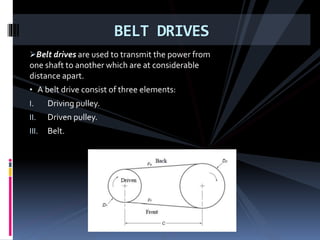
Belt drives are used to transmit the power from
one shaft to another which are at considerable
distance apart.
• A belt drive consist of three elements:
I. Driving pulley.
II. Driven pulley.
III. Belt.
BELT DRIVES
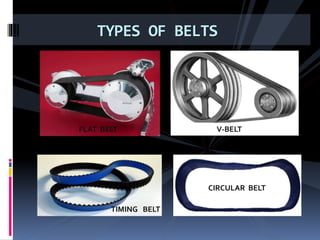
TYPES OF BELTS
FLAT BELT V-BELT
TIMING BELT
CIRCULAR BELT
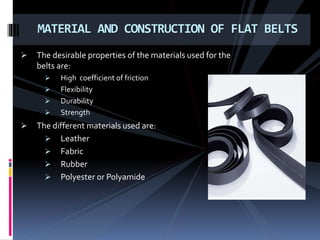
 The desirable properties of the materials used for the
belts are:
 High coefficient of friction
 Flexibility
 Durability
 Strength
 The different materials used are:
 Leather
 Fabric
 Rubber
 Polyester or Polyamide
MATERIAL AND CONSTRUCTION OF FLAT BELTS
I. Open Belt Drive.
II. Crossed Belt Drive.
III. Open Belt DriveWith Idler Pulley.
IV. Multiple Belt Drive.
V. Quarter Turn Belt Drive.
VI. Compound Belt Drive.
VII. Stepped or Cone Pulley Drive.
VIII.Fast and Loose Pulley Drive.
TYPES OF FLAT BELT DRIVES
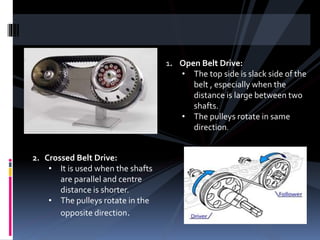
1. Open Belt Drive:
• The top side is slack side of the
belt , especially when the
distance is large between two
shafts.
• The pulleys rotate in same
direction.
2. Crossed Belt Drive:
• It is used when the shafts
are parallel and centre
distance is shorter.
• The pulleys rotate in the
opposite direction.
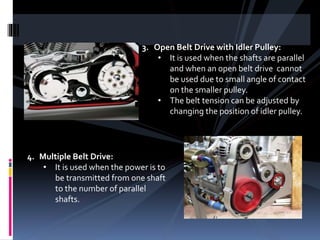
3. Open Belt Drive with Idler Pulley:
• It is used when the shafts are parallel
and when an open belt drive cannot
be used due to small angle of contact
on the smaller pulley.
• The belt tension can be adjusted by
changing the position of idler pulley.
4. Multiple Belt Drive:
• It is used when the power is to
be transmitted from one shaft
to the number of parallel
shafts.
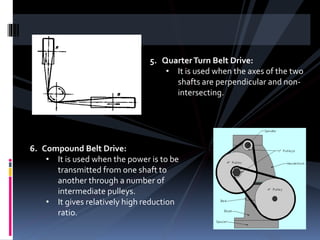
5. QuarterTurn Belt Drive:
• It is used when the axes of the two
shafts are perpendicular and non-
intersecting.
6. Compound Belt Drive:
• It is used when the power is to be
transmitted from one shaft to
another through a number of
intermediate pulleys.
• It gives relatively high reduction
ratio.
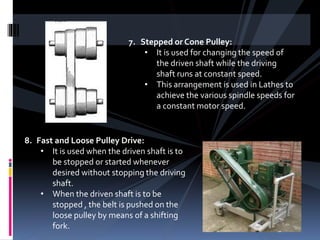
7. Stepped or Cone Pulley:
• It is used for changing the speed of
the driven shaft while the driving
shaft runs at constant speed.
• This arrangement is used in Lathes to
achieve the various spindle speeds for
a constant motor speed.
8. Fast and Loose Pulley Drive:
• It is used when the driven shaft is to
be stopped or started whenever
desired without stopping the driving
shaft.
• When the driven shaft is to be
stopped , the belt is pushed on the
loose pulley by means of a shifting
fork.
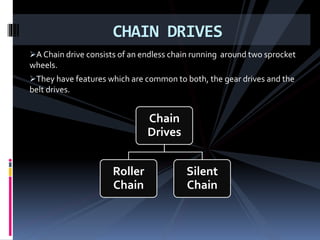
A Chain drive consists of an endless chain running around two sprocket
wheels.
They have features which are common to both, the gear drives and the
belt drives.
CHAIN DRIVES
Chain
Drives
Roller
Chain
Silent
Chain
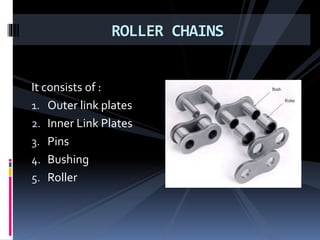
It consists of :
1. Outer link plates
2. Inner Link Plates
3. Pins
4. Bushing
5. Roller
ROLLER CHAINS
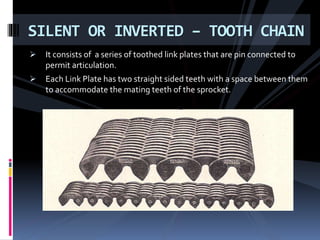
 It consists of a series of toothed link plates that are pin connected to
permit articulation.
 Each Link Plate has two straight sided teeth with a space between them
to accommodate the mating teeth of the sprocket.
SILENT OR INVERTED – TOOTH CHAIN
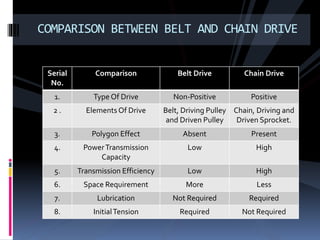
COMPARISON BETWEEN BELT AND CHAIN DRIVE
Serial
No.
Comparison Belt Drive Chain Drive
1. Type Of Drive Non-Positive Positive
2 . Elements Of Drive Belt, Driving Pulley
and Driven Pulley
Chain, Driving and
Driven Sprocket.
3. Polygon Effect Absent Present
4. PowerTransmission
Capacity
Low High
5. Transmission Efficiency Low High
6. Space Requirement More Less
7. Lubrication Not Required Required
8. InitialTension Required Not Required
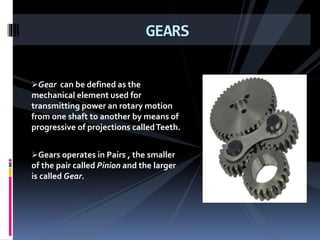
Gear can be defined as the
mechanical element used for
transmitting power an rotary motion
from one shaft to another by means of
progressive of projections calledTeeth.
Gears operates in Pairs , the smaller
of the pair called Pinion and the larger
is called Gear.
GEARS
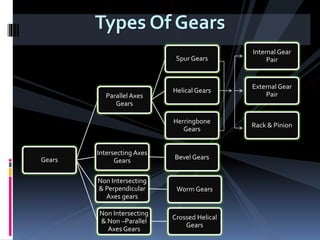
Gears
Parallel Axes
Gears
Spur Gears
Internal Gear
Pair
External Gear
Pair
Rack & Pinion
Helical Gears
Herringbone
Gears
Intersecting Axes
Gears Bevel Gears
Non Intersecting
& Perpendicular
Axes gears
Worm Gears
Non Intersecting
& Non –Parallel
Axes Gears
Crossed Helical
Gears
Types Of Gears
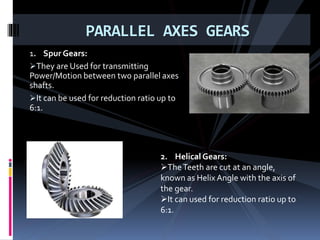
1. Spur Gears:
They are Used for transmitting
Power/Motion between two parallel axes
shafts.
It can be used for reduction ratio up to
6:1.
PARALLEL AXES GEARS
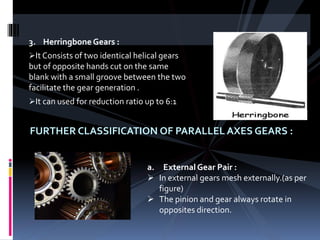
2. Helical Gears:
TheTeeth are cut at an angle,
known as Helix Angle with the axis of
the gear.
It can used for reduction ratio up to
6:1.
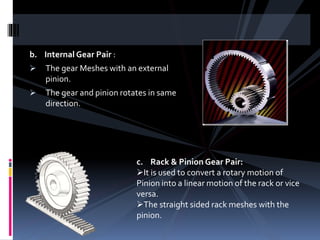
3. Herringbone Gears :
It Consists of two identical helical gears
but of opposite hands cut on the same
blank with a small groove between the two
facilitate the gear generation .
It can used for reduction ratio up to 6:1
FURTHER CLASSIFICATION OF PARALLEL AXES GEARS :
a. External Gear Pair :
 In external gears mesh externally.(as per
figure)
 The pinion and gear always rotate in
opposites direction.
b. Internal Gear Pair :
 The gear Meshes with an external
pinion.
 The gear and pinion rotates in same
direction.
c. Rack & Pinion Gear Pair:
It is used to convert a rotary motion of
Pinion into a linear motion of the rack or vice
versa.
The straight sided rack meshes with the
pinion.
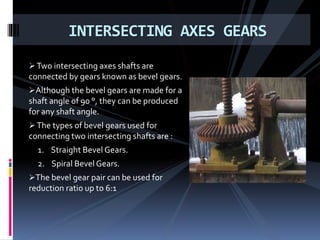
Two intersecting axes shafts are
connected by gears known as bevel gears.
Although the bevel gears are made for a
shaft angle of 90 °, they can be produced
for any shaft angle.
The types of bevel gears used for
connecting two intersecting shafts are :
1. Straight Bevel Gears.
2. Spiral Bevel Gears.
The bevel gear pair can be used for
reduction ratio up to 6:1
INTERSECTING AXES GEARS
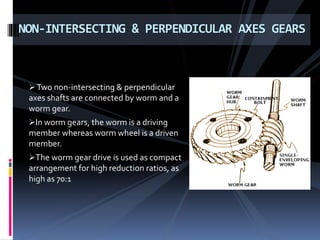
Two non-intersecting & perpendicular
axes shafts are connected by worm and a
worm gear.
In worm gears, the worm is a driving
member whereas worm wheel is a driven
member.
The worm gear drive is used as compact
arrangement for high reduction ratios, as
high as 70:1
NON-INTERSECTING & PERPENDICULAR AXES GEARS
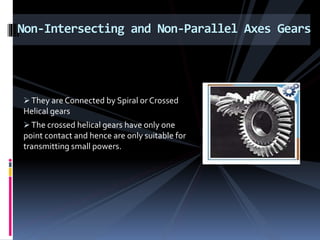
They are Connected by Spiral or Crossed
Helical gears
The crossed helical gears have only one
point contact and hence are only suitable for
transmitting small powers.
Non-Intersecting and Non-Parallel Axes Gears
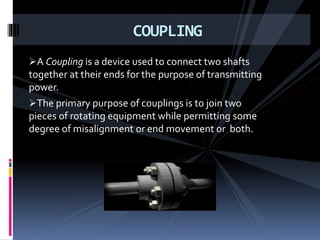
A Coupling is a device used to connect two shafts
together at their ends for the purpose of transmitting
power.
The primary purpose of couplings is to join two
pieces of rotating equipment while permitting some
degree of misalignment or end movement or both.
COUPLING
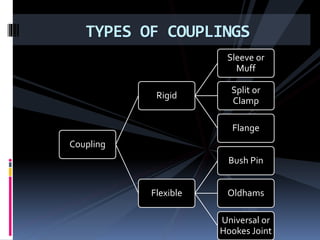
TYPES OF COUPLINGS
Coupling
Rigid
Sleeve or
Muff
Split or
Clamp
Flange
Flexible
Bush Pin
Oldhams
Universal or
Hookes Joint
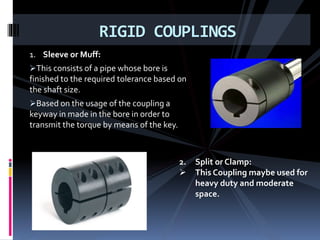
1. Sleeve or Muff:
This consists of a pipe whose bore is
finished to the required tolerance based on
the shaft size.
Based on the usage of the coupling a
keyway in made in the bore in order to
transmit the torque by means of the key.
RIGID COUPLINGS
2. Split or Clamp:
 This Coupling maybe used for
heavy duty and moderate
space.
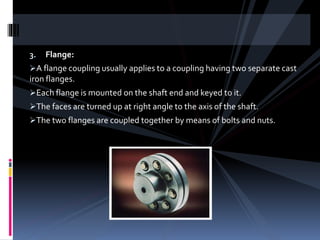
3. Flange:
A flange coupling usually applies to a coupling having two separate cast
iron flanges.
Each flange is mounted on the shaft end and keyed to it.
The faces are turned up at right angle to the axis of the shaft.
The two flanges are coupled together by means of bolts and nuts.
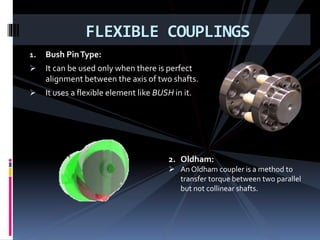
1. Bush PinType:
 It can be used only when there is perfect
alignment between the axis of two shafts.
 It uses a flexible element like BUSH in it.
FLEXIBLE COUPLINGS
2. Oldham:
 An Oldham coupler is a method to
transfer torque between two parallel
but not collinear shafts.
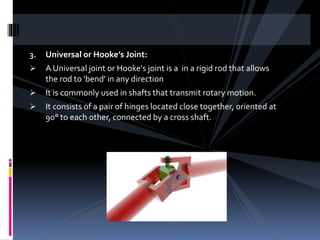
3. Universal or Hooke’s Joint:
 A Universal joint or Hooke's joint is a in a rigid rod that allows
the rod to 'bend' in any direction
 It is commonly used in shafts that transmit rotary motion.
 It consists of a pair of hinges located close together, oriented at
90° to each other, connected by a cross shaft.
THANK YOU!

Power transmission devices

  • 1.
  • 2.
     Introduction Belt Drives ChainDrives Gear Drives Couplings OUTLOOK
  • 3.
    In a modernengineering design , the trend is to design the prime movers for high power to weight ratio. The prime movers are designed with high operating speeds which are usually higher than required by the driven machines. The power transmission and speed reduction between the prime mover and the driven machine can be achieved by using the following: 1. Belt Drive. 2. Chain Drive. 3. Gear Drives. INTRODUCTION
  • 4.
    Belt drives areused to transmit the power from one shaft to another which are at considerable distance apart. • A belt drive consist of three elements: I. Driving pulley. II. Driven pulley. III. Belt. BELT DRIVES
  • 5.
    TYPES OF BELTS FLATBELT V-BELT TIMING BELT CIRCULAR BELT
  • 6.
     The desirableproperties of the materials used for the belts are:  High coefficient of friction  Flexibility  Durability  Strength  The different materials used are:  Leather  Fabric  Rubber  Polyester or Polyamide MATERIAL AND CONSTRUCTION OF FLAT BELTS
  • 7.
    I. Open BeltDrive. II. Crossed Belt Drive. III. Open Belt DriveWith Idler Pulley. IV. Multiple Belt Drive. V. Quarter Turn Belt Drive. VI. Compound Belt Drive. VII. Stepped or Cone Pulley Drive. VIII.Fast and Loose Pulley Drive. TYPES OF FLAT BELT DRIVES
  • 8.
    1. Open BeltDrive: • The top side is slack side of the belt , especially when the distance is large between two shafts. • The pulleys rotate in same direction. 2. Crossed Belt Drive: • It is used when the shafts are parallel and centre distance is shorter. • The pulleys rotate in the opposite direction.
  • 9.
    3. Open BeltDrive with Idler Pulley: • It is used when the shafts are parallel and when an open belt drive cannot be used due to small angle of contact on the smaller pulley. • The belt tension can be adjusted by changing the position of idler pulley. 4. Multiple Belt Drive: • It is used when the power is to be transmitted from one shaft to the number of parallel shafts.
  • 10.
    5. QuarterTurn BeltDrive: • It is used when the axes of the two shafts are perpendicular and non- intersecting. 6. Compound Belt Drive: • It is used when the power is to be transmitted from one shaft to another through a number of intermediate pulleys. • It gives relatively high reduction ratio.
  • 11.
    7. Stepped orCone Pulley: • It is used for changing the speed of the driven shaft while the driving shaft runs at constant speed. • This arrangement is used in Lathes to achieve the various spindle speeds for a constant motor speed. 8. Fast and Loose Pulley Drive: • It is used when the driven shaft is to be stopped or started whenever desired without stopping the driving shaft. • When the driven shaft is to be stopped , the belt is pushed on the loose pulley by means of a shifting fork.
  • 12.
    A Chain driveconsists of an endless chain running around two sprocket wheels. They have features which are common to both, the gear drives and the belt drives. CHAIN DRIVES Chain Drives Roller Chain Silent Chain
  • 13.
    It consists of: 1. Outer link plates 2. Inner Link Plates 3. Pins 4. Bushing 5. Roller ROLLER CHAINS
  • 14.
     It consistsof a series of toothed link plates that are pin connected to permit articulation.  Each Link Plate has two straight sided teeth with a space between them to accommodate the mating teeth of the sprocket. SILENT OR INVERTED – TOOTH CHAIN
  • 15.
    COMPARISON BETWEEN BELTAND CHAIN DRIVE Serial No. Comparison Belt Drive Chain Drive 1. Type Of Drive Non-Positive Positive 2 . Elements Of Drive Belt, Driving Pulley and Driven Pulley Chain, Driving and Driven Sprocket. 3. Polygon Effect Absent Present 4. PowerTransmission Capacity Low High 5. Transmission Efficiency Low High 6. Space Requirement More Less 7. Lubrication Not Required Required 8. InitialTension Required Not Required
  • 16.
    Gear can bedefined as the mechanical element used for transmitting power an rotary motion from one shaft to another by means of progressive of projections calledTeeth. Gears operates in Pairs , the smaller of the pair called Pinion and the larger is called Gear. GEARS
  • 17.
    Gears Parallel Axes Gears Spur Gears InternalGear Pair External Gear Pair Rack & Pinion Helical Gears Herringbone Gears Intersecting Axes Gears Bevel Gears Non Intersecting & Perpendicular Axes gears Worm Gears Non Intersecting & Non –Parallel Axes Gears Crossed Helical Gears Types Of Gears
  • 18.
    1. Spur Gears: Theyare Used for transmitting Power/Motion between two parallel axes shafts. It can be used for reduction ratio up to 6:1. PARALLEL AXES GEARS 2. Helical Gears: TheTeeth are cut at an angle, known as Helix Angle with the axis of the gear. It can used for reduction ratio up to 6:1.
  • 19.
    3. Herringbone Gears: It Consists of two identical helical gears but of opposite hands cut on the same blank with a small groove between the two facilitate the gear generation . It can used for reduction ratio up to 6:1 FURTHER CLASSIFICATION OF PARALLEL AXES GEARS : a. External Gear Pair :  In external gears mesh externally.(as per figure)  The pinion and gear always rotate in opposites direction.
  • 20.
    b. Internal GearPair :  The gear Meshes with an external pinion.  The gear and pinion rotates in same direction. c. Rack & Pinion Gear Pair: It is used to convert a rotary motion of Pinion into a linear motion of the rack or vice versa. The straight sided rack meshes with the pinion.
  • 21.
    Two intersecting axesshafts are connected by gears known as bevel gears. Although the bevel gears are made for a shaft angle of 90 °, they can be produced for any shaft angle. The types of bevel gears used for connecting two intersecting shafts are : 1. Straight Bevel Gears. 2. Spiral Bevel Gears. The bevel gear pair can be used for reduction ratio up to 6:1 INTERSECTING AXES GEARS
  • 22.
    Two non-intersecting &perpendicular axes shafts are connected by worm and a worm gear. In worm gears, the worm is a driving member whereas worm wheel is a driven member. The worm gear drive is used as compact arrangement for high reduction ratios, as high as 70:1 NON-INTERSECTING & PERPENDICULAR AXES GEARS
  • 23.
    They are Connectedby Spiral or Crossed Helical gears The crossed helical gears have only one point contact and hence are only suitable for transmitting small powers. Non-Intersecting and Non-Parallel Axes Gears
  • 24.
    A Coupling isa device used to connect two shafts together at their ends for the purpose of transmitting power. The primary purpose of couplings is to join two pieces of rotating equipment while permitting some degree of misalignment or end movement or both. COUPLING
  • 25.
    TYPES OF COUPLINGS Coupling Rigid Sleeveor Muff Split or Clamp Flange Flexible Bush Pin Oldhams Universal or Hookes Joint
  • 26.
    1. Sleeve orMuff: This consists of a pipe whose bore is finished to the required tolerance based on the shaft size. Based on the usage of the coupling a keyway in made in the bore in order to transmit the torque by means of the key. RIGID COUPLINGS 2. Split or Clamp:  This Coupling maybe used for heavy duty and moderate space.
  • 27.
    3. Flange: A flangecoupling usually applies to a coupling having two separate cast iron flanges. Each flange is mounted on the shaft end and keyed to it. The faces are turned up at right angle to the axis of the shaft. The two flanges are coupled together by means of bolts and nuts.
  • 28.
    1. Bush PinType: It can be used only when there is perfect alignment between the axis of two shafts.  It uses a flexible element like BUSH in it. FLEXIBLE COUPLINGS 2. Oldham:  An Oldham coupler is a method to transfer torque between two parallel but not collinear shafts.
  • 29.
    3. Universal orHooke’s Joint:  A Universal joint or Hooke's joint is a in a rigid rod that allows the rod to 'bend' in any direction  It is commonly used in shafts that transmit rotary motion.  It consists of a pair of hinges located close together, oriented at 90° to each other, connected by a cross shaft.
  • 30.