UNIT -2
MS. POOJA SEN
M.SC NURSING ( MHN)
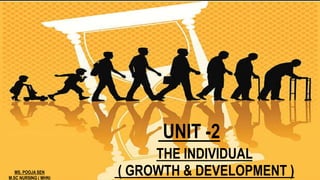
THE INDIVIDUAL
( GROWTH & DEVELOPMENT )
DEFINITION OF GROWTH
• Growth usually refers to an increase in size and number.
• Growth refers to an increase in physical size of the whole
body or any its parts.
• A child physical increase in size or amount that is easily
observed.
• Growth is the progressive increase in the size of a child or
parts of child.
• Development refers to a progressive in skill and capacity to
function.
• The ability of a child to do things that are complex and
difficult.
• Development implies overall change in shape ,form or
structure resulting in improved working or functioning.
DEFINITION OF DEVELOPMENT
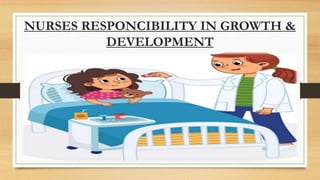
NURSES RESPONCIBILITY IN GROWTH &
DEVELOPMENT
• To know what to expect of a particular child at any given age.
• To plan for nursing management of each child .
• To better understand the reason for particular conditions &
illness that occur in various age group.
• To teach parents to observe and to provide basic knowledge
regarding growth & development.
• Assess the normal growth and development.
NURSES RESPONCIBILITY IN
GROWTH AND DEVELOPMENT
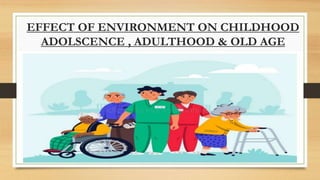
EFFECT OF ENVIRONMENT ON CHILDHOOD
ADOLSCENCE , ADULTHOOD & OLD AGE
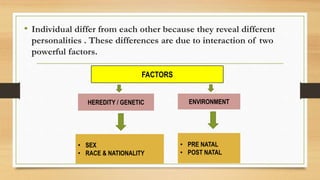
• Individual differ from each other because they reveal different
personalities . These differences are due to interaction of two
powerful factors.
HEREDITY / GENETIC ENVIRONMENT
FACTORS
• SEX
• RACE & NATIONALITY
• PRE NATAL
• POST NATAL
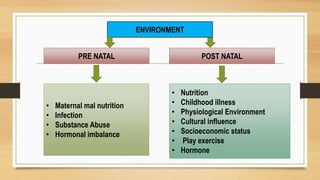
ENVIRONMENT
• Nutrition
• Childhood illness
• Physiological Environment
• Cultural influence
• Socioeconomic status
• Play exercise
• Hormone
• Maternal mal nutrition
• Infection
• Substance Abuse
• Hormonal imbalance
POST NATAL
PRE NATAL
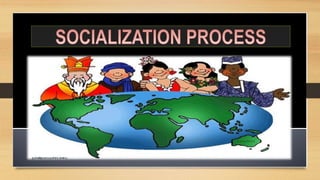
• Socialization is the process by which individuals learn the
culture of their society.
• Socialization is the process of working together of
developing group responsibility.
• Socialization is the process by which the
individual learns to norms of the group.
•They learn about behaviours that are acceptable &
those that are not.
•Socialization occurs from the moment a person is
born and continues throughout their adult life.
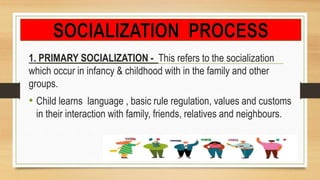
1. PRIMARY SOCIALIZATION - This refers to the socialization
which occur in infancy & childhood with in the family and other
groups.
• Child learns language , basic rule regulation, values and customs
in their interaction with family, friends, relatives and neighbours.
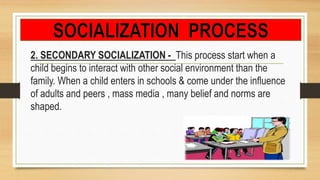
2. SECONDARY SOCIALIZATION - This process start when a
child begins to interact with other social environment than the
family. When a child enters in schools & come under the influence
of adults and peers , mass media , many belief and norms are
shaped.
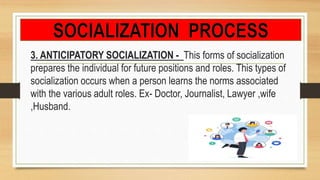
3. ANTICIPATORY SOCIALIZATION - This forms of socialization
prepares the individual for future positions and roles. This types of
socialization occurs when a person learns the norms associated
with the various adult roles. Ex- Doctor, Journalist, Lawyer ,wife
,Husband.
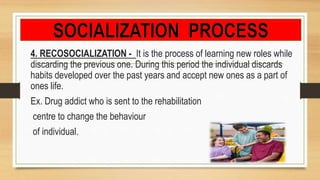
4. RECOSOCIALIZATION - It is the process of learning new roles while
discarding the previous one. During this period the individual discards
habits developed over the past years and accept new ones as a part of
ones life.
Ex. Drug addict who is sent to the rehabilitation
centre to change the behaviour
of individual.
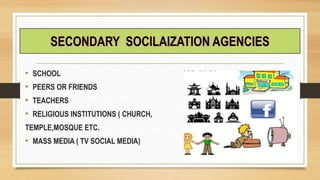
The institutions ,people and groups that contributes to socialization or those
that provide the medium of socialization are called agents or agencies of
socialization.
There are 2 forms of socialization…..
• PRIMARY SOCILIZATION AGENCY
• SECONDARY SOCIALIZATION AGENCY
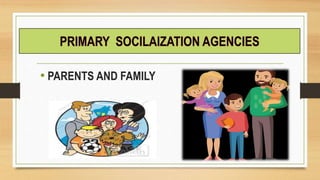
• PARENTS AND FAMILY
• SCHOOL
• PEERS OR FRIENDS
• TEACHERS
• RELIGIOUS INSTITUTIONS ( CHURCH,
TEMPLE,MOSQUE ETC.
• MASS MEDIA ( TV SOCIAL MEDIA)
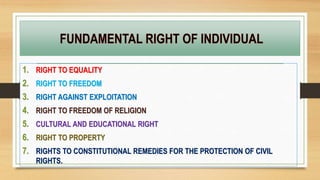
1. RIGHT TO EQUALITY
2. RIGHT TO FREEDOM
3. RIGHT AGAINST EXPLOITATION
4. RIGHT TO FREEDOM OF RELIGION
5. CULTURAL AND EDUCATIONAL RIGHT
6. RIGHT TO PROPERTY
7. RIGHTS TO CONSTITUTIONAL REMEDIES FOR THE PROTECTION OF CIVIL
RIGHTS.
RIGHT TO EQUALITY ( ARTICLE 14-18)
• All citizen equally protected by the law of country.
• State can not discriminate on the basis of caste, gender, colour,
religion and birth place .
• Equal access to public place, social equality.
• Equality in public employment.
• Abolition of untouchability.
RIGHT TO FREEDOM ( ARTICLE 19-22)
• Freedom to speech.
• Freedom to form unions or associations.
• Freedom to move freely in India.
• Freedom to practice any occupation, profession and business.
• No one can arrested without reason & also arrested person has to be presented to
magistrate with in 24 hours.
• No one can get punishment beyond the law.
RIGHT AGAINST EXPLOITATION
( ARTICLE 23-24)
• Prohibition of force labour.
• Prohibition of child labour less than 14 years of age in
any hazardous job like factory or mines.
RIGHT TO FREEDOM OF RELIGION
( ARTICLE 25-28)
• All religion are equal.
• Citizen are free to practice any religion.
• Religious organization are free to set up charitable
organization of their own.
CULTURAL & EDUCATIONAL RIGHT
( ARTICLE 29-30)
• Protection of language.
• Any religion person can set up their own educational
institutions.
• Citizen can not be discriminated for admission in a state
educational institutions.
RIGHT TO PROPERTY
( ARTICLE 19 & 31)
• All citizens have right to buy, hold or sell off property.
• No person can be deprived of their property except
through lawful means.
RIGHTS TO CONSTITUTIONAL REMEDIES FOR THE
PROTECTION OF CIVIL RIGHTS (ARTICLE 32-35)
• This right empower citizen of this country to move a
court of law in case their fundamental rights are
violated or denied.
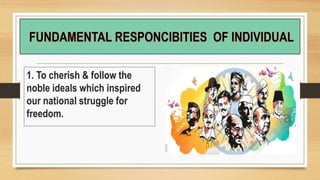
1. To cherish & follow the
noble ideals which inspired
our national struggle for
freedom.
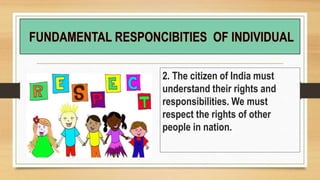
2. The citizen of India must
understand their rights and
responsibilities. We must
respect the rights of other
people in nation.
3. Rights to provide us
the freedom to do any
thing of our choice.
4. It is our
responsibility to follow
all the rule and
regulations.
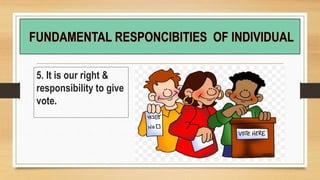
5. It is our right &
responsibility to give
vote.
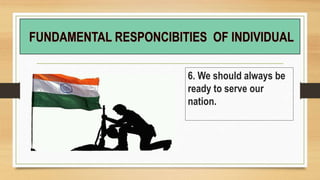
6. We should always be
ready to serve our
nation.
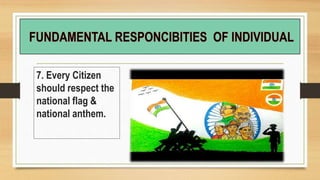
7. Every Citizen
should respect the
national flag &
national anthem.
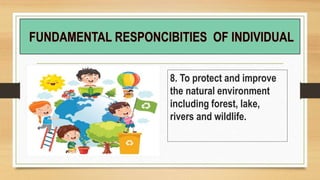
8. To protect and improve
the natural environment
including forest, lake,
rivers and wildlife.
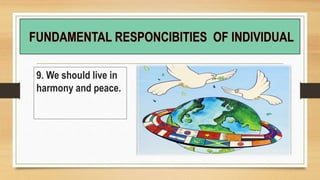
9. We should live in
harmony and peace.
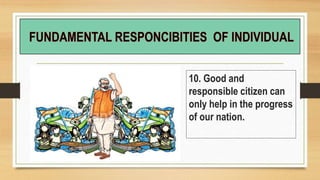
10. Good and
responsible citizen can
only help in the progress
of our nation.
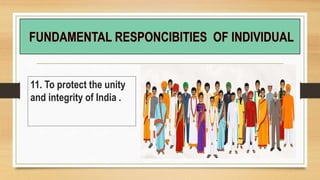
11. To protect the unity
and integrity of India .
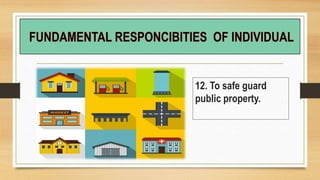
12. To safe guard
public property.
GNM UNIT -2 INDIVIDUAL GROWTHNAND DEVELOPMENT.pptx