ANATOMY
AND ANATOMICAL
DISORDERS
FOR ALL NURSING
EXAMS
PART-I
SANEESH VM
MSC NURSING( CHN)
Anatomy
The word anatomy is derived from the Greek word which means to take apart by cutting.
Anatomy is thus concerned with the study of structure and interrelationship of structures
within the human body.
 Physiology
The term physiology also derived from a Greek root with Latin equivalent physiologia, which
denotes natural knowledge. It now denotes a study of the functions of living organisms as a whole or
its constituent parts.
 Levels of Organisation of Human Body
Anatomical structures and physiological mechanisms are arranged in a series of interacting levels of
organization. At the chemical (or molecular) level of organization, chemicals interact to form
complex molecules with distinctive properties. The molecules interact to form a cell.
The cell is the smallest structural and functional unit of metabolism of organism. The human body is
made up of millions of cells of different types, each with its own form and functions. The cells are
organized in tissues, tissues to combine to form organs, and organs work together in organ system
For simplicity of learning the body is divided into nine system.
They are
1.Skeleto-muscular system
2.Cardiovascular system
3.Digestive system
4.Excretory system
5.Respiratory system
6.Endocrine System
7.Reproductive system
8.Nervous System
9.Miscellaneous – the Sense Organs (Skin, Tongue, Nose, Ear,
Eye)
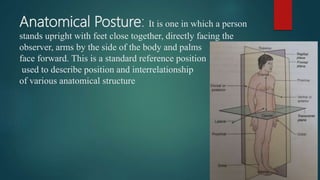
Anatomical Posture: It is one in which a person
stands upright with feet close together, directly facing the
observer, arms by the side of the body and palms
face forward. This is a standard reference position
used to describe position and interrelationship
of various anatomical structure
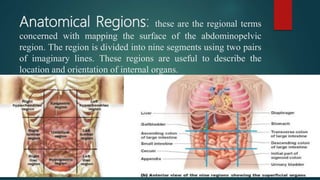
Anatomical Regions: these are the regional terms
concerned with mapping the surface of the abdominopelvic
region. The region is divided into nine segments using two pairs
of imaginary lines. These regions are useful to describe the
location and orientation of internal organs.
Body Cavities
For descriptive purposes the body is divided into the following
regions
1.Brain and Spinal Cord
2.Head and Neck
3.Upper Limbs
4.Thorax
5.Abdomen
6.Pelvis
7.Lower Limbs
Homeostatic Regulation.
It is the body's attempt to maintain a constant internal
environment. Maintaining a stable internal environment requires
constant monitoring and adjustments as conditions change. This
adjusting of physiological systems within the body is
called homeostatic regulation.
Homeostasis refers to stability, balance, or equilibrium within a
cell or the body. It is an organism’s ability to keep a constant
internal environment. Homeostasis is an important characteristic
of living things. Keeping a stable internal environment requires
constant adjustments as conditions change inside and outside the
cell. The adjusting of systems within a cell is called homeostatic
regulation. Because the internal and external environments of a
cell are constantly changing, adjustments must be made
continuously to stay at or near the set point (the normal level or
range). Homeostasis can be thought of as a dynamic equilibrium
rather than a constant, unchanging state.
Feedback Regulation Loops
The endocrine system plays an important role in homeostasis
because hormones regulate the activity of body cells. The
release of hormones into the blood is controlled by a stimulus.
For example, the stimulus either causes an increase or a decrease
in the amount of hormone secreted. Then, the response to a
stimulus changes the internal conditions and may itself become
a new stimulus. This self-adjusting mechanism is called
feedback regulation. Feedback regulation occurs when the
response to a stimulus has an effect of some kind on the original
stimulus. The type of response determines what the feedback is
called. Negative feedback occurs when the response to a
stimulus reduces the original stimulus. Positive feedback occurs
when the response to a stimulus increases the original stimulus.
Negative feedback mechanisms
Almost all homeostatic control mechanisms are negative
feedback mechanisms. These mechanisms change the variable
back to its original state or “ideal value”.
A good example of a negative feedback mechanism is a home
thermostat (heating system). The thermostat contains the
receptor (thermometer) and control center. If the heating system
is set at 70 degrees Fahrenheit, the heat (effector) is turned on if
the temperature drops below 70 degrees Fahrenheit. After the
heater heats the house to 70 degrees Fahrenheit, it shuts off
effectively maintaining the ideal temperature.
helps decrease body temperature.
Positive feedback mechanisms
A positive feedback mechanism is the exact opposite of a
negative feedback mechanism. With negative feedback, the
output reduces the original effect of the stimulus. In a positive
feedback system, the output enhances the original stimulus. A
good example of a positive feedback system is child birth.
During labor, a hormone called oxytocin is released that
intensifies and speeds up contractions. The increase in
contractions causes more oxytocin to be released and the cycle
goes on until the baby is born. The birth ends the release of
oxytocin and ends the positive feedback mechanism.
Another good example of a positive feedback mechanism is
blood clotting. Once a vessel is damaged, platelets start to cling
to the injured site and release chemicals that attract more
platelets. The platelets continue to pile up and release chemicals
until a clot is formed.
Just remember that positive feedback mechanisms enhance the
original stimulus and negative feedback mechanisms inhibit it.
Disruption of Homeostasis
Many homeostatic mechanisms keep the internal environment
within certain limits (or set points). When the cells in your body
do not work correctly, homeostatic balance is disrupted.
Homeostatic imbalance may lead to a state of disease. Disease
and cellular malfunction can be caused in two basic ways: by
deficiency (cells not getting all they need) or toxicity (cells
being poisoned by things they do not need). When homeostasis
is interrupted, your body can correct or worsen the problem,
based on certain influences. In addition to inherited (genetic)
influences, there are external influences that are based on
lifestyle choices and environmental exposure. These factors
together influence the body’s ability to maintain homeostatic
balance.
Milieu interieur:
The bodily fluids regarded as an internal
environment in which the cells of the body are
nourished and maintained in a state of equilibrium
Thank You

anatomy

  • 1.
    ANATOMY AND ANATOMICAL DISORDERS FOR ALLNURSING EXAMS PART-I SANEESH VM MSC NURSING( CHN)
  • 2.
    Anatomy The word anatomyis derived from the Greek word which means to take apart by cutting. Anatomy is thus concerned with the study of structure and interrelationship of structures within the human body.  Physiology The term physiology also derived from a Greek root with Latin equivalent physiologia, which denotes natural knowledge. It now denotes a study of the functions of living organisms as a whole or its constituent parts.  Levels of Organisation of Human Body Anatomical structures and physiological mechanisms are arranged in a series of interacting levels of organization. At the chemical (or molecular) level of organization, chemicals interact to form complex molecules with distinctive properties. The molecules interact to form a cell. The cell is the smallest structural and functional unit of metabolism of organism. The human body is made up of millions of cells of different types, each with its own form and functions. The cells are organized in tissues, tissues to combine to form organs, and organs work together in organ system
  • 3.
    For simplicity oflearning the body is divided into nine system. They are 1.Skeleto-muscular system 2.Cardiovascular system 3.Digestive system 4.Excretory system 5.Respiratory system 6.Endocrine System 7.Reproductive system 8.Nervous System 9.Miscellaneous – the Sense Organs (Skin, Tongue, Nose, Ear, Eye)
  • 4.
    Anatomical Posture: Itis one in which a person stands upright with feet close together, directly facing the observer, arms by the side of the body and palms face forward. This is a standard reference position used to describe position and interrelationship of various anatomical structure
  • 5.
    Anatomical Regions: theseare the regional terms concerned with mapping the surface of the abdominopelvic region. The region is divided into nine segments using two pairs of imaginary lines. These regions are useful to describe the location and orientation of internal organs.
  • 6.
    Body Cavities For descriptivepurposes the body is divided into the following regions 1.Brain and Spinal Cord 2.Head and Neck 3.Upper Limbs 4.Thorax 5.Abdomen 6.Pelvis 7.Lower Limbs
  • 7.
    Homeostatic Regulation. It isthe body's attempt to maintain a constant internal environment. Maintaining a stable internal environment requires constant monitoring and adjustments as conditions change. This adjusting of physiological systems within the body is called homeostatic regulation.
  • 8.
    Homeostasis refers tostability, balance, or equilibrium within a cell or the body. It is an organism’s ability to keep a constant internal environment. Homeostasis is an important characteristic of living things. Keeping a stable internal environment requires constant adjustments as conditions change inside and outside the cell. The adjusting of systems within a cell is called homeostatic regulation. Because the internal and external environments of a cell are constantly changing, adjustments must be made continuously to stay at or near the set point (the normal level or range). Homeostasis can be thought of as a dynamic equilibrium rather than a constant, unchanging state.
  • 9.
    Feedback Regulation Loops Theendocrine system plays an important role in homeostasis because hormones regulate the activity of body cells. The release of hormones into the blood is controlled by a stimulus. For example, the stimulus either causes an increase or a decrease in the amount of hormone secreted. Then, the response to a stimulus changes the internal conditions and may itself become a new stimulus. This self-adjusting mechanism is called feedback regulation. Feedback regulation occurs when the response to a stimulus has an effect of some kind on the original stimulus. The type of response determines what the feedback is called. Negative feedback occurs when the response to a stimulus reduces the original stimulus. Positive feedback occurs when the response to a stimulus increases the original stimulus.
  • 10.
    Negative feedback mechanisms Almostall homeostatic control mechanisms are negative feedback mechanisms. These mechanisms change the variable back to its original state or “ideal value”. A good example of a negative feedback mechanism is a home thermostat (heating system). The thermostat contains the receptor (thermometer) and control center. If the heating system is set at 70 degrees Fahrenheit, the heat (effector) is turned on if the temperature drops below 70 degrees Fahrenheit. After the heater heats the house to 70 degrees Fahrenheit, it shuts off effectively maintaining the ideal temperature. helps decrease body temperature.
  • 11.
    Positive feedback mechanisms Apositive feedback mechanism is the exact opposite of a negative feedback mechanism. With negative feedback, the output reduces the original effect of the stimulus. In a positive feedback system, the output enhances the original stimulus. A good example of a positive feedback system is child birth. During labor, a hormone called oxytocin is released that intensifies and speeds up contractions. The increase in contractions causes more oxytocin to be released and the cycle goes on until the baby is born. The birth ends the release of oxytocin and ends the positive feedback mechanism.
  • 12.
    Another good exampleof a positive feedback mechanism is blood clotting. Once a vessel is damaged, platelets start to cling to the injured site and release chemicals that attract more platelets. The platelets continue to pile up and release chemicals until a clot is formed. Just remember that positive feedback mechanisms enhance the original stimulus and negative feedback mechanisms inhibit it.
  • 13.
    Disruption of Homeostasis Manyhomeostatic mechanisms keep the internal environment within certain limits (or set points). When the cells in your body do not work correctly, homeostatic balance is disrupted. Homeostatic imbalance may lead to a state of disease. Disease and cellular malfunction can be caused in two basic ways: by deficiency (cells not getting all they need) or toxicity (cells being poisoned by things they do not need). When homeostasis is interrupted, your body can correct or worsen the problem, based on certain influences. In addition to inherited (genetic) influences, there are external influences that are based on lifestyle choices and environmental exposure. These factors together influence the body’s ability to maintain homeostatic balance.
  • 14.
    Milieu interieur: The bodilyfluids regarded as an internal environment in which the cells of the body are nourished and maintained in a state of equilibrium
  • 15.