PRESENT
PARTICIPLES
 Participles are verbal adjectives
 They come from verbs, but work like adjectives (agree with
the noun they describe)
 In Stage 20 we meet present participles
 In English, they end in –ing
 In Latin, they end in –ns or –nt-
 Translate them by putting –ing on the end of the verb they
come from.
WHAT IS A PARTICIPLE?
 For each sentence:
1. identify the participle and the noun it is describing
2. translate into English
EXAMPLES – P. 132
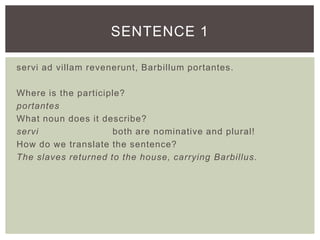
servi ad villam revenerunt, Barbillum portantes.
Where is the participle?
portantes
What noun does it describe?
servi both are nominative and plural!
How do we translate the sentence?
The slaves returned to the house, carrying Barbillus.
SENTENCE 1
ancillae prope lectum stabant, lacrimantes.
Where is the participle?
lacrimantes
What noun does it describe?
ancillae both are nominative and plural!
How do we translate the sentence?
The slave girls were standing near the bed, crying.
SENTENCE 2
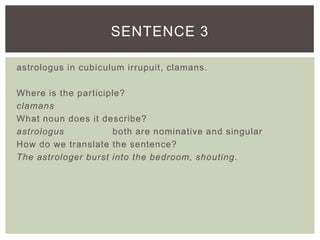
astrologus in cubiculum irrupuit, clamans.
Where is the participle?
clamans
What noun does it describe?
astrologus both are nominative and singular
How do we translate the sentence?
The astrologer burst into the bedroom, shouting.
SENTENCE 3
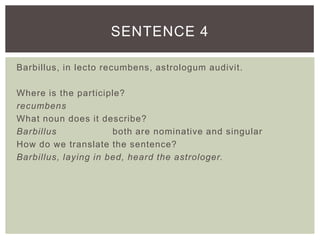
Barbillus, in lecto recumbens, astrologum audivit.
Where is the participle?
recumbens
What noun does it describe?
Barbillus both are nominative and singular
How do we translate the sentence?
Barbillus, laying in bed, heard the astrologer.
SENTENCE 4
Phormio ad urbem contendit, medicum quaerens.
Where is the participle?
quaerens
What noun does it describe?
Phormio both are nominative and singular
How do we translate the sentence?
Phormio hurried to the city, looking for a doctor.
SENTENCE 5
 All present participles have third declension endings, stuck
on the stem –nt-.
ENDINGS
Case/number Declension 3
Ending
Participle
Ending
Nominative sing. Various -ns
Accusative sing. -em -ntem
Genitive sing. -is -ntis
Dative sing. -i -nti
Nominative pl. -es -ntes
Accusative pl. -es -ntes
Genitive pl. -ium -ntium
Dative pl. -ibus -tibus
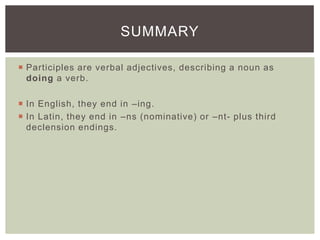
 Participles are verbal adjectives, describing a noun as
doing a verb.
 In English, they end in –ing.
 In Latin, they end in –ns (nominative) or –nt- plus third
declension endings.
SUMMARY

Present participles

  • 1.
  • 2.
     Participles areverbal adjectives  They come from verbs, but work like adjectives (agree with the noun they describe)  In Stage 20 we meet present participles  In English, they end in –ing  In Latin, they end in –ns or –nt-  Translate them by putting –ing on the end of the verb they come from. WHAT IS A PARTICIPLE?
  • 3.
     For eachsentence: 1. identify the participle and the noun it is describing 2. translate into English EXAMPLES – P. 132
  • 4.
    servi ad villamrevenerunt, Barbillum portantes. Where is the participle? portantes What noun does it describe? servi both are nominative and plural! How do we translate the sentence? The slaves returned to the house, carrying Barbillus. SENTENCE 1
  • 5.
    ancillae prope lectumstabant, lacrimantes. Where is the participle? lacrimantes What noun does it describe? ancillae both are nominative and plural! How do we translate the sentence? The slave girls were standing near the bed, crying. SENTENCE 2
  • 6.
    astrologus in cubiculumirrupuit, clamans. Where is the participle? clamans What noun does it describe? astrologus both are nominative and singular How do we translate the sentence? The astrologer burst into the bedroom, shouting. SENTENCE 3
  • 7.
    Barbillus, in lectorecumbens, astrologum audivit. Where is the participle? recumbens What noun does it describe? Barbillus both are nominative and singular How do we translate the sentence? Barbillus, laying in bed, heard the astrologer. SENTENCE 4
  • 8.
    Phormio ad urbemcontendit, medicum quaerens. Where is the participle? quaerens What noun does it describe? Phormio both are nominative and singular How do we translate the sentence? Phormio hurried to the city, looking for a doctor. SENTENCE 5
  • 9.
     All presentparticiples have third declension endings, stuck on the stem –nt-. ENDINGS Case/number Declension 3 Ending Participle Ending Nominative sing. Various -ns Accusative sing. -em -ntem Genitive sing. -is -ntis Dative sing. -i -nti Nominative pl. -es -ntes Accusative pl. -es -ntes Genitive pl. -ium -ntium Dative pl. -ibus -tibus
  • 10.
     Participles areverbal adjectives, describing a noun as doing a verb.  In English, they end in –ing.  In Latin, they end in –ns (nominative) or –nt- plus third declension endings. SUMMARY