
VERBALS
NON- VERBS
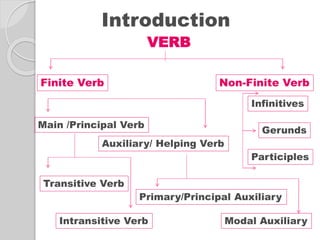
Introduction
VERB
Finite Verb Non-Finite Verb
Infinitives
Gerunds
Participles
Main /Principal Verb
Auxiliary/ Helping Verb
Transitive Verb
Intransitive Verb
Primary/Principal Auxiliary
Modal Auxiliary
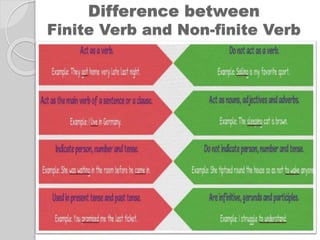
Difference between
Finite Verb and Non-finite Verb
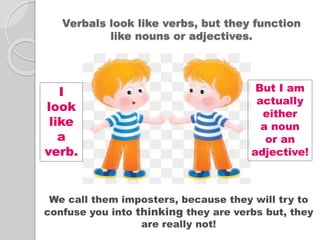
Verbals look like verbs, but they function
like nouns or adjectives.
We call them imposters, because they will try to
confuse you into thinking they are verbs but, they
are really not!
I
look
like
a
verb.
But I am
actually
either
a noun
or an
adjective!
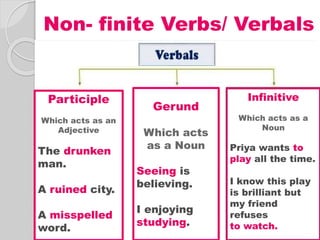
Non- finite Verbs/ Verbals
Infinitive
Which acts as a
Noun
Priya wants to
play all the time.
I know this play
is brilliant but
my friend
refuses
to watch.
Gerund
Which acts
as a Noun
Seeing is
believing.
I enjoying
studying.
Participle
Which acts as an
Adjective
The drunken
man.
A ruined city.
A misspelled
word.
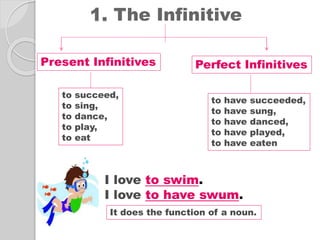
1. The Infinitive
Present Infinitives Perfect Infinitives
to succeed,
to sing,
to dance,
to play,
to eat
to have succeeded,
to have sung,
to have danced,
to have played,
to have eaten
I love to swim.
I love to have swum.
It does the function of a noun.
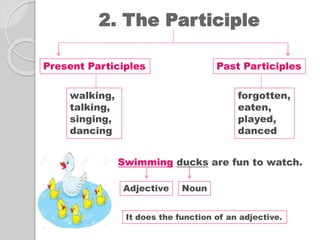
2. The Participle
Present Participles Past Participles
walking,
talking,
singing,
dancing
forgotten,
eaten,
played,
danced
Swimming ducks are fun to watch.
Noun
Adjective
It does the function of an adjective.
3. The Gerund
The Present Participle and the Gerund have the
same form.
They both end with ‘ing’ but their functions are
different.
Gerunds are Verbal Nouns.
Swimming is a good exercise.
It does the function of a noun.
Noun
Let’s practice-
1. Leaping dolphins are a great sight to behold
but fishing is what I like.
2. We are planning to visit the thundering
waterfalls and then go boating.
3. On finding no one to play with the child
began crying and his caring mother got him
an ice-cream.
4. A cracking sound broke the singing in the
room.
5. Trolling on the internet was Mohan’s
fascinating obsession till he had to pay a
high price for it.
P G I
Presented by-
Ms Swati Hasija

Verbals

  • 1.
  • 2.
    Introduction VERB Finite Verb Non-FiniteVerb Infinitives Gerunds Participles Main /Principal Verb Auxiliary/ Helping Verb Transitive Verb Intransitive Verb Primary/Principal Auxiliary Modal Auxiliary
  • 3.
    Difference between Finite Verband Non-finite Verb
  • 4.
    Verbals look likeverbs, but they function like nouns or adjectives. We call them imposters, because they will try to confuse you into thinking they are verbs but, they are really not! I look like a verb. But I am actually either a noun or an adjective!
  • 5.
    Non- finite Verbs/Verbals Infinitive Which acts as a Noun Priya wants to play all the time. I know this play is brilliant but my friend refuses to watch. Gerund Which acts as a Noun Seeing is believing. I enjoying studying. Participle Which acts as an Adjective The drunken man. A ruined city. A misspelled word.
  • 6.
    1. The Infinitive PresentInfinitives Perfect Infinitives to succeed, to sing, to dance, to play, to eat to have succeeded, to have sung, to have danced, to have played, to have eaten I love to swim. I love to have swum. It does the function of a noun.
  • 7.
    2. The Participle PresentParticiples Past Participles walking, talking, singing, dancing forgotten, eaten, played, danced Swimming ducks are fun to watch. Noun Adjective It does the function of an adjective.
  • 8.
    3. The Gerund ThePresent Participle and the Gerund have the same form. They both end with ‘ing’ but their functions are different. Gerunds are Verbal Nouns. Swimming is a good exercise. It does the function of a noun. Noun
  • 9.
    Let’s practice- 1. Leapingdolphins are a great sight to behold but fishing is what I like. 2. We are planning to visit the thundering waterfalls and then go boating. 3. On finding no one to play with the child began crying and his caring mother got him an ice-cream. 4. A cracking sound broke the singing in the room. 5. Trolling on the internet was Mohan’s fascinating obsession till he had to pay a high price for it. P G I
  • 10.