4 Scope and sequence
Viewpoint Level 1 Scope and sequence
Functions /
Topics Grammar Vocabulary
Conversation
strategies
Speaking
naturally
Unit 1
Social
networks
pages 10–19
• Ask questions
to get to know
someone
• Talk about
friends and social
networking
habits
• Use the present
tense, tend, and
will to talk about
habits
• Personality
traits (e.g.
open-minded,
pushy,
talkative)
• Formal verbs
(obtain,
withhold,
accuse)
• Ask questions to
find out or check
information
• Use And, But,
and So to start
questions which link
back to what the
previous speaker
said
• Questions
with answers
page 138
Unit 2
The media
pages 20–29
• Talk about the
influence of the
media and
celebrities
• Share views
on the impact
of TV, online
videos, and
video games
• Use defining and
non-defining
relative clauses
to give and add
information
• Use that clauses
to link ideas
• Nouns and
prepositions
(increase in,
impact on)
• Formal
expressions
(complex
issue)
• Use which clauses
to comment on your
own and others’
statements
• Use You know
what . . . ? to
introduce a
comment on what
you’re going to say
• which clauses
page 138
Unit 3
Stories
pages 30–39
• Talk about life
lessons and
experiences
• Tell stories
about your
childhood
• Use the past
tense and present
perfect forms
• Use the simple
past, past
perfect, and
past perfect
continuous
• Expressions
for school-
related
experiences
(count toward
a grade)
• Verbs (slip,
tug, etc.)
• Interrupt a story you
are telling to make a
comment and then
come back to it
• Use (It’s) no wonder
to say something is
not surprising
• Auxiliary
verbs
page 139
Checkpoint 1 Units 1–3 pages 40–41
Unit 4
Working lives
pages 42–51
• Discuss and give
advice on finding
and changing
jobs
• Share opinions
about perks and
benefits offered
by employers
• Discuss and
prepare to
answer interview
questions
• Use countable
and uncountable
nouns
• Generalize and
specify using
definite and
indefinite
articles
• Verb + noun
collocations
on the topic
of finding
a job (achieve
a goal)
• Word families
(solve – solution)
• Show your attitude
toward what you say
with -ly adverbs
• Use As a matter of
fact or In fact to give
new information
that you want to
emphasize, or
to correct what
someone assumes
or expects
• Word stress
page 139
9780521131865ovr_p004-009.indd 4 12/1/11 1:41 PM
Scope and sequence 5
Listening Reading Writing
Vocabulary
notebook
Grammar
extra
Reasons for ending
friendships
• Four people talk
about solutions
to relationship
problems
But is it fair?
• Two students debate
whether it is fair for
employers to check
out job applicants
online
Future college
students and
employees,
beware!
• An article about
the importance
of posting only
appropriate
content online
• Write a script
for a debate over
whether or not
employers should
judge applicants
by their online profile
• Plan an argument
• Contrast ideas
and arguments
• Avoid errors
with whereas
The right choice!
• Identify new
vocabulary
as formal
or informal
• Questions
• Frequency
expressions
• State verbs
pages 144–145
It’s really interesting
that . . .
• Five people discuss
the effects of TV
on young people
They’re just games
• A professor delivers
a lecture on violence
and the media
Not just a game
• An article about
the impact of
violent video
games on
young people
• Write a paragraph
in an essay about
whether songs with
violent lyrics should
be banned
• Use topic sentences
• List ideas
• Avoid errors with
listing expressions
What an effect!
• When you learn
a new noun,
find out what
prepositions are
used with it
• Verbs in subject
and object relative
clauses
• Using that clauses
• what clauses
pages 146–147
It just goes to show . . .
• Three conversations
about life lessons
How friendly are
people?
• Three students
describe the people
in their cities
Saturday
• A short story
about a woman
who suddenly
feels invisible
• Write a narrative article
about a positive or
negative experience
with people
• Brainstorm and plan
• Use verbs to structure
an article
• Avoid errors with
the past perfect
Catch up!
• Write a definition
to help you
remember
a new expression
• Time expressions
with the simple
past and present
perfect
• Time expressions
with the past
perfect
pages 148–149
Checkpoint 1 Units 1–3 pages 40–41
The best perks
• Five people discuss
and give examples of
perks and benefits
offered to employees
Interview rules
• Five applicants
are interviewed
for a job
Career help: What
questions should I
ask at a job
interview?
• An article outlining
questions a job
applicant should
and shouldn’t
ask during an
interview
• Write a personal
statement for an
application form
• Use nouns in formal
writing
• Avoid errors with
uncountable nouns
Meet that
deadline!
• When you learn
a new word,
write down
its collocations
• Making
uncountable
nouns countable
• More about
uncountable
nouns
• More about the
definite article
pages 150–151
9780521131865ovr_p004-009.indd 5 12/2/11 11:05 AM
6 Scope and sequence
Functions /
Topics Grammar Vocabulary
Conversation
strategies
Speaking
naturally
Unit 5
Challenges
pages 52–61
• Talk about world
issues and ways
to help
• Share wishes,
hopes, and
regrets about
the world
• Hypothesize
on making the
world a better
place
• Use conditional
sentences to
talk about
hypothetical
events in the
present or past
• Use wish and
hope to talk
about wishes,
hopes, and
regrets
• World
problems and
solutions
(eradicate
poverty)
• Word building
(devastate,
devastation,
devastated)
• Suggest possible
scenarios or ideas
with What if . . . ?,
suppose, and
imagine
• Use I suppose
to show that you’re
not 100 percent sure
• Shifting word
stress
page 140
Unit 6
Into the
future
pages 62–71
• Talk about the
future of money,
technology,
clothing, travel,
entertainment,
and everyday life
• Give a
presentation
• Describe future
events with be
going to, will,
may, might, and
the present
• Use modal verbs
for expectations,
guesses, offers,
necessity,
requests, etc.
• Expressions
used in giving
presentations
(As you’ll see
on the slide.)
• Nouns for
people
(climatologists)
• Use would
or ’d to soften
your opinions
• Respond with
expressions such
as I think so, I don’t
think so, and I guess
not
• Silent
consonants
page 140
Checkpoint 2 Units 4–6 pages 72–73
Unit 7
Getting along
pages 74–83
• Talk about
getting along
with friends
and family
• Compare
experiences of
growing up in
different types
of families
• Share views
on dealing with
difficult friends
• Use phrasal verbs
• Use infinitives
and -ing forms
after adjectives,
nouns, and
pronouns
• Phrasal verbs
on the topic
of house rules
(have friends
over)
• Idiomatic
expressions
(drive your
friends away,
tag along with
someone)
• Make your meaning
clear with expressions
like What I’m saying
is and I mean
• Use expressions such
as I have to say to
show that you want
to make a strong point
• Conversational
expressions
page 141
Unit 8
Food science
pages 84–93
• Talk about
farming, food,
and nutrition
• Share ideas
for eating a
healthy diet
• React to
statistics
• Use the passive
to focus on
information when
talking about the
past, present,
and future
• Use complements
of verbs that
describe causes
and effects
• Human body
parts and
processes
(heart,
metabolism)
• Noun and verb
forms of the
same root
(discovery,
discover)
• Use rhetorical
questions to make
a point
• Give examples with
expressions such as
such as, like, take,
and for instance
• Strong
and weak
forms of
prepositions
page 141
9780521131865ovr_p004-009.indd 6 12/1/11 1:41 PM
Scope and sequence 7
Listening Reading Writing
Vocabulary
notebook
Grammar
extra
What would you
give away?
• Three people talk
about ways to
help others
Inspiring people
• An interview with a
doctor about his work
with the charitable
organization
Mercy Ships
On the Mercy Ships
• An interview with
Dr. Leo Cheng,
whose volunteer
work with Mercy
Ships changes
lives in developing
countries
• Write an email inquiry
about volunteering
• Use it as subject
and object
• Avoid errors with
verb forms
Wealthy = rich
• When you learn
a new word,
write down its
synonyms or
a paraphrase
of it
• Continuous forms
for conditions
• even if and unless
to talk about
conditions
• Use of wish
with would
• Strong wishes
with If only
pages 152–153
Going cashless –
the pros and cons!
• Two friends discuss
the advantages and
disadvantages of
a cashless society
Future entertainment
• Four conversations
about entertainment
in the future
What does the future
look like?
• Four short news
articles about
developments
and changes
that could occur
in the future
• Write a one-paragraph
article about how our
everyday life will be
different in the future
• Use modal verbs with
adverbs
• Structure a paragraph
with topic, supporting,
and concluding
sentences
• Avoid errors with
adverbs
Present yourself!
• Create an “idea
string” for a
new expression
by thinking of
different ways
you can use it
• Plans and intentions
with be going to
and will
• Present forms in
clauses that refer to
the future
• More on necessity
modals
• Possibility modals
in the affirmative
and negative
pages 154–155
Checkpoint 2 Units 4–6 pages 72–73
My worst roommate
• Four people talk
about their negative
experiences with
roommates
“Boomerang” kids
• Two parents talk about
their “boomerang”
children – grown
children who move
back home
NowThat I’ve Driven
All My Friends Away,
I Finally HaveTime
For Me!
• A satirical article
with suggestions
for ways to get
rid of friends
and make time
for yourself
• Write an introduction
to an essay about
whether family
relationships are
more important
than friendships
• Use a thesis statement
• Use what clauses
to give the most
important information
• Avoid errors with
subjects
Look forward to it!
• When you learn
a new expression,
use it in a true
sentence about
someone you
know
• Objects with
separable phrasal
verbs
• Phrasal verbs
followed by the -ing
form of the verb
• More patterns
with infinitives and
it clauses
pages 156–157
A food revolution!
• Two radio show hosts
and five listeners talk
about the British chef
Jamie Oliver
Backyard beekeeping
• A man talks to
an interviewer
about his unusual
hobby – beekeeping
Where did all the
bees go?
• An article about
“colony-collapse
disorder” and why
the disappearance
of bees is a serious
threat to the
world’s food
supply
• Write a report about
trends, using
information in graphs
and charts
• Use prepositions after
verbs and nouns
• Use expressions for
approximate numbers
• Avoid errors with fall,
rise and grow
Picture this!
• Create a picture
dictionary on
your computer
• Question forms
in the passive
• Verb + object +
infinitive
• More verb patterns
pages 158–159
9780521131865ovr_p004-009.indd 7 12/1/11 1:41 PM
Functions /
Topics Grammar Vocabulary
Conversation
strategies
Speaking
naturally
Unit 9
Success and
happiness
pages 94–103
• Define and
discuss success
and happiness
• Share stories
about happy
moments and
times when
things went
wrong
• Use the
determiners
all, both, each,
every, neither,
none of, no
• Use -ing forms
as reduced
relative clauses,
to describe
simultaneous
events, and as
subjects and
objects
• Expressions
with get
(get off the
ground, get
under way,
get off to a
good start)
• Synonyms
(study =
analyze)
• Use expressions like
As far as (success) is
concerned to focus
in on a topic
• Use expressions
like As far as I’m
concerned / can tell
to give and soften
opinions
• Stress in
expressions
page 142
Checkpoint 3 Units 7–9 pages 104–105
Unit 10
Going places
pages 106–115
• Describe travel
and vacation
experiences
• Report
conversations
• Share views
on what to
take on trips
• Discuss the
effects of tourism
• Use reported
speech to report
statements
• Use reported
speech to report
questions and
instructions
• Adjectives
ending -ed
and -ing
(amazed,
amazing)
• Synonyms
(industries,
businesses)
• Use expressions such
as you mean, so what
you’re saying is, and
so I guess when
drawing conclusions
• Ask for more details
about someone’s
ideas or opinions,
using In what way?
• Silent vowels
page 142
Unit 11
Culture
pages 116–125
• Talk about
weddings, gifts,
and other
traditions
• Discuss the
positive and
negative aspects
of globalization
• Use relative
clauses with
when, where,
and whose
• Use verbs with
direct and
indirect objects
• Expressions
to describe
wedding
customs
(bride, walk
down the aisle)
• Opposites
(loss ≠
preservation)
• Soften your
comments with
expressions like kind
of, a little, and not
really
• Use Yeah, no
to agree with
someone and then
make a comment of
your own
• Consonant
groups
page 143
Unit 12
Ability
pages 126–135
• Talk about
intelligence,
skills, and
abilities
• Discuss views
on parents’ and
teachers’ roles
in developing
children’s talents
• Use adverbs
before adjectives
and adverbs
• Use as . . . as and
comparative
and superlative
adjectives and
adverbs
• Expressions to
describe types
of intelligence
and abilities
(linguistic,
articulate)
• Collocations
(raise
awareness)
• Use vague
expressions like and
that kind of thing
when you don’t
need to be precise
• Show that you
strongly agree
with someone,
using No doubt
• Stress and
intonation
page 143
Checkpoint 4 Units 10–12 pages 136–137
8 Scope and sequence
9780521131865ovr_p004-009.indd 8 12/1/11 1:41 PM
Listening Reading Writing
Vocabulary
notebook
Grammar
extra
Happy moments
gone wrong!
• Three people talk
about happy occasions
and the things that
went wrong
Happiness and
the community
• A sociology professor
lectures on policies that
can make communities
happier
Unhappy? Maybe
you’re not in the
right country!
• An article
describing ways
that governments
can take
responsibility
for their citizens’
happiness
• Write a paragraph
for an essay about
whether governments
are responsible for
citizens’ happiness
• Use expressions to
add ideas
• Avoid errors with
in addition to, etc.
Get started!
• When you learn
a new expression,
imagine using it
in an everyday
situation. Write
the situation and
what you would
say
• Singular or plural
verbs with
determiners
• Determiners with
and without of
• Verbs followed
by an -ing form
or an infinitive
• Verbs of perception
+ object + base
form or -ing form
pages 160–161
Checkpoint 3 Units 7–9 pages 104–105
More adventures
in Bolivia
• A woman tells a friend
about her plans for a
trip to Bolivia
Responsible tourism
• An eco-tour guide
discusses things
people can do to be
responsible tourists
The tourist threat
• An article about
the benefits and
dangers of the
tourist industry
• Write a survey article
for a student magazine
• Contrast ideas
• Avoid errors with
although
So amazing!
• When you learn
a new word,
make word forks
with other words
in the same
family
• Reported speech:
verbs and
pronouns
• Reported speech:
time and place
expressions
• Other reporting
verbs
• Reporting verb
forms
pages 162–163
Gift giving around
the world
• An interview about
certain gifts in different
cultures
Reviving a dying
language
• Students and their
professor discuss ideas
for saving endangered
languages
Are we losing
our culture?
• An article
discussing the
different aspects
of culture and
things that can
threaten it
• Write a concluding
paragraph in an essay
about the effects of
globalization on culture
• Explain cause and
effect
• Avoid errors with
due to
Wedding bells!
• Write new
vocabulary
on word webs
• More on relative
clauses
• Prepositions in
relative clauses
• More on verb +
direct object +
prepositional phrase
• Passive sentences
pages 164–165
Minds for the future
• Two friends discuss an
article about the five
minds that Howard
Gardner identified
The genius in all of us
• Two radio show hosts
talk about natural talent
and giftedness
Seeing things
in a completely
different way . . .
• An interview with
ChrisWaddell,
whose disability
didn’t stop him from
becoming a world
champion skier
• Write an essay about
someone you admire
• Brainstorm, then plan
an essay
• Explain purpose and
intention
• Avoid errors with
so that
It’s just the
opposite!
• When you learn
a new adjective
or descriptive
expression, find
out how to
express the
opposite meaning
• well + adjective
• Adverb and
adjective
collocations
• Patterns with
comparatives
pages 166–167
Checkpoint 4 Units 10–12 pages 136–137
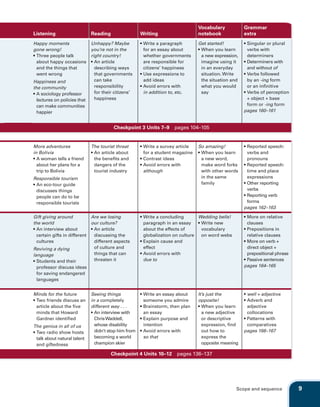
Scope and sequence 9
9780521131865ovr_p004-009.indd 9 12/1/11 1:42 PM

Viewpoint level1 sequence

  • 1.
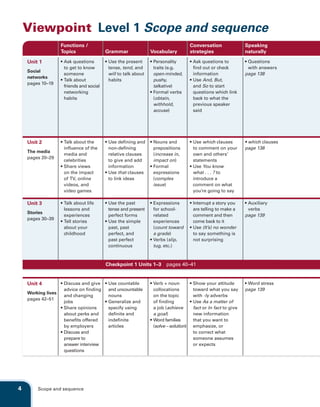
    4 Scope andsequence Viewpoint Level 1 Scope and sequence Functions / Topics Grammar Vocabulary Conversation strategies Speaking naturally Unit 1 Social networks pages 10–19 • Ask questions to get to know someone • Talk about friends and social networking habits • Use the present tense, tend, and will to talk about habits • Personality traits (e.g. open-minded, pushy, talkative) • Formal verbs (obtain, withhold, accuse) • Ask questions to find out or check information • Use And, But, and So to start questions which link back to what the previous speaker said • Questions with answers page 138 Unit 2 The media pages 20–29 • Talk about the influence of the media and celebrities • Share views on the impact of TV, online videos, and video games • Use defining and non-defining relative clauses to give and add information • Use that clauses to link ideas • Nouns and prepositions (increase in, impact on) • Formal expressions (complex issue) • Use which clauses to comment on your own and others’ statements • Use You know what . . . ? to introduce a comment on what you’re going to say • which clauses page 138 Unit 3 Stories pages 30–39 • Talk about life lessons and experiences • Tell stories about your childhood • Use the past tense and present perfect forms • Use the simple past, past perfect, and past perfect continuous • Expressions for school- related experiences (count toward a grade) • Verbs (slip, tug, etc.) • Interrupt a story you are telling to make a comment and then come back to it • Use (It’s) no wonder to say something is not surprising • Auxiliary verbs page 139 Checkpoint 1 Units 1–3 pages 40–41 Unit 4 Working lives pages 42–51 • Discuss and give advice on finding and changing jobs • Share opinions about perks and benefits offered by employers • Discuss and prepare to answer interview questions • Use countable and uncountable nouns • Generalize and specify using definite and indefinite articles • Verb + noun collocations on the topic of finding a job (achieve a goal) • Word families (solve – solution) • Show your attitude toward what you say with -ly adverbs • Use As a matter of fact or In fact to give new information that you want to emphasize, or to correct what someone assumes or expects • Word stress page 139 9780521131865ovr_p004-009.indd 4 12/1/11 1:41 PM
  • 2.
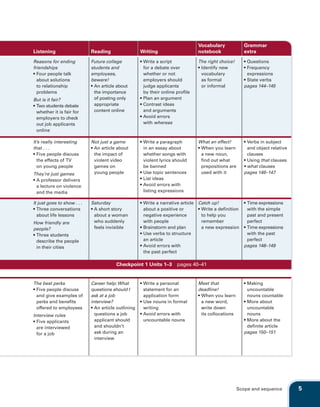
    Scope and sequence5 Listening Reading Writing Vocabulary notebook Grammar extra Reasons for ending friendships • Four people talk about solutions to relationship problems But is it fair? • Two students debate whether it is fair for employers to check out job applicants online Future college students and employees, beware! • An article about the importance of posting only appropriate content online • Write a script for a debate over whether or not employers should judge applicants by their online profile • Plan an argument • Contrast ideas and arguments • Avoid errors with whereas The right choice! • Identify new vocabulary as formal or informal • Questions • Frequency expressions • State verbs pages 144–145 It’s really interesting that . . . • Five people discuss the effects of TV on young people They’re just games • A professor delivers a lecture on violence and the media Not just a game • An article about the impact of violent video games on young people • Write a paragraph in an essay about whether songs with violent lyrics should be banned • Use topic sentences • List ideas • Avoid errors with listing expressions What an effect! • When you learn a new noun, find out what prepositions are used with it • Verbs in subject and object relative clauses • Using that clauses • what clauses pages 146–147 It just goes to show . . . • Three conversations about life lessons How friendly are people? • Three students describe the people in their cities Saturday • A short story about a woman who suddenly feels invisible • Write a narrative article about a positive or negative experience with people • Brainstorm and plan • Use verbs to structure an article • Avoid errors with the past perfect Catch up! • Write a definition to help you remember a new expression • Time expressions with the simple past and present perfect • Time expressions with the past perfect pages 148–149 Checkpoint 1 Units 1–3 pages 40–41 The best perks • Five people discuss and give examples of perks and benefits offered to employees Interview rules • Five applicants are interviewed for a job Career help: What questions should I ask at a job interview? • An article outlining questions a job applicant should and shouldn’t ask during an interview • Write a personal statement for an application form • Use nouns in formal writing • Avoid errors with uncountable nouns Meet that deadline! • When you learn a new word, write down its collocations • Making uncountable nouns countable • More about uncountable nouns • More about the definite article pages 150–151 9780521131865ovr_p004-009.indd 5 12/2/11 11:05 AM
  • 3.
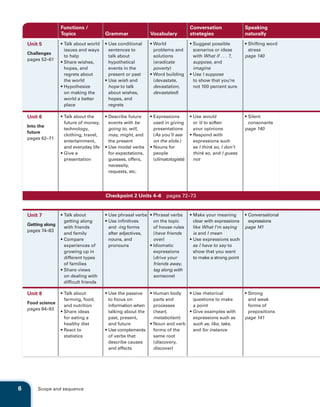
    6 Scope andsequence Functions / Topics Grammar Vocabulary Conversation strategies Speaking naturally Unit 5 Challenges pages 52–61 • Talk about world issues and ways to help • Share wishes, hopes, and regrets about the world • Hypothesize on making the world a better place • Use conditional sentences to talk about hypothetical events in the present or past • Use wish and hope to talk about wishes, hopes, and regrets • World problems and solutions (eradicate poverty) • Word building (devastate, devastation, devastated) • Suggest possible scenarios or ideas with What if . . . ?, suppose, and imagine • Use I suppose to show that you’re not 100 percent sure • Shifting word stress page 140 Unit 6 Into the future pages 62–71 • Talk about the future of money, technology, clothing, travel, entertainment, and everyday life • Give a presentation • Describe future events with be going to, will, may, might, and the present • Use modal verbs for expectations, guesses, offers, necessity, requests, etc. • Expressions used in giving presentations (As you’ll see on the slide.) • Nouns for people (climatologists) • Use would or ’d to soften your opinions • Respond with expressions such as I think so, I don’t think so, and I guess not • Silent consonants page 140 Checkpoint 2 Units 4–6 pages 72–73 Unit 7 Getting along pages 74–83 • Talk about getting along with friends and family • Compare experiences of growing up in different types of families • Share views on dealing with difficult friends • Use phrasal verbs • Use infinitives and -ing forms after adjectives, nouns, and pronouns • Phrasal verbs on the topic of house rules (have friends over) • Idiomatic expressions (drive your friends away, tag along with someone) • Make your meaning clear with expressions like What I’m saying is and I mean • Use expressions such as I have to say to show that you want to make a strong point • Conversational expressions page 141 Unit 8 Food science pages 84–93 • Talk about farming, food, and nutrition • Share ideas for eating a healthy diet • React to statistics • Use the passive to focus on information when talking about the past, present, and future • Use complements of verbs that describe causes and effects • Human body parts and processes (heart, metabolism) • Noun and verb forms of the same root (discovery, discover) • Use rhetorical questions to make a point • Give examples with expressions such as such as, like, take, and for instance • Strong and weak forms of prepositions page 141 9780521131865ovr_p004-009.indd 6 12/1/11 1:41 PM
  • 4.
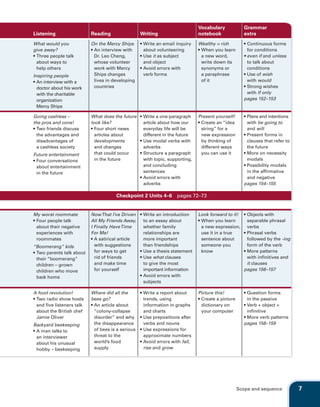
    Scope and sequence7 Listening Reading Writing Vocabulary notebook Grammar extra What would you give away? • Three people talk about ways to help others Inspiring people • An interview with a doctor about his work with the charitable organization Mercy Ships On the Mercy Ships • An interview with Dr. Leo Cheng, whose volunteer work with Mercy Ships changes lives in developing countries • Write an email inquiry about volunteering • Use it as subject and object • Avoid errors with verb forms Wealthy = rich • When you learn a new word, write down its synonyms or a paraphrase of it • Continuous forms for conditions • even if and unless to talk about conditions • Use of wish with would • Strong wishes with If only pages 152–153 Going cashless – the pros and cons! • Two friends discuss the advantages and disadvantages of a cashless society Future entertainment • Four conversations about entertainment in the future What does the future look like? • Four short news articles about developments and changes that could occur in the future • Write a one-paragraph article about how our everyday life will be different in the future • Use modal verbs with adverbs • Structure a paragraph with topic, supporting, and concluding sentences • Avoid errors with adverbs Present yourself! • Create an “idea string” for a new expression by thinking of different ways you can use it • Plans and intentions with be going to and will • Present forms in clauses that refer to the future • More on necessity modals • Possibility modals in the affirmative and negative pages 154–155 Checkpoint 2 Units 4–6 pages 72–73 My worst roommate • Four people talk about their negative experiences with roommates “Boomerang” kids • Two parents talk about their “boomerang” children – grown children who move back home NowThat I’ve Driven All My Friends Away, I Finally HaveTime For Me! • A satirical article with suggestions for ways to get rid of friends and make time for yourself • Write an introduction to an essay about whether family relationships are more important than friendships • Use a thesis statement • Use what clauses to give the most important information • Avoid errors with subjects Look forward to it! • When you learn a new expression, use it in a true sentence about someone you know • Objects with separable phrasal verbs • Phrasal verbs followed by the -ing form of the verb • More patterns with infinitives and it clauses pages 156–157 A food revolution! • Two radio show hosts and five listeners talk about the British chef Jamie Oliver Backyard beekeeping • A man talks to an interviewer about his unusual hobby – beekeeping Where did all the bees go? • An article about “colony-collapse disorder” and why the disappearance of bees is a serious threat to the world’s food supply • Write a report about trends, using information in graphs and charts • Use prepositions after verbs and nouns • Use expressions for approximate numbers • Avoid errors with fall, rise and grow Picture this! • Create a picture dictionary on your computer • Question forms in the passive • Verb + object + infinitive • More verb patterns pages 158–159 9780521131865ovr_p004-009.indd 7 12/1/11 1:41 PM
  • 5.
    Functions / Topics GrammarVocabulary Conversation strategies Speaking naturally Unit 9 Success and happiness pages 94–103 • Define and discuss success and happiness • Share stories about happy moments and times when things went wrong • Use the determiners all, both, each, every, neither, none of, no • Use -ing forms as reduced relative clauses, to describe simultaneous events, and as subjects and objects • Expressions with get (get off the ground, get under way, get off to a good start) • Synonyms (study = analyze) • Use expressions like As far as (success) is concerned to focus in on a topic • Use expressions like As far as I’m concerned / can tell to give and soften opinions • Stress in expressions page 142 Checkpoint 3 Units 7–9 pages 104–105 Unit 10 Going places pages 106–115 • Describe travel and vacation experiences • Report conversations • Share views on what to take on trips • Discuss the effects of tourism • Use reported speech to report statements • Use reported speech to report questions and instructions • Adjectives ending -ed and -ing (amazed, amazing) • Synonyms (industries, businesses) • Use expressions such as you mean, so what you’re saying is, and so I guess when drawing conclusions • Ask for more details about someone’s ideas or opinions, using In what way? • Silent vowels page 142 Unit 11 Culture pages 116–125 • Talk about weddings, gifts, and other traditions • Discuss the positive and negative aspects of globalization • Use relative clauses with when, where, and whose • Use verbs with direct and indirect objects • Expressions to describe wedding customs (bride, walk down the aisle) • Opposites (loss ≠ preservation) • Soften your comments with expressions like kind of, a little, and not really • Use Yeah, no to agree with someone and then make a comment of your own • Consonant groups page 143 Unit 12 Ability pages 126–135 • Talk about intelligence, skills, and abilities • Discuss views on parents’ and teachers’ roles in developing children’s talents • Use adverbs before adjectives and adverbs • Use as . . . as and comparative and superlative adjectives and adverbs • Expressions to describe types of intelligence and abilities (linguistic, articulate) • Collocations (raise awareness) • Use vague expressions like and that kind of thing when you don’t need to be precise • Show that you strongly agree with someone, using No doubt • Stress and intonation page 143 Checkpoint 4 Units 10–12 pages 136–137 8 Scope and sequence 9780521131865ovr_p004-009.indd 8 12/1/11 1:41 PM
  • 6.
    Listening Reading Writing Vocabulary notebook Grammar extra Happymoments gone wrong! • Three people talk about happy occasions and the things that went wrong Happiness and the community • A sociology professor lectures on policies that can make communities happier Unhappy? Maybe you’re not in the right country! • An article describing ways that governments can take responsibility for their citizens’ happiness • Write a paragraph for an essay about whether governments are responsible for citizens’ happiness • Use expressions to add ideas • Avoid errors with in addition to, etc. Get started! • When you learn a new expression, imagine using it in an everyday situation. Write the situation and what you would say • Singular or plural verbs with determiners • Determiners with and without of • Verbs followed by an -ing form or an infinitive • Verbs of perception + object + base form or -ing form pages 160–161 Checkpoint 3 Units 7–9 pages 104–105 More adventures in Bolivia • A woman tells a friend about her plans for a trip to Bolivia Responsible tourism • An eco-tour guide discusses things people can do to be responsible tourists The tourist threat • An article about the benefits and dangers of the tourist industry • Write a survey article for a student magazine • Contrast ideas • Avoid errors with although So amazing! • When you learn a new word, make word forks with other words in the same family • Reported speech: verbs and pronouns • Reported speech: time and place expressions • Other reporting verbs • Reporting verb forms pages 162–163 Gift giving around the world • An interview about certain gifts in different cultures Reviving a dying language • Students and their professor discuss ideas for saving endangered languages Are we losing our culture? • An article discussing the different aspects of culture and things that can threaten it • Write a concluding paragraph in an essay about the effects of globalization on culture • Explain cause and effect • Avoid errors with due to Wedding bells! • Write new vocabulary on word webs • More on relative clauses • Prepositions in relative clauses • More on verb + direct object + prepositional phrase • Passive sentences pages 164–165 Minds for the future • Two friends discuss an article about the five minds that Howard Gardner identified The genius in all of us • Two radio show hosts talk about natural talent and giftedness Seeing things in a completely different way . . . • An interview with ChrisWaddell, whose disability didn’t stop him from becoming a world champion skier • Write an essay about someone you admire • Brainstorm, then plan an essay • Explain purpose and intention • Avoid errors with so that It’s just the opposite! • When you learn a new adjective or descriptive expression, find out how to express the opposite meaning • well + adjective • Adverb and adjective collocations • Patterns with comparatives pages 166–167 Checkpoint 4 Units 10–12 pages 136–137 Scope and sequence 9 9780521131865ovr_p004-009.indd 9 12/1/11 1:42 PM