FOCU!i
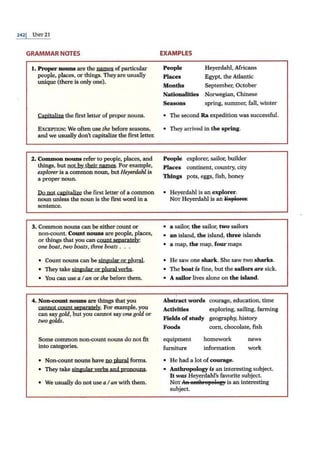
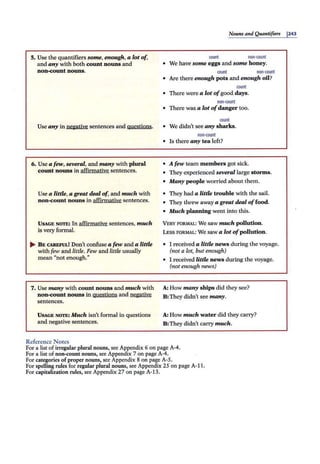
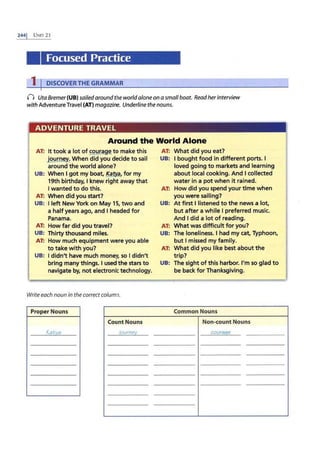
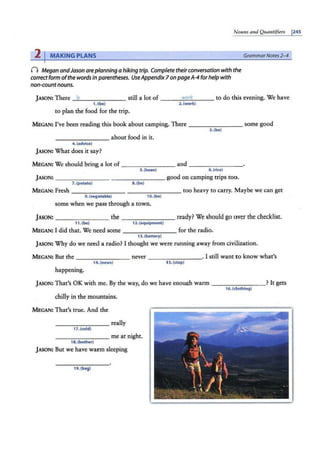
ON
6 R
AN INTEGRATED SKILLS APPROACH
THIRD EDITION
MARJORIE FUCHS
MARGARET BONNER
MIRIAM WESTHEIMER
.a.
ala
......
.,.
...
To the memory ufmy parents, Edith and Joseph Fuchs- MF
To my parents, Mam and Joseph Maus, and to my son, Luke Frances- MB
To my husband, Joel Einl.eger, and my chilJ.ren, Ari and Leora- MW
Focus ON GRAMMAR 3: An Integrated Skills Approach, Third Edition
Copyrightยฉ 2006, 2000, 1994 by Pearson Education, Inc.
All rights reserved.
No part of this publication may be reproduced,
stored in a retrieval system, or transmitted
in any form or by any means, electronic, mechanical,
photocopying, recording, or otherwise,
without the prior written permission of the publisher.
Pearson Education, l 0 Bank Street, White Plains, NY 10606
Vice president, multimedia and skills: Sherry Preiss
Executive editor: Laura Le Drean
Senior development editor: Fran~oise Leffler
Vice president, director of design and production: Rhea Banker
Director of editorial production: Linda Moser
Production supervisor: Ch ristine Edmonds
Senior production editor: Kathleen Silloway
Art director: Ann France
Senior manufacturing buyer: Nancy Flaggman
Photo research: Aerin Cs~gay
Cover design: Rhea Banker
Cover images: (background) Comstock Images (#comks76622) RF, (background center) Nick
Koudis (#AA010649) RF; (center) Harald Sund (#200131667-001) RM
Text design: Quorum Creative Services, Rhea Banker
Text composition:ElectraGraphics, Inc.
Illustrators: Steve Attoe pp. 2, 58, 59, 135, 163, 356; Bumar Technical Corporation p. 172; Moffitt Cecil pp. 19,
21, 240, 406; Ronald Chironna pp. 28, 419; Chi Chung pp. 249, 250; Chris Gash pp. 8, 9, 212, 217; Brian
Hughes pp. 16, 139, 210, 229, 230, 281, 285; jock MacRae pp. 42, 103; Tom Newsom pp. 41, 49, SO, 99,
100, 208; PC&F pp. 259, 261; Dusan Petrici pp. 17, 65, 149, 150, 256; Steve Schulman pp. 226, 352, 354,
364, 366, 420 (left); Susan Scott p. 34; Gary Torrisi pp. 199; 201, 295, 420 (right); Meryl Treamer pp. 73, 113.
Text credits: See p. x.
Photo credits: See p. x.
Library of Congress Cataloging-in-Publication Data
Focus on grammar. An integrated skills approach.- 3rd ed.
p.cm.
ISBN 0-13-147466-9 (v. 1: student book: alk. paper)-ISBN 0-13-189971-6 (v. 2:
student book: alk. paper) - ISBN 0-13-189984-8 (v. 3: student book : alk. paper)-
ISBN 0-13-190008-0 (v. 4: student book: alk. paper) - ISBN 0-13-191273-9 (v. 5:
student book : alk. paper)
1. English language-Textbooks for foreign speakers. 2. English language--Grammar-
Problems, exercises, etc.
PE1128.F555 2005
428.2'4-dc22
ISBNs: 0-13-189984-8 (Student Book)
5 6 7 8 9 10-WC-121110 09 08 07
0-13-189985-6 (Student Book with Audio CD)
5 6 7 8 9 10-WC-12 1110 09 08 07
Printed in The United States of America
LONGMAN c ' . I I W EB
Long11111n.com offers online resources for
teachers and students. Access our Companion
Websites, our online catalog, and our local
offices around the world.
Visit us at longman.com.
2005007655
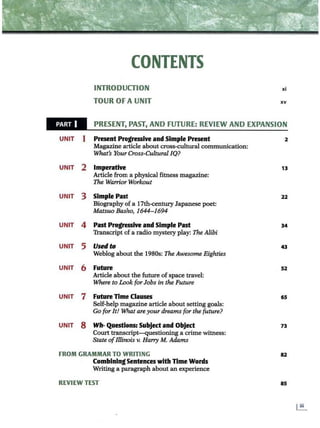
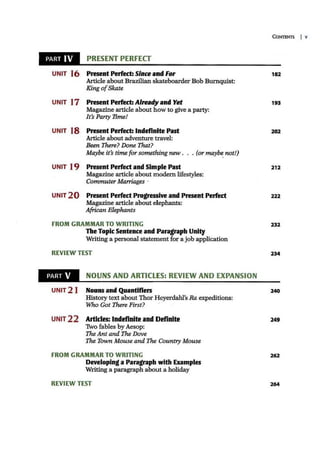
CONTENTS
INTRODUCTION
TOUR OF A UNIT
xi
xv
l:@;iiII PRESENT, PAST, AND FUTURE: REVIEW AND EXPANSION
UNIT I Present Progressive and Simple Present
Magazine article about cross-cultural communication:
Whats Your Cross-Cultural IQ?
UNIT 2 Imperative
Article from a physical fitness magazine:
The Warrior Workout
UNIT 3 Simple Past
Biography of a 17th-century Japanese poet:
MatsuoBasho, 1644-1694
UNIT 4 Past Progressive and Simple Past
Transcript of a radio mystery play: The Alibi
UNIT 5 Used to
Weblog about the 1980s: The Awesome Eighties
UNIT 6 Future
Article about the future of space travel:
Where to Look for Jobs in the Future
UNIT 7 Future Time Clauses
Self-help magazine article about setting goals:
Go for It! What are your dreams for the future?
UNIT 8 Wh- Questions: Subject and Object
Court transcript-questioning a crime witness:
State ofIllinois v. Harry M. Adams
FROM GRAMMAR TO WRITING
CombiningSentenceswith Time Words
Writing a paragraph about an experience
REVIEW TEST
2
13
22
34
43
52
65
73
82
85
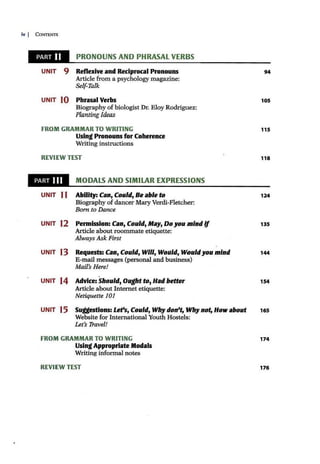
iv I CONTENT.S
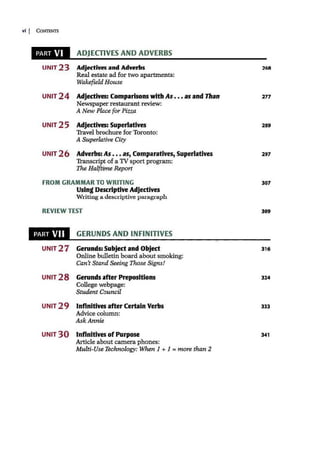
lfยง;iiil PRONOUNS AND PHRASAL VERBS
UNIT 9 Reflexive and Reciprocal Pronouns
Article from a psychology magazine:
Self-Talk
UNIT I0 Phrasal Verbs
Biography of biologist Dr. Eloy Rodriguez:
Planting Ideas
FROM GRAMMAR TO WRITING
Using Pronouns for Coherence
Writing instnlctions
REVIEW TEST
iaji;lllll
UNIT II
UNIT 12
MODALS AND SIMILAR EXPRESSIONS
Ablllty: Can, Could, Be able to
Biography ofdancer Mary Verdi-Fletcher:
Born to Dance
Permission: Can, Could, May, Doyou mind If
Article about roommate etiquette:
Always Ask First
94
105
115
118
124
135
UNIT 13 Requests: Can, Could, Will, Would, Wouldyou mind 144
E-mail messages (personal and business)
Mail's Here!
UNIT J4 Advice: Should, Oughtta, Had better
Article about Internet etiquette:
Neti.quette 101
uNIT 15 suggestions: Let's, Could, Why don't, Why not, Haw about 165
Website for International Youth Hostels:
Let's '!ravel!
FROM GRAMMAR TO WRITING 174
Using Appropriate Modals
Writing informal notes
REVIEW TEST 176
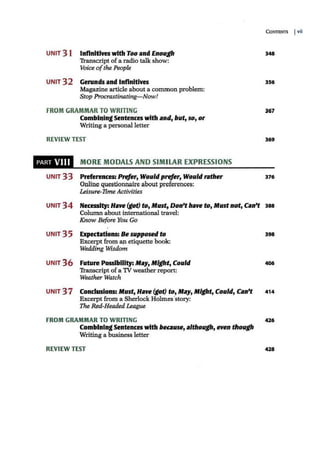
+ยง;iiC' PRESENT PERFECT
UNIT 16 Present Perfect: Sina and For
Article about Brazilian skateboarder Bob Burnquist:
King ofSkate
UNIT 17 Present Perfect:Already and Yet
Magazine article about how to give a party:
It's Party Ifme!
CONTllNTS I v
182
193
UNIT 18 Present Perfect: Indefinite Past 202
Article about adventure travel:
Been There? Done That?
Maybe it's time for something new โ€ข .. (or maybe not!)
UNIT 19 Present Perfect and Simple Past
Magazine article about modem lifestyles:
Commuter Marriages ยท
UNIT 20 Present Perfect Progressive and Present Perfect
Magazine article about elephants:
African Elephants
FROM GRAMMAR TO WRITING
The Topic Sentence and Paragraph Unity
Writing a personal statement for a job application
REVIEW TEST
212
222
232
234
l@;il!l.__
N
_O
_JJ
_N
_S
_A
_ N_
D_A
_R
_T
_l_
C_
LE
_S
_:_R
_E
_
v_
1E
_W
_ A
_N
_D
_ E
_
X_
PA
_ N_
s1
_
o_N
___
UNIT2 )
UNIT22
Nouns and Quantifiers
History text about Thor Heyerdahl's Ra expeditions:
Who Got There First? ยท
Articles: Indefinite and Definite
'IWo fables byAesop:
The Antand The Dove
The Town Mouse and The Country Mouse
FROM GRAMMAR TO WRITING
Developing a Paragraph with Examples
Writing a paragraph about a holiday
REVIEW TEST
240
249
262
264
vi I CONTENTS
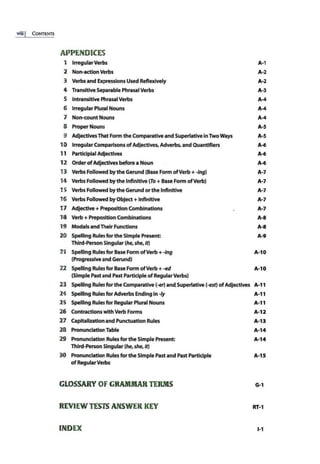
if4;Ji1i ADJECTIVES AND ADVERBS
UNIT 23 Adjectives and Adverbs
Real estate ad for two apartments:
Wakefiel.d House
UNIT 24 Adjectives: Comparisons with A.sโ€ขโ€ข โ€ขas and Than
Newspaper restaurant review:
A New Place for Pizza
UNIT 25 Adjectives: Superlatives
Travel brochure for Toronto:
A Superlative City
UNIT 26 Adverbs: Asโ€ขโ€ขโ€ข as, Comparatives, Superlatives
Jranscript ofa 1V sport program:
The Halftime Report
FROM GRAMMAR TO WRITING
Using Descriptive Adjectives
W1iting a descriptive paragraph
REVIEW TEST
iaj;ii9fi GERUNDS AND INFINITIVES
UNIT 27 Gerunds: Subject and Object
Online bulletin board about smoking:
Can't Stand Seeing Those Signs!
UNIT 28 Gerunds after Prepositions
College webpage:
Student Council
UNIT 29 Infinitives after Certain Verbs
Advice column:
AskAnnie
UNIT 30 Infinitives of Purpose
Article about camera phones:
Multi-Use Technology: When 1 + 1 =more than 2
268
277
289
297
307
309
316
324
333
341
UNIT 3 1 Infinitives with Too and Enough
'fum.script ofa radio talk show:
Voice ofthe People
UNIT 32 Gerunds and Infinitives
Magazine article about a common problem:
Stop Procrastinating-Now!
FROM GRAMMAR TO WRITING
Comblqfng Sentences with and, but, so, or
Writing a personal letter
REVIEW TEST
ifmlijlii MORE MODALS AND SIMILAR EXPRESSIONS
CONTP.NTS Ivii
348
356
367
369
UNIT 33 Preferences: Prefer, Would prefer, Would rather 376
Online questionnaire aboutpreferences:
Leisure-1lme Activities
UNIT 34 Necessity: Have (got) to, Must, Dort have to, Must not, Can't 388
Column about international travel:
Know Before You Go
UNIT 35 Expectations: Be supposed to 398
Excerpt from an etiquette book:
Wedding Wisdom
UNIT 36 Future Possibility: May, Mltfrt, Could 406
'ftanscript of a TV weatherreport:
Weather Watch
UNIT 37 Conclusions: Must, Have (got) to, May, Might, Could, Can't 414
Excerpt from a Sherlock Holmesยทstory:
The Red-Headed League
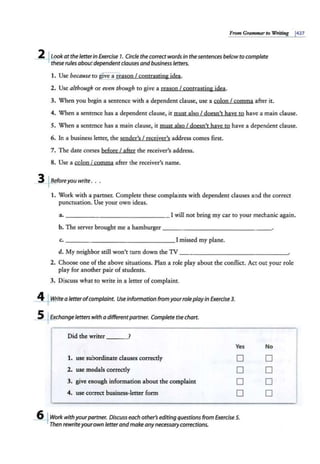
FROM GRAMMAR TO WRITING 426
Combining Sentenceswith because, although, even thouth
Writing a business letter
REVIEW TEST 428
viiiI Co1
m ..-.rrs
APPENDICES
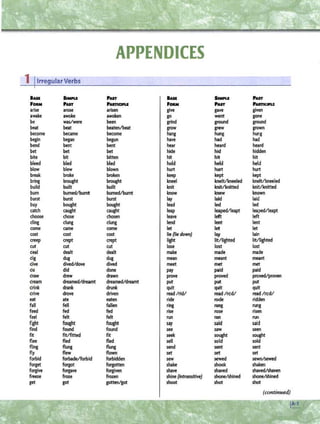
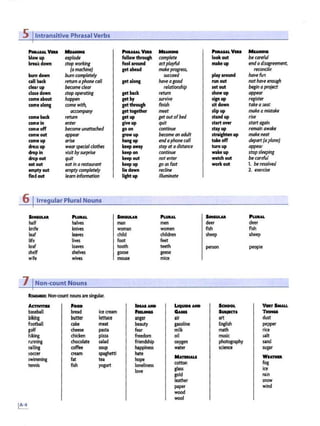
1 IrregularVerbs A-1
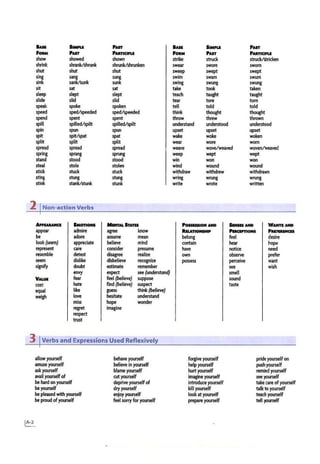
2 Non-action Verbs A-2
3 Verbs and Expressions Used Reflexively A-2
4 Transitive Separable Phrasal Verbs A-3
s Intransitive Phrasal Verbs A-4
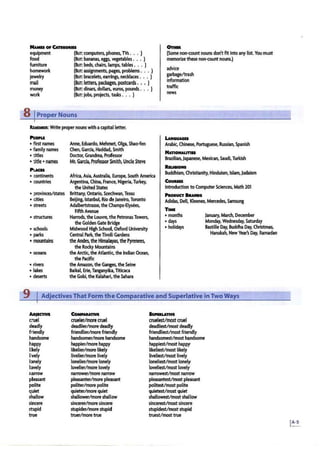
6 Irregular Plu!al Nouns A-4
7 Non-count Nouns A-4
8 Proper Nouns A-5
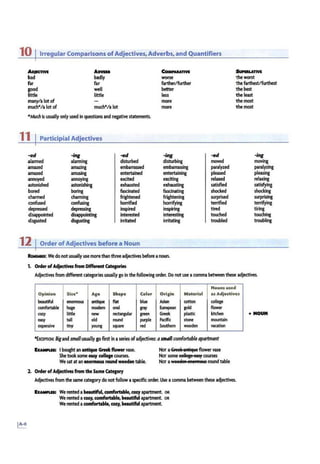
9 AdjectivesThat Form the Comparative and Superlative In Two Ways A-5
10 IrregularComparisons ofAdjectives, Adverbs, and Quantifiers A~
11 Partldplal Adjectives A~
12 Order ofAdjectives before a Noun A~
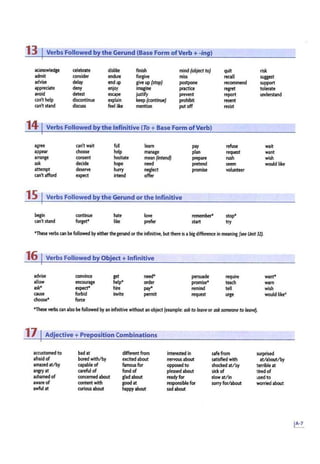
13 Verbs Followed bythe Gerund (Base Form ofVerb+ -Ing) A-7
14 Verbs Followed bythe Infinitive (To+ Base Form ofVerb) A-7
15 Verbs Followed by the Gerund or the Infinitive A-7
16 Verbs Followed by Object + Infinitive A-7
17 Adjective+ Preposition Combinations A-7
18 Verb+ Preposition Combinations A-8
19 Modals andTheir Functions A-8
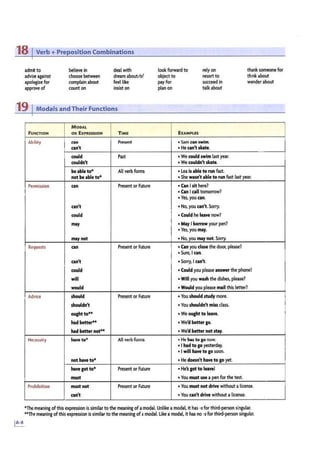
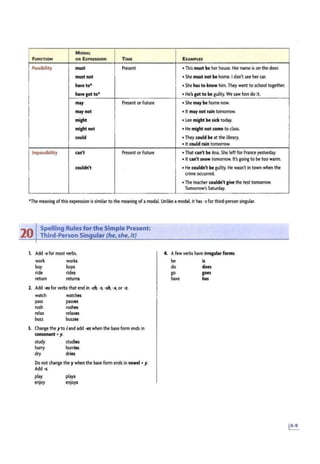
20 Spelling Rules forthe Simple Present A-9
Third-Person Singular (he,she,It)
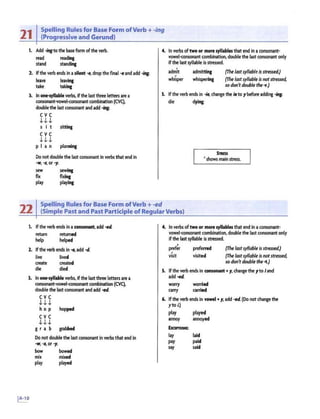
21 Spelling Rules for Base Form ofVerb +-Ing A-10
(Progressive and Gerund)
22 Spelling Rules for Base Form ofVerb + -ed A-10
(Simple Past and Past Partlclple of Regular Verbs)
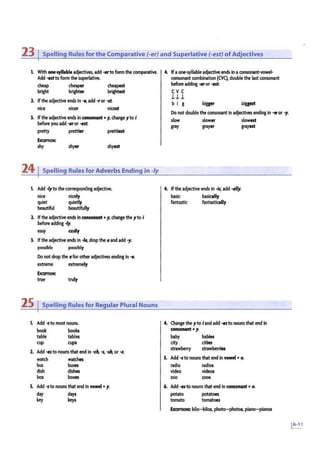
23 Spelling Rulesfor the Comparative (-er) and.Superlative (-est) ofAdjectives A-11
24 Spelling Rules for Adverbs Ending In -/y A-11
25 Spelling Rules for Regular Plural Nouns A-11
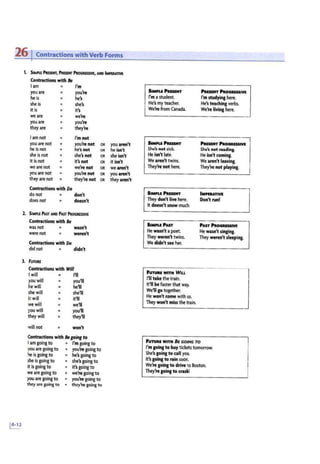
26 Contractions with Verb Forms A-12
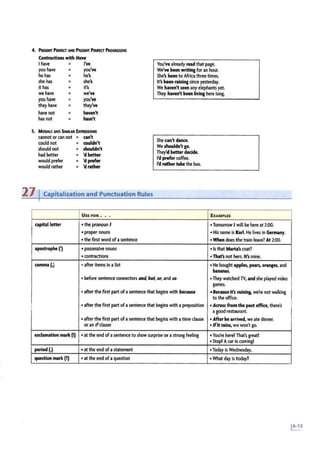
27 capitalizationand Punctuation Rules A-13
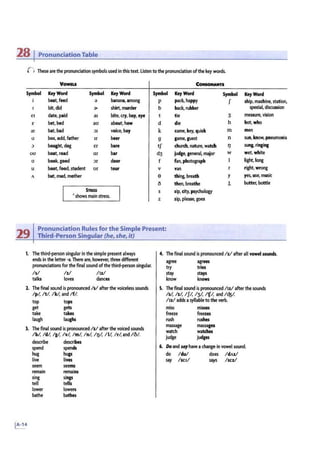
28 PronunciationTable A-14
29 Pronunciation Rules forthe Simple Present A-14
Third-Person Singular (he,she,It)
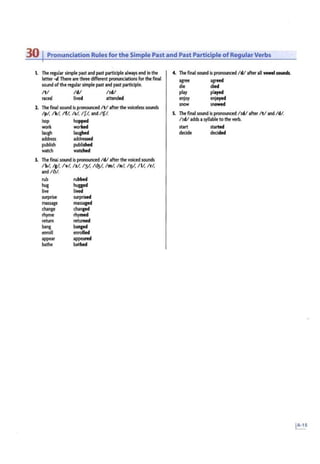
30 Pronundation Rules forthe Simple Pastand Past Participle A-15
of RegularVerbs
GLOSSARY OF GRAMMAR TERMS G-1
REVIEW TESTS ANSWER KEY RT-1
INDEX 1
-1
ABOUT THE AUTHORS
Marjorie Fuchs has taught ESL at New York City Technical College and
LaGuardia Community College of the City University of New York and EFL at the
Sprach Studio Lingua Nova in Munich, Germany. She has a master's degree in
Applied English Linguistics and a Certificate in TESOL from the University of
Wisconsin-Madison. She has authored and co-authored many widely used books
and multimedia materials, notably Crossroads, Top Twenty ESL Word Games:
Beginning Vocabulary Development, Families: Ten Card Garnes for language Learners,
Focus on Grammar 4: An Integrated Skills Approach, Focus on Grammar 3 CD-ROM,
Focus on Grammar 4 CD-ROM, Longman Englisli Interactive 3 and 4, Grammar
Express Basic, Grammar Express Basic CD-ROM, Grammar Express Intermediate,
and the workbooks to the Longman Dictionary ofAmerican English, the Longman
Photo Dictionary, The Oxford Picture Dictionary, Focus on Grammar 3 and 4, and
Grammar Express Basic.
Margaret Bonner bas taught ESL at Hunter College and the Borough of
Manhattan Community College of the City University of New York, at Taiwan
National University in Taipei, and at Vrrginia Commonwealth University in
Richmond. She holds a master's degree in Library Science from Columbia
University, and she has done work toward a Ph.D. in English Literature at the
Graduate Center of the City University of New York. She has authored and
co-authored numerous ESL and EFL print and multimedia materials, including
textbooks for the national school system ofOman, Step in.to Writing: A Basic Writing
Text, Focus on Grammar 4: An Integrated Skills Approach, Focus on Grammar 4
Workbook, Grammar Express Basic, Grammar Express Basic CD-ROM, Grammar
Express Basic Workbook, Grammar Express Intermediate, Focus on Grammar 3
CD-ROM, Focus on Grammar 4 CD-ROM, Longman English Interactive 4, and
The Ox{ord Picture Dictionary Intennediate Workbook.
Miriam Westheimer taught EFL at all levels ofinstruction in Haifa, Israel,
for a period of six years. She has also taught ESL at Queens College, at LaGuardia
Community College, and in the American Language Program ofColumbia
University. She holds a master's degree in TESOL and a doctorate in Curriculum and
Teaching from Teachers College ofColumbia University. She is the co-author ofa
communicative grammar program developed and widely used in Israel.
TEXT AND PHOTO CREDITS
p. 13, adapted from "Body Jolt" by Laurie Tarkin. Published in Fitness Magazine, July/August 1998.
Copyright 0 1998 by Laurie Tarkin. Used by permission of Laurie Tarkin; p. 52, based on a speech by
Professor Pairick Collins given at the 4th Annual FAA Commercial Space Transportation Forecasting
Conference, February 2001. Used by permission of Professor Patrick Collins; p. 57, based on an interview
conduclCd by Dr. David M. Livingston with Professor Patrick Collins on The Space Show. Used by
permission of Or. David M. Livingston and Professor Patrick Collins; p. 60, based on information from
William R. Pogue, How Do You Go to the Bathroom in Space? (New York: Tom Doherty Associates, LLC,
J999); p . 219, based on information from the Department of Commerce, Bureau of the Census, and the
Department of Health and Human Services, National Center for Health Statistics; p. 322, based on a
survey by Centers for Disease Control; p. 376, based on Roper Reports Worldwide 1997 Global Consumer
Study; pp. 385, 387, based on a survey conducted by Bon Appitit (January 1998, p. 64).
Grateful acknowledgment is given to the following for providing photographs:
p. 12, (left to right) Getty Images, MediaFocus lntemational, LLC, MediaFocus International, LLC,
MediaFocus Tnternalional, LLC; p . 13, David Mager; p . 22, Asian Art & Archaeology, Inc./Corbis; p. 27,
Bettmann/Corbis; p. 29, lwona Biedermann Photography; pp. 31, 33, RubberBall Productions; p. 43,
(top left) ยฉ1985/1987 Entertainment Rights PLC; Characters ยฉ1985/1987 Mattel Inc. All rights reserved.
She-Ra, Princess of Power; and other character names are trademarks of Mattel Inc. Used with
permission, (top right) Stefano Bianchetti/Corbis, (bottom left) Jon Riley/Index Stock Imagery. (bottom
rig/it) Paul Chesley/Getty Images; p. 46, (top) Pac-Manยฉ Namco/Image created for Photri 2005, (middle)
Dorling Kindersley. (bottom) Roger Ressmeyer/Corbis; p. 48, Lisa O'ConnorlZUMA/Corbis; p. 52, (left)
Colin Anderson/Getty Images, (middle) Michel Tcherevkoff/Gctty Images, (right) Forest J. Ackerman
Collcction/Corbis; p. 53, Forest J. Ackerman Collection/Corbis; p. 65, Birgid Allig/Getty Images; p . 76,
Jeff Cadge/Getty Images; p. 77, Chris ColHns Studio/Corbis; p. 94, (/eft) Jose Luis Pelaez/Corbis, (right)
Lou Chardonnay/Corbis; p. 105, Goldberg Diego/Corbis Sygma; p. 109, Courtesy of Dr. Eloy Rodriguez;
p . 110, Joseph Van Os/Getty Images; p. 124, Walter Seng 1998; p. 128, Frank Salle-Jim Metrisin 2004;
p. 131, John Kane/Pilobolus Inc.; pp. 132, 134, Steven W. Jones/Getty Images; p. 144, C The New Yorker
Collection 1994Wan-en Miller from cartoonbank.com. All rights reserved; p. 155, C Mick Stevens from
cartoonbank.com. All rights reserved; p. 165, (left) Courtesy of Scottish Youth Hostels Association, (right)
Courtesy of Arenal Observatory Lodge; p. 169, Robert Landau/Corbis; p. 172, Gary Cralle/Getty Images;
p. 182, Stan Liu Photography; p . 202, (left) Dave G. Houser/Corbis, (middle) Alison Wright/Corbis, (right)
Ken Redding/Corbis; p. 221, Courtesy of Felicia Mabuza-Suttle; pp. 222, 228, Jack Hollingsworth/
Getty lmagcs; p. 231, (left) Yogi, Inc./Corbis, (right) Getty Images; p . 240, Bettmann/Corbis; p. 245,
PhotoLink/Gctty Images; p. 248, NASA/Johnson Space Center; p. 254, Alinari/Art Resource, NY;
p. 257, Ralf-Finn Hestoft/Index Stock Imagery; p. 268, (top) Ariel Skelley/Corbis, (left) Getty Images,
(middle) Scott T. Baxter/Getty Images, (right) Getty Tmages; p. 275, M. Dillon/Corbis; p. 277, C Squared
Studios/Getty Images; p . 289, Andrew Gunners/Getty [mages; p. 290, Lester Lefkowitz/Corbis; p. 297,
Rebecca Cook/Reuters/Corbis; p. 303, Glyn Klrk/Getty Images; p. 304, (top) Fotosearch/Digital Vision,
(bottom) AP/Wide World Photos; p. 3 16, (left) Cancer Society ofNew Zealand, (middle) age fotost0<:k
/SupcrStock, (rig/rt) Robert Brenner/PhotoEdit; p. 3 17, State of Health Products; p . 322, Centers for
Disease Control and Prevention; p. 324, Jim Arbogast/Getty Images; p. 328, Getty Images, (bottom right)
RubberBall Productions; p. 333, RubberBall Productions; p. 334, Jeff Greenberg/PhotoEdit; p. 339,
Nancy Ney/Getty Images; p . 341, Reuters/Corbis; p. 344, (/)Getty Images, (2) NewsCom, (3) David Allan
Brandt/Getty Images, (4) Andrew Wallace/Rcuters/Corbis, (5) Richard T. Nowit7/Corbis, (6) Bill
Boch/Getty Images, (7) Omni-Photo Communications, Inc., (8) Getty Images; p. 348, RubberBall
Productions; p. 349, Carl & Ann Purcell/Corbis; p. 380, Digital Vision; p. 384, (top) Fotosearch/Corbis,
(bottom) FoodCollection/Index Stock Imagery; p. 388, Fotosearch/lmage Club; p. 398, Fotosearch/Corbis;
p . 405, Ric Ergenbright/Corbis; p. 412, Getty Images; p . 414, Universal/The Kobal Collection; p. 424,
Robert Esscl NYC/Corbis, Joseph Sohm/ChromoSohm Inc./Corbis, Getty Images, Dave Klng/Getty
Images, PictureQuest/Brand X, Dorling Kinderslcy.
INTRODUCTION
_J_ The Focus on Grammar series
Written by ELT professionals, Focus on Grammar: An Integrated Skills Approach
helps students to understand and practice English grammar. The primary aim of the
course is for students to gain confidence in their ability to speak and write English
accurately and fluently.
The third edition retains the series' focus on English grammar through lively
listening, speaking, reading, and writing activities. The new Focus on Grammar
also maintains the same five-level progression as the second edition:
โ€ข Level 1 (Beginning, formerly Introductory)
โ€ข Level 2 (High-Beginning, formerly Basic)
โ€ข Level 3 (Intermediate)
โ€ข Level 4 (High-Intermediate)
โ€ข Level 5 (Advanced)
_J_ What is the Focus on Grammar methodology?
Both controlled and communicative practice
While students expect and need to learn the formal rules of a language, it is crucial
that they also practice new structures in a variety of contexts in order to internalize
and master them. To this end, Focus on Grammar provides an abundance of both
controlled and communicative exercises so that students can bridge the gap between
knowing grammatical structures and using them. The many communicative
activities in each Student Book unit provide opportunity for critical thinking while
enabling students to personalize what they have learned in order to talk to one
another with ease about hundreds ofeveryday issues.
A unique four-step approach
The series follows a four-step approach:
Step 1: Grammar in Context shows the new structures in natural contexts, such as
articles and conversations.
Step 2:Grammar Presentation presents the structures in clear and accessible
grammar charts, notes, and examples.
Step 3: Focused Practice of both form and meaning of the new structures is
provided in numerous and varied controlled exercises.
Step 4: Communication Practice allows students to use the new structures freely
and creatively in motivating, open-ended activities.
xii I [)'.'TllODucnoN
Thorough recycling
Underpinning the scope and sequence of the Focus on Grammar series is the belief
that students need to use target structures many times, in different contexts, and at
increasing levels of difficulty. For this reason, new grammar is constantly recycled
throughout the book so that students have maximum exposure to the target forms
and become comfortable using them in speech and in writing.
Acomplete classroom text and reference guide
Amajorgoal in the development of Focus on Gram
.mar has been to provide
students with books that seive not only as vehicles for classroom instruction but
also as resources for reference and self-study. In each Student Book, the
combination of grammar chartS, grammar notes, a glossary ofgrammar terms, and
extensive appendices provides a complete and invaluable reference guide for
students.
Ongoing assessment
Review Tests at the end of each part of the Student Book allow for continual self-
assessment. In addition, the tests in the newFocus on Grammar Assessment
Package provide teachers with a valid, reliable, and practical means of determining
students' appropriate levels of placement in the courseand ofassessing students'
achievement throughout lhe course. At Levels 4 (High-Intermediate) and 5
(Advanced), Proficiency Tests give teachers an overview of their students' general
grammar knowledge.
--L What are the components of each level of Focus on Grammar?
Student Book
The Student Book is divided into eight or more parts, depending on the level. Each
part contains grammatically related units, with each unit focusing on specific
grammatical structures; where appropriate, units present contrasting forms. The
exercises in each unit are thematically related to one another; and all units have the
same clear, easy-to-follow format.
Teacher's Manual
The Teacher's Manual contains a variety ofsuggestions and information to enrich
the material in the Student Book. It includes general teaching suggestions for each
section of a typical unit, answers to frequently asked questions, unit-by-unit
teaching tips with ideas for further communicative practice, and a supplementary
activity section. Answers to the Student Book exercises and audioscripts of the
listening activities are found at the back of the Teacher's Manual. Also included in
the Teacher's Manual is a CD-ROM of teaching tools, including PowerPoint
presentations that offer alternative ways ofpresentingselected grammar structures.
Workbook
The Workbook accompanying each level ofFocus on Grammar provides additional
.exercises appropriate for self-study of the target grammar for each Student Book
unit. Tests included in each Workbook provide students with additional
opportunities for self-assessment.
INTRODUCTION Ixiii
Audio Program
All ofthe listening exercises from the Student Book, as well as the Grammarin
Context passages and other appropriate exercises, are included on the program's
CDs. In the book, the symbol [) appears next to the listening exercises. Another
symbol (), indicating that listening is optional, appears next to the Grammar in
Context passages and some exercises. All ofthese scripts appear in the Teacher's
Manual and may be used as an alternative way of presenting the activities.
Some Student Books are packaged with a separate Student Audio CD. This CD
includes the listening exercise from each unit.
CD-ROM
The Focus on Grammar CD-ROM provides students with individualized practice
and immediate feedback. Fully contextualized and interactive, the activities broaden
and extend practice of the grammatical structures in the reading, writing, listening,
and speaking skills areas. The CD-ROM includes grammar review, review tests,
score-based remedial practice, games, and all relevant reference material from the
Student Book. It can also be used in conjunction with the Longman Interactive
American Dictionary CD-ROM.
Assessment Package (NEW)
An extensive, comprehensive Assessment Package has been developed for each level
ofthe third edition ofFocus on Grammar. The components ofthe Assessment
Package are:
1. Placement, Diagnostic, and Achievement Tests
โ€ข a Placement Test to screen students and place them into the correct level
โ€ข Diagnostic Tests for each part of the Student Book
โ€ข Unit Achievement Tests for each unit ofthe Student Book
โ€ข PartAchievement Tests for each part ofthe StudentBook
2. General Proficiency Tests
โ€ข two Proficiency Tests at Level 4 (High-Intermediate)
โ€ข two Proficiency Tests at Level 5 (Advanced)
These tests can be administered at any point in the course.
3. Audio CD
The listening portions ofthe Placement, Diagnostic, and Achievement Tests are
recorded on CDs. The scripts appearin the Assessment Package.
4. Test-Generating Software
The test-banksoftware provides thousands ofquestions from which teachers can
create class-appropriate tests. All items are labeled according to the grammar
structure they are testing, so teachers can easily select relevant items; they can
also design their own items to add to the tests.
xiv I INraooucnoN
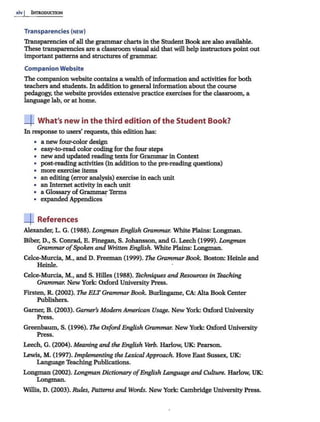
Transparencies (NEW)
Thansparencies of all the grammar charts in the Student Book are also available.
These transparencies are a classroom visual aid that will help instructors point out
important patterns and structures of grammar.
Companion Website
The companion website contains a wealth ofinformation and activities for both
teachers and students. In addition to generalinformation about the course
pedagogy, the website provides extensive practice exercises for the classroom, a
language lab, or at home.
4- What's new in the third edition of the Student Book?
In response to users' requests, this edition has:
โ€ข a new four-color design
โ€ข easy-to-read color coding for the four steps
โ€ข new and updated reading texts for Grammar in Context
โ€ข post-readingactivities (in addition to the pre-reading questions)
โ€ข more exercise items
โ€ข an editing (error analysis) exercise in each unit
โ€ข an Internet activity in each unit
โ€ข a Glossary ofGrammarTerms
โ€ข expanded Appendices ยท
-t- References
Alexander, L. G. (1988). Longman English Grammar. White Plains: Longman.
Biber, D., S. Conrad, E. Finegan, S. Johansson, and G. Leech (1999). Longman
Grammar ofSpoken and Written English. White Plains: Longman.
Celce-Murcia, M., and D. Freeman (1999). The GrammarBook. Boston: Heinle and
Heinle.
Celce-Murcia, M., and S. Hilles (1988). Techni.ques and Resources in Teaching
Grammar. New York: Oxford University Press.
Firsten, R. (2002). The BLTGrammarBook. Burlingame, CA: Alta Book Center
Publishers.
Garner, B. (2003). Gamer's Modern American Usage. New York: Oxford University
Press.
Greenbaum, S. (1996). The Oxford English Grammar. New York: Oxford University
Press.
Leech, G. (2004). Meaning and the English Verb. Harlow, UK: Pearson.
Lewis, M. (1997). Implementing the Lexical Approach. Hove East Sussex, UK:
Language Teaching Publications.
Longman (2002). Longman Dictionary ofEnglish Language and Culture. Harlow, UK:
Longman.
Willis, D. (2003). Rules, Patterns and Words. New York: Cambridge University Press.
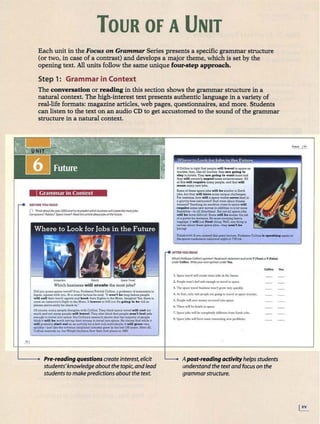
TOUR OF A UNIT
Each unit in the Focus on Grammar Series presents a specific grammar structure
(or two, in case of a contrast) and develops a major theme, which is set by the
opening text. All units follow the same unique foUl'-step approach.
Step 1: Grammar in Context
The conversation or reading in this section shows the grammar structure in a
natural context. The high-interest text presents authentic language in a variety of
real-life formats: magazine articles, web pages, questionnaires, and more. Students
can listen to the text on an audio CD to get accustomed to the sound ofthe grammar
structure in a natural context.
โ€ขGrammar in Context
BEFOREYOU READ
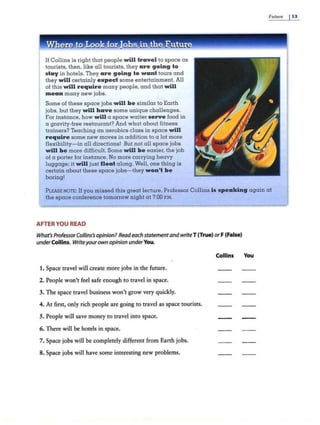
n 711ii'lkotaoClrtht"jtaf20WondrtyU>JNf<lktwhichbUJl'l'/ltU wiยปGl'~rt lhtmoujoln.
(omP4JtttS! ~sl$l>O(tru)ld}A~rlllson/deobotlrfobs<>ImtN1we.
(""1fJKIUtJ .tobob $.Pยซt fl(1t'ff
Which business will create the most jobs?
Did you guouspoco lrovet? If so. Profo111or Patdd: CollJns.,a: prolo11or ofecoDOmies l.n
Jc:p<m. ogre.1 with you. A1o โ€ข~nt leciwe he eoid. Mlt won't l:lo long betore ,,.ople
wlll coll lh.Jr tfO'YtlCOtfll&c:Ad b-k !Mlrtllghi. lO~Mooo.lmc.gl.flโ€ขt Y
N. there ii
roorn<m tocnonow's IUght 101he Moon. Is l eaves at !kOOA.M. 1tโ€ข1 going to be full so
please onivโ€ข owly tor di.cltยทtn:
OfCIOUJ'f9. ""'flY Pf'OPlโ€ขdl.togr.. w1th Colllnt. Tboy think 'lXJCโ€ข U<rVtl wlll co.. too
much and!)()! many poople will ll"avol. ThGyotso think lhol pooplo won't fe ol 1afo
et10119b to Uavol lntospaice-. ButCollina's 1~b ilhOW'fl tbal the mojorityol J*l'Plโ€ข
tblale l1wnl bo YIOllh to'vi1:19 tbโ€ขIJ moo.,- 10 l:t(rvt! 1.0.1
0 tpo(!IO, Hโ€ข ekitaH tbot whllโ€ข ll
will PfQbably dart out oโ€ข onac1
1vlty !Mo fow rich l.ndlโ€ขfdl)(ll.. 11 will powvory
qWcldy- ju.1like tho OYlotion (airplanโ€ข)indu51ry grttw in I.holaid 100 years. Aftoroll,
Collin.tโ€ขm.itld.a.11$. tbโ€ข Wr1$bt bro!Mr. new 1
.h.ob lir1t plono In 1903.
Pre-reading questions createinterest,elicit
students'knowledge aboutthetopic, andlead
students to make predictionsaboutthe text.
I eo oobi e e -----~-
IfColllr11 l1 r1gb1 thot J>tOple wUl travel lo 1poc. 01
tourl1ยท1
.. then, Ulceoll 1011,rlโ€ขt.1. th.oy a N going to
day 1.n ho!el.1. Thoy orโ€ข 901np to want louncmd
tlay willco1tainlyโ€ขโ€ขPโ€ขC-t .omoe:1tcu1a:lr1m4tnt. All
ol thlโ€ข wlll r equlre mooy J>tOi>lt.Clld 1
ho1 wW
moa:n many nโ€ขw jobt.
Somโ€ขQI tlaM tJ)CIC'O Jobs wlU Jloe timllw: toEe.rib
Jobโ€ข. but they will havo eomo UDI~cMll~
For lnrta.nco. how wlll a_~woitt r servo t'OOd bi
a grcvitr ยทlrff tโ€ข tawant? And wbat obO'u.t fll.rle11
tKtl:w:l:'I? TO<ICbl~(ll) ae:~~CICM I.'#pOCO wW
N qW- somt D.-WtDO'Vff lnccldhkm 1
0 a k>I more
flexibllilf-in all dlroctLoas! But D01 all 1pace jobs
wUI be mc-:e dUfiai.lt. Somo wW Z,e easter, tho job
QI a porter forh~.ttaacโ€ข. Notl)(X't eorrytog h.crry
luggago: it wW}ult lloatalong , W.U. one thlnig Lt
ยซ r!a:in about theae โ€ขJ)Clce jobs- tboy wonยท't be
boru>g1
Rl.EASEliOTC Uyou mluodtb.iโ€ข groat !~tu~. Profo1tor Colli.ti.a It: โ€ขP~~OI
lhe 1po,ee contereDC:e tomorrow nlvht o-t71XJP
lf.
AFTER YOU READ
Whal PtoltSSOtCo.YinsQPinion!RmNCltftl7ftmff'/rtMd1wirtT l"Trut)OIf C
Fโ€ขlsโ€ขI
vricJ.trColtlns. .'i'tirf'fO'ltOWncp(~l,lfl(/vY<>"'
I. Space u-.-vel will creJ.1c more jobs i11 1hC' fo1ut('.
l. PtOpk ""'OCI' r~โ€ข ~fcttio..q;h 100';Yd in spate'.
J. Thespll<'t u11vcl bw;:int$$ won'r $fOW very quiclcly.
.f, At fu:St, only rkh ptoplc ;irl' p โ€ขig ta u.avd ai ~aยซ cournn..
s.PeQP!c W'lll UVC' money 10 lt"โ€ขd l-fllO,~<'.
6.Thtrc wilt bl:' bo1ch1n s:p.acc.
7. Splยซ to-In will be- coโ€ขnr lecdy difft'ren1ft0m ~nh job,.
8. Splltt' j(Jbf will h~'"e some intatlllni;. n'.cw probklrn.
Comns You
Apost-reading activityhelpsstudents
understandthetextand focus on the
grammarstructure.
xvi I TOUR OF A UNIT
Step 2: Grammar Presentation
This section is made up of grammar charts, notes, and examples. The grammar
charts focus on the forms ofthe grammar structure. The grammar notes and
examples focus on the meanings and uses of the structure.
Clearand easy-to-readgrammarcharts
present thegrammarstructure in allits
forms and combinations.
โ€ขGrammar Presentation
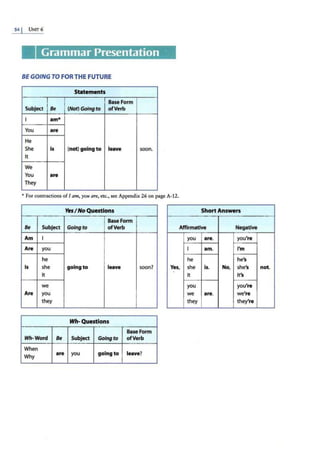
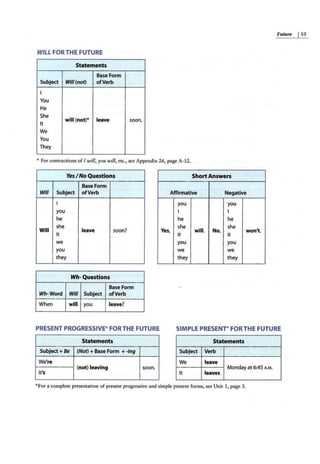
BE GOING TOFORTH.E FUTURE
Sr..tโ€ขmโ€ขnl'
~-fO!Yl'I
ยท-.. !NotJGoi't!o]k> ......
โ€ข mโ€ข
'~ ...
"'
... .. (not)9oln9 to lu ...
-
"
w.
'~
.,.
- a.~f.otm
.. ยทยท-Goi'rtgto ofVefb Afflmw.11v~ ........
Am I ,.., '"ยท
,.,, .... -ยท ....
"' "' ""
k .... toi"'9 to
ยท
- ..,., YH, ... ... ... ""'
โ€ข ,, ยซโ€ข
.. ,,.. ,.,.,..
... ,,.. -'"ยท
_,,
""" ""'
....,,,.
Wb.~s-tiOfS
ltStfOmt
W?t-Wotd .. '"'lยซ< """'"
ofV!rb
WO,.,
Why
... "'"
9011'19 10
,_,
-E h
ac l
hort,s1mp e
grammarno e gives as
explanation ofone use ofthe structure.
Theaccompanying examples ensure
students'understanding ofthepoint.
Ml lh-lrโ€ข
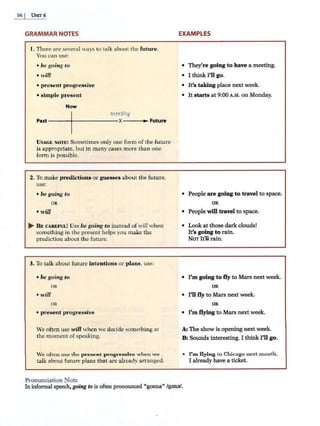
... GRAMMARHOltS EX~MPlES
I. lhcrc att ~<t~ ....a)'S tQ talkabout thefuture.
Yo" cn.n UM':
ยท be~ยท~to โ€ข They'tt going; to havea meetil8.
"";11 โ€ข I think I'll JO.
โ€ข pruenl P""""''h..- โ€ข It'โ€ขtaking: pl11cenext ~le.
โ€ข si.mp&e pn-~n1 โ€ข fl siarU a1 9:00A.M. on MoOO~y.
-
I """""
,.... P~Jt lt- r
"t11re
ยท~
~C.tl S<m!; So~ctltrK" only~ fOlll'I orIllefutll'CI
b 11pPf011rilltt', budnmany ยฎJCS more than one
form I~ P<*"lhkยท
'l. To 1
n:tkeo 1
)1
-edk1.l.O:iโ€ข otgun~ about 1
hc.futun",
~'
โ€ข beioflf.8 IQ โ€ข Pco1*Ui' goi:nl to lr.11~110"fยปCC..
.. ..
โ€ข wm โ€ข P~ w;IJ ln"~l 1
0 "p;acc.
r4 โ€ข 81! Crlll'.t'11J U$c btroJnzJo iml(llldofwfll,,.htfl โ€ข Lont n lhoscd:u'k ckluds!
jOolt'lยขlliiA$: f111ht ~I hc-)ps )"Oii mak,cti( Jt'f t;Obl$ 10n.ln.
pmlic1ion a.boot t~ futu~. NOT ltli rain,
J. To tlllk n.bou1 fumtt lnun11<1ru; orpl~.uw::
โ€ข he k(J(lf~ "' โ€ข l'm goiog to Ry 10 J.laN next v.'C'tk.
.. ..
โ€ข will โ€ข I'll Oy to M.al'3 nienv.w.lt.
.. ..
ยท ~ni p~~""- โ€ข l"1n Pybi1 to Ma.rst1ct~ '*'.'tk.
We olteil u.w wll/,;.I~ WCdttidc~c;thlfll.โ€ข โ€ข A: The.-shciw i'<ipcniQg nut wttk.
tl'll: moamn1o(lf>Cllins. lk Sound:$ imenos1
fog. I think l'Ugo.
~ oftcllIlle l.be-p~nt pf'OJl'US'lff-whenwe โ€ข rm Rylna 10Chk:ligo DQ:t month.
ull:.11bou1 ful1~pb.M-1ha1are~rc:adr~tAtd, l a!ttacty hli'C a ~.
Psonunda.tioci Nott
I.JI o.nfOtn'lil ~h.;oi..gto i$oft<o pr~ ~f;!tl!UW.,/~:ti,
Be careful/notes alertstudents to common
errors made bystudents ofEnglish.
-Timelinesclarify the meanmg ofverb forms.
TOUR OP A UNIT jxvii
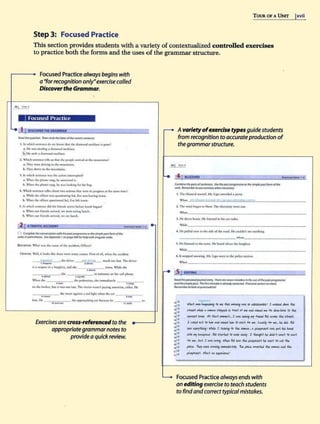
Step 3: Focused Practice
This section provides students with a variety of contextualized controlled exercises
to practice both the forms and the uses of the grammar structure.
โ€ข
Focused Practice always beginswith
a"forrecognition only"exercise called
Discoverthe Grammar.
Focused Practice
1 IDISCOVERTHEGRAMMAR
R.t-odrlltqwuiow'I. T11mrilllfotM/tltruilthfcorft(rJtmtJJCt.
I. In whKh ~ttlKl' (IQwe: k1ww rhir chc dl11n1ond u1
cdd;10: i' i;onc?
a. He w:is nutinr, a dfan1
onJ l'l(d:l3cc,
@ He i;rak .a di.in.()l'ld nยซk~.
2. lhi(h $ttll(1l('t 1db us: 1h.:11 1~ pvpk arrived โ€ขH d:ic mou1
m1
i1tt?
:1. They~ยซ:(lrivโ€ขfltt to 1
.hcmw1t1
.aim.
I). They dun"'ยข" 101hc l'll(kl111ai1
rt.
,. In ""'hkl1 $C'ntmi."C' v.ยท.J$ thr :ictiM fntctrupucl?
:a, Wh<111hc phone rโ€ข"Sยท he: iuaw"tยซI n.
b. Wh.c111~ phootnng. he w.u looking Cothi$ tug.
'4. Wl11d1 Wfltc'l'Iยซ' t.iJlo .lbo..11,.,.,~Kt.ions 1~1 WยซC' 1n prQ&'<$S 1111hc: hmt d~l
a. Vink the oflien ,,.,.,
u qucnioni"SSll, F.'"C' wiis ~viru:, 10.,..-n.
b. W'tu:n tbt offittr qucMioocd ~I. faยทt Id erown.
S, In which sieatmยซ did tht frim.U.:arrive btfott lunch bc:g;lnl
a. 'ยซ'b1!11 0111 lntnd.' a.mvcd, 'I~ ""'fft t..Uitl,f;lut1ch.
b. Vh('n our frioenlk J.t~. 'llY :i1c l11ncb.
21ATftAFFI( ACCIDEHT ~No~'~-
Ii CO/l'IPfttt 1htc011w1S01
ionwitllthepm.rptogrffllwt<H rht1imp1tposrhimo/tM
vttbs"1~1Mstt UstAppcndix I oo~OOOf.otMJpwfrhlntgvJor~
>1โ€ข"T'<'fl<'J , 1
hc dnvcr ...,,. ..i.~. โ€ข
1,.,__I ),~
i~ 11 lilflC'Cl in 11 b11tjtlJ.ty, atld she--~
,,_,,--- 'own.Whif.e dw
--...
=...
~
, --""'---,,
,-,
-=
""'ยฐ- 10$C1~<1t1~rccllrlwwlc.
Wl1
cn Jic --.,,
โ€ข.:
...
::
,
:--1htptdt$th.ll, she 11nn'IWit1dr
1
ยท" """
oo rhc br.:akcs., but i1 w;u: coo lace. The ''J('lim waMl1p.tfi~11nci:nion, ci1btt. Ht
--~
โ€ข...,
=~.-- 1M "ltttl ag.ai:n1.- red li1th1 whtn tht(:if --~,
~
..,
--ยญ
him. lie -~
,.
~
.,.
~
-
~- 1hc :11
1{1fo.a<hll'IS<"
Jt ~l.M he --~,..~
,_
--- โ€ขโ€ข
Exercises arecross-referencedto the
appropriategrammarnotes to
providea quickreview.
Avariety ofexerdse types guide students
from recognition toaccurateproduction of
the grammarstructure.
4 f BUZZ.ARO Gtom(lllal'Nolt$ 1"6
Combinottht/>(/Jfsolfttlrtnen. 1.Mthf>P<Nt~~ortMSif'tlpkpo$tfotmo/tht
wrb. ktll'.IC'lllbtt fOlftComtftrOSw~t)tttjUI!)'.
I. The blb:urd ~t;utcd. Mr. Ugo :n1cncled a p.iiny.
2. 1'hc wind beg.in co blow. Thedtcuiti1y Wtltl Out.
""''"------------ - ------------
J. Hf drQvc hQll'lr, Ht lisiยซ1c4 to h.isQr radio.
Whi~-------------------------
... H.r pullcd.o'tf 1odx steko/ 1
bc ro.ld. Ht CQUldn'r sec Bn)'thing.
------------"
'""-------------
S. He li~:ierltd 10 1he ncโ€ข'Sยท f-k htnd 11bo1.11 d~ b11Jllbry.
While ________________________ _
6. It ic09pยซl , 1
i0>v!ng. Mt. Liso v.i-n1to ~he politt Matirnl.
to1itn ________________________ _
flfOdrNs~jO;JMolttitl)'. 11ttttยฐ"ftยฅM!Mrolesin 1~11.Jf!o/rilepastptogr~ยปNe
4t>4rile~txm. Tilt6N1n:vsroit;,a.ยฐ'"~corrt:etM. INandcorn<t tbtmot(!.
ltยฐfm~l()JdClf/l(M'l(IWf~
h'f';.ยข '
IV'11At IO<t$ยท~ .U""" t}.i$ ~r.Mf ~SI"~! l uo.โ€ขยซ.J 4#.w -tJw.
S-ttul ~"-~~Mi ~ff~~~ 111t.fN.,(liยซ.~ ~~
NNtst tHlitX. At ihAt ~. I WS utUlf "ff f riv.J 8'll ctU11$$ -tJit$.WU't.
l (AJk./. - t -f> ~ Miii ~ kiM i.t l)M':t f llr ~ยท ~hr~. flt Ji.J. 6)
$atJ ~' 5ยฐl-.ilt l -tAfn, U ~"'MMโ€ข ยซ. ~(it~ f"lt fil4 k.td
ยฐ"'"'!-ยทbl!โ€ขWW"""""""'fยทl-rt,,.Ji"-"
t....t;, .....
" " ~. Olf.{ I.~ "'''1ยทIL+.tA 6Jr $atJ iht pW:KpoOO.-t ~ LTtAt ii(.Ill .U-.t.
~ยท 1"1/Jf wue41m~f 1~-!Ufยท 14 f"liยซ. Nrt$'tt.J -tl-.e ~ ~ W
pU-putt. ~~i- M ~!
Focused Practice always ends with
an editing exercise to teach students
to findandcorrect typicalmistakes.
xviii! TOUR OF A UNIT
Step 4: Communication Practice
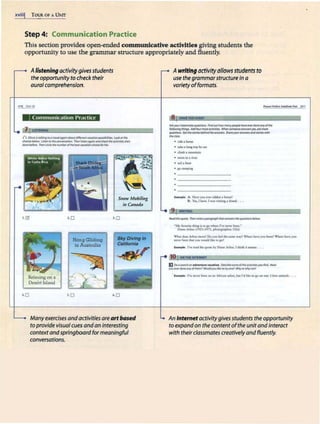
This section provides open-ended communicative activities giving students the
opportunity to use the grammar structure appropriately and fluently.
Alistening activity gives students
the opportunity to check their
aural comprehension.
ne) Uiยซr11
โ€ขCommunication Practice
() ~.........,..,,.......~~~Looiยซdw
dwkft...,_ Urtt:llโ€ขtht~ 7hml$cm09Monddied:flwocdMbn"5fl
. .~ TiliMctdirll'Jt"""'*'(l/dwbnr~dloK;f~-
Hang Gliding
in Australia
Snow Mobiling
in Canada
l.O
Slcy Diving In
Callfomla
~
Relaxing on a
Dcsert lslnnd
โ€ข.o >.O 6.0
Manyexercises andactivities areartbased
to providevisualcues andan interesting
context andspringboard formeaningful
conversations.
J
Awritingactivityallowsstudentsto
use thegrammarstructure In a
varietyofformats.
roamzm
Ali')'IX""dosJmornqundcln&. Rttdยฐ"'ltow,,_,Plot*"""~dยซJfonydthe
~thhps. Adtlloutlftlll'f~ ~*'*"f'lllUWWS,.,..fttmot't'
~ Gfcft~bdrtwlft........... Sh#tyot1.......,,,MllAOl'fn...
.........
โ€ข n&. horx
โ€ข akit a loa1 mp brat
โ€ข climb a mou1JU1t1
โ€ข Jwmiilla ri'l'ff
โ€ข sailโ€ข boar
โ€ข gou.mping
h โ€ขmpk; A; H1-ยทc yoo C"'n ridden a hood
B
: Yu,1Juvr. Iwu ._no~โ€ข ltk~ , โ€ขโ€ข
. 9~
lftoldrifquoc& "'ยฐ'..,,,.,,,....,,..,,...'IWl'Jfhf~bdl)w;
ยทMr~.._.. IOP~ rvt'anu bma.โ€ข
OU..Ar6.d (l,l.J-1'11, ,....,.,,...,..,,.,. U$AI
W!ut dotsAtbm mna} Do )'OU fttf dw MllM w-โ€ข1? W1wft bTT JOG bttr!J ~ lun- fCN
~ bttlll dlu you -.W lite 10,.,
e.-i,i.t r""read di4' q"ยฐ" by 0-,ncAibld. I tbillk 1t nwaM โ€ขโ€ขโ€ข
10fOH!HtINTERt<ET
E Oooseaยซhon 1dventurevau1tktn. ~Krltt-JoOl'JM'oldwยซrM#a)'IXIRnd.Haw
ywM.t~""1olfllfm1Would~lth1ot1y0tlft Why0twhynoU
โ€ขllttrnplr. l'Vt ""'"beef ort :in Afrito11" ubri, b1
1.1 I'd llb cogo on one. I love a.1
llm.alt , , โ€ข
An Internetactivitygivesstudents the opportunity
to expandon the contentofthe unitandinteract
with theircfassmates creatively andfluently.
TOUR BEYOND THE UNIT
In the Focus on Grammar series, the grammatically related units are grouped into
parts. and each part concludes with a section called From Grammar to Writing
and a Review Test section.
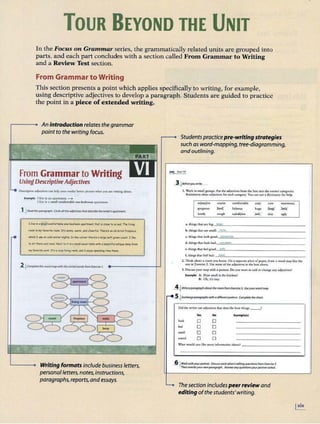
From Grammar to Writing
This section presents a point which applies specifically to writing, for example,
using descriptive adjectives to develop a paragraph. Students are guided to practice
the point in a piece ofextended writing.
Anintroduction relates thegrammar
pointto the writing focus.
From Grammar toWriting
UsingDescriptiveAdjectives
ยฐ"scripcive โ€ขdjtetiYtlCl.Ill help )'Oclt r('..drs bnttrpicnirt ~ยทh.u ~ lltt wti1i.ng 1bwt.
tx.nph,: I live in .an QpG_nn'tnl. ~
Ilive inโ€ข small comfomabk<11ยปbcd100m .ap;.irtfC"flt,
t IWe /-,.,o@(Ofl'lfOl"'obk-ยท~oprtmtltt t+iot Is do$c tos(".'IOOI, ~Ii~
l'OO!l'l It mt fO'>'Oritct'OMI. St's SUV!)',-.one! tllยซrful. There's <I'!okb<ick fi~'ยท
.whfieh I1$6on ookl wi1tftr nlgh1s. ln ttlt QOt"nCtl there's oicf9t SOh.9"ยซ1 ยซX.lth. I lob
10sit th<rt otd rcod..Nvtl to II & 11 $<tiOll ,.o<>tJ t~lc witho beoltt!(U~tamp ftom
.,, foYOt'ltcoun1, rrso ยขUy IM..,t'OOIT,O'ld t uiJ;y spc.ndโ€ขng til'lle-thtlt.
Writing formats includebusinessletters,
personalletters, notes,instructions,
paragraphs,reports, and essays.
...
Studentspracticepre-writingstrategies
suchas word-mapping, tree-diagramming,
andoutlining.
JOe! PM.TV!
-3.+IJdof'f'youwriteโ€ขโ€ข ,
J. 'ยซ'ยซle iB small groups" Put d:.e 1djcaives from 1h<: box U10 tbc (()lrยซteaugorio.
Brair.!ionn ochnadjciยซi~.s for ndi cac~ory. You an u1e a dictiOAatf tor belp.
11tjrai::!!ve <Mm comfortable t<n.y aite CllOf'l'OOUs
pgcous }la-r(' hidCOU$ hu~ Jhg( ) ket(
lovdy rough ~~n )of(" tlny ugly
:I.. d:.iโ€ข!$S dltt tiUl big:.C
โ€ข
!!
~
"'
~--------------
b. thiflil th.al ue-.1
iulJ1_,
"'"
"'
''-
โ€ข - - - - -- - - - -- - - -
c. th!nt;.l lh:n look good:....!!
'""ยฐ
""".
-"
'"'"
"'ยท-- -----------
d.. thinpdiac look bad:-"
"'"
'......,
""'"-
'ยท- - - - - - -
- - - - - -
<'โ€ข thil'l.gt that kdgood:-"
ยฐ""
"''C.ยท
- -
- - - -
- - - - - - - -
f. thi!W' chat fttl hod:-"
"'
" "'
" - - - -- - - -- - - - - - -
2. Think. aboutโ€ข rooto )"(lu koow. On l1 Kpanue pitteaf r:iper, 4~w a WOtd 1
nap lik<' 1he
(lfle i11ยฃxetCik1. Uk SiOme oftM ;djยซtives. in cbe OO:ic abovt.
J. OilO.lu )'QW' map whh a putntr. Do yc.u w.u1
t 10 add cw ch:J.n~ โ€ขnradjccrivn}
&;.mpte: A: HowSOldlittheki~ebm~
8: Oh, it'$1i11y.
~p-trheo/Xlf09!0Pho&out~roomfrom EJยซr~J, 'hit)'OC.I'WQl'dtJl()p.
..S
-J.e.t:ti.of1o9tporog..-ophswithad.'ffttrntptirrner. ('omptttttM<llOtt.
Yu ... ยฃXโ€ขl'l'IP~h)
look D D
&.I 0 D
.sa1('U 0 D
<Ow>d 0 0
W'Join wookl you Ilk<" more in!orm:uioti al>out~ -----------
_6_1
~lewi'th~poltfltf. Ols<uSSt<ICh~'ยซlitklgQlltttiol'Ufrom bacM5.
11'lotnrf!Wtitf.)'O'ltown porc19ff)ph. NISWfrt.INf4utSn10ns1'XJrpoitnt1cJ.kcd
The section includespeer reviewand
editingofthe students'writing.
xx I TOUR BEYOND Tiii! UNIT
ReviewTest
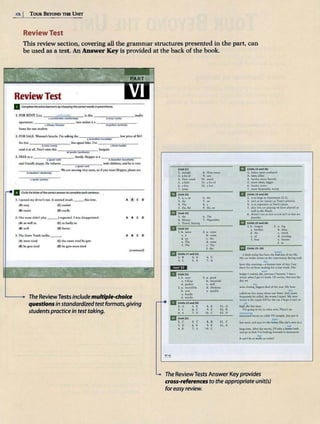
This review section, covering all the grammar structures presented in the pa11, can
be used as a test. An Answer Key is provided at the back ofthe book.
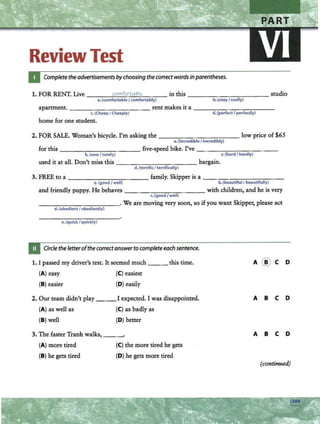
Review Test
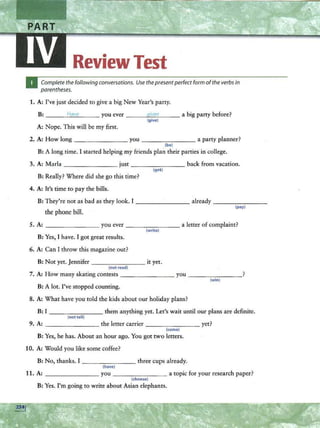
I.FOR R~NT. Uvc
:ip:uunnu. - - -
,.โ€ข
~-
-~,.
~~--
=
,--- rmt rn1kcs it a ---
.~
--.
,.~.~
,-
......,=~.~,__
hotr"' for one nudcn1
.
2. FOR SAl.f
_ Wonun's biqยทdc. rm ::asking 1bt----------'ยฐ""priยซ-ol56.'i
..-.-,....._,,
fQt ibis ---~
.~,_=
,~......,=---fivc4p('('d bil:c. I've ---.
.~-=~,
.....,
=,,--ยญ
UW'd i1 at 11U. Oonโ€ขr mi.I'Sthis--~.~,~
....,=~
,,~
โ€ขโ€ข
~
..
~..,=,-- ~rg~tn.
). FREE 10:a----------family. Skipptt is ::a --~-~-=~-
โ€ข.<,....ir~ -..~;"''"""'a-,.'
and friendly pu;ipy. Ht bdi.:1..-n - - - - - - - - - - with dilJJ:rcn, and be Is very
t.!....., .....
--.
.
===ยท-
==.~
...--ยทWe IUC lnO'ing W)' IOOfl, 50 ii JOU w;int S!ciPPf'I, p&tuc UC
IICirclfr~fftrttofrlltcMt<toruw.ttrt:HomJ)krctยซhftllrtA<f,
1. I puscd myJr!vn's fe$1. h tยซnkd mvch _ _ 1tus time,
(A) usy (C) c:uicsc
(8) cuitr (0 ) c;i~ly
l . Our 1t1m didn'r pl:ly __I expยซ!fcd. I w.u dis1ppoin1cd.
(A) as ~u n (C) " b.adl>
ยท <Js
(8 ) wdl (0 ) tw-n~r
(A) MOtCritยซI
(8) he ~u titยซI
(C) chc1
'lore rittd fie gteJ
(D) he g.cu I'll()(( tired
A (!I C 0
A 8 C 0
A 8 C 0
((!Ontim1
d}
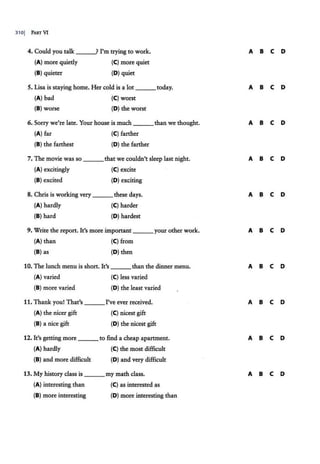
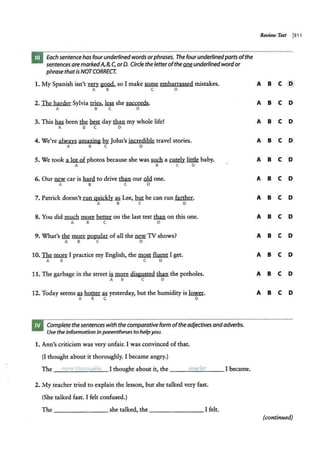
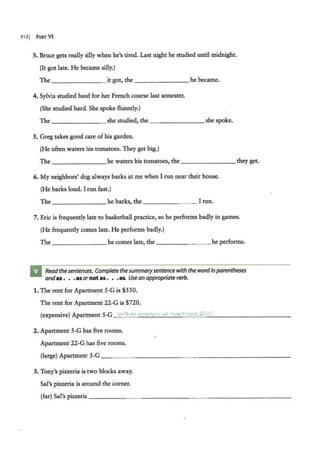
The ReviewTests includemultiple-choice
questions in standardized testformats,giving
studentspractice in testtaking.
CVllk211
l. """"'
8. How mu'IY
.J. abo( .,โ€ข .1111
4. Howmucll 10. mum
$. "!ink 11. 11 IOI o(
'ยท okw 11. โ€ข'*
,,_
1111 (U...Ul
1, t ,O,lft
โ€ข.""
j , the 7. . ...
'"'"' ...
$. dl(', lhc 9. ~.;UI
m"'"""'
3. the
'"'"'
... MOM)'
$. Tt-.n'(I, $&.Iyo~
1. V-<st"Mbks
a (Ullltll)
1.b.~ l.11. ~
"'
.._
.." """
...,,,.
ยทยท-
.,,,. .,,,.
(. โ€ขhe-
m(Unlt:l2:1arnftt)
2. 8 4, A 6.C
>. c $. A 1. โ€ข
-
a lUnltl3)
I.~ c-oiy .}. ... i;.oocl
c. Qwโ€ขp b. ~l,Jllflli
..""'= ,.. ~u
1. '- i11Cmlibl)' d. obcdi"'t
...... t. quiddr
t. hat.U,.
cl. l(rM!;ยข
โ€ข IVnhโ€ขUan426l
2.A S.8 ... 11.. D
'ยท c
.. c โ€ขโ€ขโ€ข U.. B
โ€ขโ€ข A 1. 0 ... c I )~ D
miuni.::tl)
1. c $, c .. 8 11. e
>. 0 ... โ€ขโ€ขโ€ข 12.. &
'ยท. 1. A 10. c
m(UlllU;25โ€ขnd 26)
l . Us1c:r,~<Ot1Mwd
J, ~~.Jlllikr
... tt..ยซkl. ll'!C'rC!tlยซndy
S. O'IOttohcn. b~
6. toudct, ,.,(((
1. -tfttqutndy, -
d (UM$24 1nd 26)
l. iJ.โ€ข,J.1~a>A~m'11cntllยทC..
), hn'i OJ{u (av.ยท1oy) ;uToc.y~P"'1Vโ€ขโ€ขยท
4. i.Jut~l'l' .UTooypsiu,
S. pb1(0kllll'~ot!W.~pb)'('llJ M
well .. 1ht Shock.
6. ~-. ,_ ., f.u1 11) ~(,llt ku't ~ fJ~ u)
jmfliln.
11(Unluu_,,.,
1.b.I~
~ 11.ltlbt
..""
...
'ยท bo.t
mtunlU2J..:::t6-)
1. โ€ขโ€ข big
b. l~I
ยท-ยท
d.. o::ttidlllf:
,, $-..
...
~
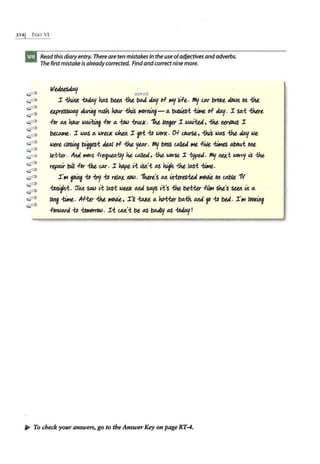
1diink c.odar h;!Jhtt11111c b.JadJ,y o4rer Uiit.
Myurbroke dow.-n oo ~Clf9tUSwโ€ขr duri,. nod!.
""'
boor diiJM<Jt~-โ€ข bu~ tlnw cldq. IA.II
th<rclor'an ~ w#ll!hg for111Qwrrud:.11ie
-
llM!!p:r-1WAIU'lf,1bt.._
ftC'f'l'Ollll ~.l WU.I
wl'<'Ck.wtw1' I&ยฐ' CO- tk. Qf<'Ollnt, diit w;ud1t
d;iywr
""
wue dodng:.bil!#S'I dNIor1M ync. Mr boM
...
ulkd aw.(rt, timtt*""'Ofl(' l(tkr.A..t..~e
(n.gwndy ht 1
r.dkd. rjicv.vm Itypod. Mrnc;u
wotty'5 1
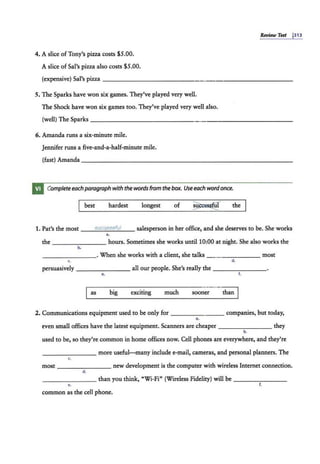
iw.ttp,irbill lordw cu. I~" IMl'i u
M
b~P..tbi:4st111'1k.
l'~gioing IOU)' t() 1(1~ ~.....Thttr"JIn
.,_,.,,
..~~ ooablt1VCOftight.Jโ€ขnaw it
..~
lloHWยซk .1Dd i.:ays it1hc bfttrr him tlH-.
 ~" en I
....
l11fยฅ ยท~ A/f(tdl( 1
110rit, I'll 1
i1kt. ~ b.lth
โ€ขnd: p 1.o baJ. l'lfl lookit1g: forw,ud rocoenuuow.
...
b O&ft'fbe.Qll t..dly"tod.ly!
The ReviewTests Answer Key provides
cross-references to the appropriateunit(s)
foreasyreview.
ACKNOWLEDGMENTS
Before acknowledging the many people who have contributed to the third edition of
Focus on Grammar, we wish to express our gratitude to those who worked on the
first and second editions, and whose influence is still present in the new work. Our
continuing thanks to:
โ€ข Joanne Dresner, who initiatedthe project and helped conceptualize the
general approach ofFocus on Grammar.
โ€ข Nancy Perry, Penny Laporte, Louisa Hellegers, and Joan Saslow, oureditors
for the first edition, and Fran~ise Leffler; our editor for the second edition,
for helping to bring the books to fruition.
โ€ข Sharon Hilles, our grammar consultant, for her insight and advice on the first
edition.
In the third edition, Focus on Grammar has continuedto evolve as we update
materials and respond to the valuable feedback from teachers and students who
have been using the series. We are grateful to the following editors and colleagues:
โ€ข Laura Le Drean, Executive Editor, for her dedication and commitment. In
spite of an incredibly full schedule, she looked at everypage of manuscript
and offered excellent suggestions. In addition, she was always available and
responsive to authors' concerns.
โ€ข Franeoise Leffler; SeniorDevelopment Editor; for her continued dedication to
the series and to improving Focus on Grammar with each new edition. As in
the previous edition, we relied on her unflagging attention to detail and her
wonderful sense ofstyle.
โ€ข Kathleen Silloway, Senior Production Editor, for pilotingthe bookthrough its
many stages ofproduction and for always giving us a heads up when more
FOG was about to roll in.
โ€ข Irene Schoenberg, for generously sharing her experience inteaching our first
two editions and for her enthusiastic support.
Finally, we are grateful, as always, to Rick Smith and Luke Frances, for their helpful
input and for standing by and supporting us as we navigated our way through our
thirdFOG.
We also wish to acknowledge the many reviewers for reading the manuscript and
offering many useful suggestions.
Aileen Allison, Golden Gate Language School, Campbell, CA; Larisa Alvarez Avila,
Centro Educativo Renacimiento, Merida, Yucatan, Mexico; Jaime Bolaiios, Colegio
Ker Liber, Guadalajara, Mexico; Vabania Carvajal Garcia, lnstituto Cultural Regina
Teresiano, Hermosillo, Sonora, Mexico; Julie Charland, Ateliers de Langues CSCG,
Quebec City, Quebec, Canada; Amelia Chavez Ruiz, Lake Forest School, Mexico
State, Mexico; Elisa Laura Chavira, Instituto Cumbre del Noroeste, Ciudad
xxiij ACKNOWl.F.DGMENTS
Obreg6n, Mexico; Ronald Clark, Boston University, Boston, MA; Judy Cleek,
University ofTennessee at Martin, Martin, TN; Elizabeth Clemente, Instituto
Tecnol6gico de Estudios Superiores de Monterrey, Atizapan, Mexico State, Mexico;
Sharon Cliff, Richmond College, Richmond, TX; Marilyn De Liro Alvarez,
Instituto "Las Brisas," Nuevo Le6n, Mexico; Susanna Eguren, Instituto Cultural
Peruano Norteamericano, Lima, Peru; Marcia Gethin-Jones, University of
Connecticut, Stamford, CT; Monica Hilding, Central Community School, Salt Lake
City, UT; Sue Hynes, Daley College, Chicago, IL; Silvia Icela Espinoza Galvez,
Colegio Lux, Hermosillo, Sonora, Mexico; Elizabeth Kelley, University of
California, San Diego, CA; Anlk Low, College Jean-de-Brebeuf, Montreal, Quebec,
Canada; Hank Mantell, International Education Progrruns, University of California,
Riverside, CA; Javier Martinez Garcia, Instituto Las Americas, Mexico City, D. F.,
Mexico; Darlene Mitchell, International English Center, Boulder, CO; Norma
Morales S8nchez, Instituto Carlos Gracido, Oaxaca, Mexico; Robin Persiani,
Sierra College, Grass Valley, CA; Mary Lou Price, University ofTexas at Austin,
Austin, TX; Mary Kay Purcell, University ofEvansville, Evansville, IN; Graciela
Ramirez Hernandez, Instituto Hispano Ingles de Mexico, Mexico City, Mexico;
Mark Rau, American River College, Sacramento, CA; Nicholas Renton, American
Culture and Language Program, Los Angeles, CA; Ernesto Romo, Lake Forest
School, Mexico State, Mexico; Rene Sandoval, Martin Luther King, Jr. School,
Guadalajara, Jalisco, Mexico; Allen Sellers, Oregon State University, Corvallis, OR;
Nicola Teague, San Diego State University, SanDiego, CA; Elena 0. Torres
Gonzalez, Instituto Tecnol6gico de Estudios Superiores de Monterrey, Atizapan,
Mexico State, Mexico; Maria Elena Vera de la Rosa, Lake Forest School, Mexico
State, Mexico; Magneli Villanueva Morales, Universidad Regiomontana,
Monterrey, Nuevo Le6n, Mexico; Elaine Wilson, Culture Works, London, Ontario,
Canada; Essio Zamora, Instituto Carlos Gracido, Oaxaca, Mexico; Ian Zapp,
Colegio Mexico lrlandes, Guadalajara, Jalisco, Mexico.
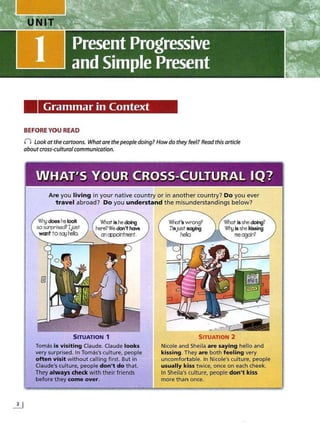
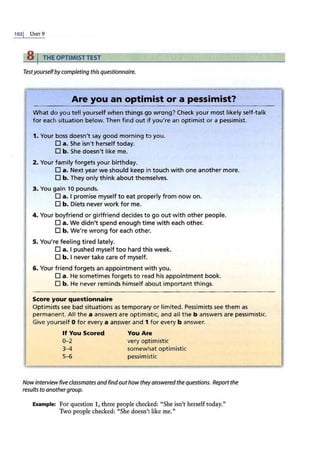
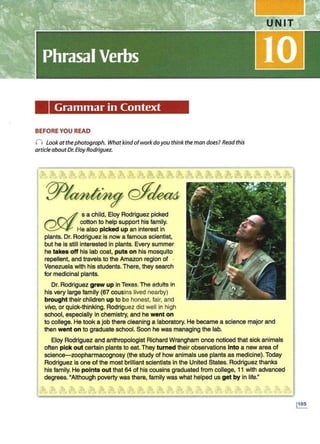
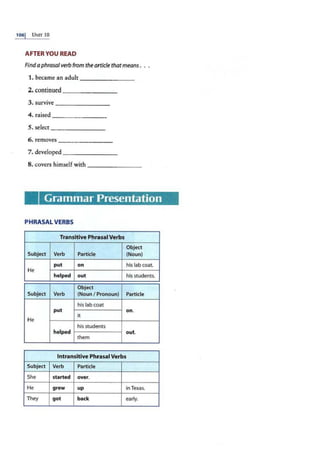
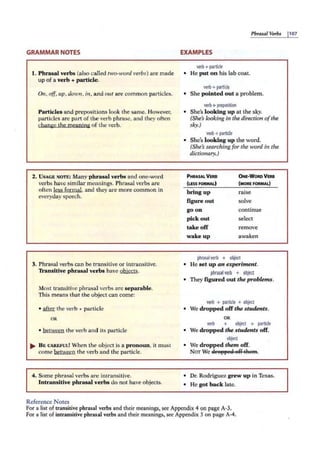
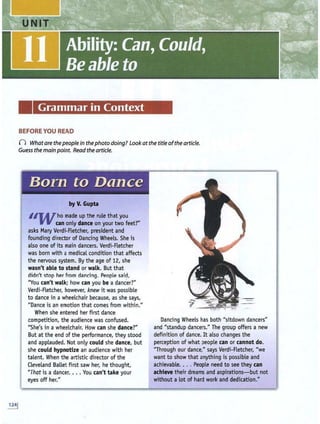
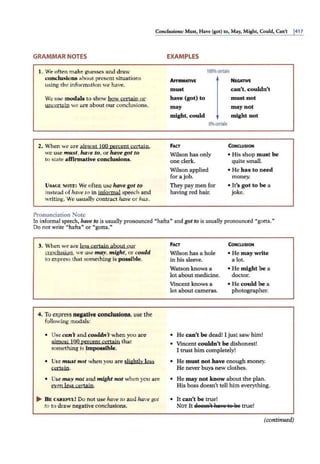
Grammar in Context
BEFORE YOU READ
0 Lookat the cartoons. What are thepeople doing? Howdo they feel? Read this article
about cross~cultural communication.
WHAT'S YOUR CROSS-CULTURAL IQ?
Are you living in your native country or in another country? Do you ever
travel abroad? Do you understand the misunderstandings below?
Wtydoes he look
sosurlJ"ised? IjcJSt
wantto5q1hello
What is he doing
here?We don't have
al oppQintment.
SITUATION 1
Tomas is visiting Claude. Claude looks
very surprised. In Tomas's culture, people
often visit without calling first. But in
Claude's culture, people don't do that.
They always check with their friends
before they come over.
W'nat's wrong?
I'ntjUSt:saying
hello.
What is she doing?
Wtyis she killlling
me again?
.. "ยท
ยท ยท ~
.-ยทยท
... ,
.......
-.v ,...
SITUATION 2
Nicole and Sheila are saying hello and
kissing. They are both feeling very
uncomfortable. In Nicole's culture, people
usually kiss twice, once on each cheek.
In Sheila's culture, people don't kiss
more than once.
Present Progressive and Simple Present I 3
AFTER YOU READ
Complete each sentencewith the correctname.
1. - - - -----is visiting without calling first.
2. - -- - -- - - is surprised to have a visitor.
3. is kissing the other woman twice.
4. doesn't expect a second kiss.
Now circlethe correctanswerforyourownculture.
In my culture . . .
5. People usually call/ don't call before visiting.
6. When people say hello, they don't kiss I kiss.
Iii6f,IJ,lfiiiM
t414ijtditu;1 I
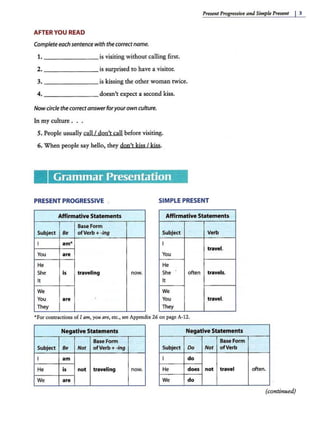
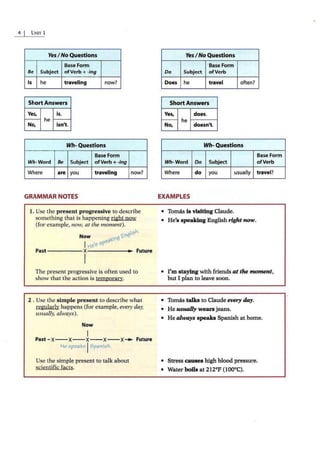
PRESENT PROGRESSIVE . SIMPLE PRESENT
Affirmat ive Statements Affirmative Statements
Base form
Subject Be ofVerb + -Ing Subject Verb
I amโ€ข I
travel.
You are You
He He
She is traveling now. She often travels.
It It
We We
You are You t ravel.
They They
โ€ขFor contractions of I am, you are, etc., see Appendix 26 on page A-12.
Negative Statem ents Negative Statem ents
Base Form Base Form
Subject Be Not ofVerb + -ing Subject Do Not ofVerb
I am I do
He is not traveling now. He does not travel
We are We do
often.
(continued)
4 I UNITl
Yes INo Questions
Base Form
Be Subject ofVerb + -ing
Is he traveling now?
Short Answers
Yes, is.
he
No, isn't.
Wh- Questions
Base Form
Wh- Word Be Subject ofVerb+ -ing
Where are you traveling now?
GRAMMAR NOTES
I. Use the present progressive to describe
something that is happening'rj~ht now
(for example, now, at the moment).
i!i1โ€ข
Now (it1e1:.ne
I1-1e!i !i'ell
Past-----X Future
I
The present progressive is often used to
show that the action is temporary.
2 . Use the simple present to describe what
regularly happens (for example, every day,
usually, always).
Now
I
Past - X-- X--X--X--X_..
H" ,;p,,ak,; ISptmi,;h.
Use the simple present to talk about
scientific facts.
Future
YesI No Questions
Base Form
Do Subject ofVerb
Does he travel often?
ShortAnswers
Yes, does.
he
No, doesn't.
Wh- Questions
Base Form
Wh-Word Do Subject ofVerb
Where do you usually travel?
EXAMPLES
โ€ข Tomas is visiting Claude.
โ€ข He's speaking English right now.
โ€ข I'm staying with friends at the moment,
but I plan to leave soon.
โ€ข Tomas talks to Claude every day.
โ€ข He usually wears jeans.
โ€ข He always speaks Spanish at home.
โ€ข Stress causes high blood pressure.
โ€ข Water bolls at 212ยฐF (100ยฐC).
3. Use the present progressive to describe
ยทsomething that is happening in the extended
present time (for example, nowadays, these
days, this month, this year), even if it's not
happening at the moment of speaking.
Now
4. Use the simple present with adverbs of
frequency to express how often something
happens.
~"' '1-..'lio*
K,.f!' ~(/Ji
d rif- l' ~?;-~ ,;fl<
oX." ro0 <~ f-fi
/ / / / / /
---- -------------------.-.-.....--.....-......-.......
100% 0%
.... BE CAREFUL! Adverbs 0ยฃ frequency usually
go before the main verb, but they go
after the verb be.
5. Use the simple present with most
non-action verbs. Do not use the present
progressive-even when the verb describes
a situation that exists at the moment of
speaking.
Non-action verbs usually desci:ibe ~or
situations but not actions. They are used to:
a. express emotions (hate, like, love, want,
feel, fear, trust)
USAGE NOTE: Unlike other verbs that
express emotion, feel is often used in the
progressive form.
b. describe mental states (know, remember,
believe, think [= believe], understand)
c. show possession (have, own, possess,
belong)
d. describe senses and perceptions
(hear, see, smell, taste, feel, notice, seem,
look[= seem], be, appear, sound)
Present Progressive and Simple l:'n:sent I s
โ€ข We're studying U.S. customs this month.
โ€ข Laura's studying in France this year.
โ€ข Are you studying hard these days?
โ€ข In Spain women always kiss on both
cheeks.
โ€ข In France women often kiss on both
cheeks.
โ€ข We rarely stand very close to each other.
โ€ข In China children never call adults
by their first names.
โ€ข They never come late.
โ€ข They are never late.
โ€ข Jane wants to go home now.
NOT Jane is Y1!tftMft~ to go home now.
โ€ข We like Claude a lot.
โ€ข Ricki feels homesick. OR
โ€ข Ricki is feeling homesick.
โ€ข I know a lot of U.S. customs now.
โ€ข Ari remembers your number.
โ€ข Cesar has two brothers.
โ€ข Some students own cars.
โ€ข I hear the telephone.
โ€ข Dina seems tired.
(continued)
6 I UNr.r 1
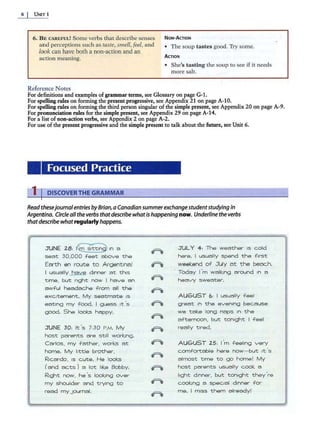
6. B E CAREFUL! Some verbs that describe senses
and perceptions such as taste, smell, feel, and
look can have both a non-action and an
action meaning.
Reference Notes
NONยท ACTION
โ€ข The soup tastes good. Try some.
ACTION
โ€ข She's tasting the soup to see if it needs
more salt.
For definitions and examples of grammar terms, see Glossary on page G-1.
For spelling rules on forming the present progressive, see Appendix 21 on page A-10.
For spelling rules on forming the third person singular of the simple present, sec Appendix 20 on page A-9.
For pronunciation rules for the simple present, see Appendix 29 on page A-14.
For a rist of non-action verbs, see Appendix 2 on page A-2.
For use of the present progressive and the simple present to talk about the future, see Unit 6.
Focused Practice
1 I DISCOVERTHE GRAMMAR
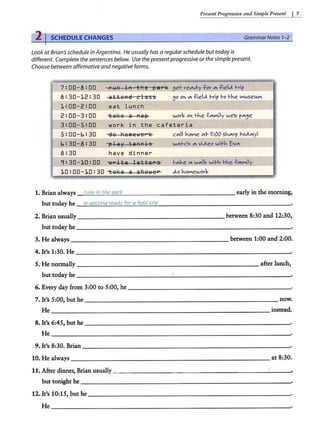
Readthesejournalentries by Brian,aCanadian summerexchange studentstudyingin
Argentina. Circle allthe verbs that describe whatis happeningnow. Underline the verbs
that describe whatregularly happens.
JUNE 28, I~ in a
seat 30.000 feet above the
E<:1rth en route to ArgentJn<:1!
I usually~ d inner at this
t ime, but right now I have an
awful headache from all the
excitement. My seatmate IS
eating my food. I guess It's
good. She looks happy.
JUNE 30, It 's 7,30 P.M. My
host parents are still working.
Carlos, my father, worl<:.s at
home. My little brother.
Ricardo. is cute. He looks
(and acts) a lot like Bobby.
Right now, he's looking over
my shoulder and trying to
read myjournal.
~
~
~
~
~
~
~
~
~
~
~
~
JUL Y 4, The weather IS cold
here. I usually spend the first
weekend of July at the beach.
ยท Today I'm walking around 1n a
heavy sweater.
AUGUST 6, I usually feel
great In the evening because
we take long naps in the
aftemoon, but tonight I feel
really t ired.
AUGUST 25, I0m feeling very
comfortable here now- but It's
almost time to go home! My
host parents usually cook a
light dinner, but tonight they 're
cooking a specia l dinner for
me. I miss t hem a lready!
Iยท
Present Progressiue a11d Simple Present I 7
2 I SCHEDULE CHANGES GrammarNotes 1-2
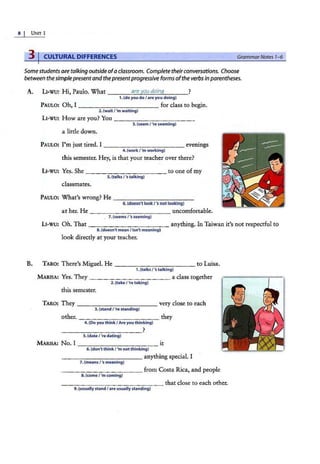
Look atBrian's schedule in Argentina. He usually has a regularschedule but todayis
different. Complete the sentences below. Use thepresent progressive or thesimplepresent.
Choose between affirmative andnegativeforms.
7:00-8:00
8 : 30- 12 : 30 atteAa c la s s
1 : 00- 2 : 00 ea t l unch
2:00-3:00 tak e a Ra ~
3:00-s:oo wor k i n the c a f eter i a
s:oo- 6: 30 ~e 1=1em e i.1e1 k
6 : 30-8 : 30 'l'l i y tQRRi5
8 : 30 have dinner
9: 30-10 : 00 ~P itll lll tt e P S
10:00-10 : 30 -tal~ e a s bgยท1eP
1. Brian always rum; in the park
but today he ii; qettinq ready for a field trip
c"'ll ..oNe "'- '>:00 s...,,vr l-0&1....y!
w"'l-c.. "'vi&l.eo wHยท.. Ev"'
+-"'oe "' w.,,Jl,o wil-.. 1-..e -t?.,,Nily
&l.o ..oNewovo
early in the morning,
2. Brian usually _______________ ___ _ between 8:30 and 12:30,
but today he __________ ___ __________ _____
3. He always _ _ __________ ____ _ ____ between 1:00 and 2:00.
4. It's 1:30. He - - - - - - - - - - -- - -- - - - -- -- -- - - -- ยท
5. He normally ________________________ after lunch,
but today he _____ ______________________ .
6. Every day from 3:00 to 5:00, he - -- - - - - - -- - - -- - - - - - - ยท
7. It's 5:00, but he ___________ ______________ __ now.
He _________ __________________ ___ instead.
8. It's 6:45, but he - - - -- - - - -- -- - -- - -- - - - - -- - -ยท
He-------------------------------~
9. It's 8:30. Brian ------------ - -- - -- - ------- ---ยท
10. He always ___ _ _ _________ ___ _________ at 8:30.
11. After dinner, Brian usually _________ ___ ____ _ _______ _,
but tonight he - - - - - - - - -- - -- - - - - - - - -- -- - -- -ยท
12. It's 10:15, but he _______ __________________
He _________________________________
8 UNIT 1
3 I CULTURAL DIFFERENCES GrammarNotes 1-6
Somestudents are talking outside ofaclassroom. Complete theirconversations. Choose
between the simplepresent and thepresentprogressive forms ofthe verbs in parentheses.
A. L1-wu: Hi, Paulo. What ___...;;
a'""
re
'-""
yo
;..;;
u
;...;
d
;;.:
o
""
in
..;.;;
q
,___ _?
B.
1. (do you do I are you doing)
PAULO: Oh, I ___________ for class to begin.
2.{wait / 'm waiting)
L1-wu: How are you? You - -- ------ ---
3. (seemt โ€ขre s,.eming)
a little down.
PAULO: I'm just tired. I _____ _______ evenings
4. {work / 'm working)
this semester. Hey, is that your teacher over there?
L1-wu: Yes. She - ----------- to one ofmy
5.{talks / 'stalking)
classmates.
PAULO: What's wrong? He ------------
6.(doesn't lookl's not looking)
at her. He ____________ uncomfortable.
7.(seems/'s seeming)
LI-WU: Oh. That - - ---------- anything. In Taiwan it's not respectful to
8.(doesn't mean I isn't meaning)
look directly at your teacher.
TARO: There's Miguel. He ------------ to Luisa.
1.(talks / 'stalking)
MARISA: Yes. They ___________ a class together
2. (take / 're taking)
this semester.
TARO: They ---- - -------very close to each
3.(stand / 're standing)
other. - - - -------- they
4. (Do you thinkI Are you thinking)
-------- ----?
5. (date/ 're dating)
MARISA: N'o.l ___________ it
6. {don't think / 'm not thinking)
------------ anything special. I
7. {means / 'smeaning)
- - ---------- from Costa Rica, and people
8.{come/ 'm coming)
---------------that close to each other.
9. (usually stand / are usually standing)
PmaitProgressive and Simple Present I 9
41MORE CULTURAL DIFFERENCES GrammarNotes 1-6
Otherstudents are talkingoutsideofaclassroom. Complete theirconversations. Use the
simplepresent or the presentprogressive form ofthe verbsin parentheses.
A.
B.
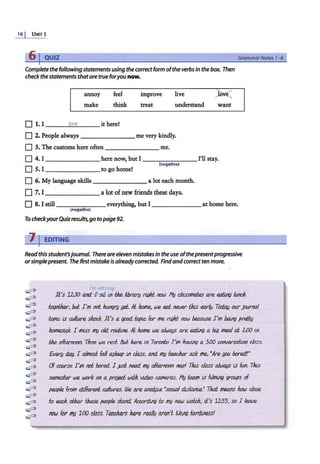
RASHA: There's Hans. Why if!; he wa/kinq
1. (walk)
so fast? Class at 9:00.
l . (startJ
He still 10 minutes!
3.(have)
CLAUDE: He always fast. I think Swiss
4.(walkl
people often to be in a hurry.
S. (appear)
YOKO: Isn't that Sergio and Luis? Why
they _______ hands? They already
1. (shake)
_______ each other!
2.(know)
LI-JING: In Brazil, men.- ------- hands every time
3.(shake)
they---- ----
4.(meet)
YOKO: ____ women ---- - -- -hands too?
S.(shake)
5 I CULTURE SHOCK!
Complete the following paragraph. Use the correctform ofthe verbs in the box.
cause feel go live travel
GrammarNotes 1-6
New food, new customs, new routines-they all - ---'m
.;.;;;;.
a""k
e
,____ international travel
1.
interesting. But they also - -- ---- - culture shock for many travelers. ____ you
2.
now ______ __ or - ------ - in a culture different from your own? If so, why
3. 4.
---- you -------- so good (or so bad)? Some experts say that we often
s.
_____ _ _ through four stages of culture shock:
6.
Honeymoon Stage: In the firstweeks everything seems great.
Rejection Stage: Vou have negativefeelingsabout the new culture.
Adjustment Stage: Thinqs are getting betterthesedays.
Adaptation Stage: You arefinallycomfortable in the newculture.
Take the quizin Exercise6 andsee whatstageyou are in.
10 I UNITl
Complete the following statements using thecoffectform ofthe verbs in the box. Then
check the statements thatare trueforyou now.
annoy
make
feel
think
0 1. l __~
lo
_
ve
___ it here!
improve
treat
live jOv(
understand want
0 2. People always _______ me very kindly.
0 3. The customs here often _______ me.
0 4. I _______here now, but I --~----I'll stay.
(negative)
0 S. I to go home!
0 6. My language skills a lot each month.
D 7. I a lot of new friends these days.
Grammar Notes 1- 6
0 8. I still _ _____ everything, but I ______ at home here.
(negative)
To checkyourQuizresults,go topage 92.
11EDITING
Readthis student'sjournal. Thereare eleven mistakesIn the useยทofthepresentprogressive
orsimplepresent. The firstmistake is already corrected. Findandcorrect ten more.
~
~
~
~
~
~
~
~
~
~
~
~
~
~
~
~
~
~
~
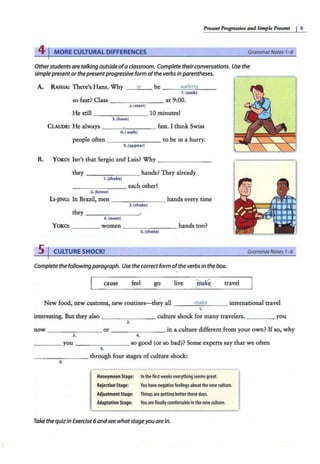
I'm sitting
It's 12:30 ant. ~ lll !:he library rfl.}kl now. Hy dasstnaiR.s are eoiJh; /IHICh.
torJ<ther, bti I'm not htmgry yet, ,It. lwme, we e.ai never tJus eor/y. Todao ourpurrv:i./
topl.e lS CJJ!tare slwc.k. It's a good l.optc for me t1l.}ht now beeouse I'm being prel:ig
hamest.ck I 1'11iSS my old. roufule. ,It. lwme we a/WCIJIS are eoiJh; a bi.g meal at 2.iJO lli
!:he afternoon. Tit.en we rest. &tt here lll Torodo I'm h.awig a 3f)() caNersail.on class.
Every d.au I almost fall Q$/eep lll class, Md my t.eac.h.er ask me, โ€ขAre fJOtl bored!'
Of cowse I'm not bored. I ,Ju.St Med. my afternoon ntzp! This class alwaus iS fW1. Tlus
semestu we work on a pro}f!d wdh. vt.deo cameras. 11y !Rom ts (Jfllim grOIJPs of
per;p/e fr0/11 d.lfiereli ct.dfures. We are a.na/yJ.R. โ€ขsoct.aJ dtst.anee.โ€ข Thai mea.ns Jww close
t.o each other t.hese people da.nd.. kcordtn() t.o my neJ.tJ woleh., ti's 1255, so I kale
ntJW for my 1:00 class. TM.dws hue rw/JJ aren't /lkll!g iarrJvless!
PresentProgressive and SimpkPresent 111
Communication Practice
8 I LISTENING
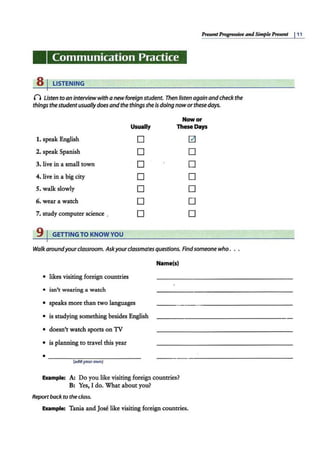
n listen to an interviewwith a newforeign student. Then listen again andcheck the
things the studentusually doesand the thingsshe is doing noworthese days.
Now or
Usually These Days
1. speak English 0 0
2. speak Spanish 0 0
3. live in a small town 0 0
4. Jive in a big city 0 0
5. walk slowly 0 0
6. wear a watch 0 0
7. study computer science . 0 0
9 I GETTINGTO KNOW YOU
Walk aroundyourclassroom. Askyourclassmates questions. Findsomeone who. . .
Name(s)
โ€ข likes visiting foreign countries
โ€ข isn't wearing a watch
โ€ข speaks more than two languages
โ€ข is studying something besides English
โ€ข doesn't watch sports on TV
โ€ข is planning to travel this year
โ€ข ~~~~~~~~~~~~
(add your own)
Example: A! Do you like visiting foreign countries?
B: Yes,Ido.Vhataboutyou?
Reportbackto the class.
Example: Tania and Jose like visiting foreign countries.
12 I UNIT l
10 I WHAT'SHAPPENING?
Work in pairs. Look atthe photographs. Describe them. What's happening? Discuss possible
explanations foreach situation. Compareyour answerswith those ofyourclassmates.
Example: A: He's pointing. He looks angry.
B: Maybe he's just explaining something.
11 I QUESTIONABLE QUESTIONS?
Workin smallgroups. Lookat thequestions. Inyourculture, which questions are
appropriate toasksomeoneyoujustmet? Which are notappropriate? Compare
yourchoices with those ofyour classmates.
โ€ข How old are you? โ€ข How much rent do you pay?
โ€ข What do you do? โ€ข What are you studying?
12 1WRITING
โ€ข .Are you married?
โ€ข Where do you live?
Write aparagraph about a new experienceyou are having. Maybeyou areliving in a new
country, taking a new class, orworking ata newjob. Describe thesituation. How is it
different from whatyou usuallydo? How doyou feel in the situation?
Example: I usually live at home with my parents, but this month I'm living with my aunt and
uncle. Everything seems different. My aunt . . .
13 I ON THE INTERNET
I] Weatheroften affects whatpeoplein differentcultures do. Do asearch on weather for
a placeyou know well. Findout what the weatheris now. Then compare it to what the
weatherusually is this time ofyear. Tellyour classmates about the weatherandwhat
people usually do in this weather.
Example: In Haiti it usually rains this time of year, but today it's not raining. It rains so often in
Haiti that people usually ignore it. Chitdren often play outside in the rain.
Grammar in Context
BEFORE YOU READ
n Look at the pictures. What is the woman doing? What do you do to stay fit? Readpart
ofan exercise routinepresented in a fitness magazine.
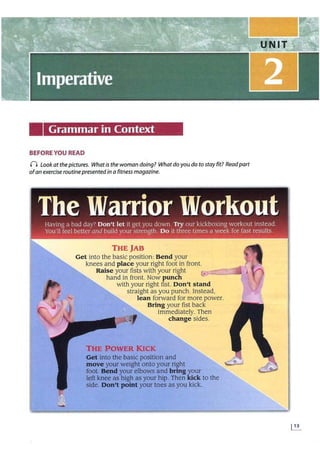
THE JAB
Get into the basic position: Bend your
knees and place your right foot in front.
Raise your fists with your right r
hand in front. Now punch e
with your right fist. Don't stand
straight as you punch. Instead,
lean forward for more power.
Bring your fist back
immediately. Then
change sides.
THE POWER KICK
Get into the basic position and
move your weight onto your right
foot. Bend your elbows and bring your
left knee as high as your hip. Then kick to the
side. Don't point your toes as you kick.
14 I UNrr2
AFTER YOU READ
Readthe following Instructions. CheckJabIfitIs fortheJab,orPowerKick ifitis forthe
PowerKick. Check Both ifit's forboth.
Jab Power Kick Both
1. Startin the basic position. D D D
2. Punch with one fist. D D D
3. Don't lean back. D D D
4. Bend both elbows. D D D
5. Put your weight on one foot. D D D
6. Don't point your toes. D D D
Grammar Presentation
IMPERATIVE
Affirmative Negative
Base Form Base Form
ofVerb Don't ofVerb
Bend your knees.
Don't
bend your knees.
Raise your fists. raise your fists.
GRAMMAR NOTES EXAMPLES
1. Use the imperative to:
a. give directions and instructions โ€ข Turn left at the light.
โ€ข Get into the basic position.
b. give orders or commands โ€ข Get up!
โ€ข Don't move!
c. give advice or make suggestions โ€ข Always warm up first.
โ€ข Don't exercise whenyou're sick.
d. give warnings โ€ข Be careful!
โ€ข Don't fall!
2. Use the imperative also to:
a. make requests (use please in addition to the
imperative)
Imperative j 15
โ€ข Please read this article.
โ€ข Read this article, please.
b. make informal invitations โ€ข Have lunch with us tomorrow.
โ€ข Bring a friend.
USAGE NOTE: When using the imperative in a
formal situation, add p/e,ase.
โ€ข Please join us, Mrs. Rivera.
NoT.Jeitt us, Mrs. Rivera.
3. Note that the subject of an imperative statement
is you. However, do not say or wl"ite you.
โ€ข Stand up straight!
NOT ยฅett stand up straight!
โ€ข Don't hold your breath!
NOT ยฅett don't hold your breath!
.... B E CAREFUL! The imperative form is the same in
both the singular and the plural.
โ€ข John, point your toes.
โ€ข John and Susan, point your toes.
Focused Practice
1 IDISCOVERTHE GRAMMAR
Match an imperative in columnA with a situation in column 8.
Column A
1. Don't touch that!
__ 2. Buckle your seat belt.
__ 3. Look both ways!
__ 4. Dress warmly!
_ _ 5. Don't bend your knees.
_ _ 6. Mark each answer true or false.
__ 7. Come in! Make yourself at home.
_ _ 8. Try a little more pepper.
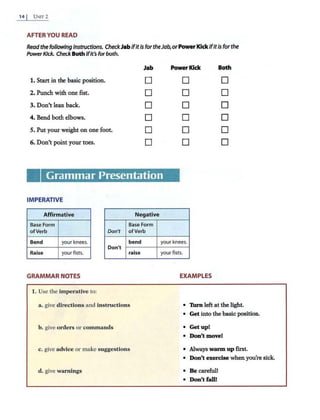
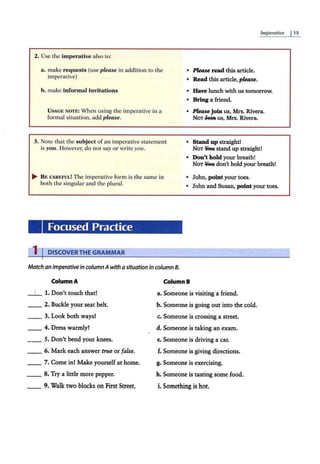
9. Walk two blocks on First Street.
ColumnB
a. Someone is visiting a friend.
b. Someone is going out into the cold.
c. Someone is crossing a street.
d. Someone is taking an exam.
e. Someone is driving a car.
f. Someone is giving directions.
g. Someone is exercising.
h. Someone is tasting some food.
i. Something is hot.
16 1 UNIT 2
2 IHEALTHY SMOOTHIE GrammarNotes I a, 3
Lookatthepicturesshowing howto makea banana-strawberrysmoothie. Match averb
from columnAwith theappropriatewords from column 8 togiveinstructions formaking
thesmoothie. Then putthe sentences In thecorrectorder.
ColumnA ColumnB
Add the ingredients until smooth.
_ 1_slice------------six strawberries.
__ Cut a banana.
__Wash orange juice into the blender.
_ _ Blend the strawberries in half.
__ Pour the fruit to the orange juice.
Write eachsentenceundertheappropriatepicture.
1. Slice a banana.
Imperative I 17
3 I MARTIAL ARTS GrammarNotes 7c, 2b, 3
Complete the advertisement for a martialarts school. Use the affirmative ornegative
imperative form ofthe verbs in the box.
become
miss
choose
register
decrease
take
increase learn
wait
MARTIAL ARTS ACADEMY
_ __;c
o...:.
v.;..:.
n-'-
't-'-
t :..:.:
hi__
nk
-'--- that martial arts is onlyabout physical training. A good
1.
martial arts program offers manyother benefits as well.
_ ____ __ self-defense and more at the Martial Arts Academy:
2.
+ _______stress. Martial arts training helps you relax.
3.ยท
+ - - -- ---- concentration. Martial arts students learn to
4.
focus their attention.
+ _______fit. Strength and flexibility improve as you learn.
s.
We are offering an introductory trial membership. -------- this
6.
special opportunity. _____ ___ classes with Master Lorenzo
7.
Gibbons, a ninth-degree Black BeltMaster.
____ ____ classes from our convenient
8.
schedule. ____ ___
9.
_ _ ____ __ now for a two-week trial.
10.
Only $30. + Uniform included.
18 1 Umr2
41EDITING
Read thisstudent'sjournal entry. There arefivemistakesin the useoftheimperative. The
firstmistake is alreadycorrected. Findandcorrectfourmore.
~
~
~
~
~
~
~
t::P
t::P
~
~
t::P
~
~
t::P
t::P
t::P
t::P
~
Fa- the Black. Belt essay, Master Gtbbons gave us this ?!ISSIQ'1f'nent:
Write
ยฅaJ '~about something 1~ to you. My topic was "The Rld'1t
Way,ยท the rules of life for the martJal arts.
Th-ee of these rules are ve<y 1~t to me:
โ€ข First, respects other people ti eat them the way you want them to
treat you.
โ€ข Second. helped people 1n need. In other words, use yo.r strength for
others, not use ItjUSt for yrur own good.
โ€ข Turd, no lie a- ~al. You can't defend others Vv'hen you feel Q.Jllty.
There are many other rules, but these are the ttvee most l"lXJl'1:ant
~to me.
Communication Practice
5 I LISTENING
() Usten to aTVchefdescribing howtomakepancakes. Then listen again andnumber
theInstructions in the correctorder.
_ _ Heat a frying pan and melt a small piece of butter in it.
_ 1_Beat two egg whites in a large bowl.
__ Add one and a quarter cups of whole wheat flour to the egg whites.
__ Flip the pancakes over.
__ Blend in some fruit.
__Mix thoroughly.
__Top them with fruit or yogurt.
__Pour some of the pancake mixture into the frying pan.
_ _ Add a cup of low-fat milk.
61INFORMATION GAP: FINDTHE WAY
Work in pairs (A andBJ. You are both going to give driving directions to placeson themap.
StudentA,fol/owthe instructions on this page. Student8, turn to page 21.
1. Ask your partner for directions to the Martial Arts Academy. Draw the route.
Imperative J 19
Example: A: I want to go to the Martial Arts Academy. Can you give me directions?
B: Sure. Start at the corner of Carter and Adams.
2. Draw the route from Carter and Adams to the Sunrise Gym.
(Be careful! One-way streets are marked ~. Don't go the wrong way on a one-way street!)
Give your partner directions.
Example: B: I want to go to the Sunrise Gym. Can you give me directions?
A: Sure. Start at the corner of Carter and Adams.
When giving directions, use sentenceslike these:
Start at the corner of Carter and Adams.
(Don't) turn right.
Parkwood Ave
Cumberland St
Go straight.
Make a left turn.
When you are finished, compareroutes with yourpartner. Are they thesame?
Continue on 9th Street.
Stay on Founders.
201 UN?r2
iJ IRECIPE EXCHANGE
Workin smallgroups. Wrltedown one ofyourfavoriterecipes. Ustthe ingredients and
write the instructions.
Example:
all1CI( A.V'D 6ASY 86A.V 1ACOS
I1re.Jiea1:s" I c.AA of beal!S /blo.u<, kiJ.rieJ/, Or pm1:o, 4 hard lbrn -talb Sht/IS,
I 1:Dtt10.:to , I oniort, le:t-hue., soJsa., spi<..es IW.Jtl~rt , cM~ powder
!11s-truยฃ.-hbns" firtSt Md dr~n -the be,a.ns . Add -the spiles. Silt!tt1er for Io tt1iro.t-tts .
Chop 1M 1:Dtt1a.1:D Md onion. Shred -the /e,-t;{u[.l.. fill -the, -talb shtlts
w~'..th -!:he beal!S, 1:Dtt1a.1:D, a.rtd onion. 'fop ~'..th -the, /e,-t;{uu a.rtd salsa..
Readyourrecipe toyourgroup. Answeryourclassmates'questions.
Example: A: How long do you rinse the beans?
B: Until the water looks clear. Use cold water. Don't use hot water.
s 1 CALM DOWN!
WorkInsmallgroups. Imagineyou havebeen In atrafflc]am foran hour. AfriendIs
waiting to meetyou on astnetcomer. Whatcanyousaytoyourselfto calmyourself
down? Shareyourlistwith theothergroups.
EXllmplr. A: Take a deep breath.
eยท: Don't think about the traffic.
C: ...
9 j WRITING
Write directions from yourschooltoanotherlocation. Itcan beyourhome, astore,
the train station, oranyplaceyou choose.
EXllmplr. To get to my apartment from school, walk two bloqcs on Oak Street. Tum left on
Tenth Avenue. Then take the bus to Main and .. .
10 ION THE INTERNET
E Asa class, chooseaplace thatyou wouldlike to go to Inyourarea. Then workIn small
groups. Doa search on mapsand directionsandlookupdirections to thatplace.
Compare the directions. Arethey thesame? Ifnothoware theydifferent? Which
directions are thebest? Whyl
Imperative I21
IINFORMATION GAP FOR STUDENT B
1. Draw the route from Carter and Adams to the Martial Arts Academy.
(Be careful! One-way streets are marked ~. Don't go the wrong way on a one-way street!)
Give your partner directions.
Example: A: I want to go to the Martial Arts Academy. Can you give me directions?
B: Sure. Start at the corner of Carter and Adams.
2. Ask your partner for directions to the Sunrise Gym. Draw the route.
Example: B: I want to go to the Sunrise Gym. Can you give me directions?
A: Sure. Start at the corner of Carter and Adams.
When giving directions, use sentences like these:
Start at the corner of Carter and Adams.
(Don't) turn right.
Parkwood Ave
Cumberland St
Go straight.
Make a left turn.
When you are finished,compare routes withyourpartner. Are they thesame?
Continue on 9th Street.
Stay on Founders.
Grammar in Context
BEFORE YOU READ
n look at thepicture and the textabove it. What didMatsuo Basho do? How long did he
live? Read thisshortbiographyofBasho.
.&ยฑ
1efajsuo 13asho, 161'f-iiJ'f
Matsuo Basho wrote more than 1,000 haiku
(three-line poems). He chose topics from
nature, daily life, and human emotions. He
became one of Japan's most famous poets,
and his work established haiku as an
important art form.
Basho was born Matsuo Munefusa near Kyoto
in 1644. ("Basho" is the name he later used as
a poet.) He did not want to become a samurai
(warrior) like his father. Instead, he moved to
Edo (present-day Tokyo) and studied poetry.
Then he became a teacher, and by 1681 he
had many students and admirers.
Basho, however, was restless. Starting in
1684, he traveled on foot and on horseback
all over Japan. Sometimes his friends joined
him and they wrote poetry together.Travel
waa difficultin the 17th century, and Basho
often got sick. He died In 1894, during a
journey to Osaka. At that time he had 2,000
students.
Ji * ......
Jfs forยท jha/ po1
.;er
133 /he road -
1'f3 lwrยทse a/e ~I
-11
a/suo 13asho
Simple Past I23
AFTER YOU READ
Readthe statements. CheckTrue orFa lse.
True Fa lse
1. Basho was born and studied in Japan. D D
2. Basho only traveled on foot. D D
3. He wrote poetry with his students. D D
4. He died at age 50. D D
Grammar Presentation
SIMPLE PAST: BE
Affirmative Statements Negative Statements
Subject Be Subject Be +Not
I was I wasn't
You were You weren't
He He
She was famous. She wasn't famous.
It It
We We
You were You weren't
They They
YesI No Questions Short Answers
Be Subject Affirmative Negative
- --
Was I you were. you weren't.
Were you I was. I wasn't.
he he he
Was she famous? Yes, she was. No, she wasn't.
it it it
we you you
Were you we were. we weren't.
they they they
(continued)
24 I UNIT 3
Wh-Questions
Wh-Word Be Subject
was I
were you
Where he
When was she famous?
Why it
we
were you
they
SIMPLE PAST: REGULAR AND IRREGULAR VERBS
Affirmative Statements Negative Statements
Base Form
Subject Verb Subject Did not ofVerb
I I
You moved
to Japan.
He traveled
You move
to Japan.
He travel
She
It
She
didn't
It
We came*
in 1684.
You left*
We come
in 1684.
You leave
They They
โ€ขCome (came) and leave (left) are irregular verbs. See Appendix 1 on page A-1 for a list of irregular verbs.
YesI NoQuestions ShortAnsw4tr$
Base Form
Did Subject ofVerb Affirmative Negative
I you you
you move
to Japan?
he travel
I I
he he
Did
she
It
Yes,
she
did. No,
she
didn't.
it it
we come
in 1684?
you leave
you you
we we
they they they
Simpl.t Past I25
Wh- Questions
Base Form
Wh-Word Did Subject ofVerb
I
you move
to Japan?
he travel
When
did
she
Why it
we come?
you leave?
they
GRAMMAR NOTES EXAMPLES
1. Use the simple past to talk about actions, states, or โ€ข Basho ilived in the 17th century.
situations that are fiinjshed. โ€ข He was a poet.
Now โ€ข He wrote haiku.
Past -X------+-------1
,.~ Future
H~ W85 8 poet.
2. You can use the sim ple past with time expressions
that refer to the past. Some examples of past time
expressions are by 1681, in the 17th century, 300
years ago, last week.
3. The simple past of r egular verbs is formed by
adding -d or -ed to the base form of the verb.
1111- B E CAREFUL! There are often spelling changes
when you add -ed to the verb.
4. Many common verbs are irregular. Their simple
past is not formed by adding-d or -ed.
Reference Notes
โ€ข He didn't stay in one place.
โ€ข Where did he travel?
โ€ข By 1681 he had many students.
โ€ข He lived in the 17tli century.
โ€ข He died more than 300 years ago.
8ASEfORM S1MPU PAST
live ~ lived
join ~ joined
study ~ studied
hop ~ hopped
prefer ~ preferred
8 ASEfORM SIMPLE PAST
be ~ was/were
get ~ got
go ~ went
have ~ had
For spelling rules for the simple past of regular verbs, see Appendix 22 on page A-10.
For pronunciation rules for the simple past of regular verbs, see Appendix 30 on page A-15.
For a list of irregular verbs, see Appendix 1 on page A-1.
26 I UNIT 3
Focused Practice
1 I DISCOVERTHE GRAMMAR
Readmore aboutBasho. Underline all the verbs in thesimple past. Then complete the time
line on the left.
/644 &shoIWS born.
1656 &slxlsft!lhertlied
1664
/6:$6
___ Sfwrknfsbuilfflle
&shoffvf.
1683
1684
___ &sho frtM;fet/fo
JJOrlltem Honshu.
_ __ &shoticket/his;de
fo visitors.
/(114
As the son of a samurai, Basho grew up in
the household ofTodo Yoshitada, a young
lord. After his father's death in 1656, Basho
stayed in the Yoshitada household. He and
Todo wrote poetry together, and in 1664
they published some poems. Two years
later, Todo died suddenly. Basho left the
area.
Basho moved around for several years.
In the 1670s, he went to Edo and stayed
there. He found friendship and success once
a.gain. Basho judged poetry contests,
published his own poetry, and taught
students. H is students built him a home
outside the city in 1681. They planted a
banana tree (basho in Japanese) in front
and called his home "Basho Hut." That is
how the poet got his name: Basho.
In spite of this success, Basho became
unhappy. He often wrote about loneliness.
His mother died in 1683, and he began his
travels a year later. His trip to the northern
part ofHonshu in 1689 was difficult, but
his travel diary about this journey, Narrow
Road to the Deep North, became one of
japan's greatest works of literature.
As a famous poet, Basho had many
visitors-too many, in fact. In 1693 he
locked his gate for a month, stayed alone,
and wrote. The following year he took his
final journey, to Osaka. He died there
among his friends.
Simple Past I27
2 IEMILY DICKINSON GrammarNotes 1-4
Complete this biographyofAmerican poetEmilyDickinson. Use thesimplepastform of
the verbsinparentheses. Go toAppendix 1on pageA-1 forhelpwith theIrregularverbs.
Emily Dickinson, oneofthe most popular American poets, lived
1. (live)
from 1830 to 1886. She _______ about love, nature, and time.
2. (write)
These - - -- - - - her favorite themes.
3.(be)
Dickinson - - -- - --an unusual Ii.Ee. After just one year
4.(lead)
ofcollege, she - - - -- - - a reclu~he almost never
S.{bocomo)
- - - - - -- her house in Amherst, Massachusetts. At home,
6.(leave)
she - - - - - - - visitors, and she only - - -- - --
7. (not have) 8.(wear)
white.
3 I MORE ABOUT EMILY DICKINSON GrammarNotes 1-4
Complete this fistoffacts aboutEmilyDickinson. Use thesimplepastform ofthe verbs In
parentheses. Go toAppendhc 1on pageA-1 forhelpwith theIrregularverbs.
1. Dickinson ___l_
ik_
ed
_ __ science.
(like)
2. She _______ it in school.
(study)
3. She _ _ ...,,..._ ___ very interested in chemistry.
(become)
4. Later she _______ about Arctic exploration.
(read)
S. She _ ______ ideas from science in many of her poems.
(use)
6. Emily Dickinson ___________ only poems.
(not write)
7. She also _______ letters.
(write)
8. But she - - - -- - - -- --the envelopes.
(notaddress)
9. Other people always - -- - - - - that for her.
(do)
10. During her lifetime, only 7 ofher 1,700 poems _ ______ in print.
(appear)
11. This - - - -- - - without her knowledge or permission.
(be)
28 I UNIT 3
4 j A POEM BY EMILY DICKINSON GrammarNotes 1-4
Nowcomplete theseJines from a poem byEmilyDickinson. Use the simplepastform ofthe
verbs in the box. Go toAppendix 1on pageA-1forhelp with the irregular verbs.
bite
A bird came down the walk:
1.
He did not lrnow I ____
2.
drink
He ____ an angle-wonn in halves
3.
And ____ the fellow raw.
4 .
And then he ____ a dew
s.
From a convenient grass,
And then ____ sidewise to the wall
6.
To let a beetle pass.
5 I BASHO AND DICKINSON
eat hop see
GrammarNotes 1- 4
Read thesestatements aboutBasho. Then write questions al>outEmilyDickinson. Write a
yes/noquestion ifaverb is underlined,ora wh-question ifotherwords are underlined.
Then answeryourquestions using the information from Exercises 2 and3.
1. Basho~ a poet.
Q: Was Dickinson a poet?
A: Yes. she was.
2. He was born in 1644.
Q: When was Dickinson born?
A: She wa5 born in 1830.
3. He became famous during his lifetime.
A: _ ___ _______________ _ _ _____ _________
4. Basho recejyed many visitors.
A: ___ _______ ___ ___ ____ _______________
Simple Past I29
5. He traveled a lot.
6. Basho wrยทote more than 1.000 poems.
7. He wrote about nature.
Q: ~~~~~~~~~~~~~~~~~~~~~~~~~~~ยญ
A: ~~~~~~~~~~~~~~~~~~~~~~~~~~~~~~~~~
8. He died jn 1694.
6 IANA CASTILLO
Readthis articleaboutamodern writer. Then answerthe questionson thenextpage.
ANA C 1
S'l'ILLO is a modern poet, novelist, short
story writer, and teacher. She was born in Chicago
in 1953, and she lived there for 32 years. Otro
Canto, her first book of poetry, appeared in 197.7.
In her work, Castillo uses humor and a lively
mixture of Spanish and English (Spanglish). She
got her special writer's "voice" by living in a
neighborhood with many different ethnic groups.
She also thanks her father for her writing style.
GrammarNotes 1-4
"He had an outgoing and easy personality, and this . . . sense of humor. I got a lot from
him ... "
Castillo attended high school, college, and graduate school in Chicago. In the 1970s,
she taught English and Mexican history. She received a Ph.D. in American Studies from
Bremen University in Germany in 1992.
(continued)
30 I UNIT 3
Readthestatements. WriteThat's right orThat's wrong andcorrecttheincorrect
statements.
1. Ana Castillo was born in Mexico City.
Thati; wrona. She wao:;n't born in Mexico City. She wao:; born in Chicaao.
2. She lived in Chicago until 1977.
3. Her father was very shy.
4. She grew up among people of different cultures.
5. Castillo got most of her education in Chicago.
6. She taught Spanish in the 1970s.
7. She went to France for her Ph.D.
71EDITING
Readthis student'sjournal. There are ten mistakesin the useofthesimplepast. The first
mistakeisalreadycorrected. Find andcorrectninemore.
~
~
~
~
~
~
~
~
~
~
~
~
~
~
~
~
Todzly ttl cless we reed a poem by Amencar'I poet Reba t Frost. I
enjoyed .
really el'P'f it. It wes about: a person who c.hoosed between two reeds
in a fa'est. MMy people believed the person ware Frost. He thinl:.ed
about his choice fa- e long time. The two roeds didn't lc:x:ibld very
diFFel ent. Ftnelly, he didn't ~ the road most people teke. He ~
the one less traveled on. At that time, he dtdt'l't 'l:houc;tt 1t wes an
'""'ยฐ'tant decision. but his choice change his life.
Sometimes I feel a little ltke Frost. Two years ago l decide to
move to a r;aw COl.l"ltry. Did I made the r!{jt dectsionr
Communication Practice
8 I LISTENING
n Listentopartofan interviewwith apoet. Then listen again,andwrite theyears on the
time line.
Simple Past I31
was parents moved began111 graduated won apoetry became
born leftTl.Ikey 111the U.S. write poetry from college award ateacher
-:~----~-----....------~
~ ------c-------c-------:1~โ€ข~
1970
9 I INFORMATION GAP: COMPLETETHE BIOGRAPHY
Workin pairs (A and8). StudentA,followthe instructions on thispage. Student8, turn to
page33.
1. Read the short biography below. Ask your partner questions to complete the missing
information.
Example: A: Where wasVladimir born?
B: He was born in Kiev.
2. Answer your partner's questions.
Example: B: When was he born?
A: He was born on May 6, 1981.
Vladimir Liapunov was born on May 6, 1981, in._ ___--'
K
""'
itw
'-'--- - -- ยท
ยท His mother
was a ______ _ ____, and his father made shoes.
At home they spoke ----------~ยท In 1999
Vlad and his family moved to-----------ยท
ยท At
first Vlad felt - - -- - -- ---ยท Then he got a
part-time job as a - - - - - - - -- -- ยทยท He worked in
a Russian restaurant. He met ___ _____ ___ at
work, and they got married in 2001. They had a baby in 2002.
____ _______ ago, Vlad enrolled at the local
community college. His goal is to own his own restaurant SOJlleday.
Whenyou are finished,compare the biographies. Arethey thesame?
32 I UNTr 3
10 IDIFFERENT LIVES
WorkIn pairs. Reread the Information aboutMatsuo Basho (seepages22 and26) and
EmilyDickinson (seepage27). In whatways were the two poetssimilar? How were they
different? With yourpartner,writeas manyideas asyoucan. CompareyourIdeas with
thoseofyourclassmates.
Example: A;, Both Basho and Dickinson were poets.
B: Basho lived in the 17th century. Dickinson lived in the 19th century.
11 I RHYMING WORDS
Inpoetry, the last word ofa line sometimes rhymes with the last word ofanotherline.
Forexample, lookatthese firsttwo linesofa famous poem byJoyce Kilmer. In these lines,
seerhymes with tree.
I think that I shall never see
A poem lovely as a tree.
Work with apartner. Write down asmanysimplepastverbs asyou can thatrhyme with
the verbs In the box.
bought drew kept sent spoke
Example: Sent rhymes with bent, lent, meant, spent, and went.
Compareyourlists with those ofotherstudents. Who has the mostrhyming words?
12 1WRITING
Write ashortautobiography. Donotputyourname on it. Your teacherwill collectallthe
papers,mix them up,andredistribute them to the class. Readtheautobiographyyour
teachergivesyou. Then askyourclassmates questions to try to findits writer.
Example: Did you come here in 1990? OR When did you come here?
13 ION THE INTERNET
E Lookupa poetrywebsite. Find apoem thatyou like andtellsomeoneaboutthepoem.
Example: I read a I an poem yesterday. It was about .
I really liked I didn't like it because . . .
When I read the poem, I thought about . . .
Simple Past I33
IINFORMATION GAP FOR STUDENT B
1. Read the short biography below. Answer your partner's questions.
Example: A: Where was Vladimir born?
B: He was born in Kiev.
2. Ask your partner questions to complete the missing information.
Example: B: When was he born?
A: He was born on May 6, 1981.
Vladimir Liapunov was born on _ ___
M
_
a.._
v_
6.._
. _
19
_8
_1
___, in Kiev. His mother was
a dressmaker, and his father made----- - - - -- -
At home they spoke Russian. In - - -- - -- - - - -
Vlad and his family moved to Boston. At first Vlad felt lonely.
Then he got a part-time job as a cook. He worked in a
-----------ยท He met Elena at work, and they
got married in - - - - -- -----ยทยท They had a baby
m -----------ยทA month ago, Vlad enrolled
at the local----------~ His goal is to own
his own restaurant someday.
Whenyou are finished, compare the biographies. Arethey the same?
Grammar in Context
BEFORE YOU! READ
(") Look at thepicture. Whatdoyou think happenedatUgo DiamondslastFridaynight?
What was the weatherlike thatnight? Readthis transcriptofa radio play.
โ„ข $ 0 @ 45J--dJ Cl ~ fil
[Ding-dong!]
SAND
ERS: Coming!.. Coming!... Oh! Hi, Officer. Sorry I took so long. I was exercising in the
basement when you rang.
OFFICER: Officer Barker, City Police. Are you Sal Sanders?
SANDERS: Yes, I am.
OFFICER: Is your wife home? I'd like to ask her afew questions.
SANDERS: No, Eve is at work. She's a manager at Ugo Diamonds. You know, she was very upset
when she heard about the burglary.
OFFICER: Was your wife wortlng the night of the burglary?
SANDERS: No, she wasn't. We were staying at Cypress Ski Lodge when it happened. Don't tell
me we're suspects! ยท
OFFICER: Just for the record, what were you and Mrs. Sanders doing between 6:00 P.M. and
9:00 P
.M. last Friday?
SANDERS: We were having dinner in our room.
OFFICER: Were you still eating '::;;::=''::;;:;:"'."~~~~=~:"'i
at 7:00?
SANDERS: No. Eve was making
acall.
OFFICER: What were you
doing while your
wifew11 talking?
SANDERS; IWU watching W
all
Strset Watch.
OFFICER: Hmmm ... Butthe
electricitywas out
because ofthe
bllzzard ...
AFTER YOU READ
WhatdidSolSonders tell the officer? Check thesentences.
D 1. He started to exercise before the doorbell rang.
D 2. He and his wife were home when.the burglary happened.
D 3. They were eating dinner at 7:00 P.M. on the night of the burglary.
D 4. He was watching TV at 7:00 P.M. that night.
Grammar Presentation
PAST PROGRESSIVE
Statements
Was/ Base Form
Subject Were (Not) ofVerb + ยทIng
I
-ยท
You
-
He Mdng yesterdayat 7:00 P.M.
She
- (not) WOl'klng when Eve mlled.
It sleeping whlleSal-talking.
We
You .....
They
Yes I No Questions Short Answers
Was/ Base Form
Were Subject ofVerb + -Ing Affirmative Negative
was I you
-ยท you ~
Were you I WU. I wasn't.
he ..ting yesterday at 7:00 P.M.7 he he
W.1 she wortlng when Eve called? Yes, she WU. ~. she wasn't.
It sleeping whlle Sal w.1tlilklng? It It
we you you
Were you we ...... we weren't.
they they they
(continued)
36 J UNIT4
Wh- Questions
Was / Base Form
Wh-Word Wl!fl! Subject ofVerb+ing
was I
were you
he eating yesterday at 7:00 P.M.?
Why was she working when Eve called?
it sleeping while ยทsal wastalking?
we
were you
they
GRAMMAR NOTES
1. Use the past progressive to describe an action that
was in pro~ss at a specific time in the past. The
action began before the specific time and may or
may not continue after the specific time.
Now
6:00
Past-~~---x_-
_.
-.-
..-.-
..-
_.--+-----... Future
we~ eati"~
.... BE CARยฃFULI Non-action verbs arc not usually used
in the progressive.
2. Use the past progressive with the simple past to
talk about an action that was jntenupted by another
action. Use the simple past for the intenupting
action.
~fJ
fo~t-Oi
Now
Past-...-
~
---~-
---
--
-..-..-..
....
_.--+-----... Future
"'Qs exerci!>t1'~
โ€ข Use when to introduce the simple past action.
โ€ข Use while to introduce the past progressive action.
EXAMPLES
โ€ข My wife and I were eating at 6:00.
โ€ข What were you doing at 7:00?
โ€ข They weren't working that night.
โ€ข She h eard about the burglary.
Nar She wes heeriAg about the ยท
burglary.
โ€ข I was exerclsl.ng when he called.
(I was exercising. The phone rang
and inle1rupted my exercising.)
โ€ข He was skiing when he fell.
โ€ข While he was siding, he fell.
3. Use the past progressive with while to talk about
two actions in progress at the same time in the past.
Use the past progressive in both clauses.
Now
Past-----X------1----""'.,_ Future
~~~~~~-ยทยท
IVa5 talkil'l0
4. Notice that the time clause (the part of the sentence
with when or while) can come at the beginning or the
end of the sentence.
Use a comma after the time clause when it comes at
the beginning. Do not use a comma when it comes at
the end.
5. BE CAREFUL! A sentence with both clauses in the
simple past has a very different meanini from
a sentence with one clause in the simple past and
one clause in the past progressive.
a. Both clauses in the simple past:
Now
5aw drove
Past--- X---X---...J...___..,_ Future
b. One clause in the simple past, the other in the
past progressive:
Now
5aw
Past-
~
---~-
--
.--
.-
..-..
-..
-โ€ข---!.---.-.,Future
IVar:; drivil'lt,l
6. Use the past progressive to focus on the duratjon
of an action, not its completion.
Use the simple past to focus on the completion
of an action.
Reference Note
For a list of non-action veirbs, see Appendix 2 on page A-2.
Past Progressive and Simple Past I37
โ€ข While I was watching TV, my wife
was talking on the phone.
OR
โ€ข My wife was talking on the phone
while I was watching TY.
โ€ข When you called, I was eating.
OR
โ€ข I was eating when you called.
NOT I was eatingxwhen you called.
โ€ข When she saw the storm clouds,
she drove home.
(First she saw the stonn clouds;
then she drove home.)
โ€ข When she saw the storm clouds,
she was driving home.
(First she was driving home;
then she saw tlte storm clouds.)
โ€ข Paul was reading a book last night.
(We don't know ifhe finished it.)
โ€ข Paul read a book last night.
(He finished it.)
38 I UNIT4
Focused Practice
1 I DISCOVER THE GRAMMAR
Read thequestion. Then circle the fetter ofthe correctsentence.
1. In which sentence do we know that the diamond necklace is gone?
aโ€ข. He was stealing a diamond necklace.
@ He stole a diamond necklace.
2. Which sentence tells us that the people arrived at the mountains?
aโ€ข.They were driving to the mountains.
b. They drove to the mounta.ins.
3. In which sentence was the action interrupted?
a. When the phone rang, he answered it.
b. When the phone rang, he was looking for his bag.
4. Which sentence talks about two actions that were in progress at the same time?
a. While the officer was questioning Sal, Eve was leaving town.
b. When the officer questioned Sal, Eve left town.
5. In which sentence did the friends arrive before lunch began?
a. When our friends arrived, we were eating lunch.
b. When our friends arrived, we ate lunch.
2 I ATRAFFIC ACCIDENT
0 Complete the conversation with thepastprogressive orthesimplepastform ofthe
verbs in parentheses. UseAppendix 7on page000forhelpwith irregularverbs.
REPoRTER: What was the cause of the accident, Officer?
GrammarNotes 1-6
OmCER: Well, it looks like the.re were many causes. First of all, when the accident
happened , the driver wai:; drivinq much too fast. The driver
1. (happen} 2.(drive}
is a suspect in a burglary, and she - - - - - - - town. While she
3. (leave}
______ _ , she - - -- - -- to someone on her cell phone.
4.(drive) 5.(speak)
When she-- ----.,-- -- the pedestrian, she immediately - -- - ----
6.(see) 7. (step)
on the brakes, but it was too late. The victim wasn't paying attention, either. He
_______ the street against a red light when the car - - -- - ---
s.(cross) 9 . (hit}
him. He ________ the approaching car because he ____ ____ to
10.(notsee) 11. (talk)
leaving
drove speaking
saw stepped
crossed hitting
didn't see was talking
PastPro~ssive and Simpk Past j 39
his friend. The friend - - - - ---- attention, either. He to
12. (not pay) 13. (listen)
music with his headphones. When he - - - - ---- the car, he -~~~---
14. (notice) 1s. (try)
to push his friend out of the way, but it was too late.
REPORTER: How is the victim doing?
OFFICER: Well, when the ambulance _______ ,he - - - - - --from a head
16.(arrive) 17.(bleed)
wound, but the doctors - - - - -- - the bleeding and they think he'll be OK.
18. (stop)
3 I ANSWER CAREFULLY GrommarNotts 1-6
Thepoliceare questioninganothersuspectIn lastFriday's burglary. Read this suspect's
answers. Use the words inparentheses and thepastprogressive orsimplepastto write the
police officer's questions.
1. OFFICER: What were you doing Friday nic:ihtf'
(What I you I doI Friday nightj
SUSPECT: I was visiting a friend.
2. OFFICER: ------------------------------------------------------
(Who exactlyI youI visit)
SUSPECT: My girlfriend. I got to her house at S:30, and then I drove her to work.
3. OFFICER: - -----------------------------------------------------
(shโ€ข / work / at 7:00)
SUSPECT: Yes, she was working the late shift.
SUSPECT: No, she was working alone.
5. OFFICER:
(What / you I doI while she / work)
SUSPECT: I was reading the paper in her office.
6. OFFICER: But there was a terrible blizzard Friday night. The lights went out.
(What / you I do I when the lightsI go out)
SUSPl!CT: I took out my flashlight and looked for my girlfriend.
7. OFFICER:
(What I she / do I when you I find her)
SUSPECT: She was looking for me.
8. OFFICER: Then - - -- - - - -- - ----,...,-----,- -- - - -- - - - - --
(WhatI youI do)
SUSPECT: We quickly left the building.
9. OFFICl!R: ------------------------------------------------------
(Why I run I when the poli<eI see you)
SUSPECT: We were running because we wanted to get out of the storm.
didn't paying been listening
was noticing tried
arrived dleeding
was stopping
who exactly did you visit ?
is she work at 7:00 ?
dose anyone eles work with her ?
what were you doing while she at work ?
what are you doing, when the lights went out ?
what's she doing when you finding her ?
what were you do ?
why were you running when the police see you ?
40 I U:-;rr 4
41BLIZZARD
Combine thepairs ofsentences. Use thepastprogressiveorthesimplepastform ofthe
verb. Rememberto usecommas when necessary.
1. The hlizzaxd started. Mr. Llgo attended a party.
When the blizzard r;tarted. Mr. Liao wafi 8ttendinq a pan;,_y.
2. The wind began to blow. The electricity went out.
GrammarNotes 1-6
When~~~~~~~~~~~~~~~~~~~~~~~~~~~~~~
3. He drove home. He listened to his car radio.
4. He pulled over to the side of the road. He couldn't see anything.
when
~~~~~~~~~~~~~~ ~~~~~~~~~~~~~~~-
5. He listened to the news. He heard about the burglary.
While~~~~~~~~~~~~~~~~~~~~~~~~~~~~~~
6. It stopped snowing. Mr. Llgo went to the police station.
When~~~~~~~~~~~~~~~~~~~~~~~~~~~~~~
s 1 EDITING
Read this personaljournal entry. There are seven mistakes in the use ofthepastprogressive
and the simple past. The firstmistake Is alreadycorrected. Find and correctsix more.
Remember to lookatpunctuation!
~
~
~
~
~
~
~
~
~
~
~
~
~
~
~
~
~app<'n&i
Who.i ldclS I~ 11i l"lt -thi.5 l"!Drruitg was so t.Ulbel~lfabte. ! I waJ1<ea dbw11 ihe
s-trui while a. wol"IAA s-Uippea ยฃit fr0rti l>f l'1t Md a.s1<ea l'1t for Ji.i..ed:i~llS 11i ihe
nea.re.si bMJ<. Ai -tha.i 1'101'1t11i, I wa.s seei~ ~ frien.d BtJ1 auoss ihe s-trui.
I c.allea bl.ti 11i liM Md a.s1<ea liM-to wru.'..t f or Mt. LULJ<i.ly f or Mt, he di.J.. 61.Jt
sa.w eve.ry-W11~' Whtie. I -t:.al1<tit~ -tD ihe woMa.11, a. pi<..l<poU<e.i wa.s pt.t.i hi,'s ~
i11-Ui MY ba.U<pa.U< . 61.11 sia.riea 11i waJ1< a.wo;;. I -thbughi he dL"d11'-t wa.11i 11i wa.i'..t
for Me , bt.t.i I wa.s wro~ . w'lwt 61.11 sa.w ihe pi<..J<poU<e.i he wen-t {ii c.all ihe
po
liu... ~ were Mrt.i/titg ir.<."1tAiAiely. -nit pcliu.. a.rre.sW ihe Wbl"IAA Md ihe
pi!J<pOU<ei. WMi AA e.xperieltu,!
the wind begin to blew the electricity went out
he driving home. he listened to his car radio
he pulling over to the side of the road he couldn't see anything
he listening to the news. he heard about the burglary.
it stopped snowing mr ligo went to the police station.
Past Progressive a1td Simple Past I4 1
Communication Practice
6 I LISTENING
n Listen to a witness describe a traffic incident. Then listen again. According to the
witness, which set ofpictures is the mostaccurate? Circle the number.
1.
2.
3.
7 I ROLE PLAY: THE REAL STORY
Workin groups offour. Follow thesesteps:
1. Three students are witnesses; the fourth is a police officer. Look at the pictu.res in Exercise 6.
2. The police officer asks the witnesses questions about the accident.
3. Each of the witnesses chooses one set of pictures to describe.
Example: A: Can you describe the accident?
B: Yes, two men were crossing the street.
8 I ARE YOU A GOODWITNESS?
lookatthispicture for ten seconds. Then closeyourbook andwrite down what was
happening. See howmany detailsyou can remember. What were thepeople doing?
Whatwere they wearing? Was anythingunusualgoing on?
Example: A man and a woman were standing by the fireplace. The woman was wearing .
Compareyourlistwith thoseofyourclassmates. Who remem/;>eredthemost?
9 I WRITING
Write adescription ofan event thatyou witnessed:an accident, acrime,a reunion, a wedding,
oranotherevent. Use thepastprogressive andthesimplepast to describe what was
happening andwhathappened during the event.
Example: While I was going to lunch today, I saw a wedding party. People were waiting for
the bride and groom outside a temple. When they saw the couple, they . . .
10 I ONTHEINTERNET
E Do asearch foryourdate ofbirth. Findoutwhat was happening in the worldatthat
time. Tellyourclassmates.
Example: I was born on March 1, 1965. At that time, the Beatles were touring the United
States. . ..
Grammar in Context
BEFORE YOU READ
n Whatis a blog orweblog? lookatthepictures. What doyou think this blog is about?
Whattoys,TVshows, clothes, andhairstylesdoyou rememberfrom yourchildhood? Read
Sandra's weblog aboutthe 1980s.
II The Aโ€ขMesgme Eighties
Today's blog is a walk down memory lane. Were you a kid in the 1980s? What toys did you use to
play with? W
hat did you use to watch on TV?
D
id you use to watch cartoons Saturday mornings? I used to love
She-Ra, Princess ofPower. I collected the toys and acted out the stories
with my friends. It's hard to believe, but we didn't use to play video
games then!
Apuzzle called the Rubik's cube
used to be very popular in the 1980s.
M
y older sister Linda carried one in
her backpackall the time. She and her
friends used to have contests. She
didn't win very often, but she loved it
anyway.
This is my mother, dressed for work.
She used to love suits with big
shoulders. She said they made her
feel strong, like She-Ra, Princess of
Power. She used to call this one
her "power suit."
My brother Gary and his friends had a
rock band. They used to pra.ctlce in
the garage. They never used to study.
Gary used to get some strange
haircuts. He's a lawyer now, and he's
lost his hair!
0 198511987 Entcn:ainmmt Righu PLC; Cbaranen 0 1985/1987 Mand lnc. All rights rcscrvcd. Sbe-Ra, Prillc~s of Powยซ and other character names arc tNdemub of ~tattd Inc.
Used with permission.
44 I Utm 5
AFTER YOU READ
Readthe statements. CheckTrue orFalse.
True raise
1. Sandra didn't watch TV on Saturdays. D D
2. She played video games a lot. D D
3. Her sister Linda played with a Rubik's cube. D D
4. Her mother wore a suit to work. D D
5. Her brother's band practiced in the garage. D D
6. Her brother and his friends studied all the time. D D
7. Her brother likes strange haircuts now. D D
Grammar Presentation
USED TO
Statements
Base Form
Subject Used to ofVerb
I
You
He
She used to
be popular.
It didn't use to
We
You
They
Yes INo Questions Short Answers
Base Form
Did Subject Useto ofVerb Affirmative Negative
I you you
you I I
he he he
Did
she
be popular?
it
use to Yes,
she
did. No,
she
didn't.
it it
we you you
you we we
they they they
Wh- Questions
Base Form
Wh-Word Did Subject Use to ofVerb
I
you
he
When d id
she
it
use to be popular?
we
you
they
GRAMMAR NOTES
1. Use used to + base form of the verb to talk about
past habits or past sjtuations that no longer exist
in the present.
Now
Past -- X - X-X ----4----โ€ข~ Future
u$ed t o play
lill> BE CAREFUL! Used to always refers to the past. There
is no present form.
2. Use used to in sentences that contrast the past and
the present. We often use time expressions such as
now, no longer, and not anymore with the present ~o
emphasize the contrast.
3. Form the negative with:
didn't + use to
USAGE NOrE: In negative statements, never+ used to
is more common than didn~ use to.
4. Form questions with:
did + 11.5e to
USAGE NOTE: In questions, the simple past is more
common than did + use to.
Pronunciation Note
Used to and use to are pronounced the same: /'yust-a/.
Used to I45
EXAMPLES
โ€ข He used to play in a band.
(He played in a band in the past,
but he doesn't play in a band now.)
โ€ข She used to love cartoons.
NOT She tteee to love cartoons.
โ€ข I use4 to have very long hair,
but now my hair is very short.
โ€ข We used to play witlh Rubik's cubes,
but we don't like them anymore.
โ€ข He didn't use to study.
NoT He didn't tffleEl to study.
โ€ข He never used to study.
โ€ข Did you use to have long hair?
NOTDid you tffleEl to have long hair?
โ€ข Did you have long hair when you
were younger?
(continued)
46 j UNrr 5
5. BE CAREFUL! Do not confuse used to + base form
of the verb with the following expressions:
โ€ข She used to work.
(She doesn't work now.)
โ€ข be used to +b ase form +-ing (be accustomed to)
โ€ขget used to +base form+ -ing (get accustomed .to)
Focused Practice
1 I DISCOVERTHE GRAMMAR
โ€ข She is used to working.
(She is accustomed to working.)
โ€ข She'll get used to working.
(She'll get accustomed to working.)
Read these responses to"TheAwesome EightiesNblog. Underline the verb forms thatrefer
to pasthabits.
@ Q 0 G) '@ Ihttp://www.theawesomeeightles.com
Remember when Pacman used to be the most popular
computer game? A Japanese company brought Pacman to
the United States in 1980. In the first 18 months, people
spent $1 billion on the game. They used to play it in video
arcades, on their computers, and even on special
wristwatches!
posted 02.12.06. Comments ( 14)
We used to listen to music on vinyl records.The quality
wasn't always very good, but we were used to it- it never
used to bother us. In 1982, CDs appeared. Then we got used
to hearing perfect sound. By the end of the 1980s, vinyl
records were out, and CDs were in.
posted 02.13.06. C<>mments (71
Computers used to be very large and very expensive. In the
1980s they got smaller and cheaper. People got used to
working on personal computers in offices and started to buy
them for their homes. Now we ask, "What did we use to do
before computers?"
p0$1ed 02.14.08. Co .o " nts' 11)
IDootlrMnt: DoM (32.496 uos)
Used to I47
2 I SCHOOL REUNION GrammarNotes 1-4
Sandra is atherclass reunion. Complete the conversations with the correctform ofused to
and the wordsin parentheses.
1. SANDRA: You look familiar. _ _;O
_id
:___ you - ---'u
-"
s-'-
e_
t_
o_
b_
e__ in the drama club?
a.(be)
ROSA: Sandra! It's me-Rosal I - - - - - -- - long hair. Remember?
b.(have)
2. ROSA: There's Glen-all alone. Was he always that shy?
SANDRA: Glen? He never - - ------ talking. Let's go say hi to him.
a. (stop)
3. ROSA: _ ___ you - ------- with Gary's band, the Backyard Boys?
a.(play)
GLEN: Sometimes. We - -- - -- -- in Gary's garage after school.
b. (practice)
SANDRA: Tell the truth, Glen. You really-- - ---,--- to see my sister Linda!
c. (come)
4. GLEN: There's Jim and Laura. I think they got married a couple of years ago.
SANDRA: Really? In high school, they - - - -- - - - - --each other at all.
a. (not like)
5. LAURA: I see Sandra! We ________ next to each other in math class.
a.(sitl
jrM: She looks so different now. She - -- - - - -- - - - glasses.
b.(not wear)
LAURA: We all look different now. We -------- a lot younger back then.
c.(be)
3 I LOOKING BACK GrammarNotes 1-2
Sandra is showing herdaughterMegan an oldphotoalbum. Complete theirconversation.
Use used to andthe correct verb from the box.
be drive love play
MEGAN: Wow! Uncle Gary __
u_
s_
ed
___
w_hei
_"
""'"
e__ a lot of hair!
1.
visit
SANDRA: Not for long. Right after this photo, he shaved his head.
MEGAN: In this picture, were you going to the gym?
SANDRA: No. We - - - - ---- exercise clothes everywhere.
2.
MEGAN: You looked cute!
wear
SANDRA: This was your Aunt Linda's car. She -------- her friends to school every
3.
day.
MEGAN: That's not Uncle Fred with her.
SANDRA: No, that's Glen. He ________ her boyfriend before she met Fred.
4.
(continued)
48 I UNIT 5
MEGAN: Oh! You had a Barbie doll!
SANDRA: Of course. I _______ with it every day.
s.
MEGAN: And that's me with Grandma and Grandpa!
SANDRA: Right. You - - - - - - - them at the beach every summer.
6.
You - - - - -- -the water.
7.
41EDITING
Read thisjournalentryabout a high school reunion in Timmins,Ontario,a small town 500
miles north ofToronto. Thereare seven mistakesIn the useofused to. The firstmistakeis
alreadycorrected. Find andcorrect sixmore.
Tke /ugh. sdtool rWUJn was greoi! J t.alked. f.o
ยฃdeen ยฃ4.ward.s iJ}eJ/, ske's thR. famous Slum.a. TwaJ,n
mw Jn /ugh. scltool, ske~ /JSed. f.o be. )IJst one of us,
and wni4hi we all called. h.er Weui. Sh.e gl'aduo/,ed. ;,n
19f3, a year before me. TC111aiJ sh.e lwes iJ'I a chaieoJA lt1
Swib..erland and modยฃ/s for f!evlon, hd h.er /Je cM.nZ
l<Sed. wbe. like thai at all! Ske /JSeS f,o be. very poor,
and h.er grandma used. f.o made all h.er cldJtes beumse ,.
Shania Twain
>
f
J
f

j
h.er family COt.J.ld.n't afford wbuy th.em. Sh.e was alwaus a l}OO(i. f!l<lSi,e.i.aJ'I, t.fttwgh. Jn fad,
ske used. wearn mofl(?f} for h.er fa.tllify thai wa,y. Ske performed. wdJi a /ocaJ rod< b:md.
and f!/!J frt.end.s and. I use f,o l}O hear ker. Sh.e COt.J.!d really Si.Ill}! Her new name, SJwlla,
metl.J'IS 'on my WOIJ' i// 0.]hva f.h.er st.e;fatftR.l''s f'/afiN-e Ameri.W1 /an()W)l)e). All.el' sh.e
left TiJ71111ins, J l}Ot used. f.o Uunk tJzai Tl!nmi11s wasn't llllpori,ad to h.er M!)tnOre -hd I
was wrong. Ske lS alwa.ys doing l}OO(i. !Junl}s for ow comm/Jllll;g.lv1d f.ord/,ikt. sh.e was )IJst
thR. wa,y ske l<Sed. be. ln Jw;lt. sdtool- siJ71p/e and. ftWld.ly!
Communication Practice
5 I LISTENING
0 Two friends aretalking abouttheirpast. Listen to theirconversation. Then listen
again. Check the things theyusedto do in thepast andthe things theydo now.
Past Now
1. get up very early without an alarm clock 0 D
2. use an alarm clock D D
3. have a big breakfast D D
4. have a cup ofcoffee D D
5. look at the newspaper D D
6. have endl!ess energy D D
7. do aerobics D D
8. meet at class reunions D D
9. take car trips on weekends D D
6 I PEOPLE CHANGE
Work with apartner. Lookatthe pairsofpicturesandtalkabouthowthepeoplehave
changed. Then write sentences thatdescribe thechanges. Compareyoursentences with
those ofyourclassmates.
Now
1. Sharifa ue;ed to be very bue;y, but now ,;he i5 more relaxed.
She u5ed to wear ala,;e;ee;. but now she doe,;n"t.
Used to I49
(continued)
so I U:-irr 5
Now
2.Jean-Marc______________________ _ _____
THEN Now
3. Lyric _ _ _ ___ ___ _ _ _ _______ ___________
THEN Now
4. .Mikc_ ______ _ ________ _ _ _______ _____
7 I THE WAY I USEDTO BE
Workin smallgroups. Bringin apictureofyourselfwhenyou were muchyounger. Talk
aboutthe differences in howyou usedto beandhowyou are now. Whatdidyou use to do?
How didyou use to dress?
Example: I used to have very long hair. Now I wear my hair short.
B1 WRITING
Write a two-paragraph essay. Contrastyourlifein thepastandyourlife now. In the first
paragraph,describehowyourlife used to be atsome timein thepast. In the second
paragraph,describeyourlife today.
Eumple: I used to live in Russia. I attended St. Petersburg University.
In those days I used to . . .
Today I am living in Florida and attending Miami University .
9 I ON THE INTERNET
El Workinsmallgroups. Each grouppicks arecent decade (ten-yearperiod): 1950s,
1960s, 1970s, 1980s,or 1990s. Each memberofthe group does a web search on that
decade.
1. Look for the fashions, styles, music, or movies of that rime.
2. Share the information you find with your group.
Used to I51
3. As a group, share your information with the rest of the class. You can also bring in pictures
you find.
Example: Here are some examples of the clothes people used to wear in the 1960s.
Young girls really used to wear their skirts short . . .
And here are some examples of the way people used to wear their hair.
Boys used to let their hair grow very long . . .
Grammar in Context
BEFORE YOU READ
n Think about theyear2050 and try to predict which business willcreate the mostjobs.
Computers? Robots? Space travel? Read this article aboutjobs ofthe future.
C
omputers Robots Spoce Travel
Which business will create the most jobs?
Did you guess space travel? If so, Professor Patrick Collins, a professor of economics in
Japan, agrees with you. At a recent lecture he said, "It won't be long before people
will call their travel agents and book their flights to the Moon. Imagine! Yes, there is
room on tomorrow's flight to the Moon. It leaves at 9:00 A.M. It's going to be full so
please arrive early for check-in."
Of course, many people disagree with Collins. They think space travel will cost too
much and not many people will travel. They also think that people won't feel safe
enough to travel into space. But Collins's research shows that the majority of people
think it will be worth saving their money to travel into space. He claims that while it
will probably start oul as an activity for a few rich individuals, it will grow very
quickly- just like the uviution (uirplune) imluslry 91ew in the last 100 years. After all,
Collins reminds us, the Wright brothers flew their first plane in 1903.
Future I53
e to oo fo obs in e e -- - - -- ~ =--
If Collins is right that people will travel to space a.s
tourists, then, like all tourists, they a re going to
stay in hotels. They are going to want tours and
they will certainly expect some entertainment. All
of this will require many people, and that will
me an many new jobs.
Some of these space jobs will b e similar to Earth
jobs, but they will have some unique challenges.
For instance, how will a space waiter serve food in
a gravity-free restaurant? And what about fitness
trainers? Teaching an aerobics class in space will
re quire some new moves in addition to a lot more
flexibility-in all directions! But not all space jobs
will be more diliicult. Some will be easier, the job
of a porter for instance. No more carrying heavy
luggage; it will just float along. Well, one thing is
certain about these space jobs-they won't be
boring!
PLEASE NOTE: If you missed this great lecture, Professor Collins is spe aking again at
the space conference tomorrow night at 7:00 P.M.
AFTER YOU READ
What'sProfessor Col/ins's opinion?Readeach statementandwriteT (True) orF (False)
underCollins. Writeyourown opinion underYou.
1. Space travel will create more jobs in the future.
2. People won't feel safe enough to travel in space.
3. The space travel business won't grow very quickly.
4. At first, only rich people are going to travel as space tourists.
S. People will save money to travel into space.
6. There will be hotels in space.
7. Space jobs will be completely different from Earth jobs.
8. Space jobs will have some interesting new problems.
Collins You
54 j UJ>IT 6
Grammar Presentation
BE GOING TO FORTHE FUTURE
Statements
Base Form
Subject Be (Not) Going to ofVerb
I amโ€ข
You are
He
She Is (not) going to leave soon.
It
We
You are
They
โ€ขFor contractions of I am, you are, etc., see Appendix 26 on page A-12.
YnI No Questions Short Answers
Base Form
Be Subject Going to ofVerb Affirmative Negative
Am I you are. you're
Are you I am. I'm
he he he's
Is she going to leave soon? Yes, she is. No, she's not.
It it it's
we you you're
Are you we are. we're
they they they're
Wh- Questions
Base Form
Wh-Word Be Subj ect Going to of Verb
When
Why
are you going to leave?
Fubtre ISS
WILL FOR THE FUTURE
Statements
Base Form
Subject Will (not) ofVerb
I
You
He
She
will (not)* leave
It
soon.
We
You
They
โ€ข For contractions of I will, you will, ere., sec Appendix 26, page A-12.
YesI No Questions ShortAnswers
Base Form
Will Subject ofVerb Affirmative Negative
I you you
you I I
he he he
Will
she
leave soon?
it
she
will. No,
she
won't.
Yes,
it it
we you you
you we we
they they they
Wh- Questions
Base Form
Wh-Word Will Subject ofVerb
When will you leave?
PRESENT PROGRESSIVE* FOR THE FUTURE SIMPLE PRESENT* FOR THE FUTURE
Statements Statements
Subject+Be (Not) + Base Form + -ing Subject Verb
We're We leave
(not) leaving soon.
It's
Monday at 6:45 A.M.
It leaves
โ€ขfor a complete presentation of present progressive and simple present forms, see Unit I, page 3.
56 I UNIT 6
GRAMMAR NOTES
1. There are several ways to talk about the future.
You can use:
โ€ข be going to
โ€ข will
โ€ข present progressive
โ€ข simple present
Now
meeting
Past ----+--------x ---~ Future
USAGE NOTE: Sometimes only one form of the future
is approp1
iate, but in many cases more than one
form is possible.
2. To make predictions or guesses about the future,
use:
โ€ข be going to
OR
โ€ข wUl
.... B E CAREFUL! Use be going to instead ofwill when
something in the present helps you make the
prediction about the future.
3. To talk about future intentions or plans, use:
โ€ข be going to
OR
โ€ข will
OR
โ€ข present progressive
We often use will when we decide something at
the moment of speaking.
We o{1.en use the present progressive v..โ€ขhcn w~
talk about future plans that are already arranged.
Pronunciation Note
EXAMPLES
โ€ข They're going to have a meeting.
โ€ข I think I'll go.
โ€ข It's taking place next week.
โ€ข It starts at 9:00 A.M. OD Monday.
โ€ข People are going to travel to space.
OR
โ€ข J;>eQple will tr!lvel to space.
โ€ข Look at those dark clouds!
It's going to rain.
NOT It'll rain.
โ€ข I'm going to fly to Mars next week.
OR
โ€ข I'll fly to Mars next week.
OR
โ€ข I'm flying to Mars next week.
A: The show is opening next week.
B: Sounds interesting. I think I'll go.
โ€ข I'm llylng to Chicago n ext month.
I already have a ticket.
In informal speech. going ro is often pronounced "gonna " /gana/.
Futrtre I57
4. To talk about scheduledfuture events (timetables,
programs, schedules), use the simple present. Verbs
such as start, leave, end, and becin are often used this
way.
โ€ข The shuttle leaves at 9:00 A.M.
Reference Note
โ€ข The conference starts tomorrow
morning.
Will can also be used for making a request; see Unit 13 on page 146.
Focused Practice
1IDISCOVER THE GRAMMAR
Read this transcriptofa radio program. The host,Dr. DavidLivingston, is interviewing
Professor Patrick Collins. There are eighteen verb forms thatrefer to the future. Find and
underline them. Thefirst one is already underlined. Find andunderline seventeen more.
THE SPACE SHOW
LIVINGSTON: Good evening, everybody, and welcome to my new program, The Space
Show. I am your host, Dr. David Livingston, and my show will brinij you
information on anything and everything related to the exploration of
space. And today's guest, Professor Patrick Collins, is going to talk about
space travel. Professor Collins is speaking to us from Azabu University in
Japan. He is an expert on space travel, and he believes that space travel is
coming to us sooner than we think. Welcome to the show, Professor. Tell us:
Why do you think space travel is going to be so popular and why so soon?
COLLINS: It's simple. Ask moat people and they'll tell you they are very curious about
outer space. There's already a lot of excitement about spacetravel.
LIVINGSTON: But how will the average person be able to afford it? It will be very
expensive, no?
COLLDOll I know that some people say it'll cost too much. But space travel is also
going to create jobs. And with those new jobs, the world's economy will
improve. This means that people will have more money to spend, and
more people will want to try space travel.And I'd like to add that travel to
the Moonis only a start. We won't stop there. Putting peopleon Mars won't
take much longer. We all know this beautiful planetF.mth haa limited
resources. Soonwe will have no choice but to lookelsewhere, and that
means to lookinto space.
U'IJJ(GSTOif1 Very interesting.It's time for a short break. but first I want to remind
everyone that ProfessorCollins is speakingat the Annual Space
'l'ransportattonConference in Virginia next week. Also, don't forget that
The S,PCJCe Show la moving to a new time. Hezt week's showbegins at
8:00P.M. PacWc Standard Time.
58 I UNIT 6
2 I IT'S GOING TO HAPPEN GrammarNate2
Lookatthepictures. Theyshowevents from adayin thelifeofProfessorStarr. Write predictions
orguesses. Use the words in the box and a form ofbe going to ornot be going to.
answer the phone
go to sleep
drive
have dinner
1. ____
H
-'
e
_
'$
_
g
,_
o
_
in
~
g
'-
t
_
o
_
t
-'-
a
-'
ke
;;....;...
a""'"
t-'
ri._
p,___
3. _______________
5. _______________
?. _ ______________
get out of bed get very wet give a speech
watch TV
ram
~
2. _______________
4. _____________~
6. _____________~
8. _______________
3 I PROFESSOR STARR'S SCHEDULE
Write aboutProfessorStaff's plans fornextweek. Use theinformation from his calendar
and thepresentprogressive.
Monday Tuesday Wednesday Thursday Friday
A.M .
Teo.di mg Take Do tJt.e Work on &JU; an
ecrJl10l71le.S tJt.e train ll1l:erviRJu tJt.e Space exerCJSe
dass tr; Tokyo for Fbe dass
!~I'ยง wehsik
1
-
P.M.
!fed Answer Ay tr;
frtend.s r;_ue.stwns New York
from 'from tJt.e for tJt.e
[;.nq/Md. onl/Jle chai Spac.e
for dlnner TrMSportafi.on
C.OnferencE.
1. On Monday morning he"
e; teachinq hie; economics class.
Future I59
GrammarNote 3
Saturday
Answer
e-matis from
tJt.e Space
Futwe
~;k
IJ)riJ:R.
as~
for tJt.e
next space
travel
f
comerenc.e
2. On Tuesday morning ________ _________________
3.0nTuesdayevening________________ _ ________
4. On Wednesday morning _____ ________________ _ _ _
5. On Wednesday afternoon_______________________
6. All day Thursday_________________________
7. On Friday morning_ _ _ ______________________
8. On Friday evening _ ____ _ ____________________
9.0nSaturdaymorning _________________________
10. On Saturday afternoon ________________________
60 I UNIT 6
4 j SPACE FUTURE Q &A
Itis theyear2020 andanInternationalgroupofspace tourists aregettingreadyfor their
space flight. Partofthepreparation includes aQuestion andAnswer(Q& A) session with
astronautWilliam R.Pogue. Complete the questions andanswers. Use the verbs In
parentheseswith wlll orwon't.
You'll get used to it!
Q: Will it ___t
::::
ao:o
ke
:::___ a long time to get used to zero gravity?
1. (take)
GrammarNote2
A: No, __....;1.:::;
't.:.:
~
.:::;
on
:.:..'~
t _ _โ€ข Every day you - - -- - - - more comfortable, and after
2. 3.(feel)
three days you - - - - - -- used to being in space.
4. (become)
*'* *
Q: ____ I _______ sick?
S. (feel)
A: Yes, you might feel sick for a little while. But it _______ long.
6.(last)
***
Q: I love to read. How _ _ _ _ I - -- - -- - to keep a book open to the right page?
7.(beable)
A: Actually, reading a book in space can be quite a problem. You _______ strong
8.(need)
clips to hold the book open. It can be a little frustrating at first, but after a while you
- -- - - - - used to it.
9. (get)
***
Q: ____ I------- the same?
10.(lookl
A: Actually, you - - -- - - - the same at all. Your face and eyes - - -- -- -
11.(look) 12.(get)
puffy. The first time you look in a mirror, you probably - - - ---- yourself.
13.(recognize)
***
Q: ____ I _______ in my sleep?
15.(bump)
16.(be able}
A: Yes, youยท- - - - - - - salt and pepper, but not like you do on Earth-the grains just
17. (have)
float away in zero gravity. You ___ _ _ __ small, squeezable bottles with salt water
18.(use)
and pepper water. You just squeeze it on your food. It tastes great!
5 I MOON SHUTTLE
ItisJune 2050. You and a friendareplanning atrip to the Moon. Yourfriendjustgot the
schedule,andyou aredeciding which shuttle to take. Use the words inparentheses to ask
questions,and lookatthe schedule to write the answers. Use thesimplepresent.
โ€ข 2050 SHUTTLE SERVICE TO THE MOON
September- November 2050
All times given in Earth's Eastern Standard Time
โ€ข
' SEPTEMBER OCTOBER NOVEMBER
Leave Arrive Leave Arrive Leave Arrive
Earth Moon Earth Moon Earth Moon
914 9n 10/15 10/18 11/4 11/8
7:00 A.M. 6:00 P.M. 4:00 A.M. 3:00 P.M. 1:00 P.M. 12:00 A.M.
9/20 9/23 10/27 10/30
--
llmlllmllmlllmlillll I 11 .
1. (During which months I the shuttle I fly to the Moon this year)
A: Ourinq which monthi; doei; the i;huttle f(y to the Moon thii;year?
B: fr; ffiei;; to the Moon in September: October: and November:
2. (How many I shuttle flights I leave this year)
A:
Future I61
GrammarNott?4
B: ~~~~~~~~~~~~~~~~~~~~~~~~~~~~~~~~
3. (How often I shuttle I depart for the Moon each month)
A:
B: ~~~~~~~~~~~~~~~~~~~~~~~~~~~~~~~~-
4. (When I the earliest morning flight I leave Earth)
A:
B: ~~~~~~~~~~~~~~~~~~~~~~~~~~~~~~~~-
5. (At what time I the latest shuttle I leave Earth)
A:
B:~~~~~~~~~~~~~~~~~~~~~~~~~~~~~~~~-
62 I UNIT6
6 I CHOOSETHE FUTURE GrommorNotes 1-4
n Two people are traveling to a conference. Readtheirconversation andcircle the most
appropriate future forms.
J ASON: I just heard the weather report. It's raining /~'s going to rai~tomorrow.
1
.-----
ARIEL: Oh no. I hate driving in the rain. And it's a long drive to the conference.
J ASON: Wait! I have an idea. We'll take I We're going to take the train instead!
2.
ARIEL: Good idea! Do you have a train schedule?
J ASON: Yes. H ere's one. There's a train that will leave/ leaves at 7:00 A.M.
3.
ARIEL: What about lunch? Oh, I know. I'll make I I'm making some sandwiches for us.
4.
J ASON: OK. You know, it's a long trip. What are we doing I are we going to do all those hours?
5.
ARIEL: Don't worry. We'll think I We're thinking of something.
6.
J ASON: You know, we have to get up really early. I think I'm going/ I'll go home now.
7.
ARIEL: OK. I'm seeing you/ I'll see you tomorrow. Good night.
8.
11EDITING
Read this student'sreporton space travel. There areeleven mistakes in the use ofthe
future. The firstmistake is already corrected. Findandcorrect ten more.
travel
Botll astronauts and space tourists wlll.tfaveilAg In space, but tourists going to have
a much different experience. Space tourists Is going to travel for fun, not for work. So,
they willn't have to worry about manyof the technical problems that astronauts worry
about. For example, space tourists will need not to figure out how to use a screwdriver
without gravity. And they Isn'tgoing to try new experiments outside the space shuttle.
For the most part, space tourists wlll just going to see the sights and have a good time.
Still, there wlll be simllaritles. Regular activities be the same for astronauts and
space tourists. For example, eating, washing, and sleeplng will turned Into exciting
challenges for everyone in space. Everyone ls going to doing exercises to stay frt in
zero gravity. And both astronauts and space tourists will going to have many new
adventuresI
Communication Practice
s 1 LISTENING
() Listen to theshortconversations. Decide ifthepeopleare talking aboutsomething
happening Now orin the Future. Then listen again and check thecorrectcolumn.
Now Future
1. D G
2. D D
3. D D
4. D D
5. D D
6. D D
9 IWHEN AREYOU FREE?
Completeyourweekendschedule. Ifyou have noplans, writefreeโ€ข
. Fridl!y Saturday
12.-00 P.M.
l:OOP.M.
2:00P.M.
3:00 P.M.
t--
4:00P.M.
S:OO P
.M.
6:00P.M.
- 7:00P.M.
8:00 P.M.
9:00P.M.
Sunday
Nowwork with apartner. Ask questions to decideon atime when you are both free to do
something together.
..
Example: A: What are you doing Friday afternoon? Do you want to go to the movies?
Future I63
.
B: I'm studying at the library. How about Friday night? Are you doing anything?
64 I UNrr 6
10 I CHOOSE ATIME
There is a space conference in town this weekend. Work with yourpartnerfrom Exercise 9.
Lookatthe schedule ofevents below. Then lookatyourschedules from Exercise 9. Decide
which events to attend andwhen.
Friday
8:00 A.M.-4:00 P
.M.
10:00 A.M.- 12:00 P.M.
7:00P.M.
8:00 P.M.
Saturday
2:00 P
.M.- 3:00 P
.M.
2:00 P.M.-4:00 P
.M.
6:00 P.M.
8:00 P.M.
Sunday
SPACE TOURISM
Training for Space Travel
Eating in Space
Advertising and Videos ofMoon Resorts
Meet Yang Liwei, Chinaยทs First Astronaut
Writing a Resume for Space Employment
Personal care in Space, or 'How Do I wash My Hair?'
Advertising and Videos ofMoon Resorts
Space Sports
Training for Space Travel
I
8:00 A.M.-4:00 P
.M.
I 2:00 P
.M.- 2:00 P.M.
6:00 P.M.
Live Taping ofTheSpace Show
Lecture: Who Should Invest in Space Tourism? _ l
Example: A: What are you doing Friday? Do you want to go to "Training for Space Travel"?
B: Not really. That will take up the whole day. What else is there on Friday?
r11 I WRITING
Imagineyou are a travelagentadvertising adream vacation in space. Useyour
imagination to write aboutwhatyourclients will do, what theywillsee,and howtheywill
feel. What willhotel accommodations look like? Whatkinds ofactivities are there going to
be? Whattypes offood willpeople eat? Be creative!
Example: This is an experience you will never forget! Come with us to the Moon. We'll show
you the sights and what Earth looks like from space .
'12 I ONTHE INTERNET
IJ Do a search on space sports. Read about thepossibilities ofnewgames andsports in
zero gravity. Describe agameyou readabout ordesignyourown game. Some websites
allowyou tosubmityour new ideas. Tryit/ Maybeyours will appearon the website too!
Example: This game is called space water soccer. You will play it in a zero-gravity water room.
Large blobs of water will float through the air, and each team will have to move the
water blobs to one side of the room . . .
Grammar in Context
BEFORE YOU READ
n Lookat thepicture. Whatis the girl thinking? Readthisarticleabout setting goals.
letInI] โ€ขIiii Wbatareyourdreamsforthefuture?
Are you going to get your degree bythe time you're 22?Willyou startyour own business before you
tum 40?We all have dreams, but they'll remain just dreams until we change them to goals. Here's how.
PUTYOUR DREAMS DN PAPER. After youwrite
a dream down, it will start to become agoal.
Your path will be a lot clearer. For example,
Latoya Jones wrote:
BeforeI turn 30, I'mgoing to be
asuccessful businessperson.
Now her dream is starting
to become her goal.
LIST YOUR REASONS. When things get difficult,
you can read this list to yourself and it will help
you to go on.This is what Latoya put at the top
of her list:
My parents will be proud of me when I'm
asuccessful businessperson.
WRITEDOWN A
NACTIO
NPLAN
. What areyou
planning to doto achieve your goal? Thisis
Latoya'saction plan:
I'mgoing to goto business school as
soon as I save enough money.
When I have my degree, I'll get ajobwith
a big company.
TAKE YOUR FIRST STEPSTODAY
. Here are the
first steps Latoya is going to take:
Before I apply to schools, I'm going
to order some school catalogs.
I won't decideon aschool until I visit
several of them.
You can do exactly what Latoya did to achieve
your owngoals. Keep this article ina safeplace.
When you decidetostart, you'll know what to
do. Remember, the longest journey starts with
the first step!
66 [ UNIT 7
AFTER YOU READ
For each pair ofsentences (a orb), check the action thatcomes first.
Latoya's action plan:
1. __ a. She will order school catalogs.
2. __ a. She will save money.
3. __ a. She will get a job with a big company.
Grammar Presentation
FUTURE TIME CLAUSES
Statements
Main Clause llmeClause
Iwill
lam going to
I graduate.
She will
She is going to
get a job when she graduates.
Theywlll
they graduate.
They are going to
YesI No Questions
Main Clause llmeClause
Wiii i
Am igoing to
Igraduate?
Will she
Is she going to
get a job when she graduates?
Will they
they graduate?
Are they going to
Wh- Questions
Main Clause lime Clause
will I
Igraduate?
am Igoing to
__ b. She will apply to schools.
__ b. She will go to business school.
__ b. She will get her degree.
ShortAnswers
Affirmative Negative
will. won't.
you
are.
you
aren't.
Yes, she
will.
No, she
won't.
Is. isn't.
they
will.
they
won't.
are. aren't.
Where
will she
get a job when she graduates?
is she going to
will they
they graduate?
are they going to
GRAMMAR NOTES
1. When a sentence about future time has
two clauses, the verb in the main clause is
often in the future (will or be going to). But
the verb in the tfme clause is often in the
simple praent.
.... BECAllEFVLI Do not use will or be going to in
a future time clause.
The time clause can come at the beginning
or at the end of the sentence. The meaning
is the same.
Use a comma after the time clause when it
comes at the beginning. Do not ui;e a
comma when it comes at the end.
2. Here are some common time expresslona
you can use to beginfuture time clauses.
a. When, after,notuntil, and as soon as
often introduce the event that happens fial.
Now 1<P ~
-+
....:!! l(.
<l ;:Q
JI>
.,. iJ- ,o
~ยท ,o ~)
Pllst x-x----'"โ€ข Future
b.Before,until, and by the time often
introduce the event that happens
semnd.
c. While introduces an event that will happen
at the same time as another event.
Now
Put---------~-โ€ข Future
...!._
ook for~ jO~
!?oon inuttyi'0
Future Time Clauses J 67
EXAMPLES
m
aindause timeclause
โ€ข She'll look for a job when she graduates.
main clause timeclause
โ€ข He's going to work after he graduates.
NOT when she will ~Me.
NOT after he is geing te ~te.
โ€ข Before she applies, she11 visit schools.
OR
โ€ข She11 visit schools before she applies.
NorShe11 visit school.'before she applies.
โ€ข When I graduate, I'll look for a job.
โ€ข I11 look for a job afterI graduate.
โ€ข I won'tlook for a job until I graduate.
โ€ข As soon as I graduate, I11 look for a job.
(First 171graduate. Then 171look for a job.)
โ€ข Before I get a job, 111 finish school.
โ€ข I'll stay in schooluntil I get a job.
โ€ข .By the time I get a job, I'll be out ofschool.
(First 111finish school. Then 171get a job.)
โ€ข While I look for a job, I'll go on studying.
(l will look for a job and study at the same
time.)
68 j UNIT7
Focused Practice
1 I DISCOVERTHE GRAMMAR
Readthe numberedsentence. Then circletheletterofthetwo sentences thathave
asimilarmeaning.
1. Amber will open her own business when she finishes school.
a. Amber will open her own business. Then she'll finish school.
@ Amber will finish school. Then she'll open her own business.
2. Denzell won't quit until he finds another job.
a. Denzell will find another job. Then he'll quit.
b. Denzell will quit. Then he'll find another job.ยท
3. Jake will retire as soon as he turns 60.
a. Jake will retire. Then he'll turn 60.
b. Jake will turn 60. Then he'll retire.
4. After the Morrisons sell their house, they'll move to Florida.
a. The Morrisons will sell their house. Then they'll move to Florida.
b. The Morrisons will move to Florida. Then they'll sell their house.
S. Marisa will call you when she gets home.
a. Marisa will call you. Then she'll get home.
b. Marisa will get home. Then she'll call you.
6. Dimitri is going to live with his parents until he gets married.
a. Dimitri is going to get married. Then he'll live wit)l his parents.
b. Dimitri will live with his parents. Then he'll get married.
7. While Li-jing is in school, she'll work part-time.
a. Li-jing will finish school. Then she'll get a pan-time job.
b. Li-jing will go to school. At the same time she'll have a part-time job.
8. By the time Marta gets her diploma, she'll be 21.
a. Marta will get her diploma. Then she'll turn 21.
b. Marta will turn 21. Then she'll get her diploma.
9. Adel and Farah won't buy a house until their son is two years old.
a. They'll buy a house. Then their son will turn two.
b. Their son will turn two. Then they'll buy a house.
10. Ina will live in Paris while she studies French cooking.
a. First she'll study French cooking. Then she will move to Paris.
b. She'll study French cooking. At the same time, she'll live in Paris.
Future Time Clauses I69
2 ILOOKING AHEAD GrammarNotes 1-2
Complete this: student's worksheet. Use the correctform ofthe verbs in parentheses.
-------=-------ยทยทยท--ยท------ยทยทยทยท--ยท---~-----'"'-"------
GOAL PLANNING WORKSHEET
A. What is your most important goal?
โ€ข l _ _ ~
ยท11.!:'
qti<
et
"--- a job after I _______
1. (get) 2. '(graduate)
B. List the reasons you want to achieve this goal.
โ€ข WhenI---~~~~ a job, I _______ more money.
3. (get) 4. (have)
โ€ข WhenI _______ enough money, I _______a used car.
5. (save) 6. (buy)
โ€ข I_______ happier when I_______ employed.
7. (feel) 8. (be)
โ€ข l _______ new skills while I _______
9. (learn) 10. (work)
C. What is youraction plan?
โ€ข Every morning when I ________, I _ ______ the newspaper
11. (get up) 12. (buy)
to look at the employment ads.
โ€ข When I _______ to my friends, I _______ them ifthey know
13. (talk) 14. (ask)
ofanyjobs.
โ€ข I _______ at the job notices board whenI _______ to the
15. (look) 16. (go)
supermarket.
โ€ข Before I _ ______ on an interview, I _______ my computer
17. (go) 18. (improve)
skills. I want to learn Excel and PowerPoint.
I
I
l
I
โ€ข Before I _ _____ anything else, I ______ a list of people to f
!I
19. (do) 20. (write)
contactfor help.
D. What are the steps you will take right away?
1
โ€ข As soon as I _______ all the people on my list, I _______ on !
21. (contact) 22. (work) r
_fixin_.
_
g_u
_p
_m
_ y_
re
_s_um
_ e_
. ______ _ _ _ _,____ _ _ _ ______J
70 I UNIT 7
3 I WHAT'S NEXT?
Combine thesepairsofsentences. Use the future or the simplepresent form ofthe verb.
Remember to use commaswhen necessary.
1. Sandy and Jeff will get married. Then Sandy will graduate.
GrammarNotes 1-1
_ _ __.::
S:.::
8.:..::
nd
:::.
.Y
c.:8
::.:n
:.::
d:...:
J
::.::
e
:.:.;
ff
;..:
w
.:..::
i:.:..
11!l;
q e
:;.:
t;..:
m
.:..::8
::.:r..:.
r :.::
ie::::.
d _ _ _ before _____S
-'-8
'--
n
--'
d"'"
y-"
g""'
ra
'""'
d
.;..;
u
..;;.
8..;..
te
'--
5
'-
.- - - - -
2. Jeff is going to ger a raise. Then they are going to move to a larger apartment.
_ _ ___________ _ _ assoon as ____ _ _________ _
3. They're going to move to a larger apartment. Then they're going to have a baby.
After _ _ _________ _ _ ___________________
4. They'll have their first child. Then Sandy will get a part-time job.
_____________ _ __ after _____ ___________
5. Their child will be two. Then Sandy will go back to work full-time.
W'hen ___________ _ _ _ __________________
6. Sandy will work full-time, and Jeff will go to school.
____________ _ _ __ while___ _ ____________
7. Jeff will graduate. Then he'll find another job.
_______ _____ _ ____ when _________ _______
41EDITING GrammarNotes 1-2
Read thisjournalentry. There are ten mistakes in the use offuture time clauses. The first
mistake is alreadycorrected. Find andcorrectnine more. Remember to look atpunctuation!
5tart
Graduation Is next month! I need to make some plans now because when exams .v11ll staFt,
I don't have any free time. Vvhat am I going to do when I Will finish school? My roonmate
Is going to take a vocatiOn before she Will look. for a jOb. I Car't do that because I need
to earn some money soort I think. t hat after I will graduate I am going to take a word
processing dass. ,As soon as I learn word processing I look. for a job as a bilingual office
assistant It's hard to find fullยทtimejObs, though Part-timejobs are easier to find. Maybe
I'll take a partยทtimejOb after I find a good f ull-time one. Or maybe I'll take a work.shop in
making decisions, before I do anything!
Future Time Clauses I71
Communication Practice
5 I LISTENING
0 listen to a woman callingJobsAre Us EmploymentAgency. Readthe sentences that
follow. Then listen again and number the events in order.
The woman is going to:
_ _ a. speak to a job counselor
_ _ b. have an interview at the agency
_ I_ c. send a resume
__ d. receive more job training
__ e. go to companies
__ f. take a skills test
6 I UNTIL WHEN?
Complete thesesentences. Then compareyouranswerswith those ofyour classmates.
How manydifferentanswers are there? Remember that allsentences referto future time.
1. I'm going to continue studying English unu
ยท'---- - ------ --------
2. While I'm in this class,_ ________________ ____ ___ _ _ _
3. When I finish this class,_ ____ _ ____ ___ ______ ____ ___
4. I'll stay in this country until_ _______________________
Example: I'm going to continue studying English.until I pass the TOEFL exam.
7 I INTERVIEW
Workwith a partner. Interviewhim orheraboutsome future plans. Askquestionssuch as:
โ€ข What will you do when ?
โ€ข Where will you go after --~
โ€ข Will you while you --~
โ€ข Before you ___ ,will you --~
Take notes and then writea shortparagraph aboutyourclassmate'splans.
Example: Soo Mi is going to get married next year. Before she gets married, she's going to
return home to visit her family. While she's away, she'll miss her boyfriend, but she'll
e-mail him every day.
72 I UNIT 7
s,WRITING
Complete this worksheetforyourself. Use future timeclauses.
GOAL PLANNING WORKSHEET
A. Whatis your most important goal?
8. List the reasons you want to achieve this goal.
C. What is your action plan?
D. What are the steps you will take right away?
9 ION THE INTERNET
E Choose onepersonaldream. Write itdown to makeit a goal. Whatare the firststeps
you will take? Do a search to findthe informationyou need. Report to the class on the
informationyou find. Use future time clauses.
Example: GOAL: When I finish t!us English course, I will go to college.
SEARCH: Look up colleges.
REPORT: My goal is that when I finish this English course, I'll go to college.
I looked up information about colleges. As soon as I am ready, I will
apply to City College.
Grammar in Context
BEFORE YOU READ
() Look at the drawing byacourtroom artist. Alawyeris questioning acrime witness,
Whatkindofquestions doyou think the lawyeris asking? Readthis excerptfrom a court
transcript.
STATE OF ILLINOIS V. HARRY M. ADAMS MARCH 31 2006
LAWYER: What happened on the night of May 12? Please tell the court.
WITNESS: I went to Al's Grill.
LAWYER: Who did you see there?
WITNESS: I saw one of the defendants.
LAWYER: Which one did you see?
WITNESS: It was that man.
LAWYER:
WITNESS:
LAWYER:
WITNESS:
LAWYER:
WITNESS:
LAWYER:
WITNESS:
LAWYER:
WITNESS:
LAWYER:
WITNESS:
LAWYER:
WITNESS:
LAWYER:
WITNESS: She was still there when we heard his car speed away.
74 I UNIT 8
AFTER YOU READ
Readthe statements. CheckTrue orFalse.
True False
1. The witness saw Harry Adams. D D
2. Harry Adams saw the witness. D D
3. The witness saw a woman. D D
4. The woman saw the witness. D D
Grammar Presentation
WH- QUESTIONS: SUBJECT AND OBJECT
Questions About t he Subject Answers
Wh-Word
Subject Verb Object Subject Verb Object
Harry? him.
Who saw Marta saw
the box? it.
Questions About t he Object Answers
Wh-Word Auxiliary Main
Object Verb Subject Verb Subject Verb Object
Who(m)
did Marta see? She
What
GRAMMAR NOTES
I. Use wh- questions (also called information
questions) to ask for specific information.
Wh- questions begin with wh- words such as
who, what, where, when, why, which, whose,
how, how many, how much. and how long.
Harry.
saw
the box.
EXAMPLES
A: Who did you see at Al's Grill?
B: Harry Adams.
A: When did you go there?
B:OnMay 12.
A: How many people saw you?
B:TulO.
2. When you are asking about the subject, use:
โ€ข a wh- word in place of the subject, and
statement word order: subject +verb
For questions beginning with which, whose,
how much, and how many, we often use
wh- word + noun in place of the subject.
3. When the verb is a fo1ยทm of be (am, is, are,
was, were) use:
โ€ข wh- word + be
4. When you are asking about the object, use:
โ€ข a wh- word, and the following word order:
auxiliary verb + subject + main verb
For questions beginning with which, whose,
how much, and how many, we often use
wh- word + noun in place of the object.
REMEMBER: An auxiliary verb is a verb such
as do (does, did), have (has, had), can, or
will. Be can be an auxiliary too.
5. USAGE NOTE: In very formal English when
asking about people as object, whom is
sometimes used instead of who.
.... B E CAREFUL! If the main verb is a form of be,
you cannot use whom.
6. Wh- questions with why, when, orwhere
have the following word order:
โ€ข auxiliary verb + subject + main verb
This is the same word order as in
wh- questions about the object.
Wh- Questions: Subjectand Object I75
subject subject
Someone saw you. Somethinit happened.
J. J.
Who saw you? What happened?
โ€ข Which witness told the truth?
โ€ข How many people saw the trial?
Hany Adams is the defendant.
t
โ€ข Who is the defendant?
Harry Adams is the defendant.
ยทโ€ข Who is Harry Adams?
object
You saw someone.
object
He said somethini.
' '
J. J.
Who did you see? What did he say?
โ€ข Which witness did you believe?
โ€ข How much time did thejury need?
โ€ข Who does she defend?
โ€ข Who is she helping?
VERY FORMAL
โ€ข Whom did you see?
MORE COMMON
โ€ข Who did you see?
โ€ข Who is the next witness?
NOT VJfiem is the next witness?
โ€ข Why does she want to defend him?
โ€ข When did she arrive?
โ€ข Where will she go?
76 I UNIT 8
Focused Practice
1 I DISCOVER THE GRAMMAR
Match the questionsandanswers.
_ f _ 1. Who did you see?
__ 2. Who saw you?
a. His wife saw me.
b. She hit a car.
__ 3. What hit her? c. Harry gave me the money.
4. What did she hit? d. A car hit her.
__ 5. Which man did you give the money to?
__ 6. Which man gave you the money?
e. I gave the money to Harry.
f. I saw the defendant.
2 I CROSS-EXAMINATION
Complete the cross-examination. Write thelawyer's questions.
1. LAWYER: What time did you return home?
(What timeI you I return home)
WITNESS: I returned home just before midnight.
(HowI you I gethome)
WITNESS: Someone gave me a ride.
(Who I give / you I a ride)
WITNESS: A friend from work.
(What/happen I next)
WITNESS: I opened my door and saw someone on my living room floor.
(Who I you I see)
WITNESS: Deborah Collins.
(Who I beI Deborah Collins)
GrammarNotes 1-6
WITNESS: She's my wife's boss. I mean, she was my wife's boss. She's dead now.
(WhatI you I do)
WITNESS: I called the police.
8.LAWYER: -------- - ----- - - --------------
(When / the police I arrive)
WITNESS: In about 10 minutes.
(What I they I ask you)
WITNESS: They asked me to describe the crime scene.
Wb- Questions: Subjectand Object I77
(How many police officers / come)
WITNESS: I don't remember. Why?
LAWYER: I'm asking the questions here. Please just answer.
31Q&A
Readthe answers. Then askquestions aboutthe underlinedwords.
1. Court begins at 9:00 A.M.
When doeg court begin?
2. Something horrible happened.
3. ~witnesses testified.
4. The witness recognized Harry Adams.
5. The wimess recognized Harry Adams.
6. The district attorney questioned the restauram manager.
7. The judge spoke to the jury.
8. The verdict was "guilty."
9. The jury found Adams guilty because he didn't have an alibi.
10. The trial lasted rwo weeks.
11. Adams paid his lawyer $2,000.
GrammarNotes 1-6
78 I UNIT 8
41EDITING
Reada reporter's notes. There areeightmistakes in the use ofwh- questions. The first
mistake is alreadycorrected. Findandcorrectseven more.
Queslions
did Jones ~
Where JefleS 2>'er on 1Muary 157
UJho went wd.h. Jum7
UJh.ai ti.me he rei.wn home7
lJ)ho he caJ/ed.7
How muc.h money he had. wd.h. Jum7
UJhom saw him at. fJte st.a.ti.on fJte next ~7
How did. he kx;k?
How mMy sudcases did. he have?
When fJte wiiness call fJte po/i.e.e?
!))hat. did. happen next1
UJh.ai his allhl was?
Communication Practice
5 I LISTENING
n You are on thephonewith a friend. There is a bad connection. Listen to the following
sentences. Then listen again. Circle the letterofthe questionyou need to askin orderto get
the correctinformation.
1.@ Who did you see at the restaurant?
b. Who saw you at the restaurant?
2. a. Which car did the truck hit?
b. Which car hit the truck?
3. a. When did it happen?
b. Why did it happen?
4. a. Whose mother did you call?
b. Whose mother called you?
5. a. Who did you report it to?
b. Who reported it?
6. a. How many people heard the shouts?
b. How many shouts did you hear?
7. a. Who saw the man?
b. Who did the man see?
8. a. Why do you have to hang up?
b. When do you have to hang up?
Wh- Questions: Sub;ectand Object I 79
6 I WHAT HAPPENED NEXT?
Work with a partner. Look atthe court transcripton page73 again. Readit aloud. Then
continue the lawyer's questioning ofthe witness. Askatleastsixmore questions.
Example: LAWYER: When did the woman leave?
WITNESS: She was still there when we heard his.car speed away.
LAWYER: What happened next?
7 I INFORMATION GAP: POLICE CRIME INVESTIGATION
Two detectives (MaigretandPoirot) are investigating acase. Allthe suspects workatthe
same office. The detectives interviewedMaryRogers, the office manager. Each detective
took notes, but theirnotes are incomplete. You have to complete them. Work In pairs
(A and 8). StudentA, follow the instructions on this page. Student 8, turn to page 81.
1. Read Maigret's notes below.
2. Ask your partner for the information you need to complete Maigret's notes.
Example: A: Who did Mary Rogers see at 8:00 P.M.?
B: Rick Simon.
3. Maigret's notes have the information your partner needs to complete Poirot's notes.
Answer your partner's questions.
Example: B: Where did Mary Rogers see Rick Simon?
A: She saw him at Al's Grill.
INTERVIEW WITH: M""v~ Rogievs DETECTIVE: K"'i.givet-
SUSPECT TIME LOCATIO'N OTHER WITNESSES
(Who?) (When?) (Where?) (Who else?)
Rick Simon 8':00 P.K. Al's Gvlll
Allee M""Y Ft.Pt!-. Ave"'l.v.e Bob M"'Y
J"':.e BovJ.o"'I. ':'30 P.K. tliej"'"'l.i.i-ov
" 7: IS- P.K. soiMe clii.lc:Ave~
Jot...""- D"'~i.els 7:00 P.M.
When you are finished, compare Maigret's andPoirot's completednotes. Are they the same?
1
:
'
'
80 I UNITS
s 1 STAR REPORTERS
Workinsmallgroups. You aregoing to interviewaten-year-oldchildgenius who is
attending lawschool. You have fiveminutes to think ofas manywh- questionsasyou can.
One studentshouldwritedown all the questions.
Examples: When did you decide to become a lawyer?
Who influenced you to become a lawyer?
You willbe allowed to askonlysixquestions. Choose the sixbestquestions. Now workin
pairs. Role-play theinterview. Use thesixquestionsyourgroup chose. Then write up the
interview foramagazine article.
9 j WRITING
Workwithapartner. Thinkofsomethingexciting orinteresting thatyou once saw.
Tellyourpartner. Then write a listofquestions andinterviewyourpartnertogetmore
information. Take notes andwrite up theinterview.
Example: A: I once saw a bad car accident.
B: Where did it happen?
A: On the highway.
B: How many cars were in the accident?
A: There w;as one car and a truck.
B: What did you do?
A: I. ..
10 I ON THE INTERNET
IJ First do an online search for the definitions ofthese words. Write the definitions.
defense attorney judge jury prosecutor verdict victim
The trialIn this unittookplacein thestate ofIllinois. Do a search on crlmlnaltrial process
In the United States. Do a web search orlookatan online encyclopedia. Answerthese
questions:
โ€ข Who does the defense attorney work for?
โ€ข Who represents the victim?
โ€ข Who chooses the jury?
โ€ข How many people sit on the jury?
โ€ข What does the judge do?
โ€ข Who gives the verdict?
Whenyou are done, compareyouranswerswith those ofyourclassmates.
Wh- Qiustions: Sllbjยซtand Objยซt I81
IINFORMATION GAP FOR STUDENT B
1. Read Poirot's notes below.
2. Poirot's notes have the information your partner needs to complete Maigret's notes.
Answer your partner's questions.
Ex1mpl1: A: Who did Mary Rogers see at 8:00 P.M.?
B: Rick Simon.
3. Ask your partner for the information you need to complete Poirot's notes.
Exlmple: B: Where did Mary Rogers see Rick Simon?
I
A; She saw him at Al's Grill.
INTERVIEW WITH: Marv Rooers DETECTIVE:_,_
P""'o.::..:iro"'"'t
"--- - -
SUSPECT
(Who?)
TIME
(When?)
Rick Simon 8:00 P.M.
Alice May 7:30 P.M
Jake Bordon 6:30 PM.
Lilly Green 7:15 P.M.
LOCATION
(Where?)
Al's Grill
the office
in the park
OTHER WITNESSES ~
(Whoelse?)
the waiter
Tony's Pizza two customers
When you are finished,compareMaigret'sandPolrot's completed notes. Arethey thesamel
From Grammar to Writing
CombiningSentences with Time Words
You can often improve your writing by combining two short sentences into one longer sentence
that connects the two ideas. The two sentences can be combined by using time words such as
while, when, as soon as, before, after, or until. The resulting longer sentence is made up of
a main clause and a time clause.
Example: I was shopping. I saw the perfect dress for her. ~
timeclause main dause
While I was shopping, I saw the perfect dress for her.
mainclause timeclause .
I saw the perfect dress for her while I was shopping.
Notice that the time clause can come first or second. When it comes first, a comma separates the
two clauses.
i+Readthis paragraph.Underlineallthesentencesthatarecombinedwith atime word.
Circlethetime words.
.
1 always exc.h.Mge ho/lfi.cw presents wiih. my gvlfr~, Shao Fen.
last year:,([?Ujey was shoppif19 for h..er, I_saw an W11brella lll her
favorite wfor. As soon as 1 saw ii., 1 thcwghi of her. 1 bought the
W11brella. and.. a scarf i.J1 the same color. When Shao Fen opened the
1 present, she looked really upset.. She didn't say anyt}ung, and she
d/-dll't iook at me. 1 felt hwt and.. confused by her rea.ciion. later
she exp/aifi.ed thd lll du,nese the word. for โ€ขW11brellaโ€ขs0W1d.s kke the
word for 'separali.on.โ€ข Whet; she saw the W11brella, she miSWld.ersbxxi..
She tJwaghi 1 wanted to f#l1d_ the relationship. Affu 1 heard thd,
.. 1 was very upset! 1 de.cid.ed thd ~year, before 1 btAy somethtnq,
I'm 90i-'l<J to check wiih. her slSter1
From G1-ammar to Writing I83
-2+Look at this student'sparagraph. Combine thepairs ofunderlinedsentences with
time wordssuch aswhen, while, as soon as, before,andafter. Useyourown paper.
I usually keep my wallet in my back pocket when I go out. Two weeks ago. I was
walking on a crowded street. I felt something. I didn't pay any attention to it at the
time. I got home. I noticed that my wallet was missing. I was very upset. It didn't have
much money in it, but my credit card and my driver's license were there. I was thinking
about the sjtuatjon. My brother came home. He told me to report it to the police. l
called the police. They weren't yery encouraging. They said that wallets often get
"picked" from back pockets. They didn't think I would get it back. Tomorrow. I'm
going to the moyjes. I'll keep mv new wallet in my front pocket.
Example: Two weeks ago, while I was walking on a crowded street, I felt something.
~Beforeyou write . . โ€ข
1. We often say, "Learn from your mistakes." Think about a misunderstanding or a mistake
that you experienced or observed. How did your behavior or thinking change because of
your experience?
2. Describe the experience to a partner. Listen to your partner's experience.
3. Ask and answer questions about your experiences, for example: When did it happen?
Why did you ... ? Where were you when . . . ? What will you do ... ?
_A_~Write adraftofyourstory.Follow the modelbelow. Remember to use some of
these time words andinclude information thatyourpartnerasked about.
as soon as before until when while
I (OR My friend) always I often I usually I never - - - - - - - - - - - - - - - -
Last week I Yesterday I In 2003, - - - - - -- -- - - - - - - - - - - - -
In the future I Next time,_ _ _ _______________ ______
84 I PART!
--5.fExchangestorieswith a differentpartner.Complete thechart.
1. The writer used time words to connect ideas. Yes No
2. What I liked in the story:
3. Questions I'd like the writer to answer about the story:
Who
What
When
Where
How
(Other)
--6+.Workwithyourpartner. Discuss each other'schartfrom Exercise5. Then rewrite
yourownparagraph andmake anynecessarychanges.
?
?
?
?
?
?
Review Test
Complete each sentencewith thesimple presentorpresentprogressive form ofthe
verbin parentheses.
1. You ----'
ยทn..::;~-'
b
"'"
"
""
~a
:;;;.t
;;..;
h
""
in
'""'q
,____ _ hard. Sit down and rest for a while.
(breathe/are breathing)
2. Dolphins are mammals. They have lungs and they - --------- air.
(breathe / are breathing)
3. Fred just left. He - -- - -- - - - - to his biology class right now.
(goes /is going)
4. He - - - - - --,----- - - to biology class twice a week.
(goes /is going)
5. In our area, it ---- -- - ---- a lot in March.
(rainsI is raining)
6. It - ------- - - - right now, and I don't have my umbrella.
(rnin= / 1$ raining)
7. We - ---..,...-.......,.---..,- --ยทIs the music too loud for you?
(dance / are dancing)
8. We - ----.......,.---..,-- - every day. It's good exercise.
(dance/ are dancing)
Complete theconversations with the;implepresentorpresentprogressiveofthe
verbs in parentheses. Write shortanswerswhen necessary.
1. A: _ _ _A~
r~
'---- you __
q
~
~_
tt
_
ln
_
q
__ ready for school? It's 7:45.
a.(get)
B: Yes, I - --=
a-'-
m'--- - ยท I - - -- - - my teeth right now.
b. c.!brush)
A: How about Sue? she - -- - -- dressed?
d. (get)
B: I so. She _ ____ _ for her shoes.
e.(thlnk) f.(look)
2. A: Something - - -- -- good. What------ you _______ ?
a.(smell) b. (cook)
B: Pancakes. Hey, _____ _ you ______ your book bag?
c.(have)
A: No, I--- - - - - -- - -- --you----- - where itis?
d. e. (~now)
B: You ----- -- it in your room these days, right?
f.(keep)
A: I - - ---- - in my room right now, but I --- ---- it.
g.(stand) h.(not see)
(continued)
86 I PART I
3. A: Yuck. This milk ---- - -- awful. I'm going to have juice instead.
a. (taste)
B: Look, I - - - -- -- one sandwich for lunch. - - - - - -- that enough?
b.{pack) c.(be)
A: I - - - -- - any lunch. I - - -- -- hungry today.
d. (not want) e. (not be}
B: You------- pale. _______ you------- OK?
f.(look) g. (feel)
A: Yes, I _ _ _ _ ___. I'm just a little nervous about my spelling test.
h.
B: Oh no! Look at the time. I think I ______ the school bus.
i.{hear)
A: Don't worry. We ____ ___ right now. Bye!
j .(leave)
Complete each sentencewith an affirmativeornegativeimperative.Use the verbsin
the box. Usesome verbs more than once.
call enjoy forget have lock put walk
1. Please _ _ _.:..;
w
=
a"'-
lk
'---- the dog in the morning and afternoon.
2. But ------- her near the Wongs' house. She chases their cat.
3. Please----- -- the back door before you go out. The key is in the door.
4. Also, - - -- -- - to turn out the lights. We have high electric bills.
5. - -- - - -- the newspapers in the garbage. They go in a separate recycling bin.
6. the garbage cans on the sidewalk on Tuesday morning.
7. _____ _ _ me if you have any problems.
8. But - -- - --- after 11 :00. We go to bed early when we're on vacation.
9. ----- -- fun, and _ ______ the house.
Complete the conversation with the simple past form ofthe verbsin parentheses.
Write shortanswers when necessary.
A: Are you from Baltimore?
B: No, I'm not. I _ _ .:..:
w:::.
a.=c
s...:
b
.=
o:..:
rn
"--- in China, but I - - -- - - - here 10 years ago.
1. (be born) 2.(move)
A: Where - -- - - -- you _____ _ _ in China?
3. (live}
B: In Shanghai.
Review Test I87
A: Oh really? I - - - - - - - in Shanghai last year. I _______ English there
4. (be) S. (t each)
for three years.
B: That's interesting. _______ you _ _ _____ it?
6.(like)
A: Yes, I -------ยท Very much.
7.
B: - - - - - - - the United States - - - - - - - strange to you after China?
8.(appear)
A: Yes, it - - - - - - -ยท I - - - - - - - .comfortable in Baltimore for months.
9. 10.(not be)
For one thing, my students here_______ very polite.
11. (not seem)
B: I think it's called "reverse culture shock". I - - - - - - - uncomfortable when
A:
B:
I
12.(beJ
------- back to China a few years ago.
13. (go)
- - - - - - - you uncomfortable for a long time?
14. (be)
No, I -------ยทThings - - - - - - - to feel normal again after a
15. 16.(begin)
few weeks.
A: - - - - - -- you ------- to feel culture shock in your own culture?
17. (expect}
B: No, I _______! But I'll be prepared the next time I visit!
18.
Circle the correct verbs to complete the conversation.
A: When you were young, did you use to ate /~in restaurants a lot?
1. .
B: No, not that often. We used to cooking I cook dinner at home.
2.
A: How about prices? Were I Did they lower when yยทou were a kid?
3.
B: They sure were. Here's an example. A movie got used to I used to cost a dollar.
4.
A: Wow! Did you go I went to the movies a lot?
s.
B: Yes. We were going I went every Saturday afternoon. Hey, how about eating that
6 .
hamburger?
A: OK-but one last question. Did I Are you like everything better in those days?
7.
B: Nope. In those days, I wasn't having I didn't have you to talk to. I like things much
8.
better now.
88j PARTI
Complete the telephone conversation with the simplepast orpastprogressive form
ofthe verbs in parentheses.
A: Hi, I'm glad you're home! No one __....
a_
m
....
;~
-~
-
"
~
~...
d__ a few minutes ago.
1.(answet)
B: I -------- the lawn when the phone --------ยทWhat's up?
2. (mow) 3.{ring)
A: I-------- a little accident with the car. Nothing serious-no injuries.
4.(have}
B: Oh, that's good. How about the car?
A: It's OK. There - - ------ much damage. I -------- fast when
B:
S.(not be) 6.(not drive}
I -------- the bus.
7.(hit}
The bus! How - - -- ----you-------- that?
8.(do}
A: I
9.(try)
-----,----- to find a special radio station, so I -------- attention.
1o.(not pay}
B: --------you-------- the police?
11.(<all}
A: No. It -------- in front of a police station. An officer -----...,..---
12. (happen} 13. (appear}
before I even _ _______ out of the car. After the officer --------
14.(get) 15.{leave)
I ________ the insurance company.
16. (call)
B: Well, I'm just glad you're OK.
Circle the correct verb to completeeach conversation.
1. A: Do you and Nora have plans for the weekend?
B: Yes, weC're goin&>t 'll go to a concert on Saturday. I just bought the tickets.
2. A: I can't believe I got into medical school.
B: You are I'll be a doctor in just a few years!
3. A: Oh no! I forgot to deposit my paycheck yesterday.
B: I'll / 'm going to deposit it for you. It's on my way.
4. A: I'm taking the train to Boston tomorrow.
B: Oh. What time does I did it leave?
5. A: Take your umbrella. It's &aing to I 'II rain.
B: Thanks. I didn't listen to the weather report this morning.
6. A: My son is really interested in science fiction.
B: Maybe he has I 'II haye a career in space exploration when he grows up.
7. A: Look at Rachel's face. I think she's going to I 'II cry.
B: Poor kid. She really wants to come with us today.
8. A: It's almost June. What are we going to I do we do for the summer?
B: How about summer school?
9. A: Will I Does Mahmoud call back this afternoon?
B: He promised to call, but he's usually in class all afternoon.
10. A: Should I make a reservation at Dino's for tonight?
B: It's already arranged. We are I were meeting there at 6:00.
Complete thesentences with the correctforms oftheverbs in parentheses.Usewill
In oneclauseofeachsentence.
1. Laila ---
~
"'
i/
"'"
/ ""
n""
ee
"'
d
"'---- some new furniture when she ___m
--'-
o_
ve
_
s___
a. (need) b.(move)
Review Ten I89
2. As soon as you - - - - - - - to Oak Street, you -------- the library.
a.(get) b. (see)
3. We -------here tonight until we ---..,.----the report.
a. (stay) b. (finish)
4. After Sid ----- ---nextJune, he -~-----in the city.
a. (graduate) b. (live)
5. I - - -----the newspaper while I ----=--- - - breakfast.
a. (read) b.(eat)
6. They-------- a car when they -------- enough money.
a.(buy) b.(save)
7. Carmen---...,...---- me before she-- - - -- -
a.(call) b. (leave)
8. By the time you - - - - - - - 30, there ________ a shuttle
a. (tum) b.(be)
to the moon.
90 I PART I
Complete theconversationswithwh-questions.
1. A: Where did vou go last night?
..
B: I went to the movies.
A: Really? ---------..,- - -- - - - with you?
b.
B: Mona did. She goes every weekend.
A: - -------- -----?
c.
B: We saw Earthquake.
2. A: You look upset. ______________?
a.
B: Nothing happened. I'm just tired.
A: --- ----------- on the math test?
b.
B: I got an A.
A: Wow! Big improvement. - - - - -- - -------with?
c.
B: I studied with Ana. It really helped.
Circle theletterofthecorrectanswertocompleteeach sentence.
1. What ? You look fascinated.
(A) are you reading (C) will you read
(B) do you read (0 ) did you read
2. I'm reading about the Internet. Did you know it ___
in the 1960s?
(A) begins (C) began
(B) 's going to begin (O) is beginning
3. Jill, please ___ me your e-mail address again. I lost it.
(A) gives (C) give
(B) is giving (0 ) gave
4. My e-mail address is jillski4@data.com. it again!
(A) Not lose (C) Aren't losing
(B) Won't lose (O) Don't lose
@ B C 0
A B C 0
A B C 0
A 8 C D
5. How are you, Naruyo? You ___ a little tired these days.
(A) '11 seem (C) were seeming
(8) seem (D) seemed
6. I some evening classes this semester, and I have a lot
of homework.
(A) 'm taking
(8) take
(C) 'm going to take
(D) was taking
7. I remember you. You ___ to go to school here.
(A) used (C) using
(8 ) were used (D) use
8. You have a good memory. I ___ here for only a month.
(A} go (C} was going to go
(8) went (D} 'm going
9. Will you buy an electric car when they cheaper?
(A) will become (C) became
(8 ) are becoming (D) become
10. I think I until electric cars are really cheap.
(A) waited (C) wait
(8) 'll wait (D) was waiting
11. when it started to rain?
(A} Were you driving (C) Do you.drive
(8) Are you driving (D} Will you drive
12. We were having dinner while it
(A) rains (C) raining
(8) 's going to rain (D) was raining
13. He ___ a good job when he graduates next year.
(A) finds (C) 's finding
(8 ) '11 find (D) found
14. What classes ___ taking now?
(A) do you
(8} were you
(C) are you
(D) you are
Review Test I9,
A 8 C D
A 8 C D
A 8 C D
A 8 C D
A 8 C D
A 8 c D
A 8 c D
A 8 c D
A 8 C D
A 8 C D
92 I PA.RT I
Each sentencehas four underlinedwords orphrases.The fourunderlinedparts ofthe
sentence aremarkedA, 8, c;orD.Circle the letterofthe~ underlined wordor
phrase that is NOTCORRECT.
1. Before I moved to Chicago, I ~ m in the country.
A 8 C 0
2. We are going to ~ tonight .wuil. we finished the chapter.
A B C D
3. It.J. a one-way street, so no mm left here.
A 8 C 0
4. ~ Sid will graduate next June... he will [ive in the city.
A B C 0
5. Where you went ~you kft. last night?
A 8 C 0
6. Who .did ~ you ~ you were leaving the bank?
A B C 0
7. It usually is raining a lot here every winter, mu last year it s!i4!U.
A B C 0
8. ~ you watching TV when I ~ you last night?
A B C 0
9. You'II see the bank... *11you i'1 to Main Street.
A 8 C 0
10. We didn't hear the doorbell *11 he arrived because we ~-
A B C 0
11. Years .ag.Q, I didn't used to like rock music, !but now I w it.
A 8 C 0
12. The movie mm at 7:30, so I think I ~ยท
A B C 0
13. Are you wanting to B2 with me, or are you studying tonight?
A 8 C 0
~ To check your answers, go to theAnswerKey on page R.T-1.
QUIZ RESULTS FOR UNIT 1, EXERCISE 6
ifyou checked .
t and 2
3 and 4 and 5
6 and 7
8
you are in the . . .
Honeymoon Stage
Rejection Stage
Adjustment Stage
Adaptation Stage
A B C D
A B C D
A B C D
A B C D
A B C D
A B C D
A B C D
A B C D
A B C D
A B C D
A B C D
A B C D
Grammar in Context
BEFORE YOU READ
) Whatdayou think self-talkis? Look at the examples ofself-talkin thephotos. Which
arepositive? Which arenegative? Read this article from apsychology magazine.
rJ elf-talkis the way weexplaina problem to
......_  ourselves. It can affect how we feel and
.....,.Jhow we act. Take the caseofTom and
Sara.They both got laid offfrom their jobs at the
same company, but their reactions were totally
different. Sara frequentlytalked onthe phone witll
her friends,continued herfree-time activities, and
keptherself fit. T
om,on the other hand, spentalli
oflnis time by himself,didn't allow himself to
have agood time,and gained 10 pounds.
Why were their reactions so verydifferentfrom
one another?They both lost their jobs, so the
situation Itself can'texplainTom's problems.
The main difference was the wayTom and Sara
explainedthe problem to themselves.Saratold
herself that the problemwas temporary and that
sheherselfcould change it.Tom saw himselfas
helplessand likelyto be unemployedforever.
Tom and Sara both got their jobs back.Their
reactions when they talked to each other were,
again, very different. Forhis part,Tom grumbled,
"Oh, Iguess they were really desperate.โ€ข Sara, on
the other hand, smiled and said, "Well.I They
finally realized that they need me!โ€ข
Reflexive and ReciprocalPronouns I95
AFTER YOU READ
Who did thefollowing things? Check the correctanswers.
Tom Sara Tom and Sara
1. Stayed in good physical condition D D D
2. Spent a lot of time alone D D D
3. Thought the problem was temporary D D D
4. Felt helpless D D D
S. Had a conversation back at work D D D
Grammar Presentation
REFLEXIVE AND RECIPROCAL PRONOUNS
Reflexive Pronouns
Subject Reflexive
Pronoun Pronoun
I myself
You yourself
He himself
She herself
looked at in the mirror.
It itself
We ourselves
You yourselves
They themselves
GRAMMAR NOTES
1. Use a reflexive pronoun when the subject
and object ofa sentence refer to the same
people or things.
Reciprocal Pronouns
Subject Reciprocal
Pronoun Pronoun
We each other.
You looked at one another.
They
EXAMPLES
subject object
โ€ข Sara looked at herselfin the mirror.
(Sara looked at her own face.)
subject = object
โ€ข They felt proud of themselves.
(They were proud oftheir own actions.)
subject object
โ€ข My office light turns itself off.
(It turns offautomatically.)
(continued)
96 I UNrr 9
2. In imperative sentences with reflexive
pronouns, use:
โ€ข yourselfwhen the subject is sin~ular
โ€ขyourselves when the subject is plural
REMEMBER: In imperative sentences, the
subject is you, and you can be either singular
or plural.
3. Use a 1ยทeflexive pronoun to emphasize a
noun. In this case, the reflexive pronoun
usually follows the noun direcl'ly.
4. By + a reflexive pronowt means alone or
without any help.
Be + a reflexive pronoun means act in the
usutll way.
5. Use a reciprocal pronoun when the subject
and object of a sentence refer to the same
people, and these people have a two-way
relationship.
โ€ข Use each other for lli'.Q people.
โ€ข Use one another for more than two
people.
USAGE NOTE: Many people use each other and
one another in the same way.
... B E C.4REFUL! Reciprocal pronouns .and pluraJ
reflexive pronouns have different meanings.
6. Reciprocal pronouns have possessive forms:
each other's, one another's.
Reference Note
โ€ข "Don't push yourself so hard, Tom,"
Sara said. (talking to one friend)
โ€ข "Don't push yourselves so hard, guys,"
Sara said. (talking to several friends)
โ€ข Tom was upset when he lost his job. The
job itself wasn't important to him, but he
needed the money.
โ€ข Sara lives by herself.
(Sara lives alone.)
โ€ข We finished thejob by ourselves.
(No one helped us.)
โ€ข Just be yourself at your inte1view.
subject = object
โ€ข Tom and Sara met each other at work.
(Torn met Sara, and Sara met Tom.)
su.bject = object
โ€ข We all told one another about ourjobs.
(Each person exchanged news with every
otherperson.)
โ€ข Sara and Tom talked to each other. OR
โ€ข Sara and Tom talked to one another.
โ€ข Fred .and Jane blamed each other.
(Fred blamed Jane, and Jane blamed Fred.)
โ€ข Fred and Jane blamed themselves.
(Fred blamed himself, and Jane blamed
herself)
โ€ข Tom and Sara took each other's number.
(Torn took Sara's number; and Sara took
Tom's.)
For a list of verbs and expressions chat often take reflexive pronouns, see Appendix 3 on page A-2.
Reflexiue a11d Reciprocal Pro11ou11s I97
Focused Practice
1 I DISCOVERTHE GRAMMAR
Read the restofthe article aboutself-talk. Underline the reflexivepronouns once and the
reciprocalpronouns twice. Drawan arrow to the words that thesepronouns refer to.
....,...,....,,. (continued)
Positive self-talkcan make the difference
between winning and losing.Top athletes not only
. ~
compete against one another. they also compete
1'
against themselves
whenthey try to improve their
performances. Many athletes use self-talk to help
themselves reach new goals.For example, golf pro
JackN
icklaus usedto imaginehimselfmaking a
winning shot just before heplayed.Olym
pic
swimmerSummerSanders prepares herselffora
race by smiling.
One sports psychologistbelieves that Olympic
athletes are not verydifferentfrom one another-
they are all the best in their sports.When two top
athletes compete against each other, the winner is
the one with the most powerfulpositive "mental
movies."
P
sychologists say that ordinary people themselves
can use thesetechniquesaswell.We can create
"mentalmovies" to helpourselves succeed in
difficult situations.
2 I THE OFFICE PARTY Grammar Nores 1-2,4-5
() Tom andSara's company had an officeparty. Choose the correctreflexive or reciprocal
pronouns to complete the conversations.
1. A: Listen, guys! The food and drinks are over here: PJease come and help .vour5e/ve5
(yourselves I themselves)
B: Thanks. We will.
2. A: Isn't that the new head of the accounting department over there?
B: I think so. Let's go over and introduce - -- - -- -
(himselfI ourselves)
3. A: I'm really nervous about my date with Nicole after the party. I cut --------
(herselfI myself)
twice while shaving, and then I lost my car keys.
B: Come on. This is a party. Just relax and be - - - - -- --ยท You'll do fine.
(yourself I yourselves)
4. A: What are you giving your boss for the holidays this year?
B: We always give - - - - - - - the same holiday gifts.
(ourselves I each other)
Every year I give him a book, and he gives me a box of candy.
(continued)
98 I UNIT 9
5. A: What do you think of the new computer program?
B: I'm not sure. In our department, we're still teaching - - - - - - -- how to use it.
(ourselvesI themselves)
6. A: Jessica looks upset. Didn't she get a promotion?
B: No, and she keeps blaming - - -- - --ยท I'll lend her that article about self-talk.
(herselfI himself)
7. A: The Aguayos are going to japan on vacation this year.
B: Arc they going by - - - - -- -- or with a tour group?
(each otherI themselves)
8. A: This was a great party.
B: Yeah. We really enjoyed - -- - -- -
(ourselvesI myself)
31WE LEARN FROM ONE ANOTHER
Read this interview with George Prudeau,a high schoolFrench teacher. Complete the
interview with the correctreflexiveorreciprocalpronouns.
INTERVIEWER: How did you become a teacher?
GrammarNotes 1-6
GEORGE: When I got laid offfrom my 9:00-5:00 job, I told ___m
_.....
ys
_e
_
lf
_ __ "Here's my
1.
chance to do what I really want." One of the great things about teaching is the
freedom I have. I run the class by _______ _-just the way I want to.
2.
I also like the way my students and I learn from - - - - -- --ยท My students
3.
teach me a lot.
INTERVIEWER: What about discipline? Is that a problem?
GEORGE: We have just a few rules. I tell my students,."Keep - -- -----busy.
4.
Discuss the lessons, but don't interfere with _ _ _ _____ 's work."
5.
INTERVIEWER: What do you like to teach best?
GEORGE: I love French, but the subject ________ really isn't all that important. A
6.
good teacher helps students learn by ________ and encourages them not
1.
to give up when they have problems. For instance, john, one of my students, just
taught - - - - ----how to bake French bread. The first few loaves were
8 .
failures. I encouraged him to use positive self-talk, and in the end he succeeded.
Reflexive and Reciprocal Pronouns J 99
INTERVIEWER: What teaching materials do you use?
GEORGE: Very simple ones. I pride - - - - - - - on the fact that I can teach anywhere,
9 .
even on a street corner.
INTERVIl!WER: What do you like least about your job?
GEORGE: The salary. I teach French culture, but I can't afford to travel to France.
I have to satisfy -------- with trips to French restaurants!
10.
41GOING TO THE PARTY GrammarNotes 1,4- 5
Sara andTom went to an officeparty. Look ateach picture andwrite a sentence describing
whathappened. Usea verb from the boxwith a reflexive orreciprocalpronoun. You will
use oneverb more than once.
buy cut drive greet introduce to smile at talk to
1 Sara bought heri>elfa new dre55.
โ€ข _ __:::..::.:.::::....::.::..::JZ:..:..::C.:..:.::.:..=..:;;,,:_::..;.;.:o.:..:....::::..::;;:;;.;;;__ _
2. ______________~
3. _______________ 4. _______________
(continued)
lOOj U:-.rr 9
s 1 EDITING
Read this woman's diary. There are seven mistakes in the useofreflexive andreciprocal
pronouns. The first mistake is alreadycorrected. Find andcorrectsixmore.
my"'~/f
J'an 's b;rthdey mis W~. Md I .fa-got to call him. I rerr.nded-me all day, Md then
l fa'got mywrry! I felt ~e My s.ster ~ ~. ยท0cn't be so herd on ~. โ€ข
but I dct'I t bel-eve ha- She prides twself on 111111011ibenng ~ Than I 1emei1ibelad
the ?rtide on self-t<:lll It SQd thet people CM d'wlge the ~they explain problems
to thelrselves Well, I listened to the Wl!JY I talk.ad to me. Md It 00llled re?lily Insulting -
1
11:.e the WQY OIK hi11 school rm>th t8l:ICher used to talk. to us. I thoug.t, J'an Md I era
good friends. !:Ind we tnR!t ~ ~ well n fact. he fcrgzive myself for rrry mstlll:e
n4ยฐ1t ~ And I ~ hm for fogetting cxr domer ~ two weeks ~ Fnends
CM klrgive themselves, so I g.iess I cen forQve myself
Reflexive mโ€ขd Reciproca./ Prono1111s I101
Communication Practice
6 I LISTENING
() listen to the conversationsatan officeparty. Then listen again andcirclethe
pronouns thatyouhear.
1. A: The guys in Mark's department did a great job this year.
B: I know. They should be really proud of themselves /~ach othe~
2. A: What's wrong? You look upset.
B: I just heard Ed and Jeff talking. You know Ed blames him I himself for everything.
3. A: I hear you're going to Japan on vacation this year. Are you going by yourself I yourselves
or with a tour?
B: Oh, with a tour.
4. A: Jennifer looks happy tonight. Did Megan give her the promotion?
B: No, not yet. Megan keeps asking herself I her if she can do the job.
5. A: How do you like the new computer system?
B: I'm not sure. In our department, we're still teaching each other I ourselyes how to use it.
6. A: So long, now. Thanks for coming. It was good to see you.
B: Oh, it was a great party.
A: I'm glad you enjoyed yourself I yourse!yes.
7 I CHEER YOURSELF UPI
Whatdoyoutellyourselfin adifficultsituation? Work with apartneranddiscusseach
other'sself-talkin thesituationsbelow. Then reportto the class.
โ€ข You're going to take a big test.
โ€ข You're stuck in traffic.
โ€ข You have a roommate you don't like.
โ€ข You're going to compete in a sports event.
โ€ข You're having an argument with a friend or relative.
โ€ข You forgot something important.
Example: A: What do you tell yourself when you'.re going to take a big test?
B: I tell myself that I prepared myself well and that I'll do fine.
1021 UNIT 9
8 I THE OPTIMISTTEST
Testyourselfby completing this questionnaire.
Are you an optimist or a pessimist?
What do you tell yourself when things go wrong? Check your most likely self-talk
for each situation below. Then find out if you're an optimist or a pessimist.
1. Your boss doesn't s
.ay good morning to you.
D a. She isn't herself today.
D b. She doesn't like me.
2. Your family forgets your birthday.
D a. Next year we should keep in touch with one another more.
D b. They only think about themselves.
3. You gain 10 pounds.
D a. I promise myself to eat properly from now on.
D b. Diets never work for me.
4. Your boyfriend or girlfriend decides to go out with other people.
D a. We didn't spend enough time with each other.
D b. We're wrong for each other.
5. You're feeling tired lately.
D a. I pushed myself too hard this week.
D b. I never take care of myself.
6. Your friend forgets an appointment with you.
D a. He sometimes forgets to read his appointment book.
D b. He never reminds himself about important things.
Score your questionnaire
Optimists see bad situations as temporary or limited. Pessimists see them as
permanent. All the a answers are optimistic, and all the b answers are pessimistic.
Give yourself O for every a answer and 1 for every b answer.
If You Scored You Are
0- 2 very optimistic
3-4 somewhat optimistic
5-6 pessimistic
Nowinterviewfive classmates andfindouthow theyanswered the questions. Report the
results to anothergroup.
Example: For question l , three people checked: "She isn't herself today."
Two people checked: "She doesn't like me."
~andReciprocalPronouns 1
103
9 I THE MEMORY GAME
Work with apartner. Firstlookatthepicturecarefullyfor30seconds. Then shutyourQooks
anddo the following.
1. Write down as many things as you can remember about what the people in the picture
are doing.
2. Then compare your notes. Use reciprocal and reflexive pronouns in your description.
Example: A: Two men are waving at each other.
B: No, I think.the people waving at each other are women.
Whenyou are finished,openyour books andcheckyouranswers. Who remembered the
most? Whatdidyou leaveoutl
10 I WHATARETHEYTHINKING?
Withyourpartner,Imagine theself-talkofsome ofthe people attheparty.
Examples: The man at the mirror: "I'll never give myself a haircut again."
The woman on the couch: "I don't know many people here. Should I introduce
myself?"
1041 UNIT 9
11 I WRITING
Imagineyou receivean e-mailfrom a friend whoattendsschoolin anotherdty. Yourfriend
Is notdoing wellatschoolandis havingproblems with a boyfriendorgirlfriend. Write your
friendan e-mail. Explain thekindofself-talkyou use when thingsare notgoing well.
Eumple: Annette, I'm sorry you are having problems in school. Here's what I tell myself
when I have problems .
12 1ONTHEINTERNET
ElDo asearchon self-help. Finddifferentwebsites thatshowpeoplehowto help
themselves. Choose one thatyou find interesting andbring information aboutit to class.
Example: I found a website on teaching yourselfhow to meditate. They suggest working with
a partner so that you can help each other . . .
Grammar in Context
BEFORE YOU READ
n Look at thephotograph. What kindofwork doyou think the man does? Read this
article about Dr. Eloy Rodriguez.
s a child, Eloy Rodriguez picked
cotton to help support his family.
He also picked up an interest in
plants. Dr. Rodriguez is now a famous scientist,
but he is still interested in plants. Every summer
he takes off his lab coat, puts on his mosquito
repellent, and travels to the Amazon region of ยท
Venezuela with his students. There, they search
for medicinal plants.
Dr. Rodriguez grew up in Texas.The adults in
his very large family (67 cousins lived nearby)
brought their children up to be honest, fair, and
vivo, or quick-thinking. Rodriguez did well in high
school, especially in chemistry, and he went on
to college. He took a job there cleaning a laboratory. He became a science major and
then went on to graduate school. Soon he was managing the lab.
Eloy Rodriguez and anthropologist Richard Wrangham once noticed that sick animals
often pick out certain plants to eat. They turned their observations Into a new area of
science-zoopharmacognosy (the study of how animals use plants as medicine). Today
Rodriguez is one of the most brilliant scientists in the United States. Rodriguez thanks
his family. He points out that 64 of his cousins graduated from college, 11 with advanced
degrees. "Although poverty was there, family was what helped us get by in life."
106j U~rr 10
AFTER YOU READ
Findaphrasalverb from the article that means . .
:l. became an adult _ _ ___ _ _ _
2. continued - - - - - - -
3. survive ________
4. raised --------
5. select - -------
6. removes ________
7. developed - - - - - --
8. covers himself with - -- - - ---
Grammar Presentation
PHRASAL VERBS
Transitive PhrasalVerbs
Object
Subject Verb Particle (Noun)
put on his lab coat.
He
helped out his students.
Object
Subject Verb (Noun I Pronoun) Particle
his lab coat
put on.
it
He
his students
helped
them
out.
Intransitive Phrasal Verbs
Subject Verb Particle
She started over.
He grew up in Texas.
They got bac.k early.
GRAMMAR NOTES
l. Phrasal verbs (also called two-word verbs) are made
up of a verb + particle.
On, off, up, down, in, and out are common particles.
Particles and prepositions look the same. However,
particles are part of the verb phrase, and they often
chane:e the meanine of the verb.
2. USAGE NOTE: Many phrasal verbs and one-word
verbs have similar meanings. Phrasal verbs are
often less formal. and ilhey are more common in
everyday speech.
3. Phrasal verbs can be transitive or intransitive.
Transitive phrasal verbs have objects.
Most transitive phrasal verbs are separable.
This means that the object can come:
โ€ข ~ the verb + particle
OR
โ€ข between the verb and its particle
.... B E CARl!FIJI:! When the object is a pronoun, it must
come between the verb and the particle.
4. Some phrasal verbs are intransitive.
Intransitive phrasal verbs do not have objects.
Reference Notes
Phrtl$a/ Verl>s j107
EXAMPLES
verb+ particle
โ€ข He put on his lab coat.
verb+ particle
โ€ข She pointed out a problem.
verb+preposition
โ€ข She's looking up at the sky.
(She's looking in the direction ofthe
sky.)
verb +parlide
โ€ข She's looking up the word.
(Site's searching for the word in tlte
dictionary.)
PHRlSAL VERB ONE-WORD VERB
(LESS FORMAL) (MORE FORMAL)
bring up raise
figure out solve
goon continue
pick out select
take off remove
wakeup awaken
phrasalverb + objeet
โ€ข He set up an experiment.
phrasal verb + object
โ€ข They figured out the probl.ems.
verb + particle + object
โ€ข We dropped offthe students.
OR
verb + object + particle
โ€ข We dropped the studenis off.
object
โ€ข We dropped them off.
NOT We af'e1313etl elf tkeffi.
โ€ข Dr. Rod1iguez grew up in Texas.
โ€ข He got back late.
For a list of transitive phrasal verbs and their meaning~,~ Appl:ndix 4 on page A-3.
For a list of intransitive phrasal verbs and their meanings, see Appendix 5 on page A-4.
1OSI UNIT 10
' .
Focused Practice
1 I DISCOVERTHE GRAMMAR .
Readthe article. Underline thephrasalverbs. Circle the objectsofthe transitivephrasalverbs.
In Eloy Rodriguez's elementary school in Edinburg, Texas, teachers passed
ยฉ1canoโ€ข ยฐ;tudeniยง}over for special honors classes. They also punished them for
speaking Spanish. When Rodriguez became the first U.S.-born Chicano biology
instructor at his university, he worked 18 hours a day and slept in his lab. "I was very
aware that I was the first this, and the first that, and I knew that some people were
waiting for me to slip up." Rodriguez didn't slip up. However, he knows that when
students feel teachers don't treat them fairly, it turns them off education. Many of
them just give up.
Today, Dr. Rodriguez is passing his own success on. When he became a professor
at Cornell University, he set out to find Latino0
graduate students. He takes these
students with him on many of his trips and works hard to turn them into top scientists.
In 1990 he set up KIDS (Kids Investigating and Discovering Science)-a science
program for minority elementary school children. They put on white lab coats and
investigate science with university teachers who treat them like research scientists.
They observe nature and figure out problems. In interviews, Rodriguez always brings
up role models. "I saw my first snowflake before I saw my first Chicano scientist," he
says. Because of Rodriguez's efforts, many students will not face the same problem.
โ€ข Chican~exican-American
โ€ขโ€ข Latino-from a Spanish-speaking country in Central or South America
Readthese sentencesand decide iftheyare True (T) or False (F).
_ F_ 1. In Rodriguez's elementary school, teachers chose Chicano students for honors classes.
_ _ 2. When Rodriguez became a biology instructor, some people expected him to fail.
3. Unfair treatment makes students less interested in education.
__ 4. Today, Rodriguez wants to forget his own success.
__ 5. He searches for Latino graduate students for his program at Cornell.
__ 6. In 1990 Rodriguez visited a program called KIDS.
7. Children in KIDS wear the same lab clothes as the scientists.
_ _ 8. Rodriguez rarely mentions role models.
Phrasal Verbs I109
2 I COME ALONG! GrammarNote 2
Complete this advertisementfora field trip to theAmazon. Choose thephrasal verb from
the box thatis closestin meaning to the verb in parentheses. Use thecorrectform ofthe
phrasalverb. UseAppendices 4 and5 on pagesA-3 andA-4 for help.
fill out
pick up
find out
set up
get up
~<p_
hand in
talk over
keep on
try out
pass up
work out
Two Weeks in the Amazon! _ _...;
s
:;..:.:
ici
"'"'
n""'
ue
'--- Now!
1. (register)
The Biology Department is now ________ its summer field trip to the
2. (preparing)
Amazonian rain forest in Venezuela. -------- your application from the
3. (get)
Department Office (Room 215), and _______ it _______ right
4. (complete)
away. _______ it _______ by May 1.
Last summer we collected
plants and identified them. This
summer we plan to talk to local
people and _______
6.(discover)
how they use plants in traditional
medicine. This trip is challenging.
We travel to our camp by canoe.
When there are problems, we
S. (submit)
-------- them -------- by ourselves. We _ _______
] .(solve) 8.(arise)
very early, and we - -- --...,.--- working until dark. There is also some danger, so
9.(continue)
________ the trip ---...,.----- with your families before you
10. (discuss)
decide. This is a chance to ---- ---- your research skills and make a real
contribution. We hope you won't - - - - - - - this opportunity to do important
12. (rej ect)
"hands-on" science.
1101 UNIT 10
3 I FOODFORTHOUGHT Grammar Notes 1-2
Circle the correctparticle to completeeachphrasal verb.UseAppendices 4and5 on pages
A-3 andA-4 for help.
EAT SOME L EAVES AND CALL M E IN T H E M ORNING
In 1972, Richard Wrangham of Harvard University
set@ / up to study chimpanzees in Tanzania. He
1.
observed that these chimps get by I up at dawn
2.
to eat the leaves of Aspilia. They clearly hate the
taste. This brought back I up a question: Why do
3.
chimpanzees pick out I over this plant but pass
4.
out I up delicious fruit nearby? Wrangham thought
5.
this: question over I up for several years. He then asked Eloy Rodriguez to help him
6.
in I out with the analysis. Together, they worked over I out the puzzle: Aspilia
~ ~
contains an antibiotic. Zoopharmacognosy-the study of how animals "doctor"
themselves with plants-was born.
41INTHE FIELD
Complete theconversations. Usephrasalverbs andpronouns.
1. A: Don't forget to put on your mosquito repellent! ยท
B: Don't worry! I ___.
p
...,
u
....
t_
it
'"-"'
on
___ as soon as we got here.
2. A: Can we take off our hats? It's really hot.
B: Don't-- ------ยทยท They protect you from the sun.
3. A: How do you turn on the generator?
B: It's easy. You - - - -- - - - with this switch.
4. A: Did you cover up the leftover food? We don't want the ants to get at it.
B: Don't worry. We'll _____ __.
5. A: Is Dr. Rodriguez going to call off the field trip tomorrow?
B: He'll only - ------- ifsomeone gets sick.
6. A: Good night. Oh, can someone wake Mike up tomorrow morning?
B: No problem. I'll ___ ____.
GrammarNote3
Phrasal Verb$ p11
s 1 1NTHELAB GrammarNotes3-4
Unscramble the words to makesentences. Ifmore than one answeris possible,give both answers.
1. on I Put I your lab coats Put your J
ab coat,,; on. OR Put on your lab coat,,;.
2. the experiment I Set I up
3. out I it I Carry
4. down I Sit I when you're done
5. to page 26 I on I Go
6. up I your reports I Write
7. in I them I Hand
8. off I Take I your lab coats
9. them I Put I away
10. the lab I Clean I up
61EDITING
Read this student'sjournal notes. There are nine mistakes in the use ofphrasalverbs. The
firstmistake is alreadycorrected. Findand correct eightmore.
back
l jlSi fi.1..fr:oM 1f~a. b)4! l speit-t -WO WUKS tit -the AM~11 rll.tit foresi wi.Tu Dr.
~ยทs rtsell.rd group. We t..arri.e.J OU.i restard -there Ott plAAis {ho.f, -the ~I/. people use
ll.5 ~. We ~ Jow11 a. ti$i of -these p/AA-ts, -Md weยทre M -tt> a/W'fU -theM wl1li! we
ge-t balJC -to mci tte}(.,i WW( .
we sei Jow11 CAMp flM.r -the ~ fi.Ju, hw!Art.ls of 1111les fu111 ~ ~ a'-tJt. life -there
1$ lwJ. You. gti vuy earty up tlltJY ~. Yru ntS-t o.lWOfS wa.-td1. up Md ttellu iDlld1. a. tteW
ii1ut.-t or pll/./li. J.f you. pick up ii, yruGM ge-t a. bo.J s1<tit ro.sh.. 0u.i plAAis GM o.Jso we. Otte
d.aJf, l feli sill< . Otte of -the ~o. ~ve 111t -the s-teM of o. certain p/Mi -to d1.ew. Ii wor1<eJ!
Lo.-tu 1 fO!l/IJ a.-t -tko.-t -the Sl/.ll1t plAA-t kaps we ii1ut.-t b,ies. AttJ believe Mt. ii1ut.-ts a.re o.
b!j pr~bleM Ul {he. rAAt fOf~{ ยท J ~ l'f 111~ btt-t/~ of rtpe//et1{. 6u,{ e4etl wlert J. pu.{ Ofl
ii, 'i JIM"-!; io-taJJy Keep -the ii1uยฃ.{S 11.WOJ/.
11uS -!:nf d1.angeJ ""I ''"fe' I'M tWW -thittKtita ll.bO!l-t ~idilla ""! Major -to ~ยฐ11 . 1
WAAi -to ftitJ ovt.r MDre ll.bO!ti kDA> people GM use -the Sii.Mt ptAA-ts ยท!:ha:!: ~s use ll.5 ftltAU.ittt.
112j UNIT 10
Communication Practice
7 I LISTENING
n Somecollege studentsaretaking a scienceclass. Listen to these conversations. Circle
thephrasalverbs thatyou hear. Then listen again and checkyouranswers.
1. A: What's Terry doing?
B: She's handing jn /~anding ouysome lab reports.
2. A: Are you done with your report, Rea?
B: Almost. I just have to look up/ look over some information.
3. A: Hey, guys. That music is disturbing us.
B: Sorry. We'll turn it down I turn it off.
4. A: Jason is discouraged.
B: I know. He says he can't keep on I keep up with the class.
5. A: Did you hear about Lila?
B: Yes, we were all surprised when she dropped jn I dropped out yesterday.
6. A: OK, class. It's time to take back I take off your lab coats.
B: Oh, could we have a few more minutes? We're almost done.
7. A: Hi. Can I help you?
B: Yes, thanks. I need to pick up I pick out a book for my biology report.
8. A: Did you see Professor Diaz in lab today?
B: Yes. He broueht up I brought back those plants from the field trip. Very interesting.
Nowlookatyourcompletedsentences. Decideifthestatements beloware True (T) or
False (F).
_ F_ 9. Terry is giving some reports to the teacher.
__10. Rea is going to look for some information in a reference book.
__ 11. They're going to make the music lower.
_ _ 12. Jason feels that the class is going too fast for him.
__ 13. Lila visited the class yesterday.
__14. lt's time to return the lab coats.
__15. She needs to choose a book for her report.
__16. Professor Diaz returned the plants.
8 I LET'STALK IT OVER
Work in groups. Imagine thatyou aregoing to take aclass field trip. Decide where to go--
forexample, thezoo, a museum, apark. Then assign tasks andmakea list. Try to Include
some ofthephrasalverbs from the box. You can also useAppendices4 and5 onpagesAยท3
andA-4 forhelp.
Phrasal Vetbs I113
call up
make up
clean up
pass out
figure out
pick out
hand out
pick up
look over
talk over
look up
write down
Example: A; rll write down the To Do list.
B: Good idea. rll call up to find out the hours.
C: I can pick up a bus schedule.
91ANEWLEAF
Discuss thepictures with apartner. Who are thepeople, andwhatare theydoing In each
picture? Make up astoryabout thepictures,andwritea numberundereach picture to
show thesequence. Then writeyourstory. Compareyourstory to those ofyourclassmates.
Talk overanydifferences. ThereIsmore than onewayto tella story!
Elulmple: In this picture, one of the men is looking up information about a plant .
a. ____ b. ___ _
c. - - - -
d. _ ___ e. ____ f.
11 41 UNrrlO
10 I WRITING
Dr. EloyRodriguez Is arole modelto his students. Who wasyourmost importantrole
modelwhenyou weregrowing upl Whydidyoupick thisperson? Whatproblems didyour
role model help you outwith? Whatideas andactionsdidyoupickup from thisperson7
Writea paragraph. Use phrasalverbs.
Example: When I was growing up, my role model was my high school chemistry teacher. I
picked Ms. Suarez because she was a good teacher. She helped me out when I didn't
understand the lesson, and she . . .
ยท11 I ONTHE INTERNET
E Do asearch on science lab safety rules. Findrules that usephrasalverbs.
Write them down. Share the rules with therestofyourclass. Create one list to
putup on the board.
Example: Always clean up spills immediately.
From Grammar to Writing
Using Pronounsfor Coherence
When you write a paragraph, it is usually better to use pronouns than to repeat the same noun.
Pronouns can make your writing smoother and more connected.
Example: My apartment is pretty cozy. I hope you enjoy staying in my apartment. ~
My apartment is pretty cozy. I hope you enjoy staying in it.
_
1
-+Read this note from Ted, thanking Felicia in advance for house-sitting. Circle all
thepronouns. Above eachpronoun, write thenoun thatitrefers to.
Dell- FellCJa,
l'harb fa- staying In rrrt epe1 b 1
ient next weekend and tal:Jng are of the
Felica
dog. Heip~to the food In the fr1dga - you CM use rt all 14> If you want.
I rented sane vtdaos fa- you. Thay're on top of the TY. I plC1*I out sane ~
movtes. I ~ you I~ tr.am. The VCR IS easy to use, but 1
a 1
..-rber to tun rt
down at 11:00 PM My 14>SO:.s ~ IS Vยซ'f touchy about noise. There are
jUSt a ffNI other things to nimerrber. Red 's. fnendly, but pl9!!1Se 1:.-p her mmy
from rrrt ~'s poodle. They don 't 11.i:. each other. Her bowl IS on the kitchen
co..nter. Fill tt 14> once a day with c1y food. Please walk her tWlce a day. IAf-.en
you go out, 1a11811iber to tun on the answer1nQ mac:.Nne. It's In the IMnQ room
tt dlsenยซasf 'M-.an you teerve fa- wcri: Mondeiy,JUSt teeva the keys with
M's. DelQado next door. J'11 get them from her when I get back.
l'harb again!
Ted
116j PART II
~Readthis note. Change the nouns topronouns when youcan. With phrasalverbs,
remembertoputthepronoun between the main verbandtheparticle.
,,.. -
I - ,.
โ€ข
โ€ข
'. '
Iโ€ข
โ€ข
,.โ€ข
โ€ข. .. l
r:-- _.-"'
,, ~
i .
โ€ข lrl mind: =
it
โ€ข Thยฃ mail lS d.elwere.d. ~w day_ arOWJd. noon. You'II flnd. ~ msil-l!I thR.
- L
mailbox i.11 front. of thR. builr!:f!J9. Ple.ase l!fd_ ~ tM mail aJ1d. tit the mail on
. a - ยท~
thR. ยท r,oom tohle. ,...,, ; . , !""'r= ...,__,,, n- ,,.
โ€ข Feel free to use the., av c.ondilJ..oner, but please furn off. thR. av c.ondilJ..onet'
WMn leave thR. house.
โ€ข Thยฃre's p/err&; of food. ln,thR..ref@erator! Please feel free wuse.
mess. 7 Just wrde down thR. messa.ge on thR. Jef/ow 'ad ln the to. left desk
' ' ' ~
drawer.
self ai home!
~Beforeyouwrite ...
1. Imagine that a friend is going to take care of your home while you are away. What will
your friend's responsibilities be? What specia[ things do you need to tell him or her about
your home or neighborhood? Make a list.
2. Exchange lists with a partner. Ask questions about your partner's list. Answer your
partner's questions.
Example: A: How often should I take out the garbage?
B: Oh, you can take it out every other day.
Where do you keep the dog food?
A: It's in the cupboard under the kitchen sink.
Fromยฐ"-ro Writing 1117
Aj_
writea note toyourfriend. Useyourown paper. Give instructions abouttaking
careofyourhome. Include answers toyourpartner's questions in Exercise 3.
Usepronouns andphrasalverbs.
__5_J_
Exchangenotes with adifferentpartner. Complete the chart.
1. Did the writer use pronouns where necessary? Yes No
2. Put a question mark (?) over each pronoun you think is in the wrong place.
3. Complete this chart of daily tasks with information from your partner's note.
Ifyou have a question, ask your partner, and write the answer on the chart.
Examples: Sunday: water the plants, feed the pets, pick up the newspaper
Monday: feed the pets, pick up the mail and put it on the hall table
Day Tasks
~Workwith yourpartner. Discuss each other's editing questions from Exercise 5.
Then rewriteyournote. Make anynecessarychanges Inyour use ofpronouns.
AddInformation thatyourpartnerrequested.
Review Test
Circle the correctpronouns to complete the article.
When Marta's company laid@ / herself off, she told her I herself it was time to start her own
1. 2.
business. Like Marta, a lot of people dream about starting their I one another's own businesses
3.
and working for tbem I themselvesยท Unfortunately, very few succeed. Are you a self-starter? Read
4.
about the qualities ofsuccessful business owners and decide for you I yourself.
s.
โ€ข Do you have a lot of energy? Self-starters have. lots of energy. They push itselfI themselves
6.
very bard, and their families often have to force them I itself to take a break.
7.
โ€ข Can you lead others? Good team members work well with one anotber I themselves. but
8.
self-starters must lead them I tbemsAfves.
9.
โ€ข Do you like to challenge you I yonrself? Self-starters get bored when things are too easy.
10.
โ€ข Are you self-confident? Self-starters have lots ofself-confidence. You need to believe in
herself I yourself even when nobody else believes in you I yourself.
11. 12.
โ€ข Do you have social support? Self-starters need good friends and family, so don't forget
themselves I them when you get busy. Even independent people listen to wh other'sI his
13. 14.
problems.
Complete the article. Choose the phrasal verb from the box that is closestin
meaning to the words inparentheses. Use the correct form ofthephrasal verb.
find out
help out
get back
look up
get by
pass over
goon
pick out
~~
setup
hand over
tum into
When you were qrowin~ iip , did you think that tomatoes grew in
1.(becoming an adult)
supermarkets? Did you realize that cotton was a plant before it - - -- -- - - - - -
2. (bocame)
Review Test p1 9
your new gym socks? New Yorker Wendy Dubit - - -- - - - - - - - that a lot of city
3. (learned)
kids don't know anything about farms. She used her own money to - -----------
4. (establish)
Farm Hands/City Hands. This organization buses city people to small farms. Children and adults
from all social classes ----- ------- on family farms and receive room and food
s.(assist)
in exchange. They also learn things you can't ----------- -ยท One lawyer noted,
Q.(try tQ find in a bQQk)
"I worked with the tomatoes for weeks. Now I can - -- - - - - - - -- the perfectly
7.(choose)
ripe ones and ------ ------ the ones that need a few more days on the vine."
8 .(de.cide not to use)
Many people start small gardens of their own when they ____________ to the city.
9. (return)
After the success of Farm Hands/City Hands, Dubit --- ----- - - - - to invent
10. (continued)
Project Ongoing to train homeless people in farm work and food services. The project has been so
successful that participants - - - -- - - - - - - on the food that they grow. They sell
11.{survive)
any extra. They ----- ----- - - the profits ------------ to the
12.(give)
program.
Complete each conversation with aphrasal verb and apronoun.
1. A: This field trip will he difficult. Please think over your decision ca.refully.
B: OK. I'll ___ __;;,
t"'
hi""
.n"'"
k ;..;
it...:
o
""
v."'
~r
____ this weekend and let you know on Monday.
2. A: Did you write down the flight number for our trip?
B: Yes, I _ __________ _ on an envelope. Now where did I put the envelope?
3. A: Are we going to pick up Pam on the way to the airport?
B: No. We don't have to . She has a ride.
---------- - -
4. A: Don't forget to put on your hat. That sun is hot.
B: I'll __________ _ before I leave.
5. A: Someone please help out Ramon. That pack's too heavy for one person.
B: OK. I'll - ----------ยท We can carry it together.
6. A: Why did you pick out cat's claw to study? It's such a common plant.
B: I- - - - - - - - - - - because people use it for a lot of different things.
7. A: When are you going to write up your notes?
B: I'll ___________ as soon as we get back.
120j PARTll
Circle the letter ofthecorrectanswer to complete each sentence.
1. Maria often goes to the movies by ___,
(A) themselves (C) alone
(8 ) her {D) herself
2. Paul set ___his own business in 1999.
(A) out (C) down
(8) up (D) at
3. That frog is poisonous. Don't ____,
{A) pick it up {C) pick up
(8) pick up it (D) pick it
4. Sharon didn't wa.nt to study, but she talked ___ into it.
(A) each other (C) them
(8 ) himself {D) herself
S. We're going your way. Do you want us to ___at home?
(A) drop you off
(8) dropping you off
(C) drop you down
(D) drop off you
6. When Brad and I study together, we help ___a lot.
(A) us (C) each other
(8) them (D) her
7. After I graduated. from high school, I went ยท to college.
(A) over (C) on
(8) herself (D) himself
8. He borrowed two books from me; he hasn't given yet.
(A) them back
(8) it back
(C) back them
(D) back it
9. Could you turn ___the music so we can sleep?
(A) down (C) over
(8) away (D) up
10. We'll tum ___ and go to sleep too.
{A) it off (C)ยทit away
(8 ) off it (D) away it
A 8 C @
A 8 C D
A 8 C D
A 8 C D
A 8 C D
A 8 C D
A 8 C D
A 8 C D
A 8 C D
A 8 C D
Readthisstudent'sessay. There areeightmistakesin the useofphrasalverbs and
pronouns. The first mistakeisalreadycorrected. Findandcorrectsevenmore.
I Milt thru ~tau brO-thtts , t>u.-t ~ r0tt ltlOJi.l ~ ~ MX.i otaes-t
Review Test (121
me
bwthu, Or/Mlib . Orttl/!JJb WIAS @,/WtยปfS -thut fpr ~.; ~ Wt, wut
~ up. l W/AS lltr1 SIHaJ/ , ~ U alWaJf> J<tri ~ bW/tls OJJJ01f.
lli1wt I cbUJJtt'-t figurt up ho~I< prObltll!S 'o'/ Mf>tH, u hilpe.d ou.-t
111t. Ort~
_nt.lf.u ~t up ~ u ha.:i (2r0bltll!S . Ot!U tit ~ SlhoDt,
~ b/AStbaJI -tt.AAI.ptASstd ft'1JStlf up for pt.'-tdlu. I WM-te.d 1;o ~:.t ~
Wlll1, bu.1: '1t..-l:aJJ<eA IMt Oller plo,Jj~. It1. ftUi, U WOJ<t torty tlltxff
IMDr11irtg up 1;o prtU-/iu, wt{h ,.,e,. lli1wt fbtJ/ chose, ~t for ~'-tdlu ~
fott~ year, wt were, rt@Jty prO!&d of ourse/llts- u w~ proud of 111t for
suu~ ~ ~I WIAS prouA of ~.f for b~ ~a. grta.i c.oath.
~ To check your answers, go to theAnswerKey on page RT-2.
Grammar in Context
BEFORE YOU READ
() What are thepeoplein thephoto doing? Look atthe title ofthe article.
Guess the main point. Read the article.
Born to Dance
by V. Gupta
1IJVho made up the rule that you
can only dance on your two feet?"
asks M
ary Verdi-Fletcher, president and
founding director of Dancing Wheels. She is
also one ofits main dancers. Verdi-Fletcher
was born with a medical condition that affects
the nervous system. By the age of 12, she
wasn't able to stand or walk. But that
didn't stop her from dancing. People -said,
"You can't walk; how can you be a dancer?"
Verdi-Fletcher, however, knew it was possible
to dance in a wheelchair because, as she says,
"Dance is an emotion that comes from within."
When she entered her first dance
competition, the audience was confused.
"She's in a wheelchair. How can she dance?"
But at the end of the performance, they stood
and applauded. N
ot only could she dance, but
she could hypnotize an audience with her
talent. When the artistic director ofthe
Cleveland Ballet first saw her, he thought,
"That is a dancer. .. . You can't take your
eyes off her."
Dancing Wheels has both "sitdown dancers"
and "standup dancers." The group offers a new
definition of dance. It also changes the
perception of what people can or cannot do.
"Through our dance," says Verdi-Fletcher, "we
want to show that anything is possible and
achievable.. .. People need to see they can
achieve their dreams and aspirations- but not
without a lot of hard work and dedication."
Ability: Can, Could, Be able to p2s
AFTERYOU READ
Readthestatements. CheckTrue, False, or Don'tKnow.
True False Don't Know
1. Verdi-Fletcher is a professional dancer. 0 0 0
2. She's also a singer. 0 0 0
3. The audience loves her performance. 0 0 0
4. The director of the Cleveland Ballet didn't like her work. 0 0 0
S. Verdi-Fletcher has changed ideas about people's abilities. 0 0 0
Grammar Presentation
ABILITY: CAN AND COULD
Statementโ€ข
Subject Con I Could (not) Base Form ofVerb
I
Contractions
You can (not) now.
He
cannot
= ain't
can not
She dance
We could not = couldn't
You could (not) last year.
They
Yes I No Que1tlons Short Answen
Can / Could Subject Base Form ~Verb Afflrmati'ft NegatiW
I you you
can you I can. I ain't.
he he he
she dance? Yes, she No, she
we you you
Could you we could. we couldn't.
they they they
Whยท Questionโ€ข
WhยทWord Can / Could SUbject BueForm ofVtrb
How well
can she
danc.7
could you
(continued)
1261 UNIT 11
ABILITY: BEABLE TO
Statements
Subject Be (Not) Able to Base Form ofVerb
I am
You are
He
Is (not)ableto practice.
She
We
You are
They
Yes I No Questions ShortAnswers
Be Subject Ableto BaseForm ofVerb Affirmative Negative
Is she she Is. she Isn't.
able to practice? Yes, No,
Are you
Wh- Questions
Wh-Word Be Subject Ableto Base Form ofVerb
When Is she
able to practice?
Howoften are you
GRAMMAR NOTES
1. Can and could are inodals. Like all modals:
โ€ข They are followed by the base fo1
m of a verb.
โ€ข They have the same form for all subjects.
(They do not use -s for the third-person singula1:)
โ€ข They form the negative with not.
(They do not use do.)
โ€ข They go before the subject in questions.
(They do not use do.)
The expression be abk ro has the same meaning of
ability as can and could. This meaning makes it
similar to a modal. Notice that unlike real modals, it
has different fonns (am, is, are; was, were; will be).
I am. I'm not.
EXAMPLES
โ€ข Mary can dance.
โ€ข I can dance, and she can dance too.
NoT She eftft9 dance.
โ€ข She can't sing.
NOT She aeesR't can sing.
โ€ข Can Antonio dance too?
NoT Pees can Antonio dance too?
โ€ข Are they able to dance?
(Can they dance?)
โ€ข She wasn't able to dance then.
(She couldn't dance then.}
2. Use can, can't, could, couldn't, or a form of
be able to to express ability.
3. Use can or can't for present ability.
4. Use can for future ability when you are talking
about olans or arraniements.
~ B R CAlll!l'llL! Don't use can for future ability
when you arc tal.king about thiDยฃS you learn.
Use wU1 be able to.
5. Use could or couldn't for past ability.
~ BE CAltEFUL! Don't use could in affirmative
statements for a sjne:Je eyent in the past.
Use was I were able to.
6 . You can use a form ofbe able to for present,
future, or past ability.
Be able to can also be a genind or lnflnitlve.
USACI!. NOTE: Can is much more common than
be able to in everyday speech about the present.
Reference Notes
Ability: Can, Could, Be able to p21
โ€ข She can dance, but she can't sing.
โ€ข We could ride bikes then, but we
couldn't drive cars.
โ€ข Next yearyou'll be able to write
to me in English.
โ€ข She can speak English, but she
can't speak French.
โ€ข I can buy tickets on the way home
tmnomJw.
โ€ข When I finish this course,
I'll be able to speak French well.
NO'T When I finish this course,
I eeB speak French well.
A: Could he dance as a child?
B:No, he couldn't dance then.
โ€ข In 2002 they were able to win first
prize in the dance competition.
NOT In 2002 they eettki win . . .
FUTllllE
Are you able to drive
this car?
We'll be able to do
that dance soon.
Pun Li wam't able to win
first prize last year.
IN:FINITIVE:
Being able to dance
is important to him.
I want to be able to
drive by June.
MORE CoMMoN: Can you dance?
Liss~: Are you able to dance?
Can and could are also used to ask and give pcrmi.ssion (see Unit 12) and make requests (see Unit 13).
Can'tand could are also used to draw conclusions (see Unit 37).
Could is also used to make suggestions (see Unit 15) and express future possibility (see Unit 36).
For a list ofmodals and their functions, see Appendix 19 on page A-8.
128j UNIT 11
Focused Practice
1 IDISCOVERTHE GRAMMAR
Look ot this information aboutMary Verdi-Fletcher. Then decide whether the statements
belowareTrue (T) orFalse (F). Putaquestion mark(?) ifthere isn'tenough information.
Mary Verdi-Fletcher
1955
1975
1978
1979
1980
1980-1988
1984
1989-1990
1990-present
Awards
Other Interests
born in Ohio
graduated from high school
got job as keypunch operator
learned to drive
entered Dance Fever Competition
began Dancing Wheels
enrolled in Lakeland Community College, Ohio
took course in public speaking
worked for Independent Living Center
married Robert Fletcher
tour director for Cleveland Ballet
founding director and dancer, Dancing Wheels
teaches dance to people with and without disabilities
Outstanding Young Clevelander Award (1990)
Oracle Merit Award (1991)
Invacare Award ofExcellence in the Arts (1994)
Governor's Award for Outreach (1998)
watching football and so~cer games
_ _ 1. Verdi-Fletcher was able to get a job after high school.
__ 2. She can't drive a car.
__ 3. She couldn't participate in dance competitions.
__ 4. She can speak foreign languages.
5. She was able to start a dance company.
6. She couldn't finish college.
7. She can probably speak well in front oflarge groups of people.
8. She'll be able to help people with disabilities learn to dance.
9. She can play the piano.
__10. She's so busy she can't have other interests.
Ability: Can, Could, Be able to I129
21NOWICAN GrammarNotes 2, 4-5
Complete the paragraphs with can,can't. could,orcouldn't
1. For a long time, Jim and Marie ---'
c"'"
o.._
ul....
dn
.._'-..
t _ _ agree on a family sport. Jim loves tennis,
โ€ขโ€ข
and Marie takes lessons, but she still - - - - - - -- play. Marie - -- - - ---
~ ~
swim, butJim hates the water. They recently took up dancing. Now, they - - ------
d.
do the swing and spend time together.
2. Stefan has made a lot of progress in English. Last semester he - - - -- --- order a
..
meal in a restaurant or talk on the telephone. His friends helped him do everything. Now he
- - - - - --- speak English in a lot of situations.
b.
3. Bill almost ________ make his class presentation last semester because he was so
a.
nervous. He - - -- - - - communicate well in small groups, but not in big ones. He
b.
plans to take a course in public speaking. He - - -- - --- register online next week.
(,
4. Last year I _______ dance at all, but when I met Stan, I signed up for a class right
a.
away. He really dance, and I wanted to dance with him. Now I
b.
- -- - -- -- do the basic steps. I - - -- - --- do the waltz yet, but we're
( . d .
planning to waltt at our wedding next month.
3 AT THE DANCE STUDIO GrammarNotes 1-2,4-6
Completeeach conversation with the correct form ofbe able to andthe verb in
parentheses. Choose between affirmative andnegative.
1. A: I heard your sister wanted to take lessons. Wae; she __a
""b
""li:
"-'-
to
"-"-
et
-'-'
a
'-'-
rt
-'---?
a.(start)
B: Yes, she was. She started last month. She can do the fox-trot now, but she still
_ __________ the waltz.
b.(doJ
2. A: Why are you taking dance lessons?
B: I want to - - -- - - -- - - - at my wedding!
a. (dance)
3. A: ____ you - - -- - - -- Mrs. Suraikin at the studio yesterday?
a.ffind)
B: Yes. She told me I - - -- -- - - -- - in the tango contest next month!
b.fcompete)
A: Great! I know that's really important to you.
B: Yes. _______ ____ the tango in a contest means a lot to me.
c. fdoJ
(continued)
130J UNIT ll
4. A: ____ you -------- Russian as a child, Mrs. Suraikin?
i:l. (:i;p~dk}
B: Yes, I was. We spoke it at home, so I ----------- -it fluently.
b. (speak)
A: _ ___ your children - - - ----- Russian too?
c. (speak)
B: No, unfortunately my children never learned Russian. They only speak English.
5. A: I - - - - -- - - -- - the waltz last weekend because I hurt my ankle.
a.(practice)
B: That's too bad. _ ___ you - ----- --- next week?
b.(practice)
41ATTHETHEATER GrammarNotes 2- 6
Two friends are at a danceperformance. Complete theirconversations with can, could, or
be able to and the correct verb from the box. You will usesome ofthese verbs more than
once. Use can orcould when possible. Choose between affirmative andnegative.
dance do get lend pay pronounce see
1. NINA: ___....
ca
...n
...__ __ you _ __....
se
=
e
~--- the stage OK?
..
LE6N: Yes, I _______ it fine. What about you?
b.
NINA: No. I -------- it very well at all. The man in front of me is too tall.
c.
LE6N: Change seats with me. You - - -- - - -- it better then.
d .
2. LE6N: Wow! This performance is great. This group - - - - - - -- really beautifully!
a.
NINA: I know. I'm glad I _______ tickets. Last year I - -- ----- any.
b. c.
They were sold out.
LE6N: What's their name?
NINA: I'll spell it for you. It's P-i-1-o-b-o-l-u-s. I'm not sure I - - - - -- -- it correctly!
d.
3. LE6N: It's intermission. Would you like to get something to eat?
NINA: Oh, I'm afraid I _______ anything. I left my wallet at home by mistake.
..
LE6N: No problem. I -------- you some money.
b.
NINA: Thanks. I - - - - - -- you back tomorrow.
c.
4. NINA: _ _ ______ you - - -- -- --the tango?
a.
LE6N: Not yet! But I'm taking dance lessons, so I ________ it soon!
b.
Abilit)': Can, Could, Be able to j131
s 1 EDITING
Read this review ofadanceperformance. There are ten mistakes in the use ofcan, could,
and be able to. The firstmistake is alreadycorrected. Find and correctnine more.
The Dance Oe:=:k
C
an They
How They Can Do That?
By Jennifer Andrews
Last night was the first time I saw the group
! Pilobolus perform. And what a performance it
~
};
l
j
i~
--~~~~~~~~--i
was! I would like to cantell you that I fully
understood the performance, butI can't.
I can to say, however, that the experience was
completelywonderful.
Pilobolus is a very unusual group. The
performers have no background in dance. When they began, they thought,
"Maybe we can't dancing, so why try?" So theyjustmade interesting shapes
with their bodies. Well, this group certainly cans dance, and they are able to
do much more. Thesix dancers in the group are athletic, artistic, and very
talented. They are able do amazing things with their bodies. Inmany dances,
they move together as a single unit.
My theater companion and I had great seats. We could saw the entire stage
(not always true in some theaters). The sound system, though, had a few
problems, and we didn't able to hear the music clearly all the time.
Some people in the audience asked: "ls it dance or is it gymnastics?" You
can decide for yourself. Many people weren't able to got tickets for the first
two performances of this series, but you can still buy tickets for next week.
This is the type ofdance performance everyone can enjoys.
Highly recommended.
132J UNIT 11
Communication Practice
6 I LISTENING
0 Karlis interviewing forthejob ofoffice manageratCarmen's Dance Studio. Listen to
the conversation. Then listen again andcheck allthe things that Karlcan do now.
0 1. answer the phones D 5. design a monthly newsletter
D 2. speak another language D 6. schedule appointments
D 3. use a computer
D 4. type 50 words per minute
D 7. drive
D 8. dance
7 I INFORMATION GAP: CANTHEY DOTHETANGO?
Students atCarmen's Dance Studio arepreparing foradancerecital inJune. It is now the
endofApril. Can students do allthe dances featured in the recitalat this time? Work in
pairs (A and BJ. StudentA, follow the Instructions on this page. Student8, turn topage 134
andfollow theinstructions there.
1. Ask your partner for the information you need to complete the schedule below.
Example: A: Can the students do the Argentine tango?
B: No, they can't. But they'll be able to do it by the end of May.
2. Your schedule has the information your partner needs to complete his or her schedule.
Answer your partner's questions.
Example: B: Can they do the cha-cha?
A: Yes, they can. They could do it in March.
CARMEN'S DANC:E STUDIO
Schedule of Dance Classes
Dances March A ril Ma
Ar entine tan o
Cha-cha ./
Hustle ./
./
Waltz
Whenyou are finished, compare schedules. Arethey the same?
Ability: Can, Could, Be able to 1133
8 j CLASS PRESENTATION
Work in smallgroups. Imagineyou areplanning a classpresentation. lookat the listof
skills and telleach other whatyou canandcan't do. Addto the list.
โ€ข do research online
โ€ข c.reate a website
โ€ข nnake charts and graphs
โ€ข do a spreadsheet
โ€ข photocopy handouts
โ€ข take photographs
โ€ข videotape the presentation
โ€ข interview people
โ€ข give a PowerPoint presentation
โ€ข
Example: A: Can you do research online?
B: Sure. But I can't create a website yet.
9 I ON THE INTERNET
E Manypeople have disabilities. Research one ofthe famous people listedbelow.
Tell the class about thatperson. Who IsI was theperson? WhatisI was theperson's
disability? WhatareI were some oftheperson's accomplishments?
Ludwig van Beethoven
Andrea Bocelli
Stephen Hawking
Frida Kahlo
Marlee Matlin
Christopher Reeve
Auguste Renoir
Marla Runyan
Example: Ludwig van Beethoven was one of the most famous composers in the world. As the
result of an illness toward the end of his life, he lost the ability to hear. Even though
he couldn't hear at all, he was able to continue to compose beautiful music that
people still listen to today.
1341 U1<nยท 11
10 I WRITING
Write oneor twoparagraphs about aperson who hassucceededin spiteofsome kindof
disabilityorproblem. Use one ofthepeople from Exercise 9,orchoose anotherperson.
Example: My aunt had a difficult childho-0d. She grew up in a poor family. When she was 16,
she quit school because she had. to stay home and help her mother take care of her
younger brothers and sisters. She made all the meals, and by the time she was 18,
she could cook and bake very well. She was even able to win a local baking contest.
People began ordering cakes from her, and before long she was able to save enough
money to start her own small business .
IINFORMATION GAP FOR STUDENT B
1. The schedule below has the information your partner needs to complete his or her schedule.
Answer your partner's questions.
Example: A: Can the students do the Argentine tango?
B: No, they can't. But they'll be able to do it by the end of May.
2. Ask your partner for the information you need to complete your schedule.
Example: B: Can they do the cha-cha?
A: Yes, they can. They could do it in March.
CARMEN'S DANCE STUDIO
Schedule of Dance Classes
Dances March A ril Ma
Ar entine tan o ./
Cha-cha v'
./
Hustle
Mambo .!
Meren ue
Salsa
./
Tan o
Waltz .!
When you are finished, compare schedules. Arethey the same?
Grammar in Context
BEFORE YOU READ
() Lookatthe cartoons. Where arethesepeople? Whatistheirrelationship? Whatdo
two ofthepeople want? Howdo the others feel aboutit? Readthe article.
Oh, youยทre awake!
~---I Can I wear your new
jacket today?
Heather Immediately liked Tara, her neat, non-smoking roommate. Their first week together was
great The second week, the cookies from Heather's mom disappeared.Tara didn't ask Heather,
"Could I hava one?" Tarn'sfriends always shared food without asking permission. The third week,
Tara looked annoyed whenever Heather's friends stopped by to visit. Heather never asked Tara,
"Hey, do you mind If they hang out here for awhile?" At home, Heather'sfriends were always
welcome. ByOctober, Hleatherand Tara weren't speaking to each other.
Luckily,their dorm counselor was able to help them fix their relationship with three simple rules.
1. Always ask permission before you touch your roommate's stuff. Say: "My computer isn't
working. May I use yours for afew hours?"
2. Set times when it's OK to have visitors. If it'snot "visiting hours," ask your roommate's
permission: "Can Luis and Ming-Hwa work here tonight? We're doing apresentation in class
tomorrow."
3. Try to solve problems. Say: "Your music is too loud, butyou can borrow my headphones."
Follow these guidelines, and who knows? You may gain ahappier roommate andagood friend.
1361 UNIT 12
AFTER YOU READ
Readthestatements. CheckTrue orFalse.
True False
1. Some roommates don't know when to ask permission.
2. Tara gave Heather permission to eat her cookies.
3. Heather didn't ask for permission to have visitors.
4. It's very important to ask for permission to borrow things.
PERMISSION: CAN, COULD, MAY, DO YOU MIND IF
Questions: Can I Could I May
Basefonn
D
D
D
D
ShortAnswen
D
D
D
D
C.On I CouldI May* Subject ofVerb Affirmative Negative
I
can he
Could she stay here?
May we
they
โ€ขQin, 'oulcl, and may ;m modal$, Mod&!$ have only O!!C
form. They do not have -s in the third-person singular:
Statements: Can I May
BaseFonn
Subject Con I May(not) ofVerb
You
can (not)
He
may (not)
stay here.
They
Questions: DoyoumindIf
Ooyou mindIf Subject Verb
I
we stay
Doyou mind If
they
he
here?
she stays
It
you you
he he
can't.
Yes, she
can.
No, she
you
may.
you
maynot.
they they
Non:: May not is not contracted.
ShortAnswers
Affirmative Negative
Not at all.
No,I don't. Y
es, Ido.
Go right ahead.
Non:: See Grammar Note 4 for a full explanation.
GRAMMAR NOTES
I. Use the modals can, could, and may to
ask permission .
Notice that when you use could for permission,
it is not the past.
USAGE NOTE: May is more formal than can
and could.
2. We often sayplease when we ask permission.
Note the word order.
3. Use can or may in answers. Don't use could.
... B E CAREFUL! Do not contract may not.
USAGE NOTES: In conversation, we usually use
informal expressions instead of modals in
answers.
When people refuse permission, they usually
apologize and give an explanation.
4. Use Do you mind ifto ask permission when your
action may annoy or inconvenience someone.
... BE CAREFUL! When we answer with Not at all or
No, I don't, we're really saying: It's OK. We're giving
permission.
And when we answer with Yes, I do, we're really
saying: It's NOT OK. We're refusing pe1mission.
Reference Notes
Permission: Can, Could, May, Do you mind if j137
EXAMPLES
less formal
โ€ข Can I borrow your book?
โ€ข Could he com e tomorrow?
โ€ข May I leave now, Dr. Lee?
moreformal
โ€ข May I ask a question, p lease?
OR
โ€ข May I please ask a question?
A: Could I borrow this pencil?
B:Yes, of course you can.
NOT Yes, you eet!W.
C: No, you may not.
NOT No, you ffla,"a't.
A: Could I close the window?
B:Sure. OR Certainly. OR Go ahead.
C:No, please don't. It's hot in here.
A: Can I please use your computer?
B:I 'm sorry, butI need it today.
A: Do you mind if I clean up later?
B:Yes, actually, I do. I hate to see a
mess in the kitchen.
A: Do you mind if I eat these tacos?
B:Not at all. OR No, I don't.
(It's OK for you to eat these tacos.)
C:Yes, I do . I bought them for Kyle.
(It's NOT OK for you to eat the tacos.)
For general information on modals, see Unit 11, Grammar Note 1, on page 126.
Can and rould are also used to talk about ability (see Unit 11) and make requests (see Unit 13).
Could and may are also used to express future possibility (see Unit 36) and to draw conclusions (see Unit 37).
For a list of modals and their functions, see Appendix 19 on page Aยท8.
1381 UNIT 12
Focused Practice
1 I DISCOVERTHE GRAMMAR
Read this quiz. Underline all themodals andexpressions forpermission. Then ifyou'dlike to,
you can take the quiz. The answers are below.
Are You a Good Roommate?
Take this short quiz and find out.
l . You want to use your roommate's computer.
You say:
0 a. I may use your computer tonight.
0 b. May I use your computer tonight?
0 c. I'm using your computer tonight.
2. You don't have any food in the house.
You say:
0 a. Can you make dinner for me?
0 b. Idon't mind eating some of your food.
0 c. Do you mind if I have some of your food?
3. You may not have lime to wash the dishes tonight.
You say:
0 a. Could you wash the dishes?
0 b. I can't wash the dishes.
0 c. Can Iwash the dishes tomorrow?
4. Your roommate asks you: "Could my best friend stay.overnight?"
You answer:
O a. Can she stay in a hotel instead?
0 b.Sure.
0 c. I'm sure she could, but I don't want her to!
5. You can find nothing to wear to the party next Friday.
You say:
0 a . May I please borrow your new sweater?
0 b. I may borrow your new sweater.
0 c. You could lend me your new sweater.
6. You and your roommate need the dorm counselor's permission to have a party in your room.
You say:
0 a. Could we have a party in our room on Saturday?
0 b. Maybe we could have a party in our room on Saturday.
0 c. Could you have a party in your room on Saturday?
o ยทs ยทo ยทs ยทq ยทv '=> ยทc '=> ยทz ยทq ยทI :slllMsNv
Permission: Can, Could, May, Do you mind if I139
2 I RULES AND REGULATIONS
lookatthesigns. Complete each conversation with the wordsin parentheses
andthe correctpronouns. Write appropriate shortanswers.
1. (do you mind if)
J EAN-PIERRE: ---~
ยฐ'
~
'0
-
Y
~
O=
u~
m
~
i~
nd
~
if_ __ I --~
e
=
a=
t_ _
a. (eat)
my lunch here while I get on the Internet?
LAB ASSISTANT: - ---=
S
'-"
o
""
r'"'
rv
""'
. "'
bu
"'t'"'l""'
d
"'
o
'----ยท Look at the sign.
b.
2. (can)
EMIL: Wow! Those guys next door sure are making a lot of noise!
TORY: Well, they ------ - - - - - music now. It's
a.(play)
8:00 A.M.
EMIL: I know. ______ I-- - - - - - - - - -
3. (may)
b.(borrow)
your earplugs? I have to study for my English test.
CARMEN: ______ we-- - - - - - - - - - our
a. (ride)
bikes here?
GUARD: ____ _ _ _ _ ___
b.
4. (could)
DONOVAN: ____ _ _ I _ __________ my
a.(bring)
dog next semester? My roommate doesn't mind.
COUNSELOR: - -- - -- - - -- - ยท But some of the other
5. (may)
b.
dorms allow pets.
GABRJELLE: ______ I _ _ _ _ _ ______ my cell
a. (u"")
phone in here?
LIBRARJAN: - - - - - -- -- --
b.
GrammarNotes 1, 3-4
Computer Lab
r
l
Quiet
Hours
11 :00 p.m. -7:00 am.
Sunday a Saturday
~
, ----,
.. ,.. I
_
,.__... I
J
Kent Hall
1401 UNIT 12
31PARTYTIME
Heatherandherroommate Tara areplanning apartyin Kent Half. Use the words in
parentheses to ask forpermission. Answerthe questions.
1. Tara's friend Troy is in town. She wants him to come to the party.
TARA.: Do you mind if Troy comes to the partv?
(Do you mind if)
HEATill!R.: Not at all. I'd love to meet him.
2. Heather wants to borrow her roommate's black sweater.
GrammarNotes 1-4
HEATHER: I have nothing to wear. - ------------- ------ -
(Can)
TARA: -------------- - I'm planning to wear it myself!
3. Tara's sister is coming from out of town. Tara wants her to stay in their room.
(Do you mind If)
HEATHER: ------------ - - - She can sleep on the couch.
4. Heather and Tara would like to have the party in the dormitory lounge. Heather asks her
dormitory counselor for permission.
(May I please)
COUNSELOR: --------------- It's available next Friday.
5. Heather and Tara would like to hang decorations from the ceiling of the lounge.
(MayJplease)
CoUNSELOll: - - - - - - - -- - - - - - - Fire regulations won't allow it.
6. Heather and Tara want to party until midnight.
(CouldI please)
CoUNSELOll: - - - - - - - - - - - - - - - Quiet hours start at 11:00 on Friday.
7. Tara wants to play some of her friend Erica's CDs at the party.
(Could)
ERICA: ____ ___ _______ Which ones should I bring?
8. It's Friday night. A student wants to study in the lounge.
(Can)
HEATill!R.: ------------- - - We're having a party. Want to join us?
Permissio11:Can, Could, May, Do you mind if 1141
4 J EDITING
ReadEmil's English test. There are seven mistakes in the use ofcan, could,may,and
do you mind if. The first mistake is alreadycorrected. Find and correctsixmore.
Class: __
6~fL1lr--tSh-"--
' ~
(_0"-t.__ Name: _ _6__,..-i
_ u
-'-ยท_KWlt_'-'-'----
Directions: These conversations take place on a train. Find and correct the mistakes.
1. A: May we board the train yet? 4. A: Could I looked at your newspaper?
can't OR may not
B: No, you..may:n'.t board until 12:30. B: Yes, of course you could.
2. A: Can he comes on the train with me? 5. A: Do you mind If my son play his
B: Sorry. Only passengers can board. computer game?
3. A: Do you mind if I'm sitting here? B: No, not at all. It won't disturb me.
B: No, I don't. My friend is sitting here. A: Thanks.
Communication Practice
5 I LISTENING
n Listen and write the number ofeach conversation. Then listen again anddecide if
permission wasgiven orrefused. Check the appropriate column.
Permission Given Permission Refused
__ a. roommate I roommate D D
__ h. child I parent D D
__ c. travel agent/ customer D D
_ 1_ d. police officer I driver ~ D
_ _ e. boyfriend I girlfriend's mother D D
__ f. employee I employer D D
__ g. student I teacher D D
142j UNIT 12
6 I ASKING PERMISSION
Work in smallgroups. Readthe following situationsanddecide whatto say. Think ofas
manythings to sayaspossible.
1. You have a small apartment. Two of your friends are coming to visit your town for a week,
and they want to stay with you. What can you say to your roommate?
Examples: Do you mind if Larry and Zoe stay here for a week?
Could Larry practice his guitar in the evening?
Can Zoe keep her bike in the hall?
2. You're visiting some good friends. The weather is very cold, but they don't seem to mind.
Their windows an: open, and the heat is off. You're freezing.
3. You're at a concert with some friends. You like the performer very much. You have your
camcorder and your camera with you. Sometimes this performer talks. to fans and signs
programs after the concert.
4. You have formed a study group with some classmates. You want to use a classroom on
Thursday evenings to study. You would like to use one of your school's video cams for
speaking practice. Some of your classmates come directly from work. They would like
permission to eat their dinner in the classroom. What can you say to your teacher?
71ROLEPLAY
Workin pairs. Readthe following situations. Take turns beingStudentAandStudent8.
Student A
1. You were absent from class yesterday.
Student B, your classmate, always takes
good notes.
StudentB
1. Student A is in your class. You are always
willing to help your classmates.
Example: A: May I copy your notes from class yesterday?
B: Sure. Here they are.
A: Could I call you tonight if I have questions?
B: Of course.
2. You're at work. You have a terrible
headache. Student B is your boss.
3. You're a teenager. You and your friend
want to travel to another city to see a
concert. You want to borrow your
mother's (Student B's) car. Your friend has
a license and wants to drive.
4. Student B has invited you to a small party.
At the last minute, your two cousins show
up. They have nothing to do the night of
the party.
2. Student A is your employee. You have a lot
of work for Student A to do today.
3. Student A is your son I daughter. You like
this friend, and you have no objection to
lending him or her the car. However, you
want the friend to be careful.
4. Your party is a small party for a few of your
close friends. It's also at a restaurant, and
you have already arranged for a certain
number of people to attend.
Pennissio11: Can, Could, May, Do you mind if 1143
8 rWRITING
Write two short notes asking permission. Choose situations from Exercise 7 or use
situations of'yourown. Then exchangenotes with two classmates. Write responses
toyourclassmates'notes.
Examples:
Ana. esterday.
I missed class Y ?
our notes.
Can l copy Y
Melissa
' TON THE INTERNET
SDrry, Meltssa., bui
1 miยฐsse.J. l/a.ss iM !
Ana.
E Do a search on dormitory rules. Choose a school thatinterestsyou andprint outor
write down some oftheirrules. Then work with apartner. Role-play a conversation
between a st:
udent and a dorm counselor.
1. Ask for information about the rules for the dorm your partner researched. You can ask about:
โ€ข visitors
โ€ข decorating your room
โ€ข study areas
โ€ข quiet hours
2. Answer your partner's questions about the dorm you researched.
Example: A: Can my sister stay overnight with me?
B: Yes, she can. But only for two days.
Grammar in Context
BEFORE YOU READ
n WhatisMarcia's e-mail address? Who didMarcia sende-mails to? Who didshe get
e-mailsfrom? Readhere-mail messages.
Mail's lte~e!
D
~Send Nov $Send L
eter ~Save., Dreft 1
1'AddAttechmentโ€ข I.Jsignature โ€ข ~Op11ons โ€ข
rrom: RheaJones@island.net
To: MarciaJones@dataline.com
(;(:;
~===============--=====================::::==-::====;:;:::::=l
Subject: IRequests
"Exw se me, 1'111 lost. Can you direct me
to theinformation superhighway?"
Marcia, dear-
Can you drive me to the Burtons after
work today? They've invited me for
dinner. Oh, and will you pick up
something special at t he bakery
before you come? I told t hem I'd
bring dessert.
Thanks, honey.- Mom
P.S. Here's a little cartoon to brighten
your day. ยฉ
.
Requests: Can, Could, Will, Would, Would you mind 1145
0 i ii
~ Send Now ~ Send L
eier ~Save as D
raft I ~ A
ddAttechments I../Signature โ€ข ~Options โ€ข Ift;;: Rewrap
f rom: MarciaJones@dataline.com
To: RheaJones@island.net
Cc:
Subject: I Re: Requests
Mom,
I'm sorry, b ut tonight i can' t . I have to work late. Do you want me to ask your favorite
son-in-law ifhe can d rive you? Let me know.
M.
P.S. T hanks for the cartoon. Very funny!
-
~
~
--- -
0
ยฃSSend "1ov ~Send L
ater ~Save es Draft I~Add A
ttachments I../Signature โ€ข ~Options โ€ข I~:ยท Rewrap
from: JohnSa nchez@dat a line.com
To: MarciaJones@dataline.com
Cc:
Subject: I Sales ReEort
M arcia:
I'll be out of town until T h ursday. Would you p lease photocopy the monthly
sales report for me? Thanks a lot!
John
= -
0
~Send Now ~Send Later ~Sevees Draft ~Add Attachments ../Signature โ€ข ~Options โ€ข I[ii::Rewrap
From: MarciaJones@dataline.com
To: AnnChen@dataline.com
ยท-
2113
I
โ€ข
-
~ยท
-
โ€ข
-
~
E!l1
8
il l
I1
1
1
โ€ข
-
I
i1
E!l13
Cc:
;::::================================================:
Subject: I Re: Sales Report
Hi, Ann,
I' m sending you a copy of our sales report. Could you make 25 cop ies?
And would you mind delivering them to me when you're fi nished? It's a rush ! Thanks.
Marcia
146] UNIT 13
AFTER YOU READ
Readthe statements. CheckTrue orFalse.
1. Marcia's mother needs a ride to the Buttons.
2. Marcia is going to drive her mother to the Buttons.
3. John need~ <:opies of the sales report.
4. Marcia is going to make the copies herself.
~!iim~t:'.~res~ntation
True False
D
D
D
D
0
0
D
0
R.EQUESTS: CAN,COULD, WILL, WOULD, WOULD YOUMIND
Questions: Can I Could I Wiii i Would
Can/Could BaseFonn
Wiii/ Would" Subject ofVerb
Can mall this letterfor me7
Could
drive me to the doctor?
Will
you
Would pickup some groceries?
โ€ขCan, cculd, will, and would are modals. Modals do not have ยทS
in the third-person singular.
Questions: Wouldyoumind
Wouldyoumind . Gerund
malllng this letterfor me7
Would you mind driving me tothe doctor?
picking up some groceries?
ShortAnlWWl"I
Afftrmatlw Negatlw
Sure
(I can).
Certainly I'm sorry, but Ican't.
Of course
(I will).
ShortAnswen
Affirmative Negative
Not at all.
I'd be glad to. I'm sorry,but Ican't.
No problem.
NOTI!: See Grammar Note 4 for a full explanation.
GRAMMAR NOTES
1. Use the modals can, could, will, and would
to make a request (ask someone to do
something).
U SAGE NOTE: We use could and would to
soften requests and make them more polite.
2. You can also use please to make the request
more polite. Note the word order.
3. In affirmative answers to requests, we
usually use expressions such as sure,
certainly, of course, and IUJ problem.
In negative answers, we usually apologize
and give an explanation.
... BE CAREPUL! Do not use could or would in
respon.
~e to polite requests.
4. We also use Would you mind + gerund
(verb + -ing) to make polite requests.
... B E CAREFUL! When we answer this type of
request with Not at all, it means that we
will do what the person requests.
Reference Notes
R~: Can, Could, Will, Would, Would you mind I147
EXAMPLES
les
sform
al
โ€ข Can you turn on the TV?
โ€ข Will you bring dessert?
โ€ข Could you call me later?
โ€ข Would you close the door?
more formal
โ€ข Would you close the door, please?
OR
โ€ข Would you please close the door?
A: Would you shut the window, please?
B :Sure. OR Sure I will. OR Certainly.
A: Could you take this to Ron's office, please?
B:l 'm sorry, I can't. I'm expecting a call.
NOT I'm sony, I eettltl11't.
NOT Sure I wettW.
A: Would you mind waiting a minute?
Mr. Caras is still in a meeting.
B:Not at all.
(OK I'll do it.)
For general information on modals, see Unit 11, Grammar Note 1, page 126.
Can and c.ould are also used to talk about ability (see Unit 11) and ask permission (see Unit 12).
Can't and c.ould are also used to draw conclusions (see Unit 37).
Could is also used to express future possibility (see Unit 36).
Will is also used to talk about the future (see Units 6 and 7).
For a list of modals and their functions, see Appendix 19 on page A-8.
1481 UNIT 13
Focused Practice
1 I DISCOVERTHE GRAMMAR
n Marcia has a newco-worker. Readtheirconversations. Underline all therequests.
1. MARCIA: Hi. You must be the new assistant. I'm Marcia. Let me know if you need anything.
LORNA:'Thanks, Marcia. Could you show me the coat closet?
MARCIA: Certainly. It's right over here.
2. LORNA: Marcia, would you help me with the photocopier? I'm having trouble with it.
MARCIA: Sure. Just put your original in, like this, and press this button.
3. MARCIA: I'm leaving for lunch. Would you like to come?
LORNA: Thanks, but I can't right now. I'm really busy.
MARCIA: Do you want a sandwich from the coffee shop?
LORNA: That would be great. Can you get me a tuna sandwich and a soda?
MARCIA: Sure. Will you answer my phone until I get back?
LORNA: No problem.
4. MARCIA: Lorna, would you mind making a pot of coffee? Some clients are coming in a few
minutes, and I have to set up the PowerPoint presentation.
LoRNA: I'm sorry, but I can't do it now. I've got to finish this letter before 2:00.
MARCIA: That's OK. Thanks anyway.
5. CLIENT: I'm Michael Rodrigues. Could you tell Marcia that I'm here for our meeting?
LORNA: Certainly. I'll call her right now.
6. LORNA: Hi, Marcia. Mr. Rodrigues is here for your meeting.
MARCIA: Thanks. Could you take him to the conference room? I'll be there in a few minutes.
LORNA: No problem.
MARCIA: And would you mind offering him a cup of coffee while he waits?
7. MARCIA: I'm going home now. Don't forget to rum off the printer before you leave.
LORNA: I won't.
MARCIA: By the way, could you give this report to John Sanchez for me?
LoRNA: Sure.
Requests: Can.Could, Will, Would, Would you mind 1149
2 I ASKING FOR FAVORS Grammar Notes3-4
Mike's roommate,Jeff, is havingproblems today. ReadJeff's requests. Then circle the letter
ofthe appropriateresponse to each request.
1. Mike, would you please drive me to class today? My car won't start.
a. Yes, I would. @ rd be glad to.
2. Would you mind lending me $5? I'm getting paid tomorrow.
a. Not at all. b. Yes.
3. Mike, can you take these books back to the library for me? I'm running late this morning.
a. Sorry. I'm late for class too. b. No, I can't.
4. Could you lock the door on your way out? My hands are full.
a. Yes, I could. b. Sure. .
5. Can you turn the radio down? I need to study for my math quiz this morning.
a. Certainly. b. Not at all.
6. Will you pick up some milk on the way home this afternoon?
a. No, I won't. b. I'm sorry, I can't. I'll be at work until 8:00.
11WOULD YOU MIND? GrammarNotes 1-2, 4
Lookatthepictureson this andthenextpage. Whatis each person thinking? Write the
letterofthe correctsentence from the box.
a. Repair the photocopier. d. ~~
rts. g. Buy some cereal.
b. Call back later. e. Shut the door. h. Wait for a few minutes.
c. Get that book. f. Close the window. i. Wash your cups and dishes.
Q
.ยทโ€ข
1. d 2. ___ 3. ___
(continued)
1so1 U:-.1T 13
4. - - -
7. ___
0
โ€ข
Q
.o
g
s. ___ 6. _ _ _
8. ___ 9. ___
Whatare thesepeople going to say? Complete theirrequests. Use the words in
parentheses and the information from the pictures.
1. Could y_pu file thei?e reeยฃrt;$, eJeau? I've finished reading them.
(Could)
2. I can't think with all that noise in the hall.
(Would)
3. on the way home? We don't have any left.
(Will)
4.
(Can)
It's freezing in here.
5.
(WouId you mind)
Mr. Rivera is still in a meeting.
6. It's getting messy in here.
(Would you mind)
7.
(Could)
I have to leave for a meeting now.
8. I can't reach it.
(Can)
9.
(Could)
I need to make copies right away.
Requests: Can, Could, Will, Would, Would you mind J1S1
41EDITING
ReadMarciaJones's response to an e-mail message from her boss. (Her answers ateIn red
print.) There are seven mistakes in making andresponding to requests. The firstmistakeis
alreadycorrected. Findandcorrectsixmore.
0
~Send f>low $send lster ยฃli:lssvessorsn I~AddAttachments I../Signature โ€ข ~Options โ€ข I~:; Rewsp
Date: 04-11-05 12:14:39 EST
From: MarciaJones@dataline.com
To: JohnSanchez@dataline.com
cc: AnnChen@dataline.com
Subject: I sales meeting- Reply
>>> <JohnSanchez@datallne.com> 04/11/0610:37am>>>
ple.:i&e c~//
The meetings are going well but they have been extended a day. Could you.sail-please- Doug
Rogers to try to reschedule our sales meeting?
Not at all. I'll do it right away.
We'll need three extra copies of the monthly sales report. Would you ask Ann to take
care of that?
Yes, I would. (Ann-could you do this?)
I won't have time to return Emma Lopes' call this week. Would you mind to call her and
telling her I'll call her back next week?
No problem. Could you e-mail me her phone number?
I hate to ask, but would you mind to work 'on Saturday? We'll need the extra time to go over
the new Information I've gotten.
Sorry, but I couldn't. My in-laws are coming for a visit. But Rob Lin says he can come
into the office to help out.
One last thing. I was going to pick up those new business cards, but I won't be back in time.
Would you mind doing that for me?
Yes, I would. I'll stop at the printer's during my lunch break.
1521 UNrr 13
Communication Practice
5 I LISTENING
() Marcia Jones hasplanneda busyweekend. Listen to the conversations. Then listen
again andcheck the things that belong on herschedule.
[!1 1. take Ethan to the dentist
0 2. take kids to the library
0 3. babysit for Kelly's daughter
0 4. go to Kelly's party
6 I l'D BE GLADTO
Fill outyourschedule forthe weekend.
SATURDAY
Morning
Afternoon
Evening
0 5. go to the movies
0 6. walk Mom's dog
0 7. pick up the car at the garage
0 8. go to the gym with Jade
~
~
~
~
~
~
~
"' "'
w .,,
-=-
~
~
SUNDAY
Morning
Afternoon
Evening
Now workin a group. Askgroup members to helpyou with some ofthe things onyourschedule.
Example: A: Can you drive me to the mall Saturday morning?
B: Sorry, I can't. I'm working Saturday morning. OR Sure, I'd be glad to.
&qi##$; C1111, Could, Will, Would, Would you mind 1
1S3
, , WRITING
Readthe following situations. Foreach one,write a note making one ormorerequests.
1. Your roommate is going away for the weekend. Your sister from out of town will be visiting
you. Write a note to your roommate.
Example:
Hiยท Vik-tor,
my sis-ter is visi:an.~ -tJ.us wee1<eruJ.. WovJd you. 1t1i'1.d 1ertdL'1.~
Mr you.r bii<t? 1 'd lii<t {D -ta.kt her fDr a. ridt in W pa.rk.
1liattks,
K.wuD
2. You work at a restaurant on Mondays, Wednesdays, and Fridays. You have to go to the
dentist, but he or she can only see you on Wednesday. Write a note to a co-worker.
3. You're in school. You have to leave class early in order to help your parents. Write a note
to a classmate.
4. You''re going to have a party at your home. You've invited 20 people. Write a note to your
neighbor.
s1 ONTHE INTERNET
EJSend e-mailmessages toseveralclassmates. Make a requestin each one. Answer
messagesyou receive from yourclassmates.
Example: Hi Carlos,
I have to miss class tomorrow. Could you make a copy of your notes for me?
Also, would you mind . . .
Grammar in Context
BEFORE YOU READ
(j Doyou talk to people on the Internet? What are some advantages ofInternet
communication? What are someproblems? Read the article aboutbeing polite on the
Internet. Ifyou don't understand acyber word, look up its meaning on the nextpage.
!~~iquette l@l
E
-mail, bulletin boards, and chat rooms open up a new world of communication-and,
sometimes, misunderstanding. T
o avoid problems, you should know these simple rules of
netiquette:
ยฉWhen should you post to a bulletin board or chat room? Newbies shouldn't jump in right
away-they ought to Lurk a little first. Look through old messages for answers to common
questions. Many sites also have FAQs for basic information. After that, post when you have
something new to say. You should keep your post short and simple.
ยฉShould you use capital letters to make a strong statement? N
O! AMESSAGE ALL INCAPITAL
LETTERS SEEMS LIKE SHOUTING. You should follow the normal rules for capital (big) and
lowercase (small) letters.
' ยฉ Did someone make you angry? You'd betternot reply right away. Count to 10 first. Don't
flame another board or chat room member. You should never forget that people on the
Internet are real people with real feelings.
ยฉEmoticons help avoid misunderstandings. You should Learn how to use them to show your
feelings.
ยฉInternet safety is part of netiquette. When you post to a bulletin board or a chat room, you
should always use a screen name. Never give your real name or other personal information.
Practice these five rules of netiquette, and most of your emoticons will be smilies! ยฉ
Advice: Should, Ought co, Had bcteer 11SS
Cyber Words
bulletin board an Internet site where members can post ideas about a special interest
chat room a site for online conversations in "real" time
emoticon a picture of a feeling, for example: @ @ ยฉ @ 0J
FAQ Frequently Asked Questions
flame send insulting messages to
someone
lurk read messages on a bulletin
board but not post any messages
netiquette Internet etiquette (rules
for polite behavior)
newbie (or newb) someone new to
an Internet site
pos~ send messages to a bulletin
board or chat room
AFTER YOU READ
Readthe statements. Check OKorNot OK.
1. Read some messages before you post.
2. Reply immediately when you're angry.
3. Use all capital letters in your posts.
4. Use emoricons to show feelings.
5. Use your real name in chat rooms.
6. Learn the rules of nctiquette.
"Got your โ€ขmall,thanks."
OK
D
D
D
D
D
D
7. Always flame people when you don't like their messages. D
8. Write long, complicated messages. 0
9. Think about people's feelings when you post a message. D
Not OK
D
0
0
0
0
D
D
D
DI
156J UNIT 14
Grammar Presentation
ADVICE: SHOULD, OUGHTTO, HAD BETTER
Statements
Should I Ought to I Base Form
Subject Had Better* ofVerb
I
You
He should (not)
She ought to reply.
We had better (not)
You
They
โ€ขShould and ought to are modals. Had better is
similar to a modal. These forms do not have -s in
the third-person singular.
Yes I No Questions
Base Form
Contractions
should not = shouldn't
had better = 'd better
Short Answers
Should Subject ofVerb Affirmative Negative
I you you
he he he
Should she reply? Yes, she should. No, she shouldn't.
we you you
they they they
Wh- Questions
Base Form
Wh-Word Should Subject ofVerb ..
I
How he
When should she send it?
Where we
they
GRAMMAR NOTES
1. Use the modals should and ought to to say
that something is advisable (a good idea).
USAGE NOTES: We do not usually use the
negative of ought to in American English.
We use shouldn't instead.
We often soften adyjce with maybe,perhaps,
orI think.
Pronunciation Note
Advice:Should, Ought to, Had better 1157
EXAMPLES
โ€ข Derek should answer that e-mail.
โ€ข You ought to read the FAQ.
โ€ข We shouldn't post long messages.
NOT COMMON We ettgftt Bet te post long
messages.
โ€ข Ryan, maybe you shouldn't spend so
much time on the Internet.
Ought to is often pronounced "oughta" in informal speech.
2. Use had better for strong advice-when
you believe that something bad will happen
if the person does not follow the advice.
U SAGE NOTE: The full form had better is very
fonnal. We usually use the contraction.
The negative of hadbetter is had better not.
~ B E CAREFUL! Had better always refers to the
present or the future, never to the past
(even though it uses the word had).
3. Use should for questions. We do not
usually use ought to orhadbeuer for
questions.
Reference Notes
โ€ข Kids, you'd better get off-line now or you
won't have time for your homework.
โ€ข You'd betterchoose a screen name.
N OT COMMON You hes eeKef' choose a
screen name.
โ€ข Y
ou'd better not use your real name.
NOT You fie.El 11:et eeKep use your real name.
โ€ข You'd better not call them now. They're
probably sleeping.
โ€ข You'd better post that tomorrow or it11 be
late.
โ€ข Should I join this chat room?
โ€ข When should I sign on?
For general information on modals, see Unit 11, Grammar Note 1 on page 126.
Sometimes we use must or have to to give very strong advice. This kind of advice is similar to talking about
necessity or obligation (see Unit 34).
For a list of modals and their functions, see Appendix 19 โ€ข
On page A-8.
1ss1 UNIT 14
Focused Practice
1 I DISCOVERTHE GRAMMAR
Readtheseposts to an online bulletin board for high schoolstudents. Underline the words
thatgive or ask for advice.
I
I
Subject: HELP!
From: Hothead
MY BRAIN IS EXPLODING!!! SAVE ME!! What ~I do? I'm taking all honors courses
this year, and I'm on the debate team, in the school congress, and on the soccer team.
OHi I'd better not forget piano lessons! I'm so busy I shouldn't even be online now.@
From: Tweety
First of all, you should stop shouting. You'll feel better.Then you really ought to ask
yourself, "Why am I doing all this?" Is it for you or are you trying to please somebody else?
From: Loki
Tweety's right, Hothead. Do you really want to do all that stuff? No? You'd better not do it
then.You'll burn out before you graduate. @
From: gud4me
You're such a loser.You should get a life. I mean a REAL life. D-0 you have any friends?
Do you ยทever just sit around and do nothing?
From: Tweety
Hey, gud4me, no flaming allowed! We shouldn't fight. Try to help or keep quiet. ยฉ
,,
'""''
2 I FRIENDLY ADVICE GrammarNotes 1-2
Readtheseposts to a chatroom aboutlearning English. Complete them with the correct
form (affirmative ornegative) ofthe words in parentheses. Use contractions when possible.
curly: I think I _ _ _ ...;5
::..:
h
.:.:
oc.::
u.;.:;
ld
;..;
w.
.:.:
a
;;.:
tc
=..;
h _ _ _ more movies to improve my English. Any ideas?
1. (should I watc:h)
usedit: I loved Sixth Sense. But you -----------it if you don't like scary films.
2.(had better I rent)
agurl: Thaยทt's right. You - -- - -------the remote in your hand. That way you
3.(had betterI keep)
can fast-forward through the scary parts.
592XY: I think you - - - - -- - - - -- Groundhog Day. The same thing happens
4.(oughtto I see)
again and again. It's great listening practice-and it's funny!
Advia: Should, Ought to, Had better 1159
pati: Do you have a DVD player? If not, maybe you - - - - -- - - - - - one.
s. (should I get)
DVDs have English subtitles.
usedit But you - - -- - - - - - - - the subtitles right away. First you
6. (shouldI use)
------ - -- - - a few times. That's what rewind buttons are for!
7. (should /listen)
S9'2XY: Good advice. And you really - - - -- - - - -- - a plot summary before you
8. (oughtto I r<>ad)
watch. You can find one online. It's so much easier when you know the story.
agurl: Curly, you're a math major, right? You - ----- - - - - - A Beautiful Mind.
9. (ought to I watch)
It's about a math genius.
curly: Thanks, guys. Those are great ideas. But you - - -- - - - -- - - me any
10.(had betterI glv<>)
more advice, or I'll never work on my other courses!
31COMPUTERTIPS GrammarNote3
Complete theseposts to an online bulletin board. Choose the correct words from the box to
complete the questions. Giveshortanswers.
ask them to stop
forward the e-mail
buy one online
p~~
check the spelling
try to repair it
1. Q: I want to join a new online discussion group. Should I r:ioi;t riaht away ?
A: No, you i;houldn't . It's always a good idea to "lurk" before you post.
2. Q: My friends e-mail me a lot of jokes. A few of them are funny, but I really don't like
receiving them. _ ___ ___ ________?
A: --------------~ยทThese jokes can waste a lot of time!
3. Q: My computer is seven years old and has problems.-------------~'
A: --------------~ยทThat's very old for a computer! Buy a new one!
4. Q: I just received a warning about a computer virus. The e-mail says to tell everyone I know
about it. _______________ .?
A: --------------~ยท These warnings are almost alw.ays false.
5. Q: I hate to go shopping, but I really need a jacket. ___________ ___?
A: - - - - - -- - -- -- - -ยท It's safe. Just buy from a company you know.
6. Q: I type fast and make spelling mistakes. Is that bad? ___ _ _ _ _______?
A: - -- - - - -- -- - -- ---' Use a spell checker! Mistakes are bad netiquette!
1601 UNIT 14
41SAFETY RULES! Grammar Notes 1
-2
Rewrite these Internetsafetytips. Useshould, ought to, orhad better. Choose between
affirmative andnegative.
The Internet is a wonderful place to visit and hang out.
Here are some tips to make your trip there a safe one!
1. I often use my real name online. Is that a problem?
Yes! You i:hould alwavs u@e a screen name.
(Always use a S(reen name.}
Protect your identity!
2. Someone in my chat group just asked for my address.
{Don't give out any personal information.}
People can use it to steal your identity and your money.
3. My btother wants my password to check out a group before joining.
{Don't give itto anyone.)
Not even your brother! He might share it, and then people can steal your information.
4. I sent a file to someone, and she told me it had a virus.
(Get virus protection and use it.}
A virus can hurt your computer and destroy important files (and other people's too).
5. I update my virus protection every month. Is that rea!Jy necessary?
Yes!~~~~~~~~~~~~~~~~~~~~~~~~~~~~~~~~~~
(Keep your virus prote<tion upw
to-date.)
Remember: Old virus protection is no virus protection!
6. I got an e-mail about a home-based business. I could make $15,000 a month.
{Don't believe any "get rich quick" offers.)
They sound good, but people almost always lose money.
7. I got an interesting e-mail. I don't know who sent it, but it's got a file attached.
{Don't open any e-mail attzchments from strangers.)
They could contain dangerous viruses.
8. The Internet sounds too dangerous for me!
Not really.--- - - -- -- -- - -- -- -----------
(Be careful!)
but enjoy yourself- it's an exciting world out there!
Advice: Should, Ough1 co, Had bener j161
s1 EDITING
Readthesepoststoabulletin board forinternationalstudentsin theUnitedStates. There
aretwelvemistakesin the useofshould, oughtto, andhad better. The firstmistakeis
alreadycorrected. Findandcorrecteleven more.
"
Justma: Myfriend asked me to dinnerand she told me Ishould)lbrtng some food! What kind of
an invitation isti1at? What Ishould brtng to this strange dinner party?
Sasha: LOLIโ€ข Your friend Is having apotluck---Q dinner party where everybody brtngs someti1ing.
I
It's really alot of fun. You ought briing adish from your country. People will enjoy that.
Toby: HELPI My first dayofclass, and I lost my wallet! What ought I do first? My student ID,
credit card, and cash are all gone.
I โ€ข R2D2: First ofall, you'd not better panic because you need to be calm so you can speak clearly.
You should to call your credit card company rtght away. Did you lose your wallet at
Iยท
school? Then you oughtto going to the Lostand Found Departmentatyour school.
,,
Smllay: What should an international student does to make friends? At mycollege people always
smile and say, "Hi, howare you?" butthey don'twait for an answer!
I 4gud: New students should joining some clubs and International student organizations. Theyalso
ought to find astudent in each class to study with and ask about homeworkassignments.
Ii
Nawguy: HI. I'm newto this board. I'm from Vietnam, and I'm going to school in Canada nextyear.
I
I'
How should Iwill get ready?
,,
SmH
ay: Welcome Newguyl I'm at school in Montreal, and my bast advice is-you're better bring
alot of warm clothes.You won't believe how cold itgets here.
,.
Saaha: You oughtcheck theschool's website.They might have aVietnam Students' Association.
Ifthey do, you should e-mailthe Association with your queStions.Good luckl
....
*LOL = Laughing out Loud
;
....
i
,,
,I
:
.
:i
-
""
~!
1621 UNIT 14
Communication Practice
6 I LISTENING
0 AradioshowhostIs givingadvicetocallersaboutbuyinga newcomputer. Listen to
theshow. Then listenagainandcheckthe sentences thatagreewithhisadvice.
D 1. Repair a seven-year-old computer.
lZI 2. Read online computer reviews.
D 3. Throw away your old computer.
D 4. Always buy the cheapest computer.
D S. Order a computer from a big online company.
D 6. Shop at a local computer store.
D 7. Consider a service contract.
D 8. Get the most memory you can afford.
7 I NEW COUNTRY, NEW CUSTOMS
Work withapartner. Imaginethatyourpartnerhasbeen offeredajobina countrythat
youknowverywell. Givesomeadviceaboutcustoms there. Then switch roles. Use the
topicsbelowandsomeofyourown.
โ€ข calling your boss by his or her first name
โ€ข shaking hands when you first meet someone
โ€ข calling a co-worker by a nickname
โ€ข asking for a second helping offood when you are a guest
โ€ข crossing the street before the light turns green
Addyourown topics.
Examples: You'd better not call your boss by her first name.
You should shake hands when you first meet someone.
Advia: Should, Ought to, Had better I163
8 j PROBLEM SOLVING
Work in smallgroups. Take turns telfing each otheraboutproblems you orehaving. They
can bereal problems orinventedproblems, oryou can choose from theproblems below.
Yourclassmates willgiveyou advice.
โ€ข having trouble making friends
โ€ข not earning enough money
โ€ข not having enough free time
Example: A: I'm having trouble making friends.
B: Maybe you should come to the student lounge.
C: I think you ought to spend more time with the rest of us.
9 I THIS PLACE NEEDS WORK!
Workinpairs. Lookata classroom at theEFL ComputerTraining Institute. Give advice for
ways to improve theinstitute. Then compareyourideas with the ideas ofanotherpair.
Example: A: They should empty the trash.
B: Yes, and they ought to ...
1641 UNTT 14
10 I WRITING
Look at thepicturein Exercise 9. Imagineyou are astudentatthe EFL ComputerTraining
Institute. Write a letterofcomplaintto Mr.Thompson, the owneroftheschool. Give advice
on improvements the instituteshould make.
Elulmple: Dear Mr. Thompson:
I am a student at the EFL Computer Training Institute. My classes are very good,
but the Institute had better make some improvements or many students are going to
leave. First, I think you should ...
11 I ON THE INTERNET
IJ Do a search on advice on teaming English. Then discussyoursearch results with
yourclassmates.
Example: A: You should always speak English with your classmates.
B: You shouldn't worry about speaking fast. It's not important.
C: I think ...
Doyou agreewith the advice?
Grammar in Context
BEFOREYOU READ
n Whatdoyou knowaboutyouth hostels? Wouldyou like to stayin oneofthehostels in
thephotos below? Readtheinformation from ayouth hostelwebsite.
Let's Travel!
A LOTOFSTUDEN
TSWANTTOTRAVEL-but they don't have much money or don't want t o
travel alone. Sound familiar? If so, why don't you travel and stay at youth hostels?
They are cheap, and you'll meet friendly people from all over the world.
There are more ttian 4,000 hostels in over 60 different countries. They vary from simple
building.sto magnificent old castles. Interested in a more active vacation? How about
checking into a lodge near a volcano in Costa Rica? Hike through the rain forest during
the day. In the evening, you could watch red-hot lava coming out of the volcano.
Do you prefer cities? Why not stay at the Jockey Club Mt. Davis Youth Hostel in Hong
Kong? It overlooks the harbor and isn't far from the excitement of downtown.
Tired of being on land? How about a room on the afChapman in S
t oc.
kholm, Sweden?
Built in 1888, this sailing ship has been rocking tired t ourists to sleep for more than 50
years.
Wherever you go, you'll meet talkative travelers, share stories with them, and gain a
greater understanding of the world and its people. So what are you waiting for?
I(select a country) I ...,. Iand let's gol
1661 UNIT 15
AFTER YOU READ
Check thecorrectanswers.
The website suggests ____,
0 1. spending your vacation in the dorm
0 2. staying at expensive hotels
0 3. checking into a lodge
0 4. avoiding the Jockey Club Mt. Davis Youth Hostel
0 5. sleeping on the afChapman
0 6. talking to other travelers
Grammar Presentation
SUGGESTIONS: LET'S, COULD, WHY DON'T, WHYNOT, HOWABOUT
Let's Could
Base form Base form
Let's (not) ofVerb Subject Could* ofVerb
take the ferry.
Let 's (not)
stay in a castle.
I
You take the ferry.
He
could
She
We stay in a castle.
Why don't
Base Form
Why Don't Subject ofVerb
I
don't
we take
Why
you
they
doesn't
he stay
she
They
โ€ขcould is a modal. Modals have only one form.
They do not have -s in the third-person singular.
Why not
Base form
Why not ofVerb
take
the ferry?
Why not
stay
in a castle?
the ferry?
in a castle?
Howabout
Howabout Gerund I Noun
staying in a castle?
How about
a castle?
GRAMMAR NOTES
1. Use let's, couW, why dtm't, why not, and
how about to make suggestions.
USAGE Norn: We often use maybe in
suggestions with could.
2. Let's always includes the speake1: It means
"Here's a suggestion for you and me."
3. Note the different forms to use with these
expr,essions.
4. Notice the punctuation at the end of each
kind of suggestion.
Suggestions: Let's, Could, Why don't, Why not, How about J167
EXAMPLES
A: Let's take a trip this summer.
B:We could go to Costa Rica.
A: Why don't we ask Luke to go too?
B:OK. Why doesn't Tom call him tonight?
A: Why not call him right now?
B :How about staying at youth hostels?
A: How about a lodge in the rain forest?
โ€ข Maybe we could stay near the volcano.
โ€ข Let's go to Miami. We need a vacation.
(I suggest that we go to Miami.)
โ€ข Let's not stay at a hostel.
(I suggest that we don't stay at a hostel)
BASE f ORM OFTHEVERB
โ€ข Let's take the ferry.
โ€ข We could take the ferry.
โ€ข Why don't we take the ferry?
โ€ข Why not take the ferry?
GERUNDOR NOUN
โ€ข How about taking the ferry?
โ€ข How about the ferry?
STAT1
EMENTS
โ€ข Let's go to a concert.
โ€ข Maybe we could go to a concert.
QUESTIONS
โ€ข Why don't we go to a concert?
โ€ข Why not go to a concert?
โ€ข How about going to a concert?
(continued)
168] UNrr 15
5. To agre~ with a suggestion, we usually
answer with an informal expression.
To disagree, we often give an explanation
and make another suggestion.
Reference Note
A: Let's take a walk.
B: Good idea.
Great.
I'd like that.
OK.
Sure.
A: Why don't we go to the park?
B:We go there a lot. How about the river?
Making suggestions is sometimes similar to giving advice (see Unit :n4).
Focused Practice
1 I DISCOVERTHE GRAMMAR
n EmilyandMegan arevisiting Hong Kong. Readtheirconversation. Underlineall the
suggestions.
EMILY: Why don't we go to the races? I hear they're really exciting.
MEGAN: I'd like to, but I need to go shopping.
EMILY: Then let's go to the Temple Street Market tonight. We might even see some Chinese
opera in the street while we're there.
MEGAN: That sounds like fun. But ifwe do that, why not go to the races this afternoon?
EMILY: OK, but let's get something to eat first in one of those floating restaurants.
MEGAN: I don't think we'll have time. Maybe we could do that tomorrow. Right now, how about
getting dim sum at the Kau Kee Restaurant next door? Then we could take the Star Ferry
to Hong Kong Island and the racecourse.
EMILY: Sounds good. Here's an idea for tomorrow. Why not take one of those small boats-
kai.do-to Lantau Island? When we come back, we could have dinner at the Jumbo
Pal.ace.
MEGAN: Let's do that. It's a little expensive, but it sounds like fun.
Suggestions: Let's, Could, Why don't:, Why not, How about j169
Nowlookatthispage from a Hong Kong guidebookand check theplaces Emily and
Megan will visitandthe transportation they will take.
โ€ข Hong Kong Space Museum. One of the
ยท world's most advanced. See the SkyShow
and a movie on the Omnimax movie screen.
Y. Temple Street Night Markel Find great
bargains, visit a fortune-teller, and, with
luck, hear Chinese opera performed in the
street.
TRANSPORTATION
โ€ข Railway lines make local stops in both
Kowloon and on Hong Kong fsland. Use
the Kwung Tong Line in Kowloon and the
Island Line on Hong Kong Island.
โ€ขThe Star Ferry is the queen of Hong Kong
water transportation, and it's a bargain, too.
There are several routes connecting
Kowloon and Hong Kong Island.
โ€ขKaido are smaU wooden ferries that carry
20--40 passengers.
โ€ขCitybus passengers ride the double-decker
buses in air-conditioned comfort all over
Hong Kong, Kowloon, and nearby islands.
Tourists like the view from the top deck.
โ€ข Harbour City. Shop for clothing, electronics,
and antiques in this huge, modern mall.
Beautiful harbour views from the open rooftop.
โ€ข Happy Valley Racecourse. Watch Hong
Kong's favorite sport. Feel the excitementas
millions of Hong Kong dollars ride on every
horse race.
PLACES TO EAT
โ€ขJumbo Palace ($$$) A traditional-style
floating restaurant specializingin seafood.
โ€ข.Yunk Kee Restaurant ($) Award-winning
Cantonesefood-famous for its roast duck.
โ€ข Kau Kee Restaurant ($) A favorite place for
dim sum- a great way to try a variety of
dishes.
โ€ข Bo Kong Vegetarian Restaurant($$) Simple
but tasty dishes. This attractive restaurant is
popular with local celebrities.
โ€ข Peak Lookout ($$$) The food is not exciting,
but you won't notice because the view of the
harbour and the islands is so spectacular.
170j Usrr 15
2 I MAKING PLANS GrammarNotes 1- 4
Completethe conversations with the appropriateexpressioninparentheses.
1. A: I feel like having seafood for dinner, but we went to Jumbo Palace last night.
B: ----"""'
Wh
=..
v~
n
""
oยฐ"'
t____ go again? The food's great, and so is the view.
(Whynot/Let's not)
2. A: I'm really tired. - - - -- - - - - - - resting before we go out?
(Let'sI How about)
B:That's a good idea. I'm tired too.
3. A: I want to explore downtown Hong Kong.
B: - - -- - - -- - - - take a double-decker Citybus? We'll see a lot more that way.
(Let's not/Why don't we)
4. A: A group of foreign students just checked into the hostel.
B: ___ _ _ ______ ask them to join us for dinner.
(How about I Maybe we could)
5. A: I don't want to go home tomorrow. I'm having a really good time here.
B: So am I. _ _ _________ leave tomorrow.
(Let's/let'$ not)
3 j LET'S . . GrammarNotes 3-4
Complete the suggestionswithphrases from the box. Addpronounsandchangethe verbs
asnecessary. Punctuatecorrectly.
buy another one
go to the beach
ยงPi~
take a trip together
come with us
try that new seafood place
1. A: There's an Oasis concert at the Hong Kong Convention Centre next weekend.
B: We're near there now. Why don't..__
we
~
bu
..v
'-t
.._
i~
ck
=
etr?
--"-?
..___ _ ____________ _
2. A: It's going to be hot tomorrow.
B: lknow. Howabout_ _______________________ ___
3. A: Sweaters are on sale. Maybe we could buy one for Brian's birthday.
B: We got him a sweater last year. Let's not_________ ______ ___ _
4. A: I don't know what to do on spring vacation. I'm sick ofstaying in the dorm.
B:M:etoo.Maybe _ ______________ ____________ _
5. A: Emily doesn't have any plans either.
B: Why doesn't_ _ _ _ _ ____ _ _ _ ___ _ ___________
6. A: I'm hungry.
B:Let~ --------------------------------
S11ggestio11s: Let's, Could, Why don't, Why not, How about I171
41EDITING
Read these comments from a suggestions book ata hostel. There are nine mistakes in the
use ofexpressions ofsuggestion. The first mistake is already corrected. Findand correct
eightmore. Remember to check thepunctuation.
SUGGESTIONS
have
1herooms~(!18 ~nice, Mv.frtti:Jtlfyov"""'1fIJeflerldmpssoKe Cdn l'e4llofniflrf?
Pe'kd~GrtJll..Ne.lt!!?tt!n.<ls.....
H()(J).ahoti h&e a...kst. of. lfJ.@<p~slv.e r~r~ .
in f,h.e f!J:"e.tf!
Jf?$Si!!4. ยฃ4wo,rxts, C
4fll!M
The .break.fc;i~:t is...de/Jcious.. bl.!.t why not nps musJ~ iD th~
breal:;f~t CQQrn? Everyon!'l likes. rn-:ยงic;.,.
Liv Lincb.
erg , ..Sw.ecle.n
1he, f-D.UJl~IJ.e, o,i:.
Du.n4 .here is very b~ยฑtfw ...Mo.yoe y.Q~ lbยตja ha.v.~ng
sD,.,,e b
.
iJ<es f Dr LtS 1:D .use.SD l!>e C.41-lla t.X(J/Qr.e.<:t ti"i-tle ?
IL IL โ€ข ""J; 'ft .
rAA ring 'Yl, .~AA
I ll~e st~y1~ i"< o.!J., '1Lsto.r1c hO.$t-E;s, ~v.t I l".'iss sol"le o~ the l"IOJ.ev-
c~!Ve1eces. Hew ~'pc,t J."~Yl"::J ltevet "'ccess, It ~cv.1.J.. be lk~ to
...se~..<'"<J. :'.jet e~ll) A
"J.. .w~y .ct."'cceptl"&J cveJ..lt.c.,...-.:As7
(<'vies Ez.cv.ry-"', Av~elH""
You provideยงheets, so why y9u.d911't pr9vide towels too? They're ju.st g$ impqrtantas she~ts!
Ian Harlow, Scotland
Here's 8 sugges.t1on for al{ of.. tยต flostel. gq,ests.. Le( s d.on"
t he so mess!/!
It wt!! he ~rf!. .,PleBsant for eYer!f01t.e if we ~lea1t. up or;.r OW1t. stuff
h011fj"'1.0US
1721 UNIT 15
Communication Practice
5 I LISTENING
0 EmilyandMegan havejustarrivedon LantauIslandin Hong Kong. Lookatthe map.
Then listen to the conversation. Listen again. On themap, checkthe things theydecide to
do andtheplaces they decide to see.
TianT~~A
.f Buddh~
Po LinMonastel'(
Lantau
&
Lantau
. Trail
Tian Tan Buddha and Po Lin Monastery I
.............LZ..~r
ral~ af"
6 I HOW ABOUT . . . ?
Ridinq
school
Tea Gardens
Restaurant . .
0 TheS.G.
Davis Hostel
Work with a partner. Imagineyou are both visiting Hong Kong. Lookat theguidebookon
page 169and talk aboutwhatyou wouldlike to do. Makesuggestions aboutactivities.
Example: A: I want to buy some souvenirs.
B: Let's go to the Temple Street Night Market.
Suggesti<ms: Let's, Could, Why don't, Why not, How about I173
7 I THINGS TO DO
Work with agroup toplana tripto aninterestingplaceinyourarea. Discussthe following:
โ€ข where to go
โ€ข when to go
โ€ข how to get there
โ€ข what to do there
โ€ข who will call or write for more information
Example: A: How about visiting San Diego?
B: Maybe we could go next weekend.
C: How about going to the zoo?
A: Why not take the bus?
B: Why don't the two of you call for information?
s 1 WRITING
Write aletterto someonewhois going to visityou. Makesuggestionsaboutthe thingsyou
can do together.
Example: Dear Kim,
I am so excited about your visit! Let's make some plans right now. You arrive on
Friday, the 10th. Why don't we spend the next day at the museum? There's a great
exhibit on .. .
9 I ON THE INTERNET
E Work with apartner. Firstchooseacountryandcityyouarebothinterestedin visiting.
Then research the hostels there. (You couldcheckoutHos1elllng lntematlonal). Discuss
the hostelpossibilitiesandagreeononeto stayat.
Example: A: Let's go to England.
B: I've been there. How about Scotland? It's a beautiful country, and we could still
practice our English . . .
A: Maybe we could stay at Carbisdale Castle. It looks great in the photo.
B: That's true. But why don't we stay in Edinburgh? There are several hostels in the
old section of the city . . .
From Grammar to Writing
UsingAppropriate Modals
When you write a note, you do more than give information. You perform social functions such as
asking for permission and making requests. Modals help you perform these functions politely.
Example: I want you to call me in the morning. --
Could you please call me in the morning?
_l_jRead this note from Edto his co-worker, Chen. Work with aยทpartneranddecide which
sentencesshould have modals. Underline the sentences.
a,; From the Desk ofEd Hansen . ..
Cke>1,-lice is Ol.Y' f'"ojeci- Sl.-ry. ReM it. I "e"'lly thi>1~ it's """'ck too lo~.
wMI- J..o yol. thi>1~? '"ell ""f! wkethe.. to sl-.OY"te>1 it. we will ""f!et tolo'OY'Y'ow to
11-Completea seconddraftofthe note. Use modals to express the functions in parentheses.
a, From the Desk ofEd Hansen . . .
Cke>1,-lie..e is Ol.Y' f'"ojeci- sl.-ry. -~
~
~o
~
u
=
ld
~
vo
~
u
~m
~
in
=
d
~ veMi~ it? I "e"'lly thi>1~
(make a requert)
it's lo'l.ck too lo"'. wk4'1t J..o yol. thi>1~? _____ ___ I sko..te>1 it?
(ask advice)
- - ------ lo'f!et to-ow to J.is~l.SS ih We. ________ -Pi>1isk
(make a suggestion) (give advice)
the ili>1"'I J..""'*' 'oy f-iJ.."'Yยท Sy the w4'1y, lo!Mi4'1 is i>1 i-ow>1. ___ ___ _ _
(ask permission)
From Grammarto Writing p1s
~CompleteChen's note to Ed. Use modals to express the following ideas:
โ€ข Shorten the summary. (advice)
โ€ข I want to meet tomorrow morning instead. (suggestion)
โ€ข Reserve the conference room for the meeting. (request)
โ€ข Of course Nadia will come to the meeting. {permission)
โ€ข We're going to have lunch together after the meeting. (suggestion)
J!t From the Desk ofChen Wu ...
Ed-Sorry, I was very busy this mcrn1
ng, so I wasn 't able to
f inish reading the summary until now. I think you should shorten it.
See ya..i torn::irrow morning.-Chen
~Beforeyou write ...
1. Work with a partner. Choose one of the situations below. Role-play the situation.
Use modals to express the ideas.
SITUATION l ; A salesperson and his <>r her boss
You work in a sales office. Recently a customer complained to your boss because he
had to wait for service. You want to meet with your boss to explain what happened.
You'd like to bring a co-worker who saw the incident. You think the company needs
anoยทther receptionist for busy times.
SITUATION 2: Astudent and his or her English teacher
You would like your English teacher to write a letter of recommendation for you.
You want him or her to mention that you have good computer skills and are an
A student in the class. You're not sure how many hours to work a week, so you ask
your teacher. You want to miss class so that you can go to your job interview.
2. Work with another pair. Watch their role play. Make a list of functions they expressed
(for example, advice, suggestion, ability) and the modals they used to express those
functions. Discuss your list with them---did they express what they wanted to?
3. Perform your role play and discuss it with the other pair.
~Writea no:te as one ofthe characters in the role play. Use modals andinformation
from the feedbackyou receivedon yourrole play.
ReviewTest
Circle theletterofthe appropriate response to each question.
1. Could you speak English when you were a child?
a. I'd be glad toโ€ข
โ€ขYes, I could.
2. Can you swim?
a. Yes, I can. I'd be glad to.
b. Yes, I can. I really cnjo~ it.
3. Would you tum off the lights before you leave?
a. Ofcourse.
b. Yes, I would.
4. May I ask a question?
a. Yes, you may. What is it?
b. You may. I'm not sure.
S. Would you mind lending me some money? I left my wallet at home.
a. Yes, I would. Here's $10.
b. Not at all. Here's $10.
6. Why don't we go to the beach today?
a. Good idea.
b. Because the car broke down.
7. Could you explain this word to me?
a. Sorry, but I don't understand it either.
b. No, I couldn't. I never heard it before!
8. Maybe I'll wear a suit. What do you think?
a. Maybe you shouldn't.
b. Maybe you won't.
9. Were you able to get tickets for the concert last weelc?
a. No, I wasn't.
b. Why not?
Review Test 1
177
Read each sentence. Write its function. Use the words in the box.
Iability advice permission request suggestion
1. Passengers may not use cell phones on the airplane. __.r;..
Pe
::;.;
r..:..;
m
""'
is
""'s
'""
io
""'
n
'---
2. Could you please turn the light out before you leave? - - - - - - -
3. Why not take the train?---- - - -
4. Ofcourse you can use my pen.-- -- - ---
5. When Eva was little, she couldn't reach the elevator button.--------
6. Do you mind ifmy sister comes with us? ----- ---
7. Let's take a taxi.--------
8. Ifyou don't know who sent that e-mail, you'd better not open it.--------
9. Would you mind calling back in about halfan hour? - - - - - --
10. Will you please explain that to me again? - - - -- - -
11. I can't lift that box by myself.----- --
12. Maybe we could go to a later movie. - -------
13. You shouldn't use your real name in an Internet chat room. - -- -----
14. Ty didn't study hard, but he was able to pass the final exam.-------
Circle the correct words to complete the conversations.
1.A: This dorm room is depressing me.
B: Ma,y we L<WJiYnopredecorate? We have some free time.
a.
A: OK. Where should we I were we able to start?
b.
B: Maybe we could I couldn't put up new curtains.
c.
A: Great. Let's I Why not go to the store right now?
d.
B: We can't/ 'd better measure the windows first.
โ€ข.
A: These curtains are pretty. Why notI How a,bout putting them up right away?
f.
B: We ma,y I should wash the windows first. They're really dirty.
g.
A: OK. The windows are clean. Let's I Ma,y we put up the c~s now.
h.
B: The room looks great. Why don't we I We should buy some new posters next.
i. (continued)
178j PART III
2. A: Dancing Wheels is performing next weekend. Let's I Would you mjnd get tickets.
โ€ขโ€ข
B: Good idea. Could I Should you pick them up? I'm really busy this week.
b.
A: No problem. I'll can I be able to get them :after class today. Do you mind ifI Why not
~ 4
I get a ticket for Carlos too?
B: Yes. 1 do. I Not at all. I haven't seen him in ages. Maybe we could I will all go out to
& l
dinner before the theater. I hear that new Indian restaurant is very good.
A: OK, but we could/ 'd better make a reservation. It's also very popular.
g.
3. A: I'm buying a new computer this year. Any suggestions?
B: How about I Why don't you ask Anatol? He knows a lot about computers.
โ€ขโ€ข
A: Good idea. Could I Should you give me his e-mail address?
b.
B: I don't have it, but you 'd better I could ask Karin. She'll have it.
c.
A: Do you mind jf/Would you mjnd asking her for me? You know her better.
d.
B: Sure.
Each sentence has fourunderlined words orphrases. The fourunderlinedparts ofthe
sentences are markedA, 8, C,or 0. Circle the letterofthe one underlined wordor
phrasethatis NOTCORRECT
1. When I was 10, I~ hit a ball far, but I wasn't able nm fast.
A 8 C D
2. Why don't we~ dinner and then gQ see Possible Dreams.
A B C D
3. You drove all day today, so maybe you'd not better~ tonight.
A B C D
4. ~you mind bringing your camera to the party tomorrow ?
A B C D
5. Dad, ma}'. I borrow the car tomorrow or~ Mom has. to use it?
A B C D
6. I Qill'..t hclJ2 you with this, so maybe you sholllld to talk to Mr. Ho.
A B C D
7. Should I~ my host flowers, or should I bringing candy?
A B C D
A B C @
A B C D
A B C D
A B C D
A B C D
A B C D
A B C D
8. Ma,v be you ~ m just briniflowers.
A B C D
9. Silva wam't a strong child, but she~ win first prize in
A B
gymnastics :w:hm she .was. ten.
C D
10. I think I .was.able .tl2.finWimy homework early tomorrow.
A B C D
11.Ia really late, so kt'.slli gQ out to dinner tonight, OK?
A B C 0
Findand correct the mistake in each conversation.
dance
1. A; Can Elena Se:aees?
Bl Yes, she's great. She's able to do all kinds of difficult steps.
2. A: When you were a child, were you able to skate?
B: Yes. In fact, I once could win a competition in my school.
3. A: Could please you help me?
B: Sure. What seems to be the problem?
4. A: Would you mind giving me a ride home?
B: Yes, I would. When would you like to leave?
s. A; You really ought update your virus protection.
B: OK. I'll do it today.
6. A; We would better hurry, or we'll be late.
B: Don't worry. We can still get there on time.
7. A: Could I borrow the car tonight?
B: Sorry, but you couldn't. I need it myself.
8. A: Do you mind ifmy friend coming to the party with me?
B: Not at all. There's always room for one morel
..... To check your answers, go to the Answer Key on page RT-2.
ReviewTest I179
A B C D
A B C D
A B C D
A B C D
Grammar in Context
BEFORE YOU READ
() Where canyou findan articlelike this? Lookatthe information belowthe photo. Howlong
has Bob Burnquist been a professional? Read the article aboutthis champion skateboarder.
by Mariana Andrade
When he was only I I years old, Bob
Burnquist's life changed. A skate park
opened just three blocks from his house in
Sao Paulo, Brazil. Bob got his very first
skateboard and started skating. He hasn't
stopped since then .
At first he did it just for fun, but soon he turned
pro. His first big international contest was in
Canada, in 1995. Since then he has taken home
many more first-place prizes and gold medals. He
has also earned enough money to support himself 1
while doing what he loves most. In 2002 he was
vqted "King of Skate" in a California contest.
Bob has lived in California since 1995, but he
frequently returns to Brazil. He's had dual
citizenship (Brazil and the Uniteq States) for
many years. Does he consider himself
"American"? "! am American, South American.
. . . A citizen of the world."
The skateboard isn't the only board he uses.
Bob also enjoys snowboarding and surfing.
Since he moved to California, he has
been close to snow-topped mountains and
the beach. Hes backyard and. of course,
the streets provide opportunity for
skating. As he once said. "Ifyou
snowboard, surf, and skate, you pretty
much cover Lhe whole Earth."
Pmmt Perfect: Since and For jl83
AFTER YOU READ
Readthe statements. CheckTrueorFalse.
True False
1. Bob Burnquist still skates.
2. His only first-place prize was in 1995.
3. He lives in Brazil.
4. He lives close to the beach.
Grammar Presentation
PRESENT PERFECT: SINCE ANO FOR
Statements
Subject Have (not) Past Partldple Since / For
I
Youโ€ข
have (not) beent
We
They since 1995.
here
He
for a long time.
She has (not) lived
It
โ€ขYou is both singular and plural.
D
D
D
D
tBee11 is an irregular past participle. See Grammar Notes on page 185 and
Appendix I on page A-1 for a list of irregular verbs.
YesI No Questions
Have Subject Past Partidple Since / For
I
Have
you
been
we
they since 1995?
here
he
for a long time?
Yes,
Has she lived
it
D
D
D
D
Short Answers
Affirmative Negative
you you
I/we
have.
I/ we
haven't.
you you
they No, they
he he
she has. she hasn't.
it it
(continued)
1841 UNrr 16
Whยท Questions ShortAnswers
Wh-Word Have Subject Past Participle
I
have
you
been
we
How long they here?
Since 1995.
For many years.
he
has she lived
it
Contractions
Affirmative Negative
I have = I've he has = he's have not = haven't
you have = you've she has = she's has not =hasn't
we have =we've it has =It's
they have= they'veยท
GRAMMAR NOTES
1. Use the present perfect with since or for to
talk about something that~ in the past
and continues into the present (and may
continue into the future).
Now
1987 I
Past --l1-------~-----;1r.- Future
~- -- ~
hae; been
2. Use since + point in time (since yesterday,
since 5:00, since Monday, since 1995)
to show when something started.
Since can also introduce a time clause.
3. Use for+ length of time (for 10 minutes,
for two weeks, for years, for a long time)
to show how !oni: something has lasted.
EXAMPLES
โ€ข Bob has been a skater since 1987.
(He became a skater in 1987, and he is still
a skater.)
โ€ข He has been a skater for many years.
(He became a skater many years ago, and he
is still a skater.)
โ€ข He has won many contests since 1995.
โ€ข He has become famous since then.
โ€ข He has loved sports since he was a child.
โ€ข Bob has owned a restaurant for years.
4. Form the present perfect with;
have + past participle
Past participles can be regular or inยทegular.
a. The regular form of the past participle is
base fonn of verb + -d or -ed.
This form is the same as the regular
simple past form of the verb.
.... B E CAREFOLI There are often spelling
changes when you add -ed to the verb.
b. There are many irregular past participles.
A few common ones are listed below.
Notice that irregular verbs with similar
base fo1ms often have similar past
participles.
Base form Past Base Form Past
PnsentPerfect: Since and For ps s
โ€ข He has lived there for years.
โ€ข They have been skating partners since
1998.
โ€ข He has loved sports since he was a kid.
โ€ข He has wanted to skate for a long time.
โ€ข He hasn't stopped since then.
โ€ข He has bought two new skateboards
since March.
โ€ข They haven't won a contest for several
years.
of the.Verb Participle ofthe V
erb Partlelple
be bffn pay paid
see seen say said
meet met do done
sleep slept go gone
sell sold drive driven
tell told give given
buy bought know known
think thought grow grown
begin begun eat eaten
sing sung fall fallen
have had speak spoken
make made break broken
put put get gotten
read read write written
Reference Note
For a more complete list of irregular past participles,
see Appendix 1 on page A-1.
186j UNIT 16
Focused Practice
1 I DISCOVER THE GRAMMAR
Read the information aboutCaterina andRoque. Then circle theletterofthesentence
(a or b) thatbestdescribes the situation.
1. Caterina has been a skater since 1998.
@ She is still a skater.
b. She is not a skater anymore.
2. She has had long hair since she was a little girl.
a. She has short hair now.
b. She has long hair now.
3. She has lived in the same apartment for ten years. ยท
a. She lived in a different apartment eleven years ago.
b. She moved a few years ago.
4. Caterina and Roque have been married for five years.
a. They are not married now.
b. They got married five years ago.
5. They haven't been on a vacation since 2001.
a. They are on a vacation now.
b. They were on a vacation in 2001.
6. Caterina hasn't won a contest for two years.
a. She won a championship two years ago.
b. She didn't win a championship two years ago.
2 I FOR LOVE OF THE SPORT GrammarNotes 1-3
Complete thesesentences aboutBrazilian sportswriterMarianaAndrade. Use since orfor.
1. Mariana Andrade has lived in Sao Paulo ~ince 1995.
2. She has been a sportswriter _ ___four years.
3. ____ June she has written several articles about skateboarding.
4. This sport has been very popular in Brazil many years.
5. Mariana has met Burnquist twice she started her job.
6. She loves to skate, but she hasn't skated a long time.
7. She has been married to Alvaro, another skater, _ ___2003.
8. They've had their own house ___ _ two years, and they've been parents ____July.
3 I SKATING SUCCESS GrammarNote4
Complete this article aboutRoqueGuterres with the correctform ofthe verbs In
parentheses. UseAppendix 7on pageA-7forhelp with irregular verbs.
Roque Guterres ____h
"'
a
""
e;
'-
l"'"
ov
""
e
~
d____ skating since he was a little boy. He began
t .{love)
skating when he was 10, and he - -- - - -- ----since that time. Roque
2.(notstop)
- - - -- -- - - - - a professional skater now for several years. He and Caterina
3.[be}
- - - -- - - - - -- in Rio since they got married. They-- - - -- - -- - -
4. [live) s.(have)
the same one-bedroom apartment for five years. They - -----..,...-,..--- - - a vacation
6.(not 111ke)
for many years, but they - - -- - - - ----to several skating contests since Roque
7.(go)
turned pro. Roq111e - - --....,....,...,..--,...-- - - - in four international contests since last year.
8.(skate)
He - - - -- - - - - -- two second-place prizes since then. Since he was a child, he
9.(win)
___________ to be a pro. His dream - - --------- true
1O.(want) 11.(come)
since then.
4 I SKATEBOARDING FACTS GrammarNotes 1-4
Complete thesesentenceswith thepresentperfectform ofthe verbsinparentheses and
with sinceorfor. UseAppendix 7on pageA-1forhelpwith irregularverbs.
~ Skateboarding ______
h...
ai.
....,b
,...
e,...
e_
n _ ___ popular
1.(bel
for more than 50 years.
2.
~ Skateboards-----.,,..-.,-- - -- around ____ the 1930s. The first ones
3. (be) 4.
were simple wooden boxes on metal wheels. They -----------alot
S.(change)
____ then!
6.
~ The first skateboarding contest took place in California in 1963. ____ then,
7.
thousands ofcontests - - - - -- -- - - - place all over the world.
8.(take)
~ In 1976, the first outdoor skate park opened in Florida. ___ then, hundreds of
9.
parks - - - - -- - - - - - in countries around the world.
10. (open)
~ Skateboarding can be dangerous. ____ last year, more than 15,600 people in the
11.
United States alone - - - - - -- -- - - to hospital emergency rooms because
12.(go)
of injuries.
(continued)
188j UNIT 16
<!!fl When he was seven years old, Jon Comer lost his right foot as a result ofa car accident.
But that didn't stop him. ---- then, he ----------- one of the
13. 14. (become)
best-known professional skateboarders in the world.
<!!fl Tony Hawk - - - - - -- -- -- professionally ____ many years, but he
15. (not compete) 16.
is still the most famous and successful skateboarder in the world.
s 1 ARESUME GrammarNotes 1-4
IngridSchwab is applying forajobas acollegesports instructor. Lookatherresume and
the Interviewer's notes. Complete the interview. Use the words Inparentheses to write
questions. Then answerthe questions. Use contractions when possible.
Note: TheyearIs 2006.
Ingrid Schwab
2136 East Travis Street
San Antonio, Texas 78284 ~'i{~'D
1~<a'l1
1~ 09/1.S/Of?:i
Education:
1998 Certificate (American College of Sports Medicine)
1995 M.A. Physical Education (University of Texas) ~~~~~
;n iqq1
Employment:
1997- present
1995-present
part-time physical educa tion teacher (high school)
sports trainer (private} .__ t ~~;s sw1rnm1il9
teac.r,.,s e.' ' ยท
SkiEls:
speak German, Portuguese, and Spanish
martial arts got bl~K be~
int~ 1:.won
Other Interests: 2 mos 'Zl90
travel, photography, skateboarding
Awards:
1998 Teacher of the Year Award
1995 silver medal in Texas Skateboarding Contest
Memberships:
1998- present member of National Education Association (NEA)
,,
PITSMtPerfea: Since andFor I189
1. (How 1011,g /live in San Antonio)
INTERVIEWER: How lonq have you lived in San Antonio?
INGRID: I've lived in San Antonio for 15 year5.
OR
I've lived in San Antonio e;ince 1991.
2. (How long I have your M.A. degree)
INTERVIEWER:____________ _ _____________~
INGRID:_____________________________
3. (have any more training since you got your ~.A.)
INTERVIEWER:_______ ___________________~
INGRID:_____________ _ _______________
4. (How longI be a physical education teacher)
INTERVIEWER:__________________ _ __________
INGRID:__________________________~
5. (How longI work as a sports trainer)
INTERVIEWER:~---------------------------ยญ
INGRID:~----------------------------
6. (How longI have a black belt in tae kwon do)
INTERVIEWER:~---------------------------ยญ
INGRID:~----------------------------
7. (win any awards since then)
INTERVIEWER: I see you won a medal in skateboarding.---------- -- - -
INGRID: . I won the Teacher of the Year Award in 1998.
8. (How long I be a member of the NEA)
INTERVIEWER:___________________________ _ _
INGRID:__________________________ ~
1901 UNrr 16
61EDITING
Read theseposts to an onlineskateboard message board. There are ten mistakes in the use
ofthepresentperfect with sinceandfor. The firstmistake Ts already corrected. Findand
correctnine more.
The Skateboarding Board
Tell us your skating stories here!
/'vo had
-!-have.my skatebo.ard for two years. For me, it's much more than just a sport. It's a form of
transportation. It's much faster than walking!
Jenntfer
, USA
rve been a skater since five years. Since December I won two contests. rd love to go pro one day.
Paulo, Brull
Help! rve brokenthree boards for January!!! Is this normal? How long you have had your board?
Sang-Ook, Korea
Broken boards?! That's nothing! rve break my wrist twice since I started skating!
Marta, Mexico
Last year, my board hit a rock while I was skating in the street. I fell and hit my head and had to
go to the emergency room. I always worn a helmet since then!
Megan, Australia
I Live in California since 2001. My first love is surfing, but when there aren't any waves, I jump on
my skateboard and take to the streets!
Mtng, USA
Wow! Yesterday, my friend gave me a copy ofthe video MOP King of Skate." rve watch it three
times since then. The Burnqulst part is awesome!
Todd, canada
At last! Askate park opened near my home last week. Since then I gone every day. It's a lot more
fun than skating in the streets!
Sylvie, France
, b4 m kt a j -
.
....
=-'
!.
'
-
...
Present Perfect: Since and For I191
Communication Practice
7 I LISTENING
n AntonioSerrano is looking forajob as a radiosports announcer. Listen to this
interview. Then listen again andcomplete the interviewer's notes. Usesinceandfor.
WSPRRadio
Art-tDiub Serra.tW
He:s bee.it a. sports a.rtrtDwu.er __f.
_
o_
r_
20
~
y_
ea
_
r
_
5_
1.
He's W -two jobs _____
2.
He's /Wed. irt Los Art~ele,s ______
3.
Ht lwsn'-t WDrkeJ. --~---
4.
He's bee.it a. s-tudeit-t a.i llC.LA --~--ยญ
s.
8 I ROLE PLAY: A JOB INTERVIEW
Writea resume. Use Ingrid's resume on page 788 as a model. You can use realorimaginary
Information. Then role-playajob interviewwith apartner. Take turns being the interviewer
and the candidate. Use the script below to helpyou complete the interview.
Example: A: How long have you been a lab technician?
B; I've been a lab technician for five years.
INTERVIEWER: How long have you been a(n) __________________?
CANDIDATE: I've
INTERVIEWER: And how many jobs have you had since
CANDIDATE: I've
INTERVIEWER: I see from your resume that you live in ---------------~
How long have you lived there?
CANDIDATE:
INTERVIEWER: Your English is quite good. How long have you studied it?
CANDIDATE:
INTERVIEWER: Well, thank you very much. We'll be in touch with you.
1921 UNIT 16
9 I THE BEST PERSON FOR THE JOB
Abusiness college needs a newmath teacher. Lookat these two resumes. In smallgroups,
decide who to hire andwhy. Usesinceandfor.
Example: A: Wu Hao has had the same job since he got his Ph.D.
B: Erika Jones has a lot of experience. She's been a teacher since 1981.
Wu Hao
Education:
1995 Ph.Din Mathematics (UCLA)
Teaching Experience:
1995- present Bryant University
Courses Taught:
Algebra
Trigonometry
Calculus
Business Mathematics
Publications:
"introducing Computers into the College
Math Class" (The Journal ofMathematics,
1997)
Awards:
Teacher of the Year, 1997
Distinguished Professor, 2004
10 I WRITING
Erika Jones
Education:
1981 Ph.Din Mathematics (UCLA)
Teaching Experience:
2001-present NYC Technical College
1996-2000 UCLA
1987- 1995 University of Wisconsin,
Madison
1984-1986
1981-1983
Brown University
UCLA
Courses Taught:
Mathematical Analysis 1
Mathematical Analysis 2
Publications:
"Imaginary Numbers" (MJS, 1986)
"Number Theory" (Mathematics, 1986)
"How Real Are Real Numbers?" (Math
Education, 1989)
Write aparagraph aboutsomeone's accomplishments. Itcan be someone famous or
someoneyou know. Use thepresentperfectwith sinceorfor.
Example: Ingrid has been a high school physical education teacher and a private sports
trainer for many years. She has received two awards since 1998, one for teaching
and the other for skateboarding. She has been a member of the National Education
Association since 1998. Ingrid speaks four languages. She has been a student of
martial arts for a long time, and she has had her black belt in tae kwon do for two
months.
11 I ON THE INTERNET
I] Findinformation on/ine abouta currentfamous professional athlete. Howlong has
thatperson been professional? Howmany events hashe orshe won since2005? Whatelse
has he orshe accomplished?
Grammar in Context
BEFORE YOU READ
() How doyou feelaboutparties? Which doyou prefer:giving a party orgoing to one?
Why? Read the magazine article.
...
โ€ข
โ€ข โ€ข
. Aยท~ ~
.. ~ ..
/"V:;I..,.. โ€ข '
โ€ข โ€ข
โ€ข
It's almost the end of the year, and you've already been to several parties,
but you haven't given one yet. You're a Uttle nervous, but you decide it's
time to take the plunge.
First things first: Have you chosen the day yet? What about the time?
OK. You've already cbosen the day and thetime and sent the Invitations.
But you haven't decided on the menu yet, and now your party lsjust a
week awayl Don't panic!
We spoke to Patty Cake, a professional party planner. She says, โ€ขtt is very
important to be organized, but remember: You don't need a whole new set
of skills. Think about your everyday life. You've already done many of the
things you need to do for a party. You know how to shop for food, put it on
plates, andยทIntroduce friends to one another. Now, youjust need to bring all
these skills together.โ€ข
Still need help? Party planners, like Patty Cake, can offer specific advice.
"We've already helped hundreds of people plan successful parties-big
am! small. If you haven't tried a party-planning se.
rvJce yet, you should give
it a chance,ยท says Cake. And you don't have to spend a lot of money. free
advice ls available on the Internet. There, you will also find handy llsts
where you can check off th.
lngs you've already done (and see the things
you haven't done yet!). So, take a deep breath, relax, and ertjoy the partyl
~ .โ€ข
ยทS
โ€ข โ€ข
1941 UNIT 17
AFTER YOU READ
Reread the first threeparagraphs ofthearticle. Check the correctanswers.
The person --~
0 1. went to several parties
0 2. gave a party
0 3. chose a date for the party
0 4. chose theยทtime
0 5. sent invitations
0 6. decided on a menu
Grammar Presentation
PRESENT PERFECT: ALREADYAND YET
Affirmative Statements: Already
Subject Have Already Past Participle
They have mailed the invitations.
She has
already
gotten her invitation.
Negative Statements: Yet
Subject Havenot Past Participle Yet
They haven't mailed the invitations
She hasn't gotten herinvitation
yet.
Yes I No Questions: Yet
Have Subject Past Participle Yet
Have they mailed the invitations
yet?
Has she gotten her invitation
Short Answers
Affirmative Negative
Yes,
they have.
No,
they haven't.
she has. she hasn't.
GRAMMAR NOTES
I. Use the present perfect with al.ready in affirmative
statements to talk about something that has
happened before now.
.... B E CAREFUL! We do not usually use past time
expressions with the present perfect and already.
2. Already usually goes between have and the past
participle.
Already can also go at the end of the clause.
3. Use the present perfect vi.th yet in negative
staiements to talk about something that has not
happened before now.
It is possible that we expected something to have
happened earlier; and it is still possible that it will
happen in the future.
4. Yet usually goes at the end of the clause.
Yet can also go between have not and the past
participle.
5. Use yet in questions to ask ifsomething has
happened before now.
USAGE NOTE: We sometimes use al.ready in guestions
to express surprise that something happened sooner
than expected.
6. For negative answers to yes I no questions, you can
use haven't or notyet.
Reference Note
PresentPerfect: Already and Yet j195
EXAMPLES
โ€ข I've al.ready mailed the invitations.
โ€ข Jenna has already met Carlos.
NOT Jenna has already met Carlos
l115t M 89:lA. .
โ€ข I've al.ready baked the cake.
OR
โ€ข I've baked the cake already.
โ€ข I haven't cleaned yet.
A: Jenna hasn't called yet.
B: Oh, I'm sure we11hear from her
.later.
โ€ข They haven't arrived yet.
OR
โ€ข They haven't yet arrived.
โ€ข Have you bought the sodayet?
โ€ข Has Carlos arrived already?
The party doesn't start until 8:00!
A: Has the party started yet?
B: No, it hasn't.
OR
No, not yet.
OR
Not yet.
For a list of irregular past participles, see Appendix 1 on page A-1.
1961 UNIT 17
Focused Practice
1 I DISCOVER THE GRAMMAR
Read the first sentence. Then decide ifthesecondsentenceis True (T) orFalse (F).
1. I've already given many parties.
_ F_ This will be my first party.
2. I haven't baked the cake yet.
I plan to bake a cake.
3. Have the guests arrived yet?
I'm surprised that the guests are here.
2 I PARTY TALK
4. Has Jenna left already?
I'm surprised that Jenna left.
5. Have you had a cup of tea yet?
I don't know if you had a cup of tea.
6. Carlos has already met my sister.
I need to introduce Carlos to my sister.
GrammarNotes 1-6
Complete these conversations. Use thepresentperfect form ofthe verbs inparentheses
with already oryet andshortanswers. Use contractions when possible. Go to Appendix 1
onpageA-1 for help with irregularverbs.
1. A: This is a sreat party. - -""
H
""
a"'
"'
"-- you __t
""
r""'
it:d
""-- - the cake - - -'
y"-
et
=---_ _ >
(try)
B: - - -'""
N
""
o
'----โ€ข I --~
ha
:;.;
"'
.::.
en
;.:.'.::..
t __โ€ข But I'm going to have a piece now.
2. A: Jenna, I'd like you to meet my friend Carlos.
B: We------- ______ ________. Marta introduced us.
(meet)
3. A: Would you like another cup ofcoffee?
B: No, thanks. I _______ - - - - - - - ________ three cups!
(have)
4. A: I don't see Jenna. ______ she ____________ ? It's still early!
(leave)
B: - - -- ---,she - - - -- -- ยทShe's in the kitchen.
5. A: _ _ _ _ _ __ you------- Coppola's new movie ___ ____?
(see)
B: _ ______ , I - - - -- - -ยท It's great. What about you?
A: I--- - - - - - -- - - - - it _ ______, but I want to.
(see)
6. A: This was a great party. I'm giving my own party next week.
I _______ - - - - -- - - -- - - - - the whole thing, but I'm
(plan)
still a little nervous about it.
B: Don't worry. Ifyou do all the planning, the rest will take care of itself!
l'resent I'erfect: Already and Yc:t 1197
3 I FIRSTTHINGS FIRST GrammarNotes 1-4
ReadFabrizio's party-planning checklist. Writestatements about the things that he has
alreadydone and the things thathe hasn't done yet. Use contractionswhenpossible.
Go to Appendix 1onpageAยท1forhelp with irregular verbs.
Things to Do
lZl pick. a date
D choose c:1 time
lZl f ind a location
lZl wnte a g uest list
lZl buy invitations
D send invit ations
D ask friends to help
D plan the menu
lZl pick out music
D shop for f ood
D clean the house
lZJ borrow some chairs
1. He's already picked a date.
2. Ht: ha!:m't choe;en a time yet.
3ยท~~~~~~~~~~~~~~~~~~~~~~~~~~~~~~~~
4. ~~~~~~~~~~~~~~~~~~~~~~~~~~~~~~~~
5. ~~~~~~~~~~~~~~~~~~~~~~~~~~~~~~~~
6. ~~~~~~~~~~~~~~~~~~~~~~~~~~~~~~~~
7. ~~~~~~~~~~~~~~~~~~~~~~~~~~~~~~~~
8ยท ~~~~~~~~~~~~~~~~~~~~~~~~~~~~~~~~
9. ~~~~~~~~~~~~~~~~~~~~~~~~~~~~~~~~
10.~~~~~~~~~~~~~~~~~~~~~~~~~~~~~~-
11. ~~~~~~~~~~~~~~~~~~~~~~~~~~~~~~~~
12. ~~~~~~~~~~~~~~~~~~~~~~~~~~~~~~~~
1981 UNrr 17
41EDITING
Read this online bulletin board. There are nine mistakes in the use ofthepresentperfect
with already andyet. The firstmistakeis already corrected. Find andcorrecteightmore.
Ask the Party Planner!
yet
Doug asked: Help! My party is next week and I haven't figured out the food al~!
I've yet wasted three days worrying, and I still don't have any ideas. What should I do?
The Party Planner's Advice is: Don't panic! Your guests have started arriving yet, so
there's still time. Ask everyone to bring something! (You've already invite people,
right?) Or order pizza. I haven't met anyone already who doesn't like pizza.
โ€ขโ€ขโ€ขโ€ขโ€ขโ€ขโ€ขโ€ขโ€ขโ€ขโ€ขโ€ขโ€ขโ€ขโ€ขโ€ขโ€ขโ€ขโ€ขโ€ขโ€ขโ€ขโ€ขโ€ขโ€ขโ€ขโ€ขโ€ขโ€ขโ€ขโ€ขโ€ขโ€ขโ€ขโ€ขโ€ขโ€ขโ€ขโ€ขโ€ขโ€ขโ€ขโ€ขโ€ขโ€ขโ€ขโ€ขโ€ขโ€ขโ€ขโ€ขโ€ขโ€ขโ€ขโ€ขโ€ขโ€ขโ€ขโ€ขโ€ขโ€ขโ€ขโ€ขโ€ขโ€ขโ€ขโ€ขโ€ขโ€ขโ€ขโ€ขโ€ขโ€ขโ€ขโ€ขโ€ขโ€ข
Rosa asked: I'd like to find a "themen for my next birthday party. I've already have a
pasta party (10 kinds of pasta!), and I've already gave a movie party (everyone
dressed up as a movie character). Any ideas?
I
The Party Planner's Advice is: Sure. Has you tried this one yet? No yet? Ask each guest
to bring a baby photo of him- or herself. Collect the photos. People try to match the
photos with the guests! Your guests will love it!
Communication Practice
5 I LISTENING
() Some friendsareplanning aparty. Listen to theirconversation. Listen again and
check the things they've already done.
~ l flnd a p/ac.e.
2- wd:e pet'Jp/e
3. borrow extra c.halrs
'/. fl{}we Olli food
5. bv,y srxi.a
6. se/e.ci muslc.
'
PresentPerfect: Already a11d Yet 1
199
6 I INFORMATION GAP: CHORES
Work in pairs (A and8). StudentA, follow the instructions on this page. Student 8, turn to
page201 andfollow the instructions there.
1. Look at the picture of the Meiers' dining room and at Gisela's To Do list. Cross out the chores
that Gisela has already done.
2. Answer your partner's questions about Gisela's chores.
Example: B: Has Gisela vacuumed the carpet yet?
A: No, she hasn't. OR No, not yet.
3. Look at Helmut's To Do list. Ask your partner questions to find out which chores Helmut has
already done. Cross out those chores.
Example: A: Has Helmut bought film yet?
B: Yes, he has. OR Yes, he's already bought film.
~~~~~~~~~~~
To Do-Heimd
~mยญ
bake tJte cake
pd tJt.e turk@ ill tJt.e Olell
mop tJt.e floor
wask tJt.e dishes
cd up tJt.e velj{?f.ah/es
Now compare lists with yourpartner. Are they the same?
~~~~~'Uii~~~
To Do-Gise!ยฃ
vacuum the carpet
buy flowers
wash the windows
set the table
hang the balloons
wrap the gift
200j UNIT 17
7 I WHAT ABOUT YOU?
Write a list ofthings thatyouplannedor wanted to do by this time (for example, find a new
job,paintthe apartment). Include things thatyou have alreadydone and things thatyou
haven'tdoneyet. Exchange lists with a classmate andaskandanswerquestions about the
items on the lists.
Example: A: Have you found a new job yet?
B: No, not yet. I'm still looking. OR Yes, I have.
8 j WRITING
Imagineyou and a friend aregiving a party tonight. Leave a note foryourfriendto explain
whatyou've already doneandwhatyou haven'tdoneyet.
Example: I've already bought the soda, but I haven't gotten the potato chips yet .
9 I ON THE INTERNET
I] Thinkofan activityyou areplanning-ajobsearch, travel,a carpurchase, moving,
a party. Look foran onllneTo Do list. Forexample, type in to do list + job search. What
haveyou already done? Whathaven'tyou doneyet? Discuss yourlist with apartner.
Example: I'm looking for a job. I've already written a resume, but I haven't gotten
any references yet.
~t Perfect: Already andYet po1
INFORMATION GAP FOR STUDENT B
1. Look at the picture of the Meiers' kitchen and at Helmut's To Do list. Crยทoss out the chores
that Helmut has already done.
2. Look at Gisela's To Do list. Ask your partner questions to find out which chores Gisela has
already done. Cross ยทout those chores.
Example: B: Has Giisela vacuumed the carpet yet?
A: No, she hasn't. OR No, not yet.
3. Answer your partner's questions about Helmut's chores.
Example: A: Has Helmut bought film yet?
B: Yes, he has. OR Yes, he's already bought film.
~~~~~~~~~~~
To Do-Helmut
bb<y film -
bake the caJ<e
pd the wk~ lfl the 01en
mop the f/oor
wash the dishes
cul up the verJei.ables
Nowcompare lists withyourpartner. Arethey the same?
~~~~~i~i~~~
To Do-Gisefg
vacuum the carpet
buy flowers
wash the windows
set the table
hang the balloons
wrap the gift
Grammar in Context
BEFORE YOU READ
() Whatdo youthink the articleis about? Wouldyoulike to do the things in the photos?
Why orwhynot? Readthe article.
BeenThere?DoneThat?Maybeit'stimerorsomethingnew...(ormaybenotD
by Rosa Garcia
Today's world is getting smaller. People are traveling the globe in record numbers. They've been to Rome.
They've seen the ancient pyramids of Egypt. They've gone skiing in the Swiss Alps. Now, they're looking
for new places to see and new things to do. They want adventure. Travel Today has just come out with its
annual survey. As part of the survey, the magazine asks its readers the following question: "What would
you like to do that you've never done before?"
Here are some of their answers:
I've made several trips to Egypt,
but I've never ridden a camel.
I'd like todo that some day.
Movingalong.
Camel safari in the desert
Hot-air ballooning! My boyfriend
has tried this several times, but
I've never done it.
Up, up<, and away!
Hot-air ballooning over Turkey
I've ice skated and I've climbed
mountains, but I've never been
ice climbing. That's something
I'd definitely like to try!
Workor play?
Ice climbing in the USA
These are just a few activities that travelers can choose from today. All you need is time, money (a lot of
it!), and a sense of adventure. But you don't have to go to a faraway place in an unusual type of
transportation ito have a great vacation! Have you ever spent the day walking in the woods or watched
the sun set over the ocean? These can be wonderful adventures too! And a Lot more affordable!
AFTER YOU READ
Which activities have the readers ofTravel Today tried?Check them.
D 1. skiing in the Alps D 4. ice skating
D 2. riding a camel D 5. mountain climbing
D 3. hot-air ballooning D 6. ice climbing
Grammar Presentation
PRESENT PERFECT: INDEFINITE PAST
Statements
Subject Have(not) Past Participle
They have (not) visited Egypt.
She has (not) been there.
Sec page 183 in Unir 16 for a complete presentation of
present perfect forms.
Statements with Adverbs
Subject Have(not) Adverb Past Participle
They have never visited
just
She has recently been
They have (not) visited
She has (not) been
Egypt.
there.
Egypt
there .
Adverb
twice.
lately.
recently.
Present Perfect: Indefinite Past 1
203
Yes I No Questions Short Answers
Have Subject (Ever) Past Participle Affirmative Negative
Have they visited Egypt?
(ever)
Has she been there?
they have. they haven't.
Yes, No,
she has. she hasn't.
Wh- Questions
Whยท Word Have Subject Past Participle
have
How often
they visited Egypt?
has she been there?
204j UNIT 18
GRAMMAR NOTES
1. Use the present perfect to talk about things that
happened at an indefinite time in the past.
You can use the present perfect when you don't know
when something happened or when the specific time
is not important.
Now
traveled
Past--X-----+--------., Future
2. Use the present perfect with adverbs like twice or
often to talk about repeated actions at some
indefinite time in the past.
vi1'i~โ‚ฌ>iยข0.
Now
Past-X-X------------1
..
~ Future
Adverbs such as twice and expressions such as
many times usually go at the end of the sentence.
Adverbs of frequency such as always, often, and
never usually go before the past participle.
3. You can use ever with the present perfect to ask
Questjons. It means at any time up until the present.
Use never to answer negatively.
4. Use the present perfect with just,lallly, and
recently to emphasize that something happened in
the yer:y recent (but still indefinite) l2Mlยท
โ€ข Just goes ~ the past participle.
โ€ข Lately goes at the rnd of the sentence.
โ€ข Recently can go ~ the past participle or
at the m'1 of the sentence.
USAGE NOTE: In American English, people often use
just and recently with the sjmple past.
Reference Note
EXAMPLES
โ€ข They've traveled to Egypt.
(You don't know exactly when.)
โ€ข We've been to Rome.
(The specific time isn't important.)
โ€ข They've visited Rome twice.
โ€ข We've often stayed at that hotel.
โ€ข I've stayed there many times.
โ€ข I've always stayed there.
A: Have you ever been to Rome?
B:No, I've never been there. OR
No, never.
โ€ข I've just gotten back from China.
โ€ข They haven't been there lately.
โ€ข He's recently flown a lot. OR
He's flown a lot recently.
โ€ข I just got back from China.
For a list of irregular past participles, see Appendix 1 on page A-1.
Present Perfect: Indefinite Past 1
205
Focused Practice
1 I DISCOVERTHE GRAMMAR
Read the firstsentence. Then decide ifthesecondsentence isTrue (TlorFalse (F).
1. Adventure vacations have become very popular.
T They are popular now.
2. I have never been to the Himalayas.
I went to the Himalayas a long time ago.
3. I've just returned from China.
I was in China a short time ago.
4. Greg asks you, "Have you ever been to Costa Rica?"
Greg wants co know when you were in Costa Rica.
5. Marta asks you, "Have you read any good travel books lately?"
Marta wants to know about a travel book you read last year.
6. We have visited Egypt several times.
This is not our first visit to Egypt.
2 I INTERVIEW GrammarNotes 1-4
(") Complete this interview betweenTravel Today (TT)and travel writerRosa Garcia (RG).
Use thepresentperfectform ofthe verbs inparentheses. Use contractions when possible.
IT: As a travel writer, you - --'
'V1
""
e""
v1
"'
ยทs""'
it
""
ed
"'-__ many places. Any favorites?
1.{visit)
RG: Thailand. It's a beautiful, amazing country. I _ _ _ _ ____ there five times, and I can't
2.(be)
wait to go back.
IT: What ________ your most unusual era.vet experience?
3. (be)
RG: My most unusual? I ________ so many! I ___ _ _ _ __ near sharks
4.(have) S.(swiml
(in.a cage, ofcourse!), I _ ___ ____ dinner next to an active volcano,
6. (eat)
I - - - - - --- in an ice hotel in Finland . . .
7.(sleep)
IT: The world - - - - - - -- a lot smaller. There are fewer and fewer "undiscovered"
8. (become)
places. _ ___ you ever - -- -- --- a really great place and decided not to tell
9.(find)
your readers about it?
(continued)
2061 UNIT 18
RG: No. I - - --..,..,-..,.,..- - about doing that a few times, but I _ ___ never
10.{think)
_______ a place secret. I ____ always _______ about it.
11. (keep) 12. (write)
TT: Where _ ___ you just _______ back from?
13. {come)
RG: I ____ just _______ from a hot-air baHooning trip in Australia.
14. (return)
It was really fantastic.
TT: Where are you going next?
RG: On an African safari! I ____ never - - - - - - - on one, and I'm really excited.
15.(go}
TT: Good luck! rlook forward to your African safari article.
31SURVEY
Look atthe survey. Then write sentences aboutthingsAndy has done and things he
hasn't done. Use contractions whenpossible.
Travel Time Survey
Name: __
A
_
n
_
dy
~
C_
hc
_
n
~
g__
Have you ever done the following activities?
Check the ones you have done.
1. rent a car
2. rent a motorcycle
3. ride a camel
4. jump out of an airplane with a parachute
5. go up in a hot-air balloon
6. spend time on a desert island
7. eat some really unusual food
8. take photos of wild animals up close
9. cross the Andes on horseback
10. sail a boat on the Nile River
11. .swim with dolphins in the ocean
12. be on a safari
13. fly around the world
D
0
D
0
0
D
0
D
D
0
0
D
D
D
I
I14. go on an organized trip
~ยท- - !!'ll!": ....._.._,~-....... ยท~~,,.
. ......
,._
......
...,..,,,,,...,,,.....,
..........
"""'"""'
'
GrammarNote I
Present Perfect: 1"defi11ite Past J207
1. He ha5n't rented a car. OR He'5 never rented a car.
2. He'5 rented a motcrcycle.
3.
4.
s.
6.
7.
8.
9.
10.
11.
12.
13.
14.
41FIRSTTIME UP GrammarNotes 1-4
() Complete this conversation with the words in parentheses and thepresentperfect
form ofthe verbs. Includeshortanswers. Use contractions when possible.
EVAN: Hot-air ballooning!What's it like? -'-
l'o.<
"'
e
"'n
"'e
:..;
"
.;;.
e""
r"""
d"""
o""'
ne
"-"
t"'
h1;.:;
ยท5
-'b
"'
e
"'
fo
"'n
"'
e
'------- -- - - - -
1. ( I / neverI doI this I before)
ANDY: You'll love it. -------------~------------ a few times,
2. {I/ go up)
EVAN: ____ _ ______________ _ _ _ _ _ _ ____ _ ____ _ _ _ )
4.(youI travel/ a lot)
ANDY: Yes, --------------- - --ยท I'm a travel writer, so it's part of my job.
5.
EVAN: That's great! __________________________ on a safari?
6. (you / ever I be)
A.NOY: No, _________ _ _ _,
, but -------- ----- ------ยท
s:u/alwaysI wantI to go)
7.
EVAN: Me too. -------------------------------- -'
9. {I / .be I to Africa I several times)
In fact, - - - -------------------- back from a trip there.
1o.{I/just / get)
But ___ _ __________________________ on a safari.
11. (I/neverI be)
ANDY: Look. - - -- - - -- - - - - -- - - - - -- - getting the balloon ready.
12. (TheyI just I finish)
It's time to go up!
2081 UNIT 18
5 I SOUVENIRS GrammarNotes 1-2
Look atsome ofRosa's things. Writesentences using thepresentperfectform ofthe verbs
in the box.
I)( ride sec stay travel write
J. ____
S
_
h
_
e_
5_
b
_
u
_n
_
to
_
E~
qy
~
p
_
t
_
t
_
w
_
ic
_
e
_
. _ _ _ 2..- - - - - - - - -- - - - -- - -
--ยทยท---ยท-----~
.'
3. ______________ _ _ 4. _____________ ____
.
._____)
s._______________ _
6.~----------------
Present Perfect: 111definite Past j209
61EDITING
Read these comments found on a hot-air ballooning website. There are twelve mistakes in
the use ofthe presentperfect and adverbs. The firstmistake is already corrected. Find and
correct eleven more.
have
upandaway.com
We.ttes-received many comments from our clients. We'd like to share some with you.
Comments .
I have always be afraid ofheights. But after Isaw the beautiful photos on your website,
I knew I had to go hot-air ballooning! This have been one ofthe best experiences ofmy
life. Thank you!
Britta Kessler, Germany
We've returned just from the best vacation we've ever have. I've told all my friends
about your company.
James Hudson, Canada
I've always wanted to go up in a hot-air balloon. I was not disappointed!
Antonio Vega, Mexico
Ijustgotten my photos back! Fantastic!
Bill Hampton, USA
โ€ขโ€ข
I've never went hot-air baHooning, but after visiting your wonderful website I've
decided to sign up!
Amalia Lopes, Brazil
We gave our parents a baHoon trip as an anniversary gift. They've just wrote to say it
was fantastic. They've ever been very adventurous, but now they want to go rafting!
Pat Calahan, Ireland
You have ever seen the face ofa kid on a hot-air balloon ride? The cost ofthe ride: a lot.
That look on her face: priceless!
Lydia Hassan, New Zealand
Ibroke my leg last month, so I haven't lately been able to do sports-boring!
Your mountain balloon trip hasjust gave me a lift-in more than one way!
May Roa, Philippines
ยท- ,.. &!L
"' ..
,,,
210J UNIT18
Communication Practice
7 I LISTENING
n Olivia is talking toa travelagentaboutdifferent vacation possibilities. Look at the
choices below. Listen to the conversation. Then listen again andcheck theactivities she's
done before. Then circle rhenumberofrhe bestvacarion choice for her.
1. 0
Relaxing on a-
Desert Island -
4.0
2. 0
Hang Gliding
in Australia
Snow Mobiling
in Canada
3.0
Sky Diving in
California
s.o 6. 0
Present Perfect: lndefinire Past 1211
8 I HAVEYOU EVER?
Askyourclassmatesquestions. Find outhow manypeople have everdoneanyofthe
following things. Addfour more activities. When someone answersyes,askmore
questions. Get thestories behind the answers. Shareyour answers andstories with
thee/ass.
โ€ข ride a horse
โ€ข take a long trip by car
โ€ข climb a mountain
โ€ข swim in a river
โ€ข sail a boat
โ€ข go camping
โ€ข
โ€ข
โ€ข
โ€ข
Example: A: Have you ever ridden a horse?
B: Yes, I have. I was visiting a friend .
9 J WRITING
Read this quote. Then writea paragraph thatanswers thequestions be/ow.
"My favorite thing is to go where I've never been."
Diane Arbus (1923- 1971, photographer, USA)
What does Arbus mean? Do you feel the same way? Where have you been? Where have you
never been that you would like to go?
Example: I've read the quote by Diane Arbus. I think it means .
10 I ON THE INTERNET
I] Do a search on adventure vacation. Describe some ofthe activitiesyou find. Have
you ever done anyofthem? Would you like to tryone? Whyor whynot?
Example: I've never been on an African safari, but I'd like to go on one. I love animals .
Grammar in Context
BEFORE YOU READ
() What doyou think a "commuter marriage"is? Whatis happening in the cartoon? How
doyou think thepeople feel? Read theexcerpt from an article in Modern Day magazine.
Commuter Marriages
M
any modem marriages are finding
interesting solutions to difficult
problems. Take Joe and Maria
Tresante, for example. Joe and Maria
married inJune 2000. They lived in
Detroit for three years. Then in 2003 Joe,
a college professor, got a great job offer in
Los Angeles. At the same time, Maria's
company moved to Boston. They are still
married, but they have lived apart ever
since. They have decided to travel back
and forth between Boston and Los
Angeles until one of them finds a
different job. Sociologists call this
kind of marriage a "commuter
marriage." "It hasn't been
easy," says Maria. "Last month
I saw Joe three times, but this
month I've only seen him once."
Italso hasn't been inexpensive. In
addition to the cost of frequent air flights,
their phone bills have gone up. Last
month, they started to communicate more
by e-mail with the hope of lowering their
expenses.
Is all this trouble and expense worth it?
"Yes," says the couple. "It was a difficult
decision, but so far it has worked out for
us. It's better for us both to havejobs that
we like." The Tresantes have had to work
hard to make their marriage succeed, but
the effort has paid off. The couple notes,
"We've been geographically separated,
but we've grown closei: emotionally."
Present Perfect and Simple Past 121 3
AFTER YOU READ
Readthe statements. Check True or False.
True False
1. Joe and Maria used to live in Detroit. 0 0
2. They are now living together in Los Angeles. 0 0
3. They are happy with their marriage. 0 0
4. It costs a lot to live apart. 0 D
5.Joe and Maria communicate by e-mail. D D
Grammar Presentation
PRESENT PERFECT AND SIMPLE PAST
PNSent Perfect Simple Past
She has been here since 2003. She was In Detroit In 2000.
They've lived here for 20 years. They lived there for 1Oyears.
We've spoken once today. We spoke twice yesterday.
He hasn't flown this month. She didn't fly last month.
Has she called him today? Did she call him yesterday?
GRAMMAR NOTES
1. Use the present perfect to talk about things that
started in the past, continue up to the present, and
may continue into the future.
Now
Past-- ~
i--
--
- -
- -
- -
- -
- -
- -
- -
- -
- -
- -
- -
- -
- -
- -
_:t_
-
__-,..
---iโ€ข~Future
have lived
Use the simple past to talk about things that
happened in the past and have no connection to
the present.
Now
2000 2001 2002 2003
Past --.,1
i---~
1
---~
1
---+
1
----;i--~ Future
I I
lived
EXAMPLES
โ€ข They have lived apart for the past
three years.
(They started living apart three years
ago and are still living apart.)
โ€ข They lived together in Detroit for
three years.
(They lived in Detroit until 2003.
They no longer live in Detroit.)
(continued)
2141 UNIT 19
2. Use the present perfect to talk about things that
happened at an indefinite time in the past.
Now
Past----x------1----
.. Future
have decided
Use the simple past to talk about things that
happened at a specific time in the past. The exact
time is known and sometimes stated.
Now
2001
Past----X----------11.,~ Future
lived
.... BE CAREFUL! Do not use the present pe1fect with a
specific point in time. The only exception is with
since.
3. Use the present perfect to talk about things that
have happened in a time period that is not finished,
such as today, t'1is moming, this month, this year.
Use the simple past to talk about things that
happened in a time period that is finished, such as
yesterday, last month, last year.
.... BE CAREFUL! Some time expressions such as
this morning, this '1Wnth, or this year can refer to
an unfinished or finished time period. Use the
present perfect if the time period is unfinished. Use
the simple past if the time period is finished.
Reference Notes
For the simple past, see Unit 3.
For the present perfect with si11ce and for, see Unit 16.
For the present perfect for indefinite past, see Unit 18.
For a list of irregular verbs, see Appendix 1 on page A-1.
โ€ข They have decided to travel back
and forth.
(We don'I know exactly when the
decision was made, or the time of
the decision is not frnportant.)
โ€ข They lived in Detroit in 2001.
โ€ข I lived in Detroit in 2002.
NoT I"1e tt'eel in Detroit in 2002.
โ€ข I've lived in Detroit since 2002.
โ€ข He's called three times today.
(Today isn't finished, and its possible
that he'll call again.)
โ€ข He called three times yesterday.
(Yesterday is finished.)
โ€ข It's 10:00 A.M. She's h ad three cups
of coffee this morning.
(The moming isn't finished.)
โ€ข It's I:00 P.M. She had three cups
of coffee this '1Wrning.
(The morning is finished.)
PresentPerfect and Simple Past I215
Focused Practice
1 I DISCOVERTHE GRAMMAR
Read theinformation aboutJoeandMaria. Then circle the letter ofthesentence (a or b)
that bestdescribes thesituation.
1. It's 2005. Joe's family moved to Houston in 1995. They still live there.
a. Joe's family lived in Houston for 10 years.
@ Joe's family has lived in Houston for 10 years.
2. Last year Joe and Maria enjoyed their vacation in Canada.
a. They had a good time.
b. They've had a good time.
3. Joe is telling his friend about his present job. His friend asks,
a. "How long were you there?"
b. "How long have you been there?"
4. Joe is telling Maria that the weather in Los Angeles has been too hot for the past five days.
a. The weather is uncomfortable now.
b. The weather is comfortable now.
5. Joe studied the piano for 10 years, but he doesn't play anymore.
a. Joe has played the piano for 10 years.
b. Joe played the piano for 10 years.
6. Maria wants to move to Los Angeles from Boston, but she must find a job first.
She is interviewing for a job in Los Angeles. She says,
a. "I Jived in Boston for two years."
b. "I've lived in Boston for two years."
7. This month Maria and Joe have met once in Boston and once in Los Angeles.
They will meet once more in New York.
a. They've seen each other twice this month.
b. They saw each other twice this month.
8. Maria's mother visited Maria in Boston. When she got home, she wrote,
a. "It was a great visit."
b. "It has been a great visit."
9. Maria and Joe haven't e-mailed each other this week.
a. Joe's computer was broken.
b. Joe's computer has been broken.
2161 UNIT 19
2 I IT HASN'T BEEN EASY
Complete this entryin Maria'sjournal. Circle the correct verb forms.
Thursday, September 28
GrammarNotes 1- 3
Ir's 8:00 l'.M. Ir('s be<:JJ)/ was a hard day, and it's not over yet! I still have to work on that
1.
reporr. I 'ye begun I began it last night, bur so far I 've written I wrote only two pages. And it's due
~ ~
romorrow! Work has been I was so difficult lately. I 'vc worked I worked late every night this
4. 5.
week. I feel exhausted and I haven't gonen I didn't get much sleep last night. And, ofcourse, I
6.
miss Joe. Even though I've seen I saw him last week, it seems like a long time ago. This commuter
7.
relationship is beginning to get me down. We 'ye liyed I lived apart for too long. Oh, there's the
8.
phone. I hope it's Joe.
3 I PHONE CONVERSATION GrammarNotes 1-3
0 Complete thephone conversation between Maria andJoe. Use thepresentperfector
the simplepast form ofthe verbs in parentheses.
JOE: Hi, hon! How _ _ ___ :..:.
w'-"-- - - -- your day? I bet you're glad it's over.
1.(bโ€ข)
MARIA: I'm OK-a linle tired. I only a few hours last night. I'm
2.(SIHp)
writing this big report, and I ----- - - - - - - worrying about it all week.
3. (not stop)
JOE: You -------- -- - tired for weeks. You need to relax a little. Listen-
4. (be)
why don't I come see you this weekend? We------- - -- - each other
s.(see)
only twice this month.
MARIA: Sounds great, but remember the last time you ____ _ ______ ,
6. (come)
I - - - - -- - - - -- any work, and I srill - -- - - - - - -- -
1. (notdo) 8. (notcatch up)
JOE: I understand. Now, why don't you have a cup ofcoffee and relax?
MARIA: Coffee! You're kidding! I - - - -- - - -- - - five cups today. And yesterday
9.(already have)
I - - - - - - - -- -- at least six. I can't drink another drop.
10.(drink)
JOE: You --------- - - a rough week. Try to get some sleep.
12. (notfinish)
JOE: Well, I hope it goes fast. Good night, hon. I'll call you tomorrow.
MARIA: Bye honey. Speak ro you tomorrow.
Pnstnt Pnfectand Simple Past 1217
4 j CHANGES GrammarNotes 1-2
JoeandMaria merin the 1990s. Since thenJoe has changed. Use the words belowand
write down howJoe has changed.
In the 1990s
1. have I long hair
2. be I clean shaven
3. be I heavy
4. be I a student
5. live I in a dormitory
6. be I single
Since then
wear his hair I very short
grow I a beard
lose I weight
become I a professor
buy I a house
get I married
1. In the 1990s Joe had lonq hair.
Since then, he has worn his hair very short.
5 I AN INTERVIEW GrammarNotes 1-3
Read the magazinearticle onpage212again. Imagine thatyou wrote the article. You
askedJoeandMaria questions togetyourinformation. Whatwere they? Use the words in
parenthesesand write thequestions.
1. (How long I be married)
How lonq haveyou been married?
2. (How long I live in Detroit)
(continued)
218j UNIT 19
3. (When I get a job offer)
4. (When I your company move)
5. (How long/ live apart)
6. (How often I see each other last month)
7. (How often I see each other this month)
8. (When I start to communicate by e-mail)
6 j EDITING
Read this entry from Maria'sjournal. There are eightmistakes in the useofthepresentperfect
and the simplepast. The first mistake is alreadycorrected. Findand correctseven more.
~
~
~
~
~
~
~
~
~
~
~
~
~
~
~
~
~
~
~
~
~
~
~
I've JL;st ftnlsiw:J. re.a.ding a fasCif/a.tln(; arf.t.de a.bod Feli.eia 11a.hll1.aยทSutile.
I've read
,ld,ual/y, ~ several a.rb.des abod he.r tJus year. She's a very fM'lous
inf.ernaiwna.I husinesswomM and t.alk-show host lt1 Soui:h Afri.c.a. Guess what! We
h.ave somelJu,nq lt1 common! She and he.r hu.shand. ka.d. a โ€ขcommuter marn.ageโ€ข fol'
more tJzan 15 years, Md th.Rf} are still ka.ppt)y marrwl.! She lwes lt1 Jolwnnesbtffg,
Soui:h Aft'i.Ca; he lwes lt1 /.IJada, Geor(}(.a. Thai's a whole oe.ean apart.! ThR;J h.ave
met lt1 the lr!Os Jn the first 10 years of their marrta.ge theu h.ave llved ln more
tJzan 10 di.ies. Then, lt1 the early l'l'IOs s.he has refurned to Soui:h Afric.a to help
he.r c.owitt'y. It wasn't ClJ1 easy kfe, but fJrR!} both feel il's heen very wortluuhde.
Th2i/ si.Luatt.on makes our problems SeR.l!I not th.al bad Joe and 1 are only
3/)00 mtJes apart, and we h.ave ma.tla4M. to see w other a Id slnC.e we left
Detroil. &/;, to he honest, I h.ave heen happw when we h.ave kved lxx;ether ln
Detroil. I hope we ca.n llve lxx;ether agalt1 someda.y soon.
Present Perfect and Simple Past J219
Communication Practice
7 ILISTENING
0 Aschoolnewspaperisinterviewing two collegeprofessors. Listen to the interview.
Then listen again andcheckthe itemsthatarenowtrue.
The professors
0 1. are married
D 2. live in different cities
D 3. are at the same university
D 4. live in Boston
D s. arc in Austin
D 6. have a house
81SOME NUMBERS
Lookat ihechart. Workinpairsanddiscuss the information. Use the words in the box.
1
increase
get higher
go up I
decrease
get lower
go down
Marriage Statistics for the United States
1980 1990
Number of marriages 2,406,700 2,448,000
Numberofdivorces 1,182,000 1,175,000
Percentage of men (20-24) never married 68.8% 79.7%
Percentage ofwomen (20- 24) never married 50.2% 64.1%
Average age offirst marriage:
men 24.7 26:1
women 22.0 23.9
Example: A: The number of marriages has decreased since 1980.
B: That's right. In 1980 there were 2,406,700 marriages.
And in 2000 there were 2,329,000.
199 5
2,336,000
1,169,000
80.7%
66.7%
26.9
24.5
200 0
2,329,000
1,155,000
83.7%
72.8%
26.8
25.1
2201 UNIT 19
91ACOUNTRYYOU KNOW WELL
Work in smallgroups. Tellyour classmates aboutsome changes in a countryyou know well.
Example: In 2004, a new president took office. Since then, the economy has improved.
10 I LOOKING BACK
Work in pairs. Look atMaria's records from lastyear and this year. It's now the endof
August. Compare what Maria did lastyear with whatshe's done thisyear.
LAST YEAR
January February March Aprll May
โ€ข b~irteSS 1:rtp โ€ขL.A. - t-X. โ€ข bLISirteSS -trip โ€ข L.A. -?JX. โ€ข 1o va.c.a:wn
-t:D tJ .Y. โ€ข I St111WtM -t:D tJ.Y. โ€ข I led:we d.oJjs
โ€ขL.A. -1-X. โ€ขL.A . - IX. โ€ข 'J"as/s we.Min~
July August September October November
โ€ขL .A. - IX. โ€ขL.A. - IX. โ€ข L.A. - t-X. โ€ข bLISirteSS -trip โ€ข I St111titar
โ€ขSue's โ€ข I lt.'-we -t:D LL1:-tle
we.Ming f!.oll<.
ยท-"" .
THIS YEAR
January February March Aprll May
โ€ข L.A. - IX. โ€ข b~i.ยฐrteSS -trip โ€ข L.A . - IX. โ€ข L.A. - IX. โ€ข b~tftesS -trip
-t:D tJ.Y. โ€ข tJa.n.'s {D /If~
โ€ข 1 lee.we wed.di~ โ€ข L.A.-IX.
July August September October November
โ€ข 60.rrt/s โ€ข L.A. - IX.
we.:Uin~ โ€ข 1 lee.we
Example: A: Last year she went on three business trips.
B: So far this year she's only gone on two.
June
โ€ข 1- :Se/111-Mrs
โ€ข L.A. -t-X.
December
โ€ข I0 I/OLA.{iM
d.aJfS
June
โ€ข 5 v'OLA.Wtt
J.as;s
โ€ข I SeMtitar
December
Present Perfect and Simple Past J221
11 I WRITING
Howhasyourfamilychangedin the last five years? Writea paragraph aboutsome ofthe
changes. Use thepresentperfectand thesimplepast.
Example: Five years ago, all my brothers and sisters lived at home. Since then, we have all
moved away ...
12 I ON THE INTERNET
E Doa search on Felicia Mabuza-Suttle. Whathas sheaccomplished? What degrees
has she gotten? What awards has she received? When didshe receive them? Writeabout
her. Use thepresentperfectand thesimplepast.
Exam,
ple: Felicia Mabuza-Suttle has been a talk-show host in South
Africa for many years . . .
Grammar in Context
BEFORE YOU READ
() Look at the key facts about Africanelephants. Whydoyou thinkthe elephant
population haschangedso much? Look at the map ofAfrica. What parts ofAfrica have
elephants? ProfessorJaneOwen has been studying elephantsforseveral decades. Read
theexcerpt from herlatest articlein Science Today.
AFRICAN
ELEPHANTS
Jane Owen. Ph.O.
KEY FACTS
Largest Size
Height: 13 feet
Length: 25 feet
Weight: 8tons
Life Span
60-65 years
Trunk: 40 pounds
Tusks: 11feet
Tall:4feet
&tlmeted Populltlon
1979: 1,300,000 1997:650,000
1989: 600,000 2Q03: 435,000
ELEPHANTS AND HUMANS
HABITAT
E
lephantsand theirancestors b1ve Ileen
livingon this planet for5 mllllon years.
Scientists have foundtheir bones In
manyplaces, including Europe and the
Amertcas. Present-day Afrtcan elephants
have also survivedIn different kinds of
environments,including very dry areas
In Niger,grasslands InEast Africa, and
r----1 forests In West Africa.
Because of their great size and strength, elephants hlYI always fascinated humans. Our fascination bu
ceu11d Afrtcan elephants to beeome almost extinct. Poachers (Illegal hunters) hlYI lllll1d hundredsof
thousands of elephants for the Ivory of their tusks. After 1989 It became illegal to sell Ivory. The elephant
populatton grewafter that, but recently It has been droppingagain. According to recent reports, many
governments hโ€ขโ€ข lostcontrol of poachers. At present, there may be only 400,000 African elephants laft.
Present PerfectProgressive and Present Perfect 1
223
AFTER YOU READ
Readthe statements. CheckTrue orFalse.
True False
1. There were elephants on Earth 5 million years ago.
2. All elephants live in grasslands.
3. Poachers killed hundreds of thousands of elephants before 1989.
D
D
D
D
D
D
D
D
4. The number of elephants is increasing.
Grammar Presentation
PRESENT PERFECT PROGRESSIVE AND PRESENT PERFECT
PRESENT PERFECT PROGRESSIVE
Statements
Base Form
Subject Have(not) Been ofVerb + -Ing (SinceI For)
I
You*
have (not)
We
They (since 2004).
been writing
(for years).
He
She has (not)
It
โ€ข ยฅ011 is both singular and plural.
Yes I No Questions Short Answers
Base Form
Have Subject Been ofVerb+ -Ing (SinceI For) Affirmative Negative
Have you (since 2004)?
been writing
(for years)?
Has he
I/we have. I/we haven't.
Yes, No,
he has. he hasn't.
Wh- Questions
Base Form
Wh-Word Hove Subject Been ofVerb + -ing
have you
How long been writing?
has he
(continued)
2241 UNIT 20
PRESENT PERFECT PROGRESSIVE AND PRESENT PERFECT
Present Perfect Progressive
They have been living here for 5 million years.
I've been reading this book since Monday.
Dr. Owen has been writing articles since 1990.
She'sbeen working in Niger for ayear.
GRAMMAR NOTES
1. The present perfect progressive often
shows that something is unfinished. It
started in the past and is still continuing.
The emphasis is on the contjnuatjon of the
action.
Now
Past-------J------โ€ข Future
?<$
~ ยทยทยท""
een reading
The present perfect often shows that
somethin.g is finished. The emphasis is
on the ~ of the action.
Now
Past--X------+----โ€ข Future
have read
~ BE CAREFUL! Non-action verbs are not
usually used in the progressive.
2. We often use the present perfect progressive
to talk about how lone something has been
happening.
We often use the present perfect to talk
about:
โ€ข how mycb someone has done
โ€ข how many thines someone has done
โ€ข how many times someone bas done
something
PresentPerfect
They have lived here for 5 million years.
I've read two books about elephants.
Dr.Owen has written many articles.
She's worked in many countries.
EXAMPLES
โ€ข I've been reading a book about elep.hants.
(I'm still reading it.)
โ€ข She's been writing an article.
(She's still writing it.)
โ€ข I've read a book about elephants.
(/finishedยทthe book.)
โ€ข She's written an article.
(She finished the article.)
โ€ข I've had a headache all day.
Nor I've eeeH hevillg a headache all day.
โ€ข I've been reading books about elephants
for two months.
โ€ข I've read a 1.ot about it.
โ€ข She's written three a1iicles.
โ€ข I've read that book twice.
3. Sometimesyou can use either the present
perfect progreasive or the present perfect.
The meaning is basically the same. This i-;
especially true with verbs such as live, study,
teach, and work with for or sinai.
USAGE NOTES
We often use the present perfect progressive
to show that something is temporazy.
We use the present perfect to show that
something is permanent.
Reference Notes
PresentPerfect Progressive andPresent Perfect I225
โ€ข She's been studying African elephants
for three years.
OR
โ€ข She's studied African elephants
for three years.
(In both cases, she is still studying them.)
โ€ข They've beenliving here since 1995,
but they are moving nelCt month.
โ€ข They've lived here since they were
children. They've always lived here.
For a list of non-action verbs, see Appendix 2 on page A-2.
For use of the present perfect with since and for, see Unit 16 on page 184.
Focused Practice
1 I DISCOVERTHE GRAMMAR
Read the firstsentence. Then decide ifthe secondsentence isTrue (T) orFalse (F).
1. Professor Owen has been reading a book about African wildlife.
F ยทshe finished the book.
2. She's read a book about African wildlife.
She finished the book.
3. She's written a magazine article about the rain forest.
She finished the article.
4. She's been waiting for some supplies.
She received the supplies.
5. They've lived in Uganda since 1992.
They are still in Uganda.
6. They've been living in Uganda since 1992.
They are still in Uganda.
7. We've been discussing environmental problems with the leaders of many countries.
The discussions are probably over.
8. We've discussed these problems with many leaders.
The discussions are probably over.
226j UNIT 20
2 PROFESSOR OWEN'S WORK GrammarNotes 1-3
Complete thesestatements. Circle the co"ectform ofthe verbs. In some cases, both forms
are correct.
1. Professor Owen is working on two articles for the next issue of National Wildlife magazine.
She has written t r!}as been writini;Jthese articles since Monday.
2. National Wildlife magazine has published I bas been publishing its annual report on the
environment. It is an excellent report.
3. More than 500 African elephants have already died I have been dyin& this year.
4. Professor Owen has given I has been giying many talks about elephants in past lecture series.
5. She has spoken I has been speaking at our school many times.
6. Congress has created I has been geatjng a new study group to discuss the problem of
endangered animals. The group has already met twice.
7. The new group has a lot of work to do. Lately, the members haye studied I baye been
Studying the problem of the spotted owl.
8. Professor Owen was late for a meeting with the members of Congress. When shearrived the
chairperson said, "Atlast, you're here. We have waited I have been waiting for you."
9. Professor Owen has lived I has been living in Kenya for the last two years, but she will return
to the United States in January.
10. She has worked I has been working with environmentalists in Kenya and Tanzania.
3 I WHAT'S BEEN HAPPENING? GrammarNote 1
Compare these twopictures ofProfessorJane Owen.
PresentPerfectProgressive and PresentPerfect p21
Complete the sentences describing whatisgoing on in thepictures. Use thepresentperfect
progressive form ofthe verbs inparentheses. Choose between affirmativeandnegativeforms.
1. She 's been workin!:j in her office.
{work)
2.She
(follow}
an elephant in the field.
3.She an article.
(write}
4.She
{read}
the newspaper.
5.She coffee.
(drink)
6. She tea.
(drink}
7.She her sandwich.
(eat}
8.She TV.
(watch}
9.She hard.
(work)
10. It
(rain)
all day.
41GRANDDAD GrammarNotes 1- 3
Complete this entry from Professor Owens fieldjournal. Use the presentperfectprogressive
or thepresentperfectform ofthe verbs inparentheses.
We ____
ยทve
"'-
be
-'
e
-.
n_h
_.
e
...
a_
ri_
ng
..___ about Granddad since we arrived here in Amboseli Park.
1.(hear}
He is one of the last "tuskers." Two days ago, we finally saw him. His tusks are more than seven
feet long. I _ _ __ never - - -:-:-----:---- anything like them.
2. (see)
Granddad ---------:----- here for mo~e than 60 years. He
3.(live}
--------- - everything, and he ----- -- ---countless threats from
4. (experience) 5. (survive)
human beings. Young men _________ _ their courage against him, and poachers
6. (test)
------..,,.-,....----- him for his ivory. His experience and courage
7. (hunt}
---------- him so far.
8. (save)
For the last two days, Granddad - -- -,....----- - slowly through the tall grass.
9.(move)
He __________ and----------ยท Luckily, it----------
10. (eat) 11. (rest) 12.(rain)
a lot this year, and even the biggest elephants ------- ---enough food and water.
13.(find)
Watching this elephant ---------- an incredible experience. I hope he is still
14.(b@)
here when we come back next year!
2281 UNrr20
5 I HOW LONG AND HOW MUCH? GrammarNote2
ProfessorOwen is doing fieldwork inAfrica. Imagineyou are aboutto interviewher. Use
the words belowto askherquestions. Use hernotes to complete heranswers. Choose
between thepresentperfectprogressive andthepresentperfect.
1. (How long I you I observe I Granddad)
FIELD NOTES
3/23/05
GRANDDAD
O rder: Proboscidea
Family: Elephantidae
Genus and Species: Loxodonta africana
โ€ข eats about 500 pounds of vegetation/day
โ€ขdrinks about 40 gallons of water at a time
โ€ขwalks 5 miles/hour (50 miles/day)
You: How lonq have .vou been observing Granddad?
OWEN: I've been obeervinq him for two days.
2. (How much vegetation I he I eat)
You:------------------------------~
OWF.N: ______________________________~
3. (How often I he I stop for water)
You: -------------------'------------~
OWEN:,_ _ _ _ _ ______________________ four times.
4. (How much water I he I drink)
You:_ ___________________________ __~
OWEN: _______ _ ______________________~
5. (How long I he I walk today)
You:______________________________
OWEN:___________________________ nine hours.
6. (How far I he I travel today)
You:___________________ ___________
OWEN: __________________ _ ____________
Prese11t Pe1fectProgressive and I'rese11t Perfect 1229
6 j EDITING
Read this student'sjournalentry. There are eightmistakes in the use ofthe presentperfect
progressive and the presentperfect. The firstmistake is already corrected. Find andcorrect
seven more.
~
~
~
~
~
~
~
~
~
~
~
~
~
~
~
~
~
~
~
~
~
studying
This year 1n dass we've been .sti 1el1eG! ~ spec.1es.
We've already been studying the pa')da a1d the tiger. Now
we 're learning about the Afnc.M elephMt. 8ephants has been
roaming the Earth fa- mlllicns of yec:rs! I have to wnte a
resec:rc.h paper on the topic.. 1've resean::hed it on the Web
s1
nc.e tvk:nday. ~ 's now Fnday, ar"ld I haven't f inished yet.
There 's so m..ic.h 1
nformat1on! I've already been reading more
thM ten a-t:Jdes, ar"ld J've even been ordered a book about
endar-igered spec.tes. I really find this topic. 1nterest1ng, ar'1d I've
been learning a lot/ The paper has to be ten pages lonc;;;i. So fc:r,
I've been wntlng about flve p~. 1've been th1nkJng about a
title fa- my paper, but I haven't been dec.1dlng on one yet.
Communication Practice
7 I LISTENING
(I Listen to the conversations. Then listen again andcircle the letterofthepictures that
illustrate the situations.
1.
a.
(continued)
2301 UNIT 20
2.
3.
a. b.
4.
a. b.
5.
a. b.
s 1 THINGS CHANGE
Have a class discussion. Talkabout things thathave changedorhave been changing in
yourcityor town. Use thepresentperfectprogressiveandthepresentperfect.
Example: A: Traffic has been getting worse. I've been spending a .lot more time driving to class.
B: Me too. I think more and more people have been driving to work.
PresentPerfect Progressive and PresentPerfect 1231
9 I ON THE INTERNET
IJ These two animals have been on the World Wildlife Fund's listofthe ten most
endangered species. Do a search on oneofthem.
Arabian oryx
Find out about its . . .
โ€ข geographic location (habitat)
โ€ข size
โ€ข habits
Monarch butterfly
Learn ...
โ€ข why it has become endangered
โ€ข what governments or other groups have been
doing to save it
Nowget togetherin smallgroups and discussyour findings.
10 I WRITING
Write aparagraph about oneofthe animals discussedin this unit. Use the topics from
Exercise 9 to guideyourwriting.
Example: The Arabian oryx is about three feet tall. Irs horns are .
It has become endangered because ...
From Grammar to Writing
The Topic Sentence and Paragraph Unity
A paragraph is a group of sentences about one main idea. Writers often state the main idea in
one sentence, called the topic sentence. The topic sentence is often near the beginning of the
paragraph.
_l_j_Readthispersonalstatement forajob application. Firstcrossoutanysentences thatdo not
belongin theparagraph. (lateryou willchoosea topicsentence.)
Please describe your work experience.
(topic sentence)
/))Jule I was ln }ugh. sch.ool, I worked. as a server ai Darby's dttrt.ng th.e SIJ/Jlmer and
on weekends. -S~~ I worked WilJt. 1!1aJ1!J dilferent
kinds of Cldomers, and I learned. t.o be. po/ik 0.1en WilJt. dilft.wlf. pe.ople. Th.@ serve
excellent food ai Darby's. I re.c.ewed. a promdi.on aJW one year. Slne.e }ugh. sch.ool, I
ha.te be.en working for Steak Hut as th.e nlf}ht tnaflal)er. I ha.te de.le/oped~
sktlls beeause I supeM.Se stx emplO!Jโ‚ฌ1!S. One of th.em iS a ยซKXJ. fnend of mlne. I ha.te
also learned. l.o order Sl)fJpltes and t.o plan men(.(S.'Someilmes I am very tlred. afW a
nlf}hi:.'s work.
Nowchooseoneofthe sentences belowas thetopic sentence,and writeitas the first
sentenceoftheparagraph.
โ€ข I feel that a high school education is necessary for anyone looking for a job.
โ€ข My restaurant experience has prepared me for a position with your company.
โ€ข Eating at both Darby's and Steak Hut in Greenville is very enjoyable.
โ€ข I prefer planning menus to any other task in the restaurant business.
From Grtz"""4rto Writing j233
_
2 jYou can use a tree diagram to develop andorganizeyourideas. Complete the tree diagram for the
paragraph in Exercise 1.
_
3
-4Beforeyou write. ..
1. On a separate piece of paper, make a tree diagram for your accomplishments. Do not
include a topic sentence.
2. Work with a small group. Look at each other's diagrams and develop a topic sentence for
each one.
3. Ask and answer questions to develop more information about your accomplishments.
_4_jWrite apersonalstatementaboutyouraccomplishments. Useyourtree diagram as an outline.
ReviewTest
Complete the following conversations. Use the presentperfect form ofthe verbsin
parentheses.
1. A: I've just decided to give a big New Year's party.
B: ___ H
~
a
_
ve
~-- you ever --~q
~
i~
ve
_
n_ _ _ a big party before?
(give)
A: Nope. This will be my first.
2. A: How long-- -- - - -- you _ _______ a party planner?
(be)
B: A long time. I started helping my friends plan their parties in college.
3. A: Marla - - - - -- - - just - - -.,...-- -- - back from vacation.
(get)
B: Really? Where did she go this time?
4. A: It's time to pay the bills.
B: They're not as bad as they look. I _______ already _____ _ _
the phone bill.
(pay)
5. A: _____ ___ you ever - - -- - --- a letter of complaint?
(write)
B: Yes, I have. I got great results.
6. A: Can I throw this magazine out?
B: Not yet. Jennifer ________ it yet.
(not read}
7. A: How many skating contests _ _ _ _____ you ____ ___ _?
(win}
B: A lot. I've stopped counting.
8. A: What have you told the kids about our holiday plans?
B: I ___ _____ them anything yet. Let's wait until our plans are definite.
(nottell)
9. A: - - -- - - -- the letter carrier - -- -- - -- yet?
(come)
B: Yes, he has. About an hour ago. You got two letters.
10. A: Would you like some coffee?
B: No, thanks. I _ _ _ _ ____ three cups already.
(have}
11. A: _______ you ___ _____ a topic for your research paper?
(choose)
B: Yes. I'm going to write about Asian elephants.
&view Te$t 1
235
Complete the conversations with since orfor.
1. A: What happened? I've been waiting for you 5ince 7:00.
B: My train broke down. I sat in the tunnel for an hou1r.
2. A: How long have you lived in San Francisco?
B: ____I was born. How about you?
A: I've only been here ____a few months.
3. A: When did you and Alan meet?
B: I've known Alan ____ ages. We went to elementary school together.
4. A: Has Greg worked at Cafe Fidelio for a long time?
B: Not too long. He's only been there ____ 2004.
.5. A: Why didn't you answer the door? I've been standing here ringing the doorbell
____five minutes.
B: I didn't hear you. I was taking a shower.
6. A: How long have you had trouble sleeping, Mr. Yang?
B: ____ March. It started when I moved.
7. A: Celia has been studying English ____she was 10.
B: That's why she speaks so well.
:8. A: Did you know that Gary plans to change jobs?
B: He's been saying that ____ the past two years. He never does anything about it.
Each sentence has fourunderlined words orphrases. The fourunderlinedparts ofthe
sentences are markedA, 8, C, or 0. Circle the letter ofthe one underlined wordor
phrase that is NOTCORRECT.
1. I 've wanted to visit Bali~ years, but I haven't been there ~ยท
A B C 0
2. We~ there last year~ we~ visited Japan.
A B C 0
3. fuR you Mm liY.in& in California ~ a long time?
A B C D
4. I lived here~ I~ married in 1998.
A B C 0
A @ C D
A B C D
A B C D
A B C D
(continued)
2361 PARTlV
5. We~ been ~ for Chen fur. an hour, but he hasn't anived u,t.
A 8 c D
6. Todd is. excited right now because he's latili~an award.
A B c D
7. lU only 9:00, and she already had four cups of tea~ morning.
A 8 C D
8. I 'm watching television fm: the last three hmllยฃ and now I ~
A 8 c D
worried about that test tomorrow.
9. Paz been workjn~ fuL Intellect ~ he moved to Silicon Valley.
A 8 c D
10. Has he moved here a long time a&Q, or hll he just arrived?
A B c D
Circle theJetterofthe correctanswer tocompleteeach sentence.
1. you ever appeared on a game show, Mr. Smith?
(A) Did (C) Have
(B) Has (D) Was
2. No, but I've _ __ wanted to.
(A) ever
(B) yet
(C) don't
(D) always
3. Why ___ you decide to try out for Risk?
(A) did (C) have
(B) were (D) are
4. My wife ___ your show for years now.
(A) watches (C) was watching
(8) is watching (D) has been watching
5. She has always ___ I should apply as a contestant.
(A) saying (C) said
(B) says (D) say
6. You're a librarian. How long ___that kind of work?
(A) did you do (C) do you do
(B) have you done (D) were you doing
A B c D
A B c D
A B c D
A B c D
A B c D
A B c D
A B ยฉ D
A B C D
A B C D
A B C D
A B C D
A B C D
7. I've been a reference librarian since
(A) a long time (CJ 1998
(B) three years (DJ I've graduated
8. Have you been interested in game shows since you a librarian?
(A) became (CJ become
(B) have become (D) have been becoming
9. I've only them for about a year.
(A) watching (CJ been watching
(B) watch (DJ watches
10. Have you been studying the rules for the show we called?
(A) for (CJ since
(B) when (D) as soon as
11. I them for weeks, but I still don't understand them.
(A) read (CJ was reading
{B) reading (D) 've been reading
Complete each conversation with the correct form ofthe verb inparentheses.
Choose between affirmative andnegative forms.
1. (see)
A: _ __:..:
H
::.
aV
c.:
t:
:...___ you ___.::.
se
::::e
::..:
n
:....__ _ Day After Tomorrow yet?
a.
TB: Yes, I have. I - ------- it last night.,
b.
2. (drink)
A: Who - - - - - - - all the soda? We needed it for the pany.
โ€ขโ€ข
Review Test
A B c D
A B c D
A B c D
A B c D
A B c D
B: Not me. I any soda at all since last week. I - - - -----
~ L
water all week. It's much healthier.
3. (write)
A: SusanJackson _____ __ a lot of travel books lately.
a.
B: - -- -- - -- she - - -- ---- Rafting in Costa Rica?
b.
A: Yes, she did. She ________ that one about five years ago.
c.
(continued)
1237
238I PAit:r IV
4. (cook)
A: You _______ for hours. When are we eating dinner?
..
B: I just finished. I _______ something special for you. It's called
b.
"ants on a ttee."
A: Gross!
B: I _ _ _ ____ it for you many times before. It's just meatballs with rice.
5. (have)
A: I - - - - - - - a lot of trouble with my new car lately.
..
B: Really? You - - - - - - - it very long!
b.
A: I know. I _______ it for only a year. I - - - - -- -- my old car
c. d.
for 10 years before I sold it. I _______ any trouble with it at all!
e.
6. (look)
A: Linda _______ really discouraged yesterday afternoon.
..
B: I know. She for an apartment and hasn't found anything yet.
b .
A: There's an apartment available on the fourth floor in our building.
- - - - - --she--- - - - - at it?
c.
B: She -------- at it last week, but she didn't rent it because it's too small.
d .
Find and correctthe mistakein each sentence.
have
1. l.ftfft applied for the position of junior accountant in my department.
2. I have been working as a bookkeeper in this company since four years.
3. I have did a good job.
4. I have already been getting a promotion.
5. I has gained a lot of experience in retail sales.
6. In addition, I have took several accounting courses.
7. Since February my boss liked my work a lot.
8. She has gave me more and more responsibility.
9. I have already show my accounting skills.
10. This has been being a very good experience for me.
..... To check youranswers, go to theAnswerKey on page RT-3.
Grammar in Context
BEFORE YOU READ
0 Look at the map and thephoto. Where dideachjourneystartand end? When doyou
think thesejourneys tookplace? Readthe historytextabouta modern explorer's expeditions.
WYO GOT TllยฃRยฃ ~IRST?
Was Christopher Columbus really the first explorer to
di~cover the Americas? The great Norwegian explorer
Thor Heyerdahl didn't~ so. He believed that ancient
people were able to build boats that could cross oceans.
To test hisideas, Heyerdahl decided to build a copy of the
reed boats pictured in an.dent Egyptian paintings and sail
across the Atlantic Ocean from North Africa to Barbados.
Heyerdahl's team also copied ancient Middle Eastern pots
and filled them with enough food for their journey-dried
fish, honey, oil, some eggs and nuts, and a little fresh fruit.
Ra, the expedition's boat, carried an international group of
sailors including a Clladian, an Egyptian, an Iraqi,
a Japanese, a Mexican, and a Norwegian.
ATLANTICOCEAN
AFRICA
RAii
f
ยทยท
-"
On May 25, 1969, Ra left Safi
in Morocco and headed across
the widest part of the Atlantic.
The boat fell apart justbefore
it reached Barbados, but all
the men aboard survived and
wanted to try again.
On May 17, 1970, Ra II, sailing
under the flag ofthe United
Nations, successfullycrossed
the Atlantic in 57days. The
expedition proved that ancient
civilizations had enough skill
to reach the Americas long
before Columbus did.
AFTER YOU READ
Readthestatements. CheckTrue orFalse.
1. Heyerdahl believed that Columbus was the first explorer
to discover the Americas.
2. Heyerdahl's team built a reed boat.
3. The team members were all from Egypt.
4. The first Ra expedition failed.
5. The second Ra expedition crossed the Pacific.
NOUNS AND QUANTIFIERS
CountNouns Non-countNouns
Article/
Number Noun Verb Noun Verb
A
sailor is
One
Oil necessary.
brave. is
The
sailors
Two
are Salllng dangerous.
Nouns and Quantifiers 124 1
True False
D
D
D
D
D
D
D
D
D
D
Quantifiers and CountNouns Quantifiers and Non-count Nouns
Quantifier Noun Quantifier Noun
some some
enough enough
alotof a lotof
I saw I used
a few sailors. a little oil.
several Islands. a greatdealof salt.
many boats. much honey.
any any
Ididn't see
enough
a lotof
I didn't use
enough
a lotof
many much
2421 UNTT21
GRAMMAR NOTES
1. Proper noUDB are the names of particular
people, places, or things. They are usually
unique (there is only one).
Capitalize the first letter of proper nouns.
EXCEPTION: We often use the before seasons,
and we usually don't capitalize the first letter.
2. Common nouns refer to people, places, and
things, but not by their names. For example,
explorer is a common noun, but Heyerdahl is
a proper noun.
Do not capitalize the first letter of a common
noun unless the noun is the fU'St word in a
sentence.
3. Common nouns can be eithercount or
non-count. Co101t nouns are people, places,
or things that you can &Qunt se.parately:
one boat, two boats, three boats . ..
โ€ข Count nouns can be siniwlar or plural.
โ€ข They take sini'llar or plural verbs.
โ€ข You can use a I an or the before them.
4. Non-count nouns are things that you
cannot count separately. For example, you
can say gold, but you cannot say one gold or
two golds.
Some common non-count nouns do not fit
into categories.
โ€ข Non-count nouns have no plural forms.
โ€ข They take sinilllar verbs and pronouns.
โ€ข We usually do not use aI an with them.
EXAMPLES
People
Places
Months
Heyerdahl, Africans
Egypt, the Atlantic
September, October
Nationalities Norwegian, Chinese
Seasons spring, summer. fall, winter
โ€ข The second Ra expedition was successful.
โ€ข They arrived in the spring.
People explorer. sailor. builder
Places continent, country, city
things pots, eggs, fish, honey
โ€ข Heyerdahl is an explorer.
NOT Heyerdahl is an Ei113lereF.
โ€ข a sailor. the sailor. two sailors
โ€ข an island, the island, three islands
โ€ข a map, the map, four maps
โ€ข He saw one shark. She saw two sharks.
โ€ข The boatis fine, but the sailors are sick.
โ€ข A sailor lives alone on the island.
Abstract words
Activities
Fields ofstudy
Foods
courage, education, time
exploring, sailing, farming
geography, history
corn, chocolate, fish
equipment
furniture
homework
information
news
work
โ€ข He had a lot of courage.
โ€ข Anthropology is an interesting subject.
Itwas Heyerdahl's favorite subject.
Nooยทha MUweJ!elegy is an interesting
subject.
5. Use the quantifiers some, enough, a lot of.
and any with both count nouns and
non-count nouns.
Use any in nei:ative sentences and questions.
6. Use a few,several, and many with plural
count nouns in affianatiye sentences.
Use a little, a great deal of. and much with
non-count nouns in affinuative sentences.
USAGE NOTE: In affinuative sentences, much
is very formal.
.... BE CAREFUL! Don't confuse a few and a little
with few and little. Few and little usually
mean "not enough."
7. Use many with count nouns and much with
non-count nouns in qยตestjons and ne~ative
sentences.
USAGE NOTE: Much isn't formal in questions
and negative sentences.
Reference Notes
Nouns and Quantifiers 1
243
count non-count
โ€ข We have some eggs and some honey.
count non-count
โ€ข Are there enough pots and enough oil?
count
โ€ข There were a lot of good days.
non-count
โ€ข There was a lot of danger too.
count
โ€ข We didn't see any sharks.
non-count
โ€ข Is there any tea left?
โ€ข A few team members got sick.
โ€ข They experienced several large storms.
โ€ข Many people worried about them.
โ€ข They had a little trouble with the sail.
โ€ข They threw away a great deal of food.
โ€ข Much J!lanning went into this.
VERY FORMAL: We saw much pollution.
Less FORMAL: We saw a lot ofpollution.
โ€ข I received a little news during the voyage.
(not a lot, but enough)
โ€ข I received little news during the voyage.
(not enough news)
A: How many ships did they see?
B:They didn't see many.
A: How much water did they carry?
B:They didn't carry much.
For a list of irregular plural nouns, see Appendix 6 on page A-4.
For a list of non-count nouns, see Appendix 7 on page A-4.
For categories of proper nouns, see Appendix 8 on page A-5.
For spelling rules for regular plural nouns, see Appendix 25 on page A-11 .
For capitalization rules, see Appendix 27 on page A-13.
2441 UNIT 21
Focused Practice
1 IDISCOVERTHE GRAMMAR
n Uta Bremer(UB) sailed around the worldalone on a small boat. Read her interview
with Adventure Travel (AT) magazine. Underline the nouns.
ADVENTURE TRAVEL
Around the World Alone
AT: It took a lot of courage to make this
journel(. When did you decide to sail
around the world alone?
UB: When I got my boat, ~ for my
19th birthday, I knew right away that
I wanted to do this.
AT: When did you start?
UB: I left New York on May 15, two and
a half years ago, and I headed for
Panama.
AT: How far did you travel?
UB: Thirty thousand miles.
AT: How much equipment were you able
to take with you?
UB: I didn't have much money, so I didn't
bring many things. I used the stars to
navigate by, not electronic technology.
Write each noun in the correctcolumn.
Proper Nouns
Count Nouns
Katya journev
AT: What did you eat?
UB: I bought food in different ports. I
loved going to markets and learning
about local cooking. And I collected
water in a pot when it rained.
AT: How did you spend your time when
you were sailing?
UB: At first I listened to the news a lot,
but after a while I preferred music.
And I did a lot of reading.
AT: What was difficult for you?
UB: The loneliness. I had my cat, Typhoon,
but I missed my family.
AT: What did you like best about the
trip?
UB: The sight of thisharbor. I'm so glad to
be back for Thanksgiving.
Common Nouns
Non-count Nouns
courage
.
N ouns and Qita11tifiers j245
2 I MAKING PLANS
n Megan andJason areplanning a hiking trip. Complete theirconversation with the
correct form ofthe words in parentheses. UseAppendix7 on page A-4 forhelp with
non-countnouns.
Grammar Notes 2-4
J ASON: There ~
5_______ still a lot of ---"'-
11-1~
or
'-"
k
'---- to do this evening. We have
1. (be) 2. (work)
to plan the food for the trip.
MEGAN: I've been reading this book about camping. There ______ __ some good
- ------- about food in it.
4.(advice)
J ASON: What does it say?
3. (be)
MEGAN: We should bring a lot of ________ and - - -- - - --
5. (bean) 6.(rice)
J ASON: _______ _ ________ good on camping trips too.
7.(potato) 8. (be)
M EGAN: Fresh ________ ------- - too heavy to carry. Maybe we can get
9. (vegetable) 10.(be)
some when we pass through a town.
JASON: _______ the - ------ ready? We should go over the checklist.
11 .(bโ€ข) 12.(equipment)
MEGAN: I did that. We need some -------- for the radio.
13. (battery)
J ASON: Why do we need a radio? I thought we were running away from civilization.
MEGAN: But the -------- never ________. I still want to know what's
14. (news) 15. (stop)
happening.
JASON: That's OK with me. By the way, do we have enough warm _ _______? It gets
16. (clothing)
chilly in the mountains.
M EGAN: That's true. And the
________ really
17. (cold)
________ me at night.
18. (bother)
J ASON: But we have warm sleeping
19.(bag)
246j UNn-21
3 I HAPPY CAMPERS GrammarNotes5-7
Complete these excerpts from a book aboutfamilycamping. Foreachparagraph, use the
quantifiers inparentheses. You willusesome quantifier:s more than once.
1. (a little I a few)
Try to get ___a
~
lit
~
t
~
le
~-- exercise before a long camping trip. It will help you feel better
โ€ขโ€ข
on the trip. --------good stretching exercises every day will help.
b.
- - -- - -- - walking or swimming is also useful.
c.
2. (many I a great deal of)
You will need - - -- - - --information for a long trip. Your public library has
..
-------- books about family campirig. The National Park Service website can also
b.
provide ___ _____ advice.
c.
3. (a I some) (much I many)
Making a fire is - - - - - - - skill, but it's easy to learn. You won't need
..
______ _ practice before you can build a roaring campfire. Start with
b.
_____ ___ paper and leaves. Place the wood on top of these and leave spaces for air.
c.
Don't use - -- - - - -- big pieces of wood.
d.
4. (any I enough) (How much I How many)
"There isn't _______ milk left! Who used it all?" - - - - -- -- times have
โ€ขโ€ข b.
you heard this cry? To avoid this problem, plamyour food in advance. - - - -- -- -
c.
sandwiches are you going to make? - - ------ bread will you need? Make sure you
d.
have - - - -- - -- food and beverages before you leave.
~.
5. (few I a few) (little I a little)
On our family's first camping trip, we had ______ _ _ equipment and almost no
..
experience, but we still had a lot of fun. It was a blast. We swam, we hiked, and we made new
friends. Of course, we had - - - - -- - - problems, but not many. Anyway,
b.
-------- inconvenience didn't interfere with our fun.
c.
Today millions of people enjoy camping. In fact, - ------- campsites are
d.
available in the summer without a reservation.
Nouns a11d Q11a11tifiers 1247
41EDITING
Read Uta's diaryentries. There areseventeen mistakes in theuse ofnouns andin the use of
verb andpronoun agreement. Thefirst three mistakes are alreadycorrected. Findand
correctfourteen more.
~
~
~
~
~
~
~
~
~
~
~
~
~
~
~
~
~
~
~
~
Canary
October 27. rve been on the ecnary Islands for three days now. rll start home when
weather ti;
the weathers Gl'e better. I was so surprised when I picked up my mails today. My
family sent some birthday presents to me. My Birthday is the 31st.
october 29. I think the w~her is getting worse. I heard thunders today, but there
wasn't many rain. Typhoon and I stayed in bed. I started reading brave New World.
October 30. I left the Canary Islands today-just like columbus. There's a strong wind
and plenty of sunshine.now. I went 250 miles.
October 31. rm 21 today. To celebrate, I drank little coffee for breakfast and I
opened my presents. I got some perfume and some pretty silver jewelries.
November 1. The electricities are low. rd better save them until I get near land. rll
need the radio then. It rained today, so I collected a few waters for cooking.
Communication Practice
5 I LISTENING
() Megan andJason areplanning to make cookies for theirtrip. Listen to them talk
about the recipe. Then listen again and check theingredients that theyhaveenough of.
Listen a third time andmakea shopping listofingredients that theyneed to buy.
Shopping List
butur
t ~s of bu.ยฑter I ~ of <..Drn.f/aJ<es
./3 GYpS of browa s~ar K e..n. . .
t. QJPS of oa.ยฑmw I lUf of ratStas
IWl.lbOJ<ed t lUf of
----=
'*
"--'(Mf-S of flour dw<..D/a:/;e dufs
2481 U NIT 21
rfi I SHIPWRECKED!
Work with a group. Imagine thatyou areabout to be shipwrecked neara deserted tropical
island. You have room in your lifeboat foronly five things. look at the list. Decide what to
take andgiveyourreasons. Compareyourchoices with othergroups'choices.
sugar
pasta
ax
matches
fishing equipment
radio
fireworks
telescope
compass
maps of the area
beans
chocolate
fresh water
cooking pot
portable TV set
batteries
a book, Navigating by the Stars
a book, Tropical Plants You Can Eat
Example: I think we should take a lot of beans. We might not find any food on the island.
Describe a trip thatyou have taken. Wheredidyou go,andwhen? Howlong didyou stay?
Who went withyou? Whatdidyou takealong? Whatdidyou do there?
Example: Three years ago, I went to Amsterdam with my family. My father was on a short
vacation, so we couldn't spend much time there . . .
8 I ON THE INTERNET
IJ Work in groups andchoose an explorerfrom the list below. Then individually do an
Internetsearch forinformation to answer the questions. Share.the information in yourgroup.
Explorers
Ellen Ochoa lbn Battuta Louise Arner Boyd Jacques Cousteau
Questions
โ€ข Where was the explorer from?
โ€ข When did he or she live?
โ€ข What parts of the world did he or she explore?
โ€ข How did he or she travel?
โ€ข Why did he or she go?
โ€ข What were some of his or her achievements?
As a group,presentyourinformation to the class. Use maps andpictures
from yourresearch.
Example: Ellen Ochoa was the first Hispanic female astronaut.
Zhang Qian
Grammar in Context
BEFORE YOU READ
() Look at thepictures on thispageandthenext. Read the titleofeachstory. What kind
ofa storydoyou think a fable is? Doyou knowa fable inyourfirst language? Read the two
fables.
Aesop was a famous storyteller in Greece more than 2,000 years ago.
The fables he told arc still famous all over the world. Here are two ofAesop's fables.
The Ant and The Dove
An ant lived next to a river. One day, the ant
went to the ri"e r to drink, and ho foll into
the water. A dove was sitting in a tree next
to the river.The dove saw the ant struggling
in the water. She picked a leaffrom the tree
and dropped itinto the river. The ant climbed
onto the leaf and floated safely to the shore.
An hour later, a hunter came to the river to
catch birds. He was the best hunter in that
part of the country, and all the animals
feared him. When the ant saw the hunter,
he wanted to save his friend, but he thought,
"How can a tiny ant stop a big man?" Then he
had an idea. He climbed on the hunter's foot
and bit him hard. The hunter shouted in pain,
and the noise made the dove fly away.
(continued)
2so1 UNIT 22
The Town Mouse and
The Country Mouse
A town mouse went to visit his
cousin in the country. The
country cousin was poor, but he
gladly served his town cousin the
only food he had-some beans
and some bread. The town mouse
ate the bread and laughed. He said,
"What poor food you country
mice eat! Come home with me. I will
show you how to live." The moon
was shining brightly that night, so
the mice left immediately.
As soon as they arrived at the town mouse's house, they went into the dining room.
There they found the leftovers ofa wonderful dinner, and soon the mice were eating
jelly and cake and many nice things. Suddenly, the door flew open, and an enormous
dog ran in. The mice ran away quickly. "Good-bye, Cousin," said the country mouse.
"Are you leaving so soon?" asked the town mouse. "Yes," his honest cousin replied.
"This has been a great adventure, but I'd rather eat bread in peace than cake in fear."
AFTER YOU READ
Numberthese sentences from "TheAntandThe Dove"in the correct order.
__ An hour later, a hunter came to the river to catch birds.
__ She picked a leaf from the tree and dropped it into the river.
__ The dove saw the ant struggling in the water.
__ A dove was sitting in a tree next to the river.
_ _ The ant climbed onto the leaf and floated safely to the shore.
Nownumberthesesentences from "TheTown Mouse andThe CountryMouseโ€ขin the
correctorder.
__ The town mouse ate the bread and laughed.
__ The mice ran away quickly.
__The country cousin was poor, but he gladly served his town cousin the only food he had.
__ This has been a great adventure.
__ A town mouse went to visit his cousin in the country.
ARTICLES: INDEFINITE AND DEFINITE
INDEFINITE
Singular Count Nouns
A/ An (Adjective) Noun
Let's read a story.
This is an old story.
Plural CountNounsI Non-countNouns
(Some) (Adjective) Noun
Let's listen to stories on this CD.
This CD has
(some)
nke musk too.
GRAMMAR NOTES
1. We can use nouns in two ways:
a. A noun is indefinite when you and your
listener do not haye a specific person,
place. or thini in mind.
b. A noun is deftnite when you and your
listener both knOW whicb person, place.
or thin& you are talking about.
2. Use the indefinite article a I an with
silliJJ].ax:_oo
~
unl..ll.OllllS that are indefinite.
โ€ข Use a before consonant sounds.
โ€ข Use an before yowel sounds.
.... BE CAIU!JIVLI It is the sound. not the letter,
that determines whether you use a oran.
Use no article or some with plural count
n2WlS. and with non-count no11ns that are
indefinite. Some means an indefinite
number.
Atticks: Indefinite andDefinite j251
DEFINITE
Singular Count Nouns
The (Adjective) Noun
Let's read the story by Aesop.
It's the oldest story.
Plural Count NounsI Non-count Nouns
The (Adjective) Noun
Let's listen to
the
stories byAesop.
Ilike old music on this CD.
EXAMPLES
A: Let's buy a book.
B: Good idea. Which one should we buy?
(A and B are not talking about a specific
book.)
A: I bought the book yesterday.
B: Good. You've wanted it for a while.
ยท (A and Bare talking about a specific book.)
A: I'm reading a fable.
B: Oh really? Which one?
โ€ข a river, a tiny ant
โ€ข an idea, an exciting story
โ€ข a European writer (a "Yuropean")
โ€ข an honest relative (an "ahnest")
pluralcount
โ€ข There are (some) books on the floor.
Are they yours?
non-count
A: I had to buy (some) food.
B: Oh. What did you buy?
(continued)
2s2j UNJT22
3. Note these uses ofa I an, no article, and
some:
a. To identify (say what someone or
something is), use:
โ€ข a I an with sinmilar count nouns
โ€ข no article with plural count nouns and
non-count nouns
b. To make general statements, use
no article with plural count nouns and
non-count nouns.
c. Some in general statements means "some,
but not all."
4. Use the definite article the with most
common nouns (count and non-count,
singular and plural) that are definfte.
Use the when: ยท
a. a person, place, or thing is uniQYe-
there is only one
b. the context malces it clear which
ยท person, place, or thing you mean
c. the noun is mentioned for the second
~ (it is often indefinite the first time
it is mentioned)
d. a phrase oradjective such as first, best,
right, wrong, or only identifies the noun
A: What do you do?
singularcount
B:I'm a chef.
A: 'What are these?
plural<ount
B:They're beans. I'm making soup.
A: And this?
nonยทwunt
B
:It's bread. I just baked it.
plural count nonยทcount
โ€ข Ava loves stories and music.
(stories and music in general)
โ€ข I like some stories, but a lot of them are
boring.
โ€ข .Aesop is famous all over tire world.
โ€ข The moon was shining brightly.
A: 'Who is she?
B : She's tire teacher.
(A and Bare students in a classroom.
A is a new student.)
A: The food was great.
B:I enjoyed it too.
(A and Bare coming out ofa restaurant.)
โ€ข An ant lived next to a river. One day,
tire ant went to tire river to drink.
โ€ข They ate cake. The cake was delicious.
โ€ข He was tire best hunter in the country.
โ€ข He served tire only food he had.
Articles: Indefinite and Definite 1253
5. Adjectives often go directly before a noun. โ€ข Old fables are great.
When you use an article or some, the
adjective goes between the article or some
and the noun.
Reference Note
โ€ข We read the fi1ยทst story in the book.
โ€ข He has some beautiful old books.
For a list of non-count nouns, see Appendix 7 on page A-4.
Focused Practice
1 I DISCOVERTHE GRAMMAR
Readtheconversations. Circle the letterofthe statementthatbestdescribes each
conversation.
1. CoRA: Dad, could you read me a story?
DAD: Sure, I'd love to.
a. Dad knows which story Cora wants him to read.
@ cora isn't talking about a particular story.
2. FR.ED: Mom, where's the new book?
MOM: Sorry, I haven't seen it.
a. Mom knows that Fred bought a new book.
b. Mom doesn't know that Fred bought a new book.
3. DAD: I'll bet it's in the hall. You always drop your things there.
FRED: I'll go look.
a. There are several halls in the house.
b. There is only one hall in the house.
4. DAD: Was I right?
FR'ยฃ.O: You weren't even close. It was on a chair in the kitchen.
a. There is only one chair in the kitchen.
b. There are several chairs in the kitchen.
5. DAD: Wow! Look at that! The pictures are great.
FRED: So are the stories.
a. All books have good pictures and stories.
b. The book Fred bought has good pictures and stories.
6. FRED: Oh, I forgot ... I also got a computer game. Do you want to play?
DAD: Sure. I love computer games.
a. Dad is talking about computer games in general.
b. Dad is talking about a particular computer game.
2541 Uim22
2 I THE LIFE OF AESOP GrammarNotes 1-S
Circle the correct article to complete thisparagraph. Circle 0 ifyou don't needan article.
People all over@.10 world know a1...thi; fables of Aesop,
1. 2.
but there is very little information about the I 0 life of this
. 3.
famous Greek st0ryteller. Scholars agree that Aesop was born
around 620 B.C. In his early years, he was~ slave, and he
4.
lived on Samos, an.LA island in an I the Aegean Sea. Even as
5. 6.
~ slave, Aesop had the I 0 wisdom and knowledge. His
7. 8.
master respected him so much that he freed him. When Aesop
became a112l. free man, he traveled to many countries in order to
9.
learn and to teach. In Lydia, the/ 0 king invited him to stay in that country and gave Aesop some
10.
difficult jobs in~ government. In his work, Aesop often used fl1JQ. fables to convince people
11. 12.
of his ideas. One time, ~ king sent Aesop to Delphi with a1JQ. gold for~ people of that
13. 14. 15.
city. Aesop became disgusted with the/ 0 people's greed, so he sent the / 0 gold back to a.L!h.e.
16. 17. 18.
king. A I The people of Delphi were very angry at Aesop for this, and they killed him. After his
19.
death, ~ famous sculptor made ~ statue of Aesop you see in ~ phot0 above.
m 21. 22.
3 I FUN AND GAMES GrammarNotes 1-5
Complete the conversations with a,an, orthe.
1. AvA: I'm sick of this computer game, and I've read all my books.
DAD: Let's go to the new bookstore on Main Street.
2. AVA: Can we buy ____computer game too?
DAD: OK. I'm sure they sell games there.
3.DAO: Maybe you should turn off ____ computer before we leave.
AVA: I'll leave it on for Ethan. He likes this game.
4. DAD: Do you see the bookstore? I was sure it was on Main Street.
AVA: I think it's on ____ side street, but I'm not sure which one.
DAD: I'll try this one.
At'tU:les: Indefinite and Definite pss
5. DAD: There it is.
A VA: You can park right across ____street.
6. AVA: There's man with drums and a guitar at the back of the store.
DAD: Maybe he's storyteller. Let's go see.
7. AvA: That was fastest hour I've ever spent.
DAD; I know. It was excellent performance.
8. A VA: I really enjoyed story about the warrior princess.
DAD: Me too. It's really exciting story.
9. AVA: We were going to get ___ _ computer game too, remember?
DAD: OK. I think the newest games are in ____ front of ____store.
10. AVA: This is ____ awesome game. Can I get it?
DAD: Sure. Let's bring everything to ____ cashier. She's right over there.
4 I FAST READERS Grammar Notes 1, 3-5
Ben went to a bookstore to buy books for hisyoung niece. Complete the sentences with
the where necessary. Leave a blankifyou don'tneedan article.
BEN: I'm looking for ____ books for my 14-year-old niece. What do you recommend?
1.
CLERK: Let's go to the young adult section. Does she like ____ mysteries? Doris
2. 3.
Duncan wrote some good ones for teenagers.
BEN: She's read all ____ mysteries by Duncan. She's ____ fastest reader in the family!
4. s.
ยท CLERK: It's hard to keep up with ___ fast readers. Here's a good one by Gillian Cross-
6.
Born of ____ Sun. It's about finding a lost Inca city.
7.
BEN: She'll like that one. She loves ____ books about history-and science too.
& L
CI..ERK: Then how about A Short History of Universe? It's in science section.
10. 11.
BEN: This is great! She likes ____ books with beautiful pictures.
12.
CLERK: Well, ____ pictures in this one are fantastic. Nature Magazine called this book
13.
____ best introduction to this subject.
14.
BEN: OK, I'll take _ __ mystery by Cross and science book. Anything else?
1~ 1~
CLERK: Well, ____ kids have fun with trivia games. Here's a good one.
17. 18.
BEN: Great. I'll get ___ _ trivia game too. Thanks. You've been very helpful.
19.
256 1 U1.:rr 22
5 PERSON, PLACE, ORTHING? GrammarNotes 1- 5
This isa trivia game. Complete the clues foreach item. Then, usingthe cluesandthe
appropriatepicture,write the answer. Use aI anorthe where necessary. Leavea blankif
you don'tneedan article. The answers to the trivia gameare attheendoftheexercise.
------
.._,_
ยท---ยท-..
_,.__.__ '
___.....__
::..":..-::..~.:.
..._.__...__
_
._.....__
---..-ยท--
__,.,,..............
::.'!:..":""..::..~-
- .
..-..-..-~ยท--------ยญ
--...-...----ยท----...,
------ยท.......--..._.._...
:-;=-:=.:-.:::-:..."':::o;;:-:..:.:::-
_....._
..._____.......
1. CLUES: He's _ __,a
..__ person in ____ story. In ____ story, he lives in _ ___
โ€ขโ€ข b. cโ€ข d.
uee with his wife, Jane, and his son, Boy.
ANSWER: He's Tarz!ln
2. CLUES: It's
โ€ขโ€ข
____ longest structure in the world. ____ emperor built it. It's so big
b.
that ____ astronauts can see it from space.
( .
ANSWER: It's
3. CLUES: It's
..
_ ___ smallest continent. There are ____ kangaroos and other
b.
interesting animals there. Europeans found ____ gold there in 1851.
c.
ANSWER: It's ------------
4. CLUES: They are ____ very short stories. _ _ __ stories are about ___ _
a. b. ( ,
animals, but they teach ____ lessons about how people behave. Aesop wrote
d.
____ most famous ones.
e.
ANSWER: They're ------------
Arlides: Indefinite and Definite J257
5. CLUBS: She was ____ intelligent and beautiful woman. She was ____ most
b.
a.
famous queen ofEgypt. She ruled ____ count.rf with her brother.
c.
ANSWER: She was-----------
6. CLUES: They are ____ biggest animals that have ever lived. They have ____ fins,
b.
a.
but they aren't _ _ _ _ fish.
c.
ANSWER: They're - - -- -- - ----
61EDITING
Read the article about video games. There are thirteeh mistakes in the use ofa, an, and
the. The first mistake is already corrected. Findandcorrect twelve more.
Once there was a plumber named Mario.
The plumber
Ph:tmbef had beautiful girlfriend. One
day, a ape fell in love with the girlfriend
and kidnapped her. The plumber chased
ape to rescue his girlfriend. This simple
tale became Donkey Kong, a first video
game with a story. It was invented by Sigeru Matsimoto, a artist with Nintendo,
Inc. Matsimoto loved the video games, but he wanted to make them more
interesting. He liked fairy tales, so he invented story similar to a famous fairy tale.
Story was an immediate success, and Nintendo followed it with The M.ario
Brothers and then with Super M.ario. The third game became popular all over a
world, and it is still most famous game in video history. Nintendo has continued
to add the new characters to the story, but success does not change Mario. He is
always brave little plumber in a red hat and work clothes.
2ss1 UNn- 22
Communication Practice
7 I LISTENING
n Listen to the conversations. Then listen againandcircle the correctarticles.
1. AM.Y: What's that?
BEN: Oh. It's .a...L@new video game. Do you want to try it?
2. AMY: I'm reading the story you recommended now. Who's Angelica? I can't figure it out.
BEN: She's ~ princess with magic powers.
3. AMY:What about Aesop? Have you read ~fable?
BEN: No. I'm going to tonight.
4. AMY: You know, I'd like to buy lliM book of fables for Ava.
BEN: Good idea. She loves fables.
5. AMY: Let's go to a.L..th.e bookstore this weekend.
BEN: OK. We can go on Sunday after lunch.
6. AMY:Speaking of lunch, I'm hungry.
BEN: Here. Why don't you have a I the sandwich?
Readyourcompletedconversations. Circletheletterofthe statementthatbestdescribes
each conversation.
l @ Ben and Amy have already spoken about this video game.
b. Ben has never mentioned this video game before. ยท
2. a. The story has several princesses. One of them has magic powers.
b. The story has just one princess.
3. a. Ben and Amy have akeady spoken about this fable.
b. Amy has never mentioned this fable before.
4. a. Amy has a specific book of fables in mind.
b. Amy isn't thinking of a particular book of fables.
5. a. Amy has a specific bookstore in mind.
b. Amy isn't thinking ofa particular bookstore.
6. a. There is only one sandwich.
b. There are several sandwiches.
Atticks: Itukfinire and Definite 1259
8 I INFORMATION GAP: STORYTIME
Workin pairs (A and BJ. StudentA, follow the instructions on this page. Student8, turn to
page 261 and follow the instructions there.
1. Look at the picture below. Ask your partner for the information you need to finish labeling
the picture.
Example: A: Who's the man in the black cape?
B: He's the magician.
2. Answer your partner's questions.
Example: B: What's the magician holding?
A: A magic wand.
warrior
princess
When you are finished, comparepictures. Arethe labels thesame?
2601 Usrr 22
91QUIZSHOW
Work with agroup. Choose five interesting orfamous things. Write three clues foreach
thing. Thenjoin another group. Giveyour clues andask the othergroup to guess what
each thing is. Lookat Exercise5 forideas.
Example: A: It's a planet. It's the closest one to the sun. There might be water there.
B: Does it have rings? ยท
10 I THEMORALOFTHESTORY
Fables o~en have amoral-asentence atthe end that explains the lesson ofthe story.
Read the fist ofmorals. Whatdoyou think theymean?
โ€ข You can't please everyone.
โ€ข It's better to ear bread in peace than cake in fear.
โ€ข Sometimes a little friend turns out to be a great friend.
โ€ข Slow and steady wins the race.
โ€ข Look before you leap.
Example: "It's better to eat bread in peace than cake in fear..,
I think this means it's better to have a good life situation with poorer things than a
bad life situation with better things. You can't enjoy the better things if you are
living in fear.
Which one could bethe moralof"The AntandThe Dove"on page249? Discussyourideas
with a group.
11 I WRITING
Choose one ofthe morals thatyou discussedIn Exercise 1o. Write aparagraph aboutan
experience thatyou have hadorknowaboutthatillustrates the meaning ofthemoral.
Example: "Slow and steady wins the race."
When I was in high school, I was a good student, but I always waited until the night
before a test to study. I learned very fast, so I never had trouble. Then I took a class
from Mr. Fox, the toughest teacher in the school . . .
12 I ON THE INTERNET
E Do a search on Aesop's fables. Choose o fable to read. Then work with a partner. Tell
yourpartner the fable andlisten toyourpartner's fable. Then discuss theanswers to these
questions aboutthe two fables.
โ€ข What is the title of the fable? โ€ข What is the problem?
โ€ข Who are the characters in the fable? โ€ข How do they solve the problem?
โ€ข Where are they? โ€ข What is the moral of the fable?
Arlie/es: Indefinite and Definite j261
IINFORMATION GAP FOR STUDENT B
1. Look at the picture below. Answer your partner's questions.
Example: A: Who's the man in the black cape?
B: He's the magician.
2. Ask your partner for the information you need to finish labeling the picture.
Example: B: What's the magician holding?
A: A magic wand.
medicine silver coins
When you are finished, comparepictures. Are the labels the same?
From Grammar to Writing
DevelopingaParagraph with Examples
One way to develop a paragraph is to add examples. Examples give your reader a clear idea of
what you are writing about. They often give more information about the people, places, and
things you are describing. They also make your writing more interesting.
Example: We celebrate with food. ---+
We celebrate with food. For example, weยท hake loaves of bread we call "souls."
_l_fRead thisparagraph about aholiday. Write the examples from the box in the correct
place in theparagraph.
For my sister, we offer toys.
My family always hires a mariachi band.
:e bake loavcs_of:..bl'eacFwe-c3lf''souls~ We also decorate the altar with candy skulls.
In Mexico we celebrate Los Dias de los Muertos ("The Days of the
Dead") on November 1 and 2 . On these days,. we remember our relatives who
have died. We celebrate with food, specia1 gifts for the dead, and
music. For example, we bake /oave5 of bread we call ยทยท5ou/5." They
1.
are shaped like people.
2.
In addition, we remember special things our relatives liked, and we buy
them gifts. For example, for my grandfather, we always put out a new
hat.
3.
everyone in my family meets at the cemetery. This sounds sad, but i t is
really a big part y.
4 .
and we all s i ng. Some people think that Los Dias de los Muertos is like
Halloween, but they are wrong. At Halloween, people pretend to be afraid
of evil spirits, but during Los Dias de los Muertos, we i nvite the
fr i endl y spirits of our family to visit us.
I
~.............---.............................................,
.....
.
From Grammar to Writing J263
i 1
.Complete this outline oftheparagraph in Exercise 1.
1. The name of the holiday and when it is celebrated:
2. The purpose of the holiday:
3. How people celebrate the holiday:
a. food
Examples: - --"
lo"-
a--'
ve
"'
i;--'
o
'"'
f-'-
b_
re
"'
a
-'-
d
--'c
"'
a
..:..
l/"'"'
ed
"--'
"i;
"'
o
""
u
""
li;
;...
"__ and -------------
b.
Examples: __a
_
n_
ew
_
ha
~t
_
fo
_
r_
rn
_
v
~a
~
r.
_
:a_
nd
_f.
..;..
a
_
i_
he
_
r
__ and-------------
c.
Examples: _____________ and _____________
--3..fseforeyou write. .
1. Develop an outline like the one in Exercise 2 for a paragraph about a holiday that is
special to you.
2. Work with a partner. Exchange outlines. Ask questions about your partner's holiday.
Answer your partner's questions.
4 IWrite aparagraph aboutaspecialholiday. Include informationyourpartner
askedyou about.
~Exchangeparagraphs with a differentpartner. Complete the chart with information
from yourpartner's paragraph.
Yes
1. Does the paragraph include examples? 0
2. Do the examples give more information about people, 0
places, and things?
3. Axe there more examples that you would like to see? 0
4. Ifyes, what would you like an example of?
No
0
0
0
5. What else would you like to know about this holiday?__________
_6_jWork with yourpartner. Discuss each other's editing questions from Exercise 5.
Then rewriteyourownparagraph and make any necessarycorrections.
Review Test
Complete eachconversation with the correct form ofthe words in parentheses.
1. A: We got ___ _....
a_.
to
....
t...o
._
f_.
m
....a
-...
i._
1 _ __ today.
a.(many / a lotof) (mail/ moils)
B: How ---- -- ------ came?
b. (much I many) (letter/letters)
2. A: Are you still majoring in mathematics?
B: No, ---------- -- interest m~ much anymore.
" ยท(it I they) (doeโ€ขn'tI don't)
3. A: There - - ---------- some new furniture in the office.
a.('โ€ข / are)
B: I know. I saw--------- --- new - -----,--- ------too.
b.(several / o great deal of) c.(<omputer I computers)
4. A: Do you enjoy reading?
B: - - --------- OK, but I prefer listening to music.
a. (It's / They're)
5. A: 1put in the tomato sauce.
a. (too muchI too many) (saltI salts)
B: No, you didn't. just fine to me.
b.(It / They) (tastes / taste)
6. A: Did you watch the six o'clock news?
B: No. 1missed ------- - - --today.
a.(it / them)
7. A: J brought _ __________ luggage on this trip.
a.(a lot of/ a)
8: How do you have?
b. (much I many) (bag I bagโ€ข)
8. A: Did you find ----- -..,--- - - --- information for your report on explorers?
a.(much I many)
B: Yes, I did. I found - - --,-- - - - -- - good articles online.
b.(anyI some)
9.A: I love this music.
B: I like - - - - - ------ too.
a.lit / them)
Complete the conversation with the correctwo_rdsorphrasesinparentheses.
A: Joe's birthday is tomorrow. Let's surprise him and give a. party.
B: That's not _ ____....
m
"'
u-"-
c....
h___ _ _ time.
1. (much I many)
Review Test 1265
A: One day? That's - -- - -- - - -- - ยท We still have candles and decorations left
2. (enough / too much)
from the last party.
B: Let's just make - -- -- - - - - - - hamburgers and fries. And I'll bake a cake.
3. (a lotof/ a great deal of}
- -- -- -- -- -- chopped meat do we have?
4. (How much I How many)
A: Only ___________ . And we only have ___________ rolls.
S.(a few I a little) 6.(a few / a little}
B: Put them on the list. I'll also need - - -- - -- - - -- eggs for the cake.
7. (some / any)
8.{How manyI How much)
B: Two. Is there -------:------flour and sugar?
9. (any I many)
A: Not - - - - - -- - -- - ยท I'll get more.
10.(much I many)
B: I think that's it.
A: Not quite. Joe's got - - -- - - - -- -- friends. We'd better start calling them.
11.(a lot ofI much)
B: Why don't you go shopping? I'll call ___________ people while you're gone.
12. (a few / a little)
Complete theconversations with a, an, or the.
1. A: Did anyone feed the cat tod.ay? 5. A: How's ____ weather in L.A.?
B: I did. Why? B: Sunny. How's New York?
A: He's still hungry. A: You can't even see ____sun.
2. A: Look at this picture of Boots. 6. A: Who's that woman in the uniform?
B: It's really cute. What kind of cat is it? B: She's ___ _ captain of this ship.
A: It's not ____ cat. It's ____ 7. A: What does Martha do?
dog. B: She's engineer. She works
B: You're kidding! What ____ for World Cargo.
unusual animal! 8. A: We need ____ new car.
3. A: Please shut _ _ _ _ door. It just B: I know. But we'll have to wait.
blew open. 9. A: I need ____ car today.
B: OK.
B: OK. Can you drop me off at work?
4. A: It was cold last night. A: Sorry, I have _ ___ early meeting,
B: _ _ _ _ ground is still frozen. so I can't help you.
2661 PARTY
Complete the sentences with the where necessary. Capitalize the first letter when
you don't use the.
E
1. friendship is very important to most people.
2. The friendship of my classmates is very important to me.
3. Sue used money in her bank account to pay her tuition.
4. money isn't everything.
5. ____ travel can be educational. ____staying at home can be educational too.
6. ___ _ vegetables in our garden aren't ripe yet.
7. vegetables contain a lot of vitamins.
Complete theparagraphswith a,an,the, or some.
1. Yesterday, I went to __
th
_e
__ biggest video store downtown to rent ____ movies.
a. b.
I found _ _ __ comedy and ____ thriller. ___ _ comedy was very funny. I really
c. d. e.
enjoyed it. _ ___ thriller wasn't that good.
f.
2. We need ro buy ____ office supplies soon. We need _ ___ paper for _ _ _ _
a. b. c.
printer and _ _ __ disks. _ ___ paper is more important than ____ disks.
d. โ€ข
. f.
Each sentence has four underlined words orphrases. The four underlinedparts ofthe
sentence are markedA, 8,C, or 0. Circle theletterofthe ~ underlined word or
phrase thatis NOTCORRECT.
1. ~popular flavorings come from Native american cultures. A B c @
A B c D
2. Chili ~ unknown in fill Asia or Europe ~ hundred years ago. A B c D
A B c D
3. Now .i.U ~ most popular spice in a .Ymdd.
A B C D
A B c D
4. It's hard to imagine tlli: Italian or Szechuan fufil! without chili. A B c D
A B c D
5. Do you know that achocolate alsoโ„ข from America? A B c D
A B c D
6. For~ American cultures, it was ~ medicine. A B c D
A B c D
7. Now People all over the world ~chocolate to flavor fQQd. A B c D
A B c D
.... To check your answers, go to the Answer Key on page RT-3.
Grammar in Context
BEFORE YOU READ
0 Look at the house. Jsthis a goodplace to live? Why or why not? Whatdo you think is
important when looking fora home? Read the ad for two apartments in this house.
WAKEFIELD HOUSE
Are you looking for a nice neighborhood with safe, quiet
streets? Do you love the big sunny rooms and high
ceilings in old buildings-but want modern appliances too?
Apartments in Wakefield House offer that and more. Here's
your place to relax completely after a long hard day at
school or work. We are located in a peaceful residential
area near famous Lake Forest Park. And you'll still be a
convenient drive or bus ride from downtown and the
university. Exciting nightlife, shopping, and museums are
just minutes away.
It sounds very expensive, right? But it's not! A charming
one-bedroom apartment is surprisingly affordable. We
have two beautifully furnished apartments available right
now. But don't wait! Our apartments rent very quickly.
Call 555...:1234 now for an appointment.
* * * * * * * * * * * * * * * * * * * * * * * * * * * * * * * *
Here's what some of our satisfied tenants are saying about life at Wakefield House:
"This neighborhood is likea
small village. There are some
really friendly peoplehere."
- Maggie Chang
,;
.
ยท ยทยท ยท.ยท ..~ยท
- 1 ;
l ~...... ~
~ .:
"This place is
absolutely per1ect.
I'll never move again!"
- Luis Rivera
"We often spend thewhole weekend
here-walking through the nearby
park or just sitting on the front porch."
- Alice Thompson
Adjectivesand.Advetbs j269
AFTER YOU READ
Readthe statements. CheckTrueorFalse.
1. Wakefield House is in a dangerous neighborhood.
2. The apartments have a lot of light.
3. It's in an exciting area of the city.
4. You'll be surprised that the rent is so low.
5. There are two apartments for rent now.
6. One tenant likes to spend weekends at home.
ADJECTIVES AND ADVERBS
Adjectives Adverbs
They are quhit tenants.
It's afast elevator.
The house looks nlc..
It's absolutely .,.rfect.
-ing Adjective
Theytalk quietly.
It moves fast.
Shedescribed It nicety.
It's absolutely perfect.
Partlclpi.I Adjectlws
True
D
D
D
D
D
D
ยซIAdjective
The apartment is Interesting. One couple Is lnteresMd in the apartment.
It's an Interesting one-bedroom apartment. The Interested couple called again.
My neighbor Is annoying. I'm annoyed by his loud music.
He's an annoying neighbor. Another annoyed tenant complained.
This street map ls confusing. People were confuHd bythe street map.
It's aconfusing street map. Aconfused driverasked for directions.
False
D
D
D
D
D
D
2701 Ur-.iT 23
GRAMMAR NOTES
I. Use adjectives to desc1;be or give more
information about ~ (people, places,
or things).
An adjective usually goes right before the
nmm it describes.
It can also go after a non-actjon verb such
as be, look, seem, appear, smell, or tasre.
2. Use adverbs to describe or give mo:;:ยทe
information about~. adjectjyes, or other
adverbs.
An adverb usually goes right after the verb
it describes.
lt usually goes right before the adlectiye or
adverb it describes.
3. Use adverbs of manner to clesc1ibe or give
more information about action verbs. These
adverbs often answer "How?" questions.
... B E CAREFUL! Do not put an adverb of
manner between the verb and the object.
4. Adverbs of manner are often formed by
addi1'g -ly to adjectives:
adjective + -ly =adverb
... BE CAREFUL! Some adjectives also end in -ly
- for example, friendly, lonely, lovely, and
sil(y.
Some adverbs of manner have two forms:
one with -ly and one without -ly. The form
without -ly is rhe same as the adjective.
U SAGE NOTE: The form without -ly is
common in informal speech.
EXAMPLES
adjective noun
โ€ข It's a quiet building.
noun adjeclive
โ€ข The building is quiet.
(Quiet tells you more about the building.)
adjective +noun
โ€ข This is a small house.
verb +adjective
โ€ข This house looks small.
verb +adverb
โ€ข The apartment rented quickly.
adverb +adjective
โ€ข It's an extremely nice house.
adverb +adverb
โ€ข They got it very quickly.
A: How did they decorate the apartment?
B :They decorated it beautifully!
verb objen adverb
โ€ข She decorated the house beautifully.
N?T She decorated eeat:ttiRtlly tfle ket:tse.
adjective
โ€ข We need a quick decision.
adverb
โ€ข You should decide quickly.
adjective
โ€ข It's a lovely apartment.
slowly
quickly
loudly
clearly
OR
OR
OR
OR
slow
quick
loud
clear
โ€ข Don't speak so loudly.
OR
โ€ข Don't speak so loud.
5. Some common adverbs of manner are not
formed by adding -ly to adjectives:
a. The adverb form ofgood is well.
b. A few adjectives and adverbs have the
same form-for example, ec1rly, fast, hard,
late, and wrong.
.... BE CAJlE.FUL! Hardly is not the adverb form of
hard. Hardly means "almost not."
Lately is not the adverb form of late. Lately
means urecently."
6. Use adverbs of h-equency to say how often
something happens.
Adverbs of frequency usually go .b.rllm: the
main verb. They usually go afua: a form of
be.
7. Partkiplal adjectives are adjectives that end
with -ing or ยทed. They come from Jlttbs.
Participial adjectives often describe feelings.
โ€ข Use the -ing form for someone or
som ething that ~ a feeling.
โ€ข Use the -ed form for the person who hM
theยทfeeling.
Reference Notes
Adjectives andAdverbs j271
adjective adverb
โ€ข He's a good driver. He drives well.
adjective advero
โ€ข Sheisa bard worker: Sheworks bard.
adjective adverb
โ€ข The visitorwas late.He woke up late.
โ€ข There's hardly enough room for a bed.
(There's almost not enough room for a bed.)
โ€ข We haven't seen any nice houses lately.
We're getting discouraged.
โ€ข She usually rents to students.
โ€ข They always share a house with friends.
โ€ข My neighbors are always home on Sunday.
verb
โ€ข This story amazes me.
adjective adjective
โ€ข It's an amazing story. I'm amazed.
โ€ข The fly is disgusting.
(The fly causes the feeling.)
โ€ข I'm disgusted.
(Ihave the feeling.)
For a list of non-action verbs, see AppendiJC 2 on page A-2.
For a discussion of adverbs of frequency, see Unit 1 on pa,ge 5.
For a list ofparticipial adjectives, see Appendix 11 on page A-6.
For the order of adjectives before a noun, see Appendix 12 on page A-6.
For spelling rules for base form of verb+ --ing, see Appendix 21 on page A-10.
For spelling rules for base form of verb+ -ed, see Appendix 22 on page A-10.
For spelยฎg001:$ foJ: fo{JPiPg -ly adverbs, see.Appeu@ 24 o!!pageA-11,
2721 UNIT 23
Focused Practice
1 I DISCOVER THE GRAMMAR
Read this notice from a universitybulletin board. Underline the adjectives andcircle the
adverbs. Then draw an arrowfrom the adjective oradverb to the word itis describing.
APT. FOR RENT
140 Grant Street, Apartment 4B
~
Are you looking for a place to live? This lovel}! apartment is in a new building
and has two large bedrooms and a sunny kitchen. The building is~
uietยญ
absolutely perfect for two serious students. You'll be close to campus. The bus
stop is a short walk, and the express bus goes directly into town. You can run
or ride your bike safely in nearby parks. The rentis very affordable. Small pets
are welcome. Interested students should call Megan at 555-5050. Don't wait!
This apartment will rent fast. Nonsmokers, please.
2 I WRITING HOME GrammarNotes 1- 7
Circlethe correct words to completeMaggie's letter to her brother.
Dear Roger,
I wasn't sure I'd like llVlng In a~/ largely city, but I real I really love ltl Maybe that's
1. 2 .
because my new I newly neighborhood Is so beautiful I beautJfullv. Last Saturday I worked
3. ~
hard I hardly and unpacked all my stuff. Then I spent Sunday happy I happl!y exploring the
~ ~
neighborhood. I couldn't believe the gorgeous I ooroeous!y houses on these streets.
7.
My apartment ls great I greatly and the other tenants are very njce I nlc.ely. My next-door
L ~
neighbor, Alice, seemed shv I shV!y at first, but I think we're going to become good I well
10. 11.
frtends very gujck I gulc!s!y. She's an art student, and she usual I usually visits museums on
12. 13.
Saturdays. We're going together next week. Life in the city Is exciting I excitingly. but I get
14.
terrible I terribly homesick. So I hope you visit me soon!
15.
Love,
Maggie
Adjedivu andA.dverba (273
3 I DID YOU LIKE IT? GrammarNotes 2, 4
Manydifferentpeoplewent tosee theapartmentdescribedin Exercise 7. Complete their
comments aboutthe apartment. Use the co"ectform ofthe wordsInparentheses. See
Appendix24 onpageA-7 7forhelpwith spelling adverbsending In ..fy.
1. I am very interested. I think the apartment is ________..
e...
xt
-.
r.-
em
--.
el..
v.._
n
""
ic
""
e_______
(extreme I nice)
2. I was expecting much bigger rooms. I was ------------------
!terribleI disappointed)
3. I thought it would be hard to find, but it was - - - - -- --.,---...,...------
{surprising/easy)
4.1bisneighborhoodis ________________________
(extreme/ &l<pensive)
S. 1bis apartmentis------------------for this neighborhood.
(amazing/ cheap)
6. I think it's a great place. rm sure it will rent------------------
(incredible/fast)
7. The notice said it was a quiet place, but I heard the neighbors - - - - - - - - - - -
(very/ c.lear)
8. I heard them too. I thought their voices were - -- --------------ยท
(awful/ loud)
9. The ad described the apartment------------ -- - - - - - - -
(very I accurate)
11. To be honest, this place is-------------------- for met
(absoluteI perfect)
12. I'm going to feel ----- ----..,.-..,...,..-....,----------ifI don't get it.
(real/upset)
41IT'S HARD TO TELL WITH ALICE GrammarNote 7
() Maggie andLuis aretalking abouttheirneighbor. Read their conversation. Complete
it with the correctparticipialadjectiveform (-Ingor-ed) ofthe verbs in parentheses.
MAGGII!: What's the matter with Alice?
LUIS: Who knows? She's always ---'a
"'n
"""
n
.;.;:;
@
.,,.e
"'d
"---- about something.
1.(annoy)
MAGGIE I know, but this time I'm really - - - - - - -ยท
2.{confuse)
LUIS: Why? What's so -------this time?
3.(confuse)
MAGGII!: Oh, I thought she was happy. She met an - - -- ---man last week.
4.(lnterest)
LUIS: Great. Was she in him?
--------
5.(interest)
MAGGIE: I thought so. She said they saw a -------- movie togethCL So I thought .
6. (fascinate)
LUIS: Maybe she was------- bythe movie, but she was - - - - - - -
7. (fascinate) 8.(disappoint)
with the guy.
MAGGIE: Maybe. It's hard to tell withAlice. Her moods are often very - - - - - - -
9. (surprise)
2741 UNIT 23
5 I EDITING
Read the evaluation Luis wrote about his teacher. Thereare twelvemistakes in the use of
adjectives andadverbs. The firstmistake is alreadycorrected. Findand correcteleven more.
BngJtsJt 808 INALUATIOll
exceptional
Mr. DeJ.ga.do 1s an -
exee1't1&ruill;v t.eacher. He prepared careful for classes, and
his lessons were almost a.lWSiYS 1nt.erested. He explained clearly the mat.er1a.l,
and he returned a.lWSiYS our t.ests on time. This was not s.n easy class, but the
time alWSiYS passed fastly because the students were exciting by the mat.erlaJ..
I studied hardly for th1s clas&-more th.an two hours a night-beoa.use Mr.
DeJ.ga.do gave ha.rd t.ests. H1s t.ests were very fa.1rly though. We were never
surprising by t.est questions because they were s.11 from class work or the
textbook . I did good 1n th1s class, s.nd I'm sure other students will too.
I recommend highly his class.
Communication Practice
6 I LISTENING
0 A couple is discussing newspaperapartmentads. Read the ads. Then listen to the
conversation. Listen again,andnumberthe ads from 7 to 4 to match the orderin which the
coupfe discusses them.
Section 6 Real Estate
CUMBERLAND
Wow! Cute/cozy 2 bed
in quiet area. No pets.
$450/month. 555-2343 ext 27
LINCOLN
Beautlful 2 bed
in completely renovated bldg.
Mod. kitchen & ba.
Available immediately
$460/month. 555-7859
SMITHFIELD 1
Large, lovely 2 bed
in new bldg, nr pub transport.
$500/month. 555-3296
FOSTER
Light and bright 2 bed
on beautifully landscaped street.
Newly painted, excel condition.
Near shopping and schools.
$600/month. 555-7749
Adjutives and Adverbs l27S
7 I WHERE DO YOU LIVE?
Workin smallgroups. Describe whereyou live. Telleach otherhowyou foundtheplace.
Explain howyou firstfeltaboutit (pleased, disappointed, etc.). Describe whatitlooks like.
Tell howyou decoratedit. What is specialaboutyourplace?
Example: I found my apartment last summer when I was walking down the street. I saw an
"Apartment for Rent" sign. I knocked on the door. At first, I was disappointed.
It's a small apartment . . .
s 1 HOME SWEET HOME
Work with a partner. There are manydifferenttypes ofhousing. Describe the different
types listed below. Howare theysimilar? Howare theydifferent? Useyourdictionaries to
helpyou. Do these typesofhousing existin otherplacesyou have lived?
โ€ข apartment
โ€ข boarding house
โ€ข dorm (dormitory)
โ€ข mansion
โ€ข mobile home
โ€ข private home
โ€ข rented room in someone's house
โ€ข studio apartment
Example: A mobile home can be very convenient. You can pull it behind your car.
9 I YOUR IDEAL NEIGHBOR
Workin smallgroups. Take turns describingyouridealneighbor. Describe theperson and
his orheractivities. Here aresome wordsyou can use.
cheerful
helpful
neat
Adjectives
considerate
loud
reliable
gloomy
messy
serious
Adverbs
early easily
late loudly
politely quietly
happily
noisily
seriously
Example: My ideal neighbor isn't loud and doesn't party too late. When we have a problem,
we can talk about it politely.
2761 UNrr23
10 I WRITING
Write an ad/Ike the one for WakefieldHouse onpage268. Describeyouridealhome.
Exโ€ข mple: Do you want to live in an exciting neighborhood with great stores that stay open
late? Do you want a large, modern apartment with a terrific view of all the action
in the streets below? The apartments in the Atrium are .
11 I ON THE INTERNET
E Do asearchon rul estateoroff-campus housing inyourareaoranotherlocation
thatinterestsyou. Printoutfourads anddiscuss them with apartner.
Elulmple: A: Here's an ad for a cozy one-bedroom apartment on a quiet street.
B: Cozy? That probably means small.
Grammar in Context
BEFORE YOU READ
0 Howoftendoyou eat out? What typesof restaurantfooddoyou enjoy? Wouldyou
like to order thepizza in thephoto? Whyorwhy not? Read thenewspaper
restaurant review.
Al FRESH Al IT GETSI
PIZZA PLACE, the chain ofpopular restaurants,
has justopened a new one onMainStreet, two
blocks from the university. The dayI ate there,
the service was notas good as at the otherPizza
Place restaurants in town. The youngstaff
(mostlystudents) probably needstime to become
more profesaional. Butthepizza was incredible!
It seemed biggerand betterthan at the other six
locations. As with allfood, the fresher the
ingredienlB, the better the pizza.The ingredienlB
at the new Pizza Place are u &esh as you can get
(no mushrooms from a can here!), and the choices
are much more varied than at their other
restaurants. We ordered two different types. The
one withmashed potatoes and garlic was a lot
more interesting than the traditionalpizza with
cheese and tomato sauce, butbothwere delicious.
Bach Pizza Place is different. The one on Main
Streetis a little larger (and louder) than the
others. It's also more crowded because students love it.At lunchtime thelines outside
thisnew eatery are gettinglonger and longer. Go early for a quieter, more relaxed meal.
278j UNIT24
AFTERYOU READ
ReadthestatementsaboutPizza Place. CheckTru&orFalse.
True False
1. The service is great. D D
2. The pizza is very good. D D
3. The mushrooms are fresh. D D
4. They have only two types of pizza. D D
5. It's crowded because it's small. D D
6. It's noisy at lunchtime. D D
Grammar Presentation
ADJECTIVES: COMPARISONS WITH AS โ€ข โ€ขโ€ข AS AND THAN
Comparisons with As โ€ข . .as
(Not) As Adjective As
large
busy
The new restaurant ls (not) IS good as the other ones.
interesting
expensive
Comparisons with Than
Comparative Adjective Form Than
larger
busier
The new restaurant is better than the other ones.
more interesting
less expensive
GR.AMMAR NOTES
1. Use (not) as + adjective + as to compare
people, places, or things, and show how
they are (or aren't) similar .
โ€ข Use as + adjective + as to show how they
are the same or egual. Use just to make
the comparison stronger.
โ€ข Use not as + adjective +as to show how
they are 0 01 the same or equal.
REMEMBER: It is not necessary to mention
both parts of the comparison when the
meaning is clea1:
2. Use comparative adjectives + than to
show how people, places, or things are
different.
3. There are several ways of formh1g
compatยทative adjectives.
a. Forshort adjectives (one-syllable and
two-syllable ending in -y), use
adjective + -er.
There are often spelling changes
when you add -er.
Some adjectives have irregular
comparative forms.
b. For long adjectives (two or more
syllables), use more I less +adjective.
c. For some adjectives, like lively , lovely,
or quiet, you can use either -er or more.
Adjectives: Comparisons with As . .. as and Than j279
EXAMPLES
A: Pizza Place is as good as Joe's.
B: ButJoe's isn't as expensive as Pizza Place.
โ€ข The new menu is just as good as the old.
(The new menu and the old menu are equally
good.)
โ€ข The new menu isn't as varied as the old.
(The old menu was more varied.)
A: I liked the old menu. It had more choices.
B:Too bad the new one isn't as varied.
(. . . as the old menu)
โ€ข The new restaurant is bigger than the old
restaurant.
โ€ข The new waiters are more professional
than the old waiters.
ADJECTIVE
loud
friendly
late
big
early
good
bad
expensive
COMPARATIVE
louder
friendlier
later
bigger
earlier
better
worse
more expensive
less expensive
โ€ข The Inn is livelier than Joe's.
OR
โ€ข The Inn is more lively than Joe's.
(continued)
280j UNn-24
4. Use titan before the second part of the
comparison.
REMEMBER: It's not necessary to mention
both parts of the comparison when the
meaning is clea1~
5. Comparatives with than and comparisons
with as . . . as often express the~
meanjng in different ways.
USAGE NOTE: With one-syllable adjectjyes.
not as . . . as is more common than
less . .. than.
6. Repeat the comparative adjective to show
how something is increasing or decreasing:
comparative nd comparative
d" i + a + d. ยท
a ~ect ve a ~ective
With long adjectives, repeat only more or
less.
7. Use two comparative adjectives to show
cause and effect:
the + comparative + the + comparative
adjective adjective
When both comparative adjectives describe
the same person, place, or thing, we often
leave out the noun.
Reference Notes
โ€ข Our table is smaller than their table.
โ€ข The new tables are smaller.
(. . . than the old tables)
โ€ข The Inn is more expensive than Joe's.
โ€ข Joe's isn't as expensive as the Inn.
โ€ข Joe's is less expensive than the Inn.
โ€ข Our server isn't as fast as theirs.
NOT Our server is less fe!lt lfleR theirs.
โ€ข The lines are getting longer and longer.
(Their length is increasing.)
โ€ข It's getting more and more popular.
(Its popularity is increasing.)
โ€ข It's less and less comfortable.
(The comfort is decreasing.)
โ€ข The more crowded the restaurant,
the slower the service.
(The service is slower because the restaurant
is more crowded.)
A: The service is really fast here.
B:The faster, the better.
(The faster the service, the better the service.)
For a list of adjectives that use both forms of the comparative, see Appendix 9 on page A-5.
For a list of irregular comparative adjectives, see Appendix 10 on page A-6.
For spelling rules for the comparative form of adjectives, see Appendix 23 on page A-11.
Adjectives: Comparisons with As . . . as and Than 1281
Focused Practice
1 I DISCOVERTHE GRAMMAR
Read the information abouttwo brands offrozen pizza. Then decide ifeach statement is
True (T) orFalse (F).
Maria's Pizza John's Pizza
Size 12 inches 12 inches
Weight 27 ounces 24 ounces
Price $5.99 $6.99
Calories* 364 292
Salt content* 731 milligrams 600 milligrams
Baking time 20 minutes 16 minutes
Taste
*** ****
โ€ข for a five-ounce serving
_ F_ 1. Maria's piz.za is bigger than John's. __ 6. Maria's is higher in calories than John's.
_ _ 2. John's pizza is just as big as Maria's. __ 7. Maria's is saltier than John's.
_ _ 3. John's isn't as heavy as Maria's. __ 8. The baking time for Maria's isn't
_ _ 4. Maria's is j1Ust as expensive as John's. as long as the baking time for John's.
__ 5. John's is more expensive than Maria's. _ _ 9. John's tastes better than Maria's.
2 I CHEESE CHECK GrammarNote 1
Look atthis consumermagazine chartcomparing three brands ofpizza cheese. Complete the
sentences. Use as . . .as ornot as . . .asand the correctform ofthe words in parentheses.
PIZZA e -- 0
CHEESE Better ~--- Worse
Brand Price Taste Smell
(per serving)
x 51/.
-- โ€ข
y 31/.
-- --
z 31/. 0
--
1. Brand Z i5 a5 exe.en5ive ai:;
(be/ expensive)
2. Brand Y
(be/ expensive)
3. Brand X
(taste/ good)
4. Brand Z
(taste / good)
5. Brand Y
(smell / nice)
6. Brand Y
(smell / nice)
Brand Y.
Brand X.
Brand Y.
Brand Y.
Brand X.
Brand Z.
2s2J UNrr 24
31MENU GrammarNotes 2- 5
Lookatthe menu. Then complete thesentences comparing items on the menu. Use the
appropriatecomparative form ofthe adjectives inparentheses and than.
~1'}1-.e ~-ml~l-=:s1 ยทP~1Ja1~-.e J
Take-out Menu
2465 Mineral Springs Rd.
Tel: (401
) 555-4923
Open 7daysaweek Place your order by
Mon-Thurs: 11
:00 A.M
.-10:00 P.M
. phonea
ndit will be
F
ri-Sat: 11:00 A.M.-11:00 P.M. readywhen you arrive.
Sunday: 12:00 noon-10:00 P.M.
I
.,... Broccoli with Garlic Sauce . . . . .... . ... โ€ข . . . โ€ข . . . โ€ข... โ€ข . . . โ€ข . . . โ€ข . . . . .. $6.25
Beefwith Broccoli . . . . . . .. .. .. . . โ€ข. . .โ€ข . . . โ€ข... โ€ข . . . โ€ข . . . โ€ข.. . ...... . $7.75
I .,...Beefwith Dried Red Pepper .. . . . .. โ€ข. .. โ€ข. . . โ€ข.. . โ€ข. . . โ€ข. . . โ€ข. . .. . . .... $7.25
C
hicken with Broccoli. . . . ........ . . . . .. . .. . . . . . . . .. . ... . . . ...... $7.75
.,... Chicken with Orange sauce......... . ... . . .. . .. .. .. . . . . .. . . . . .... $7.25
Sweet-and-Sour Shrimp. ... .... .. . . .... . .. . .. .. .. .. . . . . . . . . . . . .. $8.25
Pork with Scallions . . . .. . . . ... . .. . . . . . . . . . . . .. . .. . . .. ... . . .. . .. $6.25
9 Steamed Mixed Vegetables ....... . . . . .. . . .. . ... . .. .. .. . . . . ..... . $5.50
9 Steamed Scallops with Broccoli . .. .. .. .. . . . . . .. . . . . . . ... . .. . . .. .. $7.75
Kid's Comer
Honey chicken wings . .. .. . ....... . . . . . . . . . .. . . . .. . .. . . . . . . . . . . $5.75
P
izza-style spring roll . . . .............. , . .... . . . ....... . . . ... . . . $4.50
Macaroni and cheese slices ...โ€ข.. โ€ข... โ€ข . . . . . . . โ€ข... โ€ข . . . โ€ข . . . . . . . ... $4.00
,,,,. Hot and Spicy ยฅ No sugar,salt, or oil
1. The sweet-and-sour shrimp is __.:.:.
m
,,,
o;;.:
re
::..e
,,,
x
"'e""
e"'
ns
:::.:
i.:.:
ve
'-t
"'
h
"'
a
"'
n
'--- the steamed scallops.
(expensive)
I
2. The beef with dried red pepper is - -- -------- the beef with broccoli.
(hot)
3. The pork with scallions is -------- -- - the sweet-and-sour shrimp.
(expensive)
4. The chicken with orange sauce is ------- -- - - the scallops with broccoli.
(spicy)
S. The steamed mixed vegetables are-------- - - - the pork with scallions.
(salty)
Adjeai1Je$: Comparisons with As โ€ข .โ€ข as and Than 1
283
6. The chicken with broccoli is ----------- the chic!ken with orange sauce.
(mild)
7. The steamed vegetables are - - - - - - -- - -- the beef with dried red pepper.
(healthy)
8. The broccoli with garlic sauce is ----- - - - - - - the chicken with broccoli.
(cheap)
9. The pork with scallions is - ----------the steamed mixed vegetables.
(oily)
10. The shrimp dish is - - - - - - - - -- the scallop dish.
{sweet}
11. The restaurant's hours on Sunday are ---- - - - - - - - they are on Saturday.
(short)
12. The children's menu is -----------the adult's menu.
(short)
13. The children's menu is ___________ too.
(expensive)
14. The chicken wings are ----------- the macaroni and cheese slices.
(sweet)
41THE MORE,THE MERRIER GrammarNotes6- 7
Complete these conversations. Use the comparative form ofthe adjectives inparentheses
to showan Increase/decrease ora cause andeffect.
1. A: Wow! The lines here are getting ___l
:.:::
o:..:;
nt1
"'
e
"'-
r-"
a
"'
n"'
d-"
/o
"'
n
"'
q""
e'--
r ___
(long)
B: I know. And ____.:..;
th
"'
e;....;
l"'
on
""
q
""
e"""'
r____ the wait, ----"-
t "'
he
""""
ht
"'
m
""
q
"-
ri
""
ยทe'-
r ___ I get.
(long) (hungry)
2. A: It's worth the wait. The food here is getting -------,--- - -
(good)
B: But----------- the food,--- - -- - - - - - the bill!
{good) {high)
3. A: The lunch crowd is leaving. It's getting --- - - - - - - - -
{crowded)
B: Great. These books were starting to feel -------- - --
(heavy)
4. A: There's Professor Lee. You know, his course is getting -----------
(popular)
B: It's amazing. -------- - --it is, -------- - --it gets.
(hard) (popular)
He's a great teacher.
5. A: Is it the hot sauce, or has your cough been getting _ __________?
(bad)
B: It's the hot sauce, but I love it.. For my taste, ---------- -
(spicy)
{good)
6. A: The service used to be slow here, but it's getting - ----------
(fast)
B: Right. ----------- the service, -------- - --the lines!
(fast) (short)
2841 UNIT 24
5 I EDITING
Read thisstudent's essay. There are nine mistakes in the use ofas. . .as andcomparatives
with than. The first mistake is alreadycorrected. Findandcorrecteightmore.
When I was a teenager in the Philippines, I was an expert on snacks and
hungrier
fast foods. I was growing fast, so the more I ate, the lttm.gryI felt. The
street vendors in our town had the better snacks than anyone else. In the
morning, I used to buy rice muffins on the way to school. They are much
sweeter that American muffins. After school, I ate fish balls on a stick or
adidas (chicken feet). Snacks on a stick are small than American hot dogs
and burgers, but they are much varied. My friend thought banana-cue
(banana on a stick) was really great. However, they weren't as sweet from
kamote-cue (fried sweet potatoes and brown sugar), my favorite snack.
When I came to the United States, I didn't like American fast food at
first. To me, it was interesting than my native food and less tastier too.
Now I'm getting used to it, and it seems deliciouser and deliciouser.
Does anyone want to go out for a pizza?
Communication Practice
6 I LISTENING
0 Acouple is trying to choose between two brands offrozen pizza in thesupermarket.
Listen to theirconversation. Then listen again andcheck thepizza thatis betterin each
category.
Di Roma's Angela's
1.cheap ~ D
2. big D D
3. healthy D D
4. tasty D D
5. fresh D D
Ad;ectives: Comparisons with As . . . as and T han pss
11PIZZA AROUNDTHEWORLD
look atsome ofthese favorite internationalpizza toppings. Discuss them with apartner.
Make comparisons usingsome oftheadjectives in the box.
delicious filling healthy interesting spicy tasty traditional unusual
1. Australia 2. Mexico
3. HongKong 4. Greece
~hr~()
/~~~~~urd
ci6mustiroo~~j _
q ~pers ,,
S. Poland 6. Indonesia
Example: A: The pizza from Poland seems more filling than the one from Greece.
B: Yes, and it's not as spicy.
2861 UNIT24
8 IWHAT'S ON THE MENU?
Work in groups. Imagine thatyou have a restavrant. Giveyour restauranta name and
decide what to put on the menu. Discussยทdishes andprices foreach category. Use
comparisons inyour discussion.
Example: A: We need one more soup. How about chicken noodle?
B: Too boring! Gazpacho is more interesting.
Sou1โ€ขs tmd Ap1>efu.crs
----------------ยท.... ... ..s ----
-------- -------- ยท....... ..s - ---
_ ___________ ____.. ....... .s ----
Eutrees
------------- ---ยท..... .. ..s - ---
-------- -------- ยท.........s - - - -
------------ ----ยท...... ...s ----
- -- - - - - - - - - - -- - - ยท ....... . . $ ----
Salads mad Side Dishes
________________ .... ......s ----
------------ - - - -ยท ... . .. ... $ ----
- - - - - - - - - - - - -- - - ยท ....... .. $ ----
- - -- ------------ยท ......... $ - ---
__________ ______ .. . . .. .... $ ----
- - - - - - - - - - - - -- - - ยท .. ....... $ ----
________________ .. . ...... . $ - ---
________________.. ..... ... s ----
________________ .. . ....... $ ----
________________ .......... g - ---
________________..........s----
With yourgroup, role-playordering from yourmenu. Oneperson is the server; the others
are customers.
Example: CUSTOMER: Is the gazpacho as spicy as the hot-and-sour soup?
SERVER: No, the hot-and-sour soup is much spicier.
Adjectives: Comparisons with As โ€ข .. as andThan 1287
91INFORMATION GAP: THICK AND CHUNKY
Work in pairs (A andBJ. StudentA, follow the instructions on this page. Student 8, turn to
page288 andfollow the instructions there.
1. Look at the charts below comparing two brands of spaghetti sauce.
2. Ask your partner questions to complete the charts.
Example: A: Which brand is smoother?
B: Frank's is smoother than Classic's.
3. Draw the following circles:
e for the brand that has more of a certain quality
~ ifthe brands are equal
0 for the brand that has less of a certain quality
4. Answer your partner's questions.
Example: B: Which brand is thicker?
A: Frank's is as thick as Classic's.
Spaghetti Sauce
-
โ€ข ~
more equal
0
less
Quality Frank's Classic's Quality Frank's Classic's
smooth
โ€ข 0 spicy
thick ~ ~ qarlicky
โ€ข 0
chunky fresh-tastinq
f lavorful 0
โ€ข fatteninq 0
โ€ข
sweet nutritious
saltv
โ€ข 0 expensive
โ€ข 0
When you are finished, compareyour charts. Are they thesamel Choose aspaghettisauce
to buy. Explainyourchoice.
10 I WRITING
Write aparagraph comparingyourcountry's food with the foodofanothercountry.
Example: Food in Taiwan is fresher than food in the United States. Taiwan is a small island
and there are a lot of farms ...
288 j UNrr24
11 I ON THE INTERNET
E Work with apartner. Find two onlinemenus for thesame type oftake-outrestaurants
in yourcity(forexample,pizzaplaces,hamburgerplaces,Chinese restaurants). Print them
outand compare them. Which restaurant wouldyou prefer to eatat? Why?
Example: A: The food at Mike's Place isn't as cheap as at the Plaza Grill.
B: You're right. But it looks more varied and interesting.
INFORMATION GAP FOR STUDENT B
1. Look at the charts below comparing two brands ofspaghetti sauce.
2. Answer your partner's questions.
Example: A: Which brand is smoother?
B: Frank's is smoother than Classic's.
3. Ask your partner questions to complete the charts.
Example: B: Which brand is thicker.
A: Frank's is as thick as Classic's.
4. Draw the following circles:
โ€ข for the brand that has more of a certain quality
~ if the brands are equal
0 for the brand that has less of a certain quality
Spaghetti Sauce
โ€ข
more
Quality Frank's Classic's Quality
smooth
โ€ข 0 spicy
t hick ~ ~ oarlicky
chunkv 0
โ€ข fresh-tastino
flavorful fattening
sweet
โ€ข 0 nutritious
salty expensive
~
equal
Frank's
0
~
0
0
less
Classic's
โ€ข
~
โ€ข
When you are finished, compareyourcharts. Are they the same? Choose aspaghettisauce
to buy. Explain yourchoice.
Grammar in Context
BEFORE YOU READ
() Lookatthephoto. Doyou recognize this city? Where doyou think itis? Whatare
someimportantfeatures for acityto have? Read the travelbrochure.
A Superlative City
TORONTO. It's the capital ofthe province ofOntario. It's also ...
+the largest city in Canada
+ the most important economic and financial center ofthe country
โ€ข one ofthe most multi-cultural cities on earth
' (Over 100 languages are spoken!)
+ one ofthe easiest towns to get around
(It has the second largest public transportation system in North America.)
+the safest city on the continent, and one ofthe most peaceful ofall large,
international cities
All ofthese features, and many more, make Toronto one ofthe most exciting
cities in the world. Come visit and! find out for yourself!
2901 UNIT 25
AFTER YOU READ
Readthe statements. CheckTrue orFalse.
True False
1. Some Canadian cities are larger than Toronto. D D
2. Some Canadian cities are more important economically than Toronto. D D
3. Many cities in the world aren't as diverse and multi-cultural as Toronto. D D
4. It's easy to get around Toronto. D D
5. No city in North America is safer than Toronto.. D D
Toronto andthe CNTowerseen from Lake.Ontario
Grammar Presentation. .
ADJECTIVES: SUPERLATIVES
Superlatives
Superlative Adjective Form
the largest
the busiest in the worE
d.
This is the best city ofall.
the most interesting I've ever visited.
the least expensive
GRAMMAR NOTES
1. Use superlative adjectives to compare
~person, place, or thing with other
people, places, or things in a ilmll2ยท
2. There are several ways of forming
superlative adjectives.
a. For abort adjectives (one syllable and
two syllables eruling in-y). use:
the+ ad.Jecdve +-est.
There are often spelling changes
when you add -ut.
Some adjectives have irregular
superlatiVe forms.
b. For long adjectives (two or more
syllables), use the most I the least +
adjective.
c. For some adjectives, likelively, lovely,
or quiet, you can use either the . . . -est
or the most I the least.
3. We often use the superlative with other
words and expressions:
a. phrases with in and of
b. one oforsome of
Use a plural noun with these expressions.
c. second (third, fourth . ..)
d. ever + preeent perfect
Reference Notes
Adjectives: Superlatives j291
EXAMPLES
โ€ข The CN Tower is the tallest tower
in the world.
โ€ข Torontois the most multi-cultural city
in Canada.
AoJECTM
loud
friendly
late
big
early
good
bad
expensive
SUPERLATIVE
the loudest
the friendliest
the latest
the biggest
the earliest
the best
the worst
the most expensive
the least expensive
โ€ข Rio is the liveliest cityin the world.
OR
โ€ข Rio is the most lively city in the world.
โ€ข This is the least expensive hotel in town.
โ€ข This was the best day ofour visit.
โ€ข Toronto is one ofthe most interesting
cities in the world.
NarToronto is one of the most interesting
~in the world.
โ€ข It has the second largest transportation
system.
โ€ข This is tlie biggest building I've ever seen.
For a list ofadjectives that use both forms ofthe superlative, seeAppendix 9 on page A-5.
For a list of irregular superlative adjectives, see Appendix 10 on page A-6.
For spelling rules for the superlativeform of adjectives, see Appendix 23 on page A-11.
292J UNrr 25
Focused Practice
1 IDISCOVERTHE GRAMMAR
Readmore information aboutToronto. Underlineallthesuperlative adjectives.
What to Do and See in Toronto
+ Go to the CN Tower. It's the tallest free-standing structure in the world-
even taller than the Petronas Towers in Malaysia. From there you can get
the best view ofthe city and countryside.
+ Drive alon~ Yon~e Street. At 1,200 miles (1,800 km) it's the longest street
in the world. For one weekend in July it's one ofthe liveliest too. Come and
join 1 million others for the exciting Yonge Street Festival.
+ Visit PATH, the world's largest underground shopping complex.
+ Explore the Old Town ofYork. It has the most historic buildings in the
whole city.
+Take the Yuk Yuk Comedy Tour ofthe Entertainment District-you'll have
a good time on the funniest bus ride in town.
+Visit the Toronto Zoo. There's always something new and fascinating
going on. Local people call it the best family outing in Toronto.
2 ICITY STATISTICS GrammarNotes 1-2
Look at thechartandcomplete thesentences on the nextpage. Use thesuperlative form of
the correctadjective.
โ€ขPopulation 748,110 8,591,309 9,853,972 2,571,400
~ Size
428 square km/ 1,479 square km/ 627 square kml 630 square km/
165 square miles 571 square miles 242 square miles 243 square miles
I Average January 10.2'CI 13.3'C/ ..!J.fjC/ -6.4'C/
Temperature 50.4'F 55.9'F 25.TF 20.51'
I Average July 27.9'CI 16.TC/ 24.4'C/ 20.lยฐC/
Temperature 82.2'F 62.1'F 75.9'F 69.3'F
1" Average Rainfall 394.8 mml 634.3mm/ 1,364.8 mml 877.7 mm/
per Year 15.5 in. 25 In. 53.71n. 32.2 in.
~ Cost of a Cup of $4.25 $1.20 $3.00 $3.35
Coffee ($U.S.)
Adjectives: Superlatives 1293
1. Seoul has ______,t_
h_.
e_.
/a"""r.
_.
<:i-..
e5
._t
_ _ __ population of all four cities, but it isn't
(large/ small)
------------city in size.
(big/small)
2. Mexico City is --- -- ------- city in area.
(big/small)
3. Athens is - -- - -- ------ city in both population and size.
(big / small)
4. In winter, ----.,----.,---,..,,-----cities are Seoul and Toronto.
(warm I <old)
5. Toronto also has some of ___________ July temperatures, but Seoul doesn't.
(hotI cool)
6. Of all the cities in the chart, Mexico City is ___________ in July and
(hotI cool)
- - - -- - - - -- -in January. It has - - - -- - -- ---climate of all.
(warmI cold) {comfortableI uncomfortable)
7. - ----------city is Athens. It's also _ _ _ _ _ _ _ ___ _ in July.
(dry I rainy)
8. Seoul is - ----------- city.
(dry I rainy)
(hotI cold)
9. You'll find - - - -- - - ---- cup of coffee in Mexico City.
10.
(cheap I expensive)
---,...,--- ,----- - - - cup of coffee is in Athens.
(cheap I expensive)
3 I THE CN TOWERI LA TOUR CN
Read about the CNTower. Complete the information. Use the superlative form ofthe
correctadjective from the box.
I clear famous fast heavy long popular
GrammarNotes 1-3
fa:!( I
1. At 1,815 feet, 5 inches (553.33 m), the CN Tow<:r is - ---'t"'"
h
""
e'""
t"'
a"'
l/e
""
5
""
t _ _ _
free-standing structure in the world.
2. Everyone recognizes the CN Tower. It is - - - - - -- - - building in Canada.
3. At 130,000 tons (117,910 metric tonnes), the CN Tower is one of ________ _
buildings in the world.
4. With 2 million visitors every year, it is one of _______ ___ tourist attractions in
the country.
5. Because of its very high antenna, the tower provides the people ofToronto with some of
_________ _ radio and TV reception in North America.
6. Moving at 15 miles (22 km) per hour, the six elevators are among ___ ___ _ ___
in the world. The ride to the Look Out Level takes just 58 seconds.
7.1ยฃ you don't want to take the elevator, you can try the stairs! The CN Tower has
_______ ___ metal staircase in the world.
2941 UNIT 25
41WHAT ABOUT YOU?
Writesuperlativesentencesaboutyourownexperiences. Use the wordsin parentheses
with the most andthe least +the presentperfect. Write two sentences foreach item.
Go toAppendix 7,pageA-1,for helpwith the irregularpastparticiples.
Example: Toronto is the most interesting city I've ever visited.
Meadville is the least interesting place I've ever visited.
1. (interesting I city I visit)
2. (comfortable I place I stay)
3. (friendly I people I meet)
4. (expensive I trip I take)
s 1 EDITING
GrammarNotes 1-3
Readthispostcard. There are sevenmistakesin the useofsuperlativeadjectives. The first
mistake isalreadycorrected. Findandcorrectsixmore.
mo5t beautiful
Greet:r,gs tton Tamt:o-tha~ City I've ever VISlted. Yestaday
we W8'"lt to the CN TONer-the m:re rec:.ogttd:>le struc::tuยท~ 11"1 all of
Uriada Fran there )oQJ get the best V1eW of the City. The resta.nnt was
the most expenstvest J've ever seen, so we.)..St Elljayed the view ?n::I then W8'"lt to
Kenslngtm lvbi:st to eat Ths plac:e has the baddest cro.vds b..rt: the ~ ~
the goodest food we've had so tt:r. We'ra staying in East Tamt:o. tt 's not the
dosEr place to <bNntown, b..rt: rt has sane of most r.stcnc. b.Alc:lrQs. h fact, o.r bed-
?n::l-breali:.fast IS called 1871 H;stonc 1--b.Jse. Jc:i!Yl LeN'IOI" sle pt here!
Love, Ma ISSa
Adjectives: Superlatives 1295
Communication Practice
6 I LISTENING
0 MayandDan aredeciding on ahotelfor theirvacation in Toronto. Usten to their
conversation. Then check the correcthotelforeach superlative adjective.
Westin Harbour Castle Hotel Le Germain
the best view
the most convenient
the least convenient
the most comfortable
the most expensive
the least expensive
the biggest
the smallest
"
7 I IN YOUR COUNTRY
Work in smallgroups. Discuss cities inyourcountry. You can use these adjectives:
beautiful interesting
dean international
crowded
exciting
friendly
modem
old
safe
Eumple: A: What's the most interesting city in Argentina?
Delta Chelsea
=
B: I think Buenos Aires is the most interesting city in Argentina. There's so much to
do-theater, sports, movies. It's also the most diverse city in the country. People
from all over the world live there.
296j UNIT25
8 IIN THE WORLD
Workin smallgroups. Discussyouranswers to Exercise4.
Example: A: What's the most interesting city you've ever visited?
B: Barcelona. It has some of the most wonderful buildings in the world. It also has
some of the best restaurants . . .
9 I ON THE INTERNET
E Do asearch on a city thatInterestsyou. RndInformation about:
โ€ข the most famous tourist attractions
โ€ข the most historic buildings and areas
โ€ข the best restaurants
Discuss theInformation In smallgroups.
Exampt.: A: The most famous tourist attraction in Paris is the Eiffel Tower.
B: In Athens, it's the Parthenon.
110 IWRITING
Write a factsheetwith information for tourists about the cityyou researched forExercise 9.
Include superlatives.
Example: What to Do and See in Meadville
โ€ข Go to Joe's for the best pizza in town.
โ€ข Ride the number 53 bus for one of the cheapest
and best ways to see the major sights.
Grammar in Context
BEFORE YOU READ
0 Lookat thephoto. Whatgameare theyplaying? Which sportsdoyou like to watch?
Doyouplayanysports? Which ones? Whydoyou like them? Readthe transcriptofaTV
sportsprogram.
The Halftime Report
CINDY: What agame! Spero, have you everseen two
teams play more 1ggl'llllYely?
SPEWD: No, I haven't, Cindy. Folks, we're watching the
Detroit Shock battlethe Los Angeles Sparks.
It's hatttime,and just listen to that Sparks
crowd! Ithink they cheer the loudest ofany
fans In the game!
CINDY: Well,the court really belonged to the Sparksยท
for the first few minutes ofthe game, Spero.
But the Shock recovered qulckly. They'va
scored almost as frequently 11 the Sparks in
the first half. The score is now 30-28, Sparks,
and no one can predictawinner atthis point.
Tamecka Dixon of the LA Sparl<s
and Ruth Riley of the Detroit Shock
SPERO: I heard that Ruth Riley, the Shock's star player, injured her arm yesterday, but you can't tell
from the Wa>f she's playing today. She'sscored the most of herteam so far.
CINDY: But Tamecka Dixon ofthe Sparks Isn'tfar behind. She's playing mo... end mol'9 Intensely.
You can see that she really wants the ball, and she's getting it mon col'lliltlntly in every game.
SPERO: You're right, Cindy. Tlle harder she plays, the more she scores.
CINDY: The Sparks have really been playing agreat defense tonight. They've been blocking Riley
more effectively than any otherteam this season. But can they stop her?
SPERO: We'll find out nowt The second half is ready to begin. See you again afterthe game.
I
298J U1'TI 26
AFTER YOU READ
Readthestatements. CheckTrue orFalse.
True False
1. Both teams are playing aggressively. D D
2. The Sparks fans cheer louder than the Shock fans. D D
3. In the first half, the Shock scored as many points as the Sparks. D D
4. Tamecka Dixon is playing badly. D D
S. Other Shock players have scored more than Riley. D D
6. Other teams have blocked Ruth Riley better than the Sparks. 0 0
Grammar Presentation
ADVERBS: AS โ€ข โ€ข .AS,COMPARATIVES, SUPERLATIVES
As โ€ข โ€ข โ€ขas
As Adverb As
hard
played - 11
The Huskies didn't play as agg,.sslvely as the Gophers.
consistently
Comparatives
Comparative Adverb Form Than
harder
better
The Huskies played
more aggressively
than the Gophers.
less consistently
Superlatives
Superlative Adverb Form
the hardest
the best
The star player played
the mostaggressively
ofanyone in the game.
the least consistently
GRAMMAR NOTES
1. Use (not) as + adverb + as to compare
actions and show how they are (or aren't)
similar.
โ€ข Use as + adverb + as to show how actions
are the same or egยตal. Use just to make
the comparison stronger.
โ€ข Use not as + adverb + as to show how
actions are not the Mme or egual.
2. Use comparative adverbs + than to show
how the actions of two people or things are
different.
3. REMEMBER! It's not necessary to mention
both parts of the comparison when the
meaning is clear.
4. Use tuperiative adverbs to compare~
action with the actions ofother people or
things in a &rQl!J2.
We often use the superlative with
expressions beginning with uf.
S. There are several ways of forming
comparative and superlative adverbs.
a. For short adverbs (one syllable), use
adverb + -er orthe + adverb + -est.
Some adverbs have irregular comparative
and superlative forms.
b. For long adverbs (two or more syllables),
use more 11.ess + adverb or
the most I the least + adverb.
Adverbs: As โ€ข . โ€ขas, Comparativu, S..perlatives 1299
EXAMPLES
โ€ข Riley played just as well as most players.
(She and the otherplayers played equally
well)
โ€ข Cash didn't play as aggressively as Ely.
(Cash and Ely didn't play the same.
Cash played less aggressively.)
โ€ข The Sparks played better than the Shock.
โ€ข Riley played more sklllfully than Nolan.
โ€ข She played less aggressively than Nolan.
โ€ข He played hard. She played just as hard (as
he did).
โ€ข Beard shot more consistently (than King).
โ€ข All the players worked hard, but Robins
worked the hardest.
โ€ข Villaneuva scored the most frequently
ofany player on the team.
ADYElll
fast
hard
well
badly
skillfully
(OMPARA11VI
faster
harder
better
worse
more / less
skillfully
5 UPERl.A11VI
the fastest
the hardest
the best
the worst
the most I the least
skillfully
c. Note that some adverbs of manner have quickly more quickly the most quickly
two comparative and two superlative forms. quicker the quickest
USAGE NOTE: The -er I -est forms are slowly more slowly the most slowly
jnfoonal. Do not use them in formal speech
and writing.
slower the slowest
(continued)
300j UNIT 26
6. Comparatives with than and compa1isons
with as . . . as often express the ~
meanine: in different ways.
USAGE NOTE: With one-syllable adverbs,
not as . . . as is more common than
less . . . than.
7. R EME.MBER: Do not put an adverb of manner
between the verb and the object.
8. Repeat the comparative adverb to show
how something is increasing or decreasin1r
comparative + and comparative
adverb + adverb
With long adverbs, repeat only m ore or less.
9. Use two comparative adverbs to show
cause and effeq :
the + comparative + the + comparative
adverb adverb
Reference Notes
โ€ข The Sparks played more aggressively than
the Shock.
โ€ข The Shock didn't play as aggressively as
the Sparks.
โ€ข The Shock played less aggressively than
the Sparks.
โ€ข The Shockdidn't play as hard as the Sparks.
NOT The Shock played less hl!ftl Hlafl
the Sparks.
verb object adverb
โ€ข Davis handled the ball more skillfully than
Adams.
NOT Davis handled ffleFe sliillR.11,ยท !:he eaU
than Adams.
โ€ข Kukoc is playing better and better as the
season continues.
(His performance keeps getting better.)
โ€ข He is playing more and more aggressively.
โ€ข The Gophers play less and less skillfully.
โ€ข The harder he played, the better he got.
(When he played harder, he got better.)
For a list of irregular comparative and superlative adverbs see Appendix 10 on page A-6.
For more information about adverbs, sec Unit 23 on page 270.
Adverbs: As โ€ขโ€ขโ€ข as, Comparatives, Superlatiues 1301
Focused Practice
1 I DISCOVERTHE GRAMMAR
Readthisstoryfrom thesportssection ofthe newspaper. Underline all the comparisons
with (not)as +adverb +as,andall the comparative andsuperlative adverb forms.
Comets Beat Lions!
In the first basketball game of the season, the
Comets beat the Lions, 90 to 83. The Lions
played a truly fantastic game, but their defense
Is still weak. The Comets defended the ball
much more aggressively than the Lions did.
Of course, Ace Hernandez certainly helped
win the game for the Comets. The Comets' star
player was back on the court today to the de-
light of his many fans. He was hurt badly at the
end of last season, but he has recovered
quickly. Although he didn't play as well as pea.
pie expected, he still handled the ball like the
2 IPICKS OFTHE KICKS
old Ace. He certalnly handled it the most skill-
fully of anyone on the team. He controlled the
ball the best, shot the ball the most accurately,
and scored the most consistently of any of the
players on either team. He played hard and
helped the Comets look good. In fact, the harder
he played, the better the Comets performed.
Watch Ace this season.
And watch the Lions. They have a new
coach, and they're training more seriously this
year. I think we'll see them play betterand betยท
tar as the season progresses.
Grammar Notes 1,6- 7
Read this chart comparing severalbrands ofbasketballshoes. Complete the sentences.
Use (not)as+adverb+ as andthe words in parentheses. Change the adjectives to
adverbs.
1. x fit:; a:; comfortabl:t. e;i:; Y.
SHOES Better Worse (fit I comfortable)
โ€ข ~ Q 2. z XorY.
(fitI comfortable)
B
rand Comfort Support Protection Durabilityโ€ข 3. y z.
(supportI theankles / good)
x ~ โ€ข ~ยท
โ€ข ~ 4. Yand Z x.
{support I the ankles / good)
y~ โ€ข 0
โ€ข 0
z~ 0 0 ~ ~
5. z X or Y.
(protectI the feet I effective)
6. x Y.
(protectI the feet / effective)
7. x z.
(last /long)
"hoY long the product lasts 8. y XorZ.
(last /long)
3021 UNIT26
3 I AWHOLE NEW BALL GAME GrammarNotes 1-6, 8-9
() Complete the conversation between sports commentator Carla Lobo andplayerElena
Bard. Use the words inparentheses with as . . .as or with the comparative orsuperlative
forms. Addthe orthan,andchoose between more orlesswhere necessary.
Loso: Why do people still take female basketball players _____;l.::.
ee;
::..:
e;
:....e;
::..:
e
:.:..
r =
io.::.
ue;
:::..:
l.<...
y ..::.
th
:.:.:
a
o:.
n
:...__ __
1.(seriously)
male players? Do women really play - - - - ----------- men?
2.(aggressively)
BARD: Absolutely not! We play just - - - - - - - - - - - - - -ยท And when we fall,
3 . (aggressively)
we hit the floor just - -- - - - -- - - - - - - - the guys do.
4.lhard)
Loso: You could sure sec that in tonight's game. Jackson played ____________
5. (fearlessly)
of any player I've seen, male or female.
BARD: Yes. And - - -- - - - - -- ----- women athletes compete,
6.(often)
----- - - - - -- - - - - audiences are going to see that.
7.(soon)
Loso: Some people say women play - ----------- - - - men.
8. (cooperatively)
BARD: I agree. I think we have better teamwork-we play --------------
9. Cwelll
on a team. We also play ---------------ยท Women players will
1O. (patiently)
wait -------- - - - - - - - for a good chance to shoot.
11 .{long)
LOBO: Tickets for women's basketball games cost --------------- tickets
12.(little)
for men's games. Does that bother you?
BARD: Sure, but ---- - -- - - -- - - --women players attract fans,
13. (fast)
- ---------- - - -- the women's leagues will make money.
14. (fast)
LOBO: So as time goes on you'll be paid --------------- and
15. (well}
BARD: We certainly hope so.
41THE ALL-AROUND ATHLETE GrammarNotes 2-5
Lookatthecharton the nextpage. Then complete the sentences. Use the comparativeor
superlative form ofthe adverbs in the box. You willusesomeadverbs more than once.
Ibadly far fast well high slowly I
Adverbs: As โ€ข โ€ขโ€ข as, Comparatives, Superlatives 1303
Broad Jump (distance) Pole Vaulting (height) 5-mile Run (speed)
Nolan 14.3 feet 7 feet,3 inches 24 minutes
Smith 14.1 feet 7 feet,2 inches 28 minutes
Diaz 15.2 feet 7 feet,8 inches 30 minutes
Wang 15.4 feet 8 feet,2 inches 22 minutes
1. Nolan jumped _ _ ___f.
_
a_
rt
_h
_
e_
r _
t _
ha
_n
____ _ Smith.
2. Wang vaulted ______
t
_
h_
e _
h1~
ยทq_
he
_
5_
t____ of all.
4. Smith ran - - - -- - -- -- ------ Wang.
5. Wang jumped ____ _ _ __________
6. Nolan ran ___________ ____ Smith.
7. Wang vaulted - -- - - -- ------- Smith.
8. All in all, Wang did - - - -- - -- - - -- -
9. All in all, Smith did - - - - - - - - - - -- -
s 1 EDITING
Read thisarticle in astudentnewspaper. Thereare nine mistakes in the use ofadverbs. The
firstmistake is already corrected. Findandcorrecteightmore.
Last night was the last game of the season,
be6t
and the Lions played t!he geeElest they've
played for months. Both the Cubs and Lions
play a great offensive game, but this time
the Lions really played defense much more
effectiv ely as the Cubs. Hernandez, the
Cubs' star player, has been shooting more
aggressively and more aggressively all
season. Butin last night's game, the more
aggressive he played, the most closely the
Lions guarded him. Then, in the last two
minutes, "TmyTlIIl." O'Connell made the
winning shot for the Lions. "He's less than
six feet tall, but he runs more fastly than
anyone else on the court," the Cubs' coach
said. "O'Connell doesn't shoot as often other
players, but he's a lot more accurately than
the bigger guys." The Cubs played a great
game last night too, but they justdidn't play
as good as the Lions.
3041 UNJT26
Communication Practice
6 I LISTENING
() Listento thesportscasterdescribing a horserace. Then listen again andrank the
horses from firstplace (1) tolastplace (5).
__ Exuberant King
_ 1_ Get Paclcin'
__ Inspired Wmner
_ _ Senor Speedy
Wild Whirl
7 I SPORTS AROUND THE WORLD
Workas a class. Nameseveralfamous athletes foronesport. Compare theirabl/ities. Use
thecomparative andsuperlativeformsofadverbs. Useyourown Ideas orthe IdeasIn the
boxto helpyou.
Activities Adverbs
catch carefully
hit defensively
kick easily
play powerfully
race regularly
run seriously
throw straight
train successfully
Ex'llmple: Fatuma Roba is a runner from Ethiopia.
She runs faster and more gracefully than
most other runners.
Adverbs: As โ€ขโ€ขโ€ข as, Comparatives, Superlatives 1305
Answerthequestionnaire.
1. How many hours do you work every week? ____
2. How many books have you read this month? ____
3. When did you last watch a sports event? ____
4. How many hours a week do you participate in sports? ____
5. How many trips have you taken in the last year? ____
6. How many countries have you visited? _ ___
Nowaddyour own questions.
7. ________________ _____ __________
8. _______________________ _ _ ___ _ _
9. _______________ _ _________________ _
10. _____ _________________________
Workin groups. Compareyouranswers to questions 1-{iwith those ofyourclassmates.
Askthegroupyourown questions(7-7OJ andcompare the answers.
Find out:
1. Who works the hardest?
2. Who reads the most?
3. Who has watched a sports event the most recently?
4. Who participates in sports the most regularly?
5. Who has traveled the most frequently?
6. Who has traveled the most extensively?
Example: Sharifworks the hardest. He works 45 hours every week.
9 j WRITING
Write aparagraph comparing twosports figures. Choose eithertwopeople thatyou know
or two famous athletes. You can use the ideas from the boxin Exercise 7.
Example: My friends Paul and Nick are both good soccer players, but they have different
styles. Nick plays more aggressively than Paul, but Paul runs faster and passes more
frequently. Nick scores more often, but Paul plays more cooperatively . . .
306j UNrr 26
10 I ON THE INTERNET
I] Work in teams. Do a search on Olympics2004resultsto find the answers to the
questions in this Olympics quiz. The first team to get all the correct answerswins!
1. Who ran the fastest in the women's marathon?
a. Deena Kastor b. Mizuki Noguchi c. Catherine Ndereba
2. In the men's 100-meter race, who ran faster than Francis Obikwelu?
a. Justin Gatlin b. Maurice Green
3. Did Italy score as high as Argentina in men's basketball in the championship game?
a. Yes b. No
4. Which woman jumped the highest in the women's high jump?
a. Yelena lsinbayeva b. Viktoriya Styopina c. Hestrie Cloete
From Gramm,
ar to Writing
Using DescriptiveAdjectives
Descriptive adjectives can help your reader better picture what you are writing about.
Example: I live in an apartment. --
1live in a small comfortable one-bedroom apartment.
~Readthis paragraph. Circle all the adjectives thatdescribe the writer's apartment.
I Jive in a~comfortable one-bedroom apartment that is close to school. The Jiving
room is my favorite room. It's sunny, warm, and cheerful. There's an old brick fireplace,
which I use on cold winter nights. In the corner there's a large soft green couch. I like
to sit there and read.Next to it is a small wood table with a beautiful antique lamp from
my favorite aunt. It's a cozy living room, and I enjoy spending time there.
_l_j_
Complete this wordmap with the circled words from Exercise 1.
apartment
couch
3081 PARTVI
-3+8eforeyou write . . .
1. Work in small groups. Put the adjectives from the box into the correct categories.
Brainstorm other adjectives for each category. You can use a dictionary for help.
aftra~vc
gorgeous
lovely
coarse
Jlai(
rough
comfortable
hideous
rWl>d{
wn
cozy cute enormous
huge J3'rg( )ltd~
Jef.(" tiny ugly
a. things that are big:_
la_
ra
....
,e
_
.- - - - - - - - - - - - - - - - - -- - --
b. things that are small: __..;;.
lit
;..;
t.;..;
le
""
.- - - - -- - - - - - - - - -- - -- - -
c. things that look good:_
a_
tt
_
~..._
ac
_t
_
iv.
_
e.._
. - - - -- - - - - - - -- - - - - - -
d. things that look bad:~
r""
u""
n-
~
d"""
o""
wn
""
,--------------------
e. things that feel good:_
s....
oft
....-
ยท--------------- - -----
f. things that feel bad: _ h
_
a
_
rd
...-ยท---------------------
2. Think about a room you know. On a separate piece of paper, draw a word map like the
one in Exercise 2. Use some,of the adjectives in the box above.
3. Discuss your map with a partner. Do you want to add or change any adjectives?
Example: A: How small is the kitchen?
B: Oh, it's tiny.
_ยง~ Writea paragraph aboutthe room from Exercise3. Useyourwordmap.
-.S_fExchangeparagraphs with a differentpartner. Complete the chart.
Did the writer use adjectives that describe how things ?
Yes No Example(s)
look D D
feel D D
smell D D
sound D D
What would you like more information about?
~Workwithyourpartner. Discuss each other's editing questionsfrom Exercise 5.
Then rewriteyourown paragraph. Answeranyquestionsyourpartnerasked.
Review Test
Complete theadvertisements bychoosing the correct words in parentheses.
1. FOR RENT. Live ---~
co
~m
~
fo
_
rt
~a
~l7
_
1y
~--- in this ------- - -- -- studio
a.(comfortable I comfortably) b.(cozy f cozily)
apartment. _ ___ _ _ _ ____ rent makes it a---- - - -- -- --
c.(Cheap I Choaply)
home for one student.
d.(perfect I perfectly)
2. FOR SALE. Woman's bicycle. I'm asking the ________ __ low price of $65
a.(incredible f incredibly)
for this---~------- five-speed bike. I've-- ----- - -- -
b. (newf newly) c.(hard I hardly)
used it at all. Don't miss this - --------- - bargain.
d.(terrific I terrifically)
3. FREE to a -----------family. Skipper is a---------- -
a. (good f well) b. (beautilulfbeautifully)
and friendly puppy. He behaves - - -- ,..--..,....,.---,,- --- with children, and he is very
c.(good f well)
- - -- -------ยท We are moving very soon, so if you want Skipper, please act
d.(obedient I obediently)
e.(quick f quickly)
Circle the letterofthecorrectanswer to completeeach sentence.
1. I passed my driver's test. It seemed much ___ this time. A @ C D
(A) easy (C) easiest
(B) easier (D) easily
2. Our team didn't play I expected. I was disappointed. A B c D
(A) as well as (C) as badly as
(B) well (D) better
3. The faster Tranh walks, A B c D
(A) more tired (C) the more tired he gets
(B) he gets tired (D) he gets more tired
(continued)
310j PARTVI
4. Could you talk--~? I'm trying to work.
(A) more quietly (C) more quiet
(B) quieter (D) quiet
5. Lisa is staying home. Her cold is a lot ___today.
(A) bad (C) worst
(B) worse (D) the worst
6. Sorry we're late. Your house is much ___than we thought.
(A) far (C) farther
(B) the farthest (D) the farther
7. The movie was so ___that we couldn't sleep last night.
(A) excitingly (C) excite
(B) excited (D) exciting
8. Chris is working very ___ these days.
(A) hardly (C) harder
(B) hard (D) hardest
9. Write the report. It's more important ___your other work.
(A) than
(B) as
(C) from
(D) then
10. The lunch menu is short. It's than the dinner menu.
---
(A) varied (C) less varied
(B) more varied (D) the least varied
11. Thank you! That's ___ I've ever received.
(A) the nicer gift
(B) a nice gift
(C) nicest gift
(D) the nicest gift
12. It's getting more _ __ to find a cheap apartment.
(A) hardly (C) the most difficult
(B) and more difficult (D) and very difficult
13. My history class is ___my math class.
(A) interesting than (C) as interested as
(B) more interesting (D) more interesting than
A B C D
A B C D
A B C D
A B C D
A B C D
A B C D
A B C D
A B C D
A B C D
A B C D
Each sentence has fourunderlinedwords orphrases. The fourunderlinedparts ofthe
sentences are markedA,8, C, orD. Circle the letterofthe~ underlined wordor
phrase thatis NOTCORRECT.
1. My Spanish isn't~ &Q,Qd, so I make m embarrassed mistakes.
A B C D
2. The harder Sylvia ~. ~ she succeeds.
A B C D
3. This has been the ~ day th.an my whole life!
A B C D
4. We're always amazing bl'.John's incredible travel stories.
A B C D
5. We took a lot of photos because she was fil!ctl. a cutely little baby.
A B C D
6. Our ~ car is h.ar4 to drive than ourcl4 one.
A B C D
7. Patrick doesn't run quickly n Lee, but be can run farther.
A B C D
8. You did much !IlQI.e. ~on the last test than on this one.
A B C D
9. What's Ihi:. ~popular of all the lli:Yi 1V shows?
A B C D
10. lliill.!.!tt I practice my English, the most fluent I get.
A B C D
11. The garbage in the street is.~ disgusted .tha.n the potholes.
A B C D
12. Today seems n hotter M yesterday, but the humidity is~.
A B C D
Complete the sentences with the comparative form ofthe adjectives andadverbs.
Use the information in parentheses to helpyou.
1. Ann's criticism was very unfair. I was convinced of that.
(I thought about it thoroughly. I became angry.)
The 'ยทnore thorouahly I thought about it, the _ _ _21
:::;n
o.:::
,;i
""
n "'"ยท
e1
:....
ยท _ _ I became.
2. My teacher tried to explain the lesson, but she talked very fast.
(She talked fast. I felt confused.)
The--- - - - - she talked, the _ ______ I felt.
Review Test j311
A B C (D)
A B C D
A B C D
A B C D
A B C D
A B C D
A B C D
A B C D
A B C D
A B C D
A B C D
A B C D
(continued)
3121 PARTVI
3. Bruce gets really silly when he's tired. Last night he studied until midnight.
(It got late. He became silly.)
The _ _ _____ it got, the ___ _____ he became.
4. Sylvia studied hard for her French course last semester.
(She studied hard. She spoke fluently.)
The - - - - - -- she studied, the ________she spoke.
5. Greg takes good care of his garden.
(He often waters his tomatoes. They get big.)
The _ ___ ____ he waters his tomatoes, the ________ they get.
6. My neighbors' dog always barks at me when I run near their house.
(He barks loud. I run fast.)
The ____ ___ he barks, the ______ _ I run.
7. Eric is frequently late to basketball practice, so he performs badly in games.
(He frequently comes late. He performs badly.)
The ____ ___ he comes late, the _____ __ he performs.
Readthesentences. Completethe summarysentencewith thewordin parentheses
andas . . .asornotas โ€ข โ€ข โ€ขas. Use an appropriate verb.
1. The rent for Apartment 5-G is $550.
The rent for Apartment 22-G is $720.
(expensive) Apartment 5-G ion't ag expenc
,1ve ag Apartment 22ยทยท'1.
2. Apartment 5-G has five rooms.
Apartment 22-G has five rooms.
(large) Apartment 5-G_ _ _ _ _ _____ _ _ _______ _____
3. Tony's pizzeria is two blocks away.
Sal's pizzeria is around the corner.
(far) Sal's pizzeria _ ____ ___________ _______ ___
RevUw Test j313
4. A slice of Tony's pizza costs $5.00.
A slice ofSal's pizza also costs $5.00.
(expensive) Sal's pizza - - -- - - -- - - - - -- - - -----------
5. The Sparks have won six games. They've played very well.
The Shock have won six games too. They've played very well a'lso.
(well) The Sparks ____________ ______________
6. Amanda runs a six-minute mile.
Jennifer runs a five-and-a-half-minute mile.
(fast) Amanda - - - - -- - - - - - - - - - - - - - - - - - - - --
Complete eachparagraph with the words from the box. Use each word once.
best hardest longest of the
1. Pat's the most __5
_u
_
c_
c_
e5
_5
_,,
_
ul__ salesperson in her office, and she deserves to be. She works
a.
the - - - -- - --hours. Sometimes she works until 10:00 at night. She also works the
b.
________ . When she works with a client, she talks - - - ----- most
c. d.
persuasively - - -- - --- all our people. She's really the - -- - - ---
โ€ขโ€ข f.
as big exciting much sooner than
2. Communications equipment used to be only for - - - - ---- companies, but today,
a.
even small offices have the latest equipment. Scanners are cheaper - -- -- - -- they
b.
used to be, so they're common in home offices now. Cell phones are everywhere, and they're
_ ____ _ _ _ more useful-many include e-mail, cameras, and personal planners. The
c.
most - - - - -- -- new development is the computer with wireless Internet connection.
d.
_ ______ than you think, "Wi-Fi" (Wireless Fidelity) will be - - -- - - -
โ€ขโ€ข f.
common as the cell phone.
3141 PART VI
~
c;;:::::t
~
~
~
~
~
c;;:::::t
~
~
c;;:::::t
~
~
c;;:::::t
~
~
~
Read this diaryentry. There are ten mistakes in the use ofadjectives andadverbs.
Thefirst mistake is already corrected. Findandcorrectnine more.
W~ W01"5t
I. ~ ~ kiAs blllt -the 8M b.J/ rrF- f<f./ /~"-Ft. flfl/ UJ.r brOKt t/Dwtt Ott -the
t,Xfr~ ~ rush how -thi.S ~ - 4 buslts-t - ,,.,. b.J/. I. sa.-t -that
-For M how toQJ.:a.i!g .f11r 4 -tbll.> -b-ulJc. '!Ke longtr I. IOQJ."-td, -the Mn/DUS I.
bWlll1t. I. IO/lS 4 IOrt.GIC tohtfl I. jOi io IO&rK. D-f Gow-St, iJuS I0/1S {he b.J/ tot
IA>lrt c.losing ~-t k4l ,,.,. -the YUJ.r. Ml/ bDss UIJIU IHt -fWt -bMes ~-t Otlt
It-Hu . Ai1d more. -FrtJiUbl.-t.ly ht ~tu , -the laOt'U :r -bfpea. Ml/ 11ยซ-t ~ i$ -the
repo.U- bill -For -tht- UJ.r. I. hopt ,1; i$tt'-t /1S 11+-the l11Si -t.ln.
I.'IM M -to -tยฅy -to rtla.x. llD/AJ. "'lhut's M itt-tues-tea ~ 011. <Ablt 1V
iolllf1.i. ~M sato ,1; l11Si tottlf. M4 SD.JfS Vt's ~ t>tiitr -Fil1M skt's Sllll itt 4
/Ortf -t.in. A-ft.er -the~. I.'11mt4 hoi-ttr b4-f:h AAA f -to bU. I.
0
1M IOOKing
-fDrll>M4 -to iolMM"OIO. I.-t lM'-t bt /1S 'oa4Jy /1S -tobJ/!
~ To check your answers, go to the Answer Key on page RT-4.
Grammar in Context
BEFORE YOU READ
() Where canyou find
posters orsigns like
these? How do you feel
about them?
Read the online bulletin board aboutsmoking.
E UTE_ 7T7:Zยฃ T7
Re: Can't Stand Seeing Those Signs!
INTERDIT
DE
FUMER
NO SM-OKING
_RZ__
Posted by Grofumeur on February 16, 2005, at 15:30:03
a
I can't stand seeing all the new No Smoking signs. Eating in a restaurant or having an espresso
in a cafe is no fun anymore! Junk food is worse than smoking. But I bet the government won't
prohibit ordering burgers and fries for lunch!
Reply posted by Nuffsed on February 17, 12:15:22
Hey, Grofumewr-I don't get sick when my boyfriend has a Big Mac, but sitting in a room full of
his cigarette smoke makes my hair and clothing stink.
Reply posted by Swissfriend on February 17, 20:53:11
Hi, Smokers! I am a member of Freunde der Tabak, a Swiss group of smokers and non-smokers. We
suggest practicing courtesy to non-smokers and tolerance of smokers. I enjoy smoking, but I
understand not wanting to inhale second-hand smoke.
Reply posted by Cleanaire on February 18, 9:53:11
Friend-Have you ever tried to stop smoking? If so, then you know you are addfcted to nicotine.
The younger you start smoking, the harder itis to quit
.,
AFTER YOU READ
Check the correct answer(s).
Who ?
1. smokes
2. thinks it's difficult to quit smoking
3. doesn't want to see No Smoking signs
4. hates secondhand smoke
5. thinks smokers and non-smokers should
be polite
Grofumeur
D
D
D
D
D
ยทGrammar Presentation
GERUNDS: AS SUBJECTS AND OBJECTS
Gerund as Subject
Gerund (Subject) verb
Smoking causes health problems.
Not smoking Is healthier.
Gerund as Object
Subject Verb Gerund (Object)
You should quit smoking.
We suggest not smoking.
Gerunds: Sub;ectand Obiโ€ขct J317
Nuffsed Swissfrlend Cleanaire
D D D
D D D
D D D
D D D
D D D
3181 UNIT 27
GRAMMAR NOTES
J. A gerund (base form of verb + -ing) is a
verb that we use like a noun.
... BE CAREFUL! There arc often spellinii:
chanii:es when you add -ing.
Form the negative by placing not before
lhe gerund.
2. A gerund can be the subject of a sentence.
It is always sinwlar. Use the third-person-
singular form of the verb after gerunds.
... B E CAREFUL! Don't confuse a gerund with
the progressive form of the verb.
3. A gerund can also be the object of certain
verbs. Use a gerund after these verbs:
ad111i1
dislike
practice
avoid
en;oy
quit
consider
finish
suggest
deny
miss
understand
4. We of1cn use go + gerund to describe
<1ctjvjties such as shopping, fishing, skiing,
swimming, and camping.
Rdcrcm:c Nutes
EXAMPLES
โ€ข Smoking is bad for your health.
โ€ข Swimming is a good exercise.
โ€ข I enjoy running in the park.
BASE FORM
smoke
swim
GERUND
smoking
swimming
โ€ข Not exercising is bad for you.
โ€ข The doctor suggested not drinking coffee
for a while.
โ€ข Eatingjunk food makes me sick.
โ€ข Inhaling smoke gives me bronchitis.
gerund
โ€ข Drinking a lot of coffee is unhealthy.
pr09ress
iveform
โ€ข He is drinking coffee right now.
โ€ข Jiang avoids hanging out with smokers.
โ€ข Have you evec considered quitting?
โ€ข I dislike sitting near smokers in cafes.
โ€ข We finished studying and went out.
โ€ข Did you miss smoking after you quit?
โ€ข Dr. Ho suggested not staying up late.
โ€ข Let's go swimming in the lake.
โ€ข I went shopping for running shoes
yesterday.
For a more c:omplcre list of verbs that can he followed by gerunds, see Appendix 13 on page A-7.
For spelling rules for verb +-ing, see Appendix 21 on page A-10.
Gerunds: Subject and Object 1319
'
Focused Practice
1 IDISCOVER THE GRAMMAR
Readpart of an article from a health newsletter. Underline the gerunds.
.~9 is a great exercise. It's
healthy, fun, and relaxing. Because
swimmingis a low-impactsport,
people canenjoyparticipatingin
this activity without fear of injury
to bones or muscles.
Jogging, a high-impact activity,
can be harmful for some people. I
know this from personal experience.
2 I HEALTH ISSUES
Last year whileI was jogging, I
injured my right knee. I don't go
jogginganymore.
After a painful month ofrecovery,
I stopped running andswitched to
water sports. I'm now considering
joining the swimming team at my
health club and competingin races.
Stayingfit should be fun!
GrammarNotes 1-3
Complete this article with gerunds. Use the verbs in the box. You will use one verb more
than once. Choose between affirmativeand negative.
eat exercise go increase smoke start stay
_ _ ..;_~_n
_
ti
-'--- attention to their health is a mistake a lot ofcollege students make.
-------- healthy will help you do well in school and enjoy your college experience.
2.
Here are some tips:
โ€ข Smokers have more colds and less energy. Quit ______ __ now or don't start.
3.
โ€ข - -- -- --- regularly reduces stress and brings more oxygen to your brain. If you
4.
don't exercise, consider -------- a program now.
s.
โ€ข -------- breakfast is a common mistake. It's the most important meal of the day.
6.
โ€ข Avoid _ _______ foods with a lot of fat and sugar. Your brain will thank you!
7.
โ€ข Health experts advise -------- the fruits and vegetables in your diet. You need at
8.
least four and a half cups a day, but more is better.
โ€ข -------- to the doctor when you're sick is another common mistake. Know where
9.
your school Health Service is, and use it when you need it.
320j UNIT27
3 I A QUESTION OF HEALTH GrammarNotes 7-4
Write a summarysentence foreach conversation. Use the correctform ofa verb from the
box and the gerundform ofthe verb in parentheses.
admit avoid consider enjoy go mind
1. BRIAN: Where are the cookies I bought? You ate them, didn't you?
Eu.EN: No, I didn't.
SUMMARY: Ellen denied eating the cookies.
(cat)
2. ANN: Do you want to go running with me before work?
TOM: Running? Axe you kidding? I hate it!
SUMMARY: Tom doesn't - - - - - - - - - - -
(run)
3. RALPH: Would you like a cigarette?
MARTA: Oh, no, thanks. I don't smoke anymore.
SUMMARY: Marta ___ _ _ ______
(smoke)
4. CHEN: What are you doing after work?
quit
AN-LING: I'm going to that new swimming pool. Would you like to go with me?
SUMMARY: An-ling is going to - - - - - - - - - - -
{swim)
5. IRENE: You're lazy. You really need to exercise more.
MIKE: You're right. I am lazy.
SUMMARY: .Mike _ _ _ ________ lazy.
(be)
6. MONICA: Would you like a piece ofchocolate cake?
PAULO: No, thanks. I try to stay away from sweets.
SUMMARY: Paulo - - - - - - - - - - - sweets.
(eat)
7. CRAIG: I know exercise is important, but I hate it. What about you?
VILMA: Well, I don't love it, but it's OK.
SUMMARY: Vilma doesn't - - - - - - - - - - -
(exercise)
8. ALICE: We've been working too hard. Maybe we need a vacation.
ERIK: A vacation? Hmmm. That's an interesting idea. Do you think we can afford it?
SUMMARY: Erik and Alice - - - -- - - - - - - a vacation.
{take)
Geru11ds:Subject a11d Object 1321
41EDITING
Readpartofan ex-smoker'sjournal. Thereare fourteen mistakes in the use ofgerunds as
subjectand object. The firstmistakeis alreadycorrected. Find andcorrect thirteen more.
Rememberto check forspelling mistakes.
e;moking
DK 1 I 'l'-li1~e! Tlus was t1t.e ltrsi dou of t1t.e rest of ~ Ide as a rr>n-smokv. Get
~h. tJte. dlJIJ wasn't l:oo <iikull I ?'J'i. drrJ'lkiJrJ r.offee todou l:oo, and I I.Ju.Ilk IJtat. h.elp01..
I ~ tc t21001 Ito.ti. 11 Cl/prefi,e. WiJA a cop of r.offee f.11 t1t.e f!IOrntn(J.
DK 3 Todau was lt.arda. I calkd. Df.llalt. ant. atJntiUd llXJJied f.tJ smoke. Shยฃ adJ/i.seti. fak~
dR.Rp bretilts and. sf.aJ;iAg lx,ey.7kd IJ.KJri<ed. J ltate f.tJ rest.st eat l:oo tm.d. Ga/Mg fwe pOIJ!ld.5
are.n't 11 bi,g rka/, bu/; J don't wad t.o (JaJJI mJre titan tltot.
DK 5 I gd tJzrouqh t1t.e ~ SlllOke free fly boss keeps t.e/ls me, 'YGVJ CM di:J Ii.ยท I r~/y
app~ to ltl1Jle. ku StJpport. 1 MSS smo/(iJ'l(J, bu/; 1 ggd1 mlSS f.o sUi.ntiJJtJ oufsidR. f.11 t1t.e c.old
psi kJ smoke. J a/sa don't ll1l./1d d.on't bur!VllJ Jw/es /J1 ~ <!.lotMs!
DK 7 lJ/J1a)z. .<tK}{le.Sted f.o 90 ottL t.o dJMer, bti I CIUl't rtSk be arouw1. smokers . . . JnsiR.atJ., we
wed, .s/tcPiHJ and. J botitJkt 11 sltvt IJJfiJr. tM lfOllRJJ I sated. d.un,ng ~fin week as a non-smcker.
# 2 :
Communication Practice
5 I LISTENING
n Adoctorisgiving adviceto a patient. Some things areOKforthis patient to do, butother
things ore not. Listento theconversation. Then listenagain andcheck the correctcolumn.
OKto Do NotOKtoOo
1. smoking D [21
2. drinking coffee D D
3. losing more weight D D
4. eating more complex carbohydrates D D
5. running every day D D
6. riding a bike every day D D
7. working eight hours a day D D
3221 UNrr 27
6 I AN OPINION SURVEY
Takeaclasssurvey. Howmanystudentsagreewiththestatementsbelow? Write the
numbersin theappropriatecolumn.
Agree Disagree
Seeing someone with a cigarette tums me off.*
I'd rather hang out with"" people who don't smoke.
It's safe to smoke for only ayear ortwo.
Smoking can help you when you're bored.
Smoking helps reduce stress.
Smoking helps keep your weight down.
I quit, but sometimes I miss smoking.
โ€ขtttms me off= disgusts me
../Ja11g out wit/J = spend a lot of time with
Discussyoursurveyresults.
Example: Ten people say that seeing someone smoke turns them off.
11POSTERTALK
Workin small groups. Discuss thispaster. Complete someofthesentencesbelowto help
youin the discussion.
The message of this poster is . . .
The man wants I doesn't want to quit.
The camel enjoys . . .
The camel keeps . . .
Lighting up a cigarette .
After six years, most people can't resist .
I can't imagine . . .
I can't stand . . .
This poster makes me feel like .
Smoking is.
No Opinion
or Don't Know
Example: The message of this poster is:
Smoking is an addiction.
s 1 NO SMOKING?
Manypeople agreewithlaws thatprohibitsmokingIn allpublicplaces. Whatisyour
opinionl W
orkIn smallgroups. Thinkofarguments forandagainstallowingsmokingin
publicplaces. Takenotes.
Example: Going outside to smoke wastes a lot of time at work.
9 I ON THE INTERNET
E Do asearch on howto quit smoking. Discuss the tips with therestoftheclass.
Example: A: Many websites advise setting a "quit" date.
B: Yes. Setting a date is important. Getting support from your friends and family
is also very important.
10 I WRITING
Writea fetterto a friendwho wants to stop smoking. Giveyourfriend tips on howto quit.
Usegerunds.
Example: Avoid being around people who smoke.
Grammar in Context
BEFOREYOU READ
n Lookatthewebsite. Whatdoes theStudentCouncildo? Doesyourschoolhavea
StudentCouncill ls studentgovernmentuseful? Haveyoueverbeenamemberofa
student government? Readtheinformationon the website.
0
Student Council
ror i ro
Welcome!
Thank you for visiting the Student Council webpage. The Council represents all students at
ll!ylor. If you are a Taylor College student, you are already a member! Now Is the time to think
โ€ขbout getting Involved and m11klng a difference.
What does the Student Council do?
The Council Is responsible for
โ€ข developing communication between the students and the administration
โ€ข helplng to Improve student-faculty relationships
โ€ข orgโ€ขnlzlng social events
โ€ข providing ways (such as this website) for students to share Information
โ€ข ere.ting committees for Improving services
Why should you get active?
Because you
l The Banner Newspaper
1
โ€ข have Ideas for 90lvtng Important Issues
โ€ข are good n communlc.tlng (and love to do It)
โ€ข are sick of sitting around and complโ€ขlnlng
โ€ข are Interested In meeting other students, speakers, and faculty
Check out the links.
Then come to the meeting on October 23rd In Buford Hall.
We look forward to -Ing you therel
l
(
(
(
l
t
Campus Safety
'
Couru Outlines J
Events ]
Faculty Evaluations )
Food Services J
Transportation
I ...
~
AFTER YOU READ
Check the things thatStudentCouncilmemberscan do.
0 1. plan a party for new students
0 2. work on the Student Council website
0 3. accept or reject tuition increases
0 4. make new friends and meet teachers
0 S. hire new employees for the school
0 6. start a new committee
0 7. talk to the administration
Grammar Presentation
GERUNDS AFTER PREPOSITIONS
Preposition+ Gerund
Do you have ideas about Improving life at school?
Aretheteachers against Increasing tuition?
The students are for having onllne courses.
My roommate left before finishing the test.
Verb+ Preposition+ Gerund
I plan on joining the StudentCouncil.
We'll succeed In Improving the school.
They object to paying higherfees.
Please think about voting for Latoya.
Adjective+ Preposition +Gerund
I'm Interested In studying math.
Are you tired of hearing complaints?
They are happy about not missing the meeting.
She is used to organizing large groups.
Gerunds afterPrepositions 132s
3261 UKIT 28
GRAMMAR NOTES
1. Prepositions are words such as:
about against al
by for in
on to with
before
of
without
EXAMPLES
โ€ข Sam is thinking about college.
โ€ข He's not against it.
โ€ข Before applying, he'll talk to a counselor.
After prepositions, use ~ and pronouns. โ€ข I thanked him for the book.
โ€ข I thanked him for it.
Because gen.mds (base fotm of verb + -ing)
are nouns, they can also follow prepositions.
REMEMBER: Form the negative by placing
not before the gerund.
2. Many common expressions have the fonns:
โ€ข verb + preposition
OR
โ€ข adjective + preposition
โ€ข I thanked him for giving me the book.
โ€ข She's happy about not working today.
VERB + PREPOSITION
advise against
believe in
count on
ADJECTIVE+ PllEPOsmoN
be afraid of
be bored with
be excited about
You can use a gerund aft er these expressions. โ€ข She believes in working hard.
3. Do not confi.ise the preposition to with part
of the infinitive (to + base form of verb).
Use a gerund, not an i nfinitive, ~
expressions with the preposition to.
.... B E CAREF UL ! Notice the difference in
meanings:
a. Use be I get used to + gerund to mean
be I become accusromed to.
b. Use used to + base form of verb for
past habits or past sjtuations that
no longer exist in the present.
Reference Notes
โ€ข He is bored with working in a store.
ExPRESSIONSWITH PREPOSITION TO
look forward to
object to
resort to
be opposed to
be used to
get used to
โ€ข I'm looking forward to seeing you.
NoT I'm looking forward to eee you.
โ€ข I'm used to driving to work because I
drove to work for years.
โ€ข Now I have to get used to taking the train.
โ€ข I used to drive to work, but now I take the
train.
For a list of adjectives followed by prepositions, see Appendix 17 on page A-7.
For a list of verbs followed by prepositions, see Appendix 18 on page A-8.
For more on the meanings of used to, be used to, and get used to, see Unit 5 on page 46.
Gerunds after Prepositions 1327
Focused Practice
1 IDISCOVERTHE GRAMMAR
Read theStudentCouncilpetition to the presidentofTaylor College. Underline allthe
preposition+ gerundcombinations.
Student Council
Please sign this petition
TAYLOR COLLEGE NEEDS BETTER INTERNET ACCESS
To President Hacking:
We are concerned about improving Internet access atTaylor College.Times are
changing. With Wi-Fi (for Wireless Fidelity, or a wireless Internet connection),
studentscan get on the Internet anywhere on campus. Many schools have
succeeded in making their campuses completely wireless. Taylor College has been
slow at developing this technology, but it is becoming more necessary.Taylor
College instructors are putting more and more course material online. With only a
few Wi-Fi areas, busy students cannot count on finding a place to connect when
they have the time to work on course material. By having more Wi-Fi areas, the
college will make education more efficient. We are asking the administration to
consider increasing the number of"hotspots" for wireless connections.We look
forward to having a completely wireless campus in the next few years.
Sincerely,
The Undersigned
Print Name Signature Class
lยฃยฃ RAND lee !?.and. 201C
At.J10t.JIO ยฃIV6~ Art1:DAA? Rivera. Z..008
MAGGIE CHANG Maggie Chang 2009
RICARDO VA 'SILIA Ric.,,v.l.o .,1..,, Silv"' 2.010
3281 UNl1" 28
2 I SPRING BREAK GrammarNotes 2-3
Complete thestudents'statements. Choose theappropriatepreposition from the box.
(You will use someprepositions more than once.) Addthe gerundform ofthe verb in
parentheses.
about for in on to
Vol. 5, Issue 24 March 1, 2006
It's almost time for spring break! We asked students: "What are your plansfor spring break?"
Here are some of their answers:
I'm always very interested
In li!>tenln61 to jazz,
1. (listen)
so I'm going to attend the
Spring Jazz Festival.
I don't have any plans, but I'm
not concerned----- -
2. (get)
bored. I can always take a walk
or something.
My friends and I are driving to
New Orleans. I'm excited
---=~--:---- , but I'm
3. (go)
nervous - - -.,-----ยท
4. (drive)
I'm really looking forward
,___ _____ at home
5. (stay)
and _ _ ____ _ _
6. (rela><)
. 4#- SXยฅ4 - AW!
We' re driving to Quebec City
next weekend. It's famous
___ _ ___ great
7 . (have)
food.
I'm really very worried
_ ___ ___ well in my
8. (not do)
Japanese class, so I'm studying
over the break.
My friends and I are going
camping, and, as usual, my
adorable little brother insists
_ ______ with us!
9. (come)
My girlhiend plans
---~~-- to the
10. (go)
movies a lot, so I guess 111 see
a lot of movies.
z
= t
Gerund$ afterPrepositions j329
3 I SCHOOL ISSUES
Combine the following pairs ofsentences to makestatements aboutschool life. Use the
prepositions in parentheses.
1. You can't walk on campus late at night. You have to worry about your safety.
You can't walk on campu5 /ate at niqht without worryinq about your 5afety.
(without)
2. We can make changes. We can tell the administration about our concerns.
(by)
3. The administration can help. It can listen to our concerns.
(by)
GrammarNote 1
4. In some cases, students just complain. They don't make suggestions for improvements.
(instead of)
5. Students get annoyed with some teachers. Some teachers don't come to class on time.
(for)
6. You can improve your grades. Study regularly.
(by)
7. We're proud of our school. It has the latest computer technology.
(for)
8. Students should learn about issues. Then they'll vote for the next Student Council president.
(before)
9. You have great ideas. Those ideas could solve some problems on campus.
(for)
10. Our school has been slow. It hasn't improved food services.
(at)
11. Latoya is happy. She's running for Student Council.
(about)
3301 u~n- 2s
41MAKING CHANGES GrammarNote3
LarryJones quitschool afterhigh schooland hadvariousjobs. Then he decided to go to
college. That was a big change forhim. Complete the sentences about Larry. Use the
appropriate form ofthe verbs in parentheses.
1. Larry used to - ---'-
be
=--- -- a student, but he quit after high school.
(be)
2. He used to --------a job.
(have}
3. In fact, he used to -------- a lot of different jobs.
(have)
4. When he went back to college, he had to get used to ---....,....---- a student again.
(be)
5. He wasn't used to to school every day and --------
(go} (study)
6. He had ro ger used to homework again.
(do}
7. When Larry was working, he used ro quite a bit of money. He used to
(earn}
---- - - -- everything too. Now he has to get used to ________ less.
{spend) (spend)
8. Ir hasn't been easy, but Larry has gotten used to - ------- a student's life again.
(live)
s1 EDITING
Read thispost to a studentcouncil website. There areseven mistakes in the use ofgerunds
afterprepositions. The firstmistake is alreadycorrected. Findand correctsixmore.
..
0 -
-- ยท- - -
GIVE US YOUR FEEDBACK
0Complaint 0Problem @Suggestion 0 Compliment
Enter your comments below:
living
I'm a new student and I'm not used to ยทfive on a college campus. Before
to come here, I lived at home and had a lot of friends. I'm very happy about
being here, but I'm getting sick of spend all my time alone in the library. I'm
really interested in meet more people. Would it be possible to have more social
events on campus-especially for new students? I'm planning at joining some
clubs too. Is there a list? I'm looking forward to hear your response. Thank
l!!l 13
-
-
โ€ข
f
I
โ€ข
I
'
you for to give us the opportunity to make suggestions online!
~~
I ยซ>
~ mr 2 !!&E AQ LLE &J44ยฅยฅt - -
'
Communication Practice
6 I LISTENING
() Usten to this speech byacandidate for the office ofStudentCouncilpresident. Then
listen again andmarkthe fol/owing statementsTrue (T) orFalse (F).
__ 1. Latoya has experience in working for student government.
__ 2. She believes in raising student activity fees.
__ 3. There are only two kinds offood on campus.
__ 4. The computer labs and libraries close early.
_ _ 5. Students feel safe on the campus at night.
__ 6. Latoya is most interested in improving campus safety.
7 I VOTE FOR ME
Pretendyouare running forpresidentofthe StudentCouncil. Prepareyourcampaign
speech andreadit to the class. Answersome ofthesequestions.
โ€ข What are you most interested in? โ€ข What are you opposed to?
โ€ข What do you believe in? โ€ข What are you excited about?
โ€ข What will you insist on? โ€ข What are you good at?
Example: Vote for me. I'm interested in making our lives better by improving .
Nowhave an election.
a,STRESS
Belowaresome life events, both positiveandnegative, thatcan lead to stress. Work by
yourselfand rank them from moststressful (1) to leaststressful(8). Then in smallgroups
compareanddiscussyourlists. Use beused to andget used toto explainyourchoices.
__ starting college
__ moving to a new city
__ changing jobs or schools
__ getting married
__ getting divorced
__ having or adopting a baby
__ death of a close family member
__ getting fired at work
Example: I think getting married is the third most stressful life event on the list. You have to
get used to living with another person.
3321 UNIT 28
91WRITING
Read this letter to the editor ofa school newspaper.
To the Editor ...
I have been attending Longtree College for a year. I am an international student in the Chemistry
Department. I am very happy about studying here. However, I have had some problems with
academic advisers. The academic advisers are not used to talking to international students, so
they get nervous about understanding us.
Inaddition, the school delays looking at the records of transfer students. I attended a university
in Ukraine for two years, and I took several chemistry courses. The Chemistry Department has
not yet looked at my records.My adviser recommends taking basic courses, butI am afraid of
repeating courses and wasting my time.
I suggest giving a workshop for advisers. In the workshop they can practice talking dearly and
organizing their information for international students. I also recommend looking at student
records as soon as possible.
Respectfully,
Galina Terela
Nowmark the following statements True (T) orFalse (F).
_ F_ 1. Galina is complaining about being a chemistry student.
__ 2. The advisers have a lot of experience in talking to international students.
__ 3. They feel confident about communicating with international students.
_ _ 4. Galina is a first-year college student.
_ _ S. The Chemistry Department has been slow in reviewing Galina's records.
__ 6. Galina objects to taking basic chemistry courses.
__ 7. Galina thinks that advisers should learn about dealing with international students.
Write a letterto the editorofyourschoolnewspaper. Write aboutthe thingsyou like and
dislike aboutyourschool. Use Galina's letteras a model.
10 I ON THE INTERNET
I] Do a search on studentcouncil candidates. Take notes aboutonecandidate's ideas
and experience. Discussyour candidate with a smallgroup. Which candidates doyou
thinkare the best? Why?
Example: Natasha Gailes at Louisiana State University talks about a lot of issues. She's
interested in improving communication between students and faculty.
Grammar in Context
BEFORE YOU READ
I) What kindofquestionsdo you thinkAnnieanswers? Doyou think this is a gocdplace
to get advice? Readthe letterto the newspaperadvice column,Ask Annie.
Lifestyles Section 4
ASK ANNIE Dear Annie,
I've just moved to Seattle and
started going to a new school. I
try to meet people but nothing
seems to work. A few weeks
ago, I agreed to have dinner
with someone from my English
class. Bad idea. Right after we
got to the restaurant, hie asked
to borrow money from me for
the check. And he also wanted
to correct my pronunciation
(I'm from Louisiana). Obviously,
I decided not to see him
again. Now my roommate would
like me to go out with her
boyfriend's brother. I asked her
not to arrange anything
because I really don't want
to date anyone right now. First,
I'd just like to find some friends
to hang out with. Do you have any
suggestions?
Lonely in Seattle
Dear Lonely,
You seem to have the right idea
about making new friends. A lot
of people try to solve the
problem of loneliness by falling
in love. I usually advise them to
make friends first. Perhaps you
just need to relax a bit. Don't
expect to develop friendships
overnight because that takes
time. Instead, do things that
you'd like to do anyway. Join a
sports club. Learn to dance.
Try not to focus so much on
your problem, and just
remember to have fun with your
new activities. You'll come into
contact with people who have
similar interests. Even if you fail
to meet your new best friends
immediately, you will at least
have a good time!
Don't give up!
Annie
3341 UNIT 29
AFTER YOU READ
Readthe statements. CheckTrue orFalse.
1. "Lonely" has been successful in meeting people.
2. She isn't asking for advice about daring.
3. Annie thinks making friends is a good idea.
4. She says that friendships develop quickly.
5. Annie thinks that "Lonely" ought to have some fun.
Ill
INFINITIVES AFTER CERTAIN VERBS
Statements
Subject Verb (Object) Infinitive
I decided (not) to write to Annie.
You urged John (not) to take her advice.
He wanted (her) to advise John.
True False
0
0
0
0
0
0
0
0
0
0
GRAMMAR NOTES
1. An infinitive is to + base fonn of the verb.
Form the negative by placing not before the
infinitive.
2. Certain verbs can be followed by an infinitive.
3. Some verbs, like the ones below, can be followed
directly by an infinitive.
begin decide fail
hope
promise
learn
refuse
plan
try
4. Some verbs, like the ones below, need an object
(noun or pronoun) before the infinitive.
advise allow encourage
force invite orde1
ยท
rem ind tell warn
S. Some verbs, like the ones below, can be followed by:
โ€ข an infinitive
OR
โ€ข an object + infinitive
ask expect
1
1
.eed want
Reference Notes
help
would like
EXAMPLES
โ€ข She asked me to callafter 5:00 P
.M
.
โ€ข She asked me not to call before
S:OOP.M
.
โ€ข I want to make some new friends.
โ€ข I asked Annie to help me.
โ€ข She advised me to relax.
โ€ข She told me not to worry.
verb + infinitive
โ€ข He decided to join a health club.
โ€ข He hoped to meet new people.
โ€ข Shepromised to go out with him.
โ€ข She trkd not to be late.
verb + obje<t+ infinitive
โ€ข I invited Mary to eat with us.
โ€ข I reminded her to come.
โ€ข She told me to call her.
โ€ข Theywarned us not to forget.
infinitive
โ€ข I asked to join the club.
obje<t+infinitive
โ€ข I asked them to jointhe club.
For a list of verbs that are followed by infinitives, see Appendix 14 on page A-7.
For a more complete list of verbs that need an object before the infinitive, see Appendix 16 on page A-7.
3361 UNIT29
Focused Practice
1 I DISCOVERTHE GRAMMAR
Read this entry in apersonaldiary. Underline all the verb+ infinitive and the verb+ object
+Infinitive combinations.
Annie advised me to join a club or take a class, and I finally did it/ I decided to join the
school"s Outdoor Adventure Club. and I went to my first meeting last night. I'm really
excited about this. The club is planning a hiking trip next weekend. I definitely want fo
go. I hope It won't be too hard for my first adventure. Last night they also decided to
go rafting in the spring. At first I didn't want to sign up, but the leader was so nice.
He urged me not to miss this trip, so I put my name on rhe list. After the meeting, a
group of people asked me to go out with them. We went' to a coffee shop and talked
for hours. We//, I hoped to make some new friends when I joined this club, but I didn't
expect everyone to be so friendly. I'm glad Annie persuaded me not to give up.
2 I PLAN TO SUCCEED
Complete thearticle with the correctform ofthe verbs inparentheses. Use the
simplepresentor the Imperative form forthe first verb.
Grammar Notes 1-5
Most people make careful plans when they ---~
d
~
e.._
c.._
id
.._
e~
to
.._
t
.._
a
_
k.._
e___ a vacation. Yet when
1.(decide I take)
they ----------- - a mate, they depend on luck.
2.(attempt I find)
Edward A. Dreyfus, Ph.D., ___________________ love to chance.
3. (warn I single people I notleave)
He -------------- his relationship plan when they search for a life partner.
4. (urgeI them I use)
Remember: when you _ _ __________, you ------------
5.!fail I plan) 6.(plan I fail)
SlEP ONE: Make a list. What kind of person do you ___________?
7. (wish I meet)
Someone intelligent? Someone who loves sports? List everything.
STEP Two: Make another list. What kind of person are you? List all your characteristics.
this list and comment on it.
---- - - ----------
8.(Ask I two friends I read)
--------------- about hurting your feelings. The two lists should match.
9.(Tell/them I not worry)
Infinitivu ~ Cntain Vmn j337
STEP THREE: Increase your chances. - - ----------- - in activities you like.
10.(Choose/partidpate)
STf:PFou1i: Ask for introducrious. Dr. Dreyfus --------- - - -- embarrassed.
1I.(adviseI peopleI notfuel)
Everyone ___________ a matchmaker!
17..(wont/be)
3 I IN OTHER WORDS GrammarNotes 3- 5
Foreach conversation, use theco"ectform ofaverb from the boxfollowedbyan infinitive
oran object+ Infinitive.
Iagree encourage forget invite need remind
1. KAREN: (yawn) Don't you have a meeting tomorrow? Maybe you should go home now.
ToM: It's only eleven o'clock. And Star Wars is on in five minutes!
SUMMARY: Karen would like Tom ro ao home..
2. KURT: Hey, honey, did you get any stamps?
LltY: Oh, I forgot. I'll stop at the post office on the way home.
SUMMARY: Kurt_______________ ____________
3. JOHN: We're going out for coffee. Would you like to join us?
MAllY: I'd love to.
SUMMARY: John________________________~
4. DAD: I expect you to come home by 10:30. Do you understand? Ifyou don't, I'm
grounding you for two weeks.
JASON: OK, OK. Take it easy, Dad.
SUMMARY: Jason _ _ _ _ _ _ _ ___________________
S. DoN: You didn't go to the staff meeting. We missedyou.
JEFF: Oh, no! The staffmeeting!
SUMMARY: Jeff--- - - - - - - - -- - -- - - -- - - -----
6. MOM! Don't be scared, sweetie. Just try once more. You'll love it.
LisA: I hate to ice skate. I always fall down.
SUMMARY: Lisa's mom-------------------- - - - - -
7. BRAD: Are you using the car tonight?
Th.RRY: Well, I have a lot of shopping to do. And I promised Susan I'd give her a ride.
SUMMARY: Terry __________ _ ______ _______ _
3381 UNIT 29
41EDITING
Readthis magazinearticle. Thereare nine mistakes in the useofinfinitives. The first
mistake isalreadycorrected. Find andcorrecteightmore.
make
You'd like to maยทkiยทng some new mends. Maybe you're at a new school orjob, or, possibly, you have
changed and the "new you" wants meet new people. First, I strongly advise to tum offthe lV. Those
people on Friends are notYOUR mends. You need go out with real people. Decide right now to don't
refuse invitations. When a classmate or co-worker invites you for coffee, just say "Yes." join a club
and volunteerto doing something. That responsibility will force you to attend the meetings. By
doing these things, you will manage meeting a lot ofnew people. But don't rush to become close
mends with someone right away. Learn to listen. Encourage the person to talks by asking questicns.
Allow relationships develops naturally, and soon you'll have a group of people you're really
comfortable with.
Communication Practice
5 I LISTENING
0 Usten toa couple talk abouttheirfamily. Then //sten again anddrc/e the letterofthe
sentences thatyou hear.
1. a. I really wanted to discuss their problems.
'E'I really wanted them to discuss their problems.
2. a. I finally learned to argue with my stepdaughter.
b. I finally learned not to argue with my stepdaughter.
3. a. I expected to have problems with my daughter.
b. I expected you to have problems with my daughter.
4. a. Sometimes I just wanted to leave the house for a few hours.
b. Sometimes I just wanted her to leave the house for a few hours.
5. a. After all, she didn't choose to live with us.
b. After all, she chose not to live with us.
6. a. Then one day, she asked to go on a family vacation.
b. Then one day, she asked me to go on a family vacation.
7. a. I didn't expect to have a good time.
b. I didn't expect her to have a good time.
8. a. In fact, sometimes I'd like to stop talking for a few minutes.
b. In fact, sometimes I'd like her to stop talking for a few minutes.
6 IDESCRIBEYOUR PARENTS
WorkIn pairs. Telleach otheraboutyourrelationship with yourparents.
โ€ข What did they encourage you to do? โ€ข What did they advise you to do?
โ€ข How did they encourage you to do that? โ€ข Why did they advise you to do that?
โ€ข What didn't they allow you to do? โ€ข What do they expect you to do?
โ€ข What did they force you to do? โ€ข What would you prefer to do?
โ€ข What would they like you to do? โ€ข Why would you prefer to do that?
Ellllmple: My parents encouraged me to learn other languages.
Addyourown questions.
7 I SOCIALIZING AROUND THE WORLD
Discuss howpeople inyourculture socialize. Doyoung men andwomen go out together?
Ifso,do theygo outin couples or In groups? Whataresome ways people meettheirfuture
husbandsorwives?
Ellllmple: A; In Brazil, young people
usually prefer to go out
together in groups.
They like to go to clubs
or to the movies.
B: In Germany, families
allow young people to
go out on dates.
3401 UNrr29
8 I ON THE INTERNET
E Doasearch on eventsInyour town orcity. Make alistofeventsthatInterestyou.
Include thedateandtimeofeach event. Discuss the eventsin asmallgroup andplanto do
something together.
Example: A; I'd like to go to the outdoor concert in River Park on Sunday. It starts at 3:00 P.M.
B: That sounds great, but I promised to help my brother move on Sunday. How
about .. .
9 j WRITING
Write e-mails to two orthree friendsandinvite them tojoinyou forthe eventyourgroup
chose forExercise 8. Rememberto useinfinitives.
Example: Hi Ari,
Some classmates and I plan to see Hero at the Regis Cineplex on Saturday. Can you
come with us? We want to go to the 7:00 P.M. show. After the movie, we'll probably
go out for pizza. I hope to see you Saturday. It's going to be fun!
Liv
Grammar in Context
BEFORE YOU READ
n Whatdoyou think multi-usemeans? Whatcanyou use acamera phone for?
Read the magazinearticle.
You can use it to send
instant pictures home to your
family. You can use it to call
your friends. But a camera
phone is so much more than
just a camera plus phone!
When the first model came
out in 2000, some people
(like me) thought, "Why do I
need itr Now, millions of
people around the world ask,
U
How did I live without oner
Megan uses hers to get
instant advice on shopping
trips. "'If rm shopping for a
new sweater, and my friends
aren't with me, I take a few
pictures, send them, and ask,
'Which oner "
Carlos, a student, uses his
to organize everything in his
busy life. "I use the calendar
to plan my week, and I use
the address book to store
phone numbers and e-mail
addresses." In school he
uses it to take pictures of
the teache(s notes on the
board.
Marie-Catherine is a TV
journalist. "Sometimes I see
something interesting, but
I don't have a camera or
video crew with me. But I
always have my camera
phone. I can instantly send
my story with a photo or
video fn order to meet my
deadline-and to get the
story before the competition,
of course!"
Many people, like Omar,
use the camera phone just to
have fun. "I use ft to surfthe
Internet, e-mail my friends,
listen to music, watch
videos, and play games."
For work orfor play,
camera phones have changed
our lives. What will the
newest technology bring? It's
hard to predict. But one
thing is certafo: It will be
faster and smaller. And, as
always, people will find uses
for ft that are difficult to
imagine today.
3421 Ur-in 30
AFTER YOU READ
Completethesentence. Checkthecorrectanswers.
According to the article, with a camera phone you can ___,
D 1. pay bills
D 2. listen to music
0 3. watch 1V
D 4. order clothes
Grammar Presentation
INFINITIVES OF PURPOSE
Affirmative
D 5. make a weekly schedule
D 6. have a good time
Negative
I left at 9:00 (In order) to be on time. I left at 9:00 In order not to be late.
GRAMMAR NOTES
1. Use an infinitive (to+ base form of verb) to explain
the purpose of an action. It often answers the
question Why?
U SAGE NOTES:
a. In conversation, you can answer the question
Why? with an incomplete sentence beginning
with to.
b. We usually do not repeat to when we give more
than one purpose.
2. You can also use the longer form in order to +
base form of verb to explain a purpose.
USAGE NOTE: To + base form of verb is much
more common in jnfoonal speech and writing.
3. Use in order not to + base form of verb to explain
a nt:iative purpose.
U SAGE NOTE: In. order not to is formal. In everyday
spoken English, we often express a negative purpose
with because + a reason.
EXAMPLES
A: Why did you go to the mall?
B:I went there to buy a new camera
phone.
A: Why did you go to the mall?
B:To buy a new camera phone.
โ€ข I went to the mall to buy a sweater,
eat lunch, and see a movie.
NOT I went to the mall to buy a
sweater, ~ eat lunch, and ~ see a
movie.
โ€ข I bought my first camera phone
in order to send instant photos.
โ€ข I bought my first camera phone
to send instant photos to friends.
โ€ข Reporters use camera phones
in order not to miss deadlines.
โ€ข Reporters use camera phones
because they don't want to miss
deadlines.
Infinitives ofPurpose 1343
Focused Practice
1 I DISCOVERTHE GRAMMAR
Readmoreabout cameraphones. Underlineall the infinitives thatexpress apurpose.
No Camera Ph(Z)nes Allowed!
New technology is great, butit often brings new problems. Most people use camera phones
for good things, for example, to take pictures of their family and friends. But some people
use them to play meanjokes on other people or even to steal. When camera phones first
came out, some places had to prolubit their use. People were using them to take secret
pictures in health clubs and other private places! Not very nice! And what about "digital
shoplifting"? Here is an example: My friend Ned (nothis real name) oftengoes to
bookstores to look at magazines. Sometimes he sees an interesting article, buthe doesn't
want to buy the magazine.In order not to payfor the article, he secretly photographs it with
his camera phone. Then he goes home to read it! Did Ned steal the article? Shouldstores ban
camera phones in order to prevent digital shoplifting?
2 I THE REASON IS โ€ข . โ€ข GrammarNotes 7, 3
Match each action with itspurpose.
Action Purpose
_ b_ 1. She bought a camera phone because she a. didn't want to get calls.
2. He took the bus because he b. wanted to send instant photos.
_ _ 3. We turned our phone off because we c. wanted to buy a new camera phone.
_ _ 4. She caped her favorite TV show because she d. didn't want to be late.
_ _ 5. He enrolled in French 101 because he e. didn't want to miss it.
_ _ 6. She went to the electronics store because she f. wanted to learn the language.
Now combine the sentences. Use the infinitiveofpurpose.
2.~~~~~~~~~~~~~~~~~~~~~~~~~~~~~~~~~~
3ยท ~~~~~~~~~~~~~~~~~~~~~~~~~~~~~~~~~~
4. ~~~~~~~~~~~~~~~~~~~~~~~~~~~~~~~~~~
s.~~~~~~~~~~~~~~~~~~~~~~~~~~~~~~~~~~
6. ~~~~~~~~~~~~~~~~~~~~~~~~~~~~~~~~~~
3 441 UNIT 30
3 I PICTURETHIS! GrammarNotes 1- 2
O.n a moblog,you can postpictures, videos, andtext from yourcameraphonedirectly to
the Web for millions ofpeople to see. Lookatthis moblog. Complete the sentenceswith
the correctwords from the box. Use the infinitive ofpurpose.
buy fruit and vegetables communicate with her drive to Montreal exchange money
get more gas have coffee pass it -
take myown picture
-
1. That's me! I used my camera phone 2. We rented this car_____
i% t 'iike my ยทJwn picture
3. Thistruck was infront of us.We had 4. We stopped here _ _____
to drive fast - - - -----ยท
5. We went to the bank _____ 6. We came here_ ______
7. We stopped here ______ 8. This is Fabienne. We had to speak
French _ ________
lllfi11itives ofPurpose j34S
41EDITING
Read this on/ine bulletin board aboutcamera phones. There areseven mistakes in the use of
the infinitives ofpurpose. The firstmistake is alreadycorrected. Findandcorrectsixmore.
ยท-- ---ยท - -.- - -..
to tell
Click here fel'-telltng us how you've used your camera phone.
Iwas riding my bike when Isaw an accident. A car hit a truck, but it didn't
stop. Iused my camera phone take a picture ofthe car and the license plate
number. Then I used it to call the police. Jason Harvey, England
Iwas at a great concert in Mexico City. Iwanted to share the experience with
my best friend back home. I picked up my camera phone and used it to take
a photo, record a little bit ofa song, and writing a short message. Instantly
my friend was "there" with me. Awesome! Emilia Leale, Italy
My brother needed a new part for his remgerator. He called the supply store
on his camera phone and tried to describe the broken part. They told him to
use his phone to takes a picture. He did it, and the supply store was able to
send him the correct part right away. Min-Soo Kim, Korea
Isell houses. Ialways use my camera phone in order no waste my customers'
time. When I see an interesting house, Iimmediately send a photo. Then, if
they are interested, Imake an appointment for them. Andrea Cook, USA
While Iwas traveling, Igot a terrible skin rash. I used my camera phone
for calling my doctorand send her a photo ofit. She was thousands ofmiles
away, but she used the photo to give me instant advice! Ana Diaz, Spain
One ofmy classmates was sick and had to miss class. I used my camera
phone to call him and taking a picture ofthe teacher's notes on the board.
He heard the class fine, but had trouble reading the teacher's handwriting.
But that's not the fault ofthe camera phoneI James Gordon, Australia
""''
-
3461 UNIT 30
Communication Practice
5 I LISTENING
() You are calling Lacy's DepartmentStore togetinformation. Read the listbelow.
Listen to Lacy's automatictelephone message. Then listen again andwrite the number
ofthe telephone key thatyoushouldpress foreach ofthe following purposes.
__ 1. place an order
__ 2. find out when the store opens
__ 3. report a lost or stolen credit card
4. ask about a bill
__ 5. ask about a delivery
__
, _ 6. speak to a customer service representative
__ 7. listen to the message again
6 I WHAT'S IT FOR?
Workin groups. Think ofuses for the following everydayobjects. Use the infinitive of
purposeandyour imagination! Shareyourideas with othergroups.
1. 2. 3.
~
~
~ lie:/
4. 5. 6.
E.Xample: You can use a shell to hold coins, keep soap in, or eat from.
Which item is the most useful? Why?
Infinitives ofPurpose 1347
7 I THE CAMERA PHONE
You've won a cameraphonein acontest. Whatwillyou use it for? Whatwon'tyou useit
for? Discussyouranswers with apartner.
Example: A: I'll use it to send e-mails with photos.
B: I won't use it to copy magazine articles in a bookstore!
8 I REMOTE CONTROL
Read this adfora remote control.
The SMART Touch 100
You can program this powerful remote
to operate up to six video and audio
components-yourTV, VCR, DVD,
CD player, and more. It's easy and
convenient to use. So, get smart,
get the SMARTTouch.
Work in smaflgroups. Imagine thatin the future there will beaSMARTTouch thatwill
controleverything inyourhouse-notonlyelectronicequipment. What willyou use it for?
Example: A: I'll use it to turn on the shower.
B: I'll use it to open and close the windows.
9 j WRITING
Write an adfora newelectronic gadget. Describea realitem,orinventone. Use infinitives
ofpurpose.
10 I ON THE INTERNET
I] Doa search on electronic gadgets. Selectone thatinterestsyou. Whatcan you useit
for? Tellyourclassmates.
Example: You can use a Digi Pen to take pictures. It's smaller than a camera phone!
Grammar in Context
BEFORE YOU READ
n Look atthephotos. Howolddoyou thinkeachperson is? Inyouropinion, are theyold
enough to vote? Read the transcriptofa radio talkshow aboutvoting rights for people
under age 18.
VOICE OF THE PEQPl1Ei
SMITH: Welcome to Voice of the People. I'm Ed Smith, and tonight
our topic is youth voting rights. Kyle, you're only 16. For
someone your age, is getting the vote important enough
to fight for?
KYLE: Sure. Without it, politicians won't take usseriously enough
to hear our views.
SMITH: I don't get it. In the 1960s when military service was required,
18-year-olds had an argument: "If we're old enough to fight
for our country, then we're old enough
to vote." What's your argument?
TINA: Well, there are a lot of laws that discriminate against us. We
want the vote so that politicians will listen to usand change
t hose laws. We want the same rights adults have.
SMITH: Can you give examples of laws that discriminate against teens?
MICAH: Sure. My parents are divorced. I see my
father every weekend. I'd really like to
see him more often, but the law says I'm
too young to decide for myself.
KYLE
: My city has curfew laws. I'm responsible enough to work
and pay taxes, but too irresponsible to stay out past 10:00.
That's fair?
TINA: Women, ethnic minorities, and people with disabilities have
won their civil rights. Now it'sour turn.
24 K & WU M ti 2 :St
AFTER YOU READ
Check the things Kyle can do.
D 1. vote
D 2. work
D 3. pay taxes
D 4. st.ay out past 10:00
~
mlhar Prese11tation
INFINITIVESWITH TOO AND ENOUGH
Infinitives with Too
Adjective/ (For+ Noun I
Too Adverb Object Pronoun)
IWe're (not) yol.l'lg
They answered too quickly for Kyle
It's (not) hard (for us)
Infinitives with Enough
Adjective I (For+ Noun I
Adverb Enough Object Pronoun)
We're (not) old
They have(n't) answered dffrly enough for Kyle
It's (not) HSy (for us)
Infinitives withToo and Enough 1349
Infinitive
to vote.
to underst.and the issues.
todecide.
Infinitive
to vote.
to underst.and the issues.
to decide.
3501 UNIT 31
GRAMMAR NOTES
1. Use the following to give a reason:
too + a&ijective I adverb + in6nitive
2. You can also use the following to give a
reason:
adjective I adverb + emJUgh + infinitive
3. Too comes~ the adjective or adverb.
Enough comes .11.fu:.t the adjective or adverb.
4. Sometimes we use fow + noun I pronoun
b:mthe infinitive.
5. You don't need the infinftive when the::
meaning is clear.
EXAMPLES
adjective
โ€ข I'm too young to vote.
(I can't vote.)
โ€ข She isn't too young to vote.
(She can vote.)
adverb
โ€ข I anived too late to vote.
(I couldn't vote.)
~ Shedidn't anive too late to vote.
(She could vote.)
adjective
โ€ข I'm old enough to go into the army.
(I can go into the anny.)
โ€ข He isn't old enough. to go into the anny.
(He can't go into the army.)
adverb
โ€ข I ran fa.st enough to pass the physical.
(Ipassed the physical.)
โ€ข She didn't run fast enough to pass the
physical.
(She didn't pass the physical.)
โ€ข She'stoo old to drive.
โ€ข I'm not old enough to drive.
Nar I'm not eBett~ els.
โ€ข It's not too hardfow people to understand.
(People understand.)
โ€ข It's easy enough for them to understand.
(They understand.)
A: Are you going to vote this year?
B:No, I'm too young (to vote).
OR
No, I'm not old enough (to vote).
Infinitives with Too and Enough ps1
Focused Practice
1 IDISCOVERTHE GRAMMAR
People have differentopinions aboutpublic issues. Readeach statementofopinion. Then
choose the sentence (a orb) thatsummarizes thatopinion.
1. Teenagers are responsible enough to stay out past 10:00 P.M.
@ Teenagers should have permission to stay out past 10:00 P.M.
b. Teenagers shouldn't have permission to stay out past 10:00 P.M.
2. Teenagers are too immature to vote.
a. Teenagers should be able to vote.
b. Teenagers shouldn't be able to vote.
3. Women are strong enough to be good soldiers.
a. Women can be good soldiers.
b. Women can't be good soldiers.
4. Children are mature enough to choose which parent to live with.
a. Children can choose whiclh parent to live with.
b. Children can't choose which parent to live with.
5. Teenagers are responsible enough to use the Internet without censorship.
a. Teenagers can use the Internet without censorship.
b. Teenagers can't use the Internet without censorship.
6. Adults are too afraid of change to listen to children's ideas.
a. Adults listen to children's ideas.
b. Adults don't listen to children's ideas.
7. People with disabilities have worked too hard to give up the fight for equal rights.
a. People with disabilities can give up the fight for equal rights.
b. People with disabilities can't give up the fight for equal rights.
8. At age 70, we arc not too old to work.
a. At age 70, we can work.
b. At age 70, we can't work.
9. Some children's movies are too violent for children to watch.
a. Kids shouldn't watch some movies for children.
b. Kids can watch all children's movies.
10. College is too expensive for a lot of people to afford.
a. Everyone can afford to goยทto college.
b. Some people can afford to go to college.
3521 UNrr 31
2 I CAN YOU GET BY? Grammar Notes 1- 5
Match thepictureswith the sentences below.
1. e 2. 3. _
4. 5. 6.
7. 8. _ _ 9.
a. The buttons are too high for him to reach. f. The traffic is light enough for them to cross.
b.The buttons are low enough. g. She's too old to join the army.
c. The steps are too steep for him to get up. h. She is too young to vote.
d. The box is too heavy. i. She is old enough to vote.
e. The street is too busy for them to cross.
Infinitives with Too and Enough 1
353
3 j CURFEW!
Some teenagersareleaving aconcert. Complete theirconversations. Use the wordsIn
parentheseswith the Infinitive andtoo orenough.
1. A; Hologram is so cool! Did you cat.ch the: words in that last song?
GrammarNotes 1
-4
B: No. The guitar was _ ____ ...::
to
.:::o
::...::::;
lo.:::
ud
~
fo
;;...
r:..:.
m
:;:;
e....:;
to
:::...::;
un
""
d
::.:::
e.:...:
r5
:..:
t=
an
c:.:
d
'------ the words.
(loudI me/ understand)
2. A: They're playing in Hampton Stadium next month.
B: Let's go. The tickets are--- - -- - - - - - - - - - - - - - - - -
(good Iyou I miss}
4. A: It's 9:30. Do we have time to get a slice of pizza?
B: No. It's--------- -- - - - - - - - - - - - - - - - -
(late/stop}
S. A: I hate this curfew!
B: Me tool I think we're----- - - - - -- - - - - - -- out past 10:00!
(oldI stay)
6. A: Where's Kyle tonight?
B: Working. He didn't get off---- - - - - -- - - - - - - - - --
(~orly I come)
7. A: The new recreation center just opened. Do you want to play basketball tomorrow?
B: Sure. But Pm still _______________________ you!
(slowI beat}
41EDITING
Read this student'sjournalentry. There are six mistakes in the use ofinfinitives with too or
enough. The first mistake is already corrected. Find and correct five more.
to sleep
& ~ rata1(llKJ,C ruu&rmeltforuI'm, tiยปtw.dlJxi~? llยฅJtfils
[)vliA, t'M ~ ~ ""'uoiaUn't~r'~ ~"" tfMJ sMturl~tit" tfMJ
rata1(llJS tutn ~ ~ ldttUM' ~ hl8 ~,pqp-pzro. I hffff~ S'OJpd
~1t:rtJยปld!Uri~"It-jWILI !ยซId~ Mttlac ~fยปP ~ Id
tfMJ ftuu.."'"tiยปJPKIAPP'~ ordput10:()()El!! llxJt'ctr4-~
IVrll /Ctlยปttir tJp ~j8fsrma slap fY' /'I.&, tiยป tilwitiยป?flยฅiA tfMJ~
3541 UNrr 31
Communication Practice
5 I LISTENING
() Anewyouth recreation centerhas been builtso thatpeoplein wheelchairs can get
aroundeasily. Listen to the description ofthecenter. Then listen again andcircle the
number ofthepicture that best fits the description.
1. 2.
3. 4.
6 I YOUTH RIGHTS
Discuss one ofthese questions asa class. Then vote on youropinions.
โ€ข At what age should people start to vote?
โ€ข Should towns have curfews for people younger than age 18?
Example: A: I think 15 year olds are mature enough to vote. They can read newspapers and
understand issues.
B: I disagree. I don't think 15 year olds are concerned enough about politics to vote.
Infinitives wilh Too and Enough j3SS
11COMMON EXPRESSIONS
Whatdoyou think theseexpressionsmean? When wouldyou use them? Discussyour
ideas in smallgroups.
โ€ข She's old enough to know better.
โ€ข Life is too short to worry about every little thing.
โ€ข You're never too old to try.
โ€ข It looks good enough to eat.
โ€ข It's too hot to handle.
โ€ข It's never too late!
8 I WHAT'SYOUR OPINION?
Complete the following sentences. In smallgroups, compareyouropinions.
1. People over age 70 are too . . .
Example: A: People over age 70 are too old to drive.
B: Oh, I don't agree. Some elderly people drive better than young people.
2. The leaders of this country are powerful enough .
3. Teenagers are too crazy . . .
4. Guns are too dangerous . . .
5. Taxes aren't high enough ...
6. Women are strong enough . . .
7. Radio and 1V broadcasters speak (or don't speak) clearly enough.
8. Time goes by too quickly .
91WRITING
Write a letter to the editorofa newspaper. Choose a topicfrom Exercise 8.
Example: To the Editor:
I'm in favor ofgun control. I believe that guns are too dangerous for ordinary
people to own and use .
10 I ON THE INTERNET
I] Doa search on teen voting rights. Makenotes aboutsome ofthe arguments forand
againstlowering the voting age to 16. Discuss the arguments insmallgroups.
Example: This article says that teenagers take courses in history, government, and current
events. That means they are educated enough to vote.
Grammar in Context
BEFOREYOU READ
n Doyou alwaysfind excuses not to do certain things? ffyou answered"yes,"you are
a procrastinator. What types ofthings do you put offdoing? Why doyou procrastinate?
Read the excerpt from a magazine article aboutprocrastinating.
srโ€ขP PR0CRASTINATING-N.W!
It's a beautiful day. Eva doesn't feel like spending it at the library. She goes to the
park instead. She keeps telling herself she'll work better the next day.
Todd planned to make an appointment with the dentist, but he decided to wait
another week, or maybe two.
Procrastinating-putting off until tomorrow things you need to do today-is a
universal problem. College students are famous for procrastinating, but we all do
it sometimes. What causes people to put off important tasks? Read what the
experts say.
UNPLEASANT TASKS โ€ข It's not always fun to do a lot of the things on our To Do lists.
Most people prefer to do enjoyable things.
POOR TIME MANAGEMENT โ€ข Having too little time for a task is discouraging. It's hard
to get started on a project when you feel
that you can't finish it.
FEAR โ€ข An important test can make you
feel so nervous that you put off studying.
PERFECTIONISM โ€ข The belief that you must
do a perfect job can prevent you from
starting or finishing a task.
As you can see, people often procrastinate
because they want to avoid bad feelings.
But procrastinators end up feeling even
worse because of their procrastination.
The only solution: stop procrastinating.
Now!
GenuuJs andInfinitives j357
AFTER YOU READ
Check the reasons thearticlegives for procrastination.
0 1. being lazy
0 2. not enjoying the task
0 3. feeling nervous about the task
GERUNDS AND INFINITIVES
Gerunds
Eva enjoys going to the park.
She loves taking long breaks.
She stopfl9d studying.
Changing habits is hard.
She's worried about finishing her paper.
GRAMMAR NOTES
1. Some verbs, like the ones below, are
followed by a gerund (base form + ยทing).
appreciate
end up
mind
avoid
feel like
recall
can~ stand
keep
regret
2. Some verl>s. like the ones below, are
followed by an infinitive (to + base form).
afford agree decide
expect
plan
need
wa1
u
offer
wozild like
USAGE NOTE: We USILlaily do not repeat to
when there is more t han one infiniti ve.
0 4. not having enough time
0 5. not getting enough sleep
0 6. feeling depressed
Infinitives
Eva wants to go to the park.
She lovesto take long breaks.
Shestopfl9d to study.
It's hard to change habits.
EXAMPLES
โ€ข Eva avoids doing her work.
โ€ข Shekeeps making excuses.
โ€ข Sheregrets not studying more.
โ€ข Todd doesn't want to go to the dentist.
โ€ข He'd lilce to stay home.
โ€ข He decided not to keep his appointment.
โ€ข He plans to watch Tv, read the paper,
and call his friends.
NOT He plans to watch Tv; te read the
paper, and te call his friends.
(continued)
3581 UNIT 32
3. Some verbs, like the ones below, can be
followed by a gerund or an infinitive.
begin
like
continue
love
hate
JNefer
4. BB CAREFUL! The verbs stop, renumber,
and -forget can be followed by either the
gerund or the infinitive, but they have very
different meanjnis.
5. The gerund is the only verb form that can
follow a preposition.
6. To make general statements, you can use:
โ€ข genmd as subject
OR
โ€ข it + infinitive
Reference Notes
โ€ข Jeff hates studying.
OR
โ€ข Jeff hates to study.
โ€ข Eva stopped taking breaks.
(She doesn't take breaks anymore.)
โ€ข Eva stopped to take a break.
(She stopped another activity in order to take
a break.)
โ€ข Todd remembered reading the story.
(First he read the story. Then he remembered
that he did it.)
โ€ข Todd remembered to read the story.
(First he remembered. Then he read the story.
He didn't forget.)
โ€ข Jeff forgot meeting Dana.
(Jeffmet Dana, but afterwards he didn't
remember the event.)
โ€ข Jeff. forgot to meet Dana.
(Jeffhad plans to meet Dana, but he didn't
meet her because he forgot about the plans.)
preposition
โ€ข Jeff is worried about writing his paper.
preposition
โ€ข He's looking forward to 6nisbing it.
โ€ข Writing a paper is hard.
OR
โ€ข It's hard to write a paper.
For a more complete list of verbs followed by a gerund, see Appendix 13 on page A-7.
For a more complete list of verbs followed by an infinitive, see Appendix 14 on page A-7.
For a more complete list of verbs followed by a gerund or an infinitive, see Appendix 15 on page A-7.
For more on gerunds after prepositions, see Unit 28 on page 326, and Appendices 17 and 18 on pages A-7
and A-8.
Gerunds mu/ Infinitives 1359
Focused Practice
1 I DISCOVERTHE GRAMMAR
Read thisparagraph. Circle the gerunds. Underline theInfinitives.
Like many students, Eva is a procrastinator. She keeps(j}utting o#}her school work. When she
studies, she often stops ~ for a walk in the park. She wants to improve her study habits, but
she isn't sure how. Eva decided to make a list of things she needs to do every day. She always
remembers to make her list, but she often forgets to read it. It's very frustrating. Last night Eva
remembered reading an article in the school newspaper about a support group for procrastinators.
She thinks being in a group is a good idea. She likes sharing ideas with other students.
Nowread thesesentences. WriteT (True) orf (False).
F 1. Eva never does her school work.
__ 2. She quit going for walks in the park.
__ 3. She'd like to be a better student.
__ 4. Eva makes a list every day.
_ _ 5. She always reads her list.
__ 6. She read about a support group.
__ 7. She thinks it's good to be in a group.
8. She likes to share ideas with others.
2 ARE YOU APROCRASTINATOR? GrammarNotes 1-3, 5
Read this quiz. Orcle the correctform ofthe verbs. In some cases, both forms are correct.
0 When I don't feel like to do / @Ol'ili)something, I oftenput off to start I starting it.
1. 2.
0 I sometimes start to study /studying the night before a test.
3.
D I sometimes start a job but then postpone to finish I finishing it.
4.
0 I often delay to make I making difficult decisions.
s.
0 I find excuses for not to do I doing things I dislike.
6.
0 When a task seems too difficult, I often avoid to work I working on it.
7.
0 I prefer to do I doing easy tasks first.
8.
0 I often promise myself to work I working on a projectbut then fail to do I doing it.
9. 10.
0 I worry about to make I making mistakes orabout not tobe I being perfect.
,,, 12.
0 I often choose to do I doing other tasks instead of the l;llOSt important one.
13.
0 I want to improve I improving. but I keep to put I putting itoff!
1~ 15.
3601 UNff 32
3 I FROM AN ADVICE COLUMN GrammarNotes 1-2,4-5
Completethese tips. Use the correctform ofthe verbsin parentheses.
Jonie Wยขยทffl'~ --~
s_
to
~P
~
P_
in~
g__
1.{stop)
(!) Ifyou have a large project to work on, break it into small tasks. Finish _______ _
one small task before -------- the next.
3. (start)
2.(do)
(9 Choose------- the hardest task first. You'll get it out of the way, and you'll feel
4.(do)
better about yourself.
e Promise - - - - - - - at least 15 minutes on a task even ifyou don't really feel like
5.(spend)
- ------it. You'll be surprised. You can get a lot done in 15 minutes-and you'll
6. (do)
often keep - - - - - - - even longer.
7.(work)
(9 Stop -------short breaks-but no more than 10 minutes.
8. (take)
(!) Arrange _______ yourself a reward when you succeed in - -------
9. (givQ) 10.(finish)
a task. Do something you enjoy - - - - - - -
11.(d o)
(!) Consider - - - - - - - a suppon group for procrastinators.
n.(join)
4 j SUPPORT GROUP GrammarNotes 1-2,4
Readthese conversationsthattookplaceataprocrastinators'supportgroup meeting.
Completethesummarystatements. Use thegerundortheinfinitive.
1. jl!FF: Hi, Todd. Did you bring the soda?
Tooo: Yes. Here it is.
SUMMARY:Toddremembered-"
t~
o~
b~
ri~
na
"-"
~h
~
~
~s
~
o
~
d
:
a~
ยท ----------------
2. LEE: Eva, do you remember Todd?
EVA: Oh, yes. We met last year.
SUMMARY: Eva remembers
------------------------
3. JEFF: You take too many breaks.
Tooo: No, I don't!
SUMMARY: Todd denied ______________________~
Genmds andInfinitives j361
4. EVA: What do you do in your free time, Kay?
KAY: I listen to music a lot.
SUMMARY: Kay enjoys _________________________
5. UTA: I'm tired. Let's go home.
KAY: OK. Just five more minutes.
SUMMARY: Uta wan~ -------------------------
6. UTA: Eva, can we give you a ride home?
EVA: Thanks, but I think I'll stay a little longer.
SUMMARY: Uta offered _________________________
Eva decided - ------------ - - - -- - - - - - -
7. PAT: Good night. Please drive carefully.
UTA: Don't worry. I will.
SUMMARY: Uta promised------------------------
5 I IN OTHERWORDS
Eva andToddaretalking. Theyagreeon everything. Readoneperson'sopinion andwrite
the other's. Ifthe firstperson usedthegerund,use theinfinitive. Ifthe firstperson used the
infinitive, use thegerund.
1. EVA: It's hard to start a new project.
TODD: I agree. Startinei a new proiect fr; hard.
2. TODD: Taking short breaks is helpful.
EVA: You're right. /r;.'g helpful to take shon; break!>.
3. EVA: It's difficult to work on a long project.
GrammarNott6
ToDD:Tharstrue. __________________________
4. TODD: Completing a job on time feels great.
EVA: You're right.--------------------------
5. TODD: Rewarding yourself for finishing a project is a good idea.
EvA:lagree. _________ _ ______ _______ _ ____
6. EVA: Being in a support group is very helpful.
TODD:Yes. _____________________________
7. EVA: It's good to meet people with the same problem.
TODD: I feel the same way.------------------------
3621 UNIT 32
61EDITING
ReadEva'sjournalentry. Thereareeightmistakes in the use ofthe gerundandinfinitive.
The first mistakeis already corrected. Find andcorrectseven more.
going
~
~
~
~
~
~
~
~
For months I was thinking about to-go to a sopport groop for procrastinators.
E
botI kept potting it off/ Last night I finall!J decided going. and I'm glad I did. I'm not
alone! There were a lot of people there with the same problem as me.I expected
being bored, bot it was reall!J ~ite interesting-and helpful. I even knew some of the
other sfodents there.I remembered to meet a few of them at a school part!J last
!Jear. I reall!J er]jO!Jed to talk to Todd. and before I left I promised coming again.
~
~
~
~
~
I have a math test tomorrow. soI reall!J should stop to write now and start
stod!Jing. See. I've alread!J learned something from to be in this groopl I have to stop
making excuses and start m!J work/ Now/
Communication Practice
7 I LISTENING
0 Theschoolnewspaperis interviewing Eva about herstudyhabits. Read the listof
activities. Listen to the interview. Then listen again andcheck the things Eva does and
doesn'tdonowwhen she is studying fora test.
ThingsEva Does Things Eva Doesn't Do
1. dean her work area 0 0
2. start the night before the test 0 0
3. study the hardest thing first 0 0
4. make a To Do list 0 0
5. take long breaks 0 0
6. do relaxation exercises 0 0
7.ยทreward herself for finishing 0 0
Gennuls Olld befittitiws j363
8 I TAKE A BREAK!
Taking shortbreakscan helpyou work moreeffeaivefy. Workin groups. Brainstorm ideas
for 10-minute workbreaks. Shareyourideas with the restofyourclassmates.
Examples: I enjoy . . .
It's relaxing .
You could consider.
I recommend .
Ilike .. .
Try .. .
9 I STOP PUTTINGTHINGS OFF
Work in smallgroups. Discuss thesequestions:
1. Can you complete projects on time?
2. Do you follow any of the tips in Exercise 3?
Example: A; I sometimes put off writing a paper.
B: I always make a note on my calendar when the paper is due.
10 IQUOTABLEQUOTES
Read these quotes aboutprocrastination. Discuss them with a partner. Whatdo they
mean? Doyouagreewith them?
Never put off till tomorrow what you can do today.
-Lord Chesterfield (British politician, 1694-1773)
Example: Lord Chesterfield advises doing things right away. I think that is not always possible
because ...
Procrastination is the art of keeping up with yesterday.
-Don Marquis (U.S. author, 1878- 1937)
Procrastination is the thief of time.
-Edward Young (British poet, 1683-1765)
When there is a hill to climb, don't think that wai.ting will make it smaller.
- Anonymous
Putting off an easy thing makes it hard, and putting off a hard one makes it impossible.
-George H. Lorimer (U.S. magazine editor, 1868-1937)
Procrastination is like a credit card: It's a lot of fun until you get the bill.
-Christopher Parker
3641 UNrr 32
11 I INFORMATION GAP: AT THE SUPPORT GROUP
Workinpairs (A and8). StudentA, followtheinstructions on thispage. Student8, turn to
page 366 andfollowthe instructions there.
1. Look at the picture below. Ask your partner questions to complete what people said at the
support group meeting.
Example: A: What does Eva remember doing?
B: She remembers meeting Todd.
2. Answer your partner's questions.
Example: B: What does Todd hope to do?
A: He hopes to see Eva again.
When you are done, compareyourpictures. Are they thesame?
12 1WRITING
Writing agoals worksheetis agoodway to helppreventprocrastination. Rrst, complete
this worksheet. Listthree goals forthis month InorderofImportance(1 =the most
Importantgoal}.
This Month's Goal.s
Golll 1: Complete by:
Golll 2: Complete by:
Golll 3: Complete by:
Now, write threeparagraphs (one foreach goal) on howyouplan to accomplishyourgoals.
Eurnple: I want to finish writing my English paper by March 28. First, I plan to .
13 I ONTHE INTERNET
II Doasearch on procrastination quiz. Take thequizanddiscuss the results wfthyour
dassmates.
3661 UNIT 32
IINFORMATION GAP FOR STUDENT B
1. Look at the picture below. Answer your partner's questions.
Example: A: What does Eva remember doing?
B: She remembers meeting Todd.
2. Ask you partner questions to complete what people said at the support group meeting.
Example: B: What does Todd hope to do?
A: He hopes to see Eva again.
I remember
meeting you. I quit
making excuses.
I keep
When you are done, compareyourpictures. Arethey the same?
I lear ned
From Grammar to Writing
CombiningSentences with and, but, so, or
You can combine two sentences with and, but, so, and or. The resulting longer sentence is made
up of two main clauses.
Example: Commuting to school is hard. I prefer to live in the dorm. --
mainclause main clause
Commuting to school is hard, so I prefer to live in the dorm.
The clause starting with and, but, so, or or always comes second. Note that a comma comes after
the first clause.
_1 ~Circle the correctwords to completethis letter.
D<:or /)ah,a.
I how.psi a kiiJe fJJne before ~ next, elass,@ I but tJu.s wdl be a sltort k&r. Tlus
1.
~ has been dlHtcJ.Jlt, id I orI'm eJ'/tJ!lhJ fl I'm W1.11g b,;o Ent;/lsk. classes, and I so
~ L
I'm also on ilt.e Sl.utied Cov.ncJJ. ~ on ilt.e ~ has l.auq}rf; me a Id, buL I so '1 Wes
4.
up a Id oUune.
Sfutidh.J Wes up most of ~ tune, !1lld. I but I by f.o Md. fJJne fOI' sports f.oo. I've gd w
s.
Kel!.P !JI slu:ipe TJus ~~.nd I'm (JO/Jig JulยซhJ WiJ.h. some elassma/,es. Do lJOi' remember ilt.e
fJJne we wed JulยซHJ, and I so we caJdA't Md. OtJr wau bad<'r
6.
YOtJr vtst.i ts !JI psi b,;o ~s! I'm really loohm forwarr:J. f,o SeefhJ lJOi', and I btti I'm
7.
sure we'll how. a ored tune. r~ ca.n stou 1J1 rm dorm, and. !or I can fVT'QJ'lge for 1JS bdlt f.o
8.
stau WiJ.h. rm pareds. WM WOIJ1rJ. !JOll prefer wd.cP. l1g pare.tt.s don't /we far from rm dorm,
and. I but I k~ fMo wdl IJKJJi f.o see gou.
9.
U.l me kmw wM tralJI !JOtl're laiang, so I Id I can meei lJOi' at ilt.e sf.afJbfl.
10.
Note these different ways to close a personaI letter:
โ€ข Love, for family and close friends
โ€ข Warmly, for friends
โ€ข Best wishes, for colleagues and acquaintances.
3681 PART VII
2 ~ยทCompletethese rules forusing and,but.so,and or. Lookatthe letterin Exercise 7for help.
1. Use md when the second sentence adds information.
2. Use ____when the second sentence gives a choice.
3. Use when the second sentence gives a contrasting idea.
4. Use when the information in the second sentence is a result of the informa-
tion in the first sentence.
~Completethesesentenc~withyourown ideas.
1. It has started to rain, but_______________________
2. I don't really want to study tonight, so_______ _ ___________
3. This weekend my friends and I will go to a movie, or_ __________ _ _
4. I'm reading a lot of books in English, and - - - -- - - - - -- - - - - -
5. After class I'm going shopping, so---- - - -- - - - -- -------
6. I used to go dancing a lot, but___________ __________ _
7. I'm looking forward to graduating, and - - -- - - - -- - - - -- - - -
8. Ed is too young to vote, but____________ _ _________
9. We can take a train, or________________________
10. Dan is tired of staying home evenings, so ----- -- - ------ - - -
JI:+Beforeyou write. ..
Talk to a partner about your life these days. Answer some ofthes.e questions.
โ€ข What are you doing these days?
โ€ข What do you enjoy doing?
โ€ข What can't you stand?
โ€ข What do you plan to do next semester?
โ€ข What are you looking forward to?
_5__~Writea letterto a friend describingyourpresentlife. Use the letterin Exercise 7as amodel.
Include some ofthe ideasyouspoke aboutin Exercise 4. Useand,butso,andor.
_6
_~Exchangeletters with a newpartner. Answeryourpartner's letter.
ReviewTest
Complete the conversation. Use theprepositions in the boxand the gerundform of
the verbs in parentheses.
Iabout ) ./ for
r.....__ m to without
A: Carla, your English is just great. How did you learn so quickly?
B: _ ____"l
_
v
~"
~
i'
~
1a
_ ____ some special strategies.
1.(use)
A: Like what?
B: Well, first I got used - - - - - -- -- -- my time. I scheduled time
2.(plan)
____ ________ television and writing letters in English to my pen pal.
3. (watch)
A: How did you practice speaking?
B: At first I was very nervous - - - - -- - - - - - English. I had to learn to talk
4 . (speak)
- - - - -- -- - --- about mistakes. I used deep breathing exercises and music to
S.(worry)
calm myself down.
A: What else helped you relax?
B: Jokes. I got interested - - - - - ------jokes in English. That way I always had
6.(learn)
something to say, and I also learned a lot about American culture.
Completeeach conversation with the correctphrase in parentheses.
1. A: Let's go running.
B: No. You always run ___ __
r""
'':...
r>"""
t<
""
1"'
""
t;....
ยท _ _ _ _ for me to keep up with you.
(too fast I fast enough)
A: OK. Let's go swimming, then.
2. A: Why did you get an Fon this paper?
B: My handwriting was ------ - - - -- - for the teacher to read.
(messy enough I too messy)
A: Then how did he know the answers were wrong?
{continued)
3701 PART VII
3.A: Have you tried the coffee?
B: I will in a minute. It's ------------ to drink yet.
(too cool/ not cool enough)
4. A: This steak is - - ---------- to eat.
(too tough I tough enough)
B: Send it back and ask for something else.
5.A: john's a good player. Why didn't he make the soccer team?
B: He doesn't play ------------- to win.
(too aggressivelyI aggressively enough)
6. A: What did the forecaster say about thunderstorms?
B: I'm not sure. The radio wasn't ------------ for me to hear.
(loud enough I too loud)
Complete this text with thecorrect form of theverbs in the box. Choose between the
gerund or the infinitive ofpurpose.
drink
reward
eat
save
feel
shop
follow
smoke
give up
take
~ยทi(
tell
read
Cigarettes. They're bad for your health. Your doctor recommends - --'q
"'t;;.;.
1i"'
tt
""
in
""
a
,____
1.
Your friends keep you to stop. Even your dry cleaner suggests that you stop
2.
- ---- - - -ยท(He says you burned holes in your suit jacket.) You want to stop, but
3.
-------- an old habit is difficult. these suggestions can help.
~ 5.
โ€ข List your reasons for quitting. Are you quitting - - - - - - -- better?
6.
-------- money? Keep your list nearby -------- when you want
7. 8.
a cigarette.
โ€ข Stop -------- coffee and tea. Caffeine causes people to want a cigarette.
9.
โ€ข When you feel the desire to light up, put it off for five minutes. Use the time
___ ____ some deep breaths. The urge will pass quickly.
10.
โ€ข Avoid ---- ---- big meals for a few weeks.
11.
โ€ข Save the money that y.ou aren't spending on cigarettes. Go - - - - - - - - for
12.
something special ________ yourself for your success.
13.
If you follow these suggestions, it shouldn't be too hard to give up this unhealthy habit.
Complete the conversation by writing the words andphrases in parenthesesin the
correctorder.
A: Why are so many people starring home-based businesses?
Review Test 137 1
B: In offices, work hours are often _____
to
_o
_lo_
n"'
g_
f._
or
_p
,_e
_o
_,,
p
_
le
_to
_ !3.._
p_
en
_d
____ time with their
1. (p.,opleI to spend I too long / for)
families.
A: What are some keys to home business success?
B: Networking is one. ------------------ organizations. After you
2.(necessary I to / It's/ join)
join, you must----------- - ------ a lot of people. But don't get
3.(enoughI me"t I participateI to)
------------------people who sound interested in your product.
4.(too I to I busy I call)
A: Do business owners really work fewer hours?
B: No, they are most likely to work more. But they can arrange their time. Their hours arc
---------- ------- family time too.
5.(to haveI tnough I for them I flexible)
A: What do you warn new business owners about?
B: I ------------------ their privacy. Remember, the business phone is
6.(them I to thinkaboutI advise)
always going to ring right in the middle of the family dinner. Also,
-----------------the loneliness of working alone, especially when
7. (importantI it's / to know about)
you're used to a big office.
A: Anything else?
B: In my seminars, I teach strategies for getting paid on time. Home business owners often find
that they don't get paid ----------------- their own bills.
8.(for I enough I to payI soon I them)
A: What kind of home businesses are people starring?
B: Well, as I said, a lot of working people are ---------------- - care
9.(take I toI tooI busy)
of things like shopping and planning parries. Many home-based businesses supply these
services.
A: You mean, someone will pay me for shopping?
B: Sure. In fact, I ----------------- planning your own shopping
10.(you I to start I encourage)
business. My class for new business owners srarrs next week.
3721 PART VII
Circle the letter ofthe correctanswerto completeeach sentence.
1. Tom is late because he stopped dinner.
(A) buying (C) and buy
(8) buy (D) to buy
2. My key was in my pocket, but I don't remember ___ it there.
(A) to put
(8) putting
(C) I put
(D) to put
3. Bob's 17 years old, so he's still vote.
(A) too young to (C) too old to
(B) young enough to (D) too young for
4. I bought a camera phone ___photos to my friends.
(A) by sending (C) to send
{8 ) I sent (D) send
5. Chris so her grades are low this semester.
(A) stopped studying (C) stopped to study
(8) stopping to study (D) was stopping to study
6. As firefighters, women work the job done.
(A) hardly get (C) not enough to get
(8) too hard to get {D) hard enough to get
7. He's used ___ a big breakfast.
(A) ate
(B) to eat
(C) to eating
(D) eats
8. I used to be very nervous ___, but I'm not anymore.
(A) to drive (C) to driving
(8) for driving (D) about driving
9. I didn't remember ___my check, so I paid the rent twice!
(A) mailed (C) mailing
(8) to mail (D) I mail
10. Sal enjoyed ___in Texas.
(A) live (C) living
(B) to live (D) lived
A 8 C @
A 8 C D
A 8 C D
A 8 C D
A 8 C D
A 8 C D
A 8 C D
A B C D
A B C D
A B C D
Review Test 1373
Complete theinterview with thegerundorinfinitive form ofthe verbs in parentheses.
INTERVIEWER: You're one of the best baseball players today, Anthony. Who taught you
----'-'
to
-'
p
'-'
/,s
'-'
. y
'---__?
1.(play)
ANnioNY: I learned - --.,,-:--:- -- a ball with my dad. We used to play together
2. (hit)
for hours on weekends.
INTERVIEWER: What was the most important thing he taught you?
ANnioNY: Dad believed in ---,...--..,....--- fun. He always forgot about
3.(have)
______ _ when he played. By - --...,.....,.--,---with him,
4. (win) 5. (play}
I developed the same attitude.
INTERVIEWER: When did you decide _______ a professional?
6.(be<omo)
ANnioNY: Too early-in elementary school. That was a mistake. I was too young
------- that decision.
7. (make)
INTERVIEWER: Why?
ANniONY: My schoolwork suffered. I thought a lot about - - - - - -- a pro ball
8. (become)
player, and I didn't think much about - - - - - - - homework.
9.(doJ
INTERVIEWER: Did anything happen to change your mind about school?
ANniONY: Yes, I planned - - - - - - - to City High School, which had a great team.
10.(go)
Then I found out that my grades were probably too low for the school
_______ me.
11. (accept)
INTERVIEWER: But you graduated from City High School. Right?
.ANniONY: Yes, I did. My parents urged me - -- - - - - harder. I followed their advice
12.(study)
and I've never stopped - - - - - - -
13.(study}
INTERVll!Wl!R! Well, thank you for - - - - - - - to this interview.
14. (agree)
ANniONY: You're welcome. I enjoyed _______ your questions.
1S. (answer)
3741 PART VII
Each sentencehas fourunderlined words orphrases. The fourunderlined partsofthe
sentenceare markedA,8,C,orD.Circle the letteroftheQM underlined wordor
phrase thatis NOTCORRECT.
1. It's difficult~ in a foreign country, so students ~to prepare
A 8 C D
for the experience.
2. Students look forward to trayeHng, but they worry about don't make
A B C D
a good impression.
A @ C D
A B C D
3. They're afraid Qf not understanding the culture, and they don't want A B C D
A 8 C
making mistakes.
D
4. Counselors can ~ them against wear the wrong clothing and
A 8 C
A B C D
making the wrong gestures.
D
5. It's natural to have some problems because no one can get used to
A B C
A B C D
m in a new culture immediately.
D
6. No one escapes fm.m feeHng some culture shock, and it's important
A 8 C
A B C D
reaHzing this fact.
D
7. Jan st<>.,Pped t2..fcd uncomfortable after she Started to make new
A 8 C D
A B C D
friends.
8. Now she is looking forward to SIUhere and getting a job.
A B C D
A B C D
~ To check your answers, go to theAnswerKey on page RT-4.
Grammar in Context
BEFORE YOU READ
() Lookatthe bargraph. Whatis leisure time? Which leisure-time activityis most
popular? Read the online questionnaire about leisure-timepreferences.
Preferred Leisure-Time Activities Around the World
โ€ข Adult>
I Teens
watch lV cook read listen to listen to hobbies shop in exercise
radio music recorde<I stores
music
Leisure-Time Activities Market Survey, Inc.
I Click on the answer closest to your preference.
D When you go to the movies, would you rather see a comedy or a thriller?
0 I prefer seeing a thriller. 0 I'd rather watch a comedy.
IJWhen you choose a restaurant, do you look for interesting foods or big portions?
0 I prefer big portions. 0 I'd rather try interesting foods.
.IIWhich would you prefer: tickets to a rock concert or tickets to a football game?
0 I'd prefer to go to the game. 0 I'd rather go to the concert.
D Which do you prefer- eating out or cooking at home?
0 I almost always prefer eating out. 0 I'd rather cook at home.
D How do you prefer communicating with friends?
0 I prefer to e-mail. 0 I'd rather talk on the phone.
f - if ยท.w~ โ€ข * = &9
...
Preferences: Prefer, Would prefer, Would rather 1
377
AFTER YOU READ
Lookatthe bar graph. Read thestatements. Check TrueorFalse.
True False
1. Teens would rather watch TV than shop in stores. 0 0
2. Adults would rather listen to radio music than recorded music. 0 0
3. Adults and teens prefer hobbies to exercise. 0 0
4. Adults and teens prefer reading to watching TV. 0 0
5. Teens would prefer watching TV to all other activities. D D
6. Adults would rather shop than cook. 0 0
Ill
PREFERENCES: PREFER, WOULD PREFER
Statements
Subject Prefer/ Would prefet* Noun I Gerund / Infinitive
I
You prefer
Contraction
We would prefer TV news (to newspapers). would prefer = 'd prefer
They watching the news (to reading newspapers).
He prefers
(not) to watch the news.
She would prefer
โ€ขLike modals, u1011ld prefer does not have-sin the third-person singular.
YesI No Questions ShortAnswers
Noun I Gerund I
Do/Would Subject Prefer Infinitive Affirmative Negative
I you you
Do you
Would we TV news?
they prefer watching the news?
towatch the news?
Does he
I/we do. I/we doni't.
you j would. you wouldn't .
Yes, they No, they
he d oes. he doe:sn't .
Would she she would. she wouldn't .
3781 UNIT 33
PREFERENCES: WOULD RATHER
Statements
Base Form
Subject Wouldrather" ofVerb
I
You watch the news (than read newspapers). Contradlon
He
would rather
She
would rather = 'd rather
We not read newspapers.
They
โ€ขLike modals, would rather does not have -s in the third-person singular.
YesI No Questions
Base Form
Would Subject Rather ofVerb
Would
you
rather read?
she
Yes,
GRAMMAR NOTES
I. Use prefer, would prefer,and wouldrather
lo talk about things or activities that you
like better than other things or activities.
USAGE NOTES:
a. We usually use the contraction for
would in speech and jnforroa] writing.
b. We often use prefer to express a iieneral
preference.
c. We use wouldprefer or would rather to
talk about a preference in a specific
situation.
1111> B E CAREFUL! Do not use will to talk about
preferences.
ShortAnswers
Affirmative Negative
I
would.
I'd
rather not.
she She'd
EXAMPLES
โ€ข We usually prefer Italian food.
โ€ข I'd prefer to have Chinese food tonight.
โ€ข I'd rather cook at home.
โ€ข I'd rather go.
Nor I wetila Nater go.
โ€ข Which do you prefer-action movies or
romantic comedies?
โ€ข I usually prefer action movies, but tonight
I'd prefer a romantic comedy.
โ€ข I'd rather go to the rock concert next
weekend.
NOT I will Feth.er ge to the rock concert next
weekend.
2. Prefer and would prยทefer may be followed by
a nrum. a gerund, or an jnfinjtjve.
USAGE NOTE: Would prefer+ infinitive is
more common than would pref
er+ geiund.
3. Would rather can only be followed by
the base form of the verb.
The negative of I'd rather is I'd rather not.
USAGE NOTE:
We often use I'd ratl1er not, by itself,
to refuse an 0ยฃfe1; suggestion, or invitation .
4. A comparison with to can follow
preferI would prefer + !1Qill1.
A comparison with to can also follow
preferI would prefer + iwrund.
5. Acomparison with tlian can follow
would rather+ base form of verb.
Preferences: Prefer, Would prefer, Would rather 1379
noun
โ€ข Jeffrey usually prefers comedies.
โ€ข Right now, he'd prefer a thriller.
gerund
โ€ข Does Kyle prefer readi ng magazines?
โ€ข Would he prefer watching a movie?
infinitive
โ€ข Kathleen prefers to read magazines.
โ€ข She would prefer to watch TV tonight.
A: Would you like to eat out tonight?
baseform
B:l'd rather cook dinner at home.
โ€ข I'd rather not have desse1t.
NOT I wettlEla't retkeF have dessert.
NOT I'<:I Rel f'atReF.
A: Let's see the movie al tlhe Film House.
B:I'd rather not. I hear iil's ten-ible.
noun noun
โ€ข Lani prefers comedies to th1illers.
noun noun
โ€ข She'd prefer Life to Crash.
gerund gerund
โ€ข l prefer visiting friends to going lo pai1ies.
gerund gerund
โ€ข Tonight I'd prefer visiting Lani to going to
the office party.
baseform base form
โ€ข They'd rather eat out tho.n cook.
baseform base form
โ€ข I'd rather watch football tl1an play it.
3801 Ui-.'IT 33
Focused Practice
1 I DISCOVER THE GRAMMAR
0 TerryandGracearespending theafternoonatthe mall. Underline the sentences that
talk aboutpreferences.
TERRY: Which would you rather do first, get stuff for your project or shop?
GRACE: I think I'd rather get the things for my project first. There's ABC Crafts.
TERRY: Have you tried Franklin's? I really prefer them for science projects.
GRACE: So let's go there.
โ€ข โ€ข โ€ข โ€ข
GRACE: Do you want to look at computer games at Nerdly's?
TERRY: I'd prefer looking for DVDs at Goodly's. What about you?
GRACE: I'd rather do that too. Let's check out that group we saw at the concert last week.
โ€ข โ€ข โ€ข โ€ข
TERRY: There's Stella Blue. Do you want to buy new earrings for Sara's party?
GRACE: I've been thinking about it, and I'd rather not. I'll just wear some old ones.
โ€ข โ€ข โ€ข โ€ข
TERRY: Have you seen The Racer yet?
GRACE: No, but you know me. I always prefer romantic comedies to action movies.
TERRY: We can see Breakfast in Bogota at 5:00. That's romantic.
GRACB: Sounds good. Are you hungry? Let's get a pizza..
TERRY: The line's awfully long.
I'd rather just get a taco.
GRACE: You're right. The movie
starts in about 10 minutes.
Preferences: Prefer, Would prefer, Would rather 1
381
Now lookatthe Mall Directory. Check theplaces that Grace andTerrydecide togo to.
MALL DIRECTORY
Computers & Electronics Jew elry
โ€ข Nerdly's Softwore 0 โ€ข Gem Stones 0
I โ€ข Radio Hut 0 โ€ข Stella Blue 0
โ€ข Goodly's Music 0 โ€ข Dupree's Diamonds 0
Fashions Show Time Cinemas
โ€ข Fantastic Footwear 0 โ€ข The Racer 4:30 0
โ€ข JanTyler Dresses 0 โ€ข Breakfast in Bogota 5:00 0
'
Food Court Toys and Hobbies
โ€ข Candy Mon 0 โ€ขABC Crafts 0
I โ€ข Toco Bill's 0 โ€ข Animal Farm Pets 0
I
โ€ข Viva Pizzo! 0 โ€ข Franklin's 0
~
- - -
2 I MUSHROOMS OR PEPPERONI?
Emma andKyle are discussing theireveningplans. Complete theirconversation. Use
would rather (not) with one ofthe verbs from the box. Use short answers.
Icook have see
EMMA: Would you like to go to a movie tonight?
KYLE: _ _ _ .,:.
l ::.
d ..:..
r.a
::.t::;:.
h;.::;
e.:..
r .;;;
tr>.:.:
t..a
""
'-
' _ _ _ home and watch 1V.
1.
EMMA: Sounds good. Maybe we could make dinner later.
KYLE: - - - - - - -- -- -- tonight. Let's order out for some pizza.
2.
EMMA: OK. Mushrooms or anchovies?
KYLE: I'm in the mood for pepperoni. Let's get a pepperoni pizza.
EMMA: - - - - - - - - -- -- ยท Pepperoni gives me heartburn.
3.
------ ------ mushrooms than pepperoni, if that's OK.
4.
GrammarNotes 1,3
KYJ.E: Mushrooms it is! Now, what should we watch on 1V? How about the new Stephen King
thriller?
EMMA: . His movies give me the creeps.
5.
KYLE: Well . . there's a comedy on at 8:00 and a documentary at 8:30.
EMMA: the comedy. I need a laugh.
6.
3821 UNIT 33
3 I DECISIONS GrammarNotes 1-3
Complete the questionswith prefer, would prefer,orwouldrather. Use prefer tostate
generalpreferences.
1.A: When we go to St. Louis next week, __........;
IM
.;..:;
'O
:.::
u....::
la
'-
ยท _ _ _ you ___..:..:
ra
:::..:
t"'
h""
er
'--__ travel
by train or by plane?
B: Let's take the train. It's cheaper.
2.A: ________ Kyle usually ________ an aisle or a window seat?
B: He always asks for an aisle seat. He says there's more room.
3.A: Look-we won the prize! We have two choices. _______you
________going to a World Series game or getting a new television set?
B: Let's go to the baseball game. Pve always wanted to go to a World Series game.
4.A: I'm looking for a movie.
B: What do you like? ________ you------- to watch comedies or
thrillers?
S.A: Listen up, everyone! We're going on a field trip next week. You have a choice.
________ you go to the museum or to the Capitol?
B: The museum!
6.A: Waiter. this cigarette smoke is really bothering us.
B: you---- - - - a table in the non-smoking section?
41SPORTS PREFERENCES GrammarNotes4-5
Complete thisreportaboutsportspreferences aroundthe world. Use the words in
parentheses plustoorthan to make acomparison. Ifthere isa verb, choose the correctform.
THE WIDE WORLD OF SPORTSยท
Soccer or Basketball?
You're going to play a sport today. Would you prefer --4'
P
:..::
la
""
v
"'
in
""
i:i'-'5
""
o
""
c"'
ce
"'"
r-'
to
~
o
:.::
la
:;.,
v
c::.
in
""
t1-'
b
""
a""
&k
,,.
e
:.:
t;:;,
ba
:::.:
I._
/ __?
1.(play soccerf play basketball)
Your answer depends a lot on your age, your gender. ana your nationality. Boys age 13 and older
prefer - - - - - - -- ----------โ€ขbut girls ofthe same age prefer
2.(soccerI basketball)
------------------ยท Because of girls' preferences, teens as a group
3.(shoot hoops f make goals)
Preferences: Prefer, Would prefer, Would rather 1383
would rather - - -----------------ยท In this age group, basketball is
4.(play basketball/ play soccer)
as popular in Colombia and Thailand as it is in the United States.
Play or Watch?
People of all ages prefer - -- - - - -- - -- -- - - - -- ยท Seventy percent of
s.(watch I play}
Latin Americans prefer ___________________, but Filipinos would
6.(soccerI otherTV sports)
rather see a basketball game (85 percent watch regularly). Worldwide, cricket is not a popular
sport on TV, but in India, 80 percent prefer - -- ----------------
?.(it I basketball or soccer)
In general, people like to watch the sports they love to play.
No, Thanks.
This is not true of car racing, figure skating, and wrestling. For these sports, almost everyone
would rather ----------------- - -
a.(watch a proI participate)
s 1 EDITING
Read Kyle's report. There are sixmistakes in the use ofprefer andwould rather. The first
mistake is alreadycorrected. Findand correct five more.
For my study, I interviewed 50 men a.nd women. There wa.s no real
difference in men's a.nd women's preferences for television. I found that
to
everyone prefers watching television-tftea going to the movies.
Men a.nd women both enjoy news programs a.nd entertajnment specials.
However, men would rather wa.t.ching adventure programs a.nd science
fiction, while women prefer soap operas. Men also like to watch all kinds
of sport.a, but women would rather see game shows to sports events.
I found a big difference in rea.d.i.ng preferences. Men prefer to rea.d.i.ng
newspapers while women would much rather read magazines and books.
When men read books, they prefer read nonfiction a.nd adventure stories.
Women will prefer novels.
3841 UNIT 33
Communication Practice
6 I LISTENING
() Emma is ordering in a restaurant. listen to herconversation with the server. Then
listen again andcircle theitems on the menu thatEmma wants.
7 I WHAT'S ON TV?
FISH DINNER
Comes with
โ€ข soup (tomato or onion) or salad
โ€ข rice or potatoes
โ€ข coffee, tea, or soda (diet or regular)
โ€ข apple pie or ice cream
STEAK DINNER
Comes with
โ€ข vegetables and potatoes
โ€ข coffee, tea, or soda (diet or regular)
โ€ข apple pie
Work in smallgroups. Lookat the TVschedule and try to agree on something to watch at
8:00P.M. Usewould rather orwould prefer to talkaboutyourpreferences.
8:00
O Hockey
Maple Leafs vs. Canucks
rG Science Watch
L Are we alone in the universe?
O Everybody Loves Raymond
The whole family goes to Italy.
[ccNN) World News
m Movie..* (2004) Spiderman 2
Action film follows the adventures of the famous superhero.
Entertaining and exciting. (127 min)
g Movie*' (1999) Life
Comedy starring Eddie Murphy. Two criminals discover
the value of life alter going to prison. Funny with serious
message. (108 min)
CI!) Movie"'.. (2003 ) Love Actually
Romantic comeqy follows the lives of eight couples in
London. Very sweet "feel-good" movie. (134 min)
Example: A: Let's watch the hockey game at 8:00.
B: I don't really like hockey. I'd prefer to watch Everybody Loves Raymond.
Preferences: Prefer, Would prefer, Would rarher 1385
B1 1F IHAO MY WAY
Readthechoices below. In pairs, discussyourpreferences. Give reasons foryourchoices.
โ€ข live in the city / live in the country โ€ข be married I be single
โ€ข work in an office I work at home โ€ข work for someone else I own your own business
Example: A: Would you rather live in the city or in the country?
B: I'd rather live in the city. There's a lot more to do.
A: Really? I'd prefer the country. It's quieter.
Nowaskyourpartneraboutsomeotherchoices.
9 I INFORMATION GAP: PREFERRED SNACKS
Workin pairs (A and8). StudentA, follow the instructions on thispage. Student8, turn to
page387 and follow theInstructions there.
1. Look at the bar graphs below. Ask your partner for the information you need to complete
each graph. Draw the missing bar(s) on each giraph.
Example: A: In the overall favorites: What per.centage of people would rather eat chips than
any other snack?
B: About 25 percent.
2. Answer your partner's questions.
Example: B: What percentage prefer eating cheese?
A: Fifteen percent prefer cheese to chips or popcorn.
overall favorites at the movies
.!! 50
Q.
g 40
2- 30
0
.!! 50
Q.
~ 40
0 30
c 20
E10
c 20
~ 10
.. 0
., 0
Q. Q.
cheese chips popcorn candy buttered plain
popcorn popcorn
in front of TV eating out of hand
.!! 50 .!! 50
Q. Q.
g 40 ~ 40
2- 30 0 30
0
c 20 c 20
~ 10 E10
., 0
., 0
Q. Q.
dinner ice cream popcorn fruil pizza potato chips
Whenyou are finished,comparegraphs. Aretheythe same?
386j U:-:rr 33
10 I CHOICES
Complete the leisure-time activities questionnaireonpage376. Discussyouranswerswith
apartner. Give reasons foryourchoices.
Example: A: I prefer seeing thrillers. They're more exciting.
B: Not me. I prefer comedies. I'd rather laugh than be frightened.
11 I WRITING
Write aparagraph aboutone ofthe choicesyou discussedin Exercise 8. Givereasons and
examples foryourchoice.
Example: I prefer living in the city to living in the country. There are a lot more choices of
things to do in the city. For example . . .
12 1ON THE INTERNET
E Do asearch on moviesplaying in yourcity or town (oracityofyourchoice). Discuss
the choices with a partneranddecide on a movie to see. Alsochoose a day and time.
Example: A: Would you rather see a comedy or a thriller?
B: I always prefer comedies. The Purple Cow is playing at the Cineplex.
How about that?
A: Sure. We could go Monday night.
B: I'd rather go on the weekend . . .
~: Prefer, Would prefer, Would rather 1
387
IINFORMATION GAP FOR STUDENT B
1. Look at the bar graphs below. Answer your partner's questions.
Eumple: A: In the overall favorites: What percentage of people would rather eat chips than
any other snack?
B: About 25 percent.
2. Ask your partner for the information you need to complete each bar graph. Draw the missing
bar(s) on each graph.
Eumple: B: What percentage prefer eating cheese?
A: Fifteen percent prefer cheese to chips or popcorn.
.!! so
a.
8. 40
- 30
0
c 20
~ 10
overall favorites
in front of TV
!. 0 +-----.--
ice cream
dinner
.!! 50
a.
g 40
~ 30
0
c 20
~ 10
i 0
Whenyou ore finished, comparegraphs. Are they thesome?
at the movies
candy
eating out of hand
fruit potato chips
Grammar.in Context
BEFORE YOU READ
n Haveyou ever traveled to a differentcountry? How didyou prepare foryour trip?
Whatdidyou need to know? Read the article aboutsome rule:;. forinternational travel.
IDOIBEFOREYOUGO
What do international travelers have to know before they go?
This week's column answers some questions from our readers.
Q: Do I have toput my computer and digital camera through the X-ray machine at
airport security? I'mworried that the machine will damage them.
A: It probably won't, but you don't have toput them through the X-ray equipment.
An agent must inspect them,though. Ask for an agent to inspect them by hand.
Q: My passport is going to expire in three months. CanI use it for ashort trip to Asia
next month?
A: F
or many countries,your passport must be validfor at least six months after you
enter the country. Renew your passportb efore you leave, orxou'll have tocheck
the rules of each country you plan to visit.
Q: I'm aFrench citizen, Last month Ivisited the U.S
., and I brought some gifts for
friencfs. Why did U.S. Customs take the cheese?
A:"You can't bring most types of cheese into tile U.S. without aspecial permit. Many
governments have strict rules aboutbringing food into their countries. To avoid
problems, don't p(ing gifts of fresh food and eat your snacks on the plarie.
Q: I'mfrom Australia. My family and I are planning atripto Europe and North America.
We'dlike to rent cars in afew places. Do I have to get an International Driver's
Permit (IDP)?
A: Regulations differ: In Germany you must not drive without an IDP; in Canada you
don't have to have one, but it's recoTT]mended. For an around-the-world tour, you
really should get an IOP to avoid problems and disappo.intment.
โ€ข AJ;<OE ;::
- '(
W"!E !Si! 6i
Necusity: Have (got) to, Must, Don't have to, Must not, Can't 1
389
KNOW BEFOBE YOU GO )$
Q
: I'm planning atrip from Toronto to New Delhi. There's anew nonstop flight, but it's
more expensive, and it's about 14 hours long! What doyou recommend?
A: Several airlines arenow offering super-long flights. They providemore comfortable
seats, wireless computers, and lots of entertainment. They cost abit more, but you
won't have to make as many connecting flights. That saves you time and hassles.
But remember: To stay healthy on long flights you've got to get up and move around.
You also must drink plenty of water. On a longflight these are"musts," not "shoulds"!
AFTER YOU READ
Readthe statements. CheckTrue orFalse.
True False
1. Passengers must put computers and cameras through security X-ray equipment. D D
2. An international visitor needs an IDP to drive in Germany. D D
3. Travelers are not permitted to bring cheese into the U.S. D D
4. Passengers are not permitted to move around on long flights. D D
Grammar Presentation
NECESSITY: HAVE (GOT) TO, DON'THAVETO
Affirmative Statements Negative Statements
Have to/ Base Form Base Form
Subject Have gotto ofVerb Subject Do not Have to ofVerb
I I
You have to
We havegotto
You
don't
We
They leave now. They have to leave now.
He
has to
She
hasgotto
It
He
She doesn't
It
Contractions
have got to = 'vegotto
has got to = 's gotto
Note: There are no contractions for have to and has to.
(continued)
3901 UNIT 34
Yes I No Questions Sho rt An swers
Base Form
Do Subject Have to ofVerb Affirmative Negative
I you you
Do
you I/we
do.
I/we
don't.
we you you
they have to leave now? Yes, they No, they
he he he
Does she she does. she doesn't.
it it it
Wh- Questions
Base Form
Whยท Word Do Subject Have to ofVerb
I
do
you
we
When they have to leave?
he
does she
it
NECESSITY: MUST, MUSTNOT, CAN'T
Must
Base Form
Subject Must* (not) ofVerb
I
You must leave early.
He
She
It
We must not arrive late.
They
โ€ขMust is a modal. Modals have only one form.
They do not have -s in the third-person singular.
Can't
Base Form
Subject Can't ofVerb
You
can't sit here.
They
Contraction
must not = mustn't
Necessity: Have (got) to, Must, Don't have to, Must not, Can't j391
GRAMMAR NOTES
1. Use have to, liave got to, and must for necessity.
a. Have to is the most common expression in
everyday speakini: and wiitiOi~ยท
b. Have got to is used fa conversation and infonnal
writing to express stroni: feelim:s.
c. Must is used in writing, including official fo1ms,
signs, and notices.
USAGE NOTE: Must is stronger than have to.
2. Use the con-ect fonn of have to for all tenses.
Use have got to and mtlst only for the present
and the future.
3. Use lrave to for most questions.
USAGE NOTE: We almost never use must or have got to
in questions.
4. DI! CARยฃFIJL! llave (got) to and must have similar
meanings. However, don't have to and must not
have very different meanings.
a. Use don't ha.ve to to show that something is
not necessary. There is a choice.
b. Use must not for prohjbjtjon. There is no choice.
U SAGE NOTE: We often use can't instead of must not
to express prohibition in spoken En!llish.
Pronunciation Note
EXAMPLES
โ€ข You have to carry your passport
for international travel.
โ€ข I've got to apply for a new
passport right away!
โ€ข 'Il:avelers must show their
passports when they check in.
โ€ข Jess, you really must pack tonight.
โ€ข She has to travel a lot for herjob.
โ€ข He had to travel a lot last year.
โ€ข We'll have to visit them soon.
โ€ข You've got to turn offyour cell
phone on this flight.
โ€ข Passengers must anive one hour
before the flight.
โ€ข Did you have to get an IDP?
โ€ข Do you have to leave now?
โ€ข A tourist doesn't have to have
an IDP in Canada.
โ€ข Most tourists must not drive
without an IDP in Spain.
โ€ข You can't drive without an IDP
in Thailand.
Jn informal speech, have to is often pronounced "hafta" and got t-0 is often pronounced "gotta."
Reference Notes
For general information on modals, see Unit 11, Grammar Note 1, on page 126.
Have (got) to, must, and can't are also used to draw conclusions (see Unit 37).
Can't is also used to express ability (see Unit 11), refuse permission (see Unit 12) or requests (see Unit 13).
For a list of modals and their functions, see Appendix 19 on page A-8.
392j UNIT 34
Focused Practice
1 I DISCOVERTHE GRAMMAR
) ReadBen Leonard's telephone conversation with aclerkfrom the Italian consulate.
Underline the words in the conversation that expresssomething necessary, not necessary,
or prohibited.
BEN: Hello. I'm Australian, and I'm planning to spend several weeks in Europe with my family.
I have some questions. First, do we have to get visas to visit Italy?
CLERK: Not for a short visit. But you can't stay for longer than 90 days without a visa.
Australians also need a Permit to Stay for visits in Italy longer than eight days. You must
apply for the permit at a local police station within eight days of your arrival.
BEN: Can my wife and I use our Australian driver's licenses in Italy?
CLERK: You have to carry your Australian license, but you must also have an International
Driver's Permit. And you've got to be at least 18 years old.
BEN: When do we have to get the !DPs? Is it possible to apply for them when we get to Europe?
CLERK: No, you must apply before you leave. The Australian Automobile Association can help
you. You'll also have to get an International Insurance Certificate to show you have
insurance. But you'll be able to get that at the car rental agency.
BEN: We'll be in Italy in January. We don't have a set schedule, so we haven't made any
reservations.
CLERK: Oh, you've got to have reservations, even inJanuary-especially in major cities like Rome,
Florence, or Venice.
BEN: OK. Thanks a lot. You've been very helpfui.
Nowcheck the appropriate boxforeach instruction.
Necessary Not Necessary Prohibited
1. Get a visa for a two-week visit. D 0 D
2. Get a Permit to Stay for visits longer than eight days. D D D
3. Apply for a Permit to Stay ten days after arrival. D D D
4. Get a visa for a one-month visit. D D D
5. Use only an Australian driver's license. D D D
6. Apply for an IDP in Europe. D D D
7. Make hotel reservations. D D D
Necessity: Have (got) to, Must, Don't have to, Mast uot, Can't j393
21GETTING READY GrammarNotes 1and4
The Leonards have checkedoffthe things they'vealreadydone to getreadyfortheirtrip.
Read the lists andwritesentences aboutwhat theLeonardsstillhave to doandwhat they
don't have to do.
~
ti make C-q)leS of passpcrts
cn:l IDPs
buy e..ros
gve the f'a.50 keys to
Nao
I &Lf
bv!J phone e.o.rd.s onli.ne
t1 c.all Pei Care
buy bali.erU!S for tke
dJ,(J{ia/ c.amera
.; stop tke maJ1 for buo
weeks
Ben doe5n't have to make copie5 of pa55pon:.5 and IDP5.
He ha;; to buy euro;;, and he ha5 to qive the hou5e key5 to Nora.
Ann ...
3 I ARE WE THERE YET?
I
ยซ;e"'" Mยข M~"'
ti r"'-c< clof-1.es
c.oose )V)s "'"""' CDs
.Pov r .e h ip
S"'-Y~ooJ.-'oye ro .PvieJ.S
GrammarNotes 7-4
Ben's family Istraveling from Australiato Italy. Complete theconversations with the correct
form ofhave to, have got to, orcan'tandthe verbs in parentheses. Useshortanswers.
1. BEN: What time __d
:::;;o
:;,..__ we ___ h
:.;.:
a
::..:
v.
.::.
e..;;
to
.:;....;:
le
;.::;
a""
ve
:;,..__ _ _ tomorrow?
a.(leave)
ANN: We __________ later than 5:30. We - -- - -- - - - -
b.(start)
with the airline by 7:00.
'ยท(check in)
SEAN: ____ we really - - - - - - - - - - - there so early? Our flight leaves at
d.(get)
10:00. We've got plenty of time.
ANN: Yes, - -- - - -- - - --ยท It takes a long time to check in and get through
e.
airport security these days.
MAYA: And Mom _ ___ _ ______ the car. That takes some time too!
f.(park)
(continued)
3941
1 UNIT 34
2. BEN: Maya, this bag -------.,.--,....,..,..----- over 70 pounds or we
a. (weigh)
----...,....,...-...,..----~ extra. ____ you ____......,,,...,.....,...---~
b. (pay) c.(bring)
so many clothes?
MAYA! Yes,------ - - ---ยท I ___________ all my stuff!
cl. e.(have)
We'll be gone for weeks.
ANN: Put some in my bag. And hurry. We _____ _____
f.(go)
3. BEN: We ___ _ never -----,...-,,.--- -- - this long to check in before.
a. (wait)
ANN: I know. But we much longer. We're next.
b. (wait}
4. SEAN: Look! They have computers and TV screens! I Randy!
a. (call)
BEN: We - - - - -- - - - -- our cell phone on the plane. Send an e-mail.
b. (use)
s. ANN: We ----------- around again. Come on, everybody, let's go.
a. (walk)
SEAN: Why we _ _ _ _ ______ _ up all the ti.me?
b.(get}
BEN: Remember our rules? We -----...,...,.----- for more than three hours.
c. (sit}
It's unhealthy.
6. MAYA: Are we there yet? This flight is endless!
ANN: We ___ ____ ____ in here much longer. We're landing in an hour.
a.(not be)
41FOLLOWING THE RULES GrammarNares 1
,4
Complete theserules forairline travel. Usemustormustnot
1. Passengers ___
m
_u_
6_
t _ __ arrive three hours before an international flight.
2. They keep their bags with them at all times.
3. Carry-on bags be bigger than 45 inches (115 cm).
4. They _ ______ fit under the seat or in the overhead compartment ofthe airplane.
S. They _______ contain knives, scissors, or other dangerous items.
6. Checked bags ______ _ have labels with the passenger's name.
7. They weigh more than 70 pounds, or there will be additional charges.
8. Travelers _______ show identification when they check in with the airline.
9. Everyone have a ticket in order to go through security.
โ€ข
110. On board, passengers _______get up when the seat belt sign is on.
11. On many flights, passengers use cell phones.
Necessity: Have (gor) to, Must, Don't have to, Must not, Can't j39S
5 IAT THE POOL GrammarNote4
Read the sign at the Casa Luciani swimming pool and complete each statement with
must not ordon't have to.
1. Children under age 12
!il without an adult.
must not swim
(swim)
Swimming Pool Rules and Regulations 2. You ________ your own towel.
(bring)
Pool Hours 10:00 A.M. - 10:00 P.M. 3. You
(play)
--------ball in or around
Children under 12years NOT ALLOWED the pool.
in pool without an adult.
4. You ______ __into the pool.
Towels available at front desk. (dive)
5. Teenagers --------swimming
โ€ข NO radio with an adult.
(go)
โ€ข NO diving
6. You
โ€ข NO ball playing
________ the swimming
(leave)
โ€ข NO glass bottles pool at 8:00 P.M.
โ€ข NO alcoholic beverages 7. You ________ in the pool past
10:00 P.M.
(stay)
6 J EDITING
ReadSean's e-mail to his friend. There are seven mistakes in expressing necessity. The first
mistake is alreadycorrected. Findand correctsixmore.
Hi Randy,
had
We're on our way back to Australia. We -have-to leave the hotel at 5:30 this morning, and then we
had got to wait in line at the airport for hours. This flight is great. There are computers and lVs
at every seat and hundreds of movies to watch. But we can't sitfor more than three hours at a
time because it's unhealthy, and we must to drink water every hour when we're not sleeping. This
flight is 14 hours long, so we have to taking care of ourselves. Thanks for the camping knife.
I used it a lot in Italy, but before we left, I has to put it in my suitcase. You don't have to bring
knives in cany-on bags. WeU. I got to get up and walk around again.
E-mail me. We'll be on this plane for 10 more hours! -Sean -
...
ยท,:
3961 UNIT 34
Communication Practice
7 I LISTENING
() Listen to the conversations. Then listen again andwrite thenumberofeach
conversation nextto the appropriatesign.
a. b. _ <It
d. e e.
8 I READING THE SIGNS
c.
f. 1
Work in pairs. Where conyou find these signs? Whatdo theymean? Whatdoyou have to
do whenyou see each one? Whatcan'tyou do? Whatdoyou thinkofthese rules?
โ€ข
~~
..
..
5
PARKING
ONLY
Nuasity: Have (got) to, Must, Don't have to, Ma.st not, Can't j397
9 I INVENT A SIGN
Drawyourown sign toillustrate somethingpeople haveto do ormustnotdo. Showitto
aclassmate. See ifheorshe can guess the meaning. Decide where the sign belongs.
10 I TAKING CARE OF BUSINESS
Make a listofyourmostimportanttasks forthis week. Checkoffthe thingsyou've already
done. Tellapartnerwhatyoustill haveto doandwhatyou don't havetodo. Reportto
a group.
Examples: I don't have to do English homework. I've already done it.
Hamed has to wash the car. He doesn't have to go shopping because he went on
Monday.
11 I WRITING
Write about the applicationprocedure forgetting adriver's license, apassport,a work
permit, citizenship,school admission,ora newjob. Whatdoyouhave to do7 Whatdon't
you have to do7 Usehave to,don't haveto, naust,andmust not.
Example: To get a driver's license in my state, you must be at least 16 years and 3 months old.
Drivers under the age of 19 also have to take a driver's education course. Then they
have to ...
12 I ON THE INTERNET
E Do asearch on driving rulesIn anothercountry. Look forrules aboutsome ofthe
things below. Discuss theinformation In a group. Compare some oftherules.
โ€ข cell phone use โ€ข side of the road
โ€ข seat belts or air bags โ€ข car insurance
โ€ข driver's license โ€ข helmets for motorcycle riders
โ€ข learner's permit โ€ข minimum and maximum age
โ€ข speed limits โ€ข license plates
Example: InJapan, you have to drive on the left side of the road, but in Taiwan you can't
drive on the left. You have to drive on the right.
Grammar in Context
BEFORE YOU READ
n Whatdoyou think the letter to Ms. Etiquetteisabout? Whatdoes etiquettemean7
Readthispagefrom Ms.Etiquette's book.The RightThing.
Dear Ms. Etiquette:
What is the maid of honor supposed to do in a wedding
ceremony? My best friend is getting married soon. She
has invited me tobe her maid of honor.I was planning
to buy a new dress to wear, but someone told me that
the bride is supposed to select my dress. This swprised
me. I'm new inthis country, and I'mnot swe what my
friend expects of me.
Dear Reader:
First ofall, you should be very proud. In the past, the bride's sister was supposed to
serve as her maid ofhonor, and the groom 's brother was supposed to be his best man.
Today, however, the bride and groom can ask anyone they want Your friend's invitation
means thatshe values your friendship very highly.
The maid of honor is the bride's assistant, and the bestman is the groom's. Before the
wedding, these two are supposed to h elp the couple prepare for the ceremony. You
might help the bridechoose the bridesmaids' dresses and send the wedding invitations,
for example. The day of the wedding, the best man is supposed to drive the groom to
the ceremony. During the ceremony, the maid of honor holds the bride's flowers. After
the wedding, the maid of honor and the best man ge both suppo11ed to sign the
marriage certificate as witnesses.
....
AFTER YOU READ
Check the maidofhonor's responsibilities.
She has to ___,
D 1. choose her own dress for the wedding
D 2. help send wedding invitations
D 3. choose the best man
D 4. drive the groom to the ceremony
D 5. hold the bride's flowers during the ceremony
D 6. sign the marriage certificate as a witness
1!.xpectatWns: Be supposed to 1399
Grammar Presentation
EXPECTATIONS: BE SUPPOSED TO
Statements
Base Form
Subject Be (not) Supposed to ofVerb
I
am
was
You
We
are
(not) supposed to sign the marriage certificate.
They
-re
He
She Is
was
It be a small wedding.
Yes / No Questions Short Answers
Base Form
Be Subject Supposed to ofVerb Affirmative Negative
Am
I
Was
are. aren't.
you
-re.
you
weren't.
Are
supposed to stand?
Were
you Yes,
am.
No, I
'mnot.
I
wasn't.
was.
Is
she
Was
she
Is.
she
Isn't.
was. wasn't.
(continued)
4001 UNIT 35
Wh- Questions
Base form
WhยทWord Be Subject Supposedto ofVerb
am
I
was
Where
are
supposed to stand?
were
you
is
she
was
GRAMMAR NOTES
1. Use be supposed to to talk about different
kinds of expectations:
a. rules
b. customs (usual ways of doing things)
c. predictions
d. hearsay (what everyone says)
e. plans or arrangements
2. Use be snpposed to only in the simple
present or the simple past.
a. Use the simple present for the presentor
the~.
b. Use the simple put forl!lW expectations.
USAGE NOTES:
Was I were suppoud to and was I were
going to can have similar meanings.
We often use was I 'Mwe supposed to or
was I were going to when something we
expected to happen did not hapnen.
EXAMPLES
โ€ข You're not supposed to park over here.
There's a No Parking sign.
โ€ข The groom is supposed to anive at the
ceremony early. It's a custom.
โ€ข The weather forecast says it's supposed
to rain tomorrow.
โ€ข The beaches in Aruba are supposed to be
beautiful. Everyone says so.
โ€ข Let's hurry. We're supposed to pick up the
Smiths at 6:00.
โ€ข The bride is supposed to be here now.
โ€ข I'm supposed to be at the wedding
rehearsal tomorrow.
Nor I โ€ขNill eesupposed to be . . .
โ€ข They were supposed to get there by 6:00,
so they took a taxi.
โ€ข The show was supposed to start at 8:00.
โ€ข The show was going to start al 8:00.
โ€ข Carl was supposed to get here at noon,
but his train was late.
โ€ข Carl was going to get here at noon,
but his train was late.
P.xpectations: Be supposed to j401
Focused Practice
1 I DISCOVER THE GRAMMAR
Readthe articleandunderline thephrases thatexpressexpectations.
BY MATI PEDDLER
PROVIDENCE
, July 19-The Stricklands wanted a small, quiet wedding- that's why they
eloped to Block Island, off the Atlantic Coast of the United States.
The ferry they took to their wedding site doesn't carry cars, so the Stricklands packed their
bikes for the trip.
The couple found a lonely hill overlooking the ocean. The weather was supposed to be
beautiful, so they asked the town mayor to marry them on the hill the next afternoon.
They were going to have a small, private ceremony in this romantic setting.
"When we got there, we found a crowd of cyclists admiring the view," laughed Beth
Strickland.
When Bill kissed his bride, the audience burst into loud applause and rang their bicycle bells.
"We weren't supposed to have 50 wedding guests, but we love biking, and we're not sorry,"
Bill said.
When they packed to leave the island the next day, Beth left her wedding bouquet at the
hotel. She remembered it minutes before the ferry was going to leave. Bill jumped on his
bike, recovered the flowers, and made it back to the ferry before it departed.
"Cyclists are supposed to stay fast and fit," he said. "Now I know why."
Readthe articleagain. CheckTrue orFalse foreach statement.
True False
1. Tihe Stricklands planned a big wedding. D ~
2. Tihe weather forecaster predicted rain. D D
3. Tihe Stricklands wanted an outdoor wedding. D D
4. They didn't expect 50 guests. D D
5. Beth remembered her bouquet after the ferry left. D D
6. People believe that cyclists are in good shape. D D
4021 UNIT 35
2 l GETTING READY GrammarNotes 1-2
Complete the conversations with the verbs in parentheses anda form ofbe supposed to.
1. A: Netta, Gary called while you were out.
B: Am I !f>U/JfJO!f>ed to call him back?
a.(call)
A: No, he'll call you later in the afternoon.
2. A: The dress store called too. They delivered your wedding dress to your office this morning.
____ they----------- that?
a.(do)
B: No, they weren't! They ---------- - -- - - it here. That's why I
b.(deliver)
stayed home today.
3. A: Let's get in line. The rehearsal --------------- in a few minutes.
a. (start)
B: We're bridesmaids. Where ____ we ____ _______?
b. (stand)
A: Right here, behind Netta.
4. A: Hi. Where's Netta?
B: Gary! You _ _______ _______ here!
a.(not be)
A: Why not?
B: The groom - - - - - -- - - - - - - - the bride on the day of the wedding
b.(notsee)
until the ceremony. It's bad luck.
5. A: Sophie, could I borrow your handkerchief, please?
B: Sure, but why?
A: I _______________ something old, something new, something
a.(wear)
borrowed, and something blue. I don't have anything borrowed.
B: It - - - - - - - - - - - - - - this afternoon. Maybe I should lend you my
b.(rain)
umbrella instead.
6. A: Where are Gary and Netta going on their honeymoon?
B: Aruba.
A: Oh, that ---------------a really nice island.
a.(be)
7. A: How long are they going to be away?
B: They --------------- ten days, but they decided to stay two weeks.
a.(stay)
Expectations: Be supposed to 1403
3 I PLANS CHANGE GrammarNote 2
Lookat thelistofweddingplans. Therehave been a Jot ofchanges. Write sentences with
was I were goingto.
TASK WHO COMPLETED
1. choose the br1desma.1ds' dresses
Q.fJd Sophie
Netta. 0
t. I0
0
a. ma.11 Me 1nv1te.t1ons Netta's parents
ยฎlDta..-/:e !
0
s. order a ve.mBe. oa.ke Netta.
~t
-&. hire a fcck band Gary's parents 0
t.O
8. give the bridal shower ~ H>- Sophie 0
e. plan the rehea.rsa.l dinner
&.o.ry's pru-e11-ts
~ 0
i:Ta.<.K
7. flnd a photographer ~ 0
red. spor-ts lf)J"
8. rent a-lime. Jack 0
April 15
9. order flowers by ~ r Sophie 0
l/OlKS
10. Buy Cl&D'1lee a.a bl'1C1esma.1ds' g1ftS Netta's pa.rent.a 0
i:Ta.<.K
11. Send the wedd1ng announcement -Ga.Py-- 0
to the newspaper
2. ~~~~~~~~~~~~~~~~~~~~~~~~~~~~~~~~~-
3. ~~~~~~~~~~~~~~~~~~~~~~~~~~~~~~~~~-
4. ~~~~~~~~~~~~~~~~~~~~~~~~~~~~~~~~~-
5. ~~~~~~~~~~~~~~~~~~~~~~~~~~~~~~~~~-
6. ~~~~~~~~~~~~~~~~~~~~~~~~~~~~~~~~~-
7. ~~~~~~~~~~~~~~~~~~~~~~~~~~~~~~~~~-
8. ~~~~~~~~~~~~~~~~~~~~~~~~~~~~~~~~~-
9.~~~~~~~~~~~~~~~~~~~~~~~~~~~~~~~~~-
10.
11.
4041 UNIT 35
41EDITING
ReadJack's e-mail to a friend. There are eight mistakes in the use ofbe supposed to and
was / were going to. The firstmistake is already corrected. Findand correct seven more.
H
.,
1.
Remember my old college roommate Gary? He's getting married tomorrow, and I'm the best man!
were
He and his fiance~supposed to have a small wedding, but they ended up inviting more than 200
people! As best man, I have some important responsibilities. For one thing, I'm supposing to make
sure Gary gets to the wedding ceremony on time- not an easy job for me. At first we was going to
hire a limousine and driver, but I decided to drive him there myself in a rented red sports car. I'm
also supposed to hold the wedding rings during the ceremony. Then, at the end of the reception ,
I
party, I'm supposed to helping the newlyweds leave quickly for their honeymoon. They're going
straight to the airport (I'm also suppose to hold the plane tickets for them). They are going to go
to Hawaii, but they changed their minds and are going to Aruba instead. Oh! I just looked at the
clock. I'd better sign off now, or I'll be late for the rehearsal dinner. I going to leave five minutes
ago! By the way, Sophie, the maid of honor, will be there too. I've never met her, but she supposes
to be very nice. I'll let you know how it goes! - Jack
:e ยฅ_
Communication Practice
5 I LISTENING
0 It's the day ofthe wedding. Listen to the conversations. Then listen again and circle
the correct words.
1. Netta is /~1supposed to be at the church by 2:00.
2. Netta was I wasn't going to walk to the wedding.
3. The photographer is I isn't supposed to take pictures during the ceremony.
4. Members of the bride's family are I aren't supposed to sit on the right.
5. The bridesmaids were I weren't going to wear pink.
6. The maid of honor is I isn't supposed to walk behind the bride.
7. Guests are I aren't supposed to say "congratulations" to the groom.
8. Guests are I aren't supposed to throw rice at the bride and groom.
-
I '
;,
I!.xpectations:Be supposed 10 j405
6 I ACHANGE OF PLANS
Work witha partner. Discussimpartantplansthatyouhadthatchanged.
Usewas I were supposed toandwas I were going to.
Example: A: My family and I were supposed to move to Mexico City, but my mother got a
better job in Guadalajara, so we moved there instead.
B: When were you going to move to Mexico City?
7 I INTERNATIONAL CUSTOMS
Work in smallgroups. Discusstheseimportantevents. Whatarepeopleinyourculture
supposedto do andsayatthese times? Arepeopleexpectedto give certain gifts? Report
to theclass.
โ€ข a wedding
โ€ข an important birthday
โ€ข a graduation ceremony
โ€ข an engagement to be married
โ€ข an anniversary
โ€ข a birth
โ€ข a funeral
Example: In traditional Japanese weddings,
the bride and groom are supposed
to wear kimonos.
8 j WRITING
Write ashortessayaboutoneoftheevents listedin Exercise7. Use be supposed to to
describe customs.
9 I ONTHE INTERNET
E Doasearchon international etiquette. Chooseacountrythatinterestsyou. Write
aboutsome things thatyouaresuppasedto do andsome thingsyouarenotsuppasedto
do inthatcountry.

, .
Example: In Turkey you're supposed to shake hands firmly when you meet someone.
You're not supposed to show the bottom of your shoes when you're sitting.
You're . . .
Grammar in Context
BEFORE YOU READ
() Lookatthe weathermap. Arethe temperaturesin Celsius orFahrenheit? Howwarm
mightitgetinAnkara?Howcool? What's the weatherprediction forMadrid? Read this
transcriptofa weatherreporton British rv.
WEATHERWATCH
CAROL: Good morning. I'm Carol
Johnson, and here's the
local forecast.The cold front
that has been affecting
much of northern Europe is
moving toward Great Britain.
Temperatures may drop as
much as 11 degrees by late
tomorrow afternoon. In
London, expect a high of only
2 and a low of -4 degrees.We might even see some snow flurries later on In the
day. By evening, winds could reach 40 miles per hour. So, bundle up; It's going to
be a cold one! And now irs time for our travelers' forecast with Ethan Harvey. Ethan?
ETHAN: Thanks, Carol.Take your umbrella If you're traveling to Paris. Stormy conditions
may move into France by tomorrow morning. Rain could tum into snow by
evening when temperatures fall to near or below freezing.On a wanner not~
you may not need your coat at all If you plan to be In Rome. Expect to see partly
cloudy skies with early morning highs around 10.Temperatures could climb to
above 20 as skies clear up in the afternoon. It looks like it will turn out to be a
beautiful, sunny day in central Italy.
CAROL: Italy sounds great! Will you join me on a Roman holiday?
ETHAN: I might!
Future Possibility: May, Might, Could j407
AFTER YOU READ
Readthestatements. CheckTrue orFalse.
1. Temperatures will definitely drop 11 degrees in Grt:at Britain.
2. Snow is possible in London.
3. There will definitely be stormy weather in France.
4. Snow is possible in Paris.
5. Temperature.swill definitely be above 20ยฐC in Rome.
Grammar Presentation
FUTURE POSSIBILITY: MAY, MIGHT, COULD
St atements
Base Form
Subject MayI MightI Could* ofVerb
You may (not)
It might (not) get cold.
They could
โ€ขMay, might, and could are modals. Modals have only one
form. They do not have -sin the third-person singular.
YesI No Qu estion s Short An swers
Are you going to fly to Paris?
Are you leaving on Monday?
may (not).
I might (not).
could.
Areyou going to may
Will you be there long? We might be.
Is it possible you'll could
Note: May not and might not are nor contracted.
Wh- Qu estion s An swers
When are you going to Paris?
How long are you goingto bethere?
I
may go nextweek.
We
might
could be there a week.
True False
0 0
D D
D D
D D
D D
408j lJNIT 36
GRAMMAR NOTES
1. Use may, might, and could to talk about future
possibility.
Iii>- BE CAREFUL! May be and maybe both express
possibility. Notice these differences:
โ€ข May be is a modal + be. It is always two words.
โ€ข Maybe is not a modal. It is an adverb. It is always
one word, and it comes at ihe beginning of the
sentence.
2. Use may not and might not to express the possibility
that something will not happen.
Use coufdn't to express the idea that something is
impossjblc.
Iii>- B E CAREFUL! We usually do not contract might rwt,
and we never contract may not.
3 . (Juestions about possibility usually do not use
may, might, or could. Instead, they use the future
(will, be going to, the present progressive) or
phrases such as Do you think ... ? or ls it possible
that .. . ?
The answers to these questions often use may,
might, or could.
In short answers to yes I no questions, use may,
might, or could alone.
USAGE NOTE: If be is the main verb, it is common to
include be in the sho1t answe1:
Reference Notes
EXAMPLES
โ€ข It may be windy later.
โ€ข It might get cold tonight.
โ€ข It could rain tomorrow.
โ€ข He may be late today.
โ€ข Maybe he'll take the train.
NOT He fflayee *8he the train.
โ€ข There are a lot of clouds, but it
might not rain.
A: Why don't you ask John for a 1;de?
8:I couldn't do that. He's too busy.
โ€ข You may not need a coat.
NOT You mec:iยทt1't need a coat.
A: When will it start snowing?
8:It might start around lunchtime.
A:Are you going to drive to work?
B:I don't know. I might take the bus.
A: When are you leaving?
B: I may leave now.
A: Do you think it'll snow tomorrow?
B: It could stop tonight.
A: Will your office close early?
B:It might.
A: Will our flight be on time?
B: It might be.
For general information on modals, see Unit 11, Grammar Note 1 on page 126.
May is also used to ask and give permission (sec Unit 12).
Might is also used to draw conclusions (see Unit 37).
Could is also used to talk about ability (see Unit 11), ask and give permission (see Unit 12), make requests
(see Unit 13), make suggestions (see Unit 15), and draw conclusions (see Unit 37).
For a list of modals and their functions, see Appendix 19 on page A-8.
Fut111'e l'ossibility: May. Might, Could 140!1
II Focused Practice
1 IDISCOVERTHE GRAMMAR
(") Anna is a collegestudent who workspart-time; Codyis her boyfriend. Read their
conversation. Underline the words thatexpress future possibility.
ANNA: Are you going to drive to work tomorrow?
CODY: I might. Why?
ANNA: I just heard the weather report. It may snow tonight.
CooY: Then I might take the 7:30 train instead. I have a 9:00 meeting, and I don't want to miss it.
Do you have a class tomorrow morning?
ANNA: No, but I'm going to the library to work on my paper. Maybe I'll take the train with you.
CooY: Could we have lunch together after you go to the library?
ANNA: Oh, I'm sorry. I have a class at noon every day this week.
CODY: Cut class tomorrow. One day won't make any difference.
ANNA: I couldn't do that. I'll meet you at 6:00 at the train station, OK? I'm going to take the 6:30
train home.
CoDY: I might not catch the 6:30 train. My boss said something about working late tomorrow. I'll
call you and let you know what I'm doing.
ANNA: OK. I'll get some takeout on the way home. Do you mind eating late?
CODY: No. I definitely want to have dinner together. Maybe I'll rent a movie.
ANNA: There might be something good on TV.
CoDY: Let's decide tomorrow.
Read the conversation again. Checktheappropriatebox foreach activity.
CODY' S SCHEDULE ANNA'S SCHEDULE
Certain Possible Impossible Certain Possible
1. shovel snow D 0 D 1. ride train with Cody D D
2. take 7:30 A.M. train D D D 2. go to library D D
3. 9:00 A.M. meeting D D D 3. go to class D D
4. meetAnna for lunch D D D 4. lunch with Cody D D
s. call Anna D D D s. 6:00 P.M.-meet Cody D D
6. work until 8:00 P.M. D D D 6. take 6:30 train home D D
7. dinner with Anna D D D 7. buytakeoutfor dinner D D
8. rent a movie D D D 8. dinner with Cody D D
Impossible
D
D
D
D
D
D
D
D
410j UNTT 36
2 I MAKING PLANS GrammarNotes 1-2
Annaisgraduating from college with a degree in earlychildhoodeducation. Complete this
paragraph from herdiary. Choose theappropriatewordsin parentheses.
I just got the notice from my school. I _ __;
ยทm
~
q~
o1~
ยทnq
~
to
~- graduate in June, but I still don't
1.(might not / 'm going to)
have plans. Some day-care centers hire students before they graduate, so I --------
2.(could I couldn't)
apply for a job now. On the other hand, I - - - - - - - apply to a graduate school and get
3.(might I might not)
my master's degree. I'm just not sure, though-these past two years have been really hard, and
I - -- - ---- be ready to study for two more years. At least I am sure about my career.
4. {mayI maynot)
I work with children-that's certain. I made an appointment to discuss my
s.('m going toI might)
grades with my teacher, Mrs. Humphrey, tomorrow. I - - - - - - - talk about my plans
6. (maybe/may)
with her. She - - -- - - - have an idea about what I should do.
7.{won't I might)
31IMIGHT
LookatAnna~ schedule forMonday. Sheputa question mark (7) nextto each itemshe
wasn'tsureabout. Writesentences aboutAnna~ plans forMonday. Use mayor might
(forthings thatarepossible) andbegoing to(forthings thatare certain).
MONDAY
1. call Cody at 9:00
2. buy some notebooks before class ?
3. go to the meeting with Mrs. Humphrey at 11:00
4. have coffee with Sue after class ?
5. go to work at 1:00
6. go shopping after work ?
7. take the 7:00 train ?
1. Anna is ({Oing to call Cody at 9:00.
GrammarNote 1
2. ______ ______________ ____________
3. _____________________________~
4. _______ __________________________
s. _______ __________________________
6. _________________________________
7. ___________________________________
Future Possibility: May, Might, Could 1
411
41STORM WARNING
Foreach question, write a shortanswer with could or couldn't Use bewhen necessary.
1. A: Do you think the roads will be dangerous? It's snowing really hard.
B: ----~
~
h
=
ev
ยท~=
c~
ou
=l=
d~
b
~
~---ยท It's a big storm.
2. A: Will the schools stay open?
GrammarNotes 2-3
B: Oh, no. - --------- - ยท
ยท It's too dangerous for school buses in a storm as
bad as this one.
3.A: Will it be very windy?
B: ----------~ยทThe winds are very strong already.
4. A: Will it get very cold?
B: ----------~ยท The temperature in Centerville is below zero.
5. A: ls it possible that the storm will be over by Monday?
B: - - -- - -- - ---ยท It's moving pretty quickly now.
6. A: Do you think it will be warmer on Tuesday?
B: . It has stopped snowing in Centerville already.
s1 EDITING
Read this student's reportaboutEl Nino. There are seven mistakes in the use ofmay,
might,andcould. The first mistake is already corrected. Findand correct six more.
Every few years, the ocean near Peru becomes warmer.This change is called El Nino. An El Nino
may
-maybe cause big weather changes all over the world.The west coasts of North and South America
might have very heavy rains. On the other side of the Pacific, New Guinea might becomes very dry.
Northern areas could have warmer, wetter winters, arnd southern areas maybe become much
colder. These weather changes affect plants and animals. Some fish mayn't survive in warmer
waters. They may die or swim to colder places. In addition, dry conditions could causing crops to
die.When that happens, food may get very expensive. El Nino does not happen regularly. It may
happen every two years, or It could not come for seven years.Will El Ninos get worse in the future?
They could be. Pollution might increase the effects of El Nino, but no one is sure yet.
4121 UNIT 36
Communication Practice
6 I LISTENING
0 Listen to the weatherforecast. Then listen again and checkCertain orPossible
foreach forecast.
Friday
Certain Possible
Saturday
Certain Possible
Sunday
Dry 0 ~ Sunny 0 0 Cold
Sunny 0 0 60ยฐ 0 0 Windy
Certain
0
0
LowSGs 0 0 Windy 0 0 Snow flurries 0
7 l POSSIBILITIES
lookatthesestudentprofiles from a schoolnewspaper. Work in agroup. Talkaboutwhat
thesestudentsmightdo in the future. Use the information in the boxon the nextpage or
yourown ideas.
About Your Classmates
Name:
Major:
Name: Anna !Lane
Major: Early Childhood Education
Activities: Students' Association, school newspaper
Likes: adventure, meeting new people
Dislikes: snow, boring routines
Plans: teach in a preschool
Dreams: travel around the world
Nick Vanek
Information Systems
Activities: Computer Club, Runners' Club
Likes: learning something new
Dislikes: crowded places
Plans: go to a four-year college
Dreams: become an inventor
Possible
0
0
0
Future Possibility: May, Might, Could j413
FUTURE POSSIBILITIES
Occupations Hobbies Achievements
โ€ข computer programmer โ€ขdancing ยทfly on space shuttle
ยท teacher โ€ขskiing โ€ข teach In Alaska
โ€ข manager,day-care center โ€ขcreative writing โ€ข develop a computer program
Example: A: Anna is on the school newspaper. She might do creative writing as a hobby.
B: Nick hates crowded places. He couldn't work on the space shuttle.
Now writeyourown profile. Discussyourfuture possibilitieswith yourgroup.
s 1 WRITING
Write a paragraph aboutyour future plans. Use will and begoing to for the thingsyou
are certain about. Use may, might and could forthe thingsyou think arepossible.
Example: I'm going to graduate in a few months, and suddenly I'm facing a lot ofchoices.
I might look for a job and work for a few years to get experience . . .
9 I ON THE INTERNET
E Do a search on weather in yourarea. Write about the weather for the next two days.
Include modalsoffuture possibility.
Example: Monday will be warm and sunny in Miami, but there might be some thunderstorms
in the afternoon . . .
Grammar in Context
BEFORE YOU READ
() Who isSherlockHolmes? Whatkindofastoryis this? Readan excerpt from aSherlock
Holmes story called "The Red-Headedleague.โ€ข
When Dr. Watson arrived, Sherlock Holmes was with
a visitor.
"Dr. Watson, this ls Mr. Jabez Wilson," said Holmes.
Watson shook hands with a fat, red-haired man.
"Mr. Wilson lllllllt write a lot," Dr. Watson said.
Holmes smiled. "You coald be right. But why do you
think so?"
"His right shirt cuff looks very old and worn. And he
has a small hole in the left elbow of his jacket. He
probably rests his left elbow on the desk when he
writes."
Wilson looked amazed. "Dr.Watson ls correct," he told
Holmes. "Your methods may be useful after all.ft
"Please tell Dr. Watson your story," said Holmes.
"l have a small shop; began the red-haired man.
"I don't have many customers, so I was very interested
in this advertisement. My clerk, Vincent, showed It to me.ft He handed Watson a piece of
newspaper:
,, "''" .,,__ ,..,......"" ''-,..,., ,., โ€ข.... _,,_.., .."'"'..,.ยท
'
~ An American millionaire s1arted the Red-Headed
( Leag!HI to help red-headed men.
' The League now has one position open.The salary
 is ยฃ4 per week forfour hours of work f11/ery day.
1 The Job is to copy the encyclopedia In our offices.
"Theycouldn't pay someone just
for having red hair and copying the
encyclopedia," Watson laughed. "This
bM to be ajoke."
"Itmight not be," said Holmes. "Listen
to Wilson tell the rest of his story."
l,...,...,.._....,.,....,...~~""~~JY<,_ "I got the job, and Iworked at the
League for two months. Then this morning I found a note on the door." Wilson gave Holmes
the note .. .
CondMSi01'S: Mom, Have (got) to, May, Might, Could, Can't 1415
AFTER YOU READ
Readthe statements. CheckTrue orFals..
True
1. Dr. Watson is almost certain that Mr. Wilson writes a lot. 0
2. Holmes thinks Dr. Watson is wrong about Mr. Wilson. 0
3. Mr. Wilson is certain that Holmes's methods will be useful. 0
4. Dr. Watson is sure that the newspaper job is a joke. 0
S. Holmes is sure that it isn't a joke. 0
Grammar Presentation
CONCLUSIONS: MUST, HAVE (GOT) TO, MAY, MIGHT, COULD, CAN'T
AffirmativeStatetMnts
Must/ May/ Base Form
Subject MightI Coukr ofVerb
I
You
He must
She may
be
It m'lght
wrong.
We could
You
They
โ€ขMust, may, might, and could are modals. Modals have
only one fonn. They do not have ยทSin the third-person
singular.
Negatiw Statements
Must/ May/ BaseFonn
Subject MightI CouldI can Not ofVerb
I
You
He
must
She
IMY
It
might not be
We
could
You
can
They
right.
Contractions
could not = couldn't
cannot
OR = can't
can not
Note: We usually do nor contract
must not, may not, and might not
when we draw conclusions.
False
0
0
0
0
0
4161 UNrr 37
Affirmative Stat.ments with Have (got) to
Subject Have(got) to Base Form
I
You
have (got) to
We
They be right.
He
She has(got)to
It
YnI No Questions ShortAnswers
Con/ Could Subject Base Form Subject Modal
Could
he that?
caยทn
know
must (not).
may(not).
Do Subject Base Form
He
might (not).
could(n't).
has (got)to.
Does he know that? can't.
YnI No Questions with Be Short Answers
Con/Could Subject Be Subject Modal Be
Coยทuld
he be a detective?
Can
must (not)
may(inot)
Be Subject
He
might(not)
be.
could(n't)
has (got) to
Is he a detective? can't
Wh- Qlest!onJยฅ1th Conend Could
Whยท Word Can/Could Subject Base Form
Who can it I be?
What could they [ want?
Conclusions: Must, Have (got) to, May, Might, Could, Can't j417
GRAMMAR NOTES
l . We often make guesses and draw
conclusions about present situations
using the info1ยทmation we have.
We use modals to show how cenain or
uncenajn we are about our conclusions.
2. When we are almost I00 percent certain.
we use must, have to, or have got to
to state affirmative conclusions.
VSAGE 111on:; We often use have gQt tQ
instead of ha.ve 10 in jnforroal speech and
writing. We usually contract have or has.
Pronunciation Note
EXAMPLES
100%cercain
AFFIRMATIVE
must
have (got) to
may
might, could
FACT
0%cercain
Wilson has only
one clerk.
Wilson applied
for a job.
They pay men for
having red hair.
NEGATIVE
can't, couldn't
must not
may not
might not
(ONCLUSl:ON
โ€ข His shop must be
quite small.
โ€ข He has to need
money.
โ€ข It's got to be a
joke.
In informal speech, have to is usually pronounced "hafta" and got to is usually pronounced "gotta. "
Do not write "hafta" or "gotta."
3. When we are less certain about our
conclusion. we use may, might, or could
to express that something is possible.
4. To express negative conclusions, use the
following modals:
โ€ข Use can't and couldn't when you are
almost 100 percent cenajn that
something is impossible.
โ€ข Use must not when you are sliiht!v less
certajn.
โ€ข Use may not and miglat not when you are
even less ce1tain.
1111- B E CAREFUL! Do not use ha.ve to and have got
to to draw negative conclusions.
FACT
Wilson has a hole
in his sleeve.
Watson knows a
lot about medicine.
Vincent knows a
lot about cameras.
CONCLUSl'ON
โ€ข He may write
a lot.
โ€ข He might be a
doctor.
โ€ข He could be a
photographe1~
โ€ข He can't be dead! I just saw him!
โ€ข Vincent couldn't be dishonest!
I trust him completely!
โ€ข He must not have enough money.
He never buys new clothes.
โ€ข He may not know about the plan.
His boss doesn't tell him everything.
โ€ข It can't be true!
NOTIt Eleesa't ha11e te 8e true!
(continued)
4181 UNff 37
5. Use can and could in questions.
6. ln short answers, use a modal alone.
... B E CAREFUL! Use be in short answers to
questions that include be.
Reference Notes
โ€ข Someone'scoming. Who can il be?
โ€ข Could Vmcenl be in the shop?
A: Does she still work at Wilson's?
B:She may not. I saw a new clerk there.
A:Is Ron still with City Bank?
B:I'm not sure. He might not be.
May, can, and could are also used to express permission (see Unit 12).
Must, have to, and have got to are also used to express necessity (see Unit 34).
May, might, and could are also used to express future possibility (see Unit 36).
For a list of modals and their functions, see Appendix 19 on page A-8.
Focused Practice
1 IDISCOVERTHE GRAMMAR
() Read the nextpartof"The Red-HeadedLeague.โ€ข Underline thephrases thatdrawconclusions.
SherlockHolmes studied the note: The Red-HeadedLeague does notexist anymore.
"This could be serious," Holmes told Wilson. "What can you tell us about your clerk
Vincent?"
"Vincent couldn't be dishonest," replied Wilson. "In fact, he took this job for half-pay
because he wanted to learn the business. His only fault is photography."
"Photography?" Holmes and Watson asked together.
"Yes," replied Wilson. "He's always running down to the basement to work with his
cameras."
Wilson left soon after that.
"Wilson's clerk might be the key to this mystery," Holmes told Watson. "Let's go see
him."An hour later, Holmes and Watson walked Into Wilson's shop. The clerk was a man of
about 30, with a scar on his forehead. Holmes asked him for directions. Then he and
Watson left the shop.
"My dear Watson," Holmes began. "It's very unusual for a 30-year-old man to work for
half-pay. This clerk has to have a very special reason for working here."
"Something to do with the Red-Headed League?" Watson asked.
"Yes. Perhaps the clerk placed that ad In the newspaper. He may want to be alone in the
shop. Did you look at his legs?"
"No, I didn't."
"He has holes In his trouser knees. He must spend his time digging a tunnel from
Wilson's basement. But where is It?"
Holmes hit the ground sharply with his walking stick. "Theground isn't hollow, so the
tunnel must not be here ln front of the shop. Let's walk to the street In backof Wilson's shop."
Cottcltuions: Mutt, Have (got) to, May, Might. Could.Can't 1419
Readthe secondpartofthe storyagain. Whatdoes Holmes be/leveabouteach ofthe
followingstatements? Check PossibleorAlmost Certainforeach statement.
Possible Almost Certain
1. Something serious is happening.
2. The clerk is the key to the mystery.
3. The clerk has a special reason for working in Wilson's shop.
0
D
D
D
D
D
D
D
D
D
D
D
4. He wants to be alone in the shop.
5. He's digging a tunnel from Wilson's basement.
6. The tunnel isn't in front of the shop.
2 IPICTURE THIS GrammarNotes 1-4
Lookatthepicture. Thinkaboutitin connection to thestory,'The Red-HeadedLeague.โ€ข
Drawconclusions andcircle theappropriatewords.
1. It(mustV could be nighttime.
__,
2. Number 27 might I can't be a bank.
3. The delivery couldn't I might be for
the bank.
4. The box could I must not contain gold.
5. The two men on the sidewalk
must not I could notice the delivery.
6. The manager might not I must want
people to know about this delivery.
7. He couldn't I ma_v worry about robbers.
4201 UNrr 37
3 DRAWING CONCLUSIONS Grammar Notes 7,2,4
Lookattheposter andthe mapofWilson's neighborhood. Use the evidenceandthe words
inparenthesesto writesentences with must andmust not
JohnClaJ
Many Crimes
-------
- --- --ยท- ------
-------ยท
------- ...._,_
1. Wilson's clerk is the man on the poster.
He mu6t be a criminal.
(He/ bea criminal)
2. The man on the poster is named John Clay.
(Vincent I be the clerk's r<!al name)
3. Mr. Wilson trusts Vincent.
(He I know aboutthe poster)
4. John Clay has committed a lot ofcrimes, but the police haven't caught him.
(He I be very clever)
5. The address of the bank on the map and the address in the picture for Exercise 2 are the same.
(Number 27 Carlisle Street/ be City Bank)
6. The hat shop and the drugstore don't make much money.
(Vincent's tunnel/ lead to those shops}
7. There's a lot ofmoney in the bank, and it's very close to Wilson's shop.
(Vincent's tunnel / lead to the bank)
8. The bank is expecting a shipment of gold.
(Thetunnel I be almost finished)
Conclusions: Must, Have (got) 10, May, Might, Could, Can't 1
421
41IT'S GOTTO BE GrammarNotes 1
, 2, 4
Ann andMarie arebuying hats in theshopon CarlisleStreet. Readthe conversation and
rewritethe underlinedsentencesanotherway. Use have got to orcan't andthe wordin
parentheses.
ANN: Look at this hat, Marie. What do you think?
MARJE: Oh, come on. That's got to be a joke.
You ca11't be serious.
1. {serious)
Anyway, it's much too expensive. Look at the price tag.
ANN: It's $100! That can't be right.
2.(wrong)
MARIE: I know. It can't Cost more than $50.
3.(less)
Anyway, let's talk about it over lunch. I'm getting hungry.
ANN: It's too early for lunch. It has to be before 11;00.
4. (after)
MARIE: Look at my watch. It's already 12;30.
ANN: Then let's go to Cafe Au Lait. It's on Jones Street. It can't be far.
S. (nearby)
MARIE: Let's go home after lunch. I don't feel well.
ANN: Oh, come on. You're fine. You must be hungry.
6.(sick)
5 I BESTGUESSES
Writeashortanswertoeachquestion. Usemight (not) ormust (not) andincludebe
wherenecessary.
A: You sound terrible. Are you sick?
B: I _ _ _m
"""-
us
'-t'-b
'-e
'----' I have a headache and my throat is starting to hurt.
1.
A: This bottle is empty. Are we all out ofcough syrup?
B: We - - - - - - - ยท I think that was the last bottle.
2.
GrammarNote 6
(continued)
4221 U:-m 37
A: I'll go get you some cough medicine. Does that nighttime cough medicine work?
B: It - - - ----ยท It's worth a try.
3.
A: I forgot to cash a check today. Do you have any money?
B: I - ------ยท Look in my wallet. It's on the table downstairs.
4.
A: I found it. It's 9:30. Is Drake Drugstore still open?
B: It _______. Their advertisement says "Open 'til 11."
5.
A: Do you think they sell chicken soup? Some drugstores carry food.
B: They _ _ _____. It's a very small srore.
6 .
A: What about Quickshop? Do they have soup?
B: They - - - -- - -ยท They've got everything.
7.
6 I MAYBE IT'S THE CAT
() Mr. andMrs. Wilson are trying toget tosleep. Write questionsandanswers with
could be, couldn't be,orcan't be. Choose between affirmativeand negative forms.
MRS. Wu.SON: Shh! I hear someone at the door. It's 9:30.
Who __~
c~
ou
_
~
~--it ____
be
____?
1.
MR. WILSON: It _______ a late customer.
2.
GrammarNotes 3-6
MRS. WILSON: No, it - - - -- - - ยท It's much too late. Maybe it's the cat.
3.
MR. WnsoN: It - - - -- - - ยท I put the cat out before we went to bed.
4.
MRS. WILSON: - - - - - -- it _ _ _____ Vincent? He's always down in the
5.
basement with his camera.
MR. WusoN: No, Vincent went out an hour ago. He back this early.
6.
Wait a minute. It Holmes and Dr. Watson. They said they
1.
wanted to talk to me.
MRS. WnsoN: - - - -- - -they really - - - - - - -here so late?
8.
MR. WILSON: No. You're right. It------- them.
9.
MRS. WU.SON: What------- it------- then?
10.
MR. Wn.SON: That door rattles whenever the wind blows. It - - - - -- - the wind.
11.
MRS. WILSON: That must be it. Let's go to sleep.
Condiuions: Must. Have (got) to, May, Might, Could, Can't j423
7 rEDITING
Readthisstudent'sreadingjournal foramysterynovel. Thereare sixmistakes in the useof
must have(got) to, may, mightcould.and can't. The firstmistakeIs alreadycorrected.
Rndandco"ectfive more.
1kt. ~ c.~mct.er, M6fllf SiMi.ih, 1.$ a. Cl/Itยฅ 6SL Wdu. Ske 1.$ ~ -to
be
.fitlA '10" Ji.DA ~. .fli-$-t Koltlt- &it -tkt Ulu.'-!:U S-to.-US. :r-t MOJ/ยทbeingยท
&it a. 111NoAf f.oain. "!he ~t 1:hut ~ St.MU . 1htJ/ c.ouJ4 t>t hAl!t a.
Stc.rt:t, or -tMf JtUS-1:~-!: ka.-!:t s~. Molly kas SOIMt o
ld lt-t-tbs -tka.-t
'""1-i It.Ali '10" -to -tkt p/M.e. 1ktf./ ort &it ~. bu.-t Ollt o-f '10" 5-tu.Wtts
,...,,_-ts -tmnsta.-l:t ~ -For '10". 1ktJ.t ka..fia. t>t ~ ~ -tkt
IUl.-tlor ~/IS -thtM nfi DM>OJ/. 1kt. lt-t-tbs "4S-t ~ .fAAily uc.rtts.
:r'111 5W't o-F i:.t. II/ho ..S -tilt t>U fJ/r :r-t ~ยท-t t>t -tkt siuJtJti ~ kt
~-to kelp. :r-t Mfl.-t -to t>t -tkt ~~&it -tkt f.oliin.
Communication Practice
8 I LISTENING
() Holmes, Dr. Watson,andapolicecaptain meetin frontofCityBank. Usten to their
conversation. Then listen again andcheckPossibleorAlmostCertain foreach statement.
Posslblโ€ข AlmostCertain
1. It's 10:00. D 0
2. They have a long wait. D D
3. John Clay knows about the gold. D D
4. Clay's tunnel is finished.. D D
S. The tunnel is under the bank floor. D D
6. John Clay is dangerous. D D
7. Clay is waiting for Wilson to go to sleep. D D
8. There's someone in the tunnel. D D
9. The man isJohn Clay. D D
4241 UNrr 37
9 I TELL-TALE SIGNS
Look atthepicturesofSandra Diazandsome things thatshe andherfamily own.
Make guessesaboutthe Diazfamily. Give reasons foryourguesses.
Example: A: Sandra might be a construction worker. She's wearing a hard hat.
B: Or she could be an architect.
10 I POSSIBLE EXPLANATIONS
Readthefollowingsituations. Inpairs,discusspossible explanations foreach situation.
Then cometo aconclusion. Discussyourexplanationswith the restofthe class. Useyour
imagination/
1. You've been calling your sister on the phone for three days. No one has answered.
Example: A: She might be at the library. She always studies hard for her exams.
B: I don't think so. She's already finished her exams.
A: You could have the wrong number.
B: This is the number I always call. I think she's been on vacation this week.
A: Then she must be away.
2. You are on the street. You have asked a woman three times for the time. She hasn't answered.
3. You go to dinner with a good friend. Your friend hardly says a word all evening.
4. You went on a picnic in the park. You ate strawberries and cheese. Now you are sneezing and
your eyes are watering.
5. You're at a party, and no one is talking to you.
Conclusfon.s: Must, Have (got) to, May, Might, Could, Can't 1425
11 I WRITING
AgathaJames, themysterywriter,startsanewnovelbywritingstoryoutlinesabouteach
oneofhercharacters. Readaboutthe murdersuspect's activities on the day ofthe crime.
MARCH 1
7:00-8:00
9:30
11:00-1:00
1:30
2:00
3:00
4:30
MURDER SUSPECT'S AC11Vl11ES
gym-'ael"'Ob1
cs class - talks to exercise
1
nstruc.torl
calls Dr. Lorenzo
hairdresser-changes hair color
pharmac.y- p1ci:.s up prescnptlon
bank.-w1thdraws 110,000
Mr. .Jordan
calls travel ~y-vegetanan meal?
Workin smallgroups to speculateaboutthestoryandthe characters. Considerquestions
likethese:
โ€ข Is the murder suspect a man or a woman?
โ€ข Who is Dr. Lorenzo?
โ€ข Who is Mr. Jordan? What is his relationship with the suspect?
โ€ข Why does the suspect need $10,000?
Example: A: The suspect must be a woman. She's going to the hairdresser.
B: It could be a man. Men go to hairdressers too.
Now writepossibilitiesandconclusionsaboutthe storyandthe characters.
12 I ON THE INTERNET
E Doasearchon mystery pictures. Printoutonepicture. Then workinagroup. Show
yourpictureanddiscuss whatitmightbewithyourclassmates. Do thesamewith your
classmates'pictures.
Example: A: It could be part of a plant.
B: I don't think so. It must be from outer space.
From Grammar to Writing
CombiningSentences with because,
although, even though
You can combine two sentences with because, although, and even though. In the new sentence,
the clause that begins with because, although, or even though is the dependent clause. The other
clause is the main clause.
Example: It was my mistake. I think the cashier was rude. ~
dependentclause mainclause
Even though it was my mistake, I think the cashier was rude.
The dependent clause can come first or second. When it comes first, a comma separates the two
clauses.
_l_j.Circle the correct words to complete this business letter. Underline the main
clauses once and the dependent clauses twice.
Customer Service Representative
Hardly's Restaurant
12345 Beaty Court
Provo, UT 84004
Dear Customer Service Representative:
23 Creek Road
Provo, UT 84001
September 1O, 2005
Lam wrltim.t!.1Js letter of complaint although/~~r cashiers treated !l'ยงl!JdelY,
Because I Even though I was sure I pald her with a $20 bill, I only received change for $1O. I told her
that !her& was a mistake. She said, "You're wrong.โ€ข Later the managercalled. He said the cashierwas
right although I because the money In the cash drawer was correct.
Because I Even though the mistake wss mine, I belie11e the cashierbehaved extremely rudely.
Although/ Because I like Hardly's, I also value polite service. I hope I won't have to change restaurants
alttlough I beea~ I can't get It there.
Sincerely,
J(u; ~@71
Ken Netson
From Grammar to Writing 1427
2 lLookat theJetterin Exercise 7. Circle theco"ect words in thesentences belowto complete
these rules about dependent clauses and business letters.
1. Use because to !five a reason I contrasting idea.
2. Use although or even though to give a reason I contrasting idea.
3. When you begin a sentence with a dependent clause, use a colon I comma after it.
4. When a sentence has a dependent clause, it must alsoI doesn't have to have a main clause.
5. When a sentence has a main clause, it must also I doesn't have to have a dependent clause.
6. In a business letter, the sender's I receiver's address comes first.
7. The date comes before I after the receiver's address.
8. Use a colon I comma after the receiver's name.
3 'Beforeyou write. . .
1. Work with a partner. Complete these complaints with dependent clauses and the correct
punctuation. Use your own ideas.
a. ---------------I will not bring my car to your mechanic again.
b. The server brought me a hamburger--- - - - -- - - - - - --
c. ____ ___________ !missed my plane.
d. My neighbor still won't turn down the TV--------------~
2. Choose one of the above situations. Plan a role play about the conflict. Act out your role
play for another pair ofstudents.
3. Discuss what to write in a letter of complaint.
4 J Write a letterofcomplaint. Use information from yourrole play in Exercise 3.
5 JExchange letters with a differentpartner. Complete thechart.
Did the writer ?
1. use subordinate clauses correctly
2. use modals correctly
3. give enough information about the complaint
4. use correct business-letter form
Yes
D
D
D
D
6 fWork withyourpartner. Discuss each other's editing questions from Exercise 5.
Then rewriteyourown letterandmakeanynecessarycorrections.
No
D
D
D
D
Review Test
Circle the letterofthe appropriate response to each question.
1. Are we supposed to bring a gift?
~Yes, we are.
b. Yes, we were.
2. Do you think Fred has the report?
a. Yes, he may. It's OK with me.
b. He might. Let's ask him.
3. Will the weather improve tomorrow?
a. It might.
b. It might be.
4. Do you have to practice ev.ery day?
a. Yes, I have.
b. Yes, I do.
5. Do we have any more orange juice?
a. We might.
b. We might have.
6. Would you prefer to go out or stay home?
a. Yes, I would.
b. Let's stay home.
7. Should I turn left at the corner?
a. You can't turn left. It says, Do Not Enter.
b. You don't have to turn left. It says, Do Not Enter.
8. Is it going to rain?
a. It might.
b. It can.
9. Was I supposed to call you?
a. No, you weren't.
b. Yes, I was.
1O. There's someone at the door. Who can it be?
a. It can be Melissa.
b. It could be Melissa.
11. I'd rather stay home. What about you?
a. So had I.
b. So would I.
12. Lena isn't here yet. Was she going to take the 7:00 train?
a. Yes. Maybe she missed it.
b. Yes, she is.
13. Do I have to wear a suit to the wedding?
a. Yes, you have.
b. Yes, you do.
14. Would you rather walk or drive?
a. I'd rather not.
b. l'd rather walk.
Read each sentence. Write its function. Use the words in the box. You will use some
words more than once.
conclusion expectation future possibility necessity preference
1. She might arrive around noon. future pos!>ibilitv
2. You must fill out the entire form.--------
3. I'd rather not see that movie. --------
4. He might be sick. - - - - - - -
5. We're supposed to take the test on Friday.--------
6. You can't drive without a license. --------
Review Test J429
prohibition
7. Because of the cold front, the temperature could fall below freezing. ________
8. There is only one Maple Street, so this has to be the correct street. --------
9. That new restaurant is supposed to be very good.--------
10. She must be very happy about her promotion. - - - -- - --
11. Please hurry. We've got to be home by 11:00.- - - - - - -
12. You must not ride your bike without a helmet. --------
4301 PART Vlll
Circle the letterofthecorrect answer ta complete each sentence.
1. I'd rather ___the movie. It's supposed to be good.
(A) watch (C) watching
(B) tu watch (D) nut watch
2. Take your umbrella. It _ __ rain.
(A) might not
(B) must
(C) 's supposed to
(D) going to
3. There are two umbrellas. This one is definitely mine, so the
other one be yours.
IA) must not (C) might
(B) might not (D) must
4. Don't forget your sweater. The movie theater ___be cold.
(A) might (C) couldn't
(B) has to (D) must
S. We bring a gift, but we can if we want to.
(A) have to (C) must
(B) don't have to (D) must not
6. I have dessert. I'm trying to lose some weight.
(A) 'd rather (C) 'd prefer
(B) 'd rather not (D) 'd prefer not
7. That's a beautiful gold watch. It be expensive.
(A) couldn't (C) must
(8) doesn't have to (D) maybe
8. Hurry up. We _ __ be home by 11:00.
(A) have to (C) must not
(8) might (D) prefer
9. We be late, or we'll get into trouble.
(A) don't have to (C) couldn't
(B) can't (D) might
1O. We ___ to drive, but we took the train instead.
(A) were going
(B) are going
(C) might
(D) 've got to
A B C D
A B C D
A B C D
A B C D
A B C D
A 8 C D
A 8 C D
A 8 C D
A B C D
A B C D
Write a sentence abouteach situation. Use the negative oraffirmative form ofthe
modaland the words in parentheses.
Review Test 1431
1. John gets headaches. At school, he can't see the board unless he sits in the front row.
He mrqht nud q!aso;er..
(mightI need glasses)
2. Your sister won't go see Visitor from Another Planet with you, and she turns off the TV when
Star Ship starts.
(prefer I watch science fiction)
3. Carmen is looking at some jewelry. It's beautiful and it's made of gold.
(mustI be expensive)
4. In Thai culture it's impolite to open a gift in front of the giver. Somchai felt embarrassed when
Linda opened his birthday gift.
(be supposed to I open it in front of him)
5. You've called your friend at work several times today. He doesn't answer, and he hasn't
returned your messages.
(mustI be atworktoday)
6. You've invited some friends to dinner, and you've served.curry. Everyone except Sue has had
two servings. Sue hasn't even finished the first one.
(might/like curry)
7. In the United States, internati.onal travelers must arrive at the airport three hours before their
flight. Your flight from New York to Los Angeles leaves at 3:00 P.M.
(have to I arrive at the airport by noon)
8. Marc invited his sister to his graduation. She accepted the invitation, but she got sick, so she
didn't go.
(be going to/go to his graduation)
9. Carl has just left for a trip to Hong Kong. You've seen him off at the airport. A few minutes
after you get home, the doorbell rings.
(could I be Carl)
10. You just bought a painting for $10 at a garage sale. Your friend Tim thinks it looks a lot like a
Picasso. First you laughed, but then you looked at some art books.
(couldI be veryvaluable)
432j PART VIII
~
~
~
~
~
~
~
~
~
~
~
~
~
~
~
~
~
Read thisjournalentry. Thereare eight mistakes in the useofmodals andsimilar
expressions. Thefirstmistake is already corrected. Findandcorrectseven more.
lh...rsday
I'm
+~ to take my road test tom:Jrrow. I'm a lrttle nervous
because I hea-d that there might be a Sta 111. 1'd not rather dnve
rn the rain! My 1nstruc.ta-, J"orn, 1s supposed to pick. me 1.-4=' at
8:00 and dnve me to the test a-ea. lhen he have to watt .fer
me while I take the test. He doesn't have to be 1n the car with
me d..nng the test-it's not allowed. I like J"d-n. I den't kro.v mJCh
about him. He says he's been dnvlng .fa- rna-e than 40 yea-s, so
I g iess he got to be at least 60. He maybe even older tha-i that
Well, It's getting late, and I shc:Ud go to bed. I'd rather
watc.hlng sane TV, but I ha.fta get up e~ tcrnorrow.
.. To check your answers, go to the Answer Key on page RT-5.
g _
APPENDICES
1 IIrregularVerbs
hi& SIMPU PAIT hi& ........ PAIT
ยท- PAIT PAKnCIPLI
ยท- PAST PAll1'IC'.IPLI
arise arose arisen give gave given
awake awoke awoken go went gone
be was/were been grind ground ground
beat beat beaten/beat grow grEW grown
become became become hang hung hung
begin began begun have had had
bend bent bent hear heard heard
bet bet bet hide hid hidden
bite bit bitten hit hit hit
bleed bled bled hold held held
blow blew blown hurt hurt hurt
break broke broken keep kept kept
bring brought brought kneel knelt/kneeled knelt/kneeled
build built built knit knit/knitted knit/lcnitted
bum bumed/bumt bumed/bumt know knew known
burst burst burst lay laid laid
buy bought bought lead led led
catch caught caught leap leaped/leapt leaped/leapt
choose chose chosen leave left left
cling clung clung lend lent lent
come came come let let let
cost cost cost lie (lie down) lay lain
creep t~t tr~pt light lit/lighted lit/lighted
cut cut cut lose lost lost
deal dealt dealt make made made
dig dug dug mean meant meant
dive dived/dove dived meet met met
do did done pay paid paid
draw drew drawn prove proved proved/proven
dream dreamed/dreamt dreamed/dreamt put put put
drink drank drunk quit quit quit
drive drove driven read /rid/ read /red/ read /red/
eat ate eaten ride rode ridden
fall fell fallen ring rang rung
feed fed fed rise rose risen
feel felt felt run ran run
fight fought fought say said said
find found found see saw seen
flt flt/fitted flt seek sought sought
flee fled fled sell sold sold
fling flung flung send sent sent
fly flew flown set set set
forbid forbade/forbid forbidden sew sewed sewn/sewed
forget forgot forgotten shake shook shaken
forgive forgave forgiven shave shaved shaved/shaven
freeze froze frozen shine (intransitive) shooe/shined shone/shined
get got gotten/got shoot shot shot
(continued)
llAll llMPU PAIT
ยท- PAIT PAlmO'U
show showed shown
shrink shrank/shrunk shrunk/shrunken
shut shut shut
sing sang sung
sink sank/sunk sunk
sit sat sat
sleep slept slept
slide slid slid
speak spoke spoken
speed sped/speeded sped/speeded
spend spent spent
spill spilled/spilt spilled/spilt
spin spun spun
spit spit/spat spat
split split split
spread spread spread
spring sprang sprung
stand stood stood
steal stole stolen
stick stuck stuck
sting stung stung
stink stank/stunk stunk
2 INon-action Verbs
AfflAuHcl ~ MDfrAL SrATll
appear admire agree know
be adore assume mean
look(seem) appreciate believe mind
represent care consider presume
resemble detest disagree realize
seem dislike disbelieve recognize
signify doubt estimate remember
envy expect see (understand)
VAUll fear feel (believe) suppose
cost hate find {believe) suspect
equal like guess think (believe)
weigh love hesitate understand
miss hope wonder
regret imagine
respect
trust
3 Verbs and Expressions Used Reflexively
allow yourself
amuse yourself
ask yourself
avail yourselfof
be hard on yourself
beyourself
be pleased withyourself
be proud ofyourself
behave yourself
believe in yourself
blameyourself
cut yourself
deprive yourself of
dry yourself
enjoy yourself
feel sorry for yourself
llAll luau PAIT
ยท- PAIT PAllTIO'U
strike struck struck/stricken
swear swore sworn
sweep swept swept
swim swam swum
swing swung swung
take took taken
teach taught taught
tear tore torn
tell told told
think thought thought
throw threw thrown
understand understood understood
upset upset upset
wake woke woken
wear wore worn
weave wove/weaved woven/weaved
weep wept
win won
wind wound
withdraw withdrew
wring wrung
write wrote
Pol1m10M AND
lbu.110llllllP
belong
contain
have
own
possess
forgive yourself
help yourself
hurtyourself
imagine yourself
introduce yourself
kill yourself
look at yourself
prepareyourself
wept
won
wound
withdrawn
wrung
written
PMariiOIU
WANTS -
l'uRa.Dlal
desire
feel
hear
notice
observe
perceive
see
smell
sound
taste
hope
need
prefer
want
wish
prideyourselfon
pushyourself
remind yourself
see yourself
take care ofyourself
talktoyourself
teach yourself
tell )'Ollrself
41
Transitive Separable Phrasal Verbs
(s.o. =someone s.t. =something)
l'HUSAL VIU MIANIM l'ltusAl.Vua Mut1-
ask s.o. over invite to one's home make s.t. up create
blow s.t. out stop burning by blowingair on it pass s.t. on give to
blow s.t. up make explode pass s.t. out distribute
bring s.o.or s.t. back return pass s.o. or s.t. over decide not to use
bring s.o. up raise (a child) pass s.o. or s.t. up decide not to use, reject
bring s.t. up bring attention to pay s.o. or s.t. back repay
bum 5.t. down burn completely pick s.o. or s.t. out choose
call 5.o. back return aphonecoll picks.o. or s.t. up 1. lift
call s.t. off cancel 2. gogetsomeone or something
call s.o. up contactbyphone pick s.t. up 1. get(on idea/a new book)
carry s.t. out complete (a pion) 2. answer the phone
clean s.o. or s.t. up clean completely point s.o. or s.t. out indicate
clear s.t. up explain put s.t. away putin on appropriate place
clOH s.t. down close by force put s.t back return to its originalplace
covers.o. or s.t. up cover completely put s.o.or s.t. down stop holding
cross s.t. out draw aline through put s.t. off delay
do s.t. over doogoin put s.t. on cover the body (with clothes/lotion)
drink s.t. up drink completely put s.t. together assemble
drop s.o. or s.t. off tokesomeplace in acar and put s.t. up erect
leave there set s.t. up 1. prepare for use
empty s.t. out emptycompletely 2. establish (a business)
figure s.o. out understand (the behavior) shut s.t. off stop (amachine/light)
figure s.t. out solve, understando~er thinking straighten s.t. up make neat
about it switch s.t. on start (amachine/light)
fill 5.t. in complete with information take 5.o. or 5.t. back return
fill s.t. out complete(a form) take s.t. off remove
find s.t. out learn information talk s.o. into persuade
give s.t. back return talk s.t. over discuss
give s.t. up quit, abandon tear5.t. down destroy
hand s.t. in give work(to aboss/teacher), submit tears.t. off removeby tearing
hand s.t. out distribute tear5.t. up tear into smallpieces
hand 5.t. over give think s.t. over consider
help s.o. out assist think s.t. up invent
keep s.o. or s.t. away cause to stay atadistance throw s.t. away/out put in the trash, discord
keep s.t. on notremove(a piece ofclothing/ try s.t. on put clothingon to see ifit fits
jewelry) try s.t. out use to see ifit works
keep s.o. or s.t. out not allow to enter turn s.o.or s.t. down reject
lay s.o. off endemployment turn s.t. down lower the volume (a TV/radio)
leave s.t. on 1. notturn off(a light/radio) tum s.t. in give work(to aboss/teacher),
2. notremove (a piece ofclothing/ submit
jewelry) turns.o. or s.t. into change from one form to another
leave s.t. out notinclude, omit turn s.o. off [slang] destroyinterest in
lets.o. down disappoint turn s.t. off stop (a machine/light). extinguish
let s.o. ors.t. in allow to enter tums.t. on start(a machine/light)
let s.o. off allow to leave(from abus/car) tum s.t. up make louder (a TV/radio)
light s.t. up illuminate use s.t. up usecompletely,consume
look s.o.or s.t. over examine wakes.o.up awaken
look s.t. up try to find (in abook/on the work s.t. out solve, find asolution to a problem
Internet) write s.t. down write on apiece ofpaper
write 5.t. up write in a finished form
5 IIntransitive PhrasalVerbs
l'MaA&ALYIU Mu.tllMI l'HUSALVIU MIWllHCI l'HUIALYIU MIAH-
blow up explode follow through complete look out be careful
breakdown stop working fool around act playful makeup endadisagreement.
(a machine) getahod make progress, reconcile
bum down burn completely succeed .my around hove fun
call bade return ophone coll get along hove agood nm out nothove enough
dear up becomeclear relationship setout begin oproject
close down stop operating get back return show up appear
come about happen getby survive sign up register
come1long cQ!'llf with, get thl'Olgh finish sit down tokeoseat
accompany get together meet slip up make amistake
comeback return getup getoutofbed stand up rise
come in enter give up quit start over start again
comeoff become unattached goon continue stay up remain awoke
come out appear grow up becomeon adult straighten up make neat
come up arise hangup endophone coll take off depart(a plane)
dreu up wearspecialclothes keepaway stay atodistance tum up appear
drop in vfsitbysurprise keep on continue wakeup stop sleeping
dropout quit keep out notenter watch out be careful
eat out eatIn orestaurant keep up go as fast workout L beresolved
empty out emptycompletely lie down recline 2. exercise
find out learn information light up illuminate
6 IIrregular Plural Nouns
SINOUWl PwlUL Slt11u-
....u. PwllAL llNGuLAll Pwlw.
half halves man men deer deer
knife knives woman women fish fish
leaf leaves child children sheep sheep
life lives foot feet
loaf loaves tooth teeth person people
shelf shelves goose geese
wife wives mouse mice
1 INon-count Nouns
RยฃM!Mlll: Non-count nouns are singular.
Ac:nvma
ยท- IDIMAMD L!QutDI AMD ~ Vlln' IM.w.
baseball bread ice cream ,_ GAus
...'"" .,_.
biking butter lettuce anger air art !!!ID
football cake meat beauty gasoline English pepper
golf cheese pasta fear milk math rice
hiking chicken pizza freedom oil music salt
running chocolate salad friendship oxygen photography sand
sailing coffee soup happiness water science sugar
ioccer cream spaghetti hate
MATDIAU W IATMR
swimming fat tea hope
tennis fish yogurt loneliness cotton fog
love glass Ice
gold rain
leather snow
paper wind
wood
wool
IA-4
"-ยฐ'CA,__
equipment (Bur: computers, phones,TVs ... )
food (Bur. bananas, eggs. vegetables . . . )
furniture (Bur: beds, chairs, lamps, tables . . . )
Or.-
(Some non-countnouns don't fit into any list You ml!.tSt
memorizetflese non-count nouns.)
homework (Bur. assignments, pages, problems . . . ) advice
garbage/trash
jewelry (Bur. bracelets, earrings, necklaces . . . )
information
mail (Bur. letters. pad<ages, postcard$. . โ€ข )
traffic
money (Bur. dinars, dollars, euros, pounds . . . )
news
work (Bur:jobs, projects, tasks . . . )
8 IProper Nouns
ltยฃMolm: Write proper nouns with a capital letter.
PEOfu
โ€ข first names
โ€ข family names
โ€ข titles
โ€ข title โ€ข names
""--
Anne, Eduardo, Mehmet, Olga. Shao-fen
Chen, Garcia, Haddad, Smith
Doctor, Grandma, Professor
Mr. Garcia, Professor Smith, Uncle Steve
l.NtGaโ€ขAGll
Arabic, Chinese, Portuguese, Russian,Spanish
NATIOIW.ITID
Brazilian,Japanese, M
exican, Saudi, Turkish
~
โ€ข continents
โ€ข countries
Africa, Asia, Australia, Europe, South America
Argentina, China, Fran.ce, Nigeria. Turkey,
Buddhism, Christianity, Hinduism, Islam,Judaism
Couua
Introduction to Computer Sciences, Math 201
โ€ข provinces/states
โ€ข cities
โ€ข streets
โ€ข structures
โ€ข schools
โ€ข parks
โ€ขmountains
โ€ข oceans
โ€ข riv
ers
โ€ข lakes
โ€ข deserts
the United States
Brittany, Ontario, Szechwan, Texas
Beijing. Istanbul, Rio deJaneiro, Toronto
Adalbertstrasse,the Champs-Elysees,
Frfth Avenue
Harrods. the Louvre, the PetronasTowers,
the Golden Gate Bridge
Midwood High School, Oxford University
Central Park, theTivoli Gardens
the Andes,the Himalayas, the Pyrenees,
the Rodcy Mountains
the Arctic, the Atlantic, the Indian Ocean,
the Pacific
the Amazon, the Ganges, the Seine
Baikal, Erie,Tanganyika,Titicaca
the Gob~ the Kalahari, the Sahara
PmDuCT llu-.
Adidas, DeU, K
leenex, Mercedes, Samsung
Tuu
โ€ข months
โ€ข days
โ€ข holidays
January, March, December
Monday, Wednesday. Saturday
Bastille Day, Buddha Day, Christmas,
Hanukah, New Year's Day, Ramadan
9 Adjectives That Form the Comparative and Superlative in Two Ways
AllJICTIW
cruel
deadly
friendly
handsome
happy
likely
lively
lonely
lovely
narrow
pleasant
polite
quiet
smallow
sincere
stupid
mue
C:O-Unw
crueler/more cruel
deadlier/more deadly
friendlier/more friendly
handsomer/more handsome
happier/more happy
likelier/more likely
livelier/more lively
lonelier/more lonely
lovelier/more lovely
narrower/more narrow
pleasanter/more pleasant
politer/more polite
quieter/more quiet
shallower/more shaltow
sincerer/more sincere
stupider/more stupid
truer/more true
llmaunw
cruelest/mostcruel
deadliest/most deadly
friendliest/most friendly
handsomest/most handsome
happiest/most happy
likeliest/most likely
liveliest/most lively
loneliest/most lonely
loveliest/most lovely
narrowest/mostnarrow
pleasantest/most pleasant
politest/most polite
quietest/mostquiet
shallowest/mostshallow
sincerest/most sincere
stupidest/most stupid
truest/most true
10 Irregular Comparisons ofAdjectives,Adverbs,and Quantifiers
MJICllYI
.__
bad badly
far far
good well
little little
many/a lotof
much*/a lot of much*/a lot
โ€ขMuch is usually only used in questions and negativestatements.
11 IParticipialAdjectives
.-ed
alarmed
amazed
amused
annoyed
astonished
bored
charmed
confused
depressed
disappointed
disgusted
ยทIng
alarming
amazing
amusing
annoying
astonishing
boring
charming
confusing
depressing
disappointing
disgusting
-'
disturbed
embarrassed
entertained
excited
exhausted
fascinated
frightened
horrified
inspired
Interested
irritated
12 IOrder ofAdjectives before a Noun
C-U'llVll
worse
farther/further
better
less
more
more
-Ing
disturbing
embarrassing
entertaining
ellciting
ellhausting
fa!scinating
frightening
horrifying
inspiring
interesting
imitating
" - : We do not usually use more tflanthree adjectives beforeano111.
1. Ordยซ ofAdjectiva from Diff8NntCatipies
-'
moved
paralyzed
pleased
relaxed
satisfied
shocked
surprised
terrified
tired
touched
troubled
SwauTlvl
1he worst
iltle farthest/furthest
the best
the least
themost
the most
ยทing
moving
paralyzing
pleasing
relaxing
satisfying
shocking
surprising
terrifying
tiring
touching
troubling
Adjectives from different categories usually go in the following order. Do not use a comma between these adjectives.
Nouns used
Opinion Size* Age Shape Color Origin Mattrial as Adjectives
beautiful enormous antique flat blue Asim cotton college
comfortable Nige modem oval gay European gold flower
coey little new rectangular green Greetc plastic kitchen
easy tall old round purple Pacific stone m0ts1tain
expemive tiny young square red Southern wooden vacation
*ExcunoN: Bigand smallusually go flrrt in a series of adjectiVes. aSiikill comfoitablt11pottment
llwuul: Iboughtan antique Gnek flower vase.
She took someeasy college courses.
Wesatat an~ round wooden table.
2. Order ofAdjectives from the Same Category
Nor aGreekaMitltte flowervase
Nar some eellege !t!f'/ courses
Nor ateedeA eftePffletts round table
Adjectives from the same category do notfollow aspecific order. Use acomma between these adjectives.
lhAwua: We rented abeautifu~ camfortable,wzyapartment. OR
We rented acozy, comfomlble, beautiful apartment. OR
We rented acomfortable, cozy, beautiful apartment.
โ€ขMOUN
13 j Verbs Followed by the Gerund (Base Form ofVerb+ -ing)
acknowledge celebrate dislike finish mind (objectto)
admit consider endure forgive miss
advise delay end up give up (stop) postpone
appreciate deny enjoy imagine practice
avoid detest escape justify prevent
can'thelp discontinue explain keep (continue) prohibit
can't stand discuss feel like mention put off
14 I Verbs Followed by the Infinitive (To + Base Form ofVerb)
agree can'twait fail learn
appear choose help manage
arrange consent hesitate mean (intend)
ask decide hope need
attempt deserve hurry neglect
can't afford expect intend offer
15 Verbs Followed by the Gerund or the Infinitive
begin
can't stand
continue
forgetโ€ข
hate
like
love
prefer
pay
plan
prepare
pretend
promise
remember*
start
quit
recall
recommend
regret
report
resent
resist
refuse
request
rush
seem
volunteer
stop*
try
risk
suggest
support
tolerate
understand
wait
want
wish
would like
*These verbs can be followed by eitherthegerund orthe infinitive, but there is a big difference in meaning (see Unit32).
16 j Verbs Followed by Object+ Infinitive
advise convince get need*
allow encourage hflp* order
ask* expectโ€ข hire payโ€ข
cause forbid invite permit
chooseโ€ข force
persuade
promiseโ€ข
remind
request
require
teach
tell
urge
wantโ€ข
warn
wish
would like*
*These verbs can also be followed by an infinitive withoutan object (example: ask to leaveor asksomeone to leave).
17 Adjective+ Preposition Combinations
accustomed to
afraid of
amazed at/by
angry at
ashamed of
aware of
awful at
bad at
bored with/by
capable of
careful of
concerned about
content with
curious about
different from
excited about
famous for
fond of
glad about
good at
happy about
interested in
nervous about
opposed to
pleased about
readyfor
responsible for
sad about
safe from
satisfied with
shod<ed at/by
sitk of
slow at/in
sorry for/about
surpri.sed
at/about/by
terrible at
tired of
used to
worried about
18 j Verb+ Preposition Combinations
admit to
advise against
apologize for
approve of
believe in
choose between
complain about
count on
deal with
dream about/of
feel like
insist on
19 IModals and Their Functions
MODAL
FUNCTION OR EXPRESSION TIMI
Ability can Present
can't
could Past
couldn't
be able to* All verb forms
not be able to*
Permission can Present or Future
can't
could
may
may not
Requests can Present or Future
can't
could
will
would
Adยท1ice should Present or Future
shouldn't
ought to**
had better**
had better not**
Nece11.sity haw to* All verb forms
not have to*
have gotto* Present or Future
must
Prohibition must not Present or Future
can't
look forward to
object to
rely on
resort to
succeed in
talk about
think someone for
think about
wonder about
pay for
plan on
EXAMPUS
โ€ข Silm c.an swim.
โ€ข He can't skate.
โ€ข We could swim last year.
โ€ข We couldn'tskate.
โ€ข lea is able to run fast.
โ€ข She wasn't able to run fast last year.
โ€ข Can Isit here?
โ€ข Can Icall tomorrow?
โ€ข Yes, you can.
โ€ข No, you can't. Sorry.
โ€ข Could he leave now?
โ€ขMay Iborrow your pen?
โ€ข Yes, you may.
โ€ข No, you may not. Sorry.
โ€ข Can you close the door, please1
โ€ข Sure, Ican.
โ€ข Sorry,Ican't.
โ€ข Couldyou please ans-r the phone?
โ€ขWill you wash the dishes, please?
โ€ขWould you please mail this letter?
โ€ข You should study more.
โ€ข You shouldn't miss class.
โ€ขWe ought to leave.
โ€ข We'd better go.
โ€ข We'd better not stay.
โ€ข He has to go now.
โ€ข Ihad to go yesterday.
โ€ขI will have to go soon.
โ€ข He doesn't have to go yet.
โ€ข He's got to leavel
โ€ข You must use a pen for the test.
โ€ข You must not drive without alicense.
โ€ข You can't drive without a license.
"Themeaning ofthis expression is similar to the meaning ofamodal. Unlike amodal, it has -sfor thirdยทperson singular.
**The meaning ofthis expression is similar to the meaning ofamodal. like a modal, it has no -sfor thirdยทperson singular.
IA-8
MODAL
fUMCTIOH Oil lxPIUSStOH TIMI EXAMPUS
Possibility must Present โ€ข This must be her house. Her name is on the door.
must not โ€ข She must not be home. Idon't see her car.
have to* โ€ข She has to know him. They went to school together.
have got to* โ€ข He's got to be guilty. W
esaw himdo it.
may Present or Future โ€ข She may be home now.
maynot โ€ข It may not raintomorrow.
might โ€ข lee might be sicktoday.
might not โ€ข He might not come to class.
could โ€ขThey could be at the library.
โ€ข It could naln tomorrow.
Impossibility can't Present or Future โ€ข That can't be Ana. She left for France yesterday.
โ€ข It can't snow tomorrow. It's going to be too warm.
couldn't โ€ข He couldn't be guilty. He wasn't in town when the
crime occurred.
โ€ข The teacher couldn't give thetest tomorrow.
Tomorrow's Saturday.
*The meaning of this expression is similarto the meaning ofa modal. Unlike a modal, it has ยทsfor third-person singular.
20
Spelling Rulesfor the Simple Present:
Third-Person Sin ular (he,she,it)
1. Add ยทsfor most verbs.
work works
buy buys
ride rides
return returns
1. Add ยทesfor verbs that end in ..:h,ยทs. -sh. -~ or ยทL
watch watches
pass passes
rush rushes
relax relaxes
buu buues
3. Change the yto iand add -ti when the base form ends in
consonant โ€ข y.
study studies
hurry hurries
dry dries
Do not change the ywhen the base formends In vowel โ€ข y.
Add ยทs.
play plays
enjoy enjoys
4. Afew verbs have irregular forms.
be is
do does
go goes
have has
21
Spelling Rulesfor Base Form ofVerb + -ing
(Progressiveand Gerund)
1. Add -ingtothe base form ofthe verb.
read reading
stand standing
2. Ifthe verb ends in asilent -e, drop thefinal ยทโ€ขand add ยทing.
leave leaving
take taking
3. In one-syllable verbs,ifthe last three letters are a
consonant-vowel-consonantcombination (cvq,
doublethe lastconsonantand add -fnf.
eve
.J, .J, .J,
s i t sitting
eve
.J,.J, .J,
p I a n planning
Do not double the lastconsonant in verbsthat end in
-w, -x, or -y.
sew sewing
fix fixing
play playing
4. In verbs oftwo or more syllables thatend in a consonantโ€ข
vowel-consonant combination, double the last consonant only
ifthe last syllableiis stressed.
'
admit admitting
whiSper whispering
(The lostsyllable isstressed)
{The lostsyllableisnotstressed,
so don't double the-f'.}
5. Ifthe verb ends in -ie, change the ieto y before adding ยทing.
die dying:
Sruss
' shows main stress.
22
Spelling Rules for Base Form ofVerb + -ed
(Simple Past and Past Participle ofRegularVerbs)
1. Ifthe verb ends in a consonant, add -ed.
return returned
help helped
2. Ifthe verb ends in -e, add -d.
live lived
create created
die died
). In one-syllable verbs, ifthe lastthree lettei!S are a
consonant-vowel-consonantcombination (CVq
double the last consonant and add .ff.
eve
J, J, J,
hop hopped
eve
.J,.J, .J,
g r a b grabbed
Do notdoublethe last consonant in verbsthat end in
-w, -x, or -y.
bow bowed
mix mixed
play played
4. In verbs oftwo or moresyllables that end in a consonantยท
vowel-consonant combination, double the last consonant only
ifthe last syllable is stressed.
I
prefer preferred {The lostsyllable isstressed.)
,
visit visited (The lostsyllable is notstressed,
so don'tdouble theยทt.)
5. Ifthe verb ends in consonant+ y, change the yto iand
add -ed.
worry worried
carry carried
6. Ifthe verb ends in vowelโ€ข y, add -ed. {Do not change the
yto i.)
p!ay
annoy
ExamoMs:
lay
pay
say
playt>d
annoyed
laid
paid
said
23 ISpelling Rules for the Comparative (-er) and Superlative (-est) of Adjectives
1. With one-syllal>le adjectives, add -ettoform the comparative.
Add -titto form the superlative.
cheap cheaper
bright brighter
cheapest
brightest
1. If the adjective ends in -e, add ~or -st
nice nicer nicest
l. Ifthe adjective ends in conson&nt โ€ข y, change yto I
before you add -eror -est
pretty prettitt' prettiest
Exarn0!4:
shy shyer shyest
24 i Spelling Rules for Adverbs Ending in -ly
1. Add -lyto the corresponding adjective.
nice
quiet
beautiful
nicely
quietly
beautifully
1. Ifthe adjective ends in consonantโ€ข y. change theyto i
before adding -ly.
easy easily
l. Ifthe adjective ends in -le, drop the 11 and add -y.
possible poS$ibly
Do notdrop the efor other adjectives ending in -e.
extreme extremely
ExarnON
:
true truly
25 ISpelling Rules for Regular Plural Nouns
1. Add -sto most nouns.
book books
table tables
cup cups
1. Add -es to nounsthat end in -ch, -s, -sit, or -11.
watch
bus
dish
box
watches
buses
dishes
boxes
3. Add -sto nouns that end In vowelโ€ข y.
day days
key keys
4. Ifaone-syllable adjective ends in aconsonant-vowel-
consonant combination (CVC), double the last consonant
before adding -etor -est
c v c
.J, .J, .J,
b i g bigger biggest
Do not double the consonant in adjectives ending in -wor -y.
slow
gray
slower
grayer
slowest
grayest
4. Ifthe adjective ends in -ic, add -ally.
basic basically
fantastic fantastically
4. Change the yto i and add -.sto nouns that end in
consonant โ€ข 1ยท
baby babies
city cities
strawberry strawberries
5. Add -sto nouns thatend in vowel โ€ข o.
radio radios
video videos
zoo zoos
6. Add -esto nouns that end in consonant โ€ข o.
potato
tomato
potatoes
tomatoes
Exan1oMs: kilo-kilos, photo-photos, piano-pianos
26 j Contractions with Verb Forms
1. SIMrI PwufT, PwOft" ~Alt> IMrfMTM
Contnctions with e.
lam = I'm
you are = you'tt
he is he's
she is = she's
it is = it's
we are we'tt
youare = you'tt
they are = they'tt
lam not = I'mnot
you are not you'ttnot OR
he I
s not = he's not Oii
she is not c she's not OR
it isnot = it's not OR
weare not = we'tt not OR
you are not = you'tt not OR
they are not = they'tt not OR
Contradions with Do
do not = don't
does not = dotsn't
2. S!Ml'U PAST AMO PAST l'llOGWSM
Contractions with at
v.-as not = wasn't
were not - ยทt
Contractions with Do
did not didn't
3. fl/TUIU
Contractions with Will
Iwill = I'll
you will = you'll
hewill = he11
she will she11
it wtll = it11
we will we'll
you will you'll
they will = they11
will not =
Contractlom with e.ping to
Iam going to โ€ข I'm going to
you are goingto โ€ข you'tt goingto
he is going to he's goingto
she is going to โ€ข she'sgoing to
it Is going to = It'sgoingto
we are going to we'tt going to
you are goingto โ€ข you'tt going to
they arc goingto โ€ข they're goingto
you aren't
he Isn't
she isn't
it isn't
we uen't
you uen't
they aren't
llMl'U l'ulan
I'm a student.
He's my teacher.
We're from Canada.
llMl'Llha.r
She'a "ยฐt skk.
He isn't late.
We aren't twins.
They'tt not here.
S-.al'ulutT
They don't lift here.
It dc>Hn't snow much.
llMl'LI PAST
He wasn't apoet
They weren't twins.
We didn't see her.
Furuu wmt Wtu
I'll take the train.
1111be faster that wa)'.
We11 go together.
He won't come with us.
They won't miss the train.
l'uslNT l'llOGllllllVI
I'm studying here.
He's teadiing verbs.
We'tt living here.
......,.,.,__
She's ftOt readin9.
He isn't coming.
We aren't leaving.
They'tt not pt.yi"'.
IMP'lllATin
Don'trunl
PAST,__
He wasn't singing.
They weren'tslttping.
FUTVU WnM BE GOING TO
I'mgoing to buy tickets tomorrow.
She's goinc to call you.
It'sgoillg to raJn soon.
We'tt going to drive to Boston.
They'tt going to craA!
4. PIWDIT PwKT AND PWlllT PIRRCT l'RoGllWM
Contnctions with Hore
Ihave = I've You've already read that page.
you have = you've We've been writing for an hour.
he has he's She's been to Africa threetimes.
she has = she's It's been raining since yesterday.
it has = it's We haven't seen any elephants yet.
we have = we've They haven't been living here long.
you have = you've
they have = they've
have not = haven't
has not = hasn't
5. Moo.us All!> SIMLAR ExflwslONS
cannot or can not = Clll't
She can't dance.
could not = couldn't
We shouldn't go.
should not = shouldn't
had better = 'dbetter
They'd better decide.
would prefer = 'd prefer I'd prefer coffee.
I'd rathertake the bus.
would rather = 'd rather
27 Capitalization and Punctuation Rules
USE FOR โ€ขโ€ขโ€ข EXAMPUS
capital letter โ€ข the pronoun I โ€ข Tomorrow Iwill be here at 2:00.
โ€ข proper nouns โ€ขHis name i.sKarl. He lives inGermany.
โ€ข thefirst word ofasentence โ€ขWhendoes the train leave? At 2:00.
apostrophe (') โ€ข possessive nouns โ€ข Is that Marta's coat?
โ€ข contractions โ€ขThat's not hers. It's mine.
comma{,) โ€ข after items in a list โ€ข He bought apples, pears, oranges,and
bananas.
โ€ข before sentence connectors and. but, or,and so โ€ขThey watched TV, and she played video
games.
โ€ข afterthe first part of asentence that begins with bยซouse โ€ขBecause it's raining, we're not walking
to the office.
โ€ข after the first part ofa sentence that begins with a preposition โ€ขAcross from the post office, there's
agood restaurant.
โ€ข after tine first part ofa sentence that begins with atime clause โ€ขAfterhe arrived, we ate dinner.
or an ifclause โ€ข /fit rains, we won't go.
exclamation marlc (1) โ€ข at the end of asentence to show surprise or a strong feeling โ€ข You're here! That's great!
โ€ขStop! Acar is coming!
period(.) โ€ข at the end ofa statement โ€ขToday is Wednesday.
question mark (1) โ€ข at the end ofa question โ€ข What day is today?
28 j PronunciationTable
n These are the pronunciation symbols used in this text. listentothe pronunciation ofthe key words.
Yowa.s Co~
Symbol Key Word Symbol Key Word Symbol Key Word Symbol Key Word
beat,feed a banana, among p pack, happy f ship, machine, station,
bit, did a- shirt, murder b bad<, rubber special, diS<ussion
e1 date, paid aJ bite, cry, buy, eye tie 3 measure, vision
โ‚ฌ bet.bed au about, how d die h hot, who
a! bat, bad :>I voice, boy k came, key, quick m men
a box, odd, father ir beet- 9 game, guest n sun, know, pneumonia
::> bought,dog er bare tf church, nature, watch I) sung. ringing
OU boat, road or bar d3 judge, general, major w wet, white
u book, good ::>r door f fan, photograph light, long
u boot,food, student ur tour v van r right, wrong
A but, mud, mother e thing. breath y yes, use, music
0 then, breathe .t butter, bottle
STRW s sip, city, psychology
'shows main stress.
z zip, pleaJe,goes
29
Pronunciation Rulesfor the Simple Present:
Third-Person Singular (he, she,it)
1. The third-person singular in the simple present always
ends in the letter -s. There are, however, three different
pronunciations for the final sound ofthe third-person singular.
Isl lzl /1zl
talks loves dances
2. The final sound is pronounced Isl after the voiceless sounds
/pl. /ti. !kl. and /fl.
top tops
get gets
take takes
laugh laughs
). The final sound i.spronounced /z/ after the voiced sounds
/b/, /di. lg/, Iv/, !ml. In/, /IJ/, II/. Ir!. and /II/.
describe describes
spend spends
hug hugs
live lives
seem seems
remain remains
sing sings
tell tells
lower lowers
bathe bathes
4. The final sound is pronounced /z/ after all vowel sounds.
agree agrees
try tries
stay stays
know knows
5. The final sound is pronounced /fz/ after the sounds
/s/, /z/, !f/, /3/, /fl. and/d3f.
/1z/ adds a syllableto the verb.
miss misses
freeze freezes
rush rushes
massage massages
watch watches
judge judges
6. Do and sayhave a change in vowel sound.
do I du/ does I dM.!
say I se1/ says I sezl
30 Pronunciation Rules for the Simple Past and Past Participle of Regular Verbs
1. The regular simple past and past participle always end in the
letter ยทd.There are three different pronunciations forthe final
sound ofthe regular simple past and past participle.
It/ /di /Id/
raced lived attended
2. The final sound is pronounced / t/ after the voiceless sounds
/ pl, /kl, If/, Isl. If!. and /tf/.
hop hopped
work worked
laugh lalJ8htd
address addressed
publish publilhed
watch watched
l. The final sound is pronounced /di afterthe voiced sounds
/ bl, lg!. Iv/, lzl, 131, 1c131, / ml, / n/, lo!. I ll, I r/,
and IOI.
rub rubbed
hug hugged
live lived
surprise surprised
massage massaged
change changed
rhyme rhymed
retum returned
bang banged
enroll enrolled
appear appeared
bathe bathed
4. The final sound is pronounced /di after all -el sounds.
agree agreed
die died
play played
enjoy enjoyed
snow snowed
5. The final sound is pronounced /1d/ after /ti and /di.
/rd/ adds asyllable to the verb.
start started
decide decided
ti
GLOSSARY OF GRAMMAR TERMS
action verb a verb that describes an action.
โ€ข Aliciaton home.
adjective a word that describes a noun or
pronoun.
โ€ข That's a gnatIdea.
โ€ข It's wonderful.
adverb a word that describes a verb, an adjective,
or another adverb.
โ€ข Shedrives carwfully.
โ€ข She's averygooddriver.
โ€ข Shedrlvesreallywell.
adverb offrequency an adverb thatdescribes how
often something happens.
โ€ข Wealways watch thatprogram.
adverb of manner an adverb that describes how
someone does something or how something
happens.It usually ends in -ly.
โ€ข Hesings beautifully.
adverb of time an adverb that describes when
something happens.
โ€ข We'll seeyousoon.
affirmative a statement or answer meaning Yes.
โ€ข He worts. (affirmative statement)
โ€ข Yes,he does. (affirmative short answer)
article a word that goes before a noun.
The indefinite artic.les are a and an.
โ€ข Iatea sandwich andan apple.
The definite article Is the.
โ€ข Ididn'tlike the sandwich. Titโ€ข apple was good.
auxiliary verb (also called helplng verb)
a verb used with a main verb.Be, do, and have are
often auxiliary verbs.Modals (can,should,may . . .)
are also auxiliary verbs.
โ€ข I am exercisingrightnow.
โ€ข Don he exerciseeverydoyl
โ€ข Sheshouldexerciseeveryday.
base form the simple form ofa verb without any
endings (-s,-ed,-ing) or otherchanges.
โ€ข H ,have, go,driw
capital letter the large form of a letter.The capital
letters are: A,B, C, D, โ€ข โ€ข โ€ข
โ€ข Alidalives in the UnitedStates.
clause a group ofwords that has a subject and
a verb.Asentence can have one or more clauses.
โ€ข We areleaving now. (one clause)
โ€ข When he calls, we'llleave. (two clauses)
common noun a word fora person, place,or
thing (but not the name of the person, place, or
thing).
โ€ข Teresa livesin ahousenearthe beach.
comparative the form ofan adjective or adverb
that shows the difference between two people,
places, orthings.
โ€ข Alain isshol'tel'than Brendan.(adjective)
โ€ข Brendan runs faster thanAlain. (adverb)
comparison a statement that shows the
difference between two people, places,or things.
Acomparison can use comparative adjectives and
comparative adverbs.It can also use as. . .as.
โ€ข Alain is shorterthan Brendan.
โ€ข Alain isn'tas tallasBrendan.
โ€ข Heruns fasterthan Brendan.
consonant a letter ofthe alphabet.
The consonants are:
โ€ข b,c,d,f,g,h,j, k,l,m,n,p, q,r,s,t, v, w,x,y,z
continuous See prog,.sslve.
contraction a short form of a word or words.
An apostrophe(') replaces the missing letter or
letters.
โ€ข she's =she Is
โ€ข hasn't =hasnot
โ€ข can't= cannot
โ€ข won't= willnot
count noun a noun that you can count. It has a
singularand a plural form.
โ€ข one book, two books
definite article thโ€ข.
This article goes before a noun that refers to a
specific person, place, or thing.
โ€ข Pleasebringme thโ€ข bookon the table.I'malmost
finished reading it.
dependent clause (also called subordinate
clause) a clause that needs a main clause for its
meaning.
โ€ข WMn I get home, I'llcallyou.
direct object a noun or pronoun that receives
the action of a verb.
โ€ข Marta kickedthโ€ข ball.I sawher.
formal language used In business situations or
with adults you do not know.
โ€ข Goodahernoon, Mr. Rivera.Please have aseat.
gerund a noun formed with verb+ -ing.
It can be the subject or object ofa sentence.
โ€ข Swimming isgreatexercise.
โ€ข I enjoyswimming.
helping verb Seeauxlllary verb.
imperative a sentence that gives a command or
instructions.
โ€ข Hurry#
โ€ข Don't touch thatt
indefinite article a oron.
These articles go before a noun that does not refer to
a specific person, place,or thing.
โ€ข Canyou bring mea book?I'm looking forsomething
to read.
indefinite past past time, but not a specific time.
It is often used with the present perfect.
โ€ข l'vโ€ข already,._n thatmovie.
indefinite pronoun a pronoun such as
someone, something,anyone, anything,anywhere,no
one, nothing, everyone, and everything. An Indefinite
pronoun does not refer to a specific person, place,or
thing.
โ€ข Someone calledyou last night.
โ€ข Didanything happen?
indirect object a noun or pronoun (often a
person) that receives something as the result ofthe
action ofthe verb.
โ€ข I toldJohn thestory.
โ€ข Hegavemesomegoodadvice.
infinitive to+ base form ofthe verb.
โ€ข lwanttoleownow.
infinitive of purpose (in order)to + base form.
This form gives the reason for an action.
โ€ข Igo toschoolin ordertolearn English.
informal language used with family,friends, and
children.
โ€ข Hi,Pete.Sitdown.
information question See wh- questlon.
inseparable phrasal verb a phrasal verb whose
parts must stay together.
โ€ข Weran into Tomas atthesupermarket.
intransitive verb a verb that does not have an
object.
โ€ข We fell.
irregular a word that does not change its form in
the usual way.
โ€ข good..,. -11
โ€ข bad_,. wane
irregular verb a verb that does not form its past
with-ed.
.,_..,.,eft
main clause a clause that can stand alone as a
sentence.
โ€ข When Igethome,I'llcallyou.
main verb a verbthat describes an action or state.
It is often used with an auxiliary verb.
โ€ข Jarediscalling.
โ€ข He'llcallagain later.
โ€ข Doeshe calleveryday7
modal a type of auxiliary verb. It goes before a
main verb and expresses ideas such as ability,advice,
obligation,permission, and possibility.Can,could, wlll,
would, may,might,should,and must are modals.
โ€ข Conyouswim?
โ€ข You reallyshouldlearn to swim.
negative a statement or answer meaning No.
โ€ข Hedoesn't work. (negative statement)
โ€ข No, he doesn't.(negative short answer)
non-action verb (also called stative verb)
a verb that does not describe an action. It describes
such things as thoughts, feelings,and senses.
โ€ข 1 ,11m11m~rthatword.
โ€ข Chrisloves icecream.
โ€ข It tastesgreat.
non-count noun a noun that you usuallydo not
count (air,water,rice.love,. ..J.It has only a singular
form.
โ€ข The riceisdelicious.
noun a word fora person,place,or thing.
โ€ข Mysister,Anne, worksin an offlc11.
โ€ข Sheuses a computer.
object a noun or pronoun that receives the action
ofa verb.Sometimes a verb has two objects.
โ€ข She wrotea Witer to Tom.
โ€ข Shewrotehim a letter.
object pronoun a pronoun (me,you,him,her,it,
us, them) that receives the action ofa verb.
โ€ข I gavehera book.
โ€ข I gaveIt to her.
paragraph a group ofsentences, usually about
one topic.
participial adjective an adjective that ends In
-ing or -ed. It comes from a verb.
โ€ข That'san Interesting book.
โ€ข She's Interestedin the book.
particle a word that looks like a preposition and
combines with a main verb to form a phrasal verb.
It often changes the meaning ofthe main verb.
โ€ข He lookedthe wordup.
(He looked forthe meaning in the dictionary.)
โ€ข I ran Into myteacher.
(I met my teacheraccidentally.)
past participle a verb form (verb+ -ed).
It can also be Irregular.It is used to form the present
perfect. It can also be an adjective.
โ€ข We've livedheresinceApril.
โ€ข She's Interestedinmath.
phrasal verb (also called two-word verb)
a verb that has two parts (verb+ particle).The
meaning is often different from the meaning ofits
separate parts.
โ€ข HegrewupIn Texas.(became an adult)
โ€ข Hisparents broughthim up to be honest. (raised)
phrase a group ofwords that forms a unit but
does not have a main verb. Many phrases give
information about time or place.
โ€ข Lastyear, wewere living in Canada.
plural two or more.
โ€ข Therearethreepeople in therestaurant.
โ€ข Theyareeating dinner.
โ€ข Wesawthem.
possessive nouns,pronouns,or adjectives that
show a relationship or show that someone owns
something.
โ€ข Zach isMegan'sbrother. (possessive noun)
โ€ข Is thatcarhis? (possessive pronoun)
โ€ข That's his car. (possessive adjective)
predicate the part ofa sentence that has the
main verb. It tens what the subject is doing or
describes the subject.
โ€ข Mysisterworlcs for a travelagency.
preposition a word that goes before a noun or
a pronoun to show time, place,or direction.
โ€ข Iwentto thebankon Monday.It's nextto my office.
Prepositions also go before nouns,pronouns,and
gerunds in expressions with verbs and adjectives.
โ€ข We rely on him.
โ€ข She's accustomedtogetting up early.
progressive (also called continuous)
theverb form be+ verb+ -Ing.It focuses on the
continuation (not the completion) ofan action.
โ€ข She'sreading thepaper.
โ€ข We were watching TVwhenyou called.
pronoun a word used in place ofa noun.
โ€ข That's my brother. You methimatmyparty.
proper noun a noun that Is the name ofa person,
place,or thing.It begins with a capital letter.
โ€ข Mariagoes to CentTalHigh Schc00I.
โ€ข !rson High StTttt.
punctuation marics used in writing
(period, comma, . . .}.They make the meaning clear.
For example, a period(.)shows the end of a sentence.
It also shows that the sentence is a statement.not a
question.
quantifier a word or phrase that shows an
amount (but not an exact amount). It often comes
before a noun.
โ€ข Josh boughta lotofbookslastyear, butheonly
readafww.
โ€ข He doesn'thavemuch time.
question Seeya/no question and wlt-qllfttlon.
question word See wit-word.
reciprocal pronoun a pronoun (each otheror
oneanother} that shows that the subject and object
ofa sentence refer to the same people and that these
people have a two-way relationship.
โ€ข Megan andJasonhaveknown eachoth.,.since
highschool.
โ€ข Allthestudents worked with oneanoth..-on the
project.
reflexive pronoun a pronoun (myself,yourse/f,
himself,herself, Itself, ourselves,yourselves, themselves)
that shows that the subject and the object ofthe
sentence referto the same people or things.
โ€ข He lookedathims.ffin the mirror.
โ€ข TheyenjoyedthemHlves at theparty.
regular a word that changes its form In the usual
way.
โ€ข play-+played
โ€ข fast-+fasr...
โ€ข qulclc-+quickly
sentence a group ofwordsthat has a subject and
a main verb.It begins with a capital letterand ends
with a period (.),question mark(?),or exc.lamatlon
point (I}.
โ€ข Computersare veryuseful.
ExcePTION: In Imperative sentences,the subject Is you.
We do not usually say or write the subject In
Imperative sentences.
โ€ข Callhernow/
separable phrasal verb a phrasal verb whose
parts can separate.
โ€ข Tom loohdthe wordupIn a dlctionory.
โ€ข He /oohd itup.
short answer an answerto a yes/no question.
A: Didyoucallme lastnight?
B:No,I didn't. ORNo.
singular one.
โ€ข Theyhavea lister.
โ€ข Sheworks In ahospital.
statement a sentence thatgives information.
In writing. it ends In a period.
โ€ข TodayisMonday.
stative verb See IKllHICtlon wrb.
subject the person, place,or thing that the
sentence is about.
โ€ข Ms.Chen teachesEnglish.
โ€ข Herclass IsInteresting.
subject pronoun a pronoun that shows the
person or thing (l,you,he,she,Jt,we,they) that the
sentence is about
โ€ข I reodalot.
โ€ข She readsa lottoo.
subordinate clause See dependentmuse.
superlative the form ofan adjective oradverb
that is used to compare a person, place, or thing to a
group of people,places,or things.
โ€ข Cindiis thebatdancerIn thegroup. (adjective)
โ€ข She dances themostgramully. (adverb)
tense the form ofa verbthat shows the time of
the action.
โ€ข simple present:FabiotoJlcs to hisfriend everyday.
โ€ข simple put:Fabio talkedto his teacheryesterday.
third-person singular the pronouns he,she,and
it or a singular noun.In the simple present.the third-
person-singular verb ends in -s.
โ€ข Tomds warlcsIn an office.(Tom~s = he)
time clause a clause that begins with a time word
such as when,before,after,while,or assoon as.
โ€ข I'llcallyou when I pthome.
time expression a phrase that describes when
something happened orwill happen.
โ€ข WesawTomdslast-'c.
โ€ข He71graduatenatyear.
transitive verb averbthat has an object.
โ€ข Shepaints beautifulpictures..
two-word verb See phrual wrb.
verb a word that describes what the subjectofthe
sentencedoes,thinks.feels,senses,orowns.
โ€ข Theyruntwomiles everyday.
โ€ข She /owdthatmovie.
โ€ข Hehasa newcamera.
vowel a letter ofthe alphabet.Thevowels are:
โ€ข 4e,ยฃ0,u.
wh- question (also called Informationquestion)
a question that begins with a wh-word.You answera
wh- question with Information.
A: Wheftareyougoing?
B:To thestore.
wh- word (also calledquestion wonl}
a word such as who,~.when,where,which,why,
how,and howmuch. It can begina wh- question.
โ€ข Wlto lsthat7
โ€ข WltotdldyouStt7
โ€ข When does themovieusuallystart?
โ€ข Howlong IsIt?
yes/noquestion aquestion that begins with
a form ofbe or an auxlllaryverb.You cananswer a
yes/no question with yes orno.
A:Areyouastudent?
B: Mis.Iam. OR No,rm not
A:DoyouCOfTW! hereoften?
B:Mts,ldo. OR No,ldon't

English Grammar

  • 2.
    FOCU!i ON 6 R AN INTEGRATEDSKILLS APPROACH THIRD EDITION MARJORIE FUCHS MARGARET BONNER MIRIAM WESTHEIMER .a. ala ...... .,. ...
  • 3.
    To the memoryufmy parents, Edith and Joseph Fuchs- MF To my parents, Mam and Joseph Maus, and to my son, Luke Frances- MB To my husband, Joel Einl.eger, and my chilJ.ren, Ari and Leora- MW Focus ON GRAMMAR 3: An Integrated Skills Approach, Third Edition Copyrightยฉ 2006, 2000, 1994 by Pearson Education, Inc. All rights reserved. No part of this publication may be reproduced, stored in a retrieval system, or transmitted in any form or by any means, electronic, mechanical, photocopying, recording, or otherwise, without the prior written permission of the publisher. Pearson Education, l 0 Bank Street, White Plains, NY 10606 Vice president, multimedia and skills: Sherry Preiss Executive editor: Laura Le Drean Senior development editor: Fran~oise Leffler Vice president, director of design and production: Rhea Banker Director of editorial production: Linda Moser Production supervisor: Ch ristine Edmonds Senior production editor: Kathleen Silloway Art director: Ann France Senior manufacturing buyer: Nancy Flaggman Photo research: Aerin Cs~gay Cover design: Rhea Banker Cover images: (background) Comstock Images (#comks76622) RF, (background center) Nick Koudis (#AA010649) RF; (center) Harald Sund (#200131667-001) RM Text design: Quorum Creative Services, Rhea Banker Text composition:ElectraGraphics, Inc. Illustrators: Steve Attoe pp. 2, 58, 59, 135, 163, 356; Bumar Technical Corporation p. 172; Moffitt Cecil pp. 19, 21, 240, 406; Ronald Chironna pp. 28, 419; Chi Chung pp. 249, 250; Chris Gash pp. 8, 9, 212, 217; Brian Hughes pp. 16, 139, 210, 229, 230, 281, 285; jock MacRae pp. 42, 103; Tom Newsom pp. 41, 49, SO, 99, 100, 208; PC&F pp. 259, 261; Dusan Petrici pp. 17, 65, 149, 150, 256; Steve Schulman pp. 226, 352, 354, 364, 366, 420 (left); Susan Scott p. 34; Gary Torrisi pp. 199; 201, 295, 420 (right); Meryl Treamer pp. 73, 113. Text credits: See p. x. Photo credits: See p. x. Library of Congress Cataloging-in-Publication Data Focus on grammar. An integrated skills approach.- 3rd ed. p.cm. ISBN 0-13-147466-9 (v. 1: student book: alk. paper)-ISBN 0-13-189971-6 (v. 2: student book: alk. paper) - ISBN 0-13-189984-8 (v. 3: student book : alk. paper)- ISBN 0-13-190008-0 (v. 4: student book: alk. paper) - ISBN 0-13-191273-9 (v. 5: student book : alk. paper) 1. English language-Textbooks for foreign speakers. 2. English language--Grammar- Problems, exercises, etc. PE1128.F555 2005 428.2'4-dc22 ISBNs: 0-13-189984-8 (Student Book) 5 6 7 8 9 10-WC-121110 09 08 07 0-13-189985-6 (Student Book with Audio CD) 5 6 7 8 9 10-WC-12 1110 09 08 07 Printed in The United States of America LONGMAN c ' . I I W EB Long11111n.com offers online resources for teachers and students. Access our Companion Websites, our online catalog, and our local offices around the world. Visit us at longman.com. 2005007655
  • 4.
    CONTENTS INTRODUCTION TOUR OF AUNIT xi xv l:@;iiII PRESENT, PAST, AND FUTURE: REVIEW AND EXPANSION UNIT I Present Progressive and Simple Present Magazine article about cross-cultural communication: Whats Your Cross-Cultural IQ? UNIT 2 Imperative Article from a physical fitness magazine: The Warrior Workout UNIT 3 Simple Past Biography of a 17th-century Japanese poet: MatsuoBasho, 1644-1694 UNIT 4 Past Progressive and Simple Past Transcript of a radio mystery play: The Alibi UNIT 5 Used to Weblog about the 1980s: The Awesome Eighties UNIT 6 Future Article about the future of space travel: Where to Look for Jobs in the Future UNIT 7 Future Time Clauses Self-help magazine article about setting goals: Go for It! What are your dreams for the future? UNIT 8 Wh- Questions: Subject and Object Court transcript-questioning a crime witness: State ofIllinois v. Harry M. Adams FROM GRAMMAR TO WRITING CombiningSentenceswith Time Words Writing a paragraph about an experience REVIEW TEST 2 13 22 34 43 52 65 73 82 85
  • 5.
    iv I CONTENT.S lfยง;iiilPRONOUNS AND PHRASAL VERBS UNIT 9 Reflexive and Reciprocal Pronouns Article from a psychology magazine: Self-Talk UNIT I0 Phrasal Verbs Biography of biologist Dr. Eloy Rodriguez: Planting Ideas FROM GRAMMAR TO WRITING Using Pronouns for Coherence Writing instnlctions REVIEW TEST iaji;lllll UNIT II UNIT 12 MODALS AND SIMILAR EXPRESSIONS Ablllty: Can, Could, Be able to Biography ofdancer Mary Verdi-Fletcher: Born to Dance Permission: Can, Could, May, Doyou mind If Article about roommate etiquette: Always Ask First 94 105 115 118 124 135 UNIT 13 Requests: Can, Could, Will, Would, Wouldyou mind 144 E-mail messages (personal and business) Mail's Here! UNIT J4 Advice: Should, Oughtta, Had better Article about Internet etiquette: Neti.quette 101 uNIT 15 suggestions: Let's, Could, Why don't, Why not, Haw about 165 Website for International Youth Hostels: Let's '!ravel! FROM GRAMMAR TO WRITING 174 Using Appropriate Modals Writing informal notes REVIEW TEST 176
  • 6.
    +ยง;iiC' PRESENT PERFECT UNIT16 Present Perfect: Sina and For Article about Brazilian skateboarder Bob Burnquist: King ofSkate UNIT 17 Present Perfect:Already and Yet Magazine article about how to give a party: It's Party Ifme! CONTllNTS I v 182 193 UNIT 18 Present Perfect: Indefinite Past 202 Article about adventure travel: Been There? Done That? Maybe it's time for something new โ€ข .. (or maybe not!) UNIT 19 Present Perfect and Simple Past Magazine article about modem lifestyles: Commuter Marriages ยท UNIT 20 Present Perfect Progressive and Present Perfect Magazine article about elephants: African Elephants FROM GRAMMAR TO WRITING The Topic Sentence and Paragraph Unity Writing a personal statement for a job application REVIEW TEST 212 222 232 234 l@;il!l.__ N _O _JJ _N _S _A _ N_ D_A _R _T _l_ C_ LE _S _:_R _E _ v_ 1E _W _ A _N _D _ E _ X_ PA _ N_ s1 _ o_N ___ UNIT2 ) UNIT22 Nouns and Quantifiers History text about Thor Heyerdahl's Ra expeditions: Who Got There First? ยท Articles: Indefinite and Definite 'IWo fables byAesop: The Antand The Dove The Town Mouse and The Country Mouse FROM GRAMMAR TO WRITING Developing a Paragraph with Examples Writing a paragraph about a holiday REVIEW TEST 240 249 262 264
  • 7.
    vi I CONTENTS if4;Ji1iADJECTIVES AND ADVERBS UNIT 23 Adjectives and Adverbs Real estate ad for two apartments: Wakefiel.d House UNIT 24 Adjectives: Comparisons with A.sโ€ขโ€ข โ€ขas and Than Newspaper restaurant review: A New Place for Pizza UNIT 25 Adjectives: Superlatives Travel brochure for Toronto: A Superlative City UNIT 26 Adverbs: Asโ€ขโ€ขโ€ข as, Comparatives, Superlatives Jranscript ofa 1V sport program: The Halftime Report FROM GRAMMAR TO WRITING Using Descriptive Adjectives W1iting a descriptive paragraph REVIEW TEST iaj;ii9fi GERUNDS AND INFINITIVES UNIT 27 Gerunds: Subject and Object Online bulletin board about smoking: Can't Stand Seeing Those Signs! UNIT 28 Gerunds after Prepositions College webpage: Student Council UNIT 29 Infinitives after Certain Verbs Advice column: AskAnnie UNIT 30 Infinitives of Purpose Article about camera phones: Multi-Use Technology: When 1 + 1 =more than 2 268 277 289 297 307 309 316 324 333 341
  • 8.
    UNIT 3 1Infinitives with Too and Enough 'fum.script ofa radio talk show: Voice ofthe People UNIT 32 Gerunds and Infinitives Magazine article about a common problem: Stop Procrastinating-Now! FROM GRAMMAR TO WRITING Comblqfng Sentences with and, but, so, or Writing a personal letter REVIEW TEST ifmlijlii MORE MODALS AND SIMILAR EXPRESSIONS CONTP.NTS Ivii 348 356 367 369 UNIT 33 Preferences: Prefer, Would prefer, Would rather 376 Online questionnaire aboutpreferences: Leisure-1lme Activities UNIT 34 Necessity: Have (got) to, Must, Dort have to, Must not, Can't 388 Column about international travel: Know Before You Go UNIT 35 Expectations: Be supposed to 398 Excerpt from an etiquette book: Wedding Wisdom UNIT 36 Future Possibility: May, Mltfrt, Could 406 'ftanscript of a TV weatherreport: Weather Watch UNIT 37 Conclusions: Must, Have (got) to, May, Might, Could, Can't 414 Excerpt from a Sherlock Holmesยทstory: The Red-Headed League FROM GRAMMAR TO WRITING 426 Combining Sentenceswith because, although, even thouth Writing a business letter REVIEW TEST 428
  • 9.
    viiiI Co1 m ..-.rrs APPENDICES 1IrregularVerbs A-1 2 Non-action Verbs A-2 3 Verbs and Expressions Used Reflexively A-2 4 Transitive Separable Phrasal Verbs A-3 s Intransitive Phrasal Verbs A-4 6 Irregular Plu!al Nouns A-4 7 Non-count Nouns A-4 8 Proper Nouns A-5 9 AdjectivesThat Form the Comparative and Superlative In Two Ways A-5 10 IrregularComparisons ofAdjectives, Adverbs, and Quantifiers A~ 11 Partldplal Adjectives A~ 12 Order ofAdjectives before a Noun A~ 13 Verbs Followed bythe Gerund (Base Form ofVerb+ -Ing) A-7 14 Verbs Followed bythe Infinitive (To+ Base Form ofVerb) A-7 15 Verbs Followed by the Gerund or the Infinitive A-7 16 Verbs Followed by Object + Infinitive A-7 17 Adjective+ Preposition Combinations A-7 18 Verb+ Preposition Combinations A-8 19 Modals andTheir Functions A-8 20 Spelling Rules forthe Simple Present A-9 Third-Person Singular (he,she,It) 21 Spelling Rules for Base Form ofVerb +-Ing A-10 (Progressive and Gerund) 22 Spelling Rules for Base Form ofVerb + -ed A-10 (Simple Past and Past Partlclple of Regular Verbs) 23 Spelling Rulesfor the Comparative (-er) and.Superlative (-est) ofAdjectives A-11 24 Spelling Rules for Adverbs Ending In -/y A-11 25 Spelling Rules for Regular Plural Nouns A-11 26 Contractions with Verb Forms A-12 27 capitalizationand Punctuation Rules A-13 28 PronunciationTable A-14 29 Pronunciation Rules forthe Simple Present A-14 Third-Person Singular (he,she,It) 30 Pronundation Rules forthe Simple Pastand Past Participle A-15 of RegularVerbs GLOSSARY OF GRAMMAR TERMS G-1 REVIEW TESTS ANSWER KEY RT-1 INDEX 1 -1
  • 10.
    ABOUT THE AUTHORS MarjorieFuchs has taught ESL at New York City Technical College and LaGuardia Community College of the City University of New York and EFL at the Sprach Studio Lingua Nova in Munich, Germany. She has a master's degree in Applied English Linguistics and a Certificate in TESOL from the University of Wisconsin-Madison. She has authored and co-authored many widely used books and multimedia materials, notably Crossroads, Top Twenty ESL Word Games: Beginning Vocabulary Development, Families: Ten Card Garnes for language Learners, Focus on Grammar 4: An Integrated Skills Approach, Focus on Grammar 3 CD-ROM, Focus on Grammar 4 CD-ROM, Longman Englisli Interactive 3 and 4, Grammar Express Basic, Grammar Express Basic CD-ROM, Grammar Express Intermediate, and the workbooks to the Longman Dictionary ofAmerican English, the Longman Photo Dictionary, The Oxford Picture Dictionary, Focus on Grammar 3 and 4, and Grammar Express Basic. Margaret Bonner bas taught ESL at Hunter College and the Borough of Manhattan Community College of the City University of New York, at Taiwan National University in Taipei, and at Vrrginia Commonwealth University in Richmond. She holds a master's degree in Library Science from Columbia University, and she has done work toward a Ph.D. in English Literature at the Graduate Center of the City University of New York. She has authored and co-authored numerous ESL and EFL print and multimedia materials, including textbooks for the national school system ofOman, Step in.to Writing: A Basic Writing Text, Focus on Grammar 4: An Integrated Skills Approach, Focus on Grammar 4 Workbook, Grammar Express Basic, Grammar Express Basic CD-ROM, Grammar Express Basic Workbook, Grammar Express Intermediate, Focus on Grammar 3 CD-ROM, Focus on Grammar 4 CD-ROM, Longman English Interactive 4, and The Ox{ord Picture Dictionary Intennediate Workbook. Miriam Westheimer taught EFL at all levels ofinstruction in Haifa, Israel, for a period of six years. She has also taught ESL at Queens College, at LaGuardia Community College, and in the American Language Program ofColumbia University. She holds a master's degree in TESOL and a doctorate in Curriculum and Teaching from Teachers College ofColumbia University. She is the co-author ofa communicative grammar program developed and widely used in Israel.
  • 11.
    TEXT AND PHOTOCREDITS p. 13, adapted from "Body Jolt" by Laurie Tarkin. Published in Fitness Magazine, July/August 1998. Copyright 0 1998 by Laurie Tarkin. Used by permission of Laurie Tarkin; p. 52, based on a speech by Professor Pairick Collins given at the 4th Annual FAA Commercial Space Transportation Forecasting Conference, February 2001. Used by permission of Professor Patrick Collins; p. 57, based on an interview conduclCd by Dr. David M. Livingston with Professor Patrick Collins on The Space Show. Used by permission of Or. David M. Livingston and Professor Patrick Collins; p. 60, based on information from William R. Pogue, How Do You Go to the Bathroom in Space? (New York: Tom Doherty Associates, LLC, J999); p . 219, based on information from the Department of Commerce, Bureau of the Census, and the Department of Health and Human Services, National Center for Health Statistics; p. 322, based on a survey by Centers for Disease Control; p. 376, based on Roper Reports Worldwide 1997 Global Consumer Study; pp. 385, 387, based on a survey conducted by Bon Appitit (January 1998, p. 64). Grateful acknowledgment is given to the following for providing photographs: p. 12, (left to right) Getty Images, MediaFocus lntemational, LLC, MediaFocus International, LLC, MediaFocus Tnternalional, LLC; p . 13, David Mager; p . 22, Asian Art & Archaeology, Inc./Corbis; p. 27, Bettmann/Corbis; p. 29, lwona Biedermann Photography; pp. 31, 33, RubberBall Productions; p. 43, (top left) ยฉ1985/1987 Entertainment Rights PLC; Characters ยฉ1985/1987 Mattel Inc. All rights reserved. She-Ra, Princess of Power; and other character names are trademarks of Mattel Inc. Used with permission, (top right) Stefano Bianchetti/Corbis, (bottom left) Jon Riley/Index Stock Imagery. (bottom rig/it) Paul Chesley/Getty Images; p. 46, (top) Pac-Manยฉ Namco/Image created for Photri 2005, (middle) Dorling Kindersley. (bottom) Roger Ressmeyer/Corbis; p. 48, Lisa O'ConnorlZUMA/Corbis; p. 52, (left) Colin Anderson/Getty Images, (middle) Michel Tcherevkoff/Gctty Images, (right) Forest J. Ackerman Collcction/Corbis; p. 53, Forest J. Ackerman Collection/Corbis; p. 65, Birgid Allig/Getty Images; p . 76, Jeff Cadge/Getty Images; p. 77, Chris ColHns Studio/Corbis; p. 94, (/eft) Jose Luis Pelaez/Corbis, (right) Lou Chardonnay/Corbis; p. 105, Goldberg Diego/Corbis Sygma; p. 109, Courtesy of Dr. Eloy Rodriguez; p . 110, Joseph Van Os/Getty Images; p. 124, Walter Seng 1998; p. 128, Frank Salle-Jim Metrisin 2004; p. 131, John Kane/Pilobolus Inc.; pp. 132, 134, Steven W. Jones/Getty Images; p. 144, C The New Yorker Collection 1994Wan-en Miller from cartoonbank.com. All rights reserved; p. 155, C Mick Stevens from cartoonbank.com. All rights reserved; p. 165, (left) Courtesy of Scottish Youth Hostels Association, (right) Courtesy of Arenal Observatory Lodge; p. 169, Robert Landau/Corbis; p. 172, Gary Cralle/Getty Images; p. 182, Stan Liu Photography; p . 202, (left) Dave G. Houser/Corbis, (middle) Alison Wright/Corbis, (right) Ken Redding/Corbis; p. 221, Courtesy of Felicia Mabuza-Suttle; pp. 222, 228, Jack Hollingsworth/ Getty lmagcs; p. 231, (left) Yogi, Inc./Corbis, (right) Getty Images; p . 240, Bettmann/Corbis; p. 245, PhotoLink/Gctty Images; p. 248, NASA/Johnson Space Center; p. 254, Alinari/Art Resource, NY; p. 257, Ralf-Finn Hestoft/Index Stock Imagery; p. 268, (top) Ariel Skelley/Corbis, (left) Getty Images, (middle) Scott T. Baxter/Getty Images, (right) Getty Tmages; p. 275, M. Dillon/Corbis; p. 277, C Squared Studios/Getty Images; p . 289, Andrew Gunners/Getty [mages; p. 290, Lester Lefkowitz/Corbis; p. 297, Rebecca Cook/Reuters/Corbis; p. 303, Glyn Klrk/Getty Images; p. 304, (top) Fotosearch/Digital Vision, (bottom) AP/Wide World Photos; p. 3 16, (left) Cancer Society ofNew Zealand, (middle) age fotost0<:k /SupcrStock, (rig/rt) Robert Brenner/PhotoEdit; p. 3 17, State of Health Products; p . 322, Centers for Disease Control and Prevention; p. 324, Jim Arbogast/Getty Images; p. 328, Getty Images, (bottom right) RubberBall Productions; p. 333, RubberBall Productions; p. 334, Jeff Greenberg/PhotoEdit; p. 339, Nancy Ney/Getty Images; p . 341, Reuters/Corbis; p. 344, (/)Getty Images, (2) NewsCom, (3) David Allan Brandt/Getty Images, (4) Andrew Wallace/Rcuters/Corbis, (5) Richard T. Nowit7/Corbis, (6) Bill Boch/Getty Images, (7) Omni-Photo Communications, Inc., (8) Getty Images; p. 348, RubberBall Productions; p. 349, Carl & Ann Purcell/Corbis; p. 380, Digital Vision; p. 384, (top) Fotosearch/Corbis, (bottom) FoodCollection/Index Stock Imagery; p. 388, Fotosearch/lmage Club; p. 398, Fotosearch/Corbis; p . 405, Ric Ergenbright/Corbis; p. 412, Getty Images; p . 414, Universal/The Kobal Collection; p. 424, Robert Esscl NYC/Corbis, Joseph Sohm/ChromoSohm Inc./Corbis, Getty Images, Dave Klng/Getty Images, PictureQuest/Brand X, Dorling Kinderslcy.
  • 12.
    INTRODUCTION _J_ The Focuson Grammar series Written by ELT professionals, Focus on Grammar: An Integrated Skills Approach helps students to understand and practice English grammar. The primary aim of the course is for students to gain confidence in their ability to speak and write English accurately and fluently. The third edition retains the series' focus on English grammar through lively listening, speaking, reading, and writing activities. The new Focus on Grammar also maintains the same five-level progression as the second edition: โ€ข Level 1 (Beginning, formerly Introductory) โ€ข Level 2 (High-Beginning, formerly Basic) โ€ข Level 3 (Intermediate) โ€ข Level 4 (High-Intermediate) โ€ข Level 5 (Advanced) _J_ What is the Focus on Grammar methodology? Both controlled and communicative practice While students expect and need to learn the formal rules of a language, it is crucial that they also practice new structures in a variety of contexts in order to internalize and master them. To this end, Focus on Grammar provides an abundance of both controlled and communicative exercises so that students can bridge the gap between knowing grammatical structures and using them. The many communicative activities in each Student Book unit provide opportunity for critical thinking while enabling students to personalize what they have learned in order to talk to one another with ease about hundreds ofeveryday issues. A unique four-step approach The series follows a four-step approach: Step 1: Grammar in Context shows the new structures in natural contexts, such as articles and conversations. Step 2:Grammar Presentation presents the structures in clear and accessible grammar charts, notes, and examples. Step 3: Focused Practice of both form and meaning of the new structures is provided in numerous and varied controlled exercises. Step 4: Communication Practice allows students to use the new structures freely and creatively in motivating, open-ended activities.
  • 13.
    xii I [)'.'TllODucnoN Thoroughrecycling Underpinning the scope and sequence of the Focus on Grammar series is the belief that students need to use target structures many times, in different contexts, and at increasing levels of difficulty. For this reason, new grammar is constantly recycled throughout the book so that students have maximum exposure to the target forms and become comfortable using them in speech and in writing. Acomplete classroom text and reference guide Amajorgoal in the development of Focus on Gram .mar has been to provide students with books that seive not only as vehicles for classroom instruction but also as resources for reference and self-study. In each Student Book, the combination of grammar chartS, grammar notes, a glossary ofgrammar terms, and extensive appendices provides a complete and invaluable reference guide for students. Ongoing assessment Review Tests at the end of each part of the Student Book allow for continual self- assessment. In addition, the tests in the newFocus on Grammar Assessment Package provide teachers with a valid, reliable, and practical means of determining students' appropriate levels of placement in the courseand ofassessing students' achievement throughout lhe course. At Levels 4 (High-Intermediate) and 5 (Advanced), Proficiency Tests give teachers an overview of their students' general grammar knowledge. --L What are the components of each level of Focus on Grammar? Student Book The Student Book is divided into eight or more parts, depending on the level. Each part contains grammatically related units, with each unit focusing on specific grammatical structures; where appropriate, units present contrasting forms. The exercises in each unit are thematically related to one another; and all units have the same clear, easy-to-follow format. Teacher's Manual The Teacher's Manual contains a variety ofsuggestions and information to enrich the material in the Student Book. It includes general teaching suggestions for each section of a typical unit, answers to frequently asked questions, unit-by-unit teaching tips with ideas for further communicative practice, and a supplementary activity section. Answers to the Student Book exercises and audioscripts of the listening activities are found at the back of the Teacher's Manual. Also included in the Teacher's Manual is a CD-ROM of teaching tools, including PowerPoint presentations that offer alternative ways ofpresentingselected grammar structures. Workbook The Workbook accompanying each level ofFocus on Grammar provides additional .exercises appropriate for self-study of the target grammar for each Student Book unit. Tests included in each Workbook provide students with additional opportunities for self-assessment.
  • 14.
    INTRODUCTION Ixiii Audio Program Allofthe listening exercises from the Student Book, as well as the Grammarin Context passages and other appropriate exercises, are included on the program's CDs. In the book, the symbol [) appears next to the listening exercises. Another symbol (), indicating that listening is optional, appears next to the Grammar in Context passages and some exercises. All ofthese scripts appear in the Teacher's Manual and may be used as an alternative way of presenting the activities. Some Student Books are packaged with a separate Student Audio CD. This CD includes the listening exercise from each unit. CD-ROM The Focus on Grammar CD-ROM provides students with individualized practice and immediate feedback. Fully contextualized and interactive, the activities broaden and extend practice of the grammatical structures in the reading, writing, listening, and speaking skills areas. The CD-ROM includes grammar review, review tests, score-based remedial practice, games, and all relevant reference material from the Student Book. It can also be used in conjunction with the Longman Interactive American Dictionary CD-ROM. Assessment Package (NEW) An extensive, comprehensive Assessment Package has been developed for each level ofthe third edition ofFocus on Grammar. The components ofthe Assessment Package are: 1. Placement, Diagnostic, and Achievement Tests โ€ข a Placement Test to screen students and place them into the correct level โ€ข Diagnostic Tests for each part of the Student Book โ€ข Unit Achievement Tests for each unit ofthe Student Book โ€ข PartAchievement Tests for each part ofthe StudentBook 2. General Proficiency Tests โ€ข two Proficiency Tests at Level 4 (High-Intermediate) โ€ข two Proficiency Tests at Level 5 (Advanced) These tests can be administered at any point in the course. 3. Audio CD The listening portions ofthe Placement, Diagnostic, and Achievement Tests are recorded on CDs. The scripts appearin the Assessment Package. 4. Test-Generating Software The test-banksoftware provides thousands ofquestions from which teachers can create class-appropriate tests. All items are labeled according to the grammar structure they are testing, so teachers can easily select relevant items; they can also design their own items to add to the tests.
  • 15.
    xiv I INraooucnoN Transparencies(NEW) Thansparencies of all the grammar charts in the Student Book are also available. These transparencies are a classroom visual aid that will help instructors point out important patterns and structures of grammar. Companion Website The companion website contains a wealth ofinformation and activities for both teachers and students. In addition to generalinformation about the course pedagogy, the website provides extensive practice exercises for the classroom, a language lab, or at home. 4- What's new in the third edition of the Student Book? In response to users' requests, this edition has: โ€ข a new four-color design โ€ข easy-to-read color coding for the four steps โ€ข new and updated reading texts for Grammar in Context โ€ข post-readingactivities (in addition to the pre-reading questions) โ€ข more exercise items โ€ข an editing (error analysis) exercise in each unit โ€ข an Internet activity in each unit โ€ข a Glossary ofGrammarTerms โ€ข expanded Appendices ยท -t- References Alexander, L. G. (1988). Longman English Grammar. White Plains: Longman. Biber, D., S. Conrad, E. Finegan, S. Johansson, and G. Leech (1999). Longman Grammar ofSpoken and Written English. White Plains: Longman. Celce-Murcia, M., and D. Freeman (1999). The GrammarBook. Boston: Heinle and Heinle. Celce-Murcia, M., and S. Hilles (1988). Techni.ques and Resources in Teaching Grammar. New York: Oxford University Press. Firsten, R. (2002). The BLTGrammarBook. Burlingame, CA: Alta Book Center Publishers. Garner, B. (2003). Gamer's Modern American Usage. New York: Oxford University Press. Greenbaum, S. (1996). The Oxford English Grammar. New York: Oxford University Press. Leech, G. (2004). Meaning and the English Verb. Harlow, UK: Pearson. Lewis, M. (1997). Implementing the Lexical Approach. Hove East Sussex, UK: Language Teaching Publications. Longman (2002). Longman Dictionary ofEnglish Language and Culture. Harlow, UK: Longman. Willis, D. (2003). Rules, Patterns and Words. New York: Cambridge University Press.
  • 16.
    TOUR OF AUNIT Each unit in the Focus on Grammar Series presents a specific grammar structure (or two, in case of a contrast) and develops a major theme, which is set by the opening text. All units follow the same unique foUl'-step approach. Step 1: Grammar in Context The conversation or reading in this section shows the grammar structure in a natural context. The high-interest text presents authentic language in a variety of real-life formats: magazine articles, web pages, questionnaires, and more. Students can listen to the text on an audio CD to get accustomed to the sound ofthe grammar structure in a natural context. โ€ขGrammar in Context BEFOREYOU READ n 711ii'lkotaoClrtht"jtaf20WondrtyU>JNf<lktwhichbUJl'l'/ltU wiยปGl'~rt lhtmoujoln. (omP4JtttS! ~sl$l>O(tru)ld}A~rlllson/deobotlrfobs<>ImtN1we. (""1fJKIUtJ .tobob $.Pยซt fl(1t'ff Which business will create the most jobs? Did you guouspoco lrovet? If so. Profo111or Patdd: CollJns.,a: prolo11or ofecoDOmies l.n Jc:p<m. ogre.1 with you. A1o โ€ข~nt leciwe he eoid. Mlt won't l:lo long betore ,,.ople wlll coll lh.Jr tfO'YtlCOtfll&c:Ad b-k !Mlrtllghi. lO~Mooo.lmc.gl.flโ€ขt Y N. there ii roorn<m tocnonow's IUght 101he Moon. Is l eaves at !kOOA.M. 1tโ€ข1 going to be full so please onivโ€ข owly tor di.cltยทtn: OfCIOUJ'f9. ""'flY Pf'OPlโ€ขdl.togr.. w1th Colllnt. Tboy think 'lXJCโ€ข U<rVtl wlll co.. too much and!)()! many poople will ll"avol. ThGyotso think lhol pooplo won't fe ol 1afo et10119b to Uavol lntospaice-. ButCollina's 1~b ilhOW'fl tbal the mojorityol J*l'Plโ€ข tblale l1wnl bo YIOllh to'vi1:19 tbโ€ขIJ moo.,- 10 l:t(rvt! 1.0.1 0 tpo(!IO, Hโ€ข ekitaH tbot whllโ€ข ll will PfQbably dart out oโ€ข onac1 1vlty !Mo fow rich l.ndlโ€ขfdl)(ll.. 11 will powvory qWcldy- ju.1like tho OYlotion (airplanโ€ข)indu51ry grttw in I.holaid 100 years. Aftoroll, Collin.tโ€ขm.itld.a.11$. tbโ€ข Wr1$bt bro!Mr. new 1 .h.ob lir1t plono In 1903. Pre-reading questions createinterest,elicit students'knowledge aboutthetopic, andlead students to make predictionsaboutthe text. I eo oobi e e -----~- IfColllr11 l1 r1gb1 thot J>tOple wUl travel lo 1poc. 01 tourl1ยท1 .. then, Ulceoll 1011,rlโ€ขt.1. th.oy a N going to day 1.n ho!el.1. Thoy orโ€ข 901np to want louncmd tlay willco1tainlyโ€ขโ€ขPโ€ขC-t .omoe:1tcu1a:lr1m4tnt. All ol thlโ€ข wlll r equlre mooy J>tOi>lt.Clld 1 ho1 wW moa:n many nโ€ขw jobt. Somโ€ขQI tlaM tJ)CIC'O Jobs wlU Jloe timllw: toEe.rib Jobโ€ข. but they will havo eomo UDI~cMll~ For lnrta.nco. how wlll a_~woitt r servo t'OOd bi a grcvitr ยทlrff tโ€ข tawant? And wbat obO'u.t fll.rle11 tKtl:w:l:'I? TO<ICbl~(ll) ae:~~CICM I.'#pOCO wW N qW- somt D.-WtDO'Vff lnccldhkm 1 0 a k>I more flexibllilf-in all dlroctLoas! But D01 all 1pace jobs wUI be mc-:e dUfiai.lt. Somo wW Z,e easter, tho job QI a porter forh~.ttaacโ€ข. Notl)(X't eorrytog h.crry luggago: it wW}ult lloatalong , W.U. one thlnig Lt ยซ r!a:in about theae โ€ขJ)Clce jobs- tboy wonยท't be boru>g1 Rl.EASEliOTC Uyou mluodtb.iโ€ข groat !~tu~. Profo1tor Colli.ti.a It: โ€ขP~~OI lhe 1po,ee contereDC:e tomorrow nlvht o-t71XJP lf. AFTER YOU READ Whal PtoltSSOtCo.YinsQPinion!RmNCltftl7ftmff'/rtMd1wirtT l"Trut)OIf C Fโ€ขlsโ€ขI vricJ.trColtlns. .'i'tirf'fO'ltOWncp(~l,lfl(/vY<>"' I. Space u-.-vel will creJ.1c more jobs i11 1hC' fo1ut('. l. PtOpk ""'OCI' r~โ€ข ~fcttio..q;h 100';Yd in spate'. J. Thespll<'t u11vcl bw;:int$$ won'r $fOW very quiclcly. .f, At fu:St, only rkh ptoplc ;irl' p โ€ขig ta u.avd ai ~aยซ cournn.. s.PeQP!c W'lll UVC' money 10 lt"โ€ขd l-fllO,~<'. 6.Thtrc wilt bl:' bo1ch1n s:p.acc. 7. Splยซ to-In will be- coโ€ขnr lecdy difft'ren1ft0m ~nh job,. 8. Splltt' j(Jbf will h~'"e some intatlllni;. n'.cw probklrn. Comns You Apost-reading activityhelpsstudents understandthetextand focus on the grammarstructure.
  • 17.
    xvi I TOUROF A UNIT Step 2: Grammar Presentation This section is made up of grammar charts, notes, and examples. The grammar charts focus on the forms ofthe grammar structure. The grammar notes and examples focus on the meanings and uses of the structure. Clearand easy-to-readgrammarcharts present thegrammarstructure in allits forms and combinations. โ€ขGrammar Presentation BE GOING TOFORTH.E FUTURE Sr..tโ€ขmโ€ขnl' ~-fO!Yl'I ยท-.. !NotJGoi't!o]k> ...... โ€ข mโ€ข '~ ... "' ... .. (not)9oln9 to lu ... - " w. '~ .,. - a.~f.otm .. ยทยท-Goi'rtgto ofVefb Afflmw.11v~ ........ Am I ,.., '"ยท ,.,, .... -ยท .... "' "' "" k .... toi"'9 to ยท - ..,., YH, ... ... ... ""' โ€ข ,, ยซโ€ข .. ,,.. ,.,.,.. ... ,,.. -'"ยท _,, """ ""' ....,,,. Wb.~s-tiOfS ltStfOmt W?t-Wotd .. '"'lยซ< """'" ofV!rb WO,., Why ... "'" 9011'19 10 ,_, -E h ac l hort,s1mp e grammarno e gives as explanation ofone use ofthe structure. Theaccompanying examples ensure students'understanding ofthepoint. Ml lh-lrโ€ข ... GRAMMARHOltS EX~MPlES I. lhcrc att ~<t~ ....a)'S tQ talkabout thefuture. Yo" cn.n UM': ยท be~ยท~to โ€ข They'tt going; to havea meetil8. "";11 โ€ข I think I'll JO. โ€ข pruenl P""""''h..- โ€ข It'โ€ขtaking: pl11cenext ~le. โ€ข si.mp&e pn-~n1 โ€ข fl siarU a1 9:00A.M. on MoOO~y. - I """"" ,.... P~Jt lt- r "t11re ยท~ ~C.tl S<m!; So~ctltrK" only~ fOlll'I orIllefutll'CI b 11pPf011rilltt', budnmany ยฎJCS more than one form I~ P<*"lhkยท 'l. To 1 n:tkeo 1 )1 -edk1.l.O:iโ€ข otgun~ about 1 hc.futun", ~' โ€ข beioflf.8 IQ โ€ข Pco1*Ui' goi:nl to lr.11~110"fยปCC.. .. .. โ€ข wm โ€ข P~ w;IJ ln"~l 1 0 "p;acc. r4 โ€ข 81! Crlll'.t'11J U$c btroJnzJo iml(llldofwfll,,.htfl โ€ข Lont n lhoscd:u'k ckluds! jOolt'lยขlliiA$: f111ht ~I hc-)ps )"Oii mak,cti( Jt'f t;Obl$ 10n.ln. pmlic1ion a.boot t~ futu~. NOT ltli rain, J. To tlllk n.bou1 fumtt lnun11<1ru; orpl~.uw:: โ€ข he k(J(lf~ "' โ€ข l'm goiog to Ry 10 J.laN next v.'C'tk. .. .. โ€ข will โ€ข I'll Oy to M.al'3 nienv.w.lt. .. .. ยท ~ni p~~""- โ€ข l"1n Pybi1 to Ma.rst1ct~ '*'.'tk. We olteil u.w wll/,;.I~ WCdttidc~c;thlfll.โ€ข โ€ข A: The.-shciw i'<ipcniQg nut wttk. tl'll: moamn1o(lf>Cllins. lk Sound:$ imenos1 fog. I think l'Ugo. ~ oftcllIlle l.be-p~nt pf'OJl'US'lff-whenwe โ€ข rm Rylna 10Chk:ligo DQ:t month. ull:.11bou1 ful1~pb.M-1ha1are~rc:adr~tAtd, l a!ttacty hli'C a ~. Psonunda.tioci Nott I.JI o.nfOtn'lil ~h.;oi..gto i$oft<o pr~ ~f;!tl!UW.,/~:ti, Be careful/notes alertstudents to common errors made bystudents ofEnglish. -Timelinesclarify the meanmg ofverb forms.
  • 18.
    TOUR OP AUNIT jxvii Step 3: Focused Practice This section provides students with a variety of contextualized controlled exercises to practice both the forms and the uses of the grammar structure. โ€ข Focused Practice always beginswith a"forrecognition only"exercise called Discoverthe Grammar. Focused Practice 1 IDISCOVERTHEGRAMMAR R.t-odrlltqwuiow'I. T11mrilllfotM/tltruilthfcorft(rJtmtJJCt. I. In whKh ~ttlKl' (IQwe: k1ww rhir chc dl11n1ond u1 cdd;10: i' i;onc? a. He w:is nutinr, a dfan1 onJ l'l(d:l3cc, @ He i;rak .a di.in.()l'ld nยซk~. 2. lhi(h $ttll(1l('t 1db us: 1h.:11 1~ pvpk arrived โ€ขH d:ic mou1 m1 i1tt? :1. They~ยซ:(lrivโ€ขfltt to 1 .hcmw1t1 .aim. I). They dun"'ยข" 101hc l'll(kl111ai1 rt. ,. In ""'hkl1 $C'ntmi."C' v.ยท.J$ thr :ictiM fntctrupucl? :a, Wh<111hc phone rโ€ข"Sยท he: iuaw"tยซI n. b. Wh.c111~ phootnng. he w.u looking Cothi$ tug. '4. Wl11d1 Wfltc'l'Iยซ' t.iJlo .lbo..11,.,.,~Kt.ions 1~1 WยซC' 1n prQ&'<$S 1111hc: hmt d~l a. Vink the oflien ,,.,., u qucnioni"SSll, F.'"C' wiis ~viru:, 10.,..-n. b. W'tu:n tbt offittr qucMioocd ~I. faยทt Id erown. S, In which sieatmยซ did tht frim.U.:arrive btfott lunch bc:g;lnl a. 'ยซ'b1!11 0111 lntnd.' a.mvcd, 'I~ ""'fft t..Uitl,f;lut1ch. b. Vh('n our frioenlk J.t~. 'llY :i1c l11ncb. 21ATftAFFI( ACCIDEHT ~No~'~- Ii CO/l'IPfttt 1htc011w1S01 ionwitllthepm.rptogrffllwt<H rht1imp1tposrhimo/tM vttbs"1~1Mstt UstAppcndix I oo~OOOf.otMJpwfrhlntgvJor~ >1โ€ข"T'<'fl<'J , 1 hc dnvcr ...,,. ..i.~. โ€ข 1,.,__I ),~ i~ 11 lilflC'Cl in 11 b11tjtlJ.ty, atld she--~ ,,_,,--- 'own.Whif.e dw --... =... ~ , --""'---,, ,-, -= ""'ยฐ- 10$C1~<1t1~rccllrlwwlc. Wl1 cn Jic --.,, โ€ข.: ... :: , :--1htptdt$th.ll, she 11nn'IWit1dr 1 ยท" """ oo rhc br.:akcs., but i1 w;u: coo lace. The ''J('lim waMl1p.tfi~11nci:nion, ci1btt. Ht --~ โ€ข..., =~.-- 1M "ltttl ag.ai:n1.- red li1th1 whtn tht(:if --~, ~ .., --ยญ him. lie -~ ,. ~ .,. ~ - ~- 1hc :11 1{1fo.a<hll'IS<" Jt ~l.M he --~,..~ ,_ --- โ€ขโ€ข Exercises arecross-referencedto the appropriategrammarnotes to providea quickreview. Avariety ofexerdse types guide students from recognition toaccurateproduction of the grammarstructure. 4 f BUZZ.ARO Gtom(lllal'Nolt$ 1"6 Combinottht/>(/Jfsolfttlrtnen. 1.Mthf>P<Nt~~ortMSif'tlpkpo$tfotmo/tht wrb. ktll'.IC'lllbtt fOlftComtftrOSw~t)tttjUI!)'. I. The blb:urd ~t;utcd. Mr. Ugo :n1cncled a p.iiny. 2. 1'hc wind beg.in co blow. Thedtcuiti1y Wtltl Out. ""''"------------ - ------------ J. Hf drQvc hQll'lr, Ht lisiยซ1c4 to h.isQr radio. Whi~------------------------- ... H.r pullcd.o'tf 1odx steko/ 1 bc ro.ld. Ht CQUldn'r sec Bn)'thing. ------------" '""------------- S. He li~:ierltd 10 1he ncโ€ข'Sยท f-k htnd 11bo1.11 d~ b11Jllbry. While ________________________ _ 6. It ic09pยซl , 1 i0>v!ng. Mt. Liso v.i-n1to ~he politt Matirnl. to1itn ________________________ _ flfOdrNs~jO;JMolttitl)'. 11ttttยฐ"ftยฅM!Mrolesin 1~11.Jf!o/rilepastptogr~ยปNe 4t>4rile~txm. Tilt6N1n:vsroit;,a.ยฐ'"~corrt:etM. INandcorn<t tbtmot(!. ltยฐfm~l()JdClf/l(M'l(IWf~ h'f';.ยข ' IV'11At IO<t$ยท~ .U""" t}.i$ ~r.Mf ~SI"~! l uo.โ€ขยซ.J 4#.w -tJw. S-ttul ~"-~~Mi ~ff~~~ 111t.fN.,(liยซ.~ ~~ NNtst tHlitX. At ihAt ~. I WS utUlf "ff f riv.J 8'll ctU11$$ -tJit$.WU't. l (AJk./. - t -f> ~ Miii ~ kiM i.t l)M':t f llr ~ยท ~hr~. flt Ji.J. 6) $atJ ~' 5ยฐl-.ilt l -tAfn, U ~"'MMโ€ข ยซ. ~(it~ f"lt fil4 k.td ยฐ"'"'!-ยทbl!โ€ขWW"""""""'fยทl-rt,,.Ji"-" t....t;, ..... " " ~. Olf.{ I.~ "'''1ยทIL+.tA 6Jr $atJ iht pW:KpoOO.-t ~ LTtAt ii(.Ill .U-.t. ~ยท 1"1/Jf wue41m~f 1~-!Ufยท 14 f"liยซ. Nrt$'tt.J -tl-.e ~ ~ W pU-putt. ~~i- M ~! Focused Practice always ends with an editing exercise to teach students to findandcorrect typicalmistakes.
  • 19.
    xviii! TOUR OFA UNIT Step 4: Communication Practice This section provides open-ended communicative activities giving students the opportunity to use the grammar structure appropriately and fluently. Alistening activity gives students the opportunity to check their aural comprehension. ne) Uiยซr11 โ€ขCommunication Practice () ~.........,..,,.......~~~Looiยซdw dwkft...,_ Urtt:llโ€ขtht~ 7hml$cm09Monddied:flwocdMbn"5fl . .~ TiliMctdirll'Jt"""'*'(l/dwbnr~dloK;f~- Hang Gliding in Australia Snow Mobiling in Canada l.O Slcy Diving In Callfomla ~ Relaxing on a Dcsert lslnnd โ€ข.o >.O 6.0 Manyexercises andactivities areartbased to providevisualcues andan interesting context andspringboard formeaningful conversations. J Awritingactivityallowsstudentsto use thegrammarstructure In a varietyofformats. roamzm Ali')'IX""dosJmornqundcln&. Rttdยฐ"'ltow,,_,Plot*"""~dยซJfonydthe ~thhps. Adtlloutlftlll'f~ ~*'*"f'lllUWWS,.,..fttmot't' ~ Gfcft~bdrtwlft........... Sh#tyot1.......,,,MllAOl'fn... ......... โ€ข n&. horx โ€ข akit a loa1 mp brat โ€ข climb a mou1JU1t1 โ€ข Jwmiilla ri'l'ff โ€ข sailโ€ข boar โ€ข gou.mping h โ€ขmpk; A; H1-ยทc yoo C"'n ridden a hood B : Yu,1Juvr. Iwu ._no~โ€ข ltk~ , โ€ขโ€ข . 9~ lftoldrifquoc& "'ยฐ'..,,,.,,,....,,..,,...'IWl'Jfhf~bdl)w; ยทMr~.._.. IOP~ rvt'anu bma.โ€ข OU..Ar6.d (l,l.J-1'11, ,....,.,,...,..,,.,. U$AI W!ut dotsAtbm mna} Do )'OU fttf dw MllM w-โ€ข1? W1wft bTT JOG bttr!J ~ lun- fCN ~ bttlll dlu you -.W lite 10,., e.-i,i.t r""read di4' q"ยฐ" by 0-,ncAibld. I tbillk 1t nwaM โ€ขโ€ขโ€ข 10fOH!HtINTERt<ET E Oooseaยซhon 1dventurevau1tktn. ~Krltt-JoOl'JM'oldwยซrM#a)'IXIRnd.Haw ywM.t~""1olfllfm1Would~lth1ot1y0tlft Why0twhynoU โ€ขllttrnplr. l'Vt ""'"beef ort :in Afrito11" ubri, b1 1.1 I'd llb cogo on one. I love a.1 llm.alt , , โ€ข An Internetactivitygivesstudents the opportunity to expandon the contentofthe unitandinteract with theircfassmates creatively andfluently.
  • 20.
    TOUR BEYOND THEUNIT In the Focus on Grammar series, the grammatically related units are grouped into parts. and each part concludes with a section called From Grammar to Writing and a Review Test section. From Grammar to Writing This section presents a point which applies specifically to writing, for example, using descriptive adjectives to develop a paragraph. Students are guided to practice the point in a piece ofextended writing. Anintroduction relates thegrammar pointto the writing focus. From Grammar toWriting UsingDescriptiveAdjectives ยฐ"scripcive โ€ขdjtetiYtlCl.Ill help )'Oclt r('..drs bnttrpicnirt ~ยทh.u ~ lltt wti1i.ng 1bwt. tx.nph,: I live in .an QpG_nn'tnl. ~ Ilive inโ€ข small comfomabk<11ยปbcd100m .ap;.irtfC"flt, t IWe /-,.,o@(Ofl'lfOl"'obk-ยท~oprtmtltt t+iot Is do$c tos(".'IOOI, ~Ii~ l'OO!l'l It mt fO'>'Oritct'OMI. St's SUV!)',-.one! tllยซrful. There's <I'!okb<ick fi~'ยท .whfieh I1$6on ookl wi1tftr nlgh1s. ln ttlt QOt"nCtl there's oicf9t SOh.9"ยซ1 ยซX.lth. I lob 10sit th<rt otd rcod..Nvtl to II & 11 $<tiOll ,.o<>tJ t~lc witho beoltt!(U~tamp ftom .,, foYOt'ltcoun1, rrso ยขUy IM..,t'OOIT,O'ld t uiJ;y spc.ndโ€ขng til'lle-thtlt. Writing formats includebusinessletters, personalletters, notes,instructions, paragraphs,reports, and essays. ... Studentspracticepre-writingstrategies suchas word-mapping, tree-diagramming, andoutlining. JOe! PM.TV! -3.+IJdof'f'youwriteโ€ขโ€ข , J. 'ยซ'ยซle iB small groups" Put d:.e 1djcaives from 1h<: box U10 tbc (()lrยซteaugorio. Brair.!ionn ochnadjciยซi~.s for ndi cac~ory. You an u1e a dictiOAatf tor belp. 11tjrai::!!ve <Mm comfortable t<n.y aite CllOf'l'OOUs pgcous }la-r(' hidCOU$ hu~ Jhg( ) ket( lovdy rough ~~n )of(" tlny ugly :I.. d:.iโ€ข!$S dltt tiUl big:.C โ€ข !! ~ "' ~-------------- b. thiflil th.al ue-.1 iulJ1_, "'" "' ''- โ€ข - - - - -- - - - -- - - - c. th!nt;.l lh:n look good:....!! '""ยฐ """. -" '"'" "'ยท-- ----------- d.. thinpdiac look bad:-" "'" '......, ""'"- 'ยท- - - - - - - - - - - - - <'โ€ข thil'l.gt that kdgood:-" ยฐ"" "''C.ยท - - - - - - - - - - - - - - f. thi!W' chat fttl hod:-" "' " "' " - - - -- - - -- - - - - - - 2. Think. aboutโ€ข rooto )"(lu koow. On l1 Kpanue pitteaf r:iper, 4~w a WOtd 1 nap lik<' 1he (lfle i11ยฃxetCik1. Uk SiOme oftM ;djยซtives. in cbe OO:ic abovt. J. OilO.lu )'QW' map whh a putntr. Do yc.u w.u1 t 10 add cw ch:J.n~ โ€ขnradjccrivn} &;.mpte: A: HowSOldlittheki~ebm~ 8: Oh, it'$1i11y. ~p-trheo/Xlf09!0Pho&out~roomfrom EJยซr~J, 'hit)'OC.I'WQl'dtJl()p. ..S -J.e.t:ti.of1o9tporog..-ophswithad.'ffttrntptirrner. ('omptttttM<llOtt. Yu ... ยฃXโ€ขl'l'IP~h) look D D &.I 0 D .sa1('U 0 D <Ow>d 0 0 W'Join wookl you Ilk<" more in!orm:uioti al>out~ ----------- _6_1 ~lewi'th~poltfltf. Ols<uSSt<ICh~'ยซlitklgQlltttiol'Ufrom bacM5. 11'lotnrf!Wtitf.)'O'ltown porc19ff)ph. NISWfrt.INf4utSn10ns1'XJrpoitnt1cJ.kcd The section includespeer reviewand editingofthe students'writing.
  • 21.
    xx I TOURBEYOND Tiii! UNIT ReviewTest This review section, covering all the grammar structures presented in the pa11, can be used as a test. An Answer Key is provided at the back ofthe book. Review Test I.FOR R~NT. Uvc :ip:uunnu. - - - ,.โ€ข ~- -~,. ~~-- = ,--- rmt rn1kcs it a --- .~ --. ,.~.~ ,- ......,=~.~,__ hotr"' for one nudcn1 . 2. FOR SAl.f _ Wonun's biqยทdc. rm ::asking 1bt----------'ยฐ""priยซ-ol56.'i ..-.-,....._,, fQt ibis ---~ .~,_= ,~......,=---fivc4p('('d bil:c. I've ---. .~-=~, ....., =,,--ยญ UW'd i1 at 11U. Oonโ€ขr mi.I'Sthis--~.~,~ ....,=~ ,,~ โ€ขโ€ข ~ .. ~..,=,-- ~rg~tn. ). FREE 10:a----------family. Skipptt is ::a --~-~-=~- โ€ข.<,....ir~ -..~;"''"""'a-,.' and friendly pu;ipy. Ht bdi.:1..-n - - - - - - - - - - with dilJJ:rcn, and be Is very t.!....., ..... --. . ===ยท- ==.~ ...--ยทWe IUC lnO'ing W)' IOOfl, 50 ii JOU w;int S!ciPPf'I, p&tuc UC IICirclfr~fftrttofrlltcMt<toruw.ttrt:HomJ)krctยซhftllrtA<f, 1. I puscd myJr!vn's fe$1. h tยซnkd mvch _ _ 1tus time, (A) usy (C) c:uicsc (8) cuitr (0 ) c;i~ly l . Our 1t1m didn'r pl:ly __I expยซ!fcd. I w.u dis1ppoin1cd. (A) as ~u n (C) " b.adl> ยท <Js (8 ) wdl (0 ) tw-n~r (A) MOtCritยซI (8) he ~u titยซI (C) chc1 'lore rittd fie gteJ (D) he g.cu I'll()(( tired A (!I C 0 A 8 C 0 A 8 C 0 ((!Ontim1 d} The ReviewTests includemultiple-choice questions in standardized testformats,giving studentspractice in testtaking. CVllk211 l. """"' 8. How mu'IY .J. abo( .,โ€ข .1111 4. Howmucll 10. mum $. "!ink 11. 11 IOI o( 'ยท okw 11. โ€ข'* ,,_ 1111 (U...Ul 1, t ,O,lft โ€ข."" j , the 7. . ... '"'"' ... $. dl(', lhc 9. ~.;UI m"'"""' 3. the '"'"' ... MOM)' $. Tt-.n'(I, $&.Iyo~ 1. V-<st"Mbks a (Ullltll) 1.b.~ l.11. ~ "' .._ .." """ ...,,,. ยทยท- .,,,. .,,,. (. โ€ขhe- m(Unlt:l2:1arnftt) 2. 8 4, A 6.C >. c $. A 1. โ€ข - a lUnltl3) I.~ c-oiy .}. ... i;.oocl c. Qwโ€ขp b. ~l,Jllflli ..""'= ,.. ~u 1. '- i11Cmlibl)' d. obcdi"'t ...... t. quiddr t. hat.U,. cl. l(rM!;ยข โ€ข IVnhโ€ขUan426l 2.A S.8 ... 11.. D 'ยท c .. c โ€ขโ€ขโ€ข U.. B โ€ขโ€ข A 1. 0 ... c I )~ D miuni.::tl) 1. c $, c .. 8 11. e >. 0 ... โ€ขโ€ขโ€ข 12.. & 'ยท. 1. A 10. c m(UlllU;25โ€ขnd 26) l . Us1c:r,~<Ot1Mwd J, ~~.Jlllikr ... tt..ยซkl. ll'!C'rC!tlยซndy S. O'IOttohcn. b~ 6. toudct, ,.,((( 1. -tfttqutndy, - d (UM$24 1nd 26) l. iJ.โ€ข,J.1~a>A~m'11cntllยทC.. ), hn'i OJ{u (av.ยท1oy) ;uToc.y~P"'1Vโ€ขโ€ขยท 4. i.Jut~l'l' .UTooypsiu, S. pb1(0kllll'~ot!W.~pb)'('llJ M well .. 1ht Shock. 6. ~-. ,_ ., f.u1 11) ~(,llt ku't ~ fJ~ u) jmfliln. 11(Unluu_,,., 1.b.I~ ~ 11.ltlbt .."" ... 'ยท bo.t mtunlU2J..:::t6-) 1. โ€ขโ€ข big b. l~I ยท-ยท d.. o::ttidlllf: ,, $-.. ... ~ 1diink c.odar h;!Jhtt11111c b.JadJ,y o4rer Uiit. Myurbroke dow.-n oo ~Clf9tUSwโ€ขr duri,. nod!. ""' boor diiJM<Jt~-โ€ข bu~ tlnw cldq. IA.II th<rclor'an ~ w#ll!hg for111Qwrrud:.11ie - llM!!p:r-1WAIU'lf,1bt.._ ftC'f'l'Ollll ~.l WU.I wl'<'Ck.wtw1' I&ยฐ' CO- tk. Qf<'Ollnt, diit w;ud1t d;iywr "" wue dodng:.bil!#S'I dNIor1M ync. Mr boM ... ulkd aw.(rt, timtt*""'Ofl(' l(tkr.A..t..~e (n.gwndy ht 1 r.dkd. rjicv.vm Itypod. Mrnc;u wotty'5 1 iw.ttp,irbill lordw cu. I~" IMl'i u M b~P..tbi:4st111'1k. l'~gioing IOU)' t() 1(1~ ~.....Thttr"JIn .,_,.,, ..~~ ooablt1VCOftight.Jโ€ขnaw it ..~ lloHWยซk .1Dd i.:ays it1hc bfttrr him tlH-. ~" en I .... l11fยฅ ยท~ A/f(tdl( 1 110rit, I'll 1 i1kt. ~ b.lth โ€ขnd: p 1.o baJ. l'lfl lookit1g: forw,ud rocoenuuow. ... b O&ft'fbe.Qll t..dly"tod.ly! The ReviewTests Answer Key provides cross-references to the appropriateunit(s) foreasyreview.
  • 22.
    ACKNOWLEDGMENTS Before acknowledging themany people who have contributed to the third edition of Focus on Grammar, we wish to express our gratitude to those who worked on the first and second editions, and whose influence is still present in the new work. Our continuing thanks to: โ€ข Joanne Dresner, who initiatedthe project and helped conceptualize the general approach ofFocus on Grammar. โ€ข Nancy Perry, Penny Laporte, Louisa Hellegers, and Joan Saslow, oureditors for the first edition, and Fran~ise Leffler; our editor for the second edition, for helping to bring the books to fruition. โ€ข Sharon Hilles, our grammar consultant, for her insight and advice on the first edition. In the third edition, Focus on Grammar has continuedto evolve as we update materials and respond to the valuable feedback from teachers and students who have been using the series. We are grateful to the following editors and colleagues: โ€ข Laura Le Drean, Executive Editor, for her dedication and commitment. In spite of an incredibly full schedule, she looked at everypage of manuscript and offered excellent suggestions. In addition, she was always available and responsive to authors' concerns. โ€ข Franeoise Leffler; SeniorDevelopment Editor; for her continued dedication to the series and to improving Focus on Grammar with each new edition. As in the previous edition, we relied on her unflagging attention to detail and her wonderful sense ofstyle. โ€ข Kathleen Silloway, Senior Production Editor, for pilotingthe bookthrough its many stages ofproduction and for always giving us a heads up when more FOG was about to roll in. โ€ข Irene Schoenberg, for generously sharing her experience inteaching our first two editions and for her enthusiastic support. Finally, we are grateful, as always, to Rick Smith and Luke Frances, for their helpful input and for standing by and supporting us as we navigated our way through our thirdFOG. We also wish to acknowledge the many reviewers for reading the manuscript and offering many useful suggestions. Aileen Allison, Golden Gate Language School, Campbell, CA; Larisa Alvarez Avila, Centro Educativo Renacimiento, Merida, Yucatan, Mexico; Jaime Bolaiios, Colegio Ker Liber, Guadalajara, Mexico; Vabania Carvajal Garcia, lnstituto Cultural Regina Teresiano, Hermosillo, Sonora, Mexico; Julie Charland, Ateliers de Langues CSCG, Quebec City, Quebec, Canada; Amelia Chavez Ruiz, Lake Forest School, Mexico State, Mexico; Elisa Laura Chavira, Instituto Cumbre del Noroeste, Ciudad
  • 23.
    xxiij ACKNOWl.F.DGMENTS Obreg6n, Mexico;Ronald Clark, Boston University, Boston, MA; Judy Cleek, University ofTennessee at Martin, Martin, TN; Elizabeth Clemente, Instituto Tecnol6gico de Estudios Superiores de Monterrey, Atizapan, Mexico State, Mexico; Sharon Cliff, Richmond College, Richmond, TX; Marilyn De Liro Alvarez, Instituto "Las Brisas," Nuevo Le6n, Mexico; Susanna Eguren, Instituto Cultural Peruano Norteamericano, Lima, Peru; Marcia Gethin-Jones, University of Connecticut, Stamford, CT; Monica Hilding, Central Community School, Salt Lake City, UT; Sue Hynes, Daley College, Chicago, IL; Silvia Icela Espinoza Galvez, Colegio Lux, Hermosillo, Sonora, Mexico; Elizabeth Kelley, University of California, San Diego, CA; Anlk Low, College Jean-de-Brebeuf, Montreal, Quebec, Canada; Hank Mantell, International Education Progrruns, University of California, Riverside, CA; Javier Martinez Garcia, Instituto Las Americas, Mexico City, D. F., Mexico; Darlene Mitchell, International English Center, Boulder, CO; Norma Morales S8nchez, Instituto Carlos Gracido, Oaxaca, Mexico; Robin Persiani, Sierra College, Grass Valley, CA; Mary Lou Price, University ofTexas at Austin, Austin, TX; Mary Kay Purcell, University ofEvansville, Evansville, IN; Graciela Ramirez Hernandez, Instituto Hispano Ingles de Mexico, Mexico City, Mexico; Mark Rau, American River College, Sacramento, CA; Nicholas Renton, American Culture and Language Program, Los Angeles, CA; Ernesto Romo, Lake Forest School, Mexico State, Mexico; Rene Sandoval, Martin Luther King, Jr. School, Guadalajara, Jalisco, Mexico; Allen Sellers, Oregon State University, Corvallis, OR; Nicola Teague, San Diego State University, SanDiego, CA; Elena 0. Torres Gonzalez, Instituto Tecnol6gico de Estudios Superiores de Monterrey, Atizapan, Mexico State, Mexico; Maria Elena Vera de la Rosa, Lake Forest School, Mexico State, Mexico; Magneli Villanueva Morales, Universidad Regiomontana, Monterrey, Nuevo Le6n, Mexico; Elaine Wilson, Culture Works, London, Ontario, Canada; Essio Zamora, Instituto Carlos Gracido, Oaxaca, Mexico; Ian Zapp, Colegio Mexico lrlandes, Guadalajara, Jalisco, Mexico.
  • 25.
    Grammar in Context BEFOREYOU READ 0 Lookat the cartoons. What are thepeople doing? Howdo they feel? Read this article about cross~cultural communication. WHAT'S YOUR CROSS-CULTURAL IQ? Are you living in your native country or in another country? Do you ever travel abroad? Do you understand the misunderstandings below? Wtydoes he look sosurlJ"ised? IjcJSt wantto5q1hello What is he doing here?We don't have al oppQintment. SITUATION 1 Tomas is visiting Claude. Claude looks very surprised. In Tomas's culture, people often visit without calling first. But in Claude's culture, people don't do that. They always check with their friends before they come over. W'nat's wrong? I'ntjUSt:saying hello. What is she doing? Wtyis she killlling me again? .. "ยท ยท ยท ~ .-ยทยท ... , ....... -.v ,... SITUATION 2 Nicole and Sheila are saying hello and kissing. They are both feeling very uncomfortable. In Nicole's culture, people usually kiss twice, once on each cheek. In Sheila's culture, people don't kiss more than once.
  • 26.
    Present Progressive andSimple Present I 3 AFTER YOU READ Complete each sentencewith the correctname. 1. - - - -----is visiting without calling first. 2. - -- - -- - - is surprised to have a visitor. 3. is kissing the other woman twice. 4. doesn't expect a second kiss. Now circlethe correctanswerforyourownculture. In my culture . . . 5. People usually call/ don't call before visiting. 6. When people say hello, they don't kiss I kiss. Iii6f,IJ,lfiiiM t414ijtditu;1 I PRESENT PROGRESSIVE . SIMPLE PRESENT Affirmat ive Statements Affirmative Statements Base form Subject Be ofVerb + -Ing Subject Verb I amโ€ข I travel. You are You He He She is traveling now. She often travels. It It We We You are You t ravel. They They โ€ขFor contractions of I am, you are, etc., see Appendix 26 on page A-12. Negative Statem ents Negative Statem ents Base Form Base Form Subject Be Not ofVerb + -ing Subject Do Not ofVerb I am I do He is not traveling now. He does not travel We are We do often. (continued)
  • 27.
    4 I UNITl YesINo Questions Base Form Be Subject ofVerb + -ing Is he traveling now? Short Answers Yes, is. he No, isn't. Wh- Questions Base Form Wh- Word Be Subject ofVerb+ -ing Where are you traveling now? GRAMMAR NOTES I. Use the present progressive to describe something that is happening'rj~ht now (for example, now, at the moment). i!i1โ€ข Now (it1e1:.ne I1-1e!i !i'ell Past-----X Future I The present progressive is often used to show that the action is temporary. 2 . Use the simple present to describe what regularly happens (for example, every day, usually, always). Now I Past - X-- X--X--X--X_.. H" ,;p,,ak,; ISptmi,;h. Use the simple present to talk about scientific facts. Future YesI No Questions Base Form Do Subject ofVerb Does he travel often? ShortAnswers Yes, does. he No, doesn't. Wh- Questions Base Form Wh-Word Do Subject ofVerb Where do you usually travel? EXAMPLES โ€ข Tomas is visiting Claude. โ€ข He's speaking English right now. โ€ข I'm staying with friends at the moment, but I plan to leave soon. โ€ข Tomas talks to Claude every day. โ€ข He usually wears jeans. โ€ข He always speaks Spanish at home. โ€ข Stress causes high blood pressure. โ€ข Water bolls at 212ยฐF (100ยฐC).
  • 28.
    3. Use thepresent progressive to describe ยทsomething that is happening in the extended present time (for example, nowadays, these days, this month, this year), even if it's not happening at the moment of speaking. Now 4. Use the simple present with adverbs of frequency to express how often something happens. ~"' '1-..'lio* K,.f!' ~(/Ji d rif- l' ~?;-~ ,;fl< oX." ro0 <~ f-fi / / / / / / ---- -------------------.-.-.....--.....-......-....... 100% 0% .... BE CAREFUL! Adverbs 0ยฃ frequency usually go before the main verb, but they go after the verb be. 5. Use the simple present with most non-action verbs. Do not use the present progressive-even when the verb describes a situation that exists at the moment of speaking. Non-action verbs usually desci:ibe ~or situations but not actions. They are used to: a. express emotions (hate, like, love, want, feel, fear, trust) USAGE NOTE: Unlike other verbs that express emotion, feel is often used in the progressive form. b. describe mental states (know, remember, believe, think [= believe], understand) c. show possession (have, own, possess, belong) d. describe senses and perceptions (hear, see, smell, taste, feel, notice, seem, look[= seem], be, appear, sound) Present Progressive and Simple l:'n:sent I s โ€ข We're studying U.S. customs this month. โ€ข Laura's studying in France this year. โ€ข Are you studying hard these days? โ€ข In Spain women always kiss on both cheeks. โ€ข In France women often kiss on both cheeks. โ€ข We rarely stand very close to each other. โ€ข In China children never call adults by their first names. โ€ข They never come late. โ€ข They are never late. โ€ข Jane wants to go home now. NOT Jane is Y1!tftMft~ to go home now. โ€ข We like Claude a lot. โ€ข Ricki feels homesick. OR โ€ข Ricki is feeling homesick. โ€ข I know a lot of U.S. customs now. โ€ข Ari remembers your number. โ€ข Cesar has two brothers. โ€ข Some students own cars. โ€ข I hear the telephone. โ€ข Dina seems tired. (continued)
  • 29.
    6 I UNr.r1 6. B E CAREFUL! Some verbs that describe senses and perceptions such as taste, smell, feel, and look can have both a non-action and an action meaning. Reference Notes NONยท ACTION โ€ข The soup tastes good. Try some. ACTION โ€ข She's tasting the soup to see if it needs more salt. For definitions and examples of grammar terms, see Glossary on page G-1. For spelling rules on forming the present progressive, see Appendix 21 on page A-10. For spelling rules on forming the third person singular of the simple present, sec Appendix 20 on page A-9. For pronunciation rules for the simple present, see Appendix 29 on page A-14. For a rist of non-action verbs, see Appendix 2 on page A-2. For use of the present progressive and the simple present to talk about the future, see Unit 6. Focused Practice 1 I DISCOVERTHE GRAMMAR Readthesejournalentries by Brian,aCanadian summerexchange studentstudyingin Argentina. Circle allthe verbs that describe whatis happeningnow. Underline the verbs that describe whatregularly happens. JUNE 28, I~ in a seat 30.000 feet above the E<:1rth en route to ArgentJn<:1! I usually~ d inner at this t ime, but right now I have an awful headache from all the excitement. My seatmate IS eating my food. I guess It's good. She looks happy. JUNE 30, It 's 7,30 P.M. My host parents are still working. Carlos, my father, worl<:.s at home. My little brother. Ricardo. is cute. He looks (and acts) a lot like Bobby. Right now, he's looking over my shoulder and trying to read myjournal. ~ ~ ~ ~ ~ ~ ~ ~ ~ ~ ~ ~ JUL Y 4, The weather IS cold here. I usually spend the first weekend of July at the beach. ยท Today I'm walking around 1n a heavy sweater. AUGUST 6, I usually feel great In the evening because we take long naps in the aftemoon, but tonight I feel really t ired. AUGUST 25, I0m feeling very comfortable here now- but It's almost time to go home! My host parents usually cook a light dinner, but tonight they 're cooking a specia l dinner for me. I miss t hem a lready! Iยท
  • 30.
    Present Progressiue a11dSimple Present I 7 2 I SCHEDULE CHANGES GrammarNotes 1-2 Look atBrian's schedule in Argentina. He usually has a regularschedule but todayis different. Complete the sentences below. Use thepresent progressive or thesimplepresent. Choose between affirmative andnegativeforms. 7:00-8:00 8 : 30- 12 : 30 atteAa c la s s 1 : 00- 2 : 00 ea t l unch 2:00-3:00 tak e a Ra ~ 3:00-s:oo wor k i n the c a f eter i a s:oo- 6: 30 ~e 1=1em e i.1e1 k 6 : 30-8 : 30 'l'l i y tQRRi5 8 : 30 have dinner 9: 30-10 : 00 ~P itll lll tt e P S 10:00-10 : 30 -tal~ e a s bgยท1eP 1. Brian always rum; in the park but today he ii; qettinq ready for a field trip c"'ll ..oNe "'- '>:00 s...,,vr l-0&1....y! w"'l-c.. "'vi&l.eo wHยท.. Ev"' +-"'oe "' w.,,Jl,o wil-.. 1-..e -t?.,,Nily &l.o ..oNewovo early in the morning, 2. Brian usually _______________ ___ _ between 8:30 and 12:30, but today he __________ ___ __________ _____ 3. He always _ _ __________ ____ _ ____ between 1:00 and 2:00. 4. It's 1:30. He - - - - - - - - - - -- - -- - - - -- -- -- - - -- ยท 5. He normally ________________________ after lunch, but today he _____ ______________________ . 6. Every day from 3:00 to 5:00, he - -- - - - - - -- - - -- - - - - - - ยท 7. It's 5:00, but he ___________ ______________ __ now. He _________ __________________ ___ instead. 8. It's 6:45, but he - - - -- - - - -- -- - -- - -- - - - - -- - -ยท He-------------------------------~ 9. It's 8:30. Brian ------------ - -- - -- - ------- ---ยท 10. He always ___ _ _ _________ ___ _________ at 8:30. 11. After dinner, Brian usually _________ ___ ____ _ _______ _, but tonight he - - - - - - - - -- - -- - - - - - - - -- -- - -- -ยท 12. It's 10:15, but he _______ __________________ He _________________________________
  • 31.
    8 UNIT 1 3I CULTURAL DIFFERENCES GrammarNotes 1-6 Somestudents are talking outside ofaclassroom. Complete theirconversations. Choose between the simplepresent and thepresentprogressive forms ofthe verbs in parentheses. A. L1-wu: Hi, Paulo. What ___...;; a'"" re '-"" yo ;..;; u ;...; d ;;.: o "" in ..;.;; q ,___ _? B. 1. (do you do I are you doing) PAULO: Oh, I ___________ for class to begin. 2.{wait / 'm waiting) L1-wu: How are you? You - -- ------ --- 3. (seemt โ€ขre s,.eming) a little down. PAULO: I'm just tired. I _____ _______ evenings 4. {work / 'm working) this semester. Hey, is that your teacher over there? L1-wu: Yes. She - ----------- to one ofmy 5.{talks / 'stalking) classmates. PAULO: What's wrong? He ------------ 6.(doesn't lookl's not looking) at her. He ____________ uncomfortable. 7.(seems/'s seeming) LI-WU: Oh. That - - ---------- anything. In Taiwan it's not respectful to 8.(doesn't mean I isn't meaning) look directly at your teacher. TARO: There's Miguel. He ------------ to Luisa. 1.(talks / 'stalking) MARISA: Yes. They ___________ a class together 2. (take / 're taking) this semester. TARO: They ---- - -------very close to each 3.(stand / 're standing) other. - - - -------- they 4. (Do you thinkI Are you thinking) -------- ----? 5. (date/ 're dating) MARISA: N'o.l ___________ it 6. {don't think / 'm not thinking) ------------ anything special. I 7. {means / 'smeaning) - - ---------- from Costa Rica, and people 8.{come/ 'm coming) ---------------that close to each other. 9. (usually stand / are usually standing)
  • 32.
    PmaitProgressive and SimplePresent I 9 41MORE CULTURAL DIFFERENCES GrammarNotes 1-6 Otherstudents are talkingoutsideofaclassroom. Complete theirconversations. Use the simplepresent or the presentprogressive form ofthe verbsin parentheses. A. B. RASHA: There's Hans. Why if!; he wa/kinq 1. (walk) so fast? Class at 9:00. l . (startJ He still 10 minutes! 3.(have) CLAUDE: He always fast. I think Swiss 4.(walkl people often to be in a hurry. S. (appear) YOKO: Isn't that Sergio and Luis? Why they _______ hands? They already 1. (shake) _______ each other! 2.(know) LI-JING: In Brazil, men.- ------- hands every time 3.(shake) they---- ---- 4.(meet) YOKO: ____ women ---- - -- -hands too? S.(shake) 5 I CULTURE SHOCK! Complete the following paragraph. Use the correctform ofthe verbs in the box. cause feel go live travel GrammarNotes 1-6 New food, new customs, new routines-they all - ---'m .;.;;;;. a""k e ,____ international travel 1. interesting. But they also - -- ---- - culture shock for many travelers. ____ you 2. now ______ __ or - ------ - in a culture different from your own? If so, why 3. 4. ---- you -------- so good (or so bad)? Some experts say that we often s. _____ _ _ through four stages of culture shock: 6. Honeymoon Stage: In the firstweeks everything seems great. Rejection Stage: Vou have negativefeelingsabout the new culture. Adjustment Stage: Thinqs are getting betterthesedays. Adaptation Stage: You arefinallycomfortable in the newculture. Take the quizin Exercise6 andsee whatstageyou are in.
  • 33.
    10 I UNITl Completethe following statements using thecoffectform ofthe verbs in the box. Then check the statements thatare trueforyou now. annoy make feel think 0 1. l __~ lo _ ve ___ it here! improve treat live jOv( understand want 0 2. People always _______ me very kindly. 0 3. The customs here often _______ me. 0 4. I _______here now, but I --~----I'll stay. (negative) 0 S. I to go home! 0 6. My language skills a lot each month. D 7. I a lot of new friends these days. Grammar Notes 1- 6 0 8. I still _ _____ everything, but I ______ at home here. (negative) To checkyourQuizresults,go topage 92. 11EDITING Readthis student'sjournal. Thereare eleven mistakesIn the useยทofthepresentprogressive orsimplepresent. The firstmistake is already corrected. Findandcorrect ten more. ~ ~ ~ ~ ~ ~ ~ ~ ~ ~ ~ ~ ~ ~ ~ ~ ~ ~ ~ I'm sitting It's 12:30 ant. ~ lll !:he library rfl.}kl now. Hy dasstnaiR.s are eoiJh; /IHICh. torJ<ther, bti I'm not htmgry yet, ,It. lwme, we e.ai never tJus eor/y. Todao ourpurrv:i./ topl.e lS CJJ!tare slwc.k. It's a good l.optc for me t1l.}ht now beeouse I'm being prel:ig hamest.ck I 1'11iSS my old. roufule. ,It. lwme we a/WCIJIS are eoiJh; a bi.g meal at 2.iJO lli !:he afternoon. Tit.en we rest. &tt here lll Torodo I'm h.awig a 3f)() caNersail.on class. Every d.au I almost fall Q$/eep lll class, Md my t.eac.h.er ask me, โ€ขAre fJOtl bored!' Of cowse I'm not bored. I ,Ju.St Med. my afternoon ntzp! This class alwaus iS fW1. Tlus semestu we work on a pro}f!d wdh. vt.deo cameras. 11y !Rom ts (Jfllim grOIJPs of per;p/e fr0/11 d.lfiereli ct.dfures. We are a.na/yJ.R. โ€ขsoct.aJ dtst.anee.โ€ข Thai mea.ns Jww close t.o each other t.hese people da.nd.. kcordtn() t.o my neJ.tJ woleh., ti's 1255, so I kale ntJW for my 1:00 class. TM.dws hue rw/JJ aren't /lkll!g iarrJvless!
  • 34.
    PresentProgressive and SimpkPresent111 Communication Practice 8 I LISTENING n listen to an interviewwith a newforeign student. Then listen again andcheck the things the studentusually doesand the thingsshe is doing noworthese days. Now or Usually These Days 1. speak English 0 0 2. speak Spanish 0 0 3. live in a small town 0 0 4. Jive in a big city 0 0 5. walk slowly 0 0 6. wear a watch 0 0 7. study computer science . 0 0 9 I GETTINGTO KNOW YOU Walk aroundyourclassroom. Askyourclassmates questions. Findsomeone who. . . Name(s) โ€ข likes visiting foreign countries โ€ข isn't wearing a watch โ€ข speaks more than two languages โ€ข is studying something besides English โ€ข doesn't watch sports on TV โ€ข is planning to travel this year โ€ข ~~~~~~~~~~~~ (add your own) Example: A! Do you like visiting foreign countries? B: Yes,Ido.Vhataboutyou? Reportbackto the class. Example: Tania and Jose like visiting foreign countries.
  • 35.
    12 I UNITl 10 I WHAT'SHAPPENING? Work in pairs. Look atthe photographs. Describe them. What's happening? Discuss possible explanations foreach situation. Compareyour answerswith those ofyourclassmates. Example: A: He's pointing. He looks angry. B: Maybe he's just explaining something. 11 I QUESTIONABLE QUESTIONS? Workin smallgroups. Lookat thequestions. Inyourculture, which questions are appropriate toasksomeoneyoujustmet? Which are notappropriate? Compare yourchoices with those ofyour classmates. โ€ข How old are you? โ€ข How much rent do you pay? โ€ข What do you do? โ€ข What are you studying? 12 1WRITING โ€ข .Are you married? โ€ข Where do you live? Write aparagraph about a new experienceyou are having. Maybeyou areliving in a new country, taking a new class, orworking ata newjob. Describe thesituation. How is it different from whatyou usuallydo? How doyou feel in the situation? Example: I usually live at home with my parents, but this month I'm living with my aunt and uncle. Everything seems different. My aunt . . . 13 I ON THE INTERNET I] Weatheroften affects whatpeoplein differentcultures do. Do asearch on weather for a placeyou know well. Findout what the weatheris now. Then compare it to what the weatherusually is this time ofyear. Tellyour classmates about the weatherandwhat people usually do in this weather. Example: In Haiti it usually rains this time of year, but today it's not raining. It rains so often in Haiti that people usually ignore it. Chitdren often play outside in the rain.
  • 36.
    Grammar in Context BEFOREYOU READ n Look at the pictures. What is the woman doing? What do you do to stay fit? Readpart ofan exercise routinepresented in a fitness magazine. THE JAB Get into the basic position: Bend your knees and place your right foot in front. Raise your fists with your right r hand in front. Now punch e with your right fist. Don't stand straight as you punch. Instead, lean forward for more power. Bring your fist back immediately. Then change sides. THE POWER KICK Get into the basic position and move your weight onto your right foot. Bend your elbows and bring your left knee as high as your hip. Then kick to the side. Don't point your toes as you kick.
  • 37.
    14 I UNrr2 AFTERYOU READ Readthe following Instructions. CheckJabIfitIs fortheJab,orPowerKick ifitis forthe PowerKick. Check Both ifit's forboth. Jab Power Kick Both 1. Startin the basic position. D D D 2. Punch with one fist. D D D 3. Don't lean back. D D D 4. Bend both elbows. D D D 5. Put your weight on one foot. D D D 6. Don't point your toes. D D D Grammar Presentation IMPERATIVE Affirmative Negative Base Form Base Form ofVerb Don't ofVerb Bend your knees. Don't bend your knees. Raise your fists. raise your fists. GRAMMAR NOTES EXAMPLES 1. Use the imperative to: a. give directions and instructions โ€ข Turn left at the light. โ€ข Get into the basic position. b. give orders or commands โ€ข Get up! โ€ข Don't move! c. give advice or make suggestions โ€ข Always warm up first. โ€ข Don't exercise whenyou're sick. d. give warnings โ€ข Be careful! โ€ข Don't fall!
  • 38.
    2. Use theimperative also to: a. make requests (use please in addition to the imperative) Imperative j 15 โ€ข Please read this article. โ€ข Read this article, please. b. make informal invitations โ€ข Have lunch with us tomorrow. โ€ข Bring a friend. USAGE NOTE: When using the imperative in a formal situation, add p/e,ase. โ€ข Please join us, Mrs. Rivera. NoT.Jeitt us, Mrs. Rivera. 3. Note that the subject of an imperative statement is you. However, do not say or wl"ite you. โ€ข Stand up straight! NOT ยฅett stand up straight! โ€ข Don't hold your breath! NOT ยฅett don't hold your breath! .... B E CAREFUL! The imperative form is the same in both the singular and the plural. โ€ข John, point your toes. โ€ข John and Susan, point your toes. Focused Practice 1 IDISCOVERTHE GRAMMAR Match an imperative in columnA with a situation in column 8. Column A 1. Don't touch that! __ 2. Buckle your seat belt. __ 3. Look both ways! __ 4. Dress warmly! _ _ 5. Don't bend your knees. _ _ 6. Mark each answer true or false. __ 7. Come in! Make yourself at home. _ _ 8. Try a little more pepper. 9. Walk two blocks on First Street. ColumnB a. Someone is visiting a friend. b. Someone is going out into the cold. c. Someone is crossing a street. d. Someone is taking an exam. e. Someone is driving a car. f. Someone is giving directions. g. Someone is exercising. h. Someone is tasting some food. i. Something is hot.
  • 39.
    16 1 UNIT2 2 IHEALTHY SMOOTHIE GrammarNotes I a, 3 Lookatthepicturesshowing howto makea banana-strawberrysmoothie. Match averb from columnAwith theappropriatewords from column 8 togiveinstructions formaking thesmoothie. Then putthe sentences In thecorrectorder. ColumnA ColumnB Add the ingredients until smooth. _ 1_slice------------six strawberries. __ Cut a banana. __Wash orange juice into the blender. _ _ Blend the strawberries in half. __ Pour the fruit to the orange juice. Write eachsentenceundertheappropriatepicture. 1. Slice a banana.
  • 40.
    Imperative I 17 3I MARTIAL ARTS GrammarNotes 7c, 2b, 3 Complete the advertisement for a martialarts school. Use the affirmative ornegative imperative form ofthe verbs in the box. become miss choose register decrease take increase learn wait MARTIAL ARTS ACADEMY _ __;c o...:. v.;..:. n-'- 't-'- t :..:.: hi__ nk -'--- that martial arts is onlyabout physical training. A good 1. martial arts program offers manyother benefits as well. _ ____ __ self-defense and more at the Martial Arts Academy: 2. + _______stress. Martial arts training helps you relax. 3.ยท + - - -- ---- concentration. Martial arts students learn to 4. focus their attention. + _______fit. Strength and flexibility improve as you learn. s. We are offering an introductory trial membership. -------- this 6. special opportunity. _____ ___ classes with Master Lorenzo 7. Gibbons, a ninth-degree Black BeltMaster. ____ ____ classes from our convenient 8. schedule. ____ ___ 9. _ _ ____ __ now for a two-week trial. 10. Only $30. + Uniform included.
  • 41.
    18 1 Umr2 41EDITING Readthisstudent'sjournal entry. There arefivemistakesin the useoftheimperative. The firstmistake is alreadycorrected. Findandcorrectfourmore. ~ ~ ~ ~ ~ ~ ~ t::P t::P ~ ~ t::P ~ ~ t::P t::P t::P t::P ~ Fa- the Black. Belt essay, Master Gtbbons gave us this ?!ISSIQ'1f'nent: Write ยฅaJ '~about something 1~ to you. My topic was "The Rld'1t Way,ยท the rules of life for the martJal arts. Th-ee of these rules are ve<y 1~t to me: โ€ข First, respects other people ti eat them the way you want them to treat you. โ€ข Second. helped people 1n need. In other words, use yo.r strength for others, not use ItjUSt for yrur own good. โ€ข Turd, no lie a- ~al. You can't defend others Vv'hen you feel Q.Jllty. There are many other rules, but these are the ttvee most l"lXJl'1:ant ~to me. Communication Practice 5 I LISTENING () Usten to aTVchefdescribing howtomakepancakes. Then listen again andnumber theInstructions in the correctorder. _ _ Heat a frying pan and melt a small piece of butter in it. _ 1_Beat two egg whites in a large bowl. __ Add one and a quarter cups of whole wheat flour to the egg whites. __ Flip the pancakes over. __ Blend in some fruit. __Mix thoroughly. __Top them with fruit or yogurt. __Pour some of the pancake mixture into the frying pan. _ _ Add a cup of low-fat milk.
  • 42.
    61INFORMATION GAP: FINDTHEWAY Work in pairs (A andBJ. You are both going to give driving directions to placeson themap. StudentA,fol/owthe instructions on this page. Student8, turn to page 21. 1. Ask your partner for directions to the Martial Arts Academy. Draw the route. Imperative J 19 Example: A: I want to go to the Martial Arts Academy. Can you give me directions? B: Sure. Start at the corner of Carter and Adams. 2. Draw the route from Carter and Adams to the Sunrise Gym. (Be careful! One-way streets are marked ~. Don't go the wrong way on a one-way street!) Give your partner directions. Example: B: I want to go to the Sunrise Gym. Can you give me directions? A: Sure. Start at the corner of Carter and Adams. When giving directions, use sentenceslike these: Start at the corner of Carter and Adams. (Don't) turn right. Parkwood Ave Cumberland St Go straight. Make a left turn. When you are finished, compareroutes with yourpartner. Are they thesame? Continue on 9th Street. Stay on Founders.
  • 43.
    201 UN?r2 iJ IRECIPEEXCHANGE Workin smallgroups. Wrltedown one ofyourfavoriterecipes. Ustthe ingredients and write the instructions. Example: all1CI( A.V'D 6ASY 86A.V 1ACOS I1re.Jiea1:s" I c.AA of beal!S /blo.u<, kiJ.rieJ/, Or pm1:o, 4 hard lbrn -talb Sht/IS, I 1:Dtt10.:to , I oniort, le:t-hue., soJsa., spi<..es IW.Jtl~rt , cM~ powder !11s-truยฃ.-hbns" firtSt Md dr~n -the be,a.ns . Add -the spiles. Silt!tt1er for Io tt1iro.t-tts . Chop 1M 1:Dtt1a.1:D Md onion. Shred -the /e,-t;{u[.l.. fill -the, -talb shtlts w~'..th -!:he beal!S, 1:Dtt1a.1:D, a.rtd onion. 'fop ~'..th -the, /e,-t;{uu a.rtd salsa.. Readyourrecipe toyourgroup. Answeryourclassmates'questions. Example: A: How long do you rinse the beans? B: Until the water looks clear. Use cold water. Don't use hot water. s 1 CALM DOWN! WorkInsmallgroups. Imagineyou havebeen In atrafflc]am foran hour. AfriendIs waiting to meetyou on astnetcomer. Whatcanyousaytoyourselfto calmyourself down? Shareyourlistwith theothergroups. EXllmplr. A: Take a deep breath. eยท: Don't think about the traffic. C: ... 9 j WRITING Write directions from yourschooltoanotherlocation. Itcan beyourhome, astore, the train station, oranyplaceyou choose. EXllmplr. To get to my apartment from school, walk two bloqcs on Oak Street. Tum left on Tenth Avenue. Then take the bus to Main and .. . 10 ION THE INTERNET E Asa class, chooseaplace thatyou wouldlike to go to Inyourarea. Then workIn small groups. Doa search on mapsand directionsandlookupdirections to thatplace. Compare the directions. Arethey thesame? Ifnothoware theydifferent? Which directions are thebest? Whyl
  • 44.
    Imperative I21 IINFORMATION GAPFOR STUDENT B 1. Draw the route from Carter and Adams to the Martial Arts Academy. (Be careful! One-way streets are marked ~. Don't go the wrong way on a one-way street!) Give your partner directions. Example: A: I want to go to the Martial Arts Academy. Can you give me directions? B: Sure. Start at the corner of Carter and Adams. 2. Ask your partner for directions to the Sunrise Gym. Draw the route. Example: B: I want to go to the Sunrise Gym. Can you give me directions? A: Sure. Start at the corner of Carter and Adams. When giving directions, use sentences like these: Start at the corner of Carter and Adams. (Don't) turn right. Parkwood Ave Cumberland St Go straight. Make a left turn. When you are finished,compare routes withyourpartner. Are they thesame? Continue on 9th Street. Stay on Founders.
  • 45.
    Grammar in Context BEFOREYOU READ n look at thepicture and the textabove it. What didMatsuo Basho do? How long did he live? Read thisshortbiographyofBasho. .&ยฑ 1efajsuo 13asho, 161'f-iiJ'f Matsuo Basho wrote more than 1,000 haiku (three-line poems). He chose topics from nature, daily life, and human emotions. He became one of Japan's most famous poets, and his work established haiku as an important art form. Basho was born Matsuo Munefusa near Kyoto in 1644. ("Basho" is the name he later used as a poet.) He did not want to become a samurai (warrior) like his father. Instead, he moved to Edo (present-day Tokyo) and studied poetry. Then he became a teacher, and by 1681 he had many students and admirers. Basho, however, was restless. Starting in 1684, he traveled on foot and on horseback all over Japan. Sometimes his friends joined him and they wrote poetry together.Travel waa difficultin the 17th century, and Basho often got sick. He died In 1894, during a journey to Osaka. At that time he had 2,000 students. Ji * ...... Jfs forยท jha/ po1 .;er 133 /he road - 1'f3 lwrยทse a/e ~I -11 a/suo 13asho
  • 46.
    Simple Past I23 AFTERYOU READ Readthe statements. CheckTrue orFa lse. True Fa lse 1. Basho was born and studied in Japan. D D 2. Basho only traveled on foot. D D 3. He wrote poetry with his students. D D 4. He died at age 50. D D Grammar Presentation SIMPLE PAST: BE Affirmative Statements Negative Statements Subject Be Subject Be +Not I was I wasn't You were You weren't He He She was famous. She wasn't famous. It It We We You were You weren't They They YesI No Questions Short Answers Be Subject Affirmative Negative - -- Was I you were. you weren't. Were you I was. I wasn't. he he he Was she famous? Yes, she was. No, she wasn't. it it it we you you Were you we were. we weren't. they they they (continued)
  • 47.
    24 I UNIT3 Wh-Questions Wh-Word Be Subject was I were you Where he When was she famous? Why it we were you they SIMPLE PAST: REGULAR AND IRREGULAR VERBS Affirmative Statements Negative Statements Base Form Subject Verb Subject Did not ofVerb I I You moved to Japan. He traveled You move to Japan. He travel She It She didn't It We came* in 1684. You left* We come in 1684. You leave They They โ€ขCome (came) and leave (left) are irregular verbs. See Appendix 1 on page A-1 for a list of irregular verbs. YesI NoQuestions ShortAnsw4tr$ Base Form Did Subject ofVerb Affirmative Negative I you you you move to Japan? he travel I I he he Did she It Yes, she did. No, she didn't. it it we come in 1684? you leave you you we we they they they
  • 48.
    Simpl.t Past I25 Wh-Questions Base Form Wh-Word Did Subject ofVerb I you move to Japan? he travel When did she Why it we come? you leave? they GRAMMAR NOTES EXAMPLES 1. Use the simple past to talk about actions, states, or โ€ข Basho ilived in the 17th century. situations that are fiinjshed. โ€ข He was a poet. Now โ€ข He wrote haiku. Past -X------+-------1 ,.~ Future H~ W85 8 poet. 2. You can use the sim ple past with time expressions that refer to the past. Some examples of past time expressions are by 1681, in the 17th century, 300 years ago, last week. 3. The simple past of r egular verbs is formed by adding -d or -ed to the base form of the verb. 1111- B E CAREFUL! There are often spelling changes when you add -ed to the verb. 4. Many common verbs are irregular. Their simple past is not formed by adding-d or -ed. Reference Notes โ€ข He didn't stay in one place. โ€ข Where did he travel? โ€ข By 1681 he had many students. โ€ข He lived in the 17tli century. โ€ข He died more than 300 years ago. 8ASEfORM S1MPU PAST live ~ lived join ~ joined study ~ studied hop ~ hopped prefer ~ preferred 8 ASEfORM SIMPLE PAST be ~ was/were get ~ got go ~ went have ~ had For spelling rules for the simple past of regular verbs, see Appendix 22 on page A-10. For pronunciation rules for the simple past of regular verbs, see Appendix 30 on page A-15. For a list of irregular verbs, see Appendix 1 on page A-1.
  • 49.
    26 I UNIT3 Focused Practice 1 I DISCOVERTHE GRAMMAR Readmore aboutBasho. Underline all the verbs in thesimple past. Then complete the time line on the left. /644 &shoIWS born. 1656 &slxlsft!lhertlied 1664 /6:$6 ___ Sfwrknfsbuilfflle &shoffvf. 1683 1684 ___ &sho frtM;fet/fo JJOrlltem Honshu. _ __ &shoticket/his;de fo visitors. /(114 As the son of a samurai, Basho grew up in the household ofTodo Yoshitada, a young lord. After his father's death in 1656, Basho stayed in the Yoshitada household. He and Todo wrote poetry together, and in 1664 they published some poems. Two years later, Todo died suddenly. Basho left the area. Basho moved around for several years. In the 1670s, he went to Edo and stayed there. He found friendship and success once a.gain. Basho judged poetry contests, published his own poetry, and taught students. H is students built him a home outside the city in 1681. They planted a banana tree (basho in Japanese) in front and called his home "Basho Hut." That is how the poet got his name: Basho. In spite of this success, Basho became unhappy. He often wrote about loneliness. His mother died in 1683, and he began his travels a year later. His trip to the northern part ofHonshu in 1689 was difficult, but his travel diary about this journey, Narrow Road to the Deep North, became one of japan's greatest works of literature. As a famous poet, Basho had many visitors-too many, in fact. In 1693 he locked his gate for a month, stayed alone, and wrote. The following year he took his final journey, to Osaka. He died there among his friends.
  • 50.
    Simple Past I27 2IEMILY DICKINSON GrammarNotes 1-4 Complete this biographyofAmerican poetEmilyDickinson. Use thesimplepastform of the verbsinparentheses. Go toAppendix 1on pageA-1 forhelpwith theIrregularverbs. Emily Dickinson, oneofthe most popular American poets, lived 1. (live) from 1830 to 1886. She _______ about love, nature, and time. 2. (write) These - - -- - - - her favorite themes. 3.(be) Dickinson - - -- - --an unusual Ii.Ee. After just one year 4.(lead) ofcollege, she - - - -- - - a reclu~he almost never S.{bocomo) - - - - - -- her house in Amherst, Massachusetts. At home, 6.(leave) she - - - - - - - visitors, and she only - - -- - -- 7. (not have) 8.(wear) white. 3 I MORE ABOUT EMILY DICKINSON GrammarNotes 1-4 Complete this fistoffacts aboutEmilyDickinson. Use thesimplepastform ofthe verbs In parentheses. Go toAppendhc 1on pageA-1 forhelpwith theIrregularverbs. 1. Dickinson ___l_ ik_ ed _ __ science. (like) 2. She _______ it in school. (study) 3. She _ _ ...,,..._ ___ very interested in chemistry. (become) 4. Later she _______ about Arctic exploration. (read) S. She _ ______ ideas from science in many of her poems. (use) 6. Emily Dickinson ___________ only poems. (not write) 7. She also _______ letters. (write) 8. But she - - - -- - - -- --the envelopes. (notaddress) 9. Other people always - -- - - - - that for her. (do) 10. During her lifetime, only 7 ofher 1,700 poems _ ______ in print. (appear) 11. This - - - -- - - without her knowledge or permission. (be)
  • 51.
    28 I UNIT3 4 j A POEM BY EMILY DICKINSON GrammarNotes 1-4 Nowcomplete theseJines from a poem byEmilyDickinson. Use the simplepastform ofthe verbs in the box. Go toAppendix 1on pageA-1forhelp with the irregular verbs. bite A bird came down the walk: 1. He did not lrnow I ____ 2. drink He ____ an angle-wonn in halves 3. And ____ the fellow raw. 4 . And then he ____ a dew s. From a convenient grass, And then ____ sidewise to the wall 6. To let a beetle pass. 5 I BASHO AND DICKINSON eat hop see GrammarNotes 1- 4 Read thesestatements aboutBasho. Then write questions al>outEmilyDickinson. Write a yes/noquestion ifaverb is underlined,ora wh-question ifotherwords are underlined. Then answeryourquestions using the information from Exercises 2 and3. 1. Basho~ a poet. Q: Was Dickinson a poet? A: Yes. she was. 2. He was born in 1644. Q: When was Dickinson born? A: She wa5 born in 1830. 3. He became famous during his lifetime. A: _ ___ _______________ _ _ _____ _________ 4. Basho recejyed many visitors. A: ___ _______ ___ ___ ____ _______________
  • 52.
    Simple Past I29 5.He traveled a lot. 6. Basho wrยทote more than 1.000 poems. 7. He wrote about nature. Q: ~~~~~~~~~~~~~~~~~~~~~~~~~~~ยญ A: ~~~~~~~~~~~~~~~~~~~~~~~~~~~~~~~~~ 8. He died jn 1694. 6 IANA CASTILLO Readthis articleaboutamodern writer. Then answerthe questionson thenextpage. ANA C 1 S'l'ILLO is a modern poet, novelist, short story writer, and teacher. She was born in Chicago in 1953, and she lived there for 32 years. Otro Canto, her first book of poetry, appeared in 197.7. In her work, Castillo uses humor and a lively mixture of Spanish and English (Spanglish). She got her special writer's "voice" by living in a neighborhood with many different ethnic groups. She also thanks her father for her writing style. GrammarNotes 1-4 "He had an outgoing and easy personality, and this . . . sense of humor. I got a lot from him ... " Castillo attended high school, college, and graduate school in Chicago. In the 1970s, she taught English and Mexican history. She received a Ph.D. in American Studies from Bremen University in Germany in 1992. (continued)
  • 53.
    30 I UNIT3 Readthestatements. WriteThat's right orThat's wrong andcorrecttheincorrect statements. 1. Ana Castillo was born in Mexico City. Thati; wrona. She wao:;n't born in Mexico City. She wao:; born in Chicaao. 2. She lived in Chicago until 1977. 3. Her father was very shy. 4. She grew up among people of different cultures. 5. Castillo got most of her education in Chicago. 6. She taught Spanish in the 1970s. 7. She went to France for her Ph.D. 71EDITING Readthis student'sjournal. There are ten mistakesin the useofthesimplepast. The first mistakeisalreadycorrected. Find andcorrectninemore. ~ ~ ~ ~ ~ ~ ~ ~ ~ ~ ~ ~ ~ ~ ~ ~ Todzly ttl cless we reed a poem by Amencar'I poet Reba t Frost. I enjoyed . really el'P'f it. It wes about: a person who c.hoosed between two reeds in a fa'est. MMy people believed the person ware Frost. He thinl:.ed about his choice fa- e long time. The two roeds didn't lc:x:ibld very diFFel ent. Ftnelly, he didn't ~ the road most people teke. He ~ the one less traveled on. At that time, he dtdt'l't 'l:houc;tt 1t wes an '""'ยฐ'tant decision. but his choice change his life. Sometimes I feel a little ltke Frost. Two years ago l decide to move to a r;aw COl.l"ltry. Did I made the r!{jt dectsionr
  • 54.
    Communication Practice 8 ILISTENING n Listentopartofan interviewwith apoet. Then listen again,andwrite theyears on the time line. Simple Past I31 was parents moved began111 graduated won apoetry became born leftTl.Ikey 111the U.S. write poetry from college award ateacher -:~----~-----....------~ ~ ------c-------c-------:1~โ€ข~ 1970 9 I INFORMATION GAP: COMPLETETHE BIOGRAPHY Workin pairs (A and8). StudentA,followthe instructions on thispage. Student8, turn to page33. 1. Read the short biography below. Ask your partner questions to complete the missing information. Example: A: Where wasVladimir born? B: He was born in Kiev. 2. Answer your partner's questions. Example: B: When was he born? A: He was born on May 6, 1981. Vladimir Liapunov was born on May 6, 1981, in._ ___--' K ""' itw '-'--- - -- ยท ยท His mother was a ______ _ ____, and his father made shoes. At home they spoke ----------~ยท In 1999 Vlad and his family moved to-----------ยท ยท At first Vlad felt - - -- - -- ---ยท Then he got a part-time job as a - - - - - - - -- -- ยทยท He worked in a Russian restaurant. He met ___ _____ ___ at work, and they got married in 2001. They had a baby in 2002. ____ _______ ago, Vlad enrolled at the local community college. His goal is to own his own restaurant SOJlleday. Whenyou are finished,compare the biographies. Arethey thesame?
  • 55.
    32 I UNTr3 10 IDIFFERENT LIVES WorkIn pairs. Reread the Information aboutMatsuo Basho (seepages22 and26) and EmilyDickinson (seepage27). In whatways were the two poetssimilar? How were they different? With yourpartner,writeas manyideas asyoucan. CompareyourIdeas with thoseofyourclassmates. Example: A;, Both Basho and Dickinson were poets. B: Basho lived in the 17th century. Dickinson lived in the 19th century. 11 I RHYMING WORDS Inpoetry, the last word ofa line sometimes rhymes with the last word ofanotherline. Forexample, lookatthese firsttwo linesofa famous poem byJoyce Kilmer. In these lines, seerhymes with tree. I think that I shall never see A poem lovely as a tree. Work with apartner. Write down asmanysimplepastverbs asyou can thatrhyme with the verbs In the box. bought drew kept sent spoke Example: Sent rhymes with bent, lent, meant, spent, and went. Compareyourlists with those ofotherstudents. Who has the mostrhyming words? 12 1WRITING Write ashortautobiography. Donotputyourname on it. Your teacherwill collectallthe papers,mix them up,andredistribute them to the class. Readtheautobiographyyour teachergivesyou. Then askyourclassmates questions to try to findits writer. Example: Did you come here in 1990? OR When did you come here? 13 ION THE INTERNET E Lookupa poetrywebsite. Find apoem thatyou like andtellsomeoneaboutthepoem. Example: I read a I an poem yesterday. It was about . I really liked I didn't like it because . . . When I read the poem, I thought about . . .
  • 56.
    Simple Past I33 IINFORMATIONGAP FOR STUDENT B 1. Read the short biography below. Answer your partner's questions. Example: A: Where was Vladimir born? B: He was born in Kiev. 2. Ask your partner questions to complete the missing information. Example: B: When was he born? A: He was born on May 6, 1981. Vladimir Liapunov was born on _ ___ M _ a.._ v_ 6.._ . _ 19 _8 _1 ___, in Kiev. His mother was a dressmaker, and his father made----- - - - -- - At home they spoke Russian. In - - -- - -- - - - - Vlad and his family moved to Boston. At first Vlad felt lonely. Then he got a part-time job as a cook. He worked in a -----------ยท He met Elena at work, and they got married in - - - - -- -----ยทยท They had a baby m -----------ยทA month ago, Vlad enrolled at the local----------~ His goal is to own his own restaurant someday. Whenyou are finished, compare the biographies. Arethey the same?
  • 57.
    Grammar in Context BEFOREYOU! READ (") Look at thepicture. Whatdoyou think happenedatUgo DiamondslastFridaynight? What was the weatherlike thatnight? Readthis transcriptofa radio play. โ„ข $ 0 @ 45J--dJ Cl ~ fil [Ding-dong!] SAND ERS: Coming!.. Coming!... Oh! Hi, Officer. Sorry I took so long. I was exercising in the basement when you rang. OFFICER: Officer Barker, City Police. Are you Sal Sanders? SANDERS: Yes, I am. OFFICER: Is your wife home? I'd like to ask her afew questions. SANDERS: No, Eve is at work. She's a manager at Ugo Diamonds. You know, she was very upset when she heard about the burglary. OFFICER: Was your wife wortlng the night of the burglary? SANDERS: No, she wasn't. We were staying at Cypress Ski Lodge when it happened. Don't tell me we're suspects! ยท OFFICER: Just for the record, what were you and Mrs. Sanders doing between 6:00 P.M. and 9:00 P .M. last Friday? SANDERS: We were having dinner in our room. OFFICER: Were you still eating '::;;::=''::;;:;:"'."~~~~=~:"'i at 7:00? SANDERS: No. Eve was making acall. OFFICER: What were you doing while your wifew11 talking? SANDERS; IWU watching W all Strset Watch. OFFICER: Hmmm ... Butthe electricitywas out because ofthe bllzzard ...
  • 58.
    AFTER YOU READ WhatdidSolSonderstell the officer? Check thesentences. D 1. He started to exercise before the doorbell rang. D 2. He and his wife were home when.the burglary happened. D 3. They were eating dinner at 7:00 P.M. on the night of the burglary. D 4. He was watching TV at 7:00 P.M. that night. Grammar Presentation PAST PROGRESSIVE Statements Was/ Base Form Subject Were (Not) ofVerb + ยทIng I -ยท You - He Mdng yesterdayat 7:00 P.M. She - (not) WOl'klng when Eve mlled. It sleeping whlleSal-talking. We You ..... They Yes I No Questions Short Answers Was/ Base Form Were Subject ofVerb + -Ing Affirmative Negative was I you -ยท you ~ Were you I WU. I wasn't. he ..ting yesterday at 7:00 P.M.7 he he W.1 she wortlng when Eve called? Yes, she WU. ~. she wasn't. It sleeping whlle Sal w.1tlilklng? It It we you you Were you we ...... we weren't. they they they (continued)
  • 59.
    36 J UNIT4 Wh-Questions Was / Base Form Wh-Word Wl!fl! Subject ofVerb+ing was I were you he eating yesterday at 7:00 P.M.? Why was she working when Eve called? it sleeping while ยทsal wastalking? we were you they GRAMMAR NOTES 1. Use the past progressive to describe an action that was in pro~ss at a specific time in the past. The action began before the specific time and may or may not continue after the specific time. Now 6:00 Past-~~---x_- _. -.- ..-.- ..- _.--+-----... Future we~ eati"~ .... BE CARยฃFULI Non-action verbs arc not usually used in the progressive. 2. Use the past progressive with the simple past to talk about an action that was jntenupted by another action. Use the simple past for the intenupting action. ~fJ fo~t-Oi Now Past-...- ~ ---~- --- -- -..-..-.. .... _.--+-----... Future "'Qs exerci!>t1'~ โ€ข Use when to introduce the simple past action. โ€ข Use while to introduce the past progressive action. EXAMPLES โ€ข My wife and I were eating at 6:00. โ€ข What were you doing at 7:00? โ€ข They weren't working that night. โ€ข She h eard about the burglary. Nar She wes heeriAg about the ยท burglary. โ€ข I was exerclsl.ng when he called. (I was exercising. The phone rang and inle1rupted my exercising.) โ€ข He was skiing when he fell. โ€ข While he was siding, he fell.
  • 60.
    3. Use thepast progressive with while to talk about two actions in progress at the same time in the past. Use the past progressive in both clauses. Now Past-----X------1----""'.,_ Future ~~~~~~-ยทยท IVa5 talkil'l0 4. Notice that the time clause (the part of the sentence with when or while) can come at the beginning or the end of the sentence. Use a comma after the time clause when it comes at the beginning. Do not use a comma when it comes at the end. 5. BE CAREFUL! A sentence with both clauses in the simple past has a very different meanini from a sentence with one clause in the simple past and one clause in the past progressive. a. Both clauses in the simple past: Now 5aw drove Past--- X---X---...J...___..,_ Future b. One clause in the simple past, the other in the past progressive: Now 5aw Past- ~ ---~- -- .-- .- ..-.. -.. -โ€ข---!.---.-.,Future IVar:; drivil'lt,l 6. Use the past progressive to focus on the duratjon of an action, not its completion. Use the simple past to focus on the completion of an action. Reference Note For a list of non-action veirbs, see Appendix 2 on page A-2. Past Progressive and Simple Past I37 โ€ข While I was watching TV, my wife was talking on the phone. OR โ€ข My wife was talking on the phone while I was watching TY. โ€ข When you called, I was eating. OR โ€ข I was eating when you called. NOT I was eatingxwhen you called. โ€ข When she saw the storm clouds, she drove home. (First she saw the stonn clouds; then she drove home.) โ€ข When she saw the storm clouds, she was driving home. (First she was driving home; then she saw tlte storm clouds.) โ€ข Paul was reading a book last night. (We don't know ifhe finished it.) โ€ข Paul read a book last night. (He finished it.)
  • 61.
    38 I UNIT4 FocusedPractice 1 I DISCOVER THE GRAMMAR Read thequestion. Then circle the fetter ofthe correctsentence. 1. In which sentence do we know that the diamond necklace is gone? aโ€ข. He was stealing a diamond necklace. @ He stole a diamond necklace. 2. Which sentence tells us that the people arrived at the mountains? aโ€ข.They were driving to the mountains. b. They drove to the mounta.ins. 3. In which sentence was the action interrupted? a. When the phone rang, he answered it. b. When the phone rang, he was looking for his bag. 4. Which sentence talks about two actions that were in progress at the same time? a. While the officer was questioning Sal, Eve was leaving town. b. When the officer questioned Sal, Eve left town. 5. In which sentence did the friends arrive before lunch began? a. When our friends arrived, we were eating lunch. b. When our friends arrived, we ate lunch. 2 I ATRAFFIC ACCIDENT 0 Complete the conversation with thepastprogressive orthesimplepastform ofthe verbs in parentheses. UseAppendix 7on page000forhelpwith irregularverbs. REPoRTER: What was the cause of the accident, Officer? GrammarNotes 1-6 OmCER: Well, it looks like the.re were many causes. First of all, when the accident happened , the driver wai:; drivinq much too fast. The driver 1. (happen} 2.(drive} is a suspect in a burglary, and she - - - - - - - town. While she 3. (leave} ______ _ , she - - -- - -- to someone on her cell phone. 4.(drive) 5.(speak) When she-- ----.,-- -- the pedestrian, she immediately - -- - ---- 6.(see) 7. (step) on the brakes, but it was too late. The victim wasn't paying attention, either. He _______ the street against a red light when the car - - -- - --- s.(cross) 9 . (hit} him. He ________ the approaching car because he ____ ____ to 10.(notsee) 11. (talk) leaving drove speaking saw stepped crossed hitting didn't see was talking
  • 62.
    PastPro~ssive and SimpkPast j 39 his friend. The friend - - - - ---- attention, either. He to 12. (not pay) 13. (listen) music with his headphones. When he - - - - ---- the car, he -~~~--- 14. (notice) 1s. (try) to push his friend out of the way, but it was too late. REPORTER: How is the victim doing? OFFICER: Well, when the ambulance _______ ,he - - - - - --from a head 16.(arrive) 17.(bleed) wound, but the doctors - - - - -- - the bleeding and they think he'll be OK. 18. (stop) 3 I ANSWER CAREFULLY GrommarNotts 1-6 Thepoliceare questioninganothersuspectIn lastFriday's burglary. Read this suspect's answers. Use the words inparentheses and thepastprogressive orsimplepastto write the police officer's questions. 1. OFFICER: What were you doing Friday nic:ihtf' (What I you I doI Friday nightj SUSPECT: I was visiting a friend. 2. OFFICER: ------------------------------------------------------ (Who exactlyI youI visit) SUSPECT: My girlfriend. I got to her house at S:30, and then I drove her to work. 3. OFFICER: - ----------------------------------------------------- (shโ€ข / work / at 7:00) SUSPECT: Yes, she was working the late shift. SUSPECT: No, she was working alone. 5. OFFICER: (What / you I doI while she / work) SUSPECT: I was reading the paper in her office. 6. OFFICER: But there was a terrible blizzard Friday night. The lights went out. (What / you I do I when the lightsI go out) SUSPl!CT: I took out my flashlight and looked for my girlfriend. 7. OFFICER: (What I she / do I when you I find her) SUSPECT: She was looking for me. 8. OFFICER: Then - - -- - - - -- - ----,...,-----,- -- - - -- - - - - -- (WhatI youI do) SUSPECT: We quickly left the building. 9. OFFICl!R: ------------------------------------------------------ (Why I run I when the poli<eI see you) SUSPECT: We were running because we wanted to get out of the storm. didn't paying been listening was noticing tried arrived dleeding was stopping who exactly did you visit ? is she work at 7:00 ? dose anyone eles work with her ? what were you doing while she at work ? what are you doing, when the lights went out ? what's she doing when you finding her ? what were you do ? why were you running when the police see you ?
  • 63.
    40 I U:-;rr4 41BLIZZARD Combine thepairs ofsentences. Use thepastprogressiveorthesimplepastform ofthe verb. Rememberto usecommas when necessary. 1. The hlizzaxd started. Mr. Llgo attended a party. When the blizzard r;tarted. Mr. Liao wafi 8ttendinq a pan;,_y. 2. The wind began to blow. The electricity went out. GrammarNotes 1-6 When~~~~~~~~~~~~~~~~~~~~~~~~~~~~~~ 3. He drove home. He listened to his car radio. 4. He pulled over to the side of the road. He couldn't see anything. when ~~~~~~~~~~~~~~ ~~~~~~~~~~~~~~~- 5. He listened to the news. He heard about the burglary. While~~~~~~~~~~~~~~~~~~~~~~~~~~~~~~ 6. It stopped snowing. Mr. Llgo went to the police station. When~~~~~~~~~~~~~~~~~~~~~~~~~~~~~~ s 1 EDITING Read this personaljournal entry. There are seven mistakes in the use ofthepastprogressive and the simple past. The firstmistake Is alreadycorrected. Find and correctsix more. Remember to lookatpunctuation! ~ ~ ~ ~ ~ ~ ~ ~ ~ ~ ~ ~ ~ ~ ~ ~ ~app<'n&i Who.i ldclS I~ 11i l"lt -thi.5 l"!Drruitg was so t.Ulbel~lfabte. ! I waJ1<ea dbw11 ihe s-trui while a. wol"IAA s-Uippea ยฃit fr0rti l>f l'1t Md a.s1<ea l'1t for Ji.i..ed:i~llS 11i ihe nea.re.si bMJ<. Ai -tha.i 1'101'1t11i, I wa.s seei~ ~ frien.d BtJ1 auoss ihe s-trui. I c.allea bl.ti 11i liM Md a.s1<ea liM-to wru.'..t f or Mt. LULJ<i.ly f or Mt, he di.J.. 61.Jt sa.w eve.ry-W11~' Whtie. I -t:.al1<tit~ -tD ihe woMa.11, a. pi<..l<poU<e.i wa.s pt.t.i hi,'s ~ i11-Ui MY ba.U<pa.U< . 61.11 sia.riea 11i waJ1< a.wo;;. I -thbughi he dL"d11'-t wa.11i 11i wa.i'..t for Me , bt.t.i I wa.s wro~ . w'lwt 61.11 sa.w ihe pi<..J<poU<e.i he wen-t {ii c.all ihe po liu... ~ were Mrt.i/titg ir.<."1tAiAiely. -nit pcliu.. a.rre.sW ihe Wbl"IAA Md ihe pi!J<pOU<ei. WMi AA e.xperieltu,! the wind begin to blew the electricity went out he driving home. he listened to his car radio he pulling over to the side of the road he couldn't see anything he listening to the news. he heard about the burglary. it stopped snowing mr ligo went to the police station.
  • 64.
    Past Progressive a1tdSimple Past I4 1 Communication Practice 6 I LISTENING n Listen to a witness describe a traffic incident. Then listen again. According to the witness, which set ofpictures is the mostaccurate? Circle the number. 1. 2. 3. 7 I ROLE PLAY: THE REAL STORY Workin groups offour. Follow thesesteps: 1. Three students are witnesses; the fourth is a police officer. Look at the pictu.res in Exercise 6. 2. The police officer asks the witnesses questions about the accident. 3. Each of the witnesses chooses one set of pictures to describe. Example: A: Can you describe the accident? B: Yes, two men were crossing the street.
  • 65.
    8 I AREYOU A GOODWITNESS? lookatthispicture for ten seconds. Then closeyourbook andwrite down what was happening. See howmany detailsyou can remember. What were thepeople doing? Whatwere they wearing? Was anythingunusualgoing on? Example: A man and a woman were standing by the fireplace. The woman was wearing . Compareyourlistwith thoseofyourclassmates. Who remem/;>eredthemost? 9 I WRITING Write adescription ofan event thatyou witnessed:an accident, acrime,a reunion, a wedding, oranotherevent. Use thepastprogressive andthesimplepast to describe what was happening andwhathappened during the event. Example: While I was going to lunch today, I saw a wedding party. People were waiting for the bride and groom outside a temple. When they saw the couple, they . . . 10 I ONTHEINTERNET E Do asearch foryourdate ofbirth. Findoutwhat was happening in the worldatthat time. Tellyourclassmates. Example: I was born on March 1, 1965. At that time, the Beatles were touring the United States. . ..
  • 66.
    Grammar in Context BEFOREYOU READ n Whatis a blog orweblog? lookatthepictures. What doyou think this blog is about? Whattoys,TVshows, clothes, andhairstylesdoyou rememberfrom yourchildhood? Read Sandra's weblog aboutthe 1980s. II The Aโ€ขMesgme Eighties Today's blog is a walk down memory lane. Were you a kid in the 1980s? What toys did you use to play with? W hat did you use to watch on TV? D id you use to watch cartoons Saturday mornings? I used to love She-Ra, Princess ofPower. I collected the toys and acted out the stories with my friends. It's hard to believe, but we didn't use to play video games then! Apuzzle called the Rubik's cube used to be very popular in the 1980s. M y older sister Linda carried one in her backpackall the time. She and her friends used to have contests. She didn't win very often, but she loved it anyway. This is my mother, dressed for work. She used to love suits with big shoulders. She said they made her feel strong, like She-Ra, Princess of Power. She used to call this one her "power suit." My brother Gary and his friends had a rock band. They used to pra.ctlce in the garage. They never used to study. Gary used to get some strange haircuts. He's a lawyer now, and he's lost his hair! 0 198511987 Entcn:ainmmt Righu PLC; Cbaranen 0 1985/1987 Mand lnc. All rights rcscrvcd. Sbe-Ra, Prillc~s of Powยซ and other character names arc tNdemub of ~tattd Inc. Used with permission.
  • 67.
    44 I Utm5 AFTER YOU READ Readthe statements. CheckTrue orFalse. True raise 1. Sandra didn't watch TV on Saturdays. D D 2. She played video games a lot. D D 3. Her sister Linda played with a Rubik's cube. D D 4. Her mother wore a suit to work. D D 5. Her brother's band practiced in the garage. D D 6. Her brother and his friends studied all the time. D D 7. Her brother likes strange haircuts now. D D Grammar Presentation USED TO Statements Base Form Subject Used to ofVerb I You He She used to be popular. It didn't use to We You They Yes INo Questions Short Answers Base Form Did Subject Useto ofVerb Affirmative Negative I you you you I I he he he Did she be popular? it use to Yes, she did. No, she didn't. it it we you you you we we they they they
  • 68.
    Wh- Questions Base Form Wh-WordDid Subject Use to ofVerb I you he When d id she it use to be popular? we you they GRAMMAR NOTES 1. Use used to + base form of the verb to talk about past habits or past sjtuations that no longer exist in the present. Now Past -- X - X-X ----4----โ€ข~ Future u$ed t o play lill> BE CAREFUL! Used to always refers to the past. There is no present form. 2. Use used to in sentences that contrast the past and the present. We often use time expressions such as now, no longer, and not anymore with the present ~o emphasize the contrast. 3. Form the negative with: didn't + use to USAGE NOrE: In negative statements, never+ used to is more common than didn~ use to. 4. Form questions with: did + 11.5e to USAGE NOTE: In questions, the simple past is more common than did + use to. Pronunciation Note Used to and use to are pronounced the same: /'yust-a/. Used to I45 EXAMPLES โ€ข He used to play in a band. (He played in a band in the past, but he doesn't play in a band now.) โ€ข She used to love cartoons. NOT She tteee to love cartoons. โ€ข I use4 to have very long hair, but now my hair is very short. โ€ข We used to play witlh Rubik's cubes, but we don't like them anymore. โ€ข He didn't use to study. NoT He didn't tffleEl to study. โ€ข He never used to study. โ€ข Did you use to have long hair? NOTDid you tffleEl to have long hair? โ€ข Did you have long hair when you were younger? (continued)
  • 69.
    46 j UNrr5 5. BE CAREFUL! Do not confuse used to + base form of the verb with the following expressions: โ€ข She used to work. (She doesn't work now.) โ€ข be used to +b ase form +-ing (be accustomed to) โ€ขget used to +base form+ -ing (get accustomed .to) Focused Practice 1 I DISCOVERTHE GRAMMAR โ€ข She is used to working. (She is accustomed to working.) โ€ข She'll get used to working. (She'll get accustomed to working.) Read these responses to"TheAwesome EightiesNblog. Underline the verb forms thatrefer to pasthabits. @ Q 0 G) '@ Ihttp://www.theawesomeeightles.com Remember when Pacman used to be the most popular computer game? A Japanese company brought Pacman to the United States in 1980. In the first 18 months, people spent $1 billion on the game. They used to play it in video arcades, on their computers, and even on special wristwatches! posted 02.12.06. Comments ( 14) We used to listen to music on vinyl records.The quality wasn't always very good, but we were used to it- it never used to bother us. In 1982, CDs appeared. Then we got used to hearing perfect sound. By the end of the 1980s, vinyl records were out, and CDs were in. posted 02.13.06. C<>mments (71 Computers used to be very large and very expensive. In the 1980s they got smaller and cheaper. People got used to working on personal computers in offices and started to buy them for their homes. Now we ask, "What did we use to do before computers?" p0$1ed 02.14.08. Co .o " nts' 11) IDootlrMnt: DoM (32.496 uos)
  • 70.
    Used to I47 2I SCHOOL REUNION GrammarNotes 1-4 Sandra is atherclass reunion. Complete the conversations with the correctform ofused to and the wordsin parentheses. 1. SANDRA: You look familiar. _ _;O _id :___ you - ---'u -" s-'- e_ t_ o_ b_ e__ in the drama club? a.(be) ROSA: Sandra! It's me-Rosal I - - - - - -- - long hair. Remember? b.(have) 2. ROSA: There's Glen-all alone. Was he always that shy? SANDRA: Glen? He never - - ------ talking. Let's go say hi to him. a. (stop) 3. ROSA: _ ___ you - ------- with Gary's band, the Backyard Boys? a.(play) GLEN: Sometimes. We - -- - -- -- in Gary's garage after school. b. (practice) SANDRA: Tell the truth, Glen. You really-- - ---,--- to see my sister Linda! c. (come) 4. GLEN: There's Jim and Laura. I think they got married a couple of years ago. SANDRA: Really? In high school, they - - - -- - - - - --each other at all. a. (not like) 5. LAURA: I see Sandra! We ________ next to each other in math class. a.(sitl jrM: She looks so different now. She - -- - - - -- - - - glasses. b.(not wear) LAURA: We all look different now. We -------- a lot younger back then. c.(be) 3 I LOOKING BACK GrammarNotes 1-2 Sandra is showing herdaughterMegan an oldphotoalbum. Complete theirconversation. Use used to andthe correct verb from the box. be drive love play MEGAN: Wow! Uncle Gary __ u_ s_ ed ___ w_hei _" ""'" e__ a lot of hair! 1. visit SANDRA: Not for long. Right after this photo, he shaved his head. MEGAN: In this picture, were you going to the gym? SANDRA: No. We - - - - ---- exercise clothes everywhere. 2. MEGAN: You looked cute! wear SANDRA: This was your Aunt Linda's car. She -------- her friends to school every 3. day. MEGAN: That's not Uncle Fred with her. SANDRA: No, that's Glen. He ________ her boyfriend before she met Fred. 4. (continued)
  • 71.
    48 I UNIT5 MEGAN: Oh! You had a Barbie doll! SANDRA: Of course. I _______ with it every day. s. MEGAN: And that's me with Grandma and Grandpa! SANDRA: Right. You - - - - - - - them at the beach every summer. 6. You - - - - -- -the water. 7. 41EDITING Read thisjournalentryabout a high school reunion in Timmins,Ontario,a small town 500 miles north ofToronto. Thereare seven mistakesIn the useofused to. The firstmistakeis alreadycorrected. Find andcorrect sixmore. Tke /ugh. sdtool rWUJn was greoi! J t.alked. f.o ยฃdeen ยฃ4.ward.s iJ}eJ/, ske's thR. famous Slum.a. TwaJ,n mw Jn /ugh. scltool, ske~ /JSed. f.o be. )IJst one of us, and wni4hi we all called. h.er Weui. Sh.e gl'aduo/,ed. ;,n 19f3, a year before me. TC111aiJ sh.e lwes iJ'I a chaieoJA lt1 Swib..erland and modยฃ/s for f!evlon, hd h.er /Je cM.nZ l<Sed. wbe. like thai at all! Ske /JSeS f,o be. very poor, and h.er grandma used. f.o made all h.er cldJtes beumse ,. Shania Twain > f J f j h.er family COt.J.ld.n't afford wbuy th.em. Sh.e was alwaus a l}OO(i. f!l<lSi,e.i.aJ'I, t.fttwgh. Jn fad, ske used. wearn mofl(?f} for h.er fa.tllify thai wa,y. Ske performed. wdJi a /ocaJ rod< b:md. and f!/!J frt.end.s and. I use f,o l}O hear ker. Sh.e COt.J.!d really Si.Ill}! Her new name, SJwlla, metl.J'IS 'on my WOIJ' i// 0.]hva f.h.er st.e;fatftR.l''s f'/afiN-e Ameri.W1 /an()W)l)e). All.el' sh.e left TiJ71111ins, J l}Ot used. f.o Uunk tJzai Tl!nmi11s wasn't llllpori,ad to h.er M!)tnOre -hd I was wrong. Ske lS alwa.ys doing l}OO(i. !Junl}s for ow comm/Jllll;g.lv1d f.ord/,ikt. sh.e was )IJst thR. wa,y ske l<Sed. be. ln Jw;lt. sdtool- siJ71p/e and. ftWld.ly!
  • 72.
    Communication Practice 5 ILISTENING 0 Two friends aretalking abouttheirpast. Listen to theirconversation. Then listen again. Check the things theyusedto do in thepast andthe things theydo now. Past Now 1. get up very early without an alarm clock 0 D 2. use an alarm clock D D 3. have a big breakfast D D 4. have a cup ofcoffee D D 5. look at the newspaper D D 6. have endl!ess energy D D 7. do aerobics D D 8. meet at class reunions D D 9. take car trips on weekends D D 6 I PEOPLE CHANGE Work with apartner. Lookatthe pairsofpicturesandtalkabouthowthepeoplehave changed. Then write sentences thatdescribe thechanges. Compareyoursentences with those ofyourclassmates. Now 1. Sharifa ue;ed to be very bue;y, but now ,;he i5 more relaxed. She u5ed to wear ala,;e;ee;. but now she doe,;n"t. Used to I49 (continued)
  • 73.
    so I U:-irr5 Now 2.Jean-Marc______________________ _ _____ THEN Now 3. Lyric _ _ _ ___ ___ _ _ _ _______ ___________ THEN Now 4. .Mikc_ ______ _ ________ _ _ _______ _____
  • 74.
    7 I THEWAY I USEDTO BE Workin smallgroups. Bringin apictureofyourselfwhenyou were muchyounger. Talk aboutthe differences in howyou usedto beandhowyou are now. Whatdidyou use to do? How didyou use to dress? Example: I used to have very long hair. Now I wear my hair short. B1 WRITING Write a two-paragraph essay. Contrastyourlifein thepastandyourlife now. In the first paragraph,describehowyourlife used to be atsome timein thepast. In the second paragraph,describeyourlife today. Eumple: I used to live in Russia. I attended St. Petersburg University. In those days I used to . . . Today I am living in Florida and attending Miami University . 9 I ON THE INTERNET El Workinsmallgroups. Each grouppicks arecent decade (ten-yearperiod): 1950s, 1960s, 1970s, 1980s,or 1990s. Each memberofthe group does a web search on that decade. 1. Look for the fashions, styles, music, or movies of that rime. 2. Share the information you find with your group. Used to I51 3. As a group, share your information with the rest of the class. You can also bring in pictures you find. Example: Here are some examples of the clothes people used to wear in the 1960s. Young girls really used to wear their skirts short . . . And here are some examples of the way people used to wear their hair. Boys used to let their hair grow very long . . .
  • 75.
    Grammar in Context BEFOREYOU READ n Think about theyear2050 and try to predict which business willcreate the mostjobs. Computers? Robots? Space travel? Read this article aboutjobs ofthe future. C omputers Robots Spoce Travel Which business will create the most jobs? Did you guess space travel? If so, Professor Patrick Collins, a professor of economics in Japan, agrees with you. At a recent lecture he said, "It won't be long before people will call their travel agents and book their flights to the Moon. Imagine! Yes, there is room on tomorrow's flight to the Moon. It leaves at 9:00 A.M. It's going to be full so please arrive early for check-in." Of course, many people disagree with Collins. They think space travel will cost too much and not many people will travel. They also think that people won't feel safe enough to travel into space. But Collins's research shows that the majority of people think it will be worth saving their money to travel into space. He claims that while it will probably start oul as an activity for a few rich individuals, it will grow very quickly- just like the uviution (uirplune) imluslry 91ew in the last 100 years. After all, Collins reminds us, the Wright brothers flew their first plane in 1903.
  • 76.
    Future I53 e tooo fo obs in e e -- - - -- ~ =-- If Collins is right that people will travel to space a.s tourists, then, like all tourists, they a re going to stay in hotels. They are going to want tours and they will certainly expect some entertainment. All of this will require many people, and that will me an many new jobs. Some of these space jobs will b e similar to Earth jobs, but they will have some unique challenges. For instance, how will a space waiter serve food in a gravity-free restaurant? And what about fitness trainers? Teaching an aerobics class in space will re quire some new moves in addition to a lot more flexibility-in all directions! But not all space jobs will be more diliicult. Some will be easier, the job of a porter for instance. No more carrying heavy luggage; it will just float along. Well, one thing is certain about these space jobs-they won't be boring! PLEASE NOTE: If you missed this great lecture, Professor Collins is spe aking again at the space conference tomorrow night at 7:00 P.M. AFTER YOU READ What'sProfessor Col/ins's opinion?Readeach statementandwriteT (True) orF (False) underCollins. Writeyourown opinion underYou. 1. Space travel will create more jobs in the future. 2. People won't feel safe enough to travel in space. 3. The space travel business won't grow very quickly. 4. At first, only rich people are going to travel as space tourists. S. People will save money to travel into space. 6. There will be hotels in space. 7. Space jobs will be completely different from Earth jobs. 8. Space jobs will have some interesting new problems. Collins You
  • 77.
    54 j UJ>IT6 Grammar Presentation BE GOING TO FORTHE FUTURE Statements Base Form Subject Be (Not) Going to ofVerb I amโ€ข You are He She Is (not) going to leave soon. It We You are They โ€ขFor contractions of I am, you are, etc., see Appendix 26 on page A-12. YnI No Questions Short Answers Base Form Be Subject Going to ofVerb Affirmative Negative Am I you are. you're Are you I am. I'm he he he's Is she going to leave soon? Yes, she is. No, she's not. It it it's we you you're Are you we are. we're they they they're Wh- Questions Base Form Wh-Word Be Subj ect Going to of Verb When Why are you going to leave?
  • 78.
    Fubtre ISS WILL FORTHE FUTURE Statements Base Form Subject Will (not) ofVerb I You He She will (not)* leave It soon. We You They โ€ข For contractions of I will, you will, ere., sec Appendix 26, page A-12. YesI No Questions ShortAnswers Base Form Will Subject ofVerb Affirmative Negative I you you you I I he he he Will she leave soon? it she will. No, she won't. Yes, it it we you you you we we they they they Wh- Questions Base Form Wh-Word Will Subject ofVerb When will you leave? PRESENT PROGRESSIVE* FOR THE FUTURE SIMPLE PRESENT* FOR THE FUTURE Statements Statements Subject+Be (Not) + Base Form + -ing Subject Verb We're We leave (not) leaving soon. It's Monday at 6:45 A.M. It leaves โ€ขfor a complete presentation of present progressive and simple present forms, see Unit I, page 3.
  • 79.
    56 I UNIT6 GRAMMAR NOTES 1. There are several ways to talk about the future. You can use: โ€ข be going to โ€ข will โ€ข present progressive โ€ข simple present Now meeting Past ----+--------x ---~ Future USAGE NOTE: Sometimes only one form of the future is approp1 iate, but in many cases more than one form is possible. 2. To make predictions or guesses about the future, use: โ€ข be going to OR โ€ข wUl .... B E CAREFUL! Use be going to instead ofwill when something in the present helps you make the prediction about the future. 3. To talk about future intentions or plans, use: โ€ข be going to OR โ€ข will OR โ€ข present progressive We often use will when we decide something at the moment of speaking. We o{1.en use the present progressive v..โ€ขhcn w~ talk about future plans that are already arranged. Pronunciation Note EXAMPLES โ€ข They're going to have a meeting. โ€ข I think I'll go. โ€ข It's taking place next week. โ€ข It starts at 9:00 A.M. OD Monday. โ€ข People are going to travel to space. OR โ€ข J;>eQple will tr!lvel to space. โ€ข Look at those dark clouds! It's going to rain. NOT It'll rain. โ€ข I'm going to fly to Mars next week. OR โ€ข I'll fly to Mars next week. OR โ€ข I'm flying to Mars next week. A: The show is opening next week. B: Sounds interesting. I think I'll go. โ€ข I'm llylng to Chicago n ext month. I already have a ticket. In informal speech. going ro is often pronounced "gonna " /gana/.
  • 80.
    Futrtre I57 4. Totalk about scheduledfuture events (timetables, programs, schedules), use the simple present. Verbs such as start, leave, end, and becin are often used this way. โ€ข The shuttle leaves at 9:00 A.M. Reference Note โ€ข The conference starts tomorrow morning. Will can also be used for making a request; see Unit 13 on page 146. Focused Practice 1IDISCOVER THE GRAMMAR Read this transcriptofa radio program. The host,Dr. DavidLivingston, is interviewing Professor Patrick Collins. There are eighteen verb forms thatrefer to the future. Find and underline them. Thefirst one is already underlined. Find andunderline seventeen more. THE SPACE SHOW LIVINGSTON: Good evening, everybody, and welcome to my new program, The Space Show. I am your host, Dr. David Livingston, and my show will brinij you information on anything and everything related to the exploration of space. And today's guest, Professor Patrick Collins, is going to talk about space travel. Professor Collins is speaking to us from Azabu University in Japan. He is an expert on space travel, and he believes that space travel is coming to us sooner than we think. Welcome to the show, Professor. Tell us: Why do you think space travel is going to be so popular and why so soon? COLLINS: It's simple. Ask moat people and they'll tell you they are very curious about outer space. There's already a lot of excitement about spacetravel. LIVINGSTON: But how will the average person be able to afford it? It will be very expensive, no? COLLDOll I know that some people say it'll cost too much. But space travel is also going to create jobs. And with those new jobs, the world's economy will improve. This means that people will have more money to spend, and more people will want to try space travel.And I'd like to add that travel to the Moonis only a start. We won't stop there. Putting peopleon Mars won't take much longer. We all know this beautiful planetF.mth haa limited resources. Soonwe will have no choice but to lookelsewhere, and that means to lookinto space. U'IJJ(GSTOif1 Very interesting.It's time for a short break. but first I want to remind everyone that ProfessorCollins is speakingat the Annual Space 'l'ransportattonConference in Virginia next week. Also, don't forget that The S,PCJCe Show la moving to a new time. Hezt week's showbegins at 8:00P.M. PacWc Standard Time.
  • 81.
    58 I UNIT6 2 I IT'S GOING TO HAPPEN GrammarNate2 Lookatthepictures. Theyshowevents from adayin thelifeofProfessorStarr. Write predictions orguesses. Use the words in the box and a form ofbe going to ornot be going to. answer the phone go to sleep drive have dinner 1. ____ H -' e _ '$ _ g ,_ o _ in ~ g '- t _ o _ t -'- a -' ke ;;....;... a""'" t-' ri._ p,___ 3. _______________ 5. _______________ ?. _ ______________ get out of bed get very wet give a speech watch TV ram ~ 2. _______________ 4. _____________~ 6. _____________~ 8. _______________
  • 82.
    3 I PROFESSORSTARR'S SCHEDULE Write aboutProfessorStaff's plans fornextweek. Use theinformation from his calendar and thepresentprogressive. Monday Tuesday Wednesday Thursday Friday A.M . Teo.di mg Take Do tJt.e Work on &JU; an ecrJl10l71le.S tJt.e train ll1l:erviRJu tJt.e Space exerCJSe dass tr; Tokyo for Fbe dass !~I'ยง wehsik 1 - P.M. !fed Answer Ay tr; frtend.s r;_ue.stwns New York from 'from tJt.e for tJt.e [;.nq/Md. onl/Jle chai Spac.e for dlnner TrMSportafi.on C.OnferencE. 1. On Monday morning he" e; teachinq hie; economics class. Future I59 GrammarNote 3 Saturday Answer e-matis from tJt.e Space Futwe ~;k IJ)riJ:R. as~ for tJt.e next space travel f comerenc.e 2. On Tuesday morning ________ _________________ 3.0nTuesdayevening________________ _ ________ 4. On Wednesday morning _____ ________________ _ _ _ 5. On Wednesday afternoon_______________________ 6. All day Thursday_________________________ 7. On Friday morning_ _ _ ______________________ 8. On Friday evening _ ____ _ ____________________ 9.0nSaturdaymorning _________________________ 10. On Saturday afternoon ________________________
  • 83.
    60 I UNIT6 4 j SPACE FUTURE Q &A Itis theyear2020 andanInternationalgroupofspace tourists aregettingreadyfor their space flight. Partofthepreparation includes aQuestion andAnswer(Q& A) session with astronautWilliam R.Pogue. Complete the questions andanswers. Use the verbs In parentheseswith wlll orwon't. You'll get used to it! Q: Will it ___t :::: ao:o ke :::___ a long time to get used to zero gravity? 1. (take) GrammarNote2 A: No, __....;1.:::; 't.:.: ~ .:::; on :.:..'~ t _ _โ€ข Every day you - - -- - - - more comfortable, and after 2. 3.(feel) three days you - - - - - -- used to being in space. 4. (become) *'* * Q: ____ I _______ sick? S. (feel) A: Yes, you might feel sick for a little while. But it _______ long. 6.(last) *** Q: I love to read. How _ _ _ _ I - -- - -- - to keep a book open to the right page? 7.(beable) A: Actually, reading a book in space can be quite a problem. You _______ strong 8.(need) clips to hold the book open. It can be a little frustrating at first, but after a while you - -- - - - - used to it. 9. (get) *** Q: ____ I------- the same? 10.(lookl A: Actually, you - - -- - - - the same at all. Your face and eyes - - -- -- - 11.(look) 12.(get) puffy. The first time you look in a mirror, you probably - - - ---- yourself. 13.(recognize) *** Q: ____ I _______ in my sleep? 15.(bump) 16.(be able} A: Yes, youยท- - - - - - - salt and pepper, but not like you do on Earth-the grains just 17. (have) float away in zero gravity. You ___ _ _ __ small, squeezable bottles with salt water 18.(use) and pepper water. You just squeeze it on your food. It tastes great!
  • 84.
    5 I MOONSHUTTLE ItisJune 2050. You and a friendareplanning atrip to the Moon. Yourfriendjustgot the schedule,andyou aredeciding which shuttle to take. Use the words inparentheses to ask questions,and lookatthe schedule to write the answers. Use thesimplepresent. โ€ข 2050 SHUTTLE SERVICE TO THE MOON September- November 2050 All times given in Earth's Eastern Standard Time โ€ข ' SEPTEMBER OCTOBER NOVEMBER Leave Arrive Leave Arrive Leave Arrive Earth Moon Earth Moon Earth Moon 914 9n 10/15 10/18 11/4 11/8 7:00 A.M. 6:00 P.M. 4:00 A.M. 3:00 P.M. 1:00 P.M. 12:00 A.M. 9/20 9/23 10/27 10/30 -- llmlllmllmlllmlillll I 11 . 1. (During which months I the shuttle I fly to the Moon this year) A: Ourinq which monthi; doei; the i;huttle f(y to the Moon thii;year? B: fr; ffiei;; to the Moon in September: October: and November: 2. (How many I shuttle flights I leave this year) A: Future I61 GrammarNott?4 B: ~~~~~~~~~~~~~~~~~~~~~~~~~~~~~~~~ 3. (How often I shuttle I depart for the Moon each month) A: B: ~~~~~~~~~~~~~~~~~~~~~~~~~~~~~~~~- 4. (When I the earliest morning flight I leave Earth) A: B: ~~~~~~~~~~~~~~~~~~~~~~~~~~~~~~~~- 5. (At what time I the latest shuttle I leave Earth) A: B:~~~~~~~~~~~~~~~~~~~~~~~~~~~~~~~~-
  • 85.
    62 I UNIT6 6I CHOOSETHE FUTURE GrommorNotes 1-4 n Two people are traveling to a conference. Readtheirconversation andcircle the most appropriate future forms. J ASON: I just heard the weather report. It's raining /~'s going to rai~tomorrow. 1 .----- ARIEL: Oh no. I hate driving in the rain. And it's a long drive to the conference. J ASON: Wait! I have an idea. We'll take I We're going to take the train instead! 2. ARIEL: Good idea! Do you have a train schedule? J ASON: Yes. H ere's one. There's a train that will leave/ leaves at 7:00 A.M. 3. ARIEL: What about lunch? Oh, I know. I'll make I I'm making some sandwiches for us. 4. J ASON: OK. You know, it's a long trip. What are we doing I are we going to do all those hours? 5. ARIEL: Don't worry. We'll think I We're thinking of something. 6. J ASON: You know, we have to get up really early. I think I'm going/ I'll go home now. 7. ARIEL: OK. I'm seeing you/ I'll see you tomorrow. Good night. 8. 11EDITING Read this student'sreporton space travel. There areeleven mistakes in the use ofthe future. The firstmistake is already corrected. Findandcorrect ten more. travel Botll astronauts and space tourists wlll.tfaveilAg In space, but tourists going to have a much different experience. Space tourists Is going to travel for fun, not for work. So, they willn't have to worry about manyof the technical problems that astronauts worry about. For example, space tourists will need not to figure out how to use a screwdriver without gravity. And they Isn'tgoing to try new experiments outside the space shuttle. For the most part, space tourists wlll just going to see the sights and have a good time. Still, there wlll be simllaritles. Regular activities be the same for astronauts and space tourists. For example, eating, washing, and sleeplng will turned Into exciting challenges for everyone in space. Everyone ls going to doing exercises to stay frt in zero gravity. And both astronauts and space tourists will going to have many new adventuresI
  • 86.
    Communication Practice s 1LISTENING () Listen to theshortconversations. Decide ifthepeopleare talking aboutsomething happening Now orin the Future. Then listen again and check thecorrectcolumn. Now Future 1. D G 2. D D 3. D D 4. D D 5. D D 6. D D 9 IWHEN AREYOU FREE? Completeyourweekendschedule. Ifyou have noplans, writefreeโ€ข . Fridl!y Saturday 12.-00 P.M. l:OOP.M. 2:00P.M. 3:00 P.M. t-- 4:00P.M. S:OO P .M. 6:00P.M. - 7:00P.M. 8:00 P.M. 9:00P.M. Sunday Nowwork with apartner. Ask questions to decideon atime when you are both free to do something together. .. Example: A: What are you doing Friday afternoon? Do you want to go to the movies? Future I63 . B: I'm studying at the library. How about Friday night? Are you doing anything?
  • 87.
    64 I UNrr6 10 I CHOOSE ATIME There is a space conference in town this weekend. Work with yourpartnerfrom Exercise 9. Lookatthe schedule ofevents below. Then lookatyourschedules from Exercise 9. Decide which events to attend andwhen. Friday 8:00 A.M.-4:00 P .M. 10:00 A.M.- 12:00 P.M. 7:00P.M. 8:00 P.M. Saturday 2:00 P .M.- 3:00 P .M. 2:00 P.M.-4:00 P .M. 6:00 P.M. 8:00 P.M. Sunday SPACE TOURISM Training for Space Travel Eating in Space Advertising and Videos ofMoon Resorts Meet Yang Liwei, Chinaยทs First Astronaut Writing a Resume for Space Employment Personal care in Space, or 'How Do I wash My Hair?' Advertising and Videos ofMoon Resorts Space Sports Training for Space Travel I 8:00 A.M.-4:00 P .M. I 2:00 P .M.- 2:00 P.M. 6:00 P.M. Live Taping ofTheSpace Show Lecture: Who Should Invest in Space Tourism? _ l Example: A: What are you doing Friday? Do you want to go to "Training for Space Travel"? B: Not really. That will take up the whole day. What else is there on Friday? r11 I WRITING Imagineyou are a travelagentadvertising adream vacation in space. Useyour imagination to write aboutwhatyourclients will do, what theywillsee,and howtheywill feel. What willhotel accommodations look like? Whatkinds ofactivities are there going to be? Whattypes offood willpeople eat? Be creative! Example: This is an experience you will never forget! Come with us to the Moon. We'll show you the sights and what Earth looks like from space . '12 I ONTHE INTERNET IJ Do a search on space sports. Read about thepossibilities ofnewgames andsports in zero gravity. Describe agameyou readabout ordesignyourown game. Some websites allowyou tosubmityour new ideas. Tryit/ Maybeyours will appearon the website too! Example: This game is called space water soccer. You will play it in a zero-gravity water room. Large blobs of water will float through the air, and each team will have to move the water blobs to one side of the room . . .
  • 88.
    Grammar in Context BEFOREYOU READ n Lookat thepicture. Whatis the girl thinking? Readthisarticleabout setting goals. letInI] โ€ขIiii Wbatareyourdreamsforthefuture? Are you going to get your degree bythe time you're 22?Willyou startyour own business before you tum 40?We all have dreams, but they'll remain just dreams until we change them to goals. Here's how. PUTYOUR DREAMS DN PAPER. After youwrite a dream down, it will start to become agoal. Your path will be a lot clearer. For example, Latoya Jones wrote: BeforeI turn 30, I'mgoing to be asuccessful businessperson. Now her dream is starting to become her goal. LIST YOUR REASONS. When things get difficult, you can read this list to yourself and it will help you to go on.This is what Latoya put at the top of her list: My parents will be proud of me when I'm asuccessful businessperson. WRITEDOWN A NACTIO NPLAN . What areyou planning to doto achieve your goal? Thisis Latoya'saction plan: I'mgoing to goto business school as soon as I save enough money. When I have my degree, I'll get ajobwith a big company. TAKE YOUR FIRST STEPSTODAY . Here are the first steps Latoya is going to take: Before I apply to schools, I'm going to order some school catalogs. I won't decideon aschool until I visit several of them. You can do exactly what Latoya did to achieve your owngoals. Keep this article ina safeplace. When you decidetostart, you'll know what to do. Remember, the longest journey starts with the first step!
  • 89.
    66 [ UNIT7 AFTER YOU READ For each pair ofsentences (a orb), check the action thatcomes first. Latoya's action plan: 1. __ a. She will order school catalogs. 2. __ a. She will save money. 3. __ a. She will get a job with a big company. Grammar Presentation FUTURE TIME CLAUSES Statements Main Clause llmeClause Iwill lam going to I graduate. She will She is going to get a job when she graduates. Theywlll they graduate. They are going to YesI No Questions Main Clause llmeClause Wiii i Am igoing to Igraduate? Will she Is she going to get a job when she graduates? Will they they graduate? Are they going to Wh- Questions Main Clause lime Clause will I Igraduate? am Igoing to __ b. She will apply to schools. __ b. She will go to business school. __ b. She will get her degree. ShortAnswers Affirmative Negative will. won't. you are. you aren't. Yes, she will. No, she won't. Is. isn't. they will. they won't. are. aren't. Where will she get a job when she graduates? is she going to will they they graduate? are they going to
  • 90.
    GRAMMAR NOTES 1. Whena sentence about future time has two clauses, the verb in the main clause is often in the future (will or be going to). But the verb in the tfme clause is often in the simple praent. .... BECAllEFVLI Do not use will or be going to in a future time clause. The time clause can come at the beginning or at the end of the sentence. The meaning is the same. Use a comma after the time clause when it comes at the beginning. Do not ui;e a comma when it comes at the end. 2. Here are some common time expresslona you can use to beginfuture time clauses. a. When, after,notuntil, and as soon as often introduce the event that happens fial. Now 1<P ~ -+ ....:!! l(. <l ;:Q JI> .,. iJ- ,o ~ยท ,o ~) Pllst x-x----'"โ€ข Future b.Before,until, and by the time often introduce the event that happens semnd. c. While introduces an event that will happen at the same time as another event. Now Put---------~-โ€ข Future ...!._ ook for~ jO~ !?oon inuttyi'0 Future Time Clauses J 67 EXAMPLES m aindause timeclause โ€ข She'll look for a job when she graduates. main clause timeclause โ€ข He's going to work after he graduates. NOT when she will ~Me. NOT after he is geing te ~te. โ€ข Before she applies, she11 visit schools. OR โ€ข She11 visit schools before she applies. NorShe11 visit school.'before she applies. โ€ข When I graduate, I'll look for a job. โ€ข I11 look for a job afterI graduate. โ€ข I won'tlook for a job until I graduate. โ€ข As soon as I graduate, I11 look for a job. (First 171graduate. Then 171look for a job.) โ€ข Before I get a job, 111 finish school. โ€ข I'll stay in schooluntil I get a job. โ€ข .By the time I get a job, I'll be out ofschool. (First 111finish school. Then 171get a job.) โ€ข While I look for a job, I'll go on studying. (l will look for a job and study at the same time.)
  • 91.
    68 j UNIT7 FocusedPractice 1 I DISCOVERTHE GRAMMAR Readthe numberedsentence. Then circletheletterofthetwo sentences thathave asimilarmeaning. 1. Amber will open her own business when she finishes school. a. Amber will open her own business. Then she'll finish school. @ Amber will finish school. Then she'll open her own business. 2. Denzell won't quit until he finds another job. a. Denzell will find another job. Then he'll quit. b. Denzell will quit. Then he'll find another job.ยท 3. Jake will retire as soon as he turns 60. a. Jake will retire. Then he'll turn 60. b. Jake will turn 60. Then he'll retire. 4. After the Morrisons sell their house, they'll move to Florida. a. The Morrisons will sell their house. Then they'll move to Florida. b. The Morrisons will move to Florida. Then they'll sell their house. S. Marisa will call you when she gets home. a. Marisa will call you. Then she'll get home. b. Marisa will get home. Then she'll call you. 6. Dimitri is going to live with his parents until he gets married. a. Dimitri is going to get married. Then he'll live wit)l his parents. b. Dimitri will live with his parents. Then he'll get married. 7. While Li-jing is in school, she'll work part-time. a. Li-jing will finish school. Then she'll get a pan-time job. b. Li-jing will go to school. At the same time she'll have a part-time job. 8. By the time Marta gets her diploma, she'll be 21. a. Marta will get her diploma. Then she'll turn 21. b. Marta will turn 21. Then she'll get her diploma. 9. Adel and Farah won't buy a house until their son is two years old. a. They'll buy a house. Then their son will turn two. b. Their son will turn two. Then they'll buy a house. 10. Ina will live in Paris while she studies French cooking. a. First she'll study French cooking. Then she will move to Paris. b. She'll study French cooking. At the same time, she'll live in Paris.
  • 92.
    Future Time ClausesI69 2 ILOOKING AHEAD GrammarNotes 1-2 Complete this: student's worksheet. Use the correctform ofthe verbs in parentheses. -------=-------ยทยทยท--ยท------ยทยทยทยท--ยท---~-----'"'-"------ GOAL PLANNING WORKSHEET A. What is your most important goal? โ€ข l _ _ ~ ยท11.!:' qti< et "--- a job after I _______ 1. (get) 2. '(graduate) B. List the reasons you want to achieve this goal. โ€ข WhenI---~~~~ a job, I _______ more money. 3. (get) 4. (have) โ€ข WhenI _______ enough money, I _______a used car. 5. (save) 6. (buy) โ€ข I_______ happier when I_______ employed. 7. (feel) 8. (be) โ€ข l _______ new skills while I _______ 9. (learn) 10. (work) C. What is youraction plan? โ€ข Every morning when I ________, I _ ______ the newspaper 11. (get up) 12. (buy) to look at the employment ads. โ€ข When I _______ to my friends, I _______ them ifthey know 13. (talk) 14. (ask) ofanyjobs. โ€ข I _______ at the job notices board whenI _______ to the 15. (look) 16. (go) supermarket. โ€ข Before I _ ______ on an interview, I _______ my computer 17. (go) 18. (improve) skills. I want to learn Excel and PowerPoint. I I l I โ€ข Before I _ _____ anything else, I ______ a list of people to f !I 19. (do) 20. (write) contactfor help. D. What are the steps you will take right away? 1 โ€ข As soon as I _______ all the people on my list, I _______ on ! 21. (contact) 22. (work) r _fixin_. _ g_u _p _m _ y_ re _s_um _ e_ . ______ _ _ _ _,____ _ _ _ ______J
  • 93.
    70 I UNIT7 3 I WHAT'S NEXT? Combine thesepairsofsentences. Use the future or the simplepresent form ofthe verb. Remember to use commaswhen necessary. 1. Sandy and Jeff will get married. Then Sandy will graduate. GrammarNotes 1-1 _ _ __.:: S:.:: 8.:..:: nd :::. .Y c.:8 ::.:n :.:: d:...: J ::.:: e :.:.; ff ;..: w .:..:: i:.:.. 11!l; q e :;.: t;..: m .:..::8 ::.:r..:. r :.:: ie::::. d _ _ _ before _____S -'-8 '-- n --' d"'" y-" g""' ra '""' d .;..; u ..;;. 8..;.. te '-- 5 '- .- - - - - 2. Jeff is going to ger a raise. Then they are going to move to a larger apartment. _ _ ___________ _ _ assoon as ____ _ _________ _ 3. They're going to move to a larger apartment. Then they're going to have a baby. After _ _ _________ _ _ ___________________ 4. They'll have their first child. Then Sandy will get a part-time job. _____________ _ __ after _____ ___________ 5. Their child will be two. Then Sandy will go back to work full-time. W'hen ___________ _ _ _ __________________ 6. Sandy will work full-time, and Jeff will go to school. ____________ _ _ __ while___ _ ____________ 7. Jeff will graduate. Then he'll find another job. _______ _____ _ ____ when _________ _______ 41EDITING GrammarNotes 1-2 Read thisjournalentry. There are ten mistakes in the use offuture time clauses. The first mistake is alreadycorrected. Find andcorrectnine more. Remember to look atpunctuation! 5tart Graduation Is next month! I need to make some plans now because when exams .v11ll staFt, I don't have any free time. Vvhat am I going to do when I Will finish school? My roonmate Is going to take a vocatiOn before she Will look. for a jOb. I Car't do that because I need to earn some money soort I think. t hat after I will graduate I am going to take a word processing dass. ,As soon as I learn word processing I look. for a job as a bilingual office assistant It's hard to find fullยทtimejObs, though Part-timejobs are easier to find. Maybe I'll take a partยทtimejOb after I find a good f ull-time one. Or maybe I'll take a work.shop in making decisions, before I do anything!
  • 94.
    Future Time ClausesI71 Communication Practice 5 I LISTENING 0 listen to a woman callingJobsAre Us EmploymentAgency. Readthe sentences that follow. Then listen again and number the events in order. The woman is going to: _ _ a. speak to a job counselor _ _ b. have an interview at the agency _ I_ c. send a resume __ d. receive more job training __ e. go to companies __ f. take a skills test 6 I UNTIL WHEN? Complete thesesentences. Then compareyouranswerswith those ofyour classmates. How manydifferentanswers are there? Remember that allsentences referto future time. 1. I'm going to continue studying English unu ยท'---- - ------ -------- 2. While I'm in this class,_ ________________ ____ ___ _ _ _ 3. When I finish this class,_ ____ _ ____ ___ ______ ____ ___ 4. I'll stay in this country until_ _______________________ Example: I'm going to continue studying English.until I pass the TOEFL exam. 7 I INTERVIEW Workwith a partner. Interviewhim orheraboutsome future plans. Askquestionssuch as: โ€ข What will you do when ? โ€ข Where will you go after --~ โ€ข Will you while you --~ โ€ข Before you ___ ,will you --~ Take notes and then writea shortparagraph aboutyourclassmate'splans. Example: Soo Mi is going to get married next year. Before she gets married, she's going to return home to visit her family. While she's away, she'll miss her boyfriend, but she'll e-mail him every day.
  • 95.
    72 I UNIT7 s,WRITING Complete this worksheetforyourself. Use future timeclauses. GOAL PLANNING WORKSHEET A. Whatis your most important goal? 8. List the reasons you want to achieve this goal. C. What is your action plan? D. What are the steps you will take right away? 9 ION THE INTERNET E Choose onepersonaldream. Write itdown to makeit a goal. Whatare the firststeps you will take? Do a search to findthe informationyou need. Report to the class on the informationyou find. Use future time clauses. Example: GOAL: When I finish t!us English course, I will go to college. SEARCH: Look up colleges. REPORT: My goal is that when I finish this English course, I'll go to college. I looked up information about colleges. As soon as I am ready, I will apply to City College.
  • 96.
    Grammar in Context BEFOREYOU READ () Look at the drawing byacourtroom artist. Alawyeris questioning acrime witness, Whatkindofquestions doyou think the lawyeris asking? Readthis excerptfrom a court transcript. STATE OF ILLINOIS V. HARRY M. ADAMS MARCH 31 2006 LAWYER: What happened on the night of May 12? Please tell the court. WITNESS: I went to Al's Grill. LAWYER: Who did you see there? WITNESS: I saw one of the defendants. LAWYER: Which one did you see? WITNESS: It was that man. LAWYER: WITNESS: LAWYER: WITNESS: LAWYER: WITNESS: LAWYER: WITNESS: LAWYER: WITNESS: LAWYER: WITNESS: LAWYER: WITNESS: LAWYER: WITNESS: She was still there when we heard his car speed away.
  • 97.
    74 I UNIT8 AFTER YOU READ Readthe statements. CheckTrue orFalse. True False 1. The witness saw Harry Adams. D D 2. Harry Adams saw the witness. D D 3. The witness saw a woman. D D 4. The woman saw the witness. D D Grammar Presentation WH- QUESTIONS: SUBJECT AND OBJECT Questions About t he Subject Answers Wh-Word Subject Verb Object Subject Verb Object Harry? him. Who saw Marta saw the box? it. Questions About t he Object Answers Wh-Word Auxiliary Main Object Verb Subject Verb Subject Verb Object Who(m) did Marta see? She What GRAMMAR NOTES I. Use wh- questions (also called information questions) to ask for specific information. Wh- questions begin with wh- words such as who, what, where, when, why, which, whose, how, how many, how much. and how long. Harry. saw the box. EXAMPLES A: Who did you see at Al's Grill? B: Harry Adams. A: When did you go there? B:OnMay 12. A: How many people saw you? B:TulO.
  • 98.
    2. When youare asking about the subject, use: โ€ข a wh- word in place of the subject, and statement word order: subject +verb For questions beginning with which, whose, how much, and how many, we often use wh- word + noun in place of the subject. 3. When the verb is a fo1ยทm of be (am, is, are, was, were) use: โ€ข wh- word + be 4. When you are asking about the object, use: โ€ข a wh- word, and the following word order: auxiliary verb + subject + main verb For questions beginning with which, whose, how much, and how many, we often use wh- word + noun in place of the object. REMEMBER: An auxiliary verb is a verb such as do (does, did), have (has, had), can, or will. Be can be an auxiliary too. 5. USAGE NOTE: In very formal English when asking about people as object, whom is sometimes used instead of who. .... B E CAREFUL! If the main verb is a form of be, you cannot use whom. 6. Wh- questions with why, when, orwhere have the following word order: โ€ข auxiliary verb + subject + main verb This is the same word order as in wh- questions about the object. Wh- Questions: Subjectand Object I75 subject subject Someone saw you. Somethinit happened. J. J. Who saw you? What happened? โ€ข Which witness told the truth? โ€ข How many people saw the trial? Hany Adams is the defendant. t โ€ข Who is the defendant? Harry Adams is the defendant. ยทโ€ข Who is Harry Adams? object You saw someone. object He said somethini. ' ' J. J. Who did you see? What did he say? โ€ข Which witness did you believe? โ€ข How much time did thejury need? โ€ข Who does she defend? โ€ข Who is she helping? VERY FORMAL โ€ข Whom did you see? MORE COMMON โ€ข Who did you see? โ€ข Who is the next witness? NOT VJfiem is the next witness? โ€ข Why does she want to defend him? โ€ข When did she arrive? โ€ข Where will she go?
  • 99.
    76 I UNIT8 Focused Practice 1 I DISCOVER THE GRAMMAR Match the questionsandanswers. _ f _ 1. Who did you see? __ 2. Who saw you? a. His wife saw me. b. She hit a car. __ 3. What hit her? c. Harry gave me the money. 4. What did she hit? d. A car hit her. __ 5. Which man did you give the money to? __ 6. Which man gave you the money? e. I gave the money to Harry. f. I saw the defendant. 2 I CROSS-EXAMINATION Complete the cross-examination. Write thelawyer's questions. 1. LAWYER: What time did you return home? (What timeI you I return home) WITNESS: I returned home just before midnight. (HowI you I gethome) WITNESS: Someone gave me a ride. (Who I give / you I a ride) WITNESS: A friend from work. (What/happen I next) WITNESS: I opened my door and saw someone on my living room floor. (Who I you I see) WITNESS: Deborah Collins. (Who I beI Deborah Collins) GrammarNotes 1-6 WITNESS: She's my wife's boss. I mean, she was my wife's boss. She's dead now. (WhatI you I do) WITNESS: I called the police. 8.LAWYER: -------- - ----- - - -------------- (When / the police I arrive) WITNESS: In about 10 minutes.
  • 100.
    (What I theyI ask you) WITNESS: They asked me to describe the crime scene. Wb- Questions: Subjectand Object I77 (How many police officers / come) WITNESS: I don't remember. Why? LAWYER: I'm asking the questions here. Please just answer. 31Q&A Readthe answers. Then askquestions aboutthe underlinedwords. 1. Court begins at 9:00 A.M. When doeg court begin? 2. Something horrible happened. 3. ~witnesses testified. 4. The witness recognized Harry Adams. 5. The wimess recognized Harry Adams. 6. The district attorney questioned the restauram manager. 7. The judge spoke to the jury. 8. The verdict was "guilty." 9. The jury found Adams guilty because he didn't have an alibi. 10. The trial lasted rwo weeks. 11. Adams paid his lawyer $2,000. GrammarNotes 1-6
  • 101.
    78 I UNIT8 41EDITING Reada reporter's notes. There areeightmistakes in the use ofwh- questions. The first mistake is alreadycorrected. Findandcorrectseven more. Queslions did Jones ~ Where JefleS 2>'er on 1Muary 157 UJho went wd.h. Jum7 UJh.ai ti.me he rei.wn home7 lJ)ho he caJ/ed.7 How muc.h money he had. wd.h. Jum7 UJhom saw him at. fJte st.a.ti.on fJte next ~7 How did. he kx;k? How mMy sudcases did. he have? When fJte wiiness call fJte po/i.e.e? !))hat. did. happen next1 UJh.ai his allhl was? Communication Practice 5 I LISTENING n You are on thephonewith a friend. There is a bad connection. Listen to the following sentences. Then listen again. Circle the letterofthe questionyou need to askin orderto get the correctinformation. 1.@ Who did you see at the restaurant? b. Who saw you at the restaurant? 2. a. Which car did the truck hit? b. Which car hit the truck? 3. a. When did it happen? b. Why did it happen? 4. a. Whose mother did you call? b. Whose mother called you? 5. a. Who did you report it to? b. Who reported it? 6. a. How many people heard the shouts? b. How many shouts did you hear? 7. a. Who saw the man? b. Who did the man see? 8. a. Why do you have to hang up? b. When do you have to hang up?
  • 102.
    Wh- Questions: Sub;ectandObject I 79 6 I WHAT HAPPENED NEXT? Work with a partner. Look atthe court transcripton page73 again. Readit aloud. Then continue the lawyer's questioning ofthe witness. Askatleastsixmore questions. Example: LAWYER: When did the woman leave? WITNESS: She was still there when we heard his.car speed away. LAWYER: What happened next? 7 I INFORMATION GAP: POLICE CRIME INVESTIGATION Two detectives (MaigretandPoirot) are investigating acase. Allthe suspects workatthe same office. The detectives interviewedMaryRogers, the office manager. Each detective took notes, but theirnotes are incomplete. You have to complete them. Work In pairs (A and 8). StudentA, follow the instructions on this page. Student 8, turn to page 81. 1. Read Maigret's notes below. 2. Ask your partner for the information you need to complete Maigret's notes. Example: A: Who did Mary Rogers see at 8:00 P.M.? B: Rick Simon. 3. Maigret's notes have the information your partner needs to complete Poirot's notes. Answer your partner's questions. Example: B: Where did Mary Rogers see Rick Simon? A: She saw him at Al's Grill. INTERVIEW WITH: M""v~ Rogievs DETECTIVE: K"'i.givet- SUSPECT TIME LOCATIO'N OTHER WITNESSES (Who?) (When?) (Where?) (Who else?) Rick Simon 8':00 P.K. Al's Gvlll Allee M""Y Ft.Pt!-. Ave"'l.v.e Bob M"'Y J"':.e BovJ.o"'I. ':'30 P.K. tliej"'"'l.i.i-ov " 7: IS- P.K. soiMe clii.lc:Ave~ Jot...""- D"'~i.els 7:00 P.M. When you are finished, compare Maigret's andPoirot's completednotes. Are they the same? 1 : ' '
  • 103.
    80 I UNITS s1 STAR REPORTERS Workinsmallgroups. You aregoing to interviewaten-year-oldchildgenius who is attending lawschool. You have fiveminutes to think ofas manywh- questionsasyou can. One studentshouldwritedown all the questions. Examples: When did you decide to become a lawyer? Who influenced you to become a lawyer? You willbe allowed to askonlysixquestions. Choose the sixbestquestions. Now workin pairs. Role-play theinterview. Use thesixquestionsyourgroup chose. Then write up the interview foramagazine article. 9 j WRITING Workwithapartner. Thinkofsomethingexciting orinteresting thatyou once saw. Tellyourpartner. Then write a listofquestions andinterviewyourpartnertogetmore information. Take notes andwrite up theinterview. Example: A: I once saw a bad car accident. B: Where did it happen? A: On the highway. B: How many cars were in the accident? A: There w;as one car and a truck. B: What did you do? A: I. .. 10 I ON THE INTERNET IJ First do an online search for the definitions ofthese words. Write the definitions. defense attorney judge jury prosecutor verdict victim The trialIn this unittookplacein thestate ofIllinois. Do a search on crlmlnaltrial process In the United States. Do a web search orlookatan online encyclopedia. Answerthese questions: โ€ข Who does the defense attorney work for? โ€ข Who represents the victim? โ€ข Who chooses the jury? โ€ข How many people sit on the jury? โ€ข What does the judge do? โ€ข Who gives the verdict? Whenyou are done, compareyouranswerswith those ofyourclassmates.
  • 104.
    Wh- Qiustions: SllbjยซtandObjยซt I81 IINFORMATION GAP FOR STUDENT B 1. Read Poirot's notes below. 2. Poirot's notes have the information your partner needs to complete Maigret's notes. Answer your partner's questions. Ex1mpl1: A: Who did Mary Rogers see at 8:00 P.M.? B: Rick Simon. 3. Ask your partner for the information you need to complete Poirot's notes. Exlmple: B: Where did Mary Rogers see Rick Simon? I A; She saw him at Al's Grill. INTERVIEW WITH: Marv Rooers DETECTIVE:_,_ P""'o.::..:iro"'"'t "--- - - SUSPECT (Who?) TIME (When?) Rick Simon 8:00 P.M. Alice May 7:30 P.M Jake Bordon 6:30 PM. Lilly Green 7:15 P.M. LOCATION (Where?) Al's Grill the office in the park OTHER WITNESSES ~ (Whoelse?) the waiter Tony's Pizza two customers When you are finished,compareMaigret'sandPolrot's completed notes. Arethey thesamel
  • 105.
    From Grammar toWriting CombiningSentences with Time Words You can often improve your writing by combining two short sentences into one longer sentence that connects the two ideas. The two sentences can be combined by using time words such as while, when, as soon as, before, after, or until. The resulting longer sentence is made up of a main clause and a time clause. Example: I was shopping. I saw the perfect dress for her. ~ timeclause main dause While I was shopping, I saw the perfect dress for her. mainclause timeclause . I saw the perfect dress for her while I was shopping. Notice that the time clause can come first or second. When it comes first, a comma separates the two clauses. i+Readthis paragraph.Underlineallthesentencesthatarecombinedwith atime word. Circlethetime words. . 1 always exc.h.Mge ho/lfi.cw presents wiih. my gvlfr~, Shao Fen. last year:,([?Ujey was shoppif19 for h..er, I_saw an W11brella lll her favorite wfor. As soon as 1 saw ii., 1 thcwghi of her. 1 bought the W11brella. and.. a scarf i.J1 the same color. When Shao Fen opened the 1 present, she looked really upset.. She didn't say anyt}ung, and she d/-dll't iook at me. 1 felt hwt and.. confused by her rea.ciion. later she exp/aifi.ed thd lll du,nese the word. for โ€ขW11brellaโ€ขs0W1d.s kke the word for 'separali.on.โ€ข Whet; she saw the W11brella, she miSWld.ersbxxi.. She tJwaghi 1 wanted to f#l1d_ the relationship. Affu 1 heard thd, .. 1 was very upset! 1 de.cid.ed thd ~year, before 1 btAy somethtnq, I'm 90i-'l<J to check wiih. her slSter1
  • 106.
    From G1-ammar toWriting I83 -2+Look at this student'sparagraph. Combine thepairs ofunderlinedsentences with time wordssuch aswhen, while, as soon as, before,andafter. Useyourown paper. I usually keep my wallet in my back pocket when I go out. Two weeks ago. I was walking on a crowded street. I felt something. I didn't pay any attention to it at the time. I got home. I noticed that my wallet was missing. I was very upset. It didn't have much money in it, but my credit card and my driver's license were there. I was thinking about the sjtuatjon. My brother came home. He told me to report it to the police. l called the police. They weren't yery encouraging. They said that wallets often get "picked" from back pockets. They didn't think I would get it back. Tomorrow. I'm going to the moyjes. I'll keep mv new wallet in my front pocket. Example: Two weeks ago, while I was walking on a crowded street, I felt something. ~Beforeyou write . . โ€ข 1. We often say, "Learn from your mistakes." Think about a misunderstanding or a mistake that you experienced or observed. How did your behavior or thinking change because of your experience? 2. Describe the experience to a partner. Listen to your partner's experience. 3. Ask and answer questions about your experiences, for example: When did it happen? Why did you ... ? Where were you when . . . ? What will you do ... ? _A_~Write adraftofyourstory.Follow the modelbelow. Remember to use some of these time words andinclude information thatyourpartnerasked about. as soon as before until when while I (OR My friend) always I often I usually I never - - - - - - - - - - - - - - - - Last week I Yesterday I In 2003, - - - - - -- -- - - - - - - - - - - - - In the future I Next time,_ _ _ _______________ ______
  • 107.
    84 I PART! --5.fExchangestorieswitha differentpartner.Complete thechart. 1. The writer used time words to connect ideas. Yes No 2. What I liked in the story: 3. Questions I'd like the writer to answer about the story: Who What When Where How (Other) --6+.Workwithyourpartner. Discuss each other'schartfrom Exercise5. Then rewrite yourownparagraph andmake anynecessarychanges. ? ? ? ? ? ?
  • 108.
    Review Test Complete eachsentencewith thesimple presentorpresentprogressive form ofthe verbin parentheses. 1. You ----' ยทn..::;~-' b "'" " "" ~a :;;;.t ;;..; h "" in '""'q ,____ _ hard. Sit down and rest for a while. (breathe/are breathing) 2. Dolphins are mammals. They have lungs and they - --------- air. (breathe / are breathing) 3. Fred just left. He - -- - -- - - - - to his biology class right now. (goes /is going) 4. He - - - - - --,----- - - to biology class twice a week. (goes /is going) 5. In our area, it ---- -- - ---- a lot in March. (rainsI is raining) 6. It - ------- - - - right now, and I don't have my umbrella. (rnin= / 1$ raining) 7. We - ---..,...-.......,.---..,- --ยทIs the music too loud for you? (dance / are dancing) 8. We - ----.......,.---..,-- - every day. It's good exercise. (dance/ are dancing) Complete theconversations with the;implepresentorpresentprogressiveofthe verbs in parentheses. Write shortanswerswhen necessary. 1. A: _ _ _A~ r~ '---- you __ q ~ ~_ tt _ ln _ q __ ready for school? It's 7:45. a.(get) B: Yes, I - --= a-'- m'--- - ยท I - - -- - - my teeth right now. b. c.!brush) A: How about Sue? she - -- - -- dressed? d. (get) B: I so. She _ ____ _ for her shoes. e.(thlnk) f.(look) 2. A: Something - - -- -- good. What------ you _______ ? a.(smell) b. (cook) B: Pancakes. Hey, _____ _ you ______ your book bag? c.(have) A: No, I--- - - - - -- - -- --you----- - where itis? d. e. (~now) B: You ----- -- it in your room these days, right? f.(keep) A: I - - ---- - in my room right now, but I --- ---- it. g.(stand) h.(not see) (continued)
  • 109.
    86 I PARTI 3. A: Yuck. This milk ---- - -- awful. I'm going to have juice instead. a. (taste) B: Look, I - - - -- -- one sandwich for lunch. - - - - - -- that enough? b.{pack) c.(be) A: I - - - -- - any lunch. I - - -- -- hungry today. d. (not want) e. (not be} B: You------- pale. _______ you------- OK? f.(look) g. (feel) A: Yes, I _ _ _ _ ___. I'm just a little nervous about my spelling test. h. B: Oh no! Look at the time. I think I ______ the school bus. i.{hear) A: Don't worry. We ____ ___ right now. Bye! j .(leave) Complete each sentencewith an affirmativeornegativeimperative.Use the verbsin the box. Usesome verbs more than once. call enjoy forget have lock put walk 1. Please _ _ _.:..; w = a"'- lk '---- the dog in the morning and afternoon. 2. But ------- her near the Wongs' house. She chases their cat. 3. Please----- -- the back door before you go out. The key is in the door. 4. Also, - - -- -- - to turn out the lights. We have high electric bills. 5. - -- - - -- the newspapers in the garbage. They go in a separate recycling bin. 6. the garbage cans on the sidewalk on Tuesday morning. 7. _____ _ _ me if you have any problems. 8. But - -- - --- after 11 :00. We go to bed early when we're on vacation. 9. ----- -- fun, and _ ______ the house. Complete the conversation with the simple past form ofthe verbsin parentheses. Write shortanswers when necessary. A: Are you from Baltimore? B: No, I'm not. I _ _ .:..: w:::. a.=c s...: b .= o:..: rn "--- in China, but I - - -- - - - here 10 years ago. 1. (be born) 2.(move) A: Where - -- - - -- you _____ _ _ in China? 3. (live} B: In Shanghai.
  • 110.
    Review Test I87 A:Oh really? I - - - - - - - in Shanghai last year. I _______ English there 4. (be) S. (t each) for three years. B: That's interesting. _______ you _ _ _____ it? 6.(like) A: Yes, I -------ยท Very much. 7. B: - - - - - - - the United States - - - - - - - strange to you after China? 8.(appear) A: Yes, it - - - - - - -ยท I - - - - - - - .comfortable in Baltimore for months. 9. 10.(not be) For one thing, my students here_______ very polite. 11. (not seem) B: I think it's called "reverse culture shock". I - - - - - - - uncomfortable when A: B: I 12.(beJ ------- back to China a few years ago. 13. (go) - - - - - - - you uncomfortable for a long time? 14. (be) No, I -------ยทThings - - - - - - - to feel normal again after a 15. 16.(begin) few weeks. A: - - - - - -- you ------- to feel culture shock in your own culture? 17. (expect} B: No, I _______! But I'll be prepared the next time I visit! 18. Circle the correct verbs to complete the conversation. A: When you were young, did you use to ate /~in restaurants a lot? 1. . B: No, not that often. We used to cooking I cook dinner at home. 2. A: How about prices? Were I Did they lower when yยทou were a kid? 3. B: They sure were. Here's an example. A movie got used to I used to cost a dollar. 4. A: Wow! Did you go I went to the movies a lot? s. B: Yes. We were going I went every Saturday afternoon. Hey, how about eating that 6 . hamburger? A: OK-but one last question. Did I Are you like everything better in those days? 7. B: Nope. In those days, I wasn't having I didn't have you to talk to. I like things much 8. better now.
  • 111.
    88j PARTI Complete thetelephone conversation with the simplepast orpastprogressive form ofthe verbs in parentheses. A: Hi, I'm glad you're home! No one __.... a_ m .... ;~ -~ - " ~ ~... d__ a few minutes ago. 1.(answet) B: I -------- the lawn when the phone --------ยทWhat's up? 2. (mow) 3.{ring) A: I-------- a little accident with the car. Nothing serious-no injuries. 4.(have} B: Oh, that's good. How about the car? A: It's OK. There - - ------ much damage. I -------- fast when B: S.(not be) 6.(not drive} I -------- the bus. 7.(hit} The bus! How - - -- ----you-------- that? 8.(do} A: I 9.(try) -----,----- to find a special radio station, so I -------- attention. 1o.(not pay} B: --------you-------- the police? 11.(<all} A: No. It -------- in front of a police station. An officer -----...,..--- 12. (happen} 13. (appear} before I even _ _______ out of the car. After the officer -------- 14.(get) 15.{leave) I ________ the insurance company. 16. (call) B: Well, I'm just glad you're OK. Circle the correct verb to completeeach conversation. 1. A: Do you and Nora have plans for the weekend? B: Yes, weC're goin&>t 'll go to a concert on Saturday. I just bought the tickets. 2. A: I can't believe I got into medical school. B: You are I'll be a doctor in just a few years! 3. A: Oh no! I forgot to deposit my paycheck yesterday. B: I'll / 'm going to deposit it for you. It's on my way. 4. A: I'm taking the train to Boston tomorrow. B: Oh. What time does I did it leave?
  • 112.
    5. A: Takeyour umbrella. It's &aing to I 'II rain. B: Thanks. I didn't listen to the weather report this morning. 6. A: My son is really interested in science fiction. B: Maybe he has I 'II haye a career in space exploration when he grows up. 7. A: Look at Rachel's face. I think she's going to I 'II cry. B: Poor kid. She really wants to come with us today. 8. A: It's almost June. What are we going to I do we do for the summer? B: How about summer school? 9. A: Will I Does Mahmoud call back this afternoon? B: He promised to call, but he's usually in class all afternoon. 10. A: Should I make a reservation at Dino's for tonight? B: It's already arranged. We are I were meeting there at 6:00. Complete thesentences with the correctforms oftheverbs in parentheses.Usewill In oneclauseofeachsentence. 1. Laila --- ~ "' i/ "'" / "" n"" ee "' d "'---- some new furniture when she ___m --'- o_ ve _ s___ a. (need) b.(move) Review Ten I89 2. As soon as you - - - - - - - to Oak Street, you -------- the library. a.(get) b. (see) 3. We -------here tonight until we ---..,.----the report. a. (stay) b. (finish) 4. After Sid ----- ---nextJune, he -~-----in the city. a. (graduate) b. (live) 5. I - - -----the newspaper while I ----=--- - - breakfast. a. (read) b.(eat) 6. They-------- a car when they -------- enough money. a.(buy) b.(save) 7. Carmen---...,...---- me before she-- - - -- - a.(call) b. (leave) 8. By the time you - - - - - - - 30, there ________ a shuttle a. (tum) b.(be) to the moon.
  • 113.
    90 I PARTI Complete theconversationswithwh-questions. 1. A: Where did vou go last night? .. B: I went to the movies. A: Really? ---------..,- - -- - - - with you? b. B: Mona did. She goes every weekend. A: - -------- -----? c. B: We saw Earthquake. 2. A: You look upset. ______________? a. B: Nothing happened. I'm just tired. A: --- ----------- on the math test? b. B: I got an A. A: Wow! Big improvement. - - - - -- - -------with? c. B: I studied with Ana. It really helped. Circle theletterofthecorrectanswertocompleteeach sentence. 1. What ? You look fascinated. (A) are you reading (C) will you read (B) do you read (0 ) did you read 2. I'm reading about the Internet. Did you know it ___ in the 1960s? (A) begins (C) began (B) 's going to begin (O) is beginning 3. Jill, please ___ me your e-mail address again. I lost it. (A) gives (C) give (B) is giving (0 ) gave 4. My e-mail address is jillski4@data.com. it again! (A) Not lose (C) Aren't losing (B) Won't lose (O) Don't lose @ B C 0 A B C 0 A B C 0 A 8 C D
  • 114.
    5. How areyou, Naruyo? You ___ a little tired these days. (A) '11 seem (C) were seeming (8) seem (D) seemed 6. I some evening classes this semester, and I have a lot of homework. (A) 'm taking (8) take (C) 'm going to take (D) was taking 7. I remember you. You ___ to go to school here. (A) used (C) using (8 ) were used (D) use 8. You have a good memory. I ___ here for only a month. (A} go (C} was going to go (8) went (D} 'm going 9. Will you buy an electric car when they cheaper? (A) will become (C) became (8 ) are becoming (D) become 10. I think I until electric cars are really cheap. (A) waited (C) wait (8) 'll wait (D) was waiting 11. when it started to rain? (A} Were you driving (C) Do you.drive (8) Are you driving (D} Will you drive 12. We were having dinner while it (A) rains (C) raining (8) 's going to rain (D) was raining 13. He ___ a good job when he graduates next year. (A) finds (C) 's finding (8 ) '11 find (D) found 14. What classes ___ taking now? (A) do you (8} were you (C) are you (D) you are Review Test I9, A 8 C D A 8 C D A 8 C D A 8 C D A 8 C D A 8 c D A 8 c D A 8 c D A 8 C D A 8 C D
  • 115.
    92 I PA.RTI Each sentencehas four underlinedwords orphrases.The fourunderlinedparts ofthe sentence aremarkedA, 8, c;orD.Circle the letterofthe~ underlined wordor phrase that is NOTCORRECT. 1. Before I moved to Chicago, I ~ m in the country. A 8 C 0 2. We are going to ~ tonight .wuil. we finished the chapter. A B C D 3. It.J. a one-way street, so no mm left here. A 8 C 0 4. ~ Sid will graduate next June... he will [ive in the city. A B C 0 5. Where you went ~you kft. last night? A 8 C 0 6. Who .did ~ you ~ you were leaving the bank? A B C 0 7. It usually is raining a lot here every winter, mu last year it s!i4!U. A B C 0 8. ~ you watching TV when I ~ you last night? A B C 0 9. You'II see the bank... *11you i'1 to Main Street. A 8 C 0 10. We didn't hear the doorbell *11 he arrived because we ~- A B C 0 11. Years .ag.Q, I didn't used to like rock music, !but now I w it. A 8 C 0 12. The movie mm at 7:30, so I think I ~ยท A B C 0 13. Are you wanting to B2 with me, or are you studying tonight? A 8 C 0 ~ To check your answers, go to theAnswerKey on page R.T-1. QUIZ RESULTS FOR UNIT 1, EXERCISE 6 ifyou checked . t and 2 3 and 4 and 5 6 and 7 8 you are in the . . . Honeymoon Stage Rejection Stage Adjustment Stage Adaptation Stage A B C D A B C D A B C D A B C D A B C D A B C D A B C D A B C D A B C D A B C D A B C D A B C D
  • 117.
    Grammar in Context BEFOREYOU READ ) Whatdayou think self-talkis? Look at the examples ofself-talkin thephotos. Which arepositive? Which arenegative? Read this article from apsychology magazine. rJ elf-talkis the way weexplaina problem to ......_ ourselves. It can affect how we feel and .....,.Jhow we act. Take the caseofTom and Sara.They both got laid offfrom their jobs at the same company, but their reactions were totally different. Sara frequentlytalked onthe phone witll her friends,continued herfree-time activities, and keptherself fit. T om,on the other hand, spentalli oflnis time by himself,didn't allow himself to have agood time,and gained 10 pounds. Why were their reactions so verydifferentfrom one another?They both lost their jobs, so the situation Itself can'texplainTom's problems. The main difference was the wayTom and Sara explainedthe problem to themselves.Saratold herself that the problemwas temporary and that sheherselfcould change it.Tom saw himselfas helplessand likelyto be unemployedforever. Tom and Sara both got their jobs back.Their reactions when they talked to each other were, again, very different. Forhis part,Tom grumbled, "Oh, Iguess they were really desperate.โ€ข Sara, on the other hand, smiled and said, "Well.I They finally realized that they need me!โ€ข
  • 118.
    Reflexive and ReciprocalPronounsI95 AFTER YOU READ Who did thefollowing things? Check the correctanswers. Tom Sara Tom and Sara 1. Stayed in good physical condition D D D 2. Spent a lot of time alone D D D 3. Thought the problem was temporary D D D 4. Felt helpless D D D S. Had a conversation back at work D D D Grammar Presentation REFLEXIVE AND RECIPROCAL PRONOUNS Reflexive Pronouns Subject Reflexive Pronoun Pronoun I myself You yourself He himself She herself looked at in the mirror. It itself We ourselves You yourselves They themselves GRAMMAR NOTES 1. Use a reflexive pronoun when the subject and object ofa sentence refer to the same people or things. Reciprocal Pronouns Subject Reciprocal Pronoun Pronoun We each other. You looked at one another. They EXAMPLES subject object โ€ข Sara looked at herselfin the mirror. (Sara looked at her own face.) subject = object โ€ข They felt proud of themselves. (They were proud oftheir own actions.) subject object โ€ข My office light turns itself off. (It turns offautomatically.) (continued)
  • 119.
    96 I UNrr9 2. In imperative sentences with reflexive pronouns, use: โ€ข yourselfwhen the subject is sin~ular โ€ขyourselves when the subject is plural REMEMBER: In imperative sentences, the subject is you, and you can be either singular or plural. 3. Use a 1ยทeflexive pronoun to emphasize a noun. In this case, the reflexive pronoun usually follows the noun direcl'ly. 4. By + a reflexive pronowt means alone or without any help. Be + a reflexive pronoun means act in the usutll way. 5. Use a reciprocal pronoun when the subject and object of a sentence refer to the same people, and these people have a two-way relationship. โ€ข Use each other for lli'.Q people. โ€ข Use one another for more than two people. USAGE NOTE: Many people use each other and one another in the same way. ... B E C.4REFUL! Reciprocal pronouns .and pluraJ reflexive pronouns have different meanings. 6. Reciprocal pronouns have possessive forms: each other's, one another's. Reference Note โ€ข "Don't push yourself so hard, Tom," Sara said. (talking to one friend) โ€ข "Don't push yourselves so hard, guys," Sara said. (talking to several friends) โ€ข Tom was upset when he lost his job. The job itself wasn't important to him, but he needed the money. โ€ข Sara lives by herself. (Sara lives alone.) โ€ข We finished thejob by ourselves. (No one helped us.) โ€ข Just be yourself at your inte1view. subject = object โ€ข Tom and Sara met each other at work. (Torn met Sara, and Sara met Tom.) su.bject = object โ€ข We all told one another about ourjobs. (Each person exchanged news with every otherperson.) โ€ข Sara and Tom talked to each other. OR โ€ข Sara and Tom talked to one another. โ€ข Fred .and Jane blamed each other. (Fred blamed Jane, and Jane blamed Fred.) โ€ข Fred and Jane blamed themselves. (Fred blamed himself, and Jane blamed herself) โ€ข Tom and Sara took each other's number. (Torn took Sara's number; and Sara took Tom's.) For a list of verbs and expressions chat often take reflexive pronouns, see Appendix 3 on page A-2.
  • 120.
    Reflexiue a11d ReciprocalPro11ou11s I97 Focused Practice 1 I DISCOVERTHE GRAMMAR Read the restofthe article aboutself-talk. Underline the reflexivepronouns once and the reciprocalpronouns twice. Drawan arrow to the words that thesepronouns refer to. ....,...,....,,. (continued) Positive self-talkcan make the difference between winning and losing.Top athletes not only . ~ compete against one another. they also compete 1' against themselves whenthey try to improve their performances. Many athletes use self-talk to help themselves reach new goals.For example, golf pro JackN icklaus usedto imaginehimselfmaking a winning shot just before heplayed.Olym pic swimmerSummerSanders prepares herselffora race by smiling. One sports psychologistbelieves that Olympic athletes are not verydifferentfrom one another- they are all the best in their sports.When two top athletes compete against each other, the winner is the one with the most powerfulpositive "mental movies." P sychologists say that ordinary people themselves can use thesetechniquesaswell.We can create "mentalmovies" to helpourselves succeed in difficult situations. 2 I THE OFFICE PARTY Grammar Nores 1-2,4-5 () Tom andSara's company had an officeparty. Choose the correctreflexive or reciprocal pronouns to complete the conversations. 1. A: Listen, guys! The food and drinks are over here: PJease come and help .vour5e/ve5 (yourselves I themselves) B: Thanks. We will. 2. A: Isn't that the new head of the accounting department over there? B: I think so. Let's go over and introduce - -- - -- - (himselfI ourselves) 3. A: I'm really nervous about my date with Nicole after the party. I cut -------- (herselfI myself) twice while shaving, and then I lost my car keys. B: Come on. This is a party. Just relax and be - - - - -- --ยท You'll do fine. (yourself I yourselves) 4. A: What are you giving your boss for the holidays this year? B: We always give - - - - - - - the same holiday gifts. (ourselves I each other) Every year I give him a book, and he gives me a box of candy. (continued)
  • 121.
    98 I UNIT9 5. A: What do you think of the new computer program? B: I'm not sure. In our department, we're still teaching - - - - - - -- how to use it. (ourselvesI themselves) 6. A: Jessica looks upset. Didn't she get a promotion? B: No, and she keeps blaming - - -- - --ยท I'll lend her that article about self-talk. (herselfI himself) 7. A: The Aguayos are going to japan on vacation this year. B: Arc they going by - - - - -- -- or with a tour group? (each otherI themselves) 8. A: This was a great party. B: Yeah. We really enjoyed - -- - -- - (ourselvesI myself) 31WE LEARN FROM ONE ANOTHER Read this interview with George Prudeau,a high schoolFrench teacher. Complete the interview with the correctreflexiveorreciprocalpronouns. INTERVIEWER: How did you become a teacher? GrammarNotes 1-6 GEORGE: When I got laid offfrom my 9:00-5:00 job, I told ___m _..... ys _e _ lf _ __ "Here's my 1. chance to do what I really want." One of the great things about teaching is the freedom I have. I run the class by _______ _-just the way I want to. 2. I also like the way my students and I learn from - - - - -- --ยท My students 3. teach me a lot. INTERVIEWER: What about discipline? Is that a problem? GEORGE: We have just a few rules. I tell my students,."Keep - -- -----busy. 4. Discuss the lessons, but don't interfere with _ _ _ _____ 's work." 5. INTERVIEWER: What do you like to teach best? GEORGE: I love French, but the subject ________ really isn't all that important. A 6. good teacher helps students learn by ________ and encourages them not 1. to give up when they have problems. For instance, john, one of my students, just taught - - - - ----how to bake French bread. The first few loaves were 8 . failures. I encouraged him to use positive self-talk, and in the end he succeeded.
  • 122.
    Reflexive and ReciprocalPronouns J 99 INTERVIEWER: What teaching materials do you use? GEORGE: Very simple ones. I pride - - - - - - - on the fact that I can teach anywhere, 9 . even on a street corner. INTERVIl!WER: What do you like least about your job? GEORGE: The salary. I teach French culture, but I can't afford to travel to France. I have to satisfy -------- with trips to French restaurants! 10. 41GOING TO THE PARTY GrammarNotes 1,4- 5 Sara andTom went to an officeparty. Look ateach picture andwrite a sentence describing whathappened. Usea verb from the boxwith a reflexive orreciprocalpronoun. You will use oneverb more than once. buy cut drive greet introduce to smile at talk to 1 Sara bought heri>elfa new dre55. โ€ข _ __:::..::.:.::::....::.::..::JZ:..:..::C.:..:.::.:..=..:;;,,:_::..;.;.:o.:..:....::::..::;;:;;.;;;__ _ 2. ______________~ 3. _______________ 4. _______________ (continued)
  • 123.
    lOOj U:-.rr 9 s1 EDITING Read this woman's diary. There are seven mistakes in the useofreflexive andreciprocal pronouns. The first mistake is alreadycorrected. Find andcorrectsixmore. my"'~/f J'an 's b;rthdey mis W~. Md I .fa-got to call him. I rerr.nded-me all day, Md then l fa'got mywrry! I felt ~e My s.ster ~ ~. ยท0cn't be so herd on ~. โ€ข but I dct'I t bel-eve ha- She prides twself on 111111011ibenng ~ Than I 1emei1ibelad the ?rtide on self-t<:lll It SQd thet people CM d'wlge the ~they explain problems to thelrselves Well, I listened to the Wl!JY I talk.ad to me. Md It 00llled re?lily Insulting - 1 11:.e the WQY OIK hi11 school rm>th t8l:ICher used to talk. to us. I thoug.t, J'an Md I era good friends. !:Ind we tnR!t ~ ~ well n fact. he fcrgzive myself for rrry mstlll:e n4ยฐ1t ~ And I ~ hm for fogetting cxr domer ~ two weeks ~ Fnends CM klrgive themselves, so I g.iess I cen forQve myself
  • 124.
    Reflexive mโ€ขd Reciproca./Prono1111s I101 Communication Practice 6 I LISTENING () listen to the conversationsatan officeparty. Then listen again andcirclethe pronouns thatyouhear. 1. A: The guys in Mark's department did a great job this year. B: I know. They should be really proud of themselves /~ach othe~ 2. A: What's wrong? You look upset. B: I just heard Ed and Jeff talking. You know Ed blames him I himself for everything. 3. A: I hear you're going to Japan on vacation this year. Are you going by yourself I yourselves or with a tour? B: Oh, with a tour. 4. A: Jennifer looks happy tonight. Did Megan give her the promotion? B: No, not yet. Megan keeps asking herself I her if she can do the job. 5. A: How do you like the new computer system? B: I'm not sure. In our department, we're still teaching each other I ourselyes how to use it. 6. A: So long, now. Thanks for coming. It was good to see you. B: Oh, it was a great party. A: I'm glad you enjoyed yourself I yourse!yes. 7 I CHEER YOURSELF UPI Whatdoyoutellyourselfin adifficultsituation? Work with apartneranddiscusseach other'sself-talkin thesituationsbelow. Then reportto the class. โ€ข You're going to take a big test. โ€ข You're stuck in traffic. โ€ข You have a roommate you don't like. โ€ข You're going to compete in a sports event. โ€ข You're having an argument with a friend or relative. โ€ข You forgot something important. Example: A: What do you tell yourself when you'.re going to take a big test? B: I tell myself that I prepared myself well and that I'll do fine.
  • 125.
    1021 UNIT 9 8I THE OPTIMISTTEST Testyourselfby completing this questionnaire. Are you an optimist or a pessimist? What do you tell yourself when things go wrong? Check your most likely self-talk for each situation below. Then find out if you're an optimist or a pessimist. 1. Your boss doesn't s .ay good morning to you. D a. She isn't herself today. D b. She doesn't like me. 2. Your family forgets your birthday. D a. Next year we should keep in touch with one another more. D b. They only think about themselves. 3. You gain 10 pounds. D a. I promise myself to eat properly from now on. D b. Diets never work for me. 4. Your boyfriend or girlfriend decides to go out with other people. D a. We didn't spend enough time with each other. D b. We're wrong for each other. 5. You're feeling tired lately. D a. I pushed myself too hard this week. D b. I never take care of myself. 6. Your friend forgets an appointment with you. D a. He sometimes forgets to read his appointment book. D b. He never reminds himself about important things. Score your questionnaire Optimists see bad situations as temporary or limited. Pessimists see them as permanent. All the a answers are optimistic, and all the b answers are pessimistic. Give yourself O for every a answer and 1 for every b answer. If You Scored You Are 0- 2 very optimistic 3-4 somewhat optimistic 5-6 pessimistic Nowinterviewfive classmates andfindouthow theyanswered the questions. Report the results to anothergroup. Example: For question l , three people checked: "She isn't herself today." Two people checked: "She doesn't like me."
  • 126.
    ~andReciprocalPronouns 1 103 9 ITHE MEMORY GAME Work with apartner. Firstlookatthepicturecarefullyfor30seconds. Then shutyourQooks anddo the following. 1. Write down as many things as you can remember about what the people in the picture are doing. 2. Then compare your notes. Use reciprocal and reflexive pronouns in your description. Example: A: Two men are waving at each other. B: No, I think.the people waving at each other are women. Whenyou are finished,openyour books andcheckyouranswers. Who remembered the most? Whatdidyou leaveoutl 10 I WHATARETHEYTHINKING? Withyourpartner,Imagine theself-talkofsome ofthe people attheparty. Examples: The man at the mirror: "I'll never give myself a haircut again." The woman on the couch: "I don't know many people here. Should I introduce myself?"
  • 127.
    1041 UNIT 9 11I WRITING Imagineyou receivean e-mailfrom a friend whoattendsschoolin anotherdty. Yourfriend Is notdoing wellatschoolandis havingproblems with a boyfriendorgirlfriend. Write your friendan e-mail. Explain thekindofself-talkyou use when thingsare notgoing well. Eumple: Annette, I'm sorry you are having problems in school. Here's what I tell myself when I have problems . 12 1ONTHEINTERNET ElDo asearchon self-help. Finddifferentwebsites thatshowpeoplehowto help themselves. Choose one thatyou find interesting andbring information aboutit to class. Example: I found a website on teaching yourselfhow to meditate. They suggest working with a partner so that you can help each other . . .
  • 128.
    Grammar in Context BEFOREYOU READ n Look at thephotograph. What kindofwork doyou think the man does? Read this article about Dr. Eloy Rodriguez. s a child, Eloy Rodriguez picked cotton to help support his family. He also picked up an interest in plants. Dr. Rodriguez is now a famous scientist, but he is still interested in plants. Every summer he takes off his lab coat, puts on his mosquito repellent, and travels to the Amazon region of ยท Venezuela with his students. There, they search for medicinal plants. Dr. Rodriguez grew up in Texas.The adults in his very large family (67 cousins lived nearby) brought their children up to be honest, fair, and vivo, or quick-thinking. Rodriguez did well in high school, especially in chemistry, and he went on to college. He took a job there cleaning a laboratory. He became a science major and then went on to graduate school. Soon he was managing the lab. Eloy Rodriguez and anthropologist Richard Wrangham once noticed that sick animals often pick out certain plants to eat. They turned their observations Into a new area of science-zoopharmacognosy (the study of how animals use plants as medicine). Today Rodriguez is one of the most brilliant scientists in the United States. Rodriguez thanks his family. He points out that 64 of his cousins graduated from college, 11 with advanced degrees. "Although poverty was there, family was what helped us get by in life."
  • 129.
    106j U~rr 10 AFTERYOU READ Findaphrasalverb from the article that means . . :l. became an adult _ _ ___ _ _ _ 2. continued - - - - - - - 3. survive ________ 4. raised -------- 5. select - ------- 6. removes ________ 7. developed - - - - - -- 8. covers himself with - -- - - --- Grammar Presentation PHRASAL VERBS Transitive PhrasalVerbs Object Subject Verb Particle (Noun) put on his lab coat. He helped out his students. Object Subject Verb (Noun I Pronoun) Particle his lab coat put on. it He his students helped them out. Intransitive Phrasal Verbs Subject Verb Particle She started over. He grew up in Texas. They got bac.k early.
  • 130.
    GRAMMAR NOTES l. Phrasalverbs (also called two-word verbs) are made up of a verb + particle. On, off, up, down, in, and out are common particles. Particles and prepositions look the same. However, particles are part of the verb phrase, and they often chane:e the meanine of the verb. 2. USAGE NOTE: Many phrasal verbs and one-word verbs have similar meanings. Phrasal verbs are often less formal. and ilhey are more common in everyday speech. 3. Phrasal verbs can be transitive or intransitive. Transitive phrasal verbs have objects. Most transitive phrasal verbs are separable. This means that the object can come: โ€ข ~ the verb + particle OR โ€ข between the verb and its particle .... B E CARl!FIJI:! When the object is a pronoun, it must come between the verb and the particle. 4. Some phrasal verbs are intransitive. Intransitive phrasal verbs do not have objects. Reference Notes Phrtl$a/ Verl>s j107 EXAMPLES verb+ particle โ€ข He put on his lab coat. verb+ particle โ€ข She pointed out a problem. verb+preposition โ€ข She's looking up at the sky. (She's looking in the direction ofthe sky.) verb +parlide โ€ข She's looking up the word. (Site's searching for the word in tlte dictionary.) PHRlSAL VERB ONE-WORD VERB (LESS FORMAL) (MORE FORMAL) bring up raise figure out solve goon continue pick out select take off remove wakeup awaken phrasalverb + objeet โ€ข He set up an experiment. phrasal verb + object โ€ข They figured out the probl.ems. verb + particle + object โ€ข We dropped offthe students. OR verb + object + particle โ€ข We dropped the studenis off. object โ€ข We dropped them off. NOT We af'e1313etl elf tkeffi. โ€ข Dr. Rod1iguez grew up in Texas. โ€ข He got back late. For a list of transitive phrasal verbs and their meaning~,~ Appl:ndix 4 on page A-3. For a list of intransitive phrasal verbs and their meanings, see Appendix 5 on page A-4.
  • 131.
    1OSI UNIT 10 '. Focused Practice 1 I DISCOVERTHE GRAMMAR . Readthe article. Underline thephrasalverbs. Circle the objectsofthe transitivephrasalverbs. In Eloy Rodriguez's elementary school in Edinburg, Texas, teachers passed ยฉ1canoโ€ข ยฐ;tudeniยง}over for special honors classes. They also punished them for speaking Spanish. When Rodriguez became the first U.S.-born Chicano biology instructor at his university, he worked 18 hours a day and slept in his lab. "I was very aware that I was the first this, and the first that, and I knew that some people were waiting for me to slip up." Rodriguez didn't slip up. However, he knows that when students feel teachers don't treat them fairly, it turns them off education. Many of them just give up. Today, Dr. Rodriguez is passing his own success on. When he became a professor at Cornell University, he set out to find Latino0 graduate students. He takes these students with him on many of his trips and works hard to turn them into top scientists. In 1990 he set up KIDS (Kids Investigating and Discovering Science)-a science program for minority elementary school children. They put on white lab coats and investigate science with university teachers who treat them like research scientists. They observe nature and figure out problems. In interviews, Rodriguez always brings up role models. "I saw my first snowflake before I saw my first Chicano scientist," he says. Because of Rodriguez's efforts, many students will not face the same problem. โ€ข Chican~exican-American โ€ขโ€ข Latino-from a Spanish-speaking country in Central or South America Readthese sentencesand decide iftheyare True (T) or False (F). _ F_ 1. In Rodriguez's elementary school, teachers chose Chicano students for honors classes. _ _ 2. When Rodriguez became a biology instructor, some people expected him to fail. 3. Unfair treatment makes students less interested in education. __ 4. Today, Rodriguez wants to forget his own success. __ 5. He searches for Latino graduate students for his program at Cornell. __ 6. In 1990 Rodriguez visited a program called KIDS. 7. Children in KIDS wear the same lab clothes as the scientists. _ _ 8. Rodriguez rarely mentions role models.
  • 132.
    Phrasal Verbs I109 2I COME ALONG! GrammarNote 2 Complete this advertisementfora field trip to theAmazon. Choose thephrasal verb from the box thatis closestin meaning to the verb in parentheses. Use thecorrectform ofthe phrasalverb. UseAppendices 4 and5 on pagesA-3 andA-4 for help. fill out pick up find out set up get up ~<p_ hand in talk over keep on try out pass up work out Two Weeks in the Amazon! _ _...; s :;..:.: ici "'"' n""' ue '--- Now! 1. (register) The Biology Department is now ________ its summer field trip to the 2. (preparing) Amazonian rain forest in Venezuela. -------- your application from the 3. (get) Department Office (Room 215), and _______ it _______ right 4. (complete) away. _______ it _______ by May 1. Last summer we collected plants and identified them. This summer we plan to talk to local people and _______ 6.(discover) how they use plants in traditional medicine. This trip is challenging. We travel to our camp by canoe. When there are problems, we S. (submit) -------- them -------- by ourselves. We _ _______ ] .(solve) 8.(arise) very early, and we - -- --...,.--- working until dark. There is also some danger, so 9.(continue) ________ the trip ---...,.----- with your families before you 10. (discuss) decide. This is a chance to ---- ---- your research skills and make a real contribution. We hope you won't - - - - - - - this opportunity to do important 12. (rej ect) "hands-on" science.
  • 133.
    1101 UNIT 10 3I FOODFORTHOUGHT Grammar Notes 1-2 Circle the correctparticle to completeeachphrasal verb.UseAppendices 4and5 on pages A-3 andA-4 for help. EAT SOME L EAVES AND CALL M E IN T H E M ORNING In 1972, Richard Wrangham of Harvard University set@ / up to study chimpanzees in Tanzania. He 1. observed that these chimps get by I up at dawn 2. to eat the leaves of Aspilia. They clearly hate the taste. This brought back I up a question: Why do 3. chimpanzees pick out I over this plant but pass 4. out I up delicious fruit nearby? Wrangham thought 5. this: question over I up for several years. He then asked Eloy Rodriguez to help him 6. in I out with the analysis. Together, they worked over I out the puzzle: Aspilia ~ ~ contains an antibiotic. Zoopharmacognosy-the study of how animals "doctor" themselves with plants-was born. 41INTHE FIELD Complete theconversations. Usephrasalverbs andpronouns. 1. A: Don't forget to put on your mosquito repellent! ยท B: Don't worry! I ___. p ..., u .... t_ it '"-"' on ___ as soon as we got here. 2. A: Can we take off our hats? It's really hot. B: Don't-- ------ยทยท They protect you from the sun. 3. A: How do you turn on the generator? B: It's easy. You - - - -- - - - with this switch. 4. A: Did you cover up the leftover food? We don't want the ants to get at it. B: Don't worry. We'll _____ __. 5. A: Is Dr. Rodriguez going to call off the field trip tomorrow? B: He'll only - ------- ifsomeone gets sick. 6. A: Good night. Oh, can someone wake Mike up tomorrow morning? B: No problem. I'll ___ ____. GrammarNote3
  • 134.
    Phrasal Verb$ p11 s1 1NTHELAB GrammarNotes3-4 Unscramble the words to makesentences. Ifmore than one answeris possible,give both answers. 1. on I Put I your lab coats Put your J ab coat,,; on. OR Put on your lab coat,,;. 2. the experiment I Set I up 3. out I it I Carry 4. down I Sit I when you're done 5. to page 26 I on I Go 6. up I your reports I Write 7. in I them I Hand 8. off I Take I your lab coats 9. them I Put I away 10. the lab I Clean I up 61EDITING Read this student'sjournal notes. There are nine mistakes in the use ofphrasalverbs. The firstmistake is alreadycorrected. Findand correct eightmore. back l jlSi fi.1..fr:oM 1f~a. b)4! l speit-t -WO WUKS tit -the AM~11 rll.tit foresi wi.Tu Dr. ~ยทs rtsell.rd group. We t..arri.e.J OU.i restard -there Ott plAAis {ho.f, -the ~I/. people use ll.5 ~. We ~ Jow11 a. ti$i of -these p/AA-ts, -Md weยทre M -tt> a/W'fU -theM wl1li! we ge-t balJC -to mci tte}(.,i WW( . we sei Jow11 CAMp flM.r -the ~ fi.Ju, hw!Art.ls of 1111les fu111 ~ ~ a'-tJt. life -there 1$ lwJ. You. gti vuy earty up tlltJY ~. Yru ntS-t o.lWOfS wa.-td1. up Md ttellu iDlld1. a. tteW ii1ut.-t or pll/./li. J.f you. pick up ii, yruGM ge-t a. bo.J s1<tit ro.sh.. 0u.i plAAis GM o.Jso we. Otte d.aJf, l feli sill< . Otte of -the ~o. ~ve 111t -the s-teM of o. certain p/Mi -to d1.ew. Ii wor1<eJ! Lo.-tu 1 fO!l/IJ a.-t -tko.-t -the Sl/.ll1t plAA-t kaps we ii1ut.-t b,ies. AttJ believe Mt. ii1ut.-ts a.re o. b!j pr~bleM Ul {he. rAAt fOf~{ ยท J ~ l'f 111~ btt-t/~ of rtpe//et1{. 6u,{ e4etl wlert J. pu.{ Ofl ii, 'i JIM"-!; io-taJJy Keep -the ii1uยฃ.{S 11.WOJ/. 11uS -!:nf d1.angeJ ""I ''"fe' I'M tWW -thittKtita ll.bO!l-t ~idilla ""! Major -to ~ยฐ11 . 1 WAAi -to ftitJ ovt.r MDre ll.bO!ti kDA> people GM use -the Sii.Mt ptAA-ts ยท!:ha:!: ~s use ll.5 ftltAU.ittt.
  • 135.
    112j UNIT 10 CommunicationPractice 7 I LISTENING n Somecollege studentsaretaking a scienceclass. Listen to these conversations. Circle thephrasalverbs thatyou hear. Then listen again and checkyouranswers. 1. A: What's Terry doing? B: She's handing jn /~anding ouysome lab reports. 2. A: Are you done with your report, Rea? B: Almost. I just have to look up/ look over some information. 3. A: Hey, guys. That music is disturbing us. B: Sorry. We'll turn it down I turn it off. 4. A: Jason is discouraged. B: I know. He says he can't keep on I keep up with the class. 5. A: Did you hear about Lila? B: Yes, we were all surprised when she dropped jn I dropped out yesterday. 6. A: OK, class. It's time to take back I take off your lab coats. B: Oh, could we have a few more minutes? We're almost done. 7. A: Hi. Can I help you? B: Yes, thanks. I need to pick up I pick out a book for my biology report. 8. A: Did you see Professor Diaz in lab today? B: Yes. He broueht up I brought back those plants from the field trip. Very interesting. Nowlookatyourcompletedsentences. Decideifthestatements beloware True (T) or False (F). _ F_ 9. Terry is giving some reports to the teacher. __10. Rea is going to look for some information in a reference book. __ 11. They're going to make the music lower. _ _ 12. Jason feels that the class is going too fast for him. __ 13. Lila visited the class yesterday. __14. lt's time to return the lab coats. __15. She needs to choose a book for her report. __16. Professor Diaz returned the plants.
  • 136.
    8 I LET'STALKIT OVER Work in groups. Imagine thatyou aregoing to take aclass field trip. Decide where to go-- forexample, thezoo, a museum, apark. Then assign tasks andmakea list. Try to Include some ofthephrasalverbs from the box. You can also useAppendices4 and5 onpagesAยท3 andA-4 forhelp. Phrasal Vetbs I113 call up make up clean up pass out figure out pick out hand out pick up look over talk over look up write down Example: A; rll write down the To Do list. B: Good idea. rll call up to find out the hours. C: I can pick up a bus schedule. 91ANEWLEAF Discuss thepictures with apartner. Who are thepeople, andwhatare theydoing In each picture? Make up astoryabout thepictures,andwritea numberundereach picture to show thesequence. Then writeyourstory. Compareyourstory to those ofyourclassmates. Talk overanydifferences. ThereIsmore than onewayto tella story! Elulmple: In this picture, one of the men is looking up information about a plant . a. ____ b. ___ _ c. - - - - d. _ ___ e. ____ f.
  • 137.
    11 41 UNrrlO 10I WRITING Dr. EloyRodriguez Is arole modelto his students. Who wasyourmost importantrole modelwhenyou weregrowing upl Whydidyoupick thisperson? Whatproblems didyour role model help you outwith? Whatideas andactionsdidyoupickup from thisperson7 Writea paragraph. Use phrasalverbs. Example: When I was growing up, my role model was my high school chemistry teacher. I picked Ms. Suarez because she was a good teacher. She helped me out when I didn't understand the lesson, and she . . . ยท11 I ONTHE INTERNET E Do asearch on science lab safety rules. Findrules that usephrasalverbs. Write them down. Share the rules with therestofyourclass. Create one list to putup on the board. Example: Always clean up spills immediately.
  • 138.
    From Grammar toWriting Using Pronounsfor Coherence When you write a paragraph, it is usually better to use pronouns than to repeat the same noun. Pronouns can make your writing smoother and more connected. Example: My apartment is pretty cozy. I hope you enjoy staying in my apartment. ~ My apartment is pretty cozy. I hope you enjoy staying in it. _ 1 -+Read this note from Ted, thanking Felicia in advance for house-sitting. Circle all thepronouns. Above eachpronoun, write thenoun thatitrefers to. Dell- FellCJa, l'harb fa- staying In rrrt epe1 b 1 ient next weekend and tal:Jng are of the Felica dog. Heip~to the food In the fr1dga - you CM use rt all 14> If you want. I rented sane vtdaos fa- you. Thay're on top of the TY. I plC1*I out sane ~ movtes. I ~ you I~ tr.am. The VCR IS easy to use, but 1 a 1 ..-rber to tun rt down at 11:00 PM My 14>SO:.s ~ IS Vยซ'f touchy about noise. There are jUSt a ffNI other things to nimerrber. Red 's. fnendly, but pl9!!1Se 1:.-p her mmy from rrrt ~'s poodle. They don 't 11.i:. each other. Her bowl IS on the kitchen co..nter. Fill tt 14> once a day with c1y food. Please walk her tWlce a day. IAf-.en you go out, 1a11811iber to tun on the answer1nQ mac:.Nne. It's In the IMnQ room tt dlsenยซasf 'M-.an you teerve fa- wcri: Mondeiy,JUSt teeva the keys with M's. DelQado next door. J'11 get them from her when I get back. l'harb again! Ted
  • 139.
    116j PART II ~Readthisnote. Change the nouns topronouns when youcan. With phrasalverbs, remembertoputthepronoun between the main verbandtheparticle. ,,.. - I - ,. โ€ข โ€ข '. ' Iโ€ข โ€ข ,.โ€ข โ€ข. .. l r:-- _.-"' ,, ~ i . โ€ข lrl mind: = it โ€ข Thยฃ mail lS d.elwere.d. ~w day_ arOWJd. noon. You'II flnd. ~ msil-l!I thR. - L mailbox i.11 front. of thR. builr!:f!J9. Ple.ase l!fd_ ~ tM mail aJ1d. tit the mail on . a - ยท~ thR. ยท r,oom tohle. ,...,, ; . , !""'r= ...,__,,, n- ,,. โ€ข Feel free to use the., av c.ondilJ..oner, but please furn off. thR. av c.ondilJ..onet' WMn leave thR. house. โ€ข Thยฃre's p/err&; of food. ln,thR..ref@erator! Please feel free wuse. mess. 7 Just wrde down thR. messa.ge on thR. Jef/ow 'ad ln the to. left desk ' ' ' ~ drawer. self ai home! ~Beforeyouwrite ... 1. Imagine that a friend is going to take care of your home while you are away. What will your friend's responsibilities be? What specia[ things do you need to tell him or her about your home or neighborhood? Make a list. 2. Exchange lists with a partner. Ask questions about your partner's list. Answer your partner's questions. Example: A: How often should I take out the garbage? B: Oh, you can take it out every other day. Where do you keep the dog food? A: It's in the cupboard under the kitchen sink.
  • 140.
    Fromยฐ"-ro Writing 1117 Aj_ writeanote toyourfriend. Useyourown paper. Give instructions abouttaking careofyourhome. Include answers toyourpartner's questions in Exercise 3. Usepronouns andphrasalverbs. __5_J_ Exchangenotes with adifferentpartner. Complete the chart. 1. Did the writer use pronouns where necessary? Yes No 2. Put a question mark (?) over each pronoun you think is in the wrong place. 3. Complete this chart of daily tasks with information from your partner's note. Ifyou have a question, ask your partner, and write the answer on the chart. Examples: Sunday: water the plants, feed the pets, pick up the newspaper Monday: feed the pets, pick up the mail and put it on the hall table Day Tasks ~Workwith yourpartner. Discuss each other's editing questions from Exercise 5. Then rewriteyournote. Make anynecessarychanges Inyour use ofpronouns. AddInformation thatyourpartnerrequested.
  • 141.
    Review Test Circle thecorrectpronouns to complete the article. When Marta's company laid@ / herself off, she told her I herself it was time to start her own 1. 2. business. Like Marta, a lot of people dream about starting their I one another's own businesses 3. and working for tbem I themselvesยท Unfortunately, very few succeed. Are you a self-starter? Read 4. about the qualities ofsuccessful business owners and decide for you I yourself. s. โ€ข Do you have a lot of energy? Self-starters have. lots of energy. They push itselfI themselves 6. very bard, and their families often have to force them I itself to take a break. 7. โ€ข Can you lead others? Good team members work well with one anotber I themselves. but 8. self-starters must lead them I tbemsAfves. 9. โ€ข Do you like to challenge you I yonrself? Self-starters get bored when things are too easy. 10. โ€ข Are you self-confident? Self-starters have lots ofself-confidence. You need to believe in herself I yourself even when nobody else believes in you I yourself. 11. 12. โ€ข Do you have social support? Self-starters need good friends and family, so don't forget themselves I them when you get busy. Even independent people listen to wh other'sI his 13. 14. problems. Complete the article. Choose the phrasal verb from the box that is closestin meaning to the words inparentheses. Use the correct form ofthephrasal verb. find out help out get back look up get by pass over goon pick out ~~ setup hand over tum into When you were qrowin~ iip , did you think that tomatoes grew in 1.(becoming an adult) supermarkets? Did you realize that cotton was a plant before it - - -- -- - - - - - 2. (bocame)
  • 142.
    Review Test p19 your new gym socks? New Yorker Wendy Dubit - - -- - - - - - - - that a lot of city 3. (learned) kids don't know anything about farms. She used her own money to - ----------- 4. (establish) Farm Hands/City Hands. This organization buses city people to small farms. Children and adults from all social classes ----- ------- on family farms and receive room and food s.(assist) in exchange. They also learn things you can't ----------- -ยท One lawyer noted, Q.(try tQ find in a bQQk) "I worked with the tomatoes for weeks. Now I can - -- - - - - - - -- the perfectly 7.(choose) ripe ones and ------ ------ the ones that need a few more days on the vine." 8 .(de.cide not to use) Many people start small gardens of their own when they ____________ to the city. 9. (return) After the success of Farm Hands/City Hands, Dubit --- ----- - - - - to invent 10. (continued) Project Ongoing to train homeless people in farm work and food services. The project has been so successful that participants - - - -- - - - - - - on the food that they grow. They sell 11.{survive) any extra. They ----- ----- - - the profits ------------ to the 12.(give) program. Complete each conversation with aphrasal verb and apronoun. 1. A: This field trip will he difficult. Please think over your decision ca.refully. B: OK. I'll ___ __;;, t"' hi"" .n"'" k ;..; it...: o "" v."' ~r ____ this weekend and let you know on Monday. 2. A: Did you write down the flight number for our trip? B: Yes, I _ __________ _ on an envelope. Now where did I put the envelope? 3. A: Are we going to pick up Pam on the way to the airport? B: No. We don't have to . She has a ride. ---------- - - 4. A: Don't forget to put on your hat. That sun is hot. B: I'll __________ _ before I leave. 5. A: Someone please help out Ramon. That pack's too heavy for one person. B: OK. I'll - ----------ยท We can carry it together. 6. A: Why did you pick out cat's claw to study? It's such a common plant. B: I- - - - - - - - - - - because people use it for a lot of different things. 7. A: When are you going to write up your notes? B: I'll ___________ as soon as we get back.
  • 143.
    120j PARTll Circle theletter ofthecorrectanswer to complete each sentence. 1. Maria often goes to the movies by ___, (A) themselves (C) alone (8 ) her {D) herself 2. Paul set ___his own business in 1999. (A) out (C) down (8) up (D) at 3. That frog is poisonous. Don't ____, {A) pick it up {C) pick up (8) pick up it (D) pick it 4. Sharon didn't wa.nt to study, but she talked ___ into it. (A) each other (C) them (8 ) himself {D) herself S. We're going your way. Do you want us to ___at home? (A) drop you off (8) dropping you off (C) drop you down (D) drop off you 6. When Brad and I study together, we help ___a lot. (A) us (C) each other (8) them (D) her 7. After I graduated. from high school, I went ยท to college. (A) over (C) on (8) herself (D) himself 8. He borrowed two books from me; he hasn't given yet. (A) them back (8) it back (C) back them (D) back it 9. Could you turn ___the music so we can sleep? (A) down (C) over (8) away (D) up 10. We'll tum ___ and go to sleep too. {A) it off (C)ยทit away (8 ) off it (D) away it A 8 C @ A 8 C D A 8 C D A 8 C D A 8 C D A 8 C D A 8 C D A 8 C D A 8 C D A 8 C D
  • 144.
    Readthisstudent'sessay. There areeightmistakesinthe useofphrasalverbs and pronouns. The first mistakeisalreadycorrected. Findandcorrectsevenmore. I Milt thru ~tau brO-thtts , t>u.-t ~ r0tt ltlOJi.l ~ ~ MX.i otaes-t Review Test (121 me bwthu, Or/Mlib . Orttl/!JJb WIAS @,/WtยปfS -thut fpr ~.; ~ Wt, wut ~ up. l W/AS lltr1 SIHaJ/ , ~ U alWaJf> J<tri ~ bW/tls OJJJ01f. lli1wt I cbUJJtt'-t figurt up ho~I< prObltll!S 'o'/ Mf>tH, u hilpe.d ou.-t 111t. Ort~ _nt.lf.u ~t up ~ u ha.:i (2r0bltll!S . Ot!U tit ~ SlhoDt, ~ b/AStbaJI -tt.AAI.ptASstd ft'1JStlf up for pt.'-tdlu. I WM-te.d 1;o ~:.t ~ Wlll1, bu.1: '1t..-l:aJJ<eA IMt Oller plo,Jj~. It1. ftUi, U WOJ<t torty tlltxff IMDr11irtg up 1;o prtU-/iu, wt{h ,.,e,. lli1wt fbtJ/ chose, ~t for ~'-tdlu ~ fott~ year, wt were, rt@Jty prO!&d of ourse/llts- u w~ proud of 111t for suu~ ~ ~I WIAS prouA of ~.f for b~ ~a. grta.i c.oath. ~ To check your answers, go to theAnswerKey on page RT-2.
  • 146.
    Grammar in Context BEFOREYOU READ () What are thepeoplein thephoto doing? Look atthe title ofthe article. Guess the main point. Read the article. Born to Dance by V. Gupta 1IJVho made up the rule that you can only dance on your two feet?" asks M ary Verdi-Fletcher, president and founding director of Dancing Wheels. She is also one ofits main dancers. Verdi-Fletcher was born with a medical condition that affects the nervous system. By the age of 12, she wasn't able to stand or walk. But that didn't stop her from dancing. People -said, "You can't walk; how can you be a dancer?" Verdi-Fletcher, however, knew it was possible to dance in a wheelchair because, as she says, "Dance is an emotion that comes from within." When she entered her first dance competition, the audience was confused. "She's in a wheelchair. How can she dance?" But at the end of the performance, they stood and applauded. N ot only could she dance, but she could hypnotize an audience with her talent. When the artistic director ofthe Cleveland Ballet first saw her, he thought, "That is a dancer. .. . You can't take your eyes off her." Dancing Wheels has both "sitdown dancers" and "standup dancers." The group offers a new definition of dance. It also changes the perception of what people can or cannot do. "Through our dance," says Verdi-Fletcher, "we want to show that anything is possible and achievable.. .. People need to see they can achieve their dreams and aspirations- but not without a lot of hard work and dedication."
  • 147.
    Ability: Can, Could,Be able to p2s AFTERYOU READ Readthestatements. CheckTrue, False, or Don'tKnow. True False Don't Know 1. Verdi-Fletcher is a professional dancer. 0 0 0 2. She's also a singer. 0 0 0 3. The audience loves her performance. 0 0 0 4. The director of the Cleveland Ballet didn't like her work. 0 0 0 S. Verdi-Fletcher has changed ideas about people's abilities. 0 0 0 Grammar Presentation ABILITY: CAN AND COULD Statementโ€ข Subject Con I Could (not) Base Form ofVerb I Contractions You can (not) now. He cannot = ain't can not She dance We could not = couldn't You could (not) last year. They Yes I No Que1tlons Short Answen Can / Could Subject Base Form ~Verb Afflrmati'ft NegatiW I you you can you I can. I ain't. he he he she dance? Yes, she No, she we you you Could you we could. we couldn't. they they they Whยท Questionโ€ข WhยทWord Can / Could SUbject BueForm ofVtrb How well can she danc.7 could you (continued)
  • 148.
    1261 UNIT 11 ABILITY:BEABLE TO Statements Subject Be (Not) Able to Base Form ofVerb I am You are He Is (not)ableto practice. She We You are They Yes I No Questions ShortAnswers Be Subject Ableto BaseForm ofVerb Affirmative Negative Is she she Is. she Isn't. able to practice? Yes, No, Are you Wh- Questions Wh-Word Be Subject Ableto Base Form ofVerb When Is she able to practice? Howoften are you GRAMMAR NOTES 1. Can and could are inodals. Like all modals: โ€ข They are followed by the base fo1 m of a verb. โ€ข They have the same form for all subjects. (They do not use -s for the third-person singula1:) โ€ข They form the negative with not. (They do not use do.) โ€ข They go before the subject in questions. (They do not use do.) The expression be abk ro has the same meaning of ability as can and could. This meaning makes it similar to a modal. Notice that unlike real modals, it has different fonns (am, is, are; was, were; will be). I am. I'm not. EXAMPLES โ€ข Mary can dance. โ€ข I can dance, and she can dance too. NoT She eftft9 dance. โ€ข She can't sing. NOT She aeesR't can sing. โ€ข Can Antonio dance too? NoT Pees can Antonio dance too? โ€ข Are they able to dance? (Can they dance?) โ€ข She wasn't able to dance then. (She couldn't dance then.}
  • 149.
    2. Use can,can't, could, couldn't, or a form of be able to to express ability. 3. Use can or can't for present ability. 4. Use can for future ability when you are talking about olans or arraniements. ~ B R CAlll!l'llL! Don't use can for future ability when you arc tal.king about thiDยฃS you learn. Use wU1 be able to. 5. Use could or couldn't for past ability. ~ BE CAltEFUL! Don't use could in affirmative statements for a sjne:Je eyent in the past. Use was I were able to. 6 . You can use a form ofbe able to for present, future, or past ability. Be able to can also be a genind or lnflnitlve. USACI!. NOTE: Can is much more common than be able to in everyday speech about the present. Reference Notes Ability: Can, Could, Be able to p21 โ€ข She can dance, but she can't sing. โ€ข We could ride bikes then, but we couldn't drive cars. โ€ข Next yearyou'll be able to write to me in English. โ€ข She can speak English, but she can't speak French. โ€ข I can buy tickets on the way home tmnomJw. โ€ข When I finish this course, I'll be able to speak French well. NO'T When I finish this course, I eeB speak French well. A: Could he dance as a child? B:No, he couldn't dance then. โ€ข In 2002 they were able to win first prize in the dance competition. NOT In 2002 they eettki win . . . FUTllllE Are you able to drive this car? We'll be able to do that dance soon. Pun Li wam't able to win first prize last year. IN:FINITIVE: Being able to dance is important to him. I want to be able to drive by June. MORE CoMMoN: Can you dance? Liss~: Are you able to dance? Can and could are also used to ask and give pcrmi.ssion (see Unit 12) and make requests (see Unit 13). Can'tand could are also used to draw conclusions (see Unit 37). Could is also used to make suggestions (see Unit 15) and express future possibility (see Unit 36). For a list ofmodals and their functions, see Appendix 19 on page A-8.
  • 150.
    128j UNIT 11 FocusedPractice 1 IDISCOVERTHE GRAMMAR Look ot this information aboutMary Verdi-Fletcher. Then decide whether the statements belowareTrue (T) orFalse (F). Putaquestion mark(?) ifthere isn'tenough information. Mary Verdi-Fletcher 1955 1975 1978 1979 1980 1980-1988 1984 1989-1990 1990-present Awards Other Interests born in Ohio graduated from high school got job as keypunch operator learned to drive entered Dance Fever Competition began Dancing Wheels enrolled in Lakeland Community College, Ohio took course in public speaking worked for Independent Living Center married Robert Fletcher tour director for Cleveland Ballet founding director and dancer, Dancing Wheels teaches dance to people with and without disabilities Outstanding Young Clevelander Award (1990) Oracle Merit Award (1991) Invacare Award ofExcellence in the Arts (1994) Governor's Award for Outreach (1998) watching football and so~cer games _ _ 1. Verdi-Fletcher was able to get a job after high school. __ 2. She can't drive a car. __ 3. She couldn't participate in dance competitions. __ 4. She can speak foreign languages. 5. She was able to start a dance company. 6. She couldn't finish college. 7. She can probably speak well in front oflarge groups of people. 8. She'll be able to help people with disabilities learn to dance. 9. She can play the piano. __10. She's so busy she can't have other interests.
  • 151.
    Ability: Can, Could,Be able to I129 21NOWICAN GrammarNotes 2, 4-5 Complete the paragraphs with can,can't. could,orcouldn't 1. For a long time, Jim and Marie ---' c"'" o.._ ul.... dn .._'-.. t _ _ agree on a family sport. Jim loves tennis, โ€ขโ€ข and Marie takes lessons, but she still - - - - - - -- play. Marie - -- - - --- ~ ~ swim, butJim hates the water. They recently took up dancing. Now, they - - ------ d. do the swing and spend time together. 2. Stefan has made a lot of progress in English. Last semester he - - - -- --- order a .. meal in a restaurant or talk on the telephone. His friends helped him do everything. Now he - - - - - --- speak English in a lot of situations. b. 3. Bill almost ________ make his class presentation last semester because he was so a. nervous. He - - -- - - - communicate well in small groups, but not in big ones. He b. plans to take a course in public speaking. He - - -- - --- register online next week. (, 4. Last year I _______ dance at all, but when I met Stan, I signed up for a class right a. away. He really dance, and I wanted to dance with him. Now I b. - -- - -- -- do the basic steps. I - - -- - --- do the waltz yet, but we're ( . d . planning to waltt at our wedding next month. 3 AT THE DANCE STUDIO GrammarNotes 1-2,4-6 Completeeach conversation with the correct form ofbe able to andthe verb in parentheses. Choose between affirmative andnegative. 1. A: I heard your sister wanted to take lessons. Wae; she __a ""b ""li: "-'- to "-"- et -'-' a '-'- rt -'---? a.(start) B: Yes, she was. She started last month. She can do the fox-trot now, but she still _ __________ the waltz. b.(doJ 2. A: Why are you taking dance lessons? B: I want to - - -- - - -- - - - at my wedding! a. (dance) 3. A: ____ you - - -- - - -- Mrs. Suraikin at the studio yesterday? a.ffind) B: Yes. She told me I - - -- -- - - -- - in the tango contest next month! b.fcompete) A: Great! I know that's really important to you. B: Yes. _______ ____ the tango in a contest means a lot to me. c. fdoJ (continued)
  • 152.
    130J UNIT ll 4.A: ____ you -------- Russian as a child, Mrs. Suraikin? i:l. (:i;p~dk} B: Yes, I was. We spoke it at home, so I ----------- -it fluently. b. (speak) A: _ ___ your children - - - ----- Russian too? c. (speak) B: No, unfortunately my children never learned Russian. They only speak English. 5. A: I - - - - -- - - -- - the waltz last weekend because I hurt my ankle. a.(practice) B: That's too bad. _ ___ you - ----- --- next week? b.(practice) 41ATTHETHEATER GrammarNotes 2- 6 Two friends are at a danceperformance. Complete theirconversations with can, could, or be able to and the correct verb from the box. You will usesome ofthese verbs more than once. Use can orcould when possible. Choose between affirmative andnegative. dance do get lend pay pronounce see 1. NINA: ___.... ca ...n ...__ __ you _ __.... se = e ~--- the stage OK? .. LE6N: Yes, I _______ it fine. What about you? b. NINA: No. I -------- it very well at all. The man in front of me is too tall. c. LE6N: Change seats with me. You - - -- - - -- it better then. d . 2. LE6N: Wow! This performance is great. This group - - - - - - -- really beautifully! a. NINA: I know. I'm glad I _______ tickets. Last year I - -- ----- any. b. c. They were sold out. LE6N: What's their name? NINA: I'll spell it for you. It's P-i-1-o-b-o-l-u-s. I'm not sure I - - - - -- -- it correctly! d. 3. LE6N: It's intermission. Would you like to get something to eat? NINA: Oh, I'm afraid I _______ anything. I left my wallet at home by mistake. .. LE6N: No problem. I -------- you some money. b. NINA: Thanks. I - - - - - -- you back tomorrow. c. 4. NINA: _ _ ______ you - - -- -- --the tango? a. LE6N: Not yet! But I'm taking dance lessons, so I ________ it soon! b.
  • 153.
    Abilit)': Can, Could,Be able to j131 s 1 EDITING Read this review ofadanceperformance. There are ten mistakes in the use ofcan, could, and be able to. The firstmistake is alreadycorrected. Find and correctnine more. The Dance Oe:=:k C an They How They Can Do That? By Jennifer Andrews Last night was the first time I saw the group ! Pilobolus perform. And what a performance it ~ }; l j i~ --~~~~~~~~--i was! I would like to cantell you that I fully understood the performance, butI can't. I can to say, however, that the experience was completelywonderful. Pilobolus is a very unusual group. The performers have no background in dance. When they began, they thought, "Maybe we can't dancing, so why try?" So theyjustmade interesting shapes with their bodies. Well, this group certainly cans dance, and they are able to do much more. Thesix dancers in the group are athletic, artistic, and very talented. They are able do amazing things with their bodies. Inmany dances, they move together as a single unit. My theater companion and I had great seats. We could saw the entire stage (not always true in some theaters). The sound system, though, had a few problems, and we didn't able to hear the music clearly all the time. Some people in the audience asked: "ls it dance or is it gymnastics?" You can decide for yourself. Many people weren't able to got tickets for the first two performances of this series, but you can still buy tickets for next week. This is the type ofdance performance everyone can enjoys. Highly recommended.
  • 154.
    132J UNIT 11 CommunicationPractice 6 I LISTENING 0 Karlis interviewing forthejob ofoffice manageratCarmen's Dance Studio. Listen to the conversation. Then listen again andcheck allthe things that Karlcan do now. 0 1. answer the phones D 5. design a monthly newsletter D 2. speak another language D 6. schedule appointments D 3. use a computer D 4. type 50 words per minute D 7. drive D 8. dance 7 I INFORMATION GAP: CANTHEY DOTHETANGO? Students atCarmen's Dance Studio arepreparing foradancerecital inJune. It is now the endofApril. Can students do allthe dances featured in the recitalat this time? Work in pairs (A and BJ. StudentA, follow the Instructions on this page. Student8, turn topage 134 andfollow theinstructions there. 1. Ask your partner for the information you need to complete the schedule below. Example: A: Can the students do the Argentine tango? B: No, they can't. But they'll be able to do it by the end of May. 2. Your schedule has the information your partner needs to complete his or her schedule. Answer your partner's questions. Example: B: Can they do the cha-cha? A: Yes, they can. They could do it in March. CARMEN'S DANC:E STUDIO Schedule of Dance Classes Dances March A ril Ma Ar entine tan o Cha-cha ./ Hustle ./ ./ Waltz Whenyou are finished, compare schedules. Arethey the same?
  • 155.
    Ability: Can, Could,Be able to 1133 8 j CLASS PRESENTATION Work in smallgroups. Imagineyou areplanning a classpresentation. lookat the listof skills and telleach other whatyou canandcan't do. Addto the list. โ€ข do research online โ€ข c.reate a website โ€ข nnake charts and graphs โ€ข do a spreadsheet โ€ข photocopy handouts โ€ข take photographs โ€ข videotape the presentation โ€ข interview people โ€ข give a PowerPoint presentation โ€ข Example: A: Can you do research online? B: Sure. But I can't create a website yet. 9 I ON THE INTERNET E Manypeople have disabilities. Research one ofthe famous people listedbelow. Tell the class about thatperson. Who IsI was theperson? WhatisI was theperson's disability? WhatareI were some oftheperson's accomplishments? Ludwig van Beethoven Andrea Bocelli Stephen Hawking Frida Kahlo Marlee Matlin Christopher Reeve Auguste Renoir Marla Runyan Example: Ludwig van Beethoven was one of the most famous composers in the world. As the result of an illness toward the end of his life, he lost the ability to hear. Even though he couldn't hear at all, he was able to continue to compose beautiful music that people still listen to today.
  • 156.
    1341 U1<nยท 11 10I WRITING Write oneor twoparagraphs about aperson who hassucceededin spiteofsome kindof disabilityorproblem. Use one ofthepeople from Exercise 9,orchoose anotherperson. Example: My aunt had a difficult childho-0d. She grew up in a poor family. When she was 16, she quit school because she had. to stay home and help her mother take care of her younger brothers and sisters. She made all the meals, and by the time she was 18, she could cook and bake very well. She was even able to win a local baking contest. People began ordering cakes from her, and before long she was able to save enough money to start her own small business . IINFORMATION GAP FOR STUDENT B 1. The schedule below has the information your partner needs to complete his or her schedule. Answer your partner's questions. Example: A: Can the students do the Argentine tango? B: No, they can't. But they'll be able to do it by the end of May. 2. Ask your partner for the information you need to complete your schedule. Example: B: Can they do the cha-cha? A: Yes, they can. They could do it in March. CARMEN'S DANCE STUDIO Schedule of Dance Classes Dances March A ril Ma Ar entine tan o ./ Cha-cha v' ./ Hustle Mambo .! Meren ue Salsa ./ Tan o Waltz .! When you are finished, compare schedules. Arethey the same?
  • 157.
    Grammar in Context BEFOREYOU READ () Lookatthe cartoons. Where arethesepeople? Whatistheirrelationship? Whatdo two ofthepeople want? Howdo the others feel aboutit? Readthe article. Oh, youยทre awake! ~---I Can I wear your new jacket today? Heather Immediately liked Tara, her neat, non-smoking roommate. Their first week together was great The second week, the cookies from Heather's mom disappeared.Tara didn't ask Heather, "Could I hava one?" Tarn'sfriends always shared food without asking permission. The third week, Tara looked annoyed whenever Heather's friends stopped by to visit. Heather never asked Tara, "Hey, do you mind If they hang out here for awhile?" At home, Heather'sfriends were always welcome. ByOctober, Hleatherand Tara weren't speaking to each other. Luckily,their dorm counselor was able to help them fix their relationship with three simple rules. 1. Always ask permission before you touch your roommate's stuff. Say: "My computer isn't working. May I use yours for afew hours?" 2. Set times when it's OK to have visitors. If it'snot "visiting hours," ask your roommate's permission: "Can Luis and Ming-Hwa work here tonight? We're doing apresentation in class tomorrow." 3. Try to solve problems. Say: "Your music is too loud, butyou can borrow my headphones." Follow these guidelines, and who knows? You may gain ahappier roommate andagood friend.
  • 158.
    1361 UNIT 12 AFTERYOU READ Readthestatements. CheckTrue orFalse. True False 1. Some roommates don't know when to ask permission. 2. Tara gave Heather permission to eat her cookies. 3. Heather didn't ask for permission to have visitors. 4. It's very important to ask for permission to borrow things. PERMISSION: CAN, COULD, MAY, DO YOU MIND IF Questions: Can I Could I May Basefonn D D D D ShortAnswen D D D D C.On I CouldI May* Subject ofVerb Affirmative Negative I can he Could she stay here? May we they โ€ขQin, 'oulcl, and may ;m modal$, Mod&!$ have only O!!C form. They do not have -s in the third-person singular: Statements: Can I May BaseFonn Subject Con I May(not) ofVerb You can (not) He may (not) stay here. They Questions: DoyoumindIf Ooyou mindIf Subject Verb I we stay Doyou mind If they he here? she stays It you you he he can't. Yes, she can. No, she you may. you maynot. they they Non:: May not is not contracted. ShortAnswers Affirmative Negative Not at all. No,I don't. Y es, Ido. Go right ahead. Non:: See Grammar Note 4 for a full explanation.
  • 159.
    GRAMMAR NOTES I. Usethe modals can, could, and may to ask permission . Notice that when you use could for permission, it is not the past. USAGE NOTE: May is more formal than can and could. 2. We often sayplease when we ask permission. Note the word order. 3. Use can or may in answers. Don't use could. ... B E CAREFUL! Do not contract may not. USAGE NOTES: In conversation, we usually use informal expressions instead of modals in answers. When people refuse permission, they usually apologize and give an explanation. 4. Use Do you mind ifto ask permission when your action may annoy or inconvenience someone. ... BE CAREFUL! When we answer with Not at all or No, I don't, we're really saying: It's OK. We're giving permission. And when we answer with Yes, I do, we're really saying: It's NOT OK. We're refusing pe1mission. Reference Notes Permission: Can, Could, May, Do you mind if j137 EXAMPLES less formal โ€ข Can I borrow your book? โ€ข Could he com e tomorrow? โ€ข May I leave now, Dr. Lee? moreformal โ€ข May I ask a question, p lease? OR โ€ข May I please ask a question? A: Could I borrow this pencil? B:Yes, of course you can. NOT Yes, you eet!W. C: No, you may not. NOT No, you ffla,"a't. A: Could I close the window? B:Sure. OR Certainly. OR Go ahead. C:No, please don't. It's hot in here. A: Can I please use your computer? B:I 'm sorry, butI need it today. A: Do you mind if I clean up later? B:Yes, actually, I do. I hate to see a mess in the kitchen. A: Do you mind if I eat these tacos? B:Not at all. OR No, I don't. (It's OK for you to eat these tacos.) C:Yes, I do . I bought them for Kyle. (It's NOT OK for you to eat the tacos.) For general information on modals, see Unit 11, Grammar Note 1, on page 126. Can and rould are also used to talk about ability (see Unit 11) and make requests (see Unit 13). Could and may are also used to express future possibility (see Unit 36) and to draw conclusions (see Unit 37). For a list of modals and their functions, see Appendix 19 on page Aยท8.
  • 160.
    1381 UNIT 12 FocusedPractice 1 I DISCOVERTHE GRAMMAR Read this quiz. Underline all themodals andexpressions forpermission. Then ifyou'dlike to, you can take the quiz. The answers are below. Are You a Good Roommate? Take this short quiz and find out. l . You want to use your roommate's computer. You say: 0 a. I may use your computer tonight. 0 b. May I use your computer tonight? 0 c. I'm using your computer tonight. 2. You don't have any food in the house. You say: 0 a. Can you make dinner for me? 0 b. Idon't mind eating some of your food. 0 c. Do you mind if I have some of your food? 3. You may not have lime to wash the dishes tonight. You say: 0 a. Could you wash the dishes? 0 b. I can't wash the dishes. 0 c. Can Iwash the dishes tomorrow? 4. Your roommate asks you: "Could my best friend stay.overnight?" You answer: O a. Can she stay in a hotel instead? 0 b.Sure. 0 c. I'm sure she could, but I don't want her to! 5. You can find nothing to wear to the party next Friday. You say: 0 a . May I please borrow your new sweater? 0 b. I may borrow your new sweater. 0 c. You could lend me your new sweater. 6. You and your roommate need the dorm counselor's permission to have a party in your room. You say: 0 a. Could we have a party in our room on Saturday? 0 b. Maybe we could have a party in our room on Saturday. 0 c. Could you have a party in your room on Saturday? o ยทs ยทo ยทs ยทq ยทv '=> ยทc '=> ยทz ยทq ยทI :slllMsNv
  • 161.
    Permission: Can, Could,May, Do you mind if I139 2 I RULES AND REGULATIONS lookatthesigns. Complete each conversation with the wordsin parentheses andthe correctpronouns. Write appropriate shortanswers. 1. (do you mind if) J EAN-PIERRE: ---~ ยฐ' ~ '0 - Y ~ O= u~ m ~ i~ nd ~ if_ __ I --~ e = a= t_ _ a. (eat) my lunch here while I get on the Internet? LAB ASSISTANT: - ---= S '-" o "" r'"' rv ""' . "' bu "'t'"'l""' d "' o '----ยท Look at the sign. b. 2. (can) EMIL: Wow! Those guys next door sure are making a lot of noise! TORY: Well, they ------ - - - - - music now. It's a.(play) 8:00 A.M. EMIL: I know. ______ I-- - - - - - - - - - 3. (may) b.(borrow) your earplugs? I have to study for my English test. CARMEN: ______ we-- - - - - - - - - - our a. (ride) bikes here? GUARD: ____ _ _ _ _ ___ b. 4. (could) DONOVAN: ____ _ _ I _ __________ my a.(bring) dog next semester? My roommate doesn't mind. COUNSELOR: - -- - -- - - -- - ยท But some of the other 5. (may) b. dorms allow pets. GABRJELLE: ______ I _ _ _ _ _ ______ my cell a. (u"") phone in here? LIBRARJAN: - - - - - -- -- -- b. GrammarNotes 1, 3-4 Computer Lab r l Quiet Hours 11 :00 p.m. -7:00 am. Sunday a Saturday ~ , ----, .. ,.. I _ ,.__... I J Kent Hall
  • 162.
    1401 UNIT 12 31PARTYTIME HeatherandherroommateTara areplanning apartyin Kent Half. Use the words in parentheses to ask forpermission. Answerthe questions. 1. Tara's friend Troy is in town. She wants him to come to the party. TARA.: Do you mind if Troy comes to the partv? (Do you mind if) HEATill!R.: Not at all. I'd love to meet him. 2. Heather wants to borrow her roommate's black sweater. GrammarNotes 1-4 HEATHER: I have nothing to wear. - ------------- ------ - (Can) TARA: -------------- - I'm planning to wear it myself! 3. Tara's sister is coming from out of town. Tara wants her to stay in their room. (Do you mind If) HEATHER: ------------ - - - She can sleep on the couch. 4. Heather and Tara would like to have the party in the dormitory lounge. Heather asks her dormitory counselor for permission. (May I please) COUNSELOR: --------------- It's available next Friday. 5. Heather and Tara would like to hang decorations from the ceiling of the lounge. (MayJplease) CoUNSELOll: - - - - - - - -- - - - - - - Fire regulations won't allow it. 6. Heather and Tara want to party until midnight. (CouldI please) CoUNSELOll: - - - - - - - - - - - - - - - Quiet hours start at 11:00 on Friday. 7. Tara wants to play some of her friend Erica's CDs at the party. (Could) ERICA: ____ ___ _______ Which ones should I bring? 8. It's Friday night. A student wants to study in the lounge. (Can) HEATill!R.: ------------- - - We're having a party. Want to join us?
  • 163.
    Permissio11:Can, Could, May,Do you mind if 1141 4 J EDITING ReadEmil's English test. There are seven mistakes in the use ofcan, could,may,and do you mind if. The first mistake is alreadycorrected. Find and correctsixmore. Class: __ 6~fL1lr--tSh-"-- ' ~ (_0"-t.__ Name: _ _6__,..-i _ u -'-ยท_KWlt_'-'-'---- Directions: These conversations take place on a train. Find and correct the mistakes. 1. A: May we board the train yet? 4. A: Could I looked at your newspaper? can't OR may not B: No, you..may:n'.t board until 12:30. B: Yes, of course you could. 2. A: Can he comes on the train with me? 5. A: Do you mind If my son play his B: Sorry. Only passengers can board. computer game? 3. A: Do you mind if I'm sitting here? B: No, not at all. It won't disturb me. B: No, I don't. My friend is sitting here. A: Thanks. Communication Practice 5 I LISTENING n Listen and write the number ofeach conversation. Then listen again anddecide if permission wasgiven orrefused. Check the appropriate column. Permission Given Permission Refused __ a. roommate I roommate D D __ h. child I parent D D __ c. travel agent/ customer D D _ 1_ d. police officer I driver ~ D _ _ e. boyfriend I girlfriend's mother D D __ f. employee I employer D D __ g. student I teacher D D
  • 164.
    142j UNIT 12 6I ASKING PERMISSION Work in smallgroups. Readthe following situationsanddecide whatto say. Think ofas manythings to sayaspossible. 1. You have a small apartment. Two of your friends are coming to visit your town for a week, and they want to stay with you. What can you say to your roommate? Examples: Do you mind if Larry and Zoe stay here for a week? Could Larry practice his guitar in the evening? Can Zoe keep her bike in the hall? 2. You're visiting some good friends. The weather is very cold, but they don't seem to mind. Their windows an: open, and the heat is off. You're freezing. 3. You're at a concert with some friends. You like the performer very much. You have your camcorder and your camera with you. Sometimes this performer talks. to fans and signs programs after the concert. 4. You have formed a study group with some classmates. You want to use a classroom on Thursday evenings to study. You would like to use one of your school's video cams for speaking practice. Some of your classmates come directly from work. They would like permission to eat their dinner in the classroom. What can you say to your teacher? 71ROLEPLAY Workin pairs. Readthe following situations. Take turns beingStudentAandStudent8. Student A 1. You were absent from class yesterday. Student B, your classmate, always takes good notes. StudentB 1. Student A is in your class. You are always willing to help your classmates. Example: A: May I copy your notes from class yesterday? B: Sure. Here they are. A: Could I call you tonight if I have questions? B: Of course. 2. You're at work. You have a terrible headache. Student B is your boss. 3. You're a teenager. You and your friend want to travel to another city to see a concert. You want to borrow your mother's (Student B's) car. Your friend has a license and wants to drive. 4. Student B has invited you to a small party. At the last minute, your two cousins show up. They have nothing to do the night of the party. 2. Student A is your employee. You have a lot of work for Student A to do today. 3. Student A is your son I daughter. You like this friend, and you have no objection to lending him or her the car. However, you want the friend to be careful. 4. Your party is a small party for a few of your close friends. It's also at a restaurant, and you have already arranged for a certain number of people to attend.
  • 165.
    Pennissio11: Can, Could,May, Do you mind if 1143 8 rWRITING Write two short notes asking permission. Choose situations from Exercise 7 or use situations of'yourown. Then exchangenotes with two classmates. Write responses toyourclassmates'notes. Examples: Ana. esterday. I missed class Y ? our notes. Can l copy Y Melissa ' TON THE INTERNET SDrry, Meltssa., bui 1 miยฐsse.J. l/a.ss iM ! Ana. E Do a search on dormitory rules. Choose a school thatinterestsyou andprint outor write down some oftheirrules. Then work with apartner. Role-play a conversation between a st: udent and a dorm counselor. 1. Ask for information about the rules for the dorm your partner researched. You can ask about: โ€ข visitors โ€ข decorating your room โ€ข study areas โ€ข quiet hours 2. Answer your partner's questions about the dorm you researched. Example: A: Can my sister stay overnight with me? B: Yes, she can. But only for two days.
  • 166.
    Grammar in Context BEFOREYOU READ n WhatisMarcia's e-mail address? Who didMarcia sende-mails to? Who didshe get e-mailsfrom? Readhere-mail messages. Mail's lte~e! D ~Send Nov $Send L eter ~Save., Dreft 1 1'AddAttechmentโ€ข I.Jsignature โ€ข ~Op11ons โ€ข rrom: RheaJones@island.net To: MarciaJones@dataline.com (;(:; ~===============--=====================::::==-::====;:;:::::=l Subject: IRequests "Exw se me, 1'111 lost. Can you direct me to theinformation superhighway?" Marcia, dear- Can you drive me to the Burtons after work today? They've invited me for dinner. Oh, and will you pick up something special at t he bakery before you come? I told t hem I'd bring dessert. Thanks, honey.- Mom P.S. Here's a little cartoon to brighten your day. ยฉ
  • 167.
    . Requests: Can, Could,Will, Would, Would you mind 1145 0 i ii ~ Send Now ~ Send L eier ~Save as D raft I ~ A ddAttechments I../Signature โ€ข ~Options โ€ข Ift;;: Rewrap f rom: MarciaJones@dataline.com To: RheaJones@island.net Cc: Subject: I Re: Requests Mom, I'm sorry, b ut tonight i can' t . I have to work late. Do you want me to ask your favorite son-in-law ifhe can d rive you? Let me know. M. P.S. T hanks for the cartoon. Very funny! - ~ ~ --- - 0 ยฃSSend "1ov ~Send L ater ~Save es Draft I~Add A ttachments I../Signature โ€ข ~Options โ€ข I~:ยท Rewrap from: JohnSa nchez@dat a line.com To: MarciaJones@dataline.com Cc: Subject: I Sales ReEort M arcia: I'll be out of town until T h ursday. Would you p lease photocopy the monthly sales report for me? Thanks a lot! John = - 0 ~Send Now ~Send Later ~Sevees Draft ~Add Attachments ../Signature โ€ข ~Options โ€ข I[ii::Rewrap From: MarciaJones@dataline.com To: AnnChen@dataline.com ยท- 2113 I โ€ข - ~ยท - โ€ข - ~ E!l1 8 il l I1 1 1 โ€ข - I i1 E!l13 Cc: ;::::================================================: Subject: I Re: Sales Report Hi, Ann, I' m sending you a copy of our sales report. Could you make 25 cop ies? And would you mind delivering them to me when you're fi nished? It's a rush ! Thanks. Marcia
  • 168.
    146] UNIT 13 AFTERYOU READ Readthe statements. CheckTrue orFalse. 1. Marcia's mother needs a ride to the Buttons. 2. Marcia is going to drive her mother to the Buttons. 3. John need~ <:opies of the sales report. 4. Marcia is going to make the copies herself. ~!iim~t:'.~res~ntation True False D D D D 0 0 D 0 R.EQUESTS: CAN,COULD, WILL, WOULD, WOULD YOUMIND Questions: Can I Could I Wiii i Would Can/Could BaseFonn Wiii/ Would" Subject ofVerb Can mall this letterfor me7 Could drive me to the doctor? Will you Would pickup some groceries? โ€ขCan, cculd, will, and would are modals. Modals do not have ยทS in the third-person singular. Questions: Wouldyoumind Wouldyoumind . Gerund malllng this letterfor me7 Would you mind driving me tothe doctor? picking up some groceries? ShortAnlWWl"I Afftrmatlw Negatlw Sure (I can). Certainly I'm sorry, but Ican't. Of course (I will). ShortAnswen Affirmative Negative Not at all. I'd be glad to. I'm sorry,but Ican't. No problem. NOTI!: See Grammar Note 4 for a full explanation.
  • 169.
    GRAMMAR NOTES 1. Usethe modals can, could, will, and would to make a request (ask someone to do something). U SAGE NOTE: We use could and would to soften requests and make them more polite. 2. You can also use please to make the request more polite. Note the word order. 3. In affirmative answers to requests, we usually use expressions such as sure, certainly, of course, and IUJ problem. In negative answers, we usually apologize and give an explanation. ... BE CAREPUL! Do not use could or would in respon. ~e to polite requests. 4. We also use Would you mind + gerund (verb + -ing) to make polite requests. ... B E CAREFUL! When we answer this type of request with Not at all, it means that we will do what the person requests. Reference Notes R~: Can, Could, Will, Would, Would you mind I147 EXAMPLES les sform al โ€ข Can you turn on the TV? โ€ข Will you bring dessert? โ€ข Could you call me later? โ€ข Would you close the door? more formal โ€ข Would you close the door, please? OR โ€ข Would you please close the door? A: Would you shut the window, please? B :Sure. OR Sure I will. OR Certainly. A: Could you take this to Ron's office, please? B:l 'm sorry, I can't. I'm expecting a call. NOT I'm sony, I eettltl11't. NOT Sure I wettW. A: Would you mind waiting a minute? Mr. Caras is still in a meeting. B:Not at all. (OK I'll do it.) For general information on modals, see Unit 11, Grammar Note 1, page 126. Can and c.ould are also used to talk about ability (see Unit 11) and ask permission (see Unit 12). Can't and c.ould are also used to draw conclusions (see Unit 37). Could is also used to express future possibility (see Unit 36). Will is also used to talk about the future (see Units 6 and 7). For a list of modals and their functions, see Appendix 19 on page A-8.
  • 170.
    1481 UNIT 13 FocusedPractice 1 I DISCOVERTHE GRAMMAR n Marcia has a newco-worker. Readtheirconversations. Underline all therequests. 1. MARCIA: Hi. You must be the new assistant. I'm Marcia. Let me know if you need anything. LORNA:'Thanks, Marcia. Could you show me the coat closet? MARCIA: Certainly. It's right over here. 2. LORNA: Marcia, would you help me with the photocopier? I'm having trouble with it. MARCIA: Sure. Just put your original in, like this, and press this button. 3. MARCIA: I'm leaving for lunch. Would you like to come? LORNA: Thanks, but I can't right now. I'm really busy. MARCIA: Do you want a sandwich from the coffee shop? LORNA: That would be great. Can you get me a tuna sandwich and a soda? MARCIA: Sure. Will you answer my phone until I get back? LORNA: No problem. 4. MARCIA: Lorna, would you mind making a pot of coffee? Some clients are coming in a few minutes, and I have to set up the PowerPoint presentation. LoRNA: I'm sorry, but I can't do it now. I've got to finish this letter before 2:00. MARCIA: That's OK. Thanks anyway. 5. CLIENT: I'm Michael Rodrigues. Could you tell Marcia that I'm here for our meeting? LORNA: Certainly. I'll call her right now. 6. LORNA: Hi, Marcia. Mr. Rodrigues is here for your meeting. MARCIA: Thanks. Could you take him to the conference room? I'll be there in a few minutes. LORNA: No problem. MARCIA: And would you mind offering him a cup of coffee while he waits? 7. MARCIA: I'm going home now. Don't forget to rum off the printer before you leave. LORNA: I won't. MARCIA: By the way, could you give this report to John Sanchez for me? LoRNA: Sure.
  • 171.
    Requests: Can.Could, Will,Would, Would you mind 1149 2 I ASKING FOR FAVORS Grammar Notes3-4 Mike's roommate,Jeff, is havingproblems today. ReadJeff's requests. Then circle the letter ofthe appropriateresponse to each request. 1. Mike, would you please drive me to class today? My car won't start. a. Yes, I would. @ rd be glad to. 2. Would you mind lending me $5? I'm getting paid tomorrow. a. Not at all. b. Yes. 3. Mike, can you take these books back to the library for me? I'm running late this morning. a. Sorry. I'm late for class too. b. No, I can't. 4. Could you lock the door on your way out? My hands are full. a. Yes, I could. b. Sure. . 5. Can you turn the radio down? I need to study for my math quiz this morning. a. Certainly. b. Not at all. 6. Will you pick up some milk on the way home this afternoon? a. No, I won't. b. I'm sorry, I can't. I'll be at work until 8:00. 11WOULD YOU MIND? GrammarNotes 1-2, 4 Lookatthepictureson this andthenextpage. Whatis each person thinking? Write the letterofthe correctsentence from the box. a. Repair the photocopier. d. ~~ rts. g. Buy some cereal. b. Call back later. e. Shut the door. h. Wait for a few minutes. c. Get that book. f. Close the window. i. Wash your cups and dishes. Q .ยทโ€ข 1. d 2. ___ 3. ___ (continued)
  • 172.
    1so1 U:-.1T 13 4.- - - 7. ___ 0 โ€ข Q .o g s. ___ 6. _ _ _ 8. ___ 9. ___ Whatare thesepeople going to say? Complete theirrequests. Use the words in parentheses and the information from the pictures. 1. Could y_pu file thei?e reeยฃrt;$, eJeau? I've finished reading them. (Could) 2. I can't think with all that noise in the hall. (Would) 3. on the way home? We don't have any left. (Will) 4. (Can) It's freezing in here. 5. (WouId you mind) Mr. Rivera is still in a meeting. 6. It's getting messy in here. (Would you mind) 7. (Could) I have to leave for a meeting now. 8. I can't reach it. (Can) 9. (Could) I need to make copies right away.
  • 173.
    Requests: Can, Could,Will, Would, Would you mind J1S1 41EDITING ReadMarciaJones's response to an e-mail message from her boss. (Her answers ateIn red print.) There are seven mistakes in making andresponding to requests. The firstmistakeis alreadycorrected. Findandcorrectsixmore. 0 ~Send f>low $send lster ยฃli:lssvessorsn I~AddAttachments I../Signature โ€ข ~Options โ€ข I~:; Rewsp Date: 04-11-05 12:14:39 EST From: MarciaJones@dataline.com To: JohnSanchez@dataline.com cc: AnnChen@dataline.com Subject: I sales meeting- Reply >>> <JohnSanchez@datallne.com> 04/11/0610:37am>>> ple.:i&e c~// The meetings are going well but they have been extended a day. Could you.sail-please- Doug Rogers to try to reschedule our sales meeting? Not at all. I'll do it right away. We'll need three extra copies of the monthly sales report. Would you ask Ann to take care of that? Yes, I would. (Ann-could you do this?) I won't have time to return Emma Lopes' call this week. Would you mind to call her and telling her I'll call her back next week? No problem. Could you e-mail me her phone number? I hate to ask, but would you mind to work 'on Saturday? We'll need the extra time to go over the new Information I've gotten. Sorry, but I couldn't. My in-laws are coming for a visit. But Rob Lin says he can come into the office to help out. One last thing. I was going to pick up those new business cards, but I won't be back in time. Would you mind doing that for me? Yes, I would. I'll stop at the printer's during my lunch break.
  • 174.
    1521 UNrr 13 CommunicationPractice 5 I LISTENING () Marcia Jones hasplanneda busyweekend. Listen to the conversations. Then listen again andcheck the things that belong on herschedule. [!1 1. take Ethan to the dentist 0 2. take kids to the library 0 3. babysit for Kelly's daughter 0 4. go to Kelly's party 6 I l'D BE GLADTO Fill outyourschedule forthe weekend. SATURDAY Morning Afternoon Evening 0 5. go to the movies 0 6. walk Mom's dog 0 7. pick up the car at the garage 0 8. go to the gym with Jade ~ ~ ~ ~ ~ ~ ~ "' "' w .,, -=- ~ ~ SUNDAY Morning Afternoon Evening Now workin a group. Askgroup members to helpyou with some ofthe things onyourschedule. Example: A: Can you drive me to the mall Saturday morning? B: Sorry, I can't. I'm working Saturday morning. OR Sure, I'd be glad to.
  • 175.
    &qi##$; C1111, Could,Will, Would, Would you mind 1 1S3 , , WRITING Readthe following situations. Foreach one,write a note making one ormorerequests. 1. Your roommate is going away for the weekend. Your sister from out of town will be visiting you. Write a note to your roommate. Example: Hiยท Vik-tor, my sis-ter is visi:an.~ -tJ.us wee1<eruJ.. WovJd you. 1t1i'1.d 1ertdL'1.~ Mr you.r bii<t? 1 'd lii<t {D -ta.kt her fDr a. ridt in W pa.rk. 1liattks, K.wuD 2. You work at a restaurant on Mondays, Wednesdays, and Fridays. You have to go to the dentist, but he or she can only see you on Wednesday. Write a note to a co-worker. 3. You're in school. You have to leave class early in order to help your parents. Write a note to a classmate. 4. You''re going to have a party at your home. You've invited 20 people. Write a note to your neighbor. s1 ONTHE INTERNET EJSend e-mailmessages toseveralclassmates. Make a requestin each one. Answer messagesyou receive from yourclassmates. Example: Hi Carlos, I have to miss class tomorrow. Could you make a copy of your notes for me? Also, would you mind . . .
  • 176.
    Grammar in Context BEFOREYOU READ (j Doyou talk to people on the Internet? What are some advantages ofInternet communication? What are someproblems? Read the article aboutbeing polite on the Internet. Ifyou don't understand acyber word, look up its meaning on the nextpage. !~~iquette l@l E -mail, bulletin boards, and chat rooms open up a new world of communication-and, sometimes, misunderstanding. T o avoid problems, you should know these simple rules of netiquette: ยฉWhen should you post to a bulletin board or chat room? Newbies shouldn't jump in right away-they ought to Lurk a little first. Look through old messages for answers to common questions. Many sites also have FAQs for basic information. After that, post when you have something new to say. You should keep your post short and simple. ยฉShould you use capital letters to make a strong statement? N O! AMESSAGE ALL INCAPITAL LETTERS SEEMS LIKE SHOUTING. You should follow the normal rules for capital (big) and lowercase (small) letters. ' ยฉ Did someone make you angry? You'd betternot reply right away. Count to 10 first. Don't flame another board or chat room member. You should never forget that people on the Internet are real people with real feelings. ยฉEmoticons help avoid misunderstandings. You should Learn how to use them to show your feelings. ยฉInternet safety is part of netiquette. When you post to a bulletin board or a chat room, you should always use a screen name. Never give your real name or other personal information. Practice these five rules of netiquette, and most of your emoticons will be smilies! ยฉ
  • 177.
    Advice: Should, Oughtco, Had bcteer 11SS Cyber Words bulletin board an Internet site where members can post ideas about a special interest chat room a site for online conversations in "real" time emoticon a picture of a feeling, for example: @ @ ยฉ @ 0J FAQ Frequently Asked Questions flame send insulting messages to someone lurk read messages on a bulletin board but not post any messages netiquette Internet etiquette (rules for polite behavior) newbie (or newb) someone new to an Internet site pos~ send messages to a bulletin board or chat room AFTER YOU READ Readthe statements. Check OKorNot OK. 1. Read some messages before you post. 2. Reply immediately when you're angry. 3. Use all capital letters in your posts. 4. Use emoricons to show feelings. 5. Use your real name in chat rooms. 6. Learn the rules of nctiquette. "Got your โ€ขmall,thanks." OK D D D D D D 7. Always flame people when you don't like their messages. D 8. Write long, complicated messages. 0 9. Think about people's feelings when you post a message. D Not OK D 0 0 0 0 D D D DI
  • 178.
    156J UNIT 14 GrammarPresentation ADVICE: SHOULD, OUGHTTO, HAD BETTER Statements Should I Ought to I Base Form Subject Had Better* ofVerb I You He should (not) She ought to reply. We had better (not) You They โ€ขShould and ought to are modals. Had better is similar to a modal. These forms do not have -s in the third-person singular. Yes I No Questions Base Form Contractions should not = shouldn't had better = 'd better Short Answers Should Subject ofVerb Affirmative Negative I you you he he he Should she reply? Yes, she should. No, she shouldn't. we you you they they they Wh- Questions Base Form Wh-Word Should Subject ofVerb .. I How he When should she send it? Where we they
  • 179.
    GRAMMAR NOTES 1. Usethe modals should and ought to to say that something is advisable (a good idea). USAGE NOTES: We do not usually use the negative of ought to in American English. We use shouldn't instead. We often soften adyjce with maybe,perhaps, orI think. Pronunciation Note Advice:Should, Ought to, Had better 1157 EXAMPLES โ€ข Derek should answer that e-mail. โ€ข You ought to read the FAQ. โ€ข We shouldn't post long messages. NOT COMMON We ettgftt Bet te post long messages. โ€ข Ryan, maybe you shouldn't spend so much time on the Internet. Ought to is often pronounced "oughta" in informal speech. 2. Use had better for strong advice-when you believe that something bad will happen if the person does not follow the advice. U SAGE NOTE: The full form had better is very fonnal. We usually use the contraction. The negative of hadbetter is had better not. ~ B E CAREFUL! Had better always refers to the present or the future, never to the past (even though it uses the word had). 3. Use should for questions. We do not usually use ought to orhadbeuer for questions. Reference Notes โ€ข Kids, you'd better get off-line now or you won't have time for your homework. โ€ข You'd betterchoose a screen name. N OT COMMON You hes eeKef' choose a screen name. โ€ข Y ou'd better not use your real name. NOT You fie.El 11:et eeKep use your real name. โ€ข You'd better not call them now. They're probably sleeping. โ€ข You'd better post that tomorrow or it11 be late. โ€ข Should I join this chat room? โ€ข When should I sign on? For general information on modals, see Unit 11, Grammar Note 1 on page 126. Sometimes we use must or have to to give very strong advice. This kind of advice is similar to talking about necessity or obligation (see Unit 34). For a list of modals and their functions, see Appendix 19 โ€ข On page A-8.
  • 180.
    1ss1 UNIT 14 FocusedPractice 1 I DISCOVERTHE GRAMMAR Readtheseposts to an online bulletin board for high schoolstudents. Underline the words thatgive or ask for advice. I I Subject: HELP! From: Hothead MY BRAIN IS EXPLODING!!! SAVE ME!! What ~I do? I'm taking all honors courses this year, and I'm on the debate team, in the school congress, and on the soccer team. OHi I'd better not forget piano lessons! I'm so busy I shouldn't even be online now.@ From: Tweety First of all, you should stop shouting. You'll feel better.Then you really ought to ask yourself, "Why am I doing all this?" Is it for you or are you trying to please somebody else? From: Loki Tweety's right, Hothead. Do you really want to do all that stuff? No? You'd better not do it then.You'll burn out before you graduate. @ From: gud4me You're such a loser.You should get a life. I mean a REAL life. D-0 you have any friends? Do you ยทever just sit around and do nothing? From: Tweety Hey, gud4me, no flaming allowed! We shouldn't fight. Try to help or keep quiet. ยฉ ,, '""'' 2 I FRIENDLY ADVICE GrammarNotes 1-2 Readtheseposts to a chatroom aboutlearning English. Complete them with the correct form (affirmative ornegative) ofthe words in parentheses. Use contractions when possible. curly: I think I _ _ _ ...;5 ::..: h .:.: oc.:: u.;.:; ld ;..; w. .:.: a ;;.: tc =..; h _ _ _ more movies to improve my English. Any ideas? 1. (should I watc:h) usedit: I loved Sixth Sense. But you -----------it if you don't like scary films. 2.(had better I rent) agurl: Thaยทt's right. You - -- - -------the remote in your hand. That way you 3.(had betterI keep) can fast-forward through the scary parts. 592XY: I think you - - - - -- - - - -- Groundhog Day. The same thing happens 4.(oughtto I see) again and again. It's great listening practice-and it's funny!
  • 181.
    Advia: Should, Oughtto, Had better 1159 pati: Do you have a DVD player? If not, maybe you - - - - -- - - - - - one. s. (should I get) DVDs have English subtitles. usedit But you - - -- - - - - - - - the subtitles right away. First you 6. (shouldI use) ------ - -- - - a few times. That's what rewind buttons are for! 7. (should /listen) S9'2XY: Good advice. And you really - - - -- - - - -- - a plot summary before you 8. (oughtto I r<>ad) watch. You can find one online. It's so much easier when you know the story. agurl: Curly, you're a math major, right? You - ----- - - - - - A Beautiful Mind. 9. (ought to I watch) It's about a math genius. curly: Thanks, guys. Those are great ideas. But you - - -- - - - -- - - me any 10.(had betterI glv<>) more advice, or I'll never work on my other courses! 31COMPUTERTIPS GrammarNote3 Complete theseposts to an online bulletin board. Choose the correct words from the box to complete the questions. Giveshortanswers. ask them to stop forward the e-mail buy one online p~~ check the spelling try to repair it 1. Q: I want to join a new online discussion group. Should I r:ioi;t riaht away ? A: No, you i;houldn't . It's always a good idea to "lurk" before you post. 2. Q: My friends e-mail me a lot of jokes. A few of them are funny, but I really don't like receiving them. _ ___ ___ ________? A: --------------~ยทThese jokes can waste a lot of time! 3. Q: My computer is seven years old and has problems.-------------~' A: --------------~ยทThat's very old for a computer! Buy a new one! 4. Q: I just received a warning about a computer virus. The e-mail says to tell everyone I know about it. _______________ .? A: --------------~ยท These warnings are almost alw.ays false. 5. Q: I hate to go shopping, but I really need a jacket. ___________ ___? A: - - - - - -- - -- -- - -ยท It's safe. Just buy from a company you know. 6. Q: I type fast and make spelling mistakes. Is that bad? ___ _ _ _ _______? A: - -- - - - -- -- - -- ---' Use a spell checker! Mistakes are bad netiquette!
  • 182.
    1601 UNIT 14 41SAFETYRULES! Grammar Notes 1 -2 Rewrite these Internetsafetytips. Useshould, ought to, orhad better. Choose between affirmative andnegative. The Internet is a wonderful place to visit and hang out. Here are some tips to make your trip there a safe one! 1. I often use my real name online. Is that a problem? Yes! You i:hould alwavs u@e a screen name. (Always use a S(reen name.} Protect your identity! 2. Someone in my chat group just asked for my address. {Don't give out any personal information.} People can use it to steal your identity and your money. 3. My btother wants my password to check out a group before joining. {Don't give itto anyone.) Not even your brother! He might share it, and then people can steal your information. 4. I sent a file to someone, and she told me it had a virus. (Get virus protection and use it.} A virus can hurt your computer and destroy important files (and other people's too). 5. I update my virus protection every month. Is that rea!Jy necessary? Yes!~~~~~~~~~~~~~~~~~~~~~~~~~~~~~~~~~~ (Keep your virus prote<tion upw to-date.) Remember: Old virus protection is no virus protection! 6. I got an e-mail about a home-based business. I could make $15,000 a month. {Don't believe any "get rich quick" offers.) They sound good, but people almost always lose money. 7. I got an interesting e-mail. I don't know who sent it, but it's got a file attached. {Don't open any e-mail attzchments from strangers.) They could contain dangerous viruses. 8. The Internet sounds too dangerous for me! Not really.--- - - -- -- -- - -- -- ----------- (Be careful!) but enjoy yourself- it's an exciting world out there!
  • 183.
    Advice: Should, Ough1co, Had bener j161 s1 EDITING Readthesepoststoabulletin board forinternationalstudentsin theUnitedStates. There aretwelvemistakesin the useofshould, oughtto, andhad better. The firstmistakeis alreadycorrected. Findandcorrecteleven more. " Justma: Myfriend asked me to dinnerand she told me Ishould)lbrtng some food! What kind of an invitation isti1at? What Ishould brtng to this strange dinner party? Sasha: LOLIโ€ข Your friend Is having apotluck---Q dinner party where everybody brtngs someti1ing. I It's really alot of fun. You ought briing adish from your country. People will enjoy that. Toby: HELPI My first dayofclass, and I lost my wallet! What ought I do first? My student ID, credit card, and cash are all gone. I โ€ข R2D2: First ofall, you'd not better panic because you need to be calm so you can speak clearly. You should to call your credit card company rtght away. Did you lose your wallet at Iยท school? Then you oughtto going to the Lostand Found Departmentatyour school. ,, Smllay: What should an international student does to make friends? At mycollege people always smile and say, "Hi, howare you?" butthey don'twait for an answer! I 4gud: New students should joining some clubs and International student organizations. Theyalso ought to find astudent in each class to study with and ask about homeworkassignments. Ii Nawguy: HI. I'm newto this board. I'm from Vietnam, and I'm going to school in Canada nextyear. I I' How should Iwill get ready? ,, SmH ay: Welcome Newguyl I'm at school in Montreal, and my bast advice is-you're better bring alot of warm clothes.You won't believe how cold itgets here. ,. Saaha: You oughtcheck theschool's website.They might have aVietnam Students' Association. Ifthey do, you should e-mailthe Association with your queStions.Good luckl .... *LOL = Laughing out Loud ; .... i ,, ,I : . :i - "" ~!
  • 184.
    1621 UNIT 14 CommunicationPractice 6 I LISTENING 0 AradioshowhostIs givingadvicetocallersaboutbuyinga newcomputer. Listen to theshow. Then listenagainandcheckthe sentences thatagreewithhisadvice. D 1. Repair a seven-year-old computer. lZI 2. Read online computer reviews. D 3. Throw away your old computer. D 4. Always buy the cheapest computer. D S. Order a computer from a big online company. D 6. Shop at a local computer store. D 7. Consider a service contract. D 8. Get the most memory you can afford. 7 I NEW COUNTRY, NEW CUSTOMS Work withapartner. Imaginethatyourpartnerhasbeen offeredajobina countrythat youknowverywell. Givesomeadviceaboutcustoms there. Then switch roles. Use the topicsbelowandsomeofyourown. โ€ข calling your boss by his or her first name โ€ข shaking hands when you first meet someone โ€ข calling a co-worker by a nickname โ€ข asking for a second helping offood when you are a guest โ€ข crossing the street before the light turns green Addyourown topics. Examples: You'd better not call your boss by her first name. You should shake hands when you first meet someone.
  • 185.
    Advia: Should, Oughtto, Had better I163 8 j PROBLEM SOLVING Work in smallgroups. Take turns telfing each otheraboutproblems you orehaving. They can bereal problems orinventedproblems, oryou can choose from theproblems below. Yourclassmates willgiveyou advice. โ€ข having trouble making friends โ€ข not earning enough money โ€ข not having enough free time Example: A: I'm having trouble making friends. B: Maybe you should come to the student lounge. C: I think you ought to spend more time with the rest of us. 9 I THIS PLACE NEEDS WORK! Workinpairs. Lookata classroom at theEFL ComputerTraining Institute. Give advice for ways to improve theinstitute. Then compareyourideas with the ideas ofanotherpair. Example: A: They should empty the trash. B: Yes, and they ought to ...
  • 186.
    1641 UNTT 14 10I WRITING Look at thepicturein Exercise 9. Imagineyou are astudentatthe EFL ComputerTraining Institute. Write a letterofcomplaintto Mr.Thompson, the owneroftheschool. Give advice on improvements the instituteshould make. Elulmple: Dear Mr. Thompson: I am a student at the EFL Computer Training Institute. My classes are very good, but the Institute had better make some improvements or many students are going to leave. First, I think you should ... 11 I ON THE INTERNET IJ Do a search on advice on teaming English. Then discussyoursearch results with yourclassmates. Example: A: You should always speak English with your classmates. B: You shouldn't worry about speaking fast. It's not important. C: I think ... Doyou agreewith the advice?
  • 187.
    Grammar in Context BEFOREYOUREAD n Whatdoyou knowaboutyouth hostels? Wouldyou like to stayin oneofthehostels in thephotos below? Readtheinformation from ayouth hostelwebsite. Let's Travel! A LOTOFSTUDEN TSWANTTOTRAVEL-but they don't have much money or don't want t o travel alone. Sound familiar? If so, why don't you travel and stay at youth hostels? They are cheap, and you'll meet friendly people from all over the world. There are more ttian 4,000 hostels in over 60 different countries. They vary from simple building.sto magnificent old castles. Interested in a more active vacation? How about checking into a lodge near a volcano in Costa Rica? Hike through the rain forest during the day. In the evening, you could watch red-hot lava coming out of the volcano. Do you prefer cities? Why not stay at the Jockey Club Mt. Davis Youth Hostel in Hong Kong? It overlooks the harbor and isn't far from the excitement of downtown. Tired of being on land? How about a room on the afChapman in S t oc. kholm, Sweden? Built in 1888, this sailing ship has been rocking tired t ourists to sleep for more than 50 years. Wherever you go, you'll meet talkative travelers, share stories with them, and gain a greater understanding of the world and its people. So what are you waiting for? I(select a country) I ...,. Iand let's gol
  • 188.
    1661 UNIT 15 AFTERYOU READ Check thecorrectanswers. The website suggests ____, 0 1. spending your vacation in the dorm 0 2. staying at expensive hotels 0 3. checking into a lodge 0 4. avoiding the Jockey Club Mt. Davis Youth Hostel 0 5. sleeping on the afChapman 0 6. talking to other travelers Grammar Presentation SUGGESTIONS: LET'S, COULD, WHY DON'T, WHYNOT, HOWABOUT Let's Could Base form Base form Let's (not) ofVerb Subject Could* ofVerb take the ferry. Let 's (not) stay in a castle. I You take the ferry. He could She We stay in a castle. Why don't Base Form Why Don't Subject ofVerb I don't we take Why you they doesn't he stay she They โ€ขcould is a modal. Modals have only one form. They do not have -s in the third-person singular. Why not Base form Why not ofVerb take the ferry? Why not stay in a castle? the ferry? in a castle?
  • 189.
    Howabout Howabout Gerund INoun staying in a castle? How about a castle? GRAMMAR NOTES 1. Use let's, couW, why dtm't, why not, and how about to make suggestions. USAGE Norn: We often use maybe in suggestions with could. 2. Let's always includes the speake1: It means "Here's a suggestion for you and me." 3. Note the different forms to use with these expr,essions. 4. Notice the punctuation at the end of each kind of suggestion. Suggestions: Let's, Could, Why don't, Why not, How about J167 EXAMPLES A: Let's take a trip this summer. B:We could go to Costa Rica. A: Why don't we ask Luke to go too? B:OK. Why doesn't Tom call him tonight? A: Why not call him right now? B :How about staying at youth hostels? A: How about a lodge in the rain forest? โ€ข Maybe we could stay near the volcano. โ€ข Let's go to Miami. We need a vacation. (I suggest that we go to Miami.) โ€ข Let's not stay at a hostel. (I suggest that we don't stay at a hostel) BASE f ORM OFTHEVERB โ€ข Let's take the ferry. โ€ข We could take the ferry. โ€ข Why don't we take the ferry? โ€ข Why not take the ferry? GERUNDOR NOUN โ€ข How about taking the ferry? โ€ข How about the ferry? STAT1 EMENTS โ€ข Let's go to a concert. โ€ข Maybe we could go to a concert. QUESTIONS โ€ข Why don't we go to a concert? โ€ข Why not go to a concert? โ€ข How about going to a concert? (continued)
  • 190.
    168] UNrr 15 5.To agre~ with a suggestion, we usually answer with an informal expression. To disagree, we often give an explanation and make another suggestion. Reference Note A: Let's take a walk. B: Good idea. Great. I'd like that. OK. Sure. A: Why don't we go to the park? B:We go there a lot. How about the river? Making suggestions is sometimes similar to giving advice (see Unit :n4). Focused Practice 1 I DISCOVERTHE GRAMMAR n EmilyandMegan arevisiting Hong Kong. Readtheirconversation. Underlineall the suggestions. EMILY: Why don't we go to the races? I hear they're really exciting. MEGAN: I'd like to, but I need to go shopping. EMILY: Then let's go to the Temple Street Market tonight. We might even see some Chinese opera in the street while we're there. MEGAN: That sounds like fun. But ifwe do that, why not go to the races this afternoon? EMILY: OK, but let's get something to eat first in one of those floating restaurants. MEGAN: I don't think we'll have time. Maybe we could do that tomorrow. Right now, how about getting dim sum at the Kau Kee Restaurant next door? Then we could take the Star Ferry to Hong Kong Island and the racecourse. EMILY: Sounds good. Here's an idea for tomorrow. Why not take one of those small boats- kai.do-to Lantau Island? When we come back, we could have dinner at the Jumbo Pal.ace. MEGAN: Let's do that. It's a little expensive, but it sounds like fun.
  • 191.
    Suggestions: Let's, Could,Why don't:, Why not, How about j169 Nowlookatthispage from a Hong Kong guidebookand check theplaces Emily and Megan will visitandthe transportation they will take. โ€ข Hong Kong Space Museum. One of the ยท world's most advanced. See the SkyShow and a movie on the Omnimax movie screen. Y. Temple Street Night Markel Find great bargains, visit a fortune-teller, and, with luck, hear Chinese opera performed in the street. TRANSPORTATION โ€ข Railway lines make local stops in both Kowloon and on Hong Kong fsland. Use the Kwung Tong Line in Kowloon and the Island Line on Hong Kong Island. โ€ขThe Star Ferry is the queen of Hong Kong water transportation, and it's a bargain, too. There are several routes connecting Kowloon and Hong Kong Island. โ€ขKaido are smaU wooden ferries that carry 20--40 passengers. โ€ขCitybus passengers ride the double-decker buses in air-conditioned comfort all over Hong Kong, Kowloon, and nearby islands. Tourists like the view from the top deck. โ€ข Harbour City. Shop for clothing, electronics, and antiques in this huge, modern mall. Beautiful harbour views from the open rooftop. โ€ข Happy Valley Racecourse. Watch Hong Kong's favorite sport. Feel the excitementas millions of Hong Kong dollars ride on every horse race. PLACES TO EAT โ€ขJumbo Palace ($$$) A traditional-style floating restaurant specializingin seafood. โ€ข.Yunk Kee Restaurant ($) Award-winning Cantonesefood-famous for its roast duck. โ€ข Kau Kee Restaurant ($) A favorite place for dim sum- a great way to try a variety of dishes. โ€ข Bo Kong Vegetarian Restaurant($$) Simple but tasty dishes. This attractive restaurant is popular with local celebrities. โ€ข Peak Lookout ($$$) The food is not exciting, but you won't notice because the view of the harbour and the islands is so spectacular.
  • 192.
    170j Usrr 15 2I MAKING PLANS GrammarNotes 1- 4 Completethe conversations with the appropriateexpressioninparentheses. 1. A: I feel like having seafood for dinner, but we went to Jumbo Palace last night. B: ----"""' Wh =.. v~ n "" oยฐ"' t____ go again? The food's great, and so is the view. (Whynot/Let's not) 2. A: I'm really tired. - - - -- - - - - - - resting before we go out? (Let'sI How about) B:That's a good idea. I'm tired too. 3. A: I want to explore downtown Hong Kong. B: - - -- - - -- - - - take a double-decker Citybus? We'll see a lot more that way. (Let's not/Why don't we) 4. A: A group of foreign students just checked into the hostel. B: ___ _ _ ______ ask them to join us for dinner. (How about I Maybe we could) 5. A: I don't want to go home tomorrow. I'm having a really good time here. B: So am I. _ _ _________ leave tomorrow. (Let's/let'$ not) 3 j LET'S . . GrammarNotes 3-4 Complete the suggestionswithphrases from the box. Addpronounsandchangethe verbs asnecessary. Punctuatecorrectly. buy another one go to the beach ยงPi~ take a trip together come with us try that new seafood place 1. A: There's an Oasis concert at the Hong Kong Convention Centre next weekend. B: We're near there now. Why don't..__ we ~ bu ..v '-t .._ i~ ck = etr? --"-? ..___ _ ____________ _ 2. A: It's going to be hot tomorrow. B: lknow. Howabout_ _______________________ ___ 3. A: Sweaters are on sale. Maybe we could buy one for Brian's birthday. B: We got him a sweater last year. Let's not_________ ______ ___ _ 4. A: I don't know what to do on spring vacation. I'm sick ofstaying in the dorm. B:M:etoo.Maybe _ ______________ ____________ _ 5. A: Emily doesn't have any plans either. B: Why doesn't_ _ _ _ _ ____ _ _ _ ___ _ ___________ 6. A: I'm hungry. B:Let~ --------------------------------
  • 193.
    S11ggestio11s: Let's, Could,Why don't, Why not, How about I171 41EDITING Read these comments from a suggestions book ata hostel. There are nine mistakes in the use ofexpressions ofsuggestion. The first mistake is already corrected. Findand correct eightmore. Remember to check thepunctuation. SUGGESTIONS have 1herooms~(!18 ~nice, Mv.frtti:Jtlfyov"""'1fIJeflerldmpssoKe Cdn l'e4llofniflrf? Pe'kd~GrtJll..Ne.lt!!?tt!n.<ls..... H()(J).ahoti h&e a...kst. of. lfJ.@<p~slv.e r~r~ . in f,h.e f!J:"e.tf! Jf?$Si!!4. ยฃ4wo,rxts, C 4fll!M The .break.fc;i~:t is...de/Jcious.. bl.!.t why not nps musJ~ iD th~ breal:;f~t CQQrn? Everyon!'l likes. rn-:ยงic;.,. Liv Lincb. erg , ..Sw.ecle.n 1he, f-D.UJl~IJ.e, o,i:. Du.n4 .here is very b~ยฑtfw ...Mo.yoe y.Q~ lbยตja ha.v.~ng sD,.,,e b . iJ<es f Dr LtS 1:D .use.SD l!>e C.41-lla t.X(J/Qr.e.<:t ti"i-tle ? IL IL โ€ข ""J; 'ft . rAA ring 'Yl, .~AA I ll~e st~y1~ i"< o.!J., '1Lsto.r1c hO.$t-E;s, ~v.t I l".'iss sol"le o~ the l"IOJ.ev- c~!Ve1eces. Hew ~'pc,t J."~Yl"::J ltevet "'ccess, It ~cv.1.J.. be lk~ to ...se~..<'"<J. :'.jet e~ll) A "J.. .w~y .ct."'cceptl"&J cveJ..lt.c.,...-.:As7 (<'vies Ez.cv.ry-"', Av~elH"" You provideยงheets, so why y9u.d911't pr9vide towels too? They're ju.st g$ impqrtantas she~ts! Ian Harlow, Scotland Here's 8 sugges.t1on for al{ of.. tยต flostel. gq,ests.. Le( s d.on" t he so mess!/! It wt!! he ~rf!. .,PleBsant for eYer!f01t.e if we ~lea1t. up or;.r OW1t. stuff h011fj"'1.0US
  • 194.
    1721 UNIT 15 CommunicationPractice 5 I LISTENING 0 EmilyandMegan havejustarrivedon LantauIslandin Hong Kong. Lookatthe map. Then listen to the conversation. Listen again. On themap, checkthe things theydecide to do andtheplaces they decide to see. TianT~~A .f Buddh~ Po LinMonastel'( Lantau & Lantau . Trail Tian Tan Buddha and Po Lin Monastery I .............LZ..~r ral~ af" 6 I HOW ABOUT . . . ? Ridinq school Tea Gardens Restaurant . . 0 TheS.G. Davis Hostel Work with a partner. Imagineyou are both visiting Hong Kong. Lookat theguidebookon page 169and talk aboutwhatyou wouldlike to do. Makesuggestions aboutactivities. Example: A: I want to buy some souvenirs. B: Let's go to the Temple Street Night Market.
  • 195.
    Suggesti<ms: Let's, Could,Why don't, Why not, How about I173 7 I THINGS TO DO Work with agroup toplana tripto aninterestingplaceinyourarea. Discussthe following: โ€ข where to go โ€ข when to go โ€ข how to get there โ€ข what to do there โ€ข who will call or write for more information Example: A: How about visiting San Diego? B: Maybe we could go next weekend. C: How about going to the zoo? A: Why not take the bus? B: Why don't the two of you call for information? s 1 WRITING Write aletterto someonewhois going to visityou. Makesuggestionsaboutthe thingsyou can do together. Example: Dear Kim, I am so excited about your visit! Let's make some plans right now. You arrive on Friday, the 10th. Why don't we spend the next day at the museum? There's a great exhibit on .. . 9 I ON THE INTERNET E Work with apartner. Firstchooseacountryandcityyouarebothinterestedin visiting. Then research the hostels there. (You couldcheckoutHos1elllng lntematlonal). Discuss the hostelpossibilitiesandagreeononeto stayat. Example: A: Let's go to England. B: I've been there. How about Scotland? It's a beautiful country, and we could still practice our English . . . A: Maybe we could stay at Carbisdale Castle. It looks great in the photo. B: That's true. But why don't we stay in Edinburgh? There are several hostels in the old section of the city . . .
  • 196.
    From Grammar toWriting UsingAppropriate Modals When you write a note, you do more than give information. You perform social functions such as asking for permission and making requests. Modals help you perform these functions politely. Example: I want you to call me in the morning. -- Could you please call me in the morning? _l_jRead this note from Edto his co-worker, Chen. Work with aยทpartneranddecide which sentencesshould have modals. Underline the sentences. a,; From the Desk ofEd Hansen . .. Cke>1,-lice is Ol.Y' f'"ojeci- Sl.-ry. ReM it. I "e"'lly thi>1~ it's """'ck too lo~. wMI- J..o yol. thi>1~? '"ell ""f! wkethe.. to sl-.OY"te>1 it. we will ""f!et tolo'OY'Y'ow to 11-Completea seconddraftofthe note. Use modals to express the functions in parentheses. a, From the Desk ofEd Hansen . . . Cke>1,-lie..e is Ol.Y' f'"ojeci- sl.-ry. -~ ~ ~o ~ u = ld ~ vo ~ u ~m ~ in = d ~ veMi~ it? I "e"'lly thi>1~ (make a requert) it's lo'l.ck too lo"'. wk4'1t J..o yol. thi>1~? _____ ___ I sko..te>1 it? (ask advice) - - ------ lo'f!et to-ow to J.is~l.SS ih We. ________ -Pi>1isk (make a suggestion) (give advice) the ili>1"'I J..""'*' 'oy f-iJ.."'Yยท Sy the w4'1y, lo!Mi4'1 is i>1 i-ow>1. ___ ___ _ _ (ask permission)
  • 197.
    From Grammarto Writingp1s ~CompleteChen's note to Ed. Use modals to express the following ideas: โ€ข Shorten the summary. (advice) โ€ข I want to meet tomorrow morning instead. (suggestion) โ€ข Reserve the conference room for the meeting. (request) โ€ข Of course Nadia will come to the meeting. {permission) โ€ข We're going to have lunch together after the meeting. (suggestion) J!t From the Desk ofChen Wu ... Ed-Sorry, I was very busy this mcrn1 ng, so I wasn 't able to f inish reading the summary until now. I think you should shorten it. See ya..i torn::irrow morning.-Chen ~Beforeyou write ... 1. Work with a partner. Choose one of the situations below. Role-play the situation. Use modals to express the ideas. SITUATION l ; A salesperson and his <>r her boss You work in a sales office. Recently a customer complained to your boss because he had to wait for service. You want to meet with your boss to explain what happened. You'd like to bring a co-worker who saw the incident. You think the company needs anoยทther receptionist for busy times. SITUATION 2: Astudent and his or her English teacher You would like your English teacher to write a letter of recommendation for you. You want him or her to mention that you have good computer skills and are an A student in the class. You're not sure how many hours to work a week, so you ask your teacher. You want to miss class so that you can go to your job interview. 2. Work with another pair. Watch their role play. Make a list of functions they expressed (for example, advice, suggestion, ability) and the modals they used to express those functions. Discuss your list with them---did they express what they wanted to? 3. Perform your role play and discuss it with the other pair. ~Writea no:te as one ofthe characters in the role play. Use modals andinformation from the feedbackyou receivedon yourrole play.
  • 198.
    ReviewTest Circle theletterofthe appropriateresponse to each question. 1. Could you speak English when you were a child? a. I'd be glad toโ€ข โ€ขYes, I could. 2. Can you swim? a. Yes, I can. I'd be glad to. b. Yes, I can. I really cnjo~ it. 3. Would you tum off the lights before you leave? a. Ofcourse. b. Yes, I would. 4. May I ask a question? a. Yes, you may. What is it? b. You may. I'm not sure. S. Would you mind lending me some money? I left my wallet at home. a. Yes, I would. Here's $10. b. Not at all. Here's $10. 6. Why don't we go to the beach today? a. Good idea. b. Because the car broke down. 7. Could you explain this word to me? a. Sorry, but I don't understand it either. b. No, I couldn't. I never heard it before! 8. Maybe I'll wear a suit. What do you think? a. Maybe you shouldn't. b. Maybe you won't. 9. Were you able to get tickets for the concert last weelc? a. No, I wasn't. b. Why not?
  • 199.
    Review Test 1 177 Readeach sentence. Write its function. Use the words in the box. Iability advice permission request suggestion 1. Passengers may not use cell phones on the airplane. __.r;.. Pe ::;.; r..:..; m ""' is ""'s '"" io ""' n '--- 2. Could you please turn the light out before you leave? - - - - - - - 3. Why not take the train?---- - - - 4. Ofcourse you can use my pen.-- -- - --- 5. When Eva was little, she couldn't reach the elevator button.-------- 6. Do you mind ifmy sister comes with us? ----- --- 7. Let's take a taxi.-------- 8. Ifyou don't know who sent that e-mail, you'd better not open it.-------- 9. Would you mind calling back in about halfan hour? - - - - - -- 10. Will you please explain that to me again? - - - -- - - 11. I can't lift that box by myself.----- -- 12. Maybe we could go to a later movie. - ------- 13. You shouldn't use your real name in an Internet chat room. - -- ----- 14. Ty didn't study hard, but he was able to pass the final exam.------- Circle the correct words to complete the conversations. 1.A: This dorm room is depressing me. B: Ma,y we L<WJiYnopredecorate? We have some free time. a. A: OK. Where should we I were we able to start? b. B: Maybe we could I couldn't put up new curtains. c. A: Great. Let's I Why not go to the store right now? d. B: We can't/ 'd better measure the windows first. โ€ข. A: These curtains are pretty. Why notI How a,bout putting them up right away? f. B: We ma,y I should wash the windows first. They're really dirty. g. A: OK. The windows are clean. Let's I Ma,y we put up the c~s now. h. B: The room looks great. Why don't we I We should buy some new posters next. i. (continued)
  • 200.
    178j PART III 2.A: Dancing Wheels is performing next weekend. Let's I Would you mjnd get tickets. โ€ขโ€ข B: Good idea. Could I Should you pick them up? I'm really busy this week. b. A: No problem. I'll can I be able to get them :after class today. Do you mind ifI Why not ~ 4 I get a ticket for Carlos too? B: Yes. 1 do. I Not at all. I haven't seen him in ages. Maybe we could I will all go out to & l dinner before the theater. I hear that new Indian restaurant is very good. A: OK, but we could/ 'd better make a reservation. It's also very popular. g. 3. A: I'm buying a new computer this year. Any suggestions? B: How about I Why don't you ask Anatol? He knows a lot about computers. โ€ขโ€ข A: Good idea. Could I Should you give me his e-mail address? b. B: I don't have it, but you 'd better I could ask Karin. She'll have it. c. A: Do you mind jf/Would you mjnd asking her for me? You know her better. d. B: Sure. Each sentence has fourunderlined words orphrases. The fourunderlinedparts ofthe sentences are markedA, 8, C,or 0. Circle the letterofthe one underlined wordor phrasethatis NOTCORRECT 1. When I was 10, I~ hit a ball far, but I wasn't able nm fast. A 8 C D 2. Why don't we~ dinner and then gQ see Possible Dreams. A B C D 3. You drove all day today, so maybe you'd not better~ tonight. A B C D 4. ~you mind bringing your camera to the party tomorrow ? A B C D 5. Dad, ma}'. I borrow the car tomorrow or~ Mom has. to use it? A B C D 6. I Qill'..t hclJ2 you with this, so maybe you sholllld to talk to Mr. Ho. A B C D 7. Should I~ my host flowers, or should I bringing candy? A B C D A B C @ A B C D A B C D A B C D A B C D A B C D A B C D
  • 201.
    8. Ma,v beyou ~ m just briniflowers. A B C D 9. Silva wam't a strong child, but she~ win first prize in A B gymnastics :w:hm she .was. ten. C D 10. I think I .was.able .tl2.finWimy homework early tomorrow. A B C D 11.Ia really late, so kt'.slli gQ out to dinner tonight, OK? A B C 0 Findand correct the mistake in each conversation. dance 1. A; Can Elena Se:aees? Bl Yes, she's great. She's able to do all kinds of difficult steps. 2. A: When you were a child, were you able to skate? B: Yes. In fact, I once could win a competition in my school. 3. A: Could please you help me? B: Sure. What seems to be the problem? 4. A: Would you mind giving me a ride home? B: Yes, I would. When would you like to leave? s. A; You really ought update your virus protection. B: OK. I'll do it today. 6. A; We would better hurry, or we'll be late. B: Don't worry. We can still get there on time. 7. A: Could I borrow the car tonight? B: Sorry, but you couldn't. I need it myself. 8. A: Do you mind ifmy friend coming to the party with me? B: Not at all. There's always room for one morel ..... To check your answers, go to the Answer Key on page RT-2. ReviewTest I179 A B C D A B C D A B C D A B C D
  • 203.
    Grammar in Context BEFOREYOU READ () Where canyou findan articlelike this? Lookatthe information belowthe photo. Howlong has Bob Burnquist been a professional? Read the article aboutthis champion skateboarder. by Mariana Andrade When he was only I I years old, Bob Burnquist's life changed. A skate park opened just three blocks from his house in Sao Paulo, Brazil. Bob got his very first skateboard and started skating. He hasn't stopped since then . At first he did it just for fun, but soon he turned pro. His first big international contest was in Canada, in 1995. Since then he has taken home many more first-place prizes and gold medals. He has also earned enough money to support himself 1 while doing what he loves most. In 2002 he was vqted "King of Skate" in a California contest. Bob has lived in California since 1995, but he frequently returns to Brazil. He's had dual citizenship (Brazil and the Uniteq States) for many years. Does he consider himself "American"? "! am American, South American. . . . A citizen of the world." The skateboard isn't the only board he uses. Bob also enjoys snowboarding and surfing. Since he moved to California, he has been close to snow-topped mountains and the beach. Hes backyard and. of course, the streets provide opportunity for skating. As he once said. "Ifyou snowboard, surf, and skate, you pretty much cover Lhe whole Earth."
  • 204.
    Pmmt Perfect: Sinceand For jl83 AFTER YOU READ Readthe statements. CheckTrueorFalse. True False 1. Bob Burnquist still skates. 2. His only first-place prize was in 1995. 3. He lives in Brazil. 4. He lives close to the beach. Grammar Presentation PRESENT PERFECT: SINCE ANO FOR Statements Subject Have (not) Past Partldple Since / For I Youโ€ข have (not) beent We They since 1995. here He for a long time. She has (not) lived It โ€ขYou is both singular and plural. D D D D tBee11 is an irregular past participle. See Grammar Notes on page 185 and Appendix I on page A-1 for a list of irregular verbs. YesI No Questions Have Subject Past Partidple Since / For I Have you been we they since 1995? here he for a long time? Yes, Has she lived it D D D D Short Answers Affirmative Negative you you I/we have. I/ we haven't. you you they No, they he he she has. she hasn't. it it (continued)
  • 205.
    1841 UNrr 16 WhยทQuestions ShortAnswers Wh-Word Have Subject Past Participle I have you been we How long they here? Since 1995. For many years. he has she lived it Contractions Affirmative Negative I have = I've he has = he's have not = haven't you have = you've she has = she's has not =hasn't we have =we've it has =It's they have= they'veยท GRAMMAR NOTES 1. Use the present perfect with since or for to talk about something that~ in the past and continues into the present (and may continue into the future). Now 1987 I Past --l1-------~-----;1r.- Future ~- -- ~ hae; been 2. Use since + point in time (since yesterday, since 5:00, since Monday, since 1995) to show when something started. Since can also introduce a time clause. 3. Use for+ length of time (for 10 minutes, for two weeks, for years, for a long time) to show how !oni: something has lasted. EXAMPLES โ€ข Bob has been a skater since 1987. (He became a skater in 1987, and he is still a skater.) โ€ข He has been a skater for many years. (He became a skater many years ago, and he is still a skater.) โ€ข He has won many contests since 1995. โ€ข He has become famous since then. โ€ข He has loved sports since he was a child. โ€ข Bob has owned a restaurant for years.
  • 206.
    4. Form thepresent perfect with; have + past participle Past participles can be regular or inยทegular. a. The regular form of the past participle is base fonn of verb + -d or -ed. This form is the same as the regular simple past form of the verb. .... B E CAREFOLI There are often spelling changes when you add -ed to the verb. b. There are many irregular past participles. A few common ones are listed below. Notice that irregular verbs with similar base fo1ms often have similar past participles. Base form Past Base Form Past PnsentPerfect: Since and For ps s โ€ข He has lived there for years. โ€ข They have been skating partners since 1998. โ€ข He has loved sports since he was a kid. โ€ข He has wanted to skate for a long time. โ€ข He hasn't stopped since then. โ€ข He has bought two new skateboards since March. โ€ข They haven't won a contest for several years. of the.Verb Participle ofthe V erb Partlelple be bffn pay paid see seen say said meet met do done sleep slept go gone sell sold drive driven tell told give given buy bought know known think thought grow grown begin begun eat eaten sing sung fall fallen have had speak spoken make made break broken put put get gotten read read write written Reference Note For a more complete list of irregular past participles, see Appendix 1 on page A-1.
  • 207.
    186j UNIT 16 FocusedPractice 1 I DISCOVER THE GRAMMAR Read the information aboutCaterina andRoque. Then circle theletterofthesentence (a or b) thatbestdescribes the situation. 1. Caterina has been a skater since 1998. @ She is still a skater. b. She is not a skater anymore. 2. She has had long hair since she was a little girl. a. She has short hair now. b. She has long hair now. 3. She has lived in the same apartment for ten years. ยท a. She lived in a different apartment eleven years ago. b. She moved a few years ago. 4. Caterina and Roque have been married for five years. a. They are not married now. b. They got married five years ago. 5. They haven't been on a vacation since 2001. a. They are on a vacation now. b. They were on a vacation in 2001. 6. Caterina hasn't won a contest for two years. a. She won a championship two years ago. b. She didn't win a championship two years ago. 2 I FOR LOVE OF THE SPORT GrammarNotes 1-3 Complete thesesentences aboutBrazilian sportswriterMarianaAndrade. Use since orfor. 1. Mariana Andrade has lived in Sao Paulo ~ince 1995. 2. She has been a sportswriter _ ___four years. 3. ____ June she has written several articles about skateboarding. 4. This sport has been very popular in Brazil many years. 5. Mariana has met Burnquist twice she started her job. 6. She loves to skate, but she hasn't skated a long time. 7. She has been married to Alvaro, another skater, _ ___2003. 8. They've had their own house ___ _ two years, and they've been parents ____July.
  • 208.
    3 I SKATINGSUCCESS GrammarNote4 Complete this article aboutRoqueGuterres with the correctform ofthe verbs In parentheses. UseAppendix 7on pageA-7forhelp with irregular verbs. Roque Guterres ____h "' a "" e; '- l"'" ov "" e ~ d____ skating since he was a little boy. He began t .{love) skating when he was 10, and he - -- - - -- ----since that time. Roque 2.(notstop) - - - -- -- - - - - a professional skater now for several years. He and Caterina 3.[be} - - - -- - - - - -- in Rio since they got married. They-- - - -- - -- - - 4. [live) s.(have) the same one-bedroom apartment for five years. They - -----..,...-,..--- - - a vacation 6.(not 111ke) for many years, but they - - -- - - - ----to several skating contests since Roque 7.(go) turned pro. Roq111e - - --....,....,...,..--,...-- - - - in four international contests since last year. 8.(skate) He - - - -- - - - - -- two second-place prizes since then. Since he was a child, he 9.(win) ___________ to be a pro. His dream - - --------- true 1O.(want) 11.(come) since then. 4 I SKATEBOARDING FACTS GrammarNotes 1-4 Complete thesesentenceswith thepresentperfectform ofthe verbsinparentheses and with sinceorfor. UseAppendix 7on pageA-1forhelpwith irregularverbs. ~ Skateboarding ______ h... ai. ....,b ,... e,... e_ n _ ___ popular 1.(bel for more than 50 years. 2. ~ Skateboards-----.,,..-.,-- - -- around ____ the 1930s. The first ones 3. (be) 4. were simple wooden boxes on metal wheels. They -----------alot S.(change) ____ then! 6. ~ The first skateboarding contest took place in California in 1963. ____ then, 7. thousands ofcontests - - - - -- -- - - - place all over the world. 8.(take) ~ In 1976, the first outdoor skate park opened in Florida. ___ then, hundreds of 9. parks - - - - -- - - - - - in countries around the world. 10. (open) ~ Skateboarding can be dangerous. ____ last year, more than 15,600 people in the 11. United States alone - - - - - -- -- - - to hospital emergency rooms because 12.(go) of injuries. (continued)
  • 209.
    188j UNIT 16 <!!flWhen he was seven years old, Jon Comer lost his right foot as a result ofa car accident. But that didn't stop him. ---- then, he ----------- one of the 13. 14. (become) best-known professional skateboarders in the world. <!!fl Tony Hawk - - - - - -- -- -- professionally ____ many years, but he 15. (not compete) 16. is still the most famous and successful skateboarder in the world. s 1 ARESUME GrammarNotes 1-4 IngridSchwab is applying forajobas acollegesports instructor. Lookatherresume and the Interviewer's notes. Complete the interview. Use the words Inparentheses to write questions. Then answerthe questions. Use contractions when possible. Note: TheyearIs 2006. Ingrid Schwab 2136 East Travis Street San Antonio, Texas 78284 ~'i{~'D 1~<a'l1 1~ 09/1.S/Of?:i Education: 1998 Certificate (American College of Sports Medicine) 1995 M.A. Physical Education (University of Texas) ~~~~~ ;n iqq1 Employment: 1997- present 1995-present part-time physical educa tion teacher (high school) sports trainer (private} .__ t ~~;s sw1rnm1il9 teac.r,.,s e.' ' ยท SkiEls: speak German, Portuguese, and Spanish martial arts got bl~K be~ int~ 1:.won Other Interests: 2 mos 'Zl90 travel, photography, skateboarding Awards: 1998 Teacher of the Year Award 1995 silver medal in Texas Skateboarding Contest Memberships: 1998- present member of National Education Association (NEA) ,,
  • 210.
    PITSMtPerfea: Since andForI189 1. (How 1011,g /live in San Antonio) INTERVIEWER: How lonq have you lived in San Antonio? INGRID: I've lived in San Antonio for 15 year5. OR I've lived in San Antonio e;ince 1991. 2. (How long I have your M.A. degree) INTERVIEWER:____________ _ _____________~ INGRID:_____________________________ 3. (have any more training since you got your ~.A.) INTERVIEWER:_______ ___________________~ INGRID:_____________ _ _______________ 4. (How longI be a physical education teacher) INTERVIEWER:__________________ _ __________ INGRID:__________________________~ 5. (How longI work as a sports trainer) INTERVIEWER:~---------------------------ยญ INGRID:~---------------------------- 6. (How longI have a black belt in tae kwon do) INTERVIEWER:~---------------------------ยญ INGRID:~---------------------------- 7. (win any awards since then) INTERVIEWER: I see you won a medal in skateboarding.---------- -- - - INGRID: . I won the Teacher of the Year Award in 1998. 8. (How long I be a member of the NEA) INTERVIEWER:___________________________ _ _ INGRID:__________________________ ~
  • 211.
    1901 UNrr 16 61EDITING Readtheseposts to an onlineskateboard message board. There are ten mistakes in the use ofthepresentperfect with sinceandfor. The firstmistake Ts already corrected. Findand correctnine more. The Skateboarding Board Tell us your skating stories here! /'vo had -!-have.my skatebo.ard for two years. For me, it's much more than just a sport. It's a form of transportation. It's much faster than walking! Jenntfer , USA rve been a skater since five years. Since December I won two contests. rd love to go pro one day. Paulo, Brull Help! rve brokenthree boards for January!!! Is this normal? How long you have had your board? Sang-Ook, Korea Broken boards?! That's nothing! rve break my wrist twice since I started skating! Marta, Mexico Last year, my board hit a rock while I was skating in the street. I fell and hit my head and had to go to the emergency room. I always worn a helmet since then! Megan, Australia I Live in California since 2001. My first love is surfing, but when there aren't any waves, I jump on my skateboard and take to the streets! Mtng, USA Wow! Yesterday, my friend gave me a copy ofthe video MOP King of Skate." rve watch it three times since then. The Burnqulst part is awesome! Todd, canada At last! Askate park opened near my home last week. Since then I gone every day. It's a lot more fun than skating in the streets! Sylvie, France , b4 m kt a j - . .... =-' !. ' - ...
  • 212.
    Present Perfect: Sinceand For I191 Communication Practice 7 I LISTENING n AntonioSerrano is looking forajob as a radiosports announcer. Listen to this interview. Then listen again andcomplete the interviewer's notes. Usesinceandfor. WSPRRadio Art-tDiub Serra.tW He:s bee.it a. sports a.rtrtDwu.er __f. _ o_ r_ 20 ~ y_ ea _ r _ 5_ 1. He's W -two jobs _____ 2. He's /Wed. irt Los Art~ele,s ______ 3. Ht lwsn'-t WDrkeJ. --~--- 4. He's bee.it a. s-tudeit-t a.i llC.LA --~--ยญ s. 8 I ROLE PLAY: A JOB INTERVIEW Writea resume. Use Ingrid's resume on page 788 as a model. You can use realorimaginary Information. Then role-playajob interviewwith apartner. Take turns being the interviewer and the candidate. Use the script below to helpyou complete the interview. Example: A: How long have you been a lab technician? B; I've been a lab technician for five years. INTERVIEWER: How long have you been a(n) __________________? CANDIDATE: I've INTERVIEWER: And how many jobs have you had since CANDIDATE: I've INTERVIEWER: I see from your resume that you live in ---------------~ How long have you lived there? CANDIDATE: INTERVIEWER: Your English is quite good. How long have you studied it? CANDIDATE: INTERVIEWER: Well, thank you very much. We'll be in touch with you.
  • 213.
    1921 UNIT 16 9I THE BEST PERSON FOR THE JOB Abusiness college needs a newmath teacher. Lookat these two resumes. In smallgroups, decide who to hire andwhy. Usesinceandfor. Example: A: Wu Hao has had the same job since he got his Ph.D. B: Erika Jones has a lot of experience. She's been a teacher since 1981. Wu Hao Education: 1995 Ph.Din Mathematics (UCLA) Teaching Experience: 1995- present Bryant University Courses Taught: Algebra Trigonometry Calculus Business Mathematics Publications: "introducing Computers into the College Math Class" (The Journal ofMathematics, 1997) Awards: Teacher of the Year, 1997 Distinguished Professor, 2004 10 I WRITING Erika Jones Education: 1981 Ph.Din Mathematics (UCLA) Teaching Experience: 2001-present NYC Technical College 1996-2000 UCLA 1987- 1995 University of Wisconsin, Madison 1984-1986 1981-1983 Brown University UCLA Courses Taught: Mathematical Analysis 1 Mathematical Analysis 2 Publications: "Imaginary Numbers" (MJS, 1986) "Number Theory" (Mathematics, 1986) "How Real Are Real Numbers?" (Math Education, 1989) Write aparagraph aboutsomeone's accomplishments. Itcan be someone famous or someoneyou know. Use thepresentperfectwith sinceorfor. Example: Ingrid has been a high school physical education teacher and a private sports trainer for many years. She has received two awards since 1998, one for teaching and the other for skateboarding. She has been a member of the National Education Association since 1998. Ingrid speaks four languages. She has been a student of martial arts for a long time, and she has had her black belt in tae kwon do for two months. 11 I ON THE INTERNET I] Findinformation on/ine abouta currentfamous professional athlete. Howlong has thatperson been professional? Howmany events hashe orshe won since2005? Whatelse has he orshe accomplished?
  • 214.
    Grammar in Context BEFOREYOU READ () How doyou feelaboutparties? Which doyou prefer:giving a party orgoing to one? Why? Read the magazine article. ... โ€ข โ€ข โ€ข . Aยท~ ~ .. ~ .. /"V:;I..,.. โ€ข ' โ€ข โ€ข โ€ข It's almost the end of the year, and you've already been to several parties, but you haven't given one yet. You're a Uttle nervous, but you decide it's time to take the plunge. First things first: Have you chosen the day yet? What about the time? OK. You've already cbosen the day and thetime and sent the Invitations. But you haven't decided on the menu yet, and now your party lsjust a week awayl Don't panic! We spoke to Patty Cake, a professional party planner. She says, โ€ขtt is very important to be organized, but remember: You don't need a whole new set of skills. Think about your everyday life. You've already done many of the things you need to do for a party. You know how to shop for food, put it on plates, andยทIntroduce friends to one another. Now, youjust need to bring all these skills together.โ€ข Still need help? Party planners, like Patty Cake, can offer specific advice. "We've already helped hundreds of people plan successful parties-big am! small. If you haven't tried a party-planning se. rvJce yet, you should give it a chance,ยท says Cake. And you don't have to spend a lot of money. free advice ls available on the Internet. There, you will also find handy llsts where you can check off th. lngs you've already done (and see the things you haven't done yet!). So, take a deep breath, relax, and ertjoy the partyl ~ .โ€ข ยทS โ€ข โ€ข
  • 215.
    1941 UNIT 17 AFTERYOU READ Reread the first threeparagraphs ofthearticle. Check the correctanswers. The person --~ 0 1. went to several parties 0 2. gave a party 0 3. chose a date for the party 0 4. chose theยทtime 0 5. sent invitations 0 6. decided on a menu Grammar Presentation PRESENT PERFECT: ALREADYAND YET Affirmative Statements: Already Subject Have Already Past Participle They have mailed the invitations. She has already gotten her invitation. Negative Statements: Yet Subject Havenot Past Participle Yet They haven't mailed the invitations She hasn't gotten herinvitation yet. Yes I No Questions: Yet Have Subject Past Participle Yet Have they mailed the invitations yet? Has she gotten her invitation Short Answers Affirmative Negative Yes, they have. No, they haven't. she has. she hasn't.
  • 216.
    GRAMMAR NOTES I. Usethe present perfect with al.ready in affirmative statements to talk about something that has happened before now. .... B E CAREFUL! We do not usually use past time expressions with the present perfect and already. 2. Already usually goes between have and the past participle. Already can also go at the end of the clause. 3. Use the present perfect vi.th yet in negative staiements to talk about something that has not happened before now. It is possible that we expected something to have happened earlier; and it is still possible that it will happen in the future. 4. Yet usually goes at the end of the clause. Yet can also go between have not and the past participle. 5. Use yet in questions to ask ifsomething has happened before now. USAGE NOTE: We sometimes use al.ready in guestions to express surprise that something happened sooner than expected. 6. For negative answers to yes I no questions, you can use haven't or notyet. Reference Note PresentPerfect: Already and Yet j195 EXAMPLES โ€ข I've al.ready mailed the invitations. โ€ข Jenna has already met Carlos. NOT Jenna has already met Carlos l115t M 89:lA. . โ€ข I've al.ready baked the cake. OR โ€ข I've baked the cake already. โ€ข I haven't cleaned yet. A: Jenna hasn't called yet. B: Oh, I'm sure we11hear from her .later. โ€ข They haven't arrived yet. OR โ€ข They haven't yet arrived. โ€ข Have you bought the sodayet? โ€ข Has Carlos arrived already? The party doesn't start until 8:00! A: Has the party started yet? B: No, it hasn't. OR No, not yet. OR Not yet. For a list of irregular past participles, see Appendix 1 on page A-1.
  • 217.
    1961 UNIT 17 FocusedPractice 1 I DISCOVER THE GRAMMAR Read the first sentence. Then decide ifthesecondsentenceis True (T) orFalse (F). 1. I've already given many parties. _ F_ This will be my first party. 2. I haven't baked the cake yet. I plan to bake a cake. 3. Have the guests arrived yet? I'm surprised that the guests are here. 2 I PARTY TALK 4. Has Jenna left already? I'm surprised that Jenna left. 5. Have you had a cup of tea yet? I don't know if you had a cup of tea. 6. Carlos has already met my sister. I need to introduce Carlos to my sister. GrammarNotes 1-6 Complete these conversations. Use thepresentperfect form ofthe verbs inparentheses with already oryet andshortanswers. Use contractions when possible. Go to Appendix 1 onpageA-1 for help with irregularverbs. 1. A: This is a sreat party. - -"" H "" a"' "' "-- you __t "" r""' it:d ""-- - the cake - - -' y"- et =---_ _ > (try) B: - - -'"" N "" o '----โ€ข I --~ ha :;.; "' .::. en ;.:.'.::.. t __โ€ข But I'm going to have a piece now. 2. A: Jenna, I'd like you to meet my friend Carlos. B: We------- ______ ________. Marta introduced us. (meet) 3. A: Would you like another cup ofcoffee? B: No, thanks. I _______ - - - - - - - ________ three cups! (have) 4. A: I don't see Jenna. ______ she ____________ ? It's still early! (leave) B: - - -- ---,she - - - -- -- ยทShe's in the kitchen. 5. A: _ _ _ _ _ __ you------- Coppola's new movie ___ ____? (see) B: _ ______ , I - - - -- - -ยท It's great. What about you? A: I--- - - - - - -- - - - - it _ ______, but I want to. (see) 6. A: This was a great party. I'm giving my own party next week. I _______ - - - - -- - - -- - - - - the whole thing, but I'm (plan) still a little nervous about it. B: Don't worry. Ifyou do all the planning, the rest will take care of itself!
  • 218.
    l'resent I'erfect: Alreadyand Yc:t 1197 3 I FIRSTTHINGS FIRST GrammarNotes 1-4 ReadFabrizio's party-planning checklist. Writestatements about the things that he has alreadydone and the things thathe hasn't done yet. Use contractionswhenpossible. Go to Appendix 1onpageAยท1forhelp with irregular verbs. Things to Do lZl pick. a date D choose c:1 time lZl f ind a location lZl wnte a g uest list lZl buy invitations D send invit ations D ask friends to help D plan the menu lZl pick out music D shop for f ood D clean the house lZJ borrow some chairs 1. He's already picked a date. 2. Ht: ha!:m't choe;en a time yet. 3ยท~~~~~~~~~~~~~~~~~~~~~~~~~~~~~~~~ 4. ~~~~~~~~~~~~~~~~~~~~~~~~~~~~~~~~ 5. ~~~~~~~~~~~~~~~~~~~~~~~~~~~~~~~~ 6. ~~~~~~~~~~~~~~~~~~~~~~~~~~~~~~~~ 7. ~~~~~~~~~~~~~~~~~~~~~~~~~~~~~~~~ 8ยท ~~~~~~~~~~~~~~~~~~~~~~~~~~~~~~~~ 9. ~~~~~~~~~~~~~~~~~~~~~~~~~~~~~~~~ 10.~~~~~~~~~~~~~~~~~~~~~~~~~~~~~~- 11. ~~~~~~~~~~~~~~~~~~~~~~~~~~~~~~~~ 12. ~~~~~~~~~~~~~~~~~~~~~~~~~~~~~~~~
  • 219.
    1981 UNrr 17 41EDITING Readthis online bulletin board. There are nine mistakes in the use ofthepresentperfect with already andyet. The firstmistakeis already corrected. Find andcorrecteightmore. Ask the Party Planner! yet Doug asked: Help! My party is next week and I haven't figured out the food al~! I've yet wasted three days worrying, and I still don't have any ideas. What should I do? The Party Planner's Advice is: Don't panic! Your guests have started arriving yet, so there's still time. Ask everyone to bring something! (You've already invite people, right?) Or order pizza. I haven't met anyone already who doesn't like pizza. โ€ขโ€ขโ€ขโ€ขโ€ขโ€ขโ€ขโ€ขโ€ขโ€ขโ€ขโ€ขโ€ขโ€ขโ€ขโ€ขโ€ขโ€ขโ€ขโ€ขโ€ขโ€ขโ€ขโ€ขโ€ขโ€ขโ€ขโ€ขโ€ขโ€ขโ€ขโ€ขโ€ขโ€ขโ€ขโ€ขโ€ขโ€ขโ€ขโ€ขโ€ขโ€ขโ€ขโ€ขโ€ขโ€ขโ€ขโ€ขโ€ขโ€ขโ€ขโ€ขโ€ขโ€ขโ€ขโ€ขโ€ขโ€ขโ€ขโ€ขโ€ขโ€ขโ€ขโ€ขโ€ขโ€ขโ€ขโ€ขโ€ขโ€ขโ€ขโ€ขโ€ขโ€ขโ€ขโ€ขโ€ข Rosa asked: I'd like to find a "themen for my next birthday party. I've already have a pasta party (10 kinds of pasta!), and I've already gave a movie party (everyone dressed up as a movie character). Any ideas? I The Party Planner's Advice is: Sure. Has you tried this one yet? No yet? Ask each guest to bring a baby photo of him- or herself. Collect the photos. People try to match the photos with the guests! Your guests will love it! Communication Practice 5 I LISTENING () Some friendsareplanning aparty. Listen to theirconversation. Listen again and check the things they've already done. ~ l flnd a p/ac.e. 2- wd:e pet'Jp/e 3. borrow extra c.halrs '/. fl{}we Olli food 5. bv,y srxi.a 6. se/e.ci muslc. '
  • 220.
    PresentPerfect: Already a11dYet 1 199 6 I INFORMATION GAP: CHORES Work in pairs (A and8). StudentA, follow the instructions on this page. Student 8, turn to page201 andfollow the instructions there. 1. Look at the picture of the Meiers' dining room and at Gisela's To Do list. Cross out the chores that Gisela has already done. 2. Answer your partner's questions about Gisela's chores. Example: B: Has Gisela vacuumed the carpet yet? A: No, she hasn't. OR No, not yet. 3. Look at Helmut's To Do list. Ask your partner questions to find out which chores Helmut has already done. Cross out those chores. Example: A: Has Helmut bought film yet? B: Yes, he has. OR Yes, he's already bought film. ~~~~~~~~~~~ To Do-Heimd ~mยญ bake tJte cake pd tJt.e turk@ ill tJt.e Olell mop tJt.e floor wask tJt.e dishes cd up tJt.e velj{?f.ah/es Now compare lists with yourpartner. Are they the same? ~~~~~'Uii~~~ To Do-Gise!ยฃ vacuum the carpet buy flowers wash the windows set the table hang the balloons wrap the gift
  • 221.
    200j UNIT 17 7I WHAT ABOUT YOU? Write a list ofthings thatyouplannedor wanted to do by this time (for example, find a new job,paintthe apartment). Include things thatyou have alreadydone and things thatyou haven'tdoneyet. Exchange lists with a classmate andaskandanswerquestions about the items on the lists. Example: A: Have you found a new job yet? B: No, not yet. I'm still looking. OR Yes, I have. 8 j WRITING Imagineyou and a friend aregiving a party tonight. Leave a note foryourfriendto explain whatyou've already doneandwhatyou haven'tdoneyet. Example: I've already bought the soda, but I haven't gotten the potato chips yet . 9 I ON THE INTERNET I] Thinkofan activityyou areplanning-ajobsearch, travel,a carpurchase, moving, a party. Look foran onllneTo Do list. Forexample, type in to do list + job search. What haveyou already done? Whathaven'tyou doneyet? Discuss yourlist with apartner. Example: I'm looking for a job. I've already written a resume, but I haven't gotten any references yet.
  • 222.
    ~t Perfect: AlreadyandYet po1 INFORMATION GAP FOR STUDENT B 1. Look at the picture of the Meiers' kitchen and at Helmut's To Do list. Crยทoss out the chores that Helmut has already done. 2. Look at Gisela's To Do list. Ask your partner questions to find out which chores Gisela has already done. Cross ยทout those chores. Example: B: Has Giisela vacuumed the carpet yet? A: No, she hasn't. OR No, not yet. 3. Answer your partner's questions about Helmut's chores. Example: A: Has Helmut bought film yet? B: Yes, he has. OR Yes, he's already bought film. ~~~~~~~~~~~ To Do-Helmut bb<y film - bake the caJ<e pd the wk~ lfl the 01en mop the f/oor wash the dishes cul up the verJei.ables Nowcompare lists withyourpartner. Arethey the same? ~~~~~i~i~~~ To Do-Gisefg vacuum the carpet buy flowers wash the windows set the table hang the balloons wrap the gift
  • 223.
    Grammar in Context BEFOREYOU READ () Whatdo youthink the articleis about? Wouldyoulike to do the things in the photos? Why orwhynot? Readthe article. BeenThere?DoneThat?Maybeit'stimerorsomethingnew...(ormaybenotD by Rosa Garcia Today's world is getting smaller. People are traveling the globe in record numbers. They've been to Rome. They've seen the ancient pyramids of Egypt. They've gone skiing in the Swiss Alps. Now, they're looking for new places to see and new things to do. They want adventure. Travel Today has just come out with its annual survey. As part of the survey, the magazine asks its readers the following question: "What would you like to do that you've never done before?" Here are some of their answers: I've made several trips to Egypt, but I've never ridden a camel. I'd like todo that some day. Movingalong. Camel safari in the desert Hot-air ballooning! My boyfriend has tried this several times, but I've never done it. Up, up<, and away! Hot-air ballooning over Turkey I've ice skated and I've climbed mountains, but I've never been ice climbing. That's something I'd definitely like to try! Workor play? Ice climbing in the USA These are just a few activities that travelers can choose from today. All you need is time, money (a lot of it!), and a sense of adventure. But you don't have to go to a faraway place in an unusual type of transportation ito have a great vacation! Have you ever spent the day walking in the woods or watched the sun set over the ocean? These can be wonderful adventures too! And a Lot more affordable!
  • 224.
    AFTER YOU READ Whichactivities have the readers ofTravel Today tried?Check them. D 1. skiing in the Alps D 4. ice skating D 2. riding a camel D 5. mountain climbing D 3. hot-air ballooning D 6. ice climbing Grammar Presentation PRESENT PERFECT: INDEFINITE PAST Statements Subject Have(not) Past Participle They have (not) visited Egypt. She has (not) been there. Sec page 183 in Unir 16 for a complete presentation of present perfect forms. Statements with Adverbs Subject Have(not) Adverb Past Participle They have never visited just She has recently been They have (not) visited She has (not) been Egypt. there. Egypt there . Adverb twice. lately. recently. Present Perfect: Indefinite Past 1 203 Yes I No Questions Short Answers Have Subject (Ever) Past Participle Affirmative Negative Have they visited Egypt? (ever) Has she been there? they have. they haven't. Yes, No, she has. she hasn't. Wh- Questions Whยท Word Have Subject Past Participle have How often they visited Egypt? has she been there?
  • 225.
    204j UNIT 18 GRAMMARNOTES 1. Use the present perfect to talk about things that happened at an indefinite time in the past. You can use the present perfect when you don't know when something happened or when the specific time is not important. Now traveled Past--X-----+--------., Future 2. Use the present perfect with adverbs like twice or often to talk about repeated actions at some indefinite time in the past. vi1'i~โ‚ฌ>iยข0. Now Past-X-X------------1 .. ~ Future Adverbs such as twice and expressions such as many times usually go at the end of the sentence. Adverbs of frequency such as always, often, and never usually go before the past participle. 3. You can use ever with the present perfect to ask Questjons. It means at any time up until the present. Use never to answer negatively. 4. Use the present perfect with just,lallly, and recently to emphasize that something happened in the yer:y recent (but still indefinite) l2Mlยท โ€ข Just goes ~ the past participle. โ€ข Lately goes at the rnd of the sentence. โ€ข Recently can go ~ the past participle or at the m'1 of the sentence. USAGE NOTE: In American English, people often use just and recently with the sjmple past. Reference Note EXAMPLES โ€ข They've traveled to Egypt. (You don't know exactly when.) โ€ข We've been to Rome. (The specific time isn't important.) โ€ข They've visited Rome twice. โ€ข We've often stayed at that hotel. โ€ข I've stayed there many times. โ€ข I've always stayed there. A: Have you ever been to Rome? B:No, I've never been there. OR No, never. โ€ข I've just gotten back from China. โ€ข They haven't been there lately. โ€ข He's recently flown a lot. OR He's flown a lot recently. โ€ข I just got back from China. For a list of irregular past participles, see Appendix 1 on page A-1.
  • 226.
    Present Perfect: IndefinitePast 1 205 Focused Practice 1 I DISCOVERTHE GRAMMAR Read the firstsentence. Then decide ifthesecondsentence isTrue (TlorFalse (F). 1. Adventure vacations have become very popular. T They are popular now. 2. I have never been to the Himalayas. I went to the Himalayas a long time ago. 3. I've just returned from China. I was in China a short time ago. 4. Greg asks you, "Have you ever been to Costa Rica?" Greg wants co know when you were in Costa Rica. 5. Marta asks you, "Have you read any good travel books lately?" Marta wants to know about a travel book you read last year. 6. We have visited Egypt several times. This is not our first visit to Egypt. 2 I INTERVIEW GrammarNotes 1-4 (") Complete this interview betweenTravel Today (TT)and travel writerRosa Garcia (RG). Use thepresentperfectform ofthe verbs inparentheses. Use contractions when possible. IT: As a travel writer, you - --' 'V1 "" e"" v1 "' ยทs""' it "" ed "'-__ many places. Any favorites? 1.{visit) RG: Thailand. It's a beautiful, amazing country. I _ _ _ _ ____ there five times, and I can't 2.(be) wait to go back. IT: What ________ your most unusual era.vet experience? 3. (be) RG: My most unusual? I ________ so many! I ___ _ _ _ __ near sharks 4.(have) S.(swiml (in.a cage, ofcourse!), I _ ___ ____ dinner next to an active volcano, 6. (eat) I - - - - - --- in an ice hotel in Finland . . . 7.(sleep) IT: The world - - - - - - -- a lot smaller. There are fewer and fewer "undiscovered" 8. (become) places. _ ___ you ever - -- -- --- a really great place and decided not to tell 9.(find) your readers about it? (continued)
  • 227.
    2061 UNIT 18 RG:No. I - - --..,..,-..,.,..- - about doing that a few times, but I _ ___ never 10.{think) _______ a place secret. I ____ always _______ about it. 11. (keep) 12. (write) TT: Where _ ___ you just _______ back from? 13. {come) RG: I ____ just _______ from a hot-air baHooning trip in Australia. 14. (return) It was really fantastic. TT: Where are you going next? RG: On an African safari! I ____ never - - - - - - - on one, and I'm really excited. 15.(go} TT: Good luck! rlook forward to your African safari article. 31SURVEY Look atthe survey. Then write sentences aboutthingsAndy has done and things he hasn't done. Use contractions whenpossible. Travel Time Survey Name: __ A _ n _ dy ~ C_ hc _ n ~ g__ Have you ever done the following activities? Check the ones you have done. 1. rent a car 2. rent a motorcycle 3. ride a camel 4. jump out of an airplane with a parachute 5. go up in a hot-air balloon 6. spend time on a desert island 7. eat some really unusual food 8. take photos of wild animals up close 9. cross the Andes on horseback 10. sail a boat on the Nile River 11. .swim with dolphins in the ocean 12. be on a safari 13. fly around the world D 0 D 0 0 D 0 D D 0 0 D D D I I14. go on an organized trip ~ยท- - !!'ll!": ....._.._,~-....... ยท~~,,. . ...... ,._ ...... ...,..,,,,,...,,,....., .......... """'"""' ' GrammarNote I
  • 228.
    Present Perfect: 1"defi11itePast J207 1. He ha5n't rented a car. OR He'5 never rented a car. 2. He'5 rented a motcrcycle. 3. 4. s. 6. 7. 8. 9. 10. 11. 12. 13. 14. 41FIRSTTIME UP GrammarNotes 1-4 () Complete this conversation with the words in parentheses and thepresentperfect form ofthe verbs. Includeshortanswers. Use contractions when possible. EVAN: Hot-air ballooning!What's it like? -'- l'o.< "' e "'n "'e :..; " .;;. e"" r""" d""" o""' ne "-" t"' h1;.:; ยท5 -'b "' e "' fo "'n "' e '------- -- - - - - 1. ( I / neverI doI this I before) ANDY: You'll love it. -------------~------------ a few times, 2. {I/ go up) EVAN: ____ _ ______________ _ _ _ _ _ _ ____ _ ____ _ _ _ ) 4.(youI travel/ a lot) ANDY: Yes, --------------- - --ยท I'm a travel writer, so it's part of my job. 5. EVAN: That's great! __________________________ on a safari? 6. (you / ever I be) A.NOY: No, _________ _ _ _, , but -------- ----- ------ยท s:u/alwaysI wantI to go) 7. EVAN: Me too. -------------------------------- -' 9. {I / .be I to Africa I several times) In fact, - - - -------------------- back from a trip there. 1o.{I/just / get) But ___ _ __________________________ on a safari. 11. (I/neverI be) ANDY: Look. - - -- - - -- - - - - -- - - - - -- - getting the balloon ready. 12. (TheyI just I finish) It's time to go up!
  • 229.
    2081 UNIT 18 5I SOUVENIRS GrammarNotes 1-2 Look atsome ofRosa's things. Writesentences using thepresentperfectform ofthe verbs in the box. I)( ride sec stay travel write J. ____ S _ h _ e_ 5_ b _ u _n _ to _ E~ qy ~ p _ t _ t _ w _ ic _ e _ . _ _ _ 2..- - - - - - - - -- - - - -- - - --ยทยท---ยท-----~ .' 3. ______________ _ _ 4. _____________ ____ . ._____) s._______________ _ 6.~----------------
  • 230.
    Present Perfect: 111definitePast j209 61EDITING Read these comments found on a hot-air ballooning website. There are twelve mistakes in the use ofthe presentperfect and adverbs. The firstmistake is already corrected. Find and correct eleven more. have upandaway.com We.ttes-received many comments from our clients. We'd like to share some with you. Comments . I have always be afraid ofheights. But after Isaw the beautiful photos on your website, I knew I had to go hot-air ballooning! This have been one ofthe best experiences ofmy life. Thank you! Britta Kessler, Germany We've returned just from the best vacation we've ever have. I've told all my friends about your company. James Hudson, Canada I've always wanted to go up in a hot-air balloon. I was not disappointed! Antonio Vega, Mexico Ijustgotten my photos back! Fantastic! Bill Hampton, USA โ€ขโ€ข I've never went hot-air baHooning, but after visiting your wonderful website I've decided to sign up! Amalia Lopes, Brazil We gave our parents a baHoon trip as an anniversary gift. They've just wrote to say it was fantastic. They've ever been very adventurous, but now they want to go rafting! Pat Calahan, Ireland You have ever seen the face ofa kid on a hot-air balloon ride? The cost ofthe ride: a lot. That look on her face: priceless! Lydia Hassan, New Zealand Ibroke my leg last month, so I haven't lately been able to do sports-boring! Your mountain balloon trip hasjust gave me a lift-in more than one way! May Roa, Philippines ยท- ,.. &!L "' .. ,,,
  • 231.
    210J UNIT18 Communication Practice 7I LISTENING n Olivia is talking toa travelagentaboutdifferent vacation possibilities. Look at the choices below. Listen to the conversation. Then listen again andcheck theactivities she's done before. Then circle rhenumberofrhe bestvacarion choice for her. 1. 0 Relaxing on a- Desert Island - 4.0 2. 0 Hang Gliding in Australia Snow Mobiling in Canada 3.0 Sky Diving in California s.o 6. 0
  • 232.
    Present Perfect: lndefinirePast 1211 8 I HAVEYOU EVER? Askyourclassmatesquestions. Find outhow manypeople have everdoneanyofthe following things. Addfour more activities. When someone answersyes,askmore questions. Get thestories behind the answers. Shareyour answers andstories with thee/ass. โ€ข ride a horse โ€ข take a long trip by car โ€ข climb a mountain โ€ข swim in a river โ€ข sail a boat โ€ข go camping โ€ข โ€ข โ€ข โ€ข Example: A: Have you ever ridden a horse? B: Yes, I have. I was visiting a friend . 9 J WRITING Read this quote. Then writea paragraph thatanswers thequestions be/ow. "My favorite thing is to go where I've never been." Diane Arbus (1923- 1971, photographer, USA) What does Arbus mean? Do you feel the same way? Where have you been? Where have you never been that you would like to go? Example: I've read the quote by Diane Arbus. I think it means . 10 I ON THE INTERNET I] Do a search on adventure vacation. Describe some ofthe activitiesyou find. Have you ever done anyofthem? Would you like to tryone? Whyor whynot? Example: I've never been on an African safari, but I'd like to go on one. I love animals .
  • 233.
    Grammar in Context BEFOREYOU READ () What doyou think a "commuter marriage"is? Whatis happening in the cartoon? How doyou think thepeople feel? Read theexcerpt from an article in Modern Day magazine. Commuter Marriages M any modem marriages are finding interesting solutions to difficult problems. Take Joe and Maria Tresante, for example. Joe and Maria married inJune 2000. They lived in Detroit for three years. Then in 2003 Joe, a college professor, got a great job offer in Los Angeles. At the same time, Maria's company moved to Boston. They are still married, but they have lived apart ever since. They have decided to travel back and forth between Boston and Los Angeles until one of them finds a different job. Sociologists call this kind of marriage a "commuter marriage." "It hasn't been easy," says Maria. "Last month I saw Joe three times, but this month I've only seen him once." Italso hasn't been inexpensive. In addition to the cost of frequent air flights, their phone bills have gone up. Last month, they started to communicate more by e-mail with the hope of lowering their expenses. Is all this trouble and expense worth it? "Yes," says the couple. "It was a difficult decision, but so far it has worked out for us. It's better for us both to havejobs that we like." The Tresantes have had to work hard to make their marriage succeed, but the effort has paid off. The couple notes, "We've been geographically separated, but we've grown closei: emotionally."
  • 234.
    Present Perfect andSimple Past 121 3 AFTER YOU READ Readthe statements. Check True or False. True False 1. Joe and Maria used to live in Detroit. 0 0 2. They are now living together in Los Angeles. 0 0 3. They are happy with their marriage. 0 0 4. It costs a lot to live apart. 0 D 5.Joe and Maria communicate by e-mail. D D Grammar Presentation PRESENT PERFECT AND SIMPLE PAST PNSent Perfect Simple Past She has been here since 2003. She was In Detroit In 2000. They've lived here for 20 years. They lived there for 1Oyears. We've spoken once today. We spoke twice yesterday. He hasn't flown this month. She didn't fly last month. Has she called him today? Did she call him yesterday? GRAMMAR NOTES 1. Use the present perfect to talk about things that started in the past, continue up to the present, and may continue into the future. Now Past-- ~ i-- -- - - - - - - - - - - - - - - - - - - - - - - - - - - - - _:t_ - __-,.. ---iโ€ข~Future have lived Use the simple past to talk about things that happened in the past and have no connection to the present. Now 2000 2001 2002 2003 Past --.,1 i---~ 1 ---~ 1 ---+ 1 ----;i--~ Future I I lived EXAMPLES โ€ข They have lived apart for the past three years. (They started living apart three years ago and are still living apart.) โ€ข They lived together in Detroit for three years. (They lived in Detroit until 2003. They no longer live in Detroit.) (continued)
  • 235.
    2141 UNIT 19 2.Use the present perfect to talk about things that happened at an indefinite time in the past. Now Past----x------1---- .. Future have decided Use the simple past to talk about things that happened at a specific time in the past. The exact time is known and sometimes stated. Now 2001 Past----X----------11.,~ Future lived .... BE CAREFUL! Do not use the present pe1fect with a specific point in time. The only exception is with since. 3. Use the present perfect to talk about things that have happened in a time period that is not finished, such as today, t'1is moming, this month, this year. Use the simple past to talk about things that happened in a time period that is finished, such as yesterday, last month, last year. .... BE CAREFUL! Some time expressions such as this morning, this '1Wnth, or this year can refer to an unfinished or finished time period. Use the present perfect if the time period is unfinished. Use the simple past if the time period is finished. Reference Notes For the simple past, see Unit 3. For the present perfect with si11ce and for, see Unit 16. For the present perfect for indefinite past, see Unit 18. For a list of irregular verbs, see Appendix 1 on page A-1. โ€ข They have decided to travel back and forth. (We don'I know exactly when the decision was made, or the time of the decision is not frnportant.) โ€ข They lived in Detroit in 2001. โ€ข I lived in Detroit in 2002. NoT I"1e tt'eel in Detroit in 2002. โ€ข I've lived in Detroit since 2002. โ€ข He's called three times today. (Today isn't finished, and its possible that he'll call again.) โ€ข He called three times yesterday. (Yesterday is finished.) โ€ข It's 10:00 A.M. She's h ad three cups of coffee this morning. (The moming isn't finished.) โ€ข It's I:00 P.M. She had three cups of coffee this '1Wrning. (The morning is finished.)
  • 236.
    PresentPerfect and SimplePast I215 Focused Practice 1 I DISCOVERTHE GRAMMAR Read theinformation aboutJoeandMaria. Then circle the letter ofthesentence (a or b) that bestdescribes thesituation. 1. It's 2005. Joe's family moved to Houston in 1995. They still live there. a. Joe's family lived in Houston for 10 years. @ Joe's family has lived in Houston for 10 years. 2. Last year Joe and Maria enjoyed their vacation in Canada. a. They had a good time. b. They've had a good time. 3. Joe is telling his friend about his present job. His friend asks, a. "How long were you there?" b. "How long have you been there?" 4. Joe is telling Maria that the weather in Los Angeles has been too hot for the past five days. a. The weather is uncomfortable now. b. The weather is comfortable now. 5. Joe studied the piano for 10 years, but he doesn't play anymore. a. Joe has played the piano for 10 years. b. Joe played the piano for 10 years. 6. Maria wants to move to Los Angeles from Boston, but she must find a job first. She is interviewing for a job in Los Angeles. She says, a. "I Jived in Boston for two years." b. "I've lived in Boston for two years." 7. This month Maria and Joe have met once in Boston and once in Los Angeles. They will meet once more in New York. a. They've seen each other twice this month. b. They saw each other twice this month. 8. Maria's mother visited Maria in Boston. When she got home, she wrote, a. "It was a great visit." b. "It has been a great visit." 9. Maria and Joe haven't e-mailed each other this week. a. Joe's computer was broken. b. Joe's computer has been broken.
  • 237.
    2161 UNIT 19 2I IT HASN'T BEEN EASY Complete this entryin Maria'sjournal. Circle the correct verb forms. Thursday, September 28 GrammarNotes 1- 3 Ir's 8:00 l'.M. Ir('s be<:JJ)/ was a hard day, and it's not over yet! I still have to work on that 1. reporr. I 'ye begun I began it last night, bur so far I 've written I wrote only two pages. And it's due ~ ~ romorrow! Work has been I was so difficult lately. I 'vc worked I worked late every night this 4. 5. week. I feel exhausted and I haven't gonen I didn't get much sleep last night. And, ofcourse, I 6. miss Joe. Even though I've seen I saw him last week, it seems like a long time ago. This commuter 7. relationship is beginning to get me down. We 'ye liyed I lived apart for too long. Oh, there's the 8. phone. I hope it's Joe. 3 I PHONE CONVERSATION GrammarNotes 1-3 0 Complete thephone conversation between Maria andJoe. Use thepresentperfector the simplepast form ofthe verbs in parentheses. JOE: Hi, hon! How _ _ ___ :..:. w'-"-- - - -- your day? I bet you're glad it's over. 1.(bโ€ข) MARIA: I'm OK-a linle tired. I only a few hours last night. I'm 2.(SIHp) writing this big report, and I ----- - - - - - - worrying about it all week. 3. (not stop) JOE: You -------- -- - tired for weeks. You need to relax a little. Listen- 4. (be) why don't I come see you this weekend? We------- - -- - each other s.(see) only twice this month. MARIA: Sounds great, but remember the last time you ____ _ ______ , 6. (come) I - - - - -- - - - -- any work, and I srill - -- - - - - - -- - 1. (notdo) 8. (notcatch up) JOE: I understand. Now, why don't you have a cup ofcoffee and relax? MARIA: Coffee! You're kidding! I - - - -- - - -- - - five cups today. And yesterday 9.(already have) I - - - - - - - -- -- at least six. I can't drink another drop. 10.(drink) JOE: You --------- - - a rough week. Try to get some sleep. 12. (notfinish) JOE: Well, I hope it goes fast. Good night, hon. I'll call you tomorrow. MARIA: Bye honey. Speak ro you tomorrow.
  • 238.
    Pnstnt Pnfectand SimplePast 1217 4 j CHANGES GrammarNotes 1-2 JoeandMaria merin the 1990s. Since thenJoe has changed. Use the words belowand write down howJoe has changed. In the 1990s 1. have I long hair 2. be I clean shaven 3. be I heavy 4. be I a student 5. live I in a dormitory 6. be I single Since then wear his hair I very short grow I a beard lose I weight become I a professor buy I a house get I married 1. In the 1990s Joe had lonq hair. Since then, he has worn his hair very short. 5 I AN INTERVIEW GrammarNotes 1-3 Read the magazinearticle onpage212again. Imagine thatyou wrote the article. You askedJoeandMaria questions togetyourinformation. Whatwere they? Use the words in parenthesesand write thequestions. 1. (How long I be married) How lonq haveyou been married? 2. (How long I live in Detroit) (continued)
  • 239.
    218j UNIT 19 3.(When I get a job offer) 4. (When I your company move) 5. (How long/ live apart) 6. (How often I see each other last month) 7. (How often I see each other this month) 8. (When I start to communicate by e-mail) 6 j EDITING Read this entry from Maria'sjournal. There are eightmistakes in the useofthepresentperfect and the simplepast. The first mistake is alreadycorrected. Findand correctseven more. ~ ~ ~ ~ ~ ~ ~ ~ ~ ~ ~ ~ ~ ~ ~ ~ ~ ~ ~ ~ ~ ~ ~ I've JL;st ftnlsiw:J. re.a.ding a fasCif/a.tln(; arf.t.de a.bod Feli.eia 11a.hll1.aยทSutile. I've read ,ld,ual/y, ~ several a.rb.des abod he.r tJus year. She's a very fM'lous inf.ernaiwna.I husinesswomM and t.alk-show host lt1 Soui:h Afri.c.a. Guess what! We h.ave somelJu,nq lt1 common! She and he.r hu.shand. ka.d. a โ€ขcommuter marn.ageโ€ข fol' more tJzan 15 years, Md th.Rf} are still ka.ppt)y marrwl.! She lwes lt1 Jolwnnesbtffg, Soui:h Aft'i.Ca; he lwes lt1 /.IJada, Geor(}(.a. Thai's a whole oe.ean apart.! ThR;J h.ave met lt1 the lr!Os Jn the first 10 years of their marrta.ge theu h.ave llved ln more tJzan 10 di.ies. Then, lt1 the early l'l'IOs s.he has refurned to Soui:h Afric.a to help he.r c.owitt'y. It wasn't ClJ1 easy kfe, but fJrR!} both feel il's heen very wortluuhde. Th2i/ si.Luatt.on makes our problems SeR.l!I not th.al bad Joe and 1 are only 3/)00 mtJes apart, and we h.ave ma.tla4M. to see w other a Id slnC.e we left Detroil. &/;, to he honest, I h.ave heen happw when we h.ave kved lxx;ether ln Detroil. I hope we ca.n llve lxx;ether agalt1 someda.y soon.
  • 240.
    Present Perfect andSimple Past J219 Communication Practice 7 ILISTENING 0 Aschoolnewspaperisinterviewing two collegeprofessors. Listen to the interview. Then listen again andcheckthe itemsthatarenowtrue. The professors 0 1. are married D 2. live in different cities D 3. are at the same university D 4. live in Boston D s. arc in Austin D 6. have a house 81SOME NUMBERS Lookat ihechart. Workinpairsanddiscuss the information. Use the words in the box. 1 increase get higher go up I decrease get lower go down Marriage Statistics for the United States 1980 1990 Number of marriages 2,406,700 2,448,000 Numberofdivorces 1,182,000 1,175,000 Percentage of men (20-24) never married 68.8% 79.7% Percentage ofwomen (20- 24) never married 50.2% 64.1% Average age offirst marriage: men 24.7 26:1 women 22.0 23.9 Example: A: The number of marriages has decreased since 1980. B: That's right. In 1980 there were 2,406,700 marriages. And in 2000 there were 2,329,000. 199 5 2,336,000 1,169,000 80.7% 66.7% 26.9 24.5 200 0 2,329,000 1,155,000 83.7% 72.8% 26.8 25.1
  • 241.
    2201 UNIT 19 91ACOUNTRYYOUKNOW WELL Work in smallgroups. Tellyour classmates aboutsome changes in a countryyou know well. Example: In 2004, a new president took office. Since then, the economy has improved. 10 I LOOKING BACK Work in pairs. Look atMaria's records from lastyear and this year. It's now the endof August. Compare what Maria did lastyear with whatshe's done thisyear. LAST YEAR January February March Aprll May โ€ข b~irteSS 1:rtp โ€ขL.A. - t-X. โ€ข bLISirteSS -trip โ€ข L.A. -?JX. โ€ข 1o va.c.a:wn -t:D tJ .Y. โ€ข I St111WtM -t:D tJ.Y. โ€ข I led:we d.oJjs โ€ขL.A. -1-X. โ€ขL.A . - IX. โ€ข 'J"as/s we.Min~ July August September October November โ€ขL .A. - IX. โ€ขL.A. - IX. โ€ข L.A. - t-X. โ€ข bLISirteSS -trip โ€ข I St111titar โ€ขSue's โ€ข I lt.'-we -t:D LL1:-tle we.Ming f!.oll<. ยท-"" . THIS YEAR January February March Aprll May โ€ข L.A. - IX. โ€ข b~i.ยฐrteSS -trip โ€ข L.A . - IX. โ€ข L.A. - IX. โ€ข b~tftesS -trip -t:D tJ.Y. โ€ข tJa.n.'s {D /If~ โ€ข 1 lee.we wed.di~ โ€ข L.A.-IX. July August September October November โ€ข 60.rrt/s โ€ข L.A. - IX. we.:Uin~ โ€ข 1 lee.we Example: A: Last year she went on three business trips. B: So far this year she's only gone on two. June โ€ข 1- :Se/111-Mrs โ€ข L.A. -t-X. December โ€ข I0 I/OLA.{iM d.aJfS June โ€ข 5 v'OLA.Wtt J.as;s โ€ข I SeMtitar December
  • 242.
    Present Perfect andSimple Past J221 11 I WRITING Howhasyourfamilychangedin the last five years? Writea paragraph aboutsome ofthe changes. Use thepresentperfectand thesimplepast. Example: Five years ago, all my brothers and sisters lived at home. Since then, we have all moved away ... 12 I ON THE INTERNET E Doa search on Felicia Mabuza-Suttle. Whathas sheaccomplished? What degrees has she gotten? What awards has she received? When didshe receive them? Writeabout her. Use thepresentperfectand thesimplepast. Exam, ple: Felicia Mabuza-Suttle has been a talk-show host in South Africa for many years . . .
  • 243.
    Grammar in Context BEFOREYOU READ () Look at the key facts about Africanelephants. Whydoyou thinkthe elephant population haschangedso much? Look at the map ofAfrica. What parts ofAfrica have elephants? ProfessorJaneOwen has been studying elephantsforseveral decades. Read theexcerpt from herlatest articlein Science Today. AFRICAN ELEPHANTS Jane Owen. Ph.O. KEY FACTS Largest Size Height: 13 feet Length: 25 feet Weight: 8tons Life Span 60-65 years Trunk: 40 pounds Tusks: 11feet Tall:4feet &tlmeted Populltlon 1979: 1,300,000 1997:650,000 1989: 600,000 2Q03: 435,000 ELEPHANTS AND HUMANS HABITAT E lephantsand theirancestors b1ve Ileen livingon this planet for5 mllllon years. Scientists have foundtheir bones In manyplaces, including Europe and the Amertcas. Present-day Afrtcan elephants have also survivedIn different kinds of environments,including very dry areas In Niger,grasslands InEast Africa, and r----1 forests In West Africa. Because of their great size and strength, elephants hlYI always fascinated humans. Our fascination bu ceu11d Afrtcan elephants to beeome almost extinct. Poachers (Illegal hunters) hlYI lllll1d hundredsof thousands of elephants for the Ivory of their tusks. After 1989 It became illegal to sell Ivory. The elephant populatton grewafter that, but recently It has been droppingagain. According to recent reports, many governments hโ€ขโ€ข lostcontrol of poachers. At present, there may be only 400,000 African elephants laft.
  • 244.
    Present PerfectProgressive andPresent Perfect 1 223 AFTER YOU READ Readthe statements. CheckTrue orFalse. True False 1. There were elephants on Earth 5 million years ago. 2. All elephants live in grasslands. 3. Poachers killed hundreds of thousands of elephants before 1989. D D D D D D D D 4. The number of elephants is increasing. Grammar Presentation PRESENT PERFECT PROGRESSIVE AND PRESENT PERFECT PRESENT PERFECT PROGRESSIVE Statements Base Form Subject Have(not) Been ofVerb + -Ing (SinceI For) I You* have (not) We They (since 2004). been writing (for years). He She has (not) It โ€ข ยฅ011 is both singular and plural. Yes I No Questions Short Answers Base Form Have Subject Been ofVerb+ -Ing (SinceI For) Affirmative Negative Have you (since 2004)? been writing (for years)? Has he I/we have. I/we haven't. Yes, No, he has. he hasn't. Wh- Questions Base Form Wh-Word Hove Subject Been ofVerb + -ing have you How long been writing? has he (continued)
  • 245.
    2241 UNIT 20 PRESENTPERFECT PROGRESSIVE AND PRESENT PERFECT Present Perfect Progressive They have been living here for 5 million years. I've been reading this book since Monday. Dr. Owen has been writing articles since 1990. She'sbeen working in Niger for ayear. GRAMMAR NOTES 1. The present perfect progressive often shows that something is unfinished. It started in the past and is still continuing. The emphasis is on the contjnuatjon of the action. Now Past-------J------โ€ข Future ?<$ ~ ยทยทยท"" een reading The present perfect often shows that somethin.g is finished. The emphasis is on the ~ of the action. Now Past--X------+----โ€ข Future have read ~ BE CAREFUL! Non-action verbs are not usually used in the progressive. 2. We often use the present perfect progressive to talk about how lone something has been happening. We often use the present perfect to talk about: โ€ข how mycb someone has done โ€ข how many thines someone has done โ€ข how many times someone bas done something PresentPerfect They have lived here for 5 million years. I've read two books about elephants. Dr.Owen has written many articles. She's worked in many countries. EXAMPLES โ€ข I've been reading a book about elep.hants. (I'm still reading it.) โ€ข She's been writing an article. (She's still writing it.) โ€ข I've read a book about elephants. (/finishedยทthe book.) โ€ข She's written an article. (She finished the article.) โ€ข I've had a headache all day. Nor I've eeeH hevillg a headache all day. โ€ข I've been reading books about elephants for two months. โ€ข I've read a 1.ot about it. โ€ข She's written three a1iicles. โ€ข I've read that book twice.
  • 246.
    3. Sometimesyou canuse either the present perfect progreasive or the present perfect. The meaning is basically the same. This i-; especially true with verbs such as live, study, teach, and work with for or sinai. USAGE NOTES We often use the present perfect progressive to show that something is temporazy. We use the present perfect to show that something is permanent. Reference Notes PresentPerfect Progressive andPresent Perfect I225 โ€ข She's been studying African elephants for three years. OR โ€ข She's studied African elephants for three years. (In both cases, she is still studying them.) โ€ข They've beenliving here since 1995, but they are moving nelCt month. โ€ข They've lived here since they were children. They've always lived here. For a list of non-action verbs, see Appendix 2 on page A-2. For use of the present perfect with since and for, see Unit 16 on page 184. Focused Practice 1 I DISCOVERTHE GRAMMAR Read the firstsentence. Then decide ifthe secondsentence isTrue (T) orFalse (F). 1. Professor Owen has been reading a book about African wildlife. F ยทshe finished the book. 2. She's read a book about African wildlife. She finished the book. 3. She's written a magazine article about the rain forest. She finished the article. 4. She's been waiting for some supplies. She received the supplies. 5. They've lived in Uganda since 1992. They are still in Uganda. 6. They've been living in Uganda since 1992. They are still in Uganda. 7. We've been discussing environmental problems with the leaders of many countries. The discussions are probably over. 8. We've discussed these problems with many leaders. The discussions are probably over.
  • 247.
    226j UNIT 20 2PROFESSOR OWEN'S WORK GrammarNotes 1-3 Complete thesestatements. Circle the co"ectform ofthe verbs. In some cases, both forms are correct. 1. Professor Owen is working on two articles for the next issue of National Wildlife magazine. She has written t r!}as been writini;Jthese articles since Monday. 2. National Wildlife magazine has published I bas been publishing its annual report on the environment. It is an excellent report. 3. More than 500 African elephants have already died I have been dyin& this year. 4. Professor Owen has given I has been giying many talks about elephants in past lecture series. 5. She has spoken I has been speaking at our school many times. 6. Congress has created I has been geatjng a new study group to discuss the problem of endangered animals. The group has already met twice. 7. The new group has a lot of work to do. Lately, the members haye studied I baye been Studying the problem of the spotted owl. 8. Professor Owen was late for a meeting with the members of Congress. When shearrived the chairperson said, "Atlast, you're here. We have waited I have been waiting for you." 9. Professor Owen has lived I has been living in Kenya for the last two years, but she will return to the United States in January. 10. She has worked I has been working with environmentalists in Kenya and Tanzania. 3 I WHAT'S BEEN HAPPENING? GrammarNote 1 Compare these twopictures ofProfessorJane Owen.
  • 248.
    PresentPerfectProgressive and PresentPerfectp21 Complete the sentences describing whatisgoing on in thepictures. Use thepresentperfect progressive form ofthe verbs inparentheses. Choose between affirmativeandnegativeforms. 1. She 's been workin!:j in her office. {work) 2.She (follow} an elephant in the field. 3.She an article. (write} 4.She {read} the newspaper. 5.She coffee. (drink) 6. She tea. (drink} 7.She her sandwich. (eat} 8.She TV. (watch} 9.She hard. (work) 10. It (rain) all day. 41GRANDDAD GrammarNotes 1- 3 Complete this entry from Professor Owens fieldjournal. Use the presentperfectprogressive or thepresentperfectform ofthe verbs inparentheses. We ____ ยทve "'- be -' e -. n_h _. e ... a_ ri_ ng ..___ about Granddad since we arrived here in Amboseli Park. 1.(hear} He is one of the last "tuskers." Two days ago, we finally saw him. His tusks are more than seven feet long. I _ _ __ never - - -:-:-----:---- anything like them. 2. (see) Granddad ---------:----- here for mo~e than 60 years. He 3.(live} --------- - everything, and he ----- -- ---countless threats from 4. (experience) 5. (survive) human beings. Young men _________ _ their courage against him, and poachers 6. (test) ------..,,.-,....----- him for his ivory. His experience and courage 7. (hunt} ---------- him so far. 8. (save) For the last two days, Granddad - -- -,....----- - slowly through the tall grass. 9.(move) He __________ and----------ยท Luckily, it---------- 10. (eat) 11. (rest) 12.(rain) a lot this year, and even the biggest elephants ------- ---enough food and water. 13.(find) Watching this elephant ---------- an incredible experience. I hope he is still 14.(b@) here when we come back next year!
  • 249.
    2281 UNrr20 5 IHOW LONG AND HOW MUCH? GrammarNote2 ProfessorOwen is doing fieldwork inAfrica. Imagineyou are aboutto interviewher. Use the words belowto askherquestions. Use hernotes to complete heranswers. Choose between thepresentperfectprogressive andthepresentperfect. 1. (How long I you I observe I Granddad) FIELD NOTES 3/23/05 GRANDDAD O rder: Proboscidea Family: Elephantidae Genus and Species: Loxodonta africana โ€ข eats about 500 pounds of vegetation/day โ€ขdrinks about 40 gallons of water at a time โ€ขwalks 5 miles/hour (50 miles/day) You: How lonq have .vou been observing Granddad? OWEN: I've been obeervinq him for two days. 2. (How much vegetation I he I eat) You:------------------------------~ OWF.N: ______________________________~ 3. (How often I he I stop for water) You: -------------------'------------~ OWEN:,_ _ _ _ _ ______________________ four times. 4. (How much water I he I drink) You:_ ___________________________ __~ OWEN: _______ _ ______________________~ 5. (How long I he I walk today) You:______________________________ OWEN:___________________________ nine hours. 6. (How far I he I travel today) You:___________________ ___________ OWEN: __________________ _ ____________
  • 250.
    Prese11t Pe1fectProgressive andI'rese11t Perfect 1229 6 j EDITING Read this student'sjournalentry. There are eightmistakes in the use ofthe presentperfect progressive and the presentperfect. The firstmistake is already corrected. Find andcorrect seven more. ~ ~ ~ ~ ~ ~ ~ ~ ~ ~ ~ ~ ~ ~ ~ ~ ~ ~ ~ ~ ~ studying This year 1n dass we've been .sti 1el1eG! ~ spec.1es. We've already been studying the pa')da a1d the tiger. Now we 're learning about the Afnc.M elephMt. 8ephants has been roaming the Earth fa- mlllicns of yec:rs! I have to wnte a resec:rc.h paper on the topic.. 1've resean::hed it on the Web s1 nc.e tvk:nday. ~ 's now Fnday, ar"ld I haven't f inished yet. There 's so m..ic.h 1 nformat1on! I've already been reading more thM ten a-t:Jdes, ar"ld J've even been ordered a book about endar-igered spec.tes. I really find this topic. 1nterest1ng, ar'1d I've been learning a lot/ The paper has to be ten pages lonc;;;i. So fc:r, I've been wntlng about flve p~. 1've been th1nkJng about a title fa- my paper, but I haven't been dec.1dlng on one yet. Communication Practice 7 I LISTENING (I Listen to the conversations. Then listen again andcircle the letterofthepictures that illustrate the situations. 1. a. (continued)
  • 251.
    2301 UNIT 20 2. 3. a.b. 4. a. b. 5. a. b. s 1 THINGS CHANGE Have a class discussion. Talkabout things thathave changedorhave been changing in yourcityor town. Use thepresentperfectprogressiveandthepresentperfect. Example: A: Traffic has been getting worse. I've been spending a .lot more time driving to class. B: Me too. I think more and more people have been driving to work.
  • 252.
    PresentPerfect Progressive andPresentPerfect 1231 9 I ON THE INTERNET IJ These two animals have been on the World Wildlife Fund's listofthe ten most endangered species. Do a search on oneofthem. Arabian oryx Find out about its . . . โ€ข geographic location (habitat) โ€ข size โ€ข habits Monarch butterfly Learn ... โ€ข why it has become endangered โ€ข what governments or other groups have been doing to save it Nowget togetherin smallgroups and discussyour findings. 10 I WRITING Write aparagraph about oneofthe animals discussedin this unit. Use the topics from Exercise 9 to guideyourwriting. Example: The Arabian oryx is about three feet tall. Irs horns are . It has become endangered because ...
  • 253.
    From Grammar toWriting The Topic Sentence and Paragraph Unity A paragraph is a group of sentences about one main idea. Writers often state the main idea in one sentence, called the topic sentence. The topic sentence is often near the beginning of the paragraph. _l_j_Readthispersonalstatement forajob application. Firstcrossoutanysentences thatdo not belongin theparagraph. (lateryou willchoosea topicsentence.) Please describe your work experience. (topic sentence) /))Jule I was ln }ugh. sch.ool, I worked. as a server ai Darby's dttrt.ng th.e SIJ/Jlmer and on weekends. -S~~ I worked WilJt. 1!1aJ1!J dilferent kinds of Cldomers, and I learned. t.o be. po/ik 0.1en WilJt. dilft.wlf. pe.ople. Th.@ serve excellent food ai Darby's. I re.c.ewed. a promdi.on aJW one year. Slne.e }ugh. sch.ool, I ha.te be.en working for Steak Hut as th.e nlf}ht tnaflal)er. I ha.te de.le/oped~ sktlls beeause I supeM.Se stx emplO!Jโ‚ฌ1!S. One of th.em iS a ยซKXJ. fnend of mlne. I ha.te also learned. l.o order Sl)fJpltes and t.o plan men(.(S.'Someilmes I am very tlred. afW a nlf}hi:.'s work. Nowchooseoneofthe sentences belowas thetopic sentence,and writeitas the first sentenceoftheparagraph. โ€ข I feel that a high school education is necessary for anyone looking for a job. โ€ข My restaurant experience has prepared me for a position with your company. โ€ข Eating at both Darby's and Steak Hut in Greenville is very enjoyable. โ€ข I prefer planning menus to any other task in the restaurant business.
  • 254.
    From Grtz"""4rto Writingj233 _ 2 jYou can use a tree diagram to develop andorganizeyourideas. Complete the tree diagram for the paragraph in Exercise 1. _ 3 -4Beforeyou write. .. 1. On a separate piece of paper, make a tree diagram for your accomplishments. Do not include a topic sentence. 2. Work with a small group. Look at each other's diagrams and develop a topic sentence for each one. 3. Ask and answer questions to develop more information about your accomplishments. _4_jWrite apersonalstatementaboutyouraccomplishments. Useyourtree diagram as an outline.
  • 255.
    ReviewTest Complete the followingconversations. Use the presentperfect form ofthe verbsin parentheses. 1. A: I've just decided to give a big New Year's party. B: ___ H ~ a _ ve ~-- you ever --~q ~ i~ ve _ n_ _ _ a big party before? (give) A: Nope. This will be my first. 2. A: How long-- -- - - -- you _ _______ a party planner? (be) B: A long time. I started helping my friends plan their parties in college. 3. A: Marla - - - - -- - - just - - -.,...-- -- - back from vacation. (get) B: Really? Where did she go this time? 4. A: It's time to pay the bills. B: They're not as bad as they look. I _______ already _____ _ _ the phone bill. (pay) 5. A: _____ ___ you ever - - -- - --- a letter of complaint? (write) B: Yes, I have. I got great results. 6. A: Can I throw this magazine out? B: Not yet. Jennifer ________ it yet. (not read} 7. A: How many skating contests _ _ _ _____ you ____ ___ _? (win} B: A lot. I've stopped counting. 8. A: What have you told the kids about our holiday plans? B: I ___ _____ them anything yet. Let's wait until our plans are definite. (nottell) 9. A: - - -- - - -- the letter carrier - -- -- - -- yet? (come) B: Yes, he has. About an hour ago. You got two letters. 10. A: Would you like some coffee? B: No, thanks. I _ _ _ _ ____ three cups already. (have} 11. A: _______ you ___ _____ a topic for your research paper? (choose) B: Yes. I'm going to write about Asian elephants.
  • 256.
    &view Te$t 1 235 Completethe conversations with since orfor. 1. A: What happened? I've been waiting for you 5ince 7:00. B: My train broke down. I sat in the tunnel for an hou1r. 2. A: How long have you lived in San Francisco? B: ____I was born. How about you? A: I've only been here ____a few months. 3. A: When did you and Alan meet? B: I've known Alan ____ ages. We went to elementary school together. 4. A: Has Greg worked at Cafe Fidelio for a long time? B: Not too long. He's only been there ____ 2004. .5. A: Why didn't you answer the door? I've been standing here ringing the doorbell ____five minutes. B: I didn't hear you. I was taking a shower. 6. A: How long have you had trouble sleeping, Mr. Yang? B: ____ March. It started when I moved. 7. A: Celia has been studying English ____she was 10. B: That's why she speaks so well. :8. A: Did you know that Gary plans to change jobs? B: He's been saying that ____ the past two years. He never does anything about it. Each sentence has fourunderlined words orphrases. The fourunderlinedparts ofthe sentences are markedA, 8, C, or 0. Circle the letter ofthe one underlined wordor phrase that is NOTCORRECT. 1. I 've wanted to visit Bali~ years, but I haven't been there ~ยท A B C 0 2. We~ there last year~ we~ visited Japan. A B C 0 3. fuR you Mm liY.in& in California ~ a long time? A B C D 4. I lived here~ I~ married in 1998. A B C 0 A @ C D A B C D A B C D A B C D (continued)
  • 257.
    2361 PARTlV 5. We~been ~ for Chen fur. an hour, but he hasn't anived u,t. A 8 c D 6. Todd is. excited right now because he's latili~an award. A B c D 7. lU only 9:00, and she already had four cups of tea~ morning. A 8 C D 8. I 'm watching television fm: the last three hmllยฃ and now I ~ A 8 c D worried about that test tomorrow. 9. Paz been workjn~ fuL Intellect ~ he moved to Silicon Valley. A 8 c D 10. Has he moved here a long time a&Q, or hll he just arrived? A B c D Circle theJetterofthe correctanswer tocompleteeach sentence. 1. you ever appeared on a game show, Mr. Smith? (A) Did (C) Have (B) Has (D) Was 2. No, but I've _ __ wanted to. (A) ever (B) yet (C) don't (D) always 3. Why ___ you decide to try out for Risk? (A) did (C) have (B) were (D) are 4. My wife ___ your show for years now. (A) watches (C) was watching (8) is watching (D) has been watching 5. She has always ___ I should apply as a contestant. (A) saying (C) said (B) says (D) say 6. You're a librarian. How long ___that kind of work? (A) did you do (C) do you do (B) have you done (D) were you doing A B c D A B c D A B c D A B c D A B c D A B c D A B ยฉ D A B C D A B C D A B C D A B C D A B C D
  • 258.
    7. I've beena reference librarian since (A) a long time (CJ 1998 (B) three years (DJ I've graduated 8. Have you been interested in game shows since you a librarian? (A) became (CJ become (B) have become (D) have been becoming 9. I've only them for about a year. (A) watching (CJ been watching (B) watch (DJ watches 10. Have you been studying the rules for the show we called? (A) for (CJ since (B) when (D) as soon as 11. I them for weeks, but I still don't understand them. (A) read (CJ was reading {B) reading (D) 've been reading Complete each conversation with the correct form ofthe verb inparentheses. Choose between affirmative andnegative forms. 1. (see) A: _ __:..: H ::. aV c.: t: :...___ you ___.::. se ::::e ::..: n :....__ _ Day After Tomorrow yet? a. TB: Yes, I have. I - ------- it last night., b. 2. (drink) A: Who - - - - - - - all the soda? We needed it for the pany. โ€ขโ€ข Review Test A B c D A B c D A B c D A B c D A B c D B: Not me. I any soda at all since last week. I - - - ----- ~ L water all week. It's much healthier. 3. (write) A: SusanJackson _____ __ a lot of travel books lately. a. B: - -- -- - -- she - - -- ---- Rafting in Costa Rica? b. A: Yes, she did. She ________ that one about five years ago. c. (continued) 1237
  • 259.
    238I PAit:r IV 4.(cook) A: You _______ for hours. When are we eating dinner? .. B: I just finished. I _______ something special for you. It's called b. "ants on a ttee." A: Gross! B: I _ _ _ ____ it for you many times before. It's just meatballs with rice. 5. (have) A: I - - - - - - - a lot of trouble with my new car lately. .. B: Really? You - - - - - - - it very long! b. A: I know. I _______ it for only a year. I - - - - -- -- my old car c. d. for 10 years before I sold it. I _______ any trouble with it at all! e. 6. (look) A: Linda _______ really discouraged yesterday afternoon. .. B: I know. She for an apartment and hasn't found anything yet. b . A: There's an apartment available on the fourth floor in our building. - - - - - --she--- - - - - at it? c. B: She -------- at it last week, but she didn't rent it because it's too small. d . Find and correctthe mistakein each sentence. have 1. l.ftfft applied for the position of junior accountant in my department. 2. I have been working as a bookkeeper in this company since four years. 3. I have did a good job. 4. I have already been getting a promotion. 5. I has gained a lot of experience in retail sales. 6. In addition, I have took several accounting courses. 7. Since February my boss liked my work a lot. 8. She has gave me more and more responsibility. 9. I have already show my accounting skills. 10. This has been being a very good experience for me. ..... To check youranswers, go to theAnswerKey on page RT-3.
  • 261.
    Grammar in Context BEFOREYOU READ 0 Look at the map and thephoto. Where dideachjourneystartand end? When doyou think thesejourneys tookplace? Readthe historytextabouta modern explorer's expeditions. WYO GOT TllยฃRยฃ ~IRST? Was Christopher Columbus really the first explorer to di~cover the Americas? The great Norwegian explorer Thor Heyerdahl didn't~ so. He believed that ancient people were able to build boats that could cross oceans. To test hisideas, Heyerdahl decided to build a copy of the reed boats pictured in an.dent Egyptian paintings and sail across the Atlantic Ocean from North Africa to Barbados. Heyerdahl's team also copied ancient Middle Eastern pots and filled them with enough food for their journey-dried fish, honey, oil, some eggs and nuts, and a little fresh fruit. Ra, the expedition's boat, carried an international group of sailors including a Clladian, an Egyptian, an Iraqi, a Japanese, a Mexican, and a Norwegian. ATLANTICOCEAN AFRICA RAii f ยทยท -" On May 25, 1969, Ra left Safi in Morocco and headed across the widest part of the Atlantic. The boat fell apart justbefore it reached Barbados, but all the men aboard survived and wanted to try again. On May 17, 1970, Ra II, sailing under the flag ofthe United Nations, successfullycrossed the Atlantic in 57days. The expedition proved that ancient civilizations had enough skill to reach the Americas long before Columbus did.
  • 262.
    AFTER YOU READ Readthestatements.CheckTrue orFalse. 1. Heyerdahl believed that Columbus was the first explorer to discover the Americas. 2. Heyerdahl's team built a reed boat. 3. The team members were all from Egypt. 4. The first Ra expedition failed. 5. The second Ra expedition crossed the Pacific. NOUNS AND QUANTIFIERS CountNouns Non-countNouns Article/ Number Noun Verb Noun Verb A sailor is One Oil necessary. brave. is The sailors Two are Salllng dangerous. Nouns and Quantifiers 124 1 True False D D D D D D D D D D Quantifiers and CountNouns Quantifiers and Non-count Nouns Quantifier Noun Quantifier Noun some some enough enough alotof a lotof I saw I used a few sailors. a little oil. several Islands. a greatdealof salt. many boats. much honey. any any Ididn't see enough a lotof I didn't use enough a lotof many much
  • 263.
    2421 UNTT21 GRAMMAR NOTES 1.Proper noUDB are the names of particular people, places, or things. They are usually unique (there is only one). Capitalize the first letter of proper nouns. EXCEPTION: We often use the before seasons, and we usually don't capitalize the first letter. 2. Common nouns refer to people, places, and things, but not by their names. For example, explorer is a common noun, but Heyerdahl is a proper noun. Do not capitalize the first letter of a common noun unless the noun is the fU'St word in a sentence. 3. Common nouns can be eithercount or non-count. Co101t nouns are people, places, or things that you can &Qunt se.parately: one boat, two boats, three boats . .. โ€ข Count nouns can be siniwlar or plural. โ€ข They take sini'llar or plural verbs. โ€ข You can use a I an or the before them. 4. Non-count nouns are things that you cannot count separately. For example, you can say gold, but you cannot say one gold or two golds. Some common non-count nouns do not fit into categories. โ€ข Non-count nouns have no plural forms. โ€ข They take sinilllar verbs and pronouns. โ€ข We usually do not use aI an with them. EXAMPLES People Places Months Heyerdahl, Africans Egypt, the Atlantic September, October Nationalities Norwegian, Chinese Seasons spring, summer. fall, winter โ€ข The second Ra expedition was successful. โ€ข They arrived in the spring. People explorer. sailor. builder Places continent, country, city things pots, eggs, fish, honey โ€ข Heyerdahl is an explorer. NOT Heyerdahl is an Ei113lereF. โ€ข a sailor. the sailor. two sailors โ€ข an island, the island, three islands โ€ข a map, the map, four maps โ€ข He saw one shark. She saw two sharks. โ€ข The boatis fine, but the sailors are sick. โ€ข A sailor lives alone on the island. Abstract words Activities Fields ofstudy Foods courage, education, time exploring, sailing, farming geography, history corn, chocolate, fish equipment furniture homework information news work โ€ข He had a lot of courage. โ€ข Anthropology is an interesting subject. Itwas Heyerdahl's favorite subject. Nooยทha MUweJ!elegy is an interesting subject.
  • 264.
    5. Use thequantifiers some, enough, a lot of. and any with both count nouns and non-count nouns. Use any in nei:ative sentences and questions. 6. Use a few,several, and many with plural count nouns in affianatiye sentences. Use a little, a great deal of. and much with non-count nouns in affinuative sentences. USAGE NOTE: In affinuative sentences, much is very formal. .... BE CAREFUL! Don't confuse a few and a little with few and little. Few and little usually mean "not enough." 7. Use many with count nouns and much with non-count nouns in qยตestjons and ne~ative sentences. USAGE NOTE: Much isn't formal in questions and negative sentences. Reference Notes Nouns and Quantifiers 1 243 count non-count โ€ข We have some eggs and some honey. count non-count โ€ข Are there enough pots and enough oil? count โ€ข There were a lot of good days. non-count โ€ข There was a lot of danger too. count โ€ข We didn't see any sharks. non-count โ€ข Is there any tea left? โ€ข A few team members got sick. โ€ข They experienced several large storms. โ€ข Many people worried about them. โ€ข They had a little trouble with the sail. โ€ข They threw away a great deal of food. โ€ข Much J!lanning went into this. VERY FORMAL: We saw much pollution. Less FORMAL: We saw a lot ofpollution. โ€ข I received a little news during the voyage. (not a lot, but enough) โ€ข I received little news during the voyage. (not enough news) A: How many ships did they see? B:They didn't see many. A: How much water did they carry? B:They didn't carry much. For a list of irregular plural nouns, see Appendix 6 on page A-4. For a list of non-count nouns, see Appendix 7 on page A-4. For categories of proper nouns, see Appendix 8 on page A-5. For spelling rules for regular plural nouns, see Appendix 25 on page A-11 . For capitalization rules, see Appendix 27 on page A-13.
  • 265.
    2441 UNIT 21 FocusedPractice 1 IDISCOVERTHE GRAMMAR n Uta Bremer(UB) sailed around the worldalone on a small boat. Read her interview with Adventure Travel (AT) magazine. Underline the nouns. ADVENTURE TRAVEL Around the World Alone AT: It took a lot of courage to make this journel(. When did you decide to sail around the world alone? UB: When I got my boat, ~ for my 19th birthday, I knew right away that I wanted to do this. AT: When did you start? UB: I left New York on May 15, two and a half years ago, and I headed for Panama. AT: How far did you travel? UB: Thirty thousand miles. AT: How much equipment were you able to take with you? UB: I didn't have much money, so I didn't bring many things. I used the stars to navigate by, not electronic technology. Write each noun in the correctcolumn. Proper Nouns Count Nouns Katya journev AT: What did you eat? UB: I bought food in different ports. I loved going to markets and learning about local cooking. And I collected water in a pot when it rained. AT: How did you spend your time when you were sailing? UB: At first I listened to the news a lot, but after a while I preferred music. And I did a lot of reading. AT: What was difficult for you? UB: The loneliness. I had my cat, Typhoon, but I missed my family. AT: What did you like best about the trip? UB: The sight of thisharbor. I'm so glad to be back for Thanksgiving. Common Nouns Non-count Nouns courage .
  • 266.
    N ouns andQita11tifiers j245 2 I MAKING PLANS n Megan andJason areplanning a hiking trip. Complete theirconversation with the correct form ofthe words in parentheses. UseAppendix7 on page A-4 forhelp with non-countnouns. Grammar Notes 2-4 J ASON: There ~ 5_______ still a lot of ---"'- 11-1~ or '-" k '---- to do this evening. We have 1. (be) 2. (work) to plan the food for the trip. MEGAN: I've been reading this book about camping. There ______ __ some good - ------- about food in it. 4.(advice) J ASON: What does it say? 3. (be) MEGAN: We should bring a lot of ________ and - - -- - - -- 5. (bean) 6.(rice) J ASON: _______ _ ________ good on camping trips too. 7.(potato) 8. (be) M EGAN: Fresh ________ ------- - too heavy to carry. Maybe we can get 9. (vegetable) 10.(be) some when we pass through a town. JASON: _______ the - ------ ready? We should go over the checklist. 11 .(bโ€ข) 12.(equipment) MEGAN: I did that. We need some -------- for the radio. 13. (battery) J ASON: Why do we need a radio? I thought we were running away from civilization. MEGAN: But the -------- never ________. I still want to know what's 14. (news) 15. (stop) happening. JASON: That's OK with me. By the way, do we have enough warm _ _______? It gets 16. (clothing) chilly in the mountains. M EGAN: That's true. And the ________ really 17. (cold) ________ me at night. 18. (bother) J ASON: But we have warm sleeping 19.(bag)
  • 267.
    246j UNn-21 3 IHAPPY CAMPERS GrammarNotes5-7 Complete these excerpts from a book aboutfamilycamping. Foreachparagraph, use the quantifiers inparentheses. You willusesome quantifier:s more than once. 1. (a little I a few) Try to get ___a ~ lit ~ t ~ le ~-- exercise before a long camping trip. It will help you feel better โ€ขโ€ข on the trip. --------good stretching exercises every day will help. b. - - -- - -- - walking or swimming is also useful. c. 2. (many I a great deal of) You will need - - -- - - --information for a long trip. Your public library has .. -------- books about family campirig. The National Park Service website can also b. provide ___ _____ advice. c. 3. (a I some) (much I many) Making a fire is - - - - - - - skill, but it's easy to learn. You won't need .. ______ _ practice before you can build a roaring campfire. Start with b. _____ ___ paper and leaves. Place the wood on top of these and leave spaces for air. c. Don't use - -- - - - -- big pieces of wood. d. 4. (any I enough) (How much I How many) "There isn't _______ milk left! Who used it all?" - - - - -- -- times have โ€ขโ€ข b. you heard this cry? To avoid this problem, plamyour food in advance. - - - -- -- - c. sandwiches are you going to make? - - ------ bread will you need? Make sure you d. have - - - -- - -- food and beverages before you leave. ~. 5. (few I a few) (little I a little) On our family's first camping trip, we had ______ _ _ equipment and almost no .. experience, but we still had a lot of fun. It was a blast. We swam, we hiked, and we made new friends. Of course, we had - - - - -- - - problems, but not many. Anyway, b. -------- inconvenience didn't interfere with our fun. c. Today millions of people enjoy camping. In fact, - ------- campsites are d. available in the summer without a reservation.
  • 268.
    Nouns a11d Q11a11tifiers1247 41EDITING Read Uta's diaryentries. There areseventeen mistakes in theuse ofnouns andin the use of verb andpronoun agreement. Thefirst three mistakes are alreadycorrected. Findand correctfourteen more. ~ ~ ~ ~ ~ ~ ~ ~ ~ ~ ~ ~ ~ ~ ~ ~ ~ ~ ~ ~ Canary October 27. rve been on the ecnary Islands for three days now. rll start home when weather ti; the weathers Gl'e better. I was so surprised when I picked up my mails today. My family sent some birthday presents to me. My Birthday is the 31st. october 29. I think the w~her is getting worse. I heard thunders today, but there wasn't many rain. Typhoon and I stayed in bed. I started reading brave New World. October 30. I left the Canary Islands today-just like columbus. There's a strong wind and plenty of sunshine.now. I went 250 miles. October 31. rm 21 today. To celebrate, I drank little coffee for breakfast and I opened my presents. I got some perfume and some pretty silver jewelries. November 1. The electricities are low. rd better save them until I get near land. rll need the radio then. It rained today, so I collected a few waters for cooking. Communication Practice 5 I LISTENING () Megan andJason areplanning to make cookies for theirtrip. Listen to them talk about the recipe. Then listen again and check theingredients that theyhaveenough of. Listen a third time andmakea shopping listofingredients that theyneed to buy. Shopping List butur t ~s of bu.ยฑter I ~ of <..Drn.f/aJ<es ./3 GYpS of browa s~ar K e..n. . . t. QJPS of oa.ยฑmw I lUf of ratStas IWl.lbOJ<ed t lUf of ----= '* "--'(Mf-S of flour dw<..D/a:/;e dufs
  • 269.
    2481 U NIT21 rfi I SHIPWRECKED! Work with a group. Imagine thatyou areabout to be shipwrecked neara deserted tropical island. You have room in your lifeboat foronly five things. look at the list. Decide what to take andgiveyourreasons. Compareyourchoices with othergroups'choices. sugar pasta ax matches fishing equipment radio fireworks telescope compass maps of the area beans chocolate fresh water cooking pot portable TV set batteries a book, Navigating by the Stars a book, Tropical Plants You Can Eat Example: I think we should take a lot of beans. We might not find any food on the island. Describe a trip thatyou have taken. Wheredidyou go,andwhen? Howlong didyou stay? Who went withyou? Whatdidyou takealong? Whatdidyou do there? Example: Three years ago, I went to Amsterdam with my family. My father was on a short vacation, so we couldn't spend much time there . . . 8 I ON THE INTERNET IJ Work in groups andchoose an explorerfrom the list below. Then individually do an Internetsearch forinformation to answer the questions. Share.the information in yourgroup. Explorers Ellen Ochoa lbn Battuta Louise Arner Boyd Jacques Cousteau Questions โ€ข Where was the explorer from? โ€ข When did he or she live? โ€ข What parts of the world did he or she explore? โ€ข How did he or she travel? โ€ข Why did he or she go? โ€ข What were some of his or her achievements? As a group,presentyourinformation to the class. Use maps andpictures from yourresearch. Example: Ellen Ochoa was the first Hispanic female astronaut. Zhang Qian
  • 270.
    Grammar in Context BEFOREYOU READ () Look at thepictures on thispageandthenext. Read the titleofeachstory. What kind ofa storydoyou think a fable is? Doyou knowa fable inyourfirst language? Read the two fables. Aesop was a famous storyteller in Greece more than 2,000 years ago. The fables he told arc still famous all over the world. Here are two ofAesop's fables. The Ant and The Dove An ant lived next to a river. One day, the ant went to the ri"e r to drink, and ho foll into the water. A dove was sitting in a tree next to the river.The dove saw the ant struggling in the water. She picked a leaffrom the tree and dropped itinto the river. The ant climbed onto the leaf and floated safely to the shore. An hour later, a hunter came to the river to catch birds. He was the best hunter in that part of the country, and all the animals feared him. When the ant saw the hunter, he wanted to save his friend, but he thought, "How can a tiny ant stop a big man?" Then he had an idea. He climbed on the hunter's foot and bit him hard. The hunter shouted in pain, and the noise made the dove fly away. (continued)
  • 271.
    2so1 UNIT 22 TheTown Mouse and The Country Mouse A town mouse went to visit his cousin in the country. The country cousin was poor, but he gladly served his town cousin the only food he had-some beans and some bread. The town mouse ate the bread and laughed. He said, "What poor food you country mice eat! Come home with me. I will show you how to live." The moon was shining brightly that night, so the mice left immediately. As soon as they arrived at the town mouse's house, they went into the dining room. There they found the leftovers ofa wonderful dinner, and soon the mice were eating jelly and cake and many nice things. Suddenly, the door flew open, and an enormous dog ran in. The mice ran away quickly. "Good-bye, Cousin," said the country mouse. "Are you leaving so soon?" asked the town mouse. "Yes," his honest cousin replied. "This has been a great adventure, but I'd rather eat bread in peace than cake in fear." AFTER YOU READ Numberthese sentences from "TheAntandThe Dove"in the correct order. __ An hour later, a hunter came to the river to catch birds. __ She picked a leaf from the tree and dropped it into the river. __ The dove saw the ant struggling in the water. __ A dove was sitting in a tree next to the river. _ _ The ant climbed onto the leaf and floated safely to the shore. Nownumberthesesentences from "TheTown Mouse andThe CountryMouseโ€ขin the correctorder. __ The town mouse ate the bread and laughed. __ The mice ran away quickly. __The country cousin was poor, but he gladly served his town cousin the only food he had. __ This has been a great adventure. __ A town mouse went to visit his cousin in the country.
  • 272.
    ARTICLES: INDEFINITE ANDDEFINITE INDEFINITE Singular Count Nouns A/ An (Adjective) Noun Let's read a story. This is an old story. Plural CountNounsI Non-countNouns (Some) (Adjective) Noun Let's listen to stories on this CD. This CD has (some) nke musk too. GRAMMAR NOTES 1. We can use nouns in two ways: a. A noun is indefinite when you and your listener do not haye a specific person, place. or thini in mind. b. A noun is deftnite when you and your listener both knOW whicb person, place. or thin& you are talking about. 2. Use the indefinite article a I an with silliJJ].ax:_oo ~ unl..ll.OllllS that are indefinite. โ€ข Use a before consonant sounds. โ€ข Use an before yowel sounds. .... BE CAIU!JIVLI It is the sound. not the letter, that determines whether you use a oran. Use no article or some with plural count n2WlS. and with non-count no11ns that are indefinite. Some means an indefinite number. Atticks: Indefinite andDefinite j251 DEFINITE Singular Count Nouns The (Adjective) Noun Let's read the story by Aesop. It's the oldest story. Plural Count NounsI Non-count Nouns The (Adjective) Noun Let's listen to the stories byAesop. Ilike old music on this CD. EXAMPLES A: Let's buy a book. B: Good idea. Which one should we buy? (A and B are not talking about a specific book.) A: I bought the book yesterday. B: Good. You've wanted it for a while. ยท (A and Bare talking about a specific book.) A: I'm reading a fable. B: Oh really? Which one? โ€ข a river, a tiny ant โ€ข an idea, an exciting story โ€ข a European writer (a "Yuropean") โ€ข an honest relative (an "ahnest") pluralcount โ€ข There are (some) books on the floor. Are they yours? non-count A: I had to buy (some) food. B: Oh. What did you buy? (continued)
  • 273.
    2s2j UNJT22 3. Notethese uses ofa I an, no article, and some: a. To identify (say what someone or something is), use: โ€ข a I an with sinmilar count nouns โ€ข no article with plural count nouns and non-count nouns b. To make general statements, use no article with plural count nouns and non-count nouns. c. Some in general statements means "some, but not all." 4. Use the definite article the with most common nouns (count and non-count, singular and plural) that are definfte. Use the when: ยท a. a person, place, or thing is uniQYe- there is only one b. the context malces it clear which ยท person, place, or thing you mean c. the noun is mentioned for the second ~ (it is often indefinite the first time it is mentioned) d. a phrase oradjective such as first, best, right, wrong, or only identifies the noun A: What do you do? singularcount B:I'm a chef. A: 'What are these? plural<ount B:They're beans. I'm making soup. A: And this? nonยทwunt B :It's bread. I just baked it. plural count nonยทcount โ€ข Ava loves stories and music. (stories and music in general) โ€ข I like some stories, but a lot of them are boring. โ€ข .Aesop is famous all over tire world. โ€ข The moon was shining brightly. A: 'Who is she? B : She's tire teacher. (A and Bare students in a classroom. A is a new student.) A: The food was great. B:I enjoyed it too. (A and Bare coming out ofa restaurant.) โ€ข An ant lived next to a river. One day, tire ant went to tire river to drink. โ€ข They ate cake. The cake was delicious. โ€ข He was tire best hunter in the country. โ€ข He served tire only food he had.
  • 274.
    Articles: Indefinite andDefinite 1253 5. Adjectives often go directly before a noun. โ€ข Old fables are great. When you use an article or some, the adjective goes between the article or some and the noun. Reference Note โ€ข We read the fi1ยทst story in the book. โ€ข He has some beautiful old books. For a list of non-count nouns, see Appendix 7 on page A-4. Focused Practice 1 I DISCOVERTHE GRAMMAR Readtheconversations. Circle the letterofthe statementthatbestdescribes each conversation. 1. CoRA: Dad, could you read me a story? DAD: Sure, I'd love to. a. Dad knows which story Cora wants him to read. @ cora isn't talking about a particular story. 2. FR.ED: Mom, where's the new book? MOM: Sorry, I haven't seen it. a. Mom knows that Fred bought a new book. b. Mom doesn't know that Fred bought a new book. 3. DAD: I'll bet it's in the hall. You always drop your things there. FRED: I'll go look. a. There are several halls in the house. b. There is only one hall in the house. 4. DAD: Was I right? FR'ยฃ.O: You weren't even close. It was on a chair in the kitchen. a. There is only one chair in the kitchen. b. There are several chairs in the kitchen. 5. DAD: Wow! Look at that! The pictures are great. FRED: So are the stories. a. All books have good pictures and stories. b. The book Fred bought has good pictures and stories. 6. FRED: Oh, I forgot ... I also got a computer game. Do you want to play? DAD: Sure. I love computer games. a. Dad is talking about computer games in general. b. Dad is talking about a particular computer game.
  • 275.
    2541 Uim22 2 ITHE LIFE OF AESOP GrammarNotes 1-S Circle the correct article to complete thisparagraph. Circle 0 ifyou don't needan article. People all over@.10 world know a1...thi; fables of Aesop, 1. 2. but there is very little information about the I 0 life of this . 3. famous Greek st0ryteller. Scholars agree that Aesop was born around 620 B.C. In his early years, he was~ slave, and he 4. lived on Samos, an.LA island in an I the Aegean Sea. Even as 5. 6. ~ slave, Aesop had the I 0 wisdom and knowledge. His 7. 8. master respected him so much that he freed him. When Aesop became a112l. free man, he traveled to many countries in order to 9. learn and to teach. In Lydia, the/ 0 king invited him to stay in that country and gave Aesop some 10. difficult jobs in~ government. In his work, Aesop often used fl1JQ. fables to convince people 11. 12. of his ideas. One time, ~ king sent Aesop to Delphi with a1JQ. gold for~ people of that 13. 14. 15. city. Aesop became disgusted with the/ 0 people's greed, so he sent the / 0 gold back to a.L!h.e. 16. 17. 18. king. A I The people of Delphi were very angry at Aesop for this, and they killed him. After his 19. death, ~ famous sculptor made ~ statue of Aesop you see in ~ phot0 above. m 21. 22. 3 I FUN AND GAMES GrammarNotes 1-5 Complete the conversations with a,an, orthe. 1. AvA: I'm sick of this computer game, and I've read all my books. DAD: Let's go to the new bookstore on Main Street. 2. AVA: Can we buy ____computer game too? DAD: OK. I'm sure they sell games there. 3.DAO: Maybe you should turn off ____ computer before we leave. AVA: I'll leave it on for Ethan. He likes this game. 4. DAD: Do you see the bookstore? I was sure it was on Main Street. AVA: I think it's on ____ side street, but I'm not sure which one. DAD: I'll try this one.
  • 276.
    At'tU:les: Indefinite andDefinite pss 5. DAD: There it is. A VA: You can park right across ____street. 6. AVA: There's man with drums and a guitar at the back of the store. DAD: Maybe he's storyteller. Let's go see. 7. AvA: That was fastest hour I've ever spent. DAD; I know. It was excellent performance. 8. A VA: I really enjoyed story about the warrior princess. DAD: Me too. It's really exciting story. 9. AVA: We were going to get ___ _ computer game too, remember? DAD: OK. I think the newest games are in ____ front of ____store. 10. AVA: This is ____ awesome game. Can I get it? DAD: Sure. Let's bring everything to ____ cashier. She's right over there. 4 I FAST READERS Grammar Notes 1, 3-5 Ben went to a bookstore to buy books for hisyoung niece. Complete the sentences with the where necessary. Leave a blankifyou don'tneedan article. BEN: I'm looking for ____ books for my 14-year-old niece. What do you recommend? 1. CLERK: Let's go to the young adult section. Does she like ____ mysteries? Doris 2. 3. Duncan wrote some good ones for teenagers. BEN: She's read all ____ mysteries by Duncan. She's ____ fastest reader in the family! 4. s. ยท CLERK: It's hard to keep up with ___ fast readers. Here's a good one by Gillian Cross- 6. Born of ____ Sun. It's about finding a lost Inca city. 7. BEN: She'll like that one. She loves ____ books about history-and science too. & L CI..ERK: Then how about A Short History of Universe? It's in science section. 10. 11. BEN: This is great! She likes ____ books with beautiful pictures. 12. CLERK: Well, ____ pictures in this one are fantastic. Nature Magazine called this book 13. ____ best introduction to this subject. 14. BEN: OK, I'll take _ __ mystery by Cross and science book. Anything else? 1~ 1~ CLERK: Well, ____ kids have fun with trivia games. Here's a good one. 17. 18. BEN: Great. I'll get ___ _ trivia game too. Thanks. You've been very helpful. 19.
  • 277.
    256 1 U1.:rr22 5 PERSON, PLACE, ORTHING? GrammarNotes 1- 5 This isa trivia game. Complete the clues foreach item. Then, usingthe cluesandthe appropriatepicture,write the answer. Use aI anorthe where necessary. Leavea blankif you don'tneedan article. The answers to the trivia gameare attheendoftheexercise. ------ .._,_ ยท---ยท-.. _,.__.__ ' ___.....__ ::..":..-::..~.:. ..._.__...__ _ ._.....__ ---..-ยท-- __,.,,.............. ::.'!:..":""..::..~- - . ..-..-..-~ยท--------ยญ --...-...----ยท----..., ------ยท.......--..._.._... :-;=-:=.:-.:::-:..."':::o;;:-:..:.:::- _....._ ..._____....... 1. CLUES: He's _ __,a ..__ person in ____ story. In ____ story, he lives in _ ___ โ€ขโ€ข b. cโ€ข d. uee with his wife, Jane, and his son, Boy. ANSWER: He's Tarz!ln 2. CLUES: It's โ€ขโ€ข ____ longest structure in the world. ____ emperor built it. It's so big b. that ____ astronauts can see it from space. ( . ANSWER: It's 3. CLUES: It's .. _ ___ smallest continent. There are ____ kangaroos and other b. interesting animals there. Europeans found ____ gold there in 1851. c. ANSWER: It's ------------ 4. CLUES: They are ____ very short stories. _ _ __ stories are about ___ _ a. b. ( , animals, but they teach ____ lessons about how people behave. Aesop wrote d. ____ most famous ones. e. ANSWER: They're ------------
  • 278.
    Arlides: Indefinite andDefinite J257 5. CLUBS: She was ____ intelligent and beautiful woman. She was ____ most b. a. famous queen ofEgypt. She ruled ____ count.rf with her brother. c. ANSWER: She was----------- 6. CLUES: They are ____ biggest animals that have ever lived. They have ____ fins, b. a. but they aren't _ _ _ _ fish. c. ANSWER: They're - - -- -- - ---- 61EDITING Read the article about video games. There are thirteeh mistakes in the use ofa, an, and the. The first mistake is already corrected. Findandcorrect twelve more. Once there was a plumber named Mario. The plumber Ph:tmbef had beautiful girlfriend. One day, a ape fell in love with the girlfriend and kidnapped her. The plumber chased ape to rescue his girlfriend. This simple tale became Donkey Kong, a first video game with a story. It was invented by Sigeru Matsimoto, a artist with Nintendo, Inc. Matsimoto loved the video games, but he wanted to make them more interesting. He liked fairy tales, so he invented story similar to a famous fairy tale. Story was an immediate success, and Nintendo followed it with The M.ario Brothers and then with Super M.ario. The third game became popular all over a world, and it is still most famous game in video history. Nintendo has continued to add the new characters to the story, but success does not change Mario. He is always brave little plumber in a red hat and work clothes.
  • 279.
    2ss1 UNn- 22 CommunicationPractice 7 I LISTENING n Listen to the conversations. Then listen againandcircle the correctarticles. 1. AM.Y: What's that? BEN: Oh. It's .a...L@new video game. Do you want to try it? 2. AMY: I'm reading the story you recommended now. Who's Angelica? I can't figure it out. BEN: She's ~ princess with magic powers. 3. AMY:What about Aesop? Have you read ~fable? BEN: No. I'm going to tonight. 4. AMY: You know, I'd like to buy lliM book of fables for Ava. BEN: Good idea. She loves fables. 5. AMY: Let's go to a.L..th.e bookstore this weekend. BEN: OK. We can go on Sunday after lunch. 6. AMY:Speaking of lunch, I'm hungry. BEN: Here. Why don't you have a I the sandwich? Readyourcompletedconversations. Circletheletterofthe statementthatbestdescribes each conversation. l @ Ben and Amy have already spoken about this video game. b. Ben has never mentioned this video game before. ยท 2. a. The story has several princesses. One of them has magic powers. b. The story has just one princess. 3. a. Ben and Amy have akeady spoken about this fable. b. Amy has never mentioned this fable before. 4. a. Amy has a specific book of fables in mind. b. Amy isn't thinking of a particular book of fables. 5. a. Amy has a specific bookstore in mind. b. Amy isn't thinking ofa particular bookstore. 6. a. There is only one sandwich. b. There are several sandwiches.
  • 280.
    Atticks: Itukfinire andDefinite 1259 8 I INFORMATION GAP: STORYTIME Workin pairs (A and BJ. StudentA, follow the instructions on this page. Student8, turn to page 261 and follow the instructions there. 1. Look at the picture below. Ask your partner for the information you need to finish labeling the picture. Example: A: Who's the man in the black cape? B: He's the magician. 2. Answer your partner's questions. Example: B: What's the magician holding? A: A magic wand. warrior princess When you are finished, comparepictures. Arethe labels thesame?
  • 281.
    2601 Usrr 22 91QUIZSHOW Workwith agroup. Choose five interesting orfamous things. Write three clues foreach thing. Thenjoin another group. Giveyour clues andask the othergroup to guess what each thing is. Lookat Exercise5 forideas. Example: A: It's a planet. It's the closest one to the sun. There might be water there. B: Does it have rings? ยท 10 I THEMORALOFTHESTORY Fables o~en have amoral-asentence atthe end that explains the lesson ofthe story. Read the fist ofmorals. Whatdoyou think theymean? โ€ข You can't please everyone. โ€ข It's better to ear bread in peace than cake in fear. โ€ข Sometimes a little friend turns out to be a great friend. โ€ข Slow and steady wins the race. โ€ข Look before you leap. Example: "It's better to eat bread in peace than cake in fear.., I think this means it's better to have a good life situation with poorer things than a bad life situation with better things. You can't enjoy the better things if you are living in fear. Which one could bethe moralof"The AntandThe Dove"on page249? Discussyourideas with a group. 11 I WRITING Choose one ofthe morals thatyou discussedIn Exercise 1o. Write aparagraph aboutan experience thatyou have hadorknowaboutthatillustrates the meaning ofthemoral. Example: "Slow and steady wins the race." When I was in high school, I was a good student, but I always waited until the night before a test to study. I learned very fast, so I never had trouble. Then I took a class from Mr. Fox, the toughest teacher in the school . . . 12 I ON THE INTERNET E Do a search on Aesop's fables. Choose o fable to read. Then work with a partner. Tell yourpartner the fable andlisten toyourpartner's fable. Then discuss theanswers to these questions aboutthe two fables. โ€ข What is the title of the fable? โ€ข What is the problem? โ€ข Who are the characters in the fable? โ€ข How do they solve the problem? โ€ข Where are they? โ€ข What is the moral of the fable?
  • 282.
    Arlie/es: Indefinite andDefinite j261 IINFORMATION GAP FOR STUDENT B 1. Look at the picture below. Answer your partner's questions. Example: A: Who's the man in the black cape? B: He's the magician. 2. Ask your partner for the information you need to finish labeling the picture. Example: B: What's the magician holding? A: A magic wand. medicine silver coins When you are finished, comparepictures. Are the labels the same?
  • 283.
    From Grammar toWriting DevelopingaParagraph with Examples One way to develop a paragraph is to add examples. Examples give your reader a clear idea of what you are writing about. They often give more information about the people, places, and things you are describing. They also make your writing more interesting. Example: We celebrate with food. ---+ We celebrate with food. For example, weยท hake loaves of bread we call "souls." _l_fRead thisparagraph about aholiday. Write the examples from the box in the correct place in theparagraph. For my sister, we offer toys. My family always hires a mariachi band. :e bake loavcs_of:..bl'eacFwe-c3lf''souls~ We also decorate the altar with candy skulls. In Mexico we celebrate Los Dias de los Muertos ("The Days of the Dead") on November 1 and 2 . On these days,. we remember our relatives who have died. We celebrate with food, specia1 gifts for the dead, and music. For example, we bake /oave5 of bread we call ยทยท5ou/5." They 1. are shaped like people. 2. In addition, we remember special things our relatives liked, and we buy them gifts. For example, for my grandfather, we always put out a new hat. 3. everyone in my family meets at the cemetery. This sounds sad, but i t is really a big part y. 4 . and we all s i ng. Some people think that Los Dias de los Muertos is like Halloween, but they are wrong. At Halloween, people pretend to be afraid of evil spirits, but during Los Dias de los Muertos, we i nvite the fr i endl y spirits of our family to visit us. I ~.............---............................................., ..... .
  • 284.
    From Grammar toWriting J263 i 1 .Complete this outline oftheparagraph in Exercise 1. 1. The name of the holiday and when it is celebrated: 2. The purpose of the holiday: 3. How people celebrate the holiday: a. food Examples: - --" lo"- a--' ve "' i;--' o '"' f-'- b_ re "' a -'- d --'c "' a ..:.. l/"'"' ed "--' "i; "' o "" u "" li; ;... "__ and ------------- b. Examples: __a _ n_ ew _ ha ~t _ fo _ r_ rn _ v ~a ~ r. _ :a_ nd _f. ..;.. a _ i_ he _ r __ and------------- c. Examples: _____________ and _____________ --3..fseforeyou write. . 1. Develop an outline like the one in Exercise 2 for a paragraph about a holiday that is special to you. 2. Work with a partner. Exchange outlines. Ask questions about your partner's holiday. Answer your partner's questions. 4 IWrite aparagraph aboutaspecialholiday. Include informationyourpartner askedyou about. ~Exchangeparagraphs with a differentpartner. Complete the chart with information from yourpartner's paragraph. Yes 1. Does the paragraph include examples? 0 2. Do the examples give more information about people, 0 places, and things? 3. Axe there more examples that you would like to see? 0 4. Ifyes, what would you like an example of? No 0 0 0 5. What else would you like to know about this holiday?__________ _6_jWork with yourpartner. Discuss each other's editing questions from Exercise 5. Then rewriteyourownparagraph and make any necessarycorrections.
  • 285.
    Review Test Complete eachconversationwith the correct form ofthe words in parentheses. 1. A: We got ___ _.... a_. to .... t...o ._ f_. m ....a -... i._ 1 _ __ today. a.(many / a lotof) (mail/ moils) B: How ---- -- ------ came? b. (much I many) (letter/letters) 2. A: Are you still majoring in mathematics? B: No, ---------- -- interest m~ much anymore. " ยท(it I they) (doeโ€ขn'tI don't) 3. A: There - - ---------- some new furniture in the office. a.('โ€ข / are) B: I know. I saw--------- --- new - -----,--- ------too. b.(several / o great deal of) c.(<omputer I computers) 4. A: Do you enjoy reading? B: - - --------- OK, but I prefer listening to music. a. (It's / They're) 5. A: 1put in the tomato sauce. a. (too muchI too many) (saltI salts) B: No, you didn't. just fine to me. b.(It / They) (tastes / taste) 6. A: Did you watch the six o'clock news? B: No. 1missed ------- - - --today. a.(it / them) 7. A: J brought _ __________ luggage on this trip. a.(a lot of/ a) 8: How do you have? b. (much I many) (bag I bagโ€ข) 8. A: Did you find ----- -..,--- - - --- information for your report on explorers? a.(much I many) B: Yes, I did. I found - - --,-- - - - -- - good articles online. b.(anyI some) 9.A: I love this music. B: I like - - - - - ------ too. a.lit / them) Complete the conversation with the correctwo_rdsorphrasesinparentheses. A: Joe's birthday is tomorrow. Let's surprise him and give a. party. B: That's not _ ____.... m "' u-"- c.... h___ _ _ time. 1. (much I many)
  • 286.
    Review Test 1265 A:One day? That's - -- - -- - - -- - ยท We still have candles and decorations left 2. (enough / too much) from the last party. B: Let's just make - -- -- - - - - - - hamburgers and fries. And I'll bake a cake. 3. (a lotof/ a great deal of} - -- -- -- -- -- chopped meat do we have? 4. (How much I How many) A: Only ___________ . And we only have ___________ rolls. S.(a few I a little) 6.(a few / a little} B: Put them on the list. I'll also need - - -- - -- - - -- eggs for the cake. 7. (some / any) 8.{How manyI How much) B: Two. Is there -------:------flour and sugar? 9. (any I many) A: Not - - - - - -- - -- - ยท I'll get more. 10.(much I many) B: I think that's it. A: Not quite. Joe's got - - -- - - - -- -- friends. We'd better start calling them. 11.(a lot ofI much) B: Why don't you go shopping? I'll call ___________ people while you're gone. 12. (a few / a little) Complete theconversations with a, an, or the. 1. A: Did anyone feed the cat tod.ay? 5. A: How's ____ weather in L.A.? B: I did. Why? B: Sunny. How's New York? A: He's still hungry. A: You can't even see ____sun. 2. A: Look at this picture of Boots. 6. A: Who's that woman in the uniform? B: It's really cute. What kind of cat is it? B: She's ___ _ captain of this ship. A: It's not ____ cat. It's ____ 7. A: What does Martha do? dog. B: She's engineer. She works B: You're kidding! What ____ for World Cargo. unusual animal! 8. A: We need ____ new car. 3. A: Please shut _ _ _ _ door. It just B: I know. But we'll have to wait. blew open. 9. A: I need ____ car today. B: OK. B: OK. Can you drop me off at work? 4. A: It was cold last night. A: Sorry, I have _ ___ early meeting, B: _ _ _ _ ground is still frozen. so I can't help you.
  • 287.
    2661 PARTY Complete thesentences with the where necessary. Capitalize the first letter when you don't use the. E 1. friendship is very important to most people. 2. The friendship of my classmates is very important to me. 3. Sue used money in her bank account to pay her tuition. 4. money isn't everything. 5. ____ travel can be educational. ____staying at home can be educational too. 6. ___ _ vegetables in our garden aren't ripe yet. 7. vegetables contain a lot of vitamins. Complete theparagraphswith a,an,the, or some. 1. Yesterday, I went to __ th _e __ biggest video store downtown to rent ____ movies. a. b. I found _ _ __ comedy and ____ thriller. ___ _ comedy was very funny. I really c. d. e. enjoyed it. _ ___ thriller wasn't that good. f. 2. We need ro buy ____ office supplies soon. We need _ ___ paper for _ _ _ _ a. b. c. printer and _ _ __ disks. _ ___ paper is more important than ____ disks. d. โ€ข . f. Each sentence has four underlined words orphrases. The four underlinedparts ofthe sentence are markedA, 8,C, or 0. Circle theletterofthe ~ underlined word or phrase thatis NOTCORRECT. 1. ~popular flavorings come from Native american cultures. A B c @ A B c D 2. Chili ~ unknown in fill Asia or Europe ~ hundred years ago. A B c D A B c D 3. Now .i.U ~ most popular spice in a .Ymdd. A B C D A B c D 4. It's hard to imagine tlli: Italian or Szechuan fufil! without chili. A B c D A B c D 5. Do you know that achocolate alsoโ„ข from America? A B c D A B c D 6. For~ American cultures, it was ~ medicine. A B c D A B c D 7. Now People all over the world ~chocolate to flavor fQQd. A B c D A B c D .... To check your answers, go to the Answer Key on page RT-3.
  • 289.
    Grammar in Context BEFOREYOU READ 0 Look at the house. Jsthis a goodplace to live? Why or why not? Whatdo you think is important when looking fora home? Read the ad for two apartments in this house. WAKEFIELD HOUSE Are you looking for a nice neighborhood with safe, quiet streets? Do you love the big sunny rooms and high ceilings in old buildings-but want modern appliances too? Apartments in Wakefield House offer that and more. Here's your place to relax completely after a long hard day at school or work. We are located in a peaceful residential area near famous Lake Forest Park. And you'll still be a convenient drive or bus ride from downtown and the university. Exciting nightlife, shopping, and museums are just minutes away. It sounds very expensive, right? But it's not! A charming one-bedroom apartment is surprisingly affordable. We have two beautifully furnished apartments available right now. But don't wait! Our apartments rent very quickly. Call 555...:1234 now for an appointment. * * * * * * * * * * * * * * * * * * * * * * * * * * * * * * * * Here's what some of our satisfied tenants are saying about life at Wakefield House: "This neighborhood is likea small village. There are some really friendly peoplehere." - Maggie Chang ,; . ยท ยทยท ยท.ยท ..~ยท - 1 ; l ~...... ~ ~ .: "This place is absolutely per1ect. I'll never move again!" - Luis Rivera "We often spend thewhole weekend here-walking through the nearby park or just sitting on the front porch." - Alice Thompson
  • 290.
    Adjectivesand.Advetbs j269 AFTER YOUREAD Readthe statements. CheckTrueorFalse. 1. Wakefield House is in a dangerous neighborhood. 2. The apartments have a lot of light. 3. It's in an exciting area of the city. 4. You'll be surprised that the rent is so low. 5. There are two apartments for rent now. 6. One tenant likes to spend weekends at home. ADJECTIVES AND ADVERBS Adjectives Adverbs They are quhit tenants. It's afast elevator. The house looks nlc.. It's absolutely .,.rfect. -ing Adjective Theytalk quietly. It moves fast. Shedescribed It nicety. It's absolutely perfect. Partlclpi.I Adjectlws True D D D D D D ยซIAdjective The apartment is Interesting. One couple Is lnteresMd in the apartment. It's an Interesting one-bedroom apartment. The Interested couple called again. My neighbor Is annoying. I'm annoyed by his loud music. He's an annoying neighbor. Another annoyed tenant complained. This street map ls confusing. People were confuHd bythe street map. It's aconfusing street map. Aconfused driverasked for directions. False D D D D D D
  • 291.
    2701 Ur-.iT 23 GRAMMARNOTES I. Use adjectives to desc1;be or give more information about ~ (people, places, or things). An adjective usually goes right before the nmm it describes. It can also go after a non-actjon verb such as be, look, seem, appear, smell, or tasre. 2. Use adverbs to describe or give mo:;:ยทe information about~. adjectjyes, or other adverbs. An adverb usually goes right after the verb it describes. lt usually goes right before the adlectiye or adverb it describes. 3. Use adverbs of manner to clesc1ibe or give more information about action verbs. These adverbs often answer "How?" questions. ... B E CAREFUL! Do not put an adverb of manner between the verb and the object. 4. Adverbs of manner are often formed by addi1'g -ly to adjectives: adjective + -ly =adverb ... BE CAREFUL! Some adjectives also end in -ly - for example, friendly, lonely, lovely, and sil(y. Some adverbs of manner have two forms: one with -ly and one without -ly. The form without -ly is rhe same as the adjective. U SAGE NOTE: The form without -ly is common in informal speech. EXAMPLES adjective noun โ€ข It's a quiet building. noun adjeclive โ€ข The building is quiet. (Quiet tells you more about the building.) adjective +noun โ€ข This is a small house. verb +adjective โ€ข This house looks small. verb +adverb โ€ข The apartment rented quickly. adverb +adjective โ€ข It's an extremely nice house. adverb +adverb โ€ข They got it very quickly. A: How did they decorate the apartment? B :They decorated it beautifully! verb objen adverb โ€ข She decorated the house beautifully. N?T She decorated eeat:ttiRtlly tfle ket:tse. adjective โ€ข We need a quick decision. adverb โ€ข You should decide quickly. adjective โ€ข It's a lovely apartment. slowly quickly loudly clearly OR OR OR OR slow quick loud clear โ€ข Don't speak so loudly. OR โ€ข Don't speak so loud.
  • 292.
    5. Some commonadverbs of manner are not formed by adding -ly to adjectives: a. The adverb form ofgood is well. b. A few adjectives and adverbs have the same form-for example, ec1rly, fast, hard, late, and wrong. .... BE CAJlE.FUL! Hardly is not the adverb form of hard. Hardly means "almost not." Lately is not the adverb form of late. Lately means urecently." 6. Use adverbs of h-equency to say how often something happens. Adverbs of frequency usually go .b.rllm: the main verb. They usually go afua: a form of be. 7. Partkiplal adjectives are adjectives that end with -ing or ยทed. They come from Jlttbs. Participial adjectives often describe feelings. โ€ข Use the -ing form for someone or som ething that ~ a feeling. โ€ข Use the -ed form for the person who hM theยทfeeling. Reference Notes Adjectives andAdverbs j271 adjective adverb โ€ข He's a good driver. He drives well. adjective advero โ€ข Sheisa bard worker: Sheworks bard. adjective adverb โ€ข The visitorwas late.He woke up late. โ€ข There's hardly enough room for a bed. (There's almost not enough room for a bed.) โ€ข We haven't seen any nice houses lately. We're getting discouraged. โ€ข She usually rents to students. โ€ข They always share a house with friends. โ€ข My neighbors are always home on Sunday. verb โ€ข This story amazes me. adjective adjective โ€ข It's an amazing story. I'm amazed. โ€ข The fly is disgusting. (The fly causes the feeling.) โ€ข I'm disgusted. (Ihave the feeling.) For a list of non-action verbs, see AppendiJC 2 on page A-2. For a discussion of adverbs of frequency, see Unit 1 on pa,ge 5. For a list ofparticipial adjectives, see Appendix 11 on page A-6. For the order of adjectives before a noun, see Appendix 12 on page A-6. For spelling rules for base form of verb+ --ing, see Appendix 21 on page A-10. For spelling rules for base form of verb+ -ed, see Appendix 22 on page A-10. For spelยฎg001:$ foJ: fo{JPiPg -ly adverbs, see.Appeu@ 24 o!!pageA-11,
  • 293.
    2721 UNIT 23 FocusedPractice 1 I DISCOVER THE GRAMMAR Read this notice from a universitybulletin board. Underline the adjectives andcircle the adverbs. Then draw an arrowfrom the adjective oradverb to the word itis describing. APT. FOR RENT 140 Grant Street, Apartment 4B ~ Are you looking for a place to live? This lovel}! apartment is in a new building and has two large bedrooms and a sunny kitchen. The building is~ uietยญ absolutely perfect for two serious students. You'll be close to campus. The bus stop is a short walk, and the express bus goes directly into town. You can run or ride your bike safely in nearby parks. The rentis very affordable. Small pets are welcome. Interested students should call Megan at 555-5050. Don't wait! This apartment will rent fast. Nonsmokers, please. 2 I WRITING HOME GrammarNotes 1- 7 Circlethe correct words to completeMaggie's letter to her brother. Dear Roger, I wasn't sure I'd like llVlng In a~/ largely city, but I real I really love ltl Maybe that's 1. 2 . because my new I newly neighborhood Is so beautiful I beautJfullv. Last Saturday I worked 3. ~ hard I hardly and unpacked all my stuff. Then I spent Sunday happy I happl!y exploring the ~ ~ neighborhood. I couldn't believe the gorgeous I ooroeous!y houses on these streets. 7. My apartment ls great I greatly and the other tenants are very njce I nlc.ely. My next-door L ~ neighbor, Alice, seemed shv I shV!y at first, but I think we're going to become good I well 10. 11. frtends very gujck I gulc!s!y. She's an art student, and she usual I usually visits museums on 12. 13. Saturdays. We're going together next week. Life in the city Is exciting I excitingly. but I get 14. terrible I terribly homesick. So I hope you visit me soon! 15. Love, Maggie
  • 294.
    Adjedivu andA.dverba (273 3I DID YOU LIKE IT? GrammarNotes 2, 4 Manydifferentpeoplewent tosee theapartmentdescribedin Exercise 7. Complete their comments aboutthe apartment. Use the co"ectform ofthe wordsInparentheses. See Appendix24 onpageA-7 7forhelpwith spelling adverbsending In ..fy. 1. I am very interested. I think the apartment is ________.. e... xt -. r.- em --. el.. v.._ n "" ic "" e_______ (extreme I nice) 2. I was expecting much bigger rooms. I was ------------------ !terribleI disappointed) 3. I thought it would be hard to find, but it was - - - - -- --.,---...,...------ {surprising/easy) 4.1bisneighborhoodis ________________________ (extreme/ &l<pensive) S. 1bis apartmentis------------------for this neighborhood. (amazing/ cheap) 6. I think it's a great place. rm sure it will rent------------------ (incredible/fast) 7. The notice said it was a quiet place, but I heard the neighbors - - - - - - - - - - - (very/ c.lear) 8. I heard them too. I thought their voices were - -- --------------ยท (awful/ loud) 9. The ad described the apartment------------ -- - - - - - - - (very I accurate) 11. To be honest, this place is-------------------- for met (absoluteI perfect) 12. I'm going to feel ----- ----..,.-..,...,..-....,----------ifI don't get it. (real/upset) 41IT'S HARD TO TELL WITH ALICE GrammarNote 7 () Maggie andLuis aretalking abouttheirneighbor. Read their conversation. Complete it with the correctparticipialadjectiveform (-Ingor-ed) ofthe verbs in parentheses. MAGGII!: What's the matter with Alice? LUIS: Who knows? She's always ---'a "'n """ n .;.;:; @ .,,.e "'d "---- about something. 1.(annoy) MAGGIE I know, but this time I'm really - - - - - - -ยท 2.{confuse) LUIS: Why? What's so -------this time? 3.(confuse) MAGGII!: Oh, I thought she was happy. She met an - - -- ---man last week. 4.(lnterest) LUIS: Great. Was she in him? -------- 5.(interest) MAGGIE: I thought so. She said they saw a -------- movie togethCL So I thought . 6. (fascinate) LUIS: Maybe she was------- bythe movie, but she was - - - - - - - 7. (fascinate) 8.(disappoint) with the guy. MAGGIE: Maybe. It's hard to tell withAlice. Her moods are often very - - - - - - - 9. (surprise)
  • 295.
    2741 UNIT 23 5I EDITING Read the evaluation Luis wrote about his teacher. Thereare twelvemistakes in the use of adjectives andadverbs. The firstmistake is alreadycorrected. Findand correcteleven more. BngJtsJt 808 INALUATIOll exceptional Mr. DeJ.ga.do 1s an - exee1't1&ruill;v t.eacher. He prepared careful for classes, and his lessons were almost a.lWSiYS 1nt.erested. He explained clearly the mat.er1a.l, and he returned a.lWSiYS our t.ests on time. This was not s.n easy class, but the time alWSiYS passed fastly because the students were exciting by the mat.erlaJ.. I studied hardly for th1s clas&-more th.an two hours a night-beoa.use Mr. DeJ.ga.do gave ha.rd t.ests. H1s t.ests were very fa.1rly though. We were never surprising by t.est questions because they were s.11 from class work or the textbook . I did good 1n th1s class, s.nd I'm sure other students will too. I recommend highly his class. Communication Practice 6 I LISTENING 0 A couple is discussing newspaperapartmentads. Read the ads. Then listen to the conversation. Listen again,andnumberthe ads from 7 to 4 to match the orderin which the coupfe discusses them. Section 6 Real Estate CUMBERLAND Wow! Cute/cozy 2 bed in quiet area. No pets. $450/month. 555-2343 ext 27 LINCOLN Beautlful 2 bed in completely renovated bldg. Mod. kitchen & ba. Available immediately $460/month. 555-7859 SMITHFIELD 1 Large, lovely 2 bed in new bldg, nr pub transport. $500/month. 555-3296 FOSTER Light and bright 2 bed on beautifully landscaped street. Newly painted, excel condition. Near shopping and schools. $600/month. 555-7749
  • 296.
    Adjutives and Adverbsl27S 7 I WHERE DO YOU LIVE? Workin smallgroups. Describe whereyou live. Telleach otherhowyou foundtheplace. Explain howyou firstfeltaboutit (pleased, disappointed, etc.). Describe whatitlooks like. Tell howyou decoratedit. What is specialaboutyourplace? Example: I found my apartment last summer when I was walking down the street. I saw an "Apartment for Rent" sign. I knocked on the door. At first, I was disappointed. It's a small apartment . . . s 1 HOME SWEET HOME Work with a partner. There are manydifferenttypes ofhousing. Describe the different types listed below. Howare theysimilar? Howare theydifferent? Useyourdictionaries to helpyou. Do these typesofhousing existin otherplacesyou have lived? โ€ข apartment โ€ข boarding house โ€ข dorm (dormitory) โ€ข mansion โ€ข mobile home โ€ข private home โ€ข rented room in someone's house โ€ข studio apartment Example: A mobile home can be very convenient. You can pull it behind your car. 9 I YOUR IDEAL NEIGHBOR Workin smallgroups. Take turns describingyouridealneighbor. Describe theperson and his orheractivities. Here aresome wordsyou can use. cheerful helpful neat Adjectives considerate loud reliable gloomy messy serious Adverbs early easily late loudly politely quietly happily noisily seriously Example: My ideal neighbor isn't loud and doesn't party too late. When we have a problem, we can talk about it politely.
  • 297.
    2761 UNrr23 10 IWRITING Write an ad/Ike the one for WakefieldHouse onpage268. Describeyouridealhome. Exโ€ข mple: Do you want to live in an exciting neighborhood with great stores that stay open late? Do you want a large, modern apartment with a terrific view of all the action in the streets below? The apartments in the Atrium are . 11 I ON THE INTERNET E Do asearchon rul estateoroff-campus housing inyourareaoranotherlocation thatinterestsyou. Printoutfourads anddiscuss them with apartner. Elulmple: A: Here's an ad for a cozy one-bedroom apartment on a quiet street. B: Cozy? That probably means small.
  • 298.
    Grammar in Context BEFOREYOU READ 0 Howoftendoyou eat out? What typesof restaurantfooddoyou enjoy? Wouldyou like to order thepizza in thephoto? Whyorwhy not? Read thenewspaper restaurant review. Al FRESH Al IT GETSI PIZZA PLACE, the chain ofpopular restaurants, has justopened a new one onMainStreet, two blocks from the university. The dayI ate there, the service was notas good as at the otherPizza Place restaurants in town. The youngstaff (mostlystudents) probably needstime to become more profesaional. Butthepizza was incredible! It seemed biggerand betterthan at the other six locations. As with allfood, the fresher the ingredienlB, the better the pizza.The ingredienlB at the new Pizza Place are u &esh as you can get (no mushrooms from a can here!), and the choices are much more varied than at their other restaurants. We ordered two different types. The one withmashed potatoes and garlic was a lot more interesting than the traditionalpizza with cheese and tomato sauce, butbothwere delicious. Bach Pizza Place is different. The one on Main Streetis a little larger (and louder) than the others. It's also more crowded because students love it.At lunchtime thelines outside thisnew eatery are gettinglonger and longer. Go early for a quieter, more relaxed meal.
  • 299.
    278j UNIT24 AFTERYOU READ ReadthestatementsaboutPizzaPlace. CheckTru&orFalse. True False 1. The service is great. D D 2. The pizza is very good. D D 3. The mushrooms are fresh. D D 4. They have only two types of pizza. D D 5. It's crowded because it's small. D D 6. It's noisy at lunchtime. D D Grammar Presentation ADJECTIVES: COMPARISONS WITH AS โ€ข โ€ขโ€ข AS AND THAN Comparisons with As โ€ข . .as (Not) As Adjective As large busy The new restaurant ls (not) IS good as the other ones. interesting expensive Comparisons with Than Comparative Adjective Form Than larger busier The new restaurant is better than the other ones. more interesting less expensive
  • 300.
    GR.AMMAR NOTES 1. Use(not) as + adjective + as to compare people, places, or things, and show how they are (or aren't) similar . โ€ข Use as + adjective + as to show how they are the same or egual. Use just to make the comparison stronger. โ€ข Use not as + adjective +as to show how they are 0 01 the same or equal. REMEMBER: It is not necessary to mention both parts of the comparison when the meaning is clea1: 2. Use comparative adjectives + than to show how people, places, or things are different. 3. There are several ways of formh1g compatยทative adjectives. a. Forshort adjectives (one-syllable and two-syllable ending in -y), use adjective + -er. There are often spelling changes when you add -er. Some adjectives have irregular comparative forms. b. For long adjectives (two or more syllables), use more I less +adjective. c. For some adjectives, like lively , lovely, or quiet, you can use either -er or more. Adjectives: Comparisons with As . .. as and Than j279 EXAMPLES A: Pizza Place is as good as Joe's. B: ButJoe's isn't as expensive as Pizza Place. โ€ข The new menu is just as good as the old. (The new menu and the old menu are equally good.) โ€ข The new menu isn't as varied as the old. (The old menu was more varied.) A: I liked the old menu. It had more choices. B:Too bad the new one isn't as varied. (. . . as the old menu) โ€ข The new restaurant is bigger than the old restaurant. โ€ข The new waiters are more professional than the old waiters. ADJECTIVE loud friendly late big early good bad expensive COMPARATIVE louder friendlier later bigger earlier better worse more expensive less expensive โ€ข The Inn is livelier than Joe's. OR โ€ข The Inn is more lively than Joe's. (continued)
  • 301.
    280j UNn-24 4. Usetitan before the second part of the comparison. REMEMBER: It's not necessary to mention both parts of the comparison when the meaning is clea1~ 5. Comparatives with than and comparisons with as . . . as often express the~ meanjng in different ways. USAGE NOTE: With one-syllable adjectjyes. not as . . . as is more common than less . .. than. 6. Repeat the comparative adjective to show how something is increasing or decreasing: comparative nd comparative d" i + a + d. ยท a ~ect ve a ~ective With long adjectives, repeat only more or less. 7. Use two comparative adjectives to show cause and effect: the + comparative + the + comparative adjective adjective When both comparative adjectives describe the same person, place, or thing, we often leave out the noun. Reference Notes โ€ข Our table is smaller than their table. โ€ข The new tables are smaller. (. . . than the old tables) โ€ข The Inn is more expensive than Joe's. โ€ข Joe's isn't as expensive as the Inn. โ€ข Joe's is less expensive than the Inn. โ€ข Our server isn't as fast as theirs. NOT Our server is less fe!lt lfleR theirs. โ€ข The lines are getting longer and longer. (Their length is increasing.) โ€ข It's getting more and more popular. (Its popularity is increasing.) โ€ข It's less and less comfortable. (The comfort is decreasing.) โ€ข The more crowded the restaurant, the slower the service. (The service is slower because the restaurant is more crowded.) A: The service is really fast here. B:The faster, the better. (The faster the service, the better the service.) For a list of adjectives that use both forms of the comparative, see Appendix 9 on page A-5. For a list of irregular comparative adjectives, see Appendix 10 on page A-6. For spelling rules for the comparative form of adjectives, see Appendix 23 on page A-11.
  • 302.
    Adjectives: Comparisons withAs . . . as and Than 1281 Focused Practice 1 I DISCOVERTHE GRAMMAR Read the information abouttwo brands offrozen pizza. Then decide ifeach statement is True (T) orFalse (F). Maria's Pizza John's Pizza Size 12 inches 12 inches Weight 27 ounces 24 ounces Price $5.99 $6.99 Calories* 364 292 Salt content* 731 milligrams 600 milligrams Baking time 20 minutes 16 minutes Taste *** **** โ€ข for a five-ounce serving _ F_ 1. Maria's piz.za is bigger than John's. __ 6. Maria's is higher in calories than John's. _ _ 2. John's pizza is just as big as Maria's. __ 7. Maria's is saltier than John's. _ _ 3. John's isn't as heavy as Maria's. __ 8. The baking time for Maria's isn't _ _ 4. Maria's is j1Ust as expensive as John's. as long as the baking time for John's. __ 5. John's is more expensive than Maria's. _ _ 9. John's tastes better than Maria's. 2 I CHEESE CHECK GrammarNote 1 Look atthis consumermagazine chartcomparing three brands ofpizza cheese. Complete the sentences. Use as . . .as ornot as . . .asand the correctform ofthe words in parentheses. PIZZA e -- 0 CHEESE Better ~--- Worse Brand Price Taste Smell (per serving) x 51/. -- โ€ข y 31/. -- -- z 31/. 0 -- 1. Brand Z i5 a5 exe.en5ive ai:; (be/ expensive) 2. Brand Y (be/ expensive) 3. Brand X (taste/ good) 4. Brand Z (taste / good) 5. Brand Y (smell / nice) 6. Brand Y (smell / nice) Brand Y. Brand X. Brand Y. Brand Y. Brand X. Brand Z.
  • 303.
    2s2J UNrr 24 31MENUGrammarNotes 2- 5 Lookatthe menu. Then complete thesentences comparing items on the menu. Use the appropriatecomparative form ofthe adjectives inparentheses and than. ~1'}1-.e ~-ml~l-=:s1 ยทP~1Ja1~-.e J Take-out Menu 2465 Mineral Springs Rd. Tel: (401 ) 555-4923 Open 7daysaweek Place your order by Mon-Thurs: 11 :00 A.M .-10:00 P.M . phonea ndit will be F ri-Sat: 11:00 A.M.-11:00 P.M. readywhen you arrive. Sunday: 12:00 noon-10:00 P.M. I .,... Broccoli with Garlic Sauce . . . . .... . ... โ€ข . . . โ€ข . . . โ€ข... โ€ข . . . โ€ข . . . โ€ข . . . . .. $6.25 Beefwith Broccoli . . . . . . .. .. .. . . โ€ข. . .โ€ข . . . โ€ข... โ€ข . . . โ€ข . . . โ€ข.. . ...... . $7.75 I .,...Beefwith Dried Red Pepper .. . . . .. โ€ข. .. โ€ข. . . โ€ข.. . โ€ข. . . โ€ข. . . โ€ข. . .. . . .... $7.25 C hicken with Broccoli. . . . ........ . . . . .. . .. . . . . . . . .. . ... . . . ...... $7.75 .,... Chicken with Orange sauce......... . ... . . .. . .. .. .. . . . . .. . . . . .... $7.25 Sweet-and-Sour Shrimp. ... .... .. . . .... . .. . .. .. .. .. . . . . . . . . . . . .. $8.25 Pork with Scallions . . . .. . . . ... . .. . . . . . . . . . . . .. . .. . . .. ... . . .. . .. $6.25 9 Steamed Mixed Vegetables ....... . . . . .. . . .. . ... . .. .. .. . . . . ..... . $5.50 9 Steamed Scallops with Broccoli . .. .. .. .. . . . . . .. . . . . . . ... . .. . . .. .. $7.75 Kid's Comer Honey chicken wings . .. .. . ....... . . . . . . . . . .. . . . .. . .. . . . . . . . . . . $5.75 P izza-style spring roll . . . .............. , . .... . . . ....... . . . ... . . . $4.50 Macaroni and cheese slices ...โ€ข.. โ€ข... โ€ข . . . . . . . โ€ข... โ€ข . . . โ€ข . . . . . . . ... $4.00 ,,,,. Hot and Spicy ยฅ No sugar,salt, or oil 1. The sweet-and-sour shrimp is __.:.:. m ,,, o;;.: re ::..e ,,, x "'e"" e"' ns :::.: i.:.: ve '-t "' h "' a "' n '--- the steamed scallops. (expensive) I 2. The beef with dried red pepper is - -- -------- the beef with broccoli. (hot) 3. The pork with scallions is -------- -- - the sweet-and-sour shrimp. (expensive) 4. The chicken with orange sauce is ------- -- - - the scallops with broccoli. (spicy) S. The steamed mixed vegetables are-------- - - - the pork with scallions. (salty)
  • 304.
    Adjeai1Je$: Comparisons withAs โ€ข .โ€ข as and Than 1 283 6. The chicken with broccoli is ----------- the chic!ken with orange sauce. (mild) 7. The steamed vegetables are - - - - - - -- - -- the beef with dried red pepper. (healthy) 8. The broccoli with garlic sauce is ----- - - - - - - the chicken with broccoli. (cheap) 9. The pork with scallions is - ----------the steamed mixed vegetables. (oily) 10. The shrimp dish is - - - - - - - - -- the scallop dish. {sweet} 11. The restaurant's hours on Sunday are ---- - - - - - - - they are on Saturday. (short) 12. The children's menu is -----------the adult's menu. (short) 13. The children's menu is ___________ too. (expensive) 14. The chicken wings are ----------- the macaroni and cheese slices. (sweet) 41THE MORE,THE MERRIER GrammarNotes6- 7 Complete these conversations. Use the comparative form ofthe adjectives inparentheses to showan Increase/decrease ora cause andeffect. 1. A: Wow! The lines here are getting ___l :.::: o:..:; nt1 "' e "'- r-" a "' n"' d-" /o "' n "' q"" e'-- r ___ (long) B: I know. And ____.:..; th "' e;....; l"' on "" q "" e"""' r____ the wait, ----"- t "' he """" ht "' m "" q "- ri "" ยทe'- r ___ I get. (long) (hungry) 2. A: It's worth the wait. The food here is getting -------,--- - - (good) B: But----------- the food,--- - -- - - - - - the bill! {good) {high) 3. A: The lunch crowd is leaving. It's getting --- - - - - - - - - {crowded) B: Great. These books were starting to feel -------- - -- (heavy) 4. A: There's Professor Lee. You know, his course is getting ----------- (popular) B: It's amazing. -------- - --it is, -------- - --it gets. (hard) (popular) He's a great teacher. 5. A: Is it the hot sauce, or has your cough been getting _ __________? (bad) B: It's the hot sauce, but I love it.. For my taste, ---------- - (spicy) {good) 6. A: The service used to be slow here, but it's getting - ---------- (fast) B: Right. ----------- the service, -------- - --the lines! (fast) (short)
  • 305.
    2841 UNIT 24 5I EDITING Read thisstudent's essay. There are nine mistakes in the use ofas. . .as andcomparatives with than. The first mistake is alreadycorrected. Findandcorrecteightmore. When I was a teenager in the Philippines, I was an expert on snacks and hungrier fast foods. I was growing fast, so the more I ate, the lttm.gryI felt. The street vendors in our town had the better snacks than anyone else. In the morning, I used to buy rice muffins on the way to school. They are much sweeter that American muffins. After school, I ate fish balls on a stick or adidas (chicken feet). Snacks on a stick are small than American hot dogs and burgers, but they are much varied. My friend thought banana-cue (banana on a stick) was really great. However, they weren't as sweet from kamote-cue (fried sweet potatoes and brown sugar), my favorite snack. When I came to the United States, I didn't like American fast food at first. To me, it was interesting than my native food and less tastier too. Now I'm getting used to it, and it seems deliciouser and deliciouser. Does anyone want to go out for a pizza? Communication Practice 6 I LISTENING 0 Acouple is trying to choose between two brands offrozen pizza in thesupermarket. Listen to theirconversation. Then listen again andcheck thepizza thatis betterin each category. Di Roma's Angela's 1.cheap ~ D 2. big D D 3. healthy D D 4. tasty D D 5. fresh D D
  • 306.
    Ad;ectives: Comparisons withAs . . . as and T han pss 11PIZZA AROUNDTHEWORLD look atsome ofthese favorite internationalpizza toppings. Discuss them with apartner. Make comparisons usingsome oftheadjectives in the box. delicious filling healthy interesting spicy tasty traditional unusual 1. Australia 2. Mexico 3. HongKong 4. Greece ~hr~() /~~~~~urd ci6mustiroo~~j _ q ~pers ,, S. Poland 6. Indonesia Example: A: The pizza from Poland seems more filling than the one from Greece. B: Yes, and it's not as spicy.
  • 307.
    2861 UNIT24 8 IWHAT'SON THE MENU? Work in groups. Imagine thatyou have a restavrant. Giveyour restauranta name and decide what to put on the menu. Discussยทdishes andprices foreach category. Use comparisons inyour discussion. Example: A: We need one more soup. How about chicken noodle? B: Too boring! Gazpacho is more interesting. Sou1โ€ขs tmd Ap1>efu.crs ----------------ยท.... ... ..s ---- -------- -------- ยท....... ..s - --- _ ___________ ____.. ....... .s ---- Eutrees ------------- ---ยท..... .. ..s - --- -------- -------- ยท.........s - - - - ------------ ----ยท...... ...s ---- - -- - - - - - - - - - -- - - ยท ....... . . $ ---- Salads mad Side Dishes ________________ .... ......s ---- ------------ - - - -ยท ... . .. ... $ ---- - - - - - - - - - - - - -- - - ยท ....... .. $ ---- - - -- ------------ยท ......... $ - --- __________ ______ .. . . .. .... $ ---- - - - - - - - - - - - - -- - - ยท .. ....... $ ---- ________________ .. . ...... . $ - --- ________________.. ..... ... s ---- ________________ .. . ....... $ ---- ________________ .......... g - --- ________________..........s---- With yourgroup, role-playordering from yourmenu. Oneperson is the server; the others are customers. Example: CUSTOMER: Is the gazpacho as spicy as the hot-and-sour soup? SERVER: No, the hot-and-sour soup is much spicier.
  • 308.
    Adjectives: Comparisons withAs โ€ข .. as andThan 1287 91INFORMATION GAP: THICK AND CHUNKY Work in pairs (A andBJ. StudentA, follow the instructions on this page. Student 8, turn to page288 andfollow the instructions there. 1. Look at the charts below comparing two brands of spaghetti sauce. 2. Ask your partner questions to complete the charts. Example: A: Which brand is smoother? B: Frank's is smoother than Classic's. 3. Draw the following circles: e for the brand that has more of a certain quality ~ ifthe brands are equal 0 for the brand that has less of a certain quality 4. Answer your partner's questions. Example: B: Which brand is thicker? A: Frank's is as thick as Classic's. Spaghetti Sauce - โ€ข ~ more equal 0 less Quality Frank's Classic's Quality Frank's Classic's smooth โ€ข 0 spicy thick ~ ~ qarlicky โ€ข 0 chunky fresh-tastinq f lavorful 0 โ€ข fatteninq 0 โ€ข sweet nutritious saltv โ€ข 0 expensive โ€ข 0 When you are finished, compareyour charts. Are they thesamel Choose aspaghettisauce to buy. Explainyourchoice. 10 I WRITING Write aparagraph comparingyourcountry's food with the foodofanothercountry. Example: Food in Taiwan is fresher than food in the United States. Taiwan is a small island and there are a lot of farms ...
  • 309.
    288 j UNrr24 11I ON THE INTERNET E Work with apartner. Find two onlinemenus for thesame type oftake-outrestaurants in yourcity(forexample,pizzaplaces,hamburgerplaces,Chinese restaurants). Print them outand compare them. Which restaurant wouldyou prefer to eatat? Why? Example: A: The food at Mike's Place isn't as cheap as at the Plaza Grill. B: You're right. But it looks more varied and interesting. INFORMATION GAP FOR STUDENT B 1. Look at the charts below comparing two brands ofspaghetti sauce. 2. Answer your partner's questions. Example: A: Which brand is smoother? B: Frank's is smoother than Classic's. 3. Ask your partner questions to complete the charts. Example: B: Which brand is thicker. A: Frank's is as thick as Classic's. 4. Draw the following circles: โ€ข for the brand that has more of a certain quality ~ if the brands are equal 0 for the brand that has less of a certain quality Spaghetti Sauce โ€ข more Quality Frank's Classic's Quality smooth โ€ข 0 spicy t hick ~ ~ oarlicky chunkv 0 โ€ข fresh-tastino flavorful fattening sweet โ€ข 0 nutritious salty expensive ~ equal Frank's 0 ~ 0 0 less Classic's โ€ข ~ โ€ข When you are finished, compareyourcharts. Are they the same? Choose aspaghettisauce to buy. Explain yourchoice.
  • 310.
    Grammar in Context BEFOREYOU READ () Lookatthephoto. Doyou recognize this city? Where doyou think itis? Whatare someimportantfeatures for acityto have? Read the travelbrochure. A Superlative City TORONTO. It's the capital ofthe province ofOntario. It's also ... +the largest city in Canada + the most important economic and financial center ofthe country โ€ข one ofthe most multi-cultural cities on earth ' (Over 100 languages are spoken!) + one ofthe easiest towns to get around (It has the second largest public transportation system in North America.) +the safest city on the continent, and one ofthe most peaceful ofall large, international cities All ofthese features, and many more, make Toronto one ofthe most exciting cities in the world. Come visit and! find out for yourself!
  • 311.
    2901 UNIT 25 AFTERYOU READ Readthe statements. CheckTrue orFalse. True False 1. Some Canadian cities are larger than Toronto. D D 2. Some Canadian cities are more important economically than Toronto. D D 3. Many cities in the world aren't as diverse and multi-cultural as Toronto. D D 4. It's easy to get around Toronto. D D 5. No city in North America is safer than Toronto.. D D Toronto andthe CNTowerseen from Lake.Ontario Grammar Presentation. . ADJECTIVES: SUPERLATIVES Superlatives Superlative Adjective Form the largest the busiest in the worE d. This is the best city ofall. the most interesting I've ever visited. the least expensive
  • 312.
    GRAMMAR NOTES 1. Usesuperlative adjectives to compare ~person, place, or thing with other people, places, or things in a ilmll2ยท 2. There are several ways of forming superlative adjectives. a. For abort adjectives (one syllable and two syllables eruling in-y). use: the+ ad.Jecdve +-est. There are often spelling changes when you add -ut. Some adjectives have irregular superlatiVe forms. b. For long adjectives (two or more syllables), use the most I the least + adjective. c. For some adjectives, likelively, lovely, or quiet, you can use either the . . . -est or the most I the least. 3. We often use the superlative with other words and expressions: a. phrases with in and of b. one oforsome of Use a plural noun with these expressions. c. second (third, fourth . ..) d. ever + preeent perfect Reference Notes Adjectives: Superlatives j291 EXAMPLES โ€ข The CN Tower is the tallest tower in the world. โ€ข Torontois the most multi-cultural city in Canada. AoJECTM loud friendly late big early good bad expensive SUPERLATIVE the loudest the friendliest the latest the biggest the earliest the best the worst the most expensive the least expensive โ€ข Rio is the liveliest cityin the world. OR โ€ข Rio is the most lively city in the world. โ€ข This is the least expensive hotel in town. โ€ข This was the best day ofour visit. โ€ข Toronto is one ofthe most interesting cities in the world. NarToronto is one of the most interesting ~in the world. โ€ข It has the second largest transportation system. โ€ข This is tlie biggest building I've ever seen. For a list ofadjectives that use both forms ofthe superlative, seeAppendix 9 on page A-5. For a list of irregular superlative adjectives, see Appendix 10 on page A-6. For spelling rules for the superlativeform of adjectives, see Appendix 23 on page A-11.
  • 313.
    292J UNrr 25 FocusedPractice 1 IDISCOVERTHE GRAMMAR Readmore information aboutToronto. Underlineallthesuperlative adjectives. What to Do and See in Toronto + Go to the CN Tower. It's the tallest free-standing structure in the world- even taller than the Petronas Towers in Malaysia. From there you can get the best view ofthe city and countryside. + Drive alon~ Yon~e Street. At 1,200 miles (1,800 km) it's the longest street in the world. For one weekend in July it's one ofthe liveliest too. Come and join 1 million others for the exciting Yonge Street Festival. + Visit PATH, the world's largest underground shopping complex. + Explore the Old Town ofYork. It has the most historic buildings in the whole city. +Take the Yuk Yuk Comedy Tour ofthe Entertainment District-you'll have a good time on the funniest bus ride in town. +Visit the Toronto Zoo. There's always something new and fascinating going on. Local people call it the best family outing in Toronto. 2 ICITY STATISTICS GrammarNotes 1-2 Look at thechartandcomplete thesentences on the nextpage. Use thesuperlative form of the correctadjective. โ€ขPopulation 748,110 8,591,309 9,853,972 2,571,400 ~ Size 428 square km/ 1,479 square km/ 627 square kml 630 square km/ 165 square miles 571 square miles 242 square miles 243 square miles I Average January 10.2'CI 13.3'C/ ..!J.fjC/ -6.4'C/ Temperature 50.4'F 55.9'F 25.TF 20.51' I Average July 27.9'CI 16.TC/ 24.4'C/ 20.lยฐC/ Temperature 82.2'F 62.1'F 75.9'F 69.3'F 1" Average Rainfall 394.8 mml 634.3mm/ 1,364.8 mml 877.7 mm/ per Year 15.5 in. 25 In. 53.71n. 32.2 in. ~ Cost of a Cup of $4.25 $1.20 $3.00 $3.35 Coffee ($U.S.)
  • 314.
    Adjectives: Superlatives 1293 1.Seoul has ______,t_ h_. e_. /a"""r. _. <:i-.. e5 ._t _ _ __ population of all four cities, but it isn't (large/ small) ------------city in size. (big/small) 2. Mexico City is --- -- ------- city in area. (big/small) 3. Athens is - -- - -- ------ city in both population and size. (big / small) 4. In winter, ----.,----.,---,..,,-----cities are Seoul and Toronto. (warm I <old) 5. Toronto also has some of ___________ July temperatures, but Seoul doesn't. (hotI cool) 6. Of all the cities in the chart, Mexico City is ___________ in July and (hotI cool) - - - -- - - - -- -in January. It has - - - -- - -- ---climate of all. (warmI cold) {comfortableI uncomfortable) 7. - ----------city is Athens. It's also _ _ _ _ _ _ _ ___ _ in July. (dry I rainy) 8. Seoul is - ----------- city. (dry I rainy) (hotI cold) 9. You'll find - - - -- - - ---- cup of coffee in Mexico City. 10. (cheap I expensive) ---,...,--- ,----- - - - cup of coffee is in Athens. (cheap I expensive) 3 I THE CN TOWERI LA TOUR CN Read about the CNTower. Complete the information. Use the superlative form ofthe correctadjective from the box. I clear famous fast heavy long popular GrammarNotes 1-3 fa:!( I 1. At 1,815 feet, 5 inches (553.33 m), the CN Tow<:r is - ---'t"'" h "" e'"" t"' a"' l/e "" 5 "" t _ _ _ free-standing structure in the world. 2. Everyone recognizes the CN Tower. It is - - - - - -- - - building in Canada. 3. At 130,000 tons (117,910 metric tonnes), the CN Tower is one of ________ _ buildings in the world. 4. With 2 million visitors every year, it is one of _______ ___ tourist attractions in the country. 5. Because of its very high antenna, the tower provides the people ofToronto with some of _________ _ radio and TV reception in North America. 6. Moving at 15 miles (22 km) per hour, the six elevators are among ___ ___ _ ___ in the world. The ride to the Look Out Level takes just 58 seconds. 7.1ยฃ you don't want to take the elevator, you can try the stairs! The CN Tower has _______ ___ metal staircase in the world.
  • 315.
    2941 UNIT 25 41WHATABOUT YOU? Writesuperlativesentencesaboutyourownexperiences. Use the wordsin parentheses with the most andthe least +the presentperfect. Write two sentences foreach item. Go toAppendix 7,pageA-1,for helpwith the irregularpastparticiples. Example: Toronto is the most interesting city I've ever visited. Meadville is the least interesting place I've ever visited. 1. (interesting I city I visit) 2. (comfortable I place I stay) 3. (friendly I people I meet) 4. (expensive I trip I take) s 1 EDITING GrammarNotes 1-3 Readthispostcard. There are sevenmistakesin the useofsuperlativeadjectives. The first mistake isalreadycorrected. Findandcorrectsixmore. mo5t beautiful Greet:r,gs tton Tamt:o-tha~ City I've ever VISlted. Yestaday we W8'"lt to the CN TONer-the m:re rec:.ogttd:>le struc::tuยท~ 11"1 all of Uriada Fran there )oQJ get the best V1eW of the City. The resta.nnt was the most expenstvest J've ever seen, so we.)..St Elljayed the view ?n::I then W8'"lt to Kenslngtm lvbi:st to eat Ths plac:e has the baddest cro.vds b..rt: the ~ ~ the goodest food we've had so tt:r. We'ra staying in East Tamt:o. tt 's not the dosEr place to <bNntown, b..rt: rt has sane of most r.stcnc. b.Alc:lrQs. h fact, o.r bed- ?n::l-breali:.fast IS called 1871 H;stonc 1--b.Jse. Jc:i!Yl LeN'IOI" sle pt here! Love, Ma ISSa
  • 316.
    Adjectives: Superlatives 1295 CommunicationPractice 6 I LISTENING 0 MayandDan aredeciding on ahotelfor theirvacation in Toronto. Usten to their conversation. Then check the correcthotelforeach superlative adjective. Westin Harbour Castle Hotel Le Germain the best view the most convenient the least convenient the most comfortable the most expensive the least expensive the biggest the smallest " 7 I IN YOUR COUNTRY Work in smallgroups. Discuss cities inyourcountry. You can use these adjectives: beautiful interesting dean international crowded exciting friendly modem old safe Eumple: A: What's the most interesting city in Argentina? Delta Chelsea = B: I think Buenos Aires is the most interesting city in Argentina. There's so much to do-theater, sports, movies. It's also the most diverse city in the country. People from all over the world live there.
  • 317.
    296j UNIT25 8 IINTHE WORLD Workin smallgroups. Discussyouranswers to Exercise4. Example: A: What's the most interesting city you've ever visited? B: Barcelona. It has some of the most wonderful buildings in the world. It also has some of the best restaurants . . . 9 I ON THE INTERNET E Do asearch on a city thatInterestsyou. RndInformation about: โ€ข the most famous tourist attractions โ€ข the most historic buildings and areas โ€ข the best restaurants Discuss theInformation In smallgroups. Exampt.: A: The most famous tourist attraction in Paris is the Eiffel Tower. B: In Athens, it's the Parthenon. 110 IWRITING Write a factsheetwith information for tourists about the cityyou researched forExercise 9. Include superlatives. Example: What to Do and See in Meadville โ€ข Go to Joe's for the best pizza in town. โ€ข Ride the number 53 bus for one of the cheapest and best ways to see the major sights.
  • 318.
    Grammar in Context BEFOREYOU READ 0 Lookat thephoto. Whatgameare theyplaying? Which sportsdoyou like to watch? Doyouplayanysports? Which ones? Whydoyou like them? Readthe transcriptofaTV sportsprogram. The Halftime Report CINDY: What agame! Spero, have you everseen two teams play more 1ggl'llllYely? SPEWD: No, I haven't, Cindy. Folks, we're watching the Detroit Shock battlethe Los Angeles Sparks. It's hatttime,and just listen to that Sparks crowd! Ithink they cheer the loudest ofany fans In the game! CINDY: Well,the court really belonged to the Sparksยท for the first few minutes ofthe game, Spero. But the Shock recovered qulckly. They'va scored almost as frequently 11 the Sparks in the first half. The score is now 30-28, Sparks, and no one can predictawinner atthis point. Tamecka Dixon of the LA Sparl<s and Ruth Riley of the Detroit Shock SPERO: I heard that Ruth Riley, the Shock's star player, injured her arm yesterday, but you can't tell from the Wa>f she's playing today. She'sscored the most of herteam so far. CINDY: But Tamecka Dixon ofthe Sparks Isn'tfar behind. She's playing mo... end mol'9 Intensely. You can see that she really wants the ball, and she's getting it mon col'lliltlntly in every game. SPERO: You're right, Cindy. Tlle harder she plays, the more she scores. CINDY: The Sparks have really been playing agreat defense tonight. They've been blocking Riley more effectively than any otherteam this season. But can they stop her? SPERO: We'll find out nowt The second half is ready to begin. See you again afterthe game. I
  • 319.
    298J U1'TI 26 AFTERYOU READ Readthestatements. CheckTrue orFalse. True False 1. Both teams are playing aggressively. D D 2. The Sparks fans cheer louder than the Shock fans. D D 3. In the first half, the Shock scored as many points as the Sparks. D D 4. Tamecka Dixon is playing badly. D D S. Other Shock players have scored more than Riley. D D 6. Other teams have blocked Ruth Riley better than the Sparks. 0 0 Grammar Presentation ADVERBS: AS โ€ข โ€ข .AS,COMPARATIVES, SUPERLATIVES As โ€ข โ€ข โ€ขas As Adverb As hard played - 11 The Huskies didn't play as agg,.sslvely as the Gophers. consistently Comparatives Comparative Adverb Form Than harder better The Huskies played more aggressively than the Gophers. less consistently Superlatives Superlative Adverb Form the hardest the best The star player played the mostaggressively ofanyone in the game. the least consistently
  • 320.
    GRAMMAR NOTES 1. Use(not) as + adverb + as to compare actions and show how they are (or aren't) similar. โ€ข Use as + adverb + as to show how actions are the same or egยตal. Use just to make the comparison stronger. โ€ข Use not as + adverb + as to show how actions are not the Mme or egual. 2. Use comparative adverbs + than to show how the actions of two people or things are different. 3. REMEMBER! It's not necessary to mention both parts of the comparison when the meaning is clear. 4. Use tuperiative adverbs to compare~ action with the actions ofother people or things in a &rQl!J2. We often use the superlative with expressions beginning with uf. S. There are several ways of forming comparative and superlative adverbs. a. For short adverbs (one syllable), use adverb + -er orthe + adverb + -est. Some adverbs have irregular comparative and superlative forms. b. For long adverbs (two or more syllables), use more 11.ess + adverb or the most I the least + adverb. Adverbs: As โ€ข . โ€ขas, Comparativu, S..perlatives 1299 EXAMPLES โ€ข Riley played just as well as most players. (She and the otherplayers played equally well) โ€ข Cash didn't play as aggressively as Ely. (Cash and Ely didn't play the same. Cash played less aggressively.) โ€ข The Sparks played better than the Shock. โ€ข Riley played more sklllfully than Nolan. โ€ข She played less aggressively than Nolan. โ€ข He played hard. She played just as hard (as he did). โ€ข Beard shot more consistently (than King). โ€ข All the players worked hard, but Robins worked the hardest. โ€ข Villaneuva scored the most frequently ofany player on the team. ADYElll fast hard well badly skillfully (OMPARA11VI faster harder better worse more / less skillfully 5 UPERl.A11VI the fastest the hardest the best the worst the most I the least skillfully c. Note that some adverbs of manner have quickly more quickly the most quickly two comparative and two superlative forms. quicker the quickest USAGE NOTE: The -er I -est forms are slowly more slowly the most slowly jnfoonal. Do not use them in formal speech and writing. slower the slowest (continued)
  • 321.
    300j UNIT 26 6.Comparatives with than and compa1isons with as . . . as often express the ~ meanine: in different ways. USAGE NOTE: With one-syllable adverbs, not as . . . as is more common than less . . . than. 7. R EME.MBER: Do not put an adverb of manner between the verb and the object. 8. Repeat the comparative adverb to show how something is increasing or decreasin1r comparative + and comparative adverb + adverb With long adverbs, repeat only m ore or less. 9. Use two comparative adverbs to show cause and effeq : the + comparative + the + comparative adverb adverb Reference Notes โ€ข The Sparks played more aggressively than the Shock. โ€ข The Shock didn't play as aggressively as the Sparks. โ€ข The Shock played less aggressively than the Sparks. โ€ข The Shockdidn't play as hard as the Sparks. NOT The Shock played less hl!ftl Hlafl the Sparks. verb object adverb โ€ข Davis handled the ball more skillfully than Adams. NOT Davis handled ffleFe sliillR.11,ยท !:he eaU than Adams. โ€ข Kukoc is playing better and better as the season continues. (His performance keeps getting better.) โ€ข He is playing more and more aggressively. โ€ข The Gophers play less and less skillfully. โ€ข The harder he played, the better he got. (When he played harder, he got better.) For a list of irregular comparative and superlative adverbs see Appendix 10 on page A-6. For more information about adverbs, sec Unit 23 on page 270.
  • 322.
    Adverbs: As โ€ขโ€ขโ€ขas, Comparatives, Superlatiues 1301 Focused Practice 1 I DISCOVERTHE GRAMMAR Readthisstoryfrom thesportssection ofthe newspaper. Underline all the comparisons with (not)as +adverb +as,andall the comparative andsuperlative adverb forms. Comets Beat Lions! In the first basketball game of the season, the Comets beat the Lions, 90 to 83. The Lions played a truly fantastic game, but their defense Is still weak. The Comets defended the ball much more aggressively than the Lions did. Of course, Ace Hernandez certainly helped win the game for the Comets. The Comets' star player was back on the court today to the de- light of his many fans. He was hurt badly at the end of last season, but he has recovered quickly. Although he didn't play as well as pea. pie expected, he still handled the ball like the 2 IPICKS OFTHE KICKS old Ace. He certalnly handled it the most skill- fully of anyone on the team. He controlled the ball the best, shot the ball the most accurately, and scored the most consistently of any of the players on either team. He played hard and helped the Comets look good. In fact, the harder he played, the better the Comets performed. Watch Ace this season. And watch the Lions. They have a new coach, and they're training more seriously this year. I think we'll see them play betterand betยท tar as the season progresses. Grammar Notes 1,6- 7 Read this chart comparing severalbrands ofbasketballshoes. Complete the sentences. Use (not)as+adverb+ as andthe words in parentheses. Change the adjectives to adverbs. 1. x fit:; a:; comfortabl:t. e;i:; Y. SHOES Better Worse (fit I comfortable) โ€ข ~ Q 2. z XorY. (fitI comfortable) B rand Comfort Support Protection Durabilityโ€ข 3. y z. (supportI theankles / good) x ~ โ€ข ~ยท โ€ข ~ 4. Yand Z x. {support I the ankles / good) y~ โ€ข 0 โ€ข 0 z~ 0 0 ~ ~ 5. z X or Y. (protectI the feet I effective) 6. x Y. (protectI the feet / effective) 7. x z. (last /long) "hoY long the product lasts 8. y XorZ. (last /long)
  • 323.
    3021 UNIT26 3 IAWHOLE NEW BALL GAME GrammarNotes 1-6, 8-9 () Complete the conversation between sports commentator Carla Lobo andplayerElena Bard. Use the words inparentheses with as . . .as or with the comparative orsuperlative forms. Addthe orthan,andchoose between more orlesswhere necessary. Loso: Why do people still take female basketball players _____;l.::. ee; ::..: e; :....e; ::..: e :.:.. r = io.::. ue; :::..: l.<... y ..::. th :.:.: a o:. n :...__ __ 1.(seriously) male players? Do women really play - - - - ----------- men? 2.(aggressively) BARD: Absolutely not! We play just - - - - - - - - - - - - - -ยท And when we fall, 3 . (aggressively) we hit the floor just - -- - - - -- - - - - - - - the guys do. 4.lhard) Loso: You could sure sec that in tonight's game. Jackson played ____________ 5. (fearlessly) of any player I've seen, male or female. BARD: Yes. And - - -- - - - - -- ----- women athletes compete, 6.(often) ----- - - - - -- - - - - audiences are going to see that. 7.(soon) Loso: Some people say women play - ----------- - - - men. 8. (cooperatively) BARD: I agree. I think we have better teamwork-we play -------------- 9. Cwelll on a team. We also play ---------------ยท Women players will 1O. (patiently) wait -------- - - - - - - - for a good chance to shoot. 11 .{long) LOBO: Tickets for women's basketball games cost --------------- tickets 12.(little) for men's games. Does that bother you? BARD: Sure, but ---- - -- - - -- - - --women players attract fans, 13. (fast) - ---------- - - -- the women's leagues will make money. 14. (fast) LOBO: So as time goes on you'll be paid --------------- and 15. (well} BARD: We certainly hope so. 41THE ALL-AROUND ATHLETE GrammarNotes 2-5 Lookatthecharton the nextpage. Then complete the sentences. Use the comparativeor superlative form ofthe adverbs in the box. You willusesomeadverbs more than once. Ibadly far fast well high slowly I
  • 324.
    Adverbs: As โ€ขโ€ขโ€ข as, Comparatives, Superlatives 1303 Broad Jump (distance) Pole Vaulting (height) 5-mile Run (speed) Nolan 14.3 feet 7 feet,3 inches 24 minutes Smith 14.1 feet 7 feet,2 inches 28 minutes Diaz 15.2 feet 7 feet,8 inches 30 minutes Wang 15.4 feet 8 feet,2 inches 22 minutes 1. Nolan jumped _ _ ___f. _ a_ rt _h _ e_ r _ t _ ha _n ____ _ Smith. 2. Wang vaulted ______ t _ h_ e _ h1~ ยทq_ he _ 5_ t____ of all. 4. Smith ran - - - -- - -- -- ------ Wang. 5. Wang jumped ____ _ _ __________ 6. Nolan ran ___________ ____ Smith. 7. Wang vaulted - -- - - -- ------- Smith. 8. All in all, Wang did - - - -- - -- - - -- - 9. All in all, Smith did - - - - - - - - - - -- - s 1 EDITING Read thisarticle in astudentnewspaper. Thereare nine mistakes in the use ofadverbs. The firstmistake is already corrected. Findandcorrecteightmore. Last night was the last game of the season, be6t and the Lions played t!he geeElest they've played for months. Both the Cubs and Lions play a great offensive game, but this time the Lions really played defense much more effectiv ely as the Cubs. Hernandez, the Cubs' star player, has been shooting more aggressively and more aggressively all season. Butin last night's game, the more aggressive he played, the most closely the Lions guarded him. Then, in the last two minutes, "TmyTlIIl." O'Connell made the winning shot for the Lions. "He's less than six feet tall, but he runs more fastly than anyone else on the court," the Cubs' coach said. "O'Connell doesn't shoot as often other players, but he's a lot more accurately than the bigger guys." The Cubs played a great game last night too, but they justdidn't play as good as the Lions.
  • 325.
    3041 UNJT26 Communication Practice 6I LISTENING () Listento thesportscasterdescribing a horserace. Then listen again andrank the horses from firstplace (1) tolastplace (5). __ Exuberant King _ 1_ Get Paclcin' __ Inspired Wmner _ _ Senor Speedy Wild Whirl 7 I SPORTS AROUND THE WORLD Workas a class. Nameseveralfamous athletes foronesport. Compare theirabl/ities. Use thecomparative andsuperlativeformsofadverbs. Useyourown Ideas orthe IdeasIn the boxto helpyou. Activities Adverbs catch carefully hit defensively kick easily play powerfully race regularly run seriously throw straight train successfully Ex'llmple: Fatuma Roba is a runner from Ethiopia. She runs faster and more gracefully than most other runners.
  • 326.
    Adverbs: As โ€ขโ€ขโ€ขas, Comparatives, Superlatives 1305 Answerthequestionnaire. 1. How many hours do you work every week? ____ 2. How many books have you read this month? ____ 3. When did you last watch a sports event? ____ 4. How many hours a week do you participate in sports? ____ 5. How many trips have you taken in the last year? ____ 6. How many countries have you visited? _ ___ Nowaddyour own questions. 7. ________________ _____ __________ 8. _______________________ _ _ ___ _ _ 9. _______________ _ _________________ _ 10. _____ _________________________ Workin groups. Compareyouranswers to questions 1-{iwith those ofyourclassmates. Askthegroupyourown questions(7-7OJ andcompare the answers. Find out: 1. Who works the hardest? 2. Who reads the most? 3. Who has watched a sports event the most recently? 4. Who participates in sports the most regularly? 5. Who has traveled the most frequently? 6. Who has traveled the most extensively? Example: Sharifworks the hardest. He works 45 hours every week. 9 j WRITING Write aparagraph comparing twosports figures. Choose eithertwopeople thatyou know or two famous athletes. You can use the ideas from the boxin Exercise 7. Example: My friends Paul and Nick are both good soccer players, but they have different styles. Nick plays more aggressively than Paul, but Paul runs faster and passes more frequently. Nick scores more often, but Paul plays more cooperatively . . .
  • 327.
    306j UNrr 26 10I ON THE INTERNET I] Work in teams. Do a search on Olympics2004resultsto find the answers to the questions in this Olympics quiz. The first team to get all the correct answerswins! 1. Who ran the fastest in the women's marathon? a. Deena Kastor b. Mizuki Noguchi c. Catherine Ndereba 2. In the men's 100-meter race, who ran faster than Francis Obikwelu? a. Justin Gatlin b. Maurice Green 3. Did Italy score as high as Argentina in men's basketball in the championship game? a. Yes b. No 4. Which woman jumped the highest in the women's high jump? a. Yelena lsinbayeva b. Viktoriya Styopina c. Hestrie Cloete
  • 328.
    From Gramm, ar toWriting Using DescriptiveAdjectives Descriptive adjectives can help your reader better picture what you are writing about. Example: I live in an apartment. -- 1live in a small comfortable one-bedroom apartment. ~Readthis paragraph. Circle all the adjectives thatdescribe the writer's apartment. I Jive in a~comfortable one-bedroom apartment that is close to school. The Jiving room is my favorite room. It's sunny, warm, and cheerful. There's an old brick fireplace, which I use on cold winter nights. In the corner there's a large soft green couch. I like to sit there and read.Next to it is a small wood table with a beautiful antique lamp from my favorite aunt. It's a cozy living room, and I enjoy spending time there. _l_j_ Complete this wordmap with the circled words from Exercise 1. apartment couch
  • 329.
    3081 PARTVI -3+8eforeyou write. . . 1. Work in small groups. Put the adjectives from the box into the correct categories. Brainstorm other adjectives for each category. You can use a dictionary for help. aftra~vc gorgeous lovely coarse Jlai( rough comfortable hideous rWl>d{ wn cozy cute enormous huge J3'rg( )ltd~ Jef.(" tiny ugly a. things that are big:_ la_ ra .... ,e _ .- - - - - - - - - - - - - - - - - -- - -- b. things that are small: __..;;. lit ;..; t.;..; le "" .- - - - -- - - - - - - - - -- - -- - - c. things that look good:_ a_ tt _ ~..._ ac _t _ iv. _ e.._ . - - - -- - - - - - - -- - - - - - - d. things that look bad:~ r"" u"" n- ~ d""" o"" wn "" ,-------------------- e. things that feel good:_ s.... oft ....- ยท--------------- - ----- f. things that feel bad: _ h _ a _ rd ...-ยท--------------------- 2. Think about a room you know. On a separate piece of paper, draw a word map like the one in Exercise 2. Use some,of the adjectives in the box above. 3. Discuss your map with a partner. Do you want to add or change any adjectives? Example: A: How small is the kitchen? B: Oh, it's tiny. _ยง~ Writea paragraph aboutthe room from Exercise3. Useyourwordmap. -.S_fExchangeparagraphs with a differentpartner. Complete the chart. Did the writer use adjectives that describe how things ? Yes No Example(s) look D D feel D D smell D D sound D D What would you like more information about? ~Workwithyourpartner. Discuss each other's editing questionsfrom Exercise 5. Then rewriteyourown paragraph. Answeranyquestionsyourpartnerasked.
  • 330.
    Review Test Complete theadvertisementsbychoosing the correct words in parentheses. 1. FOR RENT. Live ---~ co ~m ~ fo _ rt ~a ~l7 _ 1y ~--- in this ------- - -- -- studio a.(comfortable I comfortably) b.(cozy f cozily) apartment. _ ___ _ _ _ ____ rent makes it a---- - - -- -- -- c.(Cheap I Choaply) home for one student. d.(perfect I perfectly) 2. FOR SALE. Woman's bicycle. I'm asking the ________ __ low price of $65 a.(incredible f incredibly) for this---~------- five-speed bike. I've-- ----- - -- - b. (newf newly) c.(hard I hardly) used it at all. Don't miss this - --------- - bargain. d.(terrific I terrifically) 3. FREE to a -----------family. Skipper is a---------- - a. (good f well) b. (beautilulfbeautifully) and friendly puppy. He behaves - - -- ,..--..,....,.---,,- --- with children, and he is very c.(good f well) - - -- -------ยท We are moving very soon, so if you want Skipper, please act d.(obedient I obediently) e.(quick f quickly) Circle the letterofthecorrectanswer to completeeach sentence. 1. I passed my driver's test. It seemed much ___ this time. A @ C D (A) easy (C) easiest (B) easier (D) easily 2. Our team didn't play I expected. I was disappointed. A B c D (A) as well as (C) as badly as (B) well (D) better 3. The faster Tranh walks, A B c D (A) more tired (C) the more tired he gets (B) he gets tired (D) he gets more tired (continued)
  • 331.
    310j PARTVI 4. Couldyou talk--~? I'm trying to work. (A) more quietly (C) more quiet (B) quieter (D) quiet 5. Lisa is staying home. Her cold is a lot ___today. (A) bad (C) worst (B) worse (D) the worst 6. Sorry we're late. Your house is much ___than we thought. (A) far (C) farther (B) the farthest (D) the farther 7. The movie was so ___that we couldn't sleep last night. (A) excitingly (C) excite (B) excited (D) exciting 8. Chris is working very ___ these days. (A) hardly (C) harder (B) hard (D) hardest 9. Write the report. It's more important ___your other work. (A) than (B) as (C) from (D) then 10. The lunch menu is short. It's than the dinner menu. --- (A) varied (C) less varied (B) more varied (D) the least varied 11. Thank you! That's ___ I've ever received. (A) the nicer gift (B) a nice gift (C) nicest gift (D) the nicest gift 12. It's getting more _ __ to find a cheap apartment. (A) hardly (C) the most difficult (B) and more difficult (D) and very difficult 13. My history class is ___my math class. (A) interesting than (C) as interested as (B) more interesting (D) more interesting than A B C D A B C D A B C D A B C D A B C D A B C D A B C D A B C D A B C D A B C D
  • 332.
    Each sentence hasfourunderlinedwords orphrases. The fourunderlinedparts ofthe sentences are markedA,8, C, orD. Circle the letterofthe~ underlined wordor phrase thatis NOTCORRECT. 1. My Spanish isn't~ &Q,Qd, so I make m embarrassed mistakes. A B C D 2. The harder Sylvia ~. ~ she succeeds. A B C D 3. This has been the ~ day th.an my whole life! A B C D 4. We're always amazing bl'.John's incredible travel stories. A B C D 5. We took a lot of photos because she was fil!ctl. a cutely little baby. A B C D 6. Our ~ car is h.ar4 to drive than ourcl4 one. A B C D 7. Patrick doesn't run quickly n Lee, but be can run farther. A B C D 8. You did much !IlQI.e. ~on the last test than on this one. A B C D 9. What's Ihi:. ~popular of all the lli:Yi 1V shows? A B C D 10. lliill.!.!tt I practice my English, the most fluent I get. A B C D 11. The garbage in the street is.~ disgusted .tha.n the potholes. A B C D 12. Today seems n hotter M yesterday, but the humidity is~. A B C D Complete the sentences with the comparative form ofthe adjectives andadverbs. Use the information in parentheses to helpyou. 1. Ann's criticism was very unfair. I was convinced of that. (I thought about it thoroughly. I became angry.) The 'ยทnore thorouahly I thought about it, the _ _ _21 :::;n o.::: ,;i "" n "'"ยท e1 :.... ยท _ _ I became. 2. My teacher tried to explain the lesson, but she talked very fast. (She talked fast. I felt confused.) The--- - - - - she talked, the _ ______ I felt. Review Test j311 A B C (D) A B C D A B C D A B C D A B C D A B C D A B C D A B C D A B C D A B C D A B C D A B C D (continued)
  • 333.
    3121 PARTVI 3. Brucegets really silly when he's tired. Last night he studied until midnight. (It got late. He became silly.) The _ _ _____ it got, the ___ _____ he became. 4. Sylvia studied hard for her French course last semester. (She studied hard. She spoke fluently.) The - - - - - -- she studied, the ________she spoke. 5. Greg takes good care of his garden. (He often waters his tomatoes. They get big.) The _ ___ ____ he waters his tomatoes, the ________ they get. 6. My neighbors' dog always barks at me when I run near their house. (He barks loud. I run fast.) The ____ ___ he barks, the ______ _ I run. 7. Eric is frequently late to basketball practice, so he performs badly in games. (He frequently comes late. He performs badly.) The ____ ___ he comes late, the _____ __ he performs. Readthesentences. Completethe summarysentencewith thewordin parentheses andas . . .asornotas โ€ข โ€ข โ€ขas. Use an appropriate verb. 1. The rent for Apartment 5-G is $550. The rent for Apartment 22-G is $720. (expensive) Apartment 5-G ion't ag expenc ,1ve ag Apartment 22ยทยท'1. 2. Apartment 5-G has five rooms. Apartment 22-G has five rooms. (large) Apartment 5-G_ _ _ _ _ _____ _ _ _______ _____ 3. Tony's pizzeria is two blocks away. Sal's pizzeria is around the corner. (far) Sal's pizzeria _ ____ ___________ _______ ___
  • 334.
    RevUw Test j313 4.A slice of Tony's pizza costs $5.00. A slice ofSal's pizza also costs $5.00. (expensive) Sal's pizza - - -- - - -- - - - - -- - - ----------- 5. The Sparks have won six games. They've played very well. The Shock have won six games too. They've played very well a'lso. (well) The Sparks ____________ ______________ 6. Amanda runs a six-minute mile. Jennifer runs a five-and-a-half-minute mile. (fast) Amanda - - - - -- - - - - - - - - - - - - - - - - - - - -- Complete eachparagraph with the words from the box. Use each word once. best hardest longest of the 1. Pat's the most __5 _u _ c_ c_ e5 _5 _,, _ ul__ salesperson in her office, and she deserves to be. She works a. the - - - -- - --hours. Sometimes she works until 10:00 at night. She also works the b. ________ . When she works with a client, she talks - - - ----- most c. d. persuasively - - -- - --- all our people. She's really the - -- - - --- โ€ขโ€ข f. as big exciting much sooner than 2. Communications equipment used to be only for - - - - ---- companies, but today, a. even small offices have the latest equipment. Scanners are cheaper - -- -- - -- they b. used to be, so they're common in home offices now. Cell phones are everywhere, and they're _ ____ _ _ _ more useful-many include e-mail, cameras, and personal planners. The c. most - - - - -- -- new development is the computer with wireless Internet connection. d. _ ______ than you think, "Wi-Fi" (Wireless Fidelity) will be - - -- - - - โ€ขโ€ข f. common as the cell phone.
  • 335.
    3141 PART VI ~ c;;:::::t ~ ~ ~ ~ ~ c;;:::::t ~ ~ c;;:::::t ~ ~ c;;:::::t ~ ~ ~ Readthis diaryentry. There are ten mistakes in the use ofadjectives andadverbs. Thefirst mistake is already corrected. Findandcorrectnine more. W~ W01"5t I. ~ ~ kiAs blllt -the 8M b.J/ rrF- f<f./ /~"-Ft. flfl/ UJ.r brOKt t/Dwtt Ott -the t,Xfr~ ~ rush how -thi.S ~ - 4 buslts-t - ,,.,. b.J/. I. sa.-t -that -For M how toQJ.:a.i!g .f11r 4 -tbll.> -b-ulJc. '!Ke longtr I. IOQJ."-td, -the Mn/DUS I. bWlll1t. I. IO/lS 4 IOrt.GIC tohtfl I. jOi io IO&rK. D-f Gow-St, iJuS I0/1S {he b.J/ tot IA>lrt c.losing ~-t k4l ,,.,. -the YUJ.r. Ml/ bDss UIJIU IHt -fWt -bMes ~-t Otlt It-Hu . Ai1d more. -FrtJiUbl.-t.ly ht ~tu , -the laOt'U :r -bfpea. Ml/ 11ยซ-t ~ i$ -the repo.U- bill -For -tht- UJ.r. I. hopt ,1; i$tt'-t /1S 11+-the l11Si -t.ln. I.'IM M -to -tยฅy -to rtla.x. llD/AJ. "'lhut's M itt-tues-tea ~ 011. <Ablt 1V iolllf1.i. ~M sato ,1; l11Si tottlf. M4 SD.JfS Vt's ~ t>tiitr -Fil1M skt's Sllll itt 4 /Ortf -t.in. A-ft.er -the~. I.'11mt4 hoi-ttr b4-f:h AAA f -to bU. I. 0 1M IOOKing -fDrll>M4 -to iolMM"OIO. I.-t lM'-t bt /1S 'oa4Jy /1S -tobJ/! ~ To check your answers, go to the Answer Key on page RT-4.
  • 337.
    Grammar in Context BEFOREYOU READ () Where canyou find posters orsigns like these? How do you feel about them? Read the online bulletin board aboutsmoking. E UTE_ 7T7:Zยฃ T7 Re: Can't Stand Seeing Those Signs! INTERDIT DE FUMER NO SM-OKING _RZ__ Posted by Grofumeur on February 16, 2005, at 15:30:03 a I can't stand seeing all the new No Smoking signs. Eating in a restaurant or having an espresso in a cafe is no fun anymore! Junk food is worse than smoking. But I bet the government won't prohibit ordering burgers and fries for lunch! Reply posted by Nuffsed on February 17, 12:15:22 Hey, Grofumewr-I don't get sick when my boyfriend has a Big Mac, but sitting in a room full of his cigarette smoke makes my hair and clothing stink. Reply posted by Swissfriend on February 17, 20:53:11 Hi, Smokers! I am a member of Freunde der Tabak, a Swiss group of smokers and non-smokers. We suggest practicing courtesy to non-smokers and tolerance of smokers. I enjoy smoking, but I understand not wanting to inhale second-hand smoke. Reply posted by Cleanaire on February 18, 9:53:11 Friend-Have you ever tried to stop smoking? If so, then you know you are addfcted to nicotine. The younger you start smoking, the harder itis to quit .,
  • 338.
    AFTER YOU READ Checkthe correct answer(s). Who ? 1. smokes 2. thinks it's difficult to quit smoking 3. doesn't want to see No Smoking signs 4. hates secondhand smoke 5. thinks smokers and non-smokers should be polite Grofumeur D D D D D ยทGrammar Presentation GERUNDS: AS SUBJECTS AND OBJECTS Gerund as Subject Gerund (Subject) verb Smoking causes health problems. Not smoking Is healthier. Gerund as Object Subject Verb Gerund (Object) You should quit smoking. We suggest not smoking. Gerunds: Sub;ectand Obiโ€ขct J317 Nuffsed Swissfrlend Cleanaire D D D D D D D D D D D D D D D
  • 339.
    3181 UNIT 27 GRAMMARNOTES J. A gerund (base form of verb + -ing) is a verb that we use like a noun. ... BE CAREFUL! There arc often spellinii: chanii:es when you add -ing. Form the negative by placing not before lhe gerund. 2. A gerund can be the subject of a sentence. It is always sinwlar. Use the third-person- singular form of the verb after gerunds. ... B E CAREFUL! Don't confuse a gerund with the progressive form of the verb. 3. A gerund can also be the object of certain verbs. Use a gerund after these verbs: ad111i1 dislike practice avoid en;oy quit consider finish suggest deny miss understand 4. We of1cn use go + gerund to describe <1ctjvjties such as shopping, fishing, skiing, swimming, and camping. Rdcrcm:c Nutes EXAMPLES โ€ข Smoking is bad for your health. โ€ข Swimming is a good exercise. โ€ข I enjoy running in the park. BASE FORM smoke swim GERUND smoking swimming โ€ข Not exercising is bad for you. โ€ข The doctor suggested not drinking coffee for a while. โ€ข Eatingjunk food makes me sick. โ€ข Inhaling smoke gives me bronchitis. gerund โ€ข Drinking a lot of coffee is unhealthy. pr09ress iveform โ€ข He is drinking coffee right now. โ€ข Jiang avoids hanging out with smokers. โ€ข Have you evec considered quitting? โ€ข I dislike sitting near smokers in cafes. โ€ข We finished studying and went out. โ€ข Did you miss smoking after you quit? โ€ข Dr. Ho suggested not staying up late. โ€ข Let's go swimming in the lake. โ€ข I went shopping for running shoes yesterday. For a more c:omplcre list of verbs that can he followed by gerunds, see Appendix 13 on page A-7. For spelling rules for verb +-ing, see Appendix 21 on page A-10.
  • 340.
    Gerunds: Subject andObject 1319 ' Focused Practice 1 IDISCOVER THE GRAMMAR Readpart of an article from a health newsletter. Underline the gerunds. .~9 is a great exercise. It's healthy, fun, and relaxing. Because swimmingis a low-impactsport, people canenjoyparticipatingin this activity without fear of injury to bones or muscles. Jogging, a high-impact activity, can be harmful for some people. I know this from personal experience. 2 I HEALTH ISSUES Last year whileI was jogging, I injured my right knee. I don't go jogginganymore. After a painful month ofrecovery, I stopped running andswitched to water sports. I'm now considering joining the swimming team at my health club and competingin races. Stayingfit should be fun! GrammarNotes 1-3 Complete this article with gerunds. Use the verbs in the box. You will use one verb more than once. Choose between affirmativeand negative. eat exercise go increase smoke start stay _ _ ..;_~_n _ ti -'--- attention to their health is a mistake a lot ofcollege students make. -------- healthy will help you do well in school and enjoy your college experience. 2. Here are some tips: โ€ข Smokers have more colds and less energy. Quit ______ __ now or don't start. 3. โ€ข - -- -- --- regularly reduces stress and brings more oxygen to your brain. If you 4. don't exercise, consider -------- a program now. s. โ€ข -------- breakfast is a common mistake. It's the most important meal of the day. 6. โ€ข Avoid _ _______ foods with a lot of fat and sugar. Your brain will thank you! 7. โ€ข Health experts advise -------- the fruits and vegetables in your diet. You need at 8. least four and a half cups a day, but more is better. โ€ข -------- to the doctor when you're sick is another common mistake. Know where 9. your school Health Service is, and use it when you need it.
  • 341.
    320j UNIT27 3 IA QUESTION OF HEALTH GrammarNotes 7-4 Write a summarysentence foreach conversation. Use the correctform ofa verb from the box and the gerundform ofthe verb in parentheses. admit avoid consider enjoy go mind 1. BRIAN: Where are the cookies I bought? You ate them, didn't you? Eu.EN: No, I didn't. SUMMARY: Ellen denied eating the cookies. (cat) 2. ANN: Do you want to go running with me before work? TOM: Running? Axe you kidding? I hate it! SUMMARY: Tom doesn't - - - - - - - - - - - (run) 3. RALPH: Would you like a cigarette? MARTA: Oh, no, thanks. I don't smoke anymore. SUMMARY: Marta ___ _ _ ______ (smoke) 4. CHEN: What are you doing after work? quit AN-LING: I'm going to that new swimming pool. Would you like to go with me? SUMMARY: An-ling is going to - - - - - - - - - - - {swim) 5. IRENE: You're lazy. You really need to exercise more. MIKE: You're right. I am lazy. SUMMARY: .Mike _ _ _ ________ lazy. (be) 6. MONICA: Would you like a piece ofchocolate cake? PAULO: No, thanks. I try to stay away from sweets. SUMMARY: Paulo - - - - - - - - - - - sweets. (eat) 7. CRAIG: I know exercise is important, but I hate it. What about you? VILMA: Well, I don't love it, but it's OK. SUMMARY: Vilma doesn't - - - - - - - - - - - (exercise) 8. ALICE: We've been working too hard. Maybe we need a vacation. ERIK: A vacation? Hmmm. That's an interesting idea. Do you think we can afford it? SUMMARY: Erik and Alice - - - -- - - - - - - a vacation. {take)
  • 342.
    Geru11ds:Subject a11d Object1321 41EDITING Readpartofan ex-smoker'sjournal. Thereare fourteen mistakes in the use ofgerunds as subjectand object. The firstmistakeis alreadycorrected. Find andcorrect thirteen more. Rememberto check forspelling mistakes. e;moking DK 1 I 'l'-li1~e! Tlus was t1t.e ltrsi dou of t1t.e rest of ~ Ide as a rr>n-smokv. Get ~h. tJte. dlJIJ wasn't l:oo <iikull I ?'J'i. drrJ'lkiJrJ r.offee todou l:oo, and I I.Ju.Ilk IJtat. h.elp01.. I ~ tc t21001 Ito.ti. 11 Cl/prefi,e. WiJA a cop of r.offee f.11 t1t.e f!IOrntn(J. DK 3 Todau was lt.arda. I calkd. Df.llalt. ant. atJntiUd llXJJied f.tJ smoke. Shยฃ adJ/i.seti. fak~ dR.Rp bretilts and. sf.aJ;iAg lx,ey.7kd IJ.KJri<ed. J ltate f.tJ rest.st eat l:oo tm.d. Ga/Mg fwe pOIJ!ld.5 are.n't 11 bi,g rka/, bu/; J don't wad t.o (JaJJI mJre titan tltot. DK 5 I gd tJzrouqh t1t.e ~ SlllOke free fly boss keeps t.e/ls me, 'YGVJ CM di:J Ii.ยท I r~/y app~ to ltl1Jle. ku StJpport. 1 MSS smo/(iJ'l(J, bu/; 1 ggd1 mlSS f.o sUi.ntiJJtJ oufsidR. f.11 t1t.e c.old psi kJ smoke. J a/sa don't ll1l./1d d.on't bur!VllJ Jw/es /J1 ~ <!.lotMs! DK 7 lJ/J1a)z. .<tK}{le.Sted f.o 90 ottL t.o dJMer, bti I CIUl't rtSk be arouw1. smokers . . . JnsiR.atJ., we wed, .s/tcPiHJ and. J botitJkt 11 sltvt IJJfiJr. tM lfOllRJJ I sated. d.un,ng ~fin week as a non-smcker. # 2 : Communication Practice 5 I LISTENING n Adoctorisgiving adviceto a patient. Some things areOKforthis patient to do, butother things ore not. Listento theconversation. Then listenagain andcheck the correctcolumn. OKto Do NotOKtoOo 1. smoking D [21 2. drinking coffee D D 3. losing more weight D D 4. eating more complex carbohydrates D D 5. running every day D D 6. riding a bike every day D D 7. working eight hours a day D D
  • 343.
    3221 UNrr 27 6I AN OPINION SURVEY Takeaclasssurvey. Howmanystudentsagreewiththestatementsbelow? Write the numbersin theappropriatecolumn. Agree Disagree Seeing someone with a cigarette tums me off.* I'd rather hang out with"" people who don't smoke. It's safe to smoke for only ayear ortwo. Smoking can help you when you're bored. Smoking helps reduce stress. Smoking helps keep your weight down. I quit, but sometimes I miss smoking. โ€ขtttms me off= disgusts me ../Ja11g out wit/J = spend a lot of time with Discussyoursurveyresults. Example: Ten people say that seeing someone smoke turns them off. 11POSTERTALK Workin small groups. Discuss thispaster. Complete someofthesentencesbelowto help youin the discussion. The message of this poster is . . . The man wants I doesn't want to quit. The camel enjoys . . . The camel keeps . . . Lighting up a cigarette . After six years, most people can't resist . I can't imagine . . . I can't stand . . . This poster makes me feel like . Smoking is. No Opinion or Don't Know Example: The message of this poster is: Smoking is an addiction.
  • 344.
    s 1 NOSMOKING? Manypeople agreewithlaws thatprohibitsmokingIn allpublicplaces. Whatisyour opinionl W orkIn smallgroups. Thinkofarguments forandagainstallowingsmokingin publicplaces. Takenotes. Example: Going outside to smoke wastes a lot of time at work. 9 I ON THE INTERNET E Do asearch on howto quit smoking. Discuss the tips with therestoftheclass. Example: A: Many websites advise setting a "quit" date. B: Yes. Setting a date is important. Getting support from your friends and family is also very important. 10 I WRITING Writea fetterto a friendwho wants to stop smoking. Giveyourfriend tips on howto quit. Usegerunds. Example: Avoid being around people who smoke.
  • 345.
    Grammar in Context BEFOREYOUREAD n Lookatthewebsite. Whatdoes theStudentCouncildo? Doesyourschoolhavea StudentCouncill ls studentgovernmentuseful? Haveyoueverbeenamemberofa student government? Readtheinformationon the website. 0 Student Council ror i ro Welcome! Thank you for visiting the Student Council webpage. The Council represents all students at ll!ylor. If you are a Taylor College student, you are already a member! Now Is the time to think โ€ขbout getting Involved and m11klng a difference. What does the Student Council do? The Council Is responsible for โ€ข developing communication between the students and the administration โ€ข helplng to Improve student-faculty relationships โ€ข orgโ€ขnlzlng social events โ€ข providing ways (such as this website) for students to share Information โ€ข ere.ting committees for Improving services Why should you get active? Because you l The Banner Newspaper 1 โ€ข have Ideas for 90lvtng Important Issues โ€ข are good n communlc.tlng (and love to do It) โ€ข are sick of sitting around and complโ€ขlnlng โ€ข are Interested In meeting other students, speakers, and faculty Check out the links. Then come to the meeting on October 23rd In Buford Hall. We look forward to -Ing you therel l ( ( ( l t Campus Safety ' Couru Outlines J Events ] Faculty Evaluations ) Food Services J Transportation I ... ~
  • 346.
    AFTER YOU READ Checkthe things thatStudentCouncilmemberscan do. 0 1. plan a party for new students 0 2. work on the Student Council website 0 3. accept or reject tuition increases 0 4. make new friends and meet teachers 0 S. hire new employees for the school 0 6. start a new committee 0 7. talk to the administration Grammar Presentation GERUNDS AFTER PREPOSITIONS Preposition+ Gerund Do you have ideas about Improving life at school? Aretheteachers against Increasing tuition? The students are for having onllne courses. My roommate left before finishing the test. Verb+ Preposition+ Gerund I plan on joining the StudentCouncil. We'll succeed In Improving the school. They object to paying higherfees. Please think about voting for Latoya. Adjective+ Preposition +Gerund I'm Interested In studying math. Are you tired of hearing complaints? They are happy about not missing the meeting. She is used to organizing large groups. Gerunds afterPrepositions 132s
  • 347.
    3261 UKIT 28 GRAMMARNOTES 1. Prepositions are words such as: about against al by for in on to with before of without EXAMPLES โ€ข Sam is thinking about college. โ€ข He's not against it. โ€ข Before applying, he'll talk to a counselor. After prepositions, use ~ and pronouns. โ€ข I thanked him for the book. โ€ข I thanked him for it. Because gen.mds (base fotm of verb + -ing) are nouns, they can also follow prepositions. REMEMBER: Form the negative by placing not before the gerund. 2. Many common expressions have the fonns: โ€ข verb + preposition OR โ€ข adjective + preposition โ€ข I thanked him for giving me the book. โ€ข She's happy about not working today. VERB + PREPOSITION advise against believe in count on ADJECTIVE+ PllEPOsmoN be afraid of be bored with be excited about You can use a gerund aft er these expressions. โ€ข She believes in working hard. 3. Do not confi.ise the preposition to with part of the infinitive (to + base form of verb). Use a gerund, not an i nfinitive, ~ expressions with the preposition to. .... B E CAREF UL ! Notice the difference in meanings: a. Use be I get used to + gerund to mean be I become accusromed to. b. Use used to + base form of verb for past habits or past sjtuations that no longer exist in the present. Reference Notes โ€ข He is bored with working in a store. ExPRESSIONSWITH PREPOSITION TO look forward to object to resort to be opposed to be used to get used to โ€ข I'm looking forward to seeing you. NoT I'm looking forward to eee you. โ€ข I'm used to driving to work because I drove to work for years. โ€ข Now I have to get used to taking the train. โ€ข I used to drive to work, but now I take the train. For a list of adjectives followed by prepositions, see Appendix 17 on page A-7. For a list of verbs followed by prepositions, see Appendix 18 on page A-8. For more on the meanings of used to, be used to, and get used to, see Unit 5 on page 46.
  • 348.
    Gerunds after Prepositions1327 Focused Practice 1 IDISCOVERTHE GRAMMAR Read theStudentCouncilpetition to the presidentofTaylor College. Underline allthe preposition+ gerundcombinations. Student Council Please sign this petition TAYLOR COLLEGE NEEDS BETTER INTERNET ACCESS To President Hacking: We are concerned about improving Internet access atTaylor College.Times are changing. With Wi-Fi (for Wireless Fidelity, or a wireless Internet connection), studentscan get on the Internet anywhere on campus. Many schools have succeeded in making their campuses completely wireless. Taylor College has been slow at developing this technology, but it is becoming more necessary.Taylor College instructors are putting more and more course material online. With only a few Wi-Fi areas, busy students cannot count on finding a place to connect when they have the time to work on course material. By having more Wi-Fi areas, the college will make education more efficient. We are asking the administration to consider increasing the number of"hotspots" for wireless connections.We look forward to having a completely wireless campus in the next few years. Sincerely, The Undersigned Print Name Signature Class lยฃยฃ RAND lee !?.and. 201C At.J10t.JIO ยฃIV6~ Art1:DAA? Rivera. Z..008 MAGGIE CHANG Maggie Chang 2009 RICARDO VA 'SILIA Ric.,,v.l.o .,1..,, Silv"' 2.010
  • 349.
    3281 UNl1" 28 2I SPRING BREAK GrammarNotes 2-3 Complete thestudents'statements. Choose theappropriatepreposition from the box. (You will use someprepositions more than once.) Addthe gerundform ofthe verb in parentheses. about for in on to Vol. 5, Issue 24 March 1, 2006 It's almost time for spring break! We asked students: "What are your plansfor spring break?" Here are some of their answers: I'm always very interested In li!>tenln61 to jazz, 1. (listen) so I'm going to attend the Spring Jazz Festival. I don't have any plans, but I'm not concerned----- - 2. (get) bored. I can always take a walk or something. My friends and I are driving to New Orleans. I'm excited ---=~--:---- , but I'm 3. (go) nervous - - -.,-----ยท 4. (drive) I'm really looking forward ,___ _____ at home 5. (stay) and _ _ ____ _ _ 6. (rela><) . 4#- SXยฅ4 - AW! We' re driving to Quebec City next weekend. It's famous ___ _ ___ great 7 . (have) food. I'm really very worried _ ___ ___ well in my 8. (not do) Japanese class, so I'm studying over the break. My friends and I are going camping, and, as usual, my adorable little brother insists _ ______ with us! 9. (come) My girlhiend plans ---~~-- to the 10. (go) movies a lot, so I guess 111 see a lot of movies. z = t
  • 350.
    Gerund$ afterPrepositions j329 3I SCHOOL ISSUES Combine the following pairs ofsentences to makestatements aboutschool life. Use the prepositions in parentheses. 1. You can't walk on campus late at night. You have to worry about your safety. You can't walk on campu5 /ate at niqht without worryinq about your 5afety. (without) 2. We can make changes. We can tell the administration about our concerns. (by) 3. The administration can help. It can listen to our concerns. (by) GrammarNote 1 4. In some cases, students just complain. They don't make suggestions for improvements. (instead of) 5. Students get annoyed with some teachers. Some teachers don't come to class on time. (for) 6. You can improve your grades. Study regularly. (by) 7. We're proud of our school. It has the latest computer technology. (for) 8. Students should learn about issues. Then they'll vote for the next Student Council president. (before) 9. You have great ideas. Those ideas could solve some problems on campus. (for) 10. Our school has been slow. It hasn't improved food services. (at) 11. Latoya is happy. She's running for Student Council. (about)
  • 351.
    3301 u~n- 2s 41MAKINGCHANGES GrammarNote3 LarryJones quitschool afterhigh schooland hadvariousjobs. Then he decided to go to college. That was a big change forhim. Complete the sentences about Larry. Use the appropriate form ofthe verbs in parentheses. 1. Larry used to - ---'- be =--- -- a student, but he quit after high school. (be) 2. He used to --------a job. (have} 3. In fact, he used to -------- a lot of different jobs. (have) 4. When he went back to college, he had to get used to ---....,....---- a student again. (be) 5. He wasn't used to to school every day and -------- (go} (study) 6. He had ro ger used to homework again. (do} 7. When Larry was working, he used ro quite a bit of money. He used to (earn} ---- - - -- everything too. Now he has to get used to ________ less. {spend) (spend) 8. Ir hasn't been easy, but Larry has gotten used to - ------- a student's life again. (live) s1 EDITING Read thispost to a studentcouncil website. There areseven mistakes in the use ofgerunds afterprepositions. The firstmistake is alreadycorrected. Findand correctsixmore. .. 0 - -- ยท- - - GIVE US YOUR FEEDBACK 0Complaint 0Problem @Suggestion 0 Compliment Enter your comments below: living I'm a new student and I'm not used to ยทfive on a college campus. Before to come here, I lived at home and had a lot of friends. I'm very happy about being here, but I'm getting sick of spend all my time alone in the library. I'm really interested in meet more people. Would it be possible to have more social events on campus-especially for new students? I'm planning at joining some clubs too. Is there a list? I'm looking forward to hear your response. Thank l!!l 13 - - โ€ข f I โ€ข I ' you for to give us the opportunity to make suggestions online! ~~ I ยซ> ~ mr 2 !!&E AQ LLE &J44ยฅยฅt - - '
  • 352.
    Communication Practice 6 ILISTENING () Usten to this speech byacandidate for the office ofStudentCouncilpresident. Then listen again andmarkthe fol/owing statementsTrue (T) orFalse (F). __ 1. Latoya has experience in working for student government. __ 2. She believes in raising student activity fees. __ 3. There are only two kinds offood on campus. __ 4. The computer labs and libraries close early. _ _ 5. Students feel safe on the campus at night. __ 6. Latoya is most interested in improving campus safety. 7 I VOTE FOR ME Pretendyouare running forpresidentofthe StudentCouncil. Prepareyourcampaign speech andreadit to the class. Answersome ofthesequestions. โ€ข What are you most interested in? โ€ข What are you opposed to? โ€ข What do you believe in? โ€ข What are you excited about? โ€ข What will you insist on? โ€ข What are you good at? Example: Vote for me. I'm interested in making our lives better by improving . Nowhave an election. a,STRESS Belowaresome life events, both positiveandnegative, thatcan lead to stress. Work by yourselfand rank them from moststressful (1) to leaststressful(8). Then in smallgroups compareanddiscussyourlists. Use beused to andget used toto explainyourchoices. __ starting college __ moving to a new city __ changing jobs or schools __ getting married __ getting divorced __ having or adopting a baby __ death of a close family member __ getting fired at work Example: I think getting married is the third most stressful life event on the list. You have to get used to living with another person.
  • 353.
    3321 UNIT 28 91WRITING Readthis letter to the editor ofa school newspaper. To the Editor ... I have been attending Longtree College for a year. I am an international student in the Chemistry Department. I am very happy about studying here. However, I have had some problems with academic advisers. The academic advisers are not used to talking to international students, so they get nervous about understanding us. Inaddition, the school delays looking at the records of transfer students. I attended a university in Ukraine for two years, and I took several chemistry courses. The Chemistry Department has not yet looked at my records.My adviser recommends taking basic courses, butI am afraid of repeating courses and wasting my time. I suggest giving a workshop for advisers. In the workshop they can practice talking dearly and organizing their information for international students. I also recommend looking at student records as soon as possible. Respectfully, Galina Terela Nowmark the following statements True (T) orFalse (F). _ F_ 1. Galina is complaining about being a chemistry student. __ 2. The advisers have a lot of experience in talking to international students. __ 3. They feel confident about communicating with international students. _ _ 4. Galina is a first-year college student. _ _ S. The Chemistry Department has been slow in reviewing Galina's records. __ 6. Galina objects to taking basic chemistry courses. __ 7. Galina thinks that advisers should learn about dealing with international students. Write a letterto the editorofyourschoolnewspaper. Write aboutthe thingsyou like and dislike aboutyourschool. Use Galina's letteras a model. 10 I ON THE INTERNET I] Do a search on studentcouncil candidates. Take notes aboutonecandidate's ideas and experience. Discussyour candidate with a smallgroup. Which candidates doyou thinkare the best? Why? Example: Natasha Gailes at Louisiana State University talks about a lot of issues. She's interested in improving communication between students and faculty.
  • 354.
    Grammar in Context BEFOREYOU READ I) What kindofquestionsdo you thinkAnnieanswers? Doyou think this is a gocdplace to get advice? Readthe letterto the newspaperadvice column,Ask Annie. Lifestyles Section 4 ASK ANNIE Dear Annie, I've just moved to Seattle and started going to a new school. I try to meet people but nothing seems to work. A few weeks ago, I agreed to have dinner with someone from my English class. Bad idea. Right after we got to the restaurant, hie asked to borrow money from me for the check. And he also wanted to correct my pronunciation (I'm from Louisiana). Obviously, I decided not to see him again. Now my roommate would like me to go out with her boyfriend's brother. I asked her not to arrange anything because I really don't want to date anyone right now. First, I'd just like to find some friends to hang out with. Do you have any suggestions? Lonely in Seattle Dear Lonely, You seem to have the right idea about making new friends. A lot of people try to solve the problem of loneliness by falling in love. I usually advise them to make friends first. Perhaps you just need to relax a bit. Don't expect to develop friendships overnight because that takes time. Instead, do things that you'd like to do anyway. Join a sports club. Learn to dance. Try not to focus so much on your problem, and just remember to have fun with your new activities. You'll come into contact with people who have similar interests. Even if you fail to meet your new best friends immediately, you will at least have a good time! Don't give up! Annie
  • 355.
    3341 UNIT 29 AFTERYOU READ Readthe statements. CheckTrue orFalse. 1. "Lonely" has been successful in meeting people. 2. She isn't asking for advice about daring. 3. Annie thinks making friends is a good idea. 4. She says that friendships develop quickly. 5. Annie thinks that "Lonely" ought to have some fun. Ill INFINITIVES AFTER CERTAIN VERBS Statements Subject Verb (Object) Infinitive I decided (not) to write to Annie. You urged John (not) to take her advice. He wanted (her) to advise John. True False 0 0 0 0 0 0 0 0 0 0
  • 356.
    GRAMMAR NOTES 1. Aninfinitive is to + base fonn of the verb. Form the negative by placing not before the infinitive. 2. Certain verbs can be followed by an infinitive. 3. Some verbs, like the ones below, can be followed directly by an infinitive. begin decide fail hope promise learn refuse plan try 4. Some verbs, like the ones below, need an object (noun or pronoun) before the infinitive. advise allow encourage force invite orde1 ยท rem ind tell warn S. Some verbs, like the ones below, can be followed by: โ€ข an infinitive OR โ€ข an object + infinitive ask expect 1 1 .eed want Reference Notes help would like EXAMPLES โ€ข She asked me to callafter 5:00 P .M . โ€ข She asked me not to call before S:OOP.M . โ€ข I want to make some new friends. โ€ข I asked Annie to help me. โ€ข She advised me to relax. โ€ข She told me not to worry. verb + infinitive โ€ข He decided to join a health club. โ€ข He hoped to meet new people. โ€ข Shepromised to go out with him. โ€ข She trkd not to be late. verb + obje<t+ infinitive โ€ข I invited Mary to eat with us. โ€ข I reminded her to come. โ€ข She told me to call her. โ€ข Theywarned us not to forget. infinitive โ€ข I asked to join the club. obje<t+infinitive โ€ข I asked them to jointhe club. For a list of verbs that are followed by infinitives, see Appendix 14 on page A-7. For a more complete list of verbs that need an object before the infinitive, see Appendix 16 on page A-7.
  • 357.
    3361 UNIT29 Focused Practice 1I DISCOVERTHE GRAMMAR Read this entry in apersonaldiary. Underline all the verb+ infinitive and the verb+ object +Infinitive combinations. Annie advised me to join a club or take a class, and I finally did it/ I decided to join the school"s Outdoor Adventure Club. and I went to my first meeting last night. I'm really excited about this. The club is planning a hiking trip next weekend. I definitely want fo go. I hope It won't be too hard for my first adventure. Last night they also decided to go rafting in the spring. At first I didn't want to sign up, but the leader was so nice. He urged me not to miss this trip, so I put my name on rhe list. After the meeting, a group of people asked me to go out with them. We went' to a coffee shop and talked for hours. We//, I hoped to make some new friends when I joined this club, but I didn't expect everyone to be so friendly. I'm glad Annie persuaded me not to give up. 2 I PLAN TO SUCCEED Complete thearticle with the correctform ofthe verbs inparentheses. Use the simplepresentor the Imperative form forthe first verb. Grammar Notes 1-5 Most people make careful plans when they ---~ d ~ e.._ c.._ id .._ e~ to .._ t .._ a _ k.._ e___ a vacation. Yet when 1.(decide I take) they ----------- - a mate, they depend on luck. 2.(attempt I find) Edward A. Dreyfus, Ph.D., ___________________ love to chance. 3. (warn I single people I notleave) He -------------- his relationship plan when they search for a life partner. 4. (urgeI them I use) Remember: when you _ _ __________, you ------------ 5.!fail I plan) 6.(plan I fail) SlEP ONE: Make a list. What kind of person do you ___________? 7. (wish I meet) Someone intelligent? Someone who loves sports? List everything. STEP Two: Make another list. What kind of person are you? List all your characteristics. this list and comment on it. ---- - - ---------- 8.(Ask I two friends I read) --------------- about hurting your feelings. The two lists should match. 9.(Tell/them I not worry)
  • 358.
    Infinitivu ~ CntainVmn j337 STEP THREE: Increase your chances. - - ----------- - in activities you like. 10.(Choose/partidpate) STf:PFou1i: Ask for introducrious. Dr. Dreyfus --------- - - -- embarrassed. 1I.(adviseI peopleI notfuel) Everyone ___________ a matchmaker! 17..(wont/be) 3 I IN OTHER WORDS GrammarNotes 3- 5 Foreach conversation, use theco"ectform ofaverb from the boxfollowedbyan infinitive oran object+ Infinitive. Iagree encourage forget invite need remind 1. KAREN: (yawn) Don't you have a meeting tomorrow? Maybe you should go home now. ToM: It's only eleven o'clock. And Star Wars is on in five minutes! SUMMARY: Karen would like Tom ro ao home.. 2. KURT: Hey, honey, did you get any stamps? LltY: Oh, I forgot. I'll stop at the post office on the way home. SUMMARY: Kurt_______________ ____________ 3. JOHN: We're going out for coffee. Would you like to join us? MAllY: I'd love to. SUMMARY: John________________________~ 4. DAD: I expect you to come home by 10:30. Do you understand? Ifyou don't, I'm grounding you for two weeks. JASON: OK, OK. Take it easy, Dad. SUMMARY: Jason _ _ _ _ _ _ _ ___________________ S. DoN: You didn't go to the staff meeting. We missedyou. JEFF: Oh, no! The staffmeeting! SUMMARY: Jeff--- - - - - - - - -- - -- - - -- - - ----- 6. MOM! Don't be scared, sweetie. Just try once more. You'll love it. LisA: I hate to ice skate. I always fall down. SUMMARY: Lisa's mom-------------------- - - - - - 7. BRAD: Are you using the car tonight? Th.RRY: Well, I have a lot of shopping to do. And I promised Susan I'd give her a ride. SUMMARY: Terry __________ _ ______ _______ _
  • 359.
    3381 UNIT 29 41EDITING Readthismagazinearticle. Thereare nine mistakes in the useofinfinitives. The first mistake isalreadycorrected. Find andcorrecteightmore. make You'd like to maยทkiยทng some new mends. Maybe you're at a new school orjob, or, possibly, you have changed and the "new you" wants meet new people. First, I strongly advise to tum offthe lV. Those people on Friends are notYOUR mends. You need go out with real people. Decide right now to don't refuse invitations. When a classmate or co-worker invites you for coffee, just say "Yes." join a club and volunteerto doing something. That responsibility will force you to attend the meetings. By doing these things, you will manage meeting a lot ofnew people. But don't rush to become close mends with someone right away. Learn to listen. Encourage the person to talks by asking questicns. Allow relationships develops naturally, and soon you'll have a group of people you're really comfortable with. Communication Practice 5 I LISTENING 0 Usten toa couple talk abouttheirfamily. Then //sten again anddrc/e the letterofthe sentences thatyou hear. 1. a. I really wanted to discuss their problems. 'E'I really wanted them to discuss their problems. 2. a. I finally learned to argue with my stepdaughter. b. I finally learned not to argue with my stepdaughter. 3. a. I expected to have problems with my daughter. b. I expected you to have problems with my daughter. 4. a. Sometimes I just wanted to leave the house for a few hours. b. Sometimes I just wanted her to leave the house for a few hours. 5. a. After all, she didn't choose to live with us. b. After all, she chose not to live with us.
  • 360.
    6. a. Thenone day, she asked to go on a family vacation. b. Then one day, she asked me to go on a family vacation. 7. a. I didn't expect to have a good time. b. I didn't expect her to have a good time. 8. a. In fact, sometimes I'd like to stop talking for a few minutes. b. In fact, sometimes I'd like her to stop talking for a few minutes. 6 IDESCRIBEYOUR PARENTS WorkIn pairs. Telleach otheraboutyourrelationship with yourparents. โ€ข What did they encourage you to do? โ€ข What did they advise you to do? โ€ข How did they encourage you to do that? โ€ข Why did they advise you to do that? โ€ข What didn't they allow you to do? โ€ข What do they expect you to do? โ€ข What did they force you to do? โ€ข What would you prefer to do? โ€ข What would they like you to do? โ€ข Why would you prefer to do that? Ellllmple: My parents encouraged me to learn other languages. Addyourown questions. 7 I SOCIALIZING AROUND THE WORLD Discuss howpeople inyourculture socialize. Doyoung men andwomen go out together? Ifso,do theygo outin couples or In groups? Whataresome ways people meettheirfuture husbandsorwives? Ellllmple: A; In Brazil, young people usually prefer to go out together in groups. They like to go to clubs or to the movies. B: In Germany, families allow young people to go out on dates.
  • 361.
    3401 UNrr29 8 ION THE INTERNET E Doasearch on eventsInyour town orcity. Make alistofeventsthatInterestyou. Include thedateandtimeofeach event. Discuss the eventsin asmallgroup andplanto do something together. Example: A; I'd like to go to the outdoor concert in River Park on Sunday. It starts at 3:00 P.M. B: That sounds great, but I promised to help my brother move on Sunday. How about .. . 9 j WRITING Write e-mails to two orthree friendsandinvite them tojoinyou forthe eventyourgroup chose forExercise 8. Rememberto useinfinitives. Example: Hi Ari, Some classmates and I plan to see Hero at the Regis Cineplex on Saturday. Can you come with us? We want to go to the 7:00 P.M. show. After the movie, we'll probably go out for pizza. I hope to see you Saturday. It's going to be fun! Liv
  • 362.
    Grammar in Context BEFOREYOU READ n Whatdoyou think multi-usemeans? Whatcanyou use acamera phone for? Read the magazinearticle. You can use it to send instant pictures home to your family. You can use it to call your friends. But a camera phone is so much more than just a camera plus phone! When the first model came out in 2000, some people (like me) thought, "Why do I need itr Now, millions of people around the world ask, U How did I live without oner Megan uses hers to get instant advice on shopping trips. "'If rm shopping for a new sweater, and my friends aren't with me, I take a few pictures, send them, and ask, 'Which oner " Carlos, a student, uses his to organize everything in his busy life. "I use the calendar to plan my week, and I use the address book to store phone numbers and e-mail addresses." In school he uses it to take pictures of the teache(s notes on the board. Marie-Catherine is a TV journalist. "Sometimes I see something interesting, but I don't have a camera or video crew with me. But I always have my camera phone. I can instantly send my story with a photo or video fn order to meet my deadline-and to get the story before the competition, of course!" Many people, like Omar, use the camera phone just to have fun. "I use ft to surfthe Internet, e-mail my friends, listen to music, watch videos, and play games." For work orfor play, camera phones have changed our lives. What will the newest technology bring? It's hard to predict. But one thing is certafo: It will be faster and smaller. And, as always, people will find uses for ft that are difficult to imagine today.
  • 363.
    3421 Ur-in 30 AFTERYOU READ Completethesentence. Checkthecorrectanswers. According to the article, with a camera phone you can ___, D 1. pay bills D 2. listen to music 0 3. watch 1V D 4. order clothes Grammar Presentation INFINITIVES OF PURPOSE Affirmative D 5. make a weekly schedule D 6. have a good time Negative I left at 9:00 (In order) to be on time. I left at 9:00 In order not to be late. GRAMMAR NOTES 1. Use an infinitive (to+ base form of verb) to explain the purpose of an action. It often answers the question Why? U SAGE NOTES: a. In conversation, you can answer the question Why? with an incomplete sentence beginning with to. b. We usually do not repeat to when we give more than one purpose. 2. You can also use the longer form in order to + base form of verb to explain a purpose. USAGE NOTE: To + base form of verb is much more common in jnfoonal speech and writing. 3. Use in order not to + base form of verb to explain a nt:iative purpose. U SAGE NOTE: In. order not to is formal. In everyday spoken English, we often express a negative purpose with because + a reason. EXAMPLES A: Why did you go to the mall? B:I went there to buy a new camera phone. A: Why did you go to the mall? B:To buy a new camera phone. โ€ข I went to the mall to buy a sweater, eat lunch, and see a movie. NOT I went to the mall to buy a sweater, ~ eat lunch, and ~ see a movie. โ€ข I bought my first camera phone in order to send instant photos. โ€ข I bought my first camera phone to send instant photos to friends. โ€ข Reporters use camera phones in order not to miss deadlines. โ€ข Reporters use camera phones because they don't want to miss deadlines.
  • 364.
    Infinitives ofPurpose 1343 FocusedPractice 1 I DISCOVERTHE GRAMMAR Readmoreabout cameraphones. Underlineall the infinitives thatexpress apurpose. No Camera Ph(Z)nes Allowed! New technology is great, butit often brings new problems. Most people use camera phones for good things, for example, to take pictures of their family and friends. But some people use them to play meanjokes on other people or even to steal. When camera phones first came out, some places had to prolubit their use. People were using them to take secret pictures in health clubs and other private places! Not very nice! And what about "digital shoplifting"? Here is an example: My friend Ned (nothis real name) oftengoes to bookstores to look at magazines. Sometimes he sees an interesting article, buthe doesn't want to buy the magazine.In order not to payfor the article, he secretly photographs it with his camera phone. Then he goes home to read it! Did Ned steal the article? Shouldstores ban camera phones in order to prevent digital shoplifting? 2 I THE REASON IS โ€ข . โ€ข GrammarNotes 7, 3 Match each action with itspurpose. Action Purpose _ b_ 1. She bought a camera phone because she a. didn't want to get calls. 2. He took the bus because he b. wanted to send instant photos. _ _ 3. We turned our phone off because we c. wanted to buy a new camera phone. _ _ 4. She caped her favorite TV show because she d. didn't want to be late. _ _ 5. He enrolled in French 101 because he e. didn't want to miss it. _ _ 6. She went to the electronics store because she f. wanted to learn the language. Now combine the sentences. Use the infinitiveofpurpose. 2.~~~~~~~~~~~~~~~~~~~~~~~~~~~~~~~~~~ 3ยท ~~~~~~~~~~~~~~~~~~~~~~~~~~~~~~~~~~ 4. ~~~~~~~~~~~~~~~~~~~~~~~~~~~~~~~~~~ s.~~~~~~~~~~~~~~~~~~~~~~~~~~~~~~~~~~ 6. ~~~~~~~~~~~~~~~~~~~~~~~~~~~~~~~~~~
  • 365.
    3 441 UNIT30 3 I PICTURETHIS! GrammarNotes 1- 2 O.n a moblog,you can postpictures, videos, andtext from yourcameraphonedirectly to the Web for millions ofpeople to see. Lookatthis moblog. Complete the sentenceswith the correctwords from the box. Use the infinitive ofpurpose. buy fruit and vegetables communicate with her drive to Montreal exchange money get more gas have coffee pass it - take myown picture - 1. That's me! I used my camera phone 2. We rented this car_____ i% t 'iike my ยทJwn picture 3. Thistruck was infront of us.We had 4. We stopped here _ _____ to drive fast - - - -----ยท 5. We went to the bank _____ 6. We came here_ ______ 7. We stopped here ______ 8. This is Fabienne. We had to speak French _ ________
  • 366.
    lllfi11itives ofPurpose j34S 41EDITING Readthis on/ine bulletin board aboutcamera phones. There areseven mistakes in the use of the infinitives ofpurpose. The firstmistake is alreadycorrected. Findandcorrectsixmore. ยท-- ---ยท - -.- - -.. to tell Click here fel'-telltng us how you've used your camera phone. Iwas riding my bike when Isaw an accident. A car hit a truck, but it didn't stop. Iused my camera phone take a picture ofthe car and the license plate number. Then I used it to call the police. Jason Harvey, England Iwas at a great concert in Mexico City. Iwanted to share the experience with my best friend back home. I picked up my camera phone and used it to take a photo, record a little bit ofa song, and writing a short message. Instantly my friend was "there" with me. Awesome! Emilia Leale, Italy My brother needed a new part for his remgerator. He called the supply store on his camera phone and tried to describe the broken part. They told him to use his phone to takes a picture. He did it, and the supply store was able to send him the correct part right away. Min-Soo Kim, Korea Isell houses. Ialways use my camera phone in order no waste my customers' time. When I see an interesting house, Iimmediately send a photo. Then, if they are interested, Imake an appointment for them. Andrea Cook, USA While Iwas traveling, Igot a terrible skin rash. I used my camera phone for calling my doctorand send her a photo ofit. She was thousands ofmiles away, but she used the photo to give me instant advice! Ana Diaz, Spain One ofmy classmates was sick and had to miss class. I used my camera phone to call him and taking a picture ofthe teacher's notes on the board. He heard the class fine, but had trouble reading the teacher's handwriting. But that's not the fault ofthe camera phoneI James Gordon, Australia ""'' -
  • 367.
    3461 UNIT 30 CommunicationPractice 5 I LISTENING () You are calling Lacy's DepartmentStore togetinformation. Read the listbelow. Listen to Lacy's automatictelephone message. Then listen again andwrite the number ofthe telephone key thatyoushouldpress foreach ofthe following purposes. __ 1. place an order __ 2. find out when the store opens __ 3. report a lost or stolen credit card 4. ask about a bill __ 5. ask about a delivery __ , _ 6. speak to a customer service representative __ 7. listen to the message again 6 I WHAT'S IT FOR? Workin groups. Think ofuses for the following everydayobjects. Use the infinitive of purposeandyour imagination! Shareyourideas with othergroups. 1. 2. 3. ~ ~ ~ lie:/ 4. 5. 6. E.Xample: You can use a shell to hold coins, keep soap in, or eat from. Which item is the most useful? Why?
  • 368.
    Infinitives ofPurpose 1347 7I THE CAMERA PHONE You've won a cameraphonein acontest. Whatwillyou use it for? Whatwon'tyou useit for? Discussyouranswers with apartner. Example: A: I'll use it to send e-mails with photos. B: I won't use it to copy magazine articles in a bookstore! 8 I REMOTE CONTROL Read this adfora remote control. The SMART Touch 100 You can program this powerful remote to operate up to six video and audio components-yourTV, VCR, DVD, CD player, and more. It's easy and convenient to use. So, get smart, get the SMARTTouch. Work in smaflgroups. Imagine thatin the future there will beaSMARTTouch thatwill controleverything inyourhouse-notonlyelectronicequipment. What willyou use it for? Example: A: I'll use it to turn on the shower. B: I'll use it to open and close the windows. 9 j WRITING Write an adfora newelectronic gadget. Describea realitem,orinventone. Use infinitives ofpurpose. 10 I ON THE INTERNET I] Doa search on electronic gadgets. Selectone thatinterestsyou. Whatcan you useit for? Tellyourclassmates. Example: You can use a Digi Pen to take pictures. It's smaller than a camera phone!
  • 369.
    Grammar in Context BEFOREYOU READ n Look atthephotos. Howolddoyou thinkeachperson is? Inyouropinion, are theyold enough to vote? Read the transcriptofa radio talkshow aboutvoting rights for people under age 18. VOICE OF THE PEQPl1Ei SMITH: Welcome to Voice of the People. I'm Ed Smith, and tonight our topic is youth voting rights. Kyle, you're only 16. For someone your age, is getting the vote important enough to fight for? KYLE: Sure. Without it, politicians won't take usseriously enough to hear our views. SMITH: I don't get it. In the 1960s when military service was required, 18-year-olds had an argument: "If we're old enough to fight for our country, then we're old enough to vote." What's your argument? TINA: Well, there are a lot of laws that discriminate against us. We want the vote so that politicians will listen to usand change t hose laws. We want the same rights adults have. SMITH: Can you give examples of laws that discriminate against teens? MICAH: Sure. My parents are divorced. I see my father every weekend. I'd really like to see him more often, but the law says I'm too young to decide for myself. KYLE : My city has curfew laws. I'm responsible enough to work and pay taxes, but too irresponsible to stay out past 10:00. That's fair? TINA: Women, ethnic minorities, and people with disabilities have won their civil rights. Now it'sour turn. 24 K & WU M ti 2 :St
  • 370.
    AFTER YOU READ Checkthe things Kyle can do. D 1. vote D 2. work D 3. pay taxes D 4. st.ay out past 10:00 ~ mlhar Prese11tation INFINITIVESWITH TOO AND ENOUGH Infinitives with Too Adjective/ (For+ Noun I Too Adverb Object Pronoun) IWe're (not) yol.l'lg They answered too quickly for Kyle It's (not) hard (for us) Infinitives with Enough Adjective I (For+ Noun I Adverb Enough Object Pronoun) We're (not) old They have(n't) answered dffrly enough for Kyle It's (not) HSy (for us) Infinitives withToo and Enough 1349 Infinitive to vote. to underst.and the issues. todecide. Infinitive to vote. to underst.and the issues. to decide.
  • 371.
    3501 UNIT 31 GRAMMARNOTES 1. Use the following to give a reason: too + a&ijective I adverb + in6nitive 2. You can also use the following to give a reason: adjective I adverb + emJUgh + infinitive 3. Too comes~ the adjective or adverb. Enough comes .11.fu:.t the adjective or adverb. 4. Sometimes we use fow + noun I pronoun b:mthe infinitive. 5. You don't need the infinftive when the:: meaning is clear. EXAMPLES adjective โ€ข I'm too young to vote. (I can't vote.) โ€ข She isn't too young to vote. (She can vote.) adverb โ€ข I anived too late to vote. (I couldn't vote.) ~ Shedidn't anive too late to vote. (She could vote.) adjective โ€ข I'm old enough to go into the army. (I can go into the anny.) โ€ข He isn't old enough. to go into the anny. (He can't go into the army.) adverb โ€ข I ran fa.st enough to pass the physical. (Ipassed the physical.) โ€ข She didn't run fast enough to pass the physical. (She didn't pass the physical.) โ€ข She'stoo old to drive. โ€ข I'm not old enough to drive. Nar I'm not eBett~ els. โ€ข It's not too hardfow people to understand. (People understand.) โ€ข It's easy enough for them to understand. (They understand.) A: Are you going to vote this year? B:No, I'm too young (to vote). OR No, I'm not old enough (to vote).
  • 372.
    Infinitives with Tooand Enough ps1 Focused Practice 1 IDISCOVERTHE GRAMMAR People have differentopinions aboutpublic issues. Readeach statementofopinion. Then choose the sentence (a orb) thatsummarizes thatopinion. 1. Teenagers are responsible enough to stay out past 10:00 P.M. @ Teenagers should have permission to stay out past 10:00 P.M. b. Teenagers shouldn't have permission to stay out past 10:00 P.M. 2. Teenagers are too immature to vote. a. Teenagers should be able to vote. b. Teenagers shouldn't be able to vote. 3. Women are strong enough to be good soldiers. a. Women can be good soldiers. b. Women can't be good soldiers. 4. Children are mature enough to choose which parent to live with. a. Children can choose whiclh parent to live with. b. Children can't choose which parent to live with. 5. Teenagers are responsible enough to use the Internet without censorship. a. Teenagers can use the Internet without censorship. b. Teenagers can't use the Internet without censorship. 6. Adults are too afraid of change to listen to children's ideas. a. Adults listen to children's ideas. b. Adults don't listen to children's ideas. 7. People with disabilities have worked too hard to give up the fight for equal rights. a. People with disabilities can give up the fight for equal rights. b. People with disabilities can't give up the fight for equal rights. 8. At age 70, we arc not too old to work. a. At age 70, we can work. b. At age 70, we can't work. 9. Some children's movies are too violent for children to watch. a. Kids shouldn't watch some movies for children. b. Kids can watch all children's movies. 10. College is too expensive for a lot of people to afford. a. Everyone can afford to goยทto college. b. Some people can afford to go to college.
  • 373.
    3521 UNrr 31 2I CAN YOU GET BY? Grammar Notes 1- 5 Match thepictureswith the sentences below. 1. e 2. 3. _ 4. 5. 6. 7. 8. _ _ 9. a. The buttons are too high for him to reach. f. The traffic is light enough for them to cross. b.The buttons are low enough. g. She's too old to join the army. c. The steps are too steep for him to get up. h. She is too young to vote. d. The box is too heavy. i. She is old enough to vote. e. The street is too busy for them to cross.
  • 374.
    Infinitives with Tooand Enough 1 353 3 j CURFEW! Some teenagersareleaving aconcert. Complete theirconversations. Use the wordsIn parentheseswith the Infinitive andtoo orenough. 1. A; Hologram is so cool! Did you cat.ch the: words in that last song? GrammarNotes 1 -4 B: No. The guitar was _ ____ ...:: to .:::o ::...::::; lo.::: ud ~ fo ;;... r:..:. m :;:; e....:; to :::...::; un "" d ::.::: e.:...: r5 :..: t= an c:.: d '------ the words. (loudI me/ understand) 2. A: They're playing in Hampton Stadium next month. B: Let's go. The tickets are--- - -- - - - - - - - - - - - - - - - - (good Iyou I miss} 4. A: It's 9:30. Do we have time to get a slice of pizza? B: No. It's--------- -- - - - - - - - - - - - - - - - - (late/stop} S. A: I hate this curfew! B: Me tool I think we're----- - - - - -- - - - - - -- out past 10:00! (oldI stay) 6. A: Where's Kyle tonight? B: Working. He didn't get off---- - - - - -- - - - - - - - - -- (~orly I come) 7. A: The new recreation center just opened. Do you want to play basketball tomorrow? B: Sure. But Pm still _______________________ you! (slowI beat} 41EDITING Read this student'sjournalentry. There are six mistakes in the use ofinfinitives with too or enough. The first mistake is already corrected. Find and correct five more. to sleep & ~ rata1(llKJ,C ruu&rmeltforuI'm, tiยปtw.dlJxi~? llยฅJtfils [)vliA, t'M ~ ~ ""'uoiaUn't~r'~ ~"" tfMJ sMturl~tit" tfMJ rata1(llJS tutn ~ ~ ldttUM' ~ hl8 ~,pqp-pzro. I hffff~ S'OJpd ~1t:rtJยปld!Uri~"It-jWILI !ยซId~ Mttlac ~fยปP ~ Id tfMJ ftuu.."'"tiยปJPKIAPP'~ ordput10:()()El!! llxJt'ctr4-~ IVrll /Ctlยปttir tJp ~j8fsrma slap fY' /'I.&, tiยป tilwitiยป?flยฅiA tfMJ~
  • 375.
    3541 UNrr 31 CommunicationPractice 5 I LISTENING () Anewyouth recreation centerhas been builtso thatpeoplein wheelchairs can get aroundeasily. Listen to the description ofthecenter. Then listen again andcircle the number ofthepicture that best fits the description. 1. 2. 3. 4. 6 I YOUTH RIGHTS Discuss one ofthese questions asa class. Then vote on youropinions. โ€ข At what age should people start to vote? โ€ข Should towns have curfews for people younger than age 18? Example: A: I think 15 year olds are mature enough to vote. They can read newspapers and understand issues. B: I disagree. I don't think 15 year olds are concerned enough about politics to vote.
  • 376.
    Infinitives wilh Tooand Enough j3SS 11COMMON EXPRESSIONS Whatdoyou think theseexpressionsmean? When wouldyou use them? Discussyour ideas in smallgroups. โ€ข She's old enough to know better. โ€ข Life is too short to worry about every little thing. โ€ข You're never too old to try. โ€ข It looks good enough to eat. โ€ข It's too hot to handle. โ€ข It's never too late! 8 I WHAT'SYOUR OPINION? Complete the following sentences. In smallgroups, compareyouropinions. 1. People over age 70 are too . . . Example: A: People over age 70 are too old to drive. B: Oh, I don't agree. Some elderly people drive better than young people. 2. The leaders of this country are powerful enough . 3. Teenagers are too crazy . . . 4. Guns are too dangerous . . . 5. Taxes aren't high enough ... 6. Women are strong enough . . . 7. Radio and 1V broadcasters speak (or don't speak) clearly enough. 8. Time goes by too quickly . 91WRITING Write a letter to the editorofa newspaper. Choose a topicfrom Exercise 8. Example: To the Editor: I'm in favor ofgun control. I believe that guns are too dangerous for ordinary people to own and use . 10 I ON THE INTERNET I] Doa search on teen voting rights. Makenotes aboutsome ofthe arguments forand againstlowering the voting age to 16. Discuss the arguments insmallgroups. Example: This article says that teenagers take courses in history, government, and current events. That means they are educated enough to vote.
  • 377.
    Grammar in Context BEFOREYOUREAD n Doyou alwaysfind excuses not to do certain things? ffyou answered"yes,"you are a procrastinator. What types ofthings do you put offdoing? Why doyou procrastinate? Read the excerpt from a magazine article aboutprocrastinating. srโ€ขP PR0CRASTINATING-N.W! It's a beautiful day. Eva doesn't feel like spending it at the library. She goes to the park instead. She keeps telling herself she'll work better the next day. Todd planned to make an appointment with the dentist, but he decided to wait another week, or maybe two. Procrastinating-putting off until tomorrow things you need to do today-is a universal problem. College students are famous for procrastinating, but we all do it sometimes. What causes people to put off important tasks? Read what the experts say. UNPLEASANT TASKS โ€ข It's not always fun to do a lot of the things on our To Do lists. Most people prefer to do enjoyable things. POOR TIME MANAGEMENT โ€ข Having too little time for a task is discouraging. It's hard to get started on a project when you feel that you can't finish it. FEAR โ€ข An important test can make you feel so nervous that you put off studying. PERFECTIONISM โ€ข The belief that you must do a perfect job can prevent you from starting or finishing a task. As you can see, people often procrastinate because they want to avoid bad feelings. But procrastinators end up feeling even worse because of their procrastination. The only solution: stop procrastinating. Now!
  • 378.
    GenuuJs andInfinitives j357 AFTERYOU READ Check the reasons thearticlegives for procrastination. 0 1. being lazy 0 2. not enjoying the task 0 3. feeling nervous about the task GERUNDS AND INFINITIVES Gerunds Eva enjoys going to the park. She loves taking long breaks. She stopfl9d studying. Changing habits is hard. She's worried about finishing her paper. GRAMMAR NOTES 1. Some verbs, like the ones below, are followed by a gerund (base form + ยทing). appreciate end up mind avoid feel like recall can~ stand keep regret 2. Some verl>s. like the ones below, are followed by an infinitive (to + base form). afford agree decide expect plan need wa1 u offer wozild like USAGE NOTE: We USILlaily do not repeat to when there is more t han one infiniti ve. 0 4. not having enough time 0 5. not getting enough sleep 0 6. feeling depressed Infinitives Eva wants to go to the park. She lovesto take long breaks. Shestopfl9d to study. It's hard to change habits. EXAMPLES โ€ข Eva avoids doing her work. โ€ข Shekeeps making excuses. โ€ข Sheregrets not studying more. โ€ข Todd doesn't want to go to the dentist. โ€ข He'd lilce to stay home. โ€ข He decided not to keep his appointment. โ€ข He plans to watch Tv, read the paper, and call his friends. NOT He plans to watch Tv; te read the paper, and te call his friends. (continued)
  • 379.
    3581 UNIT 32 3.Some verbs, like the ones below, can be followed by a gerund or an infinitive. begin like continue love hate JNefer 4. BB CAREFUL! The verbs stop, renumber, and -forget can be followed by either the gerund or the infinitive, but they have very different meanjnis. 5. The gerund is the only verb form that can follow a preposition. 6. To make general statements, you can use: โ€ข genmd as subject OR โ€ข it + infinitive Reference Notes โ€ข Jeff hates studying. OR โ€ข Jeff hates to study. โ€ข Eva stopped taking breaks. (She doesn't take breaks anymore.) โ€ข Eva stopped to take a break. (She stopped another activity in order to take a break.) โ€ข Todd remembered reading the story. (First he read the story. Then he remembered that he did it.) โ€ข Todd remembered to read the story. (First he remembered. Then he read the story. He didn't forget.) โ€ข Jeff forgot meeting Dana. (Jeffmet Dana, but afterwards he didn't remember the event.) โ€ข Jeff. forgot to meet Dana. (Jeffhad plans to meet Dana, but he didn't meet her because he forgot about the plans.) preposition โ€ข Jeff is worried about writing his paper. preposition โ€ข He's looking forward to 6nisbing it. โ€ข Writing a paper is hard. OR โ€ข It's hard to write a paper. For a more complete list of verbs followed by a gerund, see Appendix 13 on page A-7. For a more complete list of verbs followed by an infinitive, see Appendix 14 on page A-7. For a more complete list of verbs followed by a gerund or an infinitive, see Appendix 15 on page A-7. For more on gerunds after prepositions, see Unit 28 on page 326, and Appendices 17 and 18 on pages A-7 and A-8.
  • 380.
    Gerunds mu/ Infinitives1359 Focused Practice 1 I DISCOVERTHE GRAMMAR Read thisparagraph. Circle the gerunds. Underline theInfinitives. Like many students, Eva is a procrastinator. She keeps(j}utting o#}her school work. When she studies, she often stops ~ for a walk in the park. She wants to improve her study habits, but she isn't sure how. Eva decided to make a list of things she needs to do every day. She always remembers to make her list, but she often forgets to read it. It's very frustrating. Last night Eva remembered reading an article in the school newspaper about a support group for procrastinators. She thinks being in a group is a good idea. She likes sharing ideas with other students. Nowread thesesentences. WriteT (True) orf (False). F 1. Eva never does her school work. __ 2. She quit going for walks in the park. __ 3. She'd like to be a better student. __ 4. Eva makes a list every day. _ _ 5. She always reads her list. __ 6. She read about a support group. __ 7. She thinks it's good to be in a group. 8. She likes to share ideas with others. 2 ARE YOU APROCRASTINATOR? GrammarNotes 1-3, 5 Read this quiz. Orcle the correctform ofthe verbs. In some cases, both forms are correct. 0 When I don't feel like to do / @Ol'ili)something, I oftenput off to start I starting it. 1. 2. 0 I sometimes start to study /studying the night before a test. 3. D I sometimes start a job but then postpone to finish I finishing it. 4. 0 I often delay to make I making difficult decisions. s. 0 I find excuses for not to do I doing things I dislike. 6. 0 When a task seems too difficult, I often avoid to work I working on it. 7. 0 I prefer to do I doing easy tasks first. 8. 0 I often promise myself to work I working on a projectbut then fail to do I doing it. 9. 10. 0 I worry about to make I making mistakes orabout not tobe I being perfect. ,,, 12. 0 I often choose to do I doing other tasks instead of the l;llOSt important one. 13. 0 I want to improve I improving. but I keep to put I putting itoff! 1~ 15.
  • 381.
    3601 UNff 32 3I FROM AN ADVICE COLUMN GrammarNotes 1-2,4-5 Completethese tips. Use the correctform ofthe verbsin parentheses. Jonie Wยขยทffl'~ --~ s_ to ~P ~ P_ in~ g__ 1.{stop) (!) Ifyou have a large project to work on, break it into small tasks. Finish _______ _ one small task before -------- the next. 3. (start) 2.(do) (9 Choose------- the hardest task first. You'll get it out of the way, and you'll feel 4.(do) better about yourself. e Promise - - - - - - - at least 15 minutes on a task even ifyou don't really feel like 5.(spend) - ------it. You'll be surprised. You can get a lot done in 15 minutes-and you'll 6. (do) often keep - - - - - - - even longer. 7.(work) (9 Stop -------short breaks-but no more than 10 minutes. 8. (take) (!) Arrange _______ yourself a reward when you succeed in - ------- 9. (givQ) 10.(finish) a task. Do something you enjoy - - - - - - - 11.(d o) (!) Consider - - - - - - - a suppon group for procrastinators. n.(join) 4 j SUPPORT GROUP GrammarNotes 1-2,4 Readthese conversationsthattookplaceataprocrastinators'supportgroup meeting. Completethesummarystatements. Use thegerundortheinfinitive. 1. jl!FF: Hi, Todd. Did you bring the soda? Tooo: Yes. Here it is. SUMMARY:Toddremembered-" t~ o~ b~ ri~ na "-" ~h ~ ~ ~s ~ o ~ d : a~ ยท ---------------- 2. LEE: Eva, do you remember Todd? EVA: Oh, yes. We met last year. SUMMARY: Eva remembers ------------------------ 3. JEFF: You take too many breaks. Tooo: No, I don't! SUMMARY: Todd denied ______________________~
  • 382.
    Genmds andInfinitives j361 4.EVA: What do you do in your free time, Kay? KAY: I listen to music a lot. SUMMARY: Kay enjoys _________________________ 5. UTA: I'm tired. Let's go home. KAY: OK. Just five more minutes. SUMMARY: Uta wan~ ------------------------- 6. UTA: Eva, can we give you a ride home? EVA: Thanks, but I think I'll stay a little longer. SUMMARY: Uta offered _________________________ Eva decided - ------------ - - - -- - - - - - - 7. PAT: Good night. Please drive carefully. UTA: Don't worry. I will. SUMMARY: Uta promised------------------------ 5 I IN OTHERWORDS Eva andToddaretalking. Theyagreeon everything. Readoneperson'sopinion andwrite the other's. Ifthe firstperson usedthegerund,use theinfinitive. Ifthe firstperson used the infinitive, use thegerund. 1. EVA: It's hard to start a new project. TODD: I agree. Startinei a new proiect fr; hard. 2. TODD: Taking short breaks is helpful. EVA: You're right. /r;.'g helpful to take shon; break!>. 3. EVA: It's difficult to work on a long project. GrammarNott6 ToDD:Tharstrue. __________________________ 4. TODD: Completing a job on time feels great. EVA: You're right.-------------------------- 5. TODD: Rewarding yourself for finishing a project is a good idea. EvA:lagree. _________ _ ______ _______ _ ____ 6. EVA: Being in a support group is very helpful. TODD:Yes. _____________________________ 7. EVA: It's good to meet people with the same problem. TODD: I feel the same way.------------------------
  • 383.
    3621 UNIT 32 61EDITING ReadEva'sjournalentry.Thereareeightmistakes in the use ofthe gerundandinfinitive. The first mistakeis already corrected. Find andcorrectseven more. going ~ ~ ~ ~ ~ ~ ~ ~ For months I was thinking about to-go to a sopport groop for procrastinators. E botI kept potting it off/ Last night I finall!J decided going. and I'm glad I did. I'm not alone! There were a lot of people there with the same problem as me.I expected being bored, bot it was reall!J ~ite interesting-and helpful. I even knew some of the other sfodents there.I remembered to meet a few of them at a school part!J last !Jear. I reall!J er]jO!Jed to talk to Todd. and before I left I promised coming again. ~ ~ ~ ~ ~ I have a math test tomorrow. soI reall!J should stop to write now and start stod!Jing. See. I've alread!J learned something from to be in this groopl I have to stop making excuses and start m!J work/ Now/ Communication Practice 7 I LISTENING 0 Theschoolnewspaperis interviewing Eva about herstudyhabits. Read the listof activities. Listen to the interview. Then listen again andcheck the things Eva does and doesn'tdonowwhen she is studying fora test. ThingsEva Does Things Eva Doesn't Do 1. dean her work area 0 0 2. start the night before the test 0 0 3. study the hardest thing first 0 0 4. make a To Do list 0 0 5. take long breaks 0 0 6. do relaxation exercises 0 0 7.ยทreward herself for finishing 0 0
  • 384.
    Gennuls Olld befittitiwsj363 8 I TAKE A BREAK! Taking shortbreakscan helpyou work moreeffeaivefy. Workin groups. Brainstorm ideas for 10-minute workbreaks. Shareyourideas with the restofyourclassmates. Examples: I enjoy . . . It's relaxing . You could consider. I recommend . Ilike .. . Try .. . 9 I STOP PUTTINGTHINGS OFF Work in smallgroups. Discuss thesequestions: 1. Can you complete projects on time? 2. Do you follow any of the tips in Exercise 3? Example: A; I sometimes put off writing a paper. B: I always make a note on my calendar when the paper is due. 10 IQUOTABLEQUOTES Read these quotes aboutprocrastination. Discuss them with a partner. Whatdo they mean? Doyouagreewith them? Never put off till tomorrow what you can do today. -Lord Chesterfield (British politician, 1694-1773) Example: Lord Chesterfield advises doing things right away. I think that is not always possible because ... Procrastination is the art of keeping up with yesterday. -Don Marquis (U.S. author, 1878- 1937) Procrastination is the thief of time. -Edward Young (British poet, 1683-1765) When there is a hill to climb, don't think that wai.ting will make it smaller. - Anonymous Putting off an easy thing makes it hard, and putting off a hard one makes it impossible. -George H. Lorimer (U.S. magazine editor, 1868-1937) Procrastination is like a credit card: It's a lot of fun until you get the bill. -Christopher Parker
  • 385.
    3641 UNrr 32 11I INFORMATION GAP: AT THE SUPPORT GROUP Workinpairs (A and8). StudentA, followtheinstructions on thispage. Student8, turn to page 366 andfollowthe instructions there. 1. Look at the picture below. Ask your partner questions to complete what people said at the support group meeting. Example: A: What does Eva remember doing? B: She remembers meeting Todd. 2. Answer your partner's questions. Example: B: What does Todd hope to do? A: He hopes to see Eva again. When you are done, compareyourpictures. Are they thesame?
  • 386.
    12 1WRITING Writing agoalsworksheetis agoodway to helppreventprocrastination. Rrst, complete this worksheet. Listthree goals forthis month InorderofImportance(1 =the most Importantgoal}. This Month's Goal.s Golll 1: Complete by: Golll 2: Complete by: Golll 3: Complete by: Now, write threeparagraphs (one foreach goal) on howyouplan to accomplishyourgoals. Eurnple: I want to finish writing my English paper by March 28. First, I plan to . 13 I ONTHE INTERNET II Doasearch on procrastination quiz. Take thequizanddiscuss the results wfthyour dassmates.
  • 387.
    3661 UNIT 32 IINFORMATIONGAP FOR STUDENT B 1. Look at the picture below. Answer your partner's questions. Example: A: What does Eva remember doing? B: She remembers meeting Todd. 2. Ask you partner questions to complete what people said at the support group meeting. Example: B: What does Todd hope to do? A: He hopes to see Eva again. I remember meeting you. I quit making excuses. I keep When you are done, compareyourpictures. Arethey the same? I lear ned
  • 388.
    From Grammar toWriting CombiningSentences with and, but, so, or You can combine two sentences with and, but, so, and or. The resulting longer sentence is made up of two main clauses. Example: Commuting to school is hard. I prefer to live in the dorm. -- mainclause main clause Commuting to school is hard, so I prefer to live in the dorm. The clause starting with and, but, so, or or always comes second. Note that a comma comes after the first clause. _1 ~Circle the correctwords to completethis letter. D<:or /)ah,a. I how.psi a kiiJe fJJne before ~ next, elass,@ I but tJu.s wdl be a sltort k&r. Tlus 1. ~ has been dlHtcJ.Jlt, id I orI'm eJ'/tJ!lhJ fl I'm W1.11g b,;o Ent;/lsk. classes, and I so ~ L I'm also on ilt.e Sl.utied Cov.ncJJ. ~ on ilt.e ~ has l.auq}rf; me a Id, buL I so '1 Wes 4. up a Id oUune. Sfutidh.J Wes up most of ~ tune, !1lld. I but I by f.o Md. fJJne fOI' sports f.oo. I've gd w s. Kel!.P !JI slu:ipe TJus ~~.nd I'm (JO/Jig JulยซhJ WiJ.h. some elassma/,es. Do lJOi' remember ilt.e fJJne we wed JulยซHJ, and I so we caJdA't Md. OtJr wau bad<'r 6. YOtJr vtst.i ts !JI psi b,;o ~s! I'm really loohm forwarr:J. f,o SeefhJ lJOi', and I btti I'm 7. sure we'll how. a ored tune. r~ ca.n stou 1J1 rm dorm, and. !or I can fVT'QJ'lge for 1JS bdlt f.o 8. stau WiJ.h. rm pareds. WM WOIJ1rJ. !JOll prefer wd.cP. l1g pare.tt.s don't /we far from rm dorm, and. I but I k~ fMo wdl IJKJJi f.o see gou. 9. U.l me kmw wM tralJI !JOtl're laiang, so I Id I can meei lJOi' at ilt.e sf.afJbfl. 10. Note these different ways to close a personaI letter: โ€ข Love, for family and close friends โ€ข Warmly, for friends โ€ข Best wishes, for colleagues and acquaintances.
  • 389.
    3681 PART VII 2~ยทCompletethese rules forusing and,but.so,and or. Lookatthe letterin Exercise 7for help. 1. Use md when the second sentence adds information. 2. Use ____when the second sentence gives a choice. 3. Use when the second sentence gives a contrasting idea. 4. Use when the information in the second sentence is a result of the informa- tion in the first sentence. ~Completethesesentenc~withyourown ideas. 1. It has started to rain, but_______________________ 2. I don't really want to study tonight, so_______ _ ___________ 3. This weekend my friends and I will go to a movie, or_ __________ _ _ 4. I'm reading a lot of books in English, and - - - -- - - - - -- - - - - - 5. After class I'm going shopping, so---- - - -- - - - -- ------- 6. I used to go dancing a lot, but___________ __________ _ 7. I'm looking forward to graduating, and - - -- - - - -- - - - -- - - - 8. Ed is too young to vote, but____________ _ _________ 9. We can take a train, or________________________ 10. Dan is tired of staying home evenings, so ----- -- - ------ - - - JI:+Beforeyou write. .. Talk to a partner about your life these days. Answer some ofthes.e questions. โ€ข What are you doing these days? โ€ข What do you enjoy doing? โ€ข What can't you stand? โ€ข What do you plan to do next semester? โ€ข What are you looking forward to? _5__~Writea letterto a friend describingyourpresentlife. Use the letterin Exercise 7as amodel. Include some ofthe ideasyouspoke aboutin Exercise 4. Useand,butso,andor. _6 _~Exchangeletters with a newpartner. Answeryourpartner's letter.
  • 390.
    ReviewTest Complete the conversation.Use theprepositions in the boxand the gerundform of the verbs in parentheses. Iabout ) ./ for r.....__ m to without A: Carla, your English is just great. How did you learn so quickly? B: _ ____"l _ v ~" ~ i' ~ 1a _ ____ some special strategies. 1.(use) A: Like what? B: Well, first I got used - - - - - -- -- -- my time. I scheduled time 2.(plan) ____ ________ television and writing letters in English to my pen pal. 3. (watch) A: How did you practice speaking? B: At first I was very nervous - - - - -- - - - - - English. I had to learn to talk 4 . (speak) - - - - -- -- - --- about mistakes. I used deep breathing exercises and music to S.(worry) calm myself down. A: What else helped you relax? B: Jokes. I got interested - - - - - ------jokes in English. That way I always had 6.(learn) something to say, and I also learned a lot about American culture. Completeeach conversation with the correctphrase in parentheses. 1. A: Let's go running. B: No. You always run ___ __ r"" '':... r>""" t< "" 1"' "" t;.... ยท _ _ _ _ for me to keep up with you. (too fast I fast enough) A: OK. Let's go swimming, then. 2. A: Why did you get an Fon this paper? B: My handwriting was ------ - - - -- - for the teacher to read. (messy enough I too messy) A: Then how did he know the answers were wrong? {continued)
  • 391.
    3701 PART VII 3.A:Have you tried the coffee? B: I will in a minute. It's ------------ to drink yet. (too cool/ not cool enough) 4. A: This steak is - - ---------- to eat. (too tough I tough enough) B: Send it back and ask for something else. 5.A: john's a good player. Why didn't he make the soccer team? B: He doesn't play ------------- to win. (too aggressivelyI aggressively enough) 6. A: What did the forecaster say about thunderstorms? B: I'm not sure. The radio wasn't ------------ for me to hear. (loud enough I too loud) Complete this text with thecorrect form of theverbs in the box. Choose between the gerund or the infinitive ofpurpose. drink reward eat save feel shop follow smoke give up take ~ยทi( tell read Cigarettes. They're bad for your health. Your doctor recommends - --'q "'t;;.;. 1i"' tt "" in "" a ,____ 1. Your friends keep you to stop. Even your dry cleaner suggests that you stop 2. - ---- - - -ยท(He says you burned holes in your suit jacket.) You want to stop, but 3. -------- an old habit is difficult. these suggestions can help. ~ 5. โ€ข List your reasons for quitting. Are you quitting - - - - - - -- better? 6. -------- money? Keep your list nearby -------- when you want 7. 8. a cigarette. โ€ข Stop -------- coffee and tea. Caffeine causes people to want a cigarette. 9. โ€ข When you feel the desire to light up, put it off for five minutes. Use the time ___ ____ some deep breaths. The urge will pass quickly. 10. โ€ข Avoid ---- ---- big meals for a few weeks. 11. โ€ข Save the money that y.ou aren't spending on cigarettes. Go - - - - - - - - for 12. something special ________ yourself for your success. 13. If you follow these suggestions, it shouldn't be too hard to give up this unhealthy habit.
  • 392.
    Complete the conversationby writing the words andphrases in parenthesesin the correctorder. A: Why are so many people starring home-based businesses? Review Test 137 1 B: In offices, work hours are often _____ to _o _lo_ n"' g_ f._ or _p ,_e _o _,, p _ le _to _ !3.._ p_ en _d ____ time with their 1. (p.,opleI to spend I too long / for) families. A: What are some keys to home business success? B: Networking is one. ------------------ organizations. After you 2.(necessary I to / It's/ join) join, you must----------- - ------ a lot of people. But don't get 3.(enoughI me"t I participateI to) ------------------people who sound interested in your product. 4.(too I to I busy I call) A: Do business owners really work fewer hours? B: No, they are most likely to work more. But they can arrange their time. Their hours arc ---------- ------- family time too. 5.(to haveI tnough I for them I flexible) A: What do you warn new business owners about? B: I ------------------ their privacy. Remember, the business phone is 6.(them I to thinkaboutI advise) always going to ring right in the middle of the family dinner. Also, -----------------the loneliness of working alone, especially when 7. (importantI it's / to know about) you're used to a big office. A: Anything else? B: In my seminars, I teach strategies for getting paid on time. Home business owners often find that they don't get paid ----------------- their own bills. 8.(for I enough I to payI soon I them) A: What kind of home businesses are people starring? B: Well, as I said, a lot of working people are ---------------- - care 9.(take I toI tooI busy) of things like shopping and planning parries. Many home-based businesses supply these services. A: You mean, someone will pay me for shopping? B: Sure. In fact, I ----------------- planning your own shopping 10.(you I to start I encourage) business. My class for new business owners srarrs next week.
  • 393.
    3721 PART VII Circlethe letter ofthe correctanswerto completeeach sentence. 1. Tom is late because he stopped dinner. (A) buying (C) and buy (8) buy (D) to buy 2. My key was in my pocket, but I don't remember ___ it there. (A) to put (8) putting (C) I put (D) to put 3. Bob's 17 years old, so he's still vote. (A) too young to (C) too old to (B) young enough to (D) too young for 4. I bought a camera phone ___photos to my friends. (A) by sending (C) to send {8 ) I sent (D) send 5. Chris so her grades are low this semester. (A) stopped studying (C) stopped to study (8) stopping to study (D) was stopping to study 6. As firefighters, women work the job done. (A) hardly get (C) not enough to get (8) too hard to get {D) hard enough to get 7. He's used ___ a big breakfast. (A) ate (B) to eat (C) to eating (D) eats 8. I used to be very nervous ___, but I'm not anymore. (A) to drive (C) to driving (8) for driving (D) about driving 9. I didn't remember ___my check, so I paid the rent twice! (A) mailed (C) mailing (8) to mail (D) I mail 10. Sal enjoyed ___in Texas. (A) live (C) living (B) to live (D) lived A 8 C @ A 8 C D A 8 C D A 8 C D A 8 C D A 8 C D A 8 C D A B C D A B C D A B C D
  • 394.
    Review Test 1373 Completetheinterview with thegerundorinfinitive form ofthe verbs in parentheses. INTERVIEWER: You're one of the best baseball players today, Anthony. Who taught you ----'-' to -' p '-' /,s '-' . y '---__? 1.(play) ANnioNY: I learned - --.,,-:--:- -- a ball with my dad. We used to play together 2. (hit) for hours on weekends. INTERVIEWER: What was the most important thing he taught you? ANnioNY: Dad believed in ---,...--..,....--- fun. He always forgot about 3.(have) ______ _ when he played. By - --...,.....,.--,---with him, 4. (win) 5. (play} I developed the same attitude. INTERVIEWER: When did you decide _______ a professional? 6.(be<omo) ANnioNY: Too early-in elementary school. That was a mistake. I was too young ------- that decision. 7. (make) INTERVIEWER: Why? ANniONY: My schoolwork suffered. I thought a lot about - - - - - -- a pro ball 8. (become) player, and I didn't think much about - - - - - - - homework. 9.(doJ INTERVIEWER: Did anything happen to change your mind about school? ANniONY: Yes, I planned - - - - - - - to City High School, which had a great team. 10.(go) Then I found out that my grades were probably too low for the school _______ me. 11. (accept) INTERVIEWER: But you graduated from City High School. Right? .ANniONY: Yes, I did. My parents urged me - -- - - - - harder. I followed their advice 12.(study) and I've never stopped - - - - - - - 13.(study} INTERVll!Wl!R! Well, thank you for - - - - - - - to this interview. 14. (agree) ANniONY: You're welcome. I enjoyed _______ your questions. 1S. (answer)
  • 395.
    3741 PART VII Eachsentencehas fourunderlined words orphrases. The fourunderlined partsofthe sentenceare markedA,8,C,orD.Circle the letteroftheQM underlined wordor phrase thatis NOTCORRECT. 1. It's difficult~ in a foreign country, so students ~to prepare A 8 C D for the experience. 2. Students look forward to trayeHng, but they worry about don't make A B C D a good impression. A @ C D A B C D 3. They're afraid Qf not understanding the culture, and they don't want A B C D A 8 C making mistakes. D 4. Counselors can ~ them against wear the wrong clothing and A 8 C A B C D making the wrong gestures. D 5. It's natural to have some problems because no one can get used to A B C A B C D m in a new culture immediately. D 6. No one escapes fm.m feeHng some culture shock, and it's important A 8 C A B C D reaHzing this fact. D 7. Jan st<>.,Pped t2..fcd uncomfortable after she Started to make new A 8 C D A B C D friends. 8. Now she is looking forward to SIUhere and getting a job. A B C D A B C D ~ To check your answers, go to theAnswerKey on page RT-4.
  • 397.
    Grammar in Context BEFOREYOU READ () Lookatthe bargraph. Whatis leisure time? Which leisure-time activityis most popular? Read the online questionnaire about leisure-timepreferences. Preferred Leisure-Time Activities Around the World โ€ข Adult> I Teens watch lV cook read listen to listen to hobbies shop in exercise radio music recorde<I stores music Leisure-Time Activities Market Survey, Inc. I Click on the answer closest to your preference. D When you go to the movies, would you rather see a comedy or a thriller? 0 I prefer seeing a thriller. 0 I'd rather watch a comedy. IJWhen you choose a restaurant, do you look for interesting foods or big portions? 0 I prefer big portions. 0 I'd rather try interesting foods. .IIWhich would you prefer: tickets to a rock concert or tickets to a football game? 0 I'd prefer to go to the game. 0 I'd rather go to the concert. D Which do you prefer- eating out or cooking at home? 0 I almost always prefer eating out. 0 I'd rather cook at home. D How do you prefer communicating with friends? 0 I prefer to e-mail. 0 I'd rather talk on the phone. f - if ยท.w~ โ€ข * = &9 ...
  • 398.
    Preferences: Prefer, Wouldprefer, Would rather 1 377 AFTER YOU READ Lookatthe bar graph. Read thestatements. Check TrueorFalse. True False 1. Teens would rather watch TV than shop in stores. 0 0 2. Adults would rather listen to radio music than recorded music. 0 0 3. Adults and teens prefer hobbies to exercise. 0 0 4. Adults and teens prefer reading to watching TV. 0 0 5. Teens would prefer watching TV to all other activities. D D 6. Adults would rather shop than cook. 0 0 Ill PREFERENCES: PREFER, WOULD PREFER Statements Subject Prefer/ Would prefet* Noun I Gerund / Infinitive I You prefer Contraction We would prefer TV news (to newspapers). would prefer = 'd prefer They watching the news (to reading newspapers). He prefers (not) to watch the news. She would prefer โ€ขLike modals, u1011ld prefer does not have-sin the third-person singular. YesI No Questions ShortAnswers Noun I Gerund I Do/Would Subject Prefer Infinitive Affirmative Negative I you you Do you Would we TV news? they prefer watching the news? towatch the news? Does he I/we do. I/we doni't. you j would. you wouldn't . Yes, they No, they he d oes. he doe:sn't . Would she she would. she wouldn't .
  • 399.
    3781 UNIT 33 PREFERENCES:WOULD RATHER Statements Base Form Subject Wouldrather" ofVerb I You watch the news (than read newspapers). Contradlon He would rather She would rather = 'd rather We not read newspapers. They โ€ขLike modals, would rather does not have -s in the third-person singular. YesI No Questions Base Form Would Subject Rather ofVerb Would you rather read? she Yes, GRAMMAR NOTES I. Use prefer, would prefer,and wouldrather lo talk about things or activities that you like better than other things or activities. USAGE NOTES: a. We usually use the contraction for would in speech and jnforroa] writing. b. We often use prefer to express a iieneral preference. c. We use wouldprefer or would rather to talk about a preference in a specific situation. 1111> B E CAREFUL! Do not use will to talk about preferences. ShortAnswers Affirmative Negative I would. I'd rather not. she She'd EXAMPLES โ€ข We usually prefer Italian food. โ€ข I'd prefer to have Chinese food tonight. โ€ข I'd rather cook at home. โ€ข I'd rather go. Nor I wetila Nater go. โ€ข Which do you prefer-action movies or romantic comedies? โ€ข I usually prefer action movies, but tonight I'd prefer a romantic comedy. โ€ข I'd rather go to the rock concert next weekend. NOT I will Feth.er ge to the rock concert next weekend.
  • 400.
    2. Prefer andwould prยทefer may be followed by a nrum. a gerund, or an jnfinjtjve. USAGE NOTE: Would prefer+ infinitive is more common than would pref er+ geiund. 3. Would rather can only be followed by the base form of the verb. The negative of I'd rather is I'd rather not. USAGE NOTE: We often use I'd ratl1er not, by itself, to refuse an 0ยฃfe1; suggestion, or invitation . 4. A comparison with to can follow preferI would prefer + !1Qill1. A comparison with to can also follow preferI would prefer + iwrund. 5. Acomparison with tlian can follow would rather+ base form of verb. Preferences: Prefer, Would prefer, Would rather 1379 noun โ€ข Jeffrey usually prefers comedies. โ€ข Right now, he'd prefer a thriller. gerund โ€ข Does Kyle prefer readi ng magazines? โ€ข Would he prefer watching a movie? infinitive โ€ข Kathleen prefers to read magazines. โ€ข She would prefer to watch TV tonight. A: Would you like to eat out tonight? baseform B:l'd rather cook dinner at home. โ€ข I'd rather not have desse1t. NOT I wettlEla't retkeF have dessert. NOT I'<:I Rel f'atReF. A: Let's see the movie al tlhe Film House. B:I'd rather not. I hear iil's ten-ible. noun noun โ€ข Lani prefers comedies to th1illers. noun noun โ€ข She'd prefer Life to Crash. gerund gerund โ€ข l prefer visiting friends to going lo pai1ies. gerund gerund โ€ข Tonight I'd prefer visiting Lani to going to the office party. baseform base form โ€ข They'd rather eat out tho.n cook. baseform base form โ€ข I'd rather watch football tl1an play it.
  • 401.
    3801 Ui-.'IT 33 FocusedPractice 1 I DISCOVER THE GRAMMAR 0 TerryandGracearespending theafternoonatthe mall. Underline the sentences that talk aboutpreferences. TERRY: Which would you rather do first, get stuff for your project or shop? GRACE: I think I'd rather get the things for my project first. There's ABC Crafts. TERRY: Have you tried Franklin's? I really prefer them for science projects. GRACE: So let's go there. โ€ข โ€ข โ€ข โ€ข GRACE: Do you want to look at computer games at Nerdly's? TERRY: I'd prefer looking for DVDs at Goodly's. What about you? GRACE: I'd rather do that too. Let's check out that group we saw at the concert last week. โ€ข โ€ข โ€ข โ€ข TERRY: There's Stella Blue. Do you want to buy new earrings for Sara's party? GRACE: I've been thinking about it, and I'd rather not. I'll just wear some old ones. โ€ข โ€ข โ€ข โ€ข TERRY: Have you seen The Racer yet? GRACE: No, but you know me. I always prefer romantic comedies to action movies. TERRY: We can see Breakfast in Bogota at 5:00. That's romantic. GRACB: Sounds good. Are you hungry? Let's get a pizza.. TERRY: The line's awfully long. I'd rather just get a taco. GRACE: You're right. The movie starts in about 10 minutes.
  • 402.
    Preferences: Prefer, Wouldprefer, Would rather 1 381 Now lookatthe Mall Directory. Check theplaces that Grace andTerrydecide togo to. MALL DIRECTORY Computers & Electronics Jew elry โ€ข Nerdly's Softwore 0 โ€ข Gem Stones 0 I โ€ข Radio Hut 0 โ€ข Stella Blue 0 โ€ข Goodly's Music 0 โ€ข Dupree's Diamonds 0 Fashions Show Time Cinemas โ€ข Fantastic Footwear 0 โ€ข The Racer 4:30 0 โ€ข JanTyler Dresses 0 โ€ข Breakfast in Bogota 5:00 0 ' Food Court Toys and Hobbies โ€ข Candy Mon 0 โ€ขABC Crafts 0 I โ€ข Toco Bill's 0 โ€ข Animal Farm Pets 0 I โ€ข Viva Pizzo! 0 โ€ข Franklin's 0 ~ - - - 2 I MUSHROOMS OR PEPPERONI? Emma andKyle are discussing theireveningplans. Complete theirconversation. Use would rather (not) with one ofthe verbs from the box. Use short answers. Icook have see EMMA: Would you like to go to a movie tonight? KYLE: _ _ _ .,:. l ::. d ..:.. r.a ::.t::;:. h;.::; e.:.. r .;;; tr>.:.: t..a "" '- ' _ _ _ home and watch 1V. 1. EMMA: Sounds good. Maybe we could make dinner later. KYLE: - - - - - - -- -- -- tonight. Let's order out for some pizza. 2. EMMA: OK. Mushrooms or anchovies? KYLE: I'm in the mood for pepperoni. Let's get a pepperoni pizza. EMMA: - - - - - - - - -- -- ยท Pepperoni gives me heartburn. 3. ------ ------ mushrooms than pepperoni, if that's OK. 4. GrammarNotes 1,3 KYJ.E: Mushrooms it is! Now, what should we watch on 1V? How about the new Stephen King thriller? EMMA: . His movies give me the creeps. 5. KYLE: Well . . there's a comedy on at 8:00 and a documentary at 8:30. EMMA: the comedy. I need a laugh. 6.
  • 403.
    3821 UNIT 33 3I DECISIONS GrammarNotes 1-3 Complete the questionswith prefer, would prefer,orwouldrather. Use prefer tostate generalpreferences. 1.A: When we go to St. Louis next week, __........; IM .;..:; 'O :.:: u....:: la '- ยท _ _ _ you ___..:..: ra :::..: t"' h"" er '--__ travel by train or by plane? B: Let's take the train. It's cheaper. 2.A: ________ Kyle usually ________ an aisle or a window seat? B: He always asks for an aisle seat. He says there's more room. 3.A: Look-we won the prize! We have two choices. _______you ________going to a World Series game or getting a new television set? B: Let's go to the baseball game. Pve always wanted to go to a World Series game. 4.A: I'm looking for a movie. B: What do you like? ________ you------- to watch comedies or thrillers? S.A: Listen up, everyone! We're going on a field trip next week. You have a choice. ________ you go to the museum or to the Capitol? B: The museum! 6.A: Waiter. this cigarette smoke is really bothering us. B: you---- - - - a table in the non-smoking section? 41SPORTS PREFERENCES GrammarNotes4-5 Complete thisreportaboutsportspreferences aroundthe world. Use the words in parentheses plustoorthan to make acomparison. Ifthere isa verb, choose the correctform. THE WIDE WORLD OF SPORTSยท Soccer or Basketball? You're going to play a sport today. Would you prefer --4' P :..:: la "" v "' in "" i:i'-'5 "" o "" c"' ce "'" r-' to ~ o :.:: la :;., v c::. in "" t1-' b "" a"" &k ,,. e :.: t;:;, ba :::.: I._ / __? 1.(play soccerf play basketball) Your answer depends a lot on your age, your gender. ana your nationality. Boys age 13 and older prefer - - - - - - -- ----------โ€ขbut girls ofthe same age prefer 2.(soccerI basketball) ------------------ยท Because of girls' preferences, teens as a group 3.(shoot hoops f make goals)
  • 404.
    Preferences: Prefer, Wouldprefer, Would rather 1383 would rather - - -----------------ยท In this age group, basketball is 4.(play basketball/ play soccer) as popular in Colombia and Thailand as it is in the United States. Play or Watch? People of all ages prefer - -- - - - -- - -- -- - - - -- ยท Seventy percent of s.(watch I play} Latin Americans prefer ___________________, but Filipinos would 6.(soccerI otherTV sports) rather see a basketball game (85 percent watch regularly). Worldwide, cricket is not a popular sport on TV, but in India, 80 percent prefer - -- ---------------- ?.(it I basketball or soccer) In general, people like to watch the sports they love to play. No, Thanks. This is not true of car racing, figure skating, and wrestling. For these sports, almost everyone would rather ----------------- - - a.(watch a proI participate) s 1 EDITING Read Kyle's report. There are sixmistakes in the use ofprefer andwould rather. The first mistake is alreadycorrected. Findand correct five more. For my study, I interviewed 50 men a.nd women. There wa.s no real difference in men's a.nd women's preferences for television. I found that to everyone prefers watching television-tftea going to the movies. Men a.nd women both enjoy news programs a.nd entertajnment specials. However, men would rather wa.t.ching adventure programs a.nd science fiction, while women prefer soap operas. Men also like to watch all kinds of sport.a, but women would rather see game shows to sports events. I found a big difference in rea.d.i.ng preferences. Men prefer to rea.d.i.ng newspapers while women would much rather read magazines and books. When men read books, they prefer read nonfiction a.nd adventure stories. Women will prefer novels.
  • 405.
    3841 UNIT 33 CommunicationPractice 6 I LISTENING () Emma is ordering in a restaurant. listen to herconversation with the server. Then listen again andcircle theitems on the menu thatEmma wants. 7 I WHAT'S ON TV? FISH DINNER Comes with โ€ข soup (tomato or onion) or salad โ€ข rice or potatoes โ€ข coffee, tea, or soda (diet or regular) โ€ข apple pie or ice cream STEAK DINNER Comes with โ€ข vegetables and potatoes โ€ข coffee, tea, or soda (diet or regular) โ€ข apple pie Work in smallgroups. Lookat the TVschedule and try to agree on something to watch at 8:00P.M. Usewould rather orwould prefer to talkaboutyourpreferences. 8:00 O Hockey Maple Leafs vs. Canucks rG Science Watch L Are we alone in the universe? O Everybody Loves Raymond The whole family goes to Italy. [ccNN) World News m Movie..* (2004) Spiderman 2 Action film follows the adventures of the famous superhero. Entertaining and exciting. (127 min) g Movie*' (1999) Life Comedy starring Eddie Murphy. Two criminals discover the value of life alter going to prison. Funny with serious message. (108 min) CI!) Movie"'.. (2003 ) Love Actually Romantic comeqy follows the lives of eight couples in London. Very sweet "feel-good" movie. (134 min) Example: A: Let's watch the hockey game at 8:00. B: I don't really like hockey. I'd prefer to watch Everybody Loves Raymond.
  • 406.
    Preferences: Prefer, Wouldprefer, Would rarher 1385 B1 1F IHAO MY WAY Readthechoices below. In pairs, discussyourpreferences. Give reasons foryourchoices. โ€ข live in the city / live in the country โ€ข be married I be single โ€ข work in an office I work at home โ€ข work for someone else I own your own business Example: A: Would you rather live in the city or in the country? B: I'd rather live in the city. There's a lot more to do. A: Really? I'd prefer the country. It's quieter. Nowaskyourpartneraboutsomeotherchoices. 9 I INFORMATION GAP: PREFERRED SNACKS Workin pairs (A and8). StudentA, follow the instructions on thispage. Student8, turn to page387 and follow theInstructions there. 1. Look at the bar graphs below. Ask your partner for the information you need to complete each graph. Draw the missing bar(s) on each giraph. Example: A: In the overall favorites: What per.centage of people would rather eat chips than any other snack? B: About 25 percent. 2. Answer your partner's questions. Example: B: What percentage prefer eating cheese? A: Fifteen percent prefer cheese to chips or popcorn. overall favorites at the movies .!! 50 Q. g 40 2- 30 0 .!! 50 Q. ~ 40 0 30 c 20 E10 c 20 ~ 10 .. 0 ., 0 Q. Q. cheese chips popcorn candy buttered plain popcorn popcorn in front of TV eating out of hand .!! 50 .!! 50 Q. Q. g 40 ~ 40 2- 30 0 30 0 c 20 c 20 ~ 10 E10 ., 0 ., 0 Q. Q. dinner ice cream popcorn fruil pizza potato chips Whenyou are finished,comparegraphs. Aretheythe same?
  • 407.
    386j U:-:rr 33 10I CHOICES Complete the leisure-time activities questionnaireonpage376. Discussyouranswerswith apartner. Give reasons foryourchoices. Example: A: I prefer seeing thrillers. They're more exciting. B: Not me. I prefer comedies. I'd rather laugh than be frightened. 11 I WRITING Write aparagraph aboutone ofthe choicesyou discussedin Exercise 8. Givereasons and examples foryourchoice. Example: I prefer living in the city to living in the country. There are a lot more choices of things to do in the city. For example . . . 12 1ON THE INTERNET E Do asearch on moviesplaying in yourcity or town (oracityofyourchoice). Discuss the choices with a partneranddecide on a movie to see. Alsochoose a day and time. Example: A: Would you rather see a comedy or a thriller? B: I always prefer comedies. The Purple Cow is playing at the Cineplex. How about that? A: Sure. We could go Monday night. B: I'd rather go on the weekend . . .
  • 408.
    ~: Prefer, Wouldprefer, Would rather 1 387 IINFORMATION GAP FOR STUDENT B 1. Look at the bar graphs below. Answer your partner's questions. Eumple: A: In the overall favorites: What percentage of people would rather eat chips than any other snack? B: About 25 percent. 2. Ask your partner for the information you need to complete each bar graph. Draw the missing bar(s) on each graph. Eumple: B: What percentage prefer eating cheese? A: Fifteen percent prefer cheese to chips or popcorn. .!! so a. 8. 40 - 30 0 c 20 ~ 10 overall favorites in front of TV !. 0 +-----.-- ice cream dinner .!! 50 a. g 40 ~ 30 0 c 20 ~ 10 i 0 Whenyou ore finished, comparegraphs. Are they thesome? at the movies candy eating out of hand fruit potato chips
  • 409.
    Grammar.in Context BEFORE YOUREAD n Haveyou ever traveled to a differentcountry? How didyou prepare foryour trip? Whatdidyou need to know? Read the article aboutsome rule:;. forinternational travel. IDOIBEFOREYOUGO What do international travelers have to know before they go? This week's column answers some questions from our readers. Q: Do I have toput my computer and digital camera through the X-ray machine at airport security? I'mworried that the machine will damage them. A: It probably won't, but you don't have toput them through the X-ray equipment. An agent must inspect them,though. Ask for an agent to inspect them by hand. Q: My passport is going to expire in three months. CanI use it for ashort trip to Asia next month? A: F or many countries,your passport must be validfor at least six months after you enter the country. Renew your passportb efore you leave, orxou'll have tocheck the rules of each country you plan to visit. Q: I'm aFrench citizen, Last month Ivisited the U.S ., and I brought some gifts for friencfs. Why did U.S. Customs take the cheese? A:"You can't bring most types of cheese into tile U.S. without aspecial permit. Many governments have strict rules aboutbringing food into their countries. To avoid problems, don't p(ing gifts of fresh food and eat your snacks on the plarie. Q: I'mfrom Australia. My family and I are planning atripto Europe and North America. We'dlike to rent cars in afew places. Do I have to get an International Driver's Permit (IDP)? A: Regulations differ: In Germany you must not drive without an IDP; in Canada you don't have to have one, but it's recoTT]mended. For an around-the-world tour, you really should get an IOP to avoid problems and disappo.intment. โ€ข AJ;<OE ;:: - '( W"!E !Si! 6i
  • 410.
    Necusity: Have (got)to, Must, Don't have to, Must not, Can't 1 389 KNOW BEFOBE YOU GO )$ Q : I'm planning atrip from Toronto to New Delhi. There's anew nonstop flight, but it's more expensive, and it's about 14 hours long! What doyou recommend? A: Several airlines arenow offering super-long flights. They providemore comfortable seats, wireless computers, and lots of entertainment. They cost abit more, but you won't have to make as many connecting flights. That saves you time and hassles. But remember: To stay healthy on long flights you've got to get up and move around. You also must drink plenty of water. On a longflight these are"musts," not "shoulds"! AFTER YOU READ Readthe statements. CheckTrue orFalse. True False 1. Passengers must put computers and cameras through security X-ray equipment. D D 2. An international visitor needs an IDP to drive in Germany. D D 3. Travelers are not permitted to bring cheese into the U.S. D D 4. Passengers are not permitted to move around on long flights. D D Grammar Presentation NECESSITY: HAVE (GOT) TO, DON'THAVETO Affirmative Statements Negative Statements Have to/ Base Form Base Form Subject Have gotto ofVerb Subject Do not Have to ofVerb I I You have to We havegotto You don't We They leave now. They have to leave now. He has to She hasgotto It He She doesn't It Contractions have got to = 'vegotto has got to = 's gotto Note: There are no contractions for have to and has to. (continued)
  • 411.
    3901 UNIT 34 YesI No Questions Sho rt An swers Base Form Do Subject Have to ofVerb Affirmative Negative I you you Do you I/we do. I/we don't. we you you they have to leave now? Yes, they No, they he he he Does she she does. she doesn't. it it it Wh- Questions Base Form Whยท Word Do Subject Have to ofVerb I do you we When they have to leave? he does she it NECESSITY: MUST, MUSTNOT, CAN'T Must Base Form Subject Must* (not) ofVerb I You must leave early. He She It We must not arrive late. They โ€ขMust is a modal. Modals have only one form. They do not have -s in the third-person singular. Can't Base Form Subject Can't ofVerb You can't sit here. They Contraction must not = mustn't
  • 412.
    Necessity: Have (got)to, Must, Don't have to, Must not, Can't j391 GRAMMAR NOTES 1. Use have to, liave got to, and must for necessity. a. Have to is the most common expression in everyday speakini: and wiitiOi~ยท b. Have got to is used fa conversation and infonnal writing to express stroni: feelim:s. c. Must is used in writing, including official fo1ms, signs, and notices. USAGE NOTE: Must is stronger than have to. 2. Use the con-ect fonn of have to for all tenses. Use have got to and mtlst only for the present and the future. 3. Use lrave to for most questions. USAGE NOTE: We almost never use must or have got to in questions. 4. DI! CARยฃFIJL! llave (got) to and must have similar meanings. However, don't have to and must not have very different meanings. a. Use don't ha.ve to to show that something is not necessary. There is a choice. b. Use must not for prohjbjtjon. There is no choice. U SAGE NOTE: We often use can't instead of must not to express prohibition in spoken En!llish. Pronunciation Note EXAMPLES โ€ข You have to carry your passport for international travel. โ€ข I've got to apply for a new passport right away! โ€ข 'Il:avelers must show their passports when they check in. โ€ข Jess, you really must pack tonight. โ€ข She has to travel a lot for herjob. โ€ข He had to travel a lot last year. โ€ข We'll have to visit them soon. โ€ข You've got to turn offyour cell phone on this flight. โ€ข Passengers must anive one hour before the flight. โ€ข Did you have to get an IDP? โ€ข Do you have to leave now? โ€ข A tourist doesn't have to have an IDP in Canada. โ€ข Most tourists must not drive without an IDP in Spain. โ€ข You can't drive without an IDP in Thailand. Jn informal speech, have to is often pronounced "hafta" and got t-0 is often pronounced "gotta." Reference Notes For general information on modals, see Unit 11, Grammar Note 1, on page 126. Have (got) to, must, and can't are also used to draw conclusions (see Unit 37). Can't is also used to express ability (see Unit 11), refuse permission (see Unit 12) or requests (see Unit 13). For a list of modals and their functions, see Appendix 19 on page A-8.
  • 413.
    392j UNIT 34 FocusedPractice 1 I DISCOVERTHE GRAMMAR ) ReadBen Leonard's telephone conversation with aclerkfrom the Italian consulate. Underline the words in the conversation that expresssomething necessary, not necessary, or prohibited. BEN: Hello. I'm Australian, and I'm planning to spend several weeks in Europe with my family. I have some questions. First, do we have to get visas to visit Italy? CLERK: Not for a short visit. But you can't stay for longer than 90 days without a visa. Australians also need a Permit to Stay for visits in Italy longer than eight days. You must apply for the permit at a local police station within eight days of your arrival. BEN: Can my wife and I use our Australian driver's licenses in Italy? CLERK: You have to carry your Australian license, but you must also have an International Driver's Permit. And you've got to be at least 18 years old. BEN: When do we have to get the !DPs? Is it possible to apply for them when we get to Europe? CLERK: No, you must apply before you leave. The Australian Automobile Association can help you. You'll also have to get an International Insurance Certificate to show you have insurance. But you'll be able to get that at the car rental agency. BEN: We'll be in Italy in January. We don't have a set schedule, so we haven't made any reservations. CLERK: Oh, you've got to have reservations, even inJanuary-especially in major cities like Rome, Florence, or Venice. BEN: OK. Thanks a lot. You've been very helpfui. Nowcheck the appropriate boxforeach instruction. Necessary Not Necessary Prohibited 1. Get a visa for a two-week visit. D 0 D 2. Get a Permit to Stay for visits longer than eight days. D D D 3. Apply for a Permit to Stay ten days after arrival. D D D 4. Get a visa for a one-month visit. D D D 5. Use only an Australian driver's license. D D D 6. Apply for an IDP in Europe. D D D 7. Make hotel reservations. D D D
  • 414.
    Necessity: Have (got)to, Must, Don't have to, Mast uot, Can't j393 21GETTING READY GrammarNotes 1and4 The Leonards have checkedoffthe things they'vealreadydone to getreadyfortheirtrip. Read the lists andwritesentences aboutwhat theLeonardsstillhave to doandwhat they don't have to do. ~ ti make C-q)leS of passpcrts cn:l IDPs buy e..ros gve the f'a.50 keys to Nao I &Lf bv!J phone e.o.rd.s onli.ne t1 c.all Pei Care buy bali.erU!S for tke dJ,(J{ia/ c.amera .; stop tke maJ1 for buo weeks Ben doe5n't have to make copie5 of pa55pon:.5 and IDP5. He ha;; to buy euro;;, and he ha5 to qive the hou5e key5 to Nora. Ann ... 3 I ARE WE THERE YET? I ยซ;e"'" Mยข M~"' ti r"'-c< clof-1.es c.oose )V)s "'"""' CDs .Pov r .e h ip S"'-Y~ooJ.-'oye ro .PvieJ.S GrammarNotes 7-4 Ben's family Istraveling from Australiato Italy. Complete theconversations with the correct form ofhave to, have got to, orcan'tandthe verbs in parentheses. Useshortanswers. 1. BEN: What time __d :::;;o :;,..__ we ___ h :.;.: a ::..: v. .::. e..;; to .:;....;: le ;.::; a"" ve :;,..__ _ _ tomorrow? a.(leave) ANN: We __________ later than 5:30. We - -- - -- - - - - b.(start) with the airline by 7:00. 'ยท(check in) SEAN: ____ we really - - - - - - - - - - - there so early? Our flight leaves at d.(get) 10:00. We've got plenty of time. ANN: Yes, - -- - - -- - - --ยท It takes a long time to check in and get through e. airport security these days. MAYA: And Mom _ ___ _ ______ the car. That takes some time too! f.(park) (continued)
  • 415.
    3941 1 UNIT 34 2.BEN: Maya, this bag -------.,.--,....,..,..----- over 70 pounds or we a. (weigh) ----...,....,...-...,..----~ extra. ____ you ____......,,,...,.....,...---~ b. (pay) c.(bring) so many clothes? MAYA! Yes,------ - - ---ยท I ___________ all my stuff! cl. e.(have) We'll be gone for weeks. ANN: Put some in my bag. And hurry. We _____ _____ f.(go) 3. BEN: We ___ _ never -----,...-,,.--- -- - this long to check in before. a. (wait) ANN: I know. But we much longer. We're next. b. (wait} 4. SEAN: Look! They have computers and TV screens! I Randy! a. (call) BEN: We - - - - -- - - - -- our cell phone on the plane. Send an e-mail. b. (use) s. ANN: We ----------- around again. Come on, everybody, let's go. a. (walk) SEAN: Why we _ _ _ _ ______ _ up all the ti.me? b.(get} BEN: Remember our rules? We -----...,...,.----- for more than three hours. c. (sit} It's unhealthy. 6. MAYA: Are we there yet? This flight is endless! ANN: We ___ ____ ____ in here much longer. We're landing in an hour. a.(not be) 41FOLLOWING THE RULES GrammarNares 1 ,4 Complete theserules forairline travel. Usemustormustnot 1. Passengers ___ m _u_ 6_ t _ __ arrive three hours before an international flight. 2. They keep their bags with them at all times. 3. Carry-on bags be bigger than 45 inches (115 cm). 4. They _ ______ fit under the seat or in the overhead compartment ofthe airplane. S. They _______ contain knives, scissors, or other dangerous items. 6. Checked bags ______ _ have labels with the passenger's name. 7. They weigh more than 70 pounds, or there will be additional charges. 8. Travelers _______ show identification when they check in with the airline. 9. Everyone have a ticket in order to go through security. โ€ข 110. On board, passengers _______get up when the seat belt sign is on. 11. On many flights, passengers use cell phones.
  • 416.
    Necessity: Have (gor)to, Must, Don't have to, Must not, Can't j39S 5 IAT THE POOL GrammarNote4 Read the sign at the Casa Luciani swimming pool and complete each statement with must not ordon't have to. 1. Children under age 12 !il without an adult. must not swim (swim) Swimming Pool Rules and Regulations 2. You ________ your own towel. (bring) Pool Hours 10:00 A.M. - 10:00 P.M. 3. You (play) --------ball in or around Children under 12years NOT ALLOWED the pool. in pool without an adult. 4. You ______ __into the pool. Towels available at front desk. (dive) 5. Teenagers --------swimming โ€ข NO radio with an adult. (go) โ€ข NO diving 6. You โ€ข NO ball playing ________ the swimming (leave) โ€ข NO glass bottles pool at 8:00 P.M. โ€ข NO alcoholic beverages 7. You ________ in the pool past 10:00 P.M. (stay) 6 J EDITING ReadSean's e-mail to his friend. There are seven mistakes in expressing necessity. The first mistake is alreadycorrected. Findand correctsixmore. Hi Randy, had We're on our way back to Australia. We -have-to leave the hotel at 5:30 this morning, and then we had got to wait in line at the airport for hours. This flight is great. There are computers and lVs at every seat and hundreds of movies to watch. But we can't sitfor more than three hours at a time because it's unhealthy, and we must to drink water every hour when we're not sleeping. This flight is 14 hours long, so we have to taking care of ourselves. Thanks for the camping knife. I used it a lot in Italy, but before we left, I has to put it in my suitcase. You don't have to bring knives in cany-on bags. WeU. I got to get up and walk around again. E-mail me. We'll be on this plane for 10 more hours! -Sean - ... ยท,:
  • 417.
    3961 UNIT 34 CommunicationPractice 7 I LISTENING () Listen to the conversations. Then listen again andwrite thenumberofeach conversation nextto the appropriatesign. a. b. _ <It d. e e. 8 I READING THE SIGNS c. f. 1 Work in pairs. Where conyou find these signs? Whatdo theymean? Whatdoyou have to do whenyou see each one? Whatcan'tyou do? Whatdoyou thinkofthese rules? โ€ข ~~ .. .. 5 PARKING ONLY
  • 418.
    Nuasity: Have (got)to, Must, Don't have to, Ma.st not, Can't j397 9 I INVENT A SIGN Drawyourown sign toillustrate somethingpeople haveto do ormustnotdo. Showitto aclassmate. See ifheorshe can guess the meaning. Decide where the sign belongs. 10 I TAKING CARE OF BUSINESS Make a listofyourmostimportanttasks forthis week. Checkoffthe thingsyou've already done. Tellapartnerwhatyoustill haveto doandwhatyou don't havetodo. Reportto a group. Examples: I don't have to do English homework. I've already done it. Hamed has to wash the car. He doesn't have to go shopping because he went on Monday. 11 I WRITING Write about the applicationprocedure forgetting adriver's license, apassport,a work permit, citizenship,school admission,ora newjob. Whatdoyouhave to do7 Whatdon't you have to do7 Usehave to,don't haveto, naust,andmust not. Example: To get a driver's license in my state, you must be at least 16 years and 3 months old. Drivers under the age of 19 also have to take a driver's education course. Then they have to ... 12 I ON THE INTERNET E Do asearch on driving rulesIn anothercountry. Look forrules aboutsome ofthe things below. Discuss theinformation In a group. Compare some oftherules. โ€ข cell phone use โ€ข side of the road โ€ข seat belts or air bags โ€ข car insurance โ€ข driver's license โ€ข helmets for motorcycle riders โ€ข learner's permit โ€ข minimum and maximum age โ€ข speed limits โ€ข license plates Example: InJapan, you have to drive on the left side of the road, but in Taiwan you can't drive on the left. You have to drive on the right.
  • 419.
    Grammar in Context BEFOREYOU READ n Whatdoyou think the letter to Ms. Etiquetteisabout? Whatdoes etiquettemean7 Readthispagefrom Ms.Etiquette's book.The RightThing. Dear Ms. Etiquette: What is the maid of honor supposed to do in a wedding ceremony? My best friend is getting married soon. She has invited me tobe her maid of honor.I was planning to buy a new dress to wear, but someone told me that the bride is supposed to select my dress. This swprised me. I'm new inthis country, and I'mnot swe what my friend expects of me. Dear Reader: First ofall, you should be very proud. In the past, the bride's sister was supposed to serve as her maid ofhonor, and the groom 's brother was supposed to be his best man. Today, however, the bride and groom can ask anyone they want Your friend's invitation means thatshe values your friendship very highly. The maid of honor is the bride's assistant, and the bestman is the groom's. Before the wedding, these two are supposed to h elp the couple prepare for the ceremony. You might help the bridechoose the bridesmaids' dresses and send the wedding invitations, for example. The day of the wedding, the best man is supposed to drive the groom to the ceremony. During the ceremony, the maid of honor holds the bride's flowers. After the wedding, the maid of honor and the best man ge both suppo11ed to sign the marriage certificate as witnesses. ....
  • 420.
    AFTER YOU READ Checkthe maidofhonor's responsibilities. She has to ___, D 1. choose her own dress for the wedding D 2. help send wedding invitations D 3. choose the best man D 4. drive the groom to the ceremony D 5. hold the bride's flowers during the ceremony D 6. sign the marriage certificate as a witness 1!.xpectatWns: Be supposed to 1399 Grammar Presentation EXPECTATIONS: BE SUPPOSED TO Statements Base Form Subject Be (not) Supposed to ofVerb I am was You We are (not) supposed to sign the marriage certificate. They -re He She Is was It be a small wedding. Yes / No Questions Short Answers Base Form Be Subject Supposed to ofVerb Affirmative Negative Am I Was are. aren't. you -re. you weren't. Are supposed to stand? Were you Yes, am. No, I 'mnot. I wasn't. was. Is she Was she Is. she Isn't. was. wasn't. (continued)
  • 421.
    4001 UNIT 35 Wh-Questions Base form WhยทWord Be Subject Supposedto ofVerb am I was Where are supposed to stand? were you is she was GRAMMAR NOTES 1. Use be supposed to to talk about different kinds of expectations: a. rules b. customs (usual ways of doing things) c. predictions d. hearsay (what everyone says) e. plans or arrangements 2. Use be snpposed to only in the simple present or the simple past. a. Use the simple present for the presentor the~. b. Use the simple put forl!lW expectations. USAGE NOTES: Was I were suppoud to and was I were going to can have similar meanings. We often use was I 'Mwe supposed to or was I were going to when something we expected to happen did not hapnen. EXAMPLES โ€ข You're not supposed to park over here. There's a No Parking sign. โ€ข The groom is supposed to anive at the ceremony early. It's a custom. โ€ข The weather forecast says it's supposed to rain tomorrow. โ€ข The beaches in Aruba are supposed to be beautiful. Everyone says so. โ€ข Let's hurry. We're supposed to pick up the Smiths at 6:00. โ€ข The bride is supposed to be here now. โ€ข I'm supposed to be at the wedding rehearsal tomorrow. Nor I โ€ขNill eesupposed to be . . . โ€ข They were supposed to get there by 6:00, so they took a taxi. โ€ข The show was supposed to start at 8:00. โ€ข The show was going to start al 8:00. โ€ข Carl was supposed to get here at noon, but his train was late. โ€ข Carl was going to get here at noon, but his train was late.
  • 422.
    P.xpectations: Be supposedto j401 Focused Practice 1 I DISCOVER THE GRAMMAR Readthe articleandunderline thephrases thatexpressexpectations. BY MATI PEDDLER PROVIDENCE , July 19-The Stricklands wanted a small, quiet wedding- that's why they eloped to Block Island, off the Atlantic Coast of the United States. The ferry they took to their wedding site doesn't carry cars, so the Stricklands packed their bikes for the trip. The couple found a lonely hill overlooking the ocean. The weather was supposed to be beautiful, so they asked the town mayor to marry them on the hill the next afternoon. They were going to have a small, private ceremony in this romantic setting. "When we got there, we found a crowd of cyclists admiring the view," laughed Beth Strickland. When Bill kissed his bride, the audience burst into loud applause and rang their bicycle bells. "We weren't supposed to have 50 wedding guests, but we love biking, and we're not sorry," Bill said. When they packed to leave the island the next day, Beth left her wedding bouquet at the hotel. She remembered it minutes before the ferry was going to leave. Bill jumped on his bike, recovered the flowers, and made it back to the ferry before it departed. "Cyclists are supposed to stay fast and fit," he said. "Now I know why." Readthe articleagain. CheckTrue orFalse foreach statement. True False 1. Tihe Stricklands planned a big wedding. D ~ 2. Tihe weather forecaster predicted rain. D D 3. Tihe Stricklands wanted an outdoor wedding. D D 4. They didn't expect 50 guests. D D 5. Beth remembered her bouquet after the ferry left. D D 6. People believe that cyclists are in good shape. D D
  • 423.
    4021 UNIT 35 2l GETTING READY GrammarNotes 1-2 Complete the conversations with the verbs in parentheses anda form ofbe supposed to. 1. A: Netta, Gary called while you were out. B: Am I !f>U/JfJO!f>ed to call him back? a.(call) A: No, he'll call you later in the afternoon. 2. A: The dress store called too. They delivered your wedding dress to your office this morning. ____ they----------- that? a.(do) B: No, they weren't! They ---------- - -- - - it here. That's why I b.(deliver) stayed home today. 3. A: Let's get in line. The rehearsal --------------- in a few minutes. a. (start) B: We're bridesmaids. Where ____ we ____ _______? b. (stand) A: Right here, behind Netta. 4. A: Hi. Where's Netta? B: Gary! You _ _______ _______ here! a.(not be) A: Why not? B: The groom - - - - - -- - - - - - - - the bride on the day of the wedding b.(notsee) until the ceremony. It's bad luck. 5. A: Sophie, could I borrow your handkerchief, please? B: Sure, but why? A: I _______________ something old, something new, something a.(wear) borrowed, and something blue. I don't have anything borrowed. B: It - - - - - - - - - - - - - - this afternoon. Maybe I should lend you my b.(rain) umbrella instead. 6. A: Where are Gary and Netta going on their honeymoon? B: Aruba. A: Oh, that ---------------a really nice island. a.(be) 7. A: How long are they going to be away? B: They --------------- ten days, but they decided to stay two weeks. a.(stay)
  • 424.
    Expectations: Be supposedto 1403 3 I PLANS CHANGE GrammarNote 2 Lookat thelistofweddingplans. Therehave been a Jot ofchanges. Write sentences with was I were goingto. TASK WHO COMPLETED 1. choose the br1desma.1ds' dresses Q.fJd Sophie Netta. 0 t. I0 0 a. ma.11 Me 1nv1te.t1ons Netta's parents ยฎlDta..-/:e ! 0 s. order a ve.mBe. oa.ke Netta. ~t -&. hire a fcck band Gary's parents 0 t.O 8. give the bridal shower ~ H>- Sophie 0 e. plan the rehea.rsa.l dinner &.o.ry's pru-e11-ts ~ 0 i:Ta.<.K 7. flnd a photographer ~ 0 red. spor-ts lf)J" 8. rent a-lime. Jack 0 April 15 9. order flowers by ~ r Sophie 0 l/OlKS 10. Buy Cl&D'1lee a.a bl'1C1esma.1ds' g1ftS Netta's pa.rent.a 0 i:Ta.<.K 11. Send the wedd1ng announcement -Ga.Py-- 0 to the newspaper 2. ~~~~~~~~~~~~~~~~~~~~~~~~~~~~~~~~~- 3. ~~~~~~~~~~~~~~~~~~~~~~~~~~~~~~~~~- 4. ~~~~~~~~~~~~~~~~~~~~~~~~~~~~~~~~~- 5. ~~~~~~~~~~~~~~~~~~~~~~~~~~~~~~~~~- 6. ~~~~~~~~~~~~~~~~~~~~~~~~~~~~~~~~~- 7. ~~~~~~~~~~~~~~~~~~~~~~~~~~~~~~~~~- 8. ~~~~~~~~~~~~~~~~~~~~~~~~~~~~~~~~~- 9.~~~~~~~~~~~~~~~~~~~~~~~~~~~~~~~~~- 10. 11.
  • 425.
    4041 UNIT 35 41EDITING ReadJack'se-mail to a friend. There are eight mistakes in the use ofbe supposed to and was / were going to. The firstmistake is already corrected. Findand correct seven more. H ., 1. Remember my old college roommate Gary? He's getting married tomorrow, and I'm the best man! were He and his fiance~supposed to have a small wedding, but they ended up inviting more than 200 people! As best man, I have some important responsibilities. For one thing, I'm supposing to make sure Gary gets to the wedding ceremony on time- not an easy job for me. At first we was going to hire a limousine and driver, but I decided to drive him there myself in a rented red sports car. I'm also supposed to hold the wedding rings during the ceremony. Then, at the end of the reception , I party, I'm supposed to helping the newlyweds leave quickly for their honeymoon. They're going straight to the airport (I'm also suppose to hold the plane tickets for them). They are going to go to Hawaii, but they changed their minds and are going to Aruba instead. Oh! I just looked at the clock. I'd better sign off now, or I'll be late for the rehearsal dinner. I going to leave five minutes ago! By the way, Sophie, the maid of honor, will be there too. I've never met her, but she supposes to be very nice. I'll let you know how it goes! - Jack :e ยฅ_ Communication Practice 5 I LISTENING 0 It's the day ofthe wedding. Listen to the conversations. Then listen again and circle the correct words. 1. Netta is /~1supposed to be at the church by 2:00. 2. Netta was I wasn't going to walk to the wedding. 3. The photographer is I isn't supposed to take pictures during the ceremony. 4. Members of the bride's family are I aren't supposed to sit on the right. 5. The bridesmaids were I weren't going to wear pink. 6. The maid of honor is I isn't supposed to walk behind the bride. 7. Guests are I aren't supposed to say "congratulations" to the groom. 8. Guests are I aren't supposed to throw rice at the bride and groom. - I ' ;,
  • 426.
    I!.xpectations:Be supposed 10j405 6 I ACHANGE OF PLANS Work witha partner. Discussimpartantplansthatyouhadthatchanged. Usewas I were supposed toandwas I were going to. Example: A: My family and I were supposed to move to Mexico City, but my mother got a better job in Guadalajara, so we moved there instead. B: When were you going to move to Mexico City? 7 I INTERNATIONAL CUSTOMS Work in smallgroups. Discusstheseimportantevents. Whatarepeopleinyourculture supposedto do andsayatthese times? Arepeopleexpectedto give certain gifts? Report to theclass. โ€ข a wedding โ€ข an important birthday โ€ข a graduation ceremony โ€ข an engagement to be married โ€ข an anniversary โ€ข a birth โ€ข a funeral Example: In traditional Japanese weddings, the bride and groom are supposed to wear kimonos. 8 j WRITING Write ashortessayaboutoneoftheevents listedin Exercise7. Use be supposed to to describe customs. 9 I ONTHE INTERNET E Doasearchon international etiquette. Chooseacountrythatinterestsyou. Write aboutsome things thatyouaresuppasedto do andsome thingsyouarenotsuppasedto do inthatcountry. , . Example: In Turkey you're supposed to shake hands firmly when you meet someone. You're not supposed to show the bottom of your shoes when you're sitting. You're . . .
  • 427.
    Grammar in Context BEFOREYOU READ () Lookatthe weathermap. Arethe temperaturesin Celsius orFahrenheit? Howwarm mightitgetinAnkara?Howcool? What's the weatherprediction forMadrid? Read this transcriptofa weatherreporton British rv. WEATHERWATCH CAROL: Good morning. I'm Carol Johnson, and here's the local forecast.The cold front that has been affecting much of northern Europe is moving toward Great Britain. Temperatures may drop as much as 11 degrees by late tomorrow afternoon. In London, expect a high of only 2 and a low of -4 degrees.We might even see some snow flurries later on In the day. By evening, winds could reach 40 miles per hour. So, bundle up; It's going to be a cold one! And now irs time for our travelers' forecast with Ethan Harvey. Ethan? ETHAN: Thanks, Carol.Take your umbrella If you're traveling to Paris. Stormy conditions may move into France by tomorrow morning. Rain could tum into snow by evening when temperatures fall to near or below freezing.On a wanner not~ you may not need your coat at all If you plan to be In Rome. Expect to see partly cloudy skies with early morning highs around 10.Temperatures could climb to above 20 as skies clear up in the afternoon. It looks like it will turn out to be a beautiful, sunny day in central Italy. CAROL: Italy sounds great! Will you join me on a Roman holiday? ETHAN: I might!
  • 428.
    Future Possibility: May,Might, Could j407 AFTER YOU READ Readthestatements. CheckTrue orFalse. 1. Temperatures will definitely drop 11 degrees in Grt:at Britain. 2. Snow is possible in London. 3. There will definitely be stormy weather in France. 4. Snow is possible in Paris. 5. Temperature.swill definitely be above 20ยฐC in Rome. Grammar Presentation FUTURE POSSIBILITY: MAY, MIGHT, COULD St atements Base Form Subject MayI MightI Could* ofVerb You may (not) It might (not) get cold. They could โ€ขMay, might, and could are modals. Modals have only one form. They do not have -sin the third-person singular. YesI No Qu estion s Short An swers Are you going to fly to Paris? Are you leaving on Monday? may (not). I might (not). could. Areyou going to may Will you be there long? We might be. Is it possible you'll could Note: May not and might not are nor contracted. Wh- Qu estion s An swers When are you going to Paris? How long are you goingto bethere? I may go nextweek. We might could be there a week. True False 0 0 D D D D D D D D
  • 429.
    408j lJNIT 36 GRAMMARNOTES 1. Use may, might, and could to talk about future possibility. Iii>- BE CAREFUL! May be and maybe both express possibility. Notice these differences: โ€ข May be is a modal + be. It is always two words. โ€ข Maybe is not a modal. It is an adverb. It is always one word, and it comes at ihe beginning of the sentence. 2. Use may not and might not to express the possibility that something will not happen. Use coufdn't to express the idea that something is impossjblc. Iii>- B E CAREFUL! We usually do not contract might rwt, and we never contract may not. 3 . (Juestions about possibility usually do not use may, might, or could. Instead, they use the future (will, be going to, the present progressive) or phrases such as Do you think ... ? or ls it possible that .. . ? The answers to these questions often use may, might, or could. In short answers to yes I no questions, use may, might, or could alone. USAGE NOTE: If be is the main verb, it is common to include be in the sho1t answe1: Reference Notes EXAMPLES โ€ข It may be windy later. โ€ข It might get cold tonight. โ€ข It could rain tomorrow. โ€ข He may be late today. โ€ข Maybe he'll take the train. NOT He fflayee *8he the train. โ€ข There are a lot of clouds, but it might not rain. A: Why don't you ask John for a 1;de? 8:I couldn't do that. He's too busy. โ€ข You may not need a coat. NOT You mec:iยทt1't need a coat. A: When will it start snowing? 8:It might start around lunchtime. A:Are you going to drive to work? B:I don't know. I might take the bus. A: When are you leaving? B: I may leave now. A: Do you think it'll snow tomorrow? B: It could stop tonight. A: Will your office close early? B:It might. A: Will our flight be on time? B: It might be. For general information on modals, see Unit 11, Grammar Note 1 on page 126. May is also used to ask and give permission (sec Unit 12). Might is also used to draw conclusions (see Unit 37). Could is also used to talk about ability (see Unit 11), ask and give permission (see Unit 12), make requests (see Unit 13), make suggestions (see Unit 15), and draw conclusions (see Unit 37). For a list of modals and their functions, see Appendix 19 on page A-8.
  • 430.
    Fut111'e l'ossibility: May.Might, Could 140!1 II Focused Practice 1 IDISCOVERTHE GRAMMAR (") Anna is a collegestudent who workspart-time; Codyis her boyfriend. Read their conversation. Underline the words thatexpress future possibility. ANNA: Are you going to drive to work tomorrow? CODY: I might. Why? ANNA: I just heard the weather report. It may snow tonight. CooY: Then I might take the 7:30 train instead. I have a 9:00 meeting, and I don't want to miss it. Do you have a class tomorrow morning? ANNA: No, but I'm going to the library to work on my paper. Maybe I'll take the train with you. CooY: Could we have lunch together after you go to the library? ANNA: Oh, I'm sorry. I have a class at noon every day this week. CODY: Cut class tomorrow. One day won't make any difference. ANNA: I couldn't do that. I'll meet you at 6:00 at the train station, OK? I'm going to take the 6:30 train home. CoDY: I might not catch the 6:30 train. My boss said something about working late tomorrow. I'll call you and let you know what I'm doing. ANNA: OK. I'll get some takeout on the way home. Do you mind eating late? CODY: No. I definitely want to have dinner together. Maybe I'll rent a movie. ANNA: There might be something good on TV. CoDY: Let's decide tomorrow. Read the conversation again. Checktheappropriatebox foreach activity. CODY' S SCHEDULE ANNA'S SCHEDULE Certain Possible Impossible Certain Possible 1. shovel snow D 0 D 1. ride train with Cody D D 2. take 7:30 A.M. train D D D 2. go to library D D 3. 9:00 A.M. meeting D D D 3. go to class D D 4. meetAnna for lunch D D D 4. lunch with Cody D D s. call Anna D D D s. 6:00 P.M.-meet Cody D D 6. work until 8:00 P.M. D D D 6. take 6:30 train home D D 7. dinner with Anna D D D 7. buytakeoutfor dinner D D 8. rent a movie D D D 8. dinner with Cody D D Impossible D D D D D D D D
  • 431.
    410j UNTT 36 2I MAKING PLANS GrammarNotes 1-2 Annaisgraduating from college with a degree in earlychildhoodeducation. Complete this paragraph from herdiary. Choose theappropriatewordsin parentheses. I just got the notice from my school. I _ __; ยทm ~ q~ o1~ ยทnq ~ to ~- graduate in June, but I still don't 1.(might not / 'm going to) have plans. Some day-care centers hire students before they graduate, so I -------- 2.(could I couldn't) apply for a job now. On the other hand, I - - - - - - - apply to a graduate school and get 3.(might I might not) my master's degree. I'm just not sure, though-these past two years have been really hard, and I - -- - ---- be ready to study for two more years. At least I am sure about my career. 4. {mayI maynot) I work with children-that's certain. I made an appointment to discuss my s.('m going toI might) grades with my teacher, Mrs. Humphrey, tomorrow. I - - - - - - - talk about my plans 6. (maybe/may) with her. She - - -- - - - have an idea about what I should do. 7.{won't I might) 31IMIGHT LookatAnna~ schedule forMonday. Sheputa question mark (7) nextto each itemshe wasn'tsureabout. Writesentences aboutAnna~ plans forMonday. Use mayor might (forthings thatarepossible) andbegoing to(forthings thatare certain). MONDAY 1. call Cody at 9:00 2. buy some notebooks before class ? 3. go to the meeting with Mrs. Humphrey at 11:00 4. have coffee with Sue after class ? 5. go to work at 1:00 6. go shopping after work ? 7. take the 7:00 train ? 1. Anna is ({Oing to call Cody at 9:00. GrammarNote 1 2. ______ ______________ ____________ 3. _____________________________~ 4. _______ __________________________ s. _______ __________________________ 6. _________________________________ 7. ___________________________________
  • 432.
    Future Possibility: May,Might, Could 1 411 41STORM WARNING Foreach question, write a shortanswer with could or couldn't Use bewhen necessary. 1. A: Do you think the roads will be dangerous? It's snowing really hard. B: ----~ ~ h = ev ยท~= c~ ou =l= d~ b ~ ~---ยท It's a big storm. 2. A: Will the schools stay open? GrammarNotes 2-3 B: Oh, no. - --------- - ยท ยท It's too dangerous for school buses in a storm as bad as this one. 3.A: Will it be very windy? B: ----------~ยทThe winds are very strong already. 4. A: Will it get very cold? B: ----------~ยท The temperature in Centerville is below zero. 5. A: ls it possible that the storm will be over by Monday? B: - - -- - -- - ---ยท It's moving pretty quickly now. 6. A: Do you think it will be warmer on Tuesday? B: . It has stopped snowing in Centerville already. s1 EDITING Read this student's reportaboutEl Nino. There are seven mistakes in the use ofmay, might,andcould. The first mistake is already corrected. Findand correct six more. Every few years, the ocean near Peru becomes warmer.This change is called El Nino. An El Nino may -maybe cause big weather changes all over the world.The west coasts of North and South America might have very heavy rains. On the other side of the Pacific, New Guinea might becomes very dry. Northern areas could have warmer, wetter winters, arnd southern areas maybe become much colder. These weather changes affect plants and animals. Some fish mayn't survive in warmer waters. They may die or swim to colder places. In addition, dry conditions could causing crops to die.When that happens, food may get very expensive. El Nino does not happen regularly. It may happen every two years, or It could not come for seven years.Will El Ninos get worse in the future? They could be. Pollution might increase the effects of El Nino, but no one is sure yet.
  • 433.
    4121 UNIT 36 CommunicationPractice 6 I LISTENING 0 Listen to the weatherforecast. Then listen again and checkCertain orPossible foreach forecast. Friday Certain Possible Saturday Certain Possible Sunday Dry 0 ~ Sunny 0 0 Cold Sunny 0 0 60ยฐ 0 0 Windy Certain 0 0 LowSGs 0 0 Windy 0 0 Snow flurries 0 7 l POSSIBILITIES lookatthesestudentprofiles from a schoolnewspaper. Work in agroup. Talkaboutwhat thesestudentsmightdo in the future. Use the information in the boxon the nextpage or yourown ideas. About Your Classmates Name: Major: Name: Anna !Lane Major: Early Childhood Education Activities: Students' Association, school newspaper Likes: adventure, meeting new people Dislikes: snow, boring routines Plans: teach in a preschool Dreams: travel around the world Nick Vanek Information Systems Activities: Computer Club, Runners' Club Likes: learning something new Dislikes: crowded places Plans: go to a four-year college Dreams: become an inventor Possible 0 0 0
  • 434.
    Future Possibility: May,Might, Could j413 FUTURE POSSIBILITIES Occupations Hobbies Achievements โ€ข computer programmer โ€ขdancing ยทfly on space shuttle ยท teacher โ€ขskiing โ€ข teach In Alaska โ€ข manager,day-care center โ€ขcreative writing โ€ข develop a computer program Example: A: Anna is on the school newspaper. She might do creative writing as a hobby. B: Nick hates crowded places. He couldn't work on the space shuttle. Now writeyourown profile. Discussyourfuture possibilitieswith yourgroup. s 1 WRITING Write a paragraph aboutyour future plans. Use will and begoing to for the thingsyou are certain about. Use may, might and could forthe thingsyou think arepossible. Example: I'm going to graduate in a few months, and suddenly I'm facing a lot ofchoices. I might look for a job and work for a few years to get experience . . . 9 I ON THE INTERNET E Do a search on weather in yourarea. Write about the weather for the next two days. Include modalsoffuture possibility. Example: Monday will be warm and sunny in Miami, but there might be some thunderstorms in the afternoon . . .
  • 435.
    Grammar in Context BEFOREYOU READ () Who isSherlockHolmes? Whatkindofastoryis this? Readan excerpt from aSherlock Holmes story called "The Red-Headedleague.โ€ข When Dr. Watson arrived, Sherlock Holmes was with a visitor. "Dr. Watson, this ls Mr. Jabez Wilson," said Holmes. Watson shook hands with a fat, red-haired man. "Mr. Wilson lllllllt write a lot," Dr. Watson said. Holmes smiled. "You coald be right. But why do you think so?" "His right shirt cuff looks very old and worn. And he has a small hole in the left elbow of his jacket. He probably rests his left elbow on the desk when he writes." Wilson looked amazed. "Dr.Watson ls correct," he told Holmes. "Your methods may be useful after all.ft "Please tell Dr. Watson your story," said Holmes. "l have a small shop; began the red-haired man. "I don't have many customers, so I was very interested in this advertisement. My clerk, Vincent, showed It to me.ft He handed Watson a piece of newspaper: ,, "''" .,,__ ,..,......"" ''-,..,., ,., โ€ข.... _,,_.., .."'"'..,.ยท ' ~ An American millionaire s1arted the Red-Headed ( Leag!HI to help red-headed men. ' The League now has one position open.The salary is ยฃ4 per week forfour hours of work f11/ery day. 1 The Job is to copy the encyclopedia In our offices. "Theycouldn't pay someone just for having red hair and copying the encyclopedia," Watson laughed. "This bM to be ajoke." "Itmight not be," said Holmes. "Listen to Wilson tell the rest of his story." l,...,...,.._....,.,....,...~~""~~JY<,_ "I got the job, and Iworked at the League for two months. Then this morning I found a note on the door." Wilson gave Holmes the note .. .
  • 436.
    CondMSi01'S: Mom, Have(got) to, May, Might, Could, Can't 1415 AFTER YOU READ Readthe statements. CheckTrue orFals.. True 1. Dr. Watson is almost certain that Mr. Wilson writes a lot. 0 2. Holmes thinks Dr. Watson is wrong about Mr. Wilson. 0 3. Mr. Wilson is certain that Holmes's methods will be useful. 0 4. Dr. Watson is sure that the newspaper job is a joke. 0 S. Holmes is sure that it isn't a joke. 0 Grammar Presentation CONCLUSIONS: MUST, HAVE (GOT) TO, MAY, MIGHT, COULD, CAN'T AffirmativeStatetMnts Must/ May/ Base Form Subject MightI Coukr ofVerb I You He must She may be It m'lght wrong. We could You They โ€ขMust, may, might, and could are modals. Modals have only one fonn. They do not have ยทSin the third-person singular. Negatiw Statements Must/ May/ BaseFonn Subject MightI CouldI can Not ofVerb I You He must She IMY It might not be We could You can They right. Contractions could not = couldn't cannot OR = can't can not Note: We usually do nor contract must not, may not, and might not when we draw conclusions. False 0 0 0 0 0
  • 437.
    4161 UNrr 37 AffirmativeStat.ments with Have (got) to Subject Have(got) to Base Form I You have (got) to We They be right. He She has(got)to It YnI No Questions ShortAnswers Con/ Could Subject Base Form Subject Modal Could he that? caยทn know must (not). may(not). Do Subject Base Form He might (not). could(n't). has (got)to. Does he know that? can't. YnI No Questions with Be Short Answers Con/Could Subject Be Subject Modal Be Coยทuld he be a detective? Can must (not) may(inot) Be Subject He might(not) be. could(n't) has (got) to Is he a detective? can't Wh- Qlest!onJยฅ1th Conend Could Whยท Word Can/Could Subject Base Form Who can it I be? What could they [ want?
  • 438.
    Conclusions: Must, Have(got) to, May, Might, Could, Can't j417 GRAMMAR NOTES l . We often make guesses and draw conclusions about present situations using the info1ยทmation we have. We use modals to show how cenain or uncenajn we are about our conclusions. 2. When we are almost I00 percent certain. we use must, have to, or have got to to state affirmative conclusions. VSAGE 111on:; We often use have gQt tQ instead of ha.ve 10 in jnforroal speech and writing. We usually contract have or has. Pronunciation Note EXAMPLES 100%cercain AFFIRMATIVE must have (got) to may might, could FACT 0%cercain Wilson has only one clerk. Wilson applied for a job. They pay men for having red hair. NEGATIVE can't, couldn't must not may not might not (ONCLUSl:ON โ€ข His shop must be quite small. โ€ข He has to need money. โ€ข It's got to be a joke. In informal speech, have to is usually pronounced "hafta" and got to is usually pronounced "gotta. " Do not write "hafta" or "gotta." 3. When we are less certain about our conclusion. we use may, might, or could to express that something is possible. 4. To express negative conclusions, use the following modals: โ€ข Use can't and couldn't when you are almost 100 percent cenajn that something is impossible. โ€ข Use must not when you are sliiht!v less certajn. โ€ข Use may not and miglat not when you are even less ce1tain. 1111- B E CAREFUL! Do not use ha.ve to and have got to to draw negative conclusions. FACT Wilson has a hole in his sleeve. Watson knows a lot about medicine. Vincent knows a lot about cameras. CONCLUSl'ON โ€ข He may write a lot. โ€ข He might be a doctor. โ€ข He could be a photographe1~ โ€ข He can't be dead! I just saw him! โ€ข Vincent couldn't be dishonest! I trust him completely! โ€ข He must not have enough money. He never buys new clothes. โ€ข He may not know about the plan. His boss doesn't tell him everything. โ€ข It can't be true! NOTIt Eleesa't ha11e te 8e true! (continued)
  • 439.
    4181 UNff 37 5.Use can and could in questions. 6. ln short answers, use a modal alone. ... B E CAREFUL! Use be in short answers to questions that include be. Reference Notes โ€ข Someone'scoming. Who can il be? โ€ข Could Vmcenl be in the shop? A: Does she still work at Wilson's? B:She may not. I saw a new clerk there. A:Is Ron still with City Bank? B:I'm not sure. He might not be. May, can, and could are also used to express permission (see Unit 12). Must, have to, and have got to are also used to express necessity (see Unit 34). May, might, and could are also used to express future possibility (see Unit 36). For a list of modals and their functions, see Appendix 19 on page A-8. Focused Practice 1 IDISCOVERTHE GRAMMAR () Read the nextpartof"The Red-HeadedLeague.โ€ข Underline thephrases thatdrawconclusions. SherlockHolmes studied the note: The Red-HeadedLeague does notexist anymore. "This could be serious," Holmes told Wilson. "What can you tell us about your clerk Vincent?" "Vincent couldn't be dishonest," replied Wilson. "In fact, he took this job for half-pay because he wanted to learn the business. His only fault is photography." "Photography?" Holmes and Watson asked together. "Yes," replied Wilson. "He's always running down to the basement to work with his cameras." Wilson left soon after that. "Wilson's clerk might be the key to this mystery," Holmes told Watson. "Let's go see him."An hour later, Holmes and Watson walked Into Wilson's shop. The clerk was a man of about 30, with a scar on his forehead. Holmes asked him for directions. Then he and Watson left the shop. "My dear Watson," Holmes began. "It's very unusual for a 30-year-old man to work for half-pay. This clerk has to have a very special reason for working here." "Something to do with the Red-Headed League?" Watson asked. "Yes. Perhaps the clerk placed that ad In the newspaper. He may want to be alone in the shop. Did you look at his legs?" "No, I didn't." "He has holes In his trouser knees. He must spend his time digging a tunnel from Wilson's basement. But where is It?" Holmes hit the ground sharply with his walking stick. "Theground isn't hollow, so the tunnel must not be here ln front of the shop. Let's walk to the street In backof Wilson's shop."
  • 440.
    Cottcltuions: Mutt, Have(got) to, May, Might. Could.Can't 1419 Readthe secondpartofthe storyagain. Whatdoes Holmes be/leveabouteach ofthe followingstatements? Check PossibleorAlmost Certainforeach statement. Possible Almost Certain 1. Something serious is happening. 2. The clerk is the key to the mystery. 3. The clerk has a special reason for working in Wilson's shop. 0 D D D D D D D D D D D 4. He wants to be alone in the shop. 5. He's digging a tunnel from Wilson's basement. 6. The tunnel isn't in front of the shop. 2 IPICTURE THIS GrammarNotes 1-4 Lookatthepicture. Thinkaboutitin connection to thestory,'The Red-HeadedLeague.โ€ข Drawconclusions andcircle theappropriatewords. 1. It(mustV could be nighttime. __, 2. Number 27 might I can't be a bank. 3. The delivery couldn't I might be for the bank. 4. The box could I must not contain gold. 5. The two men on the sidewalk must not I could notice the delivery. 6. The manager might not I must want people to know about this delivery. 7. He couldn't I ma_v worry about robbers.
  • 441.
    4201 UNrr 37 3DRAWING CONCLUSIONS Grammar Notes 7,2,4 Lookattheposter andthe mapofWilson's neighborhood. Use the evidenceandthe words inparenthesesto writesentences with must andmust not JohnClaJ Many Crimes ------- - --- --ยท- ------ -------ยท ------- ...._,_ 1. Wilson's clerk is the man on the poster. He mu6t be a criminal. (He/ bea criminal) 2. The man on the poster is named John Clay. (Vincent I be the clerk's r<!al name) 3. Mr. Wilson trusts Vincent. (He I know aboutthe poster) 4. John Clay has committed a lot ofcrimes, but the police haven't caught him. (He I be very clever) 5. The address of the bank on the map and the address in the picture for Exercise 2 are the same. (Number 27 Carlisle Street/ be City Bank) 6. The hat shop and the drugstore don't make much money. (Vincent's tunnel/ lead to those shops} 7. There's a lot ofmoney in the bank, and it's very close to Wilson's shop. (Vincent's tunnel / lead to the bank) 8. The bank is expecting a shipment of gold. (Thetunnel I be almost finished)
  • 442.
    Conclusions: Must, Have(got) 10, May, Might, Could, Can't 1 421 41IT'S GOTTO BE GrammarNotes 1 , 2, 4 Ann andMarie arebuying hats in theshopon CarlisleStreet. Readthe conversation and rewritethe underlinedsentencesanotherway. Use have got to orcan't andthe wordin parentheses. ANN: Look at this hat, Marie. What do you think? MARJE: Oh, come on. That's got to be a joke. You ca11't be serious. 1. {serious) Anyway, it's much too expensive. Look at the price tag. ANN: It's $100! That can't be right. 2.(wrong) MARIE: I know. It can't Cost more than $50. 3.(less) Anyway, let's talk about it over lunch. I'm getting hungry. ANN: It's too early for lunch. It has to be before 11;00. 4. (after) MARIE: Look at my watch. It's already 12;30. ANN: Then let's go to Cafe Au Lait. It's on Jones Street. It can't be far. S. (nearby) MARIE: Let's go home after lunch. I don't feel well. ANN: Oh, come on. You're fine. You must be hungry. 6.(sick) 5 I BESTGUESSES Writeashortanswertoeachquestion. Usemight (not) ormust (not) andincludebe wherenecessary. A: You sound terrible. Are you sick? B: I _ _ _m """- us '-t'-b '-e '----' I have a headache and my throat is starting to hurt. 1. A: This bottle is empty. Are we all out ofcough syrup? B: We - - - - - - - ยท I think that was the last bottle. 2. GrammarNote 6 (continued)
  • 443.
    4221 U:-m 37 A:I'll go get you some cough medicine. Does that nighttime cough medicine work? B: It - - - ----ยท It's worth a try. 3. A: I forgot to cash a check today. Do you have any money? B: I - ------ยท Look in my wallet. It's on the table downstairs. 4. A: I found it. It's 9:30. Is Drake Drugstore still open? B: It _______. Their advertisement says "Open 'til 11." 5. A: Do you think they sell chicken soup? Some drugstores carry food. B: They _ _ _____. It's a very small srore. 6 . A: What about Quickshop? Do they have soup? B: They - - - -- - -ยท They've got everything. 7. 6 I MAYBE IT'S THE CAT () Mr. andMrs. Wilson are trying toget tosleep. Write questionsandanswers with could be, couldn't be,orcan't be. Choose between affirmativeand negative forms. MRS. Wu.SON: Shh! I hear someone at the door. It's 9:30. Who __~ c~ ou _ ~ ~--it ____ be ____? 1. MR. WILSON: It _______ a late customer. 2. GrammarNotes 3-6 MRS. WILSON: No, it - - - -- - - ยท It's much too late. Maybe it's the cat. 3. MR. WnsoN: It - - - -- - - ยท I put the cat out before we went to bed. 4. MRS. WILSON: - - - - - -- it _ _ _____ Vincent? He's always down in the 5. basement with his camera. MR. WusoN: No, Vincent went out an hour ago. He back this early. 6. Wait a minute. It Holmes and Dr. Watson. They said they 1. wanted to talk to me. MRS. WnsoN: - - - -- - -they really - - - - - - -here so late? 8. MR. WILSON: No. You're right. It------- them. 9. MRS. WU.SON: What------- it------- then? 10. MR. Wn.SON: That door rattles whenever the wind blows. It - - - - -- - the wind. 11. MRS. WILSON: That must be it. Let's go to sleep.
  • 444.
    Condiuions: Must. Have(got) to, May, Might, Could, Can't j423 7 rEDITING Readthisstudent'sreadingjournal foramysterynovel. Thereare sixmistakes in the useof must have(got) to, may, mightcould.and can't. The firstmistakeIs alreadycorrected. Rndandco"ectfive more. 1kt. ~ c.~mct.er, M6fllf SiMi.ih, 1.$ a. Cl/Itยฅ 6SL Wdu. Ske 1.$ ~ -to be .fitlA '10" Ji.DA ~. .fli-$-t Koltlt- &it -tkt Ulu.'-!:U S-to.-US. :r-t MOJ/ยทbeingยท &it a. 111NoAf f.oain. "!he ~t 1:hut ~ St.MU . 1htJ/ c.ouJ4 t>t hAl!t a. Stc.rt:t, or -tMf JtUS-1:~-!: ka.-!:t s~. Molly kas SOIMt o ld lt-t-tbs -tka.-t '""1-i It.Ali '10" -to -tkt p/M.e. 1ktf./ ort &it ~. bu.-t Ollt o-f '10" 5-tu.Wtts ,...,,_-ts -tmnsta.-l:t ~ -For '10". 1ktJ.t ka..fia. t>t ~ ~ -tkt IUl.-tlor ~/IS -thtM nfi DM>OJ/. 1kt. lt-t-tbs "4S-t ~ .fAAily uc.rtts. :r'111 5W't o-F i:.t. II/ho ..S -tilt t>U fJ/r :r-t ~ยท-t t>t -tkt siuJtJti ~ kt ~-to kelp. :r-t Mfl.-t -to t>t -tkt ~~&it -tkt f.oliin. Communication Practice 8 I LISTENING () Holmes, Dr. Watson,andapolicecaptain meetin frontofCityBank. Usten to their conversation. Then listen again andcheckPossibleorAlmostCertain foreach statement. Posslblโ€ข AlmostCertain 1. It's 10:00. D 0 2. They have a long wait. D D 3. John Clay knows about the gold. D D 4. Clay's tunnel is finished.. D D S. The tunnel is under the bank floor. D D 6. John Clay is dangerous. D D 7. Clay is waiting for Wilson to go to sleep. D D 8. There's someone in the tunnel. D D 9. The man isJohn Clay. D D
  • 445.
    4241 UNrr 37 9I TELL-TALE SIGNS Look atthepicturesofSandra Diazandsome things thatshe andherfamily own. Make guessesaboutthe Diazfamily. Give reasons foryourguesses. Example: A: Sandra might be a construction worker. She's wearing a hard hat. B: Or she could be an architect. 10 I POSSIBLE EXPLANATIONS Readthefollowingsituations. Inpairs,discusspossible explanations foreach situation. Then cometo aconclusion. Discussyourexplanationswith the restofthe class. Useyour imagination/ 1. You've been calling your sister on the phone for three days. No one has answered. Example: A: She might be at the library. She always studies hard for her exams. B: I don't think so. She's already finished her exams. A: You could have the wrong number. B: This is the number I always call. I think she's been on vacation this week. A: Then she must be away. 2. You are on the street. You have asked a woman three times for the time. She hasn't answered. 3. You go to dinner with a good friend. Your friend hardly says a word all evening. 4. You went on a picnic in the park. You ate strawberries and cheese. Now you are sneezing and your eyes are watering. 5. You're at a party, and no one is talking to you.
  • 446.
    Conclusfon.s: Must, Have(got) to, May, Might, Could, Can't 1425 11 I WRITING AgathaJames, themysterywriter,startsanewnovelbywritingstoryoutlinesabouteach oneofhercharacters. Readaboutthe murdersuspect's activities on the day ofthe crime. MARCH 1 7:00-8:00 9:30 11:00-1:00 1:30 2:00 3:00 4:30 MURDER SUSPECT'S AC11Vl11ES gym-'ael"'Ob1 cs class - talks to exercise 1 nstruc.torl calls Dr. Lorenzo hairdresser-changes hair color pharmac.y- p1ci:.s up prescnptlon bank.-w1thdraws 110,000 Mr. .Jordan calls travel ~y-vegetanan meal? Workin smallgroups to speculateaboutthestoryandthe characters. Considerquestions likethese: โ€ข Is the murder suspect a man or a woman? โ€ข Who is Dr. Lorenzo? โ€ข Who is Mr. Jordan? What is his relationship with the suspect? โ€ข Why does the suspect need $10,000? Example: A: The suspect must be a woman. She's going to the hairdresser. B: It could be a man. Men go to hairdressers too. Now writepossibilitiesandconclusionsaboutthe storyandthe characters. 12 I ON THE INTERNET E Doasearchon mystery pictures. Printoutonepicture. Then workinagroup. Show yourpictureanddiscuss whatitmightbewithyourclassmates. Do thesamewith your classmates'pictures. Example: A: It could be part of a plant. B: I don't think so. It must be from outer space.
  • 447.
    From Grammar toWriting CombiningSentences with because, although, even though You can combine two sentences with because, although, and even though. In the new sentence, the clause that begins with because, although, or even though is the dependent clause. The other clause is the main clause. Example: It was my mistake. I think the cashier was rude. ~ dependentclause mainclause Even though it was my mistake, I think the cashier was rude. The dependent clause can come first or second. When it comes first, a comma separates the two clauses. _l_j.Circle the correct words to complete this business letter. Underline the main clauses once and the dependent clauses twice. Customer Service Representative Hardly's Restaurant 12345 Beaty Court Provo, UT 84004 Dear Customer Service Representative: 23 Creek Road Provo, UT 84001 September 1O, 2005 Lam wrltim.t!.1Js letter of complaint although/~~r cashiers treated !l'ยงl!JdelY, Because I Even though I was sure I pald her with a $20 bill, I only received change for $1O. I told her that !her& was a mistake. She said, "You're wrong.โ€ข Later the managercalled. He said the cashierwas right although I because the money In the cash drawer was correct. Because I Even though the mistake wss mine, I belie11e the cashierbehaved extremely rudely. Although/ Because I like Hardly's, I also value polite service. I hope I won't have to change restaurants alttlough I beea~ I can't get It there. Sincerely, J(u; ~@71 Ken Netson
  • 448.
    From Grammar toWriting 1427 2 lLookat theJetterin Exercise 7. Circle theco"ect words in thesentences belowto complete these rules about dependent clauses and business letters. 1. Use because to !five a reason I contrasting idea. 2. Use although or even though to give a reason I contrasting idea. 3. When you begin a sentence with a dependent clause, use a colon I comma after it. 4. When a sentence has a dependent clause, it must alsoI doesn't have to have a main clause. 5. When a sentence has a main clause, it must also I doesn't have to have a dependent clause. 6. In a business letter, the sender's I receiver's address comes first. 7. The date comes before I after the receiver's address. 8. Use a colon I comma after the receiver's name. 3 'Beforeyou write. . . 1. Work with a partner. Complete these complaints with dependent clauses and the correct punctuation. Use your own ideas. a. ---------------I will not bring my car to your mechanic again. b. The server brought me a hamburger--- - - - -- - - - - - -- c. ____ ___________ !missed my plane. d. My neighbor still won't turn down the TV--------------~ 2. Choose one of the above situations. Plan a role play about the conflict. Act out your role play for another pair ofstudents. 3. Discuss what to write in a letter of complaint. 4 J Write a letterofcomplaint. Use information from yourrole play in Exercise 3. 5 JExchange letters with a differentpartner. Complete thechart. Did the writer ? 1. use subordinate clauses correctly 2. use modals correctly 3. give enough information about the complaint 4. use correct business-letter form Yes D D D D 6 fWork withyourpartner. Discuss each other's editing questions from Exercise 5. Then rewriteyourown letterandmakeanynecessarycorrections. No D D D D
  • 449.
    Review Test Circle theletterofthe appropriate response to each question. 1. Are we supposed to bring a gift? ~Yes, we are. b. Yes, we were. 2. Do you think Fred has the report? a. Yes, he may. It's OK with me. b. He might. Let's ask him. 3. Will the weather improve tomorrow? a. It might. b. It might be. 4. Do you have to practice ev.ery day? a. Yes, I have. b. Yes, I do. 5. Do we have any more orange juice? a. We might. b. We might have. 6. Would you prefer to go out or stay home? a. Yes, I would. b. Let's stay home. 7. Should I turn left at the corner? a. You can't turn left. It says, Do Not Enter. b. You don't have to turn left. It says, Do Not Enter. 8. Is it going to rain? a. It might. b. It can. 9. Was I supposed to call you? a. No, you weren't. b. Yes, I was.
  • 450.
    1O. There's someoneat the door. Who can it be? a. It can be Melissa. b. It could be Melissa. 11. I'd rather stay home. What about you? a. So had I. b. So would I. 12. Lena isn't here yet. Was she going to take the 7:00 train? a. Yes. Maybe she missed it. b. Yes, she is. 13. Do I have to wear a suit to the wedding? a. Yes, you have. b. Yes, you do. 14. Would you rather walk or drive? a. I'd rather not. b. l'd rather walk. Read each sentence. Write its function. Use the words in the box. You will use some words more than once. conclusion expectation future possibility necessity preference 1. She might arrive around noon. future pos!>ibilitv 2. You must fill out the entire form.-------- 3. I'd rather not see that movie. -------- 4. He might be sick. - - - - - - - 5. We're supposed to take the test on Friday.-------- 6. You can't drive without a license. -------- Review Test J429 prohibition 7. Because of the cold front, the temperature could fall below freezing. ________ 8. There is only one Maple Street, so this has to be the correct street. -------- 9. That new restaurant is supposed to be very good.-------- 10. She must be very happy about her promotion. - - - -- - -- 11. Please hurry. We've got to be home by 11:00.- - - - - - - 12. You must not ride your bike without a helmet. --------
  • 451.
    4301 PART Vlll Circlethe letterofthecorrect answer ta complete each sentence. 1. I'd rather ___the movie. It's supposed to be good. (A) watch (C) watching (B) tu watch (D) nut watch 2. Take your umbrella. It _ __ rain. (A) might not (B) must (C) 's supposed to (D) going to 3. There are two umbrellas. This one is definitely mine, so the other one be yours. IA) must not (C) might (B) might not (D) must 4. Don't forget your sweater. The movie theater ___be cold. (A) might (C) couldn't (B) has to (D) must S. We bring a gift, but we can if we want to. (A) have to (C) must (B) don't have to (D) must not 6. I have dessert. I'm trying to lose some weight. (A) 'd rather (C) 'd prefer (B) 'd rather not (D) 'd prefer not 7. That's a beautiful gold watch. It be expensive. (A) couldn't (C) must (8) doesn't have to (D) maybe 8. Hurry up. We _ __ be home by 11:00. (A) have to (C) must not (8) might (D) prefer 9. We be late, or we'll get into trouble. (A) don't have to (C) couldn't (B) can't (D) might 1O. We ___ to drive, but we took the train instead. (A) were going (B) are going (C) might (D) 've got to A B C D A B C D A B C D A B C D A B C D A 8 C D A 8 C D A 8 C D A B C D A B C D
  • 452.
    Write a sentenceabouteach situation. Use the negative oraffirmative form ofthe modaland the words in parentheses. Review Test 1431 1. John gets headaches. At school, he can't see the board unless he sits in the front row. He mrqht nud q!aso;er.. (mightI need glasses) 2. Your sister won't go see Visitor from Another Planet with you, and she turns off the TV when Star Ship starts. (prefer I watch science fiction) 3. Carmen is looking at some jewelry. It's beautiful and it's made of gold. (mustI be expensive) 4. In Thai culture it's impolite to open a gift in front of the giver. Somchai felt embarrassed when Linda opened his birthday gift. (be supposed to I open it in front of him) 5. You've called your friend at work several times today. He doesn't answer, and he hasn't returned your messages. (mustI be atworktoday) 6. You've invited some friends to dinner, and you've served.curry. Everyone except Sue has had two servings. Sue hasn't even finished the first one. (might/like curry) 7. In the United States, internati.onal travelers must arrive at the airport three hours before their flight. Your flight from New York to Los Angeles leaves at 3:00 P.M. (have to I arrive at the airport by noon) 8. Marc invited his sister to his graduation. She accepted the invitation, but she got sick, so she didn't go. (be going to/go to his graduation) 9. Carl has just left for a trip to Hong Kong. You've seen him off at the airport. A few minutes after you get home, the doorbell rings. (could I be Carl) 10. You just bought a painting for $10 at a garage sale. Your friend Tim thinks it looks a lot like a Picasso. First you laughed, but then you looked at some art books. (couldI be veryvaluable)
  • 453.
    432j PART VIII ~ ~ ~ ~ ~ ~ ~ ~ ~ ~ ~ ~ ~ ~ ~ ~ ~ Readthisjournalentry. Thereare eight mistakes in the useofmodals andsimilar expressions. Thefirstmistake is already corrected. Findandcorrectseven more. lh...rsday I'm +~ to take my road test tom:Jrrow. I'm a lrttle nervous because I hea-d that there might be a Sta 111. 1'd not rather dnve rn the rain! My 1nstruc.ta-, J"orn, 1s supposed to pick. me 1.-4=' at 8:00 and dnve me to the test a-ea. lhen he have to watt .fer me while I take the test. He doesn't have to be 1n the car with me d..nng the test-it's not allowed. I like J"d-n. I den't kro.v mJCh about him. He says he's been dnvlng .fa- rna-e than 40 yea-s, so I g iess he got to be at least 60. He maybe even older tha-i that Well, It's getting late, and I shc:Ud go to bed. I'd rather watc.hlng sane TV, but I ha.fta get up e~ tcrnorrow. .. To check your answers, go to the Answer Key on page RT-5.
  • 454.
    g _ APPENDICES 1 IIrregularVerbs hi&SIMPU PAIT hi& ........ PAIT ยท- PAIT PAKnCIPLI ยท- PAST PAll1'IC'.IPLI arise arose arisen give gave given awake awoke awoken go went gone be was/were been grind ground ground beat beat beaten/beat grow grEW grown become became become hang hung hung begin began begun have had had bend bent bent hear heard heard bet bet bet hide hid hidden bite bit bitten hit hit hit bleed bled bled hold held held blow blew blown hurt hurt hurt break broke broken keep kept kept bring brought brought kneel knelt/kneeled knelt/kneeled build built built knit knit/knitted knit/lcnitted bum bumed/bumt bumed/bumt know knew known burst burst burst lay laid laid buy bought bought lead led led catch caught caught leap leaped/leapt leaped/leapt choose chose chosen leave left left cling clung clung lend lent lent come came come let let let cost cost cost lie (lie down) lay lain creep t~t tr~pt light lit/lighted lit/lighted cut cut cut lose lost lost deal dealt dealt make made made dig dug dug mean meant meant dive dived/dove dived meet met met do did done pay paid paid draw drew drawn prove proved proved/proven dream dreamed/dreamt dreamed/dreamt put put put drink drank drunk quit quit quit drive drove driven read /rid/ read /red/ read /red/ eat ate eaten ride rode ridden fall fell fallen ring rang rung feed fed fed rise rose risen feel felt felt run ran run fight fought fought say said said find found found see saw seen flt flt/fitted flt seek sought sought flee fled fled sell sold sold fling flung flung send sent sent fly flew flown set set set forbid forbade/forbid forbidden sew sewed sewn/sewed forget forgot forgotten shake shook shaken forgive forgave forgiven shave shaved shaved/shaven freeze froze frozen shine (intransitive) shooe/shined shone/shined get got gotten/got shoot shot shot (continued)
  • 455.
    llAll llMPU PAIT ยท-PAIT PAlmO'U show showed shown shrink shrank/shrunk shrunk/shrunken shut shut shut sing sang sung sink sank/sunk sunk sit sat sat sleep slept slept slide slid slid speak spoke spoken speed sped/speeded sped/speeded spend spent spent spill spilled/spilt spilled/spilt spin spun spun spit spit/spat spat split split split spread spread spread spring sprang sprung stand stood stood steal stole stolen stick stuck stuck sting stung stung stink stank/stunk stunk 2 INon-action Verbs AfflAuHcl ~ MDfrAL SrATll appear admire agree know be adore assume mean look(seem) appreciate believe mind represent care consider presume resemble detest disagree realize seem dislike disbelieve recognize signify doubt estimate remember envy expect see (understand) VAUll fear feel (believe) suppose cost hate find {believe) suspect equal like guess think (believe) weigh love hesitate understand miss hope wonder regret imagine respect trust 3 Verbs and Expressions Used Reflexively allow yourself amuse yourself ask yourself avail yourselfof be hard on yourself beyourself be pleased withyourself be proud ofyourself behave yourself believe in yourself blameyourself cut yourself deprive yourself of dry yourself enjoy yourself feel sorry for yourself llAll luau PAIT ยท- PAIT PAllTIO'U strike struck struck/stricken swear swore sworn sweep swept swept swim swam swum swing swung swung take took taken teach taught taught tear tore torn tell told told think thought thought throw threw thrown understand understood understood upset upset upset wake woke woken wear wore worn weave wove/weaved woven/weaved weep wept win won wind wound withdraw withdrew wring wrung write wrote Pol1m10M AND lbu.110llllllP belong contain have own possess forgive yourself help yourself hurtyourself imagine yourself introduce yourself kill yourself look at yourself prepareyourself wept won wound withdrawn wrung written PMariiOIU WANTS - l'uRa.Dlal desire feel hear notice observe perceive see smell sound taste hope need prefer want wish prideyourselfon pushyourself remind yourself see yourself take care ofyourself talktoyourself teach yourself tell )'Ollrself
  • 456.
    41 Transitive Separable PhrasalVerbs (s.o. =someone s.t. =something) l'HUSAL VIU MIANIM l'ltusAl.Vua Mut1- ask s.o. over invite to one's home make s.t. up create blow s.t. out stop burning by blowingair on it pass s.t. on give to blow s.t. up make explode pass s.t. out distribute bring s.o.or s.t. back return pass s.o. or s.t. over decide not to use bring s.o. up raise (a child) pass s.o. or s.t. up decide not to use, reject bring s.t. up bring attention to pay s.o. or s.t. back repay bum 5.t. down burn completely pick s.o. or s.t. out choose call 5.o. back return aphonecoll picks.o. or s.t. up 1. lift call s.t. off cancel 2. gogetsomeone or something call s.o. up contactbyphone pick s.t. up 1. get(on idea/a new book) carry s.t. out complete (a pion) 2. answer the phone clean s.o. or s.t. up clean completely point s.o. or s.t. out indicate clear s.t. up explain put s.t. away putin on appropriate place clOH s.t. down close by force put s.t back return to its originalplace covers.o. or s.t. up cover completely put s.o.or s.t. down stop holding cross s.t. out draw aline through put s.t. off delay do s.t. over doogoin put s.t. on cover the body (with clothes/lotion) drink s.t. up drink completely put s.t. together assemble drop s.o. or s.t. off tokesomeplace in acar and put s.t. up erect leave there set s.t. up 1. prepare for use empty s.t. out emptycompletely 2. establish (a business) figure s.o. out understand (the behavior) shut s.t. off stop (amachine/light) figure s.t. out solve, understando~er thinking straighten s.t. up make neat about it switch s.t. on start (amachine/light) fill 5.t. in complete with information take 5.o. or 5.t. back return fill s.t. out complete(a form) take s.t. off remove find s.t. out learn information talk s.o. into persuade give s.t. back return talk s.t. over discuss give s.t. up quit, abandon tear5.t. down destroy hand s.t. in give work(to aboss/teacher), submit tears.t. off removeby tearing hand s.t. out distribute tear5.t. up tear into smallpieces hand 5.t. over give think s.t. over consider help s.o. out assist think s.t. up invent keep s.o. or s.t. away cause to stay atadistance throw s.t. away/out put in the trash, discord keep s.t. on notremove(a piece ofclothing/ try s.t. on put clothingon to see ifit fits jewelry) try s.t. out use to see ifit works keep s.o. or s.t. out not allow to enter turn s.o.or s.t. down reject lay s.o. off endemployment turn s.t. down lower the volume (a TV/radio) leave s.t. on 1. notturn off(a light/radio) tum s.t. in give work(to aboss/teacher), 2. notremove (a piece ofclothing/ submit jewelry) turns.o. or s.t. into change from one form to another leave s.t. out notinclude, omit turn s.o. off [slang] destroyinterest in lets.o. down disappoint turn s.t. off stop (a machine/light). extinguish let s.o. ors.t. in allow to enter tums.t. on start(a machine/light) let s.o. off allow to leave(from abus/car) tum s.t. up make louder (a TV/radio) light s.t. up illuminate use s.t. up usecompletely,consume look s.o.or s.t. over examine wakes.o.up awaken look s.t. up try to find (in abook/on the work s.t. out solve, find asolution to a problem Internet) write s.t. down write on apiece ofpaper write 5.t. up write in a finished form
  • 457.
    5 IIntransitive PhrasalVerbs l'MaA&ALYIUMu.tllMI l'HUSALVIU MIWllHCI l'HUIALYIU MIAH- blow up explode follow through complete look out be careful breakdown stop working fool around act playful makeup endadisagreement. (a machine) getahod make progress, reconcile bum down burn completely succeed .my around hove fun call bade return ophone coll get along hove agood nm out nothove enough dear up becomeclear relationship setout begin oproject close down stop operating get back return show up appear come about happen getby survive sign up register come1long cQ!'llf with, get thl'Olgh finish sit down tokeoseat accompany get together meet slip up make amistake comeback return getup getoutofbed stand up rise come in enter give up quit start over start again comeoff become unattached goon continue stay up remain awoke come out appear grow up becomeon adult straighten up make neat come up arise hangup endophone coll take off depart(a plane) dreu up wearspecialclothes keepaway stay atodistance tum up appear drop in vfsitbysurprise keep on continue wakeup stop sleeping dropout quit keep out notenter watch out be careful eat out eatIn orestaurant keep up go as fast workout L beresolved empty out emptycompletely lie down recline 2. exercise find out learn information light up illuminate 6 IIrregular Plural Nouns SINOUWl PwlUL Slt11u- ....u. PwllAL llNGuLAll Pwlw. half halves man men deer deer knife knives woman women fish fish leaf leaves child children sheep sheep life lives foot feet loaf loaves tooth teeth person people shelf shelves goose geese wife wives mouse mice 1 INon-count Nouns RยฃM!Mlll: Non-count nouns are singular. Ac:nvma ยท- IDIMAMD L!QutDI AMD ~ Vlln' IM.w. baseball bread ice cream ,_ GAus ...'"" .,_. biking butter lettuce anger air art !!!ID football cake meat beauty gasoline English pepper golf cheese pasta fear milk math rice hiking chicken pizza freedom oil music salt running chocolate salad friendship oxygen photography sand sailing coffee soup happiness water science sugar ioccer cream spaghetti hate MATDIAU W IATMR swimming fat tea hope tennis fish yogurt loneliness cotton fog love glass Ice gold rain leather snow paper wind wood wool IA-4
  • 458.
    "-ยฐ'CA,__ equipment (Bur: computers,phones,TVs ... ) food (Bur. bananas, eggs. vegetables . . . ) furniture (Bur: beds, chairs, lamps, tables . . . ) Or.- (Some non-countnouns don't fit into any list You ml!.tSt memorizetflese non-count nouns.) homework (Bur. assignments, pages, problems . . . ) advice garbage/trash jewelry (Bur. bracelets, earrings, necklaces . . . ) information mail (Bur. letters. pad<ages, postcard$. . โ€ข ) traffic money (Bur. dinars, dollars, euros, pounds . . . ) news work (Bur:jobs, projects, tasks . . . ) 8 IProper Nouns ltยฃMolm: Write proper nouns with a capital letter. PEOfu โ€ข first names โ€ข family names โ€ข titles โ€ข title โ€ข names ""-- Anne, Eduardo, Mehmet, Olga. Shao-fen Chen, Garcia, Haddad, Smith Doctor, Grandma, Professor Mr. Garcia, Professor Smith, Uncle Steve l.NtGaโ€ขAGll Arabic, Chinese, Portuguese, Russian,Spanish NATIOIW.ITID Brazilian,Japanese, M exican, Saudi, Turkish ~ โ€ข continents โ€ข countries Africa, Asia, Australia, Europe, South America Argentina, China, Fran.ce, Nigeria. Turkey, Buddhism, Christianity, Hinduism, Islam,Judaism Couua Introduction to Computer Sciences, Math 201 โ€ข provinces/states โ€ข cities โ€ข streets โ€ข structures โ€ข schools โ€ข parks โ€ขmountains โ€ข oceans โ€ข riv ers โ€ข lakes โ€ข deserts the United States Brittany, Ontario, Szechwan, Texas Beijing. Istanbul, Rio deJaneiro, Toronto Adalbertstrasse,the Champs-Elysees, Frfth Avenue Harrods. the Louvre, the PetronasTowers, the Golden Gate Bridge Midwood High School, Oxford University Central Park, theTivoli Gardens the Andes,the Himalayas, the Pyrenees, the Rodcy Mountains the Arctic, the Atlantic, the Indian Ocean, the Pacific the Amazon, the Ganges, the Seine Baikal, Erie,Tanganyika,Titicaca the Gob~ the Kalahari, the Sahara PmDuCT llu-. Adidas, DeU, K leenex, Mercedes, Samsung Tuu โ€ข months โ€ข days โ€ข holidays January, March, December Monday, Wednesday. Saturday Bastille Day, Buddha Day, Christmas, Hanukah, New Year's Day, Ramadan 9 Adjectives That Form the Comparative and Superlative in Two Ways AllJICTIW cruel deadly friendly handsome happy likely lively lonely lovely narrow pleasant polite quiet smallow sincere stupid mue C:O-Unw crueler/more cruel deadlier/more deadly friendlier/more friendly handsomer/more handsome happier/more happy likelier/more likely livelier/more lively lonelier/more lonely lovelier/more lovely narrower/more narrow pleasanter/more pleasant politer/more polite quieter/more quiet shallower/more shaltow sincerer/more sincere stupider/more stupid truer/more true llmaunw cruelest/mostcruel deadliest/most deadly friendliest/most friendly handsomest/most handsome happiest/most happy likeliest/most likely liveliest/most lively loneliest/most lonely loveliest/most lovely narrowest/mostnarrow pleasantest/most pleasant politest/most polite quietest/mostquiet shallowest/mostshallow sincerest/most sincere stupidest/most stupid truest/most true
  • 459.
    10 Irregular ComparisonsofAdjectives,Adverbs,and Quantifiers MJICllYI .__ bad badly far far good well little little many/a lotof much*/a lot of much*/a lot โ€ขMuch is usually only used in questions and negativestatements. 11 IParticipialAdjectives .-ed alarmed amazed amused annoyed astonished bored charmed confused depressed disappointed disgusted ยทIng alarming amazing amusing annoying astonishing boring charming confusing depressing disappointing disgusting -' disturbed embarrassed entertained excited exhausted fascinated frightened horrified inspired Interested irritated 12 IOrder ofAdjectives before a Noun C-U'llVll worse farther/further better less more more -Ing disturbing embarrassing entertaining ellciting ellhausting fa!scinating frightening horrifying inspiring interesting imitating " - : We do not usually use more tflanthree adjectives beforeano111. 1. Ordยซ ofAdjectiva from Diff8NntCatipies -' moved paralyzed pleased relaxed satisfied shocked surprised terrified tired touched troubled SwauTlvl 1he worst iltle farthest/furthest the best the least themost the most ยทing moving paralyzing pleasing relaxing satisfying shocking surprising terrifying tiring touching troubling Adjectives from different categories usually go in the following order. Do not use a comma between these adjectives. Nouns used Opinion Size* Age Shape Color Origin Mattrial as Adjectives beautiful enormous antique flat blue Asim cotton college comfortable Nige modem oval gay European gold flower coey little new rectangular green Greetc plastic kitchen easy tall old round purple Pacific stone m0ts1tain expemive tiny young square red Southern wooden vacation *ExcunoN: Bigand smallusually go flrrt in a series of adjectiVes. aSiikill comfoitablt11pottment llwuul: Iboughtan antique Gnek flower vase. She took someeasy college courses. Wesatat an~ round wooden table. 2. Order ofAdjectives from the Same Category Nor aGreekaMitltte flowervase Nar some eellege !t!f'/ courses Nor ateedeA eftePffletts round table Adjectives from the same category do notfollow aspecific order. Use acomma between these adjectives. lhAwua: We rented abeautifu~ camfortable,wzyapartment. OR We rented acozy, comfomlble, beautiful apartment. OR We rented acomfortable, cozy, beautiful apartment. โ€ขMOUN
  • 460.
    13 j VerbsFollowed by the Gerund (Base Form ofVerb+ -ing) acknowledge celebrate dislike finish mind (objectto) admit consider endure forgive miss advise delay end up give up (stop) postpone appreciate deny enjoy imagine practice avoid detest escape justify prevent can'thelp discontinue explain keep (continue) prohibit can't stand discuss feel like mention put off 14 I Verbs Followed by the Infinitive (To + Base Form ofVerb) agree can'twait fail learn appear choose help manage arrange consent hesitate mean (intend) ask decide hope need attempt deserve hurry neglect can't afford expect intend offer 15 Verbs Followed by the Gerund or the Infinitive begin can't stand continue forgetโ€ข hate like love prefer pay plan prepare pretend promise remember* start quit recall recommend regret report resent resist refuse request rush seem volunteer stop* try risk suggest support tolerate understand wait want wish would like *These verbs can be followed by eitherthegerund orthe infinitive, but there is a big difference in meaning (see Unit32). 16 j Verbs Followed by Object+ Infinitive advise convince get need* allow encourage hflp* order ask* expectโ€ข hire payโ€ข cause forbid invite permit chooseโ€ข force persuade promiseโ€ข remind request require teach tell urge wantโ€ข warn wish would like* *These verbs can also be followed by an infinitive withoutan object (example: ask to leaveor asksomeone to leave). 17 Adjective+ Preposition Combinations accustomed to afraid of amazed at/by angry at ashamed of aware of awful at bad at bored with/by capable of careful of concerned about content with curious about different from excited about famous for fond of glad about good at happy about interested in nervous about opposed to pleased about readyfor responsible for sad about safe from satisfied with shod<ed at/by sitk of slow at/in sorry for/about surpri.sed at/about/by terrible at tired of used to worried about
  • 461.
    18 j Verb+Preposition Combinations admit to advise against apologize for approve of believe in choose between complain about count on deal with dream about/of feel like insist on 19 IModals and Their Functions MODAL FUNCTION OR EXPRESSION TIMI Ability can Present can't could Past couldn't be able to* All verb forms not be able to* Permission can Present or Future can't could may may not Requests can Present or Future can't could will would Adยท1ice should Present or Future shouldn't ought to** had better** had better not** Nece11.sity haw to* All verb forms not have to* have gotto* Present or Future must Prohibition must not Present or Future can't look forward to object to rely on resort to succeed in talk about think someone for think about wonder about pay for plan on EXAMPUS โ€ข Silm c.an swim. โ€ข He can't skate. โ€ข We could swim last year. โ€ข We couldn'tskate. โ€ข lea is able to run fast. โ€ข She wasn't able to run fast last year. โ€ข Can Isit here? โ€ข Can Icall tomorrow? โ€ข Yes, you can. โ€ข No, you can't. Sorry. โ€ข Could he leave now? โ€ขMay Iborrow your pen? โ€ข Yes, you may. โ€ข No, you may not. Sorry. โ€ข Can you close the door, please1 โ€ข Sure, Ican. โ€ข Sorry,Ican't. โ€ข Couldyou please ans-r the phone? โ€ขWill you wash the dishes, please? โ€ขWould you please mail this letter? โ€ข You should study more. โ€ข You shouldn't miss class. โ€ขWe ought to leave. โ€ข We'd better go. โ€ข We'd better not stay. โ€ข He has to go now. โ€ข Ihad to go yesterday. โ€ขI will have to go soon. โ€ข He doesn't have to go yet. โ€ข He's got to leavel โ€ข You must use a pen for the test. โ€ข You must not drive without alicense. โ€ข You can't drive without a license. "Themeaning ofthis expression is similar to the meaning ofamodal. Unlike amodal, it has -sfor thirdยทperson singular. **The meaning ofthis expression is similar to the meaning ofamodal. like a modal, it has no -sfor thirdยทperson singular. IA-8
  • 462.
    MODAL fUMCTIOH Oil lxPIUSStOHTIMI EXAMPUS Possibility must Present โ€ข This must be her house. Her name is on the door. must not โ€ข She must not be home. Idon't see her car. have to* โ€ข She has to know him. They went to school together. have got to* โ€ข He's got to be guilty. W esaw himdo it. may Present or Future โ€ข She may be home now. maynot โ€ข It may not raintomorrow. might โ€ข lee might be sicktoday. might not โ€ข He might not come to class. could โ€ขThey could be at the library. โ€ข It could naln tomorrow. Impossibility can't Present or Future โ€ข That can't be Ana. She left for France yesterday. โ€ข It can't snow tomorrow. It's going to be too warm. couldn't โ€ข He couldn't be guilty. He wasn't in town when the crime occurred. โ€ข The teacher couldn't give thetest tomorrow. Tomorrow's Saturday. *The meaning of this expression is similarto the meaning ofa modal. Unlike a modal, it has ยทsfor third-person singular. 20 Spelling Rulesfor the Simple Present: Third-Person Sin ular (he,she,it) 1. Add ยทsfor most verbs. work works buy buys ride rides return returns 1. Add ยทesfor verbs that end in ..:h,ยทs. -sh. -~ or ยทL watch watches pass passes rush rushes relax relaxes buu buues 3. Change the yto iand add -ti when the base form ends in consonant โ€ข y. study studies hurry hurries dry dries Do not change the ywhen the base formends In vowel โ€ข y. Add ยทs. play plays enjoy enjoys 4. Afew verbs have irregular forms. be is do does go goes have has
  • 463.
    21 Spelling Rulesfor BaseForm ofVerb + -ing (Progressiveand Gerund) 1. Add -ingtothe base form ofthe verb. read reading stand standing 2. Ifthe verb ends in asilent -e, drop thefinal ยทโ€ขand add ยทing. leave leaving take taking 3. In one-syllable verbs,ifthe last three letters are a consonant-vowel-consonantcombination (cvq, doublethe lastconsonantand add -fnf. eve .J, .J, .J, s i t sitting eve .J,.J, .J, p I a n planning Do not double the lastconsonant in verbsthat end in -w, -x, or -y. sew sewing fix fixing play playing 4. In verbs oftwo or more syllables thatend in a consonantโ€ข vowel-consonant combination, double the last consonant only ifthe last syllableiis stressed. ' admit admitting whiSper whispering (The lostsyllable isstressed) {The lostsyllableisnotstressed, so don't double the-f'.} 5. Ifthe verb ends in -ie, change the ieto y before adding ยทing. die dying: Sruss ' shows main stress. 22 Spelling Rules for Base Form ofVerb + -ed (Simple Past and Past Participle ofRegularVerbs) 1. Ifthe verb ends in a consonant, add -ed. return returned help helped 2. Ifthe verb ends in -e, add -d. live lived create created die died ). In one-syllable verbs, ifthe lastthree lettei!S are a consonant-vowel-consonantcombination (CVq double the last consonant and add .ff. eve J, J, J, hop hopped eve .J,.J, .J, g r a b grabbed Do notdoublethe last consonant in verbsthat end in -w, -x, or -y. bow bowed mix mixed play played 4. In verbs oftwo or moresyllables that end in a consonantยท vowel-consonant combination, double the last consonant only ifthe last syllable is stressed. I prefer preferred {The lostsyllable isstressed.) , visit visited (The lostsyllable is notstressed, so don'tdouble theยทt.) 5. Ifthe verb ends in consonant+ y, change the yto iand add -ed. worry worried carry carried 6. Ifthe verb ends in vowelโ€ข y, add -ed. {Do not change the yto i.) p!ay annoy ExamoMs: lay pay say playt>d annoyed laid paid said
  • 464.
    23 ISpelling Rulesfor the Comparative (-er) and Superlative (-est) of Adjectives 1. With one-syllal>le adjectives, add -ettoform the comparative. Add -titto form the superlative. cheap cheaper bright brighter cheapest brightest 1. If the adjective ends in -e, add ~or -st nice nicer nicest l. Ifthe adjective ends in conson&nt โ€ข y, change yto I before you add -eror -est pretty prettitt' prettiest Exarn0!4: shy shyer shyest 24 i Spelling Rules for Adverbs Ending in -ly 1. Add -lyto the corresponding adjective. nice quiet beautiful nicely quietly beautifully 1. Ifthe adjective ends in consonantโ€ข y. change theyto i before adding -ly. easy easily l. Ifthe adjective ends in -le, drop the 11 and add -y. possible poS$ibly Do notdrop the efor other adjectives ending in -e. extreme extremely ExarnON : true truly 25 ISpelling Rules for Regular Plural Nouns 1. Add -sto most nouns. book books table tables cup cups 1. Add -es to nounsthat end in -ch, -s, -sit, or -11. watch bus dish box watches buses dishes boxes 3. Add -sto nouns that end In vowelโ€ข y. day days key keys 4. Ifaone-syllable adjective ends in aconsonant-vowel- consonant combination (CVC), double the last consonant before adding -etor -est c v c .J, .J, .J, b i g bigger biggest Do not double the consonant in adjectives ending in -wor -y. slow gray slower grayer slowest grayest 4. Ifthe adjective ends in -ic, add -ally. basic basically fantastic fantastically 4. Change the yto i and add -.sto nouns that end in consonant โ€ข 1ยท baby babies city cities strawberry strawberries 5. Add -sto nouns thatend in vowel โ€ข o. radio radios video videos zoo zoos 6. Add -esto nouns that end in consonant โ€ข o. potato tomato potatoes tomatoes Exan1oMs: kilo-kilos, photo-photos, piano-pianos
  • 465.
    26 j Contractionswith Verb Forms 1. SIMrI PwufT, PwOft" ~Alt> IMrfMTM Contnctions with e. lam = I'm you are = you'tt he is he's she is = she's it is = it's we are we'tt youare = you'tt they are = they'tt lam not = I'mnot you are not you'ttnot OR he I s not = he's not Oii she is not c she's not OR it isnot = it's not OR weare not = we'tt not OR you are not = you'tt not OR they are not = they'tt not OR Contradions with Do do not = don't does not = dotsn't 2. S!Ml'U PAST AMO PAST l'llOGWSM Contractions with at v.-as not = wasn't were not - ยทt Contractions with Do did not didn't 3. fl/TUIU Contractions with Will Iwill = I'll you will = you'll hewill = he11 she will she11 it wtll = it11 we will we'll you will you'll they will = they11 will not = Contractlom with e.ping to Iam going to โ€ข I'm going to you are goingto โ€ข you'tt goingto he is going to he's goingto she is going to โ€ข she'sgoing to it Is going to = It'sgoingto we are going to we'tt going to you are goingto โ€ข you'tt going to they arc goingto โ€ข they're goingto you aren't he Isn't she isn't it isn't we uen't you uen't they aren't llMl'U l'ulan I'm a student. He's my teacher. We're from Canada. llMl'Llha.r She'a "ยฐt skk. He isn't late. We aren't twins. They'tt not here. S-.al'ulutT They don't lift here. It dc>Hn't snow much. llMl'LI PAST He wasn't apoet They weren't twins. We didn't see her. Furuu wmt Wtu I'll take the train. 1111be faster that wa)'. We11 go together. He won't come with us. They won't miss the train. l'uslNT l'llOGllllllVI I'm studying here. He's teadiing verbs. We'tt living here. ......,.,.,__ She's ftOt readin9. He isn't coming. We aren't leaving. They'tt not pt.yi"'. IMP'lllATin Don'trunl PAST,__ He wasn't singing. They weren'tslttping. FUTVU WnM BE GOING TO I'mgoing to buy tickets tomorrow. She's goinc to call you. It'sgoillg to raJn soon. We'tt going to drive to Boston. They'tt going to craA!
  • 466.
    4. PIWDIT PwKTAND PWlllT PIRRCT l'RoGllWM Contnctions with Hore Ihave = I've You've already read that page. you have = you've We've been writing for an hour. he has he's She's been to Africa threetimes. she has = she's It's been raining since yesterday. it has = it's We haven't seen any elephants yet. we have = we've They haven't been living here long. you have = you've they have = they've have not = haven't has not = hasn't 5. Moo.us All!> SIMLAR ExflwslONS cannot or can not = Clll't She can't dance. could not = couldn't We shouldn't go. should not = shouldn't had better = 'dbetter They'd better decide. would prefer = 'd prefer I'd prefer coffee. I'd rathertake the bus. would rather = 'd rather 27 Capitalization and Punctuation Rules USE FOR โ€ขโ€ขโ€ข EXAMPUS capital letter โ€ข the pronoun I โ€ข Tomorrow Iwill be here at 2:00. โ€ข proper nouns โ€ขHis name i.sKarl. He lives inGermany. โ€ข thefirst word ofasentence โ€ขWhendoes the train leave? At 2:00. apostrophe (') โ€ข possessive nouns โ€ข Is that Marta's coat? โ€ข contractions โ€ขThat's not hers. It's mine. comma{,) โ€ข after items in a list โ€ข He bought apples, pears, oranges,and bananas. โ€ข before sentence connectors and. but, or,and so โ€ขThey watched TV, and she played video games. โ€ข afterthe first part of asentence that begins with bยซouse โ€ขBecause it's raining, we're not walking to the office. โ€ข after the first part ofa sentence that begins with a preposition โ€ขAcross from the post office, there's agood restaurant. โ€ข after tine first part ofa sentence that begins with atime clause โ€ขAfterhe arrived, we ate dinner. or an ifclause โ€ข /fit rains, we won't go. exclamation marlc (1) โ€ข at the end of asentence to show surprise or a strong feeling โ€ข You're here! That's great! โ€ขStop! Acar is coming! period(.) โ€ข at the end ofa statement โ€ขToday is Wednesday. question mark (1) โ€ข at the end ofa question โ€ข What day is today?
  • 467.
    28 j PronunciationTable nThese are the pronunciation symbols used in this text. listentothe pronunciation ofthe key words. Yowa.s Co~ Symbol Key Word Symbol Key Word Symbol Key Word Symbol Key Word beat,feed a banana, among p pack, happy f ship, machine, station, bit, did a- shirt, murder b bad<, rubber special, diS<ussion e1 date, paid aJ bite, cry, buy, eye tie 3 measure, vision โ‚ฌ bet.bed au about, how d die h hot, who a! bat, bad :>I voice, boy k came, key, quick m men a box, odd, father ir beet- 9 game, guest n sun, know, pneumonia ::> bought,dog er bare tf church, nature, watch I) sung. ringing OU boat, road or bar d3 judge, general, major w wet, white u book, good ::>r door f fan, photograph light, long u boot,food, student ur tour v van r right, wrong A but, mud, mother e thing. breath y yes, use, music 0 then, breathe .t butter, bottle STRW s sip, city, psychology 'shows main stress. z zip, pleaJe,goes 29 Pronunciation Rulesfor the Simple Present: Third-Person Singular (he, she,it) 1. The third-person singular in the simple present always ends in the letter -s. There are, however, three different pronunciations for the final sound ofthe third-person singular. Isl lzl /1zl talks loves dances 2. The final sound is pronounced Isl after the voiceless sounds /pl. /ti. !kl. and /fl. top tops get gets take takes laugh laughs ). The final sound i.spronounced /z/ after the voiced sounds /b/, /di. lg/, Iv/, !ml. In/, /IJ/, II/. Ir!. and /II/. describe describes spend spends hug hugs live lives seem seems remain remains sing sings tell tells lower lowers bathe bathes 4. The final sound is pronounced /z/ after all vowel sounds. agree agrees try tries stay stays know knows 5. The final sound is pronounced /fz/ after the sounds /s/, /z/, !f/, /3/, /fl. and/d3f. /1z/ adds a syllableto the verb. miss misses freeze freezes rush rushes massage massages watch watches judge judges 6. Do and sayhave a change in vowel sound. do I du/ does I dM.! say I se1/ says I sezl
  • 468.
    30 Pronunciation Rulesfor the Simple Past and Past Participle of Regular Verbs 1. The regular simple past and past participle always end in the letter ยทd.There are three different pronunciations forthe final sound ofthe regular simple past and past participle. It/ /di /Id/ raced lived attended 2. The final sound is pronounced / t/ after the voiceless sounds / pl, /kl, If/, Isl. If!. and /tf/. hop hopped work worked laugh lalJ8htd address addressed publish publilhed watch watched l. The final sound is pronounced /di afterthe voiced sounds / bl, lg!. Iv/, lzl, 131, 1c131, / ml, / n/, lo!. I ll, I r/, and IOI. rub rubbed hug hugged live lived surprise surprised massage massaged change changed rhyme rhymed retum returned bang banged enroll enrolled appear appeared bathe bathed 4. The final sound is pronounced /di after all -el sounds. agree agreed die died play played enjoy enjoyed snow snowed 5. The final sound is pronounced /1d/ after /ti and /di. /rd/ adds asyllable to the verb. start started decide decided
  • 469.
    ti GLOSSARY OF GRAMMARTERMS action verb a verb that describes an action. โ€ข Aliciaton home. adjective a word that describes a noun or pronoun. โ€ข That's a gnatIdea. โ€ข It's wonderful. adverb a word that describes a verb, an adjective, or another adverb. โ€ข Shedrives carwfully. โ€ข She's averygooddriver. โ€ข Shedrlvesreallywell. adverb offrequency an adverb thatdescribes how often something happens. โ€ข Wealways watch thatprogram. adverb of manner an adverb that describes how someone does something or how something happens.It usually ends in -ly. โ€ข Hesings beautifully. adverb of time an adverb that describes when something happens. โ€ข We'll seeyousoon. affirmative a statement or answer meaning Yes. โ€ข He worts. (affirmative statement) โ€ข Yes,he does. (affirmative short answer) article a word that goes before a noun. The indefinite artic.les are a and an. โ€ข Iatea sandwich andan apple. The definite article Is the. โ€ข Ididn'tlike the sandwich. Titโ€ข apple was good. auxiliary verb (also called helplng verb) a verb used with a main verb.Be, do, and have are often auxiliary verbs.Modals (can,should,may . . .) are also auxiliary verbs. โ€ข I am exercisingrightnow. โ€ข Don he exerciseeverydoyl โ€ข Sheshouldexerciseeveryday. base form the simple form ofa verb without any endings (-s,-ed,-ing) or otherchanges. โ€ข H ,have, go,driw capital letter the large form of a letter.The capital letters are: A,B, C, D, โ€ข โ€ข โ€ข โ€ข Alidalives in the UnitedStates. clause a group ofwords that has a subject and a verb.Asentence can have one or more clauses. โ€ข We areleaving now. (one clause) โ€ข When he calls, we'llleave. (two clauses) common noun a word fora person, place,or thing (but not the name of the person, place, or thing). โ€ข Teresa livesin ahousenearthe beach. comparative the form ofan adjective or adverb that shows the difference between two people, places, orthings. โ€ข Alain isshol'tel'than Brendan.(adjective) โ€ข Brendan runs faster thanAlain. (adverb) comparison a statement that shows the difference between two people, places,or things. Acomparison can use comparative adjectives and comparative adverbs.It can also use as. . .as. โ€ข Alain is shorterthan Brendan. โ€ข Alain isn'tas tallasBrendan. โ€ข Heruns fasterthan Brendan. consonant a letter ofthe alphabet. The consonants are: โ€ข b,c,d,f,g,h,j, k,l,m,n,p, q,r,s,t, v, w,x,y,z continuous See prog,.sslve. contraction a short form of a word or words. An apostrophe(') replaces the missing letter or letters. โ€ข she's =she Is โ€ข hasn't =hasnot โ€ข can't= cannot โ€ข won't= willnot
  • 470.
    count noun anoun that you can count. It has a singularand a plural form. โ€ข one book, two books definite article thโ€ข. This article goes before a noun that refers to a specific person, place, or thing. โ€ข Pleasebringme thโ€ข bookon the table.I'malmost finished reading it. dependent clause (also called subordinate clause) a clause that needs a main clause for its meaning. โ€ข WMn I get home, I'llcallyou. direct object a noun or pronoun that receives the action of a verb. โ€ข Marta kickedthโ€ข ball.I sawher. formal language used In business situations or with adults you do not know. โ€ข Goodahernoon, Mr. Rivera.Please have aseat. gerund a noun formed with verb+ -ing. It can be the subject or object ofa sentence. โ€ข Swimming isgreatexercise. โ€ข I enjoyswimming. helping verb Seeauxlllary verb. imperative a sentence that gives a command or instructions. โ€ข Hurry# โ€ข Don't touch thatt indefinite article a oron. These articles go before a noun that does not refer to a specific person, place,or thing. โ€ข Canyou bring mea book?I'm looking forsomething to read. indefinite past past time, but not a specific time. It is often used with the present perfect. โ€ข l'vโ€ข already,._n thatmovie. indefinite pronoun a pronoun such as someone, something,anyone, anything,anywhere,no one, nothing, everyone, and everything. An Indefinite pronoun does not refer to a specific person, place,or thing. โ€ข Someone calledyou last night. โ€ข Didanything happen? indirect object a noun or pronoun (often a person) that receives something as the result ofthe action ofthe verb. โ€ข I toldJohn thestory. โ€ข Hegavemesomegoodadvice. infinitive to+ base form ofthe verb. โ€ข lwanttoleownow. infinitive of purpose (in order)to + base form. This form gives the reason for an action. โ€ข Igo toschoolin ordertolearn English. informal language used with family,friends, and children. โ€ข Hi,Pete.Sitdown. information question See wh- questlon. inseparable phrasal verb a phrasal verb whose parts must stay together. โ€ข Weran into Tomas atthesupermarket. intransitive verb a verb that does not have an object. โ€ข We fell. irregular a word that does not change its form in the usual way. โ€ข good..,. -11 โ€ข bad_,. wane irregular verb a verb that does not form its past with-ed. .,_..,.,eft main clause a clause that can stand alone as a sentence. โ€ข When Igethome,I'llcallyou. main verb a verbthat describes an action or state. It is often used with an auxiliary verb. โ€ข Jarediscalling. โ€ข He'llcallagain later. โ€ข Doeshe calleveryday7 modal a type of auxiliary verb. It goes before a main verb and expresses ideas such as ability,advice, obligation,permission, and possibility.Can,could, wlll, would, may,might,should,and must are modals. โ€ข Conyouswim? โ€ข You reallyshouldlearn to swim.
  • 471.
    negative a statementor answer meaning No. โ€ข Hedoesn't work. (negative statement) โ€ข No, he doesn't.(negative short answer) non-action verb (also called stative verb) a verb that does not describe an action. It describes such things as thoughts, feelings,and senses. โ€ข 1 ,11m11m~rthatword. โ€ข Chrisloves icecream. โ€ข It tastesgreat. non-count noun a noun that you usuallydo not count (air,water,rice.love,. ..J.It has only a singular form. โ€ข The riceisdelicious. noun a word fora person,place,or thing. โ€ข Mysister,Anne, worksin an offlc11. โ€ข Sheuses a computer. object a noun or pronoun that receives the action ofa verb.Sometimes a verb has two objects. โ€ข She wrotea Witer to Tom. โ€ข Shewrotehim a letter. object pronoun a pronoun (me,you,him,her,it, us, them) that receives the action ofa verb. โ€ข I gavehera book. โ€ข I gaveIt to her. paragraph a group ofsentences, usually about one topic. participial adjective an adjective that ends In -ing or -ed. It comes from a verb. โ€ข That'san Interesting book. โ€ข She's Interestedin the book. particle a word that looks like a preposition and combines with a main verb to form a phrasal verb. It often changes the meaning ofthe main verb. โ€ข He lookedthe wordup. (He looked forthe meaning in the dictionary.) โ€ข I ran Into myteacher. (I met my teacheraccidentally.) past participle a verb form (verb+ -ed). It can also be Irregular.It is used to form the present perfect. It can also be an adjective. โ€ข We've livedheresinceApril. โ€ข She's Interestedinmath. phrasal verb (also called two-word verb) a verb that has two parts (verb+ particle).The meaning is often different from the meaning ofits separate parts. โ€ข HegrewupIn Texas.(became an adult) โ€ข Hisparents broughthim up to be honest. (raised) phrase a group ofwords that forms a unit but does not have a main verb. Many phrases give information about time or place. โ€ข Lastyear, wewere living in Canada. plural two or more. โ€ข Therearethreepeople in therestaurant. โ€ข Theyareeating dinner. โ€ข Wesawthem. possessive nouns,pronouns,or adjectives that show a relationship or show that someone owns something. โ€ข Zach isMegan'sbrother. (possessive noun) โ€ข Is thatcarhis? (possessive pronoun) โ€ข That's his car. (possessive adjective) predicate the part ofa sentence that has the main verb. It tens what the subject is doing or describes the subject. โ€ข Mysisterworlcs for a travelagency. preposition a word that goes before a noun or a pronoun to show time, place,or direction. โ€ข Iwentto thebankon Monday.It's nextto my office. Prepositions also go before nouns,pronouns,and gerunds in expressions with verbs and adjectives. โ€ข We rely on him. โ€ข She's accustomedtogetting up early. progressive (also called continuous) theverb form be+ verb+ -Ing.It focuses on the continuation (not the completion) ofan action. โ€ข She'sreading thepaper. โ€ข We were watching TVwhenyou called. pronoun a word used in place ofa noun. โ€ข That's my brother. You methimatmyparty. proper noun a noun that Is the name ofa person, place,or thing.It begins with a capital letter. โ€ข Mariagoes to CentTalHigh Schc00I. โ€ข !rson High StTttt.
  • 472.
    punctuation marics usedin writing (period, comma, . . .}.They make the meaning clear. For example, a period(.)shows the end of a sentence. It also shows that the sentence is a statement.not a question. quantifier a word or phrase that shows an amount (but not an exact amount). It often comes before a noun. โ€ข Josh boughta lotofbookslastyear, butheonly readafww. โ€ข He doesn'thavemuch time. question Seeya/no question and wlt-qllfttlon. question word See wit-word. reciprocal pronoun a pronoun (each otheror oneanother} that shows that the subject and object ofa sentence refer to the same people and that these people have a two-way relationship. โ€ข Megan andJasonhaveknown eachoth.,.since highschool. โ€ข Allthestudents worked with oneanoth..-on the project. reflexive pronoun a pronoun (myself,yourse/f, himself,herself, Itself, ourselves,yourselves, themselves) that shows that the subject and the object ofthe sentence referto the same people or things. โ€ข He lookedathims.ffin the mirror. โ€ข TheyenjoyedthemHlves at theparty. regular a word that changes its form In the usual way. โ€ข play-+played โ€ข fast-+fasr... โ€ข qulclc-+quickly sentence a group ofwordsthat has a subject and a main verb.It begins with a capital letterand ends with a period (.),question mark(?),or exc.lamatlon point (I}. โ€ข Computersare veryuseful. ExcePTION: In Imperative sentences,the subject Is you. We do not usually say or write the subject In Imperative sentences. โ€ข Callhernow/ separable phrasal verb a phrasal verb whose parts can separate. โ€ข Tom loohdthe wordupIn a dlctionory. โ€ข He /oohd itup. short answer an answerto a yes/no question. A: Didyoucallme lastnight? B:No,I didn't. ORNo. singular one. โ€ข Theyhavea lister. โ€ข Sheworks In ahospital. statement a sentence thatgives information. In writing. it ends In a period. โ€ข TodayisMonday. stative verb See IKllHICtlon wrb. subject the person, place,or thing that the sentence is about. โ€ข Ms.Chen teachesEnglish. โ€ข Herclass IsInteresting. subject pronoun a pronoun that shows the person or thing (l,you,he,she,Jt,we,they) that the sentence is about โ€ข I reodalot. โ€ข She readsa lottoo. subordinate clause See dependentmuse. superlative the form ofan adjective oradverb that is used to compare a person, place, or thing to a group of people,places,or things. โ€ข Cindiis thebatdancerIn thegroup. (adjective) โ€ข She dances themostgramully. (adverb) tense the form ofa verbthat shows the time of the action. โ€ข simple present:FabiotoJlcs to hisfriend everyday. โ€ข simple put:Fabio talkedto his teacheryesterday. third-person singular the pronouns he,she,and it or a singular noun.In the simple present.the third- person-singular verb ends in -s. โ€ข Tomds warlcsIn an office.(Tom~s = he) time clause a clause that begins with a time word such as when,before,after,while,or assoon as. โ€ข I'llcallyou when I pthome. time expression a phrase that describes when something happened orwill happen. โ€ข WesawTomdslast-'c. โ€ข He71graduatenatyear.
  • 473.
    transitive verb averbthathas an object. โ€ข Shepaints beautifulpictures.. two-word verb See phrual wrb. verb a word that describes what the subjectofthe sentencedoes,thinks.feels,senses,orowns. โ€ข Theyruntwomiles everyday. โ€ข She /owdthatmovie. โ€ข Hehasa newcamera. vowel a letter ofthe alphabet.Thevowels are: โ€ข 4e,ยฃ0,u. wh- question (also called Informationquestion) a question that begins with a wh-word.You answera wh- question with Information. A: Wheftareyougoing? B:To thestore. wh- word (also calledquestion wonl} a word such as who,~.when,where,which,why, how,and howmuch. It can begina wh- question. โ€ข Wlto lsthat7 โ€ข WltotdldyouStt7 โ€ข When does themovieusuallystart? โ€ข Howlong IsIt? yes/noquestion aquestion that begins with a form ofbe or an auxlllaryverb.You cananswer a yes/no question with yes orno. A:Areyouastudent? B: Mis.Iam. OR No,rm not A:DoyouCOfTW! hereoften? B:Mts,ldo. OR No,ldon't