CLASSROOM INSTRUCTIONS
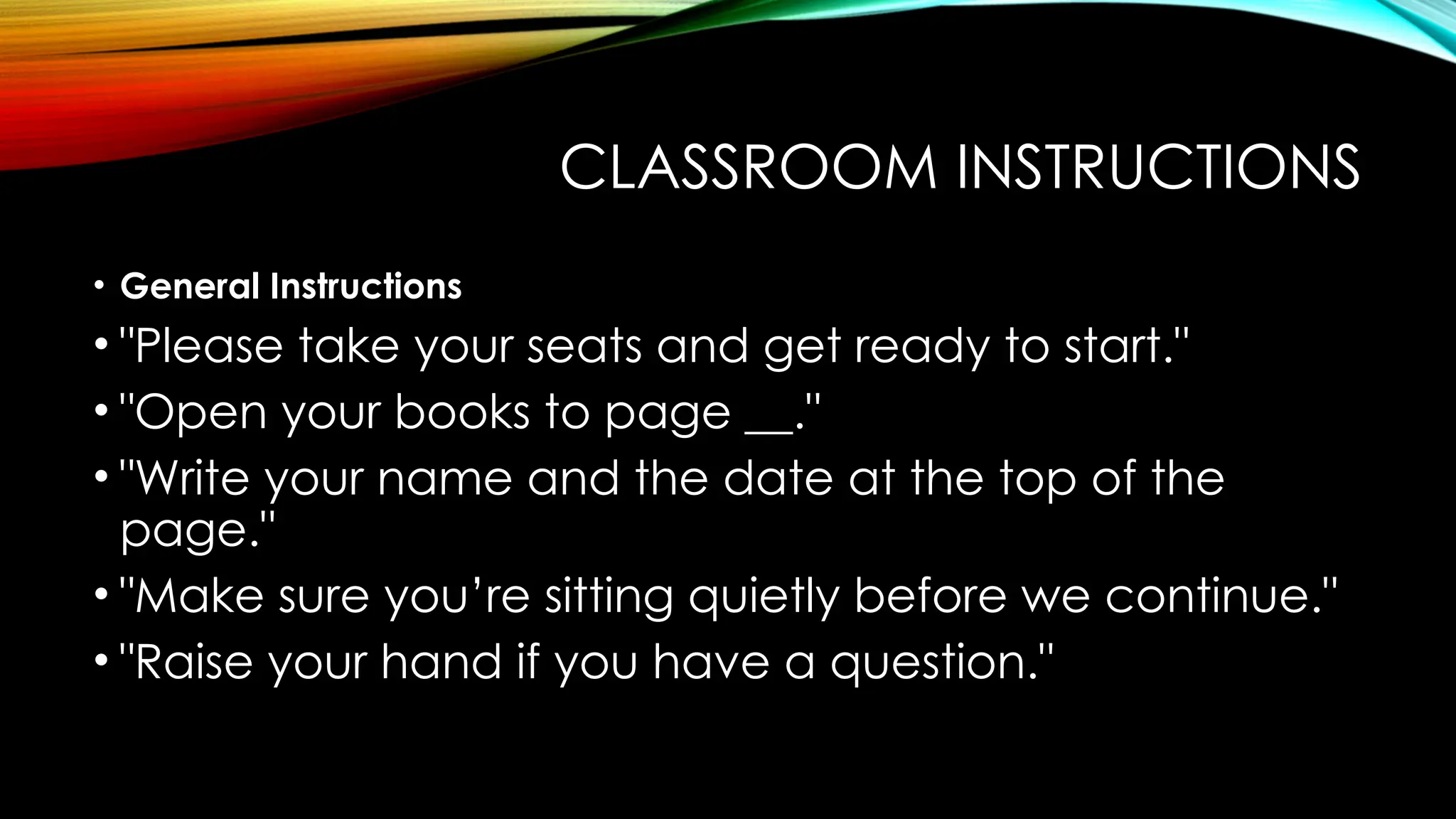
• GeneralInstructions
• "Please take your seats and get ready to start."
• "Open your books to page __."
• "Write your name and the date at the top of the
page."
• "Make sure you’re sitting quietly before we continue."
• "Raise your hand if you have a question."
3.
CLASSROOM INSTRUCTIONS
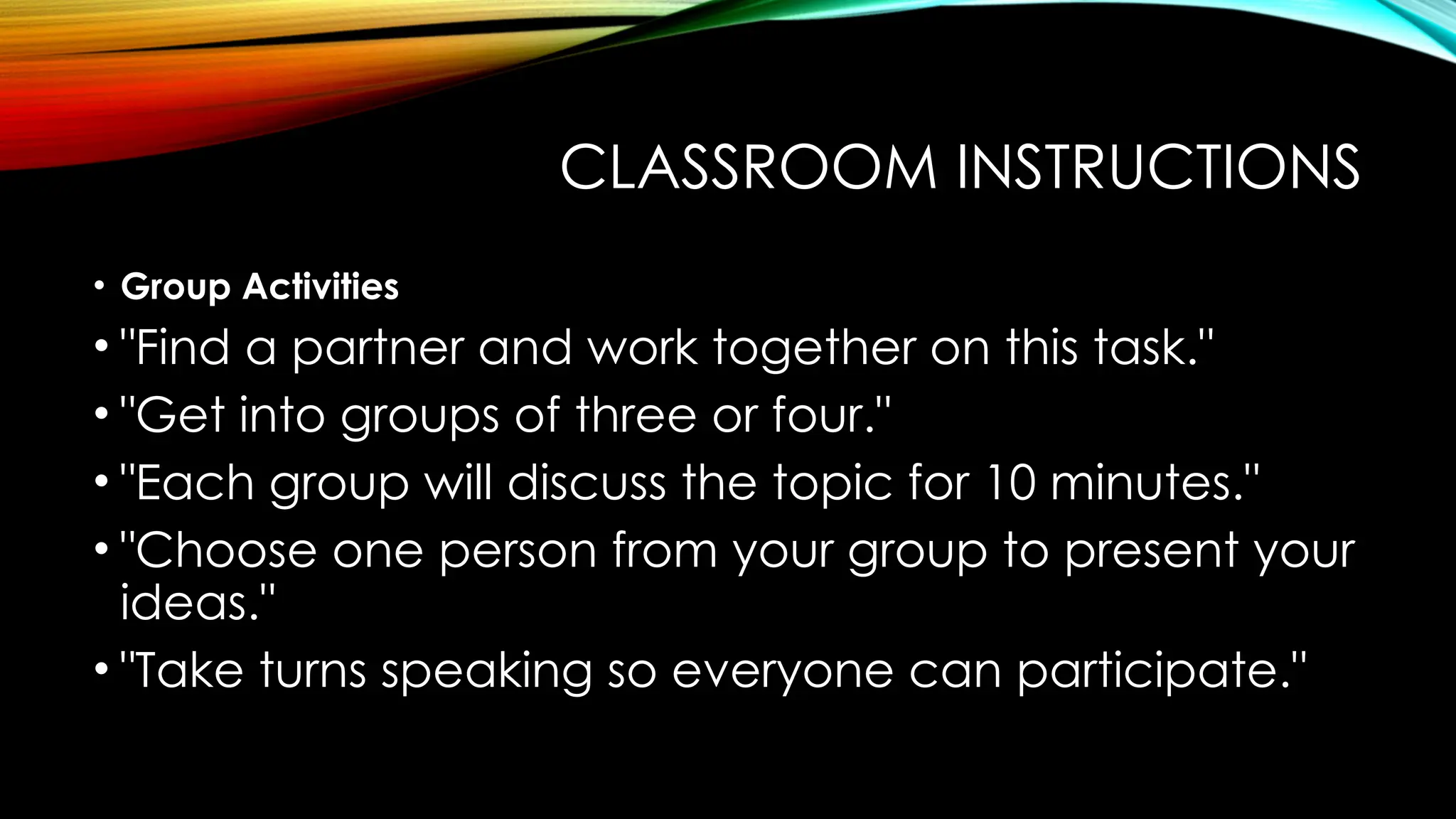
• GroupActivities
• "Find a partner and work together on this task."
• "Get into groups of three or four."
• "Each group will discuss the topic for 10 minutes."
• "Choose one person from your group to present your
ideas."
• "Take turns speaking so everyone can participate."
4.
CLASSROOM INSTRUCTIONS
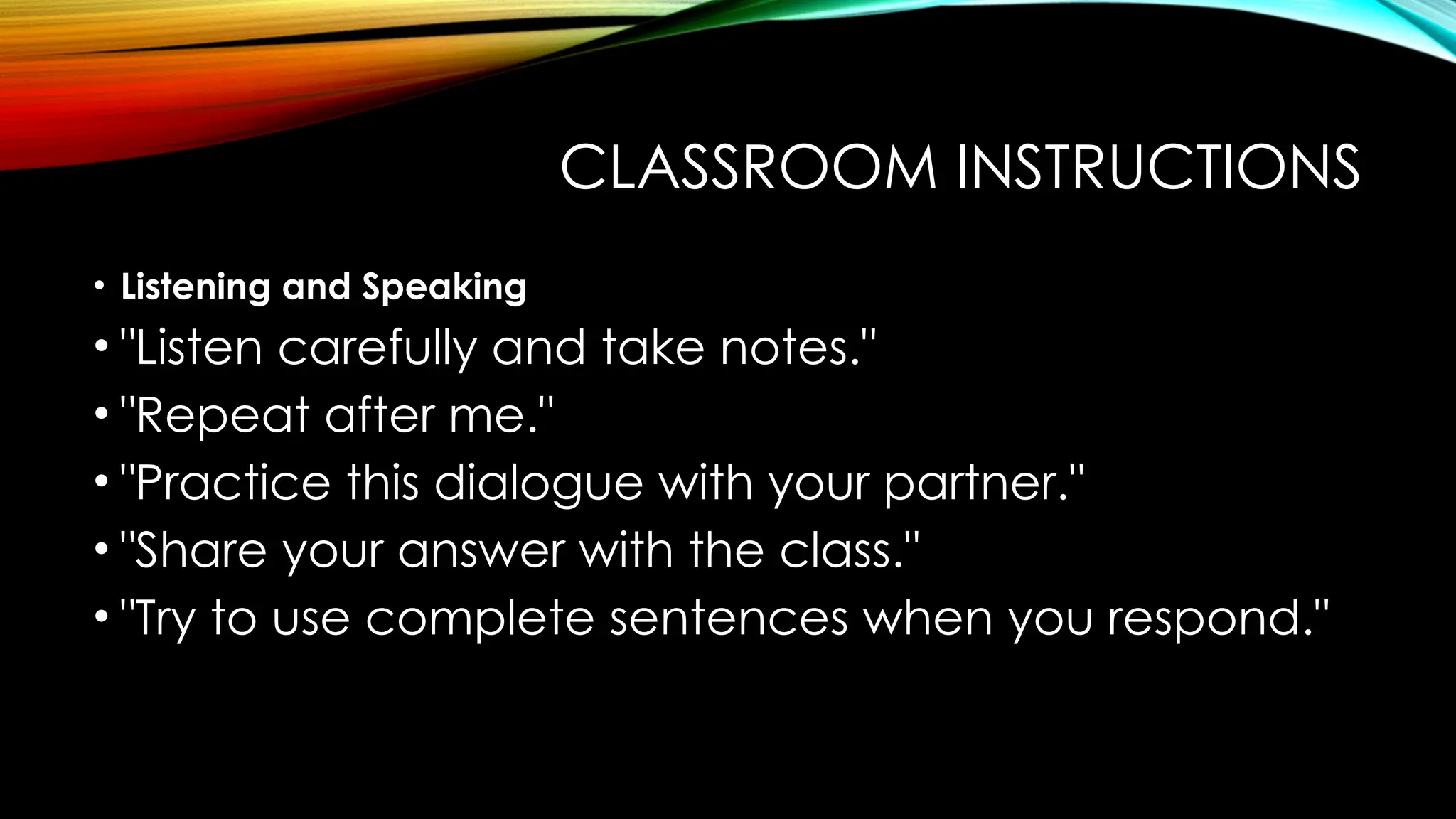
• Listeningand Speaking
• "Listen carefully and take notes."
• "Repeat after me."
• "Practice this dialogue with your partner."
• "Share your answer with the class."
• "Try to use complete sentences when you respond."
5.
CLASSROOM INSTRUCTIONS
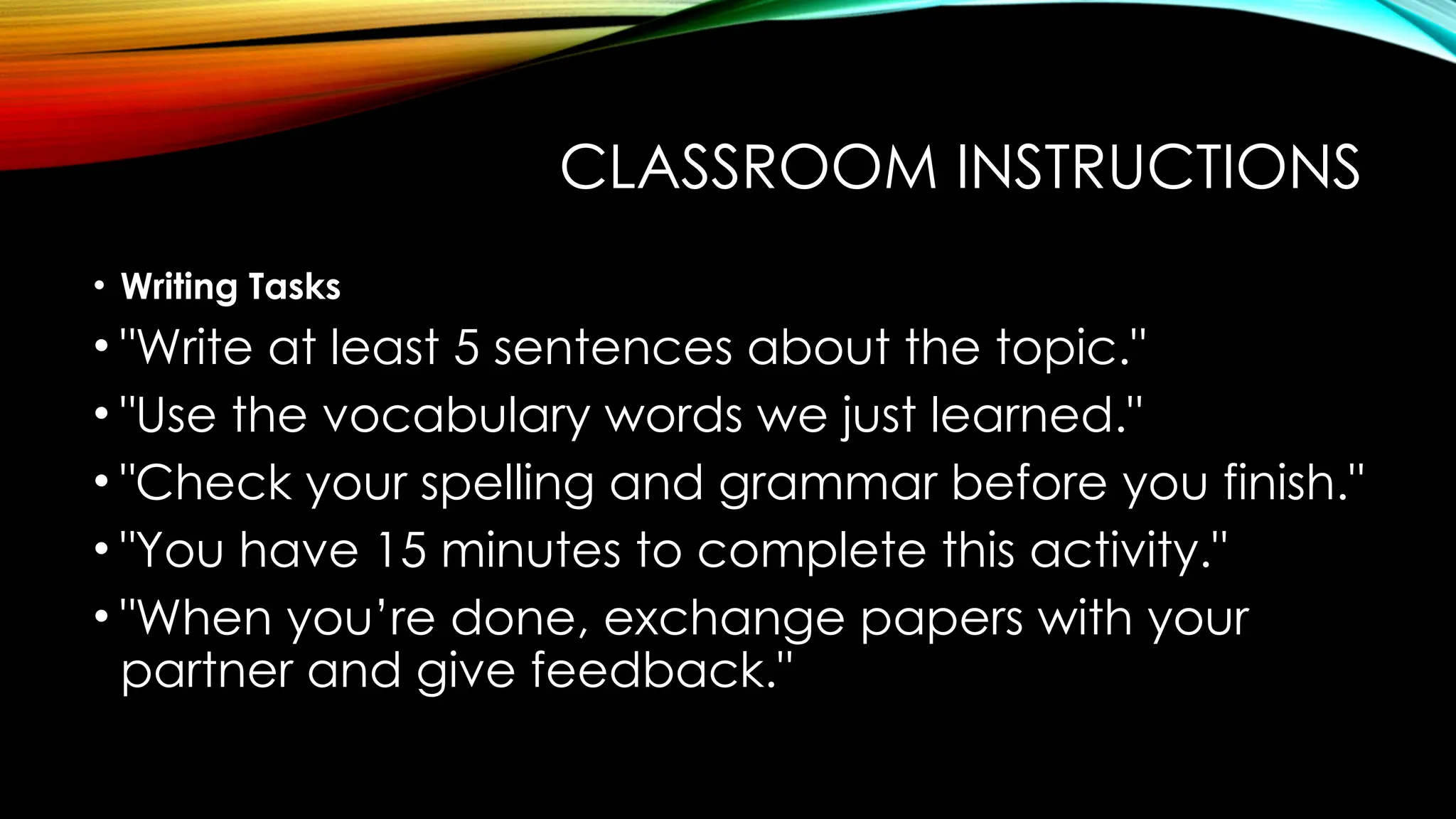
• WritingTasks
• "Write at least 5 sentences about the topic."
• "Use the vocabulary words we just learned."
• "Check your spelling and grammar before you finish."
• "You have 15 minutes to complete this activity."
• "When you’re done, exchange papers with your
partner and give feedback."
6.
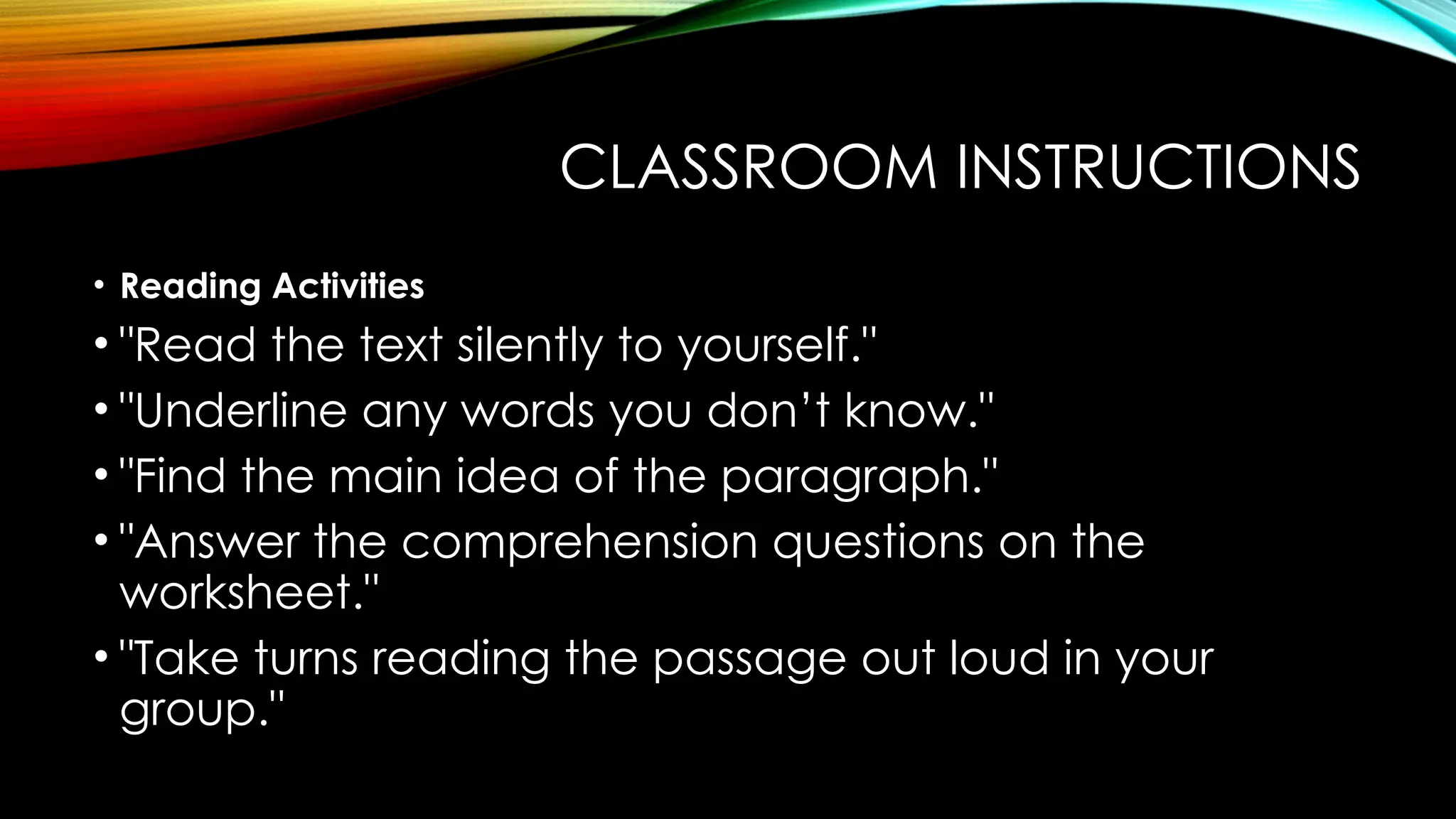
CLASSROOM INSTRUCTIONS
• ReadingActivities
• "Read the text silently to yourself."
• "Underline any words you don’t know."
• "Find the main idea of the paragraph."
• "Answer the comprehension questions on the
worksheet."
• "Take turns reading the passage out loud in your
group."
7.
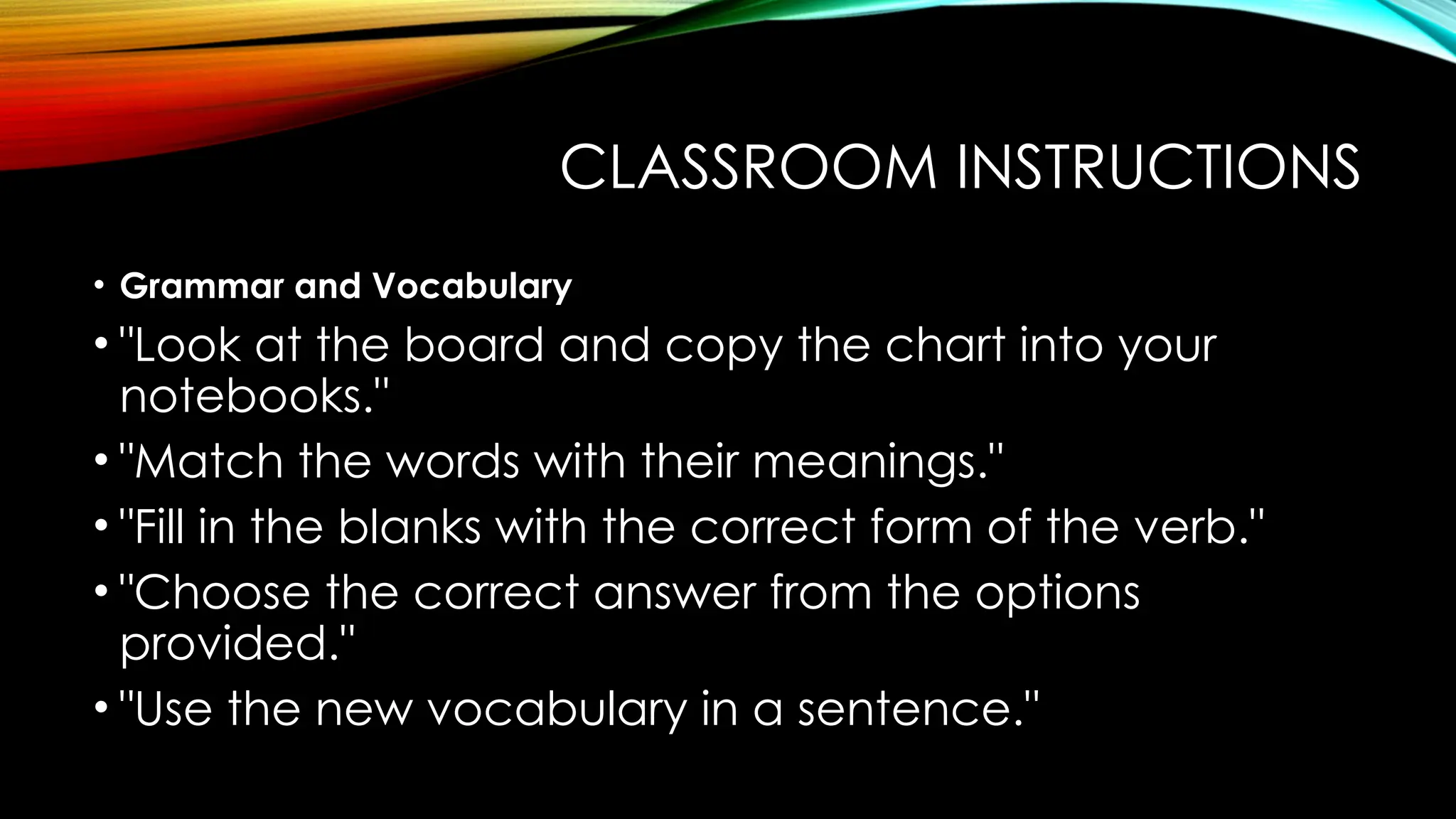
CLASSROOM INSTRUCTIONS
• Grammarand Vocabulary
• "Look at the board and copy the chart into your
notebooks."
• "Match the words with their meanings."
• "Fill in the blanks with the correct form of the verb."
• "Choose the correct answer from the options
provided."
• "Use the new vocabulary in a sentence."
8.
CLASSROOM INSTRUCTIONS
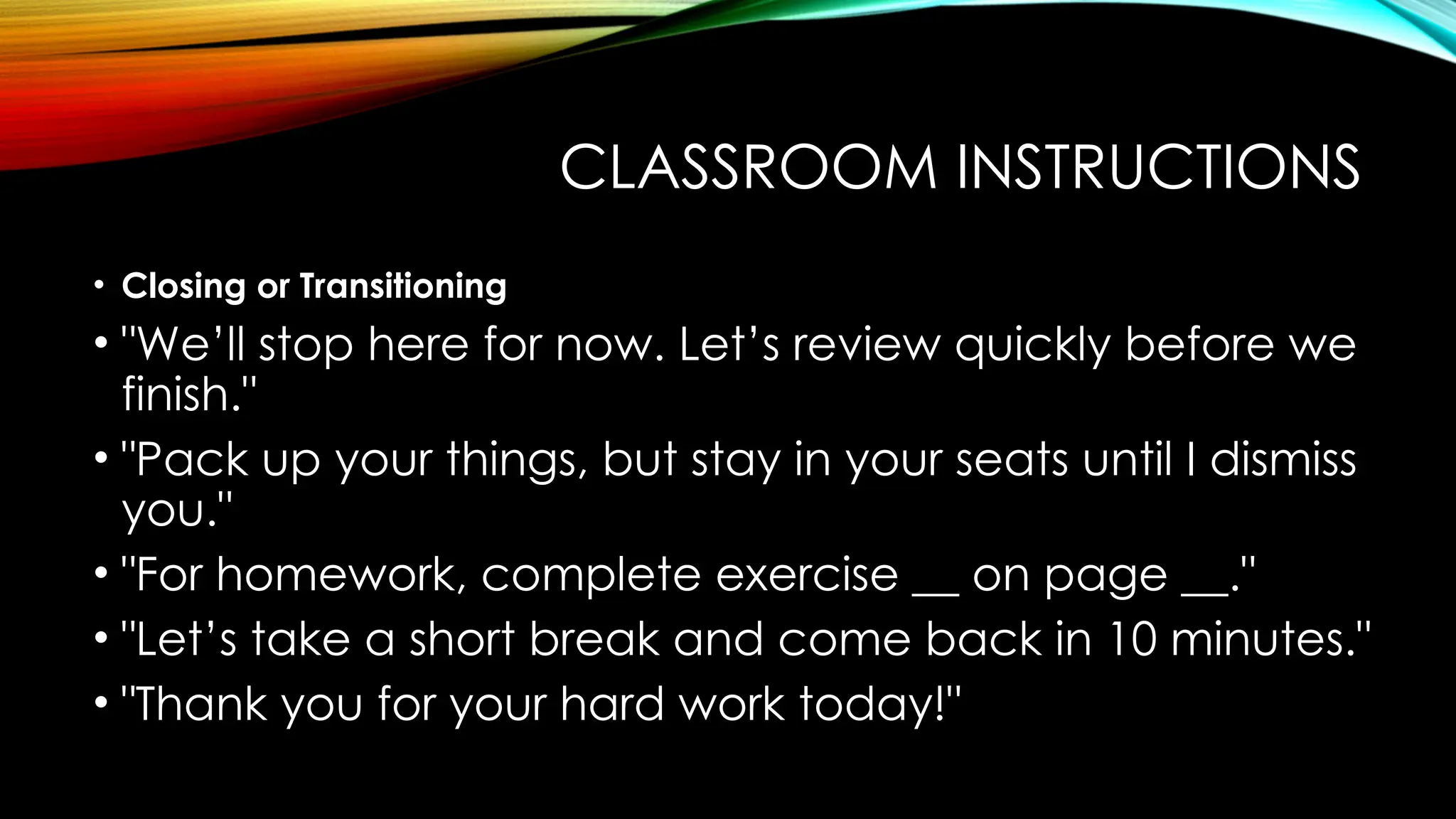
• Closingor Transitioning
• "We’ll stop here for now. Let’s review quickly before we
finish."
• "Pack up your things, but stay in your seats until I dismiss
you."
• "For homework, complete exercise __ on page __."
• "Let’s take a short break and come back in 10 minutes."
• "Thank you for your hard work today!"
9.
LIFE SAVERS
• CommonPolite Phrases
• "Excuse me, can you help me?"
• "May I go to the bathroom?"
• "Can you repeat, please?"
• "How do you spell __?"
• "What’s the English word for __?"
• "I don’t understand. Can you explain, please?"
• "I’m sorry, I didn’t hear that."
10.
LIFE SAVERS
• CommonPolite Phrases
• "Excuse me, can you help me?"
• "May I go to the bathroom?"
• "Can you repeat, please?"
• "How do you spell __?"
• "What’s the English word for __?"
• "I don’t understand. Can you explain, please?"
• "I’m sorry, I didn’t hear that."
11.
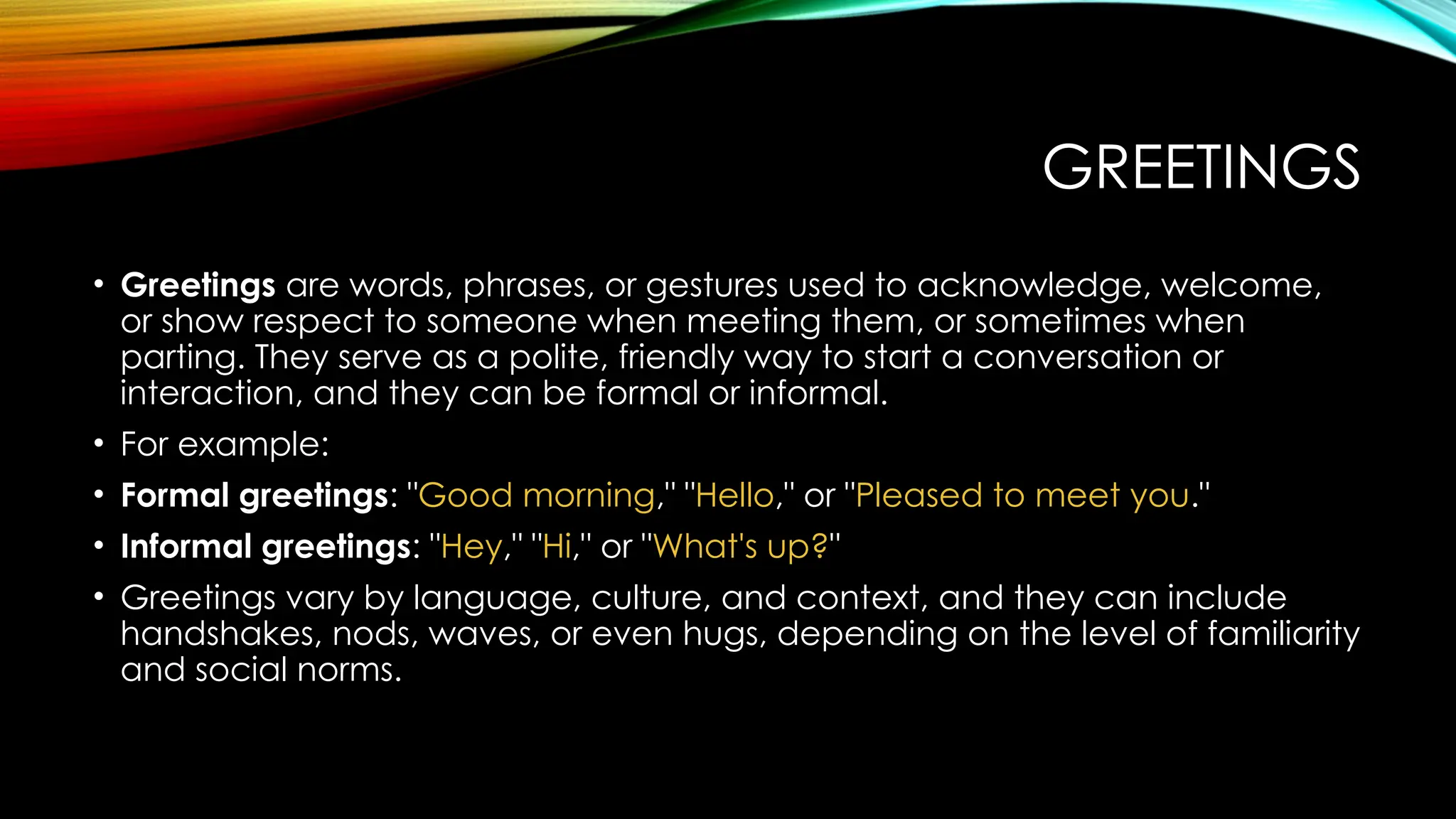
GREETINGS
• Greetings arewords, phrases, or gestures used to acknowledge, welcome,
or show respect to someone when meeting them, or sometimes when
parting. They serve as a polite, friendly way to start a conversation or
interaction, and they can be formal or informal.
• For example:
• Formal greetings: "Good morning," "Hello," or "Pleased to meet you."
• Informal greetings: "Hey," "Hi," or "What's up?"
• Greetings vary by language, culture, and context, and they can include
handshakes, nods, waves, or even hugs, depending on the level of familiarity
and social norms.
12.
FORMAL GREETINGS
1. Goodmorning.
2. Good afternoon.
3. Good evening.
4. Hello, [Name].
5. How do you do?
6. It’s a pleasure to meet you.
7. I hope this message finds you well.
8. Greetings.
9. How are you today?
10. Nice to meet you.
13.
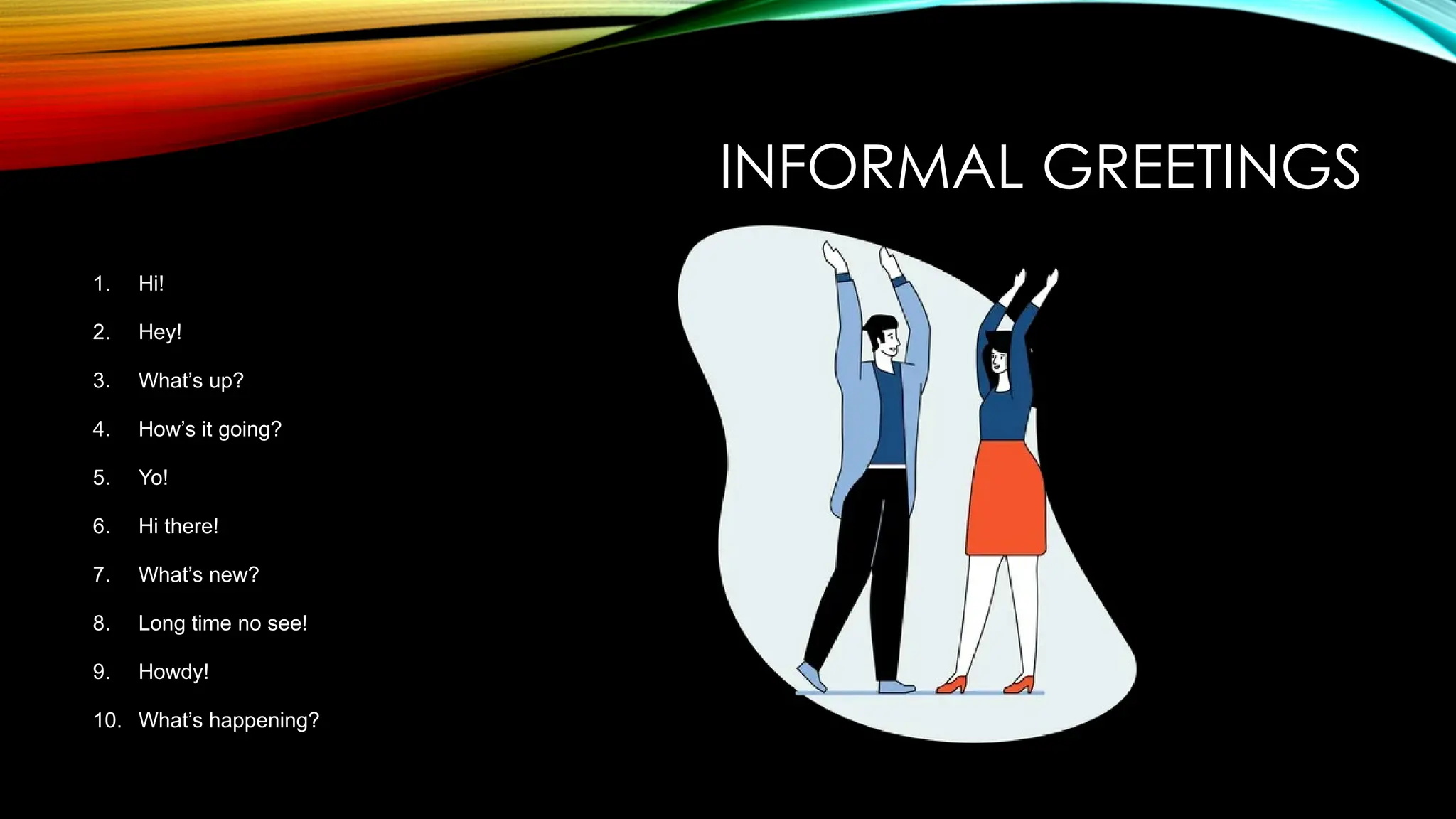
INFORMAL GREETINGS
1. Hi!
2.Hey!
3. What’s up?
4. How’s it going?
5. Yo!
6. Hi there!
7. What’s new?
8. Long time no see!
9. Howdy!
10. What’s happening?
14.
INTRODUCTIONS
• Self-introduction meansproviding information about who you are to
someone else, often as a way of starting a conversation or establishing a
new relationship. It typically includes sharing your name and, depending on
the context, can include details like your profession, interests, or background.
• In a basic or informal setting, a self-introduction may be as simple as saying,
"Hi, I'm [Name]." In more formal or professional settings, it might include
additional details, such as, "Hello, my name is [Name], and I work as [Job
Title] at [Company]."
• Self-introductions help create connections, make a good first impression,
and set a positive tone for further communication.
15.
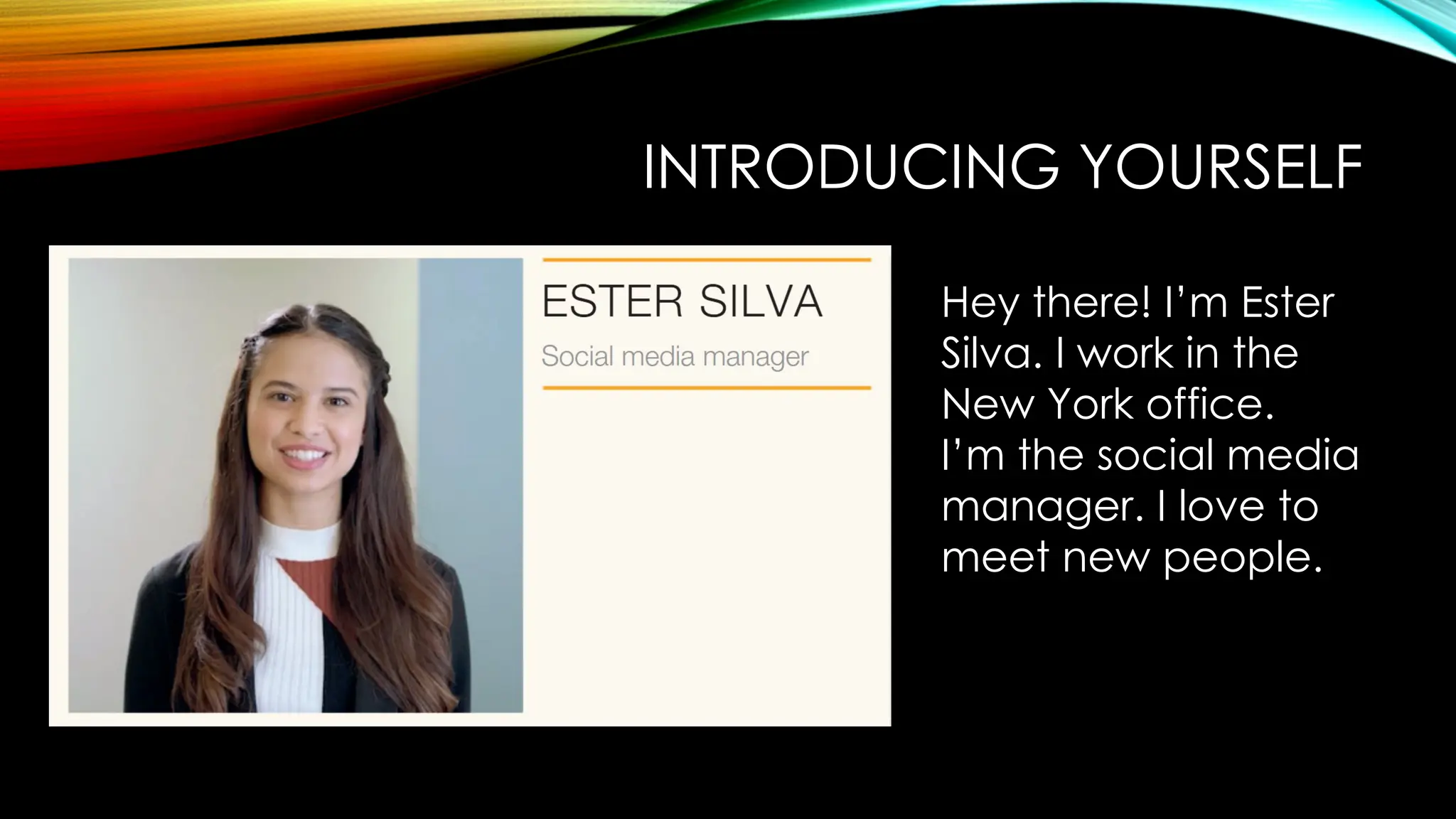
INTRODUCING YOURSELF
Hey there!I’m Ester
Silva. I work in the
New York office.
I’m the social media
manager. I love to
meet new people.
16.
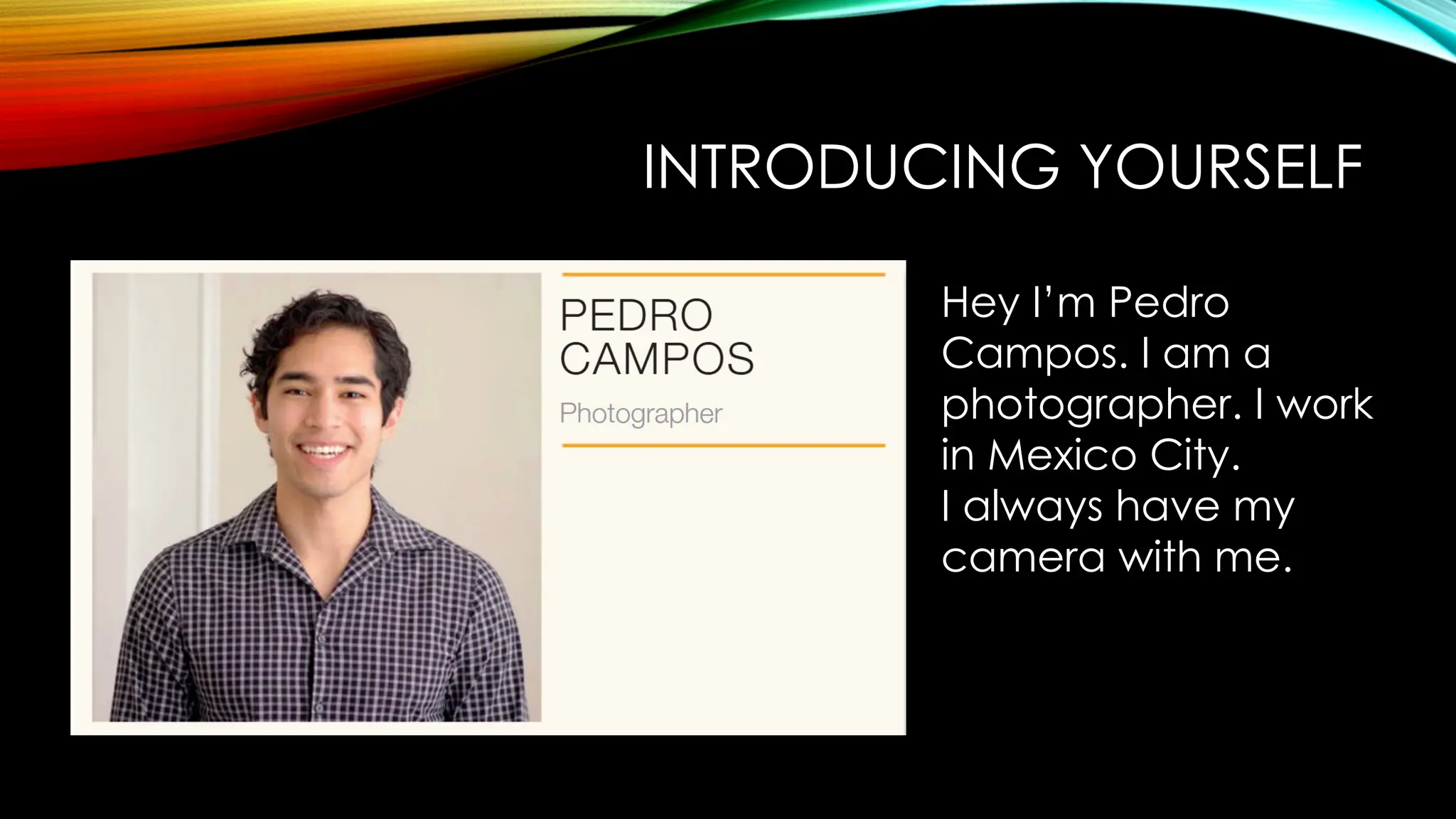
INTRODUCING YOURSELF
Hey I’mPedro
Campos. I am a
photographer. I work
in Mexico City.
I always have my
camera with me.
17.
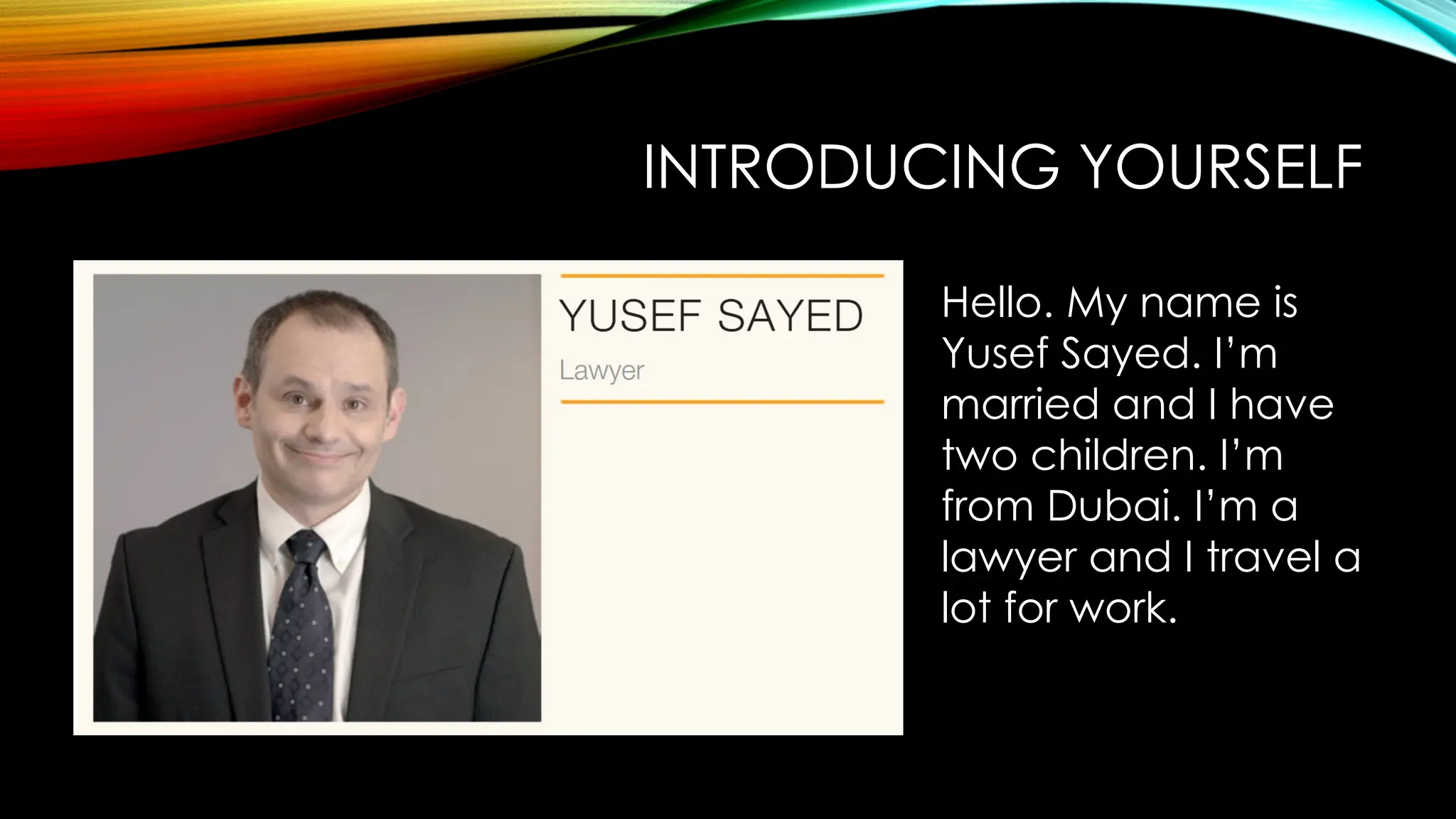
INTRODUCING YOURSELF
Hello. Myname is
Yusef Sayed. I’m
married and I have
two children. I’m
from Dubai. I’m a
lawyer and I travel a
lot for work.
18.
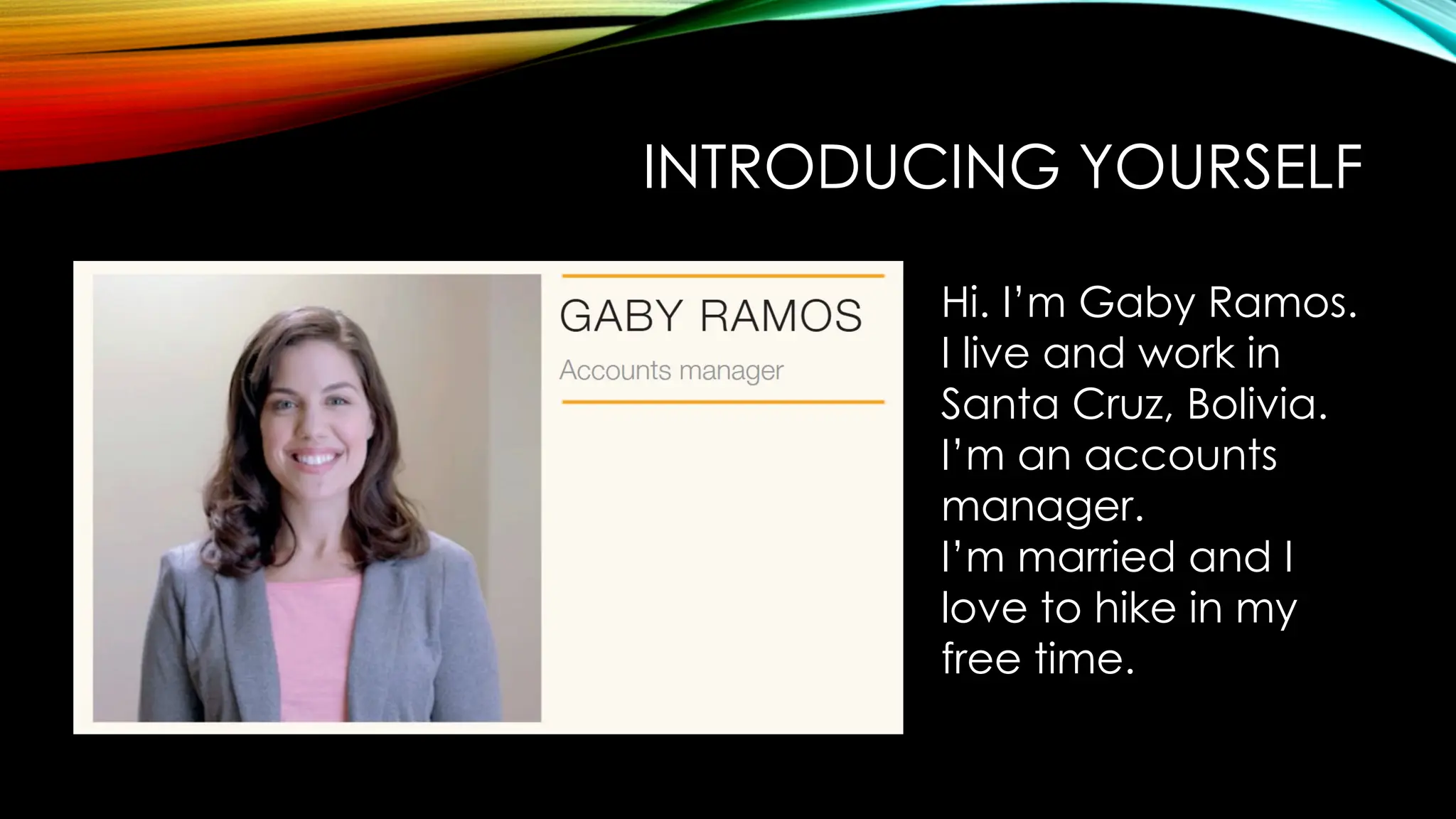
INTRODUCING YOURSELF
Hi. I’mGaby Ramos.
I live and work in
Santa Cruz, Bolivia.
I’m an accounts
manager.
I’m married and I
love to hike in my
free time.
19.
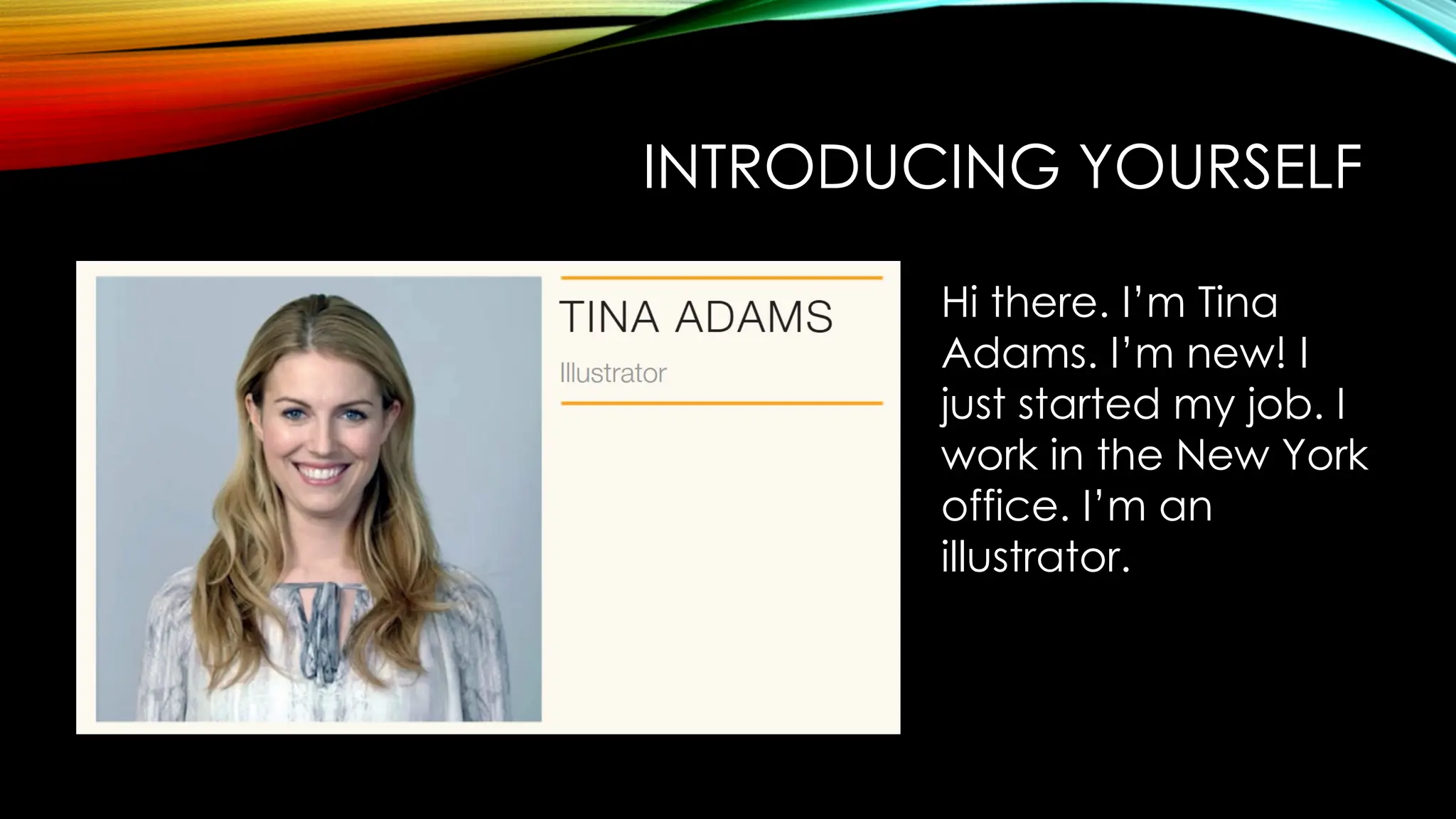
INTRODUCING YOURSELF
Hi there.I’m Tina
Adams. I’m new! I
just started my job. I
work in the New York
office. I’m an
illustrator.
20.
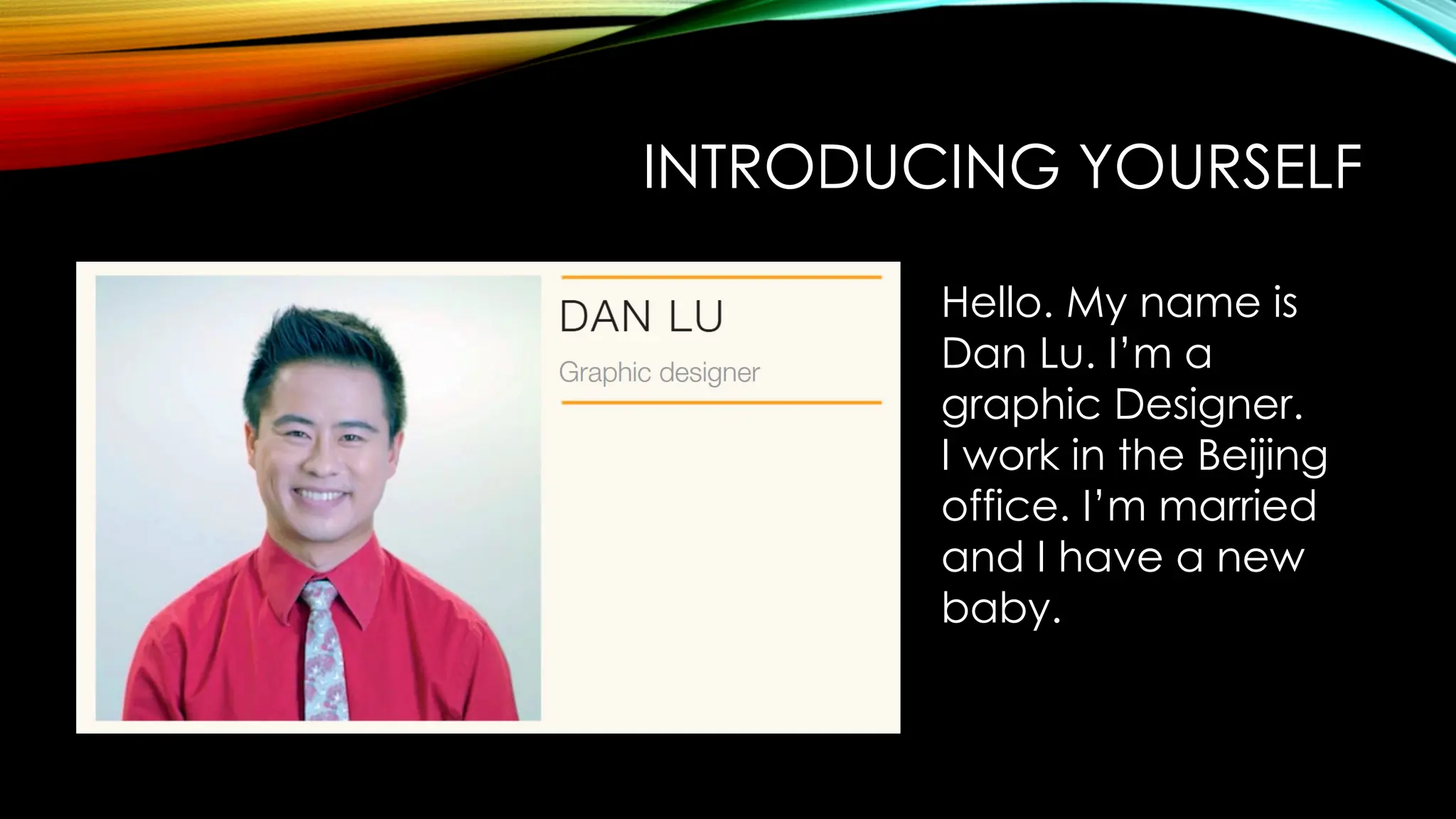
INTRODUCING YOURSELF
Hello. Myname is
Dan Lu. I’m a
graphic Designer.
I work in the Beijing
office. I’m married
and I have a new
baby.
21.
PERSONAL PRONOUNS
• Personalpronouns are words that replace specific nouns in sentences, referring to people, animals,
or things without naming them directly. In English, personal pronouns are divided into three main
categories based on the grammatical person (first, second, and third), number (singular or plural),
and sometimes gender. Here’s a breakdown:
1.First Person (refers to the speaker):
1. Singular: I (subject), me (object)
2. Plural: we (subject), us (object)
2.Second Person (refers to the person being spoken to):
1. Singular and plural: you (subject and object)
3.Third Person (refers to the person or thing being spoken about):
1. Singular:
1. Masculine: he (subject), him (object)
2. Feminine: she (subject), her (object)
3. Neutral: it (subject and object, used for things and animals in general)
2. Plural: they (subject), them (object)
22.
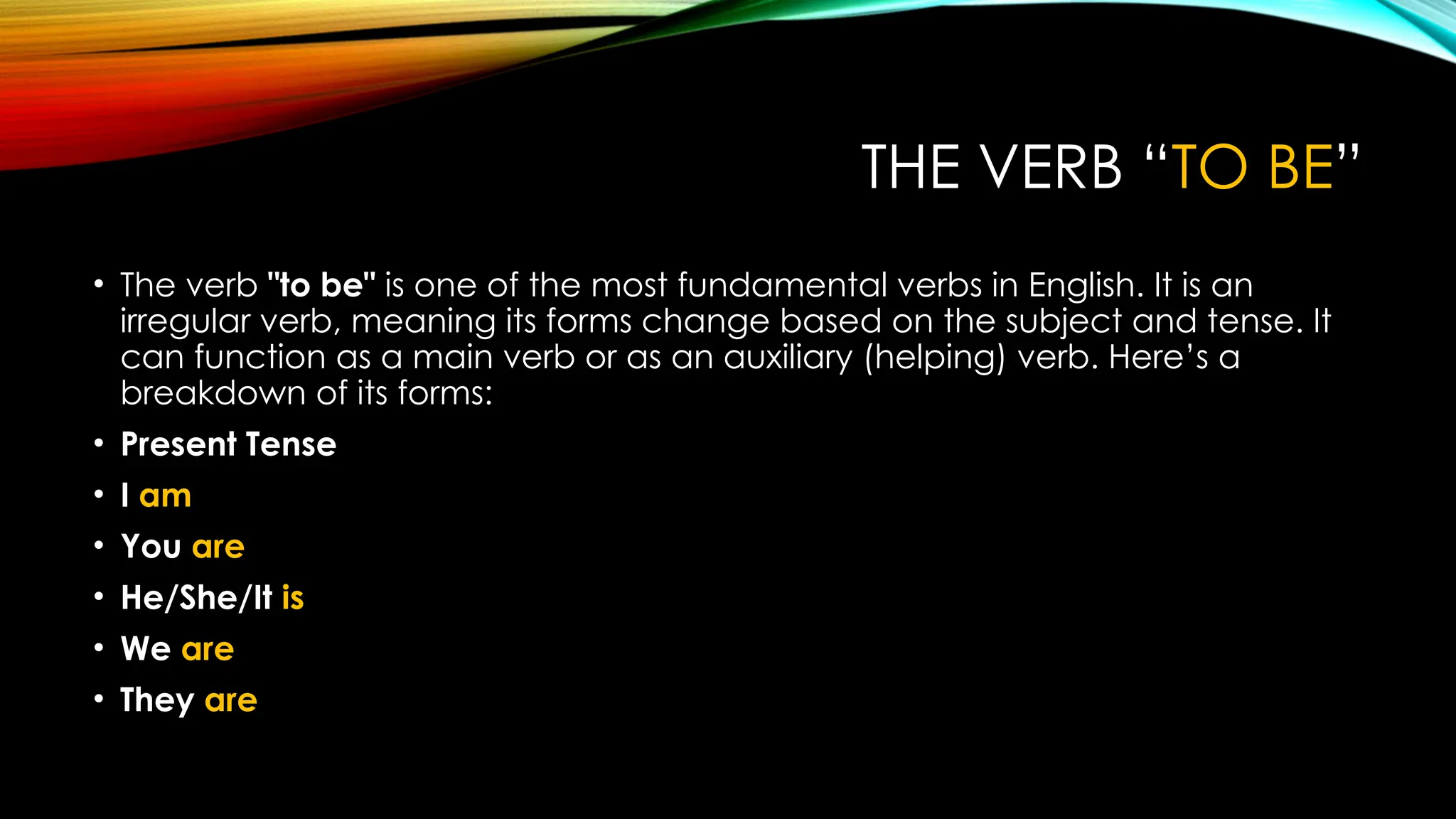
THE VERB “TOBE”
• The verb "to be" is one of the most fundamental verbs in English. It is an
irregular verb, meaning its forms change based on the subject and tense. It
can function as a main verb or as an auxiliary (helping) verb. Here’s a
breakdown of its forms:
• Present Tense
• I am
• You are
• He/She/It is
• We are
• They are
23.
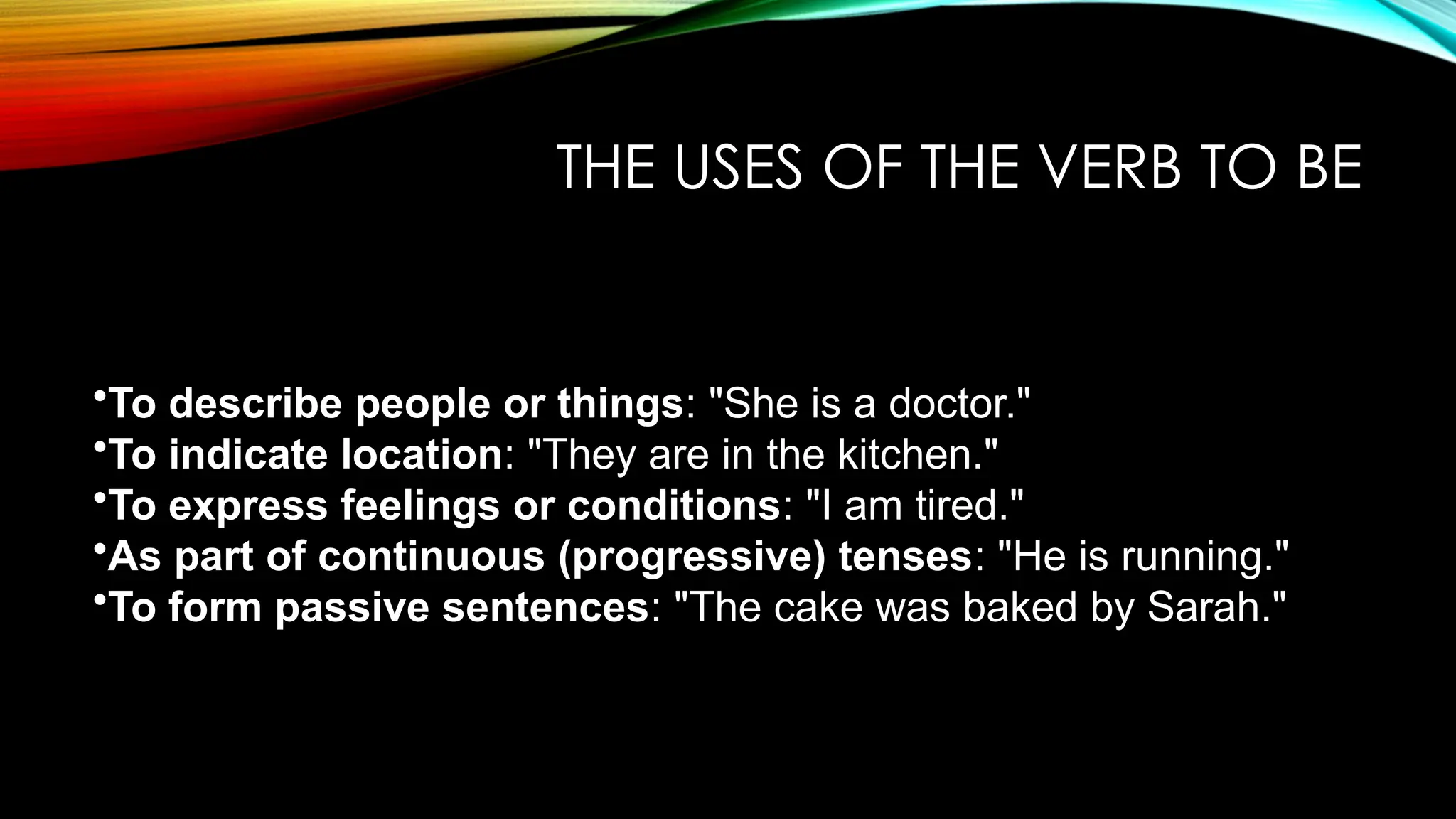
THE USES OFTHE VERB TO BE
•To describe people or things: "She is a doctor."
•To indicate location: "They are in the kitchen."
•To express feelings or conditions: "I am tired."
•As part of continuous (progressive) tenses: "He is running."
•To form passive sentences: "The cake was baked by Sarah."
24.
THE VERB TOBE STRUCTURE
• Affirmative (Positive) Sentences
• In affirmative sentences, the verb "to be" comes after the subject.
• Present Tense:
[Subject] + [am/is/are] + [complement]
• Examples:
• I am happy.
• She is a teacher.
• They are friends.
25.
THE VERB TOBE STRUCTURE
• In negative sentences, add "not" after the verb "to be."
• Present Tense:
[Subject] + [am/is/are] + not + [complement]
• Examples:
• I am not hungry.
• He is not ready.
• They are not here.
26.
THE VERB TOBE STRUCTURE
• In questions, the verb "to be" comes before the subject.
• Present Tense:
[Am/Is/Are] + [subject] + [complement]+?
• Examples:
• Am I correct?
• Is she your friend?
• Are they coming?
27.
THE VERB TOBE STRUCTURE
• Short Answers
• Positive: Yes, [subject] + [am/is/are].
• Example:
• Yes, I am.
• Yes, he is.
• Negative: No, [subject] + [am not/is not/are not].
• Example:
• No, I’m not.
• No, they aren’t.
28.
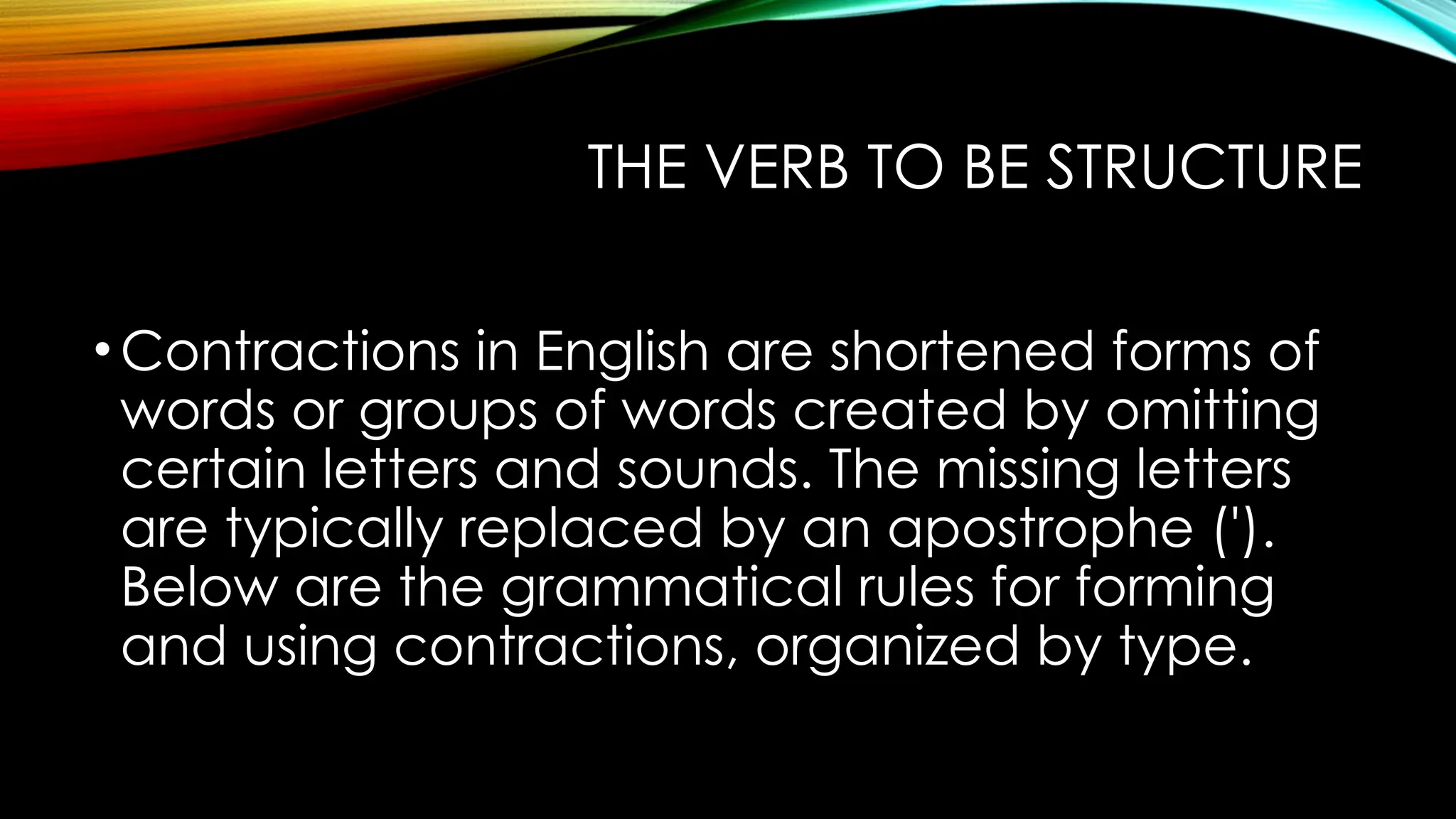
THE VERB TOBE STRUCTURE
•Contractions in English are shortened forms of
words or groups of words created by omitting
certain letters and sounds. The missing letters
are typically replaced by an apostrophe (').
Below are the grammatical rules for forming
and using contractions, organized by type.
29.
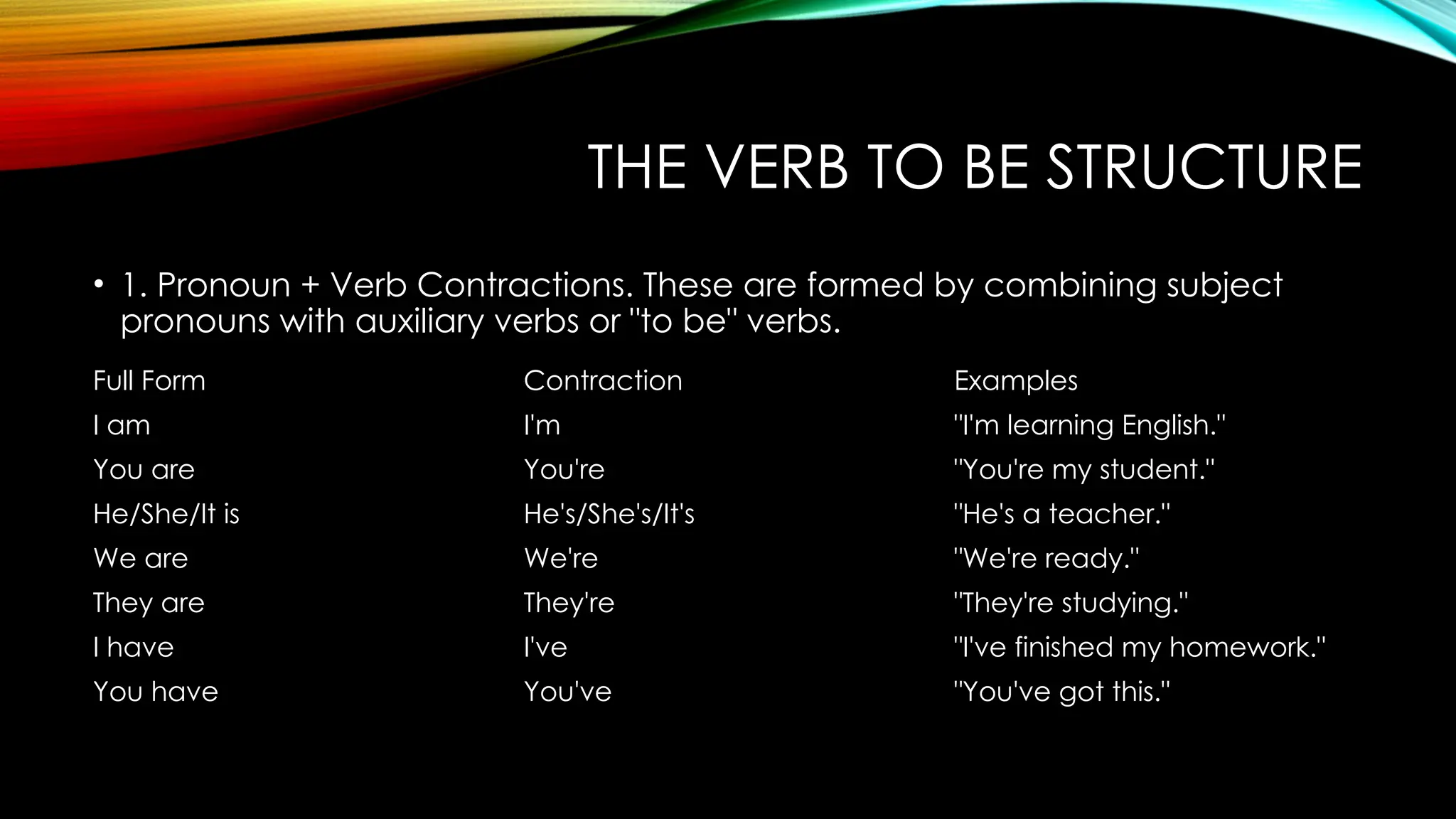
THE VERB TOBE STRUCTURE
• 1. Pronoun + Verb Contractions. These are formed by combining subject
pronouns with auxiliary verbs or "to be" verbs.
Full Form Contraction Examples
I am I'm "I'm learning English."
You are You're "You're my student."
He/She/It is He's/She's/It's "He's a teacher."
We are We're "We're ready."
They are They're "They're studying."
I have I've "I've finished my homework."
You have You've "You've got this."

![FORMAL GREETINGS
1. Good morning.
2. Good afternoon.
3. Good evening.
4. Hello, [Name].
5. How do you do?
6. It’s a pleasure to meet you.
7. I hope this message finds you well.
8. Greetings.
9. How are you today?
10. Nice to meet you.](https://image.slidesharecdn.com/sesion1-250331180954-813e4154/75/Sesion-1-Personal-presentations-and-classroom-language-12-2048.jpg)
![INTRODUCTIONS
• Self-introduction means providing information about who you are to
someone else, often as a way of starting a conversation or establishing a
new relationship. It typically includes sharing your name and, depending on
the context, can include details like your profession, interests, or background.
• In a basic or informal setting, a self-introduction may be as simple as saying,
"Hi, I'm [Name]." In more formal or professional settings, it might include
additional details, such as, "Hello, my name is [Name], and I work as [Job
Title] at [Company]."
• Self-introductions help create connections, make a good first impression,
and set a positive tone for further communication.](https://image.slidesharecdn.com/sesion1-250331180954-813e4154/75/Sesion-1-Personal-presentations-and-classroom-language-14-2048.jpg)
![THE VERB TO BE STRUCTURE
• Affirmative (Positive) Sentences
• In affirmative sentences, the verb "to be" comes after the subject.
• Present Tense:
[Subject] + [am/is/are] + [complement]
• Examples:
• I am happy.
• She is a teacher.
• They are friends.](https://image.slidesharecdn.com/sesion1-250331180954-813e4154/75/Sesion-1-Personal-presentations-and-classroom-language-24-2048.jpg)
![THE VERB TO BE STRUCTURE
• In negative sentences, add "not" after the verb "to be."
• Present Tense:
[Subject] + [am/is/are] + not + [complement]
• Examples:
• I am not hungry.
• He is not ready.
• They are not here.](https://image.slidesharecdn.com/sesion1-250331180954-813e4154/75/Sesion-1-Personal-presentations-and-classroom-language-25-2048.jpg)
![THE VERB TO BE STRUCTURE
• In questions, the verb "to be" comes before the subject.
• Present Tense:
[Am/Is/Are] + [subject] + [complement]+?
• Examples:
• Am I correct?
• Is she your friend?
• Are they coming?](https://image.slidesharecdn.com/sesion1-250331180954-813e4154/75/Sesion-1-Personal-presentations-and-classroom-language-26-2048.jpg)
![THE VERB TO BE STRUCTURE
• Short Answers
• Positive: Yes, [subject] + [am/is/are].
• Example:
• Yes, I am.
• Yes, he is.
• Negative: No, [subject] + [am not/is not/are not].
• Example:
• No, I’m not.
• No, they aren’t.](https://image.slidesharecdn.com/sesion1-250331180954-813e4154/75/Sesion-1-Personal-presentations-and-classroom-language-27-2048.jpg)