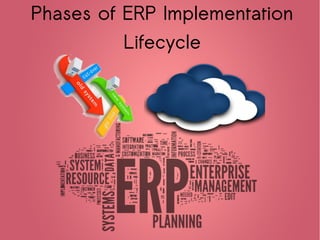
Phases of ERP Implementation
Lifecycle
What is ERP?
ERP is IT software that combine business
acivities across an enterprise. It works from
product planning, inventory control, product
distribution to order tracking.
ERP has two leading vendors which are SAP &
Oracle.
ERP application is segment for the finance,
accounting & human resources phases of
business.
ERP Implementation
ERP implementation lifecycle focus on the
ERP project which is carried out to make ERP
up and running.
ERP project is go through different segments
same as any other project. Most often these
segments do not essentially depend on one
another in a sequence, i.e. one segment might
start before previous segment has finished. All
segments that will be discussed may not be
applicable in all cases.
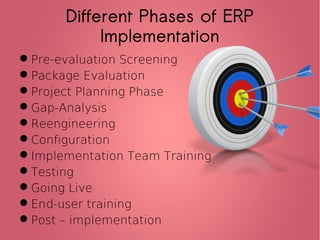
Different Phases of ERP
Implementation
Pre-evaluation Screening
Package Evaluation
Project Planning Phase
Gap-Analysis
Reengineering
Configuration
Implementation Team Training
Testing
Going Live
End-user training
Post – implementation
Pre-evaluation Screening
When the company hase agree to implement
ERP, they have to search for the convenient &
appropriate ERP package.
Package Evaluation
In this segments, find the package that is
flexible enough to meet the company's need
or a software that could be customised to
obtain a good fit.
Important Points to remember while
evaluating ERP software:
− Functional fit with the company’s business process.
− Degree of integration between the various components of
the ERP system.
− Flexibility and scalability
− Complexity
− User friendliness
− Quick implementation
Project Planning Phase
In this segment details of how to go about the
implementation are decided. Project plan is
developed, roles are identified &
responsibilities are assigned.
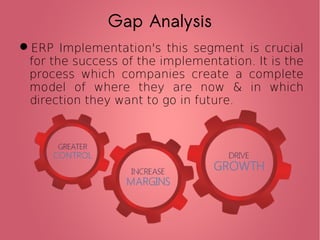
Gap Analysis
ERP Implementation's this segment is crucial
for the success of the implementation. It is the
process which companies create a complete
model of where they are now & in which
direction they want to go in future.
Reengineering
Reengineering has two inferences.
Controversial one is involving the use of ERP
to aid in downsizing efforts. In this case ERP is
purchase with the aim of reducing the number
of employees. Every implementation will
involve some change in job responsibilities as
processes become more automated and
efficient. ERP should endanger business
change but not endanger the jobs of
thousands of employee.
Reengineering
Controversial two is involving Business
Process Reengineering approach to an ERP
implementation implies that there are two
separate, but closely linked implementations
on an ERP site.
− Technical Implementation
− Business Process Implementation
This segment contains main functional area of
ERP implementation. The unwritten rule of
ERP implementation is synchronising existing
company practises with the ERP package
rather than changing the source code &
customising it to suit the company. In this
case business process have to be understood
and mapped in such a way that the incoming
ERP solutions match up with the overall goals
of the company.
Configuration
Configuration
It is important for the success of ERP
implementation that those configuring the
system are able to explain what won’t fit into
the package where the gaps in functionality
occur. ERP vendors are constantly make
efforts to lower configuration costs. Strategies
that are currently being done include
automation and pre – configuration.
Implementation Team Training
This is the segment where
the company trains its
employees to implement and
later run the system. For the
company to be self-sufficient
in running the ERP system, it
should have a good in-house
team that can handle the
various solutions. Thus the
company must realise the
importance of this phase and
selects right employees with
good attitude.
Testing
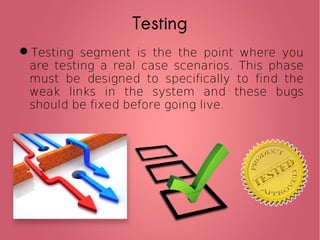
Testing segment is the the point where you
are testing a real case scenarios. This phase
must be designed to specifically to find the
weak links in the system and these bugs
should be fixed before going live.
Going Live
In this segment where all
technicalities are over and
the system is officially
declared operational. The
implementation team must
have tested and run the
system successfully for
some time. Once the
system is ‘live’ the old
system is removed and the
new system is used for
doing business.
End-User Training
The employees who are
going to use the new
system are identified and
their skills are noted.
Based on their skill levels
are divided into groups.
Then each group is given
training on the new
system. This training is
very useful as the success
of the ERP system is in the
hands of end-users.
Post – Implementation
(Maintenance Mode)
When implementation is over this critical
segment comes. There must be enough
employees who are trained to handle the
problem that might occurred when the system
is running. There must be technical people in
the company who have the ability to enhance
the system when required. Living with ERP
systems will be different from installing them.
Projects for implementing the ERP sysstems
get a lot of resources and attention. However
an organisation can only get the maximum
value of these inputs if it successfully adopts
and effectively uses the system.

erplifecycle-141107014844-conversion-gate02

  • 1.
    Phases of ERPImplementation Lifecycle
  • 2.
    What is ERP? ERPis IT software that combine business acivities across an enterprise. It works from product planning, inventory control, product distribution to order tracking. ERP has two leading vendors which are SAP & Oracle. ERP application is segment for the finance, accounting & human resources phases of business.
  • 3.
    ERP Implementation ERP implementationlifecycle focus on the ERP project which is carried out to make ERP up and running. ERP project is go through different segments same as any other project. Most often these segments do not essentially depend on one another in a sequence, i.e. one segment might start before previous segment has finished. All segments that will be discussed may not be applicable in all cases.
  • 4.
    Different Phases ofERP Implementation Pre-evaluation Screening Package Evaluation Project Planning Phase Gap-Analysis Reengineering Configuration Implementation Team Training Testing Going Live End-user training Post – implementation
  • 5.
    Pre-evaluation Screening When thecompany hase agree to implement ERP, they have to search for the convenient & appropriate ERP package.
  • 6.
    Package Evaluation In thissegments, find the package that is flexible enough to meet the company's need or a software that could be customised to obtain a good fit. Important Points to remember while evaluating ERP software: − Functional fit with the company’s business process. − Degree of integration between the various components of the ERP system. − Flexibility and scalability − Complexity − User friendliness − Quick implementation
  • 7.
    Project Planning Phase Inthis segment details of how to go about the implementation are decided. Project plan is developed, roles are identified & responsibilities are assigned.
  • 8.
    Gap Analysis ERP Implementation'sthis segment is crucial for the success of the implementation. It is the process which companies create a complete model of where they are now & in which direction they want to go in future.
  • 9.
    Reengineering Reengineering has twoinferences. Controversial one is involving the use of ERP to aid in downsizing efforts. In this case ERP is purchase with the aim of reducing the number of employees. Every implementation will involve some change in job responsibilities as processes become more automated and efficient. ERP should endanger business change but not endanger the jobs of thousands of employee.
  • 10.
    Reengineering Controversial two isinvolving Business Process Reengineering approach to an ERP implementation implies that there are two separate, but closely linked implementations on an ERP site. − Technical Implementation − Business Process Implementation
  • 11.
    This segment containsmain functional area of ERP implementation. The unwritten rule of ERP implementation is synchronising existing company practises with the ERP package rather than changing the source code & customising it to suit the company. In this case business process have to be understood and mapped in such a way that the incoming ERP solutions match up with the overall goals of the company. Configuration
  • 12.
    Configuration It is importantfor the success of ERP implementation that those configuring the system are able to explain what won’t fit into the package where the gaps in functionality occur. ERP vendors are constantly make efforts to lower configuration costs. Strategies that are currently being done include automation and pre – configuration.
  • 13.
    Implementation Team Training Thisis the segment where the company trains its employees to implement and later run the system. For the company to be self-sufficient in running the ERP system, it should have a good in-house team that can handle the various solutions. Thus the company must realise the importance of this phase and selects right employees with good attitude.
  • 14.
    Testing Testing segment isthe the point where you are testing a real case scenarios. This phase must be designed to specifically to find the weak links in the system and these bugs should be fixed before going live.
  • 15.
    Going Live In thissegment where all technicalities are over and the system is officially declared operational. The implementation team must have tested and run the system successfully for some time. Once the system is ‘live’ the old system is removed and the new system is used for doing business.
  • 16.
    End-User Training The employeeswho are going to use the new system are identified and their skills are noted. Based on their skill levels are divided into groups. Then each group is given training on the new system. This training is very useful as the success of the ERP system is in the hands of end-users.
  • 17.
    Post – Implementation (MaintenanceMode) When implementation is over this critical segment comes. There must be enough employees who are trained to handle the problem that might occurred when the system is running. There must be technical people in the company who have the ability to enhance the system when required. Living with ERP systems will be different from installing them. Projects for implementing the ERP sysstems get a lot of resources and attention. However an organisation can only get the maximum value of these inputs if it successfully adopts and effectively uses the system.