Towards a Human Resource Development Ontology Combining Competence Management and Technology-Enhanced Workplace Learning 1  FZI Research Center for Information Technologies Karlsruhe, GERMANY ² Kompetenzorientierte Personalentwicklung,  Königsbach-Stein, GERMANY Andreas.Schmidt@fzi.de | contact@christine-kunzmann.de http://www.fzi.de/ipe | http://kompetenzen-gestalten.de Andreas Schmidt 1 Christine Kunzmann²
Outline Why an HR Development Ontology? Requirements The ontology Competency Diagnosing competencies Learning Opportunities Implementation issues OWL-DL Embedding it into the Enterprise Conclusions & Outlook
Two development directions Competence Management aligning human resource development with corporate goals identify, secure and make use of employee competencies but also development organizational perspective Competency-Oriented Technology-Enhanced Workplace Learning e-learning, knowledge management & performance support formal and informal learning integration of competence development into work activities individual perspective Both are about learning, competencies, work processes...
Need for integration ... but how to make them fit together? We need a  domain engineering  approach that brings them together a shared domain model a specification of a shared infrastructure and its implementation First step: a shared domain model (or  ontology )
Requirements and Key Issues Alignment  of human resource development  with business processes & goals learning needs are determined by both individual and  corporate interests Automatability  of learning &  HR micro management recommending relevant learning opportunities tracking learning progress supporting staffing and ensuring sufficient competence Smooth transition to  knowledge management  activities knowledge management is about learning, too! Holistic view  of human resource development consists of formal training as well as informal competence development
Automatability Ontologies as models with a formal semantics  are the basis for computer-supported guidance Several promising areas have emerged: Profile matching  with similarity measures [Biesalski & Abecker 05] selecting applicants team staffing Finding learning opportunities  with knowledge gap analysis and competency subsumtion learning on demand [Schmidt 05] training planning [Kunzmann & Schmidt 06] detecting competence development pathways [Ley 06]
Developing the Ontology
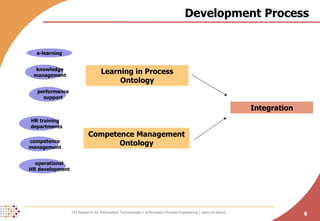
Development Process Learning in Process Ontology Competence Management Ontology Integration e-learning knowledge management performance support HR training departments competence management operational HR development
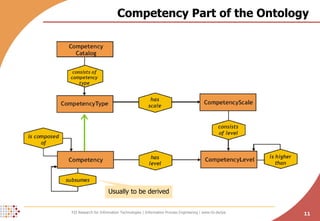
Competency Competencies  are bundles of knowledge, skills and abilities relevant to work performance sufficiently measurable and developable [Kunzmann & Schmidt 2006] Usually  competency scales  are used novice, beginner, intermediate, competent, expert CEFR scales for language proficiency scales are usually specific for certain competency types a competency is then an instance of an abstract competency type competency type has a scale attached EXAMPLE:  English Language Proficiency   (TYPE) , English C2  (COMPETENCY)
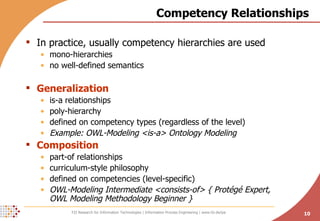
Competency Relationships In practice, usually competency hierarchies are used mono-hierarchies no well-defined semantics Generalization is-a relationships poly-hierarchy  defined on competency types (regardless of the level) Example: OWL-Modeling <is-a> Ontology Modeling Composition   part-of relationships curriculum-style philosophy defined on competencies (level-specific) OWL-Modeling Intermediate <consists-of> { Protégé Expert,  OWL Modeling Methodology Beginner }
Competency Part of the Ontology Usually to be derived
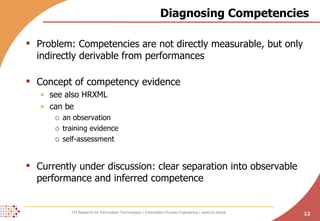
Diagnosing Competencies Problem: Competencies are not directly measurable, but only indirectly derivable from performances Concept of competency evidence  see also HRXML can be an observation training evidence  self-assessment Currently under discussion: clear separation into observable performance and inferred competence
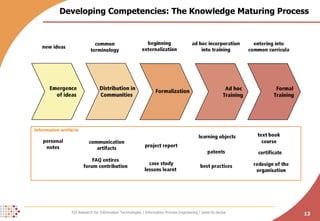
Developing Competencies: The Knowledge Maturing Process
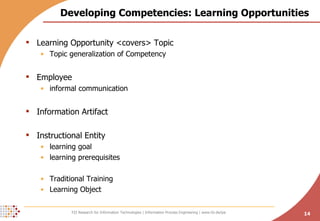
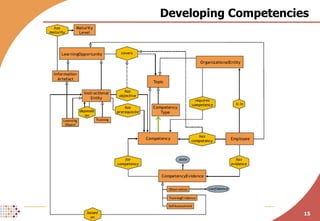
Developing Competencies: Learning Opportunities Learning Opportunity <covers> Topic Topic generalization of Competency Employee informal communication Information Artifact  Instructional Entity learning goal learning prerequisites Traditional Training Learning Object
Developing Competencies
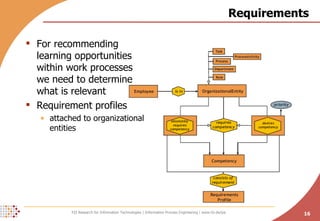
Requirements For recommending  learning opportunities within work processes we need to determine what is relevant Requirement profiles attached to organizational entities
Embedding it into the enterprise
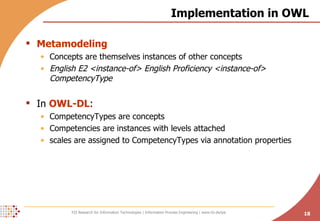
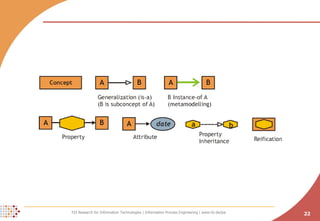
Implementation in OWL Metamodeling   Concepts are themselves instances of other concepts English E2 <instance-of> English Proficiency <instance-of> CompetencyType In  OWL-DL : CompetencyTypes are concepts Competencies are instances with levels attached scales are assigned to CompetencyTypes via annotation properties
Issue of Derived Properties Properties can be  time-dependent  and  uncertain e.g. has-competency two layers: physical and logical view => ODBASE talk on Thursday 14:30! Derived  properties SWRL is not sufficient for complex computations like subsumes has-competency Both issues cannot be efficiently dealt with within the OWL-DL frame, but are better dealt with outside of it implemented as services in an infrastructure
Conclusions & Outlook Ontology presented is a first step towards a domain engineering approach integrating the different perspectives on learning in enterprises experiences from Learning in Process and subsequent TEL projects and competence management projects current and future versions available under a creative commons license under http://professional-learning.eu/competency.html collaboration highly welcome and invited! Next step is a service-oriented infrastructure offering a shared set of services.
More information: http://professional-learning.eu Andreas Schmidt Team Manager „Knowledge and Learning“ FZI Research Center for Information Technologies Information Process Engineering [email_address] http://fzi.de/ipe
 

Towards a Human Resource Development Ontology Combining Competence Management and Technology-Enhanced Workplace Learning

  • 1.
    Towards a HumanResource Development Ontology Combining Competence Management and Technology-Enhanced Workplace Learning 1 FZI Research Center for Information Technologies Karlsruhe, GERMANY ² Kompetenzorientierte Personalentwicklung, Königsbach-Stein, GERMANY Andreas.Schmidt@fzi.de | contact@christine-kunzmann.de http://www.fzi.de/ipe | http://kompetenzen-gestalten.de Andreas Schmidt 1 Christine Kunzmann²
  • 2.
    Outline Why anHR Development Ontology? Requirements The ontology Competency Diagnosing competencies Learning Opportunities Implementation issues OWL-DL Embedding it into the Enterprise Conclusions & Outlook
  • 3.
    Two development directionsCompetence Management aligning human resource development with corporate goals identify, secure and make use of employee competencies but also development organizational perspective Competency-Oriented Technology-Enhanced Workplace Learning e-learning, knowledge management & performance support formal and informal learning integration of competence development into work activities individual perspective Both are about learning, competencies, work processes...
  • 4.
    Need for integration... but how to make them fit together? We need a domain engineering approach that brings them together a shared domain model a specification of a shared infrastructure and its implementation First step: a shared domain model (or ontology )
  • 5.
    Requirements and KeyIssues Alignment of human resource development with business processes & goals learning needs are determined by both individual and corporate interests Automatability of learning & HR micro management recommending relevant learning opportunities tracking learning progress supporting staffing and ensuring sufficient competence Smooth transition to knowledge management activities knowledge management is about learning, too! Holistic view of human resource development consists of formal training as well as informal competence development
  • 6.
    Automatability Ontologies asmodels with a formal semantics are the basis for computer-supported guidance Several promising areas have emerged: Profile matching with similarity measures [Biesalski & Abecker 05] selecting applicants team staffing Finding learning opportunities with knowledge gap analysis and competency subsumtion learning on demand [Schmidt 05] training planning [Kunzmann & Schmidt 06] detecting competence development pathways [Ley 06]
  • 7.
  • 8.
    Development Process Learningin Process Ontology Competence Management Ontology Integration e-learning knowledge management performance support HR training departments competence management operational HR development
  • 9.
    Competency Competencies are bundles of knowledge, skills and abilities relevant to work performance sufficiently measurable and developable [Kunzmann & Schmidt 2006] Usually competency scales are used novice, beginner, intermediate, competent, expert CEFR scales for language proficiency scales are usually specific for certain competency types a competency is then an instance of an abstract competency type competency type has a scale attached EXAMPLE: English Language Proficiency (TYPE) , English C2 (COMPETENCY)
  • 10.
    Competency Relationships Inpractice, usually competency hierarchies are used mono-hierarchies no well-defined semantics Generalization is-a relationships poly-hierarchy defined on competency types (regardless of the level) Example: OWL-Modeling <is-a> Ontology Modeling Composition part-of relationships curriculum-style philosophy defined on competencies (level-specific) OWL-Modeling Intermediate <consists-of> { Protégé Expert, OWL Modeling Methodology Beginner }
  • 11.
    Competency Part ofthe Ontology Usually to be derived
  • 12.
    Diagnosing Competencies Problem:Competencies are not directly measurable, but only indirectly derivable from performances Concept of competency evidence see also HRXML can be an observation training evidence self-assessment Currently under discussion: clear separation into observable performance and inferred competence
  • 13.
    Developing Competencies: TheKnowledge Maturing Process
  • 14.
    Developing Competencies: LearningOpportunities Learning Opportunity <covers> Topic Topic generalization of Competency Employee informal communication Information Artifact Instructional Entity learning goal learning prerequisites Traditional Training Learning Object
  • 15.
  • 16.
    Requirements For recommending learning opportunities within work processes we need to determine what is relevant Requirement profiles attached to organizational entities
  • 17.
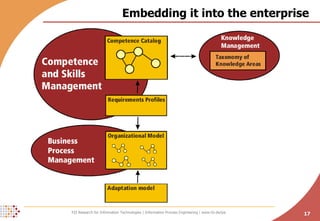
    Embedding it intothe enterprise
  • 18.
    Implementation in OWLMetamodeling Concepts are themselves instances of other concepts English E2 <instance-of> English Proficiency <instance-of> CompetencyType In OWL-DL : CompetencyTypes are concepts Competencies are instances with levels attached scales are assigned to CompetencyTypes via annotation properties
  • 19.
    Issue of DerivedProperties Properties can be time-dependent and uncertain e.g. has-competency two layers: physical and logical view => ODBASE talk on Thursday 14:30! Derived properties SWRL is not sufficient for complex computations like subsumes has-competency Both issues cannot be efficiently dealt with within the OWL-DL frame, but are better dealt with outside of it implemented as services in an infrastructure
  • 20.
    Conclusions & OutlookOntology presented is a first step towards a domain engineering approach integrating the different perspectives on learning in enterprises experiences from Learning in Process and subsequent TEL projects and competence management projects current and future versions available under a creative commons license under http://professional-learning.eu/competency.html collaboration highly welcome and invited! Next step is a service-oriented infrastructure offering a shared set of services.
  • 21.
    More information: http://professional-learning.euAndreas Schmidt Team Manager „Knowledge and Learning“ FZI Research Center for Information Technologies Information Process Engineering [email_address] http://fzi.de/ipe
  • 22.