Unit 4- CONTENT
Routing – Definition – Routing procedure –Route sheets – Bill of
material – Factors affecting routing procedure. Schedule –definition –
Difference with loading, Scheduling Policies – Techniques, Standard
scheduling methods, Line Balancing, Aggregate planning, Chase
planning, Expediting, controlling aspects.
UNIT 4
ROUTING AND SCHEDULING TECHNIQUES
Routing:
It means determination of the route to be followed by each
part/component being transformed from input/raw material into final
product.” Obviously where one single part/product is produced by
fixed set of machines the job of routing becomes automatic or
mechanized. In continuous production systems with line type or
product type layout, no managerial effort is required for routing
though different sets of machines may be utilized in manufacturing
the products in such systems.
UNIT 4 ROUTING AND SCHEDULING
TECHNIQUES
When one single part/product is produced by fixed set of machines the job
of routing becomes automatic or mechanized. In continuous production
systems with line type or product type layout, no managerial effort is
required for routing though different sets of machines may be utilized in
manufacturing the products in such systems.
UNIT 4-ROUTING AND SCHEDULING
TECHNIQUES
Functions of Routing:
In all engineering industries, the steps in the direction of preparation
for production of a product are more or less the same and occur as
follows:
(1) The future product exists only as an idea in the mind of the inventor
and he draws the sketch.
(2) The possible product is deeply analysed, studied and developed to
prepare the drawings.
(3) The next step is preparation of working drawings which may include
the parts and assemblies drawings.
(4) Blue prints of the drawings with necessary technical details are
prepared.
UNIT 4
ROUTING AND SCHEDULING TECHNIQUES
When the product is standardized and the work is repetitive, the
drawings of the components/parts are prepared with following
considerations:
(1) The operations and processes required to manufacture the
components.
(2) The material required for manufacturing of the product.
(3) The method of manufacturing.
UNIT 4
ROUTING AND SCHEDULING TECHNIQUES
In such cases the completed design prepared by the engineering division
and received in production control department will include the following:
1. Blue print of each components
2. List of parts, assemblies and sub assemblies.
3.Complete specifications of material required for each product.
4. Limits and tolerances on each part.
5. Specifications of machining process by which the part is to be produced,
6.Sequence of operations to be performed.
7.Time allowances (set up and operation time) for each operation/process.
UNIT 4
ROUTING AND SCHEDULING TECHNIQUES
Routing Procedure:
Routing procedure consists of six decisions as mentioned below:
(1) Make and Buy Decision:
The product to be manufactured and as parts needed are thoroughly analysed
to determine which parts/components are to be made and which are to be
purchased in view of the following facts:
(2) Cost comparison for making and buying.
(3) Whether the available manpower can be utilized for the purpose of
making within the plant.
(4) Whether the existing machines which are idle can be utilized.
(5) Whether the input materials and machines are available in the plant for
manufacture or require procurement.
UNIT 4
ROUTING AND SCHEDULING TECHNIQUES
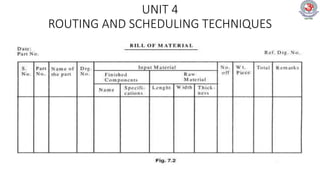
Bill of Material:
After proper analysis of the product the quality and quantity of materials
required is determined and the bill of materials as shown in Fig.
From this proforma the quantity of material required for each part is
known and accordingly can be procured. Some firms prepare separate
lists for finished components and raw materials. To know-how much
material is to be purchased or procured the amount of materials in the
stores should be known.
UNIT 4
ROUTING AND SCHEDULING TECHNIQUES
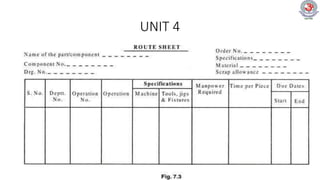
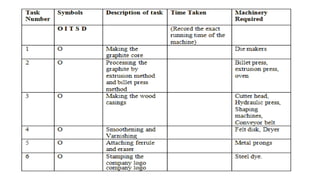
Preparation of Route Sheet:
The third step of routing procedure is the determination of
operations required together with their sequence to
manufacture the product. The routing decision establishes the
operations necessary for processing the product and lists them
in their sequence on route sheet or operation sheet. The
operation or route sheet is shown in FIGURE.
UNIT 4
UNIT 4
Lot Size Determination:
In case of mass or continuous production systems, the mathematical
relations can be used to find out the lot size to be processed. The idea is
to determine the number of units to be produced in one lot. If the
product is to be produced to fulfil the consumer requirements, the
question to determine the lot size does not arise.
UNIT 4
Determination of Scrap Factor:
The amount of waste which depends on the scraping factors is estimated. The scrap factor is
the anticipated normal scrap encountered during the course of manufacturing. As we know that
the all components produced at various work stations do not meet the required standards and
those which do not pass inspection are to be neglected as scrap.
Moreover the total material taken for processing the product does not go into end product. Thus
scrap factor determination is an important part of routing procedure.
In determining the scrap factor, it should be known where the scrap is going to occur, whether
it occurs progressively during the fabrication/production of parts, end assembly or all of sudden
after a certain operation or after completion of assembly.
If the scrap occurs at one point in the process, a single scrap factor may take care of the
anticipated scrap at the point, but when scrap is progressive, cumulative scrap factor is
essential to serve the purpose. It would be better to work out the material requirement back
ward starting from the desired level of finished product.
The usual practice should be to establish these factors from past experience, to determine the
manpower, the essential machines/ equipment and the materials. Thus the scrap factor plays an
important role in the determination of manpower requirements and loading of various
machines.
UNIT 4
To Provide Necessary Information and Forms:
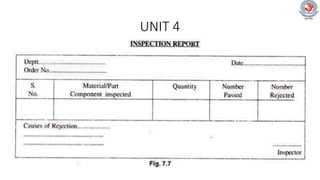
In order to carry out routing as planned various forms and procedures are
required which furnish necessary information for the purpose. Various forms used
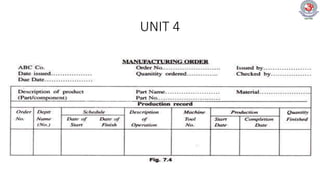
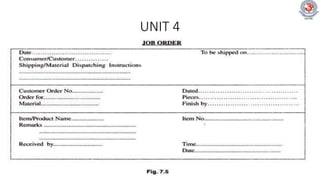
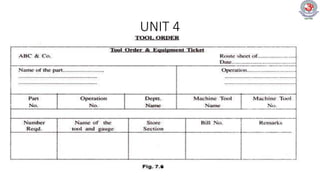
e.g. production order, job ticket, inspection ticket, move order, tool ticket and
equipment ticket are shown in Figs. 7.4 to 7.8 are also prepared in this process
UNIT 4
UNIT 4
The type of forms used in each department depends upon the type of
manufacture. Manufacturing order shown in Fig. 7.4 which contains name, no.,
description, quantity of the part to be produced. Serial no. and other information
are invariably used in job manufacturing production.
UNIT 4
UNIT 4
UNIT 4
If the manufacturing process is simple many plant forms are combined
into one sheet called the master Route Sheet. This is a multipurpose
sheet which also considerably reduces the paper work.
The type of forms used in each department depends upon the type of
manufacture. Manufacturing order shown in Fig- 7.4 which contains
name, number description, quantity of the part to be produced, serial no
and other information are invariably used in job manufacturing
production.
UNIT 4
UNIT 4
ROUTING AND SCHEDULING TECHNIQUES
Advantages of Routing:
(1) Effective utilization of available resources.
(2) Reduction in production costs.
(3) Quality improvement occurs.
(4) Productivity of the system improves and
(5) Provides a basis for loading & scheduling.
UNIT 4
ROUTING AND SCHEDULING TECHNIQUES
Factors affecting routing procedure:
01. Type of Manufacturing Process/Technique Employed:
It is the case of use of line type of layout where the production
process is serialized according to the sequence of operations
thus making routing automatic. Automobile industries adopt
this type of layout. The set up requires change only when new
models are introduced. The same type of routing may be
adopted in batch production also.
UNIT 4
ROUTING AND SCHEDULING TECHNIQUES
02. Plant Equipment Characteristics:
The same product may be possible to manufacture on two or many
machines available in the plant. In such cases the cheapest one should
be selected, whether small, heavy and automatic or mechanized machine
for routing purpose. In order to simplify the process, the routing
division should prepare and place on file a machine data card for each
and every machine giving characteristics of machine, special
attachments (Jigs, fixtures and special tools) and the job range. Records
of other facilities like material handling equipment available in the shop
may also be useful.
UNIT 4
ROUTING AND SCHEDULING TECHNIQUES
03. Availability of Plant and Equipment etc.:
Recommended actions have to be taken in order to select that equipment
or machines, which will help in production of parts at cheapest rate. But
sometimes the services of such machines or processes may not be
available due to machine load conditions, breakdowns or absenteeism of
workers.
In such conditions, the routing division must have alternatives available
to keep the materials moving for manufacturing of the product. This
alternative may be in the form of detours around the breakdown
machines/operations or by changing the sequence of operations.
UNIT 4
ROUTING AND SCHEDULING TECHNIQUES
04. Difficulties in Routing due to Non-Availability of Requisite Skilled
Manpower:
Manpower required in the plant may be highly skilled, semiskilled, or unskilled.
On certain particular machines, where high precision work is done, only services
of experienced highly skilled workers can be utilized. Routine work may affect
the routing procedure in context to manpower are job incentives, lot size, light,
heavy or medium sized work etc.
UNIT 4
ROUTING AND SCHEDULING TECHNIQUES
Scheduling: Establishing the timing of the use of equipment, facilities and
human activities in an organization
Effective scheduling can yield
Cost savings
Increases in productivity OR
Sequencing - determining the order in which jobs will be processed
Job-shop scheduling
Scheduling for low-volume
systems with many
variations in requirements
UNIT 4
ROUTING AND SCHEDULING TECHNIQUES
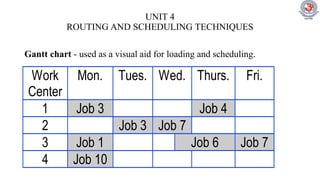
Gantt chart - used as a visual aid for loading and scheduling.
Work
Center
Mon. Tues. Wed. Thurs. Fri.
1 Job 3 Job 4
2 Job 3 Job 7
3 Job 1 Job 6 Job 7
4 Job 10
UNIT 4
ROUTING AND SCHEDULING TECHNIQUES
Loading:
Infinite loading – Jobs are assigned to work centers without regard to
the capacity of the work centre
Finite loading – Jobs are assigned to work centers taking into account
the work center capacity and the processing times
Forward scheduling – Scheduling ahead, from some point in time
Backward scheduling – Scheduling by working backwards from the due
dates
Schedule chart
UNIT 4
ROUTING AND SCHEDULING TECHNIQUES
Hungarian Method:
Method of assigning by a one-for-one matching to identify the lowest cost
solution
Refer Hungarian Method notes.
Workstation: An area where one person works, usually with special
equipment, on a specialized job.
UNIT 4
ROUTING AND SCHEDULING TECHNIQUES
Priority rules: Simple heuristics used to select the order in
which jobs will be processed.
Job time: Time needed for setup and processing of a job.
UNIT 4
ROUTING AND SCHEDULING TECHNIQUES
FCFS - first come, first served
SPT - shortest processing time
EDD - earliest due date
LPT –Longest processing time
CR - critical ratio
S/O - slack per operation
Rush - emergency
Routing
Routing is the first step in production planning and control.
Routing can be defined as the process of deciding the path (route) of work and
the sequence of operations.
Routing fixes in advance:
The quantity and quality of the product.
The men, machines, materials, etc. to be used.
The type, number and sequence of manufacturing operations, and
The place of production.
In short, routing determines ‘What’, ‘How much’, ‘With which’, ‘How’ and
‘Where’ to produce.
Routing may be either very simple or complex. This depends upon the nature
of production. In a continuous production, it is automatic, i.e. it is very
simple. However, in a job order, it is very complex.
Routing is affected by the human factor. Therefore, it should recognize
human needs, desires and expectations. It is also affected by plant-layout,
characteristics of the equipment, etc.
The main objective of routing is to determine (fix) the best and cheapest
sequence of operations and to ensure that this sequence is followed in the
factory.
Routing gives a very systematic method of converting raw-materials into
finished goods. It leads to smooth and efficient work. It leads to optimum
utilization of resources; namely, men, machines, materials, etc. It leads to
division of labor. It ensures a continuous flow of materials without any
backtracking. It saves time and space. It makes the work easy for the
production engineers and foremen. It has a great influence on design of
factory's building and installed machines.
•The routing defines a specific step-by-step method of
manufacture necessary to take a component, or set
of components, and produce a parent. For every
parent item in the manufacturing process, a BOM and
routing are maintained. The routing detail is arranged
in the order or sequence of the single-level
manufacturing process.
Each step is assigned a number or operation identifier.
 For each operation, the department and work center where
the work is to be performed are identified;
 The expected hours of machine setup, equipment changeover,
or cleanup time is described; and
The expected time to complete the operation for a single item
(or piece), known as the operation standard, is described.
Additionally some routing files allow users to maintain other
support information, such as
The labor grade required to perform the work and
Any tooling or fixtures required to support the operation
process.
Routing and Scheduling in Production Planning and Control
• Routing may be defined as the selection of path which each part of the
product will follow while being transformed from raw materials to
finished products. Path of the product will also give sequence of
operation to be adopted while being manufactured. In other way, routing
means determination of most advantageous path to be followed from
department to department and machine to machine till raw material gets
its final shape, which involves the following steps:
Type of work to be done on product or its parts.
Operation required to do the work.
Sequence of operation required.
Where the work will be done.
A proper classification about the personnel required and the machine for
doing the work.
• For effective production control of a well-managed industry with
standard conditions, the routing plays an important role, i.e., to
have the best results obtained from available plant capacity. Thus
routing provides the basis for scheduling, dispatching and follow-
up.
Techniques of Routing
While converting raw material into required goods different
operations are to be performed and the selection of a particular
path of operations for each piece is termed as ‘Routing’. This
selection of a particular path, i.e. sequence of operations must be
the best and cheapest to have the lowest cost of the final product.
The various routing techniques are:
1. Route card:
This card always accompanies with the job throughout all
operations. This indicates the material used during manufacturing
and their progress from one operation to another. In addition to
this the details of scrap and good work produced are also recorded
2. Work sheet: It contains
Specifications to be followed while manufacturing.
Instructions regarding routing of every part with identification
number of machines and This sheet is made for manufacturing as
well as for maintenance.
3. Route sheet:
It deals with specific production order. Generally made from operation
sheets. One sheet is required for each part or component of the order. This
includes the following:
Number and other identification of order.
Symbol and identification of part.
Number of pieces to be made.
Number of pieces in each lot if put through in lots.
Operation data which includes:
List of operation on the part.
Department in which operations are to be performed.
Machine to be used for each operation.
Fixed sequence of operation, if any.
4. Move order:
Though this is document needed for production control, it is
never used for routing system. Move order is prepared for
each operation as per operation sheet. On this the quantity
passed forward, scrapped and to be rectified are recorded.
It is returned to planning office when the operation is
completed.
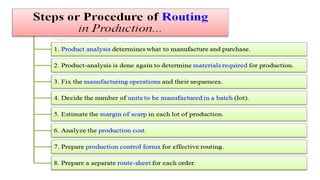
1. Product analysis
Product analysis is the first step in the routing procedure. This is done to
find out what parts (goods) should be manufactured and what parts
should be purchased. This depends mainly on the relative cost. It also
depends on other factors such as technical consideration, purchase
policies, availability of personnel, availability of equipment, etc.
Generally, during less-busy periods; most of the parts are manufactured
in the factory. However, during the busy period, many parts are
purchased from outside.
2. Determine required materials
Product-analysis is done again to find out what materials are required
for production and their quantity and quality.
3. Fix manufacturing operations
The next step in the routing procedure is to fix (decide) the
manufacturing operations and their sequences. The detailed production
procedure is then scheduled (planned). Information required for this is
derived from technical experience and by analyzing the machine
capacity.
4. Determine size of batch
The number of units to be manufactured in any one lot (group or batch)
should be decided. This is done concerning customers' orders.
Necessary provision should also be made for rejections during the
production process.
5. Estimate margin of scrap
The amount of scrap in each lot, should be estimated. Generally, a
scrap margin is between 2% to 5% of production.
6. Analyze the production cost
Estimating the cost of manufactured goods is actually the function
of costing department. However, the routing section provides
necessary data to the costing department that enables it to analyze
the production cost.
7. Prepare production control forms
Production Control forms such as Job Cards, Inspection Cards, Tool
Tickets, etc. should be prepared. These forms should contain
complete information for effective routing.
8. Prepare route sheet
Route sheet is prepared on a production control form. It shows the
part number, description of the part and the materials required. It
is prepared by a route clerk. Separate route-sheet is required for
each part of a customer's order.
Four main factors affecting routing procedure.
The factors are:
1. Type of Manufacturing Process/Technique Employed.
2. Plant Equipment Characteristics.
3. Availability of Plant and Equipment etc.
4. Difficulties in Routing due to Non-Availability of
Requisite Skilled Manpower.
Factor # 1. Type of Manufacturing Process/Technique
Employed:
• It is the case of use of line type of layout where the
production process is serialized according to the sequence
of operations thus making routing automatic. Automobile
industries adopt this type of layout. The set up requires
change only when new models are introduced. The same
type of routing may be adopted in batch production also.
Factor # 2. Plant Equipment Characteristics:
• The same product may be possible to manufacture on two
or many machines available in the plant. In such cases the
cheapest one should be selected, whether small, heavy
and automatic or mechanised machine for routing
purpose.
Factor # 3. Availability of Plant and Equipment etc.:
• Recommended actions have to be taken in order to select that equipment
or machines, which will help in production of parts at cheapest rate. But
sometimes the services of such machines or processes may not be available
due to machine load conditions, breakdowns or absenteeism of workers.
• In such conditions, the routing division must have alternatives available to
keep the materials moving for manufacturing of the product. This
alternative may be in the form of detours around the breakdown
machines/operations or by changing the sequence of operations.
Factor # 4. Difficulties in Routing due to Non-Availability of
Requisite Skilled Manpower:
• Manpower required in the plant may be highly skilled,
semiskilled, or unskilled. On certain particular machines, where
high precision work is done, only services of experienced highly
skilled workers can be utilized. Routine work may affect the
routing procedure in context to manpower are job incentives, lot
size, light, heavy or medium sized work etc.
Engineering Bill of Materials (EBOM)
The engineering bill of materials (EBOM) defines the finished product as
it was originally designed. It lists the items, parts, components,
subassemblies, and assemblies in the product as engineering designed it.
The EBOM is often created by the product engineers based on a CAD
drawing. For a finished product, more than one EBOM may be created.
• A precise and accurate EBOM is essential, especially for a new product, since
this is the document that ensures the correct materials and parts—in the
correct quantities—are available when the item is being manufactured. To
ensure that the parts are available when required, the purchasing
department needs information on what vendors to purchase items from and
how much lead time is required for each ordered part. The purchasing
department will negotiate to obtain the best price for each part in efforts to
reduce the overall cost of the finished product.
• The ramifications of errors in the EBOM are serious. Incorrect quantities can
cause production to be stopped. Any delay can lead to financial loss as the
manufacturer attempts to find missing parts or postpones manufacturing to
start a different production order.
Manufacturing Bill of Materials (MBOM)
The manufacturing bill of materials (MBOM) contains information on all the
parts and assemblies required to build a complete and shippable product. This
includes all the packaging materials required to ship the finished product to
the customer. The MBOM includes not only all the information required for
manufacturing but also any processes that must be performed on the item
before it is completed. When a materials resource planning (MRP) analysis is
run, the details of the MBOM are used to calculate when materials need to be
purchased and when the manufacturing order needs to start, based on the
suggested delivery date to the customer.
Several elements are involved in creating an MBOM.
For some companies, the MBOM must have a validity
date range. For example, when new products are
being tested, the manufacturer may want to restrict
the MBOM's use to one or two months. If, after the
test period, the product requires some modification to
either key elements or to the packaging, the MBOM
can be changed and a new validity date can be
established. Alternatively, an entirely new MBOM can
be created
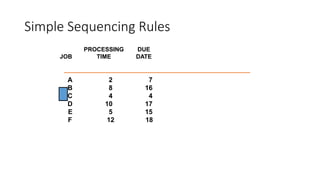
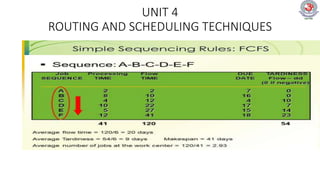
Simple Sequencing Rules
PROCESSING DUE
JOB TIME DATE
A 2 7
B 8 16
C 4 4
D 10 17
E 5 15
F 12 18
UNIT 4
ROUTING AND SCHEDULING TECHNIQUES
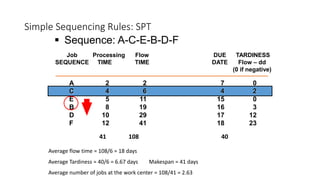
Simple Sequencing Rules: SPT
A 2 2 7 0
C 4 6 4 2
E 5 11 15 0
B 8 19 16 3
D 10 29 17 12
F 12 41 18 23
Job Processing Flow DUE TARDINESS
SEQUENCE TIME TIME DATE Flow – dd
(0 if negative)
 Sequence: A-C-E-B-D-F
41 108 40
Average flow time = 108/6 = 18 days
Average Tardiness = 40/6 = 6.67 days Makespan = 41 days
Average number of jobs at the work center = 108/41 = 2.63
UNIT 4
ROUTING AND SCHEDULING TECHNIQUES
UNIT 4
ROUTING AND SCHEDULING TECHNIQUES
UNIT 4
ROUTING AND SCHEDULING TECHNIQUES
Two Work Centre Sequencing:
Johnson’s Rule: technique for minimizing completion time for a group of jobs
to be processed on two machines or at two work centers.
Minimizes total idle time
Several conditions must be satisfied
UNIT 4
ROUTING AND SCHEDULING TECHNIQUES
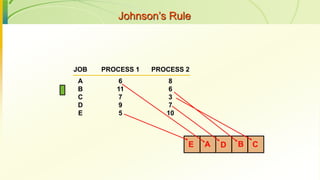
Johnson’s Rule
JOB PROCESS 1 PROCESS 2
A 6 8
B 11 6
C 7 3
D 9 7
E 5 10
CE A BD
Processing time(job work time)
• Time required to process a job
• Setup time + actual processing time
Due date
• Date at which a job is to be completed
Flow time
• Waiting time + processing time
Job lateness
• Time at which job is actually completed – scheduled finishing time
• Flow time(days) – Job due date(days)
Key Terminologies
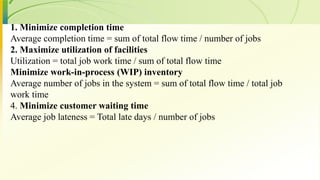
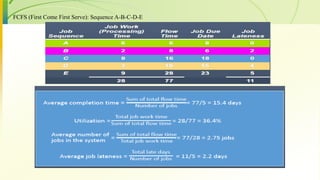
1. Minimize completion time
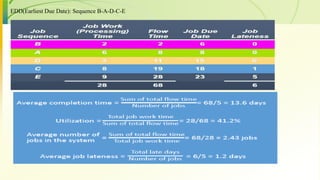
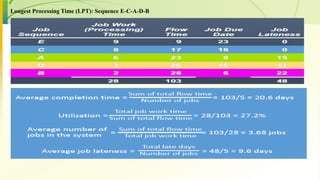
Average completion time = sum of total flow time / number of jobs
2. Maximize utilization of facilities
Utilization = total job work time / sum of total flow time
Minimize work-in-process (WIP) inventory
Average number of jobs in the system = sum of total flow time / total job
work time
4. Minimize customer waiting time
Average job lateness = Total late days / number of jobs
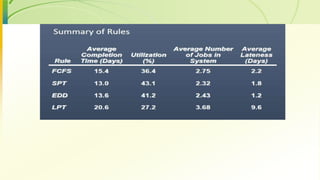
Apply the four popular sequencing rules to these five jobs
FCFS (First Come First Serve): Sequence A-B-C-D-E
SPT (Shortest Possible Time): Sequence B-D-A-C-E
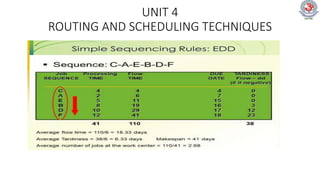
EDD(Earliest Due Date): Sequence B-A-D-C-E
Longest Processing Time (LPT): Sequence E-C-A-D-B
Sequencing N Jobs on Two Machines: Johnson’s Rule
Works with two or more jobs that pass through the same two machines or
work centers
Minimizes total production time and idle time
Johnson’s Rule
1. List all jobs and times for each work center
2. Choose the job with the shortest activity time. If that time is in the first
work center, schedule the job first. If it is in the second work center, schedule
the job last.
3. Once a job is scheduled, it is eliminated from the list
4. Repeat steps 2 and 3 working toward the center of the sequence
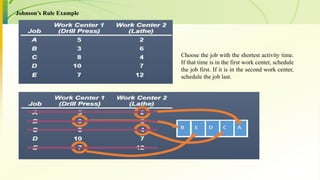
Johnson’s Rule Example
Choose the job with the shortest activity time.
If that time is in the first work center, schedule
the job first. If it is in the second work center,
schedule the job last.
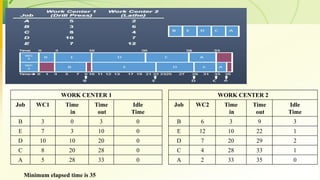
WORK CENTER 1
Job WC1 Time
in
Time
out
Idle
Time
B 3 0 3 0
E 7 3 10 0
D 10 10 20 0
C 8 20 28 0
A 5 28 33 0
WORK CENTER 2
Job WC2 Time
in
Time
out
Idle
Time
B 6 3 9 3
E 12 10 22 1
D 7 20 29 2
C 4 28 33 1
A 2 33 35 0
Minimum elapsed time is 35

Unit 4 ppc

  • 1.
    Unit 4- CONTENT Routing– Definition – Routing procedure –Route sheets – Bill of material – Factors affecting routing procedure. Schedule –definition – Difference with loading, Scheduling Policies – Techniques, Standard scheduling methods, Line Balancing, Aggregate planning, Chase planning, Expediting, controlling aspects.
  • 2.
    UNIT 4 ROUTING ANDSCHEDULING TECHNIQUES
  • 3.
    Routing: It means determinationof the route to be followed by each part/component being transformed from input/raw material into final product.” Obviously where one single part/product is produced by fixed set of machines the job of routing becomes automatic or mechanized. In continuous production systems with line type or product type layout, no managerial effort is required for routing though different sets of machines may be utilized in manufacturing the products in such systems.
  • 4.
    UNIT 4 ROUTINGAND SCHEDULING TECHNIQUES When one single part/product is produced by fixed set of machines the job of routing becomes automatic or mechanized. In continuous production systems with line type or product type layout, no managerial effort is required for routing though different sets of machines may be utilized in manufacturing the products in such systems.
  • 5.
    UNIT 4-ROUTING ANDSCHEDULING TECHNIQUES Functions of Routing: In all engineering industries, the steps in the direction of preparation for production of a product are more or less the same and occur as follows: (1) The future product exists only as an idea in the mind of the inventor and he draws the sketch. (2) The possible product is deeply analysed, studied and developed to prepare the drawings. (3) The next step is preparation of working drawings which may include the parts and assemblies drawings. (4) Blue prints of the drawings with necessary technical details are prepared.
  • 6.
    UNIT 4 ROUTING ANDSCHEDULING TECHNIQUES When the product is standardized and the work is repetitive, the drawings of the components/parts are prepared with following considerations: (1) The operations and processes required to manufacture the components. (2) The material required for manufacturing of the product. (3) The method of manufacturing.
  • 7.
    UNIT 4 ROUTING ANDSCHEDULING TECHNIQUES In such cases the completed design prepared by the engineering division and received in production control department will include the following: 1. Blue print of each components 2. List of parts, assemblies and sub assemblies. 3.Complete specifications of material required for each product. 4. Limits and tolerances on each part. 5. Specifications of machining process by which the part is to be produced, 6.Sequence of operations to be performed. 7.Time allowances (set up and operation time) for each operation/process.
  • 8.
    UNIT 4 ROUTING ANDSCHEDULING TECHNIQUES Routing Procedure: Routing procedure consists of six decisions as mentioned below: (1) Make and Buy Decision: The product to be manufactured and as parts needed are thoroughly analysed to determine which parts/components are to be made and which are to be purchased in view of the following facts: (2) Cost comparison for making and buying. (3) Whether the available manpower can be utilized for the purpose of making within the plant. (4) Whether the existing machines which are idle can be utilized. (5) Whether the input materials and machines are available in the plant for manufacture or require procurement.
  • 9.
    UNIT 4 ROUTING ANDSCHEDULING TECHNIQUES Bill of Material: After proper analysis of the product the quality and quantity of materials required is determined and the bill of materials as shown in Fig. From this proforma the quantity of material required for each part is known and accordingly can be procured. Some firms prepare separate lists for finished components and raw materials. To know-how much material is to be purchased or procured the amount of materials in the stores should be known.
  • 10.
    UNIT 4 ROUTING ANDSCHEDULING TECHNIQUES
  • 11.
    ROUTING AND SCHEDULINGTECHNIQUES Preparation of Route Sheet: The third step of routing procedure is the determination of operations required together with their sequence to manufacture the product. The routing decision establishes the operations necessary for processing the product and lists them in their sequence on route sheet or operation sheet. The operation or route sheet is shown in FIGURE.
  • 12.
  • 13.
    UNIT 4 Lot SizeDetermination: In case of mass or continuous production systems, the mathematical relations can be used to find out the lot size to be processed. The idea is to determine the number of units to be produced in one lot. If the product is to be produced to fulfil the consumer requirements, the question to determine the lot size does not arise.
  • 14.
    UNIT 4 Determination ofScrap Factor: The amount of waste which depends on the scraping factors is estimated. The scrap factor is the anticipated normal scrap encountered during the course of manufacturing. As we know that the all components produced at various work stations do not meet the required standards and those which do not pass inspection are to be neglected as scrap. Moreover the total material taken for processing the product does not go into end product. Thus scrap factor determination is an important part of routing procedure. In determining the scrap factor, it should be known where the scrap is going to occur, whether it occurs progressively during the fabrication/production of parts, end assembly or all of sudden after a certain operation or after completion of assembly. If the scrap occurs at one point in the process, a single scrap factor may take care of the anticipated scrap at the point, but when scrap is progressive, cumulative scrap factor is essential to serve the purpose. It would be better to work out the material requirement back ward starting from the desired level of finished product. The usual practice should be to establish these factors from past experience, to determine the manpower, the essential machines/ equipment and the materials. Thus the scrap factor plays an important role in the determination of manpower requirements and loading of various machines.
  • 15.
    UNIT 4 To ProvideNecessary Information and Forms: In order to carry out routing as planned various forms and procedures are required which furnish necessary information for the purpose. Various forms used e.g. production order, job ticket, inspection ticket, move order, tool ticket and equipment ticket are shown in Figs. 7.4 to 7.8 are also prepared in this process
  • 16.
  • 17.
    UNIT 4 The typeof forms used in each department depends upon the type of manufacture. Manufacturing order shown in Fig. 7.4 which contains name, no., description, quantity of the part to be produced. Serial no. and other information are invariably used in job manufacturing production.
  • 18.
  • 19.
  • 20.
    UNIT 4 If themanufacturing process is simple many plant forms are combined into one sheet called the master Route Sheet. This is a multipurpose sheet which also considerably reduces the paper work. The type of forms used in each department depends upon the type of manufacture. Manufacturing order shown in Fig- 7.4 which contains name, number description, quantity of the part to be produced, serial no and other information are invariably used in job manufacturing production.
  • 21.
  • 22.
    UNIT 4 ROUTING ANDSCHEDULING TECHNIQUES Advantages of Routing: (1) Effective utilization of available resources. (2) Reduction in production costs. (3) Quality improvement occurs. (4) Productivity of the system improves and (5) Provides a basis for loading & scheduling.
  • 23.
    UNIT 4 ROUTING ANDSCHEDULING TECHNIQUES Factors affecting routing procedure: 01. Type of Manufacturing Process/Technique Employed: It is the case of use of line type of layout where the production process is serialized according to the sequence of operations thus making routing automatic. Automobile industries adopt this type of layout. The set up requires change only when new models are introduced. The same type of routing may be adopted in batch production also.
  • 24.
    UNIT 4 ROUTING ANDSCHEDULING TECHNIQUES 02. Plant Equipment Characteristics: The same product may be possible to manufacture on two or many machines available in the plant. In such cases the cheapest one should be selected, whether small, heavy and automatic or mechanized machine for routing purpose. In order to simplify the process, the routing division should prepare and place on file a machine data card for each and every machine giving characteristics of machine, special attachments (Jigs, fixtures and special tools) and the job range. Records of other facilities like material handling equipment available in the shop may also be useful.
  • 25.
    UNIT 4 ROUTING ANDSCHEDULING TECHNIQUES 03. Availability of Plant and Equipment etc.: Recommended actions have to be taken in order to select that equipment or machines, which will help in production of parts at cheapest rate. But sometimes the services of such machines or processes may not be available due to machine load conditions, breakdowns or absenteeism of workers. In such conditions, the routing division must have alternatives available to keep the materials moving for manufacturing of the product. This alternative may be in the form of detours around the breakdown machines/operations or by changing the sequence of operations.
  • 26.
    UNIT 4 ROUTING ANDSCHEDULING TECHNIQUES 04. Difficulties in Routing due to Non-Availability of Requisite Skilled Manpower: Manpower required in the plant may be highly skilled, semiskilled, or unskilled. On certain particular machines, where high precision work is done, only services of experienced highly skilled workers can be utilized. Routine work may affect the routing procedure in context to manpower are job incentives, lot size, light, heavy or medium sized work etc.
  • 27.
    UNIT 4 ROUTING ANDSCHEDULING TECHNIQUES Scheduling: Establishing the timing of the use of equipment, facilities and human activities in an organization Effective scheduling can yield Cost savings Increases in productivity OR Sequencing - determining the order in which jobs will be processed Job-shop scheduling Scheduling for low-volume systems with many variations in requirements
  • 28.
    UNIT 4 ROUTING ANDSCHEDULING TECHNIQUES Gantt chart - used as a visual aid for loading and scheduling. Work Center Mon. Tues. Wed. Thurs. Fri. 1 Job 3 Job 4 2 Job 3 Job 7 3 Job 1 Job 6 Job 7 4 Job 10
  • 29.
    UNIT 4 ROUTING ANDSCHEDULING TECHNIQUES Loading: Infinite loading – Jobs are assigned to work centers without regard to the capacity of the work centre Finite loading – Jobs are assigned to work centers taking into account the work center capacity and the processing times Forward scheduling – Scheduling ahead, from some point in time Backward scheduling – Scheduling by working backwards from the due dates Schedule chart
  • 30.
    UNIT 4 ROUTING ANDSCHEDULING TECHNIQUES Hungarian Method: Method of assigning by a one-for-one matching to identify the lowest cost solution Refer Hungarian Method notes. Workstation: An area where one person works, usually with special equipment, on a specialized job.
  • 31.
    UNIT 4 ROUTING ANDSCHEDULING TECHNIQUES Priority rules: Simple heuristics used to select the order in which jobs will be processed. Job time: Time needed for setup and processing of a job.
  • 32.
    UNIT 4 ROUTING ANDSCHEDULING TECHNIQUES FCFS - first come, first served SPT - shortest processing time EDD - earliest due date LPT –Longest processing time CR - critical ratio S/O - slack per operation Rush - emergency
  • 33.
    Routing Routing is thefirst step in production planning and control. Routing can be defined as the process of deciding the path (route) of work and the sequence of operations. Routing fixes in advance: The quantity and quality of the product. The men, machines, materials, etc. to be used. The type, number and sequence of manufacturing operations, and The place of production. In short, routing determines ‘What’, ‘How much’, ‘With which’, ‘How’ and ‘Where’ to produce.
  • 35.
    Routing may beeither very simple or complex. This depends upon the nature of production. In a continuous production, it is automatic, i.e. it is very simple. However, in a job order, it is very complex. Routing is affected by the human factor. Therefore, it should recognize human needs, desires and expectations. It is also affected by plant-layout, characteristics of the equipment, etc. The main objective of routing is to determine (fix) the best and cheapest sequence of operations and to ensure that this sequence is followed in the factory. Routing gives a very systematic method of converting raw-materials into finished goods. It leads to smooth and efficient work. It leads to optimum utilization of resources; namely, men, machines, materials, etc. It leads to division of labor. It ensures a continuous flow of materials without any backtracking. It saves time and space. It makes the work easy for the production engineers and foremen. It has a great influence on design of factory's building and installed machines.
  • 36.
    •The routing definesa specific step-by-step method of manufacture necessary to take a component, or set of components, and produce a parent. For every parent item in the manufacturing process, a BOM and routing are maintained. The routing detail is arranged in the order or sequence of the single-level manufacturing process.
  • 37.
    Each step isassigned a number or operation identifier.  For each operation, the department and work center where the work is to be performed are identified;  The expected hours of machine setup, equipment changeover, or cleanup time is described; and The expected time to complete the operation for a single item (or piece), known as the operation standard, is described. Additionally some routing files allow users to maintain other support information, such as The labor grade required to perform the work and Any tooling or fixtures required to support the operation process.
  • 38.
    Routing and Schedulingin Production Planning and Control • Routing may be defined as the selection of path which each part of the product will follow while being transformed from raw materials to finished products. Path of the product will also give sequence of operation to be adopted while being manufactured. In other way, routing means determination of most advantageous path to be followed from department to department and machine to machine till raw material gets its final shape, which involves the following steps: Type of work to be done on product or its parts. Operation required to do the work. Sequence of operation required. Where the work will be done. A proper classification about the personnel required and the machine for doing the work.
  • 39.
    • For effectiveproduction control of a well-managed industry with standard conditions, the routing plays an important role, i.e., to have the best results obtained from available plant capacity. Thus routing provides the basis for scheduling, dispatching and follow- up. Techniques of Routing While converting raw material into required goods different operations are to be performed and the selection of a particular path of operations for each piece is termed as ‘Routing’. This selection of a particular path, i.e. sequence of operations must be the best and cheapest to have the lowest cost of the final product. The various routing techniques are:
  • 40.
    1. Route card: Thiscard always accompanies with the job throughout all operations. This indicates the material used during manufacturing and their progress from one operation to another. In addition to this the details of scrap and good work produced are also recorded 2. Work sheet: It contains Specifications to be followed while manufacturing. Instructions regarding routing of every part with identification number of machines and This sheet is made for manufacturing as well as for maintenance.
  • 41.
    3. Route sheet: Itdeals with specific production order. Generally made from operation sheets. One sheet is required for each part or component of the order. This includes the following: Number and other identification of order. Symbol and identification of part. Number of pieces to be made. Number of pieces in each lot if put through in lots. Operation data which includes: List of operation on the part. Department in which operations are to be performed. Machine to be used for each operation. Fixed sequence of operation, if any.
  • 42.
    4. Move order: Thoughthis is document needed for production control, it is never used for routing system. Move order is prepared for each operation as per operation sheet. On this the quantity passed forward, scrapped and to be rectified are recorded. It is returned to planning office when the operation is completed.
  • 44.
    1. Product analysis Productanalysis is the first step in the routing procedure. This is done to find out what parts (goods) should be manufactured and what parts should be purchased. This depends mainly on the relative cost. It also depends on other factors such as technical consideration, purchase policies, availability of personnel, availability of equipment, etc. Generally, during less-busy periods; most of the parts are manufactured in the factory. However, during the busy period, many parts are purchased from outside. 2. Determine required materials Product-analysis is done again to find out what materials are required for production and their quantity and quality.
  • 45.
    3. Fix manufacturingoperations The next step in the routing procedure is to fix (decide) the manufacturing operations and their sequences. The detailed production procedure is then scheduled (planned). Information required for this is derived from technical experience and by analyzing the machine capacity. 4. Determine size of batch The number of units to be manufactured in any one lot (group or batch) should be decided. This is done concerning customers' orders. Necessary provision should also be made for rejections during the production process.
  • 46.
    5. Estimate marginof scrap The amount of scrap in each lot, should be estimated. Generally, a scrap margin is between 2% to 5% of production. 6. Analyze the production cost Estimating the cost of manufactured goods is actually the function of costing department. However, the routing section provides necessary data to the costing department that enables it to analyze the production cost.
  • 47.
    7. Prepare productioncontrol forms Production Control forms such as Job Cards, Inspection Cards, Tool Tickets, etc. should be prepared. These forms should contain complete information for effective routing. 8. Prepare route sheet Route sheet is prepared on a production control form. It shows the part number, description of the part and the materials required. It is prepared by a route clerk. Separate route-sheet is required for each part of a customer's order.
  • 48.
    Four main factorsaffecting routing procedure. The factors are: 1. Type of Manufacturing Process/Technique Employed. 2. Plant Equipment Characteristics. 3. Availability of Plant and Equipment etc. 4. Difficulties in Routing due to Non-Availability of Requisite Skilled Manpower.
  • 49.
    Factor # 1.Type of Manufacturing Process/Technique Employed: • It is the case of use of line type of layout where the production process is serialized according to the sequence of operations thus making routing automatic. Automobile industries adopt this type of layout. The set up requires change only when new models are introduced. The same type of routing may be adopted in batch production also.
  • 50.
    Factor # 2.Plant Equipment Characteristics: • The same product may be possible to manufacture on two or many machines available in the plant. In such cases the cheapest one should be selected, whether small, heavy and automatic or mechanised machine for routing purpose.
  • 51.
    Factor # 3.Availability of Plant and Equipment etc.: • Recommended actions have to be taken in order to select that equipment or machines, which will help in production of parts at cheapest rate. But sometimes the services of such machines or processes may not be available due to machine load conditions, breakdowns or absenteeism of workers. • In such conditions, the routing division must have alternatives available to keep the materials moving for manufacturing of the product. This alternative may be in the form of detours around the breakdown machines/operations or by changing the sequence of operations.
  • 52.
    Factor # 4.Difficulties in Routing due to Non-Availability of Requisite Skilled Manpower: • Manpower required in the plant may be highly skilled, semiskilled, or unskilled. On certain particular machines, where high precision work is done, only services of experienced highly skilled workers can be utilized. Routine work may affect the routing procedure in context to manpower are job incentives, lot size, light, heavy or medium sized work etc.
  • 53.
    Engineering Bill ofMaterials (EBOM) The engineering bill of materials (EBOM) defines the finished product as it was originally designed. It lists the items, parts, components, subassemblies, and assemblies in the product as engineering designed it. The EBOM is often created by the product engineers based on a CAD drawing. For a finished product, more than one EBOM may be created.
  • 54.
    • A preciseand accurate EBOM is essential, especially for a new product, since this is the document that ensures the correct materials and parts—in the correct quantities—are available when the item is being manufactured. To ensure that the parts are available when required, the purchasing department needs information on what vendors to purchase items from and how much lead time is required for each ordered part. The purchasing department will negotiate to obtain the best price for each part in efforts to reduce the overall cost of the finished product. • The ramifications of errors in the EBOM are serious. Incorrect quantities can cause production to be stopped. Any delay can lead to financial loss as the manufacturer attempts to find missing parts or postpones manufacturing to start a different production order.
  • 55.
    Manufacturing Bill ofMaterials (MBOM) The manufacturing bill of materials (MBOM) contains information on all the parts and assemblies required to build a complete and shippable product. This includes all the packaging materials required to ship the finished product to the customer. The MBOM includes not only all the information required for manufacturing but also any processes that must be performed on the item before it is completed. When a materials resource planning (MRP) analysis is run, the details of the MBOM are used to calculate when materials need to be purchased and when the manufacturing order needs to start, based on the suggested delivery date to the customer.
  • 56.
    Several elements areinvolved in creating an MBOM. For some companies, the MBOM must have a validity date range. For example, when new products are being tested, the manufacturer may want to restrict the MBOM's use to one or two months. If, after the test period, the product requires some modification to either key elements or to the packaging, the MBOM can be changed and a new validity date can be established. Alternatively, an entirely new MBOM can be created
  • 57.
    Simple Sequencing Rules PROCESSINGDUE JOB TIME DATE A 2 7 B 8 16 C 4 4 D 10 17 E 5 15 F 12 18
  • 58.
    UNIT 4 ROUTING ANDSCHEDULING TECHNIQUES
  • 59.
    Simple Sequencing Rules:SPT A 2 2 7 0 C 4 6 4 2 E 5 11 15 0 B 8 19 16 3 D 10 29 17 12 F 12 41 18 23 Job Processing Flow DUE TARDINESS SEQUENCE TIME TIME DATE Flow – dd (0 if negative)  Sequence: A-C-E-B-D-F 41 108 40 Average flow time = 108/6 = 18 days Average Tardiness = 40/6 = 6.67 days Makespan = 41 days Average number of jobs at the work center = 108/41 = 2.63
  • 60.
    UNIT 4 ROUTING ANDSCHEDULING TECHNIQUES
  • 61.
    UNIT 4 ROUTING ANDSCHEDULING TECHNIQUES
  • 62.
    UNIT 4 ROUTING ANDSCHEDULING TECHNIQUES Two Work Centre Sequencing: Johnson’s Rule: technique for minimizing completion time for a group of jobs to be processed on two machines or at two work centers. Minimizes total idle time Several conditions must be satisfied
  • 63.
    UNIT 4 ROUTING ANDSCHEDULING TECHNIQUES
  • 64.
    Johnson’s Rule JOB PROCESS1 PROCESS 2 A 6 8 B 11 6 C 7 3 D 9 7 E 5 10 CE A BD
  • 65.
    Processing time(job worktime) • Time required to process a job • Setup time + actual processing time Due date • Date at which a job is to be completed Flow time • Waiting time + processing time Job lateness • Time at which job is actually completed – scheduled finishing time • Flow time(days) – Job due date(days) Key Terminologies
  • 66.
    1. Minimize completiontime Average completion time = sum of total flow time / number of jobs 2. Maximize utilization of facilities Utilization = total job work time / sum of total flow time Minimize work-in-process (WIP) inventory Average number of jobs in the system = sum of total flow time / total job work time 4. Minimize customer waiting time Average job lateness = Total late days / number of jobs
  • 67.
    Apply the fourpopular sequencing rules to these five jobs
  • 68.
    FCFS (First ComeFirst Serve): Sequence A-B-C-D-E
  • 69.
    SPT (Shortest PossibleTime): Sequence B-D-A-C-E
  • 70.
    EDD(Earliest Due Date):Sequence B-A-D-C-E
  • 71.
    Longest Processing Time(LPT): Sequence E-C-A-D-B
  • 73.
    Sequencing N Jobson Two Machines: Johnson’s Rule Works with two or more jobs that pass through the same two machines or work centers Minimizes total production time and idle time Johnson’s Rule 1. List all jobs and times for each work center 2. Choose the job with the shortest activity time. If that time is in the first work center, schedule the job first. If it is in the second work center, schedule the job last. 3. Once a job is scheduled, it is eliminated from the list 4. Repeat steps 2 and 3 working toward the center of the sequence
  • 74.
    Johnson’s Rule Example Choosethe job with the shortest activity time. If that time is in the first work center, schedule the job first. If it is in the second work center, schedule the job last.
  • 75.
    WORK CENTER 1 JobWC1 Time in Time out Idle Time B 3 0 3 0 E 7 3 10 0 D 10 10 20 0 C 8 20 28 0 A 5 28 33 0 WORK CENTER 2 Job WC2 Time in Time out Idle Time B 6 3 9 3 E 12 10 22 1 D 7 20 29 2 C 4 28 33 1 A 2 33 35 0 Minimum elapsed time is 35