Vietnamese German University


       WATER RESOURCES IN VIETNAM
                               Ho Chi Minh City, October 04, 2011
OUTLINE

1. Vietnam Overview
2. Natural Water Resources

   Surface Water
   Ground Water
   Water Availability & Quality
3. Water Resources Usage

4. Natural Water Resources – Major Issues

5. References


Page 1   ▌Natural water resoures in Vietnam
VIETNAM OVERVIEW
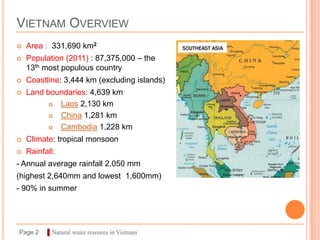
   Area : 331,690 km2
   Population (2011) : 87,375,000 – the
    13th most populous country
   Coastline: 3,444 km (excluding islands)
   Land boundaries: 4,639 km
           Laos 2,130 km
           China 1,281 km
           Cambodia 1,228 km
   Climate: tropical monsoon
   Rainfall:
- Annual average rainfall 2,050 mm
(highest 2,640mm and lowest 1,600mm)
- 90% in summer


Page 2    ▌Natural water resoures in Vietnam
SURFACE WATER – OVERVIEW


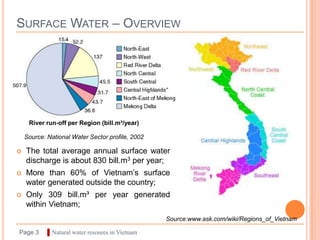
     River run-off per Region (bill.m³/year)

    Source: National Water Sector profile, 2002

   The total average annual surface water
    discharge is about 830 bill.m3 per year;
   More than 60% of Vietnam’s surface
    water generated outside the country;
   Only 309 bill.m³ per year generated
    within Vietnam;
                                                  Source:www.ask.com/wiki/Regions_of_Vietnam

Page 3      ▌Natural water resoures in Vietnam
SURFACE WATER – OVERVIEW
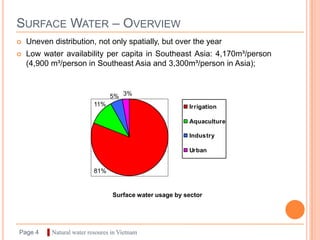
   Uneven distribution, not only spatially, but over the year
   Low water availability per capita in Southeast Asia: 4,170m³/person
    (4,900 m³/person in Southeast Asia and 3,300m³/person in Asia);


                                 5% 3%
                           11%                            Irrigation

                                                          Aquaculture

                                                          Industry

                                                          Urban


                           81%


                                  Surface water usage by sector


Page 4    ▌Natural water resoures in Vietnam
SURFACE WATER - RIVER
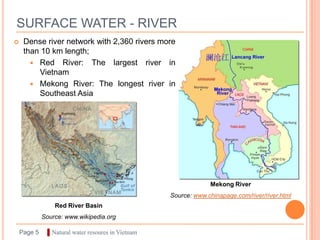
    Dense river network with 2,360 rivers more
     than 10 km length;
        Red River: The largest river in
         Vietnam
        Mekong River: The longest river in
         Southeast Asia


                                                                 Mekong River
                                                    Source: www.chinapage.com/river/river.html
                 Red River Basin
             Source: www.wikipedia.org

    Page 5     ▌Natural water resoures in Vietnam
SURFACE WATER - RIVER
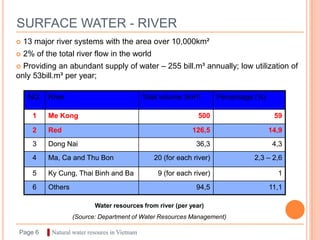
   13 major river systems with the area over 10,000km²
   2% of the total river flow in the world
 Providing an abundant supply of water – 255 bill.m³ annually; low utilization of
only 53bill.m³ per year;

     NO.   River                                Total volume (km³)       Percentage (%)

      1    Me Kong                                               500                       59

      2    Red                                                 126,5                      14,9
      3    Dong Nai                                              36,3                      4,3
      4    Ma, Ca and Thu Bon                      20 (for each river)             2,3 – 2,6

      5    Ky Cung, Thai Binh and Ba                9 (for each river)                      1
      6    Others                                                94,5                     11,1

                            Water resources from river (per year)
                    (Source: Department of Water Resources Management)

Page 6     ▌Natural water resoures in Vietnam
SURFACE WATER – LAKE, LAGOON
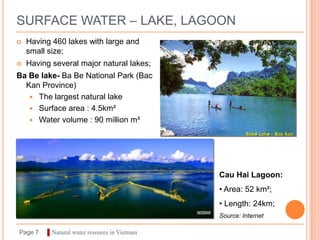
   Having 460 lakes with large and
    small size;
   Having several major natural lakes;
Ba Be lake- Ba Be National Park (Bac
  Kan Province)
    The largest natural lake
    Surface area : 4.5km²
    Water volume : 90 million m³


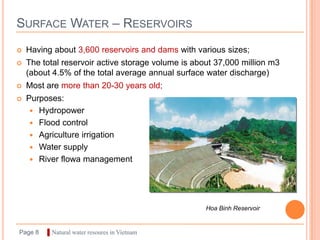
                                              Cau Hai Lagoon:
                                              • Area: 52 km²;
                                              • Length: 24km;
                                              Source: Internet

Page 7   ▌Natural water resoures in Vietnam
SURFACE WATER – RESERVOIRS
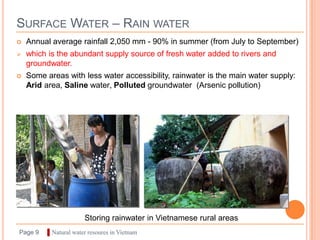
   Having about 3,600 reservoirs and dams with various sizes;
   The total reservoir active storage volume is about 37,000 million m3
    (about 4.5% of the total average annual surface water discharge)
   Most are more than 20-30 years old;
   Purposes:
      Hydropower
      Flood control
      Agriculture irrigation
      Water supply
      River flowa management


                                                    Hoa Binh Reservoir


Page 8   ▌Natural water resoures in Vietnam
SURFACE WATER – RAIN WATER
   Annual average rainfall 2,050 mm - 90% in summer (from July to September)
   which is the abundant supply source of fresh water added to rivers and
    groundwater.
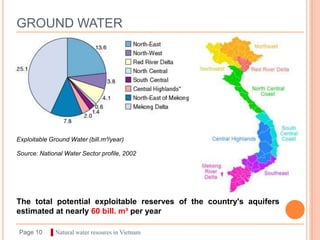
   Some areas with less water accessibility, rainwater is the main water supply:
    Arid area, Saline water, Polluted groundwater (Arsenic pollution)


                        Storing rainwater in Vietnamese rural areas
Page 9    ▌Natural water resoures in Vietnam
GROUND WATER


Exploitable Ground Water (bill.m³/year)

Source: National Water Sector profile, 2002


The total potential exploitable reserves of the country's aquifers
estimated at nearly 60 bill. m³ per year

Page 10     ▌Natural water resoures in Vietnam
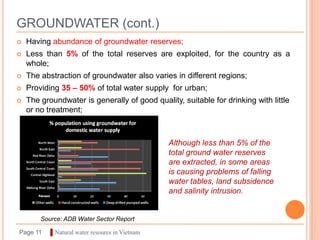
GROUNDWATER (cont.)
   Having abundance of groundwater reserves;
   Less than 5% of the total reserves are exploited, for the country as a
    whole;
   The abstraction of groundwater also varies in different regions;
   Providing 35 – 50% of total water supply for urban;
   The groundwater is generally of good quality, suitable for drinking with little
    or no treatment;


                                                Although less than 5% of the
                                                total ground water reserves
                                                are extracted, in some areas
                                                is causing problems of falling
                                                water tables, land subsidence
                                                and salinity intrusion.


        Source: ADB Water Sector Report

Page 11    ▌Natural water resoures in Vietnam
GROUNDWATER (cont.)
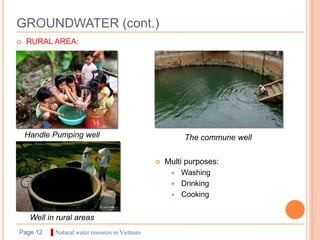
   RURAL AREA:


    Handle Pumping well                                  The commune well

                                                   Multi purposes:
                                                        Washing
                                                        Drinking
                                                        Cooking


     Well in rural areas
Page 12    ▌Natural water resoures in Vietnam
GROUNDWATER (cont.)
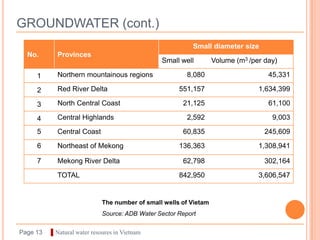
                                                           Small diameter size
  No.       Provinces
                                                Small well         Volume (m3 /per day)

     1      Northern mountainous regions                 8,080                      45,331

     2      Red River Delta                           551,157                    1,634,399

     3      North Central Coast                        21,125                       61,100

     4      Central Highlands                            2,592                       9,003

     5      Central Coast                              60,835                      245,609

     6      Northeast of Mekong                       136,363                    1,308,941

     7      Mekong River Delta                         62,798                      302,164

            TOTAL                                     842,950                    3,606,547


                             The number of small wells of Vietam
                             Source: ADB Water Sector Report

Page 13   ▌Natural water resoures in Vietnam
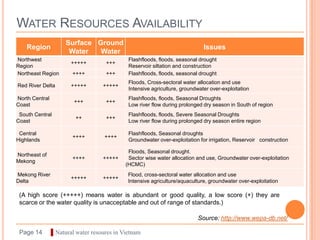
WATER RESOURCES AVAILABILITY
                     Surface Ground
    Region                                                                   Issues
                      Water   Water
Northwest                                    Flashfloods, floods, seasonal drought
                       +++++        +++
Region                                       Reservoir siltation and construction
Northeast Region        ++++        +++      Flashfloods, floods, seasonal drought
                                             Floods, Cross-sectoral water allocation and use
Red River Delta        +++++       +++++
                                             Intensive agriculture, groundwater over-exploitation
North Central                                Flashfloods, floods, Seasonal Droughts
                        +++         +++
Coast                                        Low river flow during prolonged dry season in South of region
 South Central                               Flashfloods, floods, Severe Seasonal Droughts
                         ++         +++
Coast                                        Low river flow during prolonged dry season entire region

 Central                                     Flashfloods, Seasonal droughts
                        ++++        ++++
Highlands                                    Groundwater over-exploitation for irrigation, Reservoir construction

                                             Floods, Seasonal drought.
Northeast of
                        ++++       +++++     Sector wise water allocation and use, Groundwater over-exploitation
Mekong
                                            (HCMC)
Mekong River                                 Flood, cross-sectoral water allocation and use
                       +++++       +++++
Delta                                        Intensive agriculture/aquaculture, groundwater over-exploitation

 (A high score (+++++) means water is abundant or good quality, a low score (+) they are
 scarce or the water quality is unacceptable and out of range of standards.)

                                                                          Source: http://www.wepa-db.net/

 Page 14        ▌Natural water resoures in Vietnam
WATER QUALITY – OVERVIEW
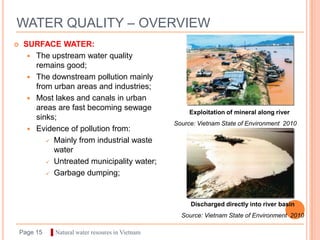
    SURFACE WATER:
       The upstream water quality
        remains good;
       The downstream pollution mainly
        from urban areas and industries;
       Most lakes and canals in urban
        areas are fast becoming sewage
                                                        Exploitation of mineral along river
        sinks;
                                                   Source: Vietnam State of Environment 2010
       Evidence of pollution from:
            Mainly from industrial waste
             water
            Untreated municipality water;

            Garbage dumping;


                                                        Discharged directly into river basin
                                                     Source: Vietnam State of Environment 2010

    Page 15   ▌Natural water resoures in Vietnam
WATER QUALITY – OVERVIEW
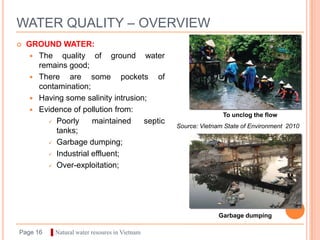
   GROUND WATER:
      The quality of ground water
       remains good;
      There    are some pockets of
       contamination;
      Having some salinity intrusion;
      Evidence of pollution from:
                                                              To unclog the flow
          Poorly     maintained     septic
                                               Source: Vietnam State of Environment 2010
            tanks;
          Garbage dumping;

          Industrial effluent;

          Over-exploitation;


                                                             Garbage dumping

Page 16   ▌Natural water resoures in Vietnam
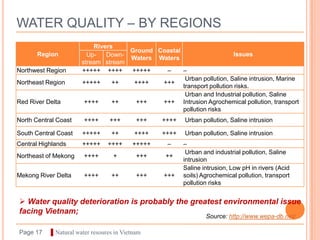
WATER QUALITY – BY REGIONS
                          Rivers
                                    Ground Coastal
       Region           Up-   Down-                                    Issues
                                    Waters Waters
                      stream stream
Northwest Region      +++++ ++++    +++++    –     –
                                                    Urban pollution, Saline intrusion, Marine
Northeast Region      +++++     ++   ++++   +++
                                                   transport pollution risks.
                                                    Urban and Industrial pollution, Saline
Red River Delta        ++++     ++    +++   +++ Intrusion Agrochemical pollution, transport
                                                   pollution risks
North Central Coast    ++++      +++       +++   ++++   Urban pollution, Saline intrusion

South Central Coast   +++++      ++       ++++   ++++   Urban pollution, Saline intrusion
Central Highlands     +++++     ++++     +++++    –     –
                                                         Urban and industrial pollution, Saline
Northeast of Mekong    ++++       +        +++   ++
                                                        intrusion
                                                        Saline intrusion, Low pH in rivers (Acid
Mekong River Delta     ++++      ++        +++   +++    soils) Agrochemical pollution, transport
                                                        pollution risks


 Water quality deterioration is probably the greatest environmental issue
facing Vietnam;
                                                                Source: http://www.wepa-db.net/

Page 17    ▌Natural water resoures in Vietnam
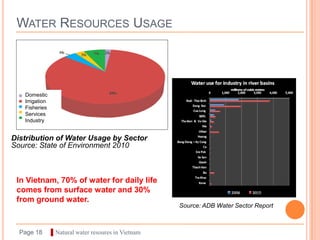
WATER RESOURCES USAGE


   Domestic
   Irrigation
   Fisheries
   Services
   Industry


Distribution of Water Usage by Sector
Source: State of Environment 2010


 In Vietnam, 70% of water for daily life
 comes from surface water and 30%
 from ground water.
                                                     Source: ADB Water Sector Report


  Page 18       ▌Natural water resoures in Vietnam
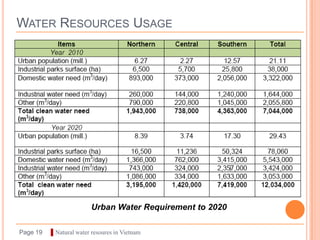
WATER RESOURCES USAGE


                         Urban Water Requirement to 2020

Page 19   ▌Natural water resoures in Vietnam
MAJOR ISSUES - OVERVIEW

   Population increase;
   Rapid urbanization and industrialization;
   Climate change;
   Monitoring the resource & extractions
   Sustainable levels of extraction
   Impacts assessment of projects (eg. hydro power projects)
   State water management capacity;
   Inadequate physical infrastructure;
   Budget for water resources development and management is limited


Page 20   ▌Natural water resoures in Vietnam
MAJOR ISSUES (cont.)
   SURFACE WATER:
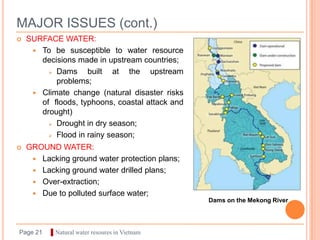
      To be susceptible to water resource
       decisions made in upstream countries;
          Dams     built at the upstream
           problems;
      Climate change (natural disaster risks
       of floods, typhoons, coastal attack and
       drought)
          Drought in dry season;

          Flood in rainy season;

   GROUND WATER:
      Lacking ground water protection plans;
      Lacking ground water drilled plans;
      Over-extraction;
      Due to polluted surface water;
                                                 Dams on the Mekong River


Page 21   ▌Natural water resoures in Vietnam
REFERENCES

   Vietnam State of Water Environment Issues, Water Environment
    Partnership in Asia, http://www.wepa-db.net/


   Vietnam State of Environment 2010


   ADB Water Sector Review – Sector Status Report, 2008


Page 22   ▌Natural water resoures in Vietnam
Vietnamese German University


             THANK YOU!

Vietnam Water resources.

  • 1.
    Vietnamese German University WATER RESOURCES IN VIETNAM Ho Chi Minh City, October 04, 2011
  • 2.
    OUTLINE 1. Vietnam Overview 2.Natural Water Resources  Surface Water  Ground Water  Water Availability & Quality 3. Water Resources Usage 4. Natural Water Resources – Major Issues 5. References Page 1 ▌Natural water resoures in Vietnam
  • 3.
    VIETNAM OVERVIEW  Area : 331,690 km2  Population (2011) : 87,375,000 – the 13th most populous country  Coastline: 3,444 km (excluding islands)  Land boundaries: 4,639 km  Laos 2,130 km  China 1,281 km  Cambodia 1,228 km  Climate: tropical monsoon  Rainfall: - Annual average rainfall 2,050 mm (highest 2,640mm and lowest 1,600mm) - 90% in summer Page 2 ▌Natural water resoures in Vietnam
  • 4.
    SURFACE WATER –OVERVIEW River run-off per Region (bill.m³/year) Source: National Water Sector profile, 2002  The total average annual surface water discharge is about 830 bill.m3 per year;  More than 60% of Vietnam’s surface water generated outside the country;  Only 309 bill.m³ per year generated within Vietnam; Source:www.ask.com/wiki/Regions_of_Vietnam Page 3 ▌Natural water resoures in Vietnam
  • 5.
    SURFACE WATER –OVERVIEW  Uneven distribution, not only spatially, but over the year  Low water availability per capita in Southeast Asia: 4,170m³/person (4,900 m³/person in Southeast Asia and 3,300m³/person in Asia); 5% 3% 11% Irrigation Aquaculture Industry Urban 81% Surface water usage by sector Page 4 ▌Natural water resoures in Vietnam
  • 6.
    SURFACE WATER -RIVER  Dense river network with 2,360 rivers more than 10 km length;  Red River: The largest river in Vietnam  Mekong River: The longest river in Southeast Asia Mekong River Source: www.chinapage.com/river/river.html Red River Basin Source: www.wikipedia.org Page 5 ▌Natural water resoures in Vietnam
  • 7.
    SURFACE WATER -RIVER  13 major river systems with the area over 10,000km²  2% of the total river flow in the world  Providing an abundant supply of water – 255 bill.m³ annually; low utilization of only 53bill.m³ per year; NO. River Total volume (km³) Percentage (%) 1 Me Kong 500 59 2 Red 126,5 14,9 3 Dong Nai 36,3 4,3 4 Ma, Ca and Thu Bon 20 (for each river) 2,3 – 2,6 5 Ky Cung, Thai Binh and Ba 9 (for each river) 1 6 Others 94,5 11,1 Water resources from river (per year) (Source: Department of Water Resources Management) Page 6 ▌Natural water resoures in Vietnam
  • 8.
    SURFACE WATER –LAKE, LAGOON  Having 460 lakes with large and small size;  Having several major natural lakes; Ba Be lake- Ba Be National Park (Bac Kan Province)  The largest natural lake  Surface area : 4.5km²  Water volume : 90 million m³ Cau Hai Lagoon: • Area: 52 km²; • Length: 24km; Source: Internet Page 7 ▌Natural water resoures in Vietnam
  • 9.
    SURFACE WATER –RESERVOIRS  Having about 3,600 reservoirs and dams with various sizes;  The total reservoir active storage volume is about 37,000 million m3 (about 4.5% of the total average annual surface water discharge)  Most are more than 20-30 years old;  Purposes:  Hydropower  Flood control  Agriculture irrigation  Water supply  River flowa management Hoa Binh Reservoir Page 8 ▌Natural water resoures in Vietnam
  • 10.
    SURFACE WATER –RAIN WATER  Annual average rainfall 2,050 mm - 90% in summer (from July to September)  which is the abundant supply source of fresh water added to rivers and groundwater.  Some areas with less water accessibility, rainwater is the main water supply: Arid area, Saline water, Polluted groundwater (Arsenic pollution) Storing rainwater in Vietnamese rural areas Page 9 ▌Natural water resoures in Vietnam
  • 11.
    GROUND WATER Exploitable GroundWater (bill.m³/year) Source: National Water Sector profile, 2002 The total potential exploitable reserves of the country's aquifers estimated at nearly 60 bill. m³ per year Page 10 ▌Natural water resoures in Vietnam
  • 12.
    GROUNDWATER (cont.)  Having abundance of groundwater reserves;  Less than 5% of the total reserves are exploited, for the country as a whole;  The abstraction of groundwater also varies in different regions;  Providing 35 – 50% of total water supply for urban;  The groundwater is generally of good quality, suitable for drinking with little or no treatment; Although less than 5% of the total ground water reserves are extracted, in some areas is causing problems of falling water tables, land subsidence and salinity intrusion. Source: ADB Water Sector Report Page 11 ▌Natural water resoures in Vietnam
  • 13.
    GROUNDWATER (cont.)  RURAL AREA: Handle Pumping well The commune well  Multi purposes:  Washing  Drinking  Cooking Well in rural areas Page 12 ▌Natural water resoures in Vietnam
  • 14.
    GROUNDWATER (cont.) Small diameter size No. Provinces Small well Volume (m3 /per day) 1 Northern mountainous regions 8,080 45,331 2 Red River Delta 551,157 1,634,399 3 North Central Coast 21,125 61,100 4 Central Highlands 2,592 9,003 5 Central Coast 60,835 245,609 6 Northeast of Mekong 136,363 1,308,941 7 Mekong River Delta 62,798 302,164 TOTAL 842,950 3,606,547 The number of small wells of Vietam Source: ADB Water Sector Report Page 13 ▌Natural water resoures in Vietnam
  • 15.
    WATER RESOURCES AVAILABILITY Surface Ground Region Issues Water Water Northwest Flashfloods, floods, seasonal drought +++++ +++ Region Reservoir siltation and construction Northeast Region ++++ +++ Flashfloods, floods, seasonal drought Floods, Cross-sectoral water allocation and use Red River Delta +++++ +++++ Intensive agriculture, groundwater over-exploitation North Central Flashfloods, floods, Seasonal Droughts +++ +++ Coast Low river flow during prolonged dry season in South of region South Central Flashfloods, floods, Severe Seasonal Droughts ++ +++ Coast Low river flow during prolonged dry season entire region Central Flashfloods, Seasonal droughts ++++ ++++ Highlands Groundwater over-exploitation for irrigation, Reservoir construction Floods, Seasonal drought. Northeast of ++++ +++++ Sector wise water allocation and use, Groundwater over-exploitation Mekong (HCMC) Mekong River Flood, cross-sectoral water allocation and use +++++ +++++ Delta Intensive agriculture/aquaculture, groundwater over-exploitation (A high score (+++++) means water is abundant or good quality, a low score (+) they are scarce or the water quality is unacceptable and out of range of standards.) Source: http://www.wepa-db.net/ Page 14 ▌Natural water resoures in Vietnam
  • 16.
    WATER QUALITY –OVERVIEW  SURFACE WATER:  The upstream water quality remains good;  The downstream pollution mainly from urban areas and industries;  Most lakes and canals in urban areas are fast becoming sewage Exploitation of mineral along river sinks; Source: Vietnam State of Environment 2010  Evidence of pollution from:  Mainly from industrial waste water  Untreated municipality water;  Garbage dumping; Discharged directly into river basin Source: Vietnam State of Environment 2010 Page 15 ▌Natural water resoures in Vietnam
  • 17.
    WATER QUALITY –OVERVIEW  GROUND WATER:  The quality of ground water remains good;  There are some pockets of contamination;  Having some salinity intrusion;  Evidence of pollution from: To unclog the flow  Poorly maintained septic Source: Vietnam State of Environment 2010 tanks;  Garbage dumping;  Industrial effluent;  Over-exploitation; Garbage dumping Page 16 ▌Natural water resoures in Vietnam
  • 18.
    WATER QUALITY –BY REGIONS Rivers Ground Coastal Region Up- Down- Issues Waters Waters stream stream Northwest Region +++++ ++++ +++++ – – Urban pollution, Saline intrusion, Marine Northeast Region +++++ ++ ++++ +++ transport pollution risks. Urban and Industrial pollution, Saline Red River Delta ++++ ++ +++ +++ Intrusion Agrochemical pollution, transport pollution risks North Central Coast ++++ +++ +++ ++++ Urban pollution, Saline intrusion South Central Coast +++++ ++ ++++ ++++ Urban pollution, Saline intrusion Central Highlands +++++ ++++ +++++ – – Urban and industrial pollution, Saline Northeast of Mekong ++++ + +++ ++ intrusion Saline intrusion, Low pH in rivers (Acid Mekong River Delta ++++ ++ +++ +++ soils) Agrochemical pollution, transport pollution risks  Water quality deterioration is probably the greatest environmental issue facing Vietnam; Source: http://www.wepa-db.net/ Page 17 ▌Natural water resoures in Vietnam
  • 19.
    WATER RESOURCES USAGE Domestic Irrigation Fisheries Services Industry Distribution of Water Usage by Sector Source: State of Environment 2010 In Vietnam, 70% of water for daily life comes from surface water and 30% from ground water. Source: ADB Water Sector Report Page 18 ▌Natural water resoures in Vietnam
  • 20.
    WATER RESOURCES USAGE Urban Water Requirement to 2020 Page 19 ▌Natural water resoures in Vietnam
  • 21.
    MAJOR ISSUES -OVERVIEW  Population increase;  Rapid urbanization and industrialization;  Climate change;  Monitoring the resource & extractions  Sustainable levels of extraction  Impacts assessment of projects (eg. hydro power projects)  State water management capacity;  Inadequate physical infrastructure;  Budget for water resources development and management is limited Page 20 ▌Natural water resoures in Vietnam
  • 22.
    MAJOR ISSUES (cont.)  SURFACE WATER:  To be susceptible to water resource decisions made in upstream countries;  Dams built at the upstream problems;  Climate change (natural disaster risks of floods, typhoons, coastal attack and drought)  Drought in dry season;  Flood in rainy season;  GROUND WATER:  Lacking ground water protection plans;  Lacking ground water drilled plans;  Over-extraction;  Due to polluted surface water; Dams on the Mekong River Page 21 ▌Natural water resoures in Vietnam
  • 23.
    REFERENCES  Vietnam State of Water Environment Issues, Water Environment Partnership in Asia, http://www.wepa-db.net/  Vietnam State of Environment 2010  ADB Water Sector Review – Sector Status Report, 2008 Page 22 ▌Natural water resoures in Vietnam
  • 24.

Editor's Notes

  • #4 Câu in đỏ để chuyển đề sang surface water and ground water :D
  • #5 The total average annual surface water discharge in Viet Nam7 is about 830 billion m3.Nearly 57% of this flows in the Cuu Long river basin, and more than 16% in the Red - Thai Binhbasin, and more than 4% in the Dong Nai basin ….
  • #6 The total average annual surface water discharge in Viet Nam7 is about 830 billion m3.Nearly 57% of this flows in the Cuu Long river basin, and more than 16% in the Red - Thai Binhbasin, and more than 4% in the Dong Nai basin ….
  • #8 Chưa tìm ra được các thống kê về hồ (tự nhiên, và nhân tạo) cho Việt Nam. Nhưng có generalize rằng có các hồ tự nhiên to tại các national park, cũng nhắc tới rất nhiều hồ có quy mô nhỏ hơn nằm rải rác, kể cả các hồ trong nội thành như ở Hà Nội, Đà Lạt …Còn những vùng nông thôn thì có các hồ là hố bom, cũng là nguồn nước dùng, ngoài ra, đó cũng là nguồn từ nước mưa …
  • #10 NA thinking: Normally rainwater is not calculate in surface water distribution, as it is an income source TO rivers and groundwater. Không thể tính % của lượng nước mưa đóng góp vào water natural resourse vì nó thật ra là chiếm 80-90 nguồn nước mặt (mưa xuống) và ngấm vào mạch nước ngầm. Khi mình trình bày phần rainwater này là bổ sung thêm giới thiệu việc sử dụng nguồn nước đa dạng thôi, ngoài dùng nước mặt (nếu thiếu, hoặc bị nhiễm mặn) hoặc ngoài dùng nước ngầm (bị mặn, ô nhiễm) người ta mới trữ nước mưa dùng riêng. Arid area (highlands, central)Saline water (Mekong delta)Polluted groundwater (Arsenic pollution, Red River Delta)
  • #12 Vẫn chưa biết other well là gì, có thể là loại combine, vừa dùng tay vừa dùng máy? Hay là đây là loại giếng đào, không sâu, nhưng vẫn dùng máy để lấy nước, để tách biệt với các loại giếng rất sâu mới có nước?
  • #14 Vẫnchưabiết other well làgì, cóthểlàloại combine, vừadùngtayvừadùngmáy? Hay làđâylàloạigiếngđào, khôngsâu, nhưngvẫndùngmáyđểlấynước, đểtáchbiệtvớicácloạigiếngrấtsâumớicónước?Là Giếng nông đấy chị, để phân biệt với giếng Sâu có độ sâu hơn 100m.Giếng Sấu thì sạch hơn, vệ sinh hơn.
  • #15 Surface water is abundant, especially in Red River Delta and Mekong River Delta. Water is a bit limited in Central Coast and Central Highlands.Some issues related to water availability is listed and highlighted in red. For example, Flashflood (we are having this problem every year, this time, we call storm and flood season. Drought is an issue in the central, and intensive ground water over-exploitation is an issue to be concerned.
  • #19 Water for irrigation gets the largest portion, (xxx %). As we see before, water is extracted from groundwaterThe example of water use in industry:Water usage for industry is expected to double in 2015
  • #20 The need for water will double in 10 years !
  • #21 Sẽ hiện ra theo nhóm để trình bày và strong discusion/statement kết bài cho hay:Budget for water resources development and management is limited and has not met the demand of the sector.1. Conflicting among different stakeholders for water usage, The lack of water sharing policies at a river basin scale is becoming increasingly problematic in Viet Nam. No limits to the amount of water that can be extracted from surface water or groundwater systems have been established.2. climate change itself is a critical issue for Vietnam, country that have the impact. 3. We need monitoring the resource and extraction, ONLY form that we can have plan for an sustainable levels of extraction. With 11 of the 16 river basins classified as stressed in the dry season, there is now an urgent need to define the sustainable limits of water extraction in each basin, and to manage total extractions to within those limits.4. Impact assessment of projects. Currently the assessment of the water resource and environmental impacts of projects is poor.5. State water management capacity is currently very limited. For both surface water and groundwater, at state and provinces level (nhân lực quản lý còn yếu kém :D)
  • #22 Sẽ hiện ra theo nhóm để trình bày và strong discusion/statement kết bài cho hay:1. Conflicting among different stakeholders for water usage, The lack of water sharing policies at a river basin scale is becoming increasingly problematic in Viet Nam. No limits to the amount of water that can be extracted from surface water or groundwater systems have been established.2. climate change itself is a critical issue for Vietnam, country that have the impact. 3. We need monitoring the resource and extraction, ONLY form that we can have plan for an sustainable levels of extraction. With 11 of the 16 river basins classified as stressed in the dry season, there is now an urgent need to define the sustainable limits of water extraction in each basin, and to manage total extractions to within those limits.4. Impact assessment of projects. Currently the assessment of the water resource and environmental impacts of projects is poor.5. State water management capacity is currently very limited. For both surface water and groundwater, at state and provinces level (nhân lực quản lý còn yếu kém :D)
  • #23 Nếu còn thời gian thì hãy giới thiệu 3 tài liệu mình tham khảo, nếu hết giờ thì thôi :D