Waterloo Moraine,Growth Pressures &
           Gravel Risks

        By Louisette Lanteigne
      butterflybluelu@rogers.com
Federal Challenges


    Fish are cross jurisdictional = Federal Fisheries Act

    Water is cross jurisdictional = No Water Act


                       WHY NOT?
Provincial Challenges

    Provinces control aggregate and fossil fuel extraction.

    Aggregates and fossil fuels = Provincial $

    Provincial Ministry of Transportation is largest
    purchaser of aggregate materials for road repair.

    The closer to the source, the cheaper.
Water + Aggregates = Aquifers
Waterloo Moraine's Complex Geology

                  
                      Along coastal areas,
                      geological composition is
                      relatively consistent and
                      “predictable”.
                  
                      The Waterloo Moraine is
                      located at the intersection
                      of multiple glacial lobes.
                  
                      The geology is very
                      complex and less
                      predictable.
Cross Section of Waterloo Moraine
Why protect the Waterloo Moraine?


    This system of glacial formed aggregates gathers
    municipal water for our region and communities
    downstream.

    It has been filtering, transporting, storing water and
    offsetting flood risk for 15,000 years for free!

    The sediment distribution controls flow and flow rates to
    our fisheries, wells systems, the Grand River & Lake Erie.

    Water volumes are need to dilute contamination issues
    and to keep wells running.

    Grand River supports the same Gross National Revenue
    as Nova Scotia and contains 51% of Canada's fish species
    It is a Natural Heritage River.
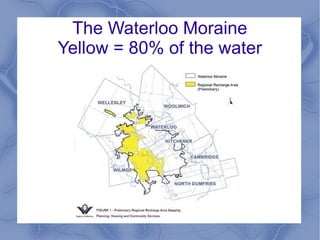
The Waterloo Moraine
Yellow = 80% of the water
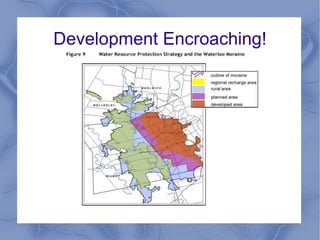
Development Encroaching!
Road Salt Risk
Source Water Protection Map: ROPP
Gravel Pits encroaching!
Contamination Issues

    Effluent: 29 waste water plants drain effluent into the Grand
    River

    Animal wastes: 290,000 cows in the Grand River Watershed
    produce waste = five million people.

    Leaky Landfills: The Greenbrook well contaminated by 1,4
    dioxane, Middleton Wells in Cambridge at risk too. Waterloo's
    Landfill is leaking vinyl chloride.

    Industrial waste: Elmira had contamination of NDMA
    (nitrosodimethylamine) from Unroyal/Chemtura. Elmira lost it's
    groundwater supply.

    In Cambridge, North Star was sued for trichloroethylene (TCE)
    contamination.
Opportunities to improve

-Composting toilets can conserve water & reduce
 wastes in waterways. Wastes are reduced to 2% of
 it's mass in 5 years and end product safe for
 landscaping.
-Biofuel recovery from sewage and farm wastes can
 replace gas from fracking to heat homes and run cars
-creation of aggregate materials from sewage and farm
 wastes reduce dependency on gravel extraction for
 roads and construction materials
-Biochemical in-situ remediation of contaminates
 including TCE is available. Natural enzymes “eat”
 toxins on site.
Challenges in Protecting it


  Provincial Growth Targets may exceed carrying capacity of the Grand
River and deplete the moraine.

    Gravel projects place the moraine and Grand River at risk.

  Today's policies cannot be grandfathered so older plans approved
years back don't have to comply to today's laws. They pose a risk.

 We don't know how much water we have. Our knowledge of ground
water volumes is limited to pre-development studies.

 Some consulting firms make money re mediating the situations they
create. There is money in destruction for them but heavy costs to
taxpayers.
Challenges cont.


      The MNR does not recognize municipal policies
    so municipally protected lands (like the ESL) are
    still at risk for aggregate extraction.

      The MOE reviewed our request for a Waterloo
    Moraine Act but the scope excluded socio-
    economic, health and long term sustainability
    issues as well as down stream impacts.
Challenges cont.

- The review lacked regard to the last five years
worth of source water protection legislation.
- The MOE report did not assess whether the
 ecological capacity of the moraines can
 realistically accommodate the projected growth in
 the region.
- To protect the system, cross jurisdictional and
 Federal water policies are needed.
Ontario Environmental Commissioner of
       Ontario 2009/2010 Annual Report

      If the principles of watershed-based planning are
    applied, and the environmental and socio-economic
    context of the moraines are examined to assess the
    cumulative effects of development, the ECO believes that
    the current provincial policies do not adequately
    protect the ecological and hydrogeological integrity of
    moraines.

      Watersheds should be a key unit within land use
    planning in which to frame decision-making.
 
ECO cont.

      The population projections for Growth Plan communities
    were established before the future water and wastewater
    infrastructure was identified, and their associated costs
    and environment impacts, were assessed.

      This clearly indicates that provincial policies, such as the
    Growth Plan, favor economic development over
    sustainable planning processes.
ECO cont.

       Not only does the Growth Plan fail to require that population
    allocations be adjusted for communities with watersheds close
    to or already at carrying capacity, it favors large-scale
    infrastructure projects to overcome natural limits.

      Waterloo is proposing to address any future water shortages
    by constructing a pipe to Lake Erie to pump water in and out of
    the city. Not only do infrastructure projects like these override
    natural ecological carrying capacity, they are also extremely
    costly and energy intensive, and as a sewage and water
    systems, ("infrastructure") they are exempt from natural heritage
    protections in the PPS and Greenbelt Plan despite their
    potential for significant environmental effects.
ECO's recommendation:


The ECO recommends that the Ministry of Municipal
Affairs and Housing amend the Provincial Policy
Statement to require that long term ecological
function and biodiversity of natural heritage systems
are maintained.


               http://www.eco.on.ca
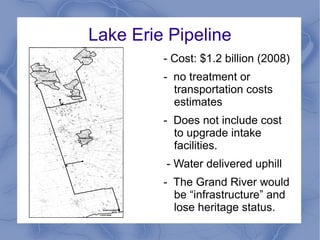
Lake Erie Pipeline
         - Cost: $1.2 billion (2008)
         - no treatment or
           transportation costs
           estimates
         - Does not include cost
           to upgrade intake
           facilities.
         - Water delivered uphill
         - The Grand River would
           be “infrastructure” and
           lose heritage status.
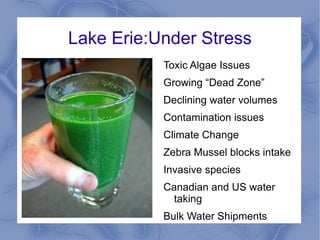
Lake Erie:Under Stress
           Toxic Algae Issues
           Growing “Dead Zone”
           Declining water volumes
           Contamination issues
           Climate Change
           Zebra Mussel blocks intake
           Invasive species
           Canadian and US water
             taking
           Bulk Water Shipments
Toxic Blue Green Algae seen from space.
International Joint Commission
biennial report on the state of the Great Lakes

  Calling Lake Erie the "poster child" for eutrophication, the
  commission's U.S. co-chair, Lana Pollack, said much of
  the lake is back to being coated with slimy green algal
  blooms in the summer, as it was in the 1960s and early
  '70s.


 "They said, 'Well, we have this one fixed.' Well, we don't have this one fixed," she said.


                                     March 9, 2011 CBC NEWS


              http://www.cbc.ca/news/canada/windsor/story/2011/03/09/tech-ijc-great-lakes.html
IJC: full report page 33
It is clear that human and ecosystem health
in the Great Lakes basin cannot be
protected without protecting ground-water
resources.

   http://www.ijc.org/rel/news/2011/110308_e.htm
TAKE ACTION!
       -Source Water
        Protection Act must
        include Quarries as
        a risk


       -Environmental
        Assessments for
        Quarries in Ontario
Mandate test times and methods
Conserve Aggregates
Protect the function of Aggregates
  Aggregates = Water Supplies

Aggregateact

  • 1.
    Waterloo Moraine,Growth Pressures& Gravel Risks By Louisette Lanteigne butterflybluelu@rogers.com
  • 2.
    Federal Challenges  Fish are cross jurisdictional = Federal Fisheries Act  Water is cross jurisdictional = No Water Act WHY NOT?
  • 3.
    Provincial Challenges  Provinces control aggregate and fossil fuel extraction.  Aggregates and fossil fuels = Provincial $  Provincial Ministry of Transportation is largest purchaser of aggregate materials for road repair.  The closer to the source, the cheaper.
  • 4.
  • 6.
    Waterloo Moraine's ComplexGeology  Along coastal areas, geological composition is relatively consistent and “predictable”.  The Waterloo Moraine is located at the intersection of multiple glacial lobes.  The geology is very complex and less predictable.
  • 7.
    Cross Section ofWaterloo Moraine
  • 8.
    Why protect theWaterloo Moraine?  This system of glacial formed aggregates gathers municipal water for our region and communities downstream.  It has been filtering, transporting, storing water and offsetting flood risk for 15,000 years for free!  The sediment distribution controls flow and flow rates to our fisheries, wells systems, the Grand River & Lake Erie.  Water volumes are need to dilute contamination issues and to keep wells running.  Grand River supports the same Gross National Revenue as Nova Scotia and contains 51% of Canada's fish species It is a Natural Heritage River.
  • 9.
    The Waterloo Moraine Yellow= 80% of the water
  • 10.
  • 11.
  • 12.
  • 13.
  • 14.
    Contamination Issues  Effluent: 29 waste water plants drain effluent into the Grand River  Animal wastes: 290,000 cows in the Grand River Watershed produce waste = five million people.  Leaky Landfills: The Greenbrook well contaminated by 1,4 dioxane, Middleton Wells in Cambridge at risk too. Waterloo's Landfill is leaking vinyl chloride.  Industrial waste: Elmira had contamination of NDMA (nitrosodimethylamine) from Unroyal/Chemtura. Elmira lost it's groundwater supply.  In Cambridge, North Star was sued for trichloroethylene (TCE) contamination.
  • 15.
    Opportunities to improve -Compostingtoilets can conserve water & reduce wastes in waterways. Wastes are reduced to 2% of it's mass in 5 years and end product safe for landscaping. -Biofuel recovery from sewage and farm wastes can replace gas from fracking to heat homes and run cars -creation of aggregate materials from sewage and farm wastes reduce dependency on gravel extraction for roads and construction materials -Biochemical in-situ remediation of contaminates including TCE is available. Natural enzymes “eat” toxins on site.
  • 16.
    Challenges in Protectingit  Provincial Growth Targets may exceed carrying capacity of the Grand River and deplete the moraine.  Gravel projects place the moraine and Grand River at risk.  Today's policies cannot be grandfathered so older plans approved years back don't have to comply to today's laws. They pose a risk.  We don't know how much water we have. Our knowledge of ground water volumes is limited to pre-development studies.  Some consulting firms make money re mediating the situations they create. There is money in destruction for them but heavy costs to taxpayers.
  • 17.
    Challenges cont.  The MNR does not recognize municipal policies so municipally protected lands (like the ESL) are still at risk for aggregate extraction.  The MOE reviewed our request for a Waterloo Moraine Act but the scope excluded socio- economic, health and long term sustainability issues as well as down stream impacts.
  • 18.
    Challenges cont. - Thereview lacked regard to the last five years worth of source water protection legislation. - The MOE report did not assess whether the ecological capacity of the moraines can realistically accommodate the projected growth in the region. - To protect the system, cross jurisdictional and Federal water policies are needed.
  • 19.
    Ontario Environmental Commissionerof Ontario 2009/2010 Annual Report  If the principles of watershed-based planning are applied, and the environmental and socio-economic context of the moraines are examined to assess the cumulative effects of development, the ECO believes that the current provincial policies do not adequately protect the ecological and hydrogeological integrity of moraines.  Watersheds should be a key unit within land use planning in which to frame decision-making.  
  • 20.
    ECO cont.    The population projections for Growth Plan communities were established before the future water and wastewater infrastructure was identified, and their associated costs and environment impacts, were assessed.  This clearly indicates that provincial policies, such as the Growth Plan, favor economic development over sustainable planning processes.
  • 21.
    ECO cont.     Not only does the Growth Plan fail to require that population allocations be adjusted for communities with watersheds close to or already at carrying capacity, it favors large-scale infrastructure projects to overcome natural limits.  Waterloo is proposing to address any future water shortages by constructing a pipe to Lake Erie to pump water in and out of the city. Not only do infrastructure projects like these override natural ecological carrying capacity, they are also extremely costly and energy intensive, and as a sewage and water systems, ("infrastructure") they are exempt from natural heritage protections in the PPS and Greenbelt Plan despite their potential for significant environmental effects.
  • 22.
    ECO's recommendation: The ECOrecommends that the Ministry of Municipal Affairs and Housing amend the Provincial Policy Statement to require that long term ecological function and biodiversity of natural heritage systems are maintained. http://www.eco.on.ca
  • 23.
    Lake Erie Pipeline - Cost: $1.2 billion (2008) - no treatment or transportation costs estimates - Does not include cost to upgrade intake facilities. - Water delivered uphill - The Grand River would be “infrastructure” and lose heritage status.
  • 24.
    Lake Erie:Under Stress Toxic Algae Issues Growing “Dead Zone” Declining water volumes Contamination issues Climate Change Zebra Mussel blocks intake Invasive species Canadian and US water taking Bulk Water Shipments
  • 25.
    Toxic Blue GreenAlgae seen from space.
  • 26.
    International Joint Commission biennialreport on the state of the Great Lakes Calling Lake Erie the "poster child" for eutrophication, the commission's U.S. co-chair, Lana Pollack, said much of the lake is back to being coated with slimy green algal blooms in the summer, as it was in the 1960s and early '70s. "They said, 'Well, we have this one fixed.' Well, we don't have this one fixed," she said. March 9, 2011 CBC NEWS http://www.cbc.ca/news/canada/windsor/story/2011/03/09/tech-ijc-great-lakes.html
  • 27.
    IJC: full reportpage 33 It is clear that human and ecosystem health in the Great Lakes basin cannot be protected without protecting ground-water resources. http://www.ijc.org/rel/news/2011/110308_e.htm
  • 28.
    TAKE ACTION! -Source Water Protection Act must include Quarries as a risk -Environmental Assessments for Quarries in Ontario
  • 29.
    Mandate test timesand methods
  • 30.
  • 31.
    Protect the functionof Aggregates Aggregates = Water Supplies