UNIT-II- VI PROGRAMMING
TECHNIQUES
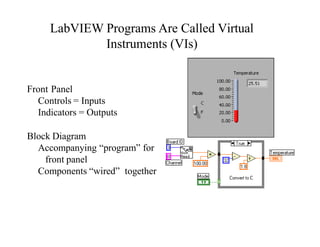
Front Panel
Controls = Inputs
Indicators = Outputs
Block Diagram
Accompanying “program” for
front panel
Components “wired” together
LabVIEW Programs Are Called Virtual
Instruments (VIs)
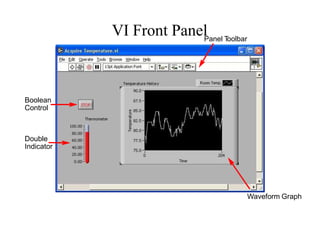
Boolean
Control
Double
Indicator
Waveform Graph
Panel T
oolbar
VI Front Panel
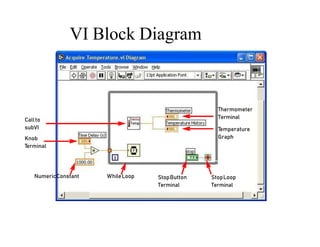
VI Block Diagram
NumericConstant WhileLoop
Callto
subVI
Knob
Terminal
StopButton
Terminal
StopLoop
Terminal
Thermometer
Terminal
Temperature
Graph
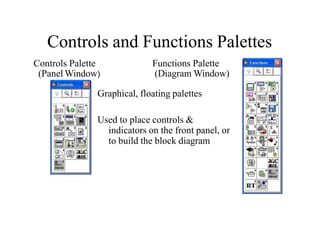
Controls and Functions Palettes
Graphical, floating palettes
Used to place controls &
indicators on the front panel, or
to build the block diagram
Controls Palette
(Panel Window)
Functions Palette
(Diagram Window)
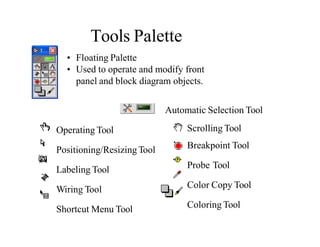
Tools Palette
Operating Tool
Positioning/Resizing Tool
Labeling Tool
Wiring Tool
Shortcut Menu Tool
Scrolling Tool
Breakpoint Tool
Probe Tool
Color Copy Tool
Coloring Tool
• Floating Palette
• Used to operate and modify front
panel and block diagram objects.
Automatic Selection Tool
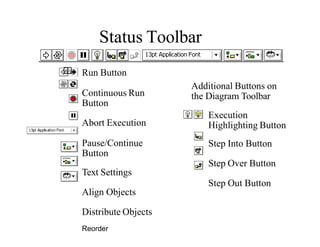
Run Button
Continuous Run
Button
Abort Execution
Pause/Continue
Button
Text Settings
Align Objects
Distribute Objects
Reorder
Additional Buttons on
the Diagram Toolbar
Execution
Highlighting Button
Step Into Button
Step Over Button
Step Out Button
Status Toolbar
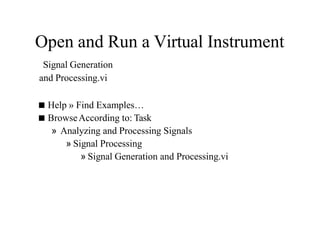
Signal Generation
and Processing.vi
Help » Find Examples…
BrowseAccording to: Task
» Analyzing and Processing Signals
» Signal Processing
» Signal Generation and Processing.vi
Open and Run a Virtual Instrument
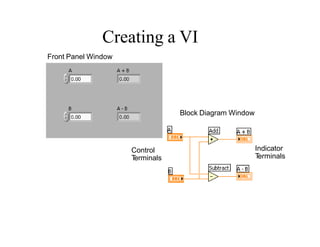
Control
T
erminals
Block Diagram Window
Front Panel Window
Indicator
T
erminals
Creating a VI
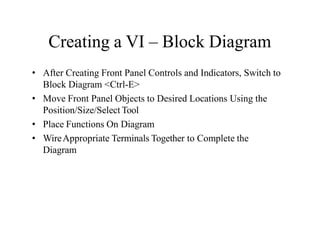
Creating a VI – Block Diagram
• After Creating Front Panel Controls and Indicators, Switch to
Block Diagram <Ctrl-E>
• Move Front Panel Objects to Desired Locations Using the
Position/Size/Select Tool
• Place Functions On Diagram
• WireAppropriate Terminals Together to Complete the
Diagram
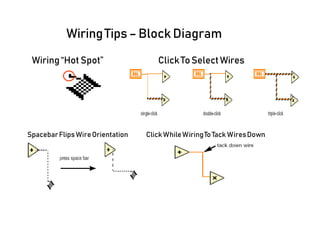
WiringTips– Block Diagram
Wiring“Hot Spot” ClickToSelectWires
ClickWhileWiringToTack WiresDown
SpacebarFlips WireOrientation
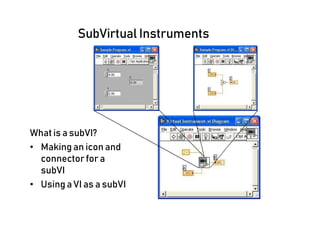
SubVirtual Instruments
Whatis a subVI?
• Making an icon and
connectorfor a
subVI
• Using aVI as a subVI
SubVIs
• ASubVI is a VI that can be used within
another VI
• Advantages
– Modular
– Easier to debug
– Don’t have to recreate code
– Require less memory
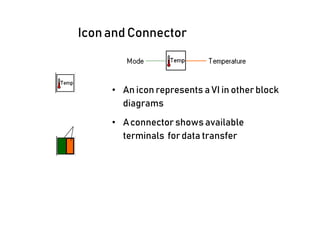
Iconand Connector
• An icon represents a VI in otherblock
diagrams
• Aconnector shows available
terminals fordata transfer
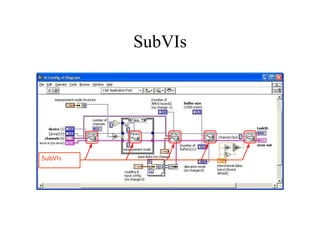
SubVIs
SubVIs
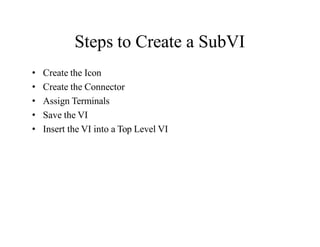
Steps to Create a SubVI
• Create the Icon
• Create the Connector
• Assign Terminals
• Save the VI
• Insert the VI into a Top Level VI
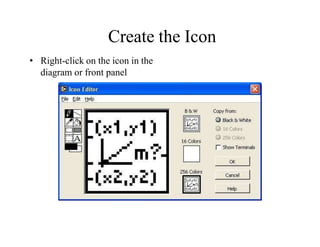
Create the Icon
• Right-click on the icon in the
diagram or front panel
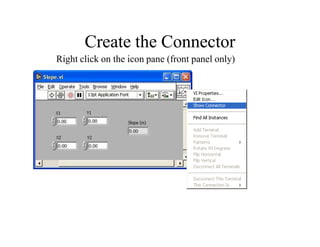
Create the Connector
Right click on the icon pane (front panel only)
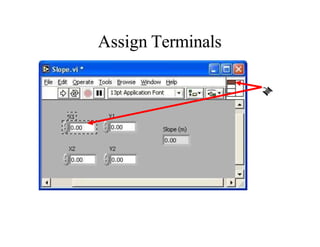
Assign Terminals
Save The VI
• Choose an Easy to Remember Location
• Organize by Functionality
– Save Similar VIs into one directory (e.g. Math Utilities)
• Organize byApplication
– Save all VIs Used for a Specific Application into one
directory or library file (e.g. Lab 1 – Frequency Response)
• Library Files (.llbs) combine many VI’s into a single
file, ideal for transferring entire applications across
computers
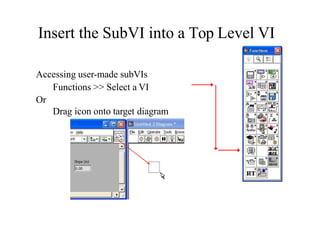
Insert the SubVI into a Top Level VI
Accessing user-made subVIs
Functions >> Select a VI
Or
Drag icon onto target diagram

Unit 3 Sensor and Instrumentation _Graphical programming techniques.pptx

  • 1.
  • 2.
    Front Panel Controls =Inputs Indicators = Outputs Block Diagram Accompanying “program” for front panel Components “wired” together LabVIEW Programs Are Called Virtual Instruments (VIs)
  • 3.
  • 4.
    VI Block Diagram NumericConstantWhileLoop Callto subVI Knob Terminal StopButton Terminal StopLoop Terminal Thermometer Terminal Temperature Graph
  • 5.
    Controls and FunctionsPalettes Graphical, floating palettes Used to place controls & indicators on the front panel, or to build the block diagram Controls Palette (Panel Window) Functions Palette (Diagram Window)
  • 6.
    Tools Palette Operating Tool Positioning/ResizingTool Labeling Tool Wiring Tool Shortcut Menu Tool Scrolling Tool Breakpoint Tool Probe Tool Color Copy Tool Coloring Tool • Floating Palette • Used to operate and modify front panel and block diagram objects. Automatic Selection Tool
  • 7.
    Run Button Continuous Run Button AbortExecution Pause/Continue Button Text Settings Align Objects Distribute Objects Reorder Additional Buttons on the Diagram Toolbar Execution Highlighting Button Step Into Button Step Over Button Step Out Button Status Toolbar
  • 8.
    Signal Generation and Processing.vi Help» Find Examples… BrowseAccording to: Task » Analyzing and Processing Signals » Signal Processing » Signal Generation and Processing.vi Open and Run a Virtual Instrument
  • 9.
    Control T erminals Block Diagram Window FrontPanel Window Indicator T erminals Creating a VI
  • 10.
    Creating a VI– Block Diagram • After Creating Front Panel Controls and Indicators, Switch to Block Diagram <Ctrl-E> • Move Front Panel Objects to Desired Locations Using the Position/Size/Select Tool • Place Functions On Diagram • WireAppropriate Terminals Together to Complete the Diagram
  • 11.
    WiringTips– Block Diagram Wiring“HotSpot” ClickToSelectWires ClickWhileWiringToTack WiresDown SpacebarFlips WireOrientation
  • 12.
    SubVirtual Instruments Whatis asubVI? • Making an icon and connectorfor a subVI • Using aVI as a subVI
  • 13.
    SubVIs • ASubVI isa VI that can be used within another VI • Advantages – Modular – Easier to debug – Don’t have to recreate code – Require less memory
  • 14.
    Iconand Connector • Anicon represents a VI in otherblock diagrams • Aconnector shows available terminals fordata transfer
  • 15.
  • 16.
    Steps to Createa SubVI • Create the Icon • Create the Connector • Assign Terminals • Save the VI • Insert the VI into a Top Level VI
  • 17.
    Create the Icon •Right-click on the icon in the diagram or front panel
  • 18.
    Create the Connector Rightclick on the icon pane (front panel only)
  • 19.
  • 20.
    Save The VI •Choose an Easy to Remember Location • Organize by Functionality – Save Similar VIs into one directory (e.g. Math Utilities) • Organize byApplication – Save all VIs Used for a Specific Application into one directory or library file (e.g. Lab 1 – Frequency Response) • Library Files (.llbs) combine many VI’s into a single file, ideal for transferring entire applications across computers
  • 21.
    Insert the SubVIinto a Top Level VI Accessing user-made subVIs Functions >> Select a VI Or Drag icon onto target diagram