©Bijesh Shrestha – Logistics and Supply Chain Management - Unit 3 – BBA 8th Semester - Page 1 of 18
Unit 3: Logistics Costs
Learning Outcomes:
1) Total cost analysis
2) Principles of logistics costing
3) Customer profitability analysis and direct product profitability
4) The bottom line approach and Shareholder value
5) Cost drivers and activity based costing
Logistics Costs
The costs of satisfying customer demand can be significant and yet, surprisingly, they are not
always fully understood by organisations. One reason for this is that traditional accounting systems
tend to be focused around understanding product costs rather than customer costs. Logistics activity
requires resources in the form of fixed capital and working capital and so there are financial issues
to be considered when supply chain strategies are devised.
Logistics management is a flow-oriented concept with the objective of integrating resources across
a pipeline which extends from suppliers to final customers, it is desirable to have a means whereby
costs and performance of that pipeline flow can be assessed.
One of the main reasons why the adoption of an integrated approach to logistics and distribution
management has proved so difficult for many companies is the lack of appropriate cost
information.
The Concept of Total Cost Analysis
Many problems at the operational level in logistics management arise because all the impacts of
specific decisions, both direct and indirect, are not taken into account throughout the corporate
system. Too often decisions taken in one area can lead to unforeseen results in other areas. Changes
in policy on minimum order value, for example, may influence customer ordering patterns and lead
to additional costs. Similarly, changes in production schedules that aim to improve production
efficiency may lead to fluctuations in finished stock availability and thus affect customer service.
The problems associated with identifying the total system impact of distribution policies are
immense. By its very nature logistics cuts across traditional company organisation functions with
cost impacts on most of those functions.
Conventional accounting systems do not usually assist in the identification of these company-wide
impacts, frequently absorbing logistics-related costs in other cost elements. The cost of processing
©Bijesh Shrestha – Logistics and Supply Chain Management - Unit 3 – BBA 8th Semester - Page 2 of 18
orders, for example, is an amalgam of specific costs incurred in different functional areas of the
business which generally prove extremely difficult to bring together. Figure below outlines the
various cost elements involved in the complete order processing cycle, each of these elements
having a fixed and variable cost component which will lead to a different total cost for any one
particular order.
Conventional accounting systems group costs into broad, aggregated categories which do not then
allow the more detailed analysis necessary to identify the true costs of servicing customers buying
particular product mixes.
Conventional accounting systems do not usually assist in the identification of the company-wide
impacts, frequently absorbing logistics-related costs in other cost elements. Thus, in order to
understand total cost, the different cost needs to be analyzed from order to collection cycle.
1. Order placement and Communication
2. Order Entry
3. Credit check
4. Documentation
5. Order picking
6. Delivery
7. Invoicing and collection
Figure: Stages in the Order-to-Collection Cycle
©Bijesh Shrestha – Logistics and Supply Chain Management - Unit 3 – BBA 8th Semester - Page 3 of 18
Example:
Accounting practice for budgeting and standard-setting has tended to result in a
compartmentalisation of company accounts; thus budgets tend to be set on a functional basis. The
trouble is that policy costs do not usually confine themselves within the same watertight boundaries.
It is the nature of logistics that, like a stone thrown into a pond, the effects of specific policies
spread beyond their immediate area of impact.
A further feature of logistics decisions that contributes to the complexity of generating appropriate
cost information is that they are usually taken against a background of an existing system. The
purpose of total cost analysis in this context is to identify the change in costs brought about by these
decisions. Cost must therefore be viewed in incremental terms – the change in total costs caused by
the change to the system. Thus the addition of an extra warehouse to the distribution network will
bring about cost changes in transport, inventory investment and communications.
It is the incremental cost difference between the two options that is the relevant accounting
information for decision making in this case. Figure below shows how total logistics costs can be
influenced by the addition, or removal, of a depot from the system.
Figure: The Total Cost of Distribution Network
©Bijesh Shrestha – Logistics and Supply Chain Management - Unit 3 – BBA 8th Semester - Page 4 of 18
The Cost of holding Inventory (Example)
One of the largest cost elements is also the one that is perhaps least well accounted for and that is
inventory. It is probably the case that many managers are unaware of what the true cost of holding
inventory actually is.
The largest cost element will normally be the cost of capital. The cost of capital comprises the cost
to the company of debt and the cost of equity.
The other costs that need to be included in the inventory holding cost are the costs of storage and
handling, obsolescence, deterioration/damage and pilferage/shrinkage, as well as insurance and all
the administrative costs associated with the management of the inventory.
The Principles of logistics Costing
One of the basic principles of logistics costing, it has been argued, is that the system should mirror
the materials flow, i.e. it should be capable of identifying the costs that result from providing
customer service in the marketplace.
A second principle is that it should be capable of enabling separate cost and revenue analyses to be
made by customer type and by market segment or distribution channel (emerged as a result of the
dangers inherent in dealing solely with averages, e.g. the average cost per delivery).
To operationalise these principles requires an ‘output’ orientation to costing.
A useful concept here is the idea of ‘mission’. In the context of logistics and supply chain
management, a mission is a set of customer service goals to be achieved by the system within a
specific product/market context. Missions can be defined in terms of the type of market served, by
which products and within what constraints of service and cost. A mission by its very nature cuts
across traditional company lines.
The Figure illustrates the concept and demonstrates the difference between an ‘output’ orientation
based upon missions and the ‘input’ orientation based upon functions.
Figure: Missions that cut across functional boundaries
©Bijesh Shrestha – Logistics and Supply Chain Management - Unit 3 – BBA 8th Semester - Page 5 of 18
The successful achievement of defined mission goals involves inputs from a large number of
functional areas and activity centres within the firm. Thus an effective costing system must seek to
determine the total systems cost of meeting desired mission objectives (the ‘output’ of the system)
and the costs of the various inputs involved in meeting these outputs.
Figure below illustrates how three supply chain missions may make a differential impact upon
activity centre/functional area costs and, in so doing, provide a logical basis for costing within the
company. As a cost or budgeting method, mission costing is the reverse of traditional techniques:
under this scheme a functional budget is determined now by the demands of the missions it serves.
Thus in Figure shows the cost per mission is identified horizontally and from this the functional
budgets may be determined by summing vertically.
Figure: The Programme Budget (‘000)
Given that the logic of mission costing is sound, how might it be made to work in practice? This
approach requires firstly that the activity centres associated with a particular distribution mission be
identified, e.g. transport, warehousing, inventory, etc., and secondly that the incremental costs for
each activity centre incurred as a result of undertaking that mission must be isolated. Incremental
costs are used because it is important not to take into account ‘sunk’ costs or costs that would still
be incurred even if the mission were abandoned. We can make use of the idea of ‘attributable costs’
to operationalise the concept:
Attributable cost is a cost per unit that could be avoided if a product or function were discontinued
entirely without changing the supporting organisation structure.
©Bijesh Shrestha – Logistics and Supply Chain Management - Unit 3 – BBA 8th Semester - Page 6 of 18
In determining the costs of an activity centre, e.g. transport, attributable to a specific mission, the
question should be asked: ‘What costs would we avoid if this customer/segment/channel were no
longer serviced?’ These avoidable costs are the true incremental costs of servicing the
customer/segment/channel. Often they will be substantially lower than the average cost because so
many distribution costs are fixed and/or shared.
This approach becomes particularly powerful when combined with a customer revenue analysis,
because even customers with low sales off-take may still be profitable in incremental costs terms if
not on an average cost basis. In other words the company would be worse off if those customers
were abandoned.
Such insights as this can be gained by extending the mission costing concept to produce
profitability analyses for customers, market segments or distribution channels. The term ‘customer
profitability accounting’ describes any attempt to relate the revenue produced by a customer,
market segment or distribution channel to the costs of servicing that customer/segment/channel.
Customer Profitability Analysis
One of the basic questions that conventional accounting procedures have difficulty answering is:
‘How profitable is this customer compared to another?’ Usually customer profitability is only
calculated at the level of gross profit – in other words the net sales revenue generated by the
customer in a period, less the cost of goods sold for the actual product mix purchased. However,
there are still many other costs to take into account before the real profitability of an individual
customer can be exposed. The same is true if we seek to identify the relative profitability of
different market segments or distribution channels.
The significance of these costs that occur as a result of servicing customers can be profound in
terms of how logistics strategies should be developed. Customer profitability analysis will often
reveal a proportion of customers who make a negative contribution, as in Figure below. The reason
for this is very simply that the costs of servicing a customer can vary considerably – even between
two customers who may make equivalent purchases from us.
©Bijesh Shrestha – Logistics and Supply Chain Management - Unit 3 – BBA 8th Semester - Page 7 of 18
Source: Hill, G.V., Logistics – The Battleground of the 1990s, A.T. Kearney
Figure: Customer Profitability Analysis
If we think of all the costs that a company incurs from when it captures an order from a customer to
when it collects the payment, is will be apparent that the total figure could be quite high. It will also
very likely be the case that there will be significant differences in these costs customer by customer.
At the same time, different customers will order a different mix of products so the gross margin that
they generate will differ. The Table below highlights, there are many costs that need to be identified
if customer profitability is to be accurately measured.
The best measure of customer profitability is to ask the question: ‘What costs would I avoid and
what revenues would I lose if I lost this customer?’ This is the concept of ‘avoidable’ costs and
incremental revenue. Using this principle helps circumvent the problems that arise when fixed costs
are allocated against individual customers.
Table: The Customer Profit and Loss Account
©Bijesh Shrestha – Logistics and Supply Chain Management - Unit 3 – BBA 8th Semester - Page 8 of 18
The average customer
A study by the consulting company A.T. Kearney suggested that the significance of
customer-oriented costs is not their average value, but specifically how they vary by
customer, by order size, by type of order and other key factors.
Whilst the average cost per customer may be easily calculated, there may be no
customer that incurs the average cost to serve. The need is to be aware of the customers
at the extremes of the cost range because, on the one hand, profits may be eroded by
serving them and, on the other, although high profit is being generated, the business is
vulnerable to competitive price-cutting.
The table below shows an example of the range of values of some customer-oriented
costs expressed as a percentage of net sales. This illustrates how misleading the use of
averages can be.
What sort of costs should be taken into account in this type of analysis? The table below
presents a basics that seeks to identify only those customer-related costs that are avoidable (i.e.
if the customer did not exist, these costs would not be incurred).
In this case a gross contribution of £70,000 becomes a net contribution of £56,400 as soon
as the costs unique to this customer are taken into account. If the analysis were to be
extended by attempting to allocate overheads (a step not to be advised because of the
problems usually associated with such allocation), what might at first seem to be a
profitable customer could be deemed to be the reverse.
However, as long as the net contribution is positive and there is no ‘opportunity cost’ in
servicing that customer the company would be better off with the business than without it.
©Bijesh Shrestha – Logistics and Supply Chain Management - Unit 3 – BBA 8th Semester - Page 9 of 18
Table: Analysis of Revenue and Cost for a specific Customer
The value of this type of exercise can be substantial. The information could be used, firstly, when
the next sales contract is negotiated and, secondly, as the basis for sales and marketing strategy in
directing effort away from less profitable types of account towards more profitable business. More
importantly it can point the way to alternative strategies for managing customers with high
servicing costs. Ideally we require all our customers to be profitable in the medium to long term and
where customers currently are profitable we should seek to build and extend that profitability
further.
Figure below represents a simple categorisation of customers along two dimensions: their total net
sales value during the period and their cost-to-serve. The suggestion is that there could be a benefit
in developing customer-specific solutions depending upon which box of the matrix they fall into.
Possible strategies for each of the quadrants are suggested below.
©Bijesh Shrestha – Logistics and Supply Chain Management - Unit 3 – BBA 8th Semester - Page 10 of 18
Figure: Customer Profitability Matrix
Build
These customers are relatively cheap to service but their net sales value is low. Can volume be
increased without a proportionate increase in the costs of service? Can our sales team be directed to
seek to influence these customers’ purchases towards a more profitable sales mix?
Danger zone
These customers should be looked at very carefully. Is there any medium- to long-term prospect
either of improving net sales value or of reducing the costs of service? Is there a strategic reason for
keeping them? Do we need them for their volume even if their profit contribution is low?
Cost engineer
These customers could be more profitable if the costs of servicing them could be reduced. Is there
any scope for increasing drop sizes? Can deliveries be consolidated? If new accounts in the same
geographic area were developed would it make delivery more economic? Is there a cheaper way of
gathering orders from these customers, e.g. the Internet?
Protect
The high net sales value customers who are relatively cheap to service are worth their weight in
gold. The strategy for these customers should be to seek relationships which make the customer less
likely to want to look for alternative suppliers. At the same time we should constantly seek
opportunities to develop the volume of business that we do with them whilst keeping strict control
of costs.
©Bijesh Shrestha – Logistics and Supply Chain Management - Unit 3 – BBA 8th Semester - Page 11 of 18
Ideally the organisation should seek to develop an accounting system that would routinely collect
and analyse data on customer profitability. Unfortunately most accounting systems are product
focused rather than customer focused. Likewise cost reporting is traditionally on a functional basis
rather than a customer basis.
So, for example, we know the costs of the transport function as a whole or the costs of making a
particular product but what we do not know are the costs of delivering a specific mix of products to
a particular customer. There is a pressing need for companies to move towards a system of
accounting for customers and market segments as well as accounting for products. As has often
been observed, it is customers who make profits, not products!
Direct Product Profitability
The idea behind DPP is that in many transactions the customer will incur costs other than the
immediate purchase price of the product. Often this is termed the total cost of ownership.
Sometimes these costs will be hidden and often they can be substantial – certainly big enough to
reduce or even eliminate net profit on a particular item.
For the supplier it is important to understand DPP inasmuch as his/her ability to be a low-cost
supplier is clearly influenced by the costs that are incurred as that product moves through their
logistics system. Similarly, as distributors and retailers are now very much more conscious of an
item’s DPP, it is to the advantage of the supplier equally to understand the cost drivers that impact
upon DPP so as to seek to influence it favourably.
The net profit contribution from the sales of a product after allowances are added and all costs that
can be rationally allocated or assigned to an individual product are subtracted = direct product
profit
©Bijesh Shrestha – Logistics and Supply Chain Management - Unit 3 – BBA 8th Semester - Page 12 of 18
The importance to the supplier of DPP is based on the proposition that a key objective of customer
service strategy is ‘to reduce the customer’s costs of ownership’. In other words the supplier should
be looking at his products and asking the question: ‘How can I favourably influence the DPP of my
customers by changing either the characteristics of the products I sell, or the way I distribute
them?’ From pack design onwards there are a number of elements that the manufacturer or supplier
may be able to vary in order to influence DPP/square metre in a positive way, for example,
changing the case size, increasing the delivery frequency, direct store deliveries, etc.
Logistics and the bottom line
Today’s turbulent business environment has produced an ever greater awareness amongst managers
of the financial dimension of decision making. ‘The bottom line’ has become the driving force
which, perhaps erroneously, determines the direction of the company. In some cases this has led to
a limiting, and potentially dangerous, focus on the short term. Hence we find that investment in
brands, in R&D and in capacity may well be curtailed if there is no prospect of an immediate
payback.
An important financial dimension to decision making is resource utilisation and specifically the use
of fixed and working capital. The pressure in most organisations is to improve the productivity of
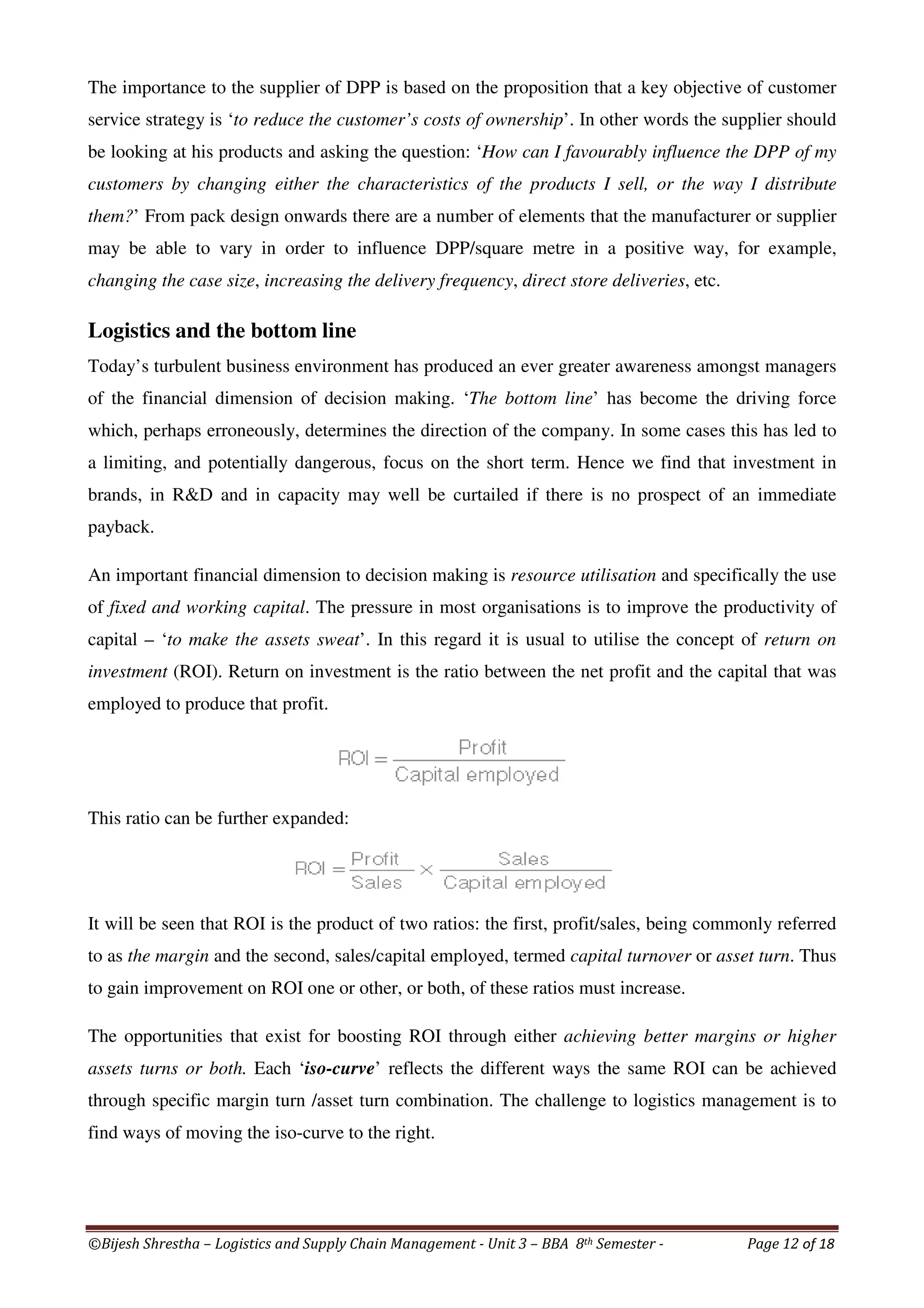
capital – ‘to make the assets sweat’. In this regard it is usual to utilise the concept of return on
investment (ROI). Return on investment is the ratio between the net profit and the capital that was
employed to produce that profit.
This ratio can be further expanded:
It will be seen that ROI is the product of two ratios: the first, profit/sales, being commonly referred
to as the margin and the second, sales/capital employed, termed capital turnover or asset turn. Thus
to gain improvement on ROI one or other, or both, of these ratios must increase.
The opportunities that exist for boosting ROI through either achieving better margins or higher
assets turns or both. Each ‘iso-curve’ reflects the different ways the same ROI can be achieved
through specific margin turn /asset turn combination. The challenge to logistics management is to
find ways of moving the iso-curve to the right.
©Bijesh Shrestha – Logistics and Supply Chain Management - Unit 3 – BBA 8th Semester - Page 13 of 18
Figure: The impact of Margin and Asset Turn on ROI
Logistics impact on ROI
The ways in which logistics management can impact on ROI are many and varied. Figure below
highlights the major elements determining ROI and the potential for improvement through more
effective logistics management.
Figure: Logistics impact on ROI
©Bijesh Shrestha – Logistics and Supply Chain Management - Unit 3 – BBA 8th Semester - Page 14 of 18
Logistics and the Balance Sheet
Once again better logistics management has the power to transform performance in this crucial area.
Figure below summarises the major elements of the balance sheet and links to each of the relevant
logistics management components. By examining each element of the balance sheet in turn it will
be seen how logistics variables can influence its final shape.
Figure: Logistics Management and the Balance Sheet
Logistics and Shareholder Value
One of the key measures of corporate performance today is shareholder value. In other words, what
is the company worth to its owners? Increasingly senior management within the business is being
driven by the goal of enhancing shareholder value. There are a number of complex issues involved
in actually calculating shareholder value but at its simplest it is determined by the net present value
of future cash flows.
It will be recognised that there are a number of significant connections between logistics
performance and shareholder value. Not only the impact that logistics service can have upon net
operating income (profit) but also the impact on capital efficiency (asset turn). Many companies
have come to realise the effect that lengthy pipelines and highly capital-intensive logistics facilities
can have on shareholder value.
As a result they have focused on finding ways in which pipelines can be shortened and,
consequently, working capital requirements reduced. At the same time they have looked again at
their fixed capital deployment of distribution facilities and vehicle fleets and in many cases have
moved these assets off the balance sheet through the use of third-party logistics service providers.
©Bijesh Shrestha – Logistics and Supply Chain Management - Unit 3 – BBA 8th Semester - Page 15 of 18
The drivers of shareholder value
The five basic drivers of enhanced shareholder value are shown in Figure below. They are revenue
growth, operating cost reduction, fixed capital efficiency, working capital efficiency and tax
minimisation. All five of these drivers are directly and indirectly affected by logistics management
and supply chain strategy.
Figure: The drivers of Shareholder value
Revenue growth
The critical linkage here is the impact that logistics service can have on sales volume and customer
retention. Whilst it is not generally possible to calculate the exact correlation between service and
sales there have been many studies that have indicated a positive causality. It can also be argued
that superior logistics service (in terms of reliability and responsiveness) can strengthen the
likelihood that customers will remain loyal to a supplier. Typically this occurs because satisfied
customers are more likely to place a greater proportion of their purchases with that supplier.
Operating cost reduction
The potential for operating cost reduction through logistics and supply chain management is
considerable. Because a large proportion of costs in a typical business are driven by logistics
decisions and the quality of supply chain relationships, it is not surprising that in the search for
enhanced margins many companies are taking a new look at the way they manage the supply chain.
It is not just the transportation, storage, handling and order processing costs within the business that
need to be considered. Rather a total pipeline view of costs on a true ‘end-to-end’ basis should be
taken. Often the upstream logistics costs can represent a significant proportion of total supply chain
costs embedded in the final product.
©Bijesh Shrestha – Logistics and Supply Chain Management - Unit 3 – BBA 8th Semester - Page 16 of 18
Fixed capital efficiency
Logistics by its very nature tends to be fixed asset ‘intensive’. Trucks, distribution centres and
automated handling systems involve considerable investment and, consequently, will often depress
return on investment. In conventional multi-echelon distribution systems, it is not unusual to find
factory warehouses, regional distribution centres and local depots, all of which represent significant
fixed investment. One of the main drivers behind the growth of the third-party logistics service
sector has been the desire to reduce fixed asset investment. At the same time the trend to lease
rather than buy has accelerated. Decisions to rationalise distribution networks and production
facilities are increasingly being driven by the realisation that the true cost of financing that capital
investment is sometimes greater than the return it generates.
Working capital efficiency
Supply chain strategy and logistics management are fundamentally linked to the working capital
requirement within the business. Long pipelines by definition generate more inventory; order fill
and invoice accuracy directly impact accounts receivable and procurement policies also affect cash
flow. Working capital requirements can be dramatically reduced through time compression in the
pipeline and subsequently reduced order-to-cash cycle times.
Surprisingly few companies know the true length of the pipeline for the products they sell. The
‘cash-to-cash’ cycle time (i.e. the elapsed time from procurement of materials/components through
to sale of the finished product) can be six months or longer in many manufacturing industries. By
focusing on eliminating non-value-adding time in the supply chain, dramatic reduction in working
capital can be achieved. So many companies have lived with low inventory turns for so long that
they assume that it is a feature of their industry and that nothing can be done. They are also possibly
not motivated to give working capital reduction a higher priority because an unrealistically low cost
of capital is often used in decision making.
Tax minimisation
In today’s increasingly global economy, organisations have choices as to where they can locate
their assets and activities. Because tax regimes are different country by country, location decisions
can have an important impact on after-tax free cash flow. It is not just corporate taxes on profits that
are affected, but also property tax and excise duty on fuel. Customs regulations, tariffs and quotas
become further considerations, as do rules and regulation on transfer pricing. For large global
companies with production facilities in many different countries and with dispersed distribution
centres and multiple markets, supply chain decisions can significantly affect the total tax bill and
hence shareholder value.
©Bijesh Shrestha – Logistics and Supply Chain Management - Unit 3 – BBA 8th Semester - Page 17 of 18
The role of cash flow in creating shareholder value
Srivastava et al. have suggested that the value of any strategy is inherently driven by:
1. an acceleration of cash flows because risk and time adjustments reduce the value of later cash flows;
2. an increase in the level of cash flows (e.g. higher revenues and/or lower costs, working capital and
fixed investment);
3. a reduction in risk associated with cash flows (e.g. through reduction in both volatility and
vulnerability of future cash flows) and hence, indirectly, the firm’s cost of capital; and
4. the residual value of the business (long-term value can be enhanced, for example, by increasing the
size of the customer base).
Figure: Changing the Cash flow Profile
Stanford University in the US analysed the financial performance of 636 companies in 24 industries
and found that those companies classed as supply chain leaders also tended to be above average in
terms of sustained profitability. More recently AMR Research6 has conducted an annual survey of
the top 25 supply chains, drawing on a combination of published financial data and peer group
evaluation. It is probably no coincidence that most of those companies ranked in the top 25 are also
above average in terms of market value added (MVA). For example, in the 2009 ranking Apple,
Procter & Gamble, Dell and Wal-Mart were amongst the highest ranked companies.
Cost drivers and activity-based costing
As we indicated earlier in this chapter there is a growing dissatisfaction with conventional cost
accounting, particularly as it relates to logistics management. Essentially these problems can be
summarised as follows:
• There is a general ignorance of the true costs of servicing different customer types/channels/market
segments.
©Bijesh Shrestha – Logistics and Supply Chain Management - Unit 3 – BBA 8th Semester - Page 18 of 18
• Costs are captured at too high a level of aggregation.
• Full cost allocation still reigns supreme.
• Conventional accounting systems are functional in their orientation rather than output oriented.
• Companies understand product costs but not customer costs.
The common theme that links these points is that we seem to suffer in business from a lack of
visibility of costs as they are incurred through the logistics pipeline. Ideally what logistics
management requires is a means of capturing costs as products and orders flow towards the
customer.
To overcome this problem it is necessary to change radically the basis of cost accounting away from
the notion that all expenses must be allocated (often on an arbitrary basis) to individual units (such
as products) and, instead, to separate the expenses and match them to the activities that consume the
resources.
The key to activity-based costing (ABC) is to seek out the ‘cost drivers’ along the logistics pipeline
that cause costs because they consume resources. The advantage of using activity-based costing is
that it enables each customer’s unique characteristics in terms of ordering behaviour and
distribution requirements to be separately accounted for. Once the cost attached to each level of
activity is identified (e.g. cost per line item picked, cost per delivery, etc.) then a clearer picture of
the true cost-to-serve will emerge. There are certain parallels between activity-based costing and the
idea of mission costing.
There are four stages in the implementation of an effective mission costing process:
1. Define the customer service segment
2. Identify the factors that produce variations in the cost of service
3. Identify the specific resources used to support customer segments
4. Attribute activity costs by customer type or segment
Clearly to make this work there is a prerequisite that the cost coding system in the business be
restructured. In other words, the coding system must be capable of gathering costs as they are
incurred by customers from the point of order generation through to final delivery, invoicing and
collection.
The basic purpose of logistics cost analysis is to provide managers with reliable information that
will enable a better allocation of resources to be achieved.

Unit 3 logistics costs lscm (18 pages)logistics management

  • 1.
    ©Bijesh Shrestha –Logistics and Supply Chain Management - Unit 3 – BBA 8th Semester - Page 1 of 18 Unit 3: Logistics Costs Learning Outcomes: 1) Total cost analysis 2) Principles of logistics costing 3) Customer profitability analysis and direct product profitability 4) The bottom line approach and Shareholder value 5) Cost drivers and activity based costing Logistics Costs The costs of satisfying customer demand can be significant and yet, surprisingly, they are not always fully understood by organisations. One reason for this is that traditional accounting systems tend to be focused around understanding product costs rather than customer costs. Logistics activity requires resources in the form of fixed capital and working capital and so there are financial issues to be considered when supply chain strategies are devised. Logistics management is a flow-oriented concept with the objective of integrating resources across a pipeline which extends from suppliers to final customers, it is desirable to have a means whereby costs and performance of that pipeline flow can be assessed. One of the main reasons why the adoption of an integrated approach to logistics and distribution management has proved so difficult for many companies is the lack of appropriate cost information. The Concept of Total Cost Analysis Many problems at the operational level in logistics management arise because all the impacts of specific decisions, both direct and indirect, are not taken into account throughout the corporate system. Too often decisions taken in one area can lead to unforeseen results in other areas. Changes in policy on minimum order value, for example, may influence customer ordering patterns and lead to additional costs. Similarly, changes in production schedules that aim to improve production efficiency may lead to fluctuations in finished stock availability and thus affect customer service. The problems associated with identifying the total system impact of distribution policies are immense. By its very nature logistics cuts across traditional company organisation functions with cost impacts on most of those functions. Conventional accounting systems do not usually assist in the identification of these company-wide impacts, frequently absorbing logistics-related costs in other cost elements. The cost of processing
  • 2.
    ©Bijesh Shrestha –Logistics and Supply Chain Management - Unit 3 – BBA 8th Semester - Page 2 of 18 orders, for example, is an amalgam of specific costs incurred in different functional areas of the business which generally prove extremely difficult to bring together. Figure below outlines the various cost elements involved in the complete order processing cycle, each of these elements having a fixed and variable cost component which will lead to a different total cost for any one particular order. Conventional accounting systems group costs into broad, aggregated categories which do not then allow the more detailed analysis necessary to identify the true costs of servicing customers buying particular product mixes. Conventional accounting systems do not usually assist in the identification of the company-wide impacts, frequently absorbing logistics-related costs in other cost elements. Thus, in order to understand total cost, the different cost needs to be analyzed from order to collection cycle. 1. Order placement and Communication 2. Order Entry 3. Credit check 4. Documentation 5. Order picking 6. Delivery 7. Invoicing and collection Figure: Stages in the Order-to-Collection Cycle
  • 3.
    ©Bijesh Shrestha –Logistics and Supply Chain Management - Unit 3 – BBA 8th Semester - Page 3 of 18 Example: Accounting practice for budgeting and standard-setting has tended to result in a compartmentalisation of company accounts; thus budgets tend to be set on a functional basis. The trouble is that policy costs do not usually confine themselves within the same watertight boundaries. It is the nature of logistics that, like a stone thrown into a pond, the effects of specific policies spread beyond their immediate area of impact. A further feature of logistics decisions that contributes to the complexity of generating appropriate cost information is that they are usually taken against a background of an existing system. The purpose of total cost analysis in this context is to identify the change in costs brought about by these decisions. Cost must therefore be viewed in incremental terms – the change in total costs caused by the change to the system. Thus the addition of an extra warehouse to the distribution network will bring about cost changes in transport, inventory investment and communications. It is the incremental cost difference between the two options that is the relevant accounting information for decision making in this case. Figure below shows how total logistics costs can be influenced by the addition, or removal, of a depot from the system. Figure: The Total Cost of Distribution Network
  • 4.
    ©Bijesh Shrestha –Logistics and Supply Chain Management - Unit 3 – BBA 8th Semester - Page 4 of 18 The Cost of holding Inventory (Example) One of the largest cost elements is also the one that is perhaps least well accounted for and that is inventory. It is probably the case that many managers are unaware of what the true cost of holding inventory actually is. The largest cost element will normally be the cost of capital. The cost of capital comprises the cost to the company of debt and the cost of equity. The other costs that need to be included in the inventory holding cost are the costs of storage and handling, obsolescence, deterioration/damage and pilferage/shrinkage, as well as insurance and all the administrative costs associated with the management of the inventory. The Principles of logistics Costing One of the basic principles of logistics costing, it has been argued, is that the system should mirror the materials flow, i.e. it should be capable of identifying the costs that result from providing customer service in the marketplace. A second principle is that it should be capable of enabling separate cost and revenue analyses to be made by customer type and by market segment or distribution channel (emerged as a result of the dangers inherent in dealing solely with averages, e.g. the average cost per delivery). To operationalise these principles requires an ‘output’ orientation to costing. A useful concept here is the idea of ‘mission’. In the context of logistics and supply chain management, a mission is a set of customer service goals to be achieved by the system within a specific product/market context. Missions can be defined in terms of the type of market served, by which products and within what constraints of service and cost. A mission by its very nature cuts across traditional company lines. The Figure illustrates the concept and demonstrates the difference between an ‘output’ orientation based upon missions and the ‘input’ orientation based upon functions. Figure: Missions that cut across functional boundaries
  • 5.
    ©Bijesh Shrestha –Logistics and Supply Chain Management - Unit 3 – BBA 8th Semester - Page 5 of 18 The successful achievement of defined mission goals involves inputs from a large number of functional areas and activity centres within the firm. Thus an effective costing system must seek to determine the total systems cost of meeting desired mission objectives (the ‘output’ of the system) and the costs of the various inputs involved in meeting these outputs. Figure below illustrates how three supply chain missions may make a differential impact upon activity centre/functional area costs and, in so doing, provide a logical basis for costing within the company. As a cost or budgeting method, mission costing is the reverse of traditional techniques: under this scheme a functional budget is determined now by the demands of the missions it serves. Thus in Figure shows the cost per mission is identified horizontally and from this the functional budgets may be determined by summing vertically. Figure: The Programme Budget (‘000) Given that the logic of mission costing is sound, how might it be made to work in practice? This approach requires firstly that the activity centres associated with a particular distribution mission be identified, e.g. transport, warehousing, inventory, etc., and secondly that the incremental costs for each activity centre incurred as a result of undertaking that mission must be isolated. Incremental costs are used because it is important not to take into account ‘sunk’ costs or costs that would still be incurred even if the mission were abandoned. We can make use of the idea of ‘attributable costs’ to operationalise the concept: Attributable cost is a cost per unit that could be avoided if a product or function were discontinued entirely without changing the supporting organisation structure.
  • 6.
    ©Bijesh Shrestha –Logistics and Supply Chain Management - Unit 3 – BBA 8th Semester - Page 6 of 18 In determining the costs of an activity centre, e.g. transport, attributable to a specific mission, the question should be asked: ‘What costs would we avoid if this customer/segment/channel were no longer serviced?’ These avoidable costs are the true incremental costs of servicing the customer/segment/channel. Often they will be substantially lower than the average cost because so many distribution costs are fixed and/or shared. This approach becomes particularly powerful when combined with a customer revenue analysis, because even customers with low sales off-take may still be profitable in incremental costs terms if not on an average cost basis. In other words the company would be worse off if those customers were abandoned. Such insights as this can be gained by extending the mission costing concept to produce profitability analyses for customers, market segments or distribution channels. The term ‘customer profitability accounting’ describes any attempt to relate the revenue produced by a customer, market segment or distribution channel to the costs of servicing that customer/segment/channel. Customer Profitability Analysis One of the basic questions that conventional accounting procedures have difficulty answering is: ‘How profitable is this customer compared to another?’ Usually customer profitability is only calculated at the level of gross profit – in other words the net sales revenue generated by the customer in a period, less the cost of goods sold for the actual product mix purchased. However, there are still many other costs to take into account before the real profitability of an individual customer can be exposed. The same is true if we seek to identify the relative profitability of different market segments or distribution channels. The significance of these costs that occur as a result of servicing customers can be profound in terms of how logistics strategies should be developed. Customer profitability analysis will often reveal a proportion of customers who make a negative contribution, as in Figure below. The reason for this is very simply that the costs of servicing a customer can vary considerably – even between two customers who may make equivalent purchases from us.
  • 7.
    ©Bijesh Shrestha –Logistics and Supply Chain Management - Unit 3 – BBA 8th Semester - Page 7 of 18 Source: Hill, G.V., Logistics – The Battleground of the 1990s, A.T. Kearney Figure: Customer Profitability Analysis If we think of all the costs that a company incurs from when it captures an order from a customer to when it collects the payment, is will be apparent that the total figure could be quite high. It will also very likely be the case that there will be significant differences in these costs customer by customer. At the same time, different customers will order a different mix of products so the gross margin that they generate will differ. The Table below highlights, there are many costs that need to be identified if customer profitability is to be accurately measured. The best measure of customer profitability is to ask the question: ‘What costs would I avoid and what revenues would I lose if I lost this customer?’ This is the concept of ‘avoidable’ costs and incremental revenue. Using this principle helps circumvent the problems that arise when fixed costs are allocated against individual customers. Table: The Customer Profit and Loss Account
  • 8.
    ©Bijesh Shrestha –Logistics and Supply Chain Management - Unit 3 – BBA 8th Semester - Page 8 of 18 The average customer A study by the consulting company A.T. Kearney suggested that the significance of customer-oriented costs is not their average value, but specifically how they vary by customer, by order size, by type of order and other key factors. Whilst the average cost per customer may be easily calculated, there may be no customer that incurs the average cost to serve. The need is to be aware of the customers at the extremes of the cost range because, on the one hand, profits may be eroded by serving them and, on the other, although high profit is being generated, the business is vulnerable to competitive price-cutting. The table below shows an example of the range of values of some customer-oriented costs expressed as a percentage of net sales. This illustrates how misleading the use of averages can be. What sort of costs should be taken into account in this type of analysis? The table below presents a basics that seeks to identify only those customer-related costs that are avoidable (i.e. if the customer did not exist, these costs would not be incurred). In this case a gross contribution of £70,000 becomes a net contribution of £56,400 as soon as the costs unique to this customer are taken into account. If the analysis were to be extended by attempting to allocate overheads (a step not to be advised because of the problems usually associated with such allocation), what might at first seem to be a profitable customer could be deemed to be the reverse. However, as long as the net contribution is positive and there is no ‘opportunity cost’ in servicing that customer the company would be better off with the business than without it.
  • 9.
    ©Bijesh Shrestha –Logistics and Supply Chain Management - Unit 3 – BBA 8th Semester - Page 9 of 18 Table: Analysis of Revenue and Cost for a specific Customer The value of this type of exercise can be substantial. The information could be used, firstly, when the next sales contract is negotiated and, secondly, as the basis for sales and marketing strategy in directing effort away from less profitable types of account towards more profitable business. More importantly it can point the way to alternative strategies for managing customers with high servicing costs. Ideally we require all our customers to be profitable in the medium to long term and where customers currently are profitable we should seek to build and extend that profitability further. Figure below represents a simple categorisation of customers along two dimensions: their total net sales value during the period and their cost-to-serve. The suggestion is that there could be a benefit in developing customer-specific solutions depending upon which box of the matrix they fall into. Possible strategies for each of the quadrants are suggested below.
  • 10.
    ©Bijesh Shrestha –Logistics and Supply Chain Management - Unit 3 – BBA 8th Semester - Page 10 of 18 Figure: Customer Profitability Matrix Build These customers are relatively cheap to service but their net sales value is low. Can volume be increased without a proportionate increase in the costs of service? Can our sales team be directed to seek to influence these customers’ purchases towards a more profitable sales mix? Danger zone These customers should be looked at very carefully. Is there any medium- to long-term prospect either of improving net sales value or of reducing the costs of service? Is there a strategic reason for keeping them? Do we need them for their volume even if their profit contribution is low? Cost engineer These customers could be more profitable if the costs of servicing them could be reduced. Is there any scope for increasing drop sizes? Can deliveries be consolidated? If new accounts in the same geographic area were developed would it make delivery more economic? Is there a cheaper way of gathering orders from these customers, e.g. the Internet? Protect The high net sales value customers who are relatively cheap to service are worth their weight in gold. The strategy for these customers should be to seek relationships which make the customer less likely to want to look for alternative suppliers. At the same time we should constantly seek opportunities to develop the volume of business that we do with them whilst keeping strict control of costs.
  • 11.
    ©Bijesh Shrestha –Logistics and Supply Chain Management - Unit 3 – BBA 8th Semester - Page 11 of 18 Ideally the organisation should seek to develop an accounting system that would routinely collect and analyse data on customer profitability. Unfortunately most accounting systems are product focused rather than customer focused. Likewise cost reporting is traditionally on a functional basis rather than a customer basis. So, for example, we know the costs of the transport function as a whole or the costs of making a particular product but what we do not know are the costs of delivering a specific mix of products to a particular customer. There is a pressing need for companies to move towards a system of accounting for customers and market segments as well as accounting for products. As has often been observed, it is customers who make profits, not products! Direct Product Profitability The idea behind DPP is that in many transactions the customer will incur costs other than the immediate purchase price of the product. Often this is termed the total cost of ownership. Sometimes these costs will be hidden and often they can be substantial – certainly big enough to reduce or even eliminate net profit on a particular item. For the supplier it is important to understand DPP inasmuch as his/her ability to be a low-cost supplier is clearly influenced by the costs that are incurred as that product moves through their logistics system. Similarly, as distributors and retailers are now very much more conscious of an item’s DPP, it is to the advantage of the supplier equally to understand the cost drivers that impact upon DPP so as to seek to influence it favourably. The net profit contribution from the sales of a product after allowances are added and all costs that can be rationally allocated or assigned to an individual product are subtracted = direct product profit
  • 12.
    ©Bijesh Shrestha –Logistics and Supply Chain Management - Unit 3 – BBA 8th Semester - Page 12 of 18 The importance to the supplier of DPP is based on the proposition that a key objective of customer service strategy is ‘to reduce the customer’s costs of ownership’. In other words the supplier should be looking at his products and asking the question: ‘How can I favourably influence the DPP of my customers by changing either the characteristics of the products I sell, or the way I distribute them?’ From pack design onwards there are a number of elements that the manufacturer or supplier may be able to vary in order to influence DPP/square metre in a positive way, for example, changing the case size, increasing the delivery frequency, direct store deliveries, etc. Logistics and the bottom line Today’s turbulent business environment has produced an ever greater awareness amongst managers of the financial dimension of decision making. ‘The bottom line’ has become the driving force which, perhaps erroneously, determines the direction of the company. In some cases this has led to a limiting, and potentially dangerous, focus on the short term. Hence we find that investment in brands, in R&D and in capacity may well be curtailed if there is no prospect of an immediate payback. An important financial dimension to decision making is resource utilisation and specifically the use of fixed and working capital. The pressure in most organisations is to improve the productivity of capital – ‘to make the assets sweat’. In this regard it is usual to utilise the concept of return on investment (ROI). Return on investment is the ratio between the net profit and the capital that was employed to produce that profit. This ratio can be further expanded: It will be seen that ROI is the product of two ratios: the first, profit/sales, being commonly referred to as the margin and the second, sales/capital employed, termed capital turnover or asset turn. Thus to gain improvement on ROI one or other, or both, of these ratios must increase. The opportunities that exist for boosting ROI through either achieving better margins or higher assets turns or both. Each ‘iso-curve’ reflects the different ways the same ROI can be achieved through specific margin turn /asset turn combination. The challenge to logistics management is to find ways of moving the iso-curve to the right.
  • 13.
    ©Bijesh Shrestha –Logistics and Supply Chain Management - Unit 3 – BBA 8th Semester - Page 13 of 18 Figure: The impact of Margin and Asset Turn on ROI Logistics impact on ROI The ways in which logistics management can impact on ROI are many and varied. Figure below highlights the major elements determining ROI and the potential for improvement through more effective logistics management. Figure: Logistics impact on ROI
  • 14.
    ©Bijesh Shrestha –Logistics and Supply Chain Management - Unit 3 – BBA 8th Semester - Page 14 of 18 Logistics and the Balance Sheet Once again better logistics management has the power to transform performance in this crucial area. Figure below summarises the major elements of the balance sheet and links to each of the relevant logistics management components. By examining each element of the balance sheet in turn it will be seen how logistics variables can influence its final shape. Figure: Logistics Management and the Balance Sheet Logistics and Shareholder Value One of the key measures of corporate performance today is shareholder value. In other words, what is the company worth to its owners? Increasingly senior management within the business is being driven by the goal of enhancing shareholder value. There are a number of complex issues involved in actually calculating shareholder value but at its simplest it is determined by the net present value of future cash flows. It will be recognised that there are a number of significant connections between logistics performance and shareholder value. Not only the impact that logistics service can have upon net operating income (profit) but also the impact on capital efficiency (asset turn). Many companies have come to realise the effect that lengthy pipelines and highly capital-intensive logistics facilities can have on shareholder value. As a result they have focused on finding ways in which pipelines can be shortened and, consequently, working capital requirements reduced. At the same time they have looked again at their fixed capital deployment of distribution facilities and vehicle fleets and in many cases have moved these assets off the balance sheet through the use of third-party logistics service providers.
  • 15.
    ©Bijesh Shrestha –Logistics and Supply Chain Management - Unit 3 – BBA 8th Semester - Page 15 of 18 The drivers of shareholder value The five basic drivers of enhanced shareholder value are shown in Figure below. They are revenue growth, operating cost reduction, fixed capital efficiency, working capital efficiency and tax minimisation. All five of these drivers are directly and indirectly affected by logistics management and supply chain strategy. Figure: The drivers of Shareholder value Revenue growth The critical linkage here is the impact that logistics service can have on sales volume and customer retention. Whilst it is not generally possible to calculate the exact correlation between service and sales there have been many studies that have indicated a positive causality. It can also be argued that superior logistics service (in terms of reliability and responsiveness) can strengthen the likelihood that customers will remain loyal to a supplier. Typically this occurs because satisfied customers are more likely to place a greater proportion of their purchases with that supplier. Operating cost reduction The potential for operating cost reduction through logistics and supply chain management is considerable. Because a large proportion of costs in a typical business are driven by logistics decisions and the quality of supply chain relationships, it is not surprising that in the search for enhanced margins many companies are taking a new look at the way they manage the supply chain. It is not just the transportation, storage, handling and order processing costs within the business that need to be considered. Rather a total pipeline view of costs on a true ‘end-to-end’ basis should be taken. Often the upstream logistics costs can represent a significant proportion of total supply chain costs embedded in the final product.
  • 16.
    ©Bijesh Shrestha –Logistics and Supply Chain Management - Unit 3 – BBA 8th Semester - Page 16 of 18 Fixed capital efficiency Logistics by its very nature tends to be fixed asset ‘intensive’. Trucks, distribution centres and automated handling systems involve considerable investment and, consequently, will often depress return on investment. In conventional multi-echelon distribution systems, it is not unusual to find factory warehouses, regional distribution centres and local depots, all of which represent significant fixed investment. One of the main drivers behind the growth of the third-party logistics service sector has been the desire to reduce fixed asset investment. At the same time the trend to lease rather than buy has accelerated. Decisions to rationalise distribution networks and production facilities are increasingly being driven by the realisation that the true cost of financing that capital investment is sometimes greater than the return it generates. Working capital efficiency Supply chain strategy and logistics management are fundamentally linked to the working capital requirement within the business. Long pipelines by definition generate more inventory; order fill and invoice accuracy directly impact accounts receivable and procurement policies also affect cash flow. Working capital requirements can be dramatically reduced through time compression in the pipeline and subsequently reduced order-to-cash cycle times. Surprisingly few companies know the true length of the pipeline for the products they sell. The ‘cash-to-cash’ cycle time (i.e. the elapsed time from procurement of materials/components through to sale of the finished product) can be six months or longer in many manufacturing industries. By focusing on eliminating non-value-adding time in the supply chain, dramatic reduction in working capital can be achieved. So many companies have lived with low inventory turns for so long that they assume that it is a feature of their industry and that nothing can be done. They are also possibly not motivated to give working capital reduction a higher priority because an unrealistically low cost of capital is often used in decision making. Tax minimisation In today’s increasingly global economy, organisations have choices as to where they can locate their assets and activities. Because tax regimes are different country by country, location decisions can have an important impact on after-tax free cash flow. It is not just corporate taxes on profits that are affected, but also property tax and excise duty on fuel. Customs regulations, tariffs and quotas become further considerations, as do rules and regulation on transfer pricing. For large global companies with production facilities in many different countries and with dispersed distribution centres and multiple markets, supply chain decisions can significantly affect the total tax bill and hence shareholder value.
  • 17.
    ©Bijesh Shrestha –Logistics and Supply Chain Management - Unit 3 – BBA 8th Semester - Page 17 of 18 The role of cash flow in creating shareholder value Srivastava et al. have suggested that the value of any strategy is inherently driven by: 1. an acceleration of cash flows because risk and time adjustments reduce the value of later cash flows; 2. an increase in the level of cash flows (e.g. higher revenues and/or lower costs, working capital and fixed investment); 3. a reduction in risk associated with cash flows (e.g. through reduction in both volatility and vulnerability of future cash flows) and hence, indirectly, the firm’s cost of capital; and 4. the residual value of the business (long-term value can be enhanced, for example, by increasing the size of the customer base). Figure: Changing the Cash flow Profile Stanford University in the US analysed the financial performance of 636 companies in 24 industries and found that those companies classed as supply chain leaders also tended to be above average in terms of sustained profitability. More recently AMR Research6 has conducted an annual survey of the top 25 supply chains, drawing on a combination of published financial data and peer group evaluation. It is probably no coincidence that most of those companies ranked in the top 25 are also above average in terms of market value added (MVA). For example, in the 2009 ranking Apple, Procter & Gamble, Dell and Wal-Mart were amongst the highest ranked companies. Cost drivers and activity-based costing As we indicated earlier in this chapter there is a growing dissatisfaction with conventional cost accounting, particularly as it relates to logistics management. Essentially these problems can be summarised as follows: • There is a general ignorance of the true costs of servicing different customer types/channels/market segments.
  • 18.
    ©Bijesh Shrestha –Logistics and Supply Chain Management - Unit 3 – BBA 8th Semester - Page 18 of 18 • Costs are captured at too high a level of aggregation. • Full cost allocation still reigns supreme. • Conventional accounting systems are functional in their orientation rather than output oriented. • Companies understand product costs but not customer costs. The common theme that links these points is that we seem to suffer in business from a lack of visibility of costs as they are incurred through the logistics pipeline. Ideally what logistics management requires is a means of capturing costs as products and orders flow towards the customer. To overcome this problem it is necessary to change radically the basis of cost accounting away from the notion that all expenses must be allocated (often on an arbitrary basis) to individual units (such as products) and, instead, to separate the expenses and match them to the activities that consume the resources. The key to activity-based costing (ABC) is to seek out the ‘cost drivers’ along the logistics pipeline that cause costs because they consume resources. The advantage of using activity-based costing is that it enables each customer’s unique characteristics in terms of ordering behaviour and distribution requirements to be separately accounted for. Once the cost attached to each level of activity is identified (e.g. cost per line item picked, cost per delivery, etc.) then a clearer picture of the true cost-to-serve will emerge. There are certain parallels between activity-based costing and the idea of mission costing. There are four stages in the implementation of an effective mission costing process: 1. Define the customer service segment 2. Identify the factors that produce variations in the cost of service 3. Identify the specific resources used to support customer segments 4. Attribute activity costs by customer type or segment Clearly to make this work there is a prerequisite that the cost coding system in the business be restructured. In other words, the coding system must be capable of gathering costs as they are incurred by customers from the point of order generation through to final delivery, invoicing and collection. The basic purpose of logistics cost analysis is to provide managers with reliable information that will enable a better allocation of resources to be achieved.