Dr. Sushma N Jogan
Unit 3: Assessment of subject based learning
3/23/2019 2Dr. Sushma N Jogan
3/23/2019 Dr. Sushma N Jogan 3
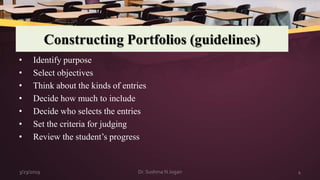
Constructing Portfolios (guidelines)
• Identify purpose
• Select objectives
• Think about the kinds of entries
• Decide how much to include
• Decide who selects the entries
• Set the criteria for judging
• Review the student’s progress
3/23/2019 4Dr. Sushma N Jogan
Identify purpose:
• Without purpose, a portfolio is only a collection of student work samples.
• Different purposes result in different portfolios.
- To show growth and change over time.
- To create collections of favourite or personally important work
- To communicate with student’s subsequent teacher
- To review curriculum or instruction
- to conduct large-scale assessment
3/23/2019 5Dr. Sushma N Jogan
Select objectives:
• The objectives to be met by students should be clearly stated.
• Portfolio should be assessed using criteria developed ahead of time.
• Entries should be selected by the students.
– because in selecting, student has to apply a higher level of
understanding/thinking about his own learning.
At any rate teachers must ensure that classroom instruction support the
identified goals.
3/23/2019 6Dr. Sushma N Jogan
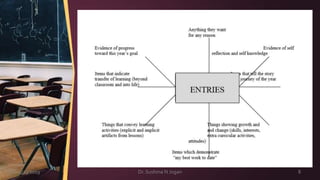
Think about the kinds of entries
• A table of contents (can be attached) or teacher may
want to give a complete list of all possible
assignments that could be included and due dates.
• a heading
• reflections
• a graph of all tests and quiz scores
• two creative pieces (writings/art/skits etc)
3/23/2019 7Dr. Sushma N Jogan
3/23/2019 Dr. Sushma N Jogan 8
3/23/2019 Dr. Sushma N Jogan 9
Decide how much to include/how to organize
• At regular intervals to serve the purpose and
objectives.
• Ask them to go through their entries to replace
anything if necessary.
• Limit number of entries in it.
• Get students involved in organizing the portfolio by
completing checklist for record keeping of things to
include.
3/23/2019 Dr. Sushma N Jogan 10
Decide who selects the entries
3/23/2019 Dr. Sushma N Jogan 11
• The student choice is the primary determinant of
entries in a portfolio.
• Teacher guides by giving a genera; structure.
• Student and teacher may be asked to explain why
they selected each entry.
• Teacher may meet with student regularly to reflect
on student growth.
Set the criteria for judging
Two kinds of criteria:
1. criteria for individual entries
2. criteria for the portfolio as a whole (variety,
growth, completeness, organization, fluency,
accuracy and goal oriented)
3/23/2019 Dr. Sushma N Jogan 12
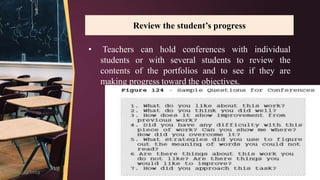
Review the student’s progress
• Teachers can hold conferences with individual
students or with several students to review the
contents of the portfolios and to see if they are
making progress toward the objectives.
3/23/2019 Dr. Sushma N Jogan 13
3/23/2019 Dr. Sushma N Jogan 14
3/23/2019 Dr. Sushma N Jogan 15
3/23/2019 Dr. Sushma N Jogan 16
3/23/2019 17Dr. Sushma N Jogan

Unit 3 Assessment for learning

  • 1.
    Dr. Sushma NJogan Unit 3: Assessment of subject based learning
  • 2.
  • 3.
  • 4.
    Constructing Portfolios (guidelines) •Identify purpose • Select objectives • Think about the kinds of entries • Decide how much to include • Decide who selects the entries • Set the criteria for judging • Review the student’s progress 3/23/2019 4Dr. Sushma N Jogan
  • 5.
    Identify purpose: • Withoutpurpose, a portfolio is only a collection of student work samples. • Different purposes result in different portfolios. - To show growth and change over time. - To create collections of favourite or personally important work - To communicate with student’s subsequent teacher - To review curriculum or instruction - to conduct large-scale assessment 3/23/2019 5Dr. Sushma N Jogan
  • 6.
    Select objectives: • Theobjectives to be met by students should be clearly stated. • Portfolio should be assessed using criteria developed ahead of time. • Entries should be selected by the students. – because in selecting, student has to apply a higher level of understanding/thinking about his own learning. At any rate teachers must ensure that classroom instruction support the identified goals. 3/23/2019 6Dr. Sushma N Jogan
  • 7.
    Think about thekinds of entries • A table of contents (can be attached) or teacher may want to give a complete list of all possible assignments that could be included and due dates. • a heading • reflections • a graph of all tests and quiz scores • two creative pieces (writings/art/skits etc) 3/23/2019 7Dr. Sushma N Jogan
  • 8.
  • 9.
  • 10.
    Decide how muchto include/how to organize • At regular intervals to serve the purpose and objectives. • Ask them to go through their entries to replace anything if necessary. • Limit number of entries in it. • Get students involved in organizing the portfolio by completing checklist for record keeping of things to include. 3/23/2019 Dr. Sushma N Jogan 10
  • 11.
    Decide who selectsthe entries 3/23/2019 Dr. Sushma N Jogan 11 • The student choice is the primary determinant of entries in a portfolio. • Teacher guides by giving a genera; structure. • Student and teacher may be asked to explain why they selected each entry. • Teacher may meet with student regularly to reflect on student growth.
  • 12.
    Set the criteriafor judging Two kinds of criteria: 1. criteria for individual entries 2. criteria for the portfolio as a whole (variety, growth, completeness, organization, fluency, accuracy and goal oriented) 3/23/2019 Dr. Sushma N Jogan 12
  • 13.
    Review the student’sprogress • Teachers can hold conferences with individual students or with several students to review the contents of the portfolios and to see if they are making progress toward the objectives. 3/23/2019 Dr. Sushma N Jogan 13
  • 14.
  • 15.
  • 16.
  • 17.