Shriram Pandey
Asst. Professor & In-Charge
MLS University, Udaipur
(CPDL-1/Block-1/Unit-2)
Lesson Plan
 What are the functional components of a digital
library
 Association of technologies at different level of DL
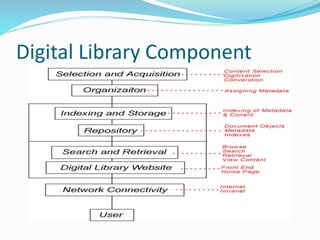
Digital Library Component
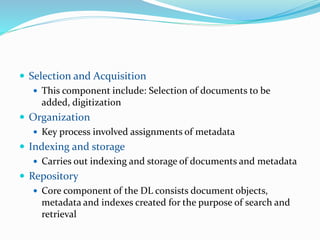
 Selection and Acquisition
 This component include: Selection of documents to be
added, digitization
 Organization
 Key process involved assignments of metadata
 Indexing and storage
 Carries out indexing and storage of documents and metadata
 Repository
 Core component of the DL consists document objects,
metadata and indexes created for the purpose of search and
retrieval
 Search and Retrieval
 Front –end; used by the end users to browse, search,
retrieve and view the content of digital library.
 Digital Library Website
 This is the server computer that hosts the digital library
collection and presents the collection to the user in the
form of a website home page.
 Network connectivity
 For online access, the digital library website computer
should have dedicated connection to the intranet and or
internet.
Association of Technologies
 Organization (Assigning Metadata)
 Preservation
 Documents formats and storage
 Repositories/digital library systems
 Dspace, Fedora, CONTENTdm, DLXS, ..
 Identifiers Standards
 URL, PURL, DOI
 Federation , metasearch and Search Retrieval
standards
 OAI- PMH/Z39.50/OpenURL/Cross Ref/SRU/SRW
 Markup Standards: HTML, SGML, XML
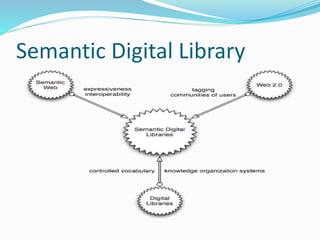
 Emerging Technologies: Semantic Digital Library
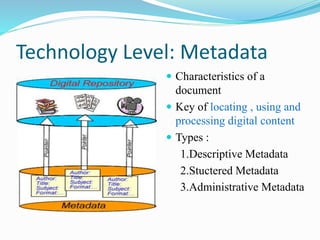
Technology Level: Metadata
 Characteristics of a
document
 Key of locating , using and
processing digital content
 Types :
1.Descriptive Metadata
2.Stuctered Metadata
3.Administrative Metadata
1)Metadata
 Descriptive Metadata
 Allows discovery of collection or objects through the use of
search tool
 Well known DM is : MARC, Dublin Core
 Structured Metadata
 Describes the associations within or among related individual
information objects.
 e.g. A book which consists of pages and chapters
 Administrative Metadata
 Facilitates metadata facilities access management and
preservation of digital resources.
 Provide a record of how and when an object was created as well
as archival and right management information
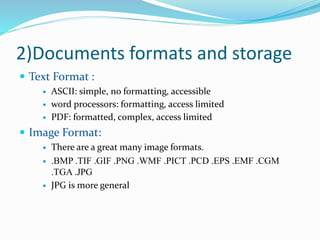
2)Documents formats and storage
 Text Format :
 ASCII: simple, no formatting, accessible
 word processors: formatting, access limited
 PDF: formatted, complex, access limited
 Image Format:
 There are a great many image formats.
 .BMP .TIF .GIF .PNG .WMF .PICT .PCD .EPS .EMF .CGM
.TGA .JPG
 JPG is more general
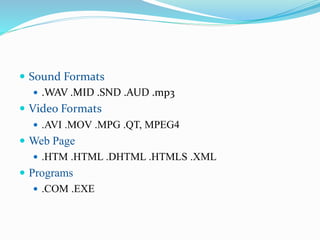
 Sound Formats
 .WAV .MID .SND .AUD .mp3
 Video Formats
 .AVI .MOV .MPG .QT, MPEG4
 Web Page
 .HTM .HTML .DHTML .HTMLS .XML
 Programs
 .COM .EXE
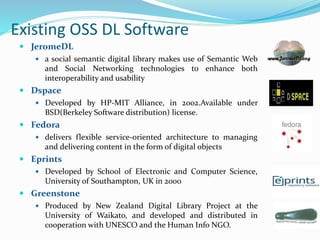
Existing OSS DL Software
 JeromeDL
 a social semantic digital library makes use of Semantic Web
and Social Networking technologies to enhance both
interoperability and usability
 Dspace
 Developed by HP-MIT Alliance, in 2002.Available under
BSD(Berkeley Software distribution) license.
 Fedora
 delivers flexible service-oriented architecture to managing
and delivering content in the form of digital objects
 Eprints
 Developed by School of Electronic and Computer Science,
University of Southampton, UK in 2000
 Greenstone
 Produced by New Zealand Digital Library Project at the
University of Waikato, and developed and distributed in
cooperation with UNESCO and the Human Info NGO.
Semantic Digital Library
VMOU, KOTA
CPDL-1/Block-1/Unit-2

Digital library technologies

  • 1.
    Shriram Pandey Asst. Professor& In-Charge MLS University, Udaipur (CPDL-1/Block-1/Unit-2)
  • 2.
    Lesson Plan  Whatare the functional components of a digital library  Association of technologies at different level of DL
  • 3.
  • 4.
     Selection andAcquisition  This component include: Selection of documents to be added, digitization  Organization  Key process involved assignments of metadata  Indexing and storage  Carries out indexing and storage of documents and metadata  Repository  Core component of the DL consists document objects, metadata and indexes created for the purpose of search and retrieval
  • 5.
     Search andRetrieval  Front –end; used by the end users to browse, search, retrieve and view the content of digital library.  Digital Library Website  This is the server computer that hosts the digital library collection and presents the collection to the user in the form of a website home page.  Network connectivity  For online access, the digital library website computer should have dedicated connection to the intranet and or internet.
  • 6.
    Association of Technologies Organization (Assigning Metadata)  Preservation  Documents formats and storage  Repositories/digital library systems  Dspace, Fedora, CONTENTdm, DLXS, ..  Identifiers Standards  URL, PURL, DOI  Federation , metasearch and Search Retrieval standards  OAI- PMH/Z39.50/OpenURL/Cross Ref/SRU/SRW  Markup Standards: HTML, SGML, XML  Emerging Technologies: Semantic Digital Library
  • 7.
    Technology Level: Metadata Characteristics of a document  Key of locating , using and processing digital content  Types : 1.Descriptive Metadata 2.Stuctered Metadata 3.Administrative Metadata
  • 8.
    1)Metadata  Descriptive Metadata Allows discovery of collection or objects through the use of search tool  Well known DM is : MARC, Dublin Core  Structured Metadata  Describes the associations within or among related individual information objects.  e.g. A book which consists of pages and chapters  Administrative Metadata  Facilitates metadata facilities access management and preservation of digital resources.  Provide a record of how and when an object was created as well as archival and right management information
  • 9.
    2)Documents formats andstorage  Text Format :  ASCII: simple, no formatting, accessible  word processors: formatting, access limited  PDF: formatted, complex, access limited  Image Format:  There are a great many image formats.  .BMP .TIF .GIF .PNG .WMF .PICT .PCD .EPS .EMF .CGM .TGA .JPG  JPG is more general
  • 10.
     Sound Formats .WAV .MID .SND .AUD .mp3  Video Formats  .AVI .MOV .MPG .QT, MPEG4  Web Page  .HTM .HTML .DHTML .HTMLS .XML  Programs  .COM .EXE
  • 11.
    Existing OSS DLSoftware  JeromeDL  a social semantic digital library makes use of Semantic Web and Social Networking technologies to enhance both interoperability and usability  Dspace  Developed by HP-MIT Alliance, in 2002.Available under BSD(Berkeley Software distribution) license.  Fedora  delivers flexible service-oriented architecture to managing and delivering content in the form of digital objects  Eprints  Developed by School of Electronic and Computer Science, University of Southampton, UK in 2000  Greenstone  Produced by New Zealand Digital Library Project at the University of Waikato, and developed and distributed in cooperation with UNESCO and the Human Info NGO.
  • 12.
  • 13.