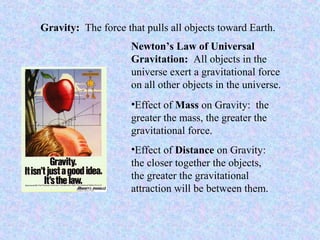
Gravity: The force that pulls all objects toward Earth.
Newton’s Law of Universal
Gravitation: All objects in the
universe exert a gravitational force
on all other objects in the universe.
•Effect of Mass on Gravity: the
greater the mass, the greater the
gravitational force.
•Effect of Distance on Gravity:
the closer together the objects,
the greater the gravitational
attraction will be between them.
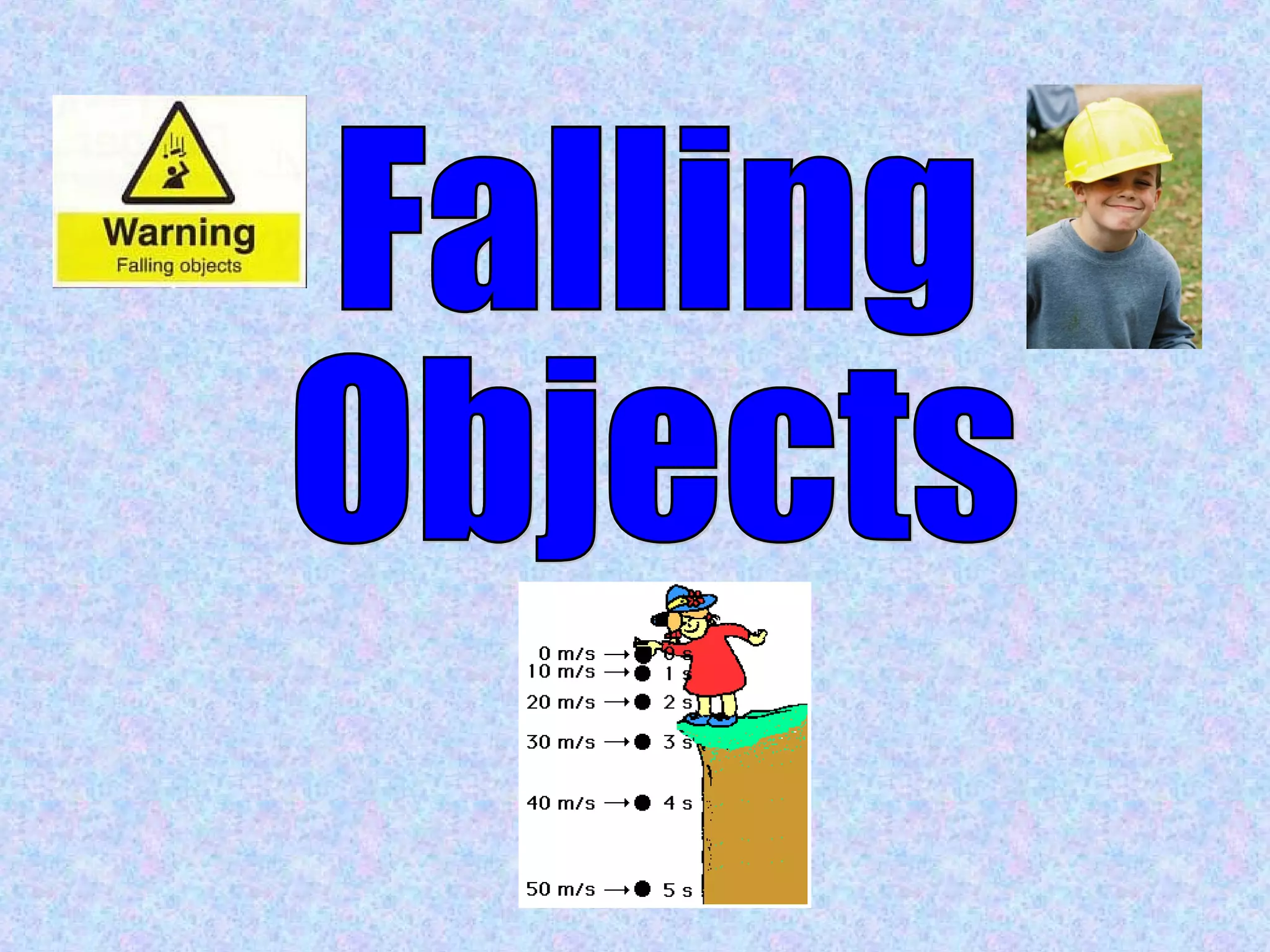
Free Fall: This occurs when gravity is the only force
acting on an object.
•An object accelerates as
it falls
•Near the surface of the
Earth this acceleration
occurs at 9.8 m/s2
for all
objects (regardless of the
object’s mass)
Which will hit the ground first,
a bowling ball or a basketball?
According to Galileo (Italy; late
1500’s) both balls would hit at
the same time
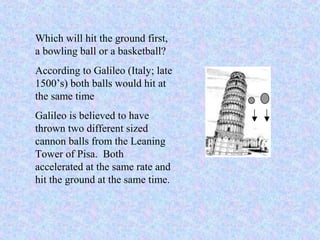
Galileo is believed to have
thrown two different sized
cannon balls from the Leaning
Tower of Pisa. Both
accelerated at the same rate and
hit the ground at the same time.
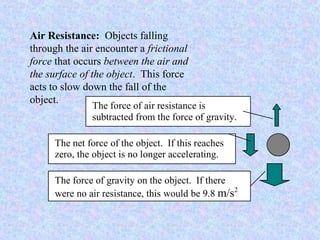
Air Resistance: Objects falling
through the air encounter a frictional
force that occurs between the air and
the surface of the object. This force
acts to slow down the fall of the
object.
The force of air resistance is
subtracted from the force of gravity.
The net force of the object. If this reaches
zero, the object is no longer accelerating.
The force of gravity on the object. If there
were no air resistance, this would be 9.8 m/s2
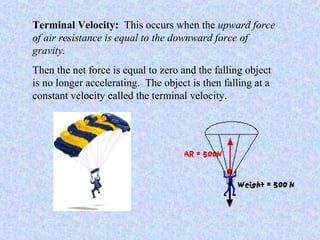
Terminal Velocity: This occurs when the upward force
of air resistance is equal to the downward force of
gravity.
Then the net force is equal to zero and the falling object
is no longer accelerating. The object is then falling at a
constant velocity called the terminal velocity.
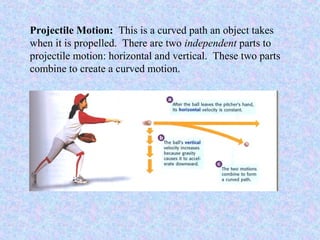
Projectile Motion: This is a curved path an object takes
when it is propelled. There are two independent parts to
projectile motion: horizontal and vertical. These two parts
combine to create a curved motion.
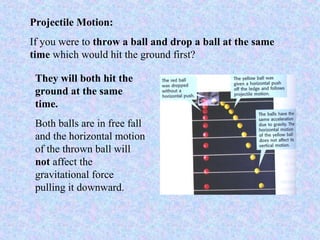
Projectile Motion:
If you were to throw a ball and drop a ball at the same
time which would hit the ground first?
They will both hit the
ground at the same
time.
Both balls are in free fall
and the horizontal motion
of the thrown ball will
not affect the
gravitational force
pulling it downward.

Chapter 10 Notes: Gravity

  • 2.
    Gravity: The forcethat pulls all objects toward Earth. Newton’s Law of Universal Gravitation: All objects in the universe exert a gravitational force on all other objects in the universe. •Effect of Mass on Gravity: the greater the mass, the greater the gravitational force. •Effect of Distance on Gravity: the closer together the objects, the greater the gravitational attraction will be between them.
  • 3.
    Free Fall: Thisoccurs when gravity is the only force acting on an object. •An object accelerates as it falls •Near the surface of the Earth this acceleration occurs at 9.8 m/s2 for all objects (regardless of the object’s mass)
  • 4.
    Which will hitthe ground first, a bowling ball or a basketball? According to Galileo (Italy; late 1500’s) both balls would hit at the same time Galileo is believed to have thrown two different sized cannon balls from the Leaning Tower of Pisa. Both accelerated at the same rate and hit the ground at the same time.
  • 5.
    Air Resistance: Objectsfalling through the air encounter a frictional force that occurs between the air and the surface of the object. This force acts to slow down the fall of the object. The force of air resistance is subtracted from the force of gravity. The net force of the object. If this reaches zero, the object is no longer accelerating. The force of gravity on the object. If there were no air resistance, this would be 9.8 m/s2
  • 6.
    Terminal Velocity: Thisoccurs when the upward force of air resistance is equal to the downward force of gravity. Then the net force is equal to zero and the falling object is no longer accelerating. The object is then falling at a constant velocity called the terminal velocity.
  • 7.
    Projectile Motion: Thisis a curved path an object takes when it is propelled. There are two independent parts to projectile motion: horizontal and vertical. These two parts combine to create a curved motion.
  • 8.
    Projectile Motion: If youwere to throw a ball and drop a ball at the same time which would hit the ground first? They will both hit the ground at the same time. Both balls are in free fall and the horizontal motion of the thrown ball will not affect the gravitational force pulling it downward.