Education in
Pakistan
Course Code 6506
Asima shahzadi
asimashahzadi7@gmail.com
After studying this unit students will be able;
1. Know the history of these four educational movements and their impact
on the Muslim of Sub-Continent.
2. Understand the Muslim outlook towards education during the British
rule.
3. Describe the impact and outcome of these educational movements with
regard to their impetus.
4. Compare and contrast the Muslim educational with the modern/British
educational system.
5. Discuss these movements as the historical foundation of modern
educational system of Pakistan.
Objectives of the unit
 The Deobandi movement developed as a reaction to the British
colonialism in India,[3] which was seen by a group of Indian scholars— consisting
of Rashid Ahmad Gangohi, Muhammad Yaqub Nanautawi, Shah Rafi al-Din, Sayyid
Muhammad Abid, Zulfiqar Ali, Fadhl al-Rahman Usmani and Muhammad Qasim
Nanotvi— to be corrupting Islam.
 In 1919, a large group of Deobandi scholars formed the political party Jamiat
Ulema-e-Hind and opposed the partition of India.[21] Deobandi scholar Maulana
Syed Husain Ahmad Madani helped to spread these ideas through his text Muttahida
Qaumiyat Aur Islam.[21] A minority group later dissented from this position and
joined Muhammad Ali Jinnah's Muslim League, forming the Jamiat Ulema-e-
Islam in 1945.
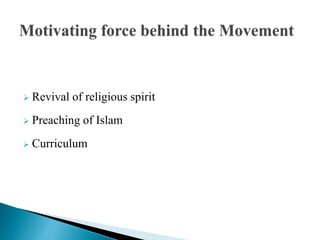
 Revival of religious spirit
 Preaching of Islam
 Curriculum
1. Balance among different Islamic educational concepts in the South
Asia.
2. Preservation of Religious knowledge
3. Education in practical arts and crafts
4. Monetary and administrative aspects
5. Patriotism
6. Character building
7. Other teaching Institutions
 After the war of Independence of 1857 A.D., the British
took over the-whole of india. They left no stone unturned in
suppressing and oppressing the Muslims.
 Sir Syed Ahmed Khan was a civil servant. He could not see
the miserable plights of the Muslims. After a prolonged and
careful thought he concluded that unless the Muslims
acquired the knowledge of the modern sciences, they could
not get rid of their miserable plight and keep pace with the
world.
 To remove the hatred between British and Muslims.
 To prepare Muslims for learning English and the modern
European sciences.
 To enable them to benefit from the modern facilities and
comforts being available due to western science and
technology.
 To develop among the Muslims a scientific outlook
 To safeguard and preserve their national identity.
Aims and Objectives of Aligarh
movement
 established a Scientific Society.
 constituted a committee consisting of those who loved and
desired progress and prosperity for the Muslims.
 launched a movement for educating the Muslims of the Sub-
continent.
 established the Muhammadan Anglo-Oriental College at
Aligarh.
 constituted the Muhammadan Educational Conference.
Important Initiatives With Regard To
The Aligarh Movement
 Training of the Students
 Social Activities
 Facilities for the Students
 Administration
 Religious Education
 Educating for the Elite and the Gentry
Salient Features of Aligarh Movement
 Compromise Between the English and the Muslims
 Prosperity for the Muslims
 Development of Urdu
 Political Training
 Establishment of Educational Institutions
 Westernization
Impact of the Aligarh Movement
A group of Muslim thinkers was of the view that Aligarh
movement was unable to face the new challenges to the Islamic
world. Moreover, he thought that the. Religious institutions
(academies) too were unable to keep pace with the educational
needs of the contemporary world. Therefore, he wanted to
evolve such a parallel curriculum as that could equip the
students with, the knowledge of religious sciences side by side
with worldly sciences. The Nadva translated these aspirations
into reality.
THE NADVA MOVEMENT
 To reform the curriculum; develop the religious sciences; improve the
character of the students and refine their manners.
 To narrow down the "differences of point of view among the Ulama
and thus create relative harmony among religious scholars.
 To reform the Muslims at large; to strive for their progress and
prosperity and to keep aloof from the political strife in the country
(South Asia).
 To establish a first-rate and grand Dar-ul-Uloom for providing
education in various arts and sciences and for promoting virtuosity
among the students
Objectives of Nadva Movement
Salient Features
 Reformation of Curriculum
 Training of the Students
 The Teacher Students Relationship
 Modern Arabic
 Contact with the Islamic World
 Internal Freedom (Autonomy)
 Huge Collection of Books
 In the beginning of 20th century it was felt that the education of the
Muslims must coincide with the national demands and aspirations of
the Muslims at that time Aligarh was the educational centre of the
Muslims. But all its efforts had failed to achieve and fulfill their
national aspirations.
 then Mulana Muhammad Ali Johar thought of setting up parallel
institutions under the name of Jamia Millia Islamia. So he left Aligarh
College and established this Jamia Millia quite close to the Aligarh
College. However, in 1925 A.D., it was shifted to Delhi.
THE JAMIA MILLIA ISLAMIA
 To equip the Muslims with modern as well s religious
sciences.
 Complete Quranic knowledge was the fountain head of its
education.
 Industrial and artistic education programmes were made
compulsory for making the Muslims independent of the
public service.
 To create a cohesion between the religious and modern
sciences.
Objectives
 Simplicity & Sincerity
 Technical Training
 Written Works (Writings)
 Combination of Modern & Oriental Sciences
 Urdu as the Medium of Instruction
 Character Building and Training
Salient Features
Unit 2 muslim educational movement in indo-pak

Unit 2 muslim educational movement in indo-pak

  • 1.
    Education in Pakistan Course Code6506 Asima shahzadi asimashahzadi7@gmail.com
  • 3.
    After studying thisunit students will be able; 1. Know the history of these four educational movements and their impact on the Muslim of Sub-Continent. 2. Understand the Muslim outlook towards education during the British rule. 3. Describe the impact and outcome of these educational movements with regard to their impetus. 4. Compare and contrast the Muslim educational with the modern/British educational system. 5. Discuss these movements as the historical foundation of modern educational system of Pakistan. Objectives of the unit
  • 4.
     The Deobandimovement developed as a reaction to the British colonialism in India,[3] which was seen by a group of Indian scholars— consisting of Rashid Ahmad Gangohi, Muhammad Yaqub Nanautawi, Shah Rafi al-Din, Sayyid Muhammad Abid, Zulfiqar Ali, Fadhl al-Rahman Usmani and Muhammad Qasim Nanotvi— to be corrupting Islam.  In 1919, a large group of Deobandi scholars formed the political party Jamiat Ulema-e-Hind and opposed the partition of India.[21] Deobandi scholar Maulana Syed Husain Ahmad Madani helped to spread these ideas through his text Muttahida Qaumiyat Aur Islam.[21] A minority group later dissented from this position and joined Muhammad Ali Jinnah's Muslim League, forming the Jamiat Ulema-e- Islam in 1945.
  • 5.
     Revival ofreligious spirit  Preaching of Islam  Curriculum
  • 6.
    1. Balance amongdifferent Islamic educational concepts in the South Asia. 2. Preservation of Religious knowledge 3. Education in practical arts and crafts 4. Monetary and administrative aspects 5. Patriotism 6. Character building 7. Other teaching Institutions
  • 8.
     After thewar of Independence of 1857 A.D., the British took over the-whole of india. They left no stone unturned in suppressing and oppressing the Muslims.  Sir Syed Ahmed Khan was a civil servant. He could not see the miserable plights of the Muslims. After a prolonged and careful thought he concluded that unless the Muslims acquired the knowledge of the modern sciences, they could not get rid of their miserable plight and keep pace with the world.
  • 9.
     To removethe hatred between British and Muslims.  To prepare Muslims for learning English and the modern European sciences.  To enable them to benefit from the modern facilities and comforts being available due to western science and technology.  To develop among the Muslims a scientific outlook  To safeguard and preserve their national identity. Aims and Objectives of Aligarh movement
  • 10.
     established aScientific Society.  constituted a committee consisting of those who loved and desired progress and prosperity for the Muslims.  launched a movement for educating the Muslims of the Sub- continent.  established the Muhammadan Anglo-Oriental College at Aligarh.  constituted the Muhammadan Educational Conference. Important Initiatives With Regard To The Aligarh Movement
  • 11.
     Training ofthe Students  Social Activities  Facilities for the Students  Administration  Religious Education  Educating for the Elite and the Gentry Salient Features of Aligarh Movement
  • 12.
     Compromise Betweenthe English and the Muslims  Prosperity for the Muslims  Development of Urdu  Political Training  Establishment of Educational Institutions  Westernization Impact of the Aligarh Movement
  • 13.
    A group ofMuslim thinkers was of the view that Aligarh movement was unable to face the new challenges to the Islamic world. Moreover, he thought that the. Religious institutions (academies) too were unable to keep pace with the educational needs of the contemporary world. Therefore, he wanted to evolve such a parallel curriculum as that could equip the students with, the knowledge of religious sciences side by side with worldly sciences. The Nadva translated these aspirations into reality. THE NADVA MOVEMENT
  • 14.
     To reformthe curriculum; develop the religious sciences; improve the character of the students and refine their manners.  To narrow down the "differences of point of view among the Ulama and thus create relative harmony among religious scholars.  To reform the Muslims at large; to strive for their progress and prosperity and to keep aloof from the political strife in the country (South Asia).  To establish a first-rate and grand Dar-ul-Uloom for providing education in various arts and sciences and for promoting virtuosity among the students Objectives of Nadva Movement
  • 15.
    Salient Features  Reformationof Curriculum  Training of the Students  The Teacher Students Relationship  Modern Arabic  Contact with the Islamic World  Internal Freedom (Autonomy)  Huge Collection of Books
  • 16.
     In thebeginning of 20th century it was felt that the education of the Muslims must coincide with the national demands and aspirations of the Muslims at that time Aligarh was the educational centre of the Muslims. But all its efforts had failed to achieve and fulfill their national aspirations.  then Mulana Muhammad Ali Johar thought of setting up parallel institutions under the name of Jamia Millia Islamia. So he left Aligarh College and established this Jamia Millia quite close to the Aligarh College. However, in 1925 A.D., it was shifted to Delhi. THE JAMIA MILLIA ISLAMIA
  • 17.
     To equipthe Muslims with modern as well s religious sciences.  Complete Quranic knowledge was the fountain head of its education.  Industrial and artistic education programmes were made compulsory for making the Muslims independent of the public service.  To create a cohesion between the religious and modern sciences. Objectives
  • 18.
     Simplicity &Sincerity  Technical Training  Written Works (Writings)  Combination of Modern & Oriental Sciences  Urdu as the Medium of Instruction  Character Building and Training Salient Features