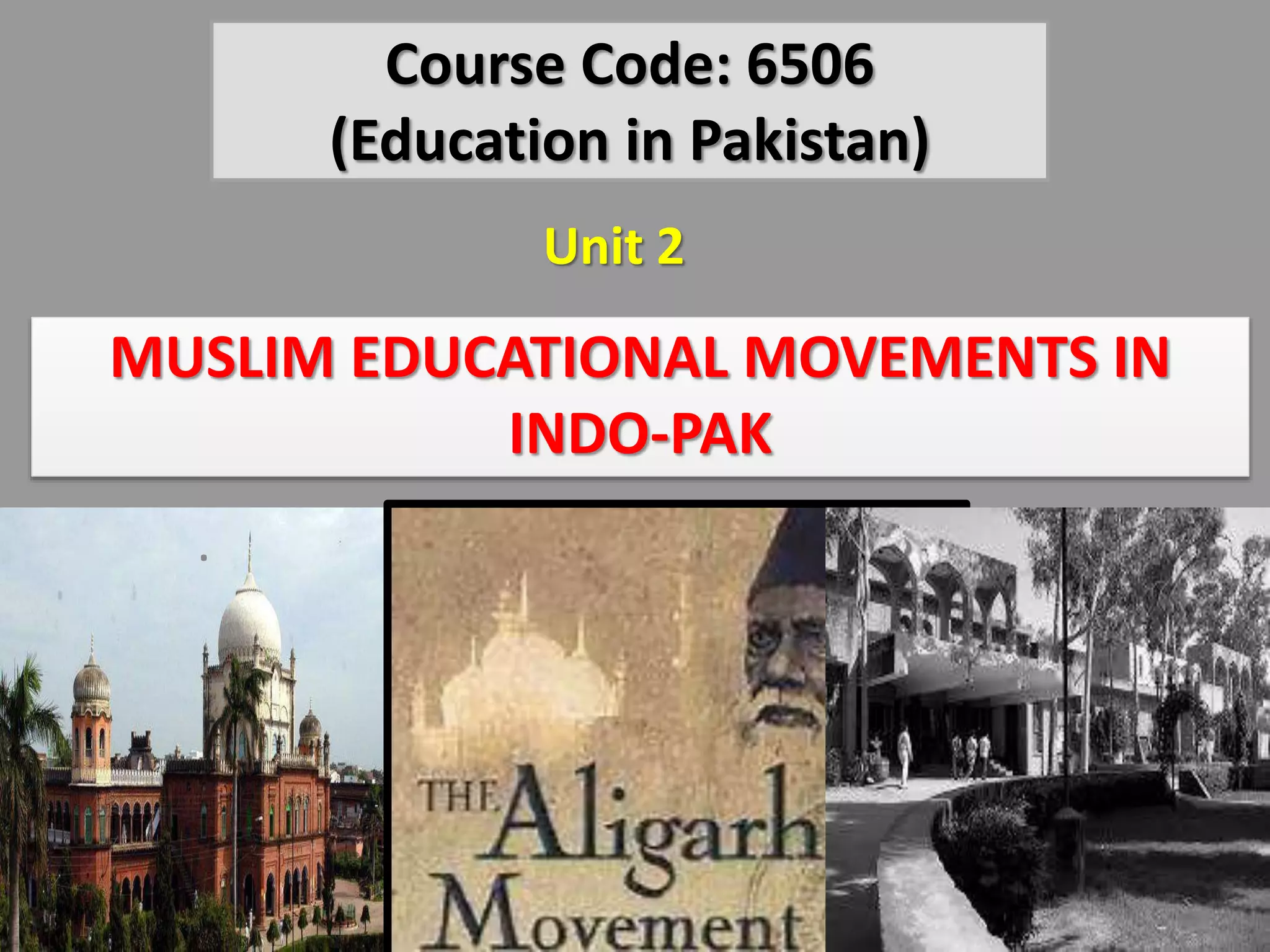
MUSLIM EDUCATIONAL MOVEMENTS IN
INDO-PAK
Course Code: 6506
(Education in Pakistan)
Unit 2
.
• History of Four Educational Movements
(Deoband, Aligarh, Nadva, The Jamia Millia Islamia)
• Impact and outcome of these Educational Movements
•Compare and contrast the Muslim Educational System
with the modern/British educational system.
Session Learning Outcomes
THE DEOBAND MOVEMENT
Background
• The Hindus readily-embraced English Educational System.
• Resistant of the Muslims.
• Need was to preserve traditional Islamic system of education the
religious sciences according to Islamic teachings.
• Maulana Muhammad Yaqoob Nanautvi, First head
• Continuation and succession of Shah Waliuallah’s thoughts.
• Remained a totally non-governmental institution.
• It also helped in gaining more and more donors for promoting it to
a great University.
Darul Uloom Deoband
.
• Revival of Religious Spirit
• Preaching of Islam
• Curriculum
– The Deoband curriculum consisted of accent and
syntax, Arabic literature; institution of the Holy Quran;
Hadith: Philosophy: Scholastic Philosophy: logic:
Islamic Jurisprudence: Rhetoric and Rules of
Metaphorical Language: Beliefs and Poetic Works, The
Prevalent Arts: Phonetics and Calligraphy. For the
purpose, different books were made to study.
– This curriculum of the Dar-ul-Uloom covering
Elementary. Secondary, Higher Secondary and Degree
classes, was to-be studies in nine years.
Motivating Force behind the Movement
a) Balance among different Islamic Educational Concepts in the South Asia
b) Preservation of Religious Knowledge
c) Education in Practical Arts and Crafts
d) Monetary and administrative aspects
e) Patriotism
f) Character Building
g) Other Teaching Institutions
h) Authorship services
Salient Features of the Movement
Aligarh Movement by Sir Syed Ahmad Khan
To improve
Muslim-British
relations.
To increase
political
awareness
among Muslims.
To reform Muslim educational
system through introducing
western education, to lead to
better economical status.
Why?
Ali Garh Movement (1875)
 After the war of independence the condition of the Muslims of
India were very miserable.
 After 1857, the Muslims emerged as a backward nation; illiterate
and hopelessly ignorant in every walk of life.
 They were deprived of their basic rights and were neglected in
every sphere of life.
 Nevertheless, they were economically, politically, socially and to
be more exact religiously made the subject of ruthless
punishment.
 They were helpless before the British and their combine lobby
with Hindus; neither trusted Hindus nor British.
 Sir Syed Ahmad Khan came forward and tried to help the Muslims
in miserable conditions, started a movement Aligarh Movement.
 He guided the Muslims towards the right path.
• To clarify the position of the Muslims to the British rulers,
who had cut off from the modern sciences
• Domination of Hindus
• Management of Education by the Muslims
• Sir Syed Ahmed Khan had criticized the dictatorial role of
the Education Directorate in particular.
• English as a medium of Instruction in public and
missionary schools.
• Curriculum against the Teachings of Islam.
Motivation behind the Aligarh Movement
Aims and Objectives (Ali Garh Movement)
• To prepare Muslims for learning English and the modern
European sciences.
• To enable them to be prepared to live with the bitter
realities of life
• …..to benefit from the modern facilities and comforts
being available
• To develop among the Muslims a Scientific Outlook
• To raise the level of consciousness to preserve their
national identity.
• For the spirit of authoritative interpretation (Ijte-had)
• To introduce and then popularize among the Muslims
the western style of living.
Important Initiatives (Aligarh Movement)
a) Establishment of a Scientific Society.
b) Progress and prosperity for the Muslims.
c) Educating the Muslims of the Sub-continent.
d) Establishment of Muhammadan Anglo-Oriental College.
e) Constitution of Muhammadan Educational Conference.
Salient Features (Aligarh Movement)
a) Training of the Students
b) Social Activities
c) Facilities for the Students
d) Administration
e) Religious Education
f) Educating for the Elite and the Gentry
Sir Syed Ahmad Khan: Educational services
What was done by him?
• 1859 and 1864: opened schools.
• 1862: Scientific Society was established.
• 1866: Issued Aligarh Institute Gazette.
• 1875: M.A.O School/College ---- status of the
Muslim University in 1920.
• 1886:Mohammedan Educational Conference.
Annual meetings in various cities where, by
the co-operation of local Muslims, steps were
taken for the progress of education.
• Compromise Between the English and the Muslims
• Prosperity for the Muslims
• Development of Urdu
• Political Training
• Establishment of Educational Institutions
• Westernization
Impact of the Aligarh Movement
Nadwat-ul- Ulama
Salient Features (Nadva tul Ulama)
a) Reformation of Curriculum
b) Training of the Students
c) The Teacher Students Relationship
d) Modern Arabic
e) Contact with the Islamic World
f) Internal Freedom(Autonomy)
Jamia Millia Islamia (1920)
Jamia Millia Islamia (Motives/ Objectives)
• To equip the Muslims with modern as well s religious
sciences.
• Complete Quranic knowledge was the fountain head of
its education.
• Industrial and artistic education programs were made
compulsory for making the Muslims independent of the
Public service and for conveying dignity of Manual labor.
• To create a cohesion between the religious and Modern
Sciences.
Jamia Millia Islamia
Stages and Curriculum
• The curriculum and stages of education at Jamia Millia
were as below:
Grades of Education
• They were:
• The Elementary Religious School
• Stage-I, i.e. Primary Stage
• Stage-II. i.e. Higher Secondary Stage
• Stage-III, i.e. the Post Degree Stages
• Stage-IV, i.e. Honour’s Stages
Jamia Millia Islamia (Salient Features)
• Simplicity & Sincerity
• Technical Training
• Written Works (Writings)
• Combination of Modern & Oriental Sciences
• Urdu as the medium of Instruction
• Character Building and Training
Questions!
.

6506 Unit 2 edu movements - Copy.pptx

  • 1.
    MUSLIM EDUCATIONAL MOVEMENTSIN INDO-PAK Course Code: 6506 (Education in Pakistan) Unit 2 .
  • 2.
    • History ofFour Educational Movements (Deoband, Aligarh, Nadva, The Jamia Millia Islamia) • Impact and outcome of these Educational Movements •Compare and contrast the Muslim Educational System with the modern/British educational system. Session Learning Outcomes
  • 3.
    THE DEOBAND MOVEMENT Background •The Hindus readily-embraced English Educational System. • Resistant of the Muslims. • Need was to preserve traditional Islamic system of education the religious sciences according to Islamic teachings. • Maulana Muhammad Yaqoob Nanautvi, First head • Continuation and succession of Shah Waliuallah’s thoughts. • Remained a totally non-governmental institution. • It also helped in gaining more and more donors for promoting it to a great University.
  • 4.
  • 5.
    • Revival ofReligious Spirit • Preaching of Islam • Curriculum – The Deoband curriculum consisted of accent and syntax, Arabic literature; institution of the Holy Quran; Hadith: Philosophy: Scholastic Philosophy: logic: Islamic Jurisprudence: Rhetoric and Rules of Metaphorical Language: Beliefs and Poetic Works, The Prevalent Arts: Phonetics and Calligraphy. For the purpose, different books were made to study. – This curriculum of the Dar-ul-Uloom covering Elementary. Secondary, Higher Secondary and Degree classes, was to-be studies in nine years. Motivating Force behind the Movement
  • 6.
    a) Balance amongdifferent Islamic Educational Concepts in the South Asia b) Preservation of Religious Knowledge c) Education in Practical Arts and Crafts d) Monetary and administrative aspects e) Patriotism f) Character Building g) Other Teaching Institutions h) Authorship services Salient Features of the Movement
  • 8.
    Aligarh Movement bySir Syed Ahmad Khan To improve Muslim-British relations. To increase political awareness among Muslims. To reform Muslim educational system through introducing western education, to lead to better economical status. Why?
  • 9.
    Ali Garh Movement(1875)  After the war of independence the condition of the Muslims of India were very miserable.  After 1857, the Muslims emerged as a backward nation; illiterate and hopelessly ignorant in every walk of life.  They were deprived of their basic rights and were neglected in every sphere of life.  Nevertheless, they were economically, politically, socially and to be more exact religiously made the subject of ruthless punishment.  They were helpless before the British and their combine lobby with Hindus; neither trusted Hindus nor British.  Sir Syed Ahmad Khan came forward and tried to help the Muslims in miserable conditions, started a movement Aligarh Movement.  He guided the Muslims towards the right path.
  • 10.
    • To clarifythe position of the Muslims to the British rulers, who had cut off from the modern sciences • Domination of Hindus • Management of Education by the Muslims • Sir Syed Ahmed Khan had criticized the dictatorial role of the Education Directorate in particular. • English as a medium of Instruction in public and missionary schools. • Curriculum against the Teachings of Islam. Motivation behind the Aligarh Movement
  • 11.
    Aims and Objectives(Ali Garh Movement) • To prepare Muslims for learning English and the modern European sciences. • To enable them to be prepared to live with the bitter realities of life • …..to benefit from the modern facilities and comforts being available • To develop among the Muslims a Scientific Outlook • To raise the level of consciousness to preserve their national identity. • For the spirit of authoritative interpretation (Ijte-had) • To introduce and then popularize among the Muslims the western style of living.
  • 12.
    Important Initiatives (AligarhMovement) a) Establishment of a Scientific Society. b) Progress and prosperity for the Muslims. c) Educating the Muslims of the Sub-continent. d) Establishment of Muhammadan Anglo-Oriental College. e) Constitution of Muhammadan Educational Conference.
  • 13.
    Salient Features (AligarhMovement) a) Training of the Students b) Social Activities c) Facilities for the Students d) Administration e) Religious Education f) Educating for the Elite and the Gentry
  • 14.
    Sir Syed AhmadKhan: Educational services What was done by him? • 1859 and 1864: opened schools. • 1862: Scientific Society was established. • 1866: Issued Aligarh Institute Gazette. • 1875: M.A.O School/College ---- status of the Muslim University in 1920. • 1886:Mohammedan Educational Conference. Annual meetings in various cities where, by the co-operation of local Muslims, steps were taken for the progress of education.
  • 15.
    • Compromise Betweenthe English and the Muslims • Prosperity for the Muslims • Development of Urdu • Political Training • Establishment of Educational Institutions • Westernization Impact of the Aligarh Movement
  • 16.
  • 19.
    Salient Features (Nadvatul Ulama) a) Reformation of Curriculum b) Training of the Students c) The Teacher Students Relationship d) Modern Arabic e) Contact with the Islamic World f) Internal Freedom(Autonomy)
  • 20.
  • 21.
    Jamia Millia Islamia(Motives/ Objectives) • To equip the Muslims with modern as well s religious sciences. • Complete Quranic knowledge was the fountain head of its education. • Industrial and artistic education programs were made compulsory for making the Muslims independent of the Public service and for conveying dignity of Manual labor. • To create a cohesion between the religious and Modern Sciences.
  • 22.
    Jamia Millia Islamia Stagesand Curriculum • The curriculum and stages of education at Jamia Millia were as below: Grades of Education • They were: • The Elementary Religious School • Stage-I, i.e. Primary Stage • Stage-II. i.e. Higher Secondary Stage • Stage-III, i.e. the Post Degree Stages • Stage-IV, i.e. Honour’s Stages
  • 23.
    Jamia Millia Islamia(Salient Features) • Simplicity & Sincerity • Technical Training • Written Works (Writings) • Combination of Modern & Oriental Sciences • Urdu as the medium of Instruction • Character Building and Training
  • 24.