Ayesha Naz
Roll no: 06
Class : B.Ed. (hons) sem viii
Subject: Contemporary issues and
trends in education
Topic: Madrassa : Origin Aims and
Objective
Submitt to : Sir Ahmad Nadeem
 Madrasa is the Arabic word for any type of
educational institution, whether secular or
religious (of any religion).
 The word is variously transliterated
madrasah
medresa
madrassa
medrese etc.
 In the West, the word usually refers to a
specific type of religious school or college for
the study of the Islamic religion.
 People of all ages attend, and many often
move on to becoming imams.The certificate
of anʻālim.
 A good number of the ḥuffāẓ(plural of ḥāfiẓ)
are the product of the madaris.
 An important function of the madaris is to
admit orphans and poor children in order to
provide them with education and training.
 Madaris may enroll female students;
however, they study separately from the
men.
 Dar-e-Arqam is a first place which was used
by the Holy Prophet (PBUH) as a hidden
location where he could quietly carry on his
divine mission.
 He used the place for few years during the
initial period of Islam to preach teachings of
Islamic faith, establish contacts and devise
strategy
 After Hijrah (migration) the madrasa of "Suffa"
was established in Madina on the east side of
the Al-Masjid an-Nabawi mosque.
 where Hazrat Muhammad was the teacher and
the students were some of his followers.
 Ubadai-bin-as-Samit was appointed there by
Hazrat Muhammad as teacher and among the
students.
 The curriculum of the madrasa, there were
teachings of The Qur'an, The Hadith,
fara'iz, tajweed, treatises of first aid, etc.
 There were also trainings of horse-riding, art
of war, handwriting and calligraphy, athletics
and martial arts.
 Omar bin Abdul Aziz was a scholar of the first
rank and surrounded himself with great
scholars like Muhammed bin Kaab and
Maimun bin Mehran. He offered stipends to
teachers and encouraged education
 Mosques were places of education, where
both religious and the so-called worldly
sciences were taught. They played a pivotal
role in the lives of Muslims.
 From the start, the mosque was the center
of the Islamic community, a place for prayer,
meditation, religious instruction, political
discussion, and a school.
 Once established, such mosques could develop
into well-known places of learning, often with
hundreds, sometimes with thousands of
students, and frequently contained important
libraries.
 Notable examples are the Mosques in Madina,
Cairo (Al-Azhar) and Damascus
 The primary schooling also included lessons in
writing of Arabic along with reading.
 Along with the primary studies, the students
were also taught the basic arithmetic which
would enable them to carry out calculations
related to the Zakat and the inheritance.
 For more advanced learning one could avail the
schooling in the bigger mosques. This would
cover instruction in Arabic grammar and poetry,
logic, algebra, biology, history, law, and theology
 The first school connected with a mosque,
was set up In Medina every mosque had an
elementary school for the education of both
boys and girls.
 Children usually started their schooling
around the age of five. The very first thing
they learnt was how to perform Salah and
the recitation of the Qur’an.
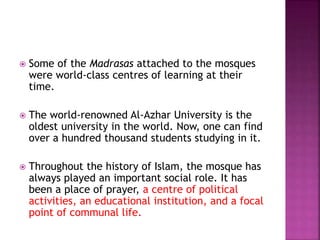
 Some of the Madrasas attached to the mosques
were world-class centres of learning at their
time.
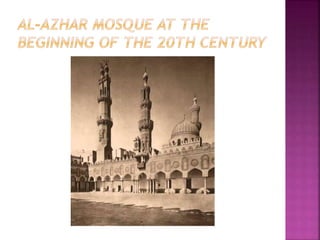
 The world-renowned Al-Azhar University is the
oldest university in the world. Now, one can find
over a hundred thousand students studying in it.
 Throughout the history of Islam, the mosque has
always played an important social role. It has
been a place of prayer, a centre of political
activities, an educational institution, and a focal
point of communal life.
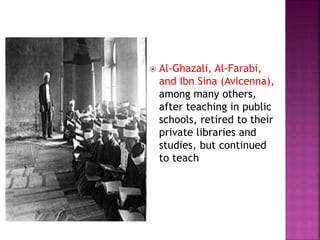
 Al-Ghazali, Al-Farabi,
and Ibn Sina (Avicenna),
among many others,
after teaching in public
schools, retired to their
private libraries and
studies, but continued
to teach
 To form each of our students to appreciate
Qur’anic texts with confidence, reciting in the
correct manner and with insight and providing
every opportunity to memorise the Qu’ran.
 To teach the basic and necessary Islamic
injunctions.
 To prepare our students to acquire a moral
attitude to live as Muslims, taking guidance from
the Qur’an and the Sunnah of the Prophet
Muhammad (peace be upon Him) in line with the
principles and practices.
 To impart Islamic Education for future
generations.
 Provide leadership courses and teacher training
enabling an effective delivery of Islamic
Education.
 Provide guidance and further facilitate advance
studies in the Islamic Sciences.
 Provide Islamic academic research and
development opportunities.
 Ensure that girls and boys have equal access to
all areas of the Islamic syllabus and all
students are treated fairly and equally.
 To establish a caring and secure environment
that facilitates excellence in Islamic education
with values of discipline and respect.
 Work for curriculum reform by introducing like
COMPUTER, Mathematics, Science, Urdu, English
And Arabic for the betterment of Madarssa
education
 To ensure students enjoy their study at the
Madrasa and develop a love of learning and a
strong desire to continue their education as a
lifelong experience.
1)The madrassa used to preach teaching of
islam was:
a)Suffa
b)Masjid-e-Nabvi
c)Dar-e-Arqam
d)Masjid-e-Haram
2) The madrassa ‘suffa’ was established in :
a)Madina
b)Makkah
c)Jeddah
d)faras
3)The word madrassa is derived from the
language:
a1)Persian
b)Greek
c)Arabic
d)Latin
4) The scholar of first rank was :
a)Hazrat zaid
b)Muhammad bin kaab
c)Ubaida bin as smit
d)Omar bin abdul aziz
5) Notable mosque Al Azhar is located in:
a)Iraq
b)Cairo
c)Iran
d)saudia
 c
 a
 c
 d
 b
 Define madrassa?
 Describe the origin of madrassa in short?
 Enlist the 5 aims and objectives of
madrassa?
 Describe the role of mosque towards
education?