Introduction to IT and Its Impact
on Organizations
Introduction To Information
Technology
Defining Information
• What is Information?
Information is any knowledge that comes to our attention. That could be
voice, image, text and video
• What is data?
Data is information when dealing with the machine
Defining Information Technology
Information Technologies are systems of hardware and/or software that
capture, process, exchange, store and/or present information using
electrical, magnetic and/or electromagnetic energy.
IT Example: Cellular Telephony
IT in Society (people)
• Personal Communication
Conversations (phone, cell)
Messaging (E-mail, SMS)
Video Coms
• Entertainment
Web surfing
Downloading video and audio files
Interactive gaming
• Day-to-Day living
Buying airline ticket
Ordering books
Electronic banking/ stock market
IT in Society (business)
• Internal Communication
Computer network
Corporate website
Video teleconferencing
Messaging (SMS, email)
• Electronic Commerce
Call Centers
Electronic transactions
Online sales
• Business operations
Factory operation systems
Databases
Examples on IT Careers
• Information Security Jobs
Address information security
• IT Analyst
Translate business requirement into technical specification
• Network Administration
Configure and operate computer network
• Management Consulting
Provide consulting for government and organizations
• Database Administration
Managing corporate database
• Computer Forensics Expert
Extracts computer evidence for detecting/preventing
/prosecuting crimes
• IT Sales
people on frontline to sell products
• Software development
develop software solutions
Advantage impact of IT on
Organizations
 Reduces office space
 Decreases number of employees
 Improves job satisfaction
 Increases productivity
 To help decrease the work
 Provides security to Organization
 Manages Date & Time Schedule
Behavioural researchers have theorized that information technology facilitates
flattening of hierarchies by broadening the distribution of information to empower
lower-level employees and increase management efficiency.
FLATTENING ORGANIZATIONS
Information systems can
reduce the number of levels in
an organization by providing
managers with information to
supervise larger numbers of
workers and by giving lower-
level employees more
decision-making authority.
The Internet and World Wide Web are increasing the accessibility, storage,
and distribution of information and knowledge for organizations,
dramatically lowering transaction and agency costs. Businesses are rapidly
rebuilding some key business processes based on Internet technology.
To deliver genuine benefits, information systems must be built with a clear
understanding of the organization in which they will be used, and
consideration of the firm's environment, structure, culture, politics,
organization and leadership, business processes, as well as the principle
interest groups affected by the system.
Unit 1:IT in the Organisations
DIKW Model
Key Concepts
• Data
• Information
• Knowledge
• Wisdom
• DIKW Model Pyramid
• Corporate Pyramid
• Information Systems Pyramid
• Decision Making Types Pyramid
What is Data
• Data is collection of Raw facts and Figures
• Data can be represented by alphabets,
numbers , special characters, images and
videos
A-Z , a-z , 0-9 , @#$%&*<>>,.”;’
• Taken in isolation “Data “ conveys no meaning
or context
Data--Information
• 230975 is Data
• 23/09/75 is Data – It could be anyone’s DOB
• DOB 23/09/76 Suresh – Data – Could be any
Suresh in the world
• DOB 23/09/76 Suresh s/o of Ramesh – Data –
could be any Suresh s/o of Ramesh
• DOB 23/09/76 Suresh s/o Ramesh R/o of …….
is Information now as there is “Context “ to Data
Information
• “Processed” Data is “Information”
• There can be multiple processes on data to get
the Information
• Data + Context = Information
Information  Knowledge
• 120/80 ,130/90, 140/100 , 150 /110 is Data
• BP I 120/80 ,130/90, 140/100 , 150 /110 is still
Data
• BP I Date I Time I Name I 120/80 ,130/90,
140/100 , 150 /110 is “Information” about Blood
Pressure as context
• BP I Date I Time I Name I 120/80 ,130/90,
140/100 , 150 /110 I Low ,Average ,High – is
Knowledge
• Information + Rules = Knowledge
Knowledge Wisdom
• In the previous examples of BP Readings , here
are decision of 3 doctors
• Decision of 1st Doctor on BP Reading –Take
Rest
• Decision of 2nd Doctor on BP Reading –Take
Medicines
• Decision of 3rd Doctor on BP Reading – Get
Hospitalized
• Knowledge + Experience = Wisdom
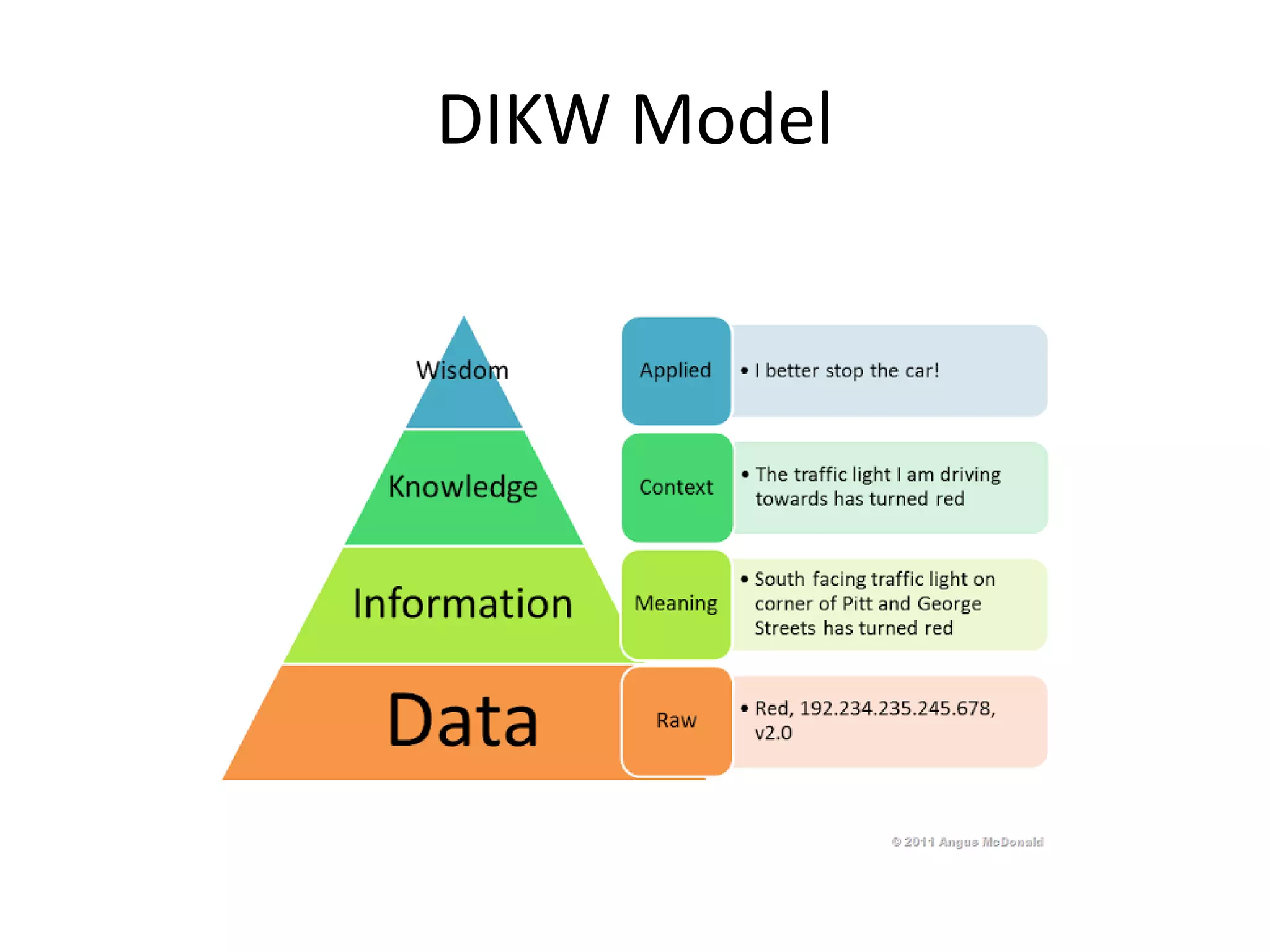
DIKW Model
• Data is considered the new “Oil” but is “useless”
or is like “Crude oil” (What is this liquid ?)
• Insights and Information processed from Data is
“Refined Oil” (Whats to be done to convert to
Diesel/Petrol )
• Where to use the oil is Knowledge (Application of
oil- Automobiles, Aviation, Industry)
• Whether to use the oil , conserve or sell is
Wisdom ( Prediction /Future Forecast-OPEC
Model )
DIKW Model
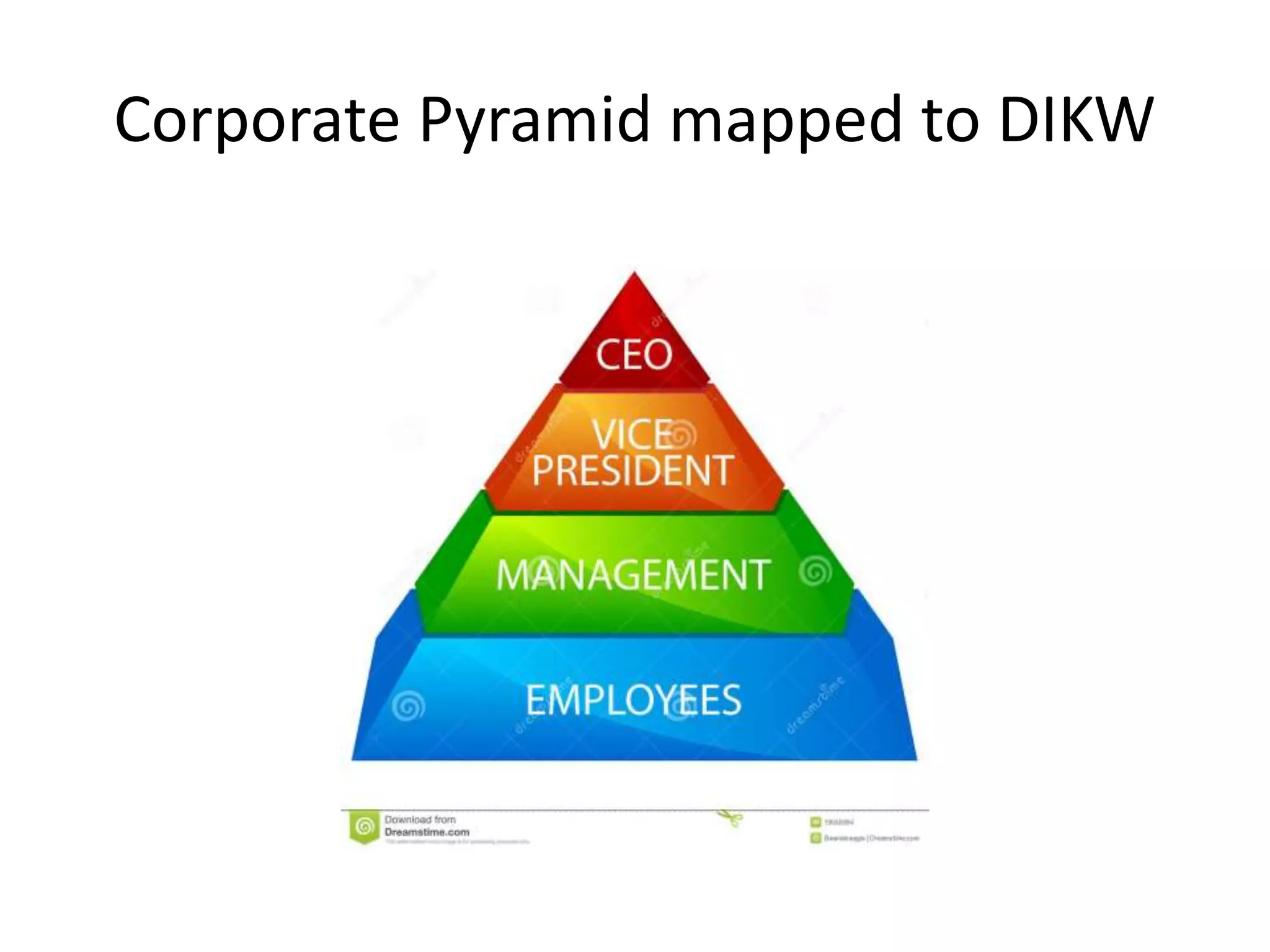
Corporate Pyramid mapped to DIKW
Information Systems Pyramid mapped
to DIKW/Corp Pyramid
DIKW-Information System-Corporate Pyramid
Mapping
Decision making Pyramid
What is System
• Definition of “System” - A system is a set of
rules, an arrangement of things, or a group of
related things that work towards a common
goal
• System is a general set of parts, steps, or
components that are connected to form a
more complex whole.
Five Components of – Information
System (IS)
• Hardware – Physical devices –computers ,
tablets , mobile phones
• Software – Tells the hardware what to do
• Data –Information manipulated by Software
• People –Users , Programmers ,Analysts , IT
Dep't
• Process- steps to accomplish a goal
• Telecommunications /Networking
Information Systems
Trends in Information Systems
What is MIS
• Management
• Information
• System
Unit 2- DIKW Model.pptx

Unit 2- DIKW Model.pptx

  • 1.
    Introduction to ITand Its Impact on Organizations
  • 2.
    Introduction To Information Technology DefiningInformation • What is Information? Information is any knowledge that comes to our attention. That could be voice, image, text and video • What is data? Data is information when dealing with the machine
  • 3.
    Defining Information Technology InformationTechnologies are systems of hardware and/or software that capture, process, exchange, store and/or present information using electrical, magnetic and/or electromagnetic energy.
  • 4.
  • 5.
    IT in Society(people) • Personal Communication Conversations (phone, cell) Messaging (E-mail, SMS) Video Coms • Entertainment Web surfing Downloading video and audio files Interactive gaming • Day-to-Day living Buying airline ticket Ordering books Electronic banking/ stock market
  • 6.
    IT in Society(business) • Internal Communication Computer network Corporate website Video teleconferencing Messaging (SMS, email) • Electronic Commerce Call Centers Electronic transactions Online sales • Business operations Factory operation systems Databases
  • 7.
    Examples on ITCareers • Information Security Jobs Address information security • IT Analyst Translate business requirement into technical specification • Network Administration Configure and operate computer network • Management Consulting Provide consulting for government and organizations • Database Administration Managing corporate database • Computer Forensics Expert Extracts computer evidence for detecting/preventing /prosecuting crimes • IT Sales people on frontline to sell products • Software development develop software solutions
  • 8.
    Advantage impact ofIT on Organizations  Reduces office space  Decreases number of employees  Improves job satisfaction  Increases productivity  To help decrease the work  Provides security to Organization  Manages Date & Time Schedule
  • 9.
    Behavioural researchers havetheorized that information technology facilitates flattening of hierarchies by broadening the distribution of information to empower lower-level employees and increase management efficiency. FLATTENING ORGANIZATIONS Information systems can reduce the number of levels in an organization by providing managers with information to supervise larger numbers of workers and by giving lower- level employees more decision-making authority.
  • 10.
    The Internet andWorld Wide Web are increasing the accessibility, storage, and distribution of information and knowledge for organizations, dramatically lowering transaction and agency costs. Businesses are rapidly rebuilding some key business processes based on Internet technology. To deliver genuine benefits, information systems must be built with a clear understanding of the organization in which they will be used, and consideration of the firm's environment, structure, culture, politics, organization and leadership, business processes, as well as the principle interest groups affected by the system.
  • 11.
    Unit 1:IT inthe Organisations DIKW Model
  • 12.
    Key Concepts • Data •Information • Knowledge • Wisdom • DIKW Model Pyramid • Corporate Pyramid • Information Systems Pyramid • Decision Making Types Pyramid
  • 13.
    What is Data •Data is collection of Raw facts and Figures • Data can be represented by alphabets, numbers , special characters, images and videos A-Z , a-z , 0-9 , @#$%&*<>>,.”;’ • Taken in isolation “Data “ conveys no meaning or context
  • 14.
    Data--Information • 230975 isData • 23/09/75 is Data – It could be anyone’s DOB • DOB 23/09/76 Suresh – Data – Could be any Suresh in the world • DOB 23/09/76 Suresh s/o of Ramesh – Data – could be any Suresh s/o of Ramesh • DOB 23/09/76 Suresh s/o Ramesh R/o of ……. is Information now as there is “Context “ to Data
  • 15.
    Information • “Processed” Datais “Information” • There can be multiple processes on data to get the Information • Data + Context = Information
  • 16.
    Information  Knowledge •120/80 ,130/90, 140/100 , 150 /110 is Data • BP I 120/80 ,130/90, 140/100 , 150 /110 is still Data • BP I Date I Time I Name I 120/80 ,130/90, 140/100 , 150 /110 is “Information” about Blood Pressure as context • BP I Date I Time I Name I 120/80 ,130/90, 140/100 , 150 /110 I Low ,Average ,High – is Knowledge • Information + Rules = Knowledge
  • 17.
    Knowledge Wisdom • Inthe previous examples of BP Readings , here are decision of 3 doctors • Decision of 1st Doctor on BP Reading –Take Rest • Decision of 2nd Doctor on BP Reading –Take Medicines • Decision of 3rd Doctor on BP Reading – Get Hospitalized • Knowledge + Experience = Wisdom
  • 18.
    DIKW Model • Datais considered the new “Oil” but is “useless” or is like “Crude oil” (What is this liquid ?) • Insights and Information processed from Data is “Refined Oil” (Whats to be done to convert to Diesel/Petrol ) • Where to use the oil is Knowledge (Application of oil- Automobiles, Aviation, Industry) • Whether to use the oil , conserve or sell is Wisdom ( Prediction /Future Forecast-OPEC Model )
  • 19.
  • 20.
  • 21.
    Information Systems Pyramidmapped to DIKW/Corp Pyramid
  • 22.
  • 23.
  • 24.
    What is System •Definition of “System” - A system is a set of rules, an arrangement of things, or a group of related things that work towards a common goal • System is a general set of parts, steps, or components that are connected to form a more complex whole.
  • 25.
    Five Components of– Information System (IS) • Hardware – Physical devices –computers , tablets , mobile phones • Software – Tells the hardware what to do • Data –Information manipulated by Software • People –Users , Programmers ,Analysts , IT Dep't • Process- steps to accomplish a goal • Telecommunications /Networking
  • 26.
  • 28.
  • 29.
    What is MIS •Management • Information • System