
1 of 15
Research Presentation
Md. Eshan, 15103066
Big Data Annalytics for Smart
Health Care
2 of 15
Big Data
Big data is a term that describes the large volume of
complex data – both structured and unstructured –
that inundates our life on a day-to-day basis. But it’s
not the amount of data that’s important. It’s what
organizations do with the data that matters. Big data
can be analyzed for insights that lead to better
decisions and strategic business moves.
3 of 15
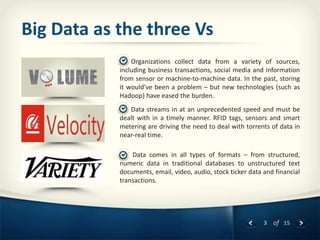
Big Data as the three Vs
Organizations collect data from a variety of sources,
including business transactions, social media and information
from sensor or machine-to-machine data. In the past, storing
it would’ve been a problem – but new technologies (such as
Hadoop) have eased the burden.
Data streams in at an unprecedented speed and must be
dealt with in a timely manner. RFID tags, sensors and smart
metering are driving the need to deal with torrents of data in
near-real time.
Data comes in all types of formats – from structured,
numeric data in traditional databases to unstructured text
documents, email, video, audio, stock ticker data and financial
transactions.
4 of 15
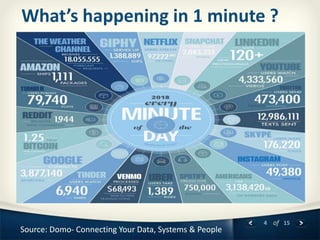
What’s happening in 1 minute ?
Source: Domo- Connecting Your Data, Systems & People
5 of 15
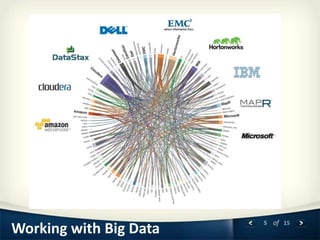
Working with Big Data
6 of 15
Hadoop
Apache Hadoop is an open source software platform for
distributed storage and distributed processing of very large
data sets on computer clusters built from commodity
hardware. Hadoop services provide for data storage, data
processing, data access, data governance, security, and
operations.
7 of 15
Big Data analytics?
Big data analytics is the use of advanced
analytic techniques against very large, diverse
data sets that include structured, semi-
structured and unstructured data, from
different sources, and in different sizes from
terabytes to zettabytes.
8 of 15
What Is Big Data In Healthcare?
Healthcare big data refers to the vast quantities of
data that is now available to healthcare providers.
As a response to the digitization of healthcare information and
the rise of value-based care, the industry has taken advantage
of big data and analytics to make strategic business decisions.
9 of 15
Why Big Data Analytics In Healthcare
With healthcare data analytics, prevention is better than cure and managing
to draw a comprehensive picture of a patient will let insurances provide a
tailored package.
Earlier physicians used their judgments to make treatment decisions, but the
last few years have seen a shift in the way these decisions are being made
by the use of Data.
Clinical trends plays a role in the rise of big data in healthcare.
10 of 15
Examples:
Big Data Helps Fight Ebola in Africa:
 Big data helps predict the spread of epidemics.
 Population movements can be tracked & stored via phone location data & current
health status.
 predict the spread of the virus.
 This gives insights about the most affected areas
 which, in turn, leads to better planning of treatment centers and enforcing movement
restriction in those areas.
Big Data Helps Health Issue in Natural Disaster (ex-Tsunami):
 Big data can help gathering previous records after disaster
 Can be predict possible health issues
 Available of every possible medicines.
 Numbers of doctors increased in certain area
11 of 15
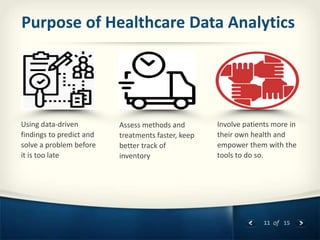
Purpose of Healthcare Data Analytics
Using data-driven
findings to predict and
solve a problem before
it is too late
Assess methods and
treatments faster, keep
better track of
inventory
Involve patients more in
their own health and
empower them with the
tools to do so.
12 of 15
How analyzing data helps in Healthcare
Some big data case studies in Healthcare are as follows:
1. Asthmapolis:
 A GPS-enabled tracker
 Information stored in cloud
 identify trends about individuals, groups, and populations
 merged with information
 physicians offer personalized care and treatment
2. AiCure:
 uses mobile technologies, facial recognition technologies, big data, and
Spark
 Stores patient behavioral records
 examine if a patient is taking the right medications at the right time
 doctors ensure about the patient medication
 alert the patient through technology
3. There is also Ginger.io & United Health Care etc.
13 of 15
Obstacles in Big Data Healthcare
1. Lack of information sharing
2. Information Privacy
3. Information Security
4. Not enough efficient algorithm
5. Only beneficial for tech people
6. Less amount of technology
7. Cost is high
8. Only easy for big organization
So on….
14 of 15
Conclusion:
With today’s always-improving technologies, it’s becoming
easier not only to collect such data but also to converting it into
relevant critical insights that can then be used to provide better
care.
15 of 15
Thanks For Listening
Any Question?

Big Data Analytics for Smart Health Care

  • 1.
    1 of 15 ResearchPresentation Md. Eshan, 15103066 Big Data Annalytics for Smart Health Care
  • 2.
    2 of 15 BigData Big data is a term that describes the large volume of complex data – both structured and unstructured – that inundates our life on a day-to-day basis. But it’s not the amount of data that’s important. It’s what organizations do with the data that matters. Big data can be analyzed for insights that lead to better decisions and strategic business moves.
  • 3.
    3 of 15 BigData as the three Vs Organizations collect data from a variety of sources, including business transactions, social media and information from sensor or machine-to-machine data. In the past, storing it would’ve been a problem – but new technologies (such as Hadoop) have eased the burden. Data streams in at an unprecedented speed and must be dealt with in a timely manner. RFID tags, sensors and smart metering are driving the need to deal with torrents of data in near-real time. Data comes in all types of formats – from structured, numeric data in traditional databases to unstructured text documents, email, video, audio, stock ticker data and financial transactions.
  • 4.
    4 of 15 What’shappening in 1 minute ? Source: Domo- Connecting Your Data, Systems & People
  • 5.
    5 of 15 Workingwith Big Data
  • 6.
    6 of 15 Hadoop ApacheHadoop is an open source software platform for distributed storage and distributed processing of very large data sets on computer clusters built from commodity hardware. Hadoop services provide for data storage, data processing, data access, data governance, security, and operations.
  • 7.
    7 of 15 BigData analytics? Big data analytics is the use of advanced analytic techniques against very large, diverse data sets that include structured, semi- structured and unstructured data, from different sources, and in different sizes from terabytes to zettabytes.
  • 8.
    8 of 15 WhatIs Big Data In Healthcare? Healthcare big data refers to the vast quantities of data that is now available to healthcare providers. As a response to the digitization of healthcare information and the rise of value-based care, the industry has taken advantage of big data and analytics to make strategic business decisions.
  • 9.
    9 of 15 WhyBig Data Analytics In Healthcare With healthcare data analytics, prevention is better than cure and managing to draw a comprehensive picture of a patient will let insurances provide a tailored package. Earlier physicians used their judgments to make treatment decisions, but the last few years have seen a shift in the way these decisions are being made by the use of Data. Clinical trends plays a role in the rise of big data in healthcare.
  • 10.
    10 of 15 Examples: BigData Helps Fight Ebola in Africa:  Big data helps predict the spread of epidemics.  Population movements can be tracked & stored via phone location data & current health status.  predict the spread of the virus.  This gives insights about the most affected areas  which, in turn, leads to better planning of treatment centers and enforcing movement restriction in those areas. Big Data Helps Health Issue in Natural Disaster (ex-Tsunami):  Big data can help gathering previous records after disaster  Can be predict possible health issues  Available of every possible medicines.  Numbers of doctors increased in certain area
  • 11.
    11 of 15 Purposeof Healthcare Data Analytics Using data-driven findings to predict and solve a problem before it is too late Assess methods and treatments faster, keep better track of inventory Involve patients more in their own health and empower them with the tools to do so.
  • 12.
    12 of 15 Howanalyzing data helps in Healthcare Some big data case studies in Healthcare are as follows: 1. Asthmapolis:  A GPS-enabled tracker  Information stored in cloud  identify trends about individuals, groups, and populations  merged with information  physicians offer personalized care and treatment 2. AiCure:  uses mobile technologies, facial recognition technologies, big data, and Spark  Stores patient behavioral records  examine if a patient is taking the right medications at the right time  doctors ensure about the patient medication  alert the patient through technology 3. There is also Ginger.io & United Health Care etc.
  • 13.
    13 of 15 Obstaclesin Big Data Healthcare 1. Lack of information sharing 2. Information Privacy 3. Information Security 4. Not enough efficient algorithm 5. Only beneficial for tech people 6. Less amount of technology 7. Cost is high 8. Only easy for big organization So on….
  • 14.
    14 of 15 Conclusion: Withtoday’s always-improving technologies, it’s becoming easier not only to collect such data but also to converting it into relevant critical insights that can then be used to provide better care.
  • 15.
    15 of 15 ThanksFor Listening Any Question?