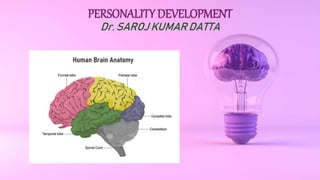
PERSONALITY DEVELOPMENT
Dr. SAROJ KUMAR DATTA
Hello Everyone
Very Good Morning
I Welcome You All To This Program
PERSONALITY DEVELOPMENT
Dr. SAROJ KUMAR DATTA
Professor Saroj Kumar Datta
B. Tech in Mechanical Engineering
M B A and Ph D (Management)
25 + years in industrial environment ( 8 years in USA)
25 + years in academic environment
Written two books , published 60+ research papers, guided 15 PhD
Scholars , presented papers in international conferences in India,
EU & Gulf countries.
PERSONALITY DEVELOPMENT
Dr. SAROJ KUMAR DATTA
This program is meant for young minds who are open to new thoughts and has the possibility
of contributing significantly to the humanity and may change their lives.
What we will discuss here:
Understanding of human personality
Different psychological theories of personality .
Major traits of psychology
Development of personality
What we will not discuss here :-
How to be successful in an interview
How to make a successful career
And things like that which are called personal development
Sessions are expected to be interesting and interacting. This program should be relevant for
you individually , intellectually and culturally.
PERSONALITY DEVELOPMENT
Dr. SAROJ KUMAR DATTA
Some homework suggested:-
Watch movies- The Lion King, Harry Potter and The Godfather
Some reading on the lives and works following scientists and great people:-Charles Darwin, Issac Newton
, Albert Einstein , Dr. Martin Luther King , Nelson Mandela, President Barack Obama , Charlie Chaplin , Neil
Armstrong .
Some Videos to watch:-
 https://www.youtube.com/watch?v=Qg3bJvqfNKc&t=887s
 https://www.youtube.com/watch?v=vP4iY1TtS3s
 https://www.youtube.com/watch?v=PGUdWfB8nLg
 https://www.youtube.com/watch?v=B8ZJf_gvHVY
Some readings-
 https://www.britannica.com/topic/personality/Modern-trends-in-personality-studies
 https://socialsci.libretexts.org/Bookshelves/Psychology/Culture_and_Community/Personality_Theory_i
n_a_Cultural_Context_(Kelland)/01%3A_Introduction_to_Personality/1.02%3A_Definitions_and_Descri
ptions_of_Personality
PERSONALITY DEVELOPMENT
Dr. SAROJ KUMAR DATTA
What do you understand by “ Personality” ?
Character? Faith? Nature? Temperament? Disposition? Make up? Persona? Psyche? Identity?
What do you understand by these words?
Celebrity, Superstar, VIP, Saint , Hero , Villain , Mafia ,
Difference between-
Famous name- Household name, Rich man- Wealthy man, Beautiful lady- Elegant lady, Love-
Compassion, Anger-Hatred, Brave man- Heroic man
What do you understand by Wonderful or good personality?
Can you think of a wonderful person whom you met anytime in your life.
Why should we know our personality? Is it relevant?
Say excellent doctor who has a very poor personality. Does it matter?
PERSONALITY DEVELOPMENT
Dr. SAROJ KUMAR DATTA
Personality determines :-
Success in our life’s occupation (Scientist-Astronaut, Musician-Painter , Doctor-Businessman, Politician-Corporate Executive…)
It determines our social life, cultural life, family life, professional life..
It determines our orientation to society, government, friends , family…
If I can understand my personality, I can find the purpose and goal of my life.
Personality Dynamics :-
Man –Individuals and or groups
Environment- Natural and or created
Communications and Interactions – Direct or indirect
Two things to think about-
Does personality remain same over time ? In that case, it gives you unique identity and identify other
people for sustainable interaction and long-term relationship.
Does personality changes due to environmental changes and our goals?
Actually,personality evolves out of biology, psychology, sociology and technology
Study of personality is intellectually and culturally relevant for an individual
PERSONALITY DEVELOPMENT
Dr. SAROJ KUMAR DATTA
The word "personality" stems from the Latin word persona, which
refers to a theatrical mask worn by performers to play roles or disguise
their identities
Personality is our projection to the outside
How other people perceives or see us
American Psychological association
Personality refers to the enduring characteristics and behavior that
comprise a person’s unique adjustment to life, including major traits,
interests, drives, values, self-concept, abilities, and emotional
patterns.
PERSONALITY DEVELOPMENT
Dr. SAROJ KUMAR DATTA
Allport's (Gordon Allport-American psychologist) definition of Personality.
Personality is the dynamic organization within the individual of those psychophysical
systems that determine his unique adjustments to the environment.”
Personality, a characteristic way of thinking, feeling, and behaving. Personality
embraces moods, attitudes, and opinions and is most clearly expressed in interactions
with other people. It includes behavioral characteristics, both inherent and acquired,
that distinguish one person from another and that can be observed in people’s
relations to the environment and to the social group.
According to John B Watson-Personality is a sum of activities that can be discovered
by actual observations over a long period of time to give reliable information.
Personality describes the unique pattern of thoughts, feelings and behaviors that
distinguish an individual from others
PERSONALITY DEVELOPMENT
Dr. SAROJ KUMAR DATTA
Nature of Personality:-
It is relatively stable but dynamic in nature
It helps the individual in adjusting with the environment
It is consistent
It is unique
Determinants of personality:-
Personal and environmental factors
Biological, Psychological , social and cultural factors
Physical , social , psychological and intellectual
PERSONALITY DEVELOPMENT
Dr. SAROJ KUMAR DATTA
PERSONALITY DEVELOPMENT
Dr. SAROJ KUMAR DATTA
PERSONALITY DEVELOPMENT
Dr. SAROJ KUMAR DATTA
NERVOUS SYSTEM
The nervous system has two main parts: The central nervous system is made up of the
brain and spinal cord. The peripheral nervous system is made up of nerves that
branch off from the spinal cord and extend to all parts of the body.
Brain
The brain is a complex organ that controls thought, memory, emotion, touch, motor
skills, vision, breathing, temperature, hunger and every process that regulates our
body. Together, the brain and spinal cord that extends from it make up the central
nervous system, or CNS.
What is the brain made of?
Weighing about 3 pounds in the average adult, the brain is about 60% fat. The
remaining 40% is a combination of water, protein, carbohydrates and salts. The brain
itself is a not a muscle. It contains blood vessels and nerves, including neurons and
glial cells
PERSONALITY DEVELOPMENT
Dr. SAROJ KUMAR DATTA
What is the gray matter and white matter?
Gray and white matter are two different regions of the central nervous system. In the
brain, gray matter refers to the darker, outer portion, while white matter describes the
lighter, inner section underneath. In the spinal cord, this order is reversed: The white
matter is on the outside, and the gray matter sits within.
Gray matter is primarily composed of neuron somas (the round central cell bodies), and
white matter is mostly made of axons (the long stems that connects neurons together)
wrapped in myelin (a protective coating). The different composition of neuron parts is
why the two appear as separate shades on certain scans.
Each region serves a different role. Gray matter is primarily responsible for processing
and interpreting information, while white matter transmits that information to other
parts of the nervous system.
PERSONALITY DEVELOPMENT
Dr. SAROJ KUMAR DATTA
Divisions of the brain
The brain can be divided into three basic units: the forebrain, the midbrain, and the
hindbrain. The hindbrain includes the upper part of the spinal cord, the brain stem, and
a wrinkled ball of tissue called the cerebellum. The hindbrain controls the body's vital
functions such as respiration and heart rate.ch as respiration and hear
The human brain can often be divided into three distinct parts, which include the
cerebrum, the cerebellum, and the brainstem.
The cerebrum
The major portion of the brain is the cerebrum, which divides the left and right cerebral
hemispheres, both of which have numerous folds and convolutions present on their
surface. Between these convolutions are ridges known as gyri. Small grooves that are
present between the gyri are known as the plural of sulcus or sulci, whereas larger
grooves are referred to as fissures.
PERSONALITY DEVELOPMENT
Dr. SAROJ KUMAR DATTA
The right and left cerebral hemispheres, both of which are covered in the cerebral
cortex that is otherwise known as gray matter, are joined together by the corpus
callosum. Whereas the left hemisphere controls speech and abstract thinking, the right
hemisphere controls spatial thinking.
The frontal, parietal, temporal, and occipital lobes are the four lobes that make up the
cerebrum. The frontal lobes, which are present directly behind the forehead, are the
largest lobes of the human brain. The frontal lobes are primarily responsible for
controlling language, motor function, and various cognitive processes including self-
awareness, mood, affect, memory, attention, as well as both social and moral
reasoning.
Within the frontal lobe is Broca’s area, which is responsible for speech production. The
parietal lobes, who can be found near the center of the brain between the frontal and
occipital lobes, are responsible for interpreting different sensory and memory
functions.
PERSONALITY DEVELOPMENT
Dr. SAROJ KUMAR DATTA
The temporal lobes, which is commonly referred to as the neocortex, is
located close to the base of the skull. Within the temporal lobe is the
Wernicke area, which allows individuals to understand both spoken and
written language. In addition to processing speech, the temporal lobe also
processes sensory information that contributes to the retention of memories,
languages, and emotions.
The fourth and final lobe of the cerebrum is the occipital lobe, which is the
smallest lobe of the cerebrum and forms the caudal part of the brain. The
primary function of the occipital lobe is the interpretation of visual
information.
PERSONALITY DEVELOPMENT
Dr. SAROJ KUMAR DATTA
The cerebellum
The largest of the hindbrain is the cerebellum. Upon reception of motor
information from both the cerebral cortex and the musculoskeletal structures
of the body, the cerebellum coordinates these signals to maintain the gait
and posture of humans in motion.
Although the cerebellum itself does not initiate muscle contraction, it aids in
the refinement and accuracy of motor activity by controlling muscle tone. In
addition to its role in controlling balance and regulating motor movement,
the cerebellum also plays a role in the regulation of fear and other cognitive
functions such as attention, language, and the human response to pleasure.
PERSONALITY DEVELOPMENT
Dr. SAROJ KUMAR DATTA
The brainstem
The cerebellum and spinal cord are connected to the cerebral hemispheres by
the brainstem. The brain stem can be classified into four distinct sections that
include the diencephalon, midbrain, pons, and medulla oblongata. The
diencephalon, which is the most superior portion of the brainstem, is further
subdivided into four portions that include the epithalamus, subthalamus,
hypothalamus, and thalamus.
The thalamus, which is the largest portion of the diencephalon, serves as a
relay point for all sensory information that enters the cortex and eventually
gets transmitted to the cerebrum for processing. The hypothalamus also
processes incoming sensory information; however, all of the information
processed by the hypothalamus is derived from the autonomic nervous
system (ANS).
PERSONALITY DEVELOPMENT
Dr. SAROJ KUMAR DATTA
As a result, the hypothalamus maintains eating habits, sexual behavior, and
sleep patterns in addition to maintaining an individual’s body temperature.
Additionally, the secretions of the pituitary gland, which develops from a
downward extension of The midbrain, which connects the diencephalon to
the pons, controls ocular motion, whereas the pons is involved in the
regulation of eye and facial movements, hearing and balance, as well as all
sensory information processed by the facial nerves.
The medulla oblongata, which is located between the pons and the spinal cord
and is therefore the most inferior portion of the brainstem, controls
autonomic functions such as breathing, blood pressure, cardiac rhythms, and
swallowing. Notably, brain death of patients in a clinical setting is declared
when there is significant destruction of the medulla oblongata.
PERSONALITY DEVELOPMENT
Dr. SAROJ KUMAR DATTA
Cerebrum
The cerebrum (front of brain) comprises gray matter (the cerebral
cortex) and white matter at its center. The largest part of the brain, the
cerebrum initiates and coordinates movement and regulates
temperature. Other areas of the cerebrum enable speech, judgment,
thinking and reasoning, problem-solving, emotions and learning. Other
functions relate to vision, hearing, touch and other senses.
PERSONALITY DEVELOPMENT
Dr. SAROJ KUMAR DATTA
Cerebral Cortex
Cortex is Latin for “bark,” and describes the outer gray matter covering of the
cerebrum. The cortex has a large surface area due to its folds, and comprises
about half of the brain’s weight.
The cerebral cortex is divided into two halves, or hemispheres. It is covered
with ridges (gyri) and folds (sulci). The two halves join at a large, deep sulcus
(the interhemispheric fissure, AKA the medial longitudinal fissure) that runs
from the front of the head to the back. The right hemisphere controls the left
side of the body, and the left half controls the right side of the body. The two
halves communicate with one another through a large, C-shaped structure of
white matter and nerve pathways called the corpus callosum. The corpus
callosum is in the center of the cerebrum.
PERSONALITY DEVELOPMENT
Dr. SAROJ KUMAR DATTA
Brainstem
The brainstem (middle of brain) connects the cerebrum with the spinal cord.
The brainstem includes the midbrain, the pons and the medulla.
 Midbrain. The midbrain (or mesencephalon) is a very complex structure
with a range of different neuron clusters (nuclei and colliculi), neural
pathways and other structures. These features facilitate various functions,
from hearing and movement to calculating responses and environmental
changes. The midbrain also contains the substantia nigra, an area affected
by Parkinson’s disease that is rich in dopamine neurons and part of the
basal ganglia, which enables movement and coordination.
 Pons. The pons is the origin for four of the 12 cranial nerves, which
enable a range of activities such as tear production, chewing, blinking,
focusing vision, balance, hearing and facial expression. Named for the
Latin word for “bridge,” the pons is the connection between the midbrain
and the medulla.
PERSONALITY DEVELOPMENT
Dr. SAROJ KUMAR DATTA
Medulla
At the bottom of the brainstem, the medulla is where the brain meets
the spinal cord. The medulla is essential to survival. Functions of the
medulla regulate many bodily activities, including heart rhythm,
breathing, blood flow, and oxygen and carbon dioxide levels. The
medulla produces reflexive activities such as sneezing, vomiting,
coughing and swallowing.
The spinal cord extends from the bottom of the medulla and through
a large opening in the bottom of the skull. Supported by the
vertebrae, the spinal cord carries messages to and from the brain and
the rest of the body.
PERSONALITY DEVELOPMENT
Dr. SAROJ KUMAR DATTA
Cerebellum
The cerebellum (“little brain”) is a fist-sized portion of the brain located at the back of the head,
below the temporal and occipital lobes and above the brainstem. Like the cerebral cortex, it has two
hemispheres. The outer portion contains neurons, and the inner area communicates with the
cerebral cortex. Its function is to coordinate voluntary muscle movements and to maintain posture,
balance and equilibrium. New studies are exploring the cerebellum’s roles in thought, emotions and
social behavior, as well as its possible involvement in addiction, autism and schizophrenia
Lobes of the brain
Frontal lobe. The largest lobe of the brain, located in the front of the head, the frontal lobe is
involved in personality characteristics, decision-making and movement. Recognition of smell usually
involves parts of the frontal lobe. The frontal lobe contains Broca’s area, which is associated with
speech ability.
Parietal lobe. The middle part of the brain, the parietal lobe helps a person identify objects and
understand spatial relationships (where one’s body is compared with objects around the person).
The parietal lobe is also involved in interpreting pain and touch in the body. The parietal lobe
houses Wernicke’s area, which helps the brain understand spoken language.
Occipital lobe. The occipital lobe is the back part of the brain that is involved with vision.
Temporal lobe. The sides of the brain, temporal lobes are involved in short-term memory, speech,
musical rhythm and some degree of smell recognition.
PERSONALITY DEVELOPMENT
Dr. SAROJ KUMAR DATTA
Deeper Structures Within the Brain
 Pituitary Gland
 Sometimes called the “master gland,” the pituitary gland is a pea-sized
structure found deep in the brain behind the bridge of the nose. The pituitary
gland governs the function of other glands in the body, regulating the flow of
hormones from the thyroid, adrenals, ovaries and testicles. It receives chemical
signals from the hypothalamus through its stalk and blood supply.
 Hypothalamus
 The hypothalamus is located above the pituitary gland and sends it chemical
messages that control its function. It regulates body temperature, synchronizes
sleep patterns, controls hunger and thirst and also plays a role in some aspects
of memory and emotion.
 Amygdala
 Small, almond-shaped structures, an amygdala is located under each half
(hemisphere) of the brain. Included in the limbic system, the amygdalae
regulate emotion and memory and are associated with the brain’s reward
system, stress, and the “fight or flight” response when someone perceives a
threat.
PERSONALITY DEVELOPMENT
Dr. SAROJ KUMAR DATTA
 Hippocampus
 A curved seahorse-shaped organ on the underside of
each temporal lobe, the hippocampus is part of a
larger structure called the hippocampal formation. It
supports memory, learning, navigation and perception
of space. It receives information from the cerebral
cortex and may play a role in Alzheimer’s disease.
 Pineal Gland
 The pineal gland is located deep in the brain and
attached by a stalk to the top of the third ventricle.
The pineal gland responds to light and dark and
secretes melatonin, which regulates circadian rhythms
and the sleep-wake cycle.
PERSONALITY DEVELOPMENT
Dr. SAROJ KUMAR DATTA
Neurons are nerve cells that send messages all over your body to allow you to do everything from
breathing to talking, eating, walking, and thinking. Until recently, most neuroscientists (scientists
who study the brain) thought we were born with all the neurons we were ever going to have
Neurons are nerve cells that send messages all over your body to allow you to do everything from
breathing to talking, eating, walking, and thinking. Until recently, most neuroscientists (scientists
who study the brain) thought we were born with all the neurons we were ever going to have ,
But a child might grow some new neurons to help build the pathways—called neural circuits—
that act as information highways between different areas of the brain. However, scientists
believed that once a neural circuit was in place, adding any new neurons would change the flow
of information and break the brain’s communication system
In 1962, scientist Joseph Altman challenged this belief when he saw evidence of neurogenesis
(the birth of neurons) in a region of the adult rat brain called the hippocampus. He later reported
that newborn neurons traveled from their birthplace in the hippocampus to other parts of the
brain. In 1979, another scientist, Michael Kaplan, confirmed Altman’s findings in the rat brain; and
in 1983, he found special kinds of cells—called neural precursor cells—with the ability to become
brain cells like neurons, in adult monkeys.
PERSONALITY DEVELOPMENT
Dr. SAROJ KUMAR DATTA
PERSONALITY DEVELOPMENT
Dr. SAROJ KUMAR DATTA
Approximately 86 billion neurons in the human brain. The latest estimates
for the number of stars in the Milky Way is somewhere between 200 and
400 billion. So close, but the human brain certainly doesn't quite stack up!
Believe it or not, there are over 7 trillion nerves in the human body. All these
nerves are part of what's known as your body's nervous system
The total length of nerves in the human body is estimated to be
around 150,000-180,000 km.
A nerve cell (neuron) consists of a large cell body and nerve fibers—one
elongated extension (axon) for sending impulses and usually many branches
(dendrites) for receiving impulses. The impulses from the axon cross a
synapse (the junction between 2 nerve cells) to the dendrite of another cell.
PERSONALITY DEVELOPMENT
Dr. SAROJ KUMAR DATTA
PERSONALITY DEVELOPMENT
Dr. SAROJ KUMAR DATTA

Personality Development , Dr. SAROJ KUMAR DATTA

  • 1.
    PERSONALITY DEVELOPMENT Dr. SAROJKUMAR DATTA Hello Everyone Very Good Morning I Welcome You All To This Program
  • 2.
    PERSONALITY DEVELOPMENT Dr. SAROJKUMAR DATTA Professor Saroj Kumar Datta B. Tech in Mechanical Engineering M B A and Ph D (Management) 25 + years in industrial environment ( 8 years in USA) 25 + years in academic environment Written two books , published 60+ research papers, guided 15 PhD Scholars , presented papers in international conferences in India, EU & Gulf countries.
  • 3.
    PERSONALITY DEVELOPMENT Dr. SAROJKUMAR DATTA This program is meant for young minds who are open to new thoughts and has the possibility of contributing significantly to the humanity and may change their lives. What we will discuss here: Understanding of human personality Different psychological theories of personality . Major traits of psychology Development of personality What we will not discuss here :- How to be successful in an interview How to make a successful career And things like that which are called personal development Sessions are expected to be interesting and interacting. This program should be relevant for you individually , intellectually and culturally.
  • 4.
    PERSONALITY DEVELOPMENT Dr. SAROJKUMAR DATTA Some homework suggested:- Watch movies- The Lion King, Harry Potter and The Godfather Some reading on the lives and works following scientists and great people:-Charles Darwin, Issac Newton , Albert Einstein , Dr. Martin Luther King , Nelson Mandela, President Barack Obama , Charlie Chaplin , Neil Armstrong . Some Videos to watch:-  https://www.youtube.com/watch?v=Qg3bJvqfNKc&t=887s  https://www.youtube.com/watch?v=vP4iY1TtS3s  https://www.youtube.com/watch?v=PGUdWfB8nLg  https://www.youtube.com/watch?v=B8ZJf_gvHVY Some readings-  https://www.britannica.com/topic/personality/Modern-trends-in-personality-studies  https://socialsci.libretexts.org/Bookshelves/Psychology/Culture_and_Community/Personality_Theory_i n_a_Cultural_Context_(Kelland)/01%3A_Introduction_to_Personality/1.02%3A_Definitions_and_Descri ptions_of_Personality
  • 5.
    PERSONALITY DEVELOPMENT Dr. SAROJKUMAR DATTA What do you understand by “ Personality” ? Character? Faith? Nature? Temperament? Disposition? Make up? Persona? Psyche? Identity? What do you understand by these words? Celebrity, Superstar, VIP, Saint , Hero , Villain , Mafia , Difference between- Famous name- Household name, Rich man- Wealthy man, Beautiful lady- Elegant lady, Love- Compassion, Anger-Hatred, Brave man- Heroic man What do you understand by Wonderful or good personality? Can you think of a wonderful person whom you met anytime in your life. Why should we know our personality? Is it relevant? Say excellent doctor who has a very poor personality. Does it matter?
  • 6.
    PERSONALITY DEVELOPMENT Dr. SAROJKUMAR DATTA Personality determines :- Success in our life’s occupation (Scientist-Astronaut, Musician-Painter , Doctor-Businessman, Politician-Corporate Executive…) It determines our social life, cultural life, family life, professional life.. It determines our orientation to society, government, friends , family… If I can understand my personality, I can find the purpose and goal of my life. Personality Dynamics :- Man –Individuals and or groups Environment- Natural and or created Communications and Interactions – Direct or indirect Two things to think about- Does personality remain same over time ? In that case, it gives you unique identity and identify other people for sustainable interaction and long-term relationship. Does personality changes due to environmental changes and our goals? Actually,personality evolves out of biology, psychology, sociology and technology Study of personality is intellectually and culturally relevant for an individual
  • 7.
    PERSONALITY DEVELOPMENT Dr. SAROJKUMAR DATTA The word "personality" stems from the Latin word persona, which refers to a theatrical mask worn by performers to play roles or disguise their identities Personality is our projection to the outside How other people perceives or see us American Psychological association Personality refers to the enduring characteristics and behavior that comprise a person’s unique adjustment to life, including major traits, interests, drives, values, self-concept, abilities, and emotional patterns.
  • 8.
    PERSONALITY DEVELOPMENT Dr. SAROJKUMAR DATTA Allport's (Gordon Allport-American psychologist) definition of Personality. Personality is the dynamic organization within the individual of those psychophysical systems that determine his unique adjustments to the environment.” Personality, a characteristic way of thinking, feeling, and behaving. Personality embraces moods, attitudes, and opinions and is most clearly expressed in interactions with other people. It includes behavioral characteristics, both inherent and acquired, that distinguish one person from another and that can be observed in people’s relations to the environment and to the social group. According to John B Watson-Personality is a sum of activities that can be discovered by actual observations over a long period of time to give reliable information. Personality describes the unique pattern of thoughts, feelings and behaviors that distinguish an individual from others
  • 9.
    PERSONALITY DEVELOPMENT Dr. SAROJKUMAR DATTA Nature of Personality:- It is relatively stable but dynamic in nature It helps the individual in adjusting with the environment It is consistent It is unique Determinants of personality:- Personal and environmental factors Biological, Psychological , social and cultural factors Physical , social , psychological and intellectual
  • 10.
  • 11.
  • 12.
    PERSONALITY DEVELOPMENT Dr. SAROJKUMAR DATTA NERVOUS SYSTEM The nervous system has two main parts: The central nervous system is made up of the brain and spinal cord. The peripheral nervous system is made up of nerves that branch off from the spinal cord and extend to all parts of the body. Brain The brain is a complex organ that controls thought, memory, emotion, touch, motor skills, vision, breathing, temperature, hunger and every process that regulates our body. Together, the brain and spinal cord that extends from it make up the central nervous system, or CNS. What is the brain made of? Weighing about 3 pounds in the average adult, the brain is about 60% fat. The remaining 40% is a combination of water, protein, carbohydrates and salts. The brain itself is a not a muscle. It contains blood vessels and nerves, including neurons and glial cells
  • 13.
    PERSONALITY DEVELOPMENT Dr. SAROJKUMAR DATTA What is the gray matter and white matter? Gray and white matter are two different regions of the central nervous system. In the brain, gray matter refers to the darker, outer portion, while white matter describes the lighter, inner section underneath. In the spinal cord, this order is reversed: The white matter is on the outside, and the gray matter sits within. Gray matter is primarily composed of neuron somas (the round central cell bodies), and white matter is mostly made of axons (the long stems that connects neurons together) wrapped in myelin (a protective coating). The different composition of neuron parts is why the two appear as separate shades on certain scans. Each region serves a different role. Gray matter is primarily responsible for processing and interpreting information, while white matter transmits that information to other parts of the nervous system.
  • 14.
    PERSONALITY DEVELOPMENT Dr. SAROJKUMAR DATTA Divisions of the brain The brain can be divided into three basic units: the forebrain, the midbrain, and the hindbrain. The hindbrain includes the upper part of the spinal cord, the brain stem, and a wrinkled ball of tissue called the cerebellum. The hindbrain controls the body's vital functions such as respiration and heart rate.ch as respiration and hear The human brain can often be divided into three distinct parts, which include the cerebrum, the cerebellum, and the brainstem. The cerebrum The major portion of the brain is the cerebrum, which divides the left and right cerebral hemispheres, both of which have numerous folds and convolutions present on their surface. Between these convolutions are ridges known as gyri. Small grooves that are present between the gyri are known as the plural of sulcus or sulci, whereas larger grooves are referred to as fissures.
  • 15.
    PERSONALITY DEVELOPMENT Dr. SAROJKUMAR DATTA The right and left cerebral hemispheres, both of which are covered in the cerebral cortex that is otherwise known as gray matter, are joined together by the corpus callosum. Whereas the left hemisphere controls speech and abstract thinking, the right hemisphere controls spatial thinking. The frontal, parietal, temporal, and occipital lobes are the four lobes that make up the cerebrum. The frontal lobes, which are present directly behind the forehead, are the largest lobes of the human brain. The frontal lobes are primarily responsible for controlling language, motor function, and various cognitive processes including self- awareness, mood, affect, memory, attention, as well as both social and moral reasoning. Within the frontal lobe is Broca’s area, which is responsible for speech production. The parietal lobes, who can be found near the center of the brain between the frontal and occipital lobes, are responsible for interpreting different sensory and memory functions.
  • 16.
    PERSONALITY DEVELOPMENT Dr. SAROJKUMAR DATTA The temporal lobes, which is commonly referred to as the neocortex, is located close to the base of the skull. Within the temporal lobe is the Wernicke area, which allows individuals to understand both spoken and written language. In addition to processing speech, the temporal lobe also processes sensory information that contributes to the retention of memories, languages, and emotions. The fourth and final lobe of the cerebrum is the occipital lobe, which is the smallest lobe of the cerebrum and forms the caudal part of the brain. The primary function of the occipital lobe is the interpretation of visual information.
  • 17.
    PERSONALITY DEVELOPMENT Dr. SAROJKUMAR DATTA The cerebellum The largest of the hindbrain is the cerebellum. Upon reception of motor information from both the cerebral cortex and the musculoskeletal structures of the body, the cerebellum coordinates these signals to maintain the gait and posture of humans in motion. Although the cerebellum itself does not initiate muscle contraction, it aids in the refinement and accuracy of motor activity by controlling muscle tone. In addition to its role in controlling balance and regulating motor movement, the cerebellum also plays a role in the regulation of fear and other cognitive functions such as attention, language, and the human response to pleasure.
  • 18.
    PERSONALITY DEVELOPMENT Dr. SAROJKUMAR DATTA The brainstem The cerebellum and spinal cord are connected to the cerebral hemispheres by the brainstem. The brain stem can be classified into four distinct sections that include the diencephalon, midbrain, pons, and medulla oblongata. The diencephalon, which is the most superior portion of the brainstem, is further subdivided into four portions that include the epithalamus, subthalamus, hypothalamus, and thalamus. The thalamus, which is the largest portion of the diencephalon, serves as a relay point for all sensory information that enters the cortex and eventually gets transmitted to the cerebrum for processing. The hypothalamus also processes incoming sensory information; however, all of the information processed by the hypothalamus is derived from the autonomic nervous system (ANS).
  • 19.
    PERSONALITY DEVELOPMENT Dr. SAROJKUMAR DATTA As a result, the hypothalamus maintains eating habits, sexual behavior, and sleep patterns in addition to maintaining an individual’s body temperature. Additionally, the secretions of the pituitary gland, which develops from a downward extension of The midbrain, which connects the diencephalon to the pons, controls ocular motion, whereas the pons is involved in the regulation of eye and facial movements, hearing and balance, as well as all sensory information processed by the facial nerves. The medulla oblongata, which is located between the pons and the spinal cord and is therefore the most inferior portion of the brainstem, controls autonomic functions such as breathing, blood pressure, cardiac rhythms, and swallowing. Notably, brain death of patients in a clinical setting is declared when there is significant destruction of the medulla oblongata.
  • 20.
    PERSONALITY DEVELOPMENT Dr. SAROJKUMAR DATTA Cerebrum The cerebrum (front of brain) comprises gray matter (the cerebral cortex) and white matter at its center. The largest part of the brain, the cerebrum initiates and coordinates movement and regulates temperature. Other areas of the cerebrum enable speech, judgment, thinking and reasoning, problem-solving, emotions and learning. Other functions relate to vision, hearing, touch and other senses.
  • 21.
    PERSONALITY DEVELOPMENT Dr. SAROJKUMAR DATTA Cerebral Cortex Cortex is Latin for “bark,” and describes the outer gray matter covering of the cerebrum. The cortex has a large surface area due to its folds, and comprises about half of the brain’s weight. The cerebral cortex is divided into two halves, or hemispheres. It is covered with ridges (gyri) and folds (sulci). The two halves join at a large, deep sulcus (the interhemispheric fissure, AKA the medial longitudinal fissure) that runs from the front of the head to the back. The right hemisphere controls the left side of the body, and the left half controls the right side of the body. The two halves communicate with one another through a large, C-shaped structure of white matter and nerve pathways called the corpus callosum. The corpus callosum is in the center of the cerebrum.
  • 22.
    PERSONALITY DEVELOPMENT Dr. SAROJKUMAR DATTA Brainstem The brainstem (middle of brain) connects the cerebrum with the spinal cord. The brainstem includes the midbrain, the pons and the medulla.  Midbrain. The midbrain (or mesencephalon) is a very complex structure with a range of different neuron clusters (nuclei and colliculi), neural pathways and other structures. These features facilitate various functions, from hearing and movement to calculating responses and environmental changes. The midbrain also contains the substantia nigra, an area affected by Parkinson’s disease that is rich in dopamine neurons and part of the basal ganglia, which enables movement and coordination.  Pons. The pons is the origin for four of the 12 cranial nerves, which enable a range of activities such as tear production, chewing, blinking, focusing vision, balance, hearing and facial expression. Named for the Latin word for “bridge,” the pons is the connection between the midbrain and the medulla.
  • 23.
    PERSONALITY DEVELOPMENT Dr. SAROJKUMAR DATTA Medulla At the bottom of the brainstem, the medulla is where the brain meets the spinal cord. The medulla is essential to survival. Functions of the medulla regulate many bodily activities, including heart rhythm, breathing, blood flow, and oxygen and carbon dioxide levels. The medulla produces reflexive activities such as sneezing, vomiting, coughing and swallowing. The spinal cord extends from the bottom of the medulla and through a large opening in the bottom of the skull. Supported by the vertebrae, the spinal cord carries messages to and from the brain and the rest of the body.
  • 24.
    PERSONALITY DEVELOPMENT Dr. SAROJKUMAR DATTA Cerebellum The cerebellum (“little brain”) is a fist-sized portion of the brain located at the back of the head, below the temporal and occipital lobes and above the brainstem. Like the cerebral cortex, it has two hemispheres. The outer portion contains neurons, and the inner area communicates with the cerebral cortex. Its function is to coordinate voluntary muscle movements and to maintain posture, balance and equilibrium. New studies are exploring the cerebellum’s roles in thought, emotions and social behavior, as well as its possible involvement in addiction, autism and schizophrenia Lobes of the brain Frontal lobe. The largest lobe of the brain, located in the front of the head, the frontal lobe is involved in personality characteristics, decision-making and movement. Recognition of smell usually involves parts of the frontal lobe. The frontal lobe contains Broca’s area, which is associated with speech ability. Parietal lobe. The middle part of the brain, the parietal lobe helps a person identify objects and understand spatial relationships (where one’s body is compared with objects around the person). The parietal lobe is also involved in interpreting pain and touch in the body. The parietal lobe houses Wernicke’s area, which helps the brain understand spoken language. Occipital lobe. The occipital lobe is the back part of the brain that is involved with vision. Temporal lobe. The sides of the brain, temporal lobes are involved in short-term memory, speech, musical rhythm and some degree of smell recognition.
  • 25.
    PERSONALITY DEVELOPMENT Dr. SAROJKUMAR DATTA Deeper Structures Within the Brain  Pituitary Gland  Sometimes called the “master gland,” the pituitary gland is a pea-sized structure found deep in the brain behind the bridge of the nose. The pituitary gland governs the function of other glands in the body, regulating the flow of hormones from the thyroid, adrenals, ovaries and testicles. It receives chemical signals from the hypothalamus through its stalk and blood supply.  Hypothalamus  The hypothalamus is located above the pituitary gland and sends it chemical messages that control its function. It regulates body temperature, synchronizes sleep patterns, controls hunger and thirst and also plays a role in some aspects of memory and emotion.  Amygdala  Small, almond-shaped structures, an amygdala is located under each half (hemisphere) of the brain. Included in the limbic system, the amygdalae regulate emotion and memory and are associated with the brain’s reward system, stress, and the “fight or flight” response when someone perceives a threat.
  • 26.
    PERSONALITY DEVELOPMENT Dr. SAROJKUMAR DATTA  Hippocampus  A curved seahorse-shaped organ on the underside of each temporal lobe, the hippocampus is part of a larger structure called the hippocampal formation. It supports memory, learning, navigation and perception of space. It receives information from the cerebral cortex and may play a role in Alzheimer’s disease.  Pineal Gland  The pineal gland is located deep in the brain and attached by a stalk to the top of the third ventricle. The pineal gland responds to light and dark and secretes melatonin, which regulates circadian rhythms and the sleep-wake cycle.
  • 27.
    PERSONALITY DEVELOPMENT Dr. SAROJKUMAR DATTA Neurons are nerve cells that send messages all over your body to allow you to do everything from breathing to talking, eating, walking, and thinking. Until recently, most neuroscientists (scientists who study the brain) thought we were born with all the neurons we were ever going to have Neurons are nerve cells that send messages all over your body to allow you to do everything from breathing to talking, eating, walking, and thinking. Until recently, most neuroscientists (scientists who study the brain) thought we were born with all the neurons we were ever going to have , But a child might grow some new neurons to help build the pathways—called neural circuits— that act as information highways between different areas of the brain. However, scientists believed that once a neural circuit was in place, adding any new neurons would change the flow of information and break the brain’s communication system In 1962, scientist Joseph Altman challenged this belief when he saw evidence of neurogenesis (the birth of neurons) in a region of the adult rat brain called the hippocampus. He later reported that newborn neurons traveled from their birthplace in the hippocampus to other parts of the brain. In 1979, another scientist, Michael Kaplan, confirmed Altman’s findings in the rat brain; and in 1983, he found special kinds of cells—called neural precursor cells—with the ability to become brain cells like neurons, in adult monkeys.
  • 28.
  • 29.
    PERSONALITY DEVELOPMENT Dr. SAROJKUMAR DATTA Approximately 86 billion neurons in the human brain. The latest estimates for the number of stars in the Milky Way is somewhere between 200 and 400 billion. So close, but the human brain certainly doesn't quite stack up! Believe it or not, there are over 7 trillion nerves in the human body. All these nerves are part of what's known as your body's nervous system The total length of nerves in the human body is estimated to be around 150,000-180,000 km. A nerve cell (neuron) consists of a large cell body and nerve fibers—one elongated extension (axon) for sending impulses and usually many branches (dendrites) for receiving impulses. The impulses from the axon cross a synapse (the junction between 2 nerve cells) to the dendrite of another cell.
  • 30.
  • 31.