Clinical Decision Support Systems - Sunil Nair Health Informatics Dalhousie University
Clinical decision support systems (CDSS) aim to enhance patient care by intelligently presenting clinical knowledge and patient information to clinicians. Early CDSS focused on diagnosis but now emphasize a variety of applications. Effective CDSS integrate easily into clinical workflows, are user-friendly, and adapt based on monitoring impact. While CDSS can improve outcomes, their success depends on overcoming integration challenges and ensuring the technology supports rather than replaces clinicians.
Artificial Intelligence inMedicine Quest for “electronic brain” Early research – “”doctors in a box” More emphasis on Diagnosis “ Medical Artificial Intelligence is primarily concerned with the construction of AI programs that perform diagnosis and make therapy recommendations”
3.
What are CDSS’s“ active knowledge systems which use two or more items of patient data to generate case-specific advise” [Wyatt J, Spiegelhalter D, 1991].
CDSS - Definition“ the provision of Clinical Knowledge and Patient related Information, intelligently filtered or presented at appropriate times, to enhance patient care” Osheroff JA, Pifer EA, Sittig DF, Jenders RA, Teich JM. Clinical decision support implementers' workbook . Chicago: HIMSS, 2004. www.himss.org/cdsworkbook .
6.
Evolution: Early Systems.DX plain – CDSS – Diagnosis aid 1989 HELP – HIS integrated with CDSS 1980 Current Systems MYCIN – Infection management -Rule based, IF and THEN rules. PUFF – LIS for interpretation of Pulmonary function test. 1976 INTERNIST 1 – diagnosis 1974 AAPHELP –Leeds Abdominal Pain System 1972
7.
Why CDSS’s? Knowledgeat the point of care Apply the best evidence Serve as a peripheral brain – assist Decision making – enhance communication. Improve Healthcare processes and Outcomes.
CDSS - ApplicationsAlerts and reminders Diagnostics Assistance Therapy critiquing and planning Prescribing decision support systems Information Retrieval Image recognition and interpretation Diagnostic and educational systems
13.
CDSS Functions -trend Administration Managing clinical complexity details Cost control Decision support
14.
An Effective CDSSshould: Speed Anticipate/Suggest Fit in to user’s Workflow User friendly-interface-rules Alerts should be descriptive Changing direction
15.
Effective CDSS featurescontd. Simple guidelines Prompt Additional Information only when required Monitor impact, feedback and respond Manage and maintain Knowledge Based system Ten Commandments for Effective Clinical Decision Support: Making the Practice of Evidence-based Medicine a Reality. David W. Bates, MD, MSc, Division of General Medicine and Primary Care, Brigham and Women's Hospital, May 27, 2003
16.
CDSS Goals PatientSafety – Error Reduction/prevention Cost Reduction – without compromising care Promoting best practice – Enforcing compliance (Practice Guidelines)
17.
What makes CDSSpossible? Machine Learning Systems/Expert Systems Create new knowledge Expressed as RULES or decision aids. KARDIO – for interpreting ECG A Study in Deep and Qualitative Knowledge for Expert Systems Ivan Bratko , et al., Nov 1989 http://mitpress.mit.edu/catalog/item/default.asp?ttype=2&tid=5059 Data Mining and Knowledge Management systems KNOWLEDGE MANAGEMENT, DATA MINING, AND TEXT MINING IN MEDICAL INFORMATICS., Hsinchun chen et al., http://ai.arizona.edu/hchen/chencourse/MedBook/Chapter_01.pdf
18.
CDSS - BenefitsImprove patient safety Reduce medical errors Improved medication and test ordering Improve quality of care Application of Clinical Pathways and Guidelines Evidence based Medicine Improved Clinical documentation Increase quality time for direct patient care Improve efficiency in Healthcare delivery Reduce costs, reduce test duplication, decrease adverse events
19.
CDSS: ComputerizedPhysician Order Entry Growing evidence that CPOE reduce medical errors and adverse drug events. Effects of Computerized Physician Order Entry and Clinical Decision Support Systems on Medication Safety Rainu Kaushal,MD,MPH et al Arch Intern Med. 2003 http://archinte.ama-assn.org/cgi/content/full/163/12/1409 Effects of Computerized Clinical Decision Support Systems on Practitioner Performance and Patient Outcomes Garg et al JAMA. 2005 http://jama.ama-assn.org/cgi/content/full/293/10/1223
20.
Opposing views… CPOEfacilitate medication error ‘risks’, create new errors. Role of Computerized Physician Order Entry Systems in Facilitating Medication Errors. Ross Koppel,PhD et al. JAMA. 2005 http://jama.ama-assn.org/cgi/content/full/293/10/1197 Computer Technology and Clinical Work Robert L. Wears et. al. JAMA. 2005;293:1261-1263 . http://jama.ama-assn.org/cgi/content/full/293/10/1261
CDSS Issues: Successor Failure Careful evaluation of user needs Leadership Integration Issues Human-Computer interface
23.
Why does CDSSfail? Belief that Diagnosis is the dominant decision making issue “what does this patient have?” vs. “how can I help this patient” Cognitive factors – different people understand differently. Human-Computer interaction. http://www.pubmedcentral.nih.gov/articlerender.fcgi?artid=130077
24.
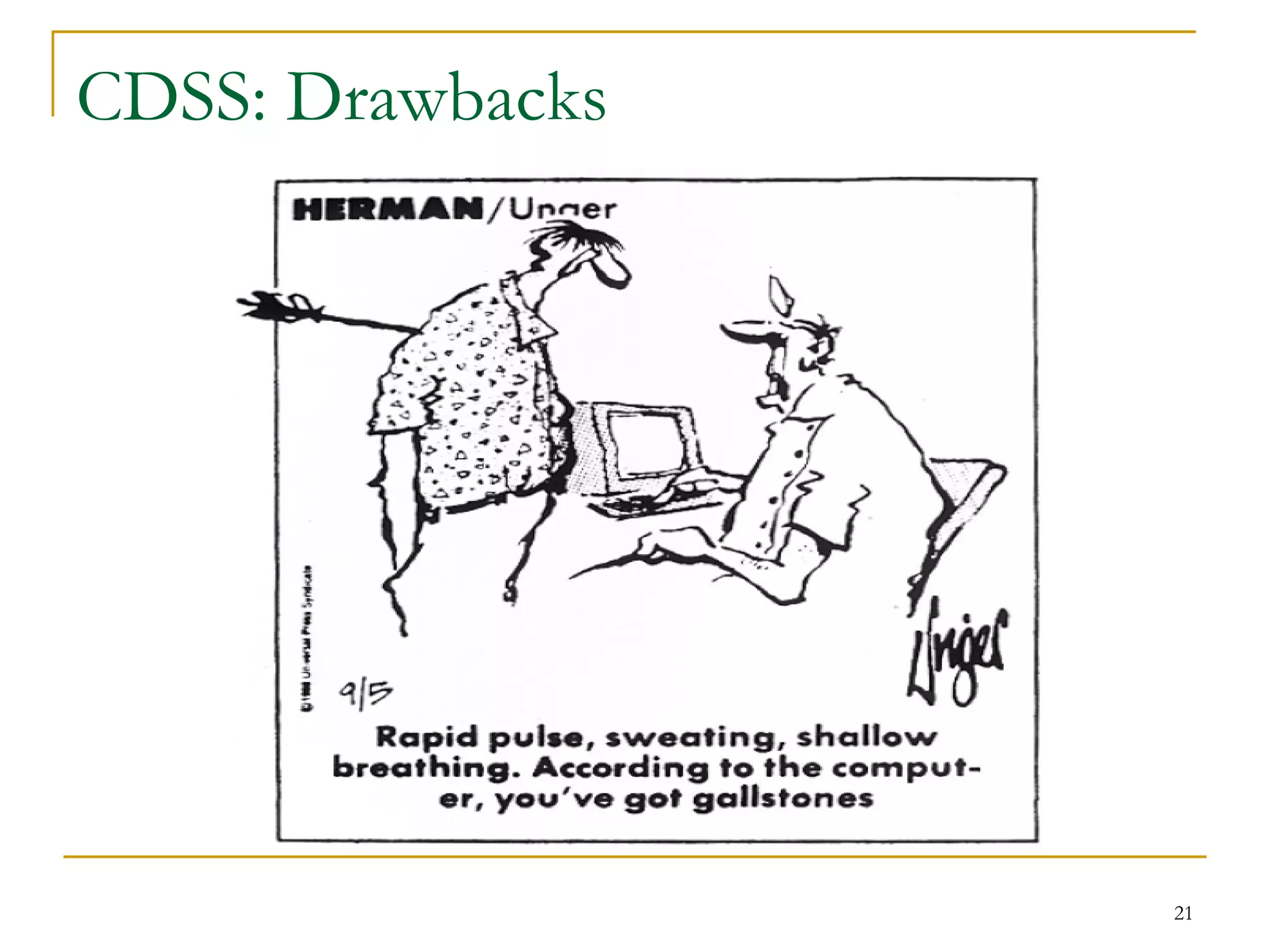
CDSS reasons forfailure. Dependence on electronic patient record. Challenging task of interaction between technologies and organizations. Only as effective as the underlying Knowledge base, needs constant updating. Additional effort (already busy, overworked) Resist to Change Computer Literacy
25.
CDSS Integration Objectives:Critical Evaluation Identifying main factors involved Understand that Healthcare is Complex and Patient focused Efficient Data Management Tracking the “Alerts” Standardization/Interoperability
26.
Evaluation ProblemDefinition Potential for Errors Change Issues Measure Outcomes Implementation
27.
CDSS: Summary Possiblein a complex healthcare environment Has to fit in to the workflow Enhance patient safety features
28.
Conclusion The futureof CDSS depends on removal of barriers to implementation. Continue to have profound effect on medical education Trained clinicians will always be required, the key is cooperative relationship between physician and computer based decision making tool


![What are CDSS’s “ active knowledge systems which use two or more items of patient data to generate case-specific advise” [Wyatt J, Spiegelhalter D, 1991].](https://image.slidesharecdn.com/hinf6101clinical-decision-support-systemssunil-1228782556800639-8/75/Clinical-Decision-Support-Systems-Sunil-Nair-Health-Informatics-Dalhousie-University-3-2048.jpg)











![[PPT] Hospital management system - Quanta-his](https://cdn.slidesharecdn.com/ss_thumbnails/quanta-his-ppt-140528045523-phpapp01-thumbnail.jpg?width=640&height=640&fit=bounds)


![[Hongsermeier] clinical decision support services amdis final](https://cdn.slidesharecdn.com/ss_thumbnails/hongsermeierclinicaldecisionsupportservicesamdisfinal-131009123754-phpapp01-thumbnail.jpg?width=640&height=640&fit=bounds)


