WHY STUDY The Structure of Crystalline
Solids?
The properties of some materials are directly related to
their crystal structures. i.e. pure and undeformed
magnesium and beryllium, having one crystal structure,
are much more brittle (lower degrees of deformation) than
are pure and undeformed metals such as gold and silver
that have yet another crystal structure.
Aknowledge of the crystal structure for iron helps us
understand transformations that occur when steels are
heat treated to improve their mechanical properties.
Furthermore, significant property differences exist
between crystalline and noncrystalline materials having
the samecomposition.
Learning
Objective
ISSUES TO ADDRESS...
Difference in atomic/molecular structure between
crystalline and noncrystalline materials.
unit cells for face-centered cubic, body centered
cubic, and hexagonal close-packed crystal structures.
Distinguish between single crystals and
polycrystalline materials.
Define isotropy and anisotropy with respect to
material properties.
A crystalline material is one in which the atoms are situated
in an orderly, repeating pattern extending in all three
dimension .i.e.Nacl ,CsFetc.
crystalline solids depend on the crystal structure of the
material, the manner in which atoms, ions, or molecules are
spatially(three dimension) arranged.
lattice is used in the context of crystal structures; in this
sense lattice means athree-dimensional arrayof points
coinciding with atom positions (or sphere centers).
Amorphous solid is one in which the atom are not situated
in an orderly, repeating pattern. i.e. glass , rubber, plastic etc.
Amorphous solid don’t have sharp melting point that is
why particle of glass soften over temperature range.
ENERGY AND
PACKING
ENERGY AND PACKING
• Non dense, randompacking
Dense, regular-packed structures tend to have lower energy
Crystalline solid Amorphous solid
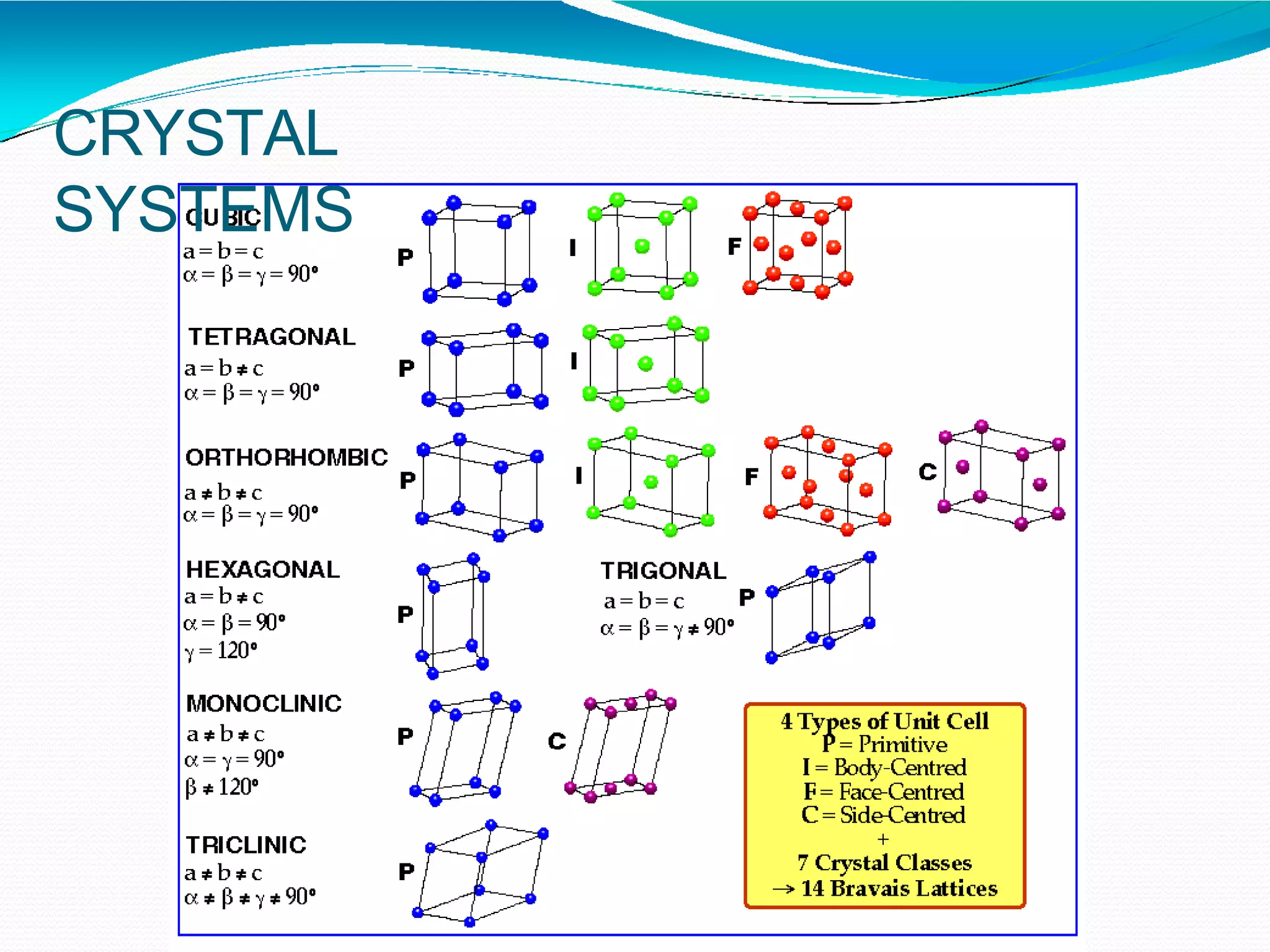
The smallest repeating unit in a crystal is a unit cell.
Three-dimensional packing of unit cells produces the
crystal lattice.
There are seven different unit cells:
• Cubic: All three axes have same length and intercept at
right angles.
• Tetragonal: The three axes intercept at right angles, but
one axis is longer or shorter than the other twoequal axes.
• Hexagonal: Three of the four axes arein one plane,
intercept at 120°,andareof the same length.
• Trigonal(rhombohedral): Sameaxes as hexagonal,
but angle lie b/wright angle to 120°.
• Orthorhombic: The three axes areof different lengths
andareat right angles to each other.
Monoclinic: The three axes areof different lengths and
twoareat right angles to each other. The third axis is
inclined.
Triclinic: All three axes areof different lengths andform
oblique angles.
CRYSTAL
SYSTEMS
Metallic Crystal
Structures
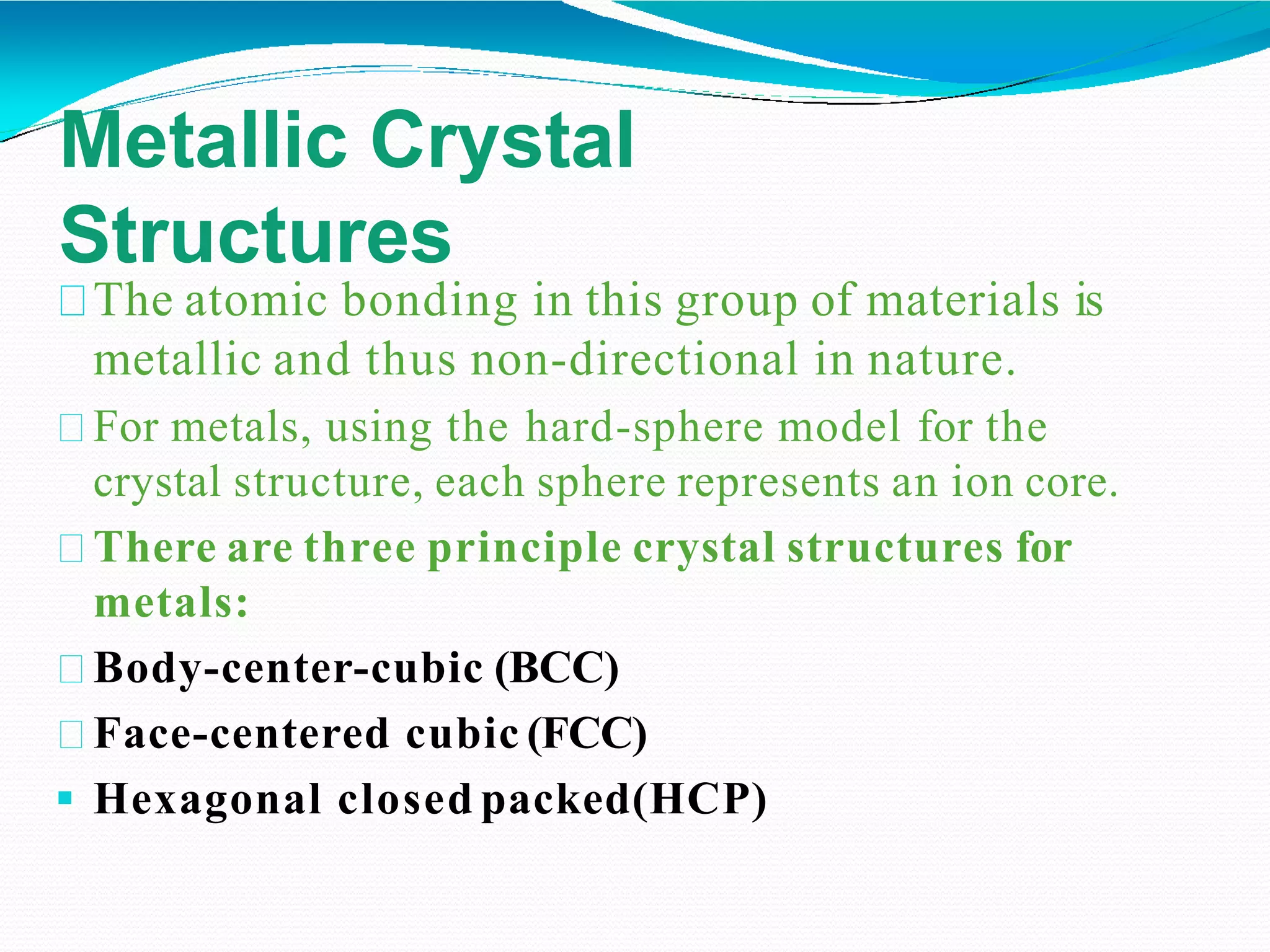
The atomic bonding in this group of materials is
metallic and thus non-directional in nature.
For metals, using the hard-sphere model for the
crystal structure, each sphere represents an ion core.
There are three principle crystal structures for
metals:
Body-center-cubic (BCC)
Face-centered cubic (FCC)
 Hexagonal closed packed(HCP)
BODY CENTERED CUBIC
STRUCTURE
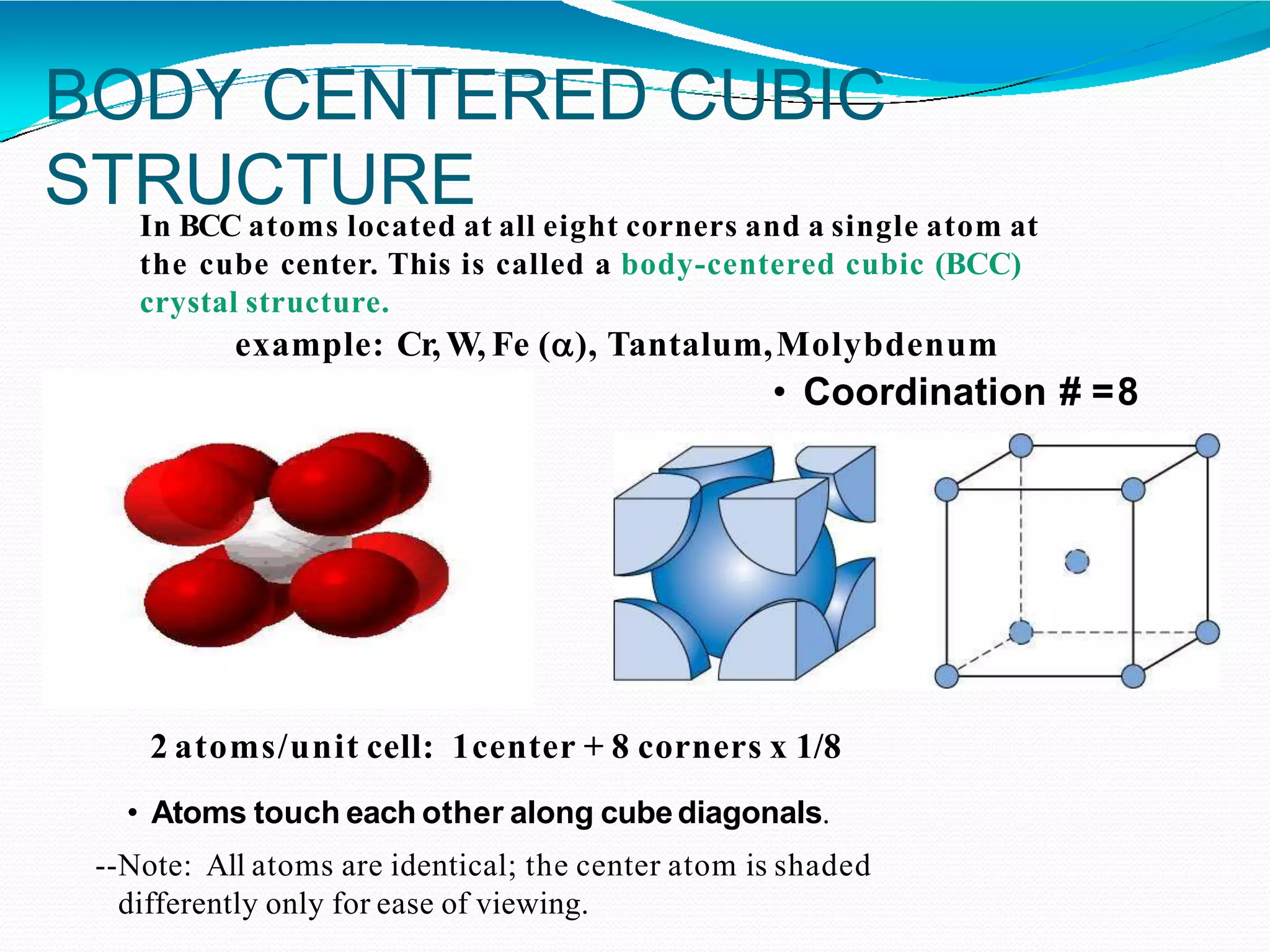
2 atoms/unit cell: 1center + 8 corners x 1/8
• Atoms touch each other along cubediagonals.
--Note: All atoms are identical; the center atom is shaded
differently only for ease of viewing.
In BCC atoms located at all eight corners and a single atom at
the cube center. This is called a body-centered cubic (BCC)
crystal structure.
example: Cr, W, Fe (), Tantalum,Molybdenum
• Coordination # =8
ATOMIC PACKING
FACTOR:
BC
C
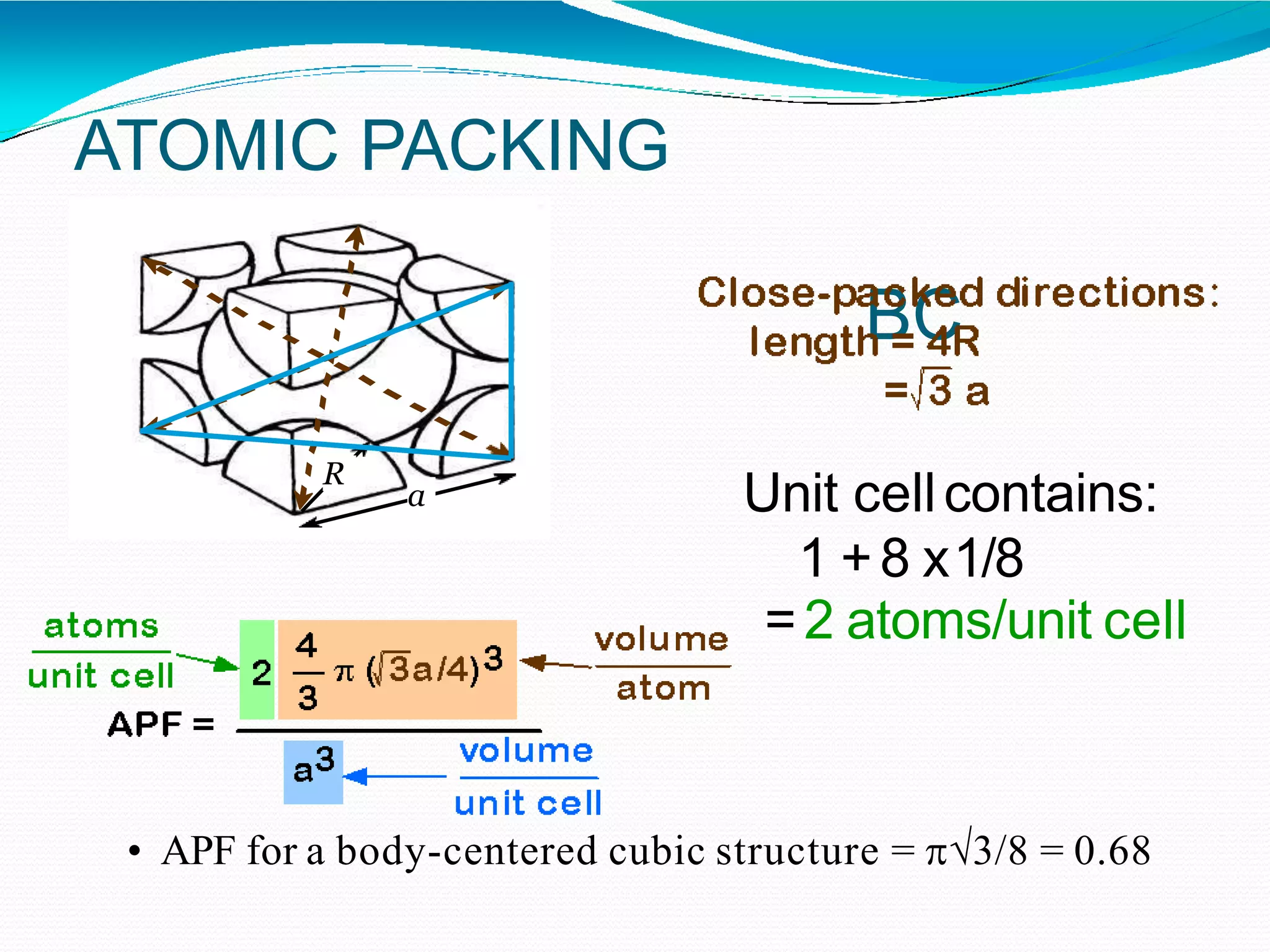
Unit cellcontains:
1 +8 x1/8
=2 atoms/unit cell
• APF for a body-centered cubic structure = 3/8 = 0.68
a
R
FACE CENTERED CUBIC
STRUCTURE (FCC)
4 atoms/unit cell: 6 face x 1/2 + 8 corners x 1/8
Atoms touch each other along face diagonals.
--Note: All atoms are identical; the face-centered atoms are shaded
differently only for ease of viewing.
In FCCatoms located at each of the corners and the centers
of all the cube faces. This is called the face-centered cubic
(FCC) crystal structure.
example: Al, Cu, Au, Pb, Ni, Pt, Ag
Coordination # =12
ATOMIC PACKING
FACTOR:
FC
C Unitcell contains:
6 x 1/2 + 8 x 1/8
= 4 atoms/unit cell
a
2 a
APF =
4
3
 ( 2 a/4 ) 3
4
atoms
unit cell atom
volume
a 3
unit cell
volume
• APF for a face-centered cubic structure = 0.74
Asites
C sites
• ABCABC... Stacking Sequence
• 2D Projection
• FCC Unit Cell
B
B
B
B
B sites
C
B
C
B
C
B
A
A
B
C
FCC Stacking Sequence
Hexagonal Close-Packed
Structure
(HCP)
• ABAB... Stacking Sequence
• 3D Projection • 2D Projection
c
Asites
B sites
Asites
Bottom layer
Top layer
Middle layer
a
• Coordination # =12
• APF = 0.74
• c/a =1.633
6 atoms/unit cell
ex: Cd, Mg,Ti, Zn
Close packed crystals
…ABCABCABC…packing
[Face Centered Cubic(FCC)]
…ABABAB…packing
[Hexagonal Close Packing (HCP)]
Aplane
Bplane
C plane
Aplane
COMPARISON OF
CRYSTAL
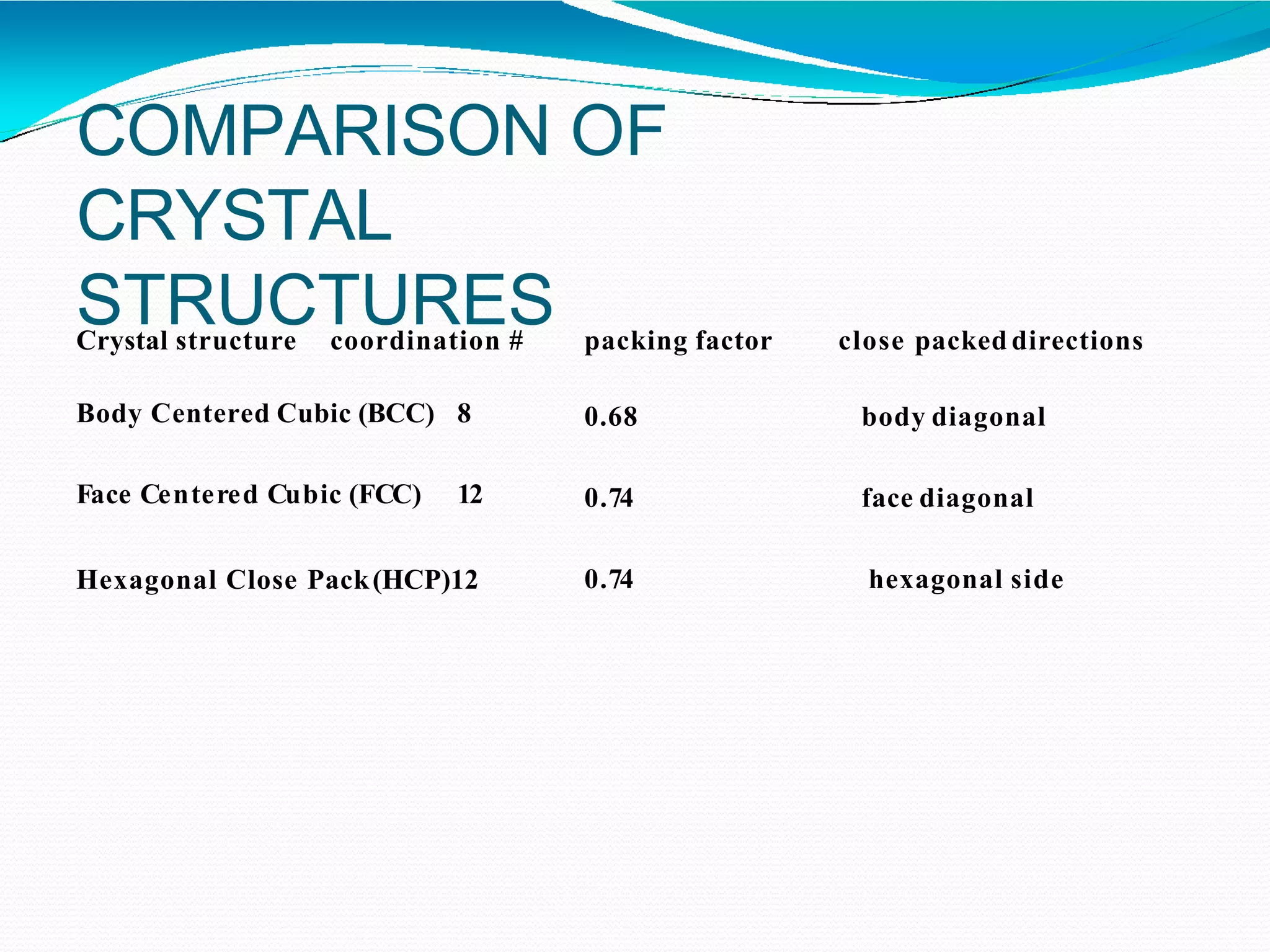
STRUCTURES packing factor close packed directions
0.68 body diagonal
0.74 face diagonal
Crystal structure coordination #
Body Centered Cubic (BCC) 8
Face Centered Cubic (FCC) 12
Hexagonal Close Pack(HCP)12 0.74 hexagonal side
SINGLE VS
POLYCRYSTALS
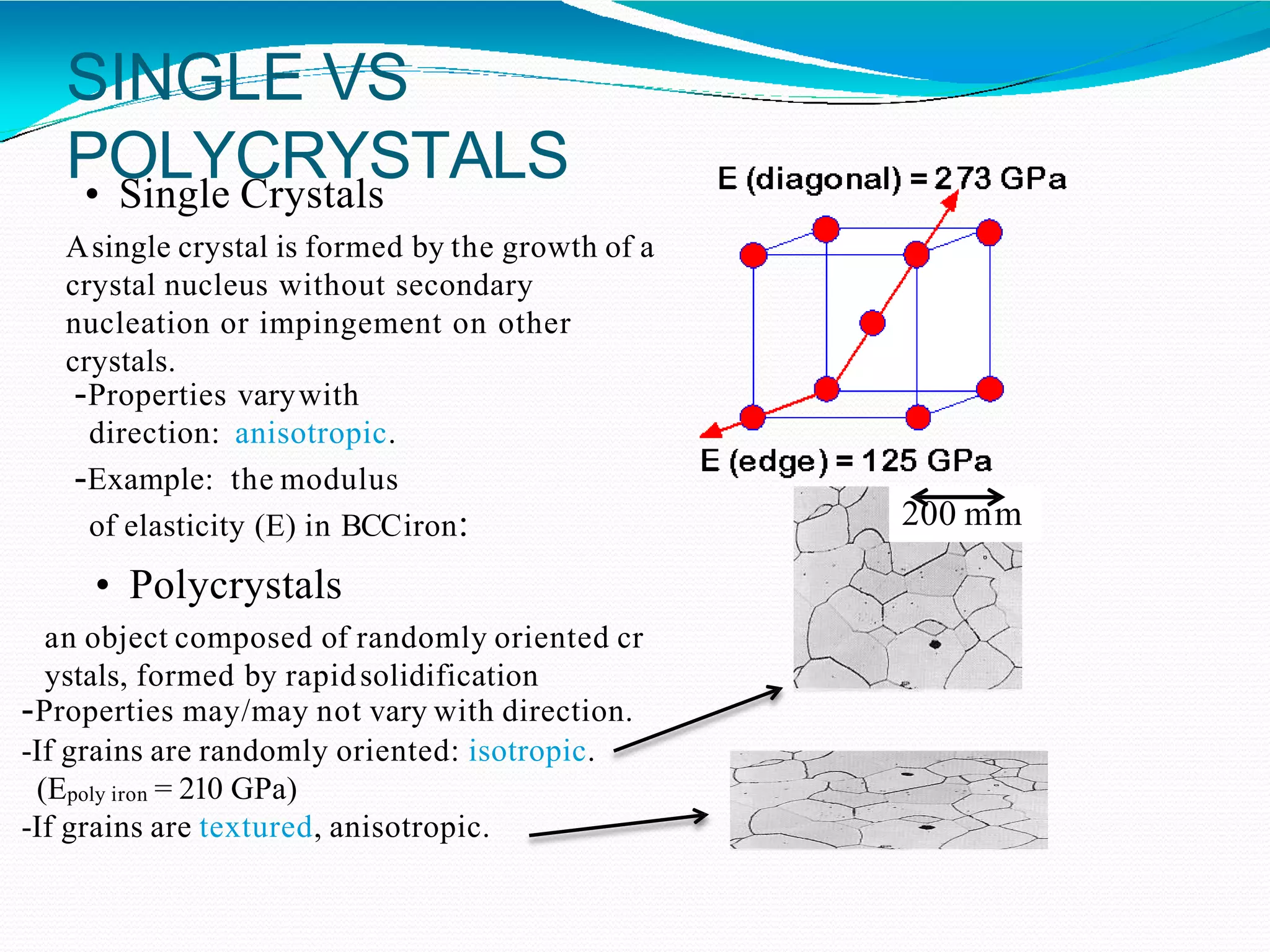
• Single Crystals
Asingle crystal is formed by the growth of a
crystal nucleus without secondary
nucleation or impingement on other
crystals.
-Properties varywith
direction: anisotropic.
-Example: the modulus
of elasticity (E) in BCCiron:
• Polycrystals
an object composed of randomly oriented cr
ystals, formed by rapidsolidification
-Properties may/may not vary with direction.
-If grains are randomly oriented: isotropic.
(Epoly iron = 210 GPa)
-If grains are textured, anisotropic.
200 mm
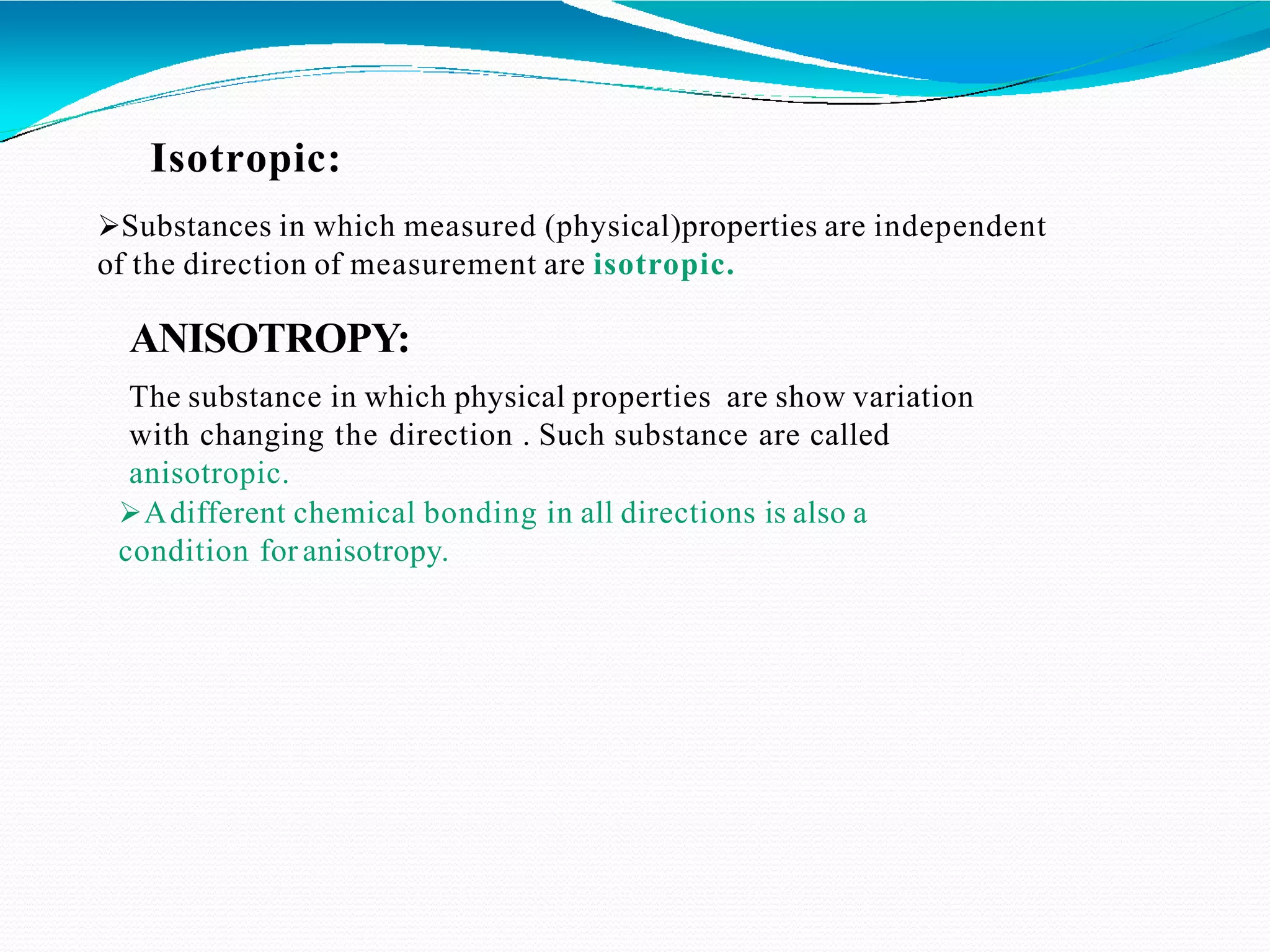
Isotropic:
Substances in which measured (physical)properties are independent
of the direction of measurement are isotropic.
ANISOTROPY:
The substance in which physical properties are show variation
with changing the direction . Such substance are called
anisotropic.
Adifferent chemical bonding in all directions is also a
condition foranisotropy.
SUMMARY
• Atoms may assemble into crystalline,
polycrystalline or amorphous structures.
• We can predict the density of a material,
provided we know the atomic weight, atomic
radius, and crystal geometry (e.g., FCC,
BCC, HCP).
• Material properties generally vary with single
crystal orientation (i.e., they are anisotropic),
but properties are generally non-directional
(i.e., they are isotropic) in polycrystals with
randomly oriented grains.

crystal structure of metal.pptx

  • 2.
    WHY STUDY TheStructure of Crystalline Solids? The properties of some materials are directly related to their crystal structures. i.e. pure and undeformed magnesium and beryllium, having one crystal structure, are much more brittle (lower degrees of deformation) than are pure and undeformed metals such as gold and silver that have yet another crystal structure. Aknowledge of the crystal structure for iron helps us understand transformations that occur when steels are heat treated to improve their mechanical properties. Furthermore, significant property differences exist between crystalline and noncrystalline materials having the samecomposition.
  • 3.
    Learning Objective ISSUES TO ADDRESS... Differencein atomic/molecular structure between crystalline and noncrystalline materials. unit cells for face-centered cubic, body centered cubic, and hexagonal close-packed crystal structures. Distinguish between single crystals and polycrystalline materials. Define isotropy and anisotropy with respect to material properties.
  • 4.
    A crystalline materialis one in which the atoms are situated in an orderly, repeating pattern extending in all three dimension .i.e.Nacl ,CsFetc. crystalline solids depend on the crystal structure of the material, the manner in which atoms, ions, or molecules are spatially(three dimension) arranged. lattice is used in the context of crystal structures; in this sense lattice means athree-dimensional arrayof points coinciding with atom positions (or sphere centers). Amorphous solid is one in which the atom are not situated in an orderly, repeating pattern. i.e. glass , rubber, plastic etc. Amorphous solid don’t have sharp melting point that is why particle of glass soften over temperature range.
  • 5.
    ENERGY AND PACKING ENERGY ANDPACKING • Non dense, randompacking Dense, regular-packed structures tend to have lower energy
  • 6.
  • 7.
    The smallest repeatingunit in a crystal is a unit cell. Three-dimensional packing of unit cells produces the crystal lattice. There are seven different unit cells: • Cubic: All three axes have same length and intercept at right angles. • Tetragonal: The three axes intercept at right angles, but one axis is longer or shorter than the other twoequal axes. • Hexagonal: Three of the four axes arein one plane, intercept at 120°,andareof the same length.
  • 8.
    • Trigonal(rhombohedral): Sameaxesas hexagonal, but angle lie b/wright angle to 120°. • Orthorhombic: The three axes areof different lengths andareat right angles to each other. Monoclinic: The three axes areof different lengths and twoareat right angles to each other. The third axis is inclined. Triclinic: All three axes areof different lengths andform oblique angles.
  • 9.
  • 10.
    Metallic Crystal Structures The atomicbonding in this group of materials is metallic and thus non-directional in nature. For metals, using the hard-sphere model for the crystal structure, each sphere represents an ion core. There are three principle crystal structures for metals: Body-center-cubic (BCC) Face-centered cubic (FCC)  Hexagonal closed packed(HCP)
  • 11.
    BODY CENTERED CUBIC STRUCTURE 2atoms/unit cell: 1center + 8 corners x 1/8 • Atoms touch each other along cubediagonals. --Note: All atoms are identical; the center atom is shaded differently only for ease of viewing. In BCC atoms located at all eight corners and a single atom at the cube center. This is called a body-centered cubic (BCC) crystal structure. example: Cr, W, Fe (), Tantalum,Molybdenum • Coordination # =8
  • 12.
    ATOMIC PACKING FACTOR: BC C Unit cellcontains: 1+8 x1/8 =2 atoms/unit cell • APF for a body-centered cubic structure = 3/8 = 0.68 a R
  • 13.
    FACE CENTERED CUBIC STRUCTURE(FCC) 4 atoms/unit cell: 6 face x 1/2 + 8 corners x 1/8 Atoms touch each other along face diagonals. --Note: All atoms are identical; the face-centered atoms are shaded differently only for ease of viewing. In FCCatoms located at each of the corners and the centers of all the cube faces. This is called the face-centered cubic (FCC) crystal structure. example: Al, Cu, Au, Pb, Ni, Pt, Ag Coordination # =12
  • 14.
    ATOMIC PACKING FACTOR: FC C Unitcellcontains: 6 x 1/2 + 8 x 1/8 = 4 atoms/unit cell a 2 a APF = 4 3  ( 2 a/4 ) 3 4 atoms unit cell atom volume a 3 unit cell volume • APF for a face-centered cubic structure = 0.74
  • 15.
    Asites C sites • ABCABC...Stacking Sequence • 2D Projection • FCC Unit Cell B B B B B sites C B C B C B A A B C FCC Stacking Sequence
  • 16.
    Hexagonal Close-Packed Structure (HCP) • ABAB...Stacking Sequence • 3D Projection • 2D Projection c Asites B sites Asites Bottom layer Top layer Middle layer a • Coordination # =12 • APF = 0.74 • c/a =1.633 6 atoms/unit cell ex: Cd, Mg,Ti, Zn
  • 17.
    Close packed crystals …ABCABCABC…packing [FaceCentered Cubic(FCC)] …ABABAB…packing [Hexagonal Close Packing (HCP)] Aplane Bplane C plane Aplane
  • 18.
    COMPARISON OF CRYSTAL STRUCTURES packingfactor close packed directions 0.68 body diagonal 0.74 face diagonal Crystal structure coordination # Body Centered Cubic (BCC) 8 Face Centered Cubic (FCC) 12 Hexagonal Close Pack(HCP)12 0.74 hexagonal side
  • 19.
    SINGLE VS POLYCRYSTALS • SingleCrystals Asingle crystal is formed by the growth of a crystal nucleus without secondary nucleation or impingement on other crystals. -Properties varywith direction: anisotropic. -Example: the modulus of elasticity (E) in BCCiron: • Polycrystals an object composed of randomly oriented cr ystals, formed by rapidsolidification -Properties may/may not vary with direction. -If grains are randomly oriented: isotropic. (Epoly iron = 210 GPa) -If grains are textured, anisotropic. 200 mm
  • 20.
    Isotropic: Substances in whichmeasured (physical)properties are independent of the direction of measurement are isotropic. ANISOTROPY: The substance in which physical properties are show variation with changing the direction . Such substance are called anisotropic. Adifferent chemical bonding in all directions is also a condition foranisotropy.
  • 21.
    SUMMARY • Atoms mayassemble into crystalline, polycrystalline or amorphous structures. • We can predict the density of a material, provided we know the atomic weight, atomic radius, and crystal geometry (e.g., FCC, BCC, HCP). • Material properties generally vary with single crystal orientation (i.e., they are anisotropic), but properties are generally non-directional (i.e., they are isotropic) in polycrystals with randomly oriented grains.