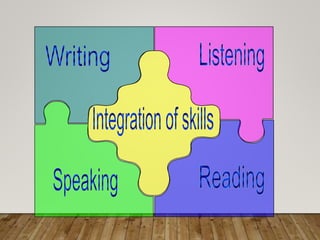
INTEGRATING
SKILLS
DAY 2
LEARNING A LANGUAGE
• Not only acquisition of language.
• Not just something we learn about.
• Rather, a set of skills, something we learn to do. So,
students need meaningful and interactive practice in
the skills, in order to learn to USE the language.
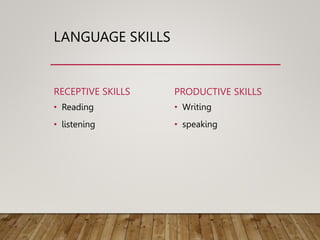
LANGUAGE SKILLS
RECEPTIVE SKILLS
• Reading
• listening
PRODUCTIVE SKILLS
• Writing
• speaking
LEARNING LANGUAGE SKILLS
• The four language skills
• Communication skills
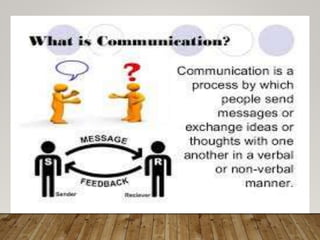
COMMUNICATION
COMMUNICATION
primary skills
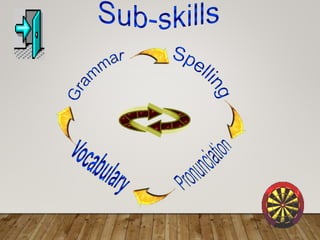
sub-skills
facial
expressions
gestures
Understanding
of culture
space
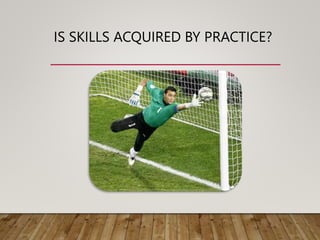
IS SKILLS ACQUIRED BY PRACTICE?
• The ability to do something well needs to continue
to be consolidated and practised or we can easily
lose our skill
• If Essam El-Hadri stopped practising, would he
continue to be a skilled goalkeeper?
1.What are the challenges that you face when your
students deal with this skill in class?
2. Select three of these challenges and discuss
possible solutions for them?
3. reflect on your teaching experience and tell
your group about a way proved to be effective
when dealing with that skill?
WHY IS IT USEFUL TO INTEGRATE
SKILLS
• It allows for the practice of Lg. as in the real world.
• Integrated lessons are more satisfying for learners.
They offer more variety
• One single topic can be fully explored, and
vocabulary can be practised and recycled.
• The same context or text can be used for another
activity, so the teacher does not have to waste time
setting up something new.
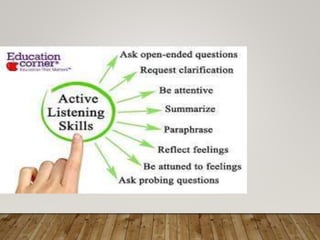
LISTENING
LISTENING
• “Listening” is receiving language through the ears.
Listening involves identifying the sounds of speech and
processing them into words and sentences. When we
listen, we use our ears to receive individual sounds (letters,
stress, rhythm and pauses) and we use our brain to convert
these into messages that mean something to us.
• Listening is any language requires focus and attention. It is
a skill that some people need to work at harder than
others. In addition, teaching the learners a lot of listening
activities is a good way of enlarging their vocabulary.
People who have difficulty concentrating are typically poor
listeners.
• we learn this skill by listening to people who already
know how to speak the language. This may or may not
include native speakers. For practice, we can listen to live
or recorded voices. The most important thing is to listen
to a variety voices as often as you can.
• to become a fluent speaker in English, we need to
develop strong listening skills. Listening is not only help
we understand what people are saying to us, but it also
helps us to speak clearly to other people. It helps us learn
how to pronounce word properly, how to use intonation
and where to place stress in words and sentences.
• Good listening skills bring benefits to our personal
lives including a greater number of friends and social
networks, improved self-esteem and confidence,
higher grades at school and academic work and even
better health and general well-being.
SPEAKING
SPEAKING
• “Speaking” is the delivery language through the mouth. Speaking
is also known as the productive skill in the oral mode. It, like the
other skills, is more complicated and it seems at first and involves
more than just pronouncing words. To speak, we create sounds
using many parts of our body including the lungs, vocal tract,
vocal chords, tongue, teeth and lips.
• This vocalized form of language usually
requires at least one listener. When two or
more people speak or talk to each other, the
conversation is called a “dialogue”. In
addition, speech can flow naturally from one
person to another in the form of dialogue. It
can also be planned and rehearsal as in the
delivery of a speech or presentation. Of
course, some people talk to themselves! In
fact, some English learners practice speaking
standing alone in front of a mirror.
• There are three kinds of speaking situation
Interactive speaking situations include face-to-
face conversations and telephone calls, in which
we have a chance to ask for clarification,
repetition, or slower speech from our
conversation partner.
• in partially interactive situations it involve
giving a speech to the audience and no
interruption during the speech. The speaker
nevertheless can see the audience and judge
from the expressions on their faces and body
language whether or not he or she is
understood.
• speaking can be formal or informal. Informal
speaking is typically used with family and
friends or people you know well. Formal
speaking occurs in business or academic
situations or when meeting people for the
first time. Speaking is probably the language
skill that most language learners wish to
perfect as soon as possible. Fluently
• in speaking can help build up our confidence
level while speaking to others.
READING
READING
• “Reading” is the receptive skill in the written mode. It
can develop independently of listening and speaking
skills, but often develops along with them especially in
societies with a highly-developed literary tradition.
Reading can help build vocabulary that helps listening
comprehension at the later stages, particularly.
• In other words, reading is the process of looking at a
series of written symbols and getting meaning to them.
When we read, we use our eyes to receive written
symbols(letters, punctuation marks and spaces) and we
use our brain to convert them into words, sentences
and paragraphs that communicate something to us.
• Reading can be silent (in our head) or aloud (so that
other can hear). Reading is an important way to of
gaining information in language learning and it is a
basic for a language learner. Therefore reading skills
refer to the specific abilities that enable a person to
read with independence and interact with the message.
• Reading is therefore a highly valuable skill and activity,
and it is recommended that English learners try to read
as much as possible in English. Moreover, reading is a
complex cognitive process of decoding symbols in
order to construct or derive meaning. Like all language,
it is a complex interaction between the text and the
reader which is shaped by the reader’s prior knowledge,
experiences, attitude and language community which is
culturally and socially situated.
• reading process requires continues practice,
development, refinement, creativity and critical
analysis.
WRITING
WRITING
• “Writing” is the process of using symbols (letters of the alphabet,
punctuation and spaces) to communicate thoughts and ideas in a
readable form. Writing is the productive skill in the written mode. It
too is more complicated and often seems to be the hardest of the
skills, even for native speakers of a language, since it involves not just
a graphic representation of speech, but the development and
presentation of thoughts in a structured way.
• To write clearly, it is essential to understand the basic system of a
language. In English, this includes knowledge of grammar, punctuation
and sentence structure.
• Vocabulary is also necessary, as is correct spelling and formatting. The
result of writing is generally called text, and the recipient of text is
called a reader.
• Nowadays, motivation for writing includes publication,
storytelling, correspondence and diary. Writing also has been
instrumental in keeping history, dissemination of knowledge
through the media and the formation of legal systems.
• A writer may write for a personal enjoyment or use, or for an
audience of one person or more. The audience may be known
(targeted) or unknown. Taking notes for study purposes is an
example of writing to one’s self. Blogging publicly is an example
of an unknown audience. A letter to a friend is an example of
writing for a targeted audience. As with speaking, it is important
to consider your audience when writing.
• There are many different styles of writing, from informal to
formal
• Therefore, the four language skills are related and
connected to each other in two ways; which is the
direction of communication (in or out) and the
method of communication (spoken or written). This
four language skills or sometime called the “macro-
skills” are very important and necessity in towards
learning a second language.
COMMUNICATION SKILLS
• Verbal skills
• Nonverbal skills
Steps of a listening lesson Activities
1. Pre-listening activity to activate students’
knowledge on the topic of the text.
2. Listening for a general understanding (listening for
gist).
3. Listening for a more detailed understanding of
information in the text.
4. Very detailed listening for language (vocabulary,
grammar, phonology) in the text.
5. Follow-on speaking activity.
1
a. Reading to get detailed information from the text.
(intensive reading )
b. Reading a text o locate a specific piece of information
such as a word or a number or a time. It is not necessary
to understand the whole text in order to do
(scan reading )
c. Either guessing the meaning of new vocabulary in a
text or understanding meaning or a message in the text
that is not immediately obvious. (inferring
2
d. Reading to get a general but not detailed
understanding of the text.
(skim / gist reading )
e. Reading longer texts frequently over a period of
time. This is usually done independently and not in
the classroom. (extensive reading)
f. Looking at headlines, pictures and layout to guess
what you think a text will be about.
(prediction)
2
2
1- prediction 2-skim / gist reading
3 -scan reading 4-intensive reading
5-inferring meaning 6-extensive reading
Texts for reading Sub-skills Strategies
a. A novel that you are really enjoying
6
b. A couple of unknown words in a text that is included in
an exam you are doing.
5
c. A telephone directory.
3
d. A series of articles, only some of which will be useful to
you, for a report you’re writing.
2
e. A travel brochure when you are trying to decide on a
holiday destination.
2/3
f. A job advertisement for a job that you are really
interested in.
4
3
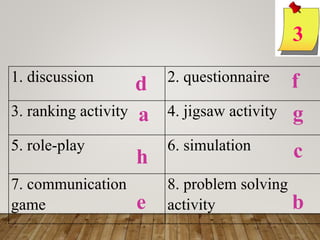
1. discussion 2. questionnaire
3. ranking activity 4. jigsaw activity
5. role-play 6. simulation
7. communication
game
8. problem solving
activity
h
d
a
e
f
g
c
b
4
Steps of a Writing Lesson Order
a.
Students brainstorm ideas for their own text.
b. The teacher checks understanding of the
model text using some kind of comprehension
task.
c. Students write their final draft of the text.
d. Students do an activity that aims to practise
the highlighted written feature.
6
5
9
3
4
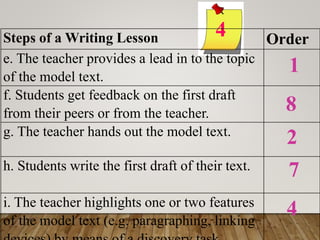
Steps of a Writing Lesson Order
e. The teacher provides a lead in to the topic
of the model text.
f. Students get feedback on the first draft
from their peers or from the teacher.
g. The teacher hands out the model text.
h. Students write the first draft of their text.
i. The teacher highlights one or two features
of the model text (e.g. paragraphing, linking
1
8
2
4
7
5
1) d
2) c
3) e
4) a
5) f
6) b
1
9
4
2
8
6
3
7
5
6
• When we integrate things, they combine, or work together to make
something more effective
• An integrated system or organisation combines different groups or
ideas in a way that works well
What does integrated mean?
• In real life, language skills never occur in isolation.
Often the use of one skill leads on naturally to
another.
• In conversations, we listen and speak.
• When filling in a form, we read and write.
• When taking notes, we listen and write.
• We see a situation, and we talk about it later.
HOW TO INTEGRATE IN A LESSON?
• As in real life, skills are integrated with one activity
leading on to another:
• ‘The learner must develop skills and
strategies for using language to
communicate meanings as effectively as
possible’
(Littlewood, 2001)
Integrating skills
• ‘Language skills are integrated; they
‘cooperate’ with each other’
(Lucantoni, 2002)
• ‘Language users employ a combination
of skills at the same time’
(Harmer, 1991)
Integrating skills
WHY IS IT USEFUL TO INTEGRATE SKILLS?
• It allows for the practice of Lg. as in the real world.
• Integrated lessons are more satisfying for learners. They offer more
variety
• One single topic can be fully explored, and vocabulary can be
practised and recycled.
• The same context or text can be used for another activity, so the
teacher does not have to waste time setting up something new.
Using the
language skills
together can
lead to
Teaching
effectiveness
Lessons will be
more interesting
Lessons will be
more motivating
Create
active
learning
environment
Language
retention

integration the four language skill.pptx

  • 1.
  • 4.
    LEARNING A LANGUAGE •Not only acquisition of language. • Not just something we learn about. • Rather, a set of skills, something we learn to do. So, students need meaningful and interactive practice in the skills, in order to learn to USE the language.
  • 5.
    LANGUAGE SKILLS RECEPTIVE SKILLS •Reading • listening PRODUCTIVE SKILLS • Writing • speaking
  • 6.
    LEARNING LANGUAGE SKILLS •The four language skills • Communication skills
  • 7.
  • 9.
  • 11.
    IS SKILLS ACQUIREDBY PRACTICE?
  • 12.
    • The abilityto do something well needs to continue to be consolidated and practised or we can easily lose our skill • If Essam El-Hadri stopped practising, would he continue to be a skilled goalkeeper?
  • 13.
    1.What are thechallenges that you face when your students deal with this skill in class? 2. Select three of these challenges and discuss possible solutions for them? 3. reflect on your teaching experience and tell your group about a way proved to be effective when dealing with that skill?
  • 14.
    WHY IS ITUSEFUL TO INTEGRATE SKILLS • It allows for the practice of Lg. as in the real world. • Integrated lessons are more satisfying for learners. They offer more variety • One single topic can be fully explored, and vocabulary can be practised and recycled. • The same context or text can be used for another activity, so the teacher does not have to waste time setting up something new.
  • 15.
  • 16.
    LISTENING • “Listening” isreceiving language through the ears. Listening involves identifying the sounds of speech and processing them into words and sentences. When we listen, we use our ears to receive individual sounds (letters, stress, rhythm and pauses) and we use our brain to convert these into messages that mean something to us. • Listening is any language requires focus and attention. It is a skill that some people need to work at harder than others. In addition, teaching the learners a lot of listening activities is a good way of enlarging their vocabulary. People who have difficulty concentrating are typically poor listeners.
  • 17.
    • we learnthis skill by listening to people who already know how to speak the language. This may or may not include native speakers. For practice, we can listen to live or recorded voices. The most important thing is to listen to a variety voices as often as you can. • to become a fluent speaker in English, we need to develop strong listening skills. Listening is not only help we understand what people are saying to us, but it also helps us to speak clearly to other people. It helps us learn how to pronounce word properly, how to use intonation and where to place stress in words and sentences.
  • 18.
    • Good listeningskills bring benefits to our personal lives including a greater number of friends and social networks, improved self-esteem and confidence, higher grades at school and academic work and even better health and general well-being.
  • 21.
  • 22.
    SPEAKING • “Speaking” isthe delivery language through the mouth. Speaking is also known as the productive skill in the oral mode. It, like the other skills, is more complicated and it seems at first and involves more than just pronouncing words. To speak, we create sounds using many parts of our body including the lungs, vocal tract, vocal chords, tongue, teeth and lips.
  • 23.
    • This vocalizedform of language usually requires at least one listener. When two or more people speak or talk to each other, the conversation is called a “dialogue”. In addition, speech can flow naturally from one person to another in the form of dialogue. It can also be planned and rehearsal as in the delivery of a speech or presentation. Of course, some people talk to themselves! In fact, some English learners practice speaking standing alone in front of a mirror.
  • 24.
    • There arethree kinds of speaking situation Interactive speaking situations include face-to- face conversations and telephone calls, in which we have a chance to ask for clarification, repetition, or slower speech from our conversation partner. • in partially interactive situations it involve giving a speech to the audience and no interruption during the speech. The speaker nevertheless can see the audience and judge from the expressions on their faces and body language whether or not he or she is understood.
  • 25.
    • speaking canbe formal or informal. Informal speaking is typically used with family and friends or people you know well. Formal speaking occurs in business or academic situations or when meeting people for the first time. Speaking is probably the language skill that most language learners wish to perfect as soon as possible. Fluently • in speaking can help build up our confidence level while speaking to others.
  • 26.
  • 27.
    READING • “Reading” isthe receptive skill in the written mode. It can develop independently of listening and speaking skills, but often develops along with them especially in societies with a highly-developed literary tradition. Reading can help build vocabulary that helps listening comprehension at the later stages, particularly. • In other words, reading is the process of looking at a series of written symbols and getting meaning to them. When we read, we use our eyes to receive written symbols(letters, punctuation marks and spaces) and we use our brain to convert them into words, sentences and paragraphs that communicate something to us.
  • 28.
    • Reading canbe silent (in our head) or aloud (so that other can hear). Reading is an important way to of gaining information in language learning and it is a basic for a language learner. Therefore reading skills refer to the specific abilities that enable a person to read with independence and interact with the message. • Reading is therefore a highly valuable skill and activity, and it is recommended that English learners try to read as much as possible in English. Moreover, reading is a complex cognitive process of decoding symbols in order to construct or derive meaning. Like all language, it is a complex interaction between the text and the reader which is shaped by the reader’s prior knowledge, experiences, attitude and language community which is culturally and socially situated.
  • 29.
    • reading processrequires continues practice, development, refinement, creativity and critical analysis.
  • 31.
  • 32.
    WRITING • “Writing” isthe process of using symbols (letters of the alphabet, punctuation and spaces) to communicate thoughts and ideas in a readable form. Writing is the productive skill in the written mode. It too is more complicated and often seems to be the hardest of the skills, even for native speakers of a language, since it involves not just a graphic representation of speech, but the development and presentation of thoughts in a structured way. • To write clearly, it is essential to understand the basic system of a language. In English, this includes knowledge of grammar, punctuation and sentence structure. • Vocabulary is also necessary, as is correct spelling and formatting. The result of writing is generally called text, and the recipient of text is called a reader.
  • 33.
    • Nowadays, motivationfor writing includes publication, storytelling, correspondence and diary. Writing also has been instrumental in keeping history, dissemination of knowledge through the media and the formation of legal systems. • A writer may write for a personal enjoyment or use, or for an audience of one person or more. The audience may be known (targeted) or unknown. Taking notes for study purposes is an example of writing to one’s self. Blogging publicly is an example of an unknown audience. A letter to a friend is an example of writing for a targeted audience. As with speaking, it is important to consider your audience when writing. • There are many different styles of writing, from informal to formal
  • 34.
    • Therefore, thefour language skills are related and connected to each other in two ways; which is the direction of communication (in or out) and the method of communication (spoken or written). This four language skills or sometime called the “macro- skills” are very important and necessity in towards learning a second language.
  • 36.
    COMMUNICATION SKILLS • Verbalskills • Nonverbal skills
  • 37.
    Steps of alistening lesson Activities 1. Pre-listening activity to activate students’ knowledge on the topic of the text. 2. Listening for a general understanding (listening for gist). 3. Listening for a more detailed understanding of information in the text. 4. Very detailed listening for language (vocabulary, grammar, phonology) in the text. 5. Follow-on speaking activity. 1
  • 38.
    a. Reading toget detailed information from the text. (intensive reading ) b. Reading a text o locate a specific piece of information such as a word or a number or a time. It is not necessary to understand the whole text in order to do (scan reading ) c. Either guessing the meaning of new vocabulary in a text or understanding meaning or a message in the text that is not immediately obvious. (inferring 2
  • 39.
    d. Reading toget a general but not detailed understanding of the text. (skim / gist reading ) e. Reading longer texts frequently over a period of time. This is usually done independently and not in the classroom. (extensive reading) f. Looking at headlines, pictures and layout to guess what you think a text will be about. (prediction) 2
  • 40.
    2 1- prediction 2-skim/ gist reading 3 -scan reading 4-intensive reading 5-inferring meaning 6-extensive reading Texts for reading Sub-skills Strategies a. A novel that you are really enjoying 6 b. A couple of unknown words in a text that is included in an exam you are doing. 5 c. A telephone directory. 3 d. A series of articles, only some of which will be useful to you, for a report you’re writing. 2 e. A travel brochure when you are trying to decide on a holiday destination. 2/3 f. A job advertisement for a job that you are really interested in. 4
  • 41.
    3 1. discussion 2.questionnaire 3. ranking activity 4. jigsaw activity 5. role-play 6. simulation 7. communication game 8. problem solving activity h d a e f g c b
  • 42.
    4 Steps of aWriting Lesson Order a. Students brainstorm ideas for their own text. b. The teacher checks understanding of the model text using some kind of comprehension task. c. Students write their final draft of the text. d. Students do an activity that aims to practise the highlighted written feature. 6 5 9 3
  • 43.
    4 Steps of aWriting Lesson Order e. The teacher provides a lead in to the topic of the model text. f. Students get feedback on the first draft from their peers or from the teacher. g. The teacher hands out the model text. h. Students write the first draft of their text. i. The teacher highlights one or two features of the model text (e.g. paragraphing, linking 1 8 2 4 7
  • 44.
    5 1) d 2) c 3)e 4) a 5) f 6) b
  • 45.
  • 47.
    • When weintegrate things, they combine, or work together to make something more effective • An integrated system or organisation combines different groups or ideas in a way that works well What does integrated mean?
  • 48.
    • In reallife, language skills never occur in isolation. Often the use of one skill leads on naturally to another. • In conversations, we listen and speak. • When filling in a form, we read and write. • When taking notes, we listen and write. • We see a situation, and we talk about it later.
  • 49.
    HOW TO INTEGRATEIN A LESSON? • As in real life, skills are integrated with one activity leading on to another:
  • 50.
    • ‘The learnermust develop skills and strategies for using language to communicate meanings as effectively as possible’ (Littlewood, 2001) Integrating skills
  • 51.
    • ‘Language skillsare integrated; they ‘cooperate’ with each other’ (Lucantoni, 2002) • ‘Language users employ a combination of skills at the same time’ (Harmer, 1991) Integrating skills
  • 52.
    WHY IS ITUSEFUL TO INTEGRATE SKILLS? • It allows for the practice of Lg. as in the real world. • Integrated lessons are more satisfying for learners. They offer more variety • One single topic can be fully explored, and vocabulary can be practised and recycled. • The same context or text can be used for another activity, so the teacher does not have to waste time setting up something new.
  • 53.
    Using the language skills togethercan lead to Teaching effectiveness Lessons will be more interesting Lessons will be more motivating Create active learning environment Language retention