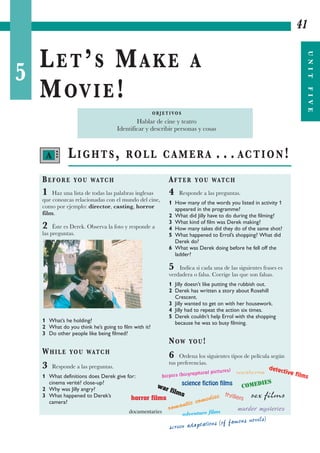
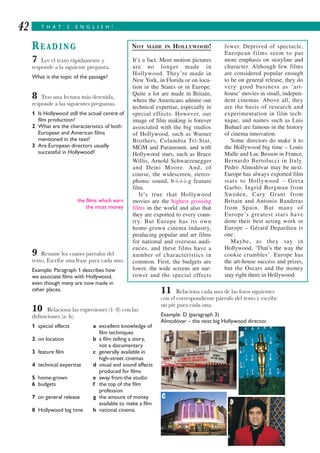
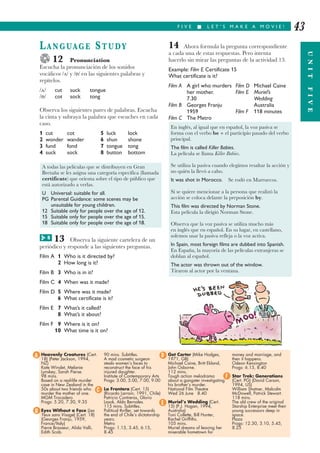
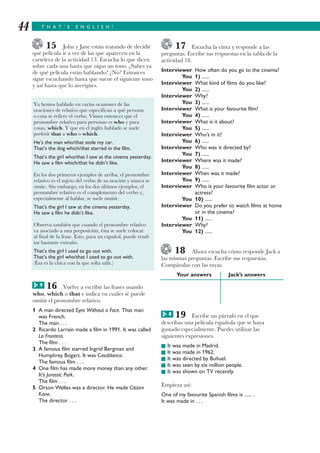
THAT’SENGLISH!Programaoficialdeinglésadistancia
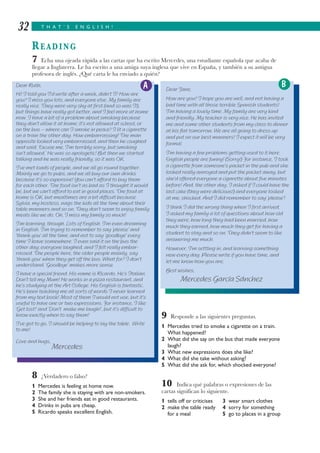
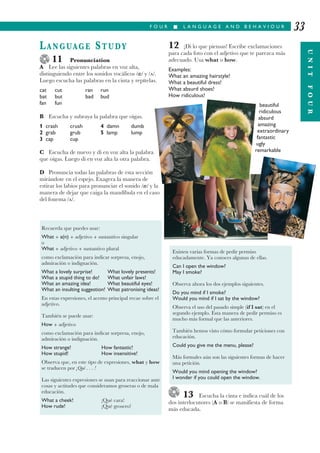
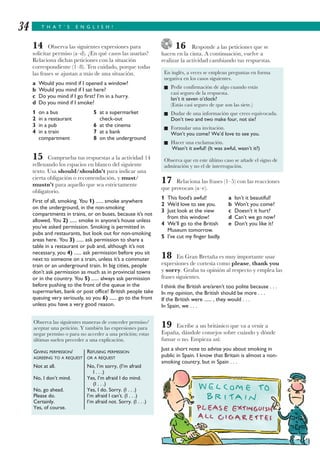
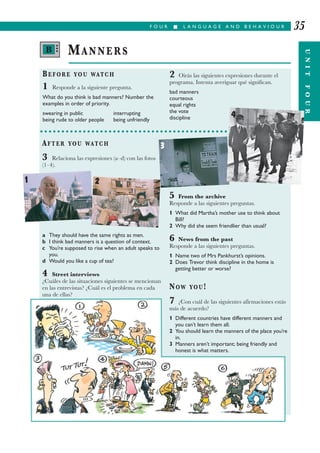
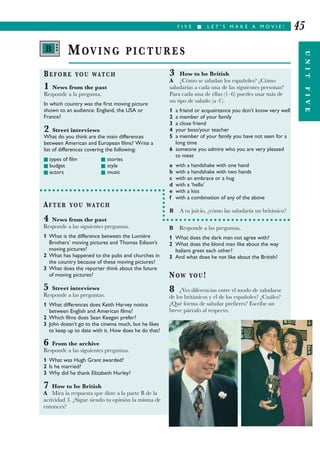
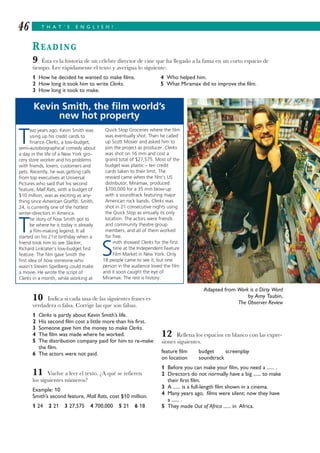
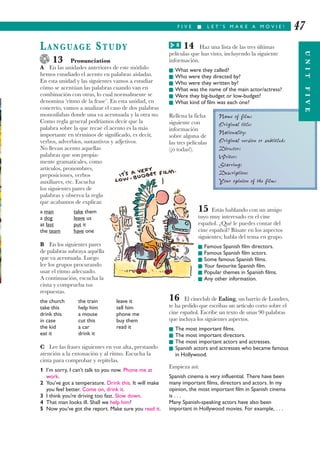
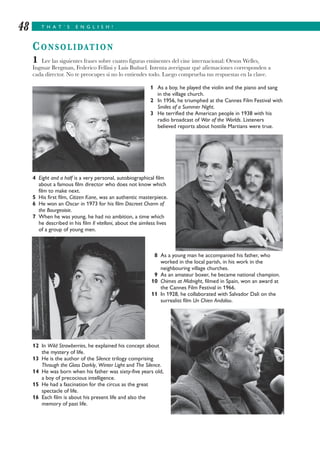
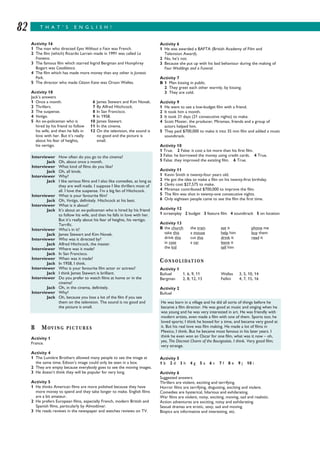
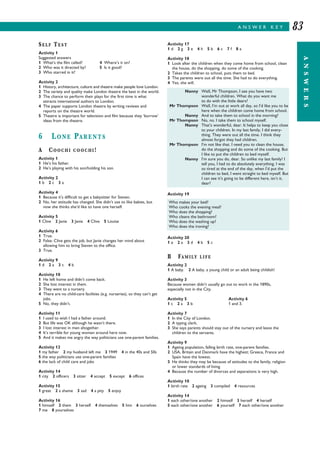
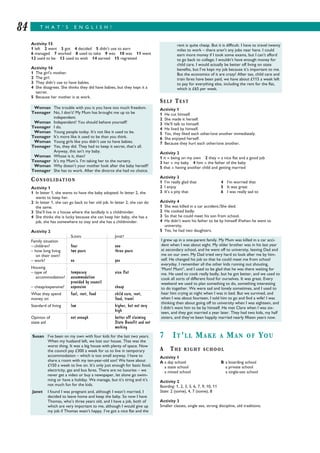
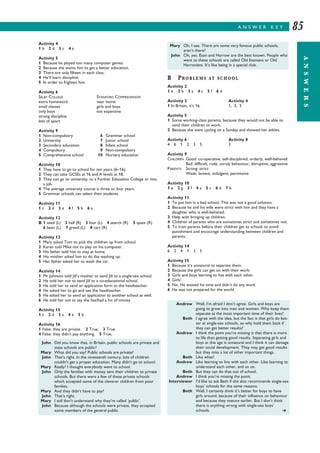
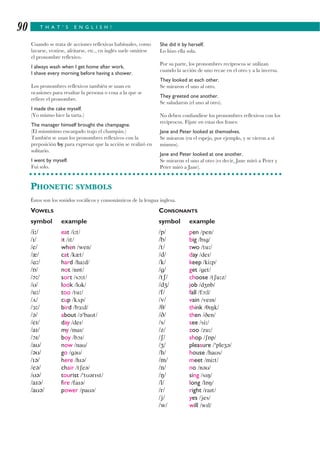
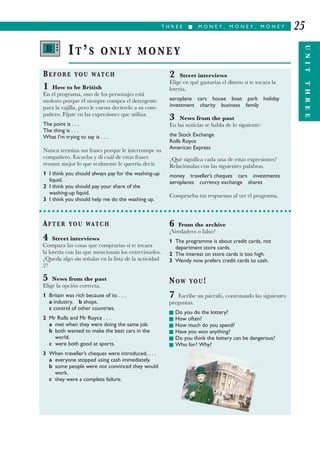
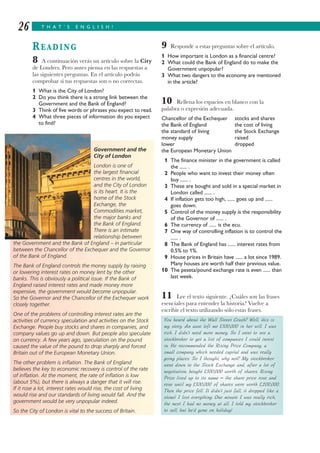
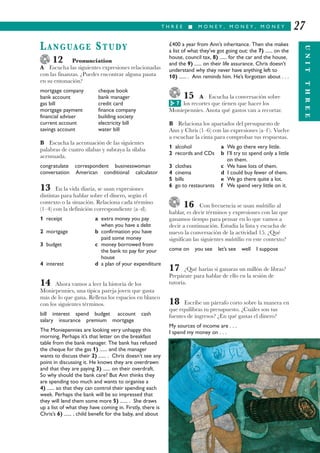
7Módulo 7
GOBIERNO
DE ESPAÑA
MINISTERIO
DE EDUCACIÓN
GOBIERNO
DE ESPAÑA
MINISTERIO
DE EDUCACIÓN
T H A T ’ S E N G L I S H !ii
Elaboración de materiales del curso de inglés de Enseñanza Oficial de Idiomas a Distancia.
Autores: Hazel Imbert, Martyn Ellis y Rosa María Martín
Director del proyecto: Phil Clymer
Director editorial de la serie: Barry Tomalin
Coordinadora editorial: Catriona Dawson
Supervisora de fotografía: Tania Ruggles
Traducción y adaptación: Isabel del Río-Sukan
Comprobación: Liliana Nogueira Pache
Diseño: Liz Rowe
Diseño de cubierta: IBERSAF
Originación: Create Publishing Services Limited, Bath, Inglaterra
Photos: Ace Photo Agency (6, 11, 42, 61); BTR Silvertown Ltd (10); Buena Vista (71); The Edinburgh Woollen Mill
Ltd (10); Mary Evans Picture Library (4, 14, 15, 16, 20, 52); General Motors Corporation, New York (11); The Ronald
Grant Archive (42); Sally & Richard Greenhill (39, 59); Robert Harding Picture Library (6, 17, 57, 73); Hulton Deutsch
Collection (8, 18, 35, 48, 58, 71); The Image Bank (11, 17); Kellogg Company of Great Britain Ltd (17); The Kobal
Collection (2, 13, 48); Doris Lee, American, 1905–1983, Thanksgiving, oil on canvas, 1935, 71.4 x 101.6 cm, Mr & Mrs
Frank G. Logan Prize Fund, 1935.313, photograph © 1994, The Art Institute of Chicago, all rights reserved (19);
Marks & Spencer (10); Mirror Syndication International (22); Pictor International – London (11, 17); Rex Features Ltd
(6, 33, 42, 48, 49, 61); Rolls-Royce Motor Cars Ltd (11); Scott’s Porage Oats (17); Tony Stone Images (17, 19, 26, 59);
Telegraph Colour Library (6, 33, 54, 64); Topham Picturepoint (18); Frank Veronsky (46); Zefa Pictures (17).
Diseño curricular y seguimiento técnico del proceso de elaboración de los materiales didácticos de Inglés a Distancia
desde el Ministerio de Educación realizado por:
Nuria Cambronero Sicilia
Javier Cerame Pérez
Carmen Echevarría Rosales
Rafael Fernández Alonso
Ángel Nieto Serrano
Realizado con la colaboración de BBVA, de TVE y de la British Broadcasting Corporation.
Módulo Séptimo
Título: That’s English!
Este material se ha elaborado en papel reciclado (60% fibras recicladas post-consumo y proceso de blanqueado de su
pasta totalmente libre de cloro TCF), siguiendo lo estipulado en la Orden PRE/116/2008, de 21 de enero.
Fecha de edición: Julio 2011
NIPO: 820-11-143-5
ISBN: 978-84-369-5145-5
Depósito Legal: M-25423-2011
Imprime: Ibersaf Industrial, S.L.
Edita:
© SECRETARÍA GENERAL TÉCNICA
Subdirección General de Información y Publicaciones
Catálogo de publicaciones del Ministerio de Educación: http://www.educacion.es
Catálogo general de publicaciones oficiales: www.060.es
MINISTERIO DE EDUCACIÓN
SECRETARÍA DE ESTADO DE EDUCACIÓN Y FORMACIÓN PROFESIONAL
Centro para la Innovación y Desarrollo de la Educación a Distancia (CIDEAD)
Módulo
7
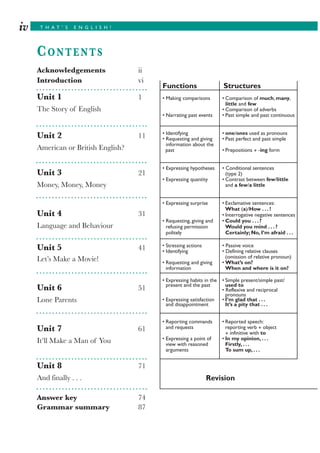
CONTENTS
Acknowledgements ii
Introduction vi
Functions Structures
Unit 1 1
The Story of English
Unit 2 11
American or British English?
Unit 3 21
Money, Money, Money
Unit 4 31
Language and Behaviour
Unit 5 41
Let’s Make a Movie!
Unit 6 51
Lone Parents
Unit 7 61
It’ll Make a Man of You
Unit 8 71
And finally . . .
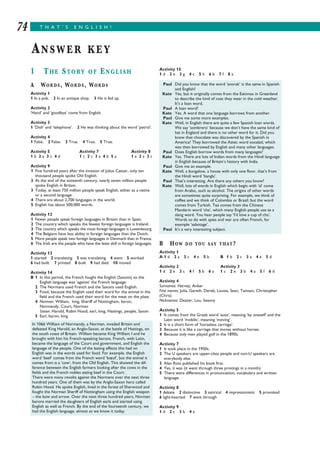
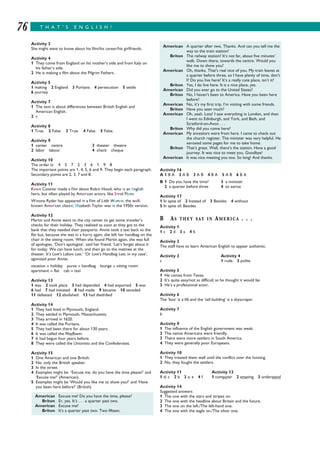
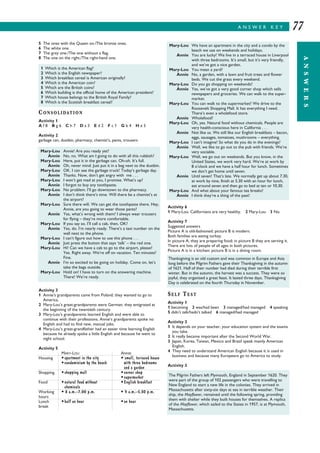
Answer key 74
Grammar summary 87
฀ ฀ ฀ ฀ ฀much, many฀
little few ฀
฀ ฀ ฀ ฀ ฀ ฀฀
฀ ฀ ฀ ฀฀฀฀ ฀ ฀ ฀ ฀ ฀ ฀
฀ ฀ ฀one/ones฀ ฀ ฀ ฀
฀ ฀ ฀ ฀ ฀ ฀ ฀ ฀ ฀ ฀฀
฀ ฀ ฀ ฀ ฀ ฀
฀฀ ฀ ฀ ฀+฀ ing฀ ฀฀฀
฀ ฀฀฀฀
฀ ฀ ฀ ฀ ฀ ฀
฀฀฀ ฀ ฀ ฀฀฀
฀ ฀ ฀ ฀ ฀ ฀few/little฀
฀ ฀ ฀ ฀a few/a little฀฀
฀฀ ฀ ฀
฀ ฀ ฀ ฀ ฀ ฀
What (a How . . . !฀฀
฀฀฀฀ ฀ ฀ ฀ ฀฀
฀ ฀ ฀ ฀ ฀Could you . . . ?฀฀
฀ ฀ ฀ ฀ Would you mind . . . ?฀
฀ ฀ ฀ Certainly; No, I’m afraid . . .
฀ ฀ ฀ ฀ ฀ ฀
฀ ฀ ฀ ฀ ฀ ฀฀ ฀฀
฀ ฀ ฀ ฀ ฀ ฀
฀ ฀ ฀ ฀ ฀What’s on? ฀฀฀
฀ ฀ ฀ When and where is it on?
฀ ฀ ฀ ฀ ฀฀ ฀ ฀ ฀ ฀
฀฀ ฀ ฀ ฀ ฀ ฀ used to฀
฀ ฀ ฀ ฀ ฀ ฀
฀ ฀ ฀ ฀
฀ ฀ ฀฀ ฀I’m glad that . . .฀฀฀
฀ ฀ ฀ ฀ It’s a pity that . . .
฀ ฀ ฀ ฀ ฀ ฀฀
฀ ฀ ฀ ฀ ฀ ฀+฀ ฀฀฀฀
+฀ ฀ ฀to฀
฀ ฀ ฀ ฀ ฀ ฀In my opinion, . . . ฀
฀ ฀ ฀ ฀ ฀ Firstly, . . .฀
฀ ฀ ฀ To sum up, . . .
Revision
T H A T ’ S E N G L I S H !iv
Lexis Pronunciation Study skills Cross culture
฀ ฀ ฀ ฀ ฀ ฀ ฀ ฀ ฀ ฀฀ ฀ ฀ ฀ ฀
฀ ฀ ฀ ฀ ฀ , ฀ ฀ ฀ ฀ ฀ ฀ ฀ ฀ ฀
฀ ฀ ฀ ฀ ฀ ฀ ฀ ฀ ฀ ฀ ฀ ฀ ฀
฀ ฀ ฀ ฀ ฀ ฀฀฀ ฀ ฀
฀ ฀ ฀ ฀ ฀ ฀ ฀ ฀ ฀ ฀ ฀ ฀ ฀ ฀ ฀ ฀ ฀
฀ ฀ ฀฀ ฀ ฀ ฀ ฀ ฀ ฀ ฀ ฀ ฀
฀ ฀ ฀฀ ฀ ฀ ฀ ฀ ฀ ฀ ฀฀
฀฀฀ ฀ ฀฀ ฀฀฀฀฀฀฀ ฀
฀ ฀ ฀฀
฀ ฀ ฀ ฀ ฀ ฀ ฀ ฀ ฀ ฀ ฀ ฀ ฀฀฀ ฀ ฀ ฀ ฀
฀ ฀ ฀ ฀ ฀ ฀ ฀ ฀ ฀ ฀ ฀ ฀ ฀ ฀ ฀ ฀
฀ ฀ ฀ ฀ ฀ ฀ ฀ ฀ ฀ ฀ ฀ ฀ ฀฀
฀฀฀ ฀ ฀ ฀ ฀฀ ฀฀฀฀฀฀฀ ฀ ฀ ฀ ฀ ฀
฀ ฀ ฀฀฀฀฀
฀ ฀ ฀ ฀ ฀ ฀ ฀ ฀ ฀฀ ฀ ฀ ฀ ฀฀ ฀ ฀ ฀ ฀
฀ ฀ ฀฀ ฀ ฀ ฀ ฀ ฀ ฀ ฀ ฀ ฀ ฀ ฀ ฀
฀ ฀ ฀ ฀ ฀ ฀ ฀ ฀ ฀
฀฀ ฀ ฀ ฀ ฀฀฀฀฀฀฀฀
฀ ฀ ฀ ฀฀
฀ ฀ ฀ ฀ ฀ ฀ ฀ ฀ ฀ ฀ ฀ ฀ ฀ ฀ ฀ ฀ ฀
฀ ฀ ฀฀ ฀ ฀ ฀ ฀ ฀ ฀ ฀ ฀ ฀ ฀
฀ ฀ ฀ ฀ ฀ ฀ ฀ ฀ ฀ ฀ ฀ ฀ ฀ ฀฀฀
฀ ฀฀฀ ฀฀฀฀฀฀ ฀ ฀ ฀ ฀
฀ ฀ ฀ ฀ ฀ ฀ ฀ ฀ ฀ ฀฀ ฀ ฀ ฀ ฀ ฀ ฀
฀ ฀ ฀ ฀ ฀ ฀฀฀฀฀฀ ฀ ฀ ฀ ฀ ฀ ฀ ฀ ฀
฀ ฀ ฀ ฀ ฀ ฀ ฀ ฀ ฀ ฀ ฀฀฀
฀฀ ฀฀฀ ฀ ฀ ฀ ฀ ฀ ฀฀ ฀฀
฀฀฀฀฀฀ ฀฀ ฀ ฀ ฀ ฀ ฀ ฀ ฀ ฀฀฀
฀ ฀
฀ ฀ ฀ ฀ ฀ ฀ ฀ ฀฀ ฀ ฀ ฀ ฀ ฀ ฀
฀ ฀ ฀ ฀ ฀ ฀ ฀฀฀ ฀ ฀ ฀ ฀ ฀ ฀ ฀฀฀
฀ ฀ ฀ ฀฀฀ ฀ ฀฀
฀฀฀฀ ฀ ฀ ฀ ฀฀ ฀฀฀฀฀฀
฀ ฀฀฀ ฀ ฀ ฀ ฀฀฀฀
and consolidation
CONTENTS
v
T H A T ’ S E N G L I S H !
INTRODUCTION
Bienvenido al séptimo libro del curso That’s English!. En
esta introducción queremos ofrecerte varias sugerencias
para seguir cómodamente y con éxito este curso. Los
números de página que aparecen a continuación se
refieren al orden dentro de cada unidad.
1ª PÁGINA – PRIMER PROGRAMA DE TV
Antes de ver el primer programa de la semana, estudia
la primera página de la Sesión A. El título general te
informará sobre el tema de la unidad. En torno a este
tema girarán también los programas de TV y la cinta;
sirve, por tanto, como elemento aglutinador de toda la
lengua y actividades presentadas. Los objetivos describen
lo que se espera que hayas aprendido al finalizar el estu-
dio de la unidad. Puedes volver a ellos en ese momento
y comprobar si los has conseguido.
Los encabezamientos Before you watch, While you
watch y After you watch (antes, mientras y después
de ver el programa) te indican qué actividades debes
hacer en cada momento.
Before you watch presenta el vocabulario y las frases
clave del programa. Debes leerlas atentamente y buscar
en el diccionario cualquier palabra que desconozcas.
While you watch contiene las preguntas que los pre-
sentadores hacen al comienzo del programa; sirven para
darte una idea de qué va a tratar el sketch y para centrar
tu atención en los aspectos esenciales del mismo. Los
presentadores te darán las respuestas al finalizar el sketch.
Este apartado debes prepararlo cuidadosamente antes
de ver el programa, pues sirve para una mejor compren-
sión y aprovechamiento del mismo.
Mientras ves el programa, intenta responder a las pre-
guntas hechas por los presentadores, pero recuerda que
lo más importante es seguir el hilo general de las conver-
saciones, y no debes preocuparte si hay algunas pa-la-
bras o expresiones que desconoces. Éstas aparecerán en
el libro y la cinta y, si no, tampoco importa. Es conven-
iente que tengas papel y lápiz a mano, pues puede haber
palabras o explicaciones de los presentadores que te
interese anotar. Haz todo lo posible por grabar el pro-
grama en vídeo: observarás que la segunda vez que lo
veas entenderás mucho más que la primera. Y si lo ves
una tercera vez, aún mejor.
Nada más terminar el programa, conviene que hagas la
sección After you watch. Con esta actividad, se intenta
medir si has comprendido lo fundamental del programa.
Si te resultara muy difícil realizar las actividades de esta
sección, deberías volver a ver el programa y enfrentarte
con ellas de nuevo.
La sección Now you! trata de que tú relaciones el tema
del programa con tus propias vivencias y opiniones.
También conviene que hagas esta actividad nada más
ver el programa, pues está muy relacionada con él, es
una forma de repasarlo e interiorizarlo.
2ª Y 6ª PÁGINAS – READING
Así como la primera página estaba dedicada al desa-
rrollo de la comprensión auditiva, las páginas 2 y 6
están dedicadas a la comprensión lectora, fundamental,
junto con aquélla, para el aprendizaje y dominio de una
lengua. Bajo el encabezamiento Reading, se encuentra
un texto que desarrolla diversos aspectos del tema gene-
ral. Léelo dos veces con detenimiento. Después con-
súltalo, siempre que sea necesario para realizar las
actividades propuestas en estas páginas, todas las cuales
están relacionadas con la lectura. La única diferencia
entre las dos páginas es que en la sexta, el texto es más
auténtico, en el sentido de que no está tan graduado su
nivel, y, por lo tanto, puede resultar más difícil. Pero lo
importante en la comprensión, tanto auditiva como lec-
tora, no es la comprensión de todas y cada una de las
palabras, sino la comprensión de lo esencial del texto, ya
sea hablado o escrito.
3ª, 4ª Y 7ª PÁGINAS – LANGUAGE STUDY
Estas páginas están dedicadas al desarrollo de los
siguientes aspectos:
Pronunciation Los ejercicios de pronunciación estu-
dian los diversos aspectos de la fonética: sonidos, acento,
ritmo y entonación, tratados desde el punto de vista de
las dificultades que ofrecen habitualmente al hablante
español. Estos ejercicios son fundamentales para mejo-
rar tu pronunciación. Para hacerlos, deberás usar la
cinta de audio. Conviene que grabes tu propia voz y la
compares con el modelo de la cinta. Para conseguir una
pronunciación aceptable, necesitarás repetir muchas
veces, pero el esfuerzo merece la pena.
Listening Estas actividades sirven no sólo para desa-
rrollar la importantísima destreza de comprender la pa-
labra hablada, sino también para reforzar el vocabulario
y las estructuras y funciones estudiadas. Para ello,
escucha la cinta siguiendo el texto, no escribas nada.
Vuelve a escuchar la cinta e intenta completar los ejerci-
cios, rebobinando cuantas veces sea necesario. Escucha
la cinta de nuevo, siguiendo el texto y comprobando que
todas las respuestas son correctas.
Grammar La gramática juega un papel importante,
pero no esencial en el aprendizaje de una lengua. El
conocimiento de las reglas no lleva automáticamente a
aplicarlas bien a la hora de hablar o escribir; por tanto,
no debes obsesionarte con la gramática. Es más impor-
tante ser capaz de participar en una conversación, leer
un libro o escribir una carta que saber todas las reglas
de la lengua. Conviene buscar un equilibrio. El cono-
cimiento de las reglas gramaticales te ayudará a entend-
er ciertas estructuras complejas o simplemente distintas
a las españolas; también te permitirá corregir tus propi-
as producciones, probablemente a posteriori, y te dará
una cierta sensación de confianza; pero recuerda que se
pueden saber todas las reglas de una lengua y ser inca-
paz de expresarse en la misma, así como también es
posible expresarse con toda fluidez y corrección sin
conocer las reglas. Resumiendo, conviene que estudies
los recuadros de explicaciones gramaticales, comprendas
bien los ejemplos y hagas los ejercicios correspondientes,
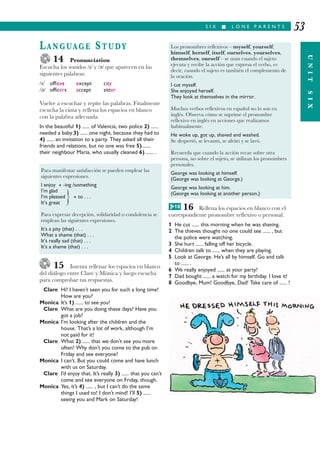
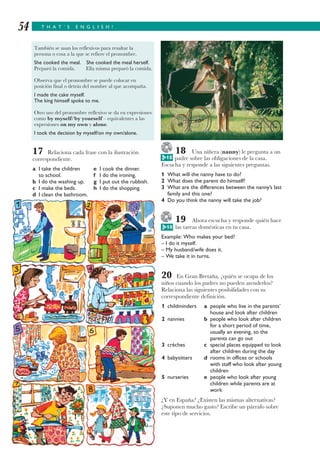
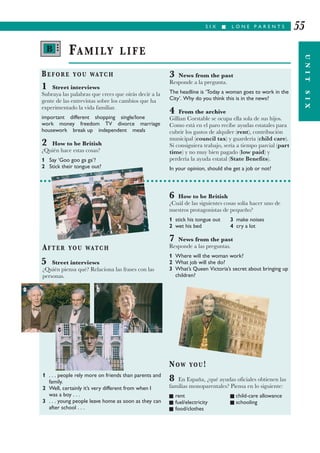
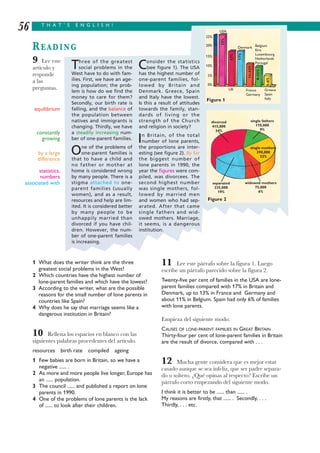
marcados con este símbolo Si todavía tuvieras
dudas, consulta la Sección de Gramática al final del
libro, y si eso aún no es suficiente, llama por teléfono al
número 900 que encontrarás en la guía del alumno.
Intenta resolver tus dudas de esta forma, pues la sesión
de tutoría no debe dedicarse a dar explicaciones grama-
ticales, sino al desarrollo de la destreza oral.
1G
vi
INTRODUCTION
Speaking Muchas de las actividades de expresión
oral de estas páginas son diálogos abiertos, es decir,
conversaciones con un interlocutor, cuya voz está
grabada en la cinta. Si puedes trabajar con algún amigo,
haz estos ejercicios con tu amigo, intercambiando los
papeles: primero, por ejemplo, tu amigo hace de inter-
locutor y tú das tus propias respuestas, y luego tú haces
de interlocutor y tu amigo te da sus propias contesta-
ciones. Otras actividades son más abiertas y podrás
realizarlas en la sesión de tutoría con tus compañeros de
clase.
Writing Para muchos de los ejercicios de expresión
escrita de estas páginas no hay una solución correcta
única. Esto no debe preocuparte. No es necesario que
todo lo que escribas sea absolutamente correcto. Escribe
con confianza, echa mano de tus fuentes de consulta:
diccionarios, gramáticas, amigos; no tengas miedo de
cometer errores, y piensa que es escribiendo como se
aprende a escribir.
Learning strategies Por último, también encontra-
rás en estas páginas actividades dedicadas al desarrollo
de las estrategias de aprendizaje, es decir, las que ayudan
al aprendizaje autónomo. En este libro séptimo, se dedi-
ca especial atención al desarrollo de una serie de estrate-
gias que te pueden ayudar a una mejor comprensión de
textos orales y escritos. Conviene que, además de hacer
los ejercicios propuestos, te acostumbres a usar el diccion-
ario de forma sistemática, no sólo para buscar el signifi-
cado de una palabra, sino también para comprobar
cómo se escribe, ver su pronunciación, cerciorarte de la
categoría gramatical a la que pertenece y a la raíz de la
que se deriva dicha palabra.
5ª PÁGINA – SEGUNDO PROGRAMA DE TV
La sesión B del libro, que se corresponde con el segundo
programa de TV de la semana, tiene por objeto ampliar
la lengua presentada en la sesión anterior de forma
menos controlada y más natural. El segundo programa
está compuesto por diversos elementos que abordan el
tema general de la semana, iniciado en la sesión anterior,
desde muy distintos puntos de vista. En primer lugar,
hay un breve repaso de lo visto el día anterior. A conti-
nuación, verás las siguientes secciones.
■ Street interviews: entrevistas realizadas en la calle
a diversas personas sobre el tema de la unidad.
■ From the archive: breves secuencias de películas o
documentos de televisión cuya función es introducirte
en el lenguaje real de dichos medios de comunicación.
■ News from the past: noticias del siglo XIX que, en
realidad, te presentan el lenguaje y la estructura de las
noticias de la actualidad.
■ How to be British: breves sketches en los que se dan
clases para comportarse ‘adecuadamente’ en la sociedad
británica.
Todos estos elementos hacen el programa muy atractivo
y real, pero algo más difícil que el primero. Es funda-
mental que antes de verlo lo prepares muy bien, y a eso
está dedicada la primera página de la sesión B. En esta
página, hay dos grandes apartados: Before you watch
y After you watch. Entre los dos apartados hay activi-
dades relacionadas con cada uno de los elementos men-
cionados.
Pues bien, antes de ver el segundo programa, es muy
conveniente que leas todas las actividades que debes
hacer antes y después, porque entre las dos secciones
encontrarás toda la lengua básica del programa y, si las
lees cuidadosamente, buscando en el diccionario las
palabras desconocidas, te resultará mucho más moti-
vador y fácil ver y comprender todos los elementos.
Realiza las actividades de la sección Before you watch
antes de ver el programa de TV: muchas de ellas están
encaminadas a familiarizarte con y, en ocasiones, a pre-
decir el lenguaje que se va a usar.
Realiza las actividades de la sección After you watch
después de ver el programa. Éstas tienen por misión
medir tu comprensión de los diversos elementos.
Un consejo que deberías tener muy en cuenta: no te
preocupes si no entiendes todas y cada una de las pala-
bras que oigas o leas. Lo importante es entender lo
esencial de cada uno de los elementos.
8ª Y 9ª PÁGINAS – CONSOLIDATION
En esta parte del libro se repasan y amplían los con-
tenidos de las dos primeras sesiones, A y B. Cada una
de las actividades integra varias destrezas, bien sea la
comprensión auditiva con la expresión escrita u oral, o
la comprensión lectora con la expresión escrita u oral,
etc.
Aunque esta parte del libro no tenga mucha relación
directa con el tercer programa de TV de la semana,
sería conveniente posponer su realización hasta después
de haber visto dicho programa de TV. Al fin y al cabo,
los dos elementos, el programa y la sección del libro, sir-
ven para repasar y ampliar los contenidos de la unidad.
Algunas de estas actividades pueden ser más abiertas y
menos controladas que las de las sesiones A y B. No
debes preocuparte si no sabes si has resuelto bien la
actividad o no. El mismo hecho de realizarla te ha servi-
do para mucho. Como muchas otras cosas de la vida,
una lengua se aprende practicándola y cometiendo
errores. La corrección de los errores puede ser impor-
tante, pero mucho más importante es el uso y la práctica
de la lengua con o sin errores.
10ª PÁGINA – SELF TEST
Esta última página de cada unidad te da la oportunidad
de que te autoevalúes y además pretende prepararte para
el examen de fin de módulo. Cada página constará de
una actividad de comprensión auditiva o de comprensión
lectora, así como de una actividad de expresión oral o
escrita y de varias preguntas de opción múltiple.
Esta página no debes realizarla hasta después de haber
completado las otras tres partes del libro y de haber
visto los tres programas de TV. Si te resulta muy difícil
esta página, vuelve a hacer las partes relevantes de la
unidad, vuelve a ver los programas de televisión, consul-
ta, si es necesario, con la línea 900 (la llamada es total-
mente gratuita) y, sobre todo, no te desesperes.
En esta misma página, en la parte inferior, encontrarás
el apartado How to be British, que refuerza el conte-
nido de la sección del mismo nombre del segundo pro-
grama de TV.
Por último, un consejo muy importante para que pue-
das tener éxito con el curso That’s English!: asiste a las
sesiones de tutoría con regularidad. Son fundamentales
para el desarrollo de la expresión oral.
vii
1
THE STORY OF
ENGLISH
1
UNITONE
WORDS, WORDS, WORDS
BEFORE YOU WATCH
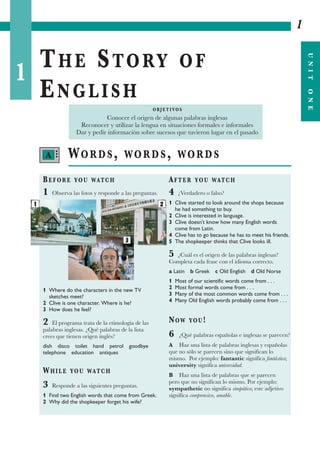
1 Observa las fotos y responde a las preguntas.
1 Where do the characters in the new TV
sketches meet?
2 Clive is one character. Where is he?
3 How does he feel?
2 El programa trata de la etimología de las
palabras inglesas. ¿Qué palabras de la lista
crees que tienen origen inglés?
dish disco toilet hand petrol goodbye
telephone education antiques
WHILE YOU WATCH
3 Responde a las siguientes preguntas.
1 Find two English words that come from Greek.
2 Why did the shopkeeper forget his wife?
AFTER YOU WATCH
4 ¿Verdadero o falso?
1 Clive started to look around the shops because
he had something to buy.
2 Clive is interested in language.
3 Clive doesn’t know how many English words
come from Latin.
4 Clive has to go because he has to meet his friends.
5 The shopkeeper thinks that Clive looks ill.
5 ¿Cuál es el origen de las palabras inglesas?
Completa cada frase con el idioma correcto.
a Latin b Greek c Old English d Old Norse
1 Most of our scientific words come from . . .
2 Most formal words come from . . .
3 Many of the most common words come from . . .
4 Many Old English words probably come from . . .
NOW YOU!
6 ¿Qué palabras españolas e inglesas se parecen?
A Haz una lista de palabras inglesas y españolas
que no sólo se parecen sino que significan lo
mismo. Por ejemplo: fantastic significa fantástico;
university significa universidad.
B Haz una lista de palabras que se parecen
pero que no significan lo mismo. Por ejemplo:
sympathetic no significa simpático; este adjetivo
significa comprensivo, amable.
O B J E T I VO S
Conocer el origen de algunas palabras inglesas
Reconocer y utilizar la lengua en situaciones formales e informales
Dar y pedir información sobre sucesos que tuvieron lugar en el pasado
A •••
2
3
1
T H A T ’ S E N G L I S H !2
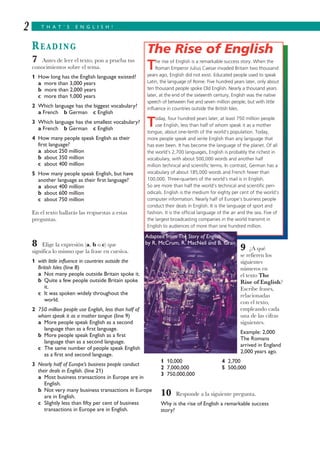
READING
7 Antes de leer el texto, pon a prueba tus
conocimientos sobre el tema.
1 How long has the English language existed?
a more than 3,000 years
b more than 2,000 years
c more than 1,000 years
2 Which language has the biggest vocabulary?
a French b German c English
3 Which language has the smallest vocabulary?
a French b German c English
4 How many people speak English as their
first language?
a about 250 million
b about 350 million
c about 400 million
5 How many people speak English, but have
another language as their first language?
a about 400 million
b about 600 million
c about 750 million
En el texto hallarás las respuestas a estas
preguntas.
8 Elige la expresión (a, b o c) que
significa lo mismo que la frase en cursiva.
1 with little influence in countries outside the
British Isles (line 8)
a Not many people outside Britain spoke it.
b Quite a few people outside Britain spoke
it.
c It was spoken widely throughout the
world.
2 750 million people use English, less than half of
whom speak it as a mother tongue (line 9)
a More people speak English as a second
language than as a first language.
b More people speak English as a first
language than as a second language.
c The same number of people speak English
as a first and second language.
3 Nearly half of Europe’s business people conduct
their deals in English. (line 21)
a Most business transactions in Europe are in
English.
b Not very many business transactions in Europe
are in English.
c Slightly less than fifty per cent of business
transactions in Europe are in English.
9 ¿A qué
se refieren los
siguientes
números en
el texto The
Rise of English?
Escribe frases,
relacionadas
con el texto,
empleando cada
una de las cifras
siguientes.
Example: 2,000
The Romans
arrived in England
2,000 years ago.
1 10,000 4 2,700
2 7,000,000 5 500,000
3 750,000,000
10 Responde a la siguiente pregunta.
Why is the rise of English a remarkable success
story?
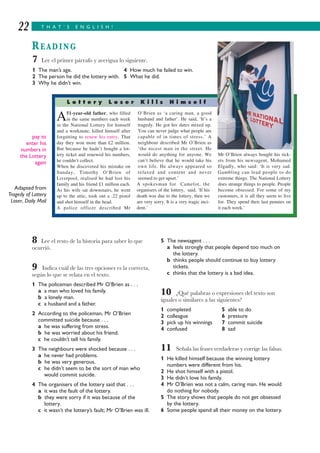
The Rise of English
The rise of English is a remarkable success story. When the
Roman Emperor Julius Caesar invaded Britain two thousand
years ago, English did not exist. Educated people used to speak
Latin, the language of Rome. Five hundred years later, only about
ten thousand people spoke Old English. Nearly a thousand years
later, at the end of the sixteenth century, English was the native
speech of between five and seven million people, but with little
influence in countries outside the British Isles.
Today, four hundred years later, at least 750 million people
use English, less than half of whom speak it as a mother
tongue, about one-tenth of the world’s population. Today,
more people speak and write English than any language that
has ever been. It has become the language of the planet. Of all
the world’s 2,700 languages, English is probably the richest in
vocabulary, with about 500,000 words and another half
million technical and scientific terms. In contrast, German has a
vocabulary of about 185,000 words and French fewer than
100,000. Three-quarters of the world’s mail is in English.
So are more than half the world’s technical and scientific peri-
odicals. English is the medium for eighty per cent of the world’s
computer information. Nearly half of Europe’s business people
conduct their deals in English. It is the language of sport and
fashion. It is the official language of the air and the sea. Five of
the largest broadcasting companies in the world transmit in
English to audiences of more than one hundred million.
Adapted from The Story of English
by R. McCrum, R. MacNeil and B. Cran
O N E I T H E S T O R Y O F E N G L I S H
UNITONE
3
LANGUAGE STUDY
11 Pronunciation
A Estudia los siguientes verbos regulares que
figuran en el texto de la página 2. Practica la
pronunciación de las formas del pasado y participio
pasado terminadas en -ed.
The Romans landed in Britain 2,000 years ago.
Julius Caesar invaded Britain.
Many broadcasting stations transmitted programmes
in English.
Many business people conducted deals in English.
Observa que si el verbo termina en un sonido sordo
(excepto /t/), la terminación -ed se pronuncia /t/.
Los sonidos sordos son los siguientes: /p/, /t/, /k/, /f/,
/ȓ/, /s/, /θ/, /tȓ/ y /h/. Si el verbo termina en un
sonido sonoro (excepto /d/), el sufijo -ed se pronun-
cia /d/. Todos los demás sonidos se consideran
sonoros. Pero cuando el verbo termina en t o d, el
sufijo -ed se pronuncia /d/.
B Practica la pronunciación del pasado de los
siguientes verbos y luego escucha la cinta.
/t/ influenced asked typed
/d/ cried failed loved
/d/ translated ended decided
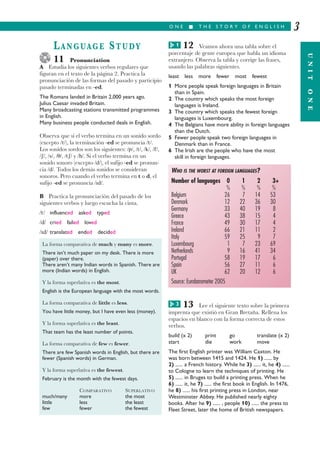
12 Veamos ahora una tabla sobre el
porcentaje de gente europea que habla un idioma
extranjero. Observa la tabla y corrige las frases,
usando las palabras siguientes.
least less more fewer most fewest
1 More people speak foreign languages in Britain
than in Spain.
2 The country which speaks the most foreign
languages is Ireland.
3 The country which speaks the fewest foreign
languages is Luxembourg.
4 The Belgians have more ability in foreign languages
than the Dutch.
5 Fewer people speak two foreign languages in
Denmark than in France.
6 The Irish are the people who have the most
skill in foreign languages.
13 Lee el siguiente texto sobre la primera
imprenta que existió en Gran Bretaña. Rellena los
espacios en blanco con la forma correcta de estos
verbos.
build (x 2) print go translate (x 2)
start die work move
The first English printer was William Caxton. He
was born between 1415 and 1424. He 1) ...... by
2) ...... a French history. While he 3) ...... it, he 4) ......
to Cologne to learn the techniques of printing. He
5) ...... in Bruges to build a printing press. When he
6) ...... it, he 7) ...... the first book in English. In 1476,
he 8) ...... his first printing press in London, near
Westminster Abbey. He published nearly eighty
books. After he 9) ...... , people 10) ...... the press to
Fleet Street, later the home of British newspapers.
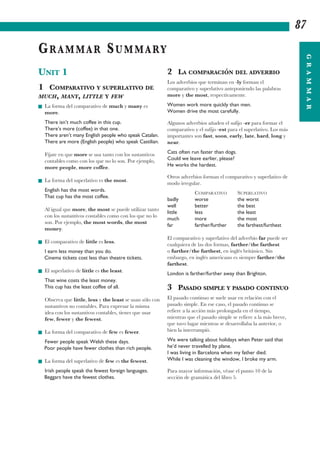
La forma comparativa de much y many es more.
There isn’t much paper on my desk. There is more
(paper) over there.
There aren’t many Indian words in Spanish. There are
more (Indian words) in English.
Y la forma superlativa es the most.
English is the European language with the most words.
La forma comparativa de little es less.
You have little money, but I have even less (money).
Y la forma superlativa es the least.
That team has the least number of points.
La forma comparativa de few es fewer.
There are few Spanish words in English, but there are
fewer (Spanish words) in German.
Y la forma superlativa es the fewest.
February is the month with the fewest days.
COMPARATIVO SUPERLATIVO
much/many more the most
little less the least
few fewer the fewest
WHO IS THE WORST AT FOREIGN LANGUAGES?
Number of languages 0 1 2 3+
% % % %
Belgium 26 7 14 53
Denmark 12 22 36 30
Germany 33 40 19 8
Greece 43 38 15 4
France 49 30 17 4
Ireland 66 21 11 2
Italy 59 25 9 7
Luxembourg 1 7 23 69
Netherlands 9 16 41 34
Portugal 58 19 17 6
Spain 56 27 11 6
UK 62 20 12 6
Source: Eurobarometer 2005
1G
3G
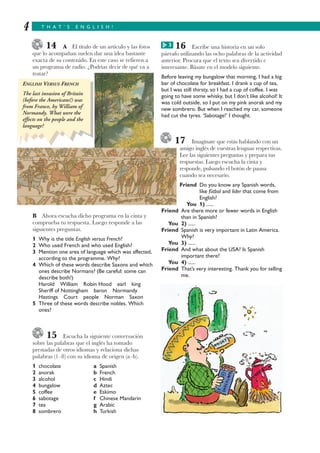
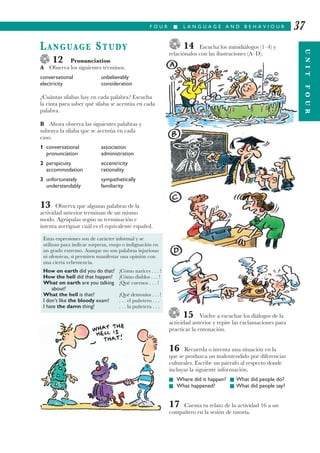
14 A El título de un artículo y las fotos
que lo acompañan suelen dar una idea bastante
exacta de su contenido. En este caso se refieren a
un programa de radio. ¿Podrías decir de qué va a
tratar?
B Ahora escucha dicho programa en la cinta y
comprueba tu respuesta. Luego responde a las
siguientes preguntas.
1 Why is the title English versus French?
2 Who used French and who used English?
3 Mention one area of language which was affected,
according to the programme. Why?
4 Which of these words describe Saxons and which
ones describe Normans? (Be careful: some can
describe both!)
Harold William Robin Hood earl king
Sheriff of Nottingham baron Normandy
Hastings Court people Norman Saxon
5 Three of these words describe nobles. Which
ones?
15 Escucha la siguiente conversación
sobre las palabras que el inglés ha tomado
prestadas de otros idiomas y relaciona dichas
palabras (1–8) con su idioma de origen (a–h).
1 chocolate a Spanish
2 anorak b French
3 alcohol c Hindi
4 bungalow d Aztec
5 coffee e Eskimo
6 sabotage f Chinese Mandarin
7 tea g Arabic
8 sombrero h Turkish
T H A T ’ S E N G L I S H !4
16 Escribe una historia en un solo
párrafo utilizando las ocho palabras de la actividad
anterior. Procura que el texto sea divertido e
interesante. Básate en el modelo siguiente.
Before leaving my bungalow that morning, I had a big
bar of chocolate for breakfast. I drank a cup of tea,
but I was still thirsty, so I had a cup of coffee. I was
going to have some whisky, but I don’t like alcohol! It
was cold outside, so I put on my pink anorak and my
new sombrero. But when I reached my car, someone
had cut the tyres. ‘Sabotage!’ I thought.
17 Imagínate que estás hablando con un
amigo inglés de vuestras lenguas respectivas.
Lee las siguientes preguntas y prepara tus
respuestas. Luego escucha la cinta y
responde, pulsando el botón de pausa
cuando sea necesario.
Friend Do you know any Spanish words,
like fútbol and líder that come from
English?
You 1) ......
Friend Are there more or fewer words in English
than in Spanish?
You 2) ......
Friend Spanish is very important in Latin America.
Why?
You 3) ......
Friend And what about the USA? Is Spanish
important there?
You 4) ......
Friend That’s very interesting. Thank you for telling
me.
ENGLISH VERSUS FRENCH
The last invasion of Britain
(before the Americans!) was
from France, by William of
Normandy. What were the
effects on the people and the
language?
3G
O N E I T H E S T O R Y O F E N G L I S H
UNITONE
5
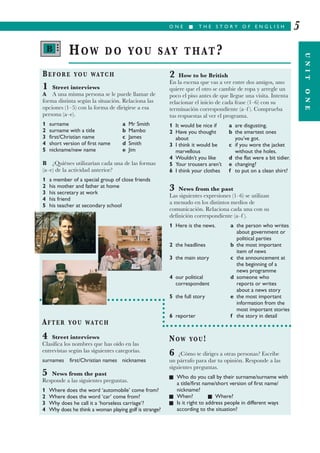
BEFORE YOU WATCH
1 Street interviews
A A una misma persona se le puede llamar de
forma distinta según la situación. Relaciona las
opciones (1–5) con la forma de dirigirse a esa
persona (a–e).
1 surname a Mr Smith
2 surname with a title b Mambo
3 first/Christian name c James
4 short version of first name d Smith
5 nickname/new name e Jim
B ¿Quiénes utilizarían cada una de las formas
(a–e) de la actividad anterior?
1 a member of a special group of close friends
2 his mother and father at home
3 his secretary at work
4 his friend
5 his teacher at secondary school
2 How to be British
En la escena que vas a ver entre dos amigos, uno
quiere que el otro se cambie de ropa y arregle un
poco el piso antes de que llegue una visita. Intenta
relacionar el inicio de cada frase (1–6) con su
terminación correspondiente (a–f ). Comprueba
tus respuestas al ver el programa.
1 It would be nice if a are disgusting.
2 Have you thought b the smartest ones
about you’ve got.
3 I think it would be c if you wore the jacket
marvellous without the holes.
4 Wouldn’t you like d the flat were a bit tidier.
5 Your trousers aren’t e changing?
6 I think your clothes f to put on a clean shirt?
3 News from the past
Las siguientes expresiones (1–6) se utilizan
a menudo en los distintos medios de
comunicación. Relaciona cada una con su
definición correspondiente (a–f ).
1 Here is the news. a the person who writes
about government or
political parties
2 the headlines b the most important
item of news
3 the main story c the announcement at
the beginning of a
news programme
4 our political d someone who
correspondent reports or writes
about a news story
5 the full story e the most important
information from the
most important stories
6 reporter f the story in detail
HOW DO YOU SAY THAT?
AFTER YOU WATCH
4 Street interviews
Clasifica los nombres que has oído en las
entrevistas según las siguientes categorías.
surnames first/Christian names nicknames
5 News from the past
Responde a las siguientes preguntas.
1 Where does the word ‘automobile’ come from?
2 Where does the word ‘car’ come from?
3 Why does he call it a ‘horseless carriage’?
4 Why does he think a woman playing golf is strange?
NOW YOU!
6 ¿Cómo te diriges a otras personas? Escribe
un párrafo para dar tu opinión. Responde a las
siguientes preguntas.
I Who do you call by their surname/surname with
a title/first name/short version of first name/
nickname?
I When? I Where?
I Is it right to address people in different ways
according to the situation?
B •••
T H A T ’ S E N G L I S H !6
READING
7 Lee el texto siguiente sobre
los usos vulgares y no vulgares
del inglés (non-U y U respectiva-
mente) y contesta estas preguntas.
1 When did the U/non-U debate
take place?
2 Who are the U speakers and
the non-U speakers described
in the article?
3 Who published ‘U/non-U’ first,
Nancy Mitford or Alan Ross?
4 Was Nancy Mitford’s collection
of essays a success?
5 How was U usage different
from non-U usage?
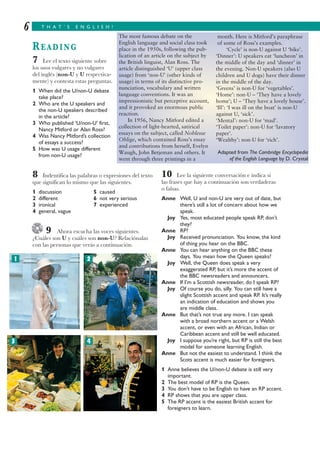
8 Indentifica las palabras o expresiones del texto
que significan lo mismo que las siguientes.
1 discussion 5 caused
2 different 6 not very serious
3 ironical 7 experienced
4 general, vague
9 Ahora escucha las voces siguientes.
¿Cuáles son U y cuáles son non-U? Relaciónalas
con las personas que verás a continuación.
10 Lee la siguiente conversación e indica si
las frases que hay a continuación son verdaderas
o falsas.
Anne Well, U and non-U are very out of date, but
there’s still a lot of concern about how we
speak.
Joy Yes, most educated people speak RP, don’t
they?
Anne RP?
Joy Received pronunciation. You know, the kind
of thing you hear on the BBC.
Anne You can hear anything on the BBC these
days. You mean how the Queen speaks?
Joy Well, the Queen does speak a very
exaggerated RP, but it’s more the accent of
the BBC newsreaders and announcers.
Anne If I’m a Scottish newsreader, do I speak RP?
Joy Of course you do, silly. You can still have a
slight Scottish accent and speak RP. It’s really
an indication of education and shows you
are middle class.
Anne But that’s not true any more. I can speak
with a broad northern accent or a Welsh
accent, or even with an African, Indian or
Caribbean accent and still be well educated.
Joy I suppose you’re right, but RP is still the best
model for someone learning English.
Anne But not the easiest to understand. I think the
Scots accent is much easier for foreigners.
1 Anne believes the U/non-U debate is still very
important.
2 The best model of RP is the Queen.
3 You don’t have to be English to have an RP accent.
4 RP shows that you are upper class.
5 The RP accent is the easiest British accent for
foreigners to learn.
The most famous debate on the
English language and social class took
place in the 1950s, following the pub-
lication of an article on the subject by
the British linguist, Alan Ross. The
article distinguished ‘U’ (upper class
usage) from ‘non-U’ (other kinds of
usage) in terms of its distinctive pro-
nunciation, vocabulary and written
language conventions. It was an
impressionistic but perceptive account,
and it provoked an enormous public
reaction.
In 1956, Nancy Mitford edited a
collection of light-hearted, satirical
essays on the subject, called Noblesse
Oblige, which contained Ross’s essay
and contributions from herself, Evelyn
Waugh, John Betjeman and others. It
went through three printings in a
month. Here is Mitford’s paraphrase
of some of Ross’s examples.
‘Cycle’ is non-U against U ‘bike’.
‘Dinner’: U speakers eat ‘luncheon’ in
the middle of the day and ‘dinner’ in
the evening. Non-U speakers (also U
children and U dogs) have their dinner
in the middle of the day.
‘Greens’ is non-U for ‘vegetables’.
‘Home’: non-U – ‘They have a lovely
home’; U – ‘They have a lovely house’.
‘Ill’: ‘I was ill on the boat’ is non-U
against U, ‘sick’.
‘Mental’: non-U for ‘mad’.
‘Toilet paper’: non-U for ‘lavatory
paper’.
‘Wealthy’: non-U for ‘rich’.
Adapted from The Cambridge Encyclopedia
of the English Language by D. Crystal
1 2
3 4
12 Rellena los espacios en blanco con la
forma correcta del adverbio indicado.
13 Un amigo inglés te está contando
cómo se comportan los británicos. Responde a sus
preguntas sobre la manera de comportarse en
España, pulsando el botón de pausa si es necesario.
Examples: In Britain, we use first names very quickly.
– We do that in Spain, too.
Friend In Britain, we shake hands on first meeting,
but not usually afterwards. What about
Spain?
You 1) ......
Friend We don’t kiss and touch each other in
public very much. Do you in Spain?
You 2) ......
Friend In Britain, the queue is very important. You
mustn’t ‘jump’ to the front of the queue
unless you ask permission and have a very
good reason. Is it like that in Spain?
You 3) ......
Friend In Britain, we always try to be on time, or
never more than ten or fifteen minutes late.
If we are late, we always apologise. In Spain,
you don’t worry about being late, do you?
You 4) ......
Friend In Britain, it’s quite quiet, except at football
matches. People don’t talk too loudly. What
about Spain?
You 5) ......
14 Una persona que conoces va a pasar una
temporada en Inglaterra. Aconséjale por escrito
sobre cómo comportarse allí. Empieza así:
You can use first names as soon as you meet
someone, just like we do in Spain.
O N E I T H E S T O R Y O F E N G L I S H
UNITONE
7
LANGUAGE STUDY
11 Pronunciation
En inglés, las palabras de dos sílabas pueden
llevar el acento en la primera o segunda sílaba.
Si hay una vocal larga o un diptongo, se acentúa
generalmente esa sílaba.
meeting before
formal pronounce
reason machine
manner remain
over appear
Aunque algunas palabras se escriban del mismo
modo, el acento varía según su función gramatical,
es decir, según sea verbo, adjetivo, sustantivo, etc.
to record a song in the studio (record = verbo)
to make a record in the studio (record = sustantivo)
He frequents the club every day. (frequent = verbo)
He was a frequent visitor to the club.
(frequent = adjetivo)
He conducts his business very well. (conduct = verbo)
His conduct at the party was disgraceful.
(conduct = sustantivo)
Intenta decir en voz alta las siguientes palabras
(tomadas de esta unidad) y luego escucha la cinta
para comprobar si has acertado.
famous language enough letter coffee
native transmit never sometimes system
El comparativo y el superlativo de los adverbios que
terminan en -ly se forman añadiendo more y the
most, respectivamente.
British people speak more quietly than Spanish people.
The Japanese speak the most quietly of all.
Algunos adverbios forman el comparativo y superlati-
vo añadiendo los sufijos -er y -est, respectivamente:
fast, soon, early, late, hard, long, far, near, etc.
The Germans work harder than the English.
They work the hardest of all.
Las formas comparativas y superlativas de algunos
adverbios son irregulares.
ADVERBIO COMPARATIVO SUPERLATIVO
badly worse the worst
well better the best
little less/lesser the least
far further/farther the furthest/farthest
She speaks English well. She speaks English better
than me.
He speaks English badly. He speaks English worse
than me.
WHO SPEAKS ENGLISH THE 1) ...... (WELL)?
This is a controversial question like ‘Who speaks
Spanish the 2) ...... (well)?’ People say they speak
Spanish 3) ...... (well) in Salamanca than anywhere
else. And who speaks Spanish the 4) ...... (bad)?
Well, guess! Nowadays we don’t like to say who
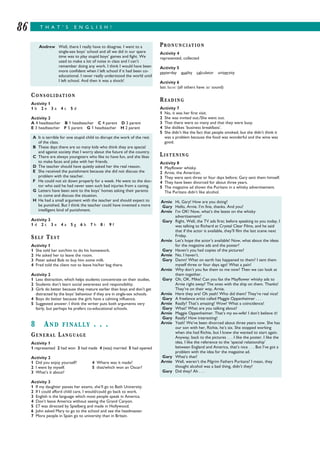
speaks 5) ...... (well) or 6) ...... (badly). We prefer to
say that all accents and dialects are equal. But we
think many schoolchildren speak and write 7) ......
(ungrammatically) than they used to. What do you
think about Spain? Do people speak 8) ...... (correct-
ly) than they used to, or is it just that many people
use Spanish in city jobs and so they need to be
more educated? Interesting thought!
2G
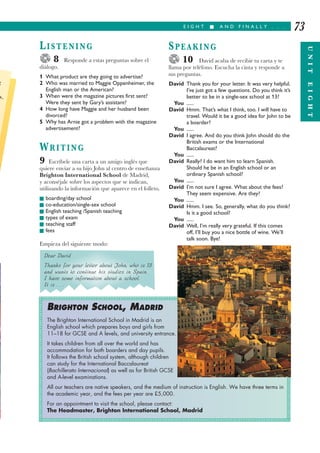
T H A T ’ S E N G L I S H !8
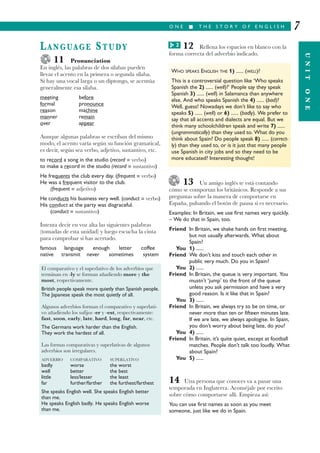
CONSOLIDATION
1 Basándote en lo que has aprendido
en esta unidad y en la ilustración que
acompaña al texto, intenta contestar la
pregunta que se formula en el título.
Luego lee el artículo para comprobar tu
respuesta.
2 Busca la siguiente información en el
texto.
1 Three reasons why English spelling is
different from English pronunciation.
2 Who William Shakespeare was.
3 Which language has more regular
spelling than English?
3 Escribe preguntas para las siguientes respuestas.
1 William Shakespeare did.
2 Spanish does.
3 It’s because there are different ways of spelling the
same sound.
4 The first ones came from Europe.
4 ¿Qué palabras del texto significan lo mismo que las
siguientes?
1 regular, permanent
2 writers
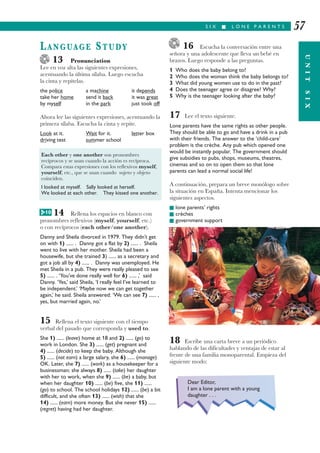
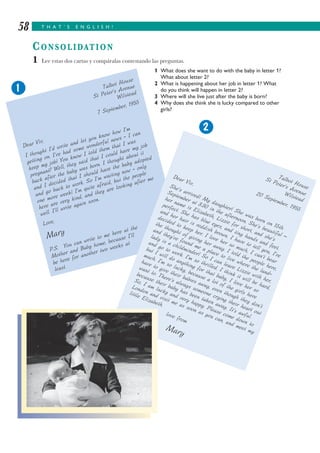
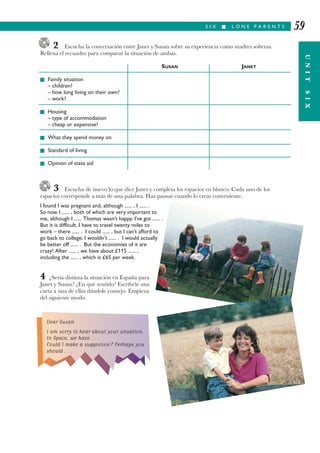
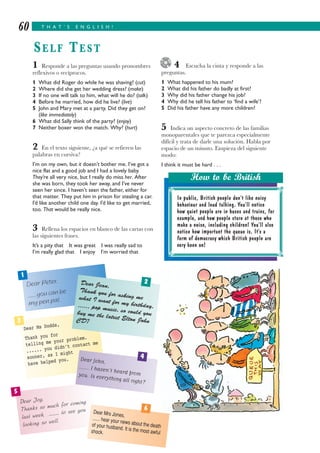
3 didn’t worry much
4 agreed ways of doing things
5 Escucha esta conversación entre Charles y Barry.
A ¿Quién utiliza un estilo formal y quién uno más informal?
B Observa estas expresiones tomadas de la conversación. ¿Cuáles son formales y cuáles son informales?
Good morning How’s it going? Hi! See you later Sounds fun I’m very well, thank you
Where do I start? Might as well I’ll look forward to seeing you Bored to death
Have you thought of . . . ? Perhaps you’d like to come What’s up, then?
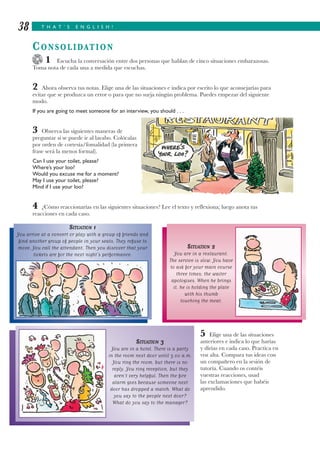
6 Ahora vas a oír varias conversaciones breves (A–E). ¿Cuáles son formales y cuáles informales?
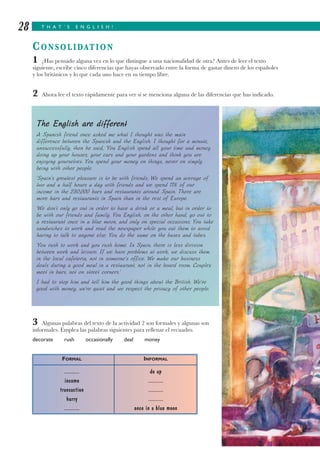
Why is English spelling so difficult?
Any learner will tell you that English spelling is very difficult.
It is far less regular than Spanish, for example. There seem
to be so many ways of spelling the same sound that it is
impossible to form a regular spelling rule for many words.
What is the problem?
The problem is partly one of Normans and Saxons. Norman
scribes spelt words in the French way. Saxon scribes spelt
words in the English way, so there were two spelling systems
in operation. When printing began in Britain in the 15th century,
the first printers came to England from Europe. They brought
their own systems and pronunciation and changed the spelling
of words to suit it. And sometimes their English wasn’t very
good! Printing made English spelling more stable but then
pronunciation changed and printing didn’t follow it. So the
way we pronounced words and the way we spelt them became
different.
People were very careless about spelling. Even England’s most
famous writer, William Shakespeare, spelt his name in many
different ways. So that is why English spelling is different
from the English pronunciation.
O N E I T H E S T O R Y O F E N G L I S H
UNITONE
9
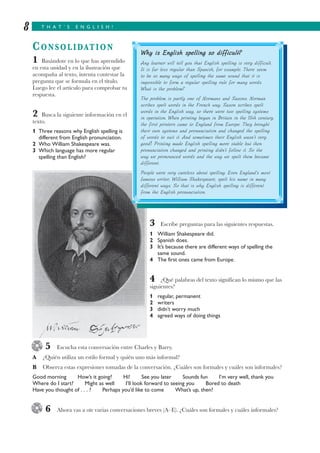
7 Observa estas dos cartas. ¿Cuál es formal y cuál no? Haz una lista de las expresiones formales e
informales que se usan en ambas cartas.
Formal expressions Informal expressions
8 Imagínate que has estado pasando una
temporada en Gran Bretaña. A tu regreso a
España, tienes que escribir dos cartas de
agradecimiento, una a tu profesor de inglés y
otra a una amiga. ¿Cuál será más formal?
Empieza del siguiente modo.
9 ¿Quiénes son más formales, los ingleses o
los españoles? Observa la lista de aspectos
característicos del comportamiento británico.
¿Sucede lo mismo en España? Toma unas notas y
prepárate para hablar de ello en tu sesión de tutoría.
A Dear Mr Jones,
Please find enclosed the book that you sent my
flatmate. Unfortunately, she has moved and no
longer lives at this address. I have her new
address, but she is abroad for six months.
As a result, I feel it would be better to return the
book herewith.
Yours truly,
Dear Mr Jackson,
I am writing to thank
you for . . .
Dear Mary,
I’m back home and wanted
to thank you for . . .
Teacher
Friend
CULTURE QUIZ
Britain Spain
• use first names soon after meeting
someone for the first time
• shake hands with men and women on
first meeting
• quite informal in letters and speech
• not direct with each other in
speaking and writing
• value quiet behaviour
• seldom touch each other while talking
B Dear John,
Thanks so much for the book you sent Linda.
Unfortunately, she’s not here, as she’s moved. I’d
send the book to her, but she’s abroad for six
months, so there’s no point. I think the best thing
to do is to send the book back to you.
Yours,
1 Rellena los espacios en blanco.
Spanish has 1) ...... words than English, but in general Spanish people speak English 2) ...... English people
speak Spanish. Many Spanish words have entered the English language. For example, the English ‘ranch’ 3) ......
Spanish rancho. English is 4) ...... formal than Spanish because we don’t have the tú and usted distinction. But
English people often behave 5) ...... than the Spanish.
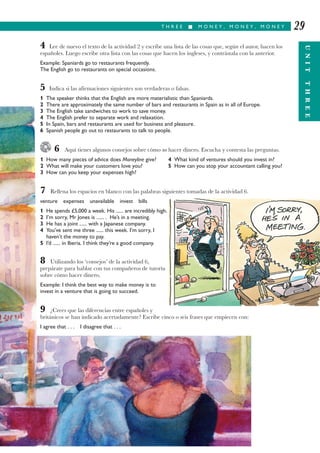
2 Lee el texto siguiente y responde a las preguntas.
The English have a habit of naming objects after the people who invented
them. The Duke of Wellington, named after a town in the south of England,
was the famous English general who defeated Napoleon at Waterloo. He
spent a lot of his time in the muddy battlefields and so he invented a special
long, rubber boot. It was very effective and is more popular amongst adults
and children than ever before. It’s called a ‘wellington boot’, or ‘welly’ for
short. A cardigan is a woollen jacket with buttons down the front. Cardigan is
the name of a town in west Wales, and the Earl of Cardigan, a nobleman, put his
name to this kind of clothing, which he found very comfortable to wear. The word
‘sandwich’ comes from the name of a small town in Kent. The Earl of Sandwich
liked to gamble and to play cards and found that he had no time to eat his lunch
because it prevented him from continuing the game. So he began taking meat and
vegetables between slices of bread to the gambling table. Since then, sandwiches
have always been popular.
1 Why did Wellington invent wellington boots?
2 Where did the Earl of Cardigan come from?
3 What are the origins of the word ‘sandwich’?
4 Where do the names Wellington, Cardigan and Sandwich come
from?
5 Do you think wellingtons, cardigans and sandwiches are still popular
today?
3 Escribe una carta a un periódico quejándote del uso abusivo de
palabras inglesas por parte de los medios de comunicación españoles.
T H A T ’ S E N G L I S H !10
SELF TEST
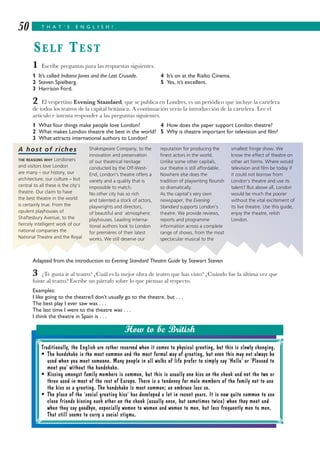
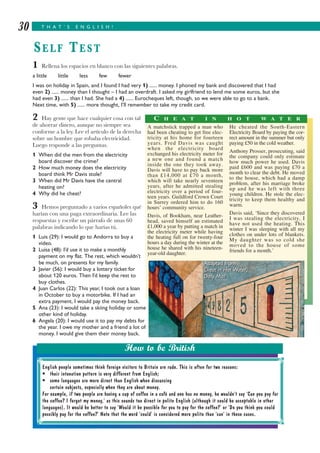
In Britain, they don’t like to say that things are better than they are. Quite often, they say the opposite.
They say things are OK when they are actually very good! Here are some examples, with their real meanings:
WHAT THE BRITISH SAY WHAT THE BRITISH MEAN
It would be nice if the flat were tidier. The flat’s untidy – please tidy it.
It’s nice to dress smartly. You must dress more smartly.
Have you thought about changing? I think you should change.
I think it would be marvellous if you Please change your jacket.
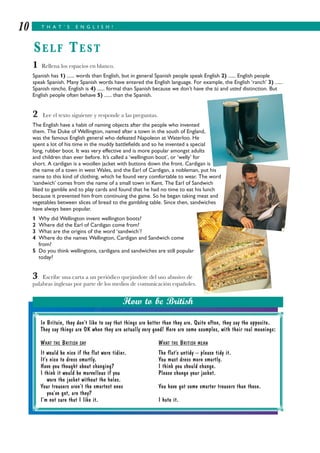
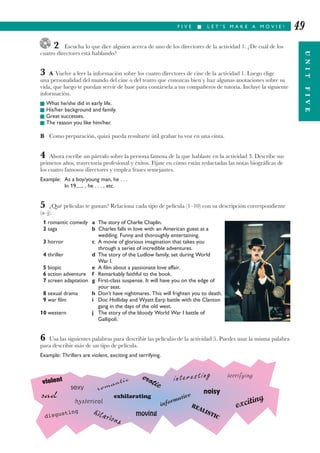
wore the jacket without the holes.
Your trousers aren’t the smartest ones You have got some smarter trousers than those.
you’ve got, are they?
I’m not sure that I like it. I hate it.
How to be British
2
AMERICAN OR
BRITISH ENGLISH?
11
UNITTWO
THE STORY OF AMERICA
BEFORE YOU WATCH
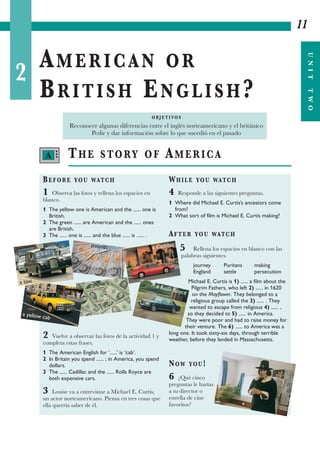
1 Observa las fotos y rellena los espacios en
blanco.
1 The yellow one is American and the ...... one is
British.
2 The green ...... are American and the ...... ones
are British.
3 The ...... one is ...... and the blue ...... is ...... .
2 Vuelve a observar las fotos de la actividad 1 y
completa estas frases.
1 The American English for ‘......’ is ‘cab’.
2 In Britain you spend ...... ; in America, you spend
dollars.
3 The ...... Cadillac and the ...... Rolls Royce are
both expensive cars.
3 Louise va a entrevistar a Michael E. Curtis,
un actor norteamericano. Piensa en tres cosas que
ella querría saber de él.
WHILE YOU WATCH
4 Responde a las siguientes preguntas.
1 Where did Michael E. Curtis’s ancestors come
from?
2 What sort of film is Michael E. Curtis making?
AFTER YOU WATCH
5 Rellena los espacios en blanco con las
palabras siguientes.
journey Puritans making
England settle persecution
Michael E. Curtis is 1) ...... a film about the
Pilgrim Fathers, who left 2) ...... in 1620
on the Mayflower. They belonged to a
religious group called the 3) ...... . They
wanted to escape from religious 4) ...... ,
so they decided to 5) ...... in America.
They were poor and had to raise money for
their venture. The 6) ...... to America was a
long one. It took sixty-six days, through terrible
weather, before they landed in Massachusetts.
NOW YOU!
6 ¿Qué cinco
preguntas le harías
a tu director o
estrella de cine
favoritos?
O B J E T I VO S
Reconocer algunas diferencias entre el inglés norteamericano y el británico
Pedir y dar información sobre lo que sucedió en el pasado
a taxi
a yellow cab
pounds
dollars
a Cadillac
a Rolls Royce
A •••
T H A T ’ S E N G L I S H !12
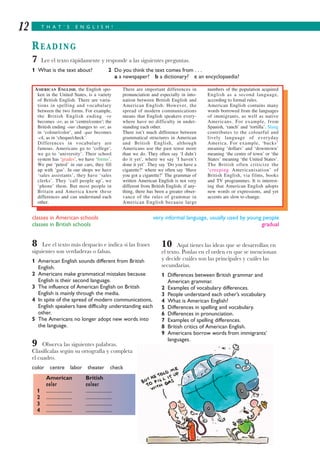
READING
7 Lee el texto rápidamente y responde a las siguientes preguntas.
1 What is the text about? 2 Do you think the text comes from . . .
a a newspaper? b a dictionary? c an encyclopaedia?
classes in American schools very informal language, usually used by young people
classes in British schools gradual
8 Lee el texto más despacio e indica si las frases
siguientes son verdaderas o falsas.
1 American English sounds different from British
English.
2 Americans make grammatical mistakes because
English is their second language.
3 The influence of American English on British
English is mainly through the media.
4 In spite of the spread of modern communications,
English speakers have difficulty understanding each
other.
5 The Americans no longer adopt new words into
the language.
9 Observa las siguientes palabras.
Clasifícalas según su ortografía y completa
el cuadro.
color centre labor theater check
10 Aquí tienes las ideas que se desarrollan en
el texto. Ponlas en el orden en que se mencionan
y decide cuáles son las principales y cuáles las
secundarias.
1 Differences between British grammar and
American grammar.
2 Examples of vocabulary differences.
3 People understand each other’s vocabulary.
4 What is American English?
5 Differences in spelling and vocabulary.
6 Differences in pronunciation.
7 Examples of spelling differences.
8 British critics of American English.
9 Americans borrow words from immigrants’
languages.
American British
color colour
1 ..................... .....................
2 ..................... .....................
3 ..................... .....................
4 ..................... .....................
AMERICAN ENGLISH, the English spo-
ken in the United States, is a variety
of British English. There are varia-
tions in spelling and vocabulary
between the two forms. For example,
the British English ending -re
becomes -er, as in ‘centre/center’; the
British ending -our changes to -or, as
in ‘colour/color’, and -que becomes
-ck, as in ‘cheque/check’.
Differences in vocabulary are
famous. Americans go to ‘college’,
we go to ‘university’. Their school
system has ‘grades’, we have ‘forms’.
We put ‘petrol’ in our cars, they fill
up with ‘gas’. In our shops we have
‘sales assistants’, they have ‘sales
clerks’. They ‘call people up’, we
‘phone’ them. But most people in
Britain and America know these
differences and can understand each
other.
There are important differences in
pronunciation and especially in into-
nation between British English and
American English. However, the
spread of modern communications
means that English speakers every-
where have no difficulty in under-
standing each other.
There isn’t much difference between
grammatical structures in American
and British English, although
Americans use the past tense more
than we do. They often say ‘I didn’t
do it yet’, where we say ‘I haven’t
done it yet’. They say ‘Do you have a
cigarette?’ where we often say ‘Have
you got a cigarette?’ The grammar of
written American English is not very
different from British English; if any-
thing, there has been a greater obser-
vance of the rules of grammar in
American English because large
numbers of the population acquired
English as a second language,
according to formal rules.
American English contains many
words borrowed from the languages
of immigrants, as well as native
Americans. For example, from
Spanish, ‘ranch’ and ‘tortilla’. Slang
contributes to the colourful and
lively language of everyday
America. For example, ‘bucks’
meaning ‘dollars’ and ‘downtown’
meaning ‘the centre of town’ or ‘the
States’ meaning ‘the United States’.
The British often criticize the
‘creeping Americanisation’ of
British English, via films, books
and TV programmes. It is interest-
ing that American English adopts
new words or expressions, and yet
accents are slow to change.
T W O I A M E R I C A N O R B R I T I S H E N G L I S H ?
UNITTWO
13
LANGUAGE STUDY
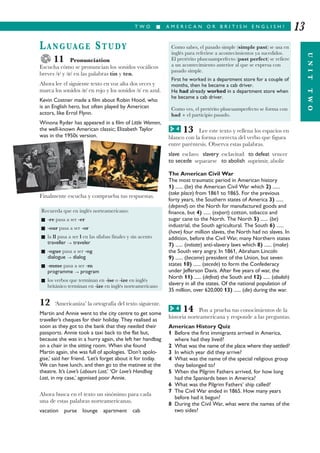
11 Pronunciation
Escucha cómo se pronuncian los sonidos vocálicos
breves // y /e/ en las palabras tin y ten.
Ahora lee el siguiente texto en voz alta dos veces y
marca los sonidos /e/ en rojo y los sonidos // en azul.
Kevin Costner made a film about Robin Hood, who
is an English hero, but often played by American
actors, like Errol Flynn.
Winona Ryder has appeared in a film of Little Women,
the well-known American classic; Elizabeth Taylor
was in the 1950s version.
Finalmente escucha y comprueba tus respuestas.
12 ‘Americaniza’ la ortografía del texto siguiente.
Martin and Annie went to the city centre to get some
traveller’s cheques for their holiday. They realised as
soon as they got to the bank that they needed their
passports. Annie took a taxi back to the flat but,
because she was in a hurry again, she left her handbag
on a chair in the sitting room. When she found
Martin again, she was full of apologies. ‘Don’t apolo-
gise,’ said her friend. ‘Let’s forget about it for today.
We can have lunch, and then go to the matinee at the
theatre. It’s Love’s Labours Lost.’ ‘Or Love’s Handbag
Lost, in my case,’ agonised poor Annie.
Ahora busca en el texto un sinónimo para cada
una de estas palabras norteamericanas.
vacation purse lounge apartment cab
13 Lee este texto y rellena los espacios en
blanco con la forma correcta del verbo que figura
entre paréntesis. Observa estas palabras.
slave esclavo slavery esclavitud to defeat vencer
to secede separarse to abolish suprimir, abolir
The American Civil War
The most traumatic period in American history
1) ...... (be) the American Civil War which 2) ......
(take place) from 1861 to 1865. For the previous
forty years, the Southern states of America 3) ......
(depend) on the North for manufactured goods and
finance, but 4) ...... (export) cotton, tobacco and
sugar cane to the North. The North 5) ...... (be)
industrial, the South agricultural. The South 6) ......
(have) four million slaves, the North had no slaves. In
addition, before the Civil War, many Northern states
7) ...... (initiate) anti-slavery laws which 8) ...... (make)
the South very angry. In 1861, Abraham Lincoln
9) ...... (become) president of the Union, but seven
states 10) ...... (secede) to form the Confederacy
under Jefferson Davis. After five years of war, the
North 11) ...... (defeat) the South and 12) ...... (abolish)
slavery in all the states. Of the national population of
35 million, over 620,000 13) ...... (die) during the war.
14 Pon a prueba tus conocimientos de la
historia norteamericana y responde a las preguntas.
American History Quiz
1 Before the first immigrants arrived in America,
where had they lived?
2 What was the name of the place where they settled?
3 In which year did they arrive?
4 What was the name of the special religious group
they belonged to?
5 When the Pilgrim Fathers arrived, for how long
had the Spaniards been in America?
6 What was the Pilgrim Fathers’ ship called?
7 The Civil War ended in 1865. How many years
before had it begun?
8 During the Civil War, what were the names of the
two sides?
Recuerda que en inglés norteamericano:
I -re pasa a ser -er
I -our pasa a ser -or
I la ll pasa a ser l en las sílabas finales y sin acento
traveller ¡ traveler
I -ogue pasa a ser -og
dialogue ¡ dialog
I -mme pasa a ser -m
programme ¡ program
I los verbos que terminan en -ise o -ize en inglés
británico terminan en -ize en inglés norteamericano
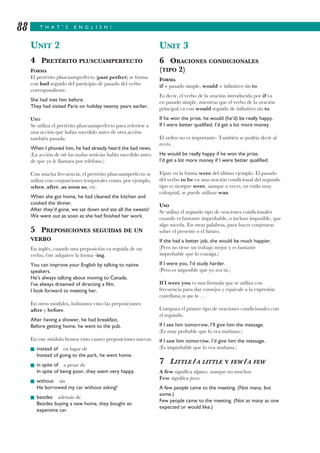
Como sabes, el pasado simple (simple past) se usa en
inglés para referirse a acontecimientos ya sucedidos.
El pretérito pluscuamperfecto (past perfect) se refiere
a un acontecimiento anterior al que se expresa con
pasado simple.
First he worked in a department store for a couple of
months, then he became a cab driver.
He had already worked in a department store when
he became a cab driver.
Como ves, el pretérito pluscuamperfecto se forma con
had + el participio pasado.
4G
4G
T H A T ’ S E N G L I S H !14
15 Escucha la conversación y luego
responde a las siguientes preguntas.
1 What nationality are the speakers?
2 Do both the speakers live there?
3 Are they in the church or in the street?
4 Find two questions asked in an American accent.
5 Find two questions asked in a British accent.
16 A Escucha de nuevo la conversación
de la actividad 15 e indica cuáles de las frases
siguientes corresponden al inglés norteamericano
(A) y cuáles al inglés británico (B).
1 a quarter past two a quarter after two
2 the train station the railway station
3 a really cute place a nice place
4 Have you ever been? Did you ever go?
5 Nice meeting you. Nice to meet you.
6 Goodbye. So long.
B Vuelve a escuchar y localiza la forma
norteamericana correspondiente a las
siguientes expresiones.
1 Have you got the time?
2 a quarter to three
3 a vicar
4 to photocopy
17 Completa las frases siguientes sobre
los llamados Padres Peregrinos, usando instead
of, in spite of, besides o without.
1 ...... sailing through terrible storms and being sick
and hungry, all except two of the original 102 on
board survived the sixty-six day voyage.
2 ...... settling where they had landed, they went
south to find a better place. In mid-December,
they chose the place where Plymouth,
Massachusetts, now stands.
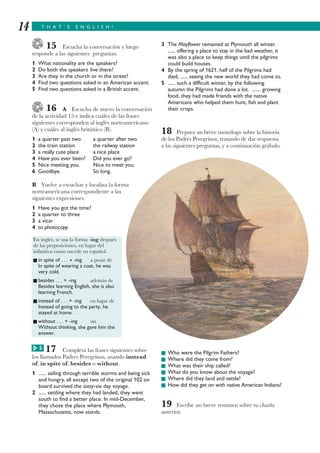
3 The Mayflower remained at Plymouth all winter.
...... offering a place to stay in the bad weather, it
was also a place to keep things until the pilgrims
could build houses.
4 By the spring of 1621, half of the Pilgrims had
died, ...... seeing the new world they had come to.
5 ...... such a difficult winter, by the following
autumn the Pilgrims had done a lot. ....... growing
food, they had made friends with the native
Americans who helped them hunt, fish and plant
their crops.
18 Prepara un breve monólogo sobre la historia
de los Padres Peregrinos, tratando de dar respuesta
a las siguientes preguntas, y a continuación grábalo.
I Who were the Pilgrim Fathers?
I Where did they come from?
I What was their ship called?
I What do you know about the voyage?
I Where did they land and settle?
I How did they get on with native American Indians?
19 Escribe un breve resumen sobre tu charla
anterior.
En inglés, se usa la forma -ing después
de las preposiciones, en lugar del
infinitivo como sucede en español.
I in spite of . . . + -ing a pesar de
In spite of wearing a coat, he was
very cold.
I besides . . . + -ing además de
Besides learning English, she is also
learning French.
I instead of . . . + -ing en lugar de
Instead of going to the party, he
stayed at home.
I without . . . + -ing sin
Without thinking, she gave him the
answer.
5G
T W O I A M E R I C A N O R B R I T I S H E N G L I S H ? 15
BEFORE YOU
WATCH
1 Street interviews
Vas a ver unas entrevistas
sobre el uso del inglés
norteamericano en Inglaterra.
¿Con qué frecuencia crees
que estas personas británicas
utilizarán expresiones norte-
americanas? Intenta relacionar
las frases con las fotos;
comprueba tus respuestas al
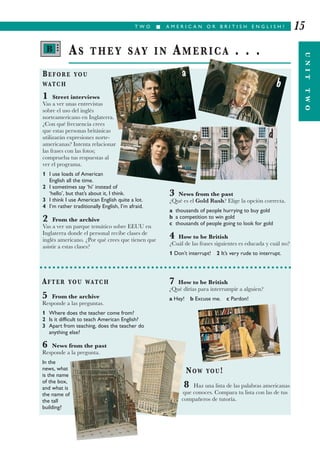
ver el programa.
1 I use loads of American
English all the time.
2 I sometimes say ‘hi’ instead of
‘hello’, but that’s about it, I think.
3 I think I use American English quite a lot.
4 I’m rather traditionally English, I’m afraid.
2 From the archive
Vas a ver un parque temático sobre EEUU en
Inglaterra donde el personal recibe clases de
inglés americano. ¿Por qué crees que tienen que
asistir a estas clases?
3 News from the past
¿Qué es el Gold Rush? Elige la opción correcta.
a thousands of people hurrying to buy gold
b a competition to win gold
c thousands of people going to look for gold
4 How to be British
¿Cuál de las frases siguientes es educada y cuál no?
1 Don’t interrupt! 2 It’s very rude to interrupt.
AS THEY SAY IN AMERICA . . .
AFTER YOU WATCH
5 From the archive
Responde a las preguntas.
1 Where does the teacher come from?
2 Is it difficult to teach American English?
3 Apart from teaching, does the teacher do
anything else?
6 News from the past
Responde a la pregunta.
In the
news, what
is the name
of the box,
and what is
the name of
the tall
building?
7 How to be British
¿Qué dirías para interrumpir a alguien?
a Hey! b Excuse me. c Pardon!
NOW YOU!
8 Haz una lista de las palabras americanas
que conoces. Compara tu lista con las de tus
compañeros de tutoría.
UNITTWO
B •••
a
b
c d
T H A T ’ S E N G L I S H !16
READING
9 Lee el texto rápidamente y responde a las siguientes preguntas.
1 Was the influence of the English government on the American colonies strong or weak?
2 Were the native Americans hostile or friendly to begin with?
3 Before the year 1700, were there more settlers in South America or in North America?
4 Were the immigrants of the eighteenth century generally poor or rich Europeans?
From The Shorter Illustrated
History of the World
by J. M. Roberts
10 Vuelve a leer el texto y contesta estas preguntas.
1 How did the native Americans treat the European settlers?
2 What did the native Americans do when the settlers took over their hunting grounds?
11 Intercala las palabras del texto (a–f ) en las frases (1–4).
a independent b less impressive c aboriginal d native American e conflict f struggle
1 The ...... Indians are an ...... people in North America.
2 Compared to Spanish in Latin America, European settlement in North America was ...... until the 1900s.
3 The Indians tried to be ...... of the settlers, but when the settlers went west across America, they were in
...... with the Indians.
4 After a lengthy ...... , they defeated the Indians.
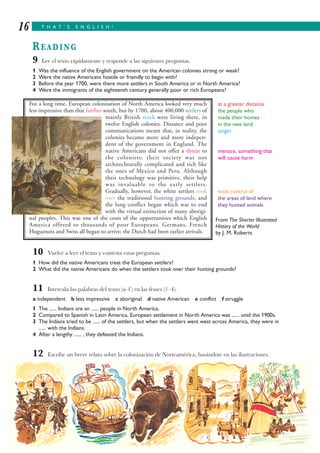
12 Escribe un breve relato sobre la colonización de Norteamérica, basándote en las ilustraciones.
For a long time, European colonisation of North America looked very much
less impressive than that further south, but by 1700, about 400,000 settlers of
mainly British stock were living there, in
twelve English colonies. Distance and poor
communications meant that, in reality, the
colonies became more and more indepen-
dent of the government in England. The
native Americans did not offer a threat to
the colonists; their society was not
architechturally complicated and rich like
the ones of Mexico and Peru. Although
their technology was primitive, their help
was invaluable to the early settlers.
Gradually, however, the white settlers took
over the traditional hunting grounds, and
the long conflict began which was to end
with the virtual extinction of many aborigi-
nal peoples. This was one of the costs of the opportunities which English
America offered to thousands of poor Europeans. Germans, French
Huguenots and Swiss all began to arrive; the Dutch had been earlier arrivals.
at a greater distance
the people who
made their homes
in the new land
origin
menace, something that
will cause harm
took control of
the areas of land where
they hunted animals
LANGUAGE STUDY
13 Pronunciation
En inglés, la acentuación de las palabras de tres sílabas no sigue reglas fijas. Cuando veas una palabra que
no conoces, consulta el diccionario. La sílaba acentuada normalmente lleva un apóstrofo delante o
aparece subrayada. Por ejemplo: /r leȓǩn/ o /rleȓǩn/. En cada uno de los siguientes grupos de palabras,
tres se acentúan en la misma sílaba. ¿Cuál de ellas no?
1 computer passenger newspaper elegant
2 ancestor yesterday amazing marvellous
3 eleven assistant cathedral understand
Ahora escucha la cinta y comprueba tus respuestas.
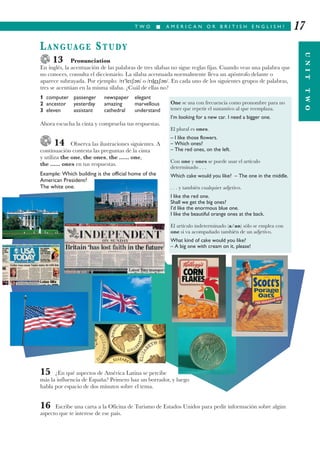
14 Observa las ilustraciones siguientes. A
continuación contesta las preguntas de la cinta
y utiliza the one, the ones, the ...... one,
the ...... ones en tus respuestas.
Example: Which building is the official home of the
American President?
The white one.
15 ¿En qué aspectos de América Latina se percibe
más la influencia de España? Primero haz un borrador, y luego
habla por espacio de dos minutos sobre el tema.
16 Escribe una carta a la Oficina de Turismo de Estados Unidos para pedir información sobre algún
aspecto que te interese de ese país.
T W O I A M E R I C A N O R B R I T I S H E N G L I S H ?
UNITTWO
17
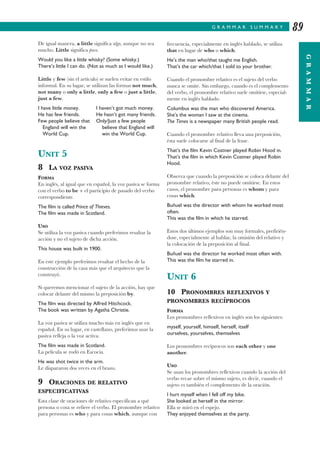
One se usa con frecuencia como pronombre para no
tener que repetir el sustantivo al que reemplaza.
I’m looking for a new car. I need a bigger one.
El plural es ones.
– I like those flowers.
– Which ones?
– The red ones, on the left.
Con one y ones se puede usar el artículo
determinado . . .
Which cake would you like? – The one in the middle.
. . . y también cualquier adjetivo.
I like the red one.
Shall we get the big ones?
I’d like the enormous blue one.
I like the beautiful orange ones at the back.
El artículo indeterminado (a/an) sólo se emplea con
one si va acompañado también de un adjetivo.
What kind of cake would you like?
– A big one with cream on it, please!
T H A T ’ S E N G L I S H !18
CONSOLIDATION
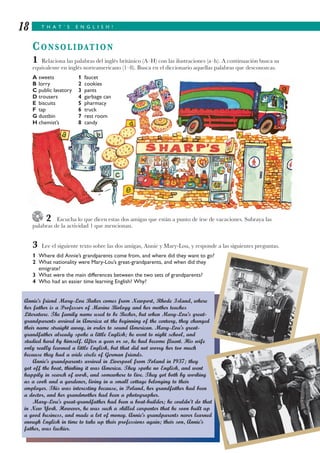
1 Relaciona las palabras del inglés británico (A–H) con las ilustraciones (a–h). A continuación busca su
equivalente en inglés norteamericano (1–8). Busca en el diccionario aquellas palabras que desconozcas.
A sweets 1 faucet
B lorry 2 cookies
C public lavatory 3 pants
D trousers 4 garbage can
E biscuits 5 pharmacy
F tap 6 truck
G dustbin 7 rest room
H chemist’s 8 candy
2 Escucha lo que dicen estas dos amigas que están a punto de irse de vacaciones. Subraya las
palabras de la actividad 1 que mencionan.
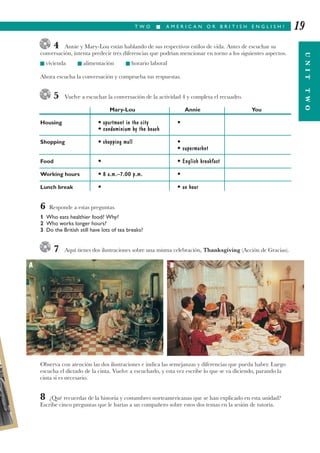
3 Lee el siguiente texto sobre las dos amigas, Annie y Mary-Lou, y responde a las siguientes preguntas.
1 Where did Annie’s grandparents come from, and where did they want to go?
2 What nationality were Mary-Lou’s great-grandparents, and when did they
emigrate?
3 What were the main differences between the two sets of grandparents?
4 Who had an easier time learning English? Why?
Annie’s friend Mary-Lou Baker comes from Newport, Rhode Island, where
her father is a Professor of Marine Biology and her mother teaches
Literature. The family name used to be Becker, but when Mary-Lou’s great-
grandparents arrived in America at the beginning of the century, they changed
their name straight away, in order to sound American. Mary-Lou’s great-
grandfather already spoke a little English; he went to night school, and
studied hard by himself. After a year or so, he had become fluent. His wife
only really learned a little English, but that did not worry her too much
because they had a wide circle of German friends.
Annie’s grandparents arrived in Liverpool from Poland in 1937; they
got off the boat, thinking it was America. They spoke no English, and went
happily in search of work, and somewhere to live. They got both by working
as a cook and a gardener, living in a small cottage belonging to their
employer. This was interesting because, in Poland, her grandfather had been
a doctor, and her grandmother had been a photographer.
Mary-Lou’s great-grandfather had been a boat-builder; he couldn’t do that
in New York. However, he was such a skilled carpenter that he soon built up
a good business, and made a lot of money. Annie’s grandparents never learned
enough English in time to take up their professions again; their son, Annie’s
father, was luckier.
T W O I A M E R I C A N O R B R I T I S H E N G L I S H ?
UNITTWO
19
4 Annie y Mary-Lou están hablando de sus respectivos estilos de vida. Antes de escuchar su
conversación, intenta predecir tres diferencias que podrían mencionar en torno a los siguientes aspectos.
I vivienda I alimentación I horario laboral
Ahora escucha la conversación y comprueba tus respuestas.
5 Vuelve a escuchar la conversación de la actividad 4 y completa el recuadro.
Mary-Lou Annie You
Housing • apartment in the city •
• condominium by the beach
Shopping • shopping mall •
• supermarket
Food • • English breakfast
Working hours • 8 a.m.–7.00 p.m. •
Lunch break • • an hour
6 Responde a estas preguntas.
1 Who eats healthier food? Why?
2 Who works longer hours?
3 Do the British still have lots of tea breaks?
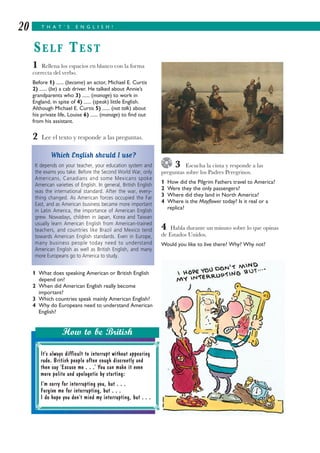
7 Aquí tienes dos ilustraciones sobre una misma celebración, Thanksgiving (Acción de Gracias).
Observa con atención las dos ilustraciones e indica las semejanzas y diferencias que pueda haber. Luego
escucha el dictado de la cinta. Vuelve a escucharlo, y esta vez escribe lo que se va diciendo, parando la
cinta si es necesario.
8 ¿Qué recuerdas de la historia y costumbres norteamericanas que se han explicado en esta unidad?
Escribe cinco preguntas que le harías a un compañero sobre estos dos temas en la sesión de tutoría.
A B
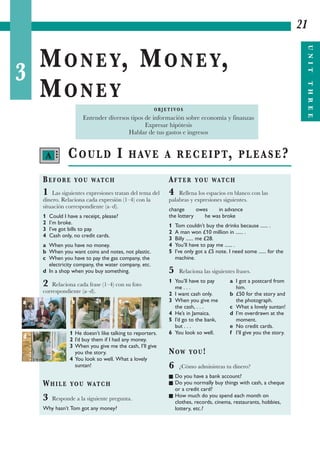
3 Escucha la cinta y responde a las
preguntas sobre los Padres Peregrinos.
1 How did the Pilgrim Fathers travel to America?
2 Were they the only passengers?
3 Where did they land in North America?
4 Where is the Mayflower today? Is it real or a
replica?
4 Habla durante un minuto sobre lo que opinas
de Estados Unidos.
Would you like to live there? Why? Why not?
1 Rellena los espacios en blanco con la forma
correcta del verbo.
Before 1) ...... (become) an actor, Michael E. Curtis
2) ...... (be) a cab driver. He talked about Annie’s
grandparents who 3) ...... (manage) to work in
England, in spite of 4) ...... (speak) little English.
Although Michael E. Curtis 5) ...... (not talk) about
his private life, Louise 6) ...... (manage) to find out
from his assistant.
2 Lee el texto y responde a las preguntas.
1 What does speaking American or British English
depend on?
2 When did American English really become
important?
3 Which countries speak mainly American English?
4 Why do Europeans need to understand American
English?
T H A T ’ S E N G L I S H !20
SELF TEST
It’s always difficult to interrupt without appearing
rude. British people often cough discreetly and
then say ‘Excuse me . . .’ You can make it even
more polite and apologetic by starting:
I’m sorry for interrupting you, but . . .
Forgive me for interrupting, but . . .
I do hope you don’t mind my interrupting, but . . .
How to be British
Which English should I use?
It depends on your teacher, your education system and
the exams you take. Before the Second World War, only
Americans, Canadians and some Mexicans spoke
American varieties of English. In general, British English
was the international standard. After the war, every-
thing changed. As American forces occupied the Far
East, and as American business became more important
in Latin America, the importance of American English
grew. Nowadays, children in Japan, Korea and Taiwan
usually learn American English from American-trained
teachers, and countries like Brazil and Mexico tend
towards American English standards. Even in Europe,
many business people today need to understand
American English as well as British English, and many
more Europeans go to America to study.
3
MONEY, MONEY,
MONEY
21
UNITTHREE
COULD I HAVE A RECEIPT, PLEASE?
BEFORE YOU WATCH
1 Las siguientes expresiones tratan del tema del
dinero. Relaciona cada expresión (1–4) con la
situación correspondiente (a–d).
1 Could I have a receipt, please?
2 I’m broke.
3 I’ve got bills to pay.
4 Cash only, no credit cards.
a When you have no money.
b When you want coins and notes, not plastic.
c When you have to pay the gas company, the
electricity company, the water company, etc.
d In a shop when you buy something.
2 Relaciona cada frase (1–4) con su foto
correspondiente (a–d).
1 He doesn’t like talking to reporters.
2 I’d buy them if I had any money.
3 When you give me the cash, I’ll give
you the story.
4 You look so well. What a lovely
suntan!
WHILE YOU WATCH
3 Responde a la siguiente pregunta.
Why hasn’t Tom got any money?
AFTER YOU WATCH
4 Rellena los espacios en blanco con las
palabras y expresiones siguientes.
change owes in advance
the lottery he was broke
1 Tom couldn’t buy the drinks because ...... .
2 A man won £10 million in ...... .
3 Billy ...... me £28.
4 You’ll have to pay me ...... .
5 I’ve only got a £5 note. I need some ...... for the
machine.
5 Relaciona las siguientes frases.
1 You’ll have to pay a I got a postcard from
me . . . him.
2 I want cash only. b £50 for the story and
3 When you give me the photograph.
the cash, . . . c What a lovely suntan!
4 He’s in Jamaica. d I’m overdrawn at the
5 I’d go to the bank, moment.
but . . . e No credit cards.
6 You look so well. f I’ll give you the story.
NOW YOU!
6 ¿Cómo administras tu dinero?
I Do you have a bank account?
I Do you normally buy things with cash, a cheque
or a credit card?
I How much do you spend each month on
clothes, records, cinema, restaurants, hobbies,
lottery, etc.?
O B J E T I VO S
Entender diversos tipos de información sobre economía y finanzas
Expresar hipótesis
Hablar de tus gastos e ingresos
A •••
a b c
d
T H A T ’ S E N G L I S H !22
READING
8 Lee el resto de la historia para saber lo que
ocurrió.
9 Indica cuál de las tres opciones es la correcta,
según lo que se relata en el texto.
1 The policeman described Mr O’Brien as . . .
a a man who loved his family.
b a lonely man.
c a husband and a father.
2 According to the policeman, Mr O’Brien
committed suicide because . . .
a he was suffering from stress.
b he was worried about his friend.
c he couldn’t tell his family.
3 The neighbours were shocked because . . .
a he never had problems.
b he was very generous.
c he didn’t seem to be the sort of man who
would commit suicide.
4 The organisers of the lottery said that . . .
a it was the fault of the lottery.
b they were sorry if it was because of the
lottery.
c it wasn’t the lottery’s fault; Mr O’Brien was ill.
5 The newsagent . . .
a feels strongly that people depend too much on
the lottery.
b thinks people should continue to buy lottery
tickets.
c thinks that the lottery is a bad idea.
10 ¿Qué palabras o expresiones del texto son
iguales o similares a las siguientes?
1 completed 5 able to do
2 colleague 6 pressure
3 pick up his winnings 7 commit suicide
4 confused 8 sad
11 Señala las frases verdaderas y corrige las falsas.
1 He killed himself because the winning lottery
numbers were different from his.
2 He shot himself with a pistol.
3 He didn’t love his family.
4 Mr O’Brien was not a calm, caring man. He would
do nothing for nobody.
5 The story shows that people do not get obsessed
by the lottery.
6 Some people spend all their money on the lottery.
A51-year-old father, who filled
in the same numbers each week
in the National Lottery for himself
and a workmate, killed himself after
forgetting to renew his entry. That
day they won more than £2 million.
But because he hadn’t bought a lot-
tery ticket and renewed his numbers,
he couldn’t collect.
When he discovered his mistake on
Sunday, Timothy O’Brien of
Liverpool, realised he had lost his
family and his friend £1 million each.
As his wife sat downstairs, he went
up to the attic, took out a .22 pistol
and shot himself in the head.
A police officer described Mr
O’Brien as ‘a caring man, a good
husband and father’. He said, ‘It’s a
tragedy. He got his dates mixed up.
You can never judge what people are
capable of in times of stress.’ A
neighbour described Mr O’Brien as
‘the nicest man in the street. He
would do anything for anyone. We
can’t believe that he would take his
own life. He always appeared so
relaxed and content and never
seemed to get upset.’
A spokesman for Camelot, the
organisers of the lottery, said, ‘If his
death was due to the lottery, then we
are very sorry. It is a very tragic inci-
dent.’
Mr O’Brien always bought his tick-
ets from his newsagent, Mohamed
Elgadly, who said: ‘It is very sad.
Gambling can lead people to do
extreme things. The National Lottery
does strange things to people. People
become obsessed. For some of my
customers, it is all they seem to live
for. They spend their last pennies on
it each week.’
pay to
enter his
numbers in
the Lottery
again
Adapted from
Tragedy of Lottery
Loser, Daily Mail
7 Lee el primer párrafo y averigua lo siguiente.
1 The man’s age. 4 How much he failed to win.
2 The person he did the lottery with. 5 What he did.
3 Why he didn’t win.
L o t t e r y L o s e r K i l l s H i m s e l f
T H R E E I M O N E Y , M O N E Y , M O N E Y
UNITTHREE
23
LANGUAGE STUDY
12 Pronunciation
A Los españoles suelen confundir los sonidos
/e/ y / / cuando los oyen. Escucha y repite la
pronunciación de las siguientes palabras.
1 sat set 6 tan ten
2 sad said 7 pat pet
3 man men 8 band bend
4 can Ken 9 sand send
5 bad bed
Escucha la cinta y señala cuál de las dos palabras
escuchas en cada caso.
B Ahora practica la pronunciación de las frases
siguientes.
1 The man said the bed was bad.
2 ‘Send that sand to Fred,’ said Dan.
3 Dan got a tan as he sat on the sand for ten
minutes.
4 ‘Can Ken send the band to the fen?’ said Stan.
5 ‘Pat the pet on the head,’ said Fred.
Escucha de nuevo las frases y repítelas.
13 ¿Qué cosas harías si te tocara el
Gordo de la lotería? Anótalas. Escucha la
cinta y compáralas con las que mencionan Ann y
Richard.
14 Básate en las ilustraciones para escribir
frases sobre lo que harían Ann y Richard si
les tocara la lotería. A continuación vuelve a
escuchar la conversación de la actividad 13 para
comprobar tu respuesta.
Example:
Richard would
give up his job.
6G
6G
Las oraciones condicionales del primer tipo se refieren
a algo que probablemente sucederá.
If it’s a nice day, we’ll go to the beach.
(Es muy probable que haga bueno.)
Las oraciones condicionales del segundo tipo se
utilizan cuando es bastante improbable, o incluso
imposible, que algo suceda.
If I won the lottery, I’d buy a house.
(No es muy probable que gane la lotería.)
If I were young, I’d play football every weekend.
(No es posible porque el hablante no es joven.)
Estructura:
Oraciones condicionales del primer tipo
if + presente simple, will + infinitivo sin to
If I see him tomorrow, I’ll give him the message.
Oraciones condicionales del segundo tipo
if + pasado simple, would + infinitivo sin to
If I were you, I’d speak English as often as possible.
T H A T ’ S E N G L I S H !24
15 Escucha de nuevo la conversación y
responde a estas preguntas.
1 How would Richard live if he won the lottery?
2 Would he give any money to charity? If so, which
ones?
3 Why wouldn’t Ann give up her job immediately?
16 Escribe las
frases siguientes, usando
el primer o segundo
tipo de oración
condicional, según
corresponda en cada
situación.
1 You feel like going to
the beach. The weather
forecast says it’s likely
to be sunny tomorrow.
If (weather/good) . . .
2 Your car is in the garage
being repaired. You
would like to drive your
friend to his house, but
you can’t.
If (have/car) . . .
3 You can’t speak
French. You have just
seen a job advertised
which interests you, but it
requires French speakers.
If (speak French) . . .
4 You live in a house with
friends. It is time to
clean the bathroom and
the kitchen. You want
to clean the bathroom.
You want your friend to
clean the kitchen.
Ask him or her.
If (clean/bathroom) . . .
5 You want to go on a
trip with your friends
who all have bicycles.
You don’t have a bicycle.
If I (have/bicycle) . . .
6 Your friend is always
complaining that his/her
flat is too small. Give
him/her some advice.
If I (be/you) . . .
17 Rellena los espacios
en blanco con las siguientes
expresiones.
few a few little a little
1 Many people win the lottery, but
...... people win a lot of money.
2 This year in Britain, ...... people
have won over £10 million!
3 I won ...... money last week. £10!
4 I have very ...... money to invest
in the lottery. Only about £1.
5 ...... writers in Britain criticise
the lottery. They say it makes us
a nation of gamblers.
6 If people want to buy lottery
tickets, they will. There’s ...... we
can do to stop them.
7 My friend spends ...... money on
the lottery every Saturday. If she
wins ...... pounds, she’s happy but
if she wins nothing, she doesn’t
mind.
18 Habla sobre tus
planes o posibilidades para el
futuro en cinco frases; utiliza
el primer tipo de oración
condicional en todas ellas. Por
ejemplo: If I pass my exams,
I’ll get a good job. Luego habla
sobre cosas que no son probables,
también en cinco frases, y en este
caso usa el segundo tipo de
oración condicional. Por ejemplo:
If I went to India, I’d see the
Taj Mahal.
19 Escribe una carta a
un amigo hablándole de tus
planes para pasar unas vacaciones
juntos. Incluye un par de ejemplos
de oración condicional del primer
tipo y otros dos del segundo.
Observa la diferencia entre few/little y a few/
a little. Con el artículo, se expresa que tenemos algo
aunque no sea mucho. Es parecido a some. Sin el
artículo, expresamos que realmente tenemos poco.
I have few problems. I have a few problems.
Tengo pocos problemas. Tengo algunos problemas.
I have little money. I have a little money.
Tengo poco dinero. Tengo algo de dinero.
6G
6G
7G
6G
6G
T H R E E I M O N E Y , M O N E Y , M O N E Y
UNITTHREE
25
BEFORE YOU WATCH
1 How to be British
En el programa, uno de los personajes está
molesto porque él siempre compra el detergente
para la vajilla, pero le cuesta decírselo a su com-
pañero. Fíjate en las expresiones que utiliza.
The point is . . .
The thing is . . .
What I’m trying to say is . . .
Nunca termina sus frases porque le interrumpe su
compañero. Escucha y di cuál de estas frases
resume mejor lo que realmente le querría decir.
1 I think you should always pay for the washing-up
liquid.
2 I think you should pay your share of the
washing-up liquid.
3 I think you should help me do the washing up.
2 Street interviews
Elige en qué gastarías el dinero si te tocara la
lotería.
aeroplane cars house boat park holiday
investment charity business family
3 News from the past
En las noticias se habla de lo siguiente:
the Stock Exchange
Rolls Royce
American Express
¿Qué significa cada una de estas expresiones?
Relaciónalas con las siguientes palabras.
money traveller’s cheques cars investments
aeroplanes currency exchange shares
Comprueba tus respuestas al ver el programa.
IT’S ONLY MONEY
AFTER YOU WATCH
4 Street interviews
Compara las cosas que comprarías si te tocara
la lotería con las que mencionan los entrevistados.
¿Queda algo sin señalar en la lista de la actividad
2?
5 News from the past
Elige la opción correcta.
1 Britain was rich because of its . . .
a industry. b shops.
c control of other countries.
2 Mr Rolls and Mr Royce . . .
a met when they were doing the same job.
b both wanted to make the best cars in the
world.
c were both good at sports.
3 When traveller’s cheques were introduced, . . .
a everyone stopped using cash immediately.
b some people were not convinced they would
work.
c they were a complete failure.
6 From the archive
¿Verdadero o falso?
1 The programme is about credit cards, not
department store cards.
2 The interest on store cards is too high.
3 Wendy now prefers credit cards to cash.
NOW YOU!
7 Escribe un párrafo, contestando las siguientes
preguntas.
I Do you do the lottery?
I How often?
I How much do you spend?
I Have you won anything?
I Do you think the lottery can be dangerous?
I Who for? Why?
B •••
T H A T ’ S E N G L I S H !26
READING
8 A continuación verás un artículo sobre la City
de Londres. Pero antes piensa en las respuestas a
las siguientes preguntas. En el artículo podrás
comprobar si tus respuestas son o no correctas.
1 What is the City of London?
2 Do you think there is a strong link between the
Government and the Bank of England?
3 Think of five words or phrases you expect to read.
4 What three pieces of information do you expect
to find?
9 Responde a estas preguntas sobre el artículo.
1 How important is London as a financial centre?
2 What could the Bank of England do to make the
Government unpopular?
3 What two dangers to the economy are mentioned
in the article?
10 Rellena los espacios en blanco con la
palabra o expresión adecuada.
Chancellor of the Exchequer stocks and shares
the Bank of England the cost of living
the standard of living the Stock Exchange
money supply raised
lower dropped
the European Monetary Union
1 The finance minister in the government is called
the ...... .
2 People who want to invest their money often
buy ...... .
3 These are bought and sold in a special market in
London called ...... .
4 If inflation gets too high, ...... goes up and ......
goes down.
5 Control of the money supply is the responsibility
of the Governor of ...... .
6 The currency of ...... is the ecu.
7 One way of controlling inflation is to control the
...... .
8 The Bank of England has ...... interest rates from
0.5% to 1%.
9 House prices in Britain have ...... a lot since 1989.
Many houses are worth half their previous value.
10 The peseta/pound exchange rate is even ...... than
last week.
11 Lee el texto siguiente. ¿Cuáles son las frases
esenciales para entender la historia? Vuelve a
escribir el texto utilizando sólo estas frases.
Government and the
City of London
London is one of
the largest financial
centres in the world,
and the City of London
is its heart. It is the
home of the Stock
Exchange, the
Commodities market,
the major banks and
the Bank of England.
There is an intimate
relationship between
the Government and the Bank of England – in particular
between the Chancellor of the Exchequer and the Governor
of the Bank of England.
The Bank of England controls the money supply by raising
or lowering interest rates on money lent by the other
banks. This is obviously a political issue. If the Bank of
England raised interest rates and made money more
expensive, the government would become unpopular.
So the Governor and the Chancellor of the Exchequer work
closely together.
One of the problems of controlling interest rates are the
activities of currency speculation and activities on the Stock
Exchange. People buy stocks and shares in companies, and
company values go up and down. But people also speculate
on currency. A few years ago, speculation on the pound
caused the value of the pound to drop sharply and forced
Britain out of the European Monetary Union.
The other problem is inflation. The Bank of England
believes the key to economic recovery is control of the rate
of inflation. At the moment, the rate of inflation is low
(about 5%), but there is always a danger that it will rise.
If it rose a lot, interest rates would rise, the cost of living
would rise and our standards of living would fall. And the
government would be very unpopular indeed.
So the City of London is vital to the success of Britain.
You heard about the Wall Street Crash? Well, this is
my story. An aunt left me £100,000 in her will. I was
rich. I didn’t need more money. So I went to see a
stockbroker to get a list of companies I could invest
in. He recommended the Rising Price Company, a
small company which needed capital and was really
going places. So I thought, why not? My stockbroker
went down to the Stock Exchange and, after a lot of
negotiation, bought £100,000 worth of shares. Rising
Price lived up to its name – the share price rose and
rose until my £100,000 of shares were worth £200,000.
Then the price fell. It didn’t just fall, it dropped like a
stone! I lost everything. One minute I was really rich,
the next I had no money at all. I told my stockbroker
to sell, but he’d gone on holiday!
£400 a year from Ann’s inheritance. Then she makes
a list of what they’ve got going out: the 7) ...... on the
house, council tax, 8) ...... for the car and the house,
and the 9) ...... on their life assurance. Chris doesn’t
understand why they never have anything left to
10) ...... . Ann reminds him. He’s forgotten about . . .
15 A Escucha la conversación sobre
los recortes que tienen que hacer los
Moniepennies. Anota qué gastos van a recortar.
B Relaciona los apartados del presupuesto de
Ann y Chris (1–6) con las expresiones (a–f ). Vuelve
a escuchar la cinta para comprobar tus respuestas.
1 alcohol a We go there very little.
2 records and CDs b I’ll try to spend only a little
on them.
3 clothes c We have lots of them.
4 cinema d I could buy fewer of them.
5 bills e We go there quite a lot.
6 go to restaurants f We spend very little on it.
16 Con frecuencia se usan muletillas al
hablar, es decir términos y expresiones con las que
ganamos tiempo para pensar en lo que vamos a
decir a continuación. Estudia la lista y escucha de
nuevo la conversación de la actividad 15. ¿Qué
significan las siguientes muletillas en este contexto?
come on you see let’s see well I suppose
17 ¿Qué harías si ganaras un millón de libras?
Prepárate para hablar de ello en la sesión de
tutoría.
18 Escribe un párrafo corto sobre la manera en
que equilibras tu presupuesto. ¿Cuáles son tus
fuentes de ingresos? ¿En qué gastas el dinero?
My sources of income are . . .
I spend my money on . . .
T H R E E I M O N E Y , M O N E Y , M O N E Y
UNITTHREE
27
LANGUAGE STUDY
12 Pronunciation
A Escucha las siguientes expresiones relacionadas
con las finanzas. ¿Puedes encontrar alguna pauta
en su entonación?
mortgage company cheque book
bank account bank manager
gas bill credit card
mortgage payment finance company
financial adviser building society
current account electricity bill
savings account water bill
B Escucha la acentuación de las siguientes
palabras de cuatro sílabas y subraya la sílaba
acentuada.
congratulate correspondent businesswoman
conversation American conditional calculator
13 En la vida diaria, se usan expresiones
distintas para hablar sobre el dinero, según el
contexto o la situación. Relaciona cada término
(1–4) con la definición correspondiente (a–d).
1 receipt a extra money you pay
when you have a debt
2 mortgage b confirmation you have
paid some money
3 budget c money borrowed from
the bank to pay for your
house
4 interest d a plan of your expenditure
14 Ahora vamos a leer la historia de los
Moniepennies, una típica pareja joven que gasta
más de lo que gana. Rellena los espacios en blanco
con los siguientes términos.
bill interest spend budget account cash
salary insurance premium mortgage
The Moniepennies are looking very unhappy this
morning. Perhaps it’s that letter on the breakfast
table from the bank manager. The bank has refused
the cheque for the gas 1) ...... and the manager
wants to discuss their 2) ...... . Chris doesn’t see any
point in discussing it. He knows they are overdrawn
and that they are paying 3) ...... on their overdraft.
So why should the bank care? But Ann thinks they
are spending too much and wants to organise a
4) ...... so that they can control their spending each
week. Perhaps the bank will be so impressed that
they will lend them some more 5) ...... . She draws
up a list of what they have coming in. Firstly, there is
Chris’s 6) ...... , child benefit for the baby, and about
7G
T H A T ’ S E N G L I S H !28
CONSOLIDATION
1 ¿Has pensado alguna vez en lo que distingue a una nacionalidad de otra? Antes de leer el texto
siguiente, escribe cinco diferencias que hayas observado entre la forma de gastar dinero de los españoles
y los británicos y lo que cada uno hace en su tiempo libre.
2 Ahora lee el texto rápidamente para ver si se menciona alguna de las diferencias que has indicado.
3 Algunas palabras del texto de la actividad 2 son formales y algunas son
informales. Emplea las palabras siguientes para rellenar el recuadro.
decorate rush occasionally deal money
The English are different
A Spanish friend once asked me what I thought was the main
difference between the Spanish and the English. I thought for a minute,
unsuccessfully, then he said, ‘You English spend all your time and money
doing up your houses, your cars and your gardens and think you are
enjoying yourselves. You spend your money on things, never on simply
being with other people.
‘Spain’s greatest pleasure is to be with friends. We spend an average of
two and a half hours a day with friends and we spend 11% of our
income in the 230,000 bars and restaurants around Spain. There are
more bars and restaurants in Spain than in the rest of Europe.
‘We don’t only go out in order to have a drink or a meal, but in order to
be with our friends and family. You English, on the other hand, go out to
a restaurant once in a blue moon, and only on special occasions. You take
sandwiches to work and read the newspaper while you eat them to avoid
having to talk to anyone else. You do the same on the buses and tubes.
‘You rush to work and you rush home. In Spain, there is less division
between work and leisure. If we have problems at work, we discuss them
in the local cafeteria, not in someone’s office. We make our business
deals during a good meal in a restaurant, not in the board room. Couples
meet in bars, not on street corners.’
I had to stop him and tell him the good things about the British. We’re
good with money, we’re quiet and we respect the privacy of other people.
FORMAL INFORMAL
............ do up
income ............
transaction ............
hurry ............
............ once in a blue moon
T H R E E I M O N E Y , M O N E Y , M O N E Y
UNITTHREE
29
4 Lee de nuevo el texto de la actividad 2 y escribe una lista de las cosas que, según el autor, hacen los
españoles. Luego escribe otra lista con las cosas que hacen los ingleses, y contrástala con la anterior.
Example: Spaniards go to restaurants frequently.
The English go to restaurants on special occasions.
5 Indica si las afirmaciones siguientes son verdaderas o falsas.
1 The speaker thinks that the English are more materialistic than Spaniards.
2 There are approximately the same number of bars and restaurants in Spain as in all of Europe.
3 The English take sandwiches to work to save money.
4 The English prefer to separate work and relaxation.
5 In Spain, bars and restaurants are used for business and pleasure.
6 Spanish people go out to restaurants to talk to people.
6 Aquí tienes algunos consejos sobre cómo no hacer dinero. Escucha y contesta las preguntas.
1 How many pieces of advice does Moneyline give? 4 What kind of ventures should you invest in?
2 What will make your customers love you? 5 How can you stop your accountant calling you?
3 How can you keep your expenses high?
7 Rellena los espacios en blanco con las palabras siguientes tomadas de la actividad 6.
venture expenses unavailable invest bills
1 He spends £5,000 a week. His ...... are incredibly high.
2 I’m sorry, Mr Jones is ...... . He’s in a meeting.
3 He has a joint ...... with a Japanese company.
4 You’ve sent me three ...... this week. I’m sorry, I
haven’t the money to pay.
5 I’d ...... in Iberia. I think they’re a good company.
8 Utilizando los ‘consejos’ de la actividad 6,
prepárate para hablar con tus compañeros de tutoría
sobre cómo hacer dinero.
Example: I think the best way to make money is to
invest in a venture that is going to succeed.
9 ¿Crees que las diferencias entre españoles y
británicos se han indicado acertadamente? Escribe cinco o seis frases que empiecen con:
I agree that . . . I disagree that . . .
1 Rellena los espacios en blanco con las siguientes palabras.
a little little less few fewer
I was on holiday in Spain, and I found I had very 1) ...... money. I phoned my bank and discovered that I had
even 2) ...... money than I thought – I had an overdraft. I asked my girlfriend to lend me some euros, but she
had even 3) ...... than I had. She had a 4) ...... Eurocheques left, though, so we were able to go to a bank.
Next time, with 5) ...... more thought, I’ll remember to take my credit card.
2 Hay gente que hace cualquier cosa con tal
de ahorrar dinero, aunque no siempre sea
conforme a la ley. Lee el artículo de la derecha
sobre un hombre que robaba electricidad.
Luego responde a las preguntas.
1 When did the men from the electricity
board discover the crime?
2 How much money does the electricity
board think Mr Davis stole?
3 When did Mr Davis have the central
heating on?
4 Why did he cheat?
3 Hemos preguntado a varios españoles qué
harían con una paga extraordinaria. Lee las
respuestas y escribe un párrafo de unas 60
palabras indicando lo que harías tú.
1 Luis (29): I would go to Andorra to buy a
video.
2 Luisa (48): I’d use it to make a monthly
payment on my flat. The rest, which wouldn’t
be much, on presents for my family.
3 Javier (56): I would buy a lottery ticket for
about 120 euros. Then I’d keep the rest to
buy clothes.
4 Juan Carlos (22): This year, I took out a loan
in October to buy a motorbike. If I had an
extra payment, I would pay the money back.
5 Ana (23): I would take a skiing holiday or some
other kind of holiday.
6 Angela (20): I would use it to pay my debts for
the year. I owe my mother and a friend a lot of
money. I would give them their money back.
T H A T ’ S E N G L I S H !30
SELF TEST
English people sometimes think foreign visitors to Britain are rude. This is often for two reasons:
• their intonation pattern is very different from English;
• some languages are more direct than English when discussing
certain subjects, especially when they are about money.
For example, if two people are having a cup of coffee in a café and one has no money, he wouldn’t say ‘Can you pay for
the coffee? I forgot my money,’ as this sounds too direct in polite English (although it could be acceptable in other
languages). It would be better to say ‘Would it be possible for you to pay for the coffee?’ or ‘Do you think you could
possibly pay for the coffee?’ Note that the word ’could’ is considered more polite than ‘can’ in these cases.
How to be British
A matchstick trapped a man who
had been cheating to get free elec-
tricity at his home for fourteen
years. Fred Davis was caught
when the electricity board
exchanged his electricity meter for
a new one and found a match
inside the one they took away.
Davis will have to pay back more
than £14,000 at £70 a month,
which will take nearly seventeen
years, after he admitted stealing
electricity over a period of four-
teen years. Guildford Crown Court
in Surrey ordered him to do 160
hours’ community service.
Davis, of Bookham, near Leather-
head, saved himself an estimated
£1,000 a year by putting a match in
the electricity meter while having
the heating full on for twenty-four
hours a day during the winter at the
house he shared with his nineteen-
year-old daughter.
He cheated the South-Eastern
Electricity Board by paying the cor-
rect amount in the summer but only
paying £50 in the cold weather.
Anthony Prosser, prosecuting, said
the company could only estimate
how much power he used. Davis
paid £600 and was paying £70 a
month to clear the debt. He moved
to the house, which had a damp
problem, after his marriage broke
up and he was left with three
young children. He stole the elec-
tricity to keep them healthy and
warm.
Davis said, ‘Since they discovered
I was stealing the electricity, I
have not used the heating. This
winter I was sleeping with all my
clothes on under lots of blankets.
My daughter was so cold she
moved to the house of some
friends for a month.’
C H E A T I N H O T W A T E R
Adapted from
Cheat in Hot Water,
Daily Mail
Adapted from
Cheat in Hot Water,
Daily Mail
4
LANGUAGE AND
BEHAVIOUR
31
UNITFOUR
D**N!
BEFORE YOU WATCH
1 Completa las frases con la idea que te parezca
más adecuada.
1 British people are
famous for talking
about . . .
food clothes
politics the weather
science each other
2 British people are
supposed to be very . . .
rich polite proud
rude unhappy
2 De las siguientes frases,
¿cuál crees que recoge mejor la
actitud de los ingleses ante el
uso de tacos y palabrotas?
It’s OK. It’s not OK.
It depends on who you are with.
¿Tienen la misma actitud los
españoles?
WHILE YOU WATCH
3 Responde a las siguientes preguntas.
1 What are the two swear words you hear in the
programme?
2 Who was Marco’s customer in the restaurant?
3 What happened to Marco?
AFTER YOU WATCH
4 Relaciona cada frase (1–4) con un personaje
(a–d).
1 Damn good
avocado, eh?
2 How dare you!
3 You should never
talk like that in the
restaurant.
4 So she sacked you
for swearing and
for being impolite.
5 ¿Verdadero o falso?
1 Tom swore when he spilt some
beer and everyone was angry.
2 Marco said that the minestrone
was rubbish.
3 Mrs Smythe was pleased with
Marco.
4 The manager of the restaurant
sacked Marco.
5 Because he was sacked, Marco got
a job as food critic at the Echo.
NOW YOU!
6 Responde a las preguntas.
1 What do you think about swearing?
2 Do you use swear words?
3 In which situations would swearing be acceptable
to you?
O B J E T I VO S
Adecuar el uso del idioma a la situación
Expresar sorpresa
A •••
a
b
c
d
T H A T ’ S E N G L I S H !32
READING
7 Echa una ojeada rápida a las cartas que ha escrito Mercedes, una estudiante española que acaba de
llegar a Inglaterra. Le ha escrito a una amiga suya inglesa que vive en España, y también a su antigua
profesora de inglés. ¿Qué carta le ha enviado a quién?
8 ¿Verdadero o falso?
1 Mercedes is feeling at home now.
2 The family she is staying with are non-smokers.
3 She and her friends eat in good restaurants.
4 Drinks in pubs are cheap.
5 Ricardo speaks excellent English.
9 Responde a las siguientes preguntas.
1 Mercedes tried to smoke a cigarette on a train.
What happened?
2 What did she say on the bus that made everyone
laugh?
3 What new expressions does she like?
4 What did she take without asking?
5 What did she ask for, which shocked everyone?
10 Indica qué palabras o expresiones de las
cartas significan lo siguiente.
1 tells off or criticises 3 wear smart clothes
2 make the table ready 4 sorry for something
for a meal 5 go to places in a group
Dear Ruth,
Hi! I told you I’d write after a week, didn’t I? How are
you? I miss you lots, and everyone else. My family are
really nice. They were very shy at first (and so was I!),
but things have really got better, and I feel more at home
now. I have a bit of a problem about smoking because
they don’t allow it at home; it’s not allowed at school, or
on the bus – where can I smoke in peace? I lit a cigarette
on a train the other day. How embarrassing! The man
opposite looked very embarrassed, and then he coughed
and said, ‘Excuse me, I’m terribly sorry, but smoking
isn’t allowed.’ He was so apologetic! But then we started
talking and he was really friendly, so it was OK.
I’ve met loads of people, and we all go round together.
Mainly we go to pubs, and we all buy our own drinks
because it’s so expensive! You can’t afford to buy them
for each other. The food isn’t as bad as I thought it would
be, but we can’t afford to eat in good places. The food at
home is OK, but mealtimes are a bit difficult because
Sylvia, my hostess, nags the kids all the time about their
table manners and so on. They don’t seem to enjoy family
meals like we do. Oh, I miss my family so much!
I’m learning, though. Lots of English. I’m even dreaming
in English. I’m trying to remember to say ‘please’ and
‘thank you’ all the time, and not to say ‘goodbye’ every
time I leave somewhere. I even said it on the bus the
other day; everyone laughed, and I felt really embar-
rassed. The people here, the older people mainly, say
‘thank you’ when they get off the bus. What for? I don’t
understand. ‘Goodbye’ makes more sense.
I have a special friend. His name is Ricardo. He’s Italian.
Don’t tell my Mum! He works in a pizza restaurant, and
he’s studying at the Art College. His English is fantastic.
He’s been teaching me all sorts of words I never learned
from my text book! Most of them I would not use, but it’s
useful to have one or two expressions. For instance, I like
‘Get lost!’ and ‘Don’t make me laugh!’, but it’s difficult to
know exactly when to say them!
I’ve got to go, I should be helping to lay the table. Write
to me!
Love and hugs,
Mercedes
Dear Jane,
How are you? I hope you are well, and not having a
bad time with all those terrible Spanish students!
I’m having a lovely time. My family are very kind
and friendly. My teacher is very nice. He has invited
me and some other students from my class to dinner
at his flat tomorrow. We are all going to dress up
and put on our best manners! I expect it will be very
formal.
I’m having a few problems getting used to it here.
English people are funny! (Sorry!) For instance, I took
a cigarette from someone’s packet in the pub and she
looked really annoyed and put the packet away, but
she’d offered everyone a cigarette about five minutes
before! And, the other day, I asked if I could have the
last cake (they were delicious!) and everyone looked
at me, shocked. And I did remember to say ‘please’!
I think I did the wrong thing when I first arrived;
I asked my family a lot of questions about how old
they were, how long they had been married, how
much they earned, how much they get for having a
student to stay and so on. They didn’t seem to like
answering me much.
However, I’m settling in, and learning something
new every day. Please write if you have time, and
let me know how you are.
Best wishes,
Mercedes García Sánchez
A B
F O U R I L A N G U A G E A N D B E H A V I O U R
UNITFOUR
33
LANGUAGE STUDY
11 Pronunciation
A Lee las siguientes palabras en voz alta,
distinguiendo entre los sonidos vocálicos / / y / /.
Luego escucha las palabras en la cinta y repítelas.
cat cut ran run
bat but bad bud
fan fun
B Escucha y subraya la palabra que oigas.
1 crash crush 4 damn dumb
2 grab grub 5 lamp lump
3 cap cup
C Escucha de nuevo y di en voz alta la palabra
que oigas. Luego di en voz alta la otra palabra.
D Pronuncia todas las palabras de esta sección
mirándote en el espejo. Exagera la manera de
estirar los labios para pronunciar el sonido / / y la
manera de dejar que caiga la mandíbula en el caso
del fonema / /.
12 ¡Di lo que piensas! Escribe exclamaciones
para cada foto con el adjetivo que te parezca más
adecuado. Usa what o how.
Examples:
What an amazing hairstyle!
What a beautiful dress!
What absurd shoes!
How ridiculous!
beautiful
ridiculous
absurd
amazing
extraordinary
fantastic
ugly
remarkable
13 Escucha la cinta e indica cuál de los
dos interlocutores (A o B) se manifiesta de forma
más educada.
Recuerda que puedes usar:
What + a(n) + adjetivo + sustantivo singular
o
What + adjetivo + sustantivo plural
como exclamación para indicar sorpresa, enojo,
admiración o indignación.
What a lovely surprise! What lovely presents!
What a stupid thing to do! What unfair laws!
What an amazing idea! What beautiful eyes!
What an insulting suggestion! What patronising ideas!
En estas expresiones, el acento principal recae sobre el
adjetivo.
También se puede usar:
How + adjetivo
como exclamación para indicar sorpresa, enojo,
admiración o indignación.
How strange! How fantastic!
How stupid! How insensitive!
Observa que, en este tipo de expresiones, what y how
se traducen por ¡Qué . . . !
Las siguientes expresiones se usan para reaccionar ante
cosas y actitudes que consideramos groseras o de mala
educación.
What a cheek! ¡Qué cara!
How rude! ¡Qué grosero!
Existen varias formas de pedir permiso
educadamente. Ya conoces algunas de ellas.
Can I open the window?
May I smoke?
Observa ahora los dos ejemplos siguientes.
Do you mind if I smoke?
Would you mind if I sat by the window?
Observa el uso del pasado simple (if I sat) en el
segundo ejemplo. Esta manera de pedir permiso es
mucho más formal que las anteriores.
También hemos visto cómo formular peticiones con
educación.
Could you give me the menu, please?
Más formales aún son las siguientes formas de hacer
una petición.
Would you mind opening the window?
I wonder if you could open the window.
T H A T ’ S E N G L I S H !34
14 Observa las siguientes expresiones para
solicitar permiso (a–d). ¿En qué casos las usarías?
Relaciona dichas peticiones con la situación
correspondiente (1–8). Ten cuidado, porque todas
las frases se ajustan a más de una situación.
a Would you mind if I opened a window?
b Would you mind if I sat here?
c Do you mind if I go first? I’m in a hurry.
d Do you mind if I smoke?
1 on a bus 5 at a supermarket
2 in a restaurant check-out
3 in a pub 6 at the cinema
4 in a train 7 at a bank
compartment 8 on the underground
15 Comprueba tus respuestas a la actividad 14
rellenando los espacios en blanco del siguiente
texto. Usa should/shouldn’t para indicar una
cierta obligación o recomendación, y must/
mustn’t para aquello que sea estrictamente
obligatorio.
First of all, smoking. You 1) ...... smoke anywhere
on the underground, in the non-smoking
compartments in trains, or on buses, because it’s not
allowed. You 2) ...... smoke in anyone’s house unless
you’ve asked permission. Smoking is permitted in
pubs and restaurants, but look out for non-smoking
areas here. You 3) ...... ask permission to share a
table in a restaurant or pub and, although it’s not
necessary, you 4) ...... ask permission before you sit
next to someone on a train, unless it’s a commuter
train or an underground train. In big cities, people
don’t ask permission as much as in provincial towns
or in the country. You 5) ...... always ask permission
before pushing to the front of the queue in the
supermarket, bank or post office! British people take
queuing very seriously, so you 6) ...... go to the front
unless you have a very good reason.
16 Responde a las peticiones que se
hacen en la cinta. A continuación, vuelve a
realizar la actividad cambiando tus respuestas.
17 Relaciona las frases (1–5) con las reacciones
que provocan (a–e).
1 This food’s awful! a Isn’t it beautiful!
2 We’d love to see you. b Won’t you come?
3 Just look at the view c Doesn’t it hurt?
from this window! d Can’t we go now?
4 We’ll go to the British e Don’t you like it?
Museum tomorrow.
5 I’ve cut my finger badly.
18 En Gran Bretaña es muy importante usar
expresiones de cortesía como please, thank you
y sorry. Graba tu opinión al respecto y emplea las
frases siguientes.
I think the British are/aren’t too polite because . . .
In my opinion, the British should be more . . .
If the British were ...... , they would . . .
In Spain, we . . .
19 Escribe a un británico que va a venir a
España, dándole consejos sobre cuándo y dónde
fumar o no. Empieza así:
Just a short note to advise you about smoking in
public in Spain. I know that Britain is almost a non-
smoking country, but in Spain . . .
Observa las siguientes maneras de conceder permiso/
aceptar una petición. Y también las expresiones para
negar permiso o para no acceder a una petición; estas
últimas suelen preceder a una explicación.
GIVING PERMISSION/ REFUSING PERMISSION
AGREEING TO A REQUEST OR A REQUEST
Not at all. No, I’m sorry, (I’m afraid
I . . .)
No, I don’t mind. Yes, I’m afraid I do mind.
(I . . .)
No, go ahead. Yes, I do. Sorry. (I . . .)
Please do. I’m afraid I can’t. (I . . .)
Certainly. I’m afraid not. Sorry. (I . . .)
Yes, of course.
En inglés, a veces se emplean preguntas en forma
negativa en los casos siguientes.
I Pedir confirmación de algo cuando estás
casi seguro de la respuesta.
Isn’t it seven o’clock?
(Estás casi seguro de que son las siete.)
I Dudar de una información que crees equivocada.
Don’t two and two make four, not six?
I Formular una invitación.
Won’t you come? We’d love to see you.
I Hacer una exclamación.
Wasn’t it awful! (It was awful, wasn’t it?)
Observa que en este último caso se añade el signo de
admiración y no el de interrogación.
F O U R I L A N G U A G E A N D B E H A V I O U R
UNITFOUR
35
BEFORE YOU WATCH
1 Responde a la siguiente pregunta.
What do you think is bad manners? Number the
examples in order of priority.
swearing in public interrupting
being rude to older people being unfriendly
2 Oirás las siguientes expresiones durante el
programa. Intenta averiguar qué significan.
bad manners
courteous
equal rights
the vote
discipline
MANNERS
AFTER YOU WATCH
3 Relaciona las expresiones (a–d) con las fotos
(1–4).
a They should have the same rights as men.
b I think bad manners is a question of context.
c You’re supposed to rise when an adult speaks to
you.
d Would you like a cup of tea?
4 Street interviews
¿Cuáles de las situaciones siguientes se mencionan
en las entrevistas? ¿Cuál es el problema en cada
una de ellas?
5 From the archive
Responde a las siguientes preguntas.
1 What did Martha’s mother use to think about
Bill?
2 Why did she seem friendlier than usual?
6 News from the past
Responde a las siguientes preguntas.
1 Name two of Mrs Pankhurst’s opinions.
2 Does Trevor think discipline in the home is
getting better or worse?
NOW YOU!
7 ¿Con cuál de las siguientes afirmaciones estás
más de acuerdo?
1 Different countries have different manners and
you can’t learn them all.
2 You should learn the manners of the place you’re
in.
3 Manners aren’t important; being friendly and
honest is what matters.
1
3
2
4
B •••
T H A T ’ S E N G L I S H !36
READING
8 A continuación hay un resumen del guión de una popular comedia televisiva sobre un restaurante.
En dicho extracto, el cliente se muestra muy grosero con el camarero. Lee el resumen y relaciona cada
escena (1–4) con su correspondiente ilustración (a–d).
9 Responde a las siguientes preguntas.
1 Why was the customer in a hurry?
2 Why didn’t he like his table?
3 How did he pay for his meal?
4 Why was the waiter smiling at the end of the
meal?
10 A ¿Qué expresiones de cortesía emplea el
camarero?
B ¿Cómo se manifiesta educadamente ante su
compañero?
C Indica las cinco ‘órdenes’ que le da el cliente al
camarero y conviértelas en peticiones educadas con
Could you . . . ? y Would you mind + -ing . . . ?
11 ¿Cómo crees que se vengó el camarero? ¿Qué
habrías hecho tú? Explica en pocas frases por
qué razón se vengó el camarero e indica qué crees
que hizo exactamente.
SCENE 1 [The entrance of the restaurant. Enter customer and
three friends.]
WAITER Good evening, sir. Have you booked, sir?CUSTOMER No. Find us a table for six, will you? There are twomore coming in a minute.WAITER We’re rather busy at the moment, sir. Would youmind waiting here while I check if there’s a tableavailable?
CUSTOMER Oh, all right. But hurry up. We’ve got tickets for ashow which starts in an hour, and we don’t want tobe late.
WAITER I understand, sir. Just a moment.[The waiter goes away and returns after half a minute.]WAITER If you would like to come this way, sir. We have atable for six over here.
[The waiter leads the way through the crowded restaurant to a
table at the rear.]
SCENE 2
CUSTOMER This table’s too near the kitchen!WAITER I’m afraid it’s the only one available at the moment,sir. And you said you were in a hurry. . .CUSTOMER Oh, all right. I suppose it will be OK. Give me thatmenu, will you? And tell the wine waiter to come andtake our order.WAITER Certainly, sir.
SCENE 3 [Half an hour later.]
WAITER Would you like to order dessert now, sir?CUSTOMER I don’t want any dessert, and neither do my friends.We’ll have coffee. Now.WAITER Certainly, sir. And would you like the bill now, sir?
CUSTOMER Yes.
[A few minutes later]
WAITER Your bill, sir.CUSTOMER I’ll pay by credit card.
[Throws down credit card on table.]
WAITER Thank you, sir. Back in a moment, sir.
SCENE 4 [The waiter goes to the till.]
WAITER Could you take this card, please, Tony? It’s for table17.
CASHIER Right. I expect you’ll be glad to see the back of him.
WAITER You’re dead right! I’ve had my revenge, though.
CASHIER Really? Did you put something in his coffee?WAITER I’m not telling you!
[He walks away, smiling.]
14 Escucha los minidiálogos (1–4) y
relaciónalos con las ilustraciones (A–D).
15 Vuelve a escuchar los diálogos de la
actividad anterior y repite las exclamaciones para
practicar la entonación.
16 Recuerda o inventa una situación en la
que se produzca un malentendido por diferencias
culturales. Escribe un párrafo al respecto donde
incluyas la siguiente información.
I Where did it happen? I What did people do?
I What happened? I What did people say?
17 Cuenta tu relato de la actividad 16 a un
compañero en la sesión de tutoría.
F O U R I L A N G U A G E A N D B E H A V I O U R 37
LANGUAGE STUDY
12 Pronunciation
A Observa los siguientes términos.
conversational unbelievably
electricity consideration
¿Cuántas sílabas hay en cada palabra? Escucha
la cinta para saber qué sílaba se acentúa en cada
palabra.
B Ahora observa las siguientes palabras y
subraya la sílaba que se acentúa en cada
caso.
1 conversational association
pronunciation administration
2 perspicuity eccentricity
accommodation rationality
3 unfortunately sympathetically
understandably familiarity
13 Observa que algunas palabras de la
actividad anterior terminan de un mismo
modo. Agrúpalas según su terminación e
intenta averiguar cuál es el equivalente español.
Estas expresiones son de carácter informal y se
utilizan para indicar sorpresa, enojo o indignación en
un grado extremo. Aunque no son palabras injuriosas
ni ofensivas, sí permiten manifestar una opinión con
una cierta vehemencia.
How on earth did you do that? ¡Cómo narices . . . !
How the hell did that happen? ¡Cómo diablos . . . !
What on earth are you talking ¡Qué cuernos . . . !
about?
What the hell is that? ¡Qué demonios . . . !
I don’t like the bloody exam! . . . el puñetero . . .
I hate the damn thing! . . . la puñetera . . . UNITFOUR
T H A T ’ S E N G L I S H !38
CONSOLIDATION
1 Escucha la conversación entre dos personas que hablan de cinco situaciones embarazosas.
Toma nota de cada una a medida que escuchas.
2 Ahora observa tus notas. Elige una de las situaciones e indica por escrito lo que aconsejarías para
evitar que se produzca un error o para que no surja ningún problema. Puedes empezar del siguiente
modo.
If you are going to meet someone for an interview, you should . . .
3 Observa las siguientes maneras de
preguntar si se puede ir al lavabo. Colócalas
por orden de cortesía/fomalidad (la primera
frase será la menos formal).
Can I use your toilet, please?
Where’s your loo?
Would you excuse me for a moment?
May I use your toilet, please?
Mind if I use your loo?
4 ¿Cómo reaccionarías en las siguientes situaciones? Lee el texto y reflexiona; luego anota tus
reacciones en cada caso.
5 Elige una de las situaciones
anteriores e indica lo que harías
y dirías en cada caso. Practica en
voz alta. Compara tus ideas con
un compañero en la sesión de
tutoría. Cuando os contéis
vuestras reacciones, usad
las exclamaciones que habéis
aprendido.
SITUATION 1
You arrive at a concert or play with a group of friends and
find another group of people in your seats. They refuse to
move. You call the attendant. Then you discover that your
tickets are for the next night’s performance.
SITUATION 2
You are in a restaurant.
The service is slow. You have
to ask for your main course
three times; the waiter
apologises. When he brings
it, he is holding the plate
with his thumb
touching the meat.
SITUATION 3
You are in a hotel. There is a party
in the room next door until 3.00 a.m.
You ring the room, but there is no
reply. You ring reception, but they
aren’t very helpful. Then the fire
alarm goes because someone next
door has dropped a match. What do
you say to the people next door?
What do you say to the manager?
F O U R I L A N G U A G E A N D B E H A V I O U R
UNITFOUR
39
6 Lee la siguiente información sobre el uso de tacos y palabras malsonantes en inglés.
7 Escribe un texto semejante al de la actividad 6, pero refiriéndote a las siguientes cuestiones.
I Grupos de tacos y palabras malsonantes en español.
I Por qué se usa este tipo de palabras en España.
I Advertencias sobre el uso de palabras malsonantes en distintos contextos en España.
8 Piensa en una costumbre social del momento que
te moleste mucho, e indica lo que te gustaría que le
pasara a la persona que tenga esa costumbre. Escribe
unas líneas.
Example:
I hate people who smoke in non-smoking
compartments in trains. When I see it, I say, ‘I’m sorry,
you can’t smoke in here. The sign says “No smoking”.’
There are three groups of taboo words in English. The first has
religious, i.e. Christian, connections, and some people find the
use of terms like ‘My God!’, ‘Damn’ and ‘Hell’ shocking.
The second group includes words related to sex, and parts of
the human body. These are not used in polite or formal speech,
and generally not in writing.
The third group relates to the excretion of body waste and, again,
these words are not used in polite or formal speech or in writing.
All these taboo words have shock value, and are therefore used
to express strong emotion; however, their constant everyday use
has made them less shocking to most people, except when they
hear them on radio or on TV. The use of swear words in the
media always causes a storm of protest.
Be careful about using swear words or taboo words in English
for two main reasons; first, it is difficult to know who will be
shocked and by which words. Second, people swear amongst
their friends, the people they know best, as part of the intimacy
of the group. If you use swear words, it may look as though
you think you are part of the group, too. If you want to, you
can use the exclamations ‘What on earth . . .’, ‘What the hell . . .’,
etc. to express strong feelings, and you might feel brave enough
to use ‘bloody’ to emphasise your description of something, for
example, ‘I gave the car a bloody good clean’.
B Ahora escucha para comprobar tus respuestas.
Finalmente lee el texto completo y responde a las
preguntas.
1 What was the original reason for taking off your
shoes before entering a house in Japan?
2 Is it a common tradition in Europe?
3 Does the author think it would be a good idea to
adopt this custom?
4 What are manners sometimes used for?
3 A Observa estas palabras. Todas se acentúan
en la misma sílaba excepto una. ¿Cuál?
1 manager compartment restaurant teacher
2 association conversation understand nation
3 interrupt discipline friendlier cinema
4 important unfriendly supermarket computer
5 awful amazing wonderful terrible
B ¿Cuáles de las frases siguientes tienen una
entonación ascendente y cuáles descendente?
1 What a beautiful dress!
2 Isn’t it beautiful!
3 Do you mind if I smoke?
4 I wonder if you could open the window.
5 Could you open the window, please?
4 En un par de líneas, quéjate del
comportamiento de otras personas.
Piensa en tres o cuatro cosas que no te gusten.
Empieza del siguiente modo:
I hate it when people . . .
1 Rellena los espacios en blanco con la frase que
corresponda (a–e).
a Would you mind making less noise?
b It was awful!
c What a terrible night!
d What on earth are you talking about?
e hadn’t he changed!
1) ...... . At 2.30 a.m. I was woken by noisy
neighbours. I telephoned them and asked, ‘2) ...... ’.
They were watching a late-night movie and having a
party. 3) ...... . Finally, I went upstairs to complain.
My neighbour is normally polite, but 4) ...... . He
swore at me and said, ‘5) ...... . I’ve been in bed
since twelve o’clock.’ I had got the wrong flat.
2 A Lee el texto e intenta rellenar los
espacios en blanco con el tiempo correcto de los
verbos siguientes.
take off find make identify look (x 2)
enter wish damage exclude
If you 1) ...... behind most customs, you 2) ...... a
sensible reason for them; for example, in Japan, you
3) ...... your shoes when 4) ...... a house. What a
strange idea! Not at all. The reason is that they use
‘tatami’, 5) ...... of grass, as floor coverings, which
shoes 6) ..... . When I 7) ...... at the bad state of the
carpets in my house, I 8) ...... that we had the same
custom! ‘Manners’, on the whole, are often the
result of one social group’s desire 9) ...... themselves
and 10) ...... other people.
T H A T ’ S E N G L I S H !40
SELF TEST
Like most other people, British people appreciate polite
language. Remember that ‘please’ and ‘thank you’ are used
frequently. Remember, too, to begin requests and offers with
the all-important word ‘would’:
Would you mind opening the door?
Would you mind if I opened the window?
Would you like a cup of tea?
If you can remember these things, your English will sound
authentically polite!
How to be British
5
LET’S MAKE A
MOVIE!
41
UNITFIVE
LIGHTS, ROLL CAMERA . . . ACTION!
BEFORE YOU WATCH
1 Haz una lista de todas las palabras inglesas
que conozcas relacionadas con el mundo del cine,
como por ejemplo: director, casting, horror
film.
2 Éste es Derek. Observa la foto y responde a
las preguntas.
1 What’s he holding?
2 What do you think he’s going to film with it?
3 Do other people like being filmed?
WHILE YOU WATCH
3 Responde a las preguntas.
1 What definitions does Derek give for:
cinema verité? close-up?
2 Why was Jilly angry?
3 What happened to Derek’s
camera?
AFTER YOU WATCH
4 Responde a las preguntas.
1 How many of the words you listed in activity 1
appeared in the programme?
2 What did Jilly have to do during the filming?
3 What kind of film was Derek making?
4 How many takes did they do of the same shot?
5 What happened to Errol’s shopping? What did
Derek do?
6 What was Derek doing before he fell off the
ladder?
5 Indica si cada una de las siguientes frases es
verdadera o falsa. Corrige las que son falsas.
1 Jilly doesn’t like putting the rubbish out.
2 Derek has written a story about Rosehill
Crescent.
3 Jilly wanted to get on with her housework.
4 Jilly had to repeat the action six times.
5 Derek couldn’t help Errol with the shopping
because he was so busy filming.
NOW YOU!
6 Ordena los siguientes tipos de película según
tus preferencias.
O B J E T I VO S
Hablar de cine y teatro
Identificar y describir personas y cosas
westerns
detective films
sex films
war films
screen adaptations (of famous novels)
biopics (biographical pictures)
science fiction films
COMEDIES
romantic comedies thrillers
documentaries
horror films
adventure films murder mysteries
A •••
T H A T ’ S E N G L I S H !42
READING
7 Lee el texto rápidamente y
responde a la siguiente pregunta.
What is the topic of the passage?
8 Tras una lectura más detenida,
responde a las siguientes preguntas.
1 Is Hollywood still the actual centre of
film production?
2 What are the characteristics of both
European and American films
mentioned in the text?
3 Are European directors usually
successful in Hollywood?
the films which earn
the most money
9 Resume los cuatro párrafos del
texto. Escribe una frase para cada uno.
Example: Paragraph 1 describes how
we associate films with Hollywood,
even though many are now made in
other places.
10 Relaciona las expresiones (1–8) con las
definiciones (a–h).
1 special effects a excellent knowledge of
film techniques
2 on location b a film telling a story,
not a documentary
3 feature film c generally available in
high-street cinemas
4 technical expertise d visual and sound effects
produced for films
5 home-grown e away from the studio
6 budgets f the top of the film
profession
7 on general release g the amount of money
available to make a film
8 Hollywood big time h national cinema
11 Relaciona cada una de las fotos siguientes
con el correspondiente párrafo del texto y escribe
un pie para cada una.
Example: D (paragraph 3)
Almodóvar – the next big Hollywood director.
NOT MADE IN HOLLYWOOD!
It’s a fact. Most motion pictures
are no longer made in
Hollywood. They’re made in
New York, in Florida or on loca-
tion in the States or in Europe.
Quite a lot are made in Britain,
where the Americans admire our
technical expertise, especially in
special effects. However, our
image of film making is forever
associated with the big studios
of Hollywood, such as Warner
Brothers, Columbia Tri-Star,
MGM and Paramount, and with
Hollywood stars, such as Bruce
Willis, Arnold Schwarzenegger
and Demi Moore. And, of
course, the widescreen, stereo-
phonic sound, b-i-i-i-g feature
film.
It’s true that Hollywood
movies are the highest grossing
films in the world and also that
they are exported to every coun-
try. But Europe has its own
home-grown cinema industry,
producing popular and art films
for national and overseas audi-
ences, and these films have a
number of characteristics in
common. First, the budgets are
lower, the wide screens are nar-
rower and the special effects
fewer. Deprived of spectacle,
European films seem to put
more emphasis on storyline and
character. Although few films
are considered popular enough
to be on general release, they do
very good business as ‘art-
house’ movies in small, indepen-
dent cinemas. Above all, they
are the basis of research and
experimentation in film tech-
nique, and names such as Luis
Buñuel are famous in the history
of cinema innovation.
Some directors do make it to
the Hollywood big time – Louis
Malle and Luc Besson in France,
Bernardo Bertolucci in Italy.
Pedro Almodóvar may be next.
Europe has always exported film
stars to Hollywood – Greta
Garbo, Ingrid Bergman from
Sweden, Cary Grant from
Britain and Antonio Banderas
from Spain. But many of
Europe’s greatest stars have
done their best acting work in
Europe – Gérard Depardieu is
one.
Maybe, as they say in
Hollywood, ‘That’s the way the
cookie crumbles’. Europe has
the art-house success and prizes,
but the Oscars and the money
stay right there in Hollywood.
A
B
C
D
F I V E I L E T ’ S M A K E A M O V I E !
UNITFIVE
43
LANGUAGE STUDY
12 Pronunciation
Escucha la pronunciación de los sonidos
vocálicos / / y / / en las siguientes palabras y
repítelos.
/ / cut suck tongue
/ / cot sock tong
Observa los siguientes pares de palabras. Escucha
la cinta y subraya la palabra que escuches en cada
caso.
1 cut cot 5 luck lock
2 wonder wander 6 shun shone
3 fund fond 7 tongue tong
4 suck sock 8 button bottom
13 Observa la siguiente cartelera de un
periódico y responde a las siguientes preguntas.
Film A 1 Who is it directed by?
2 How long is it?
Film B 3 Who is in it?
Film C 4 When was it made?
Film D 5 Where was it made?
6 What certificate is it?
Film E 7 What’s it called?
8 What’s it about?
Film F 9 Where is it on?
10 What time is it on?
14 Ahora formula la pregunta correspondiente
a cada una de estas respuestas. Pero intenta
hacerlo sin mirar las preguntas de la actividad 13.
Example: Film E Certificate 15
What certificate is it?
Film A A girl who murders Film D Michael Caine
her mother. Film E Muriel’s
7.30 Wedding
Film B Georges Franju Australia
1959 Film F 118 minutes
Film C The Metro
En inglés, al igual que en español, la voz pasiva se
forma con el verbo be + el participio pasado del verbo
principal.
The film is called Killer Babies.
La película se llama Killer Babies.
Se utiliza la pasiva cuando elegimos resaltar la acción y
no quién la llevó a cabo.
It was shot in Morocco. Se rodó en Marruecos.
Si se quiere mencionar a la persona que realizó la
acción se coloca delante la preposición by.
This film was directed by Norman Stone.
Esta película la dirigió Norman Stone.
Observa que la voz pasiva se utiliza mucho más
en inglés que en español. En su lugar, en castellano,
solemos usar la pasiva refleja o la voz activa.
In Spain, most foreign films are dubbed into Spanish.
En España, la mayoría de las películas extranjeras se
doblan al español.
The actor was thrown out of the window.
Tiraron al actor por la ventana.
A todas las películas que se distribuyen en Gran
Bretaña se les asigna una categoría específica (llamada
certificate) que orienta sobre el tipo de público que
está autorizado a verlas.
U Universal: suitable for all.
PG Parental Guidance: some scenes may be
unsuitable for young children.
12 Suitable only for people over the age of 12.
15 Suitable only for people over the age of 15.
18 Suitable only for people over the age of 18.
Heavenly Creatures (Cert.
18) (Peter Jackson, 1994,
NZ)
Kate Winslet, Melanie
Lynskey, Sarah Pierse.
98 mins.
Based on a real-life murder
case in New Zealand in the
50s about two friends who
murder the mother of one.
MGM Trocadero
Progs: 5.20, 7.30, 9.35
Eyes Without a Face (Les
Yeux sans Visage) (Cert. 18)
(Georges Franju, 1959,
France/Italy)
Pierre Brasseur, Alida Valli,
Edith Scob.
90 mins. Subtitles.
A mad cosmetic surgeon
steals women’s faces to
reconstruct the face of his
injured daughter.
Institute of Contemporary Arts
Progs: 3.00, 5.00, 7.00, 9.00
La Frontera (Cert. 15)
(Ricardo Larrain, 1991, Chile)
Patricio Contreras, Glorio
Lasok, Aldo Bernales.
115 mins. Subtitles.
Political thriller, set towards
the end of Chile’s dictatorship
years.
Metro
Progs: 1.15, 3.45, 6.15,
8.45
Get Carter (Mike Hodges,
1971, GB)
Michael Caine, Britt Ekland,
John Osborne.
112 mins.
Tough action melodrama
about a gangster investigating
his brother’s murder.
National Film Theatre
Wed 26 June 8.40
Muriel’s Wedding (Cert.
15) (P.J. Hogan, 1994,
Australia)
Toni Collette, Bill Hunter,
Rachel Griffiths.
105 mins.
Muriel dreams of leaving her
miserable hometown for
money and marriage, and
then it happens.
Odeon Kensington
Progs: 6.15, 8.40
Star Trek: Generations
(Cert. PG) (David Carson,
1994, US)
William Shatner, Malcolm
McDowell, Patrick Stewart.
118 mins.
The old crew of the original
Starship Enterprise meet their
young successors deep in
space.
Plaza
Progs: 12.30, 3.10, 5.45,
8.25
A
B
C
D
E
F
8G
T H A T ’ S E N G L I S H !44
15 John y Jane están tratando de decidir
qué película ir a ver de las que aparecen en la
cartelera de la actividad 13. Escucha lo que dicen
sobre cada una hasta que oigas un tono. ¿Sabes ya
de qué película están hablando? ¿No? Entonces
sigue escuchando hasta que suene el siguiente tono
y así hasta que lo averigües.
16 Vuelve a escribir las frases usando
who, which o that e indica en cuáles se puede
omitir el pronombre relativo.
1 A man directed Eyes Without a Face. That man
was French.
The man . . .
2 Ricardo Larrain made a film in 1991. It was called
La Frontera.
The film . . .
3 A famous film starred Ingrid Bergman and
Humphrey Bogart. It was Casablanca.
The famous film . . .
4 One film has made more money than any other.
It’s Jurassic Park.
The film . . .
5 Orson Welles was a director. He made Citizen
Kane.
The director . . .
17 Escucha la cinta y responde a las
preguntas. Escribe tus respuestas en la tabla de la
actividad 18.
Interviewer How often do you go to the cinema?
You 1) ......
Interviewer What kind of films do you like?
You 2) ......
Interviewer Why?
You 3) ......
Interviewer What is your favourite film?
You 4) ......
Interviewer What is it about?
You 5) ......
Interviewer Who’s in it?
You 6) ......
Interviewer Who was it directed by?
You 7) ......
Interviewer Where was it made?
You 8) ......
Interviewer When was it made?
You 9) ......
Interviewer Who is your favourite film actor or
actress?
You 10) ......
Interviewer Do you prefer to watch films at home
or in the cinema?
You 11) ......
Interviewer Why?
You 12) ......
18 Ahora escucha cómo responde Jack a
las mismas preguntas. Escribe sus respuestas.
Compáralas con las tuyas.
Your answers Jack’s answers
19 Escribe un párrafo en el que
describas una película española que te haya
gustado especialmente. Puedes utilizar las
siguientes expresiones.
I It was made in Madrid.
I It was made in 1962.
I It was directed by Buñuel.
I It was seen by six million people.
I It was shown on TV recently.
Empieza así:
One of my favourite Spanish films is ...... .
It was made in . . .
Ya hemos hablado en varias ocasiones de las
oraciones de relativo que especifican a qué persona
o cosa se refiere el verbo. Vimos entonces que el
pronombre relativo para personas es who y para
cosas, which. Y que en el inglés hablado se suele
preferir that a who o which.
He’s the man who/that stole my car.
That’s the dog which/that starred in the film.
That’s the girl who/that I saw at the cinema yesterday.
He saw a film which/that he didn’t like.
En los dos primeros ejemplos de arriba, el pronombre
relativo es el sujeto del verbo de su oración y nunca se
omite. Sin embargo, en los dos últimos ejemplos, el
pronombre relativo es el complemento del verbo y,
especialmente al hablar, se suele omitir.
That’s the girl I saw at the cinema yesterday.
He saw a film he didn’t like.
Observa también que cuando el pronombre relativo
va asociado a una preposición, ésta se suele colocar
al final de la frase. Esto, para un español, puede resul-
tar bastante extraño.
That’s the girl I used to go out with.
That’s the girl who/that I used to go out with.
(Ésa es la chica con la que solía salir.)
9G
8G
F I V E I L E T ’ S M A K E A M O V I E !
UNITFIVE
45
BEFORE YOU WATCH
1 News from the past
Responde a la pregunta.
In which country was the first moving picture
shown to an audience: England, the USA or
France?
2 Street interviews
What do you think are the main differences
between American and European films? Write a
list of differences covering the following:
I types of film I stories
I budget I style
I actors I music
3 How to be British
A ¿Cómo se saludan los españoles? ¿Cómo
saludarías a cada una de las siguientes personas?
Para cada una de ellas (1–6) puedes usar más de
un tipo de saludo (a–f ).
1 a friend or acquaintance you don’t know very well
2 a member of your family
3 a close friend
4 your boss/your teacher
5 a member of your family you have not seen for a
long time
6 someone you admire who you are very pleased
to meet
a with a handshake with one hand
b with a handshake with two hands
c with an embrace or a hug
d with a ‘hello’
e with a kiss
f with a combination of any of the above
B A tu juicio, ¿cómo las saludaría un británico?
MOVING PICTURES
AFTER YOU WATCH
4 News from the past
Responde a las siguientes preguntas.
1 What is the difference between the Lumière
Brothers’ moving pictures and Thomas Edison’s
moving pictures?
2 What has happened to the pubs and churches in
the country because of these moving pictures?
3 What does the reporter think about the future
of moving pictures?
5 Street interviews
Responde a las preguntas.
1 What differences does Keith Harvey notice
between English and American films?
2 Which films does Sean Keegan prefer?
3 John doesn’t go to the cinema much, but he likes
to keep up to date with it. How does he do that?
6 From the archive
Responde a las siguientes preguntas.
1 What was Hugh Grant awarded?
2 Is he married?
3 Why did he thank Elizabeth Hurley?
7 How to be British
A Mira la respuesta que diste a la parte B de la
actividad 3. ¿Sigue siendo tu opinión la misma de
entonces?
B Responde a las preguntas.
1 What does the dark man not agree with?
2 What does the blond man like about the way
Italians greet each other?
3 And what does he not like about the British?
NOW YOU!
8 ¿Ves diferencias entre el modo de saludarse
de los británicos y el de los españoles? ¿Cuáles?
¿Qué forma de saludar prefieres? Escribe un
breve párrafo al respecto.
B •••
T H A T ’ S E N G L I S H !46
READING
9 Ésta es la historia de un célebre director de cine que ha llegado a la fama en un corto espacio de
tiempo. Lee rápidamente el texto y averigua lo siguiente:
1 How he decided he wanted to make films. 4 Who helped him.
2 How long it took him to write Clerks. 5 What Miramax did to improve the film.
3 How long it took to make.
10 Indica si cada una de las siguientes frases es
verdadera o falsa. Corrige las que son falsas.
1 Clerks is partly about Kevin Smith’s life.
2 His second film cost a little more than his first.
3 Someone gave him the money to make Clerks.
4 The film was made where he worked.
5 The distribution company paid for him to re-make
the film.
6 The actors were not paid.
11 Vuelve a leer el texto. ¿A qué se refieren
los siguientes números?
Example: 10
Smith’s second feature, Mall Rats, cost $10 million.
1 24 2 21 3 27,575 4 700,000 5 21 6 18
Adapted from Work is a Dirty Word
by Amy Taubin,
The Observer Review
T
wo years ago, Kevin Smith was
using up his credit cards to
finance Clerks, a low-budget,
semi-autobiographical comedy about
a day in the life of a New York gro-
cery store worker and his problems
with friends, lovers, customers and
pets. Recently, he was getting calls
from top executives at Universal
Pictures who said that his second
feature, Mall Rats, with a budget of
$10 million, was as exciting as any-
thing since American Graffiti. Smith,
24, is currently one of the hottest
writer-directors in America.
T
he story of how Smith got to
be where he is today is already
a film-making legend. It all
started on his 21st birthday when a
friend took him to see Slacker,
Richard Linklater’s low-budget first
feature. The film gave Smith the
first idea of how someone who
wasn’t Steven Spielberg could make
a movie. He wrote the script of
Clerks in a month, while working at
Quick Stop Groceries where the film
was eventually shot. Then he called
up Scott Mosier and asked him to
join the project as producer. Clerks
was shot on 16 mm and cost a
grand total of $27,575. Most of the
budget was plastic – ten credit
cards taken to their limit. The
reward came when the film’s US
distributor, Miramax, produced
$700,000 for a 35 mm blow-up
with a soundtrack featuring major
American rock bands. Clerks was
shot in 21 consecutive nights using
the Quick Stop as virtually its only
location. The actors were friends
and community theatre group
members, and all of them worked
for free.
S
mith showed Clerks for the first
time at the Independent Feature
Film Market in New York. Only
18 people came to see it, but one
person in the audience loved the film
and it soon caught the eye of
Miramax. The rest is history.
Kevin Smith, the film world’s
new hot property
12 Rellena los espacios en blanco con las expre-
siones siguientes.
feature film budget screenplay
on location soundtrack
1 Before you can make your film, you need a ...... .
2 Directors do not normally have a big ...... to make
their first film.
3 A ...... is a full-length film shown in a cinema.
4 Many years ago, films were silent; now they have
a ...... .
5 They made Out of Africa ...... in Africa.
UNITFIVE
14 Haz una lista de las tres últimas
películas que has visto, incluyendo la siguiente
información.
I What were they called?
I Who were they directed by?
I Who were they written by?
I What was the name of the main actor/actress?
I Were they big-budget or low-budget?
I What kind of film was each one?
Rellena la ficha
siguiente con
información
sobre alguna de
las tres películas
(¡o todas!).
15 Estás hablando con un amigo
tuyo muy interesado en el cine
español. ¿Qué le puedes contar del
cine español? Básate en los aspectos
siguientes; habla del tema en grupo.
I Famous Spanish film directors.
I Famous Spanish film actors.
I Some famous Spanish films.
I Your favourite Spanish film.
I Popular themes in Spanish films.
I Any other information.
16 El cineclub de Ealing, un barrio de Londres,
te ha pedido que escribas un artículo corto sobre el
cine español. Escribe un texto de unas 90 palabras
que incluya los siguientes aspectos.
I The most important films.
I The most important directors.
I The most important actors and actresses.
I Spanish actors and actresses who became famous
in Hollywood.
Empieza así:
Spanish cinema is very influential. There have been
many important films, directors and actors. In my
opinion, the most important film in Spanish cinema
is . . .
Many Spanish-speaking actors have also been
important in Hollywood movies. For example, . . .
F I V E I L E T ’ S M A K E A M O V I E ! 47
LANGUAGE STUDY
13 Pronunciation
A En las unidades anteriores de este módulo
hemos estudiado el acento en palabras aisladas.
En esta unidad y las siguientes vamos a estudiar
cómo se acentúan las palabras cuando van en
combinación con otras, lo cual normalmente se
denomina ‘ritmo de la frase’. En esta unidad, en
concreto, vamos a analizar el caso de dos palabras
monosílabas donde una va acentuada y la otra no.
Como regla general podríamos decir que la
palabra sobre la que recae el acento es la más
importante en términos de significado, es decir,
verbos, adverbios, sustantivos y adjetivos.
No llevan acento aquellas
palabras que son propia-
mente gramaticales, como
artículos, pronombres,
preposiciones, verbos
auxiliares, etc. Escucha
los siguientes pares de
palabras y observa la regla
que acabamos de explicar.
a man take them
a dog leave us
at last put it
the team have one
B En los siguientes pares
de palabras subraya aquélla
que va acentuada. Luego
lee los grupos procurando
usar el ritmo adecuado.
A continuación, escucha la
cinta y comprueba tus
respuestas.
the church the train leave it
take this help him tell him
drink this a mouse phone me
in case cut this buy them
the kid a car read it
eat it drink it
C Lee las frases siguientes en voz alta, prestando
atención a la entonación y al ritmo. Escucha la
cinta para comprobar y repítelas.
1 I’m sorry, I can’t talk to you now. Phone me at
work.
2 You’ve got a temperature. Drink this. It will make
you feel better. Come on, drink it.
3 I think you’re driving too fast. Slow down.
4 That man looks ill. Shall we help him?
5 Now you’ve got the report. Make sure you read it.
Name of film:
Original title:
Nationality:
Original version or subtitled:
Director:
Writer:
Starring:
Description:
Your opinion of the film:
UNITFIVE
8G
T H A T ’ S E N G L I S H !48
CONSOLIDATION
1 Lee las siguientes frases sobre cuatro figuras eminentes del cine internacional: Orson Welles,
Ingmar Bergman, Federico Fellini y Luis Buñuel. Intenta averiguar qué afirmaciones corresponden a
cada director. No te preocupes si no lo entiendes todo. Luego comprueba tus respuestas en la clave.
1 As a boy, he played the violin and the piano and sang
in the village church.
2 In 1956, he triumphed at the Cannes Film Festival with
Smiles of a Summer Night.
3 He terrified the American people in 1938 with his
radio broadcast of War of the Worlds. Listeners
believed reports about hostile Martians were true.
4 Eight and a half is a very personal, autobiographical film
about a famous film director who does not know which
film to make next.
5 His first film, Citizen Kane, was an authentic masterpiece.
6 He won an Oscar in 1973 for his film Discreet Charm of
the Bourgeoisie.
7 When he was young, he had no ambition, a time which
he described in his film Il vitelloni, about the aimless lives
of a group of young men.
8 As a young man he accompanied his father, who
worked in the local parish, in his work in the
neighbouring village churches.
9 As an amateur boxer, he became national champion.
10 Chimes at Midnight, filmed in Spain, won an award at
the Cannes Film Festival in 1966.
11 In 1928, he collaborated with Salvador Dalí on the
surrealist film Un Chien Andalou.
12 In Wild Strawberries, he explained his concept about
the mystery of life.
13 He is the author of the Silence trilogy comprising
Through the Glass Darkly, Winter Light and The Silence.
14 He was born when his father was sixty-five years old,
a boy of precocious intelligence.
15 He had a fascination for the circus as the great
spectacle of life.
16 Each film is about his present life and also the
memory of past life.
2 Escucha lo que dice alguien acerca de uno de los directores de la actividad 1. ¿De cuál de los
cuatro directores está hablando?
3 A Vuelve a leer la información sobre los cuatro directores de cine de la actividad 1. Luego elige
una personalidad del mundo del cine o del teatro que conozcas bien y haz algunas anotaciones sobre su
vida, que luego te puedan servir de base para contársela a tus compañeros de tutoría. Incluye la siguiente
información.
I What he/she did in early life.
I His/her background and family.
I Great successes.
I The reason you like him/her.
B Como preparación, quizá pueda resultarte útil grabar tu voz en una cinta.
4 Ahora escribe un párrafo sobre la persona famosa de la que hablaste en la actividad 3. Describe sus
primeros años, trayectoria profesional y éxitos. Fíjate en cómo están redactadas las notas biográfícas de
los cuatro famosos directores y emplea frases semejantes.
Example: As a boy/young man, he . . .
In 19...... , he . . . , etc.
5 ¿Qué películas te gustan? Relaciona cada tipo de película (1–10) con su descripción correspondiente
(a–j).
1 romantic comedy a The story of Charlie Chaplin.
2 saga b Charles falls in love with an American guest at a
wedding. Funny and thoroughly entertaining.
3 horror c A movie of glorious imagination that takes you
through a series of incredible adventures.
4 thriller d The story of the Ludlow family, set during World
War I.
5 biopic e A film about a passionate love affair.
6 action adventure f Remarkably faithful to the book.
7 screen adaptation g First-class suspense. It will have you on the edge of
your seat.
8 sexual drama h Don’t have nightmares. This will frighten you to death.
9 war film i Doc Holliday and Wyatt Earp battle with the Clanton
gang in the days of the old west.
10 western j The story of the bloody World War I battle of
Gallipoli.
6 Usa las siguientes palabras para describir las películas de la actividad 5. Puedes usar la misma palabra
para describir más de un tipo de película.
Example: Thrillers are violent, exciting and terrifying.
F I V E I L E T ’ S M A K E A M O V I E !
UNITFIVE
49
violent
sad
movingdisgusting
terrifying
sexy
exhilarating
romantic erotic
interesting
informative
noisy
REALISTIC
hysterical
hilarious
exciting
1 Escribe preguntas para las respuestas siguientes.
1 It’s called Indiana Jones and the Last Crusade. 4 It’s on at the Rialto Cinema.
2 Steven Spielberg. 5 Yes, it’s excellent.
3 Harrison Ford.
2 El vespertino Evening Standard, que se publica en Londres, es un periódico que incluye la cartelera
de todos los teatros de la capital británica. A continuación verás la introducción de la cartelera. Lee el
artículo e intenta responder a las preguntas siguientes.
1 What four things make people love London? 4 How does the paper support London theatre?
2 What makes London theatre the best in the world? 5 Why is theatre important for television and film?
3 What attracts international authors to London?
Adapted from the introduction to Evening Standard Theatre Guide by Stewart Steven
3 ¿Te gusta ir al teatro? ¿Cuál es la mejor obra de teatro que has visto? ¿Cuándo fue la última vez que
fuiste al teatro? Escribe un párrafo sobre lo que piensas al respecto.
Examples:
I like going to the theatre/I don’t usually go to the theatre, but . . .
The best play I ever saw was . . .
The last time I went to the theatre was . . .
I think the theatre in Spain is . . .
T H A T ’ S E N G L I S H !50
SELF TEST
Traditionally, the English are rather reserved when it comes to physical greeting, but this is slowly changing.
• The handshake is the most common and the most formal way of greeting, but even this may not always be
used when you meet someone. Many people in all walks of life prefer to simply say ‘Hello’ or ‘Pleased to
meet you’ without the handshake.
• Kissing amongst family members is common, but this is usually one kiss on the cheek and not the two or
three used in most of the rest of Europe. There is a tendency for male members of the family not to use
the kiss as a greeting. The handshake is most common; an embrace less so.
• The place of the ‘social greeting kiss’ has developed a lot in recent years. It is now quite common to see
close friends kissing each other on the cheek (usually once, but sometimes twice) when they meet and
when they say goodbye, especially women to women and women to men, but less frequently men to men.
That still seems to carry a social stigma.
How to be British
A host of riches
THE REASONS WHY Londoners
and visitors love London
are many – our history, our
architecture, our culture – but
central to all these is the city’s
theatre. Our claim to have
the best theatre in the world
is certainly true. From the
opulent playhouses of
Shaftesbury Avenue, to the
fiercely intelligent work of our
national companies the
National Theatre and the Royal
Shakespeare Company, to the
innovation and preservation
of our theatrical heritage
conducted by the Off-West-
End, London’s theatre offers a
variety and a quality that is
impossible to match.
No other city has so rich
and talented a stock of actors,
playwrights and directors,
of beautiful and atmospheric
playhouses. Leading interna-
tional authors look to London
for premières of their latest
works. We still deserve our
reputation for producing the
finest actors in the world.
Unlike some other capitals,
our theatre is still affordable.
Nowhere else does the
tradition of playwriting flourish
so dramatically.
As the capital’s very own
newspaper, the Evening
Standard supports London’s
theatre. We provide reviews,
reports and programme
information across a complete
range of shows, from the most
spectacular musical to the
smallest fringe show. We
know the effect of theatre on
other art forms. Where would
television and film be today if
it could not borrow from
London’s theatre and use its
talent? But above all, London
would be much the poorer
without the vital excitement of
its live theatre. Use this guide,
enjoy the theatre, relish
London.
6 LONE PARENTS
51
UNITSIX
COOCHI COOCHI!
BEFORE YOU WATCH
1 Mira la foto y responde a las preguntas.
1 What relation is the man to
the baby?
2 What is he doing?
3 In your opinion is he . . .
a a modern father who helps
to look after the baby?
b a lone parent who looks
after the baby by himself?
2 Relaciona las expresiones (1–3) con su
definición (a–c) correspondiente.
1 a lone parent a people who always
meet at the same pub
2 social life b a parent bringing up a
child on his or her own
3 regulars c activities in which you
meet your friends
3 ¿Qué opinas tú?
1 Imagine you’re a lone parent with a child. What
kind of job might you have?
2 Could you take your child to work with you?
WHILE YOU WATCH
4 Responde a las siguientes preguntas.
1 Why hasn’t Clive been to the pub for a few
weeks?
2 Has Janie always had the same attitude towards
babies?
AFTER YOU WATCH
5 ¿Quién dijo qué? Elige una de las siguientes
opciones.
1 I know, but it’s so difficult to get a babysitter.
2 I expected you to come by yourself.
3 I need an experienced freelancer.
4 She said the company ought to have a crèche.
5 It must be hard being a single parent – bringing up
a child by yourself.
6 ¿Verdadero o falso?
1 It isn’t easy for Clive to get someone to look after
his baby.
2 Clive didn’t get the job because of Steven.
3 Janie has thought about having a baby herself.
NOW YOU!
7 En tu entorno, ¿quién suele cuidar a los niños
durante el día?
I the mother I a babysitter
I the grandparents I a nursery
I the father
O B J E T I VO S
Hablar del papel que desempeñan los padres y las madres en la educación de sus hijos
Hablar y escribir sobre las ventajas e inconvenientes de la familia monoparental
Manifestar satisfacción e insatisfacción
A •••
Clive Janie Louise
T H A T ’ S E N G L I S H !52
READING
8 Lee esta historia verídica sobre las experiencias de una mujer que tuvo que criar sola a sus hijos.
Observa los siguientes términos.
the General Strike una huelga general que tuvo lugar en 1926 y que duró una semana
the Merchant Navy la Marina Mercante
day nurseries guarderías estatales para
cuidar a los niños
9 Relaciona las expresiones del
texto (a–d) con las frases que
aparecen a continuación (1–4).
a go without
b brought up
c have a father around
d turned out well
1 became good
2 not having enough to eat
and drink because you are
too poor
3 have a father at home with
the family
4 raised and educated
10 Responde a las preguntas.
1 What happened to her father when she was young?
2 How did she feel about men after her husband had
left?
3 What did her children do while she was working?
4 How is life different for lone parents today?
5 Did her children have social problems as a result of
their childhood?
11 ¿Qué frases o expresiones del texto manifiestan
las siguientes actitudes?
1 The author missed not having a father.
2 She didn’t feel that life was too difficult without a
father.
a person
who sells
tickets
continued
have
difficulties
3 She doesn’t trust men.
4 She feels life is more difficult for lone parents today.
5 She doesn’t approve of politicians.
12 En el texto, ¿a qué se refieren las palabras
subrayadas en las frases siguientes?
Example: She managed to have occasional jobs.
She = My mother
1 . . . although he wasn’t there.
2 . . . after that I lost interest in men altogether.
3 In those days, there were far more day nurseries
available than there are today.
4 Although things were more difficult financially
then.
5 It makes me angry . . .
6 It’s terrible for young women around here now.
13 En el último párrafo la autora se queja de los
políticos. Escribe qué razones crees que tiene para
ello.
I was born in 1926,
in the middle of the General Strike,
and was brought up by my mother and
grandmother. My father was in the Merchant
Navy and left home not long after I was born,
leaving me with my mother. In the 1930s, she managed
to have occasional jobs – as a cinema cashier, in a café –
and my grandmother also helped. I used to wish I had a father
around when kids asked at school. But life was OK although he
wasn’t there, and I didn’t really go without. I married and had
twin sons in 1949, but then my husband left me, and after that I
lost interest in men altogether. In those days, there were more day
nurseries, so I was able to get a job in an office. I kept working
until the 70s when I returned to study and eventually took a degree
in English. Although things were more difficult financially then, it
was easier to get your kids into a nursery during and after the
Second World War. It’s terrible for young women around here
now . . . there just isn’t any child care so they can’t get jobs.
It’s always the women who struggle. And it makes me
angry the way politicians use one-parent
families . . . my boys turned out very
well, they weren’t juvenile
delinquents!
Adapted from
From the Workhouse
to the Workplace
by the National Council
for One-Parent Families
S I X I L O N E P A R E N T S
UNITSIX
53
LANGUAGE STUDY
14 Pronunciation
Escucha los sonidos // y /ǩ/ que aparecen en las
siguientes palabras:
// offices except city
/ǩ/ officers accept sitter
Vuelve a escuchar y repite las palabras. Finalmente
escucha la cinta y rellena los espacios en blanco
con la palabra adecuada.
In the beautiful 1) ...... of Valencia, two police 2) ......
needed a baby 3) ...... one night, because they had to
4) ...... an invitation to a party. They asked all their
friends and relations, but no one was free 5) ......
their neighbour Maria, who usually cleaned 6) ...... .
15 Intenta rellenar los espacios en blanco
del diálogo entre Clare y Mónica y luego escucha
para comprobar tus respuestas.
Clare Hi! I haven’t seen you for such a long time!
How are you?
Monica It’s 1) ...... to see you!
Clare What are you doing these days? Have you
got a job?
Monica I’m looking after the children and the
house. That’s a lot of work, although I’m
not paid for it!
Clare What 2) ...... that we don’t see you more
often! Why don’t you come to the pub on
Friday and see everyone?
Monica I can’t. But you could come and have lunch
with us on Saturday.
Clare I’d enjoy that. It’s really 3) ...... that you can’t
come and see everyone on Friday, though.
Monica Yes, it’s 4) ...... , but I can’t do the same
things I used to! I don’t mind! I’ll 5) ......
seeing you and Mark on Saturday!
16 Rellena los espacios en blanco con el
correspondiente pronombre reflexivo o personal.
1 He cut ...... this morning when he was shaving.
2 The thieves thought no one could see ...... , but
the police were watching.
3 She hurt ...... falling off her bicycle.
4 Children talk to ...... when they are playing.
5 Look at George. He’s all by himself. Go and talk
to ...... .
6 We really enjoyed ...... at your party!
7 Dad bought ...... a watch for my birthday. I love it!
8 Goodbye, Mum! Goodbye, Dad! Take care of ...... !
Para manifestar satisfacción se pueden emplear las
siguientes expresiones.
I enjoy + -ing /something
I’m glad
I’m pleased + to . . .
It’s great
}
Para expresar decepción, solidaridad o condolencia se
emplean las siguientes expresiones.
It’s a pity (that) . . .
What a shame (that) . . .
It’s really sad (that) . . .
It’s a shame (that) . . .
Los pronombres reflexivos – myself, yourself,
himself, herself, itself, ourselves, yourselves,
themselves, oneself – se usan cuando el sujeto
ejecuta y recibe la acción que expresa el verbo, es
decir, cuando el sujeto es también el complemento de
la oración.
I cut myself.
She enjoyed herself.
They look at themselves in the mirror.
Muchos verbos reflexivos en español no lo son en
inglés. Observa cómo se suprime el pronombre
reflexivo en inglés en acciones que realizamos
habitualmente.
He woke up, got up, shaved and washed.
Se despertó, se levantó, se afeitó y se lavó.
Recuerda que cuando la acción recae sobre otra
persona, no sobre el sujeto, se utilizan los pronombres
personales.
George was looking at himself.
(George was looking at George.)
George was looking at him.
(George was looking at another person.)
G 10
T H A T ’ S E N G L I S H !54
17 Relaciona cada frase con la ilustración
correspondiente.
a I take the children e I cook the dinner.
to school. f I do the ironing.
b I do the washing up. g I put out the rubbish.
c I make the beds. h I do the shopping.
d I clean the bathroom.
18 Una niñera (nanny) le pregunta a un
padre sobre las obligaciones de la casa.
Escucha y responde a las siguientes preguntas.
1 What will the nanny have to do?
2 What does the parent do himself?
3 What are the differences between the nanny’s last
family and this one?
4 Do you think the nanny will take the job?
19 Ahora escucha y responde quién hace
las tareas domésticas en tu casa.
Example: Who makes your bed?
– I do it myself.
– My husband/wife does it.
– We take it in turns.
20 En Gran Bretaña, ¿quién se ocupa de los
niños cuando los padres no pueden atenderlos?
Relaciona las siguientes posibilidades con su
correspondiente definición.
1 childminders a people who live in the parents’
house and look after children
2 nannies b people who look after children
for a short period of time,
usually an evening, so the
parents can go out
3 crèches c special places equipped to look
after children during the day
4 babysitters d rooms in offices or schools
with staff who look after young
children
5 nurseries e people who look after young
children while parents are at
work
¿Y en España? ¿Existen las mismas alternativas?
¿Suponen mucho gasto? Escribe un párrafo sobre
este tipo de servicios.
También se usan los reflexivos para resaltar la
persona o cosa a la que se refiere el pronombre.
She cooked the meal. She cooked the meal herself.
Preparó la comida. Ella misma preparó la comida.
Observa que el pronombre se puede colocar en
posición final o detrás del nombre al que acompaña.
I made the cake myself.
The king himself spoke to me.
Otro uso del pronombre reflexivo se da en expresiones
como by myself/by yourself – equivalentes a las
expresiones on my own y alone.
I took the decision by myself/on my own/alone.
G 10
G 10
S I X I L O N E P A R E N T S
UNITSIX
55
BEFORE YOU WATCH
1 Street interviews
Subraya las palabras que crees que oirás decir a la
gente de las entrevistas sobre los cambios que ha
experimentado la vida familiar.
important different shopping single/lone
work money freedom TV divorce marriage
housework break up independent meals
2 How to be British
¿Quién hace estas cosas?
1 Say ‘Goo goo ga ga’?
2 Stick their tongue out?
3 News from the past
Responde a la pregunta.
The headline is ‘Today a woman goes to work in the
City’. Why do you think this is in the news?
4 From the archive
Gillian Corstable se ocupa ella sola de sus hijos.
Como está en el paro recibe ayudas estatales para
cubrir los gastos de alquiler (rent), contribución
municipal (council tax) y guardería (child care).
Si consiguiera trabajo, sería a tiempo parcial (part
time) y no muy bien pagado (low paid) y
perdería la ayuda estatal (State Benefits).
In your opinion, should she get a job or not?
FAMILY LIFE
AFTER YOU WATCH
5 Street interviews
¿Quién piensa qué? Relaciona las frases con las
personas.
1 . . . people rely more on friends than parents and
family.
2 Well, certainly it’s very different from when I
was a boy . . .
3 . . . young people leave home as soon as they can
after school . . .
6 How to be British
¿Cuál de las siguientes cosas solía hacer uno de
nuestros protagonistas de pequeño?
1 stick his tongue out 3 make noises
2 wet his bed 4 cry a lot
7 News from the past
Responde a las preguntas.
1 Where will the woman work?
2 What job will she do?
3 What’s Queen Victoria’s secret about bringing up
children?
NOW YOU!
8 En España, ¿qué ayudas oficiales obtienen las
familias monoparentales? Piensa en lo siguiente:
I rent I child-care allowance
I fuel/electricity I schooling
I food/clothes
B •••
a b
c
T H A T ’ S E N G L I S H !
56
READING
9 Lee este
artículo y
responde
a las
preguntas.
1 What does the writer think are the three
greatest social problems in the West?
2 Which countries have the highest number of
lone-parent families and which have the lowest?
3 According to the writer, what are the possible
reasons for the small number of lone parents in
countries like Spain?
4 Why does he say that marriage seems like a
dangerous institution in Britain?
10 Rellena los espacios en blanco con las
siguientes palabras procedentes del artículo.
resources birth rate compiled ageing
1 Few babies are born in Britain, so we have a
negative ...... .
2 As more and more people live longer, Europe has
an ...... population.
3 The council ...... and published a report on lone
parents in 1990.
4 One of the problems of lone parents is the lack
of ...... to look after their children.
11 Lee este párrafo sobre la figura 1. Luego
escribe un párrafo parecido sobre la figura 2.
Twenty-five per cent of families in the USA are lone-
parent families compared with 17% in Britain and
Denmark, up to 13% in France and Germany and
about 11% in Belgium. Spain had only 6% of families
with lone parents.
Empieza del siguiente modo:
CAUSES OF LONE-PARENT FAMILIES IN GREAT BRITAIN
Thirty-four per cent of lone-parent families in Britain
are the result of divorce, compared with . . .
12 Mucha gente considera que es mejor estar
casado aunque se sea infeliz, que ser padre separa-
do o soltero. ¿Qué opinas al respecto? Escribe un
párrafo corto empezando del siguiente modo.
I think it is better to be ...... than ...... .
My reasons are firstly, that ...... . Secondly, . . .
Thirdly, . . . etc.
Three of the greatest
social problems in the
West have to do with fam-
ilies. First, we have an age-
ing population; the prob-
lem is how do we find the
money to care for them?
Secondly, our birth rate is
falling, and the balance of
the population between
natives and immigrants is
changing. Thirdly, we have
a steadily increasing num-
ber of one-parent families.
One of the problems of
one-parent families is
that to have a child and
no father or mother at
home is considered wrong
by many people. There is a
stigma attached to one-
parent families (usually
women), and as a result,
resources and help are lim-
ited. It is considered better
by many people to be
unhappily married than
divorced if you have chil-
dren. However, the num-
ber of one-parent families
is increasing.
Consider the statistics
(see figure 1). The USA
has the highest number of
one-parent families, fol-
lowed by Britain and
Denmark. Greece, Spain
and Italy have the lowest.
Is this a result of attitudes
towards the family, stan-
dards of living or the
strength of the Church
and religion in society?
In Britain, of the total
number of lone parents,
the proportions are inter-
esting (see figure 2). By far
the biggest number of
lone parents in 1990, the
year the figures were com-
piled, was divorcees. The
second highest number
was single mothers, fol-
lowed by married men
and women who had sep-
arated. After that came
single fathers and wid-
owed mothers. Marriage,
it seems, is a dangerous
institution.
equilibrium
constantly
growing
by a large
difference
statistics,
numbers
associated with separated
235,000
19%
Figure 1
0%
5%
10%
15%
20%
25%
USA
UK
Denmark
France
Germany
Belgium
Eire
Luxembourg
Netherlands
Portugal
Greece
Spain
Italy
17%
17%
25%
11–13%
9–11%
5–6%
Figure 2
divorced
415,000
34%
single fathers
110,000
9%
single mothers
390,000
32%
widowed mothers
75,000
6%
16 Escucha la conversación entre una
señora y una adolescente que lleva un bebé en
brazos. Luego responde a las preguntas.
1 Who does the baby belong to?
2 Who does the woman think the baby belongs to?
3 What did young women use to do in the past?
4 Does the teenager agree or disagree? Why?
5 Why is the teenager looking after the baby?
17 Lee el texto siguiente.
Lone parents have the same rights as other people.
They should be able to go and have a drink in a pub
with their friends. The answer to the ‘child-care’
problem is the crèche. Any pub which opened one
would be instantly popular. The government should
give subsidies to pubs, shops, museums, theatres,
cinemas and so on to open them so that lone
parents can lead a normal social life!
A continuación, prepara un breve monólogo sobre
la situación en España. Intenta mencionar los
siguientes aspectos.
I lone parents’ rights
I crèches
I government support
18 Escribe una carta breve a un periódico
hablando de las dificultades y ventajas de estar al
frente de una familia monoparental. Empieza del
siguiente modo:
S I X I L O N E P A R E N T S
UNITSIX
57
LANGUAGE STUDY
13 Pronunciation
Lee en voz alta las siguientes expresiones,
acentuando la última sílaba. Luego escucha
la cinta y repítelas.
the police a machine it depends
take her home send it back it was great
by myself in the park just took off
Ahora lee las siguientes expresiones, acentuando la
primera sílaba. Escucha la cinta y repite.
Look at it. Wait for it. letter box
driving test summer school
14 Rellena los espacios en blanco con
pronombres reflexivos (myself, yourself, etc.)
o con recíprocos (each other/one another).
Danny and Sheila divorced in 1979. They didn’t get
on with 1) ...... . Danny got a flat by 2) ...... . Sheila
went to live with her mother. Sheila had been a
housewife, but she trained 3) ...... as a secretary and
got a job all by 4) ...... . Danny was unemployed. He
met Sheila in a pub. They were really pleased to see
5) ...... . ‘You’ve done really well for 6) ...... ,’ said
Danny. ‘Yes,’ said Sheila, ‘I really feel I’ve learned to
be independent.’ ‘Maybe now we can get together
again,’ he said. Sheila answered: ‘We can see 7) ...... ,
yes, but married again, no.’
15 Rellena el texto siguiente con el tiempo
verbal del pasado que corresponda y used to.
She 1) ...... (leave) home at 18 and 2) ...... (go) to
work in London. She 3) ...... (get) pregnant and
4) ...... (decide) to keep the baby. Although she
5) ...... (not earn) a large salary, she 6) ...... (manage)
OK. Later, she 7) ...... (work) as a housekeeper for a
businessman; she always 8) ...... (take) her daughter
with her to work, when she 9) ...... (be) a baby, but
when her daughter 10) ...... (be) five, she 11) ......
(go) to school. The school holidays 12) ...... (be) a bit
difficult, and she often 13) ...... (wish) that she
14) ...... (earn) more money. But she never 15) ......
(regret) having had her daughter.
Each other y one another son pronombres
recíprocos y se usan cuando la acción es recíproca.
Compara estas expresiones con los reflexivos myself,
yourself, etc., que se usan cuando sujeto y objeto
coinciden.
I looked at myself. Sally looked at herself.
We looked at each other. They kissed one another.
Dear Editor,
I am a lone parent with a young
daughter . . .
G 10
T H A T ’ S E N G L I S H !58
CONSOLIDATION
1 Lee estas dos cartas y compáralas contestando las preguntas.
1 What does she want to do with the baby in letter 1?
What about letter 2?
2 What is happening about her job in letter 1? What
do you think will happen in letter 2?
3 Where will she live just after the baby is born?
4 Why does she think she is lucky compared to other
girls?
Talbot House
St Peter’s Avenue
Wilstead
7 September, 1955
Dear Viv,
I thought I’d write and let you know how I’m
getting on. I’ve had some wonderful news - I can
keep my job! You know I told them that I was
pregnant? Well, they said that I could have my job
back after the baby was born. I thought about it
and I decided that I should have the baby adopted
and go back to work. So I’m waiting now - only
one more week! I’m quite afraid, but the people
here are very kind, and they are looking after me
well. I’ll write again soon.
Love,
Mary
P.S. You can write to me here at the
Mother and Baby home, because I’ll
be here for another two weeks at
least.
Talbot House
St Peter’s AvenueWilstead
20 September, 1955
Dear Viv,She’s arrived! My daughter! She was born on 15th
September at 3.30 in the afternoon. She’s beautiful –
her name is Elizabeth, Lizzie for short, and she’s
perfect. She has blue eyes, and tiny hands and feet,
and her hair is reddish brown. I have to tell you, I’ve
decided to keep her. I love her so much, I can’t bear
the thought of giving her away. I told the people here,
and they’ve found me a place to live where the land-
lady is a childminder! So I can leave Lizzie with her,
and go to work. I’m so thrilled. I think it will be hard,
but I will do anything for that baby, I love her so
much. I’m so lucky, because a lot of the girls here
have to give their babies away, even though they don’t
want to. There’s always someone crying their heart out
because their baby has been taken away. It’s awful.
So, I am lucky and very happy. Please come down to
London and visit me as soon as you can, and meet my
little Elizabeth.
love from
Mary
1
2
2 Escucha la conversación entre Janet y Susan sobre su experiencia como madres solteras.
Rellena el recuadro para comparar la situación de ambas.
SUSAN JANET
I Family situation
– children?
– how long living on their own?
– work?
I Housing
– type of accommodation
– cheap or expensive?
I What they spend money on
I Standard of living
I Opinion of state aid
3 Escucha de nuevo lo que dice Janet y completa los espacios en blanco. Cada uno de los
espacios corresponde a más de una palabra. Haz pausas cuando lo creas conveniente.
I found I was pregnant and, although ...... , I ...... .
So now I ...... , both of which are very important to
me, although I ...... Thomas wasn’t happy. I’ve got ...... .
But it is difficult. I have to travel twenty miles to
work – there ...... . I could ...... , but I can’t afford to
go back to college; I wouldn’t ...... . I would actually
be better off ...... . But the economies of it are
crazy! After ...... , we have about £115 ...... ,
including the ...... , which is £65 per week.
4 ¿Sería distinta la situación en España para
Janet y Susan? ¿En qué sentido? Escríbele una
carta a una de ellas dándole consejo. Empieza
del siguiente modo.
S I X I L O N E P A R E N T S
UNITSIX
59
Dear Susan
I am sorry to hear about your situation.
In Spain, we have . . .
Could I make a suggestion? Perhaps you
should . . .
4 Escucha la cinta y responde a las
preguntas.
1 What happened to his mum?
2 What did his father do badly at first?
3 Why did his father change his job?
4 Why did he tell his father to ‘find a wife’?
5 Did his father have any more children?
5 Indica un aspecto concreto de las familias
monoparentales que te parezca especialmente
difícil y trata de darle una solución. Habla por
espacio de un minuto. Empieza del siguiente
modo:
I think it must be hard . . .
1 Responde a las preguntas usando pronombres
reflexivos o recíprocos.
1 What did Roger do while he was shaving? (cut)
2 Where did she get her wedding dress? (make)
3 If no one will talk to him, what will he do? (talk)
4 Before he married, how did he live? (live)
5 John and Mary met at a party. Did they get on?
(like immediately)
6 What did Sally think of the party? (enjoy)
7 Neither boxer won the match. Why? (hurt)
2 En el texto siguiente, ¿a qué se refieren las
palabras en cursiva?
I’m on my own, but it doesn’t bother me. I’ve got a
nice flat and a good job and I had a lovely baby.
They’re all very nice, but I really do miss her. After
she was born, they took her away, and I’ve never
seen her since. I haven’t seen the father, either for
that matter. They put him in prison for stealing a car.
I’d like another child one day. I’d like to get married,
too. That would be really nice.
3 Rellena los espacios en blanco de las cartas con
las siguientes frases.
It’s a pity that It was great I was really sad to
I’m really glad that I enjoy I’m worried that
T H A T ’ S E N G L I S H !60
SELF TEST
In public, British people don’t like noisy
behaviour and loud talking. You’ll notice
how quiet people are in buses and trains, for
example, and how people stare at those who
make a noise, including children! You’ll also
notice how important the queue is. It’s a
form of democracy which British people are
very keen on!
How to be British
Dear Peter,
...... you can be
my pen pal.
Dear Ms Dodds,
Thank you for
telling me your problem.
...... you didn’t contact me
sooner, as I might
have helped you.
Dear Joy,
Thanks so much for coming
last week. ............ to see you
looking so well.
Dear Jean,
Thank you for asking mewhat I want for my birthday....... pop music, so could youbuy me the latest Elton JohnCD?
Dear John,
...... I haven’t heard fromyou. Is everything all right?
Dear Mrs Jones,
...... hear your news about the deathof your husband. It is the most awfulshock.
1
3
5
2
4
6
7
IT’LL MAKE A MAN
OF YOU
61
UNITSEVEN
THE RIGHT SCHOOL
BEFORE YOU WATCH
1 ¿Qué descripciones corresponden a cada uno
de estos dos centros escolares?
a boarding school a day school
a mixed school a single-sex school
a private school a state school
2 ¿Cuáles de las siguientes características
asignarías a un internado privado y cuáles a un
centro estatal?
1 You have to pay. 8 Co-educational.
2 Strong discipline. 9 A hundred miles
3 Small classes. from home.
4 Large classes. 10 Traditional games,
5 Traditional values. like rugby and cricket.
6 Students sleep there. 11 You study Latin.
7 Single sex.
WHILE YOU WATCH
3 Responde a la pregunta.
What are the main characteristics of a public
school like Selby College?
AFTER YOU WATCH
4 Relaciona cada tipo de centro con su definición
correspondiente.
1 a boarding a a school owned by the
school government
2 a day school b a school you eat at and
3 a public school sleep at
4 a state school c a school not owned by the
government
d a school you go to between
9 a.m. and 3.30 p.m.
5 Responde a las siguientes preguntas.
1 Why did Paul never do any homework?
2 Why does Jilly want Paul to change his school?
3 How many pupils are there in each class at Selby?
4 What will he learn at Selby?
5 Why did Jilly take him to see Selby College?
6 ¿En qué se distinguen Selby College y
Stanford Comprehensive? Haz una lista de las
características de cada centro.
near home girls and boys
extra homework only boys
small classes not expensive
lots of sport strong discipline
NOW YOU!
7 ¿Qué centro preferirías y por qué?
I’d prefer Selby College/Stanford Comprehensive
because . . .
O B J E T I VO S
Expresar opiniones de forma razonada
Referirse a órdenes y peticiones hechas por otra persona
Hablar de distintos tipos de educación
A •••
A B
READING
8 ¿Qué sabes del sistema educativo
inglés? Escribe las palabras o expresiones
que conozcas. Cuando leas el texto,
comprueba cuántas de dichas palabras y
expresiones aparecen en el mismo.
9 El recuadro que hay a continuación
contiene información sobre el sistema
educativo inglés, aunque no está completo.
Con la información que aparece en el
texto, rellena los espacios en blanco.
10 Responde a las preguntas siguientes.
1 How long do children have to go to school for in
England?
2 What exams can children take at 16 and 18?
3 What can they do after they have taken A levels?
4 How long is the average university course?
5 What do you think is the difference between a
comprehensive school and a grammar school?
11 Relaciona las expresiones (1–6) con su
definición correspondiente (a–f).
1 compulsory a buildings
2 opt out b financed by money
given by government
3 degree c you must do it
4 more able d choose not to join
5 grant maintained e university qualification
6 premises f cleverer
T H A T ’ S E N G L I S H !62
British education has both private
and state sectors. The government
runs the state schools, which are
free, and private individuals or Trusts
run the private schools, which are
fee-paying. Education is compulsory
from six years old. The official school
leaving age is sixteen years old, but
many students stay on.
NURSERY Non-compulsory between
the ages of three and five.
PRIMARY Compulsory and divided
into infant school, from the age of
five or six to seven, and junior
school, from the age of seven or
eight to eleven. Infant and Junior
schools are often in the same
premises but have different head
teachers. In primary schools, one
teacher teaches all the subjects.
SECONDARY EDUCATION Compulsory
from the age of eleven to sixteen. At
sixteen, children take the General
Certificate of Secondary Education,
or GCSE, national examinations.
They can then go into the sixth form
of the school or to a Sixth Form
College or Technical College until
the age of eighteen to study for
General Certificate of Education at
Advanced level (A levels).
Now read about the different kinds
of school children go to at secondary
level and the places where they can
continue their studies when they fin-
ish school.
COMPREHENSIVE SCHOOLS Most sec-
ondary schools are compre-
hensive and take all children
from a certain area near the
school. These schools are
managed by the Local
Education Authority.
GRANT-MAINTAINED SCHOOLS Most
schools are controlled by a Local
Education Authority (LEA) which
tells them how much money they
can have and what they can spend it
on. But grant-maintained schools
have ‘opted out’ of this system,
which means they are not controlled
by the LEA. They have chosen to
receive their money directly from the
government and to spend it in the
way they want to. This needs very
good management. Many grant-
maintained schools are just like
comprehensive schools in all other
respects.
GRAMMAR SCHOOLS In some parts
of the country, there are still gram-
mar schools which select which stu-
dents they want to enter their
school, usually by means of an
examination. This means they can
choose the more able students if
they wish. When most of these stu-
dents leave school, they go to uni-
versity or another form of further
education, like a business school.
PUBLIC SCHOOLS These are, in fact,
private (i.e. parents must pay fees),
but they are the leading private
schools in the country. They include
the elite schools of Eton and
Harrow. Some have their own spe-
cial primary schools or ‘prep’ schools
that prepare pupils for the public
school examination.
UNIVERSITY Students study their
chosen subject and get a degree
after three or four years.
FE COLLEGES Further Education
Colleges offer a range of subjects
for students to improve their qualifi-
cations at a different level than uni-
versities.
Compulsory/ Age Type of Schools/colleges/etc.
non-compulsory education
1) ............. 21 Further 2) ...................
20 education FE College
19
Non-compulsory 18 3) ........ Sixth form for A-level
17 examinations and
university entrance
4) ............. 16 5) ....................
15 Grant-maintained school
14 Public school
13
12 6) ....................
Compulsory 11 Primary 7) ....................
10 education Public school (prep.)
9
8
Compulsory 7 8) ....................
6
9) ............. 5 10) ........ Nursery school
4
3
GUIDE TO EDUCATION IN ENGLAND
education
boarding
schools day
schools
S E V E N I I T ’ L L M A K E A M A N O F Y O U
UNITSEVEN
63
LANGUAGE STUDY
12 Pronunciation
A Escucha y repite las siguientes palabras. Todas
ellas tienen un sonido vocálico largo, pero observa
que las palabras de la izquierda se distinguen
porque su sonido vocálico es más largo que el de
las palabras de la derecha. ¿A qué se debe?
¿Podrías deducir una regla que lo explicara?
seed seat
lose loose
halve half
four fork
bean beat
greed greet
car cart
Las vocales largas que van seguidas de uno de las
siguientes sonidos consonánticos /p/, /t/, /k/, /tȓ/, /f/,
/θ/, /s/ y /ȓ/ son más cortas que cuando van seguidas
de cualquier otra consonante o de una vocal.
B Ahora vas a escuchar ocho palabras. Escríbelas
e indica si tienen una vocal larga (L) o una vocal
larga reducida (R).
13 Escribe las siguientes órdenes y peticiones en
estilo indirecto.
Examples:
Fred said to Mark, ‘Could you pick up the paper?’
(ask)
Fred asked Mark to pick up the paper.
Colin said to Amy, ‘Don’t touch that’. (tell)
Colin told Amy not to touch that.
1 Mary said to Tom, ‘Could you pick the children up
from school, please?’ (ask)
2 Karen said to Mike, ‘Don’t play on your computer’.
(tell)
3 His father said to him, ‘Stay at home’. (tell)
4 His mother said to him, ‘Can you do the washing
up, please?’ (ask)
5 Her father said to her, ‘Would you mind washing
the car, please?’ (ask)
14 Lee lo que el Sr. Johnson, Asesor Pedagógico,
aconseja a la madre de Jill. Escribe los seis consejos
del Sr. Johnson, comenzando del modo siguiente:
Mr Johnson asked/told Jill’s mother to . . .
‘Jill’s a clever girl, so send her to a single-sex school.
Don’t send her to a co-educational school. She won’t
concentrate. There’s a good school near your home.
Send in your application form to the headteacher.
This is very important. Please, go and see the head-
teacher and tell her about Jill. A lot of people want
to go to that school, so please send an application to
another school as well. One more thing: don’t say
you’ve got a lot of money. You should try and get a
scholarship for free study at the school.’
15 Rellena los espacios en blanco con la palabra
correspondiente.
a strict b discipline c bullying d qualifications
e corporal punishment
1 In some schools, ...... and threats of violence by
groups of children is a serious problem. Some
children are frightened to go to school.
2 In order to get a good job, you need good ...... .
3 When I was at school, the teachers were very ...... .
We weren’t even allowed to talk in class.
4 ...... , for example caning, is now illegal in British
state schools; but when I was at school it was very
common. Teachers used to beat us all the time.
5 In that school, the ...... is terrible. There are
children running around shouting. They don’t take
any notice of the teachers.
Estudia estos ejemplos de órdenes y peticiones en esti-
lo indirecto:
‘Do your homework.’ (estilo directo)
I told you to do your homework. (estilo indirecto)
Te dije que hicieras los deberes.
‘Please don’t do that.’ (estilo directo)
I asked you not to do that. (estilo indirecto)
Te pedí que no hicieras eso.
Fíjate en la estructura de estos ejemplos:
Sujeto Verbo Complemento to + infinitivo
indirecto
I told/asked you to do
(forma afirmativa)
I told/asked you not to do
(forma negativa)
Sally said to Bill, ‘Please, come to my party’.
Sally/She asked Bill/him to come to her party.
John said to his daughter, ‘Don’t be late!’
He told her not to be late.
T H A T ’ S E N G L I S H !64
16 Escucha la conversación entre John
y Mary sobre los colegios estatales y los colegios
privados, e indica si las frases siguientes son
verdaderas o falsas. Corrige estas últimas.
1 Public schools are state schools.
2 They are called public schools because some poor
but clever children studied there.
3 In the nineteenth century, many poor children
didn’t go to school.
4 The poor children in public schools only paid a
little money to study there.
5 Old Etonians are people who used to go to Eton
school.
17 Escucha las siguientes preguntas en la
cinta y graba tus respuestas. Escucha lo que has
dicho e intenta mejorar las respuestas que has
dado.
Interviewer At what age does compulsory
education begin in Spain?
You 1) ......
Interviewer What is the normal school-leaving
age?
You 2) ......
Interviewer In England, most children change
from primary to secondary school at
the age of eleven. How is the Spanish
system organised?
You 3) ......
Interviewer Do you have many single-sex
schools in Spain, or are most of
them co-educational?
You 4) ......
Interviewer What is an approximate average class
size in Spanish secondary schools?
You 5) ......
Interviewer Do secondary-school children wear
uniforms?
You 6) ......
Interviewer Describe a typical school day. What
time do students start? What time do
they finish?
You 7) ......
18 Escribe una carta a un periódico, dando tu
opinión razonada sobre el modelo de educación
que prefieres, estatal o privado. Usa cualquiera de
las siguientes expresiones.
Para expresar tu opinión:
In my opinion, . . .
I think/believe/feel . . .
I’m (strongly) in favour/against . . .
Para enumerar tus razones:
To start with, . . .
For a start, . . .
Firstly, . . .
In the first place, . . .
Secondly, . . .
In the second place, . . .
Thirdly, . . .
In the third place, . . .
In addition, . . .
Para contrastar ideas:
On the one hand, ...... , on the other hand, . . .
Para resumir tus ideas:
To sum up, . . .
In conclusion, . . .
Dear Sir,
I’m strongly in favour of private education
in single-sex schools. To start with, I think
that both boys and girls study harder and
get better results. In addition, there are
fewer children in the classes. If possible,
I would like my child to be a boarder,
especially at a public school.
S E V E N I I T ’ L L M A K E A M A N O F Y O U
UNITSEVEN
65
BEFORE YOU WATCH
1 Street interviews
Responde a las siguientes preguntas.
1 What type of school did you go to?
2 Did you enjoy your education?
2 From the archive
En esta sección vas a oír las expresiones que
aparecen en negrita. Relaciónalas con las
definiciones correspondientes (a–f ).
1 Schools must teach Shakespeare by law.
2 The proposals were drawn up by the National
Curriculum.
3 Schools will have a whole range of books to find.
4 Older children will get their teeth into plays
like Death of a Salesman.
5 One of the key objectives is to ensure that
our children read widely.
6 Children are introduced to more demanding
texts.
a lots of different d difficult
b devised and written e because the law tells us to
c concentrate on f vital things to try to do
3 News from the past
Responde a las preguntas.
1 In the news stories, the school-leaving age is
raised to twelve. What is the school-leaving age
in Spain today? What is the school-leaving age in
Britain today? What do you think the school-
leaving age should be?
2 What do you think is the ideal size of a class in
school?
PROBLEMS AT SCHOOL
AFTER YOU WATCH
4 From the archive
En esta sección se habla de tres de los siguientes
temas. ¿Cuáles son?
1 The importance of speaking correct
English.
2 The importance of reading fiction
by authors who are writing
today.
3 The importance of encouraging
children to read a lot.
4 The importance of children
reading so that they can
express their ideas.
5 The importance of reading
famous plays, poems and novels at
school.
5 News from the past
Responde a las preguntas.
1 Which people disagreed with the Education Act
and why?
2 Why was the vicar angry with the school
teacher?
6 How to be British
A continuación aparecen varias formas de
pedir disculpas. Colócalas por orden de
intensidad, desde la disculpa mínima a la disculpa
excesivamente exagerada.
1 I’m very sorry.
2 I’m really very sorry.
3 I’m frightfully sorry.
4 Sorry.
5 I really am most dreadfully
sorry.
6 I’m sorry.
NOW YOU!
7 ¿Qué diferencias hay
entre el sistema educativo en
vigor a finales de la década de 1890
y el del momento actual? Escribe unas
cuantas frases.
At the end of the nineteenth century, very few poor
people went to school . . .
Nowadays, . . .
B •••
T H A T ’ S E N G L I S H !66
READING
8 Echa un vistazo al título del texto y a la primera frase de cada párrafo. ¿Cuál de las frases siguientes
indica el tema del que trata el texto?
1 The story of a boy whose parents couldn’t control him.
2 Why teachers think parents don’t discipline their children properly.
3 An organisation dedicated to training parents to bring up their children properly.
9 Utiliza las siguientes palabras del texto
para completar esta tabla.
CHILDREN PARENTS
Good Bad Strong Weak
difficult lenient
difficult rude unruly behaviour lenient
strict indulgent permissive disruptive
co-operative self-disciplined aggressive
orderly well-behaved
10 Relaciona cada expresión (1–7) con la
definición correspondiente (a–g).
1 the other way a partly
round b (someone) thinks this
2 to try everything c very different from
3 a reputation for d with a lot of demanding
4 up to a point work to do
5 nothing like e the opposite
6 under pressure f well-known for
7 according to something good or bad
(someone) g to do lots of different
things to solve a problem
11 Responde a las siguientes preguntas.
1 What was the ‘solution’ to Justin’s bad behaviour at school? Was it a good solution?
2 Why does his father think that Justin’s behaviour problems were only partly his fault?
3 What does Justin’s father think he and his wife needed when Justin was growing up?
4 Who are the children with the most disruptive behaviour at school?
5 What is the main aim of the Parent Network?
12 ¿Qué opinas tú? Responde a las siguientes preguntas.
1 Who is responsible for disciplining an unruly child?
2 Are teachers right to blame parents for the poor discipline of
children at school? Or is it the other way round?
3 Would you like to be trained to be a ‘good parent’?
4 Will this kind of training result in orderly, well-behaved
children in our schools?
THE PARENTS BLAME THE
TEACHERS, AND THE TEACHERS
BLAME THE PARENTS
Who is responsible for disci-
plining an unruly child?
Parents blame the teachers.
Teachers blame the parents. Are
teachers right to blame parents
for the poor discipline of chil-
dren at school? Or is it the other
way round?
‘From the age of three,’ says
the father of Justin, now ten, ‘he
would not respond to discipline.
We tried everything, from ban-
ning television to locking him in
his room. At school, his teachers
found him difficult. He was per-
manently excluded from school
and eventually moved to another
school with a reputation for bad
results and truancy.’
Do Justin’s parents feel
responsible for their son’s rude
and unruly behaviour? ‘Up to a
point, because we’re his parents,’
his father says. ‘But we also have
a daughter who is nothing like
him. I can’t blame the schools,
though, because teachers are
under so much pressure. We’ve
never had any help with Justin.’
According to Sheila Munro of
Parent Network, ‘Parents should
be trained and not blamed.
Training is desperately needed,
as it’s often too late by the time
the child reaches school.’
Parents fall into three main
groups: disciplinarian, lenient
and inconsistent. Inconsistent
parents oscillate between being
strict and being indulgent. One
mother says, ‘I try to be permis-
sive with my children until they
get so bad I can’t stand them.
Then I start using my authority
and I get very strict.’ Children
from this group are often the
most disruptive in school.
The Parent Network encour-
ages parents to raise children to
be co-operative and self-disci-
plined without punishment.
Instead of saying to a teenager
who is playing very loud music,
‘Turn that horrible noise off, ‘a
parent will say, ‘I’m feeling a bit
tired and I need some peace.
Would you mind turning it off?’
It’s not about being aggressive,
but about parents expressing their
own needs.
The question remains: Will
this kind of training result in
orderly, well-behaved children
in our schools? Adapted from I’m warning you . . . by Marina
Cantacuzino, The Guardian
15 Escucha este debate radiofónico sobre
la coeducación y luego responde a las siguientes
preguntas.
1 Why does Andrew think it is important for boys
and girls to go to school together?
2 Why does Beth think single-sex girls’ schools are
better?
3 According to Andrew, what is more important
than getting good results?
4 From her comments, which single-sex schools does
Beth think are more successful, girls’ or boys’?
5 Does Andrew think he had a useful school life?
Give reasons.
6 How did his school life affect him when he left
school?
16 Prepárate para un
debate en clase sobre el
tema siguiente.
I Co-education or single
sex schools?
17 Escribe un párrafo
sobre tu colegio o instituto,
basándote en las preguntas
siguientes.
I Was it a boarding
school or a day school?
I Was it a state school
or a private school?
I Was it mixed or single
sex?
I How many students
were there in each
class?
I Were the teachers
good, bad, or mixed?
I Was the discipline
good or bad?
I Did corporal
punishment exist?
S E V E N I I T ’ L L M A K E A M A N O F Y O U
UNITSEVEN
67
LANGUAGE STUDY
13 Pronunciation
En esta unidad vamos a analizar otro tipo de ritmo
de la frase: el caso de dos palabras monosílabas,
donde las dos van acentuadas. Escucha y repite.
not now be quiet shut up
stand still How long? What fun!
sit down good luck Well done!
stand up get dressed too big
14 Lee este artículo sobre las universidades
norteamericanas. Los párrafos están desordenados.
Ordénalos, empezando por el párrafo de intro-
ducción y terminando con la conclusión.
On the other hand, there is much concern as to how to increase
the number of qualified students. To ensure these numbers, many
institutions of higher education are working with primary and
secondary schools to improve the quality of preparation of students
at every level.
In contrast, European students begin their higher education with
specialised studies because their general education is completed in
secondary school. The normal duration of a first degree course is
three academic years, each one divided into three terms.
In addition to the issue of recruitment of quality students, a major
problem is that of controlling rising operation costs and the rising
costs of tuition in order to keep college study possible for all the
community and not only those with sufficient financial support.
Many critics of the American university system are concerned
about a variety of issues: for example, the practice of awarding
scholarships to promising athletes, superficial course content
leading to some degrees, and the practice of open enrolment by
some universities, which allows any secondary school graduate to
be admitted without regard to academic record.
Clearly, the American university system is not without its problems.
Finances, education standards, course content, all need constant
attention. It is the universities’ collective responsibility to ensure
that its huge number of undergraduates, America’s future, are well
served by their places of study.
In the USA, the university system is rather different than in Europe.
American undergraduates traditionally follow a four-year degree
programme, and each year is divided into two semesters. Students
are required to take general survey courses before they specialise in
their areas of interest. After receiving a Bachelor of Arts (BA) or a
Bachelor of Science (BS) degree, some go on to further study at
Masters level.
1
2
3
4
5
6
CONSOLIDATION
1 Relaciona cada titular de prensa (1–5) con el desarollo de la noticia (a–e) que le corresponde.
T H A T ’ S E N G L I S H !68
1
2
3
4
5
a b
c
d
e
EARRING STRIKE Why schoolboyeats his schooldinners at home
Shame of poorgirl at school FUNNY GIRL WHO
CAN’T GO TO CLASS
Caned pupil gets
£250 compensation
payment
SCHOOLGIRL Caroline Little was too
ashamed to admit that her parents
couldn’t afford the ingredients for her
cookery class. So when she turned up
without apples and brown sugar she was
punished. Caroline was given detention
for ‘inconsiderate behaviour’.
When a group of
kids were told they
were not permitted
to wear earrings to
school, they refused
to attend classes . . .
and they were boys!
The kids claim they
are victims of sex
discrimination.
Spokesman
Stephen Haynes,
15, said, ‘The girls
are allowed to wear
earrings, so we
should be allowed
to wear ours.’
Schoolgirl Denise West has spent six
weeks sitting in a corridor because
she makes her classmates laugh too
much with her jokes and funny faces.
Teachers have told her to sit outside the
headmaster’s office and stay there until
she promises to behave.
Schoolboy Jonathan Willmott has
been awarded £250 damages for
being caned at school.
Jonathan was given two strokes of the
cane by a teacher at a private secondary
school for boys. He was punished after
being accused of frightening two fellow
pupils by telling them that some boys
were after them.
T
eenager Shaun Wilson has to walk
home to eat his school dinner. The
takeaway school meal is a punish-
ment ordered by Shaun’s headmaster. He
was given his marching orders after he
had asked for a second helping of sweet
at lunch time after teachers told pupils to
clear the dining room.
S E V E N I I T ’ L L M A K E A M A N O F Y O U
UNITSEVEN
69
2 Escucha la cinta. Indica a qué artículo de la actividad 1 se refiere cada frase que oigas y quién
la dice, un padre o un profesor.
3 ¿Crees que los castigos que se mencionan en la actividad 2 son los adecuados para el comportamiento
que se pretende corregir? Relaciona los castigos (1–9) con la definición correspondiente (a–i). Luego
clasifica los castigos por orden de gravedad (a tu juicio).
1 Detention a more work to do at school or home
2 Suspension b not being allowed to do something
3 Expulsion c stopping the child from doing some school activities for a short time
4 Extra work d keeping a child at school to do work after the other children have
been sent home
5 Repairing any damage done e prohibiting the child from ever attending the school again
6 A ban f letting a child off
7 Making the child apologise g mending something that is broken
8 Telling off h telling the child to say sorry
9 No punishment i telling the child not to do it again and giving the child another chance
4 ¿Cuáles eran los castigos más frecuentes en tu etapa escolar? ¿Se aplicaba alguno que no se menciona
en la actividad anterior? Escribe un párrafo al respecto.
Example:
In my school, the headmaster used to beat us if we didn’t do our homework. Also, there was lots of
detention and extra work after school if we were late. But when I was at school, no one was ever expelled.
5 Elige una situación de la actividad 1 con un compañero de tutoría. Imagínate que tú eres el director
del colegio y tu compañero es el padre/madre del alumno. ¿Qué conversación tendríais?
1 Lee los siguientes diálogos y cuéntale a un amigo lo que se ha dicho.
1 Mother You can’t come out of this room until 3 Peter Would you mind going to the shop
you’ve done your homework. for me? I need some milk.
Boy But Mum, I want to watch television. Bob Yes, no problem.
Mother Do your homework first.
She told ...... his homework.
2 John Could you leave the room, please? 4 Fred You can’t leave your bag there.
Mary Yes, of course. Client I’m sorry. I’ll take it with me.
2 Lee el texto y responde a las preguntas.
1 What are the arguments in favour of single-sex schools?
2 What are the arguments against?
3 Who does better in single-sex schools? Why?
4 Who does better in co-educational schools?
5 In your opinion, which does the writer think are best – co-educational or single-sex schools?
3 Escribe un párrafo sobre las ventajas que, a tu juicio, tienen tanto la coeducación como la enseñanza
en los colegios sólo de niños o sólo de niñas.
T H A T ’ S E N G L I S H !70
SELF TEST
Are there any advantages to
single-sex schools? Those in
favour of single-sex schools say
that the absence of the opposite
sex avoids distractions at an
important time of sexual and
social development. There are no
boys or girls for the opposite sex
to impress with their clothes and
hairstyles and stories. Everyone
can concentrate on their studies.
On the other hand, some say that
growing up in the company of
the opposite sex is important for the
development of social awareness
and responsibility. The single-sex
school is an unnatural world.
It is probably true to say that
neither of these ideas is right or
wrong, nor as damaging as its
opponents claim, although each
has something important to say.
But one thing many people
agree on is that girls generally
do better in a single-sex school
than boys do. What are the rea-
sons for this? Firstly, girls tend to
mature earlier than boys and are
more interested in concentrating
on their work. Secondly, boys
prefer making a noise, fighting
and causing general disruption.
Without the positive influence
of girls in the co-educational
environment, this problem
increases in single-sex boys’
schools.
So who benefits from
co-educational schools?
Probably boys more than girls.
There is a tendency for the boys’
aggression to dominate, to draw
attention to themselves, and to
hold back the girls’ progress.
Conversely, the girls’ calming
influence may be very beneficial
for boys.
It seems that single-sex schools
may be advantageous for girls
but a disadvantage for boys.
When we apologise for being late for a meeting or for work, we can say something simple, like ‘Sorry I’m
late’, or something more formal, like ‘I’m terribly sorry I’m late’. But people normally add a reason to make
it more convincing. Here are some examples.
• I’m sorry I’m late. My alarm clock didn’t go off.
• I’m really sorry I’m late. The train was delayed.
• I’m terribly sorry I’m late. The traffic was terrible.
How to be British
C O - E D U C A T I O N O R S I N G L E S E X ?
8 AND FINALLY . . .
71
UNITEIGHT
GENERAL LANGUAGE
1 Rellena los espacios en blanco con la
forma correcta del verbo que hay entre
paréntesis.
Sonja Henie, who was a Hollywood film
star in the 1950s, had an amazing career. At
the age of eleven, she was the Norwegian
women’s ice skating champion and 1) ......
(represent) Norway in the Olympic Games.
After she 2) ...... (win) her third Olympic
gold medal, she went to Hollywood in
1936. By the time she stopped acting in
1958, she 3) ...... (make) eleven films. She
4) ...... (marry) three times, the last time to
a Norwegian ship owner. She collected
French impressionist paintings. She died of leukaemia
in 1969, a year after she 5) ...... (open) her collection
to the public.
2 Rellena los espacios en blanco del siguiente
diálogo.
A Where did you go last night?
B I went to the cinema.
A 1) ...... (enjoy/yourself)?
B Not much. I saw Muriel’s Wedding! It’s a good film,
but I prefer thrillers.
A Did you go with anyone?
B No, I 2) ...... (go/myself).
A 3) ...... (be/about)?
B It’s the story of a young woman’s dreams about
leaving home and getting married.
A Sounds interesting. 4) ...... (make)?
B In Australia. The director’s Australian; I’ve never
heard of him before . . .
A Is it the film 5) ...... (win/Oscar)?
B No, it didn’t win an Oscar, but it’s quite popular!
3 Termina las siguientes frases de modo que el
significado sea el mismo.
Example:
Going to university? Phone
home as often as possible.
If you ...... , you should . . .
If you are going to university, you
should phone home as often as
possible.
1 My daughter will go to Bath
University, but she must pass
her exams first.
If my daughter . . .
2 I can’t afford child care, but I
want to go back to work.
If I . . .
3 Most people in America speak English.
English is the language . . .
4 One of the sights you must see in America is the
Grand Canyon.
Don’t leave America without . . .
5 Spielberg directed ET and made it in Hollywood.
ET was . . .
6 John said to Mary, ‘Please go to the school and
see the headmaster.’
John ...... Mary . . .
7 According to statistics, only 20% of British people
go to university compared with 41% in Spain.
More people . . .
O B J E T I VO S
Repasar lo aprendido en el módulo 7
Prepararte para la prueba de fin de módulo
1912–1969
T H A T ’ S E N G L I S H !72
PRONUNCIATION
4 Trata de encontrar dos ejemplos del pasado
cuya terminación se pronuncia /d/ en la actividad 1.
5 Todas estas palabras se acentúan en la misma
sílaba excepto una. ¿Cuál?
yesterday quality calculator university
6 Subraya la palabra cuyo sonido vocálico sea
diferente.
back grand that last shall
READING
7 Lee el siguiente artículo periodístico y
responde a las preguntas.
1 Had the American been to Spain before?
2 What did she do in the evenings during her
visit?
3 What two things impressed her about the
bars and restaurants?
4 What feature of American business life
does she dislike?
5 What didn’t she like about Spain? Why
didn’t she feel it was such a big problem?
An American returned to England recently from
her first visit to Spain. She had some very strong
opinions about what she had seen. According to
her, Spanish people really know how to enjoy themselves
She had never seen so many bars and restaurants!
And, what’s more, they were busy! She was delighted
to be invited out every evening she was there, and she
was never allowed to pay. Although she noticed that
people begin work early in Spain, no one left the bar
or the restaurant before midnight. She decided that
this was possible because of the famous siesta, until she
discovered that her business associates had worked all
afternoon. She was glad to find out, however, that the
‘business breakfast’ hasn’t been adopted in Spain yet.
It’s one aspect of business life in America which she
could do without!
One thing she didn’t like was smoking. She was
surprised by how many people smoked cigarettes.
America, she said, was almost a non-smoking
country compared to Spain. But then, she said, the
food was wonderful and the wine was good, so Spaniards
had other ways of keeping healthy. On the other hand,
since she loves animals, she was pleased to find that
bullfighting isn’t quite so popular as it once was.She finished her report by saying that Spanish
people were wonderful, just like Americans, and
that she felt more at home in Spain than she did in
England. I had to tell her that a lot of English people felt
more at home in Spain than they would in America, and
the argument went on until I decided it was late, and I
had to get some sleep! After all, I have to start work at
ten!
E I G H T I A N D F I N A L L Y . . .
UNITEIGHT
73
LISTENING
8 Responde a estas preguntas sobre el
diálogo.
1 What product are they going to advertise?
2 Who was married to Maggie Oppenheimer, the
English man or the American?
3 When were the magazine pictures first sent?
Were they sent by Gary’s assistant?
4 How long have Maggie and her husband been
divorced?
5 Why has Arnie got a problem with the magazine
advertisement?
WRITING
9 Escríbele una carta a un amigo inglés que
quiere enviar a su hijo John al centro de enseñanza
Brighton International School de Madrid,
y aconséjale sobre los aspectos que se indican,
utilizando la información que aparece en el folleto.
I boarding/day school
I co-education/single-sex school
I English teaching /Spanish teaching
I types of exam
I teaching staff
I fees
Empieza del siguiente modo:
SPEAKING
10 David acaba de recibir tu carta y te
llama por teléfono. Escucha la cinta y responde a
sus preguntas.
David Thank you for your letter. It was very helpful.
I’ve just got a few questions. Do you think it’s
better to be in a single-sex school at 13?
You ......
David Hmm. That’s what I think, too. I will have to
travel. Would it be a good idea for John to be
a boarder?
You ......
David I agree. And do you think John should do the
British exams or the International
Baccalaureat?
You ......
David Really? I do want him to learn Spanish.
Should he be in an English school or an
ordinary Spanish school?
You ......
David I’m not sure I agree. What about the fees?
They seem expensive. Are they?
You ......
David Hmm. I see. So, generally, what do you think?
Is it a good school?
You ......
David Well, I’m really very grateful. If this comes
off, I’ll buy you a nice bottle of wine. We’ll
talk soon. Bye!
BRIGHTON SCHOOL, MADRID
The Brighton International School in Madrid is an
English school which prepares boys and girls from
11–18 for GCSE and A levels, and university entrance.
It takes children from all over the world and has
accommodation for both boarders and day pupils.
It follows the British school system, although children
can study for the International Baccalaureat
(Bachillerato Internacional) as well as for British GCSE
and A-level examinations.
All our teachers are native speakers, and the medium of instruction is English. We have three terms in
the academic year, and the fees per year are £5,000.
For an appointment to visit the school, please contact:
The Headmaster, Brighton International School, Madrid
g
s.
Dear David
Thanks for your letter about John, who is 13
and wants to continue his studies in Spain.
I have some information about a school.
It is . . .
74 T H A T ’ S E N G L I S H !
1 THE STORY OF ENGLISH
A WORDS, WORDS, WORDS
Activity 1
1 In a pub. 2 In an antique shop. 3 He is fed up.
Activity 2
‘Hand’ and ‘goodbye’ come from English.
Activity 3
1 ‘Dish’ and ‘telephone’. 2 He was thinking about the word ‘petrol’.
Activity 4
1 False. 2 False. 3 True. 4 True. 5 True.
Activity 5 Activity 7 Activity 8
1 b 2 a 3 c 4 d 1 c 2 c 3 a 4 b 5 a 1 a 2 a 3 c
Activity 9
1 Five hundred years after the invasion of Julius Caesar, only ten
thousand people spoke Old English.
2 At the end of the sixteenth century, nearly seven million people
spoke English in Britain.
3 Today, at least 750 million people speak English, either as a native
or a second language.
4 There are about 2,700 languages in the world.
5 English has about 500,000 words.
Activity 12
1 Fewer people speak foreign languages in Britain than in Spain.
2 The country which speaks the fewest foreign languages is Ireland.
3 The country which speaks the most foreign languages is Luxembourg.
4 The Belgians have less ability in foreign languages than the Dutch.
5 More people speak two foreign languages in Denmark than in France.
6 The Irish are the people who have the least skill in foreign languages.
Activity 13
1 started 2 translating 3 was translating 4 went 5 worked
6 had built 7 printed 8 built 9 had died 10 moved
Activity 14
B 1 In this period, the French fought the English (Saxons) so the
English language was ‘against’ the French language.
2 The Normans used French and the Saxons used English.
3 Food, because the English used their word for the animal in the
field and the French used their word for the meat on the plate.
4 Norman: William, king, Sheriff of Nottingham, baron,
Normandy, Court, Norman
Saxon: Harold, Robin Hood, earl, king, Hastings, people, Saxon
5 Earl, baron, king
Activity 15
1 d 2 e 3 g 4 c 5 h 6 b 7 f 8 a
B HOW DO YOU SAY THAT?
Activity 1
A 1 d 2 a 3 c 4 e 5 b B 1 b 2 c 3 a 4 e 5 d
Activity 2 Activity 3
1 d 2 e 3 c 4 f 5 b 6 a 1 c 2 e 3 b 4 a 5 f 6 d
Activity 4
Surnames: Harvey, Anker
First names: Julia, Gareth, Derek, Louisa, Sean, Tamsen, Christopher
(Chris)
Nicknames: Dezzer, Lou, Seanny
Activity 5
1 It comes from the Greek word ‘auto’, meaning ‘by oneself’ and the
Latin word ‘mobilis’, meaning ‘moving’.
2 It is a short form of ‘horseless carriage’.
3 Because it is like a carriage that moves without horses.
4 Because only men played golf in the 1890s.
Activity 7
1 It took place in the 1950s.
2 The U speakers are upper-class people and non-U speakers are
everybody else.
3 Alan Ross published his book first.
4 Yes, it was (it went through three printings in a month).
5 There were differences in pronunciation, vocabulary and written
language.
Activity 8
1 debate 2 distinctive 3 satirical 4 impressionistic 5 provoked
6 light-hearted 7 went through
Activity 9
1 d 2 c 3 b 4 a
ANSWER KEY
In 1066 William of Normandy, a Norman, invaded Britain and
defeated King Harold, an Anglo-Saxon, at the battle of Hastings, on
the south coast of Britain. William became King William I and he
brought with him his French-speaking barons. French, with Latin,
became the language of the Court and government, and English the
language of the people. One of the lasting effects this had on
English was in the words used for food. For example, the English
word ‘beef’ comes from the French word ‘bœuf’, but the animal it
comes from is a ‘cow’, from the Old English. This showed the dif-
ference between the English farmers looking after the cows in the
fields and the French nobles eating beef in the Court.
There were many revolts against the Normans over the next three
hundred years. One of them was by the Anglo-Saxon hero called
Robin Hood. He spoke English, lived in the forest of Sherwood and
fought the Norman Sheriff of Nottingham using the English weapon
– the bow and arrow. Over the next three hundred years, Norman
barons married the daughters of English earls and started using
English as well as French. By the end of the fourteenth century, we
had the English language, almost as we know it today.
Paul Did you know that the word ‘anorak’ is the same in Spanish
and English?
Kate Yes, but it originally comes from the Eskimos in Greenland
to describe the kind of coat they wear in the cold weather.
It’s a loan word.
Paul A loan word?
Kate Yes. A word that one language borrows from another.
Paul Give me some more examples.
Kate Well, in English there are quite a few Spanish loan words.
We say ‘sombrero’ because we don’t have the same kind of
hat in England and there is no other word for it. Did you
know that chocolate was discovered by the Spanish in
America? They borrowed the Aztec word xocalatl, which
was then borrowed by English and many other languages.
Paul Does English borrow words from many languages?
Kate Yes. There are lots of Indian words from the Hindi language
in English because of Britain’s history with India.
Paul Give me an example.
Kate Well, a bungalow, a house with only one floor, that’s from
the Hindi word ‘bangla’.
Paul That’s interesting. Are there any others you know?
Kate Well, lots of words in English which begin with ‘al’ come
from Arabic, such as alcohol. The origins of other words
are sometimes quite surprising. For example, we think of
coffee and we think of Colombia or Brazil; but the word
comes from Turkish. Tea comes from the Chinese
Mandarin word ‘cha’, which many English people use as a
slang word. You hear people say ‘I’d love a cup of cha’.
Words to do with spies and war are often French, for
example ‘sabotage’.
Paul It’s a very interesting subject.
A N S W E R K E Y
UNITONE
75
Activity 10
1 False: she believes it is out of date, but that speaking and writing
standards are very important.
2 False: the Queen speaks an ‘exaggerated’ RP.
3 True: there are many RP accents in Britain.
4 False: RP shows that you are educated and middle class.
5 False: the Scottish accent is probably an easier accent to learn.
Activity 11
famous enough
language transmit
letter
coffee
native
never
sometimes
system
Activity 12
1 best 2 best 3 better 4 worst 5 well 6 badly
7 more ungrammatically 8 more correctly
CONSOLIDATION
Activity 2
1 Two spelling systems (French and English) were used.
The first printers weren’t English. They used their own systems
and made mistakes.
Printing didn’t change when pronunciation did.
2 Shakespeare was England’s most famous writer.
3 Spanish has more regular spelling than English.
Activity 3
1 Who spelt his name in many different ways?
2 Which language has more regular spelling than English?
3 Why are English pronunciation and spelling different?
4 Where did the first printers come from?
Activity 4
1 stable 2 scribes 3 were very careless 4 systems
Activity 5
A Barry is formal, Charles is informal.
B FORMAL EXPRESSIONS INFORMAL EXPRESSIONS
Good morning How’s it going?
I’m very well, thank you. Hi!
I’ll look forward to seeing you. See you later.
Have you thought of . . . ? Sounds fun.
Perhaps you’d like to come. Where do I start?
Might as well.
Bored to death.
What’s up, then?
Activity 6
Informal: C, D Formal: A, B, E
Activity 7
A is formal, B is informal.
FORMAL EXPRESSIONS INFORMAL EXPRESSIONS
Dear Mr Jones, Dear John,
Please find enclosed Thanks so much
no longer lives she’s moved
As a result, I feel . . . there’s no point
it would be better to . . . I think the best thing to do is . . .
return the book herewith send the book back to you
Yours truly, Yours,
SELF TEST
Activity 1
1 fewer 2 better than 3 comes from 4 less 5 more formally
Activity 2
1 He invented wellington boots because his feet got muddy in the
battlefield.
2 He came from west Wales.
3 The Earl of Sandwich ordered meat and vegetables between slices
of bread so that he didn’t have to stop gambling in order to eat.
4 They come from English place names.
5 Yes, they are.
2 AMERICAN OR BRITISH
ENGLISH?
A THE STORY OF AMERICA
Activity 1
1 black 2 ones; brown 3 red; American; one; British
Activity 2
1 taxi 2 pounds 3 American; British
A Would Madam care for luncheon in the house or in the garden?
And what vegetables to go with the pheasant?
B All right, love, get your lovely greens here! Just right for your
dinner!
C Well, after work, I get on me cycle and cycle home for dinner.
I’ve got a lovely home and a lovely garden, where I grow me
own greens.
D My dear, they must be mad. I mean they’re incredibly nice, but
they’ve got no class. I mean, you go into their house – their
taste! It makes me sick just to look at it!
Charles Hi, Barry! How’s it going?
Barry Good morning, Charles, I’m well, thank you.
Charles What’s up, then, anything interesting?
Barry Yes, life’s very interesting at the moment. Quite busy,
though. What about you?
Charles Not much. Bored to death, I am.
Barry Really? Have you thought of a hobby? Studying English,
perhaps?
Charles What do you mean? I speak English perfectly!
A – Good morning, are you well?
– Very well, thank you. And you?
– Very well, indeed, thank you.
B – Excuse me, would you mind closing the window?
– Not at all.
– Thank you very much.
C – Watch out! Careful! I nearly hit you!
– Oh, sorry.
– OK.
D – Give us that book, would you?
– Which one?
– The one over there.
– No problem. Here you are.
– Thanks.
E – I’m terribly sorry about last night.
– Please don’t mention it.
– But I must. I felt awful.
– It was nothing really.
– Well, if you’re sure you didn’t mind.
– No, it was fine. But thank you for thinking of it.
Barry No, I mean studying the language – where it comes
from, origins of words, that sort of thing.
Charles Sounds fun. Where do I start?
Barry Well, I’m giving a lecture on it tonight at the church hall.
Perhaps you’d like to come.
Charles Might as well. Nothing better to do.
Barry Excellent. I’ll look forward to seeing you tonight, then.
Charles Yes, right. See you later.
T H A T ’ S E N G L I S H !76
Activity 3
She might want to know about his film/his career/his girlfriends.
Activity 4
1 They come from England on his mother’s side and from Italy on
his father’s side.
2 He is making a film about the Pilgrim Fathers.
Activity 5
1 making 2 England 3 Puritans 4 persecution 5 settle
6 journey
Activity 7
1 The text is about differences between British English and
American English.
2 c
Activity 8
1 True. 2 False. 3 True. 4 False. 5 False.
Activity 9
1 center centre 3 theater theatre
2 labor labour 4 check cheque
Activity 10
The order is: 4 5 7 2 3 6 1 9 8
The important points are 1, 4, 5, 6 and 9. They begin each paragraph.
Secondary points are 2, 3, 7 and 8.
Activity 11
Kevin Costner made a film about Robin Hood, who is an English
hero, but often played by American actors, like Errol Flynn.
Winona Ryder has appeared in a film of Little Women, the well-
known American classic; Elizabeth Taylor was in the 1950s version.
Activity 12
Martin and Annie went to the city center to get some traveler’s
checks for their holiday. They realized as soon as they got to the
bank that they needed their passports. Annie took a taxi back to the
flat but, because she was in a hurry again, she left her handbag on the
chair in the sitting room. When she found Martin again, she was full
of apologies. ‘Don’t apologize’, said her friend. ‘Let’s forget about it
for today. We can have lunch, and then go to the matinee at the
theater. It’s Love’s Labors Lost.’ ‘Or Love’s Handbag Lost, in my case’,
agonized poor Annie.
vacation = holiday purse = handbag lounge = sitting room
apartment = flat cab = taxi
Activity 13
1 was 2 took place 3 had depended 4 had exported 5 was
6 had 7 had initiated 8 had made 9 became 10 seceded
11 defeated 12 abolished 13 had died/died
Activity 14
1 They had lived in Plymouth, England.
2 They settled in Plymouth, Massachusetts.
3 They arrived in 1620.
4 It was called the Puritans.
5 They had been there for about 130 years.
6 It was called the Mayflower.
7 It had begun four years before.
8 They were called the Unionists and the Confederates.
Activity 15
1 One American and one British.
2 No, only the British speaker.
3 In the street.
4 Examples might be ‘Excuse me, do you have the time please?’ and
‘Excuse me?’ (American).
5 Examples might be ‘Would you like me to show you?’ and ‘Have
you been here before?’ (British).
Activity 16
A 1 B A 2 A B 3 A B 4 B A 5 A B 6 B A
B 1 Do you have the time? 3 a minister
2 a quarter before three 4 to xerox
Activity 17
1 In spite of 2 Instead of 3 Besides 4 without
5 In spite of; Besides
B AS THEY SAY IN AMERICA . . .
Activity 1
1 c 2 d 3 a 4 b
Activity 2
The staff have to learn American English to appear authentic.
Activity 3 Activity 4
c 1 rude 2 polite
Activity 5
1 He comes from Texas.
2 It’s quite easy/not as difficult as he thought it would be.
3 He’s a professional actor.
Activity 6
The ‘box’ is a lift and the ‘tall building’ is a skyscraper.
Activity 7
b
Activity 9
1 The influence of the English government was weak.
2 The native Americans were friendly.
3 There were more settlers in South America.
4 They were generally poor Europeans.
Activity 10
1 They treated them well until the conflict over the hunting.
2 No, they fought the settlers.
Activity 11 Activity 13
1 d; c 2 b 3 a; e 4 f 1 computer 2 amazing 3 understand
Activity 14
Suggested answers
1 The one with the stars and stripes on.
2 The one with the headline about Britain and the future.
3 The one on the left./The left-hand one.
4 The one with the eagle on./The silver one.
American Excuse me! Do you have the time, please?
Briton Er, yes. It’s . . . a quarter past two.
American Excuse me?
Briton It’s a quarter past two. Two fifteen.
American A quarter after two. Thanks. And can you tell me the
way to the train station?
Briton The railway station? It’s not far, about five minutes’
walk. Down there, towards the centre. Would you
like me to show you?
American Oh, thanks. That’s real nice of you. My train leaves at
a quarter before three, so I have plenty of time, don’t
I? Do you live here? It’s a really cute place, isn’t it?
Briton Yes, I do live here. It is a nice place, yes.
American Did you ever go to the United States?
Briton No, I haven’t been to America. Have you been here
before?
American No, it’s my first trip. I’m visiting with some friends.
Briton Have you seen much?
American Oh, yeah. Lots! I saw everything in London, and then
I went to Edinburgh, and York, and Bath, and
Stratford-on-Avon . . .
Briton Why did you come here?
American My ancestors were from here. I came to check out
the church register. The minister was very helpful. He
xeroxed some pages for me to take home.
Briton That’s great. Well, there’s the station. Have a good
journey. It was nice to meet you. Goodbye!
American It was nice meeting you too. So long! And thanks.
A N S W E R K E Y
ANSWERS
77
5 The ones with the Queen on./The bronze ones.
6 The white one.
7 The grey one./The one without a flag.
8 The one on the right./The right-hand one.
CONSOLIDATION
Activity 1
A f 8 B g 6 C h 7 D a 3 E d 2 F c 1 G b 4 H e 5
Activity 2
garbage can, dustbin, pharmacy, chemist’s, pants, trousers
Activity 3
1 Annie’s grandparents came from Poland; they wanted to go to
America.
2 Mary-Lou’s great-grandparents were German; they emigrated at
the beginning of the twentieth century.
3 Mary-Lou’s grandparents learned English and were able to
continue with their professions. Annie’s grandparents spoke no
English and had to find new, manual jobs.
4 Mary-Lou’s great-grandfather had an easier time learning English
because he already spoke a little English and because he went to
night school.
Activity 5
MARY-LOU ANNIE
Housing •apartment in the city • small, terraced house
•condominium by the beach with three bedrooms
and a garden
Shopping •shopping mall •corner shop
•supermarket
Food •natural food without •English breakfast
chemicals
Working • 8 a.m.–7.00 p.m. • 9 a.m.–5.30 p.m.
hours
Lunch •half an hour •an hour
break
Activity 6
1 Mary-Lou: Californians are very healthy. 2 Mary-Lou 3 No.
Activity 7
Suggested answers
Picture A is old-fashioned; picture B is modern.
Both families are eating turkey.
In picture A, they are preparing food; in picture B they are serving it.
There are lots of people of all ages in both pictures.
Picture A is in a kitchen; picture B is in a dining room.
SELF TEST
Activity 1
1 becoming 2 was/had been 3 managed/had managed 4 speaking
5 didn’t talk/hadn’t talked 6 managed/had managed
Activity 2
1 It depends on your teacher, your education system and the exams
you take.
2 It really became important after the Second World War.
3 Japan, Korea, Taiwan, Mexico and Brazil speak mainly American
English.
4 They need to understand American English because it is used in
business and because many Europeans go to America to study.
Activity 3
1 Which is the American flag?
2 Which is the English newspaper?
3 Which breakfast cereal is American originally?
4 Which is the American coin?
5 Which are the British coins?
6 Which building is the official home of the American president?
7 Which house belongs to the British Royal Family?
8 Which is the Scottish breakfast cereal?
Mary-Lou Annie! Are you ready yet?
Annie No, no. What am I going to do with all this rubbish?
Mary-Lou Here, put it in the garbage can. Oh-oh. It’s full.
Annie Oh, never mind. Just put it in a bag next to the dustbin.
Mary-Lou OK. I can see the garbage truck! Today’s garbage day.
Annie Thanks. Now, don’t get angry with me . . .
Mary-Lou I won’t get mad at you, I promise. What’s up?
Annie I forgot to buy any toothpaste.
Mary-Lou No problem. I’ll go downtown to the pharmacy.
Annie I don’t think there’s time. Will there be a chemist’s at
the airport?
Mary-Lou Sure there will. We can get the toothpaste there. Hey,
Annie, are you going to wear those pants?
Annie Yes, what’s wrong with them? I always wear trousers
for flying – they’re more comfortable.
Mary-Lou If you say so. I’ll call a cab, then, OK?
Annie Yes, do. I’m nearly ready. There’s a taxi number on the
wall next to the phone.
Mary-Lou I can’t figure out how to use this phone . . .
Annie Just press the button that says ‘talk’ – the red one.
Mary-Lou Hi! Can we have a cab to go to the airport, please?
Yes. Right away. We’re off on vacation. Ten minutes?
Fine.
Annie I’m so excited to be going on holiday. Come on, let’s
take the bags outside.
Mary-Lou Hold on! I have to turn on the answering machine.
There! We’re ready.
Mary-Lou We have an apartment in the city and a condo by the
beach we use on weekends and holidays.
Annie You are lucky! We live in a terraced house in Liverpool
with three bedrooms. It’s small, but it’s very friendly,
and we’ve got a nice garden.
Mary-Lou You mean a yard?
Annie No, a garden, with a lawn and fruit trees and flower
beds. We cut the grass every weekend.
Mary-Lou Do you go shopping on weekends?
Annie Yes, we’ve got a very good corner shop which sells
newspapers and groceries. We can walk to the super-
market.
Mary-Lou You can walk to the supermarket? We drive to the
Roosevelt Shopping Mall. It has everything I need.
There’s even a wholefood store.
Annie Wholefood?
Mary-Lou Oh, yes. Natural food without chemicals. People are
very health-conscious here in California . . .
Annie Not like us. We still like our English breakfasts – bacon,
eggs, sausages, tomatoes, mushrooms – everything.
Mary-Lou I can’t imagine! So what do you do in the evenings?
Annie Well, we like to go out to the pub with friends. We’re
very sociable.
Mary-Lou Well, we go out on weekends. But you know, in the
United States, we work very hard. We’re at work by
8 o’clock and we have a half hour for lunch. Sometimes
we don’t get home until seven.
Annie Until seven! That’s late. We normally get up about 7.30,
at work by nine, finish at 5.30 with an hour for lunch,
eat around seven and then go to bed at ten or 10.30.
Mary-Lou And what about your famous tea breaks?
Annie I think they’re a thing of the past!
The Pilgrim Fathers left Plymouth, England in September 1620. They
were part of the group of 102 passengers who were travelling to
New England to start a new life in the colonies. They arrived in
Massachusetts after sixty-six days at sea in terrible weather. Their
ship, the Mayflower, remained until the following spring, providing
them with shelter while they built houses for themselves. A replica
of the Mayflower, which sailed to the States in 1957, is at Plymouth,
Massachusetts.
Thanksgiving is an old custom and was common in Europe and Asia
long before the Pilgrim Fathers gave their Thanksgiving in the autumn
of 1621. Half of their number had died during their terrible first
winter. But in the autumn, the harvest was a success. They were so
joyful, they organised a great feast. It lasted three days. Thanksgiving
Day is celebrated on the fourth Thursday in November.
T H A T ’ S E N G L I S H !78
1 They travelled in a ship called the Mayflower.
2 No, they weren’t.
3 They landed at Plymouth, Massachusetts.
4 The Mayflower is at Plymouth, Massachusetts. It’s a replica.
3 MONEY, MONEY, MONEY
A COULD I HAVE A RECEIPT, PLEASE?
Activity 1 Activity 2
1 d 2 a 3 c 4 b 1 d 2 a 3 b 4 c
Activity 3
He gave it all to Lil for the story about her brother.
Activity 4
1 he was broke. 2 the lottery. 3 owes 4 in advance. 5 change
Activity 5
1 b 2 e 3 f 4 a 5 d 6 c
Activity 7
1 51
2 A workmate (someone he worked with).
3 He forgot to renew his numbers.
4 £1 million for himself and £1 million for his friend.
5 He killed himself. (He committed suicide.)
Activity 9
1 a 2 a 3 c 4 b 5 a
Activity 10
1 filled in 2 workmate 3 collect 4 mixed up 5 capable of
6 stress 7 take his own life 8 tragic
Activity 11
1 False: he killed himself because he forgot to renew his numbers
and they won.
2 True.
3 False: he was ‘a caring man, a good husband and father’.
4 False: he was a calm, caring man who would do anything for
anyone.
5 False: the story shows that people get obsessed with the lottery.
6 True.
Activity 12
1 sat 2 said 3 men 4 Ken 5 bad 6 tan 7 pet 8 band 9 send
Activity 13
Activity 14
1 Ann would think about it for a long time.
2 Richard would buy a nice house.
3 Ann would give some money to an AIDS charity.
4 Richard and Ann would go on holiday.
5 Richard would invest some money.
6 Richard would give some money to his parents.
7 Richard would give some money to cancer research.
Activity 15
1 He would invest some money and live on the interest.
2 Yes, he would; probably cancer research or something like that.
3 No, she wouldn’t, because she would get bored.
Activity 16
1 If the weather is good, we’ll go to the beach.
2 If I had the car, I would take you home.
3 If I spoke/could speak French, I’d apply for that job.
4 If I clean the bathroom, will you clean the kitchen?
5 If I had a bicycle, I would (could) go with my friends.
6 If I were you, I’d buy a bigger flat.
Activity 17
1 few 2 a few 3 a little 4 little 5 A few 6 little 7 a little; a few
B IT’S ONLY MONEY
Activity 1
2
Activity 3
I the Stock Exchange: la Bolsa
money, investments, shares
I Rolls Royce: una empresa de ingeniería
cars, aeroplanes
I American Express: una empresa de tarjetas de crédito
traveller’s cheques, currency exchange
Activity 5
1 c 2 b 3 b
Activity 6
1 False: it’s about department store cards.
2 True.
3 False: she prefers cash.
Activity 8
1 The City of London is the financial centre of London.
2 Yes, there is.
Activity 9
1 Very important: one of the most important financial centres in the
world.
2 Raise interest rates.
3 Currency speculation and inflation.
Activity 10
1 Chancellor of the Exchequer 6 the European Monetary Union
2 stocks and shares 7 money supply
3 the Stock Exchange 8 raised
4 the cost of living; 9 dropped
the standard of living 10 lower
5 the Bank of England
Activity 11
An aunt left me £100,000 in her will. I went to a stockbroker. He
recommended the Rising Price Company. My stockbroker bought
£100,000 worth of shares. The share price rose until they were
worth £200,000, then the price fell. I lost everything.
Activity 12
A STRESS ON FIRST SYLLABLE: mortgage company, bank account,
gas bill, mortgage payment, current account, savings account,
cheque book, bank manager, credit card, finance company,
building society, water bill
STRESS NOT ON FIRST SYLLABLE: financial adviser, electricity bill
B congratulate American
correspondent conditional
businesswoman calculator
conversation
Ann What would you do if you won all that money?
Richard I’d give up my job, I’d buy a nice house and I’d go on a
long holiday. Then I’d invest the rest of the money so I
wouldn’t have to work. My money would make more
money and I wouldn’t have to do anything.
Ann Would you give any of your money away to your family
or to charity?
Richard Yes, I’d give some to my parents, and I’d probably give
some to cancer research or something like that. What
about you?
Ann I wouldn’t give up my job. At least not immediately. I’d
think for a long time what to do with the money before
I decided. A lot of people decide too quickly what to do
with the money and they sometimes make the wrong
decision. I’d give some of my money to a charity,
probably an AIDS charity, and I’d probably go on holiday.
Richard You wouldn’t give up your job?
Ann No, not immediately. I’d get bored if I had too much
money. I’d make sure I had plenty to occupy myself. I’d
rather be occupied with not much money than bored
with lots of money. Anyway, I don’t suppose I’ll ever win
a lot of money so let’s carry on as normal.
A N S W E R K E Y
ANSWERS
79
Activity 7
1 expenses 2 unavailable 3 venture 4 bills 5 invest
SELF TEST
Activity 1
1 little 2 less 3 fewer 4 few 5 a little
Activity 2
1 When they came to change Mr Davis’s meter.
2 They don’t know – they can only estimate.
3 Twenty-four hours a day during winter.
4 Because the house was damp and he wanted to keep his three
young children warm.
4 LANGUAGE AND BEHAVIOUR
A D**N!
Activity 1
1 British people are famous for talking about the weather.
2 British people are supposed to be very polite.
Activity 2
It depends on who you are with.
Activity 3
1 bloody, damn
2 Mrs Smythe, the owner of the restaurant.
3 She sacked him.
Activity 4
1 b 2 c 3 a 4 d
Activity 5
1 False. 2 True. 3 False. 4 False. 5 False.
Activity 7
A friend B teacher
Activity 8
1 True. 2 True. 3 False. 4 False. 5 True.
Activity 9
1 Another passenger told her that smoking wasn’t allowed.
2 She said goodbye.
3 She likes ‘Get lost!’ (Lárgate) and ‘Don’t make me laugh!’ (No me
hagas reír).
4 A cigarette from someone else’s packet.
5 The last cake.
Activity 10
1 nags 2 lay the table 3 dress up 4 apologetic 5 go round together
Activity 11
B 1 crush 2 grub 3 cap 4 damn 5 lamp
Activity 13
1 A 2 B 3 B 4 A 5 B
Activity 13
1 b 2 c 3 d 4 a
Activity 14
1 bill 2 account 3 interest 4 budget 5 cash 6 salary
7 mortgage 8 insurance 9 premium 10 spend
Activity 15
A
B 1 f 2 d 3 b 4 e 5 c 6 a
Activity 16
‘Come on’ means’ ‘I disagree’.
‘You see’ means ‘I’m about to explain something’.
‘Let’s see’ means ‘Let’s examine and decide’.
‘Well’ is a way of introducing a new thought.
‘I suppose’ means ‘I agree (but I’m not sure)’.
CONSOLIDATION
Activity 3
FORMAL INFORMAL
decorate do up
income money
transaction deal
hurry rush
occasionally once in a blue moon
Activity 4
I The Spanish spend their time and money on being with people.
The English spend their time and money on things.
I Spaniards go to restaurants to be with their friends and to have a
meal.
English people go to a restaurant to have a meal.
I Spaniards go to restaurants frequently.
The English go to restaurants on special occasions.
I For Spaniards, there is not a great division between work and
leisure.
The English like to separate work and leisure.
I Spaniards often do business in a bar or a restaurant.
The English do business in the office.
I Spanish couples meet in bars.
English couples meet on street corners.
Activity 5
1 True. 2 False. 3 False. 4 True. 5 True. 6 True.
Activity 6
1 Moneyline gives six pieces of advice.
2 Never send them any bills.
3 By eating in the most expensive restaurants.
4 Ones that will never make any money.
5 By being on holiday all the time.
Ann Well, let’s see. You’ve forgotten about beer and wine, for a
start.
Chris Oh, come on, Ann. We spend very little on alcohol.
Ann And what about records, CDs; at least one a month.
Chris Yes, OK. I suppose I could buy fewer of those. But you
spend a lot more than I do on clothes.
Ann Yes. Well, I’ll try to only spend a little in future.
Chris What about eating out? That’s quite expensive.
Ann Well, actually we haven’t eaten out for ages. There was that
restaurant we took your mother to, but nothing since then.
Chris Well, I suppose you’re right. We hardly ever eat out, do we?
Ann No, but we do go to the cinema quite a lot.
Chris Really? Yes, I suppose we do. We could get films out on
video, couldn’t we?
Ann That’s a good idea. Can you think of anything else?
Chris No, not really. You see, it’s mainly all those bills.
keeping your expenses high and your income low. It’s a good idea
to invest money in ventures that will never succeed. That way, you
can work very hard and be sure to earn very little money while
spending a lot. If you like betting on horses or dogs, so much the
better. Spend as much as you can – in fact, spend twice as much
as you can! Never check on your income or expenses. If you don’t
know, then you won’t worry. Oh, and spend a lot of time on
holiday. Then, when your accountant tries to contact you, you’ll be
unavailable. Follow these simple tips and I promise you will be
broke in a year.
Hello, and welcome to Moneyline. Today, advice on how not to
make money. If you have a small business, make sure you never
send anybody any bills. Your customers will love you, even though
your bank manager may be less happy. Make sure you only eat in
the best and most expensive restaurants. This is the best way of
1 A Excuse me, would you mind if I opened the window?
B It’s OK to open the window, isn’t it?
2 A Pass the salt, please.
B Would you mind passing me the salt, please?
T H A T ’ S E N G L I S H !80
Activity 14
a 1, 4
b 1, 3, 4, 6, 8 (2 sometimes in a crowded restaurant or bar)
c 3, 5, 7
d 2, 3, 4, 6 (smoking is illegal on buses and on the underground)
Activity 15
1 mustn’t 2 shouldn’t 3 should 4 should 5 should 6 mustn’t
Activity 16
Suggested answers
I Would you mind if I borrowed your pen?
Not at all./I’m sorry, I’m afraid I’m going to use it.
I Would you mind lending me your newspaper for a moment?
Not at all./I’m sorry, I’m afraid I’m reading it.
I Could you shut that window, please?
Yes, certainly./I’m sorry, I’m afraid I can’t.
I I wonder if you could give me change for a pound?
Yes, certainly./I’m sorry, I’m afraid I haven’t got any.
I Do you mind if I smoke?
Not at all. /I’m afraid I do. I’m a non-smoker.
I May I have the last cake?
Yes, certainly./I’m sorry, I’m afraid it’s for . . .
I Would you mind if we sat here?
Not at all./Sorry, this seat isn’t free.
I I wonder if you could let me have his phone number?
Yes, certainly./I’m sorry, I haven’t got it .
I Do you mind if I wait for her?
Not at all./I’m sorry . . .
I Could you show it to me on the map, please?
Yes, certainly./I’m sorry, I’m in a hurry.
Activity 17
1 e 2 b 3 a 4 d 5 c
B MANNERS
Activity 3
1 b 2 d 3 c 4 a
Activity 4
Situations 3, 4 and 5 are mentioned.
They are all examples of bad manners.
Activity 5
1 She used to think he was rude and impolite.
2 Because he was friendly and courteous.
Activity 6
1 She believes women should have equal rights with men.
She believes women should have the vote.
She believes women should have job opportunities.
2 He thinks it’s getting worse.
Activity 8
1 b 2 d 3 a 4 c
Activity 9
1 Because he and his friends were going to the theatre.
2 Because it was too near the kitchen.
3 By credit card.
4 Because he had had his revenge on the customer.
Activity 10
A sir, Would you mind . . . ?, If you would like to . . . , I’m afraid . . . ,
Certainly, Would you like . . . ?
B He says ‘please’.
C Could you find/Would mind finding us a table, please?
Could you hurry up/Would you mind hurrying up, please?
Could you give/Would you mind giving us a table further from the
kitchen, please?
Could you give/Would you mind giving me that menu, please?
Could you bring/Would you mind bringing us our coffee now,
please?
Activity 12
A Each word has five syllables.
conversational electricity unbelievably consideration
B 1 conversational association pronunciation administration
2 perspicuity eccentricity accommodation rationality
3 unfortunately sympathetically understandably familiarity
Activity 13
In general, the following endings correspond in English and Spanish:
-ity -idad
-ly -mente
-ation -ación
-ational -acional
Activity 14
1 B 2 A 3 C 4 D
CONSOLIDATION
Activity 1
3 A Do you want coffee or tea?
B Would you prefer coffee or tea?
4 A Could you give me the menu, please?
B Give me the menu, would you?
5 A Can you help me?
B I wonder if you could help me, please?
1 Teacher Good morning everybody! Just a minute! Who on
earth did this? Come on! Who did it?
Tomkins It was me, sir.
Teacher How dare you!
2 Mother George! George! Where are you?
George I’m here!
Mother What do you mean, ‘here’? Oh, my God! George!
What on earth are you doing?
3 Secretary I’m thinking of applying for your job, now I know
you’re leaving . . .
Manager How the hell did you know that?
4 Fierce Chef Paolo! Where’s the Chicken à la King?
Paolo Oh, it’s here, chef. I’ve had a bit of trouble with
it . . .
Fierce Chef Let’s have a look . . . What the hell is that?
Anthea Isn’t it awful when you make a mistake about someone’s
identity?
Barbara Oh, yes! Like that time I went for an interview, and I
thought the woman I met first was the receptionist.
And it turned out that she was the boss. How on earth
was I to know? The name on the letter said ‘Chris
Chandler’, and so I thought it was a man . . .
Anthea How embarrassing! No wonder you didn’t get the job.
Hey! Do you remember the time when I asked that
woman who the fat man was?
Barbara Yes, that was at Jane’s wedding, wasn’t it? And you said,
‘Who’s that fat man with the awful teeth?’
Anthea And she said, ‘You mean the man with the yellow tie?’
And I said, ‘Yes! What a horrible colour!’ Then she said,
‘Yes, I know him. He’s my husband.’
Barbara How awful! Oh, but do you remember that time when
we got dressed up and went to your boss’s house for a
party . . .
Anthea . . . and we were so nervous we went for a drink at the
pub first, and got to his house at about eleven . . .
Barbara . . . and he came to the door in his pyjamas and said ‘I’m
terribly sorry, but the party’s tomorrow.’
Anthea Oh, wasn’t it dreadful! I’ll never forget it. And we had
to go in and sit in his sitting room and have a glass of
sherry, do you remember?
Barbara Oh, dear. We couldn’t stop laughing . . .
Anthea Isn’t it funny! Lots of situations are embarrassing when
you’re young, because you’re inexperienced, I suppose. I
used to be embarrassed about eating in other people’s
houses, in case I did something wrong.
A N S W E R K E Y
ANSWERS
81
Activity 3
1 Where’s your loo? 4 May I use your toilet, please?
2 Mind if I use your loo? 5 Would you excuse me for a moment?
3 Can I use your toilet, please?
SELF TEST
Activity 1
1 c 2 a 3 b 4 e 5 d
Activity 2
A 1 look 2 will find 3 should take off 4 entering 5 made
6 would damage 7 look 8 wish 9 to identify 10 to exclude
B 1 To avoid damaging the grass tatami mats.
2 No, it isn’t.
3 Yes.
4 Identifying a social group and excluding other people.
Activity 3
A 1 manager compartment restaurant teacher
2 association conversation understand nation
3 interrupt discipline friendlier cinema
4 important unfriendly supermarket computer
5 awful amazing wonderful terrible
B 1 falling 2 falling 3 rising 4 falling 5 rising
5 LET’S MAKE A MOVIE!
A LIGHTS, ROLL CAMERA . . . ACTION!
Activity 2
1 A camcorder (a video camera).
Activity 3
1 He says that ‘cinema verité’ means ‘films about real life’ and that
‘close up’ is a ‘picture of people’s faces’.
2 Because Derek wanted to film her and Errol in the garden.
3 His camera was ruined/it fell in the pond.
Activity 4
2 She had to take the rubbish out.
3 He was making a documentary.
4 They did six takes.
5 Errol dropped his shopping; Derek filmed it.
6 He was filming Jilly and Errol in the garden.
Activity 5
1 True.
2 False: he is making a documentary about Rosehill Crescent.
3 False: she wanted to go to work because she was late.
4 True.
5 True.
Activity 7
Many films nowadays are made in other places, not in Hollywood.
Activity 8
1 No, although people think it is.
2 European films: lower budgets, narrower screens, fewer special
effects, more storyline and character, ‘art’ movies, experiment
with technique, art-house success, prizes.
American films: high grossing, big budget, widescreen, stereophonic
sound, special effects, Oscars.
3 No, not usually.
Activity 9
Suggested answers
Paragraph 2 describes the differences between European ‘art-house’
films and the big Hollywood movies.
Paragraph 3 describes how some European directors and actors
have succeeded in Hollywood.
Paragraph 4 concludes that you can’t change the way things are.
Activity 10
1 d 2 e 3 b 4 a 5 h 6 g 7 c 8 f
Activity 11
A paragraph 2 B paragraph 4 C paragraph 1 D paragraph 3
Activity 12
1 cut 2 wander 3 fund 4 suck 5 luck 6 shone 7 tong 8 button
Activity 13
1 Peter Jackson. 7 Muriel’s Wedding.
2 98 mins. 8 It’s about a woman who dreams of
3 Pierre Brasseur, leaving her hometown for money
Alida Valli, Edith Scob. and marriage.
4 1991. 9 The Plaza.
5 Great Britain. 10 12.30, 3.10, 5.45, 8.25.
6 It doesn’t have one.
Activity 14
Film A What’s it about? Film C Where’s it on?
What time’s it on? Film D Who’s in it?
Film B Who’s it directed by?/ Film E What’s it called?
Who is the director? Where was it made?
When was it made? Film F How long is it?
Activity 15
1 Get Carter 4 La Frontera
2 Star Trek: Generations 5 Eyes Without a Face
3 Muriel’s Wedding 6 Heavenly Creatures
Barbara Yes, I used to be embarrassed about asking for the toilet
when I was young. Not any more. Mind if I use the loo?
Anthea Be my guest!
1 John I saw this years ago when it first came out. It’s very good.
I’d like to see it again.
Jane What’s it about?
John Oh, I can’t remember. It’s very violent.
Jane What time’s it on?
John It’s only on once, 8.40 on Wednesday.
Jane Oh, no. We’ve missed it.
2 John Do you fancy a good bit of escapism, science fiction?
Jane No, thank you, I can’t stand those space films. Who’s in it?
John Oh, William Shatner again, of course. How many sequels
is that they’ve made?
3 John Oh, this looks nice. A comedy, and at least it’s not
American.
Jane Who’s in it?
John Oh, nobody famous, but it’s supposed to be really good.
Jane Where’s it on?
John Odeon, but it’s not on until 6.15.
Jane Oh, that’s no good.
4 John What about this? I read a good review of this one.
Jane Yes, so did I. But I’m not sure. How long is it?
John 115 minutes. That’s not too bad.
Jane Yes, but I’m not sure about political thrillers. And it’s got
subtitles. I’m not in the mood. Is there something a bit
more interesting?
5 John You’ll love this. Apparently, when it first came out, people
were fainting in the cinema because it was so horrible.
Jane Oh, my God! I don’t think I fancy that. Who’s it directed
by?
John Mmm, I’ve never heard of him. Oh, but it’s got subtitles
again.
Jane Has it? Where was it made?
John Well it’s a French/Italian co-production, but it’s in French.
6 John Oh, now this one, yes. We must go and see this.
Jane Oh, yes, I’ve heard some great things about this. It’s a
true story you know. Where’s it on?
John Just over there, MGM, and it starts soon. We’ll be out by
seven.
Jane Yes, it’s about these two girls whose relationship is
threatened by their parents and . . .
John Don’t tell me. Let’s go.
T H A T ’ S E N G L I S H !82
Activity 6
1 He was awarded a BAFTA (British Academy of Film and
Television Award).
2 No, he’s not.
3 Because she put up with his bad behaviour during the making of
Four Weddings and a Funeral.
Activity 7
B 1 Men kissing in public.
2 They greet each other warmly, by kissing.
3 They are cold.
Activity 9
1 He went to see a low-budget film with a friend.
2 It took him a month.
3 It took 21 days (21 consecutive nights) to make.
4 Scott Mosier, the producer, Miramax, friends and a group of
actors helped him.
5 They paid $700,000 to make it into 35 mm film and added a music
soundtrack.
Activity 10
1 True. 2 False: it cost a lot more than his first film.
3 False: he borrowed the money using credit cards. 4 True.
5 False: they improved the existing film. 6 True.
Activity 11
1 Kevin Smith is twenty-four years old.
2 He got the idea to make a film on his twenty-first birthday.
3 Clerks cost $27,575 to make.
4 Miramax contributed $700,000 to improve the film.
5 The film was shot in twenty-one consecutive nights.
6 Only eighteen people came to see the film the first time.
Activity 12
1 screenplay 2 budget 3 feature film 4 soundtrack 5 on location
Activity 13
B the church the train eat it phone me
take this a mouse help him buy them
drink this cut this drink it read it
in case a car leave it
the kid tell him
CONSOLIDATION
Activity 1
Buñuel 1, 6, 9, 11 Welles 3, 5, 10, 14
Bergman 2, 8, 12, 13 Fellini 4, 7, 15, 16
Activity 2
Buñuel
Activity 5
1 b 2 d 3 h 4 g 5 a 6 c 7 f 8 e 9 j 10 i
Activity 6
Suggested answers
Thrillers are violent, exciting and terrifying.
Horror films are terrifying, disgusting, exciting and violent.
Comedies are hysterical, hilarious and exhilarating.
War films are violent, noisy, exciting, moving, sad and realistic.
Action adventures are exciting, noisy and exhilarating.
Sexual dramas are erotic, sexy, sad and moving.
Biopics are informative and interesting, etc.
Activity 16
1 The man who directed Eyes Without a Face was French.
2 The film (which) Ricardo Larrain made in 1991 was called La
Frontera.
3 The famous film which starred Ingrid Bergman and Humphrey
Bogart was Casablanca.
4 The film which has made more money than any other is Jurassic
Park.
5 The director who made Citizen Kane was Orson Welles.
Activity 18
Jack’s answers
1 Once a month. 6 James Stewart and Kim Novak.
2 Thrillers. 7 By Alfred Hitchcock.
3 The suspense. 8 In San Francisco.
4 Vertigo. 9 In 1958.
5 An ex-policeman who is 10 James Stewart.
hired by his friend to follow 11 In the cinema.
his wife, and then he falls in 12 On the television, the sound is
love with her. But it’s really no good and the picture is
about his fear of heights, small.
his vertigo.
B MOVING PICTURES
Activity 1
France.
Activity 4
1 The Lumière Brothers allowed many people to see the image at
the same time; Edison’s image could only be seen in a box.
2 They are empty because everybody goes to see the moving images.
3 He doesn’t think they will be popular for very long.
Activity 5
1 He thinks American films are more polished because they have
more money to spend and they take longer to make. English films
are a bit amateur.
2 He prefers European films, especially French, modern British and
Spanish films, particularly by Almodóvar.
3 He reads reviews in the newspaper and watches reviews on TV.
Interviewer How often do you go to the cinema?
Jack Oh, about once a month.
Interviewer What kind of films do you like?
Jack Oh, all kinds.
Interviewer Why?
Jack I like serious films and I also like comedies, as long as
they are well made. I suppose I like thrillers most of
all. I love the suspense. I’m a big fan of Hitchcock.
Interviewer What is your favourite film?
Jack Oh, Vertigo, definitely. Hitchcock at his best.
Interviewer What is it about?
Jack It’s about an ex-policeman who is hired by his friend
to follow his wife, and then he falls in love with her.
But it’s really about his fear of heights, his vertigo.
Terrific.
Interviewer Who’s in it?
Jack James Stewart and Kim Novak.
Interviewer Who was it directed by?
Jack Alfred Hitchcock, the master.
Interviewer Where was it made?
Jack In San Francisco.
Interviewer When was it made?
Jack In 1958, I think.
Interviewer Who is your favourite film actor or actress?
Jack I think James Stewart is brilliant.
Interviewer Do you prefer to watch films at home or in the
cinema?
Jack Oh, in the cinema, definitely.
Interviewer Why?
Jack Oh, because you lose a lot of the film if you see
them on the television. The sound is no good and
the picture is small.
He was born in a village and he did all sorts of things before he
became a film director. He was good at music and singing when he
was young and he was very interested in art. He was friendly with
modern artists, even made a film with one of them. Sports too; he
loved sports; I think he boxed for a time, and became very good at
it. But his real love was film making. He made a lot of films in
Mexico, I think. But he became most famous in his later years. I
think he even won an Oscar for one film, what was it now – oh,
yes, The Discreet Charm of the Bourgeoisie, I think. Very good film;
very strange.
A N S W E R K E Y
ANSWERS
83
SELF TEST
Activity 1
Suggested answers
1 What’s the film called? 4 Where’s it on?
2 Who was it directed by? 5 Is it good?
3 Who starred in it?
Activity 2
1 History, architecture, culture and theatre make people love London.
2 The variety and quality make London theatre the best in the world.
3 The chance to perform their plays for the first time is what
attracts international authors to London.
4 The paper supports London theatre by writing reviews and
reports on the theatre world.
5 Theatre is important for television and film because they ‘borrow’
ideas from the theatre.
6 LONE PARENTS
A COOCHI COOCHI!
Activity 1
1 He’s his father.
2 He’s playing with his son/holding his son.
Activity 2
1 b 2 c 3 a
Activity 4
1 Because it’s difficult to get a babysitter for Steven.
2 No, her attitude has changed. She didn’t use to like babies, but
now she thinks she’d like to have one herself.
Activity 5
1 Clive 2 Janie 3 Janie 4 Clive 5 Louise
Activity 6
1 True.
2 False: Clive gets the job, but Janie changes her mind about
allowing him to bring Steven to the office.
3 True.
Activity 9
1 d 2 a 3 c 4 b
Activity 10
1 He left home and didn’t come back.
2 She lost interest in them.
3 They went to a nursery.
4 There are no child-care facilities (e.g. nurseries), so they can’t get
jobs.
5 No, they didn’t.
Activity 11
1 I used to wish I had a father around.
2 But life was OK although he wasn’t there.
3 I lost interest in men altogether.
4 It’s terrible for young women around here now.
5 And it makes me angry the way politicians use one-parent families.
Activity 12
1 my father 2 my husband left me 3 1949 4 in the 40s and 50s
5 the way politicians use one-parent families
6 the lack of child care and jobs
Activity 14
1 city 2 officers 3 sitter 4 accept 5 except 6 offices
Activity 15
1 great 2 a shame 3 sad 4 a pity 5 enjoy
Activity 16
1 himself 2 them 3 herself 4 themselves 5 him 6 ourselves
7 me 8 yourselves
Activity 17
1 d 2 g 3 e 4 h 5 b 6 c 7 f 8 a
Activity 18
1 Look after the children when they come home from school, clean
the house, do the shopping, do some of the cooking.
2 Takes the children to school, puts them to bed.
3 The parents were out all the time. She had to do everything.
4 Yes, she will.
Activity 19
Activity 20
1 e 2 a 3 d 4 b 5 c
B FAMILY LIFE
Activity 2
1 A baby. 2 A baby, a young child or an adult being childish!
Activity 3
Because women didn’t usually go out to work in the 1890s,
especially not in the City.
Activity 5 Activity 6
1 c 2 a 3 b 1 and 3.
Activity 7
1 In the City of London.
2 A typing clerk.
3 She says parents should stay out of the nursery and leave the
children to the servants.
Activity 9
1 Ageing population, falling birth rate, one-parent families.
2 USA, Britain and Denmark have the highest; Greece, France and
Spain have the lowest.
3 He thinks they may be because of attitudes to the family, religion
or lower standards of living.
4 Because the number of divorces and separations is very high.
Activity 10
1 birth rate 2 ageing 3 compiled 4 resources
Activity 14
1 each other/one another 2 himself 3 herself 4 herself
5 each other/one another 6 yourself 7 each other/one another
Nanny Well, Mr Thompson, I see you have two
wonderful children. What do you want me
to do with the little dears?
Mr Thompson Well, I’m out at work all day, so I’d like you to be
here when the children come home from school.
Nanny And to take them to school in the morning?
Mr Thompson No, no. I take them to school myself.
Nanny That’s wonderful, dear. It helps to keep you close
to your children. In my last family, I did every-
thing. They were out all the time. I think they
almost forgot they had children.
Mr Thompson I’m not like that. I need you to clean the house,
do the shopping and do some of the cooking. But
I like to put the children to bed myself.
Nanny I’m sure you do, dear. So unlike my last family! I
tell you, I had to do absolutely everything. I was
so tired at the end of the day, when I’d put the
children to bed, I went straight to bed myself. But
I can see it’s going to be different here, isn’t it,
dear?
Who makes your bed?
Who cooks the evening meal?
Who does the shopping?
Who cleans the bathroom?
Who does the washing up?
Who does the ironing?
T H A T ’ S E N G L I S H !84
Activity 15
1 left 2 went 3 got 4 decided 5 didn’t use to earn
6 managed 7 worked 8 used to take 9 was 10 was 11 went
12 used to be 13 used to wish 14 earned 15 regretted
Activity 16
1 The girl’s mother.
2 The girl.
3 They didn’t use to have babies.
4 She disagrees. She thinks they did have babies, but they kept it a
secret.
5 Because her mother is at work.
CONSOLIDATION
Activity 1
1 In letter 1, she wants to have the baby adopted. In letter 2, she
wants to keep her.
2 In letter 1, she can go back to her old job. In letter 2, she can do
the same.
3 She’ll live in a house where the landlady is a childminder.
4 She thinks she is lucky because she can keep her baby, she has a
job, she has somewhere to stay and she has a childminder.
Activity 2
SUSAN JANET
Family situation
– children? four one
– how long living two years three years
on their own?
– work? no yes
Housing
– type of temporary nice flat
accommodation? accommodation
provided by council
– cheap/expensive? expensive cheap
What they spend fuel, rent, food child care, rent,
money on food, travel
Standard of living low higher, but not very
high
Opinion of not enough better off claiming
state aid State Benefit and not
working
SELF TEST
Activity 1
1 He cut himself.
2 She made it herself.
3 He’ll talk to himself.
4 He lived by himself.
5 Yes, they liked each other/one another immediately.
6 She enjoyed herself.
7 Because they hurt each other/one another.
Activity 2
1 it = being on my own 2 they = a nice flat and a good job
3 her = my baby 4 him = the father of the baby
5 that = having another child and getting married
Activity 3
1 I’m really glad that 4 I’m worried that
2 I enjoy 5 It was great
3 It’s a pity that 6 I was really sad to
Activity 4
1 She was killed in a car accident./She died.
2 He cooked badly.
3 So that he could meet his son from school.
4 He didn’t want his father to be by himself if/when he went to
university.
5 Yes, he had two daughters.
7 IT’LL MAKE A MAN OF YOU
A THE RIGHT SCHOOL
Activity 1
A a day school B a boarding school
a state school a private school
a mixed school a single-sex school
Activity 2
Boarding: 1, 2, 3, 5, 6, 7, 9, 10, 11
State: 2 (some), 4, 7 (some), 8
Activity 3
Smaller classes, single sex, strong discipline, old traditions.
Woman The trouble with you is you have too much freedom.
Teenager No, I don’t! My Mum has brought me up to be
independent.
Woman Independent! You should behave yourself!
Teenager I do.
Woman Young people today. It’s not like it used to be.
Teenager It’s more like it used to be than you think.
Woman Young girls like you didn’t use to have babies.
Teenager Yes, they did. They had to keep it secret, that’s all.
Anyway, this isn’t my baby.
Woman Whose is it, then?
Teenager It’s my Mum’s. I’m taking her to the nursery.
Woman Why doesn’t your mother look after the baby herself?
Teenager She has to work. After the divorce she had no choice.
Susan I’ve been on my own with four kids for the last two years.
When my husband left, we lost our house. That was the
worst thing. It was a big house with plenty of space. Now
the council pay £300 a week for us to live in temporary
accommodation – which is too small anyway. I have to
share a room with my ten-year-old son! We have about
£150 a week to live on. It’s only just enough for basic food,
electricity, gas and bus fares. There are no luxuries – we
never get a video or buy a newspaper, let alone go swim-
ming or have a holiday. We manage, but it’s tiring and it’s
not much fun for the kids.
Janet I found I was pregnant and, although I wasn’t married, I
decided to leave home and keep the baby. So now I have
Thomas, who’s three years old, and I have a job, both of
which are very important to me, although I would give up
my job if Thomas wasn’t happy. I’ve got a nice flat and the
I grew up in a one-parent family. My Mum was killed in a car acci-
dent when I was about eight. My older brother was in his last year
at secondary school, and he went off to university, leaving Dad and
me on our own. My Dad tried very hard to look after me by him-
self. He changed his job so that he could meet me from school
everyday. I remember all the other kids running out shouting,
‘Mum! Mum!’, and I used to be glad that he was there waiting for
me. He used to cook really badly, but he got better, and we used to
cook all sorts of different food for ourselves. It was great. Every
weekend we used to plan something to do, something interesting
to do together. We were sad and lonely sometimes, and I used to
hear him crying at night when I was in bed. But we survived, and
when I was about fourteen, I told him to go and find a wife! I was
thinking then about going off to university when I was eighteen, and
I didn’t want him to be by himself. He met Clare when I was six-
teen, and they got married a year later. They had two kids, my half
sisters, and they’ve been happily married nearly fifteen years now.
rent is quite cheap. But it is difficult. I have to travel twenty
miles to work – there aren’t any jobs near here. I could
earn more money if I took some exams, but I can’t afford
to go back to college; I wouldn’t have enough money for
child care. I would actually be better off living on state
benefits, but I’ve kept my job because it’s important to me.
But the economics of it are crazy! After tax, child care and
train fares have been paid, we have about £115 a week left
to pay for everything else, including the rent for the flat,
which is £65 per week.
A N S W E R K E Y
ANSWERS
85
Activity 4
1 b 2 d 3 c 4 a
Activity 5
1 Because he played too many computer games.
2 Because she wants him to get a better education.
3 There are only fifteen in each class.
4 He’ll learn discipline.
5 In order to frighten him.
Activity 6
SELBY COLLEGE STANFORD COMPREHENSIVE
extra homework near home
small classes girls and boys
only boys not expensive
strong discipline
lots of sport
Activity 9
1 Non-compulsory 6 Grammar school
2 University 7 Junior school
3 Secondary education 8 Infant school
4 Compulsory 9 Non-compulsory
5 Comprehensive school 10 Nursery education
Activity 10
1 They have to go to school for ten years (6–16).
2 They can take GCSEs at 16 and A levels at 18.
3 They can go to university, to a Further Education College or into
a job.
4 The average university course is three or four years.
5 Grammar schools can select their students.
Activity 11
1 c 2 d 3 e 4 f 5 b 6 a
Activity 12
B 1 seed (L) 2 half (R) 3 four (L) 4 search (R) 5 spate (R)
6 bean (L) 7 greed (L) 8 cart (R)
Activity 13
1 Mary asked Tom to pick the children up from school.
2 Karen told Mike not to play on his computer.
3 His father told him to stay at home.
4 His mother asked him to do the washing up.
5 Her father asked her to wash the car.
Activity 14
1 Mr Johnson told Jill’s mother to send Jill to a single-sex school.
2 He told her not to send Jill to a co-educational school.
3 He told her to send an application form to the headteacher.
4 He asked her to go and see the headteacher.
5 He asked her to send an application to another school as well.
6 He told her not to say she has/had a lot of money.
Activity 15
1 c 2 d 3 a 4 e 5 b
Activity 16
1 False: they are private. 2 True. 3 True.
4 False: they didn’t pay anything. 5 True.
B PROBLEMS AT SCHOOL
Activity 2
1 e 2 b 3 a 4 c 5 f 6 d
Activity 3 Activity 4
1 In Britain, it’s 16. 1, 3, 5
Activity 5
1 Some working-class parents, because they would not be able to
send their children to work.
2 Because she went cycling on a Sunday and showed her ankles.
Activity 6 Activity 8
4 6 1 2 3 5 3
Activity 9
CHILDREN Good: co-operative, self-disciplined, orderly, well-behaved
Bad: difficult, rude, unruly behaviour, disruptive, aggressive
PARENTS Strong: strict
Weak: lenient, indulgent, permissive
Activity 10
1 e 2 g 3 f 4 a 5 c 6 d 7 b
Activity 11
1 To put him in a bad school. This was not a good solution.
2 Because he and his wife were strict with him and they have a
daughter who is well-behaved.
3 Help with bringing up children.
4 Children of parents who are sometimes strict and sometimes not.
5 To train parents before their children get to school; to avoid
punishment and encourage understanding between children and
parents.
Activity 14
6 2 4 1 3 5
Activity 15
1 Because it’s unnatural to separate them.
2 Because the girls can get on with their work.
3 Girls and boys learning to live with each other.
4 Girls’.
5 No. He wasted his time and didn’t do any work.
6 He was not prepared for the world.
John Did you know that, in Britain, public schools are private and
state schools are public?
Mary What did you say? Public schools are private?
John That’s right. In the nineteenth century, lots of children
couldn’t get a proper education. Many didn’t go to school.
Mary Really? I thought everybody went to school.
John Only the families with money sent their children to private
schools. But there were a few of these private schools
which accepted some of the cleverer children from poor
families.
Mary And they didn’t have to pay?
John That’s right.
Mary I still don’t understand why they’re called ‘public’.
John Because although the schools were private, they accepted
some members of the general public.
Mary Oh, I see. There are some very famous public schools,
aren’t there?
John Oh, yes. Eton and Harrow are the best known. People who
went to these schools are called Old Etonians or Old
Harrovians. It’s like being in a special club.
Andrew Well, I’m afraid I don’t agree. Girls and boys are
going to grow into men and women. Why keep them
separate at the most important time of their lives?
Beth I agree with the idea, but the fact is that girls do bet-
ter at single-sex schools, so why hold them back if
they can get better results?
Andrew I think the point you’re missing is that there is more
to life than getting good results. Separating girls and
boys at this age is unnatural and I think it can damage
their social development. They may get good results
but they miss a lot of other important things.
Beth Like what?
Andrew Like learning to live with each other. Like learning to
understand each other, and so on.
Beth But they can do that out of school.
Andrew I think you’re missing the point.
Interviewer I’d like to ask Beth if she also recommends single-sex
boys’ schools for the same reasons.
Beth Well, I certainly think it’s better for boys to have
girls around, because of their influence on behaviour
and because they mature earlier. But I don’t think
there is anything wrong with single-sex boys’
schools.  
T H A T ’ S E N G L I S H !86
CONSOLIDATION
Activity 1
1 b 2 e 3 a 4 c 5 d
Activity 2
A 4 headteacher B 1 headteacher C 4 parent D 3 parent
E 3 headteacher F 5 parent G 1 headteacher H 2 parent
Activity 3
1 d 2 c 3 e 4 a 5 g 6 b 7 h 8 i 9 f
SELF TEST
Activity 1
1 She told her son/him to do his homework.
2 He asked her to leave the room.
3 Peter asked Bob to buy him some milk.
4 Fred told the client not to leave his/her bag there.
Activity 2
1 Less distraction, which helps students concentrate on their studies.
2 Students don’t learn social awareness and responsibility.
3 Girls do better because they mature earlier than boys and don’t get
distracted by the boys’ behaviour if they are in single-sex schools.
4 Boys do better because the girls have a calming influence.
5 Suggested answer: I think the writer puts both arguments very
fairly, but perhaps he prefers co-educational schools.
8 AND FINALLY . . .
GENERAL LANGUAGE
Activity 1
1 represented 2 had won 3 had made 4 (was) married 5 had opened
Activity 2
1 Did you enjoy yourself? 4 Where was it made?
2 I went by myself. 5 that/which won an Oscar?
3 What’s it about?
Activity 3
1 If my daughter passes her exams, she’ll go to Bath University.
2 If I could afford child care, I would/could go back to work.
3 English is the language which most people speak in America.
4 Don’t leave America without seeing the Grand Canyon.
5 ET was directed by Spielberg and made in Hollywood.
6 John asked Mary to go to the school and see the headmaster.
7 More people in Spain go to university than in Britain.
PRONUNCIATION
Activity 4
represented, collected
Activity 5
yesterday quality calculator university
Activity 6
last /lǡ st/ (all others have / / sound)
READING
Activity 7
1 No, it was her first visit.
2 She was invited out./She went out.
3 That there were so many and that they were busy.
4 She dislikes ‘business breakfasts’.
5 She didn’t like the fact that people smoked, but she didn’t think it
was a problem because the food was wonderful and the wine was
good.
LISTENING
Activity 8
1 Mayflower whisky.
2 Arnie, the American.
3 They were sent three or four days before; Gary sent them himself.
4 They have been divorced for about three years.
5 The magazine ad shows the Puritans in a whisky advertisement.
The Puritans didn’t like alcohol.
A It is terrible for one stupid child to disrupt the work of the rest
of the class.
B These days there are so many kids who think they are special
and against society that I worry about the future of the country.
C There are always youngsters who like to have fun, and she likes
to make faces and joke with her friends.
D The teacher should have quietly asked her the real reason.
E She received the punishment because she did not discuss the
problem with the teacher.
F He could not sit down properly for a week. He went to the doc-
tor who said he had never seen such bad injuries from a caning.
G Letters have been sent to the boys’ homes asking their parents
to come and discuss the situation.
H He had a small argument with the teacher and should expect to
be punished. But I think the teacher could have invented a more
intelligent kind of punishment.
Arnie Hi, Gary! How are you doing?
Gary Hello, Arnie. I’m fine, thanks. And you?
Arnie I’m OK! Now, what’s the latest on the whisky
advertisement?
Gary Right. Well, the TV ads first; before speaking to you today, I
was talking to Richard at Crystal Clear Films, and he said
that if the actor is available, they’ll film the last scene next
Friday.
Arnie Let’s hope the actor’s available! Now, what about the ideas
for the magazine ads and the poster?
Gary Haven’t you had copies of the pictures?
Arnie No, I haven’t.
Gary Damn! What on earth has happened to them? I sent them
myself three or four days ago! What a pain!
Arnie Why don’t you fax them to me now? Then we can look at
them together.
Gary Oh, OK. Mike! Can you fax the Mayflower whisky ads to
Arnie right away? The ones with the ship on them. Thanks!
They’re on their way, Arnie.
Arnie Here they are! Oh yeah! Who did them? They’re real nice!
Gary A freelance artist called Maggie Oppenheimer . . .
Arnie Really? That’s amazing! Wow! What a coincidence!
Gary What? What are you talking about?
Arnie Maggie Oppenheimer. That’s my ex-wife! I don’t believe it!
Gary Really? How interesting!
Arnie Yeah! We’ve been divorced about three years now. She has
our son with her, Richie, he’s six. She stopped working
when she had Richie, but I knew she wanted to start again.
Anyway, back to the pictures . . . I like the poster. I like the
idea. I like the reference to the ‘special relationship’
between England and America, that’s nice . . . But I’ve got a
problem with the idea for the magazine ad.
Gary What’s that?
Arnie Well, weren’t the Pilgrim Fathers Puritans? I mean, they
thought alcohol was a bad thing, didn’t they?
Gary Did they? Ah . . .
Andrew Well, there I really have to disagree. I went to a
single-sex boys’ school and all we did in our spare
time was to play stupid boys’ games and fight. We
used to make a lot of noise in class and I can’t
remember doing any work. I think I would have been
more confident when I left school if it had been co-
educational. I never really understood the world until
I left school. And then it was a shock!
87
GRAMMAR
UNIT 1
1 COMPARATIVO Y SUPERLATIVO DE
MUCH, MANY, LITTLE Y FEW
I La forma del comparativo de much y many es
more.
There isn’t much coffee in this cup.
There’s more (coffee) in that one.
There aren’t many English people who speak Catalan.
There are more (English people) who speak Castilian.
Fíjate en que more se usa tanto con los sustantivos
contables como con los que no lo son. Por ejemplo,
more people, more coffee.
I La forma del superlativo es the most.
English has the most words.
That cup has the most coffee.
Al igual que more, the most se puede utilizar tanto
con los sustantivos contables como con los que no lo
son. Por ejemplo, the most words, the most
money.
I El comparativo de little es less.
I earn less money than you do.
Cinema tickets cost less than theatre tickets.
I El superlativo de little es the least.
That wine costs the least money.
This cup has the least coffee of all.
Observa que little, less y the least se usan sólo con
sustantivos no contables. Para expresar la misma
idea con los sustantivos contables, tienes que usar
few, fewer y the fewest.
I La forma del comparativo de few es fewer.
Fewer people speak Welsh these days.
Poor people have fewer clothes than rich people.
I La forma del superlativo de few es the fewest.
Irish people speak the fewest foreign languages.
Beggars have the fewest clothes.
2 LA COMPARACION DEL ADVERBIO
Los adverbios que terminan en -ly forman el
comparativo y superlativo anteponiendo las palabras
more y the most, respectivamente.
Women work more quickly than men.
Women drive the most carefully.
Algunos adverbios añaden el sufijo -er para formar el
comparativo y el sufijo -est para el superlativo. Los más
importantes son fast, soon, early, late, hard, long y
near.
Cats often run faster than dogs.
Could we leave earlier, please?
He works the hardest.
Otros adverbios forman el comparativo y superlativo de
modo irregular.
COMPARATIVO SUPERLATIVO
badly worse the worst
well better the best
little less the least
much more the most
far farther/further the farthest/furthest
El comparativo y superlativo del adverbio far puede ser
cualquiera de las dos formas, farther/the farthest
o further/the furthest, en inglés británico. Sin
embargo, en inglés americano es siempre farther/the
farthest.
London is farther/further away than Brighton.
3 PASADO SIMPLE Y PASADO CONTINUO
El pasado continuo se suele usar en relación con el
pasado simple. En ese caso, el pasado continuo se
refiere a la acción más prolongada en el tiempo,
mientras que el pasado simple se refiere a la más breve,
que tuvo lugar mientras se desarrollaba la anterior, o
bien la interrumpió.
We were talking about holidays when Peter said that
he’d never travelled by plane.
I was living in Barcelona when my father died.
While I was cleaning the window, I broke my arm.
Para mayor información, véase el punto 10 de la
sección de gramática del libro 5.
GRAMMAR SUMMARY
´
T H A T ’ S E N G L I S H !88
UNIT 2
4 PRETÉRITO PLUSCUAMPERFECTO
FORMA
El pretérito pluscuamperfecto (past perfect) se forma
con had seguido del participio de pasado del verbo
correspondiente.
She had met him before.
They had visited Paris on holiday twenty years earlier.
USO
Se utiliza el pretérito pluscuamperfecto para referirse a
una acción que había sucedido antes de otra acción
también pasada.
When I phoned him, he had already heard the bad news.
(La acción de oír las malas noticias había sucedido antes
de que yo le llamara por teléfono.)
Con mucha frecuencia, el pretérito pluscuamperfecto se
utiliza con conjunciones temporales como, por ejemplo,
when, after, as soon as, etc.
When she got home, he had cleaned the kitchen and
cooked the dinner.
After they’d gone, we sat down and ate all the sweets!
We went out as soon as she had finished her work.
5 PREPOSICIONES SEGUIDAS DE UN
VERBO
En inglés, cuando una preposición va seguida de un
verbo, éste adquiere la forma -ing.
You can improve your English by talking to native
speakers.
He’s always talking about moving to Canada.
I’ve always dreamed of directing a film.
I look forward to meeting her.
En otros módulos, habíamos visto las preposiciones
after y before.
After having a shower, he had breakfast.
Before getting home, he went to the pub.
En este módulo hemos visto cuatro preposiciones nuevas.
I instead of en lugar de
Instead of going to the park, he went home.
I in spite of a pesar de
In spite of being poor, they seem very happy.
I without sin
He borrowed my car without asking!
I besides además de
Besides buying a new home, they bought an
expensive car.
UNIT 3
6 ORACIONES CONDICIONALES
(TIPO 2)
FORMA
if + pasado simple, would + infinitivo sin to
Es decir, el verbo de la oración introducida por if va
en pasado simple, mientras que el verbo de la oración
principal va con would seguido de infinitivo sin to.
If he won the prize, he would (he’d) be really happy.
If I were better qualified, I’d get a lot more money.
El orden no es importante. También se podría decir al
revés.
He would be really happy if he won the prize.
I’d get a lot more money if I were better qualified.
Fíjate en la forma were del último ejemplo. El pasado
del verbo to be en una oración condicional del segundo
tipo es siempre were, aunque a veces, en estilo muy
coloquial, se puede utilizar was.
USO
Se utiliza el segundo tipo de oraciones condicionales
cuando es bastante improbable, o incluso imposible, que
algo suceda. En otras palabras, para hacer conjeturas
sobre el presente o el futuro.
If she had a better job, she would be much happier.
(Pero no tiene un trabajo mejor y es bastante
improbable que lo consiga.)
If I were you, I’d study harder.
(Pero es imposible que yo sea tú.)
If I were you es una fórmula que se utiliza con
frecuencia para dar consejos y equivale a la expresión
castellana yo que tu . . .
Compara el primer tipo de oraciones condicionales con
el segundo.
If I see him tomorrow, I’ll give him the message.
(Es muy probable que lo vea mañana.)
If I saw him tomorrow, I’d give him the message.
(Es improbable que lo vea mañana.)
7 LITTLE/A LITTLE Y FEW/A FEW
A few significa algunos, aunque no muchos.
Few significa pocos.
A few people came to the meeting. (Not many, but
some.)
Few people came to the meeting. (Not as many as one
expected or would like.)
G R A M M A R S U M M A R Y
GRAMMAR
89
De igual manera, a little significa algo, aunque no sea
mucho. Little significa poco.
Would you like a little whisky? (Some whisky.)
There’s little I can do. (Not as much as I would like.)
Little y few (sin el artículo) se suelen evitar en estilo
informal. En su lugar, se utilizan las formas not much,
not many o only a little, only a few o just a little,
just a few.
I have little money. I haven’t got much money.
He has few friends. He hasn’t got many friends.
Few people believe that Only/Just a few people
England will win the believe that England will
World Cup. win the World Cup.
UNIT 5
8 LA VOZ PASIVA
FORMA
En inglés, al igual que en español, la voz pasiva se forma
con el verbo to be + el participio de pasado del verbo
correspondiente.
The film is called Prince of Thieves.
The film was made in Scotland.
USO
Se utiliza la voz pasiva cuando preferimos resaltar la
acción y no el sujeto de dicha acción.
This house was built in 1900.
En este ejemplo preferimos resaltar el hecho de la
construcción de la casa más que el arquitecto que la
construyó.
Si queremos mencionar el sujeto de la acción, hay que
colocar delante del mismo la preposición by.
The film was directed by Alfred Hitchcock.
The book was written by Agatha Christie.
La voz pasiva se utiliza mucho más en inglés que en
español. En su lugar, en castellano, preferimos usar la
pasiva refleja o la voz activa.
The film was made in Scotland.
La película se rodó en Escocia.
He was shot twice in the arm.
Le dispararon dos veces en el brazo.
9 ORACIONES DE RELATIVO
ESPECIFICATIVAS
Esta clase de oraciones de relativo especifican a qué
persona o cosa se refiere el verbo. El pronombre relativo
para personas es who y para cosas which, aunque con
frecuencia, especialmente en inglés hablado, se utiliza
that en lugar de who o which.
He’s the man who/that taught me English.
That’s the car which/that I sold to your brother.
Cuando el pronombre relativo es el sujeto del verbo
nunca se omite. Sin embargo, cuando es el complemento
del verbo, el pronombre relativo suele omitirse, especial-
mente en inglés hablado.
Columbus was the man who discovered America.
She’s the woman I saw at the cinema.
The Times is a newspaper many British people read.
Cuando el pronombre relativo lleva una preposición,
ésta suele colocarse al final de la frase.
That’s the film Kevin Costner played Robin Hood in.
That’s the film in which Kevin Costner played Robin
Hood.
Observa que cuando la preposición se coloca delante del
pronombre relativo, éste no puede omitirse. En estos
casos, el pronombre para personas es whom y para
cosas which.
Buñuel was the director with whom he worked most
often.
This was the film in which he starred.
Estos dos últimos ejemplos son muy formales, prefirién-
dose, especialmente al hablar, la omisión del relativo y
la colocación de la preposición al final.
Buñuel was the director he worked most often with.
This was the film he starred in.
UNIT 6
10 PRONOMBRES REFLEXIVOS Y
PRONOMBRES RECIPROCOS
FORMA
Los pronombres reflexivos en inglés son los siguientes:
myself, yourself, himself, herself, itself
ourselves, yourselves, themselves
Los pronombres recíprocos son each other y one
another.
USO
Se usan los pronombres reflexivos cuando la acción del
verbo recae sobre el mismo sujeto, es decir, cuando el
sujeto es también el complemento de la oración.
I hurt myself when I fell off my bike.
She looked at herself in the mirror.
Ella se miró en el espejo.
They enjoyed themselves at the party.
´
T H A T ’ S E N G L I S H !90
Cuando se trata de acciones reflexivas habituales, como
lavarse, vestirse, afeitarse, etc., en inglés suele omitirse
el pronombre reflexivo.
I always wash when I get home after work.
I shave every morning before having a shower.
Los pronombres reflexivos también se usan en
ocasiones para resaltar la persona o cosa a la que se
refiere el pronombre.
I made the cake myself.
(Yo mismo hice la tarta.)
The manager himself brought the champagne.
(El mismísimo encargado trajo el champán.)
También se usan los pronombres reflexivos con la
preposición by para expresar que la acción se realizó en
solitario.
I went by myself.
Fui solo.
She did it by herself.
Lo hizo ella sola.
Por su parte, los pronombres recíprocos se utilizan
cuando la acción de uno recae en el otro y a la inversa.
They looked at each other.
Se miraron el uno al otro.
They greeted one another.
Se saludaron (el uno al otro).
No deben confundirse los pronombres reflexivos con los
recíprocos. Fíjate en estas dos frases:
Jane and Peter looked at themselves.
Se miraron (en el espejo, por ejemplo, y se vieron a si
mismos).
Jane and Peter looked at one another.
Se miraron el uno al otro (es decir, Jane miró a Peter y
Peter miró a Jane).
PHONETIC SYMBOLS
Éstos son los sonidos vocálicos y consonánticos de la lengua inglesa.
VOWELS CONSONANTS
symbol example symbol example
/i / eat /i t/ /p/ pen /pen/
// it /t/ /b/ big /b /
/e/ when /wen/ /t/ two /tu /
/ / cat /k t/ /d/ day /de/
/ǡ / hard /ha d/ /k/ keep /ki p/
/ / not /n t/ / / get / et/
/ / sort /s t/ /tȓ/ choose /tȓu z/
/υ/ look /lυk/ /dȢ/ job /dȢ b/
/u / too /tu / /f/ fall /f l/
/ / cup /k p/ /v/ vain /ven/
/ / bird /b d/ /θ/ think /θŋk/
/ǩ/ about /ǩ baυt/ /ð/ then /ðen/
/e/ day /de/ /s/ see /si /
/a/ my /ma/ /z/ zoo /zu /
/ / boy /b / /ȓ/ shop /ȓ p/
/aυ/ now /naυ/ /Ȣ/ pleasure / pleȢǩ/
/ǩυ/ go / ǩυ/ /h/ house /haυs/
/ǩ/ here /hǩ/ /m/ meet /mi t/
/eǩ/ chair /tȓeǩ/ /n/ no /nǩυ/
/υǩ/ tourist / tυǩrst/ /ŋ/ sing /sŋ/
/aǩ/ fire /faǩ/ /l/ long /l ŋ/
/aυǩ/ power /paυǩ/ /r/ right /rat/
/j/ yes /jes/
/w/ will /wl/

English Book 7

  • 1.
  • 3.
    T H AT ’ S E N G L I S H !ii Elaboración de materiales del curso de inglés de Enseñanza Oficial de Idiomas a Distancia. Autores: Hazel Imbert, Martyn Ellis y Rosa María Martín Director del proyecto: Phil Clymer Director editorial de la serie: Barry Tomalin Coordinadora editorial: Catriona Dawson Supervisora de fotografía: Tania Ruggles Traducción y adaptación: Isabel del Río-Sukan Comprobación: Liliana Nogueira Pache Diseño: Liz Rowe Diseño de cubierta: IBERSAF Originación: Create Publishing Services Limited, Bath, Inglaterra Photos: Ace Photo Agency (6, 11, 42, 61); BTR Silvertown Ltd (10); Buena Vista (71); The Edinburgh Woollen Mill Ltd (10); Mary Evans Picture Library (4, 14, 15, 16, 20, 52); General Motors Corporation, New York (11); The Ronald Grant Archive (42); Sally & Richard Greenhill (39, 59); Robert Harding Picture Library (6, 17, 57, 73); Hulton Deutsch Collection (8, 18, 35, 48, 58, 71); The Image Bank (11, 17); Kellogg Company of Great Britain Ltd (17); The Kobal Collection (2, 13, 48); Doris Lee, American, 1905–1983, Thanksgiving, oil on canvas, 1935, 71.4 x 101.6 cm, Mr & Mrs Frank G. Logan Prize Fund, 1935.313, photograph © 1994, The Art Institute of Chicago, all rights reserved (19); Marks & Spencer (10); Mirror Syndication International (22); Pictor International – London (11, 17); Rex Features Ltd (6, 33, 42, 48, 49, 61); Rolls-Royce Motor Cars Ltd (11); Scott’s Porage Oats (17); Tony Stone Images (17, 19, 26, 59); Telegraph Colour Library (6, 33, 54, 64); Topham Picturepoint (18); Frank Veronsky (46); Zefa Pictures (17). Diseño curricular y seguimiento técnico del proceso de elaboración de los materiales didácticos de Inglés a Distancia desde el Ministerio de Educación realizado por: Nuria Cambronero Sicilia Javier Cerame Pérez Carmen Echevarría Rosales Rafael Fernández Alonso Ángel Nieto Serrano Realizado con la colaboración de BBVA, de TVE y de la British Broadcasting Corporation. Módulo Séptimo Título: That’s English! Este material se ha elaborado en papel reciclado (60% fibras recicladas post-consumo y proceso de blanqueado de su pasta totalmente libre de cloro TCF), siguiendo lo estipulado en la Orden PRE/116/2008, de 21 de enero. Fecha de edición: Julio 2011 NIPO: 820-11-143-5 ISBN: 978-84-369-5145-5 Depósito Legal: M-25423-2011 Imprime: Ibersaf Industrial, S.L. Edita: © SECRETARÍA GENERAL TÉCNICA Subdirección General de Información y Publicaciones Catálogo de publicaciones del Ministerio de Educación: http://www.educacion.es Catálogo general de publicaciones oficiales: www.060.es MINISTERIO DE EDUCACIÓN SECRETARÍA DE ESTADO DE EDUCACIÓN Y FORMACIÓN PROFESIONAL Centro para la Innovación y Desarrollo de la Educación a Distancia (CIDEAD)
  • 4.
  • 5.
    CONTENTS Acknowledgements ii Introduction vi FunctionsStructures Unit 1 1 The Story of English Unit 2 11 American or British English? Unit 3 21 Money, Money, Money Unit 4 31 Language and Behaviour Unit 5 41 Let’s Make a Movie! Unit 6 51 Lone Parents Unit 7 61 It’ll Make a Man of You Unit 8 71 And finally . . . Answer key 74 Grammar summary 87 ฀ ฀ ฀ ฀ ฀much, many฀ little few ฀ ฀ ฀ ฀ ฀ ฀ ฀฀ ฀ ฀ ฀ ฀฀฀฀ ฀ ฀ ฀ ฀ ฀ ฀ ฀ ฀ ฀one/ones฀ ฀ ฀ ฀ ฀ ฀ ฀ ฀ ฀ ฀ ฀ ฀ ฀ ฀฀ ฀ ฀ ฀ ฀ ฀ ฀ ฀฀ ฀ ฀ ฀+฀ ing฀ ฀฀฀ ฀ ฀฀฀฀ ฀ ฀ ฀ ฀ ฀ ฀ ฀฀฀ ฀ ฀ ฀฀฀ ฀ ฀ ฀ ฀ ฀ ฀few/little฀ ฀ ฀ ฀ ฀a few/a little฀฀ ฀฀ ฀ ฀ ฀ ฀ ฀ ฀ ฀ ฀ What (a How . . . !฀฀ ฀฀฀฀ ฀ ฀ ฀ ฀฀ ฀ ฀ ฀ ฀ ฀Could you . . . ?฀฀ ฀ ฀ ฀ ฀ Would you mind . . . ?฀ ฀ ฀ ฀ Certainly; No, I’m afraid . . . ฀ ฀ ฀ ฀ ฀ ฀ ฀ ฀ ฀ ฀ ฀ ฀฀ ฀฀ ฀ ฀ ฀ ฀ ฀ ฀ ฀ ฀ ฀ ฀ ฀What’s on? ฀฀฀ ฀ ฀ ฀ When and where is it on? ฀ ฀ ฀ ฀ ฀฀ ฀ ฀ ฀ ฀ ฀฀ ฀ ฀ ฀ ฀ ฀ used to฀ ฀ ฀ ฀ ฀ ฀ ฀ ฀ ฀ ฀ ฀ ฀ ฀ ฀฀ ฀I’m glad that . . .฀฀฀ ฀ ฀ ฀ ฀ It’s a pity that . . . ฀ ฀ ฀ ฀ ฀ ฀฀ ฀ ฀ ฀ ฀ ฀ ฀+฀ ฀฀฀฀ +฀ ฀ ฀to฀ ฀ ฀ ฀ ฀ ฀ ฀In my opinion, . . . ฀ ฀ ฀ ฀ ฀ ฀ Firstly, . . .฀ ฀ ฀ ฀ To sum up, . . . Revision T H A T ’ S E N G L I S H !iv
  • 6.
    Lexis Pronunciation Studyskills Cross culture ฀ ฀ ฀ ฀ ฀ ฀ ฀ ฀ ฀ ฀฀ ฀ ฀ ฀ ฀ ฀ ฀ ฀ ฀ ฀ , ฀ ฀ ฀ ฀ ฀ ฀ ฀ ฀ ฀ ฀ ฀ ฀ ฀ ฀ ฀ ฀ ฀ ฀ ฀ ฀ ฀ ฀ ฀ ฀ ฀ ฀ ฀ ฀฀฀ ฀ ฀ ฀ ฀ ฀ ฀ ฀ ฀ ฀ ฀ ฀ ฀ ฀ ฀ ฀ ฀ ฀ ฀ ฀ ฀ ฀ ฀฀ ฀ ฀ ฀ ฀ ฀ ฀ ฀ ฀ ฀ ฀ ฀ ฀฀ ฀ ฀ ฀ ฀ ฀ ฀ ฀฀ ฀฀฀ ฀ ฀฀ ฀฀฀฀฀฀฀ ฀ ฀ ฀ ฀฀ ฀ ฀ ฀ ฀ ฀ ฀ ฀ ฀ ฀ ฀ ฀ ฀ ฀฀฀ ฀ ฀ ฀ ฀ ฀ ฀ ฀ ฀ ฀ ฀ ฀ ฀ ฀ ฀ ฀ ฀ ฀ ฀ ฀ ฀ ฀ ฀ ฀ ฀ ฀ ฀ ฀ ฀ ฀ ฀ ฀ ฀ ฀฀ ฀฀฀ ฀ ฀ ฀ ฀฀ ฀฀฀฀฀฀฀ ฀ ฀ ฀ ฀ ฀ ฀ ฀ ฀฀฀฀฀ ฀ ฀ ฀ ฀ ฀ ฀ ฀ ฀ ฀฀ ฀ ฀ ฀ ฀฀ ฀ ฀ ฀ ฀ ฀ ฀ ฀฀ ฀ ฀ ฀ ฀ ฀ ฀ ฀ ฀ ฀ ฀ ฀ ฀ ฀ ฀ ฀ ฀ ฀ ฀ ฀ ฀ ฀ ฀฀ ฀ ฀ ฀ ฀฀฀฀฀฀฀฀ ฀ ฀ ฀ ฀฀ ฀ ฀ ฀ ฀ ฀ ฀ ฀ ฀ ฀ ฀ ฀ ฀ ฀ ฀ ฀ ฀ ฀ ฀ ฀ ฀฀ ฀ ฀ ฀ ฀ ฀ ฀ ฀ ฀ ฀ ฀ ฀ ฀ ฀ ฀ ฀ ฀ ฀ ฀ ฀ ฀ ฀ ฀ ฀ ฀฀฀ ฀ ฀฀฀ ฀฀฀฀฀฀ ฀ ฀ ฀ ฀ ฀ ฀ ฀ ฀ ฀ ฀ ฀ ฀ ฀ ฀฀ ฀ ฀ ฀ ฀ ฀ ฀ ฀ ฀ ฀ ฀ ฀ ฀฀฀฀฀฀ ฀ ฀ ฀ ฀ ฀ ฀ ฀ ฀ ฀ ฀ ฀ ฀ ฀ ฀ ฀ ฀ ฀ ฀ ฀฀฀ ฀฀ ฀฀฀ ฀ ฀ ฀ ฀ ฀ ฀฀ ฀฀ ฀฀฀฀฀฀ ฀฀ ฀ ฀ ฀ ฀ ฀ ฀ ฀ ฀฀฀ ฀ ฀ ฀ ฀ ฀ ฀ ฀ ฀ ฀ ฀฀ ฀ ฀ ฀ ฀ ฀ ฀ ฀ ฀ ฀ ฀ ฀ ฀ ฀฀฀ ฀ ฀ ฀ ฀ ฀ ฀ ฀฀฀ ฀ ฀ ฀ ฀฀฀ ฀ ฀฀ ฀฀฀฀ ฀ ฀ ฀ ฀฀ ฀฀฀฀฀฀ ฀ ฀฀฀ ฀ ฀ ฀ ฀฀฀฀ and consolidation CONTENTS v
  • 7.
    T H AT ’ S E N G L I S H ! INTRODUCTION Bienvenido al séptimo libro del curso That’s English!. En esta introducción queremos ofrecerte varias sugerencias para seguir cómodamente y con éxito este curso. Los números de página que aparecen a continuación se refieren al orden dentro de cada unidad. 1ª PÁGINA – PRIMER PROGRAMA DE TV Antes de ver el primer programa de la semana, estudia la primera página de la Sesión A. El título general te informará sobre el tema de la unidad. En torno a este tema girarán también los programas de TV y la cinta; sirve, por tanto, como elemento aglutinador de toda la lengua y actividades presentadas. Los objetivos describen lo que se espera que hayas aprendido al finalizar el estu- dio de la unidad. Puedes volver a ellos en ese momento y comprobar si los has conseguido. Los encabezamientos Before you watch, While you watch y After you watch (antes, mientras y después de ver el programa) te indican qué actividades debes hacer en cada momento. Before you watch presenta el vocabulario y las frases clave del programa. Debes leerlas atentamente y buscar en el diccionario cualquier palabra que desconozcas. While you watch contiene las preguntas que los pre- sentadores hacen al comienzo del programa; sirven para darte una idea de qué va a tratar el sketch y para centrar tu atención en los aspectos esenciales del mismo. Los presentadores te darán las respuestas al finalizar el sketch. Este apartado debes prepararlo cuidadosamente antes de ver el programa, pues sirve para una mejor compren- sión y aprovechamiento del mismo. Mientras ves el programa, intenta responder a las pre- guntas hechas por los presentadores, pero recuerda que lo más importante es seguir el hilo general de las conver- saciones, y no debes preocuparte si hay algunas pa-la- bras o expresiones que desconoces. Éstas aparecerán en el libro y la cinta y, si no, tampoco importa. Es conven- iente que tengas papel y lápiz a mano, pues puede haber palabras o explicaciones de los presentadores que te interese anotar. Haz todo lo posible por grabar el pro- grama en vídeo: observarás que la segunda vez que lo veas entenderás mucho más que la primera. Y si lo ves una tercera vez, aún mejor. Nada más terminar el programa, conviene que hagas la sección After you watch. Con esta actividad, se intenta medir si has comprendido lo fundamental del programa. Si te resultara muy difícil realizar las actividades de esta sección, deberías volver a ver el programa y enfrentarte con ellas de nuevo. La sección Now you! trata de que tú relaciones el tema del programa con tus propias vivencias y opiniones. También conviene que hagas esta actividad nada más ver el programa, pues está muy relacionada con él, es una forma de repasarlo e interiorizarlo. 2ª Y 6ª PÁGINAS – READING Así como la primera página estaba dedicada al desa- rrollo de la comprensión auditiva, las páginas 2 y 6 están dedicadas a la comprensión lectora, fundamental, junto con aquélla, para el aprendizaje y dominio de una lengua. Bajo el encabezamiento Reading, se encuentra un texto que desarrolla diversos aspectos del tema gene- ral. Léelo dos veces con detenimiento. Después con- súltalo, siempre que sea necesario para realizar las actividades propuestas en estas páginas, todas las cuales están relacionadas con la lectura. La única diferencia entre las dos páginas es que en la sexta, el texto es más auténtico, en el sentido de que no está tan graduado su nivel, y, por lo tanto, puede resultar más difícil. Pero lo importante en la comprensión, tanto auditiva como lec- tora, no es la comprensión de todas y cada una de las palabras, sino la comprensión de lo esencial del texto, ya sea hablado o escrito. 3ª, 4ª Y 7ª PÁGINAS – LANGUAGE STUDY Estas páginas están dedicadas al desarrollo de los siguientes aspectos: Pronunciation Los ejercicios de pronunciación estu- dian los diversos aspectos de la fonética: sonidos, acento, ritmo y entonación, tratados desde el punto de vista de las dificultades que ofrecen habitualmente al hablante español. Estos ejercicios son fundamentales para mejo- rar tu pronunciación. Para hacerlos, deberás usar la cinta de audio. Conviene que grabes tu propia voz y la compares con el modelo de la cinta. Para conseguir una pronunciación aceptable, necesitarás repetir muchas veces, pero el esfuerzo merece la pena. Listening Estas actividades sirven no sólo para desa- rrollar la importantísima destreza de comprender la pa- labra hablada, sino también para reforzar el vocabulario y las estructuras y funciones estudiadas. Para ello, escucha la cinta siguiendo el texto, no escribas nada. Vuelve a escuchar la cinta e intenta completar los ejerci- cios, rebobinando cuantas veces sea necesario. Escucha la cinta de nuevo, siguiendo el texto y comprobando que todas las respuestas son correctas. Grammar La gramática juega un papel importante, pero no esencial en el aprendizaje de una lengua. El conocimiento de las reglas no lleva automáticamente a aplicarlas bien a la hora de hablar o escribir; por tanto, no debes obsesionarte con la gramática. Es más impor- tante ser capaz de participar en una conversación, leer un libro o escribir una carta que saber todas las reglas de la lengua. Conviene buscar un equilibrio. El cono- cimiento de las reglas gramaticales te ayudará a entend- er ciertas estructuras complejas o simplemente distintas a las españolas; también te permitirá corregir tus propi- as producciones, probablemente a posteriori, y te dará una cierta sensación de confianza; pero recuerda que se pueden saber todas las reglas de una lengua y ser inca- paz de expresarse en la misma, así como también es posible expresarse con toda fluidez y corrección sin conocer las reglas. Resumiendo, conviene que estudies los recuadros de explicaciones gramaticales, comprendas bien los ejemplos y hagas los ejercicios correspondientes, marcados con este símbolo Si todavía tuvieras dudas, consulta la Sección de Gramática al final del libro, y si eso aún no es suficiente, llama por teléfono al número 900 que encontrarás en la guía del alumno. Intenta resolver tus dudas de esta forma, pues la sesión de tutoría no debe dedicarse a dar explicaciones grama- ticales, sino al desarrollo de la destreza oral. 1G vi
  • 8.
    INTRODUCTION Speaking Muchas delas actividades de expresión oral de estas páginas son diálogos abiertos, es decir, conversaciones con un interlocutor, cuya voz está grabada en la cinta. Si puedes trabajar con algún amigo, haz estos ejercicios con tu amigo, intercambiando los papeles: primero, por ejemplo, tu amigo hace de inter- locutor y tú das tus propias respuestas, y luego tú haces de interlocutor y tu amigo te da sus propias contesta- ciones. Otras actividades son más abiertas y podrás realizarlas en la sesión de tutoría con tus compañeros de clase. Writing Para muchos de los ejercicios de expresión escrita de estas páginas no hay una solución correcta única. Esto no debe preocuparte. No es necesario que todo lo que escribas sea absolutamente correcto. Escribe con confianza, echa mano de tus fuentes de consulta: diccionarios, gramáticas, amigos; no tengas miedo de cometer errores, y piensa que es escribiendo como se aprende a escribir. Learning strategies Por último, también encontra- rás en estas páginas actividades dedicadas al desarrollo de las estrategias de aprendizaje, es decir, las que ayudan al aprendizaje autónomo. En este libro séptimo, se dedi- ca especial atención al desarrollo de una serie de estrate- gias que te pueden ayudar a una mejor comprensión de textos orales y escritos. Conviene que, además de hacer los ejercicios propuestos, te acostumbres a usar el diccion- ario de forma sistemática, no sólo para buscar el signifi- cado de una palabra, sino también para comprobar cómo se escribe, ver su pronunciación, cerciorarte de la categoría gramatical a la que pertenece y a la raíz de la que se deriva dicha palabra. 5ª PÁGINA – SEGUNDO PROGRAMA DE TV La sesión B del libro, que se corresponde con el segundo programa de TV de la semana, tiene por objeto ampliar la lengua presentada en la sesión anterior de forma menos controlada y más natural. El segundo programa está compuesto por diversos elementos que abordan el tema general de la semana, iniciado en la sesión anterior, desde muy distintos puntos de vista. En primer lugar, hay un breve repaso de lo visto el día anterior. A conti- nuación, verás las siguientes secciones. ■ Street interviews: entrevistas realizadas en la calle a diversas personas sobre el tema de la unidad. ■ From the archive: breves secuencias de películas o documentos de televisión cuya función es introducirte en el lenguaje real de dichos medios de comunicación. ■ News from the past: noticias del siglo XIX que, en realidad, te presentan el lenguaje y la estructura de las noticias de la actualidad. ■ How to be British: breves sketches en los que se dan clases para comportarse ‘adecuadamente’ en la sociedad británica. Todos estos elementos hacen el programa muy atractivo y real, pero algo más difícil que el primero. Es funda- mental que antes de verlo lo prepares muy bien, y a eso está dedicada la primera página de la sesión B. En esta página, hay dos grandes apartados: Before you watch y After you watch. Entre los dos apartados hay activi- dades relacionadas con cada uno de los elementos men- cionados. Pues bien, antes de ver el segundo programa, es muy conveniente que leas todas las actividades que debes hacer antes y después, porque entre las dos secciones encontrarás toda la lengua básica del programa y, si las lees cuidadosamente, buscando en el diccionario las palabras desconocidas, te resultará mucho más moti- vador y fácil ver y comprender todos los elementos. Realiza las actividades de la sección Before you watch antes de ver el programa de TV: muchas de ellas están encaminadas a familiarizarte con y, en ocasiones, a pre- decir el lenguaje que se va a usar. Realiza las actividades de la sección After you watch después de ver el programa. Éstas tienen por misión medir tu comprensión de los diversos elementos. Un consejo que deberías tener muy en cuenta: no te preocupes si no entiendes todas y cada una de las pala- bras que oigas o leas. Lo importante es entender lo esencial de cada uno de los elementos. 8ª Y 9ª PÁGINAS – CONSOLIDATION En esta parte del libro se repasan y amplían los con- tenidos de las dos primeras sesiones, A y B. Cada una de las actividades integra varias destrezas, bien sea la comprensión auditiva con la expresión escrita u oral, o la comprensión lectora con la expresión escrita u oral, etc. Aunque esta parte del libro no tenga mucha relación directa con el tercer programa de TV de la semana, sería conveniente posponer su realización hasta después de haber visto dicho programa de TV. Al fin y al cabo, los dos elementos, el programa y la sección del libro, sir- ven para repasar y ampliar los contenidos de la unidad. Algunas de estas actividades pueden ser más abiertas y menos controladas que las de las sesiones A y B. No debes preocuparte si no sabes si has resuelto bien la actividad o no. El mismo hecho de realizarla te ha servi- do para mucho. Como muchas otras cosas de la vida, una lengua se aprende practicándola y cometiendo errores. La corrección de los errores puede ser impor- tante, pero mucho más importante es el uso y la práctica de la lengua con o sin errores. 10ª PÁGINA – SELF TEST Esta última página de cada unidad te da la oportunidad de que te autoevalúes y además pretende prepararte para el examen de fin de módulo. Cada página constará de una actividad de comprensión auditiva o de comprensión lectora, así como de una actividad de expresión oral o escrita y de varias preguntas de opción múltiple. Esta página no debes realizarla hasta después de haber completado las otras tres partes del libro y de haber visto los tres programas de TV. Si te resulta muy difícil esta página, vuelve a hacer las partes relevantes de la unidad, vuelve a ver los programas de televisión, consul- ta, si es necesario, con la línea 900 (la llamada es total- mente gratuita) y, sobre todo, no te desesperes. En esta misma página, en la parte inferior, encontrarás el apartado How to be British, que refuerza el conte- nido de la sección del mismo nombre del segundo pro- grama de TV. Por último, un consejo muy importante para que pue- das tener éxito con el curso That’s English!: asiste a las sesiones de tutoría con regularidad. Son fundamentales para el desarrollo de la expresión oral. vii
  • 10.
    1 THE STORY OF ENGLISH 1 UNITONE WORDS,WORDS, WORDS BEFORE YOU WATCH 1 Observa las fotos y responde a las preguntas. 1 Where do the characters in the new TV sketches meet? 2 Clive is one character. Where is he? 3 How does he feel? 2 El programa trata de la etimología de las palabras inglesas. ¿Qué palabras de la lista crees que tienen origen inglés? dish disco toilet hand petrol goodbye telephone education antiques WHILE YOU WATCH 3 Responde a las siguientes preguntas. 1 Find two English words that come from Greek. 2 Why did the shopkeeper forget his wife? AFTER YOU WATCH 4 ¿Verdadero o falso? 1 Clive started to look around the shops because he had something to buy. 2 Clive is interested in language. 3 Clive doesn’t know how many English words come from Latin. 4 Clive has to go because he has to meet his friends. 5 The shopkeeper thinks that Clive looks ill. 5 ¿Cuál es el origen de las palabras inglesas? Completa cada frase con el idioma correcto. a Latin b Greek c Old English d Old Norse 1 Most of our scientific words come from . . . 2 Most formal words come from . . . 3 Many of the most common words come from . . . 4 Many Old English words probably come from . . . NOW YOU! 6 ¿Qué palabras españolas e inglesas se parecen? A Haz una lista de palabras inglesas y españolas que no sólo se parecen sino que significan lo mismo. Por ejemplo: fantastic significa fantástico; university significa universidad. B Haz una lista de palabras que se parecen pero que no significan lo mismo. Por ejemplo: sympathetic no significa simpático; este adjetivo significa comprensivo, amable. O B J E T I VO S Conocer el origen de algunas palabras inglesas Reconocer y utilizar la lengua en situaciones formales e informales Dar y pedir información sobre sucesos que tuvieron lugar en el pasado A ••• 2 3 1
  • 11.
    T H AT ’ S E N G L I S H !2 READING 7 Antes de leer el texto, pon a prueba tus conocimientos sobre el tema. 1 How long has the English language existed? a more than 3,000 years b more than 2,000 years c more than 1,000 years 2 Which language has the biggest vocabulary? a French b German c English 3 Which language has the smallest vocabulary? a French b German c English 4 How many people speak English as their first language? a about 250 million b about 350 million c about 400 million 5 How many people speak English, but have another language as their first language? a about 400 million b about 600 million c about 750 million En el texto hallarás las respuestas a estas preguntas. 8 Elige la expresión (a, b o c) que significa lo mismo que la frase en cursiva. 1 with little influence in countries outside the British Isles (line 8) a Not many people outside Britain spoke it. b Quite a few people outside Britain spoke it. c It was spoken widely throughout the world. 2 750 million people use English, less than half of whom speak it as a mother tongue (line 9) a More people speak English as a second language than as a first language. b More people speak English as a first language than as a second language. c The same number of people speak English as a first and second language. 3 Nearly half of Europe’s business people conduct their deals in English. (line 21) a Most business transactions in Europe are in English. b Not very many business transactions in Europe are in English. c Slightly less than fifty per cent of business transactions in Europe are in English. 9 ¿A qué se refieren los siguientes números en el texto The Rise of English? Escribe frases, relacionadas con el texto, empleando cada una de las cifras siguientes. Example: 2,000 The Romans arrived in England 2,000 years ago. 1 10,000 4 2,700 2 7,000,000 5 500,000 3 750,000,000 10 Responde a la siguiente pregunta. Why is the rise of English a remarkable success story? The Rise of English The rise of English is a remarkable success story. When the Roman Emperor Julius Caesar invaded Britain two thousand years ago, English did not exist. Educated people used to speak Latin, the language of Rome. Five hundred years later, only about ten thousand people spoke Old English. Nearly a thousand years later, at the end of the sixteenth century, English was the native speech of between five and seven million people, but with little influence in countries outside the British Isles. Today, four hundred years later, at least 750 million people use English, less than half of whom speak it as a mother tongue, about one-tenth of the world’s population. Today, more people speak and write English than any language that has ever been. It has become the language of the planet. Of all the world’s 2,700 languages, English is probably the richest in vocabulary, with about 500,000 words and another half million technical and scientific terms. In contrast, German has a vocabulary of about 185,000 words and French fewer than 100,000. Three-quarters of the world’s mail is in English. So are more than half the world’s technical and scientific peri- odicals. English is the medium for eighty per cent of the world’s computer information. Nearly half of Europe’s business people conduct their deals in English. It is the language of sport and fashion. It is the official language of the air and the sea. Five of the largest broadcasting companies in the world transmit in English to audiences of more than one hundred million. Adapted from The Story of English by R. McCrum, R. MacNeil and B. Cran
  • 12.
    O N EI T H E S T O R Y O F E N G L I S H UNITONE 3 LANGUAGE STUDY 11 Pronunciation A Estudia los siguientes verbos regulares que figuran en el texto de la página 2. Practica la pronunciación de las formas del pasado y participio pasado terminadas en -ed. The Romans landed in Britain 2,000 years ago. Julius Caesar invaded Britain. Many broadcasting stations transmitted programmes in English. Many business people conducted deals in English. Observa que si el verbo termina en un sonido sordo (excepto /t/), la terminación -ed se pronuncia /t/. Los sonidos sordos son los siguientes: /p/, /t/, /k/, /f/, /ȓ/, /s/, /θ/, /tȓ/ y /h/. Si el verbo termina en un sonido sonoro (excepto /d/), el sufijo -ed se pronun- cia /d/. Todos los demás sonidos se consideran sonoros. Pero cuando el verbo termina en t o d, el sufijo -ed se pronuncia /d/. B Practica la pronunciación del pasado de los siguientes verbos y luego escucha la cinta. /t/ influenced asked typed /d/ cried failed loved /d/ translated ended decided 12 Veamos ahora una tabla sobre el porcentaje de gente europea que habla un idioma extranjero. Observa la tabla y corrige las frases, usando las palabras siguientes. least less more fewer most fewest 1 More people speak foreign languages in Britain than in Spain. 2 The country which speaks the most foreign languages is Ireland. 3 The country which speaks the fewest foreign languages is Luxembourg. 4 The Belgians have more ability in foreign languages than the Dutch. 5 Fewer people speak two foreign languages in Denmark than in France. 6 The Irish are the people who have the most skill in foreign languages. 13 Lee el siguiente texto sobre la primera imprenta que existió en Gran Bretaña. Rellena los espacios en blanco con la forma correcta de estos verbos. build (x 2) print go translate (x 2) start die work move The first English printer was William Caxton. He was born between 1415 and 1424. He 1) ...... by 2) ...... a French history. While he 3) ...... it, he 4) ...... to Cologne to learn the techniques of printing. He 5) ...... in Bruges to build a printing press. When he 6) ...... it, he 7) ...... the first book in English. In 1476, he 8) ...... his first printing press in London, near Westminster Abbey. He published nearly eighty books. After he 9) ...... , people 10) ...... the press to Fleet Street, later the home of British newspapers. La forma comparativa de much y many es more. There isn’t much paper on my desk. There is more (paper) over there. There aren’t many Indian words in Spanish. There are more (Indian words) in English. Y la forma superlativa es the most. English is the European language with the most words. La forma comparativa de little es less. You have little money, but I have even less (money). Y la forma superlativa es the least. That team has the least number of points. La forma comparativa de few es fewer. There are few Spanish words in English, but there are fewer (Spanish words) in German. Y la forma superlativa es the fewest. February is the month with the fewest days. COMPARATIVO SUPERLATIVO much/many more the most little less the least few fewer the fewest WHO IS THE WORST AT FOREIGN LANGUAGES? Number of languages 0 1 2 3+ % % % % Belgium 26 7 14 53 Denmark 12 22 36 30 Germany 33 40 19 8 Greece 43 38 15 4 France 49 30 17 4 Ireland 66 21 11 2 Italy 59 25 9 7 Luxembourg 1 7 23 69 Netherlands 9 16 41 34 Portugal 58 19 17 6 Spain 56 27 11 6 UK 62 20 12 6 Source: Eurobarometer 2005 1G 3G
  • 13.
    14 A Eltítulo de un artículo y las fotos que lo acompañan suelen dar una idea bastante exacta de su contenido. En este caso se refieren a un programa de radio. ¿Podrías decir de qué va a tratar? B Ahora escucha dicho programa en la cinta y comprueba tu respuesta. Luego responde a las siguientes preguntas. 1 Why is the title English versus French? 2 Who used French and who used English? 3 Mention one area of language which was affected, according to the programme. Why? 4 Which of these words describe Saxons and which ones describe Normans? (Be careful: some can describe both!) Harold William Robin Hood earl king Sheriff of Nottingham baron Normandy Hastings Court people Norman Saxon 5 Three of these words describe nobles. Which ones? 15 Escucha la siguiente conversación sobre las palabras que el inglés ha tomado prestadas de otros idiomas y relaciona dichas palabras (1–8) con su idioma de origen (a–h). 1 chocolate a Spanish 2 anorak b French 3 alcohol c Hindi 4 bungalow d Aztec 5 coffee e Eskimo 6 sabotage f Chinese Mandarin 7 tea g Arabic 8 sombrero h Turkish T H A T ’ S E N G L I S H !4 16 Escribe una historia en un solo párrafo utilizando las ocho palabras de la actividad anterior. Procura que el texto sea divertido e interesante. Básate en el modelo siguiente. Before leaving my bungalow that morning, I had a big bar of chocolate for breakfast. I drank a cup of tea, but I was still thirsty, so I had a cup of coffee. I was going to have some whisky, but I don’t like alcohol! It was cold outside, so I put on my pink anorak and my new sombrero. But when I reached my car, someone had cut the tyres. ‘Sabotage!’ I thought. 17 Imagínate que estás hablando con un amigo inglés de vuestras lenguas respectivas. Lee las siguientes preguntas y prepara tus respuestas. Luego escucha la cinta y responde, pulsando el botón de pausa cuando sea necesario. Friend Do you know any Spanish words, like fútbol and líder that come from English? You 1) ...... Friend Are there more or fewer words in English than in Spanish? You 2) ...... Friend Spanish is very important in Latin America. Why? You 3) ...... Friend And what about the USA? Is Spanish important there? You 4) ...... Friend That’s very interesting. Thank you for telling me. ENGLISH VERSUS FRENCH The last invasion of Britain (before the Americans!) was from France, by William of Normandy. What were the effects on the people and the language? 3G
  • 14.
    O N EI T H E S T O R Y O F E N G L I S H UNITONE 5 BEFORE YOU WATCH 1 Street interviews A A una misma persona se le puede llamar de forma distinta según la situación. Relaciona las opciones (1–5) con la forma de dirigirse a esa persona (a–e). 1 surname a Mr Smith 2 surname with a title b Mambo 3 first/Christian name c James 4 short version of first name d Smith 5 nickname/new name e Jim B ¿Quiénes utilizarían cada una de las formas (a–e) de la actividad anterior? 1 a member of a special group of close friends 2 his mother and father at home 3 his secretary at work 4 his friend 5 his teacher at secondary school 2 How to be British En la escena que vas a ver entre dos amigos, uno quiere que el otro se cambie de ropa y arregle un poco el piso antes de que llegue una visita. Intenta relacionar el inicio de cada frase (1–6) con su terminación correspondiente (a–f ). Comprueba tus respuestas al ver el programa. 1 It would be nice if a are disgusting. 2 Have you thought b the smartest ones about you’ve got. 3 I think it would be c if you wore the jacket marvellous without the holes. 4 Wouldn’t you like d the flat were a bit tidier. 5 Your trousers aren’t e changing? 6 I think your clothes f to put on a clean shirt? 3 News from the past Las siguientes expresiones (1–6) se utilizan a menudo en los distintos medios de comunicación. Relaciona cada una con su definición correspondiente (a–f ). 1 Here is the news. a the person who writes about government or political parties 2 the headlines b the most important item of news 3 the main story c the announcement at the beginning of a news programme 4 our political d someone who correspondent reports or writes about a news story 5 the full story e the most important information from the most important stories 6 reporter f the story in detail HOW DO YOU SAY THAT? AFTER YOU WATCH 4 Street interviews Clasifica los nombres que has oído en las entrevistas según las siguientes categorías. surnames first/Christian names nicknames 5 News from the past Responde a las siguientes preguntas. 1 Where does the word ‘automobile’ come from? 2 Where does the word ‘car’ come from? 3 Why does he call it a ‘horseless carriage’? 4 Why does he think a woman playing golf is strange? NOW YOU! 6 ¿Cómo te diriges a otras personas? Escribe un párrafo para dar tu opinión. Responde a las siguientes preguntas. I Who do you call by their surname/surname with a title/first name/short version of first name/ nickname? I When? I Where? I Is it right to address people in different ways according to the situation? B •••
  • 15.
    T H AT ’ S E N G L I S H !6 READING 7 Lee el texto siguiente sobre los usos vulgares y no vulgares del inglés (non-U y U respectiva- mente) y contesta estas preguntas. 1 When did the U/non-U debate take place? 2 Who are the U speakers and the non-U speakers described in the article? 3 Who published ‘U/non-U’ first, Nancy Mitford or Alan Ross? 4 Was Nancy Mitford’s collection of essays a success? 5 How was U usage different from non-U usage? 8 Indentifica las palabras o expresiones del texto que significan lo mismo que las siguientes. 1 discussion 5 caused 2 different 6 not very serious 3 ironical 7 experienced 4 general, vague 9 Ahora escucha las voces siguientes. ¿Cuáles son U y cuáles son non-U? Relaciónalas con las personas que verás a continuación. 10 Lee la siguiente conversación e indica si las frases que hay a continuación son verdaderas o falsas. Anne Well, U and non-U are very out of date, but there’s still a lot of concern about how we speak. Joy Yes, most educated people speak RP, don’t they? Anne RP? Joy Received pronunciation. You know, the kind of thing you hear on the BBC. Anne You can hear anything on the BBC these days. You mean how the Queen speaks? Joy Well, the Queen does speak a very exaggerated RP, but it’s more the accent of the BBC newsreaders and announcers. Anne If I’m a Scottish newsreader, do I speak RP? Joy Of course you do, silly. You can still have a slight Scottish accent and speak RP. It’s really an indication of education and shows you are middle class. Anne But that’s not true any more. I can speak with a broad northern accent or a Welsh accent, or even with an African, Indian or Caribbean accent and still be well educated. Joy I suppose you’re right, but RP is still the best model for someone learning English. Anne But not the easiest to understand. I think the Scots accent is much easier for foreigners. 1 Anne believes the U/non-U debate is still very important. 2 The best model of RP is the Queen. 3 You don’t have to be English to have an RP accent. 4 RP shows that you are upper class. 5 The RP accent is the easiest British accent for foreigners to learn. The most famous debate on the English language and social class took place in the 1950s, following the pub- lication of an article on the subject by the British linguist, Alan Ross. The article distinguished ‘U’ (upper class usage) from ‘non-U’ (other kinds of usage) in terms of its distinctive pro- nunciation, vocabulary and written language conventions. It was an impressionistic but perceptive account, and it provoked an enormous public reaction. In 1956, Nancy Mitford edited a collection of light-hearted, satirical essays on the subject, called Noblesse Oblige, which contained Ross’s essay and contributions from herself, Evelyn Waugh, John Betjeman and others. It went through three printings in a month. Here is Mitford’s paraphrase of some of Ross’s examples. ‘Cycle’ is non-U against U ‘bike’. ‘Dinner’: U speakers eat ‘luncheon’ in the middle of the day and ‘dinner’ in the evening. Non-U speakers (also U children and U dogs) have their dinner in the middle of the day. ‘Greens’ is non-U for ‘vegetables’. ‘Home’: non-U – ‘They have a lovely home’; U – ‘They have a lovely house’. ‘Ill’: ‘I was ill on the boat’ is non-U against U, ‘sick’. ‘Mental’: non-U for ‘mad’. ‘Toilet paper’: non-U for ‘lavatory paper’. ‘Wealthy’: non-U for ‘rich’. Adapted from The Cambridge Encyclopedia of the English Language by D. Crystal 1 2 3 4
  • 16.
    12 Rellena losespacios en blanco con la forma correcta del adverbio indicado. 13 Un amigo inglés te está contando cómo se comportan los británicos. Responde a sus preguntas sobre la manera de comportarse en España, pulsando el botón de pausa si es necesario. Examples: In Britain, we use first names very quickly. – We do that in Spain, too. Friend In Britain, we shake hands on first meeting, but not usually afterwards. What about Spain? You 1) ...... Friend We don’t kiss and touch each other in public very much. Do you in Spain? You 2) ...... Friend In Britain, the queue is very important. You mustn’t ‘jump’ to the front of the queue unless you ask permission and have a very good reason. Is it like that in Spain? You 3) ...... Friend In Britain, we always try to be on time, or never more than ten or fifteen minutes late. If we are late, we always apologise. In Spain, you don’t worry about being late, do you? You 4) ...... Friend In Britain, it’s quite quiet, except at football matches. People don’t talk too loudly. What about Spain? You 5) ...... 14 Una persona que conoces va a pasar una temporada en Inglaterra. Aconséjale por escrito sobre cómo comportarse allí. Empieza así: You can use first names as soon as you meet someone, just like we do in Spain. O N E I T H E S T O R Y O F E N G L I S H UNITONE 7 LANGUAGE STUDY 11 Pronunciation En inglés, las palabras de dos sílabas pueden llevar el acento en la primera o segunda sílaba. Si hay una vocal larga o un diptongo, se acentúa generalmente esa sílaba. meeting before formal pronounce reason machine manner remain over appear Aunque algunas palabras se escriban del mismo modo, el acento varía según su función gramatical, es decir, según sea verbo, adjetivo, sustantivo, etc. to record a song in the studio (record = verbo) to make a record in the studio (record = sustantivo) He frequents the club every day. (frequent = verbo) He was a frequent visitor to the club. (frequent = adjetivo) He conducts his business very well. (conduct = verbo) His conduct at the party was disgraceful. (conduct = sustantivo) Intenta decir en voz alta las siguientes palabras (tomadas de esta unidad) y luego escucha la cinta para comprobar si has acertado. famous language enough letter coffee native transmit never sometimes system El comparativo y el superlativo de los adverbios que terminan en -ly se forman añadiendo more y the most, respectivamente. British people speak more quietly than Spanish people. The Japanese speak the most quietly of all. Algunos adverbios forman el comparativo y superlati- vo añadiendo los sufijos -er y -est, respectivamente: fast, soon, early, late, hard, long, far, near, etc. The Germans work harder than the English. They work the hardest of all. Las formas comparativas y superlativas de algunos adverbios son irregulares. ADVERBIO COMPARATIVO SUPERLATIVO badly worse the worst well better the best little less/lesser the least far further/farther the furthest/farthest She speaks English well. She speaks English better than me. He speaks English badly. He speaks English worse than me. WHO SPEAKS ENGLISH THE 1) ...... (WELL)? This is a controversial question like ‘Who speaks Spanish the 2) ...... (well)?’ People say they speak Spanish 3) ...... (well) in Salamanca than anywhere else. And who speaks Spanish the 4) ...... (bad)? Well, guess! Nowadays we don’t like to say who speaks 5) ...... (well) or 6) ...... (badly). We prefer to say that all accents and dialects are equal. But we think many schoolchildren speak and write 7) ...... (ungrammatically) than they used to. What do you think about Spain? Do people speak 8) ...... (correct- ly) than they used to, or is it just that many people use Spanish in city jobs and so they need to be more educated? Interesting thought! 2G
  • 17.
    T H AT ’ S E N G L I S H !8 CONSOLIDATION 1 Basándote en lo que has aprendido en esta unidad y en la ilustración que acompaña al texto, intenta contestar la pregunta que se formula en el título. Luego lee el artículo para comprobar tu respuesta. 2 Busca la siguiente información en el texto. 1 Three reasons why English spelling is different from English pronunciation. 2 Who William Shakespeare was. 3 Which language has more regular spelling than English? 3 Escribe preguntas para las siguientes respuestas. 1 William Shakespeare did. 2 Spanish does. 3 It’s because there are different ways of spelling the same sound. 4 The first ones came from Europe. 4 ¿Qué palabras del texto significan lo mismo que las siguientes? 1 regular, permanent 2 writers 3 didn’t worry much 4 agreed ways of doing things 5 Escucha esta conversación entre Charles y Barry. A ¿Quién utiliza un estilo formal y quién uno más informal? B Observa estas expresiones tomadas de la conversación. ¿Cuáles son formales y cuáles son informales? Good morning How’s it going? Hi! See you later Sounds fun I’m very well, thank you Where do I start? Might as well I’ll look forward to seeing you Bored to death Have you thought of . . . ? Perhaps you’d like to come What’s up, then? 6 Ahora vas a oír varias conversaciones breves (A–E). ¿Cuáles son formales y cuáles informales? Why is English spelling so difficult? Any learner will tell you that English spelling is very difficult. It is far less regular than Spanish, for example. There seem to be so many ways of spelling the same sound that it is impossible to form a regular spelling rule for many words. What is the problem? The problem is partly one of Normans and Saxons. Norman scribes spelt words in the French way. Saxon scribes spelt words in the English way, so there were two spelling systems in operation. When printing began in Britain in the 15th century, the first printers came to England from Europe. They brought their own systems and pronunciation and changed the spelling of words to suit it. And sometimes their English wasn’t very good! Printing made English spelling more stable but then pronunciation changed and printing didn’t follow it. So the way we pronounced words and the way we spelt them became different. People were very careless about spelling. Even England’s most famous writer, William Shakespeare, spelt his name in many different ways. So that is why English spelling is different from the English pronunciation.
  • 18.
    O N EI T H E S T O R Y O F E N G L I S H UNITONE 9 7 Observa estas dos cartas. ¿Cuál es formal y cuál no? Haz una lista de las expresiones formales e informales que se usan en ambas cartas. Formal expressions Informal expressions 8 Imagínate que has estado pasando una temporada en Gran Bretaña. A tu regreso a España, tienes que escribir dos cartas de agradecimiento, una a tu profesor de inglés y otra a una amiga. ¿Cuál será más formal? Empieza del siguiente modo. 9 ¿Quiénes son más formales, los ingleses o los españoles? Observa la lista de aspectos característicos del comportamiento británico. ¿Sucede lo mismo en España? Toma unas notas y prepárate para hablar de ello en tu sesión de tutoría. A Dear Mr Jones, Please find enclosed the book that you sent my flatmate. Unfortunately, she has moved and no longer lives at this address. I have her new address, but she is abroad for six months. As a result, I feel it would be better to return the book herewith. Yours truly, Dear Mr Jackson, I am writing to thank you for . . . Dear Mary, I’m back home and wanted to thank you for . . . Teacher Friend CULTURE QUIZ Britain Spain • use first names soon after meeting someone for the first time • shake hands with men and women on first meeting • quite informal in letters and speech • not direct with each other in speaking and writing • value quiet behaviour • seldom touch each other while talking B Dear John, Thanks so much for the book you sent Linda. Unfortunately, she’s not here, as she’s moved. I’d send the book to her, but she’s abroad for six months, so there’s no point. I think the best thing to do is to send the book back to you. Yours,
  • 19.
    1 Rellena losespacios en blanco. Spanish has 1) ...... words than English, but in general Spanish people speak English 2) ...... English people speak Spanish. Many Spanish words have entered the English language. For example, the English ‘ranch’ 3) ...... Spanish rancho. English is 4) ...... formal than Spanish because we don’t have the tú and usted distinction. But English people often behave 5) ...... than the Spanish. 2 Lee el texto siguiente y responde a las preguntas. The English have a habit of naming objects after the people who invented them. The Duke of Wellington, named after a town in the south of England, was the famous English general who defeated Napoleon at Waterloo. He spent a lot of his time in the muddy battlefields and so he invented a special long, rubber boot. It was very effective and is more popular amongst adults and children than ever before. It’s called a ‘wellington boot’, or ‘welly’ for short. A cardigan is a woollen jacket with buttons down the front. Cardigan is the name of a town in west Wales, and the Earl of Cardigan, a nobleman, put his name to this kind of clothing, which he found very comfortable to wear. The word ‘sandwich’ comes from the name of a small town in Kent. The Earl of Sandwich liked to gamble and to play cards and found that he had no time to eat his lunch because it prevented him from continuing the game. So he began taking meat and vegetables between slices of bread to the gambling table. Since then, sandwiches have always been popular. 1 Why did Wellington invent wellington boots? 2 Where did the Earl of Cardigan come from? 3 What are the origins of the word ‘sandwich’? 4 Where do the names Wellington, Cardigan and Sandwich come from? 5 Do you think wellingtons, cardigans and sandwiches are still popular today? 3 Escribe una carta a un periódico quejándote del uso abusivo de palabras inglesas por parte de los medios de comunicación españoles. T H A T ’ S E N G L I S H !10 SELF TEST In Britain, they don’t like to say that things are better than they are. Quite often, they say the opposite. They say things are OK when they are actually very good! Here are some examples, with their real meanings: WHAT THE BRITISH SAY WHAT THE BRITISH MEAN It would be nice if the flat were tidier. The flat’s untidy – please tidy it. It’s nice to dress smartly. You must dress more smartly. Have you thought about changing? I think you should change. I think it would be marvellous if you Please change your jacket. wore the jacket without the holes. Your trousers aren’t the smartest ones You have got some smarter trousers than those. you’ve got, are they? I’m not sure that I like it. I hate it. How to be British
  • 20.
    2 AMERICAN OR BRITISH ENGLISH? 11 UNITTWO THESTORY OF AMERICA BEFORE YOU WATCH 1 Observa las fotos y rellena los espacios en blanco. 1 The yellow one is American and the ...... one is British. 2 The green ...... are American and the ...... ones are British. 3 The ...... one is ...... and the blue ...... is ...... . 2 Vuelve a observar las fotos de la actividad 1 y completa estas frases. 1 The American English for ‘......’ is ‘cab’. 2 In Britain you spend ...... ; in America, you spend dollars. 3 The ...... Cadillac and the ...... Rolls Royce are both expensive cars. 3 Louise va a entrevistar a Michael E. Curtis, un actor norteamericano. Piensa en tres cosas que ella querría saber de él. WHILE YOU WATCH 4 Responde a las siguientes preguntas. 1 Where did Michael E. Curtis’s ancestors come from? 2 What sort of film is Michael E. Curtis making? AFTER YOU WATCH 5 Rellena los espacios en blanco con las palabras siguientes. journey Puritans making England settle persecution Michael E. Curtis is 1) ...... a film about the Pilgrim Fathers, who left 2) ...... in 1620 on the Mayflower. They belonged to a religious group called the 3) ...... . They wanted to escape from religious 4) ...... , so they decided to 5) ...... in America. They were poor and had to raise money for their venture. The 6) ...... to America was a long one. It took sixty-six days, through terrible weather, before they landed in Massachusetts. NOW YOU! 6 ¿Qué cinco preguntas le harías a tu director o estrella de cine favoritos? O B J E T I VO S Reconocer algunas diferencias entre el inglés norteamericano y el británico Pedir y dar información sobre lo que sucedió en el pasado a taxi a yellow cab pounds dollars a Cadillac a Rolls Royce A •••
  • 21.
    T H AT ’ S E N G L I S H !12 READING 7 Lee el texto rápidamente y responde a las siguientes preguntas. 1 What is the text about? 2 Do you think the text comes from . . . a a newspaper? b a dictionary? c an encyclopaedia? classes in American schools very informal language, usually used by young people classes in British schools gradual 8 Lee el texto más despacio e indica si las frases siguientes son verdaderas o falsas. 1 American English sounds different from British English. 2 Americans make grammatical mistakes because English is their second language. 3 The influence of American English on British English is mainly through the media. 4 In spite of the spread of modern communications, English speakers have difficulty understanding each other. 5 The Americans no longer adopt new words into the language. 9 Observa las siguientes palabras. Clasifícalas según su ortografía y completa el cuadro. color centre labor theater check 10 Aquí tienes las ideas que se desarrollan en el texto. Ponlas en el orden en que se mencionan y decide cuáles son las principales y cuáles las secundarias. 1 Differences between British grammar and American grammar. 2 Examples of vocabulary differences. 3 People understand each other’s vocabulary. 4 What is American English? 5 Differences in spelling and vocabulary. 6 Differences in pronunciation. 7 Examples of spelling differences. 8 British critics of American English. 9 Americans borrow words from immigrants’ languages. American British color colour 1 ..................... ..................... 2 ..................... ..................... 3 ..................... ..................... 4 ..................... ..................... AMERICAN ENGLISH, the English spo- ken in the United States, is a variety of British English. There are varia- tions in spelling and vocabulary between the two forms. For example, the British English ending -re becomes -er, as in ‘centre/center’; the British ending -our changes to -or, as in ‘colour/color’, and -que becomes -ck, as in ‘cheque/check’. Differences in vocabulary are famous. Americans go to ‘college’, we go to ‘university’. Their school system has ‘grades’, we have ‘forms’. We put ‘petrol’ in our cars, they fill up with ‘gas’. In our shops we have ‘sales assistants’, they have ‘sales clerks’. They ‘call people up’, we ‘phone’ them. But most people in Britain and America know these differences and can understand each other. There are important differences in pronunciation and especially in into- nation between British English and American English. However, the spread of modern communications means that English speakers every- where have no difficulty in under- standing each other. There isn’t much difference between grammatical structures in American and British English, although Americans use the past tense more than we do. They often say ‘I didn’t do it yet’, where we say ‘I haven’t done it yet’. They say ‘Do you have a cigarette?’ where we often say ‘Have you got a cigarette?’ The grammar of written American English is not very different from British English; if any- thing, there has been a greater obser- vance of the rules of grammar in American English because large numbers of the population acquired English as a second language, according to formal rules. American English contains many words borrowed from the languages of immigrants, as well as native Americans. For example, from Spanish, ‘ranch’ and ‘tortilla’. Slang contributes to the colourful and lively language of everyday America. For example, ‘bucks’ meaning ‘dollars’ and ‘downtown’ meaning ‘the centre of town’ or ‘the States’ meaning ‘the United States’. The British often criticize the ‘creeping Americanisation’ of British English, via films, books and TV programmes. It is interest- ing that American English adopts new words or expressions, and yet accents are slow to change.
  • 22.
    T W OI A M E R I C A N O R B R I T I S H E N G L I S H ? UNITTWO 13 LANGUAGE STUDY 11 Pronunciation Escucha cómo se pronuncian los sonidos vocálicos breves // y /e/ en las palabras tin y ten. Ahora lee el siguiente texto en voz alta dos veces y marca los sonidos /e/ en rojo y los sonidos // en azul. Kevin Costner made a film about Robin Hood, who is an English hero, but often played by American actors, like Errol Flynn. Winona Ryder has appeared in a film of Little Women, the well-known American classic; Elizabeth Taylor was in the 1950s version. Finalmente escucha y comprueba tus respuestas. 12 ‘Americaniza’ la ortografía del texto siguiente. Martin and Annie went to the city centre to get some traveller’s cheques for their holiday. They realised as soon as they got to the bank that they needed their passports. Annie took a taxi back to the flat but, because she was in a hurry again, she left her handbag on a chair in the sitting room. When she found Martin again, she was full of apologies. ‘Don’t apolo- gise,’ said her friend. ‘Let’s forget about it for today. We can have lunch, and then go to the matinee at the theatre. It’s Love’s Labours Lost.’ ‘Or Love’s Handbag Lost, in my case,’ agonised poor Annie. Ahora busca en el texto un sinónimo para cada una de estas palabras norteamericanas. vacation purse lounge apartment cab 13 Lee este texto y rellena los espacios en blanco con la forma correcta del verbo que figura entre paréntesis. Observa estas palabras. slave esclavo slavery esclavitud to defeat vencer to secede separarse to abolish suprimir, abolir The American Civil War The most traumatic period in American history 1) ...... (be) the American Civil War which 2) ...... (take place) from 1861 to 1865. For the previous forty years, the Southern states of America 3) ...... (depend) on the North for manufactured goods and finance, but 4) ...... (export) cotton, tobacco and sugar cane to the North. The North 5) ...... (be) industrial, the South agricultural. The South 6) ...... (have) four million slaves, the North had no slaves. In addition, before the Civil War, many Northern states 7) ...... (initiate) anti-slavery laws which 8) ...... (make) the South very angry. In 1861, Abraham Lincoln 9) ...... (become) president of the Union, but seven states 10) ...... (secede) to form the Confederacy under Jefferson Davis. After five years of war, the North 11) ...... (defeat) the South and 12) ...... (abolish) slavery in all the states. Of the national population of 35 million, over 620,000 13) ...... (die) during the war. 14 Pon a prueba tus conocimientos de la historia norteamericana y responde a las preguntas. American History Quiz 1 Before the first immigrants arrived in America, where had they lived? 2 What was the name of the place where they settled? 3 In which year did they arrive? 4 What was the name of the special religious group they belonged to? 5 When the Pilgrim Fathers arrived, for how long had the Spaniards been in America? 6 What was the Pilgrim Fathers’ ship called? 7 The Civil War ended in 1865. How many years before had it begun? 8 During the Civil War, what were the names of the two sides? Recuerda que en inglés norteamericano: I -re pasa a ser -er I -our pasa a ser -or I la ll pasa a ser l en las sílabas finales y sin acento traveller ¡ traveler I -ogue pasa a ser -og dialogue ¡ dialog I -mme pasa a ser -m programme ¡ program I los verbos que terminan en -ise o -ize en inglés británico terminan en -ize en inglés norteamericano Como sabes, el pasado simple (simple past) se usa en inglés para referirse a acontecimientos ya sucedidos. El pretérito pluscuamperfecto (past perfect) se refiere a un acontecimiento anterior al que se expresa con pasado simple. First he worked in a department store for a couple of months, then he became a cab driver. He had already worked in a department store when he became a cab driver. Como ves, el pretérito pluscuamperfecto se forma con had + el participio pasado. 4G 4G
  • 23.
    T H AT ’ S E N G L I S H !14 15 Escucha la conversación y luego responde a las siguientes preguntas. 1 What nationality are the speakers? 2 Do both the speakers live there? 3 Are they in the church or in the street? 4 Find two questions asked in an American accent. 5 Find two questions asked in a British accent. 16 A Escucha de nuevo la conversación de la actividad 15 e indica cuáles de las frases siguientes corresponden al inglés norteamericano (A) y cuáles al inglés británico (B). 1 a quarter past two a quarter after two 2 the train station the railway station 3 a really cute place a nice place 4 Have you ever been? Did you ever go? 5 Nice meeting you. Nice to meet you. 6 Goodbye. So long. B Vuelve a escuchar y localiza la forma norteamericana correspondiente a las siguientes expresiones. 1 Have you got the time? 2 a quarter to three 3 a vicar 4 to photocopy 17 Completa las frases siguientes sobre los llamados Padres Peregrinos, usando instead of, in spite of, besides o without. 1 ...... sailing through terrible storms and being sick and hungry, all except two of the original 102 on board survived the sixty-six day voyage. 2 ...... settling where they had landed, they went south to find a better place. In mid-December, they chose the place where Plymouth, Massachusetts, now stands. 3 The Mayflower remained at Plymouth all winter. ...... offering a place to stay in the bad weather, it was also a place to keep things until the pilgrims could build houses. 4 By the spring of 1621, half of the Pilgrims had died, ...... seeing the new world they had come to. 5 ...... such a difficult winter, by the following autumn the Pilgrims had done a lot. ....... growing food, they had made friends with the native Americans who helped them hunt, fish and plant their crops. 18 Prepara un breve monólogo sobre la historia de los Padres Peregrinos, tratando de dar respuesta a las siguientes preguntas, y a continuación grábalo. I Who were the Pilgrim Fathers? I Where did they come from? I What was their ship called? I What do you know about the voyage? I Where did they land and settle? I How did they get on with native American Indians? 19 Escribe un breve resumen sobre tu charla anterior. En inglés, se usa la forma -ing después de las preposiciones, en lugar del infinitivo como sucede en español. I in spite of . . . + -ing a pesar de In spite of wearing a coat, he was very cold. I besides . . . + -ing además de Besides learning English, she is also learning French. I instead of . . . + -ing en lugar de Instead of going to the party, he stayed at home. I without . . . + -ing sin Without thinking, she gave him the answer. 5G
  • 24.
    T W OI A M E R I C A N O R B R I T I S H E N G L I S H ? 15 BEFORE YOU WATCH 1 Street interviews Vas a ver unas entrevistas sobre el uso del inglés norteamericano en Inglaterra. ¿Con qué frecuencia crees que estas personas británicas utilizarán expresiones norte- americanas? Intenta relacionar las frases con las fotos; comprueba tus respuestas al ver el programa. 1 I use loads of American English all the time. 2 I sometimes say ‘hi’ instead of ‘hello’, but that’s about it, I think. 3 I think I use American English quite a lot. 4 I’m rather traditionally English, I’m afraid. 2 From the archive Vas a ver un parque temático sobre EEUU en Inglaterra donde el personal recibe clases de inglés americano. ¿Por qué crees que tienen que asistir a estas clases? 3 News from the past ¿Qué es el Gold Rush? Elige la opción correcta. a thousands of people hurrying to buy gold b a competition to win gold c thousands of people going to look for gold 4 How to be British ¿Cuál de las frases siguientes es educada y cuál no? 1 Don’t interrupt! 2 It’s very rude to interrupt. AS THEY SAY IN AMERICA . . . AFTER YOU WATCH 5 From the archive Responde a las preguntas. 1 Where does the teacher come from? 2 Is it difficult to teach American English? 3 Apart from teaching, does the teacher do anything else? 6 News from the past Responde a la pregunta. In the news, what is the name of the box, and what is the name of the tall building? 7 How to be British ¿Qué dirías para interrumpir a alguien? a Hey! b Excuse me. c Pardon! NOW YOU! 8 Haz una lista de las palabras americanas que conoces. Compara tu lista con las de tus compañeros de tutoría. UNITTWO B ••• a b c d
  • 25.
    T H AT ’ S E N G L I S H !16 READING 9 Lee el texto rápidamente y responde a las siguientes preguntas. 1 Was the influence of the English government on the American colonies strong or weak? 2 Were the native Americans hostile or friendly to begin with? 3 Before the year 1700, were there more settlers in South America or in North America? 4 Were the immigrants of the eighteenth century generally poor or rich Europeans? From The Shorter Illustrated History of the World by J. M. Roberts 10 Vuelve a leer el texto y contesta estas preguntas. 1 How did the native Americans treat the European settlers? 2 What did the native Americans do when the settlers took over their hunting grounds? 11 Intercala las palabras del texto (a–f ) en las frases (1–4). a independent b less impressive c aboriginal d native American e conflict f struggle 1 The ...... Indians are an ...... people in North America. 2 Compared to Spanish in Latin America, European settlement in North America was ...... until the 1900s. 3 The Indians tried to be ...... of the settlers, but when the settlers went west across America, they were in ...... with the Indians. 4 After a lengthy ...... , they defeated the Indians. 12 Escribe un breve relato sobre la colonización de Norteamérica, basándote en las ilustraciones. For a long time, European colonisation of North America looked very much less impressive than that further south, but by 1700, about 400,000 settlers of mainly British stock were living there, in twelve English colonies. Distance and poor communications meant that, in reality, the colonies became more and more indepen- dent of the government in England. The native Americans did not offer a threat to the colonists; their society was not architechturally complicated and rich like the ones of Mexico and Peru. Although their technology was primitive, their help was invaluable to the early settlers. Gradually, however, the white settlers took over the traditional hunting grounds, and the long conflict began which was to end with the virtual extinction of many aborigi- nal peoples. This was one of the costs of the opportunities which English America offered to thousands of poor Europeans. Germans, French Huguenots and Swiss all began to arrive; the Dutch had been earlier arrivals. at a greater distance the people who made their homes in the new land origin menace, something that will cause harm took control of the areas of land where they hunted animals
  • 26.
    LANGUAGE STUDY 13 Pronunciation Eninglés, la acentuación de las palabras de tres sílabas no sigue reglas fijas. Cuando veas una palabra que no conoces, consulta el diccionario. La sílaba acentuada normalmente lleva un apóstrofo delante o aparece subrayada. Por ejemplo: /r leȓǩn/ o /rleȓǩn/. En cada uno de los siguientes grupos de palabras, tres se acentúan en la misma sílaba. ¿Cuál de ellas no? 1 computer passenger newspaper elegant 2 ancestor yesterday amazing marvellous 3 eleven assistant cathedral understand Ahora escucha la cinta y comprueba tus respuestas. 14 Observa las ilustraciones siguientes. A continuación contesta las preguntas de la cinta y utiliza the one, the ones, the ...... one, the ...... ones en tus respuestas. Example: Which building is the official home of the American President? The white one. 15 ¿En qué aspectos de América Latina se percibe más la influencia de España? Primero haz un borrador, y luego habla por espacio de dos minutos sobre el tema. 16 Escribe una carta a la Oficina de Turismo de Estados Unidos para pedir información sobre algún aspecto que te interese de ese país. T W O I A M E R I C A N O R B R I T I S H E N G L I S H ? UNITTWO 17 One se usa con frecuencia como pronombre para no tener que repetir el sustantivo al que reemplaza. I’m looking for a new car. I need a bigger one. El plural es ones. – I like those flowers. – Which ones? – The red ones, on the left. Con one y ones se puede usar el artículo determinado . . . Which cake would you like? – The one in the middle. . . . y también cualquier adjetivo. I like the red one. Shall we get the big ones? I’d like the enormous blue one. I like the beautiful orange ones at the back. El artículo indeterminado (a/an) sólo se emplea con one si va acompañado también de un adjetivo. What kind of cake would you like? – A big one with cream on it, please!
  • 27.
    T H AT ’ S E N G L I S H !18 CONSOLIDATION 1 Relaciona las palabras del inglés británico (A–H) con las ilustraciones (a–h). A continuación busca su equivalente en inglés norteamericano (1–8). Busca en el diccionario aquellas palabras que desconozcas. A sweets 1 faucet B lorry 2 cookies C public lavatory 3 pants D trousers 4 garbage can E biscuits 5 pharmacy F tap 6 truck G dustbin 7 rest room H chemist’s 8 candy 2 Escucha lo que dicen estas dos amigas que están a punto de irse de vacaciones. Subraya las palabras de la actividad 1 que mencionan. 3 Lee el siguiente texto sobre las dos amigas, Annie y Mary-Lou, y responde a las siguientes preguntas. 1 Where did Annie’s grandparents come from, and where did they want to go? 2 What nationality were Mary-Lou’s great-grandparents, and when did they emigrate? 3 What were the main differences between the two sets of grandparents? 4 Who had an easier time learning English? Why? Annie’s friend Mary-Lou Baker comes from Newport, Rhode Island, where her father is a Professor of Marine Biology and her mother teaches Literature. The family name used to be Becker, but when Mary-Lou’s great- grandparents arrived in America at the beginning of the century, they changed their name straight away, in order to sound American. Mary-Lou’s great- grandfather already spoke a little English; he went to night school, and studied hard by himself. After a year or so, he had become fluent. His wife only really learned a little English, but that did not worry her too much because they had a wide circle of German friends. Annie’s grandparents arrived in Liverpool from Poland in 1937; they got off the boat, thinking it was America. They spoke no English, and went happily in search of work, and somewhere to live. They got both by working as a cook and a gardener, living in a small cottage belonging to their employer. This was interesting because, in Poland, her grandfather had been a doctor, and her grandmother had been a photographer. Mary-Lou’s great-grandfather had been a boat-builder; he couldn’t do that in New York. However, he was such a skilled carpenter that he soon built up a good business, and made a lot of money. Annie’s grandparents never learned enough English in time to take up their professions again; their son, Annie’s father, was luckier.
  • 28.
    T W OI A M E R I C A N O R B R I T I S H E N G L I S H ? UNITTWO 19 4 Annie y Mary-Lou están hablando de sus respectivos estilos de vida. Antes de escuchar su conversación, intenta predecir tres diferencias que podrían mencionar en torno a los siguientes aspectos. I vivienda I alimentación I horario laboral Ahora escucha la conversación y comprueba tus respuestas. 5 Vuelve a escuchar la conversación de la actividad 4 y completa el recuadro. Mary-Lou Annie You Housing • apartment in the city • • condominium by the beach Shopping • shopping mall • • supermarket Food • • English breakfast Working hours • 8 a.m.–7.00 p.m. • Lunch break • • an hour 6 Responde a estas preguntas. 1 Who eats healthier food? Why? 2 Who works longer hours? 3 Do the British still have lots of tea breaks? 7 Aquí tienes dos ilustraciones sobre una misma celebración, Thanksgiving (Acción de Gracias). Observa con atención las dos ilustraciones e indica las semejanzas y diferencias que pueda haber. Luego escucha el dictado de la cinta. Vuelve a escucharlo, y esta vez escribe lo que se va diciendo, parando la cinta si es necesario. 8 ¿Qué recuerdas de la historia y costumbres norteamericanas que se han explicado en esta unidad? Escribe cinco preguntas que le harías a un compañero sobre estos dos temas en la sesión de tutoría. A B
  • 29.
    3 Escucha lacinta y responde a las preguntas sobre los Padres Peregrinos. 1 How did the Pilgrim Fathers travel to America? 2 Were they the only passengers? 3 Where did they land in North America? 4 Where is the Mayflower today? Is it real or a replica? 4 Habla durante un minuto sobre lo que opinas de Estados Unidos. Would you like to live there? Why? Why not? 1 Rellena los espacios en blanco con la forma correcta del verbo. Before 1) ...... (become) an actor, Michael E. Curtis 2) ...... (be) a cab driver. He talked about Annie’s grandparents who 3) ...... (manage) to work in England, in spite of 4) ...... (speak) little English. Although Michael E. Curtis 5) ...... (not talk) about his private life, Louise 6) ...... (manage) to find out from his assistant. 2 Lee el texto y responde a las preguntas. 1 What does speaking American or British English depend on? 2 When did American English really become important? 3 Which countries speak mainly American English? 4 Why do Europeans need to understand American English? T H A T ’ S E N G L I S H !20 SELF TEST It’s always difficult to interrupt without appearing rude. British people often cough discreetly and then say ‘Excuse me . . .’ You can make it even more polite and apologetic by starting: I’m sorry for interrupting you, but . . . Forgive me for interrupting, but . . . I do hope you don’t mind my interrupting, but . . . How to be British Which English should I use? It depends on your teacher, your education system and the exams you take. Before the Second World War, only Americans, Canadians and some Mexicans spoke American varieties of English. In general, British English was the international standard. After the war, every- thing changed. As American forces occupied the Far East, and as American business became more important in Latin America, the importance of American English grew. Nowadays, children in Japan, Korea and Taiwan usually learn American English from American-trained teachers, and countries like Brazil and Mexico tend towards American English standards. Even in Europe, many business people today need to understand American English as well as British English, and many more Europeans go to America to study.
  • 30.
    3 MONEY, MONEY, MONEY 21 UNITTHREE COULD IHAVE A RECEIPT, PLEASE? BEFORE YOU WATCH 1 Las siguientes expresiones tratan del tema del dinero. Relaciona cada expresión (1–4) con la situación correspondiente (a–d). 1 Could I have a receipt, please? 2 I’m broke. 3 I’ve got bills to pay. 4 Cash only, no credit cards. a When you have no money. b When you want coins and notes, not plastic. c When you have to pay the gas company, the electricity company, the water company, etc. d In a shop when you buy something. 2 Relaciona cada frase (1–4) con su foto correspondiente (a–d). 1 He doesn’t like talking to reporters. 2 I’d buy them if I had any money. 3 When you give me the cash, I’ll give you the story. 4 You look so well. What a lovely suntan! WHILE YOU WATCH 3 Responde a la siguiente pregunta. Why hasn’t Tom got any money? AFTER YOU WATCH 4 Rellena los espacios en blanco con las palabras y expresiones siguientes. change owes in advance the lottery he was broke 1 Tom couldn’t buy the drinks because ...... . 2 A man won £10 million in ...... . 3 Billy ...... me £28. 4 You’ll have to pay me ...... . 5 I’ve only got a £5 note. I need some ...... for the machine. 5 Relaciona las siguientes frases. 1 You’ll have to pay a I got a postcard from me . . . him. 2 I want cash only. b £50 for the story and 3 When you give me the photograph. the cash, . . . c What a lovely suntan! 4 He’s in Jamaica. d I’m overdrawn at the 5 I’d go to the bank, moment. but . . . e No credit cards. 6 You look so well. f I’ll give you the story. NOW YOU! 6 ¿Cómo administras tu dinero? I Do you have a bank account? I Do you normally buy things with cash, a cheque or a credit card? I How much do you spend each month on clothes, records, cinema, restaurants, hobbies, lottery, etc.? O B J E T I VO S Entender diversos tipos de información sobre economía y finanzas Expresar hipótesis Hablar de tus gastos e ingresos A ••• a b c d
  • 31.
    T H AT ’ S E N G L I S H !22 READING 8 Lee el resto de la historia para saber lo que ocurrió. 9 Indica cuál de las tres opciones es la correcta, según lo que se relata en el texto. 1 The policeman described Mr O’Brien as . . . a a man who loved his family. b a lonely man. c a husband and a father. 2 According to the policeman, Mr O’Brien committed suicide because . . . a he was suffering from stress. b he was worried about his friend. c he couldn’t tell his family. 3 The neighbours were shocked because . . . a he never had problems. b he was very generous. c he didn’t seem to be the sort of man who would commit suicide. 4 The organisers of the lottery said that . . . a it was the fault of the lottery. b they were sorry if it was because of the lottery. c it wasn’t the lottery’s fault; Mr O’Brien was ill. 5 The newsagent . . . a feels strongly that people depend too much on the lottery. b thinks people should continue to buy lottery tickets. c thinks that the lottery is a bad idea. 10 ¿Qué palabras o expresiones del texto son iguales o similares a las siguientes? 1 completed 5 able to do 2 colleague 6 pressure 3 pick up his winnings 7 commit suicide 4 confused 8 sad 11 Señala las frases verdaderas y corrige las falsas. 1 He killed himself because the winning lottery numbers were different from his. 2 He shot himself with a pistol. 3 He didn’t love his family. 4 Mr O’Brien was not a calm, caring man. He would do nothing for nobody. 5 The story shows that people do not get obsessed by the lottery. 6 Some people spend all their money on the lottery. A51-year-old father, who filled in the same numbers each week in the National Lottery for himself and a workmate, killed himself after forgetting to renew his entry. That day they won more than £2 million. But because he hadn’t bought a lot- tery ticket and renewed his numbers, he couldn’t collect. When he discovered his mistake on Sunday, Timothy O’Brien of Liverpool, realised he had lost his family and his friend £1 million each. As his wife sat downstairs, he went up to the attic, took out a .22 pistol and shot himself in the head. A police officer described Mr O’Brien as ‘a caring man, a good husband and father’. He said, ‘It’s a tragedy. He got his dates mixed up. You can never judge what people are capable of in times of stress.’ A neighbour described Mr O’Brien as ‘the nicest man in the street. He would do anything for anyone. We can’t believe that he would take his own life. He always appeared so relaxed and content and never seemed to get upset.’ A spokesman for Camelot, the organisers of the lottery, said, ‘If his death was due to the lottery, then we are very sorry. It is a very tragic inci- dent.’ Mr O’Brien always bought his tick- ets from his newsagent, Mohamed Elgadly, who said: ‘It is very sad. Gambling can lead people to do extreme things. The National Lottery does strange things to people. People become obsessed. For some of my customers, it is all they seem to live for. They spend their last pennies on it each week.’ pay to enter his numbers in the Lottery again Adapted from Tragedy of Lottery Loser, Daily Mail 7 Lee el primer párrafo y averigua lo siguiente. 1 The man’s age. 4 How much he failed to win. 2 The person he did the lottery with. 5 What he did. 3 Why he didn’t win. L o t t e r y L o s e r K i l l s H i m s e l f
  • 32.
    T H RE E I M O N E Y , M O N E Y , M O N E Y UNITTHREE 23 LANGUAGE STUDY 12 Pronunciation A Los españoles suelen confundir los sonidos /e/ y / / cuando los oyen. Escucha y repite la pronunciación de las siguientes palabras. 1 sat set 6 tan ten 2 sad said 7 pat pet 3 man men 8 band bend 4 can Ken 9 sand send 5 bad bed Escucha la cinta y señala cuál de las dos palabras escuchas en cada caso. B Ahora practica la pronunciación de las frases siguientes. 1 The man said the bed was bad. 2 ‘Send that sand to Fred,’ said Dan. 3 Dan got a tan as he sat on the sand for ten minutes. 4 ‘Can Ken send the band to the fen?’ said Stan. 5 ‘Pat the pet on the head,’ said Fred. Escucha de nuevo las frases y repítelas. 13 ¿Qué cosas harías si te tocara el Gordo de la lotería? Anótalas. Escucha la cinta y compáralas con las que mencionan Ann y Richard. 14 Básate en las ilustraciones para escribir frases sobre lo que harían Ann y Richard si les tocara la lotería. A continuación vuelve a escuchar la conversación de la actividad 13 para comprobar tu respuesta. Example: Richard would give up his job. 6G 6G Las oraciones condicionales del primer tipo se refieren a algo que probablemente sucederá. If it’s a nice day, we’ll go to the beach. (Es muy probable que haga bueno.) Las oraciones condicionales del segundo tipo se utilizan cuando es bastante improbable, o incluso imposible, que algo suceda. If I won the lottery, I’d buy a house. (No es muy probable que gane la lotería.) If I were young, I’d play football every weekend. (No es posible porque el hablante no es joven.) Estructura: Oraciones condicionales del primer tipo if + presente simple, will + infinitivo sin to If I see him tomorrow, I’ll give him the message. Oraciones condicionales del segundo tipo if + pasado simple, would + infinitivo sin to If I were you, I’d speak English as often as possible.
  • 33.
    T H AT ’ S E N G L I S H !24 15 Escucha de nuevo la conversación y responde a estas preguntas. 1 How would Richard live if he won the lottery? 2 Would he give any money to charity? If so, which ones? 3 Why wouldn’t Ann give up her job immediately? 16 Escribe las frases siguientes, usando el primer o segundo tipo de oración condicional, según corresponda en cada situación. 1 You feel like going to the beach. The weather forecast says it’s likely to be sunny tomorrow. If (weather/good) . . . 2 Your car is in the garage being repaired. You would like to drive your friend to his house, but you can’t. If (have/car) . . . 3 You can’t speak French. You have just seen a job advertised which interests you, but it requires French speakers. If (speak French) . . . 4 You live in a house with friends. It is time to clean the bathroom and the kitchen. You want to clean the bathroom. You want your friend to clean the kitchen. Ask him or her. If (clean/bathroom) . . . 5 You want to go on a trip with your friends who all have bicycles. You don’t have a bicycle. If I (have/bicycle) . . . 6 Your friend is always complaining that his/her flat is too small. Give him/her some advice. If I (be/you) . . . 17 Rellena los espacios en blanco con las siguientes expresiones. few a few little a little 1 Many people win the lottery, but ...... people win a lot of money. 2 This year in Britain, ...... people have won over £10 million! 3 I won ...... money last week. £10! 4 I have very ...... money to invest in the lottery. Only about £1. 5 ...... writers in Britain criticise the lottery. They say it makes us a nation of gamblers. 6 If people want to buy lottery tickets, they will. There’s ...... we can do to stop them. 7 My friend spends ...... money on the lottery every Saturday. If she wins ...... pounds, she’s happy but if she wins nothing, she doesn’t mind. 18 Habla sobre tus planes o posibilidades para el futuro en cinco frases; utiliza el primer tipo de oración condicional en todas ellas. Por ejemplo: If I pass my exams, I’ll get a good job. Luego habla sobre cosas que no son probables, también en cinco frases, y en este caso usa el segundo tipo de oración condicional. Por ejemplo: If I went to India, I’d see the Taj Mahal. 19 Escribe una carta a un amigo hablándole de tus planes para pasar unas vacaciones juntos. Incluye un par de ejemplos de oración condicional del primer tipo y otros dos del segundo. Observa la diferencia entre few/little y a few/ a little. Con el artículo, se expresa que tenemos algo aunque no sea mucho. Es parecido a some. Sin el artículo, expresamos que realmente tenemos poco. I have few problems. I have a few problems. Tengo pocos problemas. Tengo algunos problemas. I have little money. I have a little money. Tengo poco dinero. Tengo algo de dinero. 6G 6G 7G 6G 6G
  • 34.
    T H RE E I M O N E Y , M O N E Y , M O N E Y UNITTHREE 25 BEFORE YOU WATCH 1 How to be British En el programa, uno de los personajes está molesto porque él siempre compra el detergente para la vajilla, pero le cuesta decírselo a su com- pañero. Fíjate en las expresiones que utiliza. The point is . . . The thing is . . . What I’m trying to say is . . . Nunca termina sus frases porque le interrumpe su compañero. Escucha y di cuál de estas frases resume mejor lo que realmente le querría decir. 1 I think you should always pay for the washing-up liquid. 2 I think you should pay your share of the washing-up liquid. 3 I think you should help me do the washing up. 2 Street interviews Elige en qué gastarías el dinero si te tocara la lotería. aeroplane cars house boat park holiday investment charity business family 3 News from the past En las noticias se habla de lo siguiente: the Stock Exchange Rolls Royce American Express ¿Qué significa cada una de estas expresiones? Relaciónalas con las siguientes palabras. money traveller’s cheques cars investments aeroplanes currency exchange shares Comprueba tus respuestas al ver el programa. IT’S ONLY MONEY AFTER YOU WATCH 4 Street interviews Compara las cosas que comprarías si te tocara la lotería con las que mencionan los entrevistados. ¿Queda algo sin señalar en la lista de la actividad 2? 5 News from the past Elige la opción correcta. 1 Britain was rich because of its . . . a industry. b shops. c control of other countries. 2 Mr Rolls and Mr Royce . . . a met when they were doing the same job. b both wanted to make the best cars in the world. c were both good at sports. 3 When traveller’s cheques were introduced, . . . a everyone stopped using cash immediately. b some people were not convinced they would work. c they were a complete failure. 6 From the archive ¿Verdadero o falso? 1 The programme is about credit cards, not department store cards. 2 The interest on store cards is too high. 3 Wendy now prefers credit cards to cash. NOW YOU! 7 Escribe un párrafo, contestando las siguientes preguntas. I Do you do the lottery? I How often? I How much do you spend? I Have you won anything? I Do you think the lottery can be dangerous? I Who for? Why? B •••
  • 35.
    T H AT ’ S E N G L I S H !26 READING 8 A continuación verás un artículo sobre la City de Londres. Pero antes piensa en las respuestas a las siguientes preguntas. En el artículo podrás comprobar si tus respuestas son o no correctas. 1 What is the City of London? 2 Do you think there is a strong link between the Government and the Bank of England? 3 Think of five words or phrases you expect to read. 4 What three pieces of information do you expect to find? 9 Responde a estas preguntas sobre el artículo. 1 How important is London as a financial centre? 2 What could the Bank of England do to make the Government unpopular? 3 What two dangers to the economy are mentioned in the article? 10 Rellena los espacios en blanco con la palabra o expresión adecuada. Chancellor of the Exchequer stocks and shares the Bank of England the cost of living the standard of living the Stock Exchange money supply raised lower dropped the European Monetary Union 1 The finance minister in the government is called the ...... . 2 People who want to invest their money often buy ...... . 3 These are bought and sold in a special market in London called ...... . 4 If inflation gets too high, ...... goes up and ...... goes down. 5 Control of the money supply is the responsibility of the Governor of ...... . 6 The currency of ...... is the ecu. 7 One way of controlling inflation is to control the ...... . 8 The Bank of England has ...... interest rates from 0.5% to 1%. 9 House prices in Britain have ...... a lot since 1989. Many houses are worth half their previous value. 10 The peseta/pound exchange rate is even ...... than last week. 11 Lee el texto siguiente. ¿Cuáles son las frases esenciales para entender la historia? Vuelve a escribir el texto utilizando sólo estas frases. Government and the City of London London is one of the largest financial centres in the world, and the City of London is its heart. It is the home of the Stock Exchange, the Commodities market, the major banks and the Bank of England. There is an intimate relationship between the Government and the Bank of England – in particular between the Chancellor of the Exchequer and the Governor of the Bank of England. The Bank of England controls the money supply by raising or lowering interest rates on money lent by the other banks. This is obviously a political issue. If the Bank of England raised interest rates and made money more expensive, the government would become unpopular. So the Governor and the Chancellor of the Exchequer work closely together. One of the problems of controlling interest rates are the activities of currency speculation and activities on the Stock Exchange. People buy stocks and shares in companies, and company values go up and down. But people also speculate on currency. A few years ago, speculation on the pound caused the value of the pound to drop sharply and forced Britain out of the European Monetary Union. The other problem is inflation. The Bank of England believes the key to economic recovery is control of the rate of inflation. At the moment, the rate of inflation is low (about 5%), but there is always a danger that it will rise. If it rose a lot, interest rates would rise, the cost of living would rise and our standards of living would fall. And the government would be very unpopular indeed. So the City of London is vital to the success of Britain. You heard about the Wall Street Crash? Well, this is my story. An aunt left me £100,000 in her will. I was rich. I didn’t need more money. So I went to see a stockbroker to get a list of companies I could invest in. He recommended the Rising Price Company, a small company which needed capital and was really going places. So I thought, why not? My stockbroker went down to the Stock Exchange and, after a lot of negotiation, bought £100,000 worth of shares. Rising Price lived up to its name – the share price rose and rose until my £100,000 of shares were worth £200,000. Then the price fell. It didn’t just fall, it dropped like a stone! I lost everything. One minute I was really rich, the next I had no money at all. I told my stockbroker to sell, but he’d gone on holiday!
  • 36.
    £400 a yearfrom Ann’s inheritance. Then she makes a list of what they’ve got going out: the 7) ...... on the house, council tax, 8) ...... for the car and the house, and the 9) ...... on their life assurance. Chris doesn’t understand why they never have anything left to 10) ...... . Ann reminds him. He’s forgotten about . . . 15 A Escucha la conversación sobre los recortes que tienen que hacer los Moniepennies. Anota qué gastos van a recortar. B Relaciona los apartados del presupuesto de Ann y Chris (1–6) con las expresiones (a–f ). Vuelve a escuchar la cinta para comprobar tus respuestas. 1 alcohol a We go there very little. 2 records and CDs b I’ll try to spend only a little on them. 3 clothes c We have lots of them. 4 cinema d I could buy fewer of them. 5 bills e We go there quite a lot. 6 go to restaurants f We spend very little on it. 16 Con frecuencia se usan muletillas al hablar, es decir términos y expresiones con las que ganamos tiempo para pensar en lo que vamos a decir a continuación. Estudia la lista y escucha de nuevo la conversación de la actividad 15. ¿Qué significan las siguientes muletillas en este contexto? come on you see let’s see well I suppose 17 ¿Qué harías si ganaras un millón de libras? Prepárate para hablar de ello en la sesión de tutoría. 18 Escribe un párrafo corto sobre la manera en que equilibras tu presupuesto. ¿Cuáles son tus fuentes de ingresos? ¿En qué gastas el dinero? My sources of income are . . . I spend my money on . . . T H R E E I M O N E Y , M O N E Y , M O N E Y UNITTHREE 27 LANGUAGE STUDY 12 Pronunciation A Escucha las siguientes expresiones relacionadas con las finanzas. ¿Puedes encontrar alguna pauta en su entonación? mortgage company cheque book bank account bank manager gas bill credit card mortgage payment finance company financial adviser building society current account electricity bill savings account water bill B Escucha la acentuación de las siguientes palabras de cuatro sílabas y subraya la sílaba acentuada. congratulate correspondent businesswoman conversation American conditional calculator 13 En la vida diaria, se usan expresiones distintas para hablar sobre el dinero, según el contexto o la situación. Relaciona cada término (1–4) con la definición correspondiente (a–d). 1 receipt a extra money you pay when you have a debt 2 mortgage b confirmation you have paid some money 3 budget c money borrowed from the bank to pay for your house 4 interest d a plan of your expenditure 14 Ahora vamos a leer la historia de los Moniepennies, una típica pareja joven que gasta más de lo que gana. Rellena los espacios en blanco con los siguientes términos. bill interest spend budget account cash salary insurance premium mortgage The Moniepennies are looking very unhappy this morning. Perhaps it’s that letter on the breakfast table from the bank manager. The bank has refused the cheque for the gas 1) ...... and the manager wants to discuss their 2) ...... . Chris doesn’t see any point in discussing it. He knows they are overdrawn and that they are paying 3) ...... on their overdraft. So why should the bank care? But Ann thinks they are spending too much and wants to organise a 4) ...... so that they can control their spending each week. Perhaps the bank will be so impressed that they will lend them some more 5) ...... . She draws up a list of what they have coming in. Firstly, there is Chris’s 6) ...... , child benefit for the baby, and about 7G
  • 37.
    T H AT ’ S E N G L I S H !28 CONSOLIDATION 1 ¿Has pensado alguna vez en lo que distingue a una nacionalidad de otra? Antes de leer el texto siguiente, escribe cinco diferencias que hayas observado entre la forma de gastar dinero de los españoles y los británicos y lo que cada uno hace en su tiempo libre. 2 Ahora lee el texto rápidamente para ver si se menciona alguna de las diferencias que has indicado. 3 Algunas palabras del texto de la actividad 2 son formales y algunas son informales. Emplea las palabras siguientes para rellenar el recuadro. decorate rush occasionally deal money The English are different A Spanish friend once asked me what I thought was the main difference between the Spanish and the English. I thought for a minute, unsuccessfully, then he said, ‘You English spend all your time and money doing up your houses, your cars and your gardens and think you are enjoying yourselves. You spend your money on things, never on simply being with other people. ‘Spain’s greatest pleasure is to be with friends. We spend an average of two and a half hours a day with friends and we spend 11% of our income in the 230,000 bars and restaurants around Spain. There are more bars and restaurants in Spain than in the rest of Europe. ‘We don’t only go out in order to have a drink or a meal, but in order to be with our friends and family. You English, on the other hand, go out to a restaurant once in a blue moon, and only on special occasions. You take sandwiches to work and read the newspaper while you eat them to avoid having to talk to anyone else. You do the same on the buses and tubes. ‘You rush to work and you rush home. In Spain, there is less division between work and leisure. If we have problems at work, we discuss them in the local cafeteria, not in someone’s office. We make our business deals during a good meal in a restaurant, not in the board room. Couples meet in bars, not on street corners.’ I had to stop him and tell him the good things about the British. We’re good with money, we’re quiet and we respect the privacy of other people. FORMAL INFORMAL ............ do up income ............ transaction ............ hurry ............ ............ once in a blue moon
  • 38.
    T H RE E I M O N E Y , M O N E Y , M O N E Y UNITTHREE 29 4 Lee de nuevo el texto de la actividad 2 y escribe una lista de las cosas que, según el autor, hacen los españoles. Luego escribe otra lista con las cosas que hacen los ingleses, y contrástala con la anterior. Example: Spaniards go to restaurants frequently. The English go to restaurants on special occasions. 5 Indica si las afirmaciones siguientes son verdaderas o falsas. 1 The speaker thinks that the English are more materialistic than Spaniards. 2 There are approximately the same number of bars and restaurants in Spain as in all of Europe. 3 The English take sandwiches to work to save money. 4 The English prefer to separate work and relaxation. 5 In Spain, bars and restaurants are used for business and pleasure. 6 Spanish people go out to restaurants to talk to people. 6 Aquí tienes algunos consejos sobre cómo no hacer dinero. Escucha y contesta las preguntas. 1 How many pieces of advice does Moneyline give? 4 What kind of ventures should you invest in? 2 What will make your customers love you? 5 How can you stop your accountant calling you? 3 How can you keep your expenses high? 7 Rellena los espacios en blanco con las palabras siguientes tomadas de la actividad 6. venture expenses unavailable invest bills 1 He spends £5,000 a week. His ...... are incredibly high. 2 I’m sorry, Mr Jones is ...... . He’s in a meeting. 3 He has a joint ...... with a Japanese company. 4 You’ve sent me three ...... this week. I’m sorry, I haven’t the money to pay. 5 I’d ...... in Iberia. I think they’re a good company. 8 Utilizando los ‘consejos’ de la actividad 6, prepárate para hablar con tus compañeros de tutoría sobre cómo hacer dinero. Example: I think the best way to make money is to invest in a venture that is going to succeed. 9 ¿Crees que las diferencias entre españoles y británicos se han indicado acertadamente? Escribe cinco o seis frases que empiecen con: I agree that . . . I disagree that . . .
  • 39.
    1 Rellena losespacios en blanco con las siguientes palabras. a little little less few fewer I was on holiday in Spain, and I found I had very 1) ...... money. I phoned my bank and discovered that I had even 2) ...... money than I thought – I had an overdraft. I asked my girlfriend to lend me some euros, but she had even 3) ...... than I had. She had a 4) ...... Eurocheques left, though, so we were able to go to a bank. Next time, with 5) ...... more thought, I’ll remember to take my credit card. 2 Hay gente que hace cualquier cosa con tal de ahorrar dinero, aunque no siempre sea conforme a la ley. Lee el artículo de la derecha sobre un hombre que robaba electricidad. Luego responde a las preguntas. 1 When did the men from the electricity board discover the crime? 2 How much money does the electricity board think Mr Davis stole? 3 When did Mr Davis have the central heating on? 4 Why did he cheat? 3 Hemos preguntado a varios españoles qué harían con una paga extraordinaria. Lee las respuestas y escribe un párrafo de unas 60 palabras indicando lo que harías tú. 1 Luis (29): I would go to Andorra to buy a video. 2 Luisa (48): I’d use it to make a monthly payment on my flat. The rest, which wouldn’t be much, on presents for my family. 3 Javier (56): I would buy a lottery ticket for about 120 euros. Then I’d keep the rest to buy clothes. 4 Juan Carlos (22): This year, I took out a loan in October to buy a motorbike. If I had an extra payment, I would pay the money back. 5 Ana (23): I would take a skiing holiday or some other kind of holiday. 6 Angela (20): I would use it to pay my debts for the year. I owe my mother and a friend a lot of money. I would give them their money back. T H A T ’ S E N G L I S H !30 SELF TEST English people sometimes think foreign visitors to Britain are rude. This is often for two reasons: • their intonation pattern is very different from English; • some languages are more direct than English when discussing certain subjects, especially when they are about money. For example, if two people are having a cup of coffee in a café and one has no money, he wouldn’t say ‘Can you pay for the coffee? I forgot my money,’ as this sounds too direct in polite English (although it could be acceptable in other languages). It would be better to say ‘Would it be possible for you to pay for the coffee?’ or ‘Do you think you could possibly pay for the coffee?’ Note that the word ’could’ is considered more polite than ‘can’ in these cases. How to be British A matchstick trapped a man who had been cheating to get free elec- tricity at his home for fourteen years. Fred Davis was caught when the electricity board exchanged his electricity meter for a new one and found a match inside the one they took away. Davis will have to pay back more than £14,000 at £70 a month, which will take nearly seventeen years, after he admitted stealing electricity over a period of four- teen years. Guildford Crown Court in Surrey ordered him to do 160 hours’ community service. Davis, of Bookham, near Leather- head, saved himself an estimated £1,000 a year by putting a match in the electricity meter while having the heating full on for twenty-four hours a day during the winter at the house he shared with his nineteen- year-old daughter. He cheated the South-Eastern Electricity Board by paying the cor- rect amount in the summer but only paying £50 in the cold weather. Anthony Prosser, prosecuting, said the company could only estimate how much power he used. Davis paid £600 and was paying £70 a month to clear the debt. He moved to the house, which had a damp problem, after his marriage broke up and he was left with three young children. He stole the elec- tricity to keep them healthy and warm. Davis said, ‘Since they discovered I was stealing the electricity, I have not used the heating. This winter I was sleeping with all my clothes on under lots of blankets. My daughter was so cold she moved to the house of some friends for a month.’ C H E A T I N H O T W A T E R Adapted from Cheat in Hot Water, Daily Mail Adapted from Cheat in Hot Water, Daily Mail
  • 40.
    4 LANGUAGE AND BEHAVIOUR 31 UNITFOUR D**N! BEFORE YOUWATCH 1 Completa las frases con la idea que te parezca más adecuada. 1 British people are famous for talking about . . . food clothes politics the weather science each other 2 British people are supposed to be very . . . rich polite proud rude unhappy 2 De las siguientes frases, ¿cuál crees que recoge mejor la actitud de los ingleses ante el uso de tacos y palabrotas? It’s OK. It’s not OK. It depends on who you are with. ¿Tienen la misma actitud los españoles? WHILE YOU WATCH 3 Responde a las siguientes preguntas. 1 What are the two swear words you hear in the programme? 2 Who was Marco’s customer in the restaurant? 3 What happened to Marco? AFTER YOU WATCH 4 Relaciona cada frase (1–4) con un personaje (a–d). 1 Damn good avocado, eh? 2 How dare you! 3 You should never talk like that in the restaurant. 4 So she sacked you for swearing and for being impolite. 5 ¿Verdadero o falso? 1 Tom swore when he spilt some beer and everyone was angry. 2 Marco said that the minestrone was rubbish. 3 Mrs Smythe was pleased with Marco. 4 The manager of the restaurant sacked Marco. 5 Because he was sacked, Marco got a job as food critic at the Echo. NOW YOU! 6 Responde a las preguntas. 1 What do you think about swearing? 2 Do you use swear words? 3 In which situations would swearing be acceptable to you? O B J E T I VO S Adecuar el uso del idioma a la situación Expresar sorpresa A ••• a b c d
  • 41.
    T H AT ’ S E N G L I S H !32 READING 7 Echa una ojeada rápida a las cartas que ha escrito Mercedes, una estudiante española que acaba de llegar a Inglaterra. Le ha escrito a una amiga suya inglesa que vive en España, y también a su antigua profesora de inglés. ¿Qué carta le ha enviado a quién? 8 ¿Verdadero o falso? 1 Mercedes is feeling at home now. 2 The family she is staying with are non-smokers. 3 She and her friends eat in good restaurants. 4 Drinks in pubs are cheap. 5 Ricardo speaks excellent English. 9 Responde a las siguientes preguntas. 1 Mercedes tried to smoke a cigarette on a train. What happened? 2 What did she say on the bus that made everyone laugh? 3 What new expressions does she like? 4 What did she take without asking? 5 What did she ask for, which shocked everyone? 10 Indica qué palabras o expresiones de las cartas significan lo siguiente. 1 tells off or criticises 3 wear smart clothes 2 make the table ready 4 sorry for something for a meal 5 go to places in a group Dear Ruth, Hi! I told you I’d write after a week, didn’t I? How are you? I miss you lots, and everyone else. My family are really nice. They were very shy at first (and so was I!), but things have really got better, and I feel more at home now. I have a bit of a problem about smoking because they don’t allow it at home; it’s not allowed at school, or on the bus – where can I smoke in peace? I lit a cigarette on a train the other day. How embarrassing! The man opposite looked very embarrassed, and then he coughed and said, ‘Excuse me, I’m terribly sorry, but smoking isn’t allowed.’ He was so apologetic! But then we started talking and he was really friendly, so it was OK. I’ve met loads of people, and we all go round together. Mainly we go to pubs, and we all buy our own drinks because it’s so expensive! You can’t afford to buy them for each other. The food isn’t as bad as I thought it would be, but we can’t afford to eat in good places. The food at home is OK, but mealtimes are a bit difficult because Sylvia, my hostess, nags the kids all the time about their table manners and so on. They don’t seem to enjoy family meals like we do. Oh, I miss my family so much! I’m learning, though. Lots of English. I’m even dreaming in English. I’m trying to remember to say ‘please’ and ‘thank you’ all the time, and not to say ‘goodbye’ every time I leave somewhere. I even said it on the bus the other day; everyone laughed, and I felt really embar- rassed. The people here, the older people mainly, say ‘thank you’ when they get off the bus. What for? I don’t understand. ‘Goodbye’ makes more sense. I have a special friend. His name is Ricardo. He’s Italian. Don’t tell my Mum! He works in a pizza restaurant, and he’s studying at the Art College. His English is fantastic. He’s been teaching me all sorts of words I never learned from my text book! Most of them I would not use, but it’s useful to have one or two expressions. For instance, I like ‘Get lost!’ and ‘Don’t make me laugh!’, but it’s difficult to know exactly when to say them! I’ve got to go, I should be helping to lay the table. Write to me! Love and hugs, Mercedes Dear Jane, How are you? I hope you are well, and not having a bad time with all those terrible Spanish students! I’m having a lovely time. My family are very kind and friendly. My teacher is very nice. He has invited me and some other students from my class to dinner at his flat tomorrow. We are all going to dress up and put on our best manners! I expect it will be very formal. I’m having a few problems getting used to it here. English people are funny! (Sorry!) For instance, I took a cigarette from someone’s packet in the pub and she looked really annoyed and put the packet away, but she’d offered everyone a cigarette about five minutes before! And, the other day, I asked if I could have the last cake (they were delicious!) and everyone looked at me, shocked. And I did remember to say ‘please’! I think I did the wrong thing when I first arrived; I asked my family a lot of questions about how old they were, how long they had been married, how much they earned, how much they get for having a student to stay and so on. They didn’t seem to like answering me much. However, I’m settling in, and learning something new every day. Please write if you have time, and let me know how you are. Best wishes, Mercedes García Sánchez A B
  • 42.
    F O UR I L A N G U A G E A N D B E H A V I O U R UNITFOUR 33 LANGUAGE STUDY 11 Pronunciation A Lee las siguientes palabras en voz alta, distinguiendo entre los sonidos vocálicos / / y / /. Luego escucha las palabras en la cinta y repítelas. cat cut ran run bat but bad bud fan fun B Escucha y subraya la palabra que oigas. 1 crash crush 4 damn dumb 2 grab grub 5 lamp lump 3 cap cup C Escucha de nuevo y di en voz alta la palabra que oigas. Luego di en voz alta la otra palabra. D Pronuncia todas las palabras de esta sección mirándote en el espejo. Exagera la manera de estirar los labios para pronunciar el sonido / / y la manera de dejar que caiga la mandíbula en el caso del fonema / /. 12 ¡Di lo que piensas! Escribe exclamaciones para cada foto con el adjetivo que te parezca más adecuado. Usa what o how. Examples: What an amazing hairstyle! What a beautiful dress! What absurd shoes! How ridiculous! beautiful ridiculous absurd amazing extraordinary fantastic ugly remarkable 13 Escucha la cinta e indica cuál de los dos interlocutores (A o B) se manifiesta de forma más educada. Recuerda que puedes usar: What + a(n) + adjetivo + sustantivo singular o What + adjetivo + sustantivo plural como exclamación para indicar sorpresa, enojo, admiración o indignación. What a lovely surprise! What lovely presents! What a stupid thing to do! What unfair laws! What an amazing idea! What beautiful eyes! What an insulting suggestion! What patronising ideas! En estas expresiones, el acento principal recae sobre el adjetivo. También se puede usar: How + adjetivo como exclamación para indicar sorpresa, enojo, admiración o indignación. How strange! How fantastic! How stupid! How insensitive! Observa que, en este tipo de expresiones, what y how se traducen por ¡Qué . . . ! Las siguientes expresiones se usan para reaccionar ante cosas y actitudes que consideramos groseras o de mala educación. What a cheek! ¡Qué cara! How rude! ¡Qué grosero! Existen varias formas de pedir permiso educadamente. Ya conoces algunas de ellas. Can I open the window? May I smoke? Observa ahora los dos ejemplos siguientes. Do you mind if I smoke? Would you mind if I sat by the window? Observa el uso del pasado simple (if I sat) en el segundo ejemplo. Esta manera de pedir permiso es mucho más formal que las anteriores. También hemos visto cómo formular peticiones con educación. Could you give me the menu, please? Más formales aún son las siguientes formas de hacer una petición. Would you mind opening the window? I wonder if you could open the window.
  • 43.
    T H AT ’ S E N G L I S H !34 14 Observa las siguientes expresiones para solicitar permiso (a–d). ¿En qué casos las usarías? Relaciona dichas peticiones con la situación correspondiente (1–8). Ten cuidado, porque todas las frases se ajustan a más de una situación. a Would you mind if I opened a window? b Would you mind if I sat here? c Do you mind if I go first? I’m in a hurry. d Do you mind if I smoke? 1 on a bus 5 at a supermarket 2 in a restaurant check-out 3 in a pub 6 at the cinema 4 in a train 7 at a bank compartment 8 on the underground 15 Comprueba tus respuestas a la actividad 14 rellenando los espacios en blanco del siguiente texto. Usa should/shouldn’t para indicar una cierta obligación o recomendación, y must/ mustn’t para aquello que sea estrictamente obligatorio. First of all, smoking. You 1) ...... smoke anywhere on the underground, in the non-smoking compartments in trains, or on buses, because it’s not allowed. You 2) ...... smoke in anyone’s house unless you’ve asked permission. Smoking is permitted in pubs and restaurants, but look out for non-smoking areas here. You 3) ...... ask permission to share a table in a restaurant or pub and, although it’s not necessary, you 4) ...... ask permission before you sit next to someone on a train, unless it’s a commuter train or an underground train. In big cities, people don’t ask permission as much as in provincial towns or in the country. You 5) ...... always ask permission before pushing to the front of the queue in the supermarket, bank or post office! British people take queuing very seriously, so you 6) ...... go to the front unless you have a very good reason. 16 Responde a las peticiones que se hacen en la cinta. A continuación, vuelve a realizar la actividad cambiando tus respuestas. 17 Relaciona las frases (1–5) con las reacciones que provocan (a–e). 1 This food’s awful! a Isn’t it beautiful! 2 We’d love to see you. b Won’t you come? 3 Just look at the view c Doesn’t it hurt? from this window! d Can’t we go now? 4 We’ll go to the British e Don’t you like it? Museum tomorrow. 5 I’ve cut my finger badly. 18 En Gran Bretaña es muy importante usar expresiones de cortesía como please, thank you y sorry. Graba tu opinión al respecto y emplea las frases siguientes. I think the British are/aren’t too polite because . . . In my opinion, the British should be more . . . If the British were ...... , they would . . . In Spain, we . . . 19 Escribe a un británico que va a venir a España, dándole consejos sobre cuándo y dónde fumar o no. Empieza así: Just a short note to advise you about smoking in public in Spain. I know that Britain is almost a non- smoking country, but in Spain . . . Observa las siguientes maneras de conceder permiso/ aceptar una petición. Y también las expresiones para negar permiso o para no acceder a una petición; estas últimas suelen preceder a una explicación. GIVING PERMISSION/ REFUSING PERMISSION AGREEING TO A REQUEST OR A REQUEST Not at all. No, I’m sorry, (I’m afraid I . . .) No, I don’t mind. Yes, I’m afraid I do mind. (I . . .) No, go ahead. Yes, I do. Sorry. (I . . .) Please do. I’m afraid I can’t. (I . . .) Certainly. I’m afraid not. Sorry. (I . . .) Yes, of course. En inglés, a veces se emplean preguntas en forma negativa en los casos siguientes. I Pedir confirmación de algo cuando estás casi seguro de la respuesta. Isn’t it seven o’clock? (Estás casi seguro de que son las siete.) I Dudar de una información que crees equivocada. Don’t two and two make four, not six? I Formular una invitación. Won’t you come? We’d love to see you. I Hacer una exclamación. Wasn’t it awful! (It was awful, wasn’t it?) Observa que en este último caso se añade el signo de admiración y no el de interrogación.
  • 44.
    F O UR I L A N G U A G E A N D B E H A V I O U R UNITFOUR 35 BEFORE YOU WATCH 1 Responde a la siguiente pregunta. What do you think is bad manners? Number the examples in order of priority. swearing in public interrupting being rude to older people being unfriendly 2 Oirás las siguientes expresiones durante el programa. Intenta averiguar qué significan. bad manners courteous equal rights the vote discipline MANNERS AFTER YOU WATCH 3 Relaciona las expresiones (a–d) con las fotos (1–4). a They should have the same rights as men. b I think bad manners is a question of context. c You’re supposed to rise when an adult speaks to you. d Would you like a cup of tea? 4 Street interviews ¿Cuáles de las situaciones siguientes se mencionan en las entrevistas? ¿Cuál es el problema en cada una de ellas? 5 From the archive Responde a las siguientes preguntas. 1 What did Martha’s mother use to think about Bill? 2 Why did she seem friendlier than usual? 6 News from the past Responde a las siguientes preguntas. 1 Name two of Mrs Pankhurst’s opinions. 2 Does Trevor think discipline in the home is getting better or worse? NOW YOU! 7 ¿Con cuál de las siguientes afirmaciones estás más de acuerdo? 1 Different countries have different manners and you can’t learn them all. 2 You should learn the manners of the place you’re in. 3 Manners aren’t important; being friendly and honest is what matters. 1 3 2 4 B •••
  • 45.
    T H AT ’ S E N G L I S H !36 READING 8 A continuación hay un resumen del guión de una popular comedia televisiva sobre un restaurante. En dicho extracto, el cliente se muestra muy grosero con el camarero. Lee el resumen y relaciona cada escena (1–4) con su correspondiente ilustración (a–d). 9 Responde a las siguientes preguntas. 1 Why was the customer in a hurry? 2 Why didn’t he like his table? 3 How did he pay for his meal? 4 Why was the waiter smiling at the end of the meal? 10 A ¿Qué expresiones de cortesía emplea el camarero? B ¿Cómo se manifiesta educadamente ante su compañero? C Indica las cinco ‘órdenes’ que le da el cliente al camarero y conviértelas en peticiones educadas con Could you . . . ? y Would you mind + -ing . . . ? 11 ¿Cómo crees que se vengó el camarero? ¿Qué habrías hecho tú? Explica en pocas frases por qué razón se vengó el camarero e indica qué crees que hizo exactamente. SCENE 1 [The entrance of the restaurant. Enter customer and three friends.] WAITER Good evening, sir. Have you booked, sir?CUSTOMER No. Find us a table for six, will you? There are twomore coming in a minute.WAITER We’re rather busy at the moment, sir. Would youmind waiting here while I check if there’s a tableavailable? CUSTOMER Oh, all right. But hurry up. We’ve got tickets for ashow which starts in an hour, and we don’t want tobe late. WAITER I understand, sir. Just a moment.[The waiter goes away and returns after half a minute.]WAITER If you would like to come this way, sir. We have atable for six over here. [The waiter leads the way through the crowded restaurant to a table at the rear.] SCENE 2 CUSTOMER This table’s too near the kitchen!WAITER I’m afraid it’s the only one available at the moment,sir. And you said you were in a hurry. . .CUSTOMER Oh, all right. I suppose it will be OK. Give me thatmenu, will you? And tell the wine waiter to come andtake our order.WAITER Certainly, sir. SCENE 3 [Half an hour later.] WAITER Would you like to order dessert now, sir?CUSTOMER I don’t want any dessert, and neither do my friends.We’ll have coffee. Now.WAITER Certainly, sir. And would you like the bill now, sir? CUSTOMER Yes. [A few minutes later] WAITER Your bill, sir.CUSTOMER I’ll pay by credit card. [Throws down credit card on table.] WAITER Thank you, sir. Back in a moment, sir. SCENE 4 [The waiter goes to the till.] WAITER Could you take this card, please, Tony? It’s for table17. CASHIER Right. I expect you’ll be glad to see the back of him. WAITER You’re dead right! I’ve had my revenge, though. CASHIER Really? Did you put something in his coffee?WAITER I’m not telling you! [He walks away, smiling.]
  • 46.
    14 Escucha losminidiálogos (1–4) y relaciónalos con las ilustraciones (A–D). 15 Vuelve a escuchar los diálogos de la actividad anterior y repite las exclamaciones para practicar la entonación. 16 Recuerda o inventa una situación en la que se produzca un malentendido por diferencias culturales. Escribe un párrafo al respecto donde incluyas la siguiente información. I Where did it happen? I What did people do? I What happened? I What did people say? 17 Cuenta tu relato de la actividad 16 a un compañero en la sesión de tutoría. F O U R I L A N G U A G E A N D B E H A V I O U R 37 LANGUAGE STUDY 12 Pronunciation A Observa los siguientes términos. conversational unbelievably electricity consideration ¿Cuántas sílabas hay en cada palabra? Escucha la cinta para saber qué sílaba se acentúa en cada palabra. B Ahora observa las siguientes palabras y subraya la sílaba que se acentúa en cada caso. 1 conversational association pronunciation administration 2 perspicuity eccentricity accommodation rationality 3 unfortunately sympathetically understandably familiarity 13 Observa que algunas palabras de la actividad anterior terminan de un mismo modo. Agrúpalas según su terminación e intenta averiguar cuál es el equivalente español. Estas expresiones son de carácter informal y se utilizan para indicar sorpresa, enojo o indignación en un grado extremo. Aunque no son palabras injuriosas ni ofensivas, sí permiten manifestar una opinión con una cierta vehemencia. How on earth did you do that? ¡Cómo narices . . . ! How the hell did that happen? ¡Cómo diablos . . . ! What on earth are you talking ¡Qué cuernos . . . ! about? What the hell is that? ¡Qué demonios . . . ! I don’t like the bloody exam! . . . el puñetero . . . I hate the damn thing! . . . la puñetera . . . UNITFOUR
  • 47.
    T H AT ’ S E N G L I S H !38 CONSOLIDATION 1 Escucha la conversación entre dos personas que hablan de cinco situaciones embarazosas. Toma nota de cada una a medida que escuchas. 2 Ahora observa tus notas. Elige una de las situaciones e indica por escrito lo que aconsejarías para evitar que se produzca un error o para que no surja ningún problema. Puedes empezar del siguiente modo. If you are going to meet someone for an interview, you should . . . 3 Observa las siguientes maneras de preguntar si se puede ir al lavabo. Colócalas por orden de cortesía/fomalidad (la primera frase será la menos formal). Can I use your toilet, please? Where’s your loo? Would you excuse me for a moment? May I use your toilet, please? Mind if I use your loo? 4 ¿Cómo reaccionarías en las siguientes situaciones? Lee el texto y reflexiona; luego anota tus reacciones en cada caso. 5 Elige una de las situaciones anteriores e indica lo que harías y dirías en cada caso. Practica en voz alta. Compara tus ideas con un compañero en la sesión de tutoría. Cuando os contéis vuestras reacciones, usad las exclamaciones que habéis aprendido. SITUATION 1 You arrive at a concert or play with a group of friends and find another group of people in your seats. They refuse to move. You call the attendant. Then you discover that your tickets are for the next night’s performance. SITUATION 2 You are in a restaurant. The service is slow. You have to ask for your main course three times; the waiter apologises. When he brings it, he is holding the plate with his thumb touching the meat. SITUATION 3 You are in a hotel. There is a party in the room next door until 3.00 a.m. You ring the room, but there is no reply. You ring reception, but they aren’t very helpful. Then the fire alarm goes because someone next door has dropped a match. What do you say to the people next door? What do you say to the manager?
  • 48.
    F O UR I L A N G U A G E A N D B E H A V I O U R UNITFOUR 39 6 Lee la siguiente información sobre el uso de tacos y palabras malsonantes en inglés. 7 Escribe un texto semejante al de la actividad 6, pero refiriéndote a las siguientes cuestiones. I Grupos de tacos y palabras malsonantes en español. I Por qué se usa este tipo de palabras en España. I Advertencias sobre el uso de palabras malsonantes en distintos contextos en España. 8 Piensa en una costumbre social del momento que te moleste mucho, e indica lo que te gustaría que le pasara a la persona que tenga esa costumbre. Escribe unas líneas. Example: I hate people who smoke in non-smoking compartments in trains. When I see it, I say, ‘I’m sorry, you can’t smoke in here. The sign says “No smoking”.’ There are three groups of taboo words in English. The first has religious, i.e. Christian, connections, and some people find the use of terms like ‘My God!’, ‘Damn’ and ‘Hell’ shocking. The second group includes words related to sex, and parts of the human body. These are not used in polite or formal speech, and generally not in writing. The third group relates to the excretion of body waste and, again, these words are not used in polite or formal speech or in writing. All these taboo words have shock value, and are therefore used to express strong emotion; however, their constant everyday use has made them less shocking to most people, except when they hear them on radio or on TV. The use of swear words in the media always causes a storm of protest. Be careful about using swear words or taboo words in English for two main reasons; first, it is difficult to know who will be shocked and by which words. Second, people swear amongst their friends, the people they know best, as part of the intimacy of the group. If you use swear words, it may look as though you think you are part of the group, too. If you want to, you can use the exclamations ‘What on earth . . .’, ‘What the hell . . .’, etc. to express strong feelings, and you might feel brave enough to use ‘bloody’ to emphasise your description of something, for example, ‘I gave the car a bloody good clean’.
  • 49.
    B Ahora escuchapara comprobar tus respuestas. Finalmente lee el texto completo y responde a las preguntas. 1 What was the original reason for taking off your shoes before entering a house in Japan? 2 Is it a common tradition in Europe? 3 Does the author think it would be a good idea to adopt this custom? 4 What are manners sometimes used for? 3 A Observa estas palabras. Todas se acentúan en la misma sílaba excepto una. ¿Cuál? 1 manager compartment restaurant teacher 2 association conversation understand nation 3 interrupt discipline friendlier cinema 4 important unfriendly supermarket computer 5 awful amazing wonderful terrible B ¿Cuáles de las frases siguientes tienen una entonación ascendente y cuáles descendente? 1 What a beautiful dress! 2 Isn’t it beautiful! 3 Do you mind if I smoke? 4 I wonder if you could open the window. 5 Could you open the window, please? 4 En un par de líneas, quéjate del comportamiento de otras personas. Piensa en tres o cuatro cosas que no te gusten. Empieza del siguiente modo: I hate it when people . . . 1 Rellena los espacios en blanco con la frase que corresponda (a–e). a Would you mind making less noise? b It was awful! c What a terrible night! d What on earth are you talking about? e hadn’t he changed! 1) ...... . At 2.30 a.m. I was woken by noisy neighbours. I telephoned them and asked, ‘2) ...... ’. They were watching a late-night movie and having a party. 3) ...... . Finally, I went upstairs to complain. My neighbour is normally polite, but 4) ...... . He swore at me and said, ‘5) ...... . I’ve been in bed since twelve o’clock.’ I had got the wrong flat. 2 A Lee el texto e intenta rellenar los espacios en blanco con el tiempo correcto de los verbos siguientes. take off find make identify look (x 2) enter wish damage exclude If you 1) ...... behind most customs, you 2) ...... a sensible reason for them; for example, in Japan, you 3) ...... your shoes when 4) ...... a house. What a strange idea! Not at all. The reason is that they use ‘tatami’, 5) ...... of grass, as floor coverings, which shoes 6) ..... . When I 7) ...... at the bad state of the carpets in my house, I 8) ...... that we had the same custom! ‘Manners’, on the whole, are often the result of one social group’s desire 9) ...... themselves and 10) ...... other people. T H A T ’ S E N G L I S H !40 SELF TEST Like most other people, British people appreciate polite language. Remember that ‘please’ and ‘thank you’ are used frequently. Remember, too, to begin requests and offers with the all-important word ‘would’: Would you mind opening the door? Would you mind if I opened the window? Would you like a cup of tea? If you can remember these things, your English will sound authentically polite! How to be British
  • 50.
    5 LET’S MAKE A MOVIE! 41 UNITFIVE LIGHTS,ROLL CAMERA . . . ACTION! BEFORE YOU WATCH 1 Haz una lista de todas las palabras inglesas que conozcas relacionadas con el mundo del cine, como por ejemplo: director, casting, horror film. 2 Éste es Derek. Observa la foto y responde a las preguntas. 1 What’s he holding? 2 What do you think he’s going to film with it? 3 Do other people like being filmed? WHILE YOU WATCH 3 Responde a las preguntas. 1 What definitions does Derek give for: cinema verité? close-up? 2 Why was Jilly angry? 3 What happened to Derek’s camera? AFTER YOU WATCH 4 Responde a las preguntas. 1 How many of the words you listed in activity 1 appeared in the programme? 2 What did Jilly have to do during the filming? 3 What kind of film was Derek making? 4 How many takes did they do of the same shot? 5 What happened to Errol’s shopping? What did Derek do? 6 What was Derek doing before he fell off the ladder? 5 Indica si cada una de las siguientes frases es verdadera o falsa. Corrige las que son falsas. 1 Jilly doesn’t like putting the rubbish out. 2 Derek has written a story about Rosehill Crescent. 3 Jilly wanted to get on with her housework. 4 Jilly had to repeat the action six times. 5 Derek couldn’t help Errol with the shopping because he was so busy filming. NOW YOU! 6 Ordena los siguientes tipos de película según tus preferencias. O B J E T I VO S Hablar de cine y teatro Identificar y describir personas y cosas westerns detective films sex films war films screen adaptations (of famous novels) biopics (biographical pictures) science fiction films COMEDIES romantic comedies thrillers documentaries horror films adventure films murder mysteries A •••
  • 51.
    T H AT ’ S E N G L I S H !42 READING 7 Lee el texto rápidamente y responde a la siguiente pregunta. What is the topic of the passage? 8 Tras una lectura más detenida, responde a las siguientes preguntas. 1 Is Hollywood still the actual centre of film production? 2 What are the characteristics of both European and American films mentioned in the text? 3 Are European directors usually successful in Hollywood? the films which earn the most money 9 Resume los cuatro párrafos del texto. Escribe una frase para cada uno. Example: Paragraph 1 describes how we associate films with Hollywood, even though many are now made in other places. 10 Relaciona las expresiones (1–8) con las definiciones (a–h). 1 special effects a excellent knowledge of film techniques 2 on location b a film telling a story, not a documentary 3 feature film c generally available in high-street cinemas 4 technical expertise d visual and sound effects produced for films 5 home-grown e away from the studio 6 budgets f the top of the film profession 7 on general release g the amount of money available to make a film 8 Hollywood big time h national cinema 11 Relaciona cada una de las fotos siguientes con el correspondiente párrafo del texto y escribe un pie para cada una. Example: D (paragraph 3) Almodóvar – the next big Hollywood director. NOT MADE IN HOLLYWOOD! It’s a fact. Most motion pictures are no longer made in Hollywood. They’re made in New York, in Florida or on loca- tion in the States or in Europe. Quite a lot are made in Britain, where the Americans admire our technical expertise, especially in special effects. However, our image of film making is forever associated with the big studios of Hollywood, such as Warner Brothers, Columbia Tri-Star, MGM and Paramount, and with Hollywood stars, such as Bruce Willis, Arnold Schwarzenegger and Demi Moore. And, of course, the widescreen, stereo- phonic sound, b-i-i-i-g feature film. It’s true that Hollywood movies are the highest grossing films in the world and also that they are exported to every coun- try. But Europe has its own home-grown cinema industry, producing popular and art films for national and overseas audi- ences, and these films have a number of characteristics in common. First, the budgets are lower, the wide screens are nar- rower and the special effects fewer. Deprived of spectacle, European films seem to put more emphasis on storyline and character. Although few films are considered popular enough to be on general release, they do very good business as ‘art- house’ movies in small, indepen- dent cinemas. Above all, they are the basis of research and experimentation in film tech- nique, and names such as Luis Buñuel are famous in the history of cinema innovation. Some directors do make it to the Hollywood big time – Louis Malle and Luc Besson in France, Bernardo Bertolucci in Italy. Pedro Almodóvar may be next. Europe has always exported film stars to Hollywood – Greta Garbo, Ingrid Bergman from Sweden, Cary Grant from Britain and Antonio Banderas from Spain. But many of Europe’s greatest stars have done their best acting work in Europe – Gérard Depardieu is one. Maybe, as they say in Hollywood, ‘That’s the way the cookie crumbles’. Europe has the art-house success and prizes, but the Oscars and the money stay right there in Hollywood. A B C D
  • 52.
    F I VE I L E T ’ S M A K E A M O V I E ! UNITFIVE 43 LANGUAGE STUDY 12 Pronunciation Escucha la pronunciación de los sonidos vocálicos / / y / / en las siguientes palabras y repítelos. / / cut suck tongue / / cot sock tong Observa los siguientes pares de palabras. Escucha la cinta y subraya la palabra que escuches en cada caso. 1 cut cot 5 luck lock 2 wonder wander 6 shun shone 3 fund fond 7 tongue tong 4 suck sock 8 button bottom 13 Observa la siguiente cartelera de un periódico y responde a las siguientes preguntas. Film A 1 Who is it directed by? 2 How long is it? Film B 3 Who is in it? Film C 4 When was it made? Film D 5 Where was it made? 6 What certificate is it? Film E 7 What’s it called? 8 What’s it about? Film F 9 Where is it on? 10 What time is it on? 14 Ahora formula la pregunta correspondiente a cada una de estas respuestas. Pero intenta hacerlo sin mirar las preguntas de la actividad 13. Example: Film E Certificate 15 What certificate is it? Film A A girl who murders Film D Michael Caine her mother. Film E Muriel’s 7.30 Wedding Film B Georges Franju Australia 1959 Film F 118 minutes Film C The Metro En inglés, al igual que en español, la voz pasiva se forma con el verbo be + el participio pasado del verbo principal. The film is called Killer Babies. La película se llama Killer Babies. Se utiliza la pasiva cuando elegimos resaltar la acción y no quién la llevó a cabo. It was shot in Morocco. Se rodó en Marruecos. Si se quiere mencionar a la persona que realizó la acción se coloca delante la preposición by. This film was directed by Norman Stone. Esta película la dirigió Norman Stone. Observa que la voz pasiva se utiliza mucho más en inglés que en español. En su lugar, en castellano, solemos usar la pasiva refleja o la voz activa. In Spain, most foreign films are dubbed into Spanish. En España, la mayoría de las películas extranjeras se doblan al español. The actor was thrown out of the window. Tiraron al actor por la ventana. A todas las películas que se distribuyen en Gran Bretaña se les asigna una categoría específica (llamada certificate) que orienta sobre el tipo de público que está autorizado a verlas. U Universal: suitable for all. PG Parental Guidance: some scenes may be unsuitable for young children. 12 Suitable only for people over the age of 12. 15 Suitable only for people over the age of 15. 18 Suitable only for people over the age of 18. Heavenly Creatures (Cert. 18) (Peter Jackson, 1994, NZ) Kate Winslet, Melanie Lynskey, Sarah Pierse. 98 mins. Based on a real-life murder case in New Zealand in the 50s about two friends who murder the mother of one. MGM Trocadero Progs: 5.20, 7.30, 9.35 Eyes Without a Face (Les Yeux sans Visage) (Cert. 18) (Georges Franju, 1959, France/Italy) Pierre Brasseur, Alida Valli, Edith Scob. 90 mins. Subtitles. A mad cosmetic surgeon steals women’s faces to reconstruct the face of his injured daughter. Institute of Contemporary Arts Progs: 3.00, 5.00, 7.00, 9.00 La Frontera (Cert. 15) (Ricardo Larrain, 1991, Chile) Patricio Contreras, Glorio Lasok, Aldo Bernales. 115 mins. Subtitles. Political thriller, set towards the end of Chile’s dictatorship years. Metro Progs: 1.15, 3.45, 6.15, 8.45 Get Carter (Mike Hodges, 1971, GB) Michael Caine, Britt Ekland, John Osborne. 112 mins. Tough action melodrama about a gangster investigating his brother’s murder. National Film Theatre Wed 26 June 8.40 Muriel’s Wedding (Cert. 15) (P.J. Hogan, 1994, Australia) Toni Collette, Bill Hunter, Rachel Griffiths. 105 mins. Muriel dreams of leaving her miserable hometown for money and marriage, and then it happens. Odeon Kensington Progs: 6.15, 8.40 Star Trek: Generations (Cert. PG) (David Carson, 1994, US) William Shatner, Malcolm McDowell, Patrick Stewart. 118 mins. The old crew of the original Starship Enterprise meet their young successors deep in space. Plaza Progs: 12.30, 3.10, 5.45, 8.25 A B C D E F 8G
  • 53.
    T H AT ’ S E N G L I S H !44 15 John y Jane están tratando de decidir qué película ir a ver de las que aparecen en la cartelera de la actividad 13. Escucha lo que dicen sobre cada una hasta que oigas un tono. ¿Sabes ya de qué película están hablando? ¿No? Entonces sigue escuchando hasta que suene el siguiente tono y así hasta que lo averigües. 16 Vuelve a escribir las frases usando who, which o that e indica en cuáles se puede omitir el pronombre relativo. 1 A man directed Eyes Without a Face. That man was French. The man . . . 2 Ricardo Larrain made a film in 1991. It was called La Frontera. The film . . . 3 A famous film starred Ingrid Bergman and Humphrey Bogart. It was Casablanca. The famous film . . . 4 One film has made more money than any other. It’s Jurassic Park. The film . . . 5 Orson Welles was a director. He made Citizen Kane. The director . . . 17 Escucha la cinta y responde a las preguntas. Escribe tus respuestas en la tabla de la actividad 18. Interviewer How often do you go to the cinema? You 1) ...... Interviewer What kind of films do you like? You 2) ...... Interviewer Why? You 3) ...... Interviewer What is your favourite film? You 4) ...... Interviewer What is it about? You 5) ...... Interviewer Who’s in it? You 6) ...... Interviewer Who was it directed by? You 7) ...... Interviewer Where was it made? You 8) ...... Interviewer When was it made? You 9) ...... Interviewer Who is your favourite film actor or actress? You 10) ...... Interviewer Do you prefer to watch films at home or in the cinema? You 11) ...... Interviewer Why? You 12) ...... 18 Ahora escucha cómo responde Jack a las mismas preguntas. Escribe sus respuestas. Compáralas con las tuyas. Your answers Jack’s answers 19 Escribe un párrafo en el que describas una película española que te haya gustado especialmente. Puedes utilizar las siguientes expresiones. I It was made in Madrid. I It was made in 1962. I It was directed by Buñuel. I It was seen by six million people. I It was shown on TV recently. Empieza así: One of my favourite Spanish films is ...... . It was made in . . . Ya hemos hablado en varias ocasiones de las oraciones de relativo que especifican a qué persona o cosa se refiere el verbo. Vimos entonces que el pronombre relativo para personas es who y para cosas, which. Y que en el inglés hablado se suele preferir that a who o which. He’s the man who/that stole my car. That’s the dog which/that starred in the film. That’s the girl who/that I saw at the cinema yesterday. He saw a film which/that he didn’t like. En los dos primeros ejemplos de arriba, el pronombre relativo es el sujeto del verbo de su oración y nunca se omite. Sin embargo, en los dos últimos ejemplos, el pronombre relativo es el complemento del verbo y, especialmente al hablar, se suele omitir. That’s the girl I saw at the cinema yesterday. He saw a film he didn’t like. Observa también que cuando el pronombre relativo va asociado a una preposición, ésta se suele colocar al final de la frase. Esto, para un español, puede resul- tar bastante extraño. That’s the girl I used to go out with. That’s the girl who/that I used to go out with. (Ésa es la chica con la que solía salir.) 9G 8G
  • 54.
    F I VE I L E T ’ S M A K E A M O V I E ! UNITFIVE 45 BEFORE YOU WATCH 1 News from the past Responde a la pregunta. In which country was the first moving picture shown to an audience: England, the USA or France? 2 Street interviews What do you think are the main differences between American and European films? Write a list of differences covering the following: I types of film I stories I budget I style I actors I music 3 How to be British A ¿Cómo se saludan los españoles? ¿Cómo saludarías a cada una de las siguientes personas? Para cada una de ellas (1–6) puedes usar más de un tipo de saludo (a–f ). 1 a friend or acquaintance you don’t know very well 2 a member of your family 3 a close friend 4 your boss/your teacher 5 a member of your family you have not seen for a long time 6 someone you admire who you are very pleased to meet a with a handshake with one hand b with a handshake with two hands c with an embrace or a hug d with a ‘hello’ e with a kiss f with a combination of any of the above B A tu juicio, ¿cómo las saludaría un británico? MOVING PICTURES AFTER YOU WATCH 4 News from the past Responde a las siguientes preguntas. 1 What is the difference between the Lumière Brothers’ moving pictures and Thomas Edison’s moving pictures? 2 What has happened to the pubs and churches in the country because of these moving pictures? 3 What does the reporter think about the future of moving pictures? 5 Street interviews Responde a las preguntas. 1 What differences does Keith Harvey notice between English and American films? 2 Which films does Sean Keegan prefer? 3 John doesn’t go to the cinema much, but he likes to keep up to date with it. How does he do that? 6 From the archive Responde a las siguientes preguntas. 1 What was Hugh Grant awarded? 2 Is he married? 3 Why did he thank Elizabeth Hurley? 7 How to be British A Mira la respuesta que diste a la parte B de la actividad 3. ¿Sigue siendo tu opinión la misma de entonces? B Responde a las preguntas. 1 What does the dark man not agree with? 2 What does the blond man like about the way Italians greet each other? 3 And what does he not like about the British? NOW YOU! 8 ¿Ves diferencias entre el modo de saludarse de los británicos y el de los españoles? ¿Cuáles? ¿Qué forma de saludar prefieres? Escribe un breve párrafo al respecto. B •••
  • 55.
    T H AT ’ S E N G L I S H !46 READING 9 Ésta es la historia de un célebre director de cine que ha llegado a la fama en un corto espacio de tiempo. Lee rápidamente el texto y averigua lo siguiente: 1 How he decided he wanted to make films. 4 Who helped him. 2 How long it took him to write Clerks. 5 What Miramax did to improve the film. 3 How long it took to make. 10 Indica si cada una de las siguientes frases es verdadera o falsa. Corrige las que son falsas. 1 Clerks is partly about Kevin Smith’s life. 2 His second film cost a little more than his first. 3 Someone gave him the money to make Clerks. 4 The film was made where he worked. 5 The distribution company paid for him to re-make the film. 6 The actors were not paid. 11 Vuelve a leer el texto. ¿A qué se refieren los siguientes números? Example: 10 Smith’s second feature, Mall Rats, cost $10 million. 1 24 2 21 3 27,575 4 700,000 5 21 6 18 Adapted from Work is a Dirty Word by Amy Taubin, The Observer Review T wo years ago, Kevin Smith was using up his credit cards to finance Clerks, a low-budget, semi-autobiographical comedy about a day in the life of a New York gro- cery store worker and his problems with friends, lovers, customers and pets. Recently, he was getting calls from top executives at Universal Pictures who said that his second feature, Mall Rats, with a budget of $10 million, was as exciting as any- thing since American Graffiti. Smith, 24, is currently one of the hottest writer-directors in America. T he story of how Smith got to be where he is today is already a film-making legend. It all started on his 21st birthday when a friend took him to see Slacker, Richard Linklater’s low-budget first feature. The film gave Smith the first idea of how someone who wasn’t Steven Spielberg could make a movie. He wrote the script of Clerks in a month, while working at Quick Stop Groceries where the film was eventually shot. Then he called up Scott Mosier and asked him to join the project as producer. Clerks was shot on 16 mm and cost a grand total of $27,575. Most of the budget was plastic – ten credit cards taken to their limit. The reward came when the film’s US distributor, Miramax, produced $700,000 for a 35 mm blow-up with a soundtrack featuring major American rock bands. Clerks was shot in 21 consecutive nights using the Quick Stop as virtually its only location. The actors were friends and community theatre group members, and all of them worked for free. S mith showed Clerks for the first time at the Independent Feature Film Market in New York. Only 18 people came to see it, but one person in the audience loved the film and it soon caught the eye of Miramax. The rest is history. Kevin Smith, the film world’s new hot property 12 Rellena los espacios en blanco con las expre- siones siguientes. feature film budget screenplay on location soundtrack 1 Before you can make your film, you need a ...... . 2 Directors do not normally have a big ...... to make their first film. 3 A ...... is a full-length film shown in a cinema. 4 Many years ago, films were silent; now they have a ...... . 5 They made Out of Africa ...... in Africa.
  • 56.
    UNITFIVE 14 Haz unalista de las tres últimas películas que has visto, incluyendo la siguiente información. I What were they called? I Who were they directed by? I Who were they written by? I What was the name of the main actor/actress? I Were they big-budget or low-budget? I What kind of film was each one? Rellena la ficha siguiente con información sobre alguna de las tres películas (¡o todas!). 15 Estás hablando con un amigo tuyo muy interesado en el cine español. ¿Qué le puedes contar del cine español? Básate en los aspectos siguientes; habla del tema en grupo. I Famous Spanish film directors. I Famous Spanish film actors. I Some famous Spanish films. I Your favourite Spanish film. I Popular themes in Spanish films. I Any other information. 16 El cineclub de Ealing, un barrio de Londres, te ha pedido que escribas un artículo corto sobre el cine español. Escribe un texto de unas 90 palabras que incluya los siguientes aspectos. I The most important films. I The most important directors. I The most important actors and actresses. I Spanish actors and actresses who became famous in Hollywood. Empieza así: Spanish cinema is very influential. There have been many important films, directors and actors. In my opinion, the most important film in Spanish cinema is . . . Many Spanish-speaking actors have also been important in Hollywood movies. For example, . . . F I V E I L E T ’ S M A K E A M O V I E ! 47 LANGUAGE STUDY 13 Pronunciation A En las unidades anteriores de este módulo hemos estudiado el acento en palabras aisladas. En esta unidad y las siguientes vamos a estudiar cómo se acentúan las palabras cuando van en combinación con otras, lo cual normalmente se denomina ‘ritmo de la frase’. En esta unidad, en concreto, vamos a analizar el caso de dos palabras monosílabas donde una va acentuada y la otra no. Como regla general podríamos decir que la palabra sobre la que recae el acento es la más importante en términos de significado, es decir, verbos, adverbios, sustantivos y adjetivos. No llevan acento aquellas palabras que son propia- mente gramaticales, como artículos, pronombres, preposiciones, verbos auxiliares, etc. Escucha los siguientes pares de palabras y observa la regla que acabamos de explicar. a man take them a dog leave us at last put it the team have one B En los siguientes pares de palabras subraya aquélla que va acentuada. Luego lee los grupos procurando usar el ritmo adecuado. A continuación, escucha la cinta y comprueba tus respuestas. the church the train leave it take this help him tell him drink this a mouse phone me in case cut this buy them the kid a car read it eat it drink it C Lee las frases siguientes en voz alta, prestando atención a la entonación y al ritmo. Escucha la cinta para comprobar y repítelas. 1 I’m sorry, I can’t talk to you now. Phone me at work. 2 You’ve got a temperature. Drink this. It will make you feel better. Come on, drink it. 3 I think you’re driving too fast. Slow down. 4 That man looks ill. Shall we help him? 5 Now you’ve got the report. Make sure you read it. Name of film: Original title: Nationality: Original version or subtitled: Director: Writer: Starring: Description: Your opinion of the film: UNITFIVE 8G
  • 57.
    T H AT ’ S E N G L I S H !48 CONSOLIDATION 1 Lee las siguientes frases sobre cuatro figuras eminentes del cine internacional: Orson Welles, Ingmar Bergman, Federico Fellini y Luis Buñuel. Intenta averiguar qué afirmaciones corresponden a cada director. No te preocupes si no lo entiendes todo. Luego comprueba tus respuestas en la clave. 1 As a boy, he played the violin and the piano and sang in the village church. 2 In 1956, he triumphed at the Cannes Film Festival with Smiles of a Summer Night. 3 He terrified the American people in 1938 with his radio broadcast of War of the Worlds. Listeners believed reports about hostile Martians were true. 4 Eight and a half is a very personal, autobiographical film about a famous film director who does not know which film to make next. 5 His first film, Citizen Kane, was an authentic masterpiece. 6 He won an Oscar in 1973 for his film Discreet Charm of the Bourgeoisie. 7 When he was young, he had no ambition, a time which he described in his film Il vitelloni, about the aimless lives of a group of young men. 8 As a young man he accompanied his father, who worked in the local parish, in his work in the neighbouring village churches. 9 As an amateur boxer, he became national champion. 10 Chimes at Midnight, filmed in Spain, won an award at the Cannes Film Festival in 1966. 11 In 1928, he collaborated with Salvador Dalí on the surrealist film Un Chien Andalou. 12 In Wild Strawberries, he explained his concept about the mystery of life. 13 He is the author of the Silence trilogy comprising Through the Glass Darkly, Winter Light and The Silence. 14 He was born when his father was sixty-five years old, a boy of precocious intelligence. 15 He had a fascination for the circus as the great spectacle of life. 16 Each film is about his present life and also the memory of past life.
  • 58.
    2 Escucha loque dice alguien acerca de uno de los directores de la actividad 1. ¿De cuál de los cuatro directores está hablando? 3 A Vuelve a leer la información sobre los cuatro directores de cine de la actividad 1. Luego elige una personalidad del mundo del cine o del teatro que conozcas bien y haz algunas anotaciones sobre su vida, que luego te puedan servir de base para contársela a tus compañeros de tutoría. Incluye la siguiente información. I What he/she did in early life. I His/her background and family. I Great successes. I The reason you like him/her. B Como preparación, quizá pueda resultarte útil grabar tu voz en una cinta. 4 Ahora escribe un párrafo sobre la persona famosa de la que hablaste en la actividad 3. Describe sus primeros años, trayectoria profesional y éxitos. Fíjate en cómo están redactadas las notas biográfícas de los cuatro famosos directores y emplea frases semejantes. Example: As a boy/young man, he . . . In 19...... , he . . . , etc. 5 ¿Qué películas te gustan? Relaciona cada tipo de película (1–10) con su descripción correspondiente (a–j). 1 romantic comedy a The story of Charlie Chaplin. 2 saga b Charles falls in love with an American guest at a wedding. Funny and thoroughly entertaining. 3 horror c A movie of glorious imagination that takes you through a series of incredible adventures. 4 thriller d The story of the Ludlow family, set during World War I. 5 biopic e A film about a passionate love affair. 6 action adventure f Remarkably faithful to the book. 7 screen adaptation g First-class suspense. It will have you on the edge of your seat. 8 sexual drama h Don’t have nightmares. This will frighten you to death. 9 war film i Doc Holliday and Wyatt Earp battle with the Clanton gang in the days of the old west. 10 western j The story of the bloody World War I battle of Gallipoli. 6 Usa las siguientes palabras para describir las películas de la actividad 5. Puedes usar la misma palabra para describir más de un tipo de película. Example: Thrillers are violent, exciting and terrifying. F I V E I L E T ’ S M A K E A M O V I E ! UNITFIVE 49 violent sad movingdisgusting terrifying sexy exhilarating romantic erotic interesting informative noisy REALISTIC hysterical hilarious exciting
  • 59.
    1 Escribe preguntaspara las respuestas siguientes. 1 It’s called Indiana Jones and the Last Crusade. 4 It’s on at the Rialto Cinema. 2 Steven Spielberg. 5 Yes, it’s excellent. 3 Harrison Ford. 2 El vespertino Evening Standard, que se publica en Londres, es un periódico que incluye la cartelera de todos los teatros de la capital británica. A continuación verás la introducción de la cartelera. Lee el artículo e intenta responder a las preguntas siguientes. 1 What four things make people love London? 4 How does the paper support London theatre? 2 What makes London theatre the best in the world? 5 Why is theatre important for television and film? 3 What attracts international authors to London? Adapted from the introduction to Evening Standard Theatre Guide by Stewart Steven 3 ¿Te gusta ir al teatro? ¿Cuál es la mejor obra de teatro que has visto? ¿Cuándo fue la última vez que fuiste al teatro? Escribe un párrafo sobre lo que piensas al respecto. Examples: I like going to the theatre/I don’t usually go to the theatre, but . . . The best play I ever saw was . . . The last time I went to the theatre was . . . I think the theatre in Spain is . . . T H A T ’ S E N G L I S H !50 SELF TEST Traditionally, the English are rather reserved when it comes to physical greeting, but this is slowly changing. • The handshake is the most common and the most formal way of greeting, but even this may not always be used when you meet someone. Many people in all walks of life prefer to simply say ‘Hello’ or ‘Pleased to meet you’ without the handshake. • Kissing amongst family members is common, but this is usually one kiss on the cheek and not the two or three used in most of the rest of Europe. There is a tendency for male members of the family not to use the kiss as a greeting. The handshake is most common; an embrace less so. • The place of the ‘social greeting kiss’ has developed a lot in recent years. It is now quite common to see close friends kissing each other on the cheek (usually once, but sometimes twice) when they meet and when they say goodbye, especially women to women and women to men, but less frequently men to men. That still seems to carry a social stigma. How to be British A host of riches THE REASONS WHY Londoners and visitors love London are many – our history, our architecture, our culture – but central to all these is the city’s theatre. Our claim to have the best theatre in the world is certainly true. From the opulent playhouses of Shaftesbury Avenue, to the fiercely intelligent work of our national companies the National Theatre and the Royal Shakespeare Company, to the innovation and preservation of our theatrical heritage conducted by the Off-West- End, London’s theatre offers a variety and a quality that is impossible to match. No other city has so rich and talented a stock of actors, playwrights and directors, of beautiful and atmospheric playhouses. Leading interna- tional authors look to London for premières of their latest works. We still deserve our reputation for producing the finest actors in the world. Unlike some other capitals, our theatre is still affordable. Nowhere else does the tradition of playwriting flourish so dramatically. As the capital’s very own newspaper, the Evening Standard supports London’s theatre. We provide reviews, reports and programme information across a complete range of shows, from the most spectacular musical to the smallest fringe show. We know the effect of theatre on other art forms. Where would television and film be today if it could not borrow from London’s theatre and use its talent? But above all, London would be much the poorer without the vital excitement of its live theatre. Use this guide, enjoy the theatre, relish London.
  • 60.
    6 LONE PARENTS 51 UNITSIX COOCHICOOCHI! BEFORE YOU WATCH 1 Mira la foto y responde a las preguntas. 1 What relation is the man to the baby? 2 What is he doing? 3 In your opinion is he . . . a a modern father who helps to look after the baby? b a lone parent who looks after the baby by himself? 2 Relaciona las expresiones (1–3) con su definición (a–c) correspondiente. 1 a lone parent a people who always meet at the same pub 2 social life b a parent bringing up a child on his or her own 3 regulars c activities in which you meet your friends 3 ¿Qué opinas tú? 1 Imagine you’re a lone parent with a child. What kind of job might you have? 2 Could you take your child to work with you? WHILE YOU WATCH 4 Responde a las siguientes preguntas. 1 Why hasn’t Clive been to the pub for a few weeks? 2 Has Janie always had the same attitude towards babies? AFTER YOU WATCH 5 ¿Quién dijo qué? Elige una de las siguientes opciones. 1 I know, but it’s so difficult to get a babysitter. 2 I expected you to come by yourself. 3 I need an experienced freelancer. 4 She said the company ought to have a crèche. 5 It must be hard being a single parent – bringing up a child by yourself. 6 ¿Verdadero o falso? 1 It isn’t easy for Clive to get someone to look after his baby. 2 Clive didn’t get the job because of Steven. 3 Janie has thought about having a baby herself. NOW YOU! 7 En tu entorno, ¿quién suele cuidar a los niños durante el día? I the mother I a babysitter I the grandparents I a nursery I the father O B J E T I VO S Hablar del papel que desempeñan los padres y las madres en la educación de sus hijos Hablar y escribir sobre las ventajas e inconvenientes de la familia monoparental Manifestar satisfacción e insatisfacción A ••• Clive Janie Louise
  • 61.
    T H AT ’ S E N G L I S H !52 READING 8 Lee esta historia verídica sobre las experiencias de una mujer que tuvo que criar sola a sus hijos. Observa los siguientes términos. the General Strike una huelga general que tuvo lugar en 1926 y que duró una semana the Merchant Navy la Marina Mercante day nurseries guarderías estatales para cuidar a los niños 9 Relaciona las expresiones del texto (a–d) con las frases que aparecen a continuación (1–4). a go without b brought up c have a father around d turned out well 1 became good 2 not having enough to eat and drink because you are too poor 3 have a father at home with the family 4 raised and educated 10 Responde a las preguntas. 1 What happened to her father when she was young? 2 How did she feel about men after her husband had left? 3 What did her children do while she was working? 4 How is life different for lone parents today? 5 Did her children have social problems as a result of their childhood? 11 ¿Qué frases o expresiones del texto manifiestan las siguientes actitudes? 1 The author missed not having a father. 2 She didn’t feel that life was too difficult without a father. a person who sells tickets continued have difficulties 3 She doesn’t trust men. 4 She feels life is more difficult for lone parents today. 5 She doesn’t approve of politicians. 12 En el texto, ¿a qué se refieren las palabras subrayadas en las frases siguientes? Example: She managed to have occasional jobs. She = My mother 1 . . . although he wasn’t there. 2 . . . after that I lost interest in men altogether. 3 In those days, there were far more day nurseries available than there are today. 4 Although things were more difficult financially then. 5 It makes me angry . . . 6 It’s terrible for young women around here now. 13 En el último párrafo la autora se queja de los políticos. Escribe qué razones crees que tiene para ello. I was born in 1926, in the middle of the General Strike, and was brought up by my mother and grandmother. My father was in the Merchant Navy and left home not long after I was born, leaving me with my mother. In the 1930s, she managed to have occasional jobs – as a cinema cashier, in a café – and my grandmother also helped. I used to wish I had a father around when kids asked at school. But life was OK although he wasn’t there, and I didn’t really go without. I married and had twin sons in 1949, but then my husband left me, and after that I lost interest in men altogether. In those days, there were more day nurseries, so I was able to get a job in an office. I kept working until the 70s when I returned to study and eventually took a degree in English. Although things were more difficult financially then, it was easier to get your kids into a nursery during and after the Second World War. It’s terrible for young women around here now . . . there just isn’t any child care so they can’t get jobs. It’s always the women who struggle. And it makes me angry the way politicians use one-parent families . . . my boys turned out very well, they weren’t juvenile delinquents! Adapted from From the Workhouse to the Workplace by the National Council for One-Parent Families
  • 62.
    S I XI L O N E P A R E N T S UNITSIX 53 LANGUAGE STUDY 14 Pronunciation Escucha los sonidos // y /ǩ/ que aparecen en las siguientes palabras: // offices except city /ǩ/ officers accept sitter Vuelve a escuchar y repite las palabras. Finalmente escucha la cinta y rellena los espacios en blanco con la palabra adecuada. In the beautiful 1) ...... of Valencia, two police 2) ...... needed a baby 3) ...... one night, because they had to 4) ...... an invitation to a party. They asked all their friends and relations, but no one was free 5) ...... their neighbour Maria, who usually cleaned 6) ...... . 15 Intenta rellenar los espacios en blanco del diálogo entre Clare y Mónica y luego escucha para comprobar tus respuestas. Clare Hi! I haven’t seen you for such a long time! How are you? Monica It’s 1) ...... to see you! Clare What are you doing these days? Have you got a job? Monica I’m looking after the children and the house. That’s a lot of work, although I’m not paid for it! Clare What 2) ...... that we don’t see you more often! Why don’t you come to the pub on Friday and see everyone? Monica I can’t. But you could come and have lunch with us on Saturday. Clare I’d enjoy that. It’s really 3) ...... that you can’t come and see everyone on Friday, though. Monica Yes, it’s 4) ...... , but I can’t do the same things I used to! I don’t mind! I’ll 5) ...... seeing you and Mark on Saturday! 16 Rellena los espacios en blanco con el correspondiente pronombre reflexivo o personal. 1 He cut ...... this morning when he was shaving. 2 The thieves thought no one could see ...... , but the police were watching. 3 She hurt ...... falling off her bicycle. 4 Children talk to ...... when they are playing. 5 Look at George. He’s all by himself. Go and talk to ...... . 6 We really enjoyed ...... at your party! 7 Dad bought ...... a watch for my birthday. I love it! 8 Goodbye, Mum! Goodbye, Dad! Take care of ...... ! Para manifestar satisfacción se pueden emplear las siguientes expresiones. I enjoy + -ing /something I’m glad I’m pleased + to . . . It’s great } Para expresar decepción, solidaridad o condolencia se emplean las siguientes expresiones. It’s a pity (that) . . . What a shame (that) . . . It’s really sad (that) . . . It’s a shame (that) . . . Los pronombres reflexivos – myself, yourself, himself, herself, itself, ourselves, yourselves, themselves, oneself – se usan cuando el sujeto ejecuta y recibe la acción que expresa el verbo, es decir, cuando el sujeto es también el complemento de la oración. I cut myself. She enjoyed herself. They look at themselves in the mirror. Muchos verbos reflexivos en español no lo son en inglés. Observa cómo se suprime el pronombre reflexivo en inglés en acciones que realizamos habitualmente. He woke up, got up, shaved and washed. Se despertó, se levantó, se afeitó y se lavó. Recuerda que cuando la acción recae sobre otra persona, no sobre el sujeto, se utilizan los pronombres personales. George was looking at himself. (George was looking at George.) George was looking at him. (George was looking at another person.) G 10
  • 63.
    T H AT ’ S E N G L I S H !54 17 Relaciona cada frase con la ilustración correspondiente. a I take the children e I cook the dinner. to school. f I do the ironing. b I do the washing up. g I put out the rubbish. c I make the beds. h I do the shopping. d I clean the bathroom. 18 Una niñera (nanny) le pregunta a un padre sobre las obligaciones de la casa. Escucha y responde a las siguientes preguntas. 1 What will the nanny have to do? 2 What does the parent do himself? 3 What are the differences between the nanny’s last family and this one? 4 Do you think the nanny will take the job? 19 Ahora escucha y responde quién hace las tareas domésticas en tu casa. Example: Who makes your bed? – I do it myself. – My husband/wife does it. – We take it in turns. 20 En Gran Bretaña, ¿quién se ocupa de los niños cuando los padres no pueden atenderlos? Relaciona las siguientes posibilidades con su correspondiente definición. 1 childminders a people who live in the parents’ house and look after children 2 nannies b people who look after children for a short period of time, usually an evening, so the parents can go out 3 crèches c special places equipped to look after children during the day 4 babysitters d rooms in offices or schools with staff who look after young children 5 nurseries e people who look after young children while parents are at work ¿Y en España? ¿Existen las mismas alternativas? ¿Suponen mucho gasto? Escribe un párrafo sobre este tipo de servicios. También se usan los reflexivos para resaltar la persona o cosa a la que se refiere el pronombre. She cooked the meal. She cooked the meal herself. Preparó la comida. Ella misma preparó la comida. Observa que el pronombre se puede colocar en posición final o detrás del nombre al que acompaña. I made the cake myself. The king himself spoke to me. Otro uso del pronombre reflexivo se da en expresiones como by myself/by yourself – equivalentes a las expresiones on my own y alone. I took the decision by myself/on my own/alone. G 10 G 10
  • 64.
    S I XI L O N E P A R E N T S UNITSIX 55 BEFORE YOU WATCH 1 Street interviews Subraya las palabras que crees que oirás decir a la gente de las entrevistas sobre los cambios que ha experimentado la vida familiar. important different shopping single/lone work money freedom TV divorce marriage housework break up independent meals 2 How to be British ¿Quién hace estas cosas? 1 Say ‘Goo goo ga ga’? 2 Stick their tongue out? 3 News from the past Responde a la pregunta. The headline is ‘Today a woman goes to work in the City’. Why do you think this is in the news? 4 From the archive Gillian Corstable se ocupa ella sola de sus hijos. Como está en el paro recibe ayudas estatales para cubrir los gastos de alquiler (rent), contribución municipal (council tax) y guardería (child care). Si consiguiera trabajo, sería a tiempo parcial (part time) y no muy bien pagado (low paid) y perdería la ayuda estatal (State Benefits). In your opinion, should she get a job or not? FAMILY LIFE AFTER YOU WATCH 5 Street interviews ¿Quién piensa qué? Relaciona las frases con las personas. 1 . . . people rely more on friends than parents and family. 2 Well, certainly it’s very different from when I was a boy . . . 3 . . . young people leave home as soon as they can after school . . . 6 How to be British ¿Cuál de las siguientes cosas solía hacer uno de nuestros protagonistas de pequeño? 1 stick his tongue out 3 make noises 2 wet his bed 4 cry a lot 7 News from the past Responde a las preguntas. 1 Where will the woman work? 2 What job will she do? 3 What’s Queen Victoria’s secret about bringing up children? NOW YOU! 8 En España, ¿qué ayudas oficiales obtienen las familias monoparentales? Piensa en lo siguiente: I rent I child-care allowance I fuel/electricity I schooling I food/clothes B ••• a b c
  • 65.
    T H AT ’ S E N G L I S H ! 56 READING 9 Lee este artículo y responde a las preguntas. 1 What does the writer think are the three greatest social problems in the West? 2 Which countries have the highest number of lone-parent families and which have the lowest? 3 According to the writer, what are the possible reasons for the small number of lone parents in countries like Spain? 4 Why does he say that marriage seems like a dangerous institution in Britain? 10 Rellena los espacios en blanco con las siguientes palabras procedentes del artículo. resources birth rate compiled ageing 1 Few babies are born in Britain, so we have a negative ...... . 2 As more and more people live longer, Europe has an ...... population. 3 The council ...... and published a report on lone parents in 1990. 4 One of the problems of lone parents is the lack of ...... to look after their children. 11 Lee este párrafo sobre la figura 1. Luego escribe un párrafo parecido sobre la figura 2. Twenty-five per cent of families in the USA are lone- parent families compared with 17% in Britain and Denmark, up to 13% in France and Germany and about 11% in Belgium. Spain had only 6% of families with lone parents. Empieza del siguiente modo: CAUSES OF LONE-PARENT FAMILIES IN GREAT BRITAIN Thirty-four per cent of lone-parent families in Britain are the result of divorce, compared with . . . 12 Mucha gente considera que es mejor estar casado aunque se sea infeliz, que ser padre separa- do o soltero. ¿Qué opinas al respecto? Escribe un párrafo corto empezando del siguiente modo. I think it is better to be ...... than ...... . My reasons are firstly, that ...... . Secondly, . . . Thirdly, . . . etc. Three of the greatest social problems in the West have to do with fam- ilies. First, we have an age- ing population; the prob- lem is how do we find the money to care for them? Secondly, our birth rate is falling, and the balance of the population between natives and immigrants is changing. Thirdly, we have a steadily increasing num- ber of one-parent families. One of the problems of one-parent families is that to have a child and no father or mother at home is considered wrong by many people. There is a stigma attached to one- parent families (usually women), and as a result, resources and help are lim- ited. It is considered better by many people to be unhappily married than divorced if you have chil- dren. However, the num- ber of one-parent families is increasing. Consider the statistics (see figure 1). The USA has the highest number of one-parent families, fol- lowed by Britain and Denmark. Greece, Spain and Italy have the lowest. Is this a result of attitudes towards the family, stan- dards of living or the strength of the Church and religion in society? In Britain, of the total number of lone parents, the proportions are inter- esting (see figure 2). By far the biggest number of lone parents in 1990, the year the figures were com- piled, was divorcees. The second highest number was single mothers, fol- lowed by married men and women who had sep- arated. After that came single fathers and wid- owed mothers. Marriage, it seems, is a dangerous institution. equilibrium constantly growing by a large difference statistics, numbers associated with separated 235,000 19% Figure 1 0% 5% 10% 15% 20% 25% USA UK Denmark France Germany Belgium Eire Luxembourg Netherlands Portugal Greece Spain Italy 17% 17% 25% 11–13% 9–11% 5–6% Figure 2 divorced 415,000 34% single fathers 110,000 9% single mothers 390,000 32% widowed mothers 75,000 6%
  • 66.
    16 Escucha laconversación entre una señora y una adolescente que lleva un bebé en brazos. Luego responde a las preguntas. 1 Who does the baby belong to? 2 Who does the woman think the baby belongs to? 3 What did young women use to do in the past? 4 Does the teenager agree or disagree? Why? 5 Why is the teenager looking after the baby? 17 Lee el texto siguiente. Lone parents have the same rights as other people. They should be able to go and have a drink in a pub with their friends. The answer to the ‘child-care’ problem is the crèche. Any pub which opened one would be instantly popular. The government should give subsidies to pubs, shops, museums, theatres, cinemas and so on to open them so that lone parents can lead a normal social life! A continuación, prepara un breve monólogo sobre la situación en España. Intenta mencionar los siguientes aspectos. I lone parents’ rights I crèches I government support 18 Escribe una carta breve a un periódico hablando de las dificultades y ventajas de estar al frente de una familia monoparental. Empieza del siguiente modo: S I X I L O N E P A R E N T S UNITSIX 57 LANGUAGE STUDY 13 Pronunciation Lee en voz alta las siguientes expresiones, acentuando la última sílaba. Luego escucha la cinta y repítelas. the police a machine it depends take her home send it back it was great by myself in the park just took off Ahora lee las siguientes expresiones, acentuando la primera sílaba. Escucha la cinta y repite. Look at it. Wait for it. letter box driving test summer school 14 Rellena los espacios en blanco con pronombres reflexivos (myself, yourself, etc.) o con recíprocos (each other/one another). Danny and Sheila divorced in 1979. They didn’t get on with 1) ...... . Danny got a flat by 2) ...... . Sheila went to live with her mother. Sheila had been a housewife, but she trained 3) ...... as a secretary and got a job all by 4) ...... . Danny was unemployed. He met Sheila in a pub. They were really pleased to see 5) ...... . ‘You’ve done really well for 6) ...... ,’ said Danny. ‘Yes,’ said Sheila, ‘I really feel I’ve learned to be independent.’ ‘Maybe now we can get together again,’ he said. Sheila answered: ‘We can see 7) ...... , yes, but married again, no.’ 15 Rellena el texto siguiente con el tiempo verbal del pasado que corresponda y used to. She 1) ...... (leave) home at 18 and 2) ...... (go) to work in London. She 3) ...... (get) pregnant and 4) ...... (decide) to keep the baby. Although she 5) ...... (not earn) a large salary, she 6) ...... (manage) OK. Later, she 7) ...... (work) as a housekeeper for a businessman; she always 8) ...... (take) her daughter with her to work, when she 9) ...... (be) a baby, but when her daughter 10) ...... (be) five, she 11) ...... (go) to school. The school holidays 12) ...... (be) a bit difficult, and she often 13) ...... (wish) that she 14) ...... (earn) more money. But she never 15) ...... (regret) having had her daughter. Each other y one another son pronombres recíprocos y se usan cuando la acción es recíproca. Compara estas expresiones con los reflexivos myself, yourself, etc., que se usan cuando sujeto y objeto coinciden. I looked at myself. Sally looked at herself. We looked at each other. They kissed one another. Dear Editor, I am a lone parent with a young daughter . . . G 10
  • 67.
    T H AT ’ S E N G L I S H !58 CONSOLIDATION 1 Lee estas dos cartas y compáralas contestando las preguntas. 1 What does she want to do with the baby in letter 1? What about letter 2? 2 What is happening about her job in letter 1? What do you think will happen in letter 2? 3 Where will she live just after the baby is born? 4 Why does she think she is lucky compared to other girls? Talbot House St Peter’s Avenue Wilstead 7 September, 1955 Dear Viv, I thought I’d write and let you know how I’m getting on. I’ve had some wonderful news - I can keep my job! You know I told them that I was pregnant? Well, they said that I could have my job back after the baby was born. I thought about it and I decided that I should have the baby adopted and go back to work. So I’m waiting now - only one more week! I’m quite afraid, but the people here are very kind, and they are looking after me well. I’ll write again soon. Love, Mary P.S. You can write to me here at the Mother and Baby home, because I’ll be here for another two weeks at least. Talbot House St Peter’s AvenueWilstead 20 September, 1955 Dear Viv,She’s arrived! My daughter! She was born on 15th September at 3.30 in the afternoon. She’s beautiful – her name is Elizabeth, Lizzie for short, and she’s perfect. She has blue eyes, and tiny hands and feet, and her hair is reddish brown. I have to tell you, I’ve decided to keep her. I love her so much, I can’t bear the thought of giving her away. I told the people here, and they’ve found me a place to live where the land- lady is a childminder! So I can leave Lizzie with her, and go to work. I’m so thrilled. I think it will be hard, but I will do anything for that baby, I love her so much. I’m so lucky, because a lot of the girls here have to give their babies away, even though they don’t want to. There’s always someone crying their heart out because their baby has been taken away. It’s awful. So, I am lucky and very happy. Please come down to London and visit me as soon as you can, and meet my little Elizabeth. love from Mary 1 2
  • 68.
    2 Escucha laconversación entre Janet y Susan sobre su experiencia como madres solteras. Rellena el recuadro para comparar la situación de ambas. SUSAN JANET I Family situation – children? – how long living on their own? – work? I Housing – type of accommodation – cheap or expensive? I What they spend money on I Standard of living I Opinion of state aid 3 Escucha de nuevo lo que dice Janet y completa los espacios en blanco. Cada uno de los espacios corresponde a más de una palabra. Haz pausas cuando lo creas conveniente. I found I was pregnant and, although ...... , I ...... . So now I ...... , both of which are very important to me, although I ...... Thomas wasn’t happy. I’ve got ...... . But it is difficult. I have to travel twenty miles to work – there ...... . I could ...... , but I can’t afford to go back to college; I wouldn’t ...... . I would actually be better off ...... . But the economies of it are crazy! After ...... , we have about £115 ...... , including the ...... , which is £65 per week. 4 ¿Sería distinta la situación en España para Janet y Susan? ¿En qué sentido? Escríbele una carta a una de ellas dándole consejo. Empieza del siguiente modo. S I X I L O N E P A R E N T S UNITSIX 59 Dear Susan I am sorry to hear about your situation. In Spain, we have . . . Could I make a suggestion? Perhaps you should . . .
  • 69.
    4 Escucha lacinta y responde a las preguntas. 1 What happened to his mum? 2 What did his father do badly at first? 3 Why did his father change his job? 4 Why did he tell his father to ‘find a wife’? 5 Did his father have any more children? 5 Indica un aspecto concreto de las familias monoparentales que te parezca especialmente difícil y trata de darle una solución. Habla por espacio de un minuto. Empieza del siguiente modo: I think it must be hard . . . 1 Responde a las preguntas usando pronombres reflexivos o recíprocos. 1 What did Roger do while he was shaving? (cut) 2 Where did she get her wedding dress? (make) 3 If no one will talk to him, what will he do? (talk) 4 Before he married, how did he live? (live) 5 John and Mary met at a party. Did they get on? (like immediately) 6 What did Sally think of the party? (enjoy) 7 Neither boxer won the match. Why? (hurt) 2 En el texto siguiente, ¿a qué se refieren las palabras en cursiva? I’m on my own, but it doesn’t bother me. I’ve got a nice flat and a good job and I had a lovely baby. They’re all very nice, but I really do miss her. After she was born, they took her away, and I’ve never seen her since. I haven’t seen the father, either for that matter. They put him in prison for stealing a car. I’d like another child one day. I’d like to get married, too. That would be really nice. 3 Rellena los espacios en blanco de las cartas con las siguientes frases. It’s a pity that It was great I was really sad to I’m really glad that I enjoy I’m worried that T H A T ’ S E N G L I S H !60 SELF TEST In public, British people don’t like noisy behaviour and loud talking. You’ll notice how quiet people are in buses and trains, for example, and how people stare at those who make a noise, including children! You’ll also notice how important the queue is. It’s a form of democracy which British people are very keen on! How to be British Dear Peter, ...... you can be my pen pal. Dear Ms Dodds, Thank you for telling me your problem. ...... you didn’t contact me sooner, as I might have helped you. Dear Joy, Thanks so much for coming last week. ............ to see you looking so well. Dear Jean, Thank you for asking mewhat I want for my birthday....... pop music, so could youbuy me the latest Elton JohnCD? Dear John, ...... I haven’t heard fromyou. Is everything all right? Dear Mrs Jones, ...... hear your news about the deathof your husband. It is the most awfulshock. 1 3 5 2 4 6
  • 70.
    7 IT’LL MAKE AMAN OF YOU 61 UNITSEVEN THE RIGHT SCHOOL BEFORE YOU WATCH 1 ¿Qué descripciones corresponden a cada uno de estos dos centros escolares? a boarding school a day school a mixed school a single-sex school a private school a state school 2 ¿Cuáles de las siguientes características asignarías a un internado privado y cuáles a un centro estatal? 1 You have to pay. 8 Co-educational. 2 Strong discipline. 9 A hundred miles 3 Small classes. from home. 4 Large classes. 10 Traditional games, 5 Traditional values. like rugby and cricket. 6 Students sleep there. 11 You study Latin. 7 Single sex. WHILE YOU WATCH 3 Responde a la pregunta. What are the main characteristics of a public school like Selby College? AFTER YOU WATCH 4 Relaciona cada tipo de centro con su definición correspondiente. 1 a boarding a a school owned by the school government 2 a day school b a school you eat at and 3 a public school sleep at 4 a state school c a school not owned by the government d a school you go to between 9 a.m. and 3.30 p.m. 5 Responde a las siguientes preguntas. 1 Why did Paul never do any homework? 2 Why does Jilly want Paul to change his school? 3 How many pupils are there in each class at Selby? 4 What will he learn at Selby? 5 Why did Jilly take him to see Selby College? 6 ¿En qué se distinguen Selby College y Stanford Comprehensive? Haz una lista de las características de cada centro. near home girls and boys extra homework only boys small classes not expensive lots of sport strong discipline NOW YOU! 7 ¿Qué centro preferirías y por qué? I’d prefer Selby College/Stanford Comprehensive because . . . O B J E T I VO S Expresar opiniones de forma razonada Referirse a órdenes y peticiones hechas por otra persona Hablar de distintos tipos de educación A ••• A B
  • 71.
    READING 8 ¿Qué sabesdel sistema educativo inglés? Escribe las palabras o expresiones que conozcas. Cuando leas el texto, comprueba cuántas de dichas palabras y expresiones aparecen en el mismo. 9 El recuadro que hay a continuación contiene información sobre el sistema educativo inglés, aunque no está completo. Con la información que aparece en el texto, rellena los espacios en blanco. 10 Responde a las preguntas siguientes. 1 How long do children have to go to school for in England? 2 What exams can children take at 16 and 18? 3 What can they do after they have taken A levels? 4 How long is the average university course? 5 What do you think is the difference between a comprehensive school and a grammar school? 11 Relaciona las expresiones (1–6) con su definición correspondiente (a–f). 1 compulsory a buildings 2 opt out b financed by money given by government 3 degree c you must do it 4 more able d choose not to join 5 grant maintained e university qualification 6 premises f cleverer T H A T ’ S E N G L I S H !62 British education has both private and state sectors. The government runs the state schools, which are free, and private individuals or Trusts run the private schools, which are fee-paying. Education is compulsory from six years old. The official school leaving age is sixteen years old, but many students stay on. NURSERY Non-compulsory between the ages of three and five. PRIMARY Compulsory and divided into infant school, from the age of five or six to seven, and junior school, from the age of seven or eight to eleven. Infant and Junior schools are often in the same premises but have different head teachers. In primary schools, one teacher teaches all the subjects. SECONDARY EDUCATION Compulsory from the age of eleven to sixteen. At sixteen, children take the General Certificate of Secondary Education, or GCSE, national examinations. They can then go into the sixth form of the school or to a Sixth Form College or Technical College until the age of eighteen to study for General Certificate of Education at Advanced level (A levels). Now read about the different kinds of school children go to at secondary level and the places where they can continue their studies when they fin- ish school. COMPREHENSIVE SCHOOLS Most sec- ondary schools are compre- hensive and take all children from a certain area near the school. These schools are managed by the Local Education Authority. GRANT-MAINTAINED SCHOOLS Most schools are controlled by a Local Education Authority (LEA) which tells them how much money they can have and what they can spend it on. But grant-maintained schools have ‘opted out’ of this system, which means they are not controlled by the LEA. They have chosen to receive their money directly from the government and to spend it in the way they want to. This needs very good management. Many grant- maintained schools are just like comprehensive schools in all other respects. GRAMMAR SCHOOLS In some parts of the country, there are still gram- mar schools which select which stu- dents they want to enter their school, usually by means of an examination. This means they can choose the more able students if they wish. When most of these stu- dents leave school, they go to uni- versity or another form of further education, like a business school. PUBLIC SCHOOLS These are, in fact, private (i.e. parents must pay fees), but they are the leading private schools in the country. They include the elite schools of Eton and Harrow. Some have their own spe- cial primary schools or ‘prep’ schools that prepare pupils for the public school examination. UNIVERSITY Students study their chosen subject and get a degree after three or four years. FE COLLEGES Further Education Colleges offer a range of subjects for students to improve their qualifi- cations at a different level than uni- versities. Compulsory/ Age Type of Schools/colleges/etc. non-compulsory education 1) ............. 21 Further 2) ................... 20 education FE College 19 Non-compulsory 18 3) ........ Sixth form for A-level 17 examinations and university entrance 4) ............. 16 5) .................... 15 Grant-maintained school 14 Public school 13 12 6) .................... Compulsory 11 Primary 7) .................... 10 education Public school (prep.) 9 8 Compulsory 7 8) .................... 6 9) ............. 5 10) ........ Nursery school 4 3 GUIDE TO EDUCATION IN ENGLAND education boarding schools day schools
  • 72.
    S E VE N I I T ’ L L M A K E A M A N O F Y O U UNITSEVEN 63 LANGUAGE STUDY 12 Pronunciation A Escucha y repite las siguientes palabras. Todas ellas tienen un sonido vocálico largo, pero observa que las palabras de la izquierda se distinguen porque su sonido vocálico es más largo que el de las palabras de la derecha. ¿A qué se debe? ¿Podrías deducir una regla que lo explicara? seed seat lose loose halve half four fork bean beat greed greet car cart Las vocales largas que van seguidas de uno de las siguientes sonidos consonánticos /p/, /t/, /k/, /tȓ/, /f/, /θ/, /s/ y /ȓ/ son más cortas que cuando van seguidas de cualquier otra consonante o de una vocal. B Ahora vas a escuchar ocho palabras. Escríbelas e indica si tienen una vocal larga (L) o una vocal larga reducida (R). 13 Escribe las siguientes órdenes y peticiones en estilo indirecto. Examples: Fred said to Mark, ‘Could you pick up the paper?’ (ask) Fred asked Mark to pick up the paper. Colin said to Amy, ‘Don’t touch that’. (tell) Colin told Amy not to touch that. 1 Mary said to Tom, ‘Could you pick the children up from school, please?’ (ask) 2 Karen said to Mike, ‘Don’t play on your computer’. (tell) 3 His father said to him, ‘Stay at home’. (tell) 4 His mother said to him, ‘Can you do the washing up, please?’ (ask) 5 Her father said to her, ‘Would you mind washing the car, please?’ (ask) 14 Lee lo que el Sr. Johnson, Asesor Pedagógico, aconseja a la madre de Jill. Escribe los seis consejos del Sr. Johnson, comenzando del modo siguiente: Mr Johnson asked/told Jill’s mother to . . . ‘Jill’s a clever girl, so send her to a single-sex school. Don’t send her to a co-educational school. She won’t concentrate. There’s a good school near your home. Send in your application form to the headteacher. This is very important. Please, go and see the head- teacher and tell her about Jill. A lot of people want to go to that school, so please send an application to another school as well. One more thing: don’t say you’ve got a lot of money. You should try and get a scholarship for free study at the school.’ 15 Rellena los espacios en blanco con la palabra correspondiente. a strict b discipline c bullying d qualifications e corporal punishment 1 In some schools, ...... and threats of violence by groups of children is a serious problem. Some children are frightened to go to school. 2 In order to get a good job, you need good ...... . 3 When I was at school, the teachers were very ...... . We weren’t even allowed to talk in class. 4 ...... , for example caning, is now illegal in British state schools; but when I was at school it was very common. Teachers used to beat us all the time. 5 In that school, the ...... is terrible. There are children running around shouting. They don’t take any notice of the teachers. Estudia estos ejemplos de órdenes y peticiones en esti- lo indirecto: ‘Do your homework.’ (estilo directo) I told you to do your homework. (estilo indirecto) Te dije que hicieras los deberes. ‘Please don’t do that.’ (estilo directo) I asked you not to do that. (estilo indirecto) Te pedí que no hicieras eso. Fíjate en la estructura de estos ejemplos: Sujeto Verbo Complemento to + infinitivo indirecto I told/asked you to do (forma afirmativa) I told/asked you not to do (forma negativa) Sally said to Bill, ‘Please, come to my party’. Sally/She asked Bill/him to come to her party. John said to his daughter, ‘Don’t be late!’ He told her not to be late.
  • 73.
    T H AT ’ S E N G L I S H !64 16 Escucha la conversación entre John y Mary sobre los colegios estatales y los colegios privados, e indica si las frases siguientes son verdaderas o falsas. Corrige estas últimas. 1 Public schools are state schools. 2 They are called public schools because some poor but clever children studied there. 3 In the nineteenth century, many poor children didn’t go to school. 4 The poor children in public schools only paid a little money to study there. 5 Old Etonians are people who used to go to Eton school. 17 Escucha las siguientes preguntas en la cinta y graba tus respuestas. Escucha lo que has dicho e intenta mejorar las respuestas que has dado. Interviewer At what age does compulsory education begin in Spain? You 1) ...... Interviewer What is the normal school-leaving age? You 2) ...... Interviewer In England, most children change from primary to secondary school at the age of eleven. How is the Spanish system organised? You 3) ...... Interviewer Do you have many single-sex schools in Spain, or are most of them co-educational? You 4) ...... Interviewer What is an approximate average class size in Spanish secondary schools? You 5) ...... Interviewer Do secondary-school children wear uniforms? You 6) ...... Interviewer Describe a typical school day. What time do students start? What time do they finish? You 7) ...... 18 Escribe una carta a un periódico, dando tu opinión razonada sobre el modelo de educación que prefieres, estatal o privado. Usa cualquiera de las siguientes expresiones. Para expresar tu opinión: In my opinion, . . . I think/believe/feel . . . I’m (strongly) in favour/against . . . Para enumerar tus razones: To start with, . . . For a start, . . . Firstly, . . . In the first place, . . . Secondly, . . . In the second place, . . . Thirdly, . . . In the third place, . . . In addition, . . . Para contrastar ideas: On the one hand, ...... , on the other hand, . . . Para resumir tus ideas: To sum up, . . . In conclusion, . . . Dear Sir, I’m strongly in favour of private education in single-sex schools. To start with, I think that both boys and girls study harder and get better results. In addition, there are fewer children in the classes. If possible, I would like my child to be a boarder, especially at a public school.
  • 74.
    S E VE N I I T ’ L L M A K E A M A N O F Y O U UNITSEVEN 65 BEFORE YOU WATCH 1 Street interviews Responde a las siguientes preguntas. 1 What type of school did you go to? 2 Did you enjoy your education? 2 From the archive En esta sección vas a oír las expresiones que aparecen en negrita. Relaciónalas con las definiciones correspondientes (a–f ). 1 Schools must teach Shakespeare by law. 2 The proposals were drawn up by the National Curriculum. 3 Schools will have a whole range of books to find. 4 Older children will get their teeth into plays like Death of a Salesman. 5 One of the key objectives is to ensure that our children read widely. 6 Children are introduced to more demanding texts. a lots of different d difficult b devised and written e because the law tells us to c concentrate on f vital things to try to do 3 News from the past Responde a las preguntas. 1 In the news stories, the school-leaving age is raised to twelve. What is the school-leaving age in Spain today? What is the school-leaving age in Britain today? What do you think the school- leaving age should be? 2 What do you think is the ideal size of a class in school? PROBLEMS AT SCHOOL AFTER YOU WATCH 4 From the archive En esta sección se habla de tres de los siguientes temas. ¿Cuáles son? 1 The importance of speaking correct English. 2 The importance of reading fiction by authors who are writing today. 3 The importance of encouraging children to read a lot. 4 The importance of children reading so that they can express their ideas. 5 The importance of reading famous plays, poems and novels at school. 5 News from the past Responde a las preguntas. 1 Which people disagreed with the Education Act and why? 2 Why was the vicar angry with the school teacher? 6 How to be British A continuación aparecen varias formas de pedir disculpas. Colócalas por orden de intensidad, desde la disculpa mínima a la disculpa excesivamente exagerada. 1 I’m very sorry. 2 I’m really very sorry. 3 I’m frightfully sorry. 4 Sorry. 5 I really am most dreadfully sorry. 6 I’m sorry. NOW YOU! 7 ¿Qué diferencias hay entre el sistema educativo en vigor a finales de la década de 1890 y el del momento actual? Escribe unas cuantas frases. At the end of the nineteenth century, very few poor people went to school . . . Nowadays, . . . B •••
  • 75.
    T H AT ’ S E N G L I S H !66 READING 8 Echa un vistazo al título del texto y a la primera frase de cada párrafo. ¿Cuál de las frases siguientes indica el tema del que trata el texto? 1 The story of a boy whose parents couldn’t control him. 2 Why teachers think parents don’t discipline their children properly. 3 An organisation dedicated to training parents to bring up their children properly. 9 Utiliza las siguientes palabras del texto para completar esta tabla. CHILDREN PARENTS Good Bad Strong Weak difficult lenient difficult rude unruly behaviour lenient strict indulgent permissive disruptive co-operative self-disciplined aggressive orderly well-behaved 10 Relaciona cada expresión (1–7) con la definición correspondiente (a–g). 1 the other way a partly round b (someone) thinks this 2 to try everything c very different from 3 a reputation for d with a lot of demanding 4 up to a point work to do 5 nothing like e the opposite 6 under pressure f well-known for 7 according to something good or bad (someone) g to do lots of different things to solve a problem 11 Responde a las siguientes preguntas. 1 What was the ‘solution’ to Justin’s bad behaviour at school? Was it a good solution? 2 Why does his father think that Justin’s behaviour problems were only partly his fault? 3 What does Justin’s father think he and his wife needed when Justin was growing up? 4 Who are the children with the most disruptive behaviour at school? 5 What is the main aim of the Parent Network? 12 ¿Qué opinas tú? Responde a las siguientes preguntas. 1 Who is responsible for disciplining an unruly child? 2 Are teachers right to blame parents for the poor discipline of children at school? Or is it the other way round? 3 Would you like to be trained to be a ‘good parent’? 4 Will this kind of training result in orderly, well-behaved children in our schools? THE PARENTS BLAME THE TEACHERS, AND THE TEACHERS BLAME THE PARENTS Who is responsible for disci- plining an unruly child? Parents blame the teachers. Teachers blame the parents. Are teachers right to blame parents for the poor discipline of chil- dren at school? Or is it the other way round? ‘From the age of three,’ says the father of Justin, now ten, ‘he would not respond to discipline. We tried everything, from ban- ning television to locking him in his room. At school, his teachers found him difficult. He was per- manently excluded from school and eventually moved to another school with a reputation for bad results and truancy.’ Do Justin’s parents feel responsible for their son’s rude and unruly behaviour? ‘Up to a point, because we’re his parents,’ his father says. ‘But we also have a daughter who is nothing like him. I can’t blame the schools, though, because teachers are under so much pressure. We’ve never had any help with Justin.’ According to Sheila Munro of Parent Network, ‘Parents should be trained and not blamed. Training is desperately needed, as it’s often too late by the time the child reaches school.’ Parents fall into three main groups: disciplinarian, lenient and inconsistent. Inconsistent parents oscillate between being strict and being indulgent. One mother says, ‘I try to be permis- sive with my children until they get so bad I can’t stand them. Then I start using my authority and I get very strict.’ Children from this group are often the most disruptive in school. The Parent Network encour- ages parents to raise children to be co-operative and self-disci- plined without punishment. Instead of saying to a teenager who is playing very loud music, ‘Turn that horrible noise off, ‘a parent will say, ‘I’m feeling a bit tired and I need some peace. Would you mind turning it off?’ It’s not about being aggressive, but about parents expressing their own needs. The question remains: Will this kind of training result in orderly, well-behaved children in our schools? Adapted from I’m warning you . . . by Marina Cantacuzino, The Guardian
  • 76.
    15 Escucha estedebate radiofónico sobre la coeducación y luego responde a las siguientes preguntas. 1 Why does Andrew think it is important for boys and girls to go to school together? 2 Why does Beth think single-sex girls’ schools are better? 3 According to Andrew, what is more important than getting good results? 4 From her comments, which single-sex schools does Beth think are more successful, girls’ or boys’? 5 Does Andrew think he had a useful school life? Give reasons. 6 How did his school life affect him when he left school? 16 Prepárate para un debate en clase sobre el tema siguiente. I Co-education or single sex schools? 17 Escribe un párrafo sobre tu colegio o instituto, basándote en las preguntas siguientes. I Was it a boarding school or a day school? I Was it a state school or a private school? I Was it mixed or single sex? I How many students were there in each class? I Were the teachers good, bad, or mixed? I Was the discipline good or bad? I Did corporal punishment exist? S E V E N I I T ’ L L M A K E A M A N O F Y O U UNITSEVEN 67 LANGUAGE STUDY 13 Pronunciation En esta unidad vamos a analizar otro tipo de ritmo de la frase: el caso de dos palabras monosílabas, donde las dos van acentuadas. Escucha y repite. not now be quiet shut up stand still How long? What fun! sit down good luck Well done! stand up get dressed too big 14 Lee este artículo sobre las universidades norteamericanas. Los párrafos están desordenados. Ordénalos, empezando por el párrafo de intro- ducción y terminando con la conclusión. On the other hand, there is much concern as to how to increase the number of qualified students. To ensure these numbers, many institutions of higher education are working with primary and secondary schools to improve the quality of preparation of students at every level. In contrast, European students begin their higher education with specialised studies because their general education is completed in secondary school. The normal duration of a first degree course is three academic years, each one divided into three terms. In addition to the issue of recruitment of quality students, a major problem is that of controlling rising operation costs and the rising costs of tuition in order to keep college study possible for all the community and not only those with sufficient financial support. Many critics of the American university system are concerned about a variety of issues: for example, the practice of awarding scholarships to promising athletes, superficial course content leading to some degrees, and the practice of open enrolment by some universities, which allows any secondary school graduate to be admitted without regard to academic record. Clearly, the American university system is not without its problems. Finances, education standards, course content, all need constant attention. It is the universities’ collective responsibility to ensure that its huge number of undergraduates, America’s future, are well served by their places of study. In the USA, the university system is rather different than in Europe. American undergraduates traditionally follow a four-year degree programme, and each year is divided into two semesters. Students are required to take general survey courses before they specialise in their areas of interest. After receiving a Bachelor of Arts (BA) or a Bachelor of Science (BS) degree, some go on to further study at Masters level. 1 2 3 4 5 6
  • 77.
    CONSOLIDATION 1 Relaciona cadatitular de prensa (1–5) con el desarollo de la noticia (a–e) que le corresponde. T H A T ’ S E N G L I S H !68 1 2 3 4 5 a b c d e EARRING STRIKE Why schoolboyeats his schooldinners at home Shame of poorgirl at school FUNNY GIRL WHO CAN’T GO TO CLASS Caned pupil gets £250 compensation payment SCHOOLGIRL Caroline Little was too ashamed to admit that her parents couldn’t afford the ingredients for her cookery class. So when she turned up without apples and brown sugar she was punished. Caroline was given detention for ‘inconsiderate behaviour’. When a group of kids were told they were not permitted to wear earrings to school, they refused to attend classes . . . and they were boys! The kids claim they are victims of sex discrimination. Spokesman Stephen Haynes, 15, said, ‘The girls are allowed to wear earrings, so we should be allowed to wear ours.’ Schoolgirl Denise West has spent six weeks sitting in a corridor because she makes her classmates laugh too much with her jokes and funny faces. Teachers have told her to sit outside the headmaster’s office and stay there until she promises to behave. Schoolboy Jonathan Willmott has been awarded £250 damages for being caned at school. Jonathan was given two strokes of the cane by a teacher at a private secondary school for boys. He was punished after being accused of frightening two fellow pupils by telling them that some boys were after them. T eenager Shaun Wilson has to walk home to eat his school dinner. The takeaway school meal is a punish- ment ordered by Shaun’s headmaster. He was given his marching orders after he had asked for a second helping of sweet at lunch time after teachers told pupils to clear the dining room.
  • 78.
    S E VE N I I T ’ L L M A K E A M A N O F Y O U UNITSEVEN 69 2 Escucha la cinta. Indica a qué artículo de la actividad 1 se refiere cada frase que oigas y quién la dice, un padre o un profesor. 3 ¿Crees que los castigos que se mencionan en la actividad 2 son los adecuados para el comportamiento que se pretende corregir? Relaciona los castigos (1–9) con la definición correspondiente (a–i). Luego clasifica los castigos por orden de gravedad (a tu juicio). 1 Detention a more work to do at school or home 2 Suspension b not being allowed to do something 3 Expulsion c stopping the child from doing some school activities for a short time 4 Extra work d keeping a child at school to do work after the other children have been sent home 5 Repairing any damage done e prohibiting the child from ever attending the school again 6 A ban f letting a child off 7 Making the child apologise g mending something that is broken 8 Telling off h telling the child to say sorry 9 No punishment i telling the child not to do it again and giving the child another chance 4 ¿Cuáles eran los castigos más frecuentes en tu etapa escolar? ¿Se aplicaba alguno que no se menciona en la actividad anterior? Escribe un párrafo al respecto. Example: In my school, the headmaster used to beat us if we didn’t do our homework. Also, there was lots of detention and extra work after school if we were late. But when I was at school, no one was ever expelled. 5 Elige una situación de la actividad 1 con un compañero de tutoría. Imagínate que tú eres el director del colegio y tu compañero es el padre/madre del alumno. ¿Qué conversación tendríais?
  • 79.
    1 Lee lossiguientes diálogos y cuéntale a un amigo lo que se ha dicho. 1 Mother You can’t come out of this room until 3 Peter Would you mind going to the shop you’ve done your homework. for me? I need some milk. Boy But Mum, I want to watch television. Bob Yes, no problem. Mother Do your homework first. She told ...... his homework. 2 John Could you leave the room, please? 4 Fred You can’t leave your bag there. Mary Yes, of course. Client I’m sorry. I’ll take it with me. 2 Lee el texto y responde a las preguntas. 1 What are the arguments in favour of single-sex schools? 2 What are the arguments against? 3 Who does better in single-sex schools? Why? 4 Who does better in co-educational schools? 5 In your opinion, which does the writer think are best – co-educational or single-sex schools? 3 Escribe un párrafo sobre las ventajas que, a tu juicio, tienen tanto la coeducación como la enseñanza en los colegios sólo de niños o sólo de niñas. T H A T ’ S E N G L I S H !70 SELF TEST Are there any advantages to single-sex schools? Those in favour of single-sex schools say that the absence of the opposite sex avoids distractions at an important time of sexual and social development. There are no boys or girls for the opposite sex to impress with their clothes and hairstyles and stories. Everyone can concentrate on their studies. On the other hand, some say that growing up in the company of the opposite sex is important for the development of social awareness and responsibility. The single-sex school is an unnatural world. It is probably true to say that neither of these ideas is right or wrong, nor as damaging as its opponents claim, although each has something important to say. But one thing many people agree on is that girls generally do better in a single-sex school than boys do. What are the rea- sons for this? Firstly, girls tend to mature earlier than boys and are more interested in concentrating on their work. Secondly, boys prefer making a noise, fighting and causing general disruption. Without the positive influence of girls in the co-educational environment, this problem increases in single-sex boys’ schools. So who benefits from co-educational schools? Probably boys more than girls. There is a tendency for the boys’ aggression to dominate, to draw attention to themselves, and to hold back the girls’ progress. Conversely, the girls’ calming influence may be very beneficial for boys. It seems that single-sex schools may be advantageous for girls but a disadvantage for boys. When we apologise for being late for a meeting or for work, we can say something simple, like ‘Sorry I’m late’, or something more formal, like ‘I’m terribly sorry I’m late’. But people normally add a reason to make it more convincing. Here are some examples. • I’m sorry I’m late. My alarm clock didn’t go off. • I’m really sorry I’m late. The train was delayed. • I’m terribly sorry I’m late. The traffic was terrible. How to be British C O - E D U C A T I O N O R S I N G L E S E X ?
  • 80.
    8 AND FINALLY. . . 71 UNITEIGHT GENERAL LANGUAGE 1 Rellena los espacios en blanco con la forma correcta del verbo que hay entre paréntesis. Sonja Henie, who was a Hollywood film star in the 1950s, had an amazing career. At the age of eleven, she was the Norwegian women’s ice skating champion and 1) ...... (represent) Norway in the Olympic Games. After she 2) ...... (win) her third Olympic gold medal, she went to Hollywood in 1936. By the time she stopped acting in 1958, she 3) ...... (make) eleven films. She 4) ...... (marry) three times, the last time to a Norwegian ship owner. She collected French impressionist paintings. She died of leukaemia in 1969, a year after she 5) ...... (open) her collection to the public. 2 Rellena los espacios en blanco del siguiente diálogo. A Where did you go last night? B I went to the cinema. A 1) ...... (enjoy/yourself)? B Not much. I saw Muriel’s Wedding! It’s a good film, but I prefer thrillers. A Did you go with anyone? B No, I 2) ...... (go/myself). A 3) ...... (be/about)? B It’s the story of a young woman’s dreams about leaving home and getting married. A Sounds interesting. 4) ...... (make)? B In Australia. The director’s Australian; I’ve never heard of him before . . . A Is it the film 5) ...... (win/Oscar)? B No, it didn’t win an Oscar, but it’s quite popular! 3 Termina las siguientes frases de modo que el significado sea el mismo. Example: Going to university? Phone home as often as possible. If you ...... , you should . . . If you are going to university, you should phone home as often as possible. 1 My daughter will go to Bath University, but she must pass her exams first. If my daughter . . . 2 I can’t afford child care, but I want to go back to work. If I . . . 3 Most people in America speak English. English is the language . . . 4 One of the sights you must see in America is the Grand Canyon. Don’t leave America without . . . 5 Spielberg directed ET and made it in Hollywood. ET was . . . 6 John said to Mary, ‘Please go to the school and see the headmaster.’ John ...... Mary . . . 7 According to statistics, only 20% of British people go to university compared with 41% in Spain. More people . . . O B J E T I VO S Repasar lo aprendido en el módulo 7 Prepararte para la prueba de fin de módulo 1912–1969
  • 81.
    T H AT ’ S E N G L I S H !72 PRONUNCIATION 4 Trata de encontrar dos ejemplos del pasado cuya terminación se pronuncia /d/ en la actividad 1. 5 Todas estas palabras se acentúan en la misma sílaba excepto una. ¿Cuál? yesterday quality calculator university 6 Subraya la palabra cuyo sonido vocálico sea diferente. back grand that last shall READING 7 Lee el siguiente artículo periodístico y responde a las preguntas. 1 Had the American been to Spain before? 2 What did she do in the evenings during her visit? 3 What two things impressed her about the bars and restaurants? 4 What feature of American business life does she dislike? 5 What didn’t she like about Spain? Why didn’t she feel it was such a big problem? An American returned to England recently from her first visit to Spain. She had some very strong opinions about what she had seen. According to her, Spanish people really know how to enjoy themselves She had never seen so many bars and restaurants! And, what’s more, they were busy! She was delighted to be invited out every evening she was there, and she was never allowed to pay. Although she noticed that people begin work early in Spain, no one left the bar or the restaurant before midnight. She decided that this was possible because of the famous siesta, until she discovered that her business associates had worked all afternoon. She was glad to find out, however, that the ‘business breakfast’ hasn’t been adopted in Spain yet. It’s one aspect of business life in America which she could do without! One thing she didn’t like was smoking. She was surprised by how many people smoked cigarettes. America, she said, was almost a non-smoking country compared to Spain. But then, she said, the food was wonderful and the wine was good, so Spaniards had other ways of keeping healthy. On the other hand, since she loves animals, she was pleased to find that bullfighting isn’t quite so popular as it once was.She finished her report by saying that Spanish people were wonderful, just like Americans, and that she felt more at home in Spain than she did in England. I had to tell her that a lot of English people felt more at home in Spain than they would in America, and the argument went on until I decided it was late, and I had to get some sleep! After all, I have to start work at ten!
  • 82.
    E I GH T I A N D F I N A L L Y . . . UNITEIGHT 73 LISTENING 8 Responde a estas preguntas sobre el diálogo. 1 What product are they going to advertise? 2 Who was married to Maggie Oppenheimer, the English man or the American? 3 When were the magazine pictures first sent? Were they sent by Gary’s assistant? 4 How long have Maggie and her husband been divorced? 5 Why has Arnie got a problem with the magazine advertisement? WRITING 9 Escríbele una carta a un amigo inglés que quiere enviar a su hijo John al centro de enseñanza Brighton International School de Madrid, y aconséjale sobre los aspectos que se indican, utilizando la información que aparece en el folleto. I boarding/day school I co-education/single-sex school I English teaching /Spanish teaching I types of exam I teaching staff I fees Empieza del siguiente modo: SPEAKING 10 David acaba de recibir tu carta y te llama por teléfono. Escucha la cinta y responde a sus preguntas. David Thank you for your letter. It was very helpful. I’ve just got a few questions. Do you think it’s better to be in a single-sex school at 13? You ...... David Hmm. That’s what I think, too. I will have to travel. Would it be a good idea for John to be a boarder? You ...... David I agree. And do you think John should do the British exams or the International Baccalaureat? You ...... David Really? I do want him to learn Spanish. Should he be in an English school or an ordinary Spanish school? You ...... David I’m not sure I agree. What about the fees? They seem expensive. Are they? You ...... David Hmm. I see. So, generally, what do you think? Is it a good school? You ...... David Well, I’m really very grateful. If this comes off, I’ll buy you a nice bottle of wine. We’ll talk soon. Bye! BRIGHTON SCHOOL, MADRID The Brighton International School in Madrid is an English school which prepares boys and girls from 11–18 for GCSE and A levels, and university entrance. It takes children from all over the world and has accommodation for both boarders and day pupils. It follows the British school system, although children can study for the International Baccalaureat (Bachillerato Internacional) as well as for British GCSE and A-level examinations. All our teachers are native speakers, and the medium of instruction is English. We have three terms in the academic year, and the fees per year are £5,000. For an appointment to visit the school, please contact: The Headmaster, Brighton International School, Madrid g s. Dear David Thanks for your letter about John, who is 13 and wants to continue his studies in Spain. I have some information about a school. It is . . .
  • 83.
    74 T HA T ’ S E N G L I S H ! 1 THE STORY OF ENGLISH A WORDS, WORDS, WORDS Activity 1 1 In a pub. 2 In an antique shop. 3 He is fed up. Activity 2 ‘Hand’ and ‘goodbye’ come from English. Activity 3 1 ‘Dish’ and ‘telephone’. 2 He was thinking about the word ‘petrol’. Activity 4 1 False. 2 False. 3 True. 4 True. 5 True. Activity 5 Activity 7 Activity 8 1 b 2 a 3 c 4 d 1 c 2 c 3 a 4 b 5 a 1 a 2 a 3 c Activity 9 1 Five hundred years after the invasion of Julius Caesar, only ten thousand people spoke Old English. 2 At the end of the sixteenth century, nearly seven million people spoke English in Britain. 3 Today, at least 750 million people speak English, either as a native or a second language. 4 There are about 2,700 languages in the world. 5 English has about 500,000 words. Activity 12 1 Fewer people speak foreign languages in Britain than in Spain. 2 The country which speaks the fewest foreign languages is Ireland. 3 The country which speaks the most foreign languages is Luxembourg. 4 The Belgians have less ability in foreign languages than the Dutch. 5 More people speak two foreign languages in Denmark than in France. 6 The Irish are the people who have the least skill in foreign languages. Activity 13 1 started 2 translating 3 was translating 4 went 5 worked 6 had built 7 printed 8 built 9 had died 10 moved Activity 14 B 1 In this period, the French fought the English (Saxons) so the English language was ‘against’ the French language. 2 The Normans used French and the Saxons used English. 3 Food, because the English used their word for the animal in the field and the French used their word for the meat on the plate. 4 Norman: William, king, Sheriff of Nottingham, baron, Normandy, Court, Norman Saxon: Harold, Robin Hood, earl, king, Hastings, people, Saxon 5 Earl, baron, king Activity 15 1 d 2 e 3 g 4 c 5 h 6 b 7 f 8 a B HOW DO YOU SAY THAT? Activity 1 A 1 d 2 a 3 c 4 e 5 b B 1 b 2 c 3 a 4 e 5 d Activity 2 Activity 3 1 d 2 e 3 c 4 f 5 b 6 a 1 c 2 e 3 b 4 a 5 f 6 d Activity 4 Surnames: Harvey, Anker First names: Julia, Gareth, Derek, Louisa, Sean, Tamsen, Christopher (Chris) Nicknames: Dezzer, Lou, Seanny Activity 5 1 It comes from the Greek word ‘auto’, meaning ‘by oneself’ and the Latin word ‘mobilis’, meaning ‘moving’. 2 It is a short form of ‘horseless carriage’. 3 Because it is like a carriage that moves without horses. 4 Because only men played golf in the 1890s. Activity 7 1 It took place in the 1950s. 2 The U speakers are upper-class people and non-U speakers are everybody else. 3 Alan Ross published his book first. 4 Yes, it was (it went through three printings in a month). 5 There were differences in pronunciation, vocabulary and written language. Activity 8 1 debate 2 distinctive 3 satirical 4 impressionistic 5 provoked 6 light-hearted 7 went through Activity 9 1 d 2 c 3 b 4 a ANSWER KEY In 1066 William of Normandy, a Norman, invaded Britain and defeated King Harold, an Anglo-Saxon, at the battle of Hastings, on the south coast of Britain. William became King William I and he brought with him his French-speaking barons. French, with Latin, became the language of the Court and government, and English the language of the people. One of the lasting effects this had on English was in the words used for food. For example, the English word ‘beef’ comes from the French word ‘bœuf’, but the animal it comes from is a ‘cow’, from the Old English. This showed the dif- ference between the English farmers looking after the cows in the fields and the French nobles eating beef in the Court. There were many revolts against the Normans over the next three hundred years. One of them was by the Anglo-Saxon hero called Robin Hood. He spoke English, lived in the forest of Sherwood and fought the Norman Sheriff of Nottingham using the English weapon – the bow and arrow. Over the next three hundred years, Norman barons married the daughters of English earls and started using English as well as French. By the end of the fourteenth century, we had the English language, almost as we know it today. Paul Did you know that the word ‘anorak’ is the same in Spanish and English? Kate Yes, but it originally comes from the Eskimos in Greenland to describe the kind of coat they wear in the cold weather. It’s a loan word. Paul A loan word? Kate Yes. A word that one language borrows from another. Paul Give me some more examples. Kate Well, in English there are quite a few Spanish loan words. We say ‘sombrero’ because we don’t have the same kind of hat in England and there is no other word for it. Did you know that chocolate was discovered by the Spanish in America? They borrowed the Aztec word xocalatl, which was then borrowed by English and many other languages. Paul Does English borrow words from many languages? Kate Yes. There are lots of Indian words from the Hindi language in English because of Britain’s history with India. Paul Give me an example. Kate Well, a bungalow, a house with only one floor, that’s from the Hindi word ‘bangla’. Paul That’s interesting. Are there any others you know? Kate Well, lots of words in English which begin with ‘al’ come from Arabic, such as alcohol. The origins of other words are sometimes quite surprising. For example, we think of coffee and we think of Colombia or Brazil; but the word comes from Turkish. Tea comes from the Chinese Mandarin word ‘cha’, which many English people use as a slang word. You hear people say ‘I’d love a cup of cha’. Words to do with spies and war are often French, for example ‘sabotage’. Paul It’s a very interesting subject.
  • 84.
    A N SW E R K E Y UNITONE 75 Activity 10 1 False: she believes it is out of date, but that speaking and writing standards are very important. 2 False: the Queen speaks an ‘exaggerated’ RP. 3 True: there are many RP accents in Britain. 4 False: RP shows that you are educated and middle class. 5 False: the Scottish accent is probably an easier accent to learn. Activity 11 famous enough language transmit letter coffee native never sometimes system Activity 12 1 best 2 best 3 better 4 worst 5 well 6 badly 7 more ungrammatically 8 more correctly CONSOLIDATION Activity 2 1 Two spelling systems (French and English) were used. The first printers weren’t English. They used their own systems and made mistakes. Printing didn’t change when pronunciation did. 2 Shakespeare was England’s most famous writer. 3 Spanish has more regular spelling than English. Activity 3 1 Who spelt his name in many different ways? 2 Which language has more regular spelling than English? 3 Why are English pronunciation and spelling different? 4 Where did the first printers come from? Activity 4 1 stable 2 scribes 3 were very careless 4 systems Activity 5 A Barry is formal, Charles is informal. B FORMAL EXPRESSIONS INFORMAL EXPRESSIONS Good morning How’s it going? I’m very well, thank you. Hi! I’ll look forward to seeing you. See you later. Have you thought of . . . ? Sounds fun. Perhaps you’d like to come. Where do I start? Might as well. Bored to death. What’s up, then? Activity 6 Informal: C, D Formal: A, B, E Activity 7 A is formal, B is informal. FORMAL EXPRESSIONS INFORMAL EXPRESSIONS Dear Mr Jones, Dear John, Please find enclosed Thanks so much no longer lives she’s moved As a result, I feel . . . there’s no point it would be better to . . . I think the best thing to do is . . . return the book herewith send the book back to you Yours truly, Yours, SELF TEST Activity 1 1 fewer 2 better than 3 comes from 4 less 5 more formally Activity 2 1 He invented wellington boots because his feet got muddy in the battlefield. 2 He came from west Wales. 3 The Earl of Sandwich ordered meat and vegetables between slices of bread so that he didn’t have to stop gambling in order to eat. 4 They come from English place names. 5 Yes, they are. 2 AMERICAN OR BRITISH ENGLISH? A THE STORY OF AMERICA Activity 1 1 black 2 ones; brown 3 red; American; one; British Activity 2 1 taxi 2 pounds 3 American; British A Would Madam care for luncheon in the house or in the garden? And what vegetables to go with the pheasant? B All right, love, get your lovely greens here! Just right for your dinner! C Well, after work, I get on me cycle and cycle home for dinner. I’ve got a lovely home and a lovely garden, where I grow me own greens. D My dear, they must be mad. I mean they’re incredibly nice, but they’ve got no class. I mean, you go into their house – their taste! It makes me sick just to look at it! Charles Hi, Barry! How’s it going? Barry Good morning, Charles, I’m well, thank you. Charles What’s up, then, anything interesting? Barry Yes, life’s very interesting at the moment. Quite busy, though. What about you? Charles Not much. Bored to death, I am. Barry Really? Have you thought of a hobby? Studying English, perhaps? Charles What do you mean? I speak English perfectly! A – Good morning, are you well? – Very well, thank you. And you? – Very well, indeed, thank you. B – Excuse me, would you mind closing the window? – Not at all. – Thank you very much. C – Watch out! Careful! I nearly hit you! – Oh, sorry. – OK. D – Give us that book, would you? – Which one? – The one over there. – No problem. Here you are. – Thanks. E – I’m terribly sorry about last night. – Please don’t mention it. – But I must. I felt awful. – It was nothing really. – Well, if you’re sure you didn’t mind. – No, it was fine. But thank you for thinking of it. Barry No, I mean studying the language – where it comes from, origins of words, that sort of thing. Charles Sounds fun. Where do I start? Barry Well, I’m giving a lecture on it tonight at the church hall. Perhaps you’d like to come. Charles Might as well. Nothing better to do. Barry Excellent. I’ll look forward to seeing you tonight, then. Charles Yes, right. See you later.
  • 85.
    T H AT ’ S E N G L I S H !76 Activity 3 She might want to know about his film/his career/his girlfriends. Activity 4 1 They come from England on his mother’s side and from Italy on his father’s side. 2 He is making a film about the Pilgrim Fathers. Activity 5 1 making 2 England 3 Puritans 4 persecution 5 settle 6 journey Activity 7 1 The text is about differences between British English and American English. 2 c Activity 8 1 True. 2 False. 3 True. 4 False. 5 False. Activity 9 1 center centre 3 theater theatre 2 labor labour 4 check cheque Activity 10 The order is: 4 5 7 2 3 6 1 9 8 The important points are 1, 4, 5, 6 and 9. They begin each paragraph. Secondary points are 2, 3, 7 and 8. Activity 11 Kevin Costner made a film about Robin Hood, who is an English hero, but often played by American actors, like Errol Flynn. Winona Ryder has appeared in a film of Little Women, the well- known American classic; Elizabeth Taylor was in the 1950s version. Activity 12 Martin and Annie went to the city center to get some traveler’s checks for their holiday. They realized as soon as they got to the bank that they needed their passports. Annie took a taxi back to the flat but, because she was in a hurry again, she left her handbag on the chair in the sitting room. When she found Martin again, she was full of apologies. ‘Don’t apologize’, said her friend. ‘Let’s forget about it for today. We can have lunch, and then go to the matinee at the theater. It’s Love’s Labors Lost.’ ‘Or Love’s Handbag Lost, in my case’, agonized poor Annie. vacation = holiday purse = handbag lounge = sitting room apartment = flat cab = taxi Activity 13 1 was 2 took place 3 had depended 4 had exported 5 was 6 had 7 had initiated 8 had made 9 became 10 seceded 11 defeated 12 abolished 13 had died/died Activity 14 1 They had lived in Plymouth, England. 2 They settled in Plymouth, Massachusetts. 3 They arrived in 1620. 4 It was called the Puritans. 5 They had been there for about 130 years. 6 It was called the Mayflower. 7 It had begun four years before. 8 They were called the Unionists and the Confederates. Activity 15 1 One American and one British. 2 No, only the British speaker. 3 In the street. 4 Examples might be ‘Excuse me, do you have the time please?’ and ‘Excuse me?’ (American). 5 Examples might be ‘Would you like me to show you?’ and ‘Have you been here before?’ (British). Activity 16 A 1 B A 2 A B 3 A B 4 B A 5 A B 6 B A B 1 Do you have the time? 3 a minister 2 a quarter before three 4 to xerox Activity 17 1 In spite of 2 Instead of 3 Besides 4 without 5 In spite of; Besides B AS THEY SAY IN AMERICA . . . Activity 1 1 c 2 d 3 a 4 b Activity 2 The staff have to learn American English to appear authentic. Activity 3 Activity 4 c 1 rude 2 polite Activity 5 1 He comes from Texas. 2 It’s quite easy/not as difficult as he thought it would be. 3 He’s a professional actor. Activity 6 The ‘box’ is a lift and the ‘tall building’ is a skyscraper. Activity 7 b Activity 9 1 The influence of the English government was weak. 2 The native Americans were friendly. 3 There were more settlers in South America. 4 They were generally poor Europeans. Activity 10 1 They treated them well until the conflict over the hunting. 2 No, they fought the settlers. Activity 11 Activity 13 1 d; c 2 b 3 a; e 4 f 1 computer 2 amazing 3 understand Activity 14 Suggested answers 1 The one with the stars and stripes on. 2 The one with the headline about Britain and the future. 3 The one on the left./The left-hand one. 4 The one with the eagle on./The silver one. American Excuse me! Do you have the time, please? Briton Er, yes. It’s . . . a quarter past two. American Excuse me? Briton It’s a quarter past two. Two fifteen. American A quarter after two. Thanks. And can you tell me the way to the train station? Briton The railway station? It’s not far, about five minutes’ walk. Down there, towards the centre. Would you like me to show you? American Oh, thanks. That’s real nice of you. My train leaves at a quarter before three, so I have plenty of time, don’t I? Do you live here? It’s a really cute place, isn’t it? Briton Yes, I do live here. It is a nice place, yes. American Did you ever go to the United States? Briton No, I haven’t been to America. Have you been here before? American No, it’s my first trip. I’m visiting with some friends. Briton Have you seen much? American Oh, yeah. Lots! I saw everything in London, and then I went to Edinburgh, and York, and Bath, and Stratford-on-Avon . . . Briton Why did you come here? American My ancestors were from here. I came to check out the church register. The minister was very helpful. He xeroxed some pages for me to take home. Briton That’s great. Well, there’s the station. Have a good journey. It was nice to meet you. Goodbye! American It was nice meeting you too. So long! And thanks.
  • 86.
    A N SW E R K E Y ANSWERS 77 5 The ones with the Queen on./The bronze ones. 6 The white one. 7 The grey one./The one without a flag. 8 The one on the right./The right-hand one. CONSOLIDATION Activity 1 A f 8 B g 6 C h 7 D a 3 E d 2 F c 1 G b 4 H e 5 Activity 2 garbage can, dustbin, pharmacy, chemist’s, pants, trousers Activity 3 1 Annie’s grandparents came from Poland; they wanted to go to America. 2 Mary-Lou’s great-grandparents were German; they emigrated at the beginning of the twentieth century. 3 Mary-Lou’s grandparents learned English and were able to continue with their professions. Annie’s grandparents spoke no English and had to find new, manual jobs. 4 Mary-Lou’s great-grandfather had an easier time learning English because he already spoke a little English and because he went to night school. Activity 5 MARY-LOU ANNIE Housing •apartment in the city • small, terraced house •condominium by the beach with three bedrooms and a garden Shopping •shopping mall •corner shop •supermarket Food •natural food without •English breakfast chemicals Working • 8 a.m.–7.00 p.m. • 9 a.m.–5.30 p.m. hours Lunch •half an hour •an hour break Activity 6 1 Mary-Lou: Californians are very healthy. 2 Mary-Lou 3 No. Activity 7 Suggested answers Picture A is old-fashioned; picture B is modern. Both families are eating turkey. In picture A, they are preparing food; in picture B they are serving it. There are lots of people of all ages in both pictures. Picture A is in a kitchen; picture B is in a dining room. SELF TEST Activity 1 1 becoming 2 was/had been 3 managed/had managed 4 speaking 5 didn’t talk/hadn’t talked 6 managed/had managed Activity 2 1 It depends on your teacher, your education system and the exams you take. 2 It really became important after the Second World War. 3 Japan, Korea, Taiwan, Mexico and Brazil speak mainly American English. 4 They need to understand American English because it is used in business and because many Europeans go to America to study. Activity 3 1 Which is the American flag? 2 Which is the English newspaper? 3 Which breakfast cereal is American originally? 4 Which is the American coin? 5 Which are the British coins? 6 Which building is the official home of the American president? 7 Which house belongs to the British Royal Family? 8 Which is the Scottish breakfast cereal? Mary-Lou Annie! Are you ready yet? Annie No, no. What am I going to do with all this rubbish? Mary-Lou Here, put it in the garbage can. Oh-oh. It’s full. Annie Oh, never mind. Just put it in a bag next to the dustbin. Mary-Lou OK. I can see the garbage truck! Today’s garbage day. Annie Thanks. Now, don’t get angry with me . . . Mary-Lou I won’t get mad at you, I promise. What’s up? Annie I forgot to buy any toothpaste. Mary-Lou No problem. I’ll go downtown to the pharmacy. Annie I don’t think there’s time. Will there be a chemist’s at the airport? Mary-Lou Sure there will. We can get the toothpaste there. Hey, Annie, are you going to wear those pants? Annie Yes, what’s wrong with them? I always wear trousers for flying – they’re more comfortable. Mary-Lou If you say so. I’ll call a cab, then, OK? Annie Yes, do. I’m nearly ready. There’s a taxi number on the wall next to the phone. Mary-Lou I can’t figure out how to use this phone . . . Annie Just press the button that says ‘talk’ – the red one. Mary-Lou Hi! Can we have a cab to go to the airport, please? Yes. Right away. We’re off on vacation. Ten minutes? Fine. Annie I’m so excited to be going on holiday. Come on, let’s take the bags outside. Mary-Lou Hold on! I have to turn on the answering machine. There! We’re ready. Mary-Lou We have an apartment in the city and a condo by the beach we use on weekends and holidays. Annie You are lucky! We live in a terraced house in Liverpool with three bedrooms. It’s small, but it’s very friendly, and we’ve got a nice garden. Mary-Lou You mean a yard? Annie No, a garden, with a lawn and fruit trees and flower beds. We cut the grass every weekend. Mary-Lou Do you go shopping on weekends? Annie Yes, we’ve got a very good corner shop which sells newspapers and groceries. We can walk to the super- market. Mary-Lou You can walk to the supermarket? We drive to the Roosevelt Shopping Mall. It has everything I need. There’s even a wholefood store. Annie Wholefood? Mary-Lou Oh, yes. Natural food without chemicals. People are very health-conscious here in California . . . Annie Not like us. We still like our English breakfasts – bacon, eggs, sausages, tomatoes, mushrooms – everything. Mary-Lou I can’t imagine! So what do you do in the evenings? Annie Well, we like to go out to the pub with friends. We’re very sociable. Mary-Lou Well, we go out on weekends. But you know, in the United States, we work very hard. We’re at work by 8 o’clock and we have a half hour for lunch. Sometimes we don’t get home until seven. Annie Until seven! That’s late. We normally get up about 7.30, at work by nine, finish at 5.30 with an hour for lunch, eat around seven and then go to bed at ten or 10.30. Mary-Lou And what about your famous tea breaks? Annie I think they’re a thing of the past! The Pilgrim Fathers left Plymouth, England in September 1620. They were part of the group of 102 passengers who were travelling to New England to start a new life in the colonies. They arrived in Massachusetts after sixty-six days at sea in terrible weather. Their ship, the Mayflower, remained until the following spring, providing them with shelter while they built houses for themselves. A replica of the Mayflower, which sailed to the States in 1957, is at Plymouth, Massachusetts. Thanksgiving is an old custom and was common in Europe and Asia long before the Pilgrim Fathers gave their Thanksgiving in the autumn of 1621. Half of their number had died during their terrible first winter. But in the autumn, the harvest was a success. They were so joyful, they organised a great feast. It lasted three days. Thanksgiving Day is celebrated on the fourth Thursday in November.
  • 87.
    T H AT ’ S E N G L I S H !78 1 They travelled in a ship called the Mayflower. 2 No, they weren’t. 3 They landed at Plymouth, Massachusetts. 4 The Mayflower is at Plymouth, Massachusetts. It’s a replica. 3 MONEY, MONEY, MONEY A COULD I HAVE A RECEIPT, PLEASE? Activity 1 Activity 2 1 d 2 a 3 c 4 b 1 d 2 a 3 b 4 c Activity 3 He gave it all to Lil for the story about her brother. Activity 4 1 he was broke. 2 the lottery. 3 owes 4 in advance. 5 change Activity 5 1 b 2 e 3 f 4 a 5 d 6 c Activity 7 1 51 2 A workmate (someone he worked with). 3 He forgot to renew his numbers. 4 £1 million for himself and £1 million for his friend. 5 He killed himself. (He committed suicide.) Activity 9 1 a 2 a 3 c 4 b 5 a Activity 10 1 filled in 2 workmate 3 collect 4 mixed up 5 capable of 6 stress 7 take his own life 8 tragic Activity 11 1 False: he killed himself because he forgot to renew his numbers and they won. 2 True. 3 False: he was ‘a caring man, a good husband and father’. 4 False: he was a calm, caring man who would do anything for anyone. 5 False: the story shows that people get obsessed with the lottery. 6 True. Activity 12 1 sat 2 said 3 men 4 Ken 5 bad 6 tan 7 pet 8 band 9 send Activity 13 Activity 14 1 Ann would think about it for a long time. 2 Richard would buy a nice house. 3 Ann would give some money to an AIDS charity. 4 Richard and Ann would go on holiday. 5 Richard would invest some money. 6 Richard would give some money to his parents. 7 Richard would give some money to cancer research. Activity 15 1 He would invest some money and live on the interest. 2 Yes, he would; probably cancer research or something like that. 3 No, she wouldn’t, because she would get bored. Activity 16 1 If the weather is good, we’ll go to the beach. 2 If I had the car, I would take you home. 3 If I spoke/could speak French, I’d apply for that job. 4 If I clean the bathroom, will you clean the kitchen? 5 If I had a bicycle, I would (could) go with my friends. 6 If I were you, I’d buy a bigger flat. Activity 17 1 few 2 a few 3 a little 4 little 5 A few 6 little 7 a little; a few B IT’S ONLY MONEY Activity 1 2 Activity 3 I the Stock Exchange: la Bolsa money, investments, shares I Rolls Royce: una empresa de ingeniería cars, aeroplanes I American Express: una empresa de tarjetas de crédito traveller’s cheques, currency exchange Activity 5 1 c 2 b 3 b Activity 6 1 False: it’s about department store cards. 2 True. 3 False: she prefers cash. Activity 8 1 The City of London is the financial centre of London. 2 Yes, there is. Activity 9 1 Very important: one of the most important financial centres in the world. 2 Raise interest rates. 3 Currency speculation and inflation. Activity 10 1 Chancellor of the Exchequer 6 the European Monetary Union 2 stocks and shares 7 money supply 3 the Stock Exchange 8 raised 4 the cost of living; 9 dropped the standard of living 10 lower 5 the Bank of England Activity 11 An aunt left me £100,000 in her will. I went to a stockbroker. He recommended the Rising Price Company. My stockbroker bought £100,000 worth of shares. The share price rose until they were worth £200,000, then the price fell. I lost everything. Activity 12 A STRESS ON FIRST SYLLABLE: mortgage company, bank account, gas bill, mortgage payment, current account, savings account, cheque book, bank manager, credit card, finance company, building society, water bill STRESS NOT ON FIRST SYLLABLE: financial adviser, electricity bill B congratulate American correspondent conditional businesswoman calculator conversation Ann What would you do if you won all that money? Richard I’d give up my job, I’d buy a nice house and I’d go on a long holiday. Then I’d invest the rest of the money so I wouldn’t have to work. My money would make more money and I wouldn’t have to do anything. Ann Would you give any of your money away to your family or to charity? Richard Yes, I’d give some to my parents, and I’d probably give some to cancer research or something like that. What about you? Ann I wouldn’t give up my job. At least not immediately. I’d think for a long time what to do with the money before I decided. A lot of people decide too quickly what to do with the money and they sometimes make the wrong decision. I’d give some of my money to a charity, probably an AIDS charity, and I’d probably go on holiday. Richard You wouldn’t give up your job? Ann No, not immediately. I’d get bored if I had too much money. I’d make sure I had plenty to occupy myself. I’d rather be occupied with not much money than bored with lots of money. Anyway, I don’t suppose I’ll ever win a lot of money so let’s carry on as normal.
  • 88.
    A N SW E R K E Y ANSWERS 79 Activity 7 1 expenses 2 unavailable 3 venture 4 bills 5 invest SELF TEST Activity 1 1 little 2 less 3 fewer 4 few 5 a little Activity 2 1 When they came to change Mr Davis’s meter. 2 They don’t know – they can only estimate. 3 Twenty-four hours a day during winter. 4 Because the house was damp and he wanted to keep his three young children warm. 4 LANGUAGE AND BEHAVIOUR A D**N! Activity 1 1 British people are famous for talking about the weather. 2 British people are supposed to be very polite. Activity 2 It depends on who you are with. Activity 3 1 bloody, damn 2 Mrs Smythe, the owner of the restaurant. 3 She sacked him. Activity 4 1 b 2 c 3 a 4 d Activity 5 1 False. 2 True. 3 False. 4 False. 5 False. Activity 7 A friend B teacher Activity 8 1 True. 2 True. 3 False. 4 False. 5 True. Activity 9 1 Another passenger told her that smoking wasn’t allowed. 2 She said goodbye. 3 She likes ‘Get lost!’ (Lárgate) and ‘Don’t make me laugh!’ (No me hagas reír). 4 A cigarette from someone else’s packet. 5 The last cake. Activity 10 1 nags 2 lay the table 3 dress up 4 apologetic 5 go round together Activity 11 B 1 crush 2 grub 3 cap 4 damn 5 lamp Activity 13 1 A 2 B 3 B 4 A 5 B Activity 13 1 b 2 c 3 d 4 a Activity 14 1 bill 2 account 3 interest 4 budget 5 cash 6 salary 7 mortgage 8 insurance 9 premium 10 spend Activity 15 A B 1 f 2 d 3 b 4 e 5 c 6 a Activity 16 ‘Come on’ means’ ‘I disagree’. ‘You see’ means ‘I’m about to explain something’. ‘Let’s see’ means ‘Let’s examine and decide’. ‘Well’ is a way of introducing a new thought. ‘I suppose’ means ‘I agree (but I’m not sure)’. CONSOLIDATION Activity 3 FORMAL INFORMAL decorate do up income money transaction deal hurry rush occasionally once in a blue moon Activity 4 I The Spanish spend their time and money on being with people. The English spend their time and money on things. I Spaniards go to restaurants to be with their friends and to have a meal. English people go to a restaurant to have a meal. I Spaniards go to restaurants frequently. The English go to restaurants on special occasions. I For Spaniards, there is not a great division between work and leisure. The English like to separate work and leisure. I Spaniards often do business in a bar or a restaurant. The English do business in the office. I Spanish couples meet in bars. English couples meet on street corners. Activity 5 1 True. 2 False. 3 False. 4 True. 5 True. 6 True. Activity 6 1 Moneyline gives six pieces of advice. 2 Never send them any bills. 3 By eating in the most expensive restaurants. 4 Ones that will never make any money. 5 By being on holiday all the time. Ann Well, let’s see. You’ve forgotten about beer and wine, for a start. Chris Oh, come on, Ann. We spend very little on alcohol. Ann And what about records, CDs; at least one a month. Chris Yes, OK. I suppose I could buy fewer of those. But you spend a lot more than I do on clothes. Ann Yes. Well, I’ll try to only spend a little in future. Chris What about eating out? That’s quite expensive. Ann Well, actually we haven’t eaten out for ages. There was that restaurant we took your mother to, but nothing since then. Chris Well, I suppose you’re right. We hardly ever eat out, do we? Ann No, but we do go to the cinema quite a lot. Chris Really? Yes, I suppose we do. We could get films out on video, couldn’t we? Ann That’s a good idea. Can you think of anything else? Chris No, not really. You see, it’s mainly all those bills. keeping your expenses high and your income low. It’s a good idea to invest money in ventures that will never succeed. That way, you can work very hard and be sure to earn very little money while spending a lot. If you like betting on horses or dogs, so much the better. Spend as much as you can – in fact, spend twice as much as you can! Never check on your income or expenses. If you don’t know, then you won’t worry. Oh, and spend a lot of time on holiday. Then, when your accountant tries to contact you, you’ll be unavailable. Follow these simple tips and I promise you will be broke in a year. Hello, and welcome to Moneyline. Today, advice on how not to make money. If you have a small business, make sure you never send anybody any bills. Your customers will love you, even though your bank manager may be less happy. Make sure you only eat in the best and most expensive restaurants. This is the best way of 1 A Excuse me, would you mind if I opened the window? B It’s OK to open the window, isn’t it? 2 A Pass the salt, please. B Would you mind passing me the salt, please?
  • 89.
    T H AT ’ S E N G L I S H !80 Activity 14 a 1, 4 b 1, 3, 4, 6, 8 (2 sometimes in a crowded restaurant or bar) c 3, 5, 7 d 2, 3, 4, 6 (smoking is illegal on buses and on the underground) Activity 15 1 mustn’t 2 shouldn’t 3 should 4 should 5 should 6 mustn’t Activity 16 Suggested answers I Would you mind if I borrowed your pen? Not at all./I’m sorry, I’m afraid I’m going to use it. I Would you mind lending me your newspaper for a moment? Not at all./I’m sorry, I’m afraid I’m reading it. I Could you shut that window, please? Yes, certainly./I’m sorry, I’m afraid I can’t. I I wonder if you could give me change for a pound? Yes, certainly./I’m sorry, I’m afraid I haven’t got any. I Do you mind if I smoke? Not at all. /I’m afraid I do. I’m a non-smoker. I May I have the last cake? Yes, certainly./I’m sorry, I’m afraid it’s for . . . I Would you mind if we sat here? Not at all./Sorry, this seat isn’t free. I I wonder if you could let me have his phone number? Yes, certainly./I’m sorry, I haven’t got it . I Do you mind if I wait for her? Not at all./I’m sorry . . . I Could you show it to me on the map, please? Yes, certainly./I’m sorry, I’m in a hurry. Activity 17 1 e 2 b 3 a 4 d 5 c B MANNERS Activity 3 1 b 2 d 3 c 4 a Activity 4 Situations 3, 4 and 5 are mentioned. They are all examples of bad manners. Activity 5 1 She used to think he was rude and impolite. 2 Because he was friendly and courteous. Activity 6 1 She believes women should have equal rights with men. She believes women should have the vote. She believes women should have job opportunities. 2 He thinks it’s getting worse. Activity 8 1 b 2 d 3 a 4 c Activity 9 1 Because he and his friends were going to the theatre. 2 Because it was too near the kitchen. 3 By credit card. 4 Because he had had his revenge on the customer. Activity 10 A sir, Would you mind . . . ?, If you would like to . . . , I’m afraid . . . , Certainly, Would you like . . . ? B He says ‘please’. C Could you find/Would mind finding us a table, please? Could you hurry up/Would you mind hurrying up, please? Could you give/Would you mind giving us a table further from the kitchen, please? Could you give/Would you mind giving me that menu, please? Could you bring/Would you mind bringing us our coffee now, please? Activity 12 A Each word has five syllables. conversational electricity unbelievably consideration B 1 conversational association pronunciation administration 2 perspicuity eccentricity accommodation rationality 3 unfortunately sympathetically understandably familiarity Activity 13 In general, the following endings correspond in English and Spanish: -ity -idad -ly -mente -ation -ación -ational -acional Activity 14 1 B 2 A 3 C 4 D CONSOLIDATION Activity 1 3 A Do you want coffee or tea? B Would you prefer coffee or tea? 4 A Could you give me the menu, please? B Give me the menu, would you? 5 A Can you help me? B I wonder if you could help me, please? 1 Teacher Good morning everybody! Just a minute! Who on earth did this? Come on! Who did it? Tomkins It was me, sir. Teacher How dare you! 2 Mother George! George! Where are you? George I’m here! Mother What do you mean, ‘here’? Oh, my God! George! What on earth are you doing? 3 Secretary I’m thinking of applying for your job, now I know you’re leaving . . . Manager How the hell did you know that? 4 Fierce Chef Paolo! Where’s the Chicken à la King? Paolo Oh, it’s here, chef. I’ve had a bit of trouble with it . . . Fierce Chef Let’s have a look . . . What the hell is that? Anthea Isn’t it awful when you make a mistake about someone’s identity? Barbara Oh, yes! Like that time I went for an interview, and I thought the woman I met first was the receptionist. And it turned out that she was the boss. How on earth was I to know? The name on the letter said ‘Chris Chandler’, and so I thought it was a man . . . Anthea How embarrassing! No wonder you didn’t get the job. Hey! Do you remember the time when I asked that woman who the fat man was? Barbara Yes, that was at Jane’s wedding, wasn’t it? And you said, ‘Who’s that fat man with the awful teeth?’ Anthea And she said, ‘You mean the man with the yellow tie?’ And I said, ‘Yes! What a horrible colour!’ Then she said, ‘Yes, I know him. He’s my husband.’ Barbara How awful! Oh, but do you remember that time when we got dressed up and went to your boss’s house for a party . . . Anthea . . . and we were so nervous we went for a drink at the pub first, and got to his house at about eleven . . . Barbara . . . and he came to the door in his pyjamas and said ‘I’m terribly sorry, but the party’s tomorrow.’ Anthea Oh, wasn’t it dreadful! I’ll never forget it. And we had to go in and sit in his sitting room and have a glass of sherry, do you remember? Barbara Oh, dear. We couldn’t stop laughing . . . Anthea Isn’t it funny! Lots of situations are embarrassing when you’re young, because you’re inexperienced, I suppose. I used to be embarrassed about eating in other people’s houses, in case I did something wrong.
  • 90.
    A N SW E R K E Y ANSWERS 81 Activity 3 1 Where’s your loo? 4 May I use your toilet, please? 2 Mind if I use your loo? 5 Would you excuse me for a moment? 3 Can I use your toilet, please? SELF TEST Activity 1 1 c 2 a 3 b 4 e 5 d Activity 2 A 1 look 2 will find 3 should take off 4 entering 5 made 6 would damage 7 look 8 wish 9 to identify 10 to exclude B 1 To avoid damaging the grass tatami mats. 2 No, it isn’t. 3 Yes. 4 Identifying a social group and excluding other people. Activity 3 A 1 manager compartment restaurant teacher 2 association conversation understand nation 3 interrupt discipline friendlier cinema 4 important unfriendly supermarket computer 5 awful amazing wonderful terrible B 1 falling 2 falling 3 rising 4 falling 5 rising 5 LET’S MAKE A MOVIE! A LIGHTS, ROLL CAMERA . . . ACTION! Activity 2 1 A camcorder (a video camera). Activity 3 1 He says that ‘cinema verité’ means ‘films about real life’ and that ‘close up’ is a ‘picture of people’s faces’. 2 Because Derek wanted to film her and Errol in the garden. 3 His camera was ruined/it fell in the pond. Activity 4 2 She had to take the rubbish out. 3 He was making a documentary. 4 They did six takes. 5 Errol dropped his shopping; Derek filmed it. 6 He was filming Jilly and Errol in the garden. Activity 5 1 True. 2 False: he is making a documentary about Rosehill Crescent. 3 False: she wanted to go to work because she was late. 4 True. 5 True. Activity 7 Many films nowadays are made in other places, not in Hollywood. Activity 8 1 No, although people think it is. 2 European films: lower budgets, narrower screens, fewer special effects, more storyline and character, ‘art’ movies, experiment with technique, art-house success, prizes. American films: high grossing, big budget, widescreen, stereophonic sound, special effects, Oscars. 3 No, not usually. Activity 9 Suggested answers Paragraph 2 describes the differences between European ‘art-house’ films and the big Hollywood movies. Paragraph 3 describes how some European directors and actors have succeeded in Hollywood. Paragraph 4 concludes that you can’t change the way things are. Activity 10 1 d 2 e 3 b 4 a 5 h 6 g 7 c 8 f Activity 11 A paragraph 2 B paragraph 4 C paragraph 1 D paragraph 3 Activity 12 1 cut 2 wander 3 fund 4 suck 5 luck 6 shone 7 tong 8 button Activity 13 1 Peter Jackson. 7 Muriel’s Wedding. 2 98 mins. 8 It’s about a woman who dreams of 3 Pierre Brasseur, leaving her hometown for money Alida Valli, Edith Scob. and marriage. 4 1991. 9 The Plaza. 5 Great Britain. 10 12.30, 3.10, 5.45, 8.25. 6 It doesn’t have one. Activity 14 Film A What’s it about? Film C Where’s it on? What time’s it on? Film D Who’s in it? Film B Who’s it directed by?/ Film E What’s it called? Who is the director? Where was it made? When was it made? Film F How long is it? Activity 15 1 Get Carter 4 La Frontera 2 Star Trek: Generations 5 Eyes Without a Face 3 Muriel’s Wedding 6 Heavenly Creatures Barbara Yes, I used to be embarrassed about asking for the toilet when I was young. Not any more. Mind if I use the loo? Anthea Be my guest! 1 John I saw this years ago when it first came out. It’s very good. I’d like to see it again. Jane What’s it about? John Oh, I can’t remember. It’s very violent. Jane What time’s it on? John It’s only on once, 8.40 on Wednesday. Jane Oh, no. We’ve missed it. 2 John Do you fancy a good bit of escapism, science fiction? Jane No, thank you, I can’t stand those space films. Who’s in it? John Oh, William Shatner again, of course. How many sequels is that they’ve made? 3 John Oh, this looks nice. A comedy, and at least it’s not American. Jane Who’s in it? John Oh, nobody famous, but it’s supposed to be really good. Jane Where’s it on? John Odeon, but it’s not on until 6.15. Jane Oh, that’s no good. 4 John What about this? I read a good review of this one. Jane Yes, so did I. But I’m not sure. How long is it? John 115 minutes. That’s not too bad. Jane Yes, but I’m not sure about political thrillers. And it’s got subtitles. I’m not in the mood. Is there something a bit more interesting? 5 John You’ll love this. Apparently, when it first came out, people were fainting in the cinema because it was so horrible. Jane Oh, my God! I don’t think I fancy that. Who’s it directed by? John Mmm, I’ve never heard of him. Oh, but it’s got subtitles again. Jane Has it? Where was it made? John Well it’s a French/Italian co-production, but it’s in French. 6 John Oh, now this one, yes. We must go and see this. Jane Oh, yes, I’ve heard some great things about this. It’s a true story you know. Where’s it on? John Just over there, MGM, and it starts soon. We’ll be out by seven. Jane Yes, it’s about these two girls whose relationship is threatened by their parents and . . . John Don’t tell me. Let’s go.
  • 91.
    T H AT ’ S E N G L I S H !82 Activity 6 1 He was awarded a BAFTA (British Academy of Film and Television Award). 2 No, he’s not. 3 Because she put up with his bad behaviour during the making of Four Weddings and a Funeral. Activity 7 B 1 Men kissing in public. 2 They greet each other warmly, by kissing. 3 They are cold. Activity 9 1 He went to see a low-budget film with a friend. 2 It took him a month. 3 It took 21 days (21 consecutive nights) to make. 4 Scott Mosier, the producer, Miramax, friends and a group of actors helped him. 5 They paid $700,000 to make it into 35 mm film and added a music soundtrack. Activity 10 1 True. 2 False: it cost a lot more than his first film. 3 False: he borrowed the money using credit cards. 4 True. 5 False: they improved the existing film. 6 True. Activity 11 1 Kevin Smith is twenty-four years old. 2 He got the idea to make a film on his twenty-first birthday. 3 Clerks cost $27,575 to make. 4 Miramax contributed $700,000 to improve the film. 5 The film was shot in twenty-one consecutive nights. 6 Only eighteen people came to see the film the first time. Activity 12 1 screenplay 2 budget 3 feature film 4 soundtrack 5 on location Activity 13 B the church the train eat it phone me take this a mouse help him buy them drink this cut this drink it read it in case a car leave it the kid tell him CONSOLIDATION Activity 1 Buñuel 1, 6, 9, 11 Welles 3, 5, 10, 14 Bergman 2, 8, 12, 13 Fellini 4, 7, 15, 16 Activity 2 Buñuel Activity 5 1 b 2 d 3 h 4 g 5 a 6 c 7 f 8 e 9 j 10 i Activity 6 Suggested answers Thrillers are violent, exciting and terrifying. Horror films are terrifying, disgusting, exciting and violent. Comedies are hysterical, hilarious and exhilarating. War films are violent, noisy, exciting, moving, sad and realistic. Action adventures are exciting, noisy and exhilarating. Sexual dramas are erotic, sexy, sad and moving. Biopics are informative and interesting, etc. Activity 16 1 The man who directed Eyes Without a Face was French. 2 The film (which) Ricardo Larrain made in 1991 was called La Frontera. 3 The famous film which starred Ingrid Bergman and Humphrey Bogart was Casablanca. 4 The film which has made more money than any other is Jurassic Park. 5 The director who made Citizen Kane was Orson Welles. Activity 18 Jack’s answers 1 Once a month. 6 James Stewart and Kim Novak. 2 Thrillers. 7 By Alfred Hitchcock. 3 The suspense. 8 In San Francisco. 4 Vertigo. 9 In 1958. 5 An ex-policeman who is 10 James Stewart. hired by his friend to follow 11 In the cinema. his wife, and then he falls in 12 On the television, the sound is love with her. But it’s really no good and the picture is about his fear of heights, small. his vertigo. B MOVING PICTURES Activity 1 France. Activity 4 1 The Lumière Brothers allowed many people to see the image at the same time; Edison’s image could only be seen in a box. 2 They are empty because everybody goes to see the moving images. 3 He doesn’t think they will be popular for very long. Activity 5 1 He thinks American films are more polished because they have more money to spend and they take longer to make. English films are a bit amateur. 2 He prefers European films, especially French, modern British and Spanish films, particularly by Almodóvar. 3 He reads reviews in the newspaper and watches reviews on TV. Interviewer How often do you go to the cinema? Jack Oh, about once a month. Interviewer What kind of films do you like? Jack Oh, all kinds. Interviewer Why? Jack I like serious films and I also like comedies, as long as they are well made. I suppose I like thrillers most of all. I love the suspense. I’m a big fan of Hitchcock. Interviewer What is your favourite film? Jack Oh, Vertigo, definitely. Hitchcock at his best. Interviewer What is it about? Jack It’s about an ex-policeman who is hired by his friend to follow his wife, and then he falls in love with her. But it’s really about his fear of heights, his vertigo. Terrific. Interviewer Who’s in it? Jack James Stewart and Kim Novak. Interviewer Who was it directed by? Jack Alfred Hitchcock, the master. Interviewer Where was it made? Jack In San Francisco. Interviewer When was it made? Jack In 1958, I think. Interviewer Who is your favourite film actor or actress? Jack I think James Stewart is brilliant. Interviewer Do you prefer to watch films at home or in the cinema? Jack Oh, in the cinema, definitely. Interviewer Why? Jack Oh, because you lose a lot of the film if you see them on the television. The sound is no good and the picture is small. He was born in a village and he did all sorts of things before he became a film director. He was good at music and singing when he was young and he was very interested in art. He was friendly with modern artists, even made a film with one of them. Sports too; he loved sports; I think he boxed for a time, and became very good at it. But his real love was film making. He made a lot of films in Mexico, I think. But he became most famous in his later years. I think he even won an Oscar for one film, what was it now – oh, yes, The Discreet Charm of the Bourgeoisie, I think. Very good film; very strange.
  • 92.
    A N SW E R K E Y ANSWERS 83 SELF TEST Activity 1 Suggested answers 1 What’s the film called? 4 Where’s it on? 2 Who was it directed by? 5 Is it good? 3 Who starred in it? Activity 2 1 History, architecture, culture and theatre make people love London. 2 The variety and quality make London theatre the best in the world. 3 The chance to perform their plays for the first time is what attracts international authors to London. 4 The paper supports London theatre by writing reviews and reports on the theatre world. 5 Theatre is important for television and film because they ‘borrow’ ideas from the theatre. 6 LONE PARENTS A COOCHI COOCHI! Activity 1 1 He’s his father. 2 He’s playing with his son/holding his son. Activity 2 1 b 2 c 3 a Activity 4 1 Because it’s difficult to get a babysitter for Steven. 2 No, her attitude has changed. She didn’t use to like babies, but now she thinks she’d like to have one herself. Activity 5 1 Clive 2 Janie 3 Janie 4 Clive 5 Louise Activity 6 1 True. 2 False: Clive gets the job, but Janie changes her mind about allowing him to bring Steven to the office. 3 True. Activity 9 1 d 2 a 3 c 4 b Activity 10 1 He left home and didn’t come back. 2 She lost interest in them. 3 They went to a nursery. 4 There are no child-care facilities (e.g. nurseries), so they can’t get jobs. 5 No, they didn’t. Activity 11 1 I used to wish I had a father around. 2 But life was OK although he wasn’t there. 3 I lost interest in men altogether. 4 It’s terrible for young women around here now. 5 And it makes me angry the way politicians use one-parent families. Activity 12 1 my father 2 my husband left me 3 1949 4 in the 40s and 50s 5 the way politicians use one-parent families 6 the lack of child care and jobs Activity 14 1 city 2 officers 3 sitter 4 accept 5 except 6 offices Activity 15 1 great 2 a shame 3 sad 4 a pity 5 enjoy Activity 16 1 himself 2 them 3 herself 4 themselves 5 him 6 ourselves 7 me 8 yourselves Activity 17 1 d 2 g 3 e 4 h 5 b 6 c 7 f 8 a Activity 18 1 Look after the children when they come home from school, clean the house, do the shopping, do some of the cooking. 2 Takes the children to school, puts them to bed. 3 The parents were out all the time. She had to do everything. 4 Yes, she will. Activity 19 Activity 20 1 e 2 a 3 d 4 b 5 c B FAMILY LIFE Activity 2 1 A baby. 2 A baby, a young child or an adult being childish! Activity 3 Because women didn’t usually go out to work in the 1890s, especially not in the City. Activity 5 Activity 6 1 c 2 a 3 b 1 and 3. Activity 7 1 In the City of London. 2 A typing clerk. 3 She says parents should stay out of the nursery and leave the children to the servants. Activity 9 1 Ageing population, falling birth rate, one-parent families. 2 USA, Britain and Denmark have the highest; Greece, France and Spain have the lowest. 3 He thinks they may be because of attitudes to the family, religion or lower standards of living. 4 Because the number of divorces and separations is very high. Activity 10 1 birth rate 2 ageing 3 compiled 4 resources Activity 14 1 each other/one another 2 himself 3 herself 4 herself 5 each other/one another 6 yourself 7 each other/one another Nanny Well, Mr Thompson, I see you have two wonderful children. What do you want me to do with the little dears? Mr Thompson Well, I’m out at work all day, so I’d like you to be here when the children come home from school. Nanny And to take them to school in the morning? Mr Thompson No, no. I take them to school myself. Nanny That’s wonderful, dear. It helps to keep you close to your children. In my last family, I did every- thing. They were out all the time. I think they almost forgot they had children. Mr Thompson I’m not like that. I need you to clean the house, do the shopping and do some of the cooking. But I like to put the children to bed myself. Nanny I’m sure you do, dear. So unlike my last family! I tell you, I had to do absolutely everything. I was so tired at the end of the day, when I’d put the children to bed, I went straight to bed myself. But I can see it’s going to be different here, isn’t it, dear? Who makes your bed? Who cooks the evening meal? Who does the shopping? Who cleans the bathroom? Who does the washing up? Who does the ironing?
  • 93.
    T H AT ’ S E N G L I S H !84 Activity 15 1 left 2 went 3 got 4 decided 5 didn’t use to earn 6 managed 7 worked 8 used to take 9 was 10 was 11 went 12 used to be 13 used to wish 14 earned 15 regretted Activity 16 1 The girl’s mother. 2 The girl. 3 They didn’t use to have babies. 4 She disagrees. She thinks they did have babies, but they kept it a secret. 5 Because her mother is at work. CONSOLIDATION Activity 1 1 In letter 1, she wants to have the baby adopted. In letter 2, she wants to keep her. 2 In letter 1, she can go back to her old job. In letter 2, she can do the same. 3 She’ll live in a house where the landlady is a childminder. 4 She thinks she is lucky because she can keep her baby, she has a job, she has somewhere to stay and she has a childminder. Activity 2 SUSAN JANET Family situation – children? four one – how long living two years three years on their own? – work? no yes Housing – type of temporary nice flat accommodation? accommodation provided by council – cheap/expensive? expensive cheap What they spend fuel, rent, food child care, rent, money on food, travel Standard of living low higher, but not very high Opinion of not enough better off claiming state aid State Benefit and not working SELF TEST Activity 1 1 He cut himself. 2 She made it herself. 3 He’ll talk to himself. 4 He lived by himself. 5 Yes, they liked each other/one another immediately. 6 She enjoyed herself. 7 Because they hurt each other/one another. Activity 2 1 it = being on my own 2 they = a nice flat and a good job 3 her = my baby 4 him = the father of the baby 5 that = having another child and getting married Activity 3 1 I’m really glad that 4 I’m worried that 2 I enjoy 5 It was great 3 It’s a pity that 6 I was really sad to Activity 4 1 She was killed in a car accident./She died. 2 He cooked badly. 3 So that he could meet his son from school. 4 He didn’t want his father to be by himself if/when he went to university. 5 Yes, he had two daughters. 7 IT’LL MAKE A MAN OF YOU A THE RIGHT SCHOOL Activity 1 A a day school B a boarding school a state school a private school a mixed school a single-sex school Activity 2 Boarding: 1, 2, 3, 5, 6, 7, 9, 10, 11 State: 2 (some), 4, 7 (some), 8 Activity 3 Smaller classes, single sex, strong discipline, old traditions. Woman The trouble with you is you have too much freedom. Teenager No, I don’t! My Mum has brought me up to be independent. Woman Independent! You should behave yourself! Teenager I do. Woman Young people today. It’s not like it used to be. Teenager It’s more like it used to be than you think. Woman Young girls like you didn’t use to have babies. Teenager Yes, they did. They had to keep it secret, that’s all. Anyway, this isn’t my baby. Woman Whose is it, then? Teenager It’s my Mum’s. I’m taking her to the nursery. Woman Why doesn’t your mother look after the baby herself? Teenager She has to work. After the divorce she had no choice. Susan I’ve been on my own with four kids for the last two years. When my husband left, we lost our house. That was the worst thing. It was a big house with plenty of space. Now the council pay £300 a week for us to live in temporary accommodation – which is too small anyway. I have to share a room with my ten-year-old son! We have about £150 a week to live on. It’s only just enough for basic food, electricity, gas and bus fares. There are no luxuries – we never get a video or buy a newspaper, let alone go swim- ming or have a holiday. We manage, but it’s tiring and it’s not much fun for the kids. Janet I found I was pregnant and, although I wasn’t married, I decided to leave home and keep the baby. So now I have Thomas, who’s three years old, and I have a job, both of which are very important to me, although I would give up my job if Thomas wasn’t happy. I’ve got a nice flat and the I grew up in a one-parent family. My Mum was killed in a car acci- dent when I was about eight. My older brother was in his last year at secondary school, and he went off to university, leaving Dad and me on our own. My Dad tried very hard to look after me by him- self. He changed his job so that he could meet me from school everyday. I remember all the other kids running out shouting, ‘Mum! Mum!’, and I used to be glad that he was there waiting for me. He used to cook really badly, but he got better, and we used to cook all sorts of different food for ourselves. It was great. Every weekend we used to plan something to do, something interesting to do together. We were sad and lonely sometimes, and I used to hear him crying at night when I was in bed. But we survived, and when I was about fourteen, I told him to go and find a wife! I was thinking then about going off to university when I was eighteen, and I didn’t want him to be by himself. He met Clare when I was six- teen, and they got married a year later. They had two kids, my half sisters, and they’ve been happily married nearly fifteen years now. rent is quite cheap. But it is difficult. I have to travel twenty miles to work – there aren’t any jobs near here. I could earn more money if I took some exams, but I can’t afford to go back to college; I wouldn’t have enough money for child care. I would actually be better off living on state benefits, but I’ve kept my job because it’s important to me. But the economics of it are crazy! After tax, child care and train fares have been paid, we have about £115 a week left to pay for everything else, including the rent for the flat, which is £65 per week.
  • 94.
    A N SW E R K E Y ANSWERS 85 Activity 4 1 b 2 d 3 c 4 a Activity 5 1 Because he played too many computer games. 2 Because she wants him to get a better education. 3 There are only fifteen in each class. 4 He’ll learn discipline. 5 In order to frighten him. Activity 6 SELBY COLLEGE STANFORD COMPREHENSIVE extra homework near home small classes girls and boys only boys not expensive strong discipline lots of sport Activity 9 1 Non-compulsory 6 Grammar school 2 University 7 Junior school 3 Secondary education 8 Infant school 4 Compulsory 9 Non-compulsory 5 Comprehensive school 10 Nursery education Activity 10 1 They have to go to school for ten years (6–16). 2 They can take GCSEs at 16 and A levels at 18. 3 They can go to university, to a Further Education College or into a job. 4 The average university course is three or four years. 5 Grammar schools can select their students. Activity 11 1 c 2 d 3 e 4 f 5 b 6 a Activity 12 B 1 seed (L) 2 half (R) 3 four (L) 4 search (R) 5 spate (R) 6 bean (L) 7 greed (L) 8 cart (R) Activity 13 1 Mary asked Tom to pick the children up from school. 2 Karen told Mike not to play on his computer. 3 His father told him to stay at home. 4 His mother asked him to do the washing up. 5 Her father asked her to wash the car. Activity 14 1 Mr Johnson told Jill’s mother to send Jill to a single-sex school. 2 He told her not to send Jill to a co-educational school. 3 He told her to send an application form to the headteacher. 4 He asked her to go and see the headteacher. 5 He asked her to send an application to another school as well. 6 He told her not to say she has/had a lot of money. Activity 15 1 c 2 d 3 a 4 e 5 b Activity 16 1 False: they are private. 2 True. 3 True. 4 False: they didn’t pay anything. 5 True. B PROBLEMS AT SCHOOL Activity 2 1 e 2 b 3 a 4 c 5 f 6 d Activity 3 Activity 4 1 In Britain, it’s 16. 1, 3, 5 Activity 5 1 Some working-class parents, because they would not be able to send their children to work. 2 Because she went cycling on a Sunday and showed her ankles. Activity 6 Activity 8 4 6 1 2 3 5 3 Activity 9 CHILDREN Good: co-operative, self-disciplined, orderly, well-behaved Bad: difficult, rude, unruly behaviour, disruptive, aggressive PARENTS Strong: strict Weak: lenient, indulgent, permissive Activity 10 1 e 2 g 3 f 4 a 5 c 6 d 7 b Activity 11 1 To put him in a bad school. This was not a good solution. 2 Because he and his wife were strict with him and they have a daughter who is well-behaved. 3 Help with bringing up children. 4 Children of parents who are sometimes strict and sometimes not. 5 To train parents before their children get to school; to avoid punishment and encourage understanding between children and parents. Activity 14 6 2 4 1 3 5 Activity 15 1 Because it’s unnatural to separate them. 2 Because the girls can get on with their work. 3 Girls and boys learning to live with each other. 4 Girls’. 5 No. He wasted his time and didn’t do any work. 6 He was not prepared for the world. John Did you know that, in Britain, public schools are private and state schools are public? Mary What did you say? Public schools are private? John That’s right. In the nineteenth century, lots of children couldn’t get a proper education. Many didn’t go to school. Mary Really? I thought everybody went to school. John Only the families with money sent their children to private schools. But there were a few of these private schools which accepted some of the cleverer children from poor families. Mary And they didn’t have to pay? John That’s right. Mary I still don’t understand why they’re called ‘public’. John Because although the schools were private, they accepted some members of the general public. Mary Oh, I see. There are some very famous public schools, aren’t there? John Oh, yes. Eton and Harrow are the best known. People who went to these schools are called Old Etonians or Old Harrovians. It’s like being in a special club. Andrew Well, I’m afraid I don’t agree. Girls and boys are going to grow into men and women. Why keep them separate at the most important time of their lives? Beth I agree with the idea, but the fact is that girls do bet- ter at single-sex schools, so why hold them back if they can get better results? Andrew I think the point you’re missing is that there is more to life than getting good results. Separating girls and boys at this age is unnatural and I think it can damage their social development. They may get good results but they miss a lot of other important things. Beth Like what? Andrew Like learning to live with each other. Like learning to understand each other, and so on. Beth But they can do that out of school. Andrew I think you’re missing the point. Interviewer I’d like to ask Beth if she also recommends single-sex boys’ schools for the same reasons. Beth Well, I certainly think it’s better for boys to have girls around, because of their influence on behaviour and because they mature earlier. But I don’t think there is anything wrong with single-sex boys’ schools.  
  • 95.
    T H AT ’ S E N G L I S H !86 CONSOLIDATION Activity 1 1 b 2 e 3 a 4 c 5 d Activity 2 A 4 headteacher B 1 headteacher C 4 parent D 3 parent E 3 headteacher F 5 parent G 1 headteacher H 2 parent Activity 3 1 d 2 c 3 e 4 a 5 g 6 b 7 h 8 i 9 f SELF TEST Activity 1 1 She told her son/him to do his homework. 2 He asked her to leave the room. 3 Peter asked Bob to buy him some milk. 4 Fred told the client not to leave his/her bag there. Activity 2 1 Less distraction, which helps students concentrate on their studies. 2 Students don’t learn social awareness and responsibility. 3 Girls do better because they mature earlier than boys and don’t get distracted by the boys’ behaviour if they are in single-sex schools. 4 Boys do better because the girls have a calming influence. 5 Suggested answer: I think the writer puts both arguments very fairly, but perhaps he prefers co-educational schools. 8 AND FINALLY . . . GENERAL LANGUAGE Activity 1 1 represented 2 had won 3 had made 4 (was) married 5 had opened Activity 2 1 Did you enjoy yourself? 4 Where was it made? 2 I went by myself. 5 that/which won an Oscar? 3 What’s it about? Activity 3 1 If my daughter passes her exams, she’ll go to Bath University. 2 If I could afford child care, I would/could go back to work. 3 English is the language which most people speak in America. 4 Don’t leave America without seeing the Grand Canyon. 5 ET was directed by Spielberg and made in Hollywood. 6 John asked Mary to go to the school and see the headmaster. 7 More people in Spain go to university than in Britain. PRONUNCIATION Activity 4 represented, collected Activity 5 yesterday quality calculator university Activity 6 last /lǡ st/ (all others have / / sound) READING Activity 7 1 No, it was her first visit. 2 She was invited out./She went out. 3 That there were so many and that they were busy. 4 She dislikes ‘business breakfasts’. 5 She didn’t like the fact that people smoked, but she didn’t think it was a problem because the food was wonderful and the wine was good. LISTENING Activity 8 1 Mayflower whisky. 2 Arnie, the American. 3 They were sent three or four days before; Gary sent them himself. 4 They have been divorced for about three years. 5 The magazine ad shows the Puritans in a whisky advertisement. The Puritans didn’t like alcohol. A It is terrible for one stupid child to disrupt the work of the rest of the class. B These days there are so many kids who think they are special and against society that I worry about the future of the country. C There are always youngsters who like to have fun, and she likes to make faces and joke with her friends. D The teacher should have quietly asked her the real reason. E She received the punishment because she did not discuss the problem with the teacher. F He could not sit down properly for a week. He went to the doc- tor who said he had never seen such bad injuries from a caning. G Letters have been sent to the boys’ homes asking their parents to come and discuss the situation. H He had a small argument with the teacher and should expect to be punished. But I think the teacher could have invented a more intelligent kind of punishment. Arnie Hi, Gary! How are you doing? Gary Hello, Arnie. I’m fine, thanks. And you? Arnie I’m OK! Now, what’s the latest on the whisky advertisement? Gary Right. Well, the TV ads first; before speaking to you today, I was talking to Richard at Crystal Clear Films, and he said that if the actor is available, they’ll film the last scene next Friday. Arnie Let’s hope the actor’s available! Now, what about the ideas for the magazine ads and the poster? Gary Haven’t you had copies of the pictures? Arnie No, I haven’t. Gary Damn! What on earth has happened to them? I sent them myself three or four days ago! What a pain! Arnie Why don’t you fax them to me now? Then we can look at them together. Gary Oh, OK. Mike! Can you fax the Mayflower whisky ads to Arnie right away? The ones with the ship on them. Thanks! They’re on their way, Arnie. Arnie Here they are! Oh yeah! Who did them? They’re real nice! Gary A freelance artist called Maggie Oppenheimer . . . Arnie Really? That’s amazing! Wow! What a coincidence! Gary What? What are you talking about? Arnie Maggie Oppenheimer. That’s my ex-wife! I don’t believe it! Gary Really? How interesting! Arnie Yeah! We’ve been divorced about three years now. She has our son with her, Richie, he’s six. She stopped working when she had Richie, but I knew she wanted to start again. Anyway, back to the pictures . . . I like the poster. I like the idea. I like the reference to the ‘special relationship’ between England and America, that’s nice . . . But I’ve got a problem with the idea for the magazine ad. Gary What’s that? Arnie Well, weren’t the Pilgrim Fathers Puritans? I mean, they thought alcohol was a bad thing, didn’t they? Gary Did they? Ah . . . Andrew Well, there I really have to disagree. I went to a single-sex boys’ school and all we did in our spare time was to play stupid boys’ games and fight. We used to make a lot of noise in class and I can’t remember doing any work. I think I would have been more confident when I left school if it had been co- educational. I never really understood the world until I left school. And then it was a shock!
  • 96.
    87 GRAMMAR UNIT 1 1 COMPARATIVOY SUPERLATIVO DE MUCH, MANY, LITTLE Y FEW I La forma del comparativo de much y many es more. There isn’t much coffee in this cup. There’s more (coffee) in that one. There aren’t many English people who speak Catalan. There are more (English people) who speak Castilian. Fíjate en que more se usa tanto con los sustantivos contables como con los que no lo son. Por ejemplo, more people, more coffee. I La forma del superlativo es the most. English has the most words. That cup has the most coffee. Al igual que more, the most se puede utilizar tanto con los sustantivos contables como con los que no lo son. Por ejemplo, the most words, the most money. I El comparativo de little es less. I earn less money than you do. Cinema tickets cost less than theatre tickets. I El superlativo de little es the least. That wine costs the least money. This cup has the least coffee of all. Observa que little, less y the least se usan sólo con sustantivos no contables. Para expresar la misma idea con los sustantivos contables, tienes que usar few, fewer y the fewest. I La forma del comparativo de few es fewer. Fewer people speak Welsh these days. Poor people have fewer clothes than rich people. I La forma del superlativo de few es the fewest. Irish people speak the fewest foreign languages. Beggars have the fewest clothes. 2 LA COMPARACION DEL ADVERBIO Los adverbios que terminan en -ly forman el comparativo y superlativo anteponiendo las palabras more y the most, respectivamente. Women work more quickly than men. Women drive the most carefully. Algunos adverbios añaden el sufijo -er para formar el comparativo y el sufijo -est para el superlativo. Los más importantes son fast, soon, early, late, hard, long y near. Cats often run faster than dogs. Could we leave earlier, please? He works the hardest. Otros adverbios forman el comparativo y superlativo de modo irregular. COMPARATIVO SUPERLATIVO badly worse the worst well better the best little less the least much more the most far farther/further the farthest/furthest El comparativo y superlativo del adverbio far puede ser cualquiera de las dos formas, farther/the farthest o further/the furthest, en inglés británico. Sin embargo, en inglés americano es siempre farther/the farthest. London is farther/further away than Brighton. 3 PASADO SIMPLE Y PASADO CONTINUO El pasado continuo se suele usar en relación con el pasado simple. En ese caso, el pasado continuo se refiere a la acción más prolongada en el tiempo, mientras que el pasado simple se refiere a la más breve, que tuvo lugar mientras se desarrollaba la anterior, o bien la interrumpió. We were talking about holidays when Peter said that he’d never travelled by plane. I was living in Barcelona when my father died. While I was cleaning the window, I broke my arm. Para mayor información, véase el punto 10 de la sección de gramática del libro 5. GRAMMAR SUMMARY ´
  • 97.
    T H AT ’ S E N G L I S H !88 UNIT 2 4 PRETÉRITO PLUSCUAMPERFECTO FORMA El pretérito pluscuamperfecto (past perfect) se forma con had seguido del participio de pasado del verbo correspondiente. She had met him before. They had visited Paris on holiday twenty years earlier. USO Se utiliza el pretérito pluscuamperfecto para referirse a una acción que había sucedido antes de otra acción también pasada. When I phoned him, he had already heard the bad news. (La acción de oír las malas noticias había sucedido antes de que yo le llamara por teléfono.) Con mucha frecuencia, el pretérito pluscuamperfecto se utiliza con conjunciones temporales como, por ejemplo, when, after, as soon as, etc. When she got home, he had cleaned the kitchen and cooked the dinner. After they’d gone, we sat down and ate all the sweets! We went out as soon as she had finished her work. 5 PREPOSICIONES SEGUIDAS DE UN VERBO En inglés, cuando una preposición va seguida de un verbo, éste adquiere la forma -ing. You can improve your English by talking to native speakers. He’s always talking about moving to Canada. I’ve always dreamed of directing a film. I look forward to meeting her. En otros módulos, habíamos visto las preposiciones after y before. After having a shower, he had breakfast. Before getting home, he went to the pub. En este módulo hemos visto cuatro preposiciones nuevas. I instead of en lugar de Instead of going to the park, he went home. I in spite of a pesar de In spite of being poor, they seem very happy. I without sin He borrowed my car without asking! I besides además de Besides buying a new home, they bought an expensive car. UNIT 3 6 ORACIONES CONDICIONALES (TIPO 2) FORMA if + pasado simple, would + infinitivo sin to Es decir, el verbo de la oración introducida por if va en pasado simple, mientras que el verbo de la oración principal va con would seguido de infinitivo sin to. If he won the prize, he would (he’d) be really happy. If I were better qualified, I’d get a lot more money. El orden no es importante. También se podría decir al revés. He would be really happy if he won the prize. I’d get a lot more money if I were better qualified. Fíjate en la forma were del último ejemplo. El pasado del verbo to be en una oración condicional del segundo tipo es siempre were, aunque a veces, en estilo muy coloquial, se puede utilizar was. USO Se utiliza el segundo tipo de oraciones condicionales cuando es bastante improbable, o incluso imposible, que algo suceda. En otras palabras, para hacer conjeturas sobre el presente o el futuro. If she had a better job, she would be much happier. (Pero no tiene un trabajo mejor y es bastante improbable que lo consiga.) If I were you, I’d study harder. (Pero es imposible que yo sea tú.) If I were you es una fórmula que se utiliza con frecuencia para dar consejos y equivale a la expresión castellana yo que tu . . . Compara el primer tipo de oraciones condicionales con el segundo. If I see him tomorrow, I’ll give him the message. (Es muy probable que lo vea mañana.) If I saw him tomorrow, I’d give him the message. (Es improbable que lo vea mañana.) 7 LITTLE/A LITTLE Y FEW/A FEW A few significa algunos, aunque no muchos. Few significa pocos. A few people came to the meeting. (Not many, but some.) Few people came to the meeting. (Not as many as one expected or would like.)
  • 98.
    G R AM M A R S U M M A R Y GRAMMAR 89 De igual manera, a little significa algo, aunque no sea mucho. Little significa poco. Would you like a little whisky? (Some whisky.) There’s little I can do. (Not as much as I would like.) Little y few (sin el artículo) se suelen evitar en estilo informal. En su lugar, se utilizan las formas not much, not many o only a little, only a few o just a little, just a few. I have little money. I haven’t got much money. He has few friends. He hasn’t got many friends. Few people believe that Only/Just a few people England will win the believe that England will World Cup. win the World Cup. UNIT 5 8 LA VOZ PASIVA FORMA En inglés, al igual que en español, la voz pasiva se forma con el verbo to be + el participio de pasado del verbo correspondiente. The film is called Prince of Thieves. The film was made in Scotland. USO Se utiliza la voz pasiva cuando preferimos resaltar la acción y no el sujeto de dicha acción. This house was built in 1900. En este ejemplo preferimos resaltar el hecho de la construcción de la casa más que el arquitecto que la construyó. Si queremos mencionar el sujeto de la acción, hay que colocar delante del mismo la preposición by. The film was directed by Alfred Hitchcock. The book was written by Agatha Christie. La voz pasiva se utiliza mucho más en inglés que en español. En su lugar, en castellano, preferimos usar la pasiva refleja o la voz activa. The film was made in Scotland. La película se rodó en Escocia. He was shot twice in the arm. Le dispararon dos veces en el brazo. 9 ORACIONES DE RELATIVO ESPECIFICATIVAS Esta clase de oraciones de relativo especifican a qué persona o cosa se refiere el verbo. El pronombre relativo para personas es who y para cosas which, aunque con frecuencia, especialmente en inglés hablado, se utiliza that en lugar de who o which. He’s the man who/that taught me English. That’s the car which/that I sold to your brother. Cuando el pronombre relativo es el sujeto del verbo nunca se omite. Sin embargo, cuando es el complemento del verbo, el pronombre relativo suele omitirse, especial- mente en inglés hablado. Columbus was the man who discovered America. She’s the woman I saw at the cinema. The Times is a newspaper many British people read. Cuando el pronombre relativo lleva una preposición, ésta suele colocarse al final de la frase. That’s the film Kevin Costner played Robin Hood in. That’s the film in which Kevin Costner played Robin Hood. Observa que cuando la preposición se coloca delante del pronombre relativo, éste no puede omitirse. En estos casos, el pronombre para personas es whom y para cosas which. Buñuel was the director with whom he worked most often. This was the film in which he starred. Estos dos últimos ejemplos son muy formales, prefirién- dose, especialmente al hablar, la omisión del relativo y la colocación de la preposición al final. Buñuel was the director he worked most often with. This was the film he starred in. UNIT 6 10 PRONOMBRES REFLEXIVOS Y PRONOMBRES RECIPROCOS FORMA Los pronombres reflexivos en inglés son los siguientes: myself, yourself, himself, herself, itself ourselves, yourselves, themselves Los pronombres recíprocos son each other y one another. USO Se usan los pronombres reflexivos cuando la acción del verbo recae sobre el mismo sujeto, es decir, cuando el sujeto es también el complemento de la oración. I hurt myself when I fell off my bike. She looked at herself in the mirror. Ella se miró en el espejo. They enjoyed themselves at the party. ´
  • 99.
    T H AT ’ S E N G L I S H !90 Cuando se trata de acciones reflexivas habituales, como lavarse, vestirse, afeitarse, etc., en inglés suele omitirse el pronombre reflexivo. I always wash when I get home after work. I shave every morning before having a shower. Los pronombres reflexivos también se usan en ocasiones para resaltar la persona o cosa a la que se refiere el pronombre. I made the cake myself. (Yo mismo hice la tarta.) The manager himself brought the champagne. (El mismísimo encargado trajo el champán.) También se usan los pronombres reflexivos con la preposición by para expresar que la acción se realizó en solitario. I went by myself. Fui solo. She did it by herself. Lo hizo ella sola. Por su parte, los pronombres recíprocos se utilizan cuando la acción de uno recae en el otro y a la inversa. They looked at each other. Se miraron el uno al otro. They greeted one another. Se saludaron (el uno al otro). No deben confundirse los pronombres reflexivos con los recíprocos. Fíjate en estas dos frases: Jane and Peter looked at themselves. Se miraron (en el espejo, por ejemplo, y se vieron a si mismos). Jane and Peter looked at one another. Se miraron el uno al otro (es decir, Jane miró a Peter y Peter miró a Jane). PHONETIC SYMBOLS Éstos son los sonidos vocálicos y consonánticos de la lengua inglesa. VOWELS CONSONANTS symbol example symbol example /i / eat /i t/ /p/ pen /pen/ // it /t/ /b/ big /b / /e/ when /wen/ /t/ two /tu / / / cat /k t/ /d/ day /de/ /ǡ / hard /ha d/ /k/ keep /ki p/ / / not /n t/ / / get / et/ / / sort /s t/ /tȓ/ choose /tȓu z/ /υ/ look /lυk/ /dȢ/ job /dȢ b/ /u / too /tu / /f/ fall /f l/ / / cup /k p/ /v/ vain /ven/ / / bird /b d/ /θ/ think /θŋk/ /ǩ/ about /ǩ baυt/ /ð/ then /ðen/ /e/ day /de/ /s/ see /si / /a/ my /ma/ /z/ zoo /zu / / / boy /b / /ȓ/ shop /ȓ p/ /aυ/ now /naυ/ /Ȣ/ pleasure / pleȢǩ/ /ǩυ/ go / ǩυ/ /h/ house /haυs/ /ǩ/ here /hǩ/ /m/ meet /mi t/ /eǩ/ chair /tȓeǩ/ /n/ no /nǩυ/ /υǩ/ tourist / tυǩrst/ /ŋ/ sing /sŋ/ /aǩ/ fire /faǩ/ /l/ long /l ŋ/ /aυǩ/ power /paυǩ/ /r/ right /rat/ /j/ yes /jes/ /w/ will /wl/