UNIT 1: IDENTIFY THE NEED FOR
SOFTWARE ENGINEERING
DEVELOPMENT
Introduction
• The economies of all developed nations are
dependent on software.
• More and more systems are software controlled.
• Software engineering is concerned with theories, methods and tools
for professional software development.
• Software engineering expenditure represents a
significant fraction of the Gross national product (GNP) of developed
countries.
Introduction…
• Develops a software product
• User needs and constraints stated
• Product must accommodate implementers, users and maintainers Source
code tested
• Maintenance, user manual, installation instructions, training aids and
maintenance of documents must be prepared
• Software maintenance- change requests, redesign and modification of source
code through testing of the modified code
• Appropriate user sites
• Software products- 1960
• Software: airline, train, medical and other general purpose
Definition of concepts
• Software Engineering is the technical and management discipline
concerned with systematic production and maintenance of software
products that are developed and modified on time within cost estimates.
• Software Engineering is the science and art of building significant software
systems that are:
• on time
• on budget
• with acceptable performance
• with correct operation.
• Programmers- Implementing, packaging and modifying algorithms.
• Software engineers- analysis design, verification and validation, testing,
documentation, software maintenance and project management.
Software
Programs
Documentation
Data
5
What is Software?
System
Documentation
User
Documentation
6
Types of Software
• Generic products.
• Stand-alone systems that are marketed and sold to any customer who wishes to buy them.
• Examples – PC software such as graphics programs, project management tools; CAD
software; software for specific markets such as appointments systems for dentists.
• The specification of what the software should do is owned by the software developer and
decisions on software change are made by the developer.
• Customized or bespoke products.
• Software that is commissioned by a specific customer to meet their own needs.
• Examples – embedded control systems, air traffic control software, traffic monitoring
systems.
• The specification of what the software should do is owned by the customer for the software
and they make decisions on software changes that are required.
7
Question Answer
What is software? Computer programs and associated documentation. Software
products may be developed for a particular customer or may
be developed for a general market.
What are the attributes of good software? Good software should deliver the required functionality and
performance to the user and should be maintainable,
dependable and usable.
What is software engineering? Software engineering is an engineering discipline that is
concerned with all aspects of software production.
What are the fundamental software
engineering activities?
Software specification, software development, software
validation and software evolution.
What is the difference between software
engineering and computer science?
Computer science focuses on theory and fundamentals;
software engineering is concerned with the practicalities of
developing and delivering useful software.
What is the difference between software
engineering and system engineering?
System engineering is concerned with all aspects of
computer-based systems development including hardware,
software and process engineering. Software engineering is
part of this more general process.
Frequently asked questions about software
engineering
8
Frequently asked questions about software
engineering
Question Answer
What are the key challenges facing software
engineering?
Coping with increasing diversity, demands for reduced delivery
times and developing trustworthy software.
What are the costs of software engineering? Roughly 60% of software costs are development costs, 40% are
testing costs. For custom software, evolution costs often
exceed development costs.
What are the best software engineering
techniques and methods?
While all software projects have to be professionally managed
and developed, different techniques are appropriate for
different types of system. For example, games should always be
developed using a series of prototypes whereas safety critical
control systems require a complete and analyzable
specification to be developed. You can’t, therefore, say that
one method is better than another.
What differences has the web made to
software engineering?
The web has led to the availability of software services and the
possibility of developing highly distributed service-based
systems. Web-based systems development has led to
important advances in programming languages and software
reuse.
SIZE FACTORS
1. Total effort devoted to
software:
• 1955- Hardware cost 80% high
• 1980- Reverse
SIZE FACTORS…
2. Project Size Categories
• Determines the level of
management control and the
types of tools and techniques
required on a software project.
2. Project Size Categories…
• Trivial: One programmer working part time, develop the software for the
exclusive use of the programmer and one usually discarded after a few
months.
• Small projects: Scientific application written by engineers to solve
numerical problems.
• Medium Size projects: Assemblers, Compliers, Small management
Systems, inventory, process control applications.
• Large Projects : Large compilers, time-sharing systems, data base packages,
graphics programs for data acquisition and display.
• Very large projects: air traffic control, missile, defence and military
command and control systems
3. How programmers spend their time:
QUALITY AND PRODUCTIVITY FACTORS
Factors that influence quality and productivity…
3. Product Complexity:
• Three level of product complexity.
Factors that influence quality and productivity…
MANAGERIAL ISSUES
• Managerial activities:
• managers have responsibility for ensuring that software products are
delivered on time and within cost estimates.
• Developing business plans, recruiting customers, developing marketing
strategies and recruiting and training employees.
Management Problems
• Planning for software engineering projects is generally poor.
• Procedures and techniques for the selection of project managers are poor.
• Responsibilities for various project functions.
• Ability to accurately estimate the resources.
• Success criteria of projects are frequently inappropriate.
• Aid in selecting the proper organizational structure are not available.
• Procedures, methods, and techniques for designing a project control
system are not readily available.
• Standards and techniques for measuring the quality of performance of
production expected from the programmers are not available.
Solution to solve above mentioned problems
• Educate and train top management, project managers and software
developers.
• Enforce the use of standards, procedures and documentation.
• Analyse data from prior software projects to determine effective methods.
• Define objectives in terms of quality desired.
• Define quality in terms of deliverables
• Establish success priority criteria
• Allow for contingencies
• Develop truthful, accurate cost and schedule estimates
• Select project managers based on ability to manage software projects,
rather than on technical ability or availability.
• Make specific work assignment to software developers and apply job
performance standards.
PLANNING A SOFTWARE PROJECT
• Defining the problem
• Developing a solution Strategy
• Planning the Developing Process
• Planning Organization Structure
I.DEFINING THE PROBLEM
• The problem statement should be phrased in the customers
terminology
• Justify a computerised solution strategy for the problem
• Identify the functions to be provided – hardware and software
subsystems
• Determine system level goals and requirements
• Establish high level acceptance criteria for the system
A. Goals and Requirements
• After identification of problem
preliminary goals and requirements
formulated.
• Some goals apply to every project and
every product
• Software product should be reliable,
useful, understandable and cost
effective
• Other goals ex: ease of use of
nonprogrammers depend on the
particular situation
A. Goals and Requirements…
• Requirements:
• System requirements
• Functional requirements
• Performance requirements
• Requirements of hardware,
firmware and software
A. Goals and Requirements…
• High level goals expressed in terms of quality attributes
Software Quality Characteristic tree
II. DEVELOPING A SOLUTION STRATEGY
• Outline several solution strategies, without regard for constraints
• Conduct a feasibility study for each strategy
• Recommend a solution strategy, indicating why other strategies were
rejected.
• Develop a list of priorities for product characteristics
• Several strategies should be considered. One solution strategy must
be chosen by the planners to do feasibility study.
• Feasibility study examine the solution constraints
• Feasibility of a solution include
case studies
Worst case analysis
III. PLANNING THE DEVELOPMENT PROCESS
• Define a life-cycle model and an organizational structure for the project.
• Plan the configuration management, quality assurance and validation
activities.
• Determine phase-dependent tools, techniques and notations to be used.
• Establish preliminary cost estimates for system development
• Establish a preliminary development schedule
• Establish preliminary staffing estimates
• Preliminary estimates to operate and maintain the system
• Prepare a glossary of terms
• Identify sources of information, and refer to them throughout the project
plan.
III. PLANNING THE DEVELOPMENT PROCESS…
• Software life cycle models:
a. phased life-cycle model
b. prototype model/milestones, documents and reviews
c. Cost model
d. Successive versions model
A. Phased Life-cycle Model
The phased model of software life cycle
A. Phased Life-cycle Model…
• Architectural design identifies the software
components, decoupling and decomposing
them into processing modules and conceptual
data structures and specifying the
interconnections among components.
• Detailed design is adaptation of existing code,
modification of standard algorithms, invention
of new algorithms, data representations and
packaging of the software product.
• Implementation phase is translation of design
specifications into source code, debugging,
documentation and unit testing of source code.
• Errors in implementation phase – logical
errors, errors in data structure layout, failure to
capture customer needs, design error that
reflect that failure to translate requirement
into correct design.it is expensive to remove
analysis and design errors from source code.
• System testing – integration testing and
acceptance testing
• Acceptance testing involves planning and
executing various types of tests in order to
demonstrate the implemented software
system satisfies the requirements stated in
requirement document. Software system is
released for production work and enters the
maintenance phase of the life cycle model.
• Maintenance activities
a. enhancement of capabilities
b. adaptation of software to new processing
environment
c. correction of software bugs
A. Phased Life-cycle Model…
• After the phased life cycle model
then develop recommended
strategy and determine the
acceptance criteria
• In English/some other languages
• Charts, figures, graphs, tables and
equations
• Life cycle model is used
• Organizational structure of the
project
• Preliminary development schedule
• Preliminary cost
• Preliminary staff requirement
• Tools, techniques and standards
B. Milestones, Documents and Reviews
Reviews and milestones in the phased life-cycle
model
The following reviews and milestones in the
phased life-cycle model
1. System definition and project plan are prepared
2. User manual is prepared
3. Software requirement specification is prepared
4. Software verification plan is prepared
5. Software requirement review for all the 4 points
above
6. Software design specification – architectural
design, and detailed design
7. Software product specification
8. Detailed design- critical design review is held
9. Design phase- software verification plan in
expanded to include methods that will be used
to verify that the design is complete and
consistent.
10. Actual test plan includes, actual test cases and
expected results and capabilities to be
demonstrated by each test.
11. During the implementation phase, source code
is written, debugging unit tested.
12. The user manual, installation and training plans
and software maintenance plane are completed
during implementation phase.
13. Prior to product delivery, final acceptance
review is performed.
14. Project legacy is written, what went wrong and
what went well.
C. The Cost Model
• Cost of performing the various
activities in a software project
• Cost- sum of cost incurred in
conducting each phase of the project.
• The system definition and project plan
in the cost of performing the planning
and preparing the documents, cost of
verifying the customer needs.
• Software requirement specification
includes the cost complete with
respect to the system definition and
the customer needs.
C. The Cost Model…
• Cost of design activities and preparing the design specification and the
test plan, plus the cost of modifying the correcting the system definition,
project plan and software requirement specification.
• The cost of product implementation is cost of user manual, system
definition, project plan, software requirement specification, design
specification, verification plan plus the cost of verifying that the
implementation is correct, complete and consistent.
• Finally, the cost of software maintenance is the sum of the costs of
performing product enhancement, making adaptations to new processing
requirements and fixing bugs.
D. The Prototype Life-
cycle Model
• A prototype is a mock-up or model of a
software product.
• Reasons for developing a prototype:
• Illustrate input data formats, messages, reports
and interactive dialogues for the customer.
• Gaining better understanding of the customer
needs
• Explore technical issues in the proposed product.
• Major design decision will depend on response
time of the device controller/efficiency of a
sorting algorithm.
• In situations where analysis, design,
implementation is not appropriate.
• The nature of prototyping to be performed on a
particular software depend on the nature of the
product.
E. Successive Versions
• Product development by the method of successive versions is an
extension of prototyping in which an initial product skeleton is refined
into increasing levels of capability.
Design and implementation of successive
versions
• Analysis phase followed by
design, implementation, building
and
• assessment of successive
versions.
• The dashed line indicates that
the assessment of version I may
dictate the need for further
analysis before designing version
I+1.
Analysis and design followed by
implementation of successive versions
• Version 1 through N of the product
are designed prior to any
implementation activities. In this case
the characteristics of each successive
design will have been planned during
analysis phase.
• Dashed line indicate the
implementation of the 𝐼𝑡ℎversion
may reveal the need for further
analysis and design before
proceeding with implementation of
version 𝐼 + 1.
IV. PLANNING AN ORGANIZATIONAL
STRUCTURE
1. Planning structure
a. Project format
• Involves a team of programmers who conduct a project from start to finish.
• Team members do project definition, design, implement, test, conduct Project reviews
and prepare supporting documents.
• Some members may stay with product installation and maintenance.
• Typically work for 1 to 3 years are assigned new projects on completion of the current
one.
1. Planning structure…
b. Functional Format
1. Planning structure …
c. Matrix Format
• Each of the functions have its own
management team and a group of
specialist personnel who are concerned
only with that function.
• Product function matrix organization,
each functional group participates in each
project. For ex: software development
team member belong originally to the
development function but work under
supervision of a particular project
manager.
• disadvantage: more than one boss
• Matrix organizations are increasingly
popular because special expertise can be
concentrated in particular functions.
PLANNING AN ORGANIZATIONAL STRUCTURE…
2. Programming team structure
• Every programming team have an internal structure. The best team structure
for any particular project depends on the nature of the project and the
product.
2. Programming team structure…
a. Democratic teams(egoless
team)
• In egoless team goals are set and
decisions made by group
consensus. Group leadership
rotates from member to member
based on the tasks to be
performed and the differing
abilities of the team members.
• Democratic team differs from an
egoless team
Advantages and Disadvantages of Democratic
teams(egoless team)
• Advantages
• Opportunity to each team
member to contribute to
decisions
• Learn from one another
• Increased job satisfaction
• Disadvantages
• All team members must work
well together
• Weakening individual
responsibility and authority
2. Programming team structure…
b. Chief programmer teams
• Highly structured
• The work is allocated by the chief
programmer
• The programmers between two and
five, write code, debug, document and
unit test
• Librarian maintain program listings,
design documents and test plans
• Back-up programmer serves as a
consultant to the chief programmer
on various technical problems
2. Programming team structure…
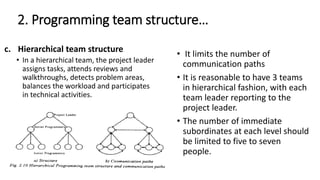
c. Hierarchical team structure
• In a hierarchical team, the project leader
assigns tasks, attends reviews and
walkthroughs, detects problem areas,
balances the workload and participates
in technical activities.
• It limits the number of
communication paths
• It is reasonable to have 3 teams
in hierarchical fashion, with each
team leader reporting to the
project leader.
• The number of immediate
subordinates at each level should
be limited to five to seven
people.
2. Programming team structure…
d. Management by objectives(MBO)
• Using MBO, employees set their own goals and objectives with the help of
their supervisor, participate in the setting of their supervisors goals.
• Objectives are set for periods of 1 to 3 months
• MBO is well suited to the milestones and intermediate work products of
software engineering.
Other planning activities
• Planning for configuration management and quality assurance
• Planning for independent verification and validation.
• Planning phase-independent tools and techniques
• Other planning activities cost estimates, schedule, preliminary staffing
level.
References
• Software Engineering: A practical approach by Roger S. Pressman
• McGraw-Hill Book Company, 1987 Edition.

UNIT 1-IDENTIFY THE NEED FOR SOFTWARE ENGINEERING DEVELOPMENT.pptx

  • 1.
    UNIT 1: IDENTIFYTHE NEED FOR SOFTWARE ENGINEERING DEVELOPMENT
  • 2.
    Introduction • The economiesof all developed nations are dependent on software. • More and more systems are software controlled. • Software engineering is concerned with theories, methods and tools for professional software development. • Software engineering expenditure represents a significant fraction of the Gross national product (GNP) of developed countries.
  • 3.
    Introduction… • Develops asoftware product • User needs and constraints stated • Product must accommodate implementers, users and maintainers Source code tested • Maintenance, user manual, installation instructions, training aids and maintenance of documents must be prepared • Software maintenance- change requests, redesign and modification of source code through testing of the modified code • Appropriate user sites • Software products- 1960 • Software: airline, train, medical and other general purpose
  • 4.
    Definition of concepts •Software Engineering is the technical and management discipline concerned with systematic production and maintenance of software products that are developed and modified on time within cost estimates. • Software Engineering is the science and art of building significant software systems that are: • on time • on budget • with acceptable performance • with correct operation. • Programmers- Implementing, packaging and modifying algorithms. • Software engineers- analysis design, verification and validation, testing, documentation, software maintenance and project management.
  • 5.
  • 6.
    6 Types of Software •Generic products. • Stand-alone systems that are marketed and sold to any customer who wishes to buy them. • Examples – PC software such as graphics programs, project management tools; CAD software; software for specific markets such as appointments systems for dentists. • The specification of what the software should do is owned by the software developer and decisions on software change are made by the developer. • Customized or bespoke products. • Software that is commissioned by a specific customer to meet their own needs. • Examples – embedded control systems, air traffic control software, traffic monitoring systems. • The specification of what the software should do is owned by the customer for the software and they make decisions on software changes that are required.
  • 7.
    7 Question Answer What issoftware? Computer programs and associated documentation. Software products may be developed for a particular customer or may be developed for a general market. What are the attributes of good software? Good software should deliver the required functionality and performance to the user and should be maintainable, dependable and usable. What is software engineering? Software engineering is an engineering discipline that is concerned with all aspects of software production. What are the fundamental software engineering activities? Software specification, software development, software validation and software evolution. What is the difference between software engineering and computer science? Computer science focuses on theory and fundamentals; software engineering is concerned with the practicalities of developing and delivering useful software. What is the difference between software engineering and system engineering? System engineering is concerned with all aspects of computer-based systems development including hardware, software and process engineering. Software engineering is part of this more general process. Frequently asked questions about software engineering
  • 8.
    8 Frequently asked questionsabout software engineering Question Answer What are the key challenges facing software engineering? Coping with increasing diversity, demands for reduced delivery times and developing trustworthy software. What are the costs of software engineering? Roughly 60% of software costs are development costs, 40% are testing costs. For custom software, evolution costs often exceed development costs. What are the best software engineering techniques and methods? While all software projects have to be professionally managed and developed, different techniques are appropriate for different types of system. For example, games should always be developed using a series of prototypes whereas safety critical control systems require a complete and analyzable specification to be developed. You can’t, therefore, say that one method is better than another. What differences has the web made to software engineering? The web has led to the availability of software services and the possibility of developing highly distributed service-based systems. Web-based systems development has led to important advances in programming languages and software reuse.
  • 9.
    SIZE FACTORS 1. Totaleffort devoted to software: • 1955- Hardware cost 80% high • 1980- Reverse
  • 10.
    SIZE FACTORS… 2. ProjectSize Categories • Determines the level of management control and the types of tools and techniques required on a software project.
  • 11.
    2. Project SizeCategories… • Trivial: One programmer working part time, develop the software for the exclusive use of the programmer and one usually discarded after a few months. • Small projects: Scientific application written by engineers to solve numerical problems. • Medium Size projects: Assemblers, Compliers, Small management Systems, inventory, process control applications. • Large Projects : Large compilers, time-sharing systems, data base packages, graphics programs for data acquisition and display. • Very large projects: air traffic control, missile, defence and military command and control systems
  • 12.
    3. How programmersspend their time:
  • 13.
  • 14.
    Factors that influencequality and productivity…
  • 15.
    Factors that influencequality and productivity… 3. Product Complexity: • Three level of product complexity.
  • 16.
    Factors that influencequality and productivity…
  • 17.
    Factors that influencequality and productivity…
  • 18.
    Factors that influencequality and productivity…
  • 19.
    MANAGERIAL ISSUES • Managerialactivities: • managers have responsibility for ensuring that software products are delivered on time and within cost estimates. • Developing business plans, recruiting customers, developing marketing strategies and recruiting and training employees.
  • 20.
    Management Problems • Planningfor software engineering projects is generally poor. • Procedures and techniques for the selection of project managers are poor. • Responsibilities for various project functions. • Ability to accurately estimate the resources. • Success criteria of projects are frequently inappropriate. • Aid in selecting the proper organizational structure are not available. • Procedures, methods, and techniques for designing a project control system are not readily available. • Standards and techniques for measuring the quality of performance of production expected from the programmers are not available.
  • 21.
    Solution to solveabove mentioned problems • Educate and train top management, project managers and software developers. • Enforce the use of standards, procedures and documentation. • Analyse data from prior software projects to determine effective methods. • Define objectives in terms of quality desired. • Define quality in terms of deliverables • Establish success priority criteria • Allow for contingencies • Develop truthful, accurate cost and schedule estimates • Select project managers based on ability to manage software projects, rather than on technical ability or availability. • Make specific work assignment to software developers and apply job performance standards.
  • 22.
    PLANNING A SOFTWAREPROJECT • Defining the problem • Developing a solution Strategy • Planning the Developing Process • Planning Organization Structure
  • 23.
    I.DEFINING THE PROBLEM •The problem statement should be phrased in the customers terminology • Justify a computerised solution strategy for the problem • Identify the functions to be provided – hardware and software subsystems • Determine system level goals and requirements • Establish high level acceptance criteria for the system
  • 24.
    A. Goals andRequirements • After identification of problem preliminary goals and requirements formulated. • Some goals apply to every project and every product • Software product should be reliable, useful, understandable and cost effective • Other goals ex: ease of use of nonprogrammers depend on the particular situation
  • 25.
    A. Goals andRequirements… • Requirements: • System requirements • Functional requirements • Performance requirements • Requirements of hardware, firmware and software
  • 26.
    A. Goals andRequirements… • High level goals expressed in terms of quality attributes Software Quality Characteristic tree
  • 27.
    II. DEVELOPING ASOLUTION STRATEGY • Outline several solution strategies, without regard for constraints • Conduct a feasibility study for each strategy • Recommend a solution strategy, indicating why other strategies were rejected. • Develop a list of priorities for product characteristics • Several strategies should be considered. One solution strategy must be chosen by the planners to do feasibility study. • Feasibility study examine the solution constraints • Feasibility of a solution include case studies Worst case analysis
  • 28.
    III. PLANNING THEDEVELOPMENT PROCESS • Define a life-cycle model and an organizational structure for the project. • Plan the configuration management, quality assurance and validation activities. • Determine phase-dependent tools, techniques and notations to be used. • Establish preliminary cost estimates for system development • Establish a preliminary development schedule • Establish preliminary staffing estimates • Preliminary estimates to operate and maintain the system • Prepare a glossary of terms • Identify sources of information, and refer to them throughout the project plan.
  • 29.
    III. PLANNING THEDEVELOPMENT PROCESS… • Software life cycle models: a. phased life-cycle model b. prototype model/milestones, documents and reviews c. Cost model d. Successive versions model
  • 30.
  • 31.
    A. Phased Life-cycleModel The phased model of software life cycle
  • 32.
    A. Phased Life-cycleModel… • Architectural design identifies the software components, decoupling and decomposing them into processing modules and conceptual data structures and specifying the interconnections among components. • Detailed design is adaptation of existing code, modification of standard algorithms, invention of new algorithms, data representations and packaging of the software product. • Implementation phase is translation of design specifications into source code, debugging, documentation and unit testing of source code. • Errors in implementation phase – logical errors, errors in data structure layout, failure to capture customer needs, design error that reflect that failure to translate requirement into correct design.it is expensive to remove analysis and design errors from source code. • System testing – integration testing and acceptance testing • Acceptance testing involves planning and executing various types of tests in order to demonstrate the implemented software system satisfies the requirements stated in requirement document. Software system is released for production work and enters the maintenance phase of the life cycle model. • Maintenance activities a. enhancement of capabilities b. adaptation of software to new processing environment c. correction of software bugs
  • 33.
    A. Phased Life-cycleModel… • After the phased life cycle model then develop recommended strategy and determine the acceptance criteria • In English/some other languages • Charts, figures, graphs, tables and equations • Life cycle model is used • Organizational structure of the project • Preliminary development schedule • Preliminary cost • Preliminary staff requirement • Tools, techniques and standards
  • 34.
    B. Milestones, Documentsand Reviews Reviews and milestones in the phased life-cycle model
  • 35.
    The following reviewsand milestones in the phased life-cycle model 1. System definition and project plan are prepared 2. User manual is prepared 3. Software requirement specification is prepared 4. Software verification plan is prepared 5. Software requirement review for all the 4 points above 6. Software design specification – architectural design, and detailed design 7. Software product specification 8. Detailed design- critical design review is held 9. Design phase- software verification plan in expanded to include methods that will be used to verify that the design is complete and consistent. 10. Actual test plan includes, actual test cases and expected results and capabilities to be demonstrated by each test. 11. During the implementation phase, source code is written, debugging unit tested. 12. The user manual, installation and training plans and software maintenance plane are completed during implementation phase. 13. Prior to product delivery, final acceptance review is performed. 14. Project legacy is written, what went wrong and what went well.
  • 36.
    C. The CostModel • Cost of performing the various activities in a software project • Cost- sum of cost incurred in conducting each phase of the project. • The system definition and project plan in the cost of performing the planning and preparing the documents, cost of verifying the customer needs. • Software requirement specification includes the cost complete with respect to the system definition and the customer needs.
  • 37.
    C. The CostModel… • Cost of design activities and preparing the design specification and the test plan, plus the cost of modifying the correcting the system definition, project plan and software requirement specification. • The cost of product implementation is cost of user manual, system definition, project plan, software requirement specification, design specification, verification plan plus the cost of verifying that the implementation is correct, complete and consistent. • Finally, the cost of software maintenance is the sum of the costs of performing product enhancement, making adaptations to new processing requirements and fixing bugs.
  • 38.
    D. The PrototypeLife- cycle Model • A prototype is a mock-up or model of a software product. • Reasons for developing a prototype: • Illustrate input data formats, messages, reports and interactive dialogues for the customer. • Gaining better understanding of the customer needs • Explore technical issues in the proposed product. • Major design decision will depend on response time of the device controller/efficiency of a sorting algorithm. • In situations where analysis, design, implementation is not appropriate. • The nature of prototyping to be performed on a particular software depend on the nature of the product.
  • 39.
    E. Successive Versions •Product development by the method of successive versions is an extension of prototyping in which an initial product skeleton is refined into increasing levels of capability.
  • 40.
    Design and implementationof successive versions • Analysis phase followed by design, implementation, building and • assessment of successive versions. • The dashed line indicates that the assessment of version I may dictate the need for further analysis before designing version I+1.
  • 41.
    Analysis and designfollowed by implementation of successive versions • Version 1 through N of the product are designed prior to any implementation activities. In this case the characteristics of each successive design will have been planned during analysis phase. • Dashed line indicate the implementation of the 𝐼𝑡ℎversion may reveal the need for further analysis and design before proceeding with implementation of version 𝐼 + 1.
  • 42.
    IV. PLANNING ANORGANIZATIONAL STRUCTURE 1. Planning structure a. Project format • Involves a team of programmers who conduct a project from start to finish. • Team members do project definition, design, implement, test, conduct Project reviews and prepare supporting documents. • Some members may stay with product installation and maintenance. • Typically work for 1 to 3 years are assigned new projects on completion of the current one.
  • 43.
    1. Planning structure… b.Functional Format
  • 44.
    1. Planning structure… c. Matrix Format • Each of the functions have its own management team and a group of specialist personnel who are concerned only with that function. • Product function matrix organization, each functional group participates in each project. For ex: software development team member belong originally to the development function but work under supervision of a particular project manager. • disadvantage: more than one boss • Matrix organizations are increasingly popular because special expertise can be concentrated in particular functions.
  • 45.
    PLANNING AN ORGANIZATIONALSTRUCTURE… 2. Programming team structure • Every programming team have an internal structure. The best team structure for any particular project depends on the nature of the project and the product.
  • 46.
    2. Programming teamstructure… a. Democratic teams(egoless team) • In egoless team goals are set and decisions made by group consensus. Group leadership rotates from member to member based on the tasks to be performed and the differing abilities of the team members. • Democratic team differs from an egoless team
  • 47.
    Advantages and Disadvantagesof Democratic teams(egoless team) • Advantages • Opportunity to each team member to contribute to decisions • Learn from one another • Increased job satisfaction • Disadvantages • All team members must work well together • Weakening individual responsibility and authority
  • 48.
    2. Programming teamstructure… b. Chief programmer teams • Highly structured • The work is allocated by the chief programmer • The programmers between two and five, write code, debug, document and unit test • Librarian maintain program listings, design documents and test plans • Back-up programmer serves as a consultant to the chief programmer on various technical problems
  • 49.
    2. Programming teamstructure… c. Hierarchical team structure • In a hierarchical team, the project leader assigns tasks, attends reviews and walkthroughs, detects problem areas, balances the workload and participates in technical activities. • It limits the number of communication paths • It is reasonable to have 3 teams in hierarchical fashion, with each team leader reporting to the project leader. • The number of immediate subordinates at each level should be limited to five to seven people.
  • 50.
    2. Programming teamstructure… d. Management by objectives(MBO) • Using MBO, employees set their own goals and objectives with the help of their supervisor, participate in the setting of their supervisors goals. • Objectives are set for periods of 1 to 3 months • MBO is well suited to the milestones and intermediate work products of software engineering.
  • 51.
    Other planning activities •Planning for configuration management and quality assurance • Planning for independent verification and validation. • Planning phase-independent tools and techniques • Other planning activities cost estimates, schedule, preliminary staffing level.
  • 52.
    References • Software Engineering:A practical approach by Roger S. Pressman • McGraw-Hill Book Company, 1987 Edition.