Unit 1:
Digital Media Sectors and Audiences
By Matei Turcu
Media Sectors
Digital media has different sectors like:
•Film
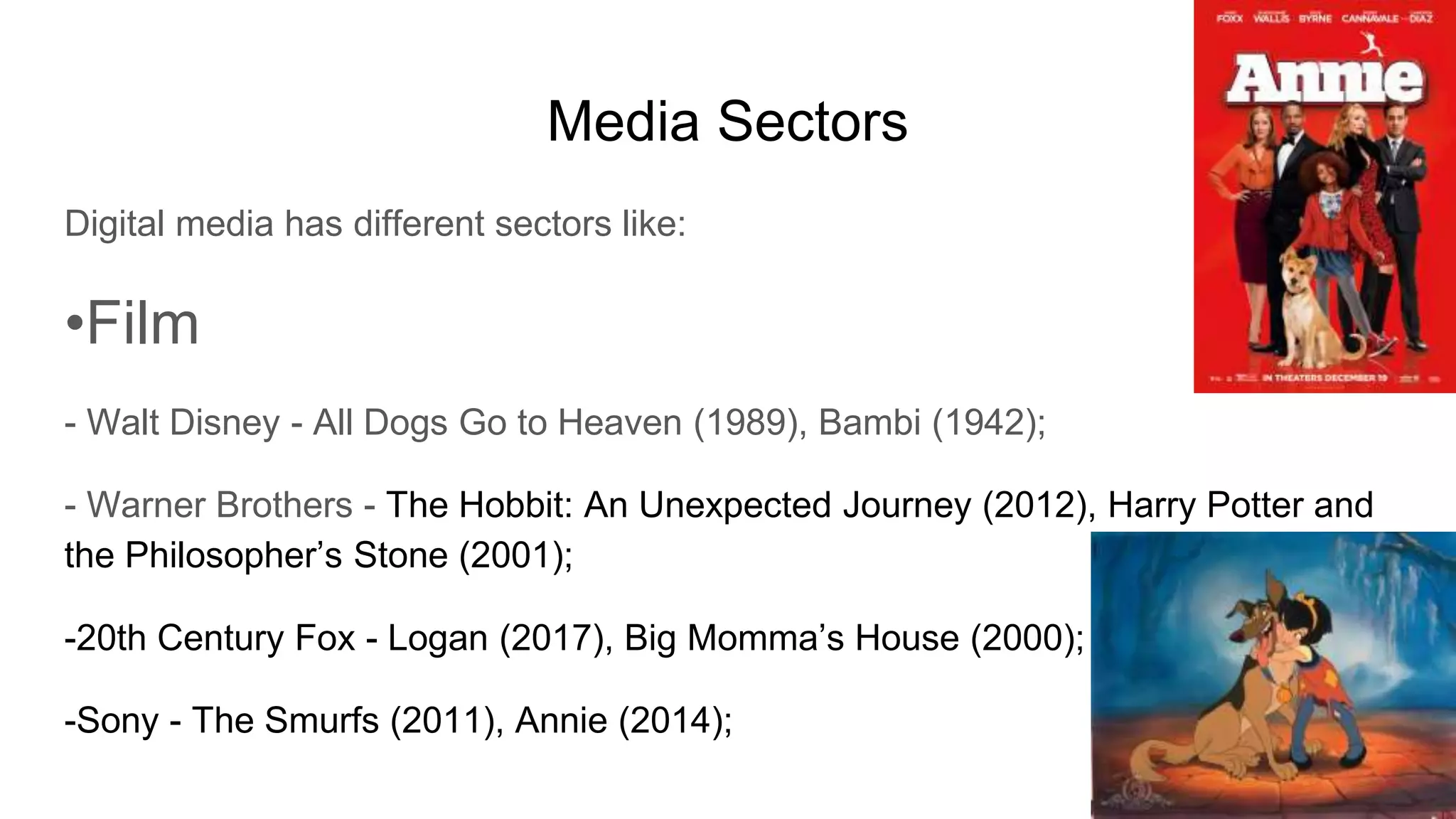
- Walt Disney - All Dogs Go to Heaven (1989), Bambi (1942);
- Warner Brothers - The Hobbit: An Unexpected Journey (2012), Harry Potter and
the Philosopher’s Stone (2001);
-20th Century Fox - Logan (2017), Big Momma’s House (2000);
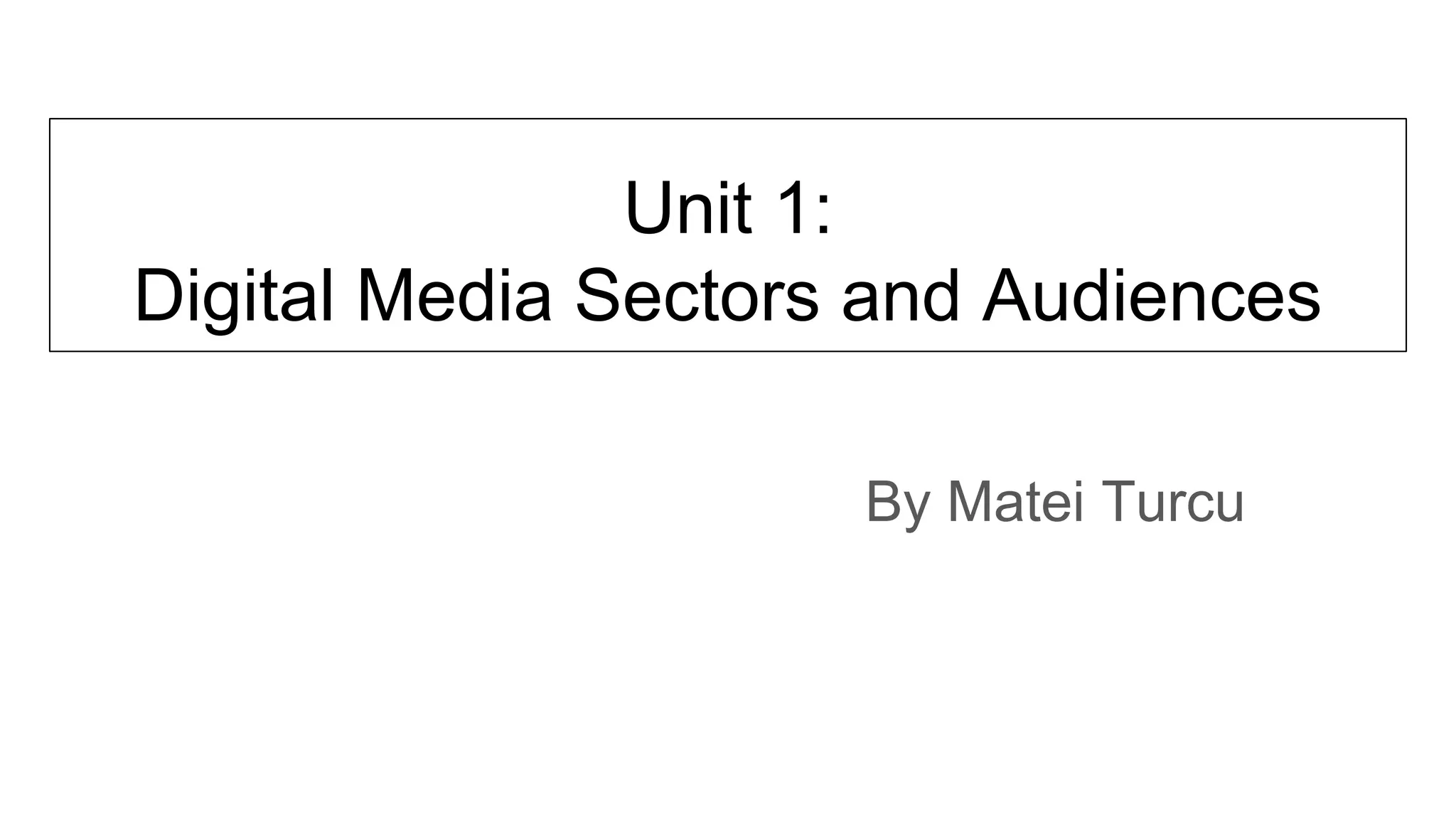
-Sony - The Smurfs (2011), Annie (2014);
Video Games
-Riot Games - League of Legends (2009)
-Rockstar Games - Grand Theft Auto 3 (2001), Grant Theft Auto San Andreas
(2004), Grand Theft Auto V (2013 for console, 2015 for PC)
-Ubisoft - Assassin's Creed Revelation (2011), Assassin's Creed Syndicate (2015)
Driver: San Fransisco (2011) Far Cry 4 (2014)
- Capcom - Resident Evil 7 (2017), Street Fighter 5 (2016) , Resident Evil (1996)
Magazines
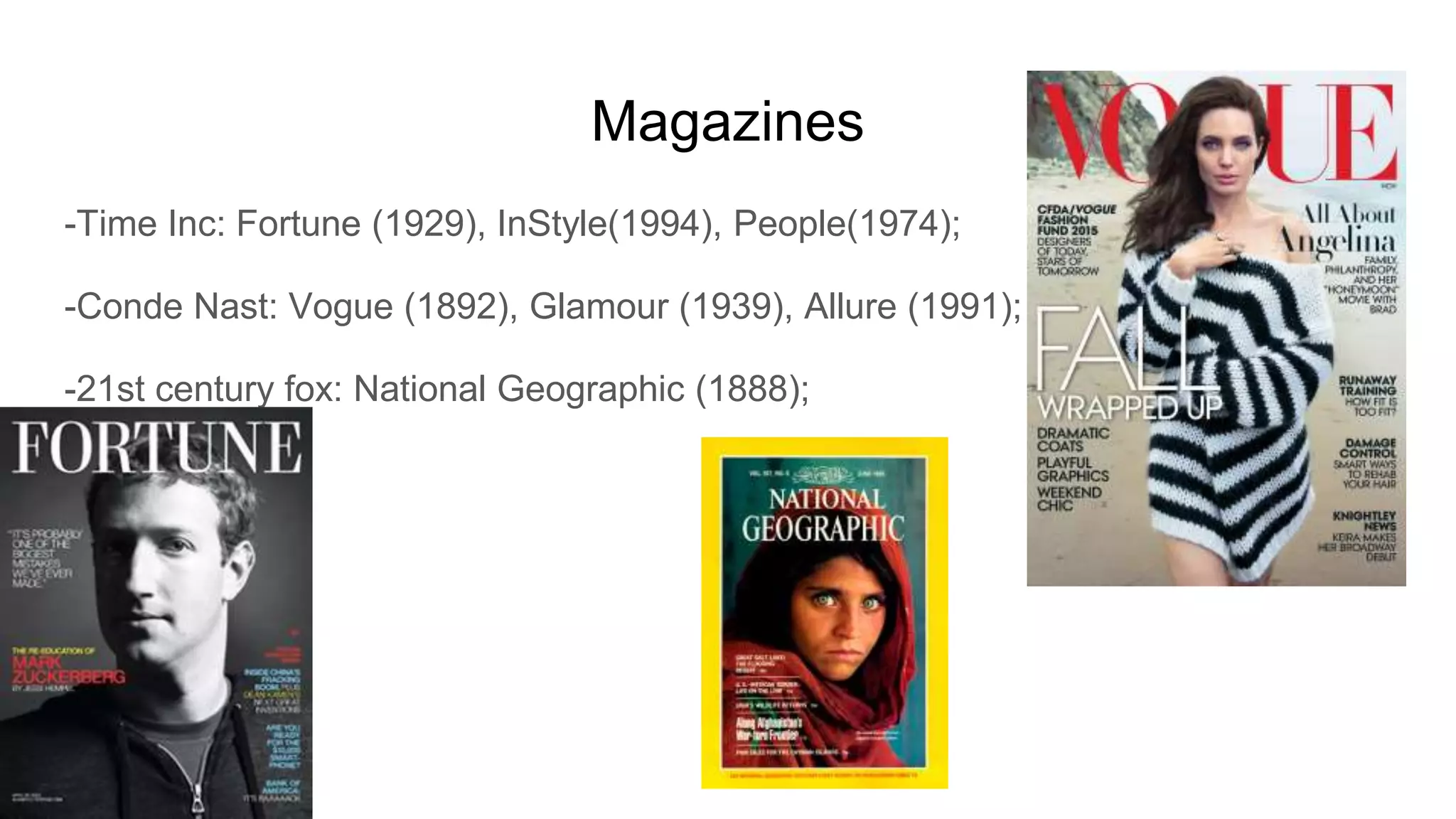
-Time Inc: Fortune (1929), InStyle(1994), People(1974);
-Conde Nast: Vogue (1892), Glamour (1939), Allure (1991);
-21st century fox: National Geographic (1888);
Music
Music is a big industry which makes lot of money.
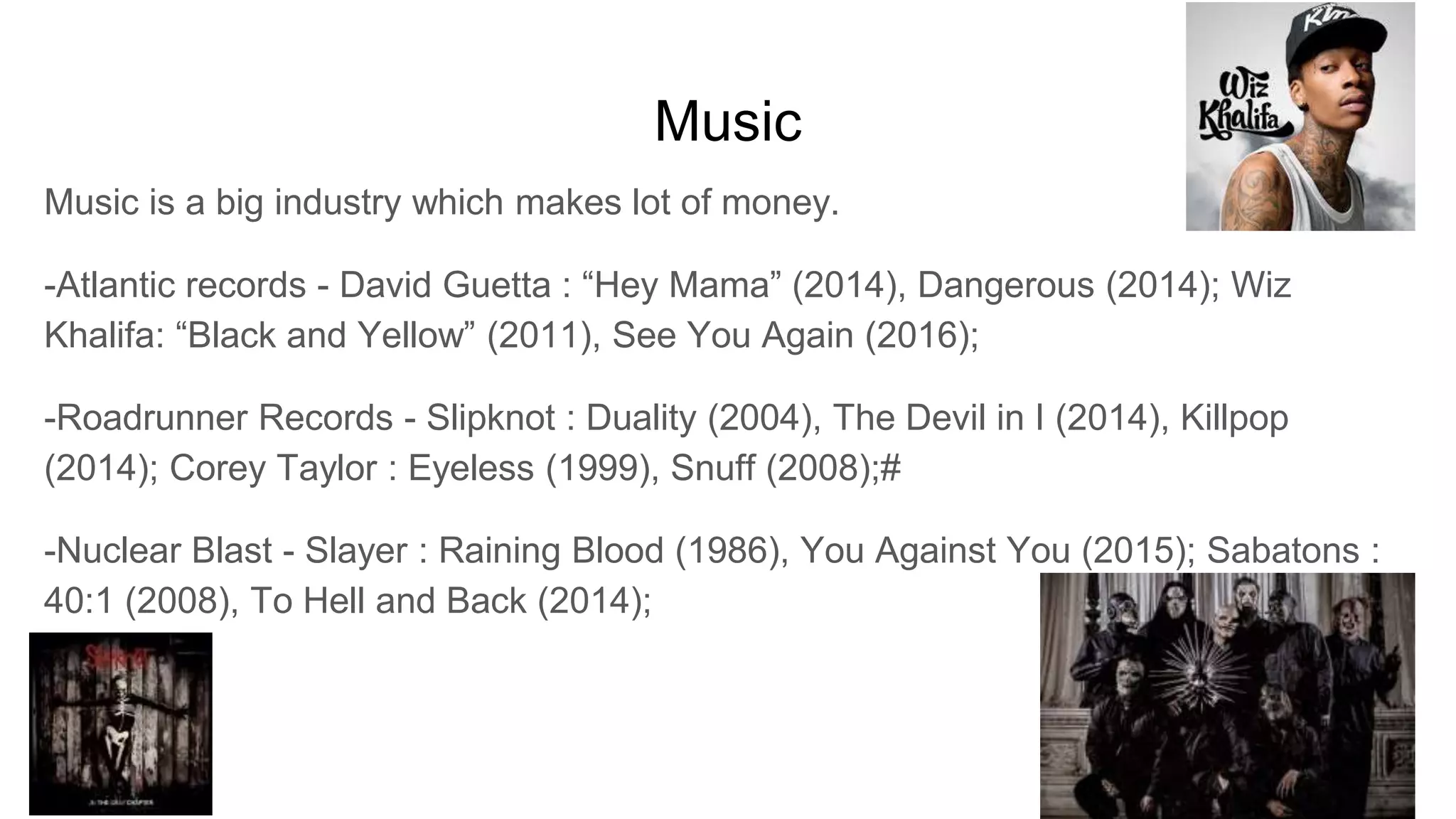
-Atlantic records - David Guetta : “Hey Mama” (2014), Dangerous (2014); Wiz
Khalifa: “Black and Yellow” (2011), See You Again (2016);
-Roadrunner Records - Slipknot : Duality (2004), The Devil in I (2014), Killpop
(2014); Corey Taylor : Eyeless (1999), Snuff (2008);#
-Nuclear Blast - Slayer : Raining Blood (1986), You Against You (2015); Sabatons :
40:1 (2008), To Hell and Back (2014);
Television
-BBC: BBC One London - “Father Brown” (2013-now), “Holby City” (1999-
present), “Doctors” (2000-now);
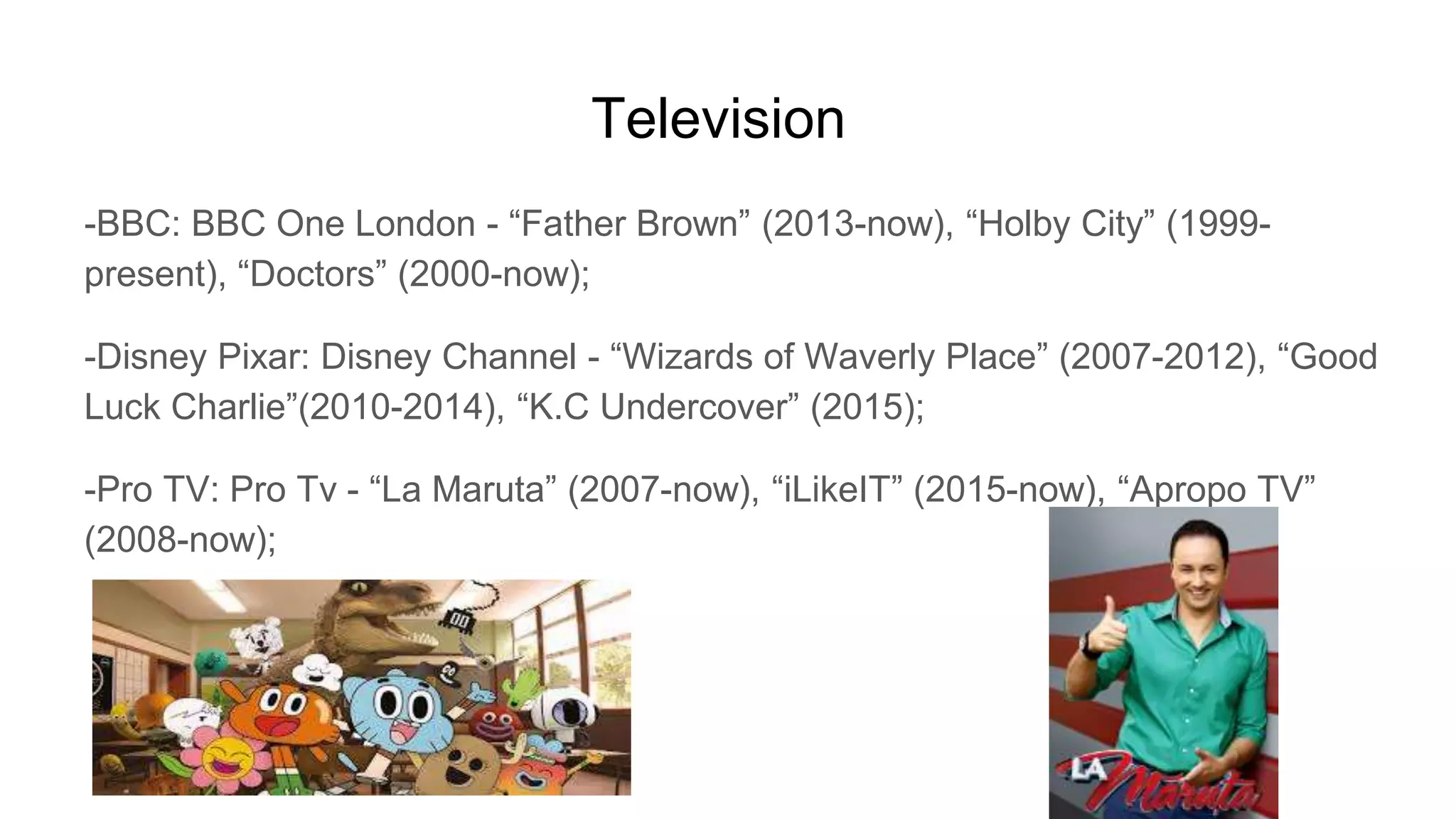
-Disney Pixar: Disney Channel - “Wizards of Waverly Place” (2007-2012), “Good
Luck Charlie”(2010-2014), “K.C Undercover” (2015);
-Pro TV: Pro Tv - “La Maruta” (2007-now), “iLikeIT” (2015-now), “Apropo TV”
(2008-now);
Radio
-Hamburg: Kiss FM (1990-now) : Kiss Presents, Rickie, Melvin and Charlie in the
morning;
-GCap Media: Capital FM (1973-now) : Roman Kemp, Will Manning;
-BBC: BBC Radio 1 : Greg James, Newsbeat, MistaJam;
Newspaper
-Scott Trust Limited: The Guardian (1821-now);
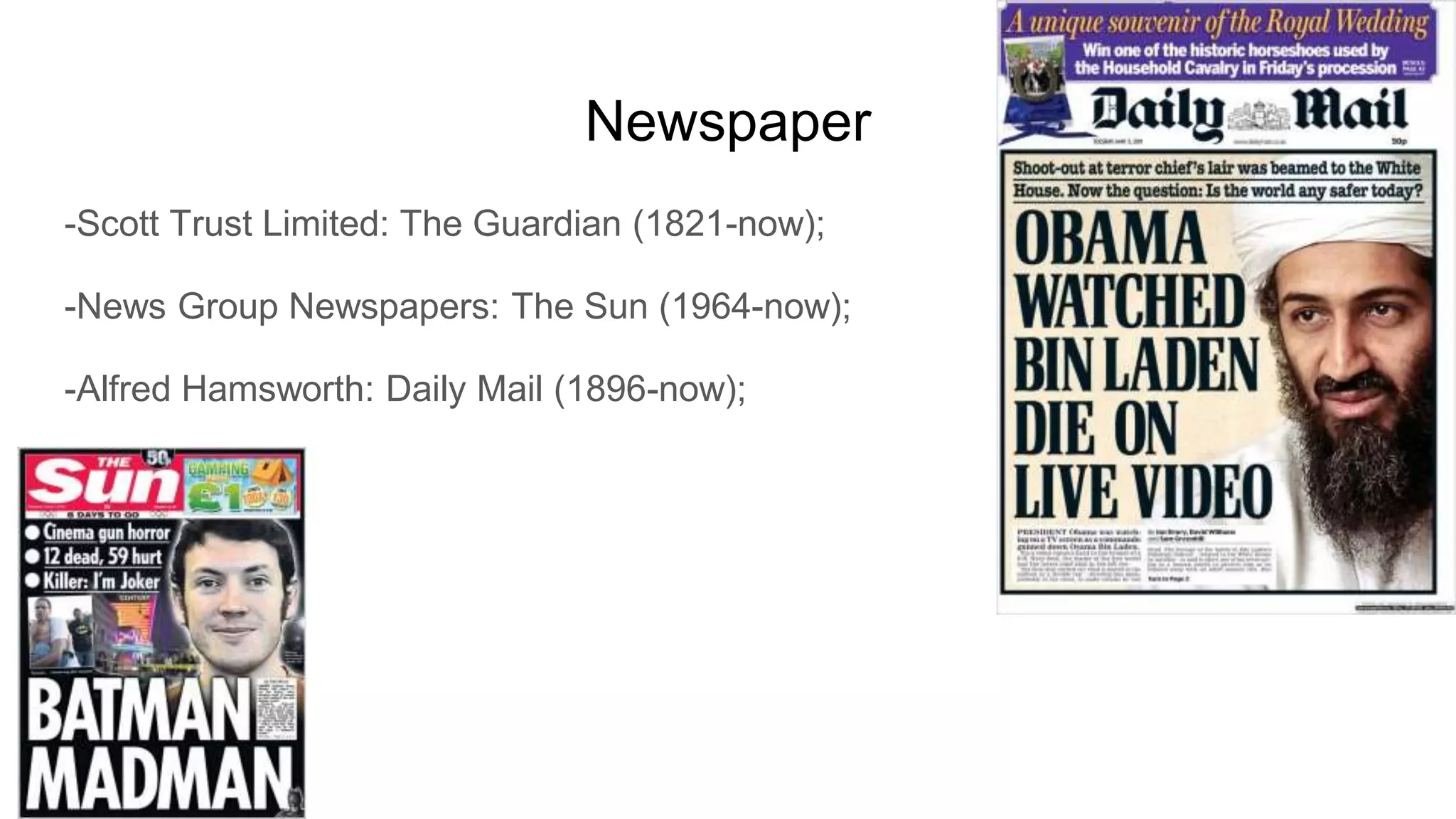
-News Group Newspapers: The Sun (1964-now);
-Alfred Hamsworth: Daily Mail (1896-now);
Web
-Mark Zuckerberg: Facebook (2004), Instagram (2010);
-Riot Games: League of Legends website (2009);
-Google: Google (1998), Youtube (2005), Gmail (2004);
-Yahoo!: Tumblr (2007), Yahoo Mail (1997);
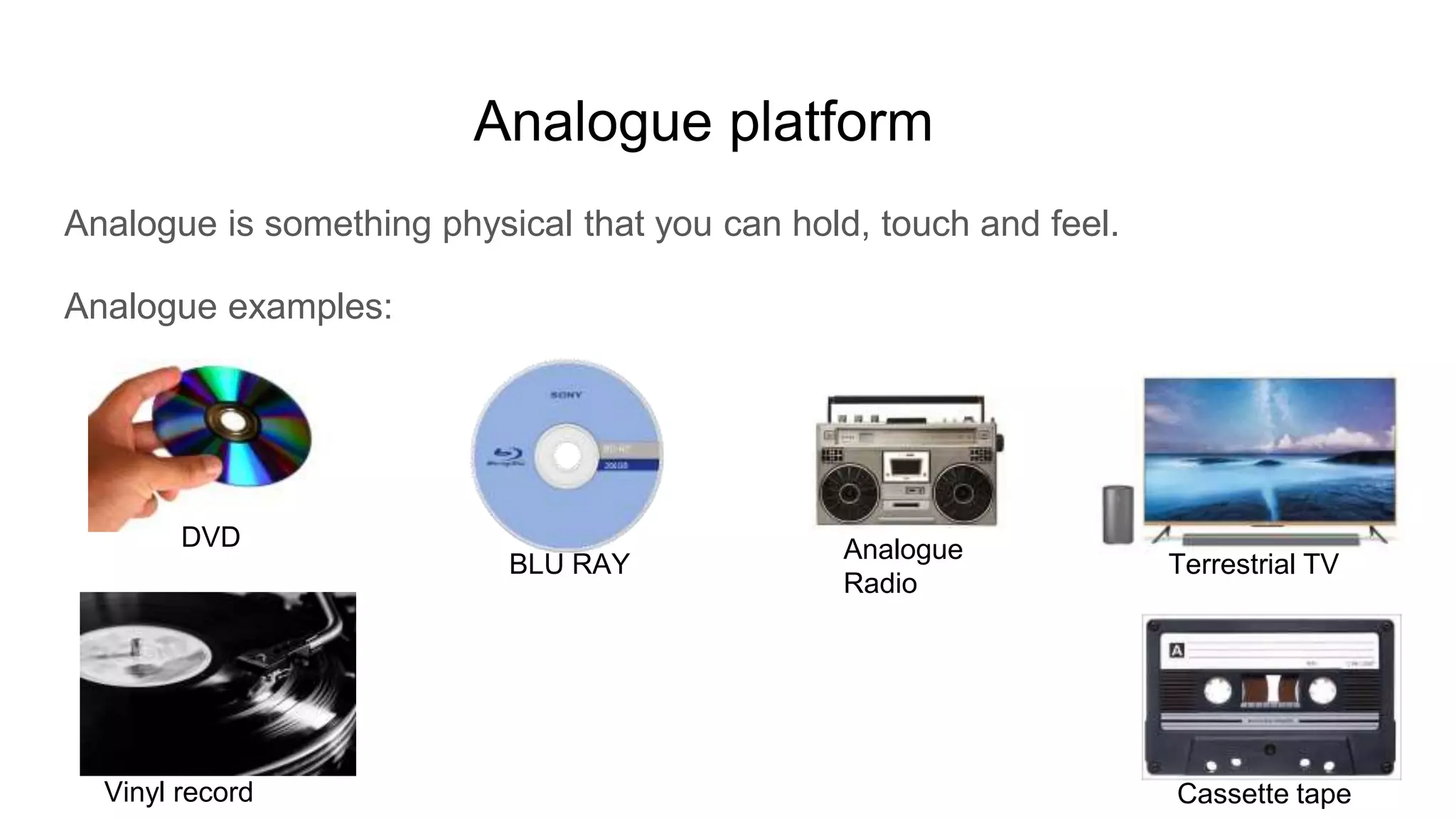
Analogue platform
Analogue is something physical that you can hold, touch and feel.
Analogue examples:
DVD
BLU RAY
Analogue
Radio
Vinyl record
Terrestrial TV
Cassette tape
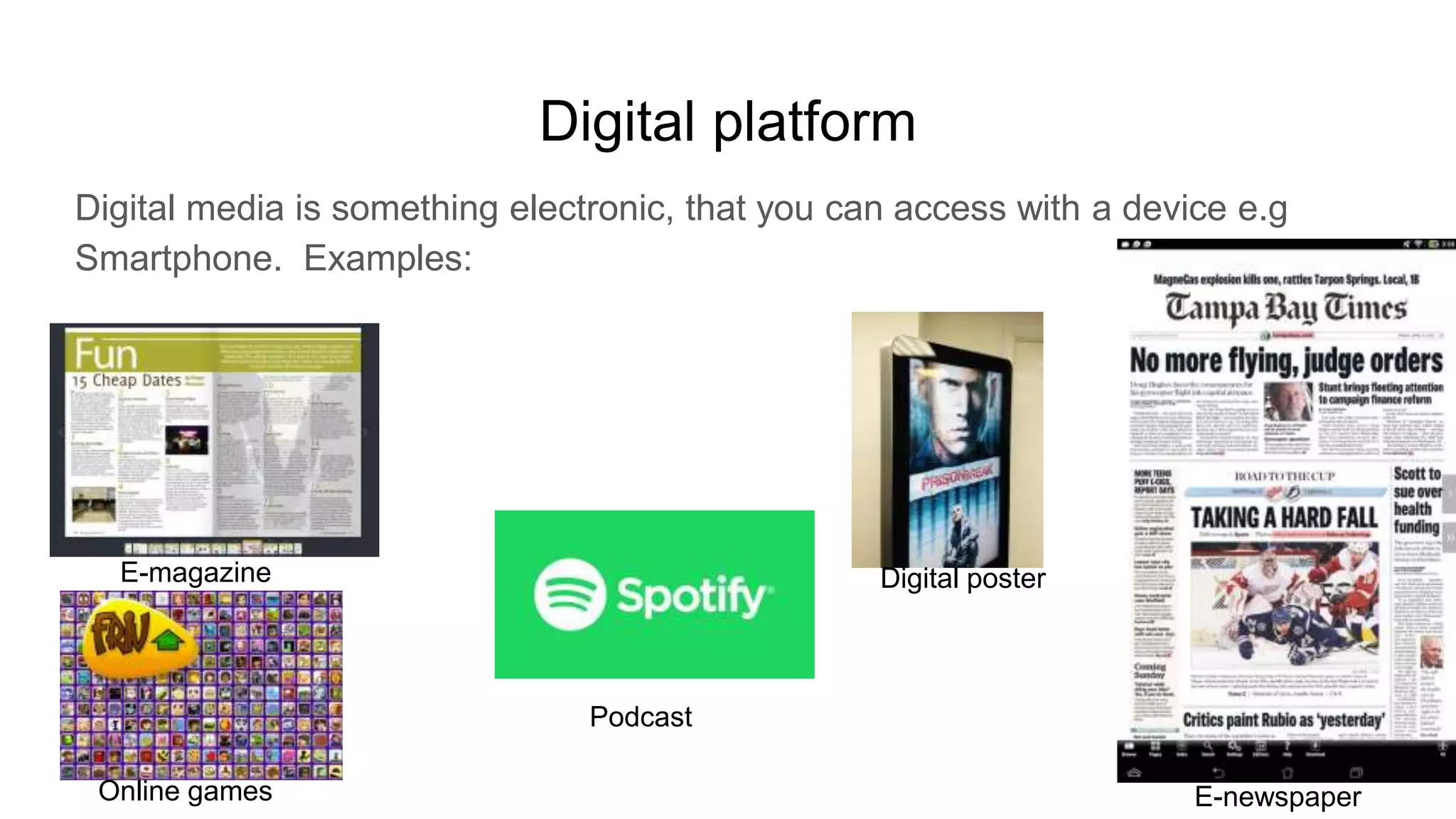
Digital platform
Digital media is something electronic, that you can access with a device e.g
Smartphone. Examples:
E-magazine Digital poster
E-newspaper
Podcast
Online games
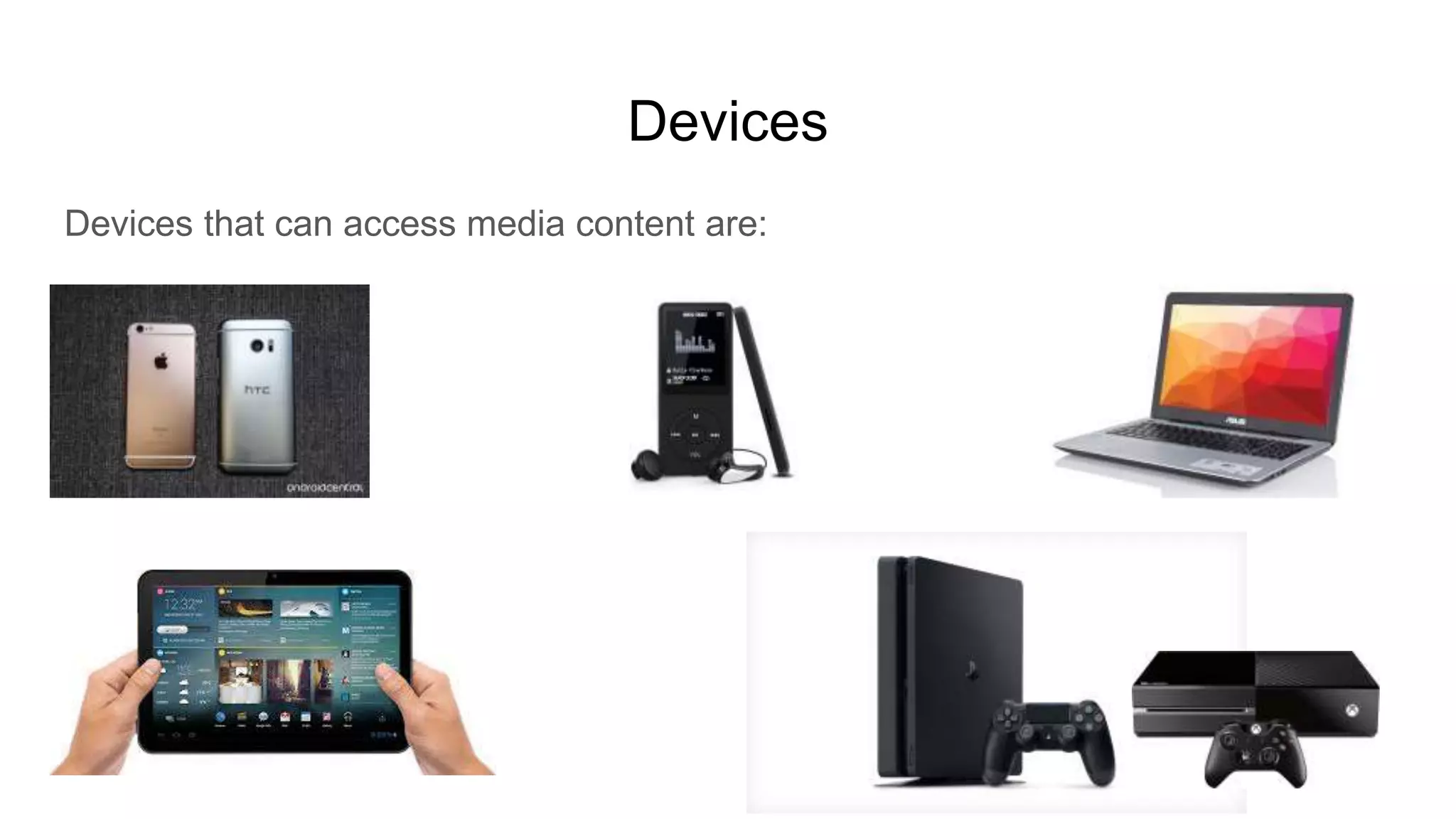
Devices
Devices that can access media content are:
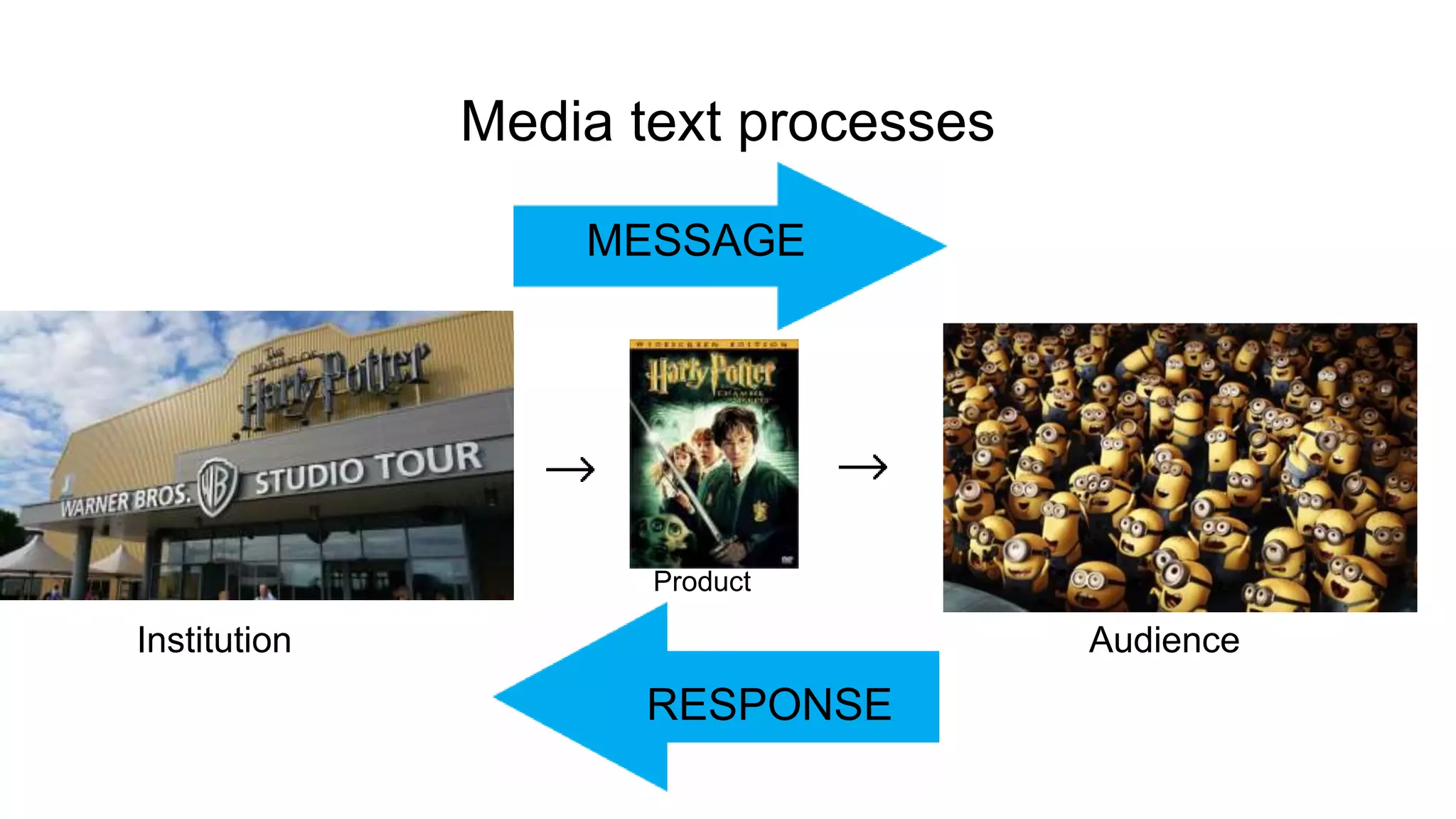
Media text processes
Institution Audience
MESSAGE
RESPONSE
Product
Pre-production
Pre-production means the planning and designing of a
media text e.g layout for a newsletter.
For example, pre-production for a video game includes: Creating animations,
creating the characters, creating the storyboard and the scripts;
For a movie, pre-production includes: planning the budget, market research,
scripts, storyboard etc.
Production
Productions means the making of a media product e.g
films, newsletters etc;
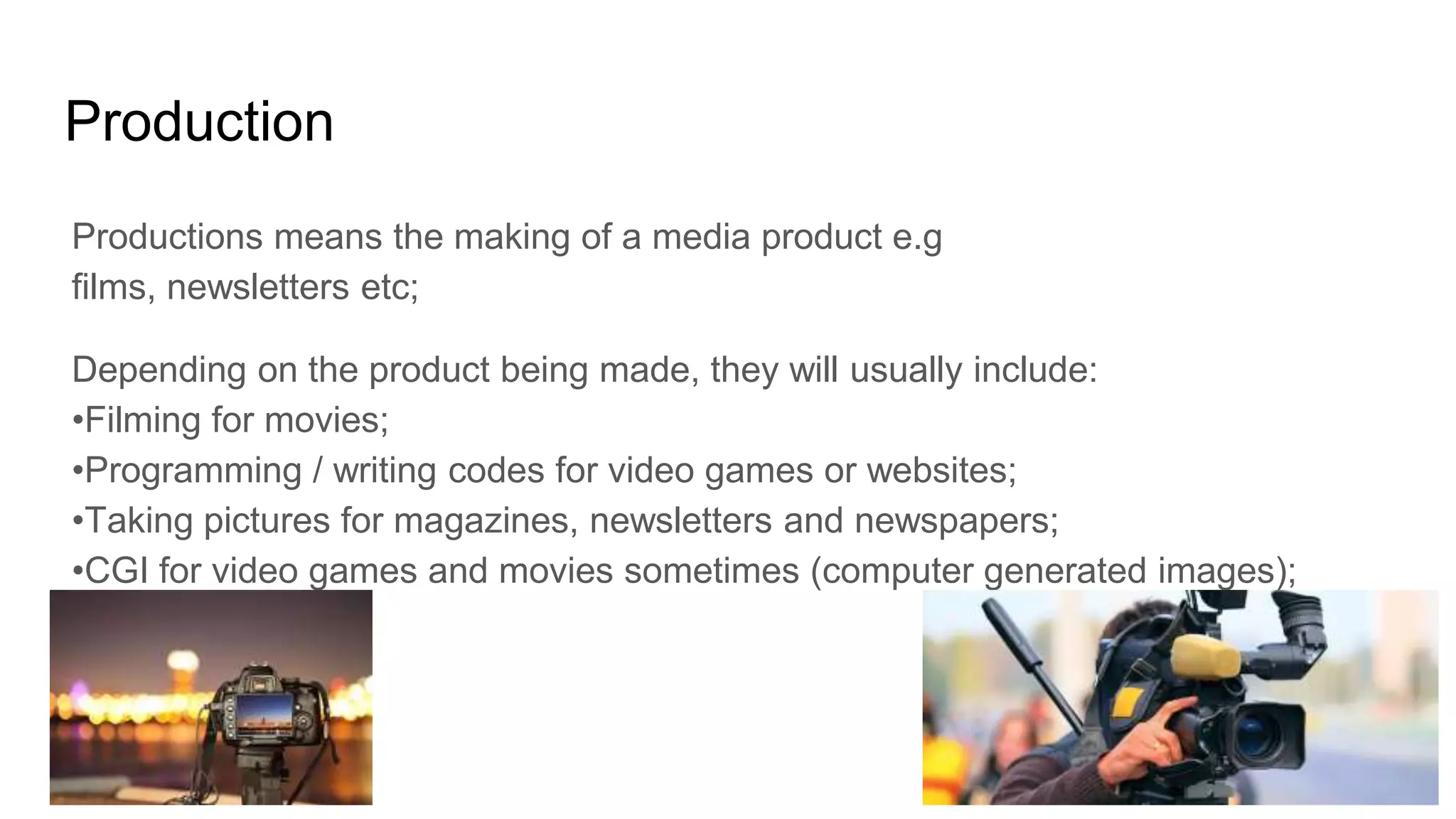
Depending on the product being made, they will usually include:
•Filming for movies;
•Programming / writing codes for video games or websites;
•Taking pictures for magazines, newsletters and newspapers;
•CGI for video games and movies sometimes (computer generated images);
Post-Production
Post-production is the editing of media text. It is when you change things e.g
spelling, font style, add shadows etc.
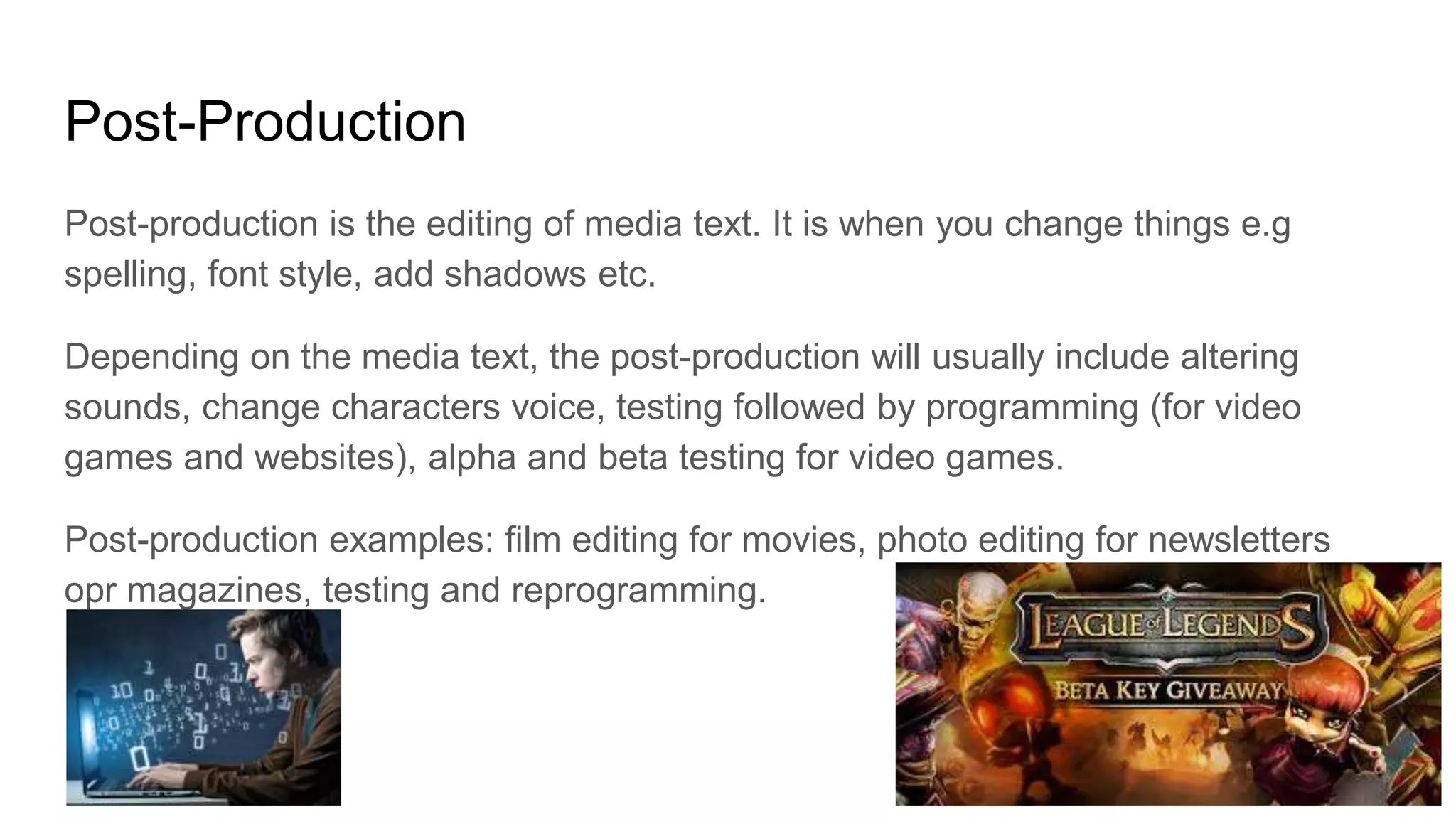
Depending on the media text, the post-production will usually include altering
sounds, change characters voice, testing followed by programming (for video
games and websites), alpha and beta testing for video games.
Post-production examples: film editing for movies, photo editing for newsletters
opr magazines, testing and reprogramming.
Marketing
Marketing involves the promotion of a media product , and it is a process of
making the public aware of the existence of a media product. It also involves the
selling of a product.
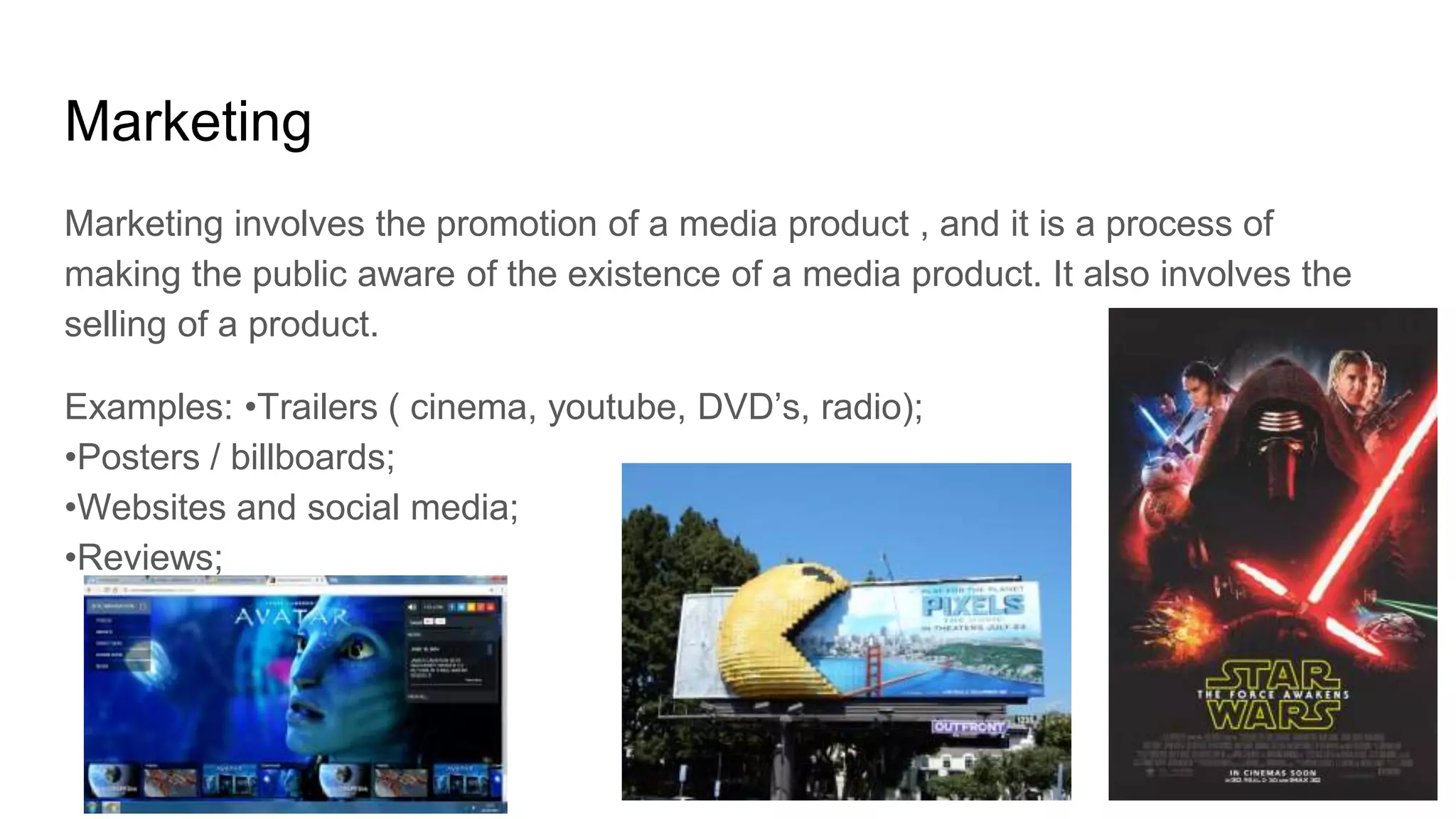
Examples: •Trailers ( cinema, youtube, DVD’s, radio);
•Posters / billboards;
•Websites and social media;
•Reviews;
Distribution
Distribution is the giving out of a media product to the audience. Media products
can be distributed via analogue and digital platforms.
This can include: •Cinema or TV (movies);
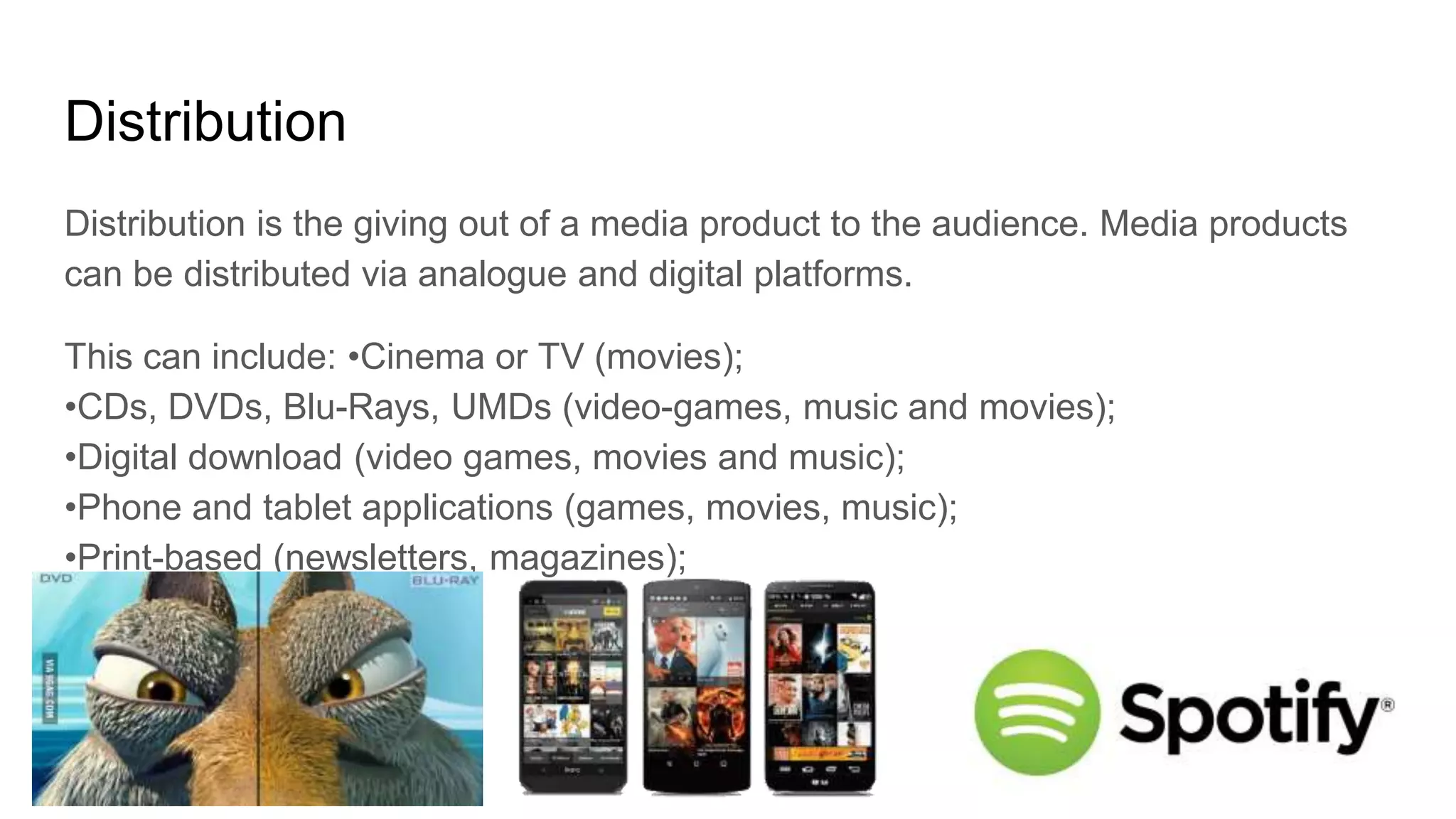
•CDs, DVDs, Blu-Rays, UMDs (video-games, music and movies);
•Digital download (video games, movies and music);
•Phone and tablet applications (games, movies, music);
•Print-based (newsletters, magazines);
Exhibition
Exhibition means the consumption of the media product by the audience. It also
includes. It is also how the audience interacts with the text.
A media text will ever have a message that aims to be delivered and understood
by the audience. Consuming the media text will usually have an impact on the
audience; this can be a positive impact or a negative one impact. Media products
can influence a person’s personality e.g music can change the way they dress,
movies can change the way a person thinks or speaks etc.
Synergy
Synergy means the release of a brand across different media platforms e.g Lord
of Rings: Book, Movie, Video-game, Magazine, Animated Cartoons, soundtracks
etc.
Media institutions use synergistic techniques to increase the brand’s image and to
expand their target audience.
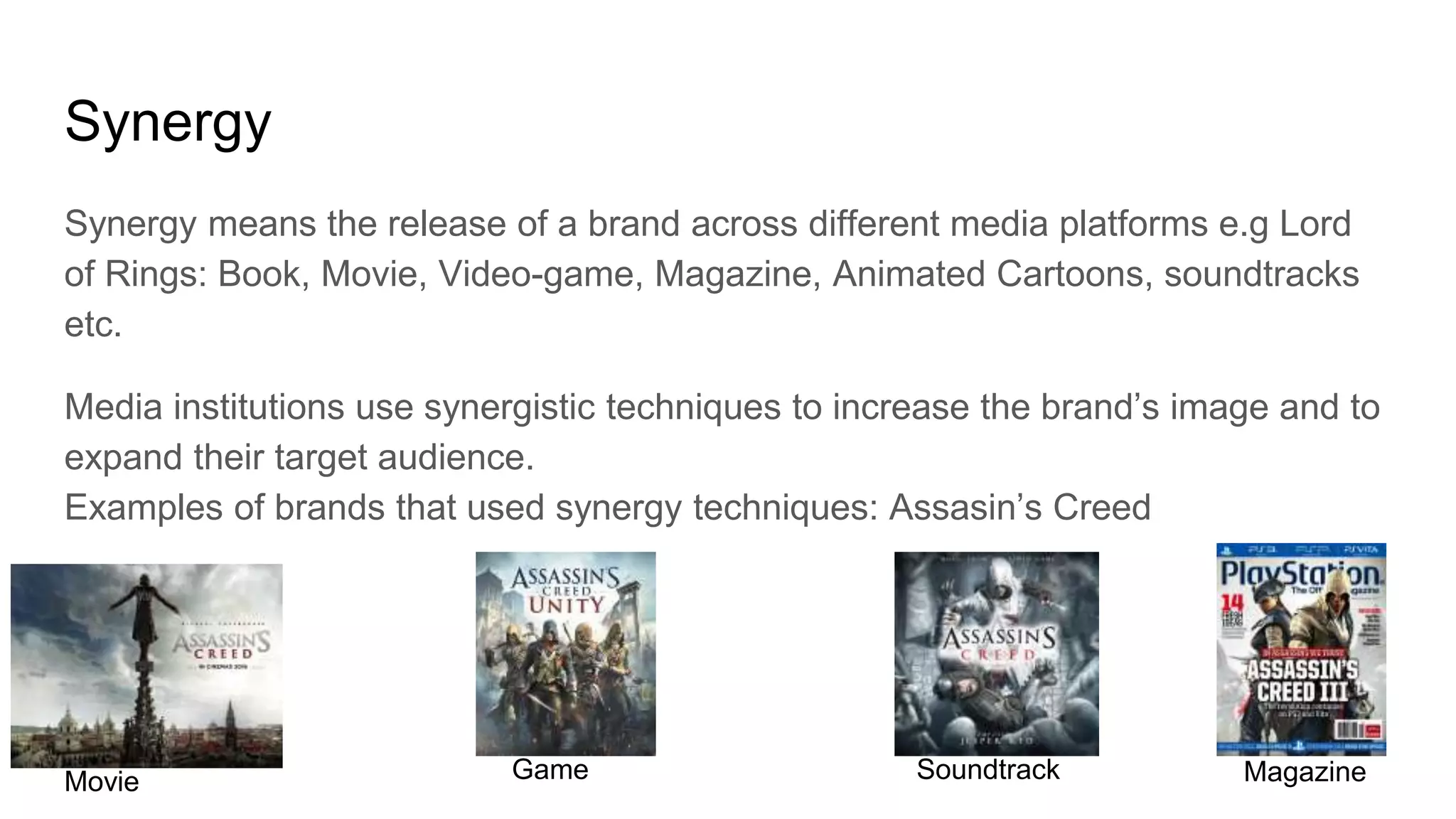
Examples of brands that used synergy techniques: Assasin’s Creed
Movie Game Soundtrack Magazine
Converge
Converge is the unification of platforms that were separate into one device, like
the smartphone. The access to the Internet has helped the audience a lot,
because now you can choose what to watch and what to do, and you don’t have
to see the same TV shows everyday, and you can listen to music without buying it
or read a newspaper every time you want. Nowadays, everyone can create a
media product like recording a video and posting it on youtube. If you did this, it
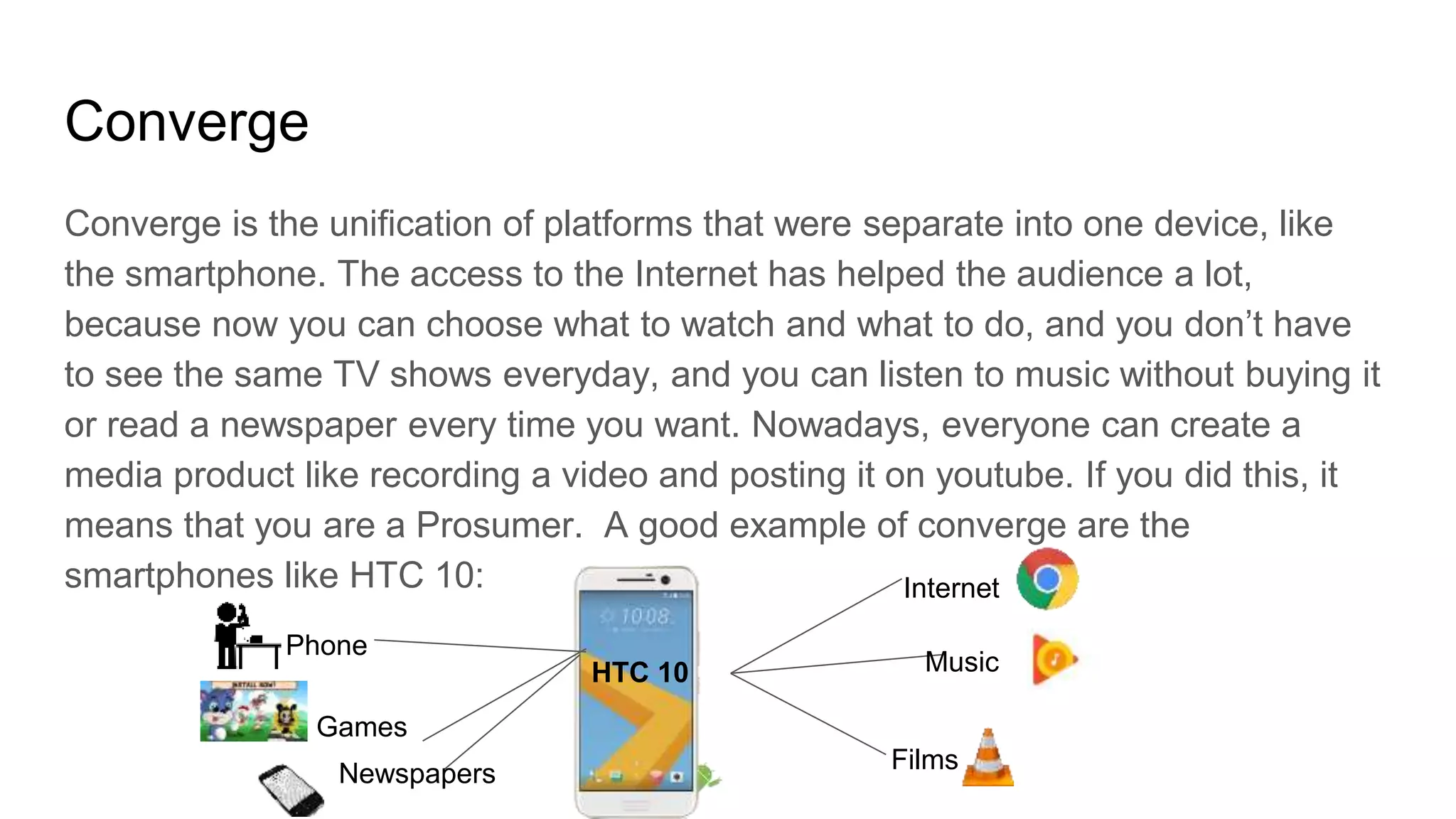
means that you are a Prosumer. A good example of converge are the
smartphones like HTC 10: Internet
Music
Films
Phone
Games
Newspapers
HTC 10
Impact of converge
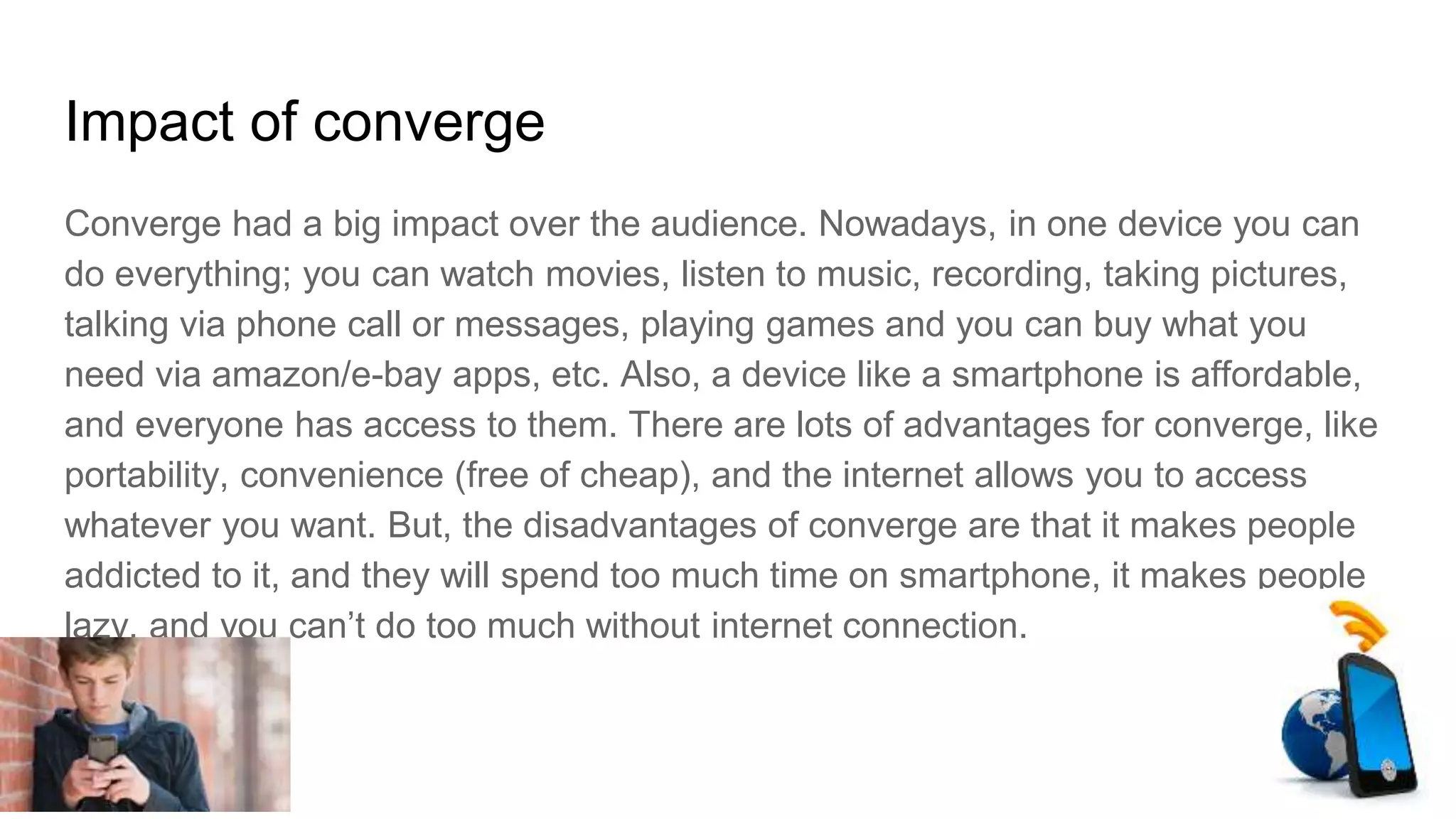
Converge had a big impact over the audience. Nowadays, in one device you can
do everything; you can watch movies, listen to music, recording, taking pictures,
talking via phone call or messages, playing games and you can buy what you
need via amazon/e-bay apps, etc. Also, a device like a smartphone is affordable,
and everyone has access to them. There are lots of advantages for converge, like
portability, convenience (free of cheap), and the internet allows you to access
whatever you want. But, the disadvantages of converge are that it makes people
addicted to it, and they will spend too much time on smartphone, it makes people
lazy, and you can’t do too much without internet connection.
Audiences
Audience are segmented in two parts: Primary and secondary;
Primary: Primary audiences is the main audience that a media text is targeting,
like the cartoon “Cars” which has the main audience childrens.
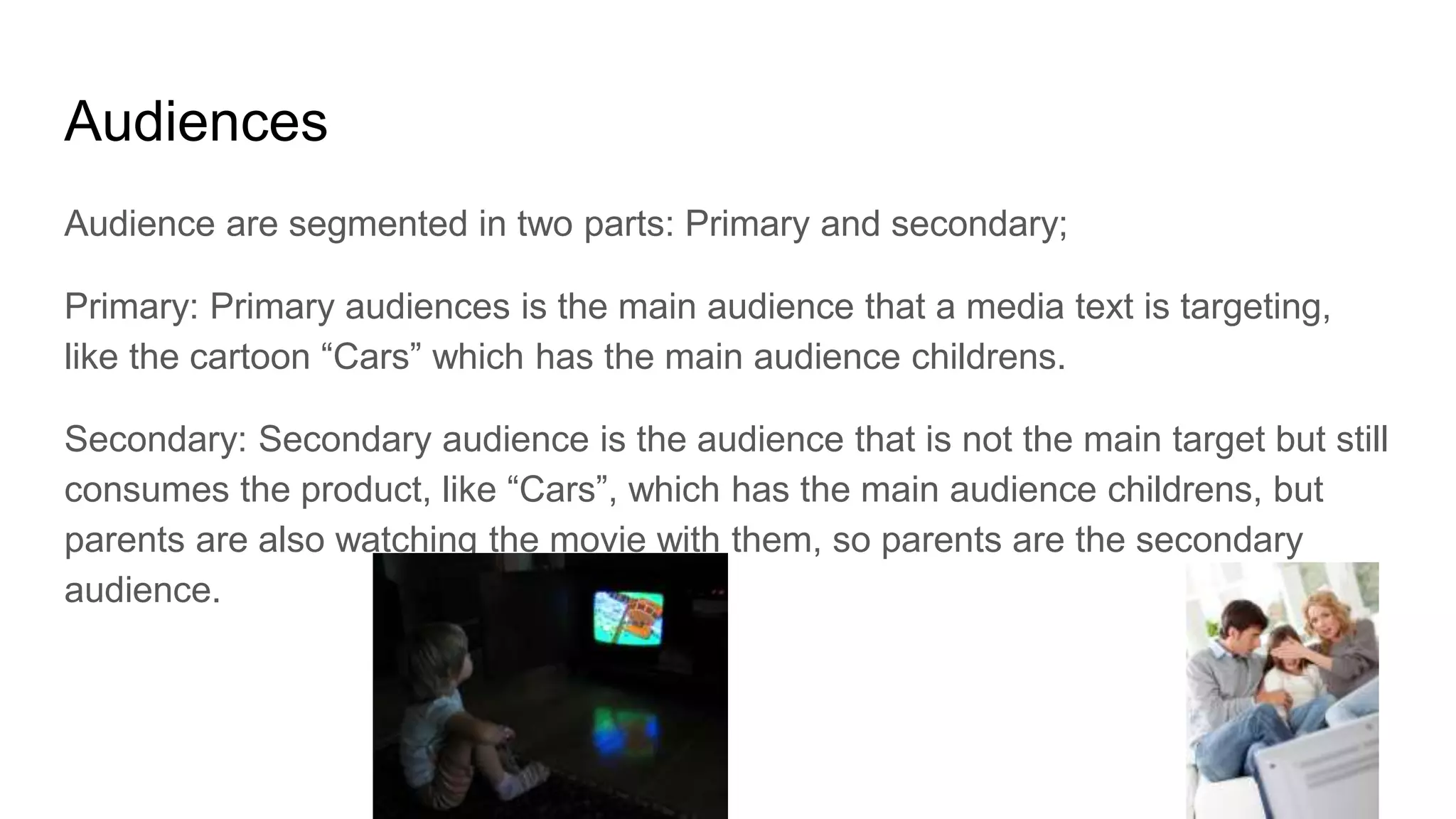
Secondary: Secondary audience is the audience that is not the main target but still
consumes the product, like “Cars”, which has the main audience childrens, but
parents are also watching the movie with them, so parents are the secondary
audience.
Audiences
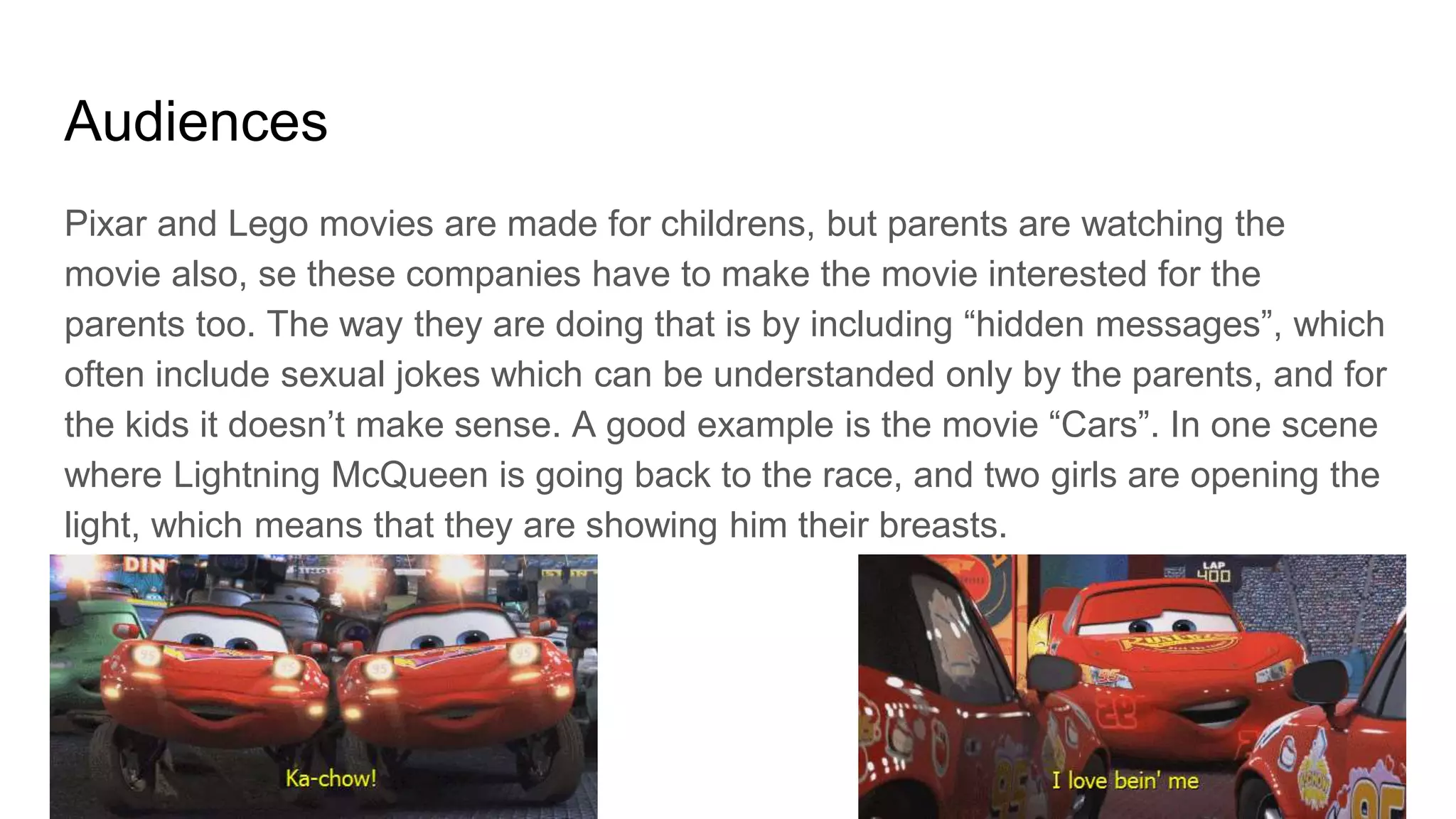
Pixar and Lego movies are made for childrens, but parents are watching the
movie also, se these companies have to make the movie interested for the
parents too. The way they are doing that is by including “hidden messages”, which
often include sexual jokes which can be understanded only by the parents, and for
the kids it doesn’t make sense. A good example is the movie “Cars”. In one scene
where Lightning McQueen is going back to the race, and two girls are opening the
light, which means that they are showing him their breasts.
Audiences
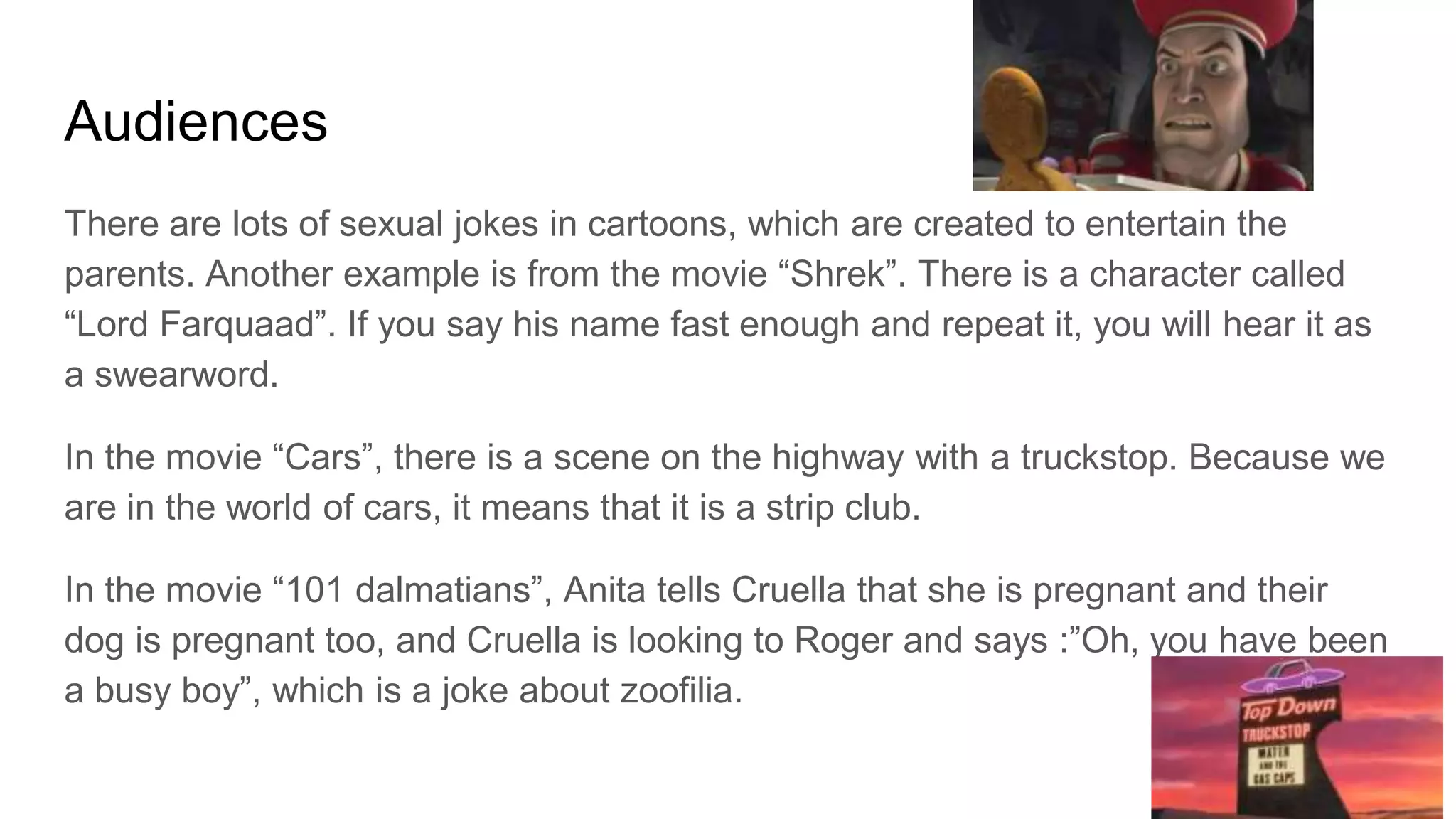
There are lots of sexual jokes in cartoons, which are created to entertain the
parents. Another example is from the movie “Shrek”. There is a character called
“Lord Farquaad”. If you say his name fast enough and repeat it, you will hear it as
a swearword.
In the movie “Cars”, there is a scene on the highway with a truckstop. Because we
are in the world of cars, it means that it is a strip club.
In the movie “101 dalmatians”, Anita tells Cruella that she is pregnant and their
dog is pregnant too, and Cruella is looking to Roger and says :”Oh, you have been
a busy boy”, which is a joke about zoofilia.
Audiences
Audiences can be passive or active. Active audience means that the audience is
interacting with the product like playing a video game. They can contribute to the
product and they can be part of the production. When playing video games you
are helping the producers of the game because you give feedback and you help
them to fix bugs, etc.
Passive audience means that the audience is not interacting physically with the
product. The participation of the audience does not influence the product, like
watching a movie or list
Audience
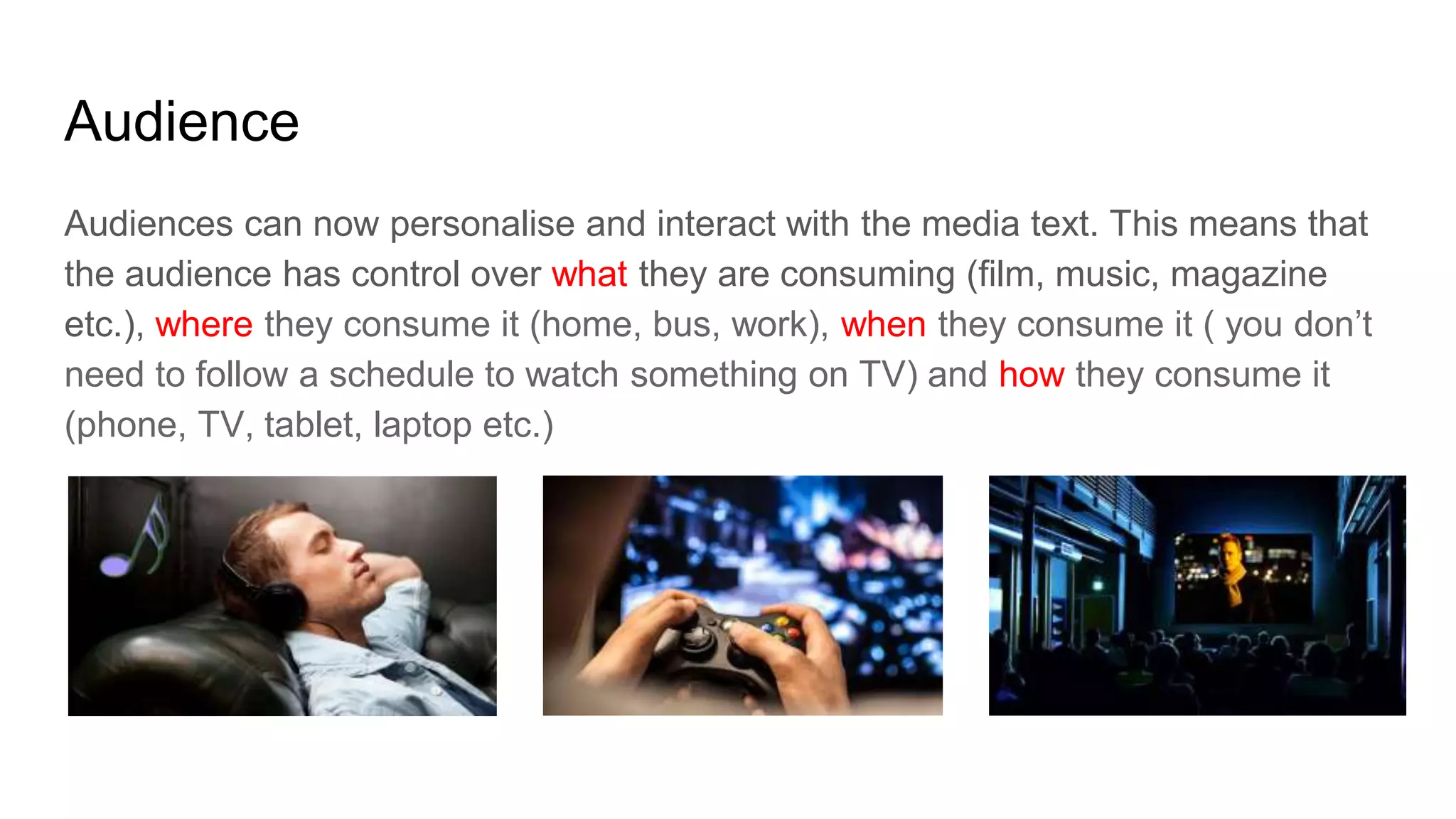
Audiences can now personalise and interact with the media text. This means that
the audience has control over what they are consuming (film, music, magazine
etc.), where they consume it (home, bus, work), when they consume it ( you don’t
need to follow a schedule to watch something on TV) and how they consume it
(phone, TV, tablet, laptop etc.)
Audience interaction
Interaction is when someone communicates with someone or something else.
Examples of audience interaction are:
-User - generated content ( uploading youtube videos );
-Digital editing ( editing a video from someone else, remixing original content )
-Forums and message boards;
-Uploads and downloads;
-Texting and downloading;-’Red button’ and TV menus.
Hypodermic needle theory
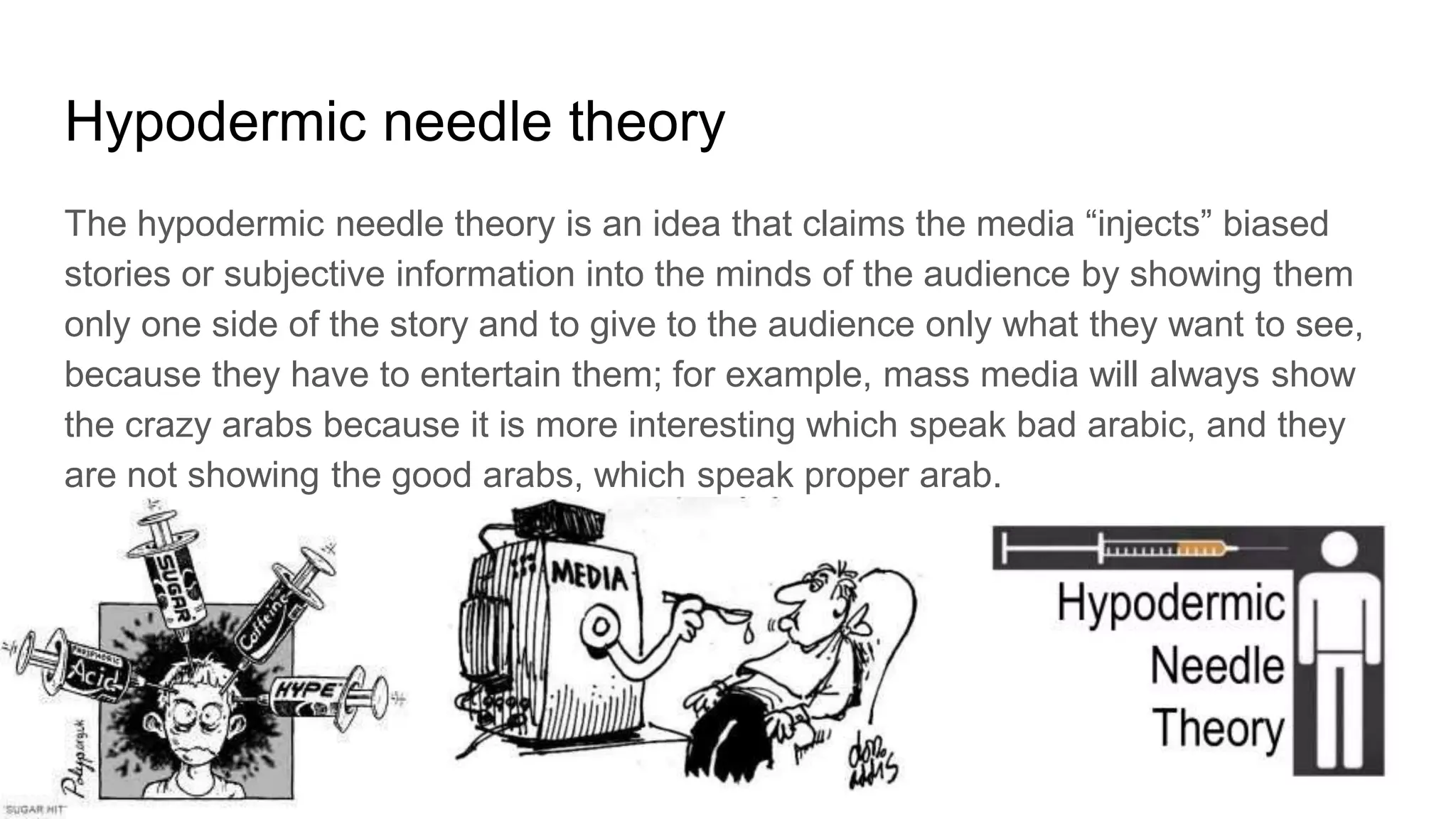
The hypodermic needle theory is an idea that claims the media “injects” biased
stories or subjective information into the minds of the audience by showing them
only one side of the story and to give to the audience only what they want to see,
because they have to entertain them; for example, mass media will always show
the crazy arabs because it is more interesting which speak bad arabic, and they
are not showing the good arabs, which speak proper arab.
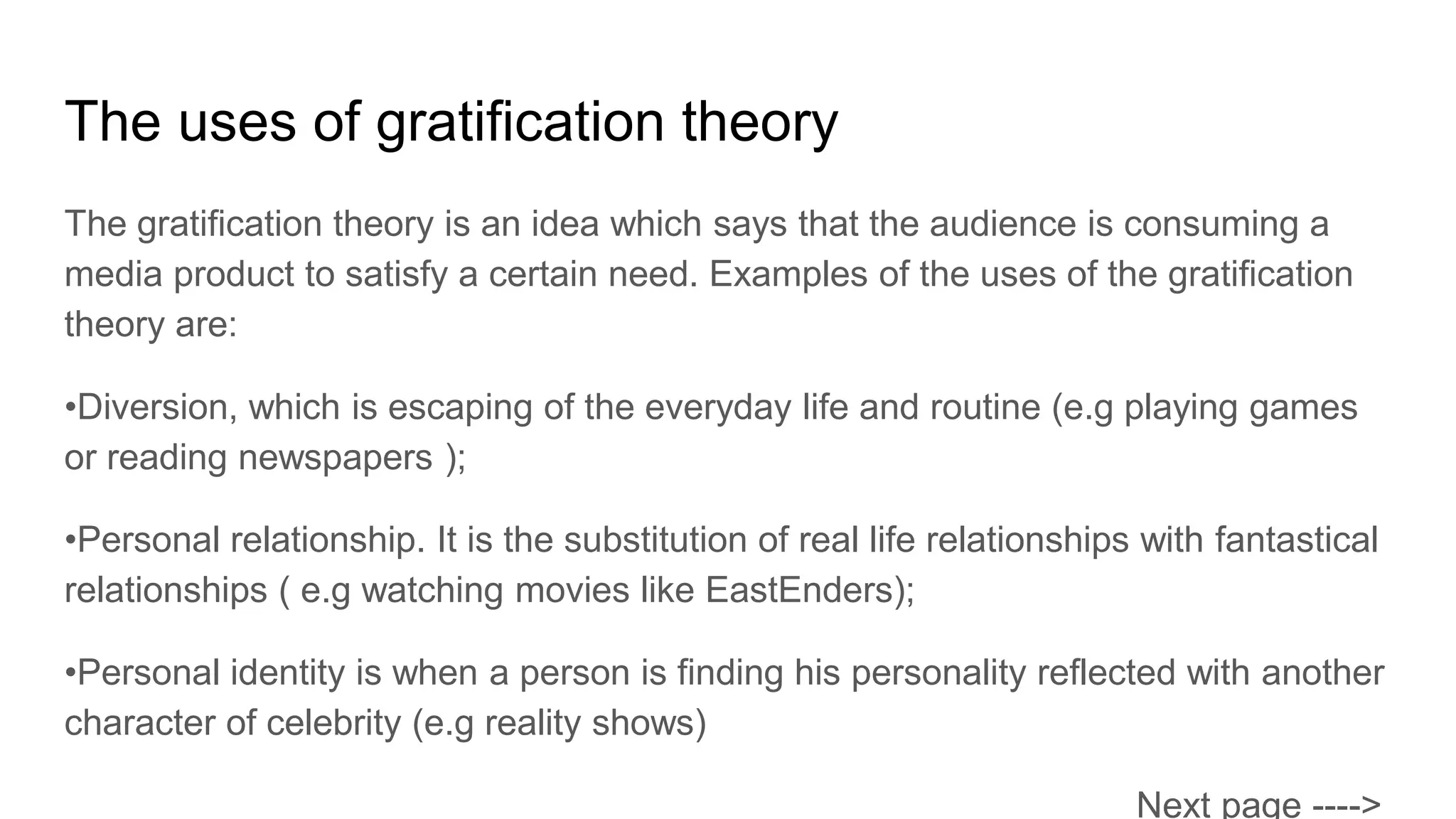
The uses of gratification theory
The gratification theory is an idea which says that the audience is consuming a
media product to satisfy a certain need. Examples of the uses of the gratification
theory are:
•Diversion, which is escaping of the everyday life and routine (e.g playing games
or reading newspapers );
•Personal relationship. It is the substitution of real life relationships with fantastical
relationships ( e.g watching movies like EastEnders);
•Personal identity is when a person is finding his personality reflected with another
character of celebrity (e.g reality shows)
Next page ---->
The uses of gratification theory
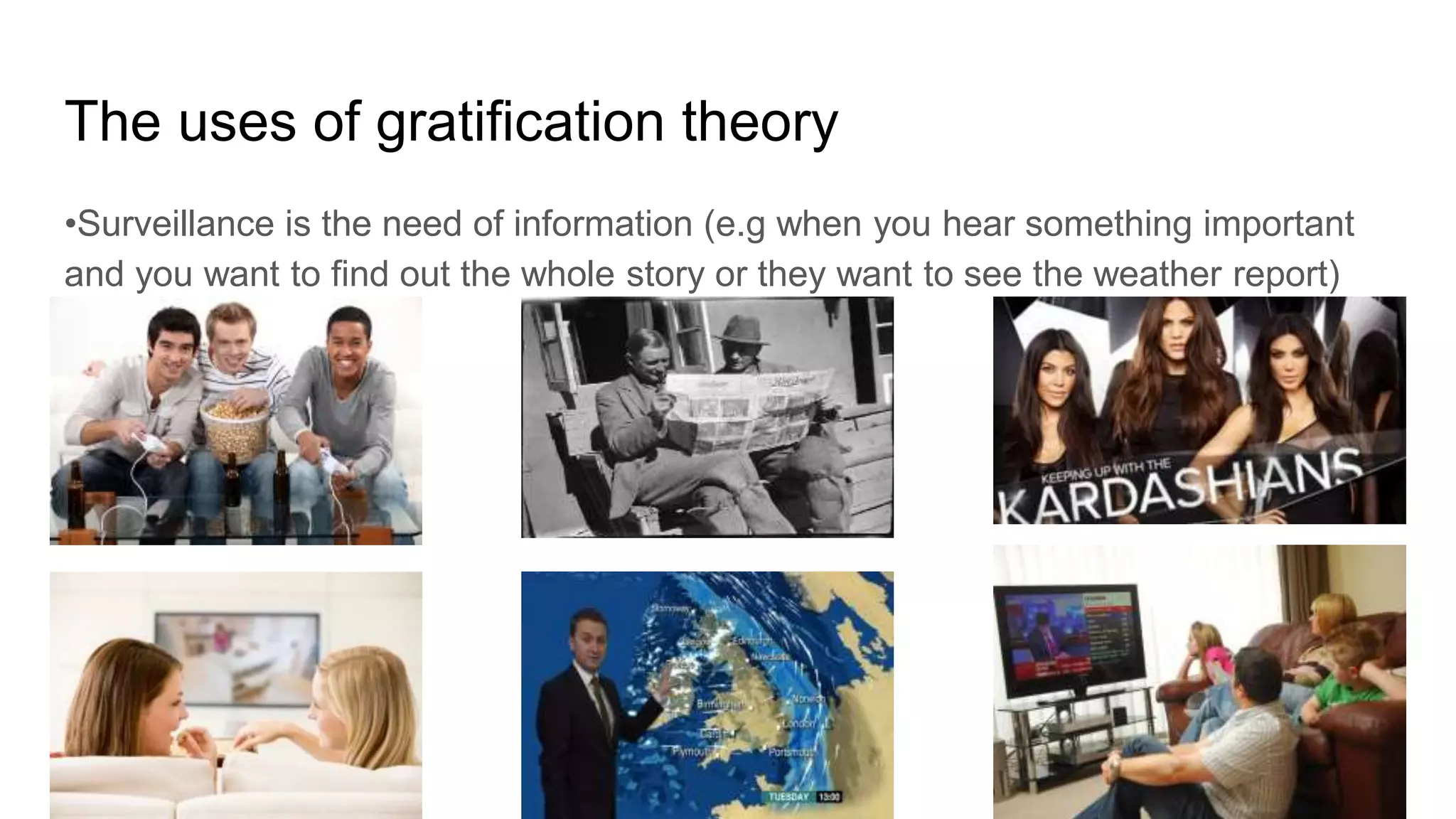
•Surveillance is the need of information (e.g when you hear something important
and you want to find out the whole story or they want to see the weather report)
Regulatory bodies
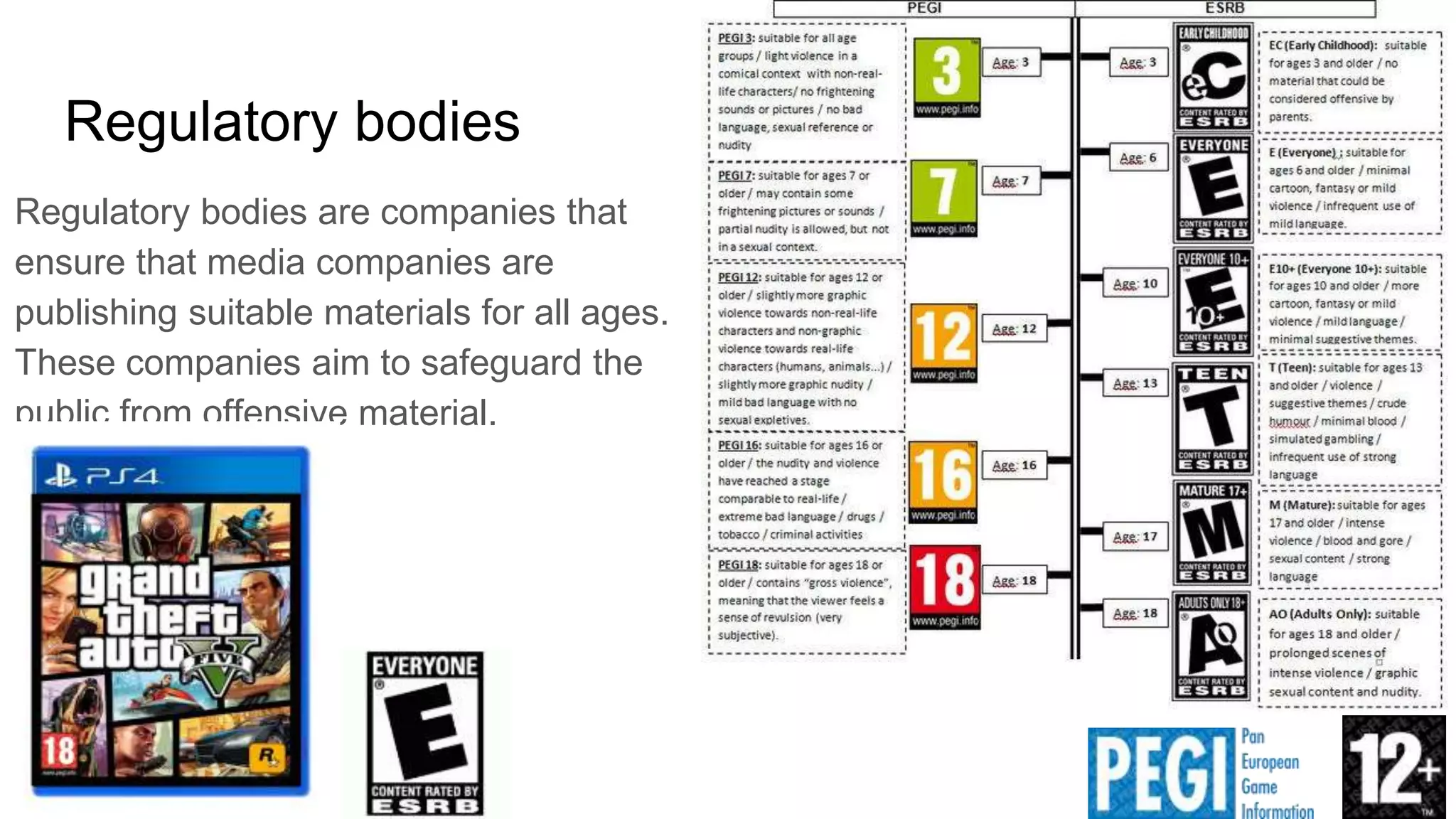
Regulatory bodies are companies that
ensure that media companies are
publishing suitable materials for all ages.
These companies aim to safeguard the
public from offensive material.
Regulatory bodies
Platform Organization Logos
Advertisements The Advertising Standards Authority
(ASA)
Films The British Board Film Classification
(BBFC)
Television and Radio The Office of Communication
(OFCOM)
Video Games Pan European Game Information
(PEGI)
Newspapers and Magazines Independent Press Standards Organization
(IPSO)
The Watershed
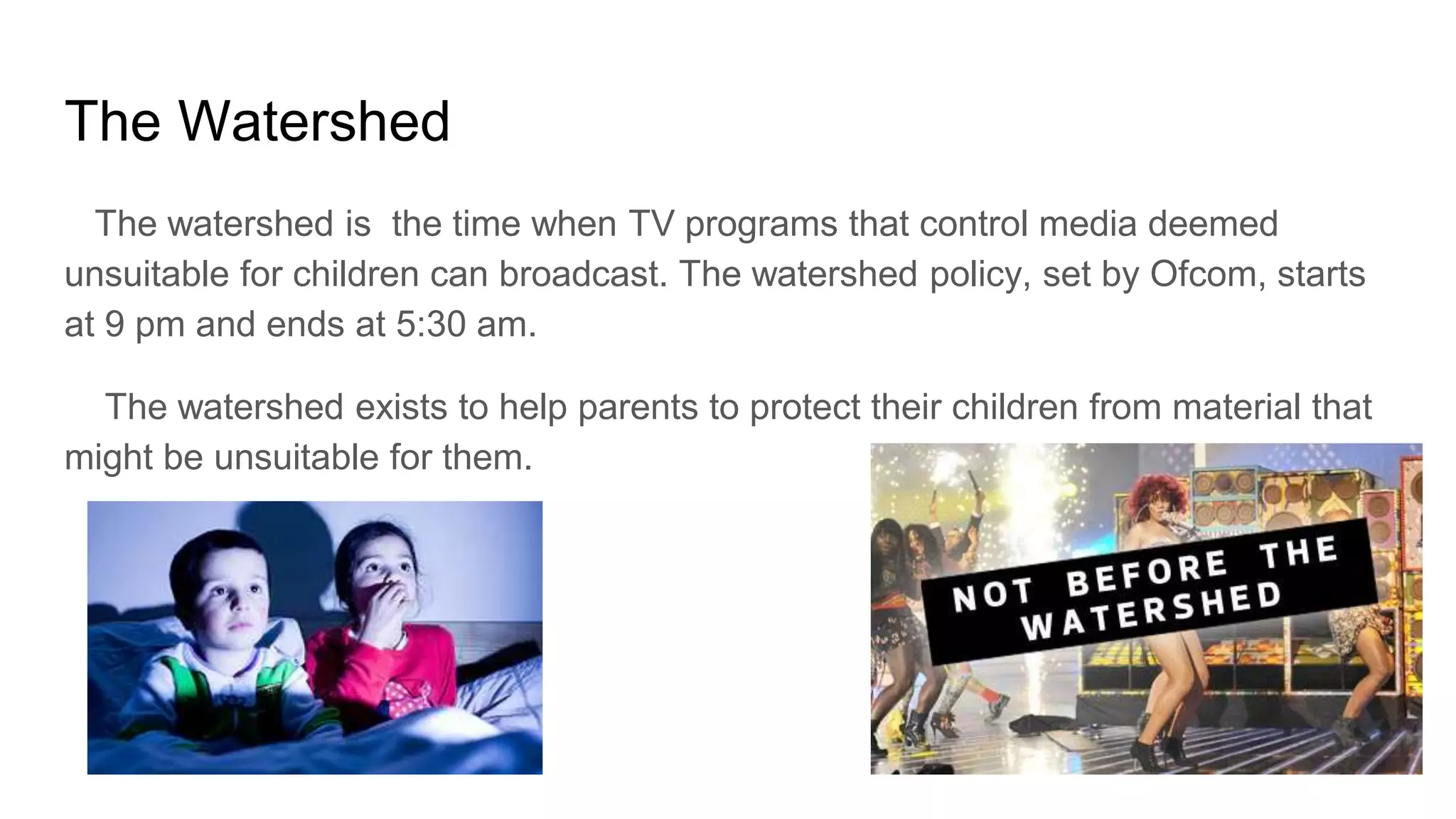
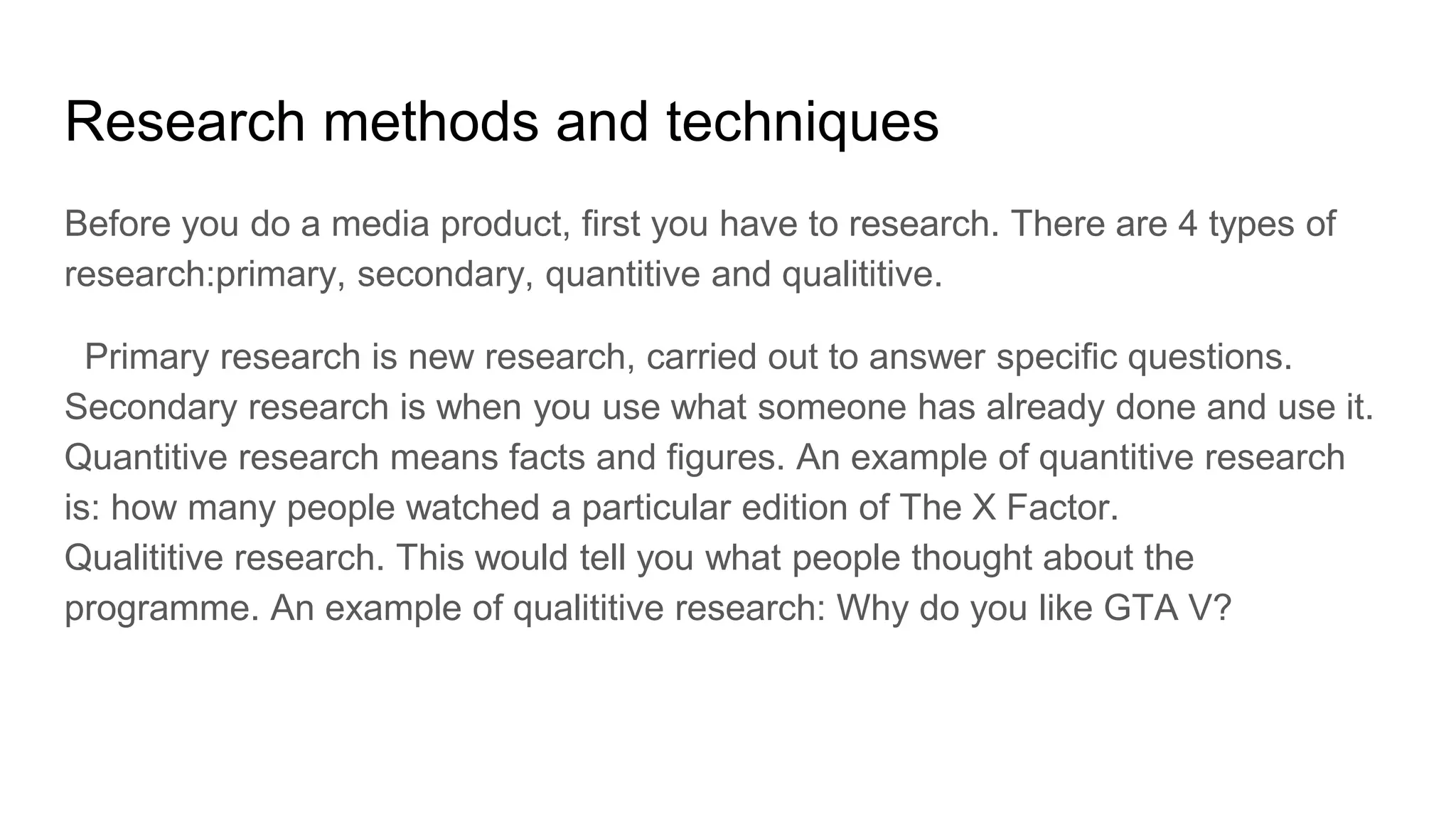
The watershed is the time when TV programs that control media deemed
unsuitable for children can broadcast. The watershed policy, set by Ofcom, starts
at 9 pm and ends at 5:30 am.
The watershed exists to help parents to protect their children from material that
might be unsuitable for them.
Research methods and techniques
Before you do a media product, first you have to research. There are 4 types of
research:primary, secondary, quantitive and qualititive.
Primary research is new research, carried out to answer specific questions.
Secondary research is when you use what someone has already done and use it.
Quantitive research means facts and figures. An example of quantitive research
is: how many people watched a particular edition of The X Factor.
Qualititive research. This would tell you what people thought about the
programme. An example of qualititive research: Why do you like GTA V?
Research methods
The term ‘demographic profiling’ relates to study of a population that is based on
factors such as: Age, gender, ethnicity, social class, occupation, location etc.
Media institutions create audience profiles using demographic information in order
to create different groups in society. These groups are created so media
companies can aim only specific products to specific groups e.g disney films for
childrens, as well for their parents.
Research methods
However, media institutions understand that the audience demand is constantly
changing. Therefore, the media institutions are always under pressure to meet
their audience’s demand before their competition.
Psychographic profile tries to understand the opinion and what is in their mind,
their behavior and their interests.
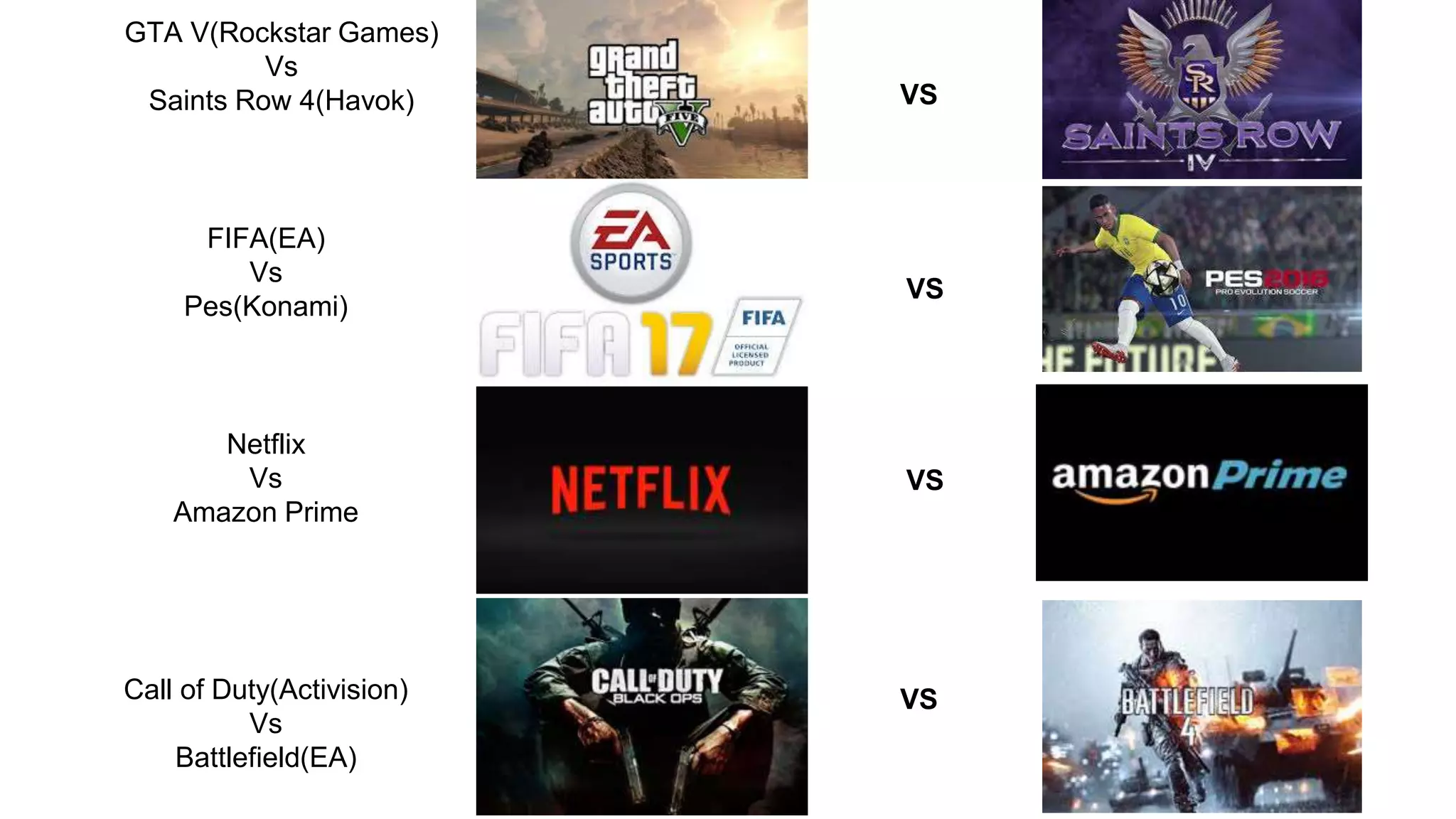
GTA V(Rockstar Games)
Vs
Saints Row 4(Havok)
FIFA(EA)
Vs
Pes(Konami)
Netflix
Vs
Amazon Prime
Call of Duty(Activision)
Vs
Battlefield(EA)
VS
VS
VS
VS
Codes
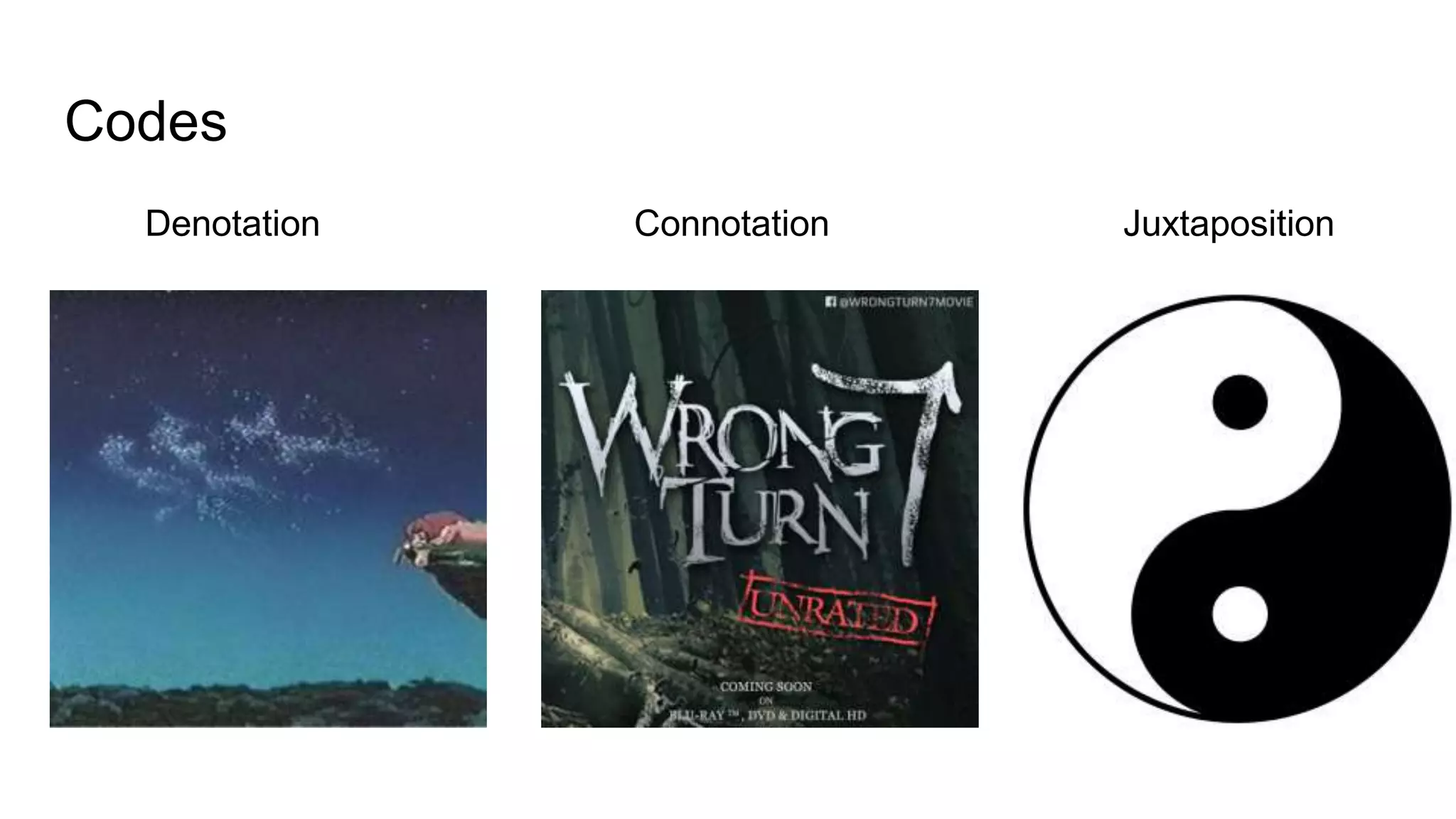
Codes ar signs or symbols within a text that a reader is supposed to read.
There are two types of codes:
-Codes that are obvious and easy to see (denotation);
-Codes that are concealed and have a deeper meaning (connotation);
Juxtaposition is when the producer uses two thing that are opposite in order to
emphasize the contrast between them.
Codes
Denotation Connotation Juxtaposition
Camerawork
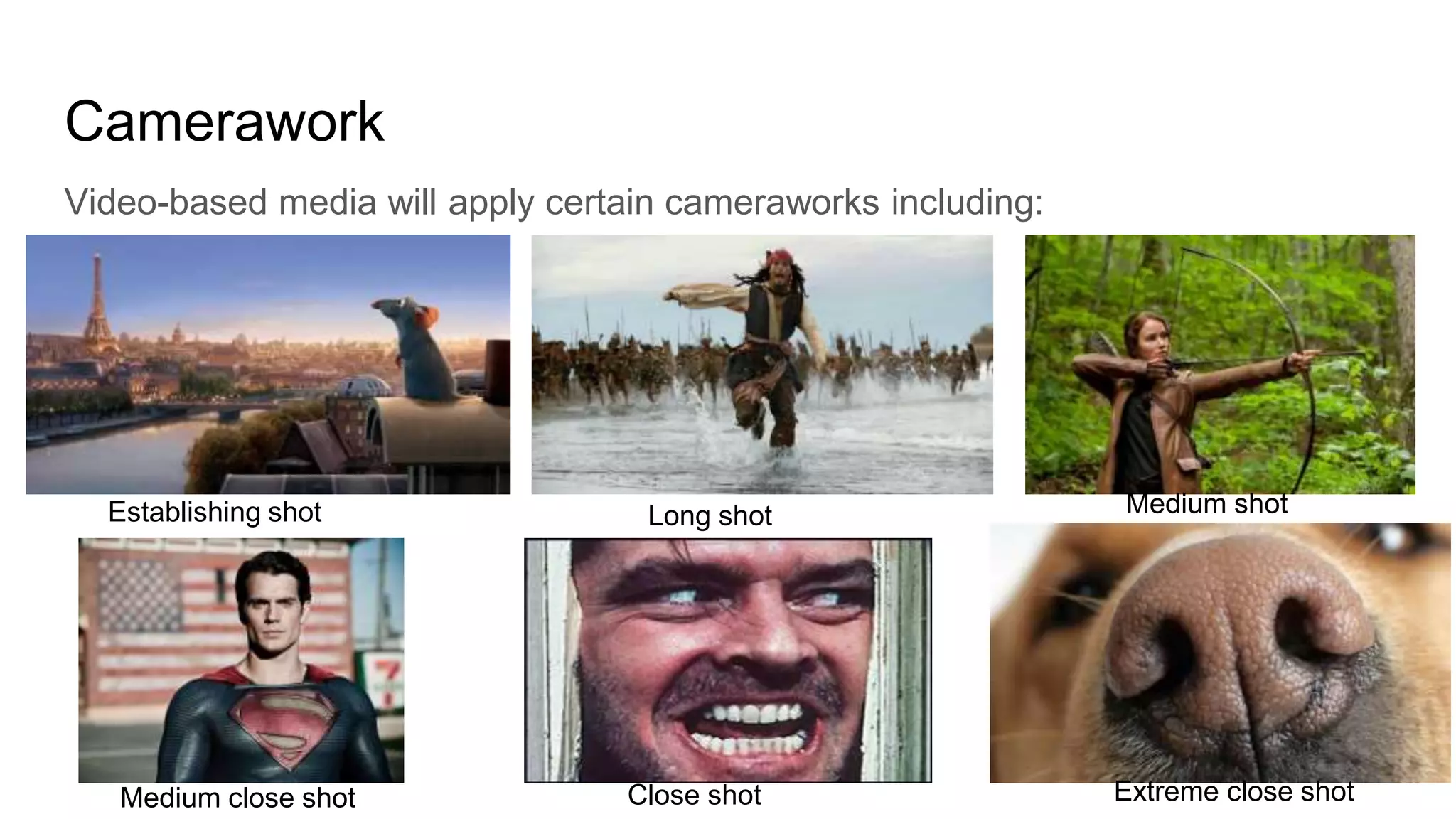
Video-based media will apply certain cameraworks including:
Establishing shot Long shot Medium shot
Medium close shot Close shot Extreme close shot
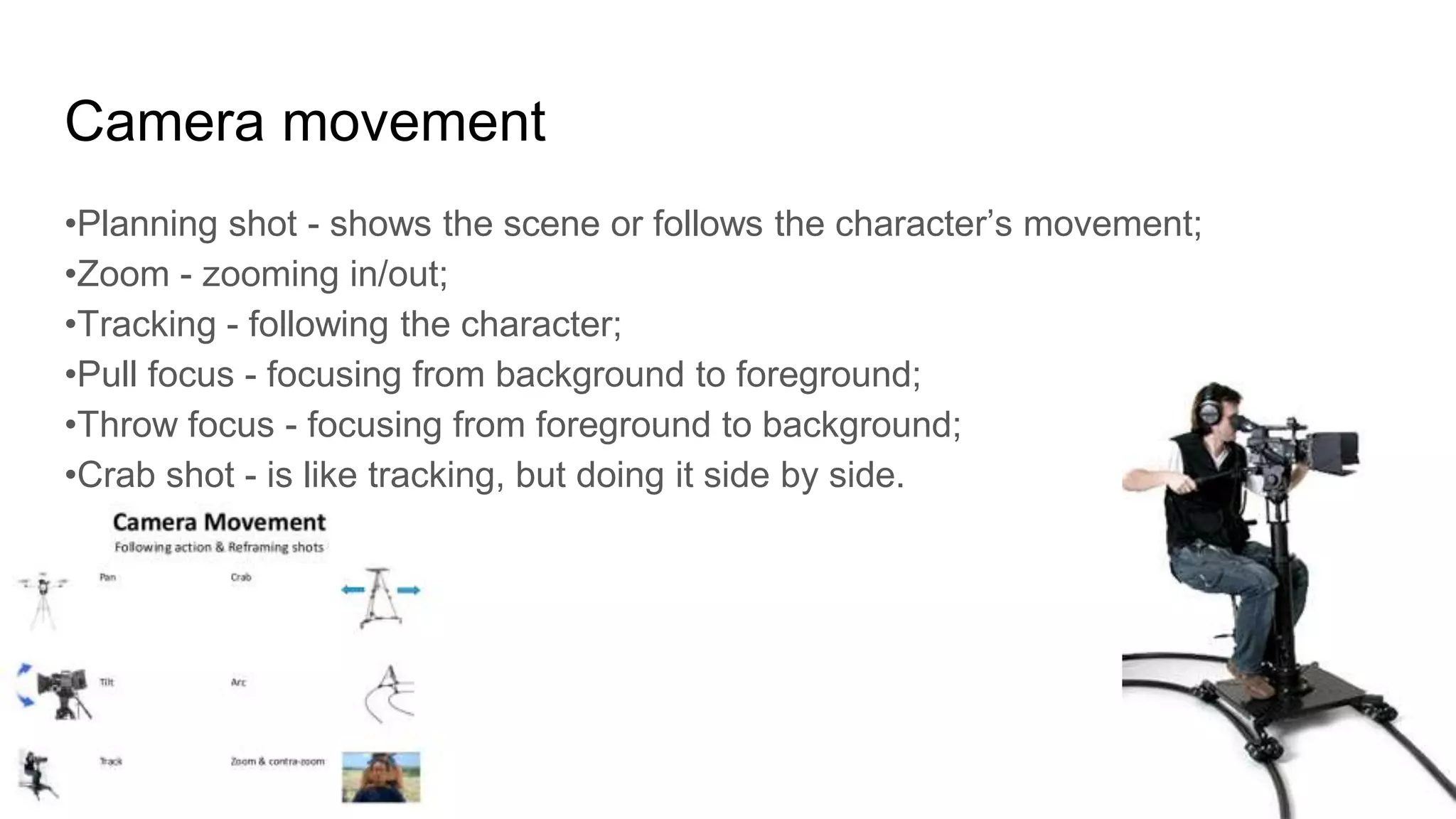
Camera movement
•Planning shot - shows the scene or follows the character’s movement;
•Zoom - zooming in/out;
•Tracking - following the character;
•Pull focus - focusing from background to foreground;
•Throw focus - focusing from foreground to background;
•Crab shot - is like tracking, but doing it side by side.
Editing
Editing is the changing or altering certain elements, such as:
•Cutting scenes;
•Changing colours schemes;
•Applying CGI (computer generated imagery);
•Adding visual effects;
•Adding sound effects;
Editing
Creating peace is about how many cuts are in a video. If you do a fast scene, you
will use a fast cutting like in a car race, but if you want a slow scene like a horror
movie, you will use slow cutting.
The 180 degree rule states that once two actors have been established on a
certain side of the scene, then they must remain that side through the edit.
Parallel editing is cutting between, two or more story lines that are occurring of the
some time, but in different places.
Cutaway - cutting away from the main subject to show other thing around it.
Editing
A key theme relating to editing is narrative. Narrative is the way a story is told, or
the way in which the events are arranged.
There are 4 types of narrative:
•Open-ended: A story that has no end, it is incompleted;
•Closed: A story that is completed, with no questions left unanswered.
•Linear: Events in a storyline that happen in a chronological order;
•Non-linear: Events of a storyline that happen in a non-chronological order.
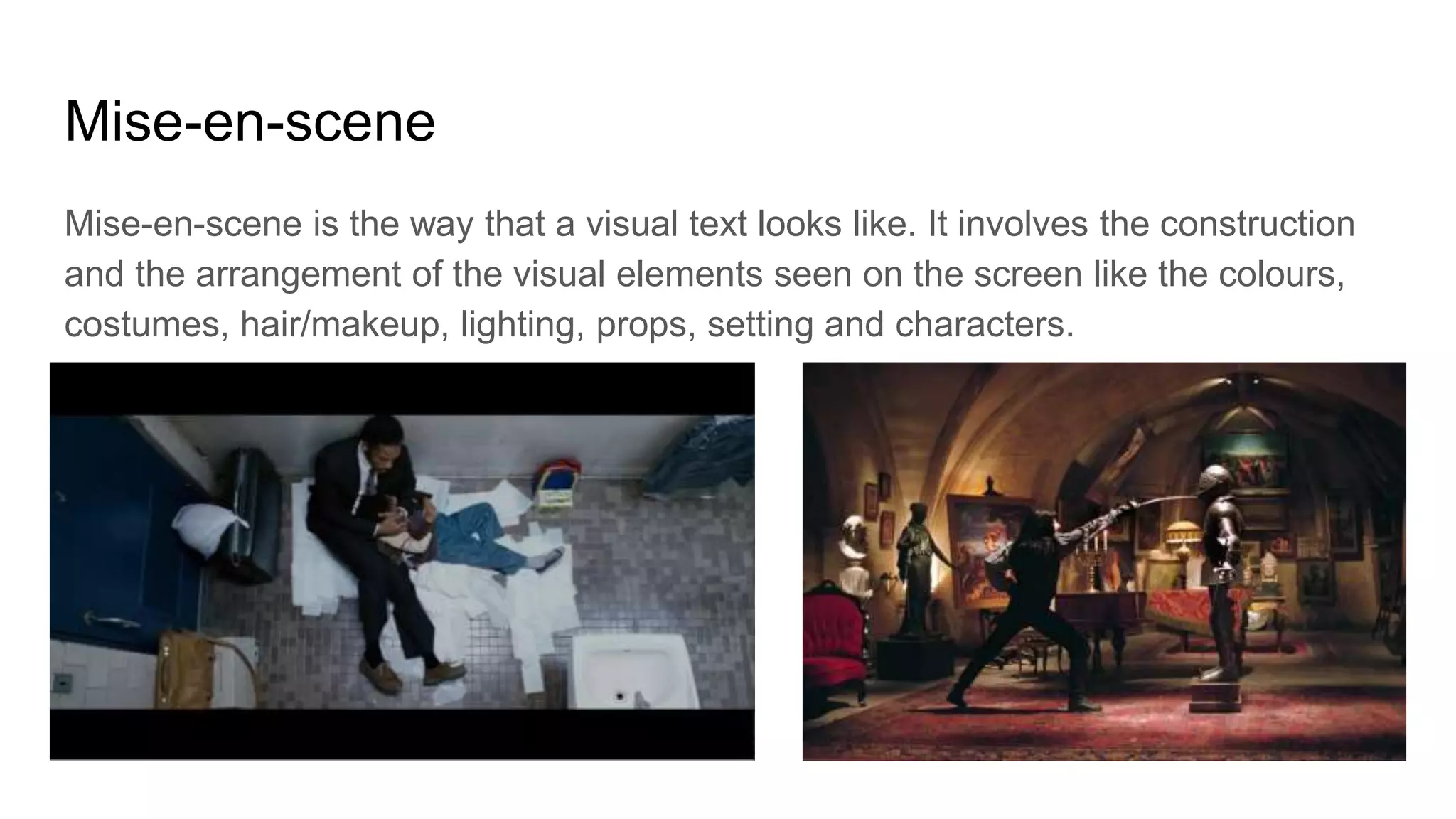
Mise-en-scene
Mise-en-scene is the way that a visual text looks like. It involves the construction
and the arrangement of the visual elements seen on the screen like the colours,
costumes, hair/makeup, lighting, props, setting and characters.
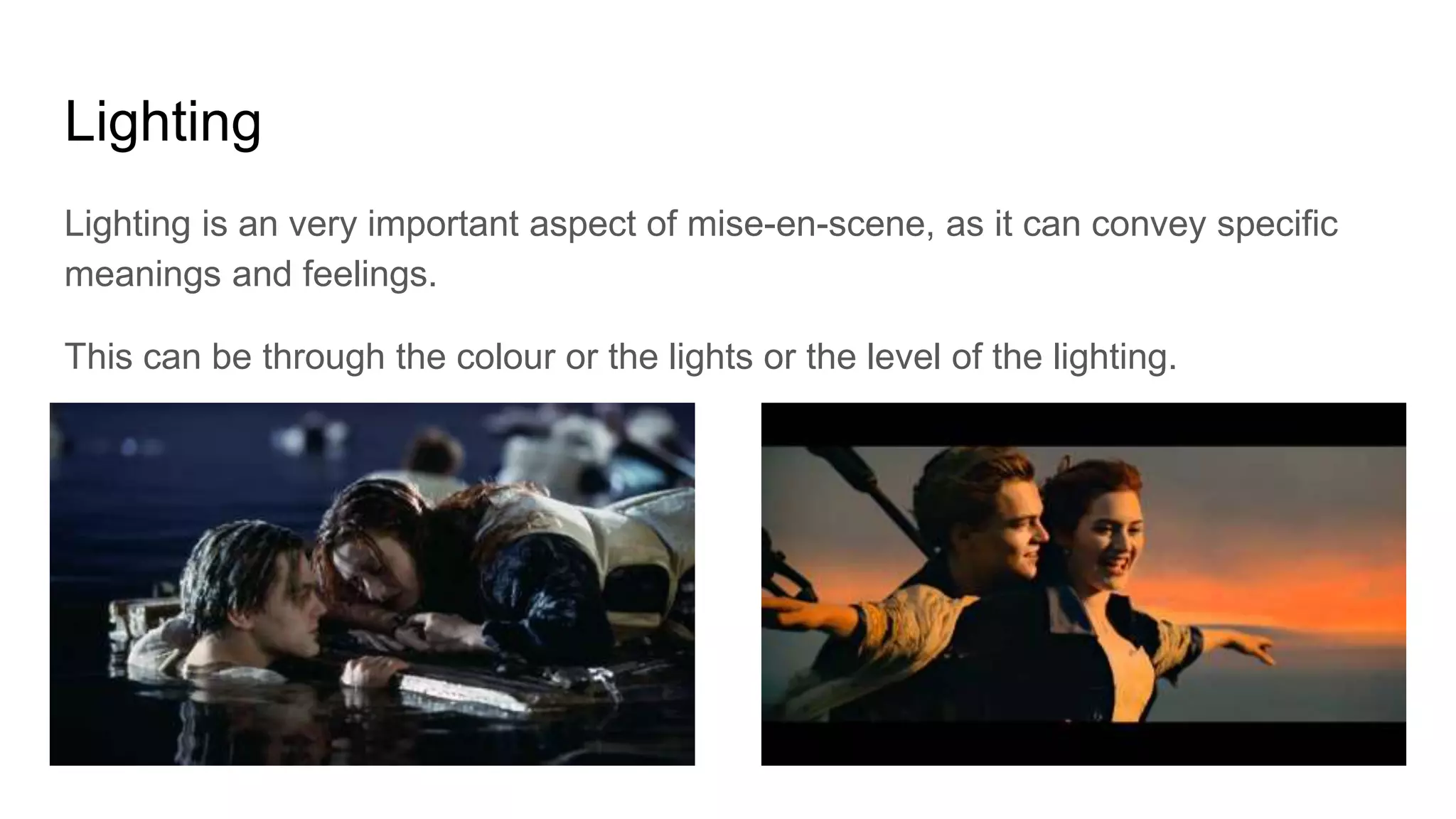
Lighting
Lighting is an very important aspect of mise-en-scene, as it can convey specific
meanings and feelings.
This can be through the colour or the lights or the level of the lighting.
Sound
There are two main topics of sound: Diegetic and non-diegetic;
Diegetic sound is sound that comes from that world e.g radio, characters voice,
sound effects etc. It is sound that emanates from a source within the actual scene.
Diegetic sound is sound that can be heard by the audience.
Non-diegetic sound is sound only the audience can hear, it can’t be heard by the
characters, it is added by the video producers or editors, and it comes from
outside of the text’s own world.
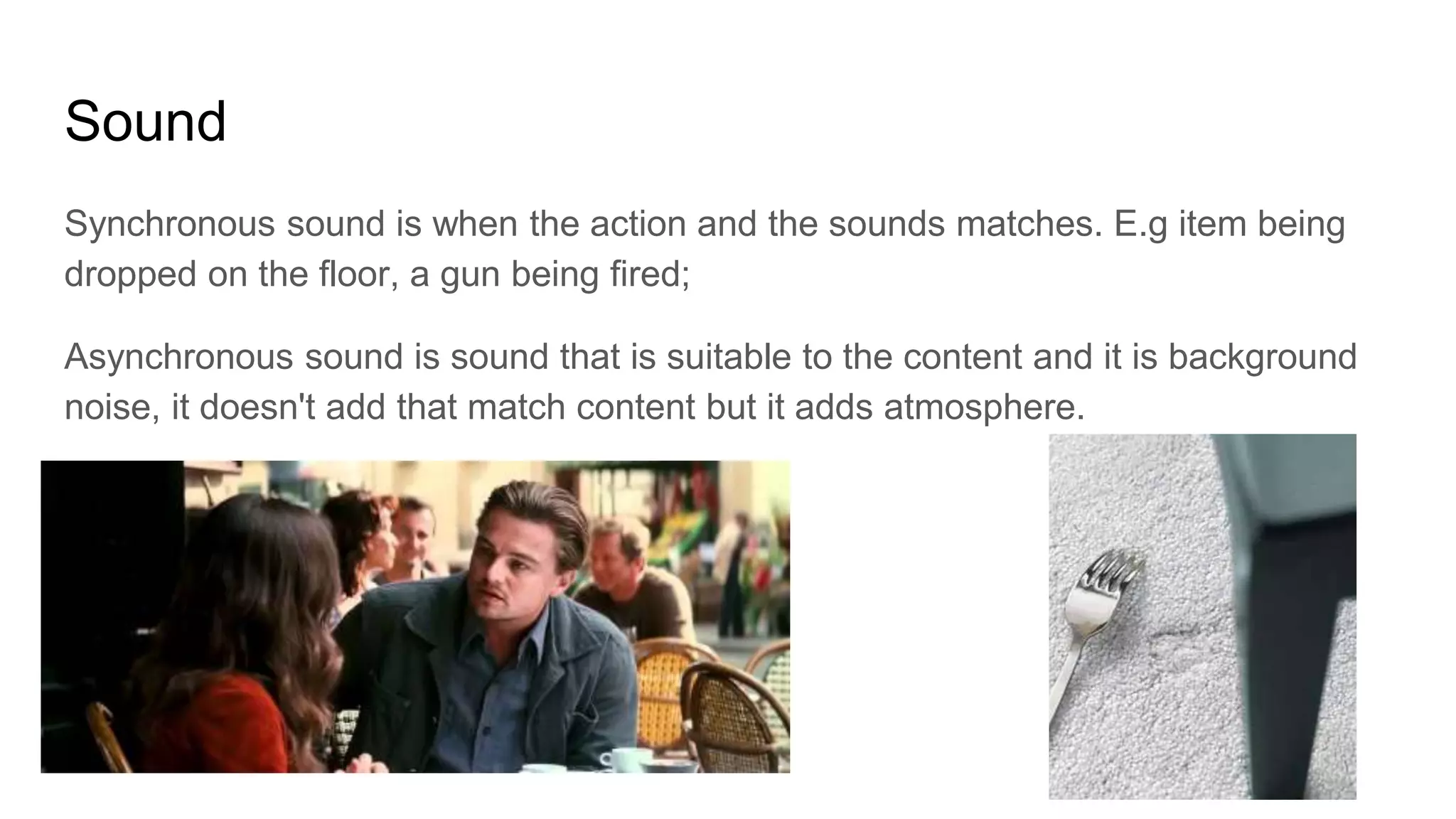
Sound
Synchronous sound is when the action and the sounds matches. E.g item being
dropped on the floor, a gun being fired;
Asynchronous sound is sound that is suitable to the content and it is background
noise, it doesn't add that match content but it adds atmosphere.

Unit 1 digital media sectors and audiences

  • 1.
    Unit 1: Digital MediaSectors and Audiences By Matei Turcu
  • 2.
    Media Sectors Digital mediahas different sectors like: •Film - Walt Disney - All Dogs Go to Heaven (1989), Bambi (1942); - Warner Brothers - The Hobbit: An Unexpected Journey (2012), Harry Potter and the Philosopher’s Stone (2001); -20th Century Fox - Logan (2017), Big Momma’s House (2000); -Sony - The Smurfs (2011), Annie (2014);
  • 3.
    Video Games -Riot Games- League of Legends (2009) -Rockstar Games - Grand Theft Auto 3 (2001), Grant Theft Auto San Andreas (2004), Grand Theft Auto V (2013 for console, 2015 for PC) -Ubisoft - Assassin's Creed Revelation (2011), Assassin's Creed Syndicate (2015) Driver: San Fransisco (2011) Far Cry 4 (2014) - Capcom - Resident Evil 7 (2017), Street Fighter 5 (2016) , Resident Evil (1996)
  • 4.
    Magazines -Time Inc: Fortune(1929), InStyle(1994), People(1974); -Conde Nast: Vogue (1892), Glamour (1939), Allure (1991); -21st century fox: National Geographic (1888);
  • 5.
    Music Music is abig industry which makes lot of money. -Atlantic records - David Guetta : “Hey Mama” (2014), Dangerous (2014); Wiz Khalifa: “Black and Yellow” (2011), See You Again (2016); -Roadrunner Records - Slipknot : Duality (2004), The Devil in I (2014), Killpop (2014); Corey Taylor : Eyeless (1999), Snuff (2008);# -Nuclear Blast - Slayer : Raining Blood (1986), You Against You (2015); Sabatons : 40:1 (2008), To Hell and Back (2014);
  • 6.
    Television -BBC: BBC OneLondon - “Father Brown” (2013-now), “Holby City” (1999- present), “Doctors” (2000-now); -Disney Pixar: Disney Channel - “Wizards of Waverly Place” (2007-2012), “Good Luck Charlie”(2010-2014), “K.C Undercover” (2015); -Pro TV: Pro Tv - “La Maruta” (2007-now), “iLikeIT” (2015-now), “Apropo TV” (2008-now);
  • 7.
    Radio -Hamburg: Kiss FM(1990-now) : Kiss Presents, Rickie, Melvin and Charlie in the morning; -GCap Media: Capital FM (1973-now) : Roman Kemp, Will Manning; -BBC: BBC Radio 1 : Greg James, Newsbeat, MistaJam;
  • 8.
    Newspaper -Scott Trust Limited:The Guardian (1821-now); -News Group Newspapers: The Sun (1964-now); -Alfred Hamsworth: Daily Mail (1896-now);
  • 9.
    Web -Mark Zuckerberg: Facebook(2004), Instagram (2010); -Riot Games: League of Legends website (2009); -Google: Google (1998), Youtube (2005), Gmail (2004); -Yahoo!: Tumblr (2007), Yahoo Mail (1997);
  • 10.
    Analogue platform Analogue issomething physical that you can hold, touch and feel. Analogue examples: DVD BLU RAY Analogue Radio Vinyl record Terrestrial TV Cassette tape
  • 11.
    Digital platform Digital mediais something electronic, that you can access with a device e.g Smartphone. Examples: E-magazine Digital poster E-newspaper Podcast Online games
  • 12.
    Devices Devices that canaccess media content are:
  • 13.
    Media text processes InstitutionAudience MESSAGE RESPONSE Product
  • 14.
    Pre-production Pre-production means theplanning and designing of a media text e.g layout for a newsletter. For example, pre-production for a video game includes: Creating animations, creating the characters, creating the storyboard and the scripts; For a movie, pre-production includes: planning the budget, market research, scripts, storyboard etc.
  • 15.
    Production Productions means themaking of a media product e.g films, newsletters etc; Depending on the product being made, they will usually include: •Filming for movies; •Programming / writing codes for video games or websites; •Taking pictures for magazines, newsletters and newspapers; •CGI for video games and movies sometimes (computer generated images);
  • 16.
    Post-Production Post-production is theediting of media text. It is when you change things e.g spelling, font style, add shadows etc. Depending on the media text, the post-production will usually include altering sounds, change characters voice, testing followed by programming (for video games and websites), alpha and beta testing for video games. Post-production examples: film editing for movies, photo editing for newsletters opr magazines, testing and reprogramming.
  • 17.
    Marketing Marketing involves thepromotion of a media product , and it is a process of making the public aware of the existence of a media product. It also involves the selling of a product. Examples: •Trailers ( cinema, youtube, DVD’s, radio); •Posters / billboards; •Websites and social media; •Reviews;
  • 18.
    Distribution Distribution is thegiving out of a media product to the audience. Media products can be distributed via analogue and digital platforms. This can include: •Cinema or TV (movies); •CDs, DVDs, Blu-Rays, UMDs (video-games, music and movies); •Digital download (video games, movies and music); •Phone and tablet applications (games, movies, music); •Print-based (newsletters, magazines);
  • 19.
    Exhibition Exhibition means theconsumption of the media product by the audience. It also includes. It is also how the audience interacts with the text. A media text will ever have a message that aims to be delivered and understood by the audience. Consuming the media text will usually have an impact on the audience; this can be a positive impact or a negative one impact. Media products can influence a person’s personality e.g music can change the way they dress, movies can change the way a person thinks or speaks etc.
  • 20.
    Synergy Synergy means therelease of a brand across different media platforms e.g Lord of Rings: Book, Movie, Video-game, Magazine, Animated Cartoons, soundtracks etc. Media institutions use synergistic techniques to increase the brand’s image and to expand their target audience. Examples of brands that used synergy techniques: Assasin’s Creed Movie Game Soundtrack Magazine
  • 21.
    Converge Converge is theunification of platforms that were separate into one device, like the smartphone. The access to the Internet has helped the audience a lot, because now you can choose what to watch and what to do, and you don’t have to see the same TV shows everyday, and you can listen to music without buying it or read a newspaper every time you want. Nowadays, everyone can create a media product like recording a video and posting it on youtube. If you did this, it means that you are a Prosumer. A good example of converge are the smartphones like HTC 10: Internet Music Films Phone Games Newspapers HTC 10
  • 22.
    Impact of converge Convergehad a big impact over the audience. Nowadays, in one device you can do everything; you can watch movies, listen to music, recording, taking pictures, talking via phone call or messages, playing games and you can buy what you need via amazon/e-bay apps, etc. Also, a device like a smartphone is affordable, and everyone has access to them. There are lots of advantages for converge, like portability, convenience (free of cheap), and the internet allows you to access whatever you want. But, the disadvantages of converge are that it makes people addicted to it, and they will spend too much time on smartphone, it makes people lazy, and you can’t do too much without internet connection.
  • 23.
    Audiences Audience are segmentedin two parts: Primary and secondary; Primary: Primary audiences is the main audience that a media text is targeting, like the cartoon “Cars” which has the main audience childrens. Secondary: Secondary audience is the audience that is not the main target but still consumes the product, like “Cars”, which has the main audience childrens, but parents are also watching the movie with them, so parents are the secondary audience.
  • 24.
    Audiences Pixar and Legomovies are made for childrens, but parents are watching the movie also, se these companies have to make the movie interested for the parents too. The way they are doing that is by including “hidden messages”, which often include sexual jokes which can be understanded only by the parents, and for the kids it doesn’t make sense. A good example is the movie “Cars”. In one scene where Lightning McQueen is going back to the race, and two girls are opening the light, which means that they are showing him their breasts.
  • 25.
    Audiences There are lotsof sexual jokes in cartoons, which are created to entertain the parents. Another example is from the movie “Shrek”. There is a character called “Lord Farquaad”. If you say his name fast enough and repeat it, you will hear it as a swearword. In the movie “Cars”, there is a scene on the highway with a truckstop. Because we are in the world of cars, it means that it is a strip club. In the movie “101 dalmatians”, Anita tells Cruella that she is pregnant and their dog is pregnant too, and Cruella is looking to Roger and says :”Oh, you have been a busy boy”, which is a joke about zoofilia.
  • 26.
    Audiences Audiences can bepassive or active. Active audience means that the audience is interacting with the product like playing a video game. They can contribute to the product and they can be part of the production. When playing video games you are helping the producers of the game because you give feedback and you help them to fix bugs, etc. Passive audience means that the audience is not interacting physically with the product. The participation of the audience does not influence the product, like watching a movie or list
  • 27.
    Audience Audiences can nowpersonalise and interact with the media text. This means that the audience has control over what they are consuming (film, music, magazine etc.), where they consume it (home, bus, work), when they consume it ( you don’t need to follow a schedule to watch something on TV) and how they consume it (phone, TV, tablet, laptop etc.)
  • 28.
    Audience interaction Interaction iswhen someone communicates with someone or something else. Examples of audience interaction are: -User - generated content ( uploading youtube videos ); -Digital editing ( editing a video from someone else, remixing original content ) -Forums and message boards; -Uploads and downloads; -Texting and downloading;-’Red button’ and TV menus.
  • 29.
    Hypodermic needle theory Thehypodermic needle theory is an idea that claims the media “injects” biased stories or subjective information into the minds of the audience by showing them only one side of the story and to give to the audience only what they want to see, because they have to entertain them; for example, mass media will always show the crazy arabs because it is more interesting which speak bad arabic, and they are not showing the good arabs, which speak proper arab.
  • 30.
    The uses ofgratification theory The gratification theory is an idea which says that the audience is consuming a media product to satisfy a certain need. Examples of the uses of the gratification theory are: •Diversion, which is escaping of the everyday life and routine (e.g playing games or reading newspapers ); •Personal relationship. It is the substitution of real life relationships with fantastical relationships ( e.g watching movies like EastEnders); •Personal identity is when a person is finding his personality reflected with another character of celebrity (e.g reality shows) Next page ---->
  • 31.
    The uses ofgratification theory •Surveillance is the need of information (e.g when you hear something important and you want to find out the whole story or they want to see the weather report)
  • 32.
    Regulatory bodies Regulatory bodiesare companies that ensure that media companies are publishing suitable materials for all ages. These companies aim to safeguard the public from offensive material.
  • 33.
    Regulatory bodies Platform OrganizationLogos Advertisements The Advertising Standards Authority (ASA) Films The British Board Film Classification (BBFC) Television and Radio The Office of Communication (OFCOM) Video Games Pan European Game Information (PEGI) Newspapers and Magazines Independent Press Standards Organization (IPSO)
  • 34.
    The Watershed The watershedis the time when TV programs that control media deemed unsuitable for children can broadcast. The watershed policy, set by Ofcom, starts at 9 pm and ends at 5:30 am. The watershed exists to help parents to protect their children from material that might be unsuitable for them.
  • 35.
    Research methods andtechniques Before you do a media product, first you have to research. There are 4 types of research:primary, secondary, quantitive and qualititive. Primary research is new research, carried out to answer specific questions. Secondary research is when you use what someone has already done and use it. Quantitive research means facts and figures. An example of quantitive research is: how many people watched a particular edition of The X Factor. Qualititive research. This would tell you what people thought about the programme. An example of qualititive research: Why do you like GTA V?
  • 36.
    Research methods The term‘demographic profiling’ relates to study of a population that is based on factors such as: Age, gender, ethnicity, social class, occupation, location etc. Media institutions create audience profiles using demographic information in order to create different groups in society. These groups are created so media companies can aim only specific products to specific groups e.g disney films for childrens, as well for their parents.
  • 37.
    Research methods However, mediainstitutions understand that the audience demand is constantly changing. Therefore, the media institutions are always under pressure to meet their audience’s demand before their competition. Psychographic profile tries to understand the opinion and what is in their mind, their behavior and their interests.
  • 38.
    GTA V(Rockstar Games) Vs SaintsRow 4(Havok) FIFA(EA) Vs Pes(Konami) Netflix Vs Amazon Prime Call of Duty(Activision) Vs Battlefield(EA) VS VS VS VS
  • 39.
    Codes Codes ar signsor symbols within a text that a reader is supposed to read. There are two types of codes: -Codes that are obvious and easy to see (denotation); -Codes that are concealed and have a deeper meaning (connotation); Juxtaposition is when the producer uses two thing that are opposite in order to emphasize the contrast between them.
  • 40.
  • 41.
    Camerawork Video-based media willapply certain cameraworks including: Establishing shot Long shot Medium shot Medium close shot Close shot Extreme close shot
  • 42.
    Camera movement •Planning shot- shows the scene or follows the character’s movement; •Zoom - zooming in/out; •Tracking - following the character; •Pull focus - focusing from background to foreground; •Throw focus - focusing from foreground to background; •Crab shot - is like tracking, but doing it side by side.
  • 43.
    Editing Editing is thechanging or altering certain elements, such as: •Cutting scenes; •Changing colours schemes; •Applying CGI (computer generated imagery); •Adding visual effects; •Adding sound effects;
  • 44.
    Editing Creating peace isabout how many cuts are in a video. If you do a fast scene, you will use a fast cutting like in a car race, but if you want a slow scene like a horror movie, you will use slow cutting. The 180 degree rule states that once two actors have been established on a certain side of the scene, then they must remain that side through the edit. Parallel editing is cutting between, two or more story lines that are occurring of the some time, but in different places. Cutaway - cutting away from the main subject to show other thing around it.
  • 45.
    Editing A key themerelating to editing is narrative. Narrative is the way a story is told, or the way in which the events are arranged. There are 4 types of narrative: •Open-ended: A story that has no end, it is incompleted; •Closed: A story that is completed, with no questions left unanswered. •Linear: Events in a storyline that happen in a chronological order; •Non-linear: Events of a storyline that happen in a non-chronological order.
  • 46.
    Mise-en-scene Mise-en-scene is theway that a visual text looks like. It involves the construction and the arrangement of the visual elements seen on the screen like the colours, costumes, hair/makeup, lighting, props, setting and characters.
  • 47.
    Lighting Lighting is anvery important aspect of mise-en-scene, as it can convey specific meanings and feelings. This can be through the colour or the lights or the level of the lighting.
  • 48.
    Sound There are twomain topics of sound: Diegetic and non-diegetic; Diegetic sound is sound that comes from that world e.g radio, characters voice, sound effects etc. It is sound that emanates from a source within the actual scene. Diegetic sound is sound that can be heard by the audience. Non-diegetic sound is sound only the audience can hear, it can’t be heard by the characters, it is added by the video producers or editors, and it comes from outside of the text’s own world.
  • 49.
    Sound Synchronous sound iswhen the action and the sounds matches. E.g item being dropped on the floor, a gun being fired; Asynchronous sound is sound that is suitable to the content and it is background noise, it doesn't add that match content but it adds atmosphere.