Digital Media Sectors and
Audiences
Unit 1
Digital Media Sectors
Farid Akhundov
Exam Details
Date: Monday 16th May 2017
Time: Morning
Length: One hour
Equipment: Pens, pencils, erasers, rulers
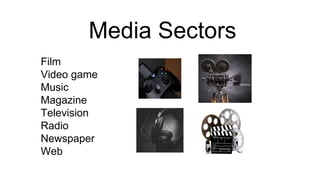
Media Sectors
Film
Video game
Music
Magazine
Television
Radio
Newspaper
Web
Film
Film is a story or event recorded by a camera as a set of moving images and
shown in a cinema or on television.
There are many film production companies. 3 examples of them is Dreamworks,
Blue Sky Studios and Pixar Animation Studios.
● Dreamworks(Shrek 1, 2001);(Kung Fu Panda 1, 2008);(Madagascar 1, 2005)
● Blue Sky Studios(Ice age 1, 2002);(Rio 1, 2011);(The Peanuts Movie, 2015)
● Pixar Animation Studios(Toy Story 1, 1995);(Cars 1, 2006);(Monsters, 2001)
Video Game
Is a game played by electronically manipulating images, produced by a computer
on a monitor or other display.
There are many video game developers such as Ea Sports, Rockstar and
Activision.
● Ea Sports(Fifa 17, 2016);(Ufc 2, 2016);(Nhl 17, 2016)
● Rockstar(Gta 5, 2013);(L.A Noire, 2011);(Red Dead Redemption, 2010)
● Activision( Call of Duty 1, 2003);(Guitar Hero, 2015);(Skylanders, 2011)
Music
Magazine
Magazine is a periodical publication containing articles and illustrations, often on a
particular subject or aimed in a particular readership.
There are many magazine publishing companies such as Time Inc., Moneyfacts
and The New Yorker.
● Time Inc. Magazine first published in 1923. The owner of Time Inc. is Time
warner.
● The Atlantic Magazine first published in 1857. The owner is David G. Bradley.
● The New Yorker Magazine first published in 1925. The owner is Conde Nast.
Television
There are many television programmes such as Nickelodeon, Disney Channel and Fox Family Movies.
● Nickelodeon: The owner of Nickelodeon is Viacom. It first launched in 1977.
Shows:Spongebob(Since 1999), iCarly(2007-2012) and Catdog(1998-2005)
● Disney Channel: The owner is Worldwide. First launched in 1983. Shows: Hannah Montana( 2006-
2011), American Dragon Jake Long(2005-2007) and Best Friends Whenever(Since 2015)
● Fox Family Movies: The owner: Fox Networks Group. Launched in 2010. Movies: A gift horse(2015),
First Kid(1996), Standing Ovation(2010)
Radio
3 Radio Stations: Capital fm, talkSport and Virgin Radio.
● Capital fm owner is Global Radio. First launched in 1990.
● talkSport radio station owner is Wireless Group. Originally launched as Talk
Radio Station on 14 February 1995.
● Virgin Radio owner is Wireless Group too. It first launched in UK in March
2016.
Newspaper
3 newsletters: The Sun, The Guardian, The Daily Telegraph.
● The Sun Newspaper owner is News UK. It first published
in 1964.
● The Daily Telegraph Newspaper owners are David and
Frederick Barclay. It first published in 1855.
● The Guardian Newspaper owner is Guardian Media
Group. It first published in 1821.
Web
3 web pages: Facebook, Instagram and Twitter.
● Facebook owner is Mark Zuckerberg. Facebook
was founded in February 2004.
● Twitter owner is Jack Dorsey . Twitter was founded
in March 2006.
● Instagram owner is Facebook Inc. Instagram was
founded in October 2010.
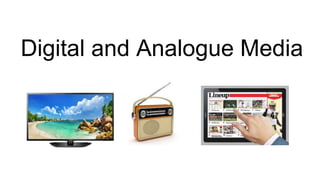
Digital and Analogue Media
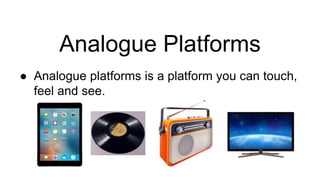
Analogue Platforms
● Analogue platforms is a platform you can touch,
feel and see.
Digital Platforms
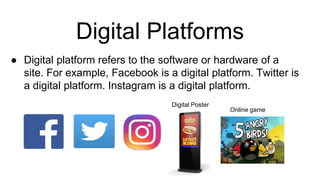
● Digital platform refers to the software or hardware of a
site. For example, Facebook is a digital platform. Twitter is
a digital platform. Instagram is a digital platform.
Online game
Digital Poster
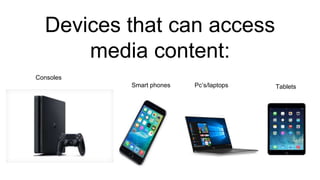
Devices that can access
media content:
Consoles
Smart phones Pc’s/laptops Tablets
Media Text Processes
● Step one-Production(including pre-
production, production and post-production)
● Step two-Marketing
● Step three-Distribution
● Step four-Exhibition
Production
● Pre-Production= In digital video, photography,
television and film, pre-production refers to the
task that must be completed or executed before
filming or shooting begins. This includes tasks
such as hiring actors or models, building sets,
budgeting, planning, scheduling, renting
equipment and tests to name a few of the many
pre-production tasks.
Production
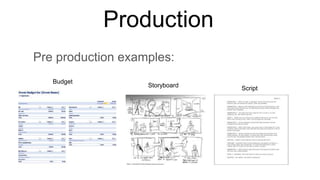
Pre production examples:
Budget
Storyboard Script
Production
● Production= In digital video, photography, television
and film, production refers to the task that must be
completed or executed during the filming or shooting.
This includes tasks such as setting up scenes,the
capture of raw footage, and usage of set design, to
name a few of the many pre-production tasks.
Production
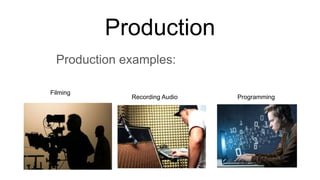
Production examples:
Filming
Recording Audio Programming
Production
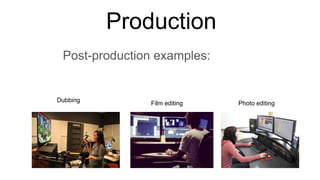
● Post-Production= In digital video, photography,
television and film, post-production refers to the task
that must be completed or executed after the filming or
shooting. This includes tasks such as editing of raw
footage to cut scenes, insert transition effects, working
with voice and sound actors and dubbing to name a
few of the many pre-production tasks.
Production
Post-production examples:
Dubbing
Film editing Photo editing
Marketing
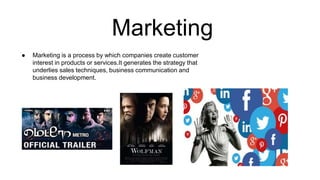
● Marketing is a process by which companies create customer
interest in products or services.It generates the strategy that
underlies sales techniques, business communication and
business development.
Marketing
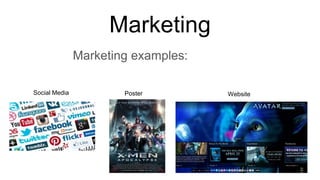
Marketing examples:
Social Media Poster Website
Distribution
● The distribution phase of the film industry is a highly
competitive business of launching and sustaining films in
the “market place”
● The film industry is a business and the films are products
to be marketed and sold.
● Every film has its own distribution plan to ensure it
reaches the right audiences.
Distribution
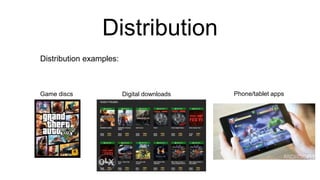
Distribution examples:
Game discs Digital downloads Phone/tablet apps
Exhibition
● Exhibition is the using of the text by the audience.
● It is how the audience react and interact with the media text.
● Every media text have a message that it aims to deliver to its
audience.
Synergy
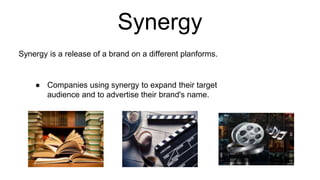
Synergy is a release of a brand on a different planforms.
● Companies using synergy to expand their target
audience and to advertise their brand's name.
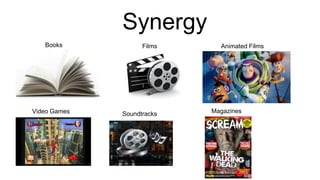
Synergy
Books Films Animated Films
Video Games Soundtracks Magazines
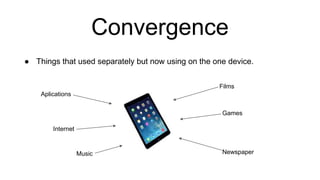
Convergence
● Things that used separately but now using on the one device.
Films
Games
Aplications
Internet
Music Newspaper
Convergence
● Due to convergence the power has shifted from the producers of
a media text to the consumers.
● Consumers of a media can now be producers of media. This is
calling being a “prosumer”.
● Procumers can now create and distribute their own media text.
Impact of Convergence
● Immediacy- the quickness of action or occurrence.
● Access- You can access it from anywhere with the internet.
● Convenience- Free of cost, so you don't need to pay for it.
Convergence has a wide range of effects on producers
AND customers, including:
Impact of Convergence
● Portability- The smart devices which can access media.
● Connectivity- Social networks, Virtual reality.
● Personalisation- Making media personal to the consumer.
● Interaction- Communication between prosumers and consumers.
Audiences
● Audiences are the users or consumers of a media text.
● Audiences can be individuals or groups.
● Individual- Who are using digital media product alone.
● Group- Who are using digital media product with others.
Audiences
Advantages of individual using digital media are the:
● Control
● Privacy
● Convenience
Advantages of group using digital media product are the:
● Social interaction
● Competition
● Belonging
Audiences
● Audiences can also be primary or secondary.
● Primary- The audience that a media text is targeting.
● Secondary- The audience that a media text is not targeting for
but may still consume text(with the primary audience)
Audiences
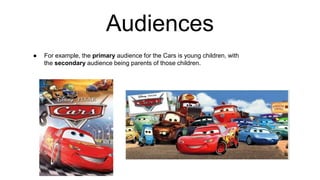
● For example, the primary audience for the Cars is young children, with
the secondary audience being parents of those children.
Audiences
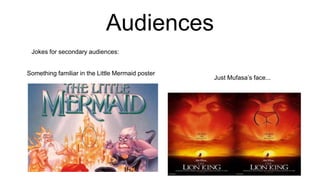
Jokes for secondary audiences:
Something familiar in the Little Mermaid poster
Just Mufasa’s face...
Audiences
● Audiences can be passive or active consumers.
● Active- The audience who physically interact with the product.
For example playing Ps4 with the Ps VR, and physically
reacting to what happening in the game.
● Passive- The audience who does not interact physically with
the product. For example sitting and watching the movie. But
not reacting physically to what happening in the movie.
Audiences
Audiences can personalise and interact with digital media texts.
● That means that now audience can control over and have choice.
● What they consume(Movie, video game, music)
● When they consume it(24/7)
● Where they consume(Home, work, underground)
● How they consume( Tv, phone, console)
Audiences
Personalisation- Personalisation is the consumer's
ability make the products personal to them.
● Log-ins
● Avatars
● Music playlists
● Digital Tv menus
Audiences
Interaction is the ability for Audiences to interact with
the media product.
● Digital editing
● Texting and emailing
● Downloads
● Uploads
Audience Theories
THE HYPODERMIC NEEDLE
THEORY
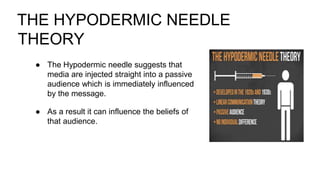
● The Hypodermic needle suggests that
media are injected straight into a passive
audience which is immediately influenced
by the message.
● As a result it can influence the beliefs of
that audience.
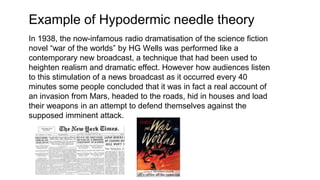
Example of Hypodermic needle theory
In 1938, the now-infamous radio dramatisation of the science fiction
novel “war of the worlds” by HG Wells was performed like a
contemporary new broadcast, a technique that had been used to
heighten realism and dramatic effect. However how audiences listen
to this stimulation of a news broadcast as it occurred every 40
minutes some people concluded that it was in fact a real account of
an invasion from Mars, headed to the roads, hid in houses and load
their weapons in an attempt to defend themselves against the
supposed imminent attack.
THE USES AND GRATIFICATIONS
THEORY
● Researches Blumer and Katz expanded this theory and published their own in 1973,
stating that individuals might use and choose a text for the following purposes
● Diversion
● Personal relationships
● Personal identify
● Surveillance
THE USES AND GRATIFICATIONS
THEORY
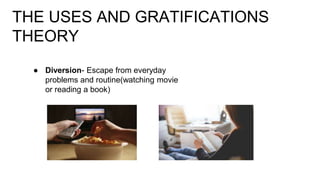
● Diversion- Escape from everyday
problems and routine(watching movie
or reading a book)
THE USES AND GRATIFICATIONS
THEORY
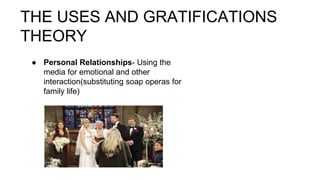
● Personal Relationships- Using the
media for emotional and other
interaction(substituting soap operas for
family life)
THE USES AND GRATIFICATIONS
THEORY
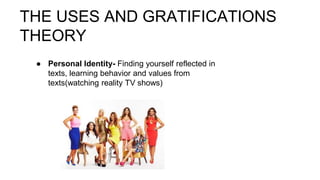
● Personal Identity- Finding yourself reflected in
texts, learning behavior and values from
texts(watching reality TV shows)
THE USES AND GRATIFICATIONS
THEORY
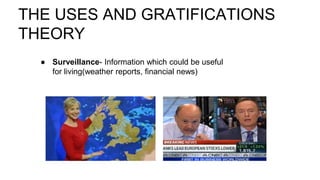
● Surveillance- Information which could be useful
for living(weather reports, financial news)
Regulation
REGULATORY BODIES
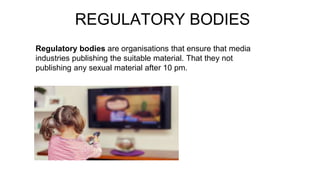
Regulatory bodies are organisations that ensure that media
industries publishing the suitable material. That they not
publishing any sexual material after 10 pm.
REGULATORY BODIES
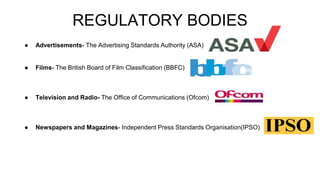
● Advertisements- The Advertising Standards Authority (ASA)
● Films- The British Board of Film Classification (BBFC)
● Television and Radio- The Office of Communications (Ofcom)
● Newspapers and Magazines- Independent Press Standards Organisation(IPSO)
THE WATERSHED
● The watershed is the time when TV programmes that
unsuitable for children can be broadcast
● The watershed policy set by Ofcom, begins at 9pm
and ends at 5:30am.
● The watershed policy is helping to parent/guardian to
protect their child from unsuitable material for them
on TV.
Research Methods
Research methods
● Primary research is new research that you do and find answers for
yourself. It can involve questionnaires, surveys or interviews with
individuals or small group.
● Secondary research is research that you collect from a source
which have done a primary research themselves. It can be books,
internet, magazines, encyclopedias.
Research methods
● Quantitative research generates numerical data or
information that can be converted into numbers. If there are
no number involved, then it's not quantitative research.
● Qualitative research gathers information that is not in
numerical form. Qualitative data is typically descriptive data.
Research methods
● The term “demographics” means
statistical study of population based on
factors such as…
● Age
● Gender
● Ethnicity
● Social class
● Occupation/employment status
● Locale
Research methods
Research methods
Research methods
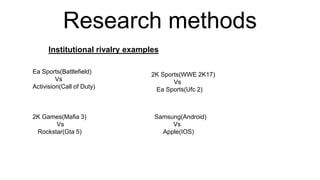
Institutional rivalry examples
Ea Sports(Battlefield)
Vs
Activision(Call of Duty)
2K Games(Mafia 3)
Vs
Rockstar(Gta 5)
2K Sports(WWE 2K17)
Vs
Ea Sports(Ufc 2)
Samsung(Android)
Vs
Apple(IOS)
Stylistic Codes
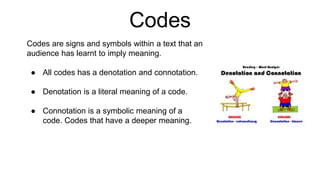
Codes
Codes are signs and symbols within a text that an
audience has learnt to imply meaning.
● All codes has a denotation and connotation.
● Denotation is a literal meaning of a code.
● Connotation is a symbolic meaning of a
code. Codes that have a deeper meaning.
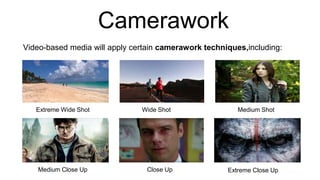
Camerawork
Extreme Wide Shot Wide Shot Medium Shot
Medium Close Up Close Up Extreme Close Up
Video-based media will apply certain camerawork techniques,including:
Editing
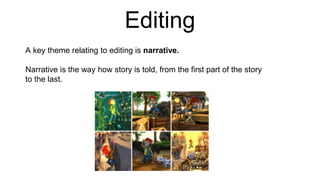
A key theme relating to editing is narrative.
Narrative is the way how story is told, from the first part of the story
to the last.
A B C
D E F
Editing
● Open-ended= The story line that is left incomplete. The story line which
started and did not finish. Also known as a “cliffhanger”.
● Closed= The story line that is left complete, with no questions left
unanswered. The story line which is finished.
● Linear= Events, of the story line, that are in chronological order.
● Non-linear= Events that are not in chronological order.
MISE-EN-SCENE
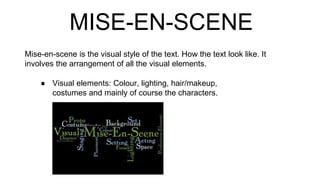
Mise-en-scene is the visual style of the text. How the text look like. It
involves the arrangement of all the visual elements.
● Visual elements: Colour, lighting, hair/makeup,
costumes and mainly of course the characters.
Lighting
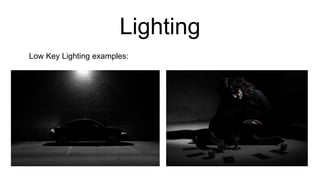
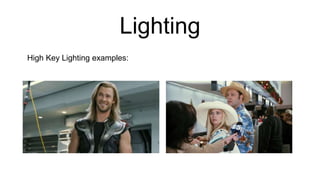
Lighting is really important part for mise-en-scene as it can
convey specific meaning and messages and this can be done
by the level of the lighting and by the colour of the lights. Low
key lighting and High key lighting are used to show
different situations.
High key lighting is the use of bright, glowy lights to show
good, pure and the most important happiness, it is usually
used in funny movies, sitcoms and also in tv serials.
Low key lighting is the use of of dark lights to slow silence,
sadness.
Lighting
Low Key Lighting examples:
Lighting
High Key Lighting examples:
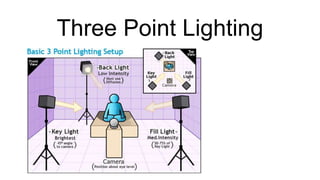
Three Point Lighting

Unit 1 Exam

  • 1.
    Digital Media Sectorsand Audiences Unit 1 Digital Media Sectors Farid Akhundov
  • 2.
    Exam Details Date: Monday16th May 2017 Time: Morning Length: One hour Equipment: Pens, pencils, erasers, rulers
  • 3.
  • 4.
    Film Film is astory or event recorded by a camera as a set of moving images and shown in a cinema or on television. There are many film production companies. 3 examples of them is Dreamworks, Blue Sky Studios and Pixar Animation Studios. ● Dreamworks(Shrek 1, 2001);(Kung Fu Panda 1, 2008);(Madagascar 1, 2005) ● Blue Sky Studios(Ice age 1, 2002);(Rio 1, 2011);(The Peanuts Movie, 2015) ● Pixar Animation Studios(Toy Story 1, 1995);(Cars 1, 2006);(Monsters, 2001)
  • 5.
    Video Game Is agame played by electronically manipulating images, produced by a computer on a monitor or other display. There are many video game developers such as Ea Sports, Rockstar and Activision. ● Ea Sports(Fifa 17, 2016);(Ufc 2, 2016);(Nhl 17, 2016) ● Rockstar(Gta 5, 2013);(L.A Noire, 2011);(Red Dead Redemption, 2010) ● Activision( Call of Duty 1, 2003);(Guitar Hero, 2015);(Skylanders, 2011)
  • 6.
  • 7.
    Magazine Magazine is aperiodical publication containing articles and illustrations, often on a particular subject or aimed in a particular readership. There are many magazine publishing companies such as Time Inc., Moneyfacts and The New Yorker. ● Time Inc. Magazine first published in 1923. The owner of Time Inc. is Time warner. ● The Atlantic Magazine first published in 1857. The owner is David G. Bradley. ● The New Yorker Magazine first published in 1925. The owner is Conde Nast.
  • 8.
    Television There are manytelevision programmes such as Nickelodeon, Disney Channel and Fox Family Movies. ● Nickelodeon: The owner of Nickelodeon is Viacom. It first launched in 1977. Shows:Spongebob(Since 1999), iCarly(2007-2012) and Catdog(1998-2005) ● Disney Channel: The owner is Worldwide. First launched in 1983. Shows: Hannah Montana( 2006- 2011), American Dragon Jake Long(2005-2007) and Best Friends Whenever(Since 2015) ● Fox Family Movies: The owner: Fox Networks Group. Launched in 2010. Movies: A gift horse(2015), First Kid(1996), Standing Ovation(2010)
  • 9.
    Radio 3 Radio Stations:Capital fm, talkSport and Virgin Radio. ● Capital fm owner is Global Radio. First launched in 1990. ● talkSport radio station owner is Wireless Group. Originally launched as Talk Radio Station on 14 February 1995. ● Virgin Radio owner is Wireless Group too. It first launched in UK in March 2016.
  • 10.
    Newspaper 3 newsletters: TheSun, The Guardian, The Daily Telegraph. ● The Sun Newspaper owner is News UK. It first published in 1964. ● The Daily Telegraph Newspaper owners are David and Frederick Barclay. It first published in 1855. ● The Guardian Newspaper owner is Guardian Media Group. It first published in 1821.
  • 11.
    Web 3 web pages:Facebook, Instagram and Twitter. ● Facebook owner is Mark Zuckerberg. Facebook was founded in February 2004. ● Twitter owner is Jack Dorsey . Twitter was founded in March 2006. ● Instagram owner is Facebook Inc. Instagram was founded in October 2010.
  • 12.
  • 13.
    Analogue Platforms ● Analogueplatforms is a platform you can touch, feel and see.
  • 14.
    Digital Platforms ● Digitalplatform refers to the software or hardware of a site. For example, Facebook is a digital platform. Twitter is a digital platform. Instagram is a digital platform. Online game Digital Poster
  • 15.
    Devices that canaccess media content: Consoles Smart phones Pc’s/laptops Tablets
  • 16.
    Media Text Processes ●Step one-Production(including pre- production, production and post-production) ● Step two-Marketing ● Step three-Distribution ● Step four-Exhibition
  • 17.
    Production ● Pre-Production= Indigital video, photography, television and film, pre-production refers to the task that must be completed or executed before filming or shooting begins. This includes tasks such as hiring actors or models, building sets, budgeting, planning, scheduling, renting equipment and tests to name a few of the many pre-production tasks.
  • 18.
  • 19.
    Production ● Production= Indigital video, photography, television and film, production refers to the task that must be completed or executed during the filming or shooting. This includes tasks such as setting up scenes,the capture of raw footage, and usage of set design, to name a few of the many pre-production tasks.
  • 20.
  • 21.
    Production ● Post-Production= Indigital video, photography, television and film, post-production refers to the task that must be completed or executed after the filming or shooting. This includes tasks such as editing of raw footage to cut scenes, insert transition effects, working with voice and sound actors and dubbing to name a few of the many pre-production tasks.
  • 22.
  • 23.
    Marketing ● Marketing isa process by which companies create customer interest in products or services.It generates the strategy that underlies sales techniques, business communication and business development.
  • 24.
  • 25.
    Distribution ● The distributionphase of the film industry is a highly competitive business of launching and sustaining films in the “market place” ● The film industry is a business and the films are products to be marketed and sold. ● Every film has its own distribution plan to ensure it reaches the right audiences.
  • 26.
    Distribution Distribution examples: Game discsDigital downloads Phone/tablet apps
  • 27.
    Exhibition ● Exhibition isthe using of the text by the audience. ● It is how the audience react and interact with the media text. ● Every media text have a message that it aims to deliver to its audience.
  • 28.
    Synergy Synergy is arelease of a brand on a different planforms. ● Companies using synergy to expand their target audience and to advertise their brand's name.
  • 29.
    Synergy Books Films AnimatedFilms Video Games Soundtracks Magazines
  • 30.
    Convergence ● Things thatused separately but now using on the one device. Films Games Aplications Internet Music Newspaper
  • 31.
    Convergence ● Due toconvergence the power has shifted from the producers of a media text to the consumers. ● Consumers of a media can now be producers of media. This is calling being a “prosumer”. ● Procumers can now create and distribute their own media text.
  • 32.
    Impact of Convergence ●Immediacy- the quickness of action or occurrence. ● Access- You can access it from anywhere with the internet. ● Convenience- Free of cost, so you don't need to pay for it. Convergence has a wide range of effects on producers AND customers, including:
  • 33.
    Impact of Convergence ●Portability- The smart devices which can access media. ● Connectivity- Social networks, Virtual reality. ● Personalisation- Making media personal to the consumer. ● Interaction- Communication between prosumers and consumers.
  • 34.
    Audiences ● Audiences arethe users or consumers of a media text. ● Audiences can be individuals or groups. ● Individual- Who are using digital media product alone. ● Group- Who are using digital media product with others.
  • 35.
    Audiences Advantages of individualusing digital media are the: ● Control ● Privacy ● Convenience Advantages of group using digital media product are the: ● Social interaction ● Competition ● Belonging
  • 36.
    Audiences ● Audiences canalso be primary or secondary. ● Primary- The audience that a media text is targeting. ● Secondary- The audience that a media text is not targeting for but may still consume text(with the primary audience)
  • 37.
    Audiences ● For example,the primary audience for the Cars is young children, with the secondary audience being parents of those children.
  • 38.
    Audiences Jokes for secondaryaudiences: Something familiar in the Little Mermaid poster Just Mufasa’s face...
  • 39.
    Audiences ● Audiences canbe passive or active consumers. ● Active- The audience who physically interact with the product. For example playing Ps4 with the Ps VR, and physically reacting to what happening in the game. ● Passive- The audience who does not interact physically with the product. For example sitting and watching the movie. But not reacting physically to what happening in the movie.
  • 40.
    Audiences Audiences can personaliseand interact with digital media texts. ● That means that now audience can control over and have choice. ● What they consume(Movie, video game, music) ● When they consume it(24/7) ● Where they consume(Home, work, underground) ● How they consume( Tv, phone, console)
  • 41.
    Audiences Personalisation- Personalisation isthe consumer's ability make the products personal to them. ● Log-ins ● Avatars ● Music playlists ● Digital Tv menus
  • 42.
    Audiences Interaction is theability for Audiences to interact with the media product. ● Digital editing ● Texting and emailing ● Downloads ● Uploads
  • 43.
  • 44.
    THE HYPODERMIC NEEDLE THEORY ●The Hypodermic needle suggests that media are injected straight into a passive audience which is immediately influenced by the message. ● As a result it can influence the beliefs of that audience.
  • 45.
    Example of Hypodermicneedle theory In 1938, the now-infamous radio dramatisation of the science fiction novel “war of the worlds” by HG Wells was performed like a contemporary new broadcast, a technique that had been used to heighten realism and dramatic effect. However how audiences listen to this stimulation of a news broadcast as it occurred every 40 minutes some people concluded that it was in fact a real account of an invasion from Mars, headed to the roads, hid in houses and load their weapons in an attempt to defend themselves against the supposed imminent attack.
  • 46.
    THE USES ANDGRATIFICATIONS THEORY ● Researches Blumer and Katz expanded this theory and published their own in 1973, stating that individuals might use and choose a text for the following purposes ● Diversion ● Personal relationships ● Personal identify ● Surveillance
  • 47.
    THE USES ANDGRATIFICATIONS THEORY ● Diversion- Escape from everyday problems and routine(watching movie or reading a book)
  • 48.
    THE USES ANDGRATIFICATIONS THEORY ● Personal Relationships- Using the media for emotional and other interaction(substituting soap operas for family life)
  • 49.
    THE USES ANDGRATIFICATIONS THEORY ● Personal Identity- Finding yourself reflected in texts, learning behavior and values from texts(watching reality TV shows)
  • 50.
    THE USES ANDGRATIFICATIONS THEORY ● Surveillance- Information which could be useful for living(weather reports, financial news)
  • 51.
  • 52.
    REGULATORY BODIES Regulatory bodiesare organisations that ensure that media industries publishing the suitable material. That they not publishing any sexual material after 10 pm.
  • 53.
    REGULATORY BODIES ● Advertisements-The Advertising Standards Authority (ASA) ● Films- The British Board of Film Classification (BBFC) ● Television and Radio- The Office of Communications (Ofcom) ● Newspapers and Magazines- Independent Press Standards Organisation(IPSO)
  • 54.
    THE WATERSHED ● Thewatershed is the time when TV programmes that unsuitable for children can be broadcast ● The watershed policy set by Ofcom, begins at 9pm and ends at 5:30am. ● The watershed policy is helping to parent/guardian to protect their child from unsuitable material for them on TV.
  • 55.
  • 56.
    Research methods ● Primaryresearch is new research that you do and find answers for yourself. It can involve questionnaires, surveys or interviews with individuals or small group. ● Secondary research is research that you collect from a source which have done a primary research themselves. It can be books, internet, magazines, encyclopedias.
  • 57.
    Research methods ● Quantitativeresearch generates numerical data or information that can be converted into numbers. If there are no number involved, then it's not quantitative research. ● Qualitative research gathers information that is not in numerical form. Qualitative data is typically descriptive data.
  • 58.
    Research methods ● Theterm “demographics” means statistical study of population based on factors such as… ● Age ● Gender ● Ethnicity ● Social class ● Occupation/employment status ● Locale
  • 59.
  • 60.
  • 61.
    Research methods Institutional rivalryexamples Ea Sports(Battlefield) Vs Activision(Call of Duty) 2K Games(Mafia 3) Vs Rockstar(Gta 5) 2K Sports(WWE 2K17) Vs Ea Sports(Ufc 2) Samsung(Android) Vs Apple(IOS)
  • 62.
  • 63.
    Codes Codes are signsand symbols within a text that an audience has learnt to imply meaning. ● All codes has a denotation and connotation. ● Denotation is a literal meaning of a code. ● Connotation is a symbolic meaning of a code. Codes that have a deeper meaning.
  • 64.
    Camerawork Extreme Wide ShotWide Shot Medium Shot Medium Close Up Close Up Extreme Close Up Video-based media will apply certain camerawork techniques,including:
  • 65.
    Editing A key themerelating to editing is narrative. Narrative is the way how story is told, from the first part of the story to the last. A B C D E F
  • 66.
    Editing ● Open-ended= Thestory line that is left incomplete. The story line which started and did not finish. Also known as a “cliffhanger”. ● Closed= The story line that is left complete, with no questions left unanswered. The story line which is finished. ● Linear= Events, of the story line, that are in chronological order. ● Non-linear= Events that are not in chronological order.
  • 67.
    MISE-EN-SCENE Mise-en-scene is thevisual style of the text. How the text look like. It involves the arrangement of all the visual elements. ● Visual elements: Colour, lighting, hair/makeup, costumes and mainly of course the characters.
  • 68.
    Lighting Lighting is reallyimportant part for mise-en-scene as it can convey specific meaning and messages and this can be done by the level of the lighting and by the colour of the lights. Low key lighting and High key lighting are used to show different situations. High key lighting is the use of bright, glowy lights to show good, pure and the most important happiness, it is usually used in funny movies, sitcoms and also in tv serials. Low key lighting is the use of of dark lights to slow silence, sadness.
  • 69.
  • 70.
  • 71.