Media Contexts
Concept Areas Listed and Explained
AS Media Studies
Section B
• Candidates should be prepared to understand
and discuss the processes of production,
distribution, marketing and exchange as they
relate to contemporary media institutions; as
well as the nature of audience consumption
and the relationships between audiences and
institutions.
Candidates should be familiar with:
• Issues raised by media ownership in contemporary media practices
• The importance of cross media convergence and synergy in production,
distribution and marketing
• The technologies that have been introduced in recent years at the levels of
production, distribution, marketing and the point of consumption
• The significance of proliferation in hardware and content for institutions
and audiences
• The importance of technological convergence for institutions and
audiences
• The issues raised in targeting of national and local audiences by
international or global institutions
• The ways in which the candidates’ own experiences of media consumption
illustrate wider patterns and trends of audience behaviour
Institutions and Audiences
This unit should be approached through contemporary examples in the form
of case studies based upon one of the specified media areas.
Film
A study of a specific studio or production company within a contemporary
film industry that targets a global or national audience (Hollywood, UK
film , Bollywood, Nollywood etc.) including its patterns of production,
distribution, exhibition and consumption by audiences. This should be
accompanied by study of contemporary film distribution practices (digital
cinemas, DVD, Blue-Ray, VOD streaming and downloads, piracy etc.) and
their impact upon production, marketing and consumption
1. Issues raised by media ownership and funding in
contemporary media practice
• You need to discuss the depth and range of ownership across a range of media and
the consequences of this ownership for audiences in terms of the genres and
budgets for films
• How for instance do film studios as parts of conglomerates profit from
conglomerate ownership of media? On the other hand, how can mini major and
small independent film studios from either the US or UK survive in the American or
British marketplace against high-concept, big budget films made by Sony, Disney,
Universal etc?
• What kinds of niche audiences are left for the mini major or the independent
studios (American, British, international) to attract?
• Are mass audiences out of reach given the genres of films the major Hollywood
studios have the budgets to make? How successful have they been in reaching
mass audiences with their films?
• How healthy is it that just a few mega media groups can own such a range of
media and can decide what the public may see, and perhaps shape audience’s
tastes?
2. The importance of cross media convergence and
synergy in production , distribution and marketing
• You need to discuss how digital technology is enabling various media to
converge in hubs, platforms and devices.
• For instance, mobile phones do a lot more then act as hand held
telephones: you can watch and upload You Tube clips, stream TV programs
and films, log into social networking sites, take photos and make short
films, listen to radio and podcasts, Tweet, SMS, MMS, play video games,
use Viber and WhatsApp etc. How does that affect the way we view films
and the production/distribution and exhibition of films?
• New HD TVs, video game consoles (Playstation, X-Box), iPads, laptops, are
also examples of hubs in which a variety of media technologies can
converge for convenience of users.
• Media convergence is having an enormous impact on the film industry
because of the ways in which institutions can produce and market for
audiences/users on a widening range of platforms, capable of receiving
their films.
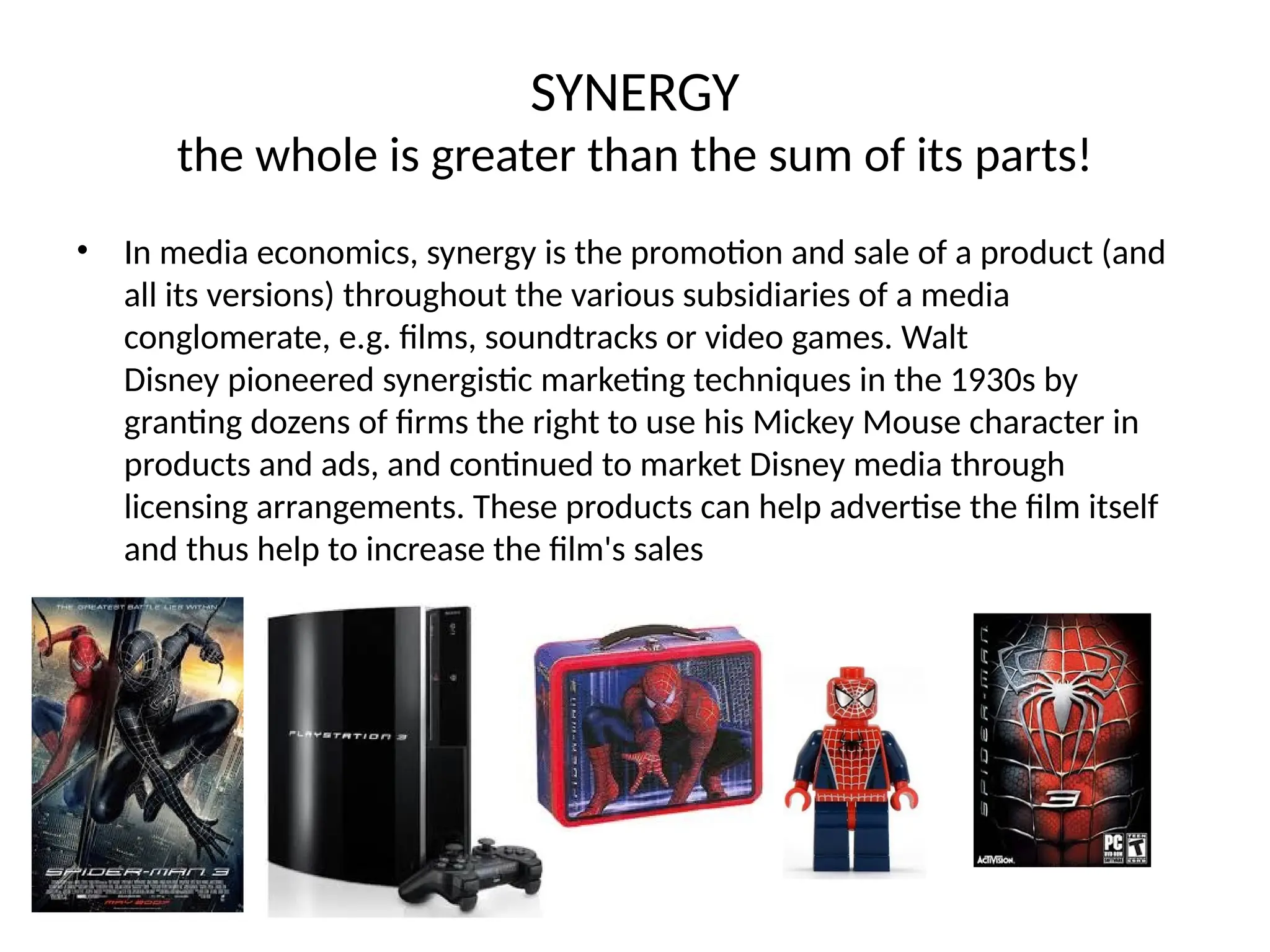
SYNERGY
the whole is greater than the sum of its parts!
• In media economics, synergy is the promotion and sale of a product (and
all its versions) throughout the various subsidiaries of a media
conglomerate, e.g. films, soundtracks or video games. Walt
Disney pioneered synergistic marketing techniques in the 1930s by
granting dozens of firms the right to use his Mickey Mouse character in
products and ads, and continued to market Disney media through
licensing arrangements. These products can help advertise the film itself
and thus help to increase the film's sales
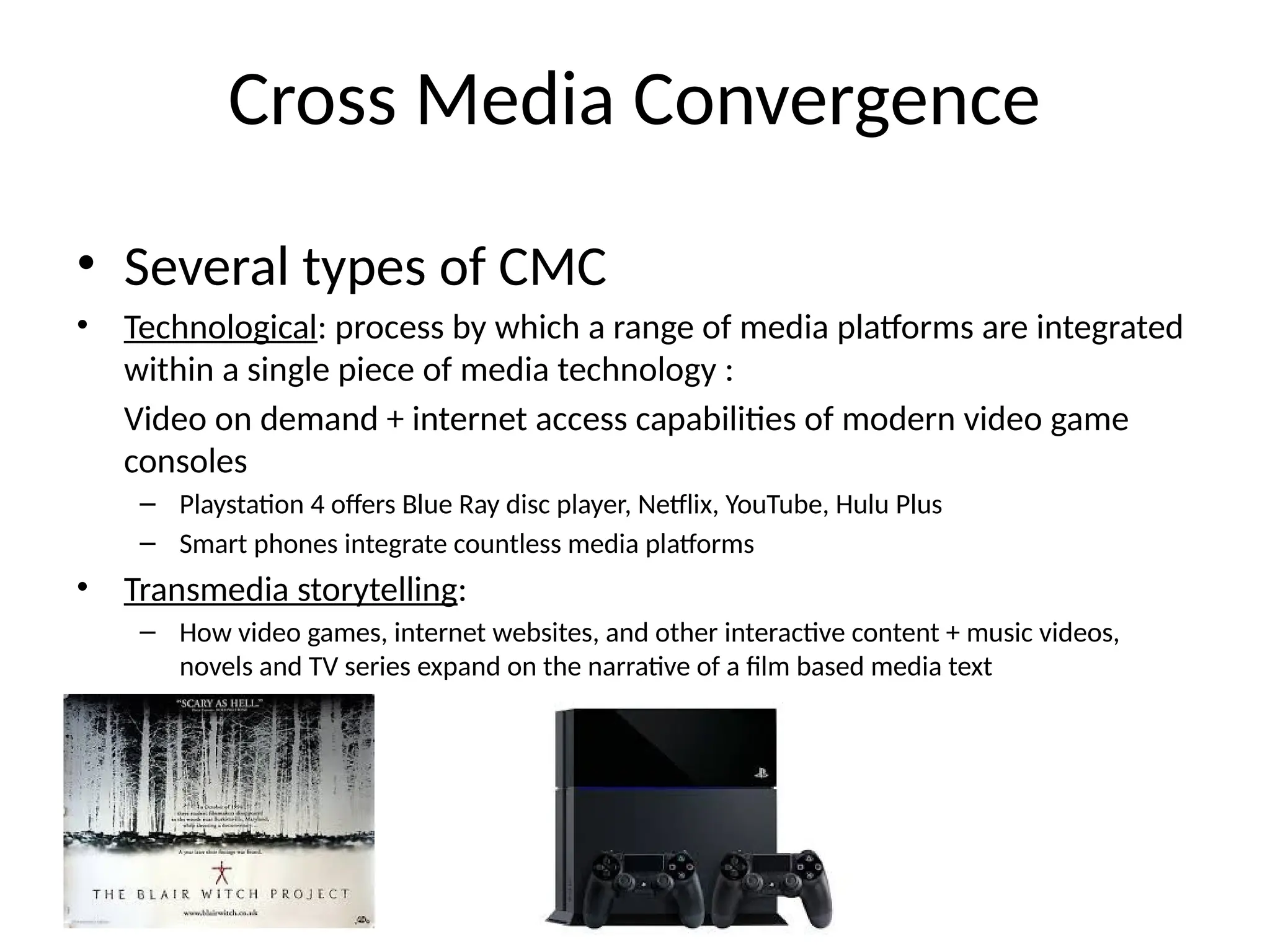
Cross Media Convergence
• Several types of CMC
• Technological: process by which a range of media platforms are integrated
within a single piece of media technology :
Video on demand + internet access capabilities of modern video game
consoles
– Playstation 4 offers Blue Ray disc player, Netflix, YouTube, Hulu Plus
– Smart phones integrate countless media platforms
• Transmedia storytelling:
– How video games, internet websites, and other interactive content + music videos,
novels and TV series expand on the narrative of a film based media text
3. Technologies that have been introduced in recent years at the levels of
production , distribution, marketing and exchange
• The audience’s ability to interact with films by, for instance using digital
technology to put extracts on You Tube and overlay new soundtracks on
them, film and upload friends’ reactions to trailers and key moments in films
> influence of Web 2.0
• Film studios can make films using CGI, green screen and other special effects
not available before; ways of filming, recording sound, editing, distribution
and projection have changed with introduction of digital technology
• Distributors market films using latest software for designing high-concept
film posters and trailers> can use phone apps, online marketing, Facebook
etc.
• File sharing and piracy are big issues; Web 2.0 enables people to do this
easily; Film production companies releasing films soon after theatrical
premiers on VOD, premium TV channels and downloads
• UK and US cinema chains not happy about this since they have invested a lot
in expensive equipment which also quickly go out of date
4. The significance of the spread of such technologies
for institutions and audiences
• Rapid increase and spreading of digital technologies and content they
produce: new filming technologies (digital cameras, CGI); 3D films, TVs and
theaters where audiences can view them; new takes on film genres using
these technologies (super-hero, sci-fi, horror, etc.); web 2.0; + all other
current trends
• How significant is this for studios connected to conglomerates in contrast
to those who are not?
• Do all genres utilize these new technologies?
• How do production studios unaffiliated with conglomerates use these
technologies?
5. Importance of technological convergence for institutions and
audiences
• How technology comes together in individual hubs like computers (laptop,
tablets, smart phones, video game consoles, smart TVs…)
• How is this affecting film production, marketing and exhibition strategies?
– think afore mentioned Spider-Man 3’s release and how it coincides to Playstation 3
release
– The look of some films today: i.e. 300, Sin City, + Pixar and other Disney features like
Marvel super-hero films> can it be said their look alone begs to be “explored” on various
media platforms?
• Internet as hub of many aspects of film, especially marketing:
– Trailers on You Tube, IMDB (+other film fan websites), interviews, official film websites,
fan blogs, Twitter, Film discussion boards and forums etc.
• Astonishing range of hardware and software to watch films and enjoy
media and merchandise tie-ins
– This significantly extends life-span (long tail) of a film
– Endless exchange
6. Issues raised in the targeting of national and local audiences by international or global institutions
• How do major Hollywood studios aim at “international audiences” with their
films but at the same time have strategies aimed at specific national markets
– Example: how major studios alter their films for Chinese, Russian and other markets with
restricted access
• Meanwhile, smaller production studios offer specialty films for niche markets
– Defining audiences by demographic brackets
– What content is considered specialty, and how are niche audiences defined?
– Three tier system (Hollywood, Indiewood and Independent)
• UK film production and market
– Attack the Block by Film 4 Productions and Big Talk Pictures
– Aimed at British audiences and Nick Frost fans
• International production and market
– Slumdog Millionaire by Celador Films and Film 4 Productions
• How do these “small” films compete in international markets saturated with
films aimed at global audiences?
• PLUS! How much are Hollywood blockbusters representative of actual
American cinema?
– Differentiating Hollywood and American film
7. The ways in which the candidates’ own experiences of media
consumption illustrate wider patterns and trends in audience
behavior
• How do you consume films?
– As a social activity on the weekend
– After shopping at the mall
– At home through VOD, DVD/Blue Ray rental, on a PS4/XBOX1, or through pirated media
• How are multiplex cinemas adapting the movie-going experience to
attract/keep their audiences?
• How you interact with the film industry
– uploading clips to You Tube related to feature film releases
– involvement with internet film fan communities (blogs, forums, Facebook etc.)
– Technological convergence and transmedia storytelling
• Identify trends in film consumption and where these trends are heading in
the future

Preliminary task one photo story media studies

  • 1.
    Media Contexts Concept AreasListed and Explained AS Media Studies
  • 2.
    Section B • Candidatesshould be prepared to understand and discuss the processes of production, distribution, marketing and exchange as they relate to contemporary media institutions; as well as the nature of audience consumption and the relationships between audiences and institutions.
  • 3.
    Candidates should befamiliar with: • Issues raised by media ownership in contemporary media practices • The importance of cross media convergence and synergy in production, distribution and marketing • The technologies that have been introduced in recent years at the levels of production, distribution, marketing and the point of consumption • The significance of proliferation in hardware and content for institutions and audiences • The importance of technological convergence for institutions and audiences • The issues raised in targeting of national and local audiences by international or global institutions • The ways in which the candidates’ own experiences of media consumption illustrate wider patterns and trends of audience behaviour
  • 4.
    Institutions and Audiences Thisunit should be approached through contemporary examples in the form of case studies based upon one of the specified media areas. Film A study of a specific studio or production company within a contemporary film industry that targets a global or national audience (Hollywood, UK film , Bollywood, Nollywood etc.) including its patterns of production, distribution, exhibition and consumption by audiences. This should be accompanied by study of contemporary film distribution practices (digital cinemas, DVD, Blue-Ray, VOD streaming and downloads, piracy etc.) and their impact upon production, marketing and consumption
  • 5.
    1. Issues raisedby media ownership and funding in contemporary media practice • You need to discuss the depth and range of ownership across a range of media and the consequences of this ownership for audiences in terms of the genres and budgets for films • How for instance do film studios as parts of conglomerates profit from conglomerate ownership of media? On the other hand, how can mini major and small independent film studios from either the US or UK survive in the American or British marketplace against high-concept, big budget films made by Sony, Disney, Universal etc? • What kinds of niche audiences are left for the mini major or the independent studios (American, British, international) to attract? • Are mass audiences out of reach given the genres of films the major Hollywood studios have the budgets to make? How successful have they been in reaching mass audiences with their films? • How healthy is it that just a few mega media groups can own such a range of media and can decide what the public may see, and perhaps shape audience’s tastes?
  • 6.
    2. The importanceof cross media convergence and synergy in production , distribution and marketing • You need to discuss how digital technology is enabling various media to converge in hubs, platforms and devices. • For instance, mobile phones do a lot more then act as hand held telephones: you can watch and upload You Tube clips, stream TV programs and films, log into social networking sites, take photos and make short films, listen to radio and podcasts, Tweet, SMS, MMS, play video games, use Viber and WhatsApp etc. How does that affect the way we view films and the production/distribution and exhibition of films? • New HD TVs, video game consoles (Playstation, X-Box), iPads, laptops, are also examples of hubs in which a variety of media technologies can converge for convenience of users. • Media convergence is having an enormous impact on the film industry because of the ways in which institutions can produce and market for audiences/users on a widening range of platforms, capable of receiving their films.
  • 7.
    SYNERGY the whole isgreater than the sum of its parts! • In media economics, synergy is the promotion and sale of a product (and all its versions) throughout the various subsidiaries of a media conglomerate, e.g. films, soundtracks or video games. Walt Disney pioneered synergistic marketing techniques in the 1930s by granting dozens of firms the right to use his Mickey Mouse character in products and ads, and continued to market Disney media through licensing arrangements. These products can help advertise the film itself and thus help to increase the film's sales
  • 8.
    Cross Media Convergence •Several types of CMC • Technological: process by which a range of media platforms are integrated within a single piece of media technology : Video on demand + internet access capabilities of modern video game consoles – Playstation 4 offers Blue Ray disc player, Netflix, YouTube, Hulu Plus – Smart phones integrate countless media platforms • Transmedia storytelling: – How video games, internet websites, and other interactive content + music videos, novels and TV series expand on the narrative of a film based media text
  • 9.
    3. Technologies thathave been introduced in recent years at the levels of production , distribution, marketing and exchange • The audience’s ability to interact with films by, for instance using digital technology to put extracts on You Tube and overlay new soundtracks on them, film and upload friends’ reactions to trailers and key moments in films > influence of Web 2.0 • Film studios can make films using CGI, green screen and other special effects not available before; ways of filming, recording sound, editing, distribution and projection have changed with introduction of digital technology • Distributors market films using latest software for designing high-concept film posters and trailers> can use phone apps, online marketing, Facebook etc. • File sharing and piracy are big issues; Web 2.0 enables people to do this easily; Film production companies releasing films soon after theatrical premiers on VOD, premium TV channels and downloads • UK and US cinema chains not happy about this since they have invested a lot in expensive equipment which also quickly go out of date
  • 10.
    4. The significanceof the spread of such technologies for institutions and audiences • Rapid increase and spreading of digital technologies and content they produce: new filming technologies (digital cameras, CGI); 3D films, TVs and theaters where audiences can view them; new takes on film genres using these technologies (super-hero, sci-fi, horror, etc.); web 2.0; + all other current trends • How significant is this for studios connected to conglomerates in contrast to those who are not? • Do all genres utilize these new technologies? • How do production studios unaffiliated with conglomerates use these technologies?
  • 11.
    5. Importance oftechnological convergence for institutions and audiences • How technology comes together in individual hubs like computers (laptop, tablets, smart phones, video game consoles, smart TVs…) • How is this affecting film production, marketing and exhibition strategies? – think afore mentioned Spider-Man 3’s release and how it coincides to Playstation 3 release – The look of some films today: i.e. 300, Sin City, + Pixar and other Disney features like Marvel super-hero films> can it be said their look alone begs to be “explored” on various media platforms? • Internet as hub of many aspects of film, especially marketing: – Trailers on You Tube, IMDB (+other film fan websites), interviews, official film websites, fan blogs, Twitter, Film discussion boards and forums etc. • Astonishing range of hardware and software to watch films and enjoy media and merchandise tie-ins – This significantly extends life-span (long tail) of a film – Endless exchange
  • 12.
    6. Issues raisedin the targeting of national and local audiences by international or global institutions • How do major Hollywood studios aim at “international audiences” with their films but at the same time have strategies aimed at specific national markets – Example: how major studios alter their films for Chinese, Russian and other markets with restricted access • Meanwhile, smaller production studios offer specialty films for niche markets – Defining audiences by demographic brackets – What content is considered specialty, and how are niche audiences defined? – Three tier system (Hollywood, Indiewood and Independent) • UK film production and market – Attack the Block by Film 4 Productions and Big Talk Pictures – Aimed at British audiences and Nick Frost fans • International production and market – Slumdog Millionaire by Celador Films and Film 4 Productions • How do these “small” films compete in international markets saturated with films aimed at global audiences? • PLUS! How much are Hollywood blockbusters representative of actual American cinema? – Differentiating Hollywood and American film
  • 13.
    7. The waysin which the candidates’ own experiences of media consumption illustrate wider patterns and trends in audience behavior • How do you consume films? – As a social activity on the weekend – After shopping at the mall – At home through VOD, DVD/Blue Ray rental, on a PS4/XBOX1, or through pirated media • How are multiplex cinemas adapting the movie-going experience to attract/keep their audiences? • How you interact with the film industry – uploading clips to You Tube related to feature film releases – involvement with internet film fan communities (blogs, forums, Facebook etc.) – Technological convergence and transmedia storytelling • Identify trends in film consumption and where these trends are heading in the future