Landscape architecture involves the planning, design, and management of both natural and built environments. It aims to make outdoor spaces functional, beautiful, and environmentally sustainable. Landscape architects use elements from various fields like design, horticulture, and environmental studies. They work on projects such as parks, golf courses, and the outdoor areas of buildings. Some key aspects covered are the definitions of landscape and landscape design, the landscape architecture profession, examples of hard and soft landscape elements, and the importance of sustainable landscape design.
Overview of landscape architecture, its importance, roles of landscape architects, and their contributions to sustainable environments. Responsibilities of landscape architects in planning, designing, and managing sustainable and functional outdoor spaces.
History and evolution of landscape architecture profession in Malaysia, including formation of professional bodies.
Definition and functions of hard landscape features like materials, outdoor furniture, and structures enhancing visual interest.
Overview of soft landscaping including flora like ground covers, shrubs, and trees catering to aesthetics and ecology.Environmentally-friendly landscaping practices that address sustainability concerns in landscape design and management.
Group discussion activity encouraging sharing insights and conclusions on landscape architecture topics.
LANDSCAPE
ARCHITECTURE
WEEK 8
AED1313 INTRODUCTIONTO BUILT ENVIRONMENT
Compiled by
Department of Architecture and Environmental Design
Centre for Foundation Studies
International Islamic University Malaysia
IntroductionIntroduction
Landscape architectshave become increasingly important as
people desire their living and work spaces to be not only functional,
but also beautiful and environmentally sound.
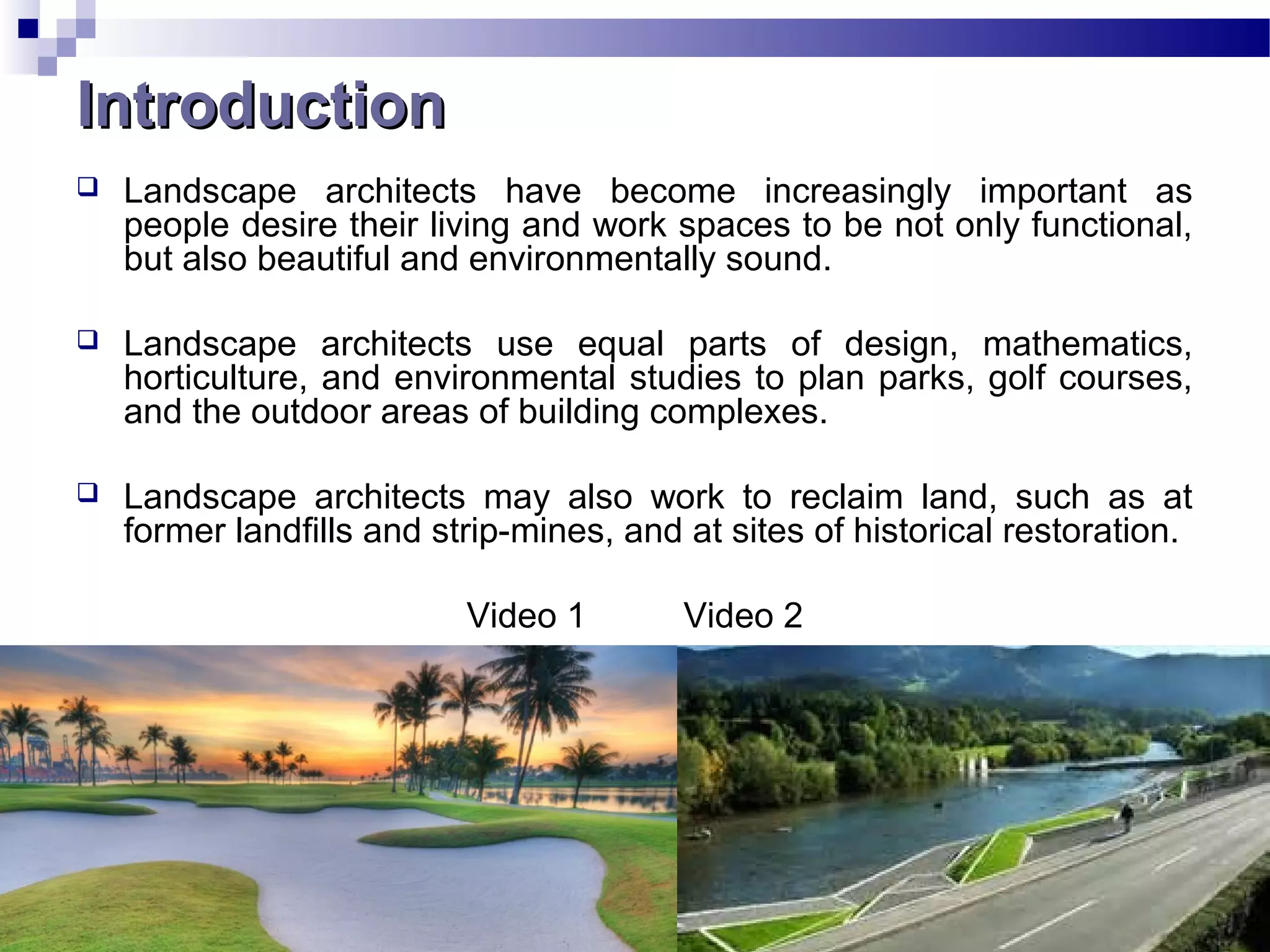
Landscape architects use equal parts of design, mathematics,
horticulture, and environmental studies to plan parks, golf courses,
and the outdoor areas of building complexes.
Landscape architects may also work to reclaim land, such as at
former landfills and strip-mines, and at sites of historical restoration.
Video 1 Video 2
4.
DefinitionDefinition
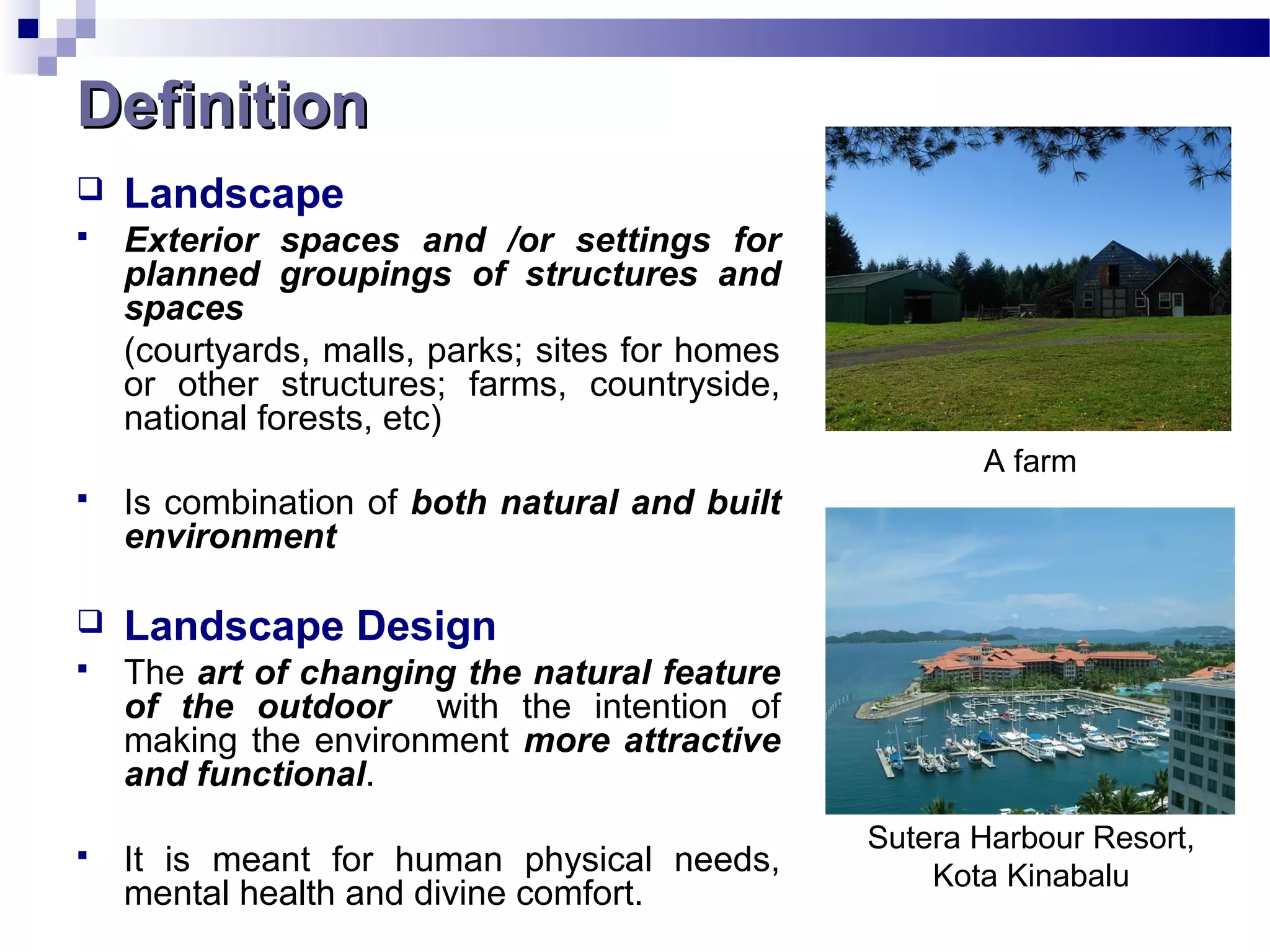
Landscape
Exteriorspaces and /or settings for
planned groupings of structures and
spaces
(courtyards, malls, parks; sites for homes
or other structures; farms, countryside,
national forests, etc)
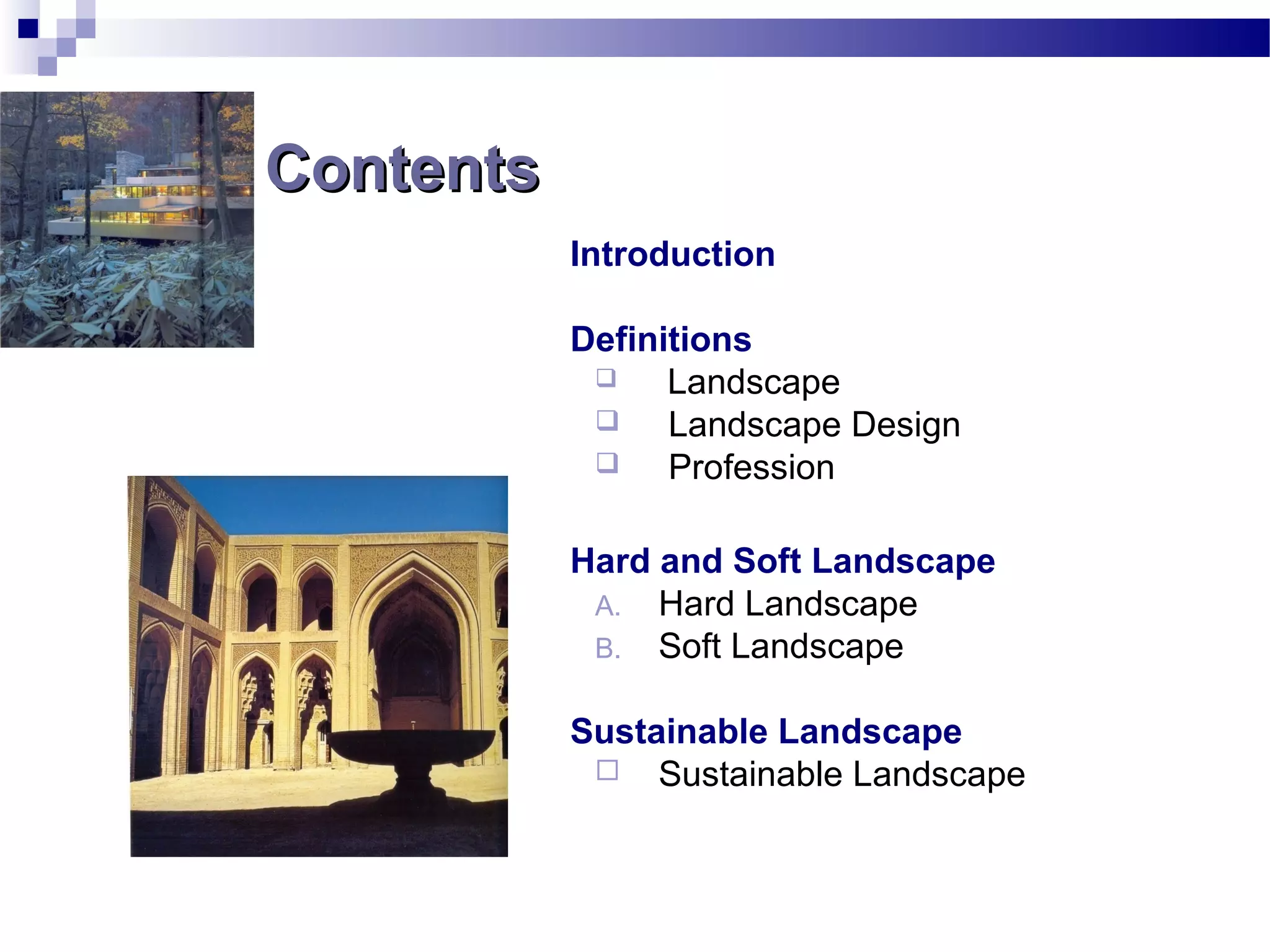
Is combination of both natural and built
environment
Landscape Design
The art of changing the natural feature
of the outdoor with the intention of
making the environment more attractive
and functional.
It is meant for human physical needs,
mental health and divine comfort.
A farm
Sutera Harbour Resort,
Kota Kinabalu
5.
Profession
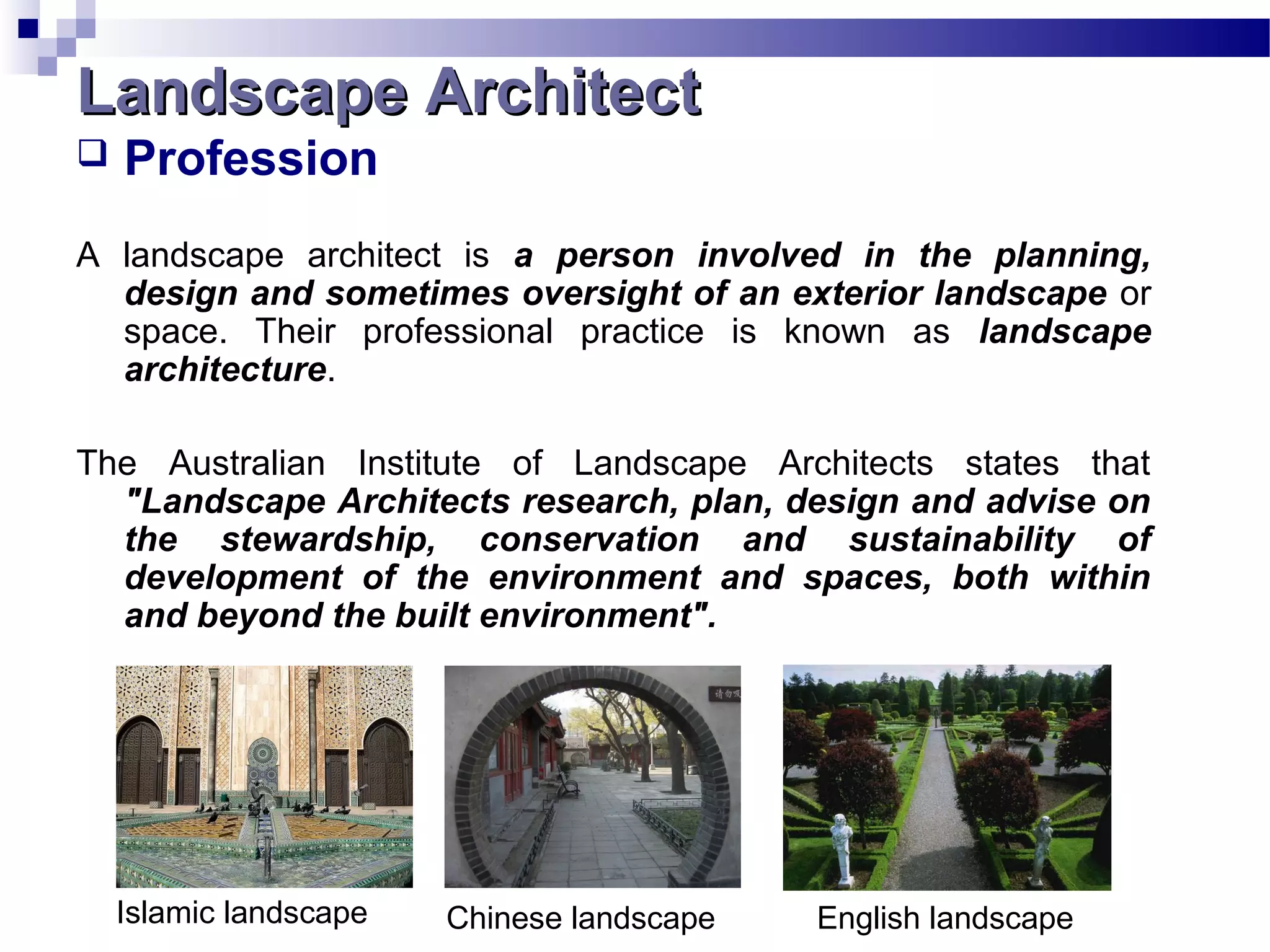
A landscapearchitect is a person involved in the planning,
design and sometimes oversight of an exterior landscape or
space. Their professional practice is known as landscape
architecture.
The Australian Institute of Landscape Architects states that
"Landscape Architects research, plan, design and advise on
the stewardship, conservation and sustainability of
development of the environment and spaces, both within
and beyond the built environment".
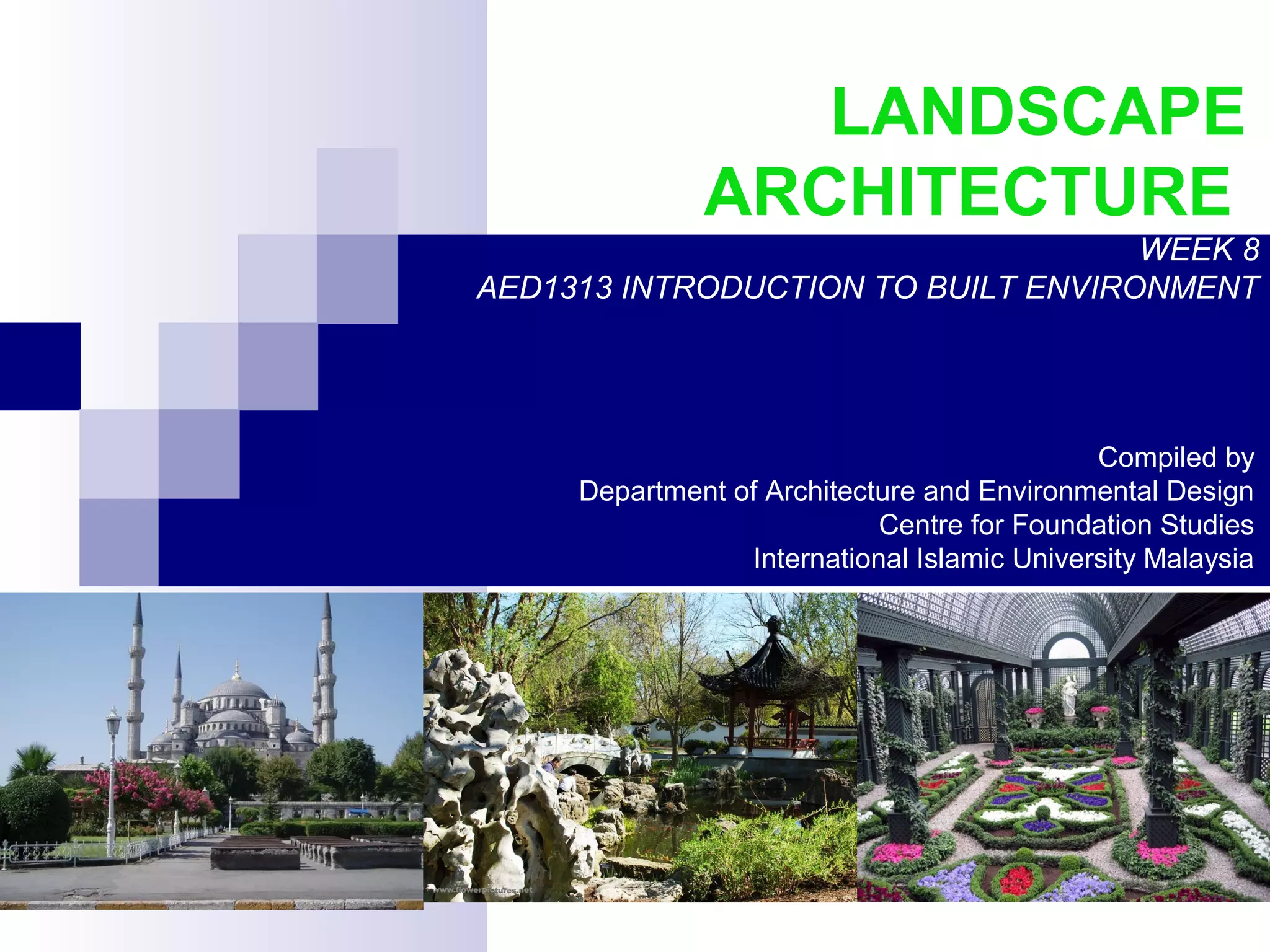
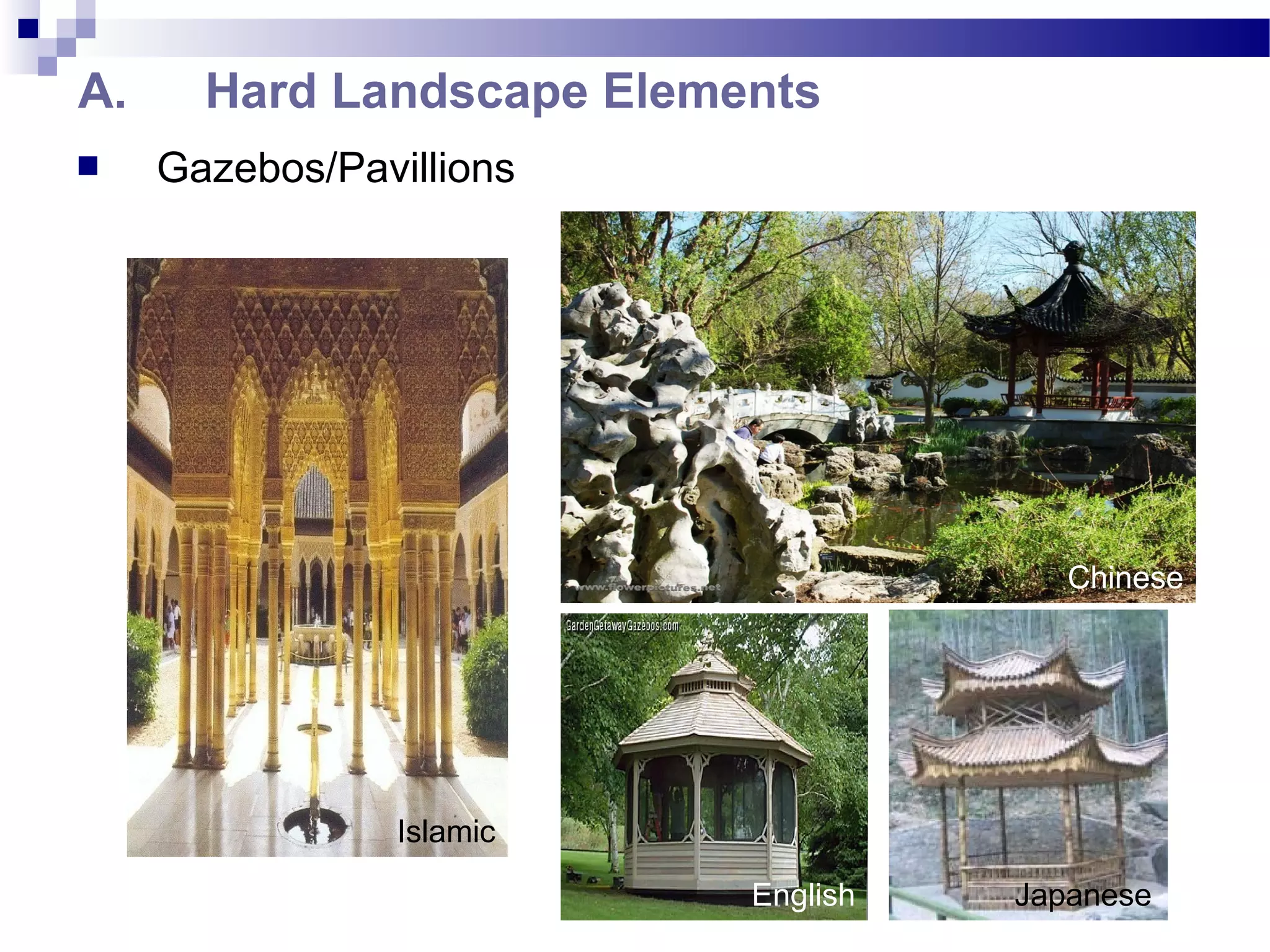
Chinese landscape English landscapeIslamic landscape
Landscape ArchitectLandscape Architect
6.
Being A LandscapeArchitectBeing A Landscape Architect
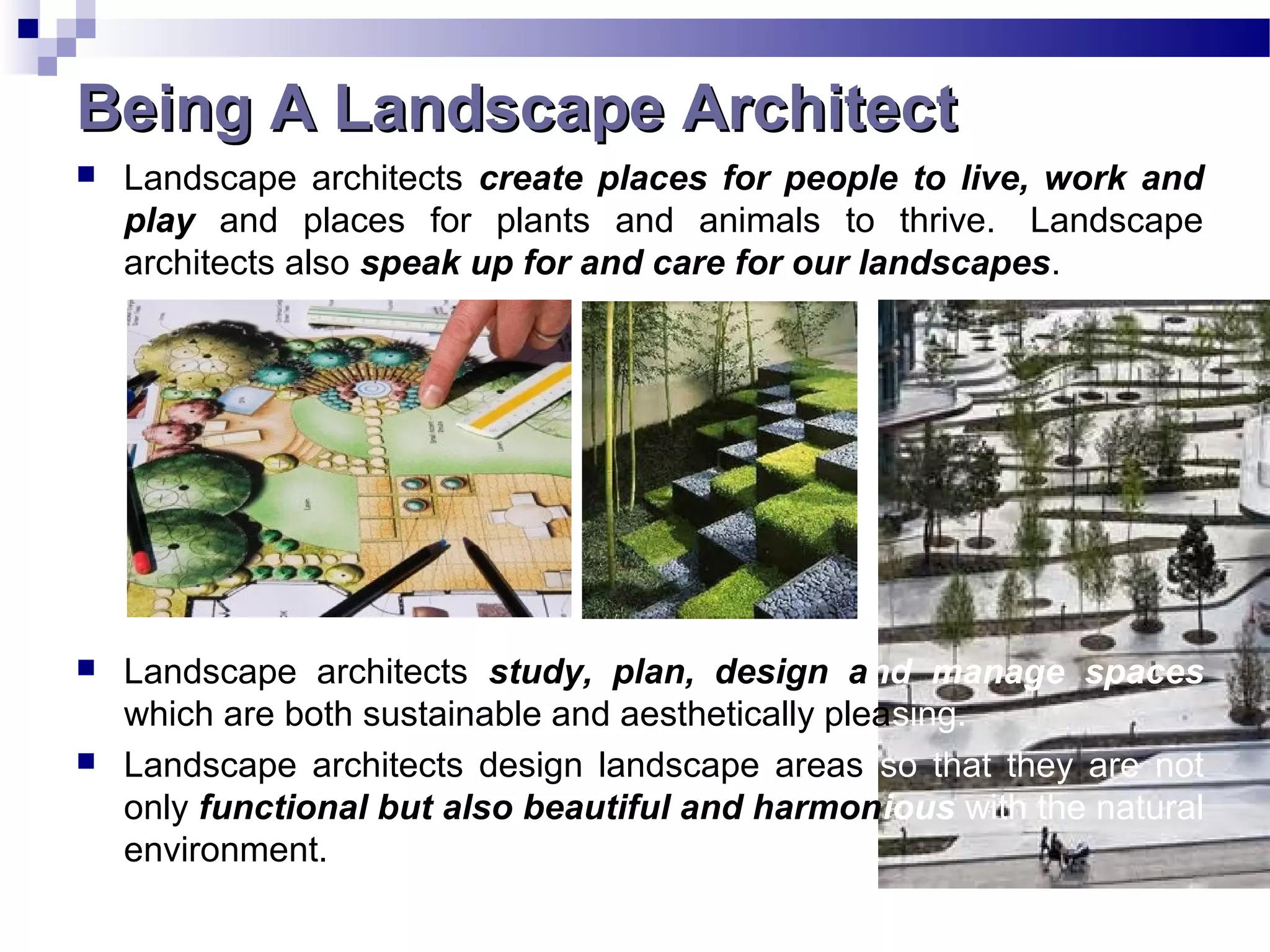
Landscape architects create places for people to live, work and
play and places for plants and animals to thrive. Landscape
architects also speak up for and care for our landscapes.
Landscape architects study, plan, design and manage spaces
which are both sustainable and aesthetically pleasing.
Landscape architects design landscape areas so that they are not
only functional but also beautiful and harmonious with the natural
environment.
7.
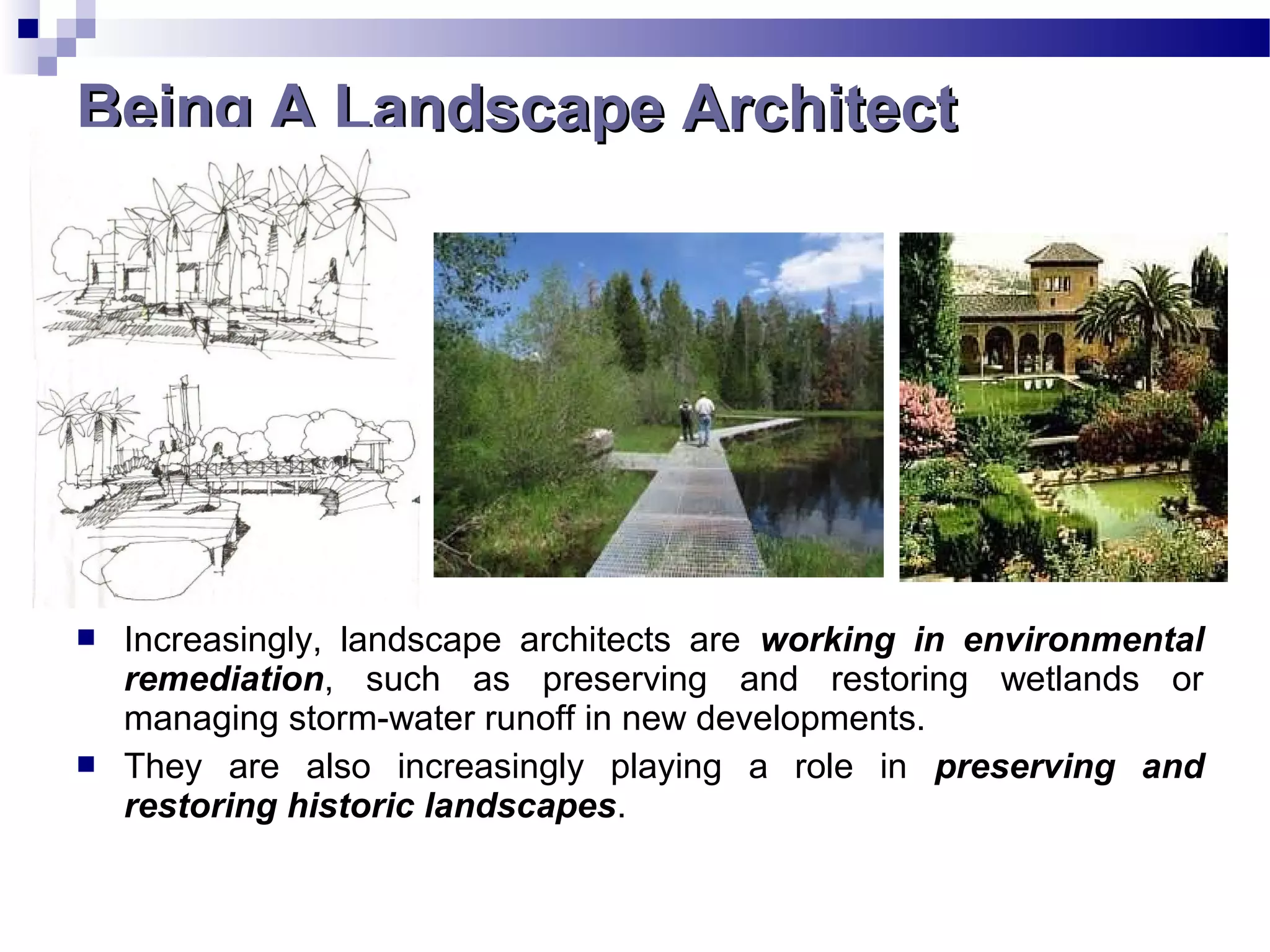
Increasingly, landscapearchitects are working in environmental
remediation, such as preserving and restoring wetlands or
managing storm-water runoff in new developments.
They are also increasingly playing a role in preserving and
restoring historic landscapes.
Being A Landscape ArchitectBeing A Landscape Architect
8.
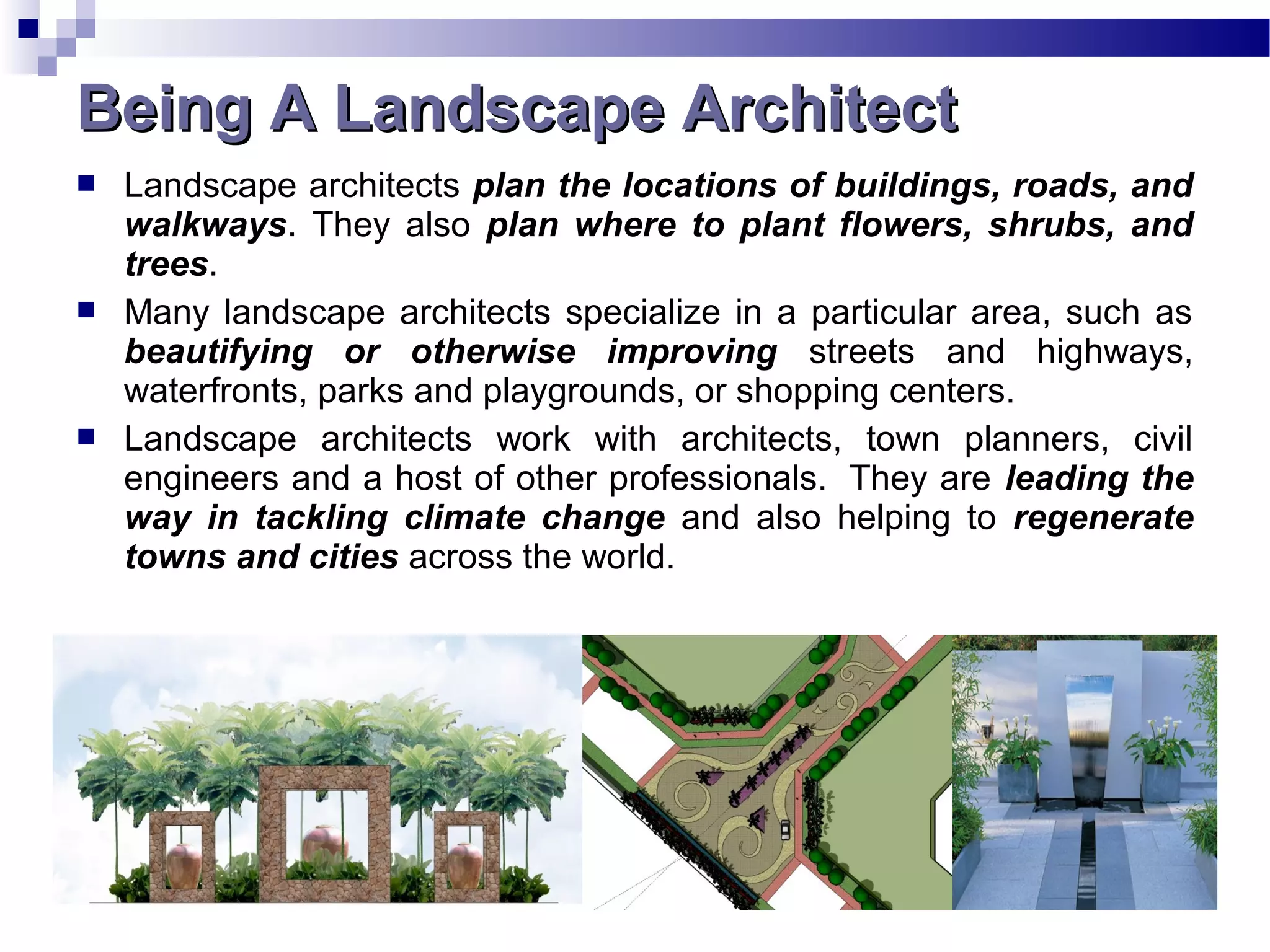
Landscape architectsplan the locations of buildings, roads, and
walkways. They also plan where to plant flowers, shrubs, and
trees.
Many landscape architects specialize in a particular area, such as
beautifying or otherwise improving streets and highways,
waterfronts, parks and playgrounds, or shopping centers.
Landscape architects work with architects, town planners, civil
engineers and a host of other professionals. They are leading the
way in tackling climate change and also helping to regenerate
towns and cities across the world.
Being A Landscape ArchitectBeing A Landscape Architect
9.
Being A LandscapeArchitectBeing A Landscape Architect
Landscape architects typically do the following:
Confer with clients, engineers, and building architects to
understand a project
Prepare site plans, specifications, and cost estimates
Coordinate the arrangement of existing and proposed land
features and structures
Prepare graphic representations and drawings of proposed
plans and designs
Analyze environmental reports and data on land conditions, such
as drainage
Inspect landscape work to ensure that it adheres to original
plans
Approve the quality of work that others do
Seek new work through marketing or by giving presentations
The Landscape Architectureprofession in Malaysia
was initially formed under the name Angkatan
Landskap Arkitek Malaysia (ALAM) on 24 September
1981.
ALAM was represented by various professions and
privates individuals. With the increasing number of
graduates from local and aboard, there was a need to
move the association forward, hence then ALAM
became Institute of Landscape Architects Malaysia
(ILAM).
In 1984, ILAM gained international recognition by becoming a member of the
International Federation of Landscape Architects (IFLA) and the
International Union of Conservation of Nature (IUCN) and also accepted as
a member of the Malaysian Professional Centre (BIM) in 1992.
Professional BodyProfessional Body
12.
Hard Landscape ElementsHardLandscape Elements
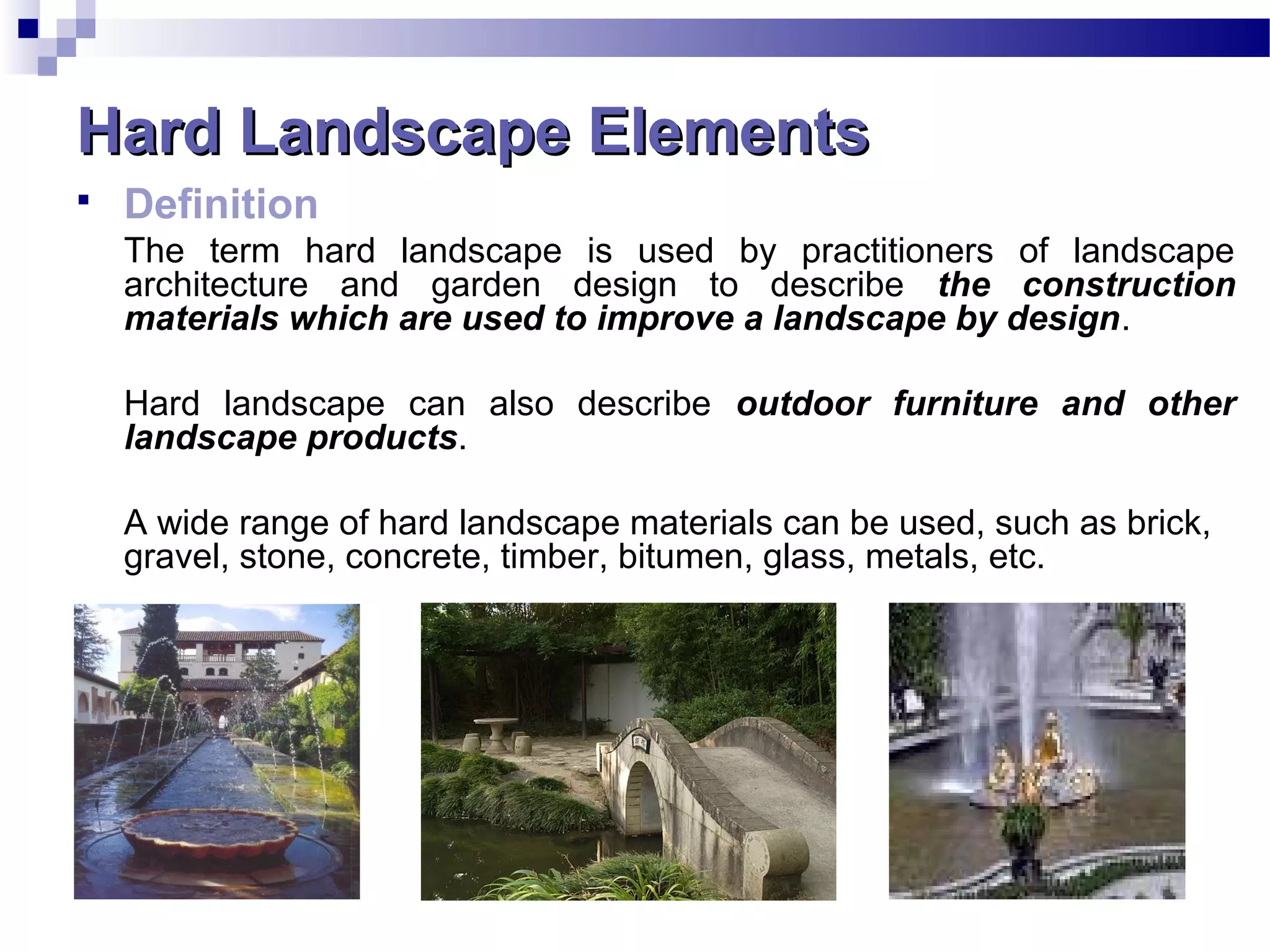
Definition
The term hard landscape is used by practitioners of landscape
architecture and garden design to describe the construction
materials which are used to improve a landscape by design.
Hard landscape can also describe outdoor furniture and other
landscape products.
A wide range of hard landscape materials can be used, such as brick,
gravel, stone, concrete, timber, bitumen, glass, metals, etc.
13.
A. Hard LandscapeElements
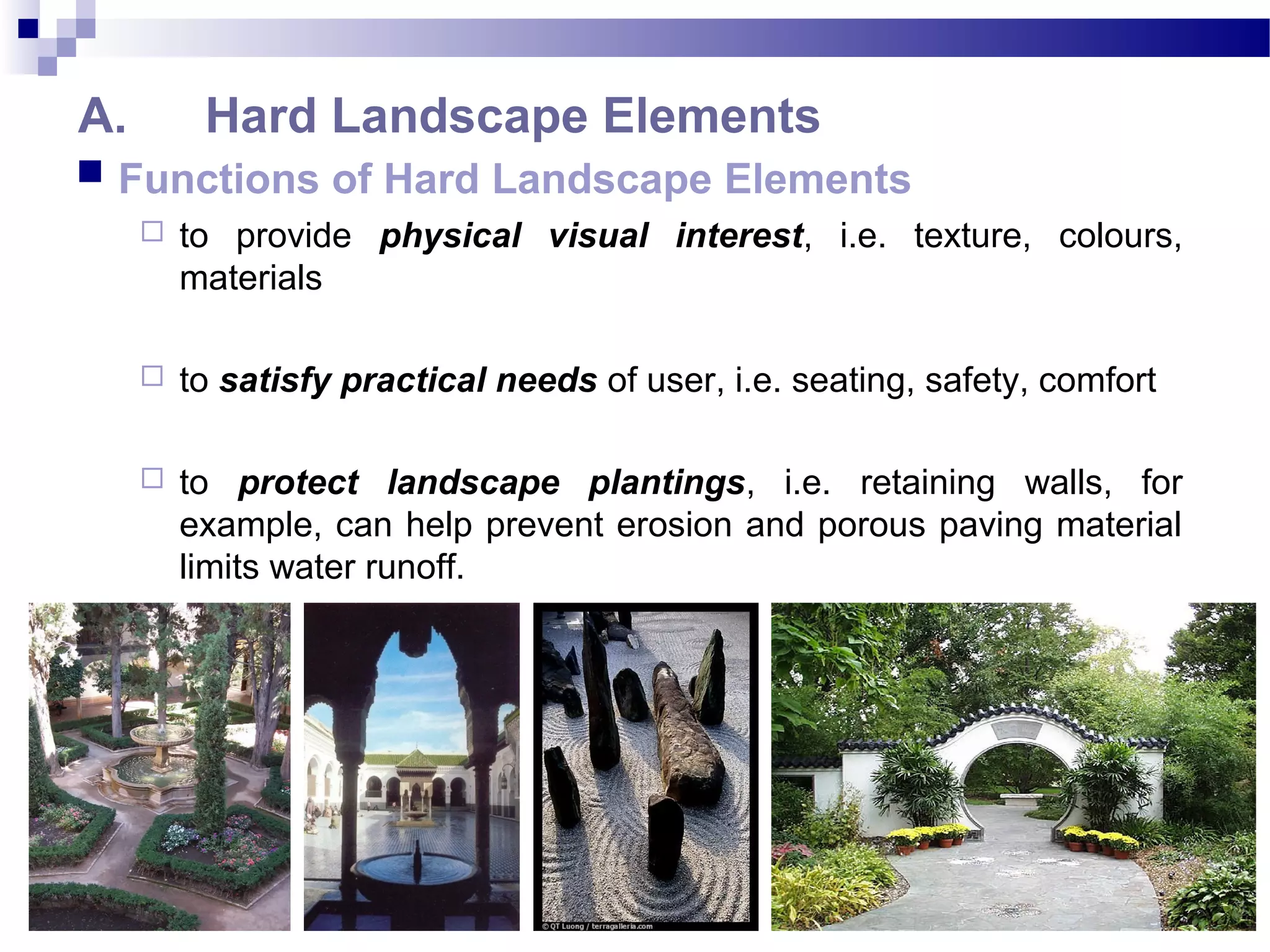
Functions of Hard Landscape Elements
to provide physical visual interest, i.e. texture, colours,
materials
to satisfy practical needs of user, i.e. seating, safety, comfort
to protect landscape plantings, i.e. retaining walls, for
example, can help prevent erosion and porous paving material
limits water runoff.
A. Hard LandscapeElements
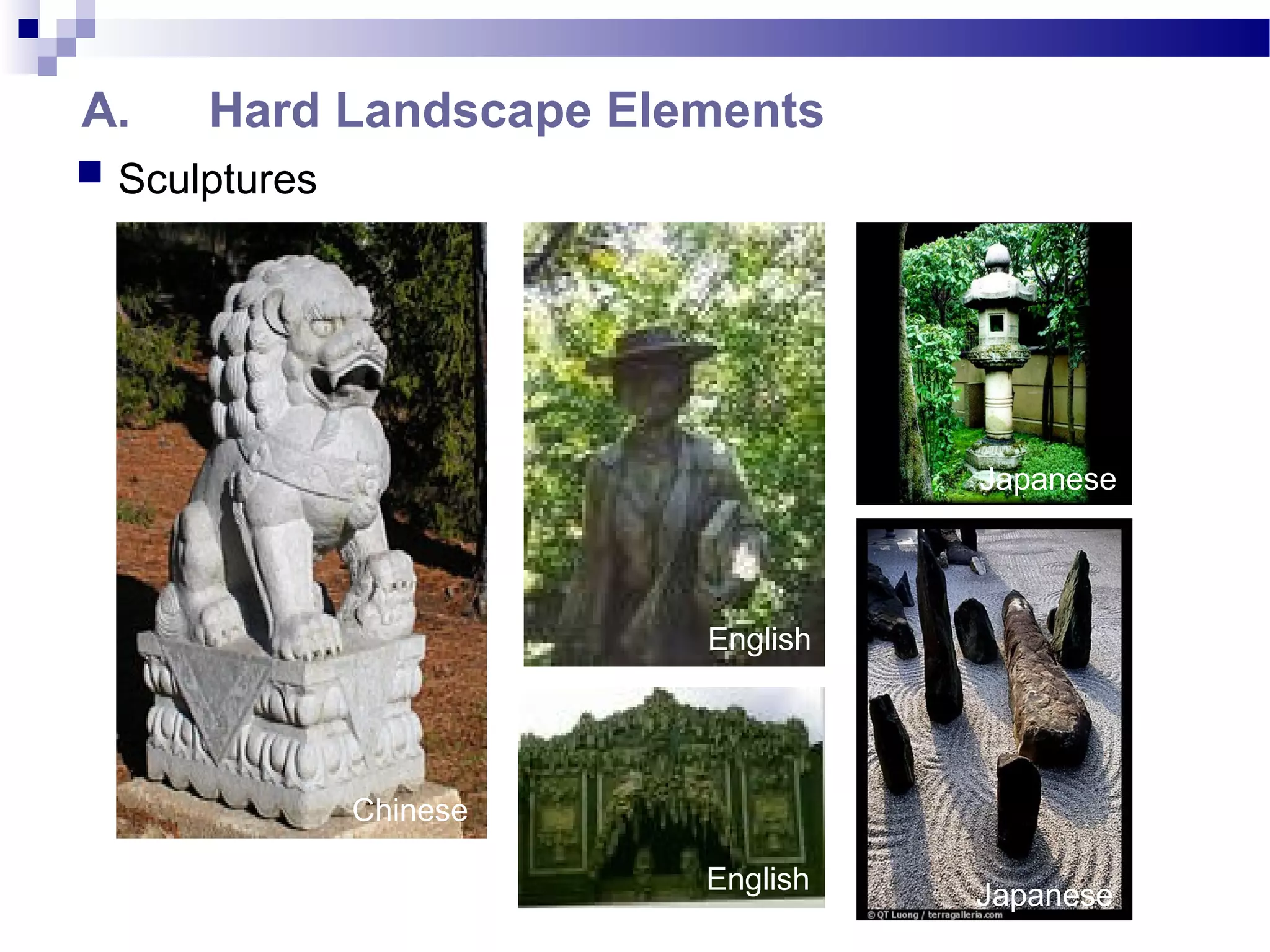
Sculptures
Chinese
English
Japanese
Japanese
English
16.
A. Hard LandscapeElements
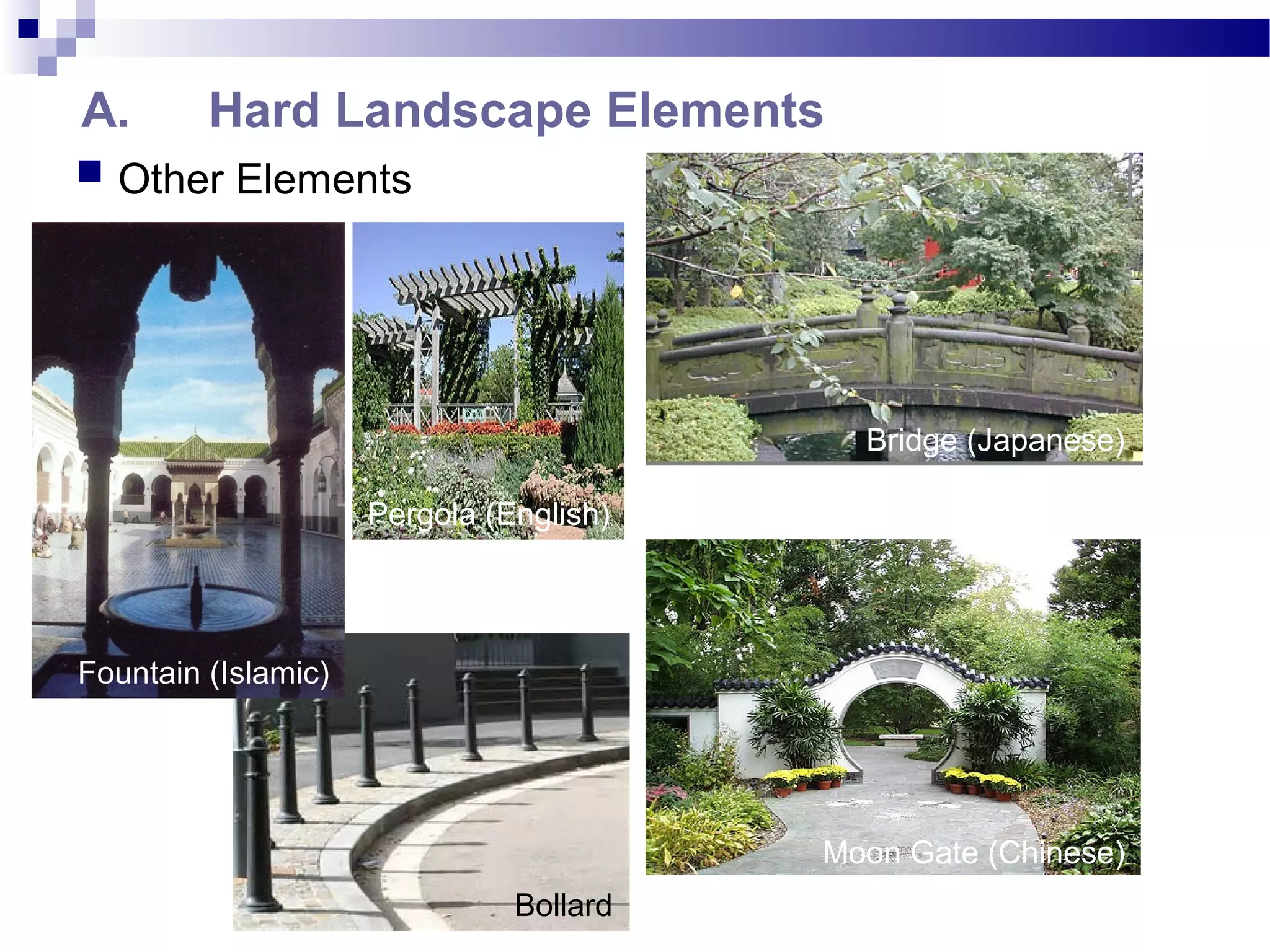
Other Elements
Pergola (English)
Bridge (Japanese)
Moon Gate (Chinese)
Fountain (Islamic)
Bollard
17.
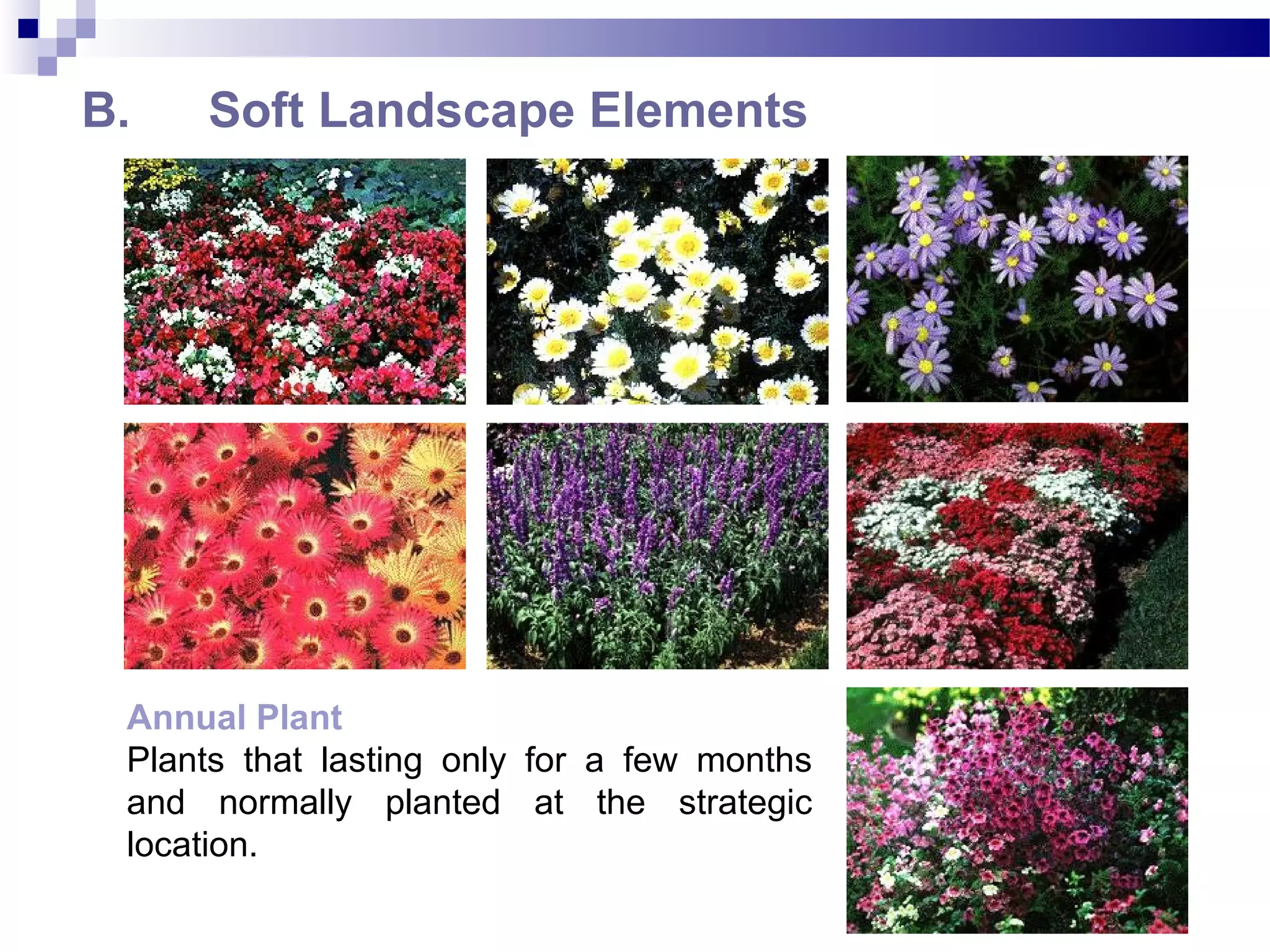
B. Soft LandscapeElements
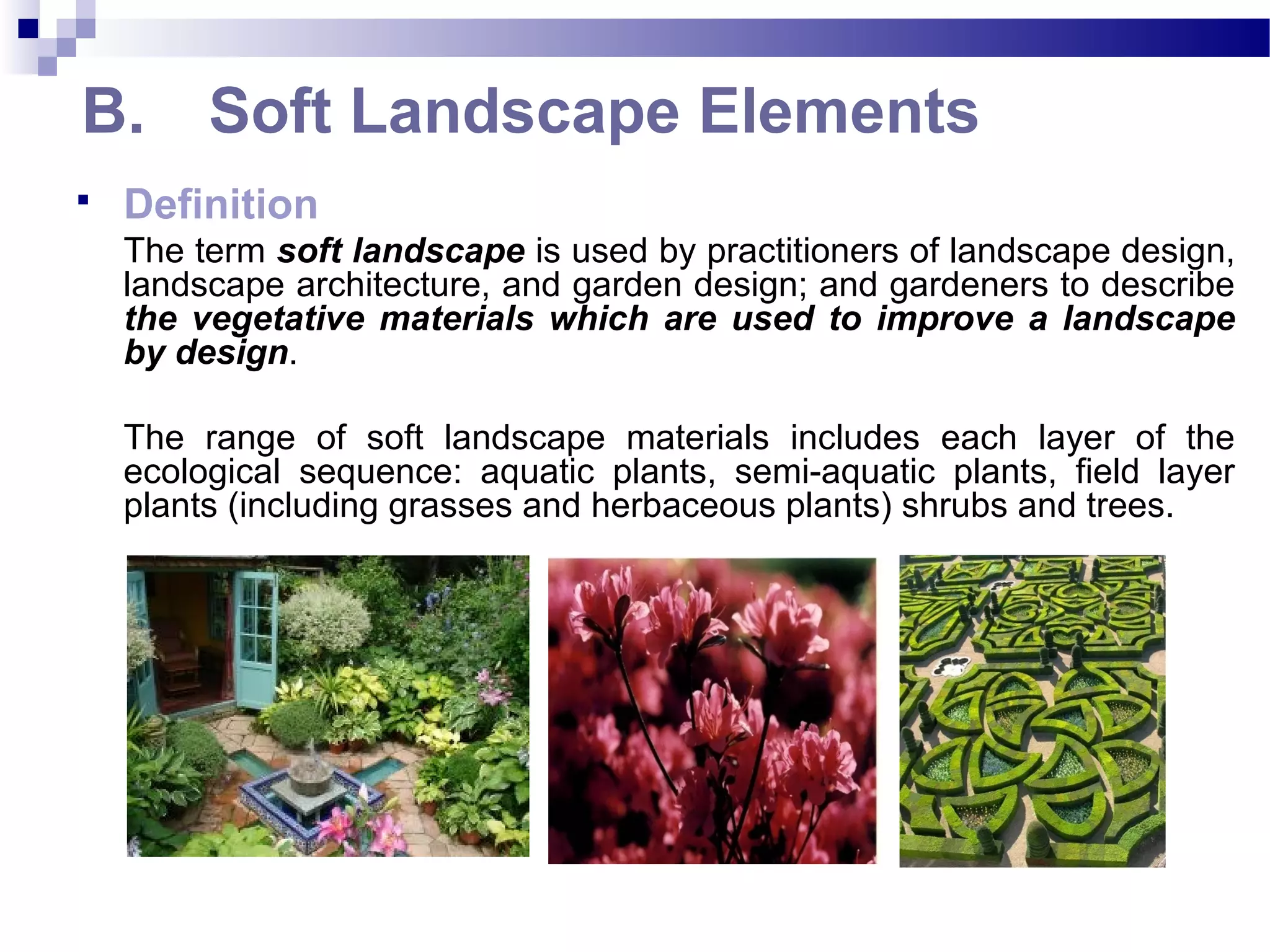
Definition
The term soft landscape is used by practitioners of landscape design,
landscape architecture, and garden design; and gardeners to describe
the vegetative materials which are used to improve a landscape
by design.
The range of soft landscape materials includes each layer of the
ecological sequence: aquatic plants, semi-aquatic plants, field layer
plants (including grasses and herbaceous plants) shrubs and trees.
18.
B. Soft LandscapeElements
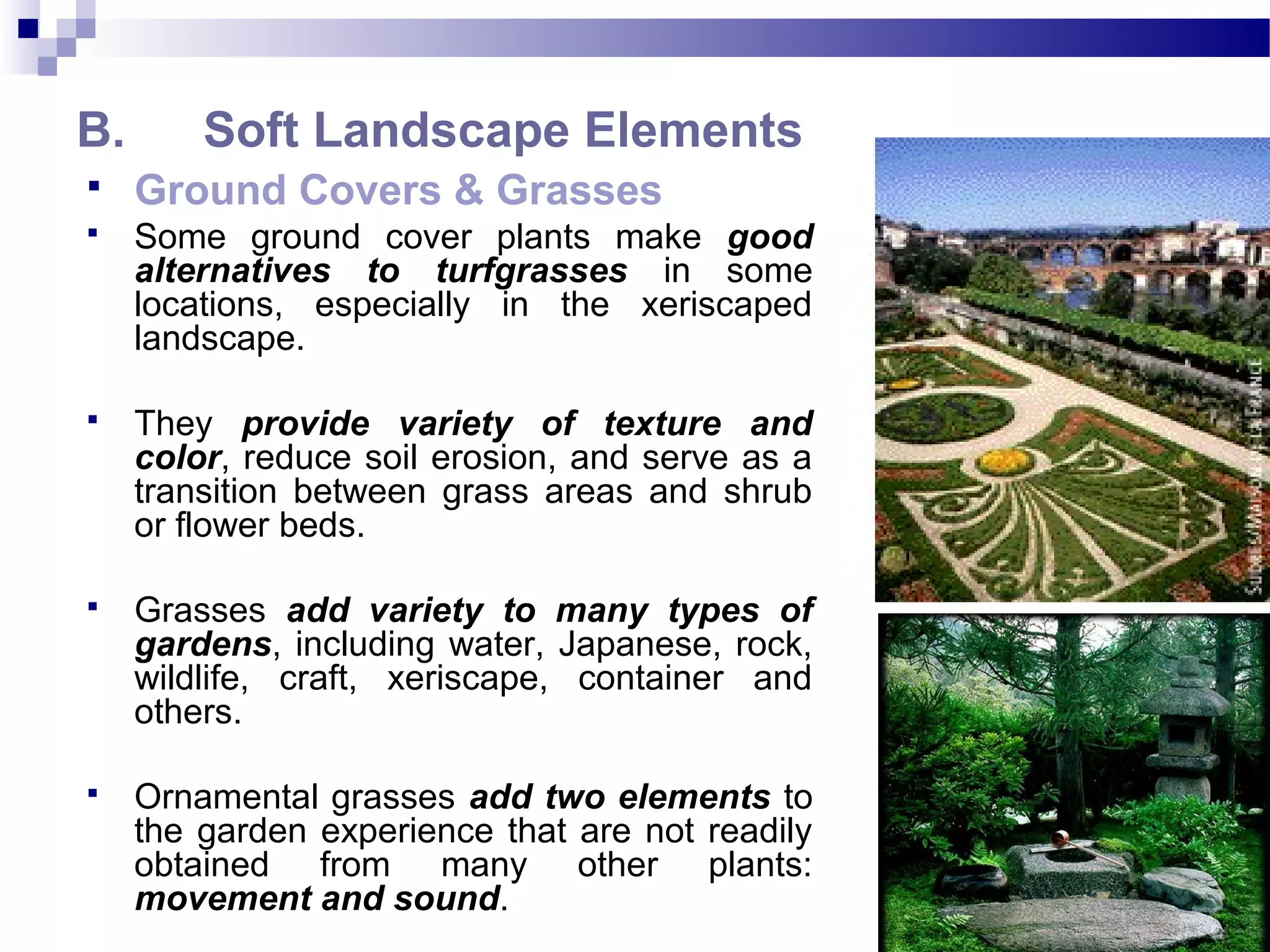
Ground Covers & Grasses
Some ground cover plants make good
alternatives to turfgrasses in some
locations, especially in the xeriscaped
landscape.
They provide variety of texture and
color, reduce soil erosion, and serve as a
transition between grass areas and shrub
or flower beds.
Grasses add variety to many types of
gardens, including water, Japanese, rock,
wildlife, craft, xeriscape, container and
others.
Ornamental grasses add two elements to
the garden experience that are not readily
obtained from many other plants:
movement and sound.
19.
B. Soft LandscapeElements
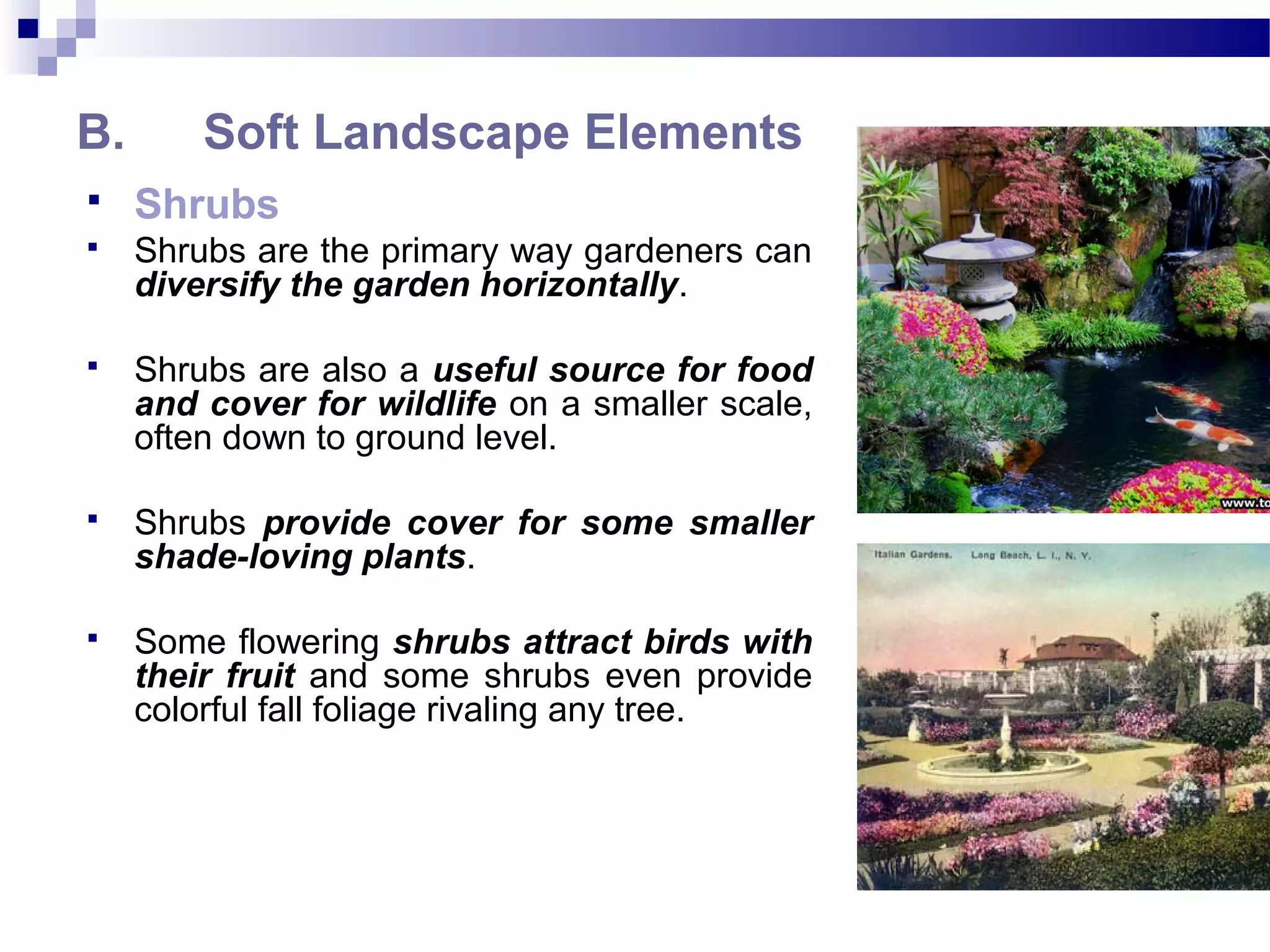
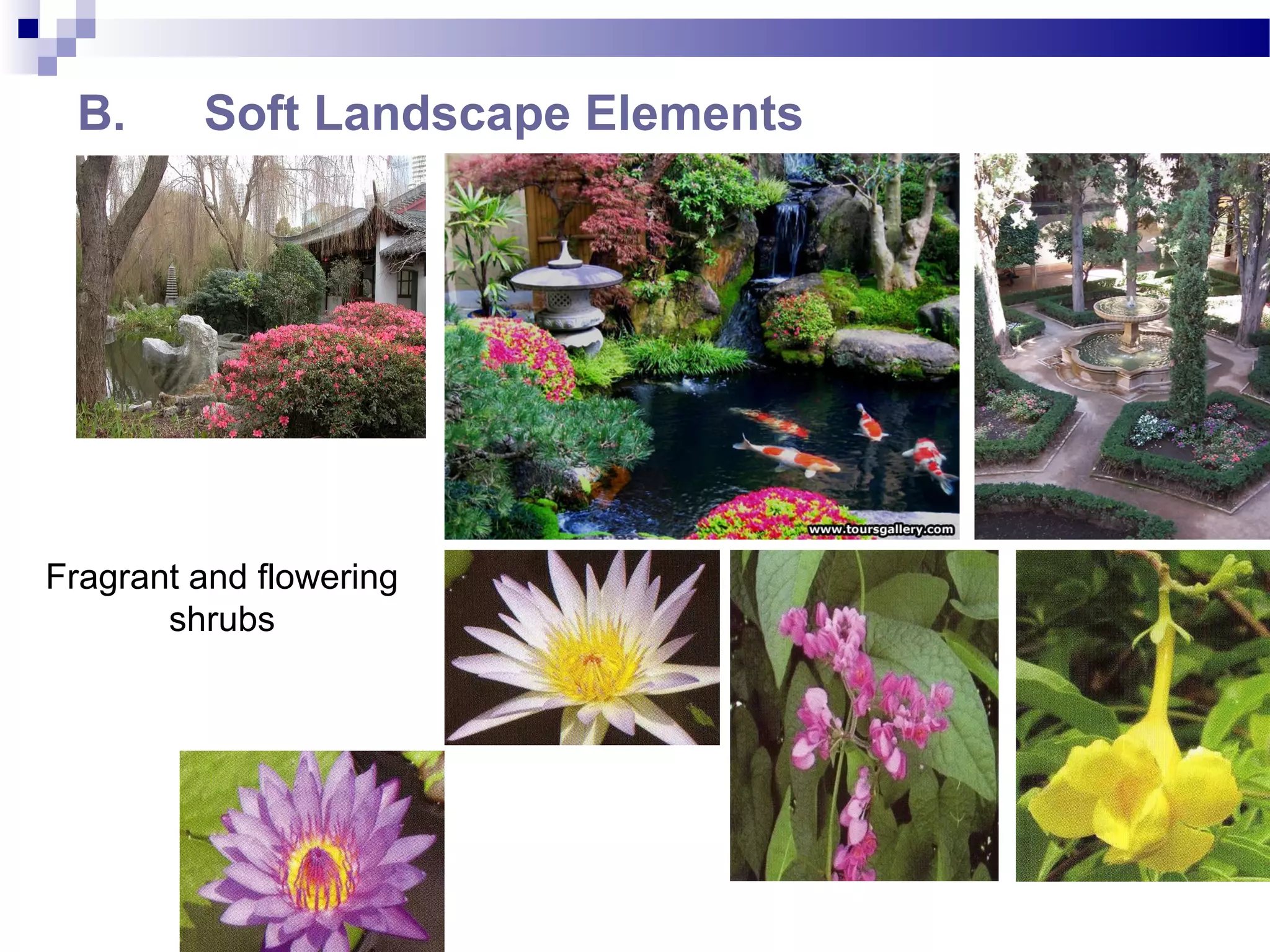
Shrubs
Shrubs are the primary way gardeners can
diversify the garden horizontally.
Shrubs are also a useful source for food
and cover for wildlife on a smaller scale,
often down to ground level.
Shrubs provide cover for some smaller
shade-loving plants.
Some flowering shrubs attract birds with
their fruit and some shrubs even provide
colorful fall foliage rivaling any tree.
20.
B. Soft LandscapeElements
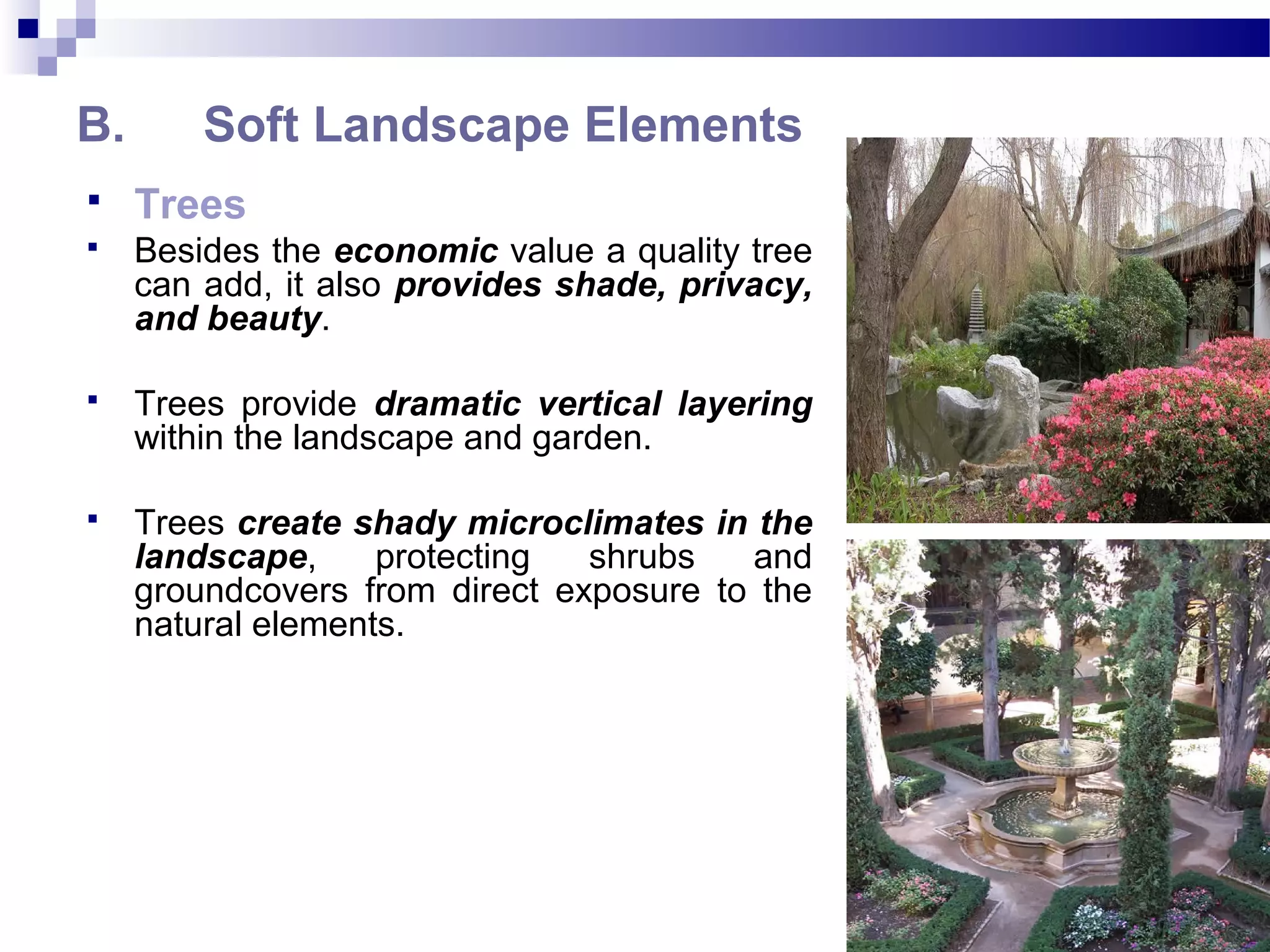
Trees
Besides the economic value a quality tree
can add, it also provides shade, privacy,
and beauty.
Trees provide dramatic vertical layering
within the landscape and garden.
Trees create shady microclimates in the
landscape, protecting shrubs and
groundcovers from direct exposure to the
natural elements.
B. Soft LandscapeElements
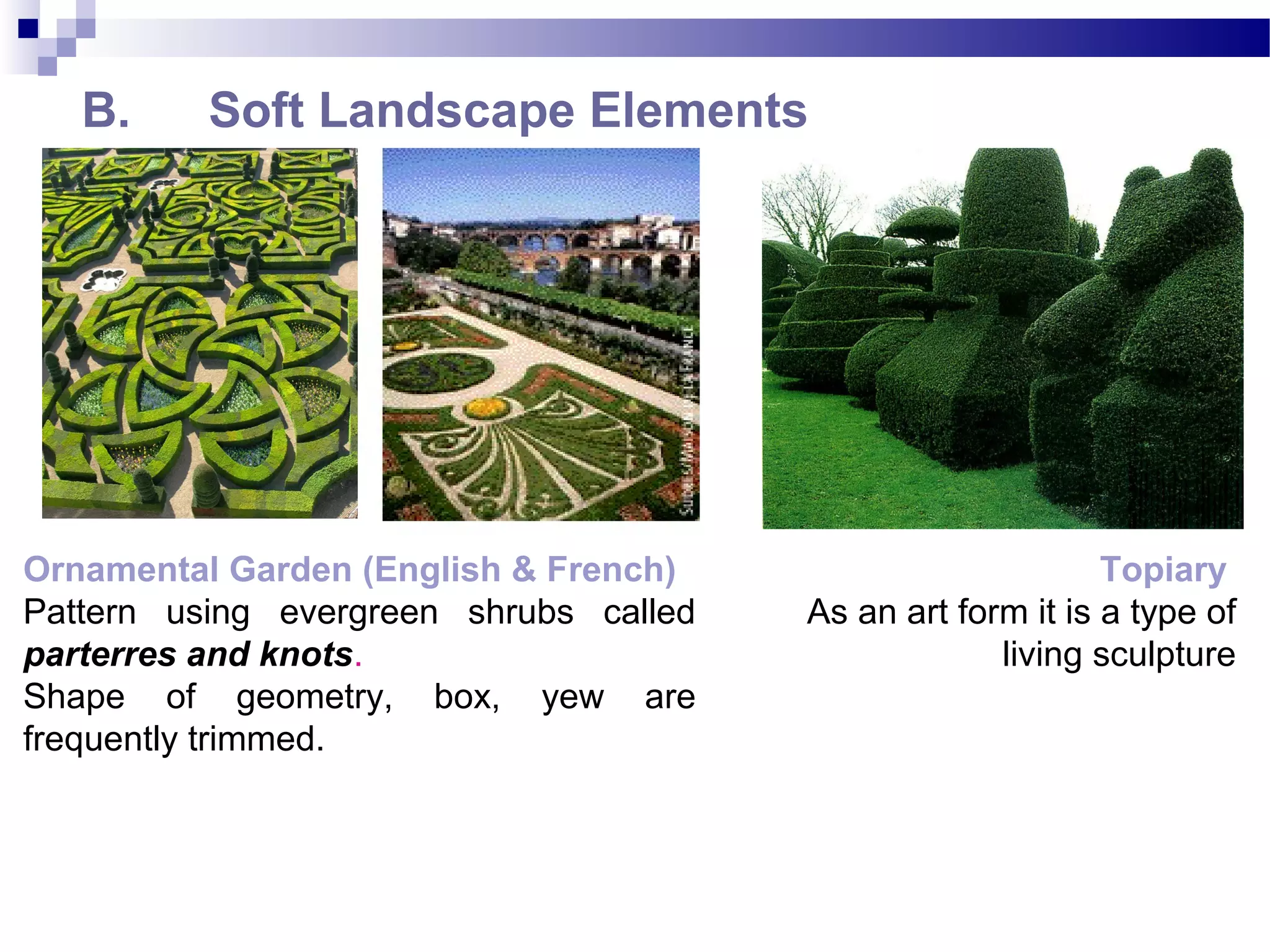
Ornamental Garden (English & French)
Pattern using evergreen shrubs called
parterres and knots.
Shape of geometry, box, yew are
frequently trimmed.
Topiary
As an art form it is a type of
living sculpture
23.
B. Soft LandscapeElements
Annual Plant
Plants that lasting only for a few months
and normally planted at the strategic
location.
24.
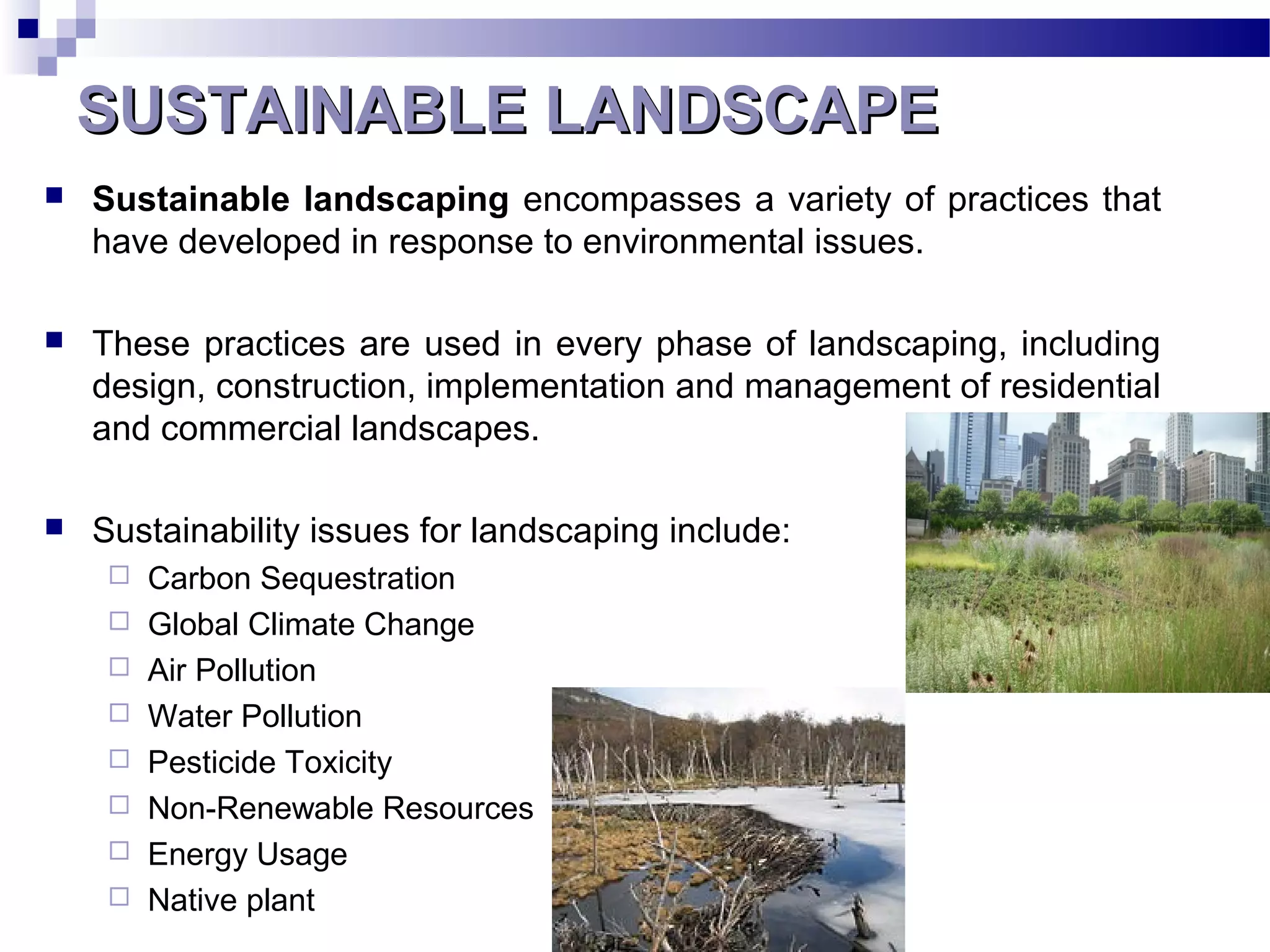
SUSTAINABLE LANDSCAPESUSTAINABLE LANDSCAPE
Sustainable landscaping encompasses a variety of practices that
have developed in response to environmental issues.
These practices are used in every phase of landscaping, including
design, construction, implementation and management of residential
and commercial landscapes.
Sustainability issues for landscaping include:
Carbon Sequestration
Global Climate Change
Air Pollution
Water Pollution
Pesticide Toxicity
Non-Renewable Resources
Energy Usage
Native plant
25.
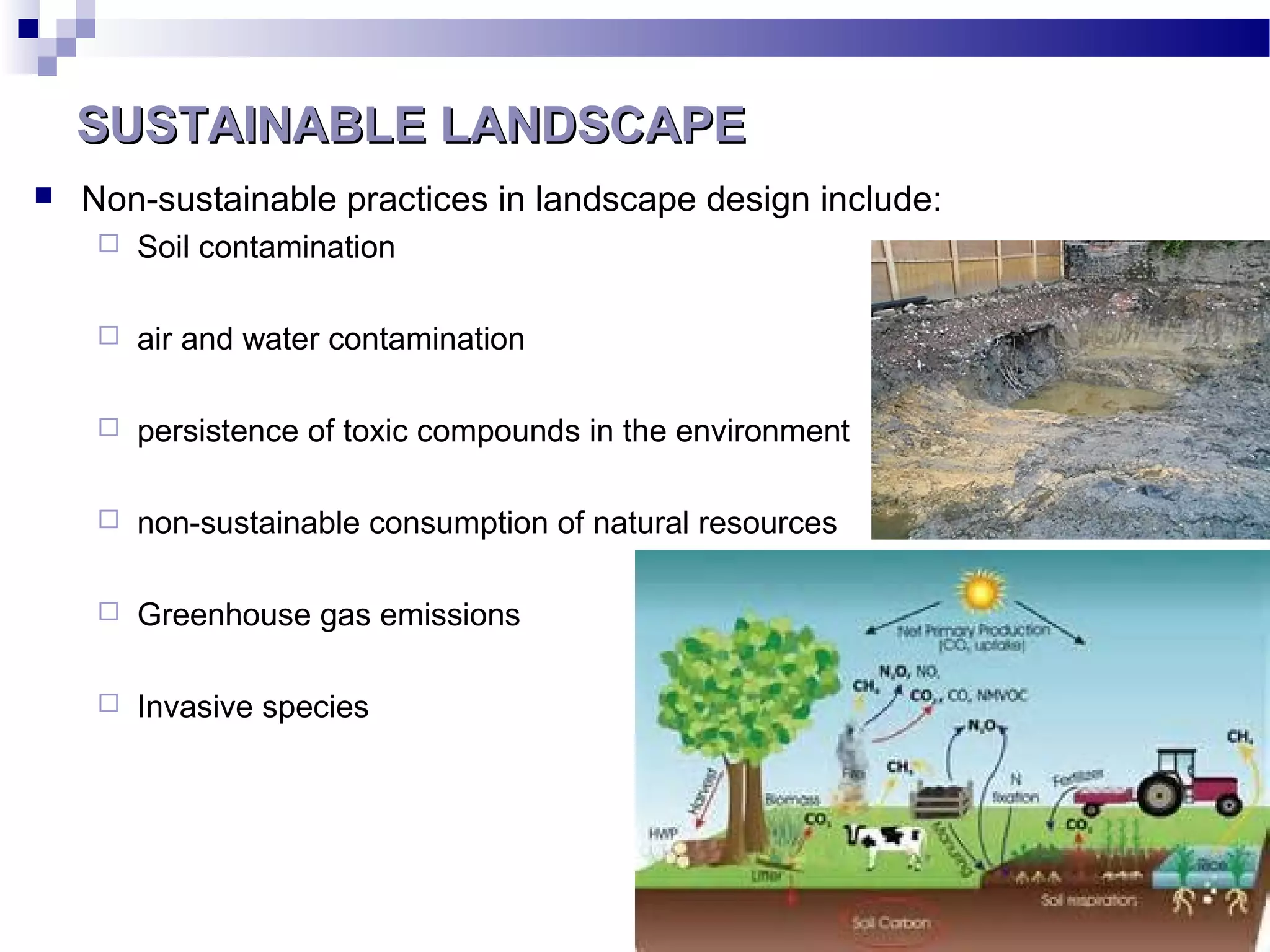
SUSTAINABLE LANDSCAPESUSTAINABLE LANDSCAPE
Non-sustainable practices in landscape design include:
Soil contamination
air and water contamination
persistence of toxic compounds in the environment
non-sustainable consumption of natural resources
Greenhouse gas emissions
Invasive species
26.
Some ofthe effects of non-sustainable practices are:
Severe degradation of the surrounding ecosystem;
harm to human health, especially in the case of degraded drinking
water supplies;
harm to flora and fauna and their habitats;
sedimentation of surface waters caused by stormwater runoff;
chemical pollutants in drinking water caused by pesticide runoff;
health problems caused by toxic fertilizers,
toxic pesticides, improper use, handling, storage and disposal of
pesticides;
air and noise pollution caused by landscape equipment;
invasion of wild lands by non-native weeds and insect pests;
and over-use of limited natural resources.
SUSTAINABLE LANDSCAPESUSTAINABLE LANDSCAPE
27.
SUSTAINABLE LANDSCAPESUSTAINABLE LANDSCAPE
Some of the solutions being developed
are:
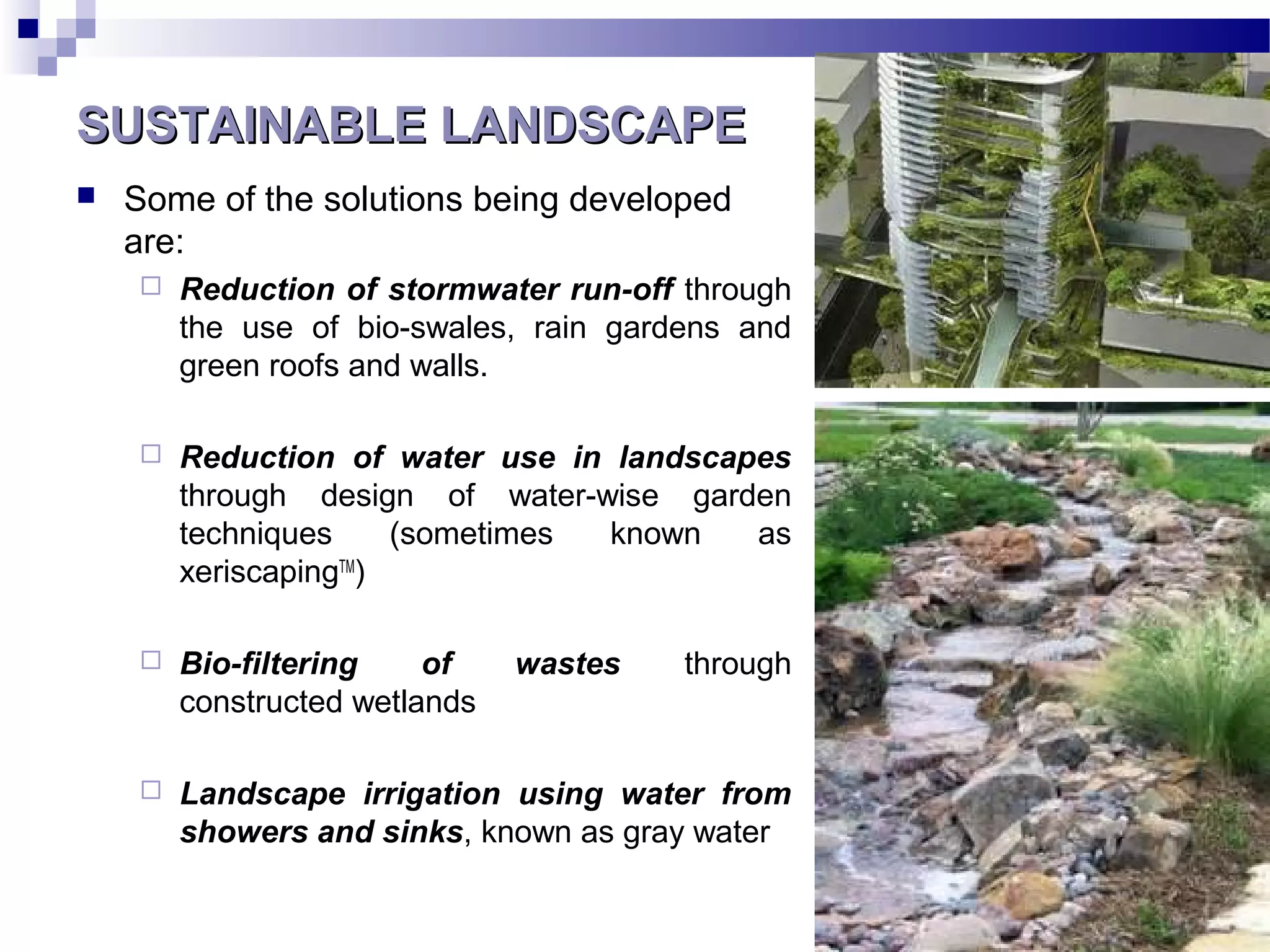
Reduction of stormwater run-off through
the use of bio-swales, rain gardens and
green roofs and walls.
Reduction of water use in landscapes
through design of water-wise garden
techniques (sometimes known as
xeriscapingTM
)
Bio-filtering of wastes through
constructed wetlands
Landscape irrigation using water from
showers and sinks, known as gray water
28.
SUSTAINABLE LANDSCAPESUSTAINABLE LANDSCAPE
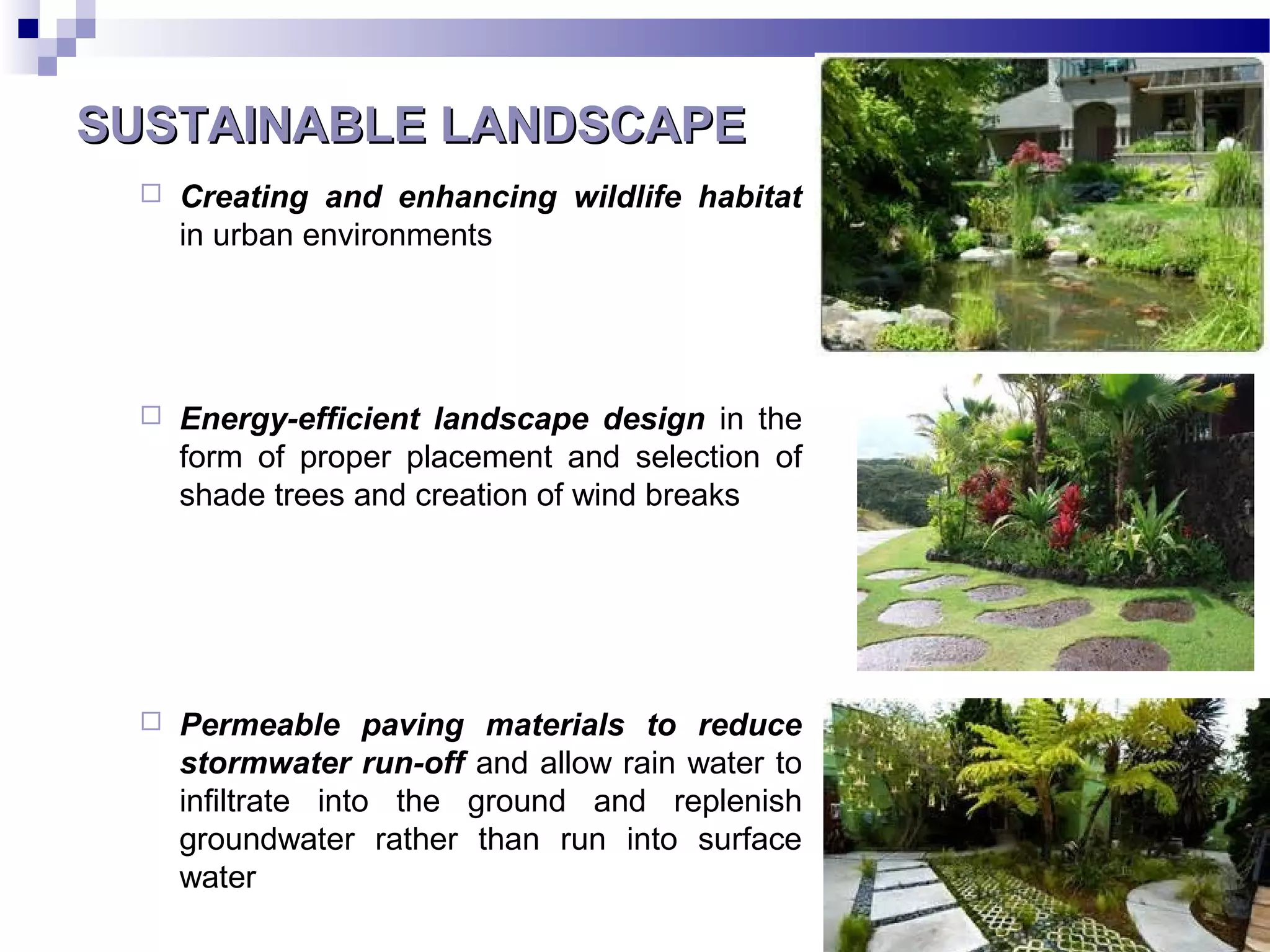
Creating and enhancing wildlife habitat
in urban environments
Energy-efficient landscape design in the
form of proper placement and selection of
shade trees and creation of wind breaks
Permeable paving materials to reduce
stormwater run-off and allow rain water to
infiltrate into the ground and replenish
groundwater rather than run into surface
water
29.
SUSTAINABLE LANDSCAPESUSTAINABLE LANDSCAPE
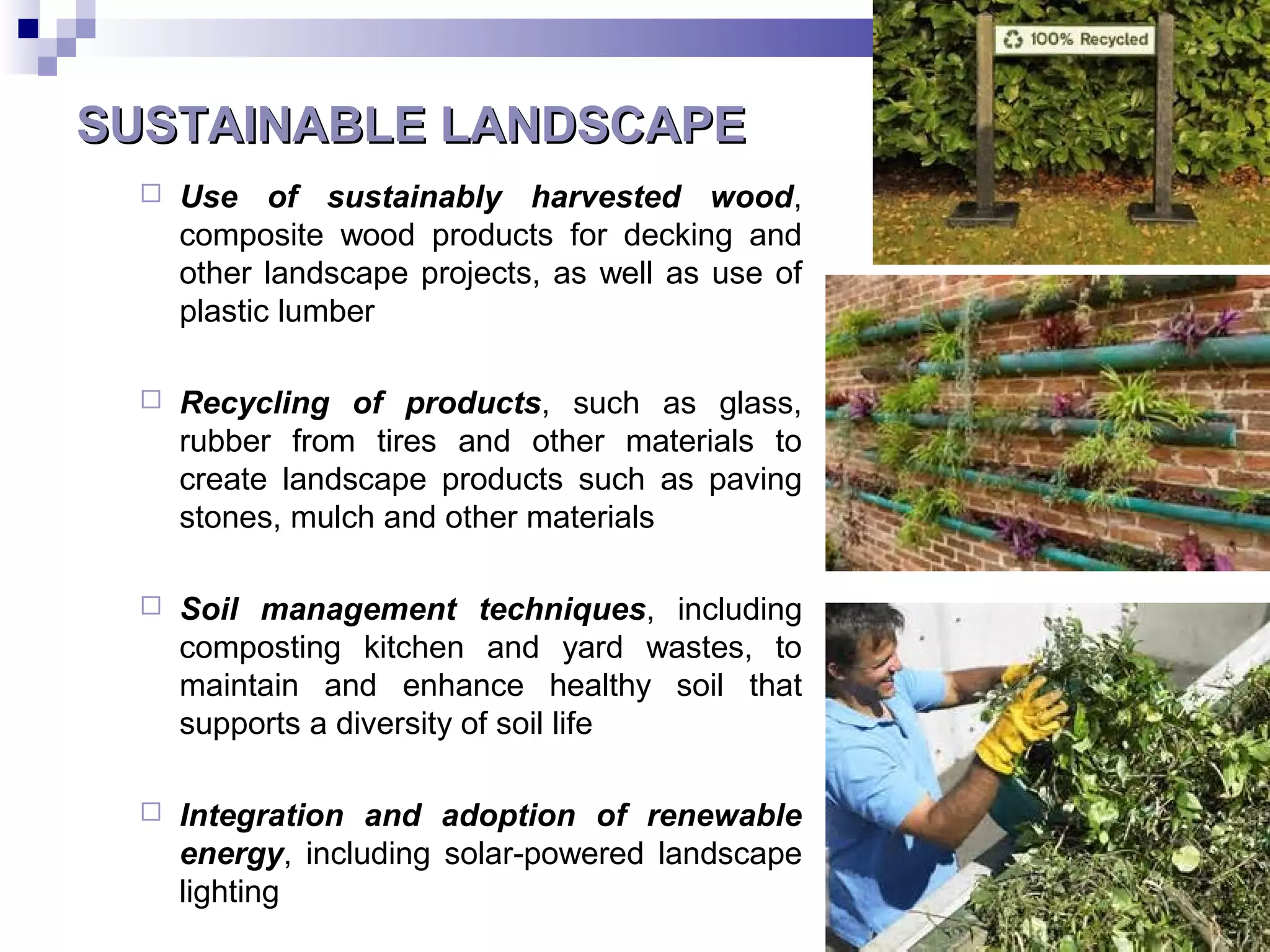
Use of sustainably harvested wood,
composite wood products for decking and
other landscape projects, as well as use of
plastic lumber
Recycling of products, such as glass,
rubber from tires and other materials to
create landscape products such as paving
stones, mulch and other materials
Soil management techniques, including
composting kitchen and yard wastes, to
maintain and enhance healthy soil that
supports a diversity of soil life
Integration and adoption of renewable
energy, including solar-powered landscape
lighting





![landscaping [Autosaved].pptx](https://cdn.slidesharecdn.com/ss_thumbnails/landscapingautosaved-230210144155-ff1c8fd6-thumbnail.jpg?width=640&height=640&fit=bounds)


