Urban Open Spacesp p
Ar. M. Senthil, M.Arch
Associate professor MIDASAssociate professor, MIDAS.
INTRODUCTION
•Urban Open Spaces are the ideal settings to promote social cohesion.
•Urban Open Space provide a space for social interaction, relaxation and
contact with nature.
•Urban Open spaces improves environmental ecosystem and satisfies peoples
recreational needs acts as production for the oxygenrecreational needs, acts as production for the oxygen.
•Living in an urban environment has long been known to be a risk factor for
psychiatric diseases, such as major depression or schizophrenia.
•Social stress, the most important factor for the increased risk of mental
disorders in urban areas.
•Recovery from stress has been shown to be faster, when subjects were
exposed to natural settings.
FUNCTIONS OF URBAN OPEN SPACE
Understanding the functions of urban open spaces, enabling better management of
existing urban spaces as well as improving the design of new ones.
The three main groupsThe three main groups
• Environmental and ecological functions
• Social and societal functions
• Structural and aesthetic functions
ENVIROMENTAL AND ECOLOGICAL FUNCTIONS
• Climatic amelioration
• Noise screening
I fl i th h d l i l l t t t• Influencing the hydrological cycle – storm water management
• Providing habitats for wild plants and animals
SOCIAL AND SOCIETAL FUNCTIONS
• Providing space and facilities for leisure and recreation
• Facilitating social contact and communication
• Access to and experience of nature
• Influencing human physical and psychological health and well-being
STRUCTURAL AND AESTHETIC FUNCTIONS
• Articulating, dividing and linking areas of the urban fabricArticulating, dividing and linking areas of the urban fabric
• Improving the legibility of the city
• Establishing a sense of place
• Acting as a carrier of identity, meanings and values
OPEN SPACE – THE COMMUNITY BENEFITS
Open space provides an array of social, health, economic and
environmental benefits to individuals and to the community as a whole.
Increasing densities population growth and climate change andIncreasing densities, population growth, and climate change and
resource depletion will place further importance on the provision of
quality open spaces.
SOCIAL BENEFITS
-as important drivers in shaping future communities.
idi t iti f l l l t t th f f-providing opportunities for local people to come together for a range of
leisure, cultural and celebratory activities
-Enhance opportunities for social cohesion and inclusion
-Improve liveability in urban environments by offering recreationp y y g
opportunities
HEALTH BENEFITS
-encourages physical activity
-enhances physical and mental health
h l d th i k f d l i h i di-helps reduce the risk of developing chronic diseases
-assists in recovery from mental fatigue
-enhances children’s development and well-being.
ENVIRONMENTAL BENEFITS
-Protection of areas of conservation, biodiversity or cultural heritage value
-managing climate change impacts by Providing shade and cooling;
-Contributing to storm water management;
-Contributing to urban heat abatement and reduction of air and noiseContributing to urban heat abatement and reduction of air and noise
pollution.
Open Spaces Classification:
City Level Public Open Spaces
District Parks
Playgroundsyg
OSR – open space reservation
Cemetries
Neighbourhood level public open spacesNeighbourhood level public open spaces
Local parks
Markets
Community spaces
Cluster open spaces
Community level public open spaces
Informal space on streetInformal space on street
Backyard
courtyard
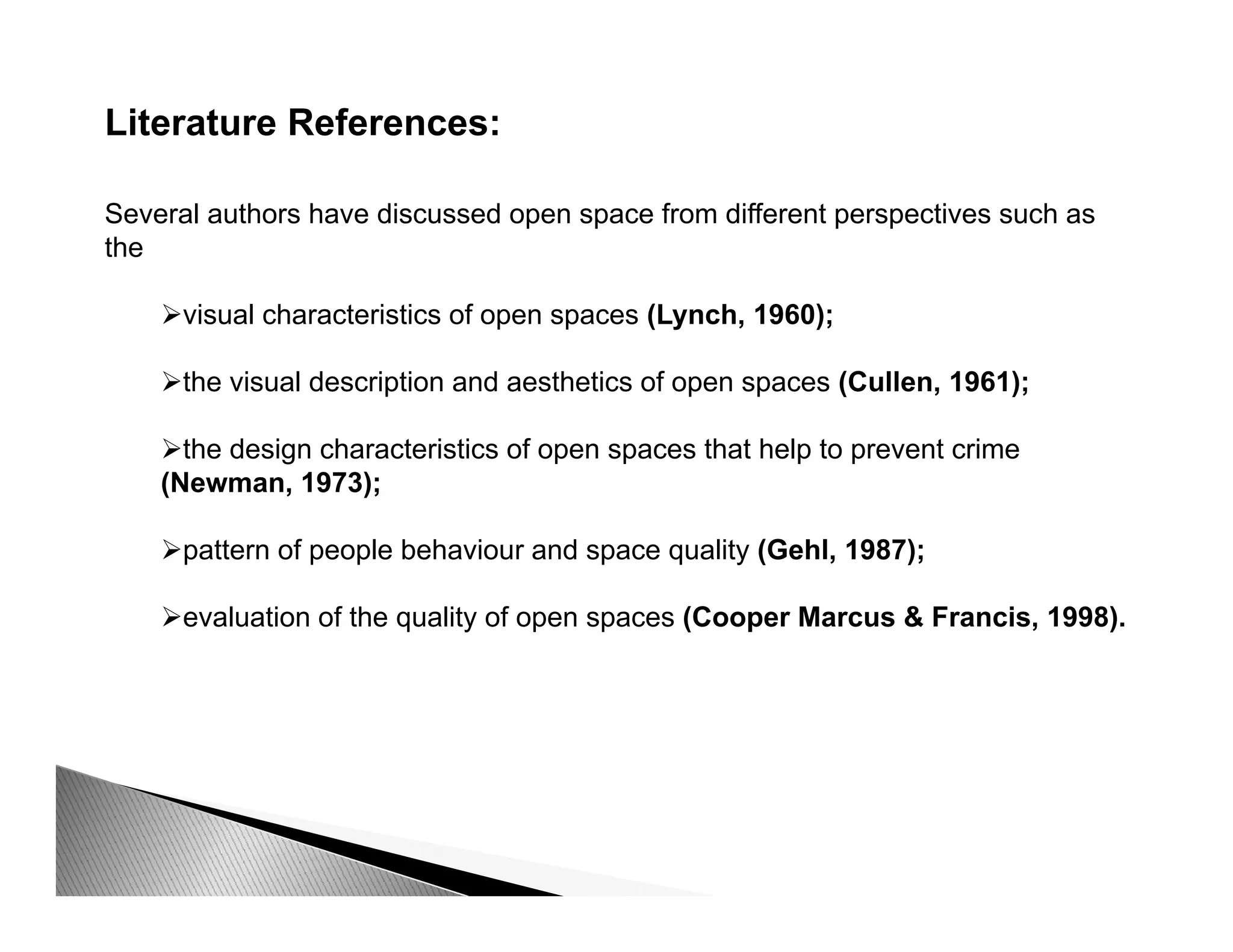
Literature References:
Several authors have discussed open space from different perspectives such as
the
visual characteristics of open spaces (Lynch, 1960);
the visual description and aesthetics of open spaces (Cullen, 1961);
the design characteristics of open spaces that help to prevent crime
(Newman, 1973);
pattern of people behaviour and space quality (Gehl, 1987);
evaluation of the quality of open spaces (Cooper Marcus & Francis, 1998).
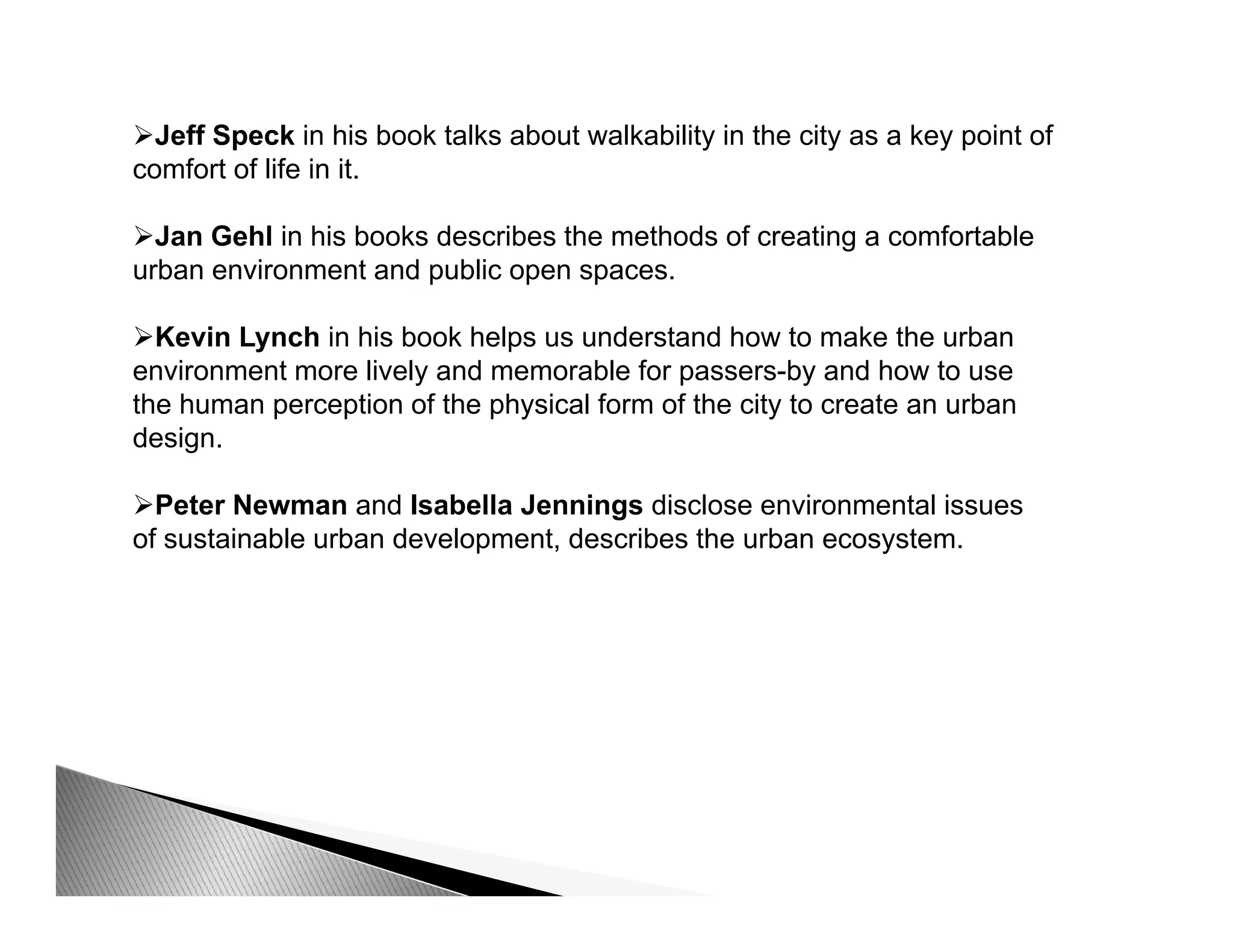
Jeff Speck in his book talks about walkability in the city as a key point of
comfort of life in it.comfort of life in it.
Jan Gehl in his books describes the methods of creating a comfortable
urban environment and public open spaces.
Kevin Lynch in his book helps us understand how to make the urban
environment more lively and memorable for passers-by and how to use
the human perception of the physical form of the city to create an urbanp p p y y
design.
Peter Newman and Isabella Jennings disclose environmental issues
of sustainable urban development describes the urban ecosystemof sustainable urban development, describes the urban ecosystem.

Urban Open spaces

  • 1.
    Urban Open Spacespp Ar. M. Senthil, M.Arch Associate professor MIDASAssociate professor, MIDAS.
  • 2.
    INTRODUCTION •Urban Open Spacesare the ideal settings to promote social cohesion. •Urban Open Space provide a space for social interaction, relaxation and contact with nature. •Urban Open spaces improves environmental ecosystem and satisfies peoples recreational needs acts as production for the oxygenrecreational needs, acts as production for the oxygen. •Living in an urban environment has long been known to be a risk factor for psychiatric diseases, such as major depression or schizophrenia. •Social stress, the most important factor for the increased risk of mental disorders in urban areas. •Recovery from stress has been shown to be faster, when subjects were exposed to natural settings.
  • 3.
    FUNCTIONS OF URBANOPEN SPACE Understanding the functions of urban open spaces, enabling better management of existing urban spaces as well as improving the design of new ones. The three main groupsThe three main groups • Environmental and ecological functions • Social and societal functions • Structural and aesthetic functions ENVIROMENTAL AND ECOLOGICAL FUNCTIONS • Climatic amelioration • Noise screening I fl i th h d l i l l t t t• Influencing the hydrological cycle – storm water management • Providing habitats for wild plants and animals
  • 4.
    SOCIAL AND SOCIETALFUNCTIONS • Providing space and facilities for leisure and recreation • Facilitating social contact and communication • Access to and experience of nature • Influencing human physical and psychological health and well-being STRUCTURAL AND AESTHETIC FUNCTIONS • Articulating, dividing and linking areas of the urban fabricArticulating, dividing and linking areas of the urban fabric • Improving the legibility of the city • Establishing a sense of place • Acting as a carrier of identity, meanings and values
  • 5.
    OPEN SPACE –THE COMMUNITY BENEFITS Open space provides an array of social, health, economic and environmental benefits to individuals and to the community as a whole. Increasing densities population growth and climate change andIncreasing densities, population growth, and climate change and resource depletion will place further importance on the provision of quality open spaces. SOCIAL BENEFITS -as important drivers in shaping future communities. idi t iti f l l l t t th f f-providing opportunities for local people to come together for a range of leisure, cultural and celebratory activities -Enhance opportunities for social cohesion and inclusion -Improve liveability in urban environments by offering recreationp y y g opportunities
  • 6.
    HEALTH BENEFITS -encourages physicalactivity -enhances physical and mental health h l d th i k f d l i h i di-helps reduce the risk of developing chronic diseases -assists in recovery from mental fatigue -enhances children’s development and well-being. ENVIRONMENTAL BENEFITS -Protection of areas of conservation, biodiversity or cultural heritage value -managing climate change impacts by Providing shade and cooling; -Contributing to storm water management; -Contributing to urban heat abatement and reduction of air and noiseContributing to urban heat abatement and reduction of air and noise pollution.
  • 7.
    Open Spaces Classification: CityLevel Public Open Spaces District Parks Playgroundsyg OSR – open space reservation Cemetries Neighbourhood level public open spacesNeighbourhood level public open spaces Local parks Markets Community spaces Cluster open spaces Community level public open spaces Informal space on streetInformal space on street Backyard courtyard
  • 11.
    Literature References: Several authorshave discussed open space from different perspectives such as the visual characteristics of open spaces (Lynch, 1960); the visual description and aesthetics of open spaces (Cullen, 1961); the design characteristics of open spaces that help to prevent crime (Newman, 1973); pattern of people behaviour and space quality (Gehl, 1987); evaluation of the quality of open spaces (Cooper Marcus & Francis, 1998).
  • 12.
    Jeff Speck inhis book talks about walkability in the city as a key point of comfort of life in it.comfort of life in it. Jan Gehl in his books describes the methods of creating a comfortable urban environment and public open spaces. Kevin Lynch in his book helps us understand how to make the urban environment more lively and memorable for passers-by and how to use the human perception of the physical form of the city to create an urbanp p p y y design. Peter Newman and Isabella Jennings disclose environmental issues of sustainable urban development describes the urban ecosystemof sustainable urban development, describes the urban ecosystem.