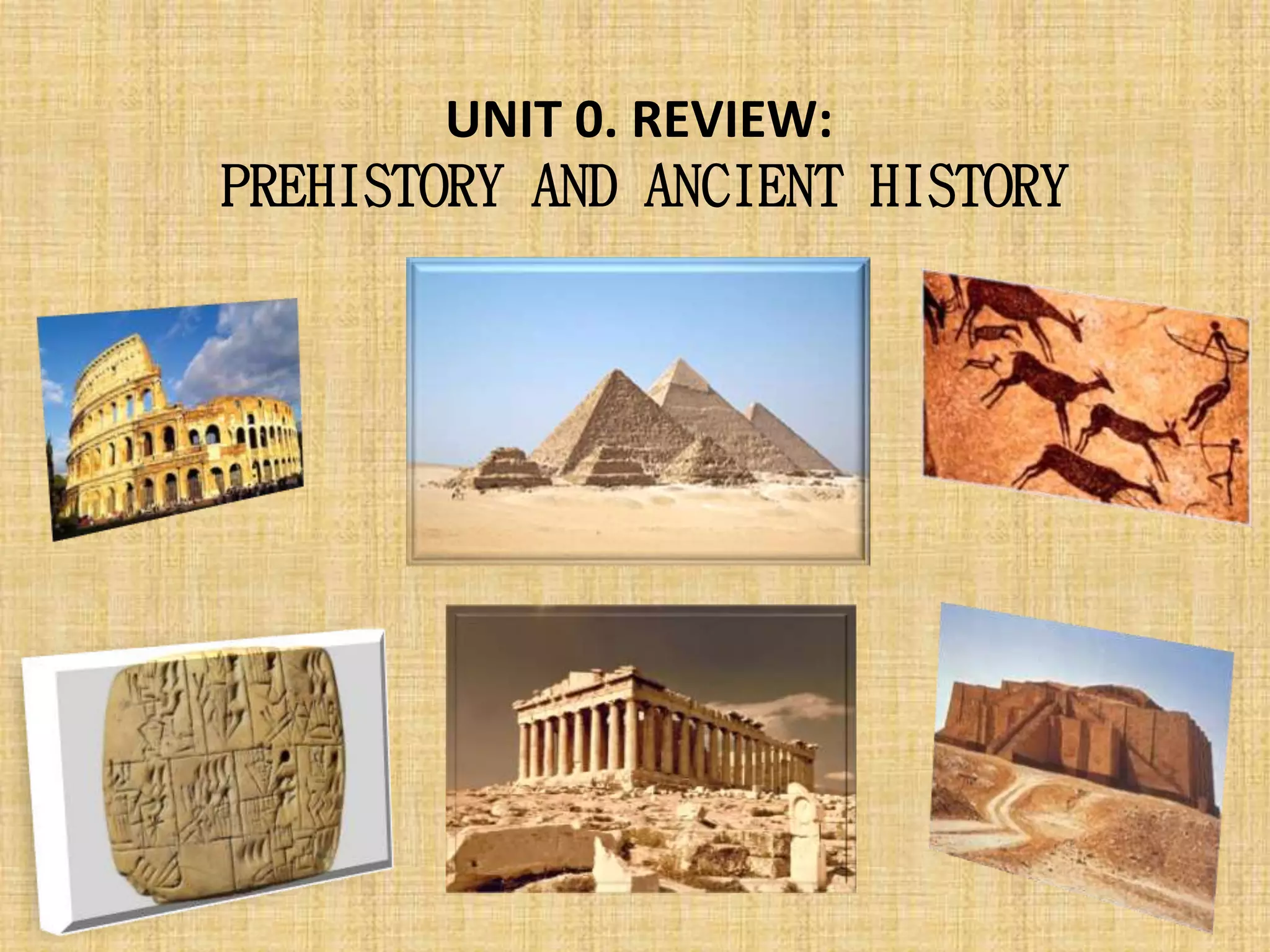
UNIT 0. REVIEW:
PREHISTORY AND ANCIENT HISTORY
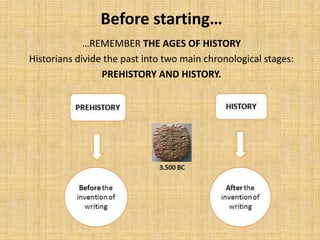
Before starting…
…REMEMBER THE AGES OF HISTORY
Historians divide the past into two main chronological stages:
PREHISTORY AND HISTORY.
PREHISTORY
(2,5 million years ago - 3.500 BC)
• Palaeolithic Period.
– It beginning was marked by the appearance of the genus Homo.
– People were nomads and hunter-gatherers.
• Neolithic Period.
– It began with the appearance of agriculture and livestock farming.
– They were sedentary.
• Metal Ages.
– It began with the mastery of metallurgy, which allowed people o manufacture
metal tools.
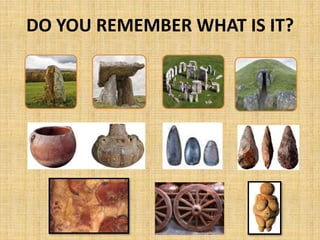
DO YOU REMEMBER WHAT IS IT?
HISTORY
(3.500 BC - present).
– Antiquity (3500 BC- 476 AD).
• Mesopotamia, Egypt, Greek and Rome.
– MIDDLE AGES (476-1492 or 1453).
– Modern Age (1492 or 1453 - 1789).
– Contemporary Age (1789 - present).
 The beginning of each of these periods was marked by a
significant historical event.
 FOR EXAMPLE: the transition from prehistory to history,
marked by the appearance of writing.
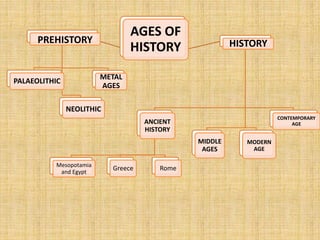
AGES OF
HISTORY
PREHISTORY
PALAEOLITHIC
METAL
AGES
NEOLITHIC
HISTORY
ANCIENT
HISTORY
Mesopotamia
and Egypt
Greece Rome
MIDDLE
AGES
MODERN
AGE
CONTEMPORARY
AGE
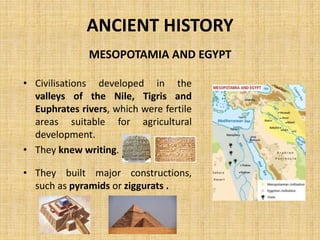
ANCIENT HISTORY
• Civilisations developed in the
valleys of the Nile, Tigris and
Euphrates rivers, which were fertile
areas suitable for agricultural
development.
• They knew writing.
• They built major constructions,
such as pyramids or ziggurats .
MESOPOTAMIA AND EGYPT
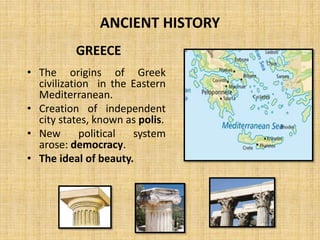
ANCIENT HISTORY
• The origins of Greek
civilization in the Eastern
Mediterranean.
• Creation of independent
city states, known as polis.
• New political system
arose: democracy.
• The ideal of beauty.
GREECE
ANCIENT HISTORY
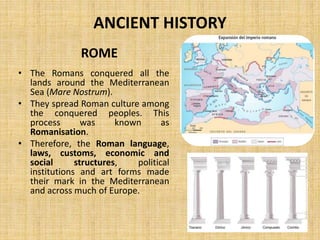
• The Romans conquered all the
lands around the Mediterranean
Sea (Mare Nostrum).
• They spread Roman culture among
the conquered peoples. This
process was known as
Romanisation.
• Therefore, the Roman language,
laws, customs, economic and
social structures, political
institutions and art forms made
their mark in the Mediterranean
and across much of Europe.
ROME
THE FALL OF THE ROMAN EMPIRE,
IN 476 AD, MARKED THE END OF THE
ANCIENT HISTORY AND THE
BEGINING OF THE MIDDLE AGES
(476 – 1492 or 1453).
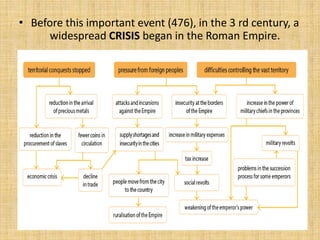
• Before this important event (476), in the 3 rd century, a
widespread CRISIS began in the Roman Empire.
Crisis III century
• Civil wars and wars against barbarians.
• More army to protect the Empire.
• To pay the army TAXES.
• People leaved cities (do not want to pay taxes).
• Trade
• Slaves: stop military conquests and the buy of the
freedom.
• Social revolts: against the emperors and the owners of
the land in the country side.
• Religious confrontation (380 Theodosious proclaimed
Christianity official religion)
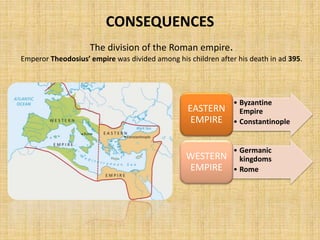
CONSEQUENCES
The division of the Roman empire.
Emperor Theodosius’ empire was divided among his children after his death in ad 395.
• Byzantine
Empire
• Constantinople
EASTERN
EMPIRE
• Germanic
kingdoms
• Rome
WESTERN
EMPIRE

Unit 0

  • 1.
    UNIT 0. REVIEW: PREHISTORYAND ANCIENT HISTORY
  • 2.
    Before starting… …REMEMBER THEAGES OF HISTORY Historians divide the past into two main chronological stages: PREHISTORY AND HISTORY.
  • 3.
    PREHISTORY (2,5 million yearsago - 3.500 BC) • Palaeolithic Period. – It beginning was marked by the appearance of the genus Homo. – People were nomads and hunter-gatherers. • Neolithic Period. – It began with the appearance of agriculture and livestock farming. – They were sedentary. • Metal Ages. – It began with the mastery of metallurgy, which allowed people o manufacture metal tools.
  • 4.
    DO YOU REMEMBERWHAT IS IT?
  • 5.
    HISTORY (3.500 BC -present). – Antiquity (3500 BC- 476 AD). • Mesopotamia, Egypt, Greek and Rome. – MIDDLE AGES (476-1492 or 1453). – Modern Age (1492 or 1453 - 1789). – Contemporary Age (1789 - present).  The beginning of each of these periods was marked by a significant historical event.  FOR EXAMPLE: the transition from prehistory to history, marked by the appearance of writing.
  • 6.
  • 7.
    ANCIENT HISTORY • Civilisationsdeveloped in the valleys of the Nile, Tigris and Euphrates rivers, which were fertile areas suitable for agricultural development. • They knew writing. • They built major constructions, such as pyramids or ziggurats . MESOPOTAMIA AND EGYPT
  • 8.
    ANCIENT HISTORY • Theorigins of Greek civilization in the Eastern Mediterranean. • Creation of independent city states, known as polis. • New political system arose: democracy. • The ideal of beauty. GREECE
  • 9.
    ANCIENT HISTORY • TheRomans conquered all the lands around the Mediterranean Sea (Mare Nostrum). • They spread Roman culture among the conquered peoples. This process was known as Romanisation. • Therefore, the Roman language, laws, customs, economic and social structures, political institutions and art forms made their mark in the Mediterranean and across much of Europe. ROME
  • 10.
    THE FALL OFTHE ROMAN EMPIRE, IN 476 AD, MARKED THE END OF THE ANCIENT HISTORY AND THE BEGINING OF THE MIDDLE AGES (476 – 1492 or 1453).
  • 11.
    • Before thisimportant event (476), in the 3 rd century, a widespread CRISIS began in the Roman Empire.
  • 12.
    Crisis III century •Civil wars and wars against barbarians. • More army to protect the Empire. • To pay the army TAXES. • People leaved cities (do not want to pay taxes). • Trade • Slaves: stop military conquests and the buy of the freedom. • Social revolts: against the emperors and the owners of the land in the country side. • Religious confrontation (380 Theodosious proclaimed Christianity official religion)
  • 13.
    CONSEQUENCES The division ofthe Roman empire. Emperor Theodosius’ empire was divided among his children after his death in ad 395. • Byzantine Empire • Constantinople EASTERN EMPIRE • Germanic kingdoms • Rome WESTERN EMPIRE