Historical Review

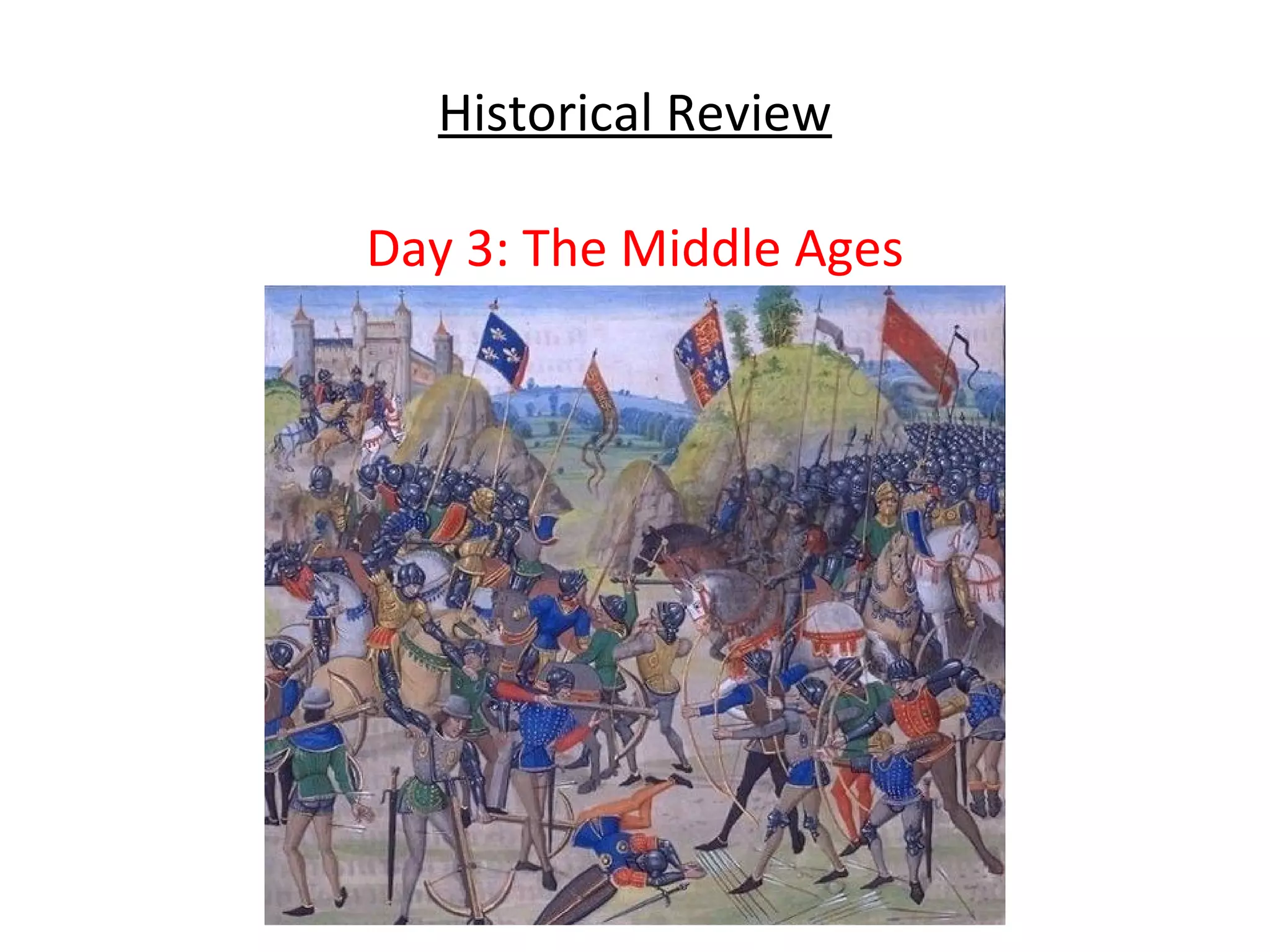
Day 3: The Middle Ages
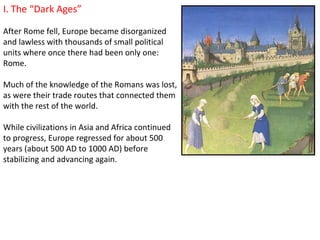
I. The “Dark Ages”

After Rome fell, Europe became disorganized
and lawless with thousands of small political
units where once there had been only one:
Rome.

Much of the knowledge of the Romans was lost,
as were their trade routes that connected them
with the rest of the world.

While civilizations in Asia and Africa continued
to progress, Europe regressed for about 500
years (about 500 AD to 1000 AD) before
stabilizing and advancing again.
II. Life in the Middle Ages
Europe was locked in almost constant warfare as local warlords vied for power.

Cities emptied as people fled to the countryside to avoid raiding armies looking to
sack urban areas.

Travel was dangerous, so most people lived their whole lives in these farming villages,
rarely traveling even to neighboring villages.

Most people were poor and could not afford weapons or armor.
They needed protection and turned to the wealthy to protect
them.

In return for protection, peasants worked for wealthy lords as
serfs, in an arrangement known as feudalism.
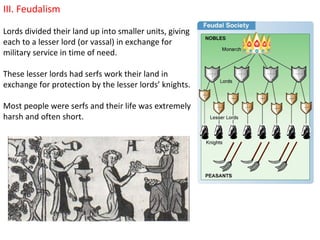
III. Feudalism

Lords divided their land up into smaller units, giving
each to a lesser lord (or vassal) in exchange for
military service in time of need.

These lesser lords had serfs work their land in
exchange for protection by the lesser lords’ knights.

Most people were serfs and their life was extremely
harsh and often short.
IV. The Church in Medieval Life

The Church shaped many aspects of the lives of
Medieval people and reigned supreme in all matters
religious.

It served as a social and religious center and was also a
powerful political entity, claiming authority (called
papal supremacy) over all earthly leaders.

In fact, the Church was Europe’s most powerful (and
wealthy) secular force.

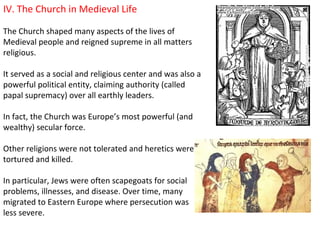
Other religions were not tolerated and heretics were
tortured and killed.

In particular, Jews were often scapegoats for social
problems, illnesses, and disease. Over time, many
migrated to Eastern Europe where persecution was
less severe.
V. The High Middle Ages

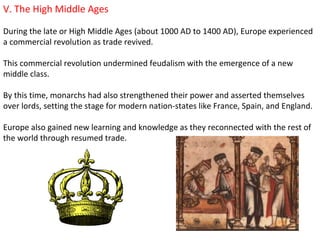
During the late or High Middle Ages (about 1000 AD to 1400 AD), Europe experienced
a commercial revolution as trade revived.

This commercial revolution undermined feudalism with the emergence of a new
middle class.

By this time, monarchs had also strengthened their power and asserted themselves
over lords, setting the stage for modern nation-states like France, Spain, and England.

Europe also gained new learning and knowledge as they reconnected with the rest of
the world through resumed trade.
VI. The Black Death

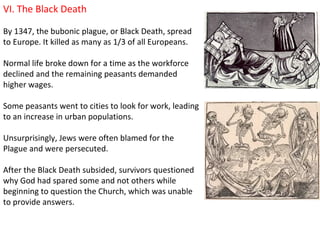
By 1347, the bubonic plague, or Black Death, spread
to Europe. It killed as many as 1/3 of all Europeans.

Normal life broke down for a time as the workforce
declined and the remaining peasants demanded
higher wages.

Some peasants went to cities to look for work, leading
to an increase in urban populations.

Unsurprisingly, Jews were often blamed for the
Plague and were persecuted.

After the Black Death subsided, survivors questioned
why God had spared some and not others while
beginning to question the Church, which was unable
to provide answers.

The Middle Ages

  • 1.
    Historical Review Day 3:The Middle Ages
  • 2.
    I. The “DarkAges” After Rome fell, Europe became disorganized and lawless with thousands of small political units where once there had been only one: Rome. Much of the knowledge of the Romans was lost, as were their trade routes that connected them with the rest of the world. While civilizations in Asia and Africa continued to progress, Europe regressed for about 500 years (about 500 AD to 1000 AD) before stabilizing and advancing again.
  • 3.
    II. Life inthe Middle Ages Europe was locked in almost constant warfare as local warlords vied for power. Cities emptied as people fled to the countryside to avoid raiding armies looking to sack urban areas. Travel was dangerous, so most people lived their whole lives in these farming villages, rarely traveling even to neighboring villages. Most people were poor and could not afford weapons or armor. They needed protection and turned to the wealthy to protect them. In return for protection, peasants worked for wealthy lords as serfs, in an arrangement known as feudalism.
  • 4.
    III. Feudalism Lords dividedtheir land up into smaller units, giving each to a lesser lord (or vassal) in exchange for military service in time of need. These lesser lords had serfs work their land in exchange for protection by the lesser lords’ knights. Most people were serfs and their life was extremely harsh and often short.
  • 5.
    IV. The Churchin Medieval Life The Church shaped many aspects of the lives of Medieval people and reigned supreme in all matters religious. It served as a social and religious center and was also a powerful political entity, claiming authority (called papal supremacy) over all earthly leaders. In fact, the Church was Europe’s most powerful (and wealthy) secular force. Other religions were not tolerated and heretics were tortured and killed. In particular, Jews were often scapegoats for social problems, illnesses, and disease. Over time, many migrated to Eastern Europe where persecution was less severe.
  • 6.
    V. The HighMiddle Ages During the late or High Middle Ages (about 1000 AD to 1400 AD), Europe experienced a commercial revolution as trade revived. This commercial revolution undermined feudalism with the emergence of a new middle class. By this time, monarchs had also strengthened their power and asserted themselves over lords, setting the stage for modern nation-states like France, Spain, and England. Europe also gained new learning and knowledge as they reconnected with the rest of the world through resumed trade.
  • 7.
    VI. The BlackDeath By 1347, the bubonic plague, or Black Death, spread to Europe. It killed as many as 1/3 of all Europeans. Normal life broke down for a time as the workforce declined and the remaining peasants demanded higher wages. Some peasants went to cities to look for work, leading to an increase in urban populations. Unsurprisingly, Jews were often blamed for the Plague and were persecuted. After the Black Death subsided, survivors questioned why God had spared some and not others while beginning to question the Church, which was unable to provide answers.