A close comparison



Both lasted approximately 400 years
Both had population of about 50 million
Han China built on earlier imperial
traditions started by the Qin and Zhou

Rome was built on controlling aristocratic
landlords and a certain element of democracy
Roman Empire

Han China




Massive road
building projects
linked crucial parts
of the empires
Roads facilitated
communication,
economic activity,
access to resources,
and movement of
military.






Confucianism
identified principles
necessary for political
and social order
Emphasized the
emperors divine
majesty
Developed a
sophisticated
bureaucracy with gov
representatives in the
provinces






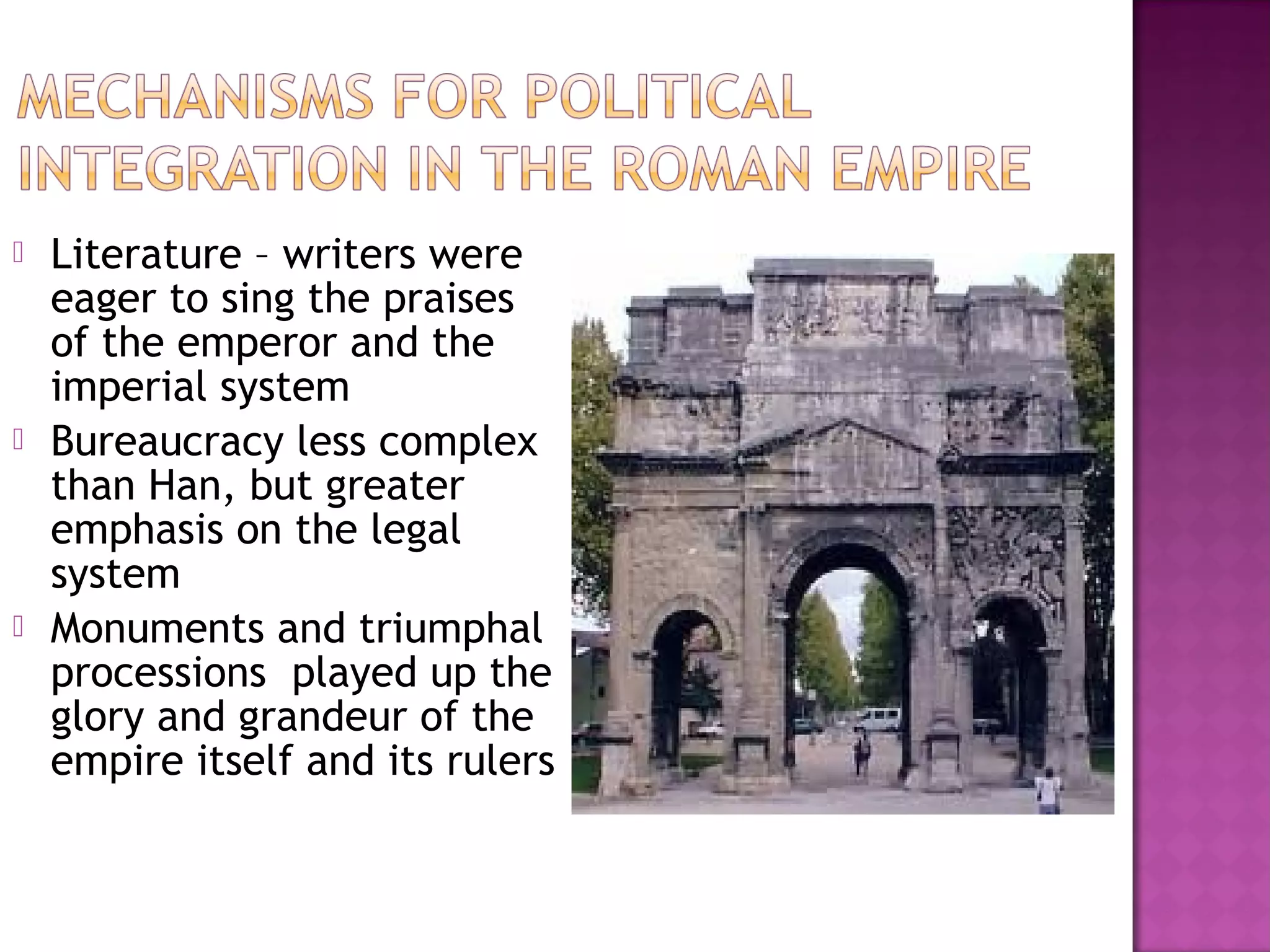
Literature – writers were
eager to sing the praises
of the emperor and the
imperial system
Bureaucracy less complex
than Han, but greater
emphasis on the legal
system
Monuments and triumphal
processions played up the
glory and grandeur of the
empire itself and its rulers
•

Both systems expanded the
functions of government,
using considerable powers
of bureaucracy and taxation
to provision major cities.

•

Both governments were
actively engaged in a
certain level of economic
activity designed to ensure
a stable social and political
order.




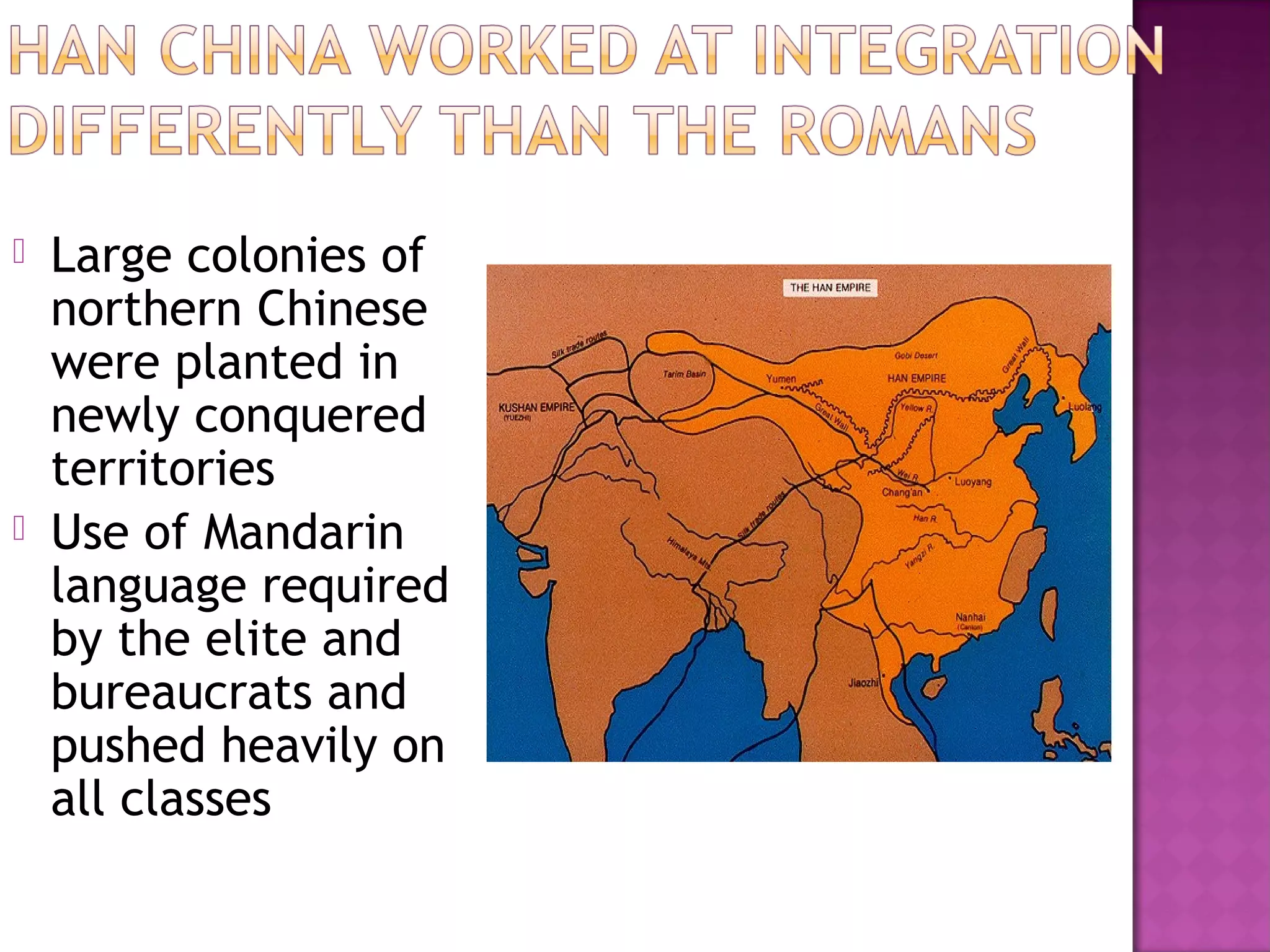
Large colonies of
northern Chinese
were planted in
newly conquered
territories
Use of Mandarin
language required
by the elite and
bureaucrats and
pushed heavily on
all classes







Colonies were smaller,
basically military outposts
not intended for population
integration
Latin was encouraged but
never supplanted Greek in
the east
Expansion of Roman
citizenship was emphasized
Rome was content to
establish looser control on
provinces and rely on local
autonomy
Imperial Rome

Han China








Pushed boundaries far
beyond Middle Kingdom,
but when the Han
Empire reached a large
geographical area,
Had difficulty
maintaining large land
border
did not feel the need to
continue expansion
Stopped expansion









Rome’s appetite for expansion
was unbounded
A more militaristic culture
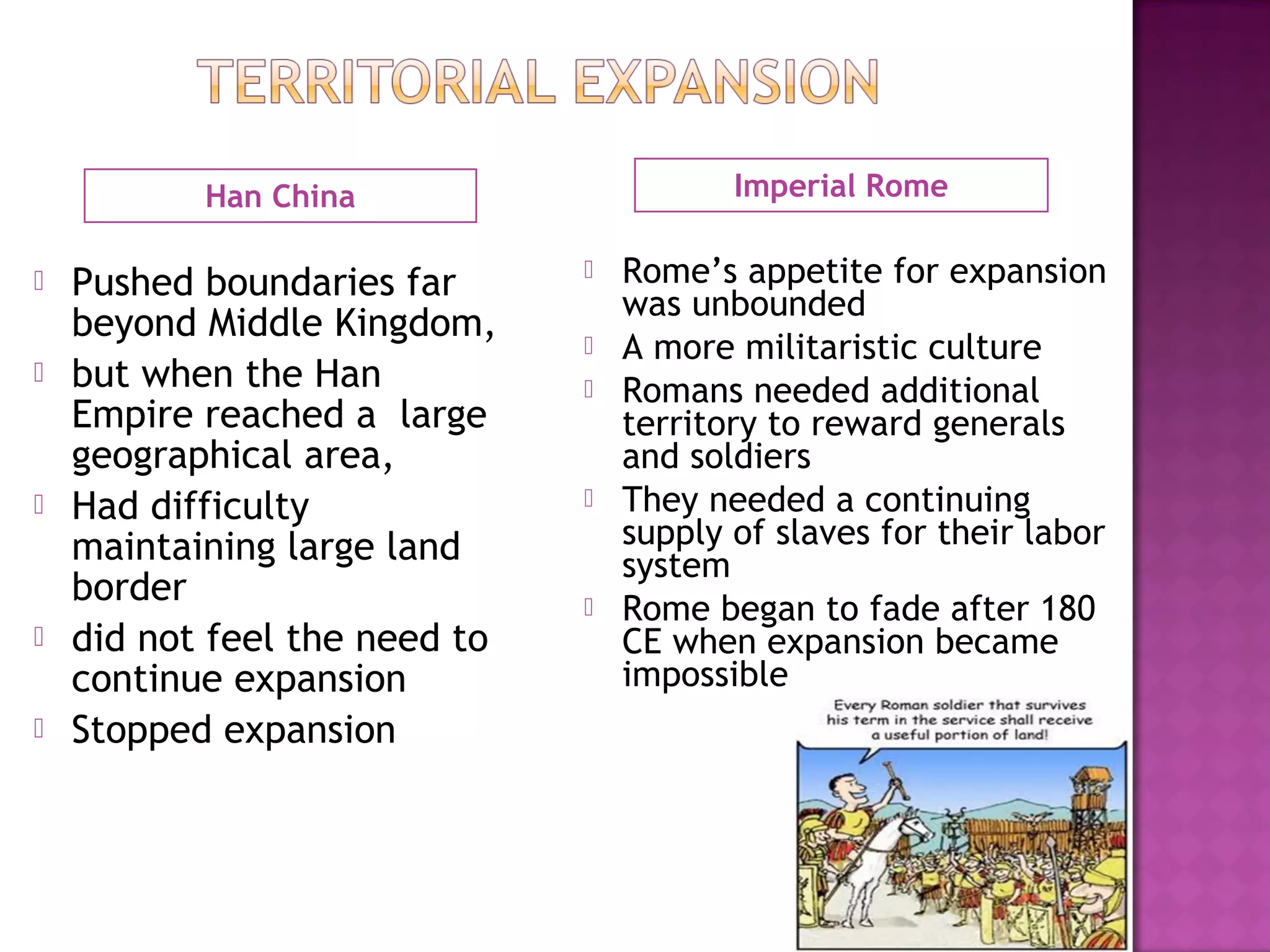
Romans needed additional
territory to reward generals
and soldiers
They needed a continuing
supply of slaves for their labor
system
Rome began to fade after 180
CE when expansion became
impossible




Rome’s
literature, art,
and architecture
was derived
from the Greeks
Classical China
was more
creative in the
area of
technology (e.g.
gunpowder)






Han emphasized
Confucianism and Rome’s
emphasis was on civic
religion
Both emphases called
attention to rituals and
themes that would bring
loyalty to the empire, but
neither was intensely
spiritual
Both are exposed to new
religions late in the
Classical Period






Military was
encouraged by both,
but more so by Rome
Rome known for tight
discipline and
organization of the
infantry known as the
legions
China known more for
military philosophy: Sun
Tzu’s The Art of War
still considered one of
the great works on
military strategy
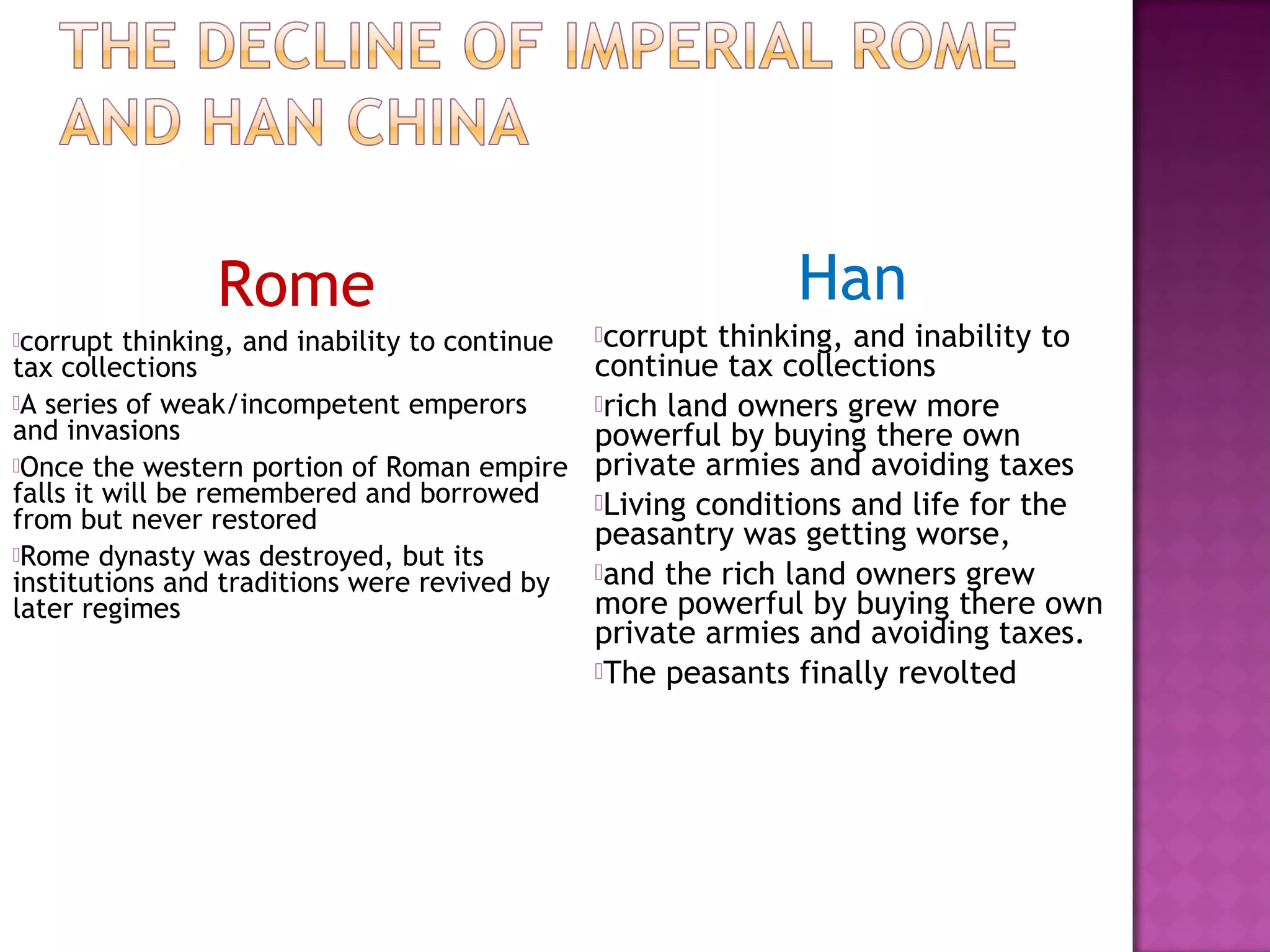
Rome
corrupt

thinking, and inability to continue
tax collections
A series of weak/incompetent emperors
and invasions
Once the western portion of Roman empire
falls it will be remembered and borrowed
from but never restored
Rome dynasty was destroyed, but its
institutions and traditions were revived by
later regimes

Han
corrupt

thinking, and inability to
continue tax collections
rich land owners grew more
powerful by buying there own
private armies and avoiding taxes
Living conditions and life for the
peasantry was getting worse,
and the rich land owners grew
more powerful by buying there own
private armies and avoiding taxes.
The peasants finally revolted

The roman empire_and_han_china

  • 1.
  • 2.
      Both lasted approximately400 years Both had population of about 50 million
  • 3.
    Han China builton earlier imperial traditions started by the Qin and Zhou Rome was built on controlling aristocratic landlords and a certain element of democracy
  • 4.
  • 5.
      Massive road building projects linkedcrucial parts of the empires Roads facilitated communication, economic activity, access to resources, and movement of military.
  • 6.
       Confucianism identified principles necessary forpolitical and social order Emphasized the emperors divine majesty Developed a sophisticated bureaucracy with gov representatives in the provinces
  • 7.
       Literature – writerswere eager to sing the praises of the emperor and the imperial system Bureaucracy less complex than Han, but greater emphasis on the legal system Monuments and triumphal processions played up the glory and grandeur of the empire itself and its rulers
  • 8.
    • Both systems expandedthe functions of government, using considerable powers of bureaucracy and taxation to provision major cities. • Both governments were actively engaged in a certain level of economic activity designed to ensure a stable social and political order.
  • 9.
      Large colonies of northernChinese were planted in newly conquered territories Use of Mandarin language required by the elite and bureaucrats and pushed heavily on all classes
  • 10.
        Colonies were smaller, basicallymilitary outposts not intended for population integration Latin was encouraged but never supplanted Greek in the east Expansion of Roman citizenship was emphasized Rome was content to establish looser control on provinces and rely on local autonomy
  • 11.
    Imperial Rome Han China      Pushedboundaries far beyond Middle Kingdom, but when the Han Empire reached a large geographical area, Had difficulty maintaining large land border did not feel the need to continue expansion Stopped expansion      Rome’s appetite for expansion was unbounded A more militaristic culture Romans needed additional territory to reward generals and soldiers They needed a continuing supply of slaves for their labor system Rome began to fade after 180 CE when expansion became impossible
  • 13.
      Rome’s literature, art, and architecture wasderived from the Greeks Classical China was more creative in the area of technology (e.g. gunpowder)
  • 14.
       Han emphasized Confucianism andRome’s emphasis was on civic religion Both emphases called attention to rituals and themes that would bring loyalty to the empire, but neither was intensely spiritual Both are exposed to new religions late in the Classical Period
  • 15.
       Military was encouraged byboth, but more so by Rome Rome known for tight discipline and organization of the infantry known as the legions China known more for military philosophy: Sun Tzu’s The Art of War still considered one of the great works on military strategy
  • 16.
    Rome corrupt thinking, and inabilityto continue tax collections A series of weak/incompetent emperors and invasions Once the western portion of Roman empire falls it will be remembered and borrowed from but never restored Rome dynasty was destroyed, but its institutions and traditions were revived by later regimes Han corrupt thinking, and inability to continue tax collections rich land owners grew more powerful by buying there own private armies and avoiding taxes Living conditions and life for the peasantry was getting worse, and the rich land owners grew more powerful by buying there own private armies and avoiding taxes. The peasants finally revolted

Editor's Notes

  • #2 Introduction The several centuries of success for Han China (202 BCE – 220 CE) and the Roman Empire (27 BCE – 476 CE) pinpoint possibilities for comparison in the classical period. They can also help and American audience combine more familiar knowledge, usually about Rome, with an appreciation for less familiar classical achievements, as in China. Both empires provided relative peace over wide areas, organized vigorous internal trading networks, and created immensely potent political systems. Elements of their achievements – Roman law, for example, or the Chinese principles of bureaucracy – would shape world history even to the present day. But the empires were also different, for example, in military and expansionist outlook and in cultural integration. These difference would affect the ultimate legacy of each empire.
  • #4 The two empires obviously had different origins The Han dynasty sprung more directly from earlier dynastic activity in classical China, replacing a period of disorder under the Zhou dynasty (which supplanted the Qin dynasty following the Warring States Period) with a focus on the importance of political order. Rome’s origins in politics had more to do with the control of the aristocratic landlords and the importance of a certain democratic element during the years of the Republic, both of which were overridden by the institution of the Empire.
  • #7 Both empires worked directly for political integration using slightly different mechanisms. In Han China, several devices combined to produce a political structure capable of ruling a vast empire. The Han dynasty attempted to further Confucian thought as a means of inculcating certain values in the elite, and if possible, other classes. The emperors continued a tradition of emphasizing their divine or semi-divine majesty. Finally, the Han introduced the first clear system of bureaucracy, in which the central government designated representatives in the provinces.
  • #8 Rome had its own methods of attaining political integration. Many Roman writers, particularly early in the empire, were eager to sing the praises of the emperors and the imperial system. Rome developed a somewhat more rudimentary bureaucracy than the Chinese, but the Romans placed more emphasis on the legal system and the rule of law across the empire. Rome did not usually assert the divinity of the emperors themselves, but surpassed the Han in imperial monuments, triumphal processions, and emphasis placed on the majesty of the emperor.
  • #10 The differences in these two systems of empire still seem to fall within a context of similarities. The Chinese regime worked harder at integrting its vast territory than the Romans. The Middle Kingdom in China in the classical period was the scene of major ethnic mixing and division, particularly in South China. The regime tackled this head-on by planting large numbers of people from the heart of the empire in the north to the south. Additionally, Mandarin was required by the elite and all levels of bureaucracy. Other classes were strongly encouraged to adopt Mandarin.
  • #11 Rome planted colonies in the hinterlands of their empire, but they were colonies of soldiers, and the hope was that they would begin to foster the Roman lifestyle among the conquered people of the remote provinces. These were smaller colonies and not intended for population integration. The Romans encouraged the use of Latin by the upper classes, although it never managed to erase the predominance of Greek in upper-class circles in the eastern Mediterranean. The Romans emphasized the expansion of Roman citizenship to those willing to serve in the Roman Army. Despite these integrating devices, Rome was content to establish looser control over most of its provinces and to rely on local autonomy.