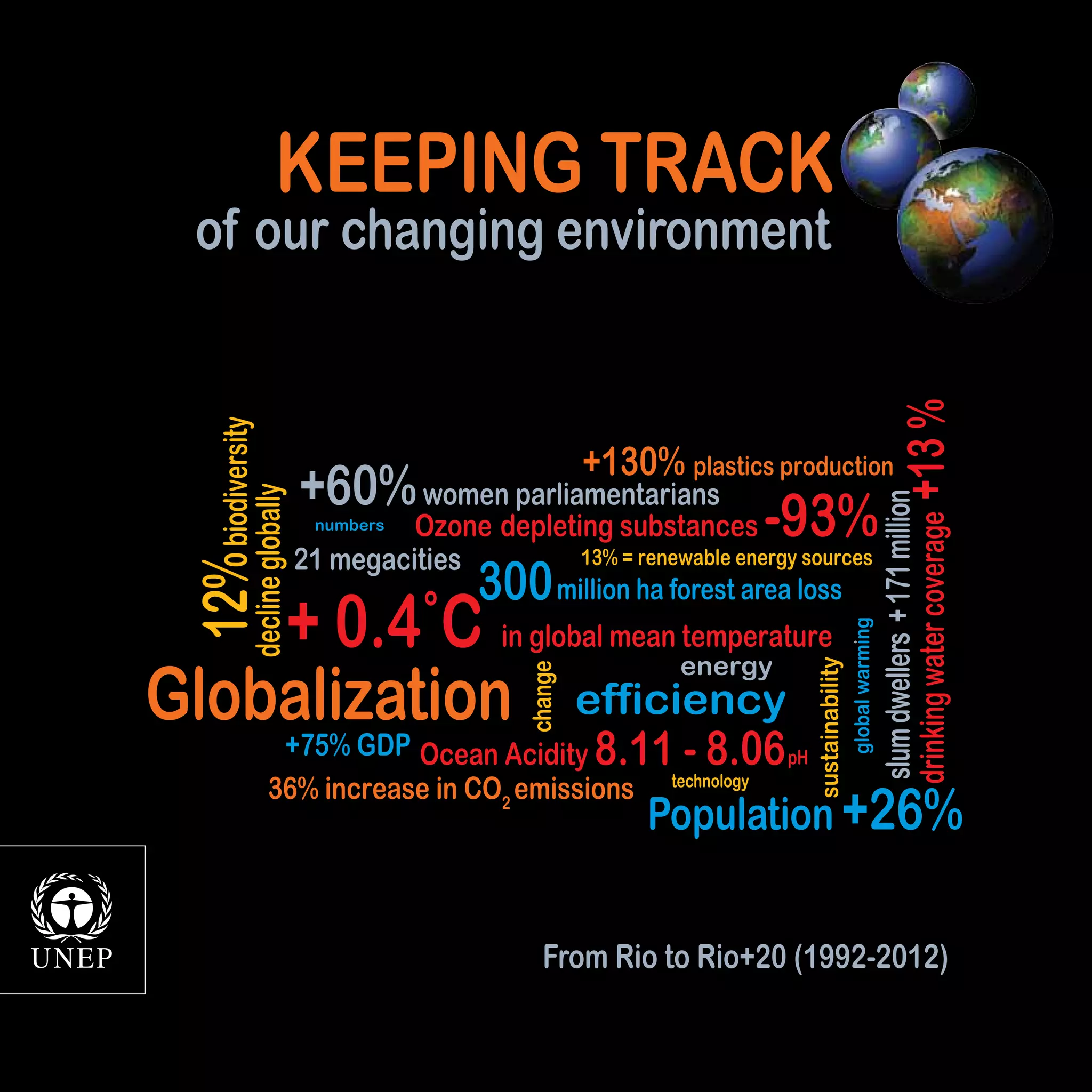

300 million ha forest area loss
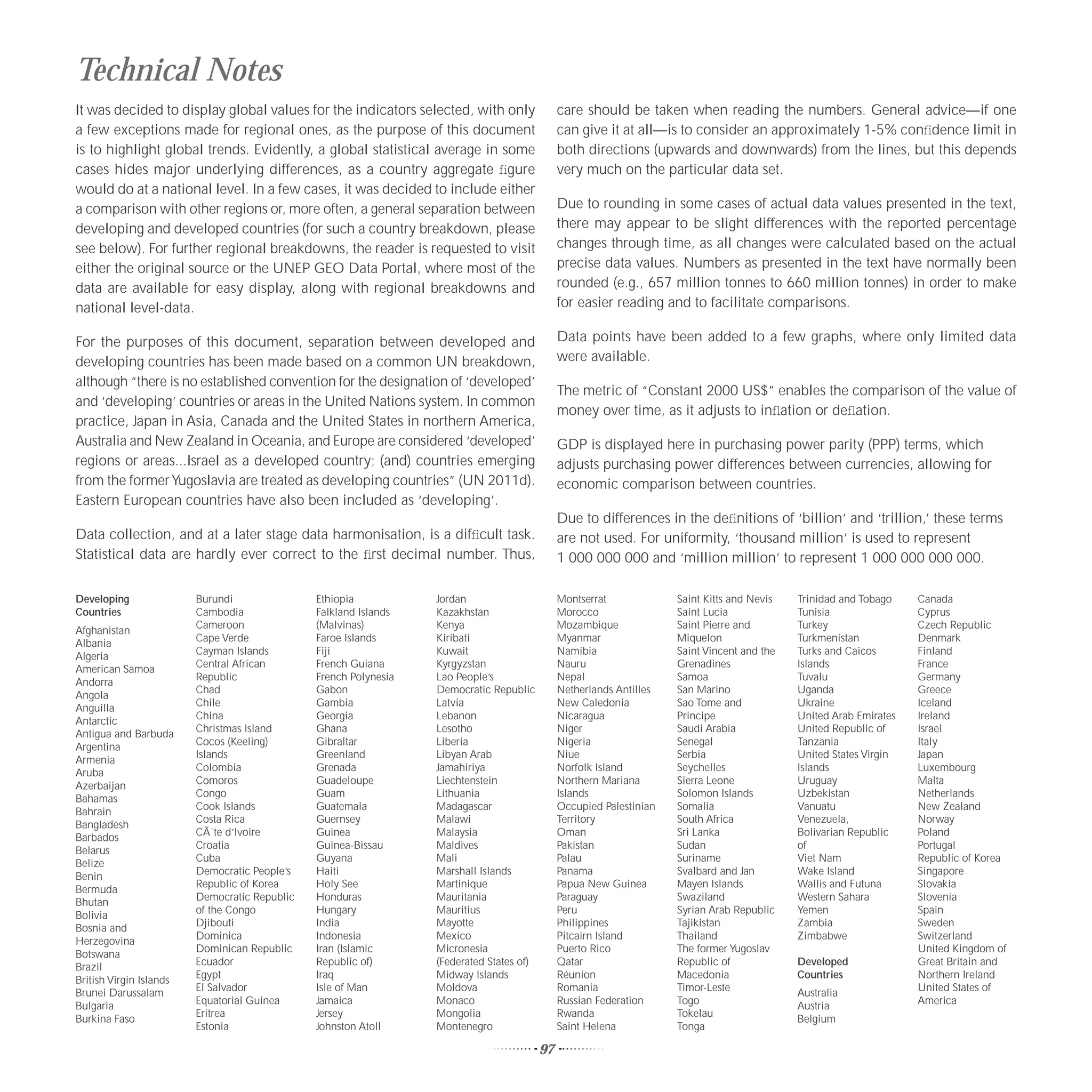
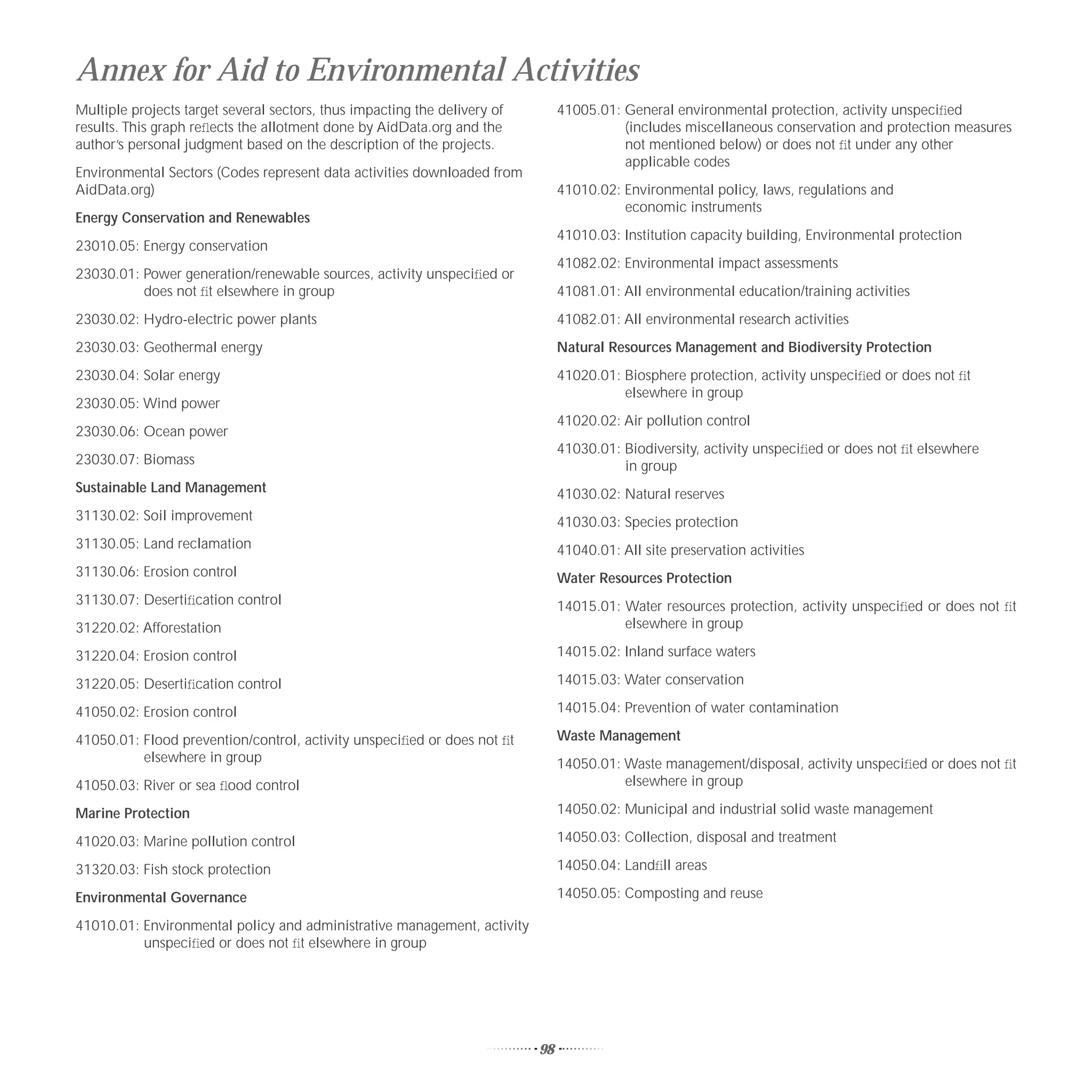
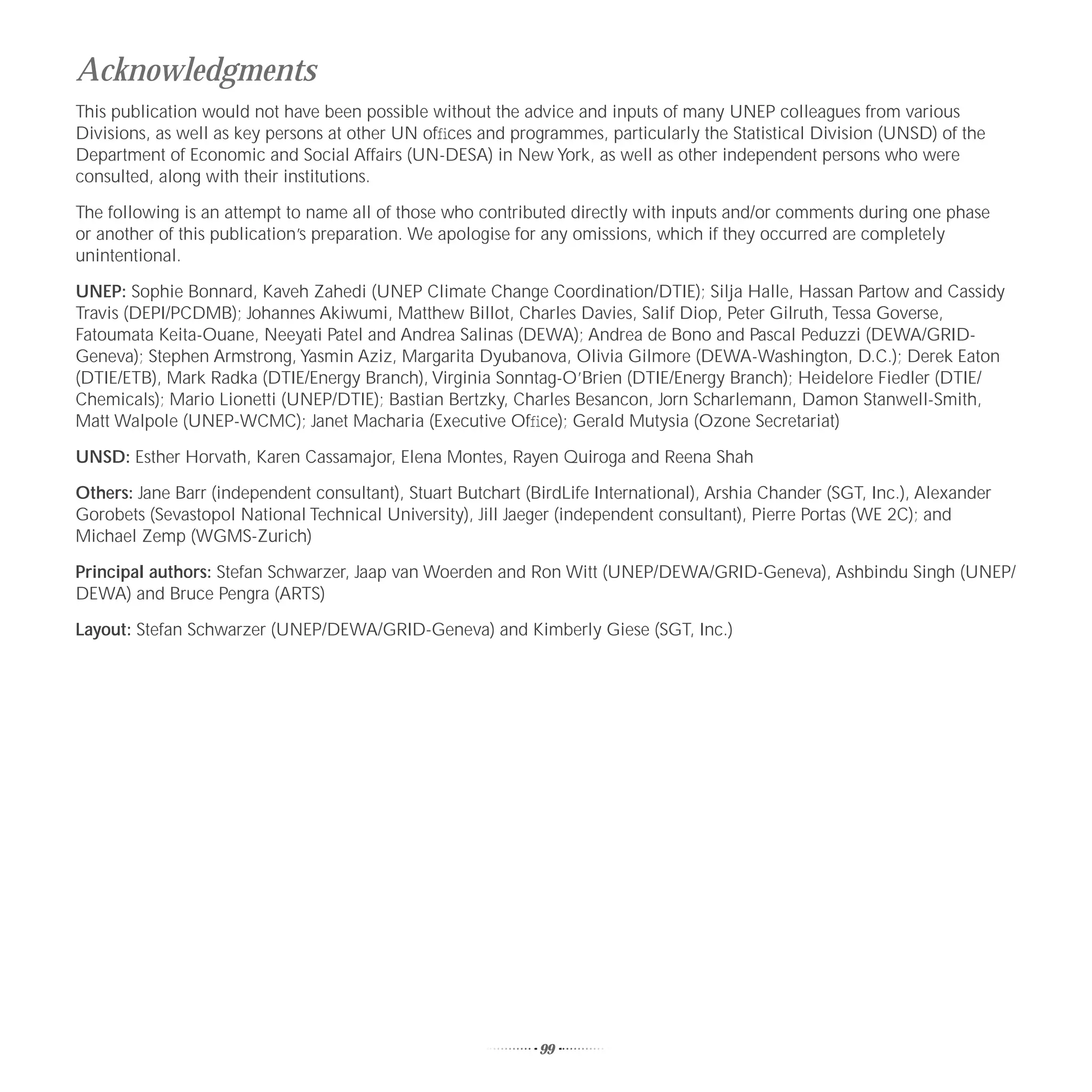
    + 0.4˚C
Globalization
                change


                           technology
© 2011 United Nations Environment Programme

Publication: Keeping Track of Our Changing Environment: From Rio to Rio+20 (1992-2012)
United Nations Environment Programme, Nairobi. Published October 2011
ISBN: 978-92-807-3190-3
Job Number: DEW/1234/NA


This Report has been prepared within the framework of UNEP’s fifth Global Environment Outlook (GEO-5) reporting process. It
complements the detailed information on the status and trends of the global environment and information on related policy measures.


Disclaimers
The content and views expressed in this publication are those of the authors and do not necessarily reflect the views or policies, or carry
the endorsement of the contributory organisations or the United Nations Environment Programme (UNEP). The designations employed and
the presentation of material in this publication do not imply the expression of any opinion whatsoever on the part of UNEP concerning the
legal status of any country, territory or city or its authorities, or concerning the delimitation of its frontiers and boundaries. Reference to a
commercial company or product in this publication does not imply the endorsement of UNEP.

© Maps, photos, and illustrations as specified.


Reproduction
This publication may be reproduced in whole or in part and in any form for educational or non-profit purposes without special permission
from the copyright holder, provided acknowledgement of the source is made. UNEP would appreciate receiving a copy of any publication
that uses this publication as a source. No use of this publication may be made for resale or any other commercial purpose whatsoever
without prior permission in writing from UNEP. Applications for such permission, with a statement of purpose and intent of the reproduction,
should be addressed to the Director, Division of Communications and Public Information (DCPI), UNEP, P.O. Box 30552, Nairobi 00100,
Kenya. The use of information from this publication concerning proprietary products for publicity or advertising is not permitted.

This publication was printed on 100 Per Cent chlorine free paper from sustainable managed forests using vegetable inks and
water-based varnish.


Citation
UNEP (2011). Keeping Track of Our Changing Environment: From Rio to Rio+20 (1992-2012).
Division of Early Warning and Assessment (DEWA), United Nations Environment Programme (UNEP), Nairobi


Produced by
UNEP Division of Early Warning and Assessment
United Nations Environment Programme
P.O. Box 30552
Nairobi, 00100, Kenya

Tel: (+254) 20 7621234
Fax: (+254) 20 7623927
E-mail: uneppub@unep.org
Web: www.unep.org
                                                                                                                                          UNEP
This publication is available from http://www.unep.org
                                                                                                                           promotes environmentally sound
                                                                                                                    practices globally and in its own activities. This
                                                                                                               publication is printed on 100 Per Cent chlorine free paper
                                                                                                              from sustainably managed forests. Our distribution policy
                                                                                                                        aims to reduce UNEP’s carbon footprint.

                                                                                         101
Keeping Track of Our Changing Environment
                    From Rio to Rio+20 (1992-2012)


                    i
Foreword
In 1992, the first United Nations Conference on Sustainable                         graphs show upward and downward trends, which, along with satellite
Development, popularly known as the Rio Earth Summit, was convened                 images, tell the story of dramatic changes.
in Rio de Janeiro, Brazil to address the state of the environment and
sustainable development. The Earth Summit yielded several important                Maintaining a healthy environment remains one of the greatest global
agreements including “Agenda 21”, a plan of action adopted by over                 challenges. Without concerted and rapid collective action to curb and
178 governments to address human impacts on the environment at                     decouple resource depletion and the generation of pollution from
local, national and global levels, and key treaties on climate change,             economic growth, human activities may destroy the very environment
desertification and biodiversity. At the second Conference in 2002—the              that supports economies and sustains life.
World Summit on Sustainable Development—governments agreed
                                                                                   The upcoming Rio+20 Conference presents a timely, global-level
on the Johannesburg Plan of Implementation, reaffirming their
                                                                                   opportunity to address one of its own stated objectives: to assess
commitment to Agenda 21. In 2012, the United Nations Conference
                                                                                   progress and gaps in implementing goals as part of an acceleration
on Sustainable Development, or Rio+20 Earth Summit, will focus
                                                                                   and scaling-up of transformative actions, programmes and policies. As
on the Green Economy in the context of sustainable development,
                                                                                   we move towards the Rio+20 Conference in an ever-more globalised
poverty eradication, and the institutional framework for sustainable
                                                                                   and integrated world, the need to chart progress towards a global
development. The object is to renew political commitment to
                                                                                   Green Economy and more efficient and effective international
sustainable development, review progress and identify implementation
                                                                                   environmental governance becomes vital. Without quantified targets,
gaps, and address new and emerging challenges.
                                                                                   our environmental goals cannot turn theory into reality. Numeric and
This publication serves as a timely update on what has occurred                    time-bound targets have certainly aided in progress made towards the
since the Earth Summit of 1992 and is part of the wider Global                     Millennium Development Goals (MDGs), for example, and should be
Environment Outlook-5 (GEO-5) preparations that will lead to the                   applied towards our environmental objectives as well.
release of the landmark GEO-5 report in May 2012. It underlines
                                                                                   This publication helps to tell the story of where the world was 20
how in just twenty years, the world has changed more than most of
                                                                                   years ago and where we collectively stand today, and to show the
us could ever have imagined—geopolitically, economically, socially
                                                                                   direction in which we need to move in a post-Rio+20 world. It also
and environmentally. Very few individuals outside academic and
                                                                                   highlights the missing pieces in our knowledge about the state of
research communities envisaged the rapid pace of change or foresaw
                                                                                   environment— such as those related to freshwater quality and quantity,
developments such as the phenomenal growth in information and
                                                                                   ground water depletion, ecosystem services, loss of natural habitat, land
communication technologies, ever-accelerating globalisation, private
                                                                                   degradation, chemicals and waste—due to lack of regular monitoring,
sector investments across the world and the rapid economic rise of
                                                                                   collection and compilation of data. Scientifically-credible data for
a number of “developing” countries. Many rapid changes have also
                                                                                   environmental monitoring remains inadequate and the challenge of
taken place in our environment, from the accumulating evidence
                                                                                   building in-country capacity to produce better policy-relevant data
of climate change and its very visible impacts on our planet, to
                                                                                   needs urgent attention.
biodiversity loss and species extinctions, further degradation of land
surfaces and the deteriorating quality of oceans. Certainly, there have            We hope this report will inform all those participating in the Rio+20
been some improvements in the environmental realm, such as the                     events and the entire process and help set the world on a path towards
significant reduction in ozone-depleting chemicals and the emergence                a more sustainable environment.
of renewable energy sources, new investments into which totalled
more than $200 thousand million in 2010. But in too many areas,
the environmental dials continue to head into the red.

This innovative report is based entirely on statistical data and indicators
and shows where the world stands on many social, economic and
environmental issues as we enter the second decade of the 21st century.
                                                                                                             Achim Steiner
Drivers of environmental change including population increase and
                                                                                                             United Nations Under-Secretary-General
economic growth, and especially the status of natural resources and
landscapes, are clearly illustrated. Numbers plotted on straightforward                                      and Executive Director, UNEP

                                                                              ii
Table of Contents
 iv   Introduction & Scope                         30   Warmest Years on Record                             64 Saudi Arabia Irrigation Project (Satellite Image)
                                                   31   Earth Global Temperature Changes by Latitude        65 Organic Farming
 v    What’s New Since Rio 1992?                   32   Ocean Temperature Deviation                         66 Selected Crops in Humid Tropical
                                                   32   Global Mean Sea Level                                  Countries, Area
vii   Goals & Targets in the                       33   Ocean Acidification                                  66 Selected Crops in Humid Tropical Countries,
      Global Environment                                                                                       Change in Area
                                                   34   Mountain Glacier Mass Balance
                                                                                                            67 Grazing Animal Herds
      Population & Human Development               35   September Arctic Sea Ice Extent
 2    Total Population                             35   September Arctic Sea Ice Extent (Satellite Image)        Fisheries
 2    Historical World Population                                                                           69   Exploitation of Fish Stocks
                                                        Forests
 3    Population Growth Rate                                                                                70   Total Fish Catch
                                                   37   Forest Net Change
 4    Urban Population                                                                                      70   Tuna Catches
                                                   37   Mangrove Forest Extent
 5    Megacities                                                                                            71   Fish Catch and Aquaculture Production
                                                   38   Mato Grosso, Amazon Rainforest (Satellite Image)
 5    Top 10 Megacities                                                                                     72   Shrimp and Prawn Aquacultures (Satellite Image)
                                                   39   Forest Plantation Extent
 6    Population in China’s Pearl River Delta      39   Roundwood Production
      (Satellite Image)                                                                                          Energy
                                                   40   Certified Forest Area                                74   Energy Consumption per Capita - Total
 7    People Living in Slums
 8    Age Distribution                                Water                                                 74   Energy Consumption per Capita - Change
 8    Life Expectancy                              42 Improved Sanitation & Drinking Water Coverage         75   Electricity Production
 9    Food Supply                                  43 Mesopotamian Marshlands (Satellite Image)             75   Electricity Production per Capita
10    Human Development Index                                                                               76   Nightlights
                                                        Biodiversity
11    Proportion of Seats Held by Women                                                                     77   Primary Energy Supply
                                                   45   Living Planet Index
      in National Parliaments                                                                               78   Renewable Energy Supply, Total
                                                   46   Red List Index
                                                                                                            78   Renewable Energy Supply, Change
      Economy                                      47   Protected Areas, Total Area
                                                                                                            79   Biofuels Production
13    GDP per Capita, Total                        47   Protected Areas, Per cent
                                                                                                            80   Investment in Sustainable Energy
13    GDP per Capita, Change                          Chemicals & Waste                                     81   Nuclear Power Plants
14    Per Capita Gross Domestic Product            49 Oil Spills from Tankers                               81   Electricity Production & Nuclear Share
14    Gross Domestic Product–per Capita (Map)      50 Plastics Production                                   82   Oil Sands (Satellite Image)
15    Trade
16    Global Materials Extraction                       Natural Hazards                                          Industry, Transport & Tourism
17    Resource Efficiency                           52   Impacts of Natural Disasters                        84 Cement & Steel Production
                                                   52   Reported Natural Disasters                          85 Air Transport
      Environmental Trends                         53   Floods–Mortality Risk, Exposure and Vulnerability   86 International Tourism, Arrivals
      Atmosphere                                   53   Tropical Cyclones - Mortality Risk, Exposure
                                                        and Vulnerability                                        Technology
21    Emissions of CO2 - Total                                                                              88 Internet Users & Mobile Phone Subscribers
21    Emissions of CO2 - per Capita                   Governance
22    Emissions of CO2 - Total, by Type            55 Multilateral Environmental Agreements, Number         90   Epilogue
22    Emissions of CO2 - Change, by Type              and Signatories
                                                   55 Number of MEAs Signed (Map)                           91   Data Sources
23    Emissions of CO2 per GDP
24    GHG Emitters by Sector                       56 ISO 14001 Certifications                               93   References
25    Consumption of Ozone-Depleting Substances    57 Carbon Market Size
25    Ozone Hole, Area and Minimum Ozone           58 Total Foreign Aid and Environmental Aid               93   Acronyms
                                                   59 Aid Allocated to Environmental Activities
26    Ozone Hole Images                                                                                     97   Technical Notes
   Climate Change                                     Agriculture
                                                   61 Food Production Index                                 98   Annex for Aid To
28 Atmospheric CO2 Concentration/Keeling Curve                                                                   Environmental Activities
29 Global Annual Mean Temperature Anomaly          62 Cereal Production, Area Harvested
                                                      and Fertilizer Consumption
29 Temperature Deviation 2000-2009 vs. Mean                                                                 99   Acknowledgments
   1951-1980 (Map)                                 63 Total Area Equipped for Irrigation
                                                                             iii
Introduction & Scope
This publication was conceived with the idea of showing how               To ensure reliability, indicator charts are only presented for areas
the planet has changed in two decades—just twenty years—                  where all three data requirements were met. For areas where
since decision-makers met at the United Nations Conference                one or another of the criteria was not met, such as freshwater
on Environment and Development in Rio de Janeiro. To                      water availability, groundwater depletion, land degradation and
relay this information in a compelling and succinct manner,               chemicals and waste, any analysis might not be reliable, and so
environmental and related trends are charted and presented                trends are not provided. Also, the availability of data related to
using globally-aggregated (and mainly statistical) data sets              the environment and natural resources that are disaggregated
collected by international agencies, research bodies and other            by gender (i.e., qualitatively) or sex (i.e., quantitatively) is
official entities.                                                         generally poor, especially for developing countries.

Major economic, environmental, social and technological                   The implications of any shortcomings in the data are clear. To
trends are shown through numerically-based graphs, with their             promote evidence-based environmental policies and actions,
upward, downward or stable trend lines as dictated by the                 the underlying data needed to support sound decision-making
data. While most of these trends speak for themselves, short              must be part of the equation and be of proven scientific
explanations of the phenomena observed are also provided for              quality. Today, there are several reasons why the quality of
further elucidation. Also included are a number of illustrative           international statistics varies greatly. First, statistics may not
“before and after” satellite images, primarily covering the same          be available at the national level; second, the statistics that
time period of 1992-2010 and showing environmental changes                are collected may be of poor quality or outdated; and third,
at the local level. In some cases, these impacts are ongoing.             the comparability of statistics over time inherently presents
                                                                          challenges. These deficiencies and issues demonstrate the need
Scope and Methodology                                                     for a comprehensive data and information system to optimally
                                                                          manage the vast array of related policy, scientific, technical,
Most of the time-series data were collected directly from
                                                                          methodological and practical issues. For this to be achieved,
countries and aggregated to regional and global levels by
                                                                          the following steps are necessary:
authoritative international agencies. The time series indicators
presented here are based on the best and most comprehensive               (1) strengthen national-level capacity for collecting and
data available to date.                                                   compiling environmental observations, especially where data
                                                                          gaps exist;
Three main criteria were used to select the indicators employed
in this publication. First, an approximately 20-year temporal             (2) publish and provide access to data using various media; and
data record on which the trend charts could be based was
required, so as to accurately portray the time period in question.        (3) develop services to efficiently and rapidly provide information
In a few cases (and particularly for recent phenomena such as             to decision-makers in (an) understandable format(s).
carbon trading), a correspondingly shorter time period was used
                                                                          Thus, a comprehensive capability at the global scale is needed
to provide at least a partial picture to date. Second, the data on
                                                                          to pull together and analyze the wealth of data collections
which the charts are based had to be global in coverage—that
                                                                          that are available, and to enhance data collection for areas
is, covering all or at least most countries so as to represent the
                                                                          where information may be lacking. Within these limitations, it
entire world and not only certain regions. Third, the data had
                                                                          is hoped that this publication provides a clear and reasonably
to be clearly sourced and taken from authoritative and reliable
                                                                          comprehensive twenty-year story on the state and trends in
institutions with extensive experience in the thematic areas
                                                                          environment and development since 1992.
treated in each case.


                                                                     iv
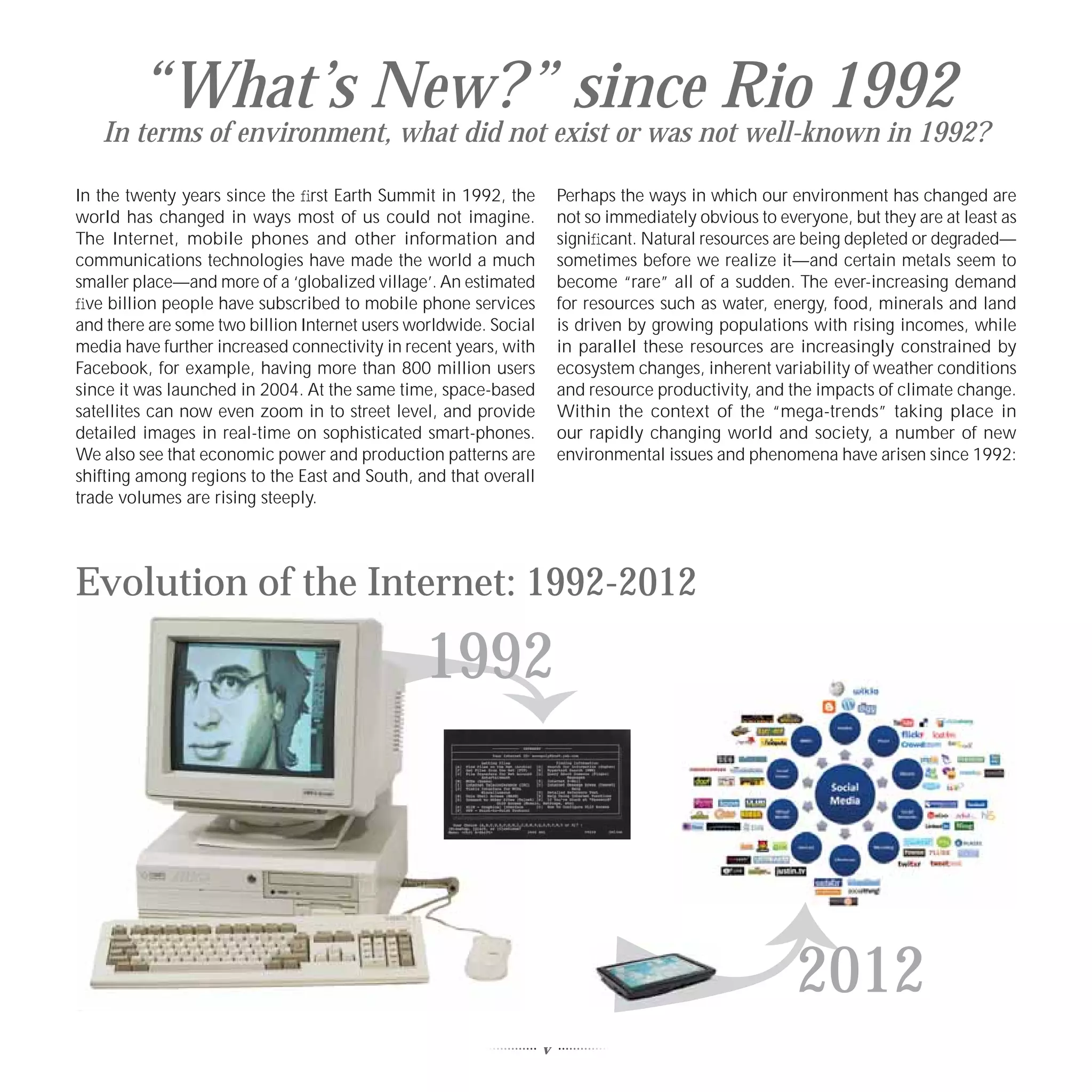
“What’s New?” since Rio 1992
   In terms of environment, what did not exist or was not well-known in 1992?

In the twenty years since the first Earth Summit in 1992, the          Perhaps the ways in which our environment has changed are
world has changed in ways most of us could not imagine.               not so immediately obvious to everyone, but they are at least as
The Internet, mobile phones and other information and                 significant. Natural resources are being depleted or degraded—
communications technologies have made the world a much                sometimes before we realize it—and certain metals seem to
smaller place—and more of a ‘globalized village’. An estimated        become “rare” all of a sudden. The ever-increasing demand
five billion people have subscribed to mobile phone services           for resources such as water, energy, food, minerals and land
and there are some two billion Internet users worldwide. Social       is driven by growing populations with rising incomes, while
media have further increased connectivity in recent years, with       in parallel these resources are increasingly constrained by
Facebook, for example, having more than 800 million users             ecosystem changes, inherent variability of weather conditions
since it was launched in 2004. At the same time, space-based          and resource productivity, and the impacts of climate change.
satellites can now even zoom in to street level, and provide          Within the context of the “mega-trends” taking place in
detailed images in real-time on sophisticated smart-phones.           our rapidly changing world and society, a number of new
We also see that economic power and production patterns are           environmental issues and phenomena have arisen since 1992:
shifting among regions to the East and South, and that overall
trade volumes are rising steeply.


Evolution of the Internet: 1992-2012

                                               1992


                                                                                                       2012
                                                                  v
New Multilateral Environmental Agreements                                Endorsement of Forest Certification (PEFC) for forest products,
and Conventions                                                          the Marine Stewardship Council (MSC) for fish products, and
Several new Multilateral Environmental Agreements (MEAs) and             “bio” or organic labels for many agricultural products including
Conventions have been established or entered into force in the           coffee, tea and dairy products.
last two decades to address emerging global environmental
issues, including the United Nations Framework Convention                Genetically Modified Organisms
on Climate Change (UNFCCC), the Convention on Biological
                                                                         Genetically Modified Organisms (GMOs) have been researched
Diversity (CBD), agreements related to chemicals (Basel,
                                                                         for decades, but have gained widespread attention in recent
Rotterdam and Stockholm Conventions), and the United Nations
                                                                         years, mainly due to prospects for increased food production.
Convention to Combat Desertification (UNCCD).
                                                                         However, they remain controversial for a variety of reasons.

Awareness of Climate Change
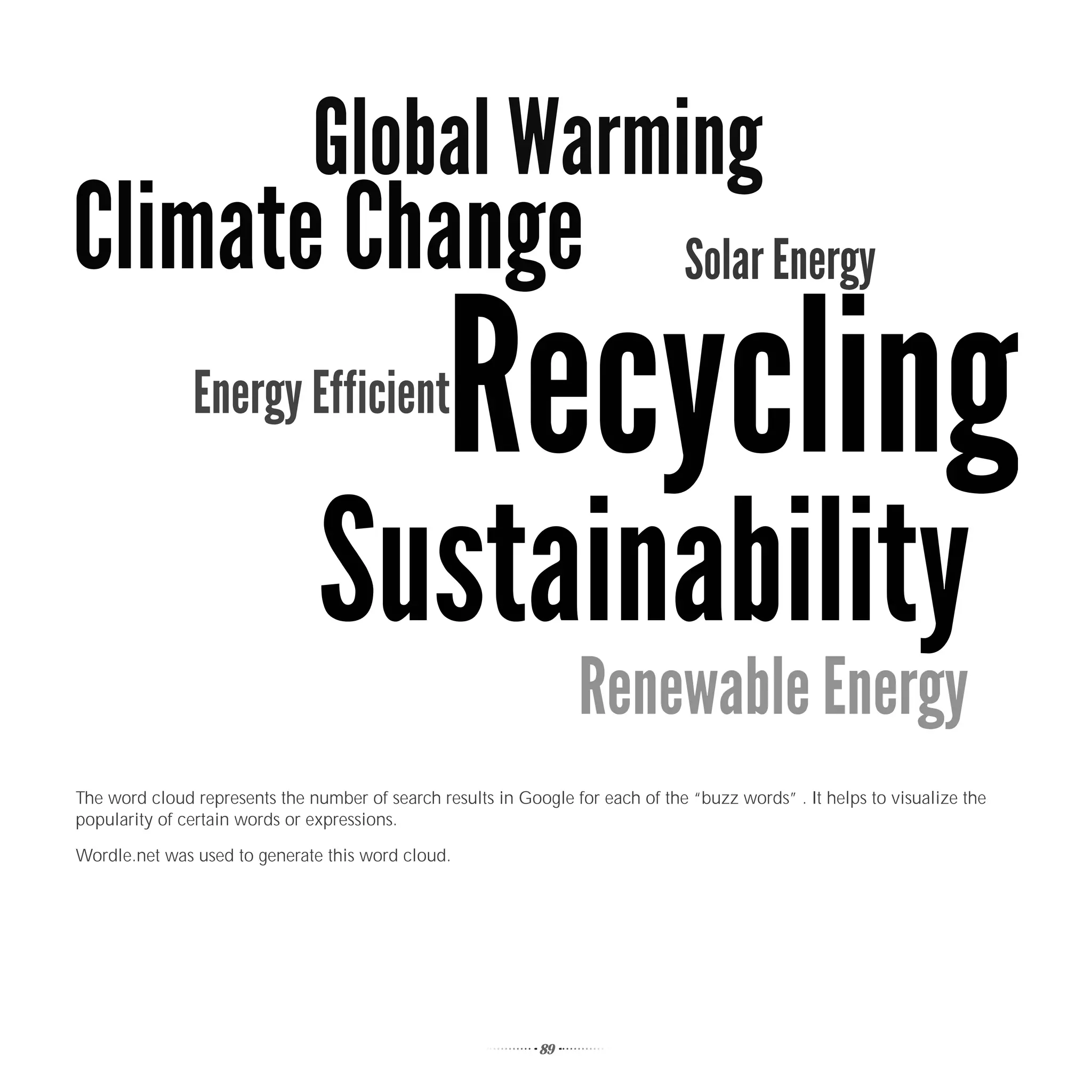
                                                                         Recycling
Among much debate and controversy, Climate Change has
                                                                         Although recycling efforts are only beginning in many parts
become a “hot topic” and entered the policy arena, topping
                                                                         of the world, processing waste into new resources, products
the global environmental agenda.
                                                                         and materials is becoming mainstream policy and practice in
                                                                         several countries and regions.
The Green Economy
Viable pathways for fundamentally shifting economic                      Commercialization of Biofuels, Solar and Wind Energy
development to become more low-carbon, climate resilient,
                                                                         While the overall use of renewable energy is still modest,
resource efficient, and socially inclusive, as well as for valuing
                                                                         biofuels are gaining a significant market share, and wind and
ecosystem services, are now being proposed widely and
                                                                         solar power production is increasing steeply. Windmills and
increasingly pursued.
                                                                         solar panels are increasingly abundant, and in the transport
                                                                         sector, hybrid cars have entered the streets and air transport
Carbon Trading and other Environmental Market Tools                      using biofuels are becoming a reality.
Placing a monetary value on greenhouse gas emissions and
creating a market for trade in carbon is a new and increasingly          Chemicals Management
utilized concept to address climate change. Other new market
                                                                         Management of toxic and other hazardous chemicals that
frameworks include biodiversity offset and compensation
                                                                         threaten human and ecosystem health has improved. A number
programs, habitat credit trading and conservation banking, with
                                                                         of deadly chemicals have been banned, and as of January 2010
a goal toward reducing biodiversity loss and mainstreaming
                                                                         the world is free of chlorofluorocarbons (CFC) production.
impacts into economic decisions. Worldwide, at least 45
compensatory mitigation programs and more than 1 100
mitigation banks now exist (UNDP and GEF 2011).                          Nano Materials
                                                                         Nanotechnology offers significant opportunities and benefits
Markets for Organic Products and Eco-labeling                            for industry and society at large, especially in the fields of
                                                                         energy, health care, clean water and climate change. But debate
Consumer demand for goods that are produced in a sustainable
                                                                         about this new technology continues and related potential
way has boosted certification and eco-labeling, such as the
                                                                         environmental hazards and risks could be emerging.
Forest Stewardship Council (FSC) and the Programme for the


                                                                    vi
Goals & Targets
                                     in the global environment
One of the obstacles to achieving environmental goals set by the         Specific Sets of Environmental Targets
international community is the lack of sufficient, solid data and
                                                                         The Millennium Development Goals (MDGs)
monitoring systems to measure progress. While for two of the
interdependent areas of sustainable development—economic                 In September 2000, leaders from 189 nations agreed on a vision
development and social development—the goals are normally                for the future: a world with less poverty, hunger and disease;
measured and tracked quantitatively, environmental targets               greater survival prospects for mothers and their infants; better-
are largely defined in qualitative terms. On the other hand,              educated children; equal opportunities for women; a healthier
those environmental agreements for which specific numerical               environment; and a world in which developed and developing
targets were set, have been relatively successful. Already in            countries work in partnership for the betterment of all. This
the 1960s, for example, the World Commission on Protected                vision took the shape of eight Millennium Development Goals
Areas (WCPA) set a target of 10% of global land area to be               (MDGs), which provide a framework of time-bound targets
designated as formally protected; today, nearly 13% of the               by which progress can be measured. A concise framework of
world’s surface is now set aside as protected. Similarly, the            eight goals and 21 targets towards the MDGs was adopted,
Montreal Protocol on Substances that Deplete the Ozone Layer             along with 60 indicators to measure and show progress. While
defines mandatory targets and specific timeframes within which             environment as a crosscutting theme is part of several MDGs,
the required reductions must be met, and it conducts regular             its significance in the overall framework is most prominently
reviews of phase-outs in accordance with scientific updates.              highlighted in MDG-7: Ensuring Environmental Sustainability.
It has been hailed as perhaps the most effective environmental           MDG-7 is divided into four targets as set forth below. They
agreement to date. More such initiatives are needed to promote           emphasize sustainability principles and reversing natural
evidence-based environmental policies and measure progress.              resource degradation; reducing biodiversity loss; increasing
The following is a summary of environment-related goals that             access to safe drinking water and sanitation; and improving
incorporate targets and indicators since 1992.                           slums (Table 1).
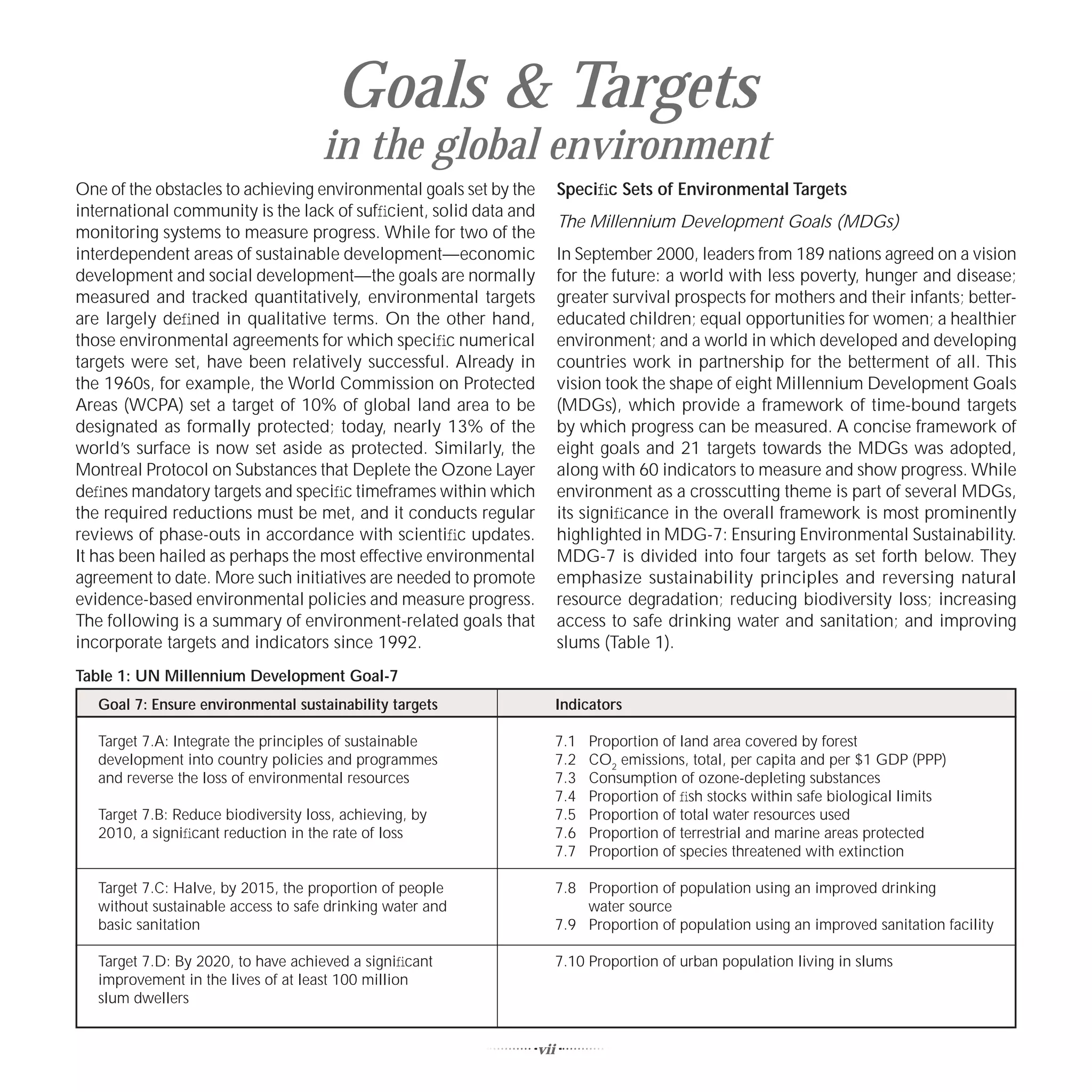
Table 1: UN Millennium Development Goal-7
   Goal 7: Ensure environmental sustainability targets                   Indicators

   Target 7.A: Integrate the principles of sustainable                   7.1   Proportion of land area covered by forest
   development into country policies and programmes                      7.2   CO2 emissions, total, per capita and per $1 GDP (PPP)
   and reverse the loss of environmental resources                       7.3   Consumption of ozone-depleting substances
                                                                         7.4   Proportion of fish stocks within safe biological limits
   Target 7.B: Reduce biodiversity loss, achieving, by                   7.5   Proportion of total water resources used
   2010, a significant reduction in the rate of loss                      7.6   Proportion of terrestrial and marine areas protected
                                                                         7.7   Proportion of species threatened with extinction

   Target 7.C: Halve, by 2015, the proportion of people                  7.8 Proportion of population using an improved drinking
   without sustainable access to safe drinking water and                     water source
   basic sanitation                                                      7.9 Proportion of population using an improved sanitation facility

   Target 7.D: By 2020, to have achieved a significant                    7.10 Proportion of urban population living in slums
   improvement in the lives of at least 100 million
   slum dwellers


                                                                   vii
The World Summit on Sustainable Development                              the Parties adopted a revised and updated Strategic Plan for
                                                                         Biodiversity for the 2011-2020 period, including the set of Aichi
Additional environmental targets were subsequently adopted
                                                                         Biodiversity Targets comprising five strategic goals and 20 targets.
in 2002 at the World Summit on Sustainable Development
                                                                         However, these targets have no clear numerical goals, except
(WSSD). These relate to: fisheries; marine protection; biodiversity
                                                                         the following ones:
loss; access to renewable energy; and phasing out of organic
pollutants (Table 2).                                                        Target 5: By 2020, the rate of loss of all natural habitats,
                                                                             including forests, is at least halved and where feasible
Table 2: Environmental targets adopted at the WSSD, 2002                     brought close to zero, and degradation and fragmentation
                                                                             is significantly reduced.
 Targets                              Indicators
                                                                             Target 11: By 2020, at least 17% of terrestrial and inland
 Maintain or restore depleted fish     To be determined                       waters, and 10% of coastal and marine areas, especially
 stocks to levels that can produce                                           areas of particular importance for biodiversity and
 the maximum sustainable yield
 by 2015                                                                     ecosystem services, are conserved through effectively and
                                                                             equitably managed, ecologically representative and well-
 Reverse the loss of biodiversity     Identified by Convention                connected systems of protected areas and other effective
 by 2010                              on Biological Diversity (CBD)
                                                                             area-based conservation measures, and integrated into
 Establish a representative network To be determined                         the wider landscapes and seascapes.
 of marine protected areas by 2012
                                                                         To conclude, with specific quantitative goals being absent, the
 Increase the share of renewable      To be determined
 energy in the total energy supply,                                      above targets may read more like recommendations. However,
 and provide 35% of African                                              when goals incorporate numerical levels or values, the required
 households with modern energy                                           achievement is more clearly defined and potentially obtainable.
 within 20 years                                                         In fact, empirical evidence shows that goal-setting can work
 Phase out by 2020, production        To be determined                   when clear quantitative targets are set. Another lesson learned
 and use of chemicals that harm                                          from the history of environmental target-setting is that it works
 health and environment                                                  best for well-defined issues, such as the phasing out of Ozone
                                                                         Depleting Substances (ODS) or leaded gasoline, and for issues
                                                                         related to industrial chemicals for which technologies exist or
The Copenhagen Accord                                                    can be developed to solve environmental problems associated
In 2009, the Copenhagen Accord recognised the need for                   with their production and use. Finally, it has become clear
emission targets that will hold the increase in global temperature       that it is critical to have baseline information to allow progress
below 2°C —equated by scientists to a concentration level of             towards the targets to be tracked. For example, relatively little
450 ppm (parts per million) of carbon dioxide in the atmosphere.         measurable progress has been made—or can be demonstrated—
The Accord today is supported by 114 countries.                          towards the WSSD target to “reverse the loss of biodiversity by
                                                                         2010”, since there are insufficient, reliable and comprehensive
Aichi Biodiversity Targets                                               biodiversity baseline data upon which to base trends and
At its tenth meeting in Nagoya, Japan in October 2010, the               assess progress.
Convention on Biological Diversity (CBD) Conference of


                                                                      viii
Population &
Human Development


                    Brian Gratwicke/Flickr.com
        1
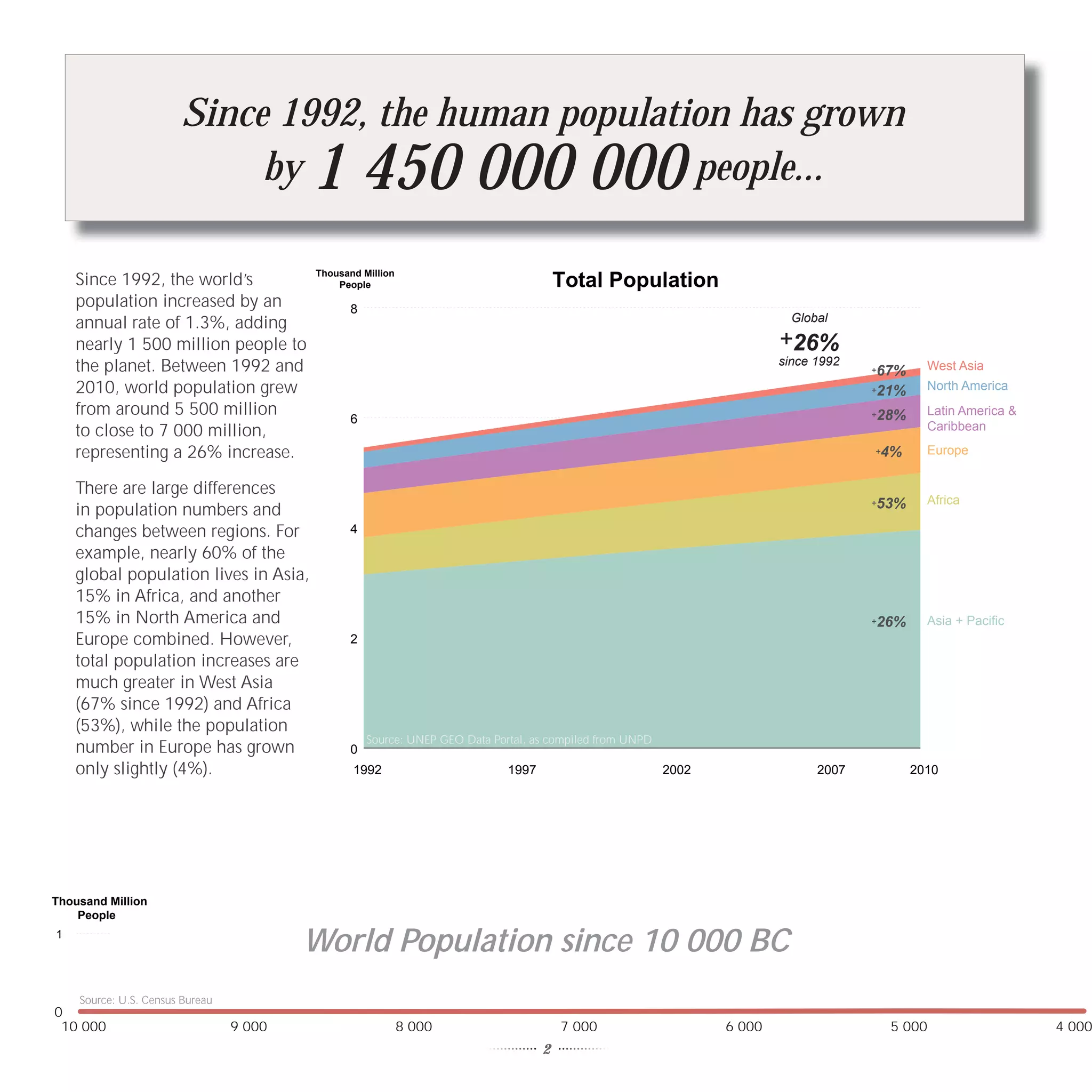
Since 1992, the human population has grown
                             by          1 450 000 000people...

    Since 1992, the world’s              Thousand Million
                                             People                                     Total Population
    population increased by an                  8
    annual rate of 1.3%, adding                                                                                            Global

    nearly 1 500 million people to                                                                                       +26%
    the planet. Between 1992 and                                                                                         since 1992
                                                                                                                                      +   67%     West Asia
    2010, world population grew                                                                                                       +   21%     North America
    from around 5 500 million                   6                                                                                     +   28%     Latin America &
    to close to 7 000 million,                                                                                                                    Caribbean

    representing a 26% increase.                                                                                                      +   4%      Europe


    There are large differences
                                                                                                                                          53%     Africa
    in population numbers and
                                                                                                                                      +


    changes between regions. For                4
    example, nearly 60% of the
    global population lives in Asia,
    15% in Africa, and another
    15% in North America and                                                                                                          +   26%     Asia + Pacific
    Europe combined. However,                   2
    total population increases are
    much greater in West Asia
    (67% since 1992) and Africa
    (53%), while the population
                                                    Source: UNEP GEO Data Portal, as compiled from UNPD
    number in Europe has grown                  0
    only slightly (4%).                         1992                         1997                         2002                 2007             2010


Thousand Million
    People
1
                                         World Population since 10 000 BC
    Source: U.S. Census Bureau
0
 10 000                          9 000                      8 000                       7 000                    6 000                     5 000                    4 000
                                                                                    2
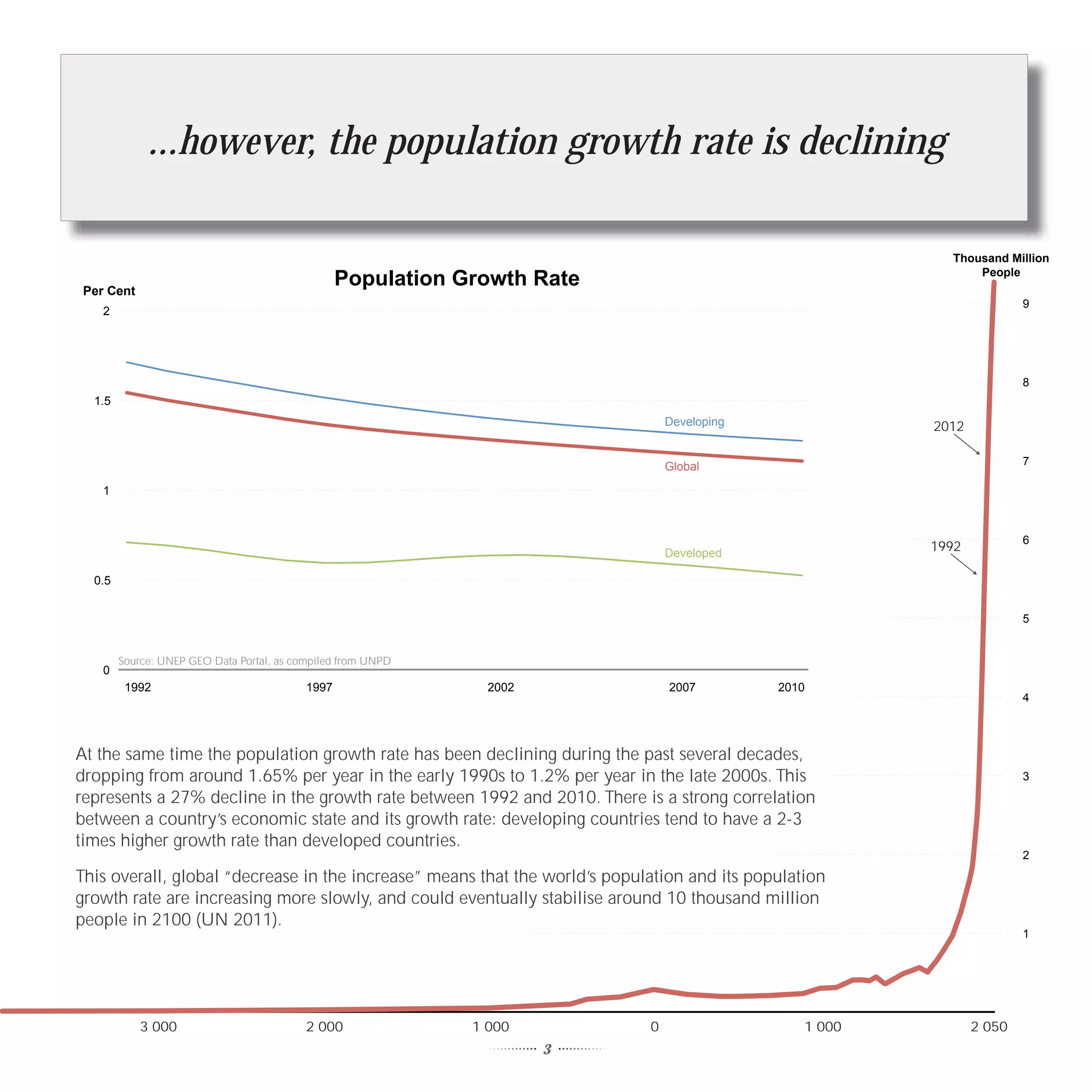
...however, the population growth rate is declining

                                                                                                           Thousand Million
                                                                                                               People
 Per Cent
                                                  Population Growth Rate
                                                                                                                        9
    2


                                                                                                                        8
  1.5
                                                                                Developing               2012

                                                                                Global                                  7

    1


                                                                                                                        6
                                                                                Developed
                                                                                                         1992

  0.5


                                                                                                                        5


        Source: UNEP GEO Data Portal, as compiled from UNPD
    0
         1992                              1997                 2002            2007         2010
                                                                                                                        4


At the same time the population growth rate has been declining during the past several decades,
dropping from around 1.65% per year in the early 1990s to 1.2% per year in the late 2000s. This                         3
represents a 27% decline in the growth rate between 1992 and 2010. There is a strong correlation
between a country’s economic state and its growth rate: developing countries tend to have a 2-3
times higher growth rate than developed countries.
                                                                                                                        2
This overall, global “decrease in the increase” means that the world’s population and its population
growth rate are increasing more slowly, and could eventually stabilise around 10 thousand million
people in 2100 (UN 2011).
                                                                                                                        1


            3 000                          2 000              1 000         0                    1 000          2 050
                                                                       3
In 2011, over                               3 500 million
                                                 people—more than
              half the world’s population—are living in urban areas


Thousand Million              Urban Population - Total                                In 1992, 2 400 million of us lived in urban
    People
      4                                                                               agglomerations. By 2009, the number had climbed
                                                                       Global
                                                                                      to 3 500 million, a 45% increase. The additional
      3                                                                               1 000 million “urban people”—nearly 200 000 new
                                                                 Developing
                                                                                      city dwellers per day—are the equivalent of 32 times
      2                                                                               the population of Tokyo, or 110 times that of Paris
                                                                                      (Brinkhoff 2011).
      1                                                          Developed
                                                                                      This unprecedented urban growth, projected to
                                                                                      continue (although at a decreasing rate) in the coming
      0 UNEP GEO Data Portal, as compiled from UNPD
           1992                    1997                  2002   2007       2009       decades, will require special attention in order to
                                                                                      make life in cities more socially, economically and
    Per Cent
                  Urban Population - Per Cent of Total Population                     environmentally sustainable.
      80
                                                                 Developed
                                                                                      While over half of the world population now lives
      70                                                                              in urban areas, they also account for 75% of global
                                                                                      energy consumption (UN-Habitat 2009) and 80%
      60
                                                                                      of global carbon emissions (The World Bank Group
                                                                       Global         2010), at least when viewed from a consumption
      50
                                                                 Developing           perspective (Satterthwaite 2011). On the other hand,
      40                                                                              the top 25 cities in the world create more than half of
                                                                                      the world’s wealth (UN-Habitat 2008).
           UNEP GEO Data Portal, as compiled from UNPD
      30
           1992                    1997                  2002   2007       2009
                                                                                      This ongoing rapid urbanisation indicates that
                                                                                      long-term investments addressing the associated
                             Urban Population - Growth Rate
   Per Cent                                                                           vulnerabilities are critically needed. “[The] urgency is
      3
                                                                                      acute considering that 30-50% of the entire population
                                                                                      of cities in developing countries live in settlements
                                                                 Developing
                                                                                      that have been developed in environmentally fragile
       2                                                               Global
                                                                                      areas, vulnerable to flooding or other adverse climate
                                                                                      conditions, and where the quality of housing is poor
       1                                                          Developed
                                                                                      and basic services are lacking” (UN 2009b).


           UNEP GEO Data Portal, as compiled from UNPD
       0
           1992                      1997                2002   2007       2009

                                                                                  4
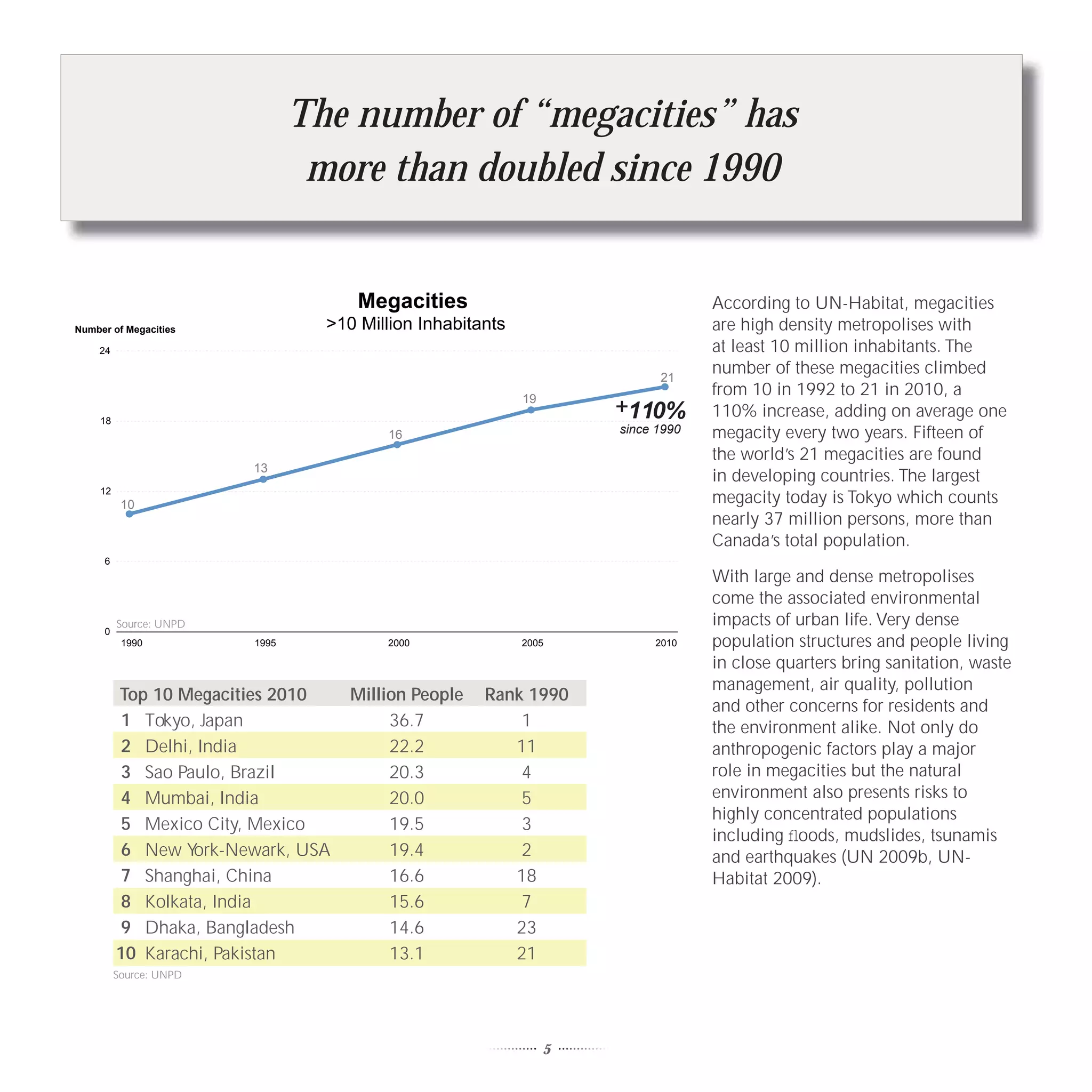
The number of “megacities” has
                                 more than doubled since 1990


                                      Megacities                                  According to UN-Habitat, megacities
Number of Megacities              >10 Million Inhabitants                         are high density metropolises with
    24                                                                            at least 10 million inhabitants. The
                                                                           21
                                                                                  number of these megacities climbed
                                                            19
                                                                                  from 10 in 1992 to 21 in 2010, a
     18
                                                                     +110%        110% increase, adding on average one
                                         16                          since 1990   megacity every two years. Fifteen of
                                                                                  the world’s 21 megacities are found
                         13
                                                                                  in developing countries. The largest
     12
           10                                                                     megacity today is Tokyo which counts
                                                                                  nearly 37 million persons, more than
                                                                                  Canada’s total population.
     6
                                                                                  With large and dense metropolises
                                                                                  come the associated environmental
          Source: UNPD                                                            impacts of urban life. Very dense
     0
           1990          1995            2000               2005          2010    population structures and people living
                                                                                  in close quarters bring sanitation, waste
                                                                                  management, air quality, pollution
          Top 10 Megacities 2010     Million People   Rank 1990
                                                                                  and other concerns for residents and
          1 Tokyo, Japan                  36.7            1                       the environment alike. Not only do
          2 Delhi, India                  22.2           11                       anthropogenic factors play a major
          3 Sao Paulo, Brazil             20.3            4                       role in megacities but the natural
          4 Mumbai, India                 20.0            5                       environment also presents risks to
                                                                                  highly concentrated populations
          5 Mexico City, Mexico           19.5            3
                                                                                  including floods, mudslides, tsunamis
          6 New Y  ork-Newark, USA        19.4            2                       and earthquakes (UN 2009b, UN-
          7 Shanghai, China               16.6           18                       Habitat 2009).
          8 Kolkata, India                15.6            7
          9 Dhaka, Bangladesh             14.6           23
          10 Karachi, Pakistan            13.1           21
          Source: UNPD


                                                                 5
T
                      Th
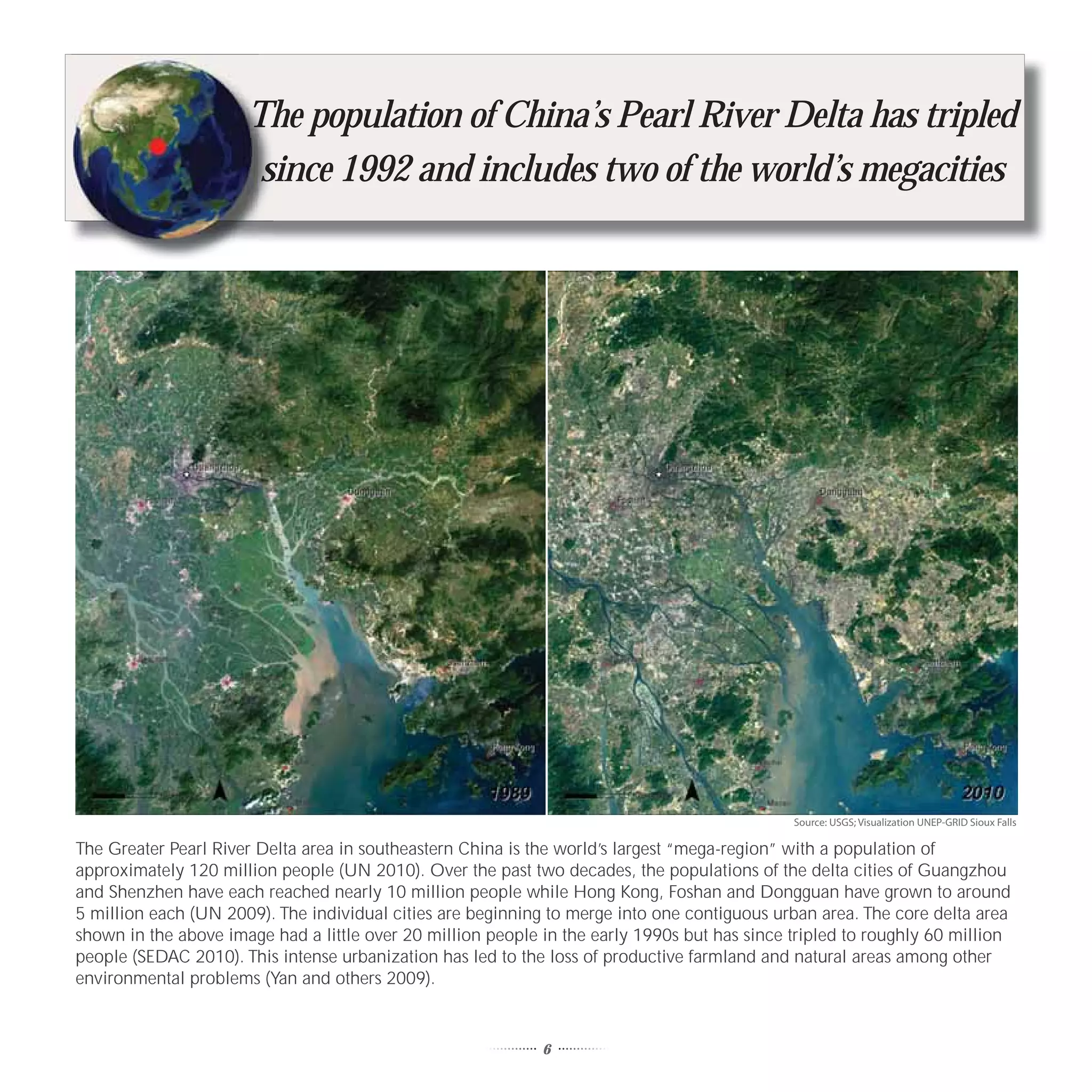
                      The population of China’s Pearl River Delta has tripled
                       since 1992 and includes two of the world’s megacities
                       s


                                                                                              Source: USGS; Visualization UNEP-GRID Sioux Falls

The Greater Pearl River Delta area in southeastern China is the world’s largest “mega-region” with a population of
approximately 120 million people (UN 2010). Over the past two decades, the populations of the delta cities of Guangzhou
and Shenzhen have each reached nearly 10 million people while Hong Kong, Foshan and Dongguan have grown to around
5 million each (UN 2009). The individual cities are beginning to merge into one contiguous urban area. The core delta area
shown in the above image had a little over 20 million people in the early 1990s but has since tripled to roughly 60 million
people (SEDAC 2010). This intense urbanization has led to the loss of productive farmland and natural areas among other
environmental problems (Yan and others 2009).


                                                             6
A smaller proportion of urban dwellers live in slums, but
    their total number has risen to                                                      827 000 000
 Population in Slums
                                                            People Living in Slums                                             Proportion of Urban
   [Million People]                                                                                                           Population in Slums [%]
         1 000                                                                                                                             50


                 46% P
                      ercen
                           ta      ge


                                                                                                                             827 Million
           800                                                                                                                             40


                                        u   m b er
                                Total N
                       illion
                 656 M                                                                                                              33%


           600                                                                                                                             30


                 Source: UN-Habitat
           400                                                                                                                             20
                 1990                                1995                 2000                         2005                         2010


Since 1990, the share of the urban population living in slums in the developing world has declined significantly, dropping
from 46% in 1990 to 33% in 2010. This decrease shows that many efforts to give inhabitants of slums access to improved
water or sanitation, and/or more durable housing have been successful. On the other hand, the absolute number of people
living in slums has increased by 26% over the same period, equaling 171 million additional people and raising their
number from 656 million in 1990 to 827 million in 2010. “Redoubled efforts will be needed to improve the lives of the
growing numbers of urban poor in cities and metropolises across the developing world” (UN 2011b).
Note:
A slum household is defined as a group of individuals living under the same roof lacking one or more of these conditions: access to improved water;
access to improved sanitation; sufficient-living area; durability of housing; security of tenure. However, since information on secure tenure is not
available for most of the countries, only the first four indicators are used to define slum household, and then to estimate the proportion of urban
population living in slums (UNSD n.d.).

                                                                           7
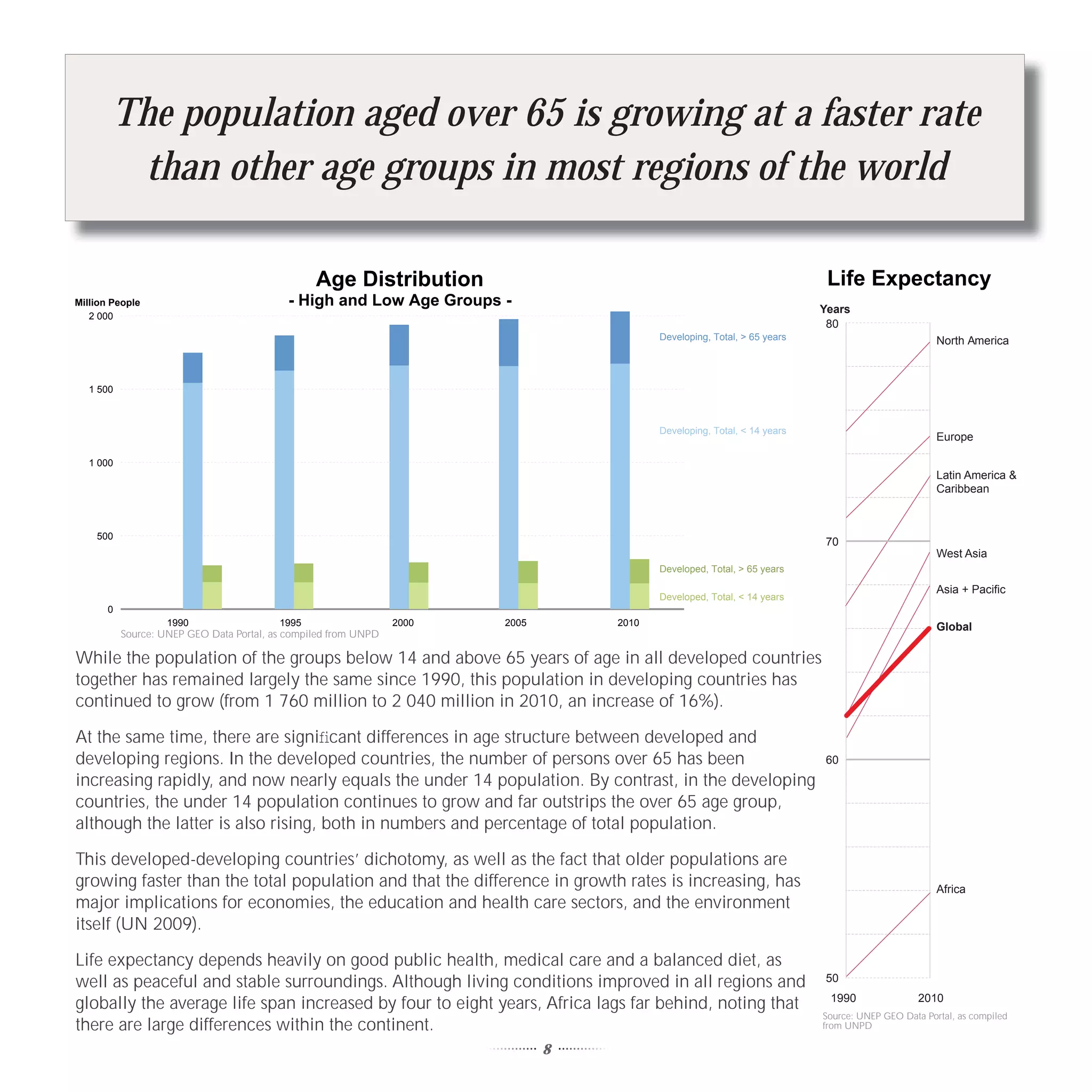
The population aged over 65 is growing at a faster rate
         than other age groups in most regions of the world

                                                 Age Distribution                                                          Life Expectancy
Million People                              - High and Low Age Groups -                                                   Years
   2 000
                                                                                                                           80
                                                                                          Developing, Total, > 65 years                            North America


  1 500


                                                                                          Developing, Total, < 14 years
                                                                                                                                                   Europe

  1 000
                                                                                                                                                   Latin America &
                                                                                                                                                   Caribbean


    500
                                                                                                                          70
                                                                                                                                                   West Asia
                                                                                          Developed, Total, > 65 years

                                                                                                                                                   Asia + Pacific
                                                                                          Developed, Total, < 14 years
       0
                    1990                  1995                   2000   2005       2010                                                            Global
           Source: UNEP GEO Data Portal, as compiled from UNPD

While the population of the groups below 14 and above 65 years of age in all developed countries
together has remained largely the same since 1990, this population in developing countries has
continued to grow (from 1 760 million to 2 040 million in 2010, an increase of 16%).

At the same time, there are significant differences in age structure between developed and
developing regions. In the developed countries, the number of persons over 65 has been                                    60
increasing rapidly, and now nearly equals the under 14 population. By contrast, in the developing
countries, the under 14 population continues to grow and far outstrips the over 65 age group,
although the latter is also rising, both in numbers and percentage of total population.

This developed-developing countries’ dichotomy, as well as the fact that older populations are
growing faster than the total population and that the difference in growth rates is increasing, has                                                Africa
major implications for economies, the education and health care sectors, and the environment
itself (UN 2009).

Life expectancy depends heavily on good public health, medical care and a balanced diet, as
well as peaceful and stable surroundings. Although living conditions improved in all regions and                          50
                                                                                                                           1990                2010
globally the average life span increased by four to eight years, Africa lags far behind, noting that
                                                                                                                          Source: UNEP GEO Data Portal, as compiled
there are large differences within the continent.                                                                         from UNPD

                                                                               8
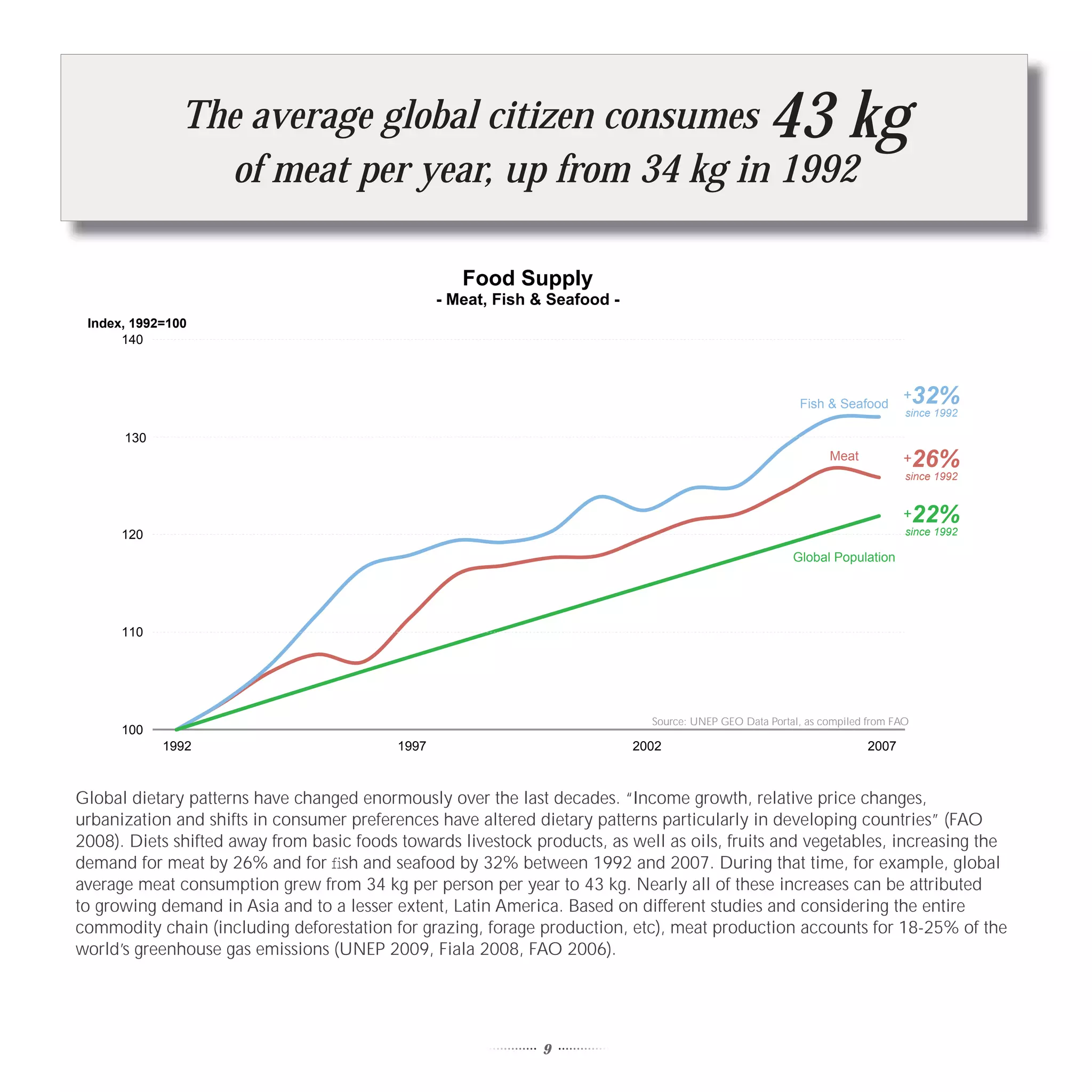
The average global citizen consumes                                                   43 kg
                 of meat per year, up from 34 kg in 1992

                                                     Food Supply
                                                  - Meat, Fish & Seafood -
 Index, 1992=100
      140


                                                                                                           Fish & Seafood
                                                                                                                               +    32%
                                                                                                                                since 1992

      130
                                                                                                                 Meat          +    26%
                                                                                                                                since 1992


                                                                                                                               +    22%
      120                                                                                                                       since 1992

                                                                                                          Global Population


      110


                                                                               Source: UNEP GEO Data Portal, as compiled from FAO
      100
            1992                           1997                              2002                                       2007


Global dietary patterns have changed enormously over the last decades. “Income growth, relative price changes,
urbanization and shifts in consumer preferences have altered dietary patterns particularly in developing countries” (FAO
2008). Diets shifted away from basic foods towards livestock products, as well as oils, fruits and vegetables, increasing the
demand for meat by 26% and for fish and seafood by 32% between 1992 and 2007. During that time, for example, global
average meat consumption grew from 34 kg per person per year to 43 kg. Nearly all of these increases can be attributed
to growing demand in Asia and to a lesser extent, Latin America. Based on different studies and considering the entire
commodity chain (including deforestation for grazing, forage production, etc), meat production accounts for 18-25% of the
world’s greenhouse gas emissions (UNEP 2009, Fiala 2008, FAO 2006).


                                                               9
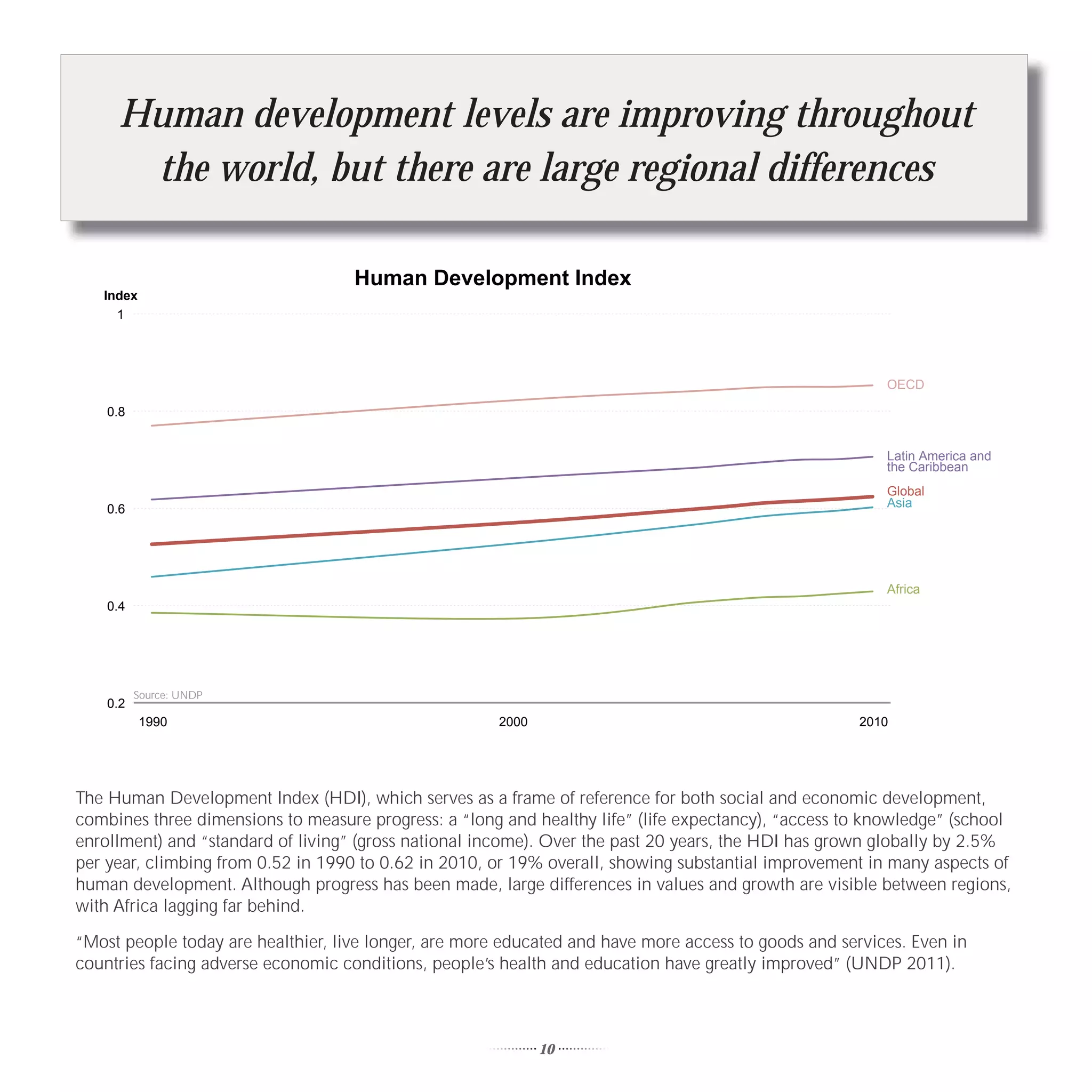
Human development levels are improving throughout
      the world, but there are large regional differences

                                    Human Development Index
   Index
     1


                                                                                                         OECD

    0.8


                                                                                                         Latin America and
                                                                                                         the Caribbean
                                                                                                         Global
    0.6                                                                                                  Asia


                                                                                                         Africa
    0.4


          Source: UNDP
    0.2
           1990                                        2000                                          2010


The Human Development Index (HDI), which serves as a frame of reference for both social and economic development,
combines three dimensions to measure progress: a “long and healthy life” (life expectancy), “access to knowledge” (school
enrollment) and “standard of living” (gross national income). Over the past 20 years, the HDI has grown globally by 2.5%
per year, climbing from 0.52 in 1990 to 0.62 in 2010, or 19% overall, showing substantial improvement in many aspects of
human development. Although progress has been made, large differences in values and growth are visible between regions,
with Africa lagging far behind.

“Most people today are healthier, live longer, are more educated and have more access to goods and services. Even in
countries facing adverse economic conditions, people’s health and education have greatly improved” (UNDP 2011).


                                                              10
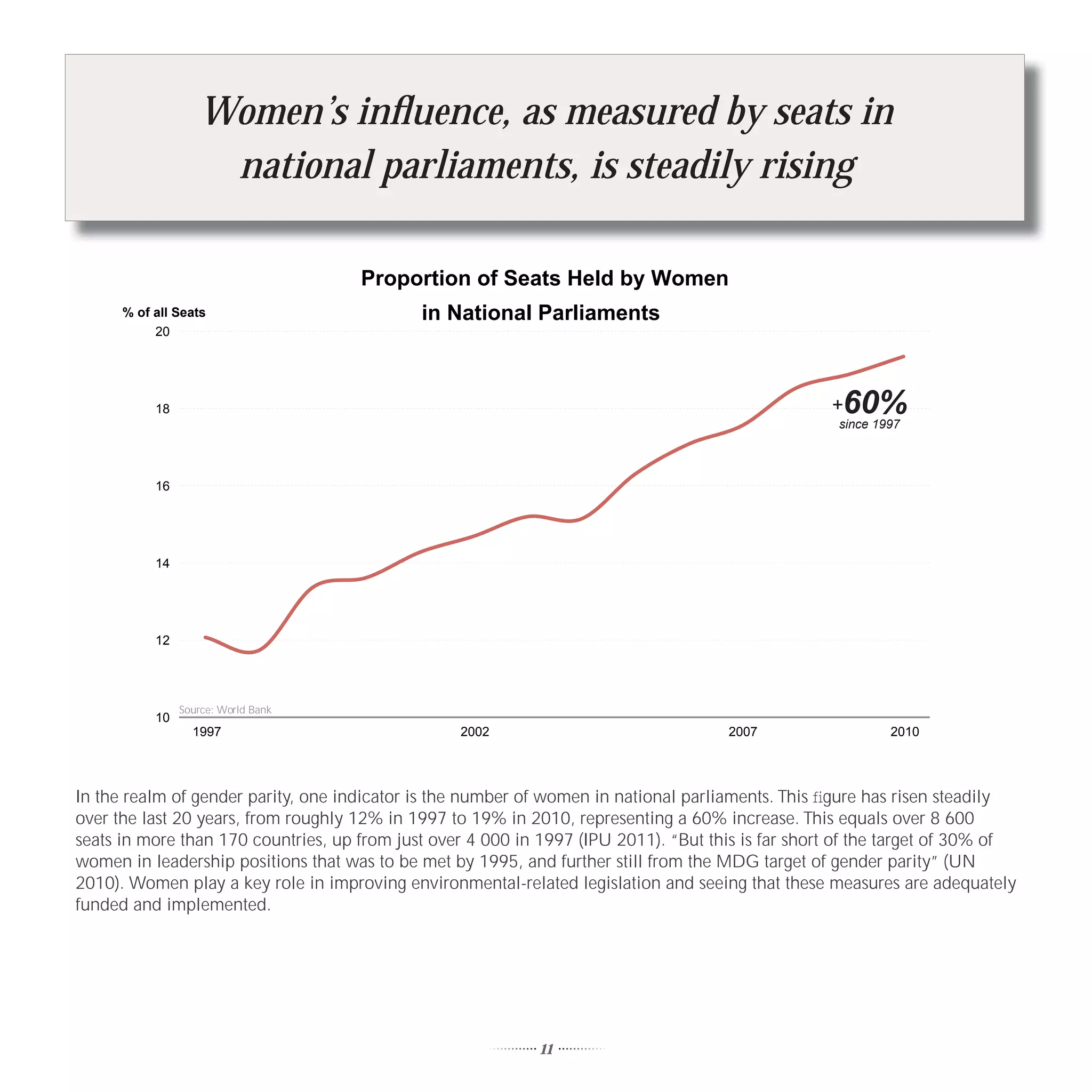
Women’s influence, as measured by seats in
                    national parliaments, is steadily rising

                                     Proportion of Seats Held by Women
      % of all Seats                         in National Parliaments
           20


           18                                                                                      + 60%
                                                                                                    since 1997


           16


           14


           12


                Source: World Bank
           10
                  1997                            2002                                2007                  2010


In the realm of gender parity, one indicator is the number of women in national parliaments. This figure has risen steadily
over the last 20 years, from roughly 12% in 1997 to 19% in 2010, representing a 60% increase. This equals over 8 600
seats in more than 170 countries, up from just over 4 000 in 1997 (IPU 2011). “But this is far short of the target of 30% of
women in leadership positions that was to be met by 1995, and further still from the MDG target of gender parity” (UN
2010). Women play a key role in improving environmental-related legislation and seeing that these measures are adequately
funded and implemented.


                                                             11
12
                             Economy


     Nic McPhee/Flickr.com
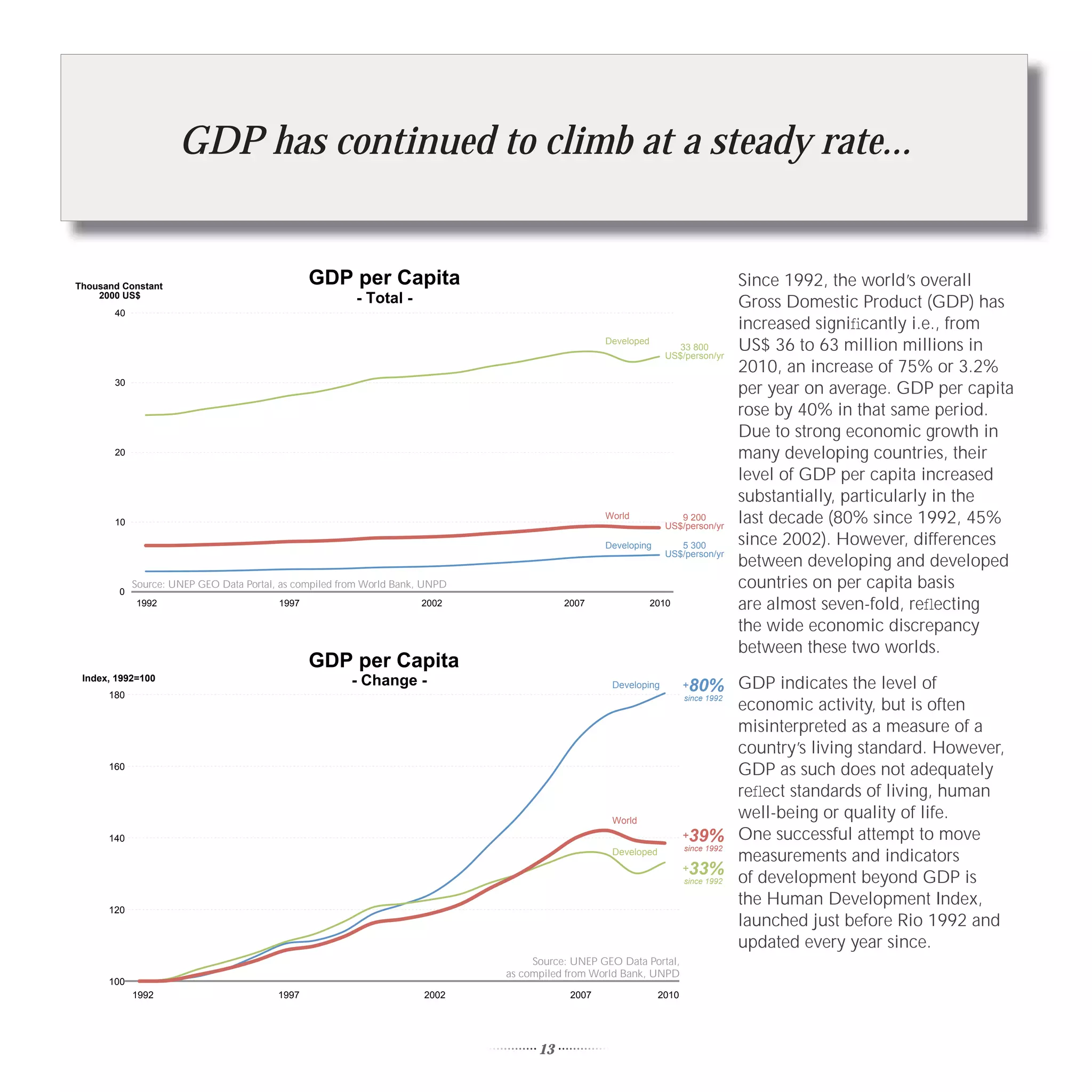
GDP has continued to climb at a steady rate...


Thousand Constant
                                                GDP per Capita                                                                    Since 1992, the world’s overall
                                                                                                                                  Gross Domestic Product (GDP) has
    2000 US$                                            - Total -
       40
                                                                                                                                  increased significantly i.e., from
                                                                                                 Developed
                                                                                                                 33 800
                                                                                                               US$/person/yr
                                                                                                                                  US$ 36 to 63 million millions in
                                                                                                                                  2010, an increase of 75% or 3.2%
       30
                                                                                                                                  per year on average. GDP per capita
                                                                                                                                  rose by 40% in that same period.
                                                                                                                                  Due to strong economic growth in
       20                                                                                                                         many developing countries, their
                                                                                                                                  level of GDP per capita increased
                                                                                                                                  substantially, particularly in the
       10
                                                                                                 World            9 200
                                                                                                               US$/person/yr
                                                                                                                                  last decade (80% since 1992, 45%
                                                                                                 Developing       5 300           since 2002). However, differences
                                                                                                               US$/person/yr
                                                                                                                                  between developing and developed
        0
            Source: UNEP GEO Data Portal, as compiled from World Bank, UNPD                                                       countries on per capita basis
            1992                         1997                        2002                2007                2010                 are almost seven-fold, reflecting
                                                                                                                                  the wide economic discrepancy
                                                                                                                                  between these two worlds.
                                                GDP per Capita
                                                       - Change -                                                     80% GDP indicates the level of
 Index, 1992=100
                                                                                                  Developing         +
      180
                                                                                                                                economic activity, but is often
                                                                                                                     since 1992


                                                                                                                                misinterpreted as a measure of a
                                                                                                                                country’s living standard. However,
      160
                                                                                                                                GDP as such does not adequately
                                                                                                                                reflect standards of living, human
                                                                                                  World
                                                                                                                                well-being or quality of life.
      140                                                                                                            +39% One successful attempt to move

                                                                                                                                measurements and indicators
                                                                                                  Developed          since 1992

                                                                                                                     +33%
                                                                                                                     since 1992 of development beyond GDP is
      120
                                                                                                                                the Human Development Index,
                                                                                                                                launched just before Rio 1992 and
                                                                                                                                updated every year since.
                                                                                   Source: UNEP GEO Data Portal,
                                                                              as compiled from World Bank, UNPD
      100
            1992                         1997                         2002                2007                2010


                                                                                    13
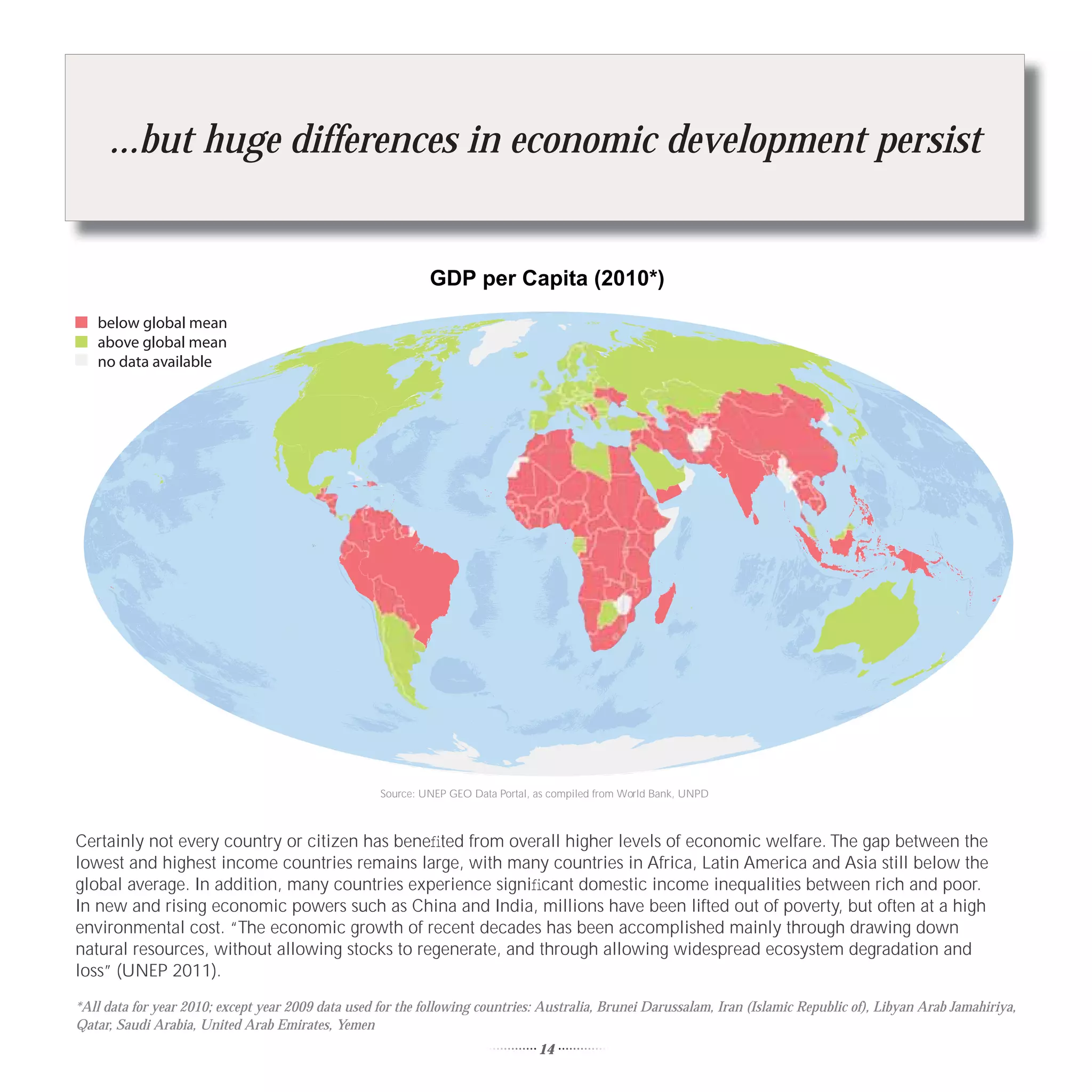
...but huge differences in economic development persist


                                                             GDP per Capita (2010*)
   below global mean
   above global mean
   no data available


                                                    Source: UNEP GEO Data Portal, as compiled from World Bank, UNPD


Certainly not every country or citizen has benefited from overall higher levels of economic welfare. The gap between the
lowest and highest income countries remains large, with many countries in Africa, Latin America and Asia still below the
global average. In addition, many countries experience significant domestic income inequalities between rich and poor.
In new and rising economic powers such as China and India, millions have been lifted out of poverty, but often at a high
environmental cost. “The economic growth of recent decades has been accomplished mainly through drawing down
natural resources, without allowing stocks to regenerate, and through allowing widespread ecosystem degradation and
loss” (UNEP 2011).
*All data for year 2010; except year 2009 data used for the following countries: Australia, Brunei Darussalam, Iran (Islamic Republic of), Libyan Arab Jamahiriya,
Qatar, Saudi Arabia, United Arab Emirates, Yemen
                                                                                  14
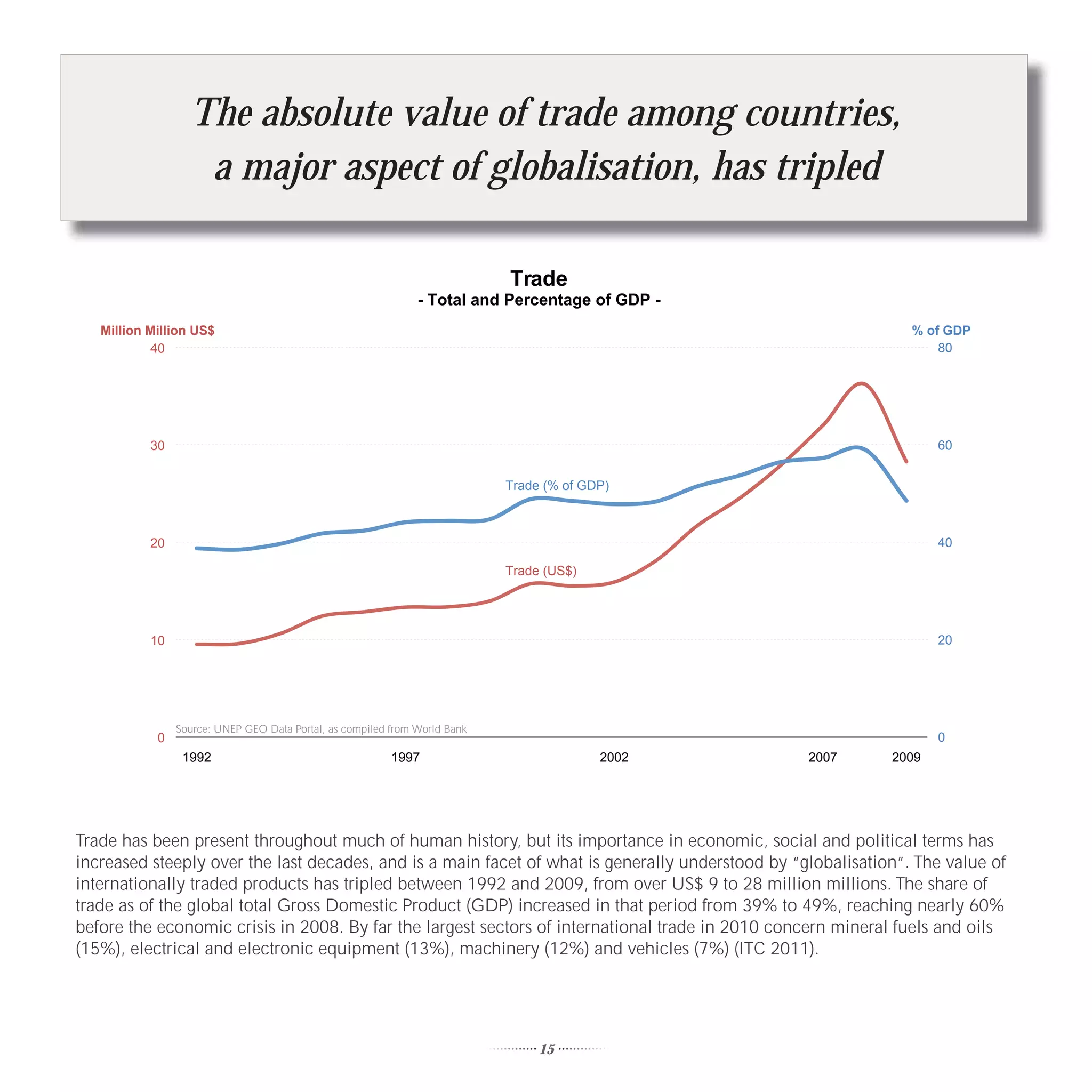
The absolute value of trade among countries,
                   a major aspect of globalisation, has tripled

                                                                            Trade
                                                               - Total and Percentage of GDP -
   Million Million US$                                                                                          % of GDP
           40                                                                                                       80


           30                                                                                                       60


                                                                            Trade (% of GDP)


           20                                                                                                       40

                                                                            Trade (US$)


           10                                                                                                       20


                Source: UNEP GEO Data Portal, as compiled from World Bank
            0                                                                                                       0
                 1992                                     1997                            2002    2007       2009


Trade has been present throughout much of human history, but its importance in economic, social and political terms has
increased steeply over the last decades, and is a main facet of what is generally understood by “globalisation”. The value of
internationally traded products has tripled between 1992 and 2009, from over US$ 9 to 28 million millions. The share of
trade as of the global total Gross Domestic Product (GDP) increased in that period from 39% to 49%, reaching nearly 60%
before the economic crisis in 2008. By far the largest sectors of international trade in 2010 concern mineral fuels and oils
(15%), electrical and electronic equipment (13%), machinery (12%) and vehicles (7%) (ITC 2011).


                                                                                 15
As societies grow and become wealthier, demand
                   for basic materials is further increasing

Thousand Million                               Global Materials Extraction
    Tonnes
      80


                                                                                            +41%
                                                                                             since 1992

      60
                                                                                                             Ores and Industrial Minerals


                                                                                                             Fossil Fuels


      40


                                                                                                             Construction Minerals


      20


                                                                                                             Biomass

           Source: Krausmann and others 2009
       0
        1992                                       1997                         2002                      2005


The global use of natural resource materials increased by over 40% between 1992 and 2005, from about 42 to nearly
60 thousand million tonnes. On a per capita basis, the increase was 27%. Among the four major material groups (biomass,
fossil fuels, ores and industrial minerals, and construction minerals) there has been a major increase in extraction of
construction minerals of almost 80%, followed by ores and industrial minerals (close to 60%). This growth is strongly linked
to increasing population numbers and the need for shelter, food and an improved standard of living (UNEP 2011).

International trade in resource materials has also increased. “The total value of world trade in natural resources was
US$ 3 700 thousand millions in 2008, or nearly 24 Per Cent of world merchandise trade. This value has increased more
than six-fold between 1998 and 2008” (WTO 2011).


                                                               16
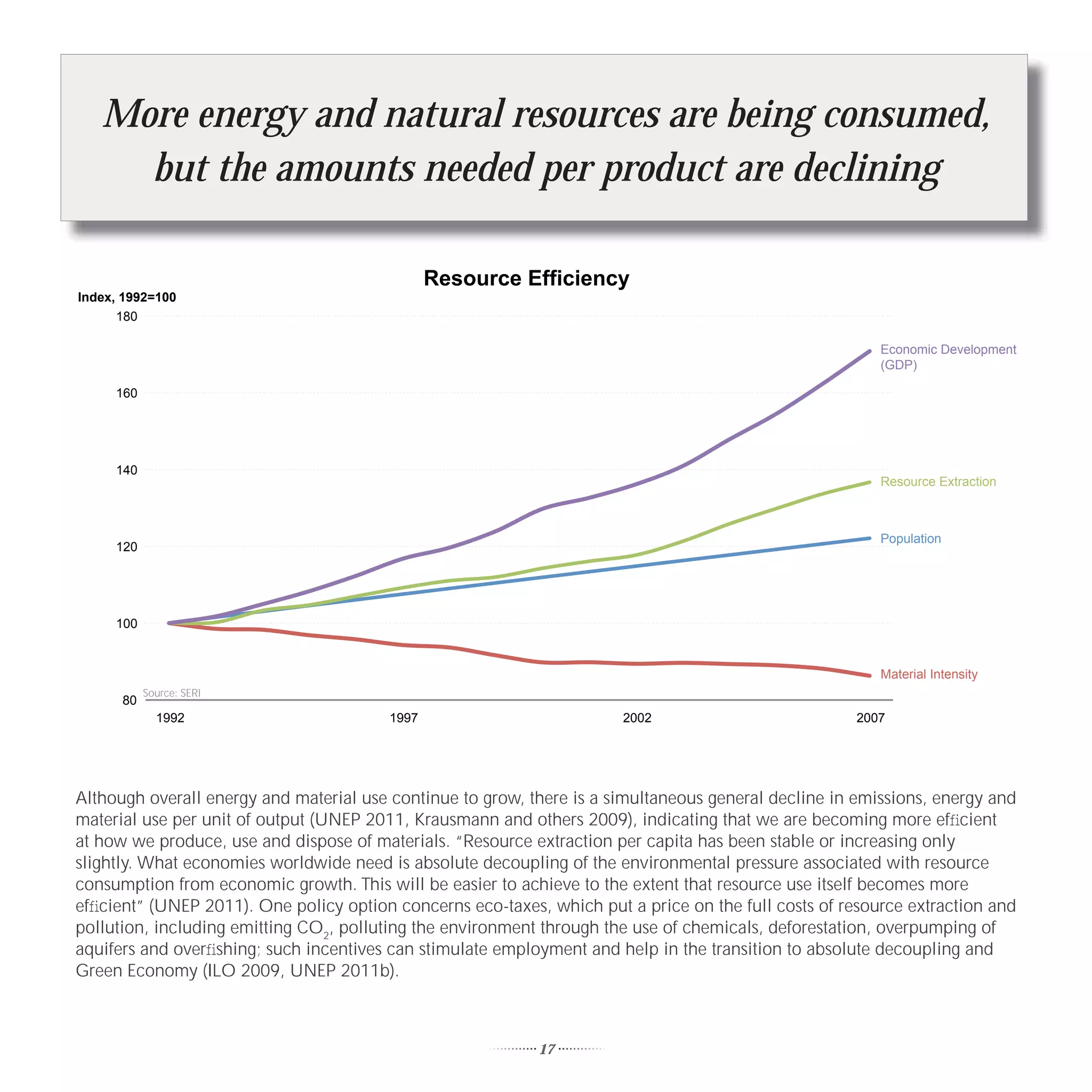
More energy and natural resources are being consumed,
     but the amounts needed per product are declining

                                                Resource Efficiency
Index, 1992=100
      180

                                                                                                         Economic Development
                                                                                                         (GDP)

     160


     140
                                                                                                         Resource Extraction


                                                                                                         Population
     120


     100


                                                                                                         Material Intensity
           Source: SERI
      80
             1992                        1997                          2002                           2007


Although overall energy and material use continue to grow, there is a simultaneous general decline in emissions, energy and
material use per unit of output (UNEP 2011, Krausmann and others 2009), indicating that we are becoming more efficient
at how we produce, use and dispose of materials. “Resource extraction per capita has been stable or increasing only
slightly. What economies worldwide need is absolute decoupling of the environmental pressure associated with resource
consumption from economic growth. This will be easier to achieve to the extent that resource use itself becomes more
efficient” (UNEP 2011). One policy option concerns eco-taxes, which put a price on the full costs of resource extraction and
pollution, including emitting CO2, polluting the environment through the use of chemicals, deforestation, overpumping of
aquifers and overfishing; such incentives can stimulate employment and help in the transition to absolute decoupling and
Green Economy (ILO 2009, UNEP 2011b).


                                                            17
Environmental Trends


         18
19
Atmosphere


             MorgueFile
    20
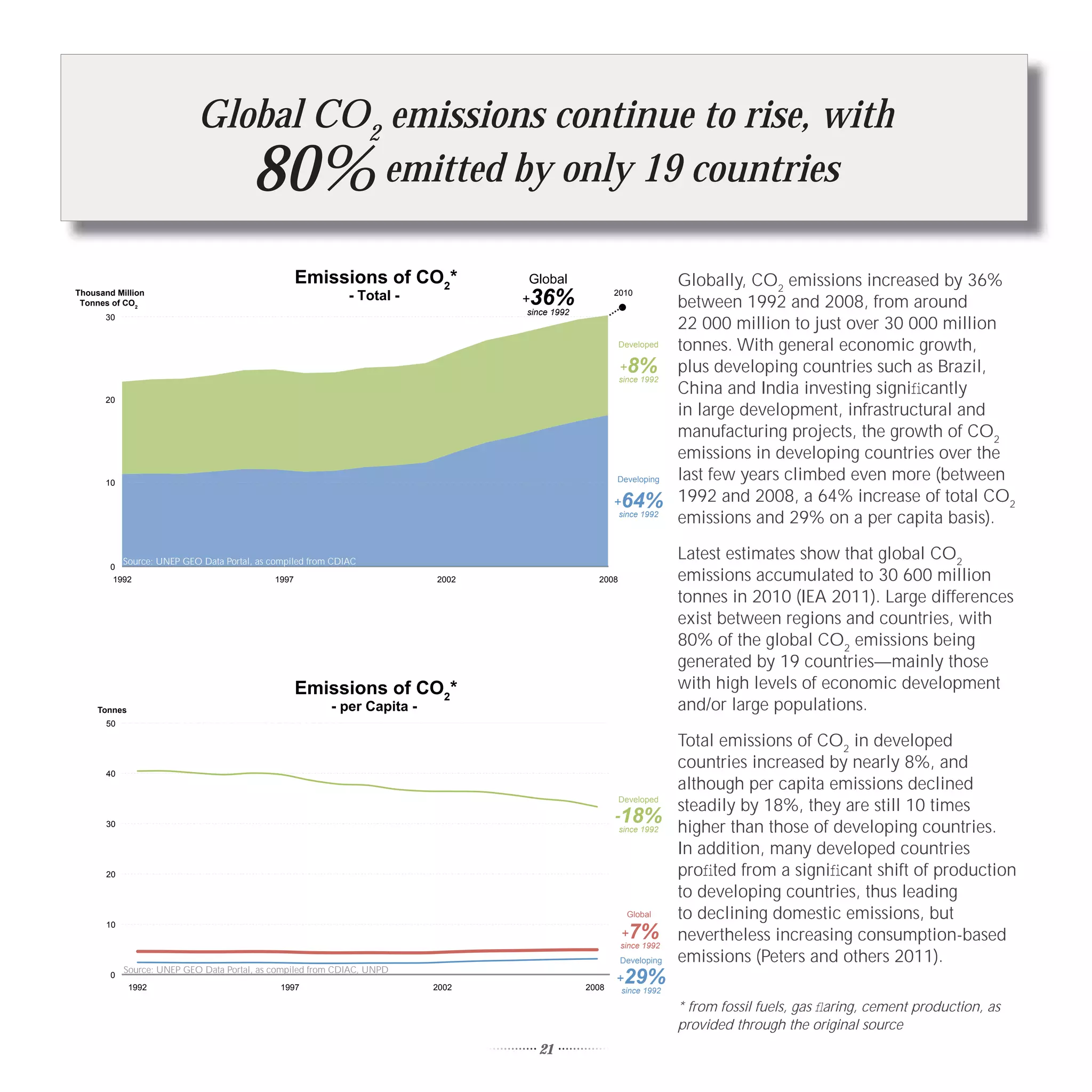
Global CO2 emissions continue to rise, with
                                        80%
                                      emitted by only 19 countries

                                                    Emissions of CO2*              Global                         Globally, CO2 emissions increased by 36%
                                                                                                      2010
Thousand Million
 Tonnes of CO2
                                                              - Total -           +36%
                                                                                  since 1992
                                                                                                                  between 1992 and 2008, from around
       30
                                                                                                                  22 000 million to just over 30 000 million
                                                                                                       Developed  tonnes. With general economic growth,
                                                                                                       +8%        plus developing countries such as Brazil,
                                                                                                       since 1992
                                                                                                                  China and India investing significantly
       20
                                                                                                                  in large development, infrastructural and
                                                                                                                  manufacturing projects, the growth of CO2
                                                                                                                  emissions in developing countries over the
       10                                                                                              Developing last few years climbed even more (between
                                                                                                      +64% 1992 and 2008, a 64% increase of total CO2
                                                                                                       since 1992
                                                                                                                  emissions and 29% on a per capita basis).

            Source: UNEP GEO Data Portal, as compiled from CDIAC
                                                                                                                     Latest estimates show that global CO2
        0
         1992                                1997                          2002                  2008                emissions accumulated to 30 600 million
                                                                                                                     tonnes in 2010 (IEA 2011). Large differences
                                                                                                                     exist between regions and countries, with
                                                                                                                     80% of the global CO2 emissions being
                                                                                                                     generated by 19 countries—mainly those
                                                    Emissions of CO2*                                                with high levels of economic development
     Tonnes                                               - per Capita -                                             and/or large populations.
       50

                                                                                                                  Total emissions of CO2 in developed
                                                                                                                  countries increased by nearly 8%, and
       40
                                                                                                                  although per capita emissions declined
                                                                                                       Developed
                                                                                                                  steadily by 18%, they are still 10 times
                                                                                                      -18%
       30
                                                                                                       since 1992 higher than those of developing countries.
                                                                                                                  In addition, many developed countries
       20                                                                                                         profited from a significant shift of production
                                                                                                                  to developing countries, thus leading
       10
                                                                                                         Global   to declining domestic emissions, but
                                                                                                        +7% nevertheless increasing consumption-based
                                                                                                       since 1992
                                                                                                       Developing emissions (Peters and others 2011).
            Source: UNEP GEO Data Portal, as compiled from CDIAC, UNPD
        0
              1992                             1997                        2002                2008
                                                                                                      + 29%
                                                                                                        since 1992

                                                                                                                     * from fossil fuels, gas flaring, cement production, as
                                                                                                                     provided through the original source
                                                                                    21
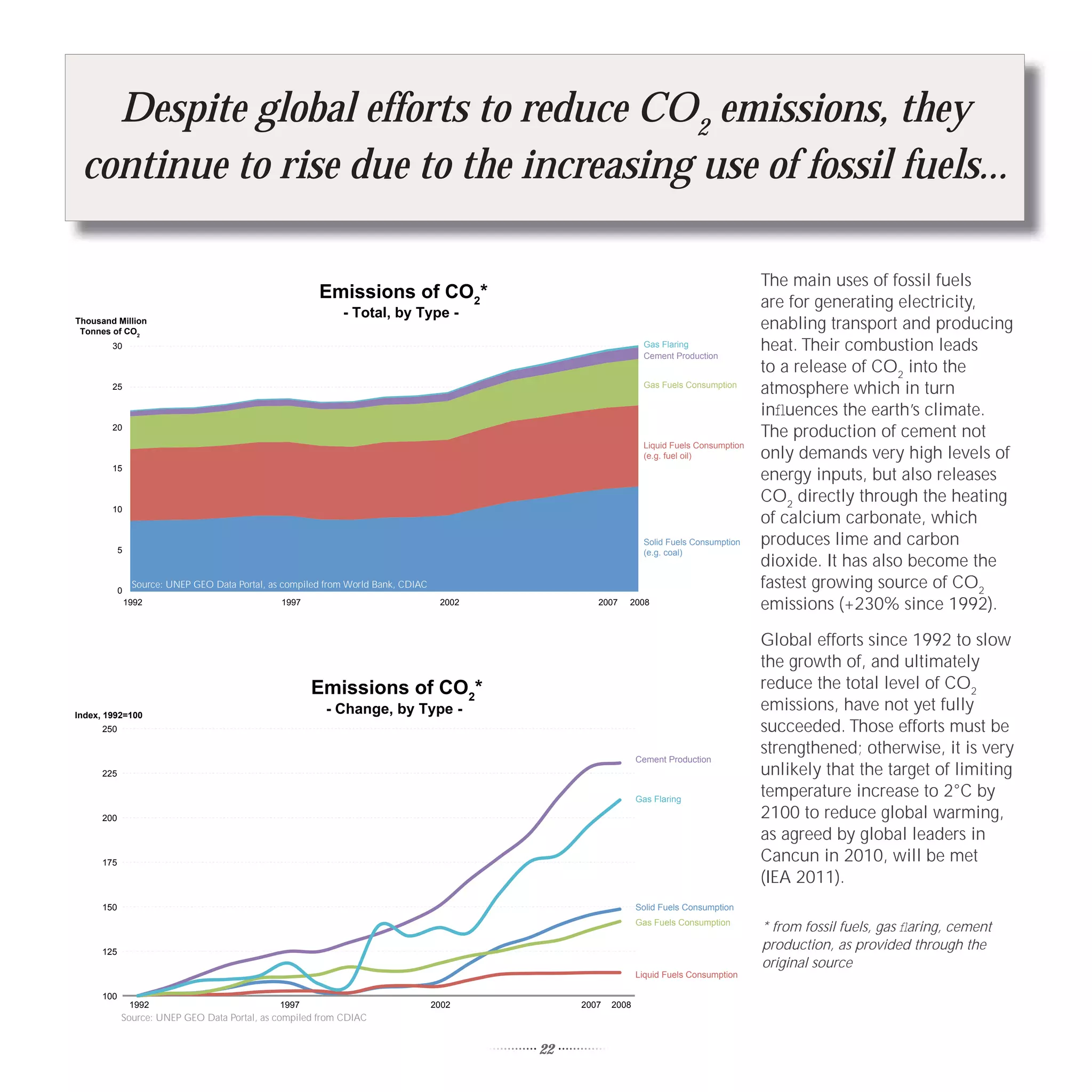
Despite global efforts to reduce CO2 emissions, they
 continue to rise due to the increasing use of fossil fuels...

                                                                                                                                              The main uses of fossil fuels
                                                                Emissions of CO2*                                                             are for generating electricity,
                                                                         - Total, by Type -
Thousand Million
 Tonnes of CO2
                                                                                                                                              enabling transport and producing
        30                                                                                                         Gas Flaring
                                                                                                                   Cement Production
                                                                                                                                              heat. Their combustion leads
                                                                                                                                              to a release of CO2 into the
        25                                                                                                         Gas Fuels Consumption
                                                                                                                                              atmosphere which in turn
                                                                                                                                              influences the earth’s climate.
        20
                                                                                                                                              The production of cement not
                                                                                                                   Liquid Fuels Consumption
                                                                                                                   (e.g. fuel oil)            only demands very high levels of
        15
                                                                                                                                              energy inputs, but also releases
                                                                                                                                              CO2 directly through the heating
        10
                                                                                                                                              of calcium carbonate, which
            5
                                                                                                                   Solid Fuels Consumption    produces lime and carbon
                                                                                                                   (e.g. coal)
                  Source: UNEP GEO Data Portal, as compiled from CDIAC
                                                                                                                                              dioxide. It has also become the
            0
                 Source: UNEP GEO Data Portal, as compiled from World Bank, CDIAC                                                             fastest growing source of CO2
                1992                                  1997                              2002           2007   2008                            emissions (+230% since 1992).

                                                                                                                                              Global efforts since 1992 to slow
                                                                                                                                              the growth of, and ultimately
                                                             Emissions of CO2*                                                                reduce the total level of CO2
Index, 1992=100                                                  - Change, by Type -                                                          emissions, have not yet fully
      250                                                                                                                                     succeeded. Those efforts must be
                                                                                                                                              strengthened; otherwise, it is very
                                                                                                                  Cement Production
      225                                                                                                                                     unlikely that the target of limiting
                                                                                                                  Gas Flaring
                                                                                                                                              temperature increase to 2°C by
      200                                                                                                                                     2100 to reduce global warming,
                                                                                                                                              as agreed by global leaders in
      175                                                                                                                                     Cancun in 2010, will be met
                                                                                                                                              (IEA 2011).
      150                                                                                                         Solid Fuels Consumption
                                                                                                                  Gas Fuels Consumption
                                                                                                                                              * from fossil fuels, gas flaring, cement
      125
                                                                                                                                              production, as provided through the
                                                                                                                                              original source
                                                                                                                  Liquid Fuels Consumption

      100
                 1992                                 1997                            2002          2007   2008
            Source: UNEP GEO Data Portal, as compiled from CDIAC


                                                                                               22
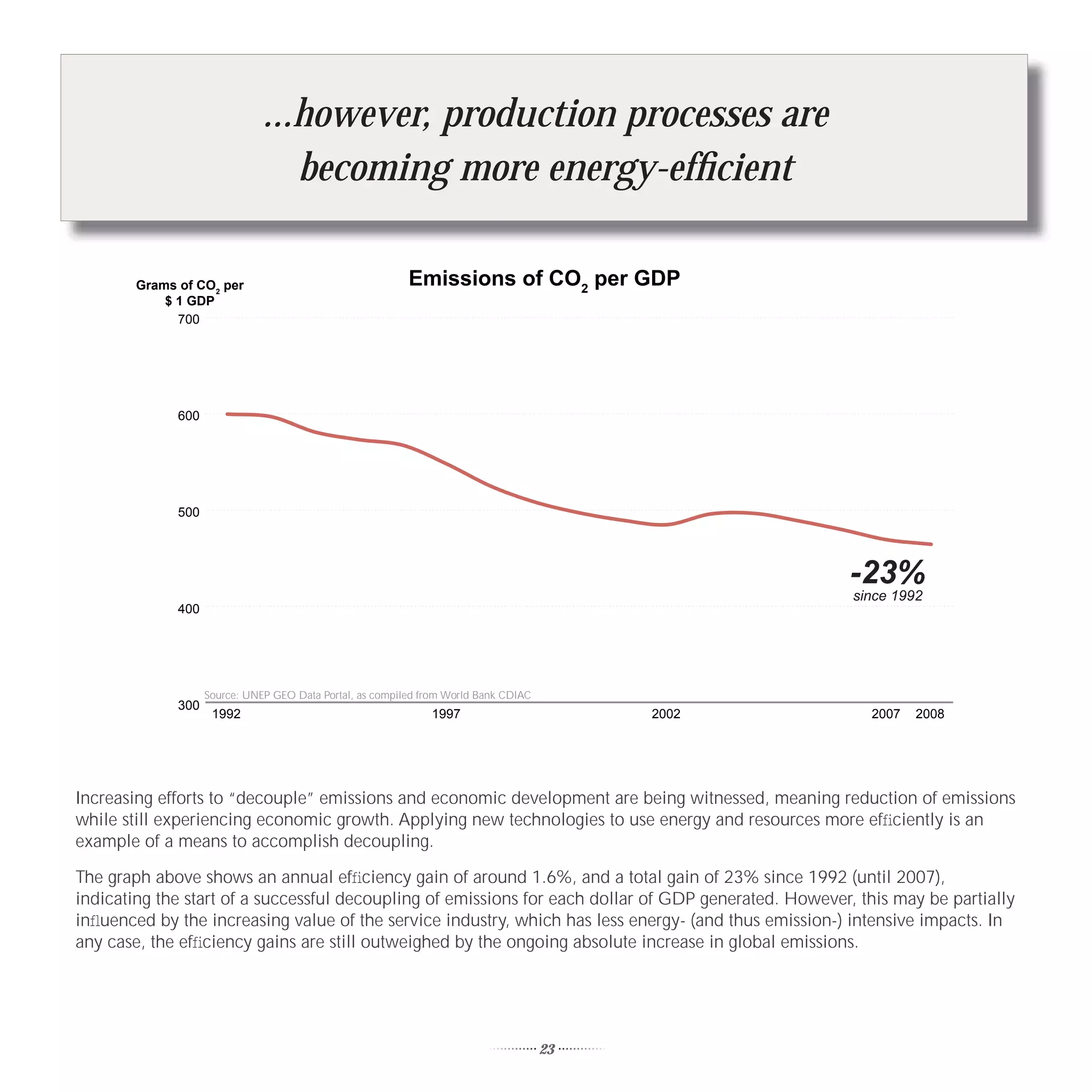
...however, production processes are
                                  becoming more energy-efficient

        Grams of CO2 per                                   Emissions of CO2 per GDP
            $ 1 GDP
              700


              600


              500


                                                                                                       -23%
                                                                                                       since 1992
              400


                    Source: UNEP GEO Data Portal, as compiled from World Bank CDIAC
              300
                     1992                                      1997                        2002          2007   2008


Increasing efforts to “decouple” emissions and economic development are being witnessed, meaning reduction of emissions
while still experiencing economic growth. Applying new technologies to use energy and resources more efficiently is an
example of a means to accomplish decoupling.

The graph above shows an annual efficiency gain of around 1.6%, and a total gain of 23% since 1992 (until 2007),
indicating the start of a successful decoupling of emissions for each dollar of GDP generated. However, this may be partially
influenced by the increasing value of the service industry, which has less energy- (and thus emission-) intensive impacts. In
any case, the efficiency gains are still outweighed by the ongoing absolute increase in global emissions.


                                                                                      23
Over 60% of Greenhouse Gases are
                               emitted by three economic sectors

             Which sectors emit the most Greenhouse Gases?
             Per Cent contribution to global anthropogenic GHG emissions, 2004
                                                hea
                                                   ting
                                                       )
                                             and y
                                                l
                                   ectr supp
                                       icity


             Per Cent
                         (e.g ergy


               30
                             ., el
                        En


                                                                                      )
               25
                                                                                   tion
                                                                ry


                                                                                    sta
                                                           ust


                                                                     (e.g restr
                                                                               fore
                                                                                    y
                                                       Ind


                                                                                                 re
                                                                         ., de


               20
                                                                                               ultu
                                                                     Fo


                                                                                                                 bui merci l and
                                                                                                            t
                                                                                                           por
                                                                                              ic


                                                                                                          ns
                                                                                          Agr


                                                                                                                         gs l
                                                                                                                  com dentia
                                                                                                                            a
               15
                                                                                                      Tra


                                                                                                                    ldin
                                                                                                                       i
                                                                                                                   Res
               10


                                                                                                                               wa te and
                                                                                                                                        r
                                                                                                                                     ate
                                                                                                                                 stew
                                                                                                                                   s
                                                                                                                                Wa
                5


                0         26                               19        17                   14          13            8              3
                    Source: IPCC 2007


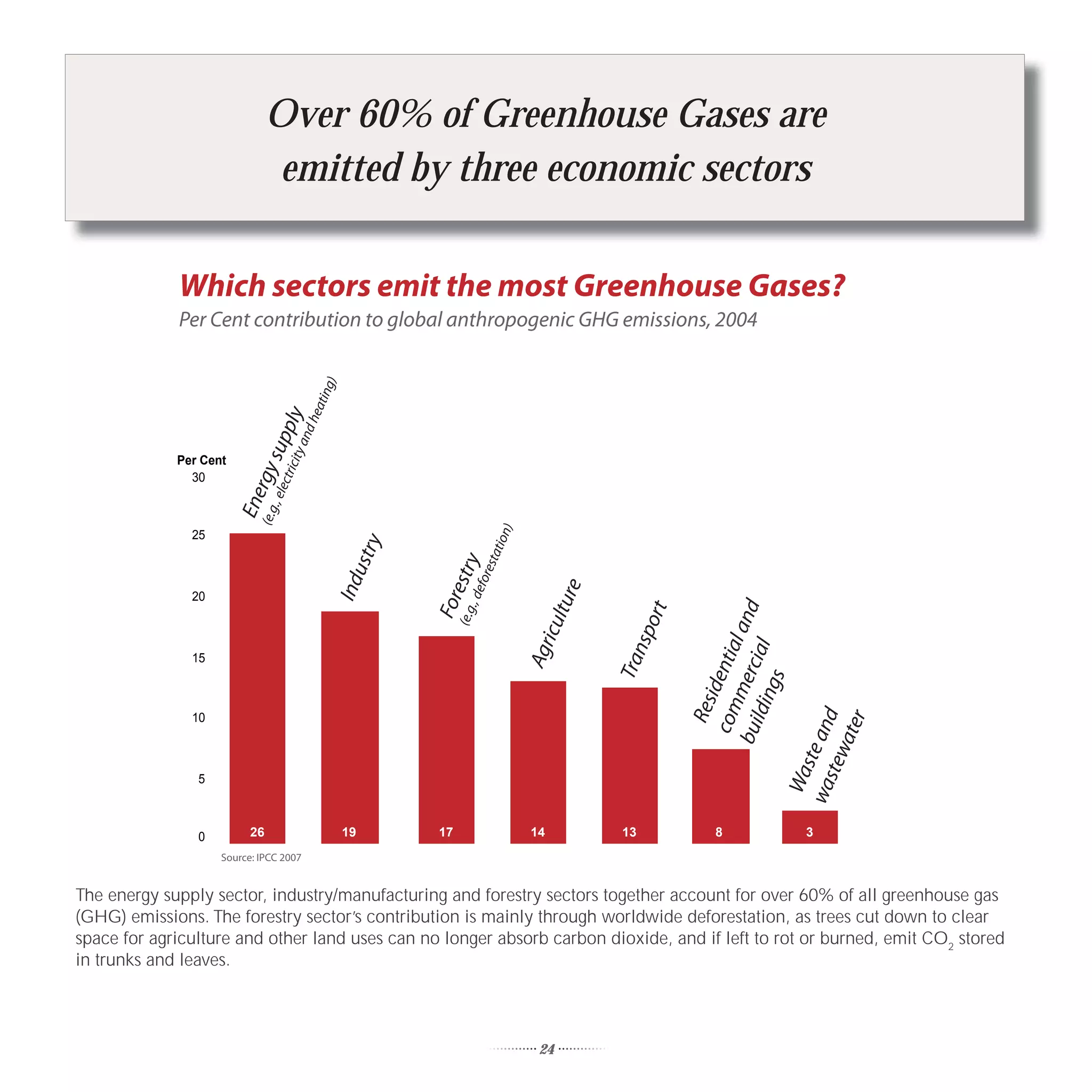
The energy supply sector, industry/manufacturing and forestry sectors together account for over 60% of all greenhouse gas
(GHG) emissions. The forestry sector’s contribution is mainly through worldwide deforestation, as trees cut down to clear
space for agriculture and other land uses can no longer absorb carbon dioxide, and if left to rot or burned, emit CO2 stored
in trunks and leaves.


                                                                                            24
The Montreal Protocol: “Perhaps the single
                                 most successful international agreement”

                 Consumption of Ozone-Depleting Substances                                                                    The ozone concentration in higher
  Thousand Tonnes of                                                                                                          altitudes protects life on earth from the
Ozone Depleting Potential
                                                                                                                              damaging ultraviolet (UV) rays of the
          600
                                                                                                                              sun. The ozone layer, especially above
                                                                                                                              Antarctica, was rapidly diminishing
                                                                                                                              until recently due to the use of Ozone-
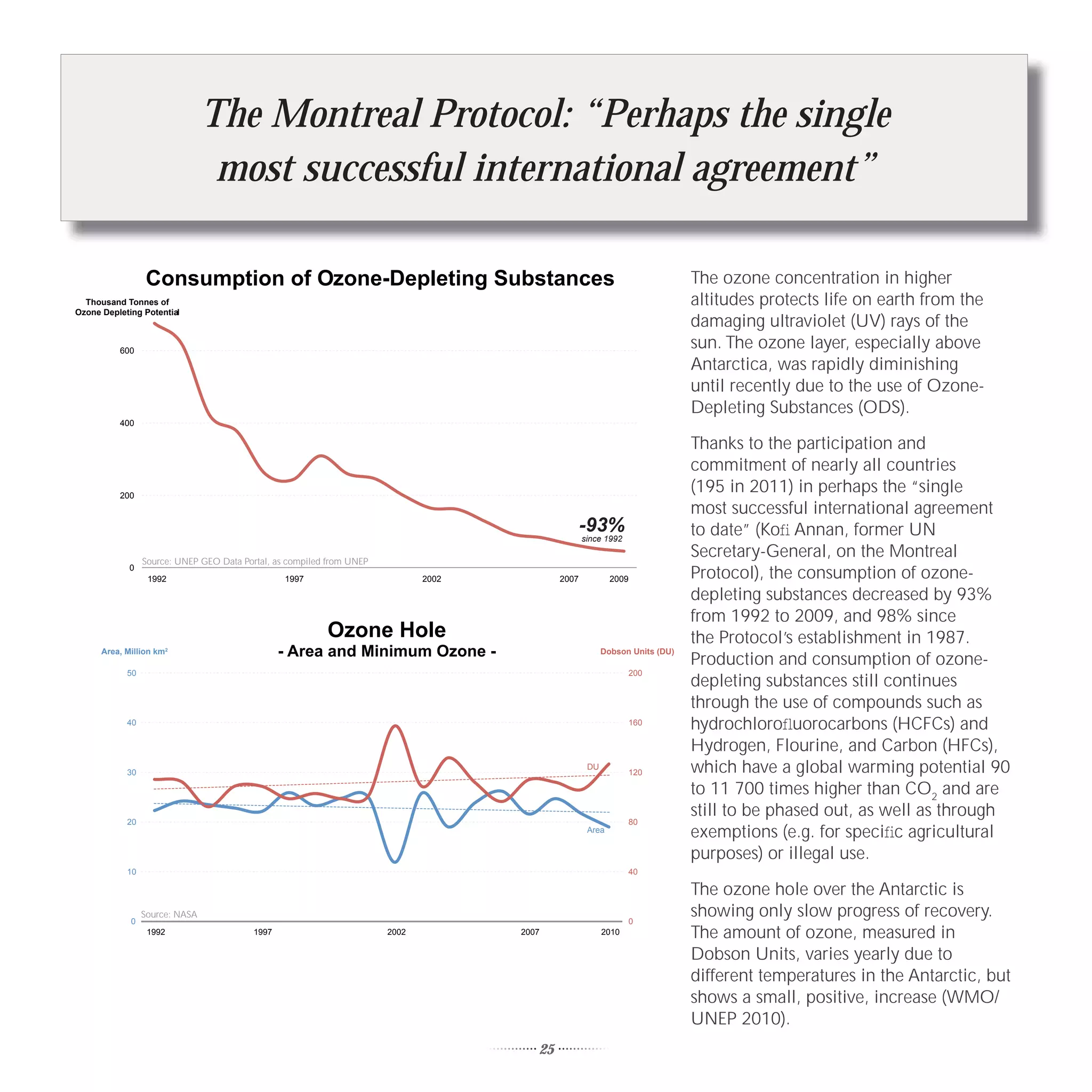
                                                                                                                              Depleting Substances (ODS).
          400

                                                                                                                              Thanks to the participation and
                                                                                                                              commitment of nearly all countries
          200
                                                                                                                              (195 in 2011) in perhaps the “single
                                                                                                                              most successful international agreement
                                                                                                    -93%                      to date” (Kofi Annan, former UN
                                                                                                    since 1992

                 Source: UNEP GEO Data Portal, as compiled from UNEP
                                                                                                                              Secretary-General, on the Montreal
             0
                  1992                           1997                         2002           2007           2009              Protocol), the consumption of ozone-
                                                                                                                              depleting substances decreased by 93%
                                                                                                                              from 1992 to 2009, and 98% since
                                                          Ozone Hole                                                          the Protocol’s establishment in 1987.
      Area, Million km2                          - Area and Minimum Ozone -                               Dobson Units (DU)
                                                                                                                              Production and consumption of ozone-
            50                                                                                                   200
                                                                                                                              depleting substances still continues
                                                                                                                              through the use of compounds such as
            40                                                                                                   160          hydrochlorofluorocarbons (HCFCs) and
                                                                                                                              Hydrogen, Flourine, and Carbon (HFCs),
            30
                                                                                                     DU
                                                                                                                 120          which have a global warming potential 90
                                                                                                                              to 11 700 times higher than CO2 and are
                                                                                                                              still to be phased out, as well as through
            20                                                                                                   80
                                                                                                     Area
                                                                                                                              exemptions (e.g. for specific agricultural
                                                                                                                              purposes) or illegal use.
            10                                                                                                   40

                                                                                                                              The ozone hole over the Antarctic is
             0
                 Source: NASA
                                                                                                                 0
                                                                                                                              showing only slow progress of recovery.
                  1992                    1997                         2002          2007                 2010                The amount of ozone, measured in
                                                                                                                              Dobson Units, varies yearly due to
                                                                                                                              different temperatures in the Antarctic, but
                                                                                                                              shows a small, positive, increase (WMO/
                                                                                                                              UNEP 2010).
                                                                                        25
Further expansion of the “ozone hole” has halted,
                  but full recovery is still far away


    September 1992           September 1994             September 1996                 September 1998   September 2000


    September 2002           September 2004             September 2006                 September 2008   September 2011

                                110           220              330               440           550
                                                                                                            Source: NASA
                                                    total ozone (Dobson Units)

The use of ODS has been controlled from 1987 onwards (and subsequently banned) under the Montreal Protocol. As of
1 January 2010, no new production of chlorofluorocarbons (CFCs) is permitted. Given that many of these substances are
also potent greenhouse gases, the Protocol provided at the same time “substantial co-benefits by reducing climate change”
(WMO/UNEP 2010): “From 1990 to 2010, the Montreal Protocol’s controls on production and consumption of ODSs
[will] have reduced GHG emissions by the equivalent of a net 135 thousand million tonnes CO2, which is equivalent to 11
thousand million tonnes CO2 per year” (Molina and others 2009).

Over the past decade concentration and extent of ozone neither notably decreased nor increased (WMO/UNEP 2010). The
ozone layer outside the Polar regions is expected to recover to its pre-1980 levels before 2050. However, the springtime
ozone hole over Antarctica is expected to recover much later.


                                                               26
27
                                      Climate Change


     Gerard Van der Leun/Flickr.com
The average amount of CO2 in the Earth’s atmosphere
         shows a steady rise over the last two decades

      Parts per Million                 Atmospheric CO2 Concentration / Keeling Curve
           (ppm)
            400


            390


            380
                                                                                                      +9%
                                                                                                     since 1992
            370


            360


            350


            340


                   Source: UNEP GEO Data Portal, as compiled from NOAA/ESRL
            330
                  1992                                1997                         2002   2007            2010 2011


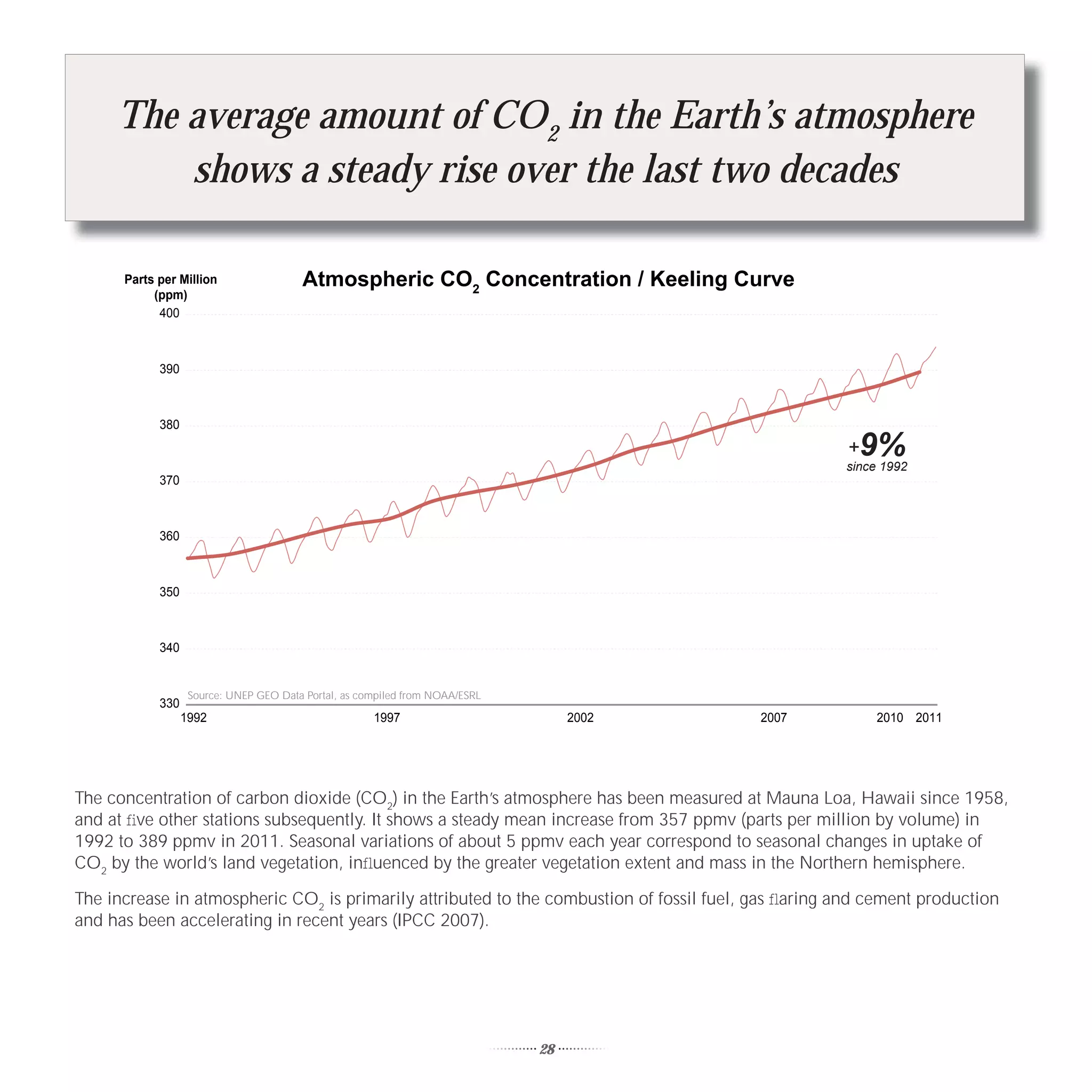
The concentration of carbon dioxide (CO2) in the Earth’s atmosphere has been measured at Mauna Loa, Hawaii since 1958,
and at five other stations subsequently. It shows a steady mean increase from 357 ppmv (parts per million by volume) in
1992 to 389 ppmv in 2011. Seasonal variations of about 5 ppmv each year correspond to seasonal changes in uptake of
CO2 by the world’s land vegetation, influenced by the greater vegetation extent and mass in the Northern hemisphere.

The increase in atmospheric CO2 is primarily attributed to the combustion of fossil fuel, gas flaring and cement production
and has been accelerating in recent years (IPCC 2007).


                                                                              28
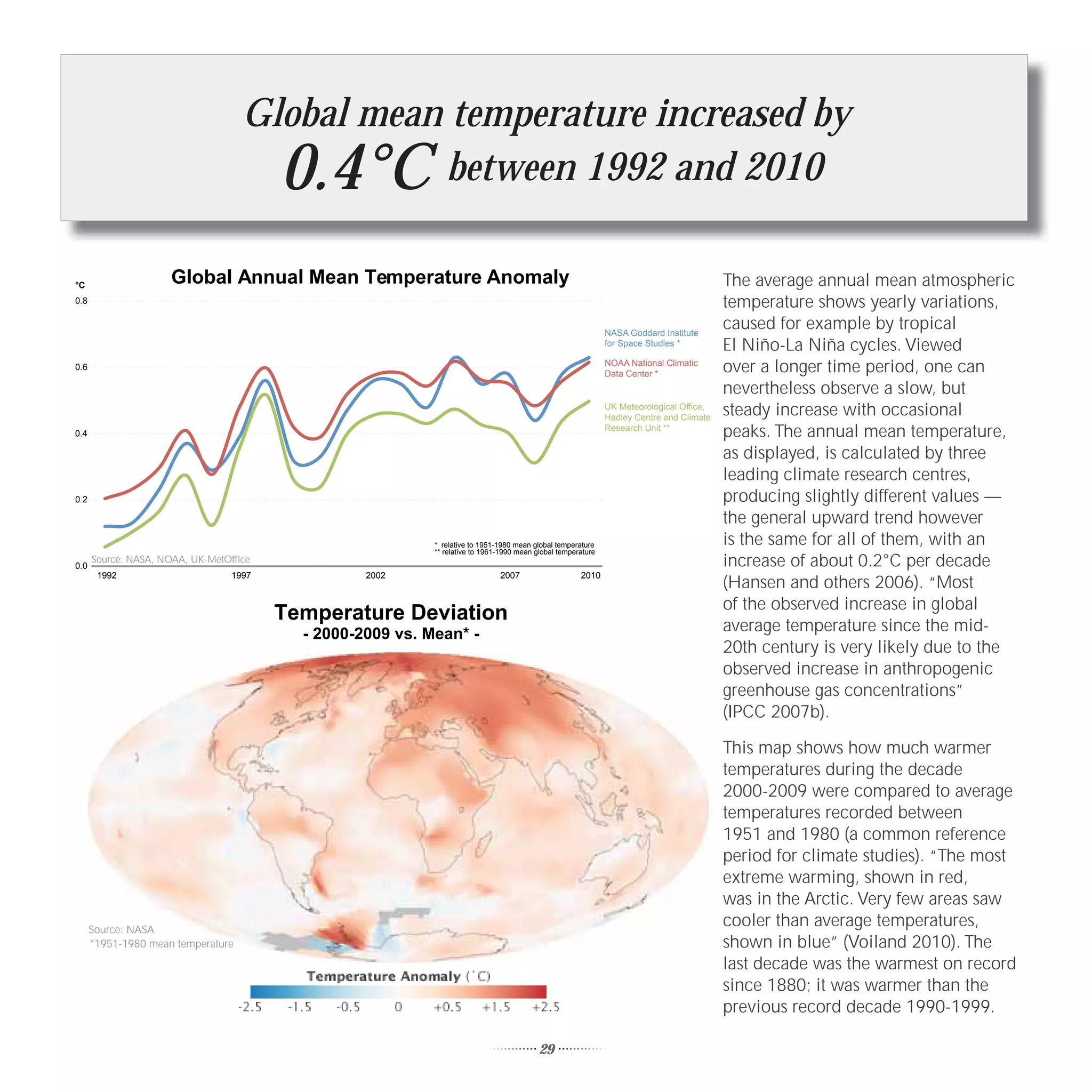
Global mean temperature increased by
                                         0.4°C between 1992 and 2010

°C
                      Global Annual Mean Temperature Anomaly                                                                               The average annual mean atmospheric
0.8                                                                                                                                        temperature shows yearly variations,
                                                                                                               NASA Goddard Institute
                                                                                                                                           caused for example by tropical
                                                                                                               for Space Studies *         El Niño-La Niña cycles. Viewed
0.6                                                                                                            NOAA National Climatic
                                                                                                               Data Center *
                                                                                                                                           over a longer time period, one can
                                                                                                                                           nevertheless observe a slow, but
                                                                                                               UK Meteorological Office,
                                                                                                               Hadley Centre and Climate
                                                                                                                                           steady increase with occasional
0.4
                                                                                                               Research Unit **
                                                                                                                                           peaks. The annual mean temperature,
                                                                                                                                           as displayed, is calculated by three
                                                                                                                                           leading climate research centres,
0.2                                                                                                                                        producing slightly different values —
                                                                                                                                           the general upward trend however
                                                            * relative to 1951-1980 mean global temperature                                is the same for all of them, with an
                                                            ** relative to 1961-1990 mean global temperature
0.0
      Source: NASA, NOAA, UK-MetOffice                                                                                                     increase of about 0.2°C per decade
       1992                       1997             2002                        2007                    2010
                                                                                                                                           (Hansen and others 2006). “Most
                                                                                                                                           of the observed increase in global
                                         Temperature Deviation
                                           - 2000-2009 vs. Mean* -                                                                         average temperature since the mid-
                                                                                                                                           20th century is very likely due to the
                                                                                                                                           observed increase in anthropogenic
                                                                                                                                           greenhouse gas concentrations”
                                                                                                                                           (IPCC 2007b).

                                                                                                                                           This map shows how much warmer
                                                                                                                                           temperatures during the decade
                                                                                                                                           2000-2009 were compared to average
                                                                                                                                           temperatures recorded between
                                                                                                                                           1951 and 1980 (a common reference
                                                                                                                                           period for climate studies). “The most
                                                                                                                                           extreme warming, shown in red,
                                                                                                                                           was in the Arctic. Very few areas saw
      Source: NASA
                                                                                                                                           cooler than average temperatures,
      *1951-1980 mean temperature                                                                                                          shown in blue” (Voiland 2010). The
                                                                                                                                           last decade was the warmest on record
                                                                                                                                           since 1880; it was warmer than the
                                                                                                                                           previous record decade 1990-1999.

                                                                                           29
The 10 hottest years ever measured
                                            have all occurred since 1998

                                                                     The Ten Hottest Years on Record
                                                              highest rank = warmest year since recording began in 1880
Rank                                                                                                                                                            Rank
 1st                                                                                                                                                             1st


2nd                                                                                                                                                             2nd


 3rd                                                                                                                                                             3rd
                     Hadley Centre UK Meteorological Office
                      NOAA National Climatic Data Center
 4th              NASA Goddard Institute for Space Studies                                                                                                       4th
                            Japanese Meteorological Agency
 5th                                                                                                                                                             5th


 6th                                                                                                                                                             6th


 7th                                                                                                                                                             7th


 8th                                                                                                                                                             8th


 9th                                                                                                                                                             9th


10th                                                                                                                                                            10th

       Source: UK-MetOffice, JMA

         1992       1993      1994     1995      1996         1997   1998   1999   2000   2001   2002   2003   2004   2005   2006   2007   2008   2009   2010


According to rankings from four top US, British and Japanese climate research centers, the ten hottest years on record have
all occurred since 1998. Eighteen out of the last 21 years feature among the 20 warmest years on record since (reliable)
recording of temperature started in 1880. These data and findings add weight to the common conclusion of all four agencies
and most of the scientific community, that in spite of short-term spatial and temporal variability the clear long-term trend is
one of global warming (NOAA 2011, NASA 2011, UK-MetOffice 2011, JMA 2011).


                                                                                          30
Far northern latitudes are seeing the most
                                         extreme changes in temperature

                                                                                  0º   0.5º   1.0º     1.5º     2.0º     2.5º      3.0º
                                                                        90°N


                                                                        60°N


                                                                            °N
                                                                        30

                                                                                                      Cº above mean *

                                                                                                     per latitude zone
                                                                             0°


                                                                                                                 200 5
                                                                                                                 200 6
                                                                                                                 200 7
                                                                        30°S
                                                                                                                 200 8
                                                                                                                 200 9
                                                                                                                 20 10


                                                                        60°S


 * relative to 1951-1980 mean global temperature                    -0.5º         0º   0.5º   1.0º      1.5º    2.0º     2.5º       3.0º
                                                                                                                                Source: NASA


The increase in global mean temperature is not occurring uniformly across the globe’s latitudinal zones. This graph of
departure from the historical mean temperature (1951-1980) for the past six years shows this variation by latitude. Far
northern latitudes are seeing the most extreme changes in temperature (see in particular the upper part of the graph
representing the higher latitudes, and corresponding larger temperature anomalies). Among the consequences of this
warming are melting of ice sheets and thawing permafrost. Furthermore, a study of 1 700 species found poleward migration
of 40 km between 1975-2005 and vertical migration in alpine regions of 6 m per decade in the second half of the 20th
century (Hansen and others 2006).

                                                           31
Oceans are also warming, while sea-level
                               rise continues unabated

                       Ocean Temperature Deviation                                                As the global atmospheric temperature
                                from 1901-2000 Average
                                                                                                  increased over the last decades, so also
  °C
  0.6
                                                                                                  did the average ocean temperature. By
  0.5
                                                                                                  comparing the last 20 years to the average
                                                                                                  of the last century, one can observe a
                                                                                                  steady warming of ocean waters, increasing
  0.4
                                                                                                  from 0.22°C above the long-term average
                                                                                                  in 1992 to nearly 0.5°C in 2010.
  0.3


  0.2


  0.1


        Source: NOAA
   0
         1992                   1998                     2004                            2010


MSL (MM)
                            Global Mean Sea Level                                                 Globally, sea level has been rising at an
  60                                                                                              average rate of about 2.5 mm per year
                                                                                                  between 1992 and 2011. This is due to
                                                                                                  rising sea-water temperature and resulting
                                                                                                  thermal expansion, as well as the melting
  40
                                                                                                  ice of the Arctic, Antarctic and Greenland
                                                                                                  ice sheets (Bindoff and others 2007).

                                                                                                  Scientific evidence supports the claim
  20
                                                                                                  that current sea level rise is caused by
                                                                                                  global warming (Bindoff and others 2007),
                                                                                                  although different opinions exist about
   0
                                                                Source: University of Colorado    the exact link as well as future projections
        1992             1997                2002               2007                       2011   (Rahmstorf and Vermeer 2011).
 -10


                                                                       32
Oceans are becoming more acidic, with negative
                implications for corals and other marine life

                                                   Ocean Acidification
      pH                                                                                                              ppm
      8.5                                                                                             CO2             400
                                                                                                      R = 0.95521


      8.4                                                                                                             375

                                                                                                         pCO2
                                                                                                         R = 0.27

      8.3                                                                                                             350


      8.2                                                                                                             325


      8.1                                                                                           pH                300
                                                                                                    R = 0.22214


            Source: Feely and others 2009
      8.0                                                                                                              275
        1992                                1997                2002                         2007                   2010


Increasing carbon dioxide (CO2) concentrations in the air alter the chemistry of the ocean’s surface, causing it to
become more acidic (measured by the logarithmic pH) (Caldeira and Wickelt 2003). The ocean’s pH declined from
8.11 in 1992 to 8.06 in 2007 (Feely and others 2009). There is a “growing concern that the process called ocean
acidification could have significant consequences on marine organisms which may alter species composition, disrupt
marine food webs and ecosystems and potentially damage fishing, tourism and other human activities connected to the
seas” (UNEP 2010b). Coral reefs are currently experiencing higher ocean temperatures and acidity than at any other
time in at least the last 400 000 years. If this trend continues, all coral reefs will likely be threatened by mid-century,
with 75 Per Cent facing high to critical threat levels (WRI 2011).

The increase in oceanic CO2 concentrations (pCO2 in the graph), measured off the coast of Hawaii, is consistent with
the atmospheric increase measured at Mauna Loa, Hawaii, within the statistical limits of the measurements (Feely and
others 2009).


                                                               33
Most mountain glaciers around the
                               world are diminishing rapidly

         Metres of
      Water Equivalent
                                                    Glacier Mass Balance
        since 1980
                 1992                             1997                2002                                   2007            2009
            -3
                                                                                 Source: UNEP GEO Data Portal, as compiled from WGMS


                         equa
                              ls an
                         of ~       an
            -5                0.4 m nual loss
                                     pe r y
                                            ear


            -7


            -9
                                                                              eq
                                                                                 u
                                                                             of als
                                                                               ~      a
                                                                                  0. n an
                                                                                    7
                                                                                      m nua
           -11                                                                          pe     l
                                                                                           r y los
                                                                                              ea s
                                                                                                 r


           -13


           -15

Changes in glaciers are key indicators of climate change. Nearly all mountain glaciers around the world are retreating and
getting thinner, as measured by their annual mass balance, with “severe impacts on the environment and human well-
being, including vegetation patterns, economic livelihoods, natural hazards, and the water and energy supply” (WGMS
2010). Diminishing glacier and ice cap volumes not only influence current sea-level rise but also threaten the well-being of
approximately one-sixth of the world’s population who depend on glacier ice and seasonal snow for their water resources
during dry seasons (WGMS 2008).

Moreover, as most glaciers are rapidly diminishing, the speed with which this happens has been increasing in recent
decades as well. For 30 glaciers observed (Zemp and others 2009), the average annual melting rate has increased from
around 0.4 metres per year in the early 1990s to 0.7 metres of water equivalent per year over the last decade, thus almost
doubling from one decade to the next, with record losses in 2004 and 2006 (WGMS 2010). The ongoing trend of worldwide
and rapid glacier shrinkage may lead to the deglaciation of large parts of many mountain ranges by the end of the 21st
century (WGMS/UNEP 2008).

                                                              34
The annual minimum extent of Arctic sea ice
                             continues its steady decline

Arctic sea ice extent has been declining since well before
satellite measurements began in 1979 (NSIDC 2011).
This decline has been most pronounced in September at
the end of the summer melt season (Stroeve and others
2008). Several of the most extreme years have been since
2002, with the smallest sea ice extent ever recorded
(4.17 million km2) occurring in 12 September 2007
(NSIDC 2011). Preliminary data for 2011 indicates that
ice extent had reached its second smallest extent ever
(4.33 million km2 on 9 September) (NSIDC 2011). The
trend is believed to be the result of natural variability in
air temperature and ocean and atmospheric circulation
patterns, combined with climate change (Wang and
Overland 2009). While the short data record precludes
confident predictions, there is concern that multiple
feedback processes such as reduced albedo could lead
to rapid transition to virtually ice-free Septembers in
the future—as soon as 2040 by one analysis (Wang and
Overland 2009).

              September Arctic Sea Ice Extent
Million km2
     8


    6


    4
                                                    -35%
                                                    since 1992
    2


    0 Source: NSIDC
       1992            1997       2002           2007       2010
                                                                        Source: NSIDC


                                                                   35
36
                               Forests


     Frank Vassen/Flickr.com
Forest area has decreased by                                                300 million ha
           since 1990, or an area larger than Argentina

Forests currently cover around 30% of the Earth’s                                                  Forest Net Change
land mass. Although the rate of deforestation is
slowing down, large areas of primary forest and other                                                               North America
                                                                                                                                                  1990-00
                                                                                                                                                  2000-05
naturally regenerated forests are declining, especially                                                                                           2005-10

in South America and Africa, while forested areas in
Europe and Asia are stable or increasing due to large-                                                                                   Latin America + Caribbean


scale afforestation programmes. Around 13 million
hectares of forest were converted to other uses or                                                                            Europe

lost through natural causes each year between 2000
and 2010, compared to 16 million hectares per year
during the preceding decade (FAO 2010). This results                                                                    Asia + Pacific


not only in biodiversity loss, but also contributes
12-15% to global warming by releasing CO2 into the                                                                                       Africa

atmosphere and hampering further CO2 storage (van
                                                              Source: UNEP GEO Data Portal, as compiled from FAO
der Werf and others 2009, UCSUSA 2011). “Millions            -5               -4       -3            -2            -1                    0              1            2                   3

of hectares of tropical forest are cleared every year                                                      Million Hectares per Year

to make way for agriculture, pastures and other
non-forest uses, or are degraded by unsustainable
or illegal logging and other poor land-use practices”
(ITTO 2011).
                                                          Thousand Hectares
                                                                                               Mangrove Forest Extent
Also in decline since several decades ago are                17
mangrove forests—important from social, economic
and biological points of view. For example,
“mangrove forests act as extremely effective carbon          16

sinks, able to absorb [nearly 100] tonnes of carbon
per hectare, or more than three times the absorptive                                                                                                                     -3%
capacity of non-mangrove forests” (UNDP 2011b).
                                                                                                                                                                         since 1990
                                                             15


Between 1990 and 2010, 3% of mangrove extent
was lost, mostly as a result of coastal development          14
and conversions to agriculture and aquaculture (rice
fields, shrimp farms). Using high-resolution satellite
imagery, the extent of mangroves in 2000 was even            13
                                                                  Source: FAO

found to be 13% less (blue point on the graph) than               1990                      1995                   2000                               2005                            2010

country statistics show (Giri and others 2010).
                                                                     37
Large portions of the Amazon rainforest were
                                 cleared for cattle pastures and farm fields


                                                                                 Source: USGS; Visualization UNEP-GRID Sioux Falls

Satellite images show that enormous areas of Amazon rainforest were cleared,


                                                                                                                               Simon Chirgwin / BBC World Service / Flickr.com
mostly along an “arc of deforestation” on the southern boundary of the
Amazon Basin. The Brazilian states of Rondônia, Para and Mato Grosso saw
the largest losses (INPE 2010). Major roads such as the BR-163 running from
north to south across the 1985 image of Mato Grosso (above), provided access
to the forest (Fearnside 2007). Twenty years later much of the forest is gone,
replaced by soy fields and cattle pastures. Severe droughts in 2005 and 2010
increased the frequency of fire, and have reinforced concerns that the Amazon
is reaching a tipping point where large areas of forest could be replaced by
a more savanna-like ecosystem (Lewis and others 2011, Nepstad and others
2008, Malhi and others 2009).
                                                            38
A gradually increasing percentage of the world’s forests
       has been replanted and is typically less diverse

Forest plantations are generally intended         Million Hectares
                                                                                         Forest Plantation Extent
for the production of timber, pulp and                  300

firewood, but along with other social
and environmental benefits also stabilise              250

soil and improve watershed protection.                                                                                                 54%
                                                                                                                                       +
Since 1990, they have been growing at                  200
                                                                                                                                       since 1990


an annual rate of 2.2%, or around 4 600
thousand hectares annually, increasing
                                                       150
from 170 to 265 million hectares
globally. Over the 20-year period,
                                                       100
this gain equals the size of a country
such as Tanzania. The total plantation
extent in 2010 represents 7% of the                     50

total forest area globally (FAO 2010b).
                                                             Source: UNEP GEO Data Portal, as compiled from FAO
Although these forests do not necessarily                0
                                                             1990                                                 2000                              2010
enrich local biodiversity since they are
mostly composed of the same and/or
introduced species, they can provide
                                            Million Solid Volume Units
                                                     (CUM)
                                                                                         Roundwood Production
                                                     3 700
important ecosystem services such as
timber, carbon and water storage and
soil stabilisation.

Roundwood production depends heavily                 3 500
on demand from the construction
sector. Economic growth around the
world stimulated production, until the
economic crisis in 2008, when new
                                                     3 300
construction activities — and thus
demand for timber — severely declined.
Some of the peaks (as for example in
2000, 2005 and 2007) in roundwood
                                                             Source: UNEP GEO Data Portal, as compiled from FAO
production are due to increased                      3 100
                                                             1992                         1997                           2002   2007                2010
extraction of the numbers of trees as a
result of severe storms (Eurostat 2011).


                                                                         39
Only about                           10%
                                    of global forests are under
                      certified sustainable management

   Million Hectares
                                                               Certified Forest Area
       250
                                                                                                      PEFC
                                                                                                                   420%
                                                                                                                   +
                                                                                                                       since 2002

       200


       150
                                                                                                      FSC          320%
                                                                                                                   +
                                                                                                                       since 2002


       100


        50


             Source: UNEP GEO Data Portal, as compiled from FSC, PEFC
         0
               2002                                                      2006                               2010


The Forest Stewardship Council (FSC) and the Programme for the Endorsement of Forest Certification (PEFC), the two largest
forest certification bodies worldwide with slightly different approaches to management and certification, certify socially and
environmentally responsible forestry. An impressive annual 20% growth rate of labeled forests indicates that both producers
and consumers are actively influencing timber production. Nevertheless, in 2010 still only about 10% of the total forest
extent was managed under FSC and PEFC practices.


                                                                           40
41
                                    Water


     Daniel Diaz Nauto/Flickr.com
Drinking water coverage increased to          , but the                               87%
     world is far from meeting the sanitation target of 75%

                                          Improved Sanitation & Drinking Water Coverage
     % of Population
         100


                                                                                                                             MDG Targets
                                                                                                                               2015
                                                                                          Drinking Water Coverage

         90                                                                                   + 13%                     87             89
                                                                                               since 1990


         80
               77

                                                                                                                                       75


         70
                                                                                       Improved Sanitation Coverage
                                                                                              + 13%                     61
                                                                                               since 1990
         60

               54

               Source: UNEP GEO Data Portal, as compiled from WHO/UNICEF
         50
                1990                                1995                        2000              2005                2008


Globally, improved sanitation coverage was just above the 60% mark in 2008, up from 54% in 1990, with over 2 500
million people still without access. Half of the people living in developing regions have no access to improved sanitation.
In all regions, coverage in rural areas lags behind that of cities and towns. At the current rate of progress, the world will
miss the MDG target of halving the proportion of people without access to improved sanitation by 2015. In fact, at the
current rate of progress, it will take until 2049 to provide 75% of the global population with flush toilets and other forms of
improved sanitation (UN 2011b).

However, the good news is that the world will meet or even exceed the MDG drinking water target by 2015 if the current
trend continues. By that time, nearly 90% of the population in developing regions, up from 77% in 1990, will have gained
access to improved sources of drinking water.


                                                                           42
T
                    Th
                    The Mesopotamian Marshlands, nearly destroyed in the
                     1
                     1990s, have been partially restored but remain at risk


                                                                               Source: USGS; Visualization UNEP-GRID Sioux Falls

The Mesopotamian Marshlands are the largest wetland ecosystem in the Middle East (Partow 2001). Construction of
numerous dams, water diversions and hydropower facilities on the Tigris and Euphrates Rivers over the past century and the
deliberate draining of the marshes by the Iraqi regime in the early 1990s had almost destroyed the wetlands by 2000 (Aoki
and Kugaprasatham 2009). Reflooding beginning in 2003 helped restore many ecosystem functions for a large portion of
the marshes (Richardson and Hussain 2006). In 2008, the eastern Hawizeh marshes were designated as Iraq’s first Ramsar
Wetland Convention site and preparations are underway to inscribe the entire marshes as a joint cultural and natural
site under the World Heritage Convention (Garsteck and Amr 2011). Ecosystem recovery, however, has been seriously
undermined by a severe drought (2008-2010) and uncoordinated water-related developments in the Tigris-Euphrates basin
(Garsteck and Amr 2011). The lack of a water sharing agreement between riparian countries and potential declines in
Euphrates flows are a major threat to the wetlands’ survival.
                                                            43
44
                                  Biodiversity


     Brian Gratwicke/Flickr.com
The Living Planet Index has declined by                                               12%
                at the global level and by       in the tropics      30%
                                               Living Planet Index
   Index, 1992=100
         120


                                                                                                                 Temperate

         100


                                                                                                                 Terrestrial
                                                                                                                 Global
                                                                                                                 Freshwater
                                                                                                                 Marine
          80


                                                                                                                 Tropical


               Source: WWF/ZSL
          60
                1992                          1997                            2002                             2007


The Living Planet Index reflects changes in the health of the earth’s ecosystems. It is based on monitoring almost 8 000
populations of over 2 500 vertebrate species. In contrast to the temperate biome, which is somewhat stable (after hundreds
of years of biodiversity losses), all other indices show various degrees of decline. Biodiversity in the tropics is dramatically
declining, by 30% since 1992, indicating the ecosystem’s severe degradation due to high deforestation rates of primary
forest and transformation into agricultural land and pasture (WWF 2010).


                                                               45
Each year              52
                                            vertebrate species move one
                                Red List category closer to extinction

  Red List Index
                                                                                     The Red List Index (RLI) measures the risk of extinction,
of Species Survival                       Red List Index                             divided into seven categories of extinction risk, as
         1.00                                                                        calculated from the IUCN Red List of Threatened
                                                                                     Species. An RLI value of 1.0 equates to species not
                                                                                     being expected to become extinct in the near future;
                                                                                     a RLI value of zero indicates that all species have
                                                                                     become ‘Extinct’ (Hoffman and others 2010). The
         0.95                                                                        graph shows that for those vertebrate groups where
                                                                                     sufficient data are available, the trend is generally
                                                                                     negative; i.e., that birds, mammals and amphibians are
better


                                                                        Birds        becoming increasingly threatened. The five principal
                                                                                     pressures driving biodiversity loss are habitat change,
         0.90
                                                                                     overexploitation, pollution, invasive alien species and
                                                                                     climate change (CBD 2010).

                                                                                     “Almost one-fifth of extant vertebrate species are
                                                                                     classified as ‘threatened’, ranging from 13% of birds to
                                                                     Mammals         41% of amphibians” (Hoffman and others 2010). On
         0.85
                                                                                     average, 52 species per year moved one category closer
                                                                                     to extinction from 1980 to 2008. Amphibians are more
                                                                                     threatened than birds and mammals, and are declining
                                                                                     at a faster rate. The status of other groups is likely to be
                                                                                     similar if not worse; nearly a quarter of plant species
         0.80                                                                        are estimated to be threatened with extinction (CBD
                                                                                     2010), and in some plant groups over 60% of species
                                                                                     are considered threatened (Hoffman and others 2010).
worse


                                                                                     As renowned ecologist Edward O. Wilson puts it:
                                                        Amphibians
                                                                                     “One small step up the Red List is one giant leap
         0.75                                                                        towards extinction”.

                                                                                     The highest numbers of threatened vertebrates can
                                                                                     be observed in the tropical regions, with figures
                                                                                     disproportionally higher than in other regions (Hoffman
         0.70
                Source: Hoffman and others 2010                                      and others 2010).
                1992                        1997     2002                2007 2008


                                                                                46
13% of the world’s land surface, 7% of its coastal
              waters and 1.4% of its oceans are protected

                                               Protected Areas                                                                                 By 2010, there were over 148 000
Million km2                                           - Total Area -                                                                           protected areas in the world (IUCN
   20
                                                                                           Terrestrial & Coastal         +42%                  2011), covering almost 13% of
                                                                                                     Terrestrial
                                                                                                                          since 1992
                                                                                                                                               the land area or 17 million square
                                                                                                                         +38%                  kilometres — an area as large as the
                                                                                                                          since 1992
   15
                                                                                                                                               Russian Federation. Marine protected
                                                                                                                                               areas, however, cover only around
                                                                                                                                               7% of coastal waters (extending out
   10                                                                                                                                          to 12 nautical miles) and just above
                                                                                                                                               1.4% of the oceans (IUCN/UNEP
                                                                                                                                               2011, Toropova and others 2010).
      5                                                                                              Marine &
                                                                                                                      +   210%                 Likely due to time lags in reporting,
                                                                                                                          since 1992
                                                                                                     Coastal
                                                                                                                                               the overall rate of increase in setting
                                                                                                     Coastal          +   120%                 aside protected areas is levelling off in
      0
                                                   Source: UNEP Geo Data Portal, as compiled from IUCN, UNEP-WCMC
                                                                                                                          since 1992
                                                                                                                                               recent years, yet saw a total increase
            1992                       1997                       2002                       2007                  2010                        of 42% between 1992 and 2010.
                                                                                                                                  17%
                                                                                                                                 target
                                               Protected Areas                                                                “terrestrial”
                                                       - Per Cent -
Per Cent
 14
                                                                                                           Terrestrial
                                                                                                                                               New targets for the extent of
 12
                                                                                                                                               protected areas globally were set
                                                                                                                                 10%
                                                                                                                                               by governments in the Nagoya
 10                                                                                                                             target
                                                                                                                          “coastal & marine”
                                                                                                                                               Protocol, negotiated in October
  8
                                                                                                                                               2010. Under a 20-point plan, they
                                                                                                           Coastal
                                                                                                                                               made commitments to protect 17% of
  6
                                                                                                                                               terrestrial and inland waters, and 10%
                                                                                                                                               of coastal and marine areas, especially
  4                                                                                                                                            areas of particular importance for
                                                                                                                                               biodiversity and ecosystem services,
                                                                                                           Marine &
  2                                                                                                        Coastal                             until 2020 (CBD 2010b).
          Source: UNEP Geo Data Portal, as compiled from IUCN, UNEP-WCMC
  0
          1992                        1997                        2002                       2007                  2010         2020


                                                                                                47
48
                                Chemicals & Waste


     D’Arcy Norman/Flickr.com
Both the number of tanker oil spills recorded and the
        quantity of oil involved have declined in 20 years

                                              Oil Spills from Tankers                                            Quantity
  Number of Spills                                                                                          [Thousand Tonnes]
      50                                                                                                           200


       40
                                                                                                                    150


       30

                                                                                                                    100


       20


                                                                                                                    50
       10


        0                                                                                                           0
            1992                       1997                         2002                     2007            2010
             Source: ITOPF


The number as well as the total quantity of oil from accidental oil spills from tankers (including combined carriers and
barges) have decreased significantly since 1992. Although the vast majority of spills are relatively small (i.e., less than seven
tonnes) (ITOPF 2011), the accumulated amount is nearly one million tonnes since 1992. “Most spills from tankers result
from routine operations such as loading, discharging and bunkering which normally occur in ports or at oil terminals”
(ITOPF 2011).


                                                               49
Plastics decompose very slowly, creating a
                       major long-term environmental impact

         Million Tonnes
                                                          Plastics Production
              300


                                                                                                  +   130%
                                                                                                      since 1992

              250


              200


              150


                    Source: EuroPlastics
              100
                     1992                          1997                               2002     2007                2010


The amount of plastics* produced globally grew steadily from 116 million tonnes in 1992 to around 255 million tonnes
in 2007, when the economic crisis led to a drop. But in 2010, a new record value of 265 million tonnes had already been
reached. This total increase of 149 million tonnes in eighteen years equals a growth of around 130%, or 15% annually. The
average use of plastic in developed regions reached around 100 kg per year per capita in 2005, whereas consumption in
developing regions is only around 20 kg, with rapid increases foreseen in the next decade (UNEP 2011c).

About 50% of plastic is used for single-use disposable applications, such as packaging, agricultural films and disposable
consumer items (Hopewell and others 2009). Plastics debris in the ocean has become particularly notorious in recent
years. Concentrated along shorelines or in huge, swirling open-sea gyres, such material threatens the lives of many marine
organisms, especially seabirds and small mammals (UNEP 2011c).
*not including Polyethylene terephthalate (PET), Polyamide (PA) and polyacryl fibres

                                                                         50
51
                                 Natural Hazards


     Warren Antiola/Flickr.com
Both human losses and economic damage from
                      natural disasters show an upward trend

                                                                                                                                                     Damage Thousand Million
Number of Deaths                                           Impacts of Natural Disasters                                                               US$, Inflation-adjusted
  500 000                                                                                                                                                             250


  400 000                                                                                                                                                             200
                                                                                 Damage
                                                                                 Deaths

  300 000                                                                                                                                                             150


  200 000                                                                                                                                                             100


  100 000                                                                                                                                                             50


        0                                                                                                                                                             0
               1992     1993   1994   1995   1996   1997    1998   1999   2000    2001    2002    2003         2004    2005     2006   2007   2008   2009    2010
            Source: EM-DAT


Although there is no clear indication that hazard occurrences (such as                           Number               Reported Natural Disasters
floods, droughts and hurricanes) have changed much in recent times                                 600

(UN 2011c), the number of reported disasters has been increasing
significantly. Indeed, “over the past two decades the number of                                    500

reported natural disasters has doubled from around 200 to over 400
per year. In 2010, over 90 Per Cent of disaster displacement within                               400

countries was attributed to climate-related hazards” (NRC 2011).
                                                                                                  300

The risks are changing, mainly due to population increase, climate
change and ecosystem degradation. The risks to humans and                                         200

economic losses are increasing in absolute terms for all principal
hazards, except for landslides, where the tendency appears to be                                  100

stable. Relative risk, however, when measured as a proportion of
population or GDP, is stable, and in the case of mortality, may even be                             0
                                                                                                        Source: EM-DAT
                                                                                                        1992                  1997            2002             2007         2010
declining (UN 2011c).

                                                                                  52
Increased exposure to natural disasters has resulted
             from more people living in hazard-prone areas

To quantify trends in disaster risk, one has                                                            Floods
to consider all three components of risk:                 Index, 1980=100
                                                                                      - Mortality Risk, Exposure and Vulnerability -
hazard, exposure and vulnerability.* In                         200

all regions, human exposure is increasing
mainly due to demographical factors: an                                                                                                Exposure
increasing population with more people
moving to hazard-prone areas. In most                          150

regions, vulnerability is decreasing, thanks
                                                                                                                                       Risk
to factors such as improved governance
and better urban and land planning. At a
global level, this decline in vulnerability
                                                               100
compensates for the increase in exposure,
thus stabilising or even decreasing the risk.                                                                                          Vulnerability

However, this global trend is mostly related
to a significant decline in vulnerability in
                                                                     Source: UNISDR
China. If China were removed from the                           50
                                                                     1990                                  2000                                  2010
analysis, the risk would still be increasing
due to a significant rise in exposure. The
global trend hides large regional differences                                                   Tropical Cyclones
(UN 2011c).                                               Index, 1980=100             - Mortality Risk, Exposure and Vulnerability -
                                                                150
                                                                                                                                          Exposure


                                                                                                                                          Risk

                                                               125
Note:

*Risk is the probability of losses (mortality and
economic losses) from a specific hazard, according to           100
                                                                                                                                          Vulnerability
its intensity, location and time period. Risk has three
components: the hazard (probability of a hazardous
event occurring at a specific intensity); exposure
(number of people or assets) located in hazard-prone
areas; and vulnerability (percentage of losses, should
a hazardous event occur). A disaster can occur when
a vulnerable population is hit by a hazardous event.
                                                                     Source: UNISDR
                                                                50
                                                                     1990                                  2000                                   2010


                                                                                 53
54
                                 Governance


     ohn & Mel Kots/Flickr.com
Numerous international agreements were negotiated in
        the two decades following the Rio Conference in 1992

   Accumulated Number of
                                Multilateral Environmental Agreements                                                               Number of
                                                                                                                                                The steady increase of countries signing
Signatories to 14 Global MEAs
          2 500
                                                     - Number and Signatories -                                                     new MEAs
                                                                                                                                        50
                                                                                                                                                Multilateral Environmental Agreements
                     New MEAs
                                                                                            Number of Signatories                               (MEAs) such as the Convention on
                                                                                                                  +   330%
                                                                                                                      since 1992
                                                                                                                                                Biological Diversity, the Ramsar Convention
         2 000                                                                                                                            40
                                                                                                                                                or the Kyoto Protocol signifies rising
                                                                                                                                                political recognition of environmental
         1 500                                                                                                                            30    issues. The graph includes 14 MEAs* and
                                                                                                                                                shows the total number of signatories for
         1 000                                                                                                                            20
                                                                                                                                                those 14 taken together (thus, if all 14
                                                                                                                                                MEAs were signed by all 196 countries,
                                                                                                                                                the number would be 14 x 196 = 2744).
           500                                                                                                                            10
                                                                                                                                                Altogether, the number of newly
                                                                                                                                                established global and regional MEAs
             0                                                                                                                            0     is steadily decreasing, demonstrating
                 1992                         1997                          2002                          2007
                 Source: UNEP GEO Data Portal, as compiled from various MEA secretariats, IEA Database Project
                                                                                                                                   2010
                                                                                                                                                that legal frameworks are in place to
                                                                                                                                                address many important issues. Neither
                                      Number of MEAs Signed                                                                                     establishing or signing an agreement or
                                                                                                                           4- 9                 convention, however, means that the related
                                                                                                                          10 - 14
                                                                                                                          no data               environmental problems have been solved.

                                                                                                                                                Most countries have signed at least nine out
                                                                                                                                                of the 14 major MEAs; 60 countries have
                                                                                                                                                signed all of them. Only a few countries or
                                                                                                                                                territories or countries in conflict have not
                                                                                                                                                signed the majority of these MEAs.


Source: UNEP GEO Data Portal, as compiled from various MEA secretariats

*Basel Convention, Cartagena Convention, Convention on Biological Diversity, Convention on International Trade in Endangered Species of Wild Fauna
and Flora, Convention on Migratory Species, World Heritage Convention, Kyoto Protocol, Secretariat for the Vienna Convention and for the Montreal
Protocol, Ramsar Convention, Rotterdam Convention, Stockholm Convention, Convention to Combat Desertification, Convention on the Law of the Sea,
Framework Convention on Climate Change

                                                                                                             55
The private sector is increasingly adopting
                      environmental management standards

  Number of Certificates                                       ISO 14001 Certifications
     in Thousands
           250


                                                                                          +1500%
                                                                                            since 1999
           200


           150


           100


            50


                  Source: UNEP GEO Data Portal, as compiled from ISO
              0
                      1999                                                 2004                          2009


The International Organization for Standardization (ISO) has developed over 18 500 international standards on a variety
of issues. The ISO 14000 standard is primarily concerned with “environmental management”. In effect, it codifies what
practices and standards companies should follow to minimize harmful impacts on the environment caused by their activities
and to achieve continual improvement of environmental performance. With annual growth rates of over 30% and 230 000
certificates granted in 2009, this development demonstrates a growing number of companies’ commitment to adopting
environmental management systems.


                                                                          56
Trading in CO2 emissions has grown rapidly, but in
       2010 still only equalled        of the global GDP1/500
                                                Carbon Market Size
     Thousand Million US$
             150


                                                                                                   +1200%
                                                                                                     since 2005
             120


             90


             60


             30


                   Source: World Bank
              0
                            2005        2006          2007            2008             2009            2010


Following five consecutive years of robust growth, the carbon market reached a three-year plateau between 2008-2010
with a value of around US$ 140 thousand million (World Bank 2011), which equals about 1/500 of global GDP. The rise on
global market trends since 2005 — the first year of the Kyoto protocol — is mostly due to increase in transactions volume.
Carbon prices have not been spared by the economic downturn. In less than a year, prices fell from € 30 to € 8 on the
European market (World Bank 2010). In addition, due to a lack of clarity about regulations in a post-Kyoto regime after
2012, some of the implemented mechanisms are today suffering rather large losses in value. Out of the total amount of
allowances, the EU Emissions Trading System launched in 2005 accounts for 84% to 97% of the global carbon market value
in 2010 (World Bank 2011).


                                                             57
Funding to support the environment has not kept up
       with the increase in total foreign aid since 1992

   Thousand Million                Total Foreign Aid and Environmental Aid                                          Thousand Million
  Constant 2000 US$                                                                                                Constant 2000 US$

        15                                                                                                                240

                                                                  Total Foreign Aid
        13                                                                                                                200


        11                                                                                                                160


         9                                                                                                                120


         7                                                                                                                80


                                                                                         Total Environmental Aid
         5                                                                                                                40


             Source: AidData.org
         3                                                                                                                0
              1992                     1996                2000                       2004                         2008


Total foreign aid from bilateral and multilateral donors increased overall during the last two decades, starting at US$ 145
thousand million in 1992 and reaching close to US$ 215 thousand million in 2008. Funding dedicated to environmental aid
purposes, however, fluctuated more widely and declined overall until 2003, before rising dramatically within the next few
years. By 2008, the share of environmental aid from total foreign aid dropped again to less than 4%, down from
5.5-7.0% in 1992-1993.


                                                            58
Environmental governance and energy initiatives
                receive the largest share of environmental aid

 Thousand Million                            Aid Allocated to Environmental Activities*
Constant 2000 US$
      6


                               Energy Conservation and Renewables
      4


                                                                                                 Environmental Governance
            Waste
      2   Management

                                                                                                      Natural Resources Management and
                                                                                                      Biodiversity Protection


                                                                                                      Sustainable Land Management
                                                                                                      Water Resources Protection
      0
       1992             1994          1996          1998            2000    2002   2004   2006      2008
       Source: AidData.org
                                                                                                      Marine Protection


When one examines the amounts of aid received from bilateral and multilateral donors by different environmental sectors,
it becomes clear that large differences exist. A major share of environmental aid funds is dedicated to energy conservation
and to the development and implementation of environmental policies (Governance). This graph shows that from 1992-
1997, aid to energy conservation was distinctly larger than any other sector; however, by 2008 it was being surpassed
by the Governance sector. Other areas such as biodiversity protection, land management, water resources and marine
protection receive far smaller amounts.


*Note: see Annex


                                                                           59
60
                             Agriculture


     Irish_Eyes/MorgueFile
Food production has continued to rise steadily
                  at a pace exceeding population growth

                                                Food Production Index
   Index, 1992=100
          160


                                                                                                         Food
                                                                                                                       +   45%
                                                                                                                        since 1992
         140


                                                                                      Livestock
                                                                                                     Population        +26%
                                                                                                                        since 1992
                                                                            Crops
         120


         100                                                                                              Source: FAO

               1992                      1997                        2002                         2007          2009


Global food production has continued to keep pace with and even exceed population growth over the past two decades.
Gains in production have come primarily from improved yields and to a lesser extent from new agricultural land. However,
despite solid gains made in food security, millions in developing countries still face chronic hunger and malnutrition.
More significant gains in agricultural production will be necessary to meet continued global population growth. These
will require expanding farm land and using more intensive production techniques. Such practices have known negative
impacts on the environment, including loss of biodiversity and pollution from nitrogenous fertilizers and other agricultural
chemicals. A more sustainable solution, as highlighted by the ‘Special Rapporteur of the UN on the Right to Food’,
is to upscale agroecology, a method of creating beneficial interactions and synergies among the components of the
agroecosystem (UN 2010b).


                                                             61
Higher agricultural yields depend
                                      heavily on the use of fertilizers

                                                 Cereal Production, Area Harvested and
                                                                     Fertilizer Consumption
    Index, 1992=100
           140


                                                                                                       Nitrogenous Fertilizer
                                                                                                       Consumption
          130
                                                                                                       Cereals - Production


          120


          110


          100                                                                                          Cereals - Area Harvested


                Source: UNEP GEO Data Portal, as compiled from FAO
           90
                 1992                                     1997                       2002     2007   2009


The increasing amounts of cereal crops being produced are only marginally linked to the total area under cultivation. Their
increase is almost exclusively dependent on intensification, where the use of fertilizers plays a major role (UNEP 2011). The
heavy dependence on machines and materials increases energy usage and leads to the fact that it takes an average of seven
to ten calories of input energy (i.e., mostly fossil fuels) to produce one calorie of food (Heller and Keoleian 2000, Pimentel
and Pimentel 1996).

Nitrogenous fertilizers, the use of which grew by around 1 500 thousand tonnes per year, supply plant nutrients and enrich
soil fertility, but can lead to eutrophication of inland and marine waters, and increase the release of very potent greenhouse
gases, such as N2O.


                                                                                62
While increasing irrigation infrastructure can raise crop
    yields, it puts further pressure on freshwater availability

Million km2
                              Total Area Equipped for Irrigation                                          Areas equipped for irrigation have
    3.5                                                                                                   expanded steadily (21% since 1992),
                                                                                                          providing improved food security and
                                                                                  +21%                    productivity in many water-constrained
                                                                                  since 1992              environments. However, irrigation
                                                                                                          accounts for approximately 70% of
    3.0
                                                                                                          total freshwater withdrawals worldwide
                                                                                                          (UNESCO 2001) and is seen as one of
                                                                                                          the principal factors in an increasing
                                                                                                          state of water scarcity. Globally, there
    2.5                                                                                                   is adequate potential for expanding
                                                                                                          irrigation to help meet production
                                                                                                          needs for a growing population.
                                                                                                          However, many of the regions where
          Source: UNEP GEO Data Portal, as compiled from FAO
                                                                                                          irrigation is likely to expand are subject
    2.0
           1992                             1997               2002            2007          2009         to freshwater and/or land scarcity.
                                                                                                          Irrigation expansion into sensitive
                                                                                                          ecosystems may lead to significant
                                                                                  Area equipped           losses of natural habitat. Conversely,
                                                                                  for irrigation (2000)
                                                                                                          intensification of agriculture through
                                                                                                          irrigation can reduce the footprint of
                                                                                                          agriculture, sparing valuable natural
                                                                                                          areas. There is a strong need in general
                                                                                                          to increase water use efficiency under
                                                                                                          irrigated agriculture regimes.

                                                                      s


          Source: Siebert and others 2007


                                                                          63
E
                        Enormous irrigation projects using fossil water
                         turned Saudi Arabia into an exporter of food


                                                                                         Source: USGS; Visualization UNEP-GRID Sioux Falls

Rich in oil but lacking abundant renewable water resources, Saudi Arabia used oil revenues to develop domestic agriculture
based on groundwater from non-renewable aquifers (Elhadj 2006). Subsidies, direct and indirect, led to astonishing growth
in agricultural output (Royal Embassy of Saudi Arabia n.d.). Large center-pivot irrigation projects such as the one above at
Wadi As-Sirhan appeared in the vast Saudi desert. However, by one calculation the cost of wheat produced reached around
US$ 500 per tonne, several times the cost of imported wheat (Elhadj 2006). In 2008, the Saudi government announced
plans to phase out wheat production by 2016 (Gulfnews 23 Apr. 2009).
                                                             64
Land area used for organic farming is growing at an
                  annual rate of nearly                                        13%
                                                         Organic Farming
         Thousand km2
             400


                                                                                                          +240%
                                                                                                           since 1999
              300


              200


              100


                    Source: Organic World
               0
                        1999                                        2004                                            2009


Organic farming is a form of agriculture that excludes or strictly limits the use of chemical fertilizers and pesticides, and
builds on integrating crops and livestock, diversifying species and recycling nutrients on the farm, among other practices
that favour natural processes (UN 2010b). It has expanded significantly from a very low baseline of around 110 000 km2
in 1999, to covering an area of over 370 000 km2 in 2009 (an increase of nearly 240%), an area that equals the size of a
country such as Japan or Germany. Nevertheless, the percentage of agricultural land managed under certified ecological
practices is still less than 1% globally.


                                                               65
Three crops have expanded dramatically in the
                        tropics, often replacing primary forests

                   Selected Crops in Humid Tropical Countries                                                              Sugar cane, soybeans, and palm oil
 Million km2
                                                          - Area -                                                         are cultivated on a massive scale
    15                                                                                                                     in the tropics; their area grew from
                                                                                                                           just above 8 million km2 in 1992
                                                                                                              Sugar Cane   to nearly 14 million km2 in 2009,
                                                                                                                           a nearly 75% increase. Oil palm
    10
                                                                                                                           plantations showed the largest
                                                                                                                           increase of 120% between 1992 and
                                                                                                                           2009, followed by soybeans (75%)
                                                                                                              Soybeans
                                                                                                                           and sugar cane (30%). However,
                                                                                                                           soybean plantations occupy the
     5
                                                                                                                           largest area and also show the
                                                                                                                           highest absolute growth, expanding
                                                                                                                           from 6 250 thousand km2 in 1992 to
                                                                                                                           nearly 10 000 thousand km2 in 2009.
        Source: UNEP GEO Data Portal, as compiled from FAO                                                    Palm oil
     0 Source: UNEP GEO Data Portal, as compiled from FAO
      1992                            1997                           2002               2007           2009                These crops are largely being raised
                                                                                                                           for the production of ethanol (sugar
                   Selected Crops in Humid Tropical Countries                                                              cane), export for livestock fodder
Index, 1992=100                                  - Change in Area -                                                        (soybeans) and ingredients for food
      250
                                                                                                                           and drug products or other biofuel
                                                                                        Palm oil   +  120%                 production (palm oil). In many
                                                                                                       since 1992


     200
                                                                                                                           or most cases they are grown on
                                                                                                                           industrial-scale farms established
                                                                                        Soybeans      +   75%
                                                                                                       since 1992          by the clear-cutting or burning of
                                                                                                                           vast areas of tropical forest (ITTO
     150
                                                                                        Sugar Cane                         2011, UCSUSA 2011, FAO 2006).
                                                                                                      +   30%              Soybeans and sugarcane have been
                                                                                                       since 1992

                                                                                                                           powerful drivers of forest loss in
     100
                                                                                                                           South America, while palm oil is
                                                                                                                           widely grown in Indonesia. The rapid
           Source: UNEP GEO Data Portal, as compiled from FAO
                                                                                                                           losses of these forests are among the
      50
            1992                        1997                    2002             2007          2009                        most dramatic land-use changes in
                                                                                                                           human history.


                                                                            66
Ever-increasing numbers of grazing animals
                  degrade already impoverished grasslands

                                                 Grazing Animal Herds
    Index, 1992=100
           160


                                                                                                         Goats           45%
                                                                                                                         +
                                                                                                                         since 1992
         140


                                                                                                         Buffaloes       +   23%
                                                                                                                         since 1992
         120


                                                                                                         Cattle          +   6%
                                                                                                                         since 1992
         100
                                                                                                         Sheep
                                                                                                                         -7%
                                                                                                                         since 1992

               Source: FAO
          80
                1992                      1997                        2002                        2007            2009


The numbers of grazing animals (other than sheep) have surged over the last 20 years. The number of cattle and buffaloes
has increased by 6% and 23% respectively, and goats by an even greater rate of 45%. These increases in grazing animal
herds are significant, due to the impacts they have on the landscape, particularly fragile grasslands. Their hooves pulverize
the soil, breaking up the thin crust formed by rainfall and allowing valuable topsoil to be more easily eroded by wind
(Brown 2011). Degraded grassland turns into shrubland, which is unable to sustain cattle and sheep, but on which goat
populations continue to thrive. The goat population is very unevenly distributed globally: in 2009, 60% were in Asia and
34% in Africa.


                                                              67
68
                          Fisheries


     Ezioman/Flickr.com
The depletion of fish stocks is one of the
                              most pressing environmental issues


            % of all Fish Stocks
                                                       Fish Stocks Exploitation*
                    100
                                                                                                                                      Underexploited +
                                                                                                                      -49%            Moderately exploited
                                                                                                                      since 1992


                    80

                                                                                                                      +   33%         Overexploited + Depleted +
                                                                                                                      since 1992      Recovering
                    60


                    40


                                                                                                                      +13%            Fully exploited
                                                                                                                      since 1992
                    20


                         Source: FAO
                     0
                      1992                             1997                       2002                      2006     2007          2008

Since 1992, the proportion of fully exploited fish stocks increased by 13% and overexploited, depleted or recovering stocks
increased by 33%, reaching 52% and 33%, respectively, of all fish stocks. Only a small percentage of stocks, around 15%,
are under-exploited or moderately exploited; these stocks saw a strong decrease (especially in the last couple of years) of
nearly 50% since 1992. “While the degree of uncertainty about these estimates may be great, the apparently increasing
trend in the percentage of overexploited, depleted and recovering stocks and the decreasing trend in under-exploited and
moderately exploited stocks do give cause for concern” (FAO 2010c). Subsidies of around US$ 27 000 million per year
“have created excess capacity by a factor of two relative to the ability of fish to reproduce” (UNEP 2011b, Sumaila and
others 2010).

“The clock is ticking on the sustainability of global fish stocks”, highlighting the need for an international agreement on
better management of the marine environment (UNEP 2010c). Given that over 500 million people globally rely on fisheries
and aquaculture for their livelihoods, and that fish help feed three thousand million people (FAO 2011), this issue is
becoming more urgent than ever.
* Underexploited or moderately exploited = able to produce more than their current catches; overexploited, depleted or recovering from depletion =
yielding less than their maximum potential production owing to excess fishing pressure in the past, with a need for rebuilding plans; fully exploited =
current catches are at or close to their maximum sustainable productions, with no room for further expansion.


                                                                           69
Marine fish catch has declined slightly,
                              although tuna catches have risen steeply

Million Tonnes
                                         Total Fish Catch                                                   Marine fish catch data show annual
    100                                                                                                     variations, with an overall trend
                                                                                                            suggesting a slight decrease over the
                                                                                  Marine Trendline
                                                                                                            last 10 years. But with catches of
     80
                                                                                         Marine
                                                                                                            around 80 million tonnes for marine
                                                                                                            fish and 10 million tonnes (with a
                                                                                                            steady growth) for inland water fish,
     60
                                                                                                            the pressure on water ecosystems
                                                                                                            remains high (UNEP 2011c).
     40


     20

                                                                                         Inland


          Source: UNEP GEO Data Portal, as compiled from FAO
      0
           1992                          1997                  2002               2007            2009


Thousand Tonnes
                                                   Tuna Catches
      4 500                                                                                                 Tuna is an economically
                                                                                                            important, globally-traded fish
                                                                                                            that is increasingly in demand by
                                                                                                            consumers. Catches increased
                                                                                            +35%            dramatically, from 600 thousand
                                                                                            since 1992
      4 000
                                                                                                            tonnes in the 1950s, to over 3 100
                                                                                                            thousand tonnes in 1992, to 4 200
                                                                                                            thousand tonnes in 2008, leaving
                                                                                                            some tuna species on the edge of
      3 500                                                                                                 extinction (IUCN 2011b, Collette
                                                                                                            and others 2011).


              Source: FAO
      3 000
               1992                             1997                  2002                 2007      2008


                                                                             70
90% of global aquaculture is practised in Asia,
                  the vast proportion of which occurs in China

                                                Fish Catch and Aquaculture Production
    Million Tonnes
        100


                                                                                                                   Fish Catch

         80


         60

                                                                                           Aquaculture, World   +   245%
                                                                                                                    since 1992


         40
                                                                                           Aquaculture, China   +   290%
                                                                                                                    since 1992


         20


              Source: UNEP GEO Data Portal, as compiled from FAO
          0
               1992                                     1997            2002                  2007          2009


Aquaculture increased by 245% between 1992 and 2009 with most growth occurring in Asia, and in particular China.
The global production has grown from 14 million tonnes in 1992 to nearly 51 million tonnes in 2009, which now equals
more than half of the total wild fish catch. This has created jobs and important economic benefits, but the environment has
suffered from a loss of mangroves, poor fish-waste management, an influx of antibiotics, impacts of producing or catching
large quantities of small fish for feed, and competition between escaped farm fish and neighbouring wild fish (FAO 2011b).


                                                                   71
S
                         Shrimp and prawn aquaculture are thriving along
                           tropical coastlines of Asia and Latin America


                                                                    Source: USGS; Visualization UNEP-GRID Sioux Falls

Shrimp and prawn aquaculture expanded roughly 400%
globally between 1992 and 2009, primarily in coastal Asia
and Latin America (FAO 2011c). The Gulf of Fonseca, shared
by Nicaragua, Honduras and El Salvador, experienced
dramatic expansion of large-scale shrimp production mostly
during the 1990s (Benessaiah 2008). While the area directly


                                                                                                                  © Greenpeace/ Mario Urrutia
affected by the shrimp ponds was generally salt and mud
flats, some areas of adjoining mangrove were converted
as well (Benessaiah 2008). Highly productive, biodiverse
habitats within tidal zones, mangroves are often cleared for
shrimp aquaculture (Giri and others 2008).


                                                               72
73
                              Energy


     Zebra Pares/Flickr.com
Energy consumption in developed countries is nearly
                 12
                 times higher than that of developing countries

Kilo-Tonnes of Oil Equivalent        Energy Consumption per Capita*                                                   As a growing world population
         per Capita
                                                                 - Total -                                            aspires to higher material living
            12

                                                                                                                      standards, there is an ever-greater
            10
                                                                                                                      need for goods and services, and
                                                                                                         Developed    the energy required to provide these
                                                                                                                      (e.g. housing, consumer products,
            8
                                                                                                                      transport and travel). The amount
                                                                                                                      of energy consumption per capita
            6
                                                                                                                      was slightly increasing until 2008
                                                                                                                      (+5 % since 1992). In 2009 it
            4                                                                                                         decreased for the first time in 30
                                                                                                                      years (globally -2.2%) as a result of
            2                                                                                                         the financial and economic crisis
                                                                                                         World
                                                                                                                      (Enerdata 2011), with the decrease
                                                                                                         Developing
            0
                 Source: UNEP GEO Data Portal, as compiled from IEA                                                   being most noticeable for developed
                  1992                           1997                         2002         2007    2009               countries. Developing regions show
                                                                                                                      a particularly strong increase in per
                                                                                                                      capita energy consumption in the
                                     Energy Consumption per Capita*                                                   last five years, although recently this
Index, 1992=100
      120
                                                                - Change -                                            seems to be levelling off.
                                                                                                    Developing        The three major economic sectors in
                                                                                                                      terms of energy consumption are:
      110
                                                                                                                      Manufacturing: 33%

                                                                                                    World             Households: 29%
      100
                                                                                                                      Transport: 26%
                                                                                                                      *Total final consumption (TFC) is the sum of
                                                                                                                      consumption by the different end-use sectors
       90
                                                                                                                      (industry, transport, other sectors, non-
                                                                                                                      energy use). Electricity is allocated to the
                                                                                                    Developed         sector where it is consumed and therefore
            Source: UNEP GEO Data Portal, as compiled from IEA                                                        the energy used to generate the electricity is
       80
             1992                             1997                           2002         2007    2009                not counted explicitly. Generation losses are
                                                                                                                      not included.

                                                                                     74
A steady rise in electricity production still leaves
                       1 440 000 000              people in the dark

Index, 1992=100
                              Electricity Production                                                                   Electricity and heat generation
      180                                                                                                              account for more than 40% of all
                                                                                                                       CO2 emissions (IEA 2010). The
                                                                        Electricity Production        +   66%          strong annual rise of over 3% and
      160
                                                                                                          since 1992   a total rise of 66% between 1992
                                                                                                                       and 2008—a much larger increase
                                                                                                                       than that of global population (1.3%
                                                                                                                       annually and 26% in total)—is
      140
                                                                                                                       primarily the result of a growth in
                                                                                                                       industrial production, as well as
                                                                                     Population       +   26%          improving living standards in many
      120                                                                                                 since 1992
                                                                                                                       developing countries.

                                                                                                                       Nevertheless, on a per capita basis,
      100
                                                    Source: UNEP GEO Data Portal, as compiled from IEA                 the largest part of the growth in
             1992                  1997                  2002                               2007   2008                absolute numbers occurred in the
                                                                                                                       developed countries, increasing from
                                                                                                                       8.3 MWh in 1992 to nearly 10 MWh
                       Electricity Production per Capita                                                               in 2008—a difference of 1.7 MWh
MWh                                                                                                                    per person. The global average of per
 12                                                                                                                    capita electricity production grew by
                                                                                                          Developed
                                                                                                                       33%, from 2.2 MWh in 1992 to 3.0
                                                                                                      +    22%         MWh in 2008; developing countries
  9
                                                                                                          since 1992   by 68%, from 1 MWh to 1.7 MWh.

                                                                                                                       In 2010, 1 440 million people
                                                                                                                       globally—that is 20% of the world
 6                                                                                                                     population—were still suffering
                                                                                                                       from “energy poverty”, not having
                                                                                                            World
                                                                                                                       access to reliable electricity or the
                                                                                                      +   33%          power grid, and depended entirely
 3                                                                                                        since 1992
                                                                                                          Developing   on biomass for cooking and lighting
                                                                                                      +    68%
                                                                                                          since 1992
                                                                                                                       (UNEP 2011b).
                                          Source: UNEP GEO Data Portal, as compiled from IEA, UNPD
  0
      1992                  1997                      2002                                 2007    2008


                                                                            75
The pattern of lights visible from space demonstrates the
    electric (and digital) divide between North and South


                                                                                                                    Source: NASA


In the context of information and communications technology, one speaks about the “digital divide” between the North and
the South. Even more than 100 years after the invention of electric light, many regions around the world remain in the dark.
Nearly the entire African continent, with some exceptions like the Nile River in Egypt or some large cities in South Africa
and Nigeria, and much of the interior of South America, look mostly dark when viewed from a distance. The brightest areas
on the map are those where most electric power is consumed and are the most urbanized, but not necessarily the most
populated; this is reflected by more densely inhabited countries such as India and China which are not as visible on the
map as Western Europe and eastern North America (NASA 2008).


                                                             76
Renewable energy sources (including biomass) currently
    account for only         of global energy supply ...               13%
  Million Tonnes of Oil                                     Primary Energy Supply
       Equivalent
        14 000

                                                                                         Hydro, Geothermal, Solar, Wind
        12 000
                                                                                                                             Nuclear

                                                                                                                             Combustible Renewables & Waste
        10 000

                                                                                                                             Natural Gas
          8 000


          6 000                                                                                                              Coal & Coal Products


          4 000


          2 000                                                                                                              Crude Oil


                  Source: UNEP GEO Data Portal, as compiled from IEA
              0
              1992                                           1997                 2002                            2007    2009


Oil, coal and gas dominate energy production for electricity and heating, transportation, industrial uses and other fuel
combustion. Their share has slightly increased in recent years, adding up to 80%. The overall share of renewable energy is
still modest compared to that of fossil fuels.

Although renewable energy production is gaining much attention, the amount of energy produced with renewable sources,
including the use of sun, wind, water and wood, amounted to 13% in 2008; estimations show this figure rose to 16% in
2010 (REN21 2011). The largest renewable energy contributor, however, was biomass (10%), the majority (60%) being
traditional biomass used in cooking and heating applications in developing countries (IPCC 2011). Thus, when biomass is
excluded from the aggregations, other renewable energies provides less than 3% of the total energy.


                                                                             77
...while solar and wind energy account for
                                only                  0.3%
                                               of global energy supply

             Million Tonnes of Oil
                   Equivalent
                                                Renewable Energy Supply - Total
                    1 200                                                                                     Total Biomass
                                                                                                              (solid, liquid, gaseous)
                                                                                                              Solid Biomass

                    1 000


                      800


                      600


                      400


                                                                                                              Hydro
                      200


                                                                                                              Geothermal
                       0                                                                                      Wind
                            1992                                1997             2002           2007   2009
                            Source: UNEP GEO Data Portal, as compiled from IEA                                        Solar Thermal
                                                                                                                      Solar Photovoltaics

Combustion of traditional biomass such as wood and waste represent by far the                                                               30 000
                                                                                                                                            Solar Photovoltaics
largest part of all renewables. The share of technologies that harvest energy from the
sun, wind and water, is under 3%, while solar and wind power alone account for just
0.3%. However, there has been a recent “take-off” in solar (nearly 30 000% since
1992), and to a lesser extent wind (6 000%) and biofuel (3 500%) energy supply,
                                                                                                                                            20 000
albeit beginning from a very low base. This development is mainly due to decreasing
prices of these technologies and the adoption of policies by countries worldwide
(119 as of 2010) to promote renewable power generation (REN21 2011).


                                                                                                                                            10 000


                                                                                                                                            Wind
      Renewable Energy Supply - Change
                                                                                                                                            Biofuels - Biogasoline &
Index, 1992=100                                                                                                                                        Biodiesel
                                                                                                                                            Solar Thermal
     0
         1992                                                 1997                       2002                       2007                 2009
         Source: UNEP GEO Data Portal, as compiled from IEA


                                                                                    78
Steep growth rates in biofuel production offer benefits,
          but also pose environmental and social risks

  Million Tonnes of
   Oil Equivalent
                                                                   Biofuels Production
         30                                                                                     Biogasoline        +2 300%
                                                                                                                    since 1992


         25

                                                                                                      Biogas       +1 200%
                                                                                                                    since 1992

         20


         15
                                                                                                                  +300 000%
                                                                                                    Biodiesel        since 1992

         10                                                                                                Other    +50%
                                                                                                                    since 1992


          5


          0
                1992                                     1997                   2002         2007          2009
              Source: UNEP GEO Data Portal, as compiled from IEA


Touted widely as an alternative to fossil fuels, the past decade has seen a rapid rise in the production and use of biomass
(such as corn, sugar cane, palm or rapeseed oil) as a renewable energy source for the production of fuel. While biogasoline
in the form of ethanol has been widely used in Brazil for a couple of decades, its use accelerated globally at the end of
the 1990s, increasing by 20% every year to reach 30 million tonnes of oil equivalent in 2009. In the first years of the new
century, biodiesel began to slowly enter the market, with annual growth rates of around 60%, attaining a production level of
nearly 13 million tonnes of oil equivalent in 2009—a staggering increase of 300 000% between 1992 and 2009.

However, more recent information on biofuels is raising new concerns about their production and use. Among these are
direct environmental and social impacts from land-clearing and conversion, the introduction of potentially invasive species,
the overuse of water, along with related consequences for the global food market. A major reason for concern is the trend
of numerous wealthy countries to buy or contract for land in other, typically developing and sometimes semi-arid countries,
in order to produce food and often biofuels. This trend may have potentially serious impacts on fossil and renewable water
resources, as well as the local food security (UNEP 2009b).

                                                                           79
Investment in sustainable energy
                                  has skyrocketed in recent years

     Thousand Million US$
                                                  Investment in Sustainable Energy
             250


                                                                                                    +540%
                                                                                                    since 2004
             200


             150


             100


              50


                   Source: Bloomberg New Energy Finance
               0
                          2004                 2005       2006        2007     2008          2009                2010


The greening of the energy sector—moving away from carbon-intensive energy sources and improving efficiency—is a
rapidly growing business. Global investment in renewable power and fuels set a new record in 2010, and the margin
over totals for previous years was wide. Investment totaled US$ 211 thousand million in 2010, up 32% from US$ 160
thousand million in 2009, and nearly five and a half times the 2004 figure. For the first time, new investment in utility-scale
renewable energy projects and companies in developing countries surpassed that of developed economies (UNEP 2011d).


                                                                 80
As of mid-2011, there are     nuclear power plants                437
      around the world, and 60 more under construction

The number of nuclear power                  Number
                                                                                     Nuclear Power Plants
plants has increased by over 20%              500

since 1992, rising from 360 to
almost 440 in mid-2011. This is the
equivalent of nearly four new plants                                                                                               +21%
                                              450
a year, although growth levelled off                                                                                               since 1992

somewhat in recent years. In some
countries, nuclear power is seen
as a unique opportunity to meet               400

the growing demand for energy.
In addition to its 14 operational
plants, China is constructing 25 new          350
ones with more to start soon (WNA
2011). Globally, there are 60 plants
under construction, 155 planned
                                                    Source: WNA
and 339 proposed (WNA 2011b).                 300
                                                     1992                         1997                   2002          2007                   2011

 “In the 30 countries that have
nuclear power generation capacity,         % of Total
                                                                    Electricity Production & Nuclear Share                                    PWh
the percentage of electricity coming   Energy Production
                                              20                                                                                                24
from nuclear reactors ranges from
78% in France to just 2% in China”                                                                                              Total (PWh)

(IAEA 2008). The global average
                                              15                                                                                                18
share lies at 13.5% in 2008, down
from 17.5% in 1992, although total                                                                                            Nuclear Share

production grew by almost 30%
(2.7 PWh in 2008).                            10                                                                                                12


                                               5                                                                                                6


                                                                                                                              Nuclear (PWh)


                                                    Source: UNEP GEO Data Portal, as compiled from IEA
                                               0                                                                                                0
                                                     1992                             1997                      2002            2007   2008


                                                                         81
T
                         The rising price of oil has created an investment
                            boom in the oil sands of Alberta, Canada


                                                                                              Source: USGS; Visualization UNEP-GRID Sioux Falls

The Athabasca Oil Sands region of Alberta, Canada forms the second-largest deposit of recoverable oil in the world after
Saudi Arabia (CAPP n.d.). The energy and environmental costs of recovering the low quality oil, however, limited its
development for decades. As the price of oil has risen there has been a rush to exploit the deposits lying under parts of
Canada’s boreal forest (Williams 2010). As seen in this image pair, the bright footprint of the strip-mined areas has expanded
dramatically into the forest since 1992. An estimated US$ 40 thousand million was invested in 2010 alone (CAPP n.d.).

                                                              82
Industry, Transport & Tourism


                                Neville Mars/Flickr.com
              83
Basic construction materials serve an
                ever-increasing demand for the building sector

                                                              Cement & Steel Production
   Million Tonnes                                                                                  Cement
       3 000
                                                                                                                +   170%
                                                                                                                    since 1992


       2 000


                                                                                                        Steel
                                                                                                                +   100%
                                                                                                                    since 1992


       1 000


               Source: USGS, World Steel Association
          0
                1992                                   1997                    2002       2007              2010


The growing global population and rapidly advancing economies in particular need construction materials to build housing,
major roads and other infrastructure. The demand for cement and steel has risen steeply since 1992, from around 1 100
million tonnes of cement and 720 million tonnes of steel to more than 3 000 million tonnes of cement (in 2009) and 1 400
million tonnes of steel (in 2010). This represents annual growth rates of 6% for cement and 3.8% for steel, the majority of
which is used in Asia (nearly 60% for steel in 2008). Production of cement and steel is responsible for about 6% of global
anthropogenic greenhouse gas emissions (IEA 2010).


                                                                          84
The number of passenger trips by airplane
                             has doubled since 1992

                                                     Air Transport
  Index, 1992=100
        350
                                                                                                                    +   230%
                                                                                                                         since 1992

       300


                                                                              Air transport, freight (tonne-km)
       250


       200                                                                    Air transport, passengers carried
                                                                                                                    +    100%
                                                                                                                         since 1992


       150


       100


             Source: World Bank
        50
              1992                     1997                        2002                              2007         2009


Since 1992, there has been a steady increase in the number of passengers transported by air, an average 4% per year and
reaching a total of 2 270 million passengers in 2009. Freight transport has followed a similar trend (7.3% growth rate per
year) with a stunning rise since 2008, when enterprises restocked their inventories following the economic crisis (IATA
2010) and surpassing 200 thousand million tonne-kilometres. This huge increase in air travel and shipping of goods is one
of the most notable characteristics of an ever-more “globalised” (interconnected) world.

At the same time, the downside of increased air travel and goods transport is the additional emissions of CO2 as well as
particulates, nitrogen oxides (NOx) and water vapour, which can have more than twice the warming effect of the carbon
dioxide alone (ETA 2011, IPCC 1999). Aviation is responsible for around 5% of anthropogenic climate change (Holmes and
others 2011). Many airlines now allow customers to “offset” the environmental impact of their travel by paying a so-called
“carbon tax”, but the practical effects of such efforts are not yet measurable.

                                                             85
Increasing globalisation and higher incomes are driving
           a steep increase in international tourism


        Million People
                                                     International Tourism, Arrivals
            1 000


             800

                                                                                                         +90%
                                                                                                          since 1995


             600


             400 Source: UNEP GEO Data Portal, as compiled from World Bank, WTO
                 1995                                           2000                   2005                       2010


With a surge of 90% between 1995 and 2010, the number of tourist arrivals shows a strong upward trend. Travel and
tourism is the single largest business sector in the world. In 2011 it is responsible for over 250 million jobs (8.8% of total
employment), and nearly US$ 6 thousand million (over 9% of global GDP) (WTTC 2011). If the travel and tourism sector
were a country, it would have the 2nd-largest economy, surpassed only by the United States. It has been growing by over
4% per year, providing an income to many people but also increasing pressure on the environment and natural resources
(UNEP 2005), with significant challenges in terms of water consumption, discharge of untreated water, waste generation,
damage to local terrestrial and marine biodiversity, and threats to the survival of local cultures and traditions (UNEP 2009c).
Ecotourism, growing at rates of 20-34% per year and three times faster than the mass-tourist industry (TIES 2006), is less
damaging to the environment and, when well designed, helps in developing local economies and reducing poverty
(UNEP 2011b).


                                                                                  86
87
                                               Technology


     NASA Goddard Photo and Video/Flickr.com
The “global village” has developed rapidly
                         on the basis of new technology

                                 Internet Users & Mobile Phone Subscribers
  Million People
      6 000

                                                                                                 Mobile Phone
                                                                                                                     +23 000%
                                                                                                                           since 1992
                                                                                                 Subscribers


     4 000


                                                                                                      Internet
                                                                                                      Users
                                                                                                                     +   29 000%
     2 000                                                                                                                 since 1992


                                                                                                 Source: World Bank, ITU
         0
             1992                    1997                         2002                    2007                   2010


Use of the Internet and mobile phones has skyrocketed in the last 15 years, revolutionising global interconnectedness and
opening up a true notion of “global commons” for nearly all of the world. The popularisation (and relatively low cost) of
Internet use and mobile phones means that nearly everyone can “stay in touch” and, more importantly, benefit from and
contribute to the global discourse. This also has positive implications for the development of so-called “citizens’ science”
networks for local and instantaneous monitoring of various phenomena. At the same time, a growing obsolescence of
communication and computer devices and other hardware increases the amounts of electronic waste (“e-waste”) containing
hazardous chemical compounds used in the fabrication process. E-waste causes significant environmental and human-
health impacts and poses enormous challenges for recycling (UNEP 2005b).


                                                             88
The word cloud represents the number of search results in Google for each of the “buzz words” . It helps to visualize the
popularity of certain words or expressions.

Wordle.net was used to generate this word cloud.


                                                             89
Epilogue: On the Road to Rio+20
Having chronicled the story of how our environment has                   persistent environmental problems and emerging issues calls
changed since the first Earth Summit 20 years ago, we have                for cooperation, flexibility and innovative solutions.
before us now the task of preserving its viability for future
generations.                                                             Careful stewardship of the planet’s natural resources is required
                                                                         to ensure the health of our environment. As we continue the
With limited progress on environmental issues achieved, and              drive for more efficient resource use, it is now widely recognised
few real “success stories” to be told, all components of the             that natural resource consumption must be decoupled from
environment—land, water, biodiversity, oceans and atmosphere             economic growth, that consumption should conform to, or be
—continue to degrade. And notwithstanding great advances                 led by, the principles of sustainability, and that new paradigms
in information and communication technologies, we have not               and solutions should be applied for progress towards a Green
made such breakthroughs when it comes to assessing the state             Economy.
of our environment. Until we apply the same dedication to
this issue as we have to other areas, data gaps and inadequate           The United Nations Conference on Sustainable Development
monitoring will continue to hinder sound ‘evidence-based                 is an opportunity to redress the deteriorating state of the
policy-making.’                                                          environment and the negative impacts experienced by the
                                                                         poorest and most vulnerable parts of society. It offers a chance
What can be done?                                                        to act on the pledges of the Earth Summit in 1992 and move
                                                                         further towards their fulfillment. The world will be watching and
The need to focus attention and resources on improved                    future generations depending on concrete actions stemming
monitoring and environmental data collection at all levels is            from the Summit. Finally, with the commitment and involvement
essential in order to provide reliable and relevant information          of all stakeholders, the promising words of Agenda 21 can still
for decision-making. A new commitment to deal with                       become a reality in the decades to come.
 Timothy Takemoto/Flickr.com


                                     Eduardo Zárate/Flickr.com


                                                                  NREL


                                                                                                        NREL


                                                                  90
Data Sources
Population and Human Development                                                           Consumption of All Ozone-Depleting Substances: UNEP GEO Data Portal, as
Age Distribution: UNEP GEO Data Portal, as compiled from UNPD (United Nations                   compiled from UNEP (United Nations Environment Programme)
       Population Division)                                                                Ozone Hole, Area and Minimum Ozone: NASA (National Aeronautics and Space
Food Supply: UNEP GEO Data Portal, as compiled from FAO (Food and Agriculture                   Administration), Ozone Hole Watch. Accessed on Sept 27, 2011 at http://
       Organization of the United Nations) – FAOStat                                            ozonewatch.gsfc.nasa.gov/meteorology/annual_data.html
Historical World Population: US Census Bureau, International Data Base. Accessed on        Ozone Images: NASA (National Aeronautics and Space Administration), Accessed on
       Apr 19, 2011 at http://www.census.gov/ipc/www/idb/worldpopinfo.php                       Sept 27, 2011 at http://ozonewatch.gsfc.nasa.gov/
Human Development Index: UNDP (United Nations Development Programme)
Life Expectancy: UNEP GEO Data Portal, as compiled from UNPD (United Nations               Climate Change
       Population Division)                                                                Atmospheric CO2 Concentration/Keeling Curve: UNEP GEO Data Portal, as compiled
Megacities: UNPD (United Nations Population Division), World Urbanization                        from NOAA/ESRL (National Oceanic and Atmospheric Administration/Earth
       Prospects                                                                                 System Research Laboratory
People Living in Slums: UN-Habitat, Global Urban Observatory (Personal                     Earth Global Temperature Changes by Latitude: NASA (National Aeronautics and
       Communication, June 14, 2011)                                                             Space Administration) GISS (Goddard Institute for Space Studies) Surface
Population Growth Rate: UNEP GEO Data Portal, as compiled from UNPD (United                      Temperature Analysis. Global Maps from GHCN Data. Accessed on Mar. 23,
       Nations Population Division)                                                              2011 at http://data.giss.nasa.gov/gistemp/maps/September Arctic Sea Ice Extent:
Population in China’s Pearl River Delta (Satellite Image): USGS (U.S. Geological                 NSIDC (National Snow and Ice Data Center)
       Survey) Land Processes Distributed Active Archive Center (LP DAAC), located         Global Annual Mean Temperature Anomaly: NASA (National Aeronautics and Space
       at USGS/EROS, Sioux Falls, SD. http://lpdaac.usgs.gov; Visualization by UNEP              Administration), NOAA (National Oceanic and Atmospheric Administration),
       GRID Sioux Falls.                                                                         UK-MetOffice
Top 10 Megacities: UNPD (United Nations Population Division), World Urbanization           Global Mean Sea Level: University of Colorado, CU Sea Level Research Group.
       Prospects                                                                                 Accessed on Aug 9, 2011 at http://sealevel.colorado.edu/content/global-mean-
Total Population: UNEP GEO Data Portal, as compiled from UNPD (United Nations                    sea-level-time-series-seasonalsignals-removed
       Population Division)                                                                Mountain Glacier Mass Balance: UNEP GEO Data Portal, as compiled from WGMS
Urban Population: UNEP GEO Data Portal, as compiled from UNPD (United Nations                    (World Glacier Monitoring Service)
       Population Division)                                                                Ocean Acidification: Feely, R.A., Doney, S.C. and Cooley, S.R. (2009). Oceanography
                                                                                                 22(4):36–47, doi:10.5670/oceanog.2009.95
Economy                                                                                    Ocean Temperature Deviation: NOAA (National Oceanic and Atmospheric
GDP- per Capita (Map): UNEP GEO Data Portal, as compiled from World Bank,                        Administration). Accessed on Sept 27, 2011 at ftp://ftp.ncdc.noaa.gov/pub/data/
      World Development Indicators, UNPD (United Nations Population Division)                    anomalies/annual.ocean.90S.90N.df_1901-2000mean.dat
GDP per Capita, Change: UNEP GEO Data Portal, as compiled from World Bank,                 September Arctic Sea Ice Extent (Satellite Image): NSIDC (National Snow and Ice Data
      World Development Indicators, UNPD (United Nations Population Division)                    Center)
GDP per Capita, Total: UNEP GEO Data Portal, as compiled from World Bank, World            September Arctic Sea Ice Extent: NSIDC (National Snow and Ice Data Center)
      Development Indicators, UNPD (United Nations Population Division)                    Temperature Deviation 2000-2009 vs. 1951-1980 (Map): NASA (National Aeronautics
Global Material Extraction: Krausmann F.; Gingrich S.; Eisenmenger N.; Erb K.-H.;                and Space Administration), Earth Observatory. Accessed on Sept 27, 2011 at
      Haberl H.; Fischer-Kowalski M. (2009) Growth in global materials use, GDP                  http://earthobservatory.nasa.gov/IOTD/view.php?id=42392
      and population during the 20th century. Ecol. Econ. 2009, 68 (10), 2696–2705.        Warmest Years on Record: UK-MetOffice, 2010 – a near record year. JMA (Japan
Per Capita Gross Domestic Product: UNEP GEO Data Portal, as compiled from World                  Meteorological Agency), Global Temperature in 2010. Accessed online on Mar
      Bank, World Development Indicators, UNPD (United Nations Population                        23, 2011 at http://www.metoffice.gov.uk/news/releases/archive/2011/2010-
      Division)                                                                                  global-go.jp/tcc/tcc/news/tccnews23.pdf temperature and http://ds.data.jma.
Resource Efficiency: SERI (Sustainable Europe Research Institute), material flows
      database (www.materialflows.net), June 2011 (Personal Communication, June             Forests
      14, 2011)                                                                            Forest Net Change: UNEP GEO Data Portal, as compiled from FAO (Food and
Trade: UNEP GEO Data Portal, as compiled from World Bank, World Development                      Agriculture Organization of the United Nations) - Global Forest Resources
      Indicators                                                                                 Assessment (FRA2010)
                                                                                           Mangrove Forest Extent: FAO (Food and Agriculture Organization of the United
Environmental Trends                                                                             Nations) - Global Forest Resources Assessment (FRA2010)
                                                                                           Mato Grosso, Amazon Rainforest (Satellite Image): USGS (U.S. Geological Survey),
Atmosphere                                                                                       Land Processes Distributed Active Archive Center (LP DAAC), located at USGS/
Emissions of CO2 - Total: UNEP GEO Data Portal, as compiled from CDIAC (Carbon                   EROS, Sioux Falls, SD. http://lpdaac.usgs.gov; Visualization- UNEP GRID Sioux
      Dioxide Information Analysis Center)                                                       Falls
Emissions of CO2 - per Capita: UNEP GEO Data Portal, as compiled from CDIAC                Forest Plantation Extent: UNEP GEO Data Portal, as compiled from FAO (Food and
      (Carbon Dioxide Information Analysis Center) UNPD (United Nations                          Agriculture Organization of the United Nations) - Global Forest Resources
      Population Division)                                                                       Assessment (FRA)
Emissions of CO2 - Total, by Type: UNEP GEO Data Portal, as compiled from CDIAC            Roundwood Production: UNEP GEO Data Portal, as compiled from FAO (Food and
      (Carbon Dioxide Information Analysis Center)                                               Agriculture Organization of the United Nations) - Global Forest Resources
Emissions of CO2 - Change, by Type: UNEP GEO Data Portal, as compiled from                       Assessment (FRA)
      CDIAC (Carbon Dioxide Information Analysis Center)                                   Certified Forest: UNEP GEO Data Portal, as compiled from FSC (Forest Stewardship
Emissions of CO2 per GDP: UNEP GEO Data Portal, as compiled from World Bank,                     Council, PEFC (Programme for the Endorsement of Forest Certification)
      World Development Indicators. CDIAC (Carbon Dioxide Information Analysis
      Center)                                                                              Water
GHG Emitters by Sector (industry, agriculture etc.): IPCC 2007, Intergovernmental          Improved Sanitation & Drinking Water Coverage: UNEP GEO Data Portal, as
      Panel on Climate Change, Fourth Assessment Report.                                        compiled from WHO/UNICEF - Joint Monitoring Programme (JMP) for Water
                                                                                                Supply and Sanitation

                                                                                      91
Mesopotamian Marshlands (Satellite Image): USGS (U.S. Geological Survey), Land               Saudi Arabia Irrigation Project (Satellite Image): USGS (U.S. Geological Survey), Land
    Processes Distributed Active Archive Center (LP DAAC), located at USGS/EROS,                   Processes Distributed Active Archive Center (LP DAAC), located at USGS/EROS,
    Sioux Falls, SD. http://lpdaac.usgs.gov; Visualization- UNEP-GRID Sioux Falls                  Sioux Falls, SD. http://lpdaac.usgs.gov; Visualisation : UNEP/GRID Sioux Falls
                                                                                             Selected Crops in Humid Tropical Countries, Area: UNEP GEO Data Portal, as
Biodiversity                                                                                       compiled from FAO (Food and Agriculture Organization of the United Nations)
Living Planet Index: WWF/ZSL (World Wildlife Fund/ Zoological Society of London)                   – FAOStat
      Living Planet Report 2010                                                              Selected Crops in Humid Tropical Countries, Change in Area: UNEP GEO Data
Protected Areas, Per Cent: UNEP GEO Data Portal, as compiled from IUCN                             Portal, as compiled from FAO (Food and Agriculture Organization of the United
      (International Union for Conservation of Nature), UNEP/WCMC (United Nations                  Nations) – FAOStat
      Environment Programme/World Conservation Monitoring Center; (2011) The                 Total Area Equipped for Irrigation: UNEP GEO Data Portal, as compiled from FAO
      World Database on Protected Areas (WDPA): January 2011. Cambridge, UK,                       (Food and Agriculture Organization of the United Nations) – FAOStat
      UNEP-WCMC.
Protected Areas, Total Area: UNEP GEO Data Portal, as compiled from IUCN                     Fisheries
      (International Union for Conservation of Nature), UNEP/WCMC (United Nations            Exploitation of Fish Stocks: FAO (Food and Agriculture Organization of the United
      Environment Programme/World Conservation Monitoring Center; (2011) The                        Nations) – FAOStat
      World Database on Protected Areas (WDPA): January 2011. Cambridge, UK,                 Fish Catch and Aquaculture Production: UNEP GEO Data Portal, as compiled from
      UNEP-WCMC.                                                                                    FAO (Food and Agriculture Organization of the United Nations) – FAOStat
Red List Index: Hoffman and others 2010. The Impact of Conservation on the Status of         Shrimp and Prawn Aquacultures (Satellite Image): USGS (U.S. Geological Survey),
      the World’s Vertebrates. Science DOI: 10.1126/science.1194442.                                Land Processes Distributed Active Archive Center (LP DAAC), located at USGS/
                                                                                                    EROS, Sioux Falls, SD. http://lpdaac.usgs.gov; Visualization: UNEP/GRID Sioux
Chemicals and Waste
                                                                                                    Falls
Plastics Production: EuroPlastics, personal communication
                                                                                             Total Fish Catch: UNEP GEO Data Portal, as compiled from FAO (Food and Agriculture
Tanker Oil Spills: ITOPF (The International Tanker Owners Pollution Federation
                                                                                                    Organization of the United Nations) – FAOStat
       Limited) Accessed on June 14, 2011 at http://www.itopf.com/information-
                                                                                             Tuna Catches: FAO (Food and Agriculture Organization of the United Nations) –
       services/data-and-statistics/statistics/ index.html
                                                                                                    FAOStat. Accessed on Sept 28, 2011 at http://www.fao.org/fishery/statistics/
Natural Hazards                                                                                     tuna-catches/en
Floods - Mortality Risk, Exposue and Vulnerability: UNISDR (United Nations
                                                                                             Energy
      International Strategy for Disaster Reduction) (2011) Global Assessment Report
                                                                                             Biofuels Production: UNEP GEO Data Portal, as compiled from IEA (International
      on Disaster Risk Reduction. Geneva, Switzerland
                                                                                                    Energy Agency)
Impacts of Natural Disasters: EM-DAT: The OFDA/CRED (U.S. Foreign Disaster
                                                                                             Electricity Production & Nuclear Share: UNEP GEO Data Portal, as compiled from IEA
      Assistance/Centre for Research on the Epidemiology of Disasters) International
                                                                                                    (International Energy Agency)
      Disaster Database – www.emdat.be – Université Catholique de Louvain –
                                                                                             Electricity Production per Capita: UNEP GEO Data Portal, as compiled from IEA
      Brussels – Belgium
                                                                                                    (International Energy Agency), UNPD (United Nations Population Division)
Reported Natural Disasters: EM-DAT: The OFDA/CRED (U.S. Foreign Disaster
                                                                                             Electricity Production: UNEP GEO Data Portal, as compiled from IEA (International
      Assistance/Centre for Research on the Epidemiology of Disasters) International
                                                                                                    Energy Agency), UNPD (United Nations Population Division)
      Disaster Database– www.emdat.be – Université Catholique de Louvain –
                                                                                             Energy Supply per Capita - Growth: UNEP GEO Data Portal, as compiled from IEA
      Brussels – Belgium
                                                                                                    (International Energy Agency), UNPD (United Nations Population Division)
Tropical Cyclones - Mortality Risk, Exposure and Vulnerability: UNISDR (United
                                                                                             Energy Supply per Capita - Total: UNEP GEO Data Portal, as compiled from IEA
      Nations International Strategy for Disaster Reduction) (2011) Global Assessment
                                                                                                    (International Energy Agency), UNPD (United Nations Population Division)
      Report on Disaster Risk Reduction. Geneva, Switzerland
                                                                                             Investment in Sustainable Energy: Bloomberg New Energy Finance
Governance                                                                                   Nightlights: NASA
Aid Allocated to Environmental Activities: AidData.org                                       Nuclear Power Plants: WNA (World Nuclear Association). The Guardian. Accessed
Carbon Market Size: World Bank (2011): State and Trends of the Carbon Market 2011                   on Sept 28, 2011 at http://www.guardian.co.uk/news/datablog/2011/mar/18/
Environmental Aid: AidData.org                                                                      nuclear-reactors-power-stations-world-list-map
ISO 14001 Certifications: UNEP GEO Data Portal, as compiled from ISO (International           Oil Sands (Satellite Image): USGS (U.S. Geological Survey), Land Processes Distributed
      Organization for Standardization)                                                             Active Archive Center (LP DAAC), located at USGS/EROS, Sioux Falls, SD. http://
Multilateral Environmental Agreements, Number and Parties: UNEP GEO Data Portal,                    lpdaac.usgs.gov; Visualization: UNEP/GRID Sioux Falls
      as compiled from various MEA secretariats, IEA (International Environmental            Primary Energy Supply: UNEP GEO Data Portal, as compiled from IEA (International
      Agreements) Database Project                                                                  Energy Agency), UNPD (United Nations Population Division)
Number of MEAs Signed (Map): UNEP GEO Data Portal, as compiled from various                  Renewable Energy Supply, Change: UNEP GEO Data Portal, as compiled from IEA
      MEA secretariats                                                                              (International Energy Agency)
                                                                                             Renewable Energy Supply, Total: UNEP GEO Data Portal, as compiled from IEA
Agriculture                                                                                         (International Energy Agency)
Cereal Production, Area Harvested and Fertilizer Consumption: UNEP GEO Data
       Portal, as compiled from FAO (Food and Agriculture Organization of the United         Industry, Transport and Tourism
       Nations) – FAOStat                                                                    Air Transport: World Bank, World Development Indicators (WDI-The World Bank)
Food Production Index: FAO (Food and Agriculture Organization of the United                  Cement and Steel Production: USGS (U.S. Geological Survey) Cement Statistics,
       Nations) – FAOStat                                                                           World Steel Association
Grazing Animal Herds: FAO (Food and Agriculture Organization of the United Nations)          International Tourism, Arrivals: UNEP GEO Data Portal, as compiled from World Bank,
       – FAOStat                                                                                    World
Irrigated Area (Map) : Siebert, S., Döll, P., Feick, S., Hoogeveen, J. and Frenken, K.
                                                                                             Technology
       (2007). Global Map of Irrigation Areas. Version 4.0.1. Johann Wolfgang Goethe
                                                                                             Development Indicators (WDI-The World Bank), WTO (World Tourism Organization)
       University, Frankfurt am Main, Germany / Food and Agriculture Organization of
                                                                                             Internet Users & Mobile Phone Subscribers: World Bank, World Development
       the United Nations, Rome, Italy
                                                                                                   Indicators. ITU (International Telecommunications Union)
Organic Farming: Organic World. The World of Organic Agriculture 2011

                                                                                        92
References
Aoki, C. and Kugaprasatham, S. (2009). “Support for Environmental Management                   FAO (2011b). The State of World Fisheries and Aquaculture 2010. Food and
   of the Iraqi Marshlands,” United Nations Environment Programme, UNEP                           Agriculture Organization, Rome
   Publication DTI/1171/JP. Nairobi (Kenya) 2009                                               FAO (2011c). Fishery Statistics programme, Food and Agriculture Organization of
Arndt, D. S., Baringer, M. O. and Johnson, M. R. (2010). State of the Climate in                  the United Nations – Fisheries and Aquaculture Department. Accessed on Jun 16,
   2009. Bulletin American Meteorological Society 91(7), S1-S224                                  2011 at http://www.fao.org/fishery/statistics/global-aquaculture-production/en
Benessaiah, K. (2008). Mangroves, shrimp aquaculture and coastal livelihoods in                Feely, R.A., Doney, S.C. and Cooley, S.R. (2009). Ocean Acidifi cation: Present
   the Estero Real, Gulf of Fonseca, Nicaragua. Masters Thesis – McGill University,                Conditions and Future Changes in a High-CO2 World. Oceanography 22(4),
   Geography Department, Montreal, Quebec                                                          36–47
Bindoff, N.L., Willebrand, J., Artale, V. and others (2007). Observations: Oceanic             Fearnside, P.M. (2007). Brazil’s Cuiabá- Santarém (BR-163) Highway: The
    Climate Change and Sea Level. In Averyt, K., Chen, Z., Manning and others.                     Environmental Cost of Paving a Soybean Corridor Thorough the Amazon.
    Climate Change 2007: The Physical Science Basis. Contribution of Working                       Environmental Management 39:601-614
    Group I to the Fourth Assessment Report of the Intergovernmental Panel on                  Fiala, N. (2008). Meeting the Demand: An Estimation of Potential Future Greenhouse
    Climate Change. Cambridge University Press. Cambridge                                          Gas Emissions from Meat Production. Ecological Economics 67, 412-419
Brinkhoff, T. (2011). The Principal Agglomerations of the World. Accessed on Aug 16,           Giri, C., Ochieng E., Tieszen, L.L. and others (2010). Status and Distribution of
    2011 at http://www.citypopulation.de                                                           Mangrove Forests of the World Using Earth Observation Satellite Data. Global
Brown, L. (2011). World on the Edge: How to Prevent Environmental and Economic                     Ecology and Biogeography 20(1), 154-159
   Collapse. W. W. Norton & Company, New York                                                  Giri, C., Zhu, Z., Tieszen, L., Singh, A., Gillette, S. and Kelmelis, J. (2008) Mangrove
Caldeira, K. and Wickett, M.E. (2003). Anthropogenic Carbon and Ocean pH.                          forest distributions and dynamics (1975-2005) of the tsunami-affected region of
    Nature 425, 365                                                                                Asia, Journal of Biogeogrpahy 35(3), 519-528
CAPP (no date). Oil Sand Facts – Canadian Association of Petroleum Producers–                  Gulfnews (23 April 2009) Saudis renew search for food security. Accessed on Jun
   website. Accessed on Jun 21, 2010 at: http://www.capp.ca/avatar/Pages/                         20, 2011 at http://gulfnews.com/business/opinion/saudis-renew-search-for-
   OilSandsFacts.aspx#bwyTKBcA4fe8                                                                foodsecurity-1.65122
CBD (2010b). A New Era of Living in Harmony with Nature is born at the Nagoya                  Hansen, J., Sato, M., Ruedy and others (2006). Global Temperature Change. PNAS
   Biodiversity Summit. Secretariat of the Convention on Biological Diversity                     103(39), 14288-14293
   United Nations Environment Programme, Montreal                                              Heller, M.C. and Keoleian. G.A. (2000). Life Cycle-based Sustainability Indicators for
CBD (2010). Global Biodiversity Outlook 3. Secretariat of the Convention on                        Assessment of the U.S. Food System. Report #CSS00-04, 6 December, Center for
   Biological Diversity. Montréal                                                                  Sustainable Systems, School of Natural Resources and Environment, University
Collette, B.B., Carpenter, K. E., Polidoro, B. and others (2011). High Value and                   of Michigan, Ann Arbor
    Long Life—Double Jeopardy for Tunas and Billfi shes. Science DOI: 10.1126/                  Hoffmann, M., Hilton-Taylor C., Angulo A. and others (2010). The Impact of
    science.1208730                                                                               Conservation on the Status of the World’s Vertebrates. Science 330(6010), 1503-
Elhadj, E. (2006). Experiments in Achieving Water and Food Self-Sufficiency in                     1509
    the Middle East: The Consequences of Contrasting Endowments, Ideologies,                   Holmes, C., Tang, Q. and M. Prather (2011). Uncertainties in climate assessment for
    and Investment Policies in Saudi Arabia and Syria. PhD dissertation, London                   the case of aviation NO doi: 10.1073/pnas.1101458108 PNAS July 5, 2011 vol.
    University, School of Oriental and African Studies (SOAS), 2006                               108 no. 27 10997-11002
Enerdata (2011). Global Energy Statistical Yearbook 2011. Grenoble                             Hopewell, J., Dvorak, R. and Kosior, E. (2009). Plastics Recycling: Challenges and
ETA (2011). Air Travel’s Impact on Climate Change. Accessed on Jul 20, 2011 at http://            Opportunities. Philosophical Transactions Royal Society B 2009 364, 2115-2126
   www.eta.co.uk/env_info/air_travel_climate_change                                            IAEA (2008). Nuclear Power Global Status. International Atomic Energy Agency.
Eurostat (2011). Forestry statistics - Statistics Explained. Accessed on Aug 24, 2011             IAEA Bulletin 49-2
    http://epp.eurostat.ec.europa.eu/statistics_explained/index.php/Forestry_statistics        IATA (2010). Air Transport Market Analysis. Air Transport Association (accessed 20
FAO (2006). Livestock Impacts on the Environment. Food and Agriculture                             July 2010)
   Organization, Rome. Accessed on Aug 16, 2011 at http://www.fao.org/ag/                      IEA (2010). CO2 Emissions from Fossil Fuel Combustion. International Energy
   magazine/0612sp1.htm                                                                            Agency, Paris
FAO (2008). Current World Fertilizer Trends and Outlook to 2011/12. Food and                   IEA (2011). Prospect of Limiting the Global Increase in Temperature to 2°C is getting
   Agriculture Organization, Rome                                                                  Bleaker. Accessed on Aug 17, 2011 at http://iea.org/index_info.asp?id=1959
FAO (2010). Global Forest Resources Assessment 2010. Food and Agriculture                      ILO (2009). World of Work Report 2009. International Labour Organization, Geneva
   Organization, Rome                                                                          INPE (2010). Specific Data of PRODES/INPE confirms the range of the Amazon
FAO (2010b). Global Forest Resources Assessment 2010 - Key Findings. Food and                     deforestation. April 29, 2010. Instituto Nacional de Pesquisas Espaciais (National
   Agriculture Organization, Rome                                                                 Institute for Space Research). Accessed on Jun 18, 2010 at: http://www.inpe.br/
FAO (2010c). World Review of Fisheries and Aquaculture. Food and Agriculture                      ingles/news/news_dest117.php
   Organization, Rome                                                                          INPE/DETER (2010) DETER System – real time deforestation data. From Brazilian
FAO (2011). Code of Conduct for Responsible Fisheries. Food and Agriculture                       National Institute for Space Research. Accessed on Sept 28, 2011 at http://www.
   Organization, Rome. Accessed on Aug 9, 2011 at http://www.fao.org/tc/resource-                 obt.inpe.br/deter/
   mobilization/ifas/ccrf/en/                                                                  IPCC (2007). IPCC Fourth Assessment Report: Climate Change 2007: The Physical
                                                                                                  Science Basis. Intergovernmental Panel on Climate Change, New York


                                                                                          93
IPCC (2007b). IPCC Fourth Assessment Report: Climate Change 2007: Synthesis                      NSIDC (2011). National Snow and Ice Data Center – Sea Ice Index data. Accessed on
   Report (AR4). Intergovernmental Panel on Climate Change                                          Jun 20, 2011 at ftp://sidads.colorado.edu/DATASETS/NOAA/G02135/
IPCC (2011). Special Report Renewable Energy Sources (SRREN). Summary for                        OECD/IEA (2008). Worldwide Trends in Energy Use and Efficiency. Key Insights from
   Policymakers. Intergovernmental Panel on Climate Change, Paris                                   IEA Indicator Analysis. International Energy Agency, Paris
IPU (2011). Women in National Parliaments. Inter-Parliamentary Union. Accessed on                Pandey, K.D., Deichmann, U., Wheeler, D.R. and Hamilton, K.E. (2006). Ambient
   July 7, 2011 at http://www.ipu.org/wmn-e/world.htm                                               Particulate Matter Concentration in Residential and Pollution Hotspot Areas of
ITC (2011). Trade Map. International Trade Statistics. Accessed on July 15, 2011 at                 World Cities: New Estimates Based on the Global Model of Ambient Particulates
    http://www.trademap.org/open_access/Product_SelProduct_TS.aspx                                  (GMAPS). The World Bank Development Economics Research Group and the
                                                                                                    Environment Department Working Paper. Washington D.C. Accessed on Sept 28,
ITOPF (2011). Statistics. The International Tanker Owners Pollution Federation                      2011 at http://go.worldbank.org/3RDFO7T6M0
   Limited. Accessed on July 18, 2011 at http://www.itopf.com/information-services/
   data-and-statistics/statistics/                                                               Partow, H. (2001). “The Mesopotamian Marshlands: Demise of an Ecosystem,”
                                                                                                     Division of Early Warning and Assessment, United Nations Environment
ITTO (2011). Survey of World’s Embattled Tropical Forests Reports 50% Increase in                    Programme, UNEP Publication UNEP/DEWA/ TR.01-3. Nairobi (Kenya), 2001
   Areas under Sustainable Management since 2005. International Tropical Timber
   Organization, Bern                                                                            Peters, G., Minx, J., Weber, C. and others (2011). Growth in Emission Transfers via
                                                                                                     International Trade from 1990 to 2008. PNAS 108(21), 8903-8908
IUCN (2011). Biodiversity and Protected Areas. International Union for Conservation
   of Nature. Accessed on July 12, 2011 http://www.iucn.org/about/union/                         Pimentel, D. and Pimentel, M. (1996). Energy Use in Fruit, Vegetable, and Forage
   commissions/wcpa/wcpa_what/wcpa_science/biodiversity_and_protected_areas/                        Production. Food, Energy, and Society. Third Edition (ed. Pimentel, M. and
                                                                                                    Pimentel, D.). CRC Press pp. 121-135
IUCN (2011b). Increased Protection Urgently Needed for Tunas. International Union
   for Conservation of Nature. Accessed on Aug 9, 2011 at http://www.iucn.org/                   Rahmstorf, S. and Vermeer, M. (2011). Discussion of: Houston, J.R. and Dean, R.G.,
   knowledge/news/?7820                                                                             2011. Sea-Level Acceleration Based on U.S. Tide Gauges and Extensions of
                                                                                                    Previous Global-Gauge Analyses. Journal of Coastal Research 27(3), 409–417
IUCN/UNEP (2011). The World Database on Protected Areas (WDPA). International
   Union for Conservation of Nature. United Nations Environment Programme.                       REN21 (2011). Renewables 2011 Global Status Report. Renewable Energy Policy
   Accessed on July 11, 2011 http://www.protectedplanet.net                                         Network for the 21st Century, Paris

JMA (2011). Global Temperature in 2010. Tokyo Climate Center News – Tokyo                        Royal Embassy of Saudi Arabia (no date). Agriculture and Water. Accessed on Jun
   climate Center. Japan Meteorological Agency. Accessed on Mar 23, 2011).http://                   20, 2011 at http://www.saudiembassy.net/about/countryinformation/agriculture_
   ds.data.jma.go.jp/tcc/tcc/news/tccnews23.pdf                                                     water/

Krausmann, F., Gingrich, S., Eisenmenger, N. and others (2009). Growth in Global                 Rummukainen, M., Räisänen, J., Björnsson, H. and others (2010). Physical Climate
    Materials Use, GDP and Population During the 20th century. Ecological                           Science since IPCC AR4. A brief update on new findings between 2007 and
    Economics 68(10), 2696-2705                                                                     April 2010. TemaNord 549

Lewis, S., Brando, P., Phillips, O., van der Heijden, G. and Nepstad, D. (2011) The              Satterthwaite, D. (2011). Cities’ Contribution to Global Warming: Notes on
   2010 Amazon Drought. Science 331:554                                                              the Allocation of Greenhouse Gas Emissions. International Institute for
                                                                                                     Environmental Development. Environment and Urbanization 20, 539
Lobell, D.B., Schlenker, W.S., Costa-Roberts, J. (2011). Climate Trends and Global
   Crop Production Since 1980. Program on Food Security and the Environment –                    Siebert, S., Döll, P., Feick, S., Hoogeveen, J. and Frenken, K. (2007). Global Map of
   Policy Brief. Standford University, Standford                                                     Irrigation Areas. Version 4.0.1. Johann Wolfgang Goethe University, Frankfurt
                                                                                                     am Main, Germany / Food and Agriculture Organization of the United Nations,
Malhi, Y., Aragão, L., Galbraith, D., Huntingford, C., Fisher, R., Zelazowski, P., Sitch,            Rome, Italy
   S., McSweeney, C and Meir, P. (2009). Exploring the likelihood and mechanism
   of a climate-change-induced dieback of the Amazon rainforest. Proceedings of                  Stroeve, J., Serreze, M., Drobot, S., Gearheard, S., Holland, M., Maslanik, J.,
   the National Academy of Sciences 106(49), 20610-20615                                             Meir, W. and Scambos, T. (2008). Arctic sea ice extent plummets in 2007. Eos,
                                                                                                     Transactions of the American Geophysical Union, 89, 13
Molina, M., Zaelkeb, D., Sarmac, K. M. and others (2009). Reducing Abrupt Climate
   Change Risk Using the Montreal Protocol and Other Regulatory Actions to                       Stroeve, J., Serreze, M., Holland, M., Kay, J., Malanik, J. and Barrett, A. (2011.) The
   Complement Cuts in CO2 Emissions. PNAS 106(49), 20616-20621                                       Arctic’s rapidly shrinking sea ice cover: a research synthesis. Climate Change
                                                                                                     107(1-2): DOI 10.1007/s10584-011-0101-1
NASA (2008). Earth‘s City Lights. National Aeronautics and Space Administration.
   Accessed on Jul 10, 2011 at http://visibleearth.nasa.gov/view_rec.php?id=1438                 Sumaila, U.R, Khan, A.S., Dyck, A.J. and others (2010). A Bottom-up Re-estimation
                                                                                                    of Global Fisheries Subsidies. Journal of Bioeconomics 12, 201–225
NASA (2011). NASA Research Finds 2010 Tied for Warmest Year on Record. National
   Aeronautics and Space Administration. Accessed on Mar 23, 2011 at http://www.                 TIES (2006). TIES Global Ecotourism Fact Sheet. The International Ecotourism Society.
   giss.nasa.gov/research/news/20110112/                                                             Washington

NOAA (2011). State of the Climate: Global Analysis for Annual 2010, published                    Toropova, C., Meliane, I., Laffoley, D., Matthews, E. and Spalding, M. (eds.) (2010).
  online December 2010, retrieved on August 18, 2011 at http://www.ncdc.                             Global Ocean Protection: Present Status and Future Possibilities. Brest, France:
  noaa.gov/sotc/global/2010/13                                                                       Agence des aires marines protégées, Gland, Switzerland, Washington, DC and
                                                                                                     New York, USA: IUCN WCPA, Cambridge, UK : UNEP-WCMC, Arlington, USA:
Nepstad, D., Stickler, C., Soares-Filho and Merry, F. (2008) Interactions among                      TNC, Tokyo, Japan: UNU, New York, USA: WCS. 96pp
   Amazon land use, forests, and climate: prospects for a near-term forest tipping
   point. Philosophical Transactions of the Royal Scociety-Biological Sciences.                  UCSUSA (2011). Deforestation Today: It’s Just Business. Union of Concerned
   363:1737-1346                                                                                    Scientist USA. Accessed on Jul 10, 2011 at http://www.ucsusa.org/global_
                                                                                                    warming/solutions/forest_solutions/deforestation-today-business.html
NRC (2011). Climate Change and Displacement: 42 million displaced by sudden
   natural disasters in 2010. Nuclear Regulatory Commission. Accessed on Aug 9,                  UK-MetOffice (2011). 2010 – A Near Record Year. Accessed on Mar 23, 2011
   2011 at http://www.nrc no/?did=9570125                                                           at http://www.metoffi ce.gov.uk/news/releases/archive/2011/2010-global-
                                                                                                    temperature


                                                                                            94
UN (2009). World Population Ageing 2009. United Nations, New York                         UNEP (2011b). Towards a Green Economy: Pathways to Sustainable Development
UN (2009b). UN-DESA Policy Brief No. 25. United Nations Department of                       and Poverty Eradication - A Synthesis for Policy Makers. United Nations
   Economic and Social Affairs. Accessed on Jun 1, 2011 at http://www.un.org/esa/           Environment Programme, St-Martin Bellevue
   analysis/policybriefs/policybrief25.pdf                                                UNEP (2011c). UNEP Yearbook 2011. United Nations Environment Programme,
UN (2010).The Millennium Development Goals. Report 2010. United Nations, New                Nairobi
   York                                                                                   UNEP (2011d). UNEP Global Trends in Renewable Energy Investment 2011: Analysis
UN (2010b). Report Submitted by the Special Rapporteur on the Right to Food,                in Trends and Issues in the Financing of Renewable Energy. United Nations
   Olivier De Schutter. United Nations. Accessed on Aug 17, 2011 at http://www.             Environment Programme, Frankfurt
   srfood.org/                                                                            UNESCO (2001). Securing the Food Supply, World Water Assessment Program.
UN (2011c). Revealing Risk, Redefining Development, the 2011 Global Assessment               United Nations Educational, Scientific and Cultural Organization
   Report on Disaster Risk Reduction. United Nations, Geneva                              van der Werf, G. R. , Morton, D. C., DeFries, R. S., Olivier, J. G. J., Kasibhatla, P. S.,
UN (2011c). Composition of Macro Geographical (Continental) Regions,                          Jackson, R. B., Collatz, G. J. and Randerson, J. T. (2009). CO2 Emissions from
   Geographical Sub-regions, and Selected Economic and Other Groupings. United                Forest Loss. Nature Geoscience 2, 737-738
   Nations. Accessed on Jan 1, 2011 at http://unstats.un.org/unsd/methods/m49/            Voiland, A. (2010). 2009: Second Warmest Year on Record. End of Warmest Decade.
   m49regin.htm#ftnc                                                                          NASA Goddard Institute for Space Studies. Accessed on Aug 22, 2011 at http:/
UN (2011). World Population Prospects 2010. United Nations                                    www.nasa.gov/topics/earth/features/temp-analysis-2009.html

UN (2011b). The Millennium Development Goals. Report 2011. United Nations,                Wang, M., and J.E. Overland (2009). A sea ice free summer Arctic within 30 years?
   New York                                                                                 Geophysical Research Letters, 36, L07502, doi: 10.1029/2009GL037820

UN-HABITAT (2005). Global Urban Indicators Programme Phase III and United                 Williams, J. (2010). American Tar: Learning from the Canadian Tar Sands Experience.
   Nations, World Urbanization Prospects. United Nations-Habitat, New York                    Canyonlands Watershed Council. Accessed on Jun 21, 2010 at http://www.
                                                                                              farcountry.org/Resources/OilGas/TarSand/AmericanTarSandsJulianaWilliams2010.
UN-HABITAT (2008). State of the World’s Cities 2008/2009 - Harmonious Cities,                 pdf
   London
                                                                                          WGMS (2008). Fluctuations of Glaciers 2000–2005, Volume IX. (eds. Haeberli, W.,
UN-HABITAT (2009). Cities and Climate Change Initiative Launch and Conference               Zemp, M., Kääb, A., Paul, F. and Hoelzle, M.), ICSU(FAGS)/IUGG(IACS)/UNEP/
   Report, Oslo                                                                             UNESCO/ WMO. World Glacier Monitoring Service, Zurich, Switzerland
UNDP (2011). The Real Wealth of Nations: Pathways to Human Development.                   WGMS (2010). Glacier Mass Balance Data 1980-2009. World Glacier Monitoring
  United Nations Development Programme. Accessed on Jul 10, 2011 at http://hdr.             Service, Zurich, Switzerland. Accessed on Aug 17, 2011 at http://www.wgms.ch
  undp.org/en/mediacentre/summary/
                                                                                          WGMS/UNEP (2008). Global Glacier Changes: Facts and Figures. World Glacier
UNDP (2011b). Bangladesh: Mangrove Forests Provide Protection from Climate                  Inventory/United Nations Environment Programme, Geneva
  Change. United Nations Development Programme. Accessed on Aug 9, 2011 at
  http://content.undp.org/go/newsroom/2010/november/bangladesh-mangrove-                  WMO/UNEP (2010). Scientific Assessment of Ozone Depletion 2010. World
  forests-provide-protectionfrom-climate-change.en                                          Meteorological Organization. United Nations Environment Programme, Nairobi

UNEP (2005). Tourism Expansion: Increasing Threats, or Conservation Opportunities?        World Bank (2010). State and Trends of the Carbon Market 2010. Washington DC
  United Nations Environment Programme, Geneva                                            World Bank (2011). State and Trends of the Carbon Market 2011. Washington DC
UNEP (2005b). E-waste, the Hidden Side of IT Equipment Manufacture and Use.               World Bank (2011b). World Development Indicators 2011. Washington DC, USA
  United Nations Environment Programme, Geneva                                            WNA (2011). Nuclear Power in China. World Nucleas Association. Accessed on Jun
UNEP (2006). GEO Year Book 2006. United Nations Environment Programme,                      23, 2011 at http://www.world-nuclear.org/info/inf63.html
  Kenya                                                                                   WNA (2011b). World Nuclear Power Reactors & Uranium Requirements. World
UNEP (2009). The Environmental Food Crisis – The Environment’s Role in Averting             Nucleas Association. Accessed on Aug 23, 2011 at http://www.world-nuclear.org/
  Future Food Crises. United Nations Environment Programme, Arendal                         info/reactors.html
UNEP (2009b). Towards Sustainable Production and Use of Resources: Assessing              WRI (2011). Reefs at Risk Revisited. World Resources Institute, Washington DC
  Biofuels. United Nations Environment Programme, Paris                                   WTO (2011). World Trade Report 2010: Trade in Natural Resources. World Trade
UNEP (2009c). Making Tourism More Sustainable: A Guide for Policy Makers.                   Organization, Geneva
  United Nations Environment Programme, Paris                                             WTTC (2011). World Key Facts at a Glance. World Travel and Tourism Council.
UNEP (2010). The Emissions Gap Report. Are the Copenhagen Accord Pledges                    Accessed on Jul 8, 2011 at http://www.wttc.org/eng/Tourism_Research/Economic_
  Suffi cient to Limit Global Warming to 2° C or 1.5° C? United Nations                      Research/
  Environment Programme, Nairobi                                                          WWF (2010). Living Planet Report 2010: Biodiversity, biocapacity and development.
UNEP (2010b). UNEP Emerging Issues: Environmental Consequences of Ocean                     World Wildlife Fund, Gland
  Acidifi ciation: A Threat to Food Security. United Nations Environment                   Zemp, M., Hoelzle, M. and Haeberli, W. (2009). Six Decades of Glacier Mass-
  Programme, Nairobi                                                                         Balance Observations: A Review of the Worldwide Monitoring Network. Annals
UNEP (2010c). Fisheries Subsidies, Sustainable Development and the WTO (ed. von              of Glaciology 50(50), 101-111
  Moltke, A.). Earthscan, Oxford pp. 480. United Nations Environment Programme
UNEP (2011). Decoupling Natural Resource Use and Environmental Impacts from
  Economic Growth. United Nations Environment Programme, Paris


                                                                                     95
Acronyms
ADB        Asian Development Bank                       NOx             Oxides of Nitrogen
BC         Years before Birth of Jesus Christ           ODS             Ozone-depleting substances
CBD        Convention on Biological Diversity           OECD            Organisation for Economic
CFCs       Chlorofluorocarbons                                           Co-operation and Development
CO2        Carbon Dioxide                               PA              Polyamide (known as Nylon)
DEWA       Division of Early Warning and                pCO2            Partial Pressure of Carbon Dioxide
           Assessment (of UNEP)                         PEFC            Programme for the Endorsement of
EC         European Community                                           Forest Certification
FSC        Forest Stewardship Council                   PET             Polyethylene terephthalate
GDP        Gross Domestic Product                       pH              Defined as measure of the acidity or
                                                                        basicity of an aqueous solution
GEF        Global Environment Facility
                                                        PPM             Parts Per Million
GEO        Global Environment Outlook
                                                        PPMV            Parts Per Million by Volume
GHG        Greenhouse Gases
                                                        PPP             Purchasing Power Parity
GMOs       Genetically Modified Organisms
                                                        RLI             Red List Index
GRID       Global Resource Information Database
           (of UNEP/DEWA)                               TPES            Total Primary Energy Supply
HCFC       Hydrochlorofluorocarbons                      UN              United Nations
HDI        Human Development Index                      UNCCD           United Nations Convention to
                                                                        Combat Desertification
HFC        Hydrogen, Flourine, and Carbon
                                                        UNEP            United Nations Environment Programme
IADB       Inter-American Development Bank
                                                        UNFCCC          United Nations Framework Convention
IBRD       International Bank for Reconstruction
                                                                        on Climate Change
           and Development
                                                        UNSD            United Nations Statistical Division
IDA        International Development Association
                                                        USA             United States of America
ISO        International Organisation
           for Standardization                          UV              Ultra Violet
MDGs       Millenium Development Goals                  WCPA            World Commission on Protected Areas
MEAs       Multilateral Environmental Agreements        World Bank IFC World Bank International
                                                                       Finance Corporation
MSC        Marine Stewardship Council
                                                        WSSD            World Summit on
N2O        Nitrous oxide
                                                                        Sustainable Development


                                                   96
Technical Notes
It was decided to display global values for the indicators selected, with only                 care should be taken when reading the numbers. General advice—if one
a few exceptions made for regional ones, as the purpose of this document                       can give it at all—is to consider an approximately 1-5% confidence limit in
is to highlight global trends. Evidently, a global statistical average in some                 both directions (upwards and downwards) from the lines, but this depends
cases hides major underlying differences, as a country aggregate figure                         very much on the particular data set.
would do at a national level. In a few cases, it was decided to include either
a comparison with other regions or, more often, a general separation between                   Due to rounding in some cases of actual data values presented in the text,
developing and developed countries (for such a country breakdown, please                       there may appear to be slight differences with the reported percentage
see below). For further regional breakdowns, the reader is requested to visit                  changes through time, as all changes were calculated based on the actual
either the original source or the UNEP GEO Data Portal, where most of the                      precise data values. Numbers as presented in the text have normally been
data are available for easy display, along with regional breakdowns and                        rounded (e.g., 657 million tonnes to 660 million tonnes) in order to make
national level-data.                                                                           for easier reading and to facilitate comparisons.

For the purposes of this document, separation between developed and                            Data points have been added to a few graphs, where only limited data
developing countries has been made based on a common UN breakdown,                             were available.
although “there is no established convention for the designation of ‘developed’
                                                                                               The metric of “Constant 2000 US$” enables the comparison of the value of
and ‘developing’ countries or areas in the United Nations system. In common
                                                                                               money over time, as it adjusts to inflation or deflation.
practice, Japan in Asia, Canada and the United States in northern America,
Australia and New Zealand in Oceania, and Europe are considered ‘developed’                    GDP is displayed here in purchasing power parity (PPP) terms, which
regions or areas...Israel as a developed country; (and) countries emerging                     adjusts purchasing power differences between currencies, allowing for
from the former Yugoslavia are treated as developing countries” (UN 2011d).                    economic comparison between countries.
Eastern European countries have also been included as ‘developing’.
                                                                                               Due to differences in the definitions of ‘billion’ and ‘trillion,’ these terms
Data collection, and at a later stage data harmonisation, is a difficult task.                  are not used. For uniformity, ‘thousand million’ is used to represent
Statistical data are hardly ever correct to the first decimal number. Thus,                     1 000 000 000 and ‘million million’ to represent 1 000 000 000 000.

Developing               Burundi               Ethiopia           Jordan                       Montserrat             Saint Kitts and Nevis   Trinidad and Tobago    Canada
Countries                Cambodia              Falkland Islands   Kazakhstan                   Morocco                Saint Lucia             Tunisia                Cyprus
                         Cameroon              (Malvinas)         Kenya                        Mozambique             Saint Pierre and        Turkey                 Czech Republic
Afghanistan
                         Cape Verde            Faroe Islands      Kiribati                     Myanmar                Miquelon                Turkmenistan           Denmark
Albania
                         Cayman Islands        Fiji               Kuwait                       Namibia                Saint Vincent and the   Turks and Caicos       Finland
Algeria
                         Central African       French Guiana      Kyrgyzstan                   Nauru                  Grenadines              Islands                France
American Samoa
                         Republic              French Polynesia   Lao People’s                 Nepal                  Samoa                   Tuvalu                 Germany
Andorra
                         Chad                  Gabon              Democratic Republic          Netherlands Antilles   San Marino              Uganda                 Greece
Angola
                         Chile                 Gambia             Latvia                       New Caledonia          Sao Tome and            Ukraine                Iceland
Anguilla
                         China                 Georgia            Lebanon                      Nicaragua              Principe                United Arab Emirates   Ireland
Antarctic
                         Christmas Island      Ghana              Lesotho                      Niger                  Saudi Arabia            United Republic of     Israel
Antigua and Barbuda
                         Cocos (Keeling)       Gibraltar          Liberia                      Nigeria                Senegal                 Tanzania               Italy

Argentina
                         Islands               Greenland          Libyan Arab                  Niue                   Serbia                  United States Virgin   Japan
Armenia
                         Colombia              Grenada            Jamahiriya                   Norfolk Island         Seychelles              Islands                Luxembourg
Aruba
                         Comoros               Guadeloupe         Liechtenstein                Northern Mariana       Sierra Leone            Uruguay                Malta
Azerbaijan
                         Congo                 Guam               Lithuania                    Islands                Solomon Islands         Uzbekistan             Netherlands
Bahamas
                         Cook Islands          Guatemala          Madagascar                   Occupied Palestinian   Somalia                 Vanuatu                New Zealand
Bahrain
                         Costa Rica            Guernsey           Malawi                       Territory              South Africa            Venezuela,             Norway
Bangladesh
                         Côte d’Ivoire        Guinea             Malaysia                     Oman                   Sri Lanka               Bolivarian Republic    Poland
Barbados
                         Croatia               Guinea-Bissau      Maldives                     Pakistan               Sudan                   of                     Portugal
Belarus
                         Cuba                  Guyana             Mali                         Palau                  Suriname                Viet Nam               Republic of Korea
Belize
                         Democratic People’s   Haiti              Marshall Islands             Panama                 Svalbard and Jan        Wake Island            Singapore
Benin
                         Republic of Korea     Holy See           Martinique                   Papua New Guinea       Mayen Islands           Wallis and Futuna      Slovakia
Bermuda
                         Democratic Republic   Honduras           Mauritania                   Paraguay               Swaziland               Western Sahara         Slovenia
Bhutan
                         of the Congo          Hungary            Mauritius                    Peru                   Syrian Arab Republic    Yemen                  Spain
Bolivia
                         Djibouti              India              Mayotte                      Philippines            Tajikistan              Zambia                 Sweden
Bosnia and
                         Dominica              Indonesia          Mexico                       Pitcairn Island        Thailand                Zimbabwe               Switzerland
Herzegovina
                         Dominican Republic    Iran (Islamic      Micronesia                   Puerto Rico            The former Yugoslav                            United Kingdom of
Botswana
                         Ecuador               Republic of)       (Federated States of)        Qatar                  Republic of             Developed              Great Britain and
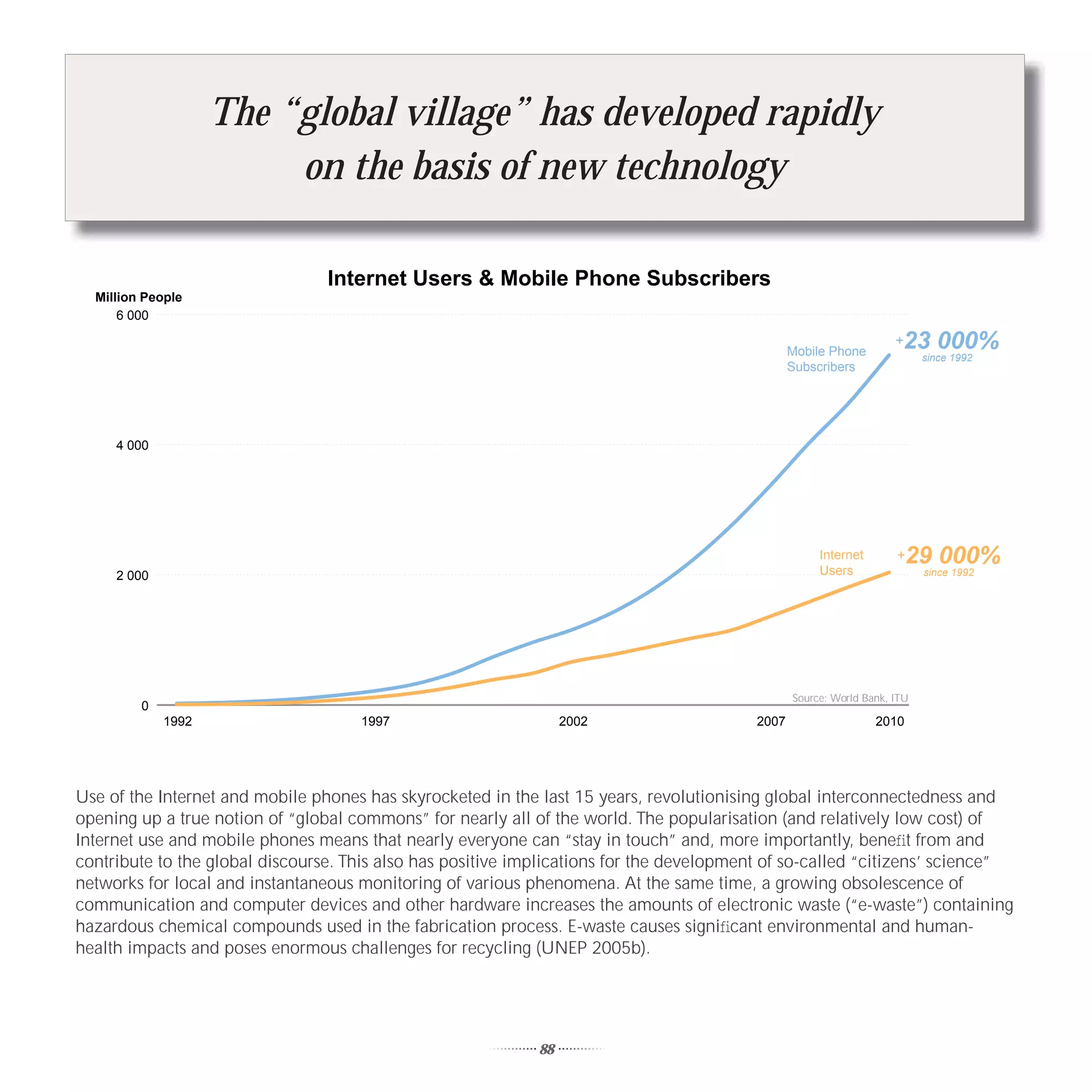
Brazil
                         Egypt                 Iraq               Midway Islands               Réunion                Macedonia               Countries              Northern Ireland
British Virgin Islands
                         El Salvador           Isle of Man        Moldova                      Romania                Timor-Leste                                    United States of
Brunei Darussalam                                                                                                                             Australia
                         Equatorial Guinea     Jamaica            Monaco                       Russian Federation     Togo                                           America
Bulgaria                                                                                                                                      Austria
                         Eritrea               Jersey             Mongolia                     Rwanda                 Tokelau
Burkina Faso                                                                                                                                  Belgium
                         Estonia               Johnston Atoll     Montenegro                   Saint Helena           Tonga

                                                                                          97
Annex for Aid to Environmental Activities
Multiple projects target several sectors, thus impacting the delivery of        41005.01: General environmental protection, activity unspecified
results. This graph reflects the allotment done by AidData.org and the                     (includes miscellaneous conservation and protection measures
author’s personal judgment based on the description of the projects.                      not mentioned below) or does not fit under any other
                                                                                          applicable codes
Environmental Sectors (Codes represent data activities downloaded from
AidData.org)                                                                    41010.02: Environmental policy, laws, regulations and
                                                                                          economic instruments
Energy Conservation and Renewables
                                                                                41010.03: Institution capacity building, Environmental protection
23010.05: Energy conservation
                                                                                41082.02: Environmental impact assessments
23030.01: Power generation/renewable sources, activity unspecified or
          does not fit elsewhere in group                                        41081.01: All environmental education/training activities
23030.02: Hydro-electric power plants                                           41082.01: All environmental research activities
23030.03: Geothermal energy                                                     Natural Resources Management and Biodiversity Protection
23030.04: Solar energy                                                          41020.01: Biosphere protection, activity unspecified or does not fit
                                                                                          elsewhere in group
23030.05: Wind power
                                                                                41020.02: Air pollution control
23030.06: Ocean power
                                                                                41030.01: Biodiversity, activity unspecified or does not fit elsewhere
23030.07: Biomass                                                                         in group
Sustainable Land Management                                                     41030.02: Natural reserves
31130.02: Soil improvement                                                      41030.03: Species protection
31130.05: Land reclamation                                                      41040.01: All site preservation activities
31130.06: Erosion control                                                       Water Resources Protection
31130.07: Desertification control                                                14015.01: Water resources protection, activity unspecified or does not fit
31220.02: Afforestation                                                                   elsewhere in group

31220.04: Erosion control                                                       14015.02: Inland surface waters

31220.05: Desertification control                                                14015.03: Water conservation

41050.02: Erosion control                                                       14015.04: Prevention of water contamination

41050.01: Flood prevention/control, activity unspecified or does not fit          Waste Management
          elsewhere in group                                                    14050.01: Waste management/disposal, activity unspecified or does not fit
41050.03: River or sea flood control                                                       elsewhere in group

Marine Protection                                                               14050.02: Municipal and industrial solid waste management

41020.03: Marine pollution control                                              14050.03: Collection, disposal and treatment

31320.03: Fish stock protection                                                 14050.04: Landfill areas

Environmental Governance                                                        14050.05: Composting and reuse

41010.01: Environmental policy and administrative management, activity
          unspecified or does not fit elsewhere in group


                                                                           98
Acknowledgments
This publication would not have been possible without the advice and inputs of many UNEP colleagues from various
Divisions, as well as key persons at other UN offices and programmes, particularly the Statistical Division (UNSD) of the
Department of Economic and Social Affairs (UN-DESA) in New York, as well as other independent persons who were
consulted, along with their institutions.

The following is an attempt to name all of those who contributed directly with inputs and/or comments during one phase
or another of this publication’s preparation. We apologise for any omissions, which if they occurred are completely
unintentional.

UNEP: Sophie Bonnard, Kaveh Zahedi (UNEP Climate Change Coordination/DTIE); Silja Halle, Hassan Partow and Cassidy
Travis (DEPI/PCDMB); Johannes Akiwumi, Matthew Billot, Charles Davies, Salif Diop, Peter Gilruth, Tessa Goverse,
Fatoumata Keita-Ouane, Neeyati Patel and Andrea Salinas (DEWA); Andrea de Bono and Pascal Peduzzi (DEWA/GRID-
Geneva); Stephen Armstrong, Yasmin Aziz, Margarita Dyubanova, Olivia Gilmore (DEWA-Washington, D.C.); Derek Eaton
(DTIE/ETB), Mark Radka (DTIE/Energy Branch), Virginia Sonntag-O’Brien (DTIE/Energy Branch); Heidelore Fiedler (DTIE/
Chemicals); Mario Lionetti (UNEP/DTIE); Bastian Bertzky, Charles Besancon, Jorn Scharlemann, Damon Stanwell-Smith,
Matt Walpole (UNEP-WCMC); Janet Macharia (Executive Office); Gerald Mutysia (Ozone Secretariat)

UNSD: Esther Horvath, Karen Cassamajor, Elena Montes, Rayen Quiroga and Reena Shah

Others: Jane Barr (independent consultant), Stuart Butchart (BirdLife International), Arshia Chander (SGT, Inc.), Alexander
Gorobets (Sevastopol National Technical University), Jill Jaeger (independent consultant), Pierre Portas (WE 2C); and
Michael Zemp (WGMS-Zurich)

Principal authors: Stefan Schwarzer, Jaap van Woerden and Ron Witt (UNEP/DEWA/GRID-Geneva), Ashbindu Singh (UNEP/
DEWA) and Bruce Pengra (ARTS)

Layout: Stefan Schwarzer (UNEP/DEWA/GRID-Geneva) and Kimberly Giese (SGT, Inc.)


                                                              99
100
This innovative publication, which is based on statistical evidence, illustrates major
global environmental, economic and social changes since 1992. The numbers tell the
story of how, in twenty years, the world has changed more than most of us could have
ever imagined.


The report has been produced within the framework of UNEP’s fifth Global
Environment Outlook assessment report, which will be published in May 2012 in
advance of Rio+20.


                                                                         www.unep.org
                                                                    United Nations Environment Programme
                                                                     P.O. Box 30552 - 00100 Nairobi, Kenya
                                                                             Tel.: +254 20 762 1234
                                                                             Fax: +254 20 762 3927
                                                                           e-mail: uneppub@unep.org
                                                                                  www.unep.org


                                                                              ISBN: 978-92-807-3190-3
                                                                                        DEW/1234/NA

Keeping track - UNEP : From Rio to Rio+20 (1992-2012)

  • 1.
    300 million haforest area loss + 0.4˚C Globalization change technology
  • 2.
    © 2011 UnitedNations Environment Programme Publication: Keeping Track of Our Changing Environment: From Rio to Rio+20 (1992-2012) United Nations Environment Programme, Nairobi. Published October 2011 ISBN: 978-92-807-3190-3 Job Number: DEW/1234/NA This Report has been prepared within the framework of UNEP’s fifth Global Environment Outlook (GEO-5) reporting process. It complements the detailed information on the status and trends of the global environment and information on related policy measures. Disclaimers The content and views expressed in this publication are those of the authors and do not necessarily reflect the views or policies, or carry the endorsement of the contributory organisations or the United Nations Environment Programme (UNEP). The designations employed and the presentation of material in this publication do not imply the expression of any opinion whatsoever on the part of UNEP concerning the legal status of any country, territory or city or its authorities, or concerning the delimitation of its frontiers and boundaries. Reference to a commercial company or product in this publication does not imply the endorsement of UNEP. © Maps, photos, and illustrations as specified. Reproduction This publication may be reproduced in whole or in part and in any form for educational or non-profit purposes without special permission from the copyright holder, provided acknowledgement of the source is made. UNEP would appreciate receiving a copy of any publication that uses this publication as a source. No use of this publication may be made for resale or any other commercial purpose whatsoever without prior permission in writing from UNEP. Applications for such permission, with a statement of purpose and intent of the reproduction, should be addressed to the Director, Division of Communications and Public Information (DCPI), UNEP, P.O. Box 30552, Nairobi 00100, Kenya. The use of information from this publication concerning proprietary products for publicity or advertising is not permitted. This publication was printed on 100 Per Cent chlorine free paper from sustainable managed forests using vegetable inks and water-based varnish. Citation UNEP (2011). Keeping Track of Our Changing Environment: From Rio to Rio+20 (1992-2012). Division of Early Warning and Assessment (DEWA), United Nations Environment Programme (UNEP), Nairobi Produced by UNEP Division of Early Warning and Assessment United Nations Environment Programme P.O. Box 30552 Nairobi, 00100, Kenya Tel: (+254) 20 7621234 Fax: (+254) 20 7623927 E-mail: uneppub@unep.org Web: www.unep.org UNEP This publication is available from http://www.unep.org promotes environmentally sound practices globally and in its own activities. This publication is printed on 100 Per Cent chlorine free paper from sustainably managed forests. Our distribution policy aims to reduce UNEP’s carbon footprint. 101
  • 3.
    Keeping Track ofOur Changing Environment From Rio to Rio+20 (1992-2012) i
  • 4.
    Foreword In 1992, thefirst United Nations Conference on Sustainable graphs show upward and downward trends, which, along with satellite Development, popularly known as the Rio Earth Summit, was convened images, tell the story of dramatic changes. in Rio de Janeiro, Brazil to address the state of the environment and sustainable development. The Earth Summit yielded several important Maintaining a healthy environment remains one of the greatest global agreements including “Agenda 21”, a plan of action adopted by over challenges. Without concerted and rapid collective action to curb and 178 governments to address human impacts on the environment at decouple resource depletion and the generation of pollution from local, national and global levels, and key treaties on climate change, economic growth, human activities may destroy the very environment desertification and biodiversity. At the second Conference in 2002—the that supports economies and sustains life. World Summit on Sustainable Development—governments agreed The upcoming Rio+20 Conference presents a timely, global-level on the Johannesburg Plan of Implementation, reaffirming their opportunity to address one of its own stated objectives: to assess commitment to Agenda 21. In 2012, the United Nations Conference progress and gaps in implementing goals as part of an acceleration on Sustainable Development, or Rio+20 Earth Summit, will focus and scaling-up of transformative actions, programmes and policies. As on the Green Economy in the context of sustainable development, we move towards the Rio+20 Conference in an ever-more globalised poverty eradication, and the institutional framework for sustainable and integrated world, the need to chart progress towards a global development. The object is to renew political commitment to Green Economy and more efficient and effective international sustainable development, review progress and identify implementation environmental governance becomes vital. Without quantified targets, gaps, and address new and emerging challenges. our environmental goals cannot turn theory into reality. Numeric and This publication serves as a timely update on what has occurred time-bound targets have certainly aided in progress made towards the since the Earth Summit of 1992 and is part of the wider Global Millennium Development Goals (MDGs), for example, and should be Environment Outlook-5 (GEO-5) preparations that will lead to the applied towards our environmental objectives as well. release of the landmark GEO-5 report in May 2012. It underlines This publication helps to tell the story of where the world was 20 how in just twenty years, the world has changed more than most of years ago and where we collectively stand today, and to show the us could ever have imagined—geopolitically, economically, socially direction in which we need to move in a post-Rio+20 world. It also and environmentally. Very few individuals outside academic and highlights the missing pieces in our knowledge about the state of research communities envisaged the rapid pace of change or foresaw environment— such as those related to freshwater quality and quantity, developments such as the phenomenal growth in information and ground water depletion, ecosystem services, loss of natural habitat, land communication technologies, ever-accelerating globalisation, private degradation, chemicals and waste—due to lack of regular monitoring, sector investments across the world and the rapid economic rise of collection and compilation of data. Scientifically-credible data for a number of “developing” countries. Many rapid changes have also environmental monitoring remains inadequate and the challenge of taken place in our environment, from the accumulating evidence building in-country capacity to produce better policy-relevant data of climate change and its very visible impacts on our planet, to needs urgent attention. biodiversity loss and species extinctions, further degradation of land surfaces and the deteriorating quality of oceans. Certainly, there have We hope this report will inform all those participating in the Rio+20 been some improvements in the environmental realm, such as the events and the entire process and help set the world on a path towards significant reduction in ozone-depleting chemicals and the emergence a more sustainable environment. of renewable energy sources, new investments into which totalled more than $200 thousand million in 2010. But in too many areas, the environmental dials continue to head into the red. This innovative report is based entirely on statistical data and indicators and shows where the world stands on many social, economic and environmental issues as we enter the second decade of the 21st century. Achim Steiner Drivers of environmental change including population increase and United Nations Under-Secretary-General economic growth, and especially the status of natural resources and landscapes, are clearly illustrated. Numbers plotted on straightforward and Executive Director, UNEP ii
  • 5.
    Table of Contents iv Introduction & Scope 30 Warmest Years on Record 64 Saudi Arabia Irrigation Project (Satellite Image) 31 Earth Global Temperature Changes by Latitude 65 Organic Farming v What’s New Since Rio 1992? 32 Ocean Temperature Deviation 66 Selected Crops in Humid Tropical 32 Global Mean Sea Level Countries, Area vii Goals & Targets in the 33 Ocean Acidification 66 Selected Crops in Humid Tropical Countries, Global Environment Change in Area 34 Mountain Glacier Mass Balance 67 Grazing Animal Herds Population & Human Development 35 September Arctic Sea Ice Extent 2 Total Population 35 September Arctic Sea Ice Extent (Satellite Image) Fisheries 2 Historical World Population 69 Exploitation of Fish Stocks Forests 3 Population Growth Rate 70 Total Fish Catch 37 Forest Net Change 4 Urban Population 70 Tuna Catches 37 Mangrove Forest Extent 5 Megacities 71 Fish Catch and Aquaculture Production 38 Mato Grosso, Amazon Rainforest (Satellite Image) 5 Top 10 Megacities 72 Shrimp and Prawn Aquacultures (Satellite Image) 39 Forest Plantation Extent 6 Population in China’s Pearl River Delta 39 Roundwood Production (Satellite Image) Energy 40 Certified Forest Area 74 Energy Consumption per Capita - Total 7 People Living in Slums 8 Age Distribution Water 74 Energy Consumption per Capita - Change 8 Life Expectancy 42 Improved Sanitation & Drinking Water Coverage 75 Electricity Production 9 Food Supply 43 Mesopotamian Marshlands (Satellite Image) 75 Electricity Production per Capita 10 Human Development Index 76 Nightlights Biodiversity 11 Proportion of Seats Held by Women 77 Primary Energy Supply 45 Living Planet Index in National Parliaments 78 Renewable Energy Supply, Total 46 Red List Index 78 Renewable Energy Supply, Change Economy 47 Protected Areas, Total Area 79 Biofuels Production 13 GDP per Capita, Total 47 Protected Areas, Per cent 80 Investment in Sustainable Energy 13 GDP per Capita, Change Chemicals & Waste 81 Nuclear Power Plants 14 Per Capita Gross Domestic Product 49 Oil Spills from Tankers 81 Electricity Production & Nuclear Share 14 Gross Domestic Product–per Capita (Map) 50 Plastics Production 82 Oil Sands (Satellite Image) 15 Trade 16 Global Materials Extraction Natural Hazards Industry, Transport & Tourism 17 Resource Efficiency 52 Impacts of Natural Disasters 84 Cement & Steel Production 52 Reported Natural Disasters 85 Air Transport Environmental Trends 53 Floods–Mortality Risk, Exposure and Vulnerability 86 International Tourism, Arrivals Atmosphere 53 Tropical Cyclones - Mortality Risk, Exposure and Vulnerability Technology 21 Emissions of CO2 - Total 88 Internet Users & Mobile Phone Subscribers 21 Emissions of CO2 - per Capita Governance 22 Emissions of CO2 - Total, by Type 55 Multilateral Environmental Agreements, Number 90 Epilogue 22 Emissions of CO2 - Change, by Type and Signatories 55 Number of MEAs Signed (Map) 91 Data Sources 23 Emissions of CO2 per GDP 24 GHG Emitters by Sector 56 ISO 14001 Certifications 93 References 25 Consumption of Ozone-Depleting Substances 57 Carbon Market Size 25 Ozone Hole, Area and Minimum Ozone 58 Total Foreign Aid and Environmental Aid 93 Acronyms 59 Aid Allocated to Environmental Activities 26 Ozone Hole Images 97 Technical Notes Climate Change Agriculture 61 Food Production Index 98 Annex for Aid To 28 Atmospheric CO2 Concentration/Keeling Curve Environmental Activities 29 Global Annual Mean Temperature Anomaly 62 Cereal Production, Area Harvested and Fertilizer Consumption 29 Temperature Deviation 2000-2009 vs. Mean 99 Acknowledgments 1951-1980 (Map) 63 Total Area Equipped for Irrigation iii
  • 6.
    Introduction & Scope Thispublication was conceived with the idea of showing how To ensure reliability, indicator charts are only presented for areas the planet has changed in two decades—just twenty years— where all three data requirements were met. For areas where since decision-makers met at the United Nations Conference one or another of the criteria was not met, such as freshwater on Environment and Development in Rio de Janeiro. To water availability, groundwater depletion, land degradation and relay this information in a compelling and succinct manner, chemicals and waste, any analysis might not be reliable, and so environmental and related trends are charted and presented trends are not provided. Also, the availability of data related to using globally-aggregated (and mainly statistical) data sets the environment and natural resources that are disaggregated collected by international agencies, research bodies and other by gender (i.e., qualitatively) or sex (i.e., quantitatively) is official entities. generally poor, especially for developing countries. Major economic, environmental, social and technological The implications of any shortcomings in the data are clear. To trends are shown through numerically-based graphs, with their promote evidence-based environmental policies and actions, upward, downward or stable trend lines as dictated by the the underlying data needed to support sound decision-making data. While most of these trends speak for themselves, short must be part of the equation and be of proven scientific explanations of the phenomena observed are also provided for quality. Today, there are several reasons why the quality of further elucidation. Also included are a number of illustrative international statistics varies greatly. First, statistics may not “before and after” satellite images, primarily covering the same be available at the national level; second, the statistics that time period of 1992-2010 and showing environmental changes are collected may be of poor quality or outdated; and third, at the local level. In some cases, these impacts are ongoing. the comparability of statistics over time inherently presents challenges. These deficiencies and issues demonstrate the need Scope and Methodology for a comprehensive data and information system to optimally manage the vast array of related policy, scientific, technical, Most of the time-series data were collected directly from methodological and practical issues. For this to be achieved, countries and aggregated to regional and global levels by the following steps are necessary: authoritative international agencies. The time series indicators presented here are based on the best and most comprehensive (1) strengthen national-level capacity for collecting and data available to date. compiling environmental observations, especially where data gaps exist; Three main criteria were used to select the indicators employed in this publication. First, an approximately 20-year temporal (2) publish and provide access to data using various media; and data record on which the trend charts could be based was required, so as to accurately portray the time period in question. (3) develop services to efficiently and rapidly provide information In a few cases (and particularly for recent phenomena such as to decision-makers in (an) understandable format(s). carbon trading), a correspondingly shorter time period was used Thus, a comprehensive capability at the global scale is needed to provide at least a partial picture to date. Second, the data on to pull together and analyze the wealth of data collections which the charts are based had to be global in coverage—that that are available, and to enhance data collection for areas is, covering all or at least most countries so as to represent the where information may be lacking. Within these limitations, it entire world and not only certain regions. Third, the data had is hoped that this publication provides a clear and reasonably to be clearly sourced and taken from authoritative and reliable comprehensive twenty-year story on the state and trends in institutions with extensive experience in the thematic areas environment and development since 1992. treated in each case. iv
  • 7.
    “What’s New?” sinceRio 1992 In terms of environment, what did not exist or was not well-known in 1992? In the twenty years since the first Earth Summit in 1992, the Perhaps the ways in which our environment has changed are world has changed in ways most of us could not imagine. not so immediately obvious to everyone, but they are at least as The Internet, mobile phones and other information and significant. Natural resources are being depleted or degraded— communications technologies have made the world a much sometimes before we realize it—and certain metals seem to smaller place—and more of a ‘globalized village’. An estimated become “rare” all of a sudden. The ever-increasing demand five billion people have subscribed to mobile phone services for resources such as water, energy, food, minerals and land and there are some two billion Internet users worldwide. Social is driven by growing populations with rising incomes, while media have further increased connectivity in recent years, with in parallel these resources are increasingly constrained by Facebook, for example, having more than 800 million users ecosystem changes, inherent variability of weather conditions since it was launched in 2004. At the same time, space-based and resource productivity, and the impacts of climate change. satellites can now even zoom in to street level, and provide Within the context of the “mega-trends” taking place in detailed images in real-time on sophisticated smart-phones. our rapidly changing world and society, a number of new We also see that economic power and production patterns are environmental issues and phenomena have arisen since 1992: shifting among regions to the East and South, and that overall trade volumes are rising steeply. Evolution of the Internet: 1992-2012 1992 2012 v
  • 8.
    New Multilateral EnvironmentalAgreements Endorsement of Forest Certification (PEFC) for forest products, and Conventions the Marine Stewardship Council (MSC) for fish products, and Several new Multilateral Environmental Agreements (MEAs) and “bio” or organic labels for many agricultural products including Conventions have been established or entered into force in the coffee, tea and dairy products. last two decades to address emerging global environmental issues, including the United Nations Framework Convention Genetically Modified Organisms on Climate Change (UNFCCC), the Convention on Biological Genetically Modified Organisms (GMOs) have been researched Diversity (CBD), agreements related to chemicals (Basel, for decades, but have gained widespread attention in recent Rotterdam and Stockholm Conventions), and the United Nations years, mainly due to prospects for increased food production. Convention to Combat Desertification (UNCCD). However, they remain controversial for a variety of reasons. Awareness of Climate Change Recycling Among much debate and controversy, Climate Change has Although recycling efforts are only beginning in many parts become a “hot topic” and entered the policy arena, topping of the world, processing waste into new resources, products the global environmental agenda. and materials is becoming mainstream policy and practice in several countries and regions. The Green Economy Viable pathways for fundamentally shifting economic Commercialization of Biofuels, Solar and Wind Energy development to become more low-carbon, climate resilient, While the overall use of renewable energy is still modest, resource efficient, and socially inclusive, as well as for valuing biofuels are gaining a significant market share, and wind and ecosystem services, are now being proposed widely and solar power production is increasing steeply. Windmills and increasingly pursued. solar panels are increasingly abundant, and in the transport sector, hybrid cars have entered the streets and air transport Carbon Trading and other Environmental Market Tools using biofuels are becoming a reality. Placing a monetary value on greenhouse gas emissions and creating a market for trade in carbon is a new and increasingly Chemicals Management utilized concept to address climate change. Other new market Management of toxic and other hazardous chemicals that frameworks include biodiversity offset and compensation threaten human and ecosystem health has improved. A number programs, habitat credit trading and conservation banking, with of deadly chemicals have been banned, and as of January 2010 a goal toward reducing biodiversity loss and mainstreaming the world is free of chlorofluorocarbons (CFC) production. impacts into economic decisions. Worldwide, at least 45 compensatory mitigation programs and more than 1 100 mitigation banks now exist (UNDP and GEF 2011). Nano Materials Nanotechnology offers significant opportunities and benefits Markets for Organic Products and Eco-labeling for industry and society at large, especially in the fields of energy, health care, clean water and climate change. But debate Consumer demand for goods that are produced in a sustainable about this new technology continues and related potential way has boosted certification and eco-labeling, such as the environmental hazards and risks could be emerging. Forest Stewardship Council (FSC) and the Programme for the vi
  • 9.
    Goals & Targets in the global environment One of the obstacles to achieving environmental goals set by the Specific Sets of Environmental Targets international community is the lack of sufficient, solid data and The Millennium Development Goals (MDGs) monitoring systems to measure progress. While for two of the interdependent areas of sustainable development—economic In September 2000, leaders from 189 nations agreed on a vision development and social development—the goals are normally for the future: a world with less poverty, hunger and disease; measured and tracked quantitatively, environmental targets greater survival prospects for mothers and their infants; better- are largely defined in qualitative terms. On the other hand, educated children; equal opportunities for women; a healthier those environmental agreements for which specific numerical environment; and a world in which developed and developing targets were set, have been relatively successful. Already in countries work in partnership for the betterment of all. This the 1960s, for example, the World Commission on Protected vision took the shape of eight Millennium Development Goals Areas (WCPA) set a target of 10% of global land area to be (MDGs), which provide a framework of time-bound targets designated as formally protected; today, nearly 13% of the by which progress can be measured. A concise framework of world’s surface is now set aside as protected. Similarly, the eight goals and 21 targets towards the MDGs was adopted, Montreal Protocol on Substances that Deplete the Ozone Layer along with 60 indicators to measure and show progress. While defines mandatory targets and specific timeframes within which environment as a crosscutting theme is part of several MDGs, the required reductions must be met, and it conducts regular its significance in the overall framework is most prominently reviews of phase-outs in accordance with scientific updates. highlighted in MDG-7: Ensuring Environmental Sustainability. It has been hailed as perhaps the most effective environmental MDG-7 is divided into four targets as set forth below. They agreement to date. More such initiatives are needed to promote emphasize sustainability principles and reversing natural evidence-based environmental policies and measure progress. resource degradation; reducing biodiversity loss; increasing The following is a summary of environment-related goals that access to safe drinking water and sanitation; and improving incorporate targets and indicators since 1992. slums (Table 1). Table 1: UN Millennium Development Goal-7 Goal 7: Ensure environmental sustainability targets Indicators Target 7.A: Integrate the principles of sustainable 7.1 Proportion of land area covered by forest development into country policies and programmes 7.2 CO2 emissions, total, per capita and per $1 GDP (PPP) and reverse the loss of environmental resources 7.3 Consumption of ozone-depleting substances 7.4 Proportion of fish stocks within safe biological limits Target 7.B: Reduce biodiversity loss, achieving, by 7.5 Proportion of total water resources used 2010, a significant reduction in the rate of loss 7.6 Proportion of terrestrial and marine areas protected 7.7 Proportion of species threatened with extinction Target 7.C: Halve, by 2015, the proportion of people 7.8 Proportion of population using an improved drinking without sustainable access to safe drinking water and water source basic sanitation 7.9 Proportion of population using an improved sanitation facility Target 7.D: By 2020, to have achieved a significant 7.10 Proportion of urban population living in slums improvement in the lives of at least 100 million slum dwellers vii
  • 10.
    The World Summiton Sustainable Development the Parties adopted a revised and updated Strategic Plan for Biodiversity for the 2011-2020 period, including the set of Aichi Additional environmental targets were subsequently adopted Biodiversity Targets comprising five strategic goals and 20 targets. in 2002 at the World Summit on Sustainable Development However, these targets have no clear numerical goals, except (WSSD). These relate to: fisheries; marine protection; biodiversity the following ones: loss; access to renewable energy; and phasing out of organic pollutants (Table 2). Target 5: By 2020, the rate of loss of all natural habitats, including forests, is at least halved and where feasible Table 2: Environmental targets adopted at the WSSD, 2002 brought close to zero, and degradation and fragmentation is significantly reduced. Targets Indicators Target 11: By 2020, at least 17% of terrestrial and inland Maintain or restore depleted fish To be determined waters, and 10% of coastal and marine areas, especially stocks to levels that can produce areas of particular importance for biodiversity and the maximum sustainable yield by 2015 ecosystem services, are conserved through effectively and equitably managed, ecologically representative and well- Reverse the loss of biodiversity Identified by Convention connected systems of protected areas and other effective by 2010 on Biological Diversity (CBD) area-based conservation measures, and integrated into Establish a representative network To be determined the wider landscapes and seascapes. of marine protected areas by 2012 To conclude, with specific quantitative goals being absent, the Increase the share of renewable To be determined energy in the total energy supply, above targets may read more like recommendations. However, and provide 35% of African when goals incorporate numerical levels or values, the required households with modern energy achievement is more clearly defined and potentially obtainable. within 20 years In fact, empirical evidence shows that goal-setting can work Phase out by 2020, production To be determined when clear quantitative targets are set. Another lesson learned and use of chemicals that harm from the history of environmental target-setting is that it works health and environment best for well-defined issues, such as the phasing out of Ozone Depleting Substances (ODS) or leaded gasoline, and for issues related to industrial chemicals for which technologies exist or The Copenhagen Accord can be developed to solve environmental problems associated In 2009, the Copenhagen Accord recognised the need for with their production and use. Finally, it has become clear emission targets that will hold the increase in global temperature that it is critical to have baseline information to allow progress below 2°C —equated by scientists to a concentration level of towards the targets to be tracked. For example, relatively little 450 ppm (parts per million) of carbon dioxide in the atmosphere. measurable progress has been made—or can be demonstrated— The Accord today is supported by 114 countries. towards the WSSD target to “reverse the loss of biodiversity by 2010”, since there are insufficient, reliable and comprehensive Aichi Biodiversity Targets biodiversity baseline data upon which to base trends and At its tenth meeting in Nagoya, Japan in October 2010, the assess progress. Convention on Biological Diversity (CBD) Conference of viii
  • 11.
    Population & Human Development Brian Gratwicke/Flickr.com 1
  • 12.
    Since 1992, thehuman population has grown by 1 450 000 000people... Since 1992, the world’s Thousand Million People Total Population population increased by an 8 annual rate of 1.3%, adding Global nearly 1 500 million people to +26% the planet. Between 1992 and since 1992 + 67% West Asia 2010, world population grew + 21% North America from around 5 500 million 6 + 28% Latin America & to close to 7 000 million, Caribbean representing a 26% increase. + 4% Europe There are large differences 53% Africa in population numbers and + changes between regions. For 4 example, nearly 60% of the global population lives in Asia, 15% in Africa, and another 15% in North America and + 26% Asia + Pacific Europe combined. However, 2 total population increases are much greater in West Asia (67% since 1992) and Africa (53%), while the population Source: UNEP GEO Data Portal, as compiled from UNPD number in Europe has grown 0 only slightly (4%). 1992 1997 2002 2007 2010 Thousand Million People 1 World Population since 10 000 BC Source: U.S. Census Bureau 0 10 000 9 000 8 000 7 000 6 000 5 000 4 000 2
  • 13.
    ...however, the populationgrowth rate is declining Thousand Million People Per Cent Population Growth Rate 9 2 8 1.5 Developing 2012 Global 7 1 6 Developed 1992 0.5 5 Source: UNEP GEO Data Portal, as compiled from UNPD 0 1992 1997 2002 2007 2010 4 At the same time the population growth rate has been declining during the past several decades, dropping from around 1.65% per year in the early 1990s to 1.2% per year in the late 2000s. This 3 represents a 27% decline in the growth rate between 1992 and 2010. There is a strong correlation between a country’s economic state and its growth rate: developing countries tend to have a 2-3 times higher growth rate than developed countries. 2 This overall, global “decrease in the increase” means that the world’s population and its population growth rate are increasing more slowly, and could eventually stabilise around 10 thousand million people in 2100 (UN 2011). 1 3 000 2 000 1 000 0 1 000 2 050 3
  • 14.
    In 2011, over 3 500 million people—more than half the world’s population—are living in urban areas Thousand Million Urban Population - Total In 1992, 2 400 million of us lived in urban People 4 agglomerations. By 2009, the number had climbed Global to 3 500 million, a 45% increase. The additional 3 1 000 million “urban people”—nearly 200 000 new Developing city dwellers per day—are the equivalent of 32 times 2 the population of Tokyo, or 110 times that of Paris (Brinkhoff 2011). 1 Developed This unprecedented urban growth, projected to continue (although at a decreasing rate) in the coming 0 UNEP GEO Data Portal, as compiled from UNPD 1992 1997 2002 2007 2009 decades, will require special attention in order to make life in cities more socially, economically and Per Cent Urban Population - Per Cent of Total Population environmentally sustainable. 80 Developed While over half of the world population now lives 70 in urban areas, they also account for 75% of global energy consumption (UN-Habitat 2009) and 80% 60 of global carbon emissions (The World Bank Group Global 2010), at least when viewed from a consumption 50 Developing perspective (Satterthwaite 2011). On the other hand, 40 the top 25 cities in the world create more than half of the world’s wealth (UN-Habitat 2008). UNEP GEO Data Portal, as compiled from UNPD 30 1992 1997 2002 2007 2009 This ongoing rapid urbanisation indicates that long-term investments addressing the associated Urban Population - Growth Rate Per Cent vulnerabilities are critically needed. “[The] urgency is 3 acute considering that 30-50% of the entire population of cities in developing countries live in settlements Developing that have been developed in environmentally fragile 2 Global areas, vulnerable to flooding or other adverse climate conditions, and where the quality of housing is poor 1 Developed and basic services are lacking” (UN 2009b). UNEP GEO Data Portal, as compiled from UNPD 0 1992 1997 2002 2007 2009 4
  • 15.
    The number of“megacities” has more than doubled since 1990 Megacities According to UN-Habitat, megacities Number of Megacities >10 Million Inhabitants are high density metropolises with 24 at least 10 million inhabitants. The 21 number of these megacities climbed 19 from 10 in 1992 to 21 in 2010, a 18 +110% 110% increase, adding on average one 16 since 1990 megacity every two years. Fifteen of the world’s 21 megacities are found 13 in developing countries. The largest 12 10 megacity today is Tokyo which counts nearly 37 million persons, more than Canada’s total population. 6 With large and dense metropolises come the associated environmental Source: UNPD impacts of urban life. Very dense 0 1990 1995 2000 2005 2010 population structures and people living in close quarters bring sanitation, waste management, air quality, pollution Top 10 Megacities 2010 Million People Rank 1990 and other concerns for residents and 1 Tokyo, Japan 36.7 1 the environment alike. Not only do 2 Delhi, India 22.2 11 anthropogenic factors play a major 3 Sao Paulo, Brazil 20.3 4 role in megacities but the natural 4 Mumbai, India 20.0 5 environment also presents risks to highly concentrated populations 5 Mexico City, Mexico 19.5 3 including floods, mudslides, tsunamis 6 New Y ork-Newark, USA 19.4 2 and earthquakes (UN 2009b, UN- 7 Shanghai, China 16.6 18 Habitat 2009). 8 Kolkata, India 15.6 7 9 Dhaka, Bangladesh 14.6 23 10 Karachi, Pakistan 13.1 21 Source: UNPD 5
  • 16.
    T Th The population of China’s Pearl River Delta has tripled since 1992 and includes two of the world’s megacities s Source: USGS; Visualization UNEP-GRID Sioux Falls The Greater Pearl River Delta area in southeastern China is the world’s largest “mega-region” with a population of approximately 120 million people (UN 2010). Over the past two decades, the populations of the delta cities of Guangzhou and Shenzhen have each reached nearly 10 million people while Hong Kong, Foshan and Dongguan have grown to around 5 million each (UN 2009). The individual cities are beginning to merge into one contiguous urban area. The core delta area shown in the above image had a little over 20 million people in the early 1990s but has since tripled to roughly 60 million people (SEDAC 2010). This intense urbanization has led to the loss of productive farmland and natural areas among other environmental problems (Yan and others 2009). 6
  • 17.
    A smaller proportionof urban dwellers live in slums, but their total number has risen to 827 000 000 Population in Slums People Living in Slums Proportion of Urban [Million People] Population in Slums [%] 1 000 50 46% P ercen ta ge 827 Million 800 40 u m b er Total N illion 656 M 33% 600 30 Source: UN-Habitat 400 20 1990 1995 2000 2005 2010 Since 1990, the share of the urban population living in slums in the developing world has declined significantly, dropping from 46% in 1990 to 33% in 2010. This decrease shows that many efforts to give inhabitants of slums access to improved water or sanitation, and/or more durable housing have been successful. On the other hand, the absolute number of people living in slums has increased by 26% over the same period, equaling 171 million additional people and raising their number from 656 million in 1990 to 827 million in 2010. “Redoubled efforts will be needed to improve the lives of the growing numbers of urban poor in cities and metropolises across the developing world” (UN 2011b). Note: A slum household is defined as a group of individuals living under the same roof lacking one or more of these conditions: access to improved water; access to improved sanitation; sufficient-living area; durability of housing; security of tenure. However, since information on secure tenure is not available for most of the countries, only the first four indicators are used to define slum household, and then to estimate the proportion of urban population living in slums (UNSD n.d.). 7
  • 18.
    The population agedover 65 is growing at a faster rate than other age groups in most regions of the world Age Distribution Life Expectancy Million People - High and Low Age Groups - Years 2 000 80 Developing, Total, > 65 years North America 1 500 Developing, Total, < 14 years Europe 1 000 Latin America & Caribbean 500 70 West Asia Developed, Total, > 65 years Asia + Pacific Developed, Total, < 14 years 0 1990 1995 2000 2005 2010 Global Source: UNEP GEO Data Portal, as compiled from UNPD While the population of the groups below 14 and above 65 years of age in all developed countries together has remained largely the same since 1990, this population in developing countries has continued to grow (from 1 760 million to 2 040 million in 2010, an increase of 16%). At the same time, there are significant differences in age structure between developed and developing regions. In the developed countries, the number of persons over 65 has been 60 increasing rapidly, and now nearly equals the under 14 population. By contrast, in the developing countries, the under 14 population continues to grow and far outstrips the over 65 age group, although the latter is also rising, both in numbers and percentage of total population. This developed-developing countries’ dichotomy, as well as the fact that older populations are growing faster than the total population and that the difference in growth rates is increasing, has Africa major implications for economies, the education and health care sectors, and the environment itself (UN 2009). Life expectancy depends heavily on good public health, medical care and a balanced diet, as well as peaceful and stable surroundings. Although living conditions improved in all regions and 50 1990 2010 globally the average life span increased by four to eight years, Africa lags far behind, noting that Source: UNEP GEO Data Portal, as compiled there are large differences within the continent. from UNPD 8
  • 19.
    The average globalcitizen consumes 43 kg of meat per year, up from 34 kg in 1992 Food Supply - Meat, Fish & Seafood - Index, 1992=100 140 Fish & Seafood + 32% since 1992 130 Meat + 26% since 1992 + 22% 120 since 1992 Global Population 110 Source: UNEP GEO Data Portal, as compiled from FAO 100 1992 1997 2002 2007 Global dietary patterns have changed enormously over the last decades. “Income growth, relative price changes, urbanization and shifts in consumer preferences have altered dietary patterns particularly in developing countries” (FAO 2008). Diets shifted away from basic foods towards livestock products, as well as oils, fruits and vegetables, increasing the demand for meat by 26% and for fish and seafood by 32% between 1992 and 2007. During that time, for example, global average meat consumption grew from 34 kg per person per year to 43 kg. Nearly all of these increases can be attributed to growing demand in Asia and to a lesser extent, Latin America. Based on different studies and considering the entire commodity chain (including deforestation for grazing, forage production, etc), meat production accounts for 18-25% of the world’s greenhouse gas emissions (UNEP 2009, Fiala 2008, FAO 2006). 9
  • 20.
    Human development levelsare improving throughout the world, but there are large regional differences Human Development Index Index 1 OECD 0.8 Latin America and the Caribbean Global 0.6 Asia Africa 0.4 Source: UNDP 0.2 1990 2000 2010 The Human Development Index (HDI), which serves as a frame of reference for both social and economic development, combines three dimensions to measure progress: a “long and healthy life” (life expectancy), “access to knowledge” (school enrollment) and “standard of living” (gross national income). Over the past 20 years, the HDI has grown globally by 2.5% per year, climbing from 0.52 in 1990 to 0.62 in 2010, or 19% overall, showing substantial improvement in many aspects of human development. Although progress has been made, large differences in values and growth are visible between regions, with Africa lagging far behind. “Most people today are healthier, live longer, are more educated and have more access to goods and services. Even in countries facing adverse economic conditions, people’s health and education have greatly improved” (UNDP 2011). 10
  • 21.
    Women’s influence, asmeasured by seats in national parliaments, is steadily rising Proportion of Seats Held by Women % of all Seats in National Parliaments 20 18 + 60% since 1997 16 14 12 Source: World Bank 10 1997 2002 2007 2010 In the realm of gender parity, one indicator is the number of women in national parliaments. This figure has risen steadily over the last 20 years, from roughly 12% in 1997 to 19% in 2010, representing a 60% increase. This equals over 8 600 seats in more than 170 countries, up from just over 4 000 in 1997 (IPU 2011). “But this is far short of the target of 30% of women in leadership positions that was to be met by 1995, and further still from the MDG target of gender parity” (UN 2010). Women play a key role in improving environmental-related legislation and seeing that these measures are adequately funded and implemented. 11
  • 22.
    12 Economy Nic McPhee/Flickr.com
  • 23.
    GDP has continuedto climb at a steady rate... Thousand Constant GDP per Capita Since 1992, the world’s overall Gross Domestic Product (GDP) has 2000 US$ - Total - 40 increased significantly i.e., from Developed 33 800 US$/person/yr US$ 36 to 63 million millions in 2010, an increase of 75% or 3.2% 30 per year on average. GDP per capita rose by 40% in that same period. Due to strong economic growth in 20 many developing countries, their level of GDP per capita increased substantially, particularly in the 10 World 9 200 US$/person/yr last decade (80% since 1992, 45% Developing 5 300 since 2002). However, differences US$/person/yr between developing and developed 0 Source: UNEP GEO Data Portal, as compiled from World Bank, UNPD countries on per capita basis 1992 1997 2002 2007 2010 are almost seven-fold, reflecting the wide economic discrepancy between these two worlds. GDP per Capita - Change - 80% GDP indicates the level of Index, 1992=100 Developing + 180 economic activity, but is often since 1992 misinterpreted as a measure of a country’s living standard. However, 160 GDP as such does not adequately reflect standards of living, human World well-being or quality of life. 140 +39% One successful attempt to move measurements and indicators Developed since 1992 +33% since 1992 of development beyond GDP is 120 the Human Development Index, launched just before Rio 1992 and updated every year since. Source: UNEP GEO Data Portal, as compiled from World Bank, UNPD 100 1992 1997 2002 2007 2010 13
  • 24.
    ...but huge differencesin economic development persist GDP per Capita (2010*) below global mean above global mean no data available Source: UNEP GEO Data Portal, as compiled from World Bank, UNPD Certainly not every country or citizen has benefited from overall higher levels of economic welfare. The gap between the lowest and highest income countries remains large, with many countries in Africa, Latin America and Asia still below the global average. In addition, many countries experience significant domestic income inequalities between rich and poor. In new and rising economic powers such as China and India, millions have been lifted out of poverty, but often at a high environmental cost. “The economic growth of recent decades has been accomplished mainly through drawing down natural resources, without allowing stocks to regenerate, and through allowing widespread ecosystem degradation and loss” (UNEP 2011). *All data for year 2010; except year 2009 data used for the following countries: Australia, Brunei Darussalam, Iran (Islamic Republic of), Libyan Arab Jamahiriya, Qatar, Saudi Arabia, United Arab Emirates, Yemen 14
  • 25.
    The absolute valueof trade among countries, a major aspect of globalisation, has tripled Trade - Total and Percentage of GDP - Million Million US$ % of GDP 40 80 30 60 Trade (% of GDP) 20 40 Trade (US$) 10 20 Source: UNEP GEO Data Portal, as compiled from World Bank 0 0 1992 1997 2002 2007 2009 Trade has been present throughout much of human history, but its importance in economic, social and political terms has increased steeply over the last decades, and is a main facet of what is generally understood by “globalisation”. The value of internationally traded products has tripled between 1992 and 2009, from over US$ 9 to 28 million millions. The share of trade as of the global total Gross Domestic Product (GDP) increased in that period from 39% to 49%, reaching nearly 60% before the economic crisis in 2008. By far the largest sectors of international trade in 2010 concern mineral fuels and oils (15%), electrical and electronic equipment (13%), machinery (12%) and vehicles (7%) (ITC 2011). 15
  • 26.
    As societies growand become wealthier, demand for basic materials is further increasing Thousand Million Global Materials Extraction Tonnes 80 +41% since 1992 60 Ores and Industrial Minerals Fossil Fuels 40 Construction Minerals 20 Biomass Source: Krausmann and others 2009 0 1992 1997 2002 2005 The global use of natural resource materials increased by over 40% between 1992 and 2005, from about 42 to nearly 60 thousand million tonnes. On a per capita basis, the increase was 27%. Among the four major material groups (biomass, fossil fuels, ores and industrial minerals, and construction minerals) there has been a major increase in extraction of construction minerals of almost 80%, followed by ores and industrial minerals (close to 60%). This growth is strongly linked to increasing population numbers and the need for shelter, food and an improved standard of living (UNEP 2011). International trade in resource materials has also increased. “The total value of world trade in natural resources was US$ 3 700 thousand millions in 2008, or nearly 24 Per Cent of world merchandise trade. This value has increased more than six-fold between 1998 and 2008” (WTO 2011). 16
  • 27.
    More energy andnatural resources are being consumed, but the amounts needed per product are declining Resource Efficiency Index, 1992=100 180 Economic Development (GDP) 160 140 Resource Extraction Population 120 100 Material Intensity Source: SERI 80 1992 1997 2002 2007 Although overall energy and material use continue to grow, there is a simultaneous general decline in emissions, energy and material use per unit of output (UNEP 2011, Krausmann and others 2009), indicating that we are becoming more efficient at how we produce, use and dispose of materials. “Resource extraction per capita has been stable or increasing only slightly. What economies worldwide need is absolute decoupling of the environmental pressure associated with resource consumption from economic growth. This will be easier to achieve to the extent that resource use itself becomes more efficient” (UNEP 2011). One policy option concerns eco-taxes, which put a price on the full costs of resource extraction and pollution, including emitting CO2, polluting the environment through the use of chemicals, deforestation, overpumping of aquifers and overfishing; such incentives can stimulate employment and help in the transition to absolute decoupling and Green Economy (ILO 2009, UNEP 2011b). 17
  • 28.
  • 29.
  • 30.
    Atmosphere MorgueFile 20
  • 31.
    Global CO2 emissionscontinue to rise, with 80% emitted by only 19 countries Emissions of CO2* Global Globally, CO2 emissions increased by 36% 2010 Thousand Million Tonnes of CO2 - Total - +36% since 1992 between 1992 and 2008, from around 30 22 000 million to just over 30 000 million Developed tonnes. With general economic growth, +8% plus developing countries such as Brazil, since 1992 China and India investing significantly 20 in large development, infrastructural and manufacturing projects, the growth of CO2 emissions in developing countries over the 10 Developing last few years climbed even more (between +64% 1992 and 2008, a 64% increase of total CO2 since 1992 emissions and 29% on a per capita basis). Source: UNEP GEO Data Portal, as compiled from CDIAC Latest estimates show that global CO2 0 1992 1997 2002 2008 emissions accumulated to 30 600 million tonnes in 2010 (IEA 2011). Large differences exist between regions and countries, with 80% of the global CO2 emissions being generated by 19 countries—mainly those Emissions of CO2* with high levels of economic development Tonnes - per Capita - and/or large populations. 50 Total emissions of CO2 in developed countries increased by nearly 8%, and 40 although per capita emissions declined Developed steadily by 18%, they are still 10 times -18% 30 since 1992 higher than those of developing countries. In addition, many developed countries 20 profited from a significant shift of production to developing countries, thus leading 10 Global to declining domestic emissions, but +7% nevertheless increasing consumption-based since 1992 Developing emissions (Peters and others 2011). Source: UNEP GEO Data Portal, as compiled from CDIAC, UNPD 0 1992 1997 2002 2008 + 29% since 1992 * from fossil fuels, gas flaring, cement production, as provided through the original source 21
  • 32.
    Despite global effortsto reduce CO2 emissions, they continue to rise due to the increasing use of fossil fuels... The main uses of fossil fuels Emissions of CO2* are for generating electricity, - Total, by Type - Thousand Million Tonnes of CO2 enabling transport and producing 30 Gas Flaring Cement Production heat. Their combustion leads to a release of CO2 into the 25 Gas Fuels Consumption atmosphere which in turn influences the earth’s climate. 20 The production of cement not Liquid Fuels Consumption (e.g. fuel oil) only demands very high levels of 15 energy inputs, but also releases CO2 directly through the heating 10 of calcium carbonate, which 5 Solid Fuels Consumption produces lime and carbon (e.g. coal) Source: UNEP GEO Data Portal, as compiled from CDIAC dioxide. It has also become the 0 Source: UNEP GEO Data Portal, as compiled from World Bank, CDIAC fastest growing source of CO2 1992 1997 2002 2007 2008 emissions (+230% since 1992). Global efforts since 1992 to slow the growth of, and ultimately Emissions of CO2* reduce the total level of CO2 Index, 1992=100 - Change, by Type - emissions, have not yet fully 250 succeeded. Those efforts must be strengthened; otherwise, it is very Cement Production 225 unlikely that the target of limiting Gas Flaring temperature increase to 2°C by 200 2100 to reduce global warming, as agreed by global leaders in 175 Cancun in 2010, will be met (IEA 2011). 150 Solid Fuels Consumption Gas Fuels Consumption * from fossil fuels, gas flaring, cement 125 production, as provided through the original source Liquid Fuels Consumption 100 1992 1997 2002 2007 2008 Source: UNEP GEO Data Portal, as compiled from CDIAC 22
  • 33.
    ...however, production processesare becoming more energy-efficient Grams of CO2 per Emissions of CO2 per GDP $ 1 GDP 700 600 500 -23% since 1992 400 Source: UNEP GEO Data Portal, as compiled from World Bank CDIAC 300 1992 1997 2002 2007 2008 Increasing efforts to “decouple” emissions and economic development are being witnessed, meaning reduction of emissions while still experiencing economic growth. Applying new technologies to use energy and resources more efficiently is an example of a means to accomplish decoupling. The graph above shows an annual efficiency gain of around 1.6%, and a total gain of 23% since 1992 (until 2007), indicating the start of a successful decoupling of emissions for each dollar of GDP generated. However, this may be partially influenced by the increasing value of the service industry, which has less energy- (and thus emission-) intensive impacts. In any case, the efficiency gains are still outweighed by the ongoing absolute increase in global emissions. 23
  • 34.
    Over 60% ofGreenhouse Gases are emitted by three economic sectors Which sectors emit the most Greenhouse Gases? Per Cent contribution to global anthropogenic GHG emissions, 2004 hea ting ) and y l ectr supp icity Per Cent (e.g ergy 30 ., el En ) 25 tion ry sta ust (e.g restr fore y Ind re ., de 20 ultu Fo bui merci l and t por ic ns Agr gs l com dentia a 15 Tra ldin i Res 10 wa te and r ate stew s Wa 5 0 26 19 17 14 13 8 3 Source: IPCC 2007 The energy supply sector, industry/manufacturing and forestry sectors together account for over 60% of all greenhouse gas (GHG) emissions. The forestry sector’s contribution is mainly through worldwide deforestation, as trees cut down to clear space for agriculture and other land uses can no longer absorb carbon dioxide, and if left to rot or burned, emit CO2 stored in trunks and leaves. 24
  • 35.
    The Montreal Protocol:“Perhaps the single most successful international agreement” Consumption of Ozone-Depleting Substances The ozone concentration in higher Thousand Tonnes of altitudes protects life on earth from the Ozone Depleting Potential damaging ultraviolet (UV) rays of the 600 sun. The ozone layer, especially above Antarctica, was rapidly diminishing until recently due to the use of Ozone- Depleting Substances (ODS). 400 Thanks to the participation and commitment of nearly all countries 200 (195 in 2011) in perhaps the “single most successful international agreement -93% to date” (Kofi Annan, former UN since 1992 Source: UNEP GEO Data Portal, as compiled from UNEP Secretary-General, on the Montreal 0 1992 1997 2002 2007 2009 Protocol), the consumption of ozone- depleting substances decreased by 93% from 1992 to 2009, and 98% since Ozone Hole the Protocol’s establishment in 1987. Area, Million km2 - Area and Minimum Ozone - Dobson Units (DU) Production and consumption of ozone- 50 200 depleting substances still continues through the use of compounds such as 40 160 hydrochlorofluorocarbons (HCFCs) and Hydrogen, Flourine, and Carbon (HFCs), 30 DU 120 which have a global warming potential 90 to 11 700 times higher than CO2 and are still to be phased out, as well as through 20 80 Area exemptions (e.g. for specific agricultural purposes) or illegal use. 10 40 The ozone hole over the Antarctic is 0 Source: NASA 0 showing only slow progress of recovery. 1992 1997 2002 2007 2010 The amount of ozone, measured in Dobson Units, varies yearly due to different temperatures in the Antarctic, but shows a small, positive, increase (WMO/ UNEP 2010). 25
  • 36.
    Further expansion ofthe “ozone hole” has halted, but full recovery is still far away September 1992 September 1994 September 1996 September 1998 September 2000 September 2002 September 2004 September 2006 September 2008 September 2011 110 220 330 440 550 Source: NASA total ozone (Dobson Units) The use of ODS has been controlled from 1987 onwards (and subsequently banned) under the Montreal Protocol. As of 1 January 2010, no new production of chlorofluorocarbons (CFCs) is permitted. Given that many of these substances are also potent greenhouse gases, the Protocol provided at the same time “substantial co-benefits by reducing climate change” (WMO/UNEP 2010): “From 1990 to 2010, the Montreal Protocol’s controls on production and consumption of ODSs [will] have reduced GHG emissions by the equivalent of a net 135 thousand million tonnes CO2, which is equivalent to 11 thousand million tonnes CO2 per year” (Molina and others 2009). Over the past decade concentration and extent of ozone neither notably decreased nor increased (WMO/UNEP 2010). The ozone layer outside the Polar regions is expected to recover to its pre-1980 levels before 2050. However, the springtime ozone hole over Antarctica is expected to recover much later. 26
  • 37.
    27 Climate Change Gerard Van der Leun/Flickr.com
  • 38.
    The average amountof CO2 in the Earth’s atmosphere shows a steady rise over the last two decades Parts per Million Atmospheric CO2 Concentration / Keeling Curve (ppm) 400 390 380 +9% since 1992 370 360 350 340 Source: UNEP GEO Data Portal, as compiled from NOAA/ESRL 330 1992 1997 2002 2007 2010 2011 The concentration of carbon dioxide (CO2) in the Earth’s atmosphere has been measured at Mauna Loa, Hawaii since 1958, and at five other stations subsequently. It shows a steady mean increase from 357 ppmv (parts per million by volume) in 1992 to 389 ppmv in 2011. Seasonal variations of about 5 ppmv each year correspond to seasonal changes in uptake of CO2 by the world’s land vegetation, influenced by the greater vegetation extent and mass in the Northern hemisphere. The increase in atmospheric CO2 is primarily attributed to the combustion of fossil fuel, gas flaring and cement production and has been accelerating in recent years (IPCC 2007). 28
  • 39.
    Global mean temperatureincreased by 0.4°C between 1992 and 2010 °C Global Annual Mean Temperature Anomaly The average annual mean atmospheric 0.8 temperature shows yearly variations, NASA Goddard Institute caused for example by tropical for Space Studies * El Niño-La Niña cycles. Viewed 0.6 NOAA National Climatic Data Center * over a longer time period, one can nevertheless observe a slow, but UK Meteorological Office, Hadley Centre and Climate steady increase with occasional 0.4 Research Unit ** peaks. The annual mean temperature, as displayed, is calculated by three leading climate research centres, 0.2 producing slightly different values — the general upward trend however * relative to 1951-1980 mean global temperature is the same for all of them, with an ** relative to 1961-1990 mean global temperature 0.0 Source: NASA, NOAA, UK-MetOffice increase of about 0.2°C per decade 1992 1997 2002 2007 2010 (Hansen and others 2006). “Most of the observed increase in global Temperature Deviation - 2000-2009 vs. Mean* - average temperature since the mid- 20th century is very likely due to the observed increase in anthropogenic greenhouse gas concentrations” (IPCC 2007b). This map shows how much warmer temperatures during the decade 2000-2009 were compared to average temperatures recorded between 1951 and 1980 (a common reference period for climate studies). “The most extreme warming, shown in red, was in the Arctic. Very few areas saw Source: NASA cooler than average temperatures, *1951-1980 mean temperature shown in blue” (Voiland 2010). The last decade was the warmest on record since 1880; it was warmer than the previous record decade 1990-1999. 29
  • 40.
    The 10 hottestyears ever measured have all occurred since 1998 The Ten Hottest Years on Record highest rank = warmest year since recording began in 1880 Rank Rank 1st 1st 2nd 2nd 3rd 3rd Hadley Centre UK Meteorological Office NOAA National Climatic Data Center 4th NASA Goddard Institute for Space Studies 4th Japanese Meteorological Agency 5th 5th 6th 6th 7th 7th 8th 8th 9th 9th 10th 10th Source: UK-MetOffice, JMA 1992 1993 1994 1995 1996 1997 1998 1999 2000 2001 2002 2003 2004 2005 2006 2007 2008 2009 2010 According to rankings from four top US, British and Japanese climate research centers, the ten hottest years on record have all occurred since 1998. Eighteen out of the last 21 years feature among the 20 warmest years on record since (reliable) recording of temperature started in 1880. These data and findings add weight to the common conclusion of all four agencies and most of the scientific community, that in spite of short-term spatial and temporal variability the clear long-term trend is one of global warming (NOAA 2011, NASA 2011, UK-MetOffice 2011, JMA 2011). 30
  • 41.
    Far northern latitudesare seeing the most extreme changes in temperature 0º 0.5º 1.0º 1.5º 2.0º 2.5º 3.0º 90°N 60°N °N 30 Cº above mean * per latitude zone 0° 200 5 200 6 200 7 30°S 200 8 200 9 20 10 60°S * relative to 1951-1980 mean global temperature -0.5º 0º 0.5º 1.0º 1.5º 2.0º 2.5º 3.0º Source: NASA The increase in global mean temperature is not occurring uniformly across the globe’s latitudinal zones. This graph of departure from the historical mean temperature (1951-1980) for the past six years shows this variation by latitude. Far northern latitudes are seeing the most extreme changes in temperature (see in particular the upper part of the graph representing the higher latitudes, and corresponding larger temperature anomalies). Among the consequences of this warming are melting of ice sheets and thawing permafrost. Furthermore, a study of 1 700 species found poleward migration of 40 km between 1975-2005 and vertical migration in alpine regions of 6 m per decade in the second half of the 20th century (Hansen and others 2006). 31
  • 42.
    Oceans are alsowarming, while sea-level rise continues unabated Ocean Temperature Deviation As the global atmospheric temperature from 1901-2000 Average increased over the last decades, so also °C 0.6 did the average ocean temperature. By 0.5 comparing the last 20 years to the average of the last century, one can observe a steady warming of ocean waters, increasing 0.4 from 0.22°C above the long-term average in 1992 to nearly 0.5°C in 2010. 0.3 0.2 0.1 Source: NOAA 0 1992 1998 2004 2010 MSL (MM) Global Mean Sea Level Globally, sea level has been rising at an 60 average rate of about 2.5 mm per year between 1992 and 2011. This is due to rising sea-water temperature and resulting thermal expansion, as well as the melting 40 ice of the Arctic, Antarctic and Greenland ice sheets (Bindoff and others 2007). Scientific evidence supports the claim 20 that current sea level rise is caused by global warming (Bindoff and others 2007), although different opinions exist about 0 Source: University of Colorado the exact link as well as future projections 1992 1997 2002 2007 2011 (Rahmstorf and Vermeer 2011). -10 32
  • 43.
    Oceans are becomingmore acidic, with negative implications for corals and other marine life Ocean Acidification pH ppm 8.5 CO2 400 R = 0.95521 8.4 375 pCO2 R = 0.27 8.3 350 8.2 325 8.1 pH 300 R = 0.22214 Source: Feely and others 2009 8.0 275 1992 1997 2002 2007 2010 Increasing carbon dioxide (CO2) concentrations in the air alter the chemistry of the ocean’s surface, causing it to become more acidic (measured by the logarithmic pH) (Caldeira and Wickelt 2003). The ocean’s pH declined from 8.11 in 1992 to 8.06 in 2007 (Feely and others 2009). There is a “growing concern that the process called ocean acidification could have significant consequences on marine organisms which may alter species composition, disrupt marine food webs and ecosystems and potentially damage fishing, tourism and other human activities connected to the seas” (UNEP 2010b). Coral reefs are currently experiencing higher ocean temperatures and acidity than at any other time in at least the last 400 000 years. If this trend continues, all coral reefs will likely be threatened by mid-century, with 75 Per Cent facing high to critical threat levels (WRI 2011). The increase in oceanic CO2 concentrations (pCO2 in the graph), measured off the coast of Hawaii, is consistent with the atmospheric increase measured at Mauna Loa, Hawaii, within the statistical limits of the measurements (Feely and others 2009). 33
  • 44.
    Most mountain glaciersaround the world are diminishing rapidly Metres of Water Equivalent Glacier Mass Balance since 1980 1992 1997 2002 2007 2009 -3 Source: UNEP GEO Data Portal, as compiled from WGMS equa ls an of ~ an -5 0.4 m nual loss pe r y ear -7 -9 eq u of als ~ a 0. n an 7 m nua -11 pe l r y los ea s r -13 -15 Changes in glaciers are key indicators of climate change. Nearly all mountain glaciers around the world are retreating and getting thinner, as measured by their annual mass balance, with “severe impacts on the environment and human well- being, including vegetation patterns, economic livelihoods, natural hazards, and the water and energy supply” (WGMS 2010). Diminishing glacier and ice cap volumes not only influence current sea-level rise but also threaten the well-being of approximately one-sixth of the world’s population who depend on glacier ice and seasonal snow for their water resources during dry seasons (WGMS 2008). Moreover, as most glaciers are rapidly diminishing, the speed with which this happens has been increasing in recent decades as well. For 30 glaciers observed (Zemp and others 2009), the average annual melting rate has increased from around 0.4 metres per year in the early 1990s to 0.7 metres of water equivalent per year over the last decade, thus almost doubling from one decade to the next, with record losses in 2004 and 2006 (WGMS 2010). The ongoing trend of worldwide and rapid glacier shrinkage may lead to the deglaciation of large parts of many mountain ranges by the end of the 21st century (WGMS/UNEP 2008). 34
  • 45.
    The annual minimumextent of Arctic sea ice continues its steady decline Arctic sea ice extent has been declining since well before satellite measurements began in 1979 (NSIDC 2011). This decline has been most pronounced in September at the end of the summer melt season (Stroeve and others 2008). Several of the most extreme years have been since 2002, with the smallest sea ice extent ever recorded (4.17 million km2) occurring in 12 September 2007 (NSIDC 2011). Preliminary data for 2011 indicates that ice extent had reached its second smallest extent ever (4.33 million km2 on 9 September) (NSIDC 2011). The trend is believed to be the result of natural variability in air temperature and ocean and atmospheric circulation patterns, combined with climate change (Wang and Overland 2009). While the short data record precludes confident predictions, there is concern that multiple feedback processes such as reduced albedo could lead to rapid transition to virtually ice-free Septembers in the future—as soon as 2040 by one analysis (Wang and Overland 2009). September Arctic Sea Ice Extent Million km2 8 6 4 -35% since 1992 2 0 Source: NSIDC 1992 1997 2002 2007 2010 Source: NSIDC 35
  • 46.
    36 Forests Frank Vassen/Flickr.com
  • 47.
    Forest area hasdecreased by 300 million ha since 1990, or an area larger than Argentina Forests currently cover around 30% of the Earth’s Forest Net Change land mass. Although the rate of deforestation is slowing down, large areas of primary forest and other North America 1990-00 2000-05 naturally regenerated forests are declining, especially 2005-10 in South America and Africa, while forested areas in Europe and Asia are stable or increasing due to large- Latin America + Caribbean scale afforestation programmes. Around 13 million hectares of forest were converted to other uses or Europe lost through natural causes each year between 2000 and 2010, compared to 16 million hectares per year during the preceding decade (FAO 2010). This results Asia + Pacific not only in biodiversity loss, but also contributes 12-15% to global warming by releasing CO2 into the Africa atmosphere and hampering further CO2 storage (van Source: UNEP GEO Data Portal, as compiled from FAO der Werf and others 2009, UCSUSA 2011). “Millions -5 -4 -3 -2 -1 0 1 2 3 of hectares of tropical forest are cleared every year Million Hectares per Year to make way for agriculture, pastures and other non-forest uses, or are degraded by unsustainable or illegal logging and other poor land-use practices” (ITTO 2011). Thousand Hectares Mangrove Forest Extent Also in decline since several decades ago are 17 mangrove forests—important from social, economic and biological points of view. For example, “mangrove forests act as extremely effective carbon 16 sinks, able to absorb [nearly 100] tonnes of carbon per hectare, or more than three times the absorptive -3% capacity of non-mangrove forests” (UNDP 2011b). since 1990 15 Between 1990 and 2010, 3% of mangrove extent was lost, mostly as a result of coastal development 14 and conversions to agriculture and aquaculture (rice fields, shrimp farms). Using high-resolution satellite imagery, the extent of mangroves in 2000 was even 13 Source: FAO found to be 13% less (blue point on the graph) than 1990 1995 2000 2005 2010 country statistics show (Giri and others 2010). 37
  • 48.
    Large portions ofthe Amazon rainforest were cleared for cattle pastures and farm fields Source: USGS; Visualization UNEP-GRID Sioux Falls Satellite images show that enormous areas of Amazon rainforest were cleared, Simon Chirgwin / BBC World Service / Flickr.com mostly along an “arc of deforestation” on the southern boundary of the Amazon Basin. The Brazilian states of Rondônia, Para and Mato Grosso saw the largest losses (INPE 2010). Major roads such as the BR-163 running from north to south across the 1985 image of Mato Grosso (above), provided access to the forest (Fearnside 2007). Twenty years later much of the forest is gone, replaced by soy fields and cattle pastures. Severe droughts in 2005 and 2010 increased the frequency of fire, and have reinforced concerns that the Amazon is reaching a tipping point where large areas of forest could be replaced by a more savanna-like ecosystem (Lewis and others 2011, Nepstad and others 2008, Malhi and others 2009). 38
  • 49.
    A gradually increasingpercentage of the world’s forests has been replanted and is typically less diverse Forest plantations are generally intended Million Hectares Forest Plantation Extent for the production of timber, pulp and 300 firewood, but along with other social and environmental benefits also stabilise 250 soil and improve watershed protection. 54% + Since 1990, they have been growing at 200 since 1990 an annual rate of 2.2%, or around 4 600 thousand hectares annually, increasing 150 from 170 to 265 million hectares globally. Over the 20-year period, 100 this gain equals the size of a country such as Tanzania. The total plantation extent in 2010 represents 7% of the 50 total forest area globally (FAO 2010b). Source: UNEP GEO Data Portal, as compiled from FAO Although these forests do not necessarily 0 1990 2000 2010 enrich local biodiversity since they are mostly composed of the same and/or introduced species, they can provide Million Solid Volume Units (CUM) Roundwood Production 3 700 important ecosystem services such as timber, carbon and water storage and soil stabilisation. Roundwood production depends heavily 3 500 on demand from the construction sector. Economic growth around the world stimulated production, until the economic crisis in 2008, when new 3 300 construction activities — and thus demand for timber — severely declined. Some of the peaks (as for example in 2000, 2005 and 2007) in roundwood Source: UNEP GEO Data Portal, as compiled from FAO production are due to increased 3 100 1992 1997 2002 2007 2010 extraction of the numbers of trees as a result of severe storms (Eurostat 2011). 39
  • 50.
    Only about 10% of global forests are under certified sustainable management Million Hectares Certified Forest Area 250 PEFC 420% + since 2002 200 150 FSC 320% + since 2002 100 50 Source: UNEP GEO Data Portal, as compiled from FSC, PEFC 0 2002 2006 2010 The Forest Stewardship Council (FSC) and the Programme for the Endorsement of Forest Certification (PEFC), the two largest forest certification bodies worldwide with slightly different approaches to management and certification, certify socially and environmentally responsible forestry. An impressive annual 20% growth rate of labeled forests indicates that both producers and consumers are actively influencing timber production. Nevertheless, in 2010 still only about 10% of the total forest extent was managed under FSC and PEFC practices. 40
  • 51.
    41 Water Daniel Diaz Nauto/Flickr.com
  • 52.
    Drinking water coverageincreased to , but the 87% world is far from meeting the sanitation target of 75% Improved Sanitation & Drinking Water Coverage % of Population 100 MDG Targets 2015 Drinking Water Coverage 90 + 13% 87 89 since 1990 80 77 75 70 Improved Sanitation Coverage + 13% 61 since 1990 60 54 Source: UNEP GEO Data Portal, as compiled from WHO/UNICEF 50 1990 1995 2000 2005 2008 Globally, improved sanitation coverage was just above the 60% mark in 2008, up from 54% in 1990, with over 2 500 million people still without access. Half of the people living in developing regions have no access to improved sanitation. In all regions, coverage in rural areas lags behind that of cities and towns. At the current rate of progress, the world will miss the MDG target of halving the proportion of people without access to improved sanitation by 2015. In fact, at the current rate of progress, it will take until 2049 to provide 75% of the global population with flush toilets and other forms of improved sanitation (UN 2011b). However, the good news is that the world will meet or even exceed the MDG drinking water target by 2015 if the current trend continues. By that time, nearly 90% of the population in developing regions, up from 77% in 1990, will have gained access to improved sources of drinking water. 42
  • 53.
    T Th The Mesopotamian Marshlands, nearly destroyed in the 1 1990s, have been partially restored but remain at risk Source: USGS; Visualization UNEP-GRID Sioux Falls The Mesopotamian Marshlands are the largest wetland ecosystem in the Middle East (Partow 2001). Construction of numerous dams, water diversions and hydropower facilities on the Tigris and Euphrates Rivers over the past century and the deliberate draining of the marshes by the Iraqi regime in the early 1990s had almost destroyed the wetlands by 2000 (Aoki and Kugaprasatham 2009). Reflooding beginning in 2003 helped restore many ecosystem functions for a large portion of the marshes (Richardson and Hussain 2006). In 2008, the eastern Hawizeh marshes were designated as Iraq’s first Ramsar Wetland Convention site and preparations are underway to inscribe the entire marshes as a joint cultural and natural site under the World Heritage Convention (Garsteck and Amr 2011). Ecosystem recovery, however, has been seriously undermined by a severe drought (2008-2010) and uncoordinated water-related developments in the Tigris-Euphrates basin (Garsteck and Amr 2011). The lack of a water sharing agreement between riparian countries and potential declines in Euphrates flows are a major threat to the wetlands’ survival. 43
  • 54.
    44 Biodiversity Brian Gratwicke/Flickr.com
  • 55.
    The Living PlanetIndex has declined by 12% at the global level and by in the tropics 30% Living Planet Index Index, 1992=100 120 Temperate 100 Terrestrial Global Freshwater Marine 80 Tropical Source: WWF/ZSL 60 1992 1997 2002 2007 The Living Planet Index reflects changes in the health of the earth’s ecosystems. It is based on monitoring almost 8 000 populations of over 2 500 vertebrate species. In contrast to the temperate biome, which is somewhat stable (after hundreds of years of biodiversity losses), all other indices show various degrees of decline. Biodiversity in the tropics is dramatically declining, by 30% since 1992, indicating the ecosystem’s severe degradation due to high deforestation rates of primary forest and transformation into agricultural land and pasture (WWF 2010). 45
  • 56.
    Each year 52 vertebrate species move one Red List category closer to extinction Red List Index The Red List Index (RLI) measures the risk of extinction, of Species Survival Red List Index divided into seven categories of extinction risk, as 1.00 calculated from the IUCN Red List of Threatened Species. An RLI value of 1.0 equates to species not being expected to become extinct in the near future; a RLI value of zero indicates that all species have become ‘Extinct’ (Hoffman and others 2010). The 0.95 graph shows that for those vertebrate groups where sufficient data are available, the trend is generally negative; i.e., that birds, mammals and amphibians are better Birds becoming increasingly threatened. The five principal pressures driving biodiversity loss are habitat change, 0.90 overexploitation, pollution, invasive alien species and climate change (CBD 2010). “Almost one-fifth of extant vertebrate species are classified as ‘threatened’, ranging from 13% of birds to Mammals 41% of amphibians” (Hoffman and others 2010). On 0.85 average, 52 species per year moved one category closer to extinction from 1980 to 2008. Amphibians are more threatened than birds and mammals, and are declining at a faster rate. The status of other groups is likely to be similar if not worse; nearly a quarter of plant species 0.80 are estimated to be threatened with extinction (CBD 2010), and in some plant groups over 60% of species are considered threatened (Hoffman and others 2010). worse As renowned ecologist Edward O. Wilson puts it: Amphibians “One small step up the Red List is one giant leap 0.75 towards extinction”. The highest numbers of threatened vertebrates can be observed in the tropical regions, with figures disproportionally higher than in other regions (Hoffman 0.70 Source: Hoffman and others 2010 and others 2010). 1992 1997 2002 2007 2008 46
  • 57.
    13% of theworld’s land surface, 7% of its coastal waters and 1.4% of its oceans are protected Protected Areas By 2010, there were over 148 000 Million km2 - Total Area - protected areas in the world (IUCN 20 Terrestrial & Coastal +42% 2011), covering almost 13% of Terrestrial since 1992 the land area or 17 million square +38% kilometres — an area as large as the since 1992 15 Russian Federation. Marine protected areas, however, cover only around 7% of coastal waters (extending out 10 to 12 nautical miles) and just above 1.4% of the oceans (IUCN/UNEP 2011, Toropova and others 2010). 5 Marine & + 210% Likely due to time lags in reporting, since 1992 Coastal the overall rate of increase in setting Coastal + 120% aside protected areas is levelling off in 0 Source: UNEP Geo Data Portal, as compiled from IUCN, UNEP-WCMC since 1992 recent years, yet saw a total increase 1992 1997 2002 2007 2010 of 42% between 1992 and 2010. 17% target Protected Areas “terrestrial” - Per Cent - Per Cent 14 Terrestrial New targets for the extent of 12 protected areas globally were set 10% by governments in the Nagoya 10 target “coastal & marine” Protocol, negotiated in October 8 2010. Under a 20-point plan, they Coastal made commitments to protect 17% of 6 terrestrial and inland waters, and 10% of coastal and marine areas, especially 4 areas of particular importance for biodiversity and ecosystem services, Marine & 2 Coastal until 2020 (CBD 2010b). Source: UNEP Geo Data Portal, as compiled from IUCN, UNEP-WCMC 0 1992 1997 2002 2007 2010 2020 47
  • 58.
    48 Chemicals & Waste D’Arcy Norman/Flickr.com
  • 59.
    Both the numberof tanker oil spills recorded and the quantity of oil involved have declined in 20 years Oil Spills from Tankers Quantity Number of Spills [Thousand Tonnes] 50 200 40 150 30 100 20 50 10 0 0 1992 1997 2002 2007 2010 Source: ITOPF The number as well as the total quantity of oil from accidental oil spills from tankers (including combined carriers and barges) have decreased significantly since 1992. Although the vast majority of spills are relatively small (i.e., less than seven tonnes) (ITOPF 2011), the accumulated amount is nearly one million tonnes since 1992. “Most spills from tankers result from routine operations such as loading, discharging and bunkering which normally occur in ports or at oil terminals” (ITOPF 2011). 49
  • 60.
    Plastics decompose veryslowly, creating a major long-term environmental impact Million Tonnes Plastics Production 300 + 130% since 1992 250 200 150 Source: EuroPlastics 100 1992 1997 2002 2007 2010 The amount of plastics* produced globally grew steadily from 116 million tonnes in 1992 to around 255 million tonnes in 2007, when the economic crisis led to a drop. But in 2010, a new record value of 265 million tonnes had already been reached. This total increase of 149 million tonnes in eighteen years equals a growth of around 130%, or 15% annually. The average use of plastic in developed regions reached around 100 kg per year per capita in 2005, whereas consumption in developing regions is only around 20 kg, with rapid increases foreseen in the next decade (UNEP 2011c). About 50% of plastic is used for single-use disposable applications, such as packaging, agricultural films and disposable consumer items (Hopewell and others 2009). Plastics debris in the ocean has become particularly notorious in recent years. Concentrated along shorelines or in huge, swirling open-sea gyres, such material threatens the lives of many marine organisms, especially seabirds and small mammals (UNEP 2011c). *not including Polyethylene terephthalate (PET), Polyamide (PA) and polyacryl fibres 50
  • 61.
    51 Natural Hazards Warren Antiola/Flickr.com
  • 62.
    Both human lossesand economic damage from natural disasters show an upward trend Damage Thousand Million Number of Deaths Impacts of Natural Disasters US$, Inflation-adjusted 500 000 250 400 000 200 Damage Deaths 300 000 150 200 000 100 100 000 50 0 0 1992 1993 1994 1995 1996 1997 1998 1999 2000 2001 2002 2003 2004 2005 2006 2007 2008 2009 2010 Source: EM-DAT Although there is no clear indication that hazard occurrences (such as Number Reported Natural Disasters floods, droughts and hurricanes) have changed much in recent times 600 (UN 2011c), the number of reported disasters has been increasing significantly. Indeed, “over the past two decades the number of 500 reported natural disasters has doubled from around 200 to over 400 per year. In 2010, over 90 Per Cent of disaster displacement within 400 countries was attributed to climate-related hazards” (NRC 2011). 300 The risks are changing, mainly due to population increase, climate change and ecosystem degradation. The risks to humans and 200 economic losses are increasing in absolute terms for all principal hazards, except for landslides, where the tendency appears to be 100 stable. Relative risk, however, when measured as a proportion of population or GDP, is stable, and in the case of mortality, may even be 0 Source: EM-DAT 1992 1997 2002 2007 2010 declining (UN 2011c). 52
  • 63.
    Increased exposure tonatural disasters has resulted from more people living in hazard-prone areas To quantify trends in disaster risk, one has Floods to consider all three components of risk: Index, 1980=100 - Mortality Risk, Exposure and Vulnerability - hazard, exposure and vulnerability.* In 200 all regions, human exposure is increasing mainly due to demographical factors: an Exposure increasing population with more people moving to hazard-prone areas. In most 150 regions, vulnerability is decreasing, thanks Risk to factors such as improved governance and better urban and land planning. At a global level, this decline in vulnerability 100 compensates for the increase in exposure, thus stabilising or even decreasing the risk. Vulnerability However, this global trend is mostly related to a significant decline in vulnerability in Source: UNISDR China. If China were removed from the 50 1990 2000 2010 analysis, the risk would still be increasing due to a significant rise in exposure. The global trend hides large regional differences Tropical Cyclones (UN 2011c). Index, 1980=100 - Mortality Risk, Exposure and Vulnerability - 150 Exposure Risk 125 Note: *Risk is the probability of losses (mortality and economic losses) from a specific hazard, according to 100 Vulnerability its intensity, location and time period. Risk has three components: the hazard (probability of a hazardous event occurring at a specific intensity); exposure (number of people or assets) located in hazard-prone areas; and vulnerability (percentage of losses, should a hazardous event occur). A disaster can occur when a vulnerable population is hit by a hazardous event. Source: UNISDR 50 1990 2000 2010 53
  • 64.
    54 Governance ohn & Mel Kots/Flickr.com
  • 65.
    Numerous international agreementswere negotiated in the two decades following the Rio Conference in 1992 Accumulated Number of Multilateral Environmental Agreements Number of The steady increase of countries signing Signatories to 14 Global MEAs 2 500 - Number and Signatories - new MEAs 50 Multilateral Environmental Agreements New MEAs Number of Signatories (MEAs) such as the Convention on + 330% since 1992 Biological Diversity, the Ramsar Convention 2 000 40 or the Kyoto Protocol signifies rising political recognition of environmental 1 500 30 issues. The graph includes 14 MEAs* and shows the total number of signatories for 1 000 20 those 14 taken together (thus, if all 14 MEAs were signed by all 196 countries, the number would be 14 x 196 = 2744). 500 10 Altogether, the number of newly established global and regional MEAs 0 0 is steadily decreasing, demonstrating 1992 1997 2002 2007 Source: UNEP GEO Data Portal, as compiled from various MEA secretariats, IEA Database Project 2010 that legal frameworks are in place to address many important issues. Neither Number of MEAs Signed establishing or signing an agreement or 4- 9 convention, however, means that the related 10 - 14 no data environmental problems have been solved. Most countries have signed at least nine out of the 14 major MEAs; 60 countries have signed all of them. Only a few countries or territories or countries in conflict have not signed the majority of these MEAs. Source: UNEP GEO Data Portal, as compiled from various MEA secretariats *Basel Convention, Cartagena Convention, Convention on Biological Diversity, Convention on International Trade in Endangered Species of Wild Fauna and Flora, Convention on Migratory Species, World Heritage Convention, Kyoto Protocol, Secretariat for the Vienna Convention and for the Montreal Protocol, Ramsar Convention, Rotterdam Convention, Stockholm Convention, Convention to Combat Desertification, Convention on the Law of the Sea, Framework Convention on Climate Change 55
  • 66.
    The private sectoris increasingly adopting environmental management standards Number of Certificates ISO 14001 Certifications in Thousands 250 +1500% since 1999 200 150 100 50 Source: UNEP GEO Data Portal, as compiled from ISO 0 1999 2004 2009 The International Organization for Standardization (ISO) has developed over 18 500 international standards on a variety of issues. The ISO 14000 standard is primarily concerned with “environmental management”. In effect, it codifies what practices and standards companies should follow to minimize harmful impacts on the environment caused by their activities and to achieve continual improvement of environmental performance. With annual growth rates of over 30% and 230 000 certificates granted in 2009, this development demonstrates a growing number of companies’ commitment to adopting environmental management systems. 56
  • 67.
    Trading in CO2emissions has grown rapidly, but in 2010 still only equalled of the global GDP1/500 Carbon Market Size Thousand Million US$ 150 +1200% since 2005 120 90 60 30 Source: World Bank 0 2005 2006 2007 2008 2009 2010 Following five consecutive years of robust growth, the carbon market reached a three-year plateau between 2008-2010 with a value of around US$ 140 thousand million (World Bank 2011), which equals about 1/500 of global GDP. The rise on global market trends since 2005 — the first year of the Kyoto protocol — is mostly due to increase in transactions volume. Carbon prices have not been spared by the economic downturn. In less than a year, prices fell from € 30 to € 8 on the European market (World Bank 2010). In addition, due to a lack of clarity about regulations in a post-Kyoto regime after 2012, some of the implemented mechanisms are today suffering rather large losses in value. Out of the total amount of allowances, the EU Emissions Trading System launched in 2005 accounts for 84% to 97% of the global carbon market value in 2010 (World Bank 2011). 57
  • 68.
    Funding to supportthe environment has not kept up with the increase in total foreign aid since 1992 Thousand Million Total Foreign Aid and Environmental Aid Thousand Million Constant 2000 US$ Constant 2000 US$ 15 240 Total Foreign Aid 13 200 11 160 9 120 7 80 Total Environmental Aid 5 40 Source: AidData.org 3 0 1992 1996 2000 2004 2008 Total foreign aid from bilateral and multilateral donors increased overall during the last two decades, starting at US$ 145 thousand million in 1992 and reaching close to US$ 215 thousand million in 2008. Funding dedicated to environmental aid purposes, however, fluctuated more widely and declined overall until 2003, before rising dramatically within the next few years. By 2008, the share of environmental aid from total foreign aid dropped again to less than 4%, down from 5.5-7.0% in 1992-1993. 58
  • 69.
    Environmental governance andenergy initiatives receive the largest share of environmental aid Thousand Million Aid Allocated to Environmental Activities* Constant 2000 US$ 6 Energy Conservation and Renewables 4 Environmental Governance Waste 2 Management Natural Resources Management and Biodiversity Protection Sustainable Land Management Water Resources Protection 0 1992 1994 1996 1998 2000 2002 2004 2006 2008 Source: AidData.org Marine Protection When one examines the amounts of aid received from bilateral and multilateral donors by different environmental sectors, it becomes clear that large differences exist. A major share of environmental aid funds is dedicated to energy conservation and to the development and implementation of environmental policies (Governance). This graph shows that from 1992- 1997, aid to energy conservation was distinctly larger than any other sector; however, by 2008 it was being surpassed by the Governance sector. Other areas such as biodiversity protection, land management, water resources and marine protection receive far smaller amounts. *Note: see Annex 59
  • 70.
    60 Agriculture Irish_Eyes/MorgueFile
  • 71.
    Food production hascontinued to rise steadily at a pace exceeding population growth Food Production Index Index, 1992=100 160 Food + 45% since 1992 140 Livestock Population +26% since 1992 Crops 120 100 Source: FAO 1992 1997 2002 2007 2009 Global food production has continued to keep pace with and even exceed population growth over the past two decades. Gains in production have come primarily from improved yields and to a lesser extent from new agricultural land. However, despite solid gains made in food security, millions in developing countries still face chronic hunger and malnutrition. More significant gains in agricultural production will be necessary to meet continued global population growth. These will require expanding farm land and using more intensive production techniques. Such practices have known negative impacts on the environment, including loss of biodiversity and pollution from nitrogenous fertilizers and other agricultural chemicals. A more sustainable solution, as highlighted by the ‘Special Rapporteur of the UN on the Right to Food’, is to upscale agroecology, a method of creating beneficial interactions and synergies among the components of the agroecosystem (UN 2010b). 61
  • 72.
    Higher agricultural yieldsdepend heavily on the use of fertilizers Cereal Production, Area Harvested and Fertilizer Consumption Index, 1992=100 140 Nitrogenous Fertilizer Consumption 130 Cereals - Production 120 110 100 Cereals - Area Harvested Source: UNEP GEO Data Portal, as compiled from FAO 90 1992 1997 2002 2007 2009 The increasing amounts of cereal crops being produced are only marginally linked to the total area under cultivation. Their increase is almost exclusively dependent on intensification, where the use of fertilizers plays a major role (UNEP 2011). The heavy dependence on machines and materials increases energy usage and leads to the fact that it takes an average of seven to ten calories of input energy (i.e., mostly fossil fuels) to produce one calorie of food (Heller and Keoleian 2000, Pimentel and Pimentel 1996). Nitrogenous fertilizers, the use of which grew by around 1 500 thousand tonnes per year, supply plant nutrients and enrich soil fertility, but can lead to eutrophication of inland and marine waters, and increase the release of very potent greenhouse gases, such as N2O. 62
  • 73.
    While increasing irrigationinfrastructure can raise crop yields, it puts further pressure on freshwater availability Million km2 Total Area Equipped for Irrigation Areas equipped for irrigation have 3.5 expanded steadily (21% since 1992), providing improved food security and +21% productivity in many water-constrained since 1992 environments. However, irrigation accounts for approximately 70% of 3.0 total freshwater withdrawals worldwide (UNESCO 2001) and is seen as one of the principal factors in an increasing state of water scarcity. Globally, there 2.5 is adequate potential for expanding irrigation to help meet production needs for a growing population. However, many of the regions where Source: UNEP GEO Data Portal, as compiled from FAO irrigation is likely to expand are subject 2.0 1992 1997 2002 2007 2009 to freshwater and/or land scarcity. Irrigation expansion into sensitive ecosystems may lead to significant Area equipped losses of natural habitat. Conversely, for irrigation (2000) intensification of agriculture through irrigation can reduce the footprint of agriculture, sparing valuable natural areas. There is a strong need in general to increase water use efficiency under irrigated agriculture regimes. s Source: Siebert and others 2007 63
  • 74.
    E Enormous irrigation projects using fossil water turned Saudi Arabia into an exporter of food Source: USGS; Visualization UNEP-GRID Sioux Falls Rich in oil but lacking abundant renewable water resources, Saudi Arabia used oil revenues to develop domestic agriculture based on groundwater from non-renewable aquifers (Elhadj 2006). Subsidies, direct and indirect, led to astonishing growth in agricultural output (Royal Embassy of Saudi Arabia n.d.). Large center-pivot irrigation projects such as the one above at Wadi As-Sirhan appeared in the vast Saudi desert. However, by one calculation the cost of wheat produced reached around US$ 500 per tonne, several times the cost of imported wheat (Elhadj 2006). In 2008, the Saudi government announced plans to phase out wheat production by 2016 (Gulfnews 23 Apr. 2009). 64
  • 75.
    Land area usedfor organic farming is growing at an annual rate of nearly 13% Organic Farming Thousand km2 400 +240% since 1999 300 200 100 Source: Organic World 0 1999 2004 2009 Organic farming is a form of agriculture that excludes or strictly limits the use of chemical fertilizers and pesticides, and builds on integrating crops and livestock, diversifying species and recycling nutrients on the farm, among other practices that favour natural processes (UN 2010b). It has expanded significantly from a very low baseline of around 110 000 km2 in 1999, to covering an area of over 370 000 km2 in 2009 (an increase of nearly 240%), an area that equals the size of a country such as Japan or Germany. Nevertheless, the percentage of agricultural land managed under certified ecological practices is still less than 1% globally. 65
  • 76.
    Three crops haveexpanded dramatically in the tropics, often replacing primary forests Selected Crops in Humid Tropical Countries Sugar cane, soybeans, and palm oil Million km2 - Area - are cultivated on a massive scale 15 in the tropics; their area grew from just above 8 million km2 in 1992 Sugar Cane to nearly 14 million km2 in 2009, a nearly 75% increase. Oil palm 10 plantations showed the largest increase of 120% between 1992 and 2009, followed by soybeans (75%) Soybeans and sugar cane (30%). However, soybean plantations occupy the 5 largest area and also show the highest absolute growth, expanding from 6 250 thousand km2 in 1992 to nearly 10 000 thousand km2 in 2009. Source: UNEP GEO Data Portal, as compiled from FAO Palm oil 0 Source: UNEP GEO Data Portal, as compiled from FAO 1992 1997 2002 2007 2009 These crops are largely being raised for the production of ethanol (sugar Selected Crops in Humid Tropical Countries cane), export for livestock fodder Index, 1992=100 - Change in Area - (soybeans) and ingredients for food 250 and drug products or other biofuel Palm oil + 120% production (palm oil). In many since 1992 200 or most cases they are grown on industrial-scale farms established Soybeans + 75% since 1992 by the clear-cutting or burning of vast areas of tropical forest (ITTO 150 Sugar Cane 2011, UCSUSA 2011, FAO 2006). + 30% Soybeans and sugarcane have been since 1992 powerful drivers of forest loss in 100 South America, while palm oil is widely grown in Indonesia. The rapid Source: UNEP GEO Data Portal, as compiled from FAO losses of these forests are among the 50 1992 1997 2002 2007 2009 most dramatic land-use changes in human history. 66
  • 77.
    Ever-increasing numbers ofgrazing animals degrade already impoverished grasslands Grazing Animal Herds Index, 1992=100 160 Goats 45% + since 1992 140 Buffaloes + 23% since 1992 120 Cattle + 6% since 1992 100 Sheep -7% since 1992 Source: FAO 80 1992 1997 2002 2007 2009 The numbers of grazing animals (other than sheep) have surged over the last 20 years. The number of cattle and buffaloes has increased by 6% and 23% respectively, and goats by an even greater rate of 45%. These increases in grazing animal herds are significant, due to the impacts they have on the landscape, particularly fragile grasslands. Their hooves pulverize the soil, breaking up the thin crust formed by rainfall and allowing valuable topsoil to be more easily eroded by wind (Brown 2011). Degraded grassland turns into shrubland, which is unable to sustain cattle and sheep, but on which goat populations continue to thrive. The goat population is very unevenly distributed globally: in 2009, 60% were in Asia and 34% in Africa. 67
  • 78.
    68 Fisheries Ezioman/Flickr.com
  • 79.
    The depletion offish stocks is one of the most pressing environmental issues % of all Fish Stocks Fish Stocks Exploitation* 100 Underexploited + -49% Moderately exploited since 1992 80 + 33% Overexploited + Depleted + since 1992 Recovering 60 40 +13% Fully exploited since 1992 20 Source: FAO 0 1992 1997 2002 2006 2007 2008 Since 1992, the proportion of fully exploited fish stocks increased by 13% and overexploited, depleted or recovering stocks increased by 33%, reaching 52% and 33%, respectively, of all fish stocks. Only a small percentage of stocks, around 15%, are under-exploited or moderately exploited; these stocks saw a strong decrease (especially in the last couple of years) of nearly 50% since 1992. “While the degree of uncertainty about these estimates may be great, the apparently increasing trend in the percentage of overexploited, depleted and recovering stocks and the decreasing trend in under-exploited and moderately exploited stocks do give cause for concern” (FAO 2010c). Subsidies of around US$ 27 000 million per year “have created excess capacity by a factor of two relative to the ability of fish to reproduce” (UNEP 2011b, Sumaila and others 2010). “The clock is ticking on the sustainability of global fish stocks”, highlighting the need for an international agreement on better management of the marine environment (UNEP 2010c). Given that over 500 million people globally rely on fisheries and aquaculture for their livelihoods, and that fish help feed three thousand million people (FAO 2011), this issue is becoming more urgent than ever. * Underexploited or moderately exploited = able to produce more than their current catches; overexploited, depleted or recovering from depletion = yielding less than their maximum potential production owing to excess fishing pressure in the past, with a need for rebuilding plans; fully exploited = current catches are at or close to their maximum sustainable productions, with no room for further expansion. 69
  • 80.
    Marine fish catchhas declined slightly, although tuna catches have risen steeply Million Tonnes Total Fish Catch Marine fish catch data show annual 100 variations, with an overall trend suggesting a slight decrease over the Marine Trendline last 10 years. But with catches of 80 Marine around 80 million tonnes for marine fish and 10 million tonnes (with a steady growth) for inland water fish, 60 the pressure on water ecosystems remains high (UNEP 2011c). 40 20 Inland Source: UNEP GEO Data Portal, as compiled from FAO 0 1992 1997 2002 2007 2009 Thousand Tonnes Tuna Catches 4 500 Tuna is an economically important, globally-traded fish that is increasingly in demand by consumers. Catches increased +35% dramatically, from 600 thousand since 1992 4 000 tonnes in the 1950s, to over 3 100 thousand tonnes in 1992, to 4 200 thousand tonnes in 2008, leaving some tuna species on the edge of 3 500 extinction (IUCN 2011b, Collette and others 2011). Source: FAO 3 000 1992 1997 2002 2007 2008 70
  • 81.
    90% of globalaquaculture is practised in Asia, the vast proportion of which occurs in China Fish Catch and Aquaculture Production Million Tonnes 100 Fish Catch 80 60 Aquaculture, World + 245% since 1992 40 Aquaculture, China + 290% since 1992 20 Source: UNEP GEO Data Portal, as compiled from FAO 0 1992 1997 2002 2007 2009 Aquaculture increased by 245% between 1992 and 2009 with most growth occurring in Asia, and in particular China. The global production has grown from 14 million tonnes in 1992 to nearly 51 million tonnes in 2009, which now equals more than half of the total wild fish catch. This has created jobs and important economic benefits, but the environment has suffered from a loss of mangroves, poor fish-waste management, an influx of antibiotics, impacts of producing or catching large quantities of small fish for feed, and competition between escaped farm fish and neighbouring wild fish (FAO 2011b). 71
  • 82.
    S Shrimp and prawn aquaculture are thriving along tropical coastlines of Asia and Latin America Source: USGS; Visualization UNEP-GRID Sioux Falls Shrimp and prawn aquaculture expanded roughly 400% globally between 1992 and 2009, primarily in coastal Asia and Latin America (FAO 2011c). The Gulf of Fonseca, shared by Nicaragua, Honduras and El Salvador, experienced dramatic expansion of large-scale shrimp production mostly during the 1990s (Benessaiah 2008). While the area directly © Greenpeace/ Mario Urrutia affected by the shrimp ponds was generally salt and mud flats, some areas of adjoining mangrove were converted as well (Benessaiah 2008). Highly productive, biodiverse habitats within tidal zones, mangroves are often cleared for shrimp aquaculture (Giri and others 2008). 72
  • 83.
    73 Energy Zebra Pares/Flickr.com
  • 84.
    Energy consumption indeveloped countries is nearly 12 times higher than that of developing countries Kilo-Tonnes of Oil Equivalent Energy Consumption per Capita* As a growing world population per Capita - Total - aspires to higher material living 12 standards, there is an ever-greater 10 need for goods and services, and Developed the energy required to provide these (e.g. housing, consumer products, 8 transport and travel). The amount of energy consumption per capita 6 was slightly increasing until 2008 (+5 % since 1992). In 2009 it 4 decreased for the first time in 30 years (globally -2.2%) as a result of 2 the financial and economic crisis World (Enerdata 2011), with the decrease Developing 0 Source: UNEP GEO Data Portal, as compiled from IEA being most noticeable for developed 1992 1997 2002 2007 2009 countries. Developing regions show a particularly strong increase in per capita energy consumption in the Energy Consumption per Capita* last five years, although recently this Index, 1992=100 120 - Change - seems to be levelling off. Developing The three major economic sectors in terms of energy consumption are: 110 Manufacturing: 33% World Households: 29% 100 Transport: 26% *Total final consumption (TFC) is the sum of consumption by the different end-use sectors 90 (industry, transport, other sectors, non- energy use). Electricity is allocated to the Developed sector where it is consumed and therefore Source: UNEP GEO Data Portal, as compiled from IEA the energy used to generate the electricity is 80 1992 1997 2002 2007 2009 not counted explicitly. Generation losses are not included. 74
  • 85.
    A steady risein electricity production still leaves 1 440 000 000 people in the dark Index, 1992=100 Electricity Production Electricity and heat generation 180 account for more than 40% of all CO2 emissions (IEA 2010). The Electricity Production + 66% strong annual rise of over 3% and 160 since 1992 a total rise of 66% between 1992 and 2008—a much larger increase than that of global population (1.3% annually and 26% in total)—is 140 primarily the result of a growth in industrial production, as well as Population + 26% improving living standards in many 120 since 1992 developing countries. Nevertheless, on a per capita basis, 100 Source: UNEP GEO Data Portal, as compiled from IEA the largest part of the growth in 1992 1997 2002 2007 2008 absolute numbers occurred in the developed countries, increasing from 8.3 MWh in 1992 to nearly 10 MWh Electricity Production per Capita in 2008—a difference of 1.7 MWh MWh per person. The global average of per 12 capita electricity production grew by Developed 33%, from 2.2 MWh in 1992 to 3.0 + 22% MWh in 2008; developing countries 9 since 1992 by 68%, from 1 MWh to 1.7 MWh. In 2010, 1 440 million people globally—that is 20% of the world 6 population—were still suffering from “energy poverty”, not having World access to reliable electricity or the + 33% power grid, and depended entirely 3 since 1992 Developing on biomass for cooking and lighting + 68% since 1992 (UNEP 2011b). Source: UNEP GEO Data Portal, as compiled from IEA, UNPD 0 1992 1997 2002 2007 2008 75
  • 86.
    The pattern oflights visible from space demonstrates the electric (and digital) divide between North and South Source: NASA In the context of information and communications technology, one speaks about the “digital divide” between the North and the South. Even more than 100 years after the invention of electric light, many regions around the world remain in the dark. Nearly the entire African continent, with some exceptions like the Nile River in Egypt or some large cities in South Africa and Nigeria, and much of the interior of South America, look mostly dark when viewed from a distance. The brightest areas on the map are those where most electric power is consumed and are the most urbanized, but not necessarily the most populated; this is reflected by more densely inhabited countries such as India and China which are not as visible on the map as Western Europe and eastern North America (NASA 2008). 76
  • 87.
    Renewable energy sources(including biomass) currently account for only of global energy supply ... 13% Million Tonnes of Oil Primary Energy Supply Equivalent 14 000 Hydro, Geothermal, Solar, Wind 12 000 Nuclear Combustible Renewables & Waste 10 000 Natural Gas 8 000 6 000 Coal & Coal Products 4 000 2 000 Crude Oil Source: UNEP GEO Data Portal, as compiled from IEA 0 1992 1997 2002 2007 2009 Oil, coal and gas dominate energy production for electricity and heating, transportation, industrial uses and other fuel combustion. Their share has slightly increased in recent years, adding up to 80%. The overall share of renewable energy is still modest compared to that of fossil fuels. Although renewable energy production is gaining much attention, the amount of energy produced with renewable sources, including the use of sun, wind, water and wood, amounted to 13% in 2008; estimations show this figure rose to 16% in 2010 (REN21 2011). The largest renewable energy contributor, however, was biomass (10%), the majority (60%) being traditional biomass used in cooking and heating applications in developing countries (IPCC 2011). Thus, when biomass is excluded from the aggregations, other renewable energies provides less than 3% of the total energy. 77
  • 88.
    ...while solar andwind energy account for only 0.3% of global energy supply Million Tonnes of Oil Equivalent Renewable Energy Supply - Total 1 200 Total Biomass (solid, liquid, gaseous) Solid Biomass 1 000 800 600 400 Hydro 200 Geothermal 0 Wind 1992 1997 2002 2007 2009 Source: UNEP GEO Data Portal, as compiled from IEA Solar Thermal Solar Photovoltaics Combustion of traditional biomass such as wood and waste represent by far the 30 000 Solar Photovoltaics largest part of all renewables. The share of technologies that harvest energy from the sun, wind and water, is under 3%, while solar and wind power alone account for just 0.3%. However, there has been a recent “take-off” in solar (nearly 30 000% since 1992), and to a lesser extent wind (6 000%) and biofuel (3 500%) energy supply, 20 000 albeit beginning from a very low base. This development is mainly due to decreasing prices of these technologies and the adoption of policies by countries worldwide (119 as of 2010) to promote renewable power generation (REN21 2011). 10 000 Wind Renewable Energy Supply - Change Biofuels - Biogasoline & Index, 1992=100 Biodiesel Solar Thermal 0 1992 1997 2002 2007 2009 Source: UNEP GEO Data Portal, as compiled from IEA 78
  • 89.
    Steep growth ratesin biofuel production offer benefits, but also pose environmental and social risks Million Tonnes of Oil Equivalent Biofuels Production 30 Biogasoline +2 300% since 1992 25 Biogas +1 200% since 1992 20 15 +300 000% Biodiesel since 1992 10 Other +50% since 1992 5 0 1992 1997 2002 2007 2009 Source: UNEP GEO Data Portal, as compiled from IEA Touted widely as an alternative to fossil fuels, the past decade has seen a rapid rise in the production and use of biomass (such as corn, sugar cane, palm or rapeseed oil) as a renewable energy source for the production of fuel. While biogasoline in the form of ethanol has been widely used in Brazil for a couple of decades, its use accelerated globally at the end of the 1990s, increasing by 20% every year to reach 30 million tonnes of oil equivalent in 2009. In the first years of the new century, biodiesel began to slowly enter the market, with annual growth rates of around 60%, attaining a production level of nearly 13 million tonnes of oil equivalent in 2009—a staggering increase of 300 000% between 1992 and 2009. However, more recent information on biofuels is raising new concerns about their production and use. Among these are direct environmental and social impacts from land-clearing and conversion, the introduction of potentially invasive species, the overuse of water, along with related consequences for the global food market. A major reason for concern is the trend of numerous wealthy countries to buy or contract for land in other, typically developing and sometimes semi-arid countries, in order to produce food and often biofuels. This trend may have potentially serious impacts on fossil and renewable water resources, as well as the local food security (UNEP 2009b). 79
  • 90.
    Investment in sustainableenergy has skyrocketed in recent years Thousand Million US$ Investment in Sustainable Energy 250 +540% since 2004 200 150 100 50 Source: Bloomberg New Energy Finance 0 2004 2005 2006 2007 2008 2009 2010 The greening of the energy sector—moving away from carbon-intensive energy sources and improving efficiency—is a rapidly growing business. Global investment in renewable power and fuels set a new record in 2010, and the margin over totals for previous years was wide. Investment totaled US$ 211 thousand million in 2010, up 32% from US$ 160 thousand million in 2009, and nearly five and a half times the 2004 figure. For the first time, new investment in utility-scale renewable energy projects and companies in developing countries surpassed that of developed economies (UNEP 2011d). 80
  • 91.
    As of mid-2011,there are nuclear power plants 437 around the world, and 60 more under construction The number of nuclear power Number Nuclear Power Plants plants has increased by over 20% 500 since 1992, rising from 360 to almost 440 in mid-2011. This is the equivalent of nearly four new plants +21% 450 a year, although growth levelled off since 1992 somewhat in recent years. In some countries, nuclear power is seen as a unique opportunity to meet 400 the growing demand for energy. In addition to its 14 operational plants, China is constructing 25 new 350 ones with more to start soon (WNA 2011). Globally, there are 60 plants under construction, 155 planned Source: WNA and 339 proposed (WNA 2011b). 300 1992 1997 2002 2007 2011 “In the 30 countries that have nuclear power generation capacity, % of Total Electricity Production & Nuclear Share PWh the percentage of electricity coming Energy Production 20 24 from nuclear reactors ranges from 78% in France to just 2% in China” Total (PWh) (IAEA 2008). The global average 15 18 share lies at 13.5% in 2008, down from 17.5% in 1992, although total Nuclear Share production grew by almost 30% (2.7 PWh in 2008). 10 12 5 6 Nuclear (PWh) Source: UNEP GEO Data Portal, as compiled from IEA 0 0 1992 1997 2002 2007 2008 81
  • 92.
    T The rising price of oil has created an investment boom in the oil sands of Alberta, Canada Source: USGS; Visualization UNEP-GRID Sioux Falls The Athabasca Oil Sands region of Alberta, Canada forms the second-largest deposit of recoverable oil in the world after Saudi Arabia (CAPP n.d.). The energy and environmental costs of recovering the low quality oil, however, limited its development for decades. As the price of oil has risen there has been a rush to exploit the deposits lying under parts of Canada’s boreal forest (Williams 2010). As seen in this image pair, the bright footprint of the strip-mined areas has expanded dramatically into the forest since 1992. An estimated US$ 40 thousand million was invested in 2010 alone (CAPP n.d.). 82
  • 93.
    Industry, Transport &Tourism Neville Mars/Flickr.com 83
  • 94.
    Basic construction materialsserve an ever-increasing demand for the building sector Cement & Steel Production Million Tonnes Cement 3 000 + 170% since 1992 2 000 Steel + 100% since 1992 1 000 Source: USGS, World Steel Association 0 1992 1997 2002 2007 2010 The growing global population and rapidly advancing economies in particular need construction materials to build housing, major roads and other infrastructure. The demand for cement and steel has risen steeply since 1992, from around 1 100 million tonnes of cement and 720 million tonnes of steel to more than 3 000 million tonnes of cement (in 2009) and 1 400 million tonnes of steel (in 2010). This represents annual growth rates of 6% for cement and 3.8% for steel, the majority of which is used in Asia (nearly 60% for steel in 2008). Production of cement and steel is responsible for about 6% of global anthropogenic greenhouse gas emissions (IEA 2010). 84
  • 95.
    The number ofpassenger trips by airplane has doubled since 1992 Air Transport Index, 1992=100 350 + 230% since 1992 300 Air transport, freight (tonne-km) 250 200 Air transport, passengers carried + 100% since 1992 150 100 Source: World Bank 50 1992 1997 2002 2007 2009 Since 1992, there has been a steady increase in the number of passengers transported by air, an average 4% per year and reaching a total of 2 270 million passengers in 2009. Freight transport has followed a similar trend (7.3% growth rate per year) with a stunning rise since 2008, when enterprises restocked their inventories following the economic crisis (IATA 2010) and surpassing 200 thousand million tonne-kilometres. This huge increase in air travel and shipping of goods is one of the most notable characteristics of an ever-more “globalised” (interconnected) world. At the same time, the downside of increased air travel and goods transport is the additional emissions of CO2 as well as particulates, nitrogen oxides (NOx) and water vapour, which can have more than twice the warming effect of the carbon dioxide alone (ETA 2011, IPCC 1999). Aviation is responsible for around 5% of anthropogenic climate change (Holmes and others 2011). Many airlines now allow customers to “offset” the environmental impact of their travel by paying a so-called “carbon tax”, but the practical effects of such efforts are not yet measurable. 85
  • 96.
    Increasing globalisation andhigher incomes are driving a steep increase in international tourism Million People International Tourism, Arrivals 1 000 800 +90% since 1995 600 400 Source: UNEP GEO Data Portal, as compiled from World Bank, WTO 1995 2000 2005 2010 With a surge of 90% between 1995 and 2010, the number of tourist arrivals shows a strong upward trend. Travel and tourism is the single largest business sector in the world. In 2011 it is responsible for over 250 million jobs (8.8% of total employment), and nearly US$ 6 thousand million (over 9% of global GDP) (WTTC 2011). If the travel and tourism sector were a country, it would have the 2nd-largest economy, surpassed only by the United States. It has been growing by over 4% per year, providing an income to many people but also increasing pressure on the environment and natural resources (UNEP 2005), with significant challenges in terms of water consumption, discharge of untreated water, waste generation, damage to local terrestrial and marine biodiversity, and threats to the survival of local cultures and traditions (UNEP 2009c). Ecotourism, growing at rates of 20-34% per year and three times faster than the mass-tourist industry (TIES 2006), is less damaging to the environment and, when well designed, helps in developing local economies and reducing poverty (UNEP 2011b). 86
  • 97.
    87 Technology NASA Goddard Photo and Video/Flickr.com
  • 98.
    The “global village”has developed rapidly on the basis of new technology Internet Users & Mobile Phone Subscribers Million People 6 000 Mobile Phone +23 000% since 1992 Subscribers 4 000 Internet Users + 29 000% 2 000 since 1992 Source: World Bank, ITU 0 1992 1997 2002 2007 2010 Use of the Internet and mobile phones has skyrocketed in the last 15 years, revolutionising global interconnectedness and opening up a true notion of “global commons” for nearly all of the world. The popularisation (and relatively low cost) of Internet use and mobile phones means that nearly everyone can “stay in touch” and, more importantly, benefit from and contribute to the global discourse. This also has positive implications for the development of so-called “citizens’ science” networks for local and instantaneous monitoring of various phenomena. At the same time, a growing obsolescence of communication and computer devices and other hardware increases the amounts of electronic waste (“e-waste”) containing hazardous chemical compounds used in the fabrication process. E-waste causes significant environmental and human- health impacts and poses enormous challenges for recycling (UNEP 2005b). 88
  • 99.
    The word cloudrepresents the number of search results in Google for each of the “buzz words” . It helps to visualize the popularity of certain words or expressions. Wordle.net was used to generate this word cloud. 89
  • 100.
    Epilogue: On theRoad to Rio+20 Having chronicled the story of how our environment has persistent environmental problems and emerging issues calls changed since the first Earth Summit 20 years ago, we have for cooperation, flexibility and innovative solutions. before us now the task of preserving its viability for future generations. Careful stewardship of the planet’s natural resources is required to ensure the health of our environment. As we continue the With limited progress on environmental issues achieved, and drive for more efficient resource use, it is now widely recognised few real “success stories” to be told, all components of the that natural resource consumption must be decoupled from environment—land, water, biodiversity, oceans and atmosphere economic growth, that consumption should conform to, or be —continue to degrade. And notwithstanding great advances led by, the principles of sustainability, and that new paradigms in information and communication technologies, we have not and solutions should be applied for progress towards a Green made such breakthroughs when it comes to assessing the state Economy. of our environment. Until we apply the same dedication to this issue as we have to other areas, data gaps and inadequate The United Nations Conference on Sustainable Development monitoring will continue to hinder sound ‘evidence-based is an opportunity to redress the deteriorating state of the policy-making.’ environment and the negative impacts experienced by the poorest and most vulnerable parts of society. It offers a chance What can be done? to act on the pledges of the Earth Summit in 1992 and move further towards their fulfillment. The world will be watching and The need to focus attention and resources on improved future generations depending on concrete actions stemming monitoring and environmental data collection at all levels is from the Summit. Finally, with the commitment and involvement essential in order to provide reliable and relevant information of all stakeholders, the promising words of Agenda 21 can still for decision-making. A new commitment to deal with become a reality in the decades to come. Timothy Takemoto/Flickr.com Eduardo Zárate/Flickr.com NREL NREL 90
  • 101.
    Data Sources Population andHuman Development Consumption of All Ozone-Depleting Substances: UNEP GEO Data Portal, as Age Distribution: UNEP GEO Data Portal, as compiled from UNPD (United Nations compiled from UNEP (United Nations Environment Programme) Population Division) Ozone Hole, Area and Minimum Ozone: NASA (National Aeronautics and Space Food Supply: UNEP GEO Data Portal, as compiled from FAO (Food and Agriculture Administration), Ozone Hole Watch. Accessed on Sept 27, 2011 at http:// Organization of the United Nations) – FAOStat ozonewatch.gsfc.nasa.gov/meteorology/annual_data.html Historical World Population: US Census Bureau, International Data Base. Accessed on Ozone Images: NASA (National Aeronautics and Space Administration), Accessed on Apr 19, 2011 at http://www.census.gov/ipc/www/idb/worldpopinfo.php Sept 27, 2011 at http://ozonewatch.gsfc.nasa.gov/ Human Development Index: UNDP (United Nations Development Programme) Life Expectancy: UNEP GEO Data Portal, as compiled from UNPD (United Nations Climate Change Population Division) Atmospheric CO2 Concentration/Keeling Curve: UNEP GEO Data Portal, as compiled Megacities: UNPD (United Nations Population Division), World Urbanization from NOAA/ESRL (National Oceanic and Atmospheric Administration/Earth Prospects System Research Laboratory People Living in Slums: UN-Habitat, Global Urban Observatory (Personal Earth Global Temperature Changes by Latitude: NASA (National Aeronautics and Communication, June 14, 2011) Space Administration) GISS (Goddard Institute for Space Studies) Surface Population Growth Rate: UNEP GEO Data Portal, as compiled from UNPD (United Temperature Analysis. Global Maps from GHCN Data. Accessed on Mar. 23, Nations Population Division) 2011 at http://data.giss.nasa.gov/gistemp/maps/September Arctic Sea Ice Extent: Population in China’s Pearl River Delta (Satellite Image): USGS (U.S. Geological NSIDC (National Snow and Ice Data Center) Survey) Land Processes Distributed Active Archive Center (LP DAAC), located Global Annual Mean Temperature Anomaly: NASA (National Aeronautics and Space at USGS/EROS, Sioux Falls, SD. http://lpdaac.usgs.gov; Visualization by UNEP Administration), NOAA (National Oceanic and Atmospheric Administration), GRID Sioux Falls. UK-MetOffice Top 10 Megacities: UNPD (United Nations Population Division), World Urbanization Global Mean Sea Level: University of Colorado, CU Sea Level Research Group. Prospects Accessed on Aug 9, 2011 at http://sealevel.colorado.edu/content/global-mean- Total Population: UNEP GEO Data Portal, as compiled from UNPD (United Nations sea-level-time-series-seasonalsignals-removed Population Division) Mountain Glacier Mass Balance: UNEP GEO Data Portal, as compiled from WGMS Urban Population: UNEP GEO Data Portal, as compiled from UNPD (United Nations (World Glacier Monitoring Service) Population Division) Ocean Acidification: Feely, R.A., Doney, S.C. and Cooley, S.R. (2009). Oceanography 22(4):36–47, doi:10.5670/oceanog.2009.95 Economy Ocean Temperature Deviation: NOAA (National Oceanic and Atmospheric GDP- per Capita (Map): UNEP GEO Data Portal, as compiled from World Bank, Administration). Accessed on Sept 27, 2011 at ftp://ftp.ncdc.noaa.gov/pub/data/ World Development Indicators, UNPD (United Nations Population Division) anomalies/annual.ocean.90S.90N.df_1901-2000mean.dat GDP per Capita, Change: UNEP GEO Data Portal, as compiled from World Bank, September Arctic Sea Ice Extent (Satellite Image): NSIDC (National Snow and Ice Data World Development Indicators, UNPD (United Nations Population Division) Center) GDP per Capita, Total: UNEP GEO Data Portal, as compiled from World Bank, World September Arctic Sea Ice Extent: NSIDC (National Snow and Ice Data Center) Development Indicators, UNPD (United Nations Population Division) Temperature Deviation 2000-2009 vs. 1951-1980 (Map): NASA (National Aeronautics Global Material Extraction: Krausmann F.; Gingrich S.; Eisenmenger N.; Erb K.-H.; and Space Administration), Earth Observatory. Accessed on Sept 27, 2011 at Haberl H.; Fischer-Kowalski M. (2009) Growth in global materials use, GDP http://earthobservatory.nasa.gov/IOTD/view.php?id=42392 and population during the 20th century. Ecol. Econ. 2009, 68 (10), 2696–2705. Warmest Years on Record: UK-MetOffice, 2010 – a near record year. JMA (Japan Per Capita Gross Domestic Product: UNEP GEO Data Portal, as compiled from World Meteorological Agency), Global Temperature in 2010. Accessed online on Mar Bank, World Development Indicators, UNPD (United Nations Population 23, 2011 at http://www.metoffice.gov.uk/news/releases/archive/2011/2010- Division) global-go.jp/tcc/tcc/news/tccnews23.pdf temperature and http://ds.data.jma. Resource Efficiency: SERI (Sustainable Europe Research Institute), material flows database (www.materialflows.net), June 2011 (Personal Communication, June Forests 14, 2011) Forest Net Change: UNEP GEO Data Portal, as compiled from FAO (Food and Trade: UNEP GEO Data Portal, as compiled from World Bank, World Development Agriculture Organization of the United Nations) - Global Forest Resources Indicators Assessment (FRA2010) Mangrove Forest Extent: FAO (Food and Agriculture Organization of the United Environmental Trends Nations) - Global Forest Resources Assessment (FRA2010) Mato Grosso, Amazon Rainforest (Satellite Image): USGS (U.S. Geological Survey), Atmosphere Land Processes Distributed Active Archive Center (LP DAAC), located at USGS/ Emissions of CO2 - Total: UNEP GEO Data Portal, as compiled from CDIAC (Carbon EROS, Sioux Falls, SD. http://lpdaac.usgs.gov; Visualization- UNEP GRID Sioux Dioxide Information Analysis Center) Falls Emissions of CO2 - per Capita: UNEP GEO Data Portal, as compiled from CDIAC Forest Plantation Extent: UNEP GEO Data Portal, as compiled from FAO (Food and (Carbon Dioxide Information Analysis Center) UNPD (United Nations Agriculture Organization of the United Nations) - Global Forest Resources Population Division) Assessment (FRA) Emissions of CO2 - Total, by Type: UNEP GEO Data Portal, as compiled from CDIAC Roundwood Production: UNEP GEO Data Portal, as compiled from FAO (Food and (Carbon Dioxide Information Analysis Center) Agriculture Organization of the United Nations) - Global Forest Resources Emissions of CO2 - Change, by Type: UNEP GEO Data Portal, as compiled from Assessment (FRA) CDIAC (Carbon Dioxide Information Analysis Center) Certified Forest: UNEP GEO Data Portal, as compiled from FSC (Forest Stewardship Emissions of CO2 per GDP: UNEP GEO Data Portal, as compiled from World Bank, Council, PEFC (Programme for the Endorsement of Forest Certification) World Development Indicators. CDIAC (Carbon Dioxide Information Analysis Center) Water GHG Emitters by Sector (industry, agriculture etc.): IPCC 2007, Intergovernmental Improved Sanitation & Drinking Water Coverage: UNEP GEO Data Portal, as Panel on Climate Change, Fourth Assessment Report. compiled from WHO/UNICEF - Joint Monitoring Programme (JMP) for Water Supply and Sanitation 91
  • 102.
    Mesopotamian Marshlands (SatelliteImage): USGS (U.S. Geological Survey), Land Saudi Arabia Irrigation Project (Satellite Image): USGS (U.S. Geological Survey), Land Processes Distributed Active Archive Center (LP DAAC), located at USGS/EROS, Processes Distributed Active Archive Center (LP DAAC), located at USGS/EROS, Sioux Falls, SD. http://lpdaac.usgs.gov; Visualization- UNEP-GRID Sioux Falls Sioux Falls, SD. http://lpdaac.usgs.gov; Visualisation : UNEP/GRID Sioux Falls Selected Crops in Humid Tropical Countries, Area: UNEP GEO Data Portal, as Biodiversity compiled from FAO (Food and Agriculture Organization of the United Nations) Living Planet Index: WWF/ZSL (World Wildlife Fund/ Zoological Society of London) – FAOStat Living Planet Report 2010 Selected Crops in Humid Tropical Countries, Change in Area: UNEP GEO Data Protected Areas, Per Cent: UNEP GEO Data Portal, as compiled from IUCN Portal, as compiled from FAO (Food and Agriculture Organization of the United (International Union for Conservation of Nature), UNEP/WCMC (United Nations Nations) – FAOStat Environment Programme/World Conservation Monitoring Center; (2011) The Total Area Equipped for Irrigation: UNEP GEO Data Portal, as compiled from FAO World Database on Protected Areas (WDPA): January 2011. Cambridge, UK, (Food and Agriculture Organization of the United Nations) – FAOStat UNEP-WCMC. Protected Areas, Total Area: UNEP GEO Data Portal, as compiled from IUCN Fisheries (International Union for Conservation of Nature), UNEP/WCMC (United Nations Exploitation of Fish Stocks: FAO (Food and Agriculture Organization of the United Environment Programme/World Conservation Monitoring Center; (2011) The Nations) – FAOStat World Database on Protected Areas (WDPA): January 2011. Cambridge, UK, Fish Catch and Aquaculture Production: UNEP GEO Data Portal, as compiled from UNEP-WCMC. FAO (Food and Agriculture Organization of the United Nations) – FAOStat Red List Index: Hoffman and others 2010. The Impact of Conservation on the Status of Shrimp and Prawn Aquacultures (Satellite Image): USGS (U.S. Geological Survey), the World’s Vertebrates. Science DOI: 10.1126/science.1194442. Land Processes Distributed Active Archive Center (LP DAAC), located at USGS/ EROS, Sioux Falls, SD. http://lpdaac.usgs.gov; Visualization: UNEP/GRID Sioux Chemicals and Waste Falls Plastics Production: EuroPlastics, personal communication Total Fish Catch: UNEP GEO Data Portal, as compiled from FAO (Food and Agriculture Tanker Oil Spills: ITOPF (The International Tanker Owners Pollution Federation Organization of the United Nations) – FAOStat Limited) Accessed on June 14, 2011 at http://www.itopf.com/information- Tuna Catches: FAO (Food and Agriculture Organization of the United Nations) – services/data-and-statistics/statistics/ index.html FAOStat. Accessed on Sept 28, 2011 at http://www.fao.org/fishery/statistics/ Natural Hazards tuna-catches/en Floods - Mortality Risk, Exposue and Vulnerability: UNISDR (United Nations Energy International Strategy for Disaster Reduction) (2011) Global Assessment Report Biofuels Production: UNEP GEO Data Portal, as compiled from IEA (International on Disaster Risk Reduction. Geneva, Switzerland Energy Agency) Impacts of Natural Disasters: EM-DAT: The OFDA/CRED (U.S. Foreign Disaster Electricity Production & Nuclear Share: UNEP GEO Data Portal, as compiled from IEA Assistance/Centre for Research on the Epidemiology of Disasters) International (International Energy Agency) Disaster Database – www.emdat.be – Université Catholique de Louvain – Electricity Production per Capita: UNEP GEO Data Portal, as compiled from IEA Brussels – Belgium (International Energy Agency), UNPD (United Nations Population Division) Reported Natural Disasters: EM-DAT: The OFDA/CRED (U.S. Foreign Disaster Electricity Production: UNEP GEO Data Portal, as compiled from IEA (International Assistance/Centre for Research on the Epidemiology of Disasters) International Energy Agency), UNPD (United Nations Population Division) Disaster Database– www.emdat.be – Université Catholique de Louvain – Energy Supply per Capita - Growth: UNEP GEO Data Portal, as compiled from IEA Brussels – Belgium (International Energy Agency), UNPD (United Nations Population Division) Tropical Cyclones - Mortality Risk, Exposure and Vulnerability: UNISDR (United Energy Supply per Capita - Total: UNEP GEO Data Portal, as compiled from IEA Nations International Strategy for Disaster Reduction) (2011) Global Assessment (International Energy Agency), UNPD (United Nations Population Division) Report on Disaster Risk Reduction. Geneva, Switzerland Investment in Sustainable Energy: Bloomberg New Energy Finance Governance Nightlights: NASA Aid Allocated to Environmental Activities: AidData.org Nuclear Power Plants: WNA (World Nuclear Association). The Guardian. Accessed Carbon Market Size: World Bank (2011): State and Trends of the Carbon Market 2011 on Sept 28, 2011 at http://www.guardian.co.uk/news/datablog/2011/mar/18/ Environmental Aid: AidData.org nuclear-reactors-power-stations-world-list-map ISO 14001 Certifications: UNEP GEO Data Portal, as compiled from ISO (International Oil Sands (Satellite Image): USGS (U.S. Geological Survey), Land Processes Distributed Organization for Standardization) Active Archive Center (LP DAAC), located at USGS/EROS, Sioux Falls, SD. http:// Multilateral Environmental Agreements, Number and Parties: UNEP GEO Data Portal, lpdaac.usgs.gov; Visualization: UNEP/GRID Sioux Falls as compiled from various MEA secretariats, IEA (International Environmental Primary Energy Supply: UNEP GEO Data Portal, as compiled from IEA (International Agreements) Database Project Energy Agency), UNPD (United Nations Population Division) Number of MEAs Signed (Map): UNEP GEO Data Portal, as compiled from various Renewable Energy Supply, Change: UNEP GEO Data Portal, as compiled from IEA MEA secretariats (International Energy Agency) Renewable Energy Supply, Total: UNEP GEO Data Portal, as compiled from IEA Agriculture (International Energy Agency) Cereal Production, Area Harvested and Fertilizer Consumption: UNEP GEO Data Portal, as compiled from FAO (Food and Agriculture Organization of the United Industry, Transport and Tourism Nations) – FAOStat Air Transport: World Bank, World Development Indicators (WDI-The World Bank) Food Production Index: FAO (Food and Agriculture Organization of the United Cement and Steel Production: USGS (U.S. Geological Survey) Cement Statistics, Nations) – FAOStat World Steel Association Grazing Animal Herds: FAO (Food and Agriculture Organization of the United Nations) International Tourism, Arrivals: UNEP GEO Data Portal, as compiled from World Bank, – FAOStat World Irrigated Area (Map) : Siebert, S., Döll, P., Feick, S., Hoogeveen, J. and Frenken, K. Technology (2007). Global Map of Irrigation Areas. Version 4.0.1. Johann Wolfgang Goethe Development Indicators (WDI-The World Bank), WTO (World Tourism Organization) University, Frankfurt am Main, Germany / Food and Agriculture Organization of Internet Users & Mobile Phone Subscribers: World Bank, World Development the United Nations, Rome, Italy Indicators. ITU (International Telecommunications Union) Organic Farming: Organic World. The World of Organic Agriculture 2011 92
  • 103.
    References Aoki, C. andKugaprasatham, S. (2009). “Support for Environmental Management FAO (2011b). The State of World Fisheries and Aquaculture 2010. Food and of the Iraqi Marshlands,” United Nations Environment Programme, UNEP Agriculture Organization, Rome Publication DTI/1171/JP. Nairobi (Kenya) 2009 FAO (2011c). Fishery Statistics programme, Food and Agriculture Organization of Arndt, D. S., Baringer, M. O. and Johnson, M. R. (2010). State of the Climate in the United Nations – Fisheries and Aquaculture Department. Accessed on Jun 16, 2009. Bulletin American Meteorological Society 91(7), S1-S224 2011 at http://www.fao.org/fishery/statistics/global-aquaculture-production/en Benessaiah, K. (2008). Mangroves, shrimp aquaculture and coastal livelihoods in Feely, R.A., Doney, S.C. and Cooley, S.R. (2009). Ocean Acidifi cation: Present the Estero Real, Gulf of Fonseca, Nicaragua. Masters Thesis – McGill University, Conditions and Future Changes in a High-CO2 World. Oceanography 22(4), Geography Department, Montreal, Quebec 36–47 Bindoff, N.L., Willebrand, J., Artale, V. and others (2007). Observations: Oceanic Fearnside, P.M. (2007). Brazil’s Cuiabá- Santarém (BR-163) Highway: The Climate Change and Sea Level. In Averyt, K., Chen, Z., Manning and others. Environmental Cost of Paving a Soybean Corridor Thorough the Amazon. Climate Change 2007: The Physical Science Basis. Contribution of Working Environmental Management 39:601-614 Group I to the Fourth Assessment Report of the Intergovernmental Panel on Fiala, N. (2008). Meeting the Demand: An Estimation of Potential Future Greenhouse Climate Change. Cambridge University Press. Cambridge Gas Emissions from Meat Production. Ecological Economics 67, 412-419 Brinkhoff, T. (2011). The Principal Agglomerations of the World. Accessed on Aug 16, Giri, C., Ochieng E., Tieszen, L.L. and others (2010). Status and Distribution of 2011 at http://www.citypopulation.de Mangrove Forests of the World Using Earth Observation Satellite Data. Global Brown, L. (2011). World on the Edge: How to Prevent Environmental and Economic Ecology and Biogeography 20(1), 154-159 Collapse. W. W. Norton & Company, New York Giri, C., Zhu, Z., Tieszen, L., Singh, A., Gillette, S. and Kelmelis, J. (2008) Mangrove Caldeira, K. and Wickett, M.E. (2003). Anthropogenic Carbon and Ocean pH. forest distributions and dynamics (1975-2005) of the tsunami-affected region of Nature 425, 365 Asia, Journal of Biogeogrpahy 35(3), 519-528 CAPP (no date). Oil Sand Facts – Canadian Association of Petroleum Producers– Gulfnews (23 April 2009) Saudis renew search for food security. Accessed on Jun website. Accessed on Jun 21, 2010 at: http://www.capp.ca/avatar/Pages/ 20, 2011 at http://gulfnews.com/business/opinion/saudis-renew-search-for- OilSandsFacts.aspx#bwyTKBcA4fe8 foodsecurity-1.65122 CBD (2010b). A New Era of Living in Harmony with Nature is born at the Nagoya Hansen, J., Sato, M., Ruedy and others (2006). Global Temperature Change. PNAS Biodiversity Summit. Secretariat of the Convention on Biological Diversity 103(39), 14288-14293 United Nations Environment Programme, Montreal Heller, M.C. and Keoleian. G.A. (2000). Life Cycle-based Sustainability Indicators for CBD (2010). Global Biodiversity Outlook 3. Secretariat of the Convention on Assessment of the U.S. Food System. Report #CSS00-04, 6 December, Center for Biological Diversity. Montréal Sustainable Systems, School of Natural Resources and Environment, University Collette, B.B., Carpenter, K. E., Polidoro, B. and others (2011). High Value and of Michigan, Ann Arbor Long Life—Double Jeopardy for Tunas and Billfi shes. Science DOI: 10.1126/ Hoffmann, M., Hilton-Taylor C., Angulo A. and others (2010). The Impact of science.1208730 Conservation on the Status of the World’s Vertebrates. Science 330(6010), 1503- Elhadj, E. (2006). Experiments in Achieving Water and Food Self-Sufficiency in 1509 the Middle East: The Consequences of Contrasting Endowments, Ideologies, Holmes, C., Tang, Q. and M. Prather (2011). Uncertainties in climate assessment for and Investment Policies in Saudi Arabia and Syria. PhD dissertation, London the case of aviation NO doi: 10.1073/pnas.1101458108 PNAS July 5, 2011 vol. University, School of Oriental and African Studies (SOAS), 2006 108 no. 27 10997-11002 Enerdata (2011). Global Energy Statistical Yearbook 2011. Grenoble Hopewell, J., Dvorak, R. and Kosior, E. (2009). Plastics Recycling: Challenges and ETA (2011). Air Travel’s Impact on Climate Change. Accessed on Jul 20, 2011 at http:// Opportunities. Philosophical Transactions Royal Society B 2009 364, 2115-2126 www.eta.co.uk/env_info/air_travel_climate_change IAEA (2008). Nuclear Power Global Status. International Atomic Energy Agency. Eurostat (2011). Forestry statistics - Statistics Explained. Accessed on Aug 24, 2011 IAEA Bulletin 49-2 http://epp.eurostat.ec.europa.eu/statistics_explained/index.php/Forestry_statistics IATA (2010). Air Transport Market Analysis. Air Transport Association (accessed 20 FAO (2006). Livestock Impacts on the Environment. Food and Agriculture July 2010) Organization, Rome. Accessed on Aug 16, 2011 at http://www.fao.org/ag/ IEA (2010). CO2 Emissions from Fossil Fuel Combustion. International Energy magazine/0612sp1.htm Agency, Paris FAO (2008). Current World Fertilizer Trends and Outlook to 2011/12. Food and IEA (2011). Prospect of Limiting the Global Increase in Temperature to 2°C is getting Agriculture Organization, Rome Bleaker. Accessed on Aug 17, 2011 at http://iea.org/index_info.asp?id=1959 FAO (2010). Global Forest Resources Assessment 2010. Food and Agriculture ILO (2009). World of Work Report 2009. International Labour Organization, Geneva Organization, Rome INPE (2010). Specific Data of PRODES/INPE confirms the range of the Amazon FAO (2010b). Global Forest Resources Assessment 2010 - Key Findings. Food and deforestation. April 29, 2010. Instituto Nacional de Pesquisas Espaciais (National Agriculture Organization, Rome Institute for Space Research). Accessed on Jun 18, 2010 at: http://www.inpe.br/ FAO (2010c). World Review of Fisheries and Aquaculture. Food and Agriculture ingles/news/news_dest117.php Organization, Rome INPE/DETER (2010) DETER System – real time deforestation data. From Brazilian FAO (2011). Code of Conduct for Responsible Fisheries. Food and Agriculture National Institute for Space Research. Accessed on Sept 28, 2011 at http://www. Organization, Rome. Accessed on Aug 9, 2011 at http://www.fao.org/tc/resource- obt.inpe.br/deter/ mobilization/ifas/ccrf/en/ IPCC (2007). IPCC Fourth Assessment Report: Climate Change 2007: The Physical Science Basis. Intergovernmental Panel on Climate Change, New York 93
  • 104.
    IPCC (2007b). IPCCFourth Assessment Report: Climate Change 2007: Synthesis NSIDC (2011). National Snow and Ice Data Center – Sea Ice Index data. Accessed on Report (AR4). Intergovernmental Panel on Climate Change Jun 20, 2011 at ftp://sidads.colorado.edu/DATASETS/NOAA/G02135/ IPCC (2011). Special Report Renewable Energy Sources (SRREN). Summary for OECD/IEA (2008). Worldwide Trends in Energy Use and Efficiency. Key Insights from Policymakers. Intergovernmental Panel on Climate Change, Paris IEA Indicator Analysis. International Energy Agency, Paris IPU (2011). Women in National Parliaments. Inter-Parliamentary Union. Accessed on Pandey, K.D., Deichmann, U., Wheeler, D.R. and Hamilton, K.E. (2006). Ambient July 7, 2011 at http://www.ipu.org/wmn-e/world.htm Particulate Matter Concentration in Residential and Pollution Hotspot Areas of ITC (2011). Trade Map. International Trade Statistics. Accessed on July 15, 2011 at World Cities: New Estimates Based on the Global Model of Ambient Particulates http://www.trademap.org/open_access/Product_SelProduct_TS.aspx (GMAPS). The World Bank Development Economics Research Group and the Environment Department Working Paper. Washington D.C. Accessed on Sept 28, ITOPF (2011). Statistics. The International Tanker Owners Pollution Federation 2011 at http://go.worldbank.org/3RDFO7T6M0 Limited. Accessed on July 18, 2011 at http://www.itopf.com/information-services/ data-and-statistics/statistics/ Partow, H. (2001). “The Mesopotamian Marshlands: Demise of an Ecosystem,” Division of Early Warning and Assessment, United Nations Environment ITTO (2011). Survey of World’s Embattled Tropical Forests Reports 50% Increase in Programme, UNEP Publication UNEP/DEWA/ TR.01-3. Nairobi (Kenya), 2001 Areas under Sustainable Management since 2005. International Tropical Timber Organization, Bern Peters, G., Minx, J., Weber, C. and others (2011). Growth in Emission Transfers via International Trade from 1990 to 2008. PNAS 108(21), 8903-8908 IUCN (2011). Biodiversity and Protected Areas. International Union for Conservation of Nature. Accessed on July 12, 2011 http://www.iucn.org/about/union/ Pimentel, D. and Pimentel, M. (1996). Energy Use in Fruit, Vegetable, and Forage commissions/wcpa/wcpa_what/wcpa_science/biodiversity_and_protected_areas/ Production. Food, Energy, and Society. Third Edition (ed. Pimentel, M. and Pimentel, D.). CRC Press pp. 121-135 IUCN (2011b). Increased Protection Urgently Needed for Tunas. International Union for Conservation of Nature. Accessed on Aug 9, 2011 at http://www.iucn.org/ Rahmstorf, S. and Vermeer, M. (2011). Discussion of: Houston, J.R. and Dean, R.G., knowledge/news/?7820 2011. Sea-Level Acceleration Based on U.S. Tide Gauges and Extensions of Previous Global-Gauge Analyses. Journal of Coastal Research 27(3), 409–417 IUCN/UNEP (2011). The World Database on Protected Areas (WDPA). International Union for Conservation of Nature. United Nations Environment Programme. REN21 (2011). Renewables 2011 Global Status Report. Renewable Energy Policy Accessed on July 11, 2011 http://www.protectedplanet.net Network for the 21st Century, Paris JMA (2011). Global Temperature in 2010. Tokyo Climate Center News – Tokyo Royal Embassy of Saudi Arabia (no date). Agriculture and Water. Accessed on Jun climate Center. Japan Meteorological Agency. Accessed on Mar 23, 2011).http:// 20, 2011 at http://www.saudiembassy.net/about/countryinformation/agriculture_ ds.data.jma.go.jp/tcc/tcc/news/tccnews23.pdf water/ Krausmann, F., Gingrich, S., Eisenmenger, N. and others (2009). Growth in Global Rummukainen, M., Räisänen, J., Björnsson, H. and others (2010). Physical Climate Materials Use, GDP and Population During the 20th century. Ecological Science since IPCC AR4. A brief update on new findings between 2007 and Economics 68(10), 2696-2705 April 2010. TemaNord 549 Lewis, S., Brando, P., Phillips, O., van der Heijden, G. and Nepstad, D. (2011) The Satterthwaite, D. (2011). Cities’ Contribution to Global Warming: Notes on 2010 Amazon Drought. Science 331:554 the Allocation of Greenhouse Gas Emissions. International Institute for Environmental Development. Environment and Urbanization 20, 539 Lobell, D.B., Schlenker, W.S., Costa-Roberts, J. (2011). Climate Trends and Global Crop Production Since 1980. Program on Food Security and the Environment – Siebert, S., Döll, P., Feick, S., Hoogeveen, J. and Frenken, K. (2007). Global Map of Policy Brief. Standford University, Standford Irrigation Areas. Version 4.0.1. Johann Wolfgang Goethe University, Frankfurt am Main, Germany / Food and Agriculture Organization of the United Nations, Malhi, Y., Aragão, L., Galbraith, D., Huntingford, C., Fisher, R., Zelazowski, P., Sitch, Rome, Italy S., McSweeney, C and Meir, P. (2009). Exploring the likelihood and mechanism of a climate-change-induced dieback of the Amazon rainforest. Proceedings of Stroeve, J., Serreze, M., Drobot, S., Gearheard, S., Holland, M., Maslanik, J., the National Academy of Sciences 106(49), 20610-20615 Meir, W. and Scambos, T. (2008). Arctic sea ice extent plummets in 2007. Eos, Transactions of the American Geophysical Union, 89, 13 Molina, M., Zaelkeb, D., Sarmac, K. M. and others (2009). Reducing Abrupt Climate Change Risk Using the Montreal Protocol and Other Regulatory Actions to Stroeve, J., Serreze, M., Holland, M., Kay, J., Malanik, J. and Barrett, A. (2011.) The Complement Cuts in CO2 Emissions. PNAS 106(49), 20616-20621 Arctic’s rapidly shrinking sea ice cover: a research synthesis. Climate Change 107(1-2): DOI 10.1007/s10584-011-0101-1 NASA (2008). Earth‘s City Lights. National Aeronautics and Space Administration. Accessed on Jul 10, 2011 at http://visibleearth.nasa.gov/view_rec.php?id=1438 Sumaila, U.R, Khan, A.S., Dyck, A.J. and others (2010). A Bottom-up Re-estimation of Global Fisheries Subsidies. Journal of Bioeconomics 12, 201–225 NASA (2011). NASA Research Finds 2010 Tied for Warmest Year on Record. National Aeronautics and Space Administration. Accessed on Mar 23, 2011 at http://www. TIES (2006). TIES Global Ecotourism Fact Sheet. The International Ecotourism Society. giss.nasa.gov/research/news/20110112/ Washington NOAA (2011). State of the Climate: Global Analysis for Annual 2010, published Toropova, C., Meliane, I., Laffoley, D., Matthews, E. and Spalding, M. (eds.) (2010). online December 2010, retrieved on August 18, 2011 at http://www.ncdc. Global Ocean Protection: Present Status and Future Possibilities. Brest, France: noaa.gov/sotc/global/2010/13 Agence des aires marines protégées, Gland, Switzerland, Washington, DC and New York, USA: IUCN WCPA, Cambridge, UK : UNEP-WCMC, Arlington, USA: Nepstad, D., Stickler, C., Soares-Filho and Merry, F. (2008) Interactions among TNC, Tokyo, Japan: UNU, New York, USA: WCS. 96pp Amazon land use, forests, and climate: prospects for a near-term forest tipping point. Philosophical Transactions of the Royal Scociety-Biological Sciences. UCSUSA (2011). Deforestation Today: It’s Just Business. Union of Concerned 363:1737-1346 Scientist USA. Accessed on Jul 10, 2011 at http://www.ucsusa.org/global_ warming/solutions/forest_solutions/deforestation-today-business.html NRC (2011). Climate Change and Displacement: 42 million displaced by sudden natural disasters in 2010. Nuclear Regulatory Commission. Accessed on Aug 9, UK-MetOffice (2011). 2010 – A Near Record Year. Accessed on Mar 23, 2011 2011 at http://www.nrc no/?did=9570125 at http://www.metoffi ce.gov.uk/news/releases/archive/2011/2010-global- temperature 94
  • 105.
    UN (2009). WorldPopulation Ageing 2009. United Nations, New York UNEP (2011b). Towards a Green Economy: Pathways to Sustainable Development UN (2009b). UN-DESA Policy Brief No. 25. United Nations Department of and Poverty Eradication - A Synthesis for Policy Makers. United Nations Economic and Social Affairs. Accessed on Jun 1, 2011 at http://www.un.org/esa/ Environment Programme, St-Martin Bellevue analysis/policybriefs/policybrief25.pdf UNEP (2011c). UNEP Yearbook 2011. United Nations Environment Programme, UN (2010).The Millennium Development Goals. Report 2010. United Nations, New Nairobi York UNEP (2011d). UNEP Global Trends in Renewable Energy Investment 2011: Analysis UN (2010b). Report Submitted by the Special Rapporteur on the Right to Food, in Trends and Issues in the Financing of Renewable Energy. United Nations Olivier De Schutter. United Nations. Accessed on Aug 17, 2011 at http://www. Environment Programme, Frankfurt srfood.org/ UNESCO (2001). Securing the Food Supply, World Water Assessment Program. UN (2011c). Revealing Risk, Redefining Development, the 2011 Global Assessment United Nations Educational, Scientific and Cultural Organization Report on Disaster Risk Reduction. United Nations, Geneva van der Werf, G. R. , Morton, D. C., DeFries, R. S., Olivier, J. G. J., Kasibhatla, P. S., UN (2011c). Composition of Macro Geographical (Continental) Regions, Jackson, R. B., Collatz, G. J. and Randerson, J. T. (2009). CO2 Emissions from Geographical Sub-regions, and Selected Economic and Other Groupings. United Forest Loss. Nature Geoscience 2, 737-738 Nations. Accessed on Jan 1, 2011 at http://unstats.un.org/unsd/methods/m49/ Voiland, A. (2010). 2009: Second Warmest Year on Record. End of Warmest Decade. m49regin.htm#ftnc NASA Goddard Institute for Space Studies. Accessed on Aug 22, 2011 at http:/ UN (2011). World Population Prospects 2010. United Nations www.nasa.gov/topics/earth/features/temp-analysis-2009.html UN (2011b). The Millennium Development Goals. Report 2011. United Nations, Wang, M., and J.E. Overland (2009). A sea ice free summer Arctic within 30 years? New York Geophysical Research Letters, 36, L07502, doi: 10.1029/2009GL037820 UN-HABITAT (2005). Global Urban Indicators Programme Phase III and United Williams, J. (2010). American Tar: Learning from the Canadian Tar Sands Experience. Nations, World Urbanization Prospects. United Nations-Habitat, New York Canyonlands Watershed Council. Accessed on Jun 21, 2010 at http://www. farcountry.org/Resources/OilGas/TarSand/AmericanTarSandsJulianaWilliams2010. UN-HABITAT (2008). State of the World’s Cities 2008/2009 - Harmonious Cities, pdf London WGMS (2008). Fluctuations of Glaciers 2000–2005, Volume IX. (eds. Haeberli, W., UN-HABITAT (2009). Cities and Climate Change Initiative Launch and Conference Zemp, M., Kääb, A., Paul, F. and Hoelzle, M.), ICSU(FAGS)/IUGG(IACS)/UNEP/ Report, Oslo UNESCO/ WMO. World Glacier Monitoring Service, Zurich, Switzerland UNDP (2011). The Real Wealth of Nations: Pathways to Human Development. WGMS (2010). Glacier Mass Balance Data 1980-2009. World Glacier Monitoring United Nations Development Programme. Accessed on Jul 10, 2011 at http://hdr. Service, Zurich, Switzerland. Accessed on Aug 17, 2011 at http://www.wgms.ch undp.org/en/mediacentre/summary/ WGMS/UNEP (2008). Global Glacier Changes: Facts and Figures. World Glacier UNDP (2011b). Bangladesh: Mangrove Forests Provide Protection from Climate Inventory/United Nations Environment Programme, Geneva Change. United Nations Development Programme. Accessed on Aug 9, 2011 at http://content.undp.org/go/newsroom/2010/november/bangladesh-mangrove- WMO/UNEP (2010). Scientific Assessment of Ozone Depletion 2010. World forests-provide-protectionfrom-climate-change.en Meteorological Organization. United Nations Environment Programme, Nairobi UNEP (2005). Tourism Expansion: Increasing Threats, or Conservation Opportunities? World Bank (2010). State and Trends of the Carbon Market 2010. Washington DC United Nations Environment Programme, Geneva World Bank (2011). State and Trends of the Carbon Market 2011. Washington DC UNEP (2005b). E-waste, the Hidden Side of IT Equipment Manufacture and Use. World Bank (2011b). World Development Indicators 2011. Washington DC, USA United Nations Environment Programme, Geneva WNA (2011). Nuclear Power in China. World Nucleas Association. Accessed on Jun UNEP (2006). GEO Year Book 2006. United Nations Environment Programme, 23, 2011 at http://www.world-nuclear.org/info/inf63.html Kenya WNA (2011b). World Nuclear Power Reactors & Uranium Requirements. World UNEP (2009). The Environmental Food Crisis – The Environment’s Role in Averting Nucleas Association. Accessed on Aug 23, 2011 at http://www.world-nuclear.org/ Future Food Crises. United Nations Environment Programme, Arendal info/reactors.html UNEP (2009b). Towards Sustainable Production and Use of Resources: Assessing WRI (2011). Reefs at Risk Revisited. World Resources Institute, Washington DC Biofuels. United Nations Environment Programme, Paris WTO (2011). World Trade Report 2010: Trade in Natural Resources. World Trade UNEP (2009c). Making Tourism More Sustainable: A Guide for Policy Makers. Organization, Geneva United Nations Environment Programme, Paris WTTC (2011). World Key Facts at a Glance. World Travel and Tourism Council. UNEP (2010). The Emissions Gap Report. Are the Copenhagen Accord Pledges Accessed on Jul 8, 2011 at http://www.wttc.org/eng/Tourism_Research/Economic_ Suffi cient to Limit Global Warming to 2° C or 1.5° C? United Nations Research/ Environment Programme, Nairobi WWF (2010). Living Planet Report 2010: Biodiversity, biocapacity and development. UNEP (2010b). UNEP Emerging Issues: Environmental Consequences of Ocean World Wildlife Fund, Gland Acidifi ciation: A Threat to Food Security. United Nations Environment Zemp, M., Hoelzle, M. and Haeberli, W. (2009). Six Decades of Glacier Mass- Programme, Nairobi Balance Observations: A Review of the Worldwide Monitoring Network. Annals UNEP (2010c). Fisheries Subsidies, Sustainable Development and the WTO (ed. von of Glaciology 50(50), 101-111 Moltke, A.). Earthscan, Oxford pp. 480. United Nations Environment Programme UNEP (2011). Decoupling Natural Resource Use and Environmental Impacts from Economic Growth. United Nations Environment Programme, Paris 95
  • 106.
    Acronyms ADB Asian Development Bank NOx Oxides of Nitrogen BC Years before Birth of Jesus Christ ODS Ozone-depleting substances CBD Convention on Biological Diversity OECD Organisation for Economic CFCs Chlorofluorocarbons Co-operation and Development CO2 Carbon Dioxide PA Polyamide (known as Nylon) DEWA Division of Early Warning and pCO2 Partial Pressure of Carbon Dioxide Assessment (of UNEP) PEFC Programme for the Endorsement of EC European Community Forest Certification FSC Forest Stewardship Council PET Polyethylene terephthalate GDP Gross Domestic Product pH Defined as measure of the acidity or basicity of an aqueous solution GEF Global Environment Facility PPM Parts Per Million GEO Global Environment Outlook PPMV Parts Per Million by Volume GHG Greenhouse Gases PPP Purchasing Power Parity GMOs Genetically Modified Organisms RLI Red List Index GRID Global Resource Information Database (of UNEP/DEWA) TPES Total Primary Energy Supply HCFC Hydrochlorofluorocarbons UN United Nations HDI Human Development Index UNCCD United Nations Convention to Combat Desertification HFC Hydrogen, Flourine, and Carbon UNEP United Nations Environment Programme IADB Inter-American Development Bank UNFCCC United Nations Framework Convention IBRD International Bank for Reconstruction on Climate Change and Development UNSD United Nations Statistical Division IDA International Development Association USA United States of America ISO International Organisation for Standardization UV Ultra Violet MDGs Millenium Development Goals WCPA World Commission on Protected Areas MEAs Multilateral Environmental Agreements World Bank IFC World Bank International Finance Corporation MSC Marine Stewardship Council WSSD World Summit on N2O Nitrous oxide Sustainable Development 96
  • 107.
    Technical Notes It wasdecided to display global values for the indicators selected, with only care should be taken when reading the numbers. General advice—if one a few exceptions made for regional ones, as the purpose of this document can give it at all—is to consider an approximately 1-5% confidence limit in is to highlight global trends. Evidently, a global statistical average in some both directions (upwards and downwards) from the lines, but this depends cases hides major underlying differences, as a country aggregate figure very much on the particular data set. would do at a national level. In a few cases, it was decided to include either a comparison with other regions or, more often, a general separation between Due to rounding in some cases of actual data values presented in the text, developing and developed countries (for such a country breakdown, please there may appear to be slight differences with the reported percentage see below). For further regional breakdowns, the reader is requested to visit changes through time, as all changes were calculated based on the actual either the original source or the UNEP GEO Data Portal, where most of the precise data values. Numbers as presented in the text have normally been data are available for easy display, along with regional breakdowns and rounded (e.g., 657 million tonnes to 660 million tonnes) in order to make national level-data. for easier reading and to facilitate comparisons. For the purposes of this document, separation between developed and Data points have been added to a few graphs, where only limited data developing countries has been made based on a common UN breakdown, were available. although “there is no established convention for the designation of ‘developed’ The metric of “Constant 2000 US$” enables the comparison of the value of and ‘developing’ countries or areas in the United Nations system. In common money over time, as it adjusts to inflation or deflation. practice, Japan in Asia, Canada and the United States in northern America, Australia and New Zealand in Oceania, and Europe are considered ‘developed’ GDP is displayed here in purchasing power parity (PPP) terms, which regions or areas...Israel as a developed country; (and) countries emerging adjusts purchasing power differences between currencies, allowing for from the former Yugoslavia are treated as developing countries” (UN 2011d). economic comparison between countries. Eastern European countries have also been included as ‘developing’. Due to differences in the definitions of ‘billion’ and ‘trillion,’ these terms Data collection, and at a later stage data harmonisation, is a difficult task. are not used. For uniformity, ‘thousand million’ is used to represent Statistical data are hardly ever correct to the first decimal number. Thus, 1 000 000 000 and ‘million million’ to represent 1 000 000 000 000. Developing Burundi Ethiopia Jordan Montserrat Saint Kitts and Nevis Trinidad and Tobago Canada Countries Cambodia Falkland Islands Kazakhstan Morocco Saint Lucia Tunisia Cyprus Cameroon (Malvinas) Kenya Mozambique Saint Pierre and Turkey Czech Republic Afghanistan Cape Verde Faroe Islands Kiribati Myanmar Miquelon Turkmenistan Denmark Albania Cayman Islands Fiji Kuwait Namibia Saint Vincent and the Turks and Caicos Finland Algeria Central African French Guiana Kyrgyzstan Nauru Grenadines Islands France American Samoa Republic French Polynesia Lao People’s Nepal Samoa Tuvalu Germany Andorra Chad Gabon Democratic Republic Netherlands Antilles San Marino Uganda Greece Angola Chile Gambia Latvia New Caledonia Sao Tome and Ukraine Iceland Anguilla China Georgia Lebanon Nicaragua Principe United Arab Emirates Ireland Antarctic Christmas Island Ghana Lesotho Niger Saudi Arabia United Republic of Israel Antigua and Barbuda Cocos (Keeling) Gibraltar Liberia Nigeria Senegal Tanzania Italy Argentina Islands Greenland Libyan Arab Niue Serbia United States Virgin Japan Armenia Colombia Grenada Jamahiriya Norfolk Island Seychelles Islands Luxembourg Aruba Comoros Guadeloupe Liechtenstein Northern Mariana Sierra Leone Uruguay Malta Azerbaijan Congo Guam Lithuania Islands Solomon Islands Uzbekistan Netherlands Bahamas Cook Islands Guatemala Madagascar Occupied Palestinian Somalia Vanuatu New Zealand Bahrain Costa Rica Guernsey Malawi Territory South Africa Venezuela, Norway Bangladesh Côte d’Ivoire Guinea Malaysia Oman Sri Lanka Bolivarian Republic Poland Barbados Croatia Guinea-Bissau Maldives Pakistan Sudan of Portugal Belarus Cuba Guyana Mali Palau Suriname Viet Nam Republic of Korea Belize Democratic People’s Haiti Marshall Islands Panama Svalbard and Jan Wake Island Singapore Benin Republic of Korea Holy See Martinique Papua New Guinea Mayen Islands Wallis and Futuna Slovakia Bermuda Democratic Republic Honduras Mauritania Paraguay Swaziland Western Sahara Slovenia Bhutan of the Congo Hungary Mauritius Peru Syrian Arab Republic Yemen Spain Bolivia Djibouti India Mayotte Philippines Tajikistan Zambia Sweden Bosnia and Dominica Indonesia Mexico Pitcairn Island Thailand Zimbabwe Switzerland Herzegovina Dominican Republic Iran (Islamic Micronesia Puerto Rico The former Yugoslav United Kingdom of Botswana Ecuador Republic of) (Federated States of) Qatar Republic of Developed Great Britain and Brazil Egypt Iraq Midway Islands Réunion Macedonia Countries Northern Ireland British Virgin Islands El Salvador Isle of Man Moldova Romania Timor-Leste United States of Brunei Darussalam Australia Equatorial Guinea Jamaica Monaco Russian Federation Togo America Bulgaria Austria Eritrea Jersey Mongolia Rwanda Tokelau Burkina Faso Belgium Estonia Johnston Atoll Montenegro Saint Helena Tonga 97
  • 108.
    Annex for Aidto Environmental Activities Multiple projects target several sectors, thus impacting the delivery of 41005.01: General environmental protection, activity unspecified results. This graph reflects the allotment done by AidData.org and the (includes miscellaneous conservation and protection measures author’s personal judgment based on the description of the projects. not mentioned below) or does not fit under any other applicable codes Environmental Sectors (Codes represent data activities downloaded from AidData.org) 41010.02: Environmental policy, laws, regulations and economic instruments Energy Conservation and Renewables 41010.03: Institution capacity building, Environmental protection 23010.05: Energy conservation 41082.02: Environmental impact assessments 23030.01: Power generation/renewable sources, activity unspecified or does not fit elsewhere in group 41081.01: All environmental education/training activities 23030.02: Hydro-electric power plants 41082.01: All environmental research activities 23030.03: Geothermal energy Natural Resources Management and Biodiversity Protection 23030.04: Solar energy 41020.01: Biosphere protection, activity unspecified or does not fit elsewhere in group 23030.05: Wind power 41020.02: Air pollution control 23030.06: Ocean power 41030.01: Biodiversity, activity unspecified or does not fit elsewhere 23030.07: Biomass in group Sustainable Land Management 41030.02: Natural reserves 31130.02: Soil improvement 41030.03: Species protection 31130.05: Land reclamation 41040.01: All site preservation activities 31130.06: Erosion control Water Resources Protection 31130.07: Desertification control 14015.01: Water resources protection, activity unspecified or does not fit 31220.02: Afforestation elsewhere in group 31220.04: Erosion control 14015.02: Inland surface waters 31220.05: Desertification control 14015.03: Water conservation 41050.02: Erosion control 14015.04: Prevention of water contamination 41050.01: Flood prevention/control, activity unspecified or does not fit Waste Management elsewhere in group 14050.01: Waste management/disposal, activity unspecified or does not fit 41050.03: River or sea flood control elsewhere in group Marine Protection 14050.02: Municipal and industrial solid waste management 41020.03: Marine pollution control 14050.03: Collection, disposal and treatment 31320.03: Fish stock protection 14050.04: Landfill areas Environmental Governance 14050.05: Composting and reuse 41010.01: Environmental policy and administrative management, activity unspecified or does not fit elsewhere in group 98
  • 109.
    Acknowledgments This publication wouldnot have been possible without the advice and inputs of many UNEP colleagues from various Divisions, as well as key persons at other UN offices and programmes, particularly the Statistical Division (UNSD) of the Department of Economic and Social Affairs (UN-DESA) in New York, as well as other independent persons who were consulted, along with their institutions. The following is an attempt to name all of those who contributed directly with inputs and/or comments during one phase or another of this publication’s preparation. We apologise for any omissions, which if they occurred are completely unintentional. UNEP: Sophie Bonnard, Kaveh Zahedi (UNEP Climate Change Coordination/DTIE); Silja Halle, Hassan Partow and Cassidy Travis (DEPI/PCDMB); Johannes Akiwumi, Matthew Billot, Charles Davies, Salif Diop, Peter Gilruth, Tessa Goverse, Fatoumata Keita-Ouane, Neeyati Patel and Andrea Salinas (DEWA); Andrea de Bono and Pascal Peduzzi (DEWA/GRID- Geneva); Stephen Armstrong, Yasmin Aziz, Margarita Dyubanova, Olivia Gilmore (DEWA-Washington, D.C.); Derek Eaton (DTIE/ETB), Mark Radka (DTIE/Energy Branch), Virginia Sonntag-O’Brien (DTIE/Energy Branch); Heidelore Fiedler (DTIE/ Chemicals); Mario Lionetti (UNEP/DTIE); Bastian Bertzky, Charles Besancon, Jorn Scharlemann, Damon Stanwell-Smith, Matt Walpole (UNEP-WCMC); Janet Macharia (Executive Office); Gerald Mutysia (Ozone Secretariat) UNSD: Esther Horvath, Karen Cassamajor, Elena Montes, Rayen Quiroga and Reena Shah Others: Jane Barr (independent consultant), Stuart Butchart (BirdLife International), Arshia Chander (SGT, Inc.), Alexander Gorobets (Sevastopol National Technical University), Jill Jaeger (independent consultant), Pierre Portas (WE 2C); and Michael Zemp (WGMS-Zurich) Principal authors: Stefan Schwarzer, Jaap van Woerden and Ron Witt (UNEP/DEWA/GRID-Geneva), Ashbindu Singh (UNEP/ DEWA) and Bruce Pengra (ARTS) Layout: Stefan Schwarzer (UNEP/DEWA/GRID-Geneva) and Kimberly Giese (SGT, Inc.) 99
  • 110.
  • 111.
    This innovative publication,which is based on statistical evidence, illustrates major global environmental, economic and social changes since 1992. The numbers tell the story of how, in twenty years, the world has changed more than most of us could have ever imagined. The report has been produced within the framework of UNEP’s fifth Global Environment Outlook assessment report, which will be published in May 2012 in advance of Rio+20. www.unep.org United Nations Environment Programme P.O. Box 30552 - 00100 Nairobi, Kenya Tel.: +254 20 762 1234 Fax: +254 20 762 3927 e-mail: uneppub@unep.org www.unep.org ISBN: 978-92-807-3190-3 DEW/1234/NA