What is team?
• A group of authors in StudySmarter in UK (2024)
defined team as consists of individuals collaborating on
specific tasks to achieve common goals and objectives.
Teams in Organization
• Organizations use different types of teams in different
ways to accomplish their objectives. Some teams have a
very simple and specific focus, and others face complex
issues with organization-wide ramifications.
Teams in Organization
• SimpleWork Teams
• Administrative Teams
• Cross-Departmental Teams
• Process Teams
• Virtual Teams
Teams in Organization
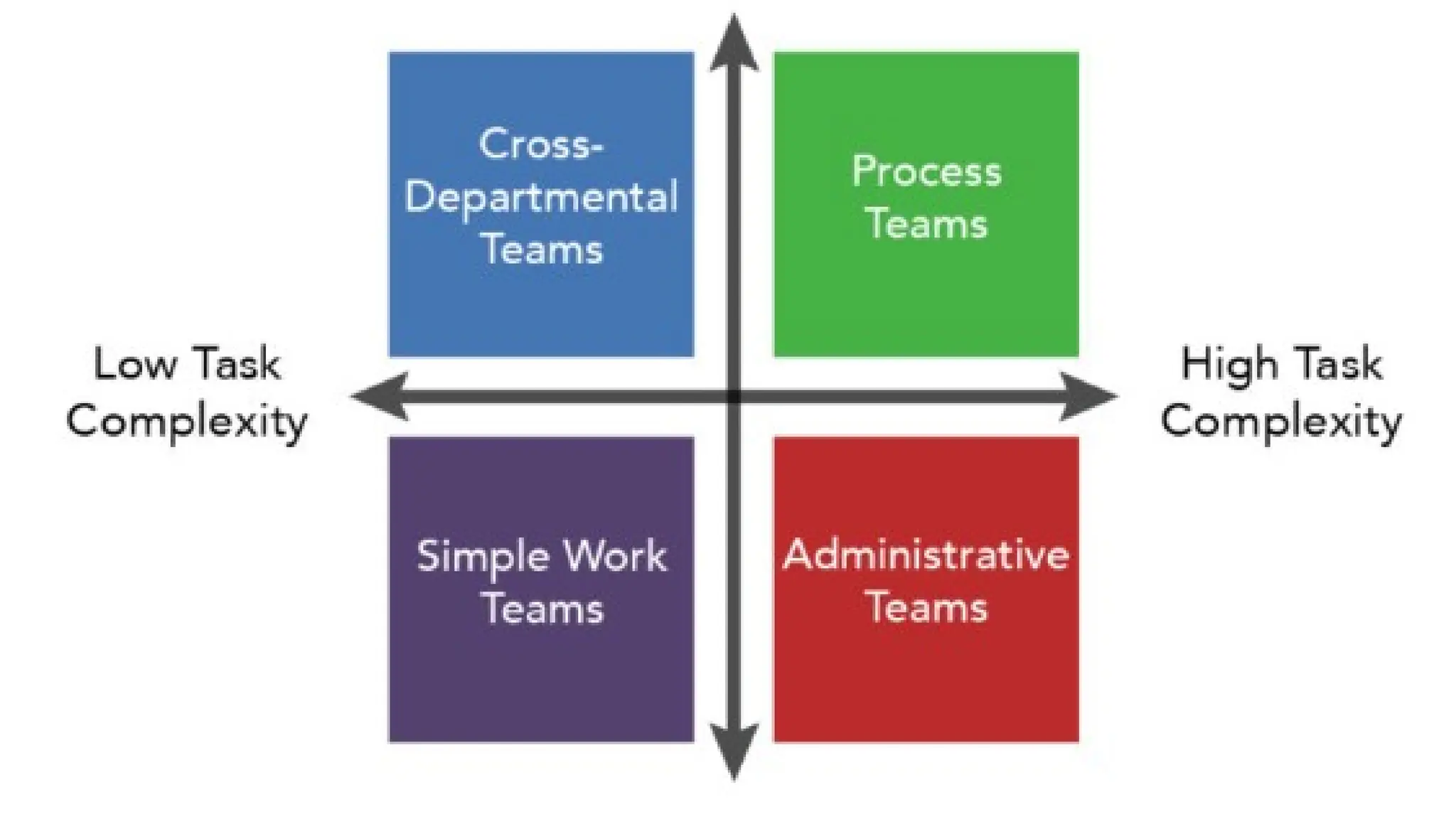
• SimpleWork Teams
Simple work teams have low task complexity and low team
fluidity. Their goal is simple problem solving, and often
they are a group that supports day-to-day activities,
dealing with issues that require input from more than one
person or to generate commitment from employees.
Usually these are people from a same team or department,
so they generally have a similar focus and tend to work
together relatively easily.
Teams in Organization
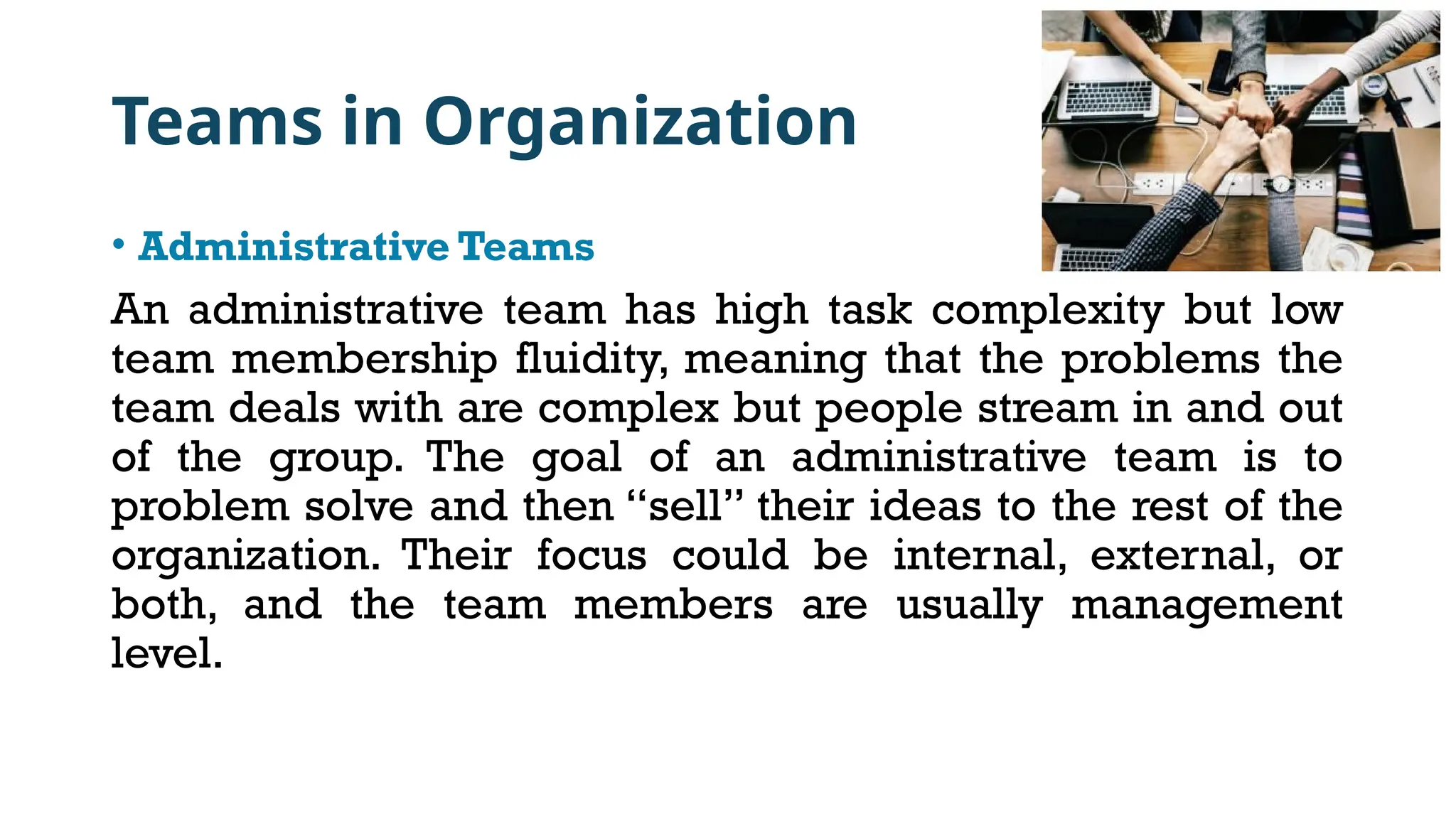
• Administrative Teams
An administrative team has high task complexity but low
team membership fluidity, meaning that the problems the
team deals with are complex but people stream in and out
of the group. The goal of an administrative team is to
problem solve and then “sell” their ideas to the rest of the
organization. Their focus could be internal, external, or
both, and the team members are usually management
level.
Teams in Organization
• Cross-Departmental Teams
A cross-departmental team tends to have a low complexity
level but a high team membership fluidity, meaning the
work is fairly simple, but the teams are committed and
fairly unchanging. Their goal is integration in structure and
setting ground rules, and their focus is internal and very
specific.
What are the advantages of cross-
departmental teams?
• Cross-departmental teams entail various benefits for
companies, among which the following three advantages
are most prominent:
• Cross-departmental teams accelerate task completion.
• With their skillful and diverse members, cross-
departmenal teams can tackle various projects at hand.
• Cross-departmental teams are dynamic and creative in
producing innovative ideas.
Teams in Organization
• Process Teams
Process teams deal with high complexity tasks and have
high team member fluidity, meaning people are assigned
to the team and stay. These folks are creative problem
solvers and deal with implementation. Their focus is
strategic and broad.
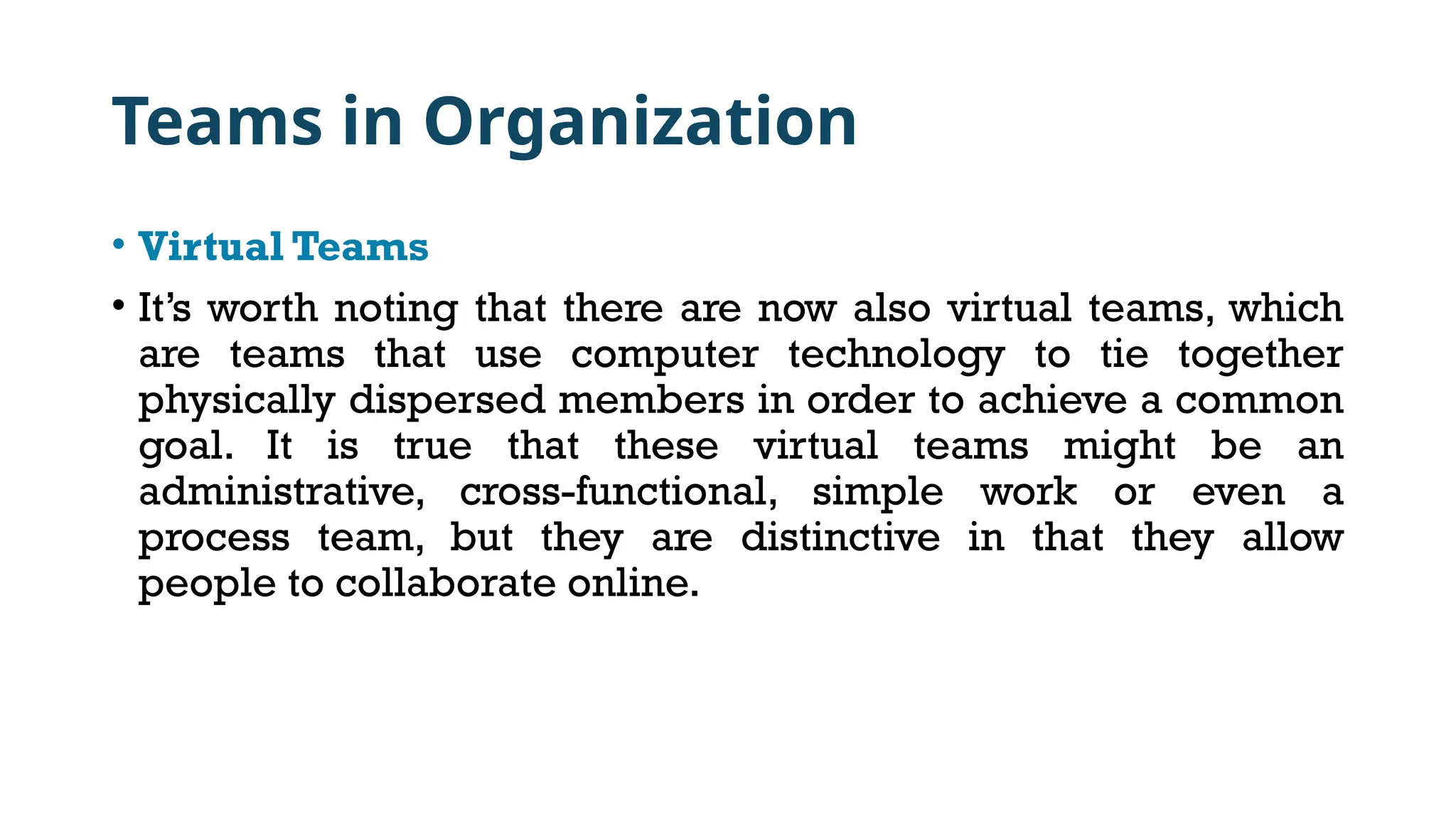
Teams in Organization
• Virtual Teams
• It’s worth noting that there are now also virtual teams, which
are teams that use computer technology to tie together
physically dispersed members in order to achieve a common
goal. It is true that these virtual teams might be an
administrative, cross-functional, simple work or even a
process team, but they are distinctive in that they allow
people to collaborate online.
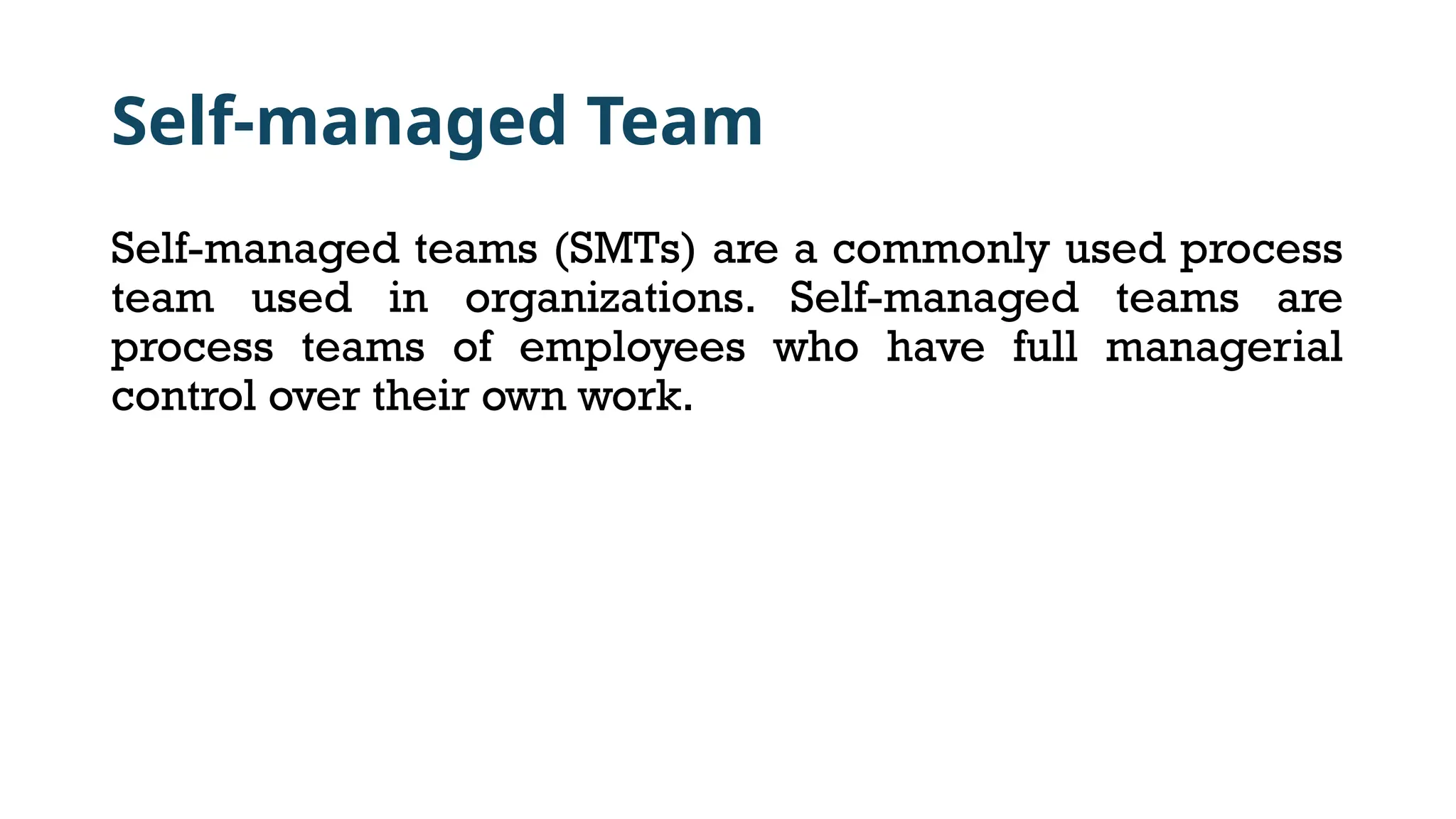
Self-managed Team
Self-managed teams (SMTs) are a commonly used process
team used in organizations. Self-managed teams are
process teams of employees who have full managerial
control over their own work.
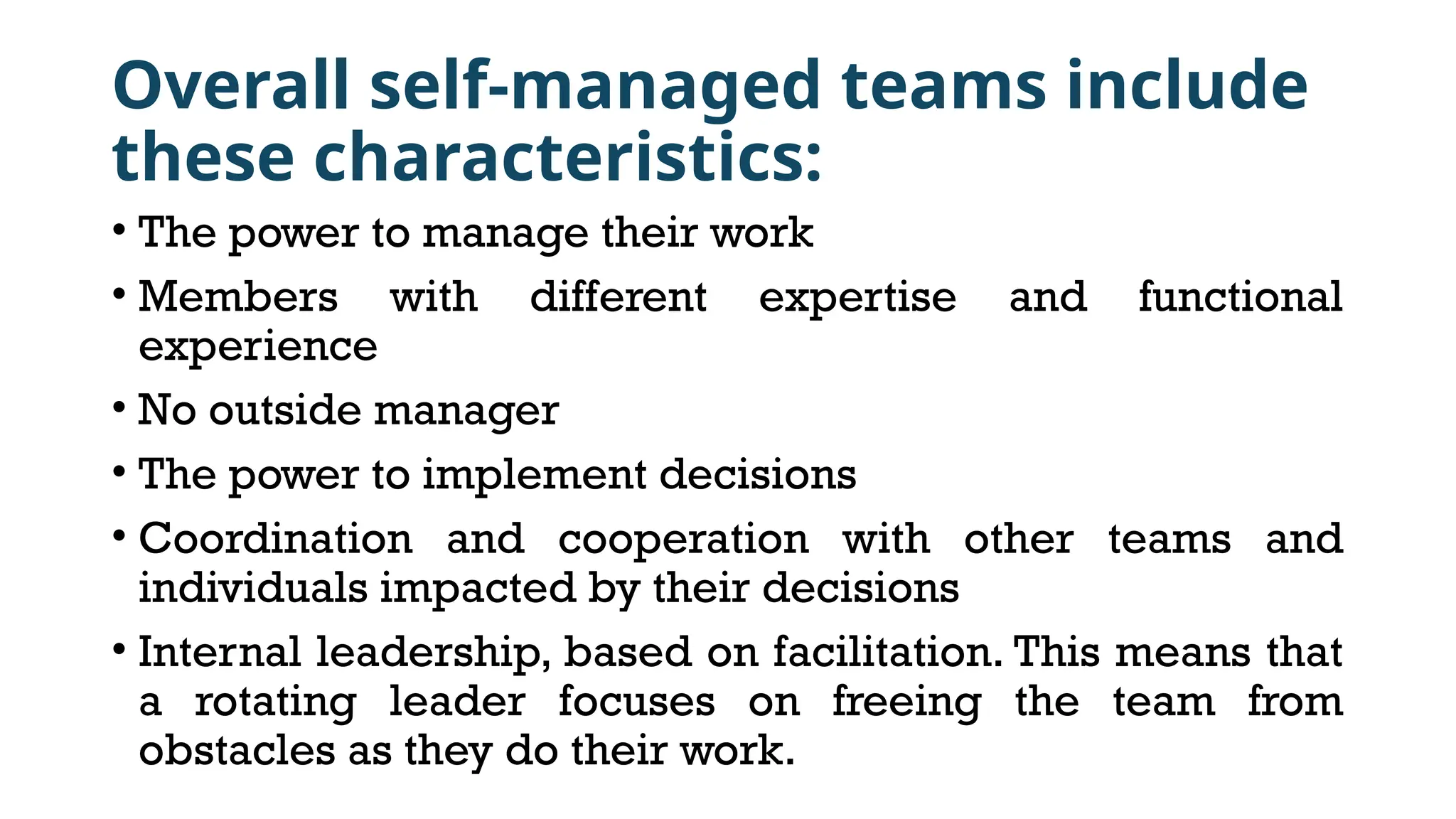
Overall self-managed teams include
these characteristics:
• The power to manage their work
• Members with different expertise and functional
experience
• No outside manager
• The power to implement decisions
• Coordination and cooperation with other teams and
individuals impacted by their decisions
• Internal leadership, based on facilitation. This means that
a rotating leader focuses on freeing the team from
obstacles as they do their work.
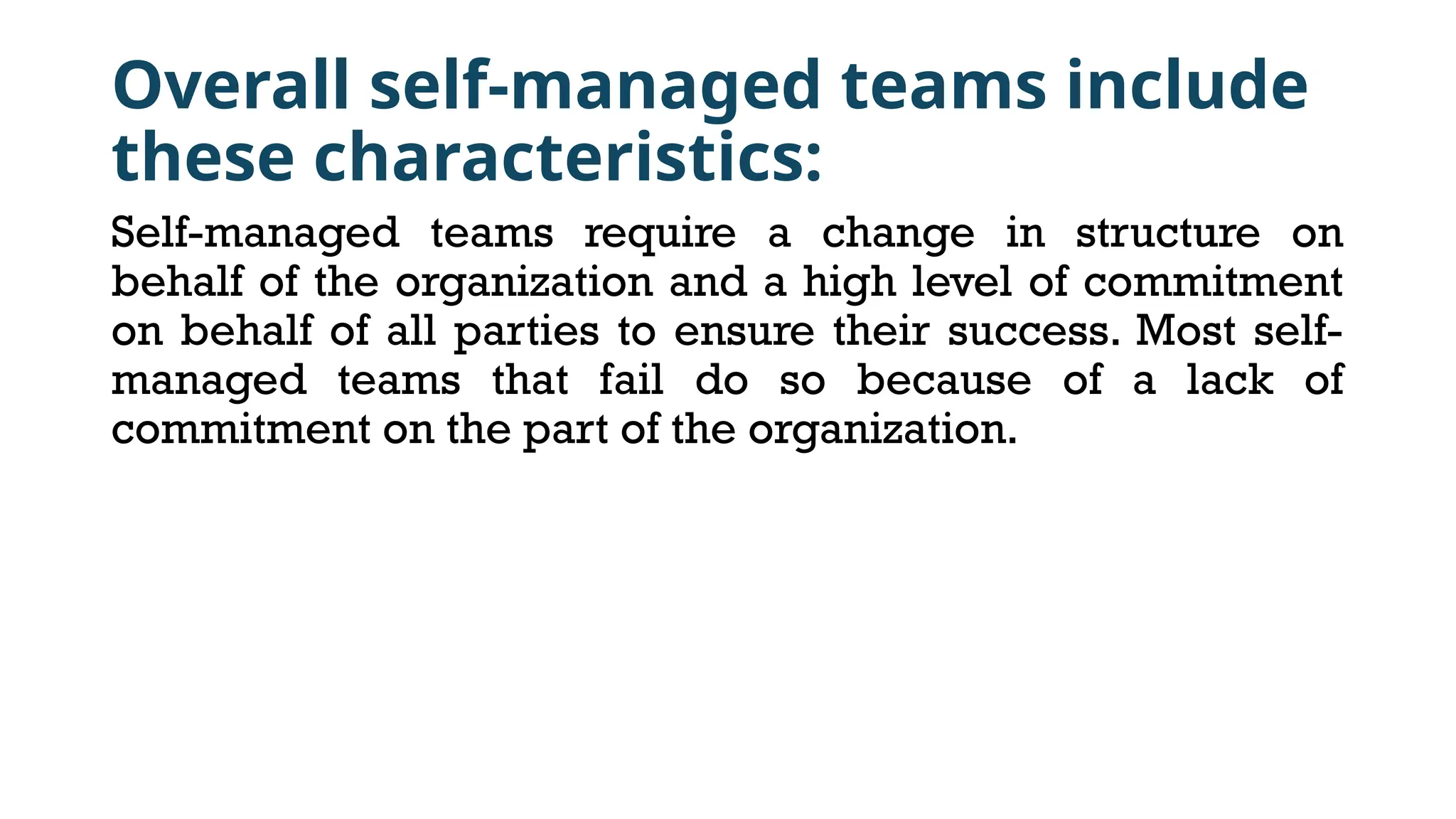
Overall self-managed teams include
these characteristics:
Self-managed teams require a change in structure on
behalf of the organization and a high level of commitment
on behalf of all parties to ensure their success. Most self-
managed teams that fail do so because of a lack of
commitment on the part of the organization.
What are the responsibilities of a
self-managed work team?
• In this team, members often perform tasks ranging from
work scheduling and operational planning to working
with customers and assisting operational decision-
making processes.
Problem Solving Team
• A problem-solving team consists of 5-10 members from
the same department. The team will have a number of
weekly meetings to resolve specific business problems.
• In fact, this type of team can alleviate possible risks
associated with certain crises while developing thorough
solutions that address multiple business segments.
• Often, problem-solving teams are assembled temporarily.
Usually, team members in problem-solving teams are
gathered in case of a crisis or an unplanned matter at
work. Thus, such teams try to address the issue and drive
the organizations out of the ongoing crisis.
What are possible crises that
concern problem-solving teams?
• Problem-solving teams can work to alleviate possible
risks in crises such as the global financial crisis in 2008-
2009, the ongoing impacts of the COVID-19 pandemic, the
currently increasing inflation rates across countries, and
so on.
Team Effectiveness
• Team effectiveness is all about creating an empowering
and satisfying work environment.
• It involves a group of individuals who work together to
achieve a shared goal established by an authority, a team
or team members.
• With the help of different models such as frameworks, a
team dynamic can be analyzed and improved.
Factors of Team Effectiveness
Reinforce a Shared Purpose
• Leaders must inspire their teams with a sense of purpose
and vision.
• Leaders must lay out the direction and provide updates
for their work teams.
• Leaders also need to show their teams how changes
impact their individual goals and purpose and most
importantly leaders need to show their teams that they
value their efforts.
Factors of Team Effectiveness
Provide Role Clarity
• Everyone needs to be clear on who does what so
employees can remain focused on achieving goals.
• Team leaders establish role clarity by setting individual
goals and responsibilities, and making sure expected
contributions are clear.
• More importantly, leaders should make sure each team
member’s qualifications, capabilities, and motivations
match their role.
• Also, team members should help leaders by knowing
their own boundaries when making decisions and
assigning work.
Factors of Team Effectiveness
Promote Enabling Processes
• Teams need time to reflect on their successes and
failures.They also need to ensure they have the time, staff,
funding, and resources to do their job.
• Successful teams have clear team processes for planning,
tracking, documenting, and managing work.
• Teams also need to control how they spend their time.
• Leaders need to make sure their teams are not falling
behind because of inefficiencies or wasted time. Leaders
should check in regularly with their teams to get
feedback on whether they have what they need.
Factors of Team Effectiveness
Create a Psychologically Safe Environment.
• Team members want to feel comfortable, valued, and
involved. Unfortunately, the vast majority don’t feel this
way.
• Teams establish emotional security with a high level
of trust, comfort, psychological safety, and understanding.
They also need to respect one another, and intentionally
invite everyone’s input and incorporate it into collective
activities, like brainstorming sessions.
• Psychological safety is one of the most important factors
in teams, especially during times of crisis and
uncertainty. Leaders need to engage with their teams on
an emotional level to keep them engaged and productive.
Factors of Team Effectiveness
Encourage a Collaborative Spirit.
• A collaborative spirit encourages everyone to come
together to think about the best ways to tackle work. It
often brings new, diverse ideas and perspectives to the
project team.
• Leaders must encourage a collaborative spirit if they
hope to achieve team effectiveness. They should share
relevant information openly and clearly with their teams
and encourage their teams to prioritize collective
contributions over individual competition.
Factors of Team Effectiveness
Foster Growth Orientation
• People need to learn and grow if they want to improve
their performance.
• Effective teams provide more ideas and output to benefit
the entire organization, sparking growth. These ideas
come from experimenting or brainstorming new ways to
solve problems.
• One way to continue growing is for team members to
learn from each other.
• Teams provide opportunities for everyone to grow and
develop skills together.
Thank
you for
listenin
g!
Giving
or
sharing
of
insights

Behavioral Characteristics of Teams in Human Relations

  • 2.
    What is team? •A group of authors in StudySmarter in UK (2024) defined team as consists of individuals collaborating on specific tasks to achieve common goals and objectives.
  • 3.
    Teams in Organization •Organizations use different types of teams in different ways to accomplish their objectives. Some teams have a very simple and specific focus, and others face complex issues with organization-wide ramifications.
  • 4.
    Teams in Organization •SimpleWork Teams • Administrative Teams • Cross-Departmental Teams • Process Teams • Virtual Teams
  • 5.
    Teams in Organization •SimpleWork Teams Simple work teams have low task complexity and low team fluidity. Their goal is simple problem solving, and often they are a group that supports day-to-day activities, dealing with issues that require input from more than one person or to generate commitment from employees. Usually these are people from a same team or department, so they generally have a similar focus and tend to work together relatively easily.
  • 6.
    Teams in Organization •Administrative Teams An administrative team has high task complexity but low team membership fluidity, meaning that the problems the team deals with are complex but people stream in and out of the group. The goal of an administrative team is to problem solve and then “sell” their ideas to the rest of the organization. Their focus could be internal, external, or both, and the team members are usually management level.
  • 7.
    Teams in Organization •Cross-Departmental Teams A cross-departmental team tends to have a low complexity level but a high team membership fluidity, meaning the work is fairly simple, but the teams are committed and fairly unchanging. Their goal is integration in structure and setting ground rules, and their focus is internal and very specific.
  • 8.
    What are theadvantages of cross- departmental teams? • Cross-departmental teams entail various benefits for companies, among which the following three advantages are most prominent: • Cross-departmental teams accelerate task completion. • With their skillful and diverse members, cross- departmenal teams can tackle various projects at hand. • Cross-departmental teams are dynamic and creative in producing innovative ideas.
  • 9.
    Teams in Organization •Process Teams Process teams deal with high complexity tasks and have high team member fluidity, meaning people are assigned to the team and stay. These folks are creative problem solvers and deal with implementation. Their focus is strategic and broad.
  • 10.
    Teams in Organization •Virtual Teams • It’s worth noting that there are now also virtual teams, which are teams that use computer technology to tie together physically dispersed members in order to achieve a common goal. It is true that these virtual teams might be an administrative, cross-functional, simple work or even a process team, but they are distinctive in that they allow people to collaborate online.
  • 11.
    Self-managed Team Self-managed teams(SMTs) are a commonly used process team used in organizations. Self-managed teams are process teams of employees who have full managerial control over their own work.
  • 12.
    Overall self-managed teamsinclude these characteristics: • The power to manage their work • Members with different expertise and functional experience • No outside manager • The power to implement decisions • Coordination and cooperation with other teams and individuals impacted by their decisions • Internal leadership, based on facilitation. This means that a rotating leader focuses on freeing the team from obstacles as they do their work.
  • 13.
    Overall self-managed teamsinclude these characteristics: Self-managed teams require a change in structure on behalf of the organization and a high level of commitment on behalf of all parties to ensure their success. Most self- managed teams that fail do so because of a lack of commitment on the part of the organization.
  • 14.
    What are theresponsibilities of a self-managed work team? • In this team, members often perform tasks ranging from work scheduling and operational planning to working with customers and assisting operational decision- making processes.
  • 16.
    Problem Solving Team •A problem-solving team consists of 5-10 members from the same department. The team will have a number of weekly meetings to resolve specific business problems. • In fact, this type of team can alleviate possible risks associated with certain crises while developing thorough solutions that address multiple business segments. • Often, problem-solving teams are assembled temporarily. Usually, team members in problem-solving teams are gathered in case of a crisis or an unplanned matter at work. Thus, such teams try to address the issue and drive the organizations out of the ongoing crisis.
  • 17.
    What are possiblecrises that concern problem-solving teams? • Problem-solving teams can work to alleviate possible risks in crises such as the global financial crisis in 2008- 2009, the ongoing impacts of the COVID-19 pandemic, the currently increasing inflation rates across countries, and so on.
  • 18.
    Team Effectiveness • Teameffectiveness is all about creating an empowering and satisfying work environment. • It involves a group of individuals who work together to achieve a shared goal established by an authority, a team or team members. • With the help of different models such as frameworks, a team dynamic can be analyzed and improved.
  • 19.
    Factors of TeamEffectiveness Reinforce a Shared Purpose • Leaders must inspire their teams with a sense of purpose and vision. • Leaders must lay out the direction and provide updates for their work teams. • Leaders also need to show their teams how changes impact their individual goals and purpose and most importantly leaders need to show their teams that they value their efforts.
  • 20.
    Factors of TeamEffectiveness Provide Role Clarity • Everyone needs to be clear on who does what so employees can remain focused on achieving goals. • Team leaders establish role clarity by setting individual goals and responsibilities, and making sure expected contributions are clear. • More importantly, leaders should make sure each team member’s qualifications, capabilities, and motivations match their role. • Also, team members should help leaders by knowing their own boundaries when making decisions and assigning work.
  • 21.
    Factors of TeamEffectiveness Promote Enabling Processes • Teams need time to reflect on their successes and failures.They also need to ensure they have the time, staff, funding, and resources to do their job. • Successful teams have clear team processes for planning, tracking, documenting, and managing work. • Teams also need to control how they spend their time. • Leaders need to make sure their teams are not falling behind because of inefficiencies or wasted time. Leaders should check in regularly with their teams to get feedback on whether they have what they need.
  • 22.
    Factors of TeamEffectiveness Create a Psychologically Safe Environment. • Team members want to feel comfortable, valued, and involved. Unfortunately, the vast majority don’t feel this way. • Teams establish emotional security with a high level of trust, comfort, psychological safety, and understanding. They also need to respect one another, and intentionally invite everyone’s input and incorporate it into collective activities, like brainstorming sessions. • Psychological safety is one of the most important factors in teams, especially during times of crisis and uncertainty. Leaders need to engage with their teams on an emotional level to keep them engaged and productive.
  • 23.
    Factors of TeamEffectiveness Encourage a Collaborative Spirit. • A collaborative spirit encourages everyone to come together to think about the best ways to tackle work. It often brings new, diverse ideas and perspectives to the project team. • Leaders must encourage a collaborative spirit if they hope to achieve team effectiveness. They should share relevant information openly and clearly with their teams and encourage their teams to prioritize collective contributions over individual competition.
  • 24.
    Factors of TeamEffectiveness Foster Growth Orientation • People need to learn and grow if they want to improve their performance. • Effective teams provide more ideas and output to benefit the entire organization, sparking growth. These ideas come from experimenting or brainstorming new ways to solve problems. • One way to continue growing is for team members to learn from each other. • Teams provide opportunities for everyone to grow and develop skills together.
  • 25.
  • 26.