Rock Eval Pyrolysis: A Tool for Reservoir
Characterization and Hydrocarbon Potentiality
Estimation
Dr Subhashree Mishra
Scientist
CSIR-NIO
Duration of the internship: 1st January, 2022 – 28th February, 2022
Topics to be covered:
· What is source and reservoir?
· What are the geological controls for hydrocarbon generation?
· Types of hydrocarbons?
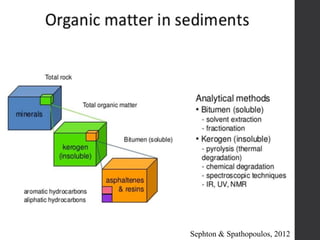
· Organic matter in marine sediments
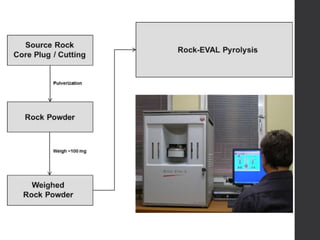
· A brief introduction to Rock Eval Pyrolysis
· Principles and Applications of Rock Eval Pyrolysis
Presentation: 28/02/2022
Sephton & Spathopoulos, 2012
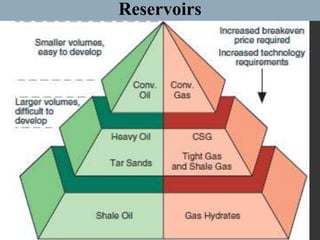
Reservoirs
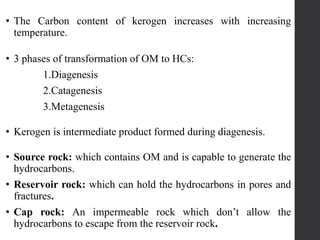
• The Carbon content of kerogen increases with increasing
temperature.
• 3 phases of transformation of OM to HCs:
1.Diagenesis
2.Catagenesis
3.Metagenesis
• Kerogen is intermediate product formed during diagenesis.
• Source rock: which contains OM and is capable to generate the
hydrocarbons.
• Reservoir rock: which can hold the hydrocarbons in pores and
fractures.
• Cap rock: An impermeable rock which don’t allow the
hydrocarbons to escape from the reservoir rock.
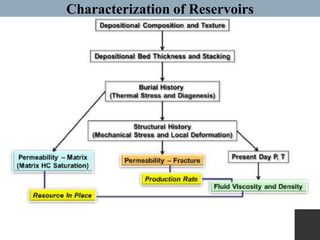
Characterization of Reservoirs
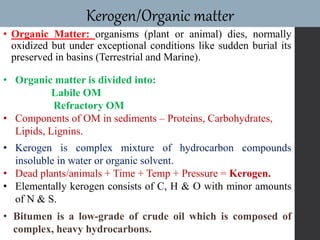
• Organic Matter: organisms (plant or animal) dies, normally
oxidized but under exceptional conditions like sudden burial its
preserved in basins (Terrestrial and Marine).
Kerogen/Organic matter
• Organic matter is divided into:
Labile OM
Refractory OM
• Components of OM in sediments – Proteins, Carbohydrates,
Lipids, Lignins.
• Bitumen is a low-grade of crude oil which is composed of
complex, heavy hydrocarbons.
• Kerogen is complex mixture of hydrocarbon compounds
insoluble in water or organic solvent.
• Dead plants/animals + Time + Temp + Pressure = Kerogen.
• Elementally kerogen consists of C, H & O with minor amounts
of N & S.
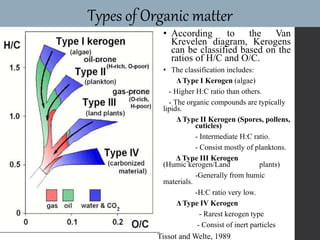
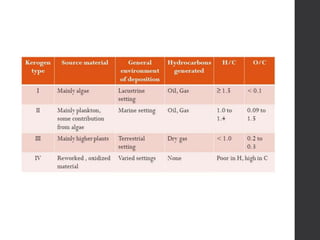
• According to the Van
Krevelen diagram, Kerogens
can be classified based on the
ratios of H/C and O/C.
• The classification includes:
Δ Type I Kerogen (algae)
- Higher H:C ratio than others.
- The organic compounds are typically
lipids.
Δ Type II Kerogen (Spores, pollens,
cuticles)
- Intermediate H:C ratio.
- Consist mostly of planktons.
Δ Type III Kerogen
(Humic kerogen/Land plants)
-Generally from humic
materials.
-H:C ratio very low.
Δ Type IV Kerogen
- Rarest kerogen type
- Consist of inert particles
Types of Organic matter
Tissot and Welte, 1989
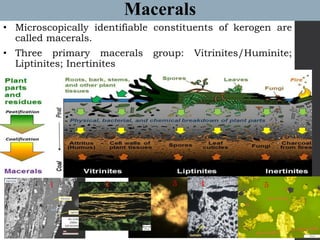
Macerals
• Microscopically identifiable constituents of kerogen are
called macerals.
• Three primary macerals group: Vitrinites/Huminite;
Liptinites; Inertinites
1 2 3 4 5
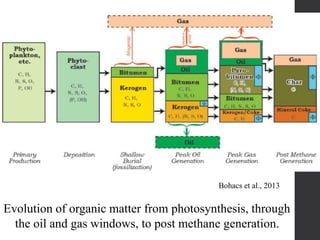
Evolution of organic matter from photosynthesis, through
the oil and gas windows, to post methane generation.
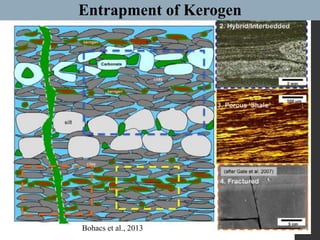
Bohacs et al., 2013
Bohacs et al., 2013
Entrapment of Kerogen
TOC and Rock Eval Pyrolysis
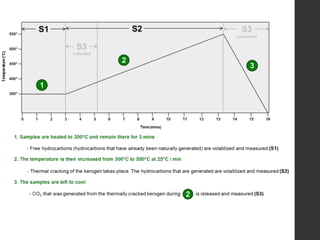
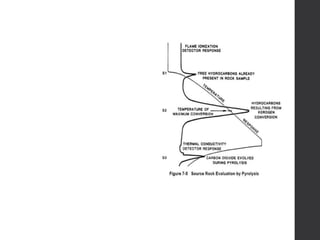
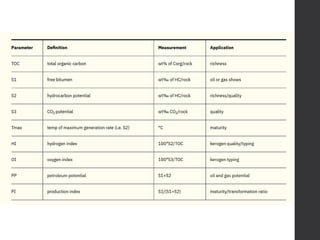
• S3 – CO/CO2 generated from the kerogen during thermal cracking of the
kerogen
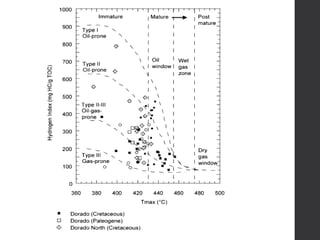
• Tmax - temperature at which the maximum amount of hydrocarbons are
generated, which is a measure of thermal maturity of the organic matter
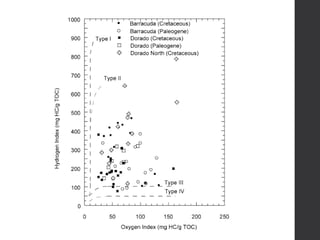
• Hydrogen index (HI) = (S2*100)/TOC and Oxygen index (OI) =
(S3*100)/TOC
• Production Index (PI) = S1/(S1+S2), denoting ratio of free hydrocarbons to
total hydrocarbons.
• Hydrocarbon generating potential (PY) = S1 + S2 is the measurement of total
pyrolytic hydrocarbon yield.
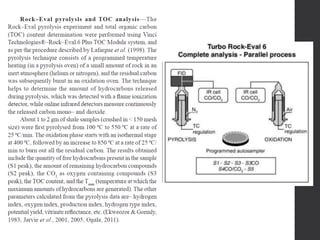
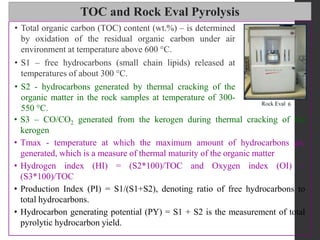
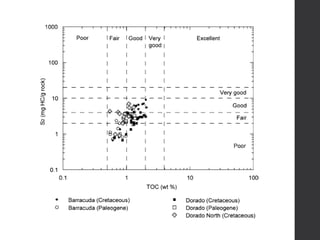
• Total organic carbon (TOC) content (wt.%) – is determined
by oxidation of the residual organic carbon under air
environment at temperature above 600 °C.
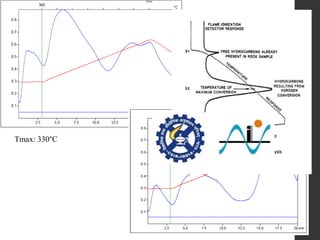
• S1 – free hydrocarbons (small chain lipids) released at
temperatures of about 300 °C.
• S2 - hydrocarbons generated by thermal cracking of the
organic matter in the rock samples at temperature of 300-
550 °C.
Tmax: 330°C
Tmax: 611°C
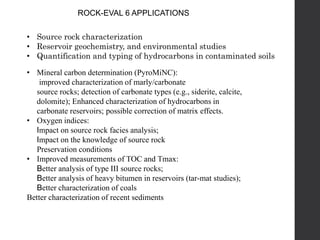
ROCK-EVAL 6 APPLICATIONS
• Mineral carbon determination (PyroMiNC):
improved characterization of marly/carbonate
source rocks; detection of carbonate types (e.g., siderite, calcite,
dolomite); Enhanced characterization of hydrocarbons in
carbonate reservoirs; possible correction of matrix effects.
• Oxygen indices:
Impact on source rock facies analysis;
Impact on the knowledge of source rock
Preservation conditions
• Improved measurements of TOC and Tmax:
Better analysis of type III source rocks;
Better analysis of heavy bitumen in reservoirs (tar-mat studies);
Better characterization of coals
Better characterization of recent sediments
• Source rock characterization
• Reservoir geochemistry, and environmental studies
• Quantification and typing of hydrocarbons in contaminated soils
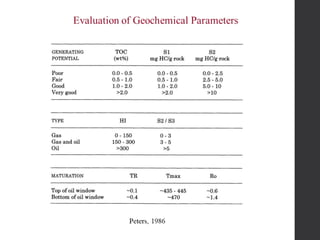
Classification of Reservoir Parameters
Classification based on TOC
HI
Tmax
PI
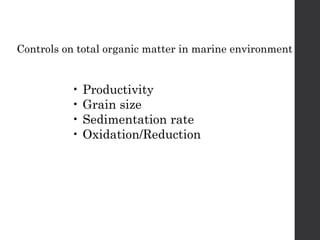
Controls on total organic matter in marine environment
• Productivity
• Grain size
• Sedimentation rate
• Oxidation/Reduction
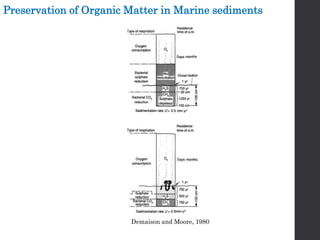
Preservation of Organic Matter in Marine sediments
Demaison and Moore, 1980
• The presence of organic-additives in drilling mud can adversely affect both
TOC and Rock-Eval data. Multiple washing can remove the bulk of the
additives.
• Oil-based mud (OBM) generally comes under the S1 measurement, but
polymeric organic material based on glycol and similar additives is less
volatile and tends to produce a precursor to the S2 peak. Inspection of
pyrograms is therefore always recommended.
• If oil or other organic mud additives are known to have been used, this
contamination of source rocks is best removed by solvent extraction prior
to the TOC and Rock-Eval analyses, so that more reliable TOC, S2, S3, HI,
OI and Tmax values can be obtained.
Potential problems
Organic matter and hydeocarbon potentialpptx

Organic matter and hydeocarbon potentialpptx

  • 1.
    Rock Eval Pyrolysis:A Tool for Reservoir Characterization and Hydrocarbon Potentiality Estimation Dr Subhashree Mishra Scientist CSIR-NIO
  • 2.
    Duration of theinternship: 1st January, 2022 – 28th February, 2022 Topics to be covered: · What is source and reservoir? · What are the geological controls for hydrocarbon generation? · Types of hydrocarbons? · Organic matter in marine sediments · A brief introduction to Rock Eval Pyrolysis · Principles and Applications of Rock Eval Pyrolysis Presentation: 28/02/2022
  • 3.
  • 4.
  • 5.
    • The Carboncontent of kerogen increases with increasing temperature. • 3 phases of transformation of OM to HCs: 1.Diagenesis 2.Catagenesis 3.Metagenesis • Kerogen is intermediate product formed during diagenesis. • Source rock: which contains OM and is capable to generate the hydrocarbons. • Reservoir rock: which can hold the hydrocarbons in pores and fractures. • Cap rock: An impermeable rock which don’t allow the hydrocarbons to escape from the reservoir rock.
  • 7.
  • 8.
    • Organic Matter:organisms (plant or animal) dies, normally oxidized but under exceptional conditions like sudden burial its preserved in basins (Terrestrial and Marine). Kerogen/Organic matter • Organic matter is divided into: Labile OM Refractory OM • Components of OM in sediments – Proteins, Carbohydrates, Lipids, Lignins. • Bitumen is a low-grade of crude oil which is composed of complex, heavy hydrocarbons. • Kerogen is complex mixture of hydrocarbon compounds insoluble in water or organic solvent. • Dead plants/animals + Time + Temp + Pressure = Kerogen. • Elementally kerogen consists of C, H & O with minor amounts of N & S.
  • 9.
    • According tothe Van Krevelen diagram, Kerogens can be classified based on the ratios of H/C and O/C. • The classification includes: Δ Type I Kerogen (algae) - Higher H:C ratio than others. - The organic compounds are typically lipids. Δ Type II Kerogen (Spores, pollens, cuticles) - Intermediate H:C ratio. - Consist mostly of planktons. Δ Type III Kerogen (Humic kerogen/Land plants) -Generally from humic materials. -H:C ratio very low. Δ Type IV Kerogen - Rarest kerogen type - Consist of inert particles Types of Organic matter Tissot and Welte, 1989
  • 10.
    Macerals • Microscopically identifiableconstituents of kerogen are called macerals. • Three primary macerals group: Vitrinites/Huminite; Liptinites; Inertinites 1 2 3 4 5
  • 11.
    Evolution of organicmatter from photosynthesis, through the oil and gas windows, to post methane generation. Bohacs et al., 2013
  • 12.
    Bohacs et al.,2013 Entrapment of Kerogen
  • 16.
    TOC and RockEval Pyrolysis • S3 – CO/CO2 generated from the kerogen during thermal cracking of the kerogen • Tmax - temperature at which the maximum amount of hydrocarbons are generated, which is a measure of thermal maturity of the organic matter • Hydrogen index (HI) = (S2*100)/TOC and Oxygen index (OI) = (S3*100)/TOC • Production Index (PI) = S1/(S1+S2), denoting ratio of free hydrocarbons to total hydrocarbons. • Hydrocarbon generating potential (PY) = S1 + S2 is the measurement of total pyrolytic hydrocarbon yield. • Total organic carbon (TOC) content (wt.%) – is determined by oxidation of the residual organic carbon under air environment at temperature above 600 °C. • S1 – free hydrocarbons (small chain lipids) released at temperatures of about 300 °C. • S2 - hydrocarbons generated by thermal cracking of the organic matter in the rock samples at temperature of 300- 550 °C.
  • 17.
  • 22.
    ROCK-EVAL 6 APPLICATIONS •Mineral carbon determination (PyroMiNC): improved characterization of marly/carbonate source rocks; detection of carbonate types (e.g., siderite, calcite, dolomite); Enhanced characterization of hydrocarbons in carbonate reservoirs; possible correction of matrix effects. • Oxygen indices: Impact on source rock facies analysis; Impact on the knowledge of source rock Preservation conditions • Improved measurements of TOC and Tmax: Better analysis of type III source rocks; Better analysis of heavy bitumen in reservoirs (tar-mat studies); Better characterization of coals Better characterization of recent sediments • Source rock characterization • Reservoir geochemistry, and environmental studies • Quantification and typing of hydrocarbons in contaminated soils
  • 23.
    Classification of ReservoirParameters Classification based on TOC HI Tmax PI
  • 24.
    Controls on totalorganic matter in marine environment • Productivity • Grain size • Sedimentation rate • Oxidation/Reduction
  • 25.
    Preservation of OrganicMatter in Marine sediments Demaison and Moore, 1980
  • 31.
    • The presenceof organic-additives in drilling mud can adversely affect both TOC and Rock-Eval data. Multiple washing can remove the bulk of the additives. • Oil-based mud (OBM) generally comes under the S1 measurement, but polymeric organic material based on glycol and similar additives is less volatile and tends to produce a precursor to the S2 peak. Inspection of pyrograms is therefore always recommended. • If oil or other organic mud additives are known to have been used, this contamination of source rocks is best removed by solvent extraction prior to the TOC and Rock-Eval analyses, so that more reliable TOC, S2, S3, HI, OI and Tmax values can be obtained. Potential problems