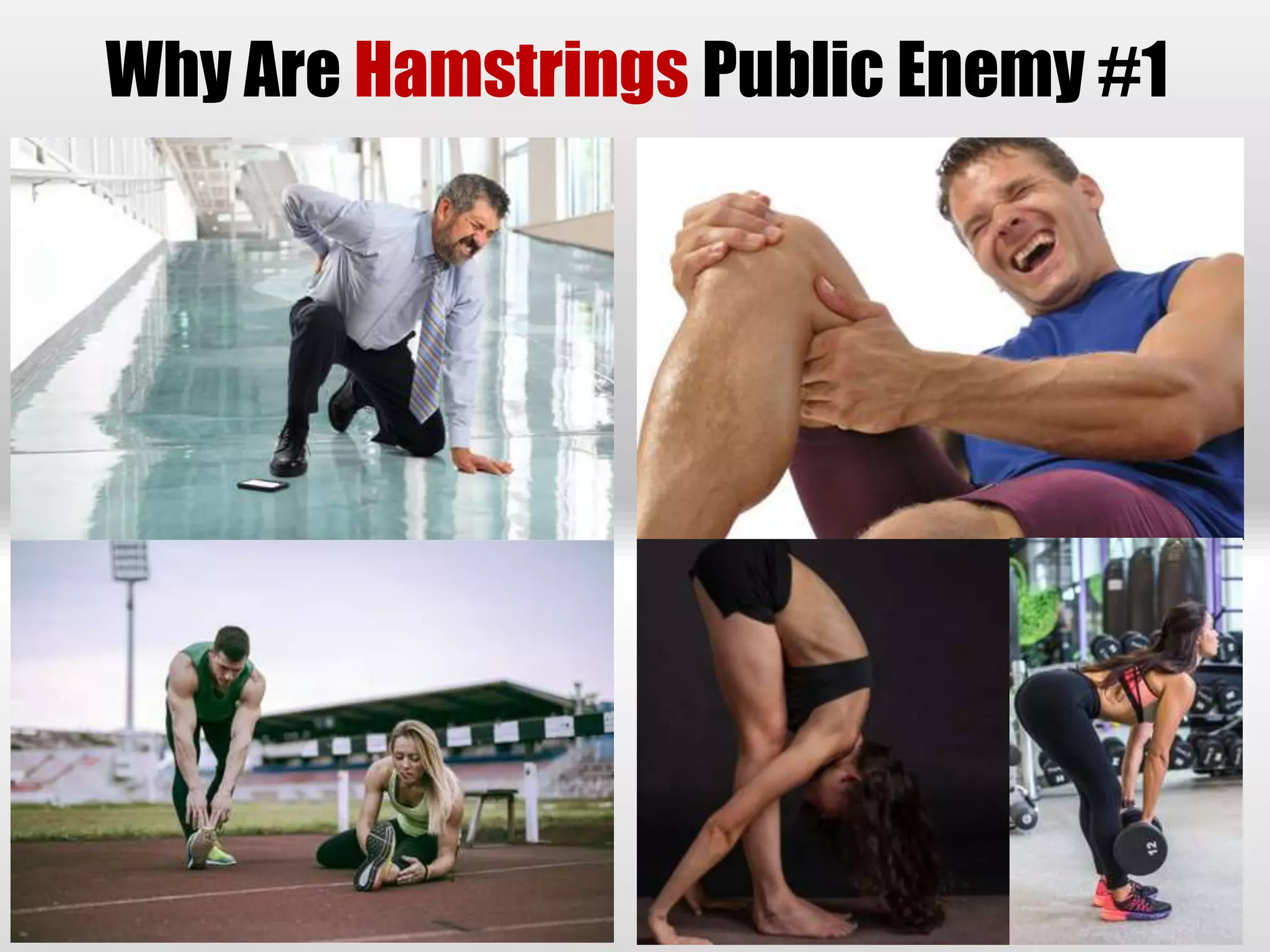
Why Are Hamstrings Public Enemy #1
What Do The HAMSTRINGS Do?
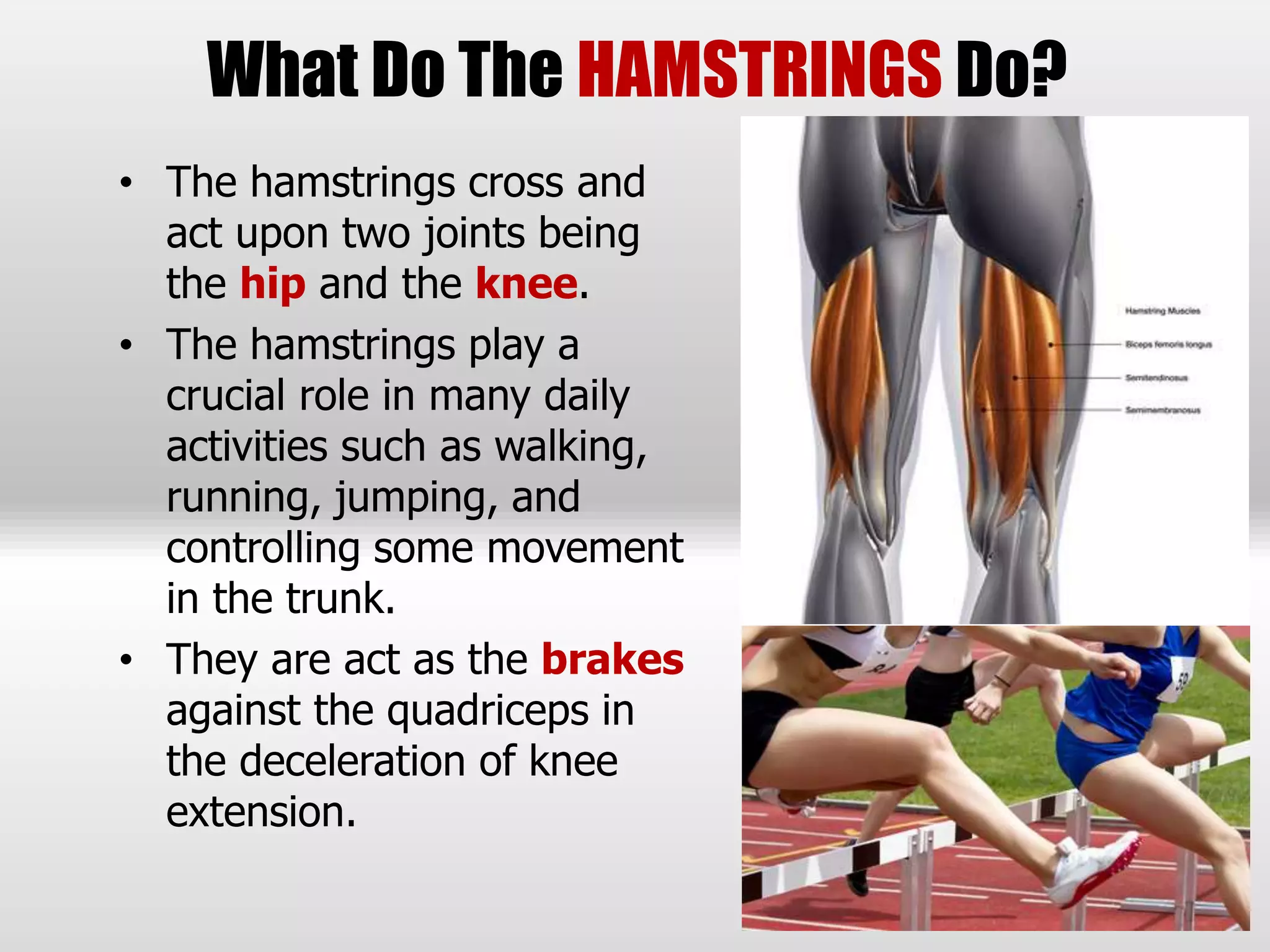
• The hamstrings cross and
act upon two joints being
the hip and the knee.
• The hamstrings play a
crucial role in many daily
activities such as walking,
running, jumping, and
controlling some movement
in the trunk.
• They are act as the brakes
against the quadriceps in
the deceleration of knee
extension.
What Do The HAMSTRINGS Do?
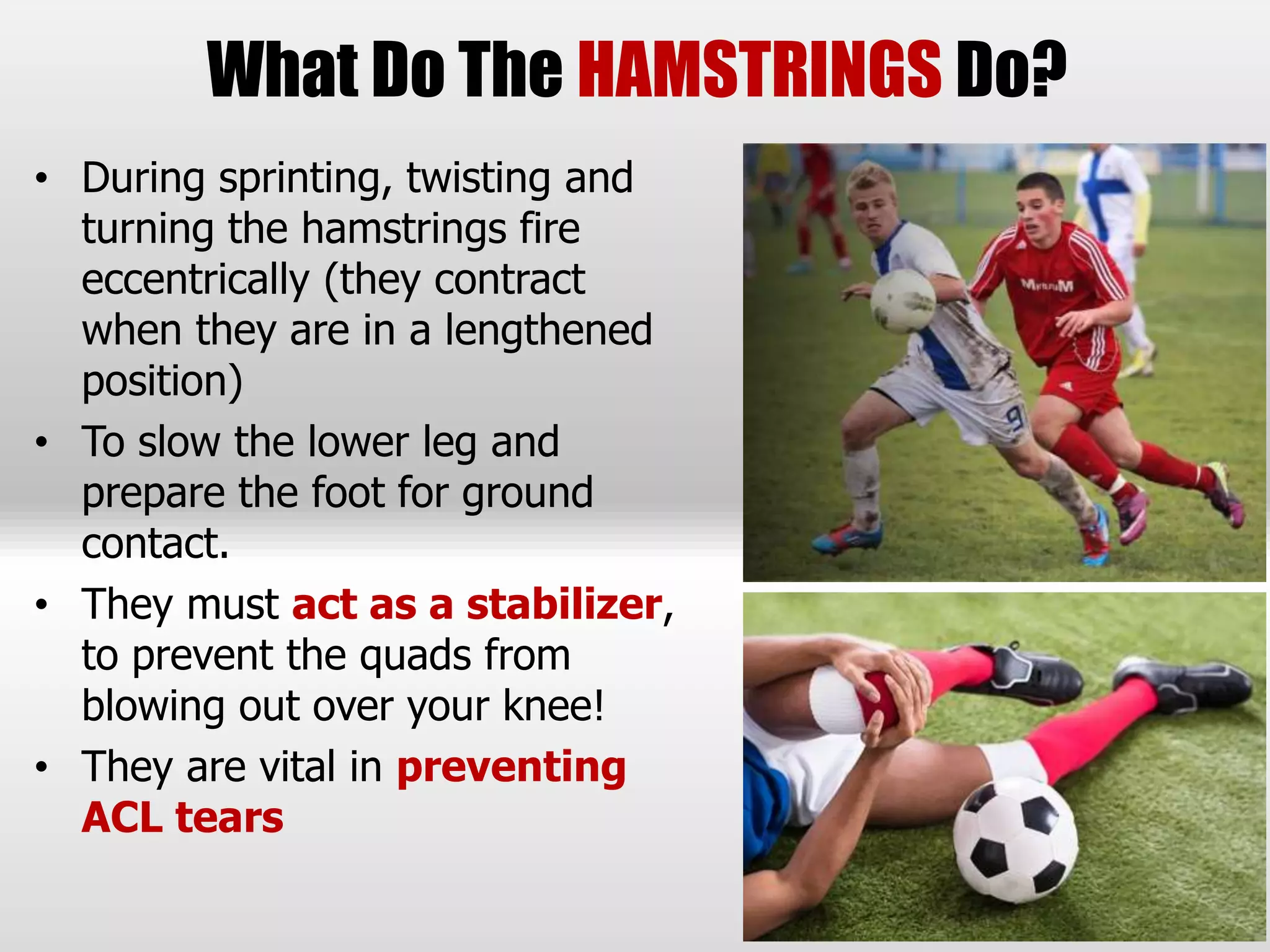
• During sprinting, twisting and
turning the hamstrings fire
eccentrically (they contract
when they are in a lengthened
position)
• To slow the lower leg and
prepare the foot for ground
contact.
• They must act as a stabilizer,
to prevent the quads from
blowing out over your knee!
• They are vital in preventing
ACL tears
What Do The HAMSTRINGS Do?
• And they are also playing a
role in your how you move
your hip and bend over.
• This is where many people
experience limited
movement and back pain
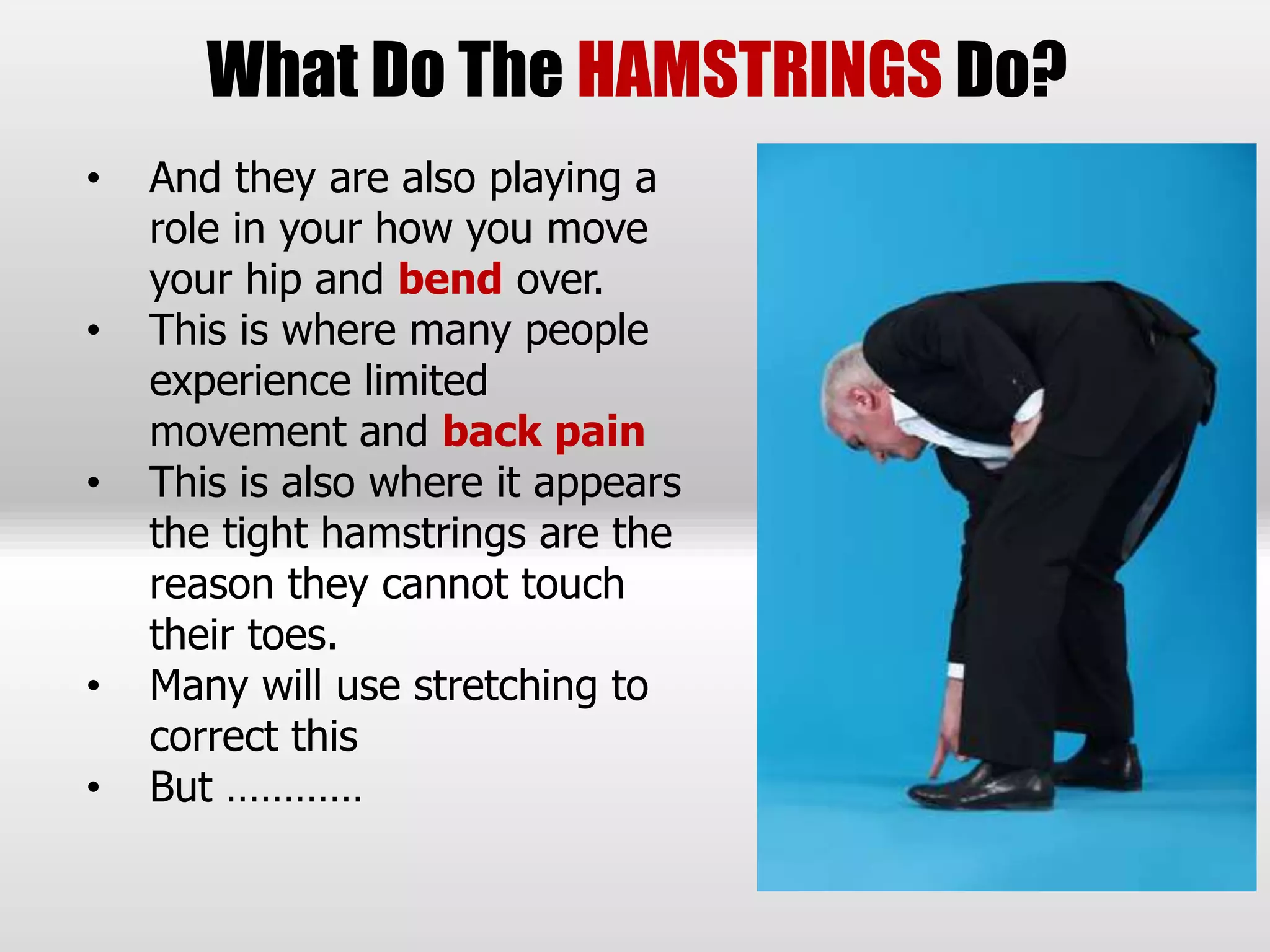
• This is also where it appears
the tight hamstrings are the
reason they cannot touch
their toes.
• Many will use stretching to
correct this
• But …………
WHY Are The Tight?
• This tightness is there for a reason and you must find
the answer to WHY they are tight to truly improve your
hamstring function.
THE HAMSTRINGS ACT LIKE A SLAVE
MUSCLE!
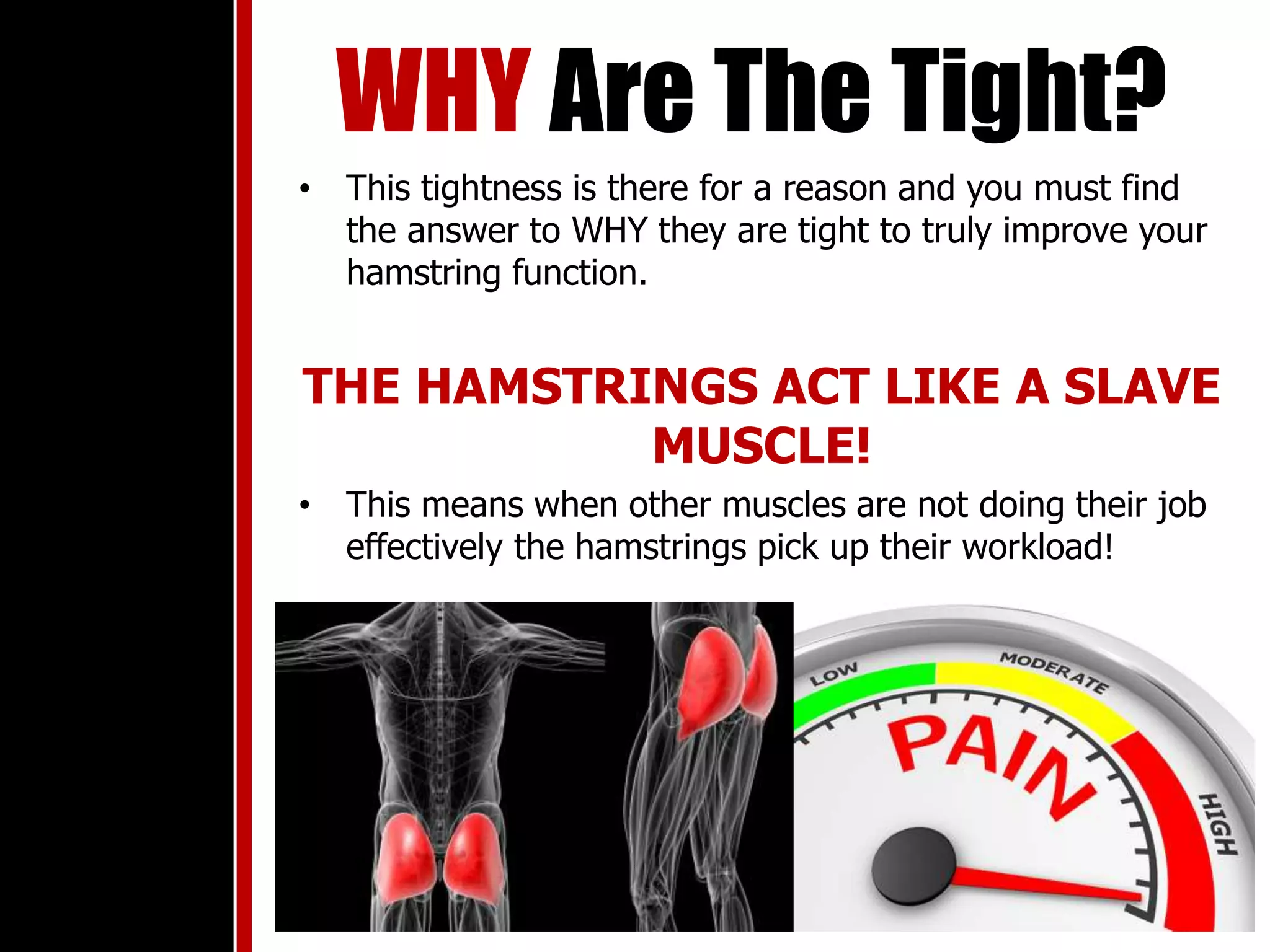
• This means when other muscles are not doing their job
effectively the hamstrings pick up their workload!
Example 1: Taut Vs Tight!
• Where what appears to be tight
hamstrings, is often not the case
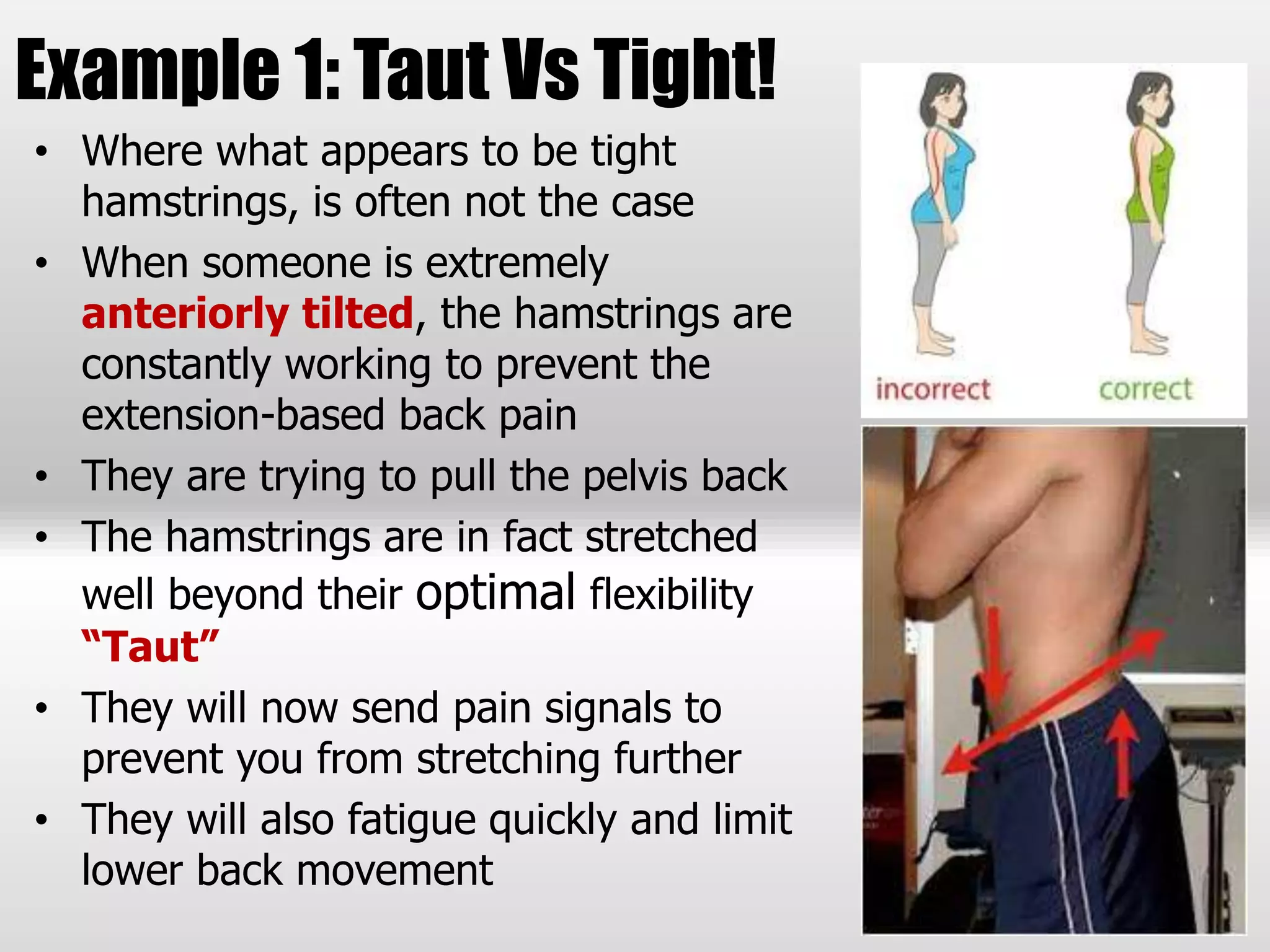
• When someone is extremely
anteriorly tilted, the hamstrings are
constantly working to prevent the
extension-based back pain
• They are trying to pull the pelvis back
• The hamstrings are in fact stretched
well beyond their optimal flexibility
“Taut”
• They will now send pain signals to
prevent you from stretching further
• They will also fatigue quickly and limit
lower back movement
Example 2: Neural Tension
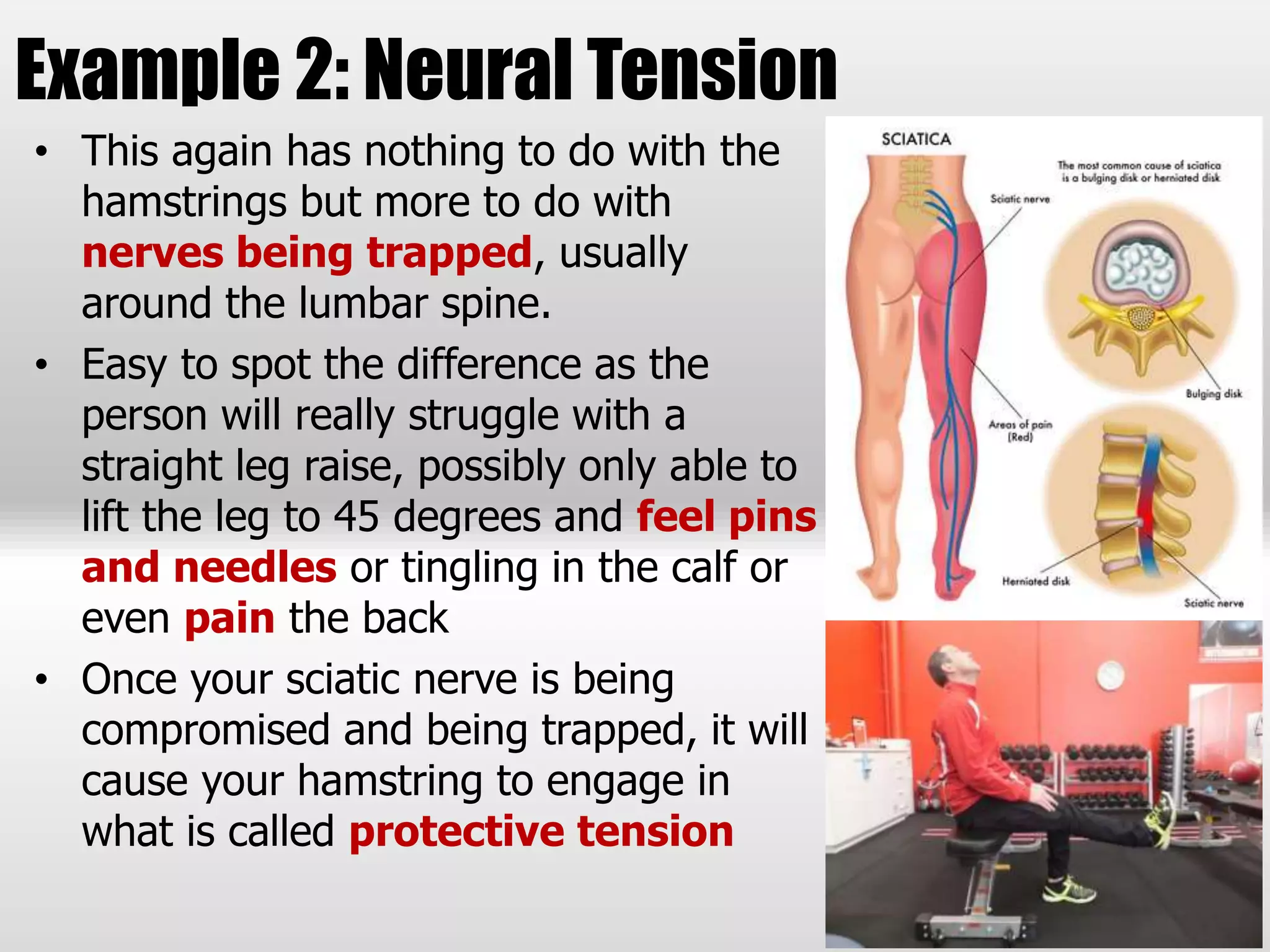
• This again has nothing to do with the
hamstrings but more to do with
nerves being trapped, usually
around the lumbar spine.
• Easy to spot the difference as the
person will really struggle with a
straight leg raise, possibly only able to
lift the leg to 45 degrees and feel pins
and needles or tingling in the calf or
even pain the back
• Once your sciatic nerve is being
compromised and being trapped, it will
cause your hamstring to engage in
what is called protective tension
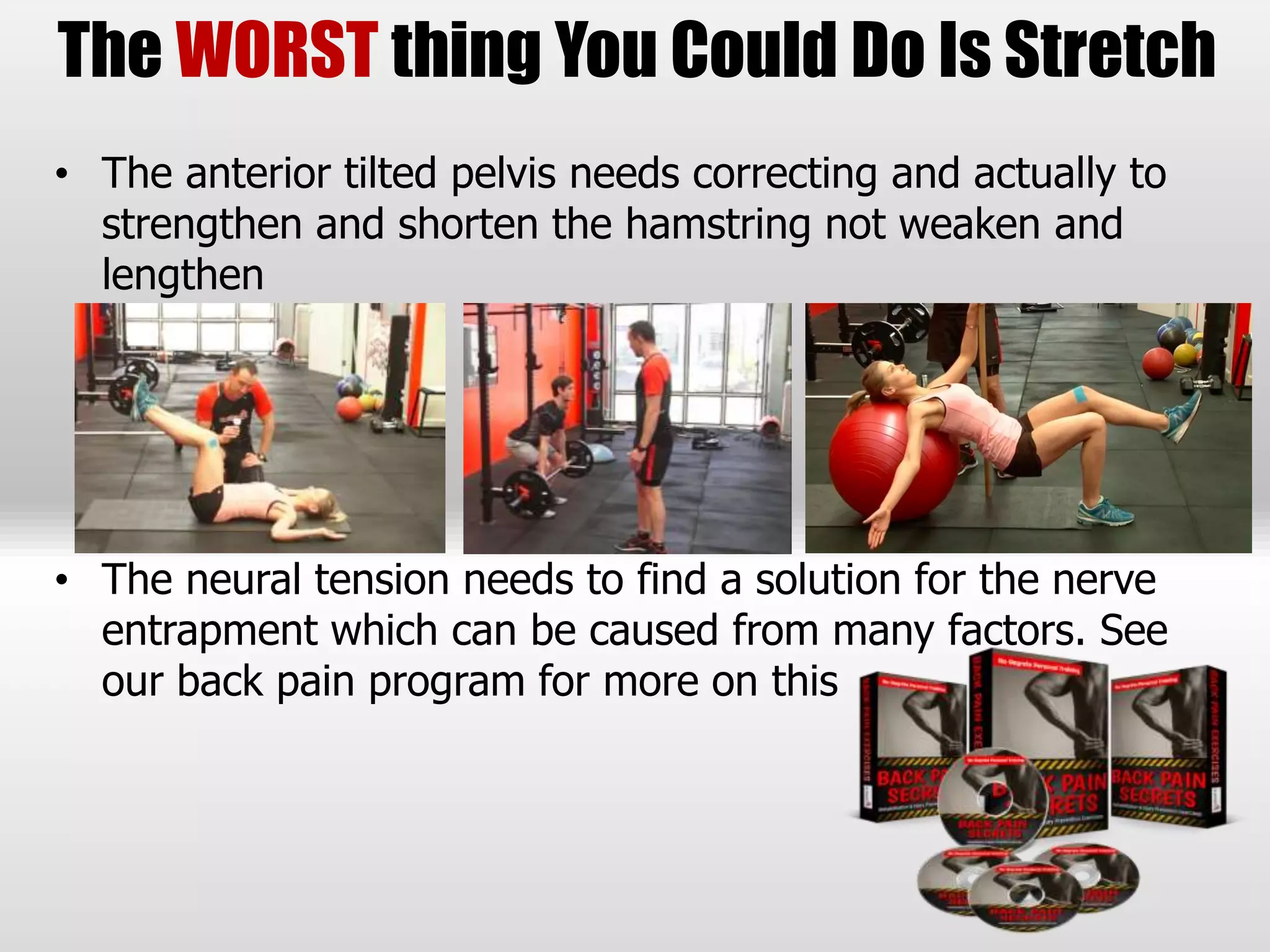
• The anterior tilted pelvis needs correcting and actually to
strengthen and shorten the hamstring not weaken and
lengthen
• The neural tension needs to find a solution for the nerve
entrapment which can be caused from many factors. See
our back pain program for more on this
The WORST thing You Could Do Is Stretch
How To Assess If You Do Have Tight Hamstrings
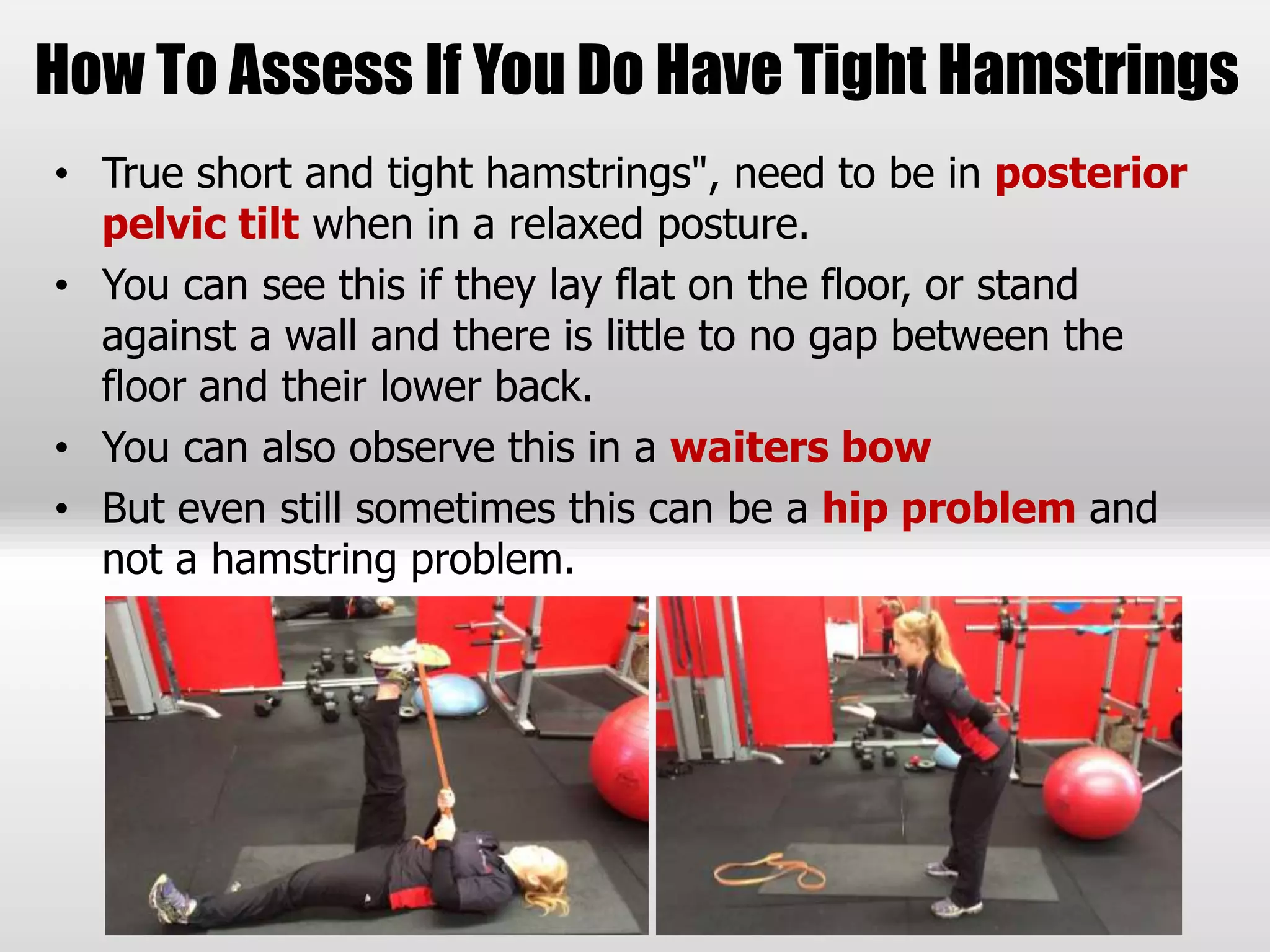
• True short and tight hamstrings", need to be in posterior
pelvic tilt when in a relaxed posture.
• You can see this if they lay flat on the floor, or stand
against a wall and there is little to no gap between the
floor and their lower back.
• You can also observe this in a waiters bow
• But even still sometimes this can be a hip problem and
not a hamstring problem.
How To Assess If You Do Have Tight Hamstrings
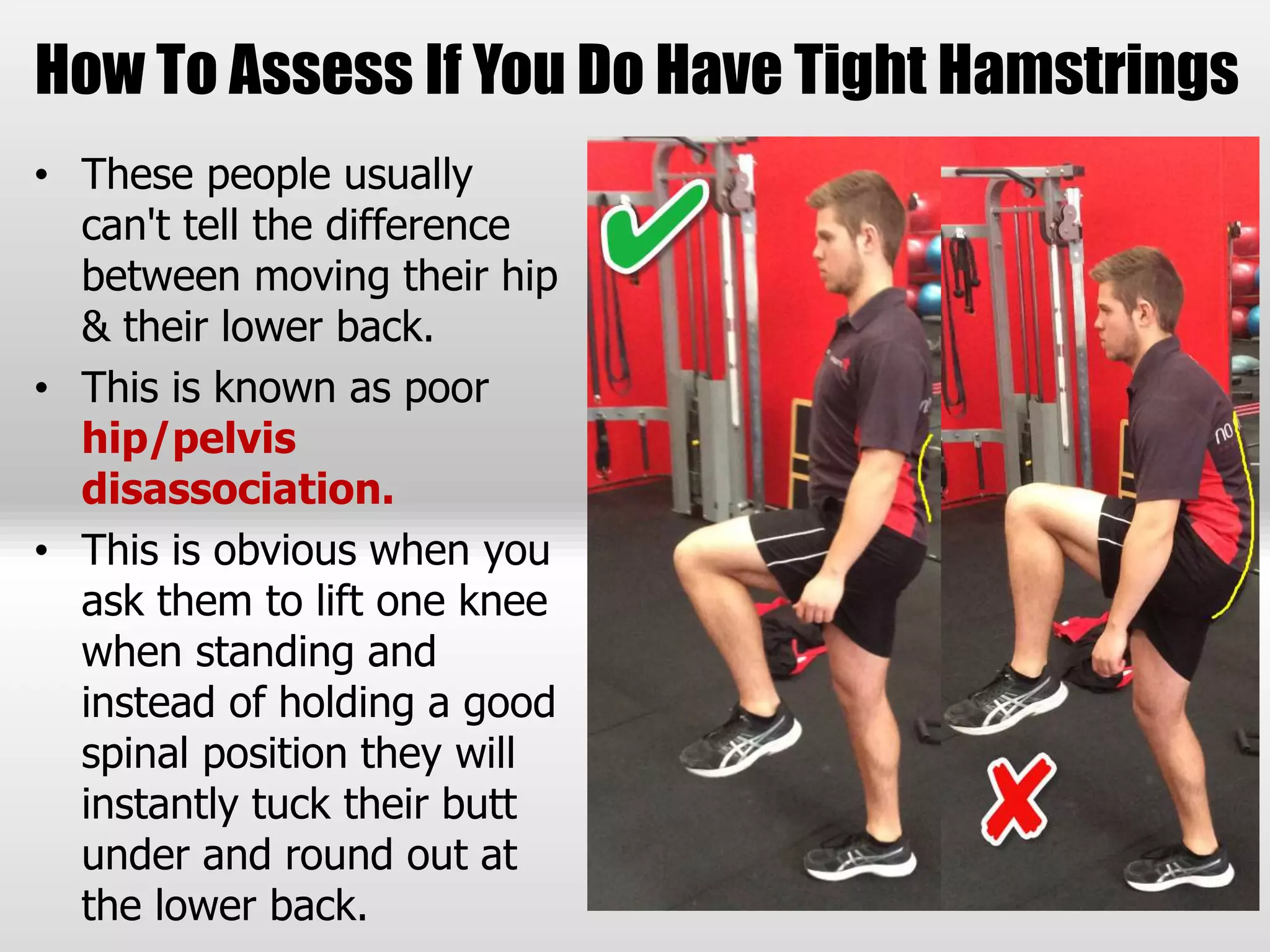
• These people usually
can't tell the difference
between moving their hip
& their lower back.
• This is known as poor
hip/pelvis
disassociation.
• This is obvious when you
ask them to lift one knee
when standing and
instead of holding a good
spinal position they will
instantly tuck their butt
under and round out at
the lower back.
DO NOT Stretch If You Can Do This
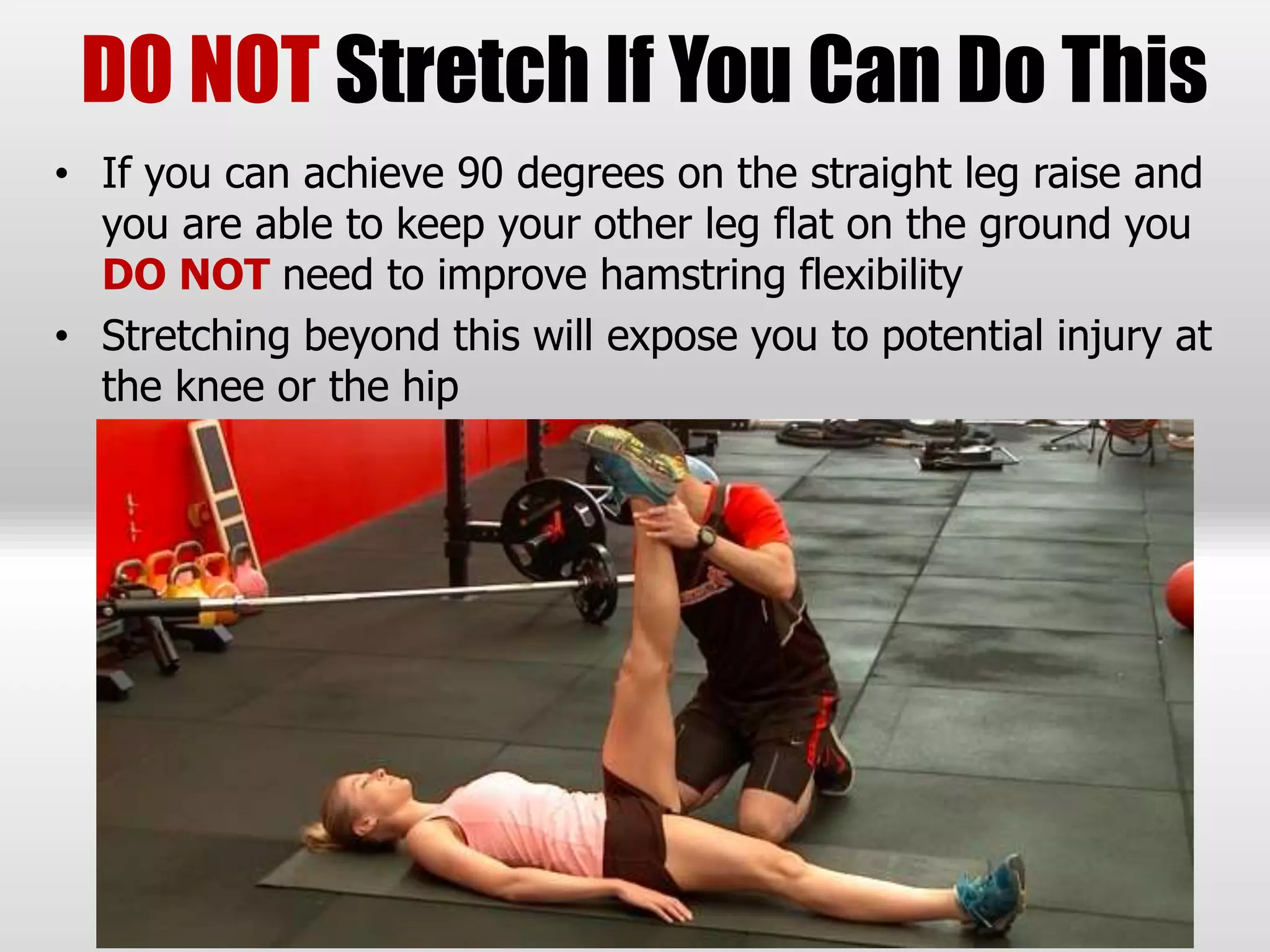
• If you can achieve 90 degrees on the straight leg raise and
you are able to keep your other leg flat on the ground you
DO NOT need to improve hamstring flexibility
• Stretching beyond this will expose you to potential injury at
the knee or the hip
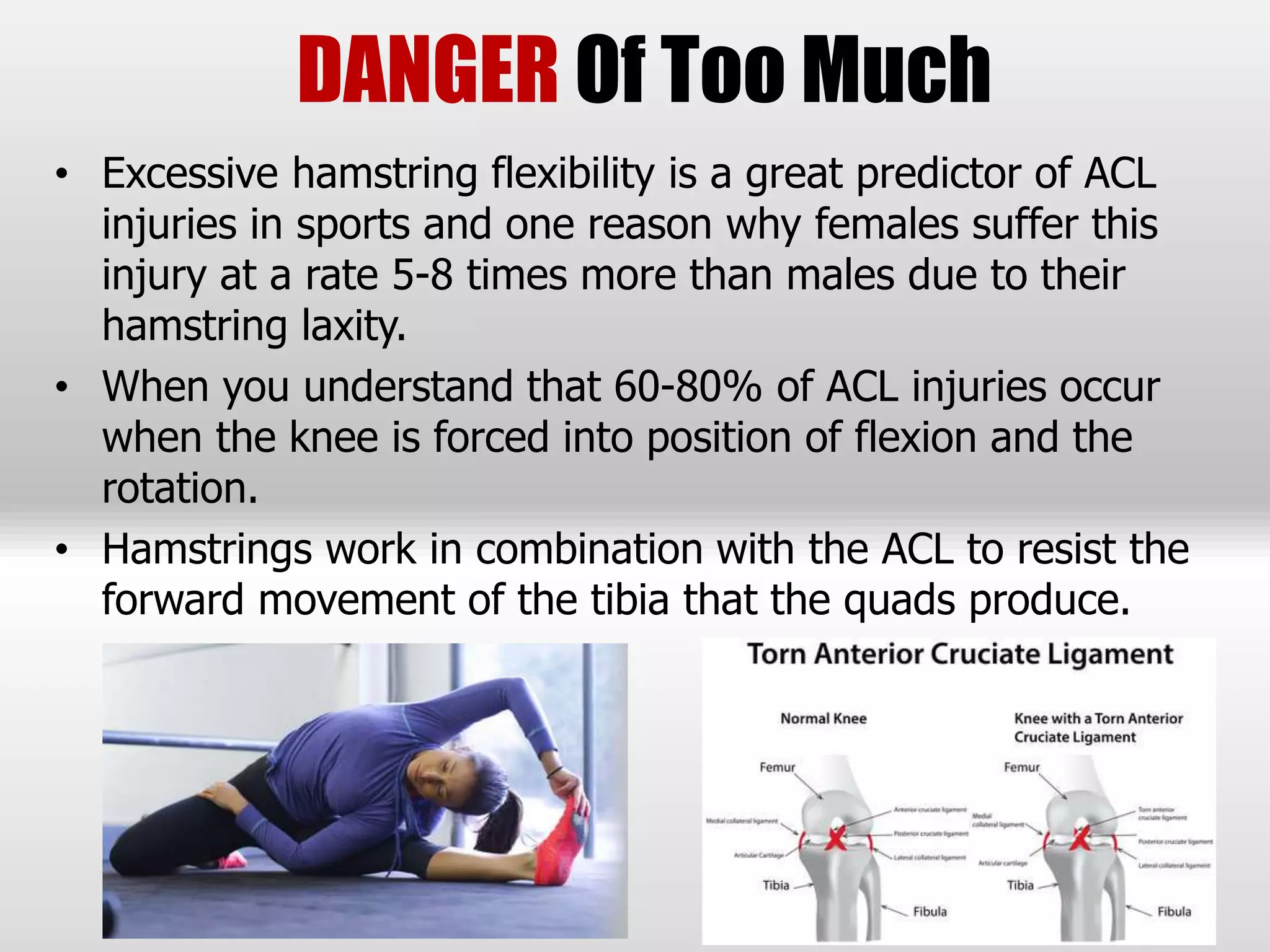
DANGER Of Too Much
• Excessive hamstring flexibility is a great predictor of ACL
injuries in sports and one reason why females suffer this
injury at a rate 5-8 times more than males due to their
hamstring laxity.
• When you understand that 60-80% of ACL injuries occur
when the knee is forced into position of flexion and the
rotation.
• Hamstrings work in combination with the ACL to resist the
forward movement of the tibia that the quads produce.
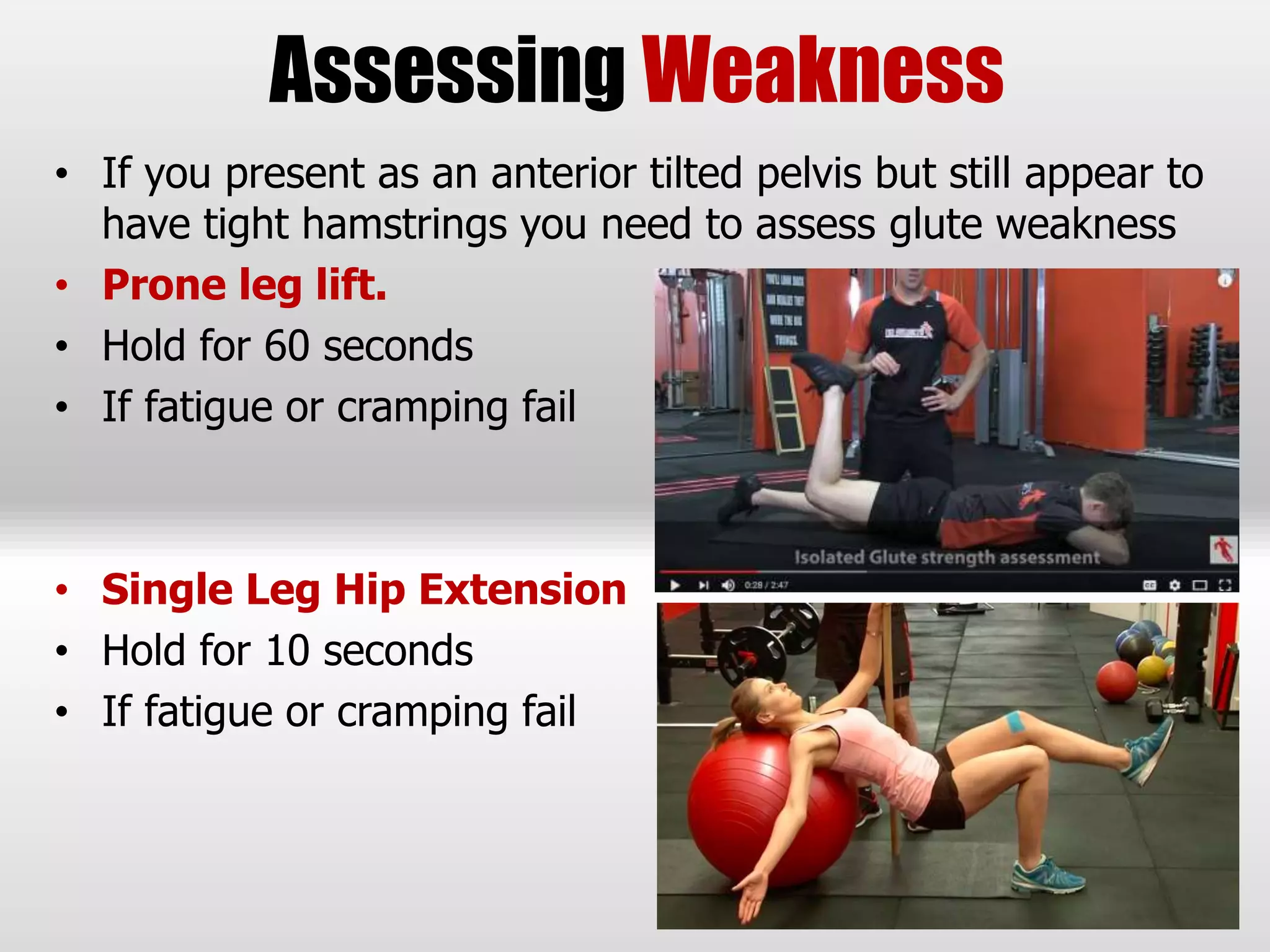
Assessing Weakness
• If you present as an anterior tilted pelvis but still appear to
have tight hamstrings you need to assess glute weakness
• Prone leg lift.
• Hold for 60 seconds
• If fatigue or cramping fail
• Single Leg Hip Extension
• Hold for 10 seconds
• If fatigue or cramping fail
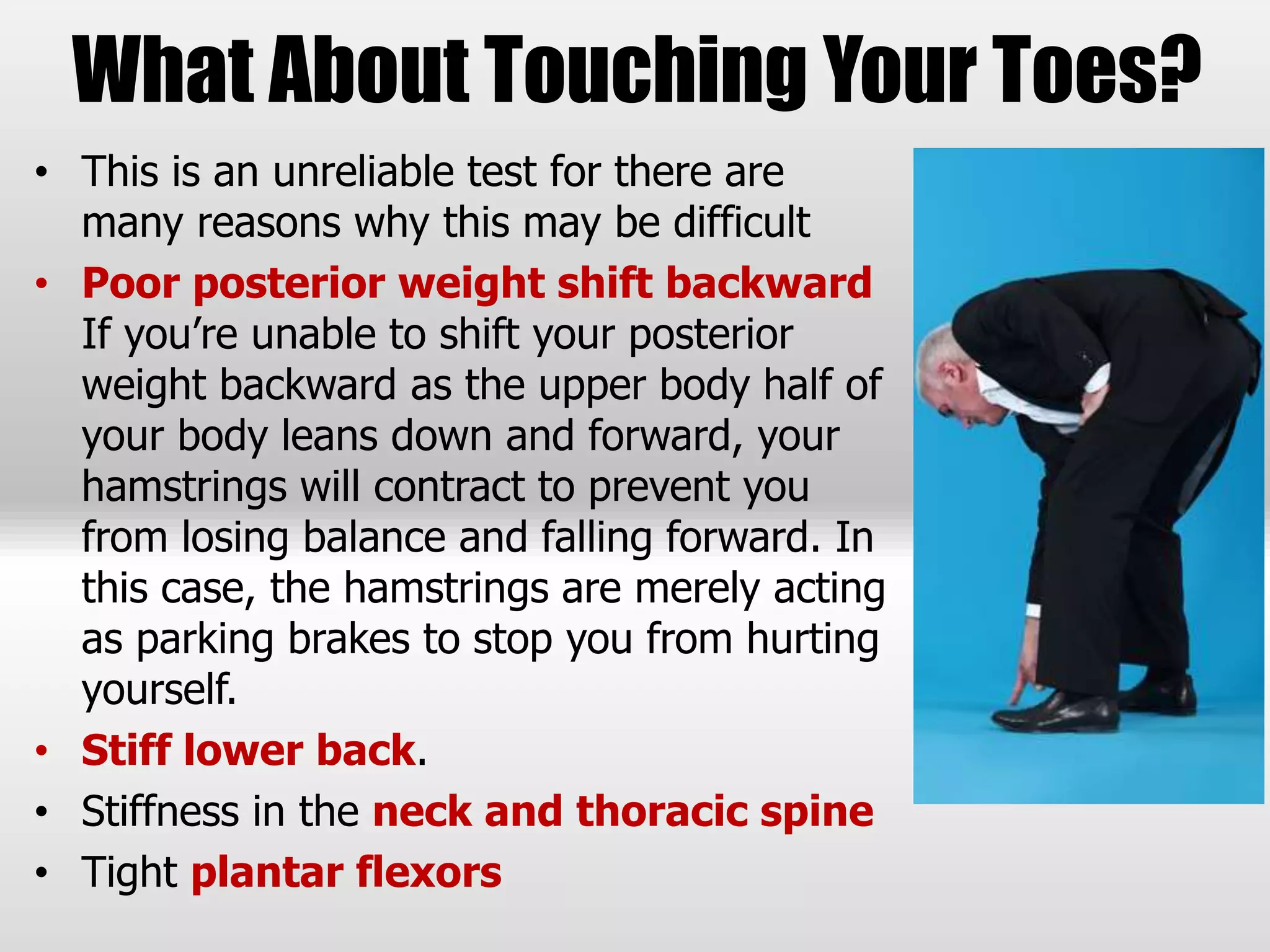
What About Touching Your Toes?
• This is an unreliable test for there are
many reasons why this may be difficult
• Poor posterior weight shift backward
If you’re unable to shift your posterior
weight backward as the upper body half of
your body leans down and forward, your
hamstrings will contract to prevent you
from losing balance and falling forward. In
this case, the hamstrings are merely acting
as parking brakes to stop you from hurting
yourself.
• Stiff lower back.
• Stiffness in the neck and thoracic spine
• Tight plantar flexors
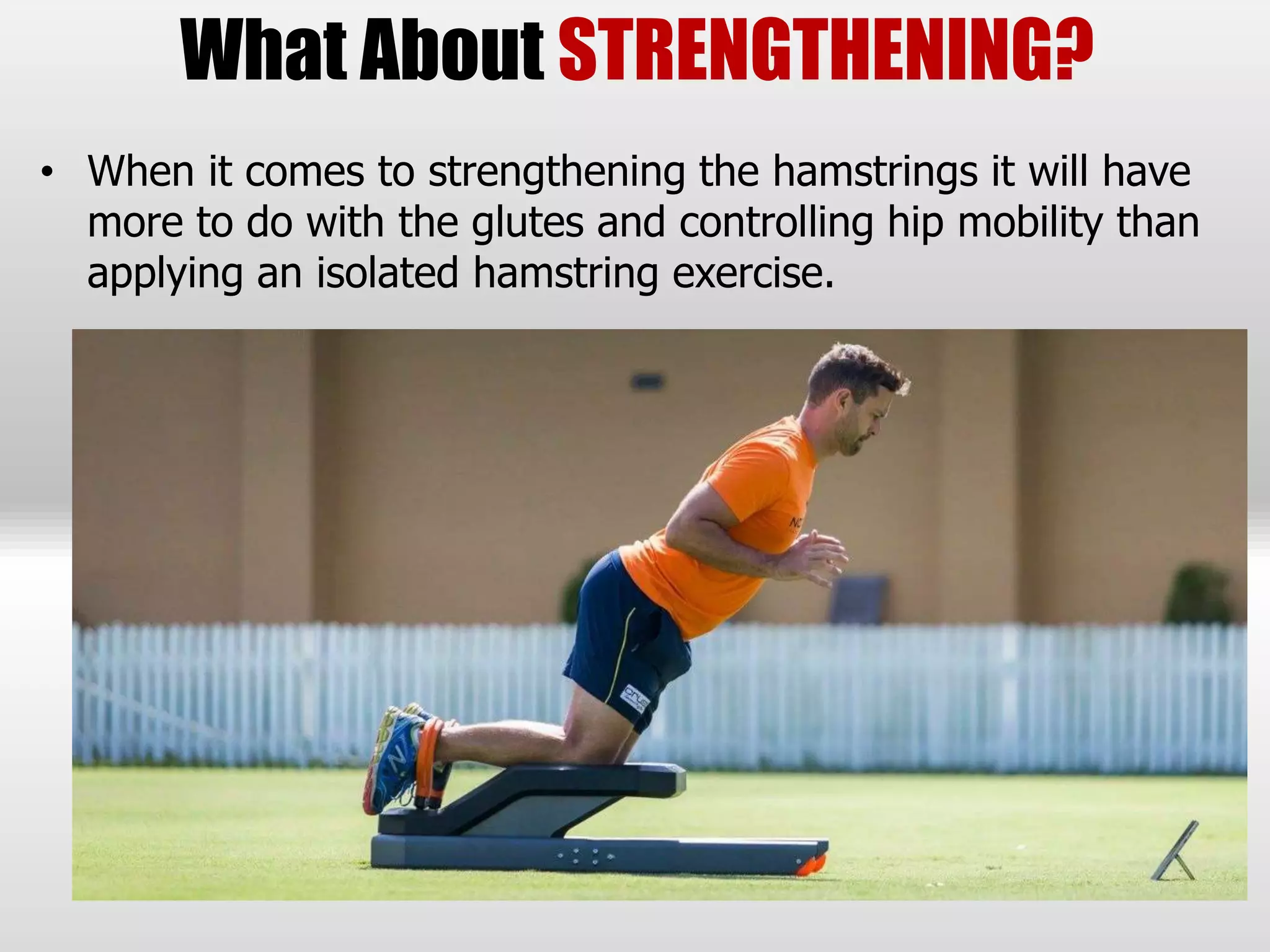
What About STRENGTHENING?
• When it comes to strengthening the hamstrings it will have
more to do with the glutes and controlling hip mobility than
applying an isolated hamstring exercise.
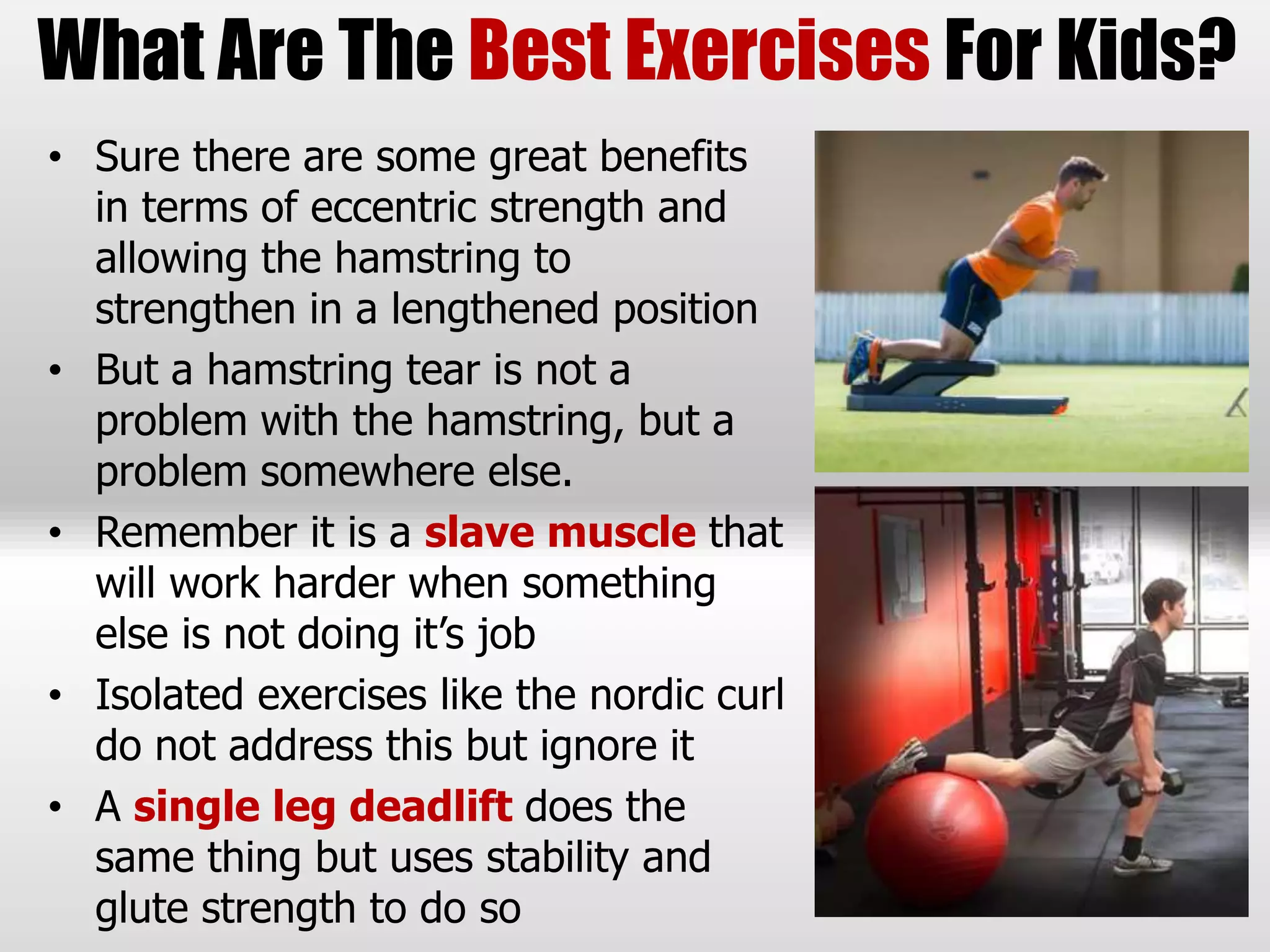
• Sure there are some great benefits
in terms of eccentric strength and
allowing the hamstring to
strengthen in a lengthened position
• But a hamstring tear is not a
problem with the hamstring, but a
problem somewhere else.
• Remember it is a slave muscle that
will work harder when something
else is not doing it’s job
• Isolated exercises like the nordic curl
do not address this but ignore it
• A single leg deadlift does the
same thing but uses stability and
glute strength to do so
What Are The Best Exercises For Kids?
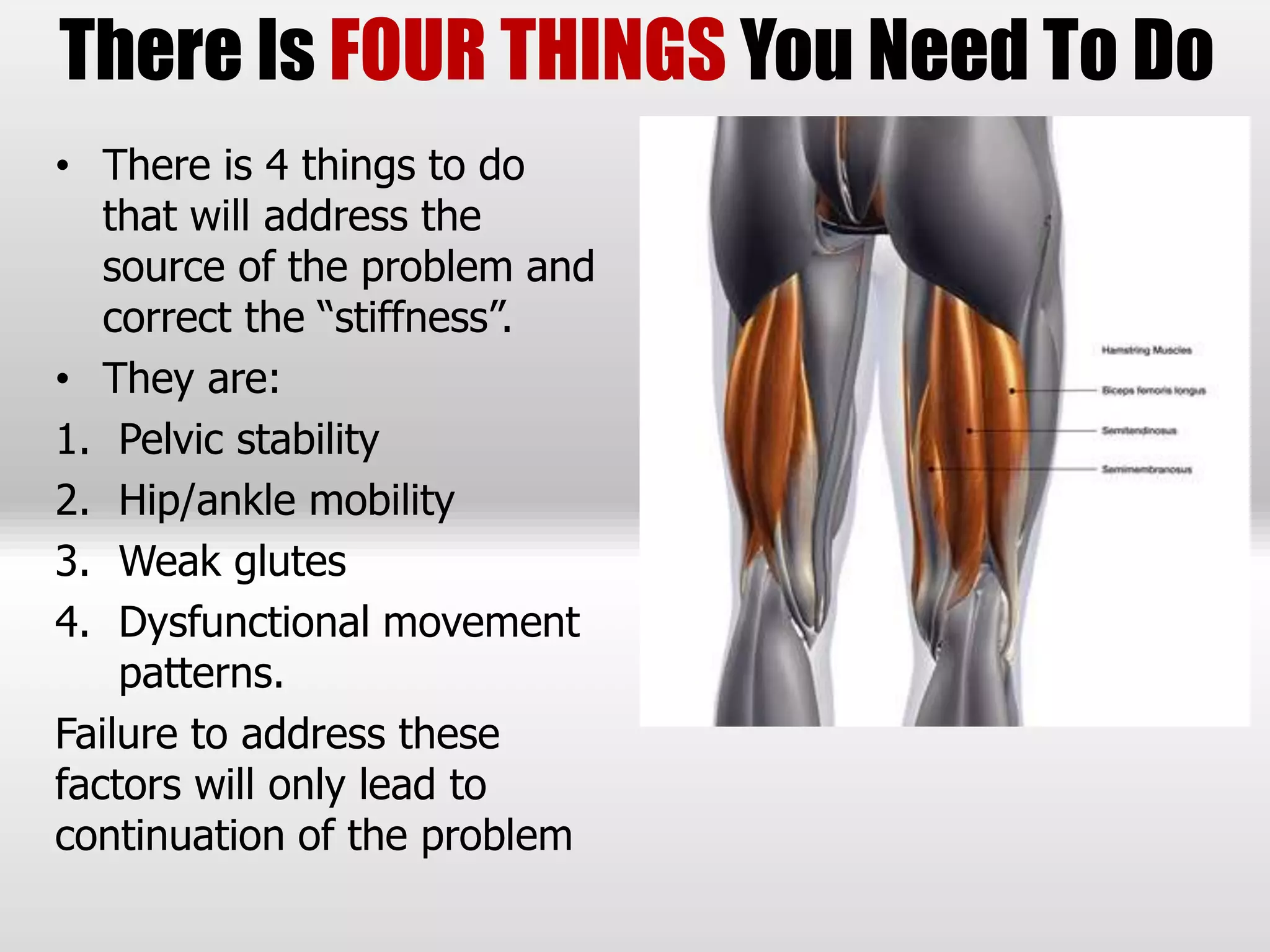
• There is 4 things to do
that will address the
source of the problem and
correct the “stiffness”.
• They are:
1. Pelvic stability
2. Hip/ankle mobility
3. Weak glutes
4. Dysfunctional movement
patterns.
Failure to address these
factors will only lead to
continuation of the problem
There Is FOUR THINGS You Need To Do
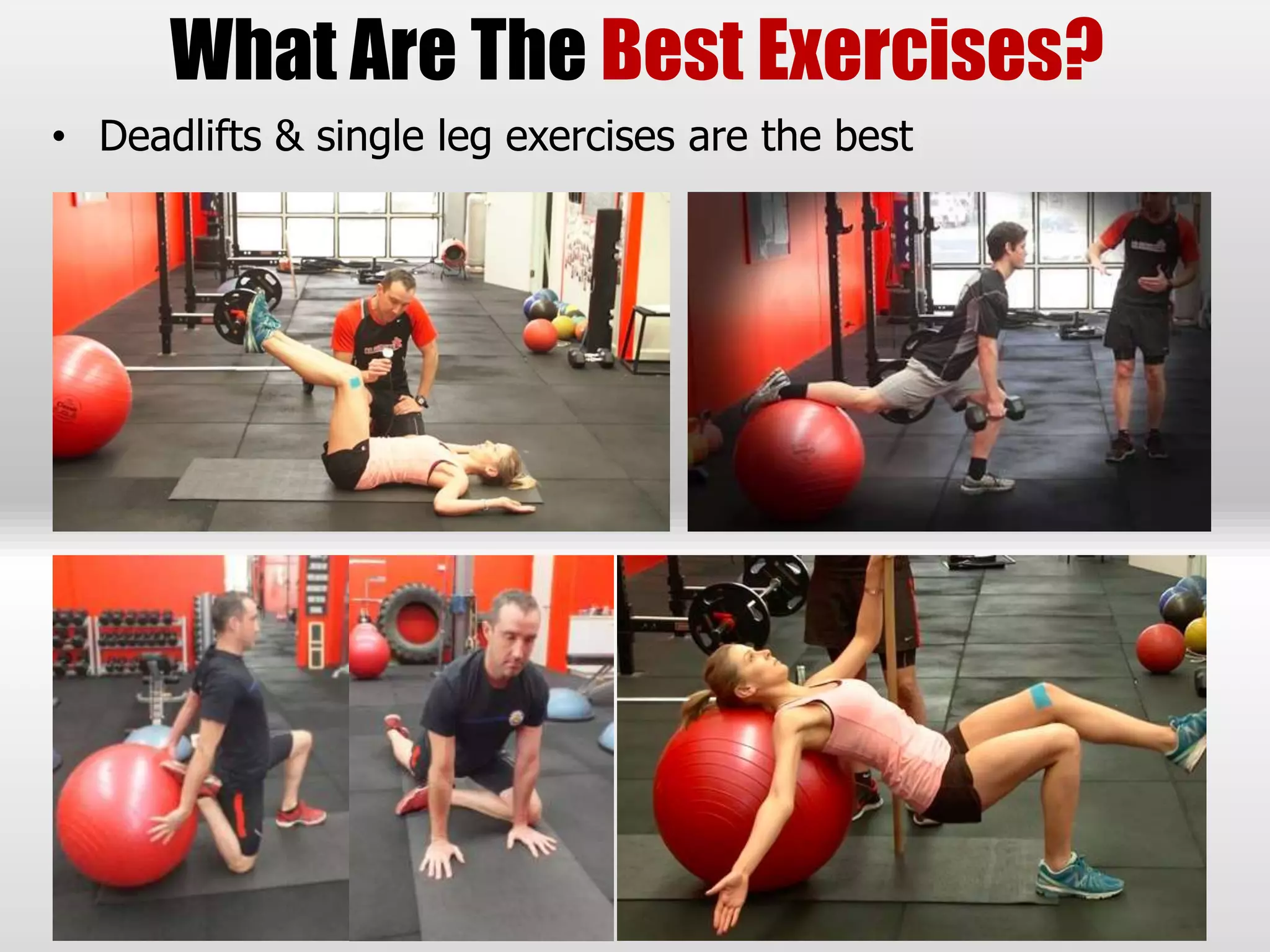
• Deadlifts & single leg exercises are the best
What Are The Best Exercises?
www.noregretspt.com.au
Questions? Comments?
Check out our programs and
stacks of free reports

Understanding Hamstring Muscles & Their Role With Stability

  • 2.
    Why Are HamstringsPublic Enemy #1
  • 3.
    What Do TheHAMSTRINGS Do? • The hamstrings cross and act upon two joints being the hip and the knee. • The hamstrings play a crucial role in many daily activities such as walking, running, jumping, and controlling some movement in the trunk. • They are act as the brakes against the quadriceps in the deceleration of knee extension.
  • 4.
    What Do TheHAMSTRINGS Do? • During sprinting, twisting and turning the hamstrings fire eccentrically (they contract when they are in a lengthened position) • To slow the lower leg and prepare the foot for ground contact. • They must act as a stabilizer, to prevent the quads from blowing out over your knee! • They are vital in preventing ACL tears
  • 5.
    What Do TheHAMSTRINGS Do? • And they are also playing a role in your how you move your hip and bend over. • This is where many people experience limited movement and back pain • This is also where it appears the tight hamstrings are the reason they cannot touch their toes. • Many will use stretching to correct this • But …………
  • 6.
    WHY Are TheTight? • This tightness is there for a reason and you must find the answer to WHY they are tight to truly improve your hamstring function. THE HAMSTRINGS ACT LIKE A SLAVE MUSCLE! • This means when other muscles are not doing their job effectively the hamstrings pick up their workload!
  • 7.
    Example 1: TautVs Tight! • Where what appears to be tight hamstrings, is often not the case • When someone is extremely anteriorly tilted, the hamstrings are constantly working to prevent the extension-based back pain • They are trying to pull the pelvis back • The hamstrings are in fact stretched well beyond their optimal flexibility “Taut” • They will now send pain signals to prevent you from stretching further • They will also fatigue quickly and limit lower back movement
  • 8.
    Example 2: NeuralTension • This again has nothing to do with the hamstrings but more to do with nerves being trapped, usually around the lumbar spine. • Easy to spot the difference as the person will really struggle with a straight leg raise, possibly only able to lift the leg to 45 degrees and feel pins and needles or tingling in the calf or even pain the back • Once your sciatic nerve is being compromised and being trapped, it will cause your hamstring to engage in what is called protective tension
  • 9.
    • The anteriortilted pelvis needs correcting and actually to strengthen and shorten the hamstring not weaken and lengthen • The neural tension needs to find a solution for the nerve entrapment which can be caused from many factors. See our back pain program for more on this The WORST thing You Could Do Is Stretch
  • 10.
    How To AssessIf You Do Have Tight Hamstrings • True short and tight hamstrings", need to be in posterior pelvic tilt when in a relaxed posture. • You can see this if they lay flat on the floor, or stand against a wall and there is little to no gap between the floor and their lower back. • You can also observe this in a waiters bow • But even still sometimes this can be a hip problem and not a hamstring problem.
  • 11.
    How To AssessIf You Do Have Tight Hamstrings • These people usually can't tell the difference between moving their hip & their lower back. • This is known as poor hip/pelvis disassociation. • This is obvious when you ask them to lift one knee when standing and instead of holding a good spinal position they will instantly tuck their butt under and round out at the lower back.
  • 12.
    DO NOT StretchIf You Can Do This • If you can achieve 90 degrees on the straight leg raise and you are able to keep your other leg flat on the ground you DO NOT need to improve hamstring flexibility • Stretching beyond this will expose you to potential injury at the knee or the hip
  • 13.
    DANGER Of TooMuch • Excessive hamstring flexibility is a great predictor of ACL injuries in sports and one reason why females suffer this injury at a rate 5-8 times more than males due to their hamstring laxity. • When you understand that 60-80% of ACL injuries occur when the knee is forced into position of flexion and the rotation. • Hamstrings work in combination with the ACL to resist the forward movement of the tibia that the quads produce.
  • 14.
    Assessing Weakness • Ifyou present as an anterior tilted pelvis but still appear to have tight hamstrings you need to assess glute weakness • Prone leg lift. • Hold for 60 seconds • If fatigue or cramping fail • Single Leg Hip Extension • Hold for 10 seconds • If fatigue or cramping fail
  • 15.
    What About TouchingYour Toes? • This is an unreliable test for there are many reasons why this may be difficult • Poor posterior weight shift backward If you’re unable to shift your posterior weight backward as the upper body half of your body leans down and forward, your hamstrings will contract to prevent you from losing balance and falling forward. In this case, the hamstrings are merely acting as parking brakes to stop you from hurting yourself. • Stiff lower back. • Stiffness in the neck and thoracic spine • Tight plantar flexors
  • 16.
    What About STRENGTHENING? •When it comes to strengthening the hamstrings it will have more to do with the glutes and controlling hip mobility than applying an isolated hamstring exercise.
  • 17.
    • Sure thereare some great benefits in terms of eccentric strength and allowing the hamstring to strengthen in a lengthened position • But a hamstring tear is not a problem with the hamstring, but a problem somewhere else. • Remember it is a slave muscle that will work harder when something else is not doing it’s job • Isolated exercises like the nordic curl do not address this but ignore it • A single leg deadlift does the same thing but uses stability and glute strength to do so What Are The Best Exercises For Kids?
  • 18.
    • There is4 things to do that will address the source of the problem and correct the “stiffness”. • They are: 1. Pelvic stability 2. Hip/ankle mobility 3. Weak glutes 4. Dysfunctional movement patterns. Failure to address these factors will only lead to continuation of the problem There Is FOUR THINGS You Need To Do
  • 19.
    • Deadlifts &single leg exercises are the best What Are The Best Exercises?
  • 20.
    www.noregretspt.com.au Questions? Comments? Check outour programs and stacks of free reports