Electrical Stimulation
Motor points and Application
Sreeraj S R
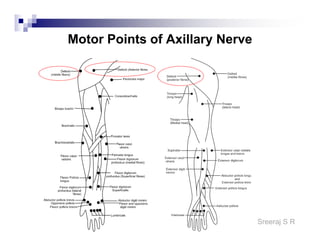
Motor Points of Axillary Nerve
Sreeraj S R
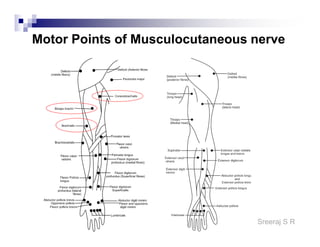
Motor Points of Musculocutaneous nerve
Sreeraj S R
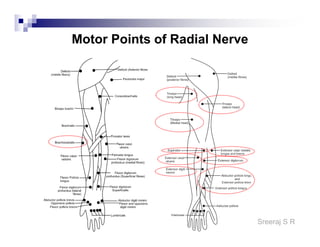
Motor Points of Radial Nerve
Sreeraj S R
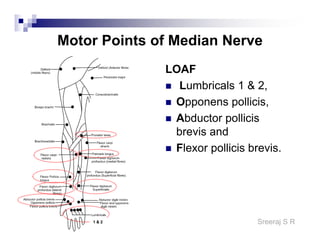
Motor Points of Median Nerve
LOAF
Lumbricals 1 & 2,
Opponens pollicis,
Abductor pollicis
brevis and
Flexor pollicis brevis.
1 & 2
Sreeraj S R
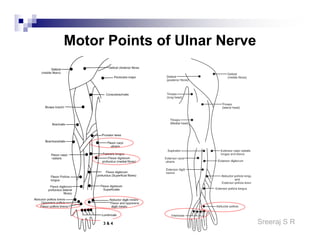
Motor Points of Ulnar Nerve
3 & 4
Sreeraj S R
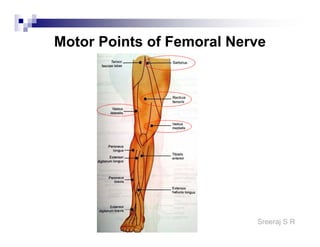
Motor Points of Femoral Nerve
Sreeraj S R
Motor Points of Sciatic Nerve
Sreeraj S R
Motor Points of Tibial Nerve
Sreeraj S R
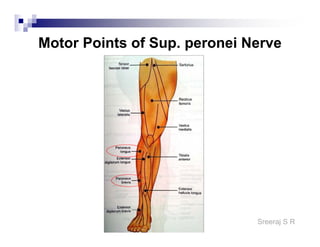
Motor Points of Sup. peronei Nerve
Sreeraj S R
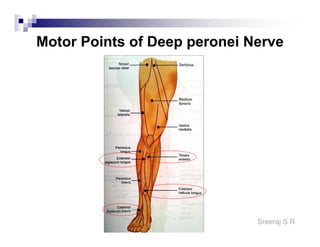
Motor Points of Deep peronei Nerve
Sreeraj S R
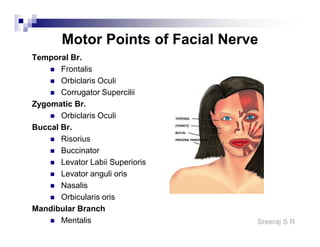
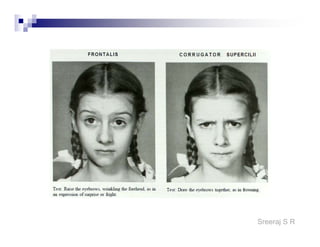
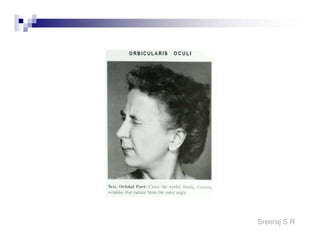
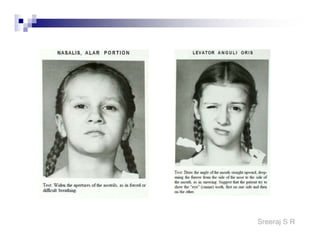
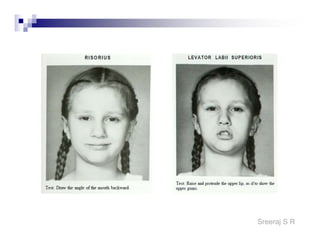
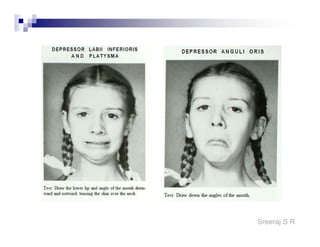
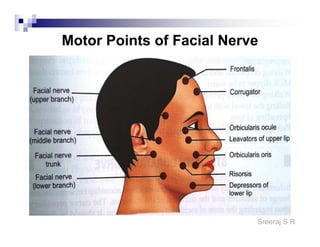
Motor Points of Facial Nerve
Temporal Br.
Frontalis
Orbiclaris Oculi
Corrugator Supercilii
Zygomatic Br.
Orbiclaris Oculi
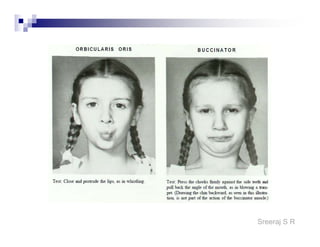
Buccal Br.
Risorius
Buccinator
Levator Labii Superioris
Levator anguli oris
Nasalis
Orbicularis oris
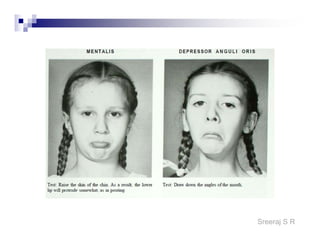
Mandibular Branch
Mentalis
Sreeraj S R
Sreeraj S R
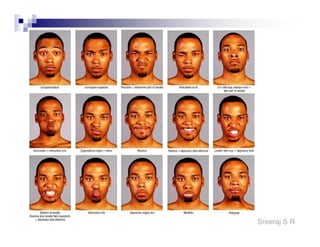
Motor Points of Facial Nerve
Sreeraj S R
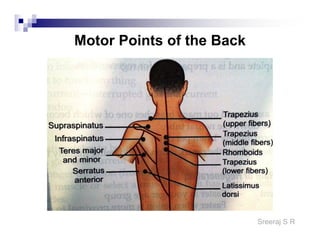
Motor Points of the Back
Sreeraj S R
PRINCIPLES OF APPLICATION
LOW FREQUENCY
Sreeraj S R
Receiving the patient
Greet the patient & introduce yourself.
Develop a good rapport with the patient.
Provide them a comfortable position to
sit/laydown
Sreeraj S R
Case sheet reading/History Taking
Name: Identification of the patient
Age: Modulation of treatment (Adult/Old )
Sex: Provide privacy (Male/Female)
Occupation: Correlate the symptoms/signs of the patient for
ergonomic advice if applicable
Chief Complaints: Generation of problem list
Side: Right or Left side of the involvement.
Site: Specific area/region to be treated
(Anterior/Posterior/Medial/Lateral)
Duration of the condition: Acute/Sub-acute/Chronic (Treatment
planning & Setting)
Diagnosis: Condition of the patient
Sreeraj S R
General contraindications
Hyperpyrexia
Epilepsy
Severe renal and
cardiac problems
Cardiac pacemakers
Severe Hypotension
and hypertension
Infections
Pregnant women
Metal Implants
Mentally retarded
patients
Mentally upset
patients
Malignancy
Eyes
Anterior aspect of
neck & carotid sinus
Sreeraj S R
Tray Preparation
Skin Resistance Lowering Tray
Pillows
Cotton
Soap
Towel
Mackintosh
Kidney Tray
Petroleum jelly or Vaseline
U – pin (sharp & blunt)
Clips
Bowel of water
Sreeraj S R
Tray Preparation
Treatment Tray
Pillow
Towel
Bed sheet
Cotton
Adhesive tapes
Straps
Salt
Powder
Scissor
Paper
Graph paper
Pencil
Eraser
Scale
Crepe bandages
Machine & accessories
Sreeraj S R
Local Contraindications
Open wounds
Scars
Local skin infections
Cuts
Abrasions
Eczema
Localized haemorrhagic spots
Sreeraj S R
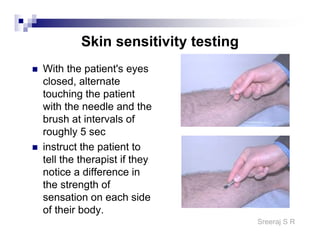
Skin sensitivity testing
With the patient's eyes
closed, alternate
touching the patient
with the needle and the
brush at intervals of
roughly 5 sec
instruct the patient to
tell the therapist if they
notice a difference in
the strength of
sensation on each side
of their body.
Sreeraj S R
Testing of equipment & Demonstration
This is to gain the self-confidence & cooperation of the patient for
the treatment.
Check for mains output by using the tester, look for any frayed part
of power cords, integrity of cables & electrodes.
Verify that all the knobs/controls in the apparatus are at zero.
Connect the machine power cord to the mains (220/110 Volts) &
switch on the mains..
Switch on the machine by turning on the power knob/switch of the
machine.
Set the timer
Keep your index and middle fingers on active and indifferent
electrodes to check whether the machine is working or not.
Demonstrate a muscle contraction to the patient by placing the
electrodes on therapist’s hand.
Sreeraj S R
Positioning of the patient
Place patient in a well-supported, comfortable &
relaxed position.
Use adequate pillows, towels & bed sheets.
Expose the body part to be treated, have patient
remove all jewelry from the area.
Drape the untreated part of the patient to
preserve modesty, protect clothing, but allow
easy accesses to the body part.
If possible give the position in which patient can
see the treatment.
Sreeraj S R
Positioning of the Therapist
Appropriate walk stand position
The therapist should be close to the
machine for operating the machine & also
near to the affected side of the patient.
If possible the therapists should position
herself so as to observe the face of the
patient.
Sreeraj S R
Preparation of the part to be treated
Skin Resistance Lowering
Uncover the part to be treated
Clean the area with water & soap to
remove any oil/cream/gel/dust
Use mackintosh and then towel for
supporting and wiping off the water.
Wipe the treatment area periodically with
saline water for better current conduction.
Sreeraj S R
Instructions & Warning to the patient
Instruct the patient,
NOT TO move the treatment part,
NOT TO touch the power cord & the generator,
NOT TO sleep during the treatment.
Inform the patient that he/she should feel a mild prickling
sensation;
if it is too intense should immediately report to the
physiotherapist.
If there is any burning sensation immediately inform the
therapist, as it might lead to burn.
Inform if the position is not comfortable.
Sreeraj S R
Application of Treatment
Select appropriate method of treatment
Make sure the power cords are not touching the
patient.
Select the current.
Select parameters.
Set treatment time.
Gradually increase the current.
The patient must be observed throughout to
ensure that treatment is progressing
satisfactorily and without adverse effects.
Sreeraj S R
Termination of Treatment
Reduce the intensity gradually to zero
Switch off the machine and the main supply.
Remove the electrodes and clean the patient.
Inspect the treated part for any adverse
reactions.
If there is any mild Erythema, apply powder.
If it is too severe, summon the physician or
advise the patient to go to the physician.
Set the next appointment.
Do winding up procedure.
Sreeraj S R
Recording
An accurate record of all parameters of
treatment including
region treated,
technique,
dosage, and
the resultant effect must be made.
This is for both follow up assessment
purposes and for legal requirements.
Sreeraj S R
References
1. Singh J. Textbook of Electrotherapy. 2 edition. Jaypee. 2012. p 94 – 125
2. Forster A, Palastanga N. Clayton’s Electotherapy, Theory ans Practic. 9th Ed. W B Saunders;
2006. p
3. http://en.wikipedia.org/wiki/Radial_nerve
4. http://en.wikipedia.org/wiki/Median_nerve
5. http://en.wikipedia.org/wiki/Ulnar_nerve
6. http://en.wikipedia.org/wiki/Femoral_nerve
7. http://en.wikipedia.org/wiki/Sciatic_nerve
8. http://en.wikipedia.org/wiki/Tibial_nerve
9. http://en.wikipedia.org/wiki/Superficial_fibular_nerve
10. http://en.wikipedia.org/wiki/Deep_fibular_nerve
11. http://www.microsurgeon.org/facialpalsy
12. http://en.wikipedia.org/wiki/Temporal_branch_of_the_facial_nerve
13. http://en.wikipedia.org/wiki/Zygomatic_branch_of_the_facial_nerve
14. http://en.wikipedia.org/wiki/Buccal_branch_of_the_facial_nerve
15. http://en.wikipedia.org/wiki/Marginal_mandibular_branch_of_the_facial_nerve
16. http://informatics.med.nyu.edu/modules/pub/neurosurgery/sensory.html
Sreeraj S R
THANK YOU

Electrical stimulation motor points and application

  • 1.
  • 2.
    Sreeraj S R MotorPoints of Axillary Nerve
  • 3.
    Sreeraj S R MotorPoints of Musculocutaneous nerve
  • 4.
    Sreeraj S R MotorPoints of Radial Nerve
  • 5.
    Sreeraj S R MotorPoints of Median Nerve LOAF Lumbricals 1 & 2, Opponens pollicis, Abductor pollicis brevis and Flexor pollicis brevis. 1 & 2
  • 6.
    Sreeraj S R MotorPoints of Ulnar Nerve 3 & 4
  • 7.
    Sreeraj S R MotorPoints of Femoral Nerve
  • 8.
    Sreeraj S R MotorPoints of Sciatic Nerve
  • 9.
    Sreeraj S R MotorPoints of Tibial Nerve
  • 10.
    Sreeraj S R MotorPoints of Sup. peronei Nerve
  • 11.
    Sreeraj S R MotorPoints of Deep peronei Nerve
  • 12.
    Sreeraj S R MotorPoints of Facial Nerve Temporal Br. Frontalis Orbiclaris Oculi Corrugator Supercilii Zygomatic Br. Orbiclaris Oculi Buccal Br. Risorius Buccinator Levator Labii Superioris Levator anguli oris Nasalis Orbicularis oris Mandibular Branch Mentalis
  • 13.
  • 14.
    Sreeraj S R MotorPoints of Facial Nerve
  • 15.
    Sreeraj S R MotorPoints of the Back
  • 16.
    Sreeraj S R PRINCIPLESOF APPLICATION LOW FREQUENCY
  • 17.
    Sreeraj S R Receivingthe patient Greet the patient & introduce yourself. Develop a good rapport with the patient. Provide them a comfortable position to sit/laydown
  • 18.
    Sreeraj S R Casesheet reading/History Taking Name: Identification of the patient Age: Modulation of treatment (Adult/Old ) Sex: Provide privacy (Male/Female) Occupation: Correlate the symptoms/signs of the patient for ergonomic advice if applicable Chief Complaints: Generation of problem list Side: Right or Left side of the involvement. Site: Specific area/region to be treated (Anterior/Posterior/Medial/Lateral) Duration of the condition: Acute/Sub-acute/Chronic (Treatment planning & Setting) Diagnosis: Condition of the patient
  • 19.
    Sreeraj S R Generalcontraindications Hyperpyrexia Epilepsy Severe renal and cardiac problems Cardiac pacemakers Severe Hypotension and hypertension Infections Pregnant women Metal Implants Mentally retarded patients Mentally upset patients Malignancy Eyes Anterior aspect of neck & carotid sinus
  • 20.
    Sreeraj S R TrayPreparation Skin Resistance Lowering Tray Pillows Cotton Soap Towel Mackintosh Kidney Tray Petroleum jelly or Vaseline U – pin (sharp & blunt) Clips Bowel of water
  • 21.
    Sreeraj S R TrayPreparation Treatment Tray Pillow Towel Bed sheet Cotton Adhesive tapes Straps Salt Powder Scissor Paper Graph paper Pencil Eraser Scale Crepe bandages Machine & accessories
  • 22.
    Sreeraj S R LocalContraindications Open wounds Scars Local skin infections Cuts Abrasions Eczema Localized haemorrhagic spots
  • 23.
    Sreeraj S R Skinsensitivity testing With the patient's eyes closed, alternate touching the patient with the needle and the brush at intervals of roughly 5 sec instruct the patient to tell the therapist if they notice a difference in the strength of sensation on each side of their body.
  • 24.
    Sreeraj S R Testingof equipment & Demonstration This is to gain the self-confidence & cooperation of the patient for the treatment. Check for mains output by using the tester, look for any frayed part of power cords, integrity of cables & electrodes. Verify that all the knobs/controls in the apparatus are at zero. Connect the machine power cord to the mains (220/110 Volts) & switch on the mains.. Switch on the machine by turning on the power knob/switch of the machine. Set the timer Keep your index and middle fingers on active and indifferent electrodes to check whether the machine is working or not. Demonstrate a muscle contraction to the patient by placing the electrodes on therapist’s hand.
  • 25.
    Sreeraj S R Positioningof the patient Place patient in a well-supported, comfortable & relaxed position. Use adequate pillows, towels & bed sheets. Expose the body part to be treated, have patient remove all jewelry from the area. Drape the untreated part of the patient to preserve modesty, protect clothing, but allow easy accesses to the body part. If possible give the position in which patient can see the treatment.
  • 26.
    Sreeraj S R Positioningof the Therapist Appropriate walk stand position The therapist should be close to the machine for operating the machine & also near to the affected side of the patient. If possible the therapists should position herself so as to observe the face of the patient.
  • 27.
    Sreeraj S R Preparationof the part to be treated Skin Resistance Lowering Uncover the part to be treated Clean the area with water & soap to remove any oil/cream/gel/dust Use mackintosh and then towel for supporting and wiping off the water. Wipe the treatment area periodically with saline water for better current conduction.
  • 28.
    Sreeraj S R Instructions& Warning to the patient Instruct the patient, NOT TO move the treatment part, NOT TO touch the power cord & the generator, NOT TO sleep during the treatment. Inform the patient that he/she should feel a mild prickling sensation; if it is too intense should immediately report to the physiotherapist. If there is any burning sensation immediately inform the therapist, as it might lead to burn. Inform if the position is not comfortable.
  • 29.
    Sreeraj S R Applicationof Treatment Select appropriate method of treatment Make sure the power cords are not touching the patient. Select the current. Select parameters. Set treatment time. Gradually increase the current. The patient must be observed throughout to ensure that treatment is progressing satisfactorily and without adverse effects.
  • 30.
    Sreeraj S R Terminationof Treatment Reduce the intensity gradually to zero Switch off the machine and the main supply. Remove the electrodes and clean the patient. Inspect the treated part for any adverse reactions. If there is any mild Erythema, apply powder. If it is too severe, summon the physician or advise the patient to go to the physician. Set the next appointment. Do winding up procedure.
  • 31.
    Sreeraj S R Recording Anaccurate record of all parameters of treatment including region treated, technique, dosage, and the resultant effect must be made. This is for both follow up assessment purposes and for legal requirements.
  • 32.
    Sreeraj S R References 1.Singh J. Textbook of Electrotherapy. 2 edition. Jaypee. 2012. p 94 – 125 2. Forster A, Palastanga N. Clayton’s Electotherapy, Theory ans Practic. 9th Ed. W B Saunders; 2006. p 3. http://en.wikipedia.org/wiki/Radial_nerve 4. http://en.wikipedia.org/wiki/Median_nerve 5. http://en.wikipedia.org/wiki/Ulnar_nerve 6. http://en.wikipedia.org/wiki/Femoral_nerve 7. http://en.wikipedia.org/wiki/Sciatic_nerve 8. http://en.wikipedia.org/wiki/Tibial_nerve 9. http://en.wikipedia.org/wiki/Superficial_fibular_nerve 10. http://en.wikipedia.org/wiki/Deep_fibular_nerve 11. http://www.microsurgeon.org/facialpalsy 12. http://en.wikipedia.org/wiki/Temporal_branch_of_the_facial_nerve 13. http://en.wikipedia.org/wiki/Zygomatic_branch_of_the_facial_nerve 14. http://en.wikipedia.org/wiki/Buccal_branch_of_the_facial_nerve 15. http://en.wikipedia.org/wiki/Marginal_mandibular_branch_of_the_facial_nerve 16. http://informatics.med.nyu.edu/modules/pub/neurosurgery/sensory.html
  • 33.