If you want to change the world,
         focus on leaders.
  If you want to change leaders,
focus on them when they’re young.

       Understanding	
  	
  
     Emo/onal	
  Intelligence	
  
Your	
  Facilitator	
                    Learning        | Consulting          | Assessment

    • NarejoHR,	
  	
  
       – Established	
  2002	
  
       – Service	
  Offerings,	
  Growing	
  Businesses	
  Through	
  People	
  
    • Rahila	
  Narejo	
  
       – Chief	
  Executive	
  &	
  Lead	
  HR	
  Consultant,	
  NarejoHR	
  (Pvt.)	
  Ltd.	
  	
  
       – Psychobiologist,	
  Univ.	
  California,	
  Los	
  Angeles	
  	
  
       – Psychometrician,	
  British	
  Psychological	
  Society	
  (Levels	
  A	
  +	
  B)	
  
       – Certified	
  Balanced	
  Scorecard	
  Professional,	
  Palladium	
  Group	
  
       – Columnist,	
  DAWN	
  Newspaper,	
  Workplace	
  Sanity	
  
       – 	
  MSc.	
  NeuroLeadership,	
  Middlesex	
  Univ.	
  &	
  NeuroLeadership	
  Institute	


!
What is the Secret to
         Effectiveness/Success?
¡  THINK: of an effective/
    successful person…
    Distinguishing
    characteristics?
¡  PAIR: Partner up
¡  SHARE: Discuss and
    agree on one
    characteristic.
¡  TIME: 5 MINUTES
Fact: 	
  
An individual’s success at
   work and life is 80%
 dependent on EQ, and
only 20% dependent on IQ	
  

           -Daniel Goleman	
  
  Author, Journalist and Psychologist
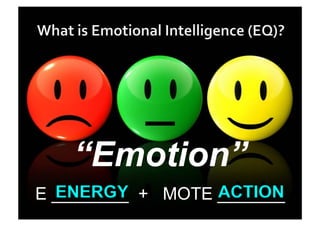
“Emotion”
  ENERGY	
        ACTION	
  
E ________ + MOTE _______
EQ is the intelligent use of emotions:
you intentionally make your emotions work
for you by using them to help guide your
behavior and thinking in ways that enhance
your results.


-Emotional Intelligence at Work, Hendric Weisinger, Ph.D.
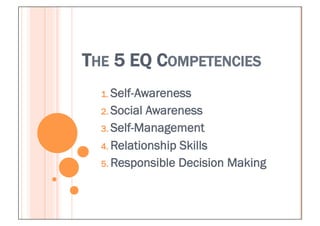
THE 5 EQ COMPETENCIES
  1.  Self-Awareness
  2.  Social Awareness
  3.  Self-Management

  4.  Relationship Skills
  5.  Responsible Decision Making
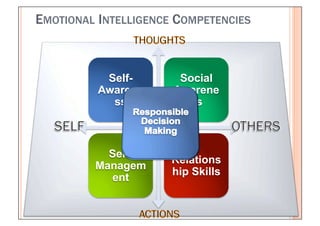
EMOTIONAL INTELLIGENCE COMPETENCIES


           Self-       Social
          Awarene     Awarene
            ss          ss


           Self-
                      Relations
         Managem
                      hip Skills
           ent
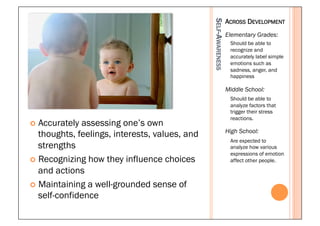
ACROSS DEVELOPMENT


                                                 SELF-AWARENESS
                                                                  Elementary Grades:
                                                                   Should be able to
                                                                   recognize and
                                                                   accurately label simple
                                                                   emotions such as
                                                                   sadness, anger, and
                                                                   happiness

                                                                  Middle School:
                                                                   Should be able to
                                                                   analyze factors that
                                                                   trigger their stress
                                                                   reactions.
¢  Accurately assessing one’s own
                                                                  High School:
    thoughts, feelings, interests, values, and
                                                                   Are expected to
    strengths                                                      analyze how various
                                                                   expressions of emotion
¢  Recognizing how they influence choices                         affect other people.

    and actions
¢  Maintaining a well-grounded sense of
    self-confidence
ACROSS


                                              SOCIAL AWARENESS
                                                                    DEVELOPMENT
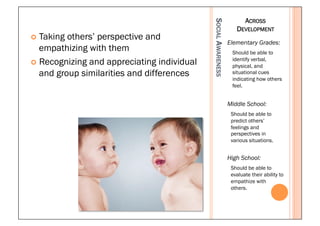
¢  Taking others’ perspective and
                                                                 Elementary Grades:
    empathizing with them                                         Should be able to
¢  Recognizing and appreciating individual
                                                                  identify verbal,
                                                                  physical, and
    and group similarities and differences                        situational cues
                                                                  indicating how others
                                                                  feel.


                                                                 Middle School:
                                                                  Should be able to
                                                                  predict others’
                                                                  feelings and
                                                                  perspectives in
                                                                  various situations.


                                                                 High School:
                                                                  Should be able to
                                                                  evaluate their ability to
                                                                  empathize with
                                                                  others.
ACROSS DEVELOPMENT


                                              SELF-MANAGEMENT
                                                                Elementary Grades:
                                                                 Children are expected
                                                                 to describe the steps of
                                                                 setting and working
                                                                 toward goals.


                                                                Middle School:
                                                                 They should be able to
                                                                 set and make a plan to
                                                                 achieve a short-term
                                                                 personal or academic
                                                                 goal.

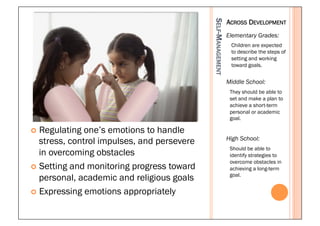
¢  Regulating  one’s emotions to handle
                                                                High School:
    stress, control impulses, and persevere
                                                                 Should be able to
    in overcoming obstacles                                      identify strategies to
                                                                 overcome obstacles in
¢  Setting and monitoring progress toward                       achieving a long-term
                                                                 goal.
    personal, academic and religious goals
¢  Expressing emotions appropriately
ACROSS


                                               RELATIONSHIP SKILLS
                                                                        DEVELOPMENT
                                                                     Elementary Grades:
                                                                      Should have an ability
                                                                      to describe
                                                                      approaches to making
                                                                      and keeping friends.


                                                                     Middle School:
                                                                      Are expected to
                                                                      demonstrate co-
                                                                      operation and team-
                                                                      work to promote
                                                                      group goals.

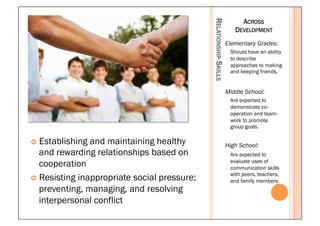
¢  Establishing and maintaining healthy                             High School:
    and rewarding relationships based on                              Are expected to
    cooperation                                                       evaluate uses of
                                                                      communication skills
                                                                      with peers, teachers,
¢  Resisting inappropriate social pressure;                          and family members.
    preventing, managing, and resolving
    interpersonal conflict
ACROSS
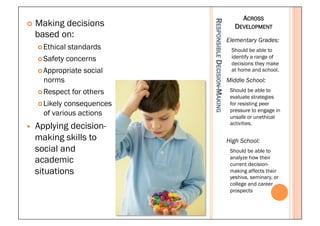
¢  Making   decisions


                                 RESPONSIBLE DECISION-MAKING
                                                                  DEVELOPMENT
      based on:
                                                               Elementary Grades:
      ¢ Ethical   standards                                    Should be able to
      ¢ Safety    concerns                                     identify a range of
                                                                decisions they make
      ¢ Appropriate   social                                   at home and school.
        norms                                                  Middle School:
      ¢ Respect    for others                                  Should be able to
                                                                evaluate strategies
      ¢ Likelyconsequences                                     for resisting peer
                                                                pressure to engage in
        of various actions                                      unsafe or unethical
                                                                activities.
—    Applying decision-
      making skills to                                         High School:
      social and                                                Should be able to
      academic                                                  analyze how their
                                                                current decision-
      situations                                                making affects their
                                                                yeshiva, seminary, or
                                                                college and career
                                                                prospects
FAMILY LIFE
Our first school for
emotional learning
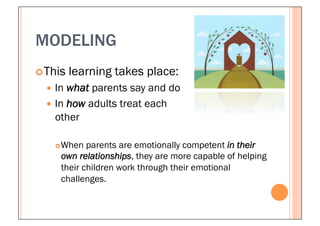
MODELING
¢ This    learning takes place:
  —  In what parents say and do
  —  In how adults treat each
      other

       When parents are emotionally competent in their
     ¢ 
       own relationships, they are more capable of helping
       their children work through their emotional
       challenges.
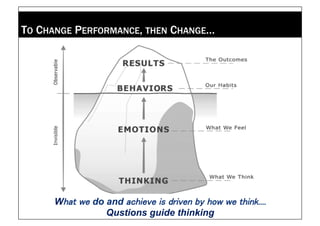
TO CHANGE PERFORMANCE, THEN CHANGE…


     What we do and achieve is driven by how we think....
                Qustions guide thinking                     19
Learning | Consulting | Assessment


Rahila	
  Narejo	
  
Lead	
  Consultant,	
  Chief	
  Executive	


Email:	
          	
  info@narejohr.com	
  
Office:	
           	
  +92	
  21-­‐3530-­‐1060/61	
  

Understanding Emotional Intelligence

  • 1.
    If you wantto change the world, focus on leaders. If you want to change leaders, focus on them when they’re young. Understanding     Emo/onal  Intelligence  
  • 2.
    Your  Facilitator   Learning | Consulting | Assessment • NarejoHR,     – Established  2002   – Service  Offerings,  Growing  Businesses  Through  People   • Rahila  Narejo   – Chief  Executive  &  Lead  HR  Consultant,  NarejoHR  (Pvt.)  Ltd.     – Psychobiologist,  Univ.  California,  Los  Angeles     – Psychometrician,  British  Psychological  Society  (Levels  A  +  B)   – Certified  Balanced  Scorecard  Professional,  Palladium  Group   – Columnist,  DAWN  Newspaper,  Workplace  Sanity   –   MSc.  NeuroLeadership,  Middlesex  Univ.  &  NeuroLeadership  Institute   !
  • 3.
    What is theSecret to Effectiveness/Success? ¡  THINK: of an effective/ successful person… Distinguishing characteristics? ¡  PAIR: Partner up ¡  SHARE: Discuss and agree on one characteristic. ¡  TIME: 5 MINUTES
  • 4.
    Fact:   Anindividual’s success at work and life is 80% dependent on EQ, and only 20% dependent on IQ   -Daniel Goleman   Author, Journalist and Psychologist
  • 5.
    “Emotion” ENERGY   ACTION   E ________ + MOTE _______
  • 6.
    EQ is theintelligent use of emotions: you intentionally make your emotions work for you by using them to help guide your behavior and thinking in ways that enhance your results. -Emotional Intelligence at Work, Hendric Weisinger, Ph.D.
  • 10.
    THE 5 EQCOMPETENCIES 1.  Self-Awareness 2.  Social Awareness 3.  Self-Management 4.  Relationship Skills 5.  Responsible Decision Making
  • 11.
    EMOTIONAL INTELLIGENCE COMPETENCIES Self- Social Awarene Awarene ss ss Self- Relations Managem hip Skills ent
  • 12.
    ACROSS DEVELOPMENT SELF-AWARENESS Elementary Grades: Should be able to recognize and accurately label simple emotions such as sadness, anger, and happiness Middle School: Should be able to analyze factors that trigger their stress reactions. ¢  Accurately assessing one’s own High School: thoughts, feelings, interests, values, and Are expected to strengths analyze how various expressions of emotion ¢  Recognizing how they influence choices affect other people. and actions ¢  Maintaining a well-grounded sense of self-confidence
  • 13.
    ACROSS SOCIAL AWARENESS DEVELOPMENT ¢  Taking others’ perspective and Elementary Grades: empathizing with them Should be able to ¢  Recognizing and appreciating individual identify verbal, physical, and and group similarities and differences situational cues indicating how others feel. Middle School: Should be able to predict others’ feelings and perspectives in various situations. High School: Should be able to evaluate their ability to empathize with others.
  • 14.
    ACROSS DEVELOPMENT SELF-MANAGEMENT Elementary Grades: Children are expected to describe the steps of setting and working toward goals. Middle School: They should be able to set and make a plan to achieve a short-term personal or academic goal. ¢  Regulating one’s emotions to handle High School: stress, control impulses, and persevere Should be able to in overcoming obstacles identify strategies to overcome obstacles in ¢  Setting and monitoring progress toward achieving a long-term goal. personal, academic and religious goals ¢  Expressing emotions appropriately
  • 15.
    ACROSS RELATIONSHIP SKILLS DEVELOPMENT Elementary Grades: Should have an ability to describe approaches to making and keeping friends. Middle School: Are expected to demonstrate co- operation and team- work to promote group goals. ¢  Establishing and maintaining healthy High School: and rewarding relationships based on Are expected to cooperation evaluate uses of communication skills with peers, teachers, ¢  Resisting inappropriate social pressure; and family members. preventing, managing, and resolving interpersonal conflict
  • 16.
    ACROSS ¢  Making decisions RESPONSIBLE DECISION-MAKING DEVELOPMENT based on: Elementary Grades: ¢ Ethical standards Should be able to ¢ Safety concerns identify a range of decisions they make ¢ Appropriate social at home and school. norms Middle School: ¢ Respect for others Should be able to evaluate strategies ¢ Likelyconsequences for resisting peer pressure to engage in of various actions unsafe or unethical activities. —  Applying decision- making skills to High School: social and Should be able to academic analyze how their current decision- situations making affects their yeshiva, seminary, or college and career prospects
  • 17.
    FAMILY LIFE Our firstschool for emotional learning
  • 18.
    MODELING ¢ This learning takes place: —  In what parents say and do —  In how adults treat each other When parents are emotionally competent in their ¢  own relationships, they are more capable of helping their children work through their emotional challenges.
  • 19.
    TO CHANGE PERFORMANCE,THEN CHANGE… What we do and achieve is driven by how we think.... Qustions guide thinking 19
  • 20.
    Learning | Consulting| Assessment Rahila  Narejo   Lead  Consultant,  Chief  Executive             Email:    info@narejohr.com   Office:    +92  21-­‐3530-­‐1060/61