


Microsoft Power BI for O365
2 
Next hour.. 
oPower BI for O365 
oData Discovery 
oData Analysis 
oData Visualization & Power Maps 
oNatural Language Search (Q&A) 
oPower BI Site 
oData Management 
oSelf Service in Power BI
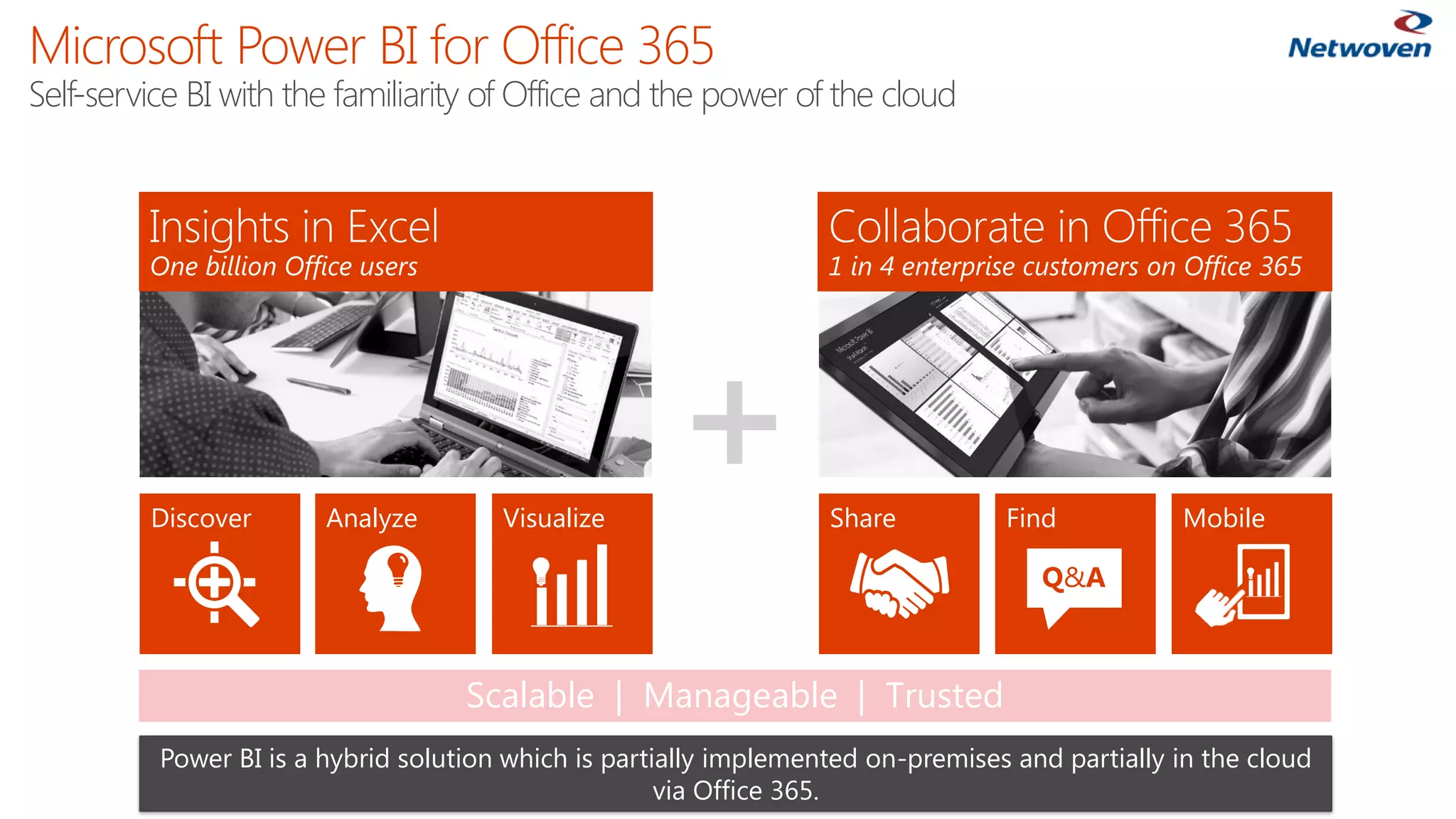
Microsoft Power BI for Office 365Self-service BI with the familiarity of Office and the power of the cloud1 in 4 enterprise customers on Office 365One billion Office users 
Analyze 
Visualize 
Share 
Find 
Q&A 
Mobile 
Discover 
Scalable | Manageable | Trusted 
Power BI is a hybrid solution which is partially implemented on-premises and partially in the cloud via Office 365.
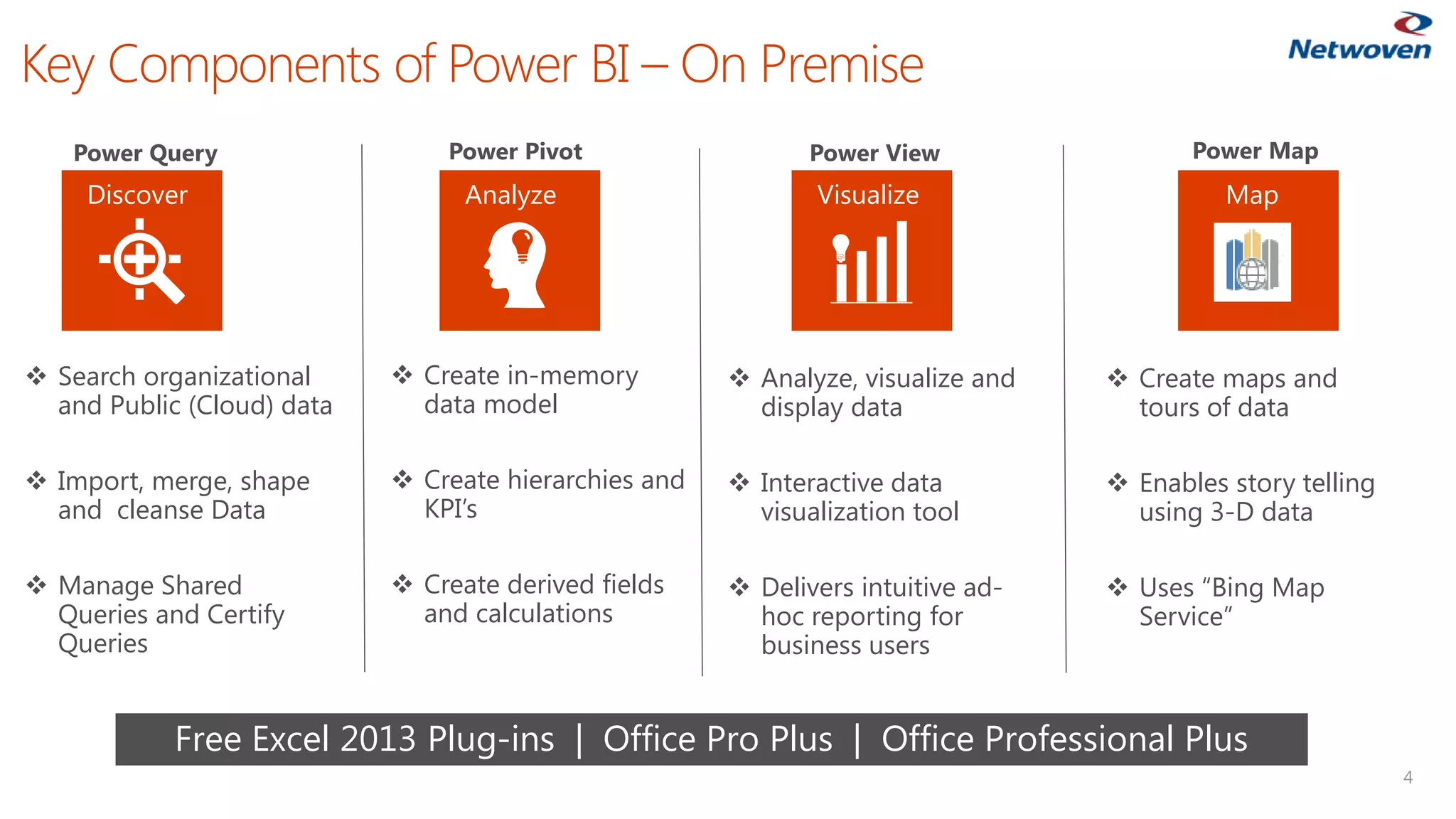
Key Components of Power BI –On Premise 
4 
Power Pivot 
Search organizational and Public (Cloud) data 
Import, merge, shape and cleanse Data 
Manage Shared Queries and Certify Queries 
Power View 
Discover 
Power Query 
Map 
Power Map 
Analyze 
Visualize 
Create in-memory data model 
Create hierarchies and KPI’s 
Create derived fields and calculations 
Analyze, visualize and display data 
Interactive data visualization tool 
Delivers intuitive ad- hoc reporting for business users 
Create maps and tours of data 
Enables story telling using 3-D data 
Uses “Bing Map Service” 
Free Excel 2013 Plug-ins | Office Pro Plus | Office Professional Plus
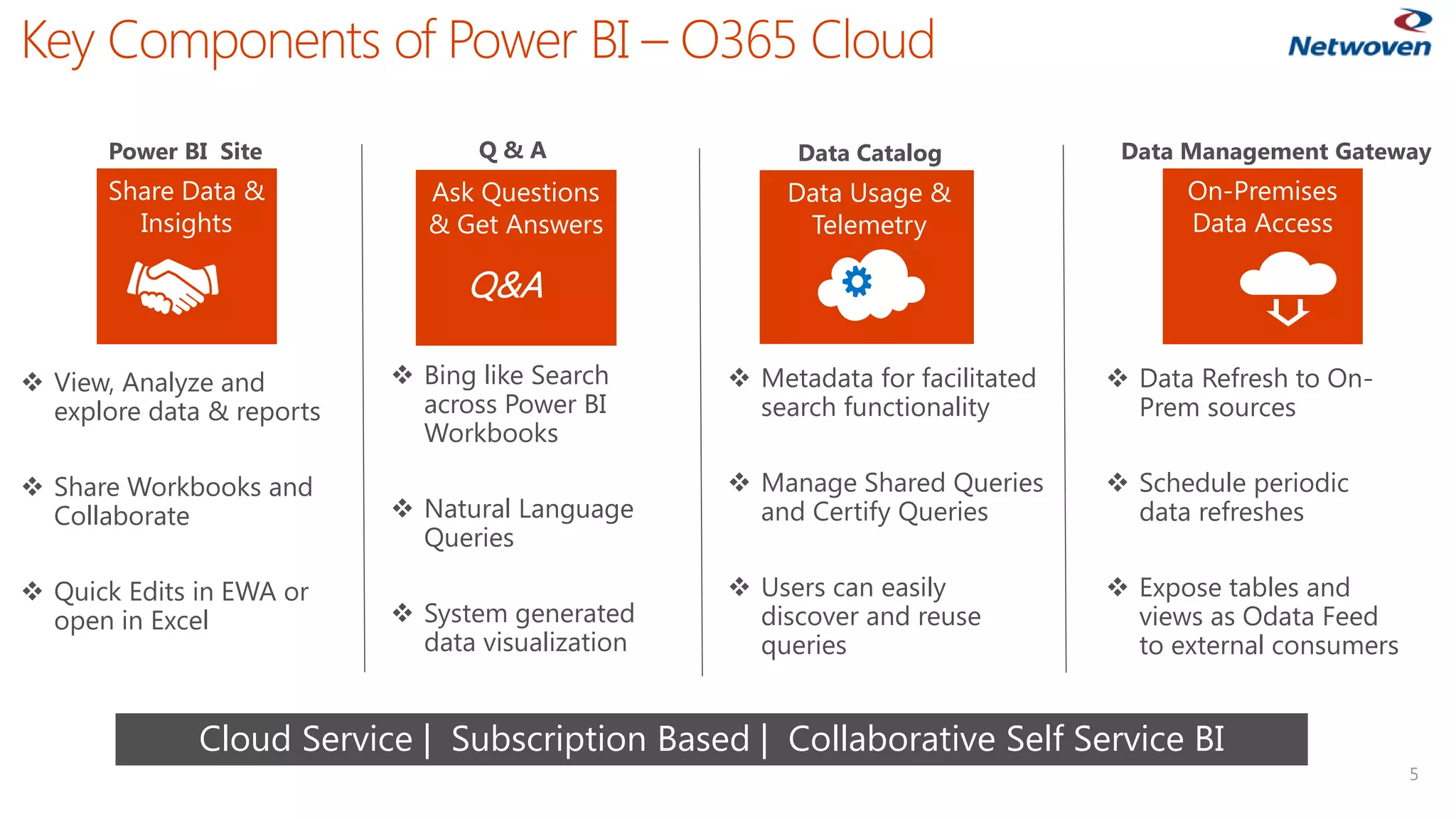
Key Components of Power BI –O365 Cloud 
5 
Q & A 
View, Analyze and explore data & reports 
Share Workbooks and Collaborate 
Quick Edits in EWA or open in Excel 
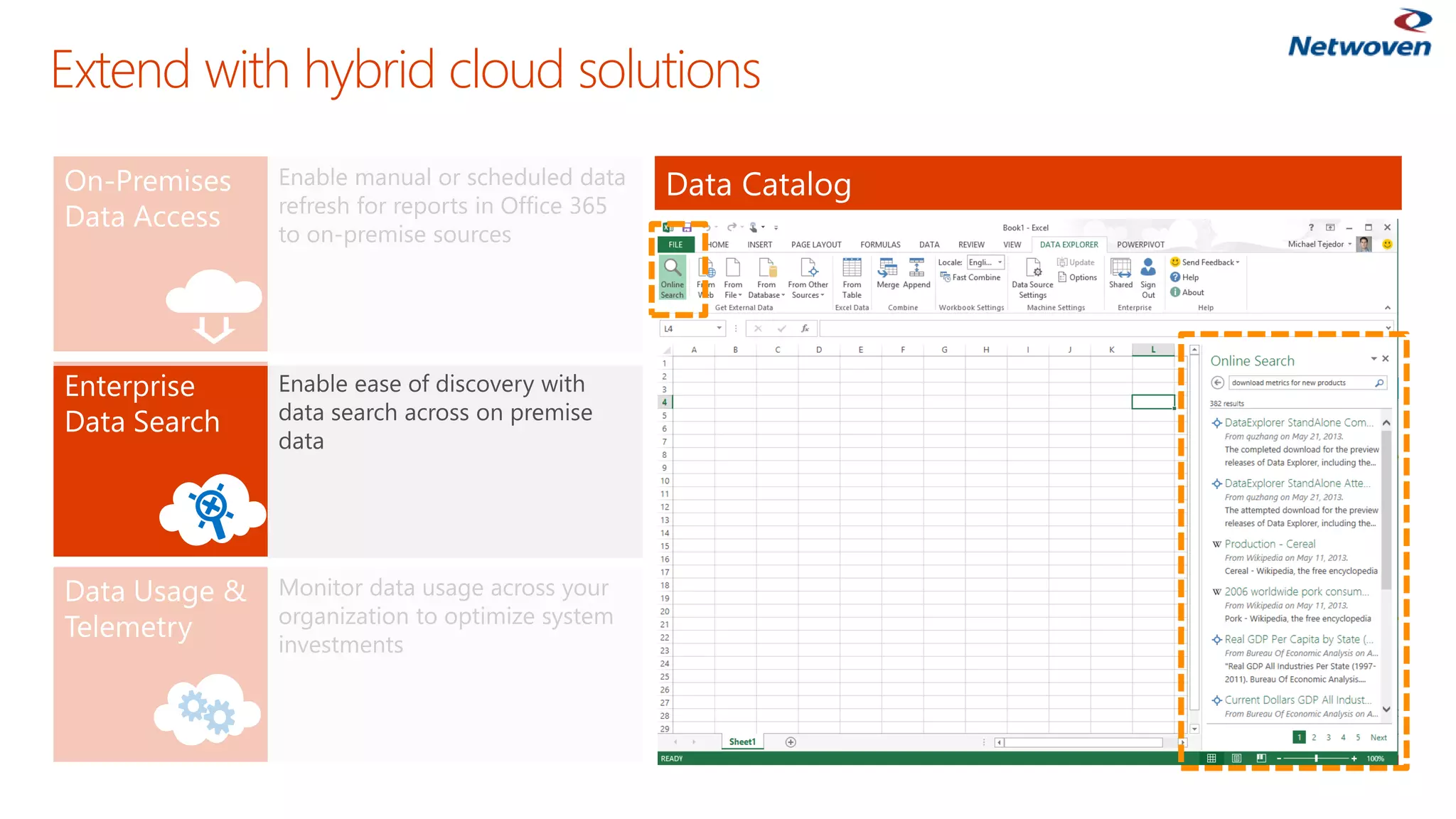
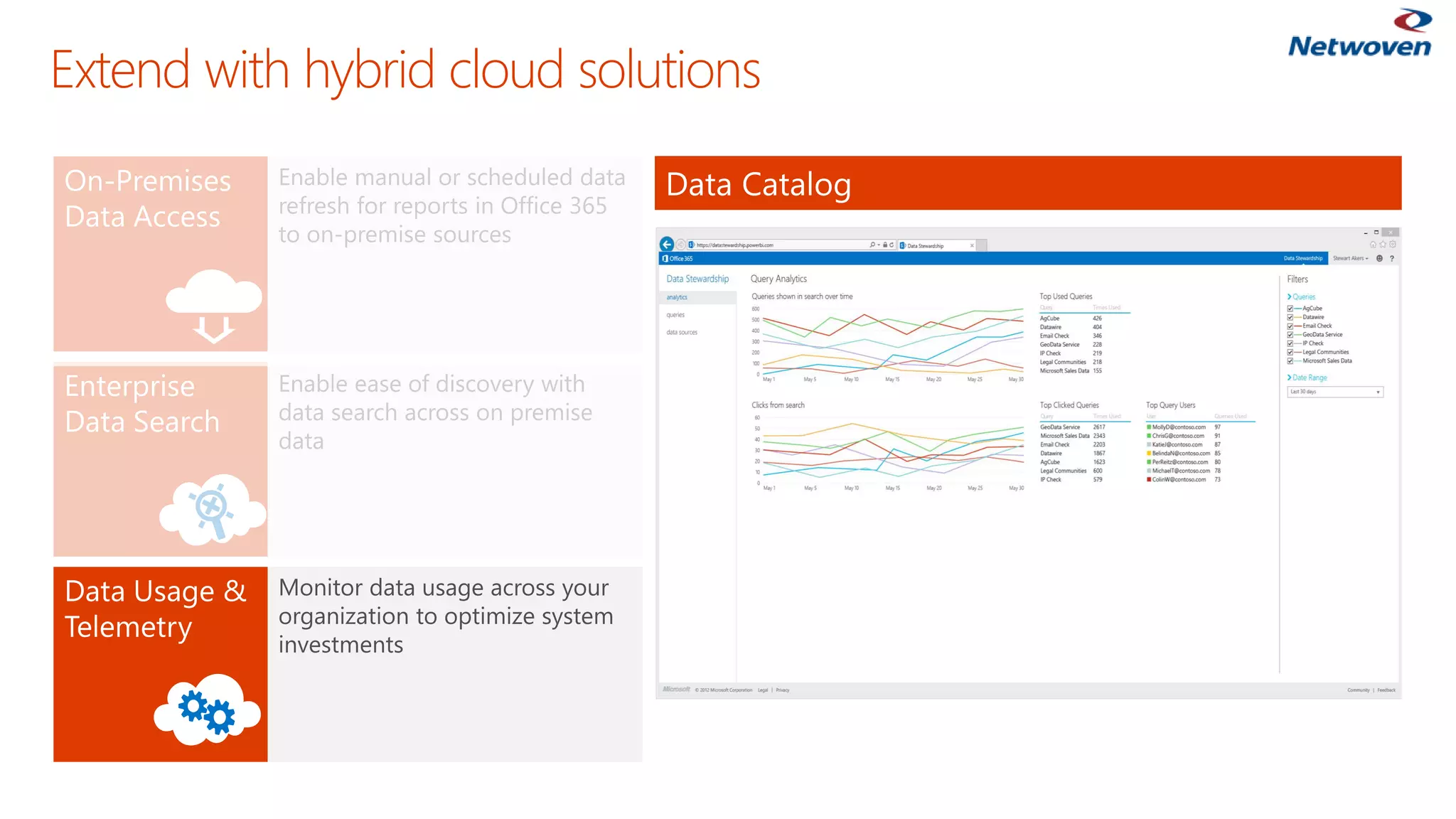
Data Catalog 
Power BI Site 
Data Management Gateway 
Bing like Search across Power BI Workbooks 
Natural Language Queries 
System generated data visualization 
Metadata for facilitated search functionality 
Manage Shared Queries and Certify Queries 
Users can easily discover and reuse queries 
Data Refresh to On- Premsources 
Schedule periodic data refreshes 
Expose tables and views as OdataFeed to external consumers 
Cloud Service | Subscription Based | Collaborative Self Service BI 
Q&A
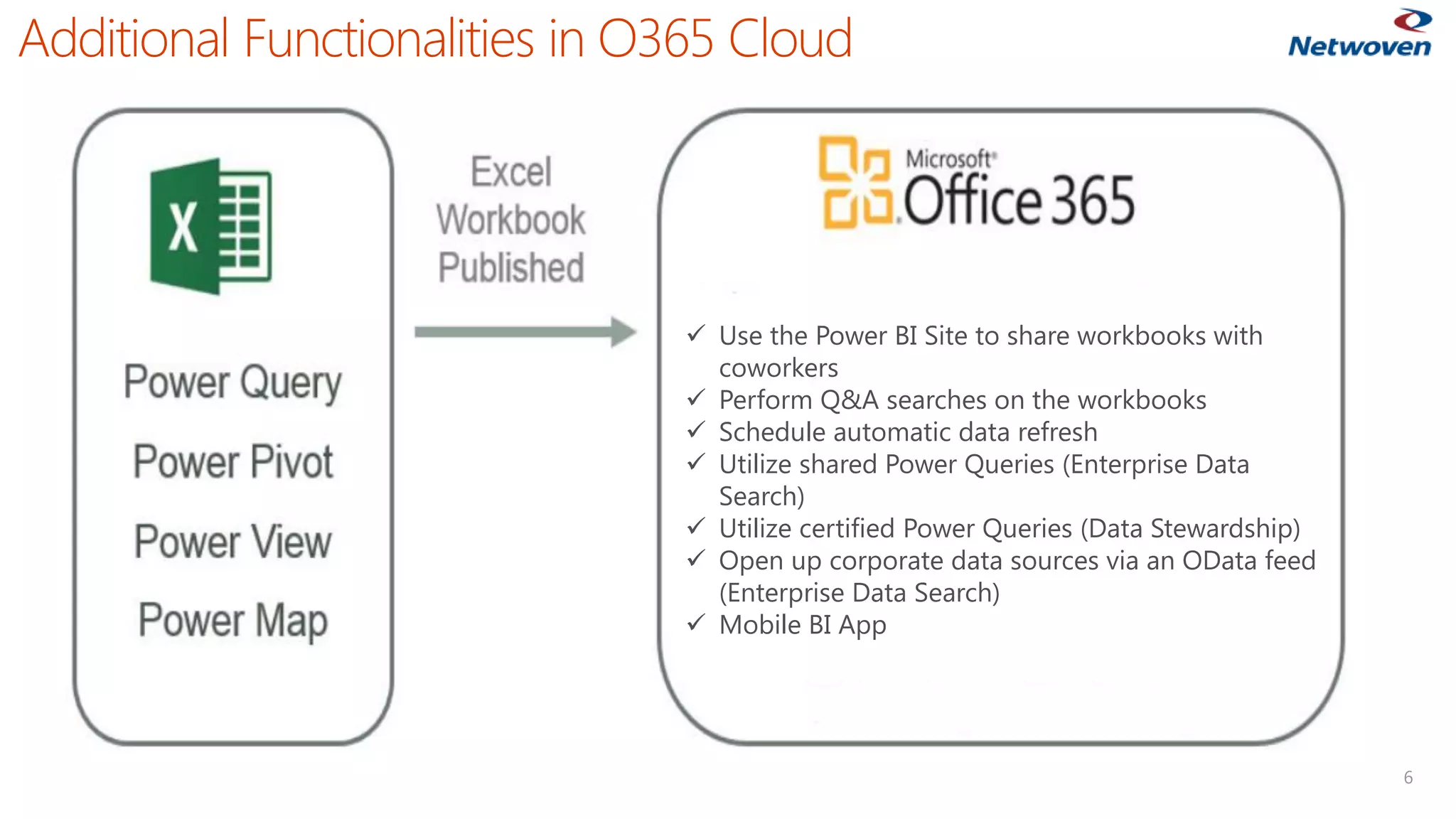
Additional Functionalities in O365 Cloud 6 
Use the Power BI Site to share workbooks with coworkers 
Perform Q&A searches on the workbooks 
Schedule automatic data refresh 
Utilize shared Power Queries (Enterprise Data Search) 
Utilize certified Power Queries (Data Stewardship) 
Open up corporate data sources via an OData feed (Enterprise Data Search) 
Mobile BI App
Power BI Workflow 
7 
Excel Data Model / 
Power Pivot 
Data Storage 
Reports 
Excel Workbook 
Publish 
Workbook 
Power BI Admin Center 
Power BI App 
Text 
Database 
Web file 
O365 (Cloud) 
Data Refresh for On PremSources 
Corporate Data Refresh
8 
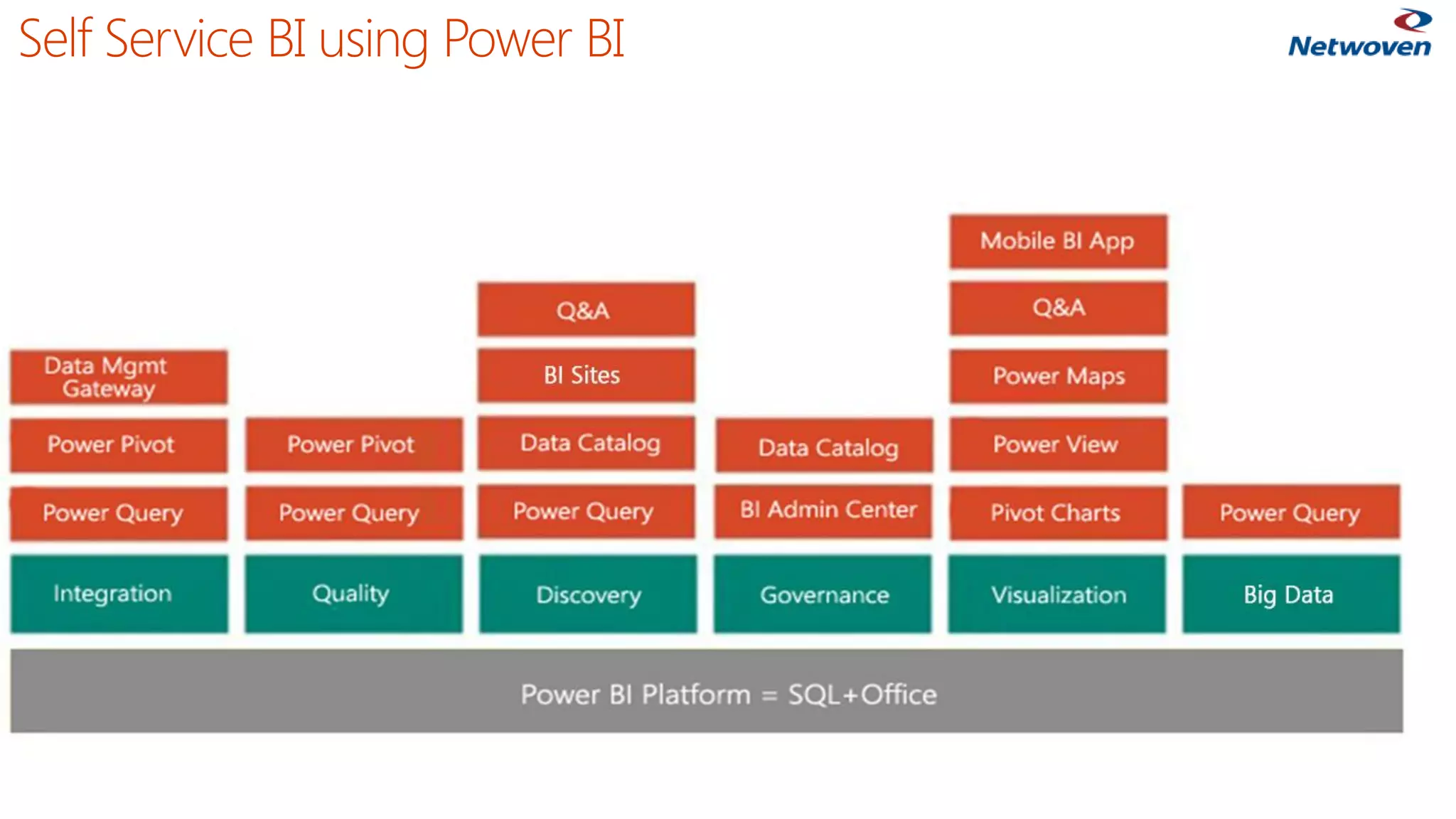
Self Service BI using Power BI
Data Discovery
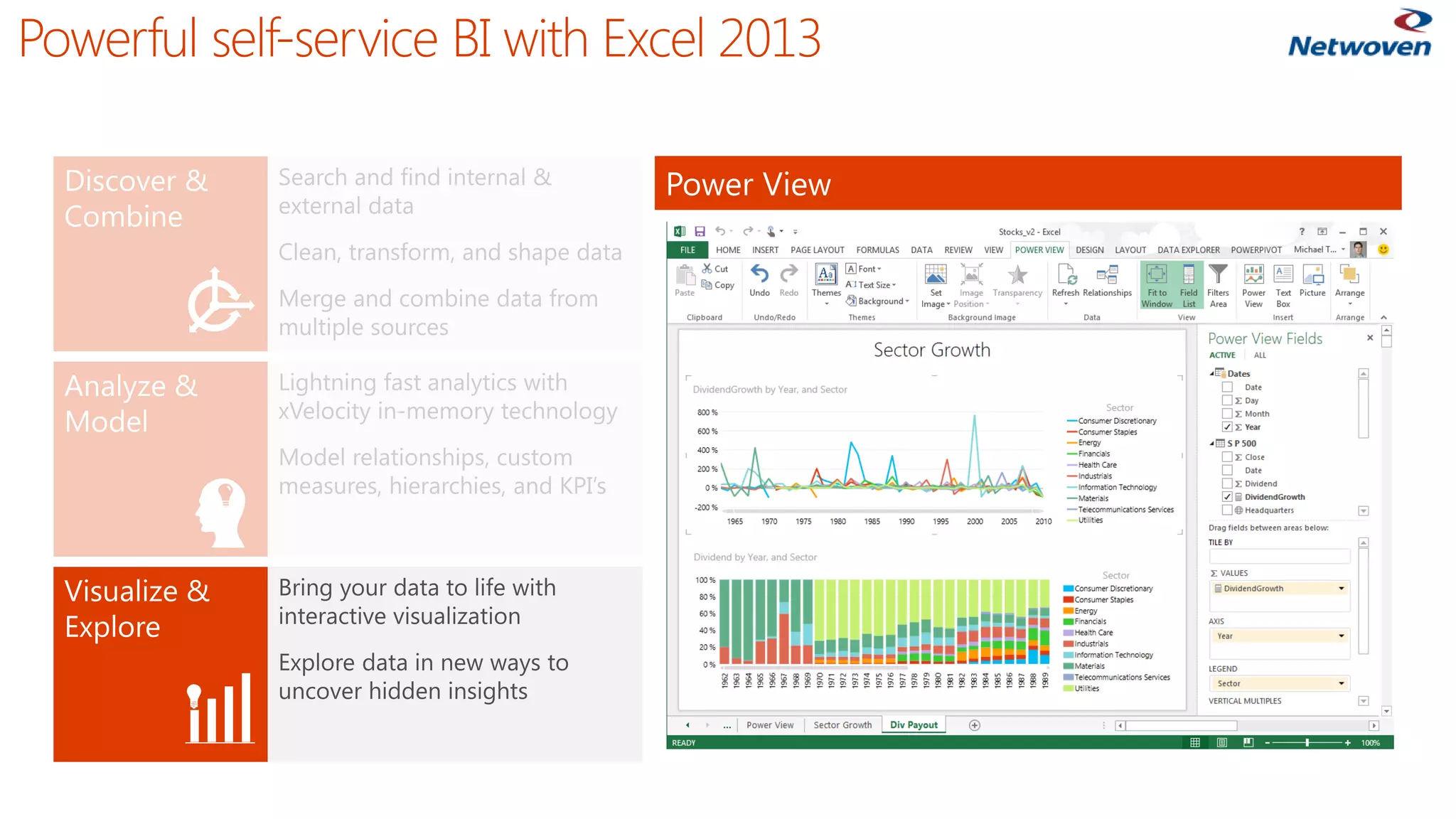
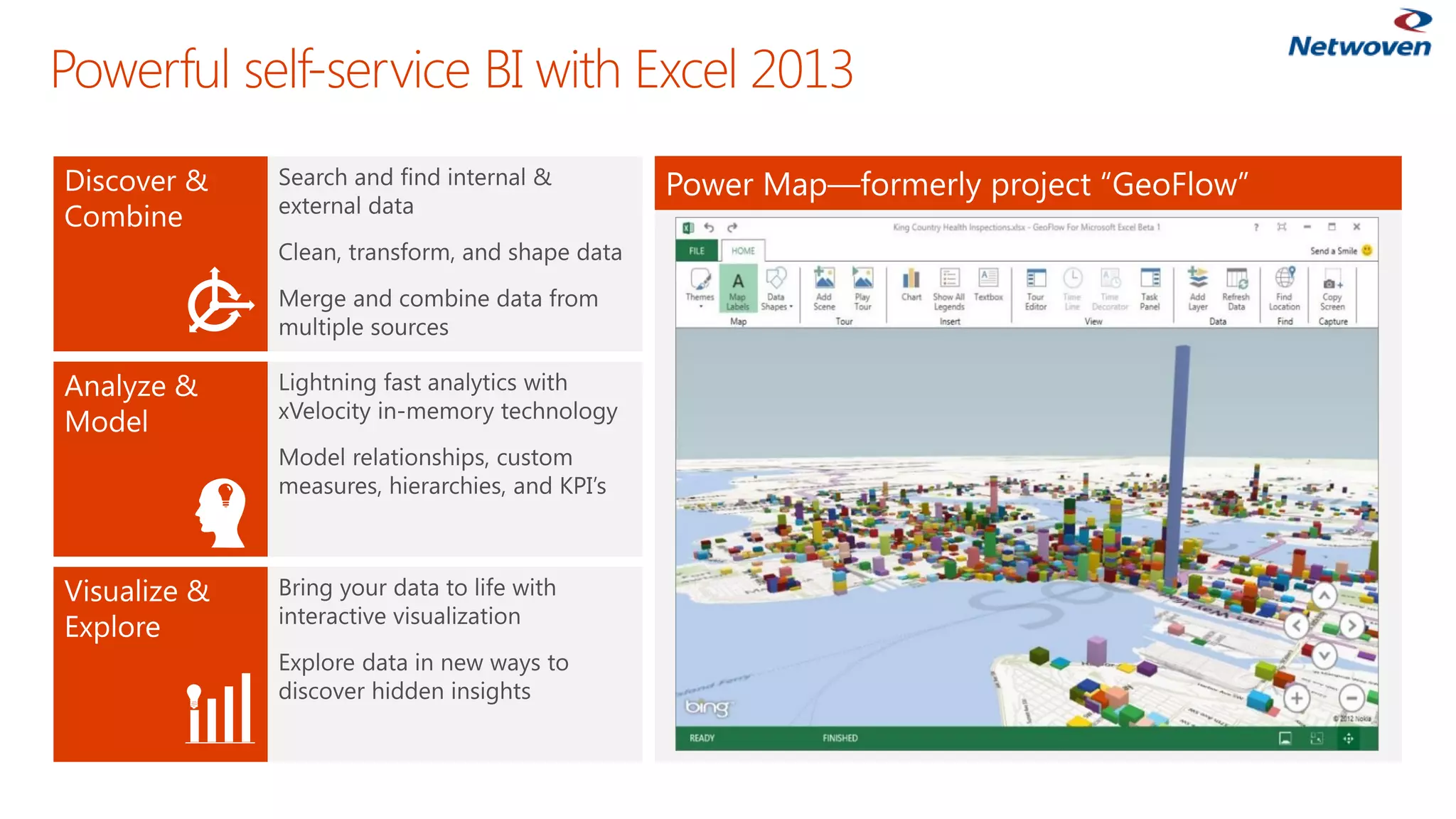
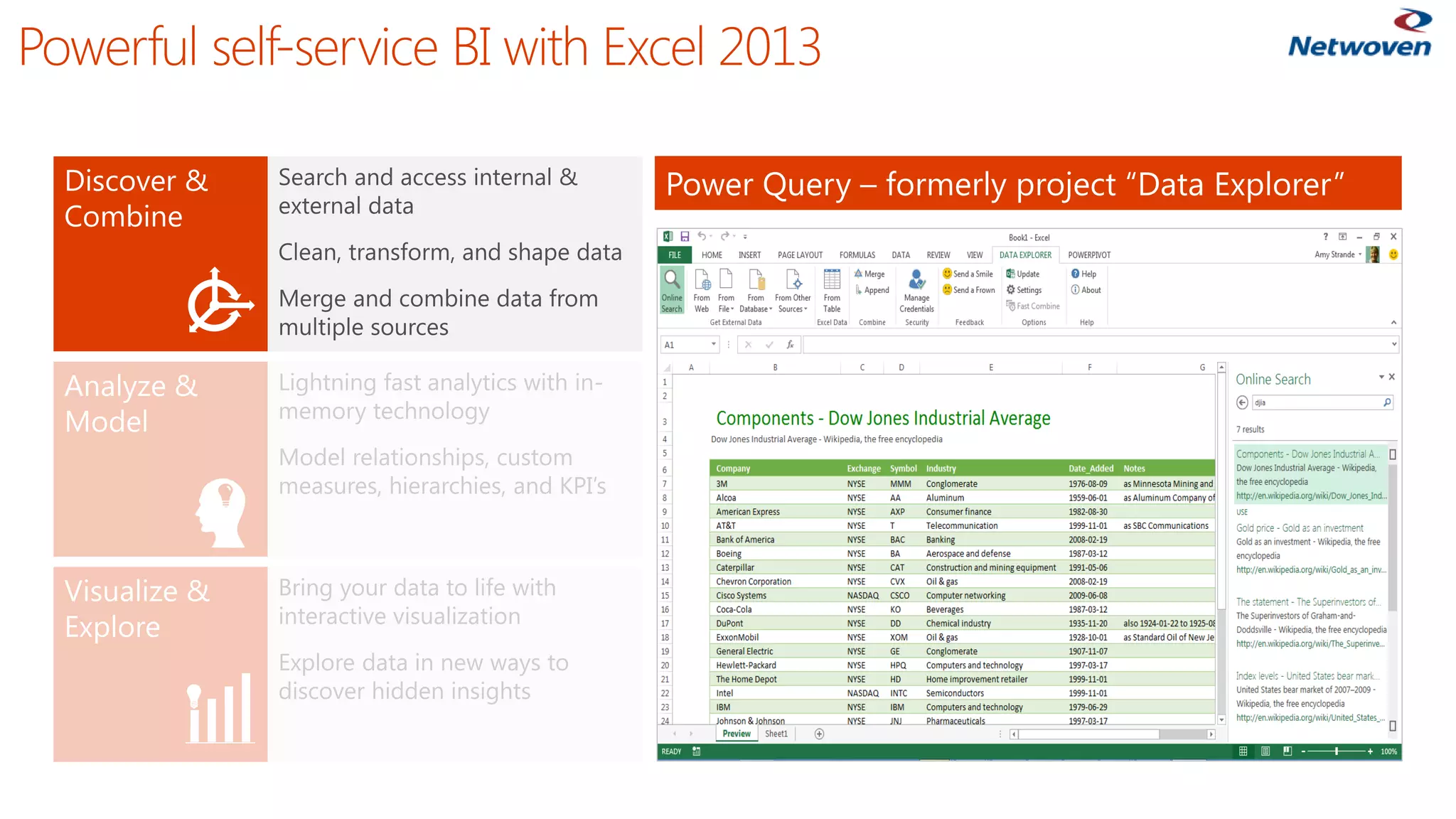
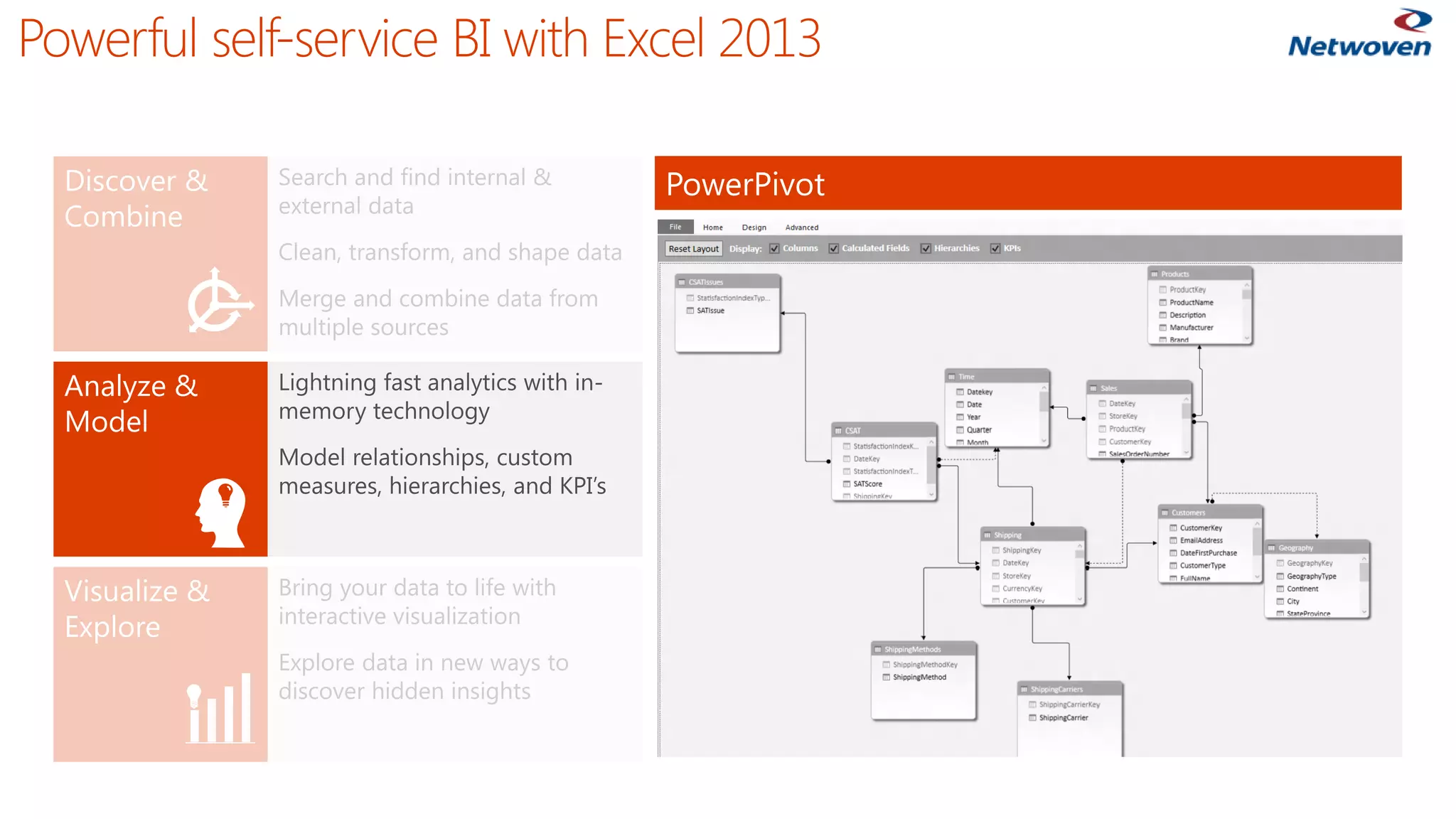
Powerful self-service BI with Excel 2013
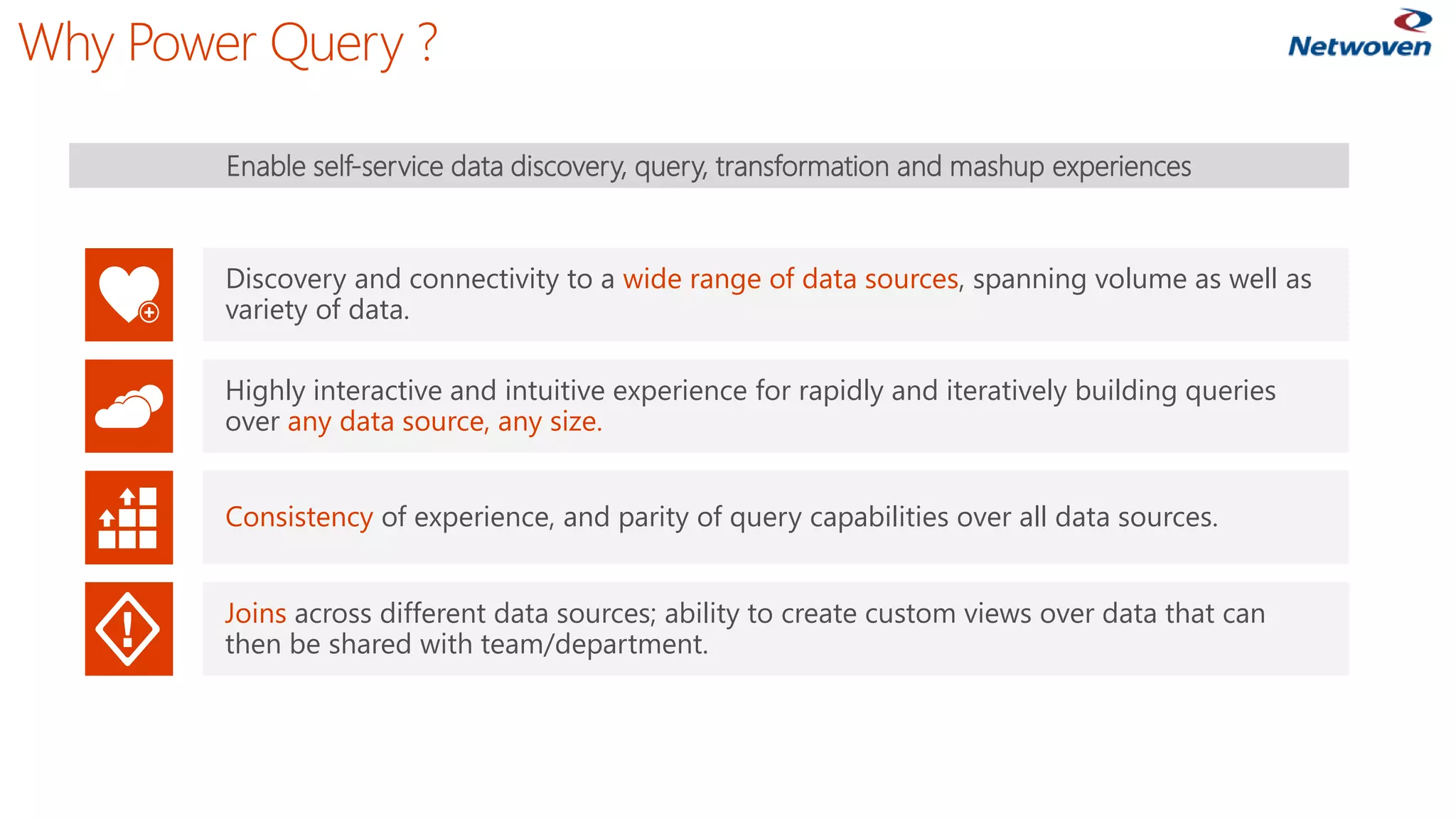
Why Power Query ? 
Enable self-service data discovery, query, transformation and mashup experiences 
Discovery and connectivity to a wide range of data sources, spanning volume as well as variety of data. 
Highly interactive and intuitive experience for rapidly and iteratively building queries over any data source, any size. 
Consistencyof experience, and parity of query capabilities over all data sources. 
Joinsacross different data sources; ability to create custom views over data that can then be shared with team/department.
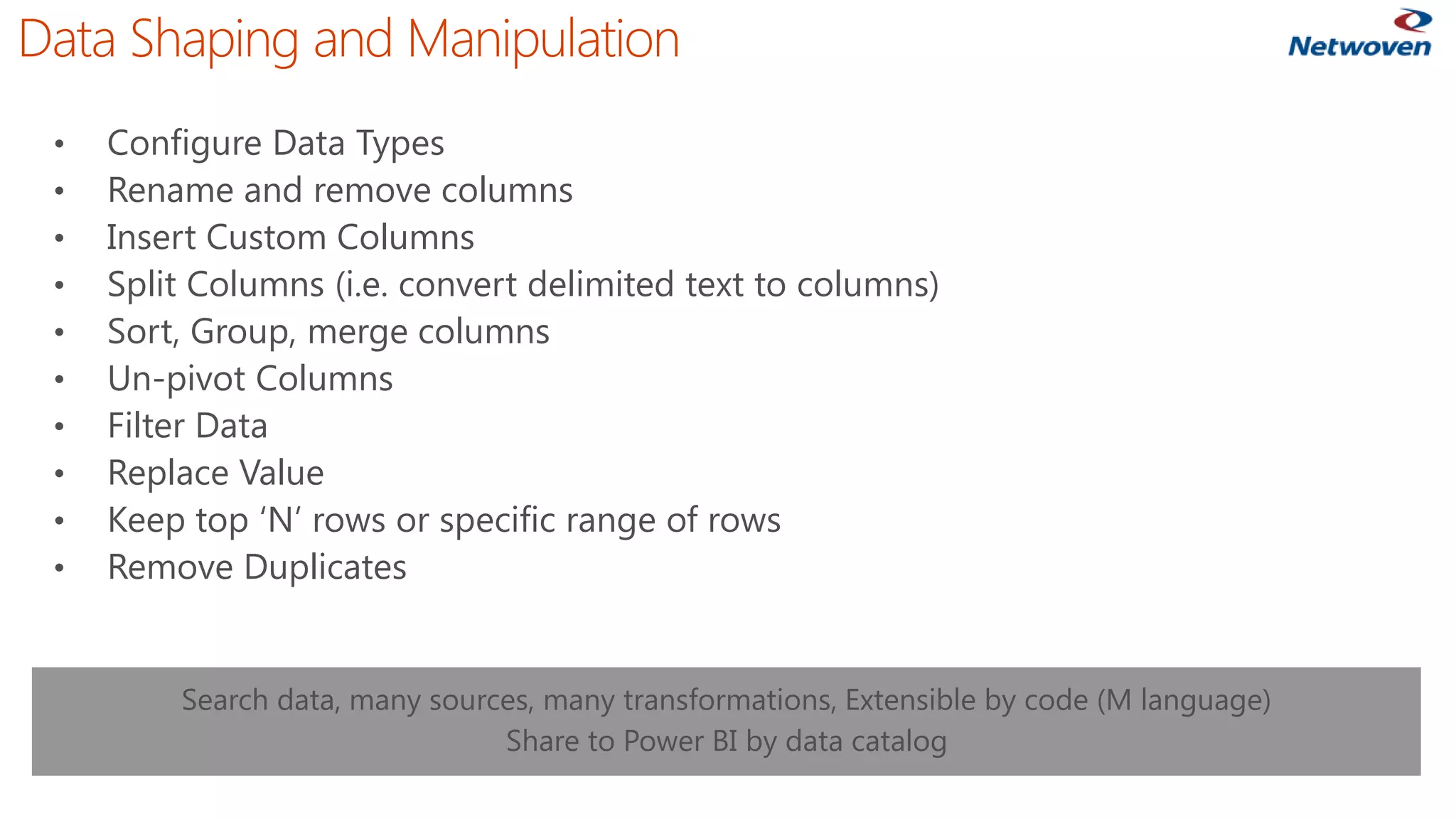
Data Shaping and Manipulation 
•Configure Data Types 
•Rename and remove columns 
•Insert Custom Columns 
•Split Columns (i.e. convert delimited text to columns) 
•Sort, Group, merge columns 
•Un-pivot Columns 
•Filter Data 
•Replace Value 
•Keep top ‘N’ rows or specific range of rows 
•Remove Duplicates 
Search data, many sources, many transformations, Extensible by code (M language) 
Share to Power BI by data catalog
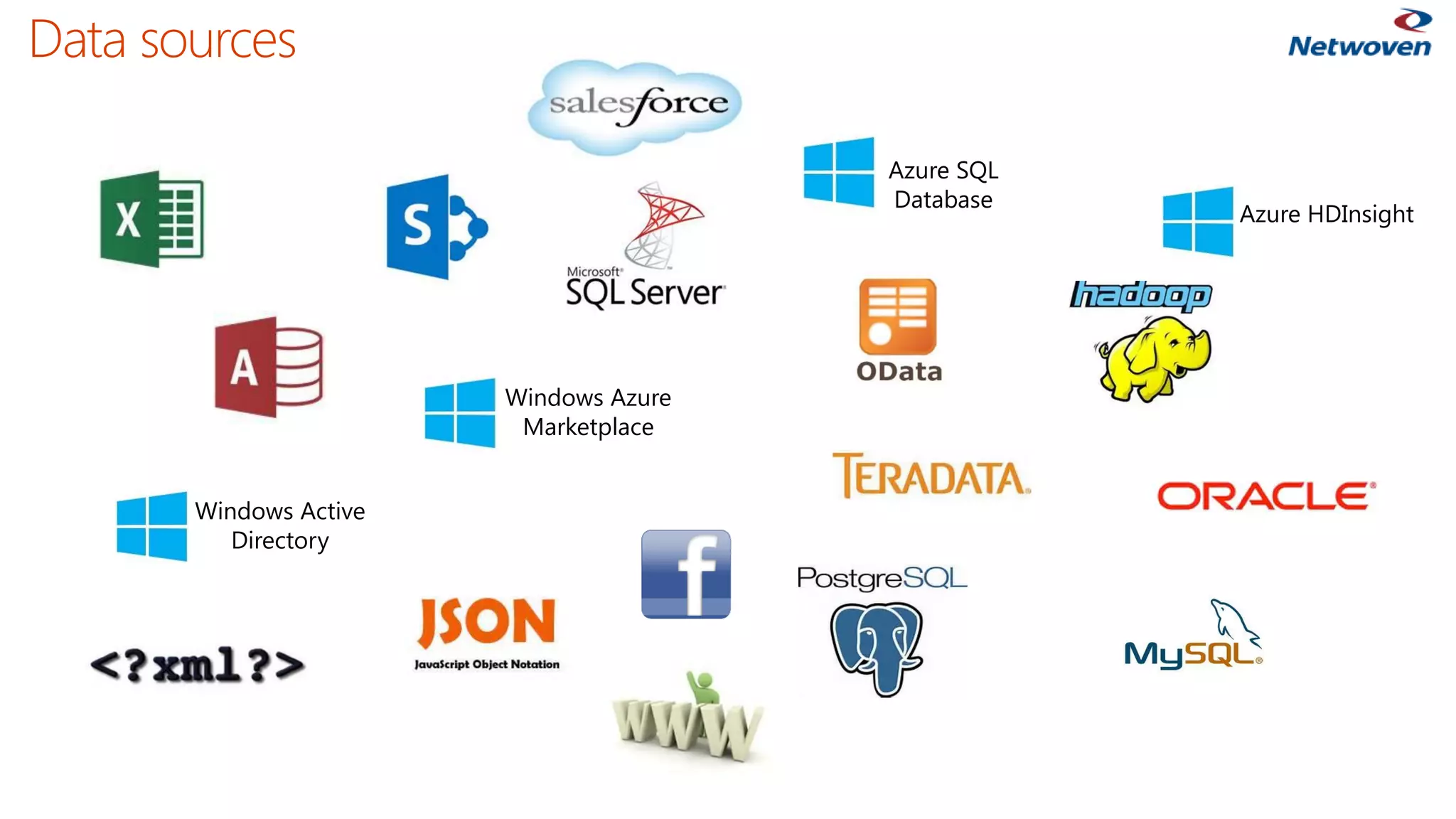
Data sources 
Windows Azure Marketplace 
Windows Active Directory 
Azure SQL Database 
Azure HDInsight
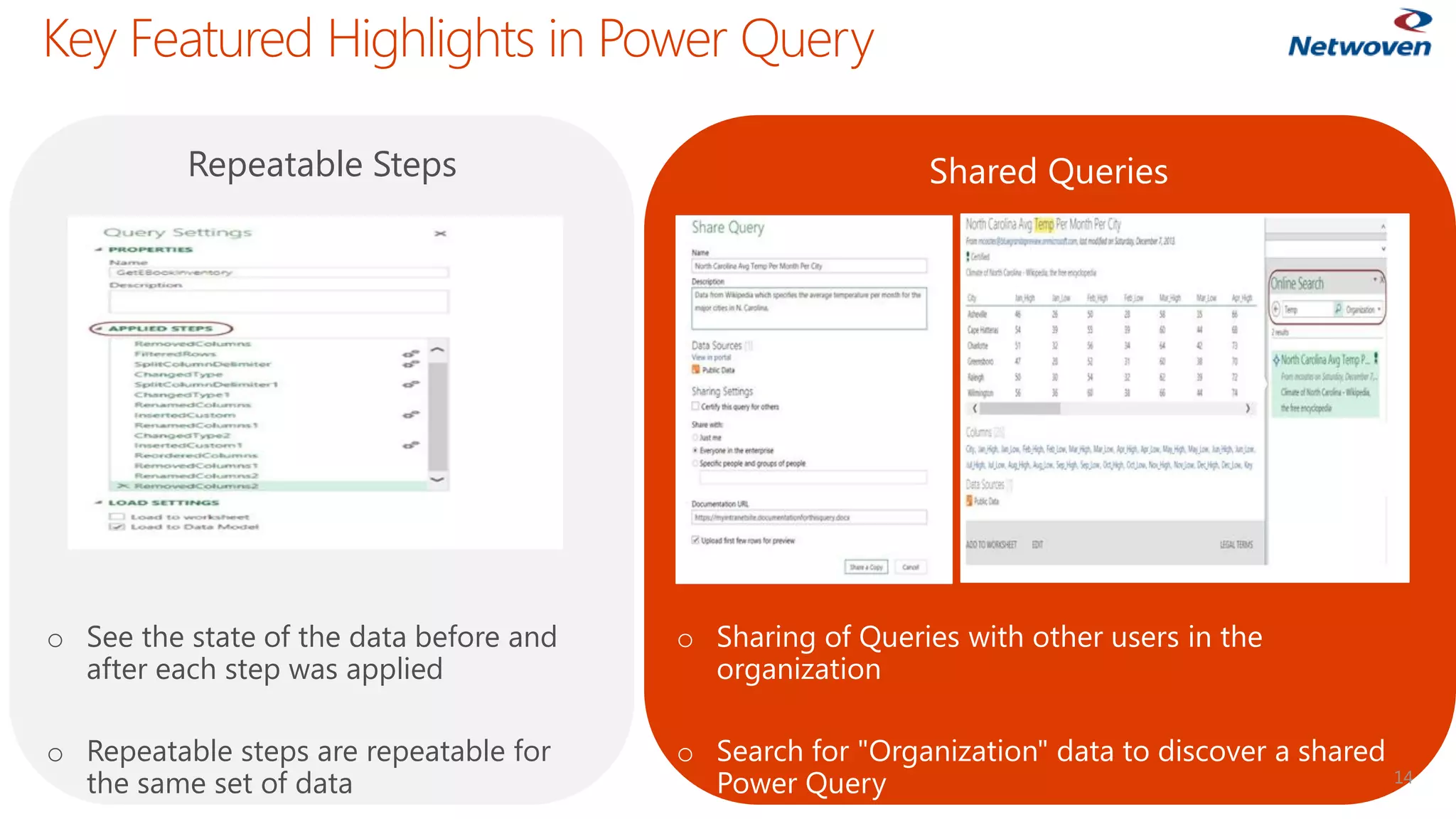
Key Featured Highlights in Power Query 
14 
Repeatable Steps 
Shared Queries 
oSee the state of the data before and after each step was applied 
oRepeatable steps are repeatable for the same set of data 
oSharing of Queries with other users in the organization 
oSearch for "Organization" data to discover a shared Power Query
Data Analysis
Powerful self-service BI with Excel 2013
Introducing PowerPivot 
•PowerPivot empowers business users to create self- service BI data models in Excel 
‐Achieved with a client-side version of SQL Server Analysis Services, known as the In-Memory Analytics Engine 
‐Columnar Storage: Can efficiently store data volumes far greater than what Excel worksheets can achieve 
‐Data is highly compressed and stored 
‐Queries are very fast 
•Can import and relate data from corporate, local, and ad hoc data stores 
•In Excel 2013 Professional Plus edition, PowerPivot is installed, but not enabled
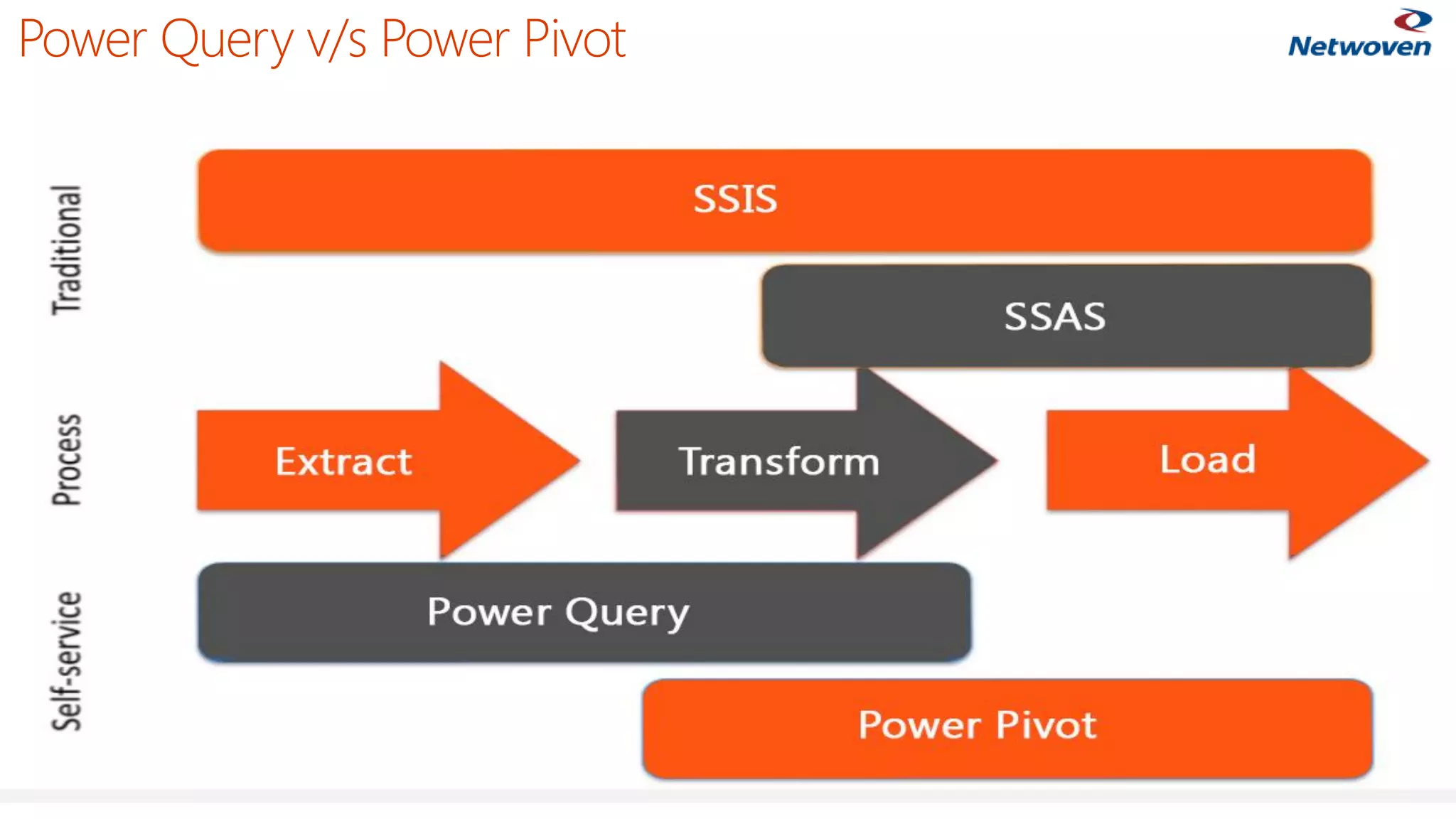
Power Query v/s Power Pivot 
18
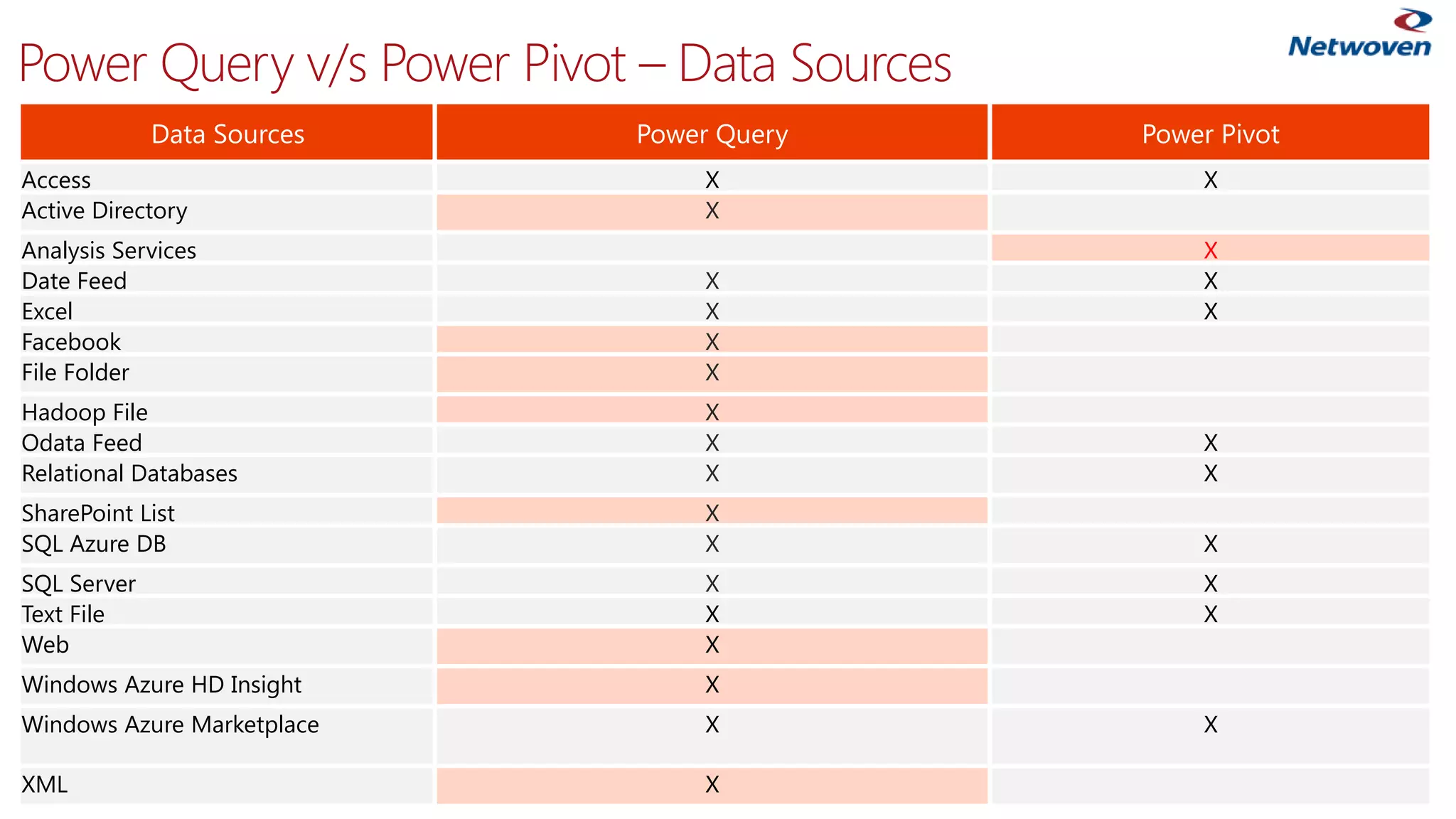
DataSources 
Power Query 
Power Pivot 
Access 
X 
X 
Active Directory 
X 
Analysis Services 
X 
Date Feed 
X 
X 
Excel 
X 
X 
Facebook 
X 
File Folder 
X 
Hadoop File 
X 
OdataFeed 
X 
X 
Relational Databases 
X 
X 
SharePoint List 
X 
SQL Azure DB 
X 
X 
SQL Server 
X 
X 
Text File 
X 
X 
Web 
X 
Windows Azure HD Insight 
X 
Windows Azure Marketplace 
X 
X 
XML 
X 
Power Query v/s Power Pivot –Data Sources
What is DAX ? 
20 
DAX (Data Analysis Expression) is a new calculation for Power Pivot 
It is a multi dimensional calculation language intended to: 
Make it easy to perform common calculations 
Make it easy for excel power users, hence Excel based syntax 
DAX expressions are designed to be limited as single line of code 
Need to understand the data logic built in power pivot data models 
Likely to be extended in the future versions of SSAS
Types of Calculations in Power Pivot 
21 
Calculated Columns 
CalculatedFields (Measures) 
New Calculationin table which performs calculations on a “row by row” basis (row context) 
Example: = ‘Employee’[Fname] & “ “ & ‘Employee’[Lname] 
New measure in a table which calculatesan aggregated numeric value (not on "rowby row” basis –filter context) 
Example: =TOTALMTD ([SalesUnits], ‘Date’[Datekey]) 
Created in Power Pivot Modelson the columns 
Created in Power PivotModel in the “Calculation area” or in the Power Pivot ribbon menu in excel window 
Two type of Calculated Fields 
a)Explicit : Defined by the data modeler using DAX 
b) Implicit: Uses the “Summarize by” behavior specified in the data model 
An Explicit Field canbe further used to define a KPI in the data model
Data Visualization
Powerful self-service BI with Excel 2013
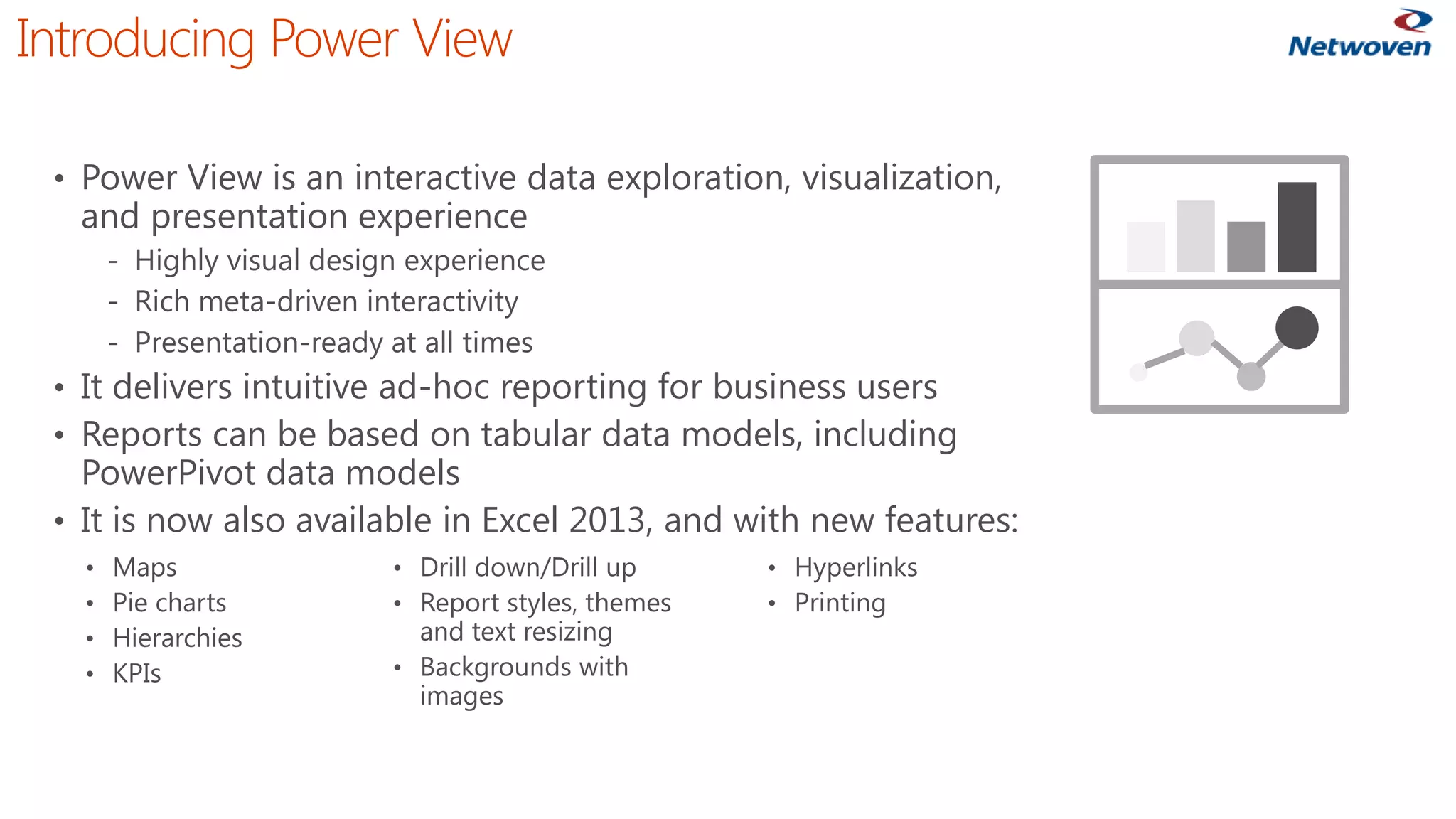
Introducing Power View 
•Power View is an interactive data exploration, visualization, and presentation experience 
‐Highly visual design experience 
‐Rich meta-driven interactivity 
‐Presentation-ready at all times 
•It delivers intuitive ad-hoc reporting for business users 
•Reports can be based on tabular data models, including PowerPivot data models 
•It is now also available in Excel 2013, and with new features:
Bar and column charts are good for showing measurable values in a quick an direct way 
Pie Chart 
Pie charts are preferable when the user would like to see the percentage of a measurable value in different categories 
Line Chart 
Line charts are good for showing how a value changed over time 
Play Axis (scatter chart) 
Play axis charts are good when you are trying to show the relationship between two measurable values( e.g. profit and cost) ,that may or may not be linearly related, over time. 
Maps 
Maps are preferable for showing measurable values at specific locations. 
Chart Types and Usage
26 
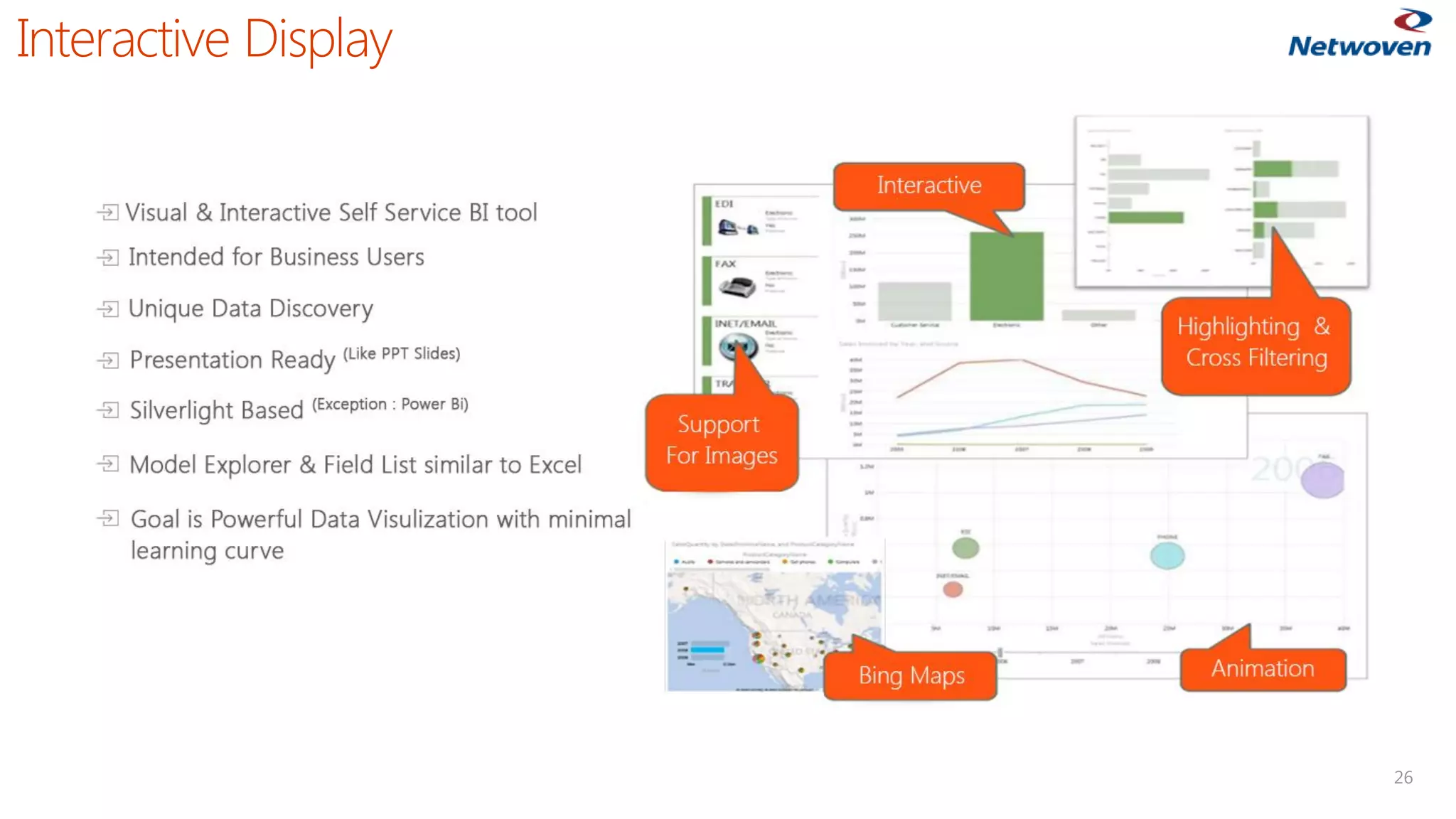
Interactive Display
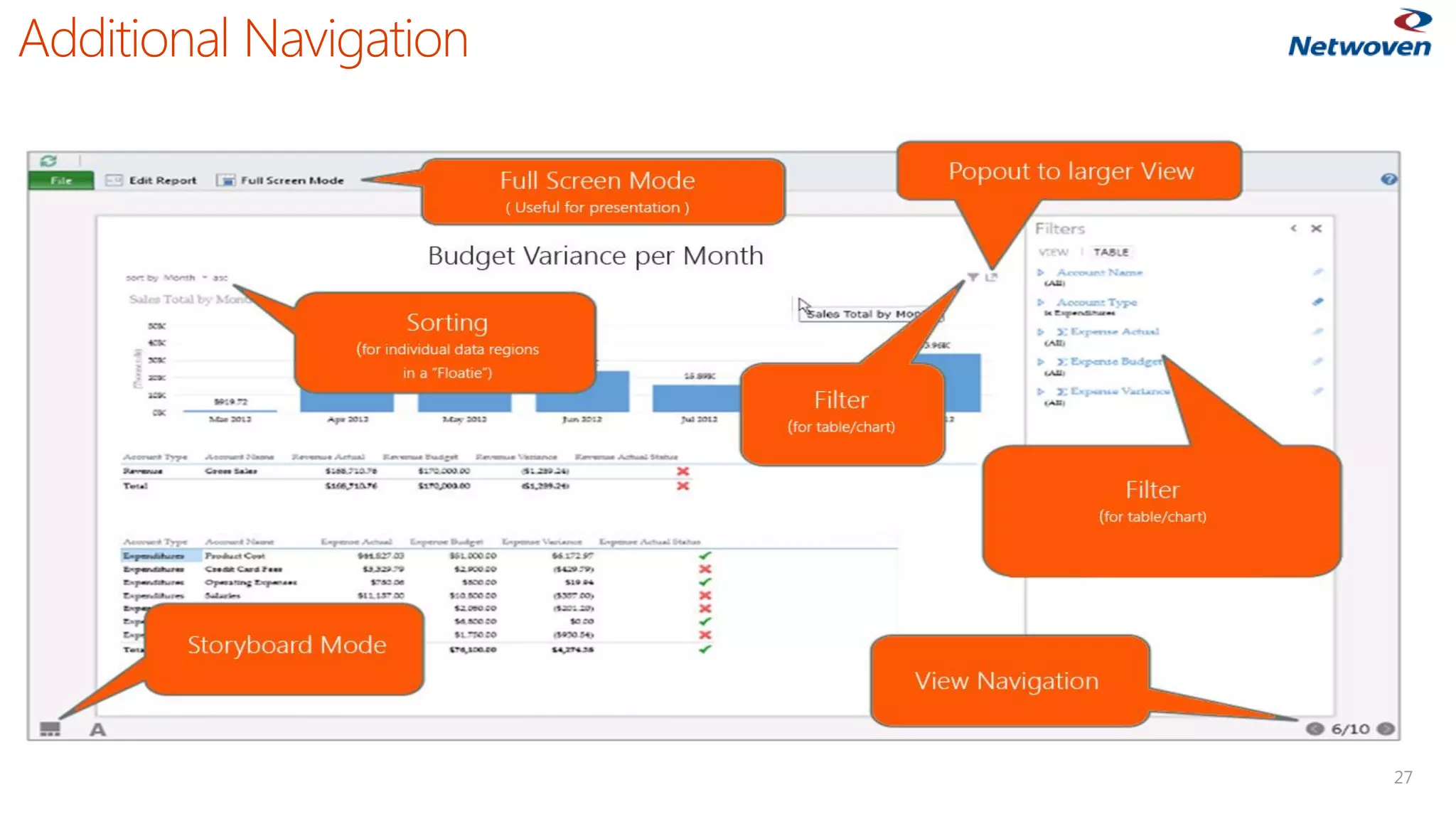
27 
Additional Navigation
Power Map
Powerful self-service BI with Excel 2013
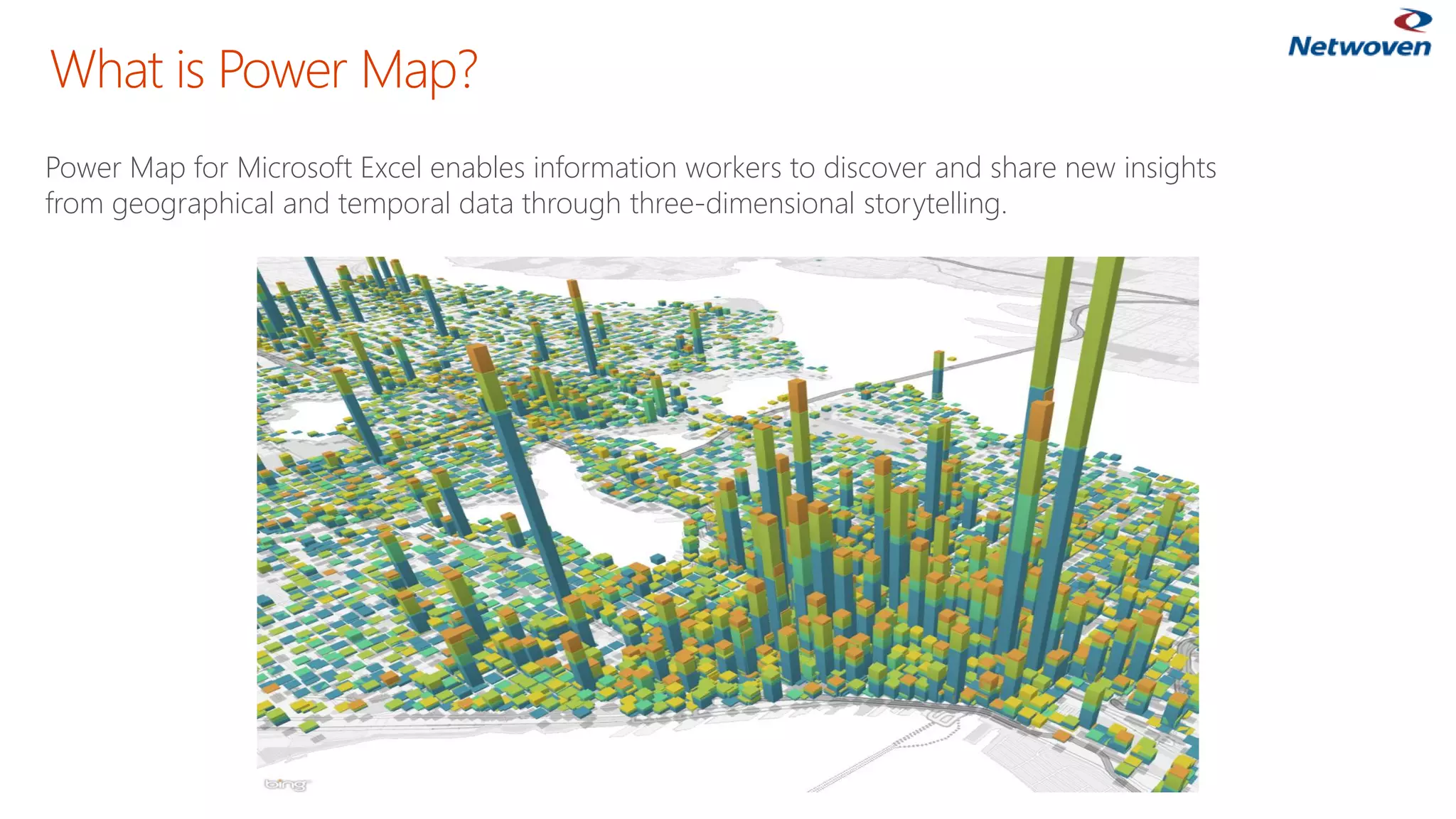
Power Map for Microsoft Excel enables information workers to discover and share new insights from geographicaland temporal data through three-dimensional storytelling. 
What is Power Map?
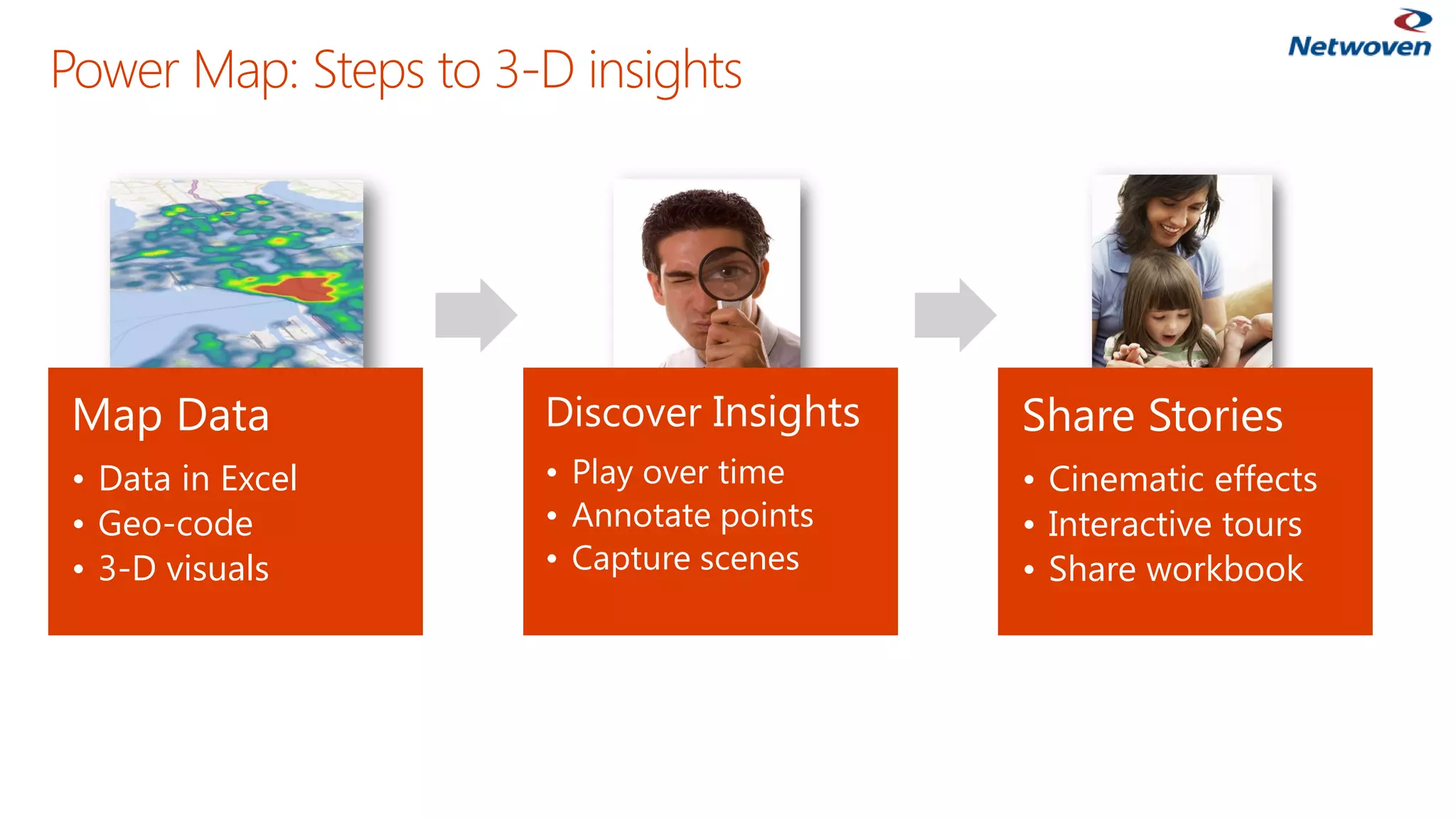
Map Data 
•Data in Excel 
•Geo-code 
•3-D visuals 
DiscoverInsights 
•Play over time 
•Annotate points 
•Capture scenes 
Share Stories 
•Cinematic effects 
•Interactive tours 
•Share workbook 
Power Map: Steps to 3-D insights
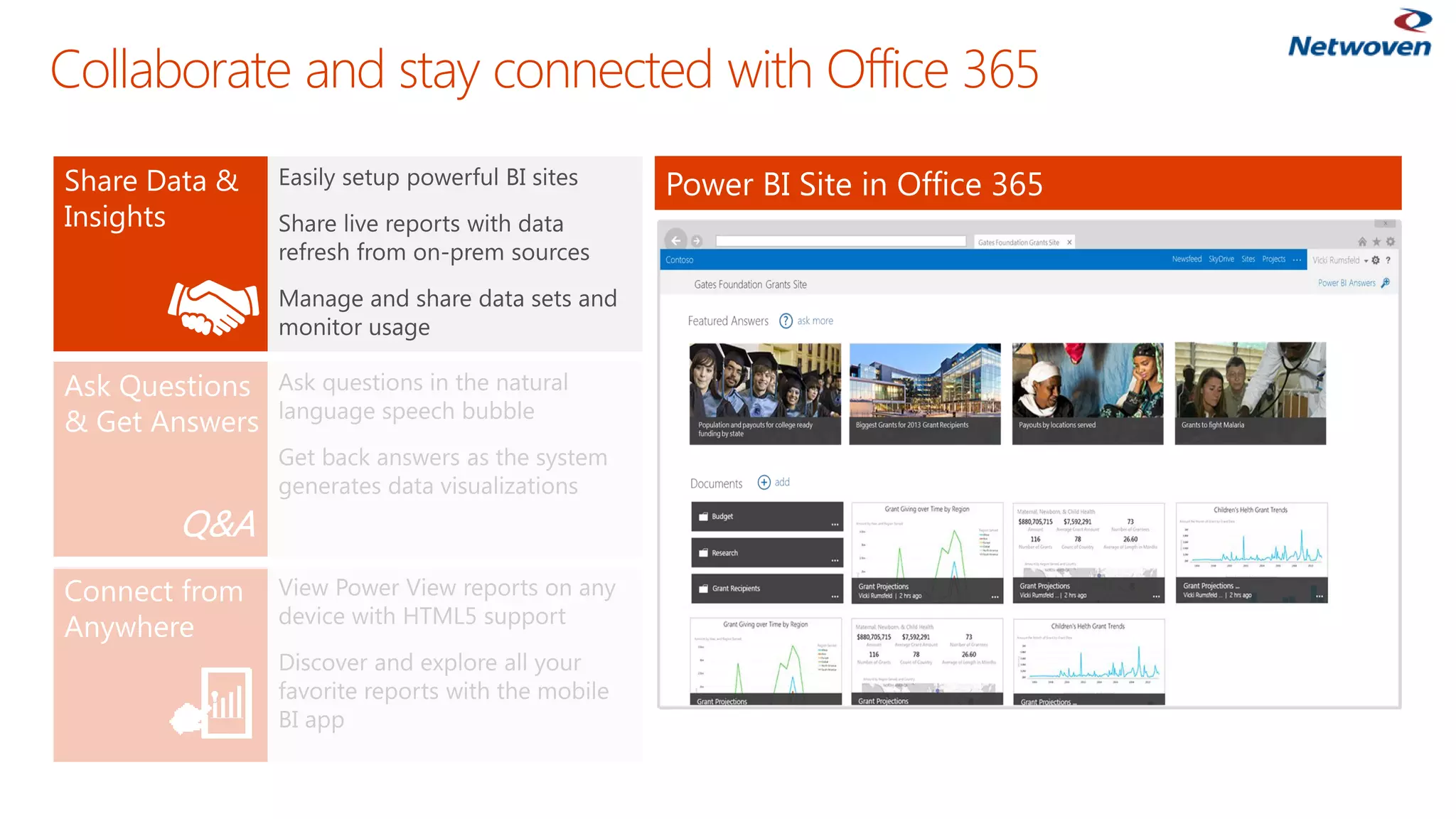
Power BI Site
Collaborate and stay connected with Office 365 
Q&A
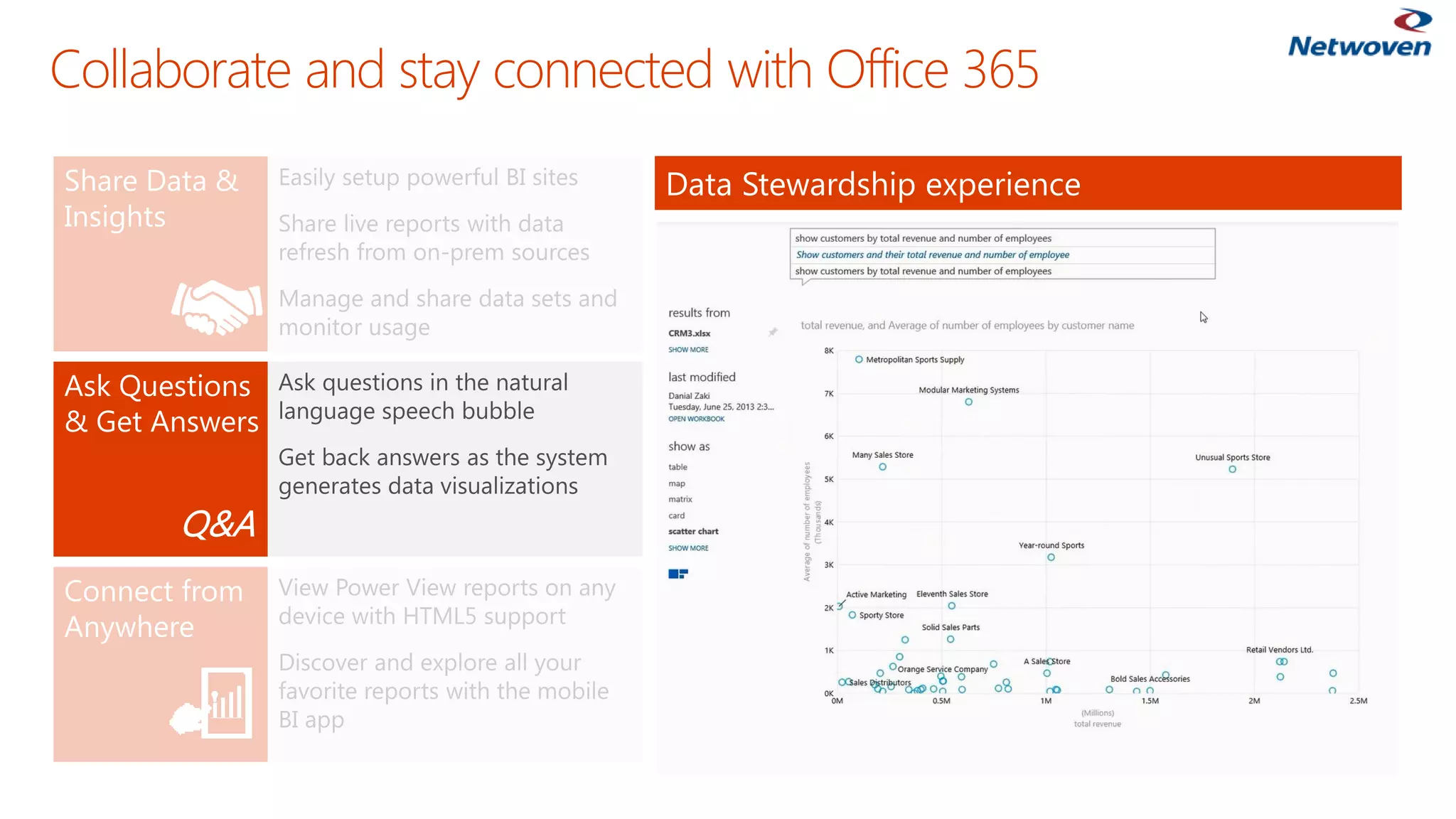
Natural Language Search (Q&A)
Collaborate and stay connected with Office 365 
Q&A
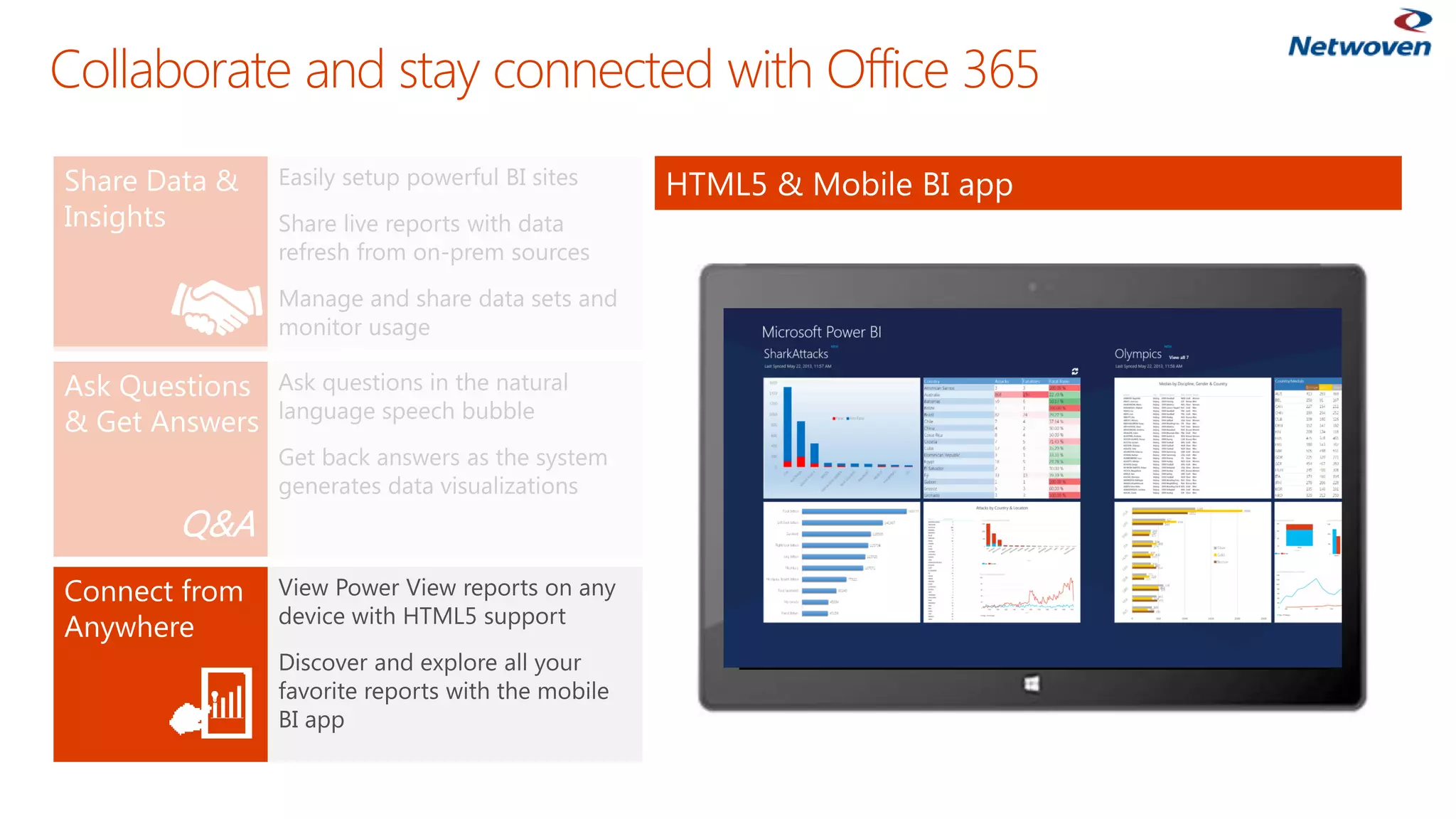
Mobile BI
Collaborate and stay connected with Office 365 
Q&A
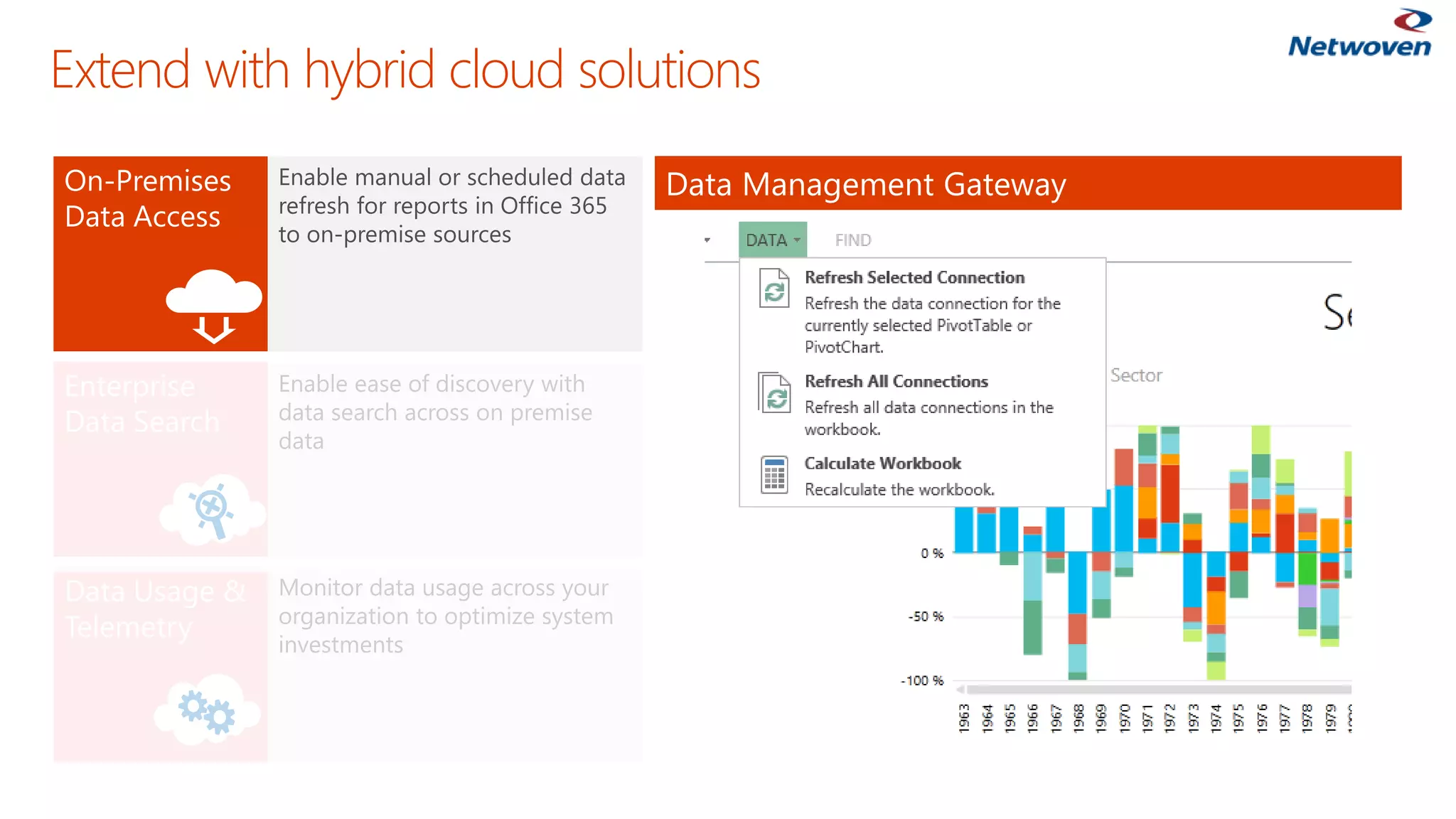
Data Management
Extend with hybrid cloud solutions
Self Service in Power BI
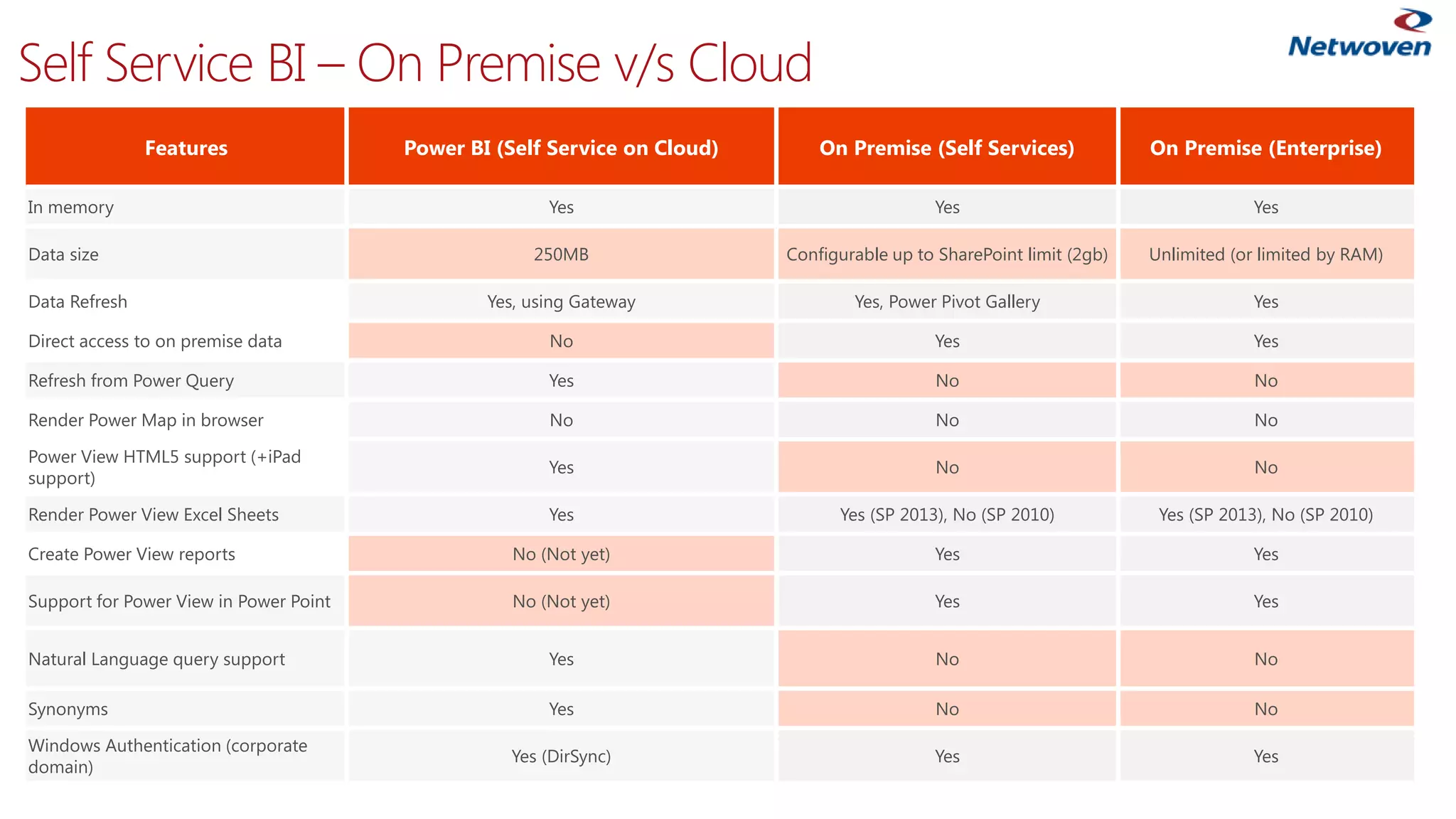
Features 
Power BI (Self Service on Cloud) 
On Premise (Self Services) 
On Premise (Enterprise) 
In memory 
Yes 
Yes 
Yes 
Data size 
250MB 
Configurable up to SharePoint limit (2gb) 
Unlimited (or limited by RAM) 
Data Refresh 
Yes, using Gateway 
Yes, Power Pivot Gallery 
Yes 
Direct access to on premise data 
No 
Yes 
Yes 
Refresh from Power Query 
Yes 
No 
No 
Render Power Map in browser 
No 
No 
No 
Power View HTML5 support (+iPad support) 
Yes 
No 
No 
Render Power View Excel Sheets 
Yes 
Yes (SP 2013), No (SP 2010) 
Create Power View reports 
No (Not yet) 
Yes 
Yes 
Support for Power View in Power Point 
No (Not yet) 
Yes 
Yes 
Natural Language query support 
Yes 
No 
No 
Synonyms 
Yes 
No 
No 
Windows Authentication (corporate domain) 
Yes (DirSync) 
Yes 
Yes 
Self Service BI –On Premise v/s Cloud
Power BI –A Powerful Self Service Tool 
44 
End Users 
oEnd-usershavelongwantedtheabilitytoeasilyaccessandanalyzedata 
oQ&A’snaturallanguagequeryandintelligentvisualizationenginewilldomoretoencourageeveryemployeetouseinformationasabasisfordecisions 
BI Analysts 
oPower Pivot gave power users the ability to build efficient data models over large data volumes, but that information needed to “fit” into clean data models 
oPower Query’s data transformation and flexibility further empower analysts to build their own end-to-end solutions quickly 
. 
IT & Data Stewards 
oThe data catalog underlying Power BI is exciting because it promotes self-service and governance simultaneously
Thank You 
Microsoft Confidential 
45 
Connect with us! 
•www.netwoven.com 
•www.netwovenblogs.com 
•Email info@netwoven.comfor more information

Microsoft Power BI Overview

  • 1.
  • 2.
    2 Next hour.. oPower BI for O365 oData Discovery oData Analysis oData Visualization & Power Maps oNatural Language Search (Q&A) oPower BI Site oData Management oSelf Service in Power BI
  • 3.
    Microsoft Power BIfor Office 365Self-service BI with the familiarity of Office and the power of the cloud1 in 4 enterprise customers on Office 365One billion Office users Analyze Visualize Share Find Q&A Mobile Discover Scalable | Manageable | Trusted Power BI is a hybrid solution which is partially implemented on-premises and partially in the cloud via Office 365.
  • 4.
    Key Components ofPower BI –On Premise 4 Power Pivot Search organizational and Public (Cloud) data Import, merge, shape and cleanse Data Manage Shared Queries and Certify Queries Power View Discover Power Query Map Power Map Analyze Visualize Create in-memory data model Create hierarchies and KPI’s Create derived fields and calculations Analyze, visualize and display data Interactive data visualization tool Delivers intuitive ad- hoc reporting for business users Create maps and tours of data Enables story telling using 3-D data Uses “Bing Map Service” Free Excel 2013 Plug-ins | Office Pro Plus | Office Professional Plus
  • 5.
    Key Components ofPower BI –O365 Cloud 5 Q & A View, Analyze and explore data & reports Share Workbooks and Collaborate Quick Edits in EWA or open in Excel Data Catalog Power BI Site Data Management Gateway Bing like Search across Power BI Workbooks Natural Language Queries System generated data visualization Metadata for facilitated search functionality Manage Shared Queries and Certify Queries Users can easily discover and reuse queries Data Refresh to On- Premsources Schedule periodic data refreshes Expose tables and views as OdataFeed to external consumers Cloud Service | Subscription Based | Collaborative Self Service BI Q&A
  • 6.
    Additional Functionalities inO365 Cloud 6 Use the Power BI Site to share workbooks with coworkers Perform Q&A searches on the workbooks Schedule automatic data refresh Utilize shared Power Queries (Enterprise Data Search) Utilize certified Power Queries (Data Stewardship) Open up corporate data sources via an OData feed (Enterprise Data Search) Mobile BI App
  • 7.
    Power BI Workflow 7 Excel Data Model / Power Pivot Data Storage Reports Excel Workbook Publish Workbook Power BI Admin Center Power BI App Text Database Web file O365 (Cloud) Data Refresh for On PremSources Corporate Data Refresh
  • 8.
    8 Self ServiceBI using Power BI
  • 9.
  • 10.
    Powerful self-service BIwith Excel 2013
  • 11.
    Why Power Query? Enable self-service data discovery, query, transformation and mashup experiences Discovery and connectivity to a wide range of data sources, spanning volume as well as variety of data. Highly interactive and intuitive experience for rapidly and iteratively building queries over any data source, any size. Consistencyof experience, and parity of query capabilities over all data sources. Joinsacross different data sources; ability to create custom views over data that can then be shared with team/department.
  • 12.
    Data Shaping andManipulation •Configure Data Types •Rename and remove columns •Insert Custom Columns •Split Columns (i.e. convert delimited text to columns) •Sort, Group, merge columns •Un-pivot Columns •Filter Data •Replace Value •Keep top ‘N’ rows or specific range of rows •Remove Duplicates Search data, many sources, many transformations, Extensible by code (M language) Share to Power BI by data catalog
  • 13.
    Data sources WindowsAzure Marketplace Windows Active Directory Azure SQL Database Azure HDInsight
  • 14.
    Key Featured Highlightsin Power Query 14 Repeatable Steps Shared Queries oSee the state of the data before and after each step was applied oRepeatable steps are repeatable for the same set of data oSharing of Queries with other users in the organization oSearch for "Organization" data to discover a shared Power Query
  • 15.
  • 16.
    Powerful self-service BIwith Excel 2013
  • 17.
    Introducing PowerPivot •PowerPivotempowers business users to create self- service BI data models in Excel ‐Achieved with a client-side version of SQL Server Analysis Services, known as the In-Memory Analytics Engine ‐Columnar Storage: Can efficiently store data volumes far greater than what Excel worksheets can achieve ‐Data is highly compressed and stored ‐Queries are very fast •Can import and relate data from corporate, local, and ad hoc data stores •In Excel 2013 Professional Plus edition, PowerPivot is installed, but not enabled
  • 18.
    Power Query v/sPower Pivot 18
  • 19.
    DataSources Power Query Power Pivot Access X X Active Directory X Analysis Services X Date Feed X X Excel X X Facebook X File Folder X Hadoop File X OdataFeed X X Relational Databases X X SharePoint List X SQL Azure DB X X SQL Server X X Text File X X Web X Windows Azure HD Insight X Windows Azure Marketplace X X XML X Power Query v/s Power Pivot –Data Sources
  • 20.
    What is DAX? 20 DAX (Data Analysis Expression) is a new calculation for Power Pivot It is a multi dimensional calculation language intended to: Make it easy to perform common calculations Make it easy for excel power users, hence Excel based syntax DAX expressions are designed to be limited as single line of code Need to understand the data logic built in power pivot data models Likely to be extended in the future versions of SSAS
  • 21.
    Types of Calculationsin Power Pivot 21 Calculated Columns CalculatedFields (Measures) New Calculationin table which performs calculations on a “row by row” basis (row context) Example: = ‘Employee’[Fname] & “ “ & ‘Employee’[Lname] New measure in a table which calculatesan aggregated numeric value (not on "rowby row” basis –filter context) Example: =TOTALMTD ([SalesUnits], ‘Date’[Datekey]) Created in Power Pivot Modelson the columns Created in Power PivotModel in the “Calculation area” or in the Power Pivot ribbon menu in excel window Two type of Calculated Fields a)Explicit : Defined by the data modeler using DAX b) Implicit: Uses the “Summarize by” behavior specified in the data model An Explicit Field canbe further used to define a KPI in the data model
  • 22.
  • 23.
    Powerful self-service BIwith Excel 2013
  • 24.
    Introducing Power View •Power View is an interactive data exploration, visualization, and presentation experience ‐Highly visual design experience ‐Rich meta-driven interactivity ‐Presentation-ready at all times •It delivers intuitive ad-hoc reporting for business users •Reports can be based on tabular data models, including PowerPivot data models •It is now also available in Excel 2013, and with new features:
  • 25.
    Bar and columncharts are good for showing measurable values in a quick an direct way Pie Chart Pie charts are preferable when the user would like to see the percentage of a measurable value in different categories Line Chart Line charts are good for showing how a value changed over time Play Axis (scatter chart) Play axis charts are good when you are trying to show the relationship between two measurable values( e.g. profit and cost) ,that may or may not be linearly related, over time. Maps Maps are preferable for showing measurable values at specific locations. Chart Types and Usage
  • 26.
  • 27.
  • 28.
  • 29.
    Powerful self-service BIwith Excel 2013
  • 30.
    Power Map forMicrosoft Excel enables information workers to discover and share new insights from geographicaland temporal data through three-dimensional storytelling. What is Power Map?
  • 31.
    Map Data •Datain Excel •Geo-code •3-D visuals DiscoverInsights •Play over time •Annotate points •Capture scenes Share Stories •Cinematic effects •Interactive tours •Share workbook Power Map: Steps to 3-D insights
  • 32.
  • 33.
    Collaborate and stayconnected with Office 365 Q&A
  • 34.
  • 35.
    Collaborate and stayconnected with Office 365 Q&A
  • 36.
  • 37.
    Collaborate and stayconnected with Office 365 Q&A
  • 38.
  • 39.
    Extend with hybridcloud solutions
  • 40.
    Extend with hybridcloud solutions
  • 41.
    Extend with hybridcloud solutions
  • 42.
  • 43.
    Features Power BI(Self Service on Cloud) On Premise (Self Services) On Premise (Enterprise) In memory Yes Yes Yes Data size 250MB Configurable up to SharePoint limit (2gb) Unlimited (or limited by RAM) Data Refresh Yes, using Gateway Yes, Power Pivot Gallery Yes Direct access to on premise data No Yes Yes Refresh from Power Query Yes No No Render Power Map in browser No No No Power View HTML5 support (+iPad support) Yes No No Render Power View Excel Sheets Yes Yes (SP 2013), No (SP 2010) Yes (SP 2013), No (SP 2010) Create Power View reports No (Not yet) Yes Yes Support for Power View in Power Point No (Not yet) Yes Yes Natural Language query support Yes No No Synonyms Yes No No Windows Authentication (corporate domain) Yes (DirSync) Yes Yes Self Service BI –On Premise v/s Cloud
  • 44.
    Power BI –APowerful Self Service Tool 44 End Users oEnd-usershavelongwantedtheabilitytoeasilyaccessandanalyzedata oQ&A’snaturallanguagequeryandintelligentvisualizationenginewilldomoretoencourageeveryemployeetouseinformationasabasisfordecisions BI Analysts oPower Pivot gave power users the ability to build efficient data models over large data volumes, but that information needed to “fit” into clean data models oPower Query’s data transformation and flexibility further empower analysts to build their own end-to-end solutions quickly . IT & Data Stewards oThe data catalog underlying Power BI is exciting because it promotes self-service and governance simultaneously
  • 45.
    Thank You MicrosoftConfidential 45 Connect with us! •www.netwoven.com •www.netwovenblogs.com •Email info@netwoven.comfor more information