Underground cables
Presented By:-PANKAJ KUMAR
Regd No.-1401316104
Department :-EEE
BEC,BBSR-752054
Guided by-Prof. Pabitra Mohan Dash
(HOD,EEE)
Contents
 Introduction of Underground cables
 Cable structure
 Construction of cables
 Classification of cables
 Properties of Insulating Material
 Insulating materials for cables
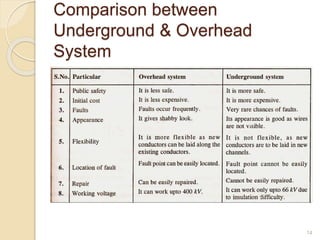
 Comparison between Underground & Overhead
System
 Advantages and disadvantages of cable
2
Underground cables
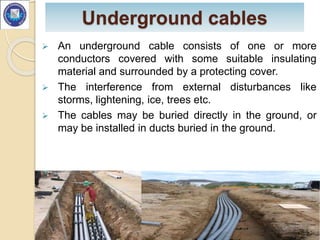
 An underground cable consists of one or more
conductors covered with some suitable insulating
material and surrounded by a protecting cover.
 The interference from external disturbances like
storms, lightening, ice, trees etc.
 The cables may be buried directly in the ground, or
may be installed in ducts buried in the ground.
3
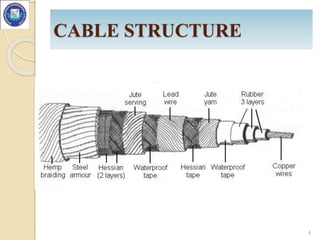
CABLE STRUCTURE
4
Construction of Cables
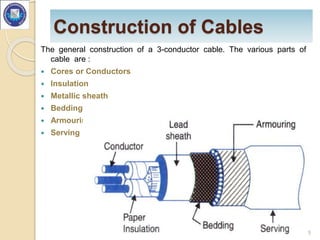
The general construction of a 3-conductor cable. The various parts of
cable are :
 Cores or Conductors
 Insulation
 Metallic sheath
 Bedding
 Armouring
 Serving
5
CLSSIFICATION OF CABLES
 Low tension (L.T)  up to 1000V
 High tension (H.T)  up to 11, 000V
 Super tension (S.T)  from 22KV to 33KV
 Extra high tension (E.H.T) cables  from 33KV to
66KV
 Extra super voltage cables beyond 132KV
6
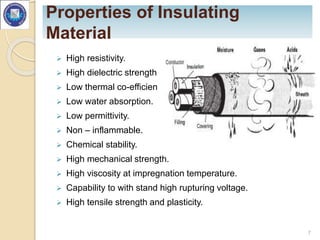
Properties of Insulating
Material
 High resistivity.
 High dielectric strength.
 Low thermal co-efficient.
 Low water absorption.
 Low permittivity.
 Non – inflammable.
 Chemical stability.
 High mechanical strength.
 High viscosity at impregnation temperature.
 Capability to with stand high rupturing voltage.
 High tensile strength and plasticity.
7
Insulating Materials for Cables
• Rubber
It can be obtained from milky sap of tropical trees or
from oil products.
It has the dielectric strength of 30 KV/mm.
Insulation resistivity of 10 exp 17 ohm.cm
Relative permittivity varying between 2 and 3.
They readily absorbs moisture, soft and liable to
damage due to rough handling and ages when exposed
to light.
Maximum safe temperature is very low about 38 C
8
Insulating Materials for Cables
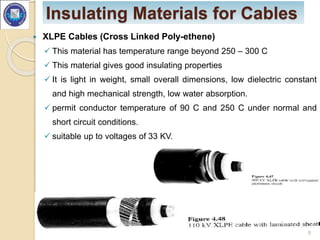
 XLPE Cables (Cross Linked Poly-ethene)
 This material has temperature range beyond 250 – 300 C
 This material gives good insulating properties
 It is light in weight, small overall dimensions, low dielectric constant
and high mechanical strength, low water absorption.
 permit conductor temperature of 90 C and 250 C under normal and
short circuit conditions.
 suitable up to voltages of 33 KV.
9
Insulating Materials for Cables
 Rubber
 XLPE cable
 Vulcanized India Rubber
 Impregnated Paper
 Varnished Cambric
 Polyvinyl chloride (PVC)
10
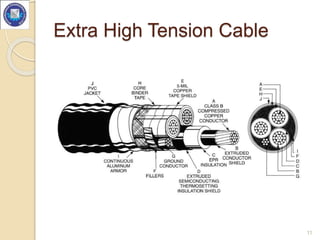
Extra High Tension Cable
11
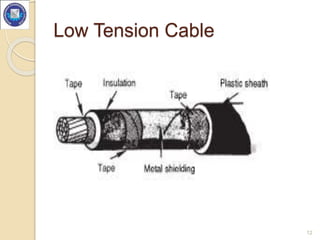
Low Tension Cable
12
3- Core belted
Cable
13
3- Core
Cables
(H-Type)
3- Core Cables
(S.L. Type)
Comparison between
Underground & Overhead
System
14
Advantages & Disadvantages
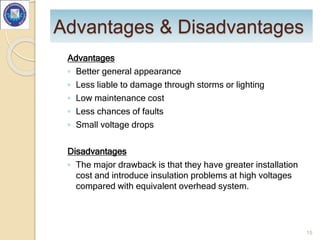
Advantages
◦ Better general appearance
◦ Less liable to damage through storms or lighting
◦ Low maintenance cost
◦ Less chances of faults
◦ Small voltage drops
Disadvantages
◦ The major drawback is that they have greater installation
cost and introduce insulation problems at high voltages
compared with equivalent overhead system.
15
THANKS TO ALL
16

UNDERGROUND CABLES PRESENTATION

  • 1.
    Underground cables Presented By:-PANKAJKUMAR Regd No.-1401316104 Department :-EEE BEC,BBSR-752054 Guided by-Prof. Pabitra Mohan Dash (HOD,EEE)
  • 2.
    Contents  Introduction ofUnderground cables  Cable structure  Construction of cables  Classification of cables  Properties of Insulating Material  Insulating materials for cables  Comparison between Underground & Overhead System  Advantages and disadvantages of cable 2
  • 3.
    Underground cables  Anunderground cable consists of one or more conductors covered with some suitable insulating material and surrounded by a protecting cover.  The interference from external disturbances like storms, lightening, ice, trees etc.  The cables may be buried directly in the ground, or may be installed in ducts buried in the ground. 3
  • 4.
  • 5.
    Construction of Cables Thegeneral construction of a 3-conductor cable. The various parts of cable are :  Cores or Conductors  Insulation  Metallic sheath  Bedding  Armouring  Serving 5
  • 6.
    CLSSIFICATION OF CABLES Low tension (L.T)  up to 1000V  High tension (H.T)  up to 11, 000V  Super tension (S.T)  from 22KV to 33KV  Extra high tension (E.H.T) cables  from 33KV to 66KV  Extra super voltage cables beyond 132KV 6
  • 7.
    Properties of Insulating Material High resistivity.  High dielectric strength.  Low thermal co-efficient.  Low water absorption.  Low permittivity.  Non – inflammable.  Chemical stability.  High mechanical strength.  High viscosity at impregnation temperature.  Capability to with stand high rupturing voltage.  High tensile strength and plasticity. 7
  • 8.
    Insulating Materials forCables • Rubber It can be obtained from milky sap of tropical trees or from oil products. It has the dielectric strength of 30 KV/mm. Insulation resistivity of 10 exp 17 ohm.cm Relative permittivity varying between 2 and 3. They readily absorbs moisture, soft and liable to damage due to rough handling and ages when exposed to light. Maximum safe temperature is very low about 38 C 8
  • 9.
    Insulating Materials forCables  XLPE Cables (Cross Linked Poly-ethene)  This material has temperature range beyond 250 – 300 C  This material gives good insulating properties  It is light in weight, small overall dimensions, low dielectric constant and high mechanical strength, low water absorption.  permit conductor temperature of 90 C and 250 C under normal and short circuit conditions.  suitable up to voltages of 33 KV. 9
  • 10.
    Insulating Materials forCables  Rubber  XLPE cable  Vulcanized India Rubber  Impregnated Paper  Varnished Cambric  Polyvinyl chloride (PVC) 10
  • 11.
  • 12.
  • 13.
    3- Core belted Cable 13 3-Core Cables (H-Type) 3- Core Cables (S.L. Type)
  • 14.
  • 15.
    Advantages & Disadvantages Advantages ◦Better general appearance ◦ Less liable to damage through storms or lighting ◦ Low maintenance cost ◦ Less chances of faults ◦ Small voltage drops Disadvantages ◦ The major drawback is that they have greater installation cost and introduce insulation problems at high voltages compared with equivalent overhead system. 15
  • 16.