UNCCD
Source-
https://www.unccd.int/
 Established in 1994, the United Nations Convention to Combat
Desertification (UNCCD) is the sole legally binding international
agreement linking environment and development to sustainable land
management.
 The Convention addresses specifically the arid, semi-arid and dry sub-
humid areas, known as the drylands, where some of the most
vulnerable ecosystems and peoples can be found.
 The Convention’s 197 parties work together to improve the living
conditions for people in drylands, to maintain and restore land and soil
productivity, and to mitigate the effects of drought.
 UNCCD collaborates closely with the other two Rio Conventions; the
Convention on Biological Diversity (CBD) and the United Nations
Framework Convention on Climate Change (UNFCCC), to meet these
complex challenges with an integrated approach and the best possible
use of natural resources.
 Desertification is “land degradation in arid, semi-arid, and dry sub-
humid areas resulting from various factors, including climatic
variations and human activities.”
UNCCD HISTORY
 In 1977 the United Nations Conference on Desertification
(UNCOD) adopted a Plan of Action to Combat
Desertification (PACD).
 The Rio Conference(1992) called on the United Nations
General Assembly to establish an Intergovernmental
Negotiating Committee (INCD) to prepare, by June 1994,
a Convention to Combat Desertification, particularly in
Africa.
 the Committee completed its negotiations in five sessions.
The Convention was adopted in Paris on 17 June 1994 and
entered into force on 26 December 1996, 90 days after the
50th ratification was received.
 The Conference of the Parties (COP), which is the
Convention's supreme governing body, held its first session
in October 1997 in Rome, Italy.
 Secretariat located in Bonn, Germany since1999.
THE CONFERENCE OF THE PARTIES (COP)
 The COP was established by the Convention as the supreme
decision-making body.
 It comprises ratifying governments and regional economic
integration organizations, such as the European Union.
 To date, the COP had held fourteen sessions; it has been
meeting biennially since 2001.
 COP14 took place in 2019 in New Delhi, India.
 One of the main functions of the COP is to review reports
submitted by the Parties detailing how they are carrying out
their commitments.
 The COP makes recommendations on the basis of these reports.
It also has the power to make amendments to the Convention or
to adopt new annexes, such as additional regional
implementation annexes.
THE REGIONS
 Five world regions –
 Africa, Asia, Latin America and the Caribbean (LAC), Northern
Mediterranean, Central and Eastern Europe
 They have the important job of deciding how to implement
the (UNCCD).
 The Convention Text includes five annexes, which each concern
one of these world regions and focus on following themes-
1. Desertification monitoring and assessment
2. Agroforestry and soil conservation
3. Rangeland management and fixation of shifting sand dunes
4. Water resources management for arid-land agriculture
5. Strengthening capacities for drought impact mitigation and
combating desertification
6. Assistance for the implementation of integrated local area
development programs (LADPs)
INDIA
 India became a signatory to the UNCCD on 14th October
1994 and it came into effect on 17th March 1997.
 The Ministry of Environment and Forests, as the National
Focal Point for the implementation of the Convention,
initiated the process of preparation of National Action
Program through the setting up of a High-Level Inter-
Sectoral National Steering Committee (NSC) in July 1999.
 The NSC decided to constitute four Working Groups (WG)
on various issues relevant to desertification.
 These are:
1. WG#1- Desertification Monitoring and Assessment,
2. WG#2- Sustainable Land Use Practices for Combating
Desertification,
3. WG# 3 - Local Area Development Program, and
4. WG# 4 - Policy and Institutional Issues.
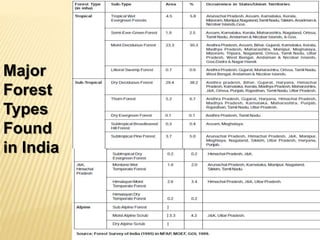
Major
Forest
Types
Found
in India
COP-14 INDIA
 The UNCCD COP 14 ended on 13 September 2019 at India Expo Mart in Greater
Noida.
 The theme of the Conference was ‘Restore land, Sustain future’
 The Conference adopted the Delhi Declaration in which parties expressed
commitment for a range of issues, including gender and health, ecosystem
restoration, taking action on climate change, private sector engagement, Peace
Forest Initiative and recovery of 26 million hectares of degraded land in India.
 Welcomed the United Nations Decade on Ecosystem Restoration (2021–2030)
 Welcome the various initiatives targeting land degradation neutrality by India such
as Har Khet Ko Pani, More Crop Per Drop, the National Afforestation Program, the
National Rural Employment Guarantee Scheme, Pradhan Mantri Krishi Sinchayee
Yojna, Rashtriya Krishi Vikas Yojana and the Soil Health Card Scheme.
 India called upon the leadership of UNCCD to conceive a global water action
agenda which is central to the Land Degradation Neutrality strategy.
• Peace Forest Initiative: It is an initiative of South Korea to use ecological
restoration as a peace-building process. It aims at addressing the issue of land
degradation in conflict-torn border areas and would go a long way in alleviating
tensions and building trust between communities living there and between enemy
countries in particular.
• Drought Toolbox: It is launched as a one-stop-shop for all actions on drought. It is
a sort of knowledge bank which contains tools that strengthen the ability of countries
to anticipate and prepare for drought effectively and mitigate their impacts as well as
tools that enable communities to anticipate and find the land management tools that
help them to build resilience to drought.
• International coalition for action on Sand and Dust storms (SDS): The coalition
will develop an SDS source base map with the goal of improving monitoring and
response to these storms.
• Initiative of Sustainability, Stability and Security (3S): Launched by 14 African
countries to address migration driven by land degradation. It aims at restoring land
and creating green jobs for migrants and vulnerable groups.
• Cooperation From Youth: The global Youth Caucus on Desertification and
Land convened its first official gathering in conjunction with the COP14 to bring
together youth advocates from different parts of the world, to build their capacity,
share knowledge, build networks and to engage them meaningfully in the UNCCD
processes.
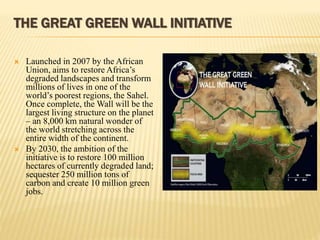
THE GREAT GREEN WALL INITIATIVE
 Launched in 2007 by the African
Union, aims to restore Africa’s
degraded landscapes and transform
millions of lives in one of the
world’s poorest regions, the Sahel.
Once complete, the Wall will be the
largest living structure on the planet
– an 8,000 km natural wonder of
the world stretching across the
entire width of the continent.
 By 2030, the ambition of the
initiative is to restore 100 million
hectares of currently degraded land;
sequester 250 million tons of
carbon and create 10 million green
jobs.

Unccd

  • 1.
  • 2.
     Established in1994, the United Nations Convention to Combat Desertification (UNCCD) is the sole legally binding international agreement linking environment and development to sustainable land management.  The Convention addresses specifically the arid, semi-arid and dry sub- humid areas, known as the drylands, where some of the most vulnerable ecosystems and peoples can be found.  The Convention’s 197 parties work together to improve the living conditions for people in drylands, to maintain and restore land and soil productivity, and to mitigate the effects of drought.  UNCCD collaborates closely with the other two Rio Conventions; the Convention on Biological Diversity (CBD) and the United Nations Framework Convention on Climate Change (UNFCCC), to meet these complex challenges with an integrated approach and the best possible use of natural resources.  Desertification is “land degradation in arid, semi-arid, and dry sub- humid areas resulting from various factors, including climatic variations and human activities.”
  • 3.
    UNCCD HISTORY  In1977 the United Nations Conference on Desertification (UNCOD) adopted a Plan of Action to Combat Desertification (PACD).  The Rio Conference(1992) called on the United Nations General Assembly to establish an Intergovernmental Negotiating Committee (INCD) to prepare, by June 1994, a Convention to Combat Desertification, particularly in Africa.  the Committee completed its negotiations in five sessions. The Convention was adopted in Paris on 17 June 1994 and entered into force on 26 December 1996, 90 days after the 50th ratification was received.  The Conference of the Parties (COP), which is the Convention's supreme governing body, held its first session in October 1997 in Rome, Italy.  Secretariat located in Bonn, Germany since1999.
  • 4.
    THE CONFERENCE OFTHE PARTIES (COP)  The COP was established by the Convention as the supreme decision-making body.  It comprises ratifying governments and regional economic integration organizations, such as the European Union.  To date, the COP had held fourteen sessions; it has been meeting biennially since 2001.  COP14 took place in 2019 in New Delhi, India.  One of the main functions of the COP is to review reports submitted by the Parties detailing how they are carrying out their commitments.  The COP makes recommendations on the basis of these reports. It also has the power to make amendments to the Convention or to adopt new annexes, such as additional regional implementation annexes.
  • 5.
    THE REGIONS  Fiveworld regions –  Africa, Asia, Latin America and the Caribbean (LAC), Northern Mediterranean, Central and Eastern Europe  They have the important job of deciding how to implement the (UNCCD).  The Convention Text includes five annexes, which each concern one of these world regions and focus on following themes- 1. Desertification monitoring and assessment 2. Agroforestry and soil conservation 3. Rangeland management and fixation of shifting sand dunes 4. Water resources management for arid-land agriculture 5. Strengthening capacities for drought impact mitigation and combating desertification 6. Assistance for the implementation of integrated local area development programs (LADPs)
  • 6.
    INDIA  India becamea signatory to the UNCCD on 14th October 1994 and it came into effect on 17th March 1997.  The Ministry of Environment and Forests, as the National Focal Point for the implementation of the Convention, initiated the process of preparation of National Action Program through the setting up of a High-Level Inter- Sectoral National Steering Committee (NSC) in July 1999.  The NSC decided to constitute four Working Groups (WG) on various issues relevant to desertification.  These are: 1. WG#1- Desertification Monitoring and Assessment, 2. WG#2- Sustainable Land Use Practices for Combating Desertification, 3. WG# 3 - Local Area Development Program, and 4. WG# 4 - Policy and Institutional Issues.
  • 7.
  • 8.
    COP-14 INDIA  TheUNCCD COP 14 ended on 13 September 2019 at India Expo Mart in Greater Noida.  The theme of the Conference was ‘Restore land, Sustain future’  The Conference adopted the Delhi Declaration in which parties expressed commitment for a range of issues, including gender and health, ecosystem restoration, taking action on climate change, private sector engagement, Peace Forest Initiative and recovery of 26 million hectares of degraded land in India.  Welcomed the United Nations Decade on Ecosystem Restoration (2021–2030)  Welcome the various initiatives targeting land degradation neutrality by India such as Har Khet Ko Pani, More Crop Per Drop, the National Afforestation Program, the National Rural Employment Guarantee Scheme, Pradhan Mantri Krishi Sinchayee Yojna, Rashtriya Krishi Vikas Yojana and the Soil Health Card Scheme.  India called upon the leadership of UNCCD to conceive a global water action agenda which is central to the Land Degradation Neutrality strategy.
  • 9.
    • Peace ForestInitiative: It is an initiative of South Korea to use ecological restoration as a peace-building process. It aims at addressing the issue of land degradation in conflict-torn border areas and would go a long way in alleviating tensions and building trust between communities living there and between enemy countries in particular. • Drought Toolbox: It is launched as a one-stop-shop for all actions on drought. It is a sort of knowledge bank which contains tools that strengthen the ability of countries to anticipate and prepare for drought effectively and mitigate their impacts as well as tools that enable communities to anticipate and find the land management tools that help them to build resilience to drought. • International coalition for action on Sand and Dust storms (SDS): The coalition will develop an SDS source base map with the goal of improving monitoring and response to these storms. • Initiative of Sustainability, Stability and Security (3S): Launched by 14 African countries to address migration driven by land degradation. It aims at restoring land and creating green jobs for migrants and vulnerable groups. • Cooperation From Youth: The global Youth Caucus on Desertification and Land convened its first official gathering in conjunction with the COP14 to bring together youth advocates from different parts of the world, to build their capacity, share knowledge, build networks and to engage them meaningfully in the UNCCD processes.
  • 10.
    THE GREAT GREENWALL INITIATIVE  Launched in 2007 by the African Union, aims to restore Africa’s degraded landscapes and transform millions of lives in one of the world’s poorest regions, the Sahel. Once complete, the Wall will be the largest living structure on the planet – an 8,000 km natural wonder of the world stretching across the entire width of the continent.  By 2030, the ambition of the initiative is to restore 100 million hectares of currently degraded land; sequester 250 million tons of carbon and create 10 million green jobs.