Multilateral Environmental
agreements
Presented by
Kiran shehzadi
Fareeha sajjad
Aima shehbaz
Mehrunisa
Hafiz Waqas
Ramsha Asif
Scheme of presentation
• Brief Introduction of MEA’s
• History of MEA’s
• Milestones of MEA’s
• Objectives of MEA’s
• Main clusters- Scope of MEA’s
• Implementation of MEA’s
• MEA’s ratified by Pakistan
• Conclusion
What are Multilateral Environmental Agreements? (MEAs)
• They have a goal of environmental protection (sustainable development);
• They take measures to remedy, mitigate or otherwise deal with global
and/or regional environmental concerns;
• The best known MEA are those that deals with global problems,
• They are governed by international law;
• They are concluded in written form.
Objectives of MEAs
• To Protecting Public Health and the Environment
• To ensure global sustainability
• Solidarity
• Financial Assistance
• Confining Environmental Problems
History Of MEAs
• Sweden first suggested to ECOSOC in 1968 the idea
of having a UN conference to focus on human
interactions with the environment
• ECOSOC passed resolution 1346 supporting the idea.
8
Milestones in the evolution of MEAs
• Stockholm Conference on the Human Development
(1972):
– first attempt to address inter-relationships of environment and
development at global level
– established the United National Environmental Program (UNEP)
– accelerated development of modern MEAs: more than 60% of
existing MEAs are adopted after Rio
• The 1992 United Nations Conference on Environment and
Development (UNCED):
– national and international policies redirected towards integration
of environmental, economic and development objectives
– Agenda 21 and Rio Declaration adopted
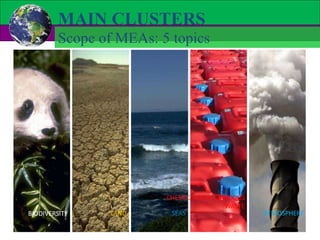
ATMOSPHERESEAS
CHEMICALS & HAZARDOUS
WASTE
LAND
MAIN CLUSTERS
Scope of MEAs: 5 topics
BIODIVERSITY
MAIN CLUSTERS
Biodiversity / Land / Seas
MEAs related to protection and conservation of BIODIVERSITY.
MEAs focusing on protecting LAND from “negative altering”.
MEAs relevant to the regional seas & MARINE ENVIRONMENT.
 Convention on Biological Diversity (CBD);
 Others include CITES, CMS, Ramsar Convention on Wetlands etc.
 UN Convention to Combat Desertification (UNCCD);
3 Rio Conventions linked to climate change and biodiversity.
17 Regional Seas Conventions;
 Global Program of Action for the protection of the marine environment
from land-based activities (GPA).
MAIN CLUSTERS
Atmosphere / Wastes & chemicals
MEAs aimed at protection of the ATMOSPHERE from pollutants.
 Montreal Protocol on substances that deplete the ozone layer;
UNFCCC (UN Framework Convention on Climate Change) and the linked
Kyoto Protocol.
MEAs dealing with hazardous WASTES & CHEMICAL pollution.
 Basel Convention on the control of trans boundary movement of
hazardous wastes and their disposal;
 Stockholm Convention on Persistent Organic Pollutants (POPs).
Implementation of MEAs
• Governments and regional organizations have
taken on a series of international commitments by signing and
ratifying MEAs.
• Efforts need to be made to apply these norms and to employ
practices that result in environmental improvements
• All MEAs differ in scope and substance. Nevertheless, they tend to
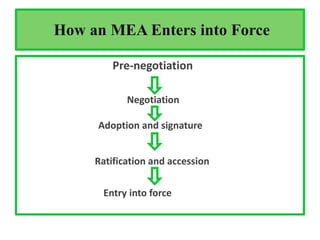
be formulated through a similar process that moves through five
distinct stages
How an MEA Enters into Force
Pre-negotiation
Negotiation
Adoption and signature
Ratification and accession
Entry into force
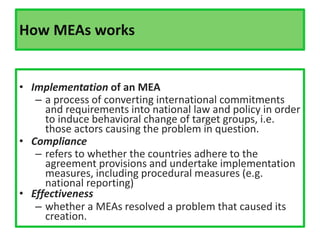
How MEAs works
• Implementation of an MEA
– a process of converting international commitments
and requirements into national law and policy in order
to induce behavioral change of target groups, i.e.
those actors causing the problem in question.
• Compliance
– refers to whether the countries adhere to the
agreement provisions and undertake implementation
measures, including procedural measures (e.g.
national reporting)
• Effectiveness
– whether a MEAs resolved a problem that caused its
creation.
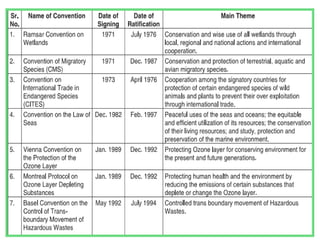
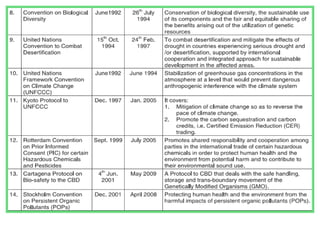
List of International Environment
Conventions/Protocols Signed and
Ratified by Pakistan
Conclusion:
• MEA’s helps to address the
environmental problems being faced by
the international community
• MEA’s helps to facilitate achieving
sustainable development.
• Many MEA’s ( CBD, UNFCCC, UNCCD)
covers environmental aspects (
biodiversity, climate change and land
management) to ensure the protection of
environment in sustainable way.
Cont ..
Pakistan is also giving
greater emphasis on
implementing MEA’s by:
 Educating general
public
 Coordinating with
implementing agencies
International partnership

What are multilateral environmental agreements

  • 1.
  • 2.
    Presented by Kiran shehzadi Fareehasajjad Aima shehbaz Mehrunisa Hafiz Waqas Ramsha Asif
  • 3.
    Scheme of presentation •Brief Introduction of MEA’s • History of MEA’s • Milestones of MEA’s • Objectives of MEA’s • Main clusters- Scope of MEA’s • Implementation of MEA’s • MEA’s ratified by Pakistan • Conclusion
  • 4.
    What are MultilateralEnvironmental Agreements? (MEAs) • They have a goal of environmental protection (sustainable development); • They take measures to remedy, mitigate or otherwise deal with global and/or regional environmental concerns; • The best known MEA are those that deals with global problems,
  • 5.
    • They aregoverned by international law; • They are concluded in written form.
  • 6.
    Objectives of MEAs •To Protecting Public Health and the Environment • To ensure global sustainability • Solidarity • Financial Assistance • Confining Environmental Problems
  • 7.
    History Of MEAs •Sweden first suggested to ECOSOC in 1968 the idea of having a UN conference to focus on human interactions with the environment • ECOSOC passed resolution 1346 supporting the idea.
  • 8.
    8 Milestones in theevolution of MEAs • Stockholm Conference on the Human Development (1972): – first attempt to address inter-relationships of environment and development at global level – established the United National Environmental Program (UNEP) – accelerated development of modern MEAs: more than 60% of existing MEAs are adopted after Rio • The 1992 United Nations Conference on Environment and Development (UNCED): – national and international policies redirected towards integration of environmental, economic and development objectives – Agenda 21 and Rio Declaration adopted
  • 9.
    ATMOSPHERESEAS CHEMICALS & HAZARDOUS WASTE LAND MAINCLUSTERS Scope of MEAs: 5 topics BIODIVERSITY
  • 10.
    MAIN CLUSTERS Biodiversity /Land / Seas MEAs related to protection and conservation of BIODIVERSITY. MEAs focusing on protecting LAND from “negative altering”. MEAs relevant to the regional seas & MARINE ENVIRONMENT.  Convention on Biological Diversity (CBD);  Others include CITES, CMS, Ramsar Convention on Wetlands etc.  UN Convention to Combat Desertification (UNCCD); 3 Rio Conventions linked to climate change and biodiversity. 17 Regional Seas Conventions;  Global Program of Action for the protection of the marine environment from land-based activities (GPA).
  • 11.
    MAIN CLUSTERS Atmosphere /Wastes & chemicals MEAs aimed at protection of the ATMOSPHERE from pollutants.  Montreal Protocol on substances that deplete the ozone layer; UNFCCC (UN Framework Convention on Climate Change) and the linked Kyoto Protocol. MEAs dealing with hazardous WASTES & CHEMICAL pollution.  Basel Convention on the control of trans boundary movement of hazardous wastes and their disposal;  Stockholm Convention on Persistent Organic Pollutants (POPs).
  • 12.
    Implementation of MEAs •Governments and regional organizations have taken on a series of international commitments by signing and ratifying MEAs. • Efforts need to be made to apply these norms and to employ practices that result in environmental improvements • All MEAs differ in scope and substance. Nevertheless, they tend to be formulated through a similar process that moves through five distinct stages
  • 13.
    How an MEAEnters into Force Pre-negotiation Negotiation Adoption and signature Ratification and accession Entry into force
  • 14.
    How MEAs works •Implementation of an MEA – a process of converting international commitments and requirements into national law and policy in order to induce behavioral change of target groups, i.e. those actors causing the problem in question. • Compliance – refers to whether the countries adhere to the agreement provisions and undertake implementation measures, including procedural measures (e.g. national reporting) • Effectiveness – whether a MEAs resolved a problem that caused its creation.
  • 15.
    List of InternationalEnvironment Conventions/Protocols Signed and Ratified by Pakistan
  • 18.
    Conclusion: • MEA’s helpsto address the environmental problems being faced by the international community • MEA’s helps to facilitate achieving sustainable development. • Many MEA’s ( CBD, UNFCCC, UNCCD) covers environmental aspects ( biodiversity, climate change and land management) to ensure the protection of environment in sustainable way.
  • 19.
    Cont .. Pakistan isalso giving greater emphasis on implementing MEA’s by:  Educating general public  Coordinating with implementing agencies International partnership