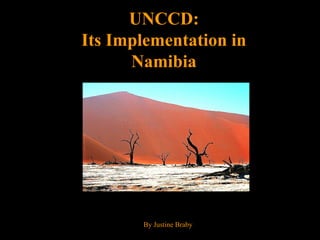
UNCCD:UNCCD:
Its Implementation inIts Implementation in
NamibiaNamibia
By Justine Braby
WHAT IS DESERTIFICATION?WHAT IS DESERTIFICATION?
“…means land degradation in arid, semi-arid and dry sub-humid areas
resulting from various factors, including climatic variations and
human activities” (UNCCD, Article 1(a))
Land Degradation meaning the loss of biological or economic productivity in
various areas (e.g. woodland) from a process or combination of processes,
including processes arising from anthropogenic activity, such as
 Soil erosion caused by wind or water
 Deterioration of the chemical, physical and biological components of the soil
 Long-term loss of natural vegetation
The United Nations Convention to
Combat Desertification in countries
experiencing drought and/or
desertification, particularly in Africa
1. Problem
2. Background
3. Formalities
4. Objectives
5. Modalities
6. Institutions
7. Related Conventions
8. Potential benefits from becoming a party
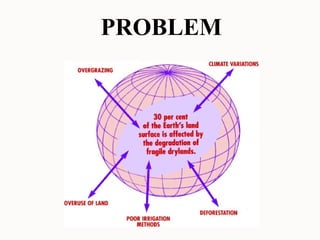
PROBLEM
BACKGROUND: The road to
Paris
 Sahelian Drought and famine 1968- 1974 200 000 people and
millions of animals died
 Plan of Action to Combat Desertification 1977
 Lack of sufficient financial aid and coordination among countries
 1992 Earth Summit: African Countries insist that proper attention
should be given to desertification
 World’s leaders agreed in Agenda 21 to call on the UN General
Assembly to set up convention
 Convention open for signing 1994
Objectives
1. Combat desertification and mitigate the
effects of drought
2. Long-term integration strategies
 Improved productivity of land
 Rehabilitation, conservation and sustainable management of
land and water resources
Formalities
 Open for signature
14- 15 October 1994
in Paris
 Entry into force 90th
day after deposit of
50th
Instrument
 1-4th
COP every year,
after every two years
 Headquarters in Bonn,
Germany
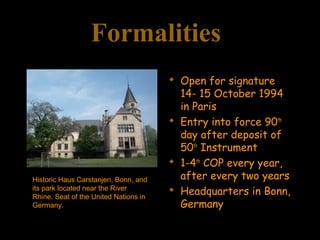
Historic Haus Carstanjen, Bonn, and
its park located near the River
Rhine. Seat of the United Nations in
Germany.
Modalities
 Common obligations of states cooperation, transfer of
knowledge, research, info and technology; capacity and
awareness building, integrated approach to combating
desertification
 Affected countries prepare action programmes
 Developed countries provide financial resources and
facilitate access to technology and know-how
 Report back on measures of convention, progress reports
on their action programmes
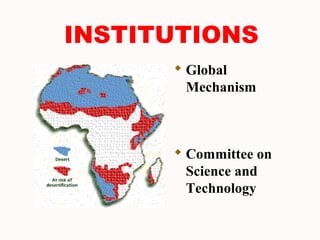
INSTITUTIONS
 Global
Mechanism
 Committee on
Science and
Technology
Related Conventions
UNFCCC, CBD
Encourage joint programmes in
research, training, information
collection and exchange
Potential Benefits
Allow a state to
1. Show solidarity with affected countries in
facing urgent and growing issue of global
dimensions,
2. Benefit from cooperation in designing and
implementing its own programmes
3. Improve access to relevant data and technology
4. Nominate scientists on the roster of experts
(CST)
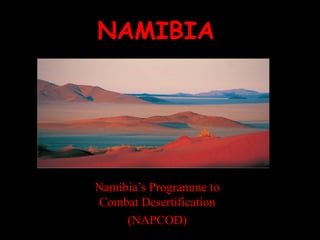
NAMIBIA
Namibia’s Programme to
Combat Desertification
(NAPCOD)
Introduction
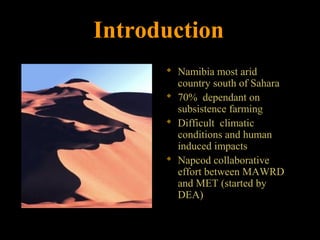
 Namibia most arid
country south of Sahara
 70% dependant on
subsistence farming
 Difficult climatic
conditions and human
induced impacts
 Napcod collaborative
effort between MAWRD
and MET (started by
DEA)
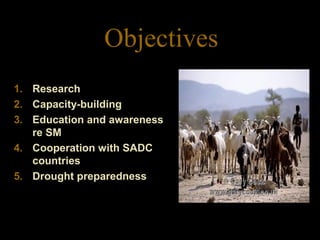
Objectives
1. Research
2. Capacity-building
3. Education and awareness
re SM
4. Cooperation with SADC
countries
5. Drought preparedness
Napcod Process
 Phase 1: 1994 Broad Consultation and
National Workshop
 Phase 2: 1995-1999 Setting up structures
for implementation (planning for Phase 3)
 Phase 3: 1999-2004 Setting up structures
for implementation
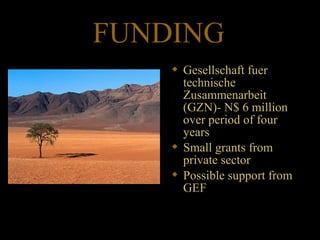
FUNDING
 Gesellschaft fuer
technische
Zusammenarbeit
(GZN)- N$ 6 million
over period of four
years
 Small grants from
private sector
 Possible support from
GEF
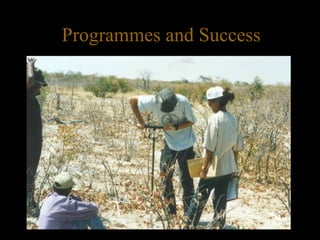
Programmes and Success
 Communications and public awareness
generation
 FIRM
 Partners and information flow
 Indicators
 Education and training
Legislation
 Namibia’s Policy to Combat Desertification
(1994)
 N’s Env Assessment Policy (1995)
 Draft Environmental Management Act (1999)
 Many principles of CCD included
 Policies, while formulated and approved by
parliament, are not implemented, are not backed
by legislation or regulations
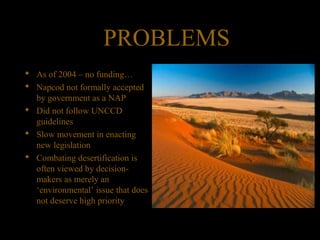
PROBLEMS
 As of 2004 – no funding…
 Napcod not formally accepted
by government as a NAP
 Did not follow UNCCD
guidelines
 Slow movement in enacting
new legislation
 Combating desertification is
often viewed by decision-
makers as merely an
‘environmental’ issue that does
not deserve high priority
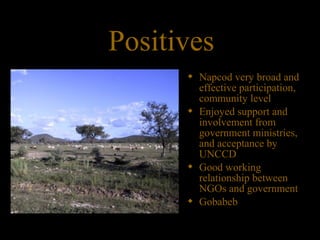
Positives
 Napcod very broad and
effective participation,
community level
 Enjoyed support and
involvement from
government ministries,
and acceptance by
UNCCD
 Good working
relationship between
NGOs and government
 Gobabeb
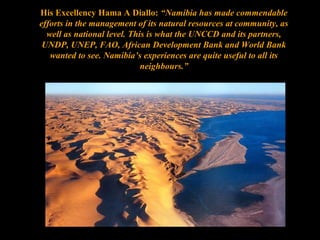
His Excellency Hama A Diallo: “Namibia has made commendable
efforts in the management of its natural resources at community, as
well as national level. This is what the UNCCD and its partners,
UNDP, UNEP, FAO, African Development Bank and World Bank
wanted to see. Namibia’s experiences are quite useful to all its
neighbours.”

UNCCD: Its implementation in Namibia

  • 1.
    UNCCD:UNCCD: Its Implementation inItsImplementation in NamibiaNamibia By Justine Braby
  • 2.
    WHAT IS DESERTIFICATION?WHATIS DESERTIFICATION? “…means land degradation in arid, semi-arid and dry sub-humid areas resulting from various factors, including climatic variations and human activities” (UNCCD, Article 1(a)) Land Degradation meaning the loss of biological or economic productivity in various areas (e.g. woodland) from a process or combination of processes, including processes arising from anthropogenic activity, such as  Soil erosion caused by wind or water  Deterioration of the chemical, physical and biological components of the soil  Long-term loss of natural vegetation
  • 3.
    The United NationsConvention to Combat Desertification in countries experiencing drought and/or desertification, particularly in Africa 1. Problem 2. Background 3. Formalities 4. Objectives 5. Modalities 6. Institutions 7. Related Conventions 8. Potential benefits from becoming a party
  • 4.
  • 5.
    BACKGROUND: The roadto Paris  Sahelian Drought and famine 1968- 1974 200 000 people and millions of animals died  Plan of Action to Combat Desertification 1977  Lack of sufficient financial aid and coordination among countries  1992 Earth Summit: African Countries insist that proper attention should be given to desertification  World’s leaders agreed in Agenda 21 to call on the UN General Assembly to set up convention  Convention open for signing 1994
  • 6.
    Objectives 1. Combat desertificationand mitigate the effects of drought 2. Long-term integration strategies  Improved productivity of land  Rehabilitation, conservation and sustainable management of land and water resources
  • 7.
    Formalities  Open forsignature 14- 15 October 1994 in Paris  Entry into force 90th day after deposit of 50th Instrument  1-4th COP every year, after every two years  Headquarters in Bonn, Germany Historic Haus Carstanjen, Bonn, and its park located near the River Rhine. Seat of the United Nations in Germany.
  • 8.
    Modalities  Common obligationsof states cooperation, transfer of knowledge, research, info and technology; capacity and awareness building, integrated approach to combating desertification  Affected countries prepare action programmes  Developed countries provide financial resources and facilitate access to technology and know-how  Report back on measures of convention, progress reports on their action programmes
  • 9.
  • 10.
    Related Conventions UNFCCC, CBD Encouragejoint programmes in research, training, information collection and exchange
  • 11.
    Potential Benefits Allow astate to 1. Show solidarity with affected countries in facing urgent and growing issue of global dimensions, 2. Benefit from cooperation in designing and implementing its own programmes 3. Improve access to relevant data and technology 4. Nominate scientists on the roster of experts (CST)
  • 12.
  • 13.
    Introduction  Namibia mostarid country south of Sahara  70% dependant on subsistence farming  Difficult climatic conditions and human induced impacts  Napcod collaborative effort between MAWRD and MET (started by DEA)
  • 14.
    Objectives 1. Research 2. Capacity-building 3.Education and awareness re SM 4. Cooperation with SADC countries 5. Drought preparedness
  • 15.
    Napcod Process  Phase1: 1994 Broad Consultation and National Workshop  Phase 2: 1995-1999 Setting up structures for implementation (planning for Phase 3)  Phase 3: 1999-2004 Setting up structures for implementation
  • 16.
    FUNDING  Gesellschaft fuer technische Zusammenarbeit (GZN)-N$ 6 million over period of four years  Small grants from private sector  Possible support from GEF
  • 17.
  • 18.
     Communications andpublic awareness generation  FIRM  Partners and information flow  Indicators  Education and training
  • 19.
    Legislation  Namibia’s Policyto Combat Desertification (1994)  N’s Env Assessment Policy (1995)  Draft Environmental Management Act (1999)  Many principles of CCD included  Policies, while formulated and approved by parliament, are not implemented, are not backed by legislation or regulations
  • 20.
    PROBLEMS  As of2004 – no funding…  Napcod not formally accepted by government as a NAP  Did not follow UNCCD guidelines  Slow movement in enacting new legislation  Combating desertification is often viewed by decision- makers as merely an ‘environmental’ issue that does not deserve high priority
  • 21.
    Positives  Napcod verybroad and effective participation, community level  Enjoyed support and involvement from government ministries, and acceptance by UNCCD  Good working relationship between NGOs and government  Gobabeb
  • 22.
    His Excellency HamaA Diallo: “Namibia has made commendable efforts in the management of its natural resources at community, as well as national level. This is what the UNCCD and its partners, UNDP, UNEP, FAO, African Development Bank and World Bank wanted to see. Namibia’s experiences are quite useful to all its neighbours.”