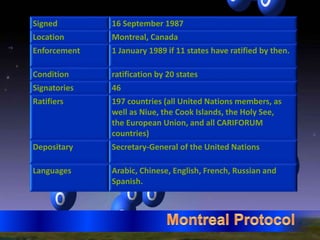
Signed 16 September 1987
Location Montreal, Canada
Enforcement 1 January 1989 if 11 states have ratified by then.
Condition ratification by 20 states
Signatories 46
Ratifiers 197 countries (all United Nations members, as
well as Niue, the Cook Islands, the Holy See,
the European Union, and all CARIFORUM
countries)
Depositary Secretary-General of the United Nations
Languages Arabic, Chinese, English, French, Russian and
Spanish.
o Vienna Convention for the Protection of the
Ozone Layer signed in 1985
o Montreal Protocol adopted in 1987
o 197 countries have signed the Montreal
Protocol including all the CARIFORUM
countries
 shall accept a series of stepped limits on CFC use and production,
including:
• from 1991 to 1992 its levels of consumption and production of the
controlled substances in Group I of Annex A do not exceed 150
percent of its calculated levels of production and consumption of
those substances in 1986;
•from 1994 its calculated level of consumption and production of the
controlled substances in Group I of Annex A does not exceed,
annually, twenty-five percent of its calculated level of consumption
and production in 1986.
•from 1996 its calculated level of consumption and production of the
controlled substances in Group I of Annex A does not exceed zero.
The substances in
Group I of Annex A
are:
CFCl3 (CFC-11)
CF2Cl2 (CFC-12)
C2F3Cl3 (CFC-113)
C2F4Cl2(CFC-114)
C2F5Cl (CFC-115)
Chlorofluorocarbons (CFCs) Phase-out Management Plan
Parties to this Protocol agreed to start reducing
its consumption and production in 2015. The
time of freezing and reducing HCFCs is then
known as 2013/2015.
Hydrochlorofluorocarbons (HCFCs) Phase-out
Management Plan (HPMP)
pose no harm to the ozone layer because, unlike
CFCs and HCFCs, they do not contain chlorine
are greenhouse gases, with a high global warming
potential (GWP), comparable to that of CFCs
and HCFCs
Hydrofluorocarbons (HFCs)
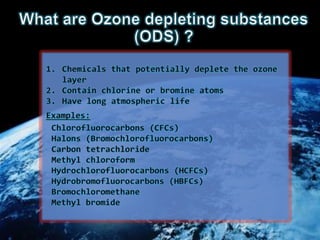
• Halo-carbons
• Carbon tetrachloride
• Methyl chloroform
• Hydrobromofluorocarbons
(HBFCs)
• Hydrochlorofluorocarbons
(HCFCs)
• Methyl bromide (CH3Br)
• Bromochloromethane
(BCM)
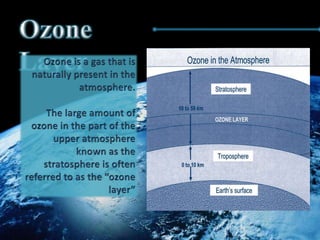
Ozone Layer
 Climate benefits already achieved larger than
Kyoto Protocol targets for 2008-2012
 Potential for additional climate benefits
significant compared to Kyoto
Reason: CFCs, HCFCs are greenhouse gases
 Large GWPs: - CO2 : 1
- CFCs: 4,000 – 11,000
- HCFCs: 700 – 2,300
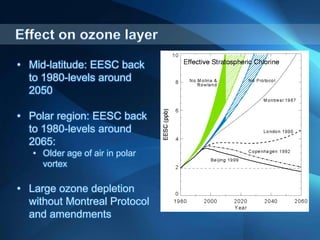
• Mid-latitude: EESC back
to 1980-levels around
2050
• Polar region: EESC back
to 1980-levels around
2065:
• Older age of air in polar
vortex
• Large ozone depletion
without Montreal Protocol
and amendments
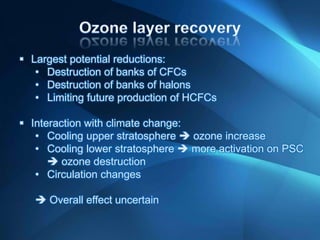
 Largest potential reductions:
• Destruction of banks of CFCs
• Destruction of banks of halons
• Limiting future production of HCFCs
 Interaction with climate change:
• Cooling upper stratosphere  ozone increase
• Cooling lower stratosphere  more activation on PSC
 ozone destruction
• Circulation changes
 Overall effect uncertain
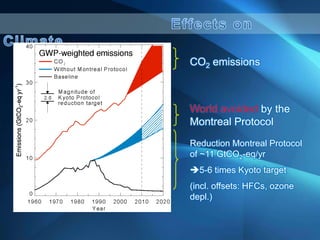
CO2 emissions
World avoided by the
Montreal Protocol
Reduction Montreal Protocol
of ~11 GtCO2-eq/yr
5-6 times Kyoto target
(incl. offsets: HFCs, ozone
depl.)
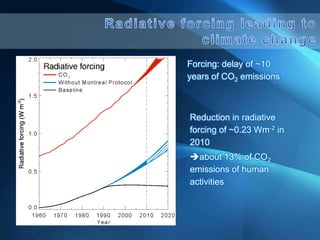
Forcing: delay of ~10
years of CO2 emissions
Reduction in radiative
forcing of ~0.23 Wm-2 in
2010
about 13% of CO2
emissions of human
activities
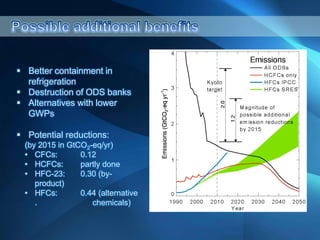
 Better containment in
refrigeration
 Destruction of ODS banks
 Alternatives with lower
GWPs
 Potential reductions:
(by 2015 in GtCO2-eq/yr)
• CFCs: 0.12
• HCFCs: partly done
• HFC-23: 0.30 (by-
product)
• HFCs: 0.44 (alternative
. chemicals)
Results to date
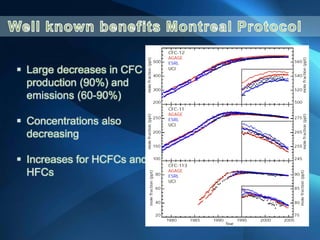
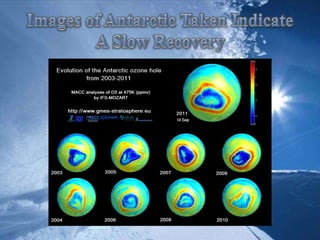
• The Montreal Protocol is working. There is clear
evidence of a decrease in the atmospheric
burden of ozone-depleting substances in the
lower atmosphere and in the stratosphere;
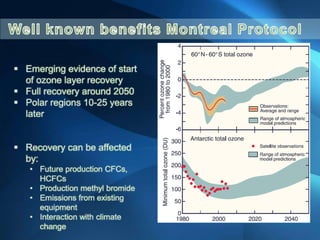
• Some early signs of the expected stratospheric
ozone recovery are also evident.
• Furthermore, if the Parties were to eliminate all
emissions of ozone depleting substances soon, it
would advance by about 15 years (from around
2050 to 2035) the global ozone layer recovery to
pre-1980 levels.
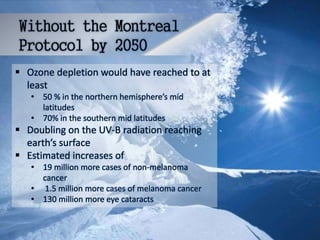
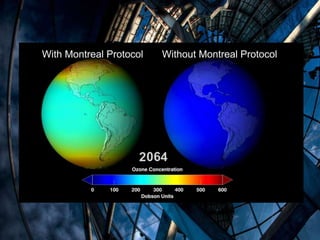
 Ozone depletion would have reached to at
least
• 50 % in the northern hemisphere’s mid
latitudes
• 70% in the southern mid latitudes
 Doubling on the UV-B radiation reaching
earth’s surface
 Estimated increases of
• 19 million more cases of non-melanoma
cancer
• 1.5 million more cases of melanoma cancer
• 130 million more eye cataracts
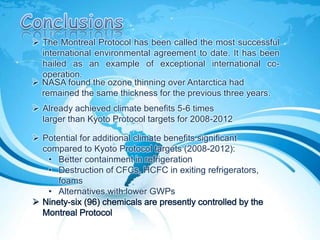
 The Montreal Protocol has been called the most successful
international environmental agreement to date. It has been
hailed as an example of exceptional international co-
operation.
 NASA found the ozone thinning over Antarctica had
remained the same thickness for the previous three years.
 Already achieved climate benefits 5-6 times
larger than Kyoto Protocol targets for 2008-2012
 Potential for additional climate benefits significant
compared to Kyoto Protocol targets (2008-2012):
• Better containment in refrigeration
• Destruction of CFCs, HCFC in exiting refrigerators,
foams
• Alternatives with lower GWPs
Gladys Ruth C.
Paypa
Jenith Abiera
Christan John
Abrenica
Rey Jhon
Guadalquiver
Johayra
Masacal
#ClimateChange

Montreal_protocol_Report

  • 2.
    Signed 16 September1987 Location Montreal, Canada Enforcement 1 January 1989 if 11 states have ratified by then. Condition ratification by 20 states Signatories 46 Ratifiers 197 countries (all United Nations members, as well as Niue, the Cook Islands, the Holy See, the European Union, and all CARIFORUM countries) Depositary Secretary-General of the United Nations Languages Arabic, Chinese, English, French, Russian and Spanish.
  • 5.
    o Vienna Conventionfor the Protection of the Ozone Layer signed in 1985 o Montreal Protocol adopted in 1987 o 197 countries have signed the Montreal Protocol including all the CARIFORUM countries
  • 7.
     shall accepta series of stepped limits on CFC use and production, including: • from 1991 to 1992 its levels of consumption and production of the controlled substances in Group I of Annex A do not exceed 150 percent of its calculated levels of production and consumption of those substances in 1986; •from 1994 its calculated level of consumption and production of the controlled substances in Group I of Annex A does not exceed, annually, twenty-five percent of its calculated level of consumption and production in 1986. •from 1996 its calculated level of consumption and production of the controlled substances in Group I of Annex A does not exceed zero. The substances in Group I of Annex A are: CFCl3 (CFC-11) CF2Cl2 (CFC-12) C2F3Cl3 (CFC-113) C2F4Cl2(CFC-114) C2F5Cl (CFC-115) Chlorofluorocarbons (CFCs) Phase-out Management Plan
  • 8.
    Parties to thisProtocol agreed to start reducing its consumption and production in 2015. The time of freezing and reducing HCFCs is then known as 2013/2015. Hydrochlorofluorocarbons (HCFCs) Phase-out Management Plan (HPMP)
  • 9.
    pose no harmto the ozone layer because, unlike CFCs and HCFCs, they do not contain chlorine are greenhouse gases, with a high global warming potential (GWP), comparable to that of CFCs and HCFCs Hydrofluorocarbons (HFCs)
  • 10.
    • Halo-carbons • Carbontetrachloride • Methyl chloroform • Hydrobromofluorocarbons (HBFCs) • Hydrochlorofluorocarbons (HCFCs) • Methyl bromide (CH3Br) • Bromochloromethane (BCM)
  • 13.
  • 22.
     Climate benefitsalready achieved larger than Kyoto Protocol targets for 2008-2012  Potential for additional climate benefits significant compared to Kyoto Reason: CFCs, HCFCs are greenhouse gases  Large GWPs: - CO2 : 1 - CFCs: 4,000 – 11,000 - HCFCs: 700 – 2,300
  • 23.
    • Mid-latitude: EESCback to 1980-levels around 2050 • Polar region: EESC back to 1980-levels around 2065: • Older age of air in polar vortex • Large ozone depletion without Montreal Protocol and amendments
  • 24.
     Largest potentialreductions: • Destruction of banks of CFCs • Destruction of banks of halons • Limiting future production of HCFCs  Interaction with climate change: • Cooling upper stratosphere  ozone increase • Cooling lower stratosphere  more activation on PSC  ozone destruction • Circulation changes  Overall effect uncertain
  • 25.
    CO2 emissions World avoidedby the Montreal Protocol Reduction Montreal Protocol of ~11 GtCO2-eq/yr 5-6 times Kyoto target (incl. offsets: HFCs, ozone depl.)
  • 26.
    Forcing: delay of~10 years of CO2 emissions Reduction in radiative forcing of ~0.23 Wm-2 in 2010 about 13% of CO2 emissions of human activities
  • 27.
     Better containmentin refrigeration  Destruction of ODS banks  Alternatives with lower GWPs  Potential reductions: (by 2015 in GtCO2-eq/yr) • CFCs: 0.12 • HCFCs: partly done • HFC-23: 0.30 (by- product) • HFCs: 0.44 (alternative . chemicals)
  • 29.
    Results to date •The Montreal Protocol is working. There is clear evidence of a decrease in the atmospheric burden of ozone-depleting substances in the lower atmosphere and in the stratosphere; • Some early signs of the expected stratospheric ozone recovery are also evident. • Furthermore, if the Parties were to eliminate all emissions of ozone depleting substances soon, it would advance by about 15 years (from around 2050 to 2035) the global ozone layer recovery to pre-1980 levels.
  • 30.
     Ozone depletionwould have reached to at least • 50 % in the northern hemisphere’s mid latitudes • 70% in the southern mid latitudes  Doubling on the UV-B radiation reaching earth’s surface  Estimated increases of • 19 million more cases of non-melanoma cancer • 1.5 million more cases of melanoma cancer • 130 million more eye cataracts
  • 33.
     The MontrealProtocol has been called the most successful international environmental agreement to date. It has been hailed as an example of exceptional international co- operation.  NASA found the ozone thinning over Antarctica had remained the same thickness for the previous three years.  Already achieved climate benefits 5-6 times larger than Kyoto Protocol targets for 2008-2012  Potential for additional climate benefits significant compared to Kyoto Protocol targets (2008-2012): • Better containment in refrigeration • Destruction of CFCs, HCFC in exiting refrigerators, foams • Alternatives with lower GWPs
  • 34.
    Gladys Ruth C. Paypa JenithAbiera Christan John Abrenica Rey Jhon Guadalquiver Johayra Masacal #ClimateChange