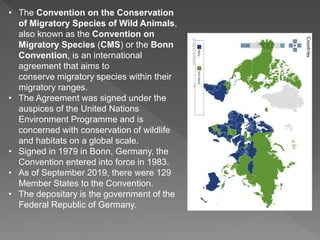
• The Convention on the Conservation
of Migratory Species of Wild Animals,
also known as the Convention on
Migratory Species (CMS) or the Bonn
Convention, is an international
agreement that aims to
conserve migratory species within their
migratory ranges.
• The Agreement was signed under the
auspices of the United Nations
Environment Programme and is
concerned with conservation of wildlife
and habitats on a global scale.
• Signed in 1979 in Bonn, Germany, the
Convention entered into force in 1983.
• As of September 2019, there were 129
Member States to the Convention.
• The depositary is the government of the
Federal Republic of Germany.
 Appendix I – Endangered migratory species
 Appendix I comprises migratory species that have been
assessed as being in danger of extinction throughout all or
a significant portion of their range.
 The Conference of the Parties has further interpreted the
term “endangered” as meaning “facing a very high risk of
extinction in the wild in the near future”
 Parties that are a Range State to a migratory species listed
in Appendix I shall endeavor to strictly protect them by:
 prohibiting the taking of such species, with very restricted
scope for exceptions; conserving and where appropriate
restoring their habitats; preventing, removing or mitigating
obstacles to their migration and controlling other factors
that might endanger them.
 Appendix II - Migratory species conserved
through Agreements
 Appendix II covers migratory species that have an
unfavourable conservation status and that require
international agreements for their conservation and
management, as well as those that have a conservation
status which would significantly benefit from the international
cooperation that could be achieved by an international
agreement.
 The Agreements may vary from legally binding treaties to less
formal instruments, such as Memoranda of
Understanding, Action Plans or Species Initiatives, covering
to the extent possible the entire migratory range of the
species concerned.
 Appendices I and II may be amended at any meeting of the
Conference of the Parties.
 The Conference of the Parties (COP) is the principal decision
making body of the Convention.
 It meets once every three years and sets the budget and
priorities of the following three years (the triennium).
 All the Parties are entitled to attend the Conference and
participate in the votes. Non-Party States are entitled to send
observers.
 There have been 13 meetings of the Conference of the Parties
so far.
 The first COP in 1985 established a Standing Committee, whose
task is to oversee the running of the Convention and the
Secretariat between sessions of the COP.
 Its membership comprises the elected regional representatives
of the Parties, plus the Depositary Government (Germany) and
the Host Governments of the previous and next COPs.
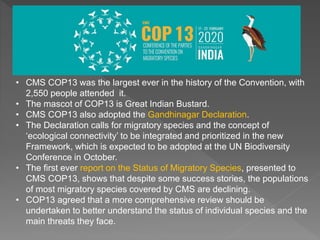
• CMS COP13 was the largest ever in the history of the Convention, with
2,550 people attended it.
• The mascot of COP13 is Great Indian Bustard.
• CMS COP13 also adopted the Gandhinagar Declaration.
• The Declaration calls for migratory species and the concept of
‘ecological connectivity’ to be integrated and prioritized in the new
Framework, which is expected to be adopted at the UN Biodiversity
Conference in October.
• The first ever report on the Status of Migratory Species, presented to
CMS COP13, shows that despite some success stories, the populations
of most migratory species covered by CMS are declining.
• COP13 agreed that a more comprehensive review should be
undertaken to better understand the status of individual species and the
main threats they face.
The COP also agreed on a number of cross-cutting
policy measures to address threats to migratory
species:
 Integrate biodiversity and migratory species considerations into
national energy and climate policy and promote wildlife-friendly
renewable energy;
 Strengthen initiatives to combat the illegal killing, taking and trade of
migratory birds;
 Mitigate the impacts of linear infrastructure such as roads and
railways on migratory species;
 Address the unsustainable use of aquatic wild meat;
 Undertake a review of bycatch levels of sharks and rays, and further
implement bycatch mitigation measures for marine mammals in
national fishing operations;
 Deepen our understanding of the importance of animal culture and
social complexity for the conservation of endangered species;
 To investigate possible trade in CMS Appendix I species and the
implications for their conservation status.
• Three CMS Ambassadors - for terrestrial, avian, and aquatic species -
were named at the re-launch of the CMS Ambassadors Programme: the
internationally renowned conservationist Ian Redmond OBE (for terrestrial), award-
winning explorer and environmentalist Sacha Dench (for avian), and Indian actor
and environmental activist Randeep Hooda (for aquatic). They will help raise
awareness about the important work of CMS and the plight of migratory species.
• Seven Migratory Species Champions were recognized. Under the
Champion Program, Germany, India, Italy, Monaco, Norway, the European
Commission, and the Environment Agency – Abu Dhabi were acknowledged for
their generous contributions to CMS initiatives. These range from wildlife
conservation in Africa to the implementation of measures to preserve marine life.
• This was the first CMS COP to be inaugurated by a host-country Head of
Government.
• Two sets of commemorative stamps were issued at COP13. A special set of UN
stamps featuring endangered migratory species and the Government of India also
issued a special stamp edition featuring the Great Indian Bustard
• India, as COP13 host, will assume the role of COP Presidency for the next three
years.
 Ten new species were added to CMS Appendices at
COP13.
 Seven species were added to Appendix I: the Asian
Elephant, Jaguar, Great Indian Bustard, Bengal
Florican, Little Bustard, Antipodean Albatross and the
Oceanic White-tip Shark.
 The Urial, Smooth Hammerhead Shark and the Tope
Shark were listed for protection under Appendix II.
 New and extended Concerted Actions with targeted
conservation plans were agreed for 14 species.
 India is a signatory to the CMS since 1983.
 India is temporary home to several migratory animals and birds. The important
among these include Amur Falcons, Bar headed Geese, Black necked cranes,
Marine turtles, Dugongs, Humpbacked Whales, etc.
 The Indian sub-continent is also part of the major bird flyway network, i.e, the
Central Asian Flyway (CAF) that covers areas between the Arctic and Indian
Oceans, and covers at least 279 populations of 182 migratory water bird
species, including 29 globally threatened species.
 India has also launched the National Action Plan for conservation of migratory
species under the Central Asian Flyway.
 India has developed and is implementing the ‘National Conservation Action
Plans of Dugongs, Great Indian Bustard, Sea Turtles and Amur Falcons’.
 A total of 868 protected areas have been established in India as on 1 March,
2019, including 104 national parks, 550 wildlife sanctuaries, 87 conservation
reserves and 127 community reserves. Besides, 27 wetlands have been
designated as Ramsar sites which give maximum protection for wildlife
including several migratory species.
 India has been monitoring the birds and mammals of Antarctica
and Southern Indian Ocean through its 'Antarctica Program'.
Most migratory birds of India have been listed under various
Schedules of the Wild Life (Protection) Act, 1972 thereby
according them protection against hunting and trade.
 India has already chosen the threatened dugong, marine turtles,
coral reefs and mangroves under its ‘Integrated Development of
Wildlife Habitats’ program on a priority basis.
 45 Indian species listed in Appendix I of CMS.
 India is also signatory to the following Agreements/MoUs under
CMS -
Siberian Crane MoU (1993/1999)
It was the first MoU to be concluded under the auspices of the CMS,
and focuses on conserving the Siberian crane as one of the three
rarest crane species. The MoU covers twelve range states
(Afghanistan, Azerbaijan, China, India, Islamic Republic of Iran,
Japan, Kazakhstan, Mongolia, Pakistan, Russian Federation,
Turkmenistan and Uzbekistan).
IOSEA Marine Turtles MoU (2001)
Geographic coverage of this MoU is the Waters and coastal States of the Indian
Ocean and South-East Asia and adjacent seas, extending eastwards to the Torres
Strait. There are 44 States in the Agreement area. India entered this MoU on 20th
February 2007.
Dugong MoU (2007)
MoU on the Conservation and Management of Dugongs and their Habitats
throughout their Range entered into force on 31 October 2007 after being signed by 7
range states (Australia, Eritrea, France, Madagascar, Myanmar, the United Arab
Emirates and the United Republic of Tanzania) and they have since been joined by
four additional signatories (India, the Comores, Kenya and the Philippines) to raise
the number of signatories to 11 range states to date.
Central Asian Flyway Action Plan for the conservation of Migratory
Waterbirds and their habitats.
Raptor MoU / Memorandum of Understanding on the Conservation of
Migratory Birds of Prey in Africa and Eurasia.
It covers 93 species of birds of prey under its ambit and an action plan has
been formulated under it that envisages the conservation action for Raptor
species. Of the total 93 species of birds that fall in Raptor MoU, 50 species
occur in India including vultures, falcons, eagles, hawks, kites, harriers and
owls.
 National Action Plan for conservation of
Migratory birds along the Central Asian Flyway
(CAF)
 Policy for Eco-tourism in Forest and Wildlife
Areas
 National Framework and Guidelines for
Managing Marine Stranding
 National Conservation Strategy and Action Plan
for the Sea Turtles and their Habitats in India
 Asiatic Lion Conservation Project
 Third National Wildlife Action Plan 2017-31
 Trans-boundary Protected Areas
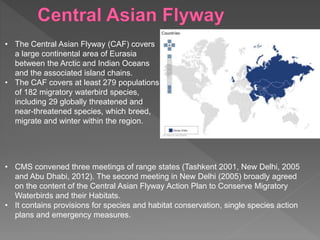
• The Central Asian Flyway (CAF) covers
a large continental area of Eurasia
between the Arctic and Indian Oceans
and the associated island chains.
• The CAF covers at least 279 populations
of 182 migratory waterbird species,
including 29 globally threatened and
near-threatened species, which breed,
migrate and winter within the region.
• CMS convened three meetings of range states (Tashkent 2001, New Delhi, 2005
and Abu Dhabi, 2012). The second meeting in New Delhi (2005) broadly agreed
on the content of the Central Asian Flyway Action Plan to Conserve Migratory
Waterbirds and their Habitats.
• It contains provisions for species and habitat conservation, single species action
plans and emergency measures.
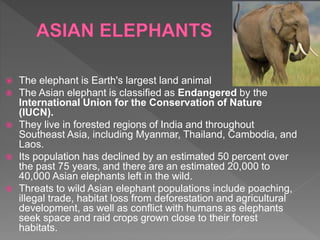
 The elephant is Earth's largest land animal
 The Asian elephant is classified as Endangered by the
International Union for the Conservation of Nature
(IUCN).
 They live in forested regions of India and throughout
Southeast Asia, including Myanmar, Thailand, Cambodia, and
Laos.
 Its population has declined by an estimated 50 percent over
the past 75 years, and there are an estimated 20,000 to
40,000 Asian elephants left in the wild.
 Threats to wild Asian elephant populations include poaching,
illegal trade, habitat loss from deforestation and agricultural
development, as well as conflict with humans as elephants
seek space and raid crops grown close to their forest
habitats.
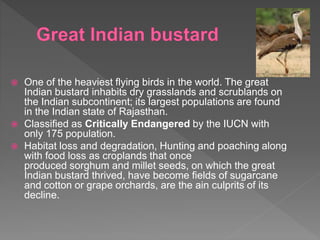
 One of the heaviest flying birds in the world. The great
Indian bustard inhabits dry grasslands and scrublands on
the Indian subcontinent; its largest populations are found
in the Indian state of Rajasthan.
 Classified as Critically Endangered by the IUCN with
only 175 population.
 Habitat loss and degradation, Hunting and poaching along
with food loss as croplands that once
produced sorghum and millet seeds, on which the great
Indian bustard thrived, have become fields of sugarcane
and cotton or grape orchards, are the ain culprits of its
decline.
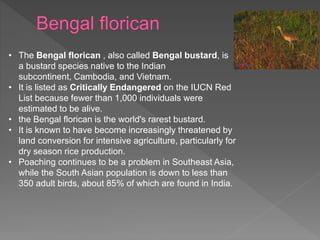
• The Bengal florican , also called Bengal bustard, is
a bustard species native to the Indian
subcontinent, Cambodia, and Vietnam.
• It is listed as Critically Endangered on the IUCN Red
List because fewer than 1,000 individuals were
estimated to be alive.
• the Bengal florican is the world's rarest bustard.
• It is known to have become increasingly threatened by
land conversion for intensive agriculture, particularly for
dry season rice production.
• Poaching continues to be a problem in Southeast Asia,
while the South Asian population is down to less than
350 adult birds, about 85% of which are found in India.

Bonn Convention (CMS)

  • 2.
    • The Conventionon the Conservation of Migratory Species of Wild Animals, also known as the Convention on Migratory Species (CMS) or the Bonn Convention, is an international agreement that aims to conserve migratory species within their migratory ranges. • The Agreement was signed under the auspices of the United Nations Environment Programme and is concerned with conservation of wildlife and habitats on a global scale. • Signed in 1979 in Bonn, Germany, the Convention entered into force in 1983. • As of September 2019, there were 129 Member States to the Convention. • The depositary is the government of the Federal Republic of Germany.
  • 3.
     Appendix I– Endangered migratory species  Appendix I comprises migratory species that have been assessed as being in danger of extinction throughout all or a significant portion of their range.  The Conference of the Parties has further interpreted the term “endangered” as meaning “facing a very high risk of extinction in the wild in the near future”  Parties that are a Range State to a migratory species listed in Appendix I shall endeavor to strictly protect them by:  prohibiting the taking of such species, with very restricted scope for exceptions; conserving and where appropriate restoring their habitats; preventing, removing or mitigating obstacles to their migration and controlling other factors that might endanger them.
  • 4.
     Appendix II- Migratory species conserved through Agreements  Appendix II covers migratory species that have an unfavourable conservation status and that require international agreements for their conservation and management, as well as those that have a conservation status which would significantly benefit from the international cooperation that could be achieved by an international agreement.  The Agreements may vary from legally binding treaties to less formal instruments, such as Memoranda of Understanding, Action Plans or Species Initiatives, covering to the extent possible the entire migratory range of the species concerned.  Appendices I and II may be amended at any meeting of the Conference of the Parties.
  • 5.
     The Conferenceof the Parties (COP) is the principal decision making body of the Convention.  It meets once every three years and sets the budget and priorities of the following three years (the triennium).  All the Parties are entitled to attend the Conference and participate in the votes. Non-Party States are entitled to send observers.  There have been 13 meetings of the Conference of the Parties so far.  The first COP in 1985 established a Standing Committee, whose task is to oversee the running of the Convention and the Secretariat between sessions of the COP.  Its membership comprises the elected regional representatives of the Parties, plus the Depositary Government (Germany) and the Host Governments of the previous and next COPs.
  • 6.
    • CMS COP13was the largest ever in the history of the Convention, with 2,550 people attended it. • The mascot of COP13 is Great Indian Bustard. • CMS COP13 also adopted the Gandhinagar Declaration. • The Declaration calls for migratory species and the concept of ‘ecological connectivity’ to be integrated and prioritized in the new Framework, which is expected to be adopted at the UN Biodiversity Conference in October. • The first ever report on the Status of Migratory Species, presented to CMS COP13, shows that despite some success stories, the populations of most migratory species covered by CMS are declining. • COP13 agreed that a more comprehensive review should be undertaken to better understand the status of individual species and the main threats they face.
  • 7.
    The COP alsoagreed on a number of cross-cutting policy measures to address threats to migratory species:  Integrate biodiversity and migratory species considerations into national energy and climate policy and promote wildlife-friendly renewable energy;  Strengthen initiatives to combat the illegal killing, taking and trade of migratory birds;  Mitigate the impacts of linear infrastructure such as roads and railways on migratory species;  Address the unsustainable use of aquatic wild meat;  Undertake a review of bycatch levels of sharks and rays, and further implement bycatch mitigation measures for marine mammals in national fishing operations;  Deepen our understanding of the importance of animal culture and social complexity for the conservation of endangered species;  To investigate possible trade in CMS Appendix I species and the implications for their conservation status.
  • 8.
    • Three CMSAmbassadors - for terrestrial, avian, and aquatic species - were named at the re-launch of the CMS Ambassadors Programme: the internationally renowned conservationist Ian Redmond OBE (for terrestrial), award- winning explorer and environmentalist Sacha Dench (for avian), and Indian actor and environmental activist Randeep Hooda (for aquatic). They will help raise awareness about the important work of CMS and the plight of migratory species. • Seven Migratory Species Champions were recognized. Under the Champion Program, Germany, India, Italy, Monaco, Norway, the European Commission, and the Environment Agency – Abu Dhabi were acknowledged for their generous contributions to CMS initiatives. These range from wildlife conservation in Africa to the implementation of measures to preserve marine life. • This was the first CMS COP to be inaugurated by a host-country Head of Government. • Two sets of commemorative stamps were issued at COP13. A special set of UN stamps featuring endangered migratory species and the Government of India also issued a special stamp edition featuring the Great Indian Bustard • India, as COP13 host, will assume the role of COP Presidency for the next three years.
  • 9.
     Ten newspecies were added to CMS Appendices at COP13.  Seven species were added to Appendix I: the Asian Elephant, Jaguar, Great Indian Bustard, Bengal Florican, Little Bustard, Antipodean Albatross and the Oceanic White-tip Shark.  The Urial, Smooth Hammerhead Shark and the Tope Shark were listed for protection under Appendix II.  New and extended Concerted Actions with targeted conservation plans were agreed for 14 species.
  • 10.
     India isa signatory to the CMS since 1983.  India is temporary home to several migratory animals and birds. The important among these include Amur Falcons, Bar headed Geese, Black necked cranes, Marine turtles, Dugongs, Humpbacked Whales, etc.  The Indian sub-continent is also part of the major bird flyway network, i.e, the Central Asian Flyway (CAF) that covers areas between the Arctic and Indian Oceans, and covers at least 279 populations of 182 migratory water bird species, including 29 globally threatened species.  India has also launched the National Action Plan for conservation of migratory species under the Central Asian Flyway.  India has developed and is implementing the ‘National Conservation Action Plans of Dugongs, Great Indian Bustard, Sea Turtles and Amur Falcons’.  A total of 868 protected areas have been established in India as on 1 March, 2019, including 104 national parks, 550 wildlife sanctuaries, 87 conservation reserves and 127 community reserves. Besides, 27 wetlands have been designated as Ramsar sites which give maximum protection for wildlife including several migratory species.
  • 11.
     India hasbeen monitoring the birds and mammals of Antarctica and Southern Indian Ocean through its 'Antarctica Program'. Most migratory birds of India have been listed under various Schedules of the Wild Life (Protection) Act, 1972 thereby according them protection against hunting and trade.  India has already chosen the threatened dugong, marine turtles, coral reefs and mangroves under its ‘Integrated Development of Wildlife Habitats’ program on a priority basis.  45 Indian species listed in Appendix I of CMS.  India is also signatory to the following Agreements/MoUs under CMS - Siberian Crane MoU (1993/1999) It was the first MoU to be concluded under the auspices of the CMS, and focuses on conserving the Siberian crane as one of the three rarest crane species. The MoU covers twelve range states (Afghanistan, Azerbaijan, China, India, Islamic Republic of Iran, Japan, Kazakhstan, Mongolia, Pakistan, Russian Federation, Turkmenistan and Uzbekistan).
  • 12.
    IOSEA Marine TurtlesMoU (2001) Geographic coverage of this MoU is the Waters and coastal States of the Indian Ocean and South-East Asia and adjacent seas, extending eastwards to the Torres Strait. There are 44 States in the Agreement area. India entered this MoU on 20th February 2007. Dugong MoU (2007) MoU on the Conservation and Management of Dugongs and their Habitats throughout their Range entered into force on 31 October 2007 after being signed by 7 range states (Australia, Eritrea, France, Madagascar, Myanmar, the United Arab Emirates and the United Republic of Tanzania) and they have since been joined by four additional signatories (India, the Comores, Kenya and the Philippines) to raise the number of signatories to 11 range states to date. Central Asian Flyway Action Plan for the conservation of Migratory Waterbirds and their habitats. Raptor MoU / Memorandum of Understanding on the Conservation of Migratory Birds of Prey in Africa and Eurasia. It covers 93 species of birds of prey under its ambit and an action plan has been formulated under it that envisages the conservation action for Raptor species. Of the total 93 species of birds that fall in Raptor MoU, 50 species occur in India including vultures, falcons, eagles, hawks, kites, harriers and owls.
  • 13.
     National ActionPlan for conservation of Migratory birds along the Central Asian Flyway (CAF)  Policy for Eco-tourism in Forest and Wildlife Areas  National Framework and Guidelines for Managing Marine Stranding  National Conservation Strategy and Action Plan for the Sea Turtles and their Habitats in India  Asiatic Lion Conservation Project  Third National Wildlife Action Plan 2017-31  Trans-boundary Protected Areas
  • 14.
    • The CentralAsian Flyway (CAF) covers a large continental area of Eurasia between the Arctic and Indian Oceans and the associated island chains. • The CAF covers at least 279 populations of 182 migratory waterbird species, including 29 globally threatened and near-threatened species, which breed, migrate and winter within the region. • CMS convened three meetings of range states (Tashkent 2001, New Delhi, 2005 and Abu Dhabi, 2012). The second meeting in New Delhi (2005) broadly agreed on the content of the Central Asian Flyway Action Plan to Conserve Migratory Waterbirds and their Habitats. • It contains provisions for species and habitat conservation, single species action plans and emergency measures.
  • 15.
     The elephantis Earth's largest land animal  The Asian elephant is classified as Endangered by the International Union for the Conservation of Nature (IUCN).  They live in forested regions of India and throughout Southeast Asia, including Myanmar, Thailand, Cambodia, and Laos.  Its population has declined by an estimated 50 percent over the past 75 years, and there are an estimated 20,000 to 40,000 Asian elephants left in the wild.  Threats to wild Asian elephant populations include poaching, illegal trade, habitat loss from deforestation and agricultural development, as well as conflict with humans as elephants seek space and raid crops grown close to their forest habitats.
  • 16.
     One ofthe heaviest flying birds in the world. The great Indian bustard inhabits dry grasslands and scrublands on the Indian subcontinent; its largest populations are found in the Indian state of Rajasthan.  Classified as Critically Endangered by the IUCN with only 175 population.  Habitat loss and degradation, Hunting and poaching along with food loss as croplands that once produced sorghum and millet seeds, on which the great Indian bustard thrived, have become fields of sugarcane and cotton or grape orchards, are the ain culprits of its decline.
  • 17.
    • The Bengalflorican , also called Bengal bustard, is a bustard species native to the Indian subcontinent, Cambodia, and Vietnam. • It is listed as Critically Endangered on the IUCN Red List because fewer than 1,000 individuals were estimated to be alive. • the Bengal florican is the world's rarest bustard. • It is known to have become increasingly threatened by land conversion for intensive agriculture, particularly for dry season rice production. • Poaching continues to be a problem in Southeast Asia, while the South Asian population is down to less than 350 adult birds, about 85% of which are found in India.